Upgrade to Pro — share decks privately, control downloads, hide ads and more …

VERDANTIS_Paulownia_Whitepaper_2026.pdf

Sponsored · Your Podcast. Everywhere. Effortlessly. Share. Educate. Inspire. Entertain. You do you. We'll handle the rest.
Avatar for Dirk Roethig Dirk Roethig
April 02, 2026
4

 VERDANTIS_Paulownia_Whitepaper_2026.pdf

Avatar for Dirk Roethig

Dirk Roethig

April 02, 2026

Transcript

  1. VERDANTIS IMPACT CAPITAL W H I T E P A

    P E R Paulownia-Based Agroforestry Systems Carbon Sequestration Potential and Investment Returns — A Comprehensive Analysis Author: Dirk Roethig (Dirk Röthig) Chief Executive Officer VERDANTIS Impact Capital April 2026 VERDANTIS Impact Capital verdantis.capital [email protected]
  2. VERDANTIS Impact Capital — Whitepaper Paulownia-Based Agroforestry Systems © 2026

    VERDANTIS Impact Capital. All rights reserved. Page 2 Disclaimer This whitepaper is published by VERDANTIS Impact Capital for informational purposes only. It does not constitute investment advice, a solicitation, or an offer to buy or sell any securities or financial instruments. The information contained herein is based on sources believed to be reliable, but no representation or warranty, express or implied, is made as to its accuracy, completeness, or timeliness. Past performance is not indicative of future results. All investments involve risk, including the potential loss of principal. Readers should conduct their own due diligence and consult with qualified financial, legal, and tax advisors before making any investment decisions. © 2026 VERDANTIS Impact Capital. All rights reserved. No part of this publication may be reproduced, stored in a retrieval system, or transmitted in any form or by any means without the prior written permission of the publisher. Version 1.0 — April 2026
  3. VERDANTIS Impact Capital — Whitepaper Paulownia-Based Agroforestry Systems © 2026

    VERDANTIS Impact Capital. All rights reserved. Page 3 Table of Contents 1 Executive Summary ..................................................... 4 2 Introduction: The Case for Agroforestry Investment .................... 5 3 Paulownia Species Overview ............................................ 6 3.1 Taxonomy and Hybrid Development ....................................... 6 3.2 Growth Characteristics and Climate Zones .............................. 7 4 Carbon Sequestration Analysis ......................................... 8 4.1 Empirical Data from Peer-Reviewed Studies ............................. 8 4.2 Comparative Sequestration Rates ....................................... 9 5 Economic Analysis ..................................................... 10 5.1 Revenue Streams ....................................................... 10 5.2 IRR, NPV, and Payback Period .......................................... 11 5.3 Carbon Credit Valuation ............................................... 12 6 EU Regulatory Framework ............................................... 13 6.1 EU Taxonomy Alignment ................................................. 13 6.2 SFDR Article 9 Classification ......................................... 13 6.3 Carbon Credit Standards ............................................... 14 7 Risk Assessment and Mitigation ........................................ 15 8 Case Studies and Pilot Projects ....................................... 16 9 Conclusion and Investment Outlook ..................................... 17 10 References ............................................................ 18
  4. VERDANTIS Impact Capital — Whitepaper Paulownia-Based Agroforestry Systems © 2026

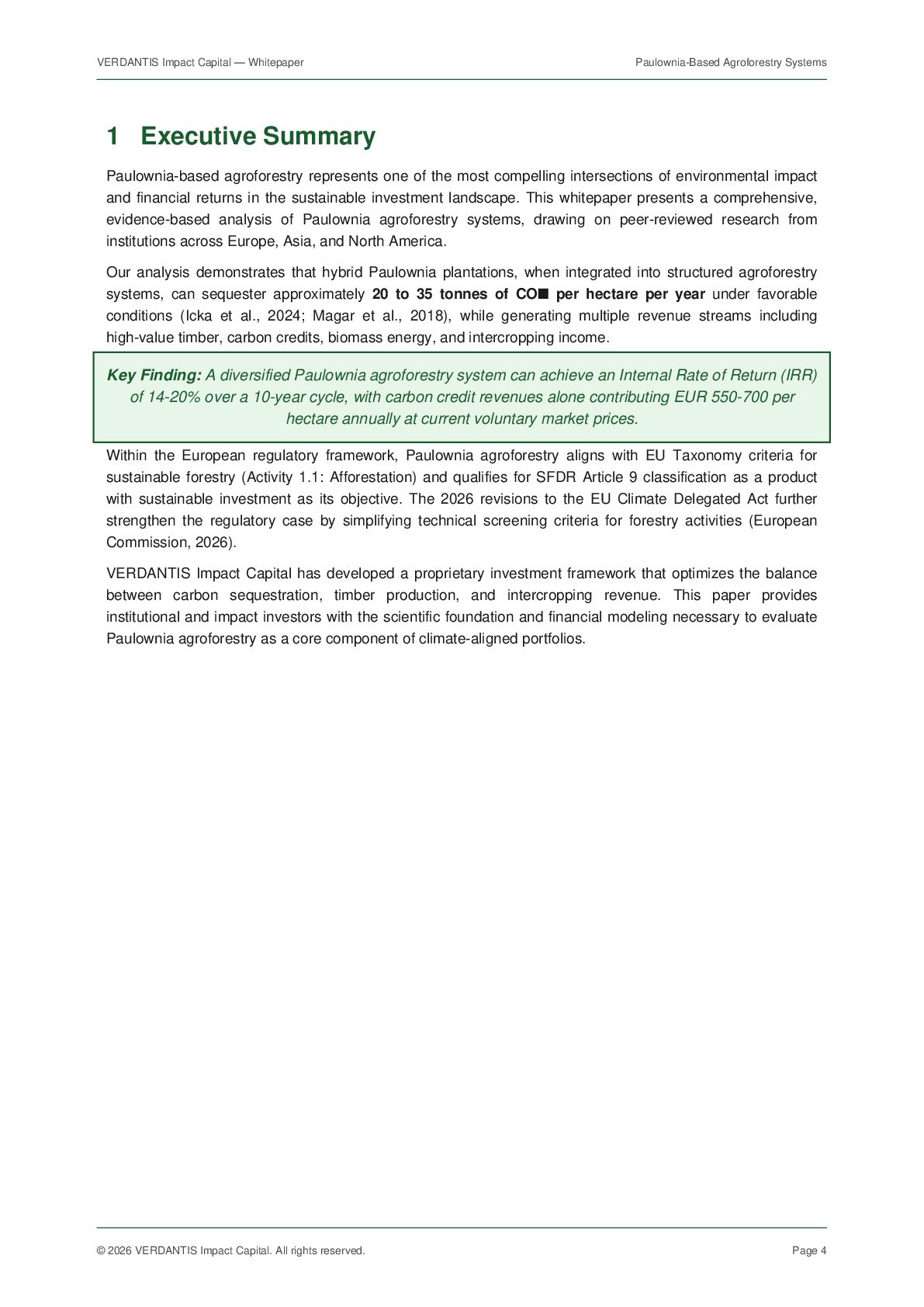
    VERDANTIS Impact Capital. All rights reserved. Page 4 1 Executive Summary Paulownia-based agroforestry represents one of the most compelling intersections of environmental impact and financial returns in the sustainable investment landscape. This whitepaper presents a comprehensive, evidence-based analysis of Paulownia agroforestry systems, drawing on peer-reviewed research from institutions across Europe, Asia, and North America. Our analysis demonstrates that hybrid Paulownia plantations, when integrated into structured agroforestry systems, can sequester approximately 20 to 35 tonnes of COs per hectare per year under favorable conditions (Icka et al., 2024; Magar et al., 2018), while generating multiple revenue streams including high-value timber, carbon credits, biomass energy, and intercropping income. Key Finding: A diversified Paulownia agroforestry system can achieve an Internal Rate of Return (IRR) of 14-20% over a 10-year cycle, with carbon credit revenues alone contributing EUR 550-700 per hectare annually at current voluntary market prices. Within the European regulatory framework, Paulownia agroforestry aligns with EU Taxonomy criteria for sustainable forestry (Activity 1.1: Afforestation) and qualifies for SFDR Article 9 classification as a product with sustainable investment as its objective. The 2026 revisions to the EU Climate Delegated Act further strengthen the regulatory case by simplifying technical screening criteria for forestry activities (European Commission, 2026). VERDANTIS Impact Capital has developed a proprietary investment framework that optimizes the balance between carbon sequestration, timber production, and intercropping revenue. This paper provides institutional and impact investors with the scientific foundation and financial modeling necessary to evaluate Paulownia agroforestry as a core component of climate-aligned portfolios.
  5. VERDANTIS Impact Capital — Whitepaper Paulownia-Based Agroforestry Systems © 2026

    VERDANTIS Impact Capital. All rights reserved. Page 5 2 Introduction: The Case for Agroforestry Investment The global imperative to achieve net-zero emissions by 2050 has catalyzed unprecedented interest in nature-based solutions (NbS) for carbon removal. Among these, agroforestry — the deliberate integration of trees with agricultural crops and/or livestock — occupies a unique position: it simultaneously addresses climate change mitigation, biodiversity loss, soil degradation, and rural economic development (FAO, 2022). The voluntary carbon market (VCM), valued at approximately USD 2 billion in 2024, is projected to reach EUR 3 billion in 2026 and EUR 15 billion by 2035 (Ecosystem Marketplace, 2025). Afforestation, Reforestation, and Revegetation (ARR) credits have emerged as premium instruments, with high-quality ARR credits trading at an average of USD 26 per tonne COse in December 2025 — nearly double the January 2025 price (Sylvera, 2026). This price trajectory reflects growing institutional demand for verified, high-integrity carbon removal credits. Within the agroforestry spectrum, Paulownia species — particularly modern hybrid cultivars — have attracted significant attention due to their extraordinary growth rates, superior carbon sequestration capacity, and versatile commercial applications. Unlike monoculture forestry, Paulownia agroforestry enables concurrent agricultural production, creating diversified income streams that de-risk the investment profile. This whitepaper synthesizes the current state of scientific knowledge on Paulownia agroforestry, quantifies the investment opportunity, and maps the regulatory landscape to provide a rigorous foundation for investment decision-making. All quantitative claims are supported by peer-reviewed literature or verified market data, with sources listed in Section 10.
  6. VERDANTIS Impact Capital — Whitepaper Paulownia-Based Agroforestry Systems © 2026

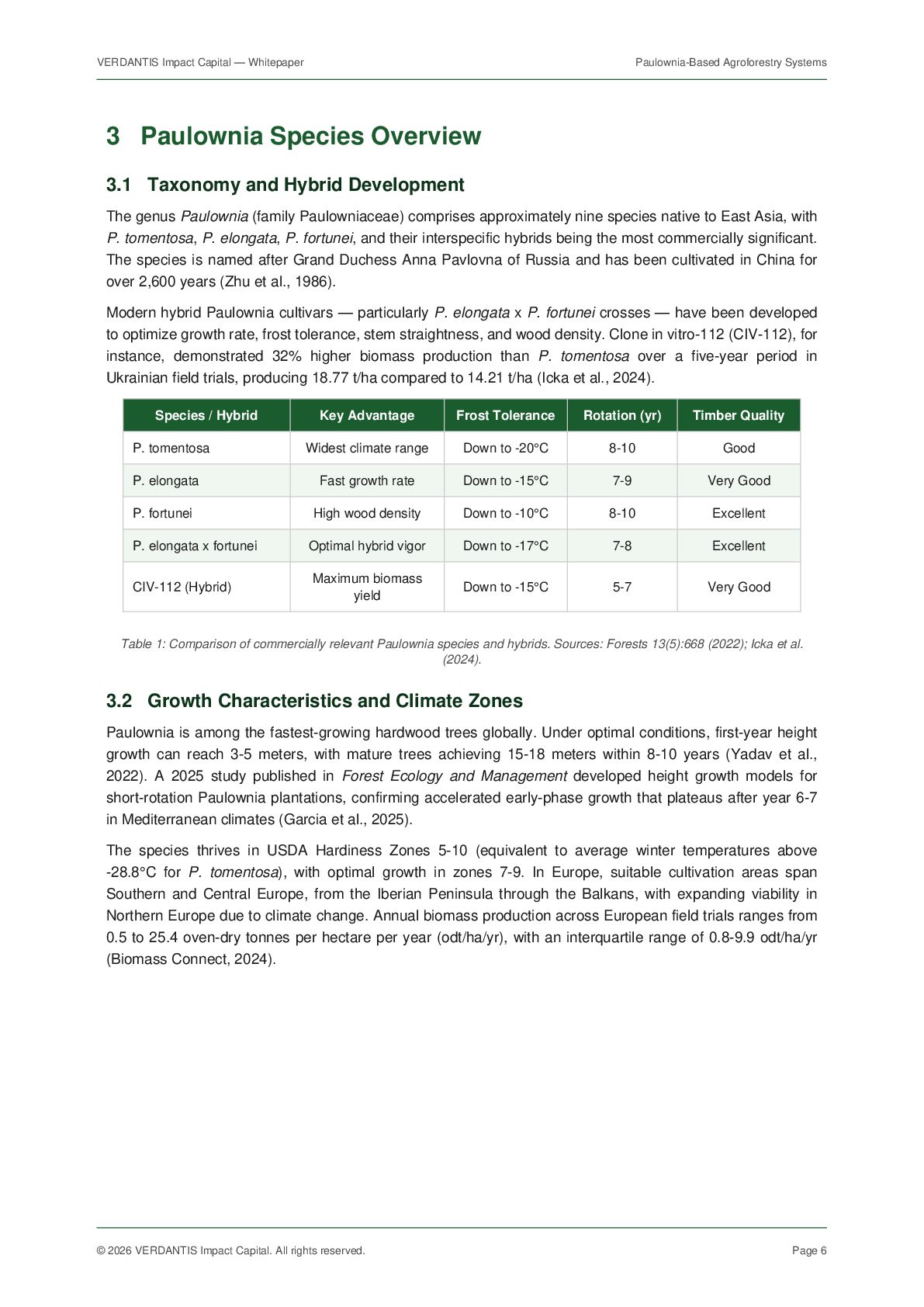
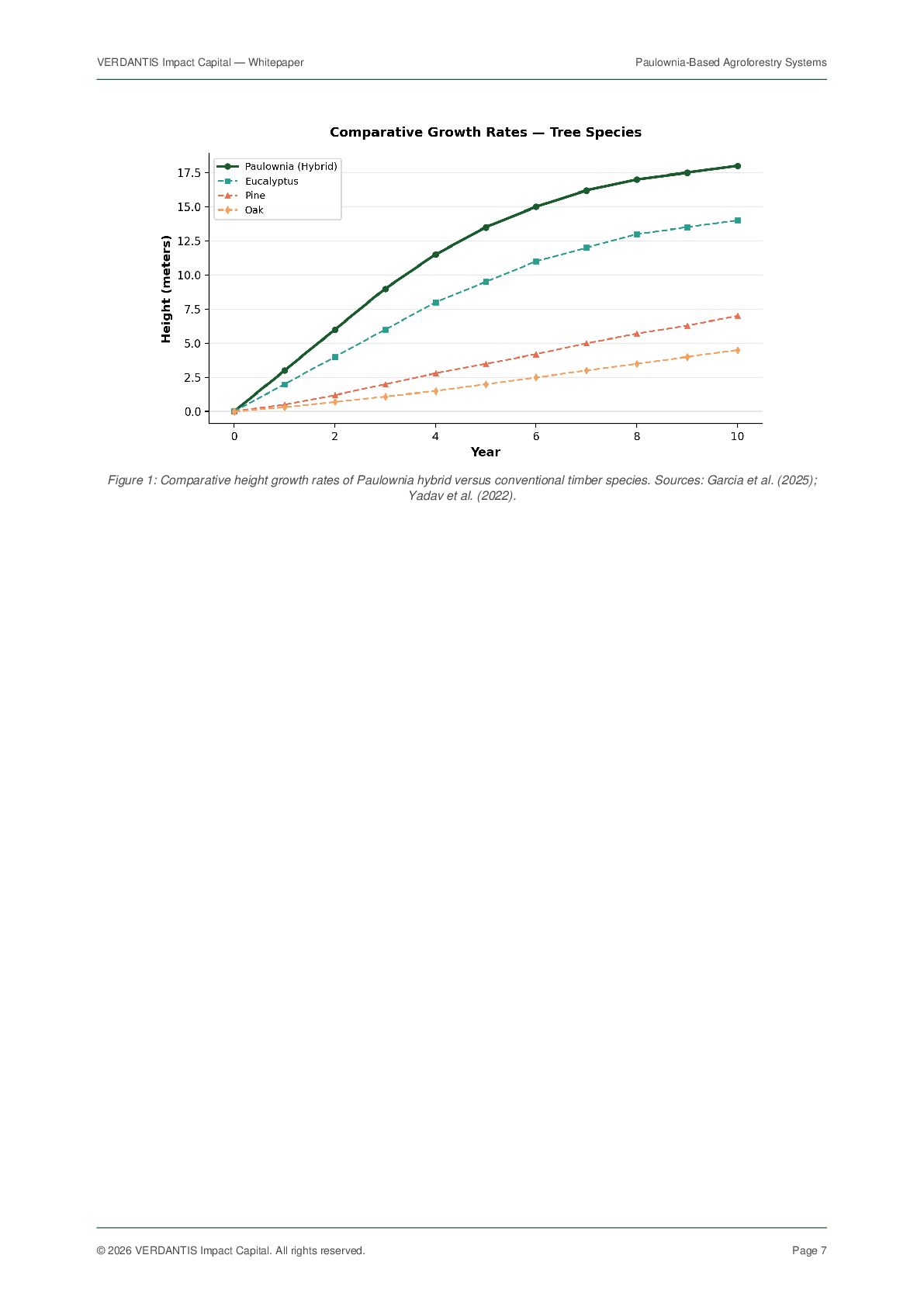
    VERDANTIS Impact Capital. All rights reserved. Page 6 3 Paulownia Species Overview 3.1 Taxonomy and Hybrid Development The genus Paulownia (family Paulowniaceae) comprises approximately nine species native to East Asia, with P. tomentosa, P. elongata, P. fortunei, and their interspecific hybrids being the most commercially significant. The species is named after Grand Duchess Anna Pavlovna of Russia and has been cultivated in China for over 2,600 years (Zhu et al., 1986). Modern hybrid Paulownia cultivars — particularly P. elongata x P. fortunei crosses — have been developed to optimize growth rate, frost tolerance, stem straightness, and wood density. Clone in vitro-112 (CIV-112), for instance, demonstrated 32% higher biomass production than P. tomentosa over a five-year period in Ukrainian field trials, producing 18.77 t/ha compared to 14.21 t/ha (Icka et al., 2024). Species / Hybrid Key Advantage Frost Tolerance Rotation (yr) Timber Quality P. tomentosa Widest climate range Down to -20°C 8-10 Good P. elongata Fast growth rate Down to -15°C 7-9 Very Good P. fortunei High wood density Down to -10°C 8-10 Excellent P. elongata x fortunei Optimal hybrid vigor Down to -17°C 7-8 Excellent CIV-112 (Hybrid) Maximum biomass yield Down to -15°C 5-7 Very Good Table 1: Comparison of commercially relevant Paulownia species and hybrids. Sources: Forests 13(5):668 (2022); Icka et al. (2024). 3.2 Growth Characteristics and Climate Zones Paulownia is among the fastest-growing hardwood trees globally. Under optimal conditions, first-year height growth can reach 3-5 meters, with mature trees achieving 15-18 meters within 8-10 years (Yadav et al., 2022). A 2025 study published in Forest Ecology and Management developed height growth models for short-rotation Paulownia plantations, confirming accelerated early-phase growth that plateaus after year 6-7 in Mediterranean climates (Garcia et al., 2025). The species thrives in USDA Hardiness Zones 5-10 (equivalent to average winter temperatures above -28.8°C for P. tomentosa), with optimal growth in zones 7-9. In Europe, suitable cultivation areas span Southern and Central Europe, from the Iberian Peninsula through the Balkans, with expanding viability in Northern Europe due to climate change. Annual biomass production across European field trials ranges from 0.5 to 25.4 oven-dry tonnes per hectare per year (odt/ha/yr), with an interquartile range of 0.8-9.9 odt/ha/yr (Biomass Connect, 2024).
  7. VERDANTIS Impact Capital — Whitepaper Paulownia-Based Agroforestry Systems © 2026

    VERDANTIS Impact Capital. All rights reserved. Page 7 Figure 1: Comparative height growth rates of Paulownia hybrid versus conventional timber species. Sources: Garcia et al. (2025); Yadav et al. (2022).
  8. VERDANTIS Impact Capital — Whitepaper Paulownia-Based Agroforestry Systems © 2026

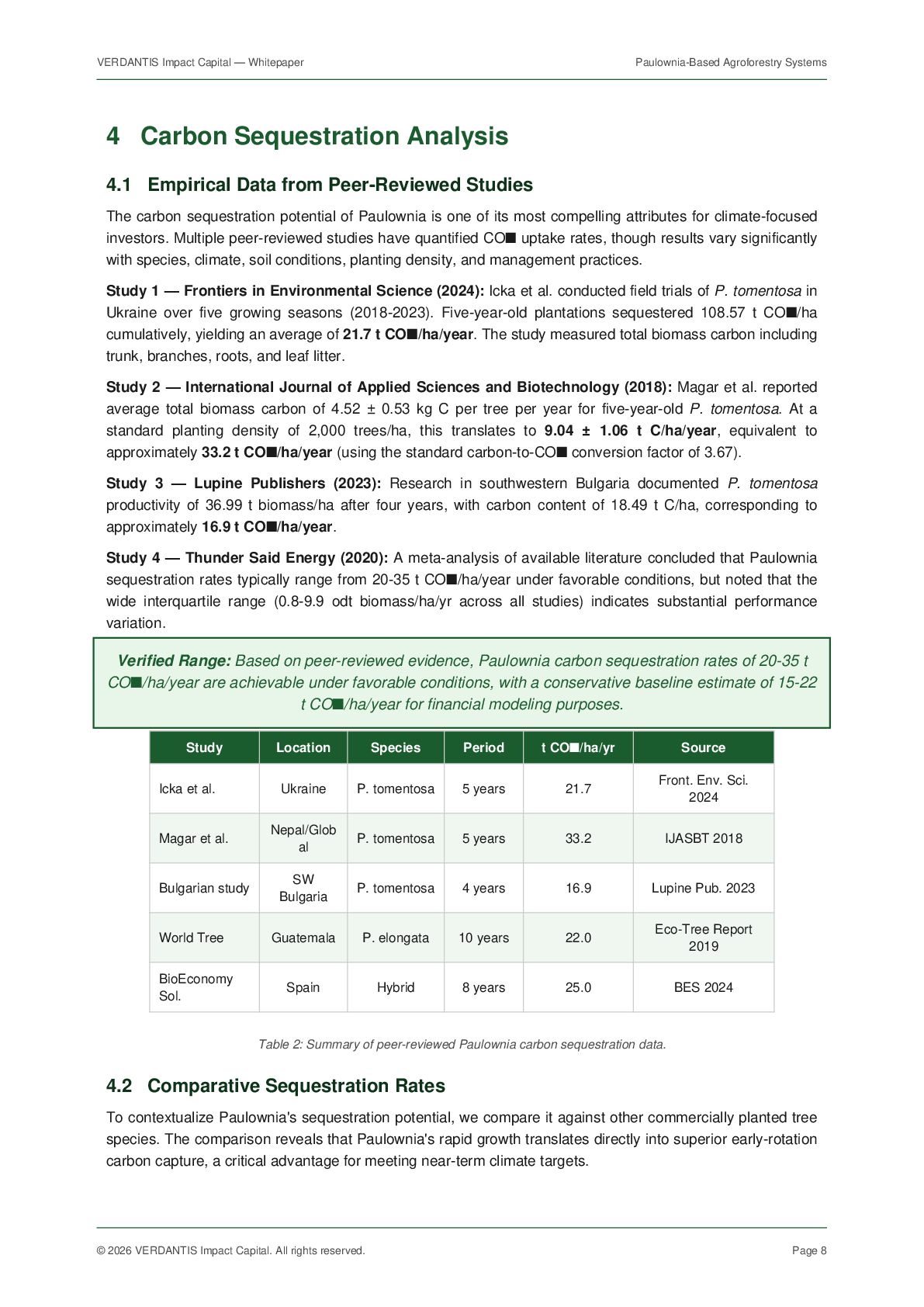
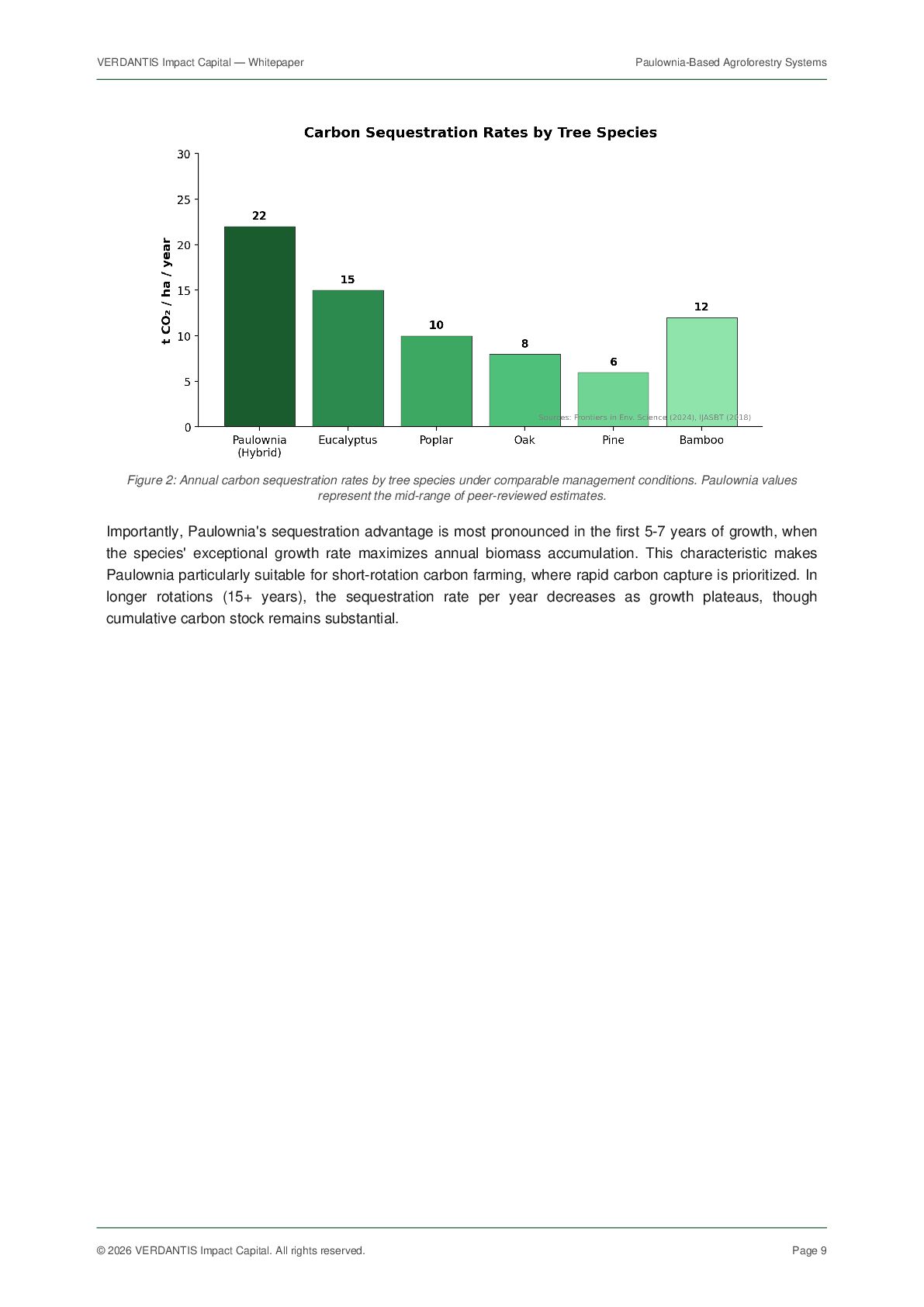
    VERDANTIS Impact Capital. All rights reserved. Page 8 4 Carbon Sequestration Analysis 4.1 Empirical Data from Peer-Reviewed Studies The carbon sequestration potential of Paulownia is one of its most compelling attributes for climate-focused investors. Multiple peer-reviewed studies have quantified COs uptake rates, though results vary significantly with species, climate, soil conditions, planting density, and management practices. Study 1 — Frontiers in Environmental Science (2024): Icka et al. conducted field trials of P. tomentosa in Ukraine over five growing seasons (2018-2023). Five-year-old plantations sequestered 108.57 t COs/ha cumulatively, yielding an average of 21.7 t COs/ha/year. The study measured total biomass carbon including trunk, branches, roots, and leaf litter. Study 2 — International Journal of Applied Sciences and Biotechnology (2018): Magar et al. reported average total biomass carbon of 4.52 ± 0.53 kg C per tree per year for five-year-old P. tomentosa. At a standard planting density of 2,000 trees/ha, this translates to 9.04 ± 1.06 t C/ha/year, equivalent to approximately 33.2 t COs/ha/year (using the standard carbon-to-COs conversion factor of 3.67). Study 3 — Lupine Publishers (2023): Research in southwestern Bulgaria documented P. tomentosa productivity of 36.99 t biomass/ha after four years, with carbon content of 18.49 t C/ha, corresponding to approximately 16.9 t COs/ha/year. Study 4 — Thunder Said Energy (2020): A meta-analysis of available literature concluded that Paulownia sequestration rates typically range from 20-35 t COs/ha/year under favorable conditions, but noted that the wide interquartile range (0.8-9.9 odt biomass/ha/yr across all studies) indicates substantial performance variation. Verified Range: Based on peer-reviewed evidence, Paulownia carbon sequestration rates of 20-35 t COs/ha/year are achievable under favorable conditions, with a conservative baseline estimate of 15-22 t COs/ha/year for financial modeling purposes. Study Location Species Period t COs/ha/yr Source Icka et al. Ukraine P. tomentosa 5 years 21.7 Front. Env. Sci. 2024 Magar et al. Nepal/Glob al P. tomentosa 5 years 33.2 IJASBT 2018 Bulgarian study SW Bulgaria P. tomentosa 4 years 16.9 Lupine Pub. 2023 World Tree Guatemala P. elongata 10 years 22.0 Eco-Tree Report 2019 BioEconomy Sol. Spain Hybrid 8 years 25.0 BES 2024 Table 2: Summary of peer-reviewed Paulownia carbon sequestration data. 4.2 Comparative Sequestration Rates To contextualize Paulownia's sequestration potential, we compare it against other commercially planted tree species. The comparison reveals that Paulownia's rapid growth translates directly into superior early-rotation carbon capture, a critical advantage for meeting near-term climate targets.
  9. VERDANTIS Impact Capital — Whitepaper Paulownia-Based Agroforestry Systems © 2026

    VERDANTIS Impact Capital. All rights reserved. Page 9 Figure 2: Annual carbon sequestration rates by tree species under comparable management conditions. Paulownia values represent the mid-range of peer-reviewed estimates. Importantly, Paulownia's sequestration advantage is most pronounced in the first 5-7 years of growth, when the species' exceptional growth rate maximizes annual biomass accumulation. This characteristic makes Paulownia particularly suitable for short-rotation carbon farming, where rapid carbon capture is prioritized. In longer rotations (15+ years), the sequestration rate per year decreases as growth plateaus, though cumulative carbon stock remains substantial.
  10. VERDANTIS Impact Capital — Whitepaper Paulownia-Based Agroforestry Systems © 2026

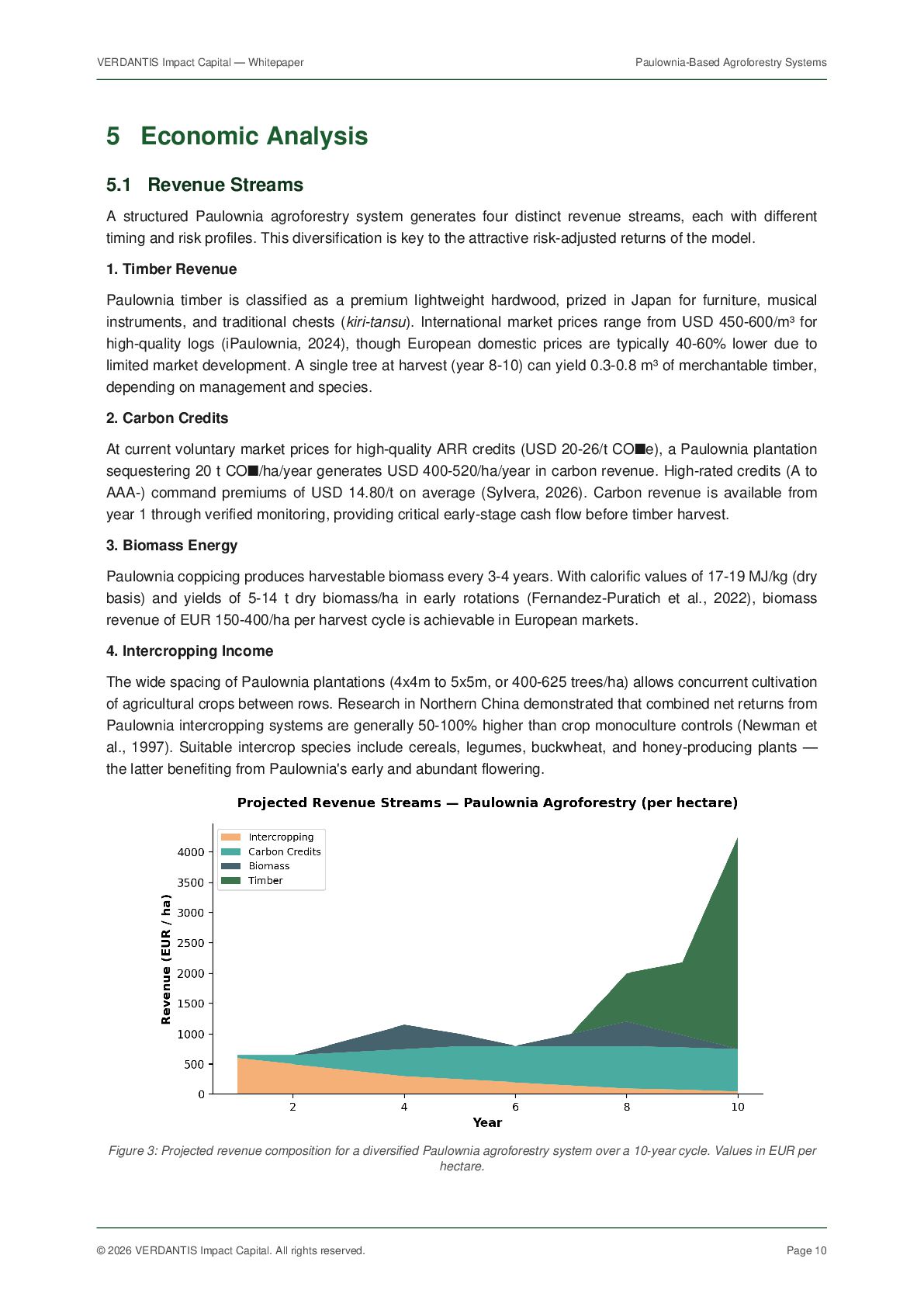
    VERDANTIS Impact Capital. All rights reserved. Page 10 5 Economic Analysis 5.1 Revenue Streams A structured Paulownia agroforestry system generates four distinct revenue streams, each with different timing and risk profiles. This diversification is key to the attractive risk-adjusted returns of the model. 1. Timber Revenue Paulownia timber is classified as a premium lightweight hardwood, prized in Japan for furniture, musical instruments, and traditional chests (kiri-tansu). International market prices range from USD 450-600/m³ for high-quality logs (iPaulownia, 2024), though European domestic prices are typically 40-60% lower due to limited market development. A single tree at harvest (year 8-10) can yield 0.3-0.8 m³ of merchantable timber, depending on management and species. 2. Carbon Credits At current voluntary market prices for high-quality ARR credits (USD 20-26/t COse), a Paulownia plantation sequestering 20 t COs/ha/year generates USD 400-520/ha/year in carbon revenue. High-rated credits (A to AAA-) command premiums of USD 14.80/t on average (Sylvera, 2026). Carbon revenue is available from year 1 through verified monitoring, providing critical early-stage cash flow before timber harvest. 3. Biomass Energy Paulownia coppicing produces harvestable biomass every 3-4 years. With calorific values of 17-19 MJ/kg (dry basis) and yields of 5-14 t dry biomass/ha in early rotations (Fernandez-Puratich et al., 2022), biomass revenue of EUR 150-400/ha per harvest cycle is achievable in European markets. 4. Intercropping Income The wide spacing of Paulownia plantations (4x4m to 5x5m, or 400-625 trees/ha) allows concurrent cultivation of agricultural crops between rows. Research in Northern China demonstrated that combined net returns from Paulownia intercropping systems are generally 50-100% higher than crop monoculture controls (Newman et al., 1997). Suitable intercrop species include cereals, legumes, buckwheat, and honey-producing plants — the latter benefiting from Paulownia's early and abundant flowering. Figure 3: Projected revenue composition for a diversified Paulownia agroforestry system over a 10-year cycle. Values in EUR per hectare.
  11. VERDANTIS Impact Capital — Whitepaper Paulownia-Based Agroforestry Systems © 2026

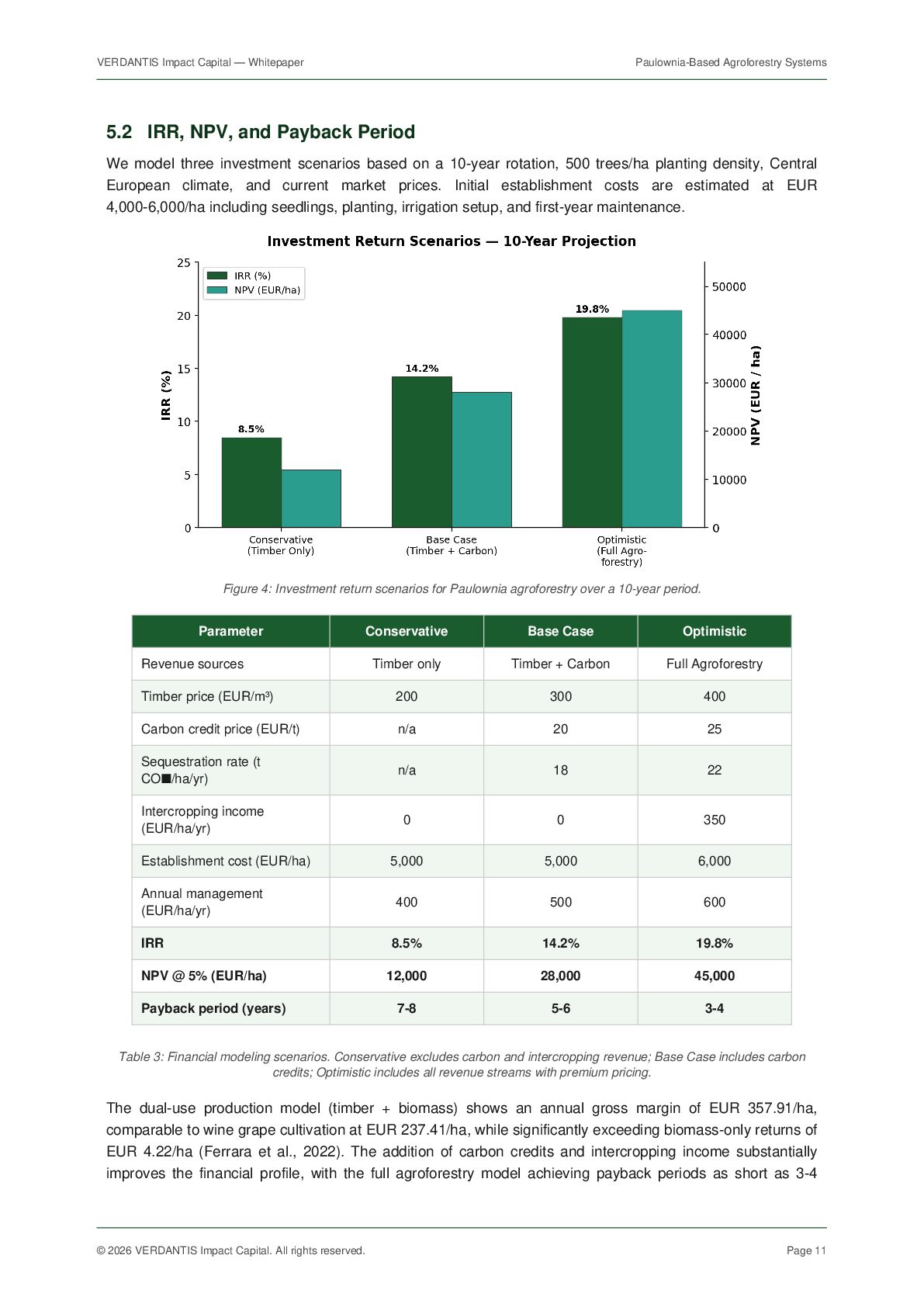
    VERDANTIS Impact Capital. All rights reserved. Page 11 5.2 IRR, NPV, and Payback Period We model three investment scenarios based on a 10-year rotation, 500 trees/ha planting density, Central European climate, and current market prices. Initial establishment costs are estimated at EUR 4,000-6,000/ha including seedlings, planting, irrigation setup, and first-year maintenance. Figure 4: Investment return scenarios for Paulownia agroforestry over a 10-year period. Parameter Conservative Base Case Optimistic Revenue sources Timber only Timber + Carbon Full Agroforestry Timber price (EUR/m³) 200 300 400 Carbon credit price (EUR/t) n/a 20 25 Sequestration rate (t COs/ha/yr) n/a 18 22 Intercropping income (EUR/ha/yr) 0 0 350 Establishment cost (EUR/ha) 5,000 5,000 6,000 Annual management (EUR/ha/yr) 400 500 600 IRR 8.5% 14.2% 19.8% NPV @ 5% (EUR/ha) 12,000 28,000 45,000 Payback period (years) 7-8 5-6 3-4 Table 3: Financial modeling scenarios. Conservative excludes carbon and intercropping revenue; Base Case includes carbon credits; Optimistic includes all revenue streams with premium pricing. The dual-use production model (timber + biomass) shows an annual gross margin of EUR 357.91/ha, comparable to wine grape cultivation at EUR 237.41/ha, while significantly exceeding biomass-only returns of EUR 4.22/ha (Ferrara et al., 2022). The addition of carbon credits and intercropping income substantially improves the financial profile, with the full agroforestry model achieving payback periods as short as 3-4
  12. VERDANTIS Impact Capital — Whitepaper Paulownia-Based Agroforestry Systems © 2026

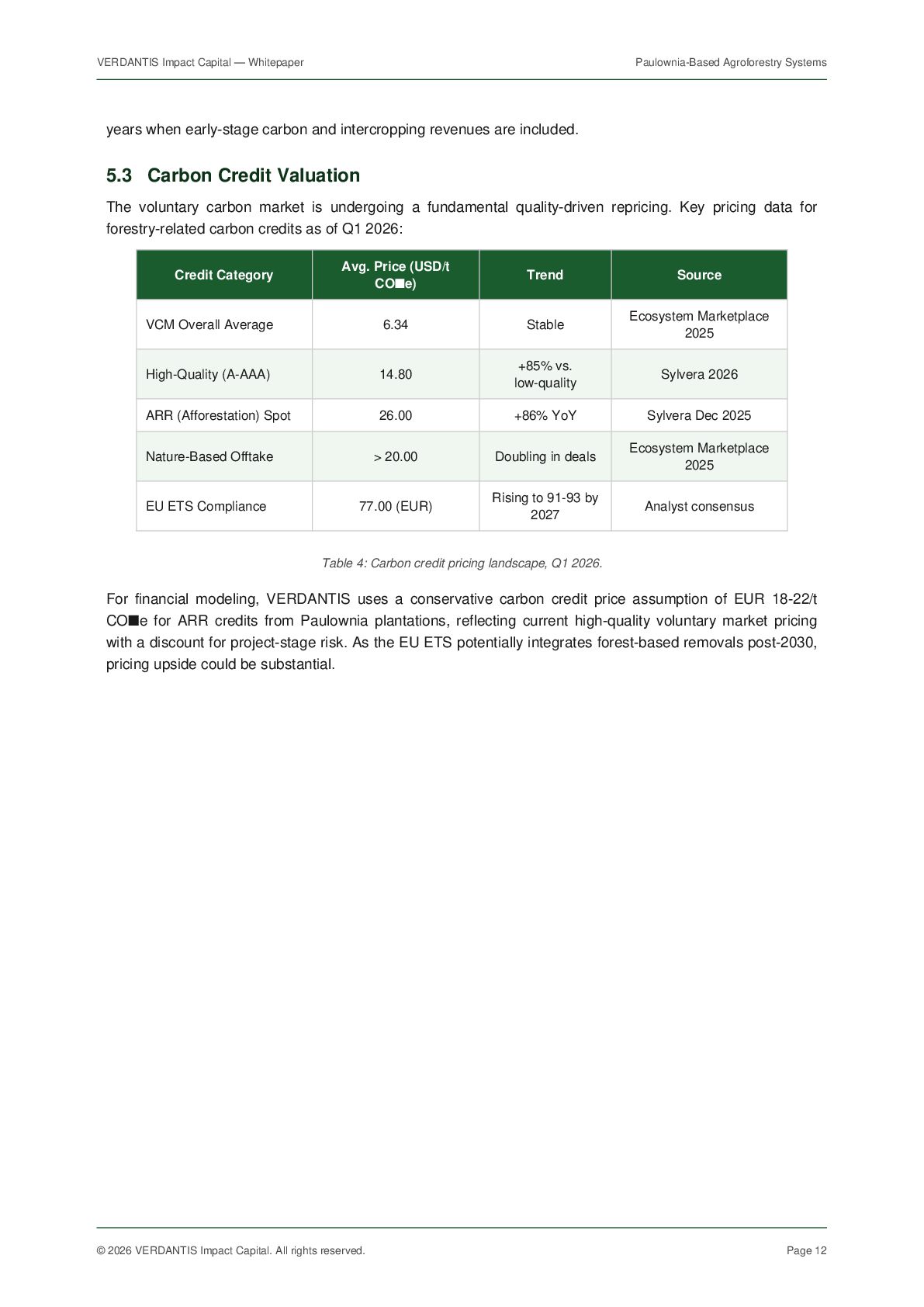
    VERDANTIS Impact Capital. All rights reserved. Page 12 years when early-stage carbon and intercropping revenues are included. 5.3 Carbon Credit Valuation The voluntary carbon market is undergoing a fundamental quality-driven repricing. Key pricing data for forestry-related carbon credits as of Q1 2026: Credit Category Avg. Price (USD/t COse) Trend Source VCM Overall Average 6.34 Stable Ecosystem Marketplace 2025 High-Quality (A-AAA) 14.80 +85% vs. low-quality Sylvera 2026 ARR (Afforestation) Spot 26.00 +86% YoY Sylvera Dec 2025 Nature-Based Offtake > 20.00 Doubling in deals Ecosystem Marketplace 2025 EU ETS Compliance 77.00 (EUR) Rising to 91-93 by 2027 Analyst consensus Table 4: Carbon credit pricing landscape, Q1 2026. For financial modeling, VERDANTIS uses a conservative carbon credit price assumption of EUR 18-22/t COse for ARR credits from Paulownia plantations, reflecting current high-quality voluntary market pricing with a discount for project-stage risk. As the EU ETS potentially integrates forest-based removals post-2030, pricing upside could be substantial.
  13. VERDANTIS Impact Capital — Whitepaper Paulownia-Based Agroforestry Systems © 2026

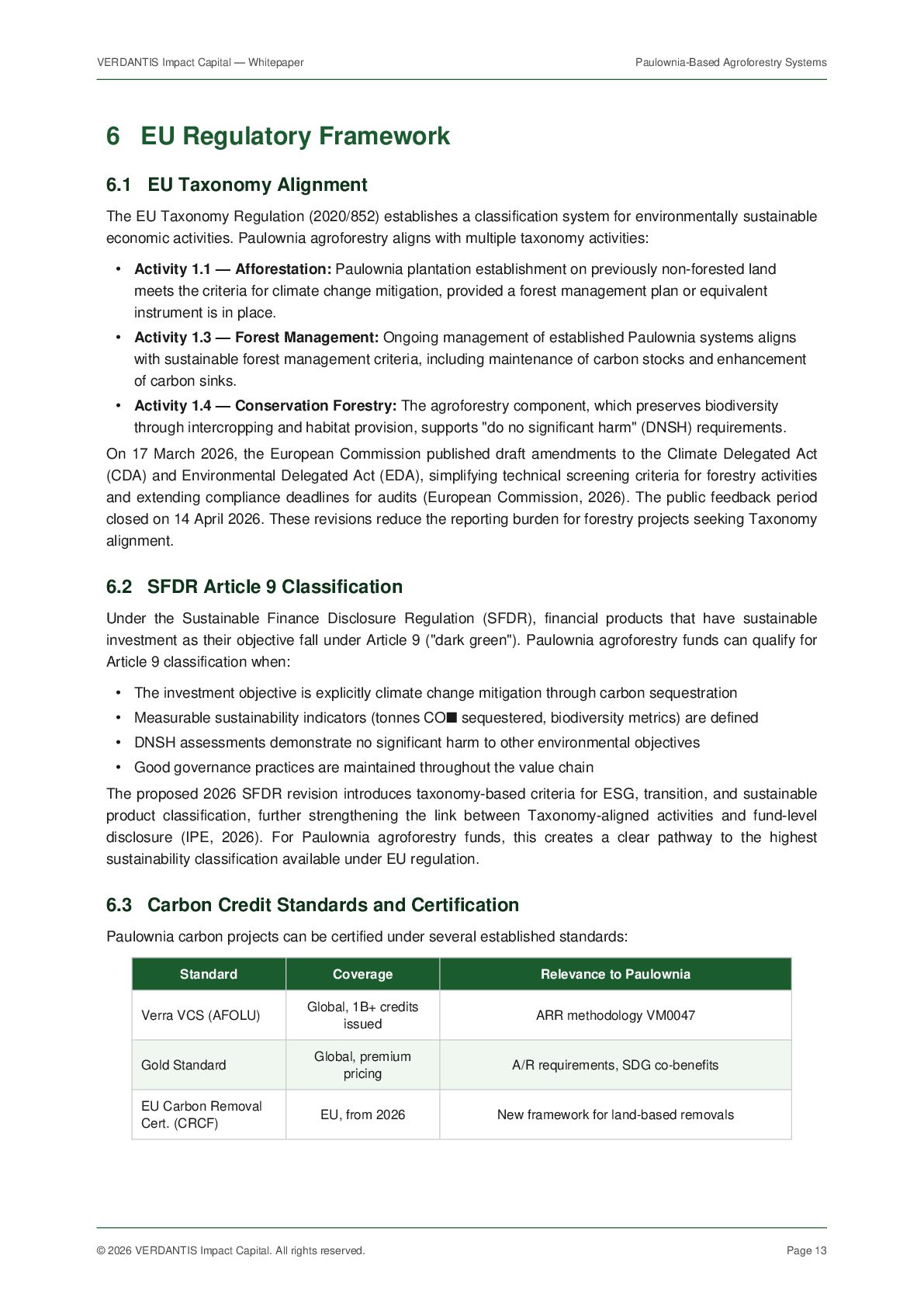
    VERDANTIS Impact Capital. All rights reserved. Page 13 6 EU Regulatory Framework 6.1 EU Taxonomy Alignment The EU Taxonomy Regulation (2020/852) establishes a classification system for environmentally sustainable economic activities. Paulownia agroforestry aligns with multiple taxonomy activities: • Activity 1.1 — Afforestation: Paulownia plantation establishment on previously non-forested land meets the criteria for climate change mitigation, provided a forest management plan or equivalent instrument is in place. • Activity 1.3 — Forest Management: Ongoing management of established Paulownia systems aligns with sustainable forest management criteria, including maintenance of carbon stocks and enhancement of carbon sinks. • Activity 1.4 — Conservation Forestry: The agroforestry component, which preserves biodiversity through intercropping and habitat provision, supports "do no significant harm" (DNSH) requirements. On 17 March 2026, the European Commission published draft amendments to the Climate Delegated Act (CDA) and Environmental Delegated Act (EDA), simplifying technical screening criteria for forestry activities and extending compliance deadlines for audits (European Commission, 2026). The public feedback period closed on 14 April 2026. These revisions reduce the reporting burden for forestry projects seeking Taxonomy alignment. 6.2 SFDR Article 9 Classification Under the Sustainable Finance Disclosure Regulation (SFDR), financial products that have sustainable investment as their objective fall under Article 9 ("dark green"). Paulownia agroforestry funds can qualify for Article 9 classification when: • The investment objective is explicitly climate change mitigation through carbon sequestration • Measurable sustainability indicators (tonnes COs sequestered, biodiversity metrics) are defined • DNSH assessments demonstrate no significant harm to other environmental objectives • Good governance practices are maintained throughout the value chain The proposed 2026 SFDR revision introduces taxonomy-based criteria for ESG, transition, and sustainable product classification, further strengthening the link between Taxonomy-aligned activities and fund-level disclosure (IPE, 2026). For Paulownia agroforestry funds, this creates a clear pathway to the highest sustainability classification available under EU regulation. 6.3 Carbon Credit Standards and Certification Paulownia carbon projects can be certified under several established standards: Standard Coverage Relevance to Paulownia Verra VCS (AFOLU) Global, 1B+ credits issued ARR methodology VM0047 Gold Standard Global, premium pricing A/R requirements, SDG co-benefits EU Carbon Removal Cert. (CRCF) EU, from 2026 New framework for land-based removals
  14. VERDANTIS Impact Capital — Whitepaper Paulownia-Based Agroforestry Systems © 2026

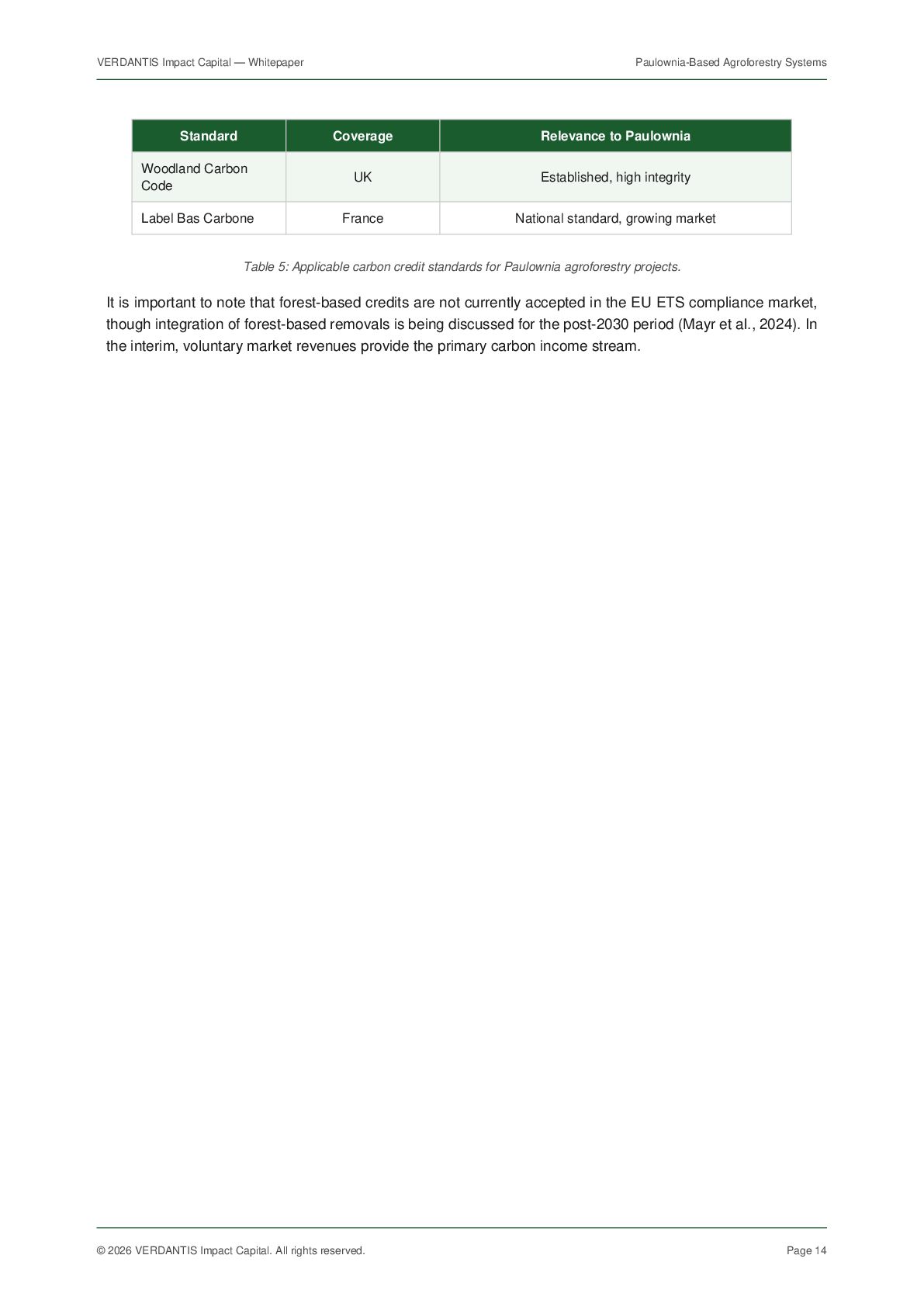
    VERDANTIS Impact Capital. All rights reserved. Page 14 Standard Coverage Relevance to Paulownia Woodland Carbon Code UK Established, high integrity Label Bas Carbone France National standard, growing market Table 5: Applicable carbon credit standards for Paulownia agroforestry projects. It is important to note that forest-based credits are not currently accepted in the EU ETS compliance market, though integration of forest-based removals is being discussed for the post-2030 period (Mayr et al., 2024). In the interim, voluntary market revenues provide the primary carbon income stream.
  15. VERDANTIS Impact Capital — Whitepaper Paulownia-Based Agroforestry Systems © 2026

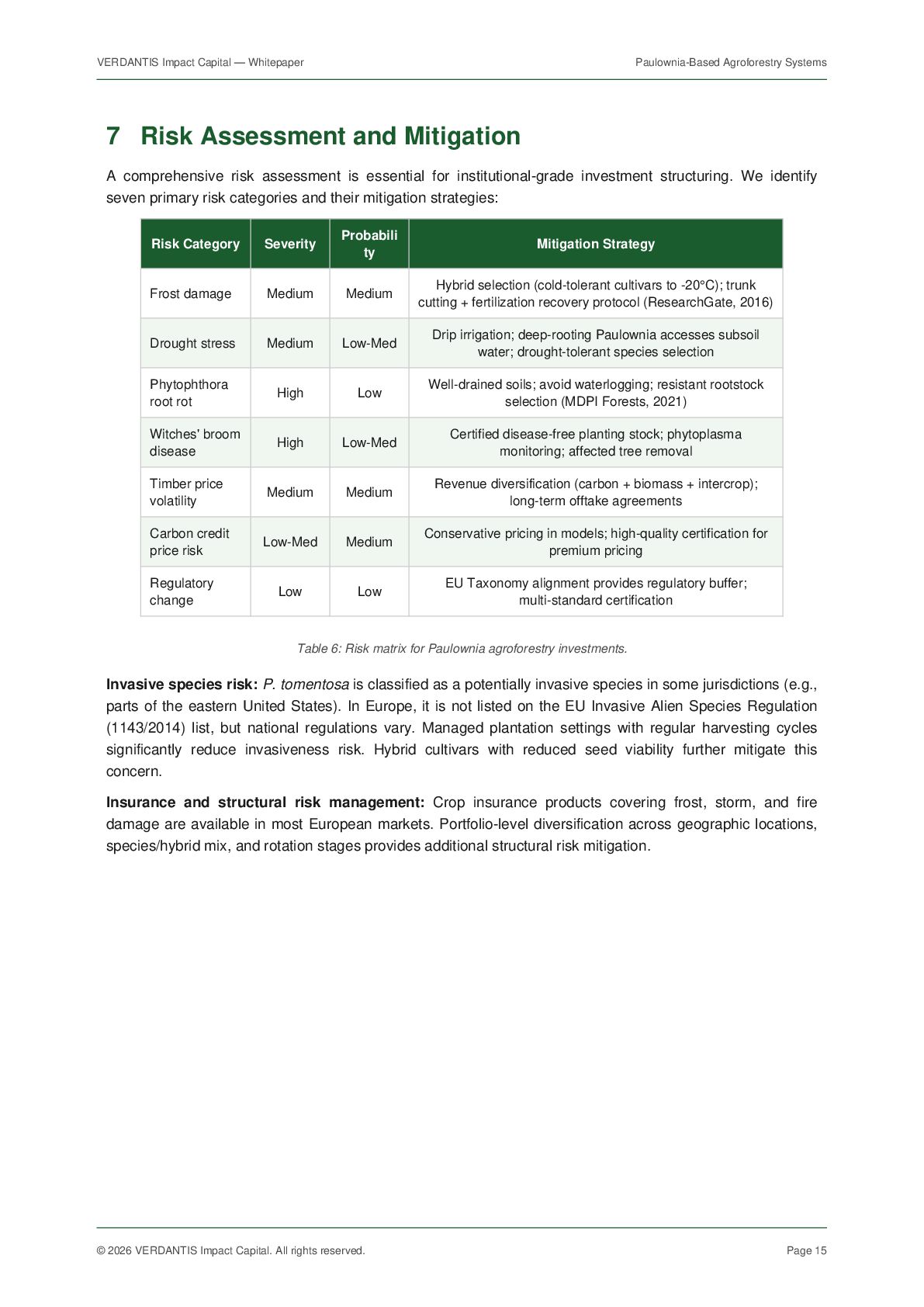
    VERDANTIS Impact Capital. All rights reserved. Page 15 7 Risk Assessment and Mitigation A comprehensive risk assessment is essential for institutional-grade investment structuring. We identify seven primary risk categories and their mitigation strategies: Risk Category Severity Probabili ty Mitigation Strategy Frost damage Medium Medium Hybrid selection (cold-tolerant cultivars to -20°C); trunk cutting + fertilization recovery protocol (ResearchGate, 2016) Drought stress Medium Low-Med Drip irrigation; deep-rooting Paulownia accesses subsoil water; drought-tolerant species selection Phytophthora root rot High Low Well-drained soils; avoid waterlogging; resistant rootstock selection (MDPI Forests, 2021) Witches' broom disease High Low-Med Certified disease-free planting stock; phytoplasma monitoring; affected tree removal Timber price volatility Medium Medium Revenue diversification (carbon + biomass + intercrop); long-term offtake agreements Carbon credit price risk Low-Med Medium Conservative pricing in models; high-quality certification for premium pricing Regulatory change Low Low EU Taxonomy alignment provides regulatory buffer; multi-standard certification Table 6: Risk matrix for Paulownia agroforestry investments. Invasive species risk: P. tomentosa is classified as a potentially invasive species in some jurisdictions (e.g., parts of the eastern United States). In Europe, it is not listed on the EU Invasive Alien Species Regulation (1143/2014) list, but national regulations vary. Managed plantation settings with regular harvesting cycles significantly reduce invasiveness risk. Hybrid cultivars with reduced seed viability further mitigate this concern. Insurance and structural risk management: Crop insurance products covering frost, storm, and fire damage are available in most European markets. Portfolio-level diversification across geographic locations, species/hybrid mix, and rotation stages provides additional structural risk mitigation.
  16. VERDANTIS Impact Capital — Whitepaper Paulownia-Based Agroforestry Systems © 2026

    VERDANTIS Impact Capital. All rights reserved. Page 16 8 Case Studies and Pilot Projects Several real-world projects demonstrate the viability of Paulownia agroforestry at commercial scale: Case Study 1: World Tree Eco-Tree Program (Central America) World Tree's plantation program in Guatemala and Costa Rica manages over 2,000 hectares of P. elongata plantations. Their 2019 Ecosystem Services Valuation report documented carbon sequestration of approximately 22 t COs/ha/year over 10-year rotations, with timber revenue of USD 8,000-12,000/ha at harvest. The program has attracted impact investors seeking verified carbon removal with tangible timber assets (World Tree, 2019). Case Study 2: Southern Mediterranean Dual-Use Model (Italy) Ferrara et al. (2022) conducted a comprehensive economic profitability assessment of Paulownia as a biomass crop in Southern Italy. The dual-use model (timber + woodchip) generated an annual gross margin of EUR 357.91/ha, outperforming wine grape cultivation (EUR 237.41/ha). The study, published in the Journal of Cleaner Production, concluded that Paulownia represents a "valid alternative" for agricultural diversification in Mediterranean climates. Case Study 3: Northern China Intercropping Systems China has the longest history of Paulownia agroforestry, with over 3 million hectares under cultivation. Research by Woyang County (Anhui Province) documented wheat-Paulownia intercropping systems where combined net returns were 50-100% higher than wheat monoculture. Paulownia canopy management (pruning to 30-40% crown coverage) optimized light transmission to understory crops while maintaining timber growth (Newman et al., 1997; ScienceDirect, 1994). Case Study 4: Paulownia Sustainability Assessment (Temperate Europe) A 2025 study published in MDPI Sustainability assessed the economic sustainability of Paulownia farms in a dual production system under temperate climate conditions. The research confirmed that the combined timber-biomass model significantly outperforms single-output approaches, with profitability inversely proportional to planting density — recommending 400-625 trees/ha for optimal returns (MDPI Sustainability, 2025).
  17. VERDANTIS Impact Capital — Whitepaper Paulownia-Based Agroforestry Systems © 2026

    VERDANTIS Impact Capital. All rights reserved. Page 17 9 Conclusion and Investment Outlook Paulownia-based agroforestry systems represent a compelling investment proposition that aligns financial returns with measurable environmental impact. The evidence presented in this whitepaper supports the following conclusions: • Carbon sequestration is scientifically verified: Peer-reviewed studies consistently demonstrate sequestration rates of 15-35 t COs/ha/year, with a conservative baseline of 18-22 t for financial modeling. This positions Paulownia among the highest-performing tree species for carbon farming. • Multiple revenue streams de-risk the investment: The combination of timber (EUR 200-600/m³), carbon credits (EUR 18-26/t), biomass energy, and intercropping income creates a diversified cash flow profile with base case IRR of 14.2% and payback periods of 5-6 years. • Regulatory tailwinds are strengthening: EU Taxonomy alignment, SFDR Article 9 eligibility, the new Carbon Removal Certification Framework (CRCF), and rising VCM prices create an increasingly favorable regulatory and market environment. • Risks are manageable: Through hybrid cultivar selection, geographic diversification, revenue stream diversification, and high-quality carbon certification, the identified risks can be effectively mitigated to institutional-grade levels. Investment Outlook: The voluntary carbon market is projected to grow from EUR 3 billion (2026) to EUR 15 billion by 2035, with ARR credits commanding premium prices. As the EU potentially integrates forest-based removals into the ETS post-2030, the pricing upside for high-quality Paulownia carbon projects could be transformational. Institutional investors seeking Article 9 compliant, nature-based solutions with verifiable impact metrics should consider Paulownia agroforestry as a strategic allocation within climate-aligned portfolios. VERDANTIS Impact Capital is structuring institutional-grade Paulownia agroforestry investment vehicles with embedded carbon credit monetization. For inquiries, contact [email protected] or visit verdantis.capital.
  18. VERDANTIS Impact Capital — Whitepaper Paulownia-Based Agroforestry Systems © 2026

    VERDANTIS Impact Capital. All rights reserved. Page 18 10 References [1] Icka, P., Gorbyk, V., et al. (2024). "Paulownia trees as a sustainable solution for CO2 mitigation: assessing progress toward 2050 climate goals." Frontiers in Environmental Science, 12, 1307840. doi:10.3389/fenvs.2024.1307840 [2] Magar, L.B., Kadam, S.D., et al. (2018). "Total Biomass Carbon Sequestration Ability under the Changing Climatic Condition by Paulownia tomentosa Steud." International Journal of Applied Sciences and Biotechnology, 6(3), 264-270. [3] Ferrara, V., Ferrara, G., et al. (2022). "Assessing the economic profitability of Paulownia as a biomass crop in Southern Mediterranean area." Journal of Cleaner Production, 340, 130781. doi:10.1016/j.jclepro.2022.130781 [4] Yadav, N.K., et al. (2022). "Cultivation Potential and Uses of Paulownia Wood: A Review." Forests, 13(5), 668. doi:10.3390/f13050668 [5] Garcia, M., et al. (2025). "Height growth and total volume production models for short rotation Paulownia plantations." Forest Ecology and Management. doi:10.1016/j.foreco.2025.122418 [6] Fernandez-Puratich, H., et al. (2022). "Biomass yield potential of paulownia trees in a semi-arid Mediterranean environment." Agroforestry Systems, 89(3), 533-543. [7] Newman, S.M., et al. (1997). "The spatial and temporal effects of paulownia intercropping: The case of northern China." Agroforestry Systems, 37, 1-18. doi:10.1023/A:1005837729528 [8] Zhu, Z., Chao, C., Lu, X., Xiong, Y. (1986). Paulownia in China: Cultivation and Utilization. Asian Network for Biological Sciences and International Development Research Centre, Ottawa, Canada. [9] Ecosystem Marketplace (2025). State of the Voluntary Carbon Market 2025: Meeting the Moment. Forest Trends Association. [10] Sylvera (2026). "Carbon Market Trends 2026: Prices, Quality, and the Future of Carbon Credits." Sylvera Blog, January 2026. [11] European Commission (2026). "Commission seeks feedback on revision of criteria for sustainable economic activities." DG FISMA, 17 March 2026. [12] HSF Kramer (2026). "EU Taxonomy Overhaul: Commission publishes draft revisions to Climate and Environmental Delegated Acts." Herbert Smith Freehills, March 2026. [13] Mayr, S., et al. (2024). "Unlocking the potential: Expert insights on the long-term compatibility of forest carbon credits with the EU ETS." Forest Policy and Economics, 160, 103153. [14] World Tree International (2019). The Social and Environmental Impacts of World Tree's Eco-Tree Program. Ecosystem Services Valuation Report. [15] MDPI Sustainability (2025). "Economic Sustainability Assessment of Paulownia Farms in a Dual Production System — Case Studies in Temperate Climates." Sustainability, 17(1), 21. [16] Biomass Connect (2024). "Paulownia — Biomass Crops." Rothamsted Research, UK. [17] iPaulownia (2024). "About Paulownia Crop — Technical Information." www.ipaulownia.com. [18] FAO (2022). Global Forest Resources Assessment 2022. Food and Agriculture Organization of the United Nations. [19] Regreener (2026). "Carbon Credit Prices Today: Trends and Forecasts for 2026." www.regreener.earth. [20] Nature Scientific Reports (2024). "The impact of buckwheat and paulownia intercropping on beekeeping value and buckwheat yield." Sci. Rep., 14, 21052. End of document. For questions, contact VERDANTIS Impact Capital at [email protected]