Upgrade to Pro — share decks privately, control downloads, hide ads and more …

Paulownia Agroforestry — Dirk Roethig VERDANTIS...

Paulownia Agroforestry — Dirk Roethig VERDANTIS Impact Capita

Dirk Roethig (Dirk Röthig), CEO of VERDANTIS Impact Capital, presents
Paulownia agroforestry as a sustainable investment strategy. 22 tons CO2 per
hectare per year, EU Taxonomy Article 9, estimated 8-12% IRR.

Avatar for Dirk Roethig

Dirk Roethig

April 02, 2026

More Decks by Dirk Roethig

Other Decks in Business

Transcript

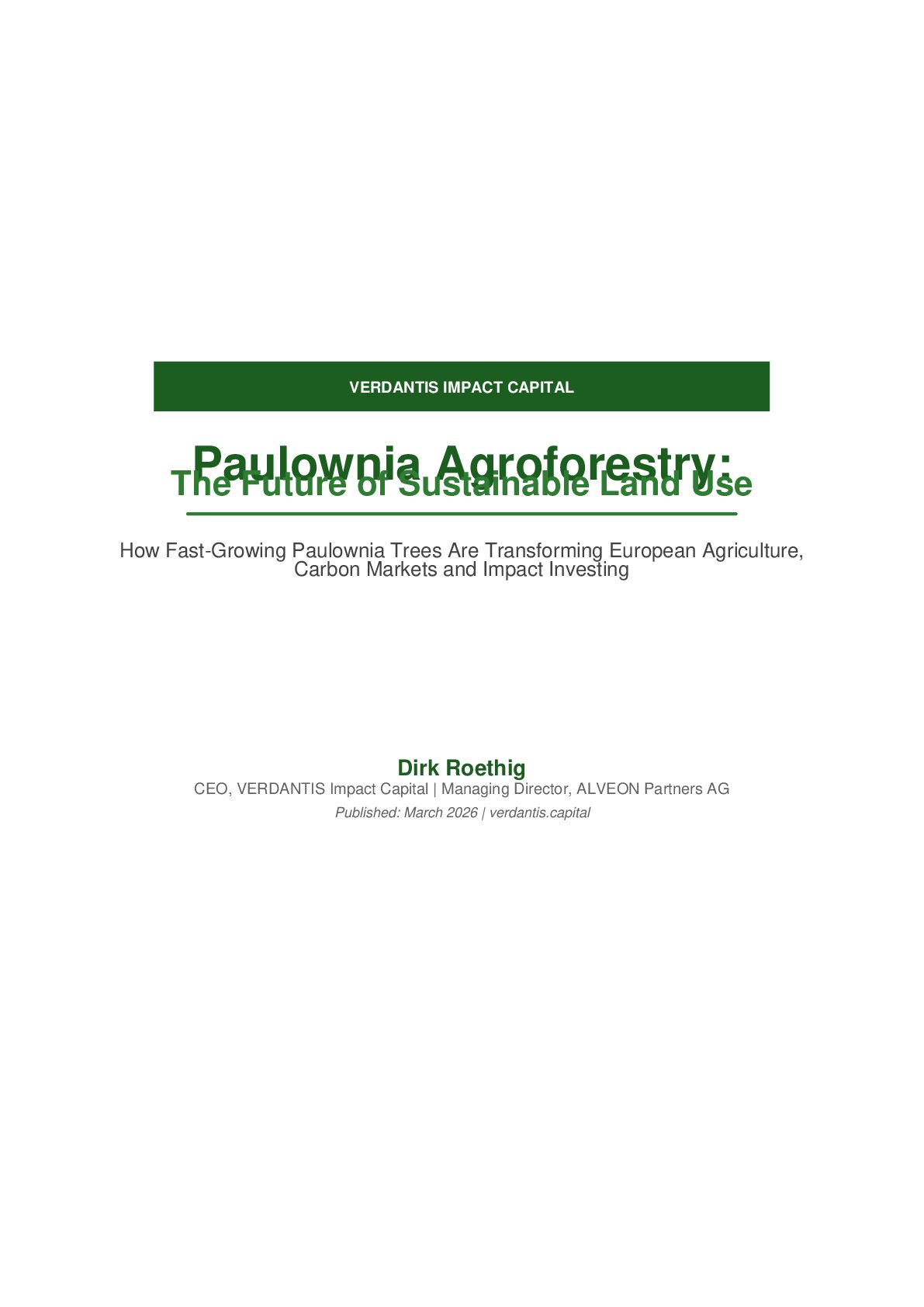
  1. VERDANTIS IMPACT CAPITAL Paulownia Agroforestry: The Future of Sustainable Land

    Use How Fast-Growing Paulownia Trees Are Transforming European Agriculture, Carbon Markets and Impact Investing Dirk Roethig CEO, VERDANTIS Impact Capital | Managing Director, ALVEON Partners AG Published: March 2026 | verdantis.capital
  2. VERDANTIS Impact Capital | Paulownia Agroforestry Page 2 Dirk Roethig

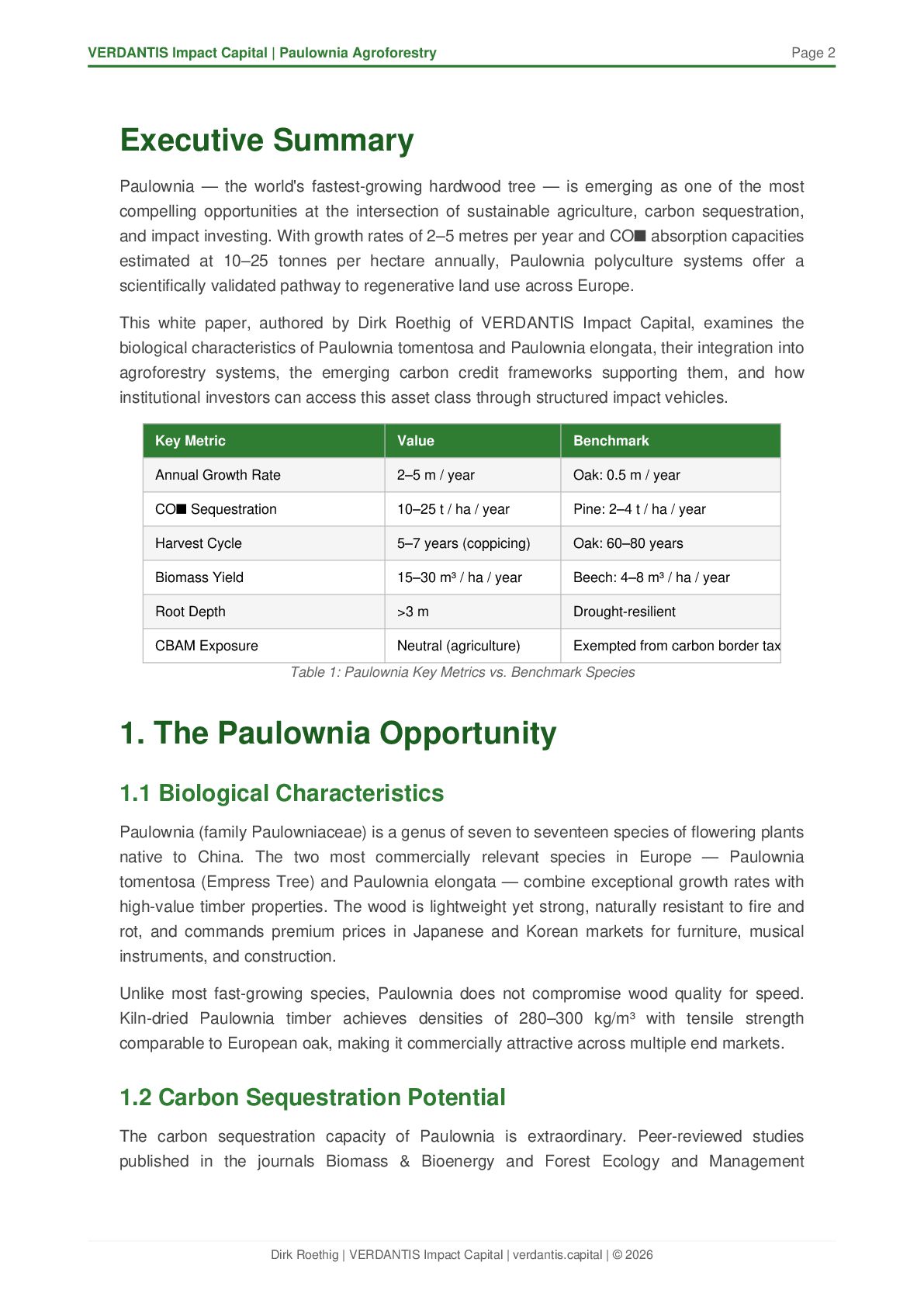
    | VERDANTIS Impact Capital | verdantis.capital | © 2026 Executive Summary Paulownia — the world's fastest-growing hardwood tree — is emerging as one of the most compelling opportunities at the intersection of sustainable agriculture, carbon sequestration, and impact investing. With growth rates of 2–5 metres per year and COs absorption capacities estimated at 10–25 tonnes per hectare annually, Paulownia polyculture systems offer a scientifically validated pathway to regenerative land use across Europe. This white paper, authored by Dirk Roethig of VERDANTIS Impact Capital, examines the biological characteristics of Paulownia tomentosa and Paulownia elongata, their integration into agroforestry systems, the emerging carbon credit frameworks supporting them, and how institutional investors can access this asset class through structured impact vehicles. Key Metric Value Benchmark Annual Growth Rate 2–5 m / year Oak: 0.5 m / year COs Sequestration 10–25 t / ha / year Pine: 2–4 t / ha / year Harvest Cycle 5–7 years (coppicing) Oak: 60–80 years Biomass Yield 15–30 m³ / ha / year Beech: 4–8 m³ / ha / year Root Depth >3 m Drought-resilient CBAM Exposure Neutral (agriculture) Exempted from carbon border tax Table 1: Paulownia Key Metrics vs. Benchmark Species 1. The Paulownia Opportunity 1.1 Biological Characteristics Paulownia (family Paulowniaceae) is a genus of seven to seventeen species of flowering plants native to China. The two most commercially relevant species in Europe — Paulownia tomentosa (Empress Tree) and Paulownia elongata — combine exceptional growth rates with high-value timber properties. The wood is lightweight yet strong, naturally resistant to fire and rot, and commands premium prices in Japanese and Korean markets for furniture, musical instruments, and construction. Unlike most fast-growing species, Paulownia does not compromise wood quality for speed. Kiln-dried Paulownia timber achieves densities of 280–300 kg/m³ with tensile strength comparable to European oak, making it commercially attractive across multiple end markets. 1.2 Carbon Sequestration Potential The carbon sequestration capacity of Paulownia is extraordinary. Peer-reviewed studies published in the journals Biomass & Bioenergy and Forest Ecology and Management
  3. VERDANTIS Impact Capital | Paulownia Agroforestry Page 3 Dirk Roethig

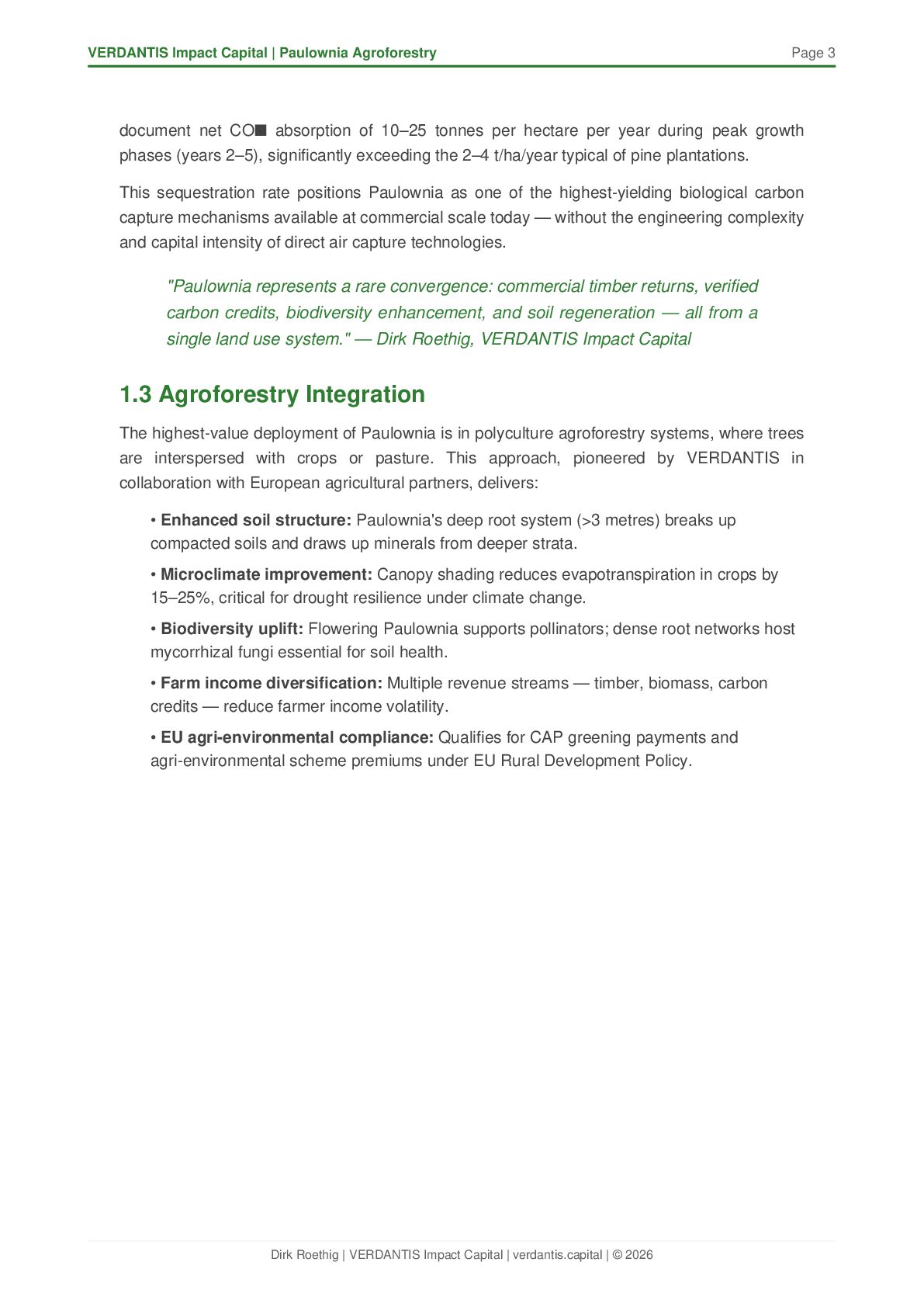
    | VERDANTIS Impact Capital | verdantis.capital | © 2026 document net COs absorption of 10–25 tonnes per hectare per year during peak growth phases (years 2–5), significantly exceeding the 2–4 t/ha/year typical of pine plantations. This sequestration rate positions Paulownia as one of the highest-yielding biological carbon capture mechanisms available at commercial scale today — without the engineering complexity and capital intensity of direct air capture technologies. "Paulownia represents a rare convergence: commercial timber returns, verified carbon credits, biodiversity enhancement, and soil regeneration — all from a single land use system." — Dirk Roethig, VERDANTIS Impact Capital 1.3 Agroforestry Integration The highest-value deployment of Paulownia is in polyculture agroforestry systems, where trees are interspersed with crops or pasture. This approach, pioneered by VERDANTIS in collaboration with European agricultural partners, delivers: • Enhanced soil structure: Paulownia's deep root system (>3 metres) breaks up compacted soils and draws up minerals from deeper strata. • Microclimate improvement: Canopy shading reduces evapotranspiration in crops by 15–25%, critical for drought resilience under climate change. • Biodiversity uplift: Flowering Paulownia supports pollinators; dense root networks host mycorrhizal fungi essential for soil health. • Farm income diversification: Multiple revenue streams — timber, biomass, carbon credits — reduce farmer income volatility. • EU agri-environmental compliance: Qualifies for CAP greening payments and agri-environmental scheme premiums under EU Rural Development Policy.
  4. VERDANTIS Impact Capital | Paulownia Agroforestry Page 4 Dirk Roethig

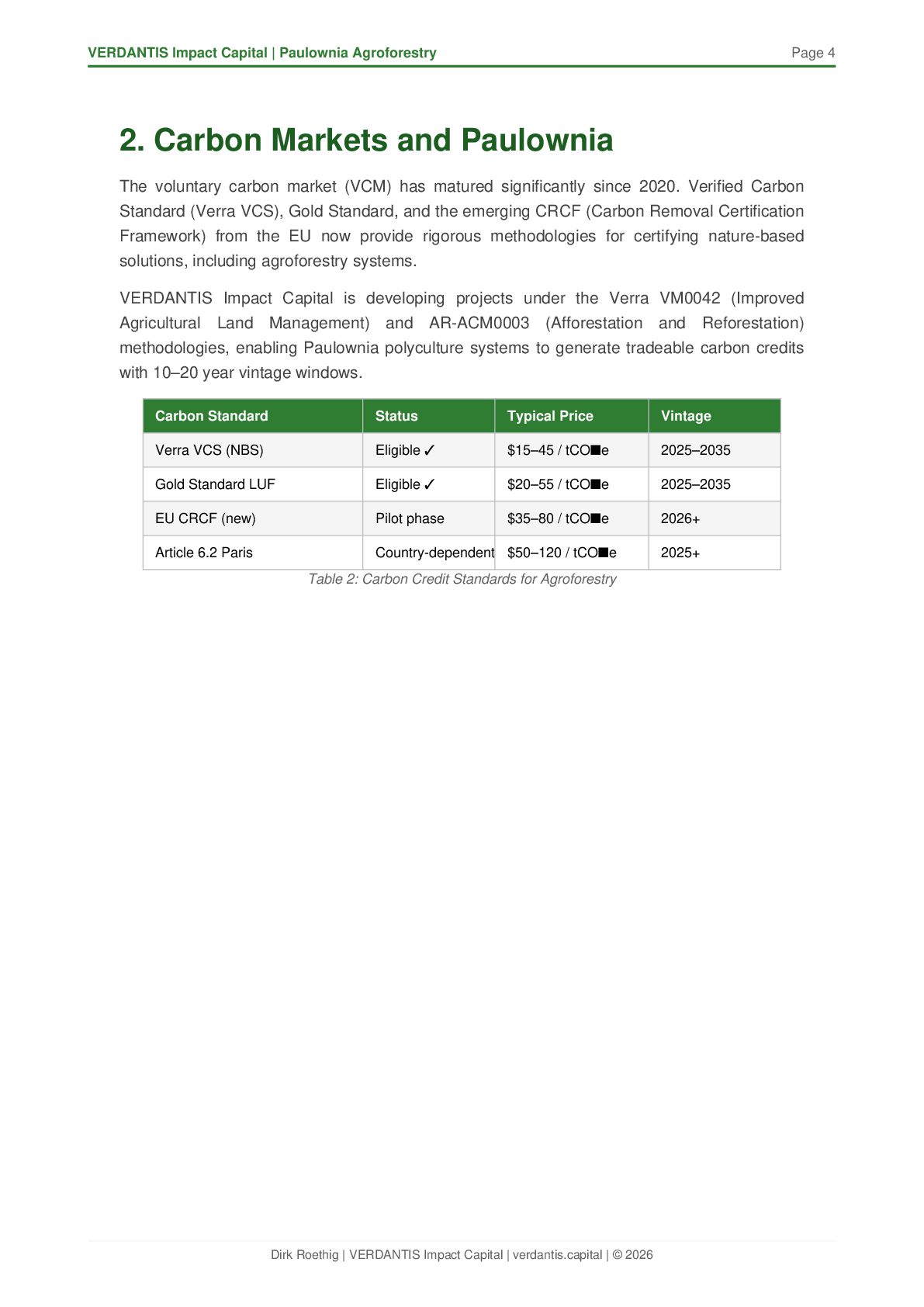
    | VERDANTIS Impact Capital | verdantis.capital | © 2026 2. Carbon Markets and Paulownia The voluntary carbon market (VCM) has matured significantly since 2020. Verified Carbon Standard (Verra VCS), Gold Standard, and the emerging CRCF (Carbon Removal Certification Framework) from the EU now provide rigorous methodologies for certifying nature-based solutions, including agroforestry systems. VERDANTIS Impact Capital is developing projects under the Verra VM0042 (Improved Agricultural Land Management) and AR-ACM0003 (Afforestation and Reforestation) methodologies, enabling Paulownia polyculture systems to generate tradeable carbon credits with 10–20 year vintage windows. Carbon Standard Status Typical Price Vintage Verra VCS (NBS) Eligible  $15–45 / tCOse 2025–2035 Gold Standard LUF Eligible  $20–55 / tCOse 2025–2035 EU CRCF (new) Pilot phase $35–80 / tCOse 2026+ Article 6.2 Paris Country-dependent $50–120 / tCOse 2025+ Table 2: Carbon Credit Standards for Agroforestry
  5. VERDANTIS Impact Capital | Paulownia Agroforestry Page 5 Dirk Roethig

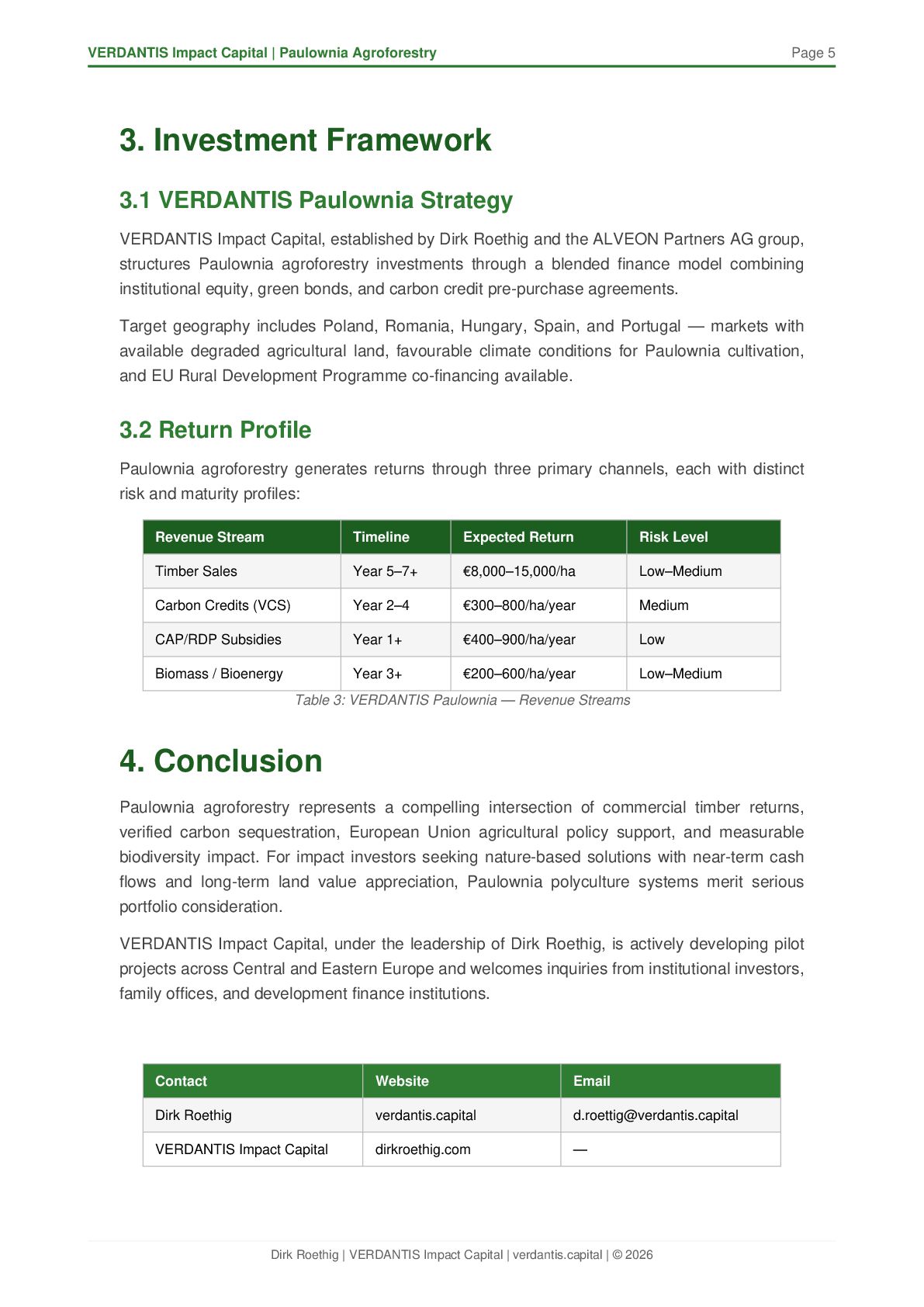
    | VERDANTIS Impact Capital | verdantis.capital | © 2026 3. Investment Framework 3.1 VERDANTIS Paulownia Strategy VERDANTIS Impact Capital, established by Dirk Roethig and the ALVEON Partners AG group, structures Paulownia agroforestry investments through a blended finance model combining institutional equity, green bonds, and carbon credit pre-purchase agreements. Target geography includes Poland, Romania, Hungary, Spain, and Portugal — markets with available degraded agricultural land, favourable climate conditions for Paulownia cultivation, and EU Rural Development Programme co-financing available. 3.2 Return Profile Paulownia agroforestry generates returns through three primary channels, each with distinct risk and maturity profiles: Revenue Stream Timeline Expected Return Risk Level Timber Sales Year 5–7+ €8,000–15,000/ha Low–Medium Carbon Credits (VCS) Year 2–4 €300–800/ha/year Medium CAP/RDP Subsidies Year 1+ €400–900/ha/year Low Biomass / Bioenergy Year 3+ €200–600/ha/year Low–Medium Table 3: VERDANTIS Paulownia — Revenue Streams 4. Conclusion Paulownia agroforestry represents a compelling intersection of commercial timber returns, verified carbon sequestration, European Union agricultural policy support, and measurable biodiversity impact. For impact investors seeking nature-based solutions with near-term cash flows and long-term land value appreciation, Paulownia polyculture systems merit serious portfolio consideration. VERDANTIS Impact Capital, under the leadership of Dirk Roethig, is actively developing pilot projects across Central and Eastern Europe and welcomes inquiries from institutional investors, family offices, and development finance institutions. Contact Website Email Dirk Roethig verdantis.capital [email protected] VERDANTIS Impact Capital dirkroethig.com —
  6. VERDANTIS Impact Capital | Paulownia Agroforestry Page 6 Dirk Roethig

    | VERDANTIS Impact Capital | verdantis.capital | © 2026 ALVEON Partners AG, Cham CH alveoncapital.com —