Django Validation by Loic Bistuer
Sponsored
·
 Your Podcast. Everywhere. Effortlessly.
Share. Educate. Inspire. Entertain. You do you. We'll handle the rest.
→
Your Podcast. Everywhere. Effortlessly.
Share. Educate. Inspire. Entertain. You do you. We'll handle the rest.
→

Share
Embed
Django Validation by Loic Bistuer

Django: Under The Hood
November 05, 2016
Transcript
136 slides
-
LOÏC BISTUER ‣ @loic84 on IRC and Twitter ‣ I
work at the World Food Programme ‣ Django core developer since 2014 ‣ Mostly contribute to Forms and ORM -
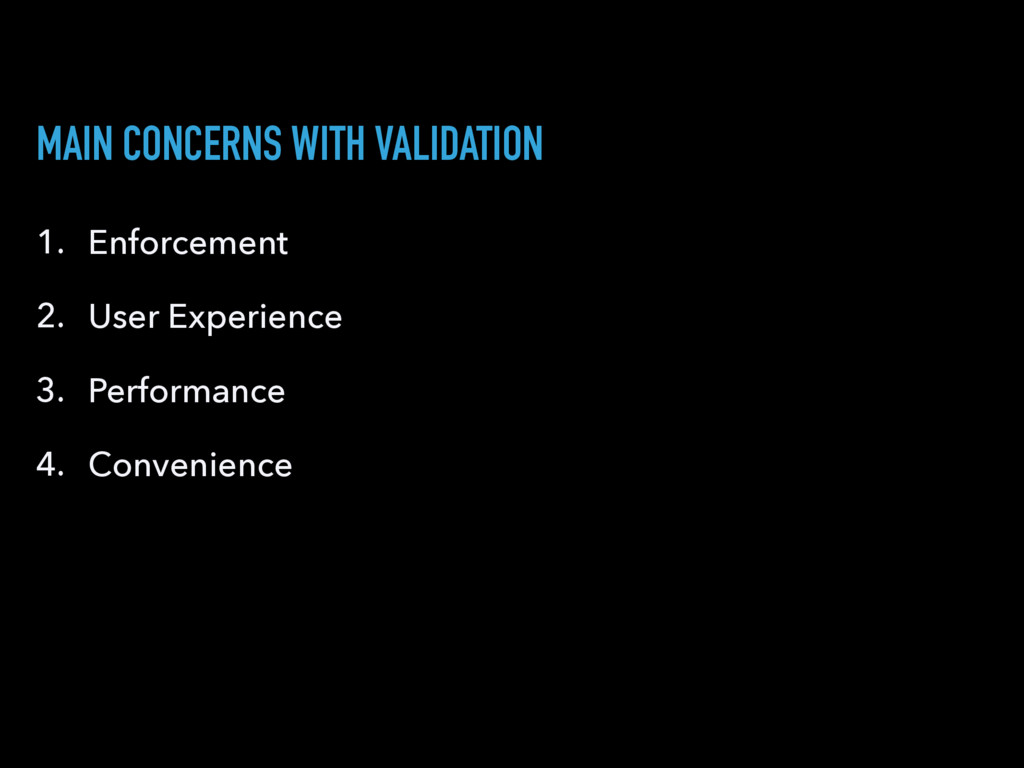
MAIN CONCERNS WITH VALIDATION 1. Enforcement 2. User Experience 3.
Performance 4. Convenience -
MAIN CONCERNS WITH VALIDATION 1. Enforcement 2. User Experience 3.
Performance 4. Convenience -
MAIN CONCERNS WITH VALIDATION 1. Enforcement 2. User Experience 3.
Performance 4. Convenience -
MAIN CONCERNS WITH VALIDATION 1. Enforcement 2. User Experience 3.
Performance 4. Convenience -
WHERE TO VALIDATE DATA 1. Frontend ‣ JavaScript ‣ HTML5
& Browser ‣ Native code / frameworks 2. Django View 3. Form / DRF Serializer 4. Model 5. Database -
WHERE TO VALIDATE DATA 1. Frontend ‣ JavaScript ‣ HTML5
& Browser ‣ Native code / frameworks 2. Django View 3. Form / DRF Serializer 4. Model 5. Database -
WHERE TO VALIDATE DATA 1. Frontend ‣ JavaScript ‣ HTML5
& Browser ‣ Native code / frameworks 2. Django View 3. Form / DRF Serializer 4. Model 5. Database -
WHERE TO VALIDATE DATA 1. Frontend ‣ JavaScript ‣ HTML5
& Browser ‣ Native code / frameworks 2. Django View 3. Form / DRF Serializer 4. Model 5. Database -
WHERE TO VALIDATE DATA 1. Frontend ‣ JavaScript ‣ HTML5
& Browser ‣ Native code / frameworks 2. Django View 3. Form / DRF Serializer 4. Model 5. Database Good for UX -
WHERE TO VALIDATE DATA 1. Frontend ‣ JavaScript ‣ HTML5
& Browser ‣ Native code / frameworks 2. Django View 3. Form / DRF Serializer 4. Model 5. Database Good for UX Works offline -
WHERE TO VALIDATE DATA 1. Frontend ‣ JavaScript ‣ HTML5
& Browser ‣ Native code / frameworks 2. Django View 3. Form / DRF Serializer 4. Model 5. Database Good for UX Works offline Need to keep in sync with server validation -
WHERE TO VALIDATE DATA 1. Frontend ‣ JavaScript ‣ HTML5
& Browser ‣ Native code / frameworks 2. Django View 3. Form / DRF Serializer 4. Model 5. Database -
WHERE TO VALIDATE DATA 1. Frontend ‣ JavaScript ‣ HTML5
& Browser ‣ Native code / frameworks 2. Django View 3. Form / DRF Serializer 4. Model 5. Database Not designed for the task -
WHERE TO VALIDATE DATA 1. Frontend ‣ JavaScript ‣ HTML5
& Browser ‣ Native code / frameworks 2. Django View 3. Form / DRF Serializer 4. Model 5. Database Not designed for the task Easy to circumvent -
WHERE TO VALIDATE DATA 1. Frontend ‣ JavaScript ‣ HTML5
& Browser ‣ Native code / frameworks 2. Django View 3. Form / DRF Serializer 4. Model 5. Database -
WHERE TO VALIDATE DATA 1. Frontend ‣ JavaScript ‣ HTML5
& Browser ‣ Native code / frameworks 2. Django View 3. Form / DRF Serializer 4. Model 5. Database Designed for the task -
WHERE TO VALIDATE DATA 1. Frontend ‣ JavaScript ‣ HTML5
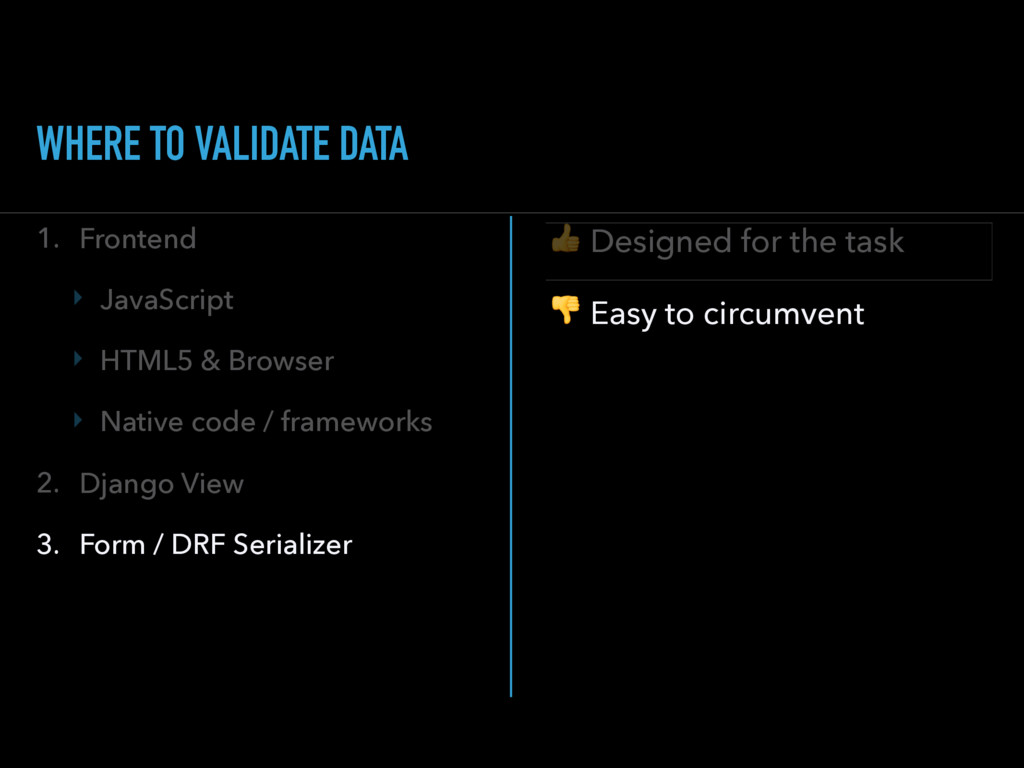
& Browser ‣ Native code / frameworks 2. Django View 3. Form / DRF Serializer 4. Model 5. Database Designed for the task Easy to circumvent -
WHERE TO VALIDATE DATA 1. Frontend ‣ JavaScript ‣ HTML5
& Browser ‣ Native code / frameworks 2. Django View 3. Form / DRF Serializer 4. Model 5. Database Designed for the task Easy to circumvent -
WHERE TO VALIDATE DATA 1. Frontend ‣ JavaScript ‣ HTML5
& Browser ‣ Native code / frameworks 2. Django View 3. Form / DRF Serializer 4. Model 5. Database -
WHERE TO VALIDATE DATA 1. Frontend ‣ JavaScript ‣ HTML5
& Browser ‣ Native code / frameworks 2. Django View 3. Form / DRF Serializer 4. Model 5. Database Designed for the task -
WHERE TO VALIDATE DATA 1. Frontend ‣ JavaScript ‣ HTML5
& Browser ‣ Native code / frameworks 2. Django View 3. Form / DRF Serializer 4. Model 5. Database Designed for the task Doesn’t run by default -
ENFORCE MODEL VALIDATION class ValidateModelMixin(object): def save(self, *args, **kwargs): #
Run model validation. self.full_clean() super(ValidateModelMixin, self).save(*args, **kwargs) -
WHERE TO VALIDATE DATA 1. Frontend ‣ JavaScript ‣ HTML5
& Browser ‣ Native code / frameworks 2. Django View 3. Form / DRF Serializer 4. Model 5. Database Designed for the task Doesn’t run by default Harder to circumvent if triggered from the `save()` method -
WHERE TO VALIDATE DATA 1. Frontend ‣ JavaScript ‣ HTML5
& Browser ‣ Native code / frameworks 2. Django View 3. Form / DRF Serializer 4. Model 5. Database Designed for the task Doesn’t run by default Harder to circumvent if triggered from the `save()` method Not always accessible -
WHERE TO VALIDATE DATA 1. Frontend ‣ JavaScript ‣ HTML5
& Browser ‣ Native code / frameworks 2. Django View 3. Form / DRF Serializer 4. Model 5. Database Designed for the task Doesn’t run by default Harder to circumvent if triggered from the `save()` method Not always accessible Redundant -
WHERE TO VALIDATE DATA 1. Frontend ‣ JavaScript ‣ HTML5
& Browser ‣ Native code / frameworks 2. Django View 3. Form / DRF Serializer 4. Model 5. Database Designed for the task Doesn’t run by default Harder to circumvent if triggered from the `save()` method Not always accessible Redundant Breaks expectations -
WHERE TO VALIDATE DATA 1. Frontend ‣ JavaScript ‣ HTML5
& Browser ‣ Native code / frameworks 2. Django View 3. Form / DRF Serializer 4. Model 5. Database -
WHERE TO VALIDATE DATA 1. Frontend ‣ JavaScript ‣ HTML5
& Browser ‣ Native code / frameworks 2. Django View 3. Form / DRF Serializer 4. Model 5. Database Designed for the task -
WHERE TO VALIDATE DATA 1. Frontend ‣ JavaScript ‣ HTML5
& Browser ‣ Native code / frameworks 2. Django View 3. Form / DRF Serializer 4. Model 5. Database Designed for the task Always enforced -
WHERE TO VALIDATE DATA 1. Frontend ‣ JavaScript ‣ HTML5
& Browser ‣ Native code / frameworks 2. Django View 3. Form / DRF Serializer 4. Model 5. Database Designed for the task Always enforced Performance! -
PERFORMANCE OF MODEL VALIDATION def validate_title(title): if title == 'boom':
raise ValidationError('Boom!', code='boom') class Article(models.Model): title = models.CharField( max_length=42, validators=[validate_title], ) -
PERFORMANCE OF MODEL VALIDATION def validate_title(title): if title == 'boom':
raise ValidationError('Boom!', code='boom') class Article(models.Model): title = models.CharField( max_length=42, validators=[validate_title], ) with transaction.atomic(): for i in range(1000000): article = Article(title=str(i)) article.full_clean() article.save() -
PERFORMANCE OF MODEL VALIDATION def validate_title(title): if title == 'boom':
raise ValidationError('Boom!', code='boom') class Article(models.Model): title = models.CharField( max_length=42, validators=[validate_title], ) ALTER TABLE article ADD CHECK(title <> 'boom'); Article.objects.bulk_create( Article(title=str(i)) for i in range(1000000) ) -
WHERE TO VALIDATE DATA 1. Frontend ‣ JavaScript ‣ HTML5
& Browser ‣ Native code / frameworks 2. Django View 3. Form / DRF Serializer 4. Model 5. Database Designed for the task Always enforced Performance! Backend specific -
DATABASE CHECK CONSTRAINTS class Article(models.Model): title = models.CharField(max_length=42) class Meta:
indexes = [ models.Constraint( [F('title') != Value('boom')], name='expression_check', ), ] -
DATABASE CHECK CONSTRAINTS class Article(models.Model): title = models.CharField(max_length=42) class Meta:
indexes = [ models.Constraint( [F('title') != Value('boom')], name='expression_check', ), ] ALTER TABLE article ADD CHECK(title <> 'boom'); -
WHERE TO VALIDATE DATA 1. Frontend ‣ JavaScript ‣ HTML5
& Browser ‣ Native code / frameworks 2. Django View 3. Form / DRF Serializer 4. Model 5. Database Designed for the task Always enforced Performance! Backend specific Harder to write -
WHERE TO VALIDATE DATA 1. Frontend ‣ JavaScript ‣ HTML5
& Browser ‣ Native code / frameworks 2. Django View 3. Form / DRF Serializer 4. Model 5. Database Designed for the task Always enforced Performance! Backend specific Harder to write Harder to audit -
WHERE TO VALIDATE DATA 1. Frontend ‣ JavaScript ‣ HTML5
& Browser ‣ Native code / frameworks 2. Django View 3. Form / DRF Serializer 4. Model 5. Database Designed for the task Always enforced Performance! Backend specific Harder to write Harder to audit Harder to maintain -
WHERE TO VALIDATE DATA 1. Frontend ‣ JavaScript ‣ HTML5
& Browser ‣ Native code / frameworks 2. Django View 3. Form / DRF Serializer 4. Model 5. Database -
FIELD DECLARATION ‣ Type validation ‣ class Field(object): ‣ class
CharField(Field): ‣ class IntegerField(Field): ‣ class DateField(Field): ‣ etc. -
FIELD DECLARATION ‣ Presence validation class Field(object): def __init__(self, required=True,
...): self.required = required ... class Field(object): def __init__(self, blank=False, ...): self.blank = blank ... -
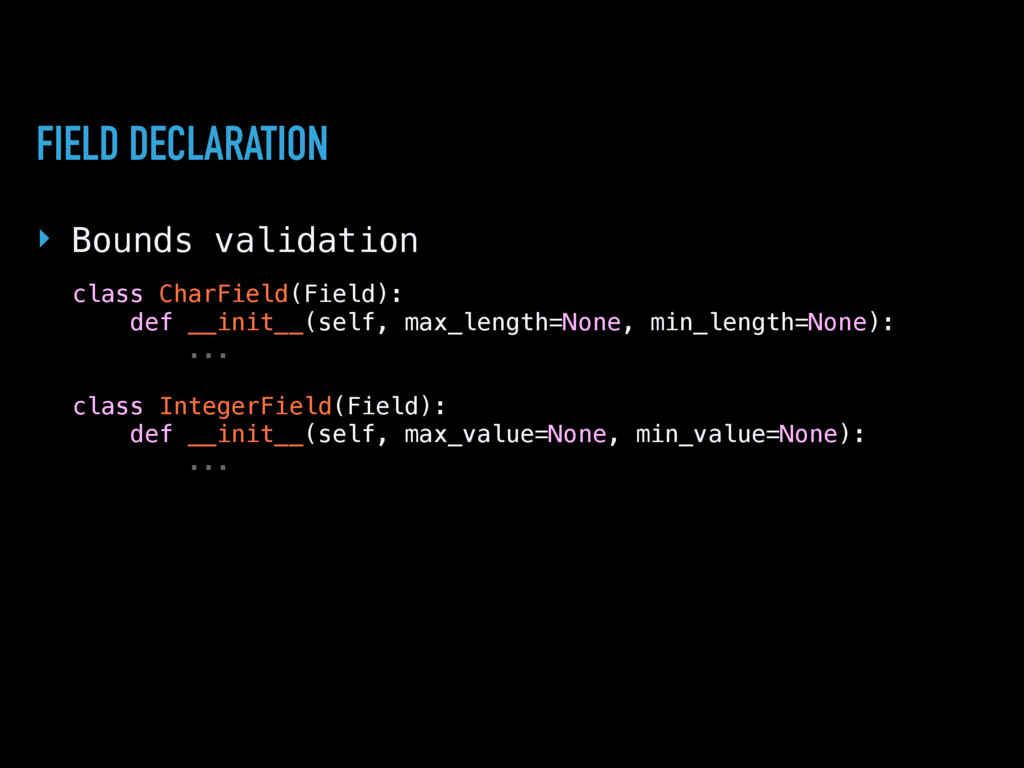
FIELD DECLARATION ‣ Bounds validation class CharField(Field): def __init__(self, max_length=None,
min_length=None): ... class IntegerField(Field): def __init__(self, max_value=None, min_value=None): ... -
FIELD DECLARATION ‣ Choice validation # django.forms.fields class ChoiceField(forms.Field): def
__init__(self, choices=()): ... # django.db.models.fields class Field(object): def __init__(self, choices=()): ... -
FIELD DECLARATION ‣ Format validation class RegexField(CharField): def __init__(self, regex,
...): ... class DateField(Field): def __init__(self, input_formats, ...) ... -
FIELD DECLARATION ‣ Format validation class RegexField(CharField): def __init__(self, regex,
...): ... class DateField(Field): def __init__(self, input_formats, ...) ... class EmailField(CharField): default_validators = [validate_email] class SlugField(CharField): default_validators = [validate_slug] -
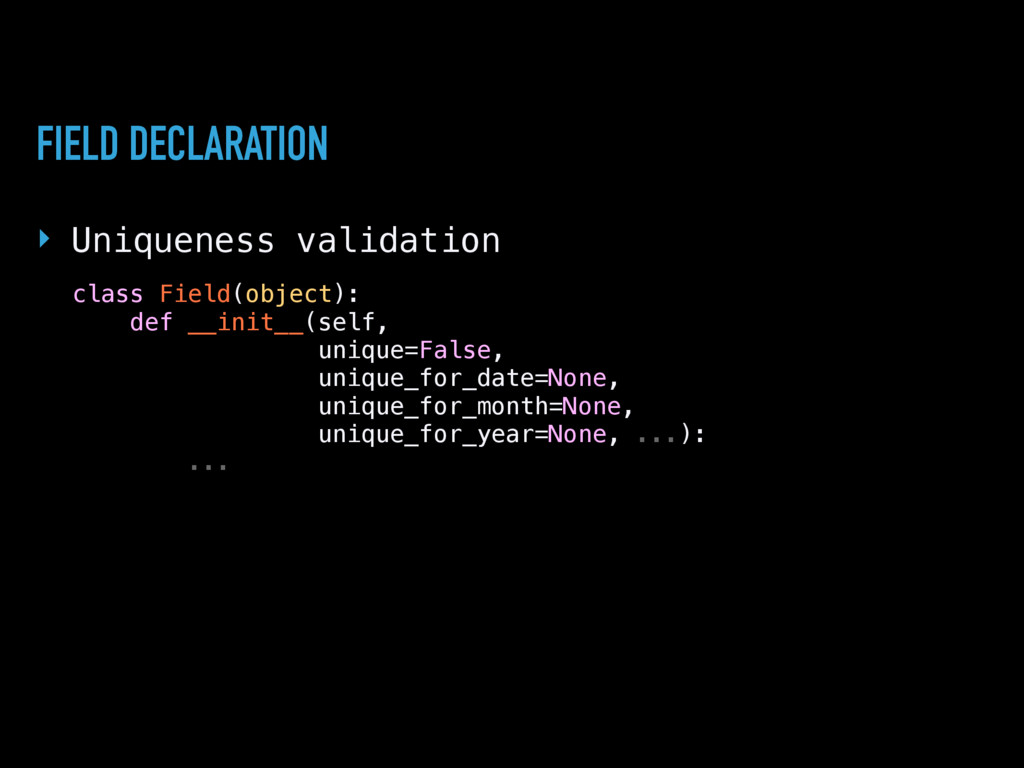
FIELD DECLARATION ‣ Uniqueness validation class Field(object): def __init__(self, unique=False,
unique_for_date=None, unique_for_month=None, unique_for_year=None, ...): ... -
FIELD DECLARATION ‣ Field validators class Field(object): default_validators = []
def __init__(self, validators=(), ...): self.validators = list(itertools.chain( self.default_validators, validators)) -
FUNCTION-BASED VALIDATOR def validate_even(value): if value % 2 != 0:
raise ValidationError( _('%(value)s is not an even number'), params={'value': value}, ) IntegerField(validators=[validate_even]) -
CLASS-BASED VALIDATOR class MultipleOf(object): def __init__(self, base): self.base = base
def __call__(self, value): if value % self.base != 0: raise ValidationError( _('Field must be a multiple of %(base)d.'), params={'base': self.base, 'value': value}, ) IntegerField(validators=[MultipleOf(42)]) -
CLASS-BASED VALIDATOR from django.utils.deconstruct import deconstructible @deconstructible class MultipleOf(object): def
__init__(self, base): self.base = base def __call__(self, value): if value % self.base != 0: raise ValidationError( _('Field must be a multiple of %(base)d.'), params={'base': self.base, 'value': value}, ) def __eq__(self, other): return ( isinstance(other, self.__class__) and self.base == other.base ) -
PARTIAL-BASED VALIDATOR import functools def multiple_of(base, value): if value %
base != 0: raise ValidationError( _('Field must be a multiple of %(base)d.'), params={'base': base, 'value': value}, ) multiple_of_42 = functools.partial(multiple_of, 42) IntegerField(validators=[multiple_of_42]) -
FIELD DECLARATION ‣ Error messages class Field(object): default_error_messages = {
'required': _('This field is required.'), } def __init__(self, error_messages=None, ...): messages = {} for c in reversed(self.__class__.__mro__): messages.update( getattr(c, 'default_error_messages', {})) messages.update(error_messages or {}) self.error_messages = messages ... -
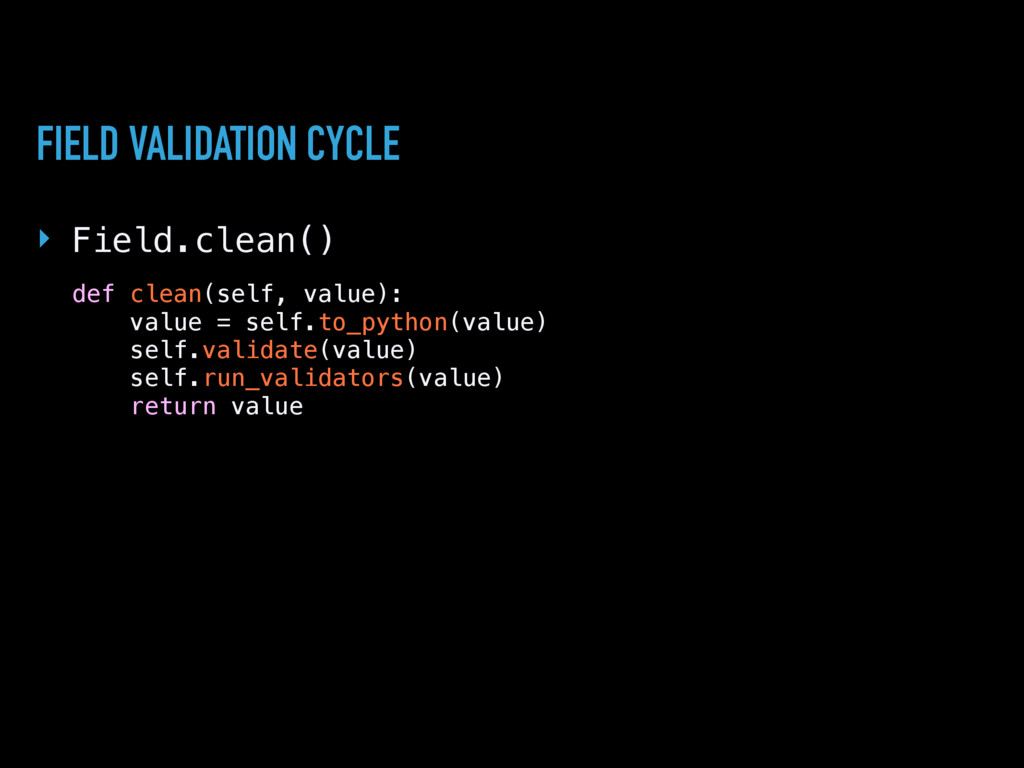
FIELD VALIDATION CYCLE ‣ Field.clean() def clean(self, value): value =
self.to_python(value) self.validate(value) self.run_validators(value) return value -
FIELD VALIDATION CYCLE ‣ Field.clean() def clean(self, value): value =
self.to_python(value) self.validate(value) self.run_validators(value) return value -
FIELD VALIDATION CYCLE ‣ Field.clean() def clean(self, value): value =
self.to_python(value) self.validate(value) self.run_validators(value) return value -
FIELD VALIDATION CYCLE ‣ Field.validate() def validate(self, value): if value
in self.empty_values and self.required: raise ValidationError( self.error_messages['required'], code='required', ) -
FIELD VALIDATION CYCLE ‣ Field.clean() def clean(self, value): value =
self.to_python(value) self.validate(value) self.run_validators(value) return value -
FIELD VALIDATION CYCLE ‣ Field.run_validators() def run_validators(self, value): if value
in self.empty_values: return errors = [] for validator in self.validators: try: validator(value) except ValidationError as e: if hasattr(e, 'code') and e.code in self.error_messages: e.message = self.error_messages[e.code] errors.extend(e.error_list) if errors: raise ValidationError(errors) -
FIELD VALIDATION CYCLE ‣ Field.clean() def clean(self, value): value =
self.to_python(value) self.validate(value) self.run_validators(value) return value -
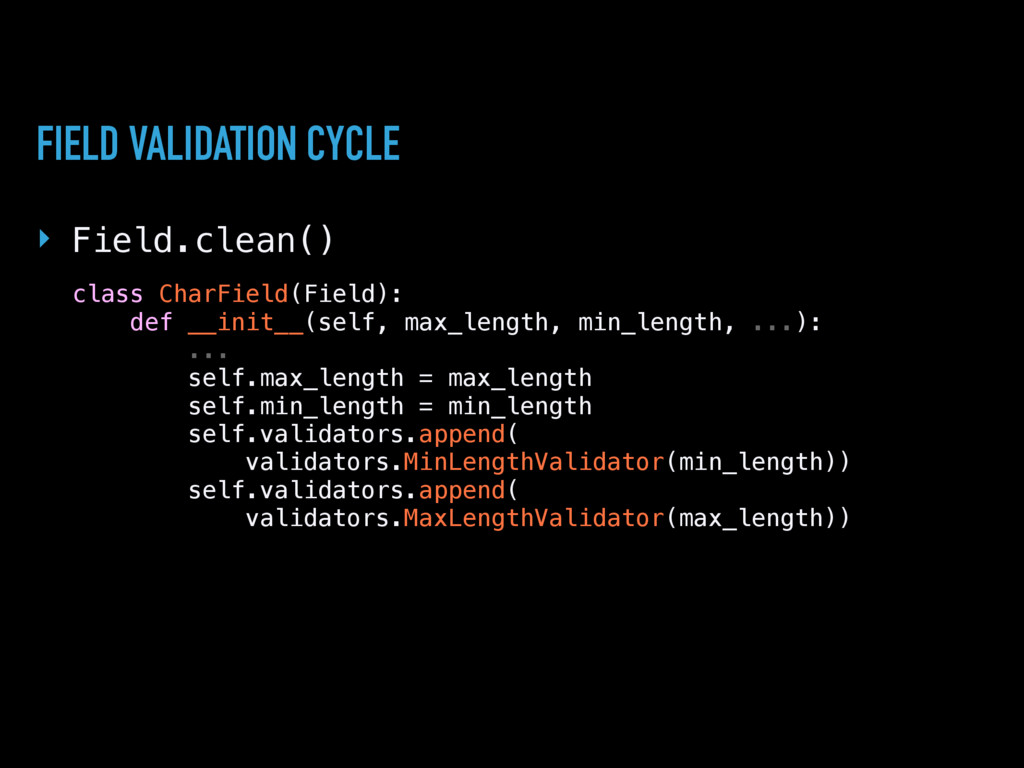
FIELD VALIDATION CYCLE ‣ Field.clean() class CharField(Field): def __init__(self, max_length,
min_length, ...): ... self.max_length = max_length self.min_length = min_length self.validators.append( validators.MinLengthValidator(min_length)) self.validators.append( validators.MaxLengthValidator(max_length)) -
ANATOMY OF VALIDATION ERROR class ValidationError(Exception): def __init__(self, message, code=None,
params=None): ... ValidationError("Foo") -
ANATOMY OF VALIDATION ERROR class ValidationError(Exception): def __init__(self, message, code=None,
params=None): ... ValidationError("Foo") ValidationError(["Foo", "Bar"]) -
ANATOMY OF VALIDATION ERROR class ValidationError(Exception): def __init__(self, message, code=None,
params=None): ... ValidationError("Foo") ValidationError(["Foo", "Bar"]) ValidationError({ "field1": ["Foo", "Bar"], "field2": "Baz", }) -
ANATOMY OF VALIDATION ERROR class ValidationError(Exception): def __init__(self, message, code=None,
params=None): ... ValidationError([ "Bar", ValidationError("Foo"), ]) -
ANATOMY OF VALIDATION ERROR class ValidationError(Exception): def __init__(self, message, code=None,
params=None): ... ValidationError({ "field1": ValidationError([ ValidationError("Foo"), ValidationError("Bar"), ]), }) -
ANATOMY OF VALIDATION ERROR class ValidationError(Exception): def __init__(self, message, code=None,
params=None): ... if isinstance(message, dict): self.error_dict = {...} elif isinstance(message, list): self.error_list = [...] else: self.message = message self.code = code self.params = params self.error_list = [self] -
RAISING VALIDATION ERRORS from django.utils.translation import ugettext as _ raise
ValidationError(_("Invalid value: %s") % 42) -
RAISING VALIDATION ERRORS from django.utils.translation import ugettext as _ raise
ValidationError( _("Invalid value: %s") % 42, code='invalid', ) -
RAISING VALIDATION ERRORS from django.utils.translation import ugettext as _ raise
ValidationError( _("Invalid value: %s"), code='invalid', params=42, ) -
RAISING VALIDATION ERRORS from django.utils.translation import ugettext as _ raise
ValidationError( _("Invalid value: %(value)s"), code='invalid', params={'value': 42}, ) -
RAISING VALIDATION ERRORS from django.utils.translation import ugettext as _ raise
ValidationError( message=_("%(model_name)s with this %(field_labels)s " "already exists."), code='unique_together', params={ 'model': self, 'model_class': model_class, 'model_name': verbose_name), 'unique_check': unique_check, }, ) -
TRIGGERING VALIDATION ‣ Form.is_valid() def is_valid(self): return self.is_bound and not
self.errors ‣ Form.errors @property def errors(self): if self._errors is None: self.full_clean() return self._errors -
TRIGGERING VALIDATION ‣ Form.is_valid() def is_valid(self): return self.is_bound and not
self.errors ‣ Form.errors @property def errors(self): if self._errors is None: self.full_clean() return self._errors ‣ Form.full_clean() -
FORM VALIDATION CYCLE ‣ Form.full_clean() def full_clean(self): self._errors = ErrorDict()
self.cleaned_data = {} self._clean_fields() self._clean_form() self._post_clean() -
FORM VALIDATION CYCLE ‣ Form.full_clean() def full_clean(self): self._errors = ErrorDict()
self.cleaned_data = {} self._clean_fields() self._clean_form() self._post_clean() -
FORM VALIDATION CYCLE ‣ Form.full_clean() def full_clean(self): self._errors = ErrorDict()
self.cleaned_data = {} self._clean_fields() self._clean_form() self._post_clean() -
FORM VALIDATION CYCLE ‣ Form._clean_fields() def _clean_fields(self): for name, field
in self.fields.items(): value = field.widget.value_from_datadict( self.data, self.files, self.add_prefix(name)) -
FORM VALIDATION CYCLE ‣ Form._clean_fields() def _clean_fields(self): for name, field
in self.fields.items(): value = field.widget.value_from_datadict( self.data, self.files, self.add_prefix(name)) try: value = field.clean(value) self.cleaned_data[name] = value -
FORM VALIDATION CYCLE ‣ Form._clean_fields() def _clean_fields(self): for name, field
in self.fields.items(): value = field.widget.value_from_datadict( self.data, self.files, self.add_prefix(name)) try: value = field.clean(value) self.cleaned_data[name] = value if hasattr(self, 'clean_%s' % name): value = getattr(self, 'clean_%s' % name)() self.cleaned_data[name] = value -
FORM VALIDATION CYCLE ‣ Form._clean_fields() def _clean_fields(self): for name, field
in self.fields.items(): value = field.widget.value_from_datadict( self.data, self.files, self.add_prefix(name)) try: value = field.clean(value) self.cleaned_data[name] = value if hasattr(self, 'clean_%s' % name): value = getattr(self, 'clean_%s' % name)() self.cleaned_data[name] = value except ValidationError as e: self.add_error(name, e) -
FORM VALIDATION CYCLE ‣ Form.full_clean() def full_clean(self): self._errors = ErrorDict()
self.cleaned_data = {} self._clean_fields() self._clean_form() self._post_clean() -
FORM VALIDATION CYCLE ‣ Form._clean_form() def _clean_form(self): try: cleaned_data =
self.clean() except ValidationError as e: self.add_error(None, e) else: if cleaned_data is not None: self.cleaned_data = cleaned_data -
FORM VALIDATION CYCLE ‣ Form.full_clean() def full_clean(self): self._errors = ErrorDict()
self.cleaned_data = {} self._clean_fields() self._clean_form() self._post_clean() ‣ Form._post_clean() def _post_clean(self): pass -
FORM VALIDATION UTILS ‣ Form.add_error() def add_error(self, field, error): if
not isinstance(error, ValidationError): error = ValidationError(error) -
FORM VALIDATION UTILS ‣ Form.add_error() def add_error(self, field, error): if
not isinstance(error, ValidationError): error = ValidationError(error) if hasattr(error, 'error_dict'): error = error.error_dict else: error = {field or NON_FIELD_ERRORS: error.error_list} -
FORM VALIDATION UTILS ‣ Form.add_error() def add_error(self, field, error): if
not isinstance(error, ValidationError): error = ValidationError(error) if hasattr(error, 'error_dict'): error = error.error_dict else: error = {field or NON_FIELD_ERRORS: error.error_list} for field, error_list in error.items(): if field not in self.errors: self._errors[field] = self.error_class() self._errors[field].extend(error_list) -
FORM VALIDATION UTILS ‣ Form.add_error() def add_error(self, field, error): if
not isinstance(error, ValidationError): error = ValidationError(error) if hasattr(error, 'error_dict'): error = error.error_dict else: error = {field or NON_FIELD_ERRORS: error.error_list} for field, error_list in error.items(): if field not in self.errors: self._errors[field] = self.error_class() self._errors[field].extend(error_list) if field in self.cleaned_data: del self.cleaned_data[field] -
FORM VALIDATION UTILS ‣ Form.errors class ErrorDict(dict): def as_ul(self): ...
def as_text(self): ... def as_data(self): ... def as_json(self, escape_html=False): ... -
FORM VALIDATION UTILS ‣ Form.errors['field_name'] class ErrorList(UserList, list): def __contains__(self,
item): return item in list(self) def __eq__(self, other): return list(self) == other def __ne__(self, other): return list(self) != other def __getitem__(self, i): error = self.data[i] if isinstance(error, ValidationError): return list(error)[0] return force_text(error) -
FORM VALIDATION UTILS ‣ Form.errors['field_name'] class ErrorList(UserList, list): def as_data(self):
return ValidationError(self.data).error_list def get_json_data(self): errors = [] for error in self.as_data(): errors.append({ 'message': list(error)[0], 'code': error.code or '', }) return errors def as_json(self): return json.dumps(self.get_json_data()) -
FORM VALIDATION UTILS ‣ Form.has_error() def has_error(self, field, code=None): if
code is None: return field in self.errors if field in self.errors: for error in self.errors.as_data()[field]: if error.code == code: return True return False -
FORM VALIDATION UTILS class ValidationError(Exception): def __str__(self): if hasattr(self, 'error_dict'):
return repr(dict(self)) return repr(list(self)) >>> str(ValidationError("Some error...")) "[u'Some error...']" -
FORM VALIDATION UTILS class ValidationError(Exception): def __str__(self): if hasattr(self, 'error_dict'):
return repr(dict(self)) elif not hasattr(self, 'code'): return repr(list(self)) else: return list(self)[0] >>> str(ValidationError("Some error...")) "Some error..." -
TRIGGERING MODEL VALIDATION ‣ Model.full_clean() try: article.full_clean() except ValidationError: is_valid
= False else: is_valid = True -
MODEL VALIDATION CYCLE ‣ Model.full_clean() def full_clean(self, exclude=None, validate_unique=True): errors
= {} ... if errors: raise ValidationError(errors) -
MODEL VALIDATION CYCLE ‣ Model.full_clean() def full_clean(self, exclude=None, validate_unique=True): ...
try: self.clean_fields(exclude=exclude) except ValidationError as e: errors = e.update_error_dict(errors) -
MODEL VALIDATION CYCLE ‣ Model.full_clean() def full_clean(self, exclude=None, validate_unique=True): ...
try: self.clean() except ValidationError as e: errors = e.update_error_dict(errors) -
MODEL VALIDATION CYCLE ‣ Model.full_clean() def full_clean(self, exclude=None, validate_unique=True): ...
try: self.clean() except ValidationError as e: errors = e.update_error_dict(errors) ‣ Model.clean() def clean(self): pass -
MODEL VALIDATION CYCLE ‣ Model.full_clean() def full_clean(self, exclude=None, validate_unique=True): ...
if validate_unique: for name in errors.keys(): if name not in exclude: exclude.append(name) try: self.validate_unique(exclude=exclude) except ValidationError as e: errors = e.update_error_dict(errors) -
MODEL VALIDATION CYCLE ‣ Field.unique_for_date ALTER TABLE article ADD EXCLUDE
USING GIST ( title WITH =, daterange(pub_date, pub_date, '[]') WITH && ); -
MODEL VALIDATION CYCLE ‣ Field.unique_for_month ALTER TABLE article ADD EXCLUDE
USING GIST ( title WITH =, daterange( date_trunc('month', pub_date::timestamp)::date, (date_trunc('month', pub_date::timestamp) + '1month - 1day')::date, '[]' ) WITH && ); -
MODEL VALIDATION CYCLE ‣ Field.unique_for_year ALTER TABLE article ADD EXCLUDE
USING GIST ( title WITH =, daterange( date_trunc('year', pub_date::timestamp)::date, (date_trunc('year', pub_date::timestamp) + '1year - 1day')::date, '[]' ) WITH && ); -
MODEL VALIDATION CYCLE ‣ Model.full_clean() def full_clean(self, exclude=None, validate_unique=True): ...
if validate_unique: for name in errors.keys(): if name not in exclude: exclude.append(name) try: self.validate_unique(exclude=exclude) except ValidationError as e: errors = e.update_error_dict(errors) -
MODELFORM VALIDATION CYCLE ‣ ModelForm._post_clean() def _post_clean(self): self.instance = construct_instance(...)
exclude = self._get_validation_exclusions() -
MODELFORM VALIDATION CYCLE ‣ ModelForm._post_clean() def _post_clean(self): self.instance = construct_instance(...)
exclude = self._get_validation_exclusions() try: self.instance.full_clean( exclude=exclude, validate_unique=False) except ValidationError as e: self._update_errors(e) -
MODELFORM VALIDATION CYCLE ‣ ModelForm._post_clean() def _post_clean(self): self.instance = construct_instance(...)
exclude = self._get_validation_exclusions() try: self.instance.full_clean( exclude=exclude, validate_unique=False) except ValidationError as e: self._update_errors(e) -
MODELFORM VALIDATION CYCLE ‣ ModelForm._post_clean() def _post_clean(self): self.instance = construct_instance(...)
exclude = self._get_validation_exclusions() try: self.instance.full_clean( exclude=exclude, validate_unique=False) except ValidationError as e: self._update_errors(e) if self._validate_unique: self.validate_unique()
 djangounderthehood
 dalinaum
 sakawe_ee
 kishida
 ivargrimstad
 fuqda
 kmars0605
 sodainc
 omatty198
 akihisaikeda
 miccheng
 veronikapj
 vivion
 tmiket
 lindahogenes
 eileencodes
 jonoalderson
 sergeychernyshev
 tammyeverts
 sonatard
 danielanewman
 jcasabona
 elsirapls
 destraynor
 skoyamalab