Upgrade to Pro — share decks privately, control downloads, hide ads and more …

Securing High-Risk Django Applications: Lesson...

Sponsored · Ship Features Fearlessly Turn features on and off without deploys. Used by thousands of Ruby developers.

Securing High-Risk Django Applications: Lessons from the Payment Domain

Payment systems face constant attacks and strict correctness requirements. This talk shares practical strategies to fortify Django applications: architecture, data integrity, secure workflows, and defenses against various vulnerabilities.

Avatar for Dmytro Khmelenko

Dmytro Khmelenko

May 29, 2026

More Decks by Dmytro Khmelenko

Other Decks in Programming

Transcript

  1. Securing High-Risk Django Applications Lessons from the Payment Domain PyCon

    Italia 2026 · Bologna Dmytro Khmelenko · Software Engineer, Payments Tech Lead
  2. Securing High-Risk Django Applications Lessons from the Payment Domain PyCon

    Italia 2026 · Bologna Dmytro Khmelenko · Software Engineer, Payments Tech Lead
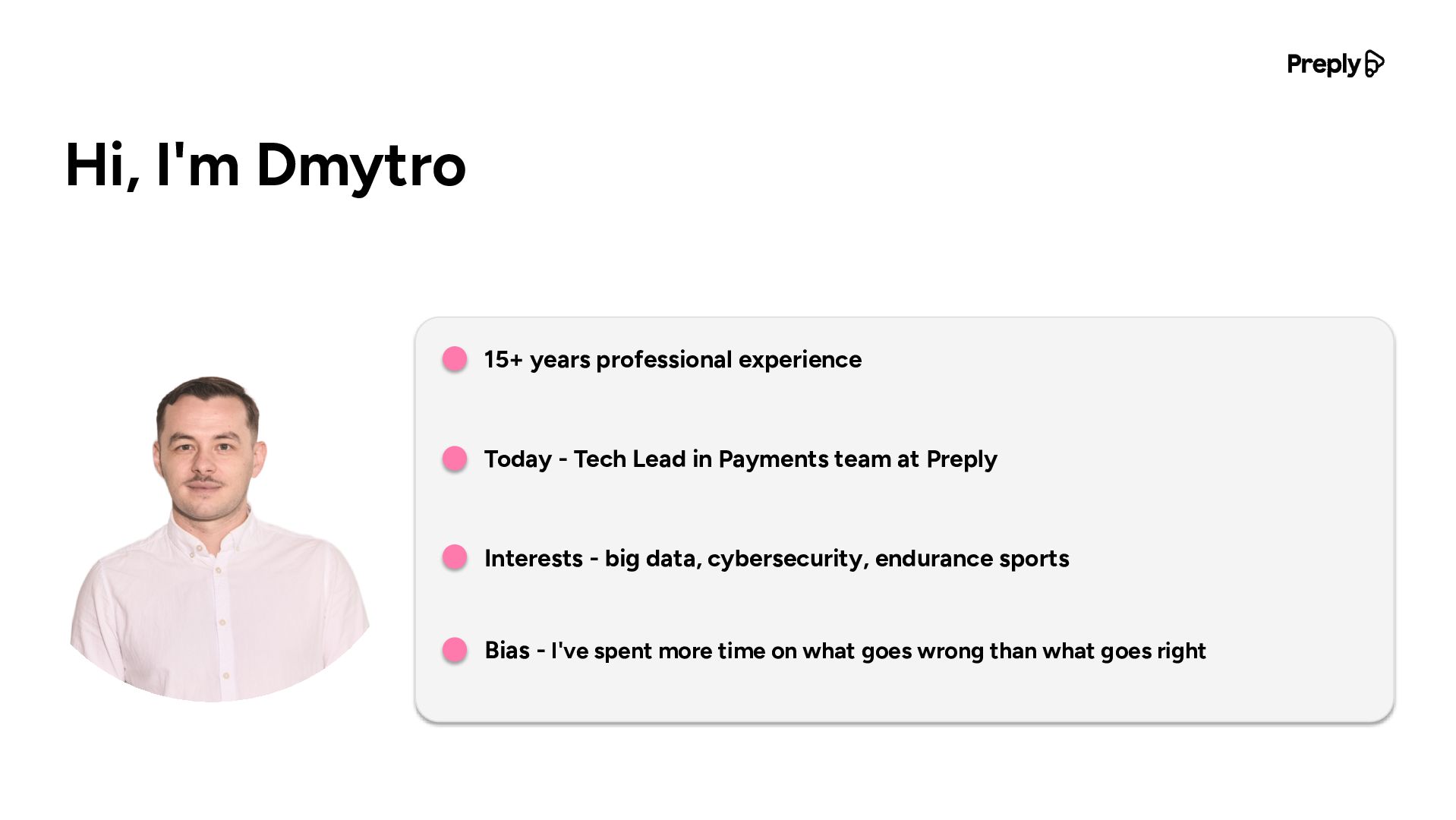
  3. Hi, I'm Dmytro 15+ years professional experience Today - Tech

    Lead in Payments team at Preply Interests - big data, cybersecurity, endurance sports Bias - I've spent more time on what goes wrong than what goes right
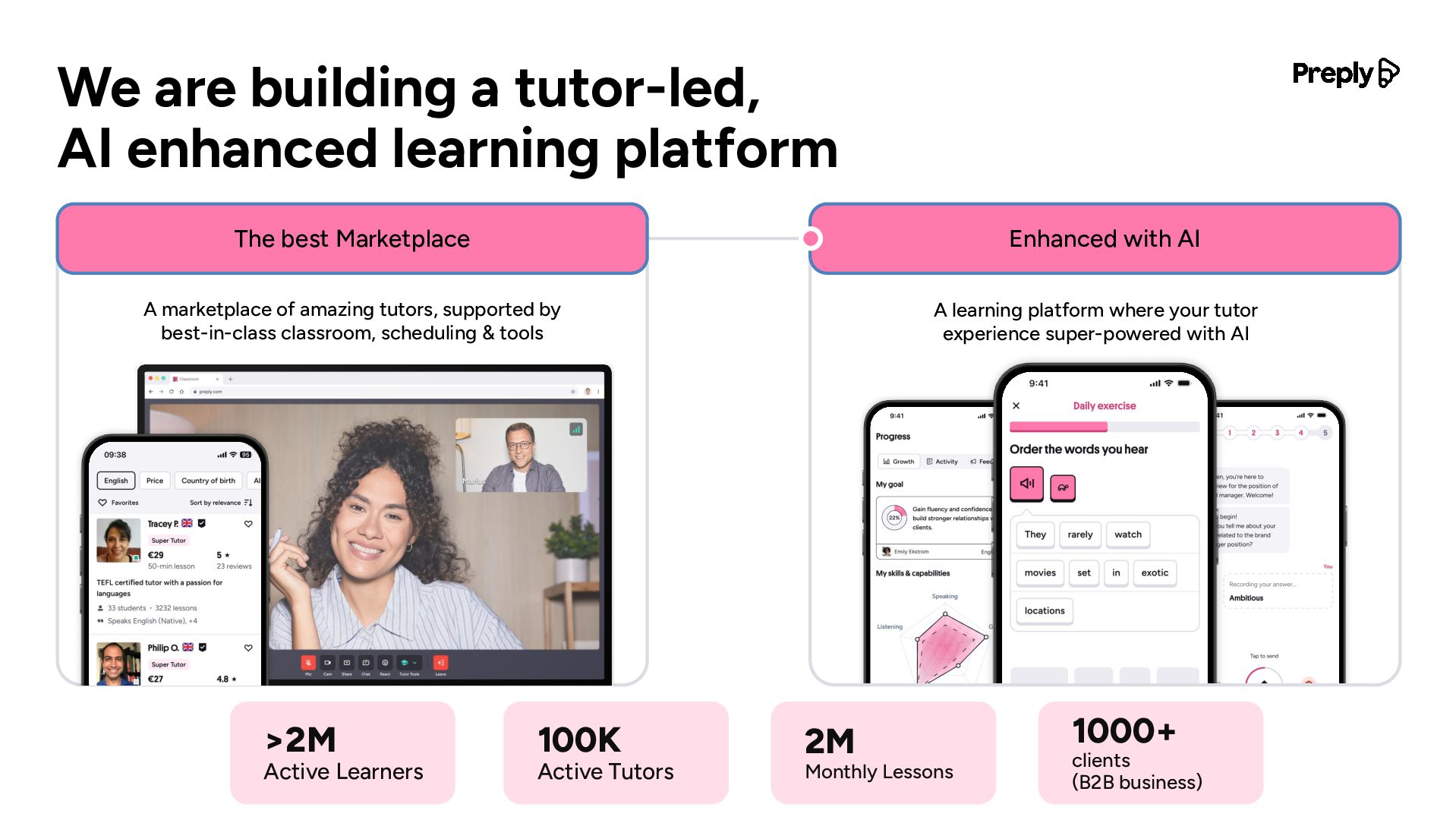
  4. A learning platform where your tutor experience super-powered with AI

    A marketplace of amazing tutors, supported by best-in-class classroom, scheduling & tools The best Marketplace We are building a tutor-led, AI enhanced learning platform Enhanced with AI >2M Active Learners 100K Active Tutors 2M Monthly Lessons 1000+ clients (B2B business)
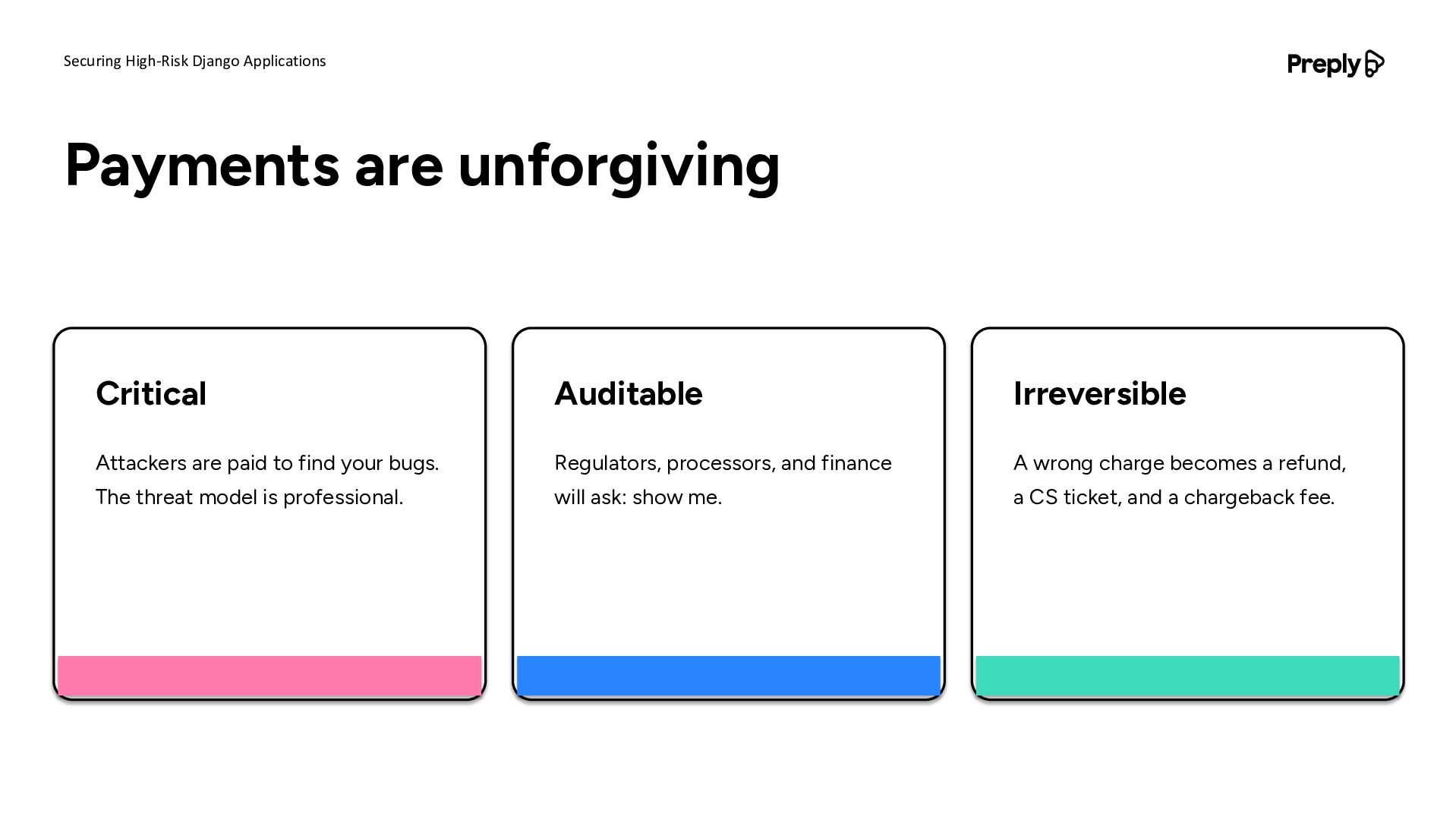
  5. Securing High-Risk Django Applications Payments are unforgiving Critical Attackers are

    paid to find your bugs. The threat model is professional. Auditable Regulators, processors, and finance will ask: show me. Irreversible A wrong charge becomes a refund, a CS ticket, and a chargeback fee.
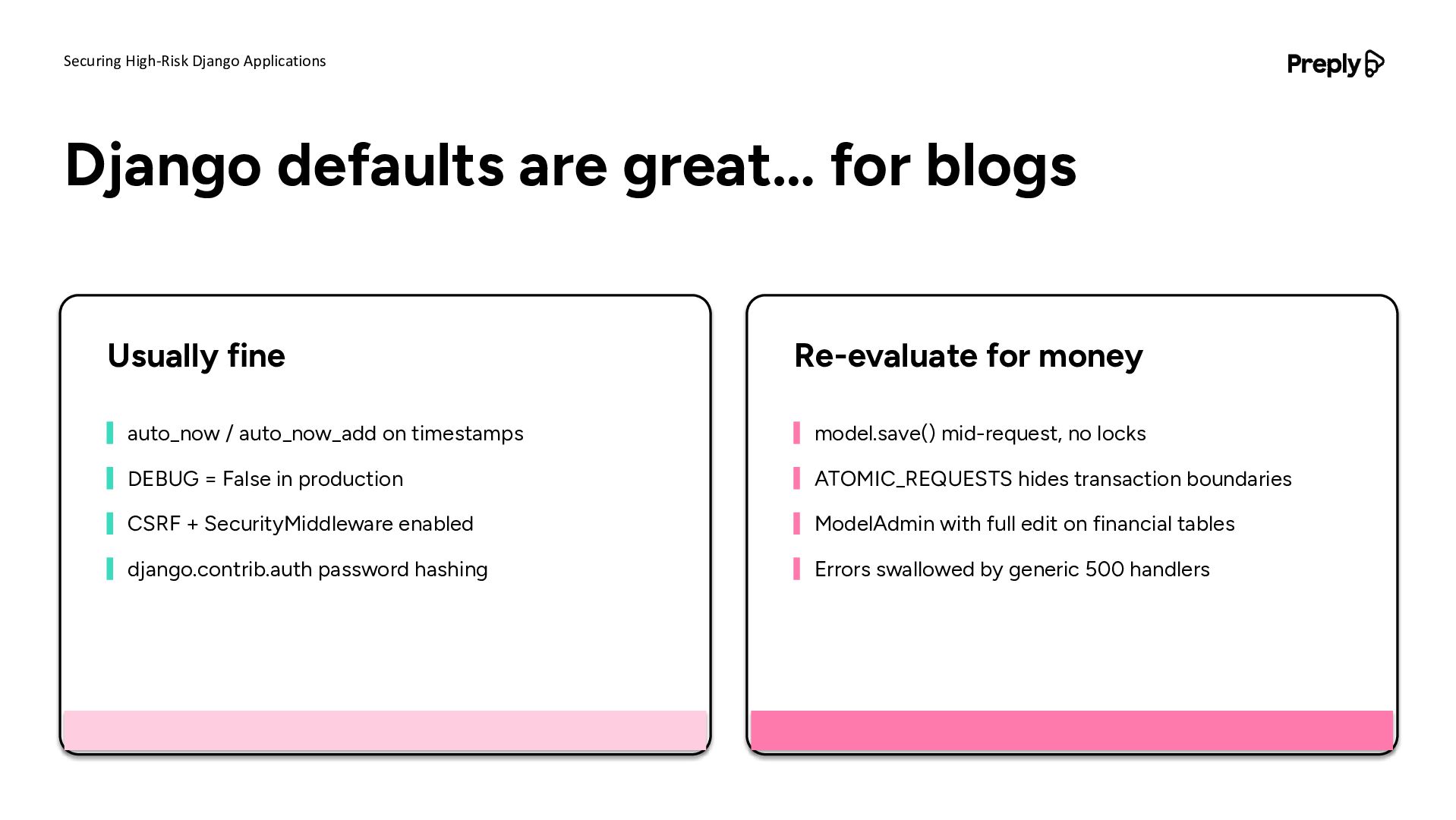
  6. Securing High-Risk Django Applications Django defaults are great… for blogs
    Usually fine ▍ auto_now / auto_now_add on timestamps ▍ DEBUG = False in production ▍ CSRF + SecurityMiddleware enabled ▍ django.contrib.auth password hashing Re-evaluate for money ▍ model.save() mid-request, no locks ▍ ATOMIC_REQUESTS hides transaction boundaries ▍ ModelAdmin with full edit on financial tables ▍ Errors swallowed by generic 500 handlers
  7. Securing High-Risk Django Applications Reads, then writes - without protection

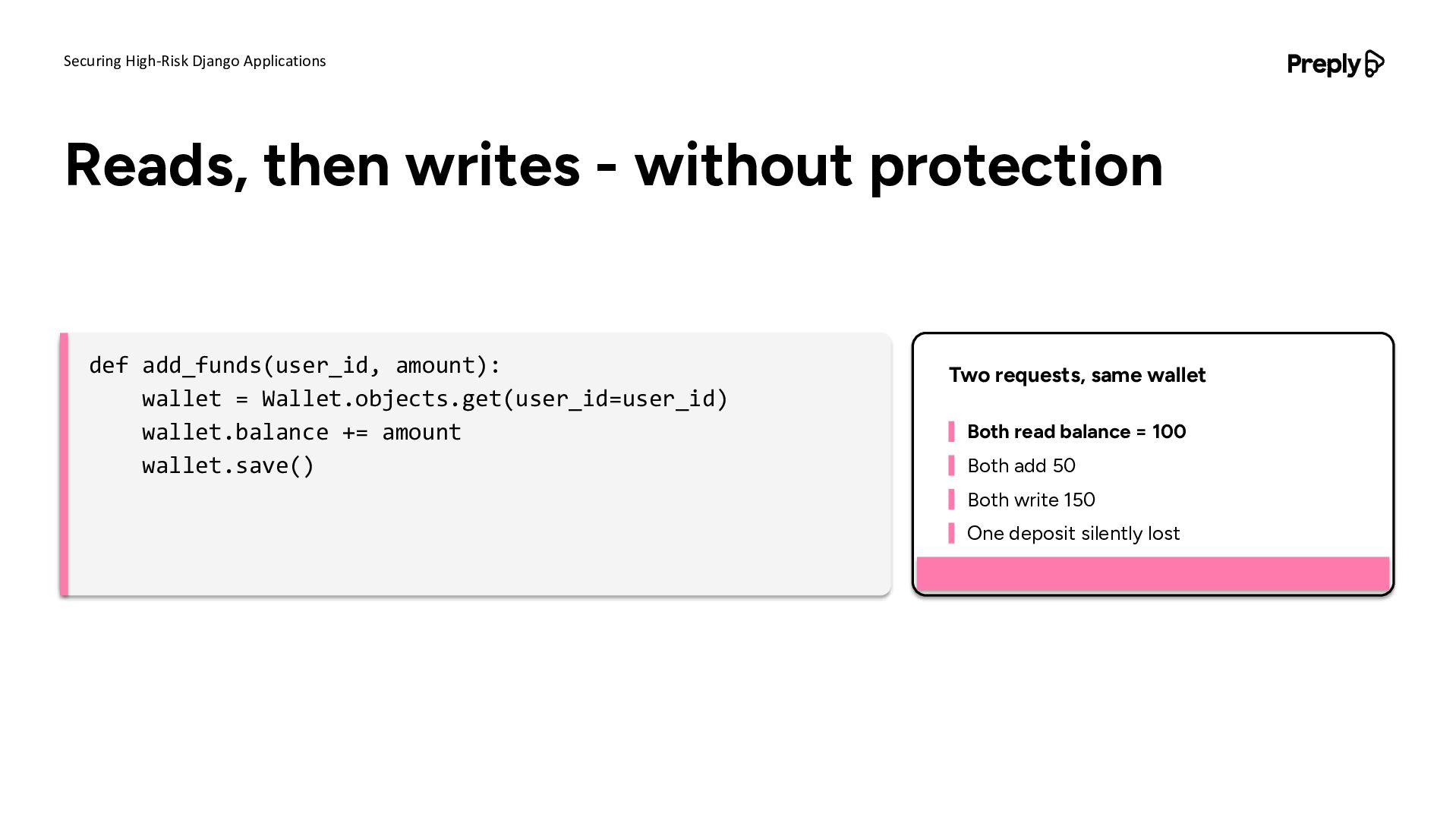
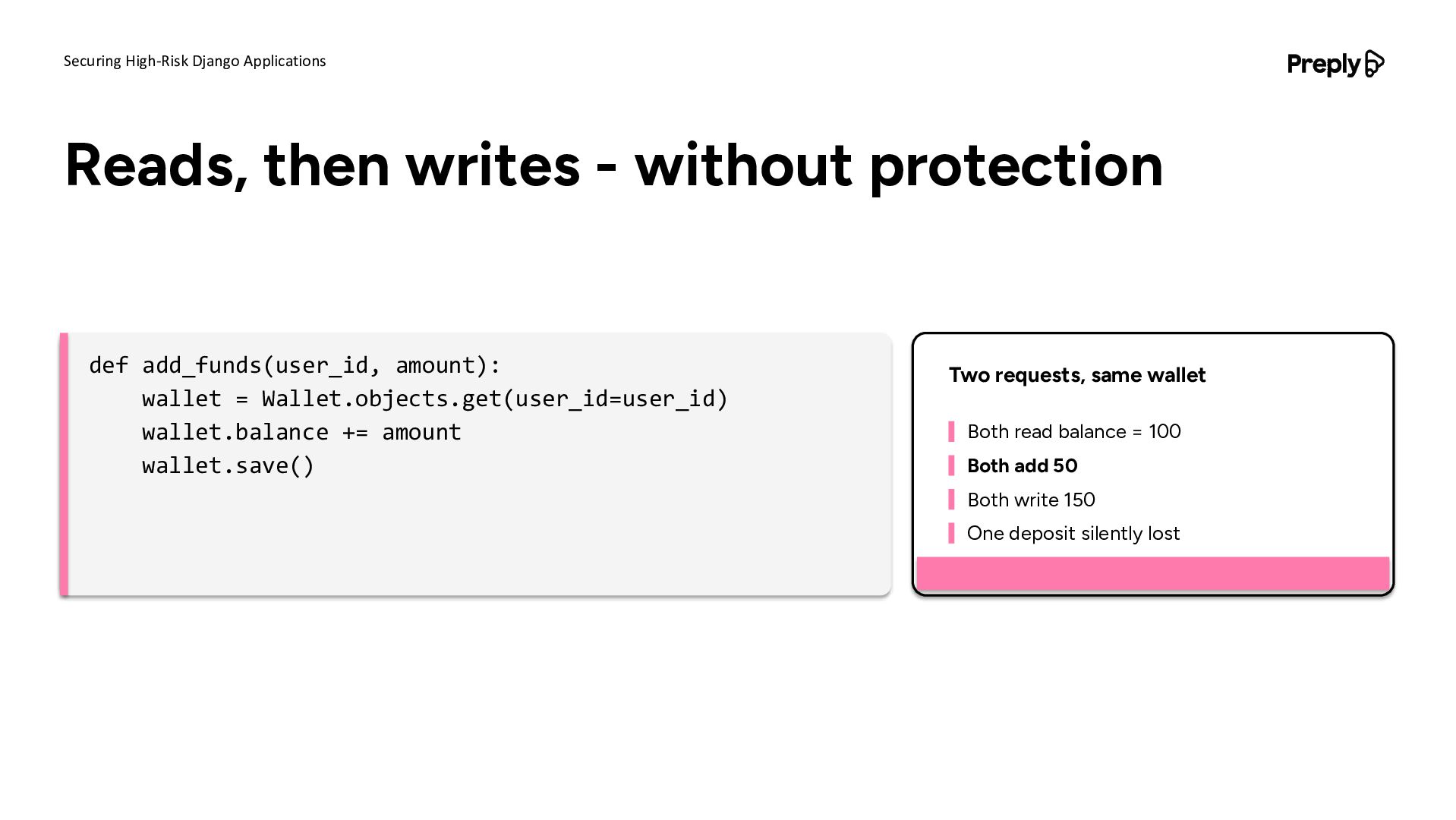
    def add_funds(user_id, amount): wallet = Wallet.objects.get(user_id=user_id) wallet.balance += amount wallet.save() Two requests, same wallet ▍ Both read balance = 100 ▍ Both add 50 ▍ Both write 150 ▍ One deposit silently lost
  8. Securing High-Risk Django Applications Reads, then writes - without protection

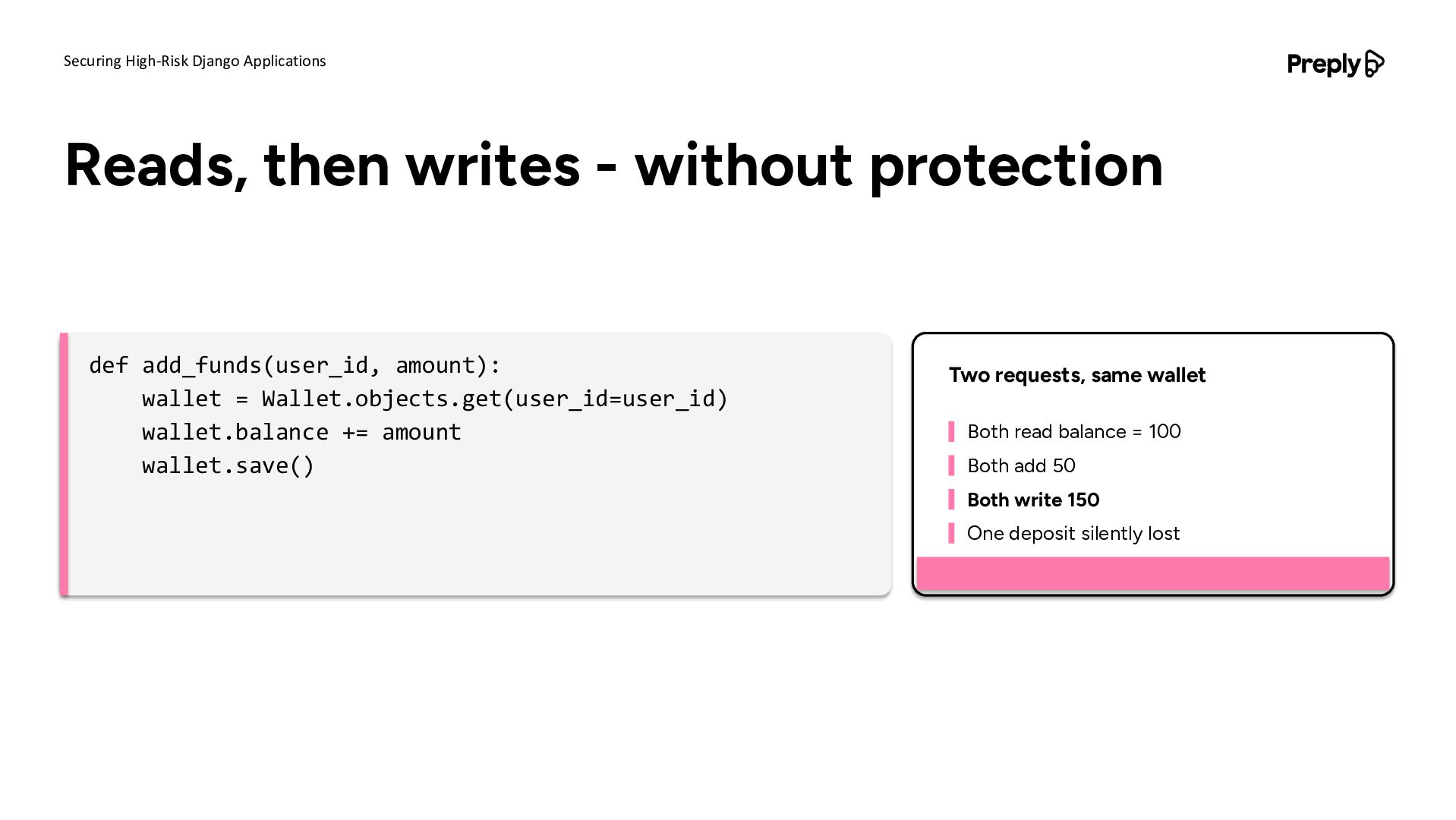
    def add_funds(user_id, amount): wallet = Wallet.objects.get(user_id=user_id) wallet.balance += amount wallet.save() Two requests, same wallet ▍ Both read balance = 100 ▍ Both add 50 ▍ Both write 150 ▍ One deposit silently lost
  9. Securing High-Risk Django Applications Reads, then writes - without protection

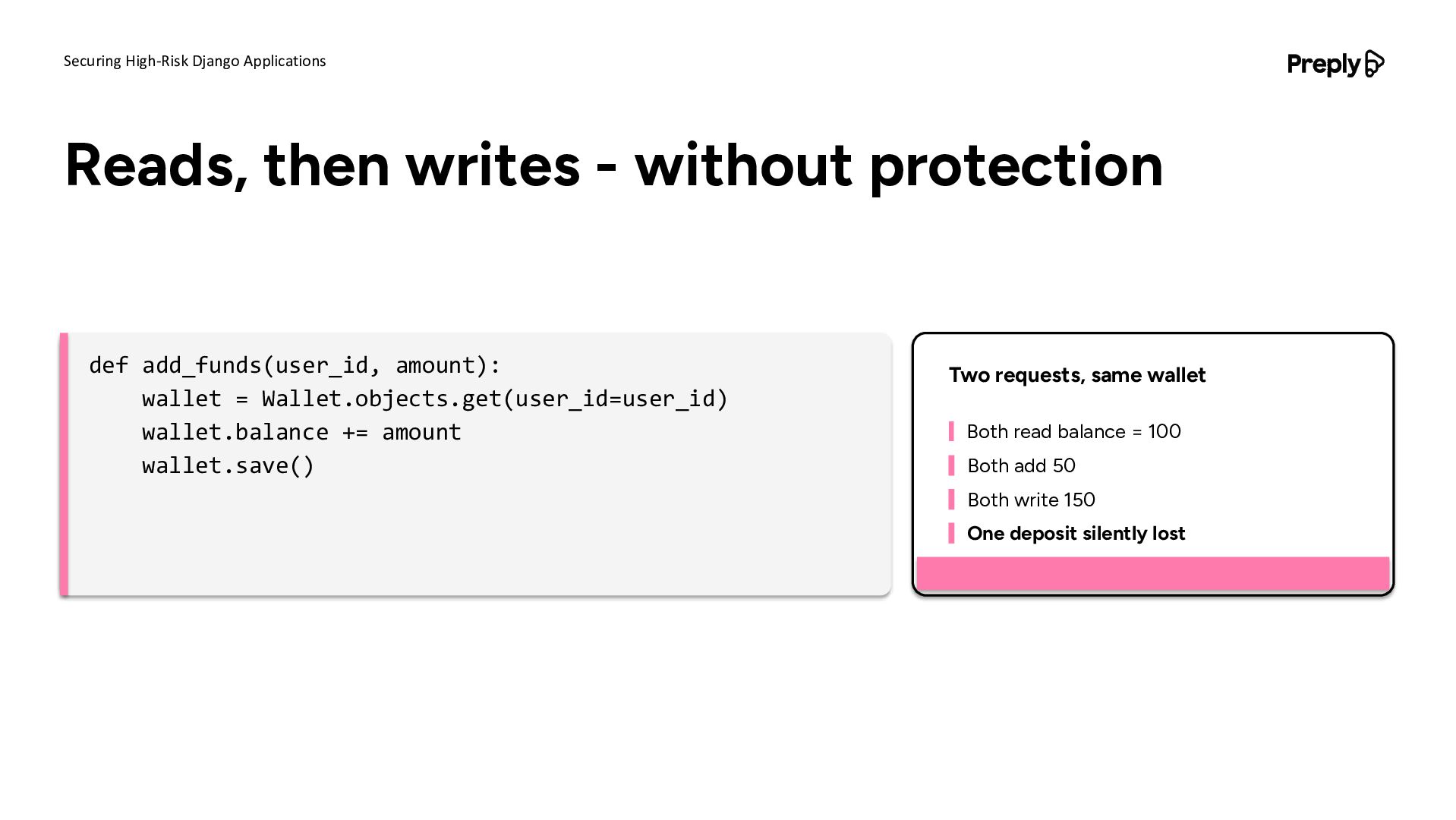
    def add_funds(user_id, amount): wallet = Wallet.objects.get(user_id=user_id) wallet.balance += amount wallet.save() Two requests, same wallet ▍ Both read balance = 100 ▍ Both add 50 ▍ Both write 150 ▍ One deposit silently lost
  10. Securing High-Risk Django Applications Reads, then writes - without protection

    def add_funds(user_id, amount): wallet = Wallet.objects.get(user_id=user_id) wallet.balance += amount wallet.save() Two requests, same wallet ▍ Both read balance = 100 ▍ Both add 50 ▍ Both write 150 ▍ One deposit silently lost
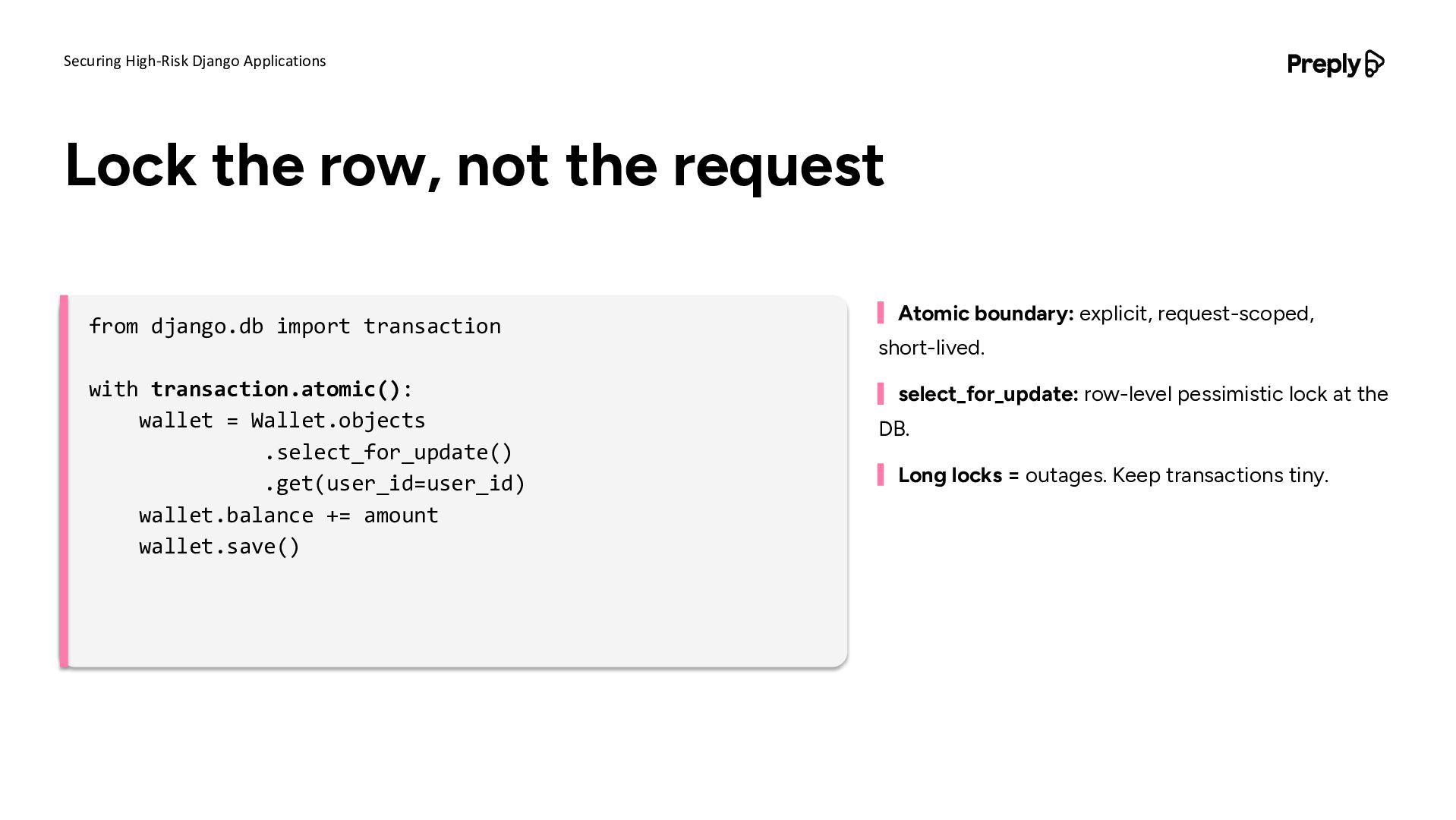
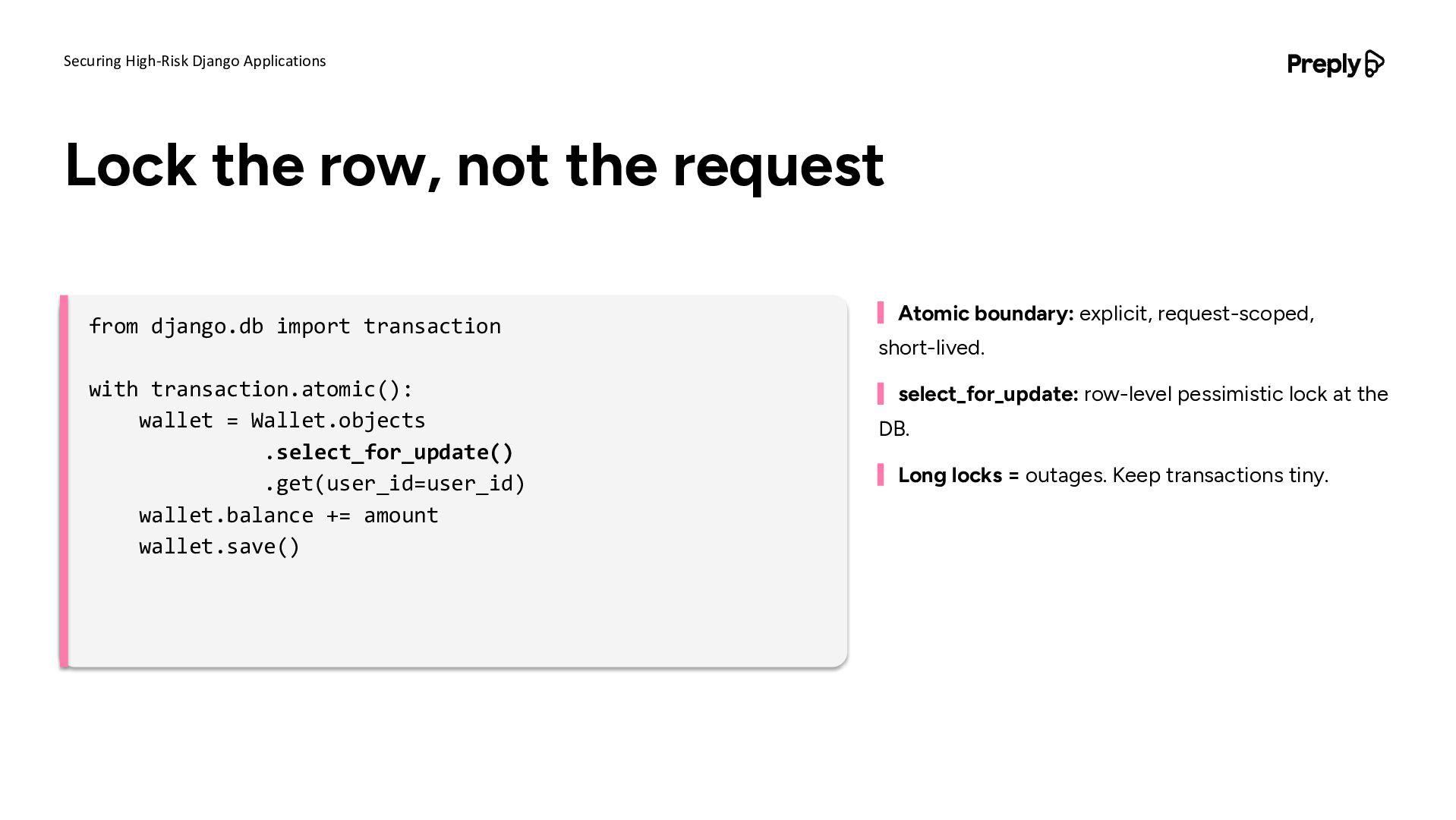
  11. Securing High-Risk Django Applications Lock the row, not the request

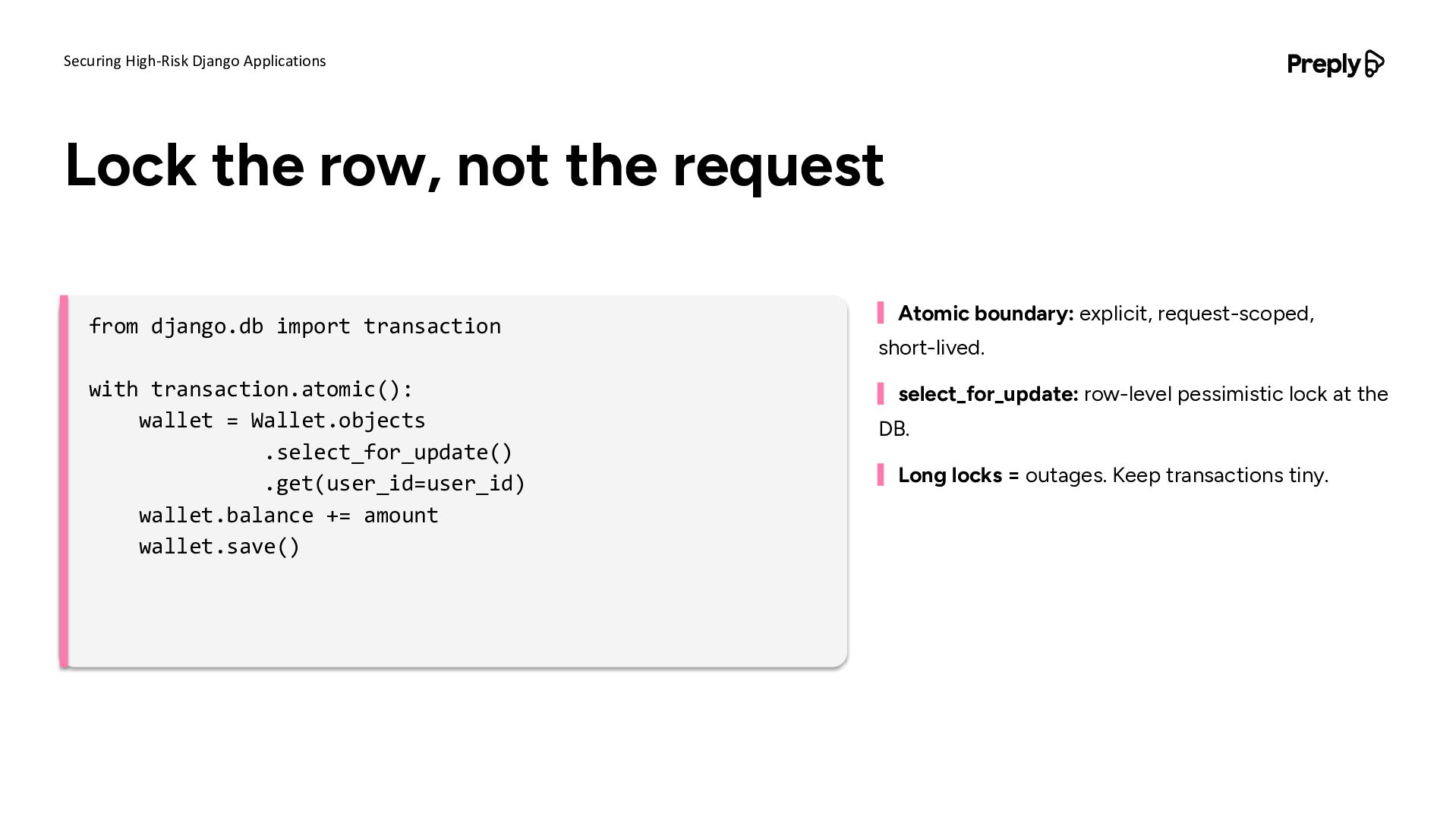
    from django.db import transaction with transaction.atomic(): wallet = Wallet.objects .select_for_update() .get(user_id=user_id) wallet.balance += amount wallet.save() ▍ Atomic boundary: explicit, request-scoped, short-lived. ▍ select_for_update: row-level pessimistic lock at the DB. ▍ Long locks = outages. Keep transactions tiny.
  12. Securing High-Risk Django Applications Lock the row, not the request

    from django.db import transaction with transaction.atomic(): wallet = Wallet.objects .select_for_update() .get(user_id=user_id) wallet.balance += amount wallet.save() ▍ Atomic boundary: explicit, request-scoped, short-lived. ▍ select_for_update: row-level pessimistic lock at the DB. ▍ Long locks = outages. Keep transactions tiny.
  13. Securing High-Risk Django Applications Lock the row, not the request

    from django.db import transaction with transaction.atomic(): wallet = Wallet.objects .select_for_update() .get(user_id=user_id) wallet.balance += amount wallet.save() ▍ Atomic boundary: explicit, request-scoped, short-lived. ▍ select_for_update: row-level pessimistic lock at the DB. ▍ Long locks = outages. Keep transactions tiny.
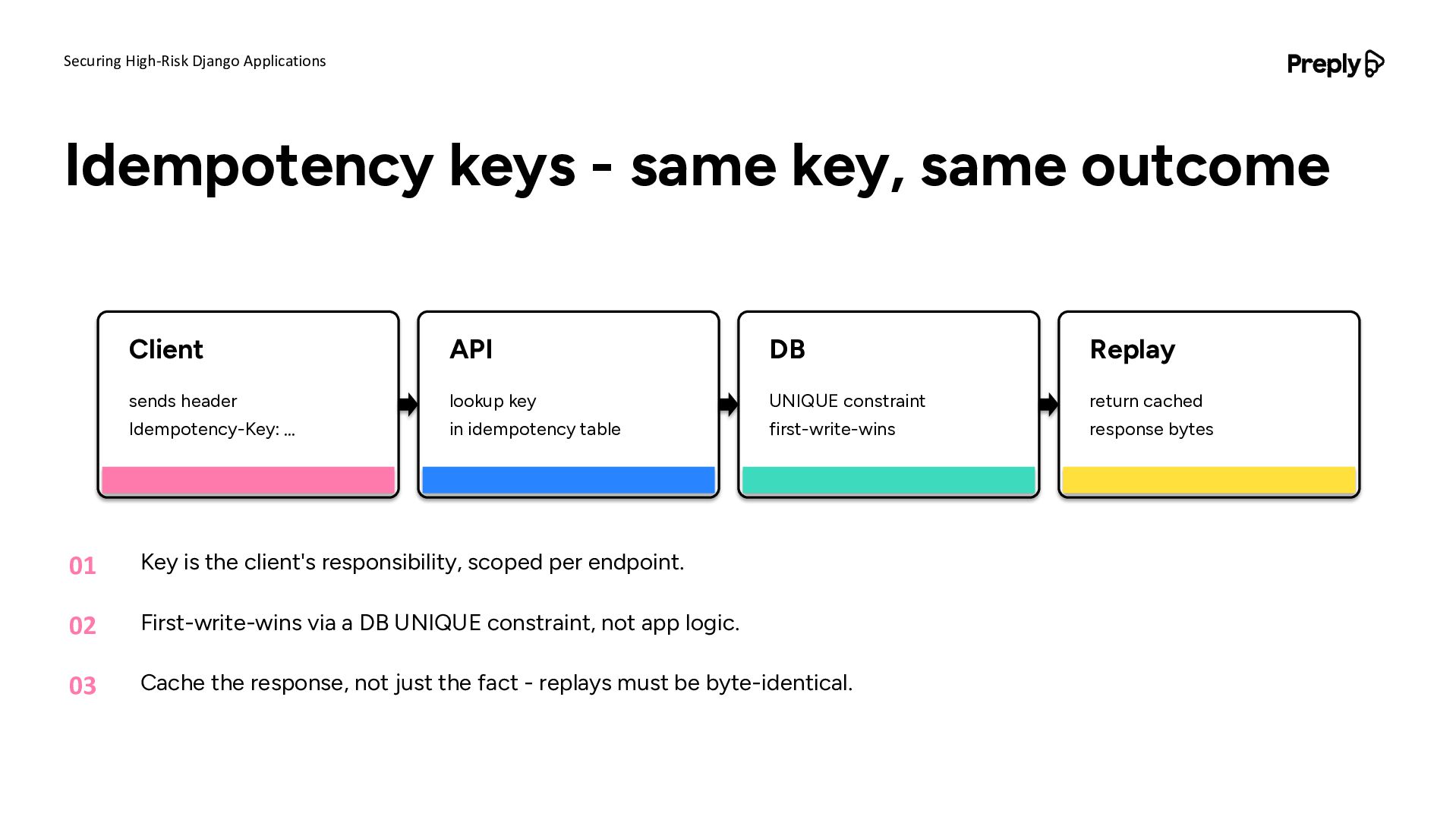
  14. Securing High-Risk Django Applications Idempotency keys - same key, same

    outcome Client sends header Idempotency-Key: … API lookup key in idempotency table DB UNIQUE constraint first-write-wins Replay return cached response bytes 01 Key is the client's responsibility, scoped per endpoint. 02 First-write-wins via a DB UNIQUE constraint, not app logic. 03 Cache the response, not just the fact - replays must be byte-identical.
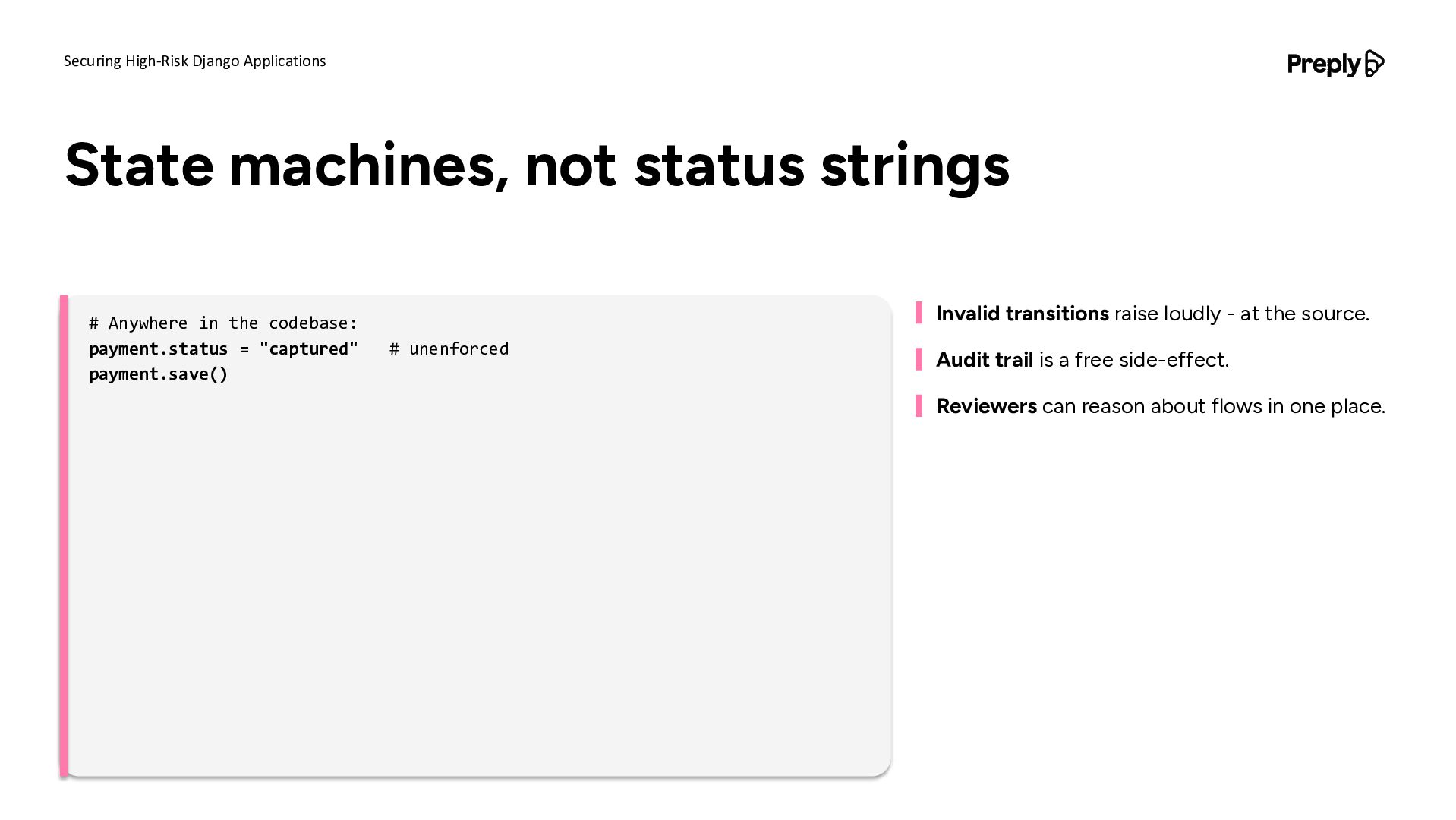
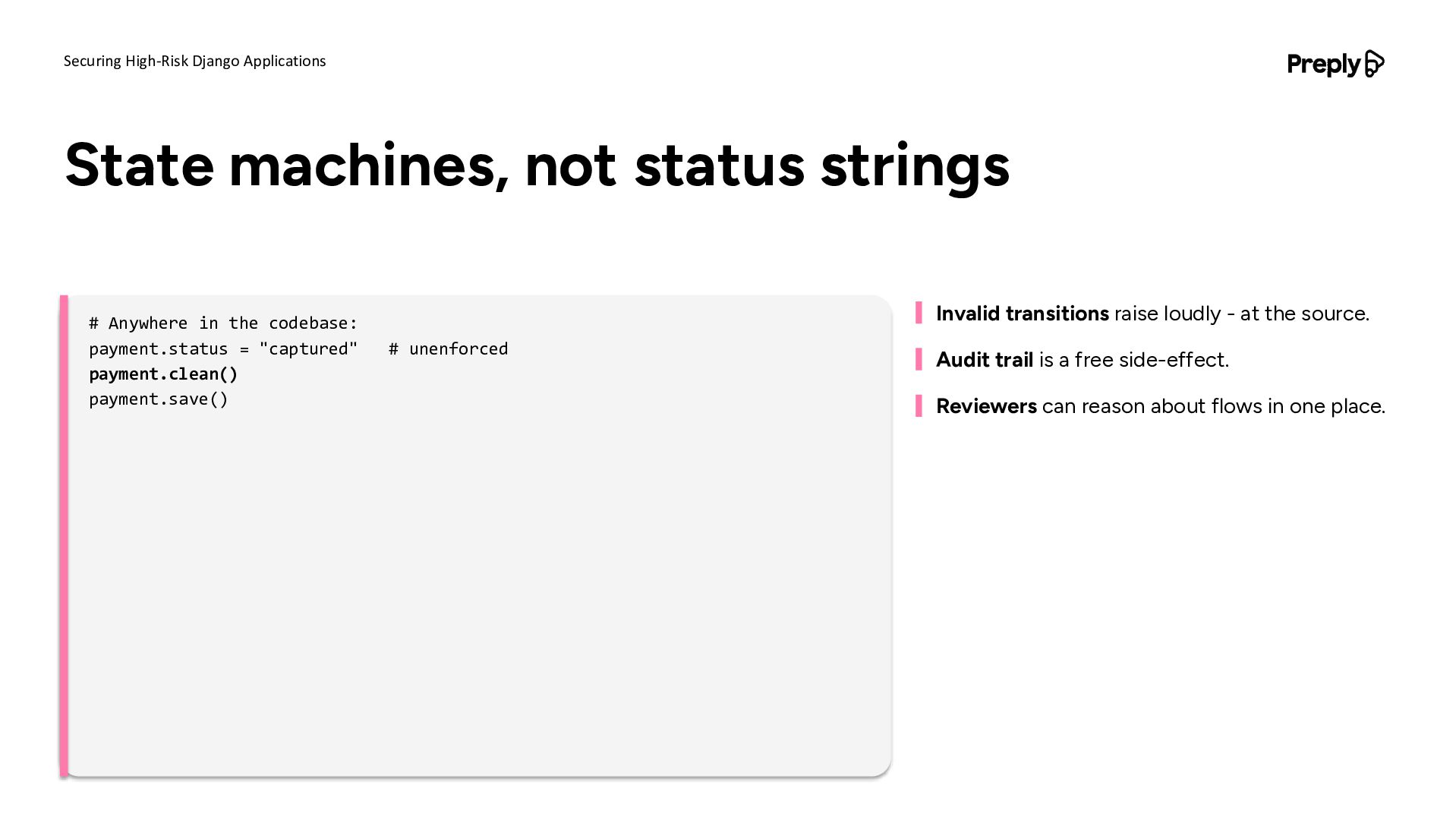
  15. Securing High-Risk Django Applications State machines, not status strings #

    Anywhere in the codebase: payment.status = "captured" # unenforced payment.save() ▍ Invalid transitions raise loudly - at the source. ▍ Audit trail is a free side-effect. ▍ Reviewers can reason about flows in one place.
  16. Securing High-Risk Django Applications State machines, not status strings #

    Anywhere in the codebase: payment.status = "captured" # unenforced payment.clean() payment.save() ▍ Invalid transitions raise loudly - at the source. ▍ Audit trail is a free side-effect. ▍ Reviewers can reason about flows in one place.
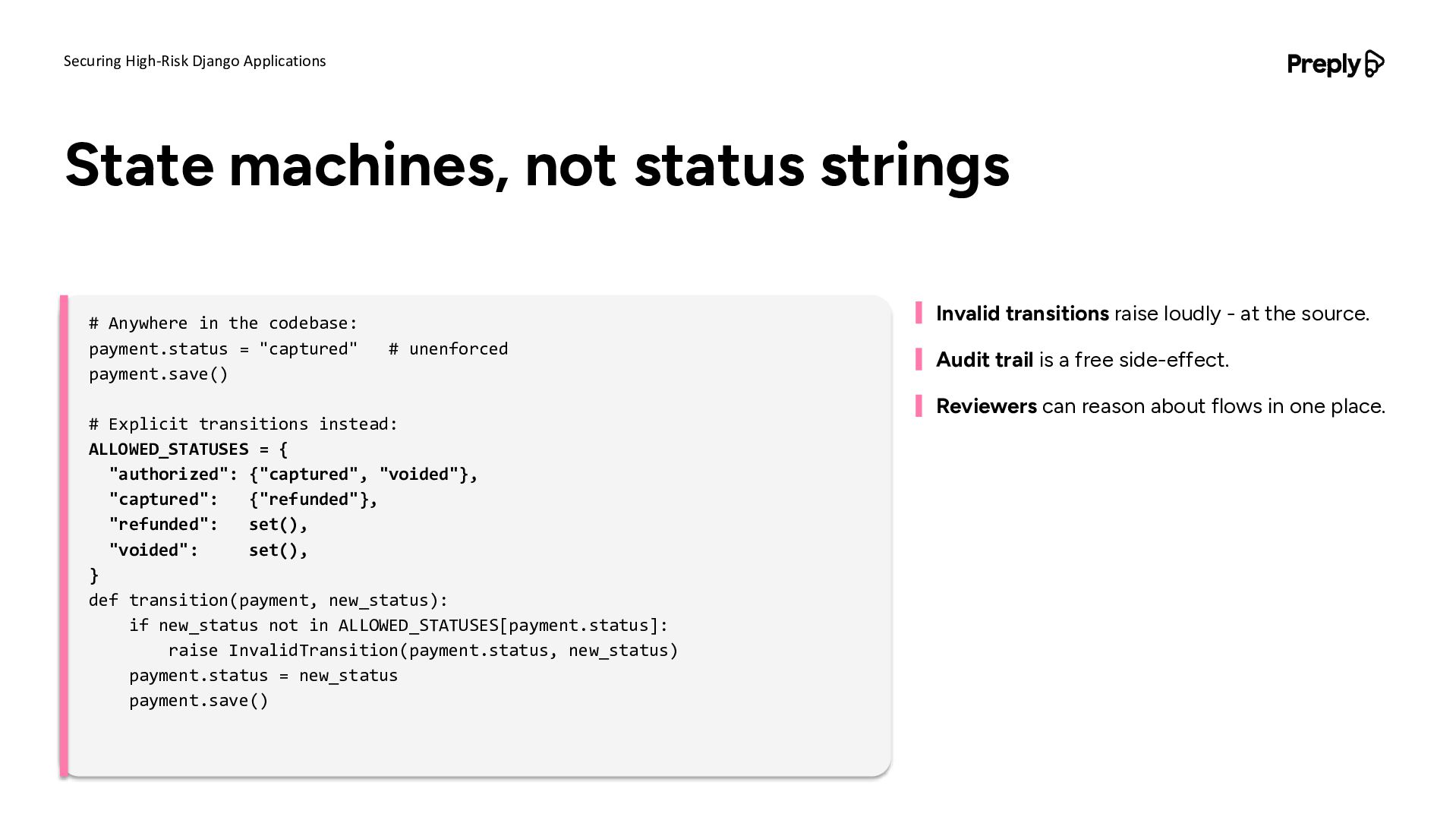
  17. Securing High-Risk Django Applications State machines, not status strings #

    Anywhere in the codebase: payment.status = "captured" # unenforced payment.save() # Explicit transitions instead: ALLOWED_STATUSES = { "authorized": {"captured", "voided"}, "captured": {"refunded"}, "refunded": set(), "voided": set(), } def transition(payment, new_status): if new_status not in ALLOWED_STATUSES[payment.status]: raise InvalidTransition(payment.status, new_status) payment.status = new_status payment.save() ▍ Invalid transitions raise loudly - at the source. ▍ Audit trail is a free side-effect. ▍ Reviewers can reason about flows in one place.
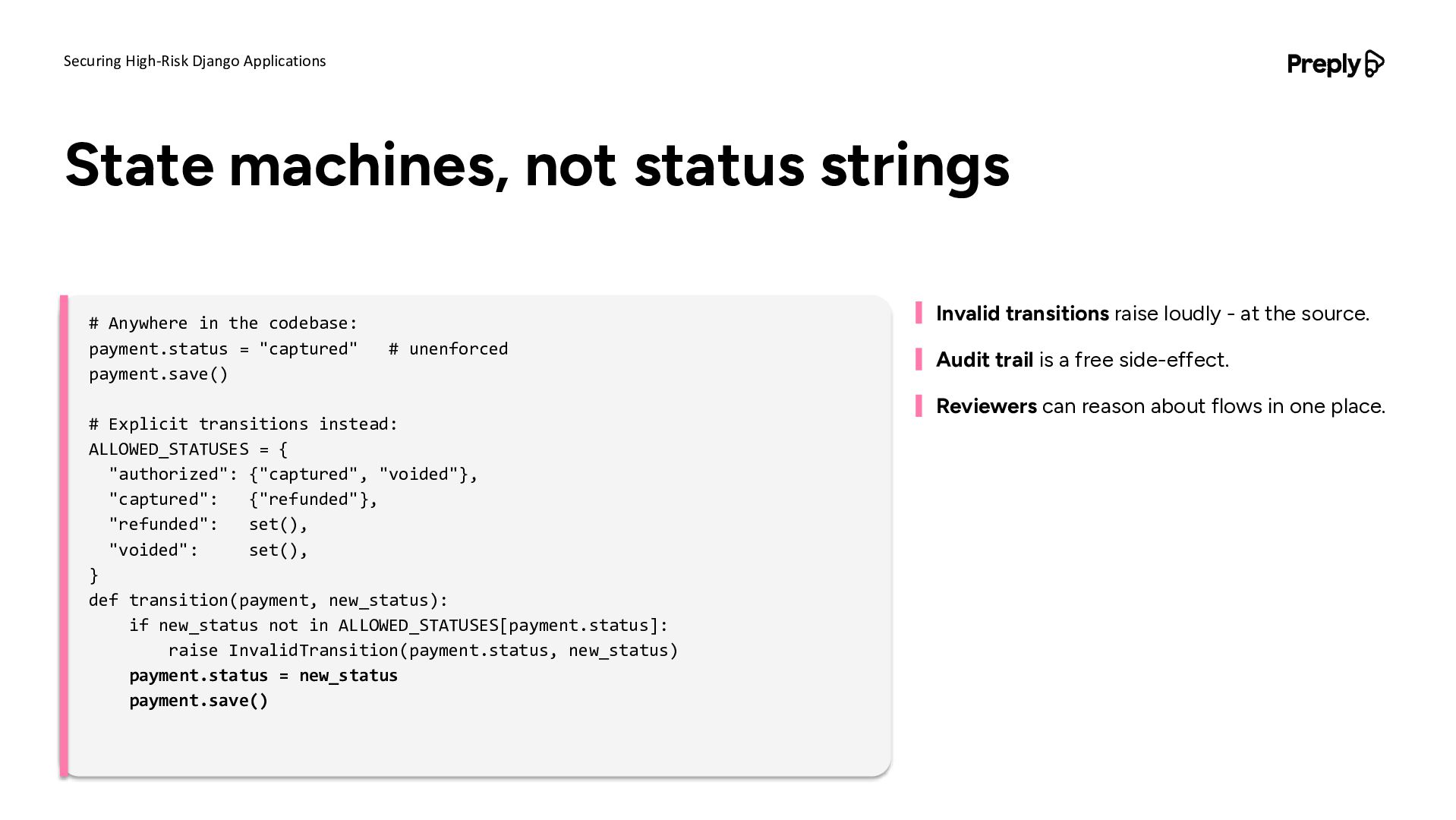
  18. Securing High-Risk Django Applications State machines, not status strings #

    Anywhere in the codebase: payment.status = "captured" # unenforced payment.save() # Explicit transitions instead: ALLOWED_STATUSES = { "authorized": {"captured", "voided"}, "captured": {"refunded"}, "refunded": set(), "voided": set(), } def transition(payment, new_status): if new_status not in ALLOWED_STATUSES[payment.status]: raise InvalidTransition(payment.status, new_status) payment.status = new_status payment.save() ▍ Invalid transitions raise loudly - at the source. ▍ Audit trail is a free side-effect. ▍ Reviewers can reason about flows in one place.
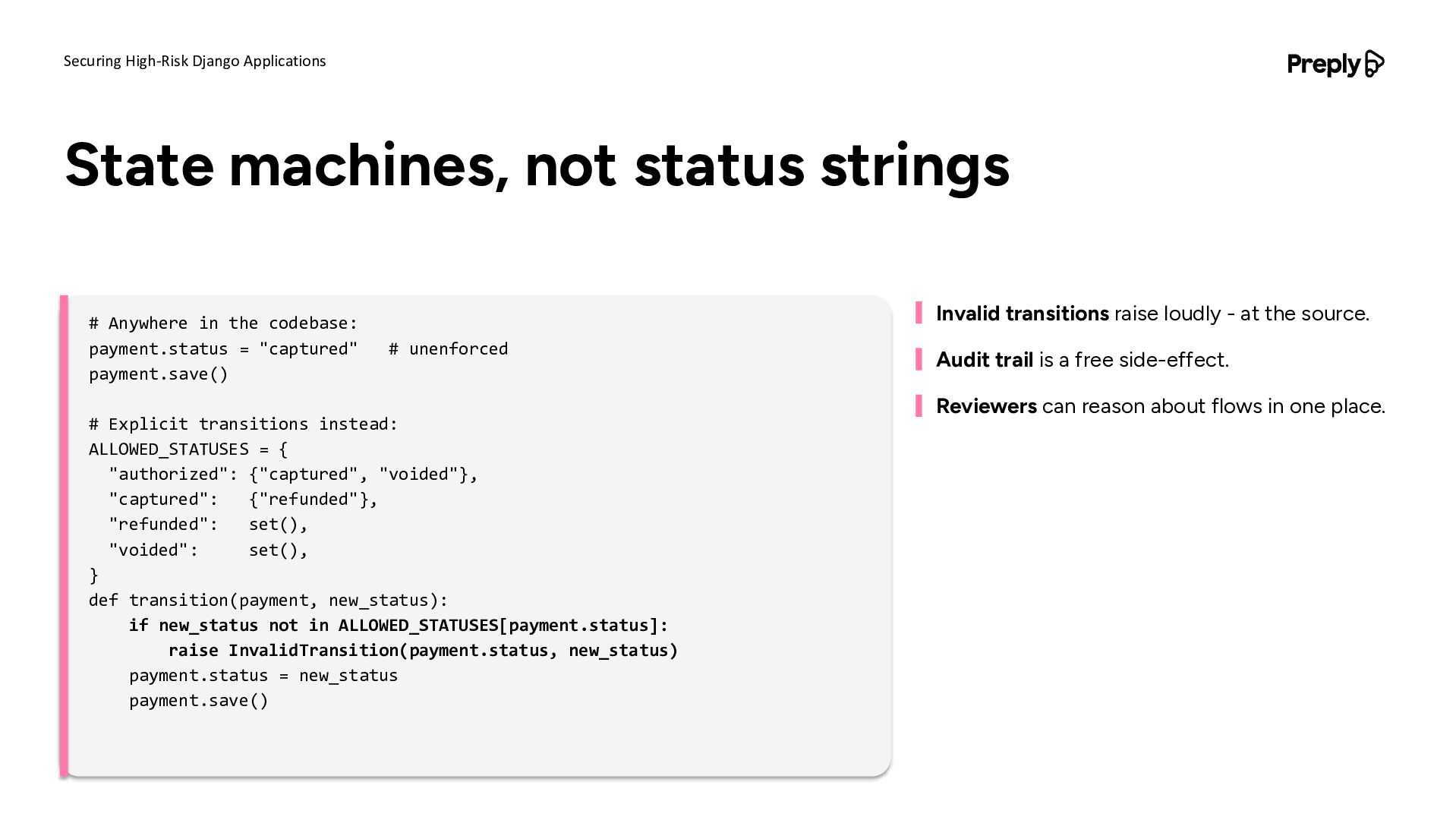
  19. Securing High-Risk Django Applications State machines, not status strings #

    Anywhere in the codebase: payment.status = "captured" # unenforced payment.save() # Explicit transitions instead: ALLOWED_STATUSES = { "authorized": {"captured", "voided"}, "captured": {"refunded"}, "refunded": set(), "voided": set(), } def transition(payment, new_status): if new_status not in ALLOWED_STATUSES[payment.status]: raise InvalidTransition(payment.status, new_status) payment.status = new_status payment.save() ▍ Invalid transitions raise loudly - at the source. ▍ Audit trail is a free side-effect. ▍ Reviewers can reason about flows in one place.
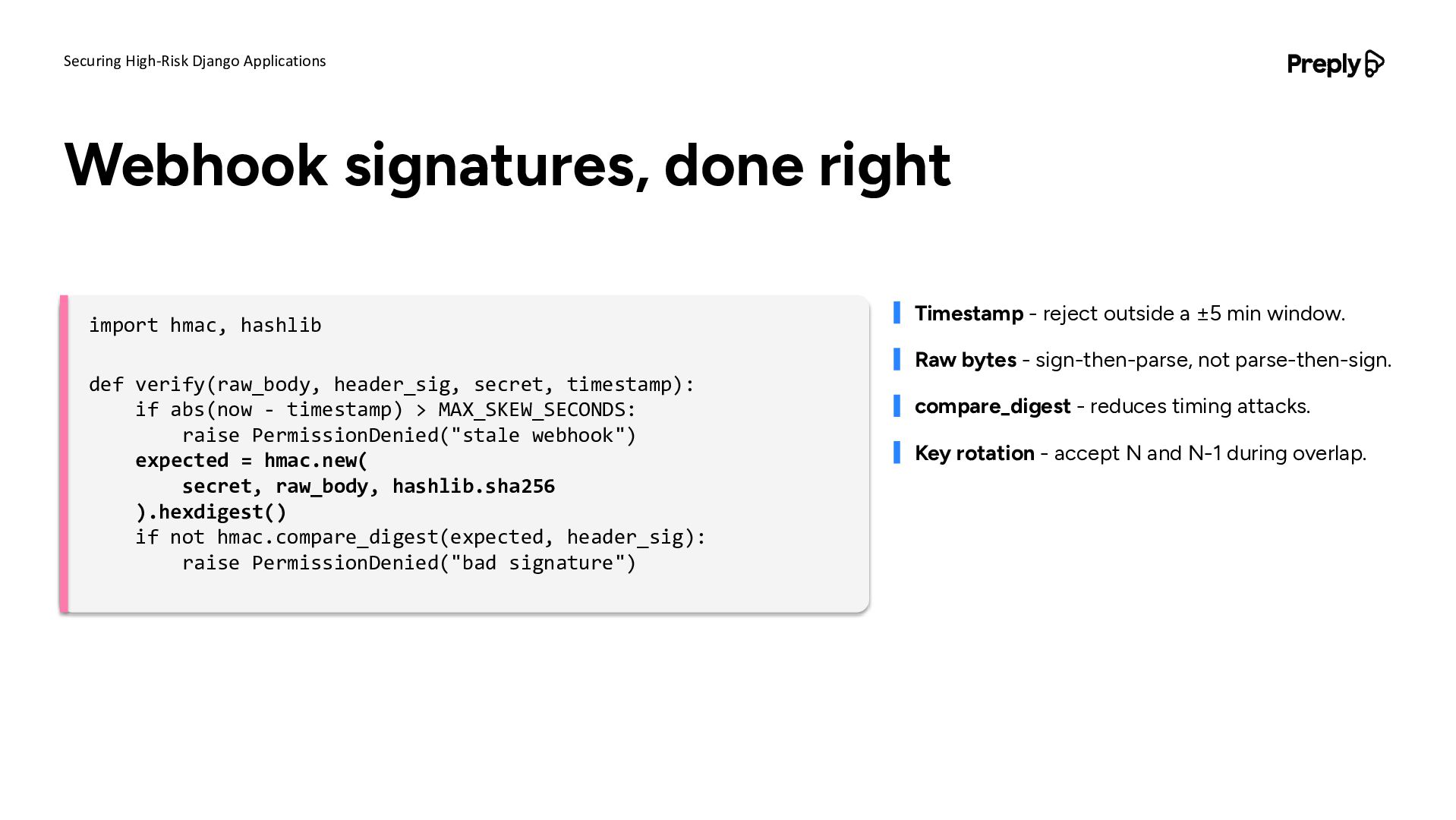
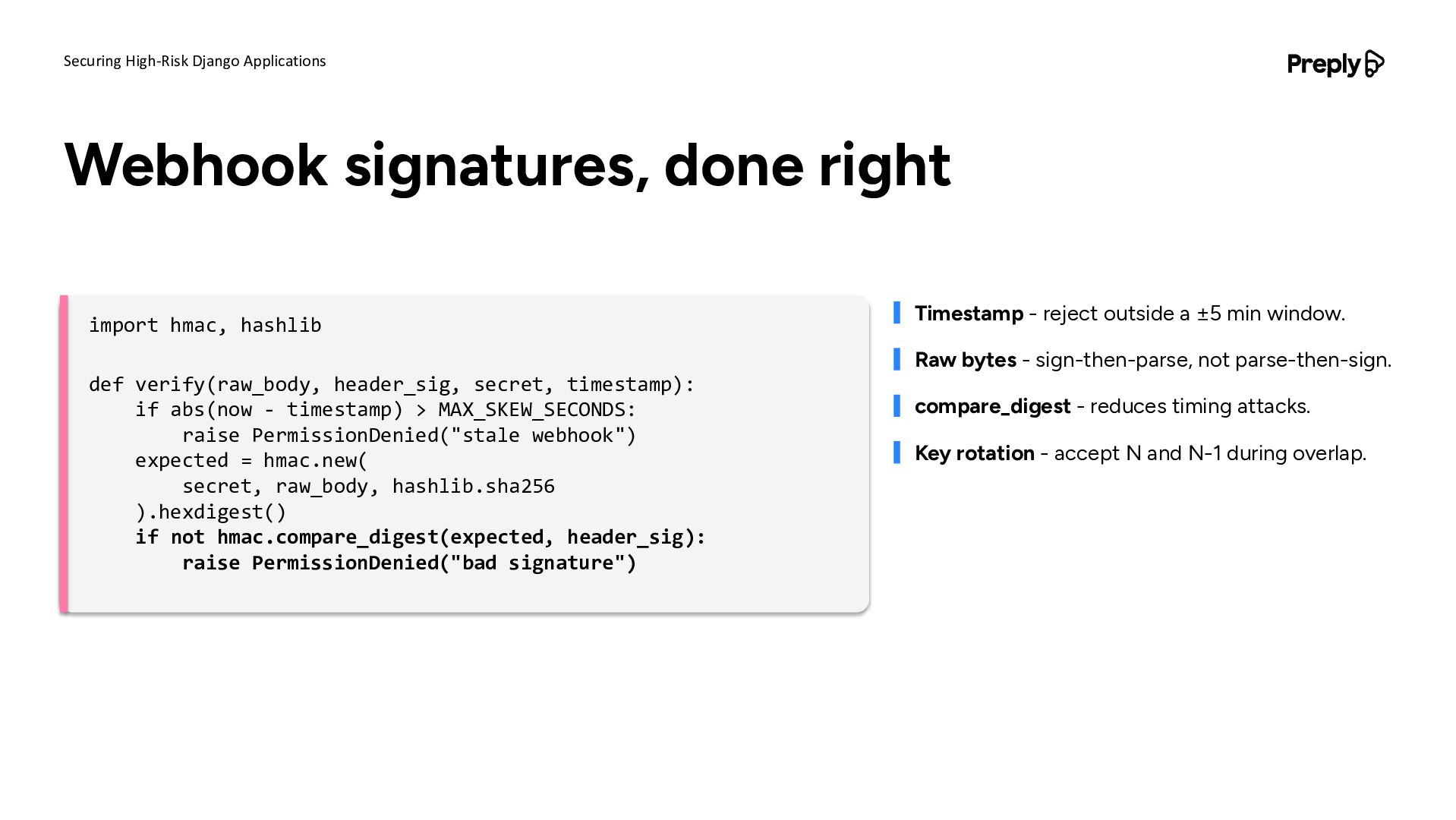
  20. Securing High-Risk Django Applications Webhook signatures, done right import hmac,

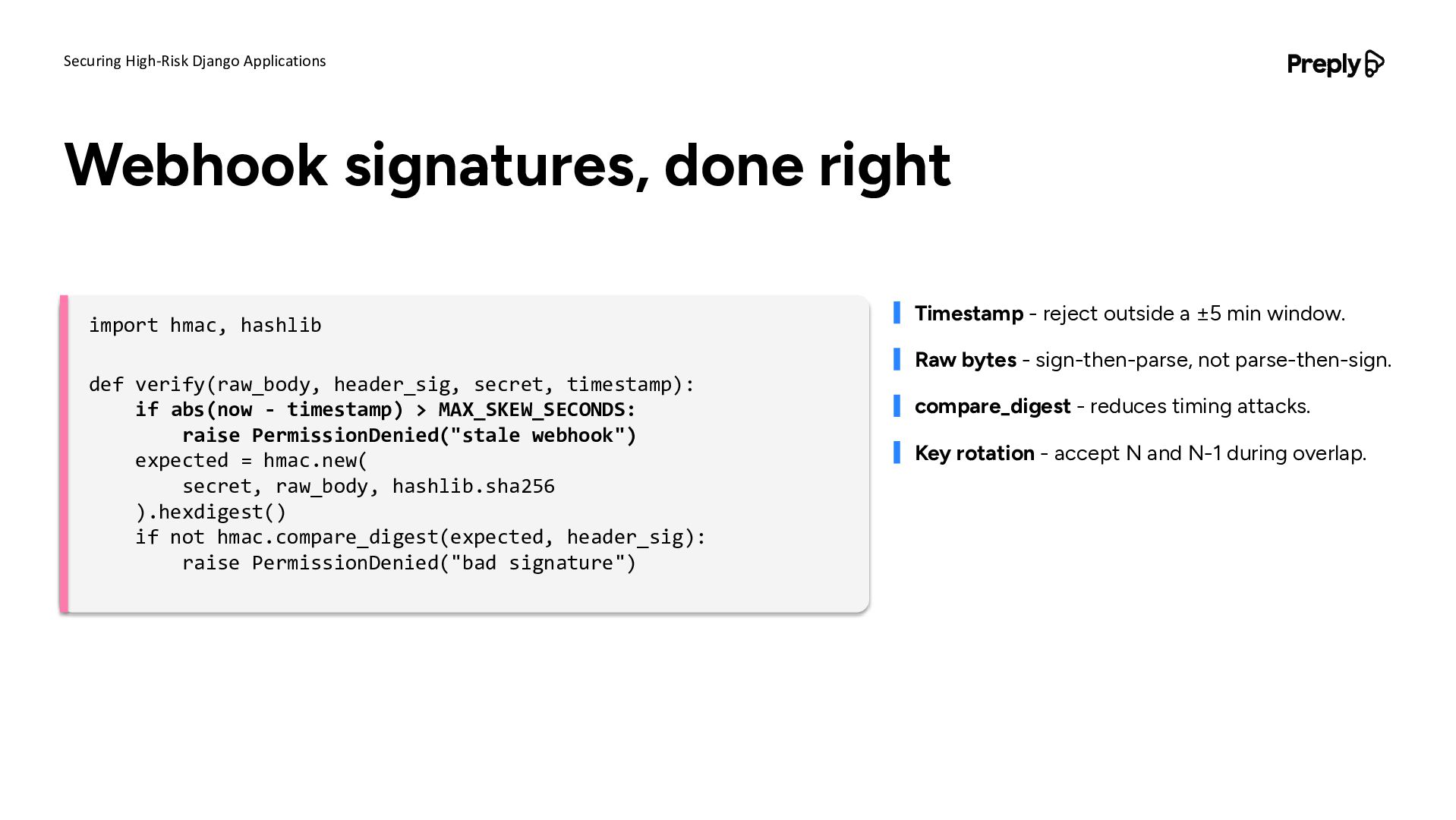
    hashlib def verify(raw_body, header_sig, secret, timestamp): if abs(now - timestamp) > MAX_SKEW_SECONDS: raise PermissionDenied("stale webhook") expected = hmac.new( secret, raw_body, hashlib.sha256 ).hexdigest() if not hmac.compare_digest(expected, header_sig): raise PermissionDenied("bad signature") ▍ Timestamp - reject outside a ±5 min window. ▍ Raw bytes - sign-then-parse, not parse-then-sign. ▍ compare_digest - reduces timing attacks. ▍ Key rotation - accept N and N-1 during overlap.
  21. Securing High-Risk Django Applications Webhook signatures, done right import hmac,

    hashlib def verify(raw_body, header_sig, secret, timestamp): if abs(now - timestamp) > MAX_SKEW_SECONDS: raise PermissionDenied("stale webhook") expected = hmac.new( secret, raw_body, hashlib.sha256 ).hexdigest() if not hmac.compare_digest(expected, header_sig): raise PermissionDenied("bad signature") ▍ Timestamp - reject outside a ±5 min window. ▍ Raw bytes - sign-then-parse, not parse-then-sign. ▍ compare_digest - reduces timing attacks. ▍ Key rotation - accept N and N-1 during overlap.
  22. Securing High-Risk Django Applications Webhook signatures, done right import hmac,

    hashlib def verify(raw_body, header_sig, secret, timestamp): if abs(now - timestamp) > MAX_SKEW_SECONDS: raise PermissionDenied("stale webhook") expected = hmac.new( secret, raw_body, hashlib.sha256 ).hexdigest() if not hmac.compare_digest(expected, header_sig): raise PermissionDenied("bad signature") ▍ Timestamp - reject outside a ±5 min window. ▍ Raw bytes - sign-then-parse, not parse-then-sign. ▍ compare_digest - reduces timing attacks. ▍ Key rotation - accept N and N-1 during overlap.
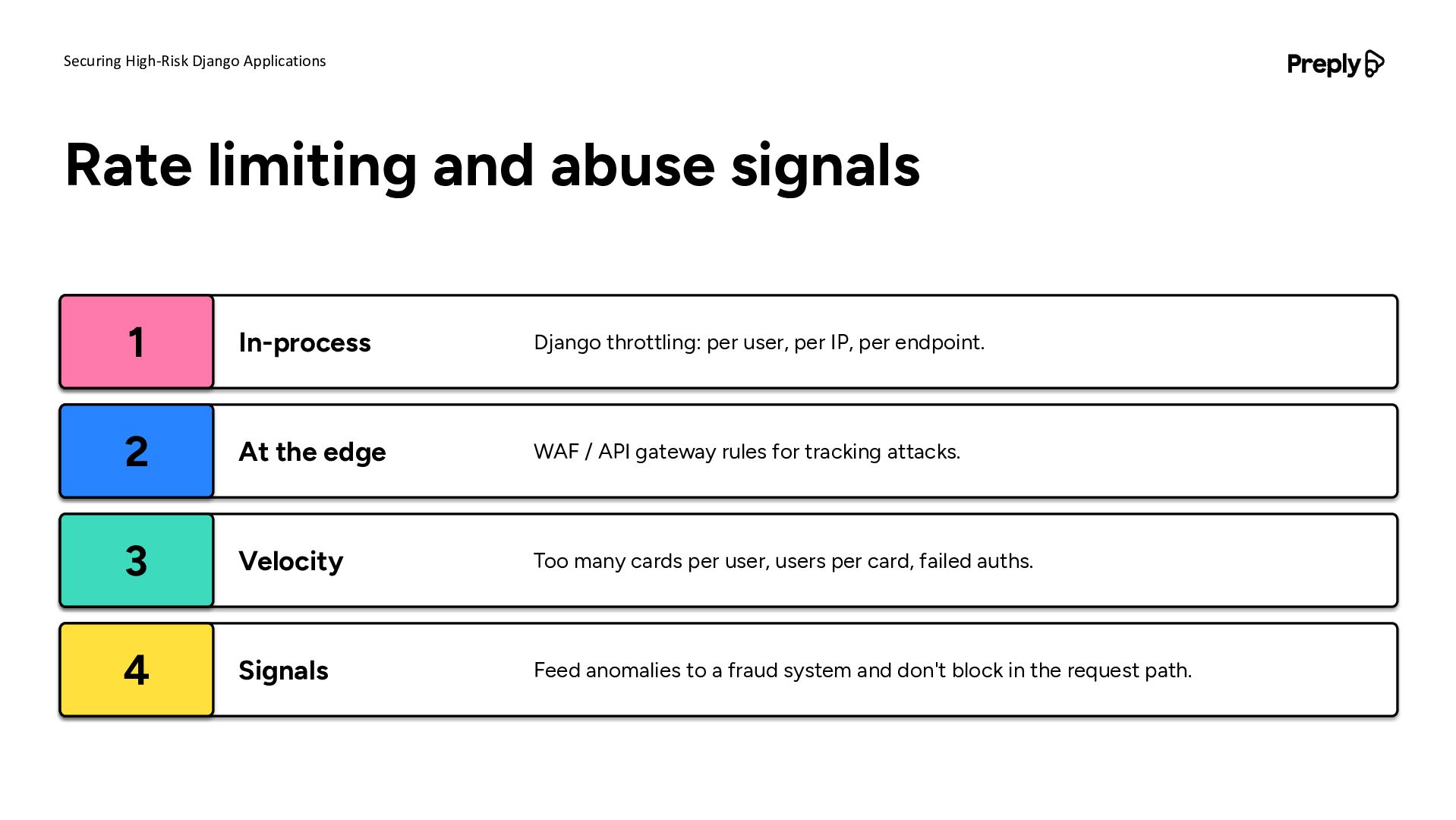
  23. Securing High-Risk Django Applications Rate limiting and abuse signals 1

    In-process Django throttling: per user, per IP, per endpoint. 2 At the edge WAF / API gateway rules for tracking attacks. 3 Velocity Too many cards per user, users per card, failed auths. 4 Signals Feed anomalies to a fraud system and don't block in the request path.
  24. 05 Django admin & internal tools Your admin is a

    vault door with a 'push' sign on it.
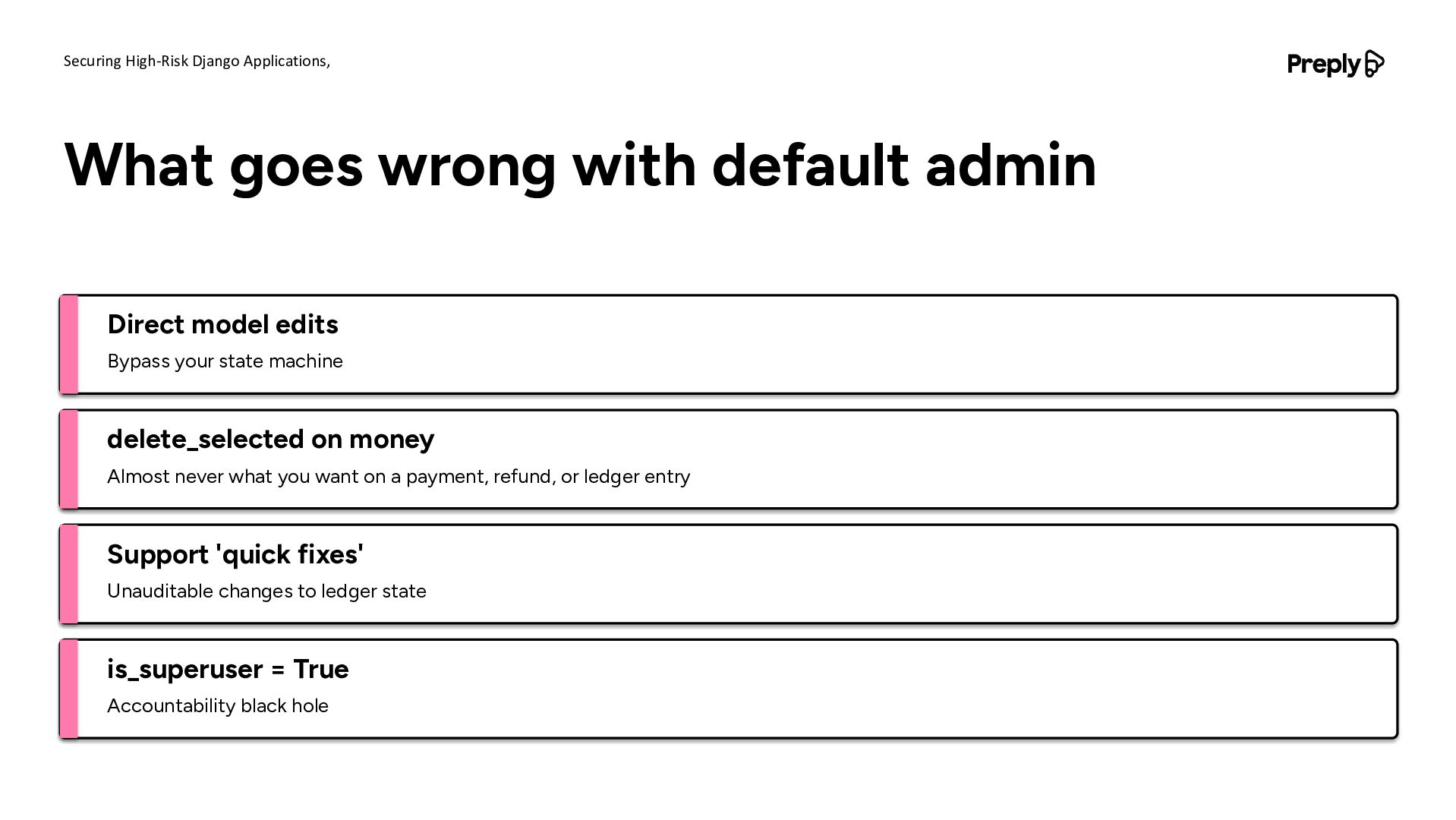
  25. Securing High-Risk Django Applications, What goes wrong with default admin

    Direct model edits Bypass your state machine delete_selected on money Almost never what you want on a payment, refund, or ledger entry Support 'quick fixes' Unauditable changes to ledger state is_superuser = True Accountability black hole
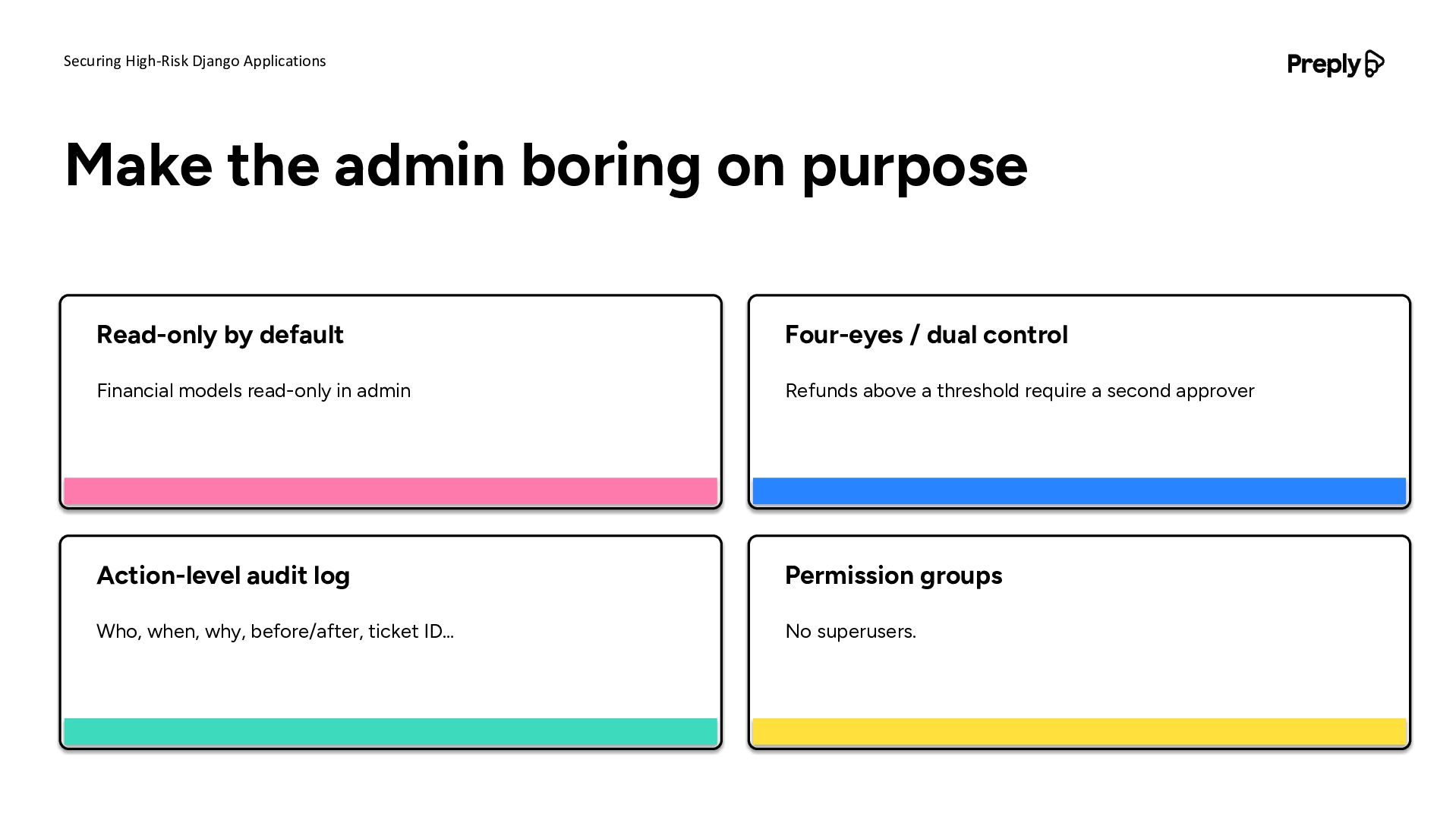
  26. Securing High-Risk Django Applications Make the admin boring on purpose

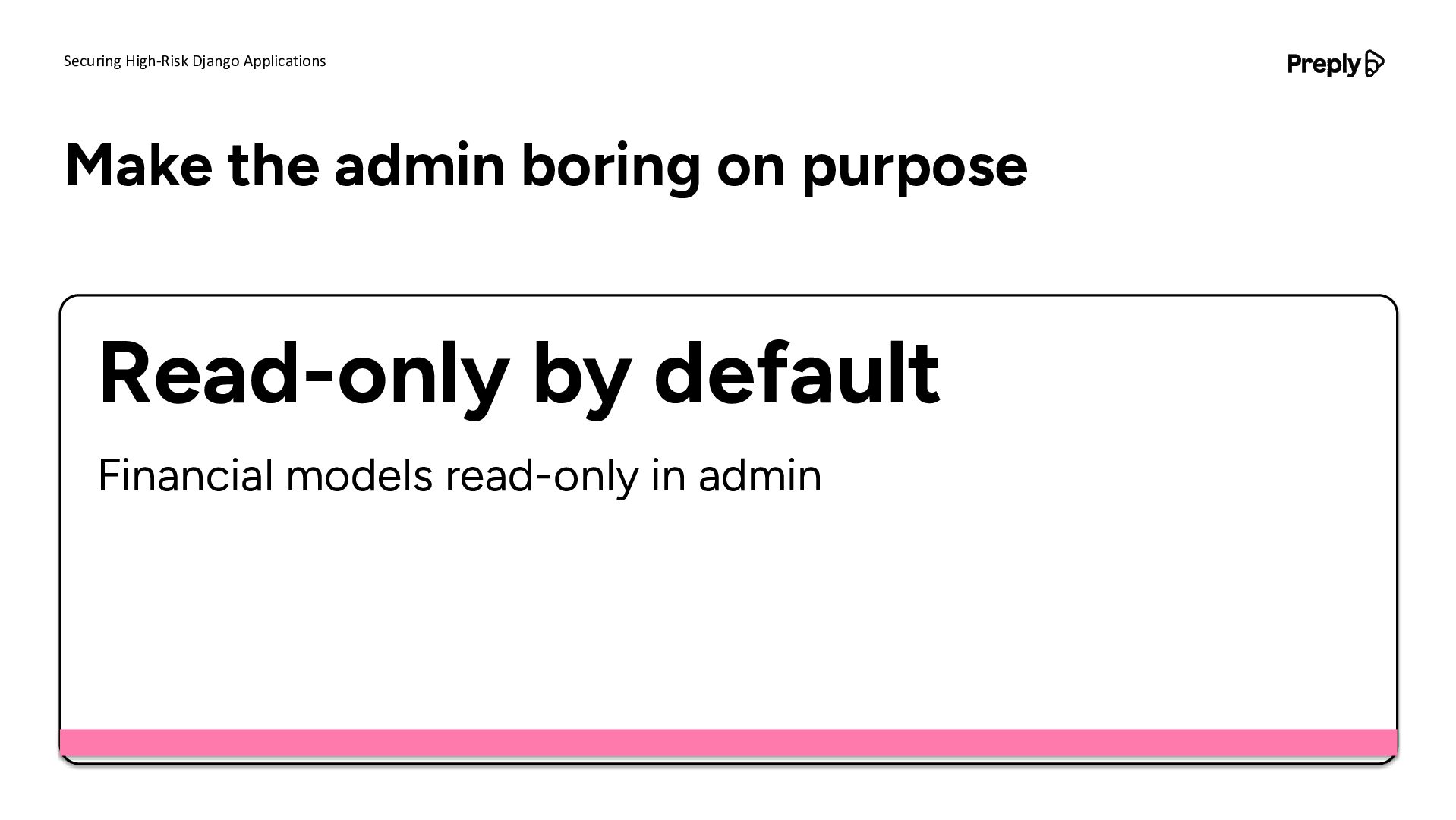
    Read-only by default Financial models read-only in admin
  27. Securing High-Risk Django Applications Make the admin boring on purpose

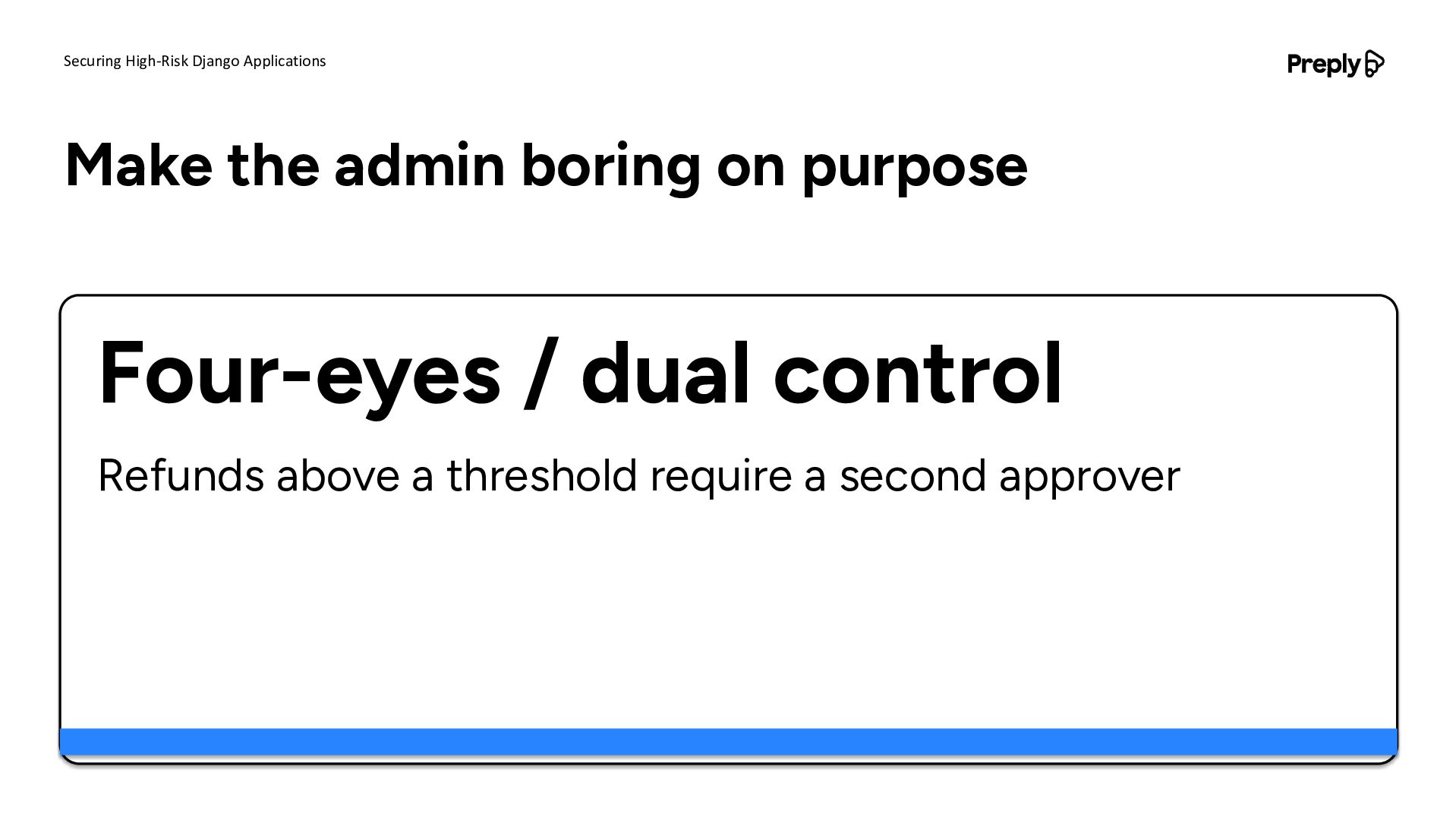
    Four-eyes / dual control Refunds above a threshold require a second approver
  28. Securing High-Risk Django Applications Make the admin boring on purpose

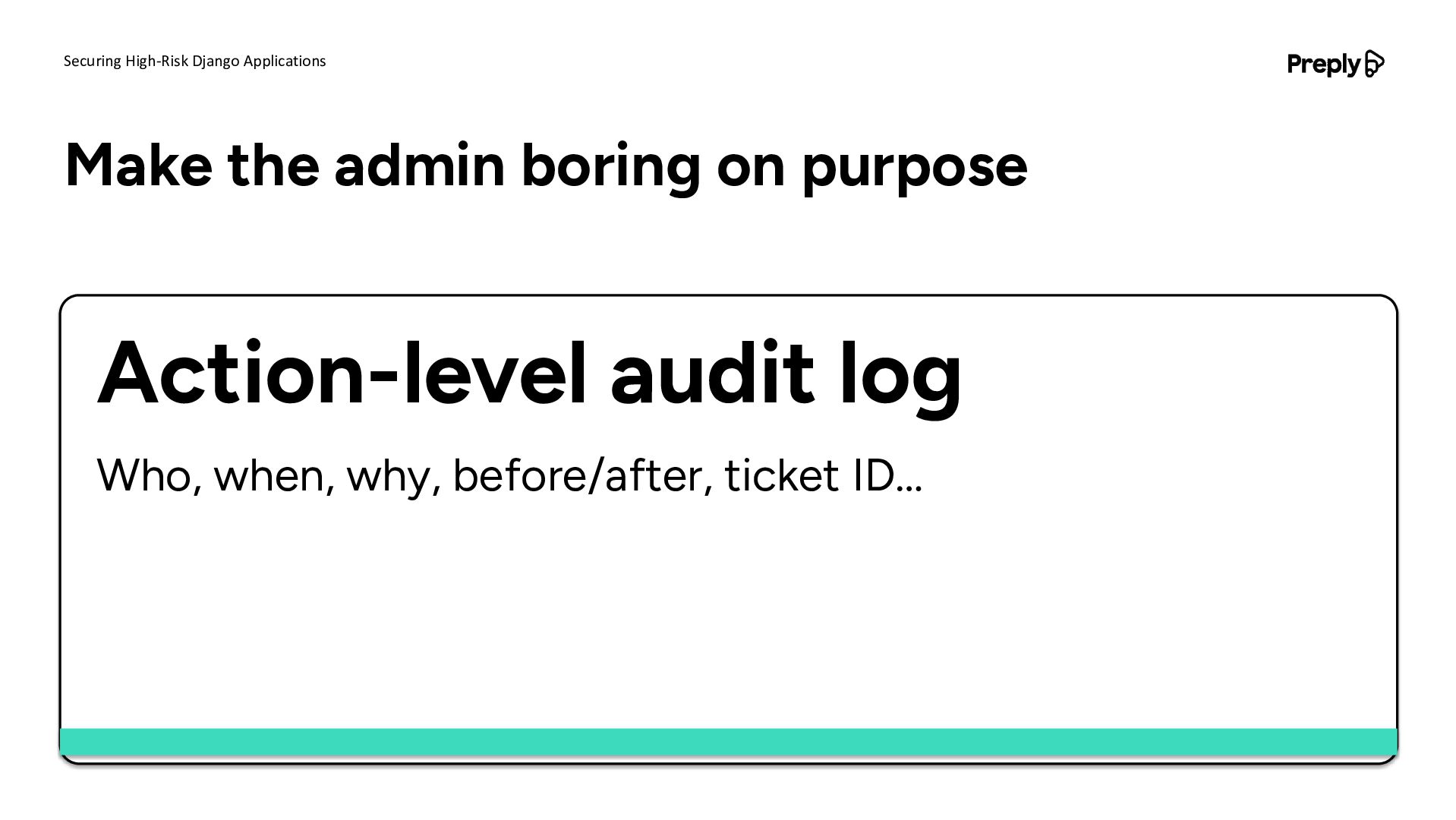
    Action-level audit log Who, when, why, before/after, ticket ID…
  29. Securing High-Risk Django Applications Make the admin boring on purpose

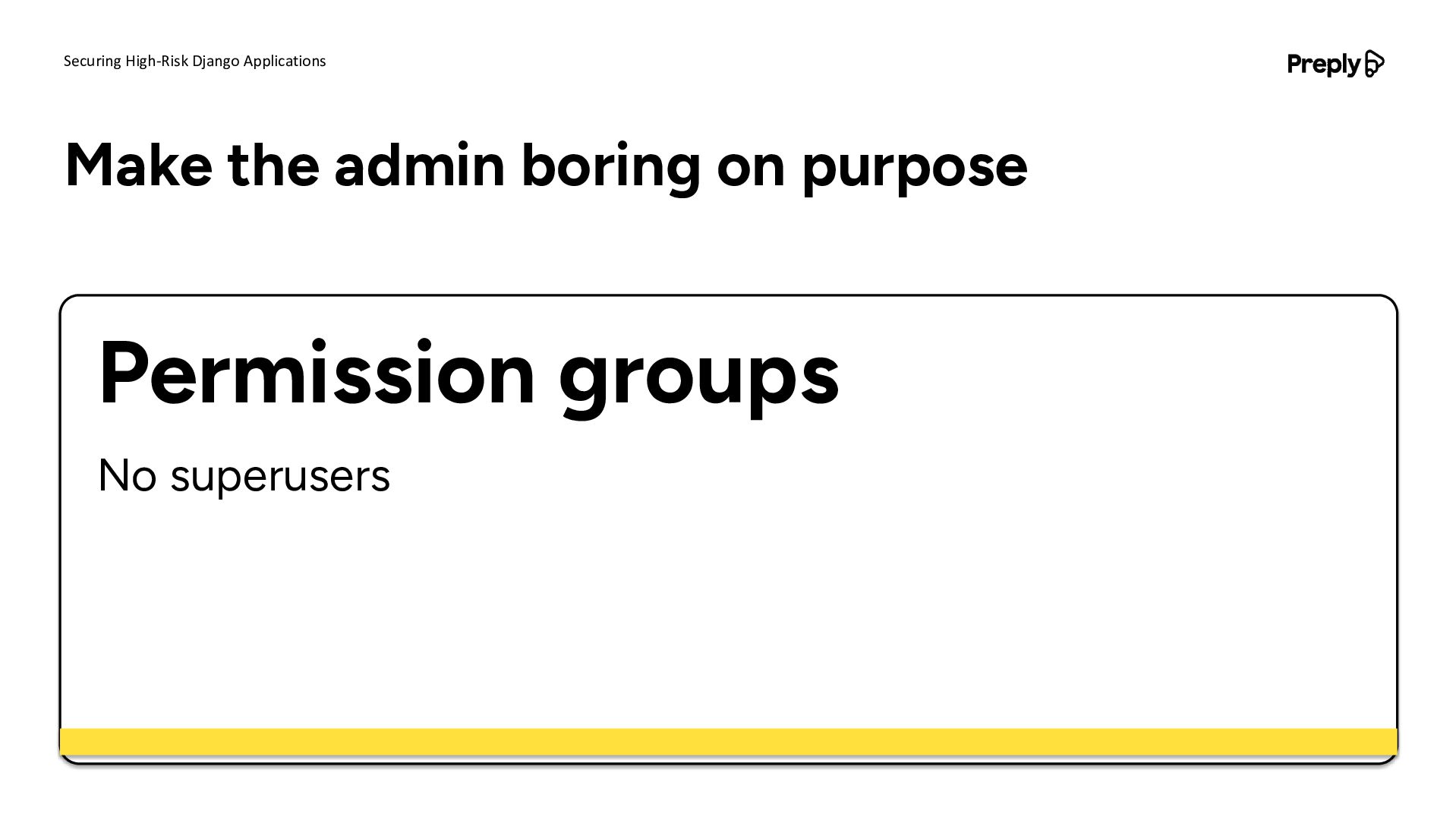
    Read-only by default Financial models read-only in admin Four-eyes / dual control Refunds above a threshold require a second approver Action-level audit log Who, when, why, before/after, ticket ID… Permission groups No superusers.
  30. 06 Observability & incident response You will be on call

    for this. Make 3 a.m. you grateful.
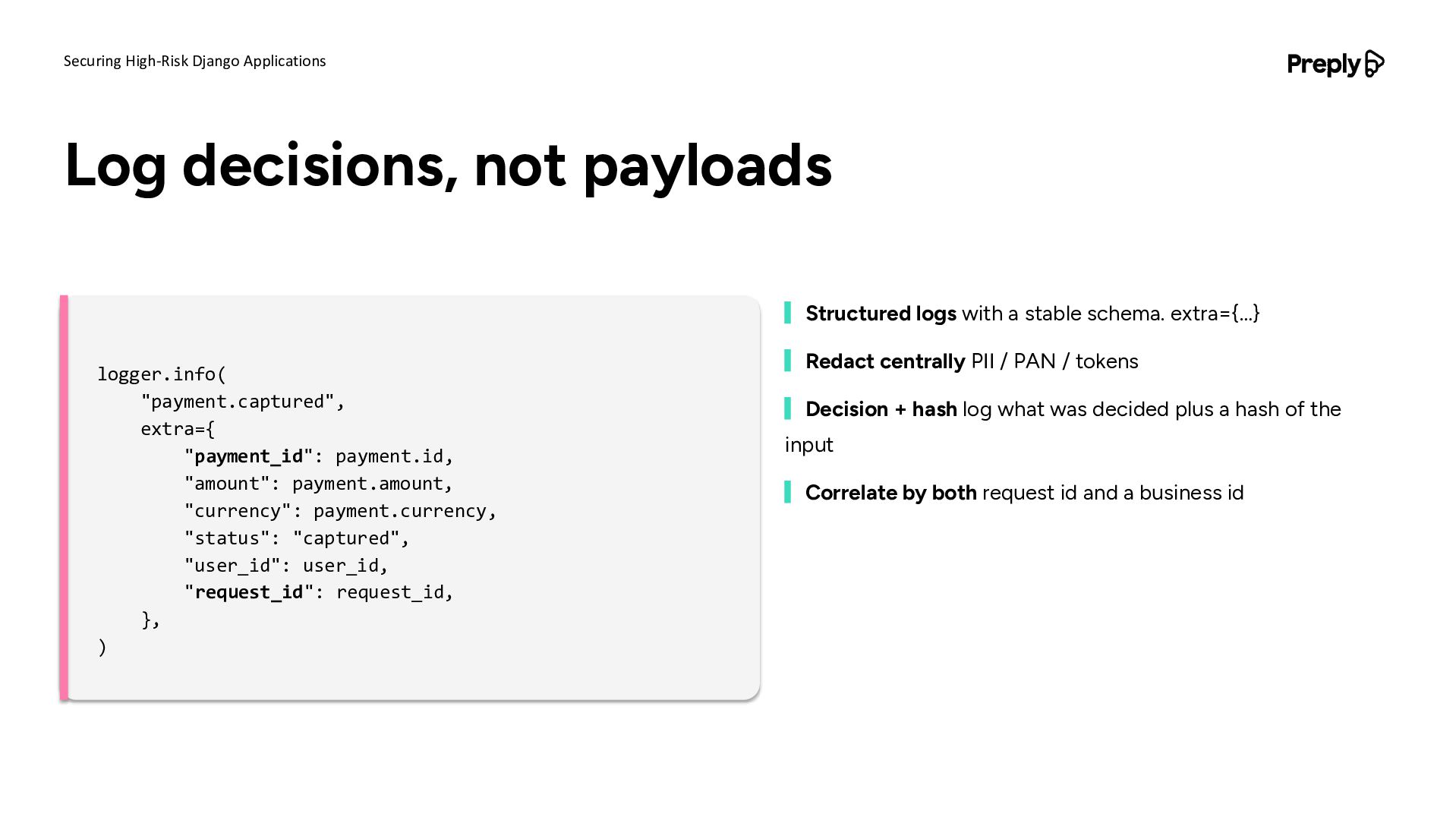
  31. Securing High-Risk Django Applications Log decisions, not payloads logger.info( "payment.captured",

    extra={ "payment_id": payment.id, "amount": payment.amount, "currency": payment.currency, "status": "captured", "user_id": user_id, "request_id": request_id, }, ) ▍ Structured logs with a stable schema. extra={…} ▍ Redact centrally PII / PAN / tokens ▍ Decision + hash log what was decided plus a hash of the input ▍ Correlate by both request id and a business id
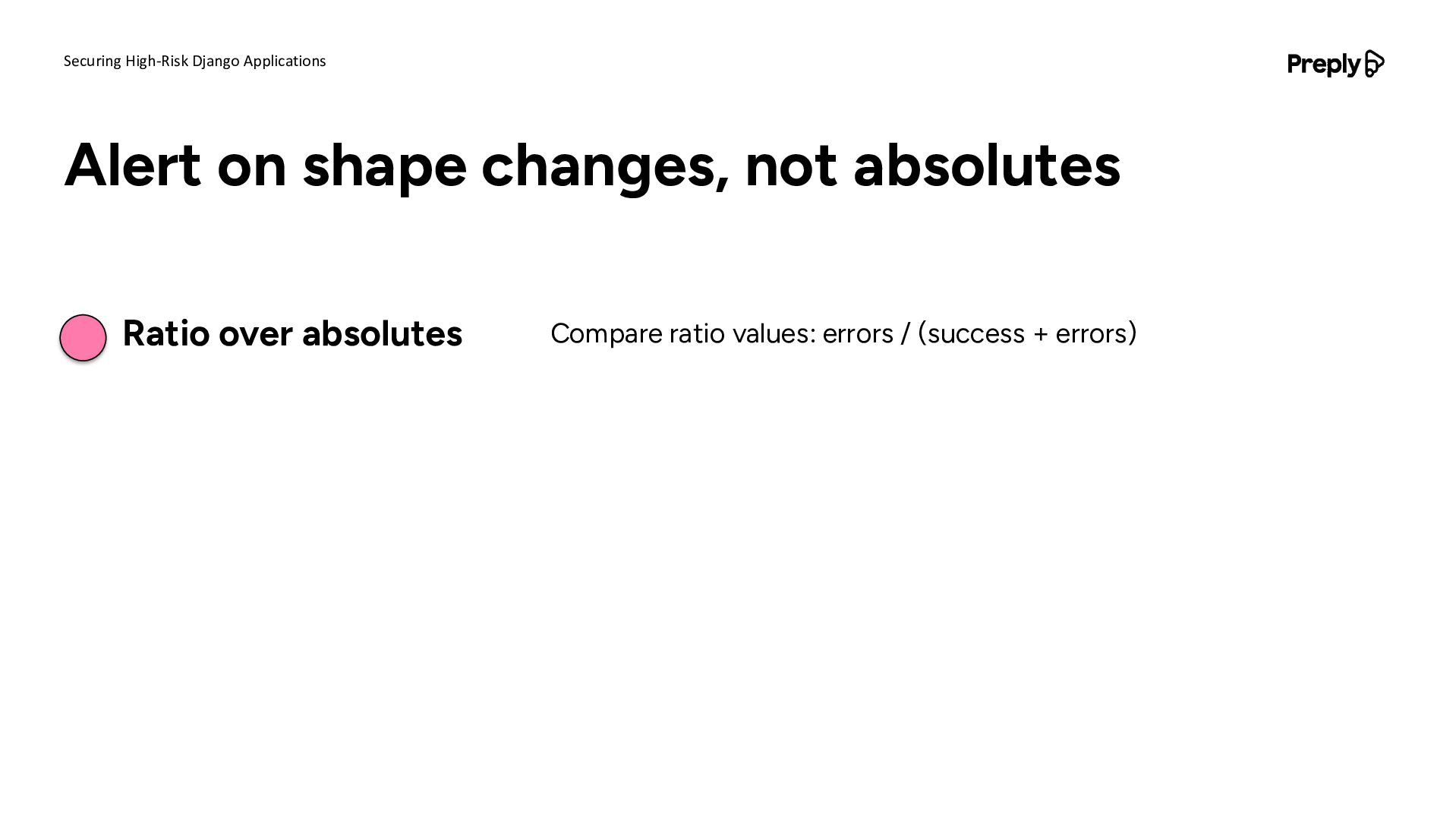
  32. Securing High-Risk Django Applications Alert on shape changes, not absolutes

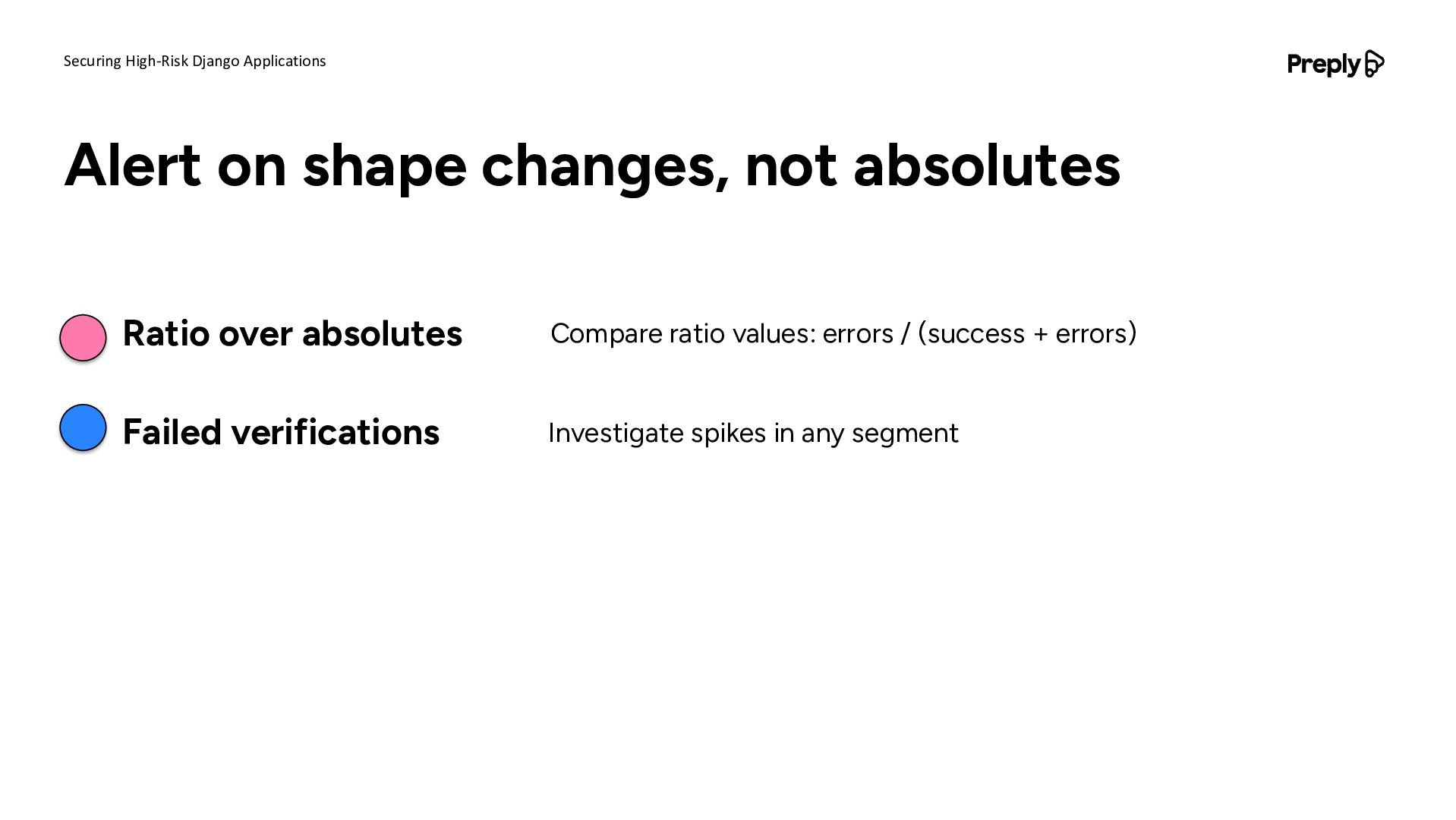
    Ratio over absolutes Compare ratio values: errors / (success + errors)
  33. Securing High-Risk Django Applications Alert on shape changes, not absolutes

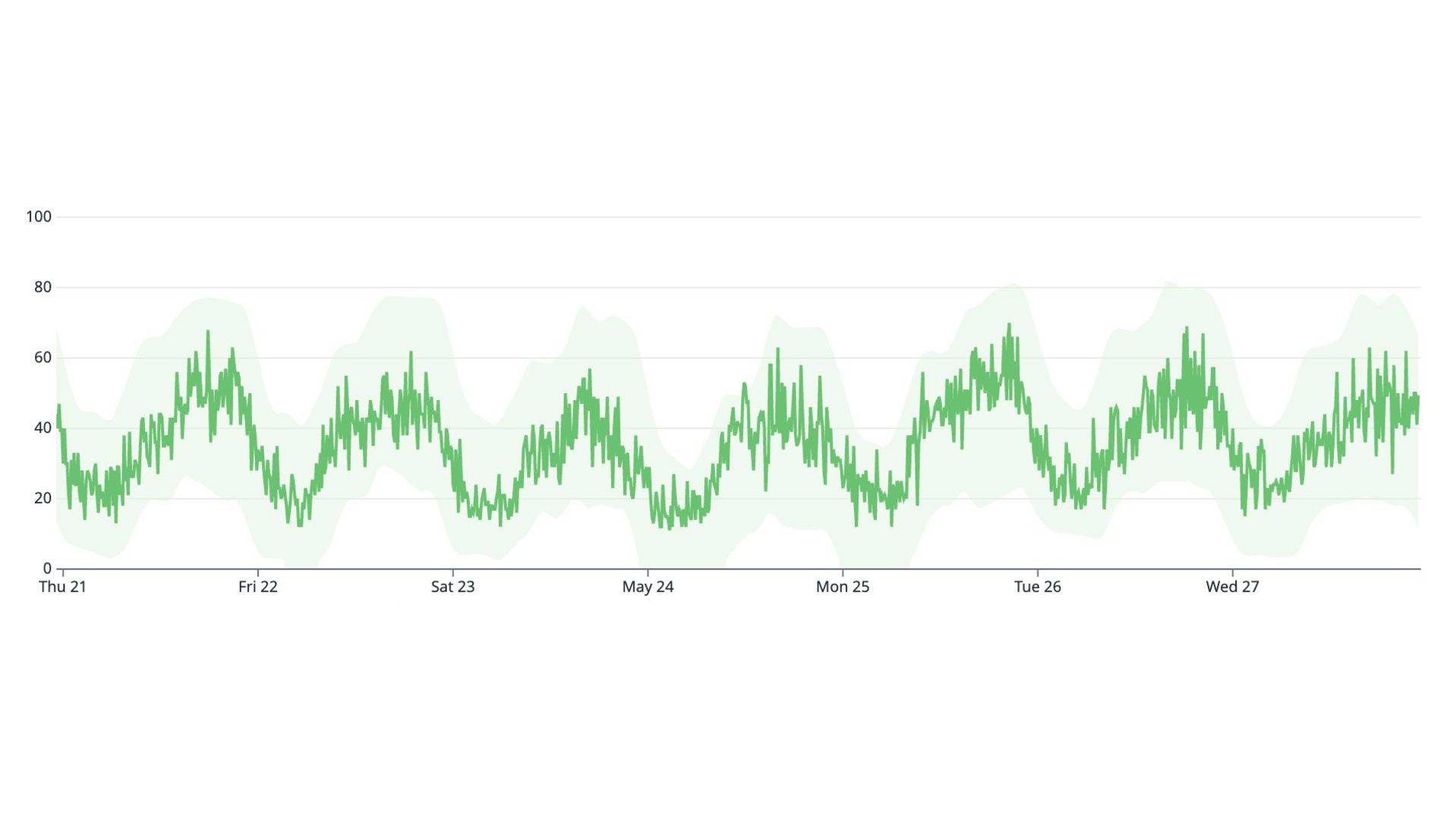
    Ratio over absolutes Compare ratio values: errors / (success + errors) Failed verifications Investigate spikes in any segment
  34. Securing High-Risk Django Applications Alert on shape changes, not absolutes

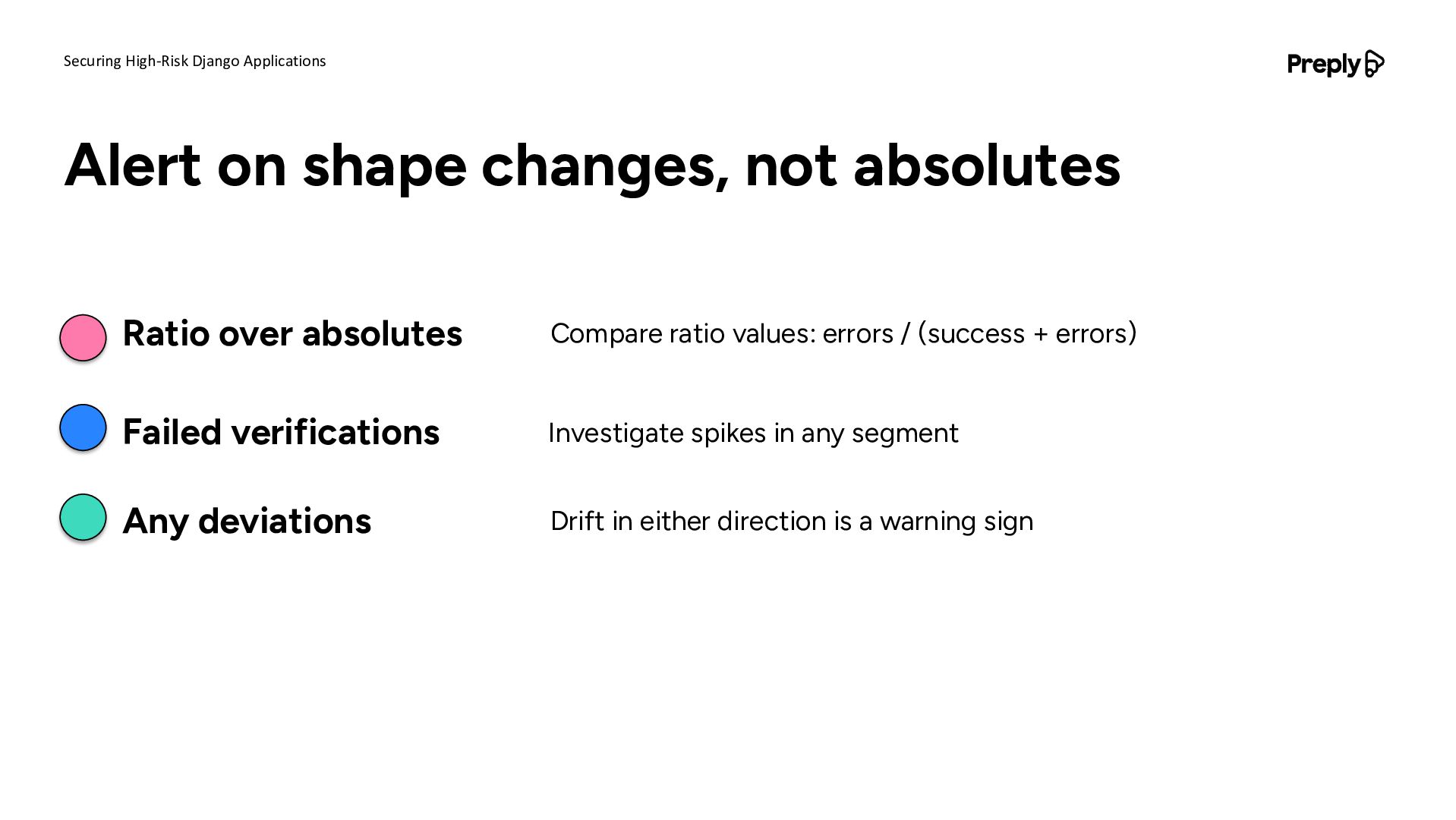
    Ratio over absolutes Compare ratio values: errors / (success + errors) Failed verifications Investigate spikes in any segment Any deviations Drift in either direction is a warning sign
  35. Securing High-Risk Django Applications Alert on shape changes, not absolutes

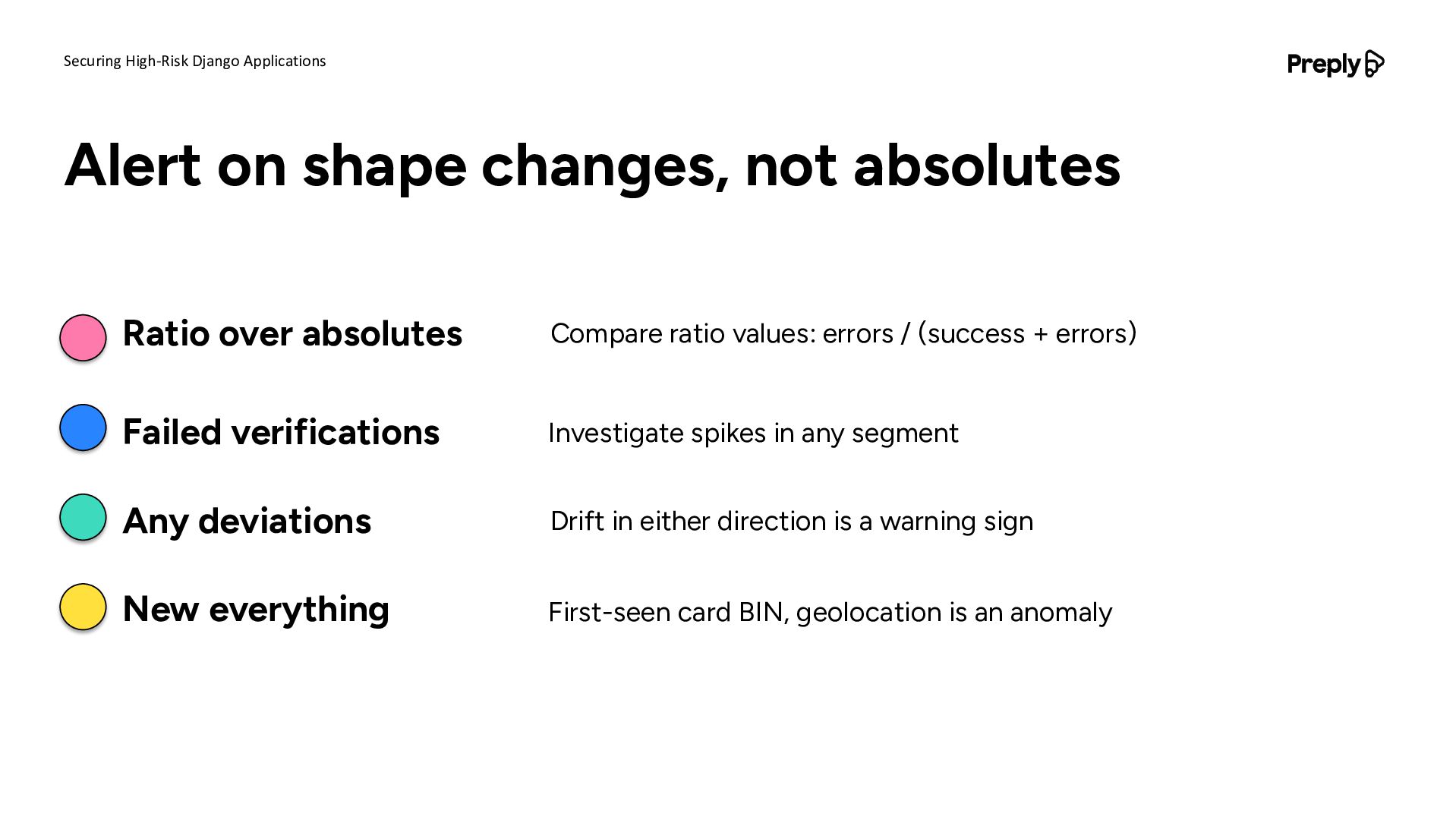
    Ratio over absolutes Compare ratio values: errors / (success + errors) Failed verifications Investigate spikes in any segment Any deviations Drift in either direction is a warning sign New everything First-seen card BIN, geolocation is an anomaly
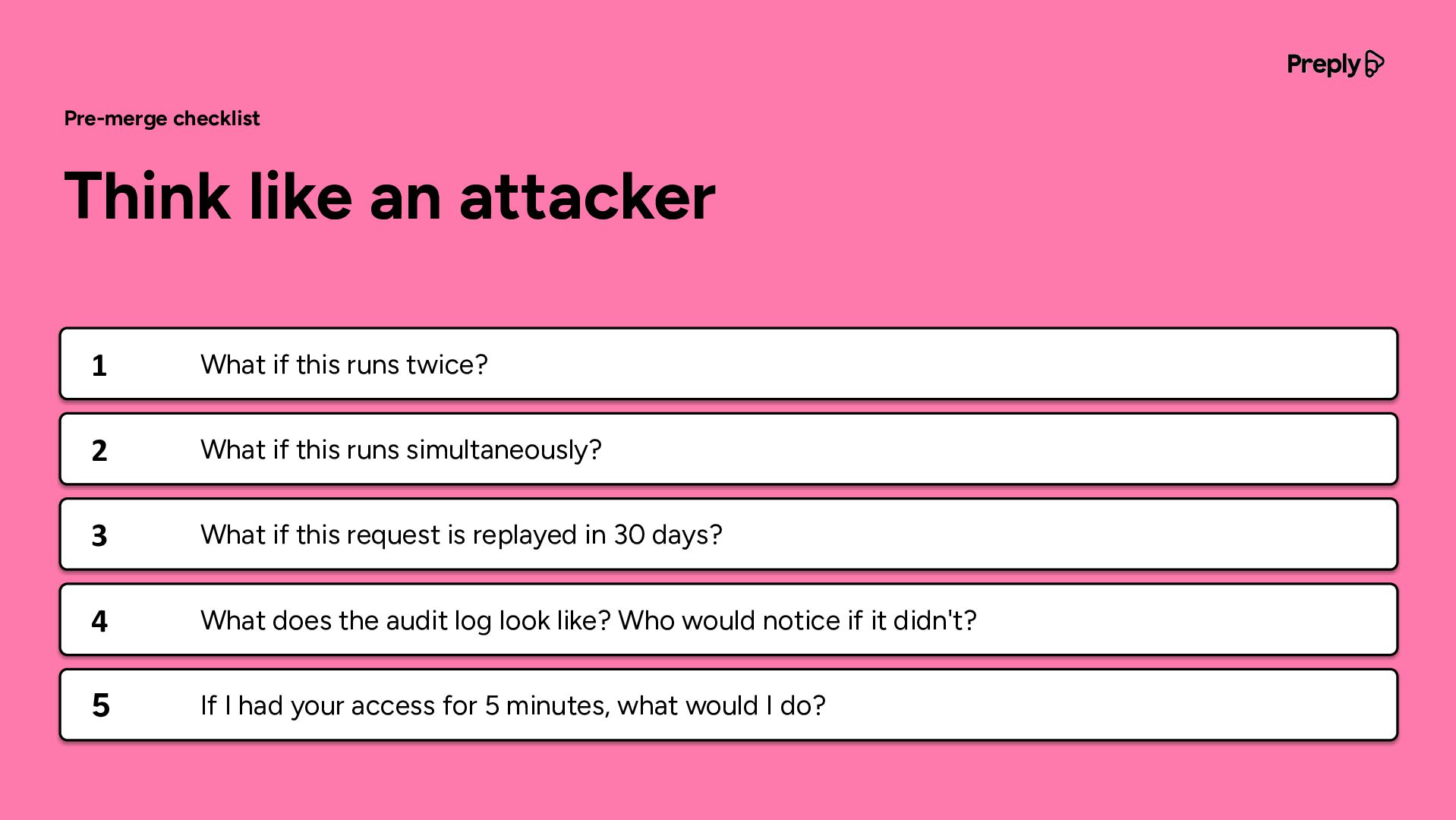
  36. Pre-merge checklist Think like an attacker 1 What if this

    runs twice? 2 What if this runs simultaneously? 3 What if this request is replayed in 30 days? 4 What does the audit log look like? Who would notice if it didn't? 5 If I had your access for 5 minutes, what would I do?
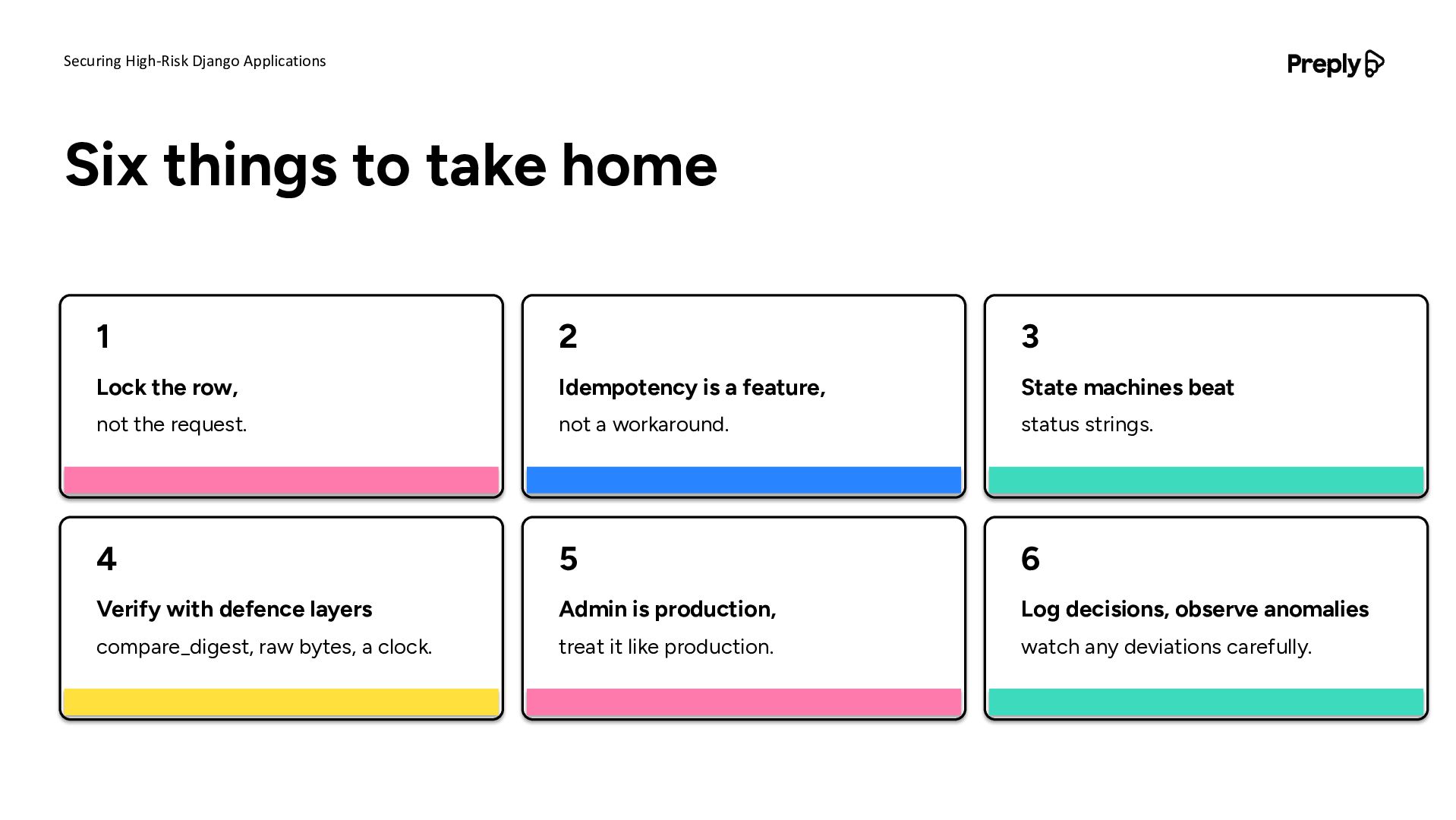
  37. Securing High-Risk Django Applications Six things to take home 1

    Lock the row, not the request. 2 Idempotency is a feature, not a workaround. 3 State machines beat status strings. 4 Verify with defence layers compare_digest, raw bytes, a clock. 5 Admin is production, treat it like production. 6 Log decisions, observe anomalies watch any deviations carefully.