Upgrade to Pro — share decks privately, control downloads, hide ads and more …

Beyond The Hamster Wheel - Developing a Content...

Sponsored · Ship Features Fearlessly Turn features on and off without deploys. Used by thousands of Ruby developers.

Beyond The Hamster Wheel - Developing a Content Studio Mindset

Beyond The Hamster Wheel - Developing a Content Studio Mindset presentation was delivered at the One West Martech Summit in Oceanside, California. Most destination marketing teams are creating more content than ever, and somehow it's still not enough. This session reframes the problem: it's not a production issue, it's a systems issue. Learn how to audit what you already have, build a content infrastructure that supports multi-channel deployment, and shift from a campaign mindset to a studio mindset , so every asset gets a second, third, and tenth life. Includes a phased roadmap you can take back to your team immediately.

Avatar for Jason Dodge

Jason Dodge

March 02, 2026
Tweet

More Decks by Jason Dodge

Other Decks in Business

Transcript

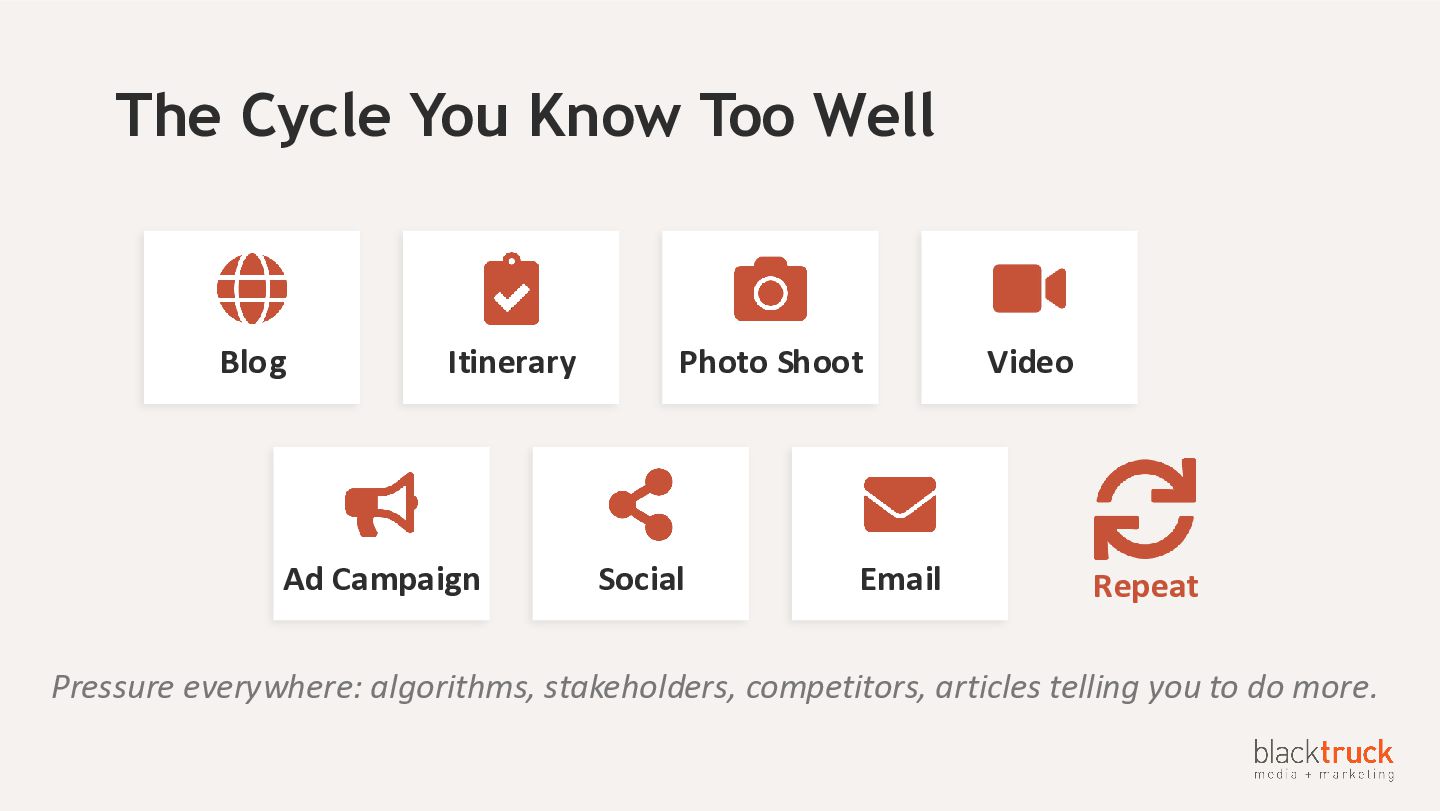
  1. The Cycle You Know Too Well Blog Itinerary Photo Shoot

    Video Ad Campaign Social Email Repeat Pressure everywhere: algorithms, stakeholders, competitors, articles telling you to do more.
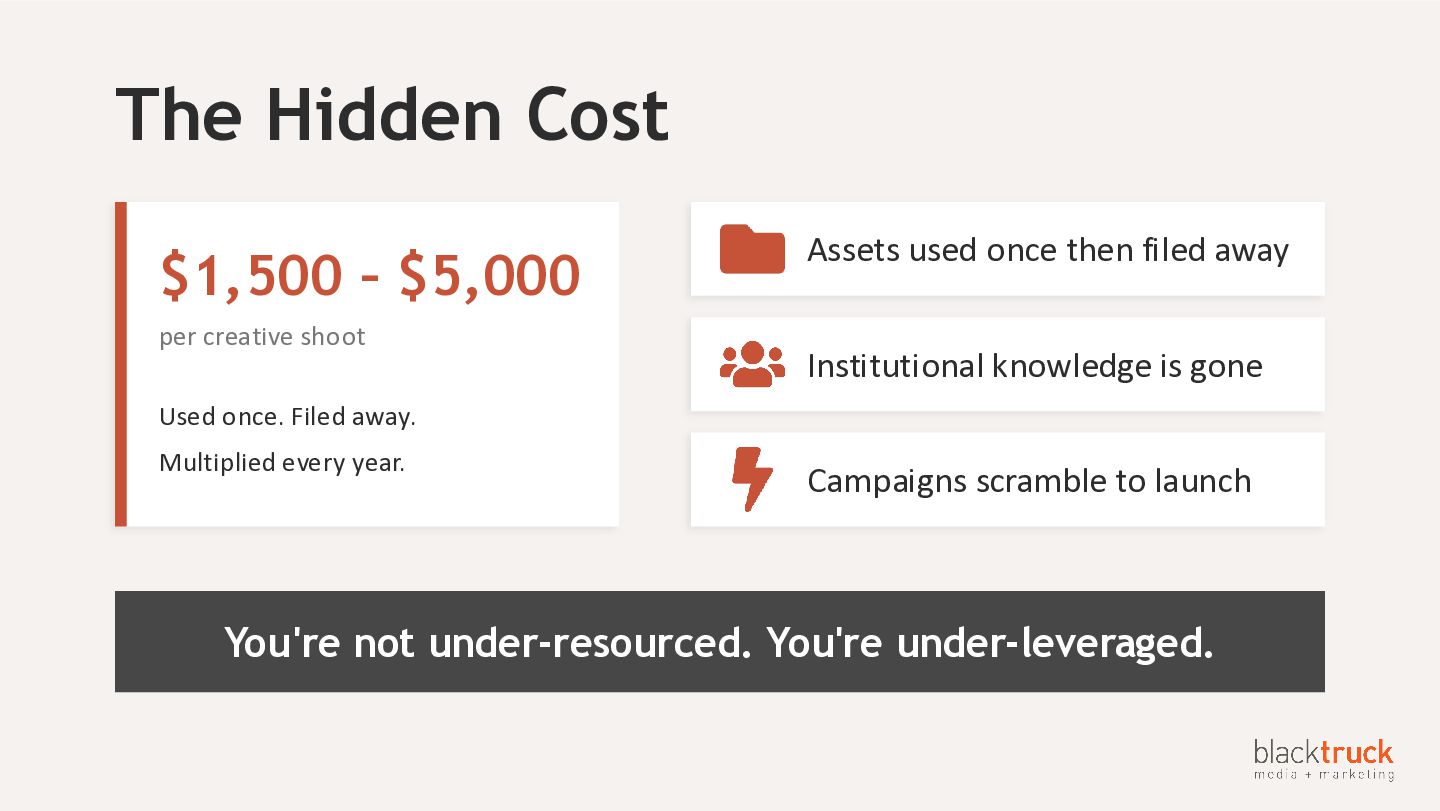
  2. The Hidden Cost $1,500 – $5,000 per creative shoot Used

    once. Filed away. Multiplied every year. Assets used once then filed away Institutional knowledge is gone Campaigns scramble to launch You're not under-resourced. You're under-leveraged.
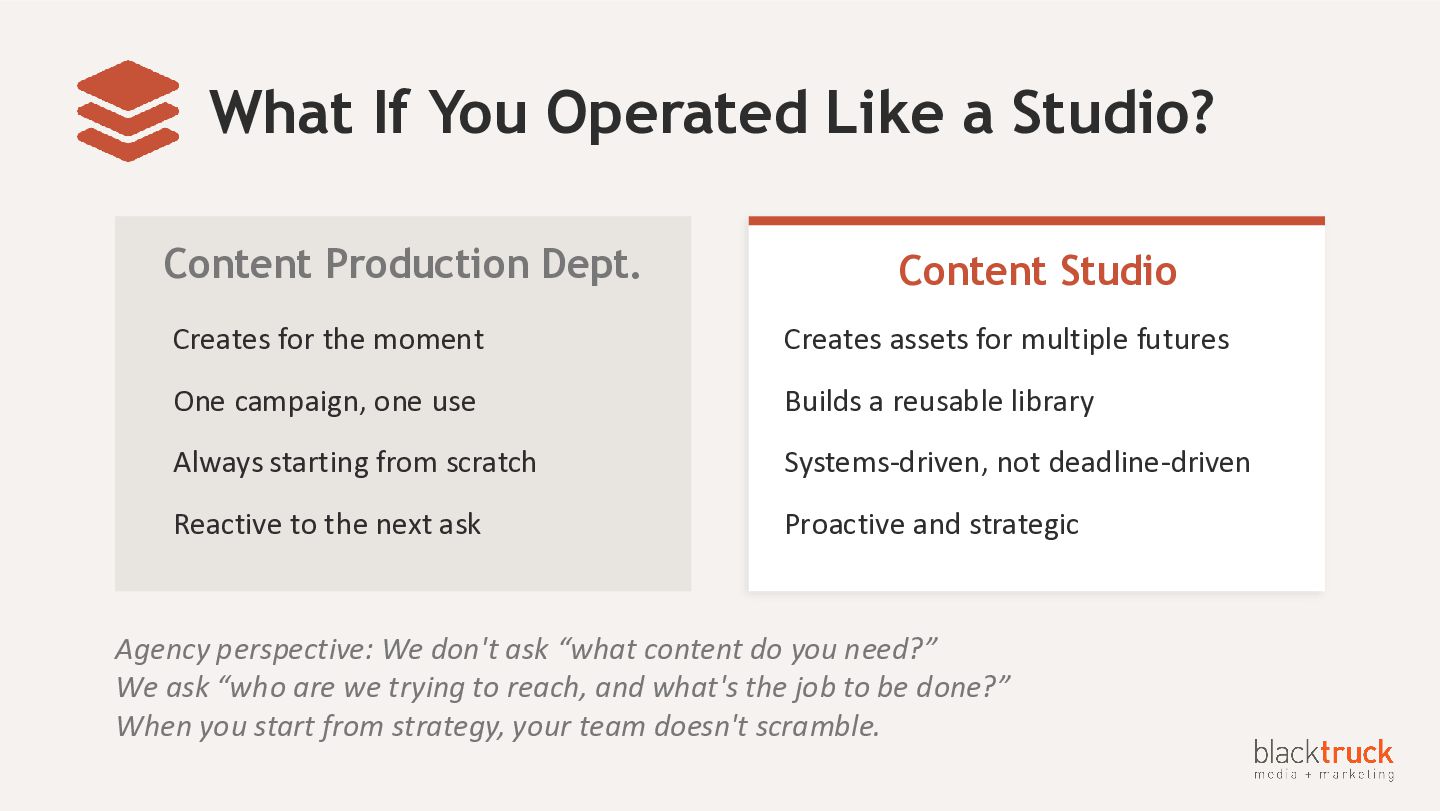
  3. What If You Operated Like a Studio? Content Production Dept.

    Creates for the moment One campaign, one use Always starting from scratch Reactive to the next ask Content Studio Creates assets for multiple futures Builds a reusable library Systems-driven, not deadline-driven Proactive and strategic Agency perspective: We don't ask “what content do you need?” We ask “who are we trying to reach, and what's the job to be done?” When you start from strategy, your team doesn't scramble.
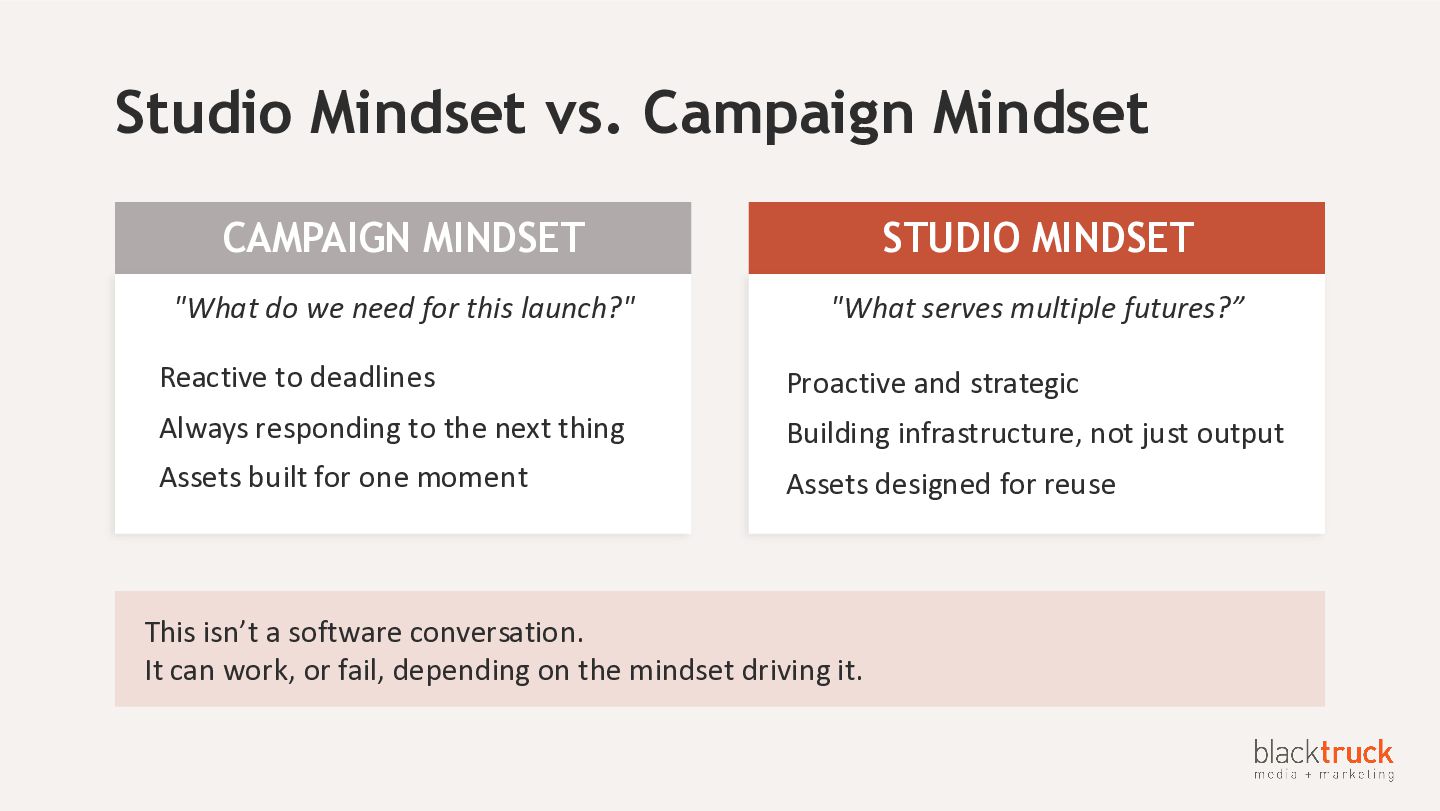
  4. Studio Mindset vs. Campaign Mindset CAMPAIGN MINDSET "What do we

    need for this launch?" STUDIO MINDSET Proactive and strategic Building infrastructure, not just output Assets designed for reuse This isn’t a software conversation. It can work, or fail, depending on the mindset driving it. Reactive to deadlines Always responding to the next thing Assets built for one moment "What serves multiple futures?”
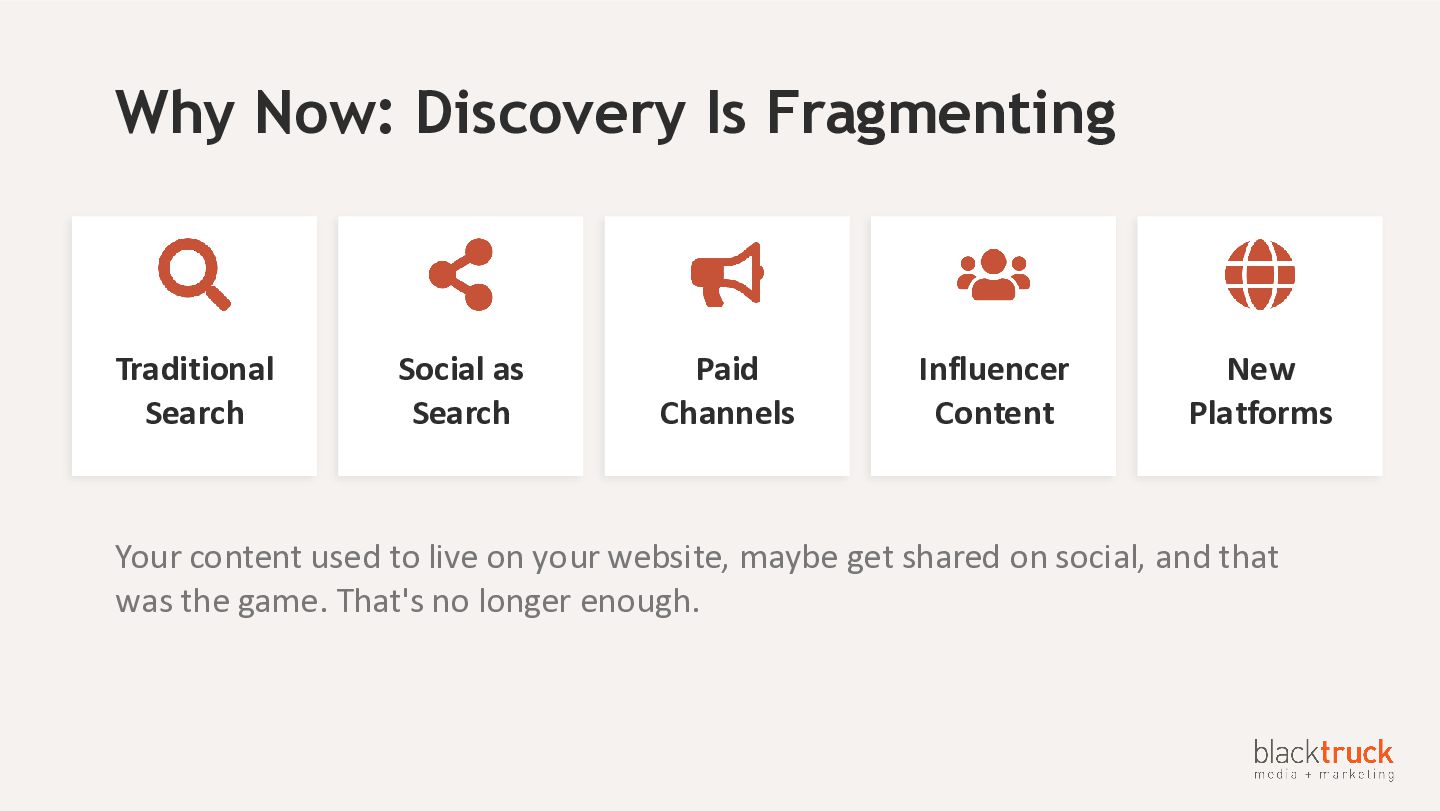
  5. Why Now: Discovery Is Fragmenting Traditional Search Social as Search

    Paid Channels Influencer Content New Platforms Your content used to live on your website, maybe get shared on social, and that was the game. That's no longer enough.
  6. And Then There's AI... Search engines are generating answers directly.

    AI overviews are pulling information without requiring a click. Travelers are asking AI tools to plan their trips. The way people find destinations is changing. If your content only lives in one place, you're invisible in the others.
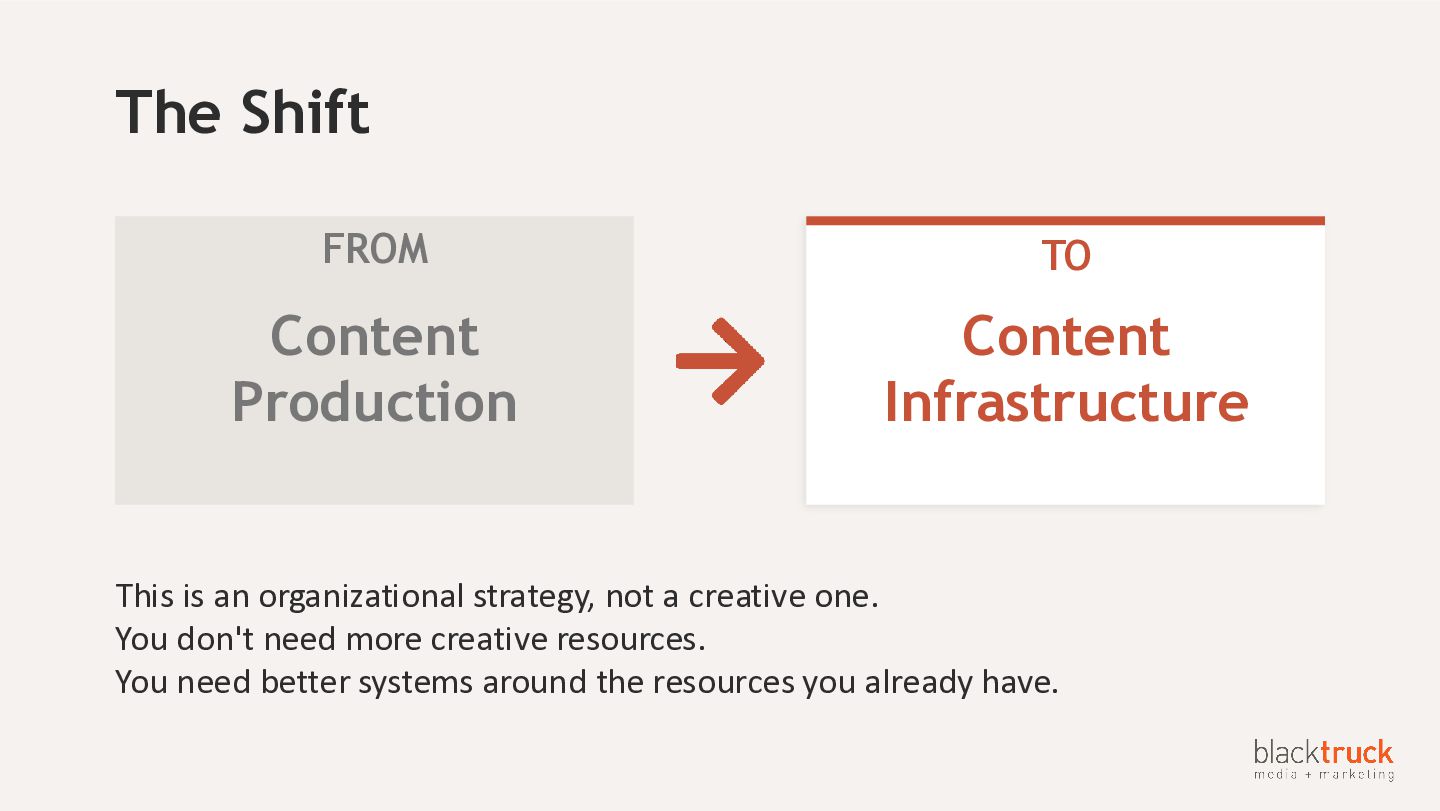
  7. The Shift FROM Content Production TO Content Infrastructure This is

    an organizational strategy, not a creative one. You don't need more creative resources. You need better systems around the resources you already have.
  8. Start With What You Have You are sitting on more

    usable content than you realize.
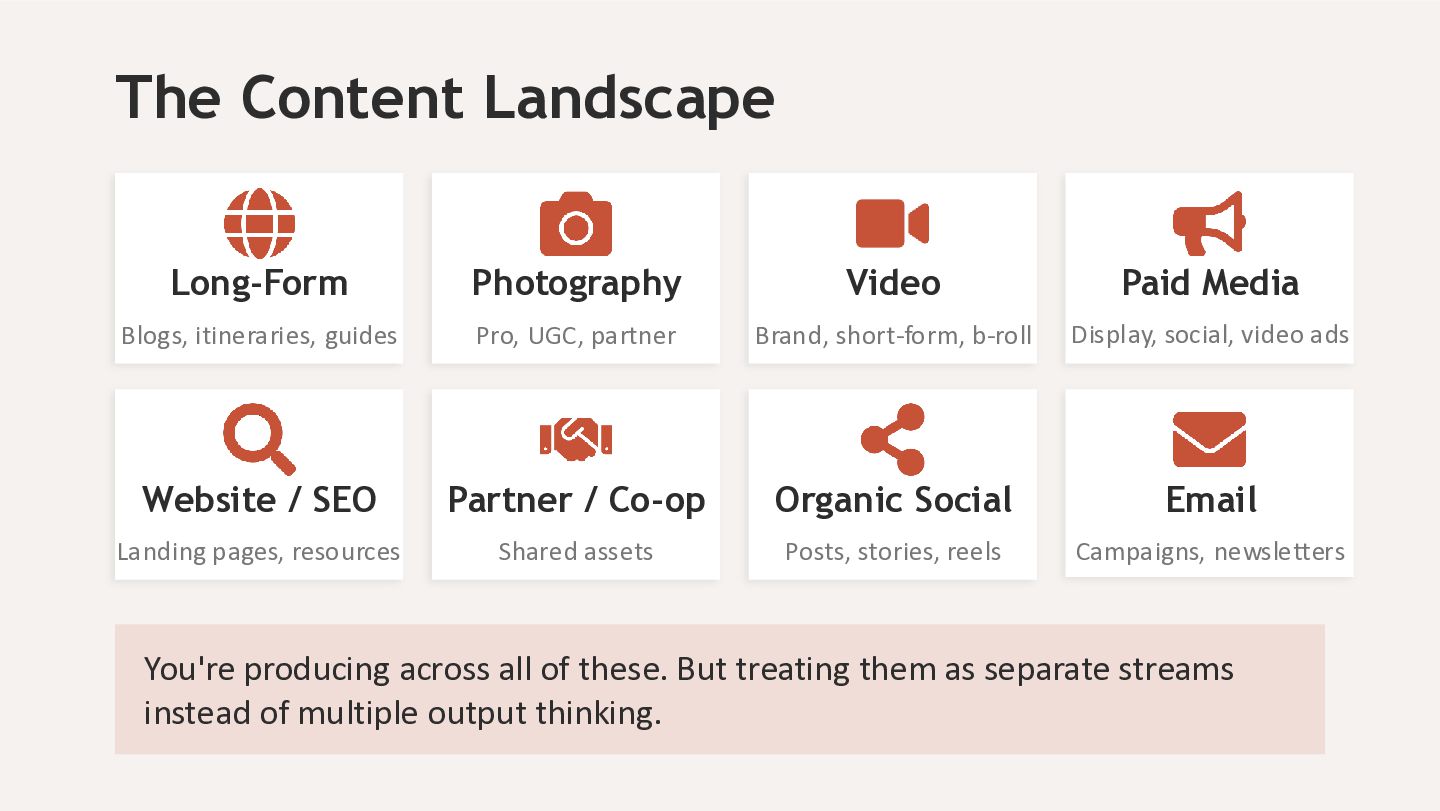
  9. The Content Landscape Long-Form Blogs, itineraries, guides Photography Pro, UGC,

    partner Video Brand, short-form, b-roll Paid Media Display, social, video ads Website / SEO Landing pages, resources Partner / Co-op Shared assets Organic Social Posts, stories, reels Email Campaigns, newsletters You're producing across all of these. But treating them as separate streams instead of multiple output thinking.
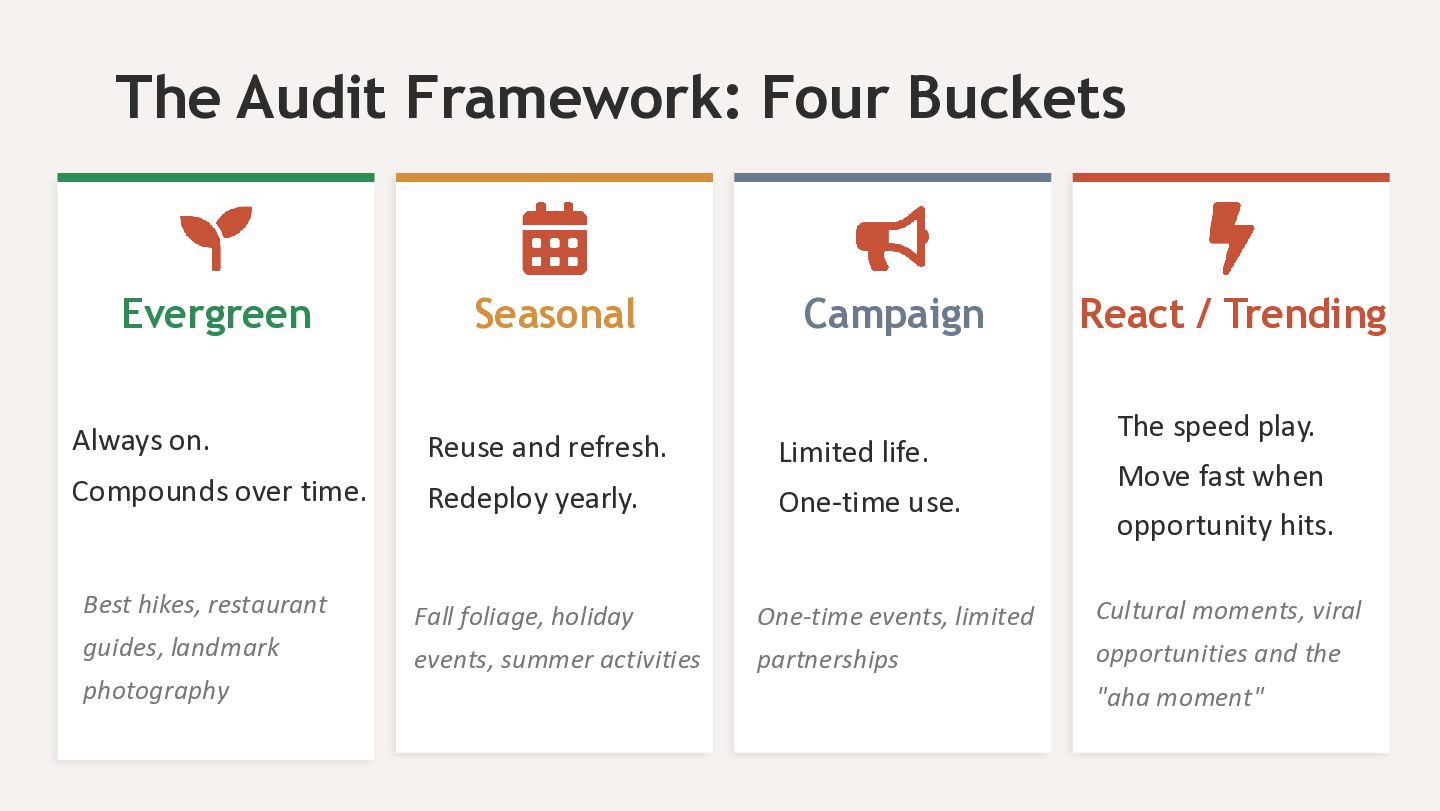
  10. The Audit Framework: Four Buckets Evergreen Always on. Compounds over

    time. Best hikes, restaurant guides, landmark photography Seasonal Reuse and refresh. Redeploy yearly. Fall foliage, holiday events, summer activities Campaign Limited life. One-time use. One-time events, limited partnerships React / Trending The speed play. Move fast when opportunity hits. Cultural moments, viral opportunities and the "aha moment"
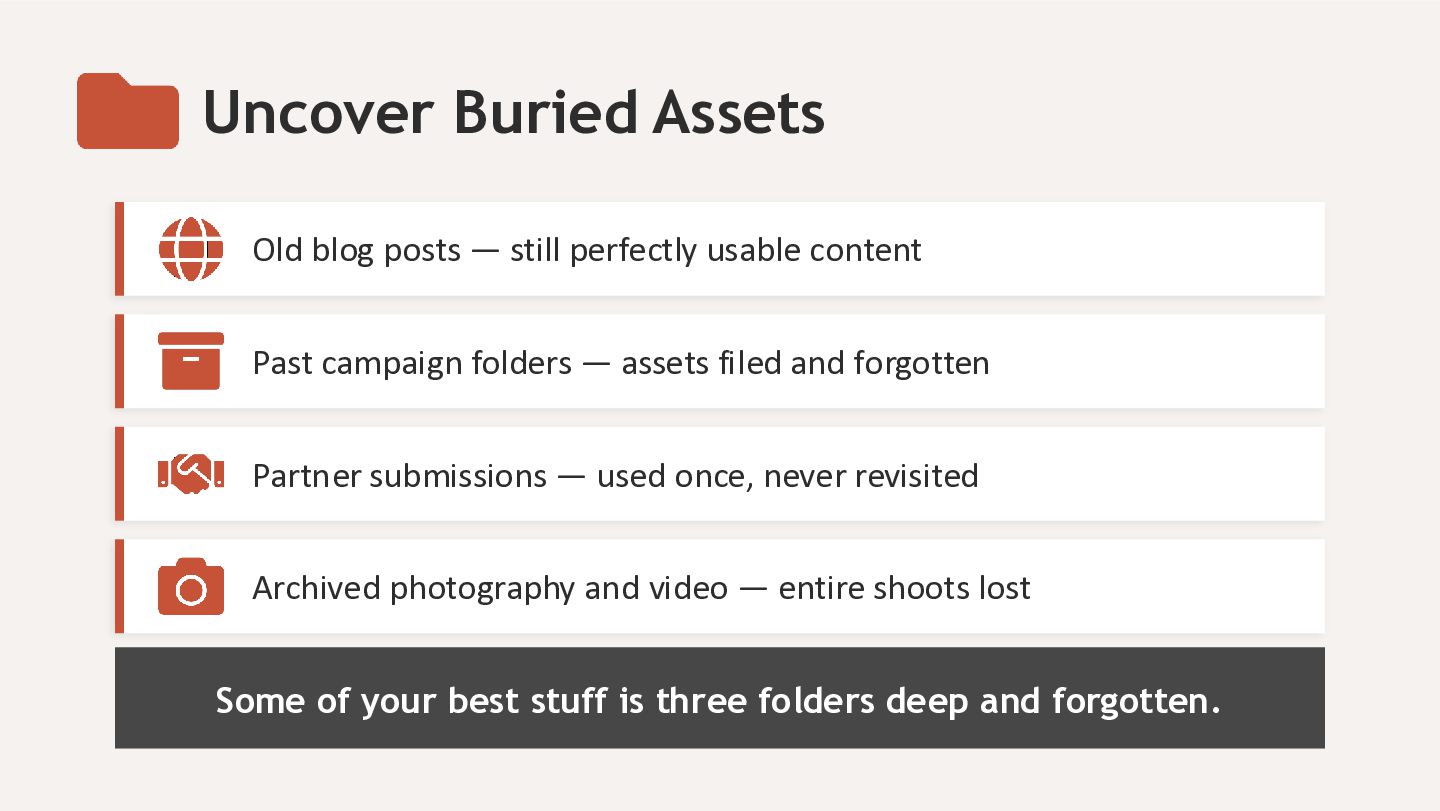
  11. Uncover Buried Assets Old blog posts — still perfectly usable

    content Past campaign folders — assets filed and forgotten Partner submissions — used once, never revisited Archived photography and video — entire shoots lost Some of your best stuff is three folders deep and forgotten.
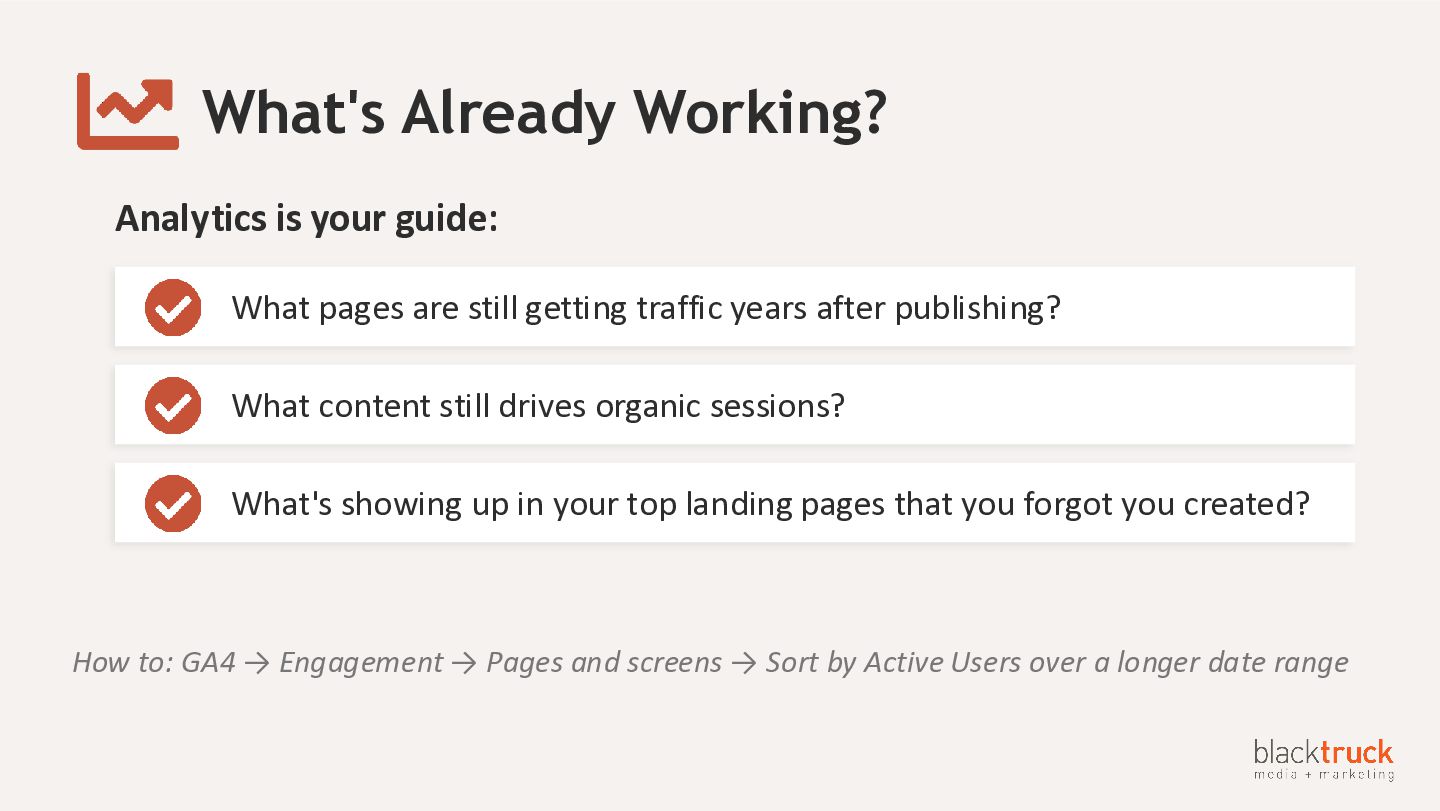
  12. What's Already Working? Analytics is your guide: What pages are

    still getting traffic years after publishing? What content still drives organic sessions? What's showing up in your top landing pages that you forgot you created? How to: GA4 → Engagement → Pages and screens → Sort by Active Users over a longer date range
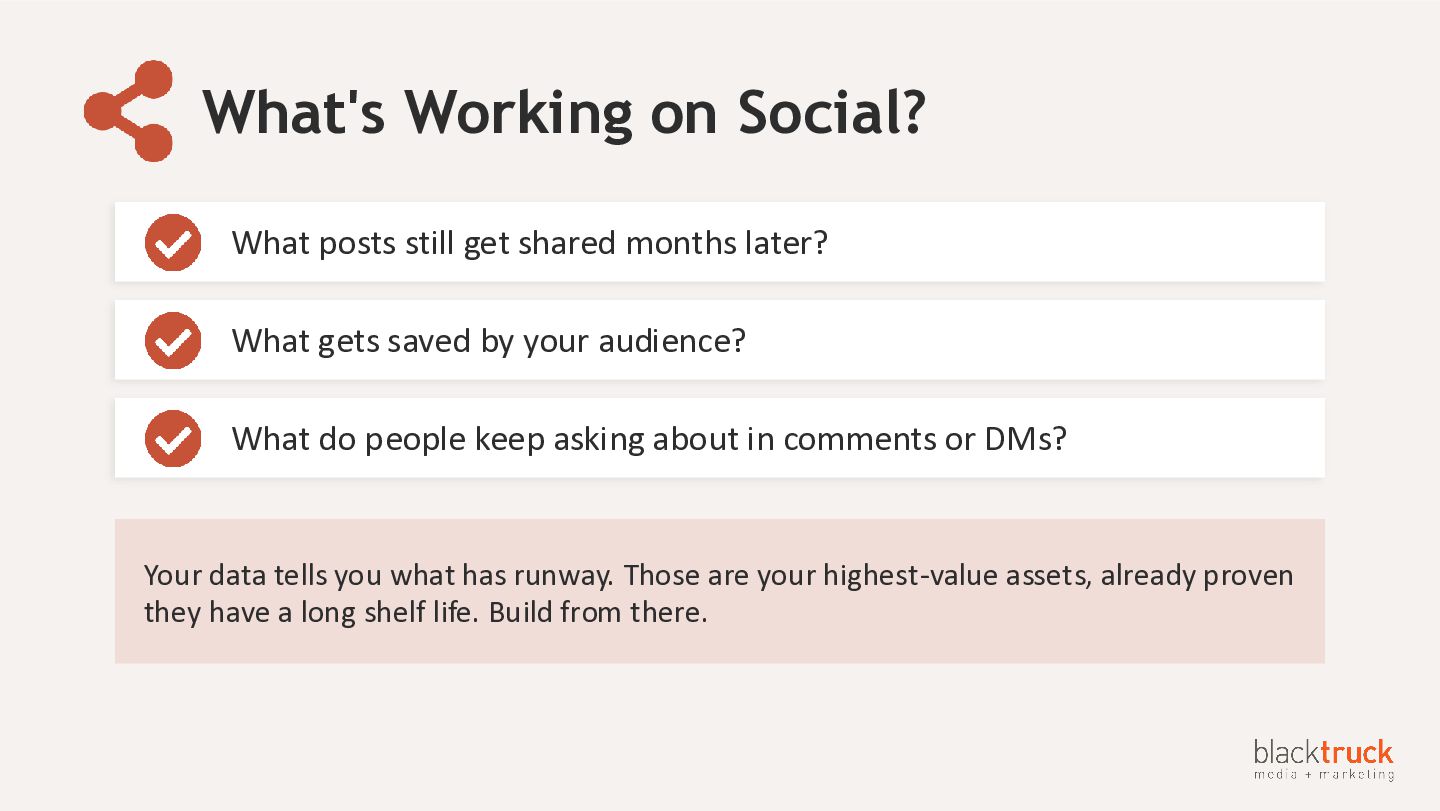
  13. What's Working on Social? What posts still get shared months

    later? What gets saved by your audience? What do people keep asking about in comments or DMs? Your data tells you what has runway. Those are your highest-value assets, already proven they have a long shelf life. Build from there.
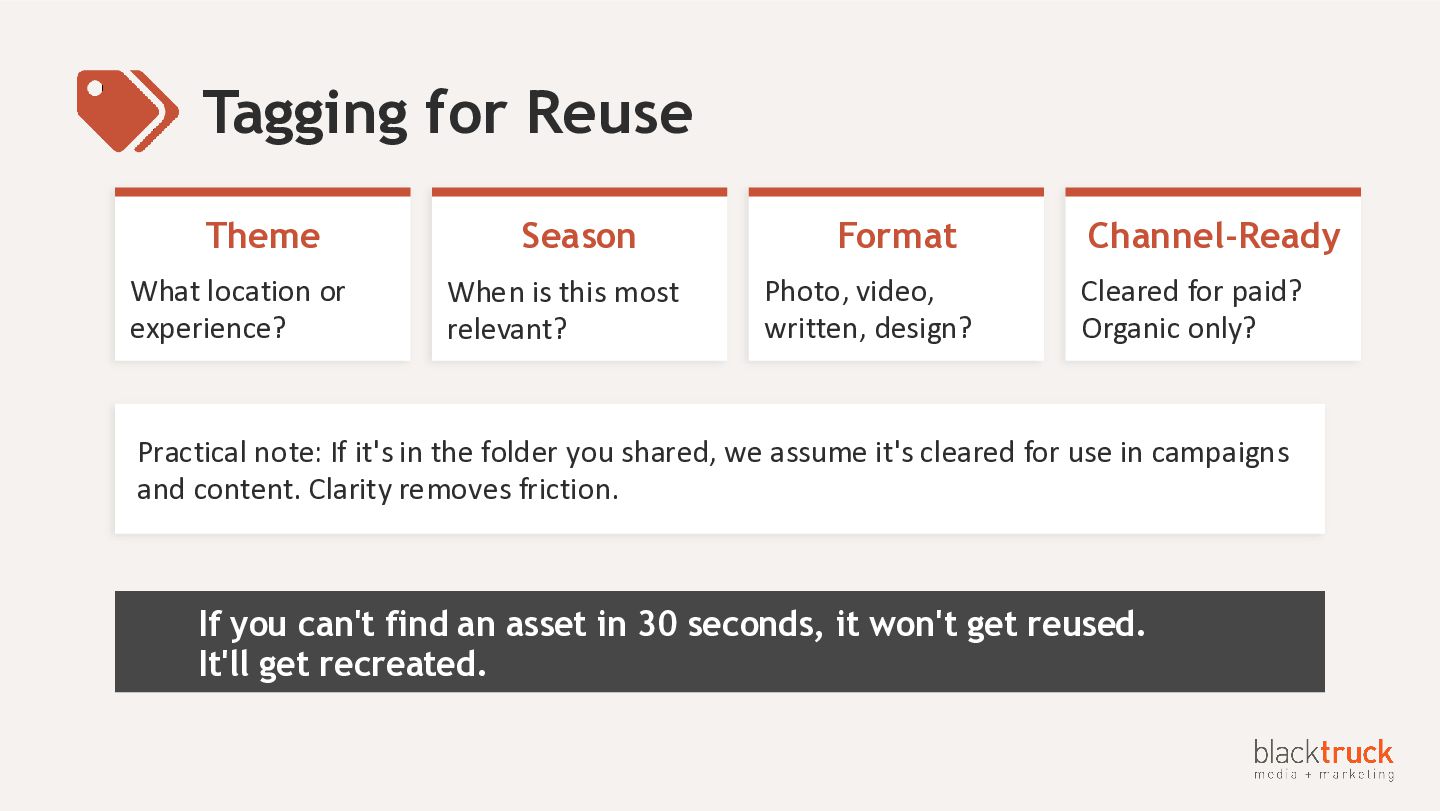
  14. Tagging for Reuse Theme What location or experience? Season When

    is this most relevant? Format Photo, video, written, design? Channel-Ready Cleared for paid? Organic only? Practical note: If it's in the folder you shared, we assume it's cleared for use in campaigns and content. Clarity removes friction. If you can't find an asset in 30 seconds, it won't get reused. It'll get recreated.
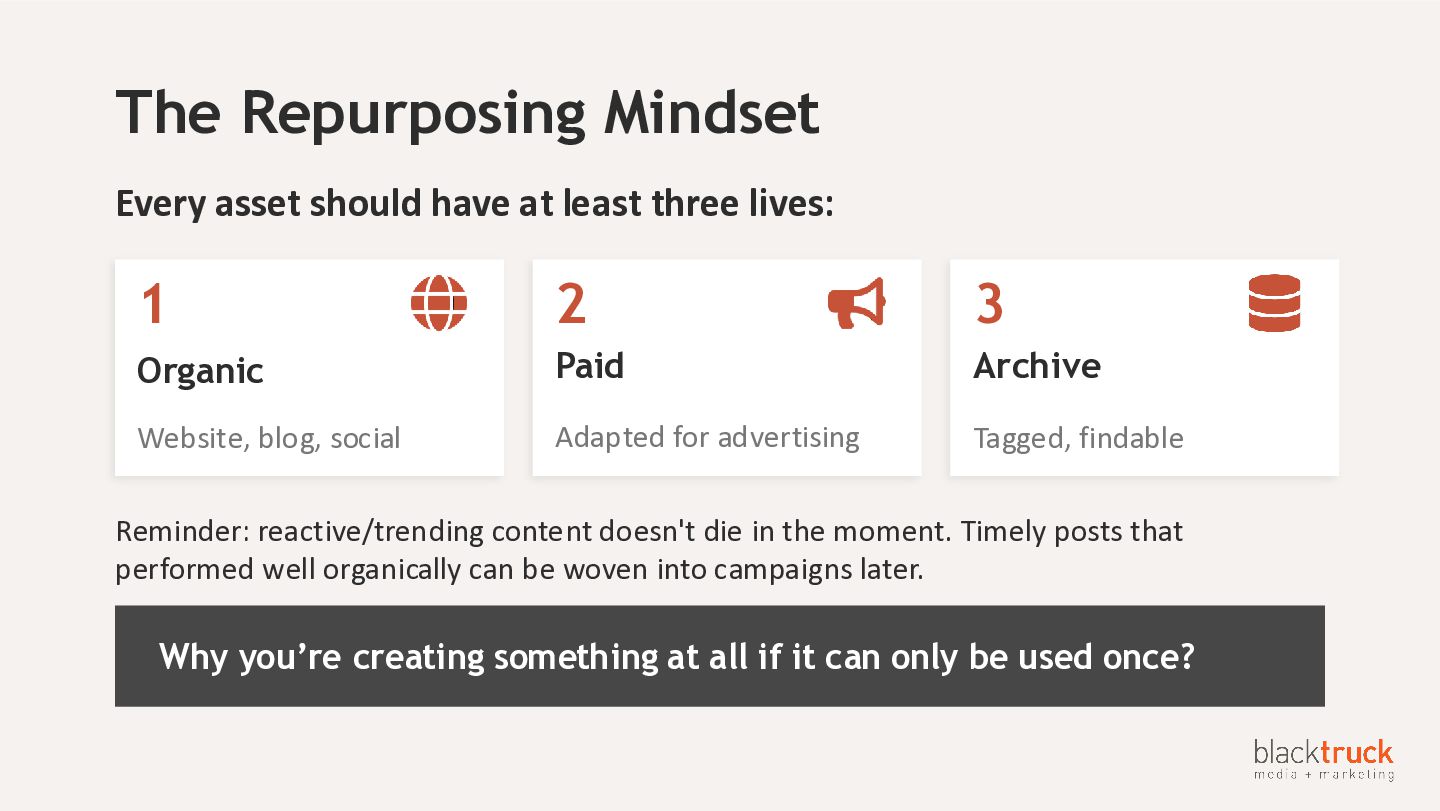
  15. The Repurposing Mindset Every asset should have at least three

    lives: 1 Organic Website, blog, social 2 Paid Adapted for advertising 3 Archive Tagged, findable Reminder: reactive/trending content doesn't die in the moment. Timely posts that performed well organically can be woven into campaigns later. Why you’re creating something at all if it can only be used once?
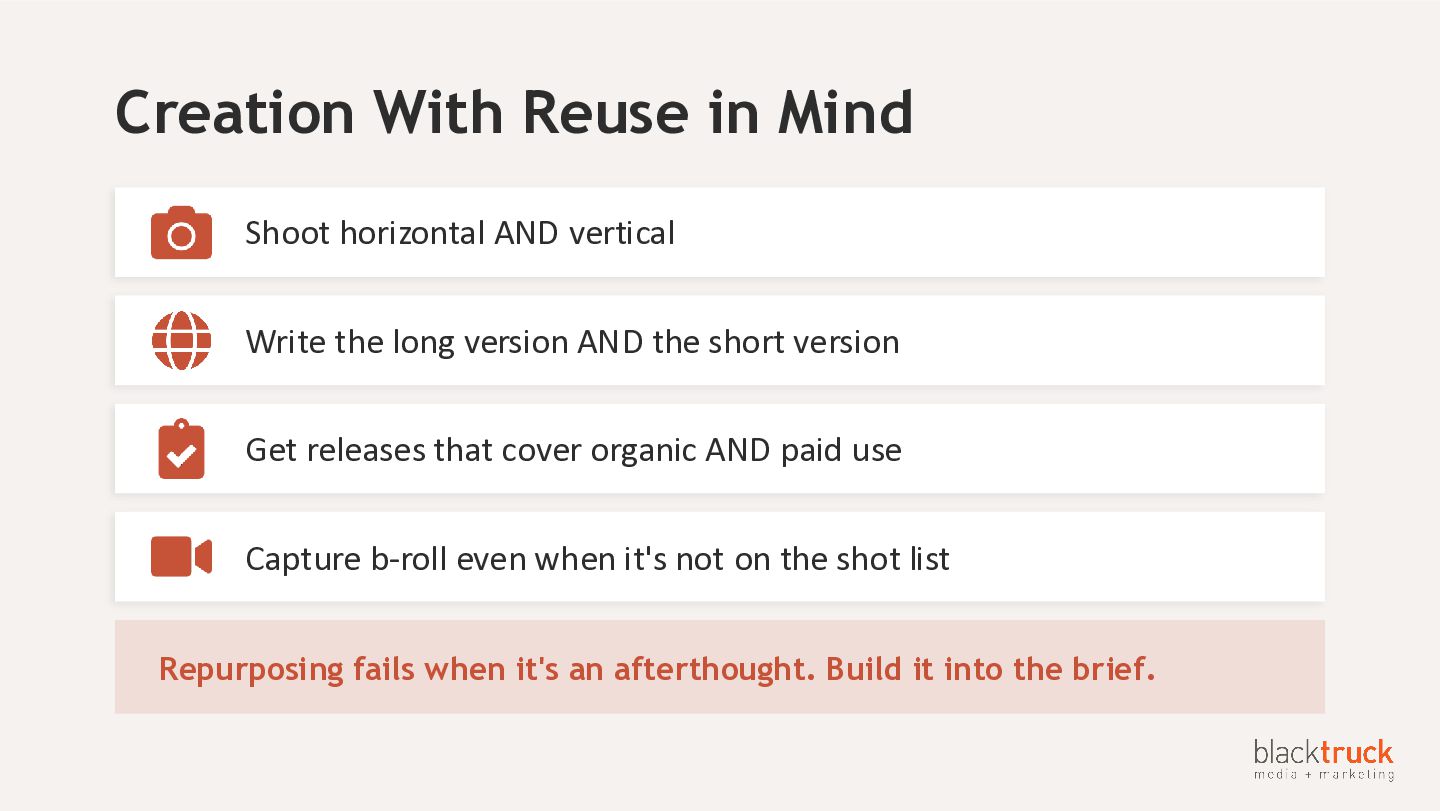
  16. Creation With Reuse in Mind Shoot horizontal AND vertical Write

    the long version AND the short version Get releases that cover organic AND paid use Capture b-roll even when it's not on the shot list Repurposing fails when it's an afterthought. Build it into the brief.
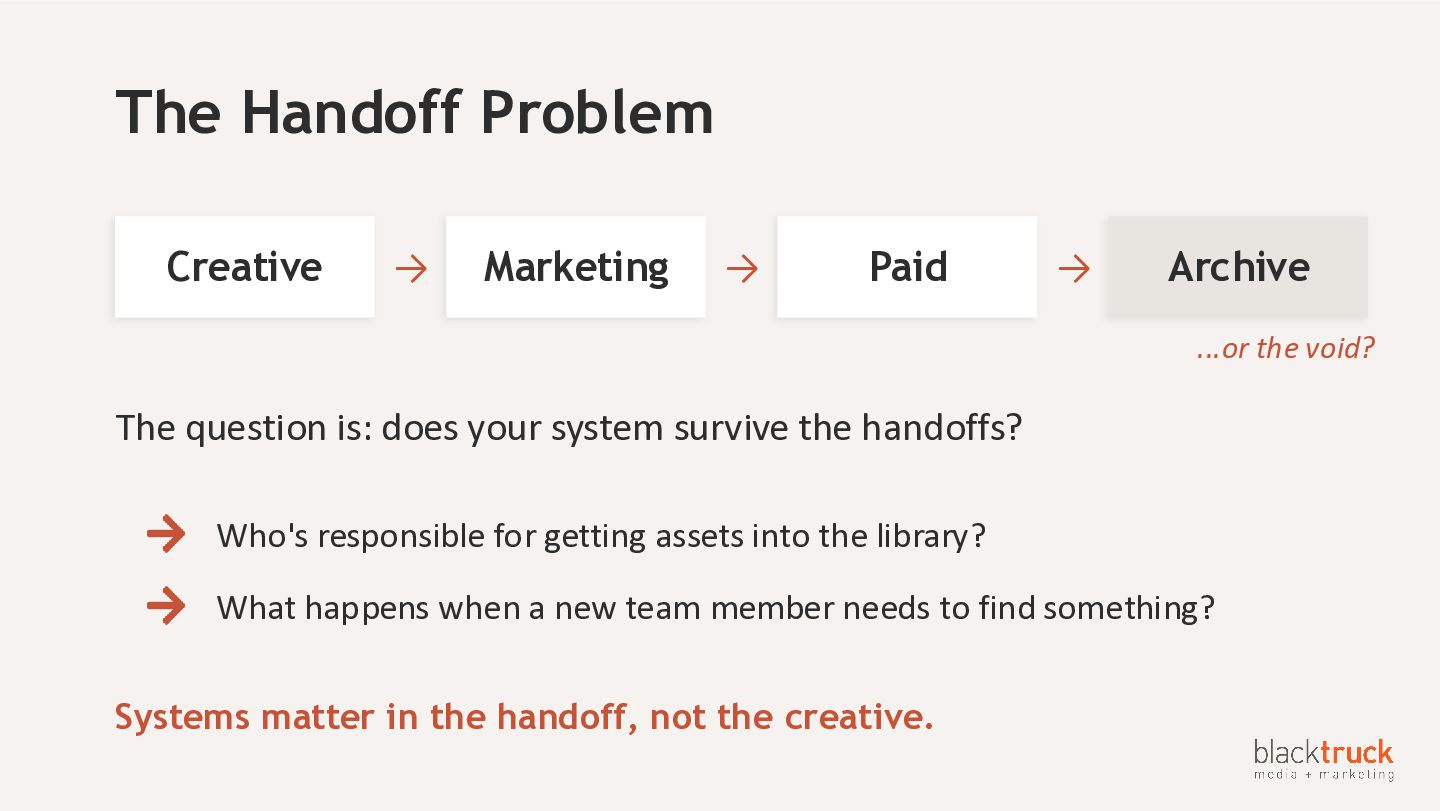
  17. The Handoff Problem Creative → Marketing → Paid → Archive

    ...or the void? The question is: does your system survive the handoffs? Who's responsible for getting assets into the library? What happens when a new team member needs to find something? Systems matter in the handoff, not the creative.
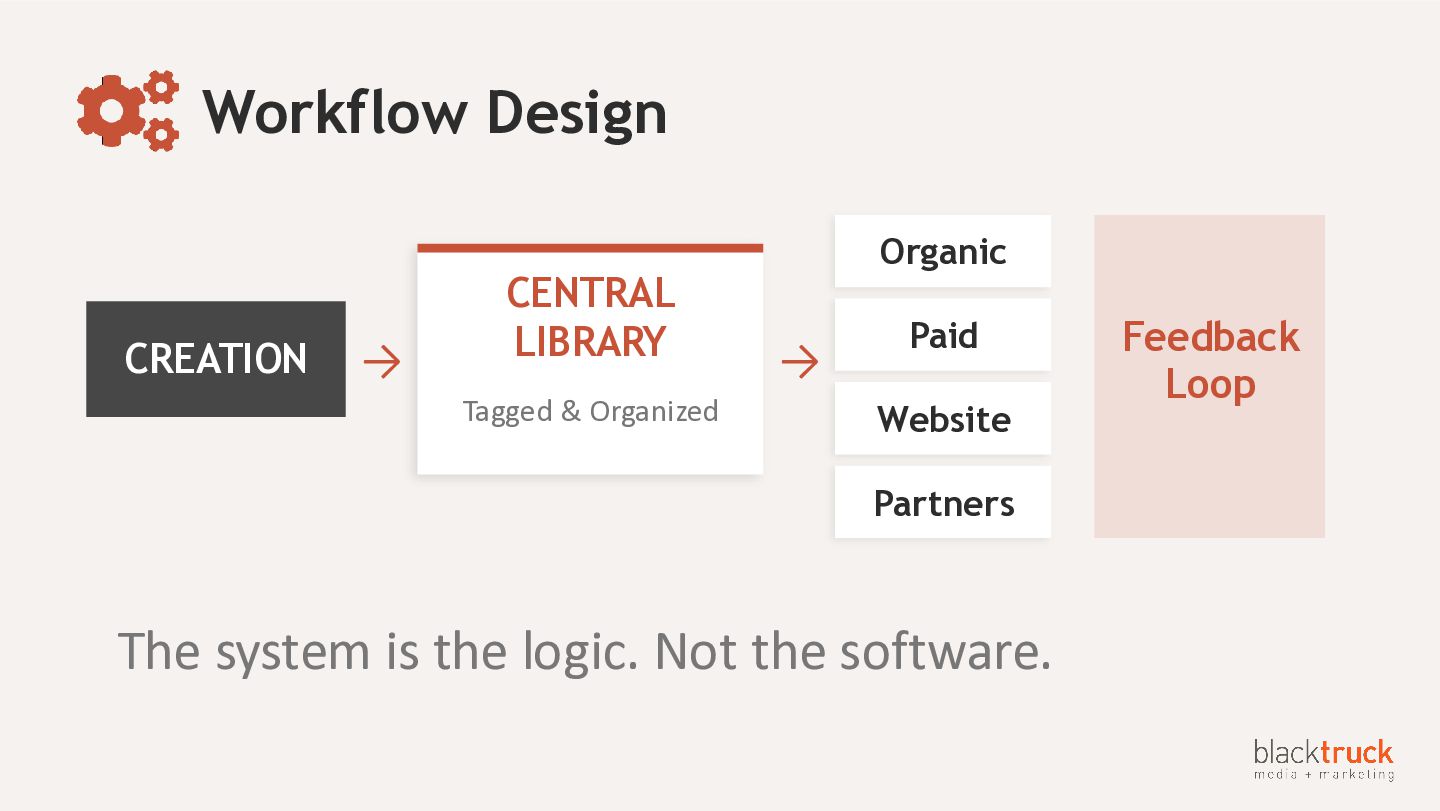
  18. Workflow Design CREATION → CENTRAL LIBRARY Tagged & Organized →

    Organic Paid Website Partners Feedback Loop The system is the logic. Not the software.
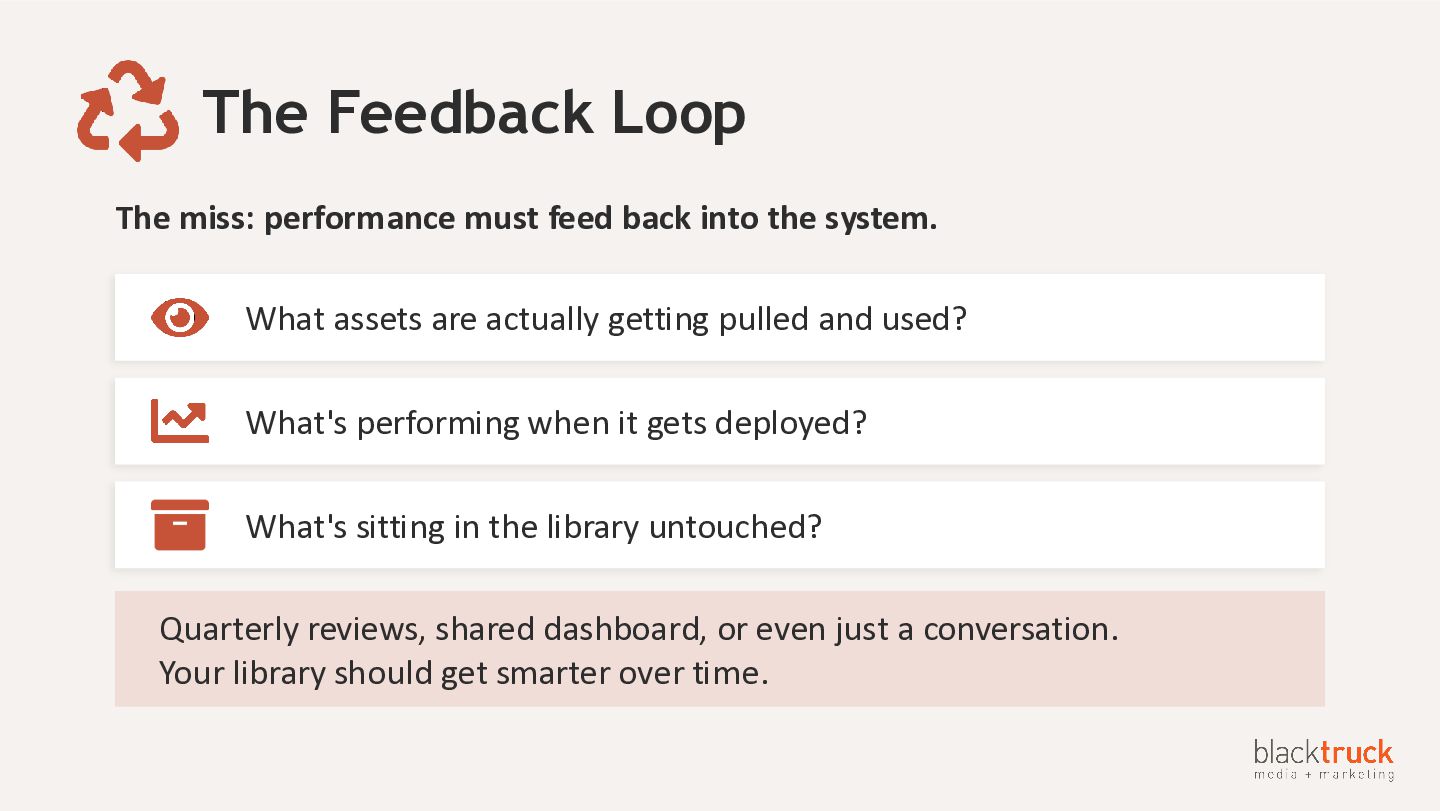
  19. The Feedback Loop The miss: performance must feed back into

    the system. What assets are actually getting pulled and used? What's performing when it gets deployed? What's sitting in the library untouched? Quarterly reviews, shared dashboard, or even just a conversation. Your library should get smarter over time.
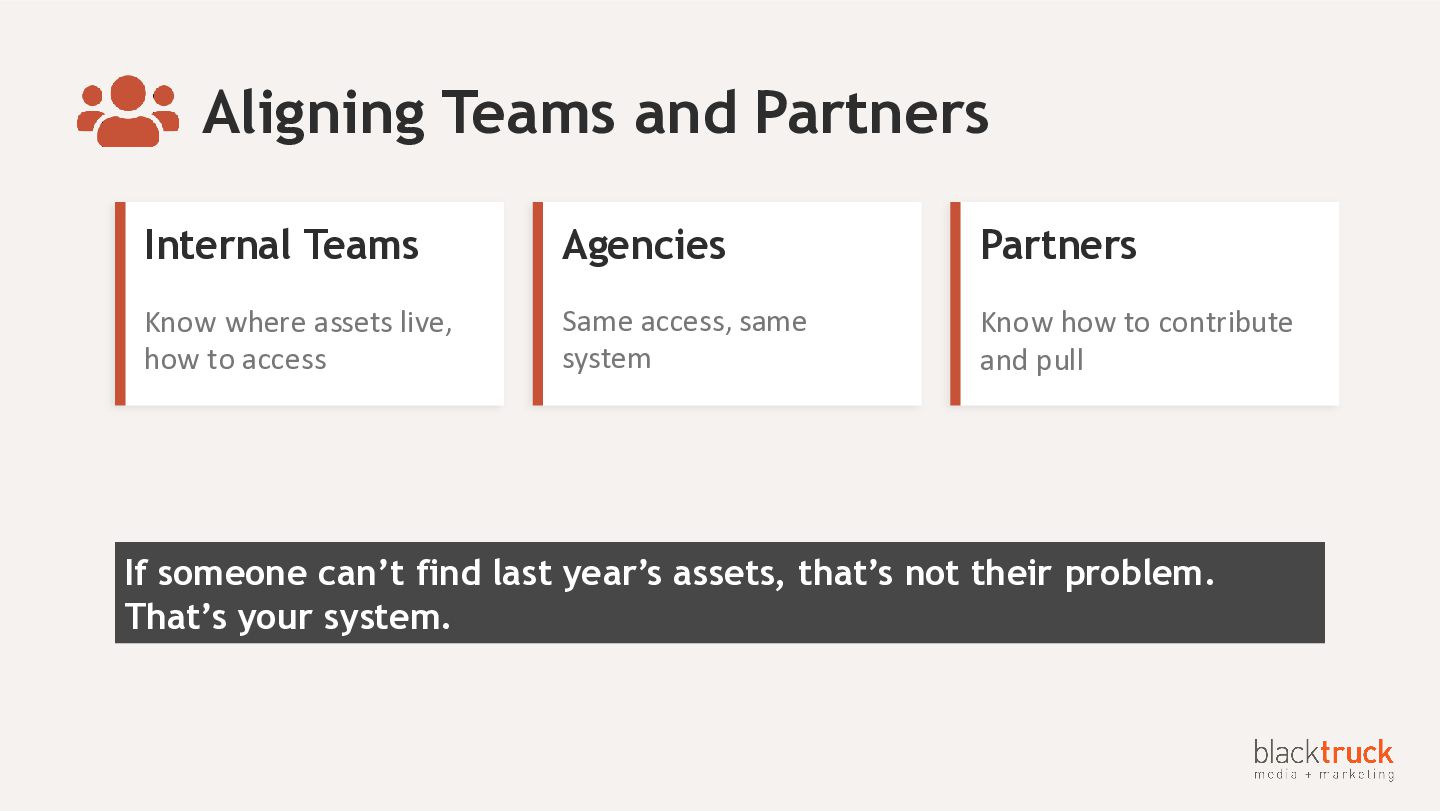
  20. Aligning Teams and Partners Internal Teams Know where assets live,

    how to access Agencies Same access, same system Partners Know how to contribute and pull If someone can’t find last year’s assets, that’s not their problem. That’s your system.
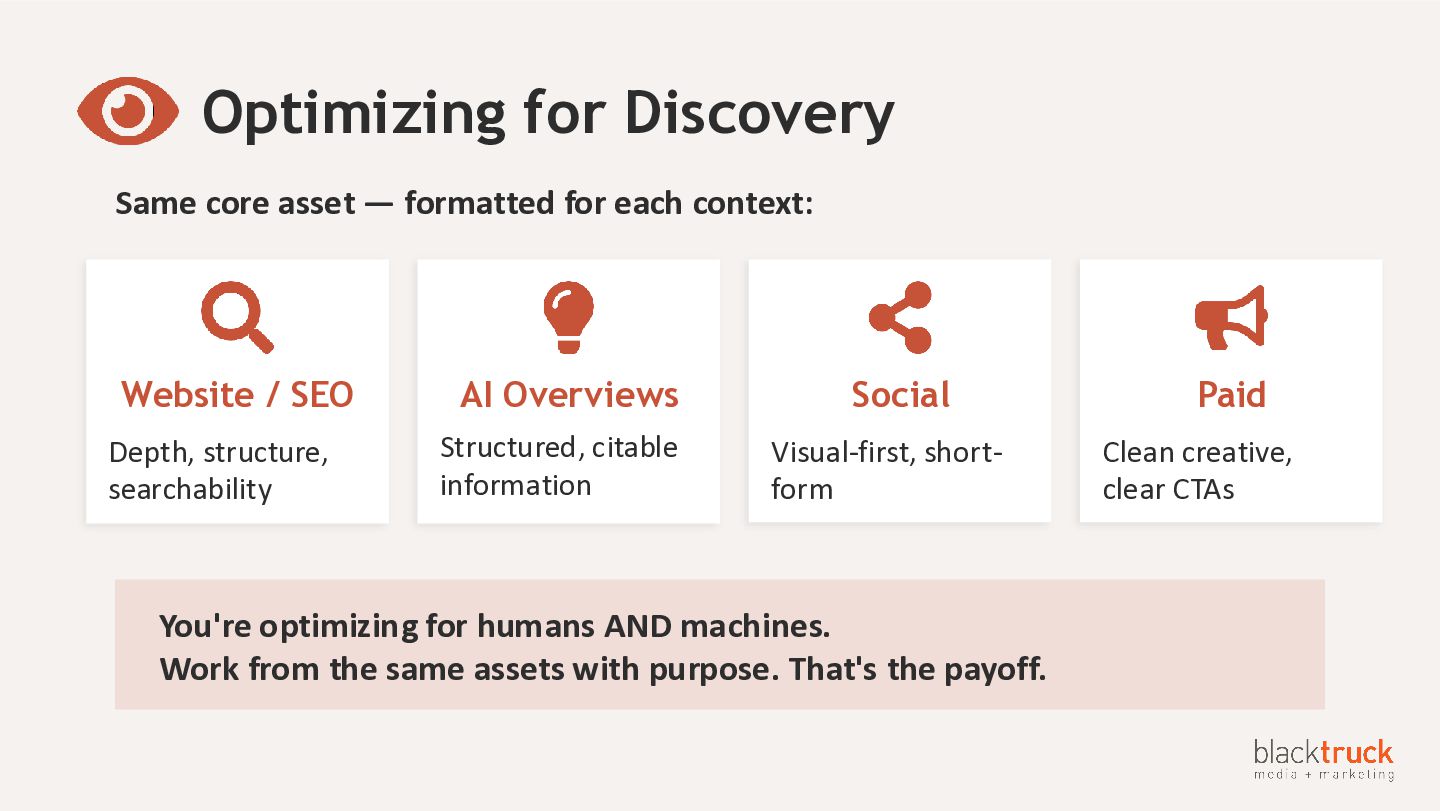
  21. Optimizing for Discovery Same core asset — formatted for each

    context: Website / SEO Depth, structure, searchability AI Overviews Structured, citable information Social Visual-first, short- form Paid Clean creative, clear CTAs You're optimizing for humans AND machines. Work from the same assets with purpose. That's the payoff.
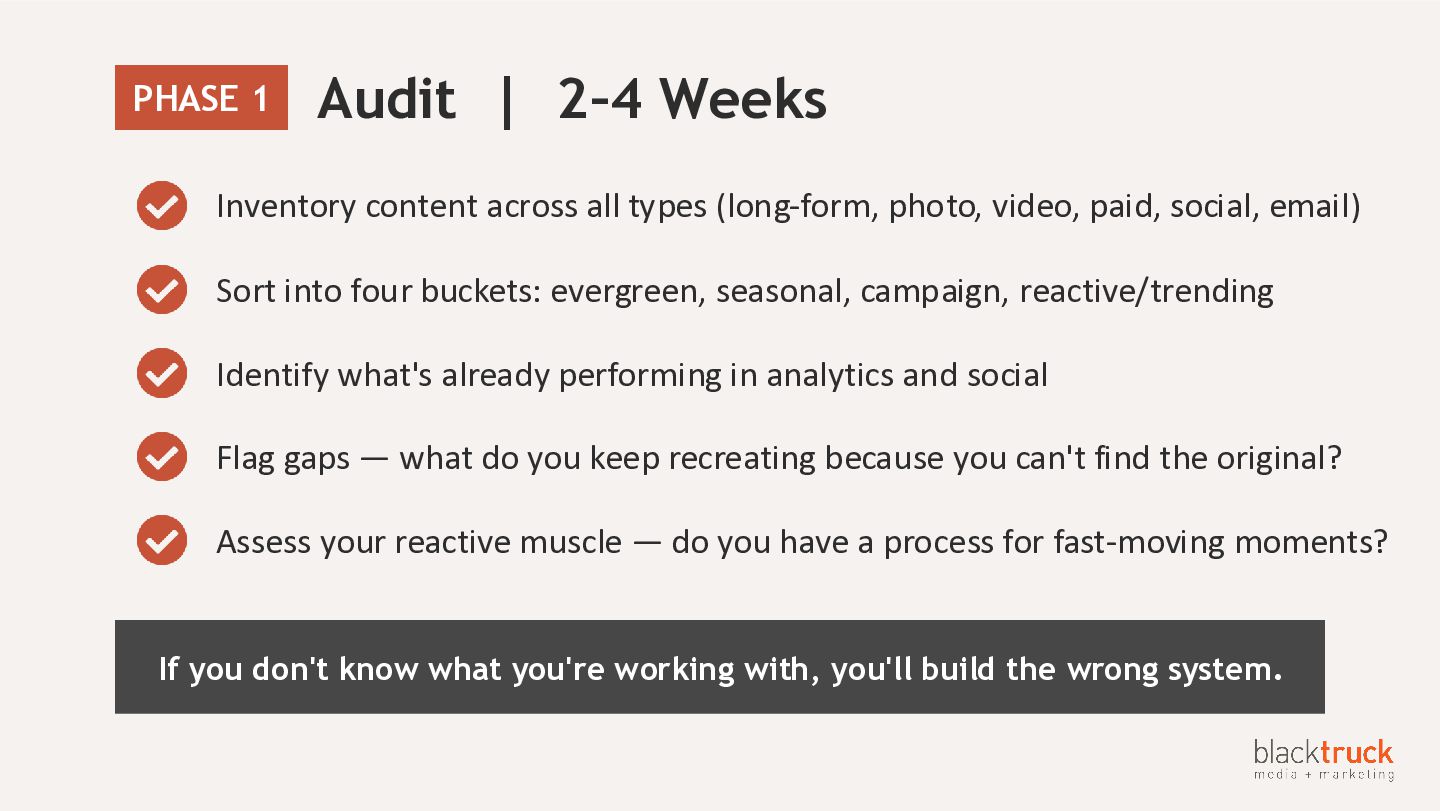
  22. PHASE 1 Audit | 2–4 Weeks Inventory content across all

    types (long-form, photo, video, paid, social, email) Sort into four buckets: evergreen, seasonal, campaign, reactive/trending Identify what's already performing in analytics and social Flag gaps — what do you keep recreating because you can't find the original? Assess your reactive muscle — do you have a process for fast-moving moments? If you don't know what you're working with, you'll build the wrong system.
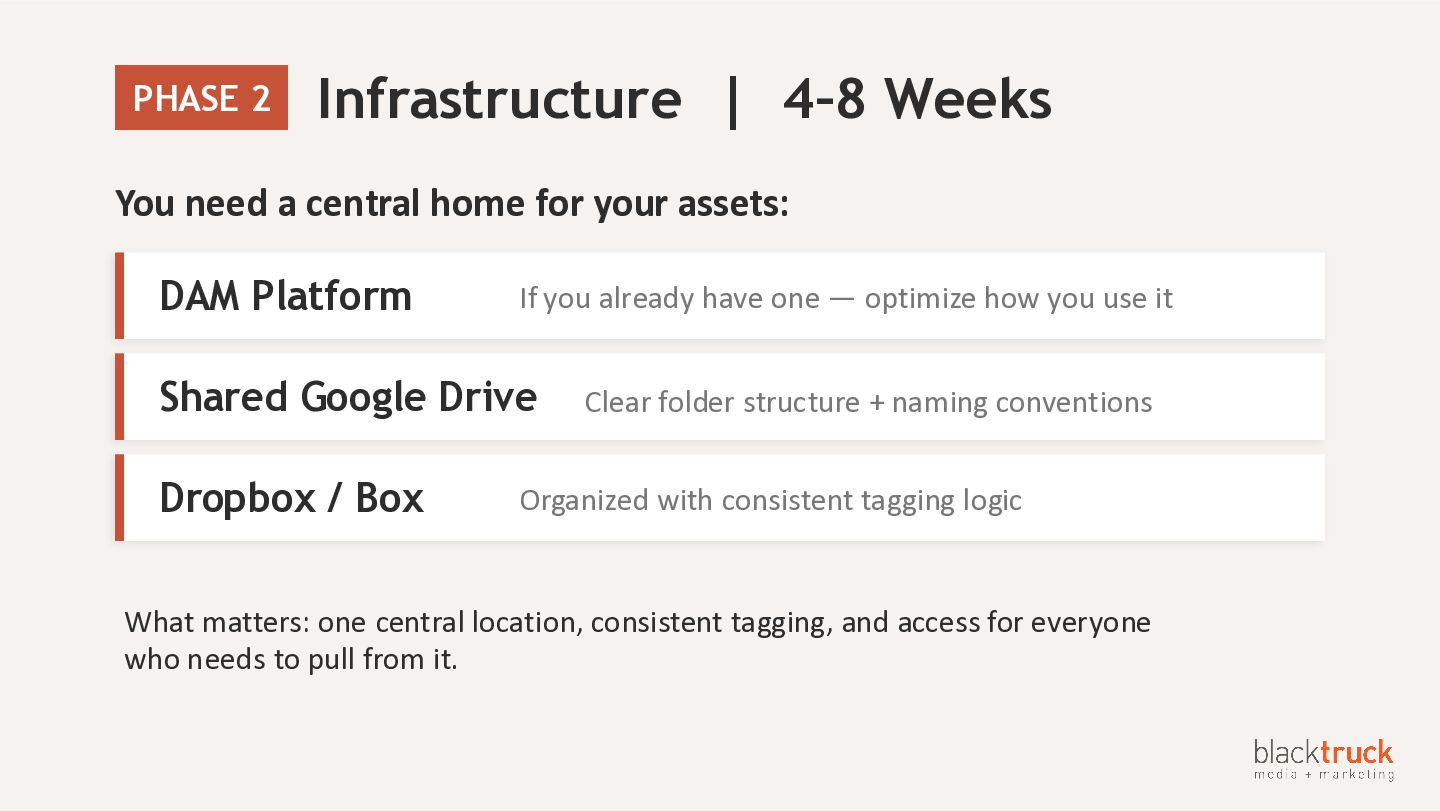
  23. PHASE 2 Infrastructure | 4–8 Weeks You need a central

    home for your assets: DAM Platform If you already have one — optimize how you use it Shared Google Drive Clear folder structure + naming conventions Dropbox / Box Organized with consistent tagging logic What matters: one central location, consistent tagging, and access for everyone who needs to pull from it.
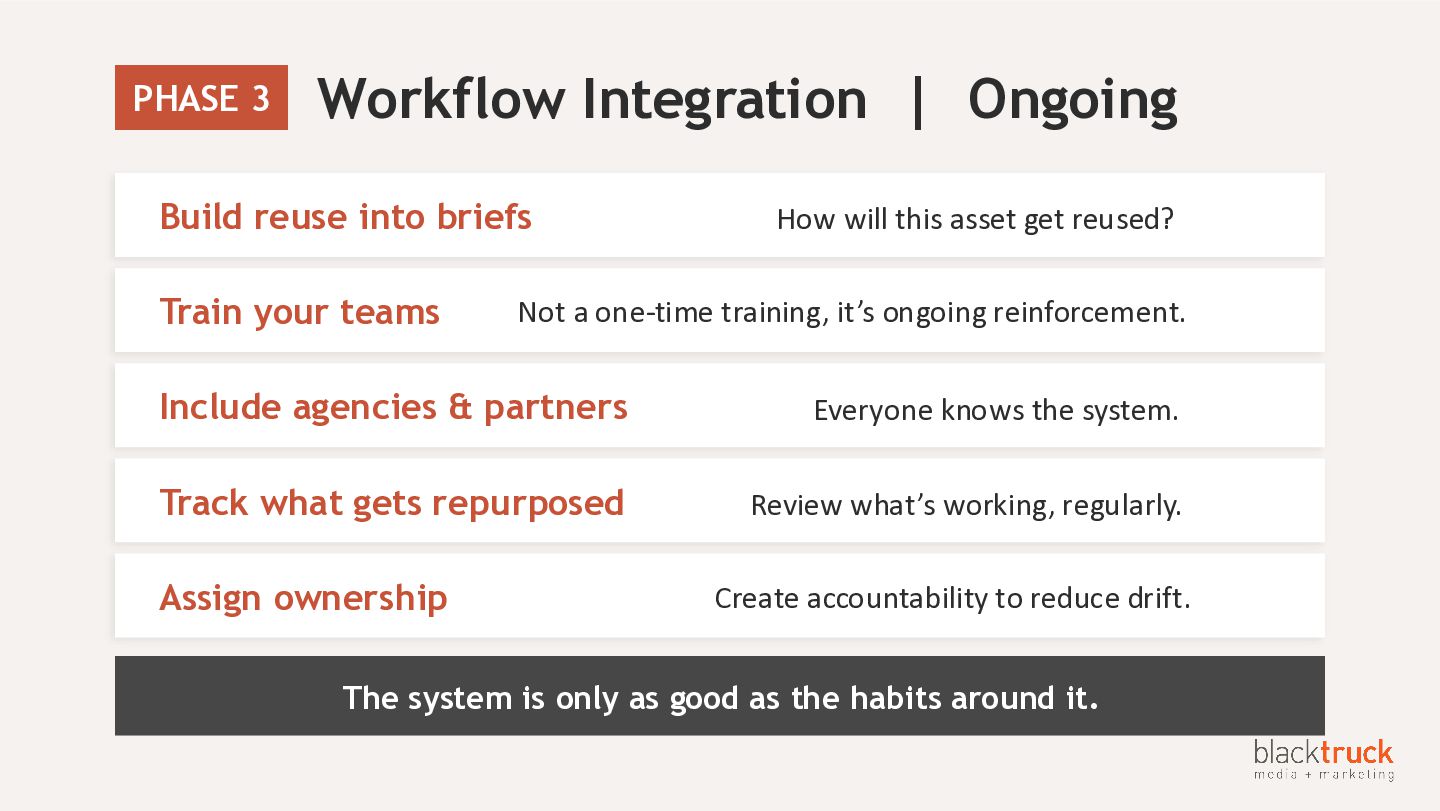
  24. PHASE 3 Workflow Integration | Ongoing Build reuse into briefs

    How will this asset get reused? Train your teams Not a one-time training, it’s ongoing reinforcement. Include agencies & partners Everyone knows the system. Track what gets repurposed Review what’s working, regularly. Assign ownership Create accountability to reduce drift. The system is only as good as the habits around it.
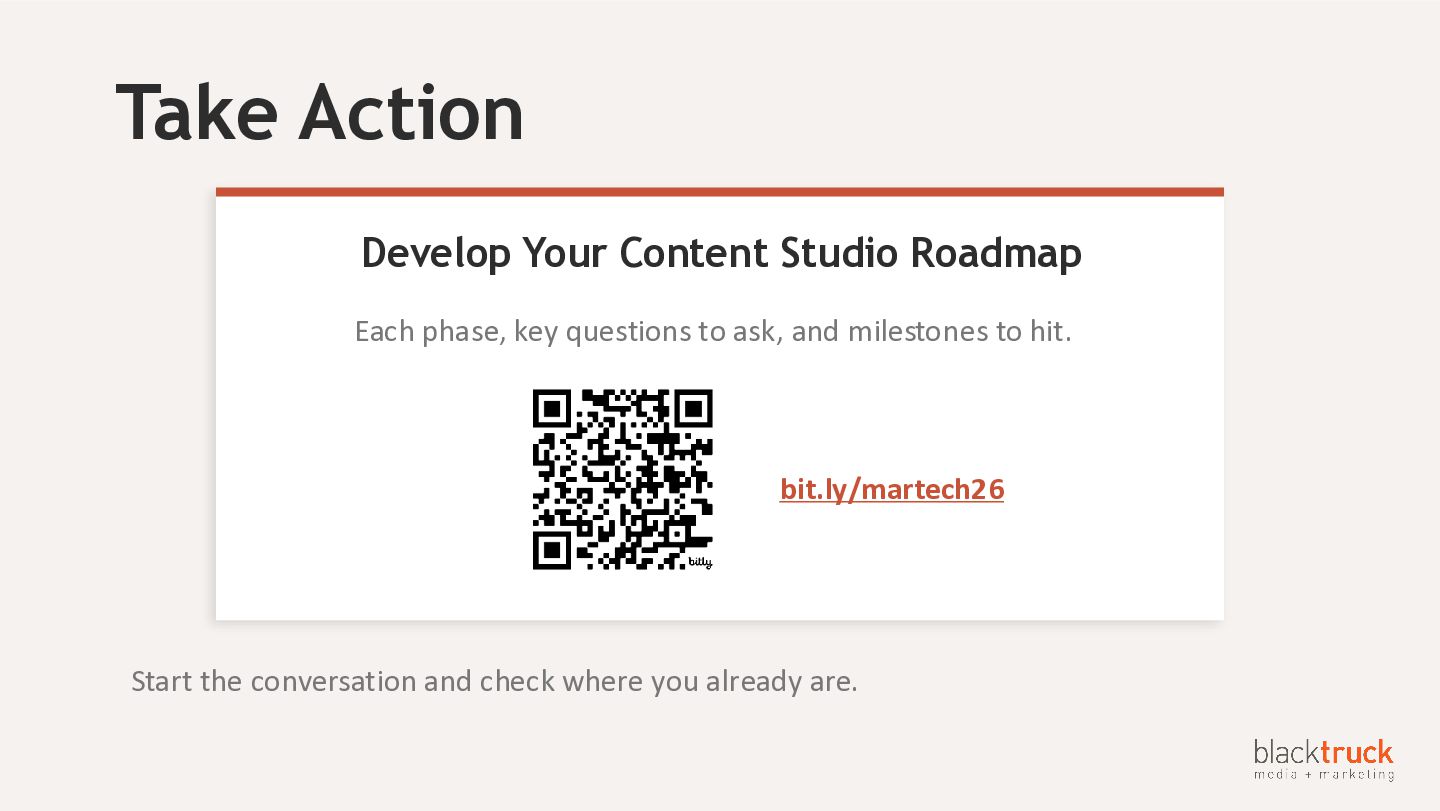
  25. Take Action Develop Your Content Studio Roadmap Each phase, key

    questions to ask, and milestones to hit. Start the conversation and check where you already are. bit.ly/martech26
  26. You don't need to create more content. Develop a system

    that gives every asset a second life, a third life, a tenth life.
  27. Let's Connect Jason Dodge Founder & CEO [email protected] blacktruckmedia.com @dodgejd

    Slides & Resources: bit.ly/martech26 Good marketing starts with the right conversation. Serious about the visibility of your brand online? We’d love to hear what you’re working on.