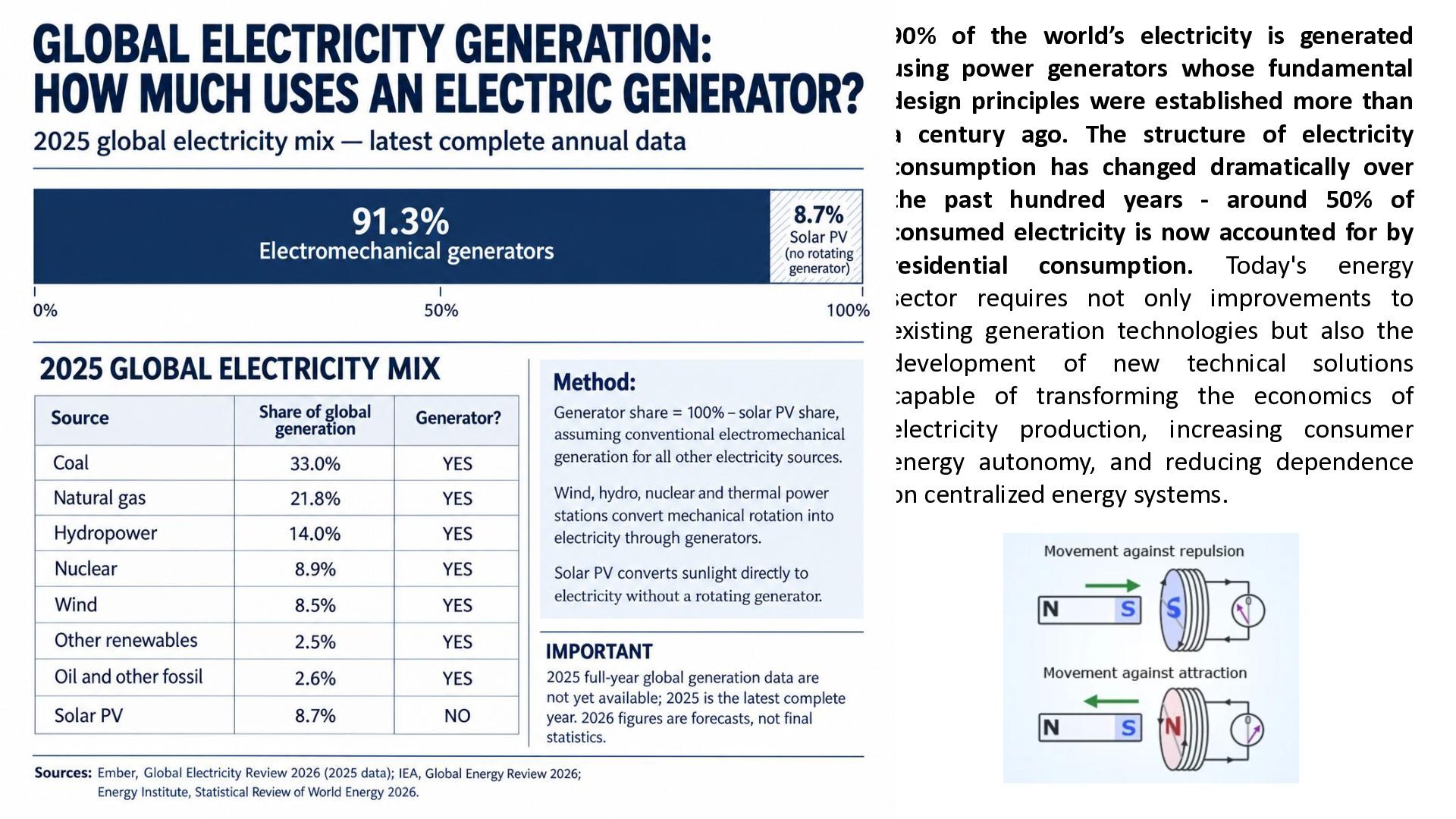
whose fundamental design principles were established more than a century ago. The structure of electricity consumption has changed dramatically over the past hundred years - around 50% of consumed electricity is now accounted for by residential consumption. Today's energy sector requires not only improvements to existing generation technologies but also the development of new technical solutions capable of transforming the economics of electricity production, increasing consumer energy autonomy, and reducing dependence on centralized energy systems.
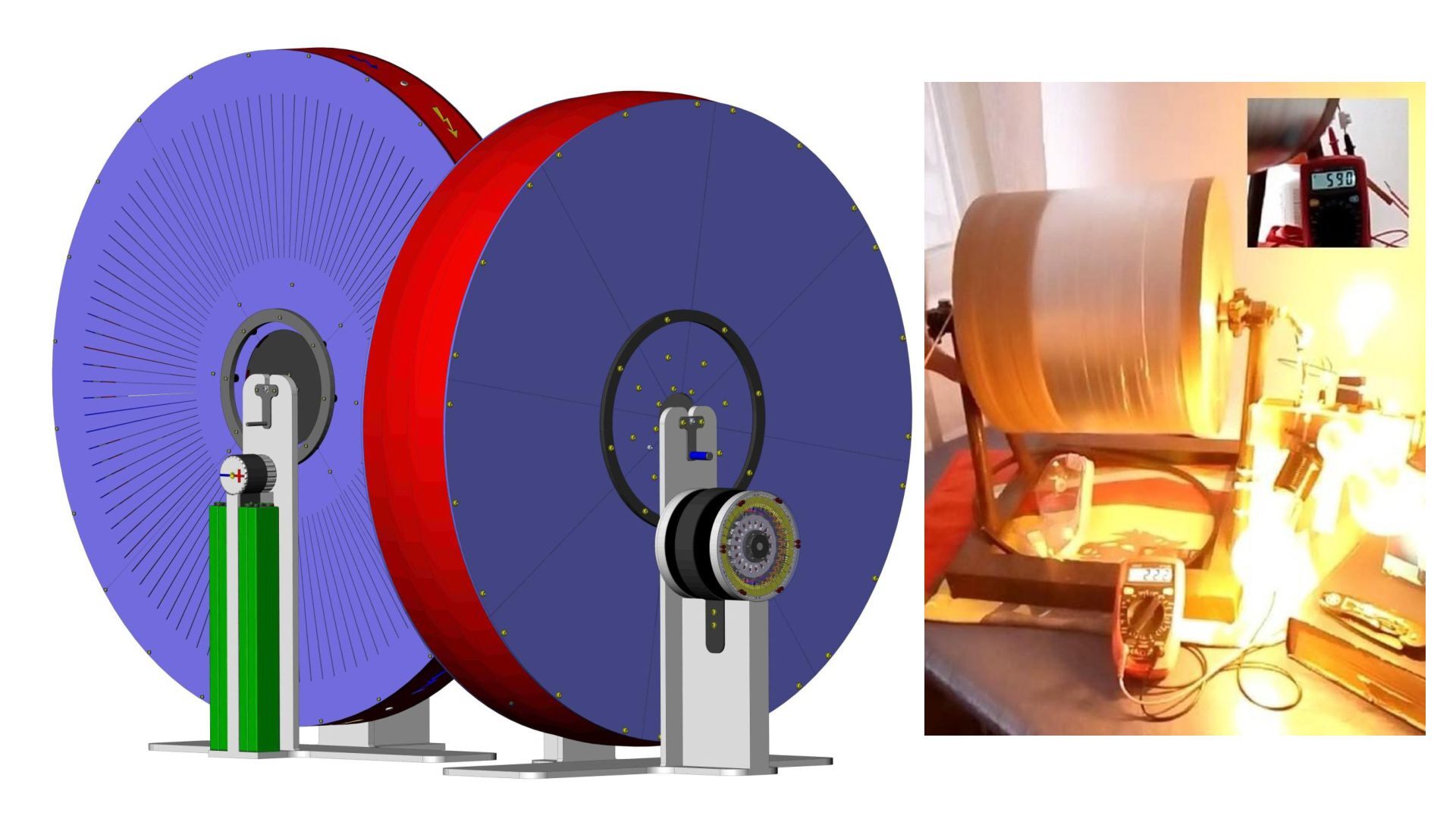
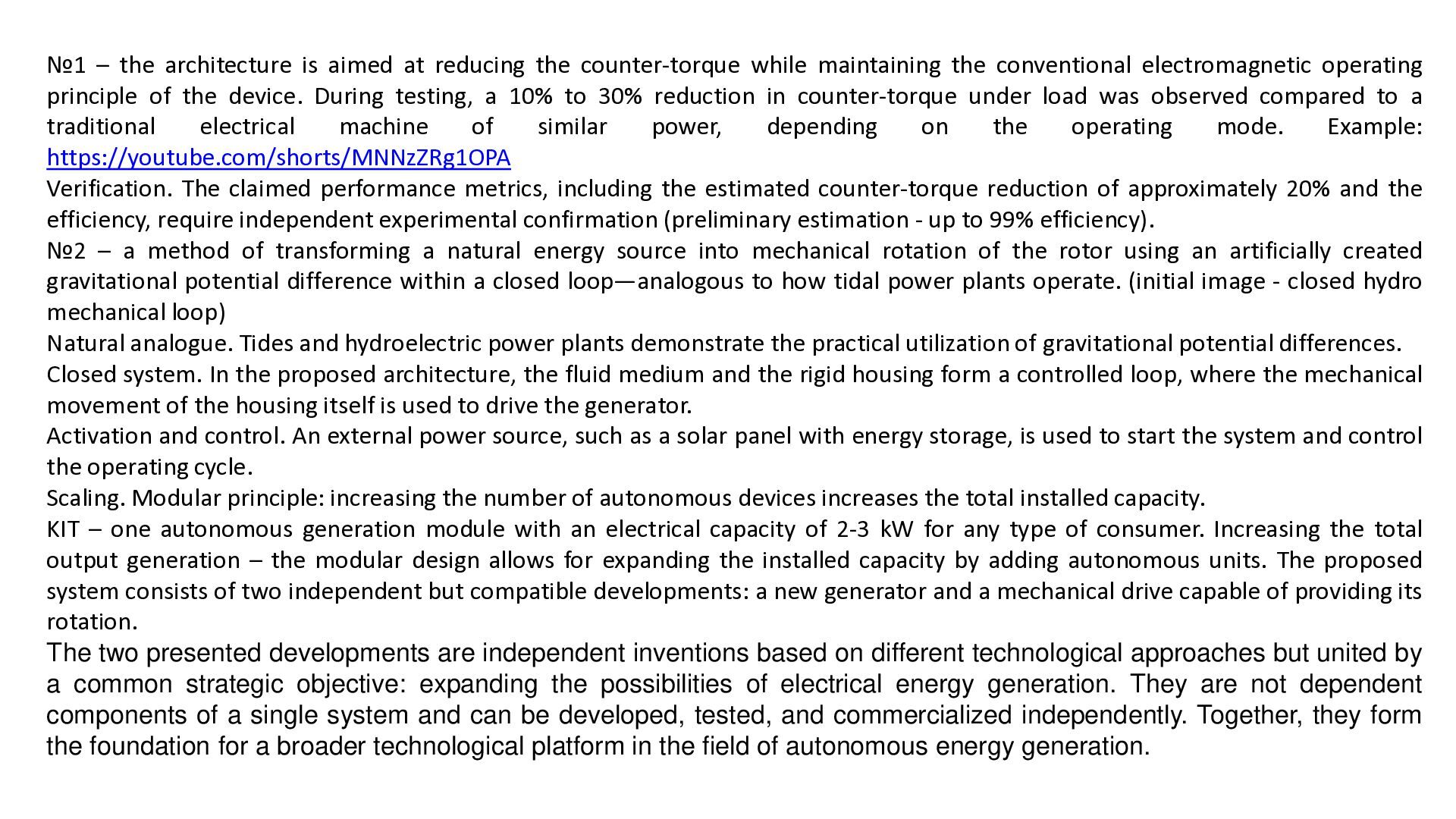
while maintaining the conventional electromagnetic operating principle of the device. During testing, a 10% to 30% reduction in counter-torque under load was observed compared to a traditional electrical machine of similar power, depending on the operating mode. Example: https://youtube.com/shorts/MNNzZRg1OPA Verification. The claimed performance metrics, including the estimated counter-torque reduction of approximately 20% and the efficiency, require independent experimental confirmation (preliminary estimation - up to 99% efficiency). №2 – a method of transforming a natural energy source into mechanical rotation of the rotor using an artificially created gravitational potential difference within a closed loop—analogous to how tidal power plants operate. (initial image - closed hydro mechanical loop) Natural analogue. Tides and hydroelectric power plants demonstrate the practical utilization of gravitational potential differences. Closed system. In the proposed architecture, the fluid medium and the rigid housing form a controlled loop, where the mechanical movement of the housing itself is used to drive the generator. Activation and control. An external power source, such as a solar panel with energy storage, is used to start the system and control the operating cycle. Scaling. Modular principle: increasing the number of autonomous devices increases the total installed capacity. KIT – one autonomous generation module with an electrical capacity of 2-3 kW for any type of consumer. Increasing the total output generation – the modular design allows for expanding the installed capacity by adding autonomous units. The proposed system consists of two independent but compatible developments: a new generator and a mechanical drive capable of providing its rotation. The two presented developments are independent inventions based on different technological approaches but united by a common strategic objective: expanding the possibilities of electrical energy generation. They are not dependent components of a single system and can be developed, tested, and commercialized independently. Together, they form the foundation for a broader technological platform in the field of autonomous energy generation.
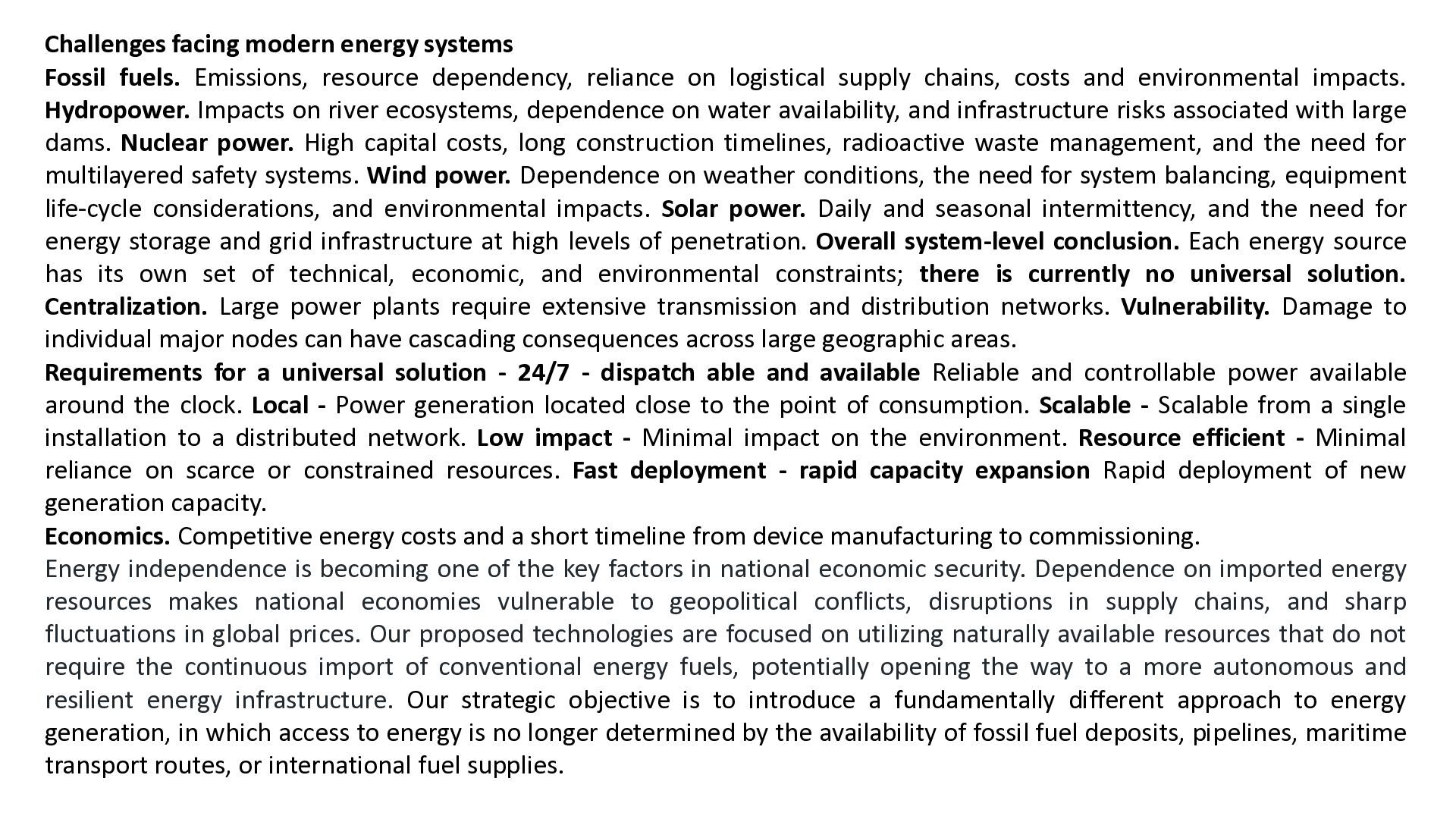
reliance on logistical supply chains, costs and environmental impacts. Hydropower. Impacts on river ecosystems, dependence on water availability, and infrastructure risks associated with large dams. Nuclear power. High capital costs, long construction timelines, radioactive waste management, and the need for multilayered safety systems. Wind power. Dependence on weather conditions, the need for system balancing, equipment life-cycle considerations, and environmental impacts. Solar power. Daily and seasonal intermittency, and the need for energy storage and grid infrastructure at high levels of penetration. Overall system-level conclusion. Each energy source has its own set of technical, economic, and environmental constraints; there is currently no universal solution. Centralization. Large power plants require extensive transmission and distribution networks. Vulnerability. Damage to individual major nodes can have cascading consequences across large geographic areas. Requirements for a universal solution - 24/7 - dispatch able and available Reliable and controllable power available around the clock. Local - Power generation located close to the point of consumption. Scalable - Scalable from a single installation to a distributed network. Low impact - Minimal impact on the environment. Resource efficient - Minimal reliance on scarce or constrained resources. Fast deployment - rapid capacity expansion Rapid deployment of new generation capacity. Economics. Competitive energy costs and a short timeline from device manufacturing to commissioning. Energy independence is becoming one of the key factors in national economic security. Dependence on imported energy resources makes national economies vulnerable to geopolitical conflicts, disruptions in supply chains, and sharp fluctuations in global prices. Our proposed technologies are focused on utilizing naturally available resources that do not require the continuous import of conventional energy fuels, potentially opening the way to a more autonomous and resilient energy infrastructure. Our strategic objective is to introduce a fundamentally different approach to energy generation, in which access to energy is no longer determined by the availability of fossil fuel deposits, pipelines, maritime transport routes, or international fuel supplies.
and large centralized generation facilities. Energy supply resilience. A distributed architecture reduces the concentration of risk in individual large-scale nodes. Industrial competitiveness. Energy-intensive industries, data centers, and technology companies would gain access to a predictable local energy source. Investment attractiveness. A validated technology combined with competitive energy costs could create a new industrial cluster around manufacturing and service operations. Partnership proposal Intellectual property. Development of a patent strategy and legal protection of rights to the results of the development. Technology development. Joint refinement, prototyping, and independent verification of the claimed performance characteristics. Commercialization. Selection of a business model: in-house manufacturing and sales, or licensing/sale of the technology. Market entry. Pilot projects, participation in relevant industry exhibitions, identification of industrial partners, and preparation for mass production. Key principle. First, provide public, measurable evidence of the technology and its energy balance; then proceed to scaling and commercialization. We are offering a strategic partner more than an opportunity to finance a project. We are offering the opportunity to take a leading role in establishing and developing a new technology startup — becoming a co-owner of the intellectual property under mutually agreed terms, participating in shaping the company's development strategy, and taking the position of CEO to lead the startup's operations. The partnership will encompass technology development, independent testing, production infrastructure development, and subsequent entry into international markets. The allocation of equity, ownership rights of intellectual property, and rights to jointly developed improvements will be agreed upon before any confidential technical information is disclosed. Let us consider a business cooperation proposal from an investor partner. Contact: [email protected]


 snoozer05
 shisyu_gaku
 erikjhordan_rey
 aki310ooooo
 kaonavi
 nkzn
 markunet
 sato4mi
 sogaoh
 nagix
 shinyaa31
 neohsu
 notwaldorf
 davidcarrasco
 panda_program
 greggifford
 jonoalderson
 codingconduct
 brettharned
 gurzu
 tammyeverts
 addyosmani
 axbom
 jlugia