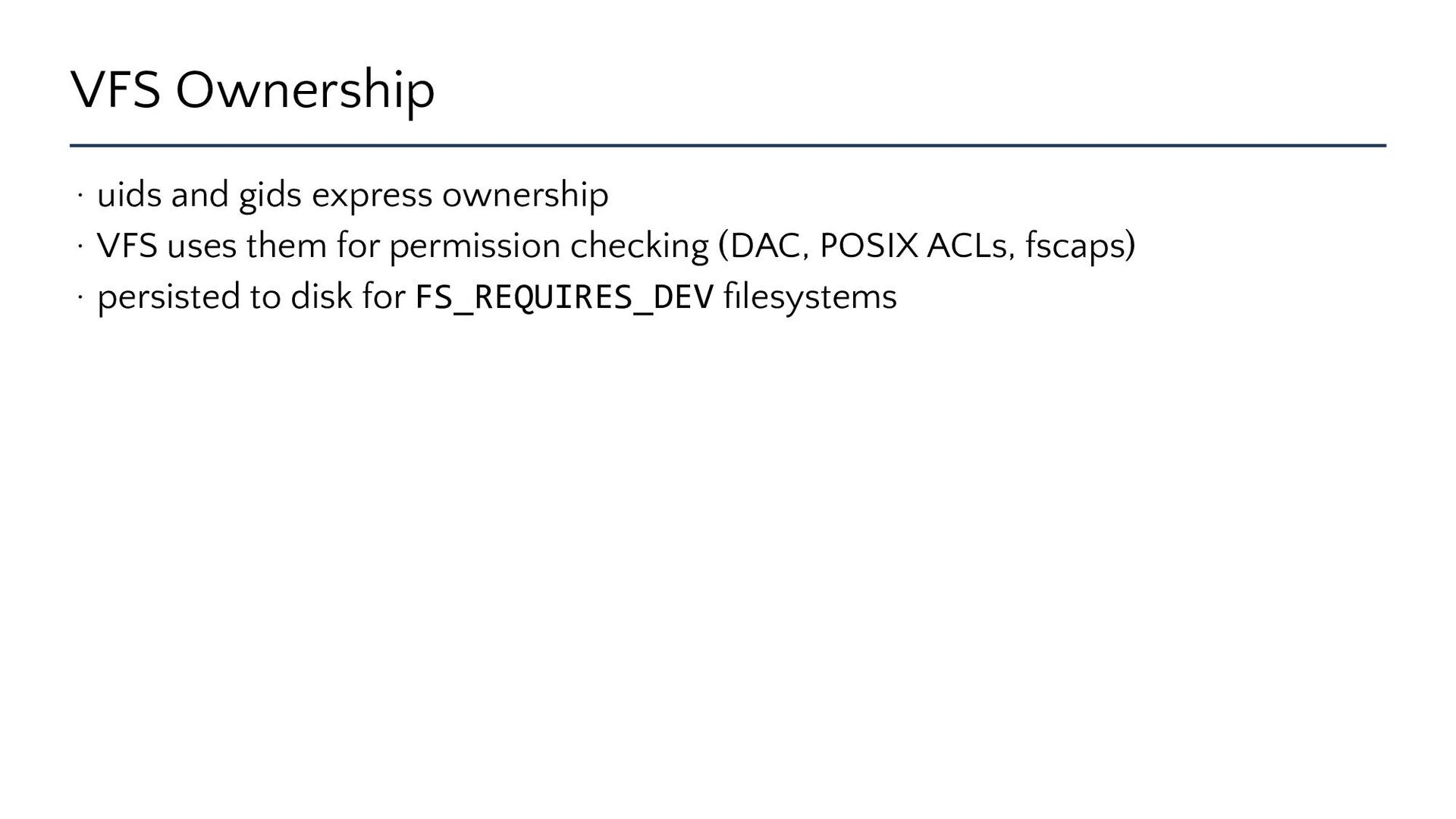
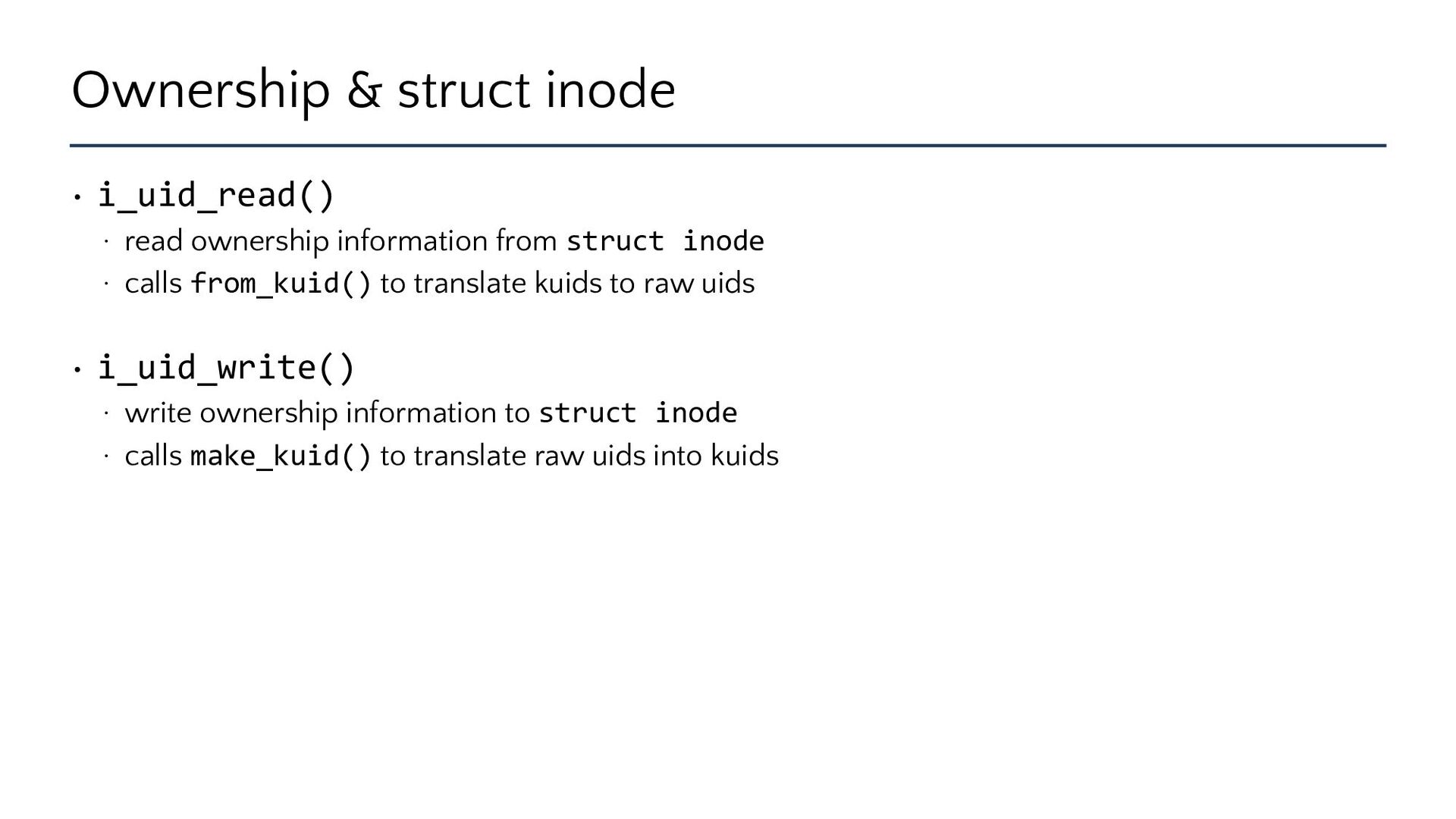
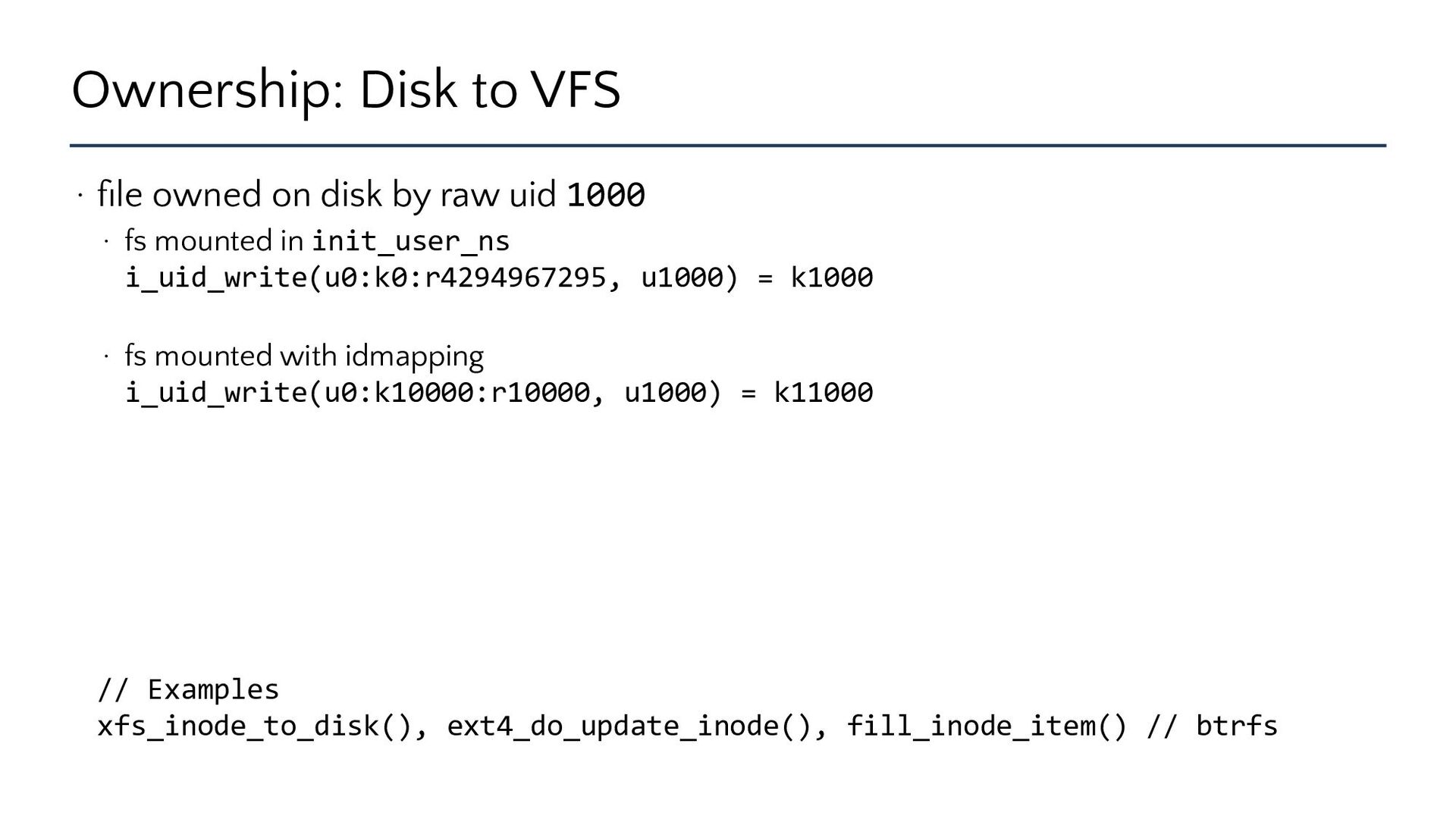
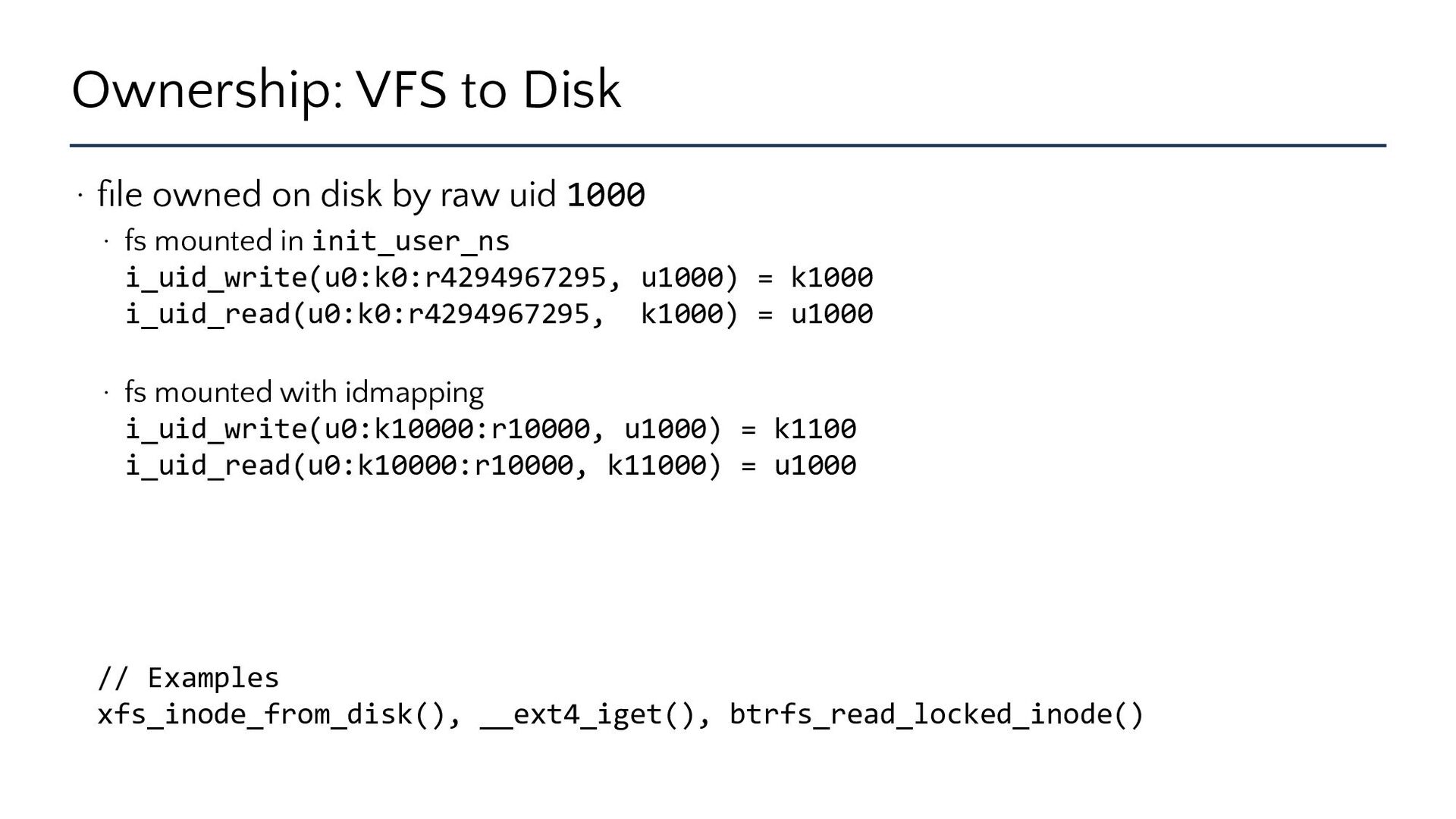
from struct inode · calls from_kuid() to translate kuids to raw uids · i_uid_write() · write ownership information to struct inode · calls make_kuid() to translate raw uids into kuids
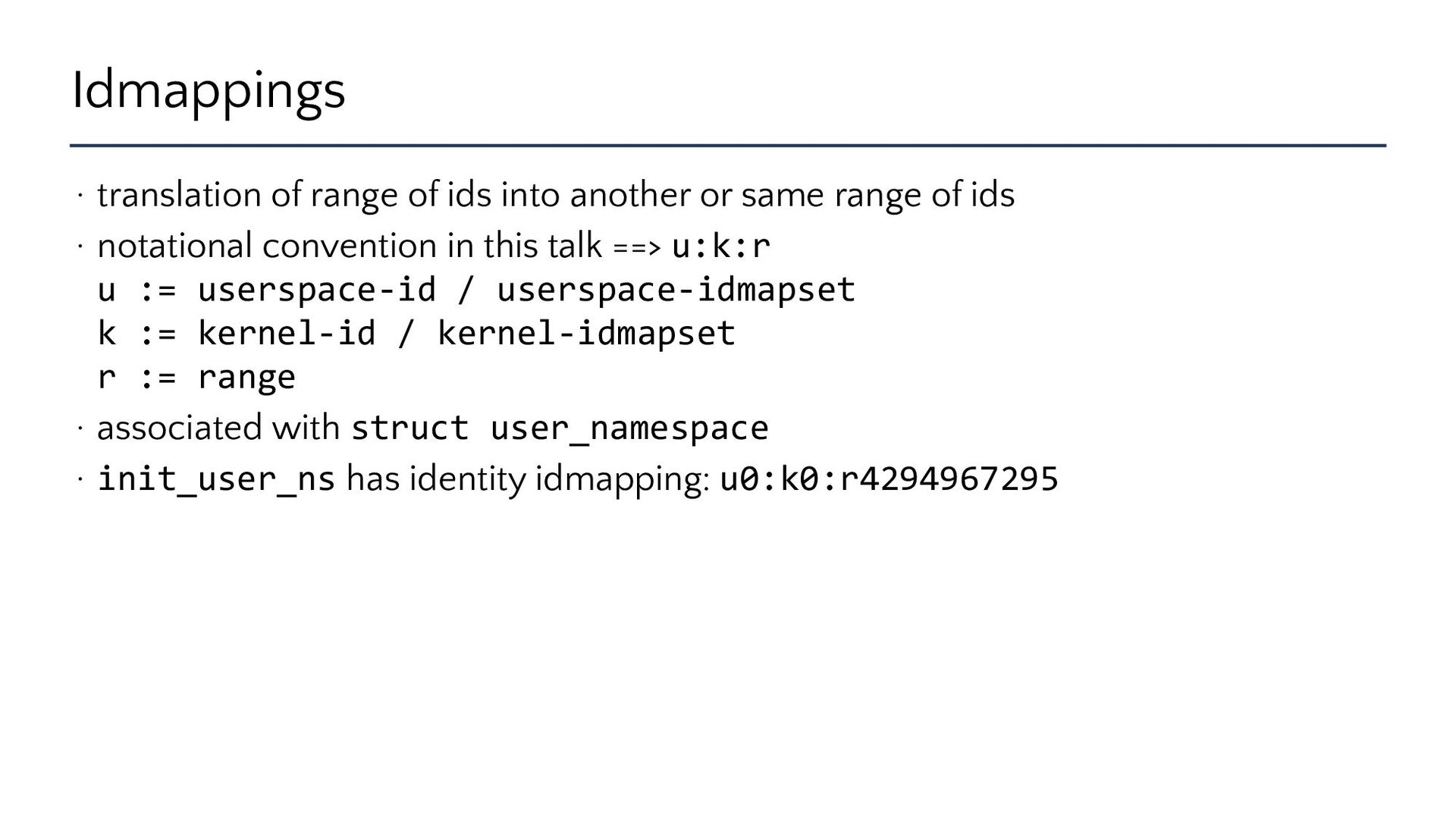
same range of ids · notational convention in this talk ==> u:k:r u := userspace-id / userspace-idmapset k := kernel-id / kernel-idmapset r := range · associated with struct user_namespace · init_user_ns has identity idmapping: u0:k0:r4294967295
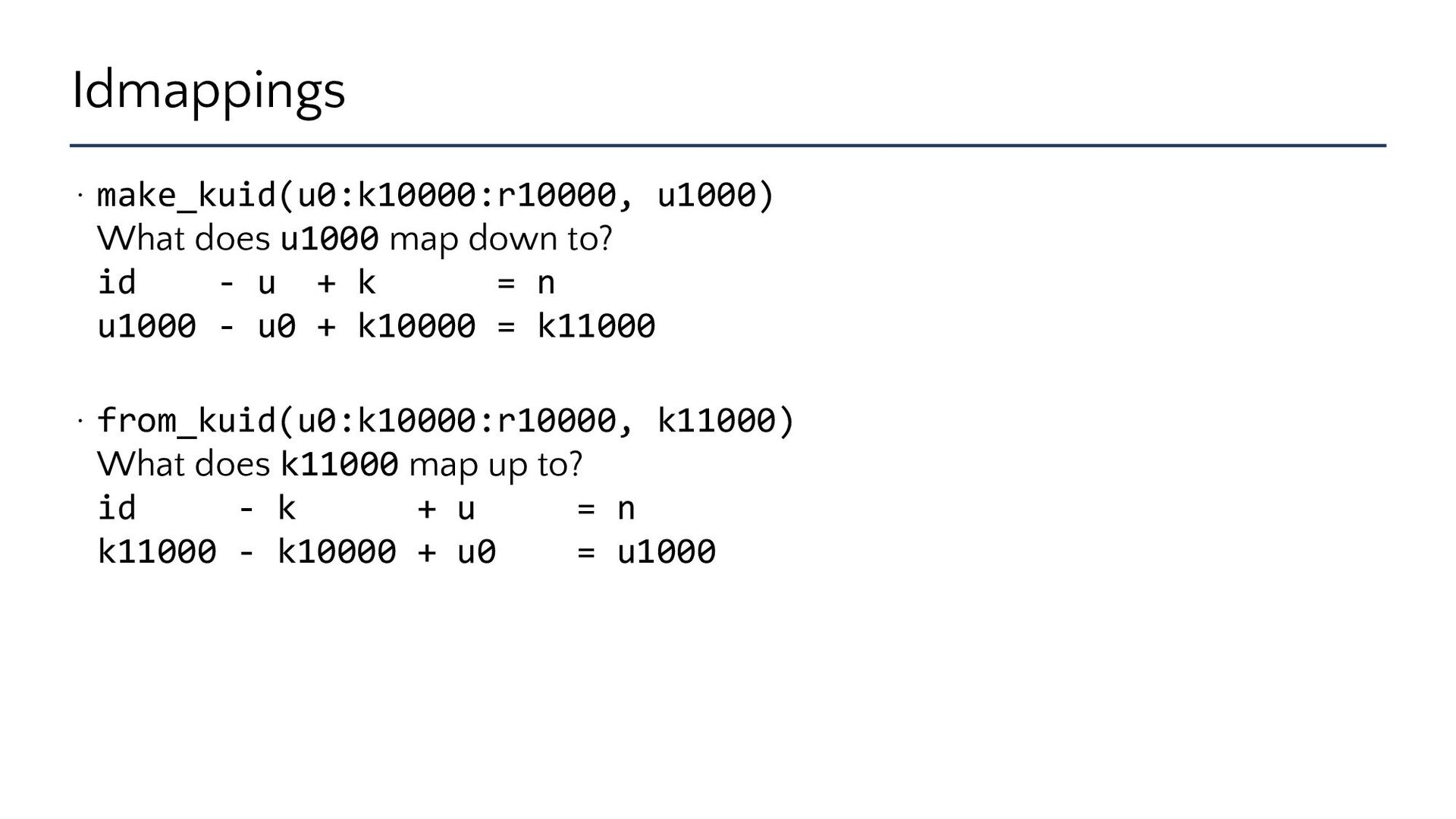
id - u + k = n u1000 - u0 + k10000 = k11000 · from_kuid(u0:k10000:r10000, k11000) What does k11000 map up to? id - k + u = n k11000 - k10000 + u0 = u1000
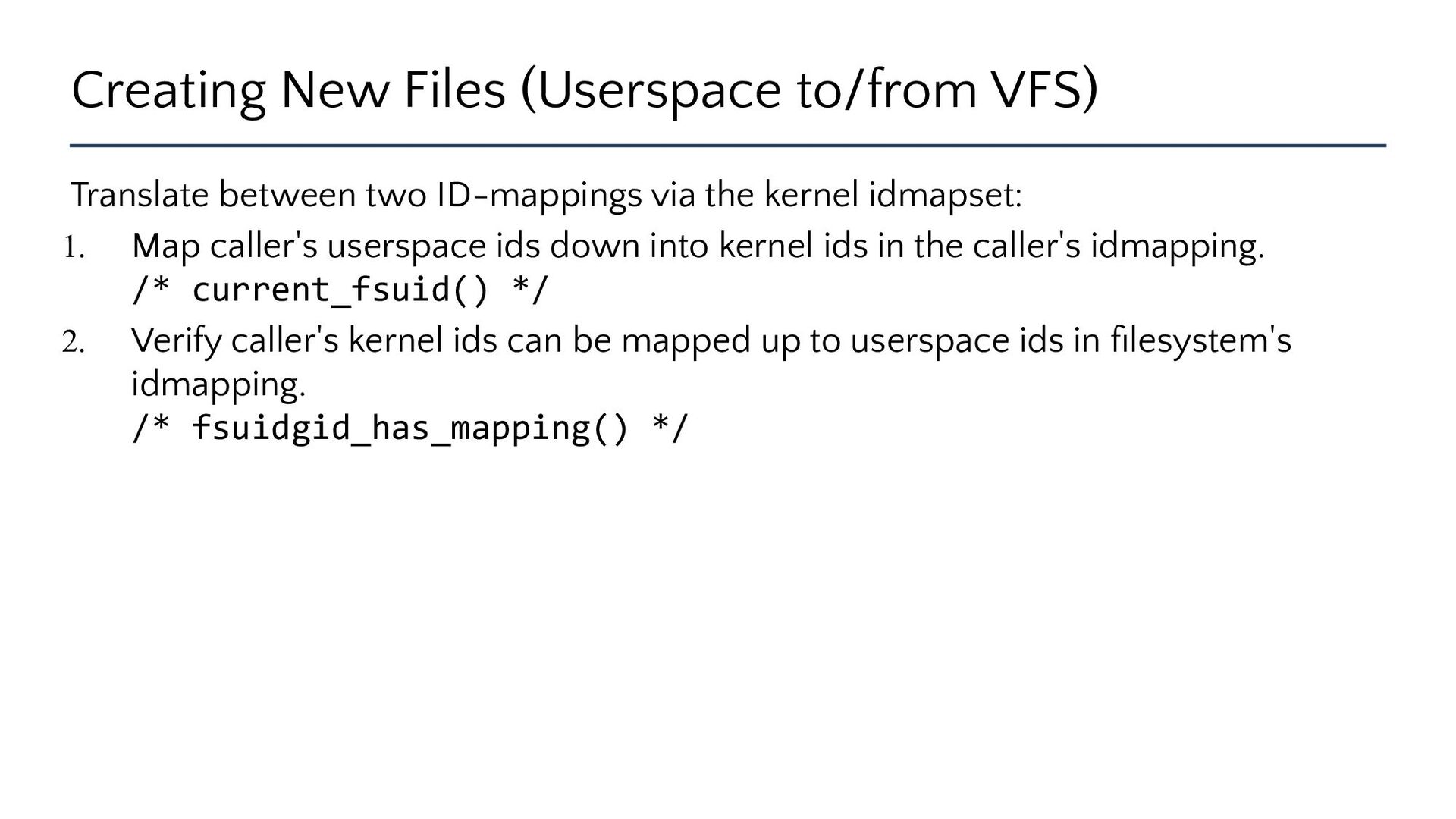
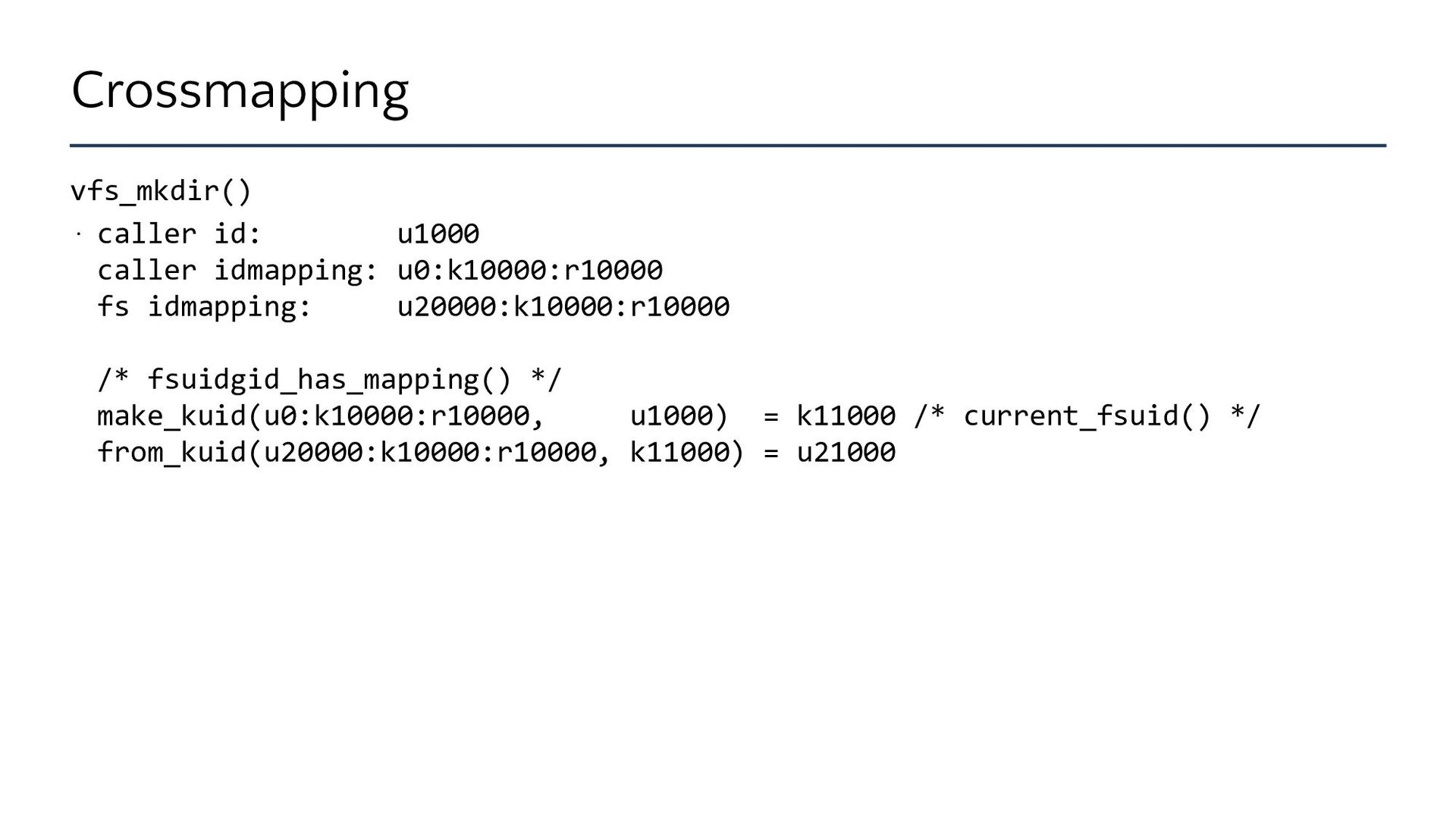
via the kernel idmapset: 1. Map caller's userspace ids down into kernel ids in the caller's idmapping. /* current_fsuid() */ 2. Verify caller's kernel ids can be mapped up to userspace ids in filesystem's idmapping. /* fsuidgid_has_mapping() */
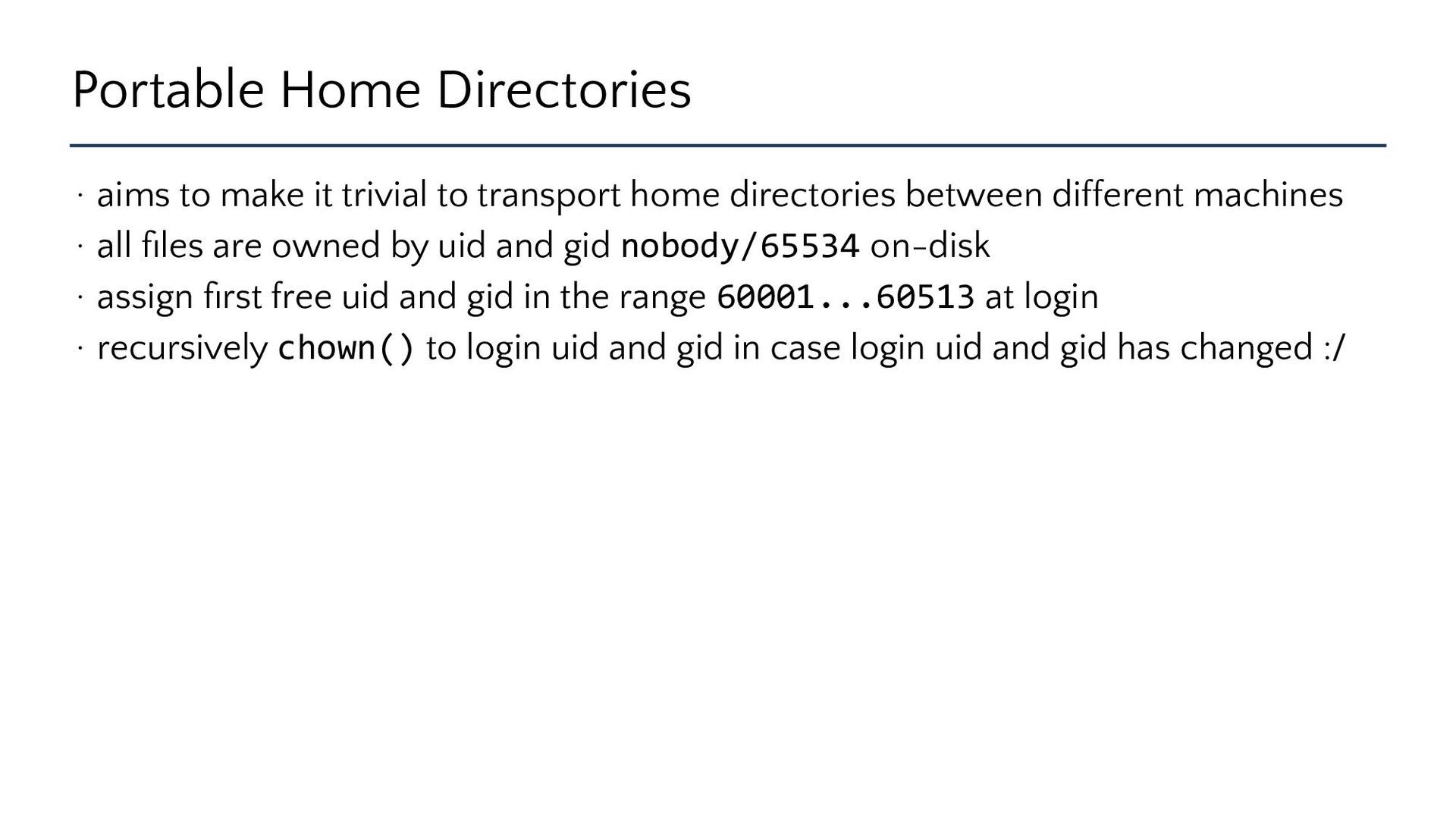
transport home directories between different machines · all files are owned by uid and gid nobody/65534 on-disk · assign first free uid and gid in the range 60001...60513 at login · recursively chown() to login uid and gid in case login uid and gid has changed :/
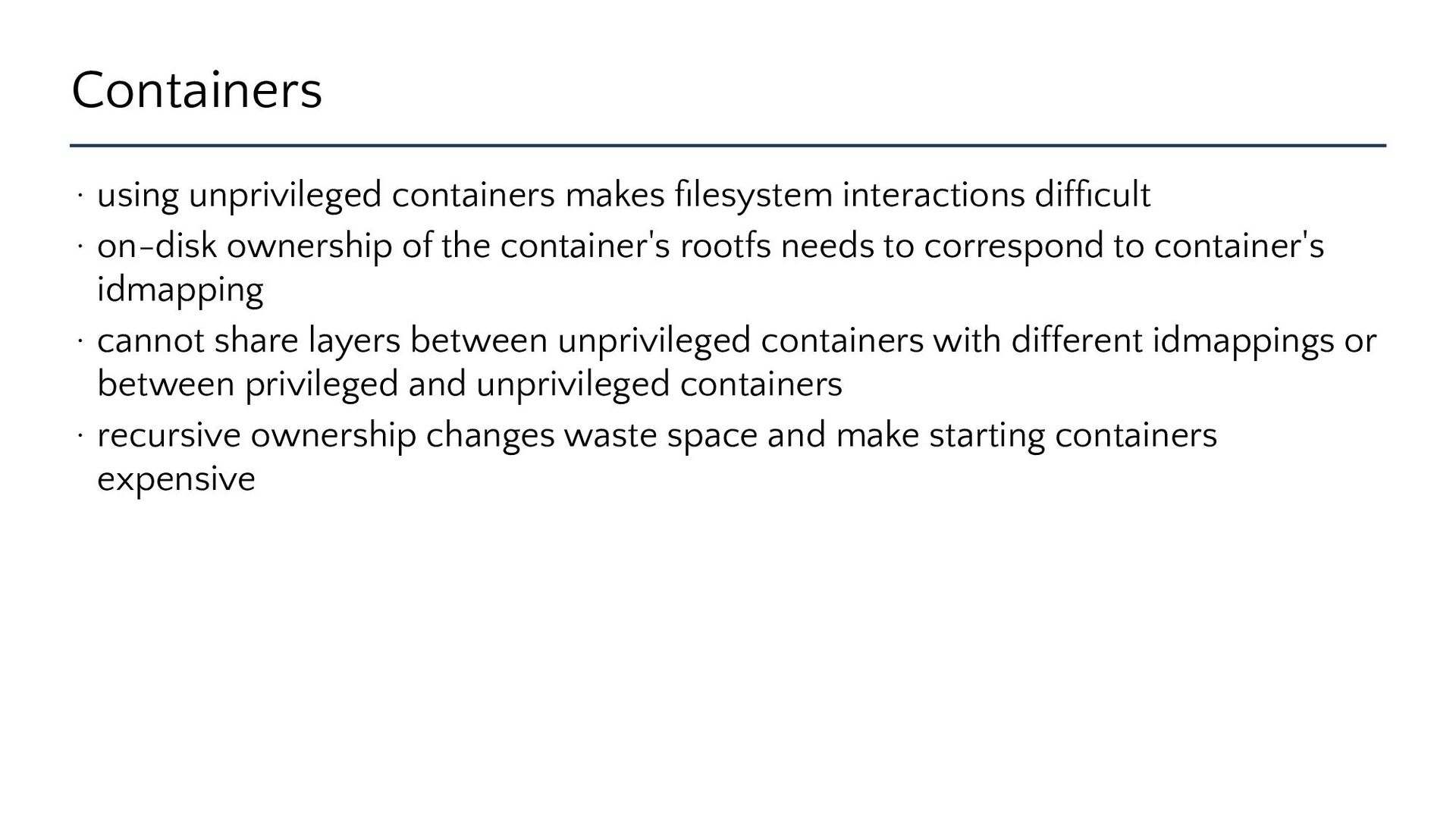
on-disk ownership of the container's rootfs needs to correspond to container's idmapping · cannot share layers between unprivileged containers with different idmappings or between privileged and unprivileged containers · recursive ownership changes waste space and make starting containers expensive
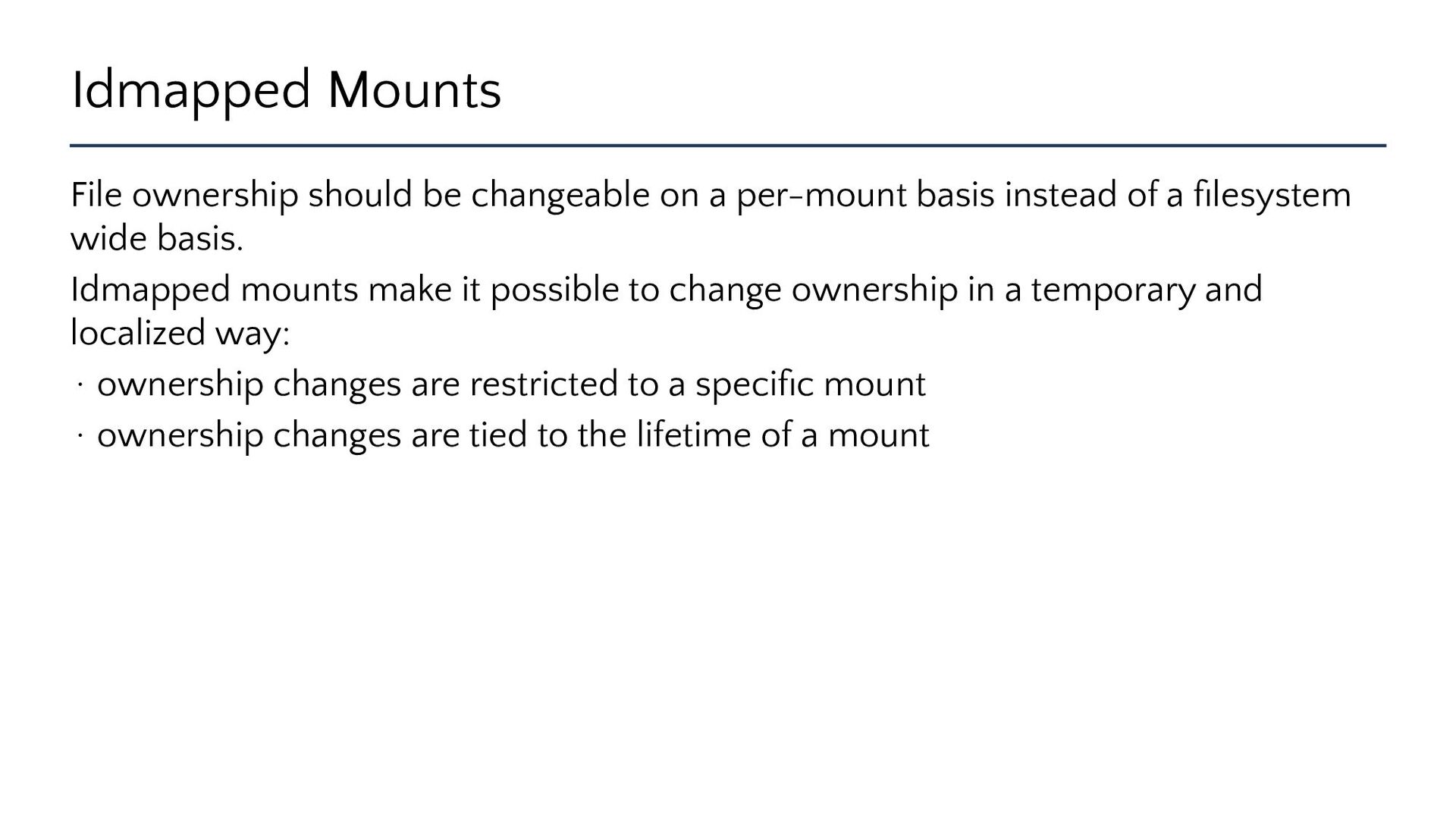
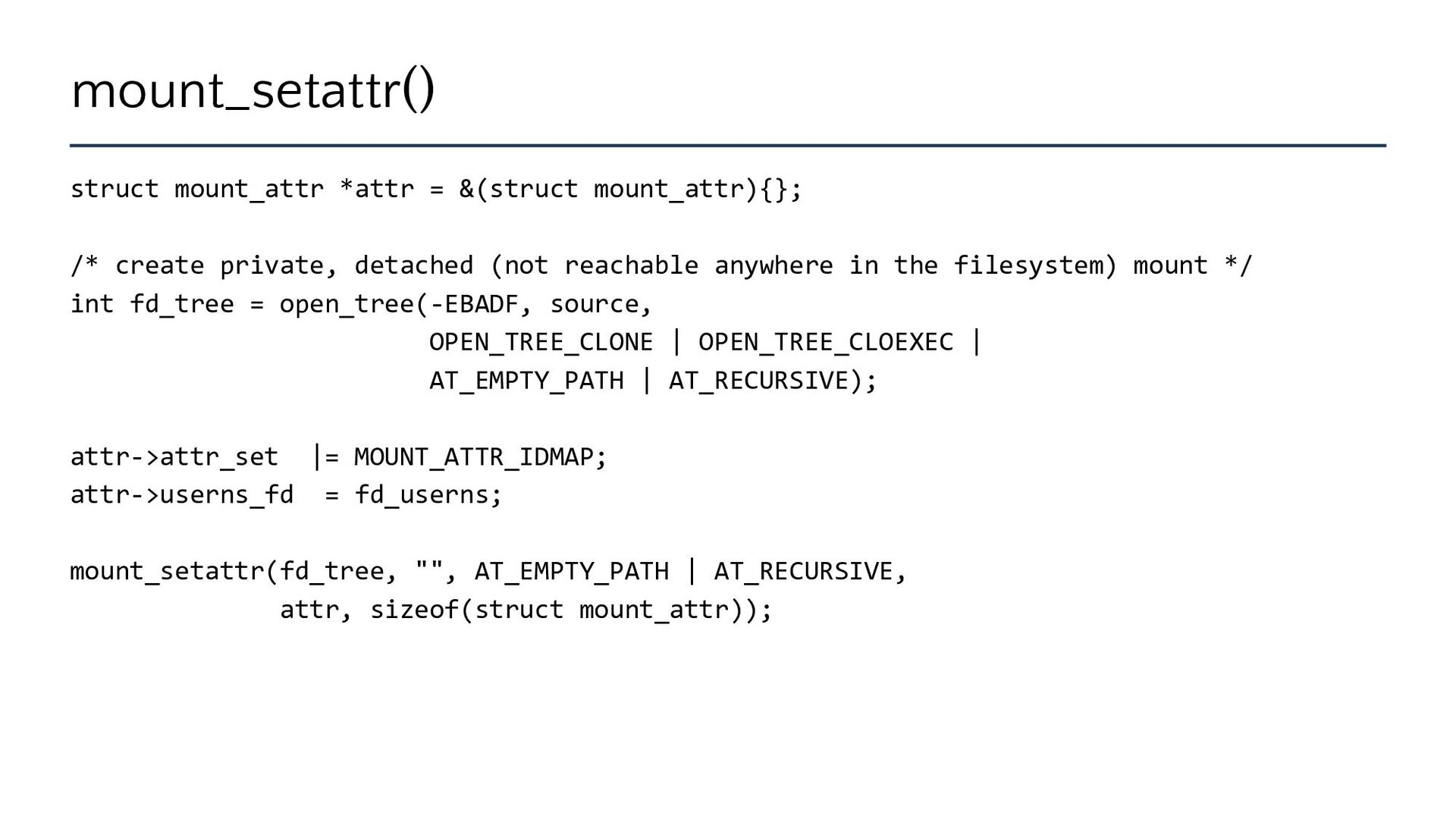
basis instead of a filesystem wide basis. Idmapped mounts make it possible to change ownership in a temporary and localized way: · ownership changes are restricted to a specific mount · ownership changes are tied to the lifetime of a mount
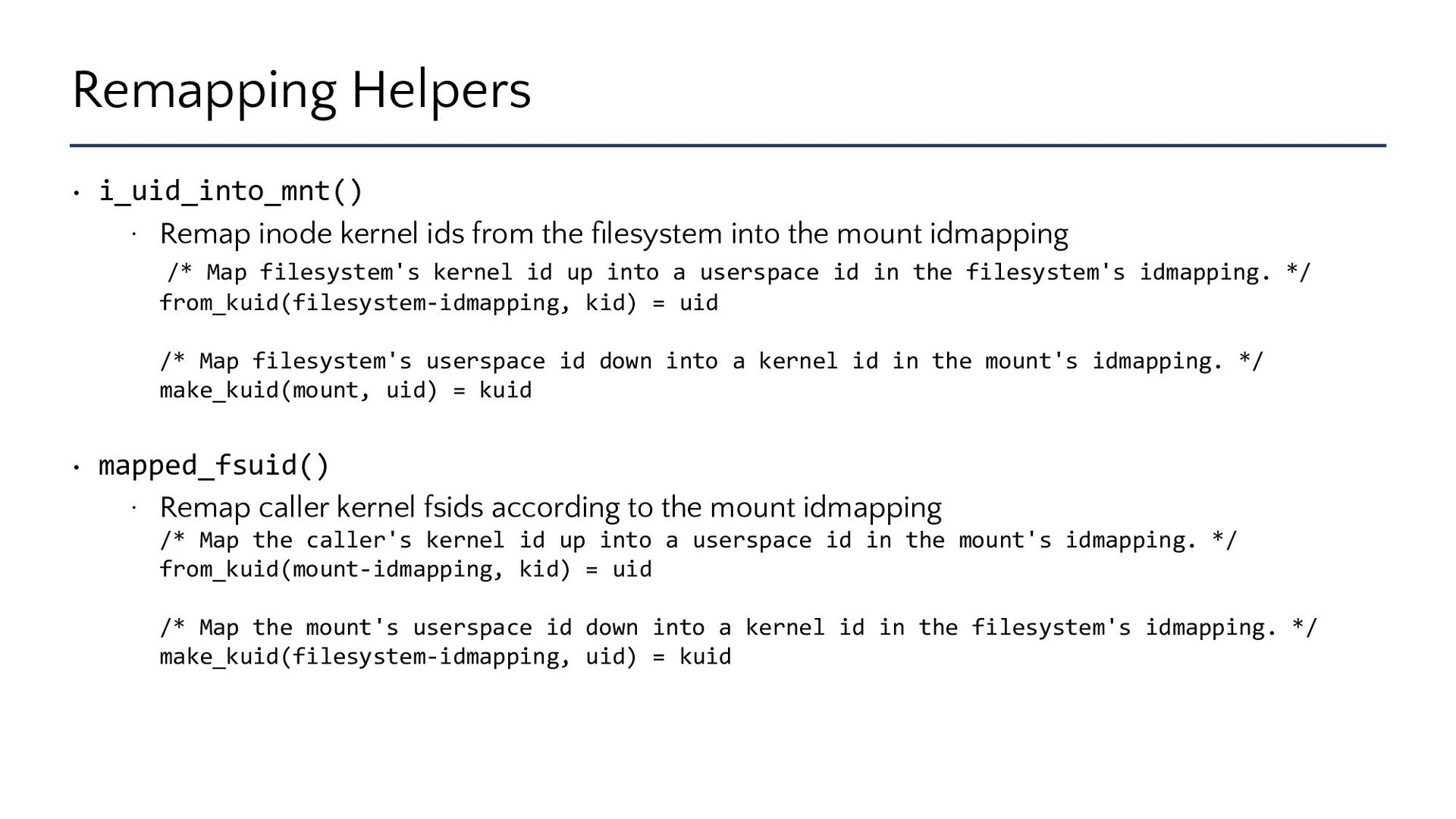
the filesystem into the mount idmapping /* Map filesystem's kernel id up into a userspace id in the filesystem's idmapping. */ from_kuid(filesystem-idmapping, kid) = uid /* Map filesystem's userspace id down into a kernel id in the mount's idmapping. */ make_kuid(mount, uid) = kuid · mapped_fsuid() · Remap caller kernel fsids according to the mount idmapping /* Map the caller's kernel id up into a userspace id in the mount's idmapping. */ from_kuid(mount-idmapping, kid) = uid /* Map the mount's userspace id down into a kernel id in the filesystem's idmapping. */ make_kuid(filesystem-idmapping, uid) = kuid
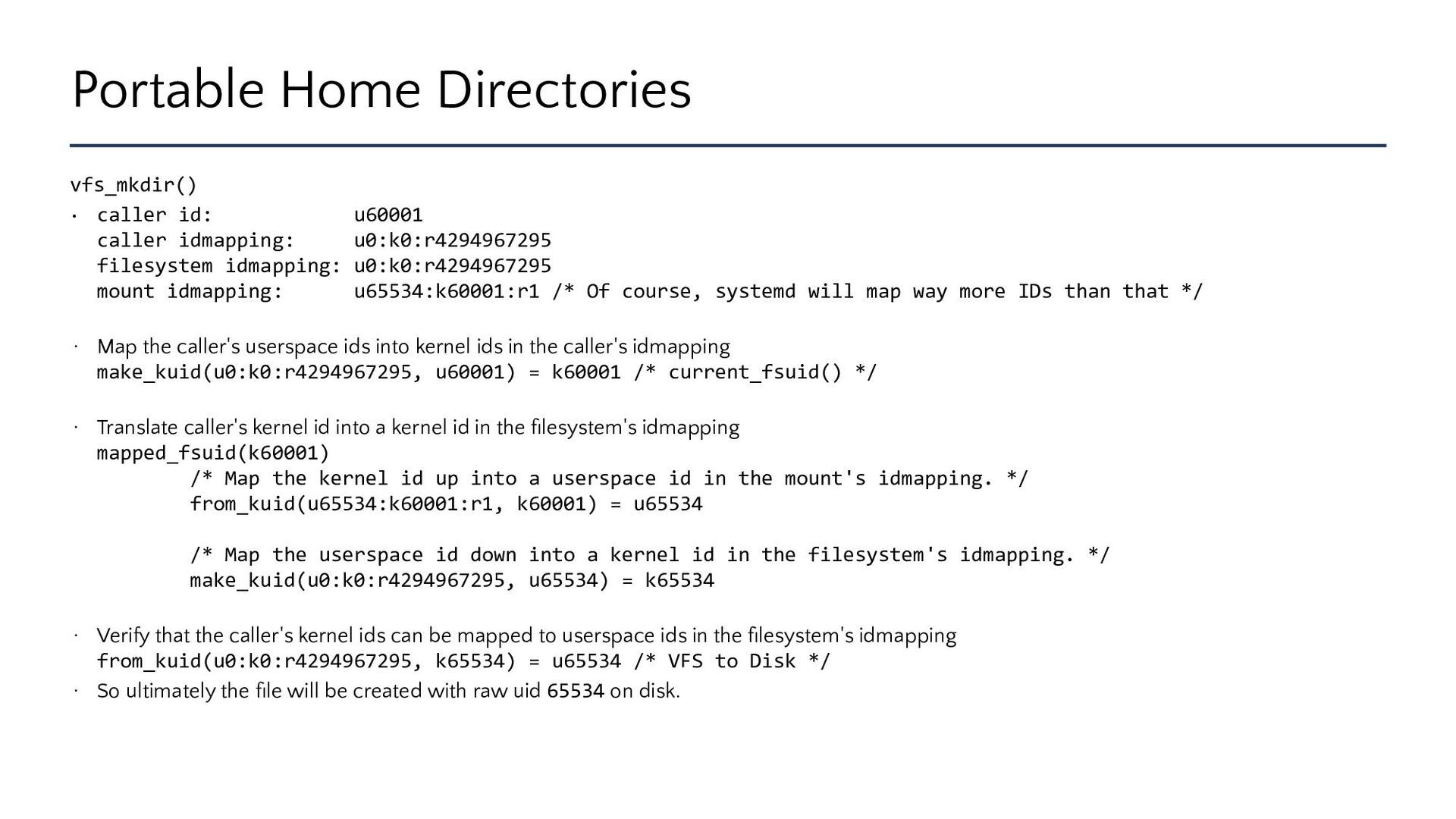
u0:k0:r4294967295 filesystem idmapping: u0:k0:r4294967295 mount idmapping: u65534:k60001:r1 /* Of course, systemd will map way more IDs than that */ · Map the caller's userspace ids into kernel ids in the caller's idmapping make_kuid(u0:k0:r4294967295, u60001) = k60001 /* current_fsuid() */ · Translate caller's kernel id into a kernel id in the filesystem's idmapping mapped_fsuid(k60001) /* Map the kernel id up into a userspace id in the mount's idmapping. */ from_kuid(u65534:k60001:r1, k60001) = u65534 /* Map the userspace id down into a kernel id in the filesystem's idmapping. */ make_kuid(u0:k0:r4294967295, u65534) = k65534 · Verify that the caller's kernel ids can be mapped to userspace ids in the filesystem's idmapping from_kuid(u0:k0:r4294967295, k65534) = u65534 /* VFS to Disk */ · So ultimately the file will be created with raw uid 65534 on disk.
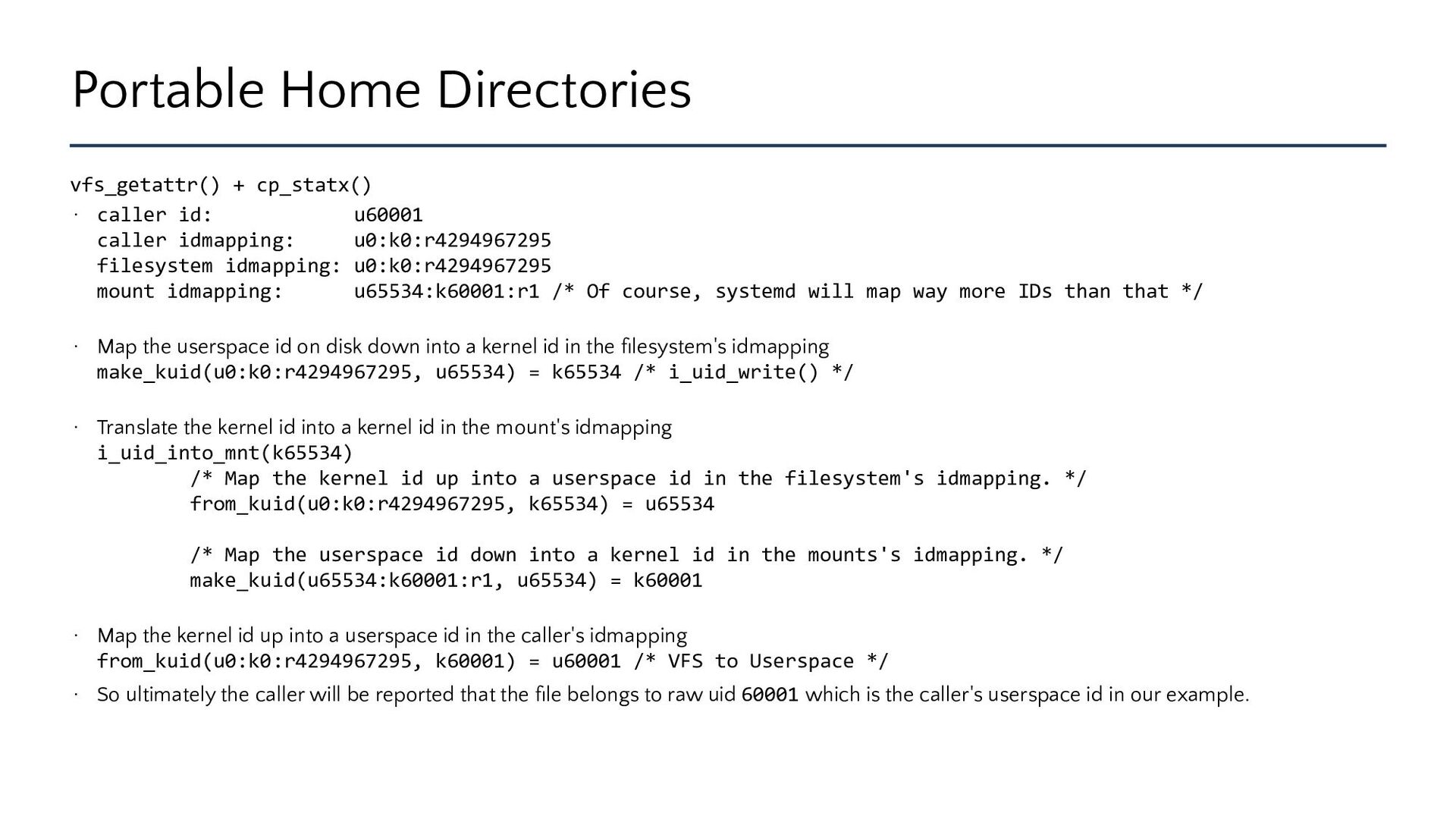
caller idmapping: u0:k0:r4294967295 filesystem idmapping: u0:k0:r4294967295 mount idmapping: u65534:k60001:r1 /* Of course, systemd will map way more IDs than that */ · Map the userspace id on disk down into a kernel id in the filesystem's idmapping make_kuid(u0:k0:r4294967295, u65534) = k65534 /* i_uid_write() */ · Translate the kernel id into a kernel id in the mount's idmapping i_uid_into_mnt(k65534) /* Map the kernel id up into a userspace id in the filesystem's idmapping. */ from_kuid(u0:k0:r4294967295, k65534) = u65534 /* Map the userspace id down into a kernel id in the mounts's idmapping. */ make_kuid(u65534:k60001:r1, u65534) = k60001 · Map the kernel id up into a userspace id in the caller's idmapping from_kuid(u0:k0:r4294967295, k60001) = u60001 /* VFS to Userspace */ · So ultimately the caller will be reported that the file belongs to raw uid 60001 which is the caller's userspace id in our example.


 ennael
 lauravandoore
 portentint
 addyosmani
 tomoyanonymous
 tamaranovitovic
 baasie
 codingconduct
 rmw
rmw
 asonas
 marketingsoph
 geoffreycrofte
 frankvandijk