Upgrade to Pro — share decks privately, control downloads, hide ads and more …

Scrum anti-patterns 010DEV 2018-01-11

Scrum anti-patterns 010DEV 2018-01-11

In order to enjoy the benefits of Scrum you must, at least, get the basics right. This presentation lists some of the pitfalls that many projects walk into. After this presentation you will be better equipped to spot anti-patterns in your projects and be able to fix the architecture of your Scrum project.

Avatar for Francisco Canedo

Francisco Canedo

January 12, 2018
Tweet

Other Decks in Programming

Transcript

  1. Francisco José Canedo Dominguez Freelance Scala developer and trainer with

    20+ years’ professional soBware development experience also a certified Scrum Master 2
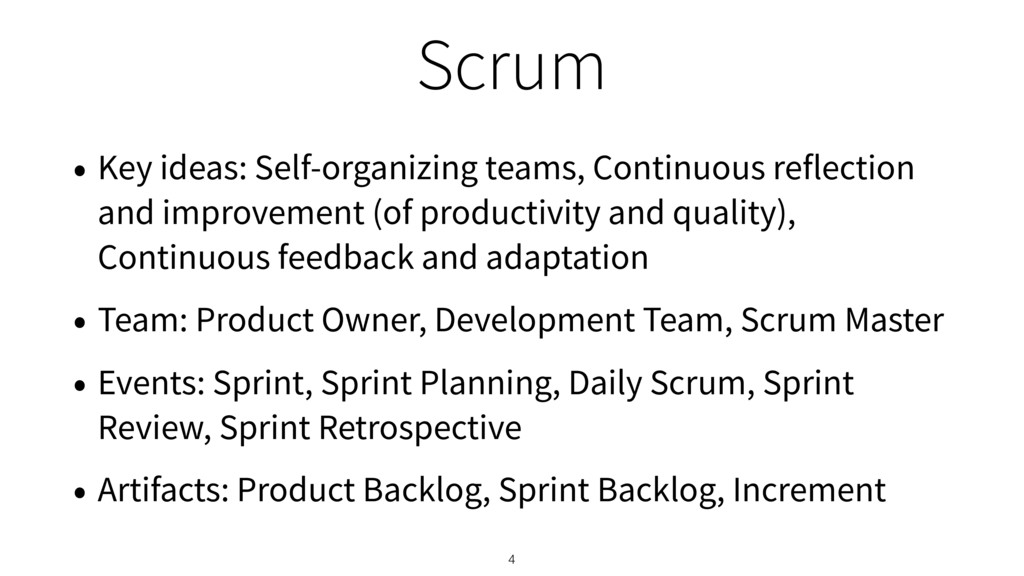
  2. Scrum • Key ideas: Self-organizing teams, Continuous reflection and improvement

    (of productivity and quality), Continuous feedback and adaptation • Team: Product Owner, Development Team, Scrum Master • Events: Sprint, Sprint Planning, Daily Scrum, Sprint Review, Sprint Retrospective • Artifacts: Product Backlog, Sprint Backlog, Increment 4
  3. “We do Scrum!” • Translation: “We (may or may not)

    do a Daily Standup” • Not actually doing Scrum • AKA: Scrumbut, Agile in Name Only 6
  4. The “Demo” • Many teams call the Sprint Review the

    “Demo” • ‘We’re cancelling the “demo” because there is nothing to demo’ • All the more reason to have the Sprint Review 7
  5. No estimates • Variations: • Only estimate User Stories •

    Only estimate tasks that have value for the customer • Makes it impossible to plan the next Sprint, let alone the road map • Can’t determine Velocity, therefore can’t objectively determine whether Velocity is improving 8
  6. Keeping the previous estimate • User Stories started in a

    previous Sprint aren’t re-estimated to reflect the remaining work • This skews the Velocity (you’re basically lying to your Product Owner) and makes the Road Map less accurate and you can’t objectively determine whether Velocity is improving • “But otherwise our Velocity decreases” • Solution: focus on finishing stories 9
  7. Too much In Progress • Risk of not getting anything

    done • Caused by: • Everyone has their own expertise • People don’t want to work together • Focus on finishing things before starting something else 10
  8. No refinement • Wasting time due to having to figure

    out the whole story during the Sprint 11
  9. Definition of Ready • Wasting time trying to make User

    Stories foolproof • Variation: Do all the thinking up front/Mini Waterfall 12
  10. Not enough on the Product Backlog • Nothing to do

    because we ran out of work • On the other hand, you can finally do some of that refactoring • Do enough refinement so that you have enough work for the next couple of Sprints 13
  11. Too much on the Product Backlog • Variation: all epics

    completely specified and split into User Stories before even starting the first Sprint • Project may stop earlier than expected, User Stories leB over on the Product Backlog represent wasted effort 14
  12. “I’m the Product Owner!” Someone (in charge) wants to feel

    important so declare themselves the Product Owner but then don’t make themselves available to the Scrum Team 15
  13. Product Owner lacks authority/domain knowledge Wasting time due to the

    Product Owner not being able to take decisions on the spot 16
  14. “Everything is important!” • If you can’t release until “everything”

    is done, you will never release • Even if you do release, you’re probably wasting effort on functionality that will not be used 17
  15. Organisation manages on Velocity • Velocity is meant for the

    Scrum Team, to be able to plan the Road Map • Easy to game: double/quadruple estimates • Solution: manage on business value instead 18
  16. Part-time Scrum Master • Not necessarily a problem if this

    is a well-running project, but… • The Scrum Master can become his own impediment • Could be a sign that the organisation is not serious about implementing Scrum 19
  17. “We don’t do Scrum, we do Agile(-like)!” • The meta

    anti-pattern, an excuse to actually do one or more anti-patterns • Someone (in charge) doesn’t like certain parts of Scrum and uses this as an excuse to not do those things • This kind of cherry-picking leads to a process that doesn’t work 20
  18. Scrum anti-patterns Francisco José Canedo Dominguez • @fcanedo • [email protected]

    • https://www.linkedin.com/in/franciscocanedo/ • https://www.meetup.com/Functional-Rotterdam 23
  19. 24 Joy of Coding Rotterdam / 8 June 2018 /

    joyofcoding.org / @joyofcoding
  20. 25