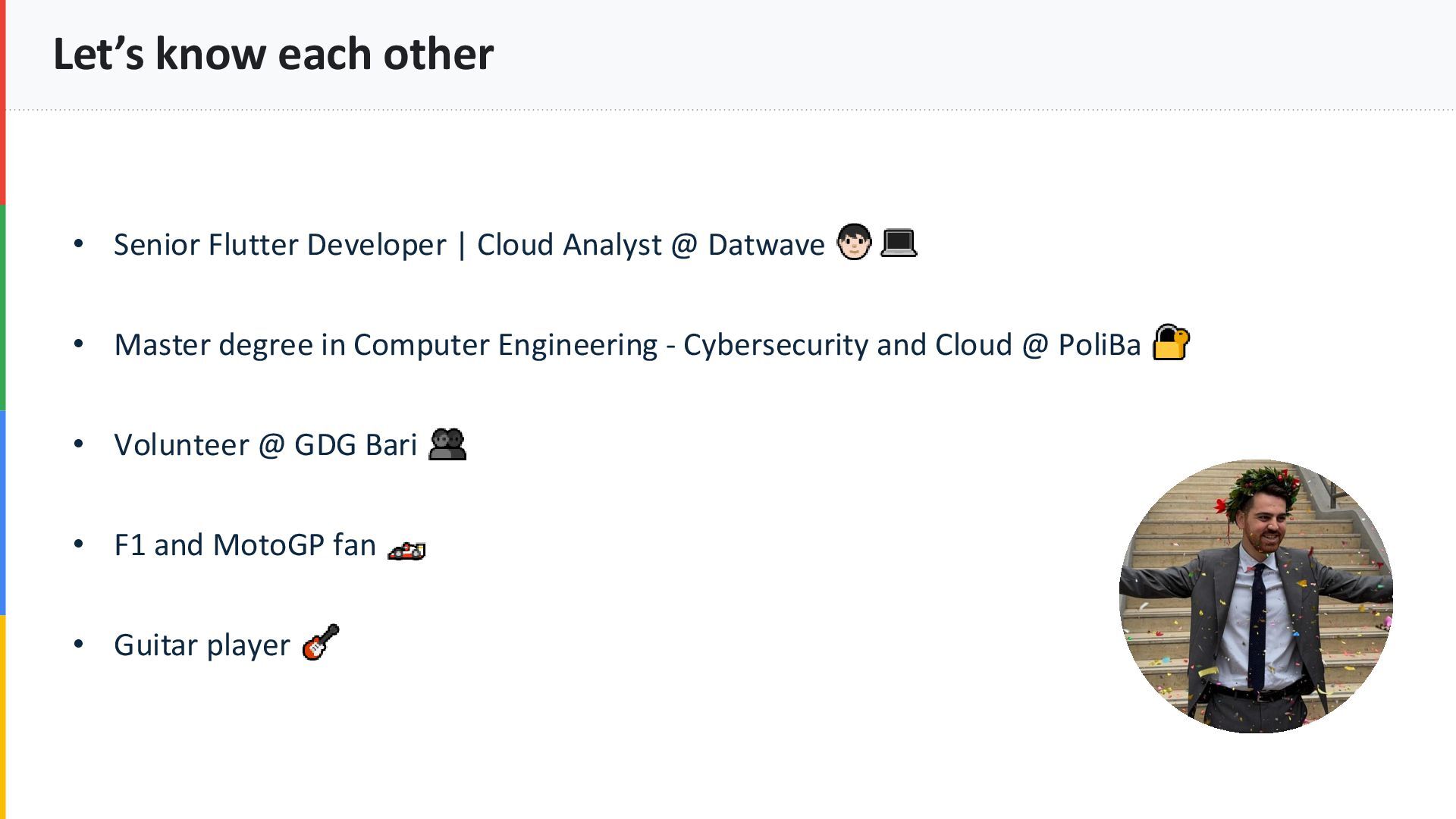
Analyst @ Datwave • Master degree in Computer Engineering - Cybersecurity and Cloud @ PoliBa • Volunteer @ GDG Bari • F1 and MotoGP fan • Guitar player
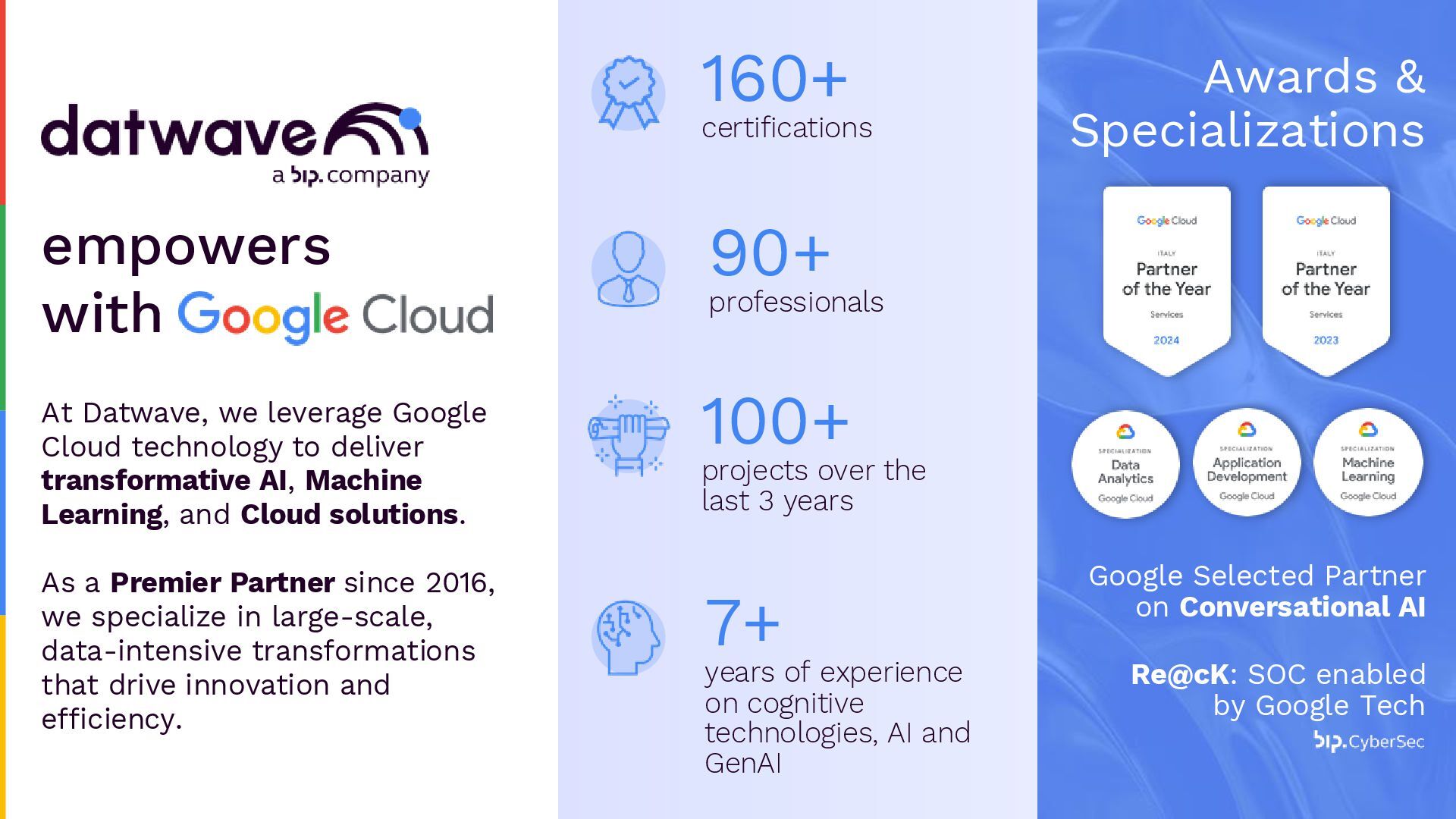
90+ years of experience on cognitive technologies, AI and GenAI 7+ At Datwave, we leverage Google Cloud technology to deliver transformative AI, Machine Learning, and Cloud solutions. As a Premier Partner since 2016, we specialize in large-scale, data-intensive transformations that drive innovation and efficiency. empowers with Awards & Specializations Re@cK: SOC enabled by Google Tech Google Selected Partner on Conversational AI
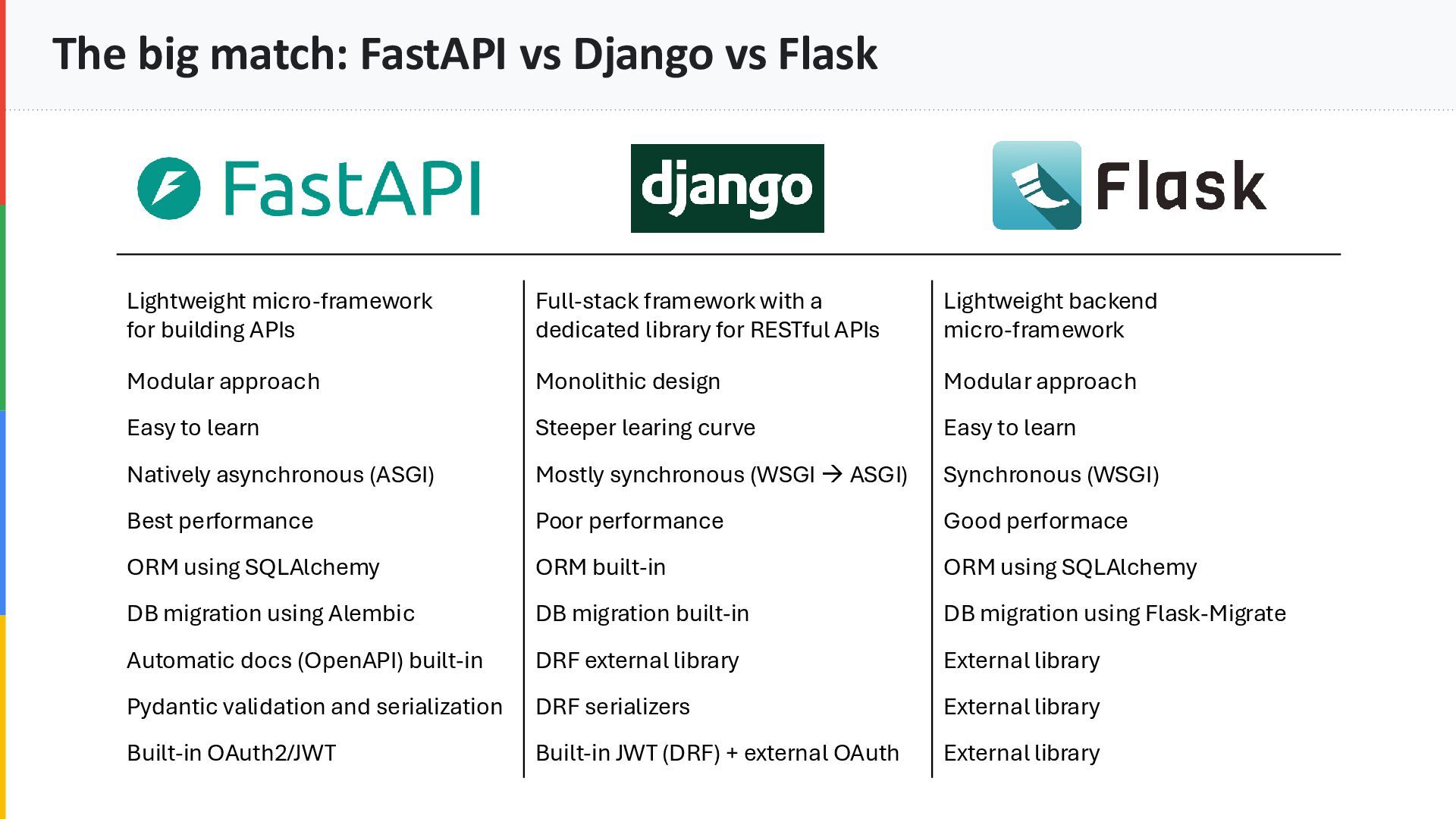
APIs with Python built on top of Starlette (an ASGI framework) for the web layer and Pydantic for data validation and serialization. It’s designed to help developers build fast, robust, and fully documented APIs with minimal effort and clean, type-safe code. • Asynchronous by design • Automatic data validation • Auto-generated OpenAPI and JSON Schema • High performance • Modular and extensible
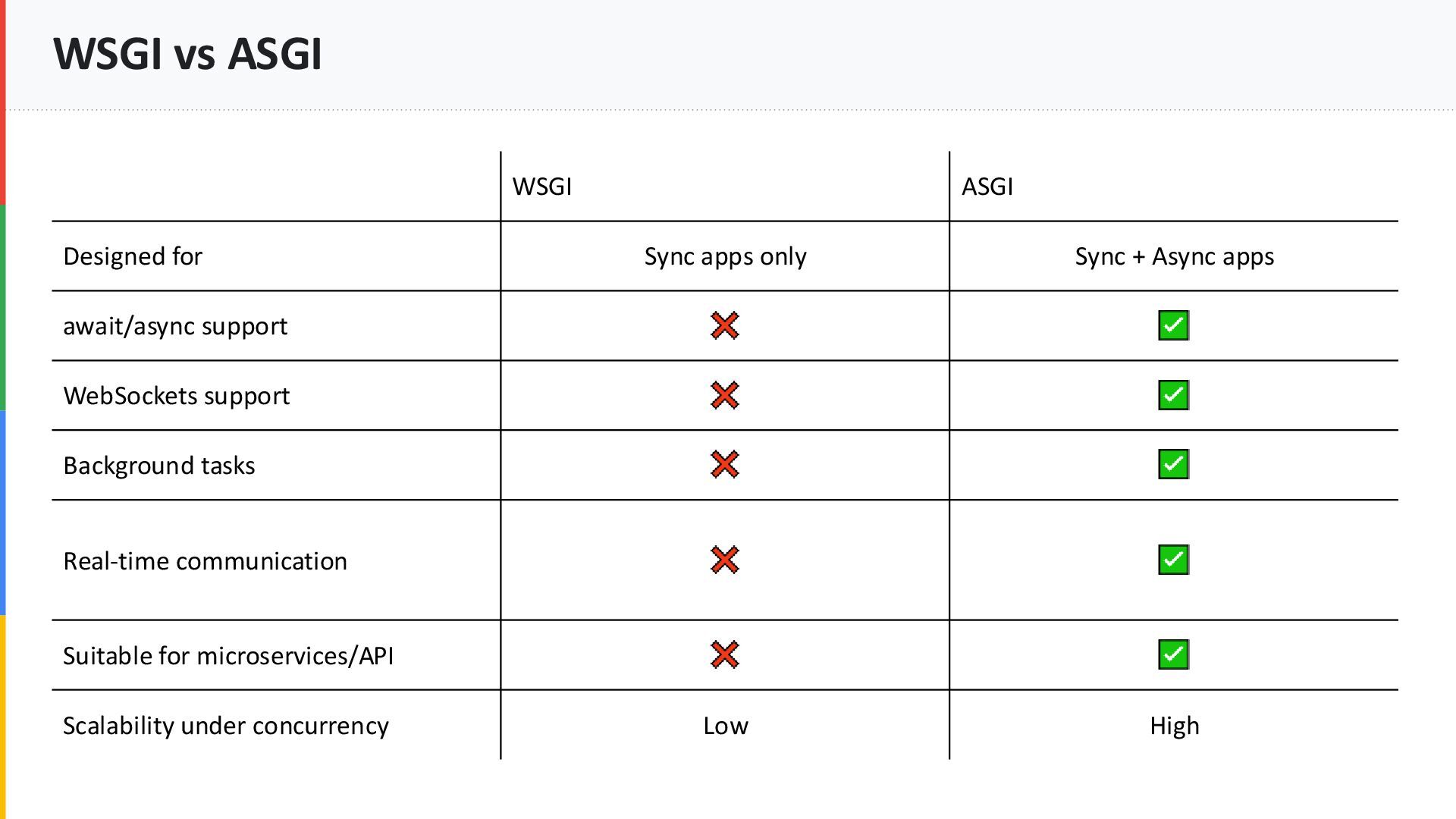
Sync + Async apps await/async support WebSockets support Background tasks Real-time communication Suitable for microservices/API Scalability under concurrency Low High
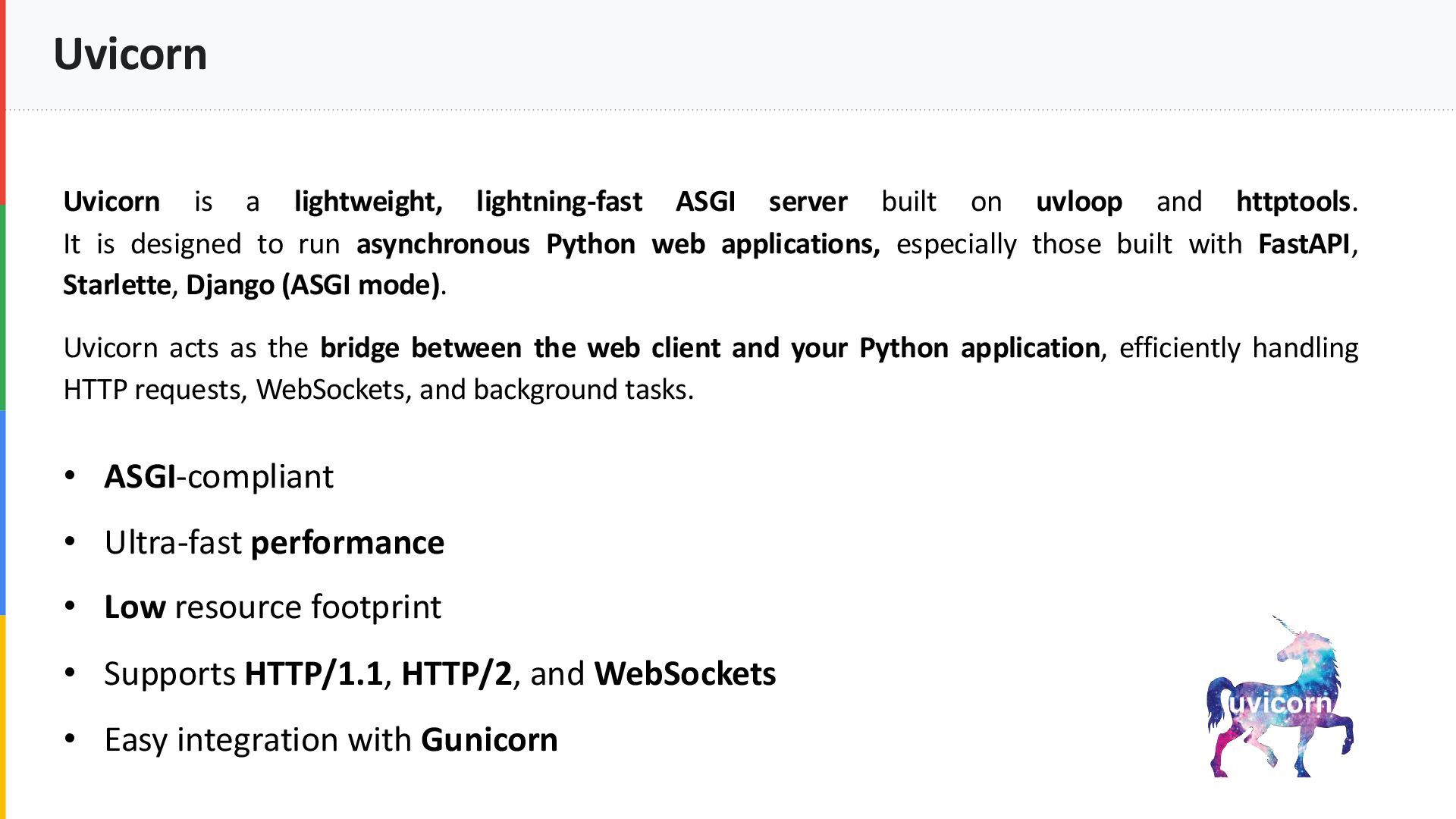
uvloop and httptools. It is designed to run asynchronous Python web applications, especially those built with FastAPI, Starlette, Django (ASGI mode). Uvicorn acts as the bridge between the web client and your Python application, efficiently handling HTTP requests, WebSockets, and background tasks. • ASGI-compliant • Ultra-fast performance • Low resource footprint • Supports HTTP/1.1, HTTP/2, and WebSockets • Easy integration with Gunicorn
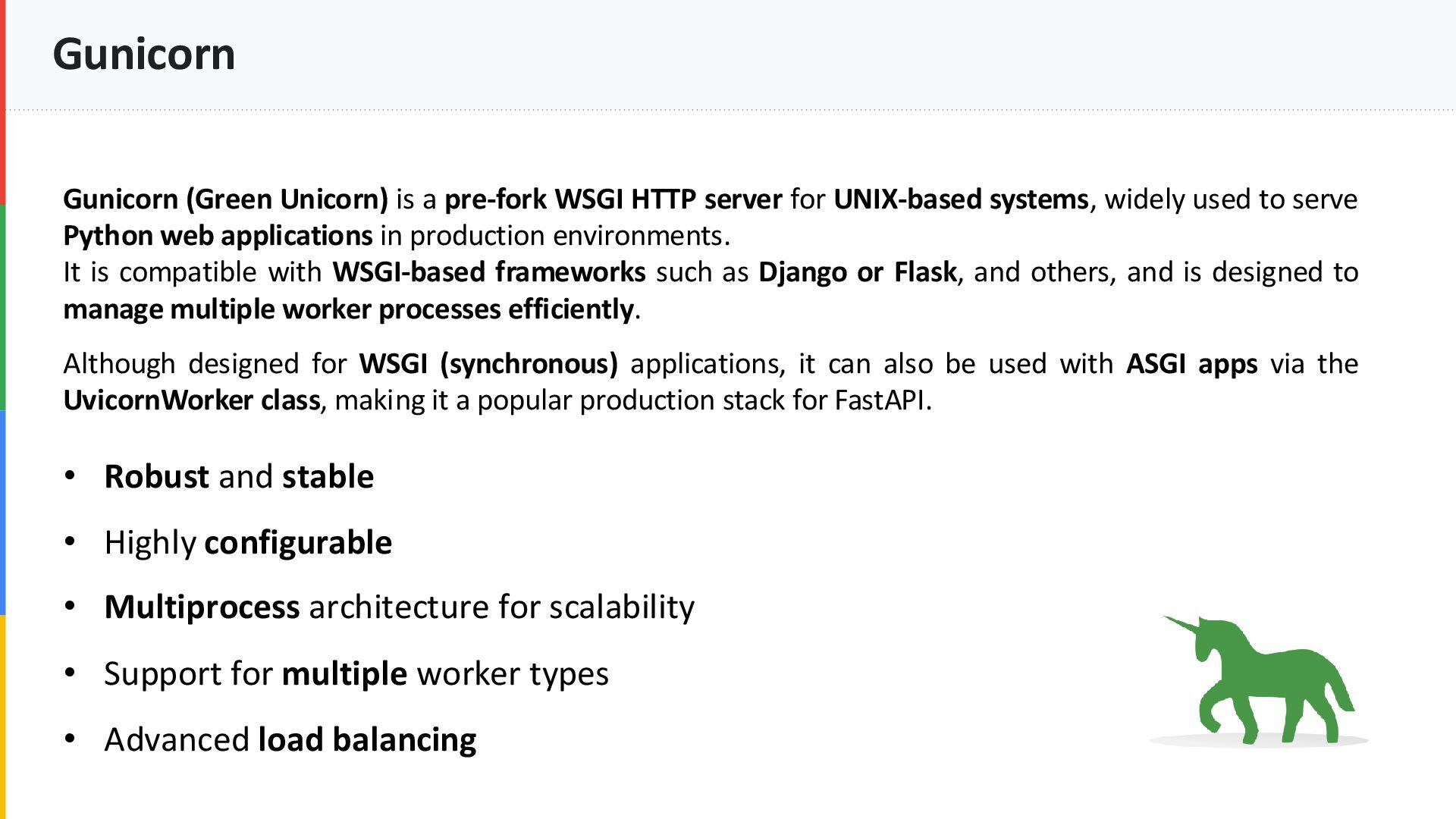
for UNIX-based systems, widely used to serve Python web applications in production environments. It is compatible with WSGI-based frameworks such as Django or Flask, and others, and is designed to manage multiple worker processes efficiently. Although designed for WSGI (synchronous) applications, it can also be used with ASGI apps via the UvicornWorker class, making it a popular production stack for FastAPI. • Robust and stable • Highly configurable • Multiprocess architecture for scalability • Support for multiple worker types • Advanced load balancing
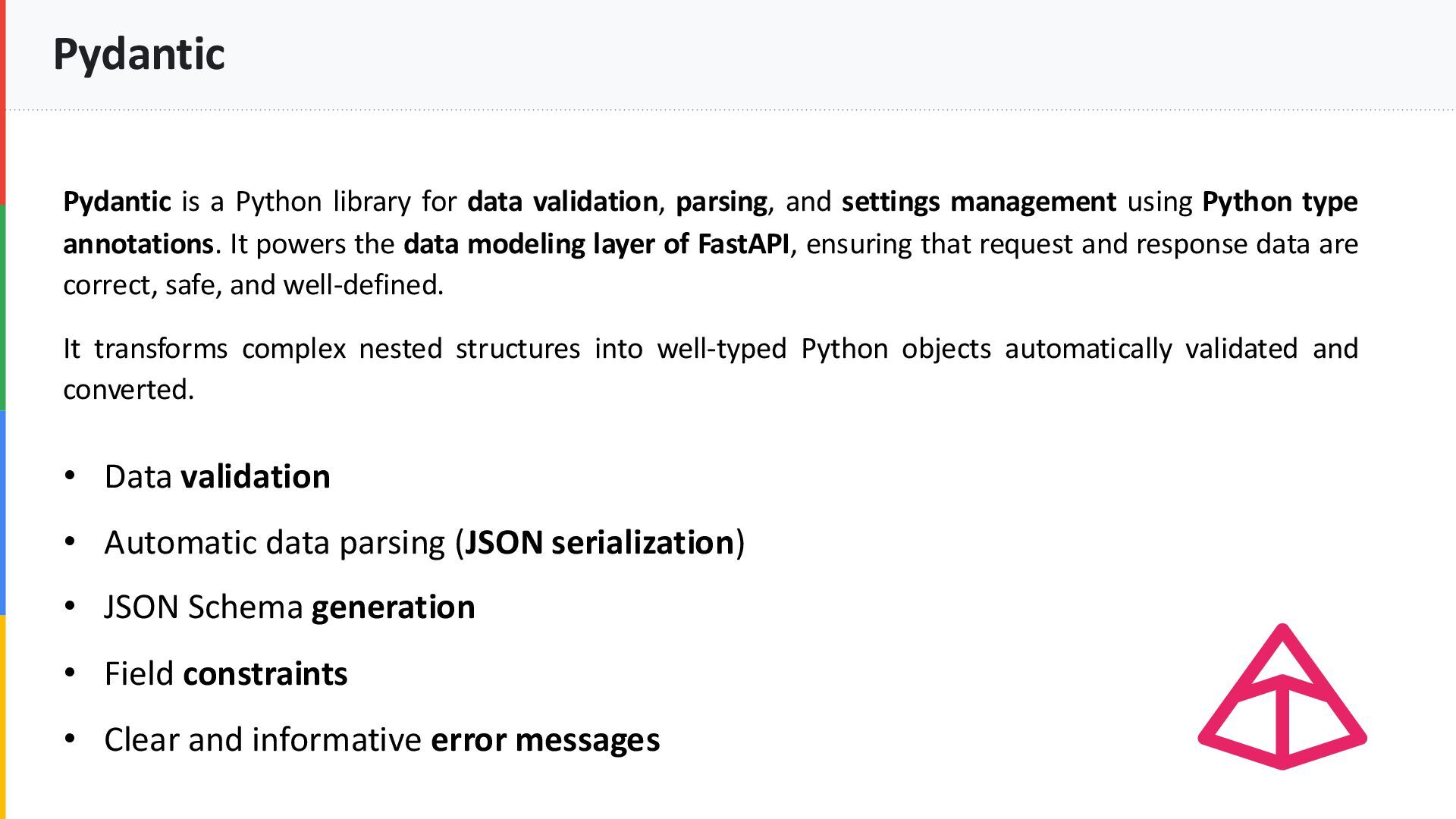
and settings management using Python type annotations. It powers the data modeling layer of FastAPI, ensuring that request and response data are correct, safe, and well-defined. It transforms complex nested structures into well-typed Python objects automatically validated and converted. • Data validation • Automatic data parsing (JSON serialization) • JSON Schema generation • Field constraints • Clear and informative error messages
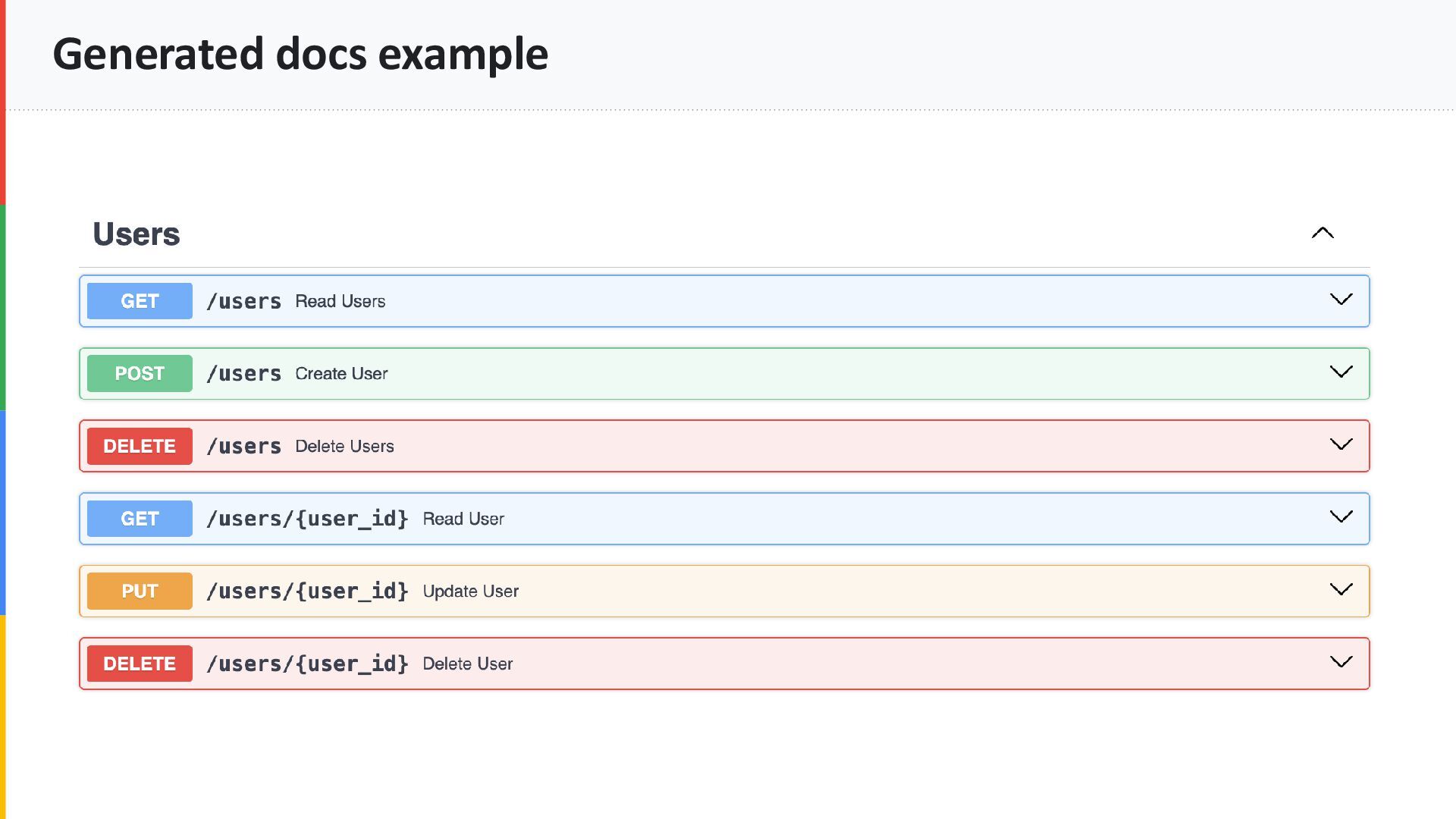
specifications for designing, documenting, testing, and consuming RESTful APIs. It is based on the OpenAPI Specification (OAS) and is the de facto standard for describing REST APIs in a machine-readable format. FastAPI auto-generates Swagger UI using OpenAPI schema from Pydantic models. • Generates interactive API documentation • Provides request/response examples • Includes built-in support for authentication mechanisms • Allows to test directly from the browser • Helps maintain consistency and versioning in APIs
used for secure authentication and authorization for data exchange between two client and server. A JWT is a stateless digitally signed token that proves the identity of a user and can carry additional claims (data). JWT structure: • Header → specifies the algorithm (e.g., HS256) and type (JWT) • Payload → contains user data (claims), e.g., sub, exp, role • Signature → ensures integrity and authenticity of the token
(ORM) in Python. It provides a full suite of tools for interacting with relational databases in an object-oriented way, allowing developers to work with Python classes instead of writing raw SQL queries. It supports both declarative ORM mapping and core SQL expression language. • SQL Expression Language support • Database agnostic (RDBMS) • Session management • Migration support via Alembic • Supports both sync and async programming
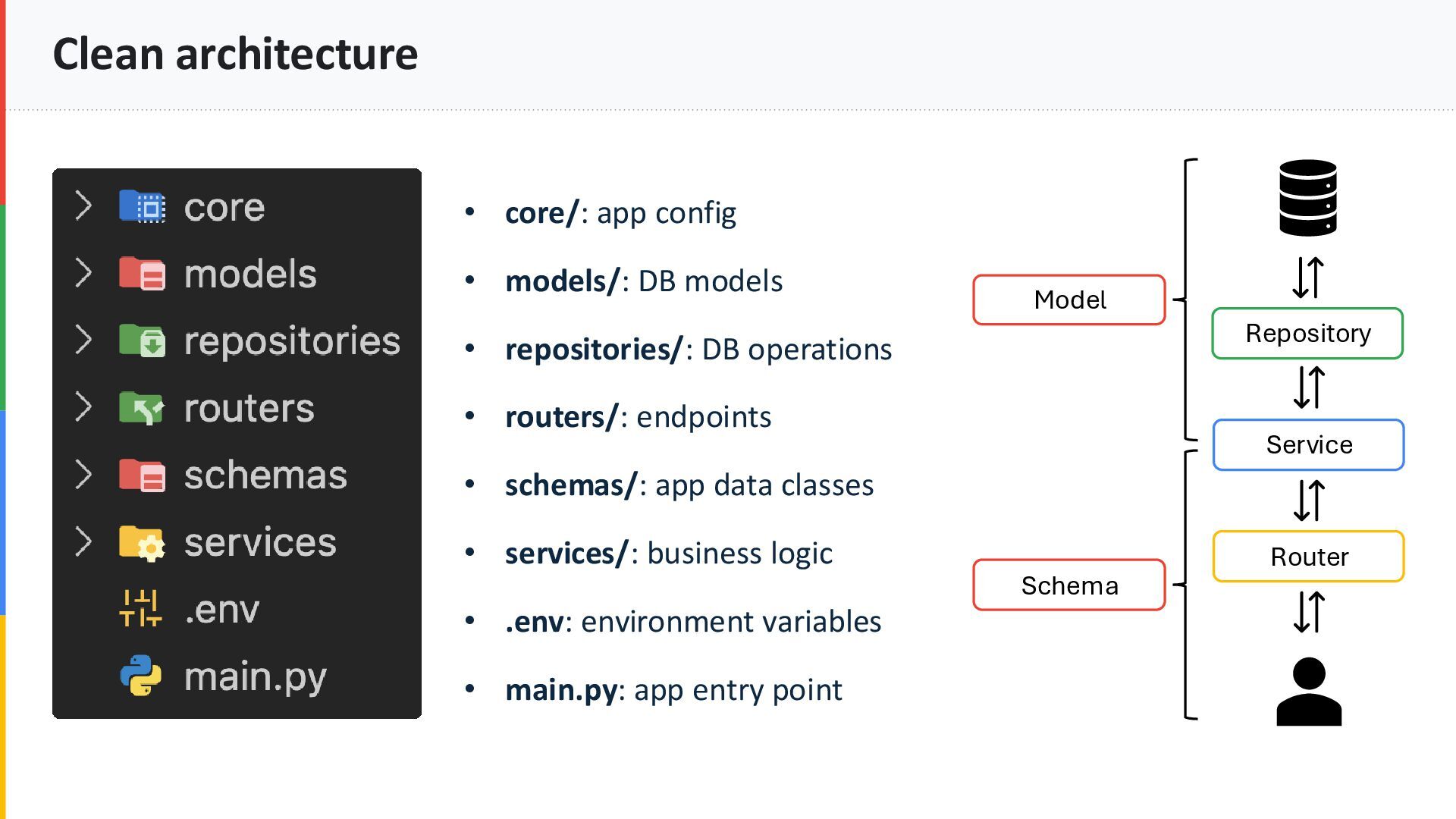
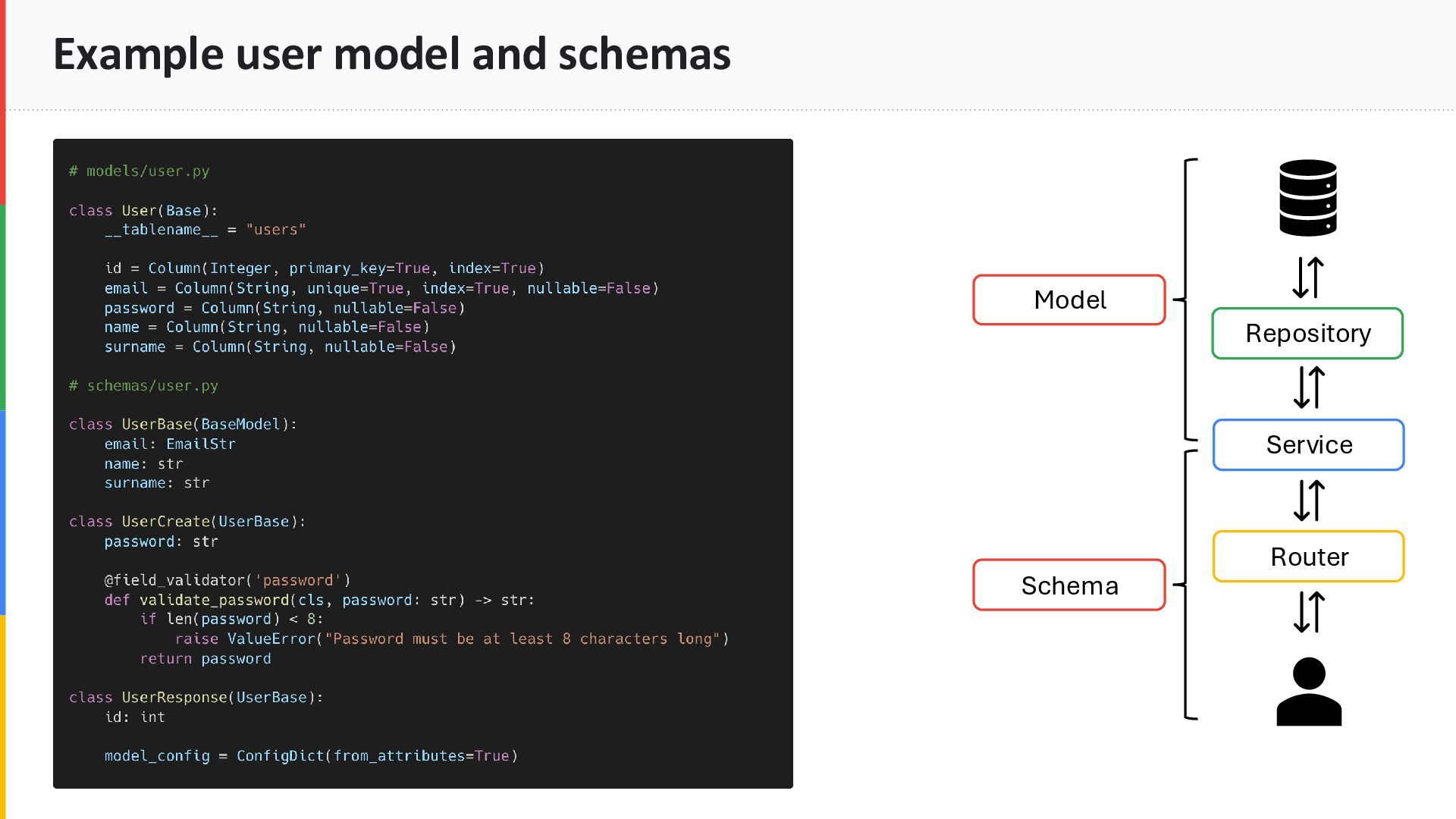
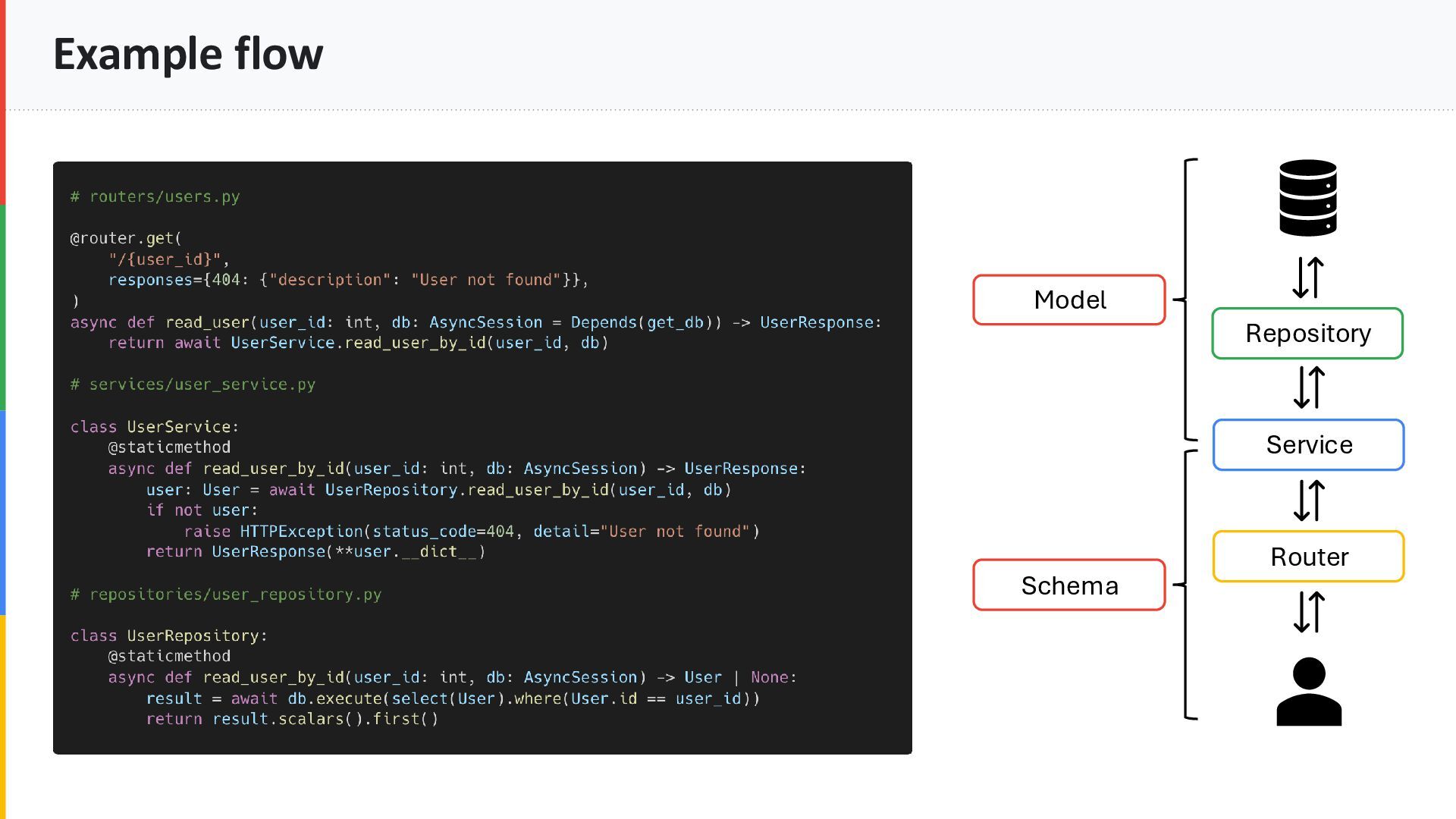
• repositories/: DB operations • routers/: endpoints • schemas/: app data classes • services/: business logic • .env: environment variables • main.py: app entry point Repository Service Router Model Schema


 fedecarroz
 prota
 rollbear
 florets1
 akit37
 marcoroth
 seike460
 htkym
 palkan
 sorah
 andpad
 sylph01
 panda728
 gurzu
 madoxten
 khoart
 mfonobong
 tmiket
 denniskardys
 morganepeng
 aleyda
 smashingmag
 lauravandoore
 davidcarrasco
 szymonslowik