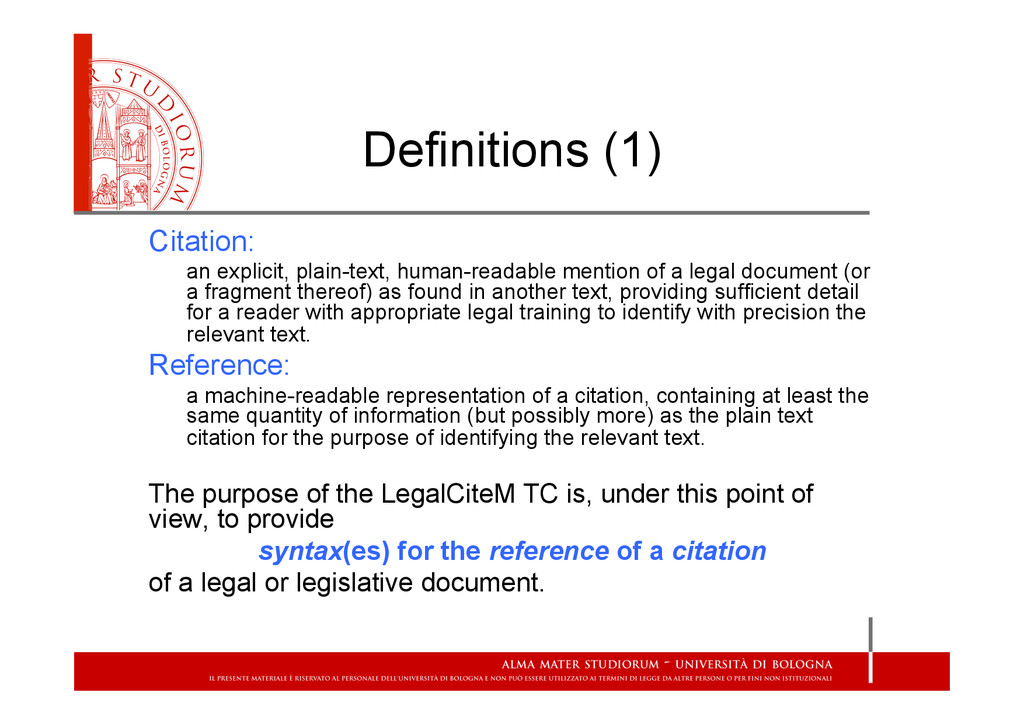
legal document (or a fragment thereof) as found in another text, providing sufficient detail for a reader with appropriate legal training to identify with precision the relevant text. Reference: a machine-readable representation of a citation, containing at least the same quantity of information (but possibly more) as the plain text citation for the purpose of identifying the relevant text. The purpose of the LegalCiteM TC is, under this point of view, to provide syntax(es) for the reference of a citation of a legal or legislative document.
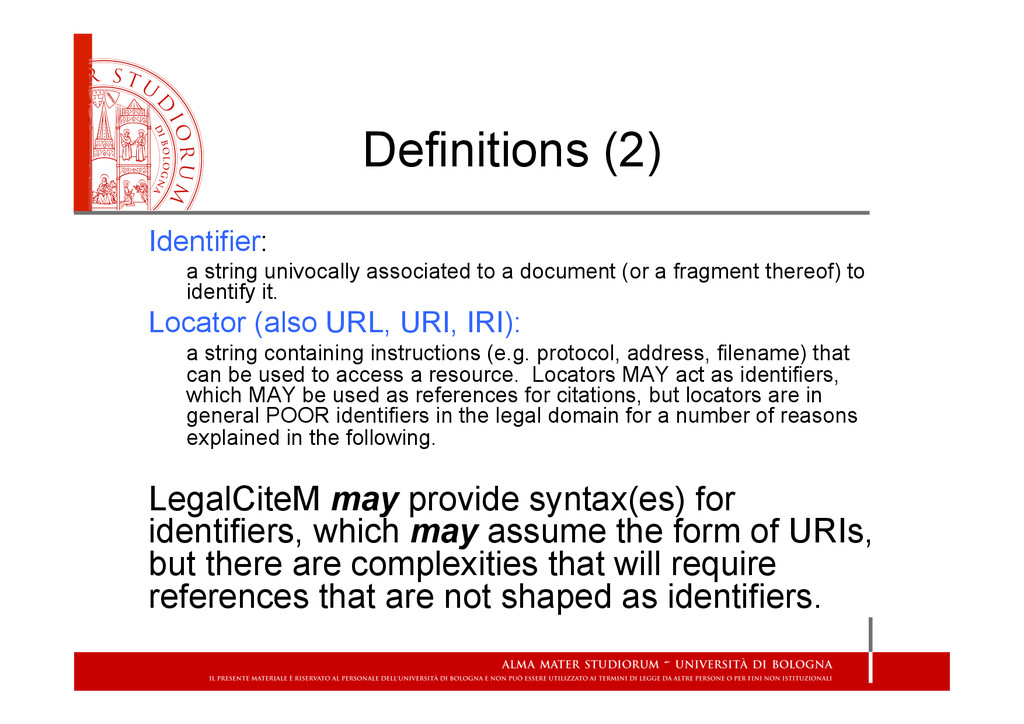
(or a fragment thereof) to identify it. Locator (also URL, URI, IRI): a string containing instructions (e.g. protocol, address, filename) that can be used to access a resource. Locators MAY act as identifiers, which MAY be used as references for citations, but locators are in general POOR identifiers in the legal domain for a number of reasons explained in the following. LegalCiteM may provide syntax(es) for identifiers, which may assume the form of URIs, but there are complexities that will require references that are not shaped as identifiers.
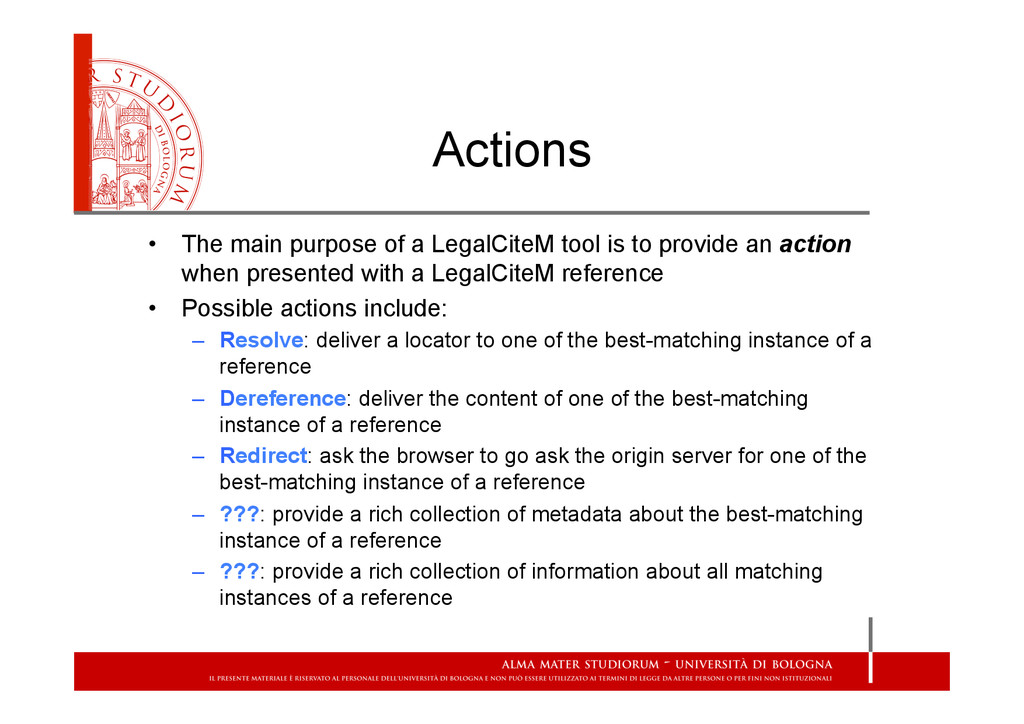
to provide an action when presented with a LegalCiteM reference • Possible actions include: – Resolve: deliver a locator to one of the best-matching instance of a reference – Dereference: deliver the content of one of the best-matching instance of a reference – Redirect: ask the browser to go ask the origin server for one of the best-matching instance of a reference – ???: provide a rich collection of metadata about the best-matching instance of a reference – ???: provide a rich collection of information about all matching instances of a reference
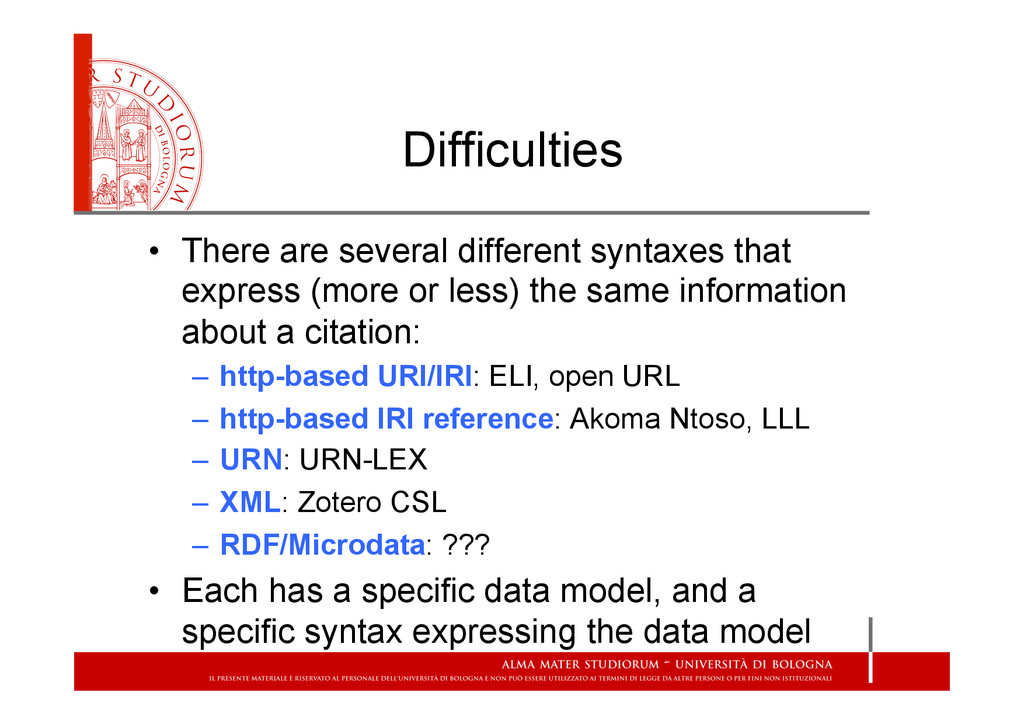
or less) the same information about a citation: – http-based URI/IRI: ELI, open URL – http-based IRI reference: Akoma Ntoso, LLL – URN: URN-LEX – XML: Zotero CSL – RDF/Microdata: ??? • Each has a specific data model, and a specific syntax expressing the data model
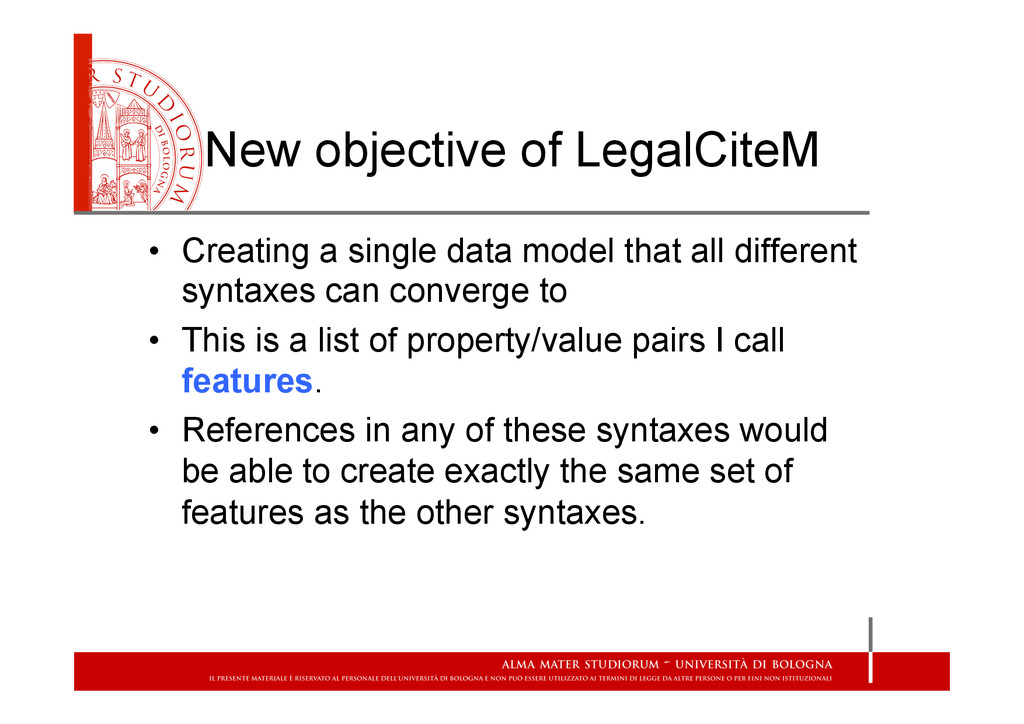
that all different syntaxes can converge to • This is a list of property/value pairs I call features. • References in any of these syntaxes would be able to create exactly the same set of features as the other syntaxes.
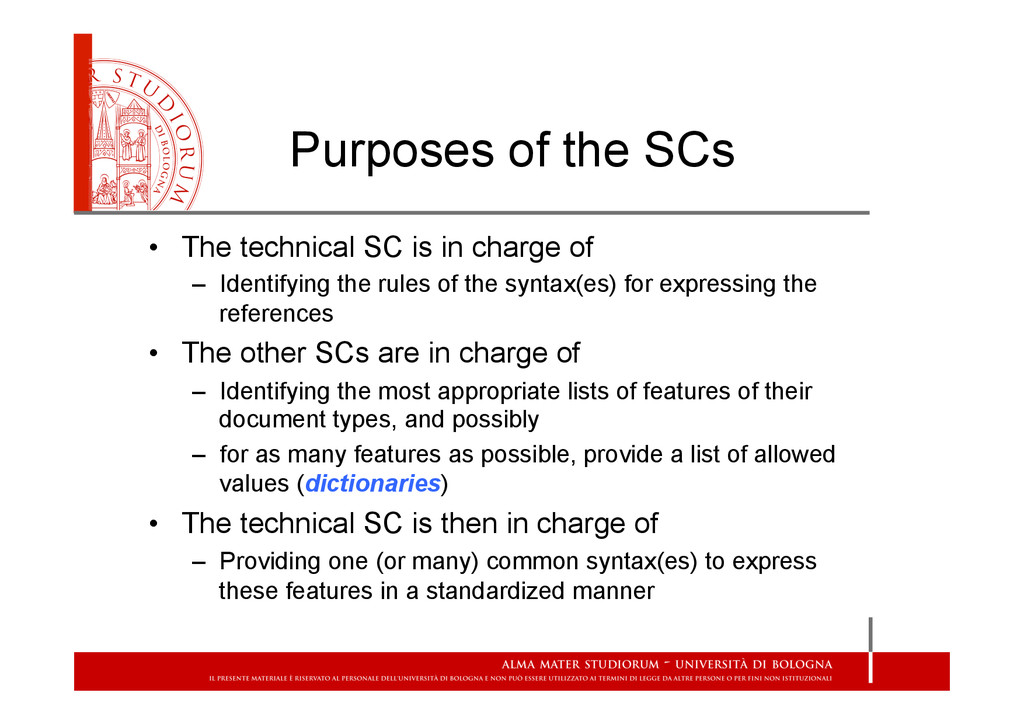
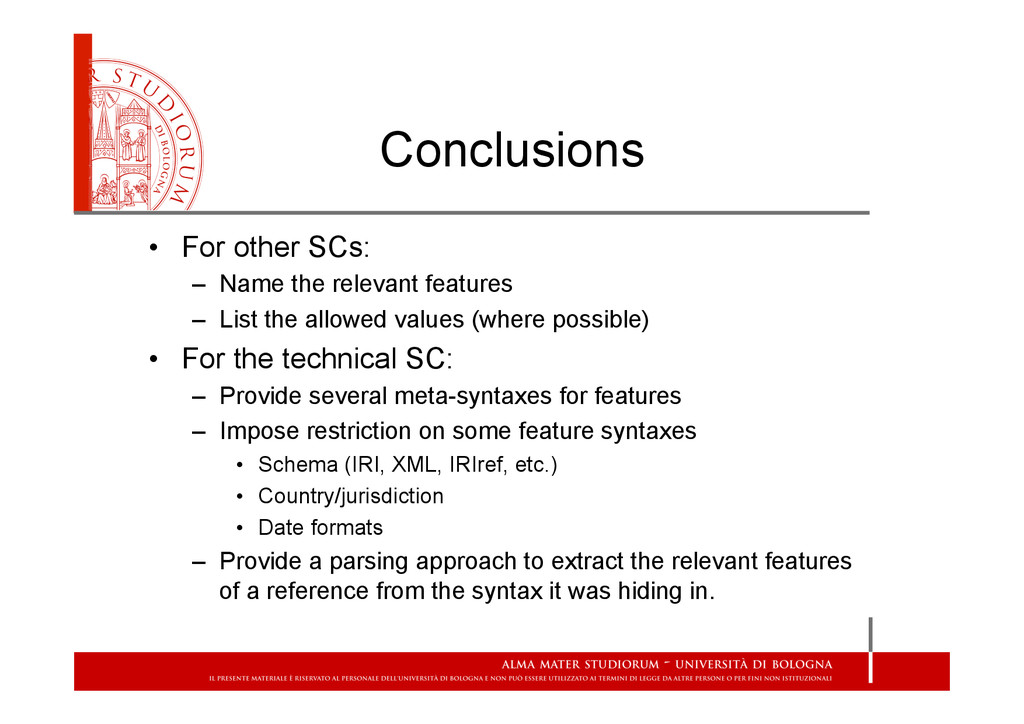
charge of – Identifying the rules of the syntax(es) for expressing the references • The other SCs are in charge of – Identifying the most appropriate lists of features of their document types, and possibly – for as many features as possible, provide a list of allowed values (dictionaries) • The technical SC is then in charge of – Providing one (or many) common syntax(es) to express these features in a standardized manner
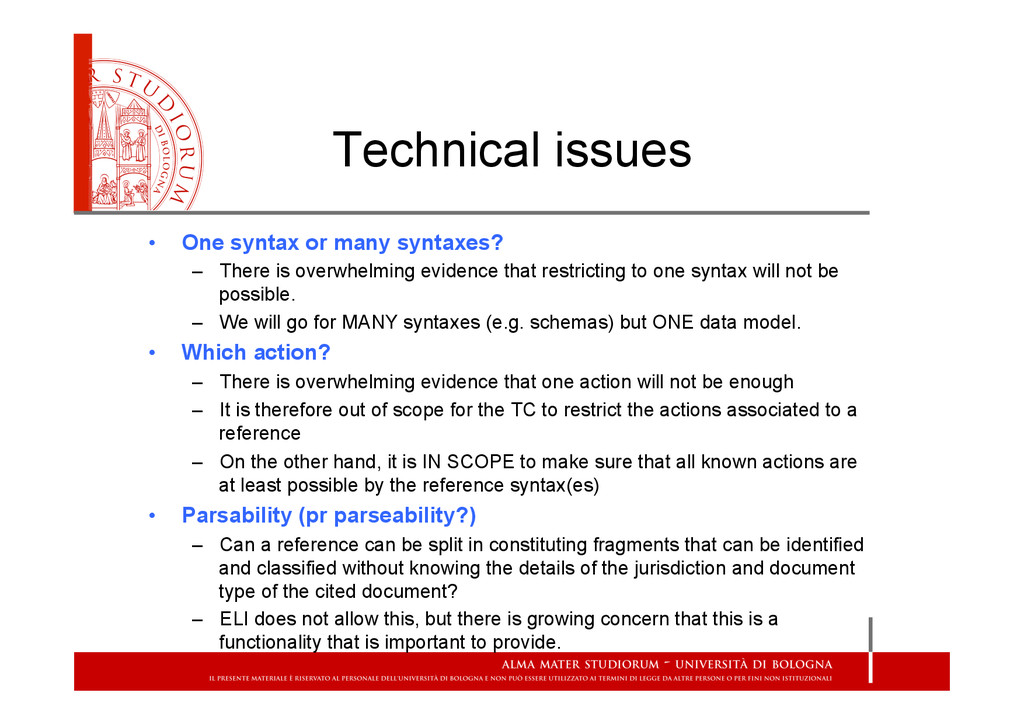
is overwhelming evidence that restricting to one syntax will not be possible. – We will go for MANY syntaxes (e.g. schemas) but ONE data model. • Which action? – There is overwhelming evidence that one action will not be enough – It is therefore out of scope for the TC to restrict the actions associated to a reference – On the other hand, it is IN SCOPE to make sure that all known actions are at least possible by the reference syntax(es) • Parsability (pr parseability?) – Can a reference can be split in constituting fragments that can be identified and classified without knowing the details of the jurisdiction and document type of the cited document? – ELI does not allow this, but there is growing concern that this is a functionality that is important to provide.
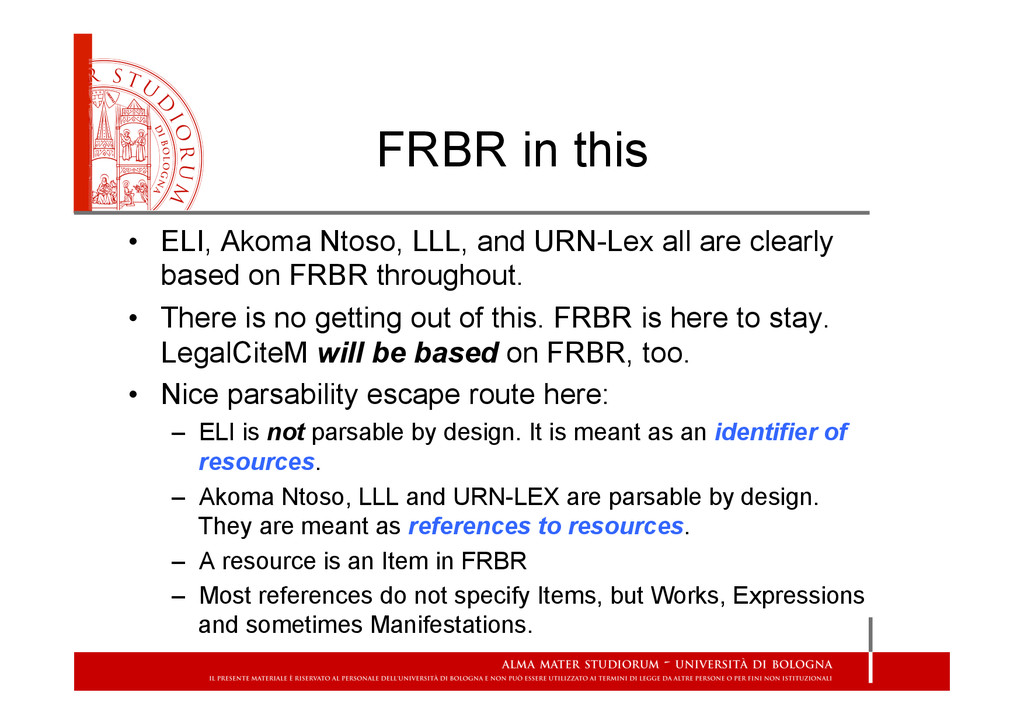
all are clearly based on FRBR throughout. • There is no getting out of this. FRBR is here to stay. LegalCiteM will be based on FRBR, too. • Nice parsability escape route here: – ELI is not parsable by design. It is meant as an identifier of resources. – Akoma Ntoso, LLL and URN-LEX are parsable by design. They are meant as references to resources. – A resource is an Item in FRBR – Most references do not specify Items, but Works, Expressions and sometimes Manifestations.
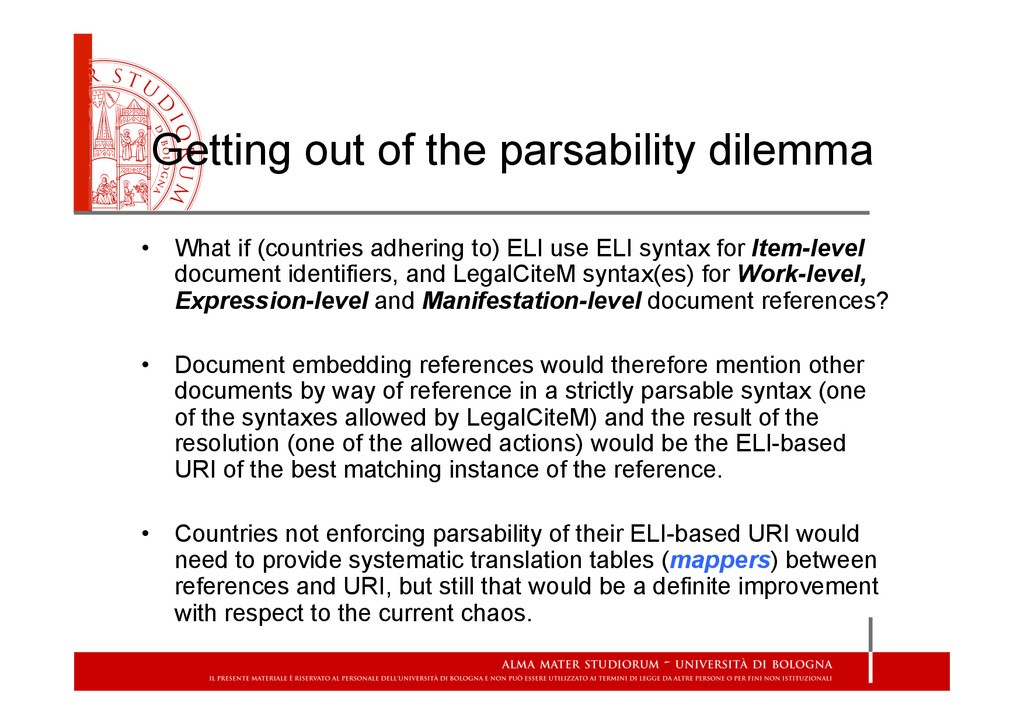
adhering to) ELI use ELI syntax for Item-level document identifiers, and LegalCiteM syntax(es) for Work-level, Expression-level and Manifestation-level document references? • Document embedding references would therefore mention other documents by way of reference in a strictly parsable syntax (one of the syntaxes allowed by LegalCiteM) and the result of the resolution (one of the allowed actions) would be the ELI-based URI of the best matching instance of the reference. • Countries not enforcing parsability of their ELI-based URI would need to provide systematic translation tables (mappers) between references and URI, but still that would be a definite improvement with respect to the current chaos.
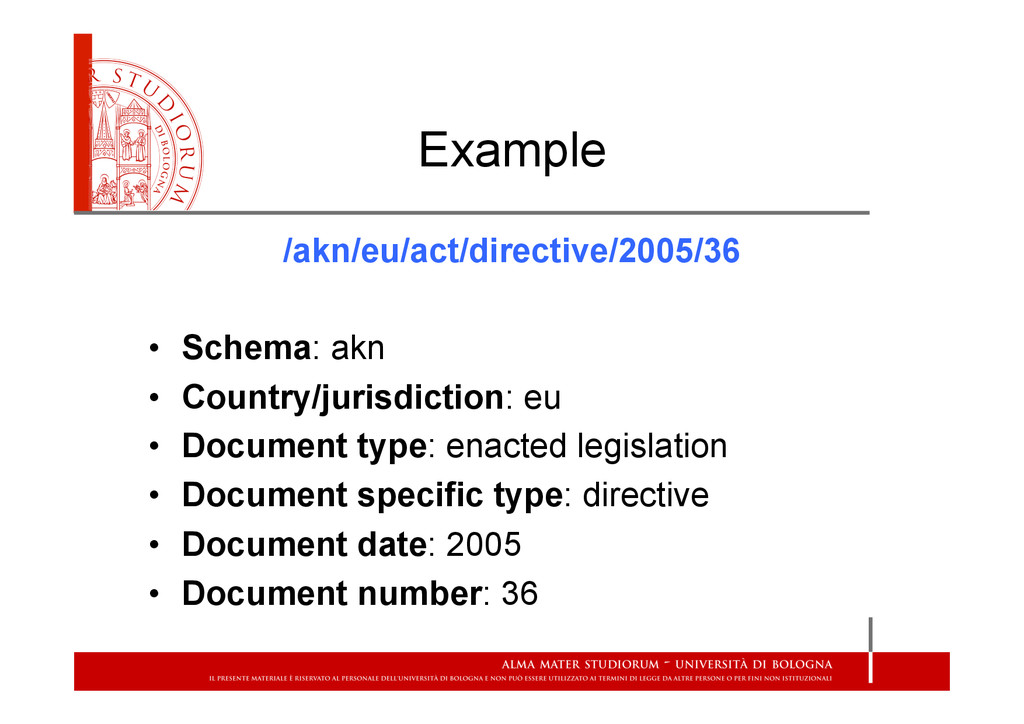
– List the allowed values (where possible) • For the technical SC: – Provide several meta-syntaxes for features – Impose restriction on some feature syntaxes • Schema (IRI, XML, IRIref, etc.) • Country/jurisdiction • Date formats – Provide a parsing approach to extract the relevant features of a reference from the syntax it was hiding in.

 Your Podcast. Everywhere. Effortlessly.


 shunsuke_takeuchi
 so_kotani
 hirohasuyoutube
 ikuodanaka
 malna
 c0rp_mdm
 tbpgr
 gatechnologies
 kazumakitao
 iwashi86
 stanby_inc
 reiwatravel_0405
 swwweet
 cassininazir
 rkendrick25
 geoffreycrofte
 codingconduct
 62gerente
 takai
 sarafernandez
 garrettdimon
 tammyeverts