Upgrade to Pro
— share decks privately, control downloads, hide ads and more …
Speaker Deck
Sign up for free
Menu
Search
Features
All features
Private URLs
Password Protection
Custom URLS
Scheduled publishing
Remove Branding
Restrict embedding
Deck Collections
Notes
Features
All features
Private URLs
Password Protection
Custom URLS
Scheduled publishing
Remove Branding
Restrict embedding
Deck Collections
Notes
Explore
Featured decks
Featured speakers
Programming
Technology
Storyboards
Explore
Featured decks
Featured speakers
Programming
Technology
Storyboards
Pricing
Search
Sign in
Sign up for free
Not All Matches Are Equally Valuable: An Online...
Search
Sponsored
·
Ship Features Fearlessly
Turn features on and off without deploys. Used by thousands of Ruby developers.
→
Tatsuya Ute
November 02, 2026
Technology
14
0
Share
Embed
Copy iframe code
Copy JS code
Copy link
Start on current slide
Not All Matches Are Equally Valuable: An Online Experiment of Retention-Focused Recommendation in a Job-Matching Platform
Tatsuya Ute
November 02, 2026
Transcript
16 slides
RecSys in HR 2026 Not All Matches Are Equally Valuable:
An Online Experiment of Retention-Focused Recommendation in a Job-Matching Platform Tatsuya Ute, Chiaki Ichimura, Yuta Saito | Sep 28, 2026 © 2026 Wantedly, Inc.
01 What we optimize © 2026 Wantedly, Inc.
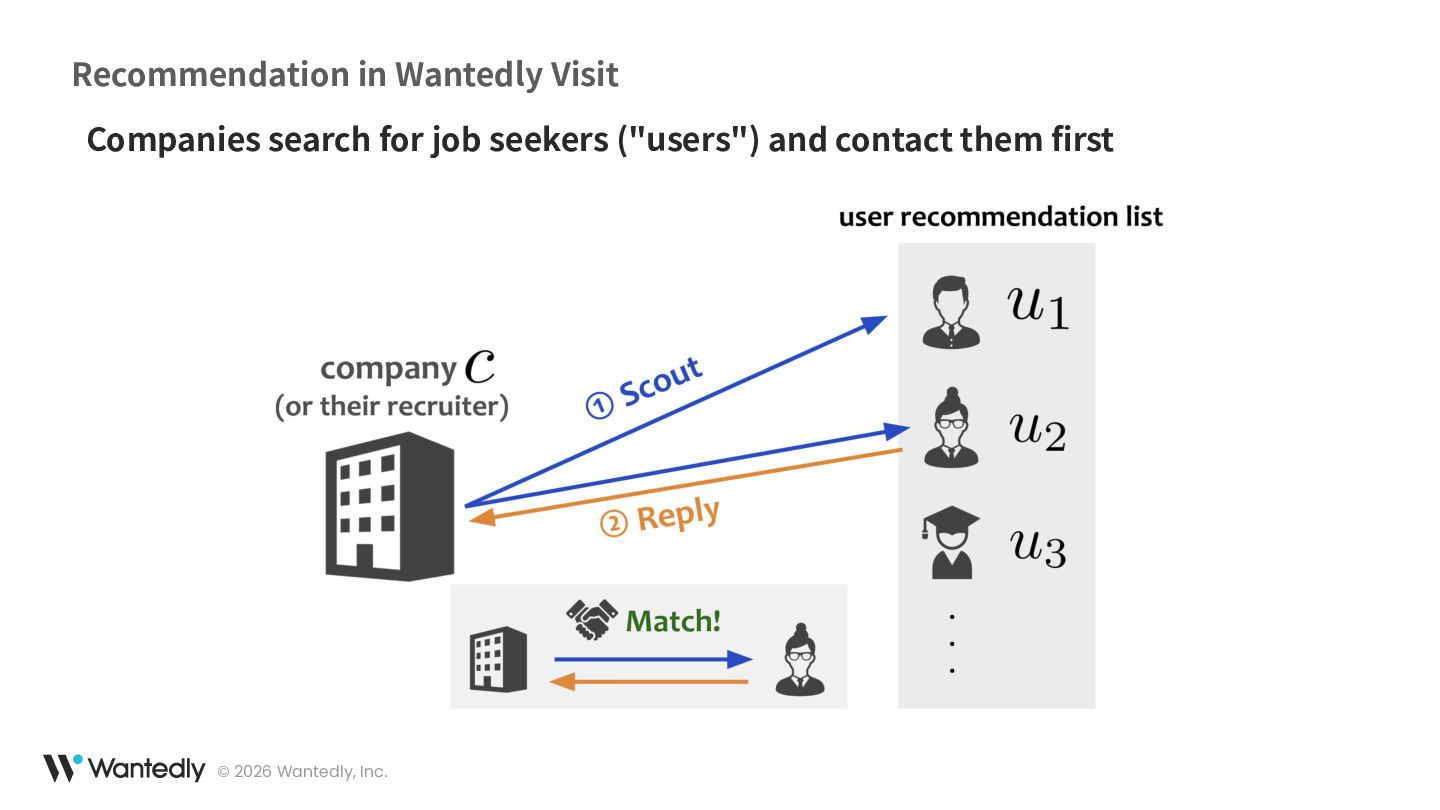
Recommendation in Wantedly Visit Companies search for job seekers ("users")
and contact them first © 2026 Wantedly, Inc.
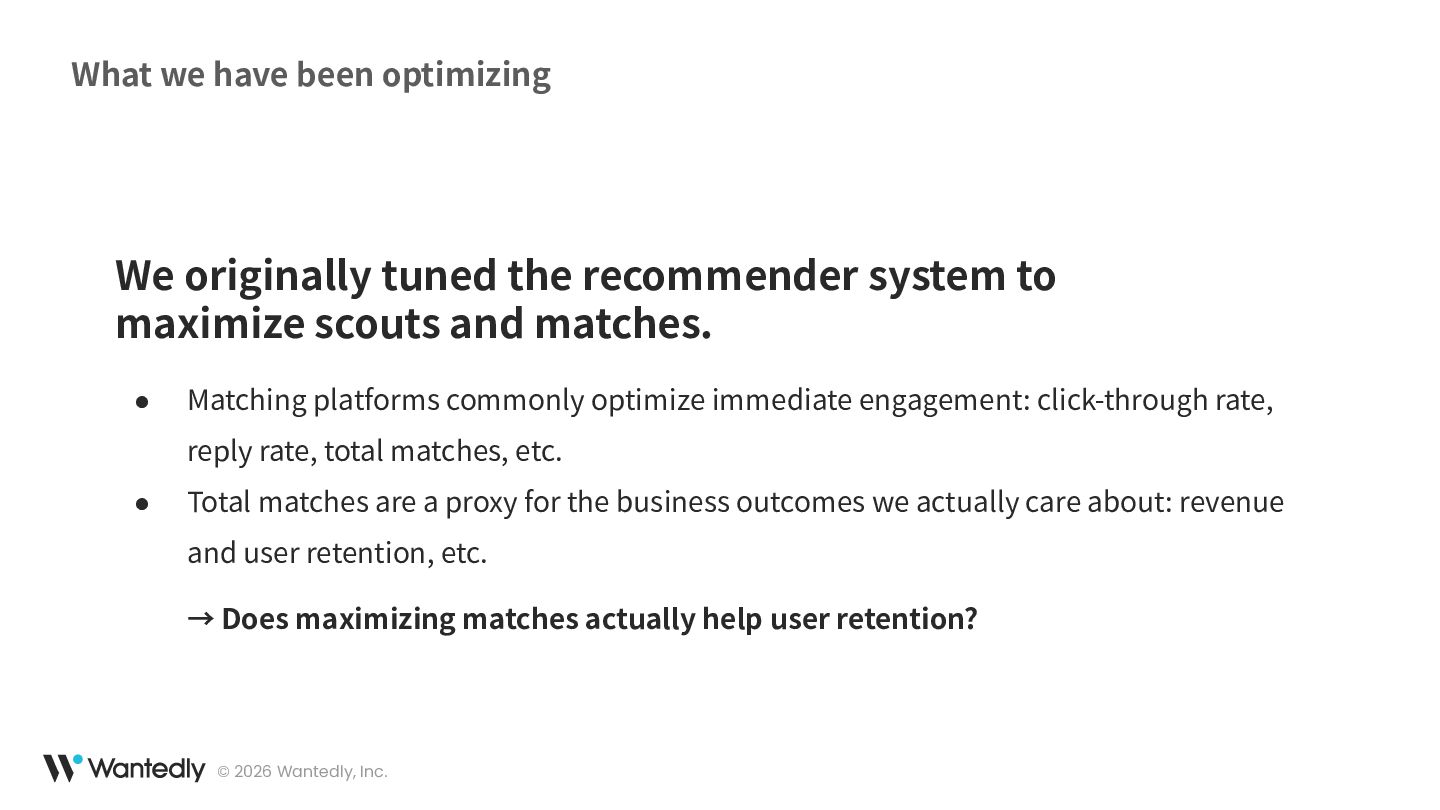
What we have been optimizing We originally tuned the recommender
system to maximize scouts and matches. • Matching platforms commonly optimize immediate engagement: click-through rate, reply rate, total matches, etc. • Total matches are a proxy for the business outcomes we actually care about: revenue and user retention, etc. → Does maximizing matches actually help user retention? © 2026 Wantedly, Inc.
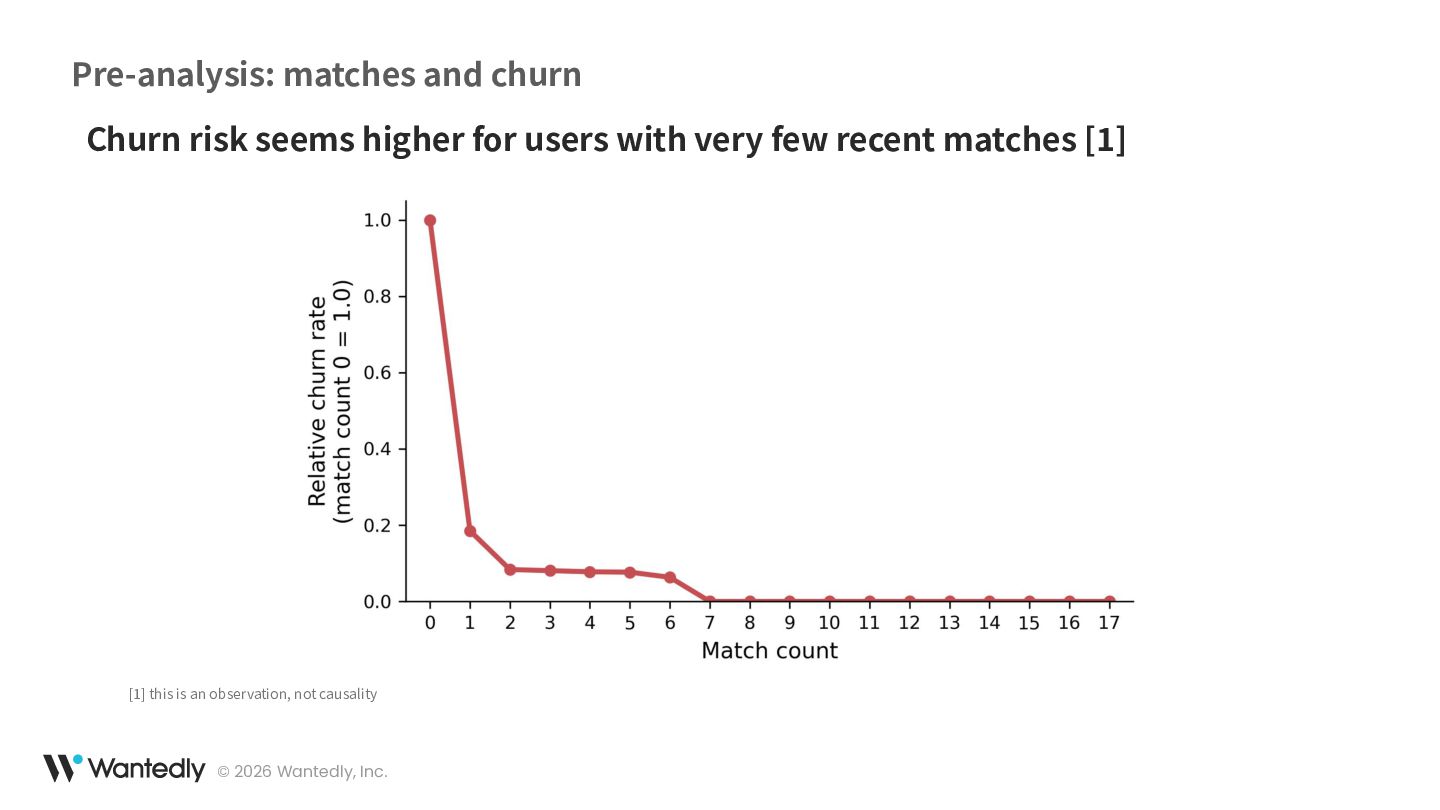
Pre-analysis: matches and churn Churn risk seems higher for users
with very few recent matches [1] [1] this is an observation, not causality © 2026 Wantedly, Inc.
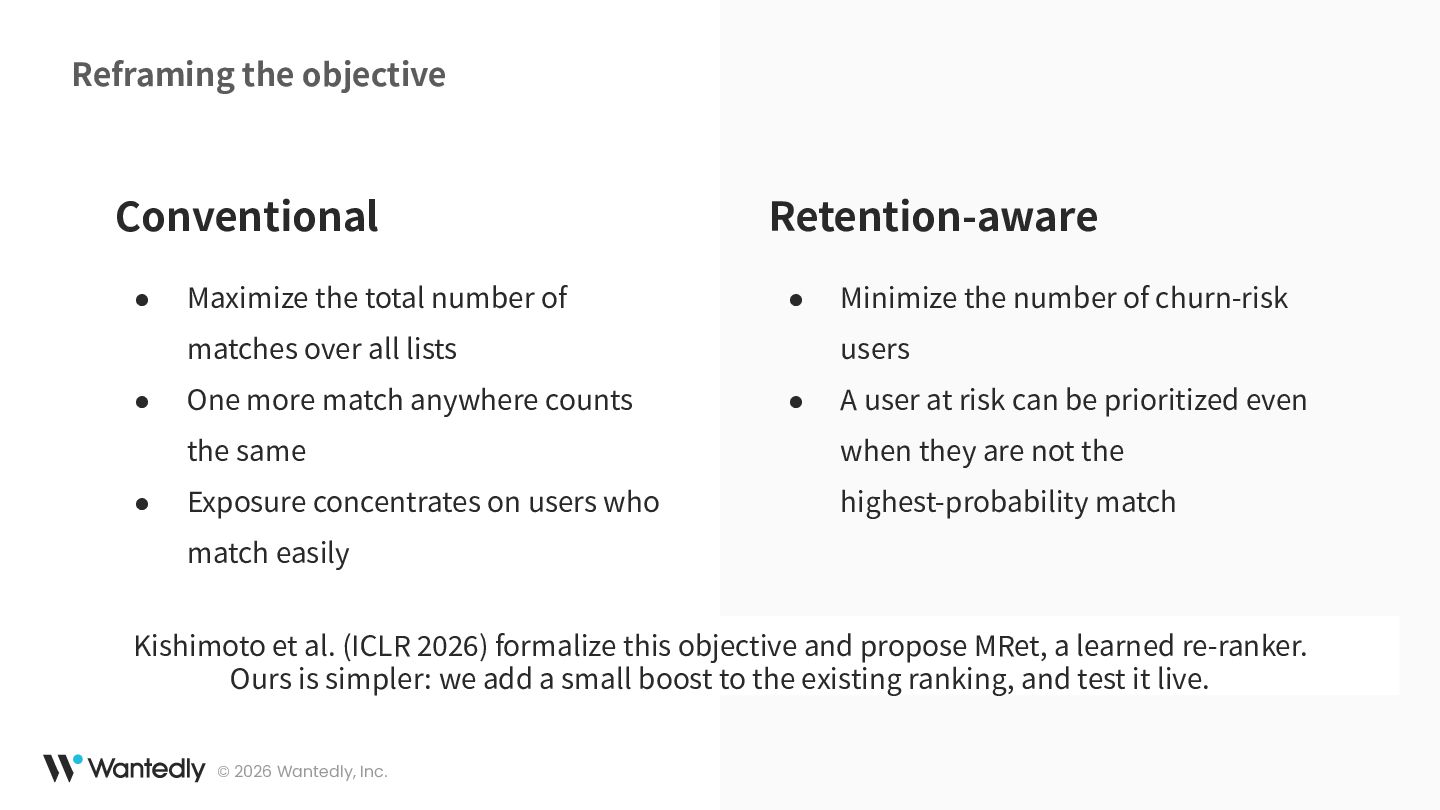
Reframing the objective Conventional • Maximize the total number of
Retention-aware • users matches over all lists • • One more match anywhere counts Minimize the number of churn-risk • A user at risk can be prioritized even the same when they are not the Exposure concentrates on users who highest-probability match match easily Kishimoto et al. (ICLR 2026) formalize this objective and propose MRet, a learned re-ranker. Ours is simpler: we add a small boost to the existing ranking, and test it live. © 2026 Wantedly, Inc.
02 Our approach © 2026 Wantedly, Inc.
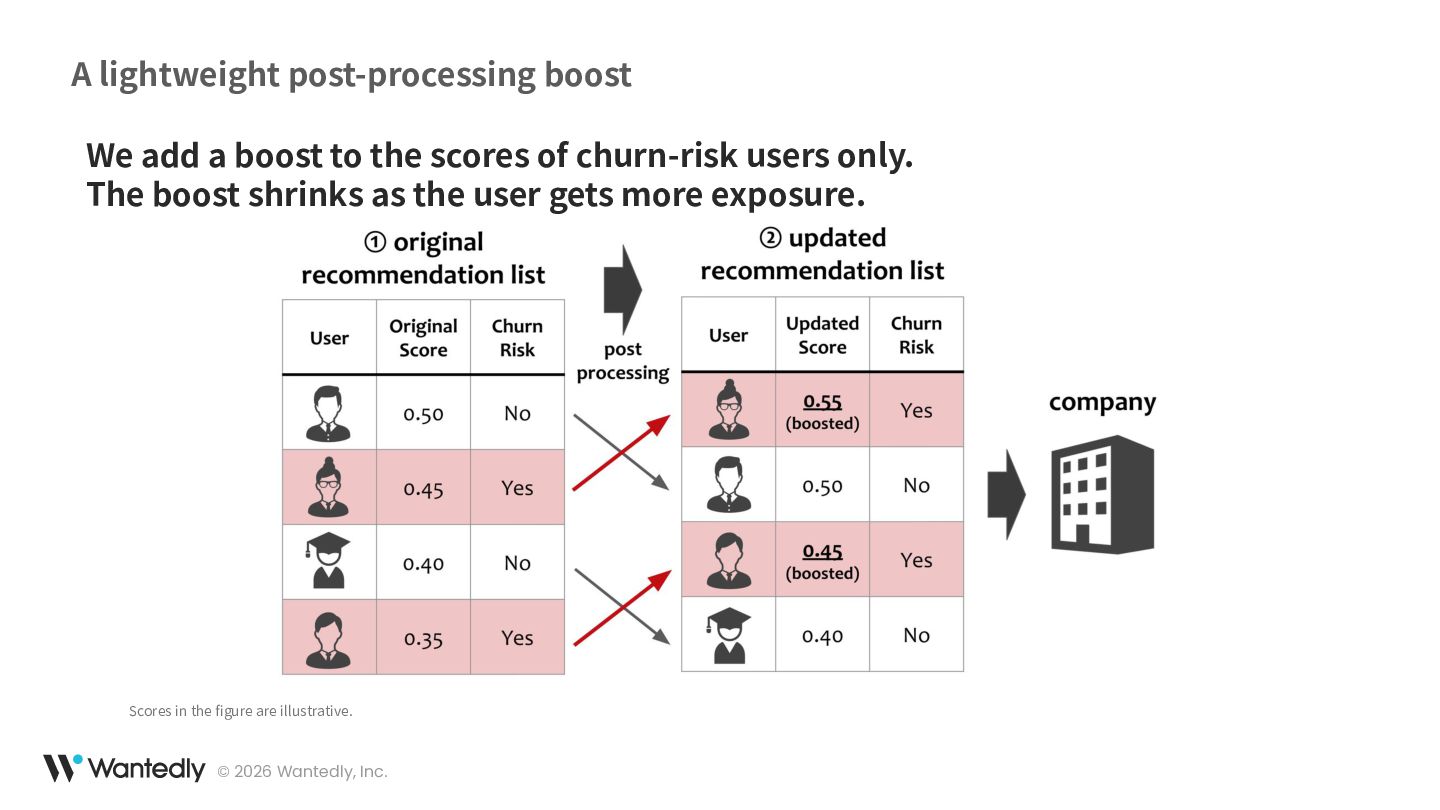
A lightweight post-processing boost We add a boost to the
scores of churn-risk users only. The boost shrinks as the user gets more exposure. Scores in the figure are illustrative. © 2026 Wantedly, Inc.
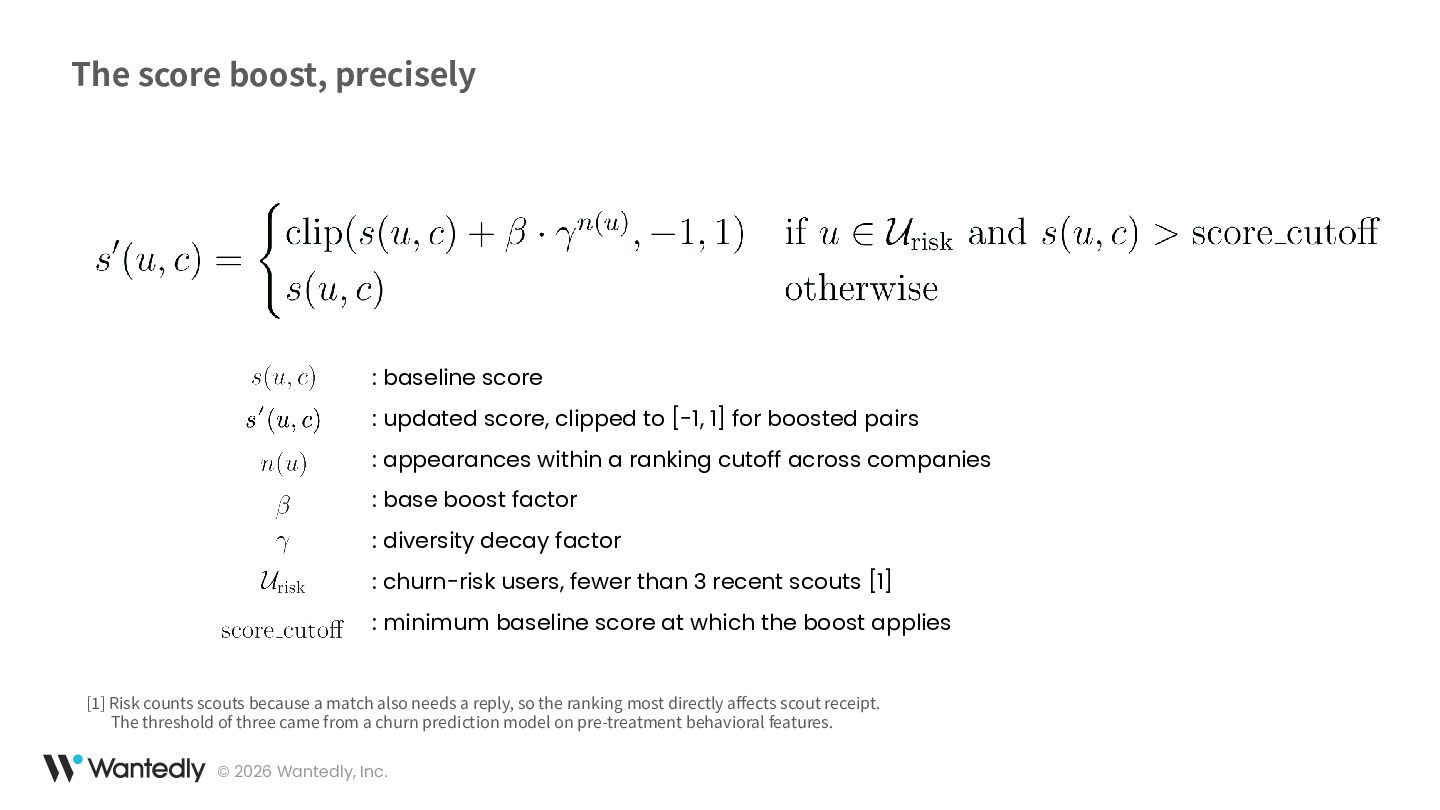
The score boost, precisely : baseline score : updated score,
clipped to [-1, 1] for boosted pairs : appearances within a ranking cutoff across companies : base boost factor : diversity decay factor : churn-risk users, fewer than 3 recent scouts [1] : minimum baseline score at which the boost applies [1] Risk counts scouts because a match also needs a reply, so the ranking most directly affects scout receipt. The threshold of three came from a churn prediction model on pre-treatment behavioral features. © 2026 Wantedly, Inc.
03 What we found © 2026 Wantedly, Inc.
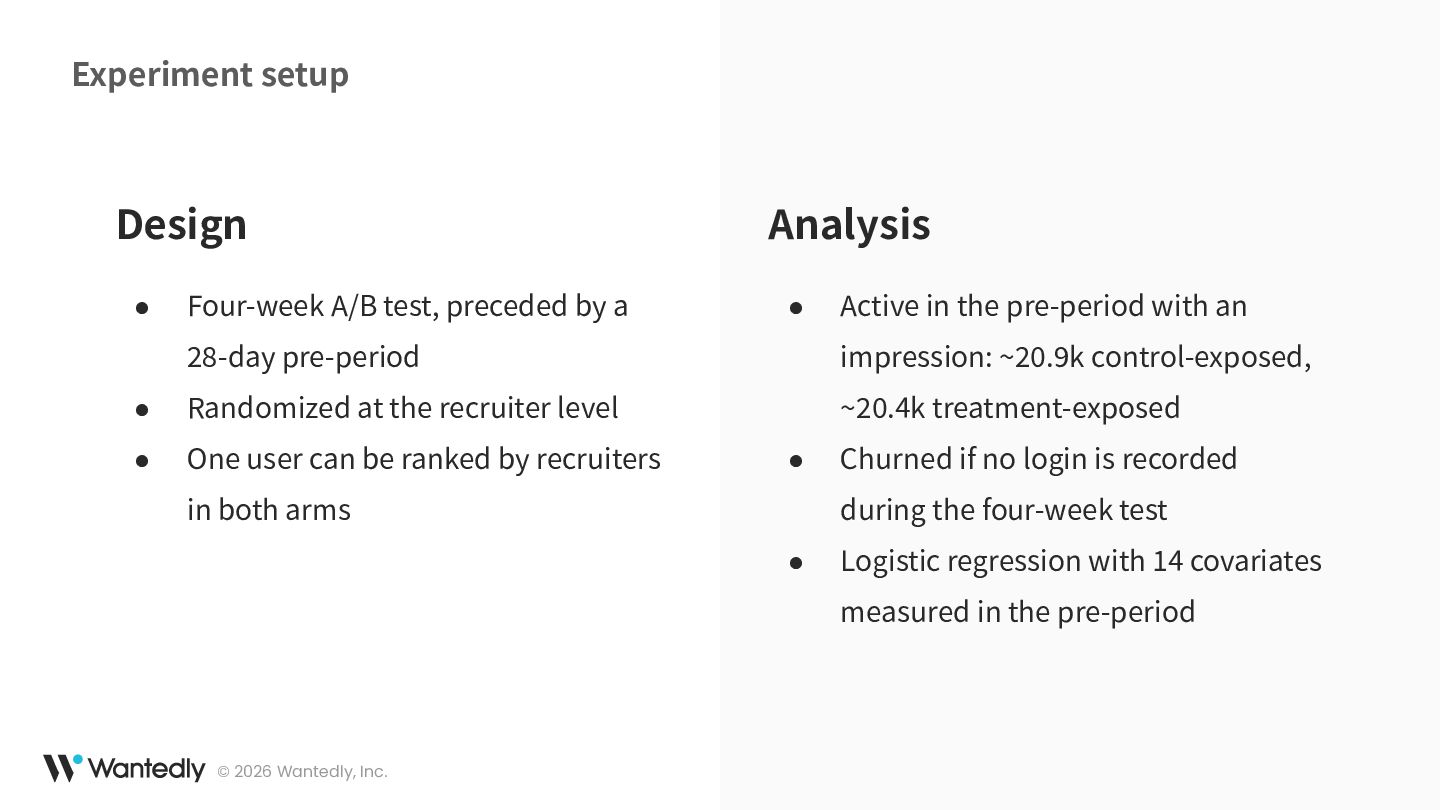
Experiment setup Design • Four-week A/B test, preceded by a
Analysis • Active in the pre-period with an 28-day pre-period impression: ~20.9k control-exposed, • Randomized at the recruiter level ~20.4k treatment-exposed • One user can be ranked by recruiters • in both arms Churned if no login is recorded during the four-week test • Logistic regression with 14 covariates measured in the pre-period © 2026 Wantedly, Inc.
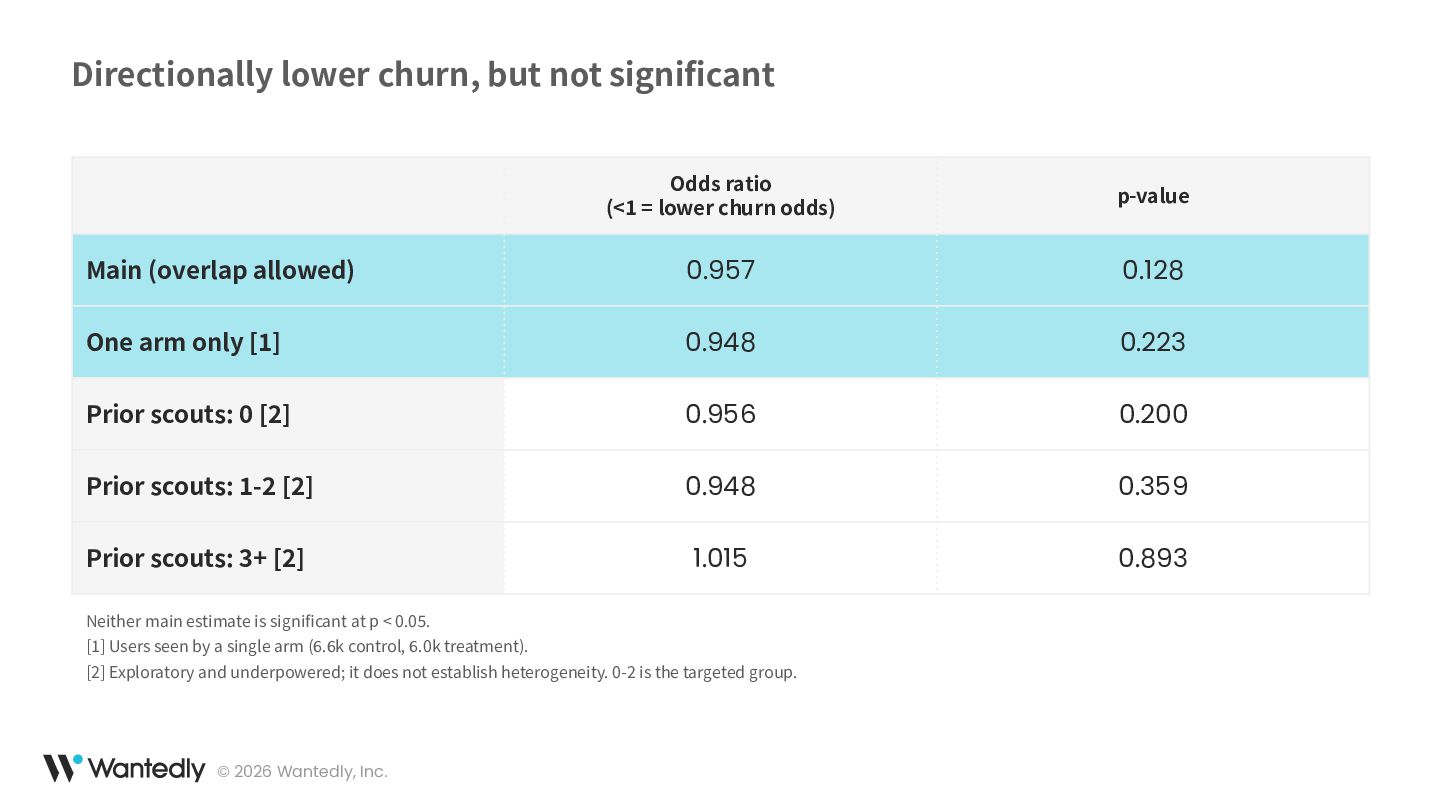
Directionally lower churn, but not significant Odds ratio (<1 =
lower churn odds) p-value Main (overlap allowed) 0.957 0.128 One arm only [1] 0.948 0.223 Prior scouts: 0 [2] 0.956 0.200 Prior scouts: 1-2 [2] 0.948 0.359 Prior scouts: 3+ [2] 1.015 0.893 Neither main estimate is significant at p < 0.05. [1] Users seen by a single arm (6.6k control, 6.0k treatment). [2] Exploratory and underpowered; it does not establish heterogeneity. 0-2 is the targeted group. © 2026 Wantedly, Inc.
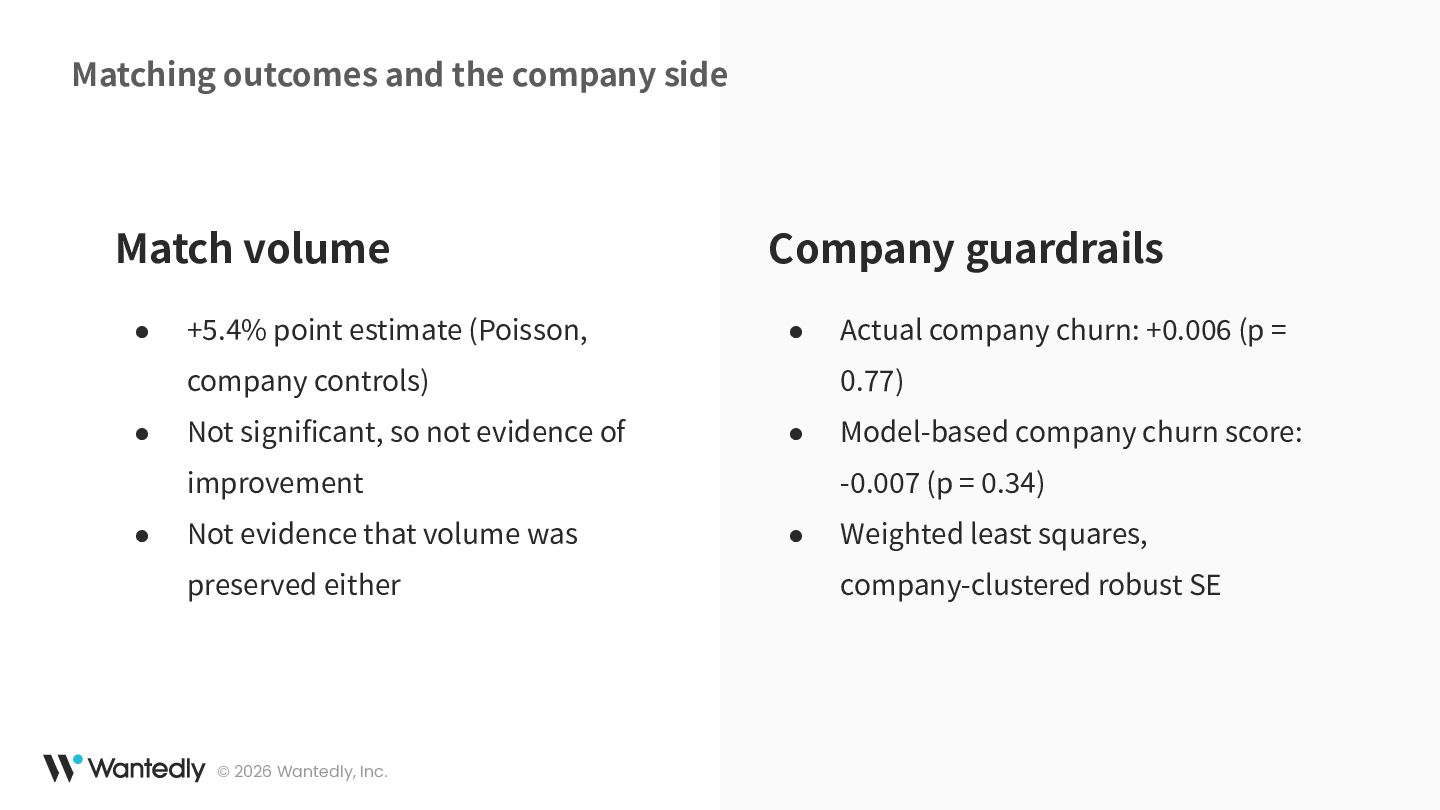
Matching outcomes and the company side Match volume • +5.4%
point estimate (Poisson, Company guardrails • company controls) • Not significant, so not evidence of 0.77) • improvement • Not evidence that volume was preserved either © 2026 Wantedly, Inc. Actual company churn: +0.006 (p = Model-based company churn score: -0.007 (p = 0.34) • Weighted least squares, company-clustered robust SE
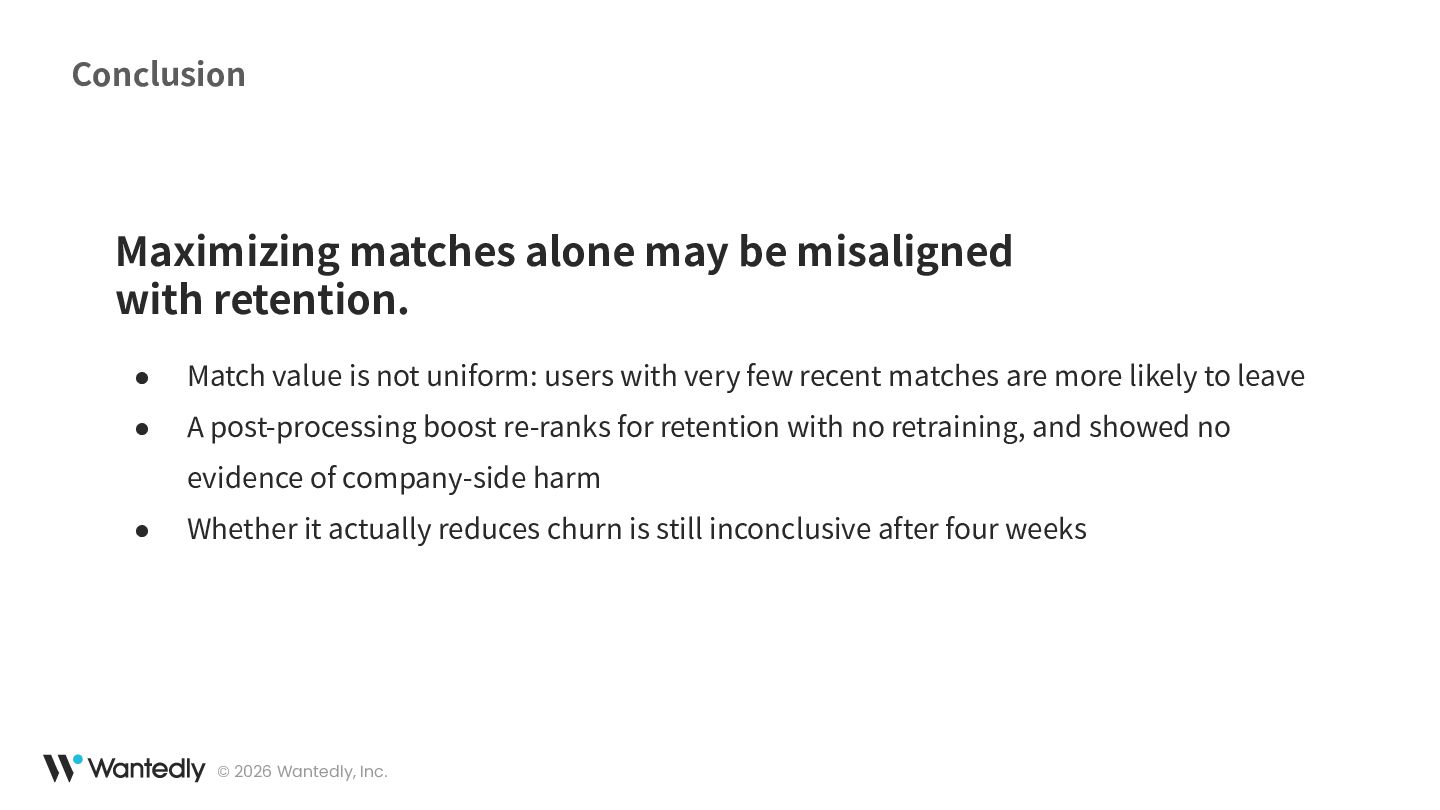
Conclusion Maximizing matches alone may be misaligned with retention. •
Match value is not uniform: users with very few recent matches are more likely to leave • A post-processing boost re-ranks for retention with no retraining, and showed no evidence of company-side harm • Whether it actually reduces churn is still inconclusive after four weeks © 2026 Wantedly, Inc.
04 Appendix © 2026 Wantedly, Inc.
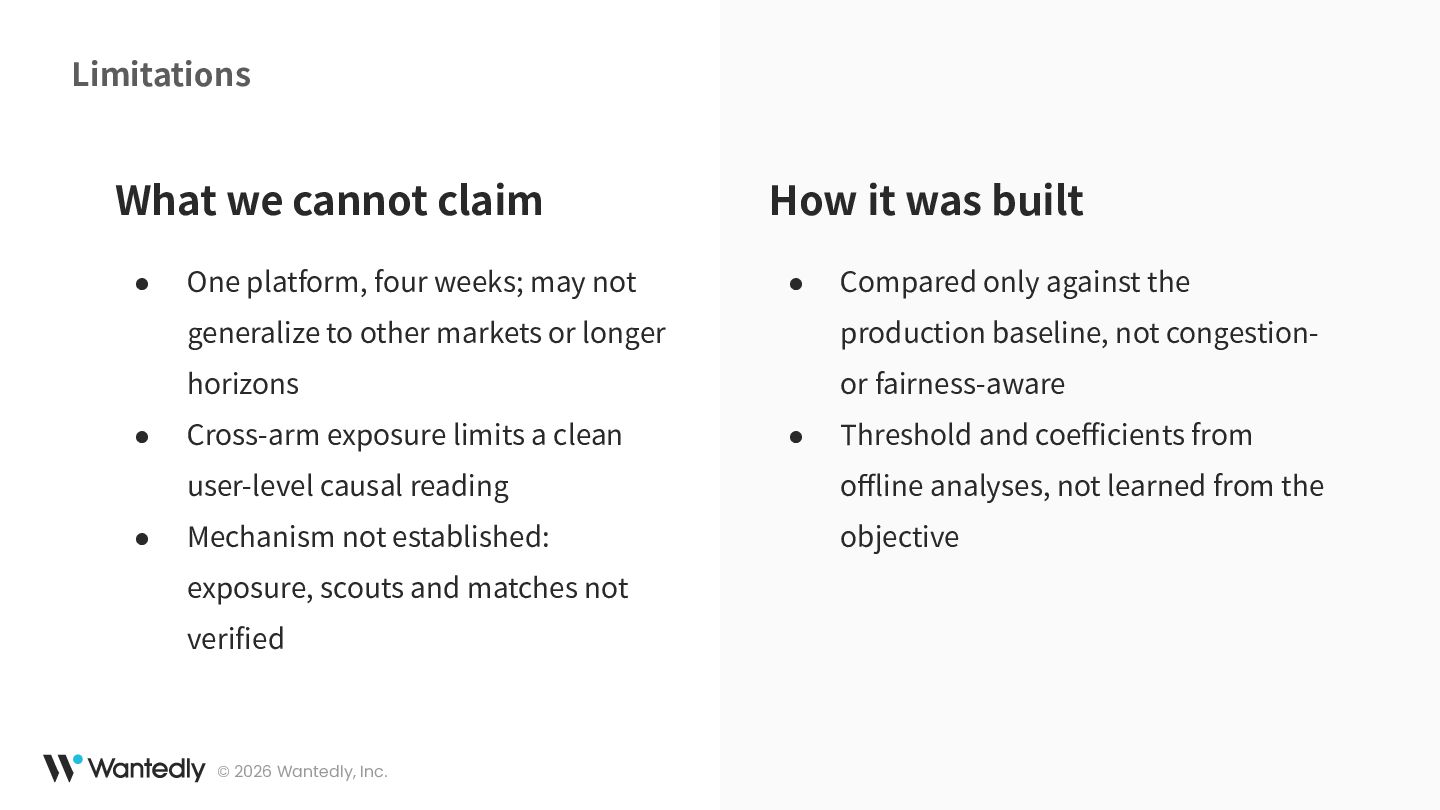
Limitations What we cannot claim • • • One platform,
four weeks; may not How it was built • Compared only against the generalize to other markets or longer production baseline, not congestion- horizons or fairness-aware Cross-arm exposure limits a clean • Threshold and coefficients from user-level causal reading offline analyses, not learned from the Mechanism not established: objective exposure, scouts and matches not verified © 2026 Wantedly, Inc.
More Decks by Tatsuya Ute
See All by Tatsuya Ute
推薦システム改善で事業 KPI を改善する:ウォンテッドリーにおけるユーザー離脱 抑制の取り組み
ghibney
1
460
JSAI2025 インダストリアルトーク
ghibney
0
710
polars 1.1.0以降の使える新機能
ghibney
0
400
ANNライブラリの移行における技術選定
ghibney
0
120
Other Decks in Technology
See All in Technology
OpenTelemetryで変わった 新時代のCloudWatchメトリクス監視
tsukuboshi
0
500
MCPでネットワーク障害調査を自動化する前に直すべき3つのこと
yama3133
1
660
OCI Artifact による自動運転タクシーに向けた OTA 基盤の構築
biwashi
1
300
kubellの最新データ分析環境
kubell_hr
2
270
AI-Ready なデータ基盤ってなに? & 新卒未経験が、いま考えていること
imuta
0
1.1k
SBOM 生成ツールで 2026 Minimum Elements はどこまで満たせるのか
gokken
0
160
Test Impact Analysis を武器に立ち向かう、AI 時代のテスト増加に対するヌーラボのアプローチ / getting-started-datadog-test-impact-analysis
k6s4i53rx
3
420
New Relicのアラート対応をClaude Codeで自動修正するワークフローを作った話
manabuseki
2
640
認知負荷の減らし方 ~開発にも日常業務にも活かせるノウハウ~
minorun365
PRO
17
10k
閉域網でのAPI公開の選択肢全部比較!
takano0131
5
700
IVRy における AI 時代のデータプロダクトと事業開発
ivry_presentationmaterials
0
110
Welcome JXL!
dynamis
0
120
Featured
See All Featured
[RailsConf 2023] Rails as a piece of cake
palkan
59
7.2k
A Tale of Four Properties
chriscoyier
163
24k
How to Build an AI Search Optimization Roadmap - Criteria and Steps to Take #SEOIRL
aleyda
1
2.3k
Evolution of real-time – Irina Nazarova, EuRuKo, 2024
irinanazarova
9
1.7k
Understanding Cognitive Biases in Performance Measurement
bluesmoon
32
3.1k
Building Experiences: Design Systems, User Experience, and Full Site Editing
marktimemedia
1
670
The Pragmatic Product Professional
lauravandoore
37
7.5k
B2B Lead Gen: Tactics, Traps & Triumph
marketingsoph
1
310
Sam Torres - BigQuery for SEOs
techseoconnect
PRO
0
620
Visualization
eitanlees
153
17k
Connecting the Dots Between Site Speed, User Experience & Your Business [WebExpo 2025]
tammyeverts
11
1.1k
Performance Is Good for Brains [We Love Speed 2024]
tammyeverts
12
2k


 ghibney
 tsukuboshi
 yama3133
 biwashi
 kubell_hr
 imuta
 gokken
 k6s4i53rx
 manabuseki
 minorun365
 takano0131
 ivry_presentationmaterials
 dynamis
 palkan
 chriscoyier
 aleyda
 irinanazarova
 bluesmoon
 marktimemedia
 lauravandoore
 marketingsoph
 techseoconnect
 eitanlees
 tammyeverts