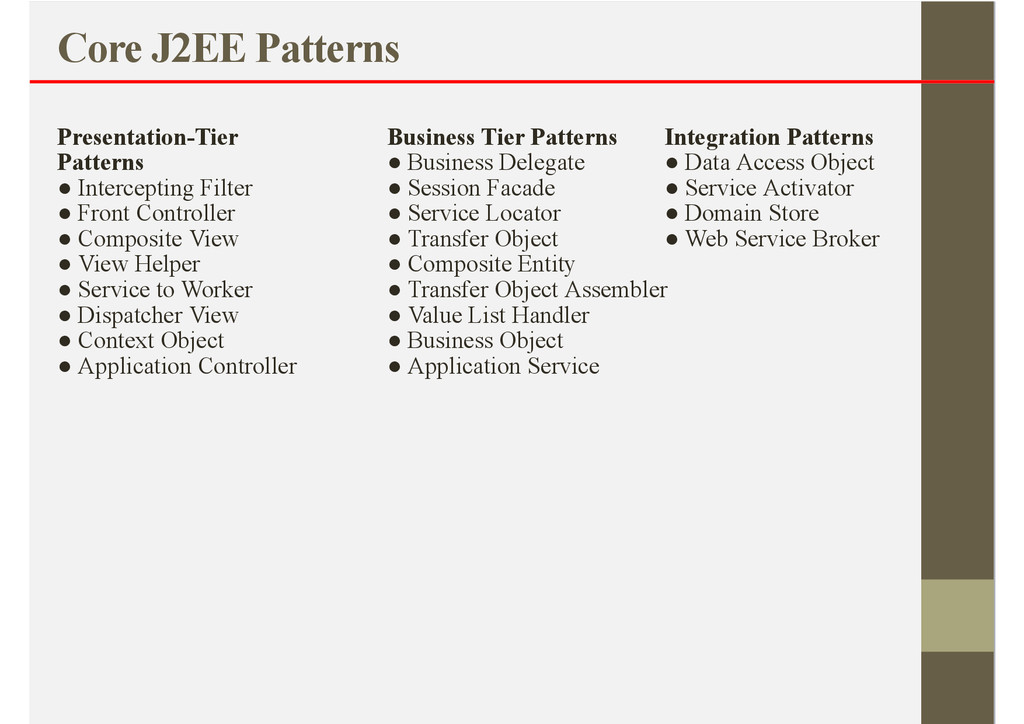
View • View Helper • Service to Worker • Dispatcher View • Context Object • Application Controller Business Tier Patterns • Business Delegate • Session Facade • Service Locator • Transfer Object • Composite Entity • Transfer Object Assembler • Value List Handler • Business Object • Application Service Integration Patterns • Data Access Object • Service Activator • Domain Store • Web Service Broker Core J2EE Patterns
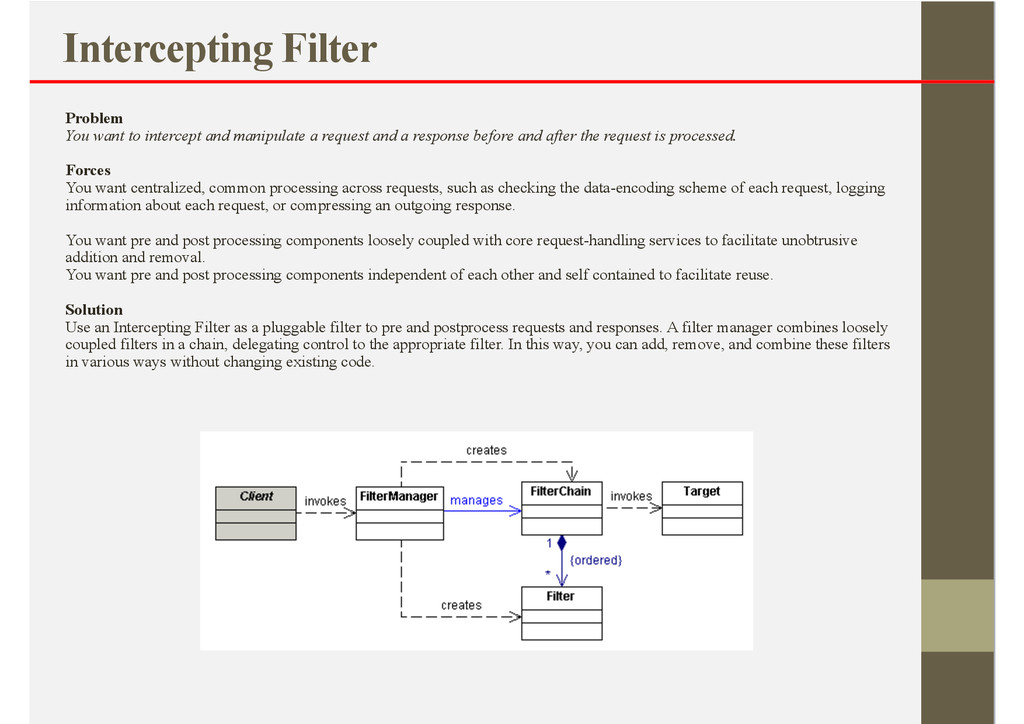
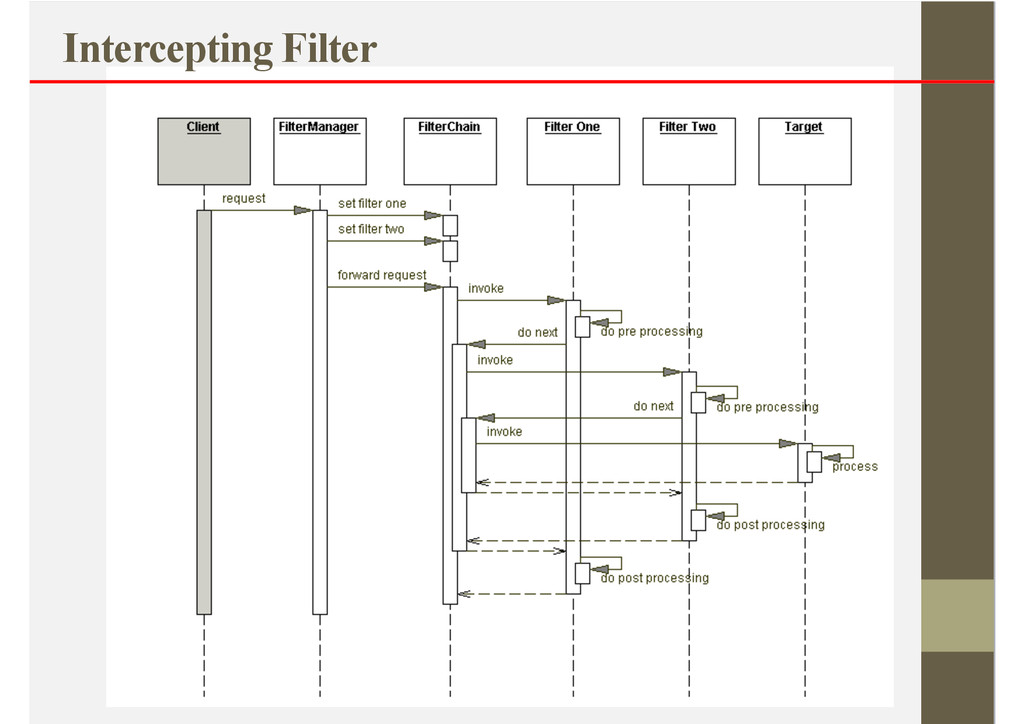
a response before and after the request is processed. Forces You want centralized, common processing across requests, such as checking the data-encoding scheme of each request, logging information about each request, or compressing an outgoing response. You want pre and post processing components loosely coupled with core request-handling services to facilitate unobtrusive addition and removal. You want pre and post processing components independent of each other and self contained to facilitate reuse. Solution Use an Intercepting Filter as a pluggable filter to pre and postprocess requests and responses. A filter manager combines loosely coupled filters in a chain, delegating control to the appropriate filter. In this way, you can add, remove, and combine these filters in various ways without changing existing code. Intercepting Filter
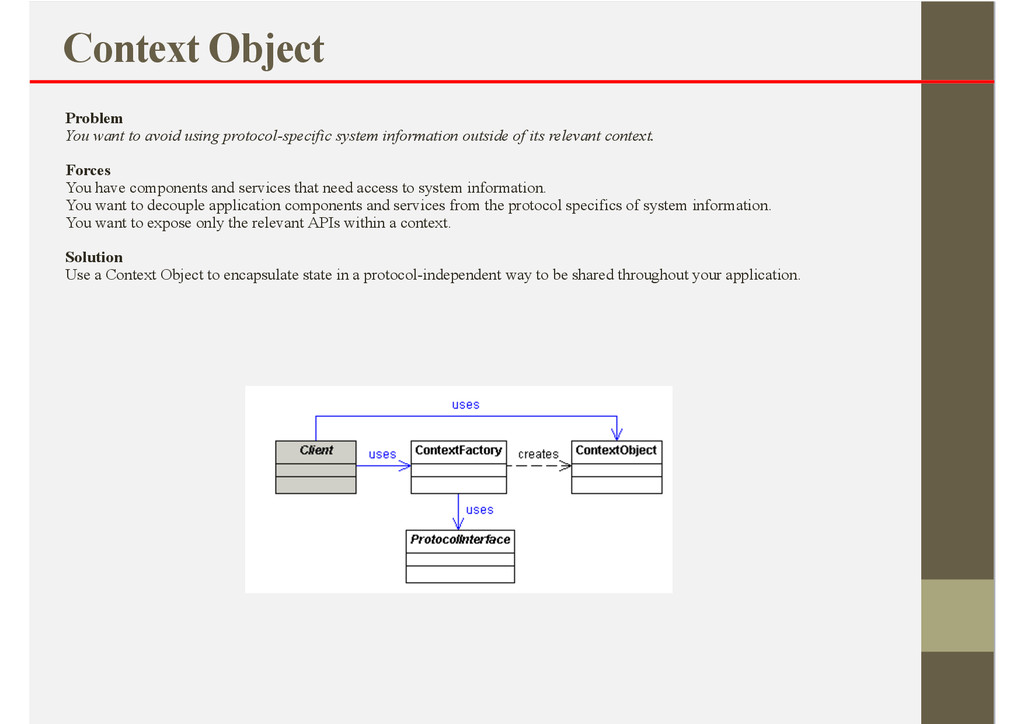
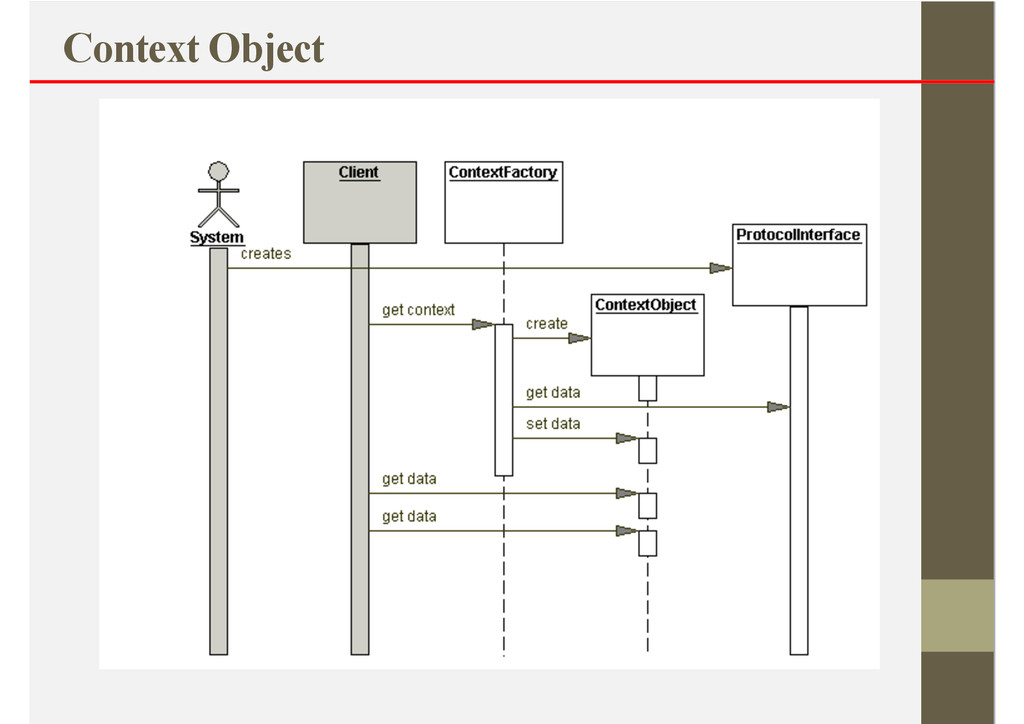
of its relevant context. Forces You have components and services that need access to system information. You want to decouple application components and services from the protocol specifics of system information. You want to expose only the relevant APIs within a context. Solution Use a Context Object to encapsulate state in a protocol-independent way to be shared throughout your application. Context Object
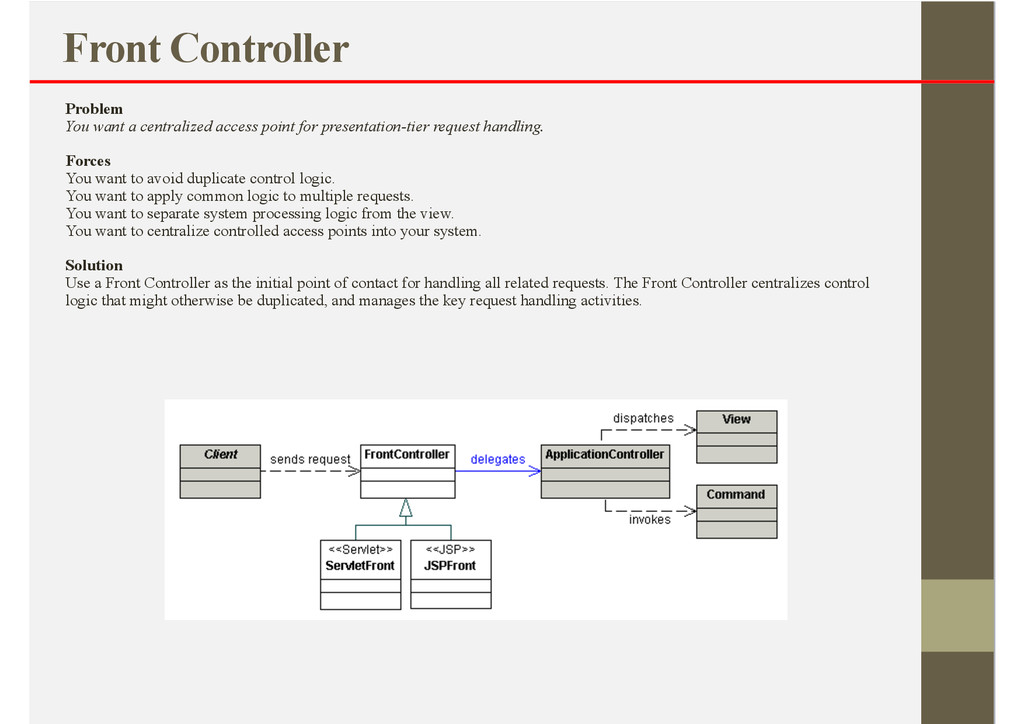
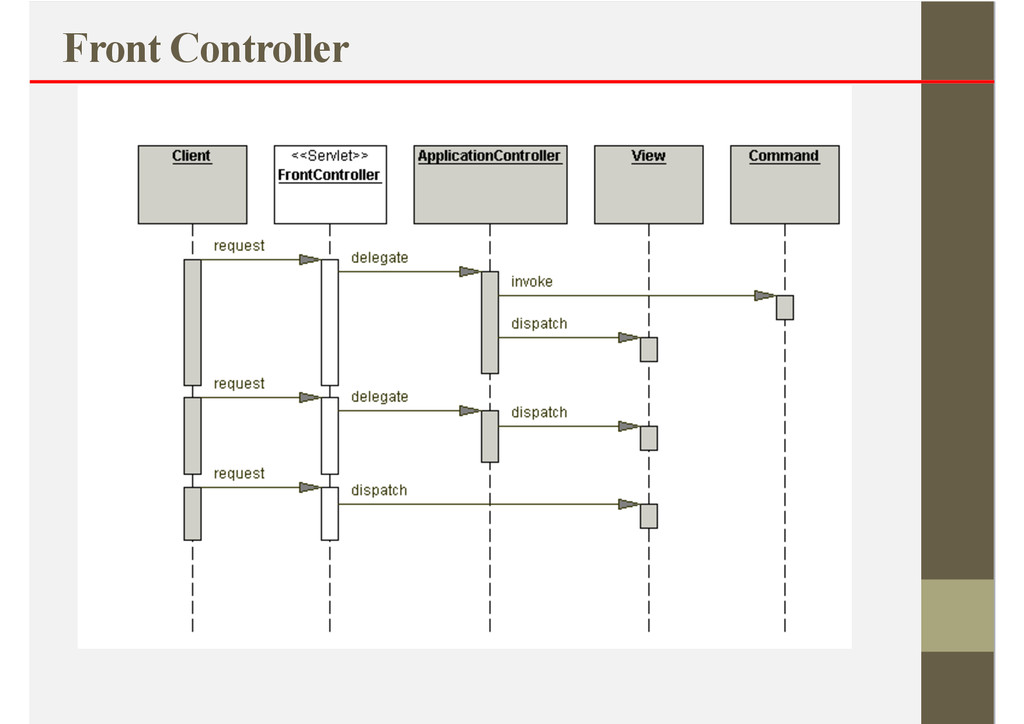
handling. Forces You want to avoid duplicate control logic. You want to apply common logic to multiple requests. You want to separate system processing logic from the view. You want to centralize controlled access points into your system. Solution Use a Front Controller as the initial point of contact for handling all related requests. The Front Controller centralizes control logic that might otherwise be duplicated, and manages the key request handling activities. Front Controller
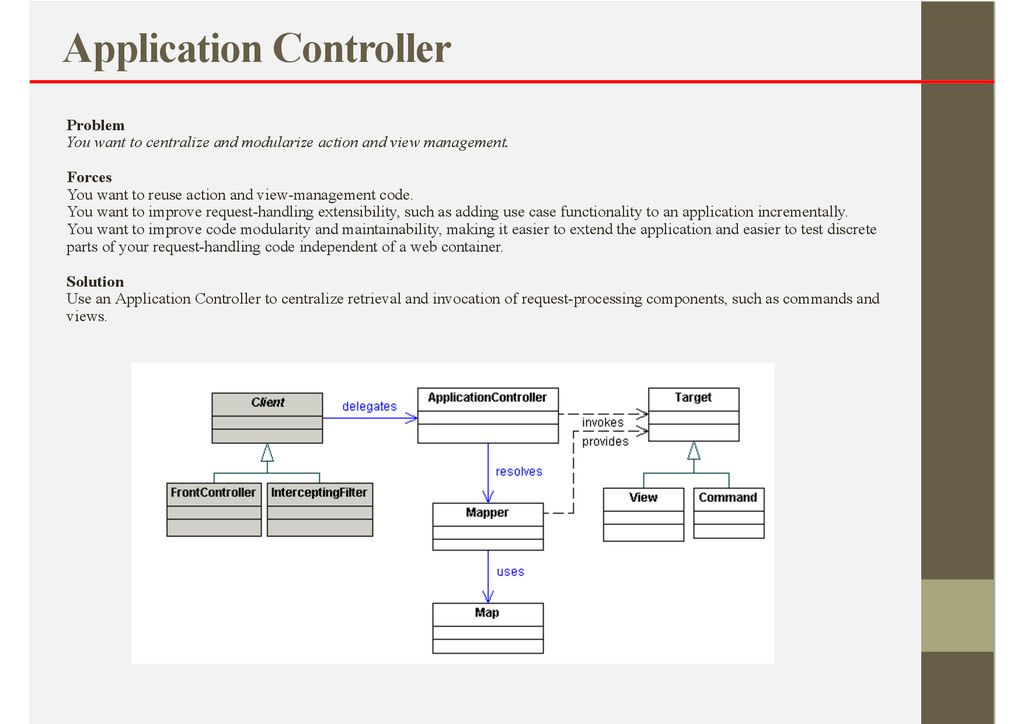
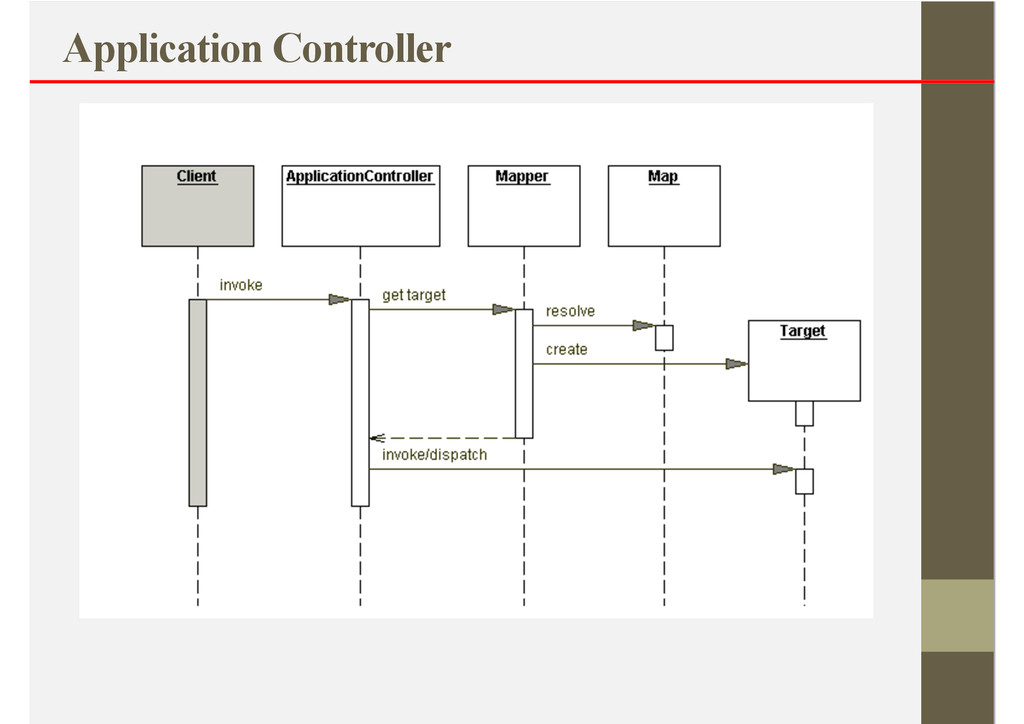
management. Forces You want to reuse action and view-management code. You want to improve request-handling extensibility, such as adding use case functionality to an application incrementally. You want to improve code modularity and maintainability, making it easier to extend the application and easier to test discrete parts of your request-handling code independent of a web container. Solution Use an Application Controller to centralize retrieval and invocation of request-processing components, such as commands and views. Application Controller
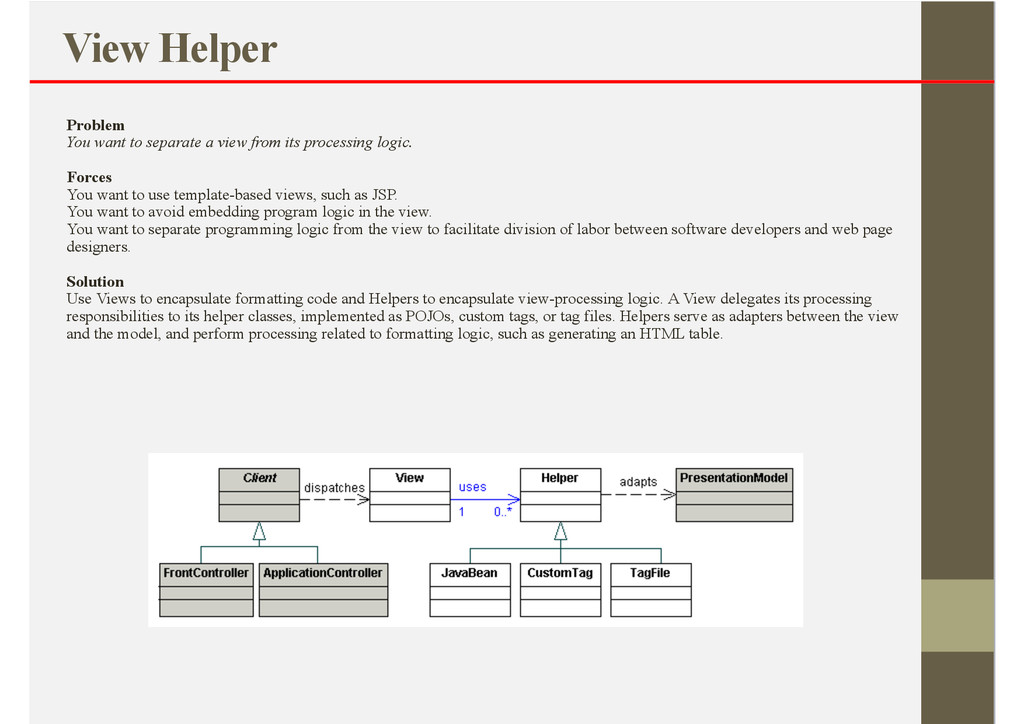
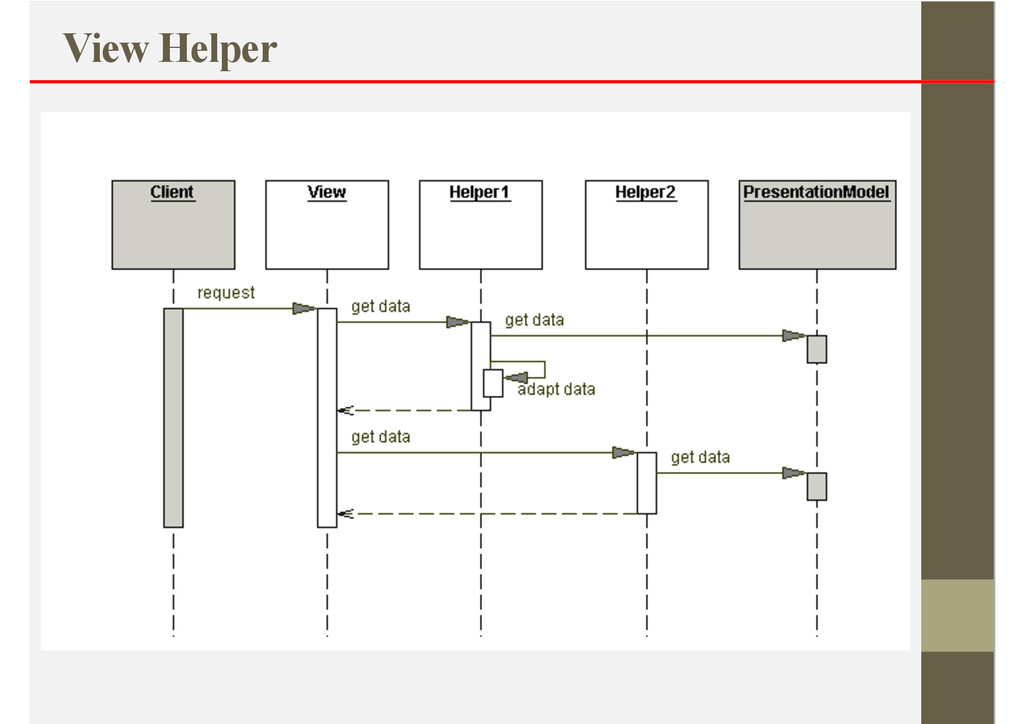
logic. Forces You want to use template-based views, such as JSP. You want to avoid embedding program logic in the view. You want to separate programming logic from the view to facilitate division of labor between software developers and web page designers. Solution Use Views to encapsulate formatting code and Helpers to encapsulate view-processing logic. A View delegates its processing responsibilities to its helper classes, implemented as POJOs, custom tags, or tag files. Helpers serve as adapters between the view and the model, and perform processing related to formatting logic, such as generating an HTML table. View Helper
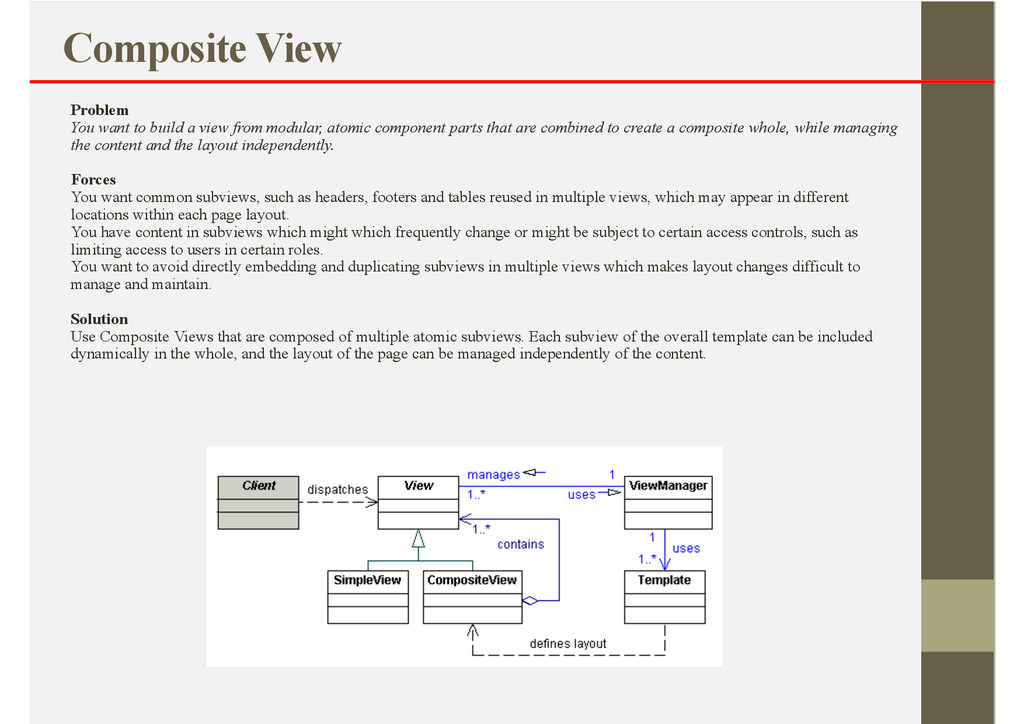
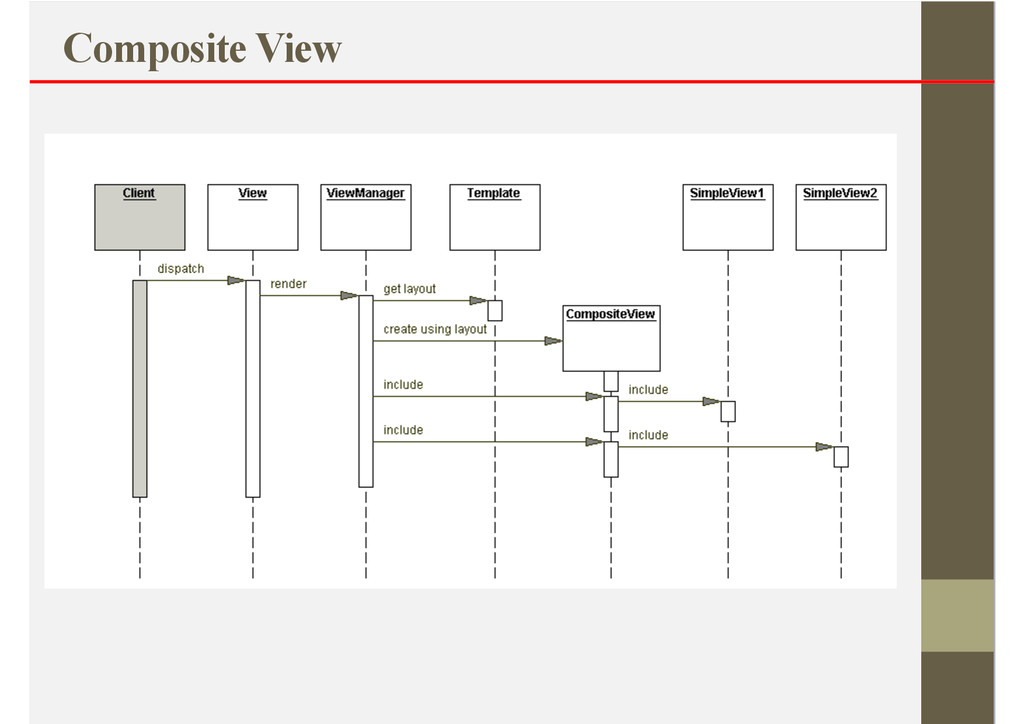
component parts that are combined to create a composite whole, while managing the content and the layout independently. Forces You want common subviews, such as headers, footers and tables reused in multiple views, which may appear in different locations within each page layout. You have content in subviews which might which frequently change or might be subject to certain access controls, such as limiting access to users in certain roles. You want to avoid directly embedding and duplicating subviews in multiple views which makes layout changes difficult to manage and maintain. Solution Use Composite Views that are composed of multiple atomic subviews. Each subview of the overall template can be included dynamically in the whole, and the layout of the page can be managed independently of the content. Composite View
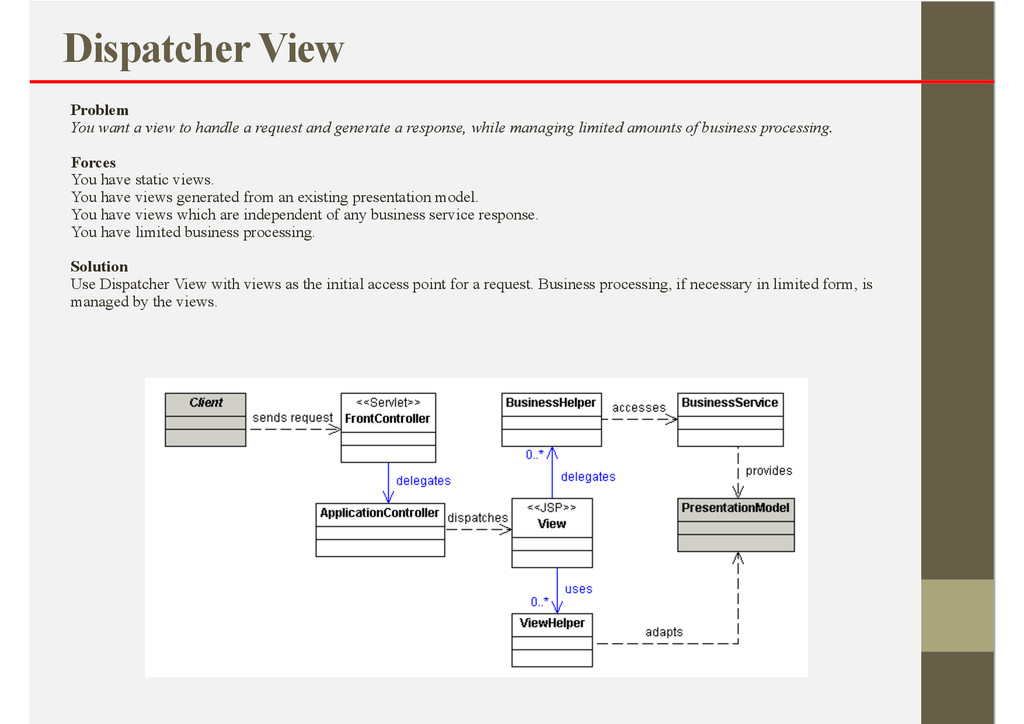
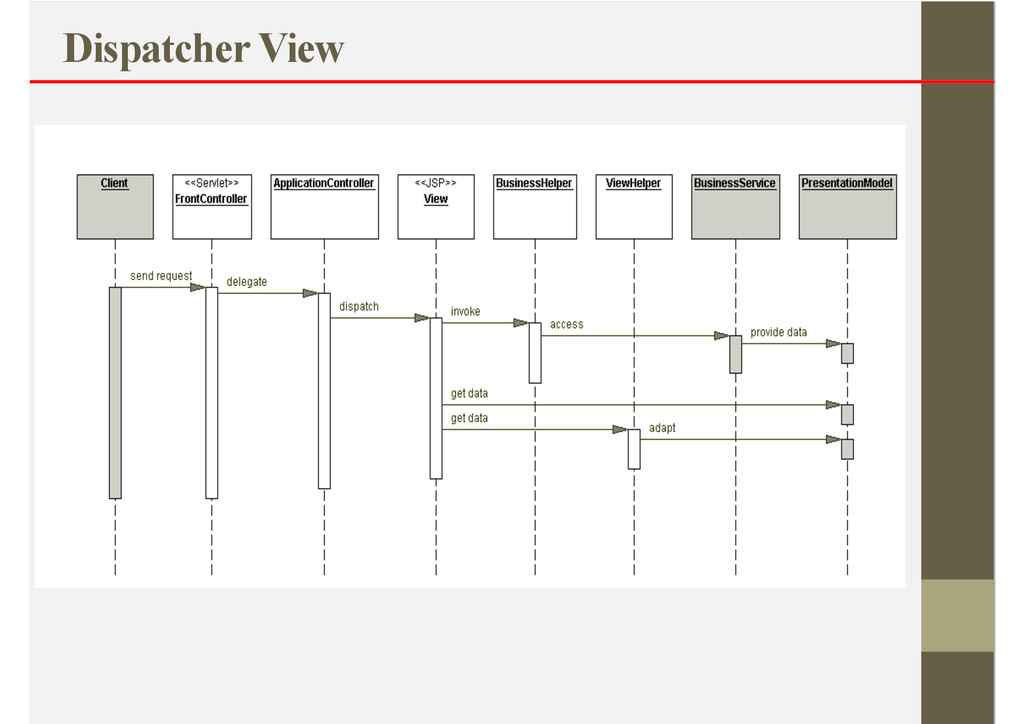
generate a response, while managing limited amounts of business processing. Forces You have static views. You have views generated from an existing presentation model. You have views which are independent of any business service response. You have limited business processing. Solution Use Dispatcher View with views as the initial access point for a request. Business processing, if necessary in limited form, is managed by the views. Dispatcher View
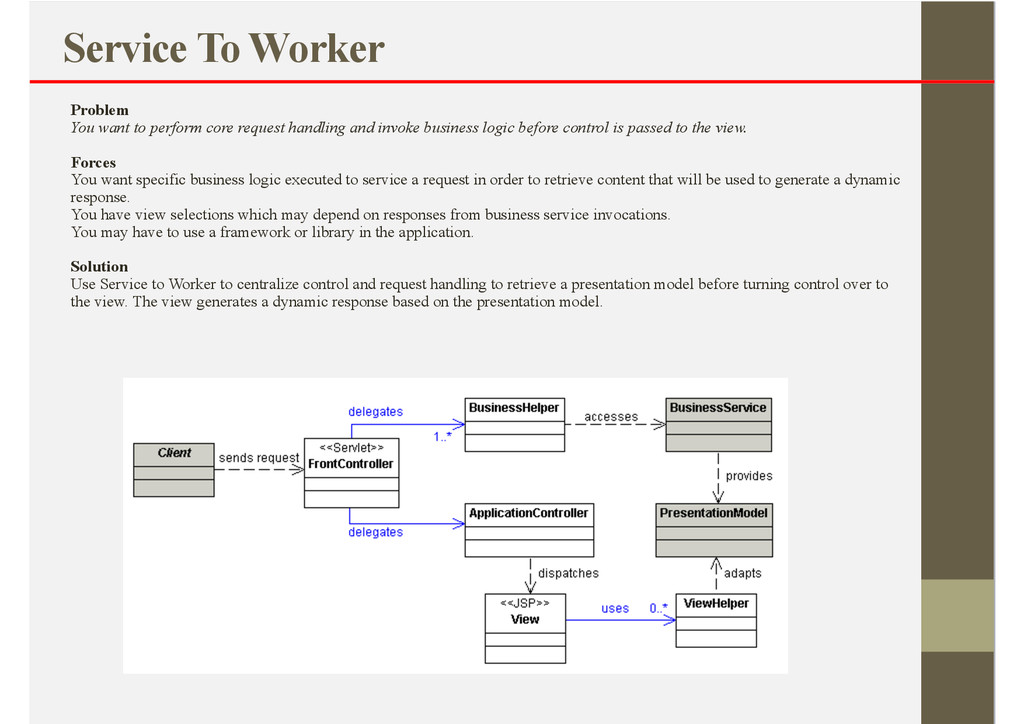
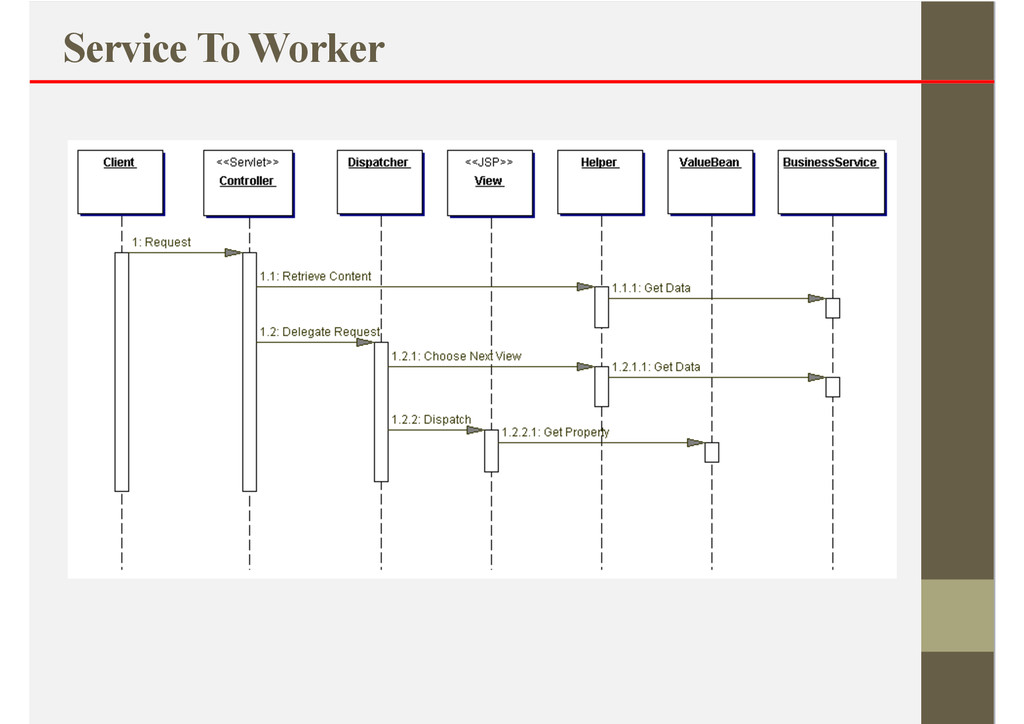
business logic before control is passed to the view. Forces You want specific business logic executed to service a request in order to retrieve content that will be used to generate a dynamic response. You have view selections which may depend on responses from business service invocations. You may have to use a framework or library in the application. Solution Use Service to Worker to centralize control and request handling to retrieve a presentation model before turning control over to the view. The view generates a dynamic response based on the presentation model. Service To Worker
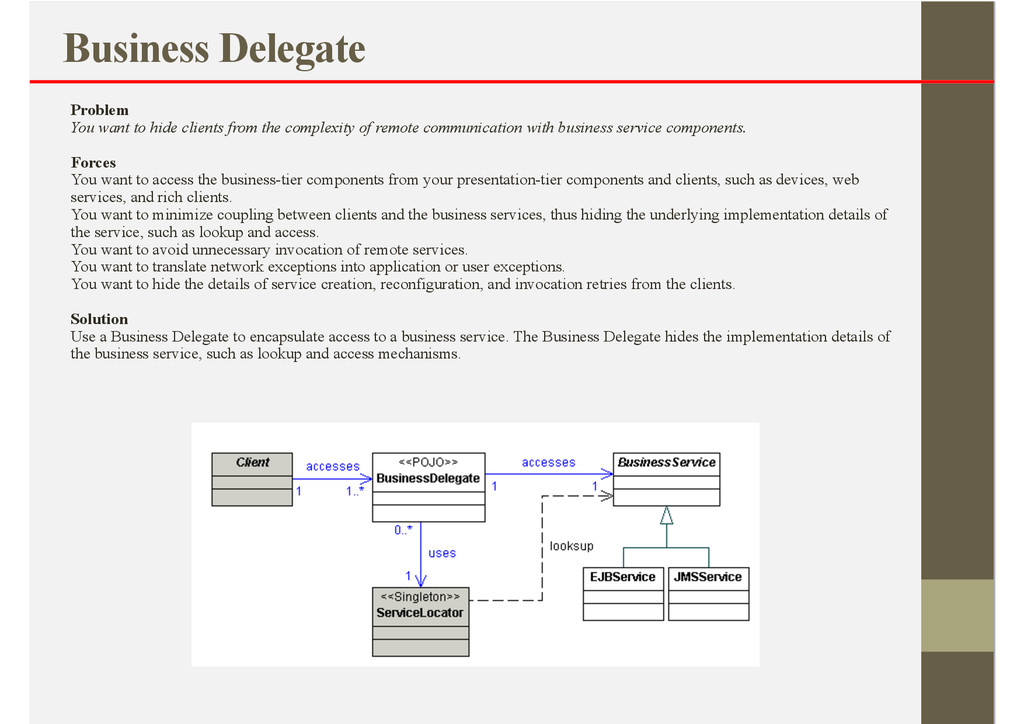
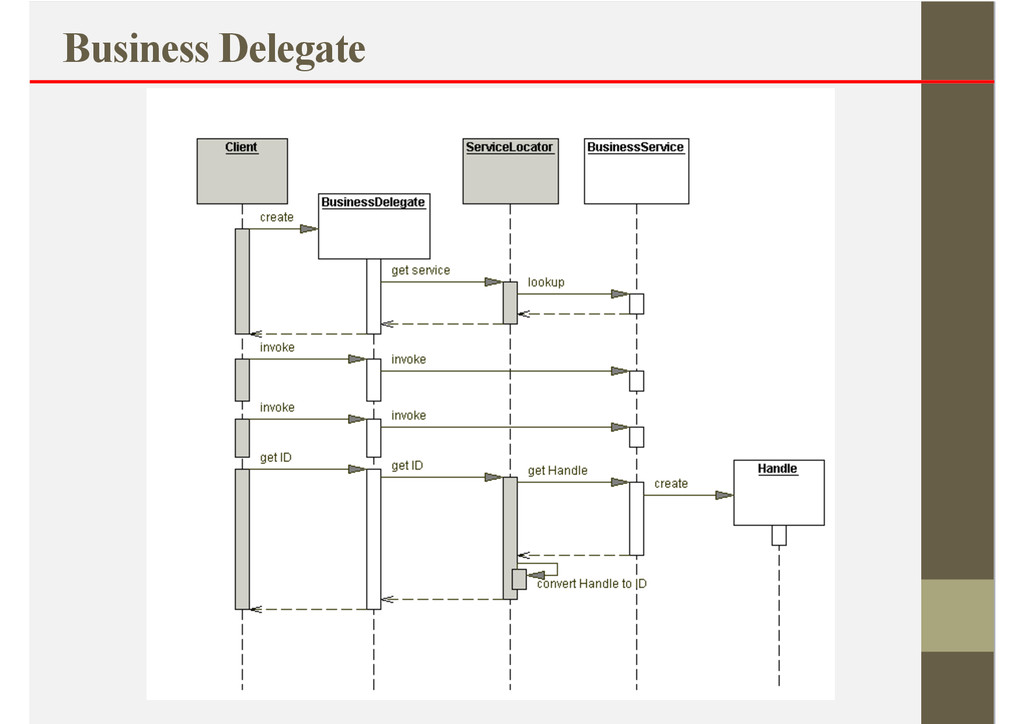
remote communication with business service components. Forces You want to access the business-tier components from your presentation-tier components and clients, such as devices, web services, and rich clients. You want to minimize coupling between clients and the business services, thus hiding the underlying implementation details of the service, such as lookup and access. You want to avoid unnecessary invocation of remote services. You want to translate network exceptions into application or user exceptions. You want to hide the details of service creation, reconfiguration, and invocation retries from the clients. Solution Use a Business Delegate to encapsulate access to a business service. The Business Delegate hides the implementation details of the business service, such as lookup and access mechanisms. Business Delegate
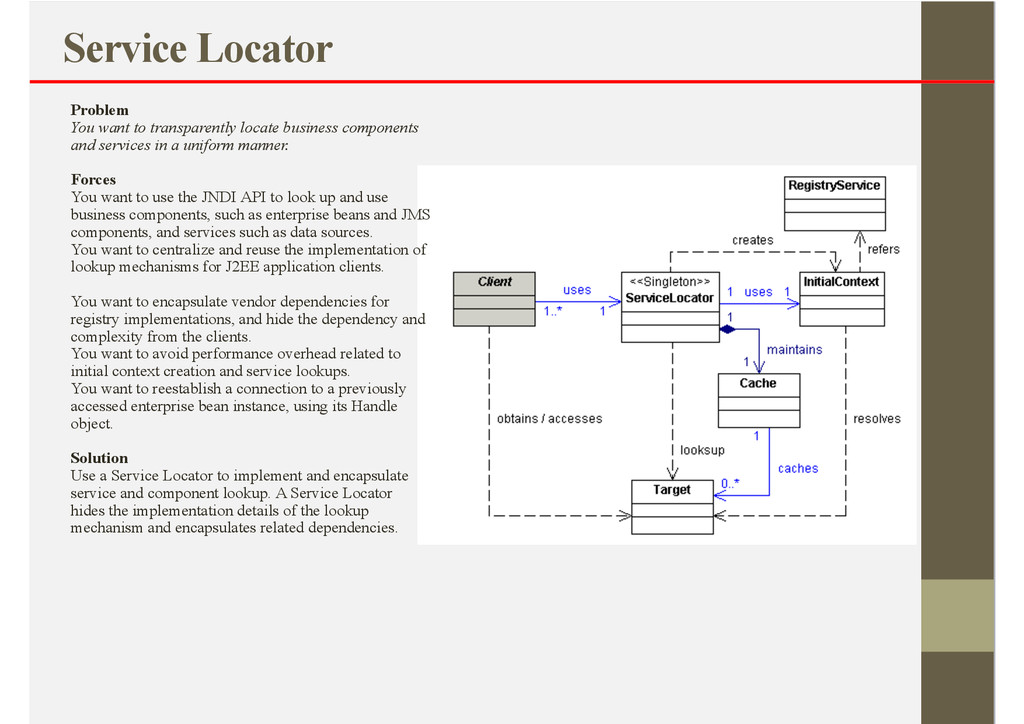
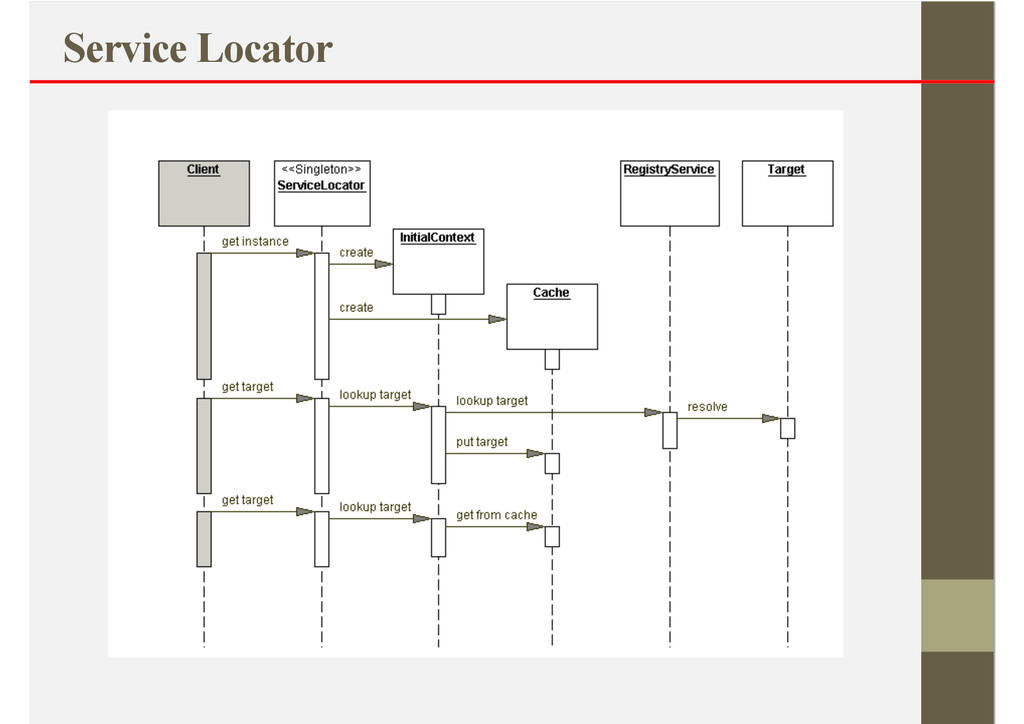
and services in a uniform manner. Forces You want to use the JNDI API to look up and use business components, such as enterprise beans and JMS components, and services such as data sources. You want to centralize and reuse the implementation of lookup mechanisms for J2EE application clients. You want to encapsulate vendor dependencies for registry implementations, and hide the dependency and complexity from the clients. You want to avoid performance overhead related to initial context creation and service lookups. You want to reestablish a connection to a previously accessed enterprise bean instance, using its Handle object. Solution Use a Service Locator to implement and encapsulate service and component lookup. A Service Locator hides the implementation details of the lookup mechanism and encapsulates related dependencies.
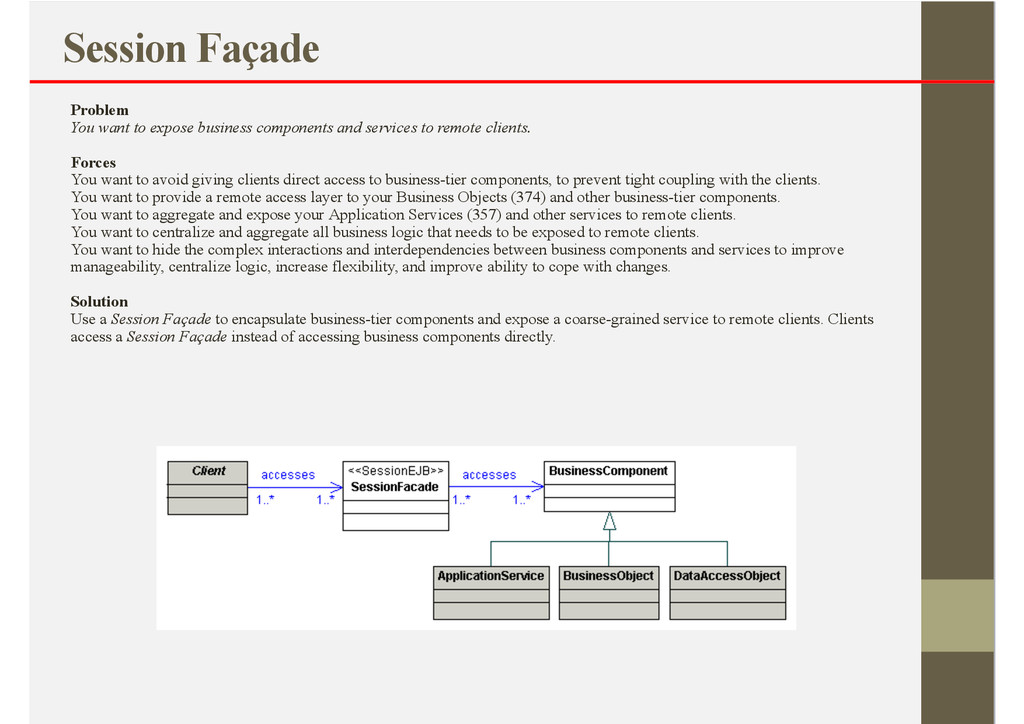
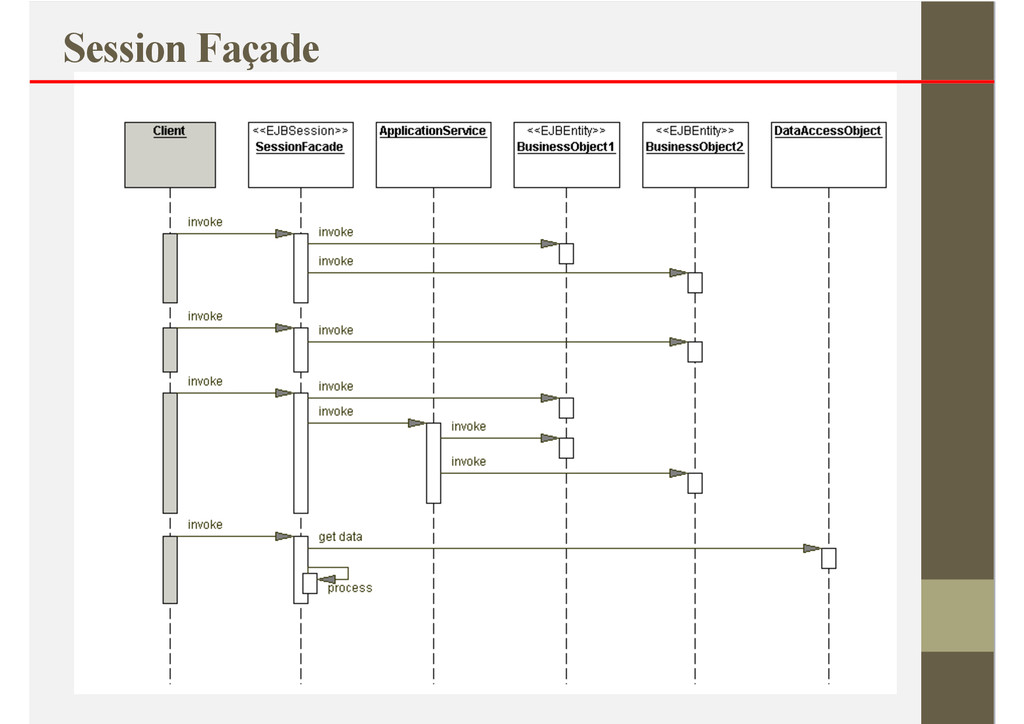
remote clients. Forces You want to avoid giving clients direct access to business-tier components, to prevent tight coupling with the clients. You want to provide a remote access layer to your Business Objects (374) and other business-tier components. You want to aggregate and expose your Application Services (357) and other services to remote clients. You want to centralize and aggregate all business logic that needs to be exposed to remote clients. You want to hide the complex interactions and interdependencies between business components and services to improve manageability, centralize logic, increase flexibility, and improve ability to cope with changes. Solution Use a Session Façade to encapsulate business-tier components and expose a coarse-grained service to remote clients. Clients access a Session Façade instead of accessing business components directly. Session Façade
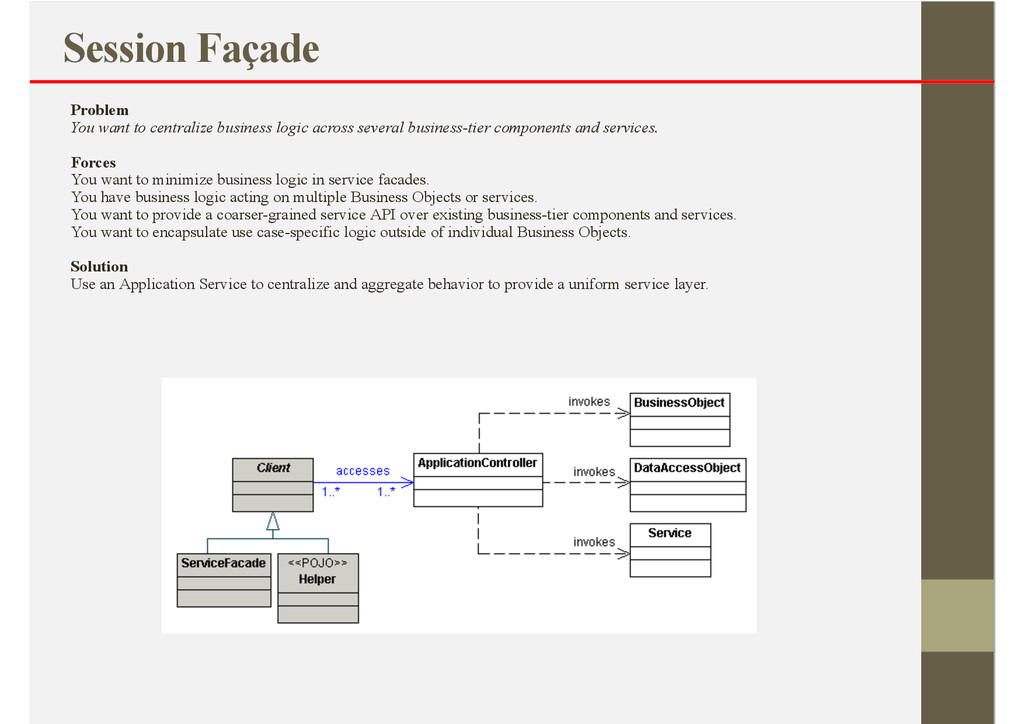
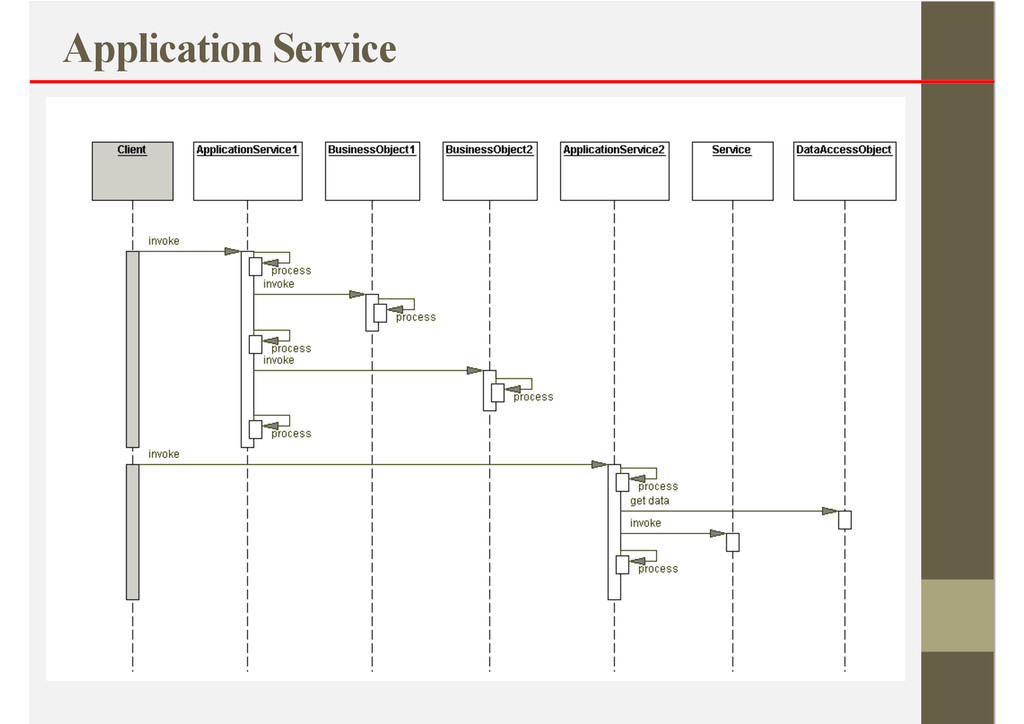
components and services. Forces You want to minimize business logic in service facades. You have business logic acting on multiple Business Objects or services. You want to provide a coarser-grained service API over existing business-tier components and services. You want to encapsulate use case-specific logic outside of individual Business Objects. Solution Use an Application Service to centralize and aggregate behavior to provide a uniform service layer. Session Façade
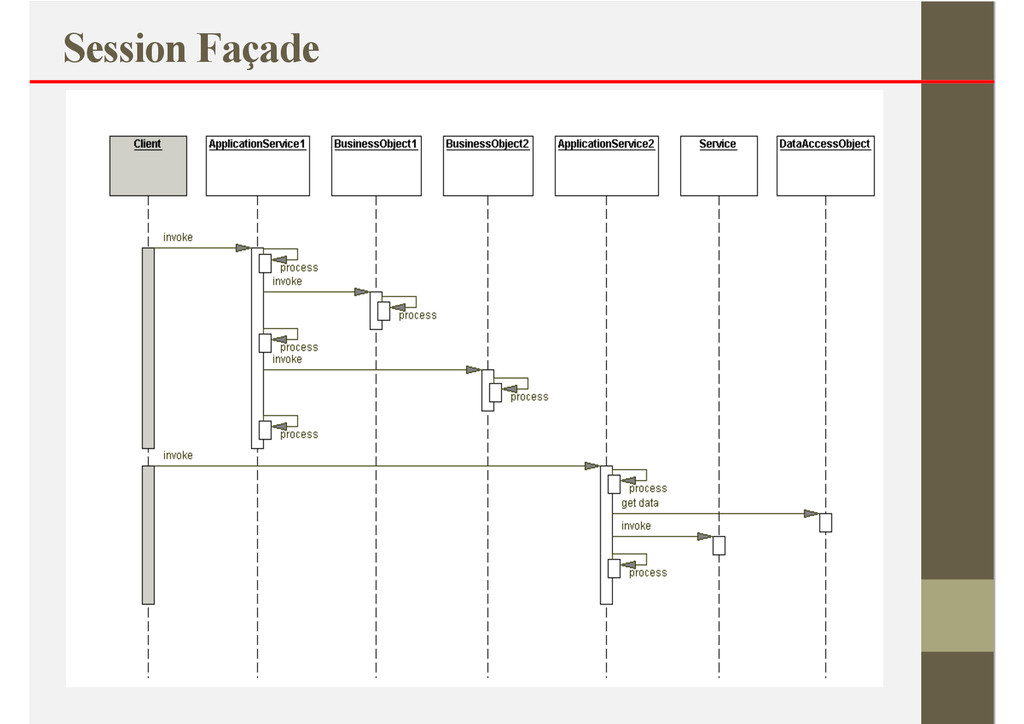
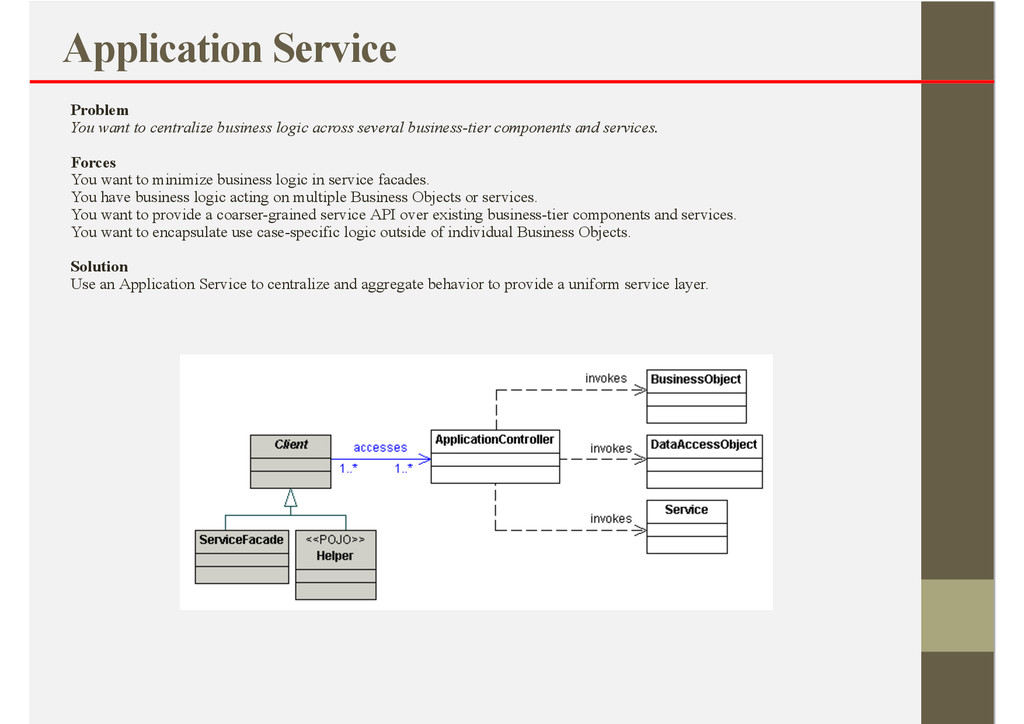
components and services. Forces You want to minimize business logic in service facades. You have business logic acting on multiple Business Objects or services. You want to provide a coarser-grained service API over existing business-tier components and services. You want to encapsulate use case-specific logic outside of individual Business Objects. Solution Use an Application Service to centralize and aggregate behavior to provide a uniform service layer. Application Service
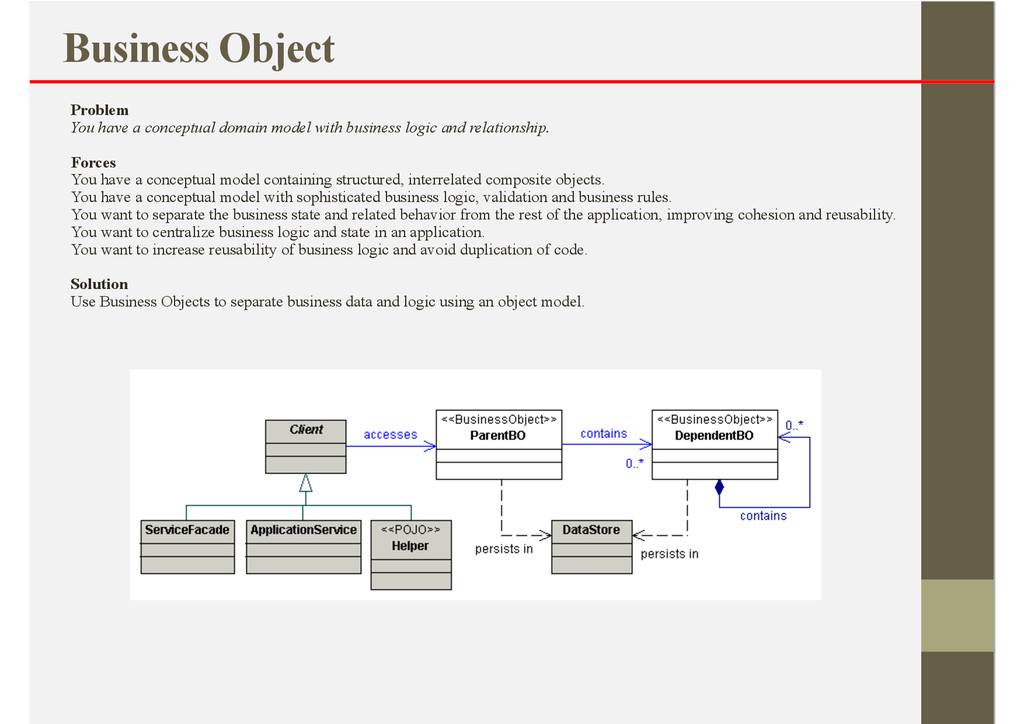
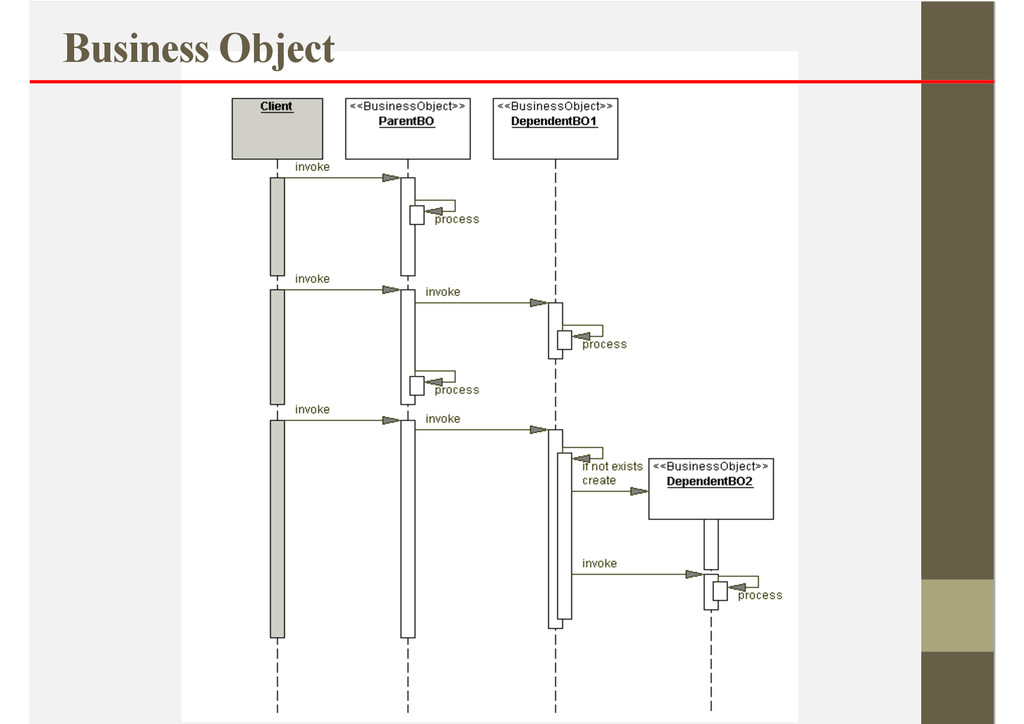
and relationship. Forces You have a conceptual model containing structured, interrelated composite objects. You have a conceptual model with sophisticated business logic, validation and business rules. You want to separate the business state and related behavior from the rest of the application, improving cohesion and reusability. You want to centralize business logic and state in an application. You want to increase reusability of business logic and avoid duplication of code. Solution Use Business Objects to separate business data and logic using an object model. Business Object
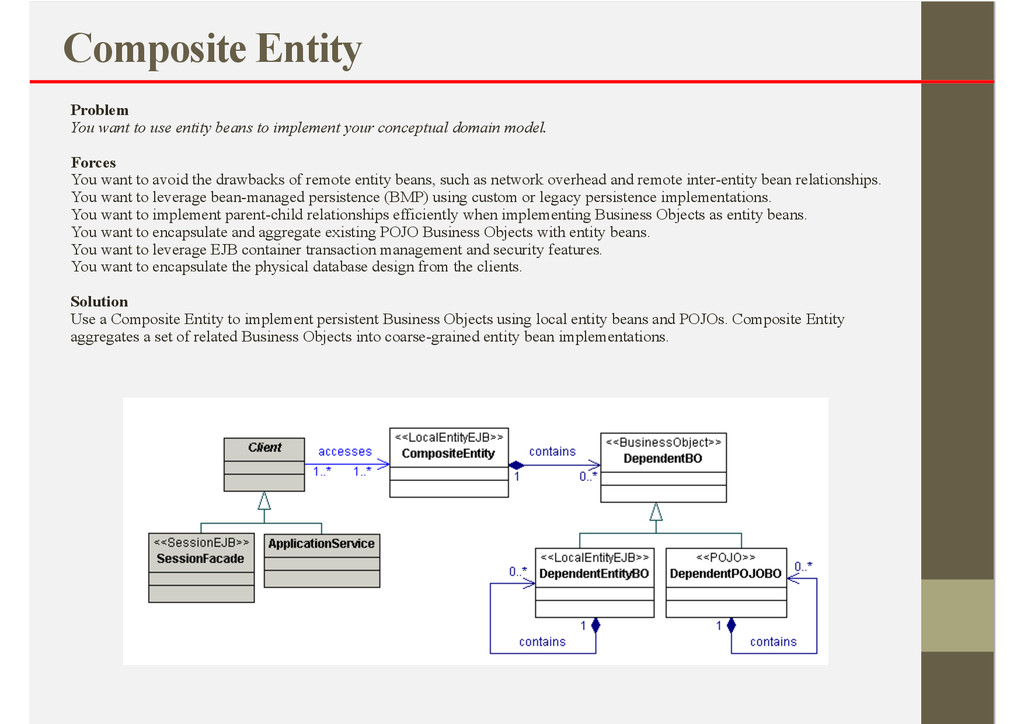
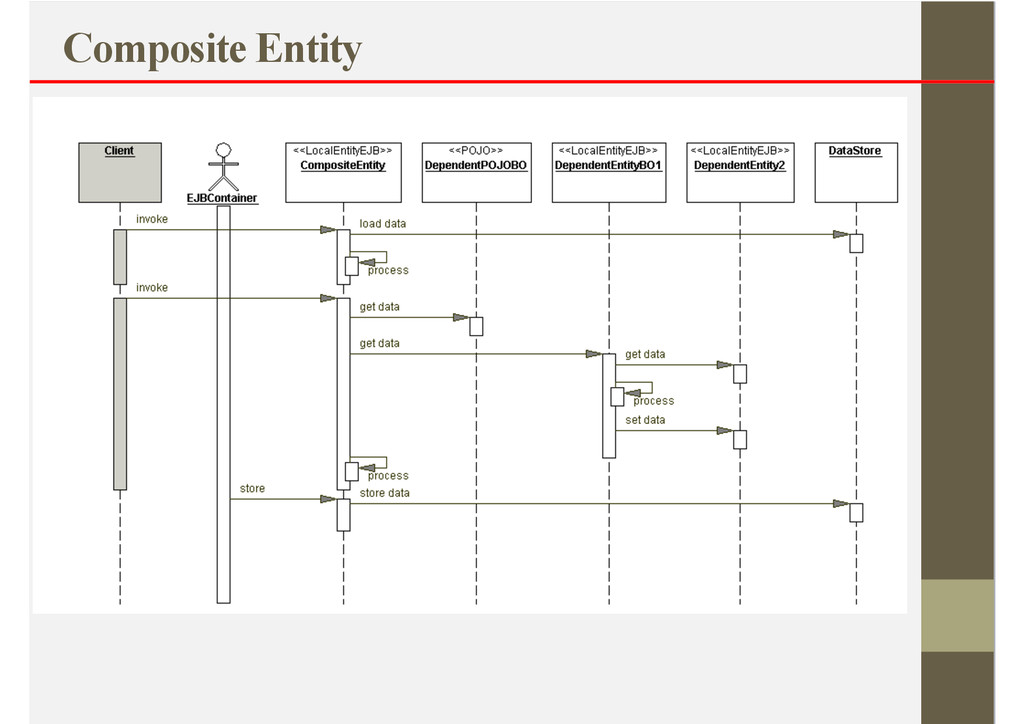
conceptual domain model. Forces You want to avoid the drawbacks of remote entity beans, such as network overhead and remote inter-entity bean relationships. You want to leverage bean-managed persistence (BMP) using custom or legacy persistence implementations. You want to implement parent-child relationships efficiently when implementing Business Objects as entity beans. You want to encapsulate and aggregate existing POJO Business Objects with entity beans. You want to leverage EJB container transaction management and security features. You want to encapsulate the physical database design from the clients. Solution Use a Composite Entity to implement persistent Business Objects using local entity beans and POJOs. Composite Entity aggregates a set of related Business Objects into coarse-grained entity bean implementations. Composite Entity
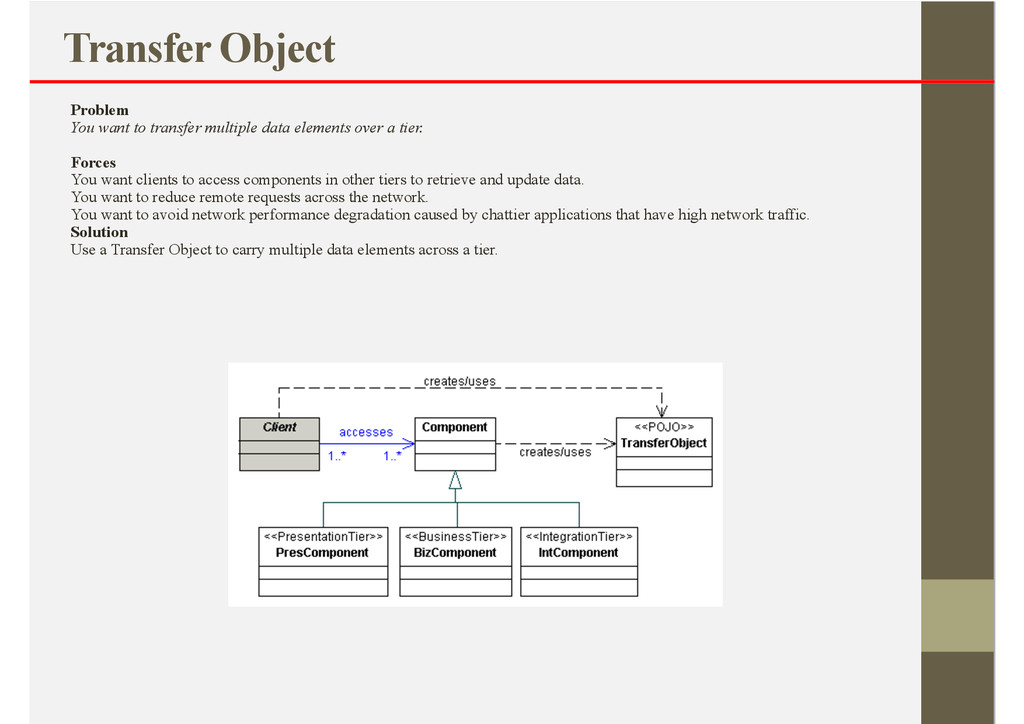
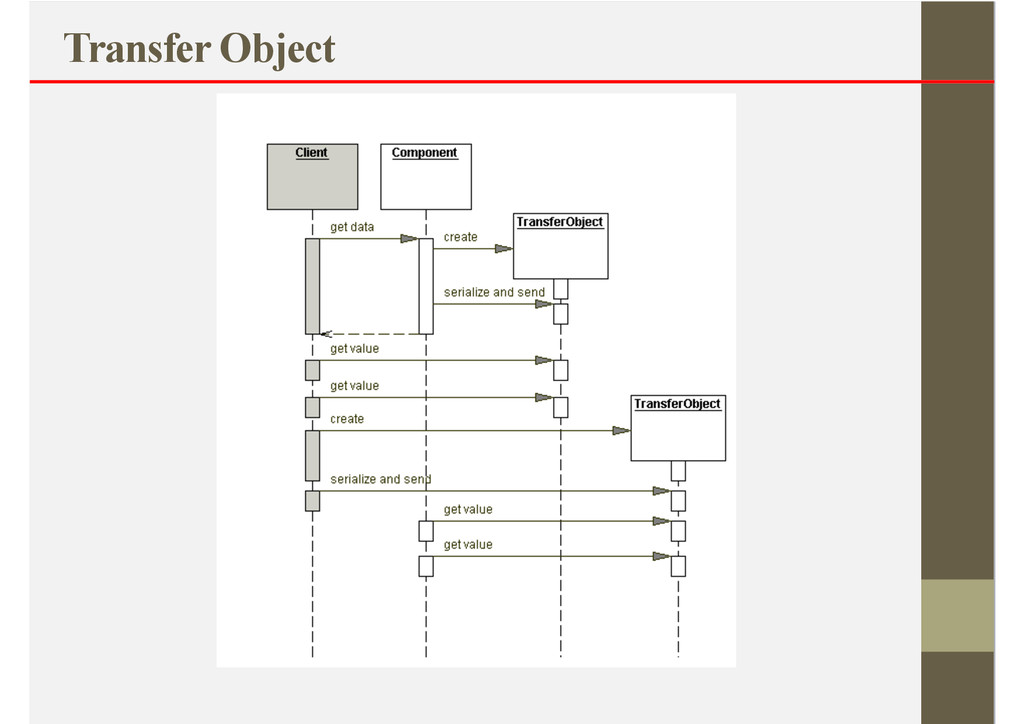
tier. Forces You want clients to access components in other tiers to retrieve and update data. You want to reduce remote requests across the network. You want to avoid network performance degradation caused by chattier applications that have high network traffic. Solution Use a Transfer Object to carry multiple data elements across a tier. Transfer Object
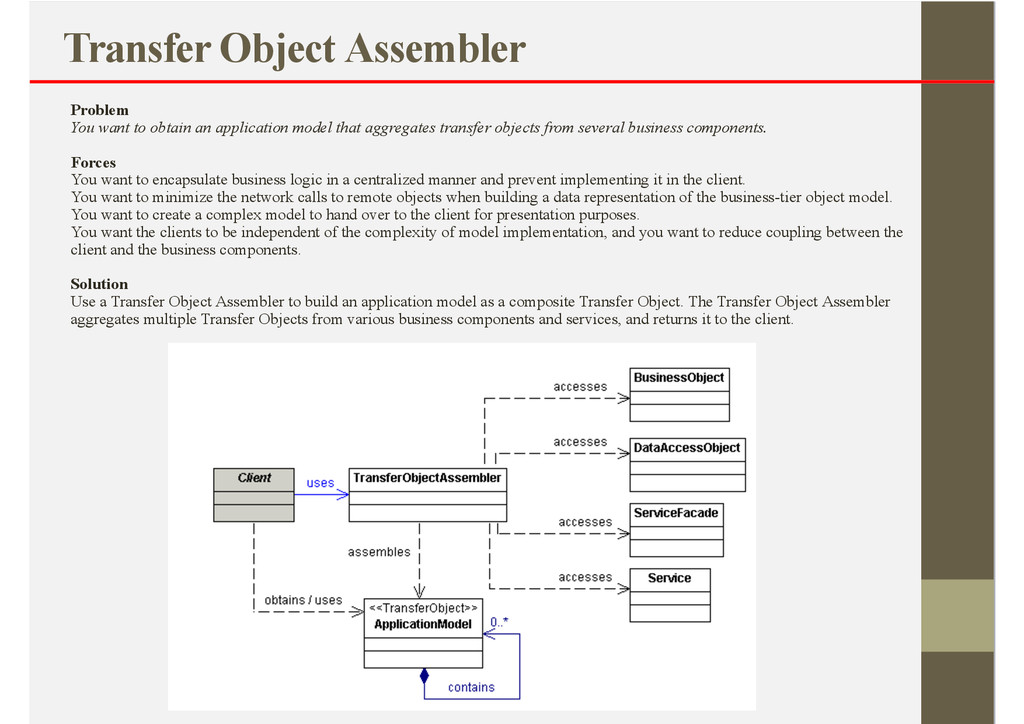
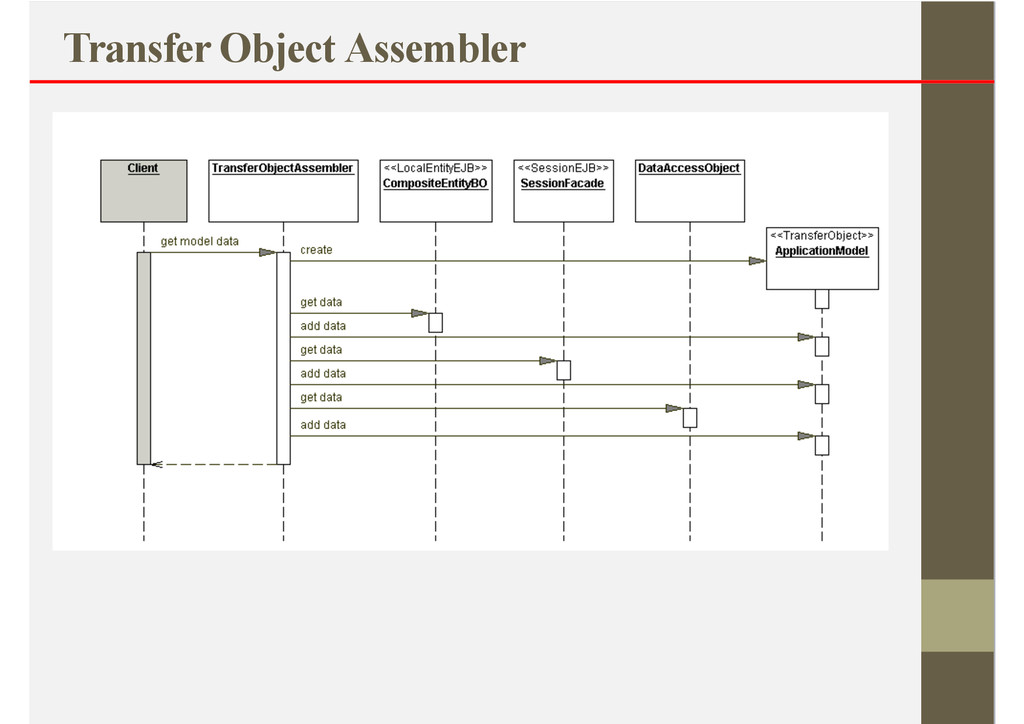
transfer objects from several business components. Forces You want to encapsulate business logic in a centralized manner and prevent implementing it in the client. You want to minimize the network calls to remote objects when building a data representation of the business-tier object model. You want to create a complex model to hand over to the client for presentation purposes. You want the clients to be independent of the complexity of model implementation, and you want to reduce coupling between the client and the business components. Solution Use a Transfer Object Assembler to build an application model as a composite Transfer Object. The Transfer Object Assembler aggregates multiple Transfer Objects from various business components and services, and returns it to the client. Transfer Object Assembler
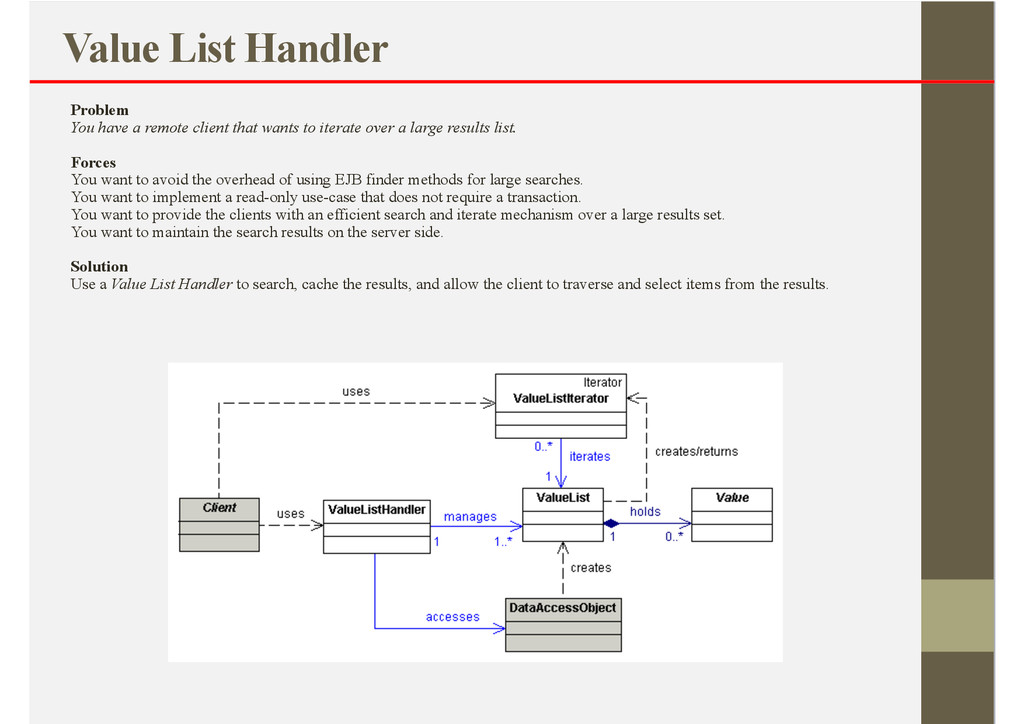
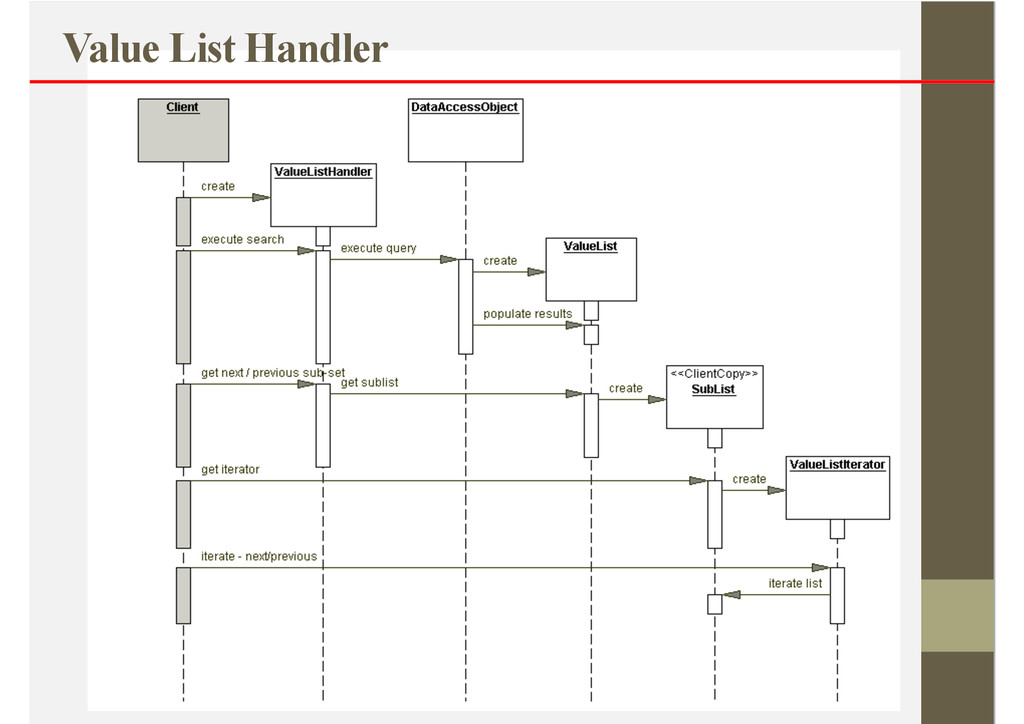
over a large results list. Forces You want to avoid the overhead of using EJB finder methods for large searches. You want to implement a read-only use-case that does not require a transaction. You want to provide the clients with an efficient search and iterate mechanism over a large results set. You want to maintain the search results on the server side. Solution Use a Value List Handler to search, cache the results, and allow the client to traverse and select items from the results. Value List Handler
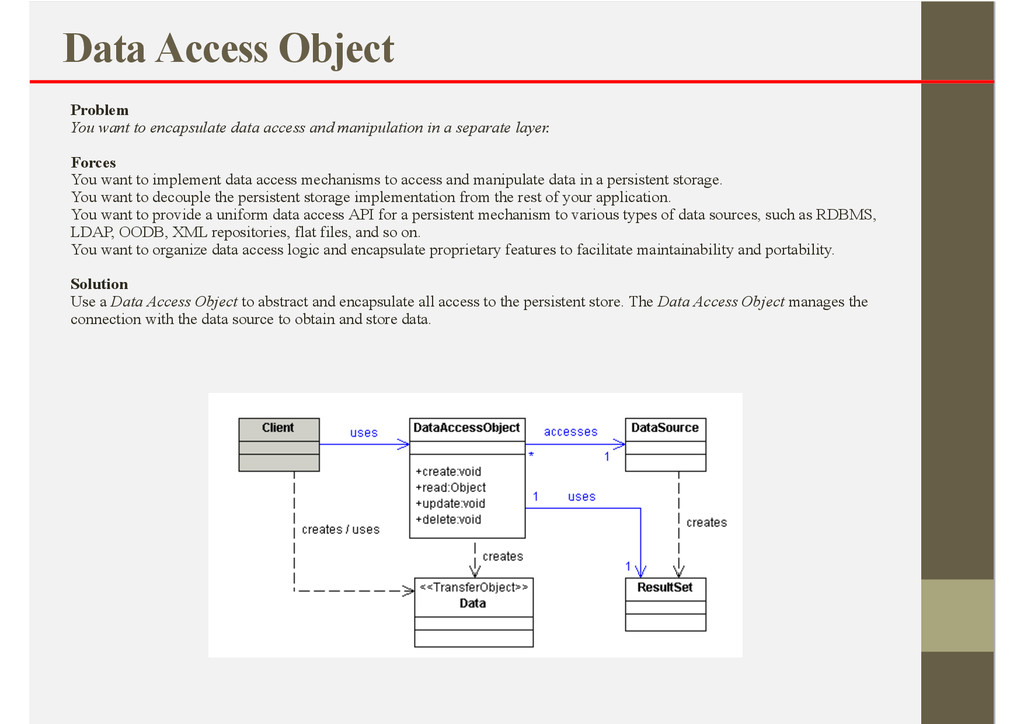
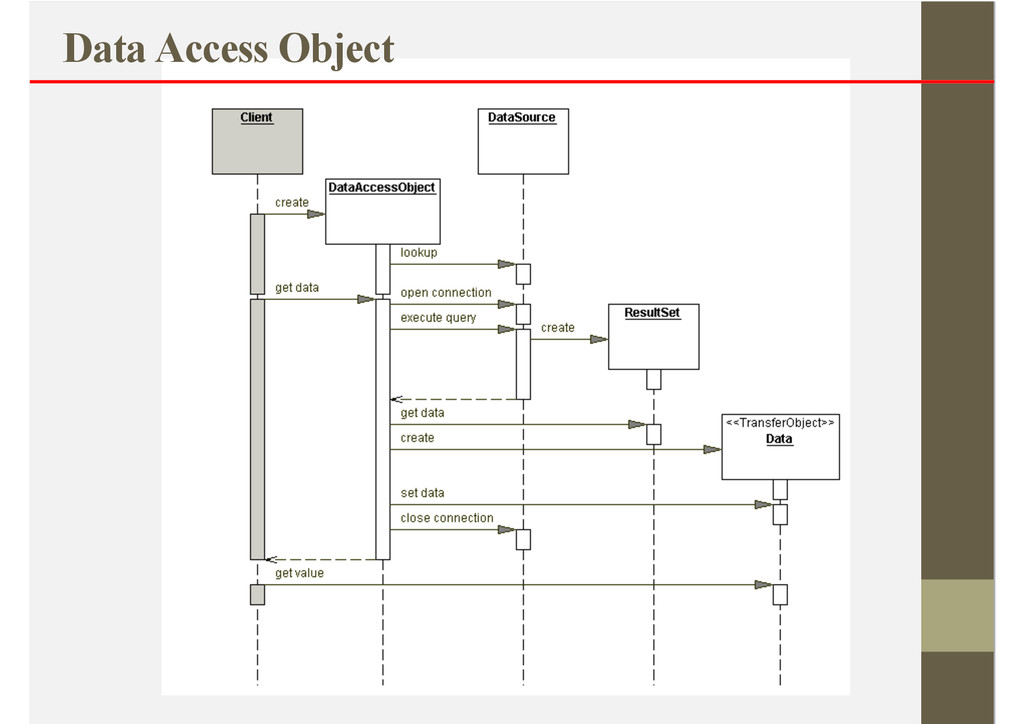
a separate layer. Forces You want to implement data access mechanisms to access and manipulate data in a persistent storage. You want to decouple the persistent storage implementation from the rest of your application. You want to provide a uniform data access API for a persistent mechanism to various types of data sources, such as RDBMS, LDAP, OODB, XML repositories, flat files, and so on. You want to organize data access logic and encapsulate proprietary features to facilitate maintainability and portability. Solution Use a Data Access Object to abstract and encapsulate all access to the persistent store. The Data Access Object manages the connection with the data source to obtain and store data. Data Access Object
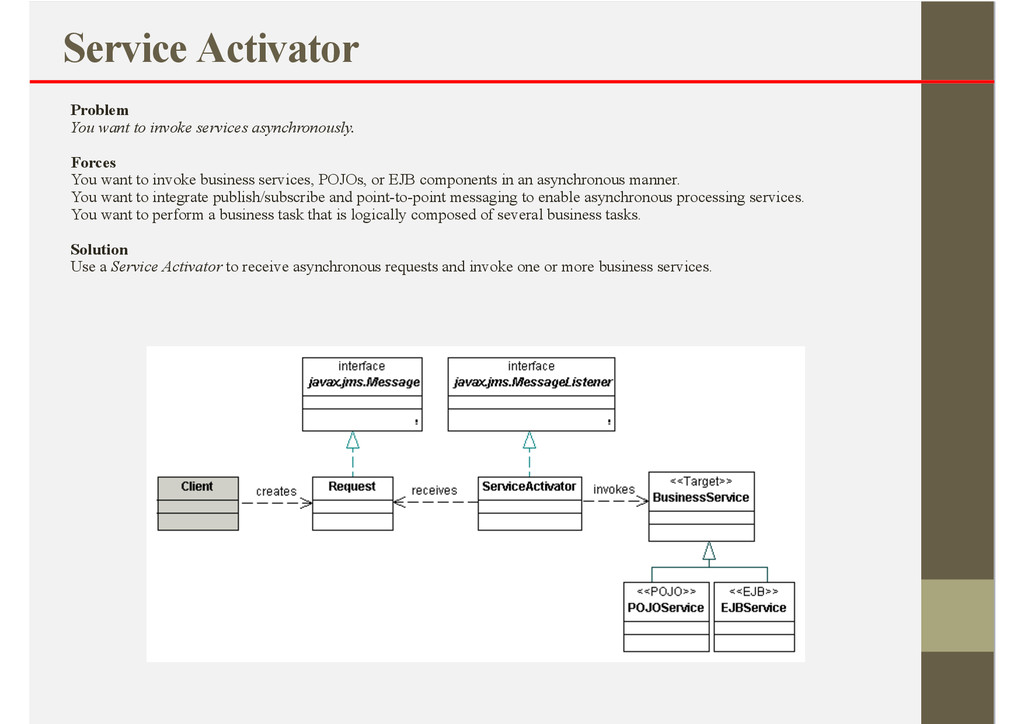
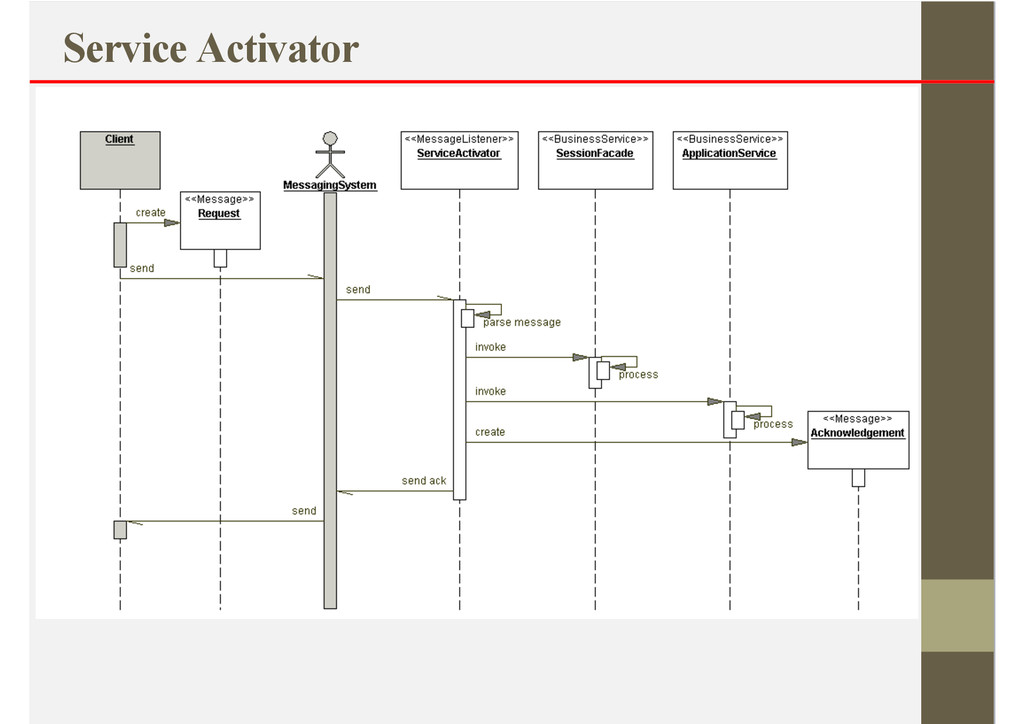
to invoke business services, POJOs, or EJB components in an asynchronous manner. You want to integrate publish/subscribe and point-to-point messaging to enable asynchronous processing services. You want to perform a business task that is logically composed of several business tasks. Solution Use a Service Activator to receive asynchronous requests and invoke one or more business services. Service Activator
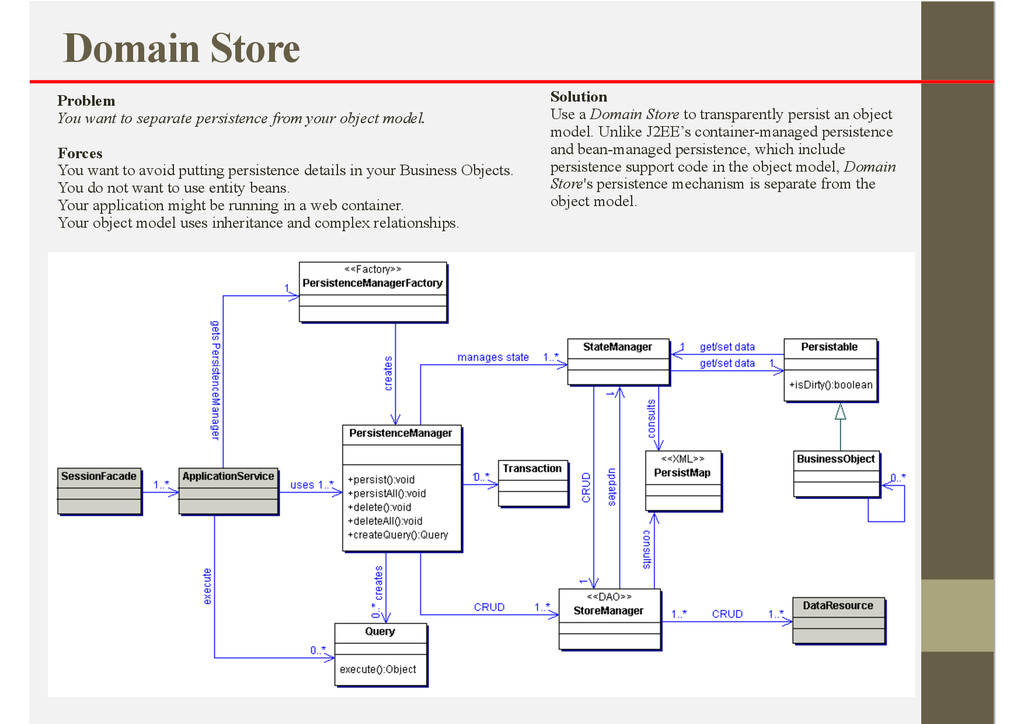
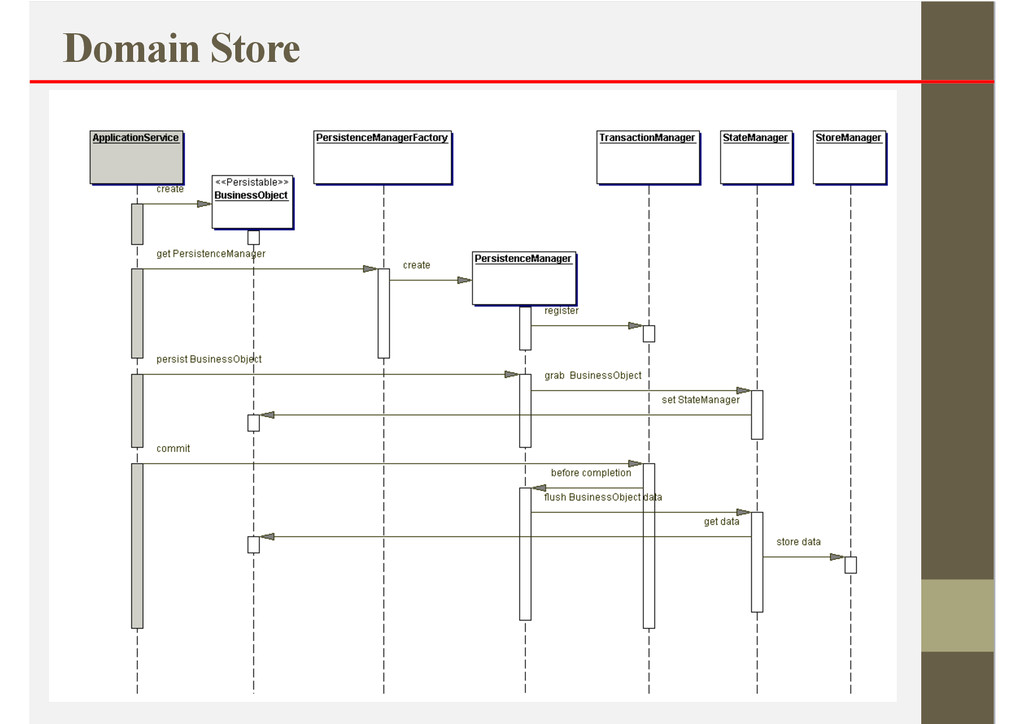
object model. Forces You want to avoid putting persistence details in your Business Objects. You do not want to use entity beans. Your application might be running in a web container. Your object model uses inheritance and complex relationships. Solution Use a Domain Store to transparently persist an object model. Unlike J2EE’s container-managed persistence and bean-managed persistence, which include persistence support code in the object model, Domain Store's persistence mechanism is separate from the object model.
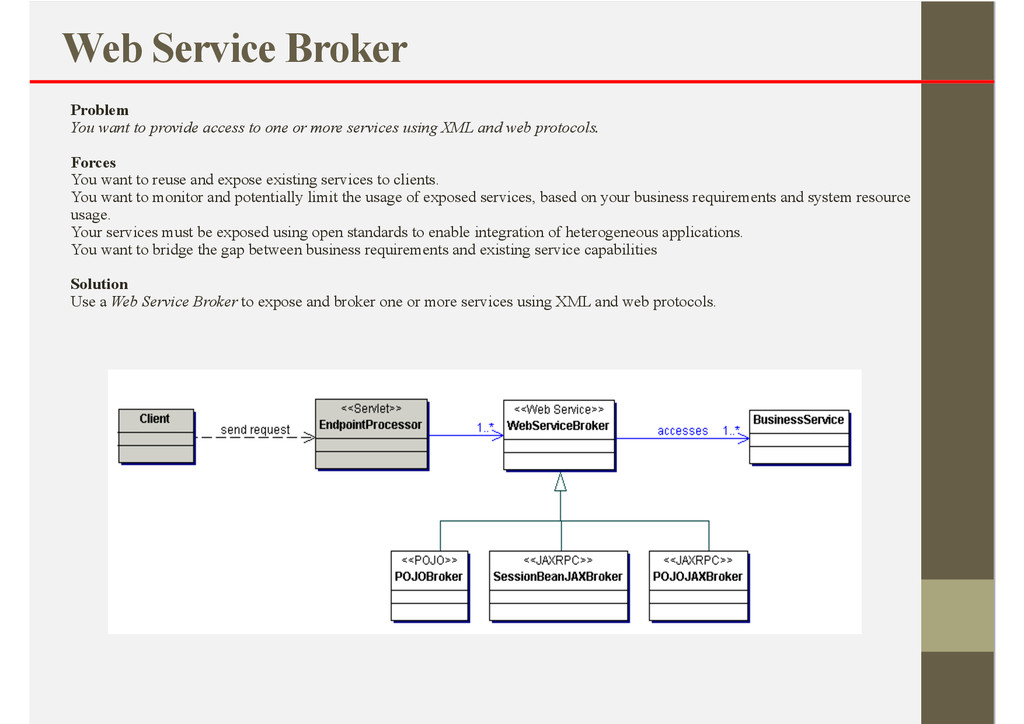
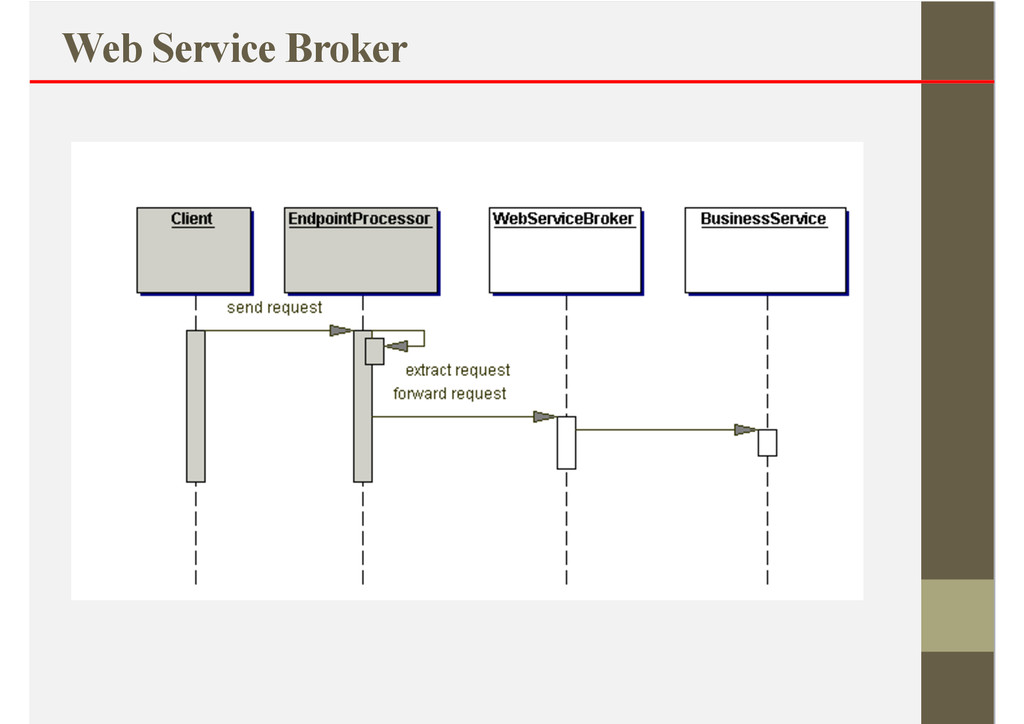
services using XML and web protocols. Forces You want to reuse and expose existing services to clients. You want to monitor and potentially limit the usage of exposed services, based on your business requirements and system resource usage. Your services must be exposed using open standards to enable integration of heterogeneous applications. You want to bridge the gap between business requirements and existing service capabilities Solution Use a Web Service Broker to expose and broker one or more services using XML and web protocols. Web Service Broker


 deka_morita
 falcon8823
 nabondance
 neuecc
 sorah
 oku053
 yutobara
 yumnumm
 econanringo
 lef237
 moro
 tmikov2023
 aleyda
 rasmusluckow
 watany
 jonrohan
 sergeychernyshev
 jonoalderson
 irinanazarova
 portentint
 honzajavorek
 rocio
 addyosmani
 jcasabona