Upgrade to Pro — share decks privately, control downloads, hide ads and more …

The State of Cloud Engineering: Skills, Signals...

Sponsored · Ship Features Fearlessly Turn features on and off without deploys. Used by thousands of Ruby developers.

The State of Cloud Engineering: Skills, Signals and Survival

Cloud engineering has moved beyond knowing tools and collecting certifications. In today’s ecosystem, what matters is which skills compound, which signals truly reflect impact, and how engineers adapt as roles shift from infrastructure maintenance to platform enablement.

This session explores the real state of cloud engineering in 2026, what teams are hiring for, why many engineers feel stuck or behind, and how to distinguish being busy from being valuable. We’ll examine the signals that separate growth from stagnation and the practical strategies engineers can use to stay relevant in a fast-moving industry.

Whether you’re early in your cloud journey or navigating the next phase of your career, this talk offers a grounded reset on how to survive and thrive in modern cloud engineering.

Avatar for shedrack akintayo

shedrack akintayo

January 31, 2026
Tweet

More Decks by shedrack akintayo

Other Decks in Programming

Transcript

  1. The State of Cloud Engineering: Skills, Signals and Survival CNCF

    Kaduna — January 2026 Shedrack Akintayo Technical Writer at Traefik & CNCF Ambassador
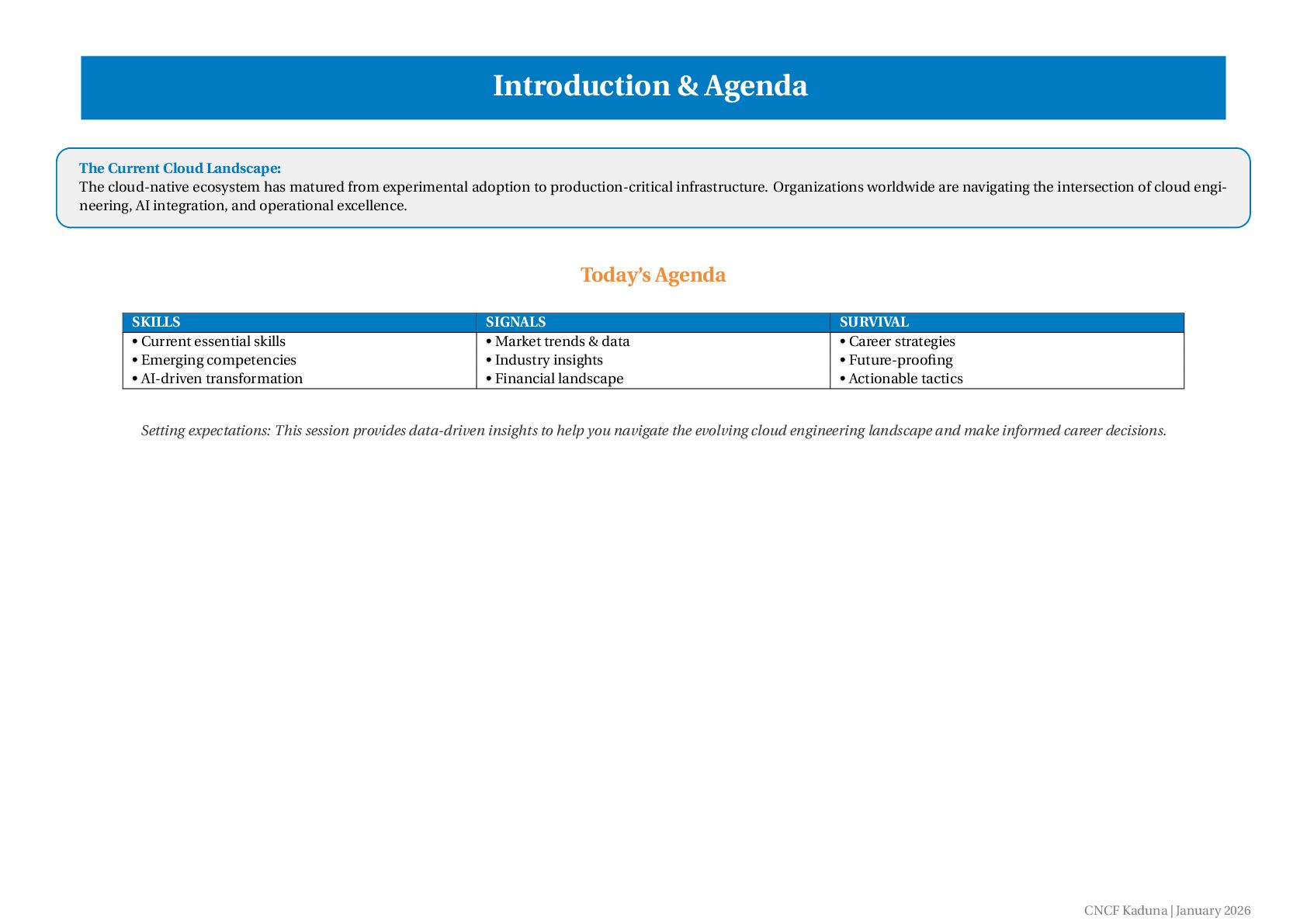
  2. Introduction & Agenda The Current Cloud Landscape: The cloud-native ecosystem

    has matured from experimental adoption to production-critical infrastructure. Organizations worldwide are navigating the intersection of cloud engi- neering, AI integration, and operational excellence. Today’s Agenda SKILLS SIGNALS SURVIVAL • Current essential skills • Market trends & data • Career strategies • Emerging competencies • Industry insights • Future-proofing • AI-driven transformation • Financial landscape • Actionable tactics Setting expectations: This session provides data-driven insights to help you navigate the evolving cloud engineering landscape and make informed career decisions. CNCF Kaduna | January 2026
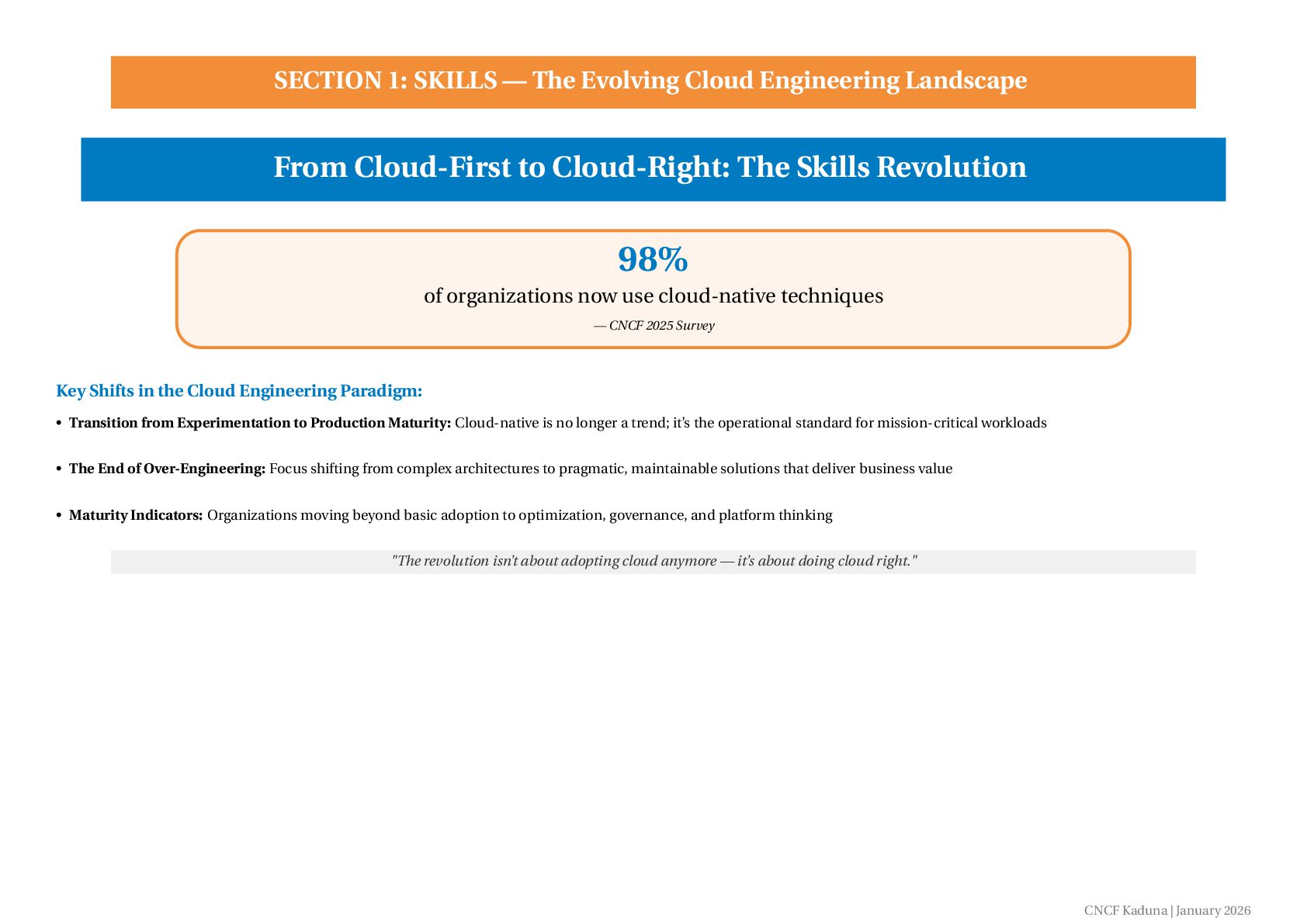
  3. SECTION 1: SKILLS — The Evolving Cloud Engineering Landscape From

    Cloud-First to Cloud-Right: The Skills Revolution 98% of organizations now use cloud-native techniques — CNCF 2025 Survey Key Shifts in the Cloud Engineering Paradigm: • Transition from Experimentation to Production Maturity: Cloud-native is no longer a trend; it’s the operational standard for mission-critical workloads • The End of Over-Engineering: Focus shifting from complex architectures to pragmatic, maintainable solutions that deliver business value • Maturity Indicators: Organizations moving beyond basic adoption to optimization, governance, and platform thinking "The revolution isn’t about adopting cloud anymore — it’s about doing cloud right." CNCF Kaduna | January 2026
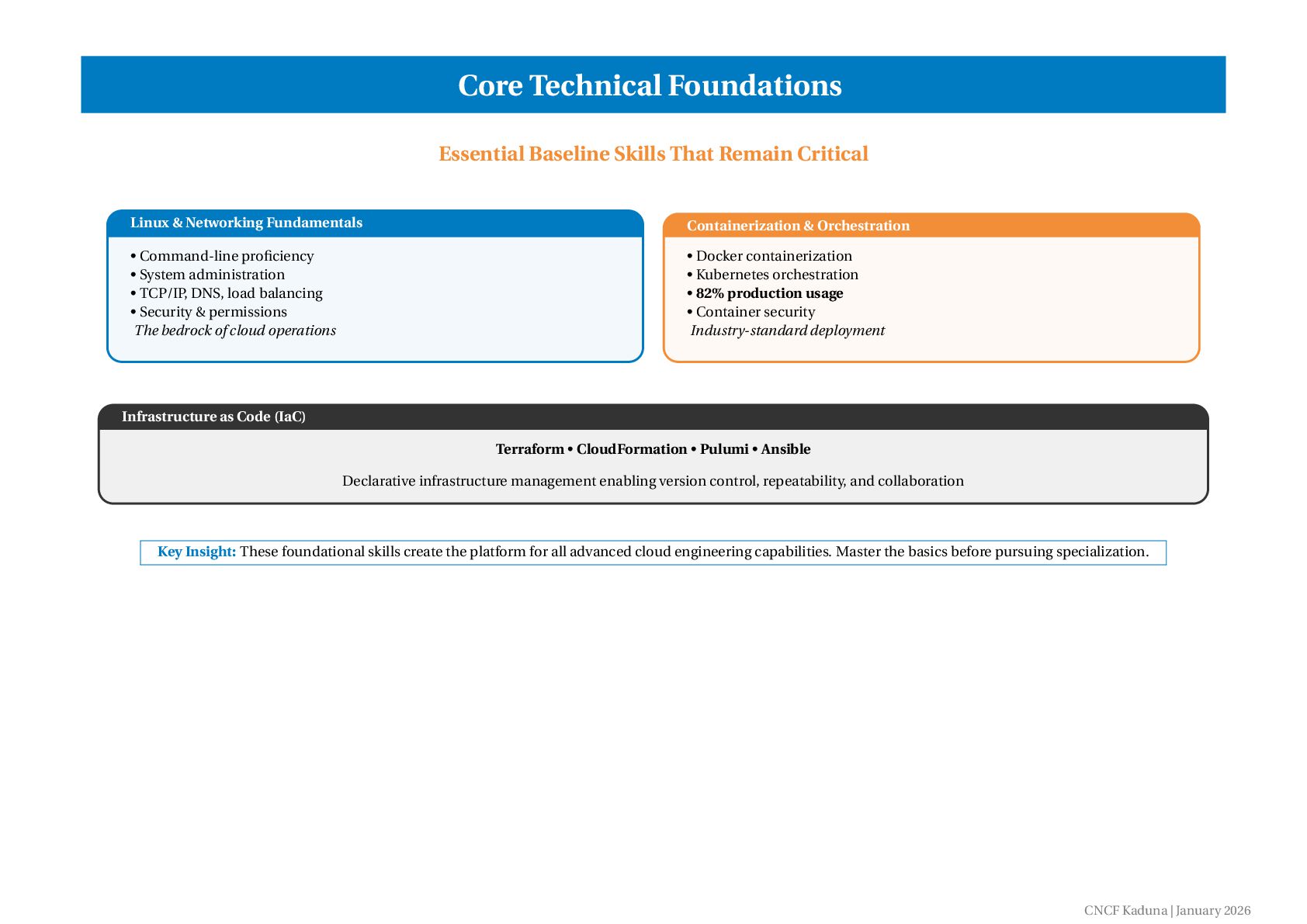
  4. Core Technical Foundations Essential Baseline Skills That Remain Critical Linux

    & Networking Fundamentals • Command-line proficiency • System administration • TCP/IP, DNS, load balancing • Security & permissions The bedrock of cloud operations Containerization & Orchestration • Docker containerization • Kubernetes orchestration • 82% production usage • Container security Industry-standard deployment Infrastructure as Code (IaC) Terraform • CloudFormation • Pulumi • Ansible Declarative infrastructure management enabling version control, repeatability, and collaboration Key Insight: These foundational skills create the platform for all advanced cloud engineering capabilities. Master the basics before pursuing specialization. CNCF Kaduna | January 2026
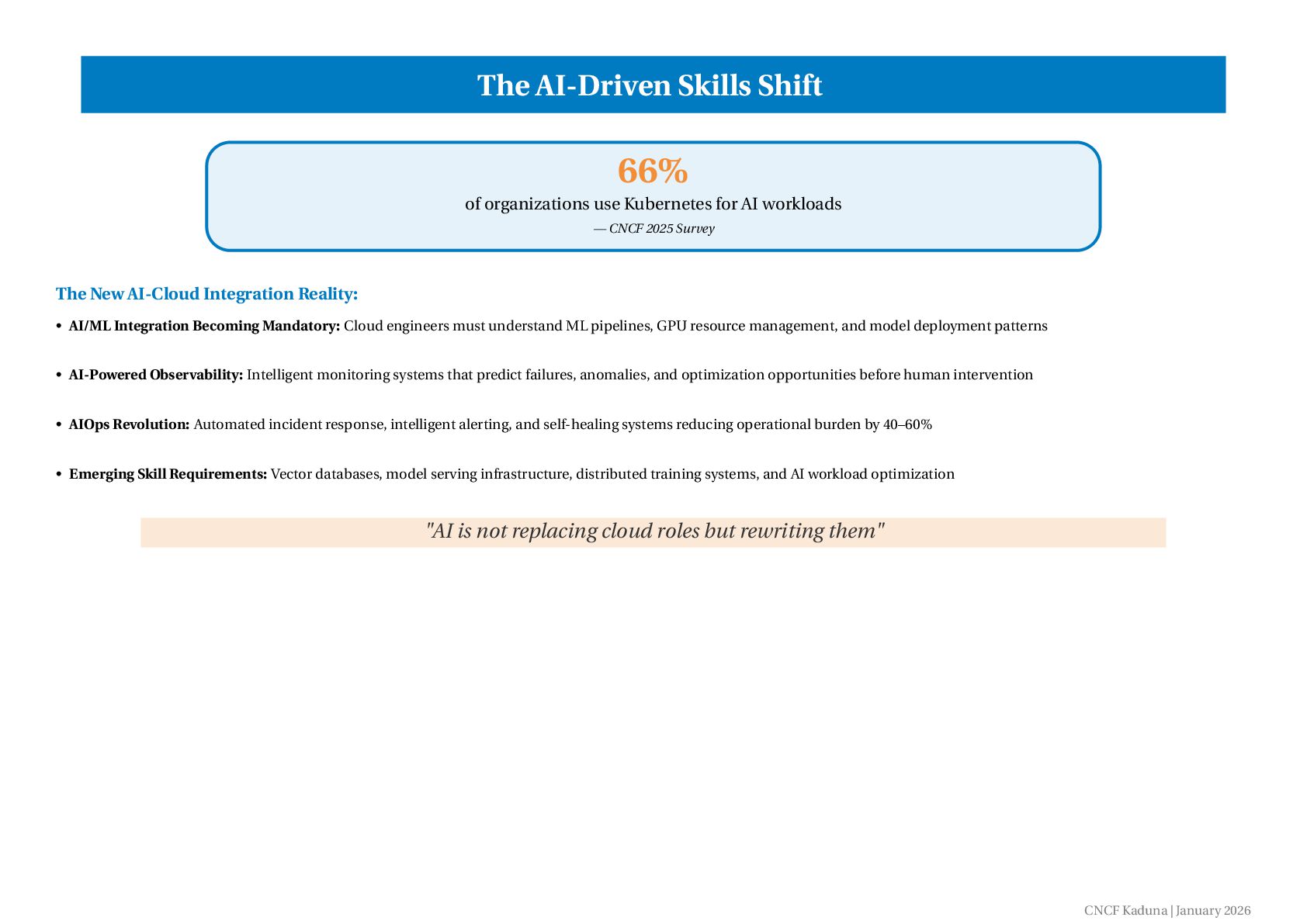
  5. The AI-Driven Skills Shift 66% of organizations use Kubernetes for

    AI workloads — CNCF 2025 Survey The New AI-Cloud Integration Reality: • AI/ML Integration Becoming Mandatory: Cloud engineers must understand ML pipelines, GPU resource management, and model deployment patterns • AI-Powered Observability: Intelligent monitoring systems that predict failures, anomalies, and optimization opportunities before human intervention • AIOps Revolution: Automated incident response, intelligent alerting, and self-healing systems reducing operational burden by 40–60% • Emerging Skill Requirements: Vector databases, model serving infrastructure, distributed training systems, and AI workload optimization "AI is not replacing cloud roles but rewriting them" CNCF Kaduna | January 2026
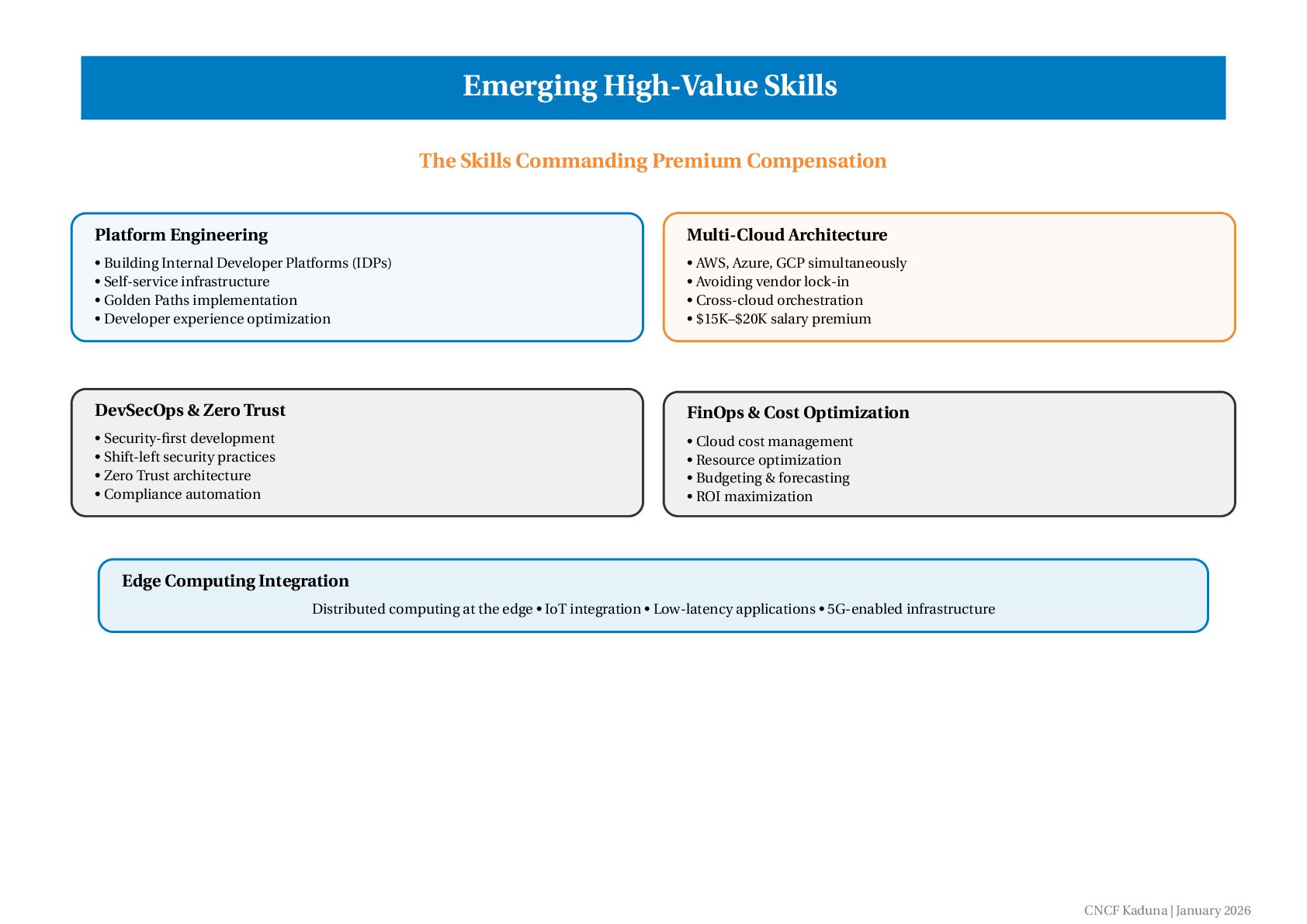
  6. Emerging High-Value Skills The Skills Commanding Premium Compensation Platform Engineering

    • Building Internal Developer Platforms (IDPs) • Self-service infrastructure • Golden Paths implementation • Developer experience optimization Multi-Cloud Architecture • AWS, Azure, GCP simultaneously • Avoiding vendor lock-in • Cross-cloud orchestration • $15K–$20K salary premium DevSecOps & Zero Trust • Security-first development • Shift-left security practices • Zero Trust architecture • Compliance automation FinOps & Cost Optimization • Cloud cost management • Resource optimization • Budgeting & forecasting • ROI maximization Edge Computing Integration Distributed computing at the edge • IoT integration • Low-latency applications • 5G-enabled infrastructure CNCF Kaduna | January 2026
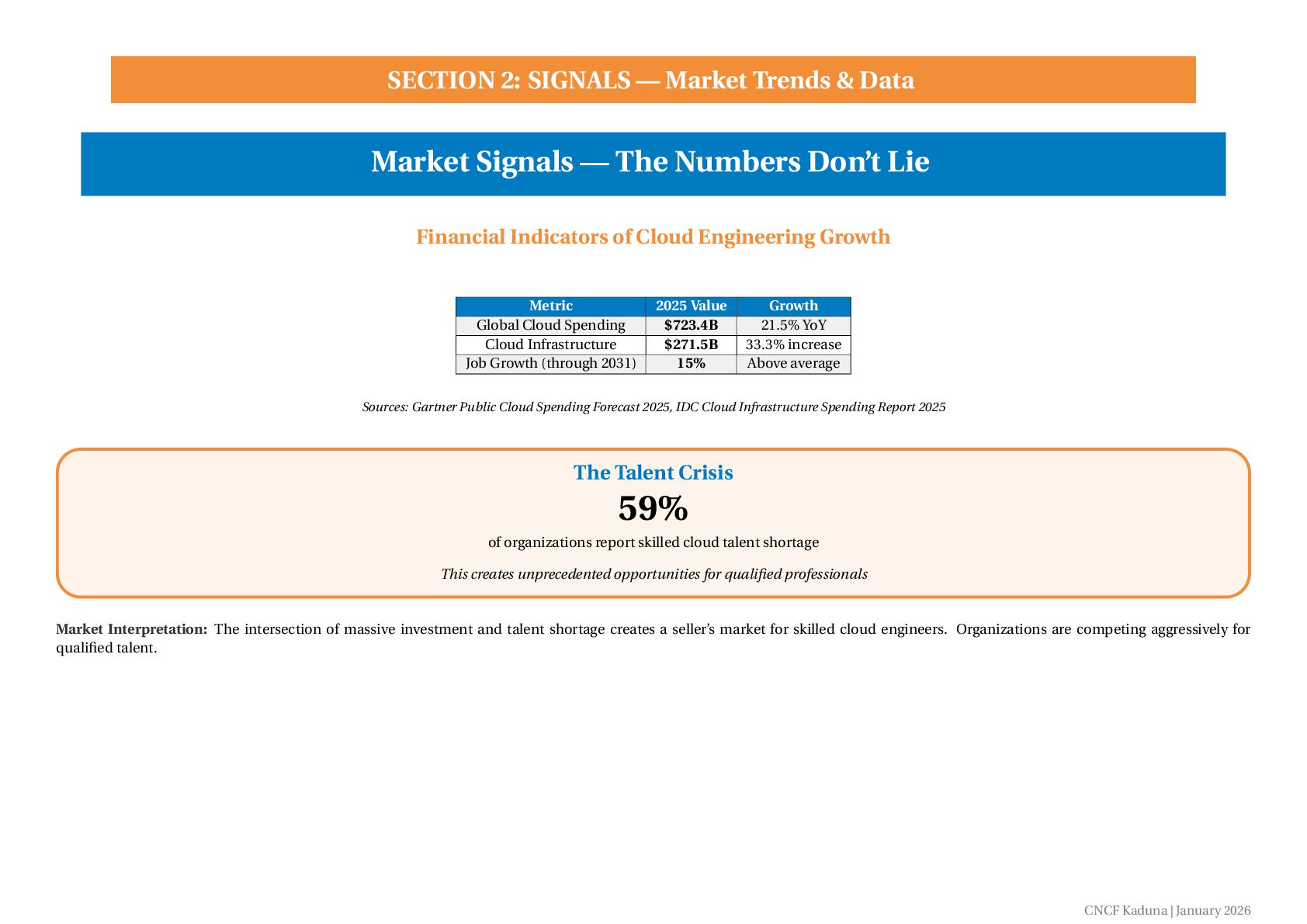
  7. SECTION 2: SIGNALS — Market Trends & Data Market Signals

    — The Numbers Don’t Lie Financial Indicators of Cloud Engineering Growth Metric 2025 Value Growth Global Cloud Spending $723.4B 21.5% YoY Cloud Infrastructure $271.5B 33.3% increase Job Growth (through 2031) 15% Above average Sources: Gartner Public Cloud Spending Forecast 2025, IDC Cloud Infrastructure Spending Report 2025 The Talent Crisis 59% of organizations report skilled cloud talent shortage This creates unprecedented opportunities for qualified professionals Market Interpretation: The intersection of massive investment and talent shortage creates a seller’s market for skilled cloud engineers. Organizations are competing aggressively for qualified talent. CNCF Kaduna | January 2026
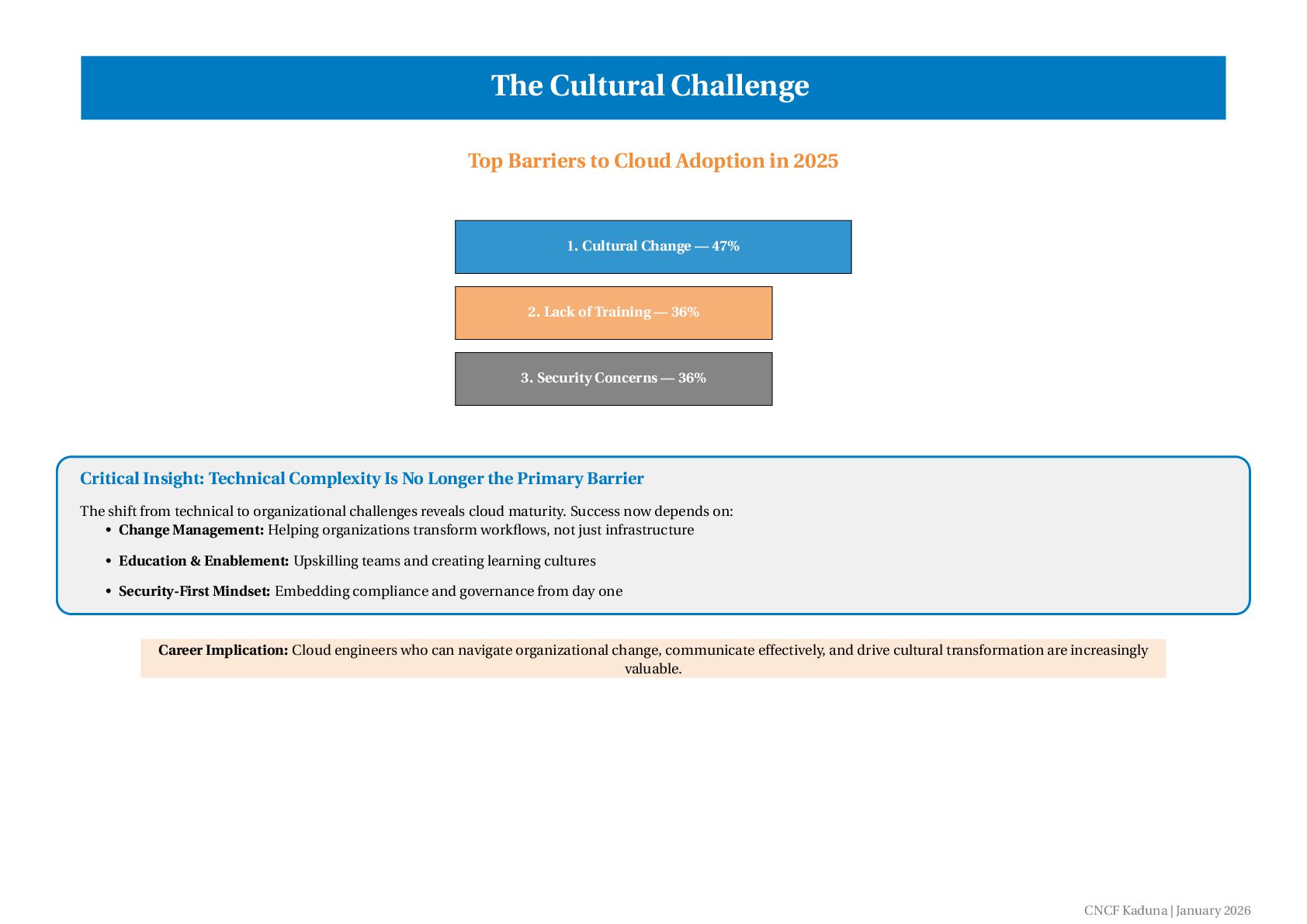
  8. The Cultural Challenge Top Barriers to Cloud Adoption in 2025

    1. Cultural Change — 47% 2. Lack of Training — 36% 3. Security Concerns — 36% Critical Insight: Technical Complexity Is No Longer the Primary Barrier The shift from technical to organizational challenges reveals cloud maturity. Success now depends on: • Change Management: Helping organizations transform workflows, not just infrastructure • Education & Enablement: Upskilling teams and creating learning cultures • Security-First Mindset: Embedding compliance and governance from day one Career Implication: Cloud engineers who can navigate organizational change, communicate effectively, and drive cultural transformation are increasingly valuable. CNCF Kaduna | January 2026
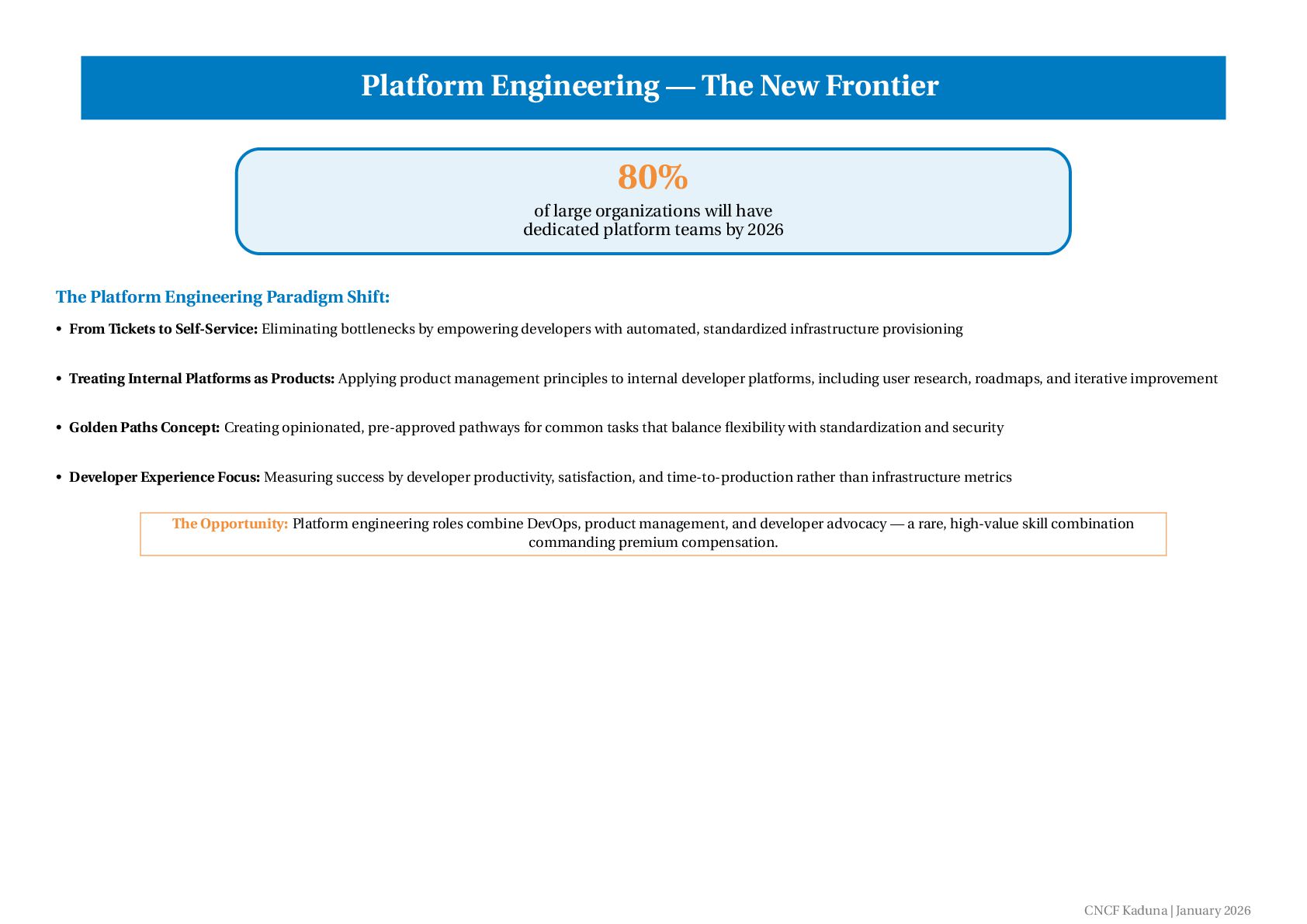
  9. Platform Engineering — The New Frontier 80% of large organizations

    will have dedicated platform teams by 2026 The Platform Engineering Paradigm Shift: • From Tickets to Self-Service: Eliminating bottlenecks by empowering developers with automated, standardized infrastructure provisioning • Treating Internal Platforms as Products: Applying product management principles to internal developer platforms, including user research, roadmaps, and iterative improvement • Golden Paths Concept: Creating opinionated, pre-approved pathways for common tasks that balance flexibility with standardization and security • Developer Experience Focus: Measuring success by developer productivity, satisfaction, and time-to-production rather than infrastructure metrics The Opportunity: Platform engineering roles combine DevOps, product management, and developer advocacy — a rare, high-value skill combination commanding premium compensation. CNCF Kaduna | January 2026
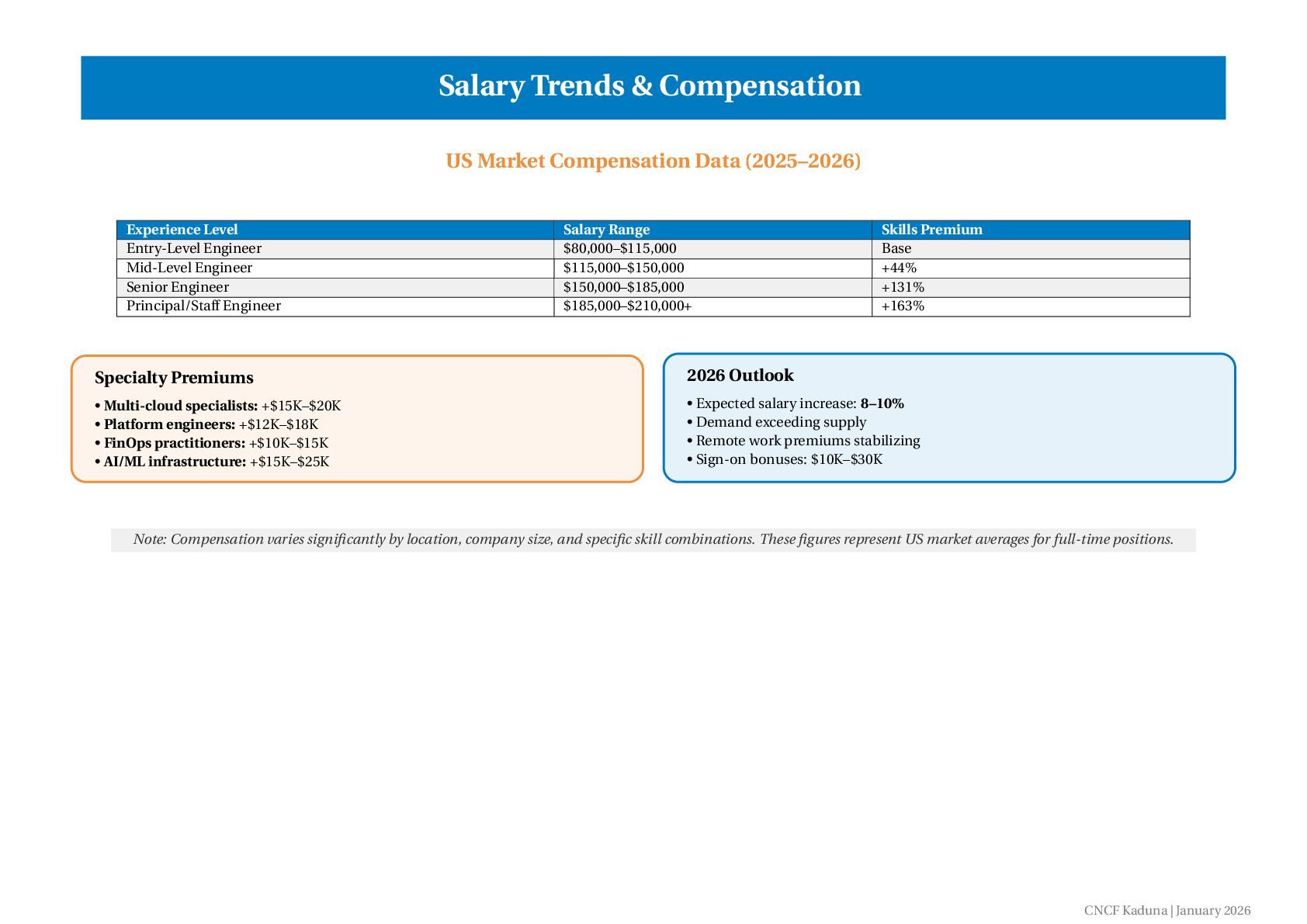
  10. Salary Trends & Compensation US Market Compensation Data (2025–2026) Experience

    Level Salary Range Skills Premium Entry-Level Engineer $80,000–$115,000 Base Mid-Level Engineer $115,000–$150,000 +44% Senior Engineer $150,000–$185,000 +131% Principal/Staff Engineer $185,000–$210,000+ +163% Specialty Premiums • Multi-cloud specialists: +$15K–$20K • Platform engineers: +$12K–$18K • FinOps practitioners: +$10K–$15K • AI/ML infrastructure: +$15K–$25K 2026 Outlook • Expected salary increase: 8–10% • Demand exceeding supply • Remote work premiums stabilizing • Sign-on bonuses: $10K–$30K Note: Compensation varies significantly by location, company size, and specific skill combinations. These figures represent US market averages for full-time positions. CNCF Kaduna | January 2026
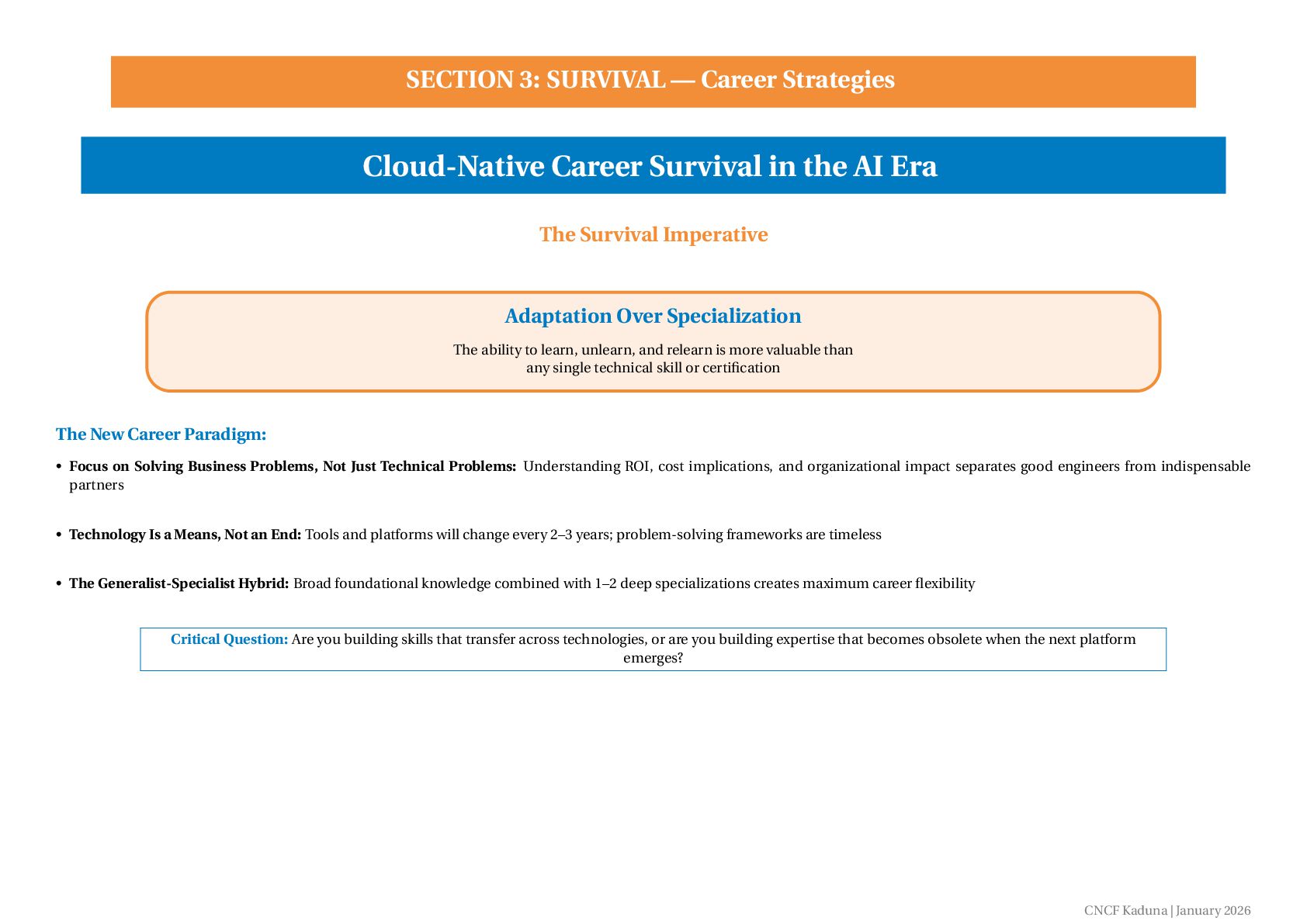
  11. SECTION 3: SURVIVAL — Career Strategies Cloud-Native Career Survival in

    the AI Era The Survival Imperative Adaptation Over Specialization The ability to learn, unlearn, and relearn is more valuable than any single technical skill or certification The New Career Paradigm: • Focus on Solving Business Problems, Not Just Technical Problems: Understanding ROI, cost implications, and organizational impact separates good engineers from indispensable partners • Technology Is a Means, Not an End: Tools and platforms will change every 2–3 years; problem-solving frameworks are timeless • The Generalist-Specialist Hybrid: Broad foundational knowledge combined with 1–2 deep specializations creates maximum career flexibility Critical Question: Are you building skills that transfer across technologies, or are you building expertise that becomes obsolete when the next platform emerges? CNCF Kaduna | January 2026
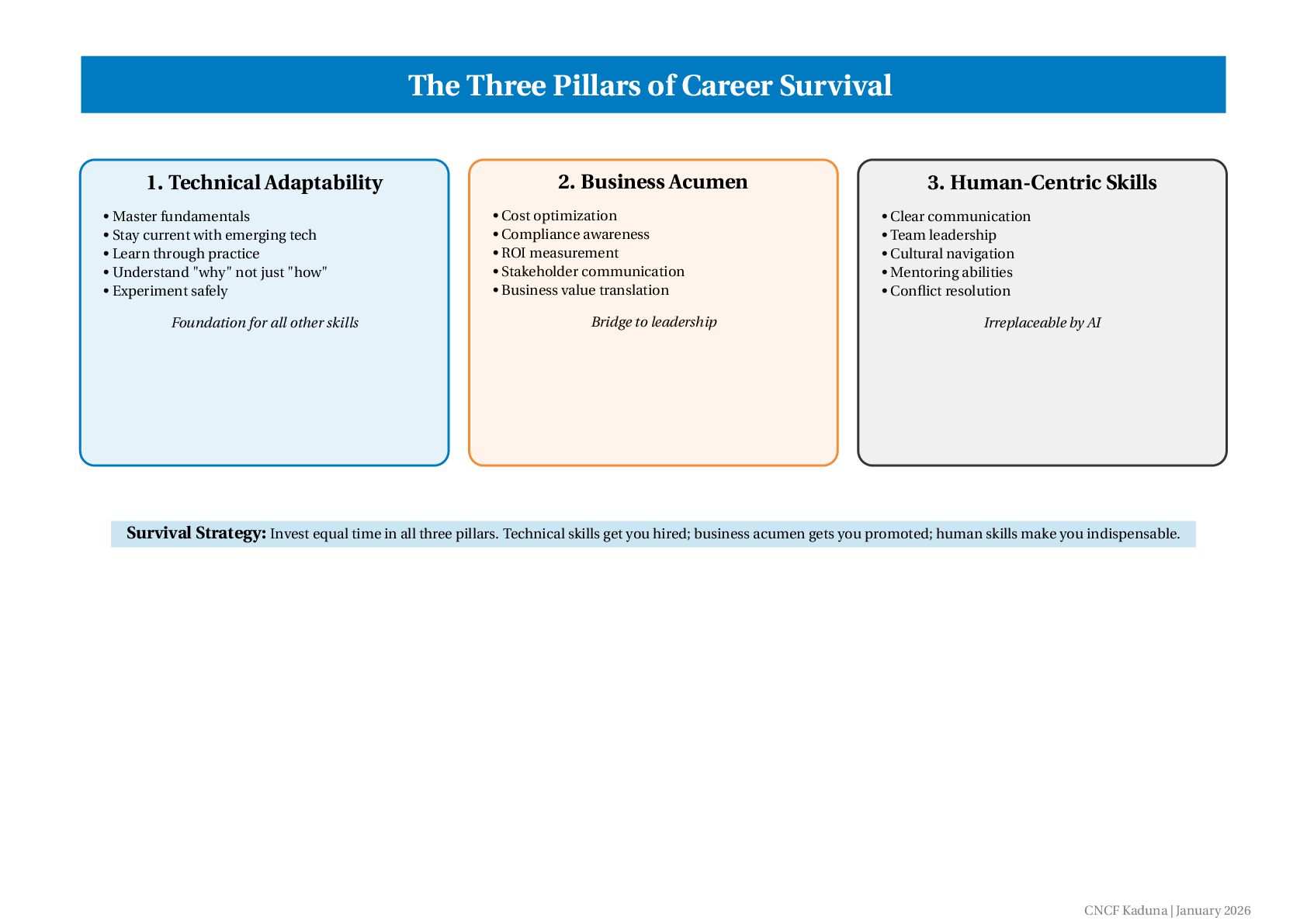
  12. The Three Pillars of Career Survival 1. Technical Adaptability •

    Master fundamentals • Stay current with emerging tech • Learn through practice • Understand "why" not just "how" • Experiment safely Foundation for all other skills 2. Business Acumen • Cost optimization • Compliance awareness • ROI measurement • Stakeholder communication • Business value translation Bridge to leadership 3. Human-Centric Skills • Clear communication • Team leadership • Cultural navigation • Mentoring abilities • Conflict resolution Irreplaceable by AI Survival Strategy: Invest equal time in all three pillars. Technical skills get you hired; business acumen gets you promoted; human skills make you indispensable. CNCF Kaduna | January 2026
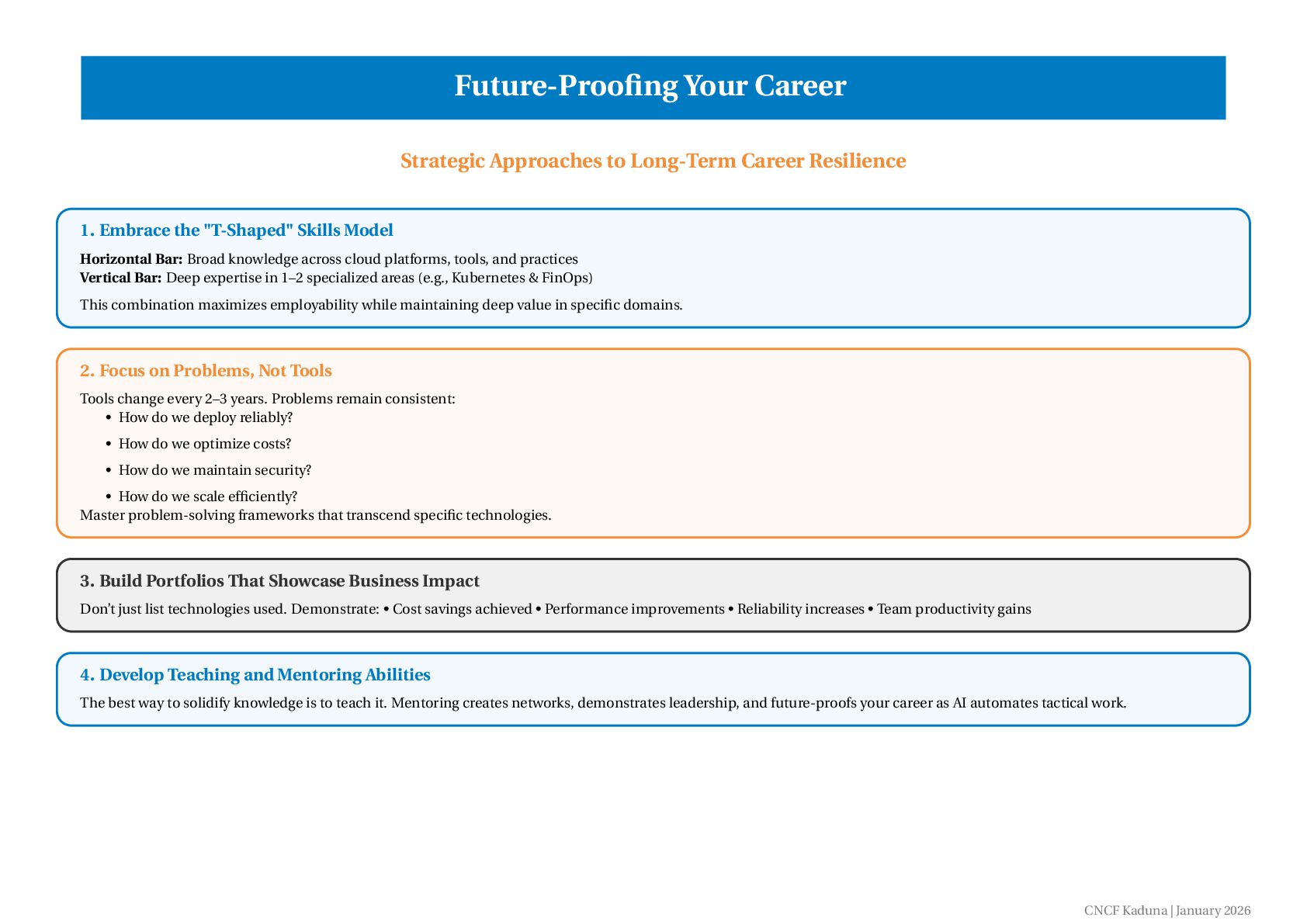
  13. Future-Proofing Your Career Strategic Approaches to Long-Term Career Resilience 1.

    Embrace the "T-Shaped" Skills Model Horizontal Bar: Broad knowledge across cloud platforms, tools, and practices Vertical Bar: Deep expertise in 1–2 specialized areas (e.g., Kubernetes & FinOps) This combination maximizes employability while maintaining deep value in specific domains. 2. Focus on Problems, Not Tools Tools change every 2–3 years. Problems remain consistent: • How do we deploy reliably? • How do we optimize costs? • How do we maintain security? • How do we scale efficiently? Master problem-solving frameworks that transcend specific technologies. 3. Build Portfolios That Showcase Business Impact Don’t just list technologies used. Demonstrate: • Cost savings achieved • Performance improvements • Reliability increases • Team productivity gains 4. Develop Teaching and Mentoring Abilities The best way to solidify knowledge is to teach it. Mentoring creates networks, demonstrates leadership, and future-proofs your career as AI automates tactical work. CNCF Kaduna | January 2026
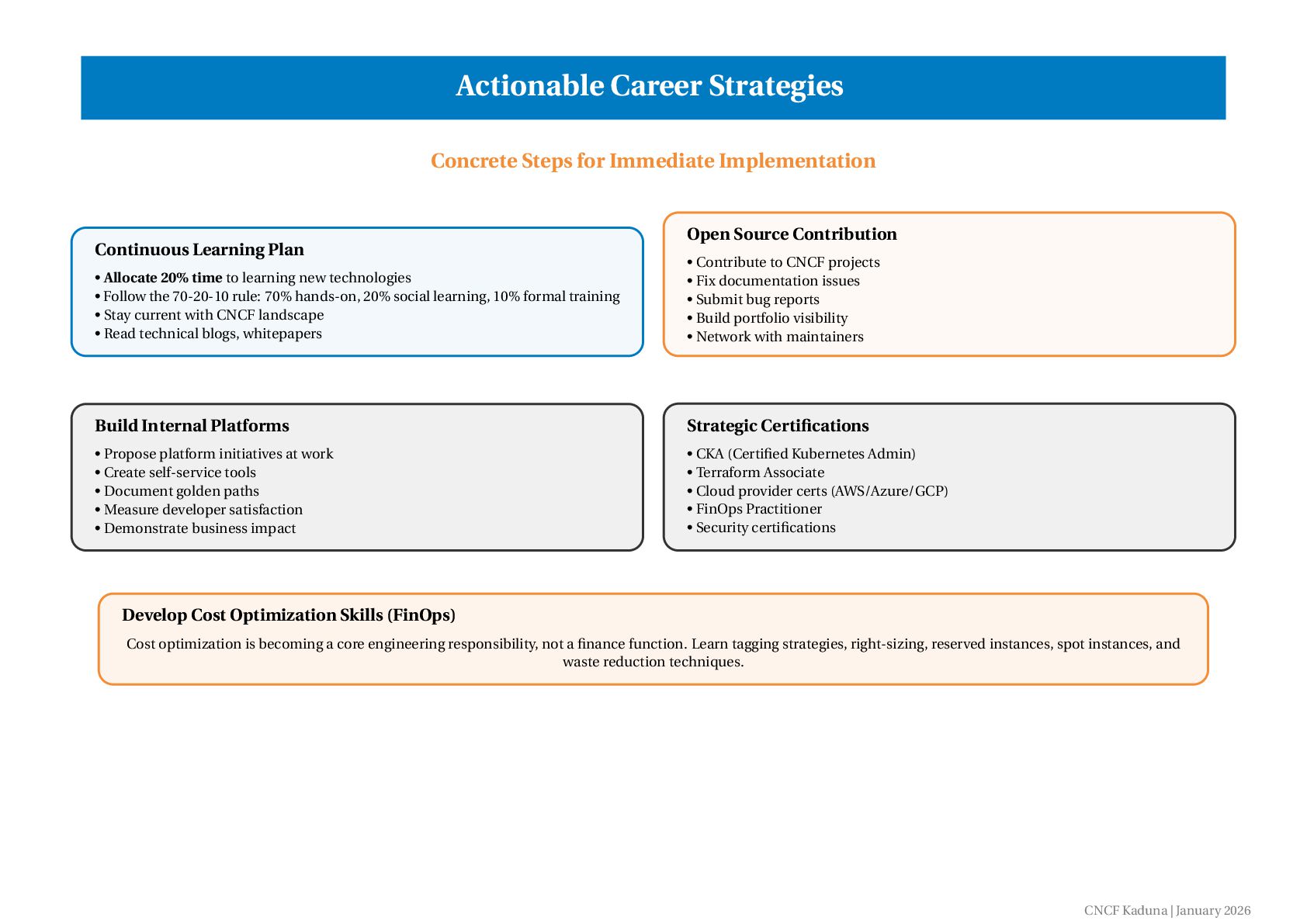
  14. Actionable Career Strategies Concrete Steps for Immediate Implementation Continuous Learning

    Plan • Allocate 20% time to learning new technologies • Follow the 70-20-10 rule: 70% hands-on, 20% social learning, 10% formal training • Stay current with CNCF landscape • Read technical blogs, whitepapers Open Source Contribution • Contribute to CNCF projects • Fix documentation issues • Submit bug reports • Build portfolio visibility • Network with maintainers Build Internal Platforms • Propose platform initiatives at work • Create self-service tools • Document golden paths • Measure developer satisfaction • Demonstrate business impact Strategic Certifications • CKA (Certified Kubernetes Admin) • Terraform Associate • Cloud provider certs (AWS/Azure/GCP) • FinOps Practitioner • Security certifications Develop Cost Optimization Skills (FinOps) Cost optimization is becoming a core engineering responsibility, not a finance function. Learn tagging strategies, right-sizing, reserved instances, spot instances, and waste reduction techniques. CNCF Kaduna | January 2026
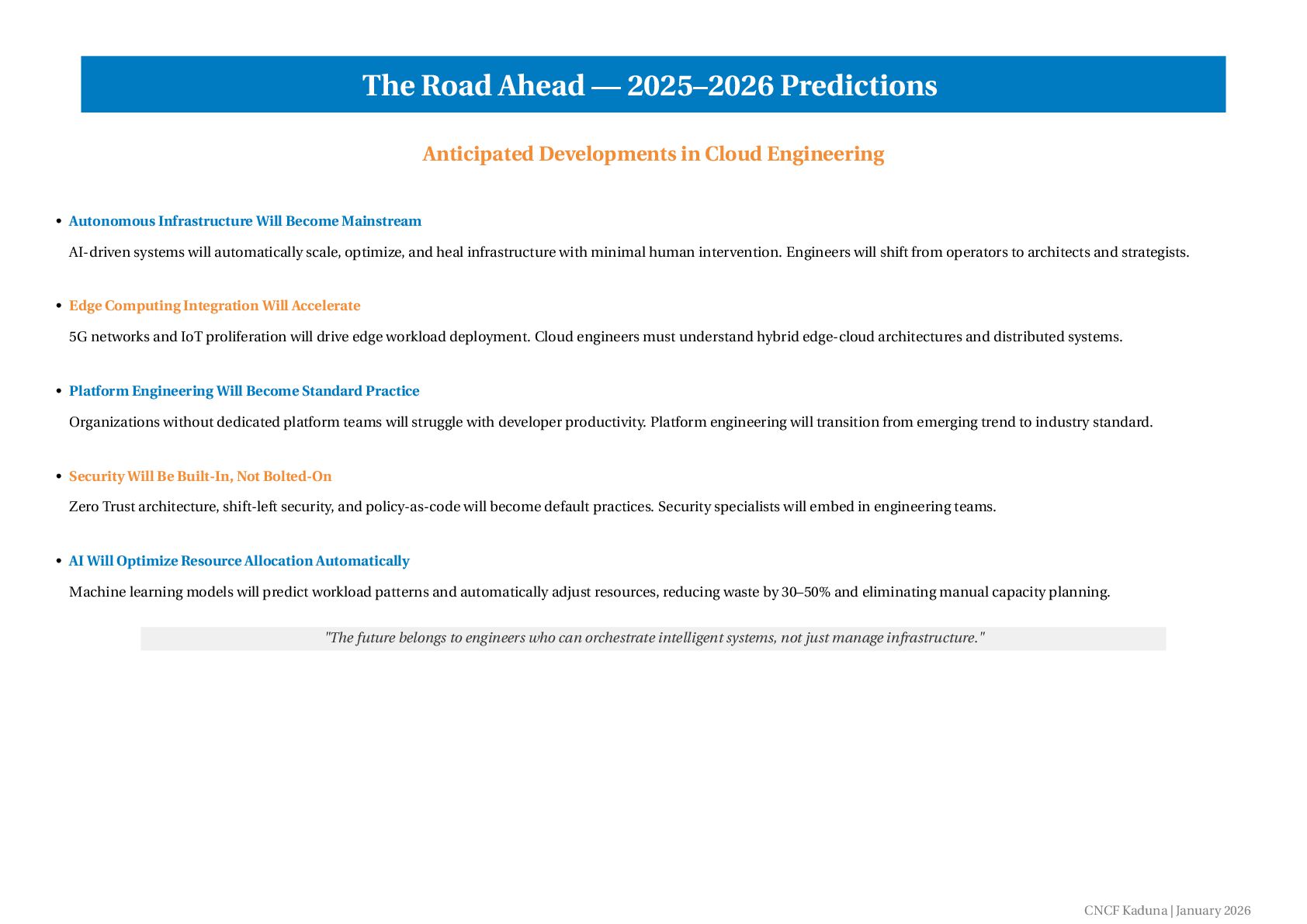
  15. The Road Ahead — 2025–2026 Predictions Anticipated Developments in Cloud

    Engineering • Autonomous Infrastructure Will Become Mainstream AI-driven systems will automatically scale, optimize, and heal infrastructure with minimal human intervention. Engineers will shift from operators to architects and strategists. • Edge Computing Integration Will Accelerate 5G networks and IoT proliferation will drive edge workload deployment. Cloud engineers must understand hybrid edge-cloud architectures and distributed systems. • Platform Engineering Will Become Standard Practice Organizations without dedicated platform teams will struggle with developer productivity. Platform engineering will transition from emerging trend to industry standard. • Security Will Be Built-In, Not Bolted-On Zero Trust architecture, shift-left security, and policy-as-code will become default practices. Security specialists will embed in engineering teams. • AI Will Optimize Resource Allocation Automatically Machine learning models will predict workload patterns and automatically adjust resources, reducing waste by 30–50% and eliminating manual capacity planning. "The future belongs to engineers who can orchestrate intelligent systems, not just manage infrastructure." CNCF Kaduna | January 2026
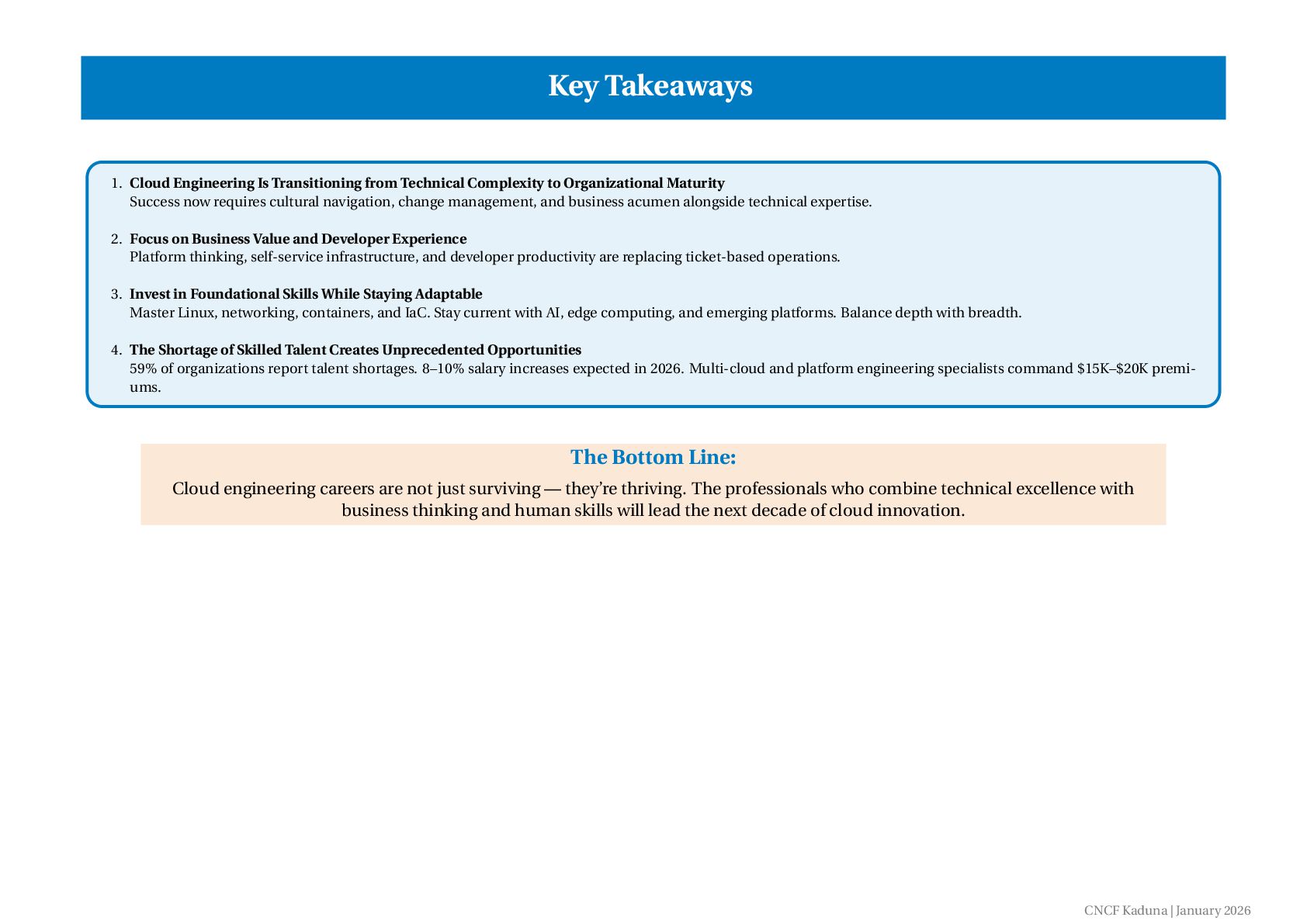
  16. Key Takeaways 1. Cloud Engineering Is Transitioning from Technical Complexity

    to Organizational Maturity Success now requires cultural navigation, change management, and business acumen alongside technical expertise. 2. Focus on Business Value and Developer Experience Platform thinking, self-service infrastructure, and developer productivity are replacing ticket-based operations. 3. Invest in Foundational Skills While Staying Adaptable Master Linux, networking, containers, and IaC. Stay current with AI, edge computing, and emerging platforms. Balance depth with breadth. 4. The Shortage of Skilled Talent Creates Unprecedented Opportunities 59% of organizations report talent shortages. 8–10% salary increases expected in 2026. Multi-cloud and platform engineering specialists command $15K–$20K premi- ums. The Bottom Line: Cloud engineering careers are not just surviving — they’re thriving. The professionals who combine technical excellence with business thinking and human skills will lead the next decade of cloud innovation. CNCF Kaduna | January 2026
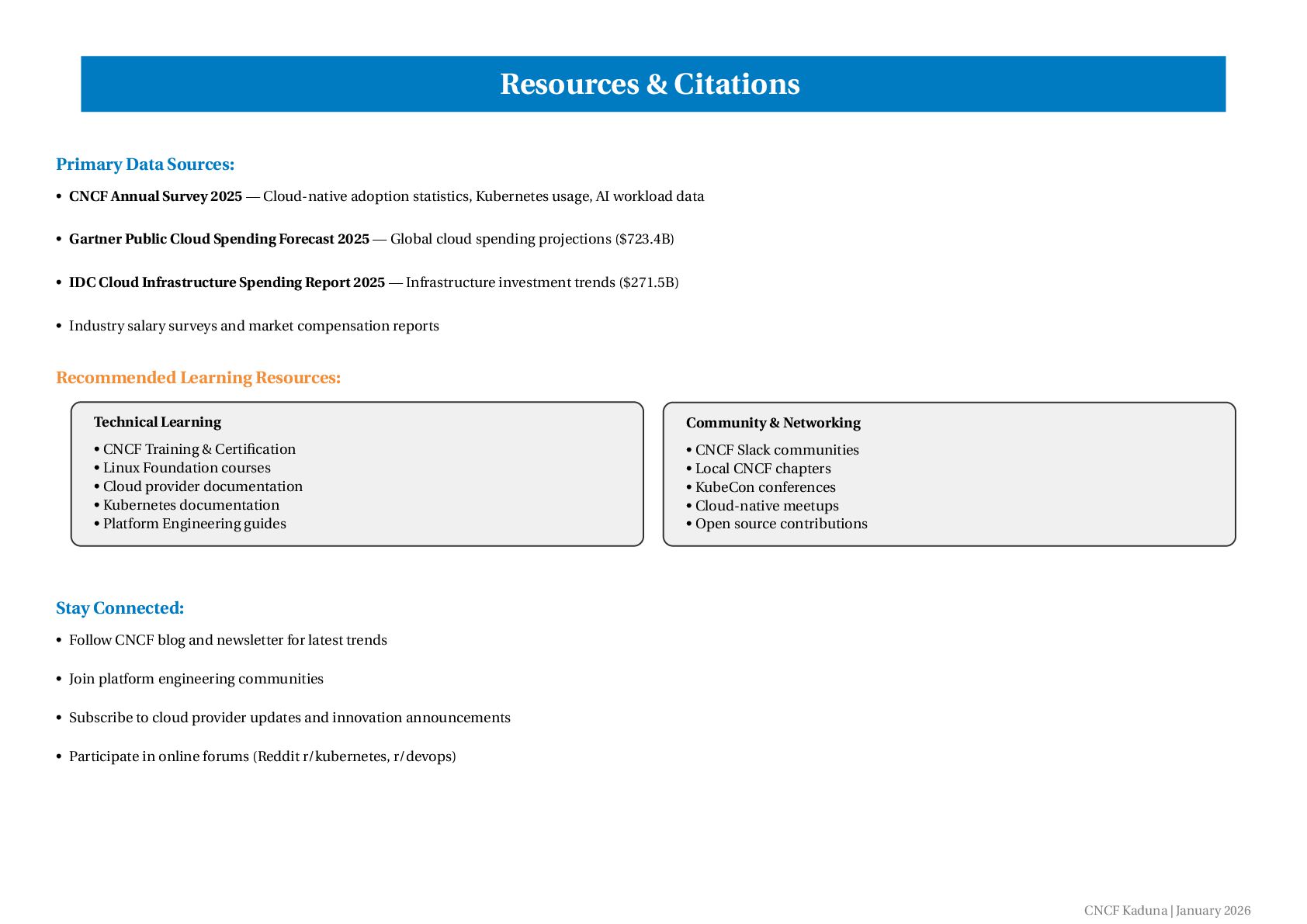
  17. Resources & Citations Primary Data Sources: • CNCF Annual Survey

    2025 — Cloud-native adoption statistics, Kubernetes usage, AI workload data • Gartner Public Cloud Spending Forecast 2025 — Global cloud spending projections ($723.4B) • IDC Cloud Infrastructure Spending Report 2025 — Infrastructure investment trends ($271.5B) • Industry salary surveys and market compensation reports Recommended Learning Resources: Technical Learning • CNCF Training & Certification • Linux Foundation courses • Cloud provider documentation • Kubernetes documentation • Platform Engineering guides Community & Networking • CNCF Slack communities • Local CNCF chapters • KubeCon conferences • Cloud-native meetups • Open source contributions Stay Connected: • Follow CNCF blog and newsletter for latest trends • Join platform engineering communities • Subscribe to cloud provider updates and innovation announcements • Participate in online forums (Reddit r/kubernetes, r/devops) CNCF Kaduna | January 2026
  18. Questions & Discussion Thank You! Contact Information Shedrack Akintayo Technical

    Writer at Traefik & CNCF Ambassador Let’s connect and continue the conversation What’s Your Next Skill Investment? The cloud engineering landscape is evolving rapidly. What skills will you prioritize to stay ahead? CNCF Kaduna | January 2026