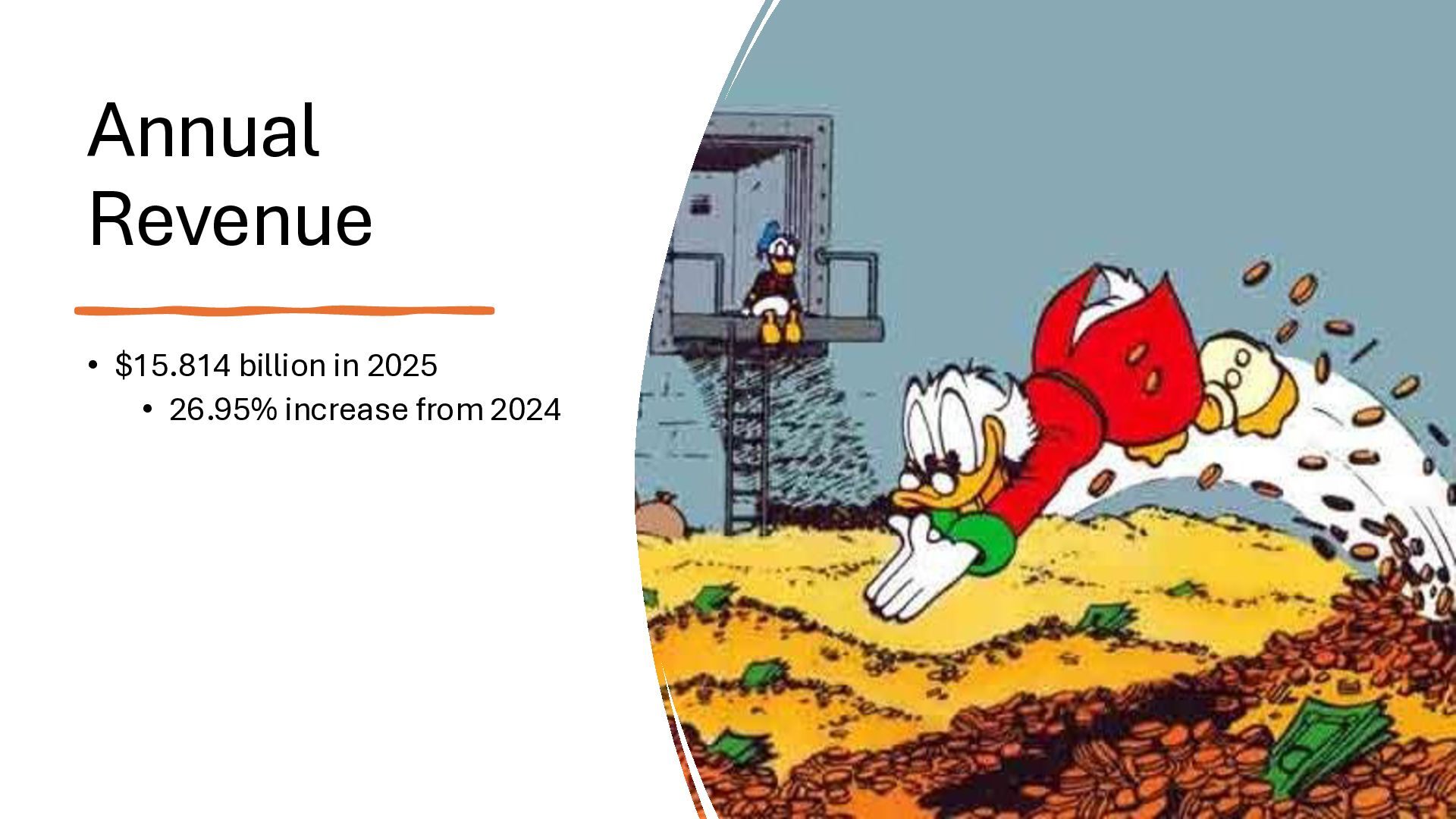
is an IOU – an Investor Owned Utility • Many cities (Chelsea, Lansing, Traverse City) have their own municipal utilities – have never had an IOU • Have utility costs of about half as much per kWh • Some states (Nebraska) have NEVER had an IOU • The whole state is public power – lower prices • Ann Arbor has municipal utilities – water, sewer • Super boring, always work – awards for water quality • Unlike DTE
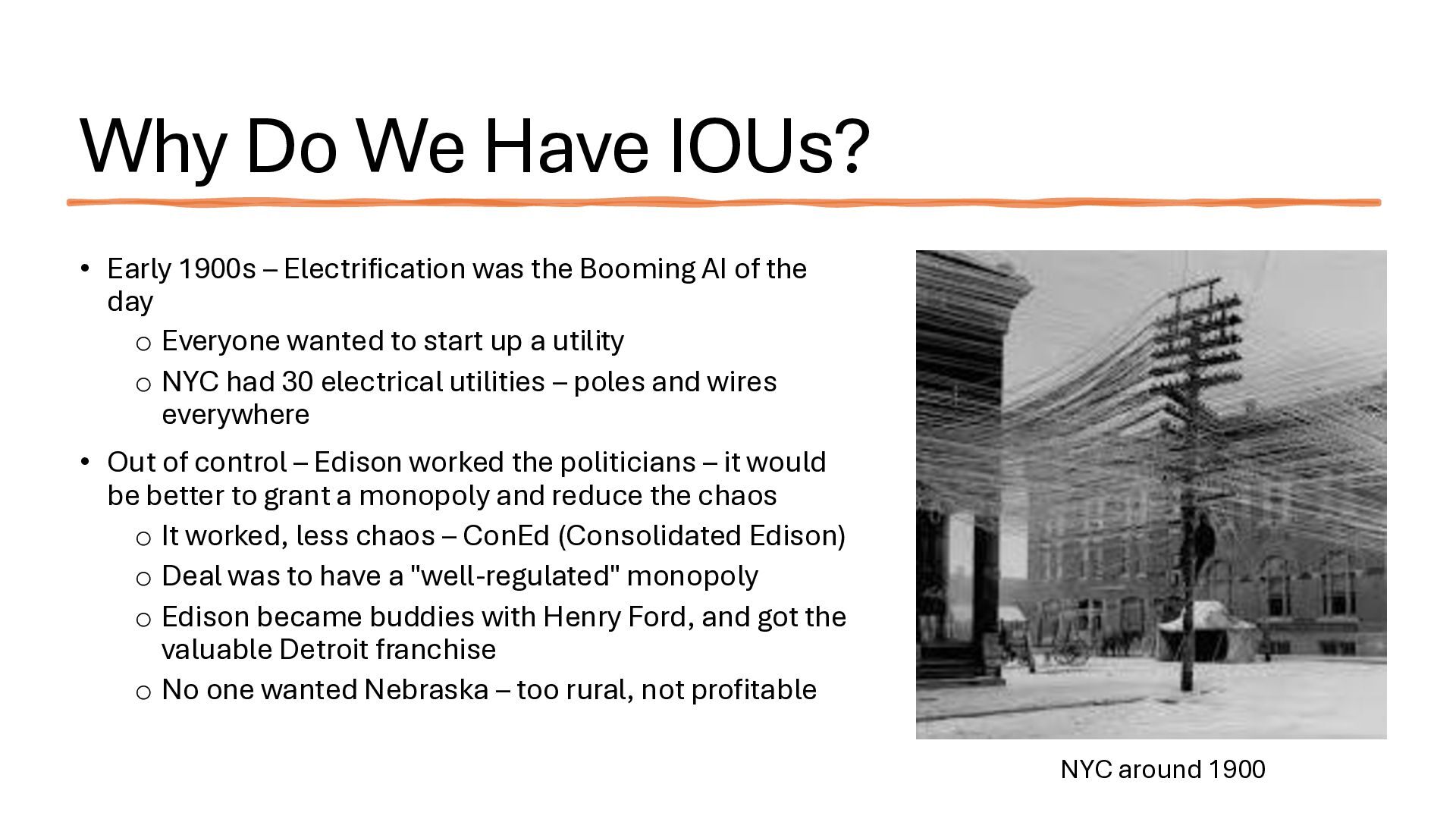
was the Booming AI of the day o Everyone wanted to start up a utility o NYC had 30 electrical utilities – poles and wires everywhere • Out of control – Edison worked the politicians – it would be better to grant a monopoly and reduce the chaos o It worked, less chaos – ConEd (Consolidated Edison) o Deal was to have a "well-regulated" monopoly o Edison became buddies with Henry Ford, and got the valuable Detroit franchise o No one wanted Nebraska – too rural, not profitable NYC around 1900
by the legislature • They get free access to land for poles, wires, transformers • They get customers with no competition • They get "regulated" • But they are the biggest lobbyist/donor to Michigan legislators (visible money, not counting 'dark money') • Who is regulating whom? • The Michigan Public Service Commission (MPSC) seems to always grant rising rate requests – appointed, not elected members • But per the state constitution, any city has the right to buy out the monopoly (utility can not refuse)
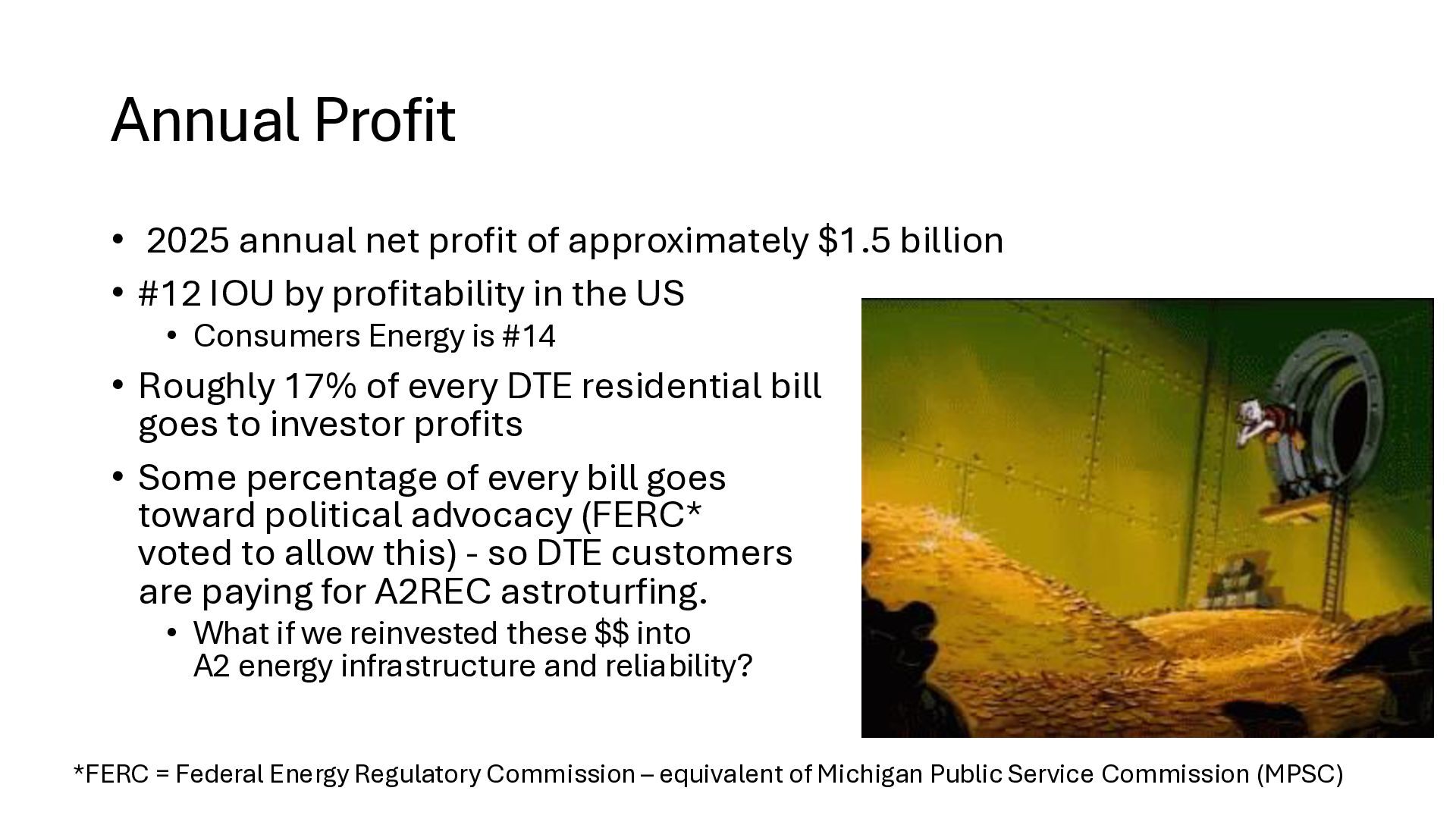
billion • #12 IOU by profitability in the US • Consumers Energy is #14 • Roughly 17% of every DTE residential bill goes to investor profits • Some percentage of every bill goes toward political advocacy (FERC* voted to allow this) - so DTE customers are paying for A2REC astroturfing. • What if we reinvested these $$ into A2 energy infrastructure and reliability? *FERC = Federal Energy Regulatory Commission – equivalent of Michigan Public Service Commission (MPSC)
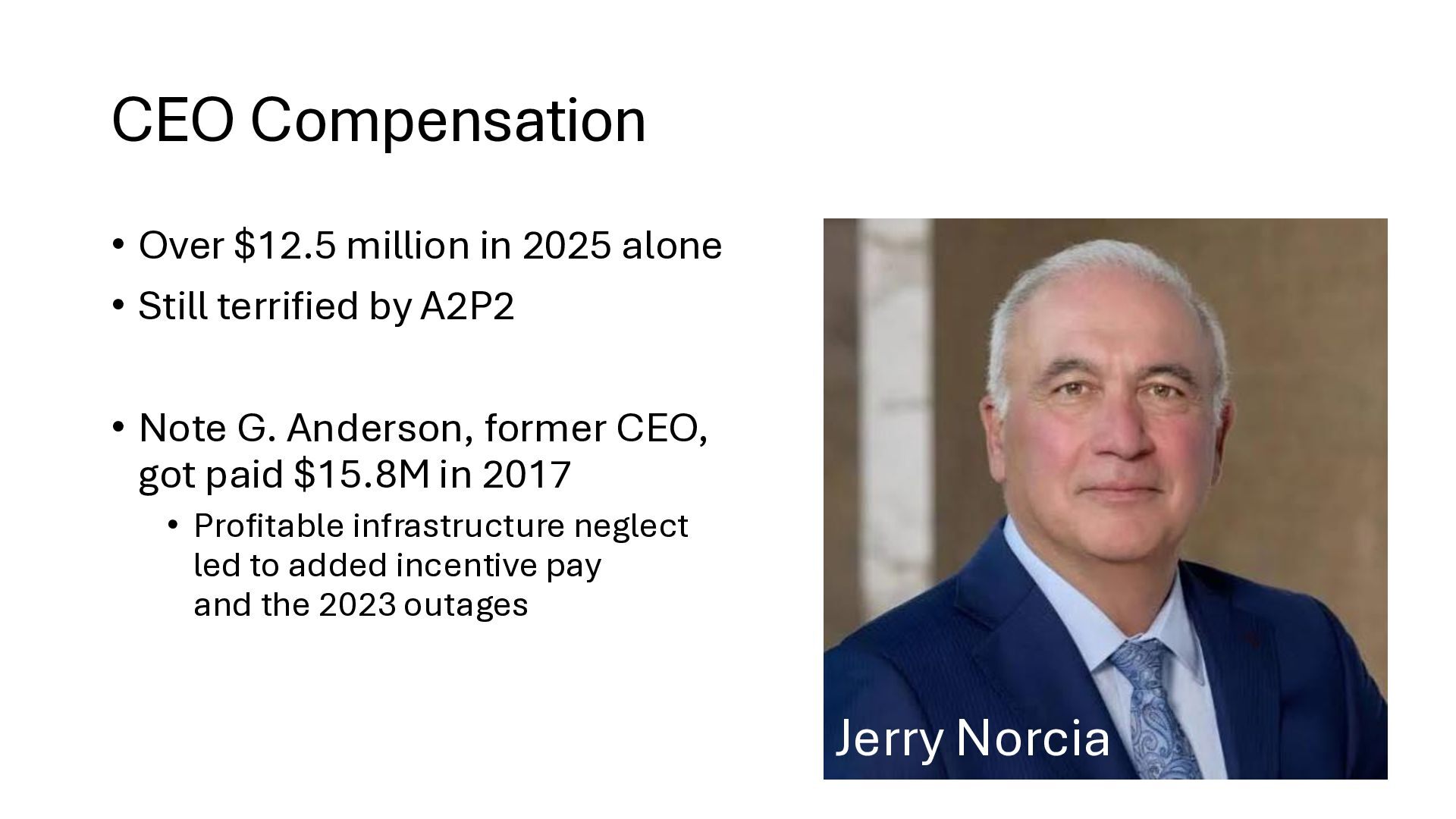
Still terrified by A2P2 • Note G. Anderson, former CEO, got paid $15.8M in 2017 • Profitable infrastructure neglect led to added incentive pay and the 2023 outages Jerry Norcia
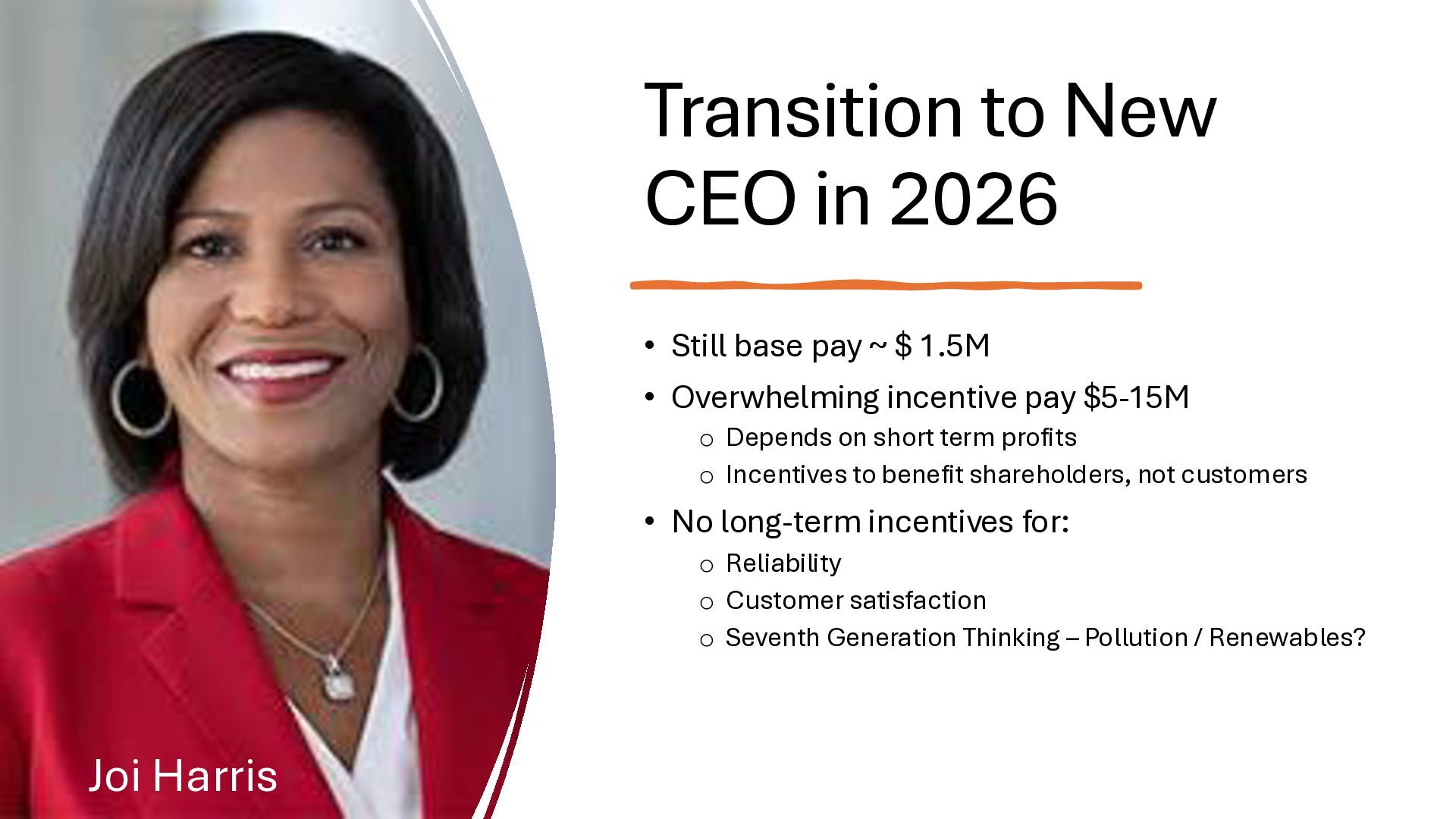
~ $ 1.5M • Overwhelming incentive pay $5-15M o Depends on short term profits o Incentives to benefit shareholders, not customers • No long-term incentives for: o Reliability o Customer satisfaction o Seventh Generation Thinking – Pollution / Renewables? Joi Harris
(IOUs) for decades • 45% of customers had at least one outage lasting at least 8 hours in 2023 • Feb 2023 ice storm - more than 78,000 customers in Washtenaw County without power (>500K in SE Michigan) • 25,000+ in Ann Arbor alone - freezing temperatures, slow to respond • Now DTE is running scared, rapidly investing to improve reliability
(Canada!) problems every year • Of U.S. major power outages 2000 to 2023, 80% (1,755) were due to weather. • The states with the most reported weather-related power outages (2000-2023) were Texas (210), Michigan (157), California (145), North Carolina (111), and Ohio (88). • Michigan needs more resilient power generation and delivery https://www.climatecentral.org/climate-matters/weather-related-power-outages-rising
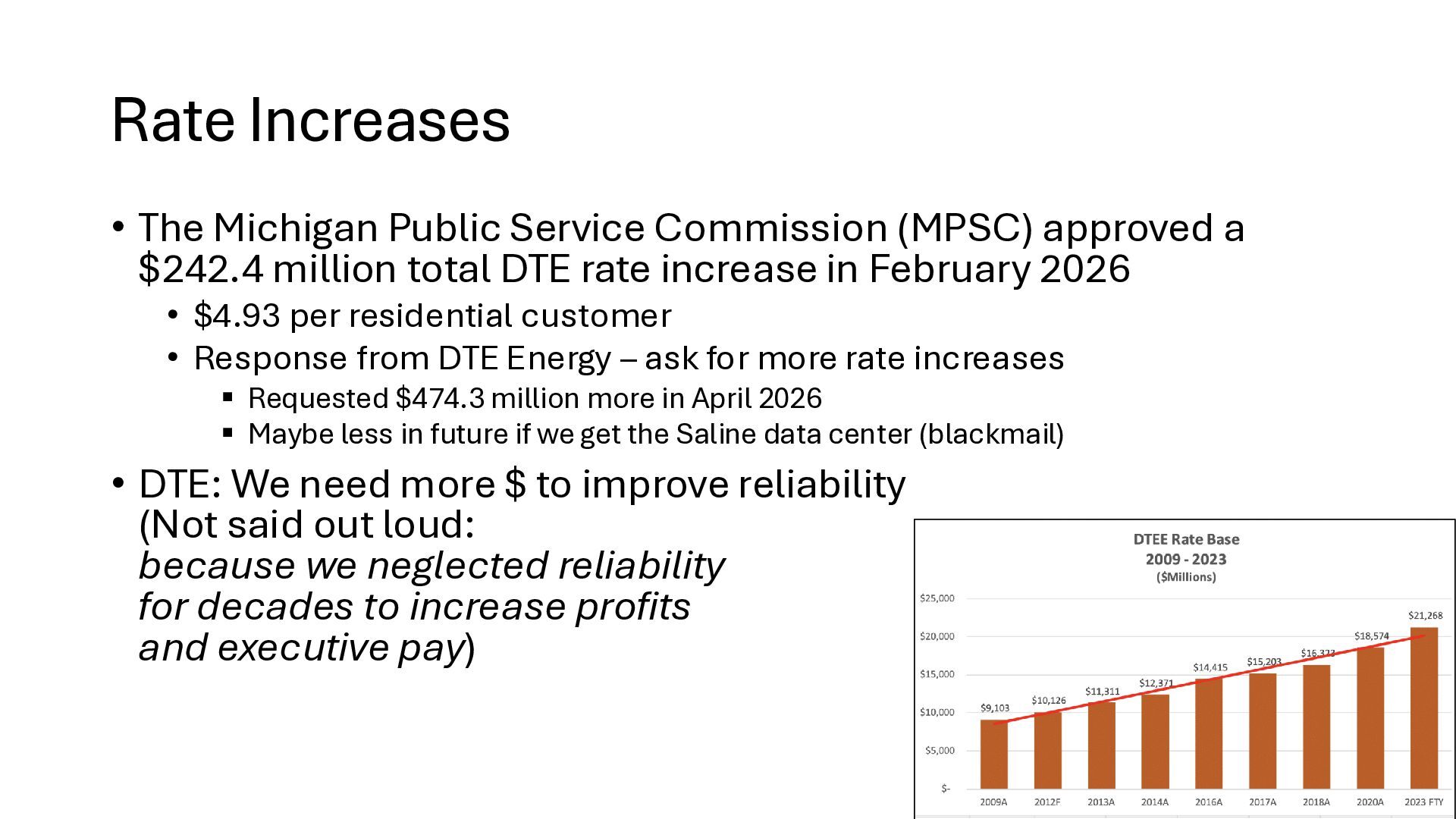
a $242.4 million total DTE rate increase in February 2026 • $4.93 per residential customer • Response from DTE Energy – ask for more rate increases ▪ Requested $474.3 million more in April 2026 ▪ Maybe less in future if we get the Saline data center (blackmail) • DTE: We need more $ to improve reliability (Not said out loud: because we neglected reliability for decades to increase profits and executive pay)
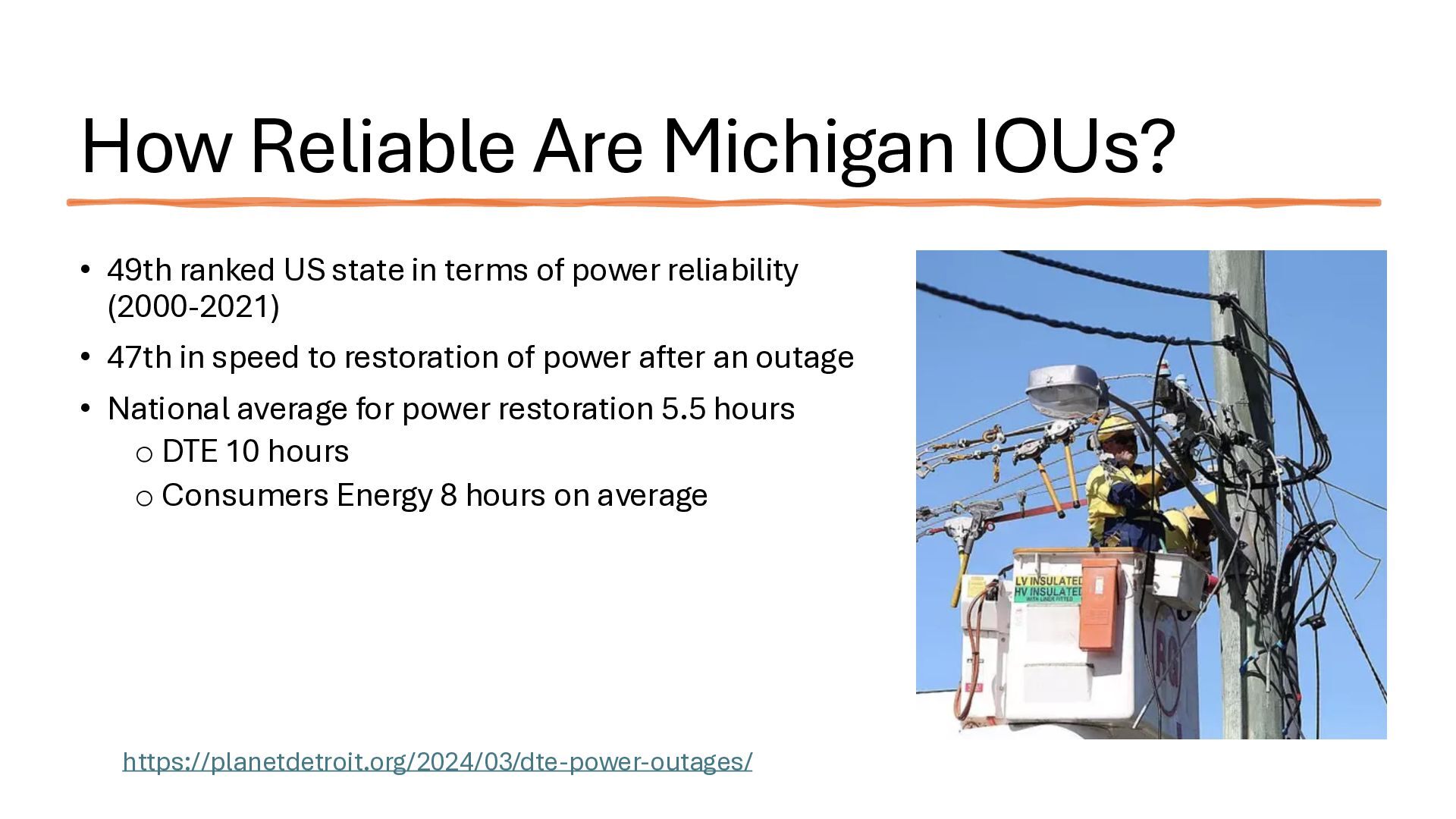
in terms of power reliability (2000-2021) • 47th in speed to restoration of power after an outage • National average for power restoration 5.5 hours o DTE 10 hours o Consumers Energy 8 hours on average https://planetdetroit.org/2024/03/dte-power-outages/
• Board of Water and Light • For years, consumers wanted ultra-low costs – got them o But maybe not enough spent on reliability? • Big Christmas 2013 storm hits Lansing o Days of power outages, poor communication o Citizens / customers / voters want to throw the rascals out o Politicians pivot – slightly higher prices, invest in reliability, better transparency • February 2023 Big Test – the Ice Storm o Weather-wise, hit as hard as Ann Arbor o At peak, only 90 BWL customers lost power o All power back up in 12 hours. Sent lineworkers to help Alpena. https://bellwetherpr.com/blog/case-study-bwl-ice-storm/ https://www.wlns.com/top-stories/lineworkers-from-lansing-help-restore-power-to-alpena-residents/
new startups • No regulation – too new - chaos • Needed big investment • No way (no grid) to buy wholesale power from somewhere else • Monopolies 'solved' the chaos • But now we are stuck with no competition in power generation • IOUs are not nimble. They build coal, nuclear, and gas plants and run them for 40 years to maximize profits. o Socialism and monopoly • There is an established nationwide electrical grid • Power producers put in power, utilities can contract to buy wholesale power • Old IOUs are incentivized to maximize shareholder profits • New producers are more nimble, can switch to solar, wind – whatever is cheaper o Solar, wind, battery costs falling fast • As prices change, public utilities can choose different providers (there is now competition among power producers because of the grid) o Capitalism and competition o Innovation 1910s 2020s
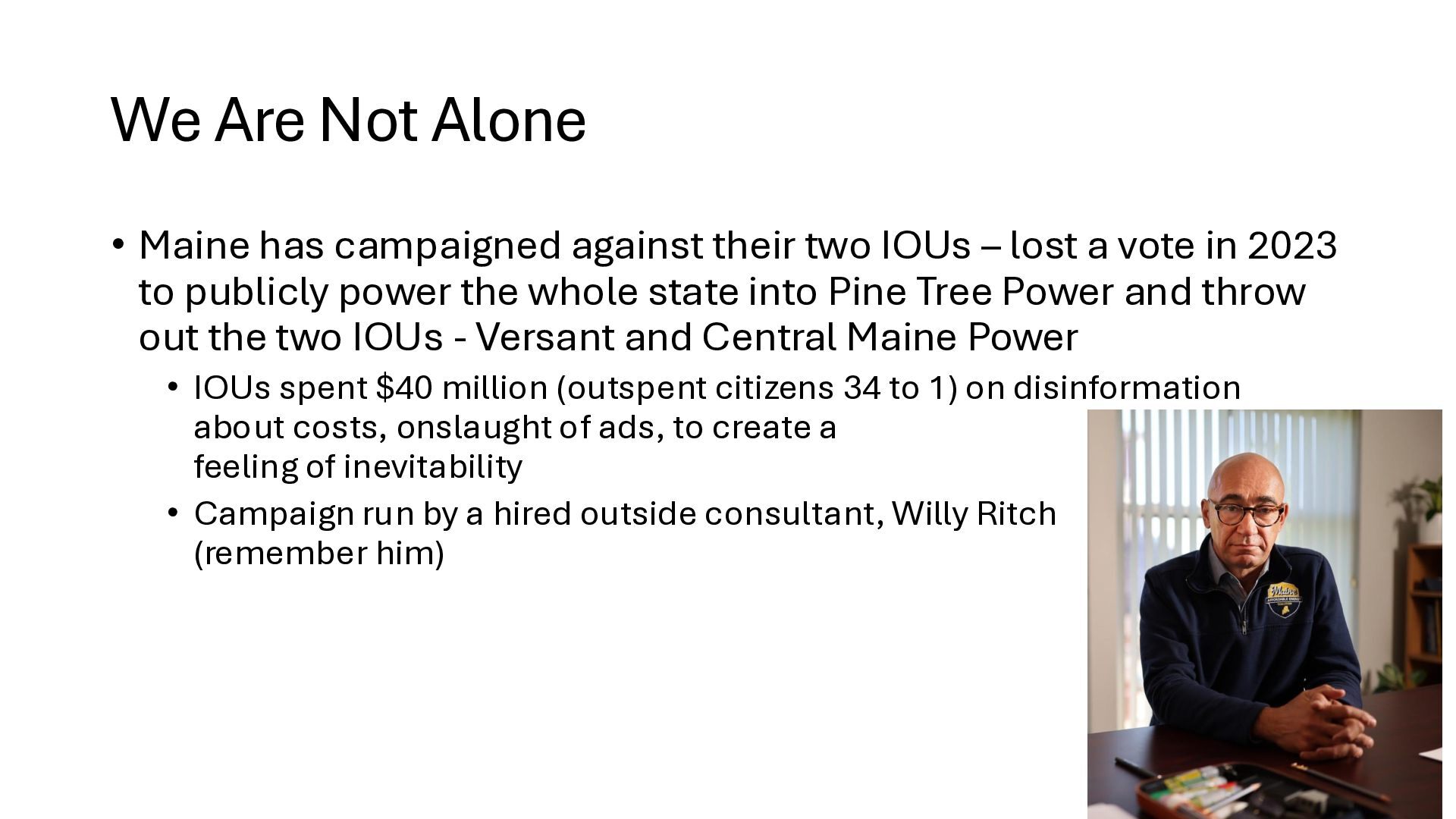
two IOUs – lost a vote in 2023 to publicly power the whole state into Pine Tree Power and throw out the two IOUs - Versant and Central Maine Power • IOUs spent $40 million (outspent citizens 34 to 1) on disinformation about costs, onslaught of ads, to create a feeling of inevitability • Campaign run by a hired outside consultant, Willy Ritch (remember him)
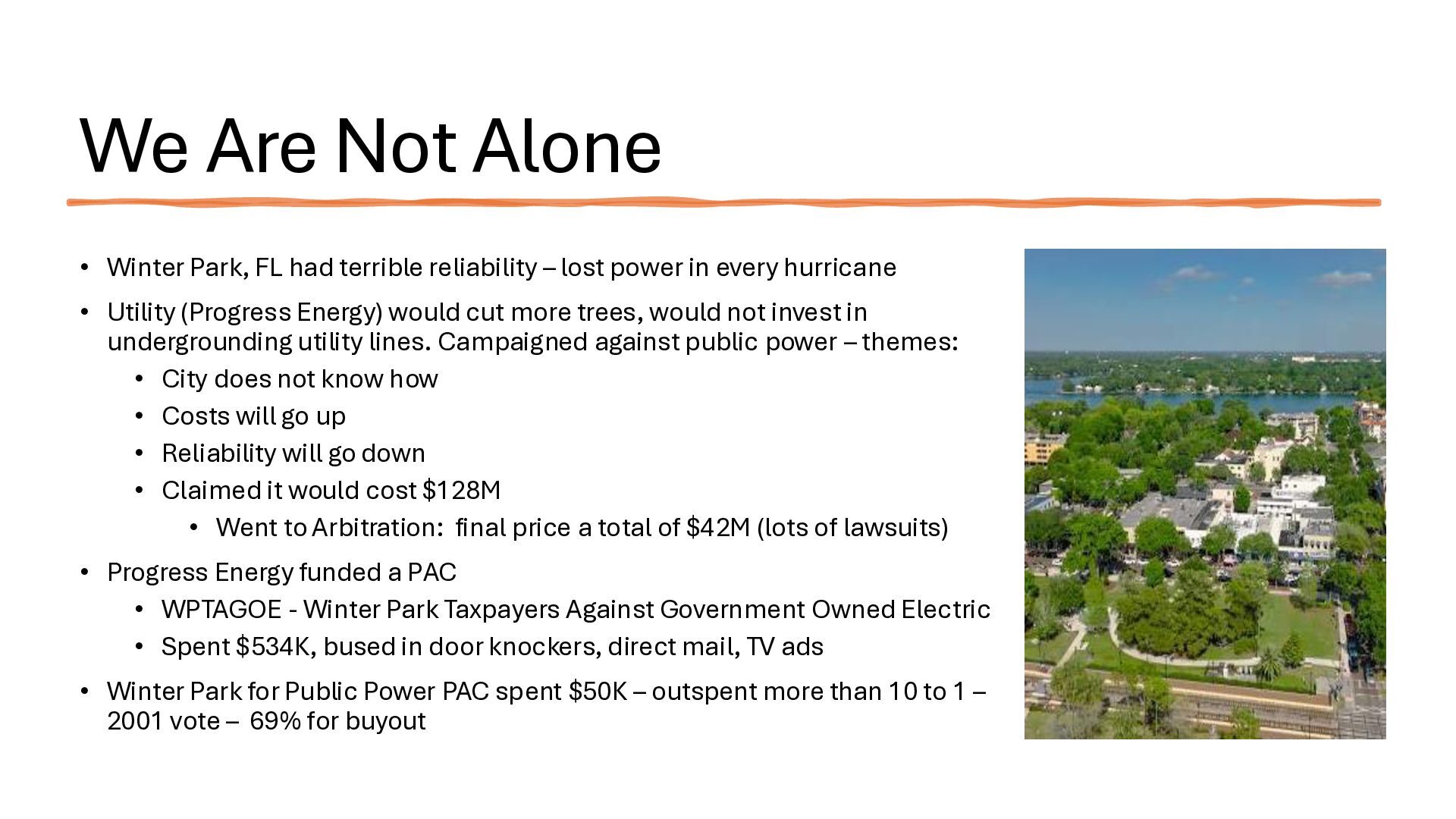
reliability – lost power in every hurricane • Utility (Progress Energy) would cut more trees, would not invest in undergrounding utility lines. Campaigned against public power – themes: • City does not know how • Costs will go up • Reliability will go down • Claimed it would cost $128M • Went to Arbitration: final price a total of $42M (lots of lawsuits) • Progress Energy funded a PAC • WPTAGOE - Winter Park Taxpayers Against Government Owned Electric • Spent $534K, bused in door knockers, direct mail, TV ads • Winter Park for Public Power PAC spent $50K – outspent more than 10 to 1 – 2001 vote – 69% for buyout
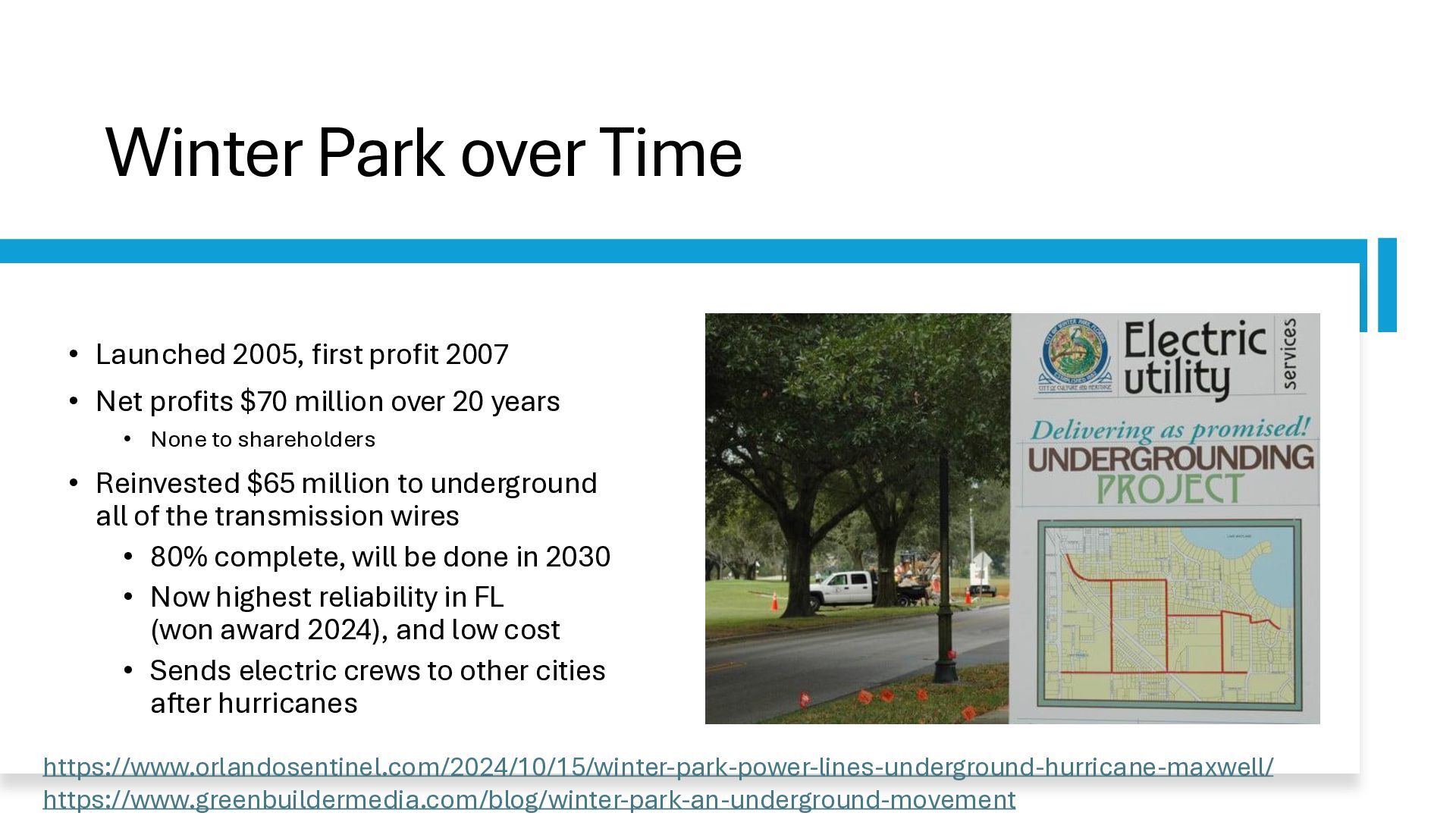
• Net profits $70 million over 20 years • None to shareholders • Reinvested $65 million to underground all of the transmission wires • 80% complete, will be done in 2030 • Now highest reliability in FL (won award 2024), and low cost • Sends electric crews to other cities after hurricanes https://www.orlandosentinel.com/2024/10/15/winter-park-power-lines-underground-hurricane-maxwell/ https://www.greenbuildermedia.com/blog/winter-park-an-underground-movement
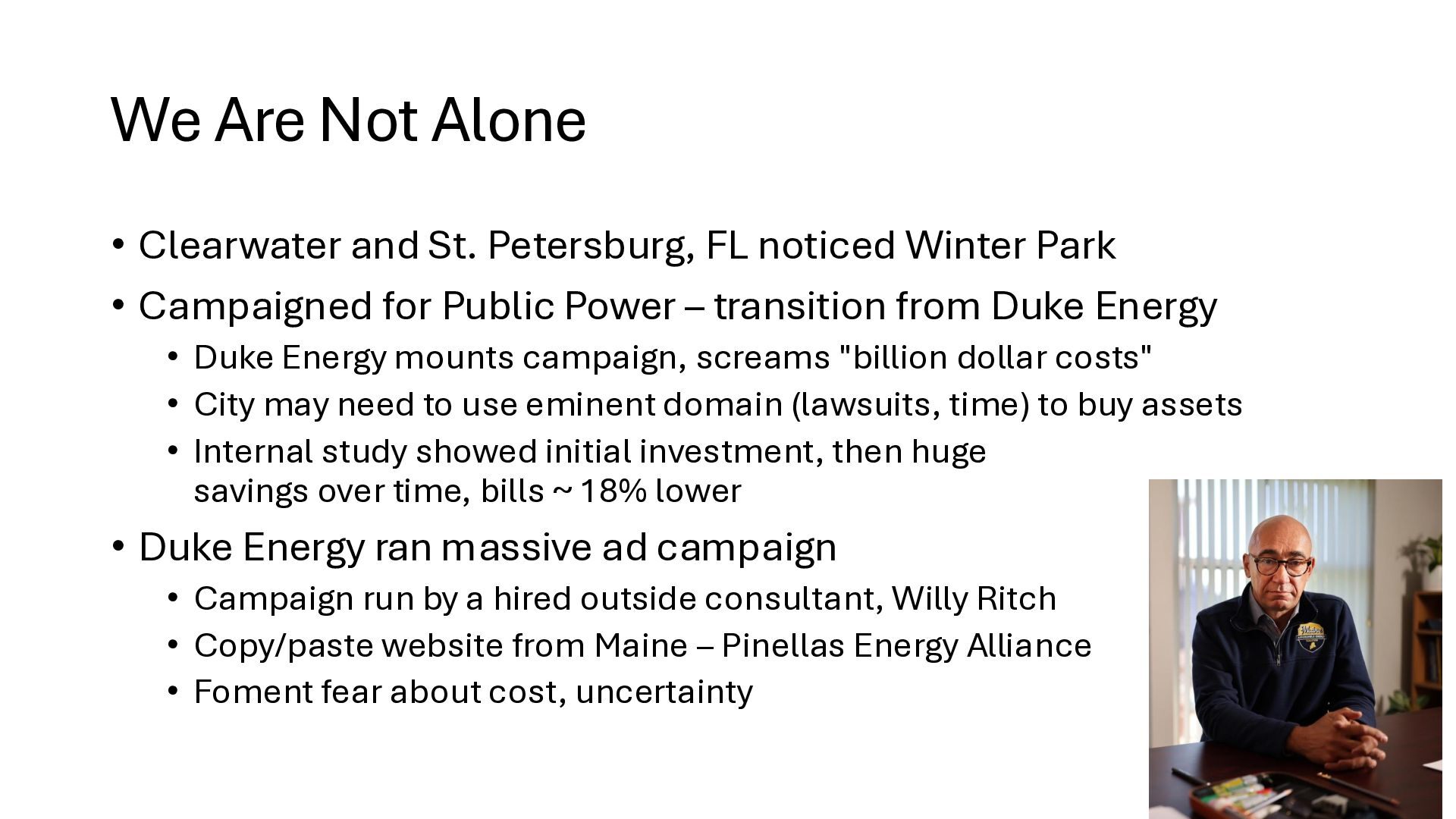
noticed Winter Park • Campaigned for Public Power – transition from Duke Energy • Duke Energy mounts campaign, screams "billion dollar costs" • City may need to use eminent domain (lawsuits, time) to buy assets • Internal study showed initial investment, then huge savings over time, bills ~ 18% lower • Duke Energy ran massive ad campaign • Campaign run by a hired outside consultant, Willy Ritch • Copy/paste website from Maine – Pinellas Energy Alliance • Foment fear about cost, uncertainty
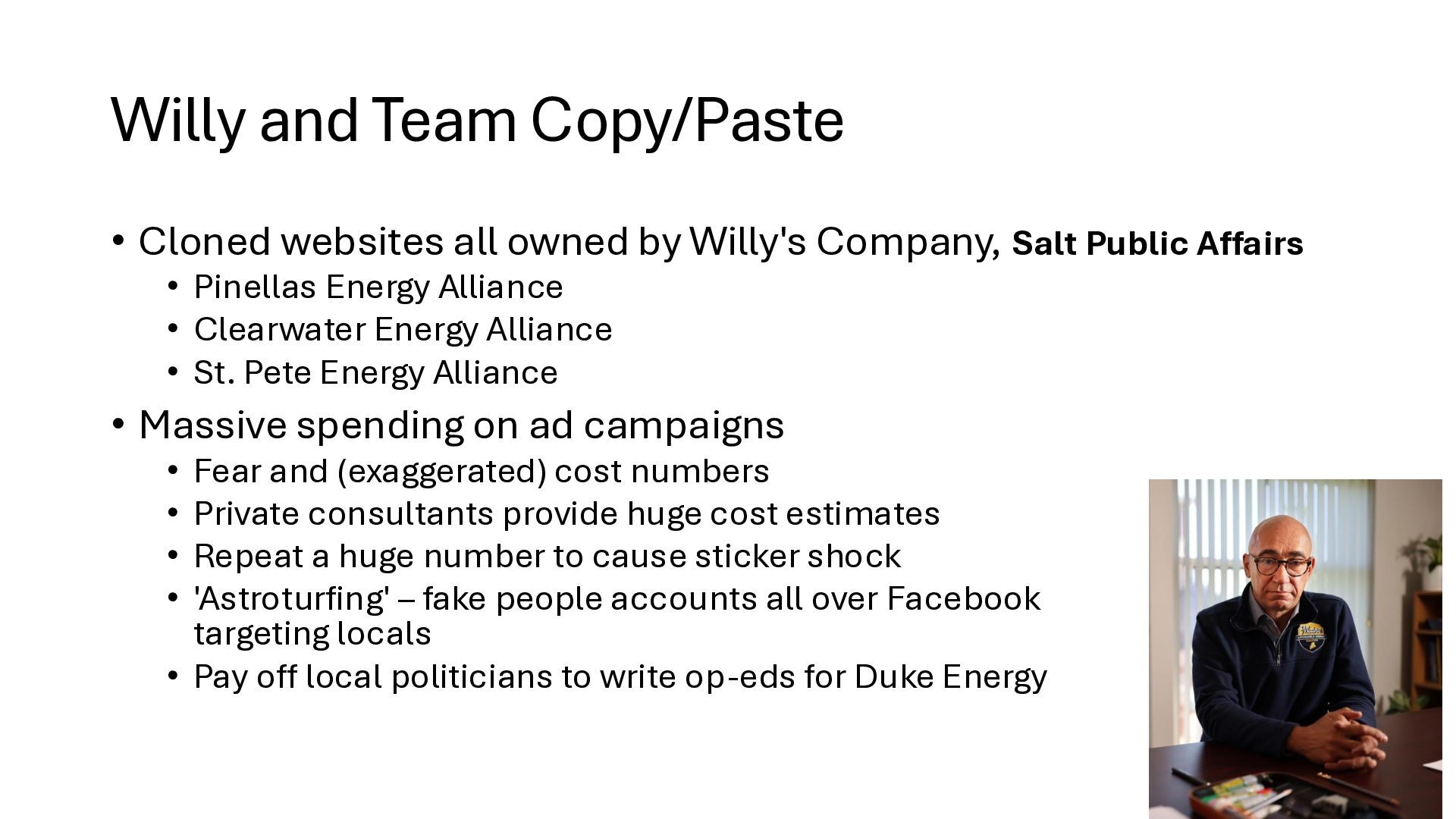
Willy's Company, Salt Public Affairs • Pinellas Energy Alliance • Clearwater Energy Alliance • St. Pete Energy Alliance • Massive spending on ad campaigns • Fear and (exaggerated) cost numbers • Private consultants provide huge cost estimates • Repeat a huge number to cause sticker shock • 'Astroturfing' – fake people accounts all over Facebook targeting locals • Pay off local politicians to write op-eds for Duke Energy
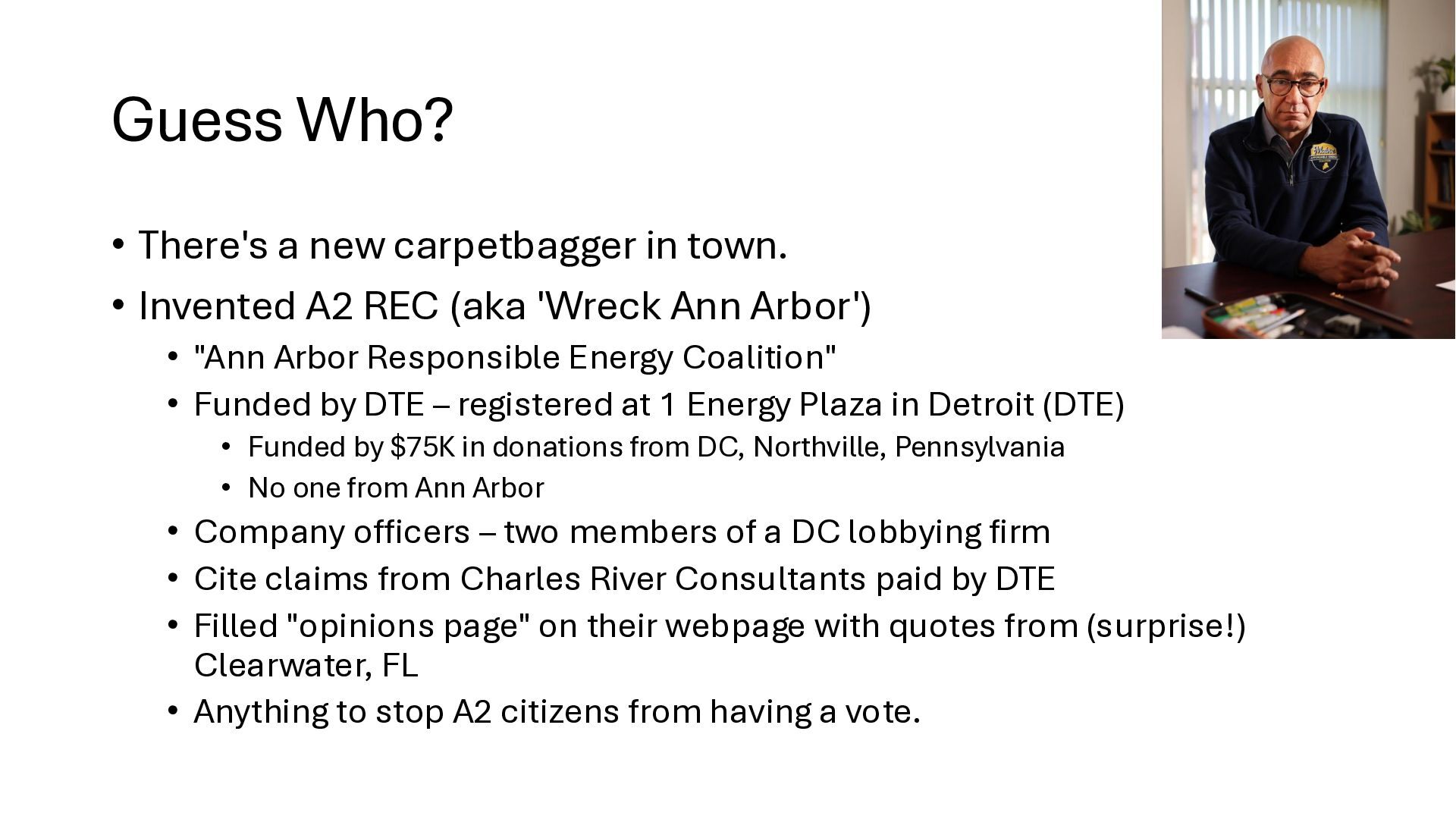
Invented A2 REC (aka 'Wreck Ann Arbor') • "Ann Arbor Responsible Energy Coalition" • Funded by DTE – registered at 1 Energy Plaza in Detroit (DTE) • Funded by $75K in donations from DC, Northville, Pennsylvania • No one from Ann Arbor • Company officers – two members of a DC lobbying firm • Cite claims from Charles River Consultants paid by DTE • Filled "opinions page" on their webpage with quotes from (surprise!) Clearwater, FL • Anything to stop A2 citizens from having a vote.
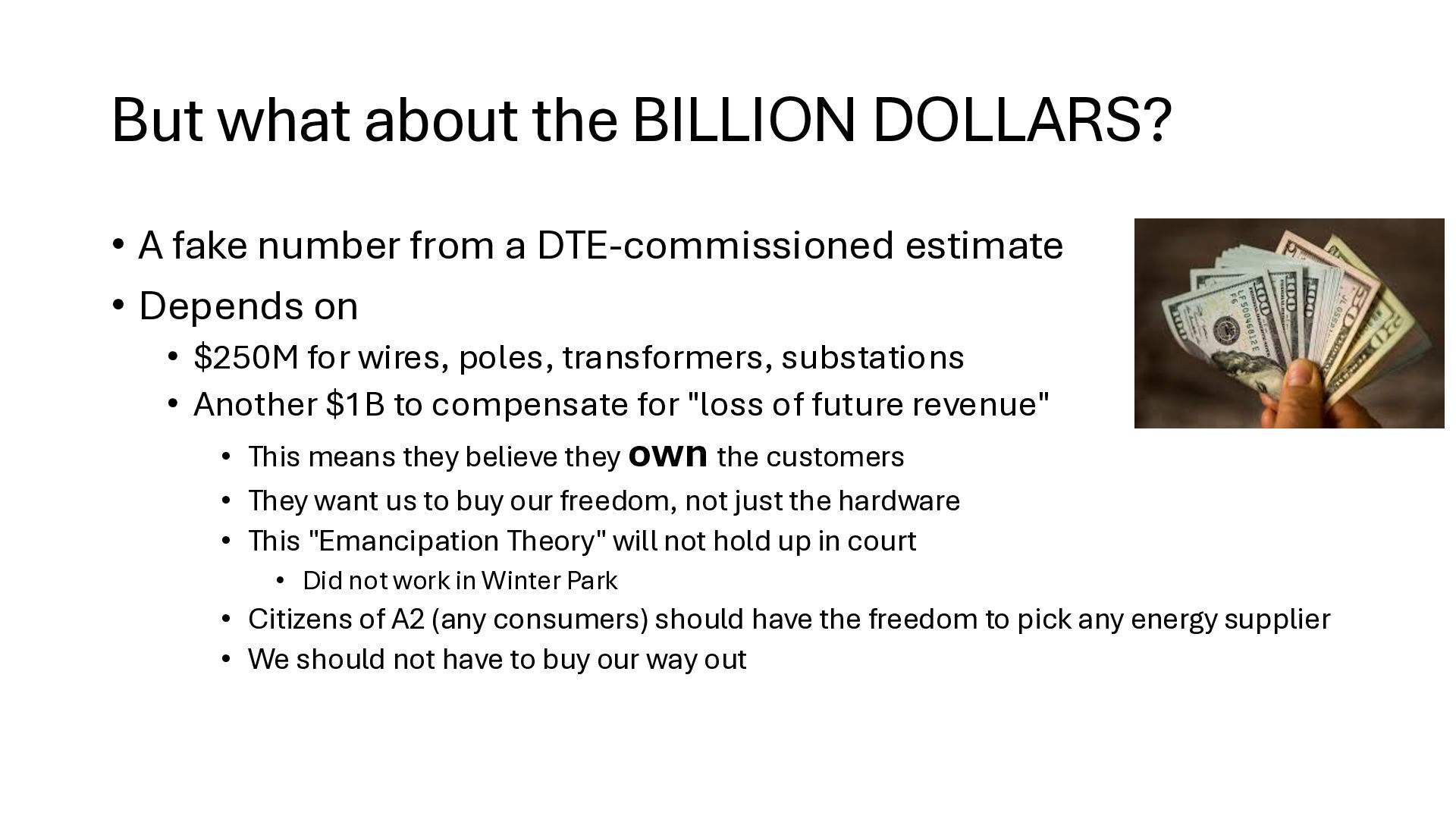
from a DTE-commissioned estimate • Depends on • $250M for wires, poles, transformers, substations • Another $1B to compensate for "loss of future revenue" • This means they believe they own the customers • They want us to buy our freedom, not just the hardware • This "Emancipation Theory" will not hold up in court • Did not work in Winter Park • Citizens of A2 (any consumers) should have the freedom to pick any energy supplier • We should not have to buy our way out
utility profits o There are big profits to be made in electricity (as per DTE) o Lots of money if there are no shareholders, no $10M+ execs to pay o Just like Winter Park, FL – reinvest the profits into infrastructure • But what about the hardware purchase? o Big up-front cost, though the number depends on the age of infrastructure o Will require 30-year bonds and a millage o Ann Arbor has a AAA bond rating
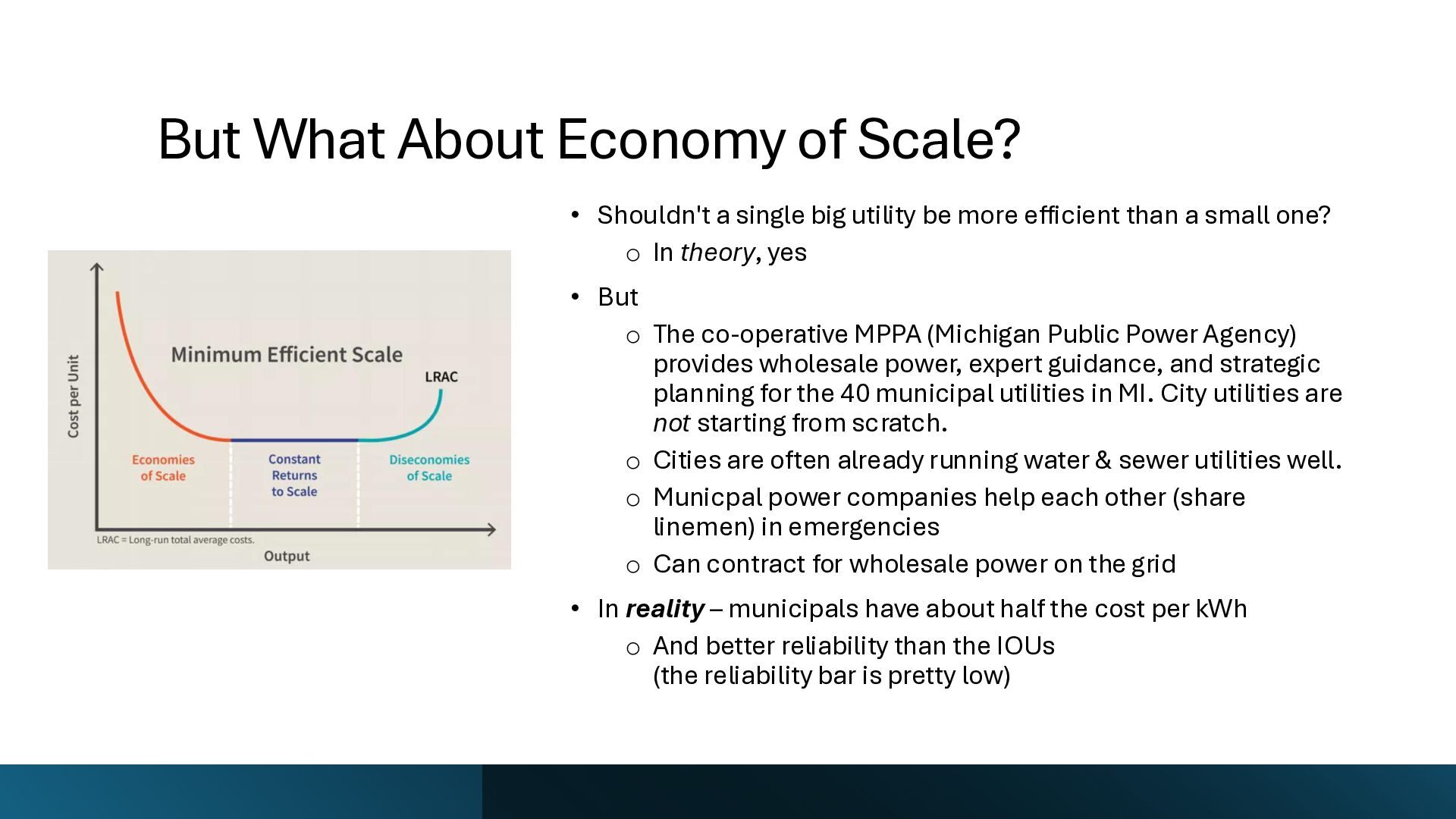
big utility be more efficient than a small one? o In theory, yes • But o The co-operative MPPA (Michigan Public Power Agency) provides wholesale power, expert guidance, and strategic planning for the 40 municipal utilities in MI. City utilities are not starting from scratch. o Cities are often already running water & sewer utilities well. o Municpal power companies help each other (share linemen) in emergencies o Can contract for wholesale power on the grid • In reality – municipals have about half the cost per kWh o And better reliability than the IOUs (the reliability bar is pretty low)
on the Ballot • Encourage other A2 voters to sign • Donate to A2P2 (getting wildly outspent by DTE) • Consider signing the MOP (Money Out of Politics petition) to stop DTE lobbying 2. Watch the Winter Park, FL video • They got so many questions from other cities, it was easier to make a YouTube video • You can learn more at this link: (or search YT for Power Shift Winter Park) • https://www.youtube.com/watch?v=SnLQB4bLCvs 3. Vote in November • This vote establishes a planning board for a municipal utility • No big purchases, nothing final


 higgi13425
 mojombo
 reverentgeek
 akashhashmi
 bluesmoon
 jct
jct
 rasmusluckow
.png) helenjbeal
helenjbeal
 sonatard
 keathley
 samlambert
 sstephenson
 samanthasiow