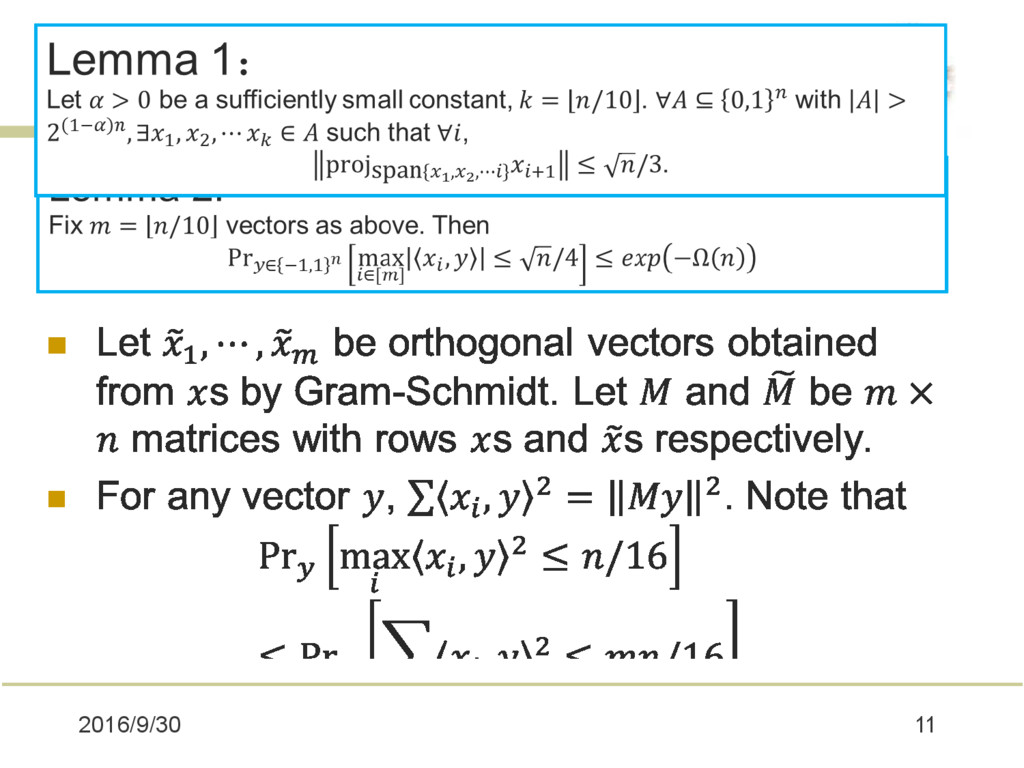
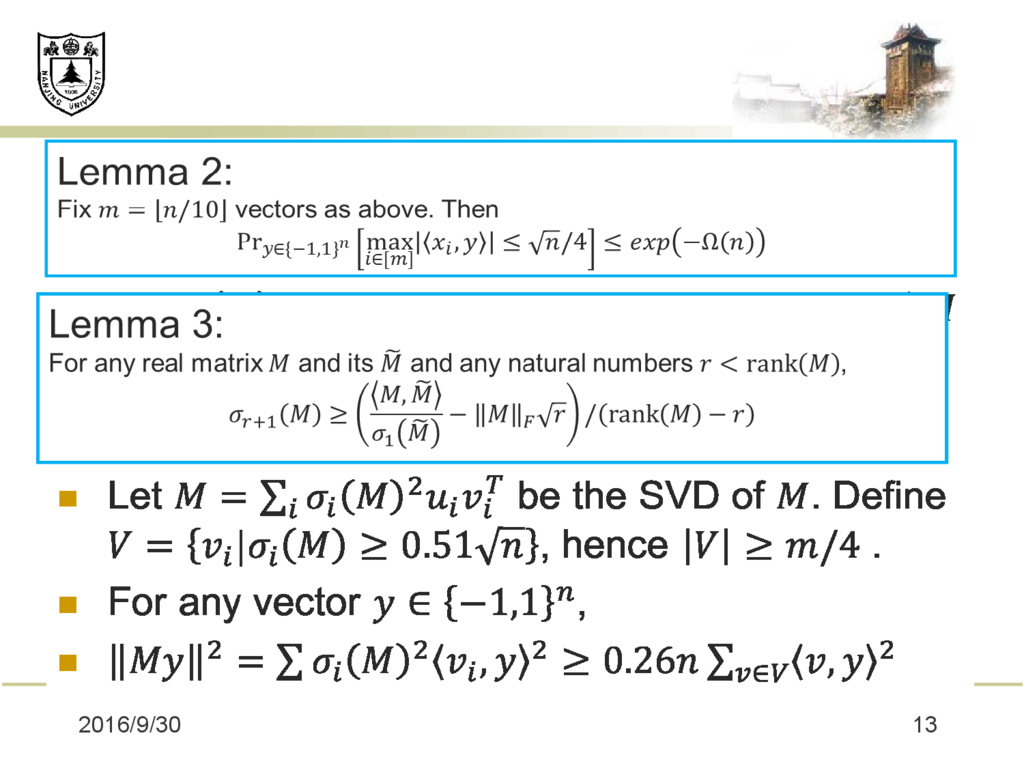
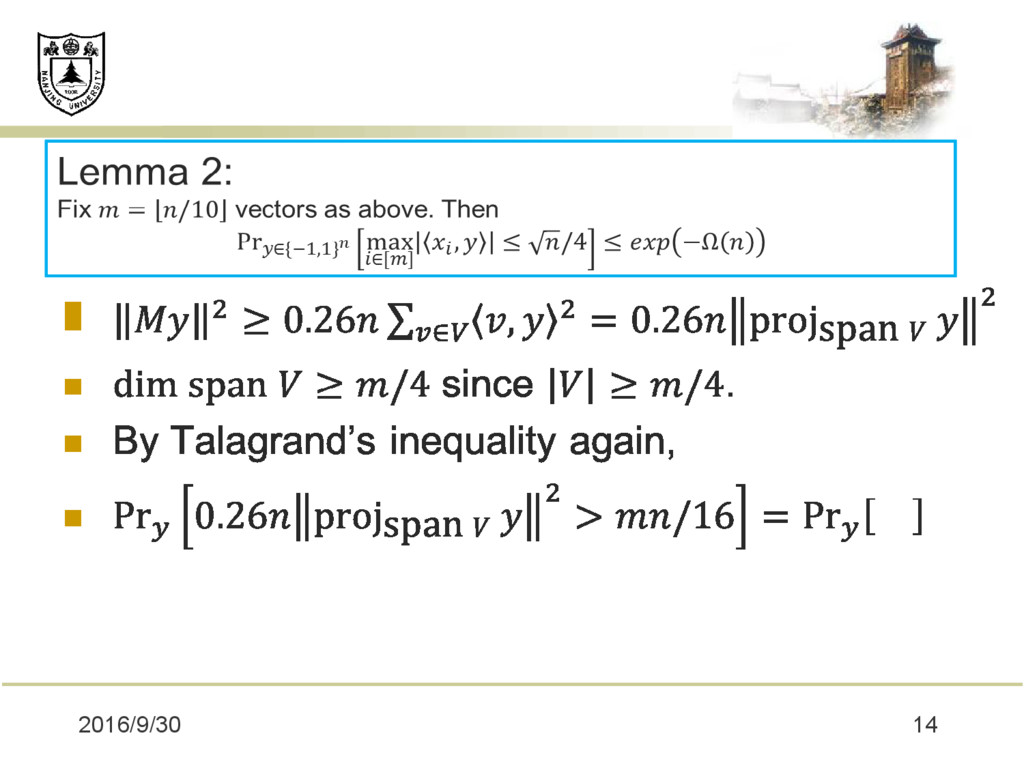
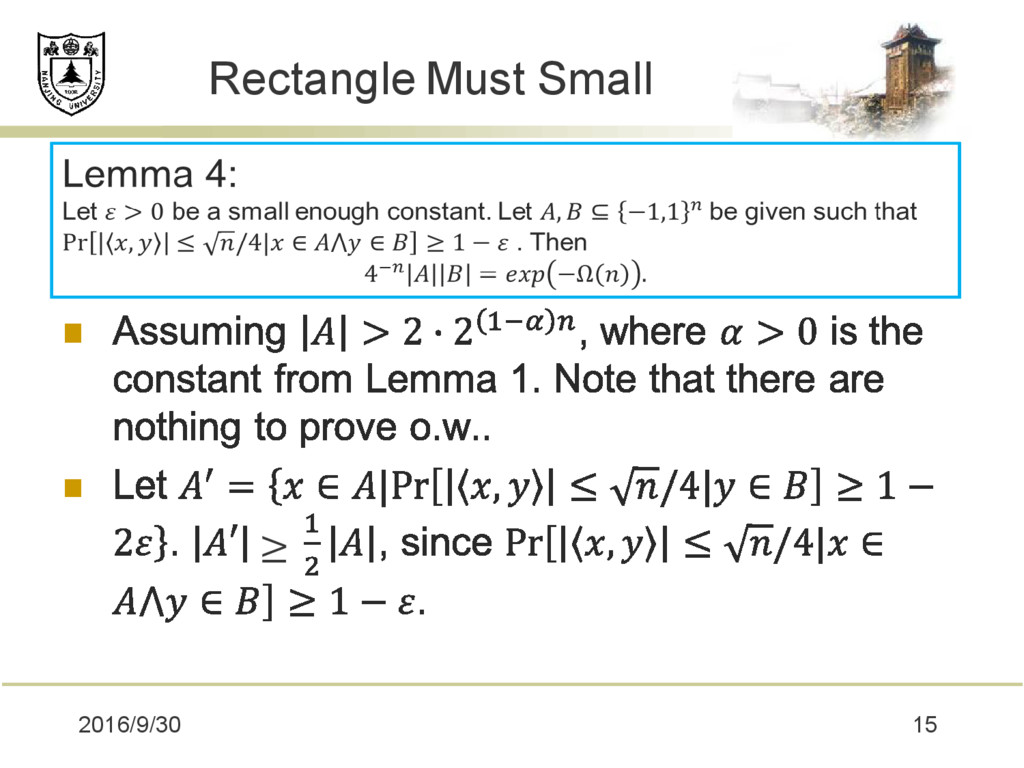
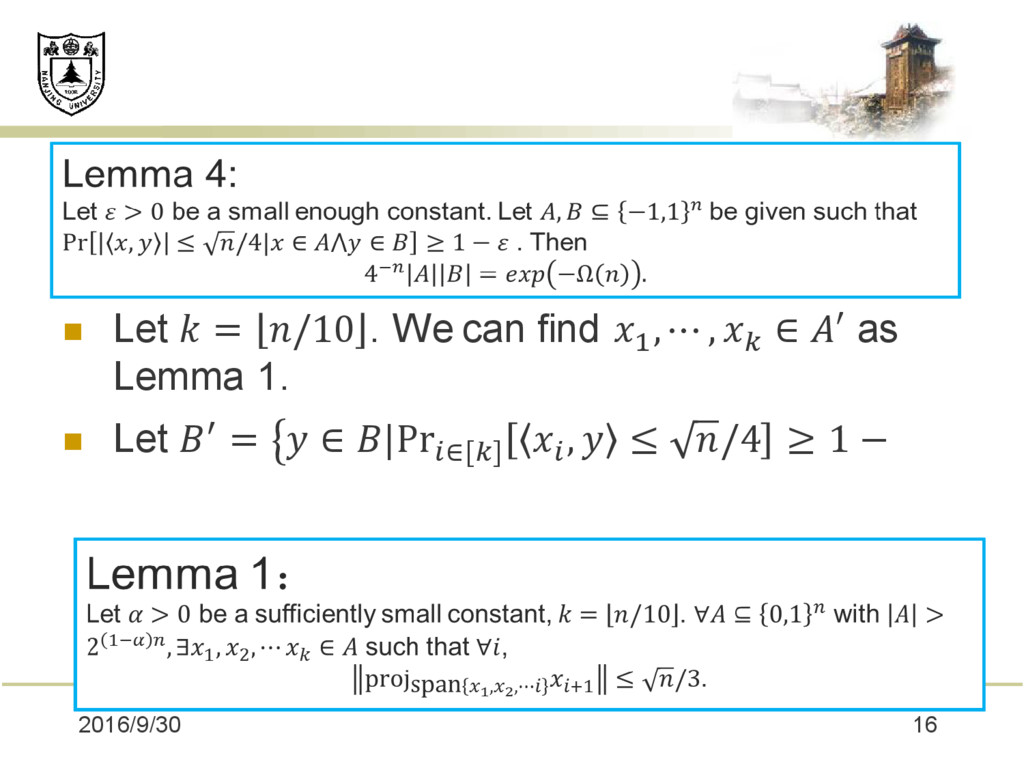
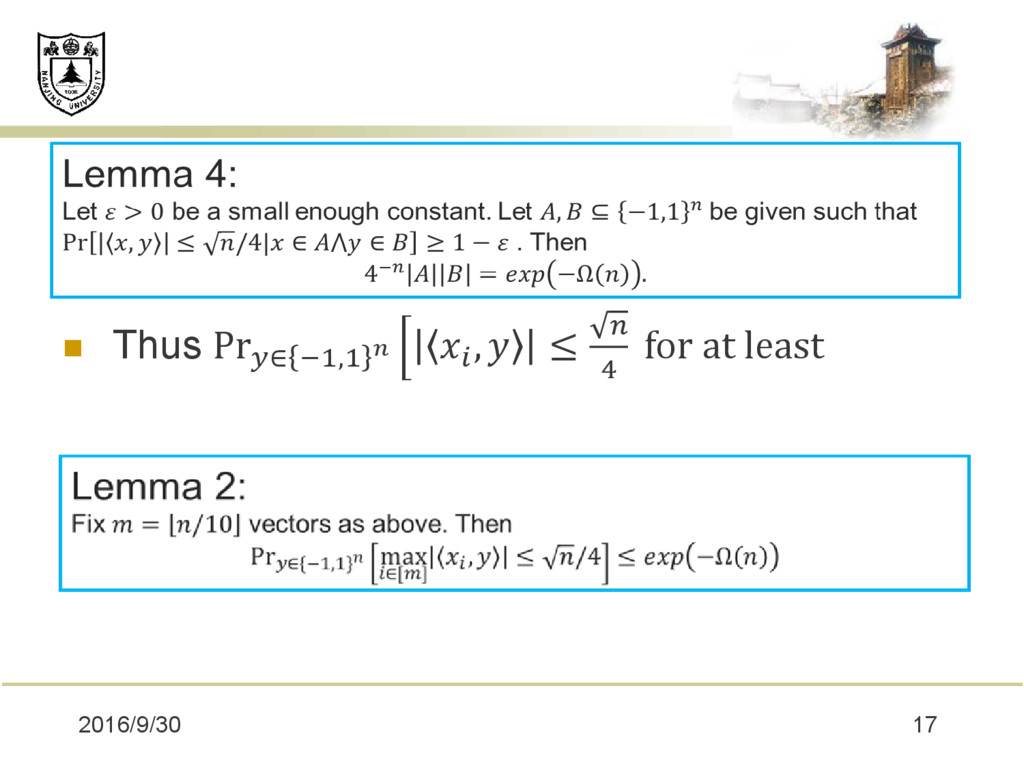
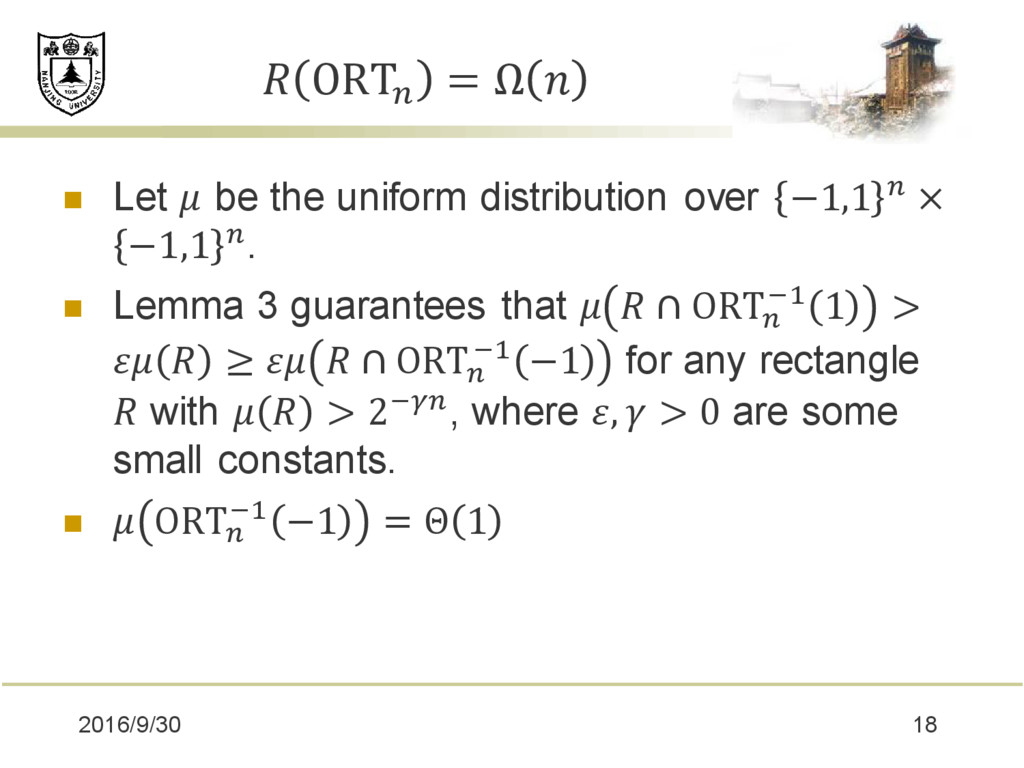
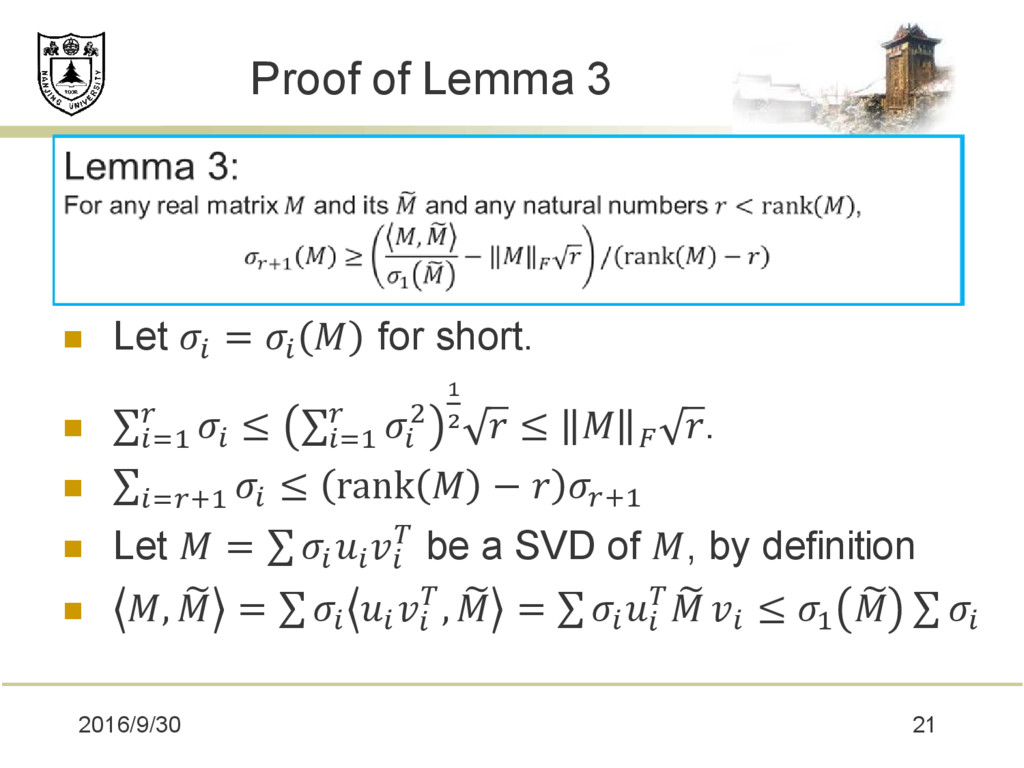
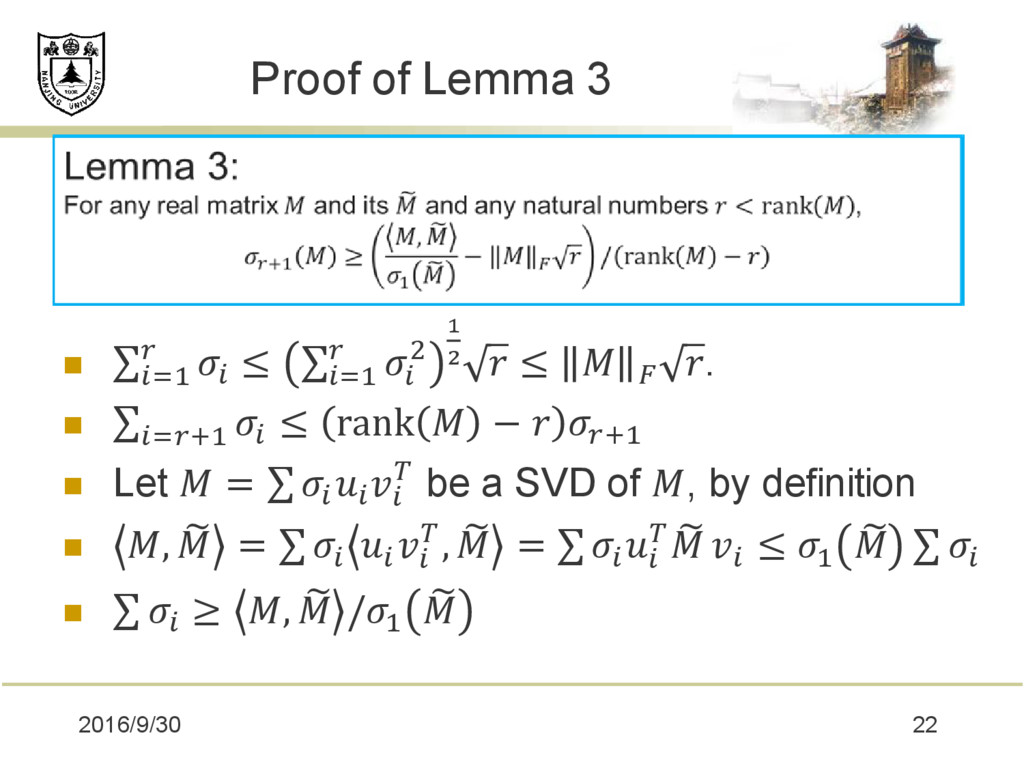
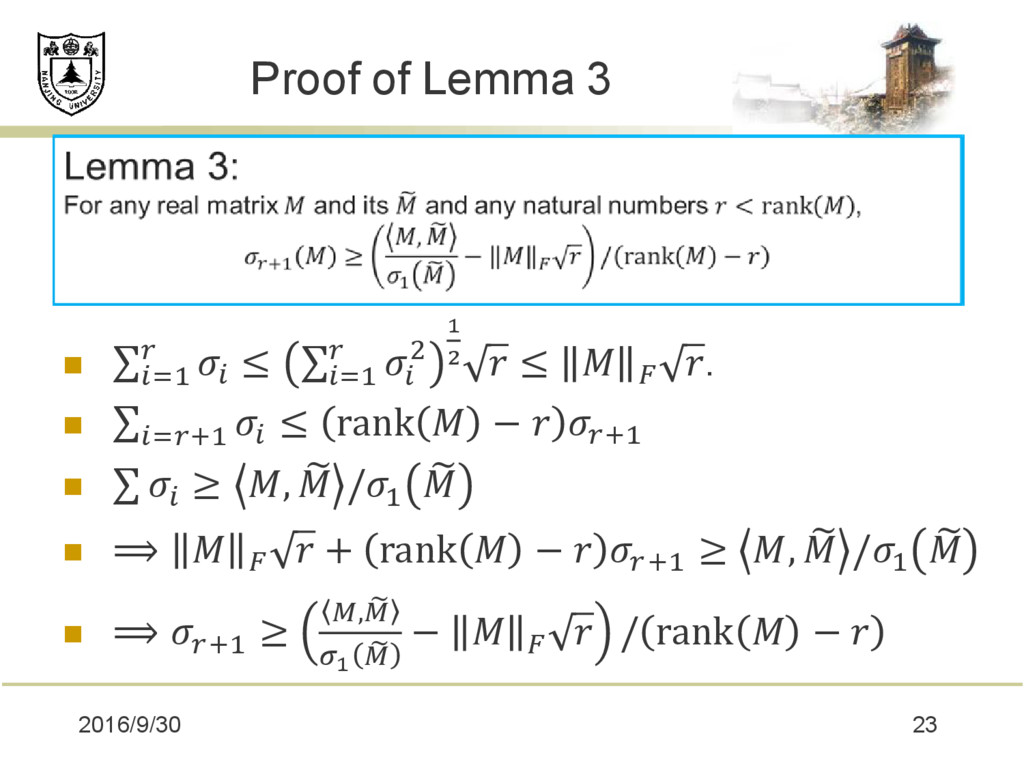
−1,1 × −1,1 . Lemma 3 guarantees that ∩ ORT −1 1 > ≥ ∩ ORT −1 −1 for any rectangle with > 2−, where , > 0 are some small constants. ORT −1 −1 = Θ 1 2016/9/30 18
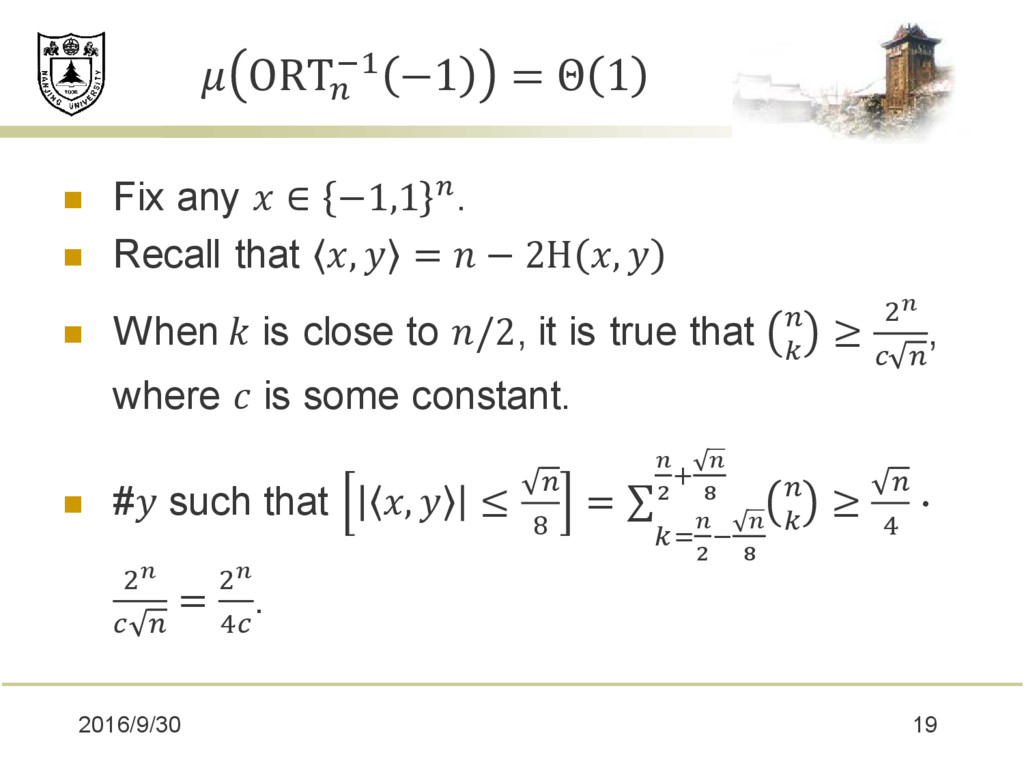
−1,1 . Recall that , = − 2H , When is close to /2, it is true that ≥ 2 , where is some constant. # such that , ≤ 8 = σ = 2 − 8 2 + 8 ≥ 4 ∙ 2 = 2 4 . 2016/9/30 19
−1,1 × −1,1 . Lemma 3 guarantees that ∩ ORT −1 1 > ≥ ∩ ORT −1 −1 for any rectangle with > 2−, where , > 0 are some small constants. ORT −1 −1 = Θ 1 By the corrupted bound [2], ORT ≥ log 2 ORT −1 −1 − 2016/9/30 20
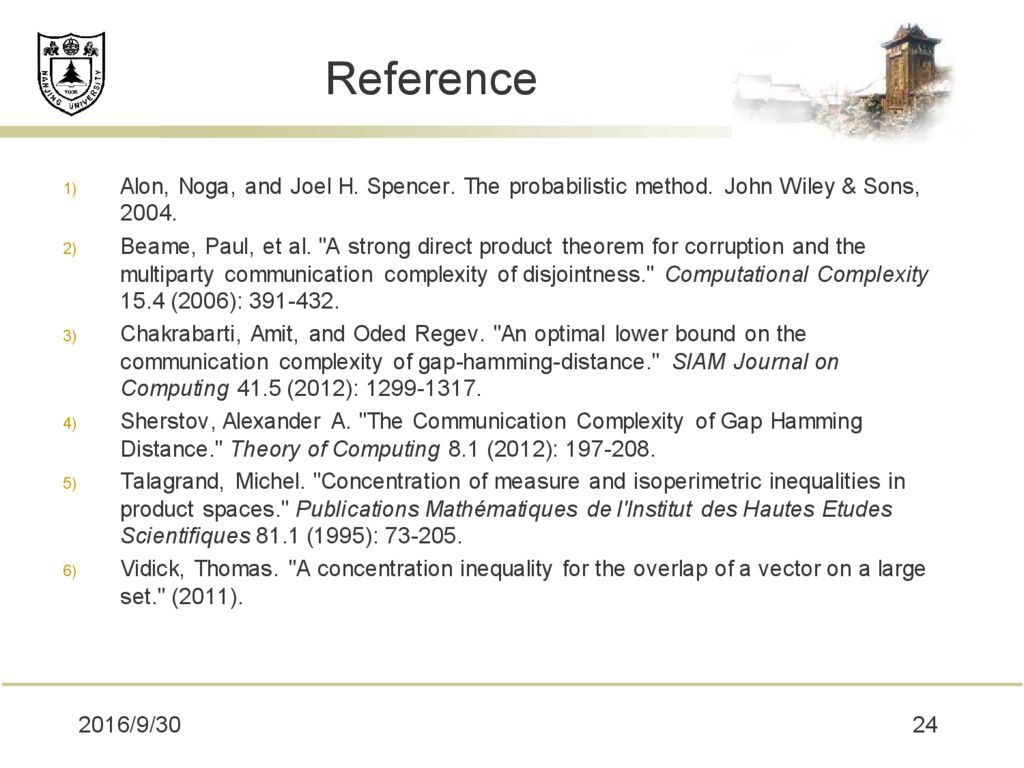
method. John Wiley & Sons, 2004. 2) Beame, Paul, et al. "A strong direct product theorem for corruption and the multiparty communication complexity of disjointness." Computational Complexity 15.4 (2006): 391-432. 3) Chakrabarti, Amit, and Oded Regev. "An optimal lower bound on the communication complexity of gap-hamming-distance." SIAM Journal on Computing 41.5 (2012): 1299-1317. 4) Sherstov, Alexander A. "The Communication Complexity of Gap Hamming Distance." Theory of Computing 8.1 (2012): 197-208. 5) Talagrand, Michel. "Concentration of measure and isoperimetric inequalities in product spaces." Publications Mathématiques de l'Institut des Hautes Etudes Scientifiques 81.1 (1995): 73-205. 6) Vidick, Thomas. "A concentration inequality for the overlap of a vector on a large set." (2011). 2016/9/30 24


 hime
hime
 kzmssk
 naok615
 institutdelelevage
 kohlerjohannes
 sokikatayama
 enochan
 shibuiwilliam
.png) satai
satai
 hisaokatsumi
 stktu
stktu
 kogoro
 aleyda
 jonrohan
 palkan
 notwaldorf
 inesmontani
 katarinadahlin
 coloredviolet
 jonoalderson
 konakalab
 rabernat