Share
Embed
ERPNext vs Odoo
ERPNext vs Odoo compares two popular ERP platforms and their capabilities in business management. This covers their modules, manufacturing, inventory, CRM, and HR. It helps organizations choose an ERP solution based on their requirements. HM Technologies provides ERPNext and Odoo implementation, customization, and integration services for businesses across different industries.
HM Technologies
November 05, 2026
Transcript
10 slides
-
E R P CO M PA R I S O
N ERPNext vs Odoo A Detailed Comparison HM Technologies ERPNext Odoo -
Understanding ERP Software W H AT A N E R
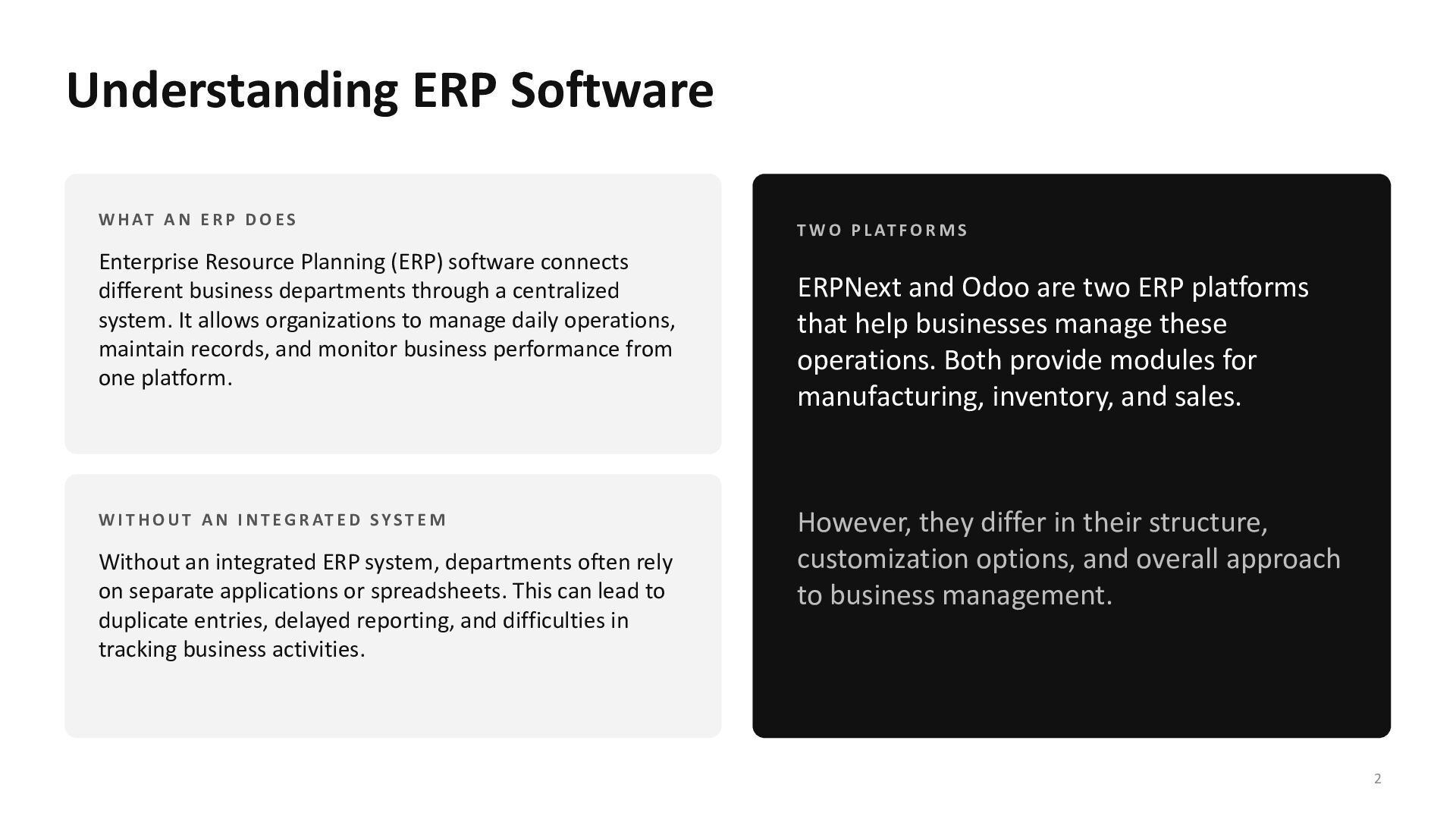
P D O E S Enterprise Resource Planning (ERP) software connects different business departments through a centralized system. It allows organizations to manage daily operations, maintain records, and monitor business performance from one platform. W I T H O U T A N I N T E G R AT E D S Y S T E M Without an integrated ERP system, departments often rely on separate applications or spreadsheets. This can lead to duplicate entries, delayed reporting, and difficulties in tracking business activities. T W O P L AT F O R M S ERPNext and Odoo are two ERP platforms that help businesses manage these operations. Both provide modules for manufacturing, inventory, and sales. However, they differ in their structure, customization options, and overall approach to business management. 2 -
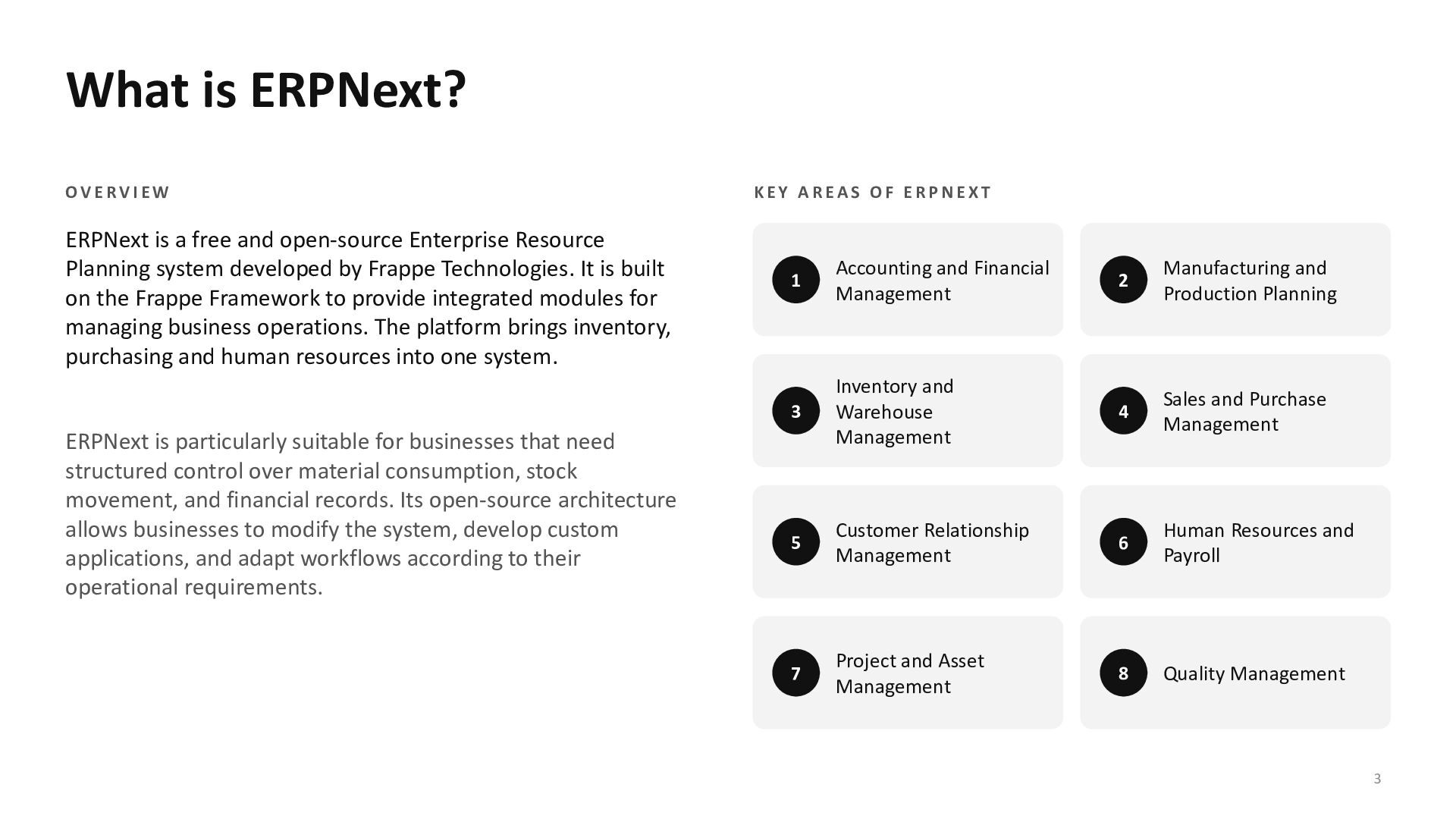
What is ERPNext? OVERVIEW ERPNext is a free and open-source
Enterprise Resource Planning system developed by Frappe Technologies. It is built on the Frappe Framework to provide integrated modules for managing business operations. The platform brings inventory, purchasing and human resources into one system. ERPNext is particularly suitable for businesses that need structured control over material consumption, stock movement, and financial records. Its open-source architecture allows businesses to modify the system, develop custom applications, and adapt workflows according to their operational requirements. KEY AREAS OF ERPNEXT 1 Accounting and Financial Management 2 Manufacturing and Production Planning 3 Inventory and Warehouse Management 4 Sales and Purchase Management 5 Customer Relationship Management 6 Human Resources and Payroll 7 Project and Asset Management 8 Quality Management 3 -
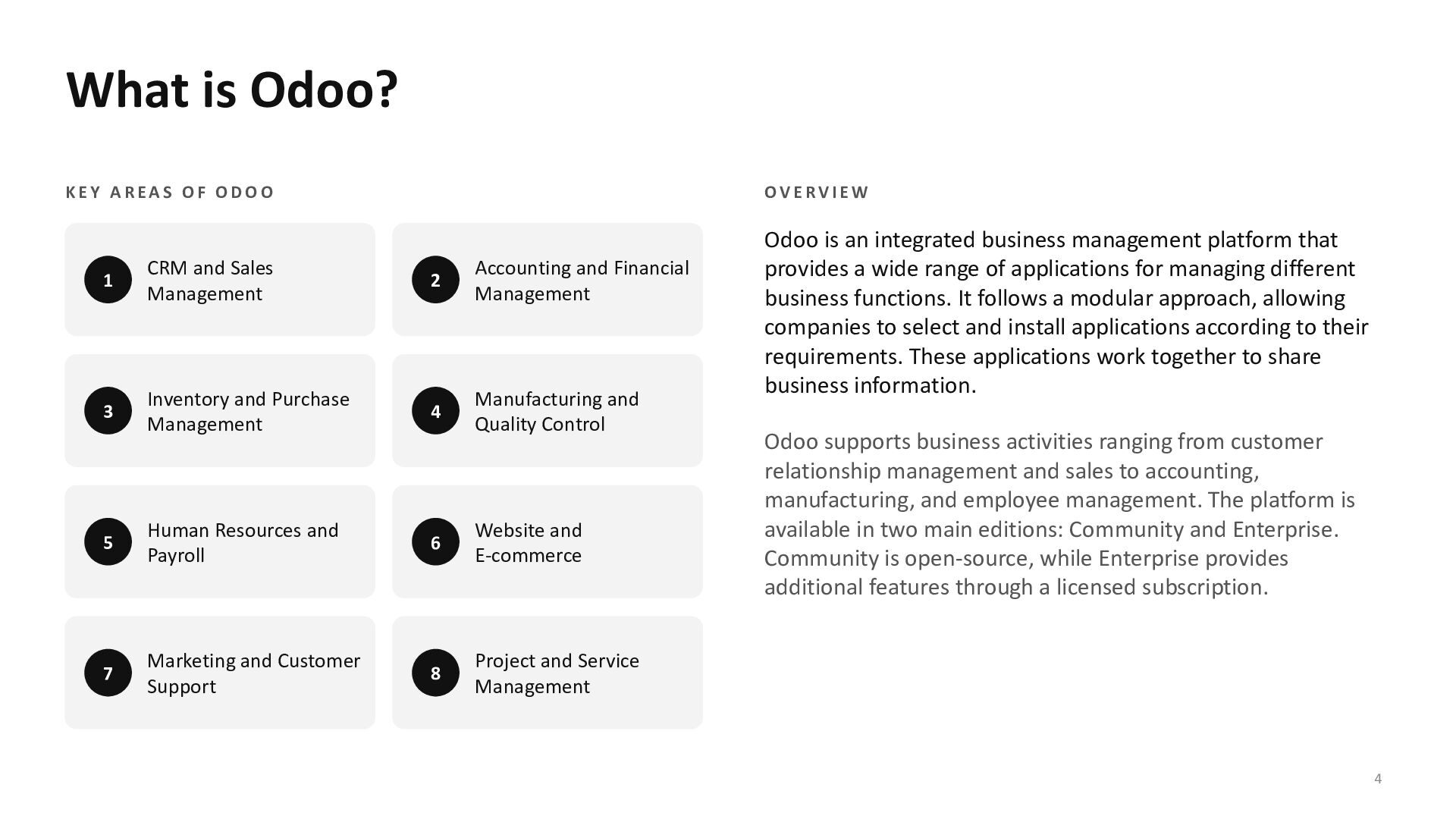
What is Odoo? KEY AREAS OF ODOO OVERVIEW 1 CRM
and Sales Management 2 Accounting and Financial Management 3 Inventory and Purchase Management 4 Manufacturing and Quality Control 5 Human Resources and Payroll 6 Website and E-commerce 7 Marketing and Customer Support 8 Project and Service Management Odoo is an integrated business management platform that provides a wide range of applications for managing different business functions. It follows a modular approach, allowing companies to select and install applications according to their requirements. These applications work together to share business information. Odoo supports business activities ranging from customer relationship management and sales to accounting, manufacturing, and employee management. The platform is available in two main editions: Community and Enterprise. Community is open-source, while Enterprise provides additional features through a licensed subscription. 4 -
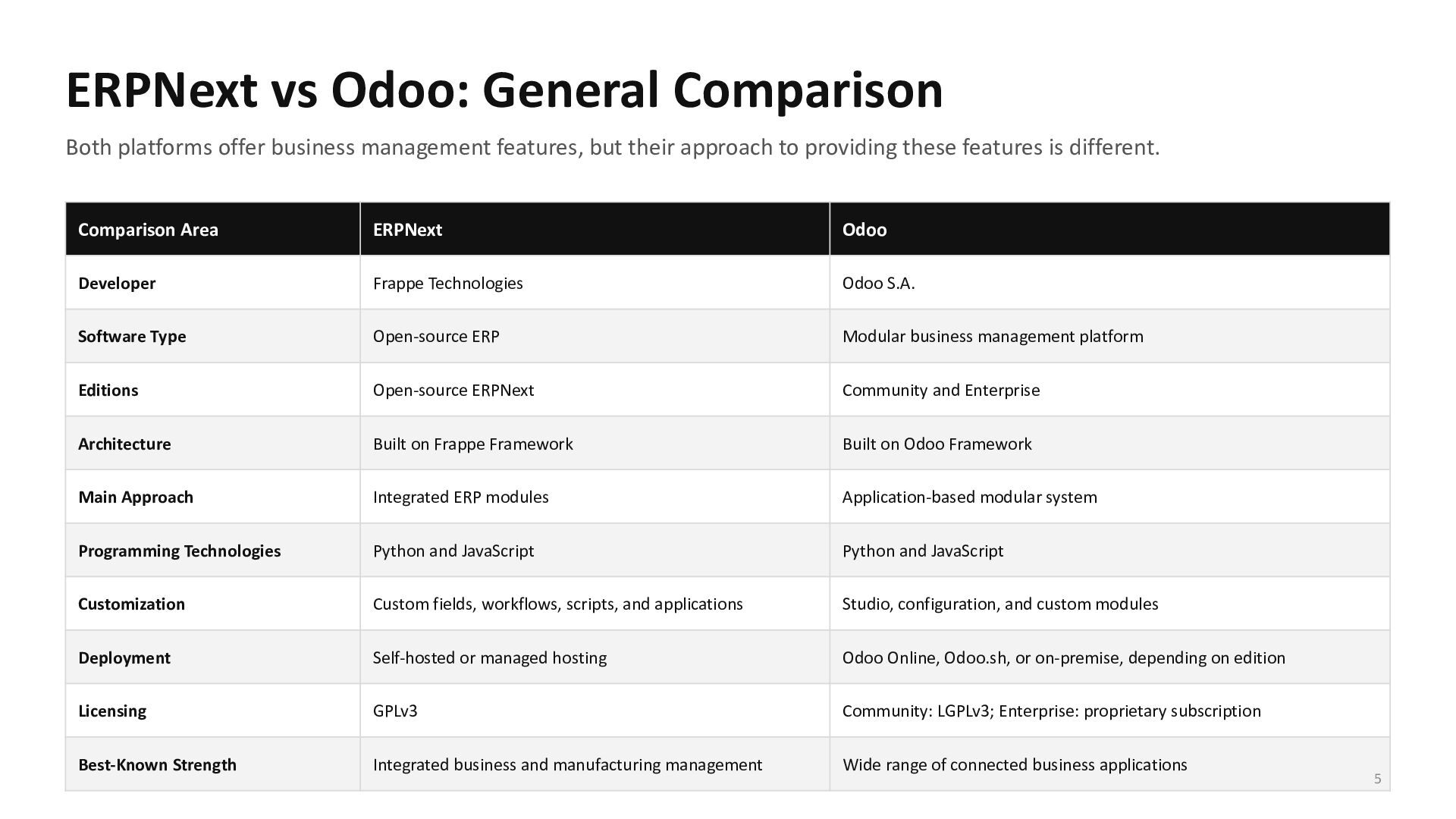
ERPNext vs Odoo: General Comparison Both platforms offer business management
features, but their approach to providing these features is different. Comparison Area ERPNext Odoo Developer Frappe Technologies Odoo S.A. Software Type Open-source ERP Modular business management platform Editions Open-source ERPNext Community and Enterprise Architecture Built on Frappe Framework Built on Odoo Framework Main Approach Integrated ERP modules Application-based modular system Programming Technologies Python and JavaScript Python and JavaScript Customization Custom fields, workflows, scripts, and applications Studio, configuration, and custom modules Deployment Self-hosted or managed hosting Odoo Online, Odoo.sh, or on-premise, depending on edition Licensing GPLv3 Community: LGPLv3; Enterprise: proprietary subscription Best-Known Strength Integrated business and manufacturing management Wide range of connected business applications 5 -
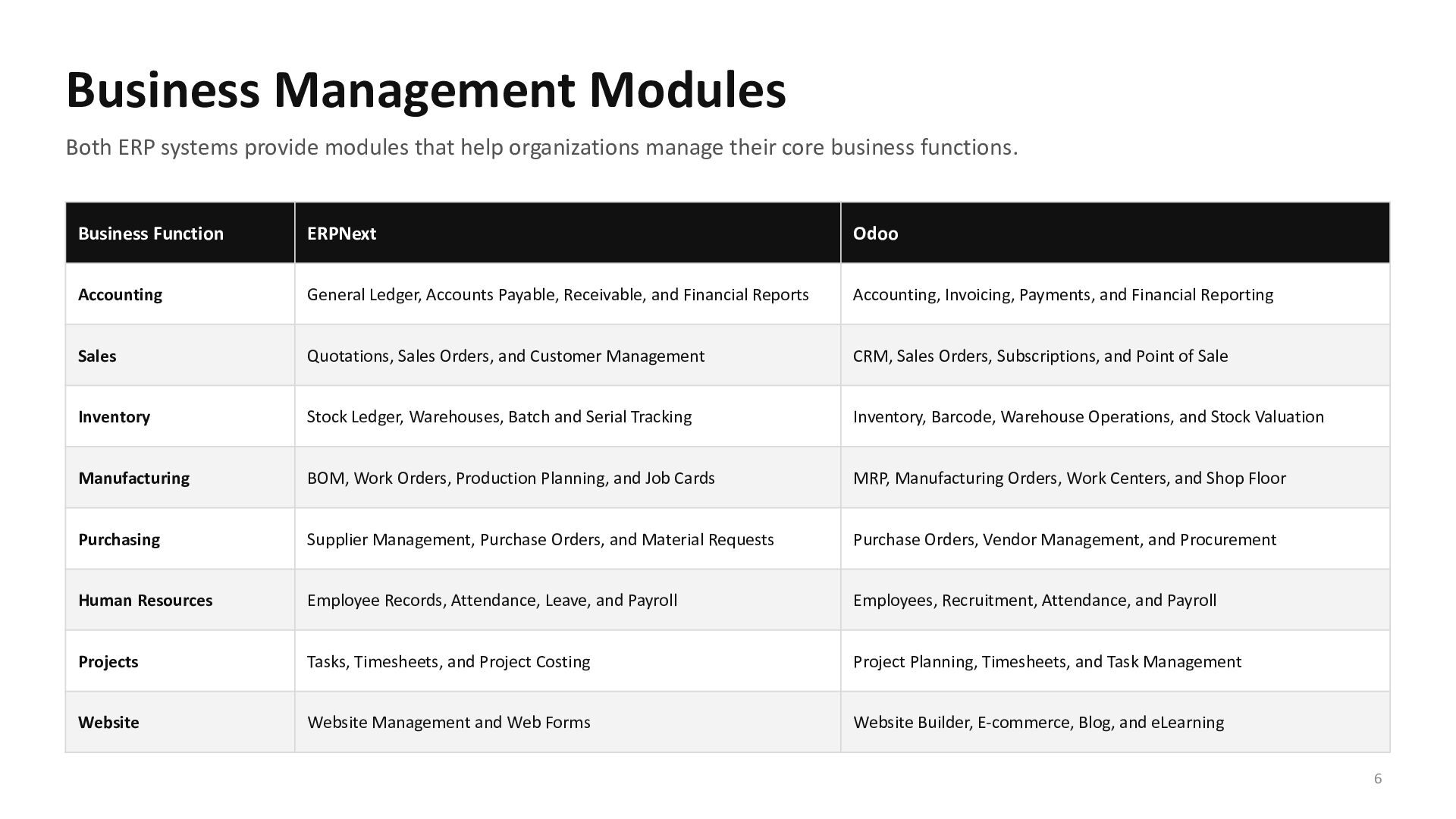
Business Management Modules Both ERP systems provide modules that help
organizations manage their core business functions. Business Function ERPNext Odoo Accounting General Ledger, Accounts Payable, Receivable, and Financial Reports Accounting, Invoicing, Payments, and Financial Reporting Sales Quotations, Sales Orders, and Customer Management CRM, Sales Orders, Subscriptions, and Point of Sale Inventory Stock Ledger, Warehouses, Batch and Serial Tracking Inventory, Barcode, Warehouse Operations, and Stock Valuation Manufacturing BOM, Work Orders, Production Planning, and Job Cards MRP, Manufacturing Orders, Work Centers, and Shop Floor Purchasing Supplier Management, Purchase Orders, and Material Requests Purchase Orders, Vendor Management, and Procurement Human Resources Employee Records, Attendance, Leave, and Payroll Employees, Recruitment, Attendance, and Payroll Projects Tasks, Timesheets, and Project Costing Project Planning, Timesheets, and Task Management Website Website Management and Web Forms Website Builder, E-commerce, Blog, and eLearning 6 -
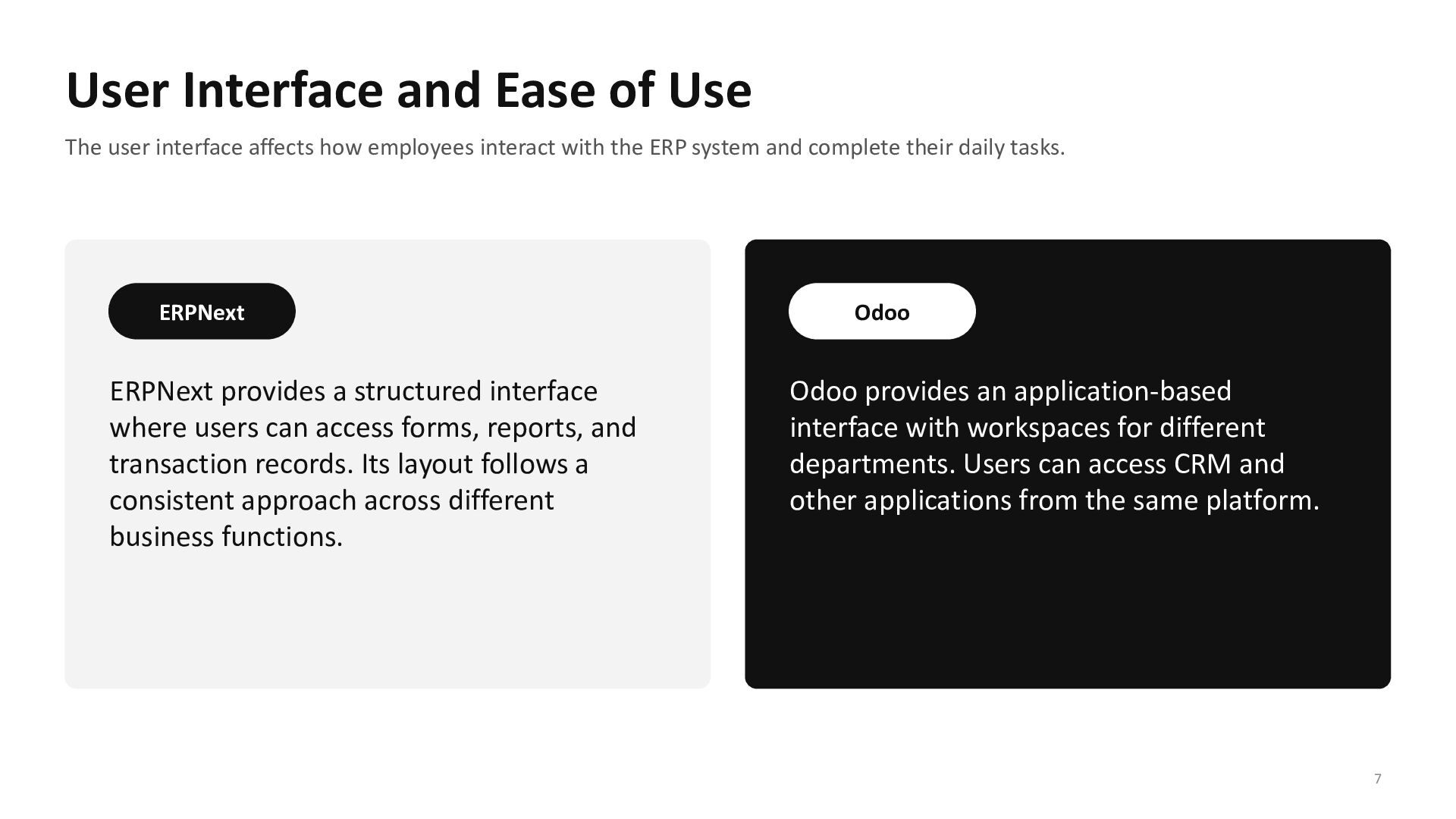
User Interface and Ease of Use The user interface affects
how employees interact with the ERP system and complete their daily tasks. ERPNext ERPNext provides a structured interface where users can access forms, reports, and transaction records. Its layout follows a consistent approach across different business functions. Odoo Odoo provides an application-based interface with workspaces for different departments. Users can access CRM and other applications from the same platform. 7 -
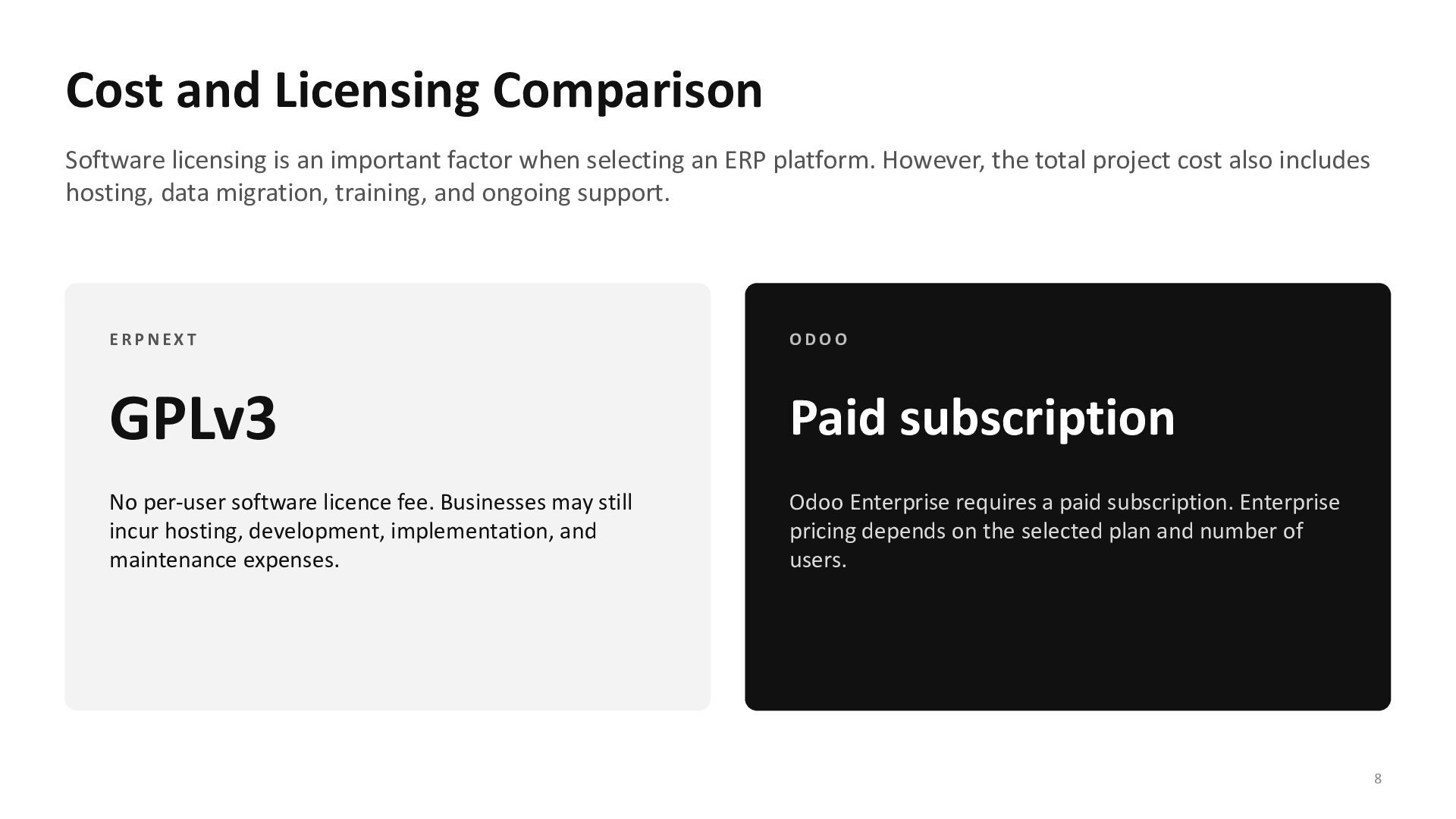
Cost and Licensing Comparison Software licensing is an important factor
when selecting an ERP platform. However, the total project cost also includes hosting, data migration, training, and ongoing support. ERPNEXT ODOO GPLv3 Paid subscription No per-user software licence fee. Businesses may still incur hosting, development, implementation, and maintenance expenses. Odoo Enterprise requires a paid subscription. Enterprise pricing depends on the selected plan and number of users. 8 -
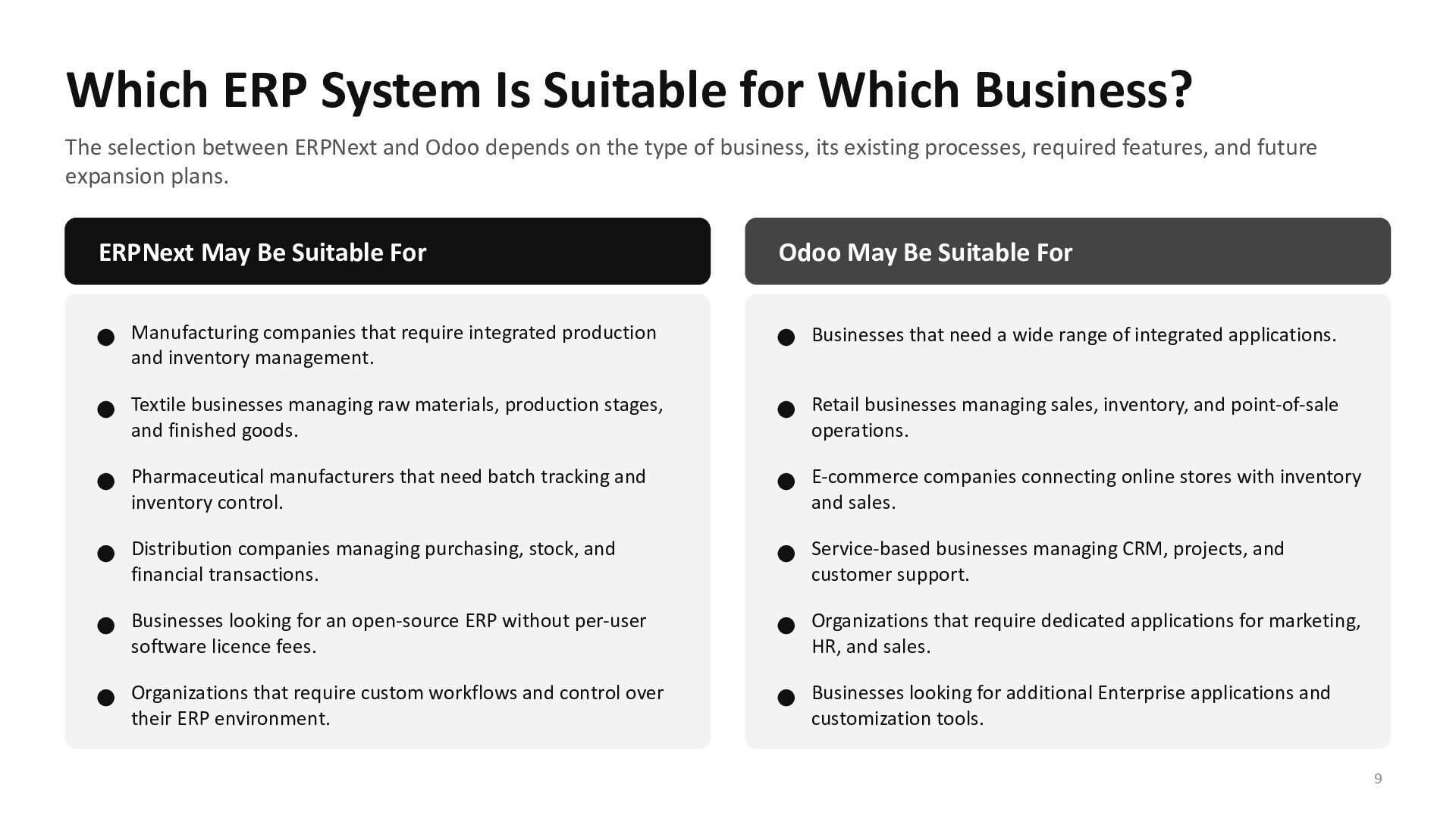
Which ERP System Is Suitable for Which Business? The selection
between ERPNext and Odoo depends on the type of business, its existing processes, required features, and future expansion plans. ERPNext May Be Suitable For Odoo May Be Suitable For Manufacturing companies that require integrated production and inventory management. Businesses that need a wide range of integrated applications. Textile businesses managing raw materials, production stages, and finished goods. Retail businesses managing sales, inventory, and point-of-sale operations. Pharmaceutical manufacturers that need batch tracking and inventory control. E-commerce companies connecting online stores with inventory and sales. Distribution companies managing purchasing, stock, and financial transactions. Service-based businesses managing CRM, projects, and customer support. Businesses looking for an open-source ERP without per-user software licence fees. Organizations that require dedicated applications for marketing, HR, and sales. Organizations that require custom workflows and control over their ERP environment. Businesses looking for additional Enterprise applications and customization tools. 9 -
Make the Right ERP Choice for Your Business! ERPNext or
Odoo? Find the right solution to manage business operations, simplify workflows, and support future growth. Let HM Technologies help turn business requirements into a powerful ERP solution. hm-technologies.com