Upgrade to Pro — share decks privately, control downloads, hide ads and more …

Roller Coster

Sponsored · Ship Features Fearlessly Turn features on and off without deploys. Used by thousands of Ruby developers. →
Avatar for Aynura Aynura
September 28, 2026

Roller Coster

Roller coster simulation

Aynura Huseynova

Description

A roller coaster is a complex physical system designed to transport passengers along a controlled track using mechanical, electrical, and safety components. The system uses different subsystems to control the movement, speed, direction, and safety of the train. These subsystems work together to provide a smooth and controlled ride from the beginning of the journey to the final stop.

Verified by Phisics teacher Telman Askeraliyev Azerbaijan Baku

Avatar for Aynura

Aynura

September 28, 2026

More Decks by Aynura

Other Decks in Design

Transcript

  1. Main System A roller coaster system is a mechanical and

    control system designed to transport passengers along a track at different speeds, heights, and directions while maintaining safety.
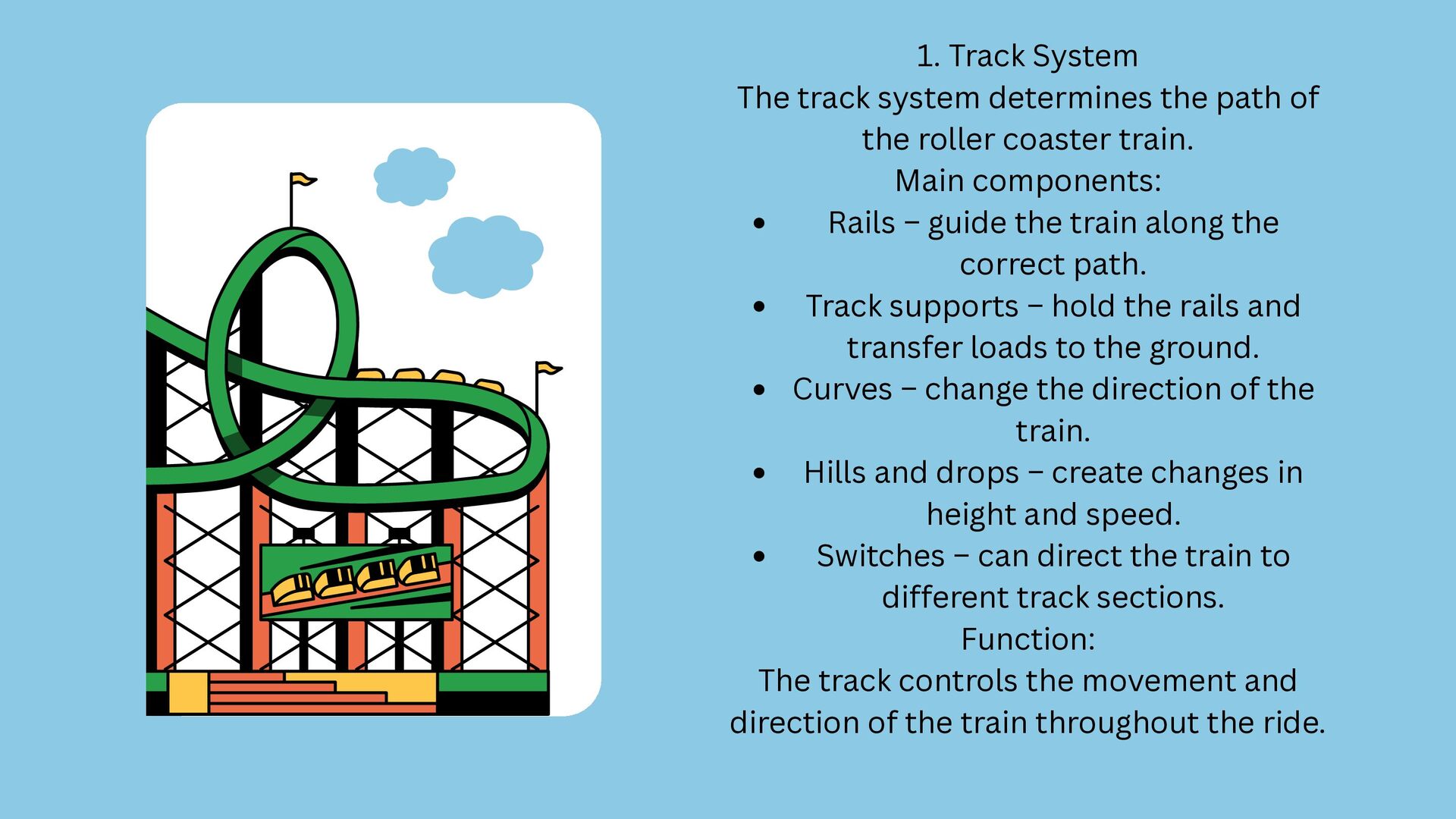
  2. 1. Track System The track system determines the path of

    the roller coaster train. Main components: Rails – guide the train along the correct path. Track supports – hold the rails and transfer loads to the ground. Curves – change the direction of the train. Hills and drops – create changes in height and speed. Switches – can direct the train to different track sections. Function: The track controls the movement and direction of the train throughout the ride.
  3. 2. Train System The train carries the passengers and moves

    along the track. Main components: Passenger cars – provide space for passengers. Seats – support passengers during the ride. Wheels – keep the train connected to the rails. Wheel assemblies – control the train’s movement and stability. Safety restraints – keep passengers securely in their seats. Function: The train transports passengers safely along the entire track.
  4. 3. Propulsion System The propulsion system provides the initial energy

    needed to move the train. Main components: Lift chain – pulls the train up a hill. Electric motor – powers the lift mechanism. Launch system – can accelerate the train at the beginning of the ride. Drive mechanism – transfers power to the train. Function: It gives the train enough energy to start moving or reach a required height/speed.
  5. 4. Braking System The braking system controls and reduces the

    train’s speed. Main components: Magnetic brakes – slow the train using magnetic forces. Friction brakes – reduce speed through controlled contact. Brake fins – interact with braking mechanisms. Emergency brakes – stop the train when necessary. Function: It controls the train’s speed and brings it to a safe stop at the station or during an emergency.
  6. 5. Safety System The safety system protects passengers and prevents

    unsafe operation. Main components: Lap bars – hold passengers in their seats. Seat belts – provide additional restraint. Safety sensors – check whether restraints and other components are correctly positioned. Emergency stop system – stops the ride when a dangerous condition is detected. Safety gates – prevent passengers from entering restricted areas. Function: It monitors important safety conditions and helps prevent accidents.
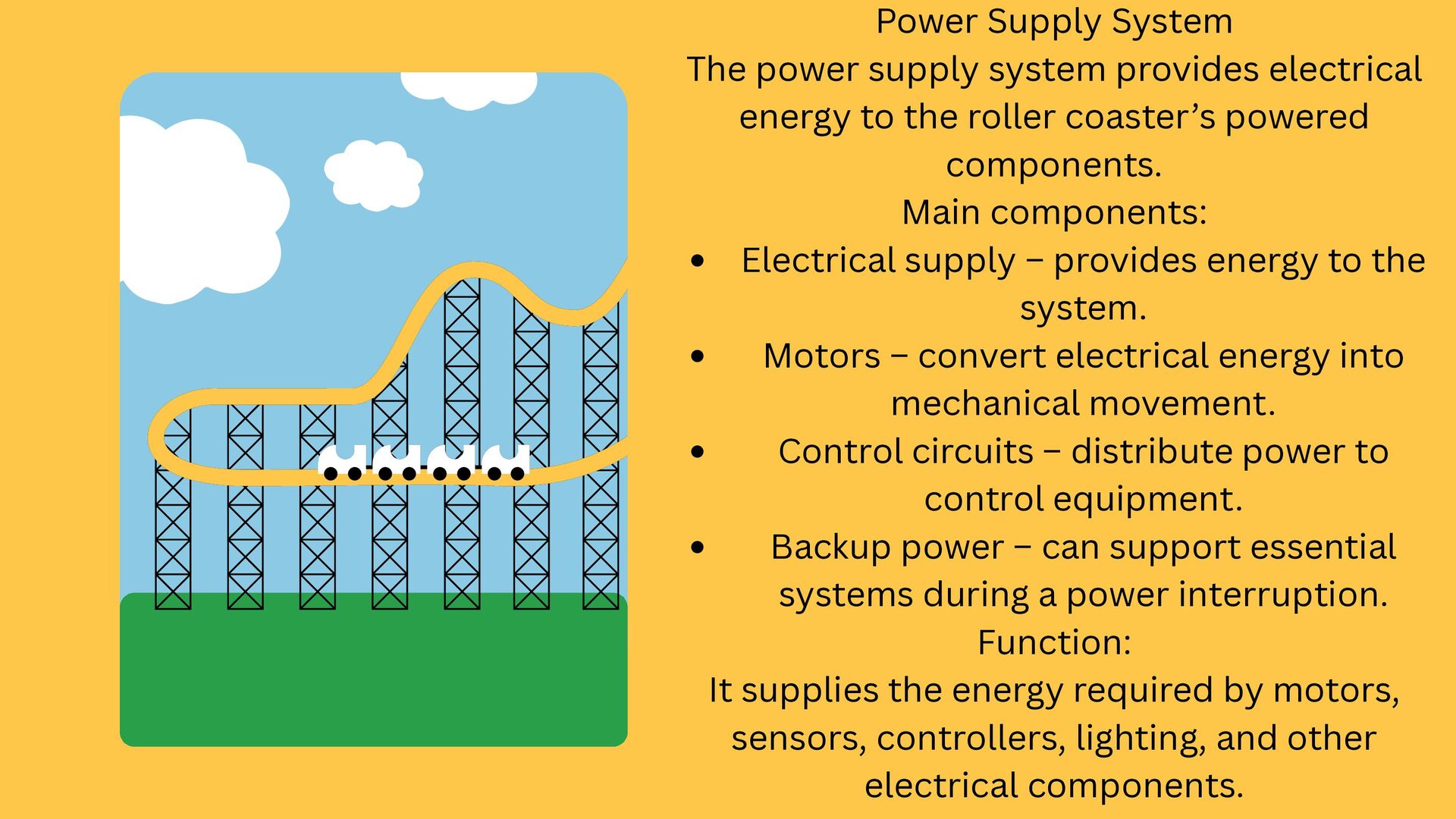
  7. Power Supply System The power supply system provides electrical energy

    to the roller coaster’s powered components. Main components: Electrical supply – provides energy to the system. Motors – convert electrical energy into mechanical movement. Control circuits – distribute power to control equipment. Backup power – can support essential systems during a power interruption. Function: It supplies the energy required by motors, sensors, controllers, lighting, and other electrical components.
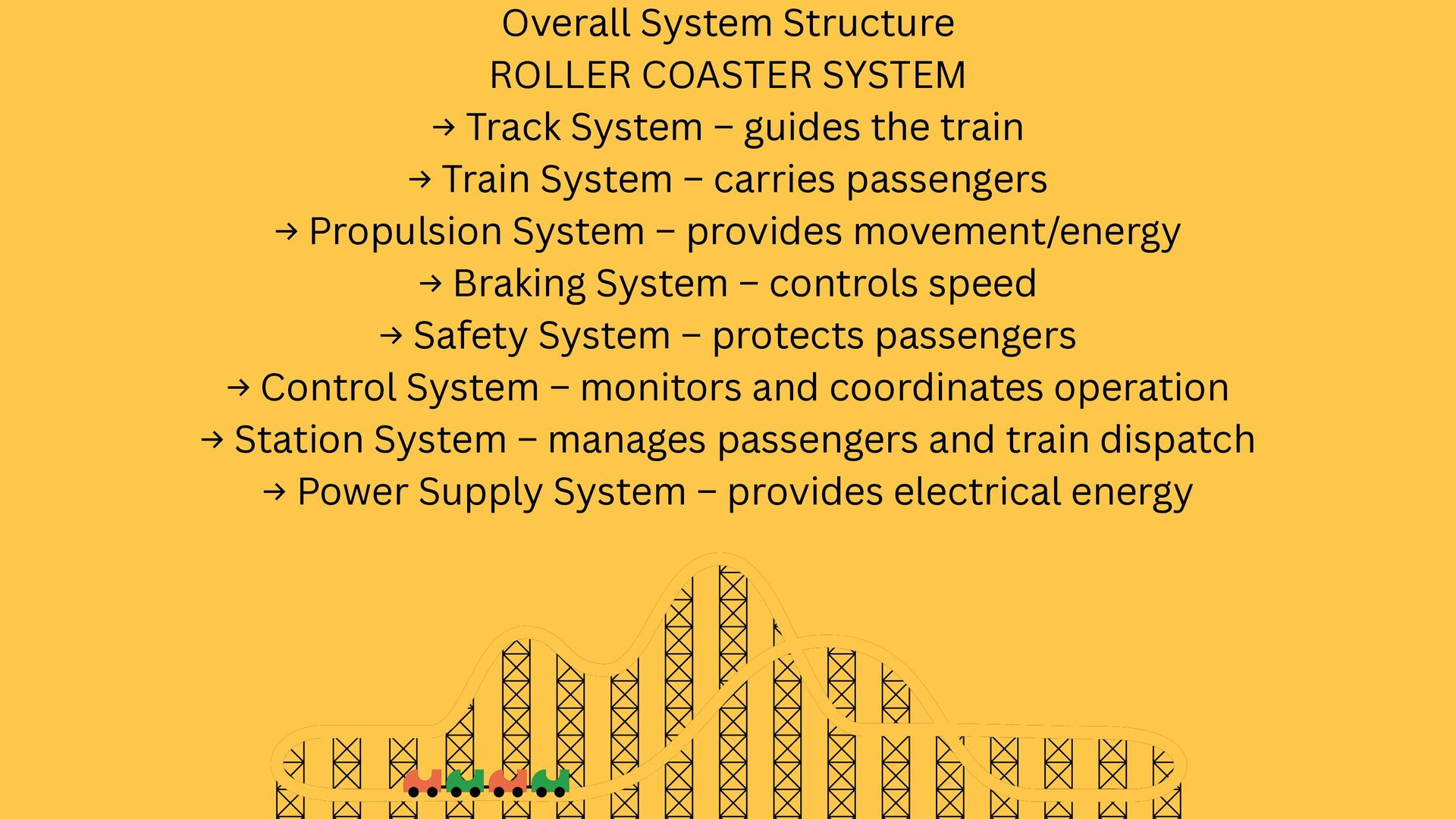
  8. Overall System Structure ROLLER COASTER SYSTEM → Track System –

    guides the train → Train System – carries passengers → Propulsion System – provides movement/energy → Braking System – controls speed → Safety System – protects passengers → Control System – monitors and coordinates operation → Station System – manages passengers and train dispatch → Power Supply System – provides electrical energy