Upgrade to Pro
— share decks privately, control downloads, hide ads and more …
Speaker Deck
Sign up for free
Menu
Search
Features
All features
Private URLs
Password Protection
Custom URLS
Scheduled publishing
Remove Branding
Restrict embedding
Deck Collections
Notes
Features
All features
Private URLs
Password Protection
Custom URLS
Scheduled publishing
Remove Branding
Restrict embedding
Deck Collections
Notes
Explore
Featured decks
Featured speakers
Programming
Technology
Storyboards
Explore
Featured decks
Featured speakers
Programming
Technology
Storyboards
Pricing
Search
Sign in
Sign up for free
Beyond grep – PyCon JP
Search
Hynek Schlawack
October 10, 2015
Programming
3.8k
1
Share
Embed
Copy iframe code
Copy JS code
Copy link
Start on current slide
Beyond grep – PyCon JP
Hynek Schlawack
October 10, 2015
More Decks by Hynek Schlawack
See All by Hynek Schlawack
Python’s True Superpower
hynek
0
310
Design Pressure
hynek
0
1.9k
Subclassing, Composition, Python, and You
hynek
3
600
Classy Abstractions @ Python Web Conf
hynek
0
240
On the Meaning of Version Numbers
hynek
0
450
Maintaining a Python Project When It’s Not Your Job
hynek
1
2.5k
How to Write Deployment-friendly Applications
hynek
0
2.7k
Solid Snakes or: How to Take 5 Weeks of Vacation
hynek
2
6k
Get Instrumented: How Prometheus Can Unify Your Metrics
hynek
4
11k
Other Decks in Programming
See All in Programming
[Rails World 2026] Durable orchestration on Rails: from continuation to workflow
palkan
1
490
手動確認はもう限界 〜XCUITestでCustom URL Schemeの遷移を起動種別ごとに自動テストする〜 / Testing Custom URL Schemes with XCUITest
otouto
0
390
CodeRabbitの効果検証と過ごしてみた3ヶ月
armondando
0
170
Androidだけじゃない、DroidKaigiで広がった私の技術スタック
akkeylab
0
120
When benchmarks go bad - what I learned from measuring performance wrong
hollycummins
0
160
Java 27新機能 / Java 27 new features
kishida
2
200
20260914 AIエージェント時代のPlatform Engineering LLM基盤とプロダクトの責務境界線
kanfab1
7
2.4k
WebRTC映像をAirPlayに対応させる挑戦.pdf
monolithic_adam
0
350
UPDATE をやめる — EF Core でマスタをバージョン管理する
panda728
PRO
0
1.1k
setup-vp GitLab対応の裏側
naokihaba
0
150
IBM Bob Dojo #1 仕様駆動開発入門
oniak3ibm
PRO
0
350
AWSに止められる覚悟してますか?
morizo_1984
2
520
Featured
See All Featured
I Don’t Have Time: Getting Over the Fear to Launch Your Podcast
jcasabona
35
2.9k
Paper Plane
katiecoart
PRO
4
54k
Building Better People: How to give real-time feedback that sticks.
wjessup
370
20k
How To Stay Up To Date on Web Technology
chriscoyier
790
250k
Building AI with AI
inesmontani
PRO
1
1.3k
A better future with KSS
kneath
240
18k
Exploring anti-patterns in Rails
aemeredith
4
520
Making Projects Easy
brettharned
120
6.8k
Product Roadmaps are Hard
iamctodd
55
13k
Building Adaptive Systems
keathley
44
3.2k
More Than Pixels: Becoming A User Experience Designer
marktimemedia
3
550
Site-Speed That Sticks
csswizardry
13
1.5k
Transcript
Beyond grep Pragmatic Logging & Metrics Hynek Schlawack
None
ͩΩͷ΅! @hynek https://hynek.me https://github.com/hynek
www.variomedia.de
ox.cx/b
Agenda
Agenda
Agenda
Agenda
Errors
Errors
Requirements
Requirements •fast
Requirements •fast •once
Requirements •fast •once
Requirements •fast •once •context
Requirements •fast •once •context
None
None
None
None
None
None
None
None
None
None
Raven-Python
Raven-Python Transports:
Raven-Python Transports: • gevent
Raven-Python Transports: • gevent • aiohttp
Raven-Python Transports: • gevent • aiohttp • Twisted
Raven-Python Transports: • gevent • aiohttp • Twisted • …8
others
Raven-Python Integrations: Transports: • gevent • aiohttp • Twisted •
…8 others
Raven-Python Integrations: • logging Transports: • gevent • aiohttp •
Twisted • …8 others
Raven-Python Integrations: • logging • Django Transports: • gevent •
aiohttp • Twisted • …8 others
Raven-Python Integrations: • logging • Django • WSGI Transports: •
gevent • aiohttp • Twisted • …8 others
Raven-Python Integrations: • logging • Django • WSGI • …9
others Transports: • gevent • aiohttp • Twisted • …8 others
Vanilla from raven import Client client = Client("https://yoursentry") try: 1
/ 0 except ZeroDivisionError: client.captureException()
Vanilla from raven import Client client = Client("https://yoursentry") try: 1
/ 0 except ZeroDivisionError: client.captureException()
Vanilla from raven import Client client = Client("https://yoursentry") try: 1
/ 0 except ZeroDivisionError: client.captureException()
Vanilla @client.capture_exceptions def foo(): raise Exception()
Django INSTALLED_APPS = ( … "raven.contrib.django.raven_compat", … )
Progress!
Progress! ✓
Metrics
Metrics?
Metrics? • numbers in a DB
Metrics? • numbers in a DB • guessing vs knowing
–D. J. Bernstein “Measure. Don’t speculate.”
System Metrics vs App Metrics • load • network traffic
• I/O • …
System Metrics vs App Metrics • load • network traffic
• I/O • … • counters
System Metrics vs App Metrics • load • network traffic
• I/O • … • counters • timers
System Metrics vs App Metrics • load • network traffic
• I/O • … • counters • timers • gauges
System Metrics vs App Metrics • load • network traffic
• I/O • … • counters • timers • gauges • …
Aggregation
Correlation
Math
Math • # reqs / s?
Math • # reqs / s? • worst 0.01% ⟨req
time⟩?
Math • # reqs / s? • worst 0.01% ⟨req
time⟩? • don’t try this alone!
Monitoring
Monitoring • latency
Monitoring • latency • error rates
Monitoring • latency • error rates • anomalies
Storage
Librato Metrics
Graphite 800 pound gorilla
Grafana
InfluxDB Graphite++ in Go
InfluxDB Graphite++ in Go
Prometheus Metrics & Monitoring
Prometheus Metrics & Monitoring
Prometheus Metrics & Monitoring
Prometheus Metrics & Monitoring
Prometheus Metrics & Monitoring
Prometheus Metrics & Monitoring
Collecting
Approaches
Approaches 1. external aggregation: StatsD, Riemann
Approaches 1. external aggregation: StatsD, Riemann + no state, simple
Approaches 1. external aggregation: StatsD, Riemann + no state, simple
– no direct introspection
Approaches 1. external aggregation: StatsD, Riemann + no state, simple
– no direct introspection 2. aggregate in-app, deliver to DB
Approaches 1. external aggregation: StatsD, Riemann + no state, simple
– no direct introspection 2. aggregate in-app, deliver to DB + in-app dashboard, useful in dev
Approaches 1. external aggregation: StatsD, Riemann + no state, simple
– no direct introspection 2. aggregate in-app, deliver to DB + in-app dashboard, useful in dev – state w/i app
None
(g|py)?statsd(py|-client)? import statsd c = statsd.StatsClient( "statsd.local", 8125 )
(g|py)?statsd(py|-client)?
(g|py)?statsd(py|-client)? c.incr("foo")
(g|py)?statsd(py|-client)? c.incr("foo") c.timing("stats.timed", 320)
Scales from greplin import scales from greplin.scales.meter import MeterStat STATS
= scales.collection( "/Resource", MeterStat("reqs"), scales.PmfStat("request_time") )
Scales from greplin import scales from greplin.scales.meter import MeterStat STATS
= scales.collection( "/Resource", MeterStat("reqs"), scales.PmfStat("request_time") )
Scales
Scales STATS.reqs.mark()
Scales STATS.reqs.mark() with STATS.request_time.time():
Scales STATS.reqs.mark() with STATS.request_time.time(): do_something_expensive()
Dashboard Scales
Dashboard Scales
Dashboard Scales … "request_time": { "count": 567315293, "99percentile": 0.10978688716888428, "75percentile":
0.013181567192077637, "min": 0.0002448558807373047, "max": 30.134822130203247, "98percentile": 0.08934824466705339, "95percentile": 0.027234303951263434, "median": 0.009176492691040039, "999percentile": 0.14235656142234793, "stddev": 0.01676855570363413, "mean": 0.013247184020535955 }, …
from greplin.scales import graphite pusher = graphite.GraphitePeriodicPusher( "graphite.host", 2003, period=30,
prefix="yourapp", ) pusher.allow("**") pusher.start()
Prometheus
Prometheus import random, time from prometheus_client import \ start_http_server, Summary
Prometheus import random, time from prometheus_client import \ start_http_server, Summary
FUNC_TIME = Summary( "func_seconds", "Time spent in func")
Prometheus import random, time from prometheus_client import \ start_http_server, Summary
FUNC_TIME = Summary( "func_seconds", "Time spent in func") @FUNC_TIME.time() def func(t): time.sleep(t)
Prometheus import random, time from prometheus_client import \ start_http_server, Summary
FUNC_TIME = Summary( "func_seconds", "Time spent in func") @FUNC_TIME.time() def func(t): time.sleep(t) if __name__ == '__main__': start_http_server(8000) while True: func(random.random())
Prometheus # HELP func_seconds Time spent in func # TYPE
func_seconds summary func_seconds_count 78.0 func_seconds_sum 37.8028838634491
Progress! ✓
Progress! ✓ ✓
Logging
Splunk
Splunk
Papertrail
loggly
ELK Elasticsearch + Logstash + Kibana
None
None
Logstash
Elasticsearch Logstash
Elasticsearch Logstash
Elasticsearch Logstash Kibana
Graylog
Graylog
Graylog
Graylog
None
None
Goal @400000005270e0d604afce64 { "event": "logged_in", "user": "guido", "ip": "8.8.8.8", "referrer":
"http://google.com" }
Context & Format
structlog
BoundLogger structlog
Original Logger BoundLogger structlog e.g. logging.Logger
Original Logger BoundLogger bind values log.bind(key=value) Context structlog
Original Logger BoundLogger bind values log.bind(key=value) Context log events log.info(event,
another_key=another_value) + structlog
Original Logger BoundLogger Processor 1 Processor n Return Value Return
Value bind values log.bind(key=value) Context log events log.info(event, another_key=another_value) + structlog
>>> import structlog >>> log = structlog.get_logger() >>> log.error("ohai", why=42,
wtf=True) why=42 wtf=True event='ohai'
>>> import structlog >>> log = structlog.get_logger() >>> log.error("ohai", why=42,
wtf=True) why=42 wtf=True event='ohai'
>>> import structlog >>> log = structlog.get_logger() >>> log.error("ohai", why=42,
wtf=True) why=42 wtf=True event='ohai'
>>> import structlog >>> log = structlog.get_logger() >>> log.error("ohai", why=42,
wtf=True) why=42 wtf=True event='ohai'
>>> from structlog import get_logger >>> log = get_logger() >>>
log = log.bind(user='anonymous', some_key=23) >>> log = log.bind(user='hynek', another_key=42) >>> log.info('user.logged_in', happy=True) some_key=23 user='hynek' another_key=42 happy=True event='user.logged_in'
>>> from structlog import get_logger >>> log = get_logger() >>>
log = log.bind(user='anonymous', some_key=23) >>> log = log.bind(user='hynek', another_key=42) >>> log.info('user.logged_in', happy=True) some_key=23 user='hynek' another_key=42 happy=True event='user.logged_in'
>>> from structlog import get_logger >>> log = get_logger() >>>
log = log.bind(user='anonymous', some_key=23) >>> log = log.bind(user='hynek', another_key=42) >>> log.info('user.logged_in', happy=True) some_key=23 user='hynek' another_key=42 happy=True event='user.logged_in'
>>> from structlog import get_logger >>> log = get_logger() >>>
log = log.bind(user='anonymous', some_key=23) >>> log = log.bind(user='hynek', another_key=42) >>> log.info('user.logged_in', happy=True) some_key=23 user='hynek' another_key=42 happy=True event='user.logged_in'
>>> from structlog import get_logger >>> log = get_logger() >>>
log = log.bind(user='anonymous', some_key=23) >>> log = log.bind(user='hynek', another_key=42) >>> log.info('user.logged_in', happy=True) some_key=23 user='hynek' another_key=42 happy=True event='user.logged_in'
def view(request): log = logger.bind(request=request) log.info("view_rendered") return "hello, world"
def view(request): log = logger.bind(request=request) log.info("view_rendered") return "hello, world"
def view(request): log = logger.bind(request=request) log.info("view_rendered") return "hello, world"
def request_extractor(_, __, event): req = event.pop("request", None) if req
is not None: event.update({ "client_addr": req.client_addr, "user_id": req.authenticated_userid, }) return event
def request_extractor(_, __, event): req = event.pop("request", None) if req
is not None: event.update({ "client_addr": req.client_addr, "user_id": req.authenticated_userid, }) return event
def request_extractor(_, __, event): req = event.pop("request", None) if req
is not None: event.update({ "client_addr": req.client_addr, "user_id": req.authenticated_userid, }) return event
def request_extractor(_, __, event): req = event.pop("request", None) if req
is not None: event.update({ "client_addr": req.client_addr, "user_id": req.authenticated_userid, }) return event
{"client_addr": "192.168.42.42", "user_id": null, "event": "view_rendered"}
import logging, sys logger = logging.getLogger() logger.addHandler( logging.StreamHandler( sys.stdout )
)
import logging, sys logger = logging.getLogger() logger.addHandler( logging.StreamHandler( sys.stdout )
)
Capture
Capture • into files
Capture • into files • to syslog / a queue
Capture • into files • to syslog / a queue
• pipe into a logging agent
None
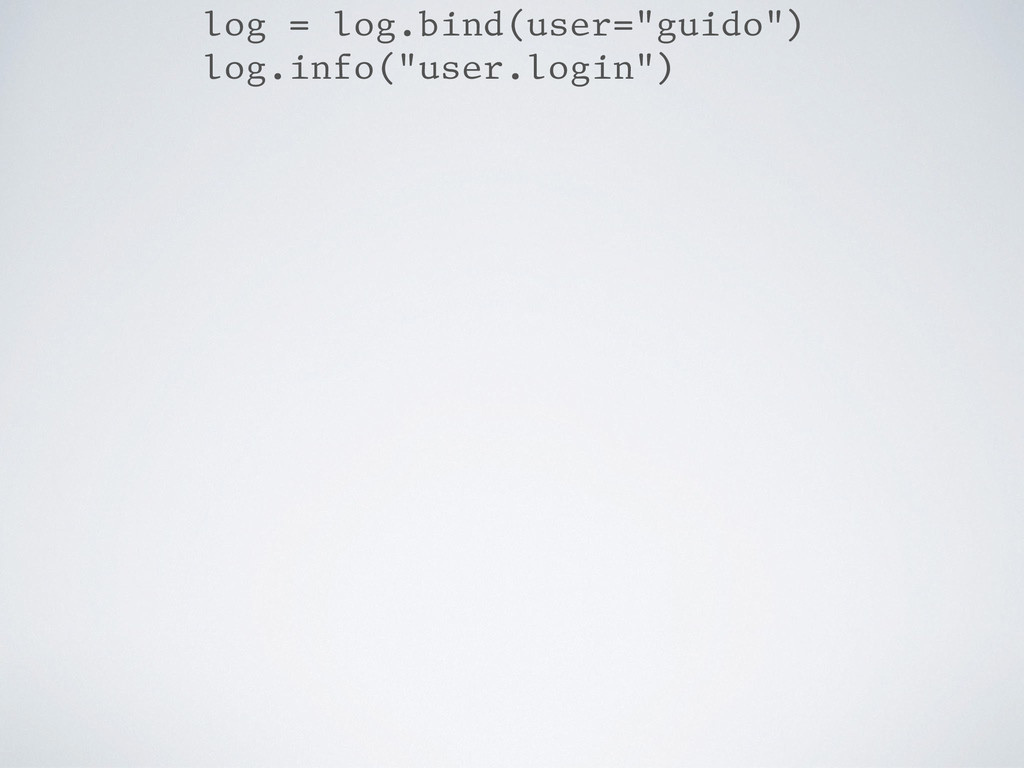
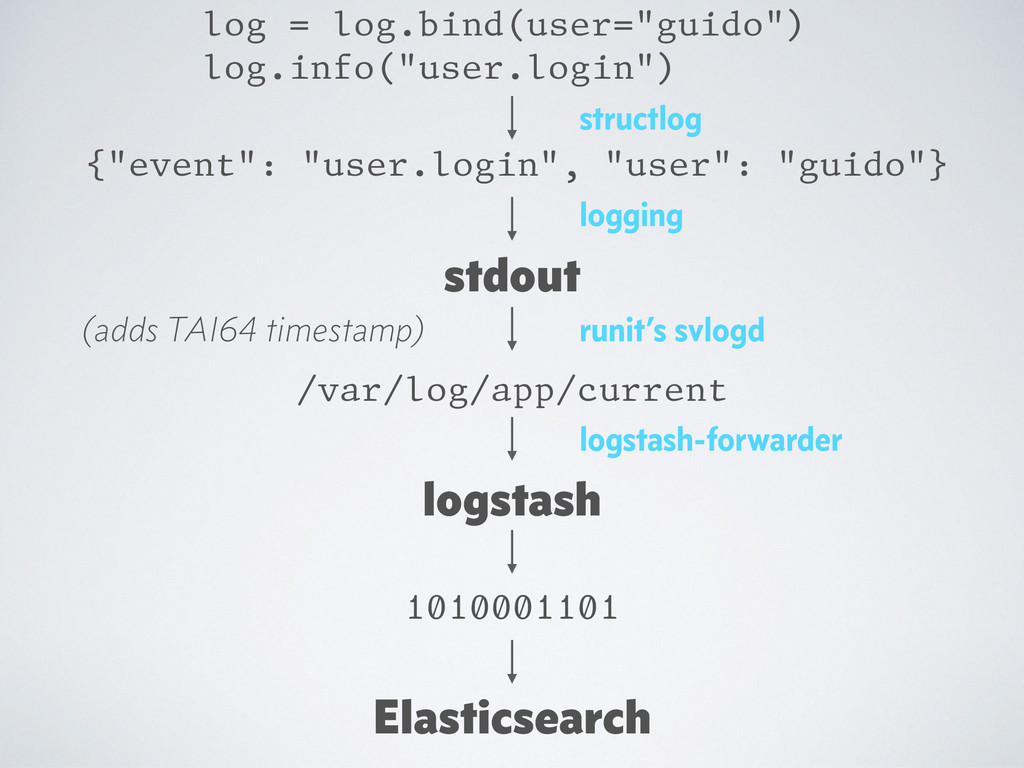
log = log.bind(user="guido") log.info("user.login")
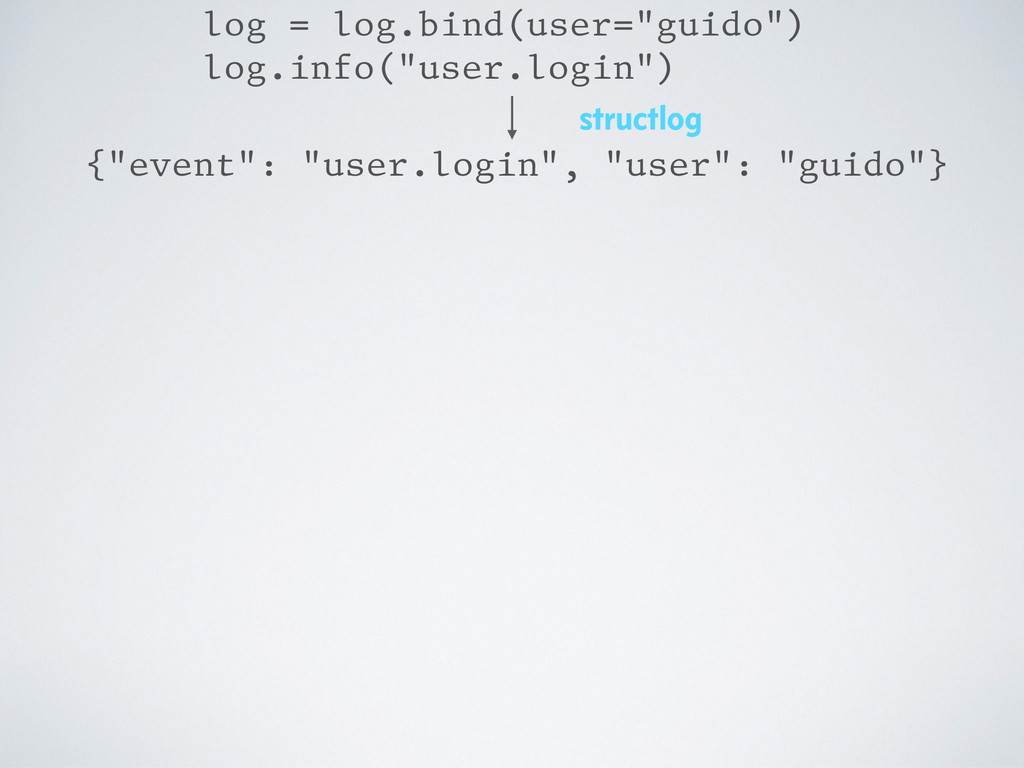
{"event": "user.login", "user": "guido"} log = log.bind(user="guido") log.info("user.login") structlog
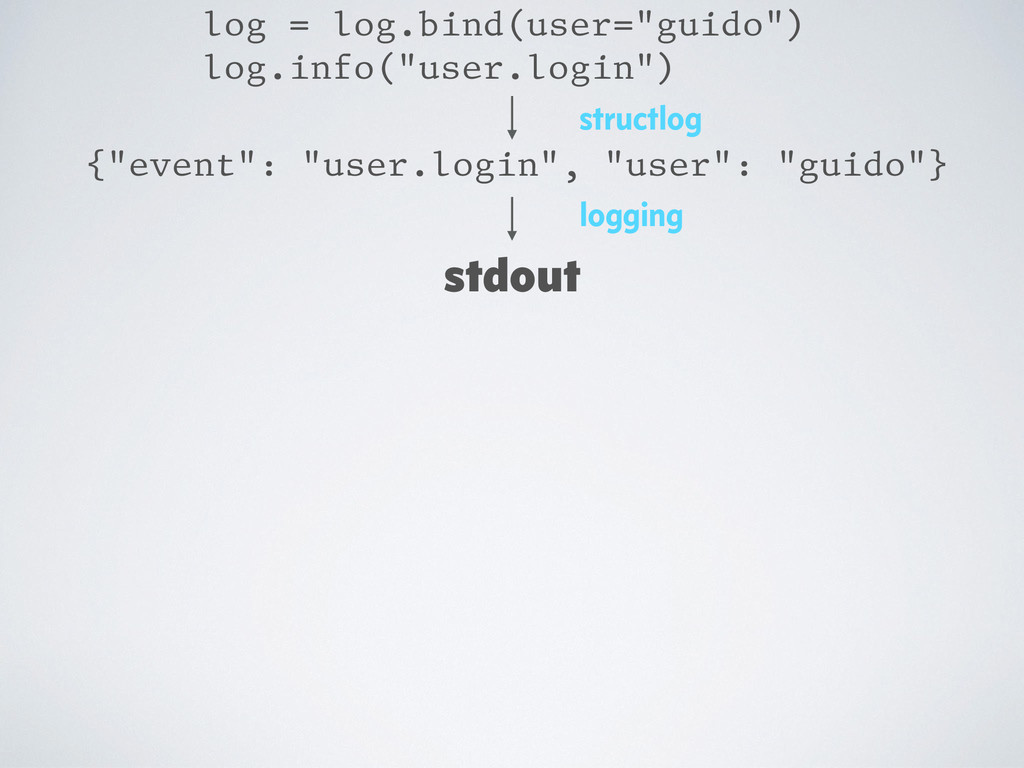
{"event": "user.login", "user": "guido"} log = log.bind(user="guido") log.info("user.login") structlog stdout
logging
{"event": "user.login", "user": "guido"} log = log.bind(user="guido") log.info("user.login") structlog stdout
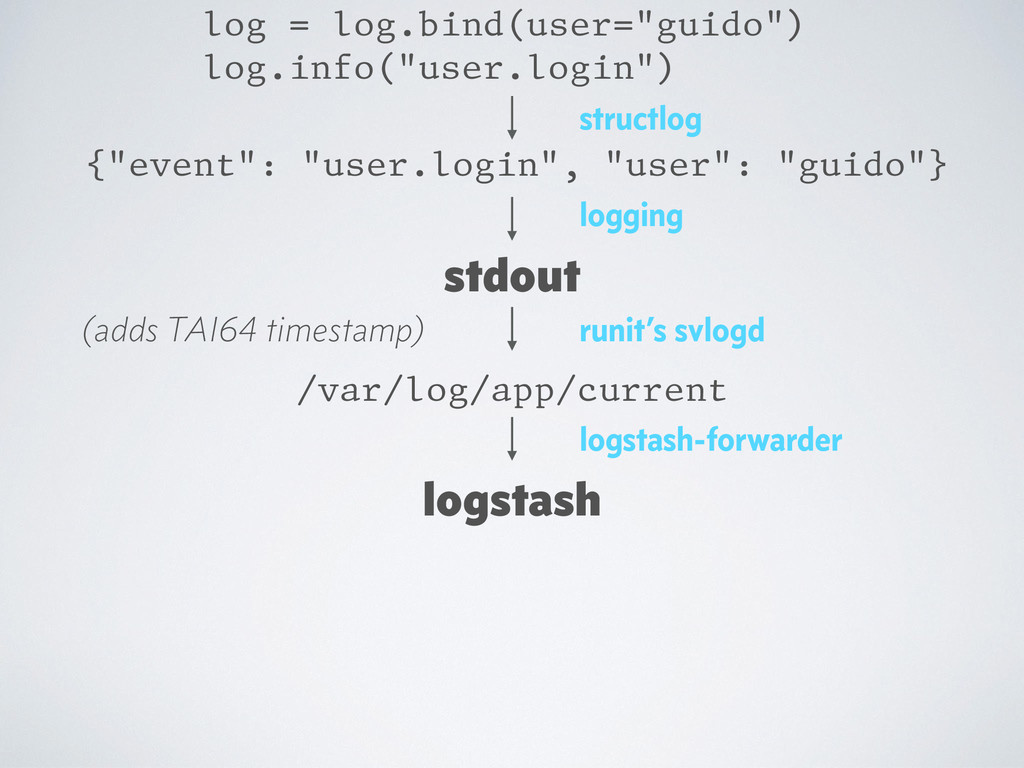
logging /var/log/app/current runit’s svlogd (adds TAI64 timestamp)
{"event": "user.login", "user": "guido"} log = log.bind(user="guido") log.info("user.login") structlog logstash-forwarder
logstash stdout logging /var/log/app/current runit’s svlogd (adds TAI64 timestamp)
{"event": "user.login", "user": "guido"} log = log.bind(user="guido") log.info("user.login") structlog logstash-forwarder
logstash 1010001101 Elasticsearch stdout logging /var/log/app/current runit’s svlogd (adds TAI64 timestamp)
Progress! ✓ ✓
Progress! ✓ ✓ ✓
Wait a Minute…
Wait a Minute…
Ugh try: STATS.time.timing(): something() except Exception as e: log.error("omg", exc_info=e)
raven_client.captureError() STATS.errors.mark()
Ugh try: STATS.time.timing(): something() except Exception as e: log.error("omg", exc_info=e)
raven_client.captureError() STATS.errors.mark()
Awww try: something() except Exception as e: log.exception("omg")
Errors
Errors • logging integration
Errors • logging integration • structlog
Errors • logging integration • structlog • web apps: error
views
Error View @view_config(context=Exception) def err(exc, request): return Response( "oops: "
+ raven_client.captureException() )
None
Metrics measure from outside
WSGI Servers
WSGI Servers • gunicorn: --statsd-host <host>
WSGI Servers • gunicorn: --statsd-host <host> • uWSGI:
WSGI Servers • gunicorn: --statsd-host <host> • uWSGI: • --stats-push
statsd:<host>
WSGI Servers • gunicorn: --statsd-host <host> • uWSGI: • --stats-push
statsd:<host> • --carbon <host>
Middleware def timing_tween_factory(handler, registry): def timing_tween(request): with STATS.request_time.time(): return handler(request)
return timing_tween
Middleware def timing_tween_factory(handler, registry): def timing_tween(request): with STATS.request_time.time(): return handler(request)
return timing_tween
Extract from Logs
Extract from Logs logstash
Extract from Logs logstash • StatsD
Extract from Logs logstash • StatsD • Graphite
Extract from Logs logstash • StatsD • Graphite • librato
Extract from Logs logstash • StatsD • Graphite • librato
• …
Extract from Logs logstash • StatsD • Graphite • librato
• … or structlog
Leverage Monitoring
Remaining
Remaining 1. measure code paths
Remaining 1. measure code paths 2. expose gauges
Summary
Summary
Summary
Summary
Summary
ox.cx/b @hynek vrmd.de


 hynek
hynek
 palkan
 otouto
 armondando
 akkeylab
 hollycummins
 kishida
 kanfab1
 monolithic_adam
 panda728
 naokihaba
 oniak3ibm
 morizo_1984
 jcasabona
 katiecoart
 wjessup
 chriscoyier
 inesmontani
 kneath
 aemeredith
 brettharned
 iamctodd
 keathley
 marktimemedia
 csswizardry