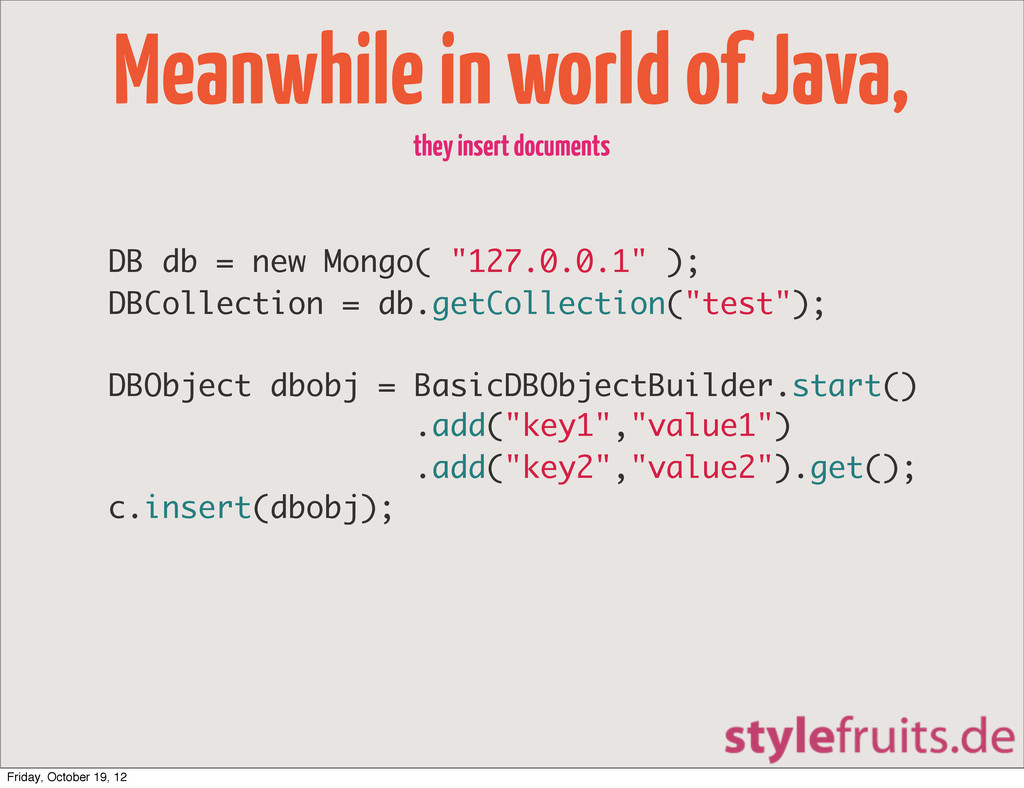
DBObject dbobj = BasicDBObjectBuilder.start() .add("key1","value1") .add("key2","value2").get(); c.insert(dbobj); Meanwhile in world of Java, they insert documents Friday, October 19, 12
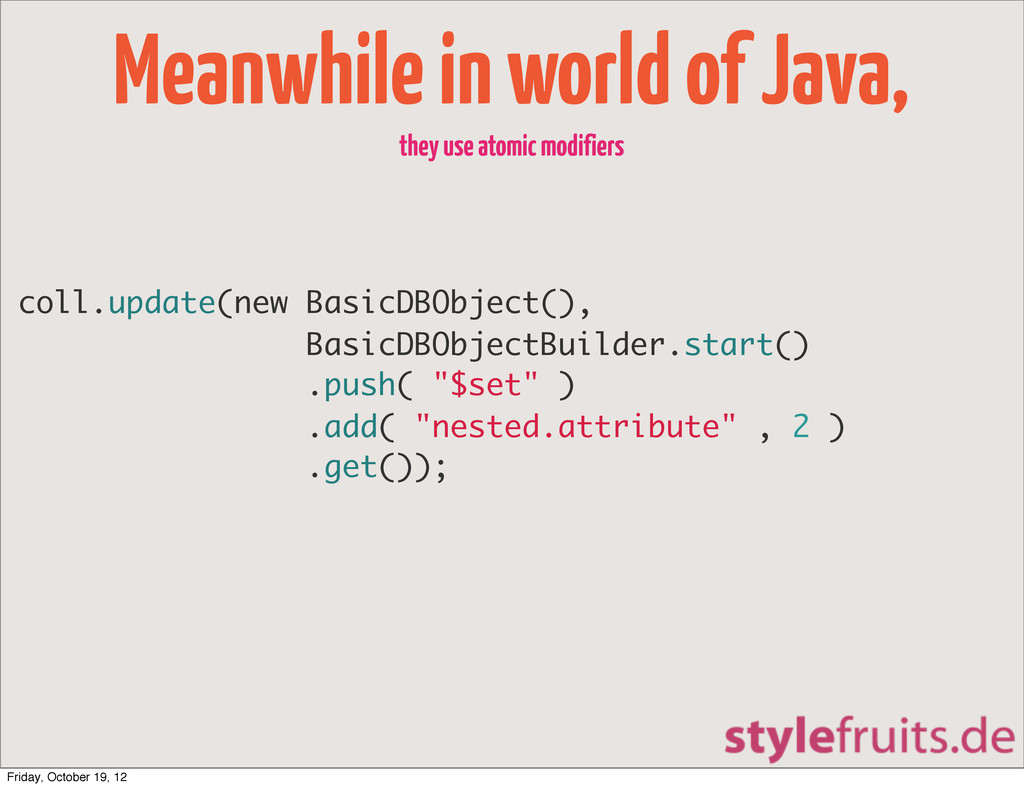
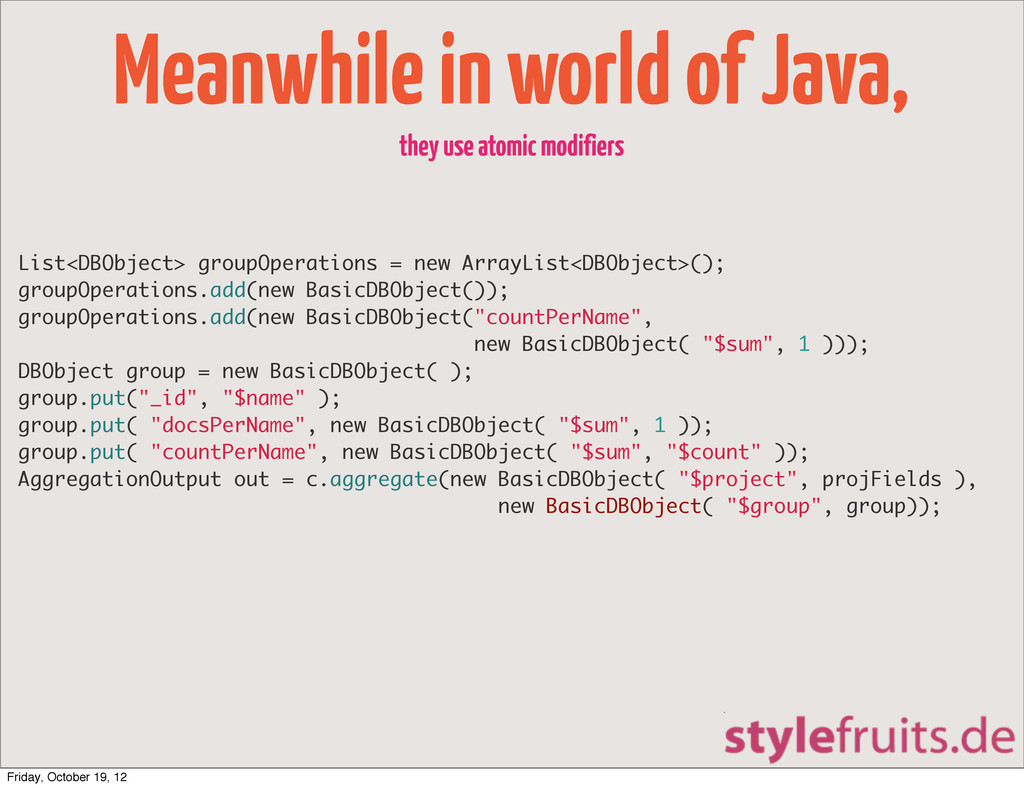
BasicDBObject( "$sum", 1 ))); DBObject group = new BasicDBObject( ); group.put("_id", "$name" ); group.put( "docsPerName", new BasicDBObject( "$sum", 1 )); group.put( "countPerName", new BasicDBObject( "$sum", "$count" )); AggregationOutput out = c.aggregate(new BasicDBObject( "$project", projFields ), new BasicDBObject( "$group", group)); Meanwhile in world of Java, they use atomic modifiers Friday, October 19, 12
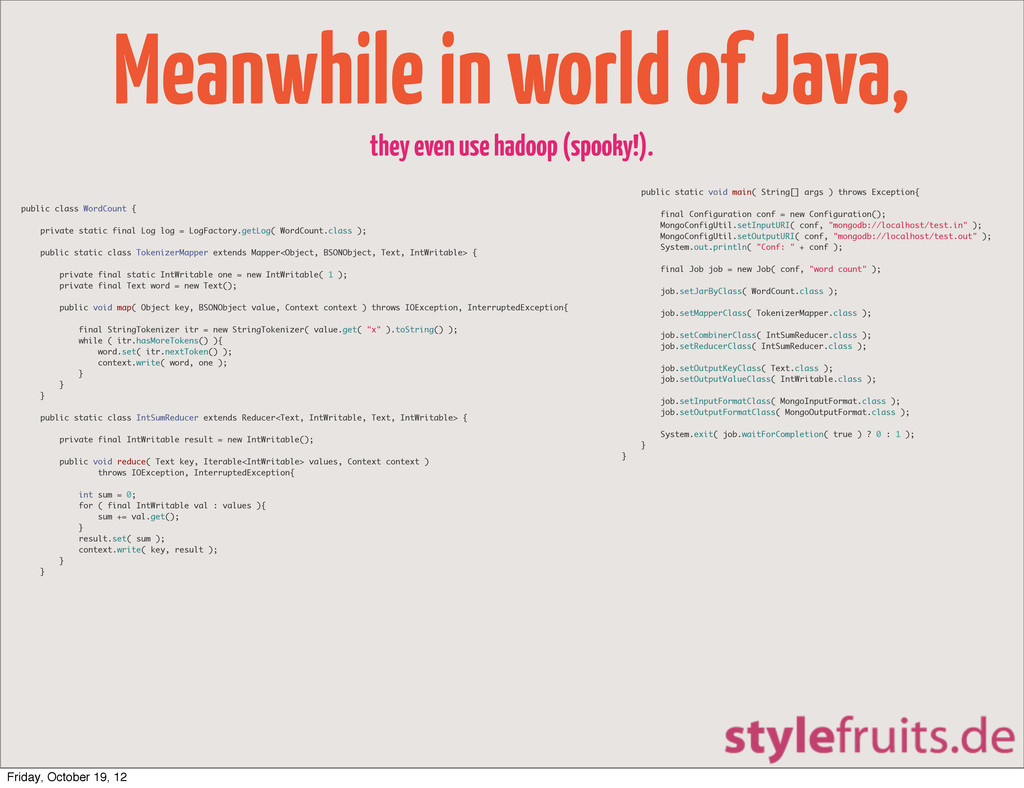
LogFactory.getLog( WordCount.class ); public static class TokenizerMapper extends Mapper<Object, BSONObject, Text, IntWritable> { private final static IntWritable one = new IntWritable( 1 ); private final Text word = new Text(); public void map( Object key, BSONObject value, Context context ) throws IOException, InterruptedException{ final StringTokenizer itr = new StringTokenizer( value.get( "x" ).toString() ); while ( itr.hasMoreTokens() ){ word.set( itr.nextToken() ); context.write( word, one ); } } } public static class IntSumReducer extends Reducer<Text, IntWritable, Text, IntWritable> { private final IntWritable result = new IntWritable(); public void reduce( Text key, Iterable<IntWritable> values, Context context ) throws IOException, InterruptedException{ int sum = 0; for ( final IntWritable val : values ){ sum += val.get(); } result.set( sum ); context.write( key, result ); } } Meanwhile in world of Java, they even use hadoop (spooky!). public static void main( String[] args ) throws Exception{ final Configuration conf = new Configuration(); MongoConfigUtil.setInputURI( conf, "mongodb://localhost/test.in" ); MongoConfigUtil.setOutputURI( conf, "mongodb://localhost/test.out" ); System.out.println( "Conf: " + conf ); final Job job = new Job( conf, "word count" ); job.setJarByClass( WordCount.class ); job.setMapperClass( TokenizerMapper.class ); job.setCombinerClass( IntSumReducer.class ); job.setReducerClass( IntSumReducer.class ); job.setOutputKeyClass( Text.class ); job.setOutputValueClass( IntWritable.class ); job.setInputFormatClass( MongoInputFormat.class ); job.setOutputFormatClass( MongoOutputFormat.class ); System.exit( job.waitForCompletion( true ) ? 0 : 1 ); } } Friday, October 19, 12
/ vars • transactional memory access yes, with retries • no user locks, no deadlocks • mutation through pure function • coordinated • readers can read value at any point in time STM?.. Friday, October 19, 12
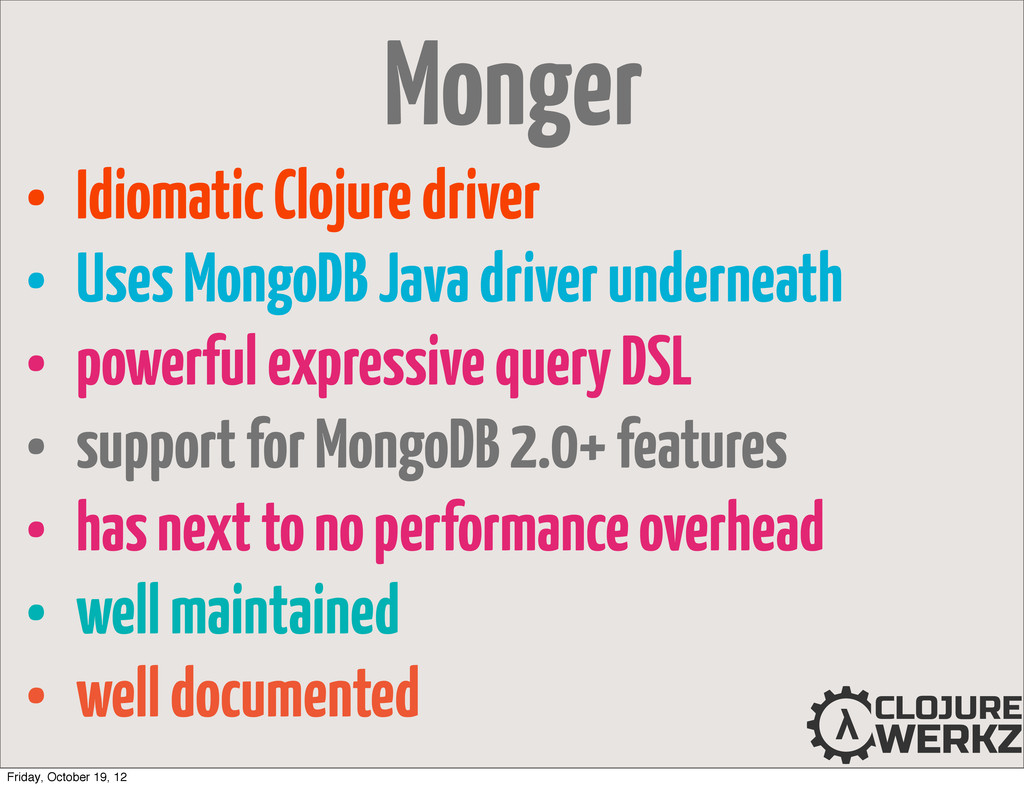
• powerful expressive query DSL • support for MongoDB 2.0+ features • has next to no performance overhead • well maintained • well documented Monger Friday, October 19, 12
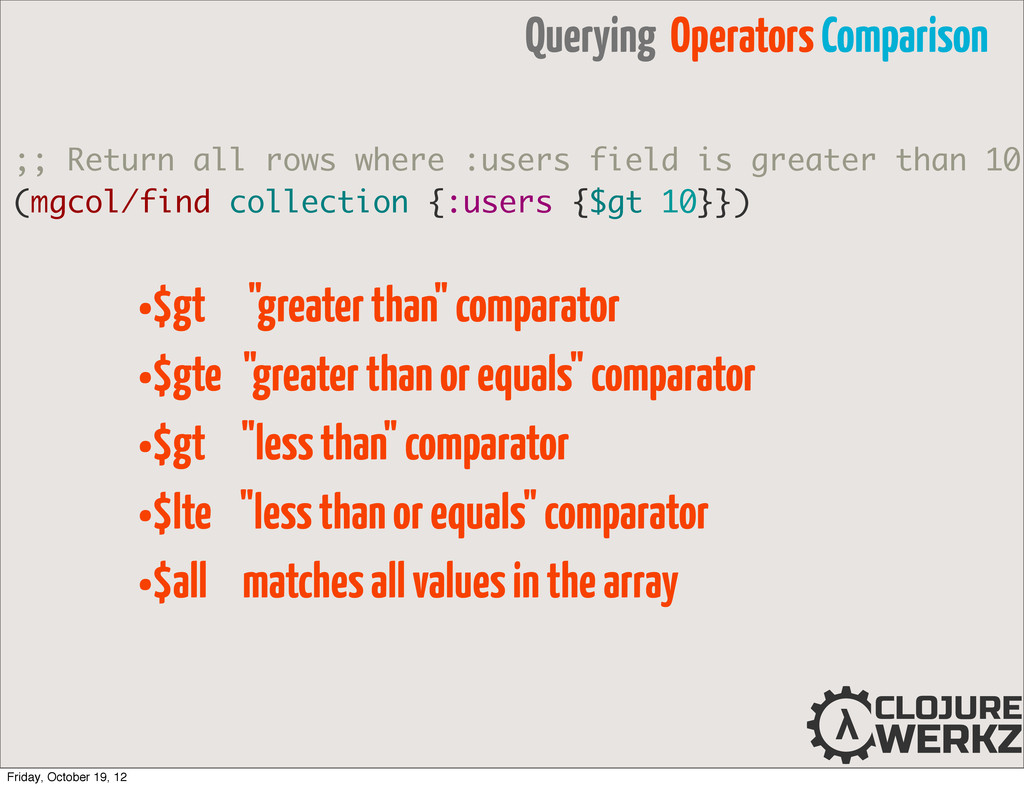
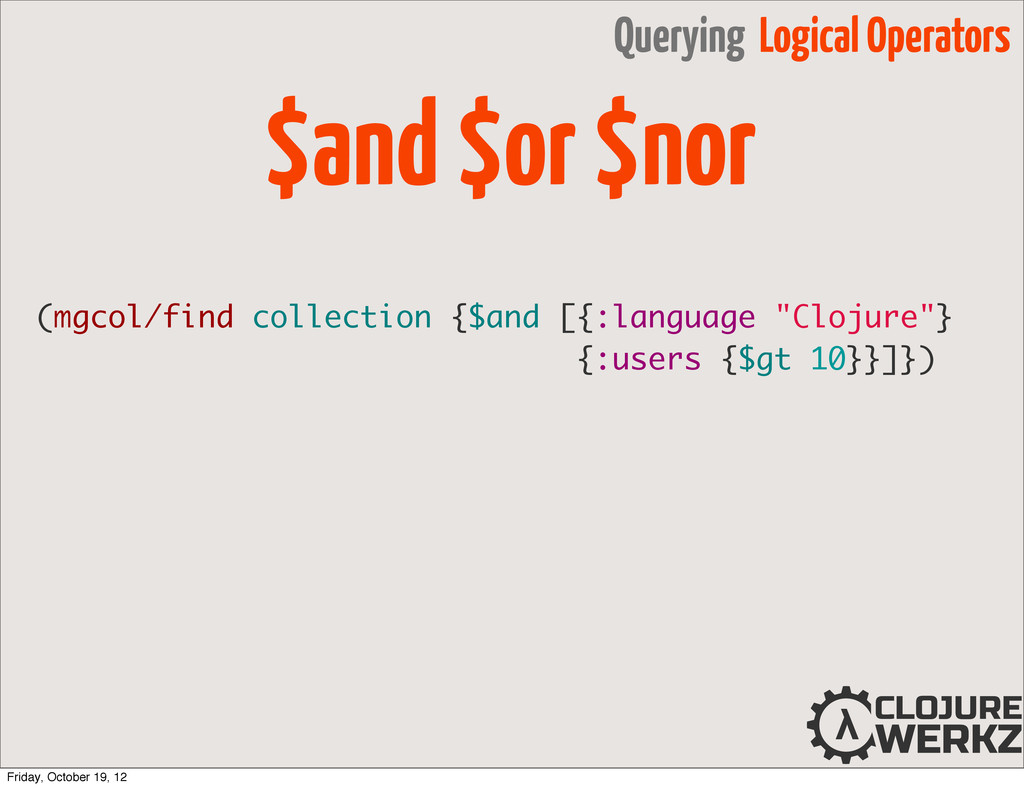
is greater than 10 (mgcol/find collection {:users {$gt 10}}) •$gt "greater than" comparator •$gte "greater than or equals" comparator •$gt "less than" comparator •$lte "less than or equals" comparator •$all matches all values in the array Friday, October 19, 12
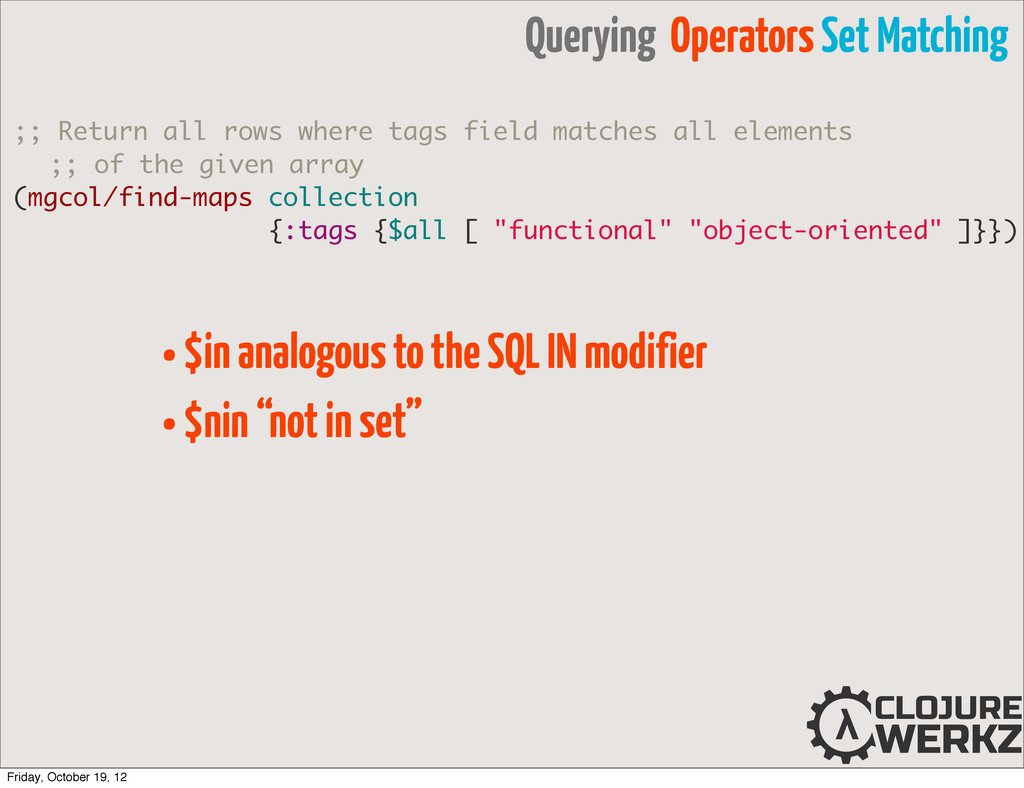
field matches all elements ;; of the given array (mgcol/find-maps collection {:tags {$all [ "functional" "object-oriented" ]}}) • $in analogous to the SQL IN modifier • $nin “not in set” Friday, October 19, 12
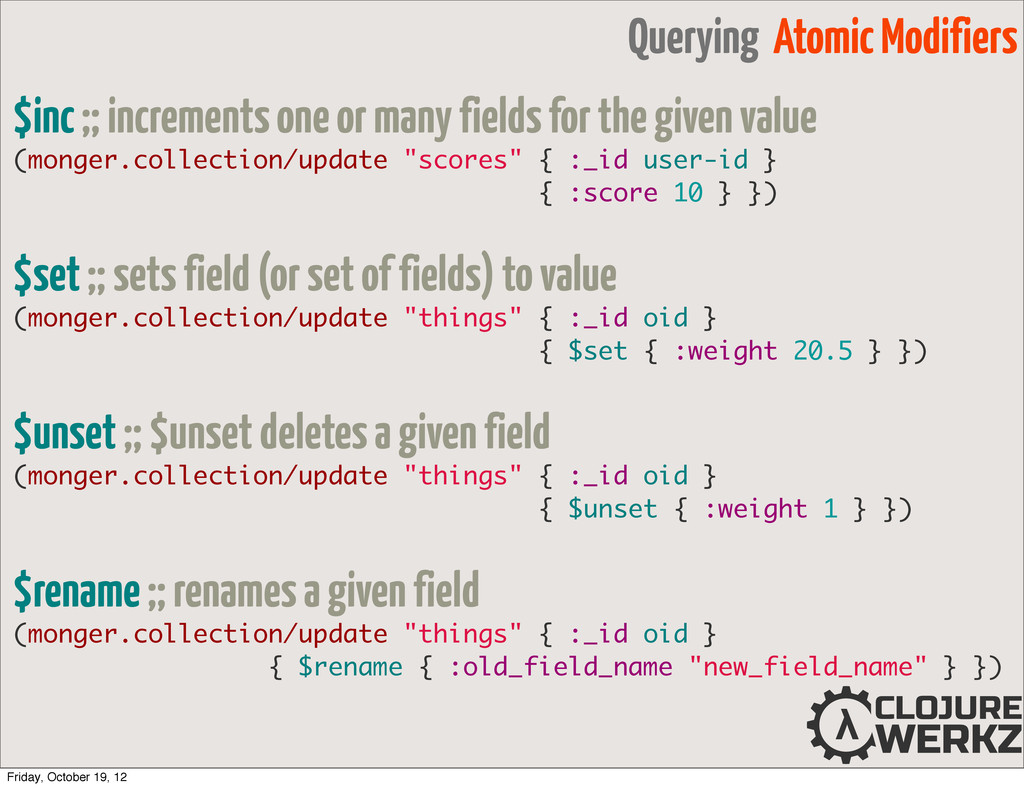
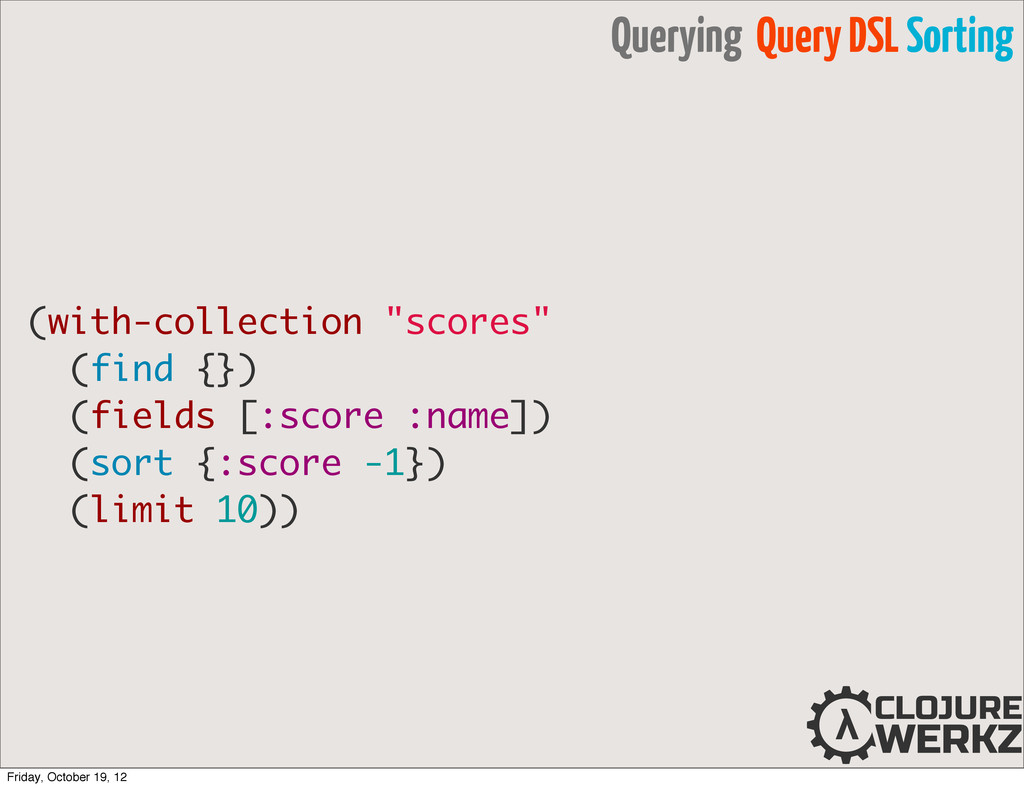
for the given value (monger.collection/update "scores" { :_id user-id } { :score 10 } }) $set ;; sets field (or set of fields) to value (monger.collection/update "things" { :_id oid } { $set { :weight 20.5 } }) $unset ;; $unset deletes a given field (monger.collection/update "things" { :_id oid } { $unset { :weight 1 } }) $rename ;; renames a given field (monger.collection/update "things" { :_id oid } { $rename { :old_field_name "new_field_name" } }) Friday, October 19, 12
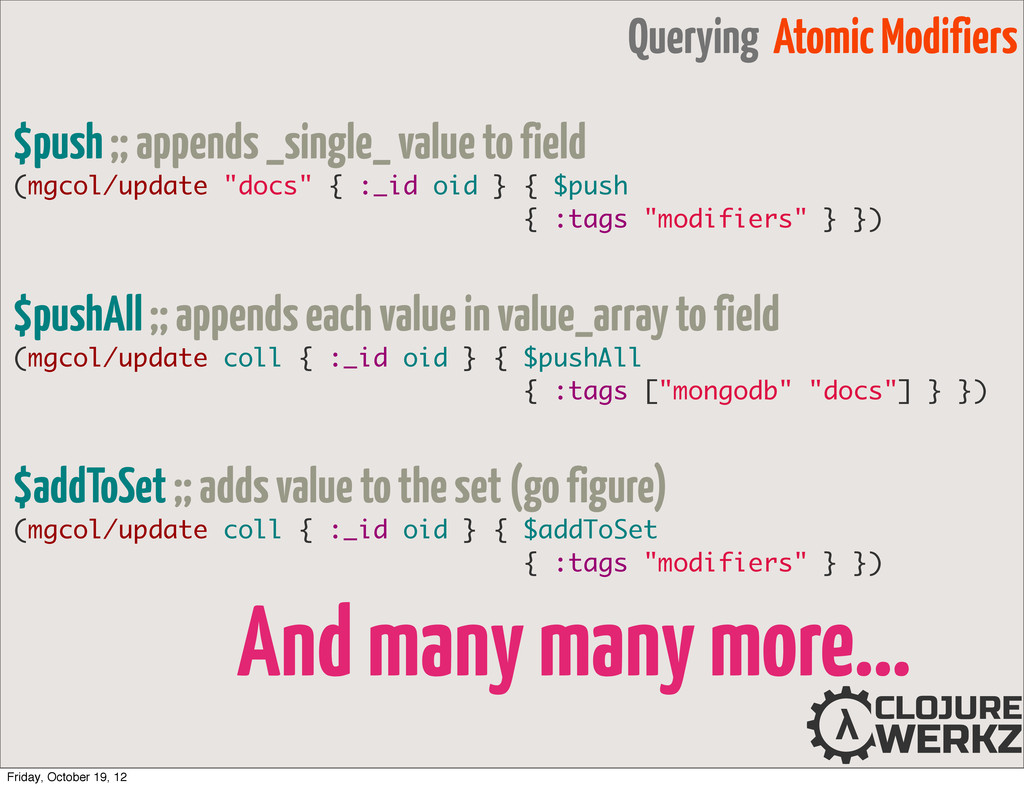
(mgcol/update "docs" { :_id oid } { $push { :tags "modifiers" } }) $pushAll ;; appends each value in value_array to field (mgcol/update coll { :_id oid } { $pushAll { :tags ["mongodb" "docs"] } }) $addToSet ;; adds value to the set (go figure) (mgcol/update coll { :_id oid } { $addToSet { :tags "modifiers" } }) And many many more... Friday, October 19, 12
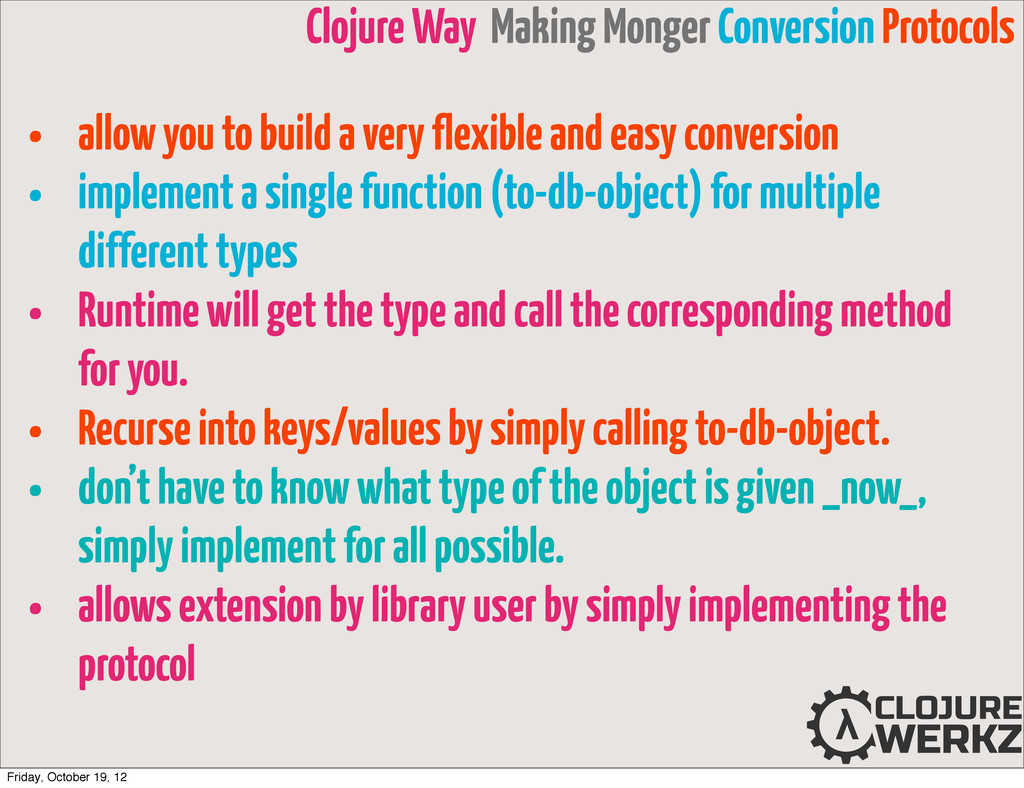
conversion • implement a single function (to-db-object) for multiple different types • Runtime will get the type and call the corresponding method for you. • Recurse into keys/values by simply calling to-db-object. • don’t have to know what type of the object is given _now_, simply implement for all possible. • allows extension by library user by simply implementing the protocol Clojure Way Making Monger Conversion Protocols Friday, October 19, 12
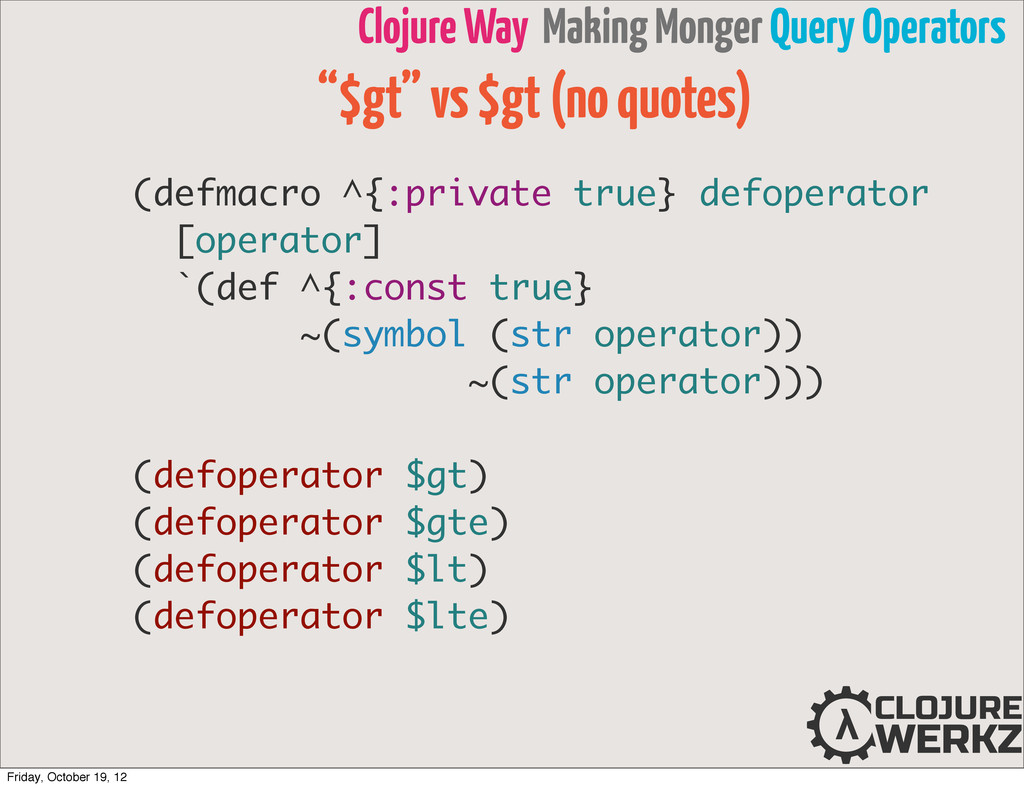
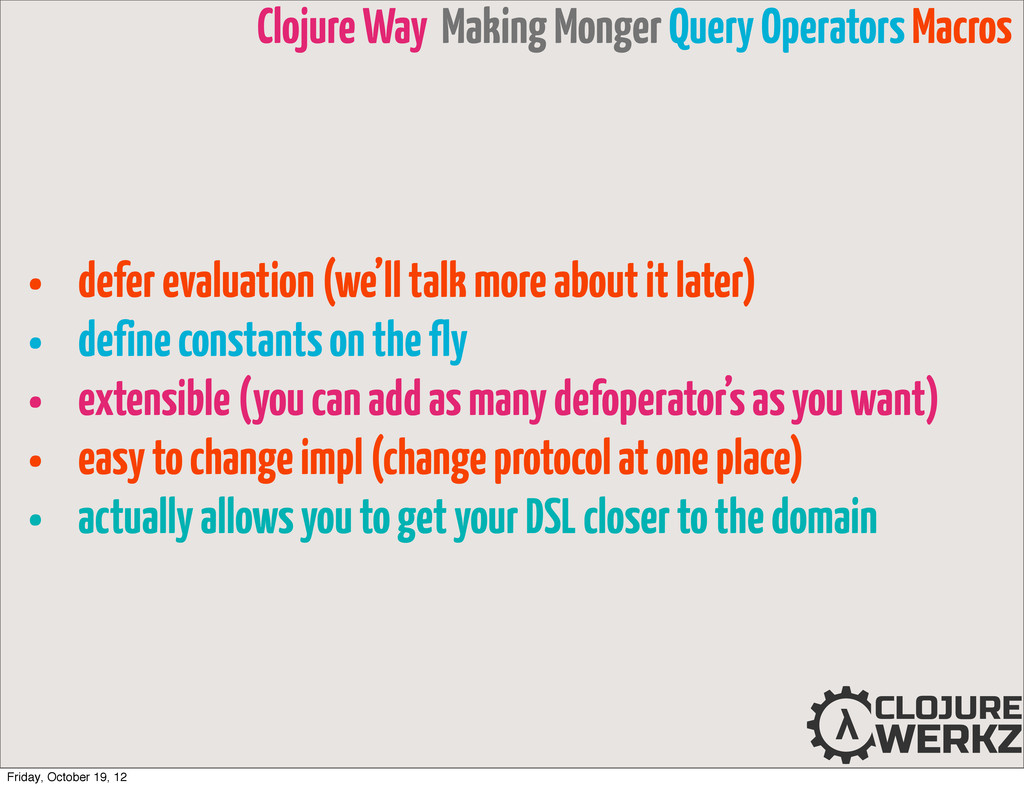
define constants on the fly • extensible (you can add as many defoperator’s as you want) • easy to change impl (change protocol at one place) • actually allows you to get your DSL closer to the domain Clojure Way Making Monger Query Operators Macros Friday, October 19, 12
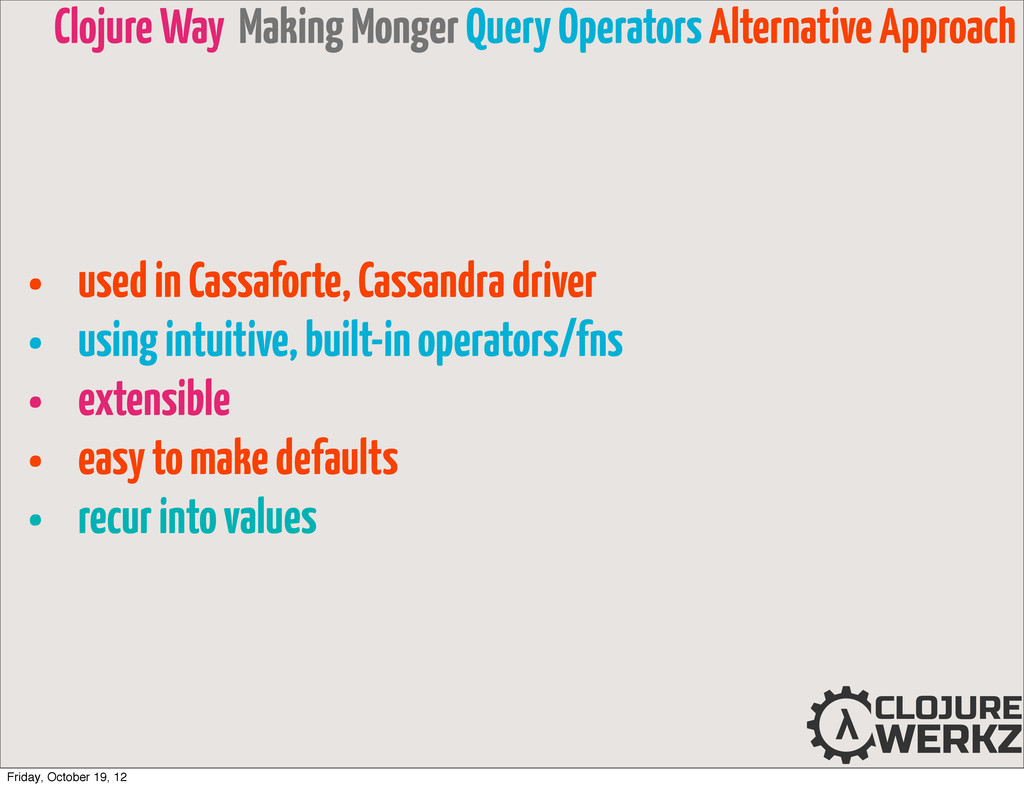
operators/fns • extensible • easy to make defaults • recur into values Clojure Way Making Monger Query Operators Alternative Approach Friday, October 19, 12
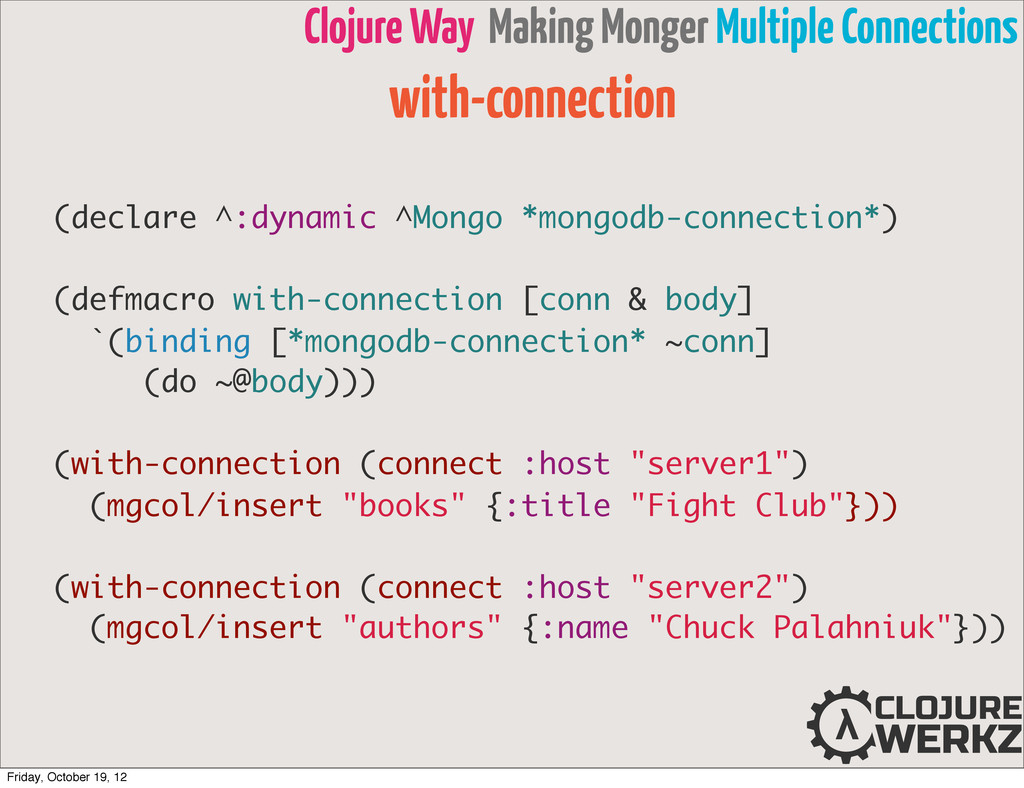
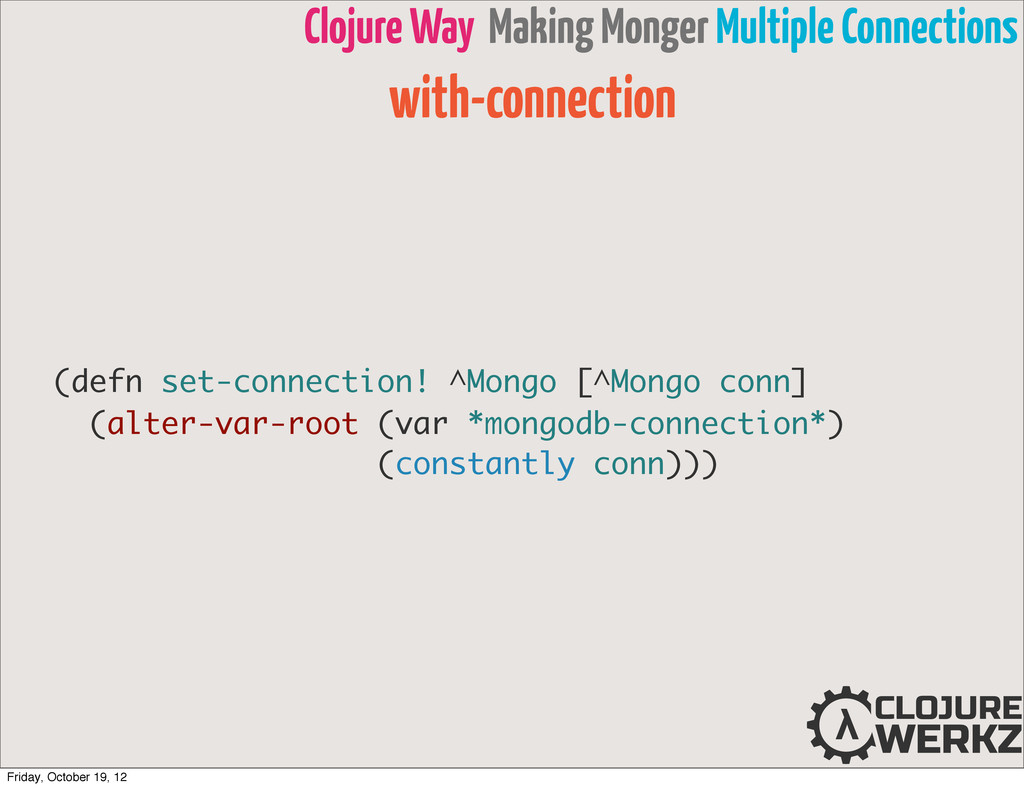
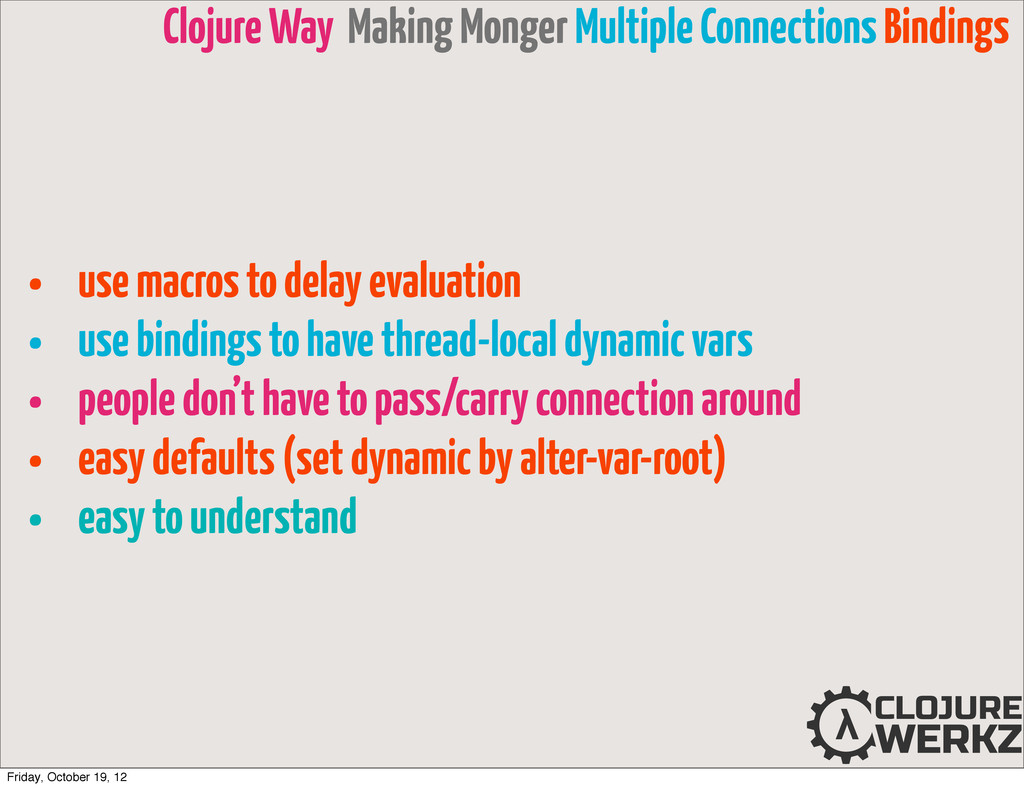
have thread-local dynamic vars • people don’t have to pass/carry connection around • easy defaults (set dynamic by alter-var-root) • easy to understand Clojure Way Making Monger Multiple Connections Bindings Friday, October 19, 12
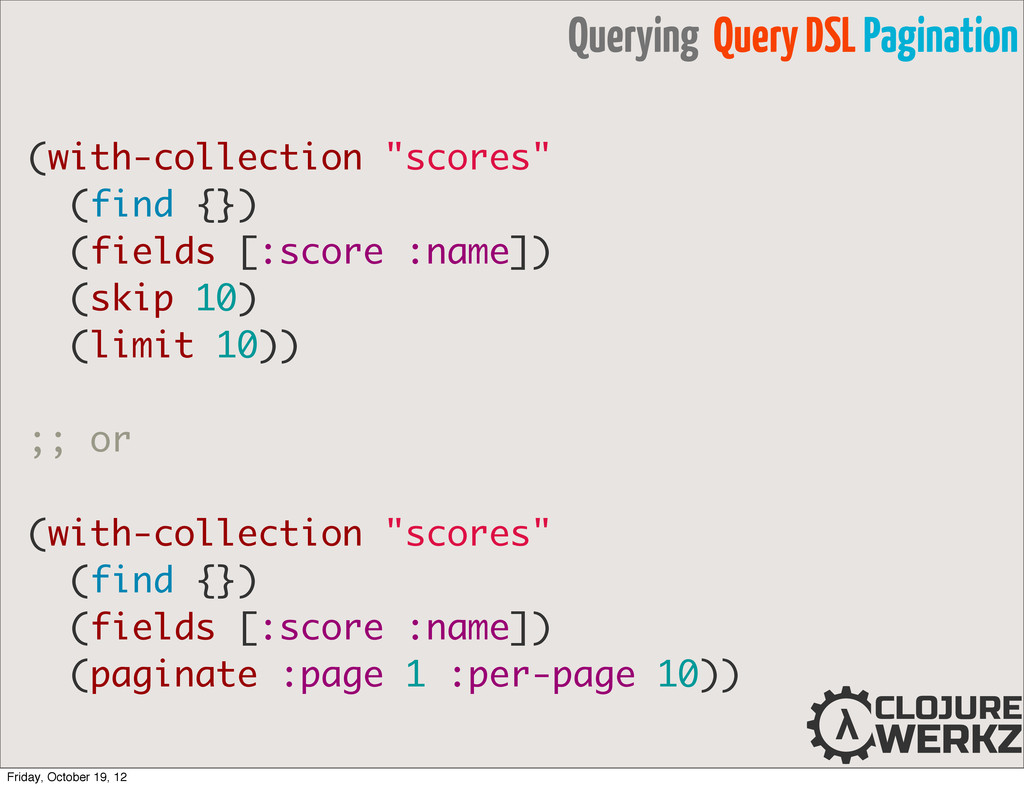
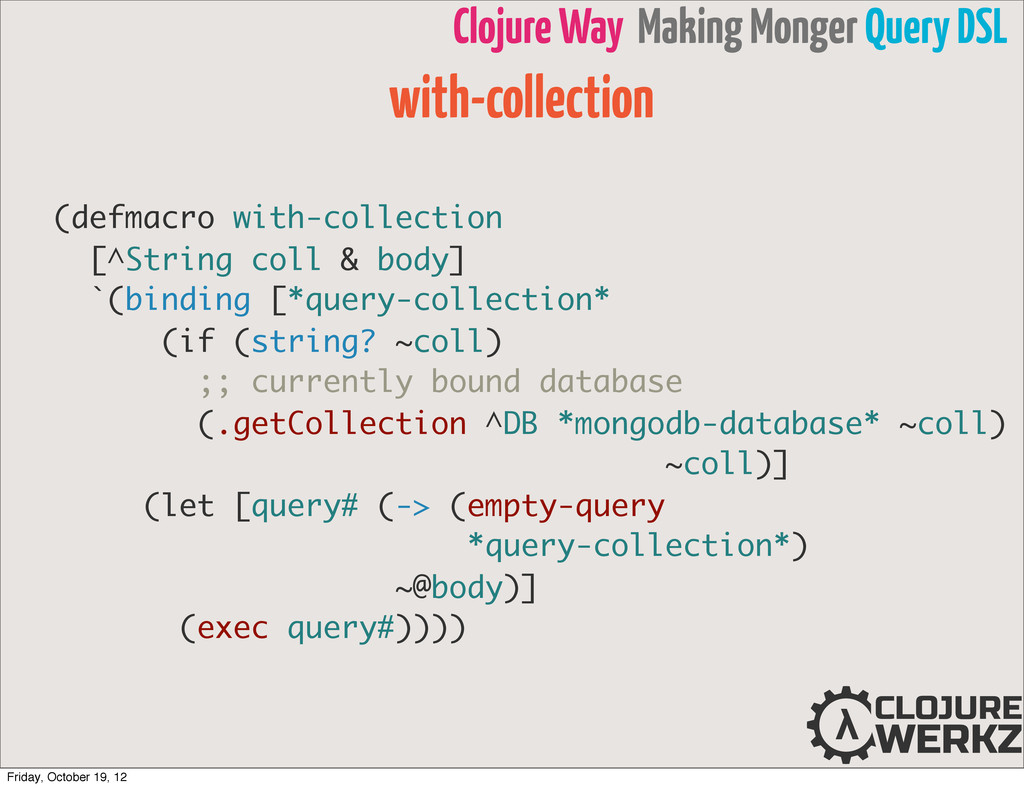
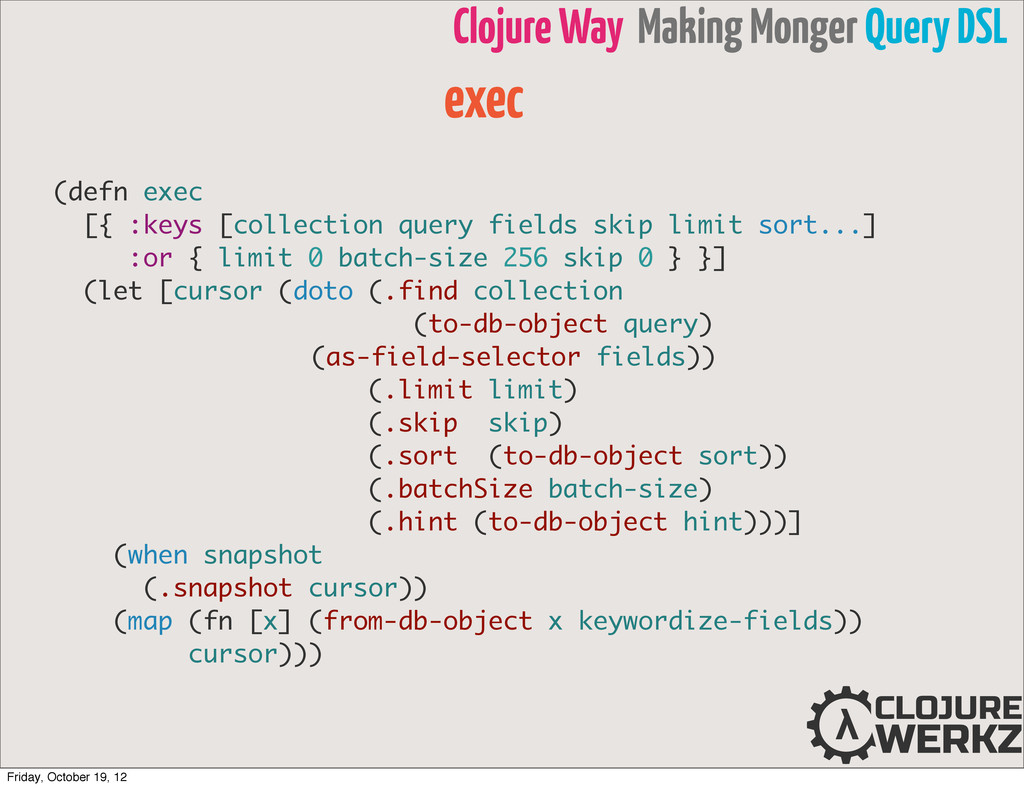
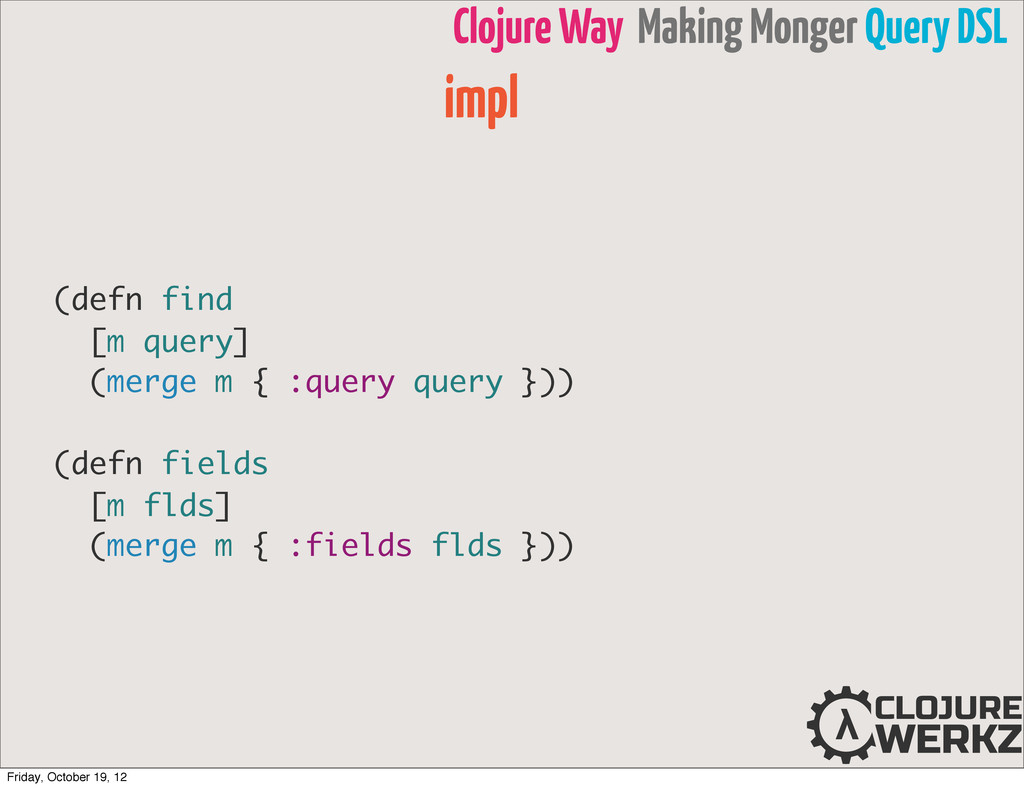
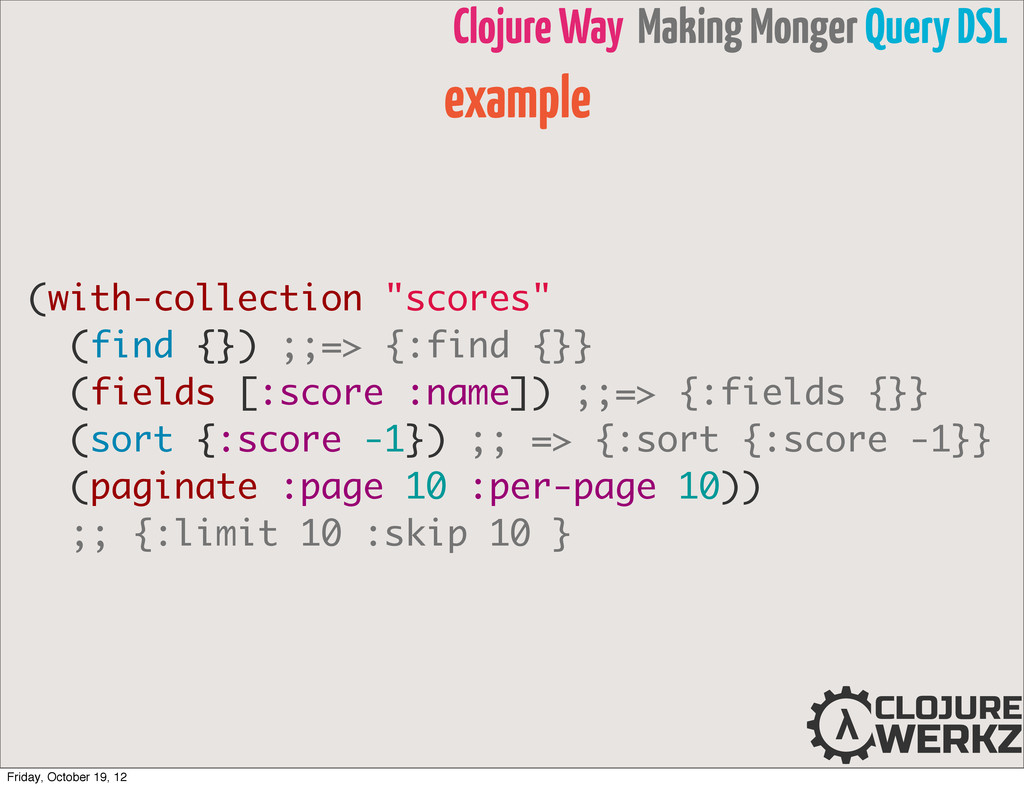
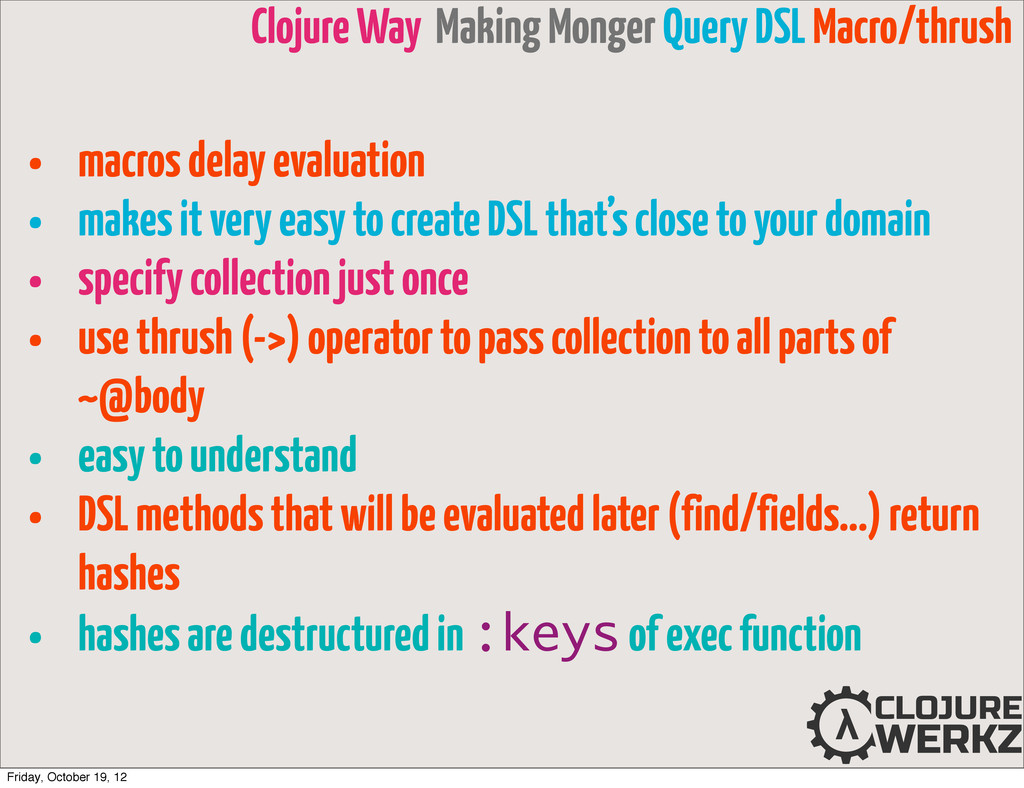
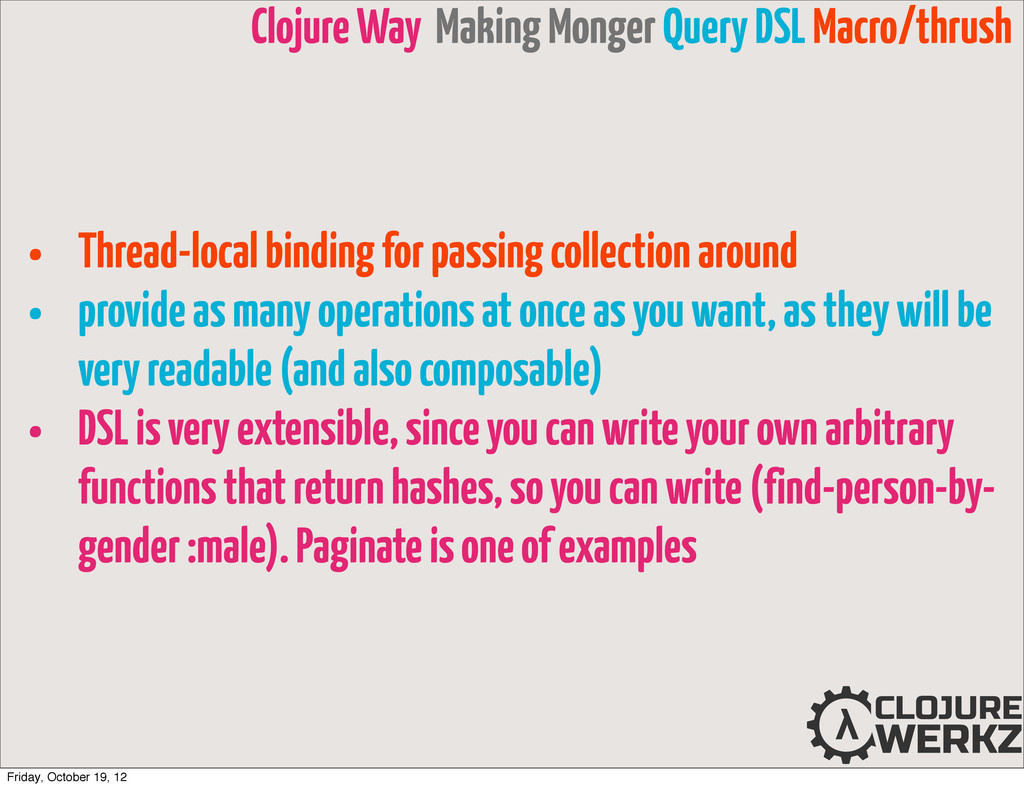
create DSL that’s close to your domain • specify collection just once • use thrush (->) operator to pass collection to all parts of ~@body • easy to understand • DSL methods that will be evaluated later (find/fields...) return hashes • hashes are destructured in :keys of exec function Clojure Way Making Monger Query DSL Macro/thrush Friday, October 19, 12
many operations at once as you want, as they will be very readable (and also composable) • DSL is very extensible, since you can write your own arbitrary functions that return hashes, so you can write (find-person-by- gender :male). Paginate is one of examples Clojure Way Making Monger Query DSL Macro/thrush Friday, October 19, 12
about server errors, only network) • Very (very) high virtual memory usage (yeah, right, let’s just use “repairDatabase”) • Repairs require lot of disk space (quantity of disk space that’s equal to size of your db, so when running into trouble, use --repairpath) • The rest I won’t mention in the talk Facts you probably won’t hear on Mongo Conferences Friday, October 19, 12
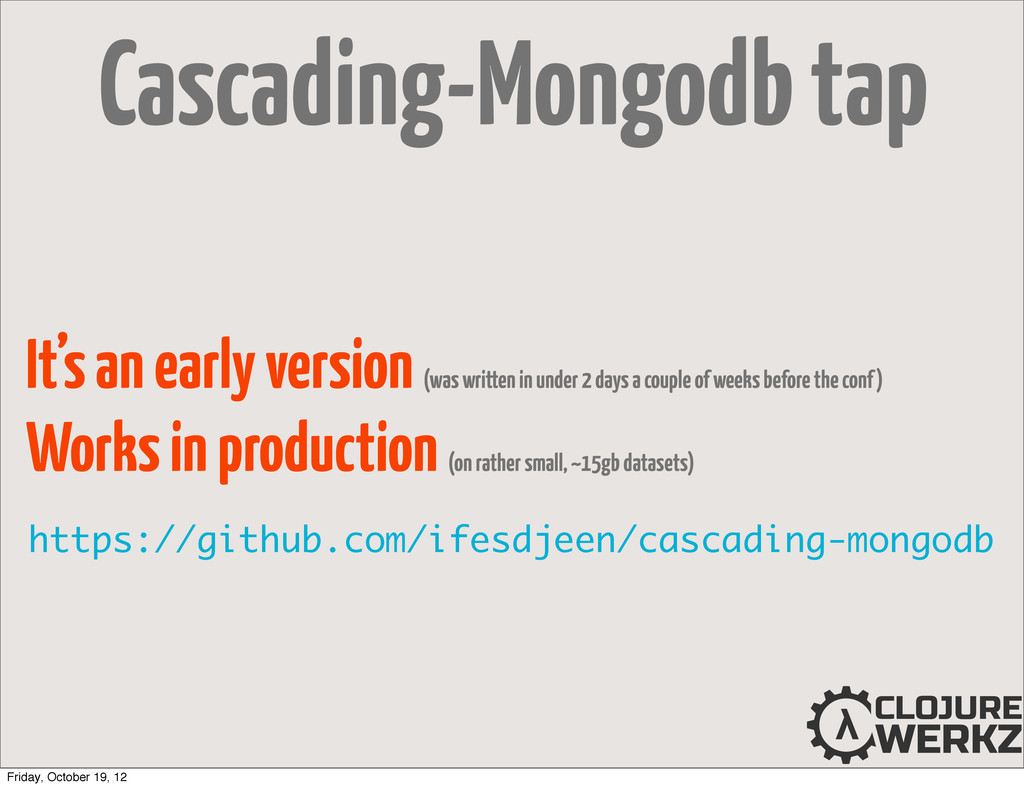
a couple of weeks before the conf) Works in production (on rather small, ~15gb datasets) https://github.com/ifesdjeen/cascading-mongodb Cascading-Mongodb tap Friday, October 19, 12
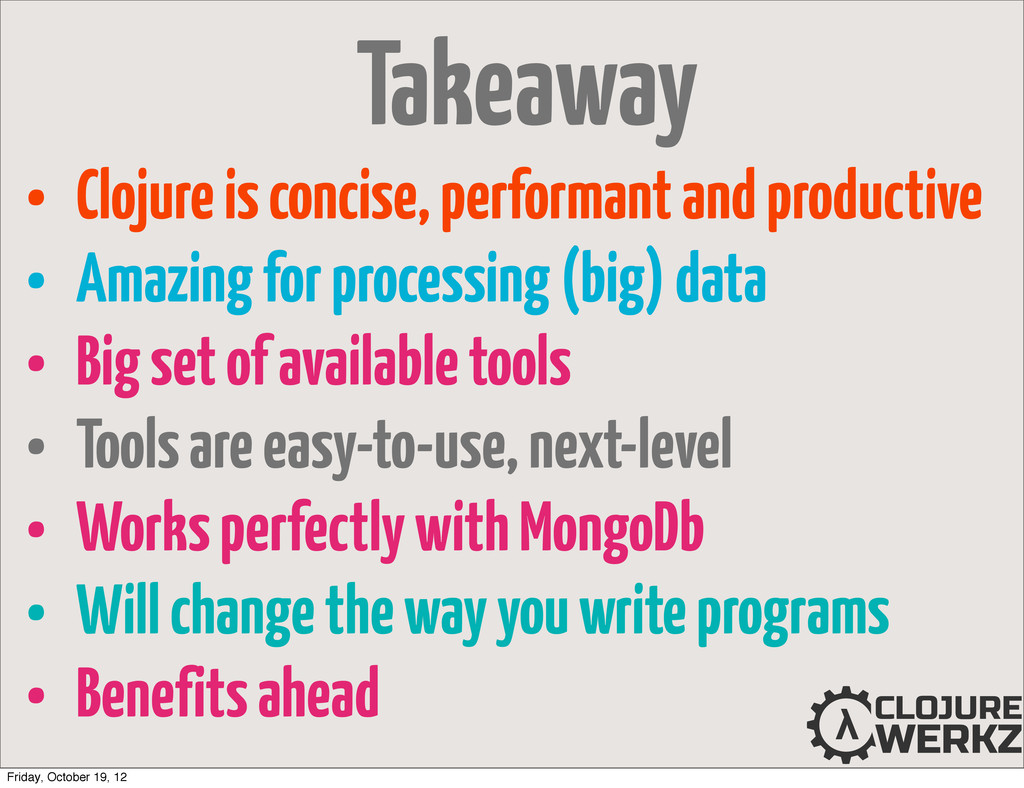
processing (big) data • Big set of available tools • Tools are easy-to-use, next-level • Works perfectly with MongoDb • Will change the way you write programs • Benefits ahead Takeaway Friday, October 19, 12
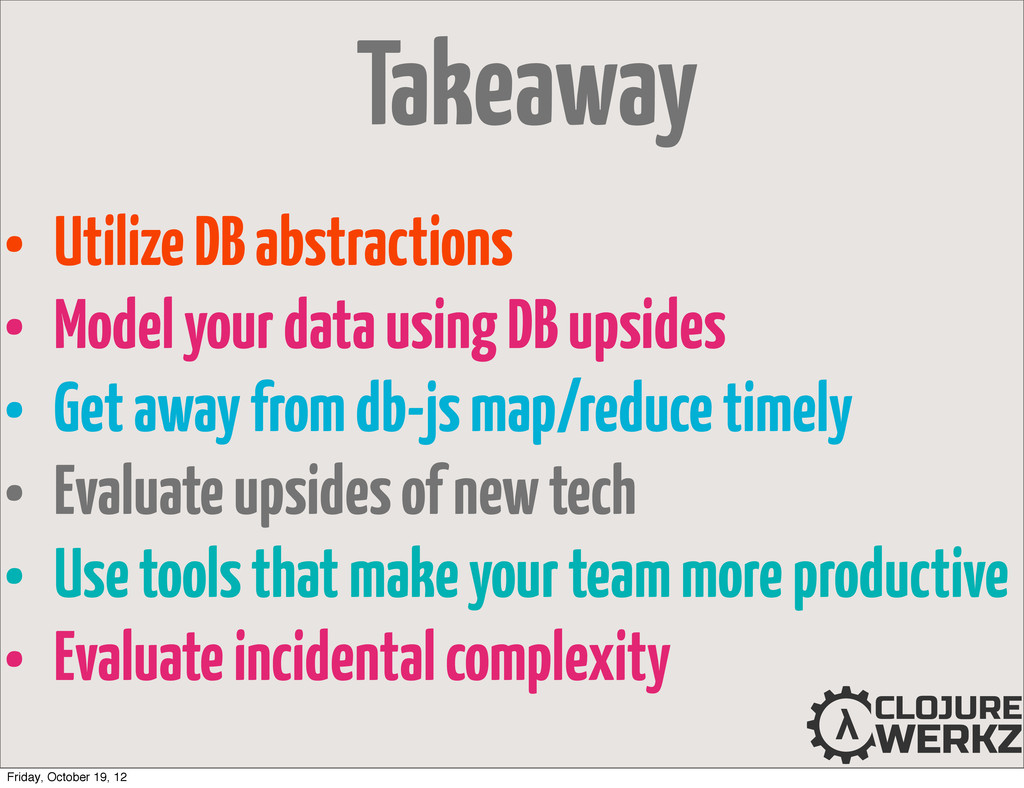
upsides • Get away from db-js map/reduce timely • Evaluate upsides of new tech • Use tools that make your team more productive • Evaluate incidental complexity Takeaway Friday, October 19, 12


 ifesdjeen
 irinanazarova
 minodriven
 colorful12
 jame2408
 seike460
 takai
takai
 y0hgi
y0hgi
 ryu1013
 econanringo
 kishida
 kaityo256
 rshindo
 codingconduct
 skipperchong
 jonoalderson
 addyosmani
 coloredviolet
 aleyda
 tammyeverts
 rkaga
rkaga
 charlesmeaden
 baasie
 soudai























![first-class functions (def hello (fn [] "Hello world")) just in](https://files.speakerdeck.com/presentations/508123325b45fd0002026bef/slide_33.jpg)









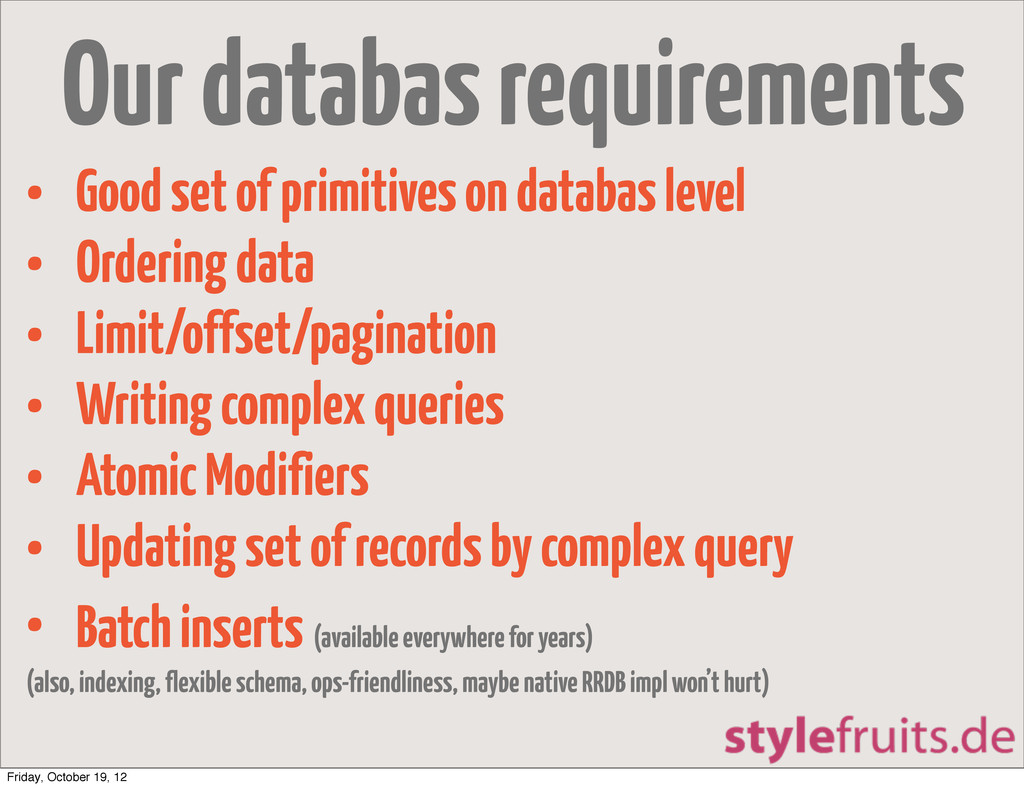
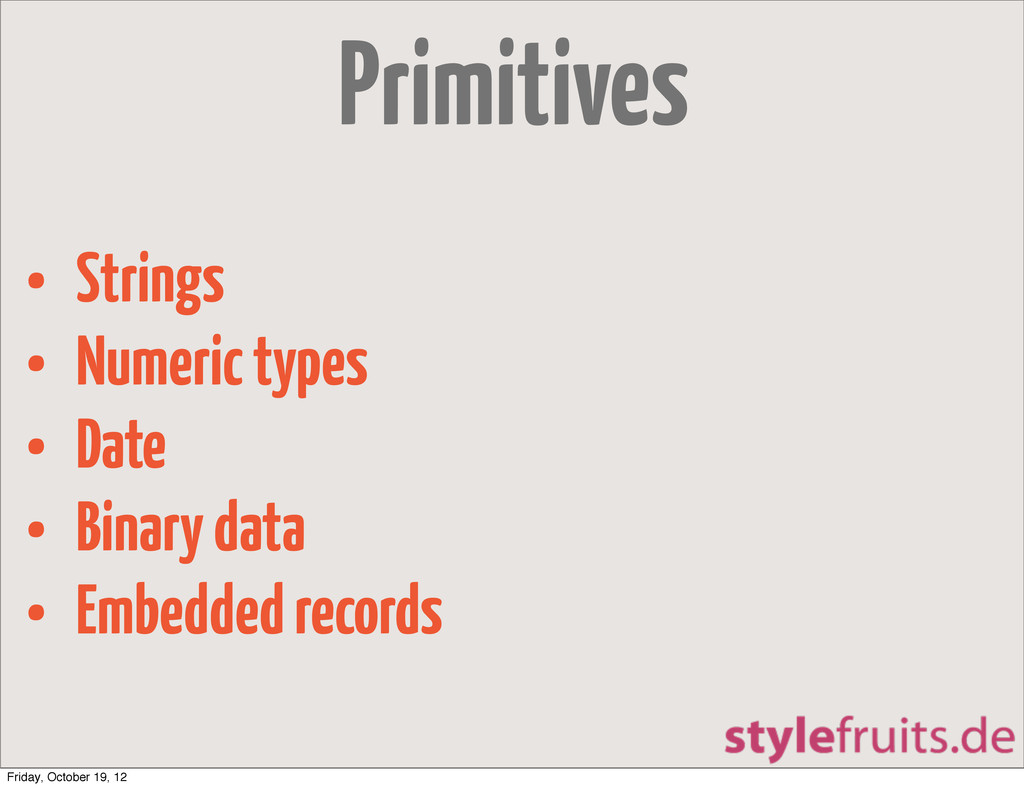
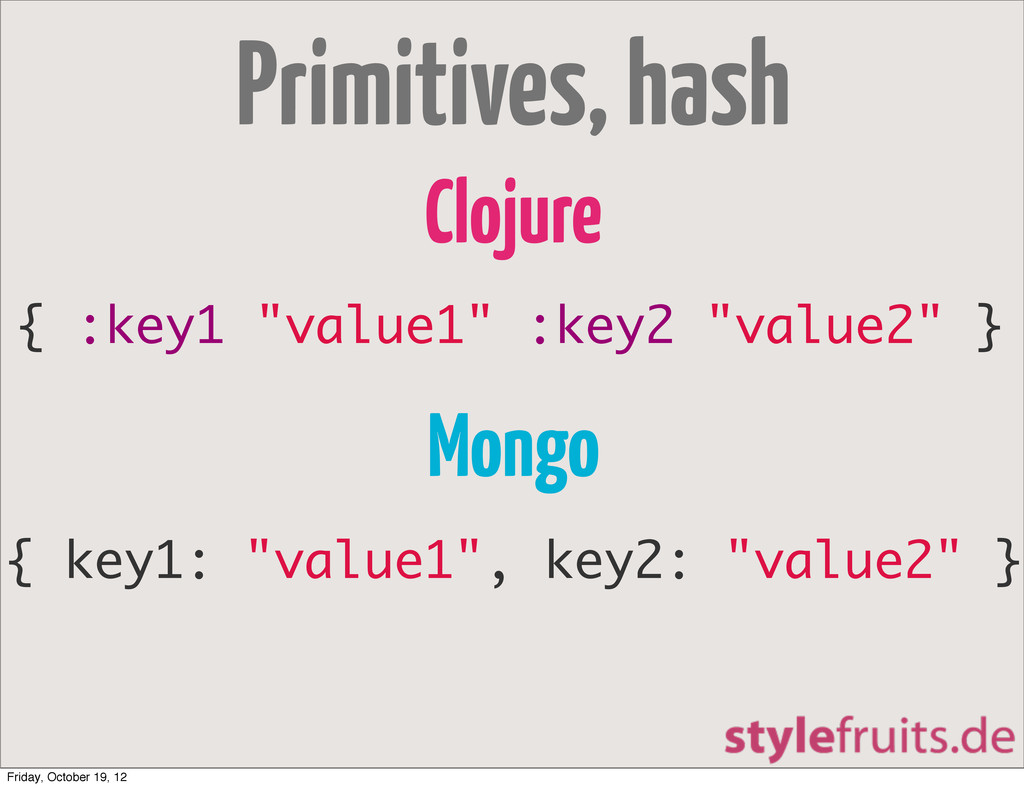
![Primitives, array/vector [ "value1" "value2" "value3" ] [ "value1", "value2",](https://files.speakerdeck.com/presentations/508123325b45fd0002026bef/slide_52.jpg)
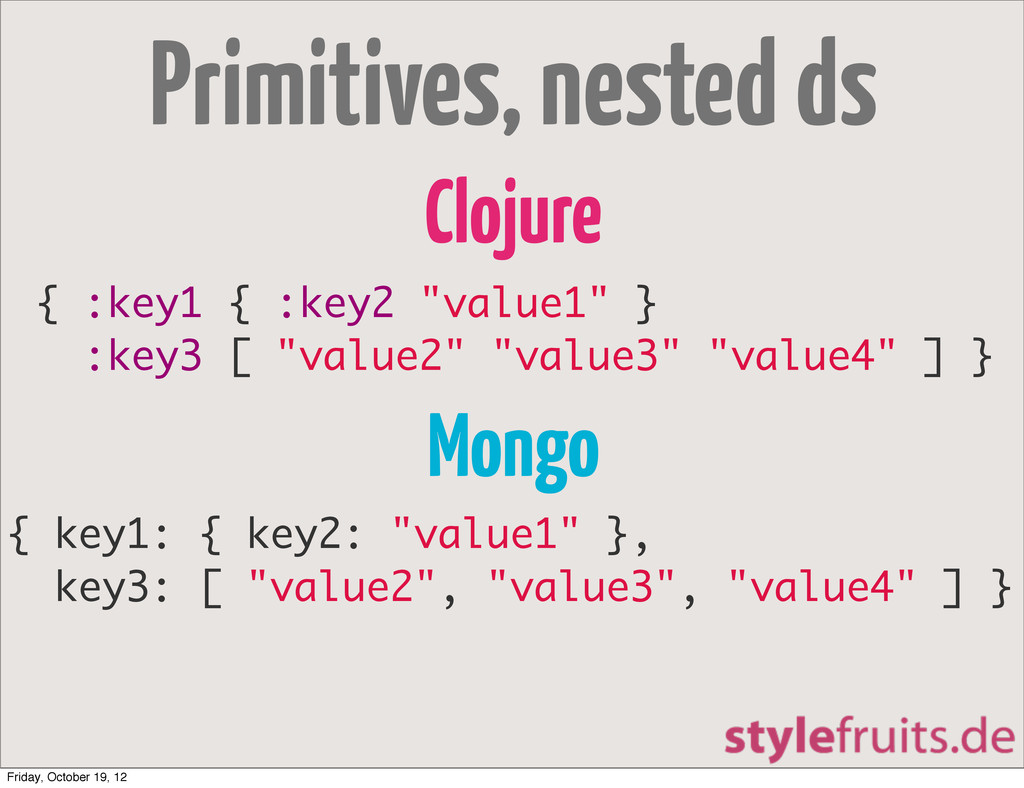








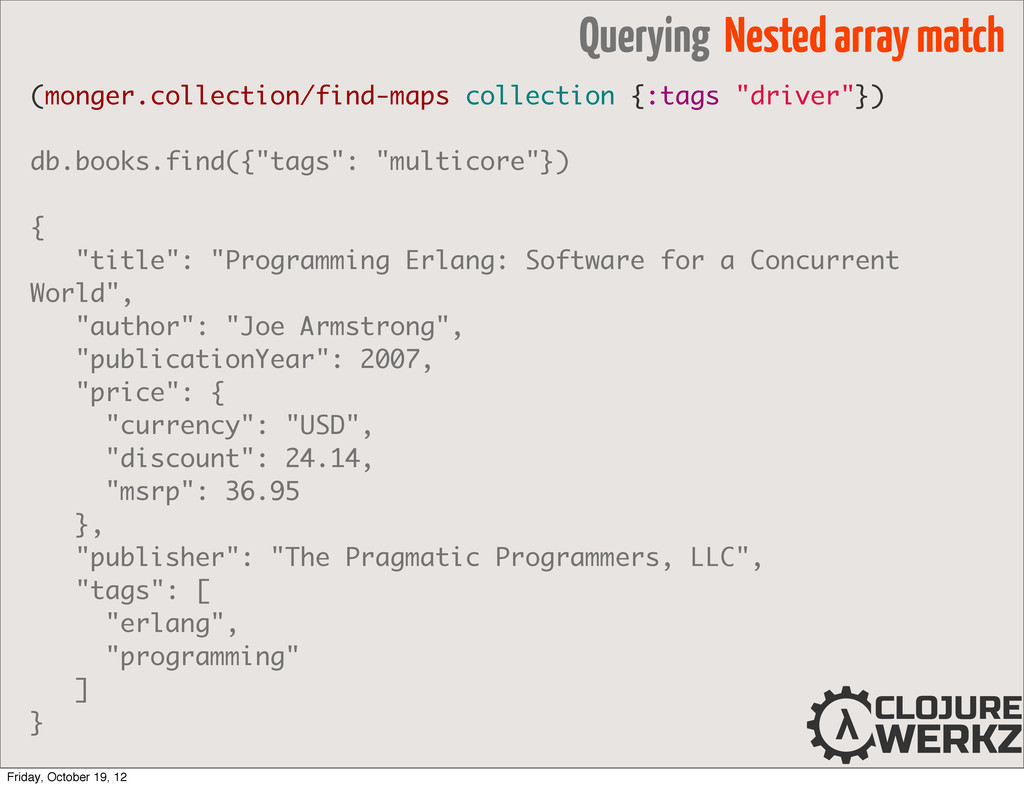
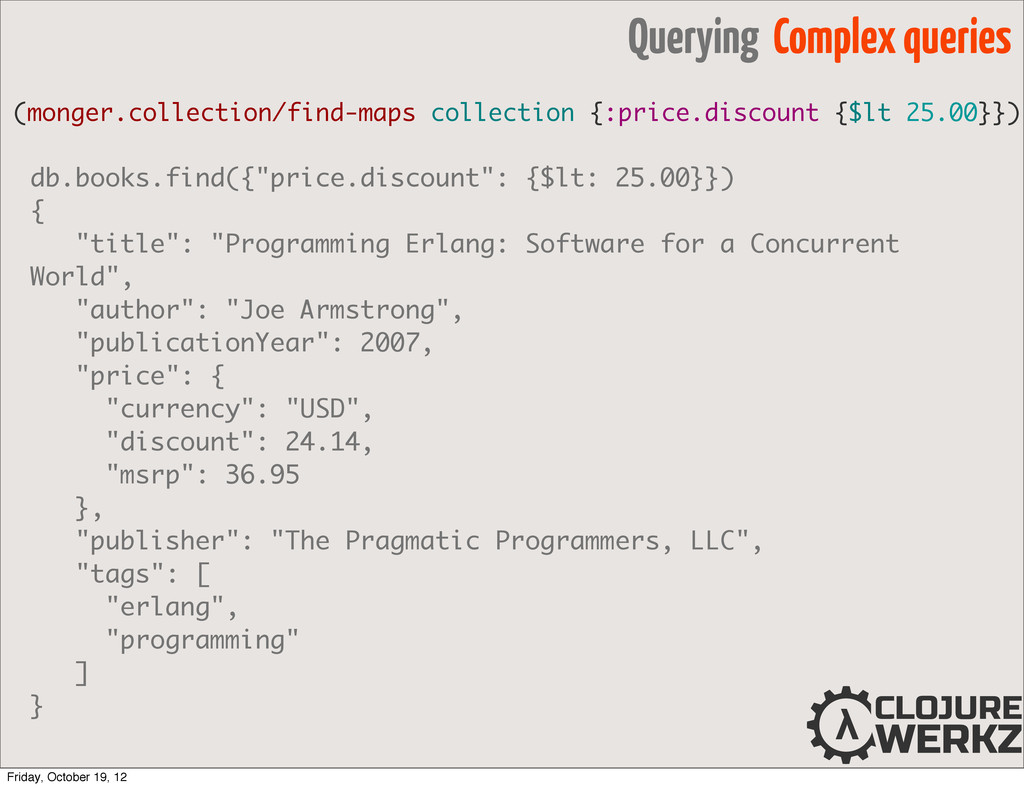
![Clojure Way Making Monger Conversion (defprotocol ConvertToDBObject (^com.mongodb.DBObject to-db-object [input]))](https://files.speakerdeck.com/presentations/508123325b45fd0002026bef/slide_76.jpg)




![Cascalog (<- [?count] (in _) (c/count ?count)) Remember that spooky](https://files.speakerdeck.com/presentations/508123325b45fd0002026bef/slide_96.jpg)
![Cascalog (?<- (stdout) [?person ?age] (age ?person ?age) (= ?person](https://files.speakerdeck.com/presentations/508123325b45fd0002026bef/slide_98.jpg)
![Cascalog (?<- (stdout) [?person ?count] (follows ?person _) (c/count ?count))](https://files.speakerdeck.com/presentations/508123325b45fd0002026bef/slide_99.jpg)
![Cascalog (<- output [!date ?md5 !count] (input ?type ?hostname ?received_at](https://files.speakerdeck.com/presentations/508123325b45fd0002026bef/slide_100.jpg)