Share
Embed
AI review (Reviewers by role, and what counts as blocking) | Learn Harness Engineering with Kiro 05
Level 300. An agent that grades its own work praises even mediocre work, so this deck splits the builder from a separate checker and shows what to give that checker: the change, the requirements, and the rules, not the author's reasons. On a small booking app, it builds Kiro reviewers by viewpoint, gives the builder and the checker the same grading criteria, applies rules only to the files they cover, defines a blocking finding by four parts, and measures a reviewer's misses and false alarms with four kinds of change. This is deck 05 (Check pillar) of the "Learn Harness Engineering with Kiro" series.

Riku INADA PRO
November 10, 2026
Annual Pro sale · Save $30
Have presentations of your own?
Share with private links, password protection, and more control over your work.
Transcript
42 slides
-
Learn Harness Engineering with Kiro Check Level 300 AI review
Reviewers by role, and what counts as blocking 05 As of November 2026 November 2026 Riku Inada Amazon Web Services Japan + Kiro + Harness Engineering © 2026, Amazon Web Services, Inc. or its affiliates. All rights reserved. 1 -
Introduction About me Riku Inada Amazon Web Services Japan G.K.
Solutions Architect Works mainly with manufacturing customers Recent work Promoting the AI-Driven Development Life Cycle (AI-DLC) Writing and speaking about Kiro and AWS Amplify © 2026, Amazon Web Services, Inc. or its affiliates. All rights reserved. X @inada_riku Speaker Deck speakerdeck.com/inariku Zenn zenn.dev/inariku GitHub github.com/inariku 2 -
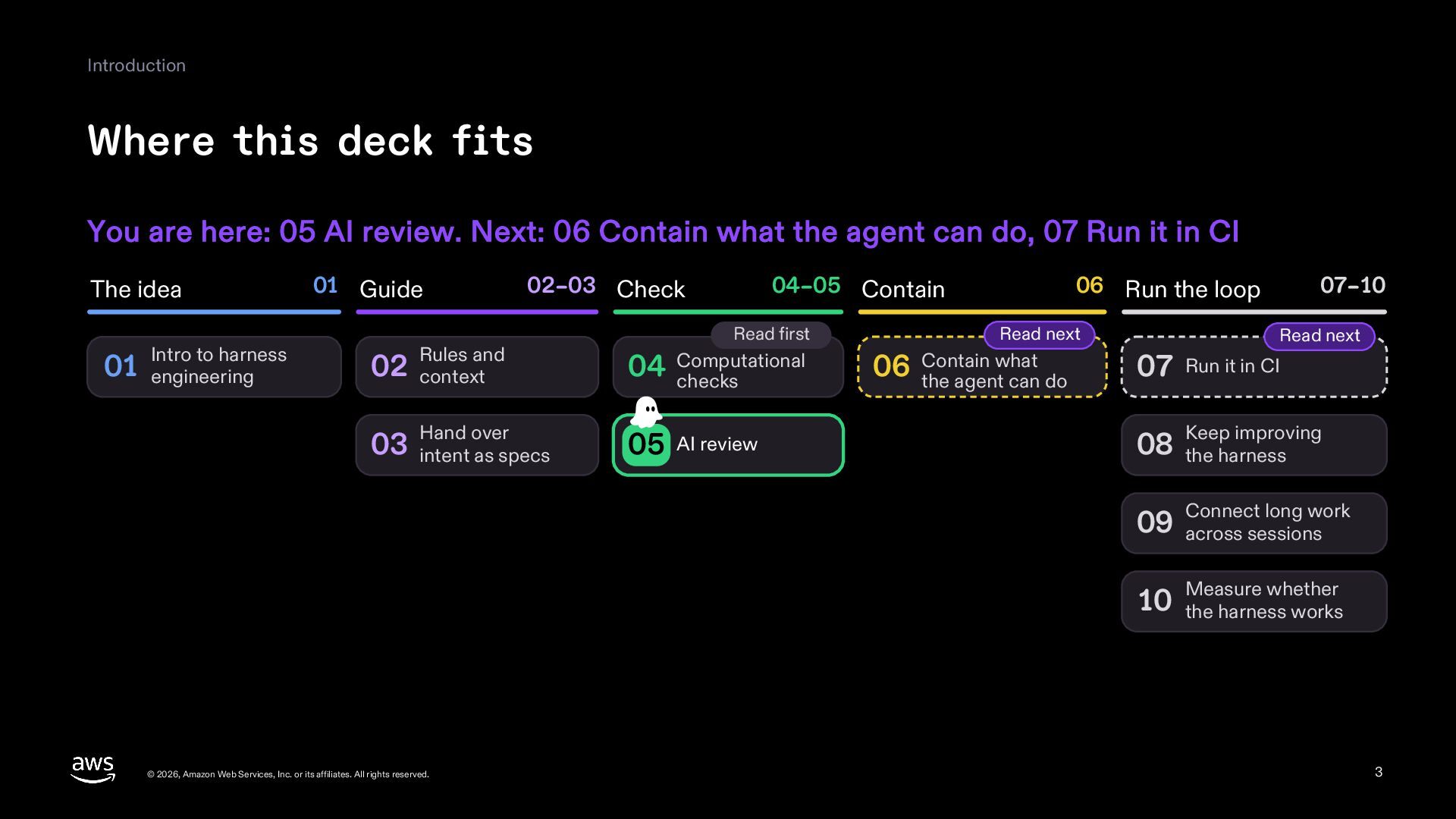
Introduction Where this deck fits You are here: 05 AI
review. Next: 06 Contain what the agent can do, 07 Run it in CI The idea Intro to harness 01 engineering 01 Guide 02–03 Check Rules and 02 context Hand over 03 intent as specs 04–05 Contain Read first 04 Computational checks 05 AI review 06 Run the loop Read next what 06 Contain the agent can do 07–10 Read next 07 Run it in CI Keep improving 08 the harness long work 09 Connect across sessions whether 10 Measure the harness works © 2026, Amazon Web Services, Inc. or its affiliates. All rights reserved. 3 -
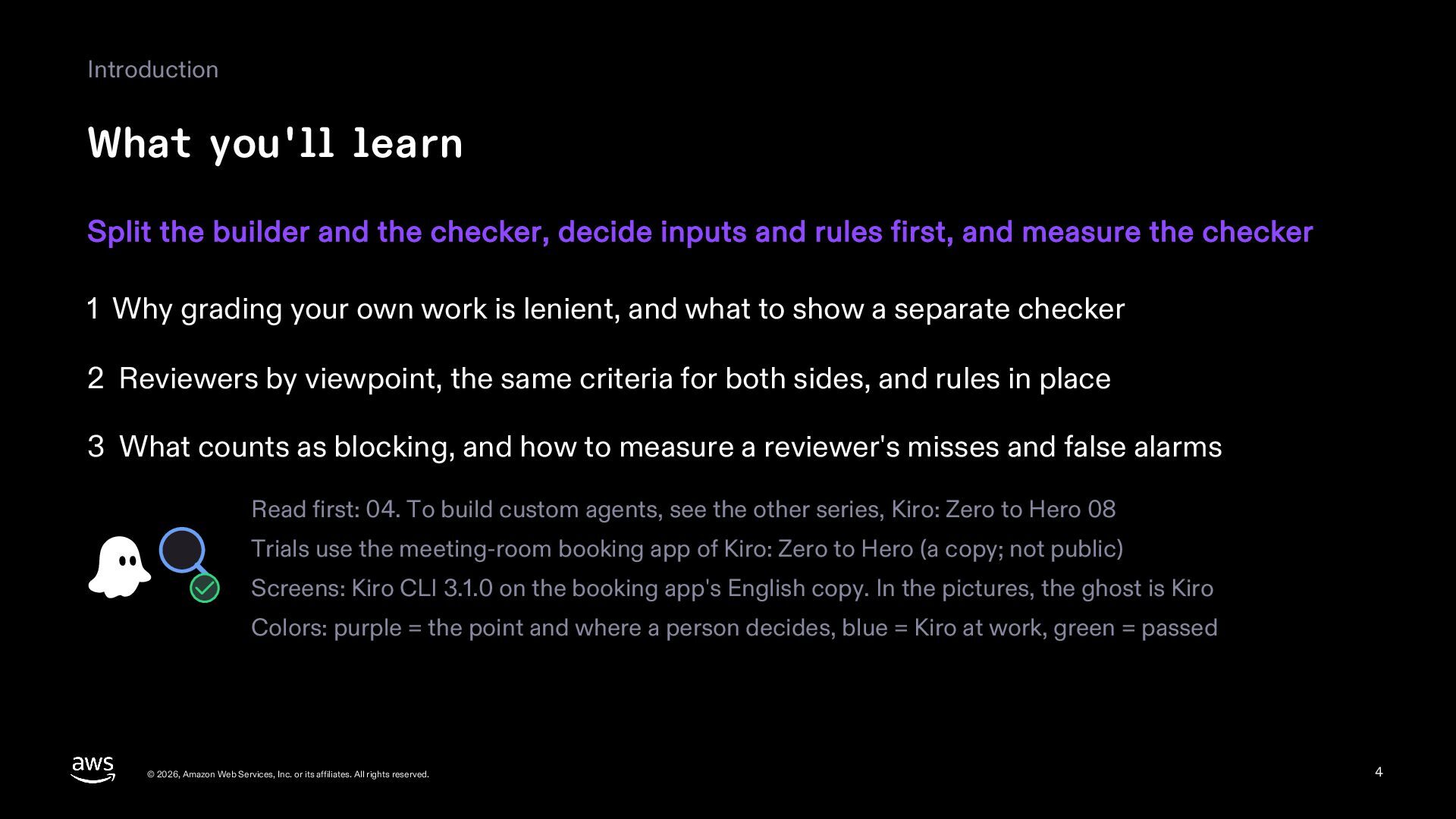
Introduction What you'll learn Split the builder and the checker,
decide inputs and rules first, and measure the checker 1 Why grading your own work is lenient, and what to show a separate checker 2 Reviewers by viewpoint, the same criteria for both sides, and rules in place 3 What counts as blocking, and how to measure a reviewer's misses and false alarms Read first: 04. To build custom agents, see the other series, Kiro: Zero to Hero 08 Trials use the meeting-room booking app of Kiro: Zero to Hero (a copy; not public) Screens: Kiro CLI 3.1.0 on the booking app's English copy. In the pictures, the ghost is Kiro Colors: purple = the point and where a person decides, blue = Kiro at work, green = passed © 2026, Amazon Web Services, Inc. or its affiliates. All rights reserved. 4 -
Part 1 The idea © 2026, Amazon Web Services, Inc.
or its affiliates. All rights reserved. 5 -
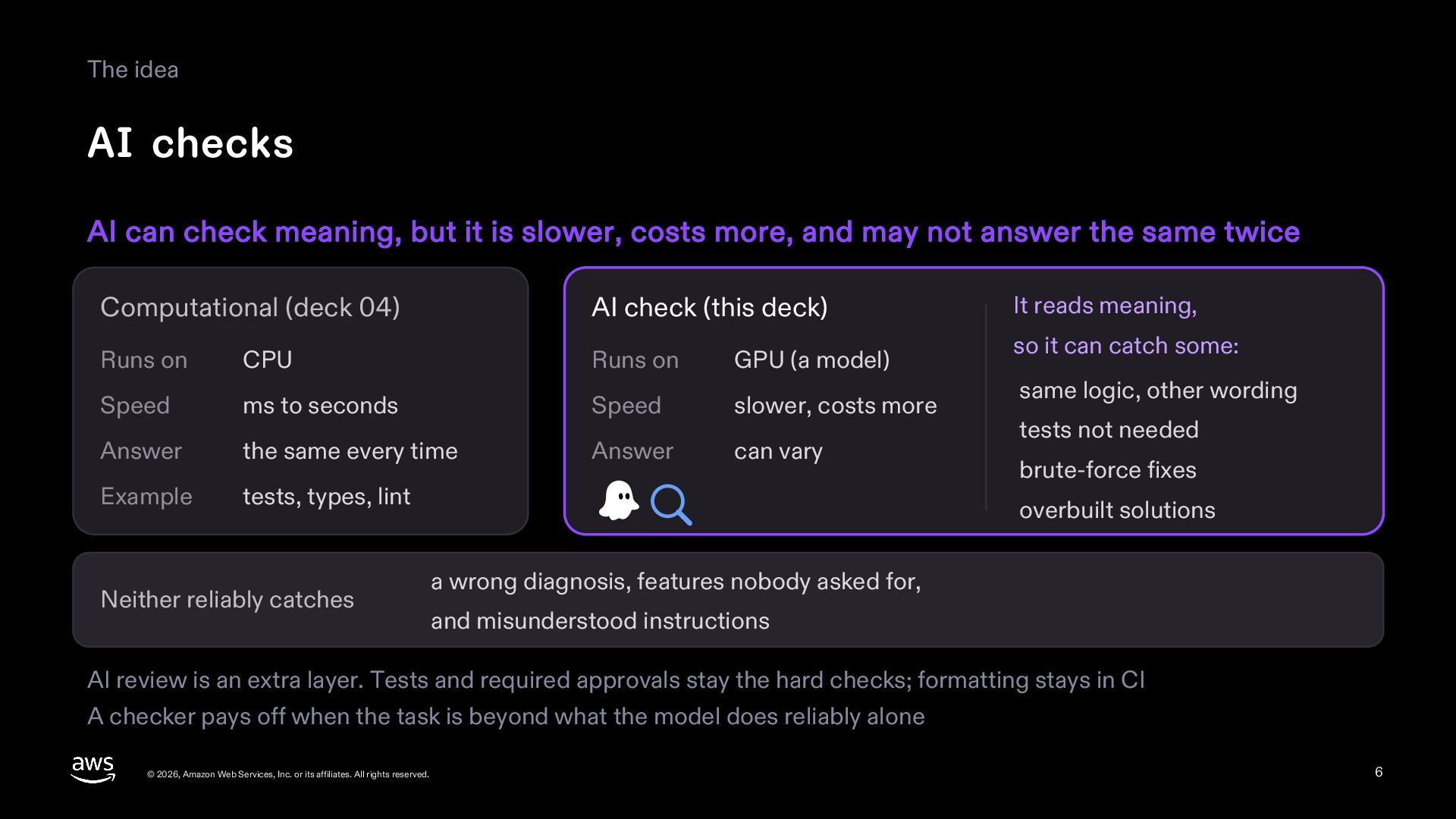
The idea AI checks AI can check meaning, but it
is slower, costs more, and may not answer the same twice Computational (deck 04) AI check (this deck) Runs on CPU Runs on GPU (a model) Speed ms to seconds Speed slower, costs more Answer the same every time Answer can vary Example tests, types, lint Neither reliably catches It reads meaning, so it can catch some: same logic, other wording tests not needed brute-force fixes overbuilt solutions a wrong diagnosis, features nobody asked for, and misunderstood instructions AI review is an extra layer. Tests and required approvals stay the hard checks; formatting stays in CI A checker pays off when the task is beyond what the model does reliably alone © 2026, Amazon Web Services, Inc. or its affiliates. All rights reserved. 6 -
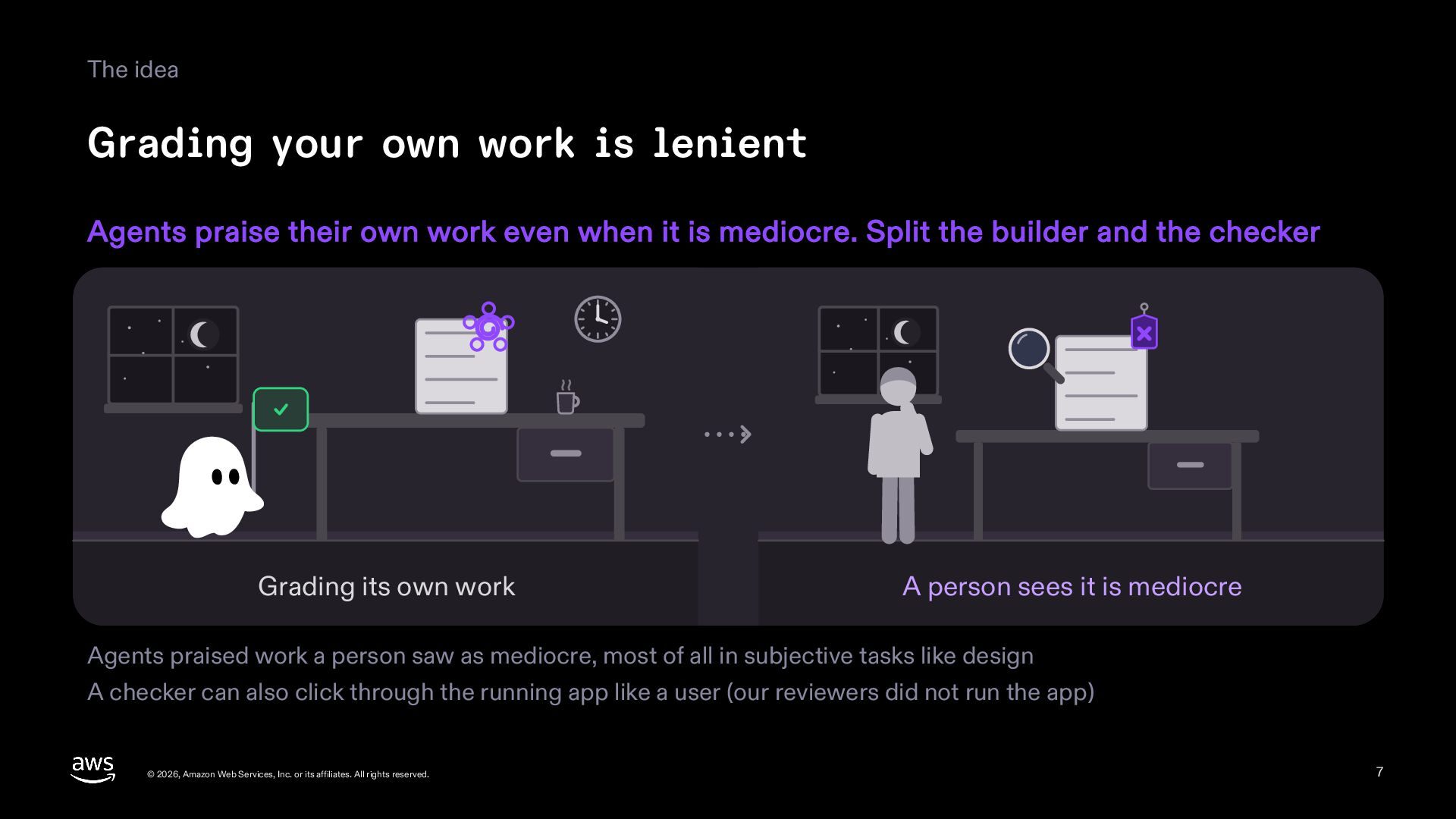
The idea Grading your own work is lenient Agents praise
their own work even when it is mediocre. Split the builder and the checker Grading its own work A person sees it is mediocre Agents praised work a person saw as mediocre, most of all in subjective tasks like design A checker can also click through the running app like a user (our reviewers did not run the app) © 2026, Amazon Web Services, Inc. or its affiliates. All rights reserved. 7 -
Part 2 Building reviewers © 2026, Amazon Web Services, Inc.
or its affiliates. All rights reserved. 8 -
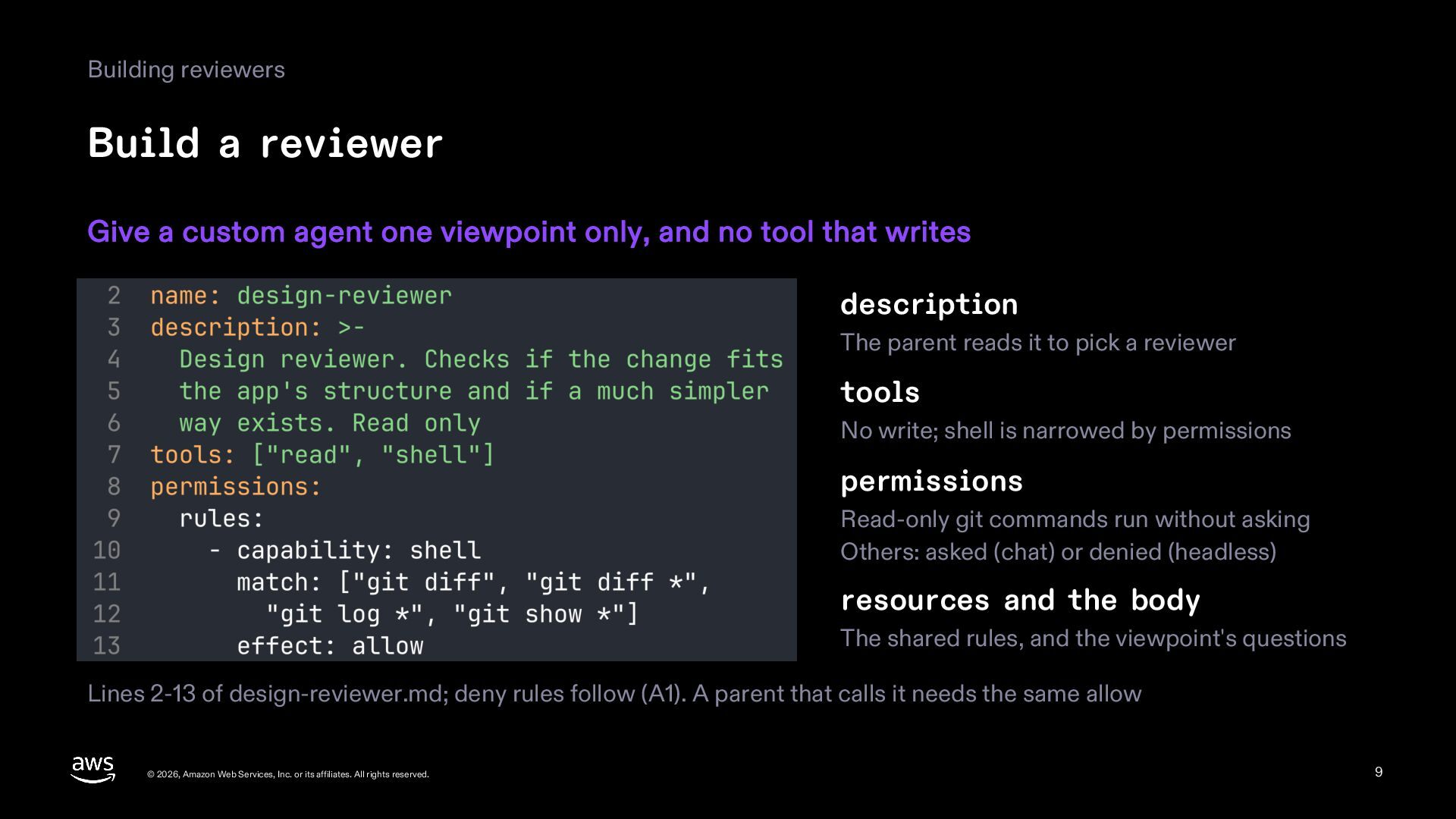
Building reviewers Build a reviewer Give a custom agent one
viewpoint only, and no tool that writes description The parent reads it to pick a reviewer tools No write; shell is narrowed by permissions permissions Read-only git commands run without asking Others: asked (chat) or denied (headless) resources and the body The shared rules, and the viewpoint's questions Lines 2-13 of design-reviewer.md; deny rules follow (A1). A parent that calls it needs the same allow © 2026, Amazon Web Services, Inc. or its affiliates. All rights reserved. 9 -
Building reviewers Split by role One reviewer that checks everything
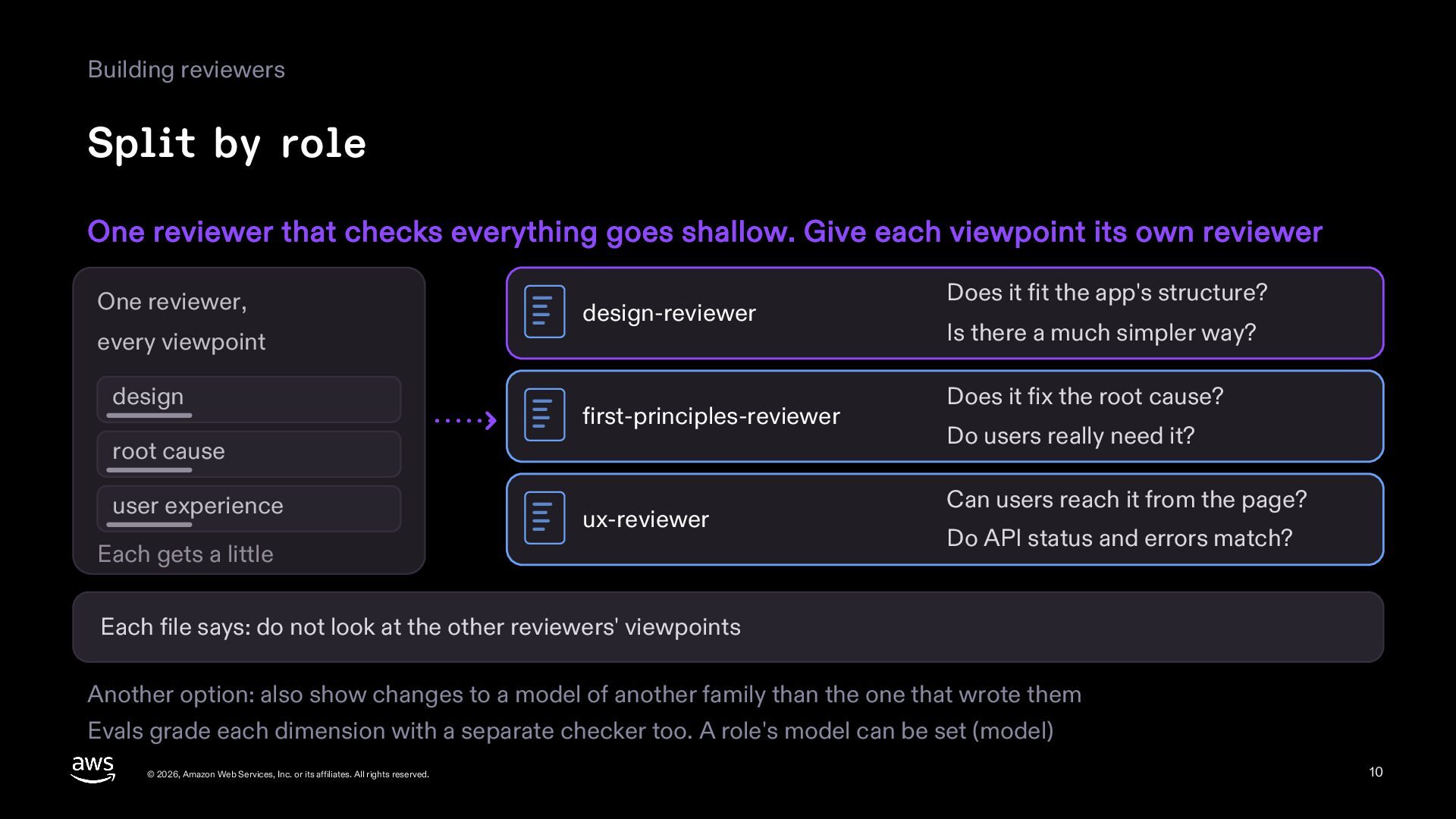
goes shallow. Give each viewpoint its own reviewer One reviewer, every viewpoint design design-reviewer first-principles-reviewer root cause user experience ux-reviewer Each gets a little Does it fit the app's structure? Is there a much simpler way? Does it fix the root cause? Do users really need it? Can users reach it from the page? Do API status and errors match? Each file says: do not look at the other reviewers' viewpoints Another option: also show changes to a model of another family than the one that wrote them Evals grade each dimension with a separate checker too. A role's model can be set (model) © 2026, Amazon Web Services, Inc. or its affiliates. All rights reserved. 10 -
Building reviewers Show the checker less Give the checker the
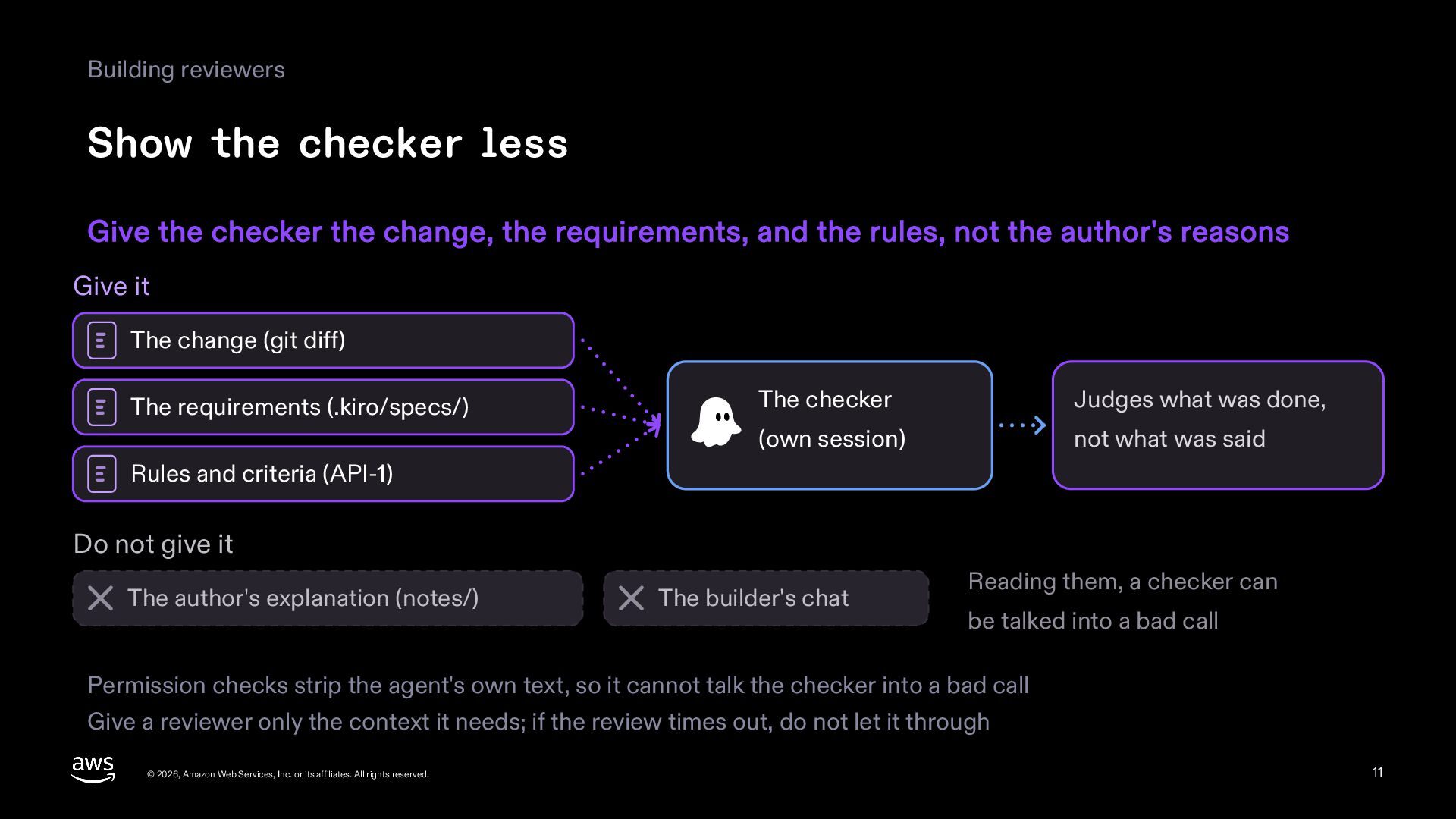
change, the requirements, and the rules, not the author's reasons Give it The change (git diff) The requirements (.kiro/specs/) The checker Judges what was done, (own session) not what was said Rules and criteria (API-1) Do not give it The author's explanation (notes/) The builder's chat Reading them, a checker can be talked into a bad call Permission checks strip the agent's own text, so it cannot talk the checker into a bad call Give a reviewer only the context it needs; if the review times out, do not let it through © 2026, Amazon Web Services, Inc. or its affiliates. All rights reserved. 11 -
Building reviewers Limit what Kiro gives the reviewer Narrow the
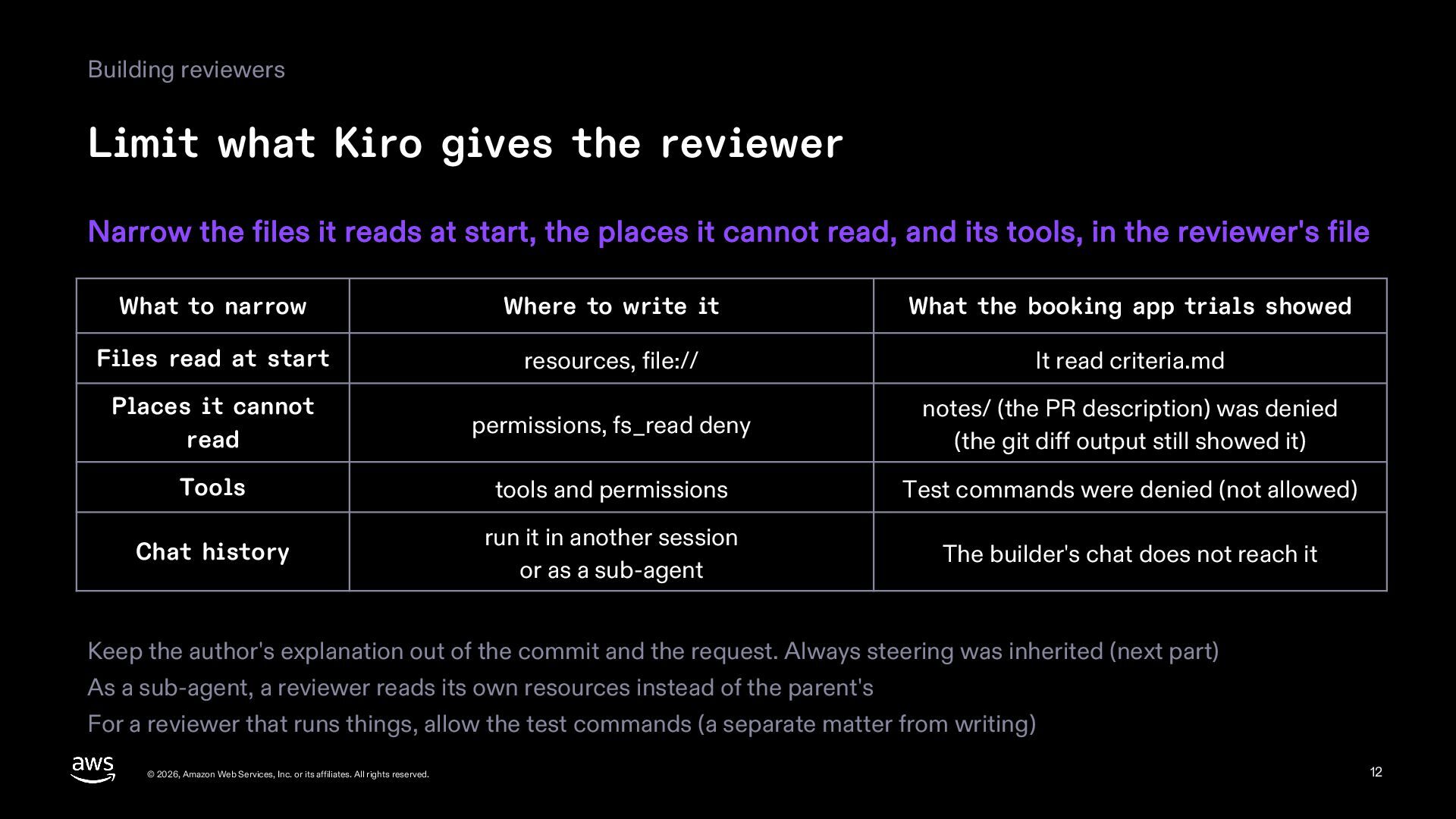
files it reads at start, the places it cannot read, and its tools, in the reviewer's file What to narrow Where to write it What the booking app trials showed Files read at start resources, file:// It read criteria.md Places it cannot read permissions, fs_read deny notes/ (the PR description) was denied (the git diff output still showed it) Tools tools and permissions Test commands were denied (not allowed) Chat history run it in another session or as a sub-agent The builder's chat does not reach it Keep the author's explanation out of the commit and the request. Always steering was inherited (next part) As a sub-agent, a reviewer reads its own resources instead of the parent's For a reviewer that runs things, allow the test commands (a separate matter from writing) © 2026, Amazon Web Services, Inc. or its affiliates. All rights reserved. 12 -
Building reviewers Ask for everything in one round Findings in
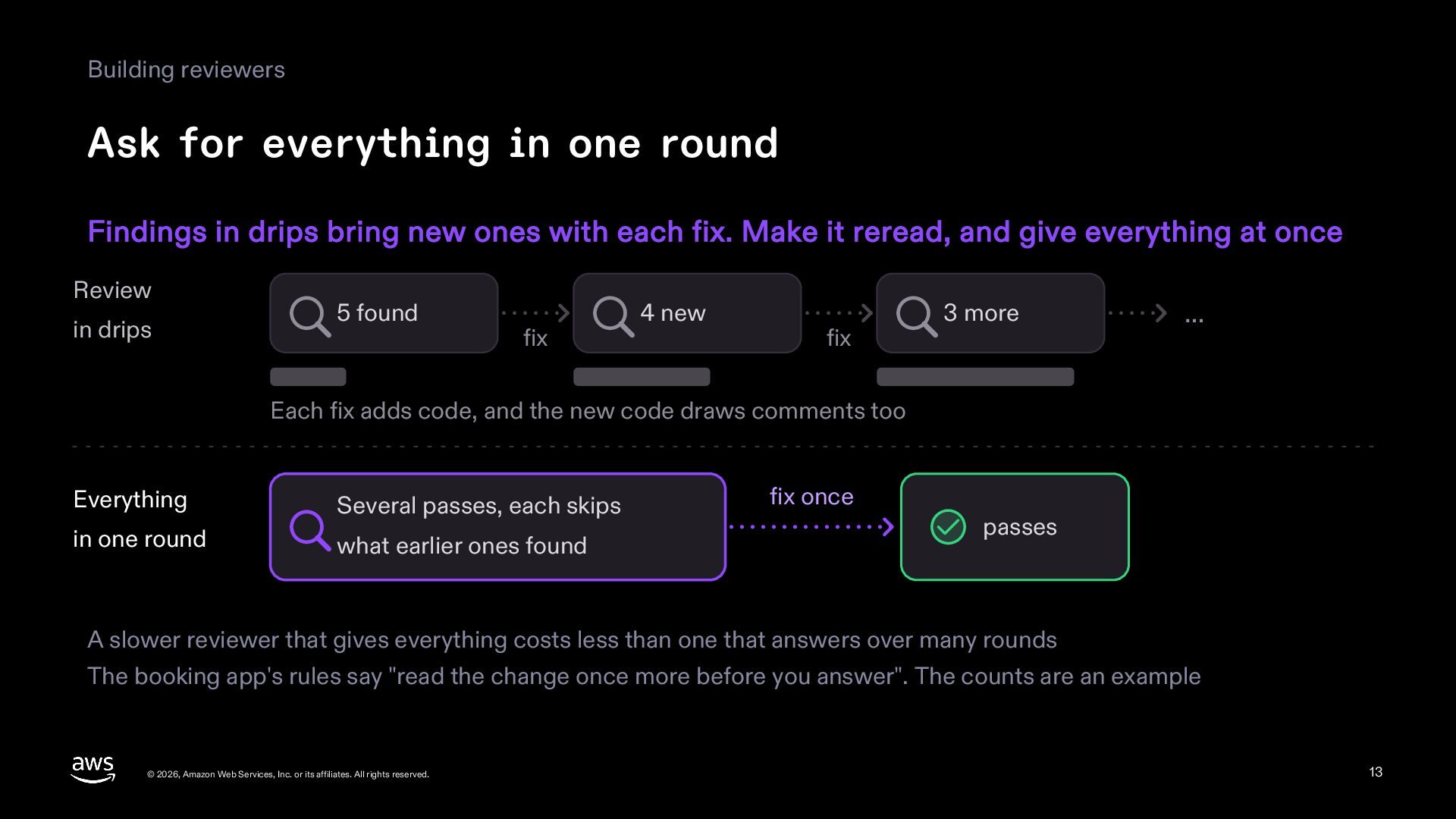
drips bring new ones with each fix. Make it reread, and give everything at once Review in drips 5 found fix 4 new fix 3 more … Each fix adds code, and the new code draws comments too Everything Several passes, each skips in one round what earlier ones found fix once passes A slower reviewer that gives everything costs less than one that answers over many rounds The booking app's rules say "read the change once more before you answer". The counts are an example © 2026, Amazon Web Services, Inc. or its affiliates. All rights reserved. 13 -
Part 3 Grading criteria © 2026, Amazon Web Services, Inc.
or its affiliates. All rights reserved. 14 -
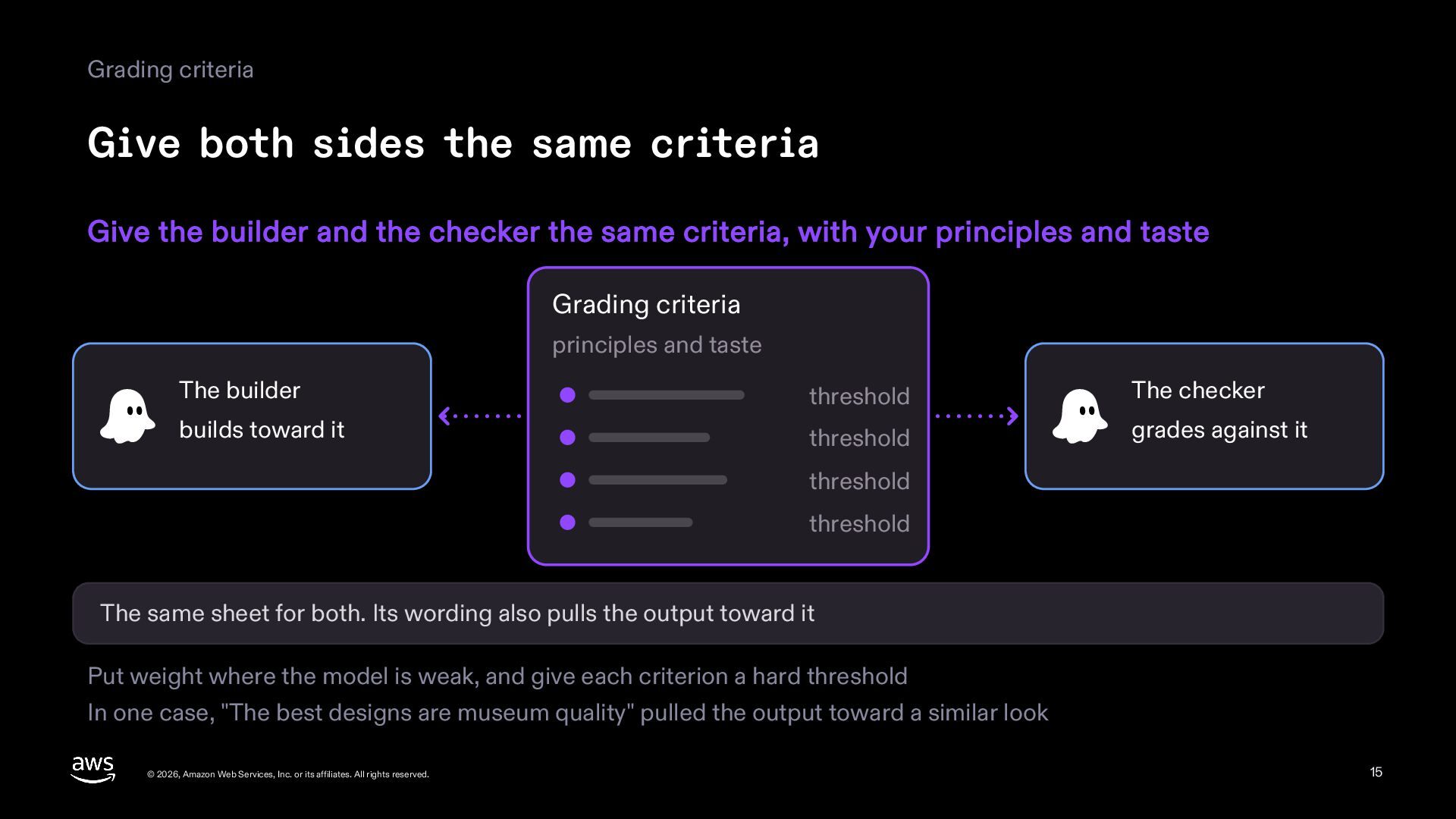
Grading criteria Give both sides the same criteria Give the
builder and the checker the same criteria, with your principles and taste Grading criteria principles and taste The builder threshold The checker builds toward it threshold grades against it threshold threshold The same sheet for both. Its wording also pulls the output toward it Put weight where the model is weak, and give each criterion a hard threshold In one case, "The best designs are museum quality" pulled the output toward a similar look © 2026, Amazon Web Services, Inc. or its affiliates. All rights reserved. 15 -
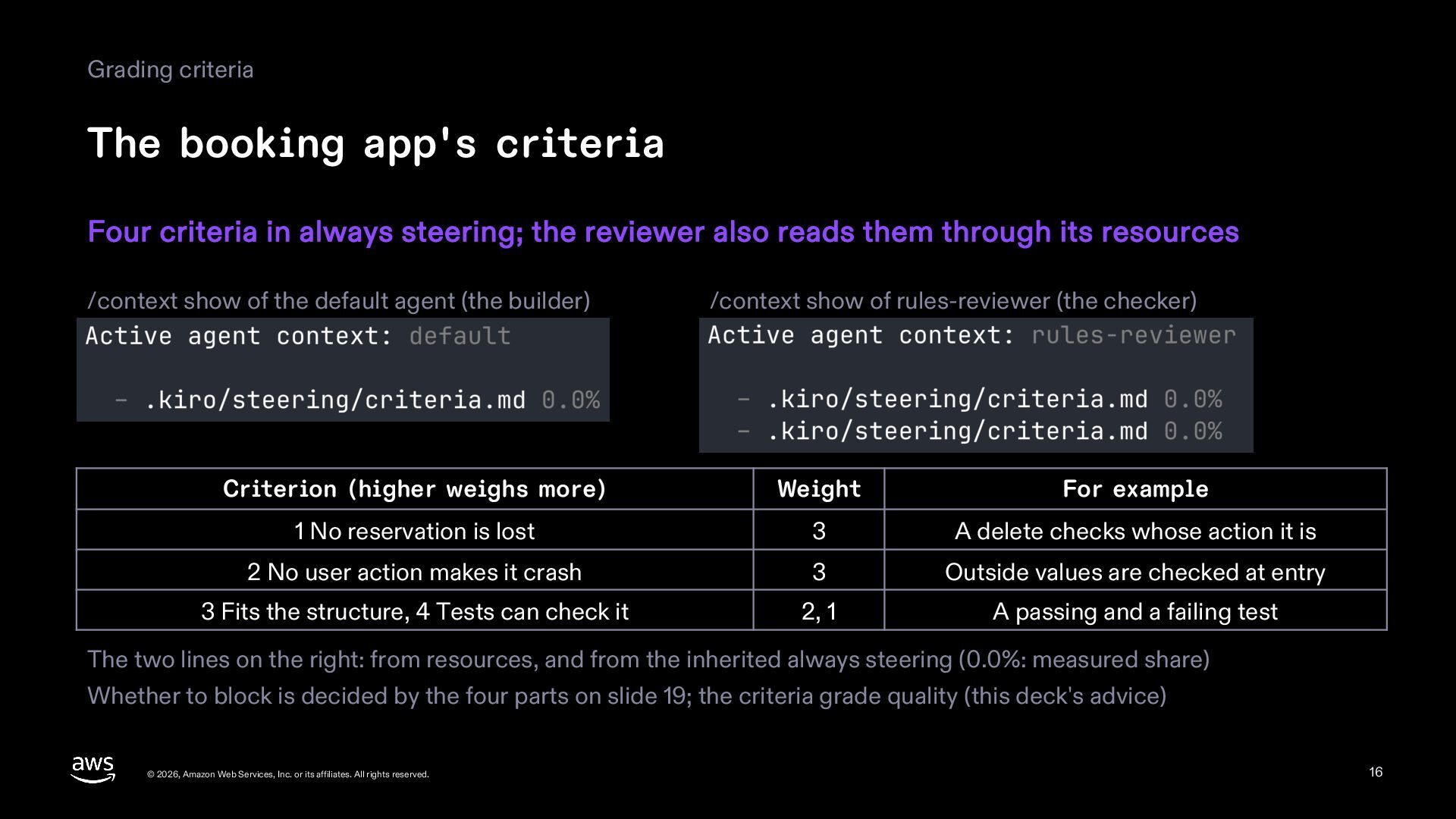
Grading criteria The booking app's criteria Four criteria in always
steering; the reviewer also reads them through its resources /context show of the default agent (the builder) /context show of rules-reviewer (the checker) Criterion (higher weighs more) Weight For example 1 No reservation is lost 3 A delete checks whose action it is 2 No user action makes it crash 3 Outside values are checked at entry 3 Fits the structure, 4 Tests can check it 2, 1 A passing and a failing test The two lines on the right: from resources, and from the inherited always steering (0.0%: measured share) Whether to block is decided by the four parts on slide 19; the criteria grade quality (this deck's advice) © 2026, Amazon Web Services, Inc. or its affiliates. All rights reserved. 16 -
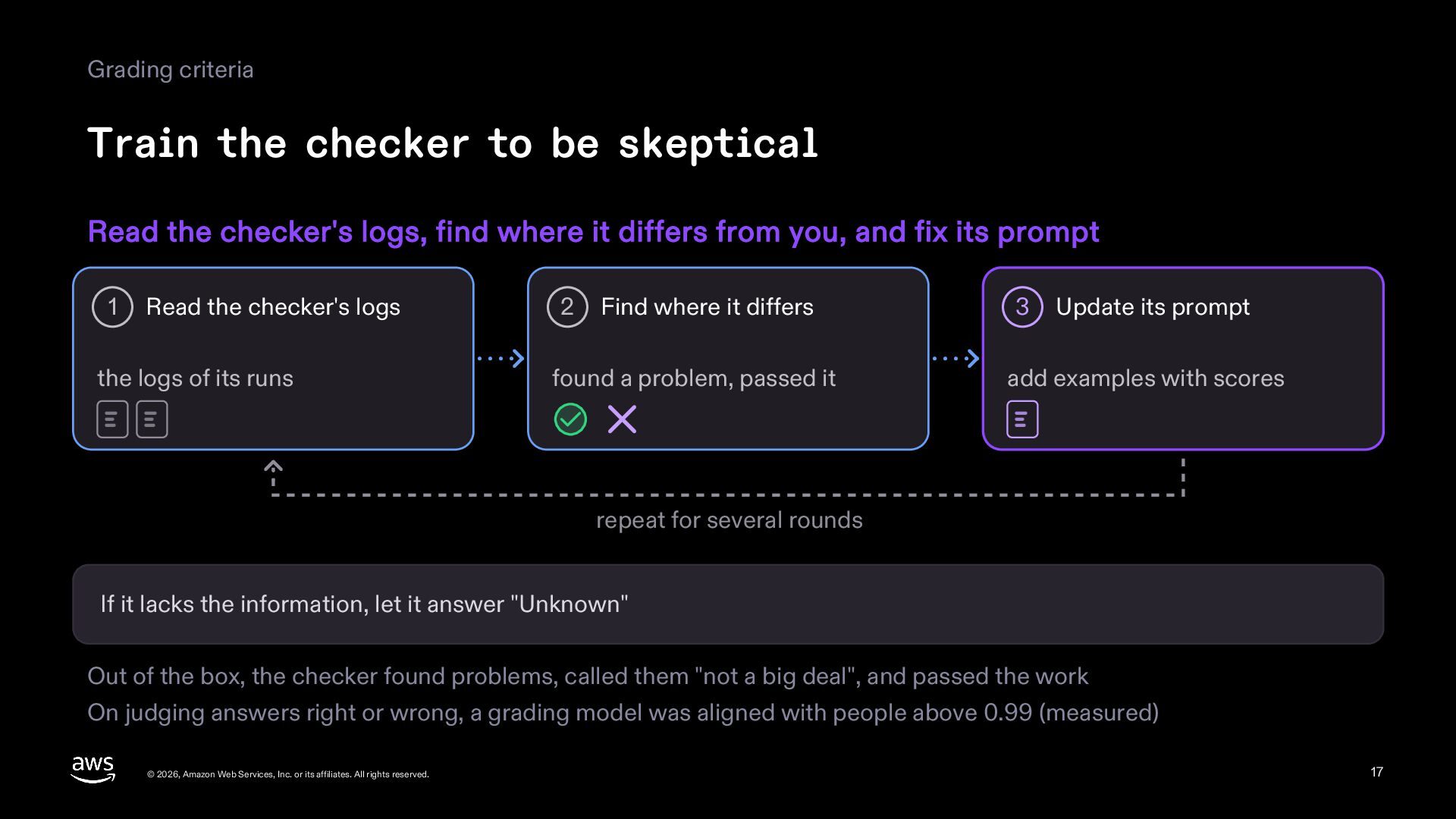
Grading criteria Train the checker to be skeptical Read the
checker's logs, find where it differs from you, and fix its prompt 1 Read the checker's logs the logs of its runs 2 Find where it differs found a problem, passed it 3 Update its prompt add examples with scores repeat for several rounds If it lacks the information, let it answer "Unknown" Out of the box, the checker found problems, called them "not a big deal", and passed the work On judging answers right or wrong, a grading model was aligned with people above 0.99 (measured) © 2026, Amazon Web Services, Inc. or its affiliates. All rights reserved. 17 -
Part 4 Rules for blocking © 2026, Amazon Web Services,
Inc. or its affiliates. All rights reserved. 18 -
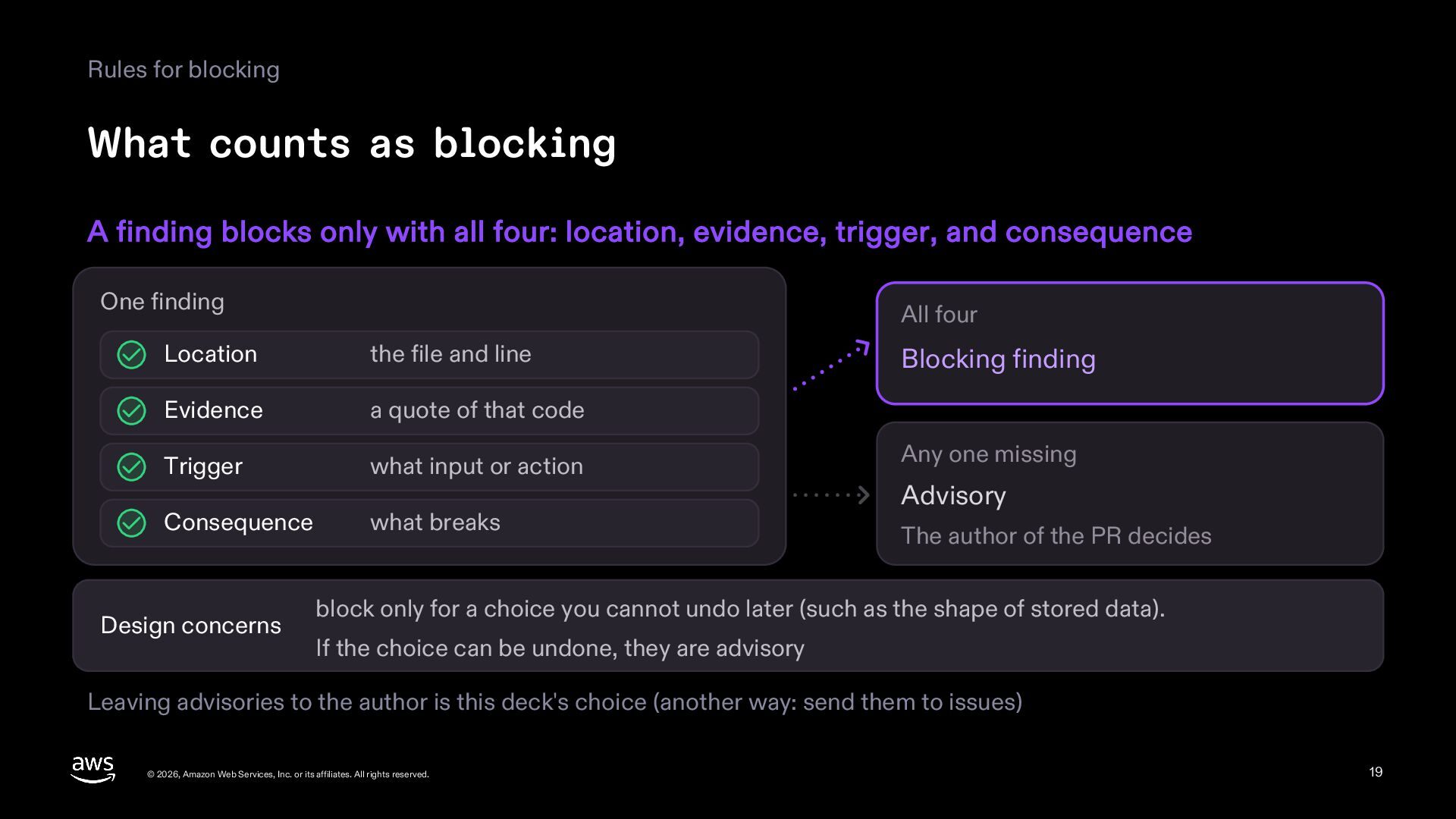
Rules for blocking What counts as blocking A finding blocks
only with all four: location, evidence, trigger, and consequence One finding All four Location the file and line Evidence a quote of that code Trigger what input or action Consequence what breaks Design concerns Blocking finding Any one missing Advisory The author of the PR decides block only for a choice you cannot undo later (such as the shape of stored data). If the choice can be undone, they are advisory Leaving advisories to the author is this deck's choice (another way: send them to issues) © 2026, Amazon Web Services, Inc. or its affiliates. All rights reserved. 19 -
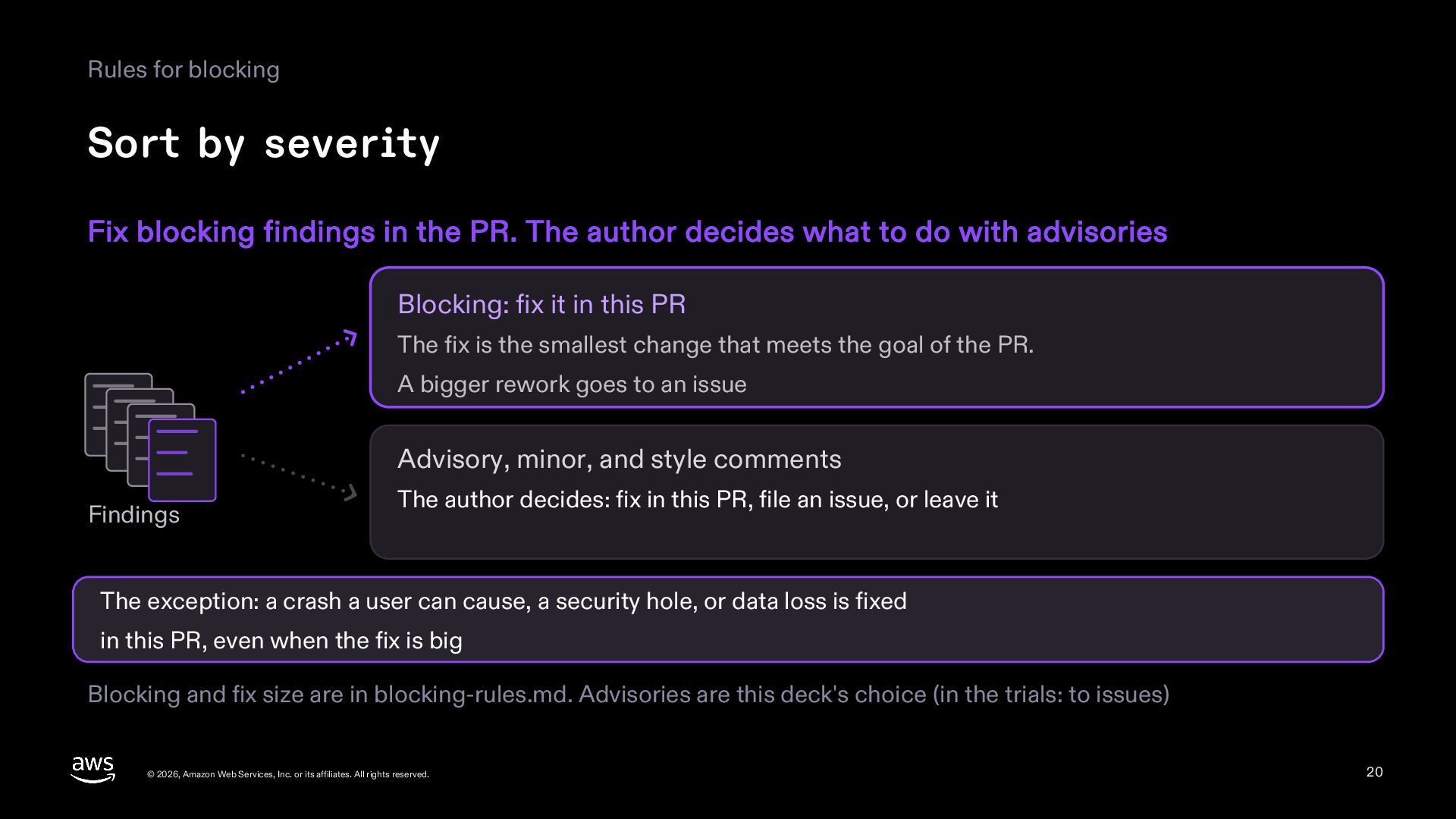
Rules for blocking Sort by severity Fix blocking findings in
the PR. The author decides what to do with advisories Blocking: fix it in this PR The fix is the smallest change that meets the goal of the PR. A bigger rework goes to an issue Advisory, minor, and style comments Findings The author decides: fix in this PR, file an issue, or leave it The exception: a crash a user can cause, a security hole, or data loss is fixed in this PR, even when the fix is big Blocking and fix size are in blocking-rules.md. Advisories are this deck's choice (in the trials: to issues) © 2026, Amazon Web Services, Inc. or its affiliates. All rights reserved. 20 -
Part 5 Rules in place © 2026, Amazon Web Services,
Inc. or its affiliates. All rights reserved. 21 -
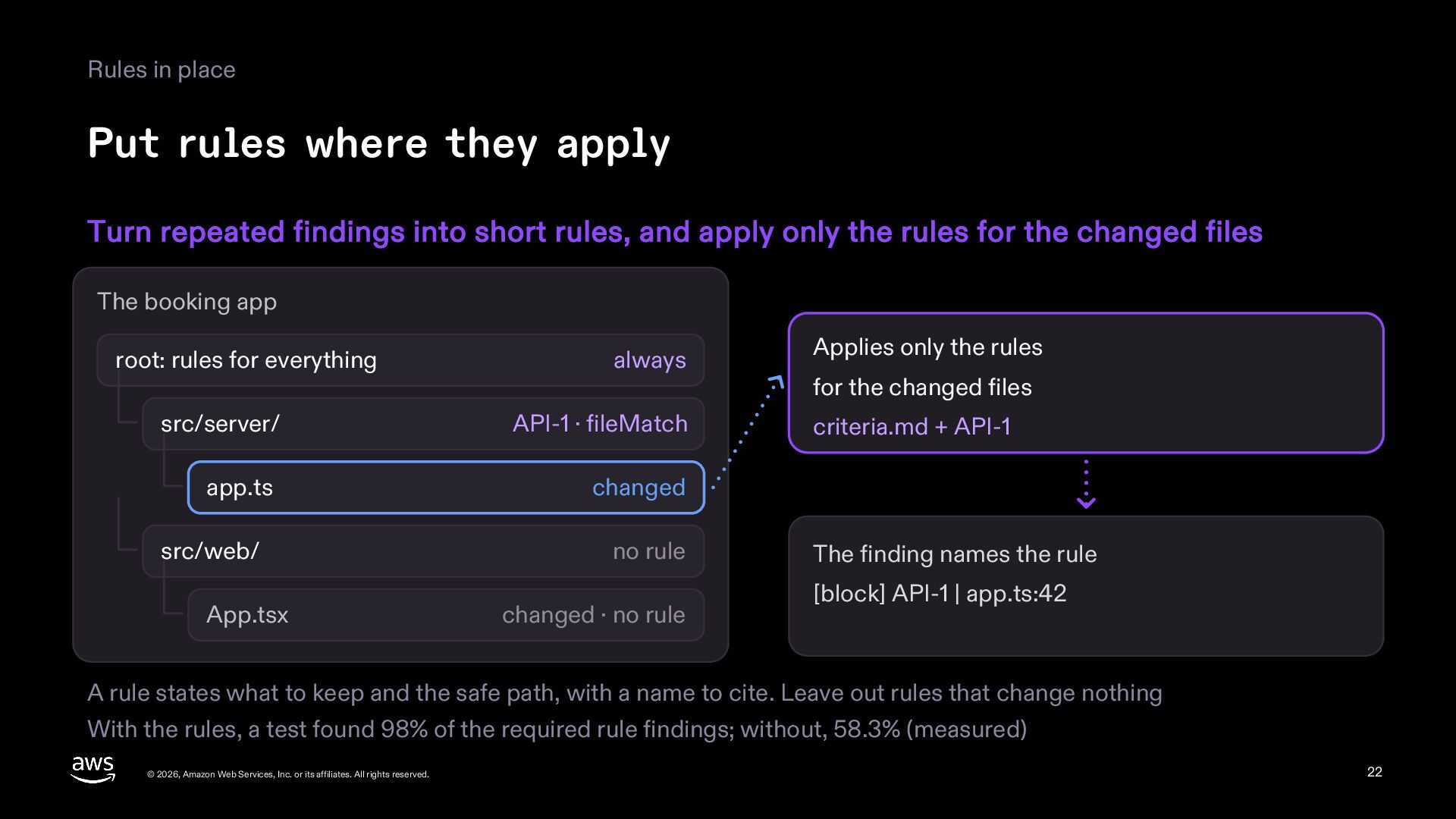
Rules in place Put rules where they apply Turn repeated
findings into short rules, and apply only the rules for the changed files The booking app root: rules for everything always src/server/ API-1 · fileMatch app.ts changed src/web/ no rule App.tsx changed · no rule Applies only the rules for the changed files criteria.md + API-1 The finding names the rule [block] API-1 | app.ts:42 A rule states what to keep and the safe path, with a name to cite. Leave out rules that change nothing With the rules, a test found 98% of the required rule findings; without, 58.3% (measured) © 2026, Amazon Web Services, Inc. or its affiliates. All rights reserved. 22 -
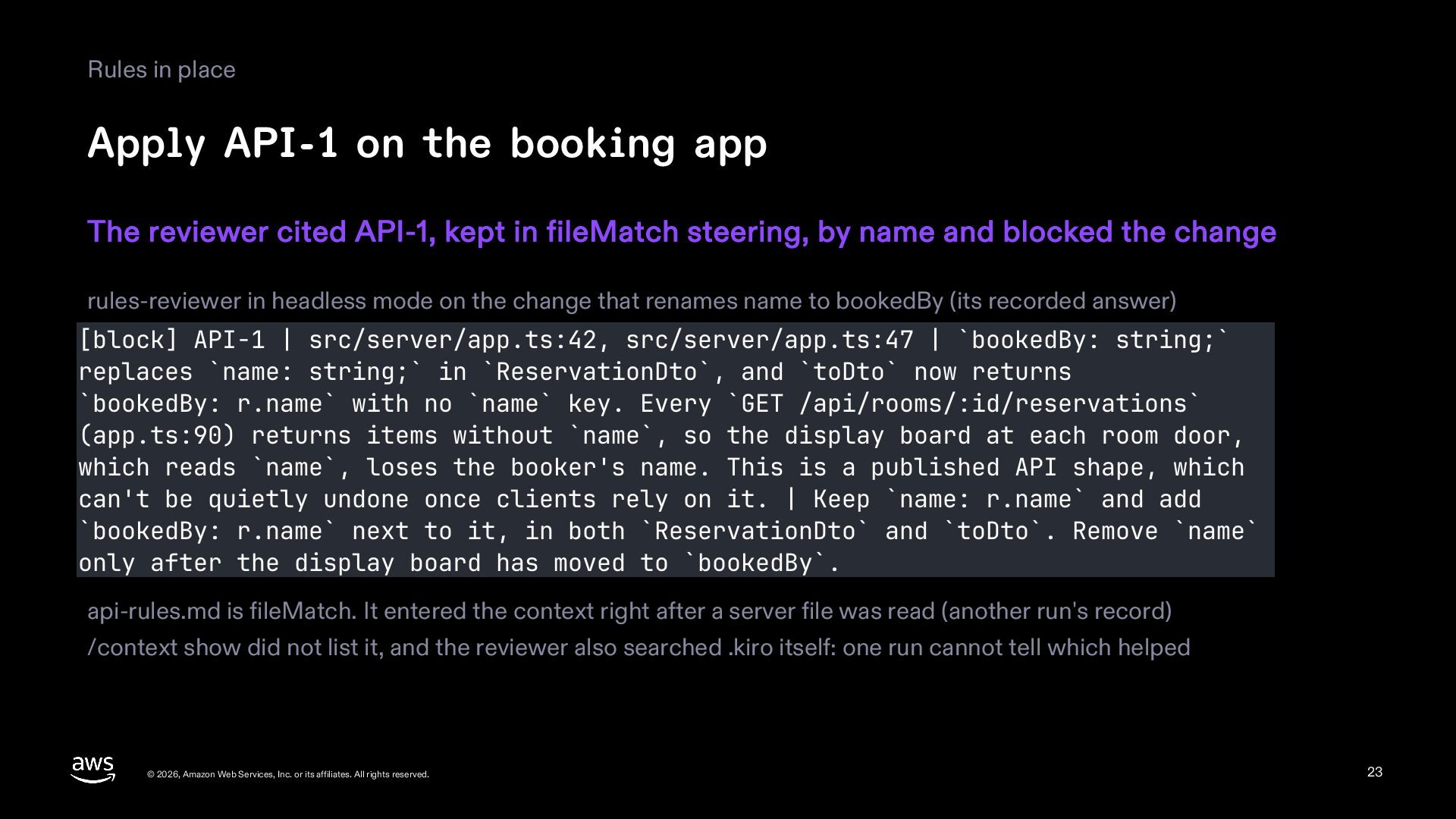
Rules in place Apply API-1 on the booking app The
reviewer cited API-1, kept in fileMatch steering, by name and blocked the change rules-reviewer in headless mode on the change that renames name to bookedBy (its recorded answer) api-rules.md is fileMatch. It entered the context right after a server file was read (another run's record) /context show did not list it, and the reviewer also searched .kiro itself: one run cannot tell which helped © 2026, Amazon Web Services, Inc. or its affiliates. All rights reserved. 23 -
Part 6 Trying it on the booking app © 2026,
Amazon Web Services, Inc. or its affiliates. All rights reserved. 24 -
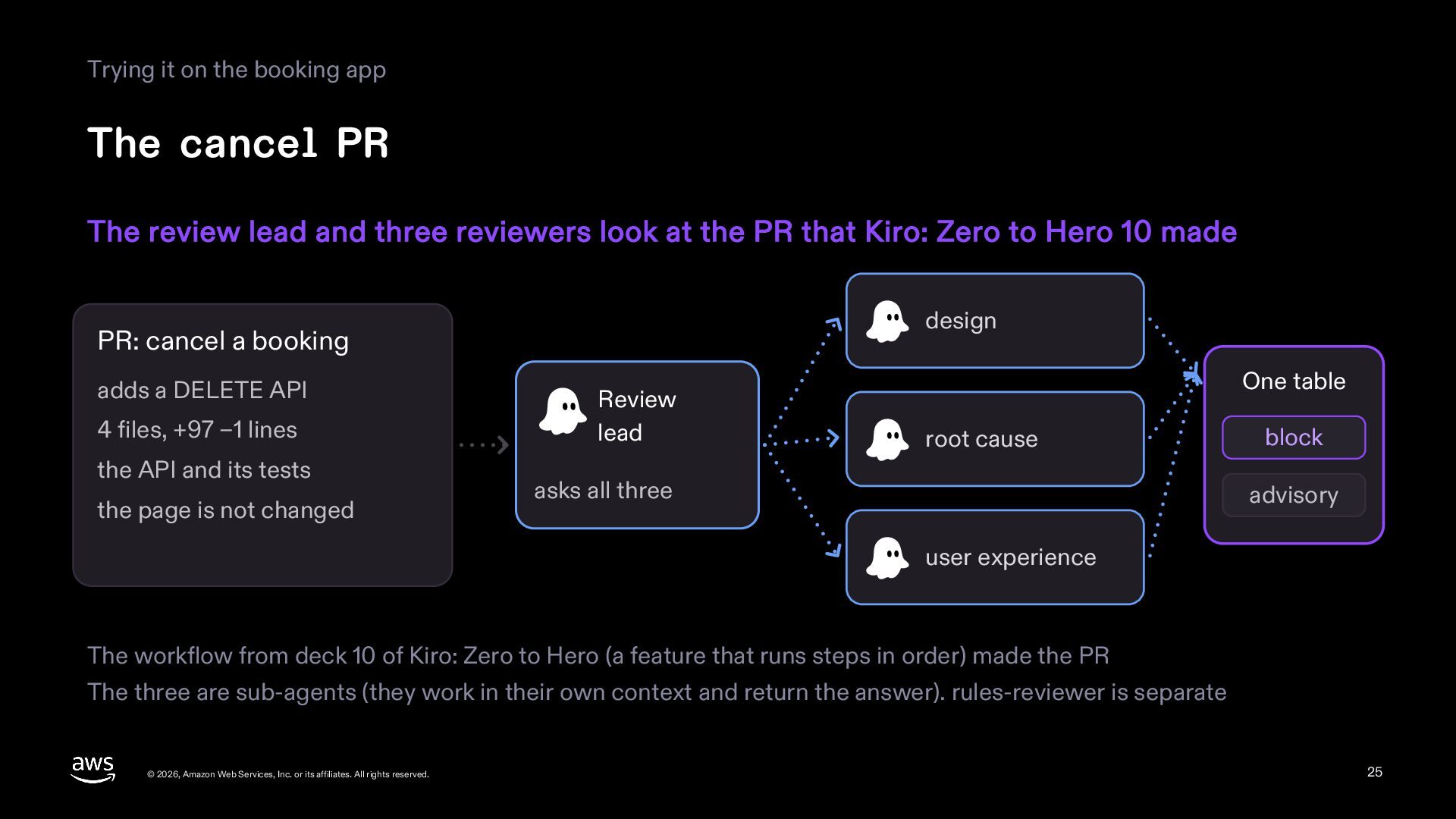
Trying it on the booking app The cancel PR The
review lead and three reviewers look at the PR that Kiro: Zero to Hero 10 made design PR: cancel a booking adds a DELETE API 4 files, +97 −1 lines the API and its tests the page is not changed Review lead One table root cause asks all three block advisory user experience The workflow from deck 10 of Kiro: Zero to Hero (a feature that runs steps in order) made the PR The three are sub-agents (they work in their own context and return the answer). rules-reviewer is separate © 2026, Amazon Web Services, Inc. or its affiliates. All rights reserved. 25 -
Trying it on the booking app Run them in parallel
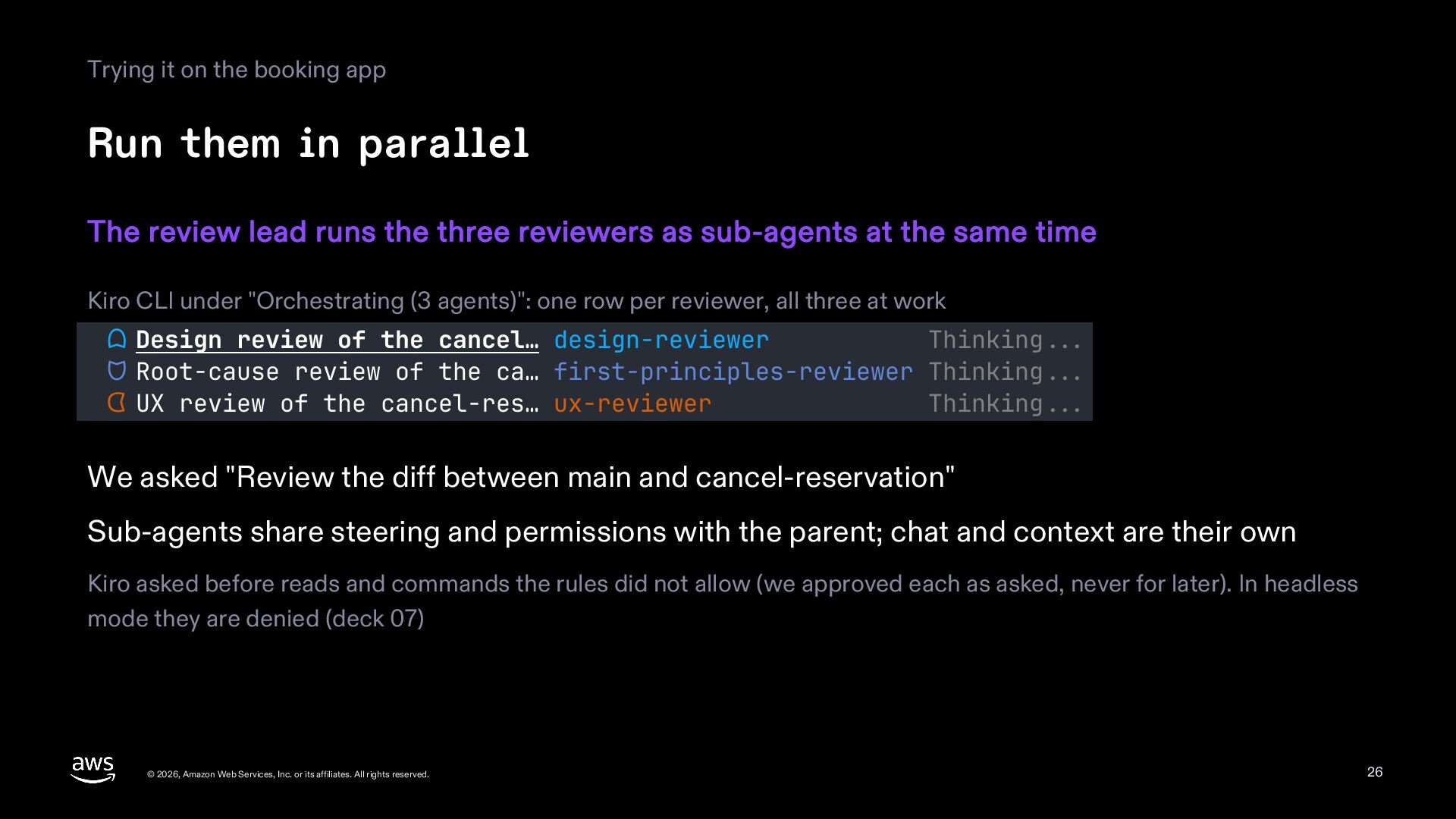
The review lead runs the three reviewers as sub-agents at the same time Kiro CLI under "Orchestrating (3 agents)": one row per reviewer, all three at work We asked "Review the diff between main and cancel-reservation" Sub-agents share steering and permissions with the parent; chat and context are their own Kiro asked before reads and commands the rules did not allow (we approved each as asked, never for later). In headless mode they are denied (deck 07) © 2026, Amazon Web Services, Inc. or its affiliates. All rights reserved. 26 -
Trying it on the booking app What the cancel PR
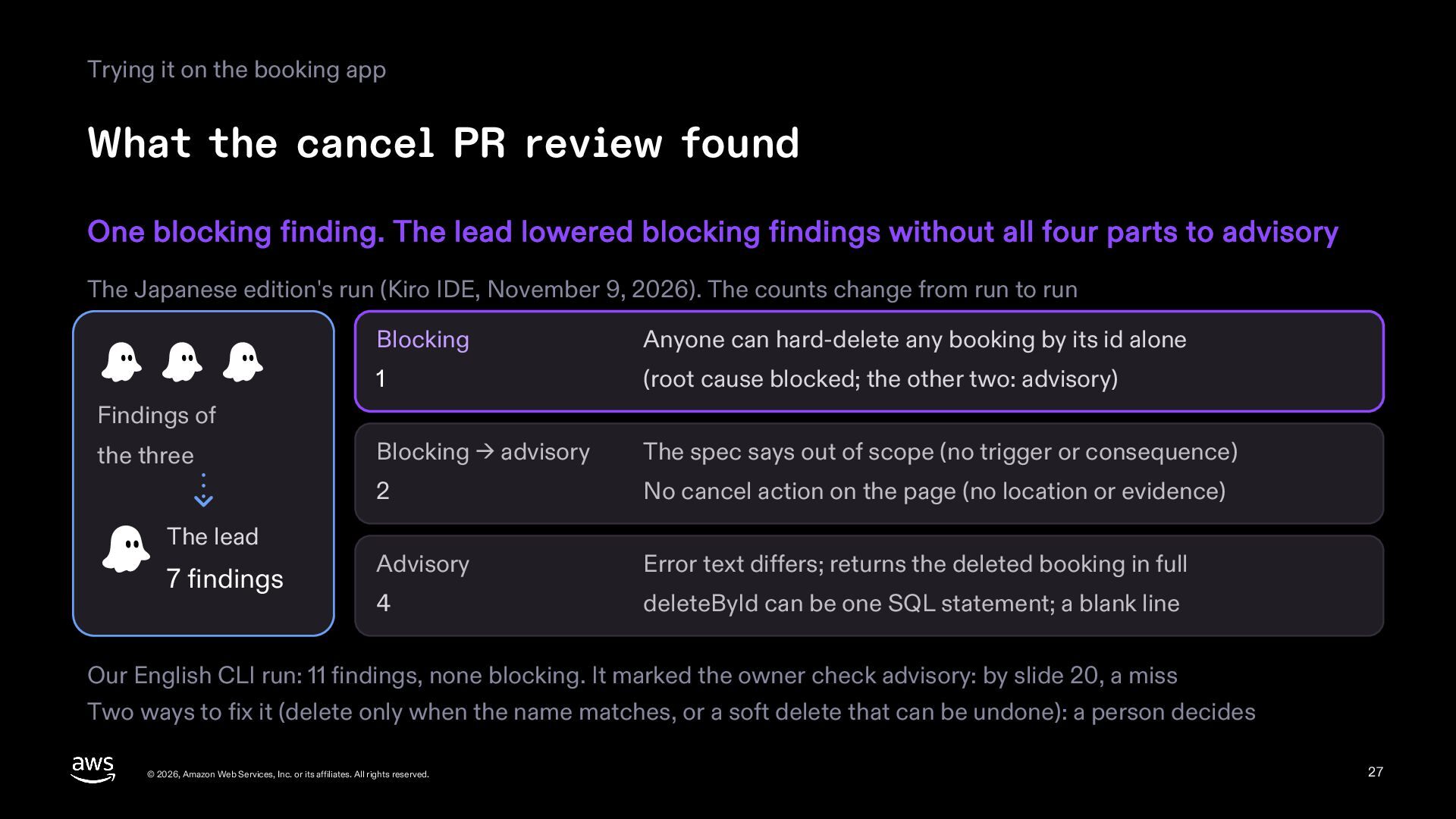
review found One blocking finding. The lead lowered blocking findings without all four parts to advisory The Japanese edition's run (Kiro IDE, November 9, 2026). The counts change from run to run Blocking Anyone can hard-delete any booking by its id alone 1 (root cause blocked; the other two: advisory) Blocking → advisory The spec says out of scope (no trigger or consequence) 2 No cancel action on the page (no location or evidence) Advisory Error text differs; returns the deleted booking in full 4 deleteById can be one SQL statement; a blank line Findings of the three The lead 7 findings Our English CLI run: 11 findings, none blocking. It marked the owner check advisory: by slide 20, a miss Two ways to fix it (delete only when the name matches, or a soft delete that can be undone): a person decides © 2026, Amazon Web Services, Inc. or its affiliates. All rights reserved. 27 -
Part 7 Measure the checker too © 2026, Amazon Web
Services, Inc. or its affiliates. All rights reserved. 28 -
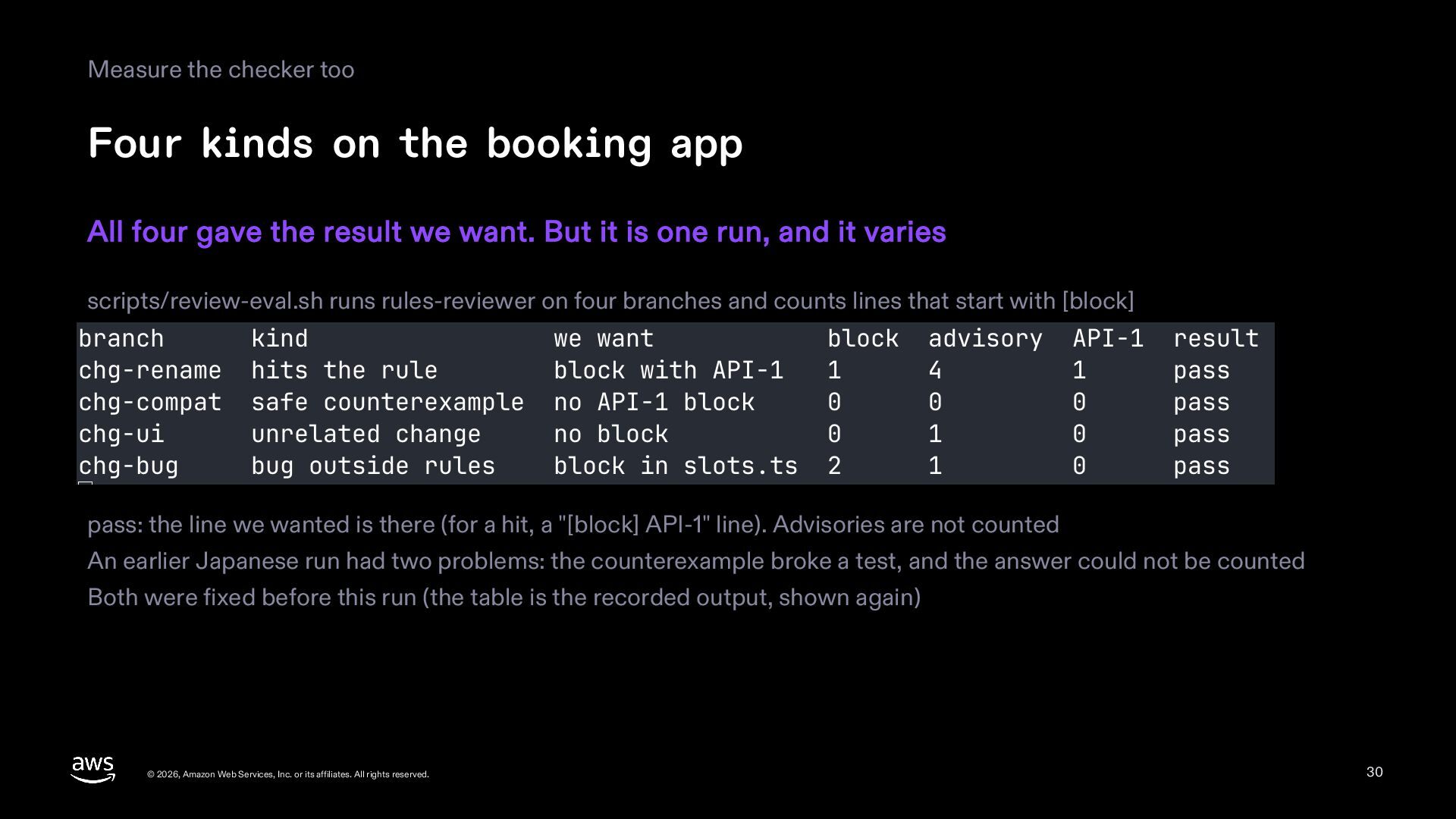
Measure the checker too Measure the checker too Run four
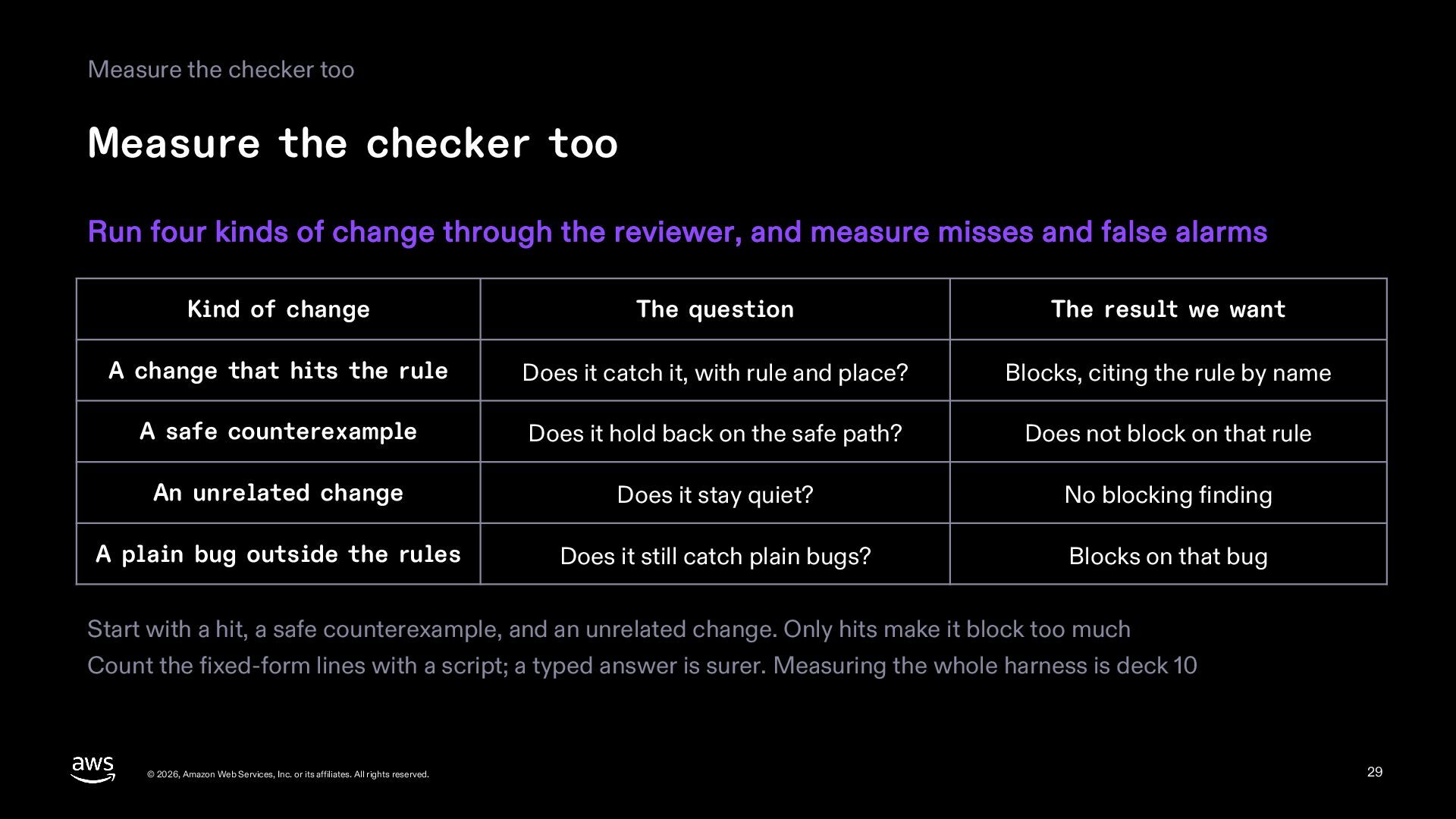
kinds of change through the reviewer, and measure misses and false alarms Kind of change The question The result we want A change that hits the rule Does it catch it, with rule and place? Blocks, citing the rule by name A safe counterexample Does it hold back on the safe path? Does not block on that rule An unrelated change Does it stay quiet? No blocking finding A plain bug outside the rules Does it still catch plain bugs? Blocks on that bug Start with a hit, a safe counterexample, and an unrelated change. Only hits make it block too much Count the fixed-form lines with a script; a typed answer is surer. Measuring the whole harness is deck 10 © 2026, Amazon Web Services, Inc. or its affiliates. All rights reserved. 29 -
Measure the checker too Four kinds on the booking app
All four gave the result we want. But it is one run, and it varies scripts/review-eval.sh runs rules-reviewer on four branches and counts lines that start with [block] pass: the line we wanted is there (for a hit, a "[block] API-1" line). Advisories are not counted An earlier Japanese run had two problems: the counterexample broke a test, and the answer could not be counted Both were fixed before this run (the table is the recorded output, shown again) © 2026, Amazon Web Services, Inc. or its affiliates. All rights reserved. 30 -
Part 8 Overbuilding © 2026, Amazon Web Services, Inc. or
its affiliates. All rights reserved. 31 -
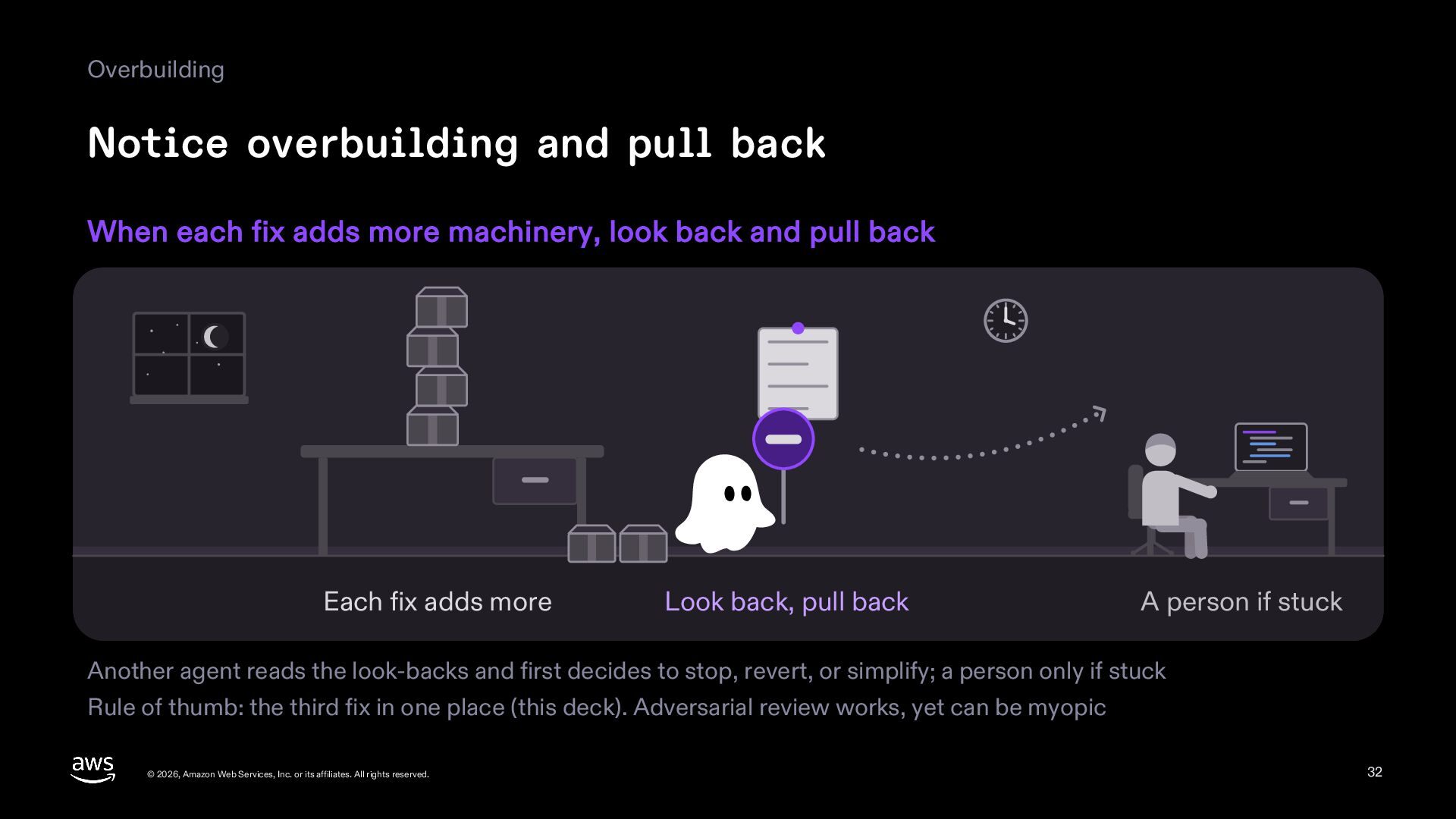
Overbuilding Notice overbuilding and pull back When each fix adds
more machinery, look back and pull back Each fix adds more Look back, pull back A person if stuck Another agent reads the look-backs and first decides to stop, revert, or simplify; a person only if stuck Rule of thumb: the third fix in one place (this deck). Adversarial review works, yet can be myopic © 2026, Amazon Web Services, Inc. or its affiliates. All rights reserved. 32 -
Part 9 Summary © 2026, Amazon Web Services, Inc. or
its affiliates. All rights reserved. 33 -
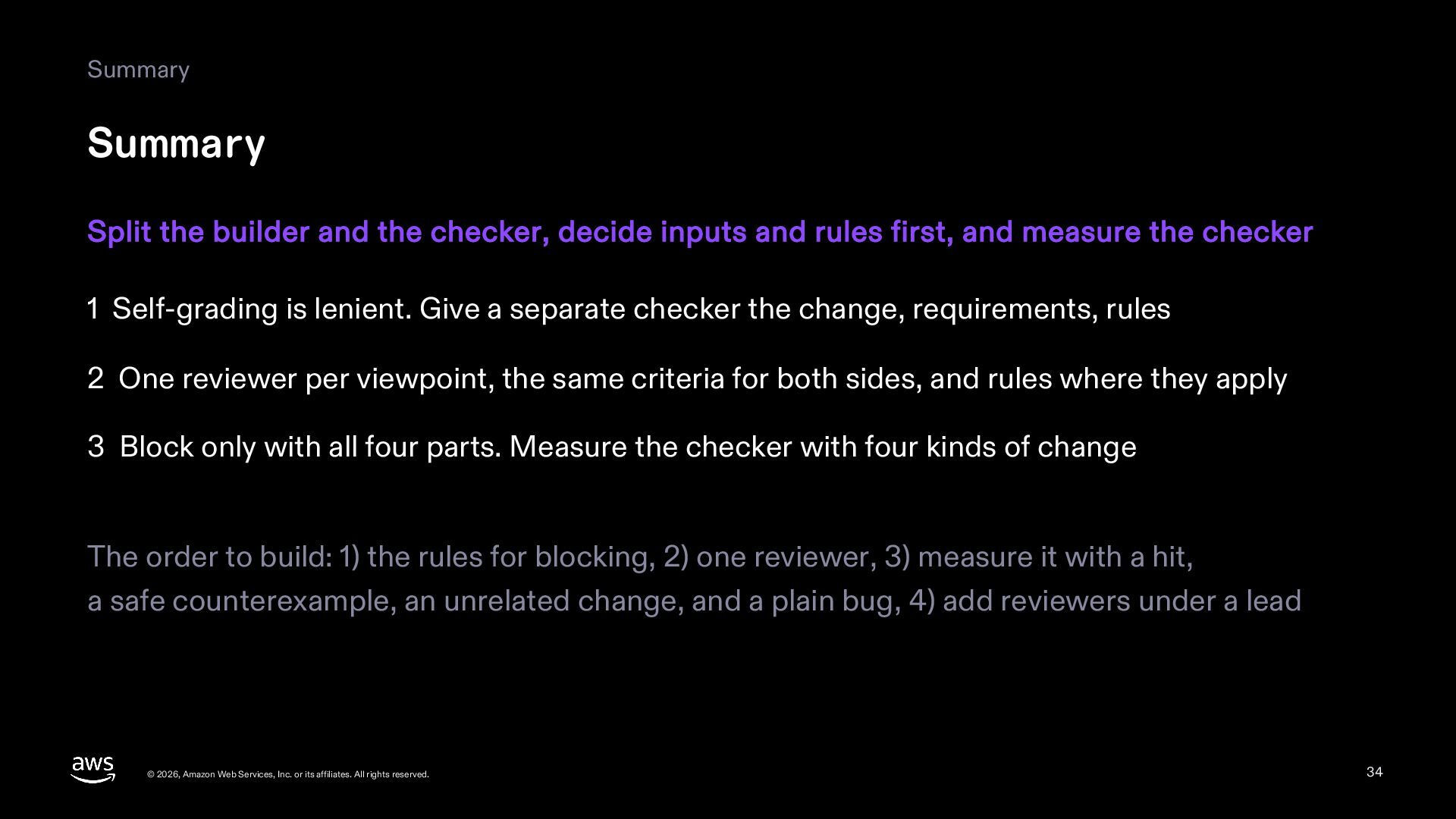
Summary Summary Split the builder and the checker, decide inputs
and rules first, and measure the checker 1 Self-grading is lenient. Give a separate checker the change, requirements, rules 2 One reviewer per viewpoint, the same criteria for both sides, and rules where they apply 3 Block only with all four parts. Measure the checker with four kinds of change The order to build: 1) the rules for blocking, 2) one reviewer, 3) measure it with a hit, a safe counterexample, an unrelated change, and a plain bug, 4) add reviewers under a lead © 2026, Amazon Web Services, Inc. or its affiliates. All rights reserved. 34 -
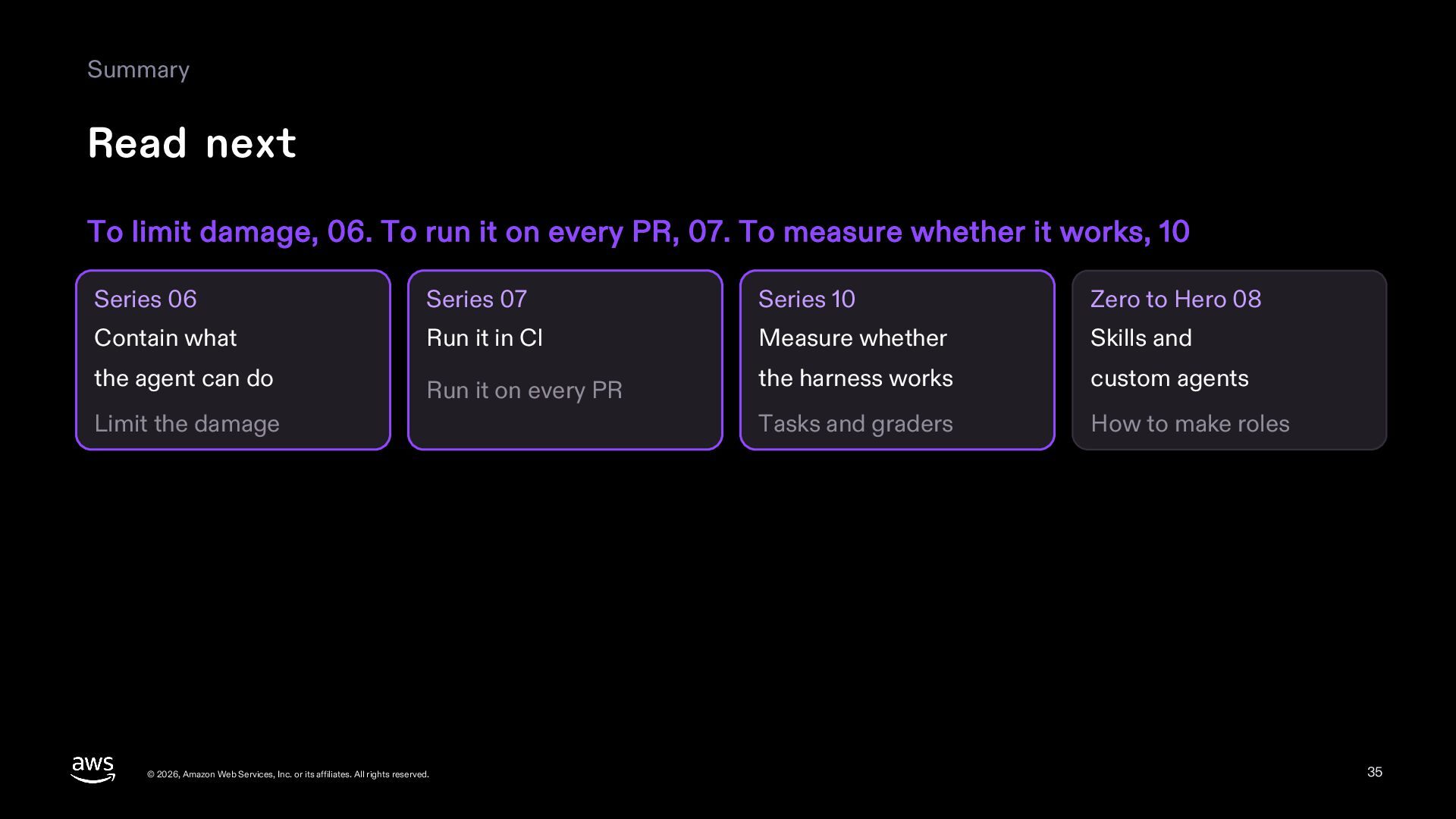
Summary Read next To limit damage, 06. To run it
on every PR, 07. To measure whether it works, 10 Series 06 Series 07 Series 10 Zero to Hero 08 Contain what Run it in CI Measure whether Skills and the agent can do Run it on every PR the harness works custom agents Tasks and graders How to make roles Limit the damage © 2026, Amazon Web Services, Inc. or its affiliates. All rights reserved. 35 -
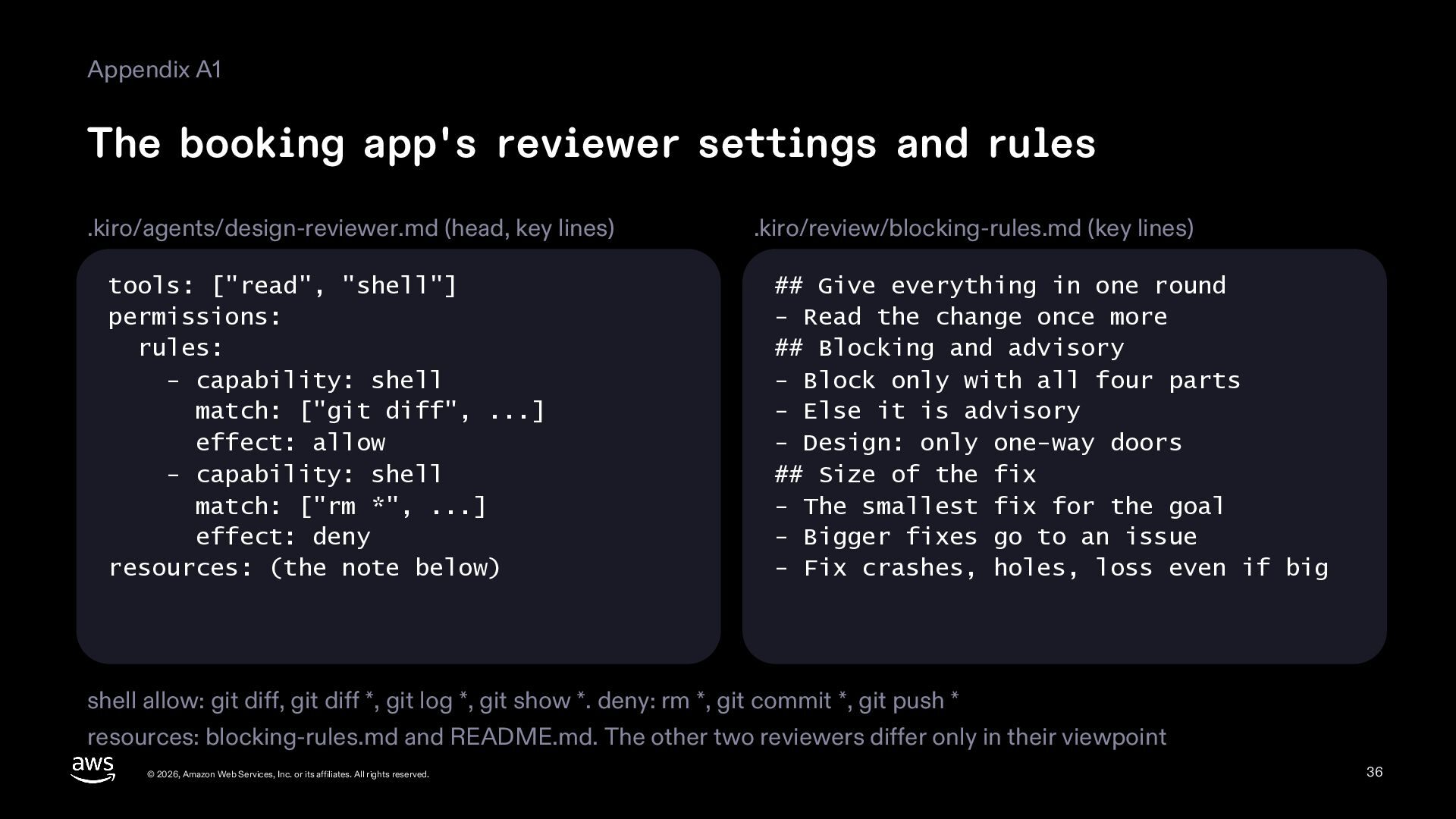
Appendix A1 The booking app's reviewer settings and rules .kiro/agents/design-reviewer.md
(head, key lines) tools: ["read", "shell"] permissions: rules: - capability: shell match: ["git diff", ...] effect: allow - capability: shell match: ["rm *", ...] effect: deny resources: (the note below) .kiro/review/blocking-rules.md (key lines) ## Give everything in one round - Read the change once more ## Blocking and advisory - Block only with all four parts - Else it is advisory - Design: only one-way doors ## Size of the fix - The smallest fix for the goal - Bigger fixes go to an issue - Fix crashes, holes, loss even if big shell allow: git diff, git diff *, git log *, git show *. deny: rm *, git commit *, git push * resources: blocking-rules.md and README.md. The other two reviewers differ only in their viewpoint © 2026, Amazon Web Services, Inc. or its affiliates. All rights reserved. 36 -
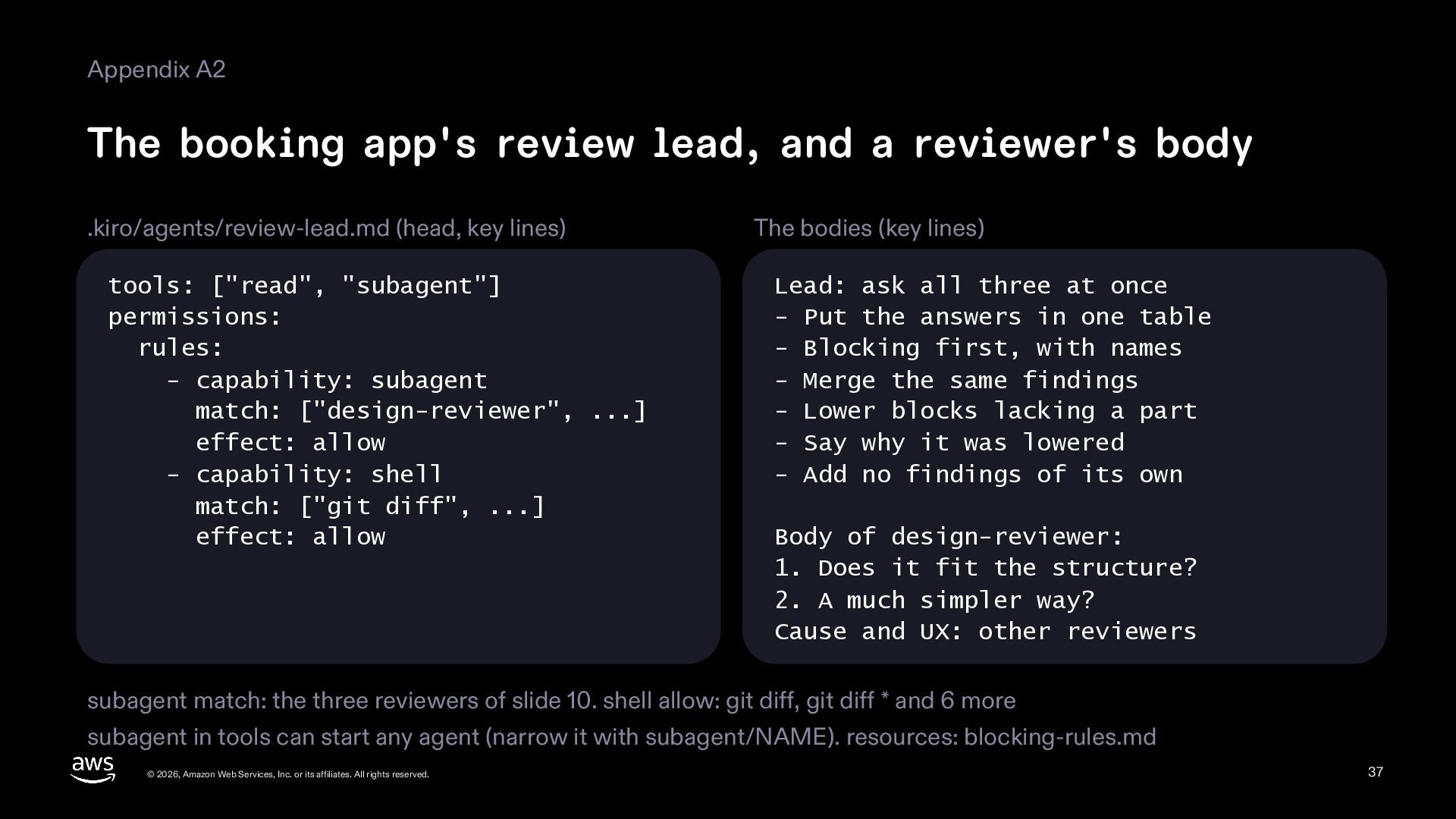
Appendix A2 The booking app's review lead, and a reviewer's
body .kiro/agents/review-lead.md (head, key lines) tools: ["read", "subagent"] permissions: rules: - capability: subagent match: ["design-reviewer", ...] effect: allow - capability: shell match: ["git diff", ...] effect: allow The bodies (key lines) Lead: ask all three at once - Put the answers in one table - Blocking first, with names - Merge the same findings - Lower blocks lacking a part - Say why it was lowered - Add no findings of its own Body of design-reviewer: 1. Does it fit the structure? 2. A much simpler way? Cause and UX: other reviewers subagent match: the three reviewers of slide 10. shell allow: git diff, git diff * and 6 more subagent in tools can start any agent (narrow it with subagent/NAME). resources: blocking-rules.md © 2026, Amazon Web Services, Inc. or its affiliates. All rights reserved. 37 -
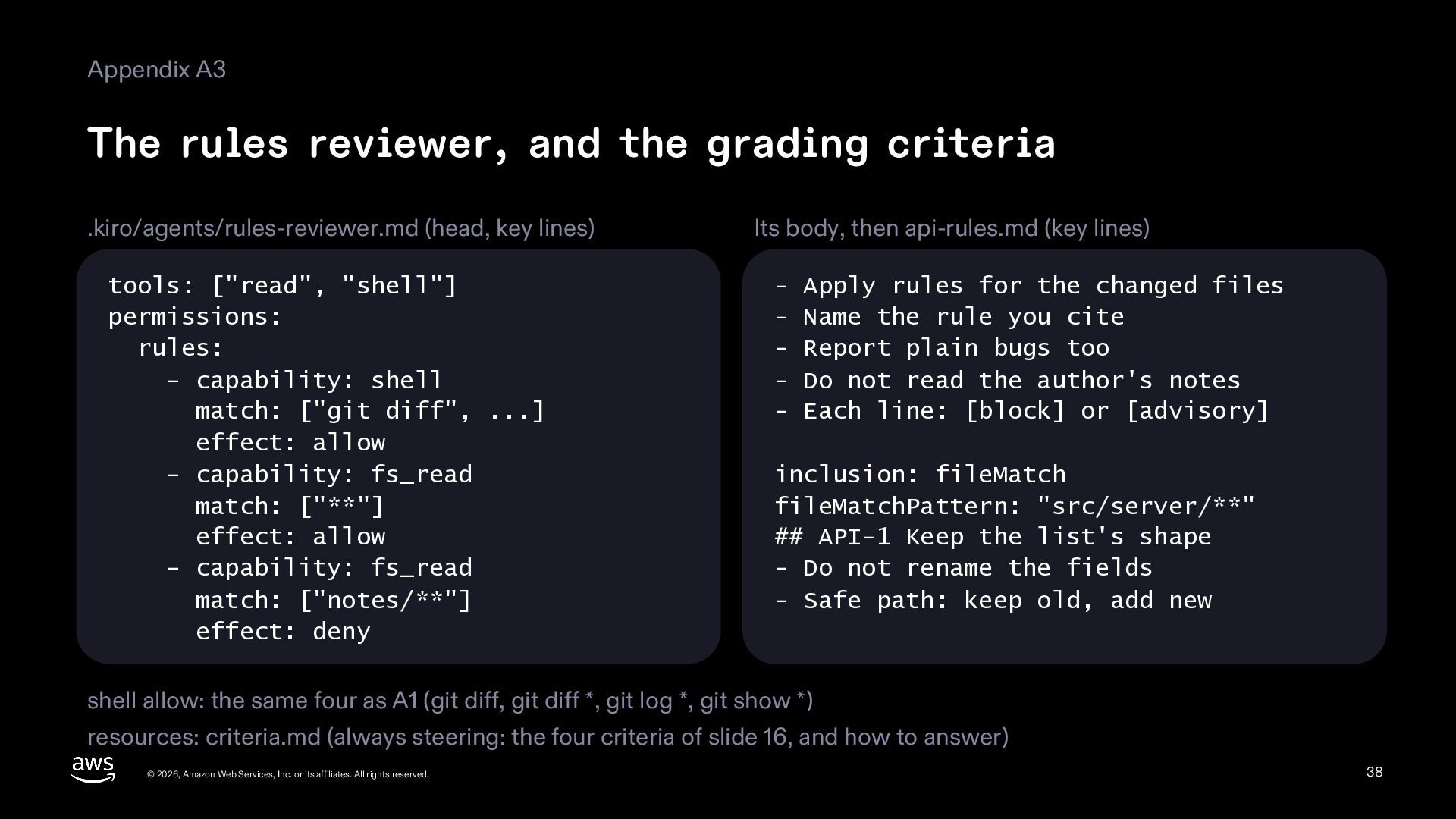
Appendix A3 The rules reviewer, and the grading criteria .kiro/agents/rules-reviewer.md
(head, key lines) tools: ["read", "shell"] permissions: rules: - capability: shell match: ["git diff", ...] effect: allow - capability: fs_read match: ["**"] effect: allow - capability: fs_read match: ["notes/**"] effect: deny Its body, then api-rules.md (key lines) - Apply rules for the changed files - Name the rule you cite - Report plain bugs too - Do not read the author's notes - Each line: [block] or [advisory] inclusion: fileMatch fileMatchPattern: "src/server/**" ## API-1 Keep the list's shape - Do not rename the fields - Safe path: keep old, add new shell allow: the same four as A1 (git diff, git diff *, git log *, git show *) resources: criteria.md (always steering: the four criteria of slide 16, and how to answer) © 2026, Amazon Web Services, Inc. or its affiliates. All rights reserved. 38 -
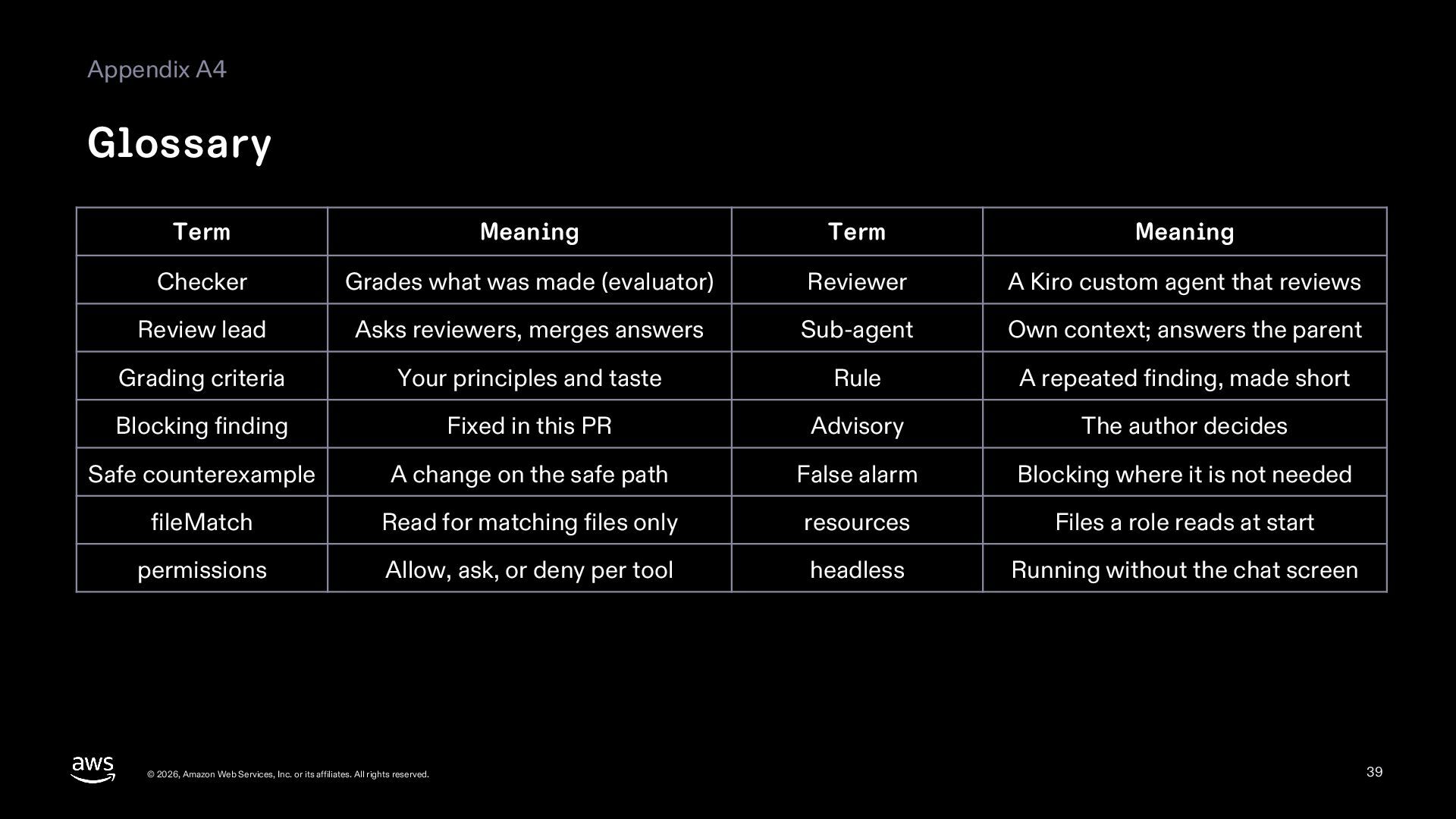
Appendix A4 Glossary Term Meaning Term Meaning Checker Grades what
was made (evaluator) Reviewer A Kiro custom agent that reviews Review lead Asks reviewers, merges answers Sub-agent Own context; answers the parent Grading criteria Your principles and taste Rule A repeated finding, made short Blocking finding Fixed in this PR Advisory The author decides Safe counterexample A change on the safe path False alarm Blocking where it is not needed fileMatch Read for matching files only resources Files a role reads at start permissions Allow, ask, or deny per tool headless Running without the chat screen © 2026, Amazon Web Services, Inc. or its affiliates. All rights reserved. 39 -
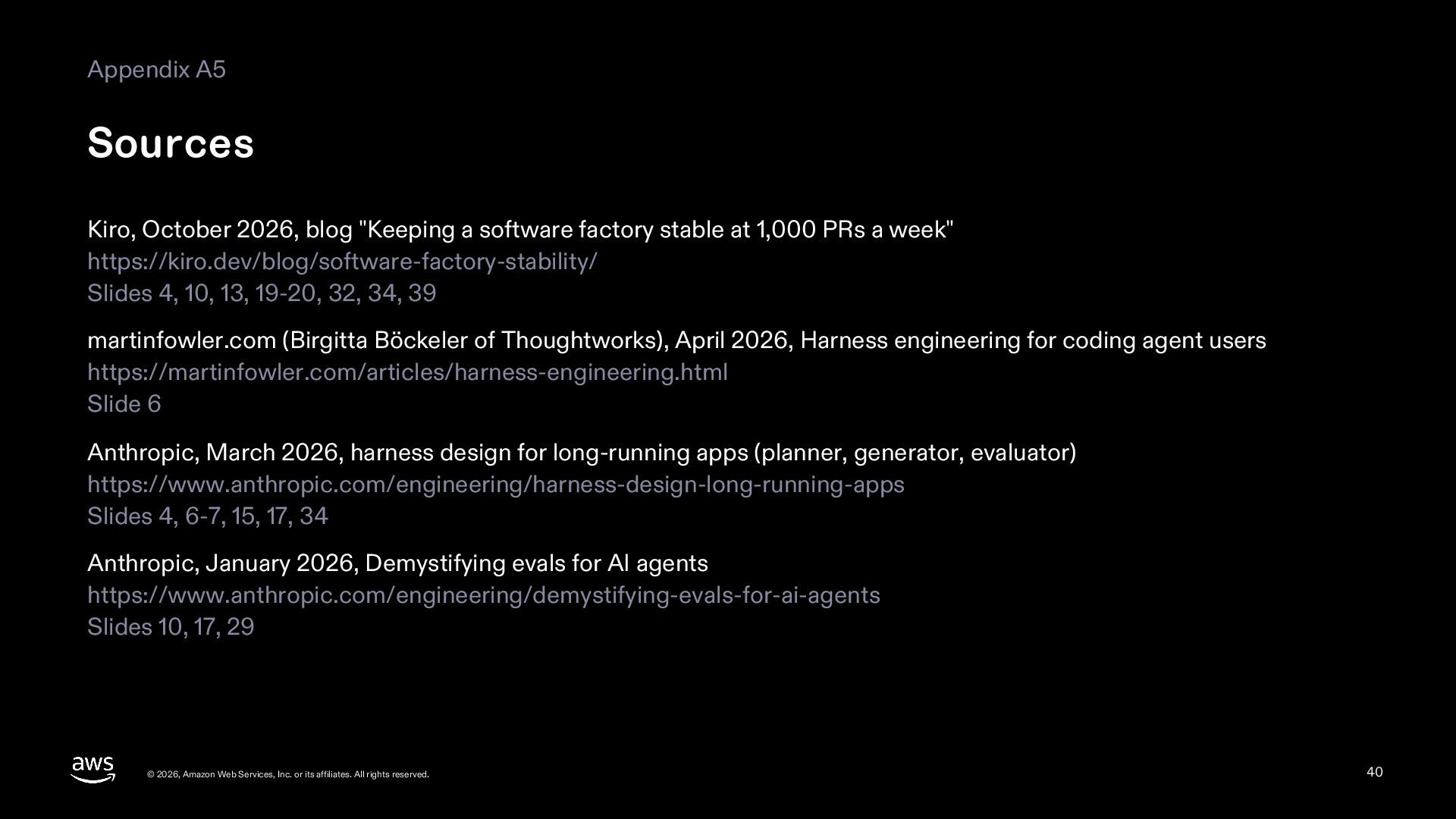
Appendix A5 Sources Kiro, October 2026, blog "Keeping a software
factory stable at 1,000 PRs a week" https://kiro.dev/blog/software-factory-stability/ Slides 4, 10, 13, 19-20, 32, 34, 39 martinfowler.com (Birgitta Böckeler of Thoughtworks), April 2026, Harness engineering for coding agent users https://martinfowler.com/articles/harness-engineering.html Slide 6 Anthropic, March 2026, harness design for long-running apps (planner, generator, evaluator) https://www.anthropic.com/engineering/harness-design-long-running-apps Slides 4, 6-7, 15, 17, 34 Anthropic, January 2026, Demystifying evals for AI agents https://www.anthropic.com/engineering/demystifying-evals-for-ai-agents Slides 10, 17, 29 © 2026, Amazon Web Services, Inc. or its affiliates. All rights reserved. 40 -
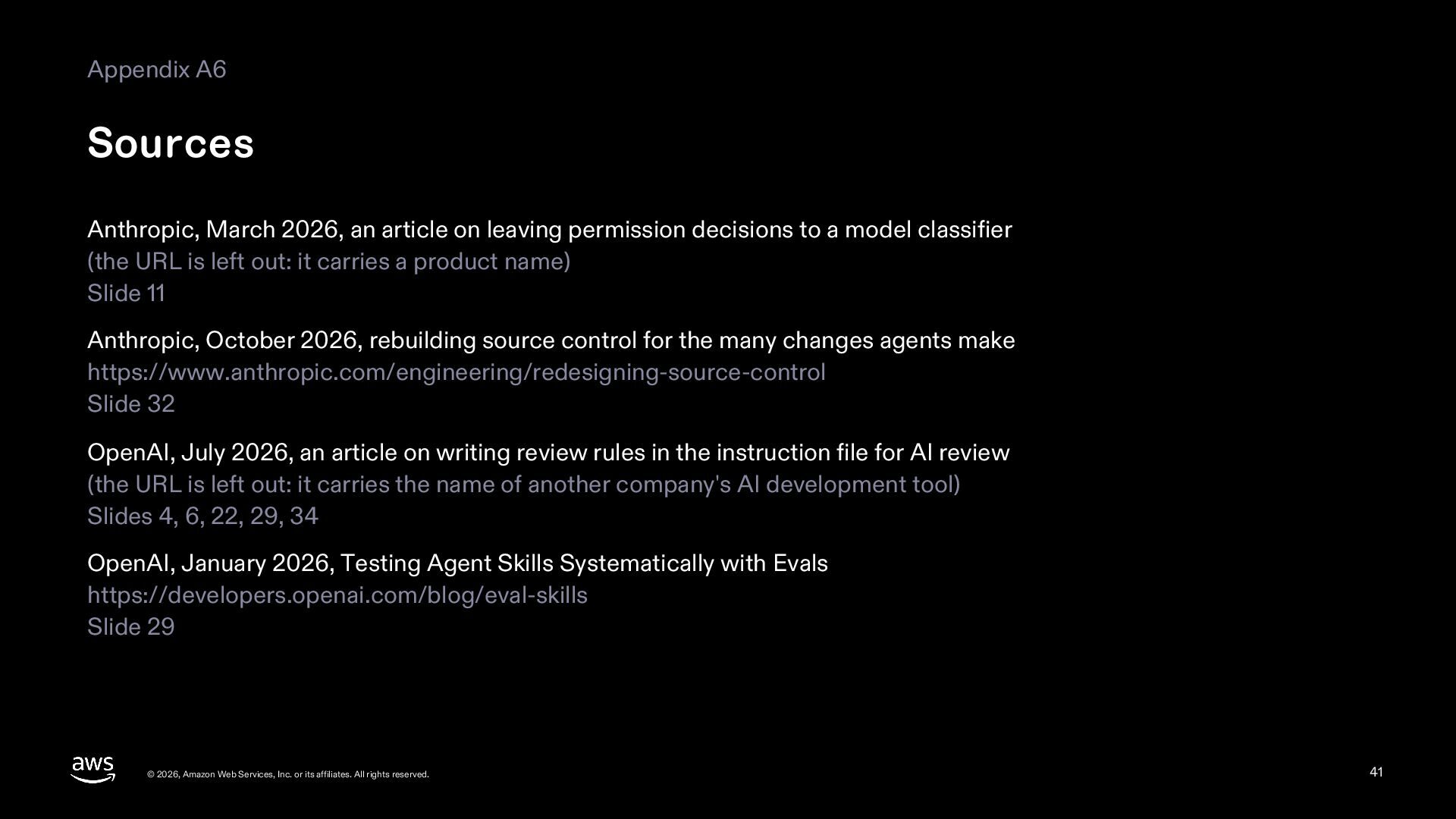
Appendix A6 Sources Anthropic, March 2026, an article on leaving
permission decisions to a model classifier (the URL is left out: it carries a product name) Slide 11 Anthropic, October 2026, rebuilding source control for the many changes agents make https://www.anthropic.com/engineering/redesigning-source-control Slide 32 OpenAI, July 2026, an article on writing review rules in the instruction file for AI review (the URL is left out: it carries the name of another company's AI development tool) Slides 4, 6, 22, 29, 34 OpenAI, January 2026, Testing Agent Skills Systematically with Evals https://developers.openai.com/blog/eval-skills Slide 29 © 2026, Amazon Web Services, Inc. or its affiliates. All rights reserved. 41 -
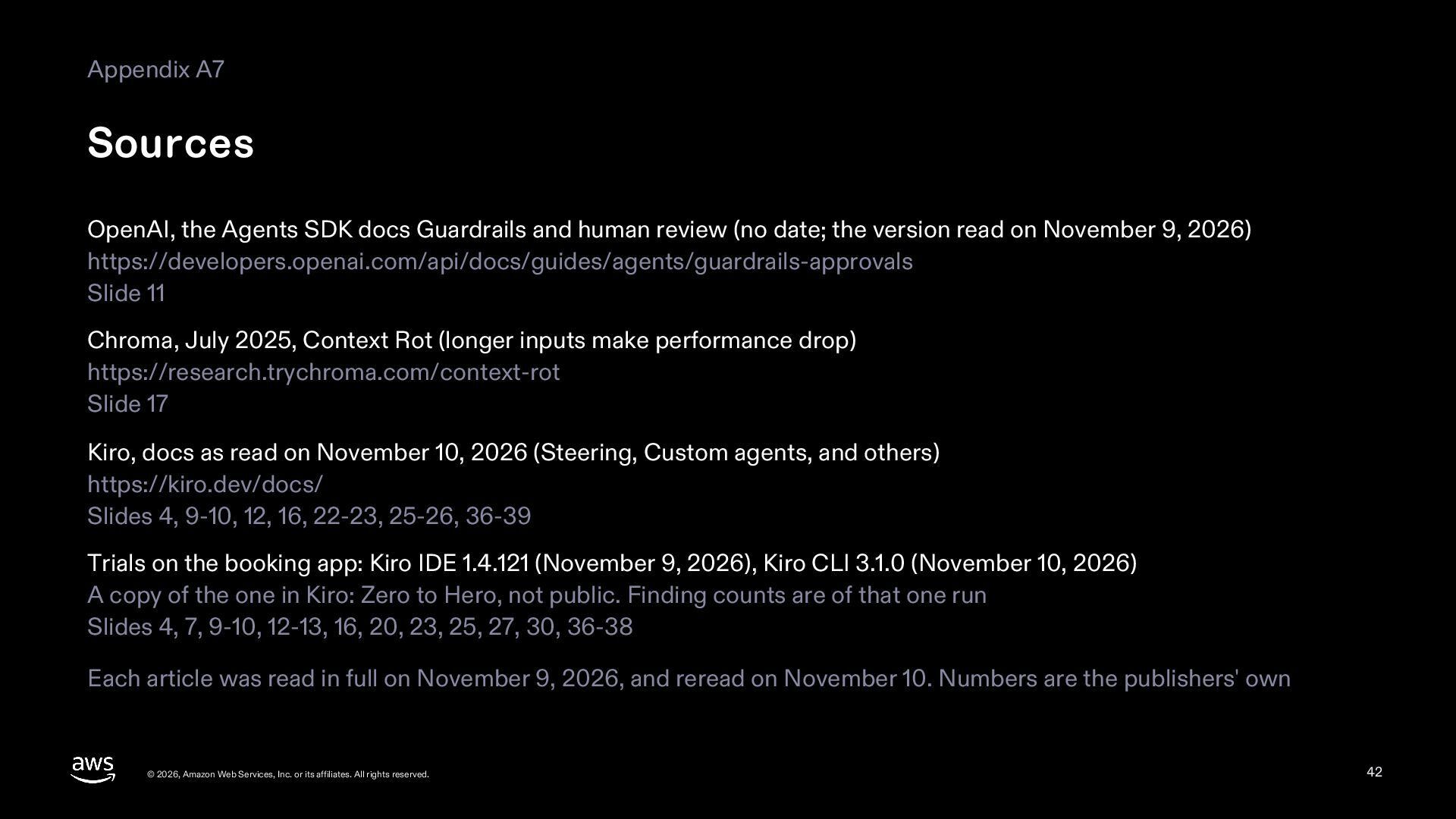
Appendix A7 Sources OpenAI, the Agents SDK docs Guardrails and
human review (no date; the version read on November 9, 2026) https://developers.openai.com/api/docs/guides/agents/guardrails-approvals Slide 11 Chroma, July 2025, Context Rot (longer inputs make performance drop) https://research.trychroma.com/context-rot Slide 17 Kiro, docs as read on November 10, 2026 (Steering, Custom agents, and others) https://kiro.dev/docs/ Slides 4, 9-10, 12, 16, 22-23, 25-26, 36-39 Trials on the booking app: Kiro IDE 1.4.121 (November 9, 2026), Kiro CLI 3.1.0 (November 10, 2026) A copy of the one in Kiro: Zero to Hero, not public. Finding counts are of that one run Slides 4, 7, 9-10, 12-13, 16, 20, 23, 25, 27, 30, 36-38 Each article was read in full on November 9, 2026, and reread on November 10. Numbers are the publishers' own © 2026, Amazon Web Services, Inc. or its affiliates. All rights reserved. 42
 inariku
 mikemcquaid
 kazeburo
 safie_recruit
 civitaspo
 yuriemori
 minorun365
 uhyo
 yoshimura_datam
 littlehands
 nkajihara
 tarappo
 chocoumai
 sachag
 eileencodes
 aleyda
 honzajavorek
 helenjbeal
 marktimemedia
 reverentgeek
 twada
 mfonobong
 kristinabergwall1