Building a software factory around human attent...

Building a software factory around human attention: Agents do each step; people come in where a decision is needed

A reference deck, with figures, introducing the kiro.dev blog post "Building a software factory around human attention" (November 25, 2026), based on public sources as of November 27, 2026. Agents write code faster than people review it, so the team building Kiro's agent built a software factory where agents do each step of development and a person comes in only where a decision is needed, and published its prompts and skills as the open-source Manual. The deck covers the factory's loop and where people come in, the loop every step runs to check its work, what the team has seen on its board (about 85% of open items reached a pull request) and what is still open, and how to try the Manual and what its README asks before you do.

Riku INADA PRO

November 27, 2026

Annual Pro sale · Save $30

Have presentations of your own?

Share with private links, password protection, and more control over your work.

Transcript

11 slides
  1. Kiro blog digest Building a software factory around human attention

    Agents do each step; people come in where a decision is needed Introduces a post by the team building Kiro's agent (November 25, 2026) Covers the factory, its checks, what the team found and how to try it As of November 27, 2026 Amazon Web Services Japan © 2026, Amazon Web Services, Inc. or its affiliates. All rights reserved. 1
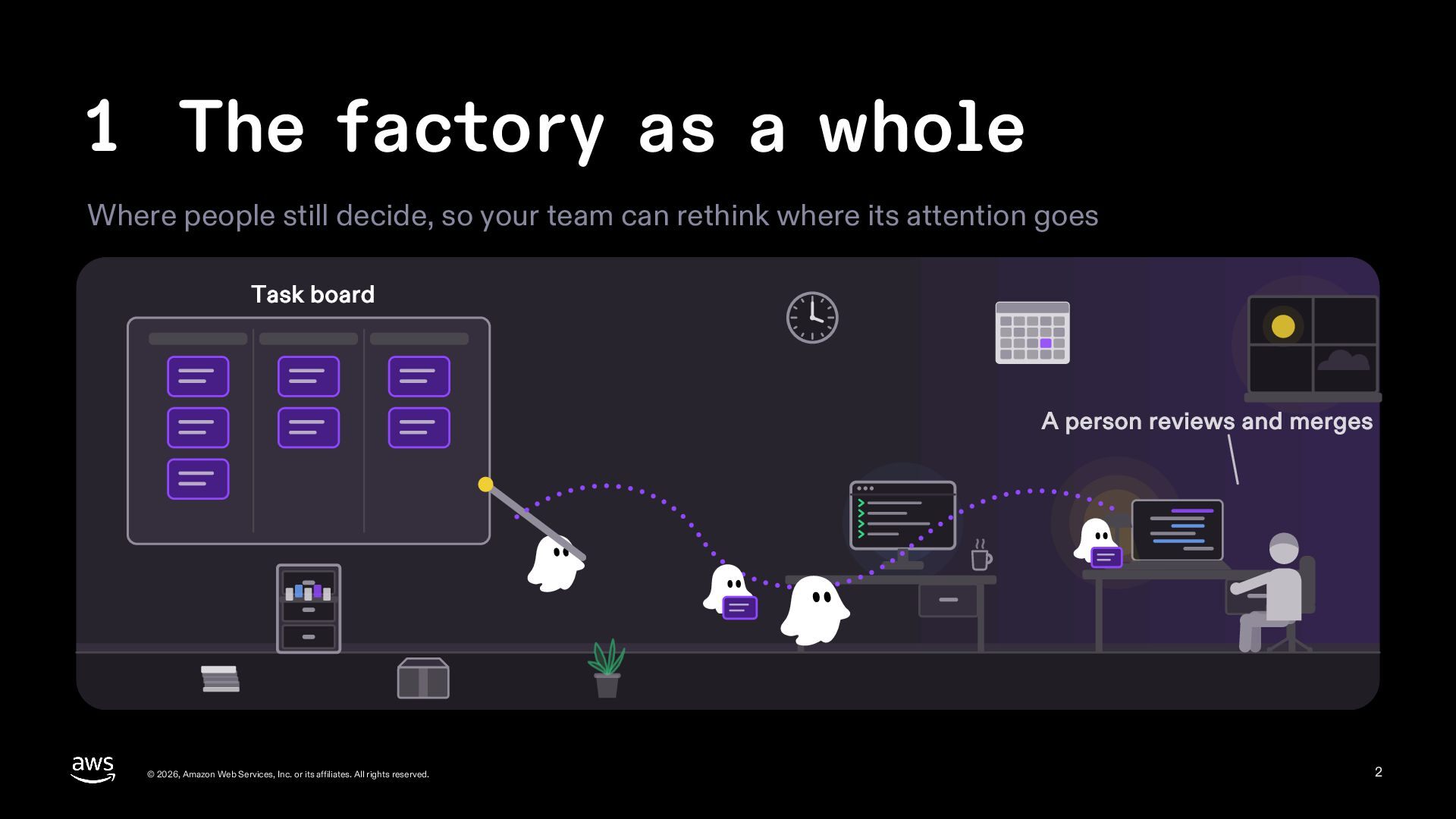
  2. 1 The factory as a whole Where people still decide,

    so your team can rethink where its attention goes Task board A person reviews and merges © 2026, Amazon Web Services, Inc. or its affiliates. All rights reserved. 2
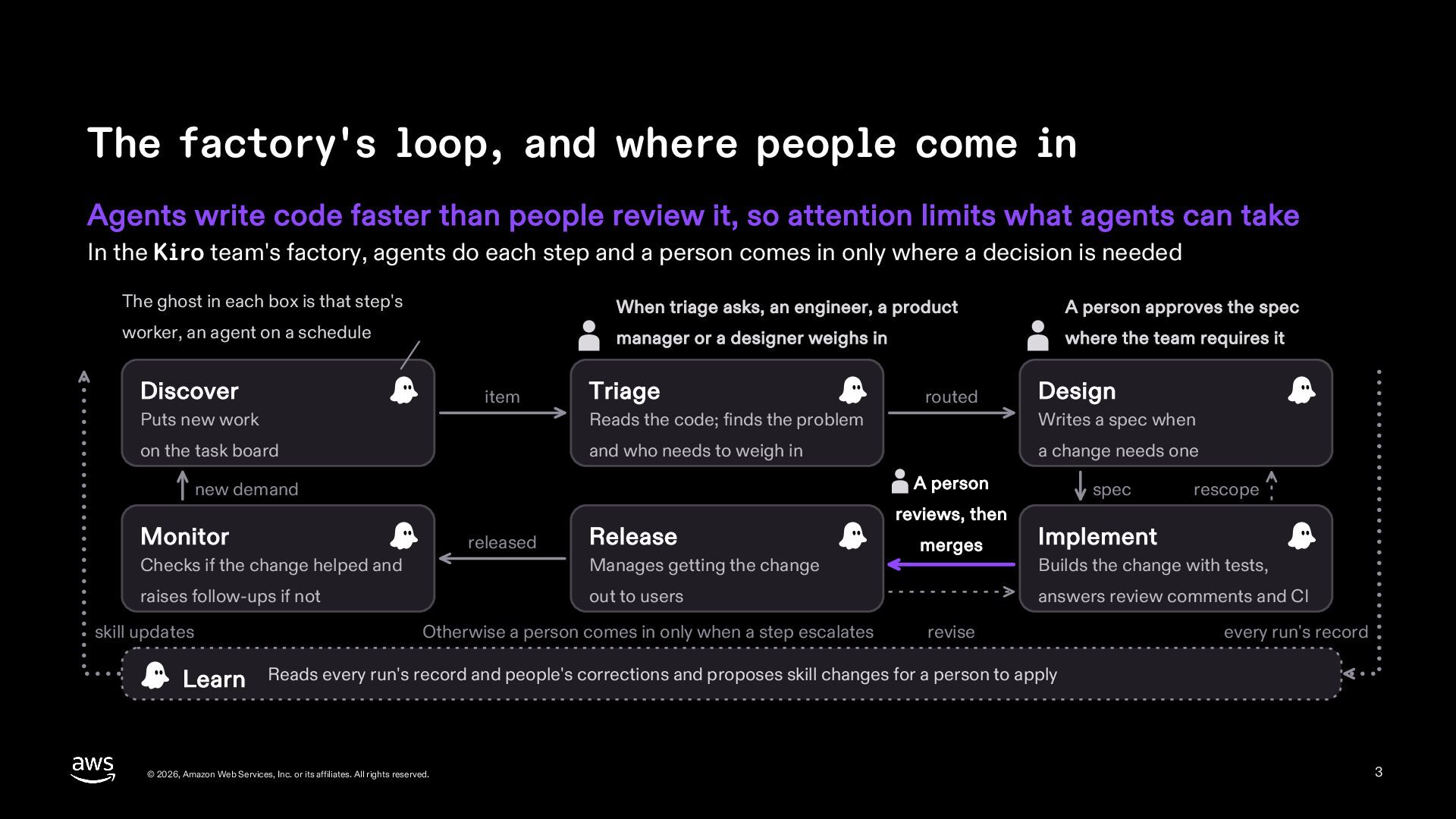
  3. The factory's loop, and where people come in Agents write

    code faster than people review it, so attention limits what agents can take In the Kiro team's factory, agents do each step and a person comes in only where a decision is needed The ghost in each box is that step's When triage asks, an engineer, a product A person approves the spec worker, an agent on a schedule manager or a designer weighs in where the team requires it Discover item Triage routed Design Puts new work Reads the code; finds the problem Writes a spec when on the task board and who needs to weigh in a change needs one A person new demand Monitor released Release Checks if the change helped and Manages getting the change raises follow-ups if not out to users skill updates Learn Otherwise a person comes in only when a step escalates reviews, then merges spec rescope Implement Builds the change with tests, answers review comments and CI revise every run's record Reads every run's record and people's corrections and proposes skill changes for a person to apply © 2026, Amazon Web Services, Inc. or its affiliates. All rights reserved. 3
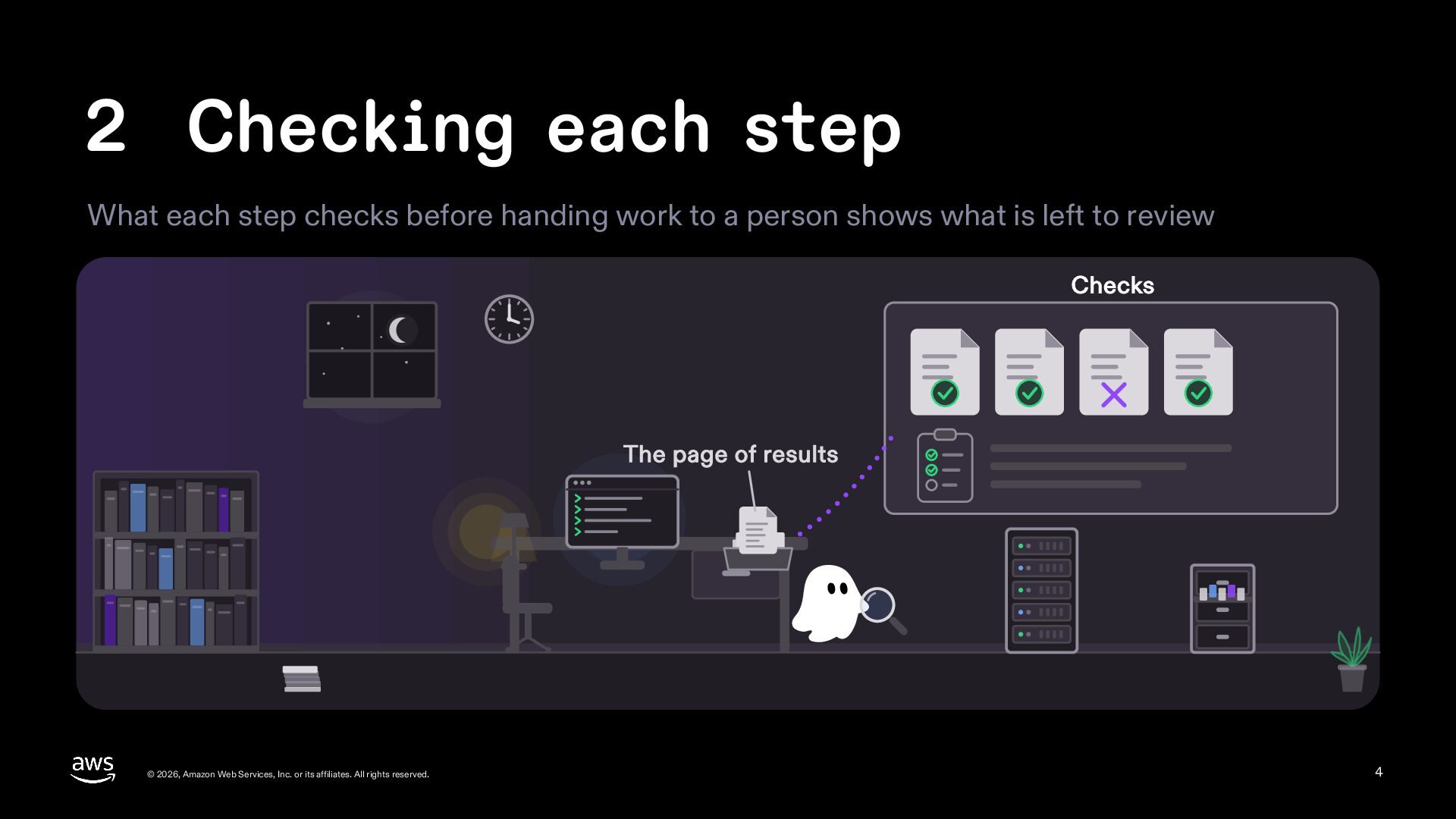
  4. 2 Checking each step What each step checks before handing

    work to a person shows what is left to review Checks The page of results © 2026, Amazon Web Services, Inc. or its affiliates. All rights reserved. 4
  5. The loop every step runs Every step checks its own

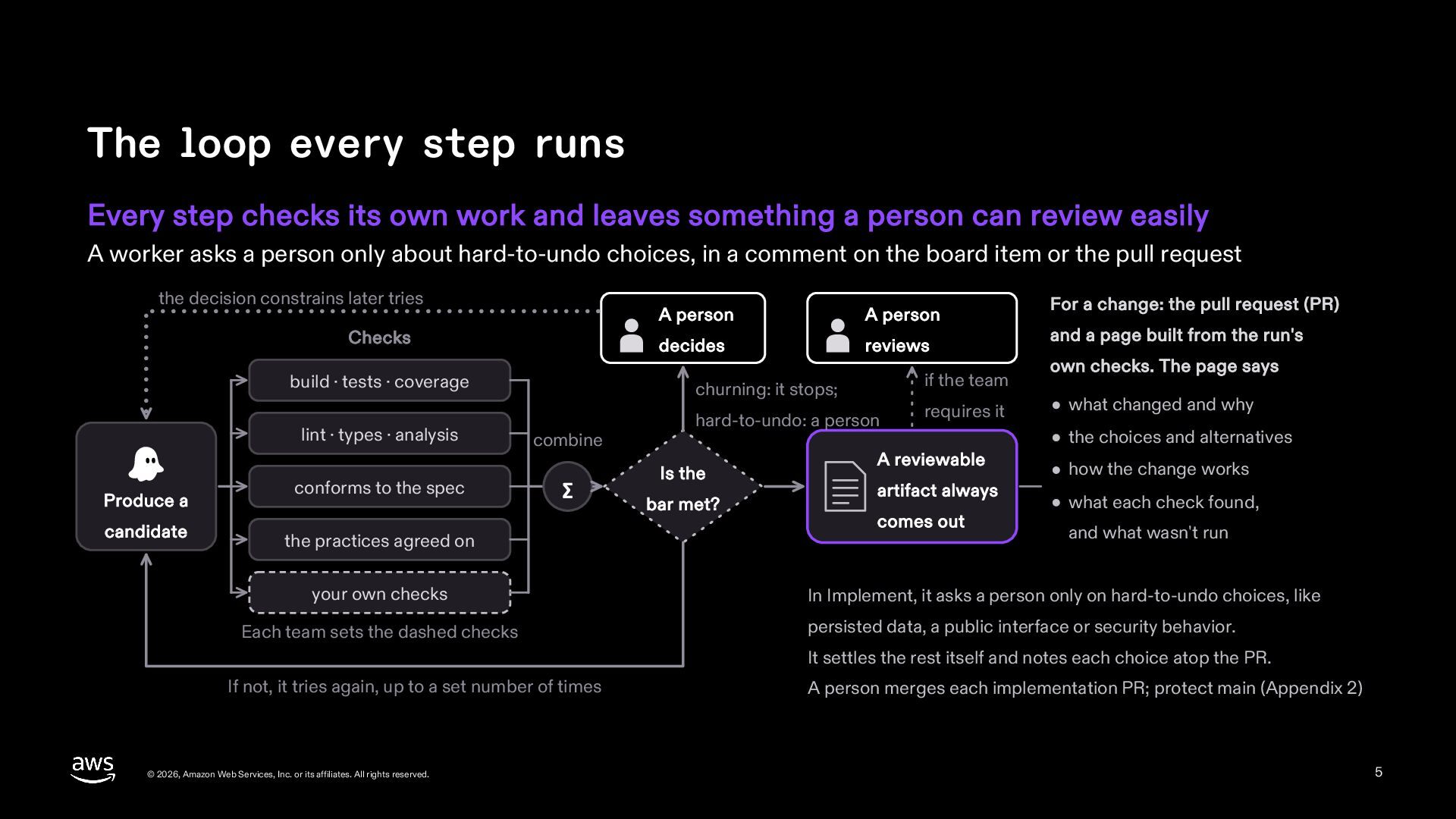
    work and leaves something a person can review easily A worker asks a person only about hard-to-undo choices, in a comment on the board item or the pull request the decision constrains later tries Checks build · tests · coverage lint · types · analysis Produce a candidate conforms to the spec A person A person decides reviews if the team churning: it stops; combine Σ the practices agreed on your own checks Each team sets the dashed checks hard-to-undo: a person Is the bar met? requires it A reviewable artifact always comes out For a change: the pull request (PR) and a page built from the run's own checks. The page says what changed and why the choices and alternatives how the change works what each check found, and what wasn't run In Implement, it asks a person only on hard-to-undo choices, like persisted data, a public interface or security behavior. It settles the rest itself and notes each choice atop the PR. If not, it tries again, up to a set number of times © 2026, Amazon Web Services, Inc. or its affiliates. All rights reserved. A person merges each implementation PR; protect main (Appendix 2) 5
  6. 3 Findings and open issues What changed for the Kiro

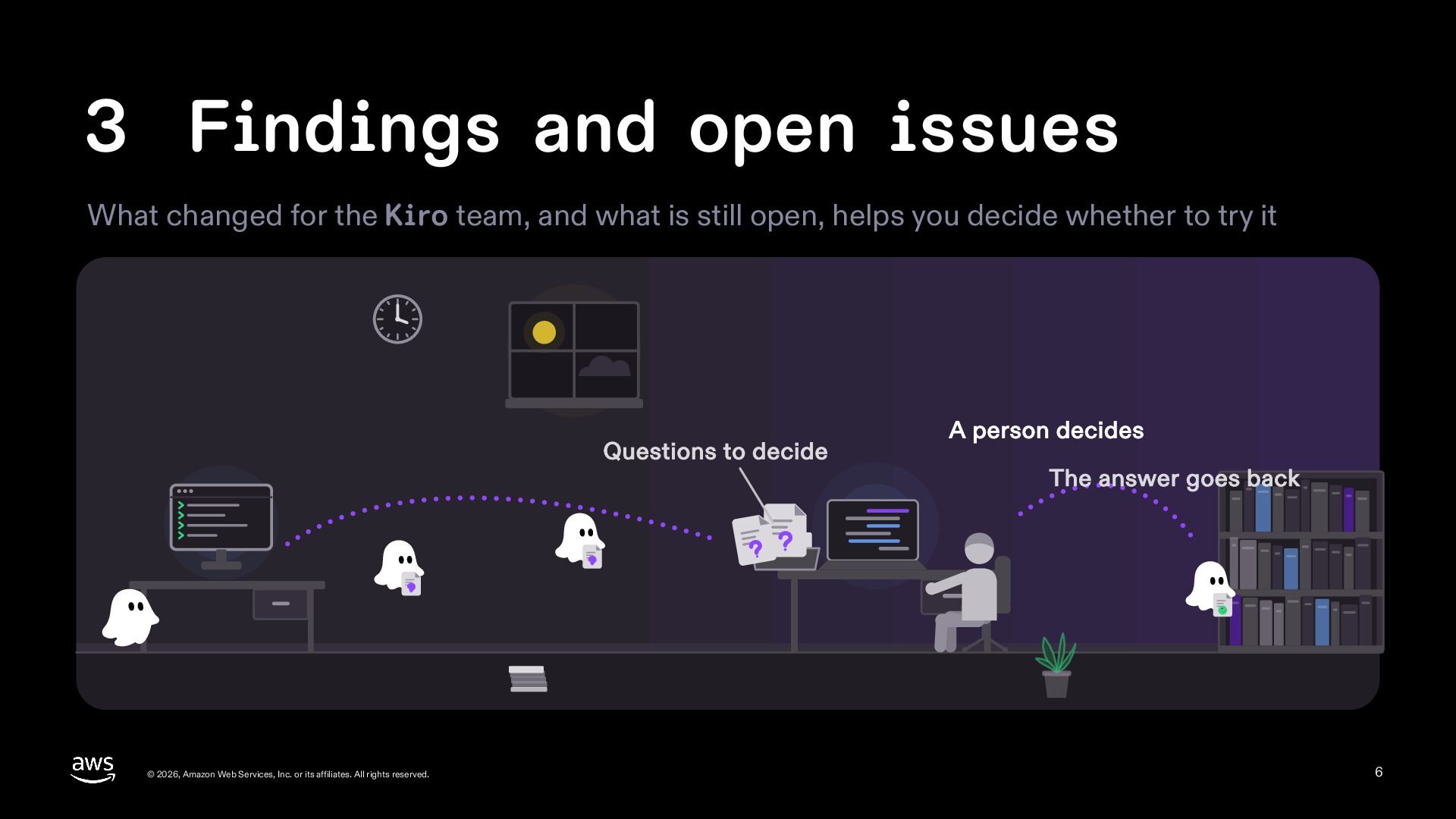
    team, and what is still open, helps you decide whether to try it Questions to decide © 2026, Amazon Web Services, Inc. or its affiliates. All rights reserved. A person decides The answer goes back 6
  7. What the Kiro team has seen so far About 85%

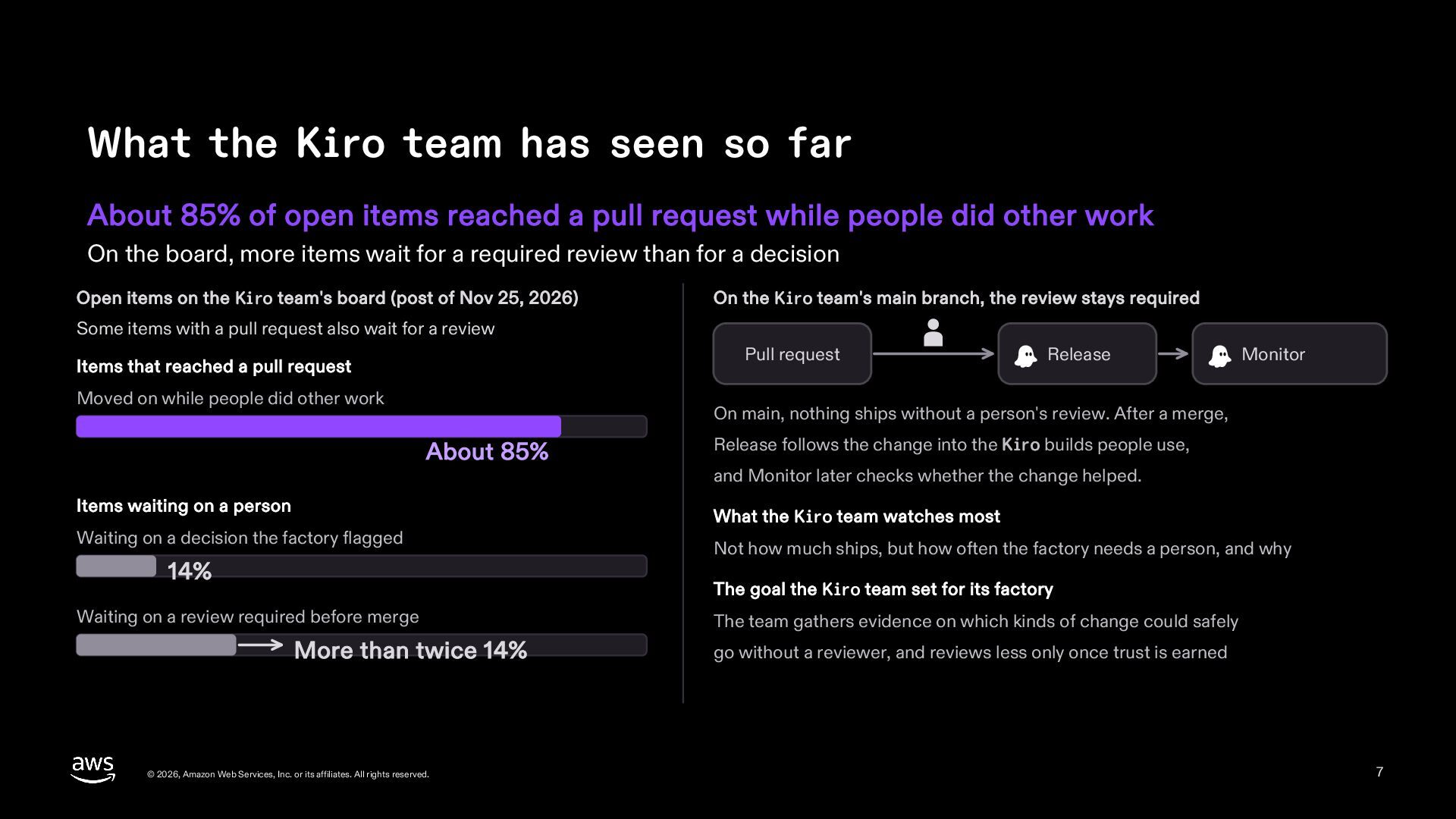
    of open items reached a pull request while people did other work On the board, more items wait for a required review than for a decision Open items on the Kiro team's board (post of Nov 25, 2026) On the Kiro team's main branch, the review stays required Some items with a pull request also wait for a review Pull request Items that reached a pull request Moved on while people did other work Release Monitor On main, nothing ships without a person's review. After a merge, About 85% Items waiting on a person Waiting on a decision the factory flagged 14% Release follows the change into the Kiro builds people use, and Monitor later checks whether the change helped. What the Kiro team watches most Not how much ships, but how often the factory needs a person, and why The goal the Kiro team set for its factory Waiting on a review required before merge More than twice 14% © 2026, Amazon Web Services, Inc. or its affiliates. All rights reserved. The team gathers evidence on which kinds of change could safely go without a reviewer, and reviews less only once trust is earned 7
  8. What is still open The number of decisions and the

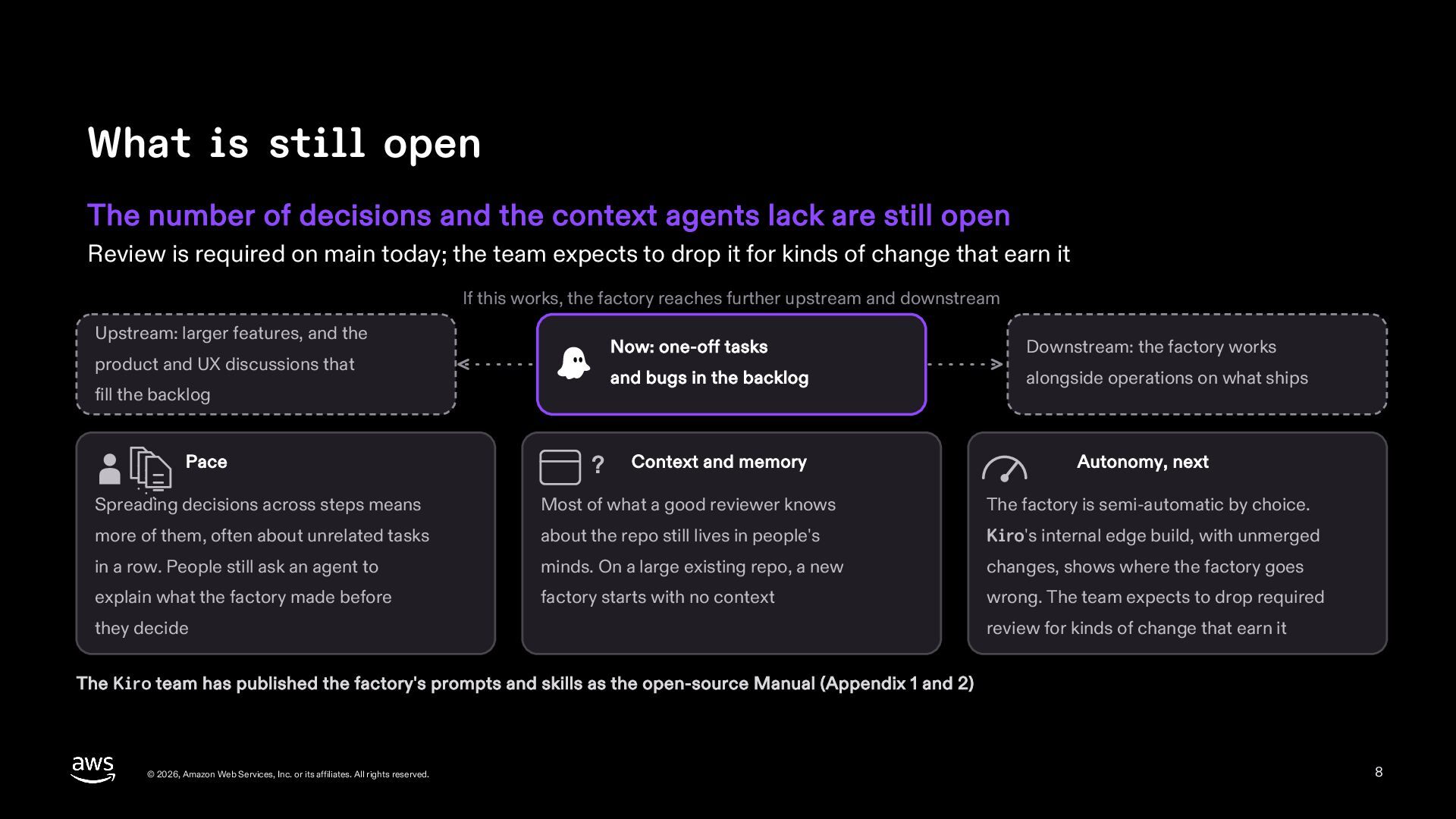
    context agents lack are still open Review is required on main today; the team expects to drop it for kinds of change that earn it If this works, the factory reaches further upstream and downstream Upstream: larger features, and the product and UX discussions that fill the backlog Pace ? Now: one-off tasks Downstream: the factory works and bugs in the backlog alongside operations on what ships Context and memory Autonomy, next Spreading decisions across steps means Most of what a good reviewer knows The factory is semi-automatic by choice. more of them, often about unrelated tasks about the repo still lives in people's Kiro's internal edge build, with unmerged in a row. People still ask an agent to minds. On a large existing repo, a new changes, shows where the factory goes explain what the factory made before factory starts with no context wrong. The team expects to drop required they decide review for kinds of change that earn it The Kiro team has published the factory's prompts and skills as the open-source Manual (Appendix 1 and 2) © 2026, Amazon Web Services, Inc. or its affiliates. All rights reserved. 8
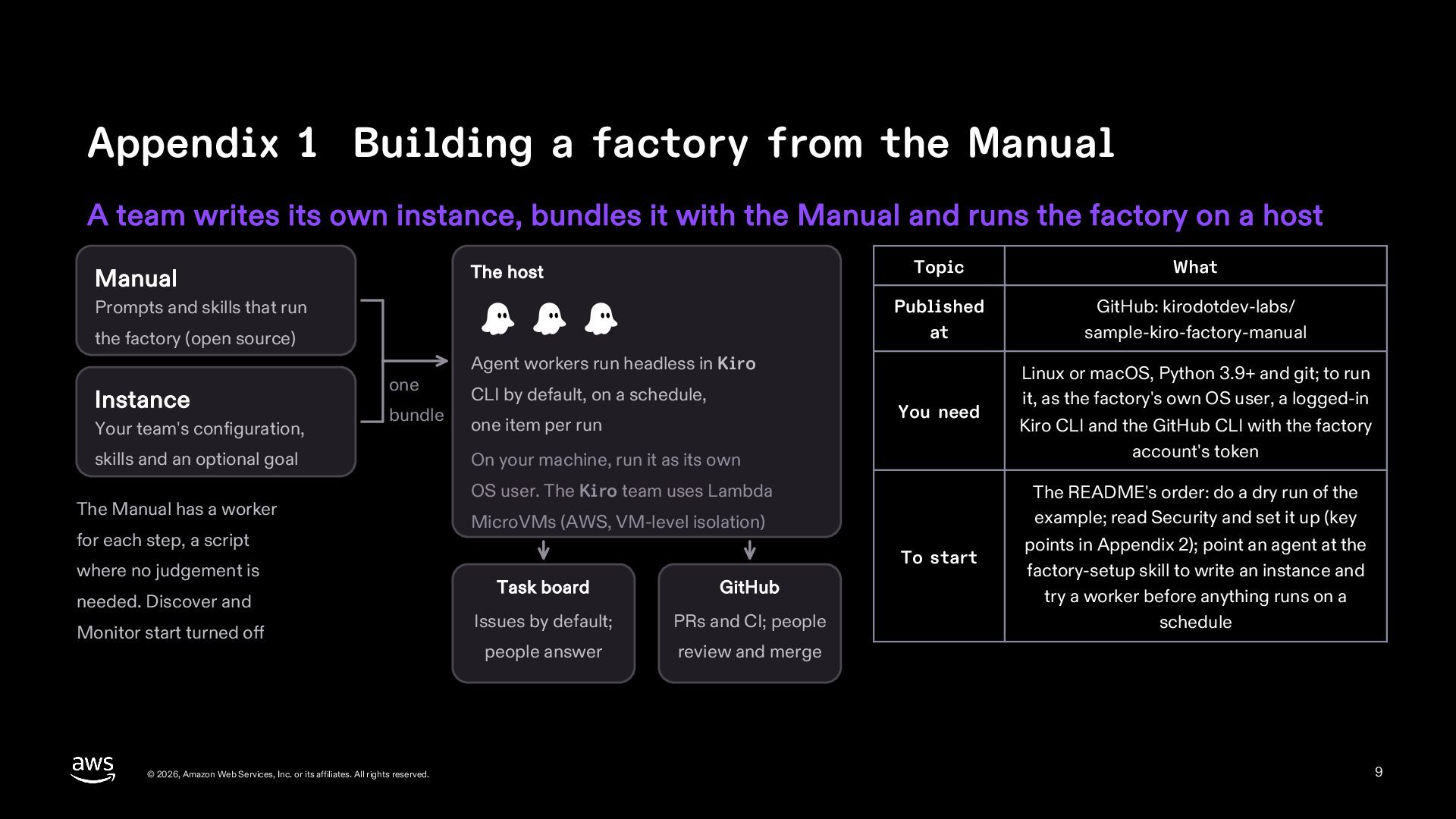
  9. Appendix 1 Building a factory from the Manual A team

    writes its own instance, bundles it with the Manual and runs the factory on a host The host Manual Prompts and skills that run the factory (open source) Instance Your team's configuration, one bundle skills and an optional goal The Manual has a worker for each step, a script where no judgement is needed. Discover and Monitor start turned off © 2026, Amazon Web Services, Inc. or its affiliates. All rights reserved. Topic What Published at GitHub: kirodotdev-labs/ sample-kiro-factory-manual You need Linux or macOS, Python 3.9+ and git; to run it, as the factory's own OS user, a logged-in Kiro CLI and the GitHub CLI with the factory account's token To start The README's order: do a dry run of the example; read Security and set it up (key points in Appendix 2); point an agent at the factory-setup skill to write an instance and try a worker before anything runs on a schedule Agent workers run headless in Kiro CLI by default, on a schedule, one item per run On your machine, run it as its own OS user. The Kiro team uses Lambda MicroVMs (AWS, VM-level isolation) Task board GitHub Issues by default; PRs and CI; people people answer review and merge 9
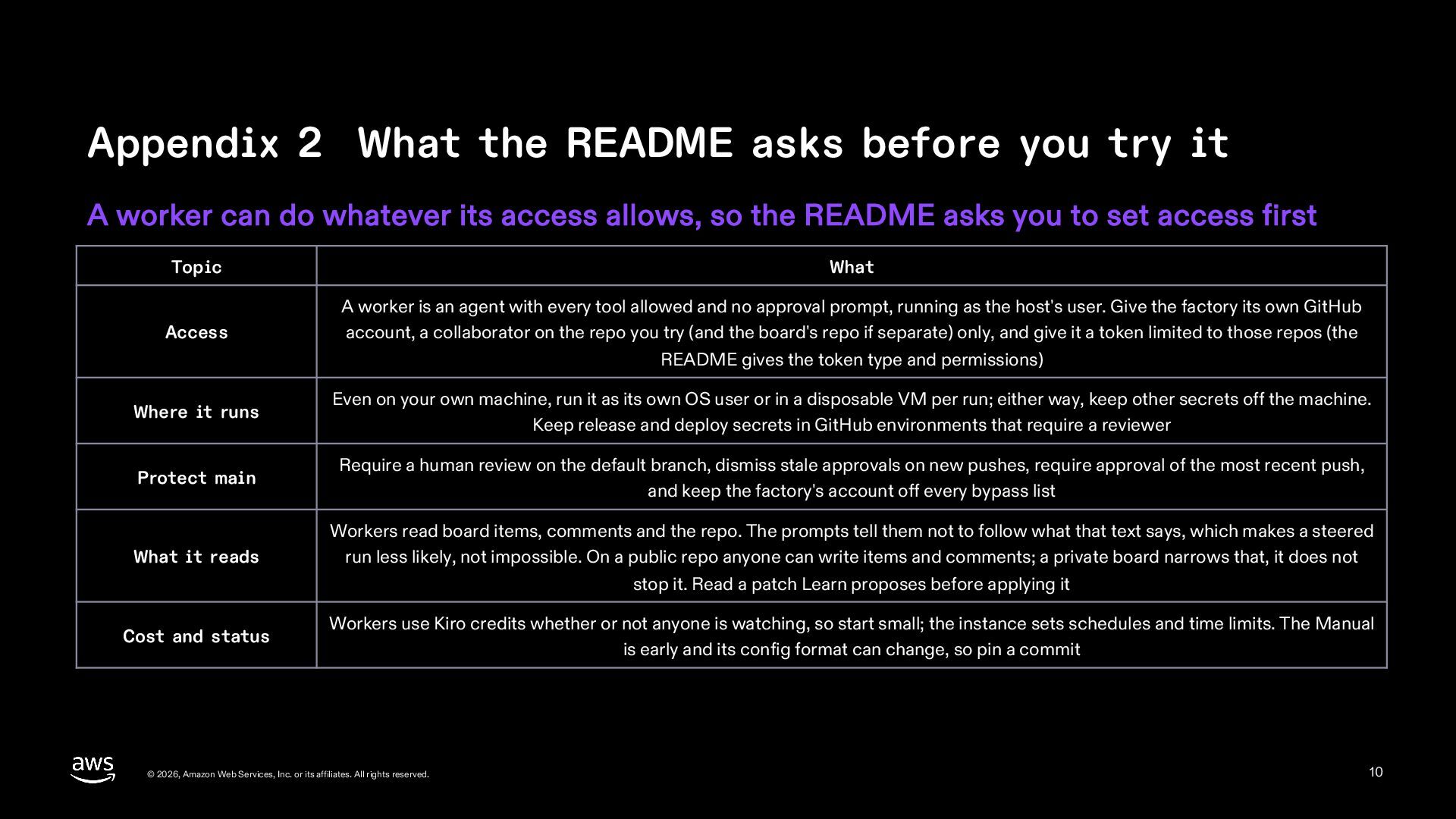
  10. Appendix 2 What the README asks before you try it

    A worker can do whatever its access allows, so the README asks you to set access first Topic What Access A worker is an agent with every tool allowed and no approval prompt, running as the host's user. Give the factory its own GitHub account, a collaborator on the repo you try (and the board's repo if separate) only, and give it a token limited to those repos (the README gives the token type and permissions) Where it runs Even on your own machine, run it as its own OS user or in a disposable VM per run; either way, keep other secrets off the machine. Keep release and deploy secrets in GitHub environments that require a reviewer Protect main Require a human review on the default branch, dismiss stale approvals on new pushes, require approval of the most recent push, and keep the factory's account off every bypass list What it reads Workers read board items, comments and the repo. The prompts tell them not to follow what that text says, which makes a steered run less likely, not impossible. On a public repo anyone can write items and comments; a private board narrows that, it does not stop it. Read a patch Learn proposes before applying it Cost and status Workers use Kiro credits whether or not anyone is watching, so start small; the instance sets schedules and time limits. The Manual is early and its config format can change, so pin a commit © 2026, Amazon Web Services, Inc. or its affiliates. All rights reserved. 10
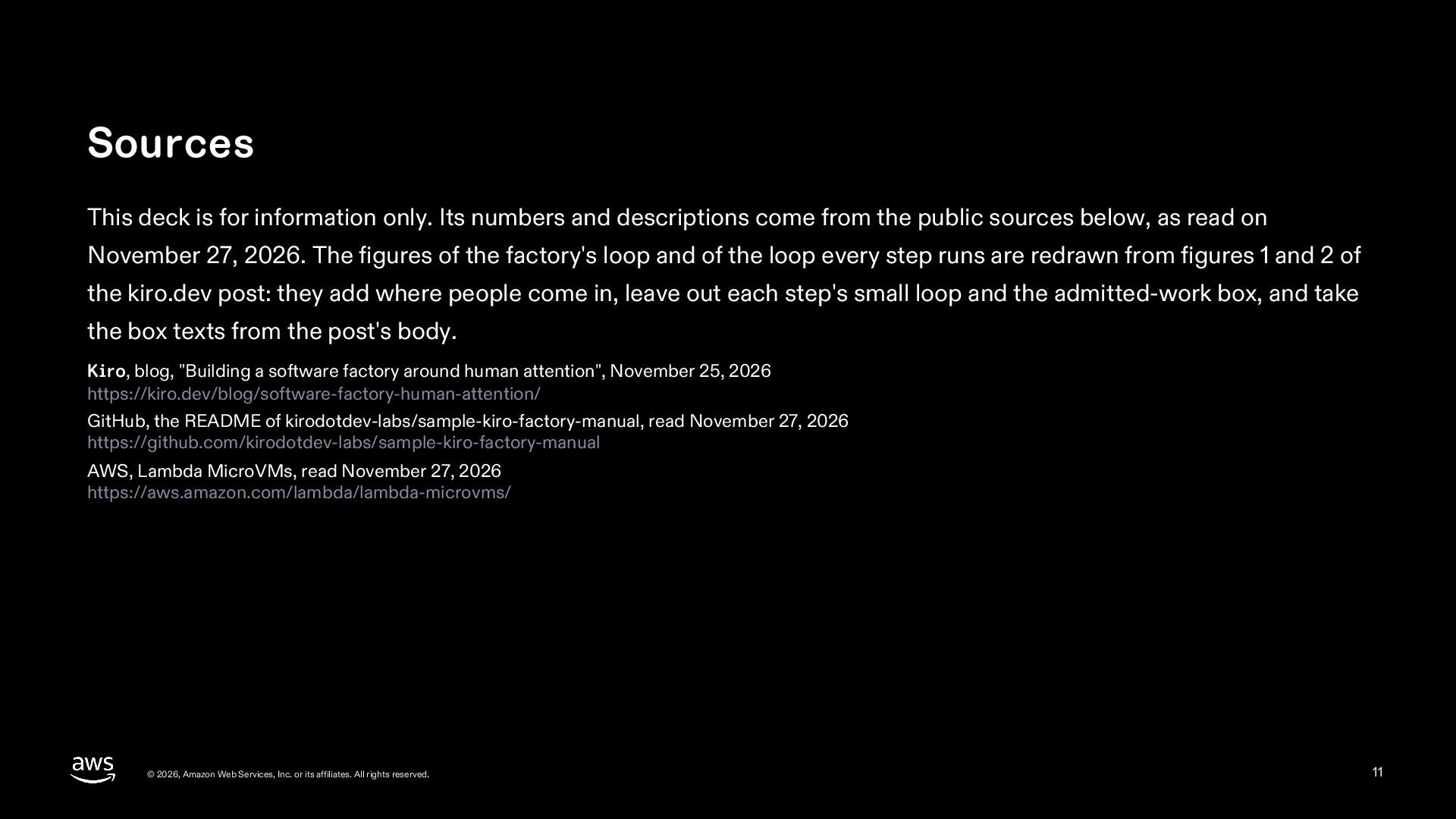
  11. Sources This deck is for information only. Its numbers and

    descriptions come from the public sources below, as read on November 27, 2026. The figures of the factory's loop and of the loop every step runs are redrawn from figures 1 and 2 of the kiro.dev post: they add where people come in, leave out each step's small loop and the admitted-work box, and take the box texts from the post's body. Kiro, blog, "Building a software factory around human attention", November 25, 2026 https://kiro.dev/blog/software-factory-human-attention/ GitHub, the README of kirodotdev-labs/sample-kiro-factory-manual, read November 27, 2026 https://github.com/kirodotdev-labs/sample-kiro-factory-manual AWS, Lambda MicroVMs, read November 27, 2026 https://aws.amazon.com/lambda/lambda-microvms/ © 2026, Amazon Web Services, Inc. or its affiliates. All rights reserved. 11

More Decks by Riku INADA

Other Decks in Technology