over the past two years and has fundamentally changed how we put food on our plates. The availability of user-f riendly apps for consumers and tech-enabled drivers has revolutionized the food delivery market. Together with the convenience that these food delivery apps have brought to our lives, new types of challenges have arisen for the Trust & Safety teams of these food delivery platforms. Trust & Safety departments have crafted “Terms of Use” policies to ensure fair use and prof itable participation in this new economy. These policies have been crafted to ensure that: Consumers access high quality Couriers supplement their The Platform takes a percentage meals with the touch of a button income by delivering meals for maintaining the marketplace However, new scams have emerged to challenge these. Bad actors take advantage of these marketplaces by abusing policies and committing f raud against the platforms, the consumers, or the couriers. This report compares how the top four food delivery platforms address three core Trust & Safety policies. It then summarizes proprietary data f rom Incognia’s food delivery clients to compare policy violations on the consumer and courier apps and how they relate to conf irmed f raud during the 3rd quarter of 2022. 2
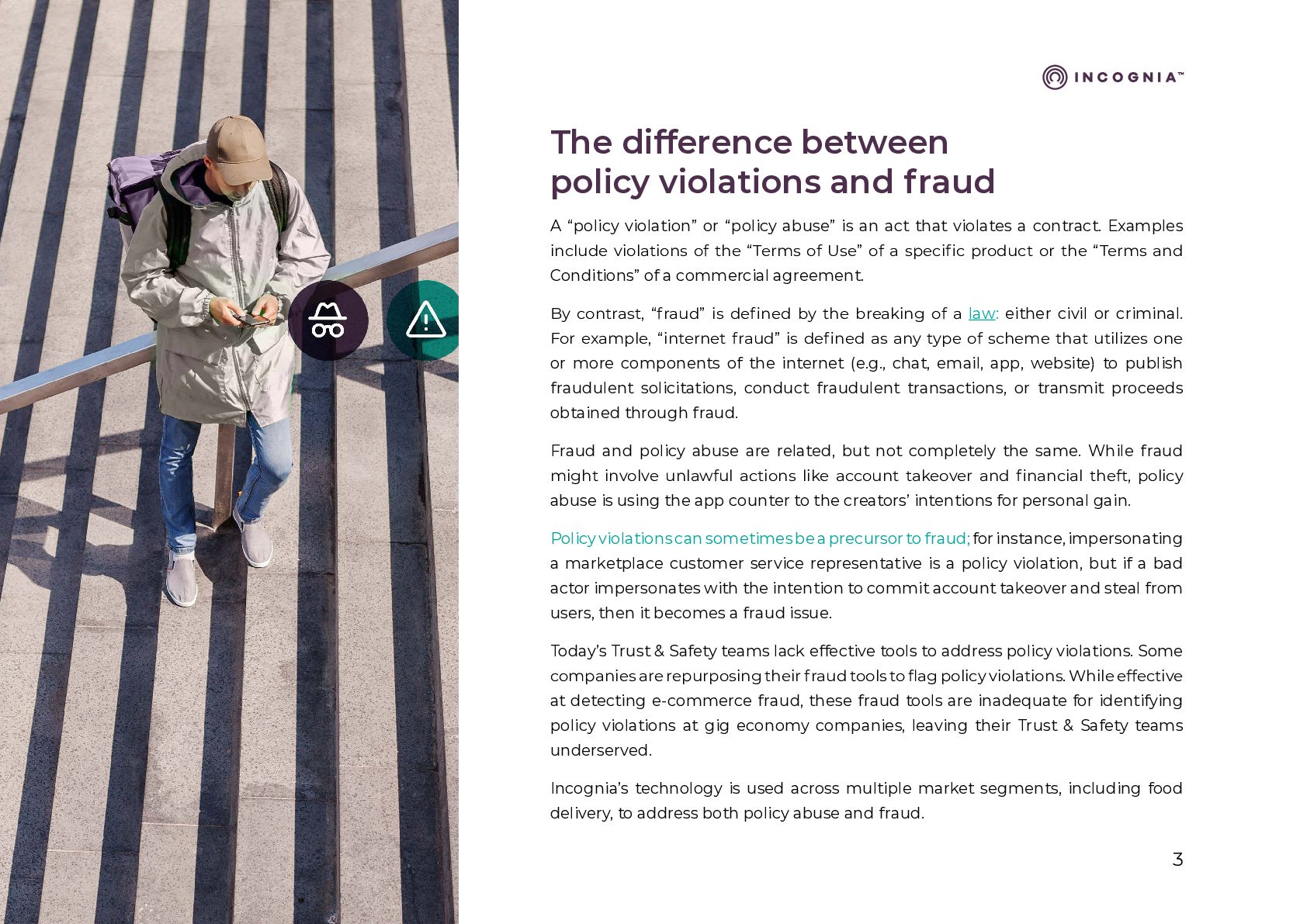
or “policy abuse” is an act that violates a contract. Examples include violations of the “Terms of Use” of a specific product or the “Terms and Conditions” of a commercial agreement. By contrast, “fraud” is defined by the breaking of a law: either civil or criminal. For example, “internet fraud” is defined as any type of scheme that utilizes one or more components of the internet (e.g., chat, email, app, website) to publish fraudulent solicitations, conduct fraudulent transactions, or transmit proceeds obtained through fraud. Fraud and policy abuse are related, but not completely the same. While fraud might involve unlawful actions like account takeover and financial theft, policy abuse is using the app counter to the creators’ intentions for personal gain. Policy violations can sometimes be a precursor to fraud; for instance, impersonating a marketplace customer service representative is a policy violation, but if a bad actor impersonates with the intention to commit account takeover and steal from users, then it becomes a fraud issue. Today’s Trust & Safety teams lack effective tools to address policy violations. Some companies are repurposing their fraud tools to flag policy violations. While effective at detecting e-commerce fraud, these fraud tools are inadequate for identifying policy violations at gig economy companies, leaving their Trust & Safety teams underserved. Incognia’s technology is used across multiple market segments, including food delivery, to address both policy abuse and fraud. 3
delivery technology platforms usually These two apps typically have two different “Term of Use” policies, utilize two different mobile apps, one for reflecting the different Trust & Safety concerns related to each stakeholder. each key stakeholder: Some of these policies are geography-based, changing depending on the country or state. These include specific employment policies. However, there are consistencies between the Trust & Safety policies of the The Consumer app is where the end user leading food delivery platforms in the world. browses restaurants, orders, and pays for Specifically, this report compares how the top four food delivery their food. platforms address several core Trust & Safety policies, including multiple account creation, account sharing, promotion abuse and device and app tampering. The Courier app is used by gig workers to accept orders, schedule their shifts, The next two pages break down the relevant consumer and courier policies included in the Terms of User of each food delivery platform. manage their wages, receive support from the platform, and verify completed deliveries. It is also common for these apps to have a mobile wallet feature through which gig workers are paid. 4
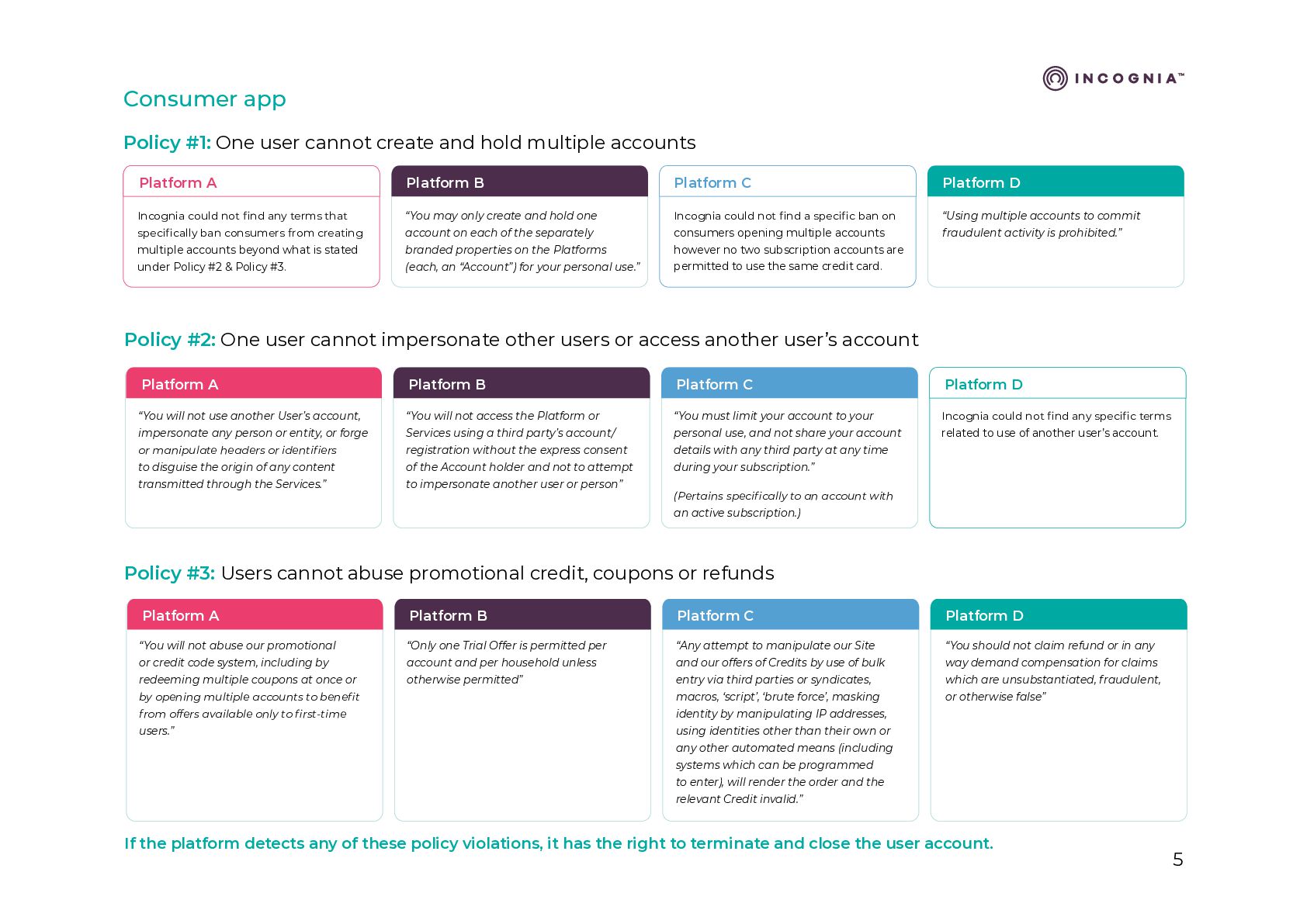
multiple accounts Platform A Platform B Platform C Platform D Incognia could not find any terms that “You may only create and hold one Incognia could not find a specific ban on “Using multiple accounts to commit specifically ban consumers from creating account on each of the separately consumers opening multiple accounts fraudulent activity is prohibited.” multiple accounts beyond what is stated branded properties on the Platforms however no two subscription accounts are under Policy #2 & Policy #3. (each, an “Account”) for your personal use.” permitted to use the same credit card. Policy #2: One user cannot impersonate other users or access another user’s account Platform A Platform B Platform C Platform D “You will not use another User’s account, “You will not access the Platform or “You must limit your account to your Incognia could not find any specific terms impersonate any person or entity, or forge Services using a third party’s account/ personal use, and not share your account related to use of another user’s account. or manipulate headers or identifiers registration without the express consent details with any third party at any time to disguise the origin of any content of the Account holder and not to attempt during your subscription.” transmitted through the Services.” to impersonate another user or person” (Pertains specifically to an account with an active subscription.) Policy #3: Users cannot abuse promotional credit, coupons or refunds Platform A Platform B Platform C Platform D “You will not abuse our promotional “Only one Trial Offer is permitted per “Any attempt to manipulate our Site “You should not claim refund or in any or credit code system, including by account and per household unless and our offers of Credits by use of bulk way demand compensation for claims redeeming multiple coupons at once or otherwise permitted” entry via third parties or syndicates, which are unsubstantiated, fraudulent, by opening multiple accounts to benefit macros, ‘script’, ‘brute force’, masking or otherwise false” from offers available only to first-time identity by manipulating IP addresses, users.” using identities other than their own or any other automated means (including systems which can be programmed to enter), will render the order and the relevant Credit invalid.” If the platform detects any of these policy violations, it has the right to terminate and close the user account. 5
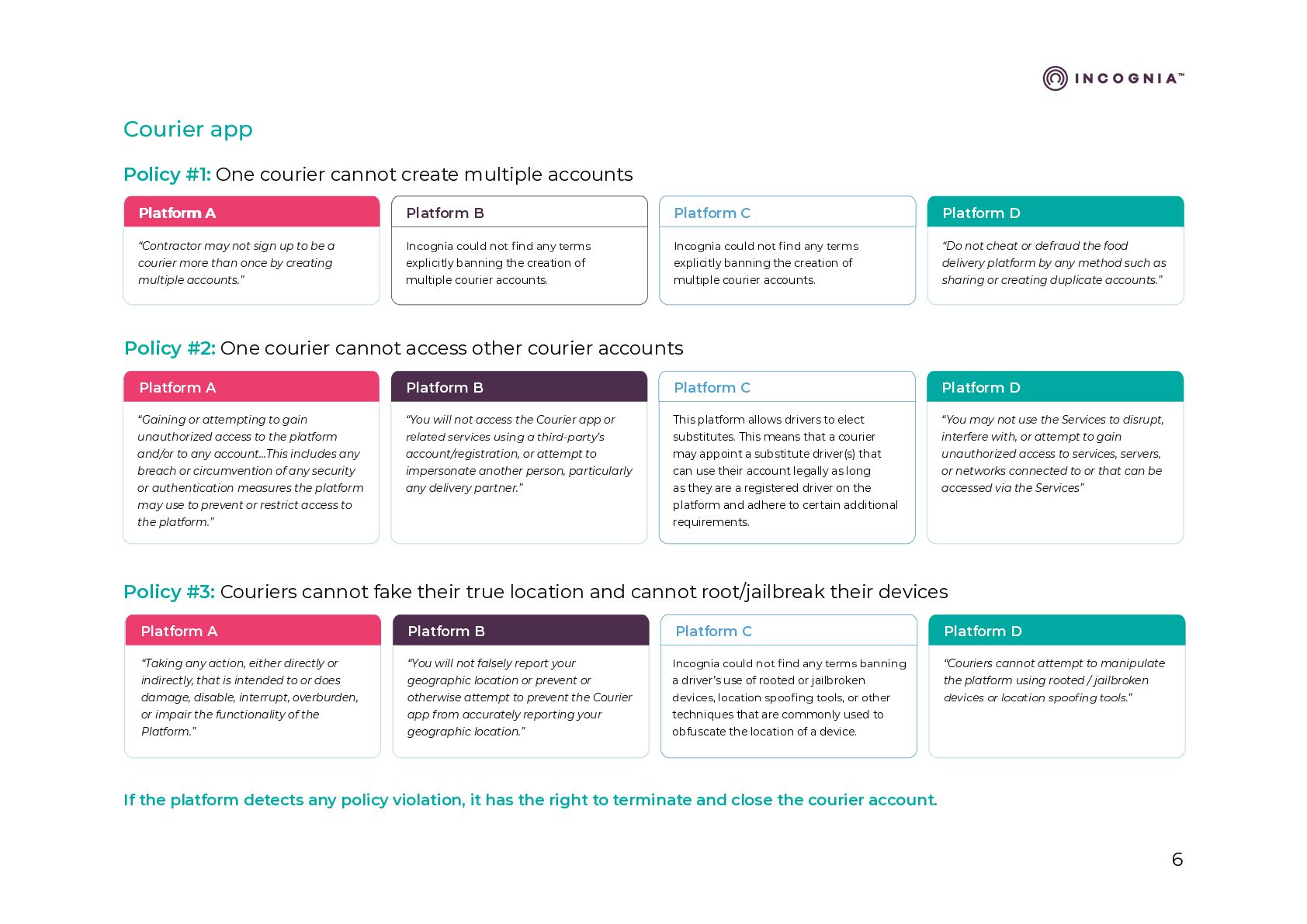
Platform A Platform B Platform C Platform D “Contractor may not sign up to be a Incognia could not find any terms Incognia could not find any terms “Do not cheat or defraud the food courier more than once by creating explicitly banning the creation of explicitly banning the creation of delivery platform by any method such as multiple accounts.” multiple courier accounts. multiple courier accounts. sharing or creating duplicate accounts.” Policy #2: One courier cannot access other courier accounts Platform A Platform B Platform C Platform D “Gaining or attempting to gain “You will not access the Courier app or This platform allows drivers to elect “You may not use the Services to disrupt, unauthorized access to the platform related services using a third-party’s substitutes. This means that a courier interfere with, or attempt to gain and/or to any account...This includes any account/registration, or attempt to may appoint a substitute driver(s) that unauthorized access to services, servers, breach or circumvention of any security impersonate another person, particularly can use their account legally as long or networks connected to or that can be or authentication measures the platform any delivery partner.” as they are a registered driver on the accessed via the Services” may use to prevent or restrict access to platform and adhere to certain additional the platform.” requirements. Policy #3: Couriers cannot fake their true location and cannot root/jailbreak their devices Platform A Platform B Platform C Platform D “Taking any action, either directly or “You will not falsely report your Incognia could not find any terms banning “Couriers cannot attempt to manipulate indirectly, that is intended to or does geographic location or prevent or a driver’s use of rooted or jailbroken the platform using rooted / jailbroken damage, disable, interrupt, overburden, otherwise attempt to prevent the Courier devices, location spoofing tools, or other devices or location spoofing tools.” or impair the functionality of the app from accurately reporting your techniques that are commonly used to Platform.” geographic location.” obfuscate the location of a device. If the platform detects any policy violation, it has the right to terminate and close the courier account. 6
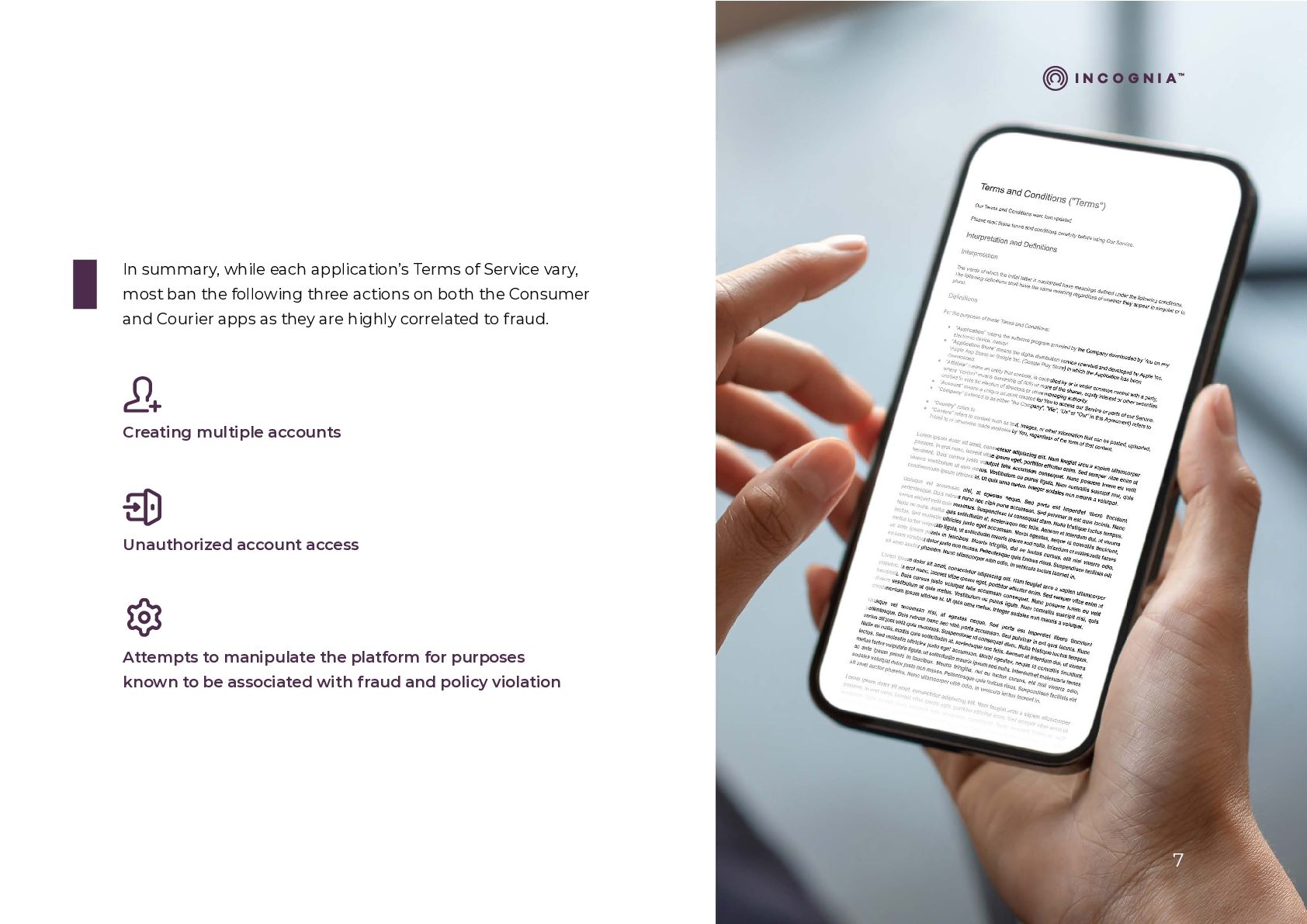
ban the following three actions on both the Consumer and Courier apps as they are highly correlated to fraud. Creating multiple accounts Unauthorized account access Attempts to manipulate the platform for purposes known to be associated with fraud and policy violation 7
illegal the way fraudulent activity is, they often represent a precursor to fraud. For example, using someone’s account without their permission is a policy violation. Taking over someone’s account to steal from them or the marketplace is fraud. What’s more, policy violations have all of the same power to impact the bottom line and customer experience as outright fraud does. For example, a food delivery courier could create multiple fake accounts and use location spoofing to appear as though they’ve attempted deliveries without ever leaving their house. It’s not illegal, but the food delivery app loses money on the fake deliveries, and the affected customers have a poor experience waiting for food that never arrives. If though, the courier in this scenario claims to have completed the delivery and is paid for their work, the violation has transitioned from policy abuse to fraud. When either situation occurs at scale, it can create a serious business problem for the apps involved. Trust & Safety policies exist to discourage bad actors, but policies alone aren’t enough to stop abuse and fraud. To properly enforce their product policies, food delivery apps need the data to detect when their terms are being violated. To properly enforce their product policies, food delivery apps need the data to detect when their terms of use are being violated. 8
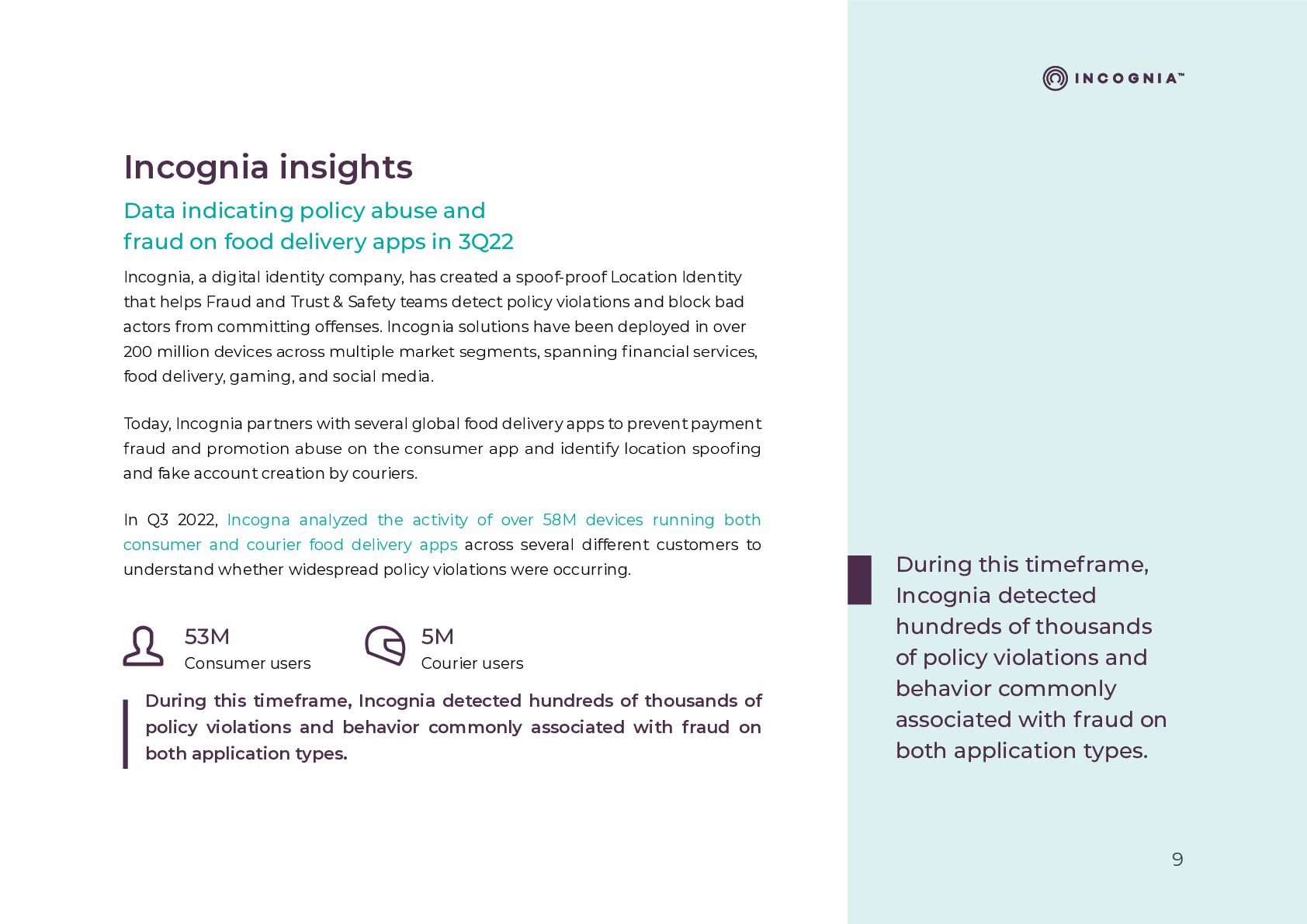
delivery apps in 3Q22 Incognia, a digital identity company, has created a spoof-proof Location Identity that helps Fraud and Trust & Safety teams detect policy violations and block bad actors from committing offenses. Incognia solutions have been deployed in over 200 million devices across multiple market segments, spanning financial services, food delivery, gaming, and social media. Today, Incognia partners with several global food delivery apps to prevent payment fraud and promotion abuse on the consumer app and identify location spoofing and fake account creation by couriers. In Q3 2022, Incogna analyzed the activity of over 58M devices running both consumer and courier food delivery apps across several different customers to understand whether widespread policy violations were occurring. 53M 5M Consumer users Courier users During this timeframe, Incognia detected hundreds of thousands of policy violations and behavior commonly associated with fraud on both application types. During this timeframe, Incognia detected hundreds of thousands of policy violations and behavior commonly associated with fraud on both application types. 9
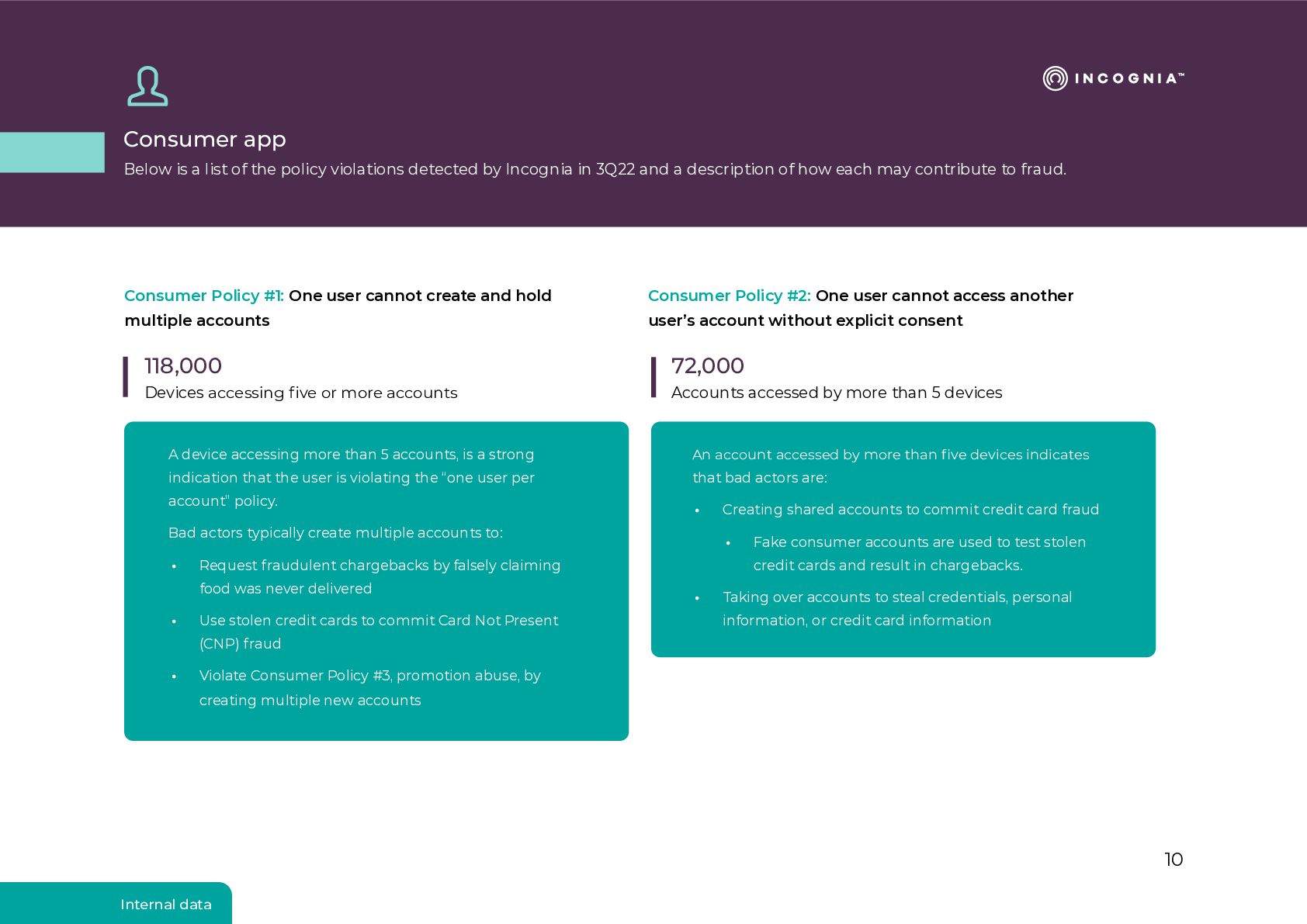
detected by Incognia in 3Q22 and a description of how each may contribute to fraud. Consumer Policy #1: One user cannot create and hold Consumer Policy #2: One user cannot access another multiple accounts user’s account without explicit consent 118,000 72,000 Devices accessing five or more accounts Accounts accessed by more than 5 devices A device accessing more than 5 accounts, is a strong An account accessed by more than five devices indicates indication that the user is violating the “one user per that bad actors are: account” policy. • Bad actors typically create multiple accounts to: • • • Request fraudulent chargebacks by falsely claiming food was never delivered Use stolen credit cards to commit Card Not Present Creating shared accounts to commit credit card fraud Fake consumer accounts are used to test stolen credit cards and result in chargebacks. • Taking over accounts to steal credentials, personal information, or credit card information (CNP) fraud • Violate Consumer Policy #3, promotion abuse, by creating multiple new accounts 10 Internal data
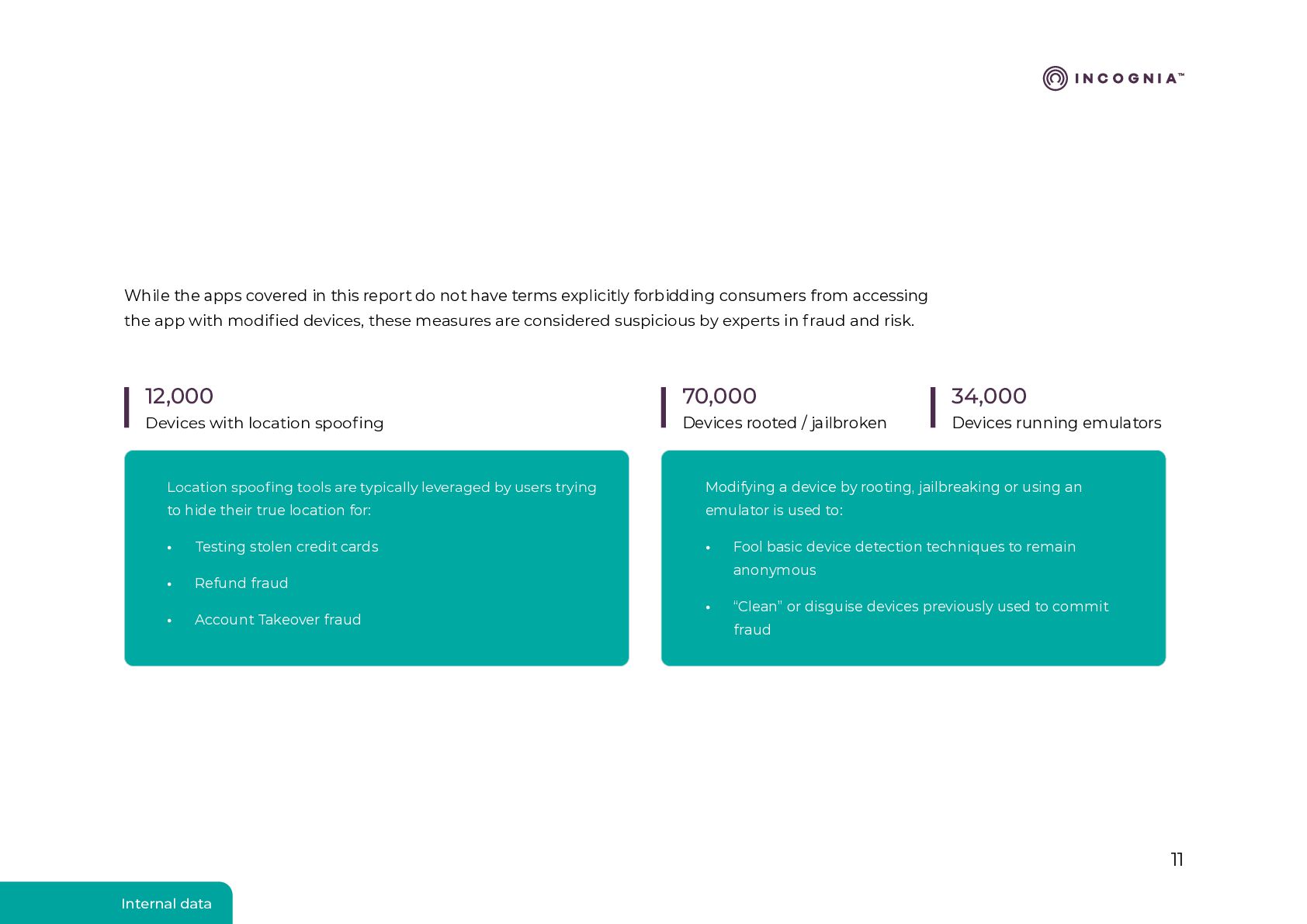
terms explicitly forbidding consumers from accessing the app with modified devices, these measures are considered suspicious by experts in fraud and risk. 12,000 70,000 34,000 Devices with location spoofing Devices rooted / jailbroken Devices running emulators Location spoofing tools are typically leveraged by users trying Modifying a device by rooting, jailbreaking or using an to hide their true location for: emulator is used to: • Testing stolen credit cards • • Refund fraud • Account Takeover fraud Fool basic device detection techniques to remain anonymous • “Clean” or disguise devices previously used to commit fraud 11 Internal data
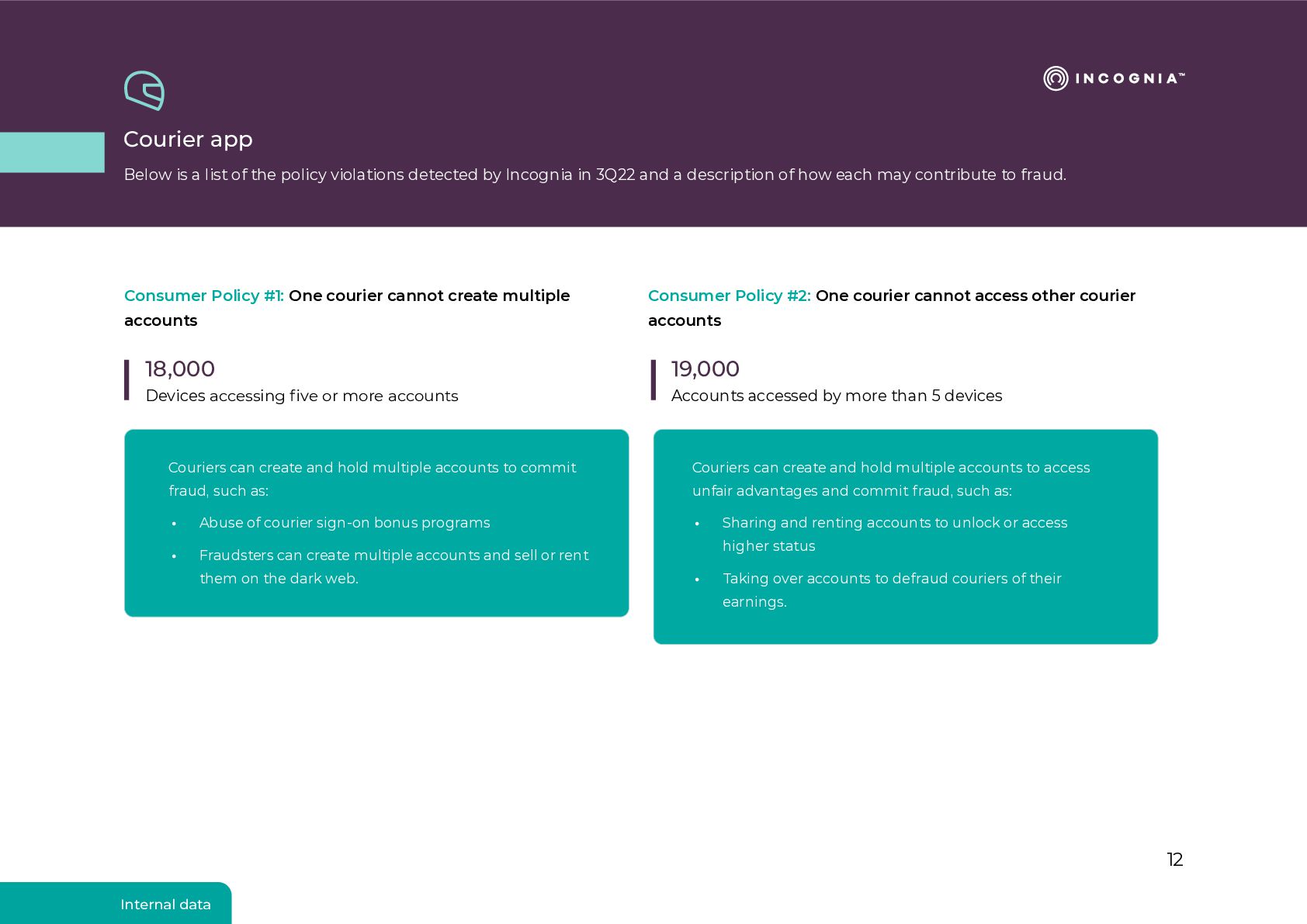
detected by Incognia in 3Q22 and a description of how each may contribute to fraud. Consumer Policy #1: One courier cannot create multiple Consumer Policy #2: One courier cannot access other courier accounts accounts 18,000 19,000 Devices accessing five or more accounts Accounts accessed by more than 5 devices Couriers can create and hold multiple accounts to commit Couriers can create and hold multiple accounts to access fraud, such as: unfair advantages and commit fraud, such as: • Abuse of courier sign-on bonus programs • • Fraudsters can create multiple accounts and sell or rent them on the dark web. Sharing and renting accounts to unlock or access higher status • Taking over accounts to defraud couriers of their earnings. 12 Internal data
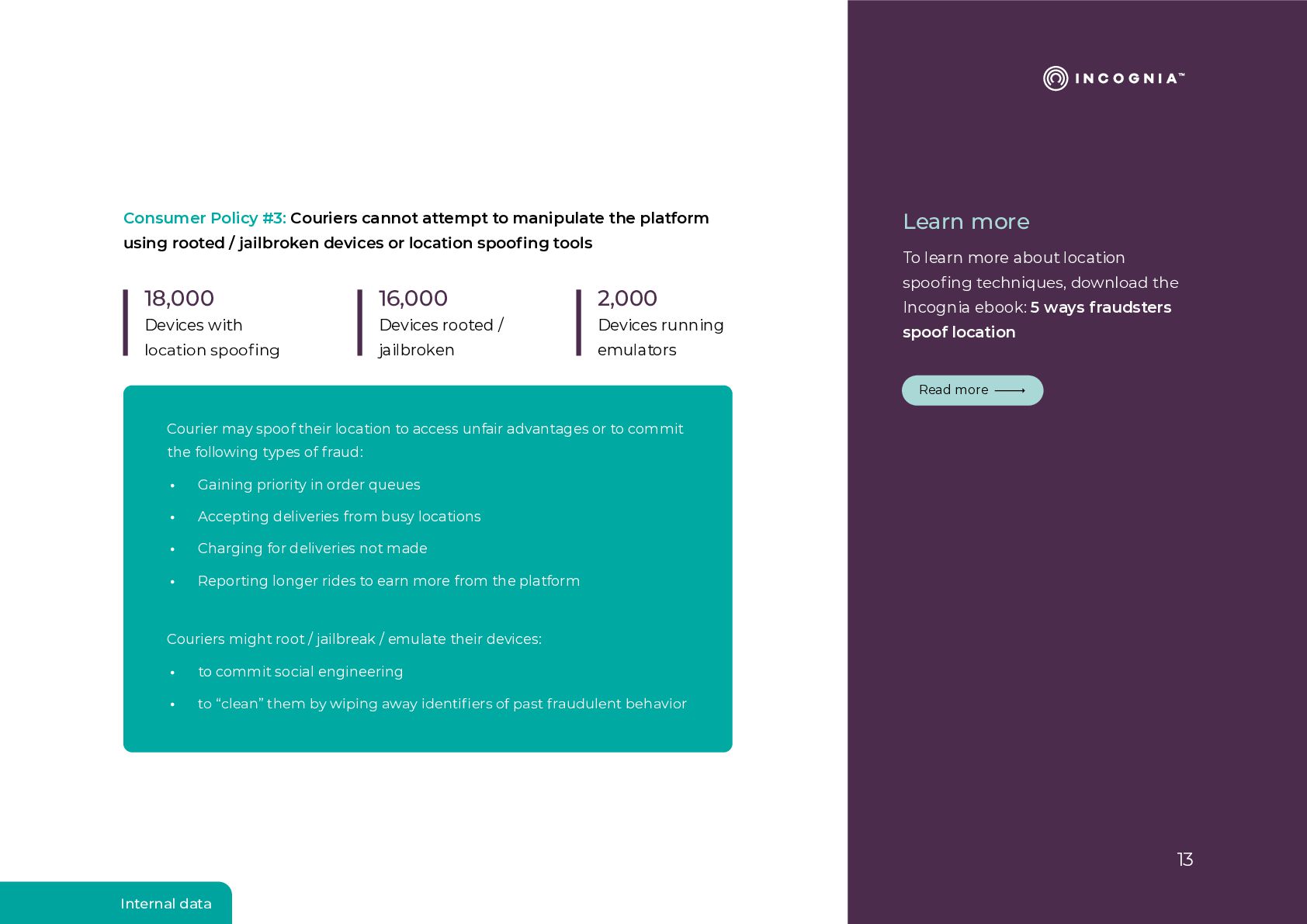
using rooted / jailbroken devices or location spoofing tools Learn more To learn more about location 18,000 16,000 2,000 Devices with Devices rooted / Devices running location spoofing jailbroken emulators spoofing techniques, download the Incognia ebook: 5 ways fraudsters spoof location Read more Courier may spoof their location to access unfair advantages or to commit the following types of fraud: • Gaining priority in order queues • Accepting deliveries from busy locations • Charging for deliveries not made • Reporting longer rides to earn more from the platform Couriers might root / jailbreak / emulate their devices: • to commit social engineering • to “clean” them by wiping away identifiers of past fraudulent behavior 1313 Internal data
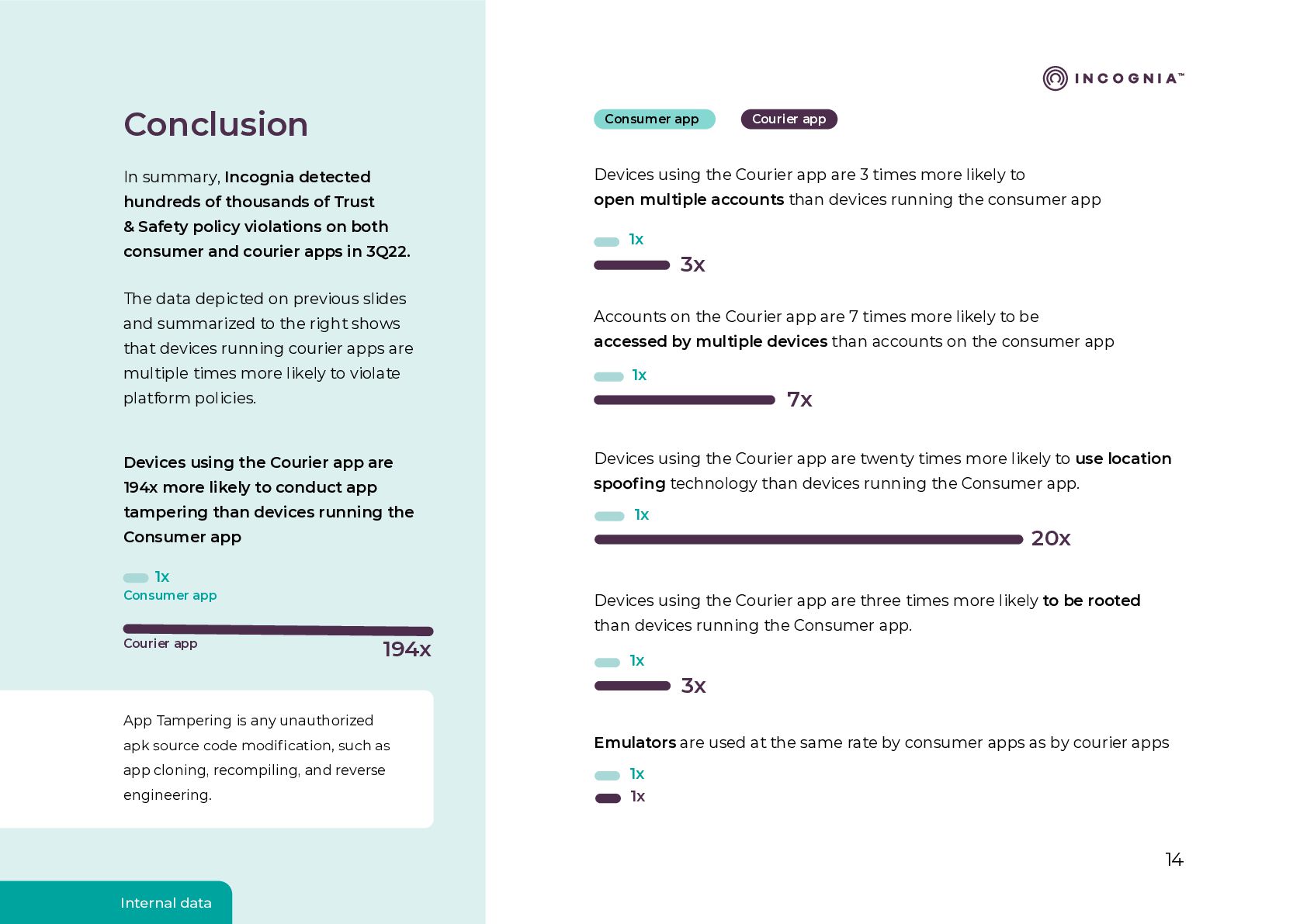
using the Courier app are 3 times more likely to hundreds of thousands of Trust open multiple accounts than devices running the consumer app & Safety policy violations on both consumer and courier apps in 3Q22. The data depicted on previous slides and summarized to the right shows that devices running courier apps are multiple times more likely to violate 1x 3x Accounts on the Courier app are 7 times more likely to be accessed by multiple devices than accounts on the consumer app 1x 7x platform policies. Devices using the Courier app are Devices using the Courier app are twenty times more likely to use location 194x more likely to conduct app spoofing technology than devices running the Consumer app. tampering than devices running the 1x 20x Consumer app 1x Consumer app Courier app Devices using the Courier app are three times more likely to be rooted 194x than devices running the Consumer app. 1x 3x App Tampering is any unauthorized apk source code modification, such as app cloning, recompiling, and reverse engineering. Emulators are used at the same rate by consumer apps as by courier apps 1x 1x 14 Internal data
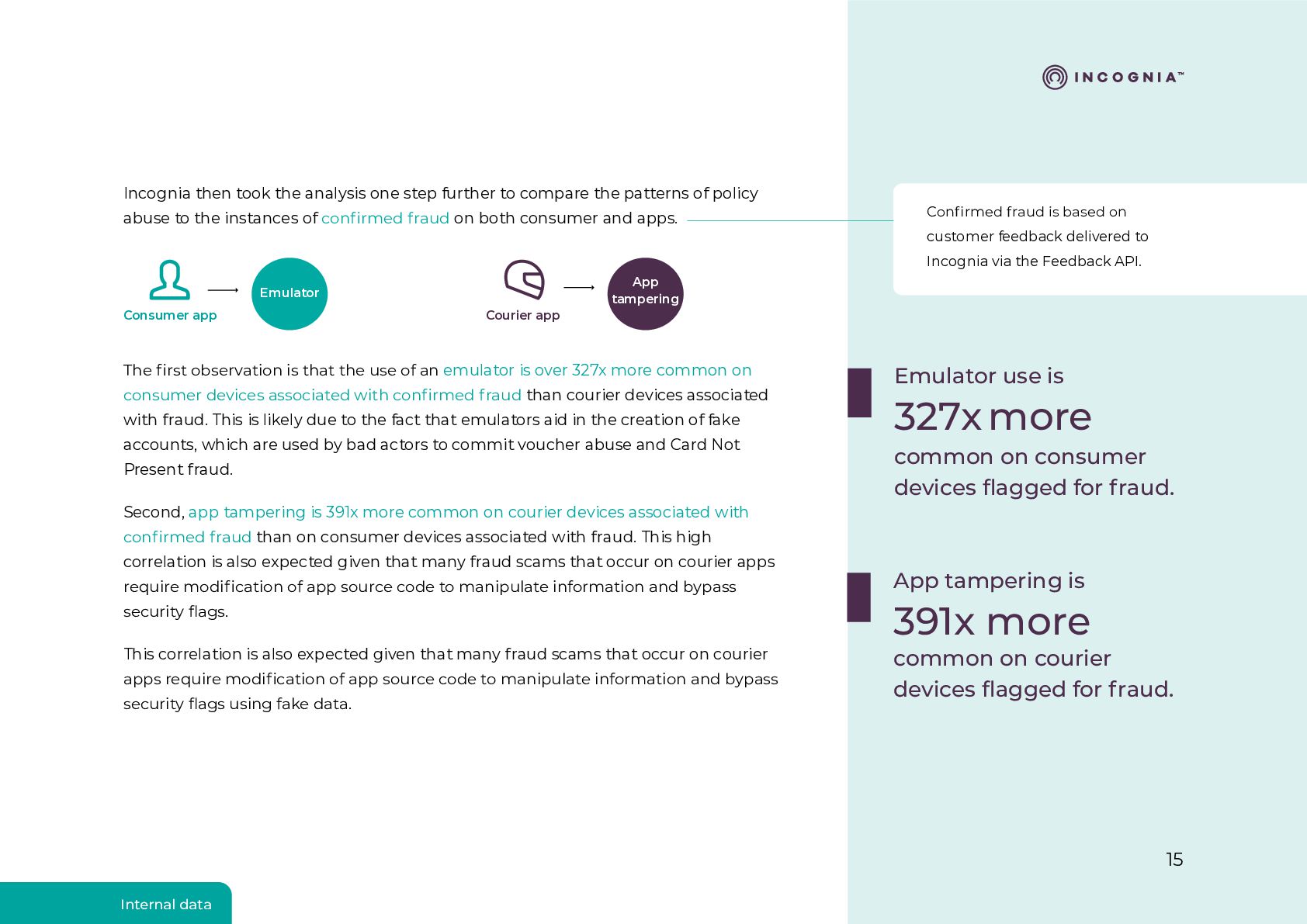
the patterns of policy abuse to the instances of confirmed fraud on both consumer and apps. Confirmed fraud is based on customer feedback delivered to Incognia via the Feedback API. App tampering Emulator Consumer app Courier app The first observation is that the use of an emulator is over 327x more common on consumer devices associated with confirmed fraud than courier devices associated with fraud. This is likely due to the fact that emulators aid in the creation of fake accounts, which are used by bad actors to commit voucher abuse and Card Not Present fraud. Emulator use is 327x more common on consumer devices flagged for fraud. Second, app tampering is 391x more common on courier devices associated with confirmed fraud than on consumer devices associated with fraud. This high correlation is also expected given that many fraud scams that occur on courier apps require modification of app source code to manipulate information and bypass security flags. This correlation is also expected given that many fraud scams that occur on courier apps require modification of app source code to manipulate information and bypass security flags using fake data. App tampering is 391x more common on courier devices flagged for fraud. 15 Internal data
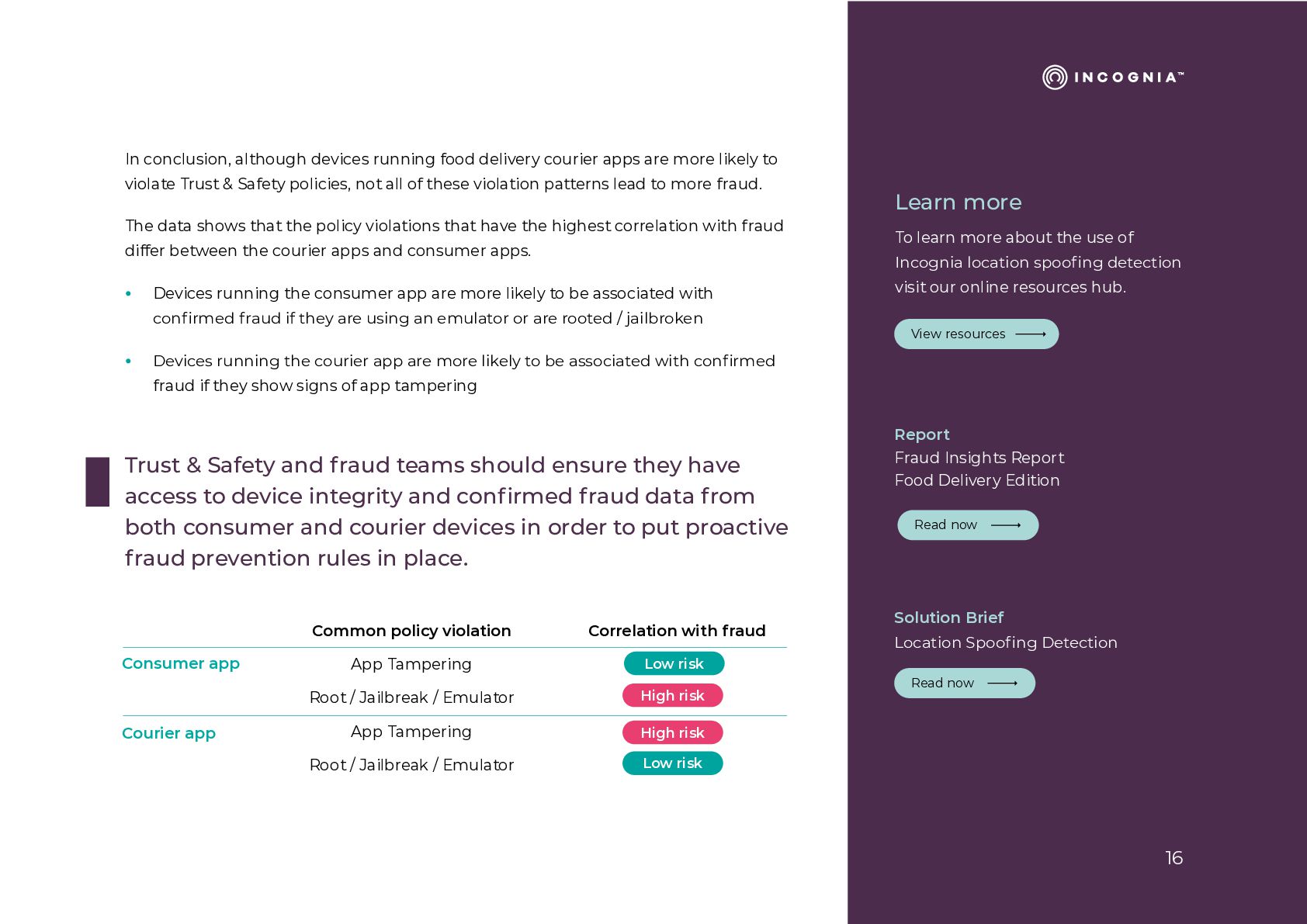
more likely to violate Trust & Safety policies, not all of these violation patterns lead to more fraud. The data shows that the policy violations that have the highest correlation with fraud differ between the courier apps and consumer apps. • To learn more about the use of Incognia location spoofing detection Devices running the consumer app are more likely to be associated with confirmed fraud if they are using an emulator or are rooted / jailbroken • Learn more visit our online resources hub. View resources Devices running the courier app are more likely to be associated with confirmed fraud if they show signs of app tampering Trust & Safety and fraud teams should ensure they have access to device integrity and confirmed fraud data from both consumer and courier devices in order to put proactive fraud prevention rules in place. Consumer app Courier app Common policy violation Correlation with fraud App Tampering Low risk Root / Jailbreak / Emulator High risk App Tampering High risk Root / Jailbreak / Emulator Low risk Report Fraud Insights Report Food Delivery Edition Read now Solution Brief Location Spoofing Detection Read now 16
spoof-proof Location Identity to silently authenticate customers throughout their digital journey. Fraud and operations teams at food delivery, ride-sharing, social media and eCommerce marketplace companies use Incognia to authenticate trusted users without friction and detect suspicious behavior to prevent new account fraud and ATO. Today, Incognia’s network includes over 200M devices globally. Incognia is a venture-backed company headquartered in California, with teams in New York and Brazil. Stay connected and follow Incognia on Twitter and LinkedIn. Visit Incognia.com to learn more. 17


 recsyslab
 takasehideki
 shibuiwilliam
 polipoli
 satai
 ontheslope
 koide3
 stktu
 hellosct1
 rikkabotan7
 rfujii
 skipperchong
 eileencodes
 palkan
 axbom
 bluesmoon
 konakalab
 cassininazir
 nikkihalliwell
 mayunak
 rabernat
 leimatthew05
 gurzu