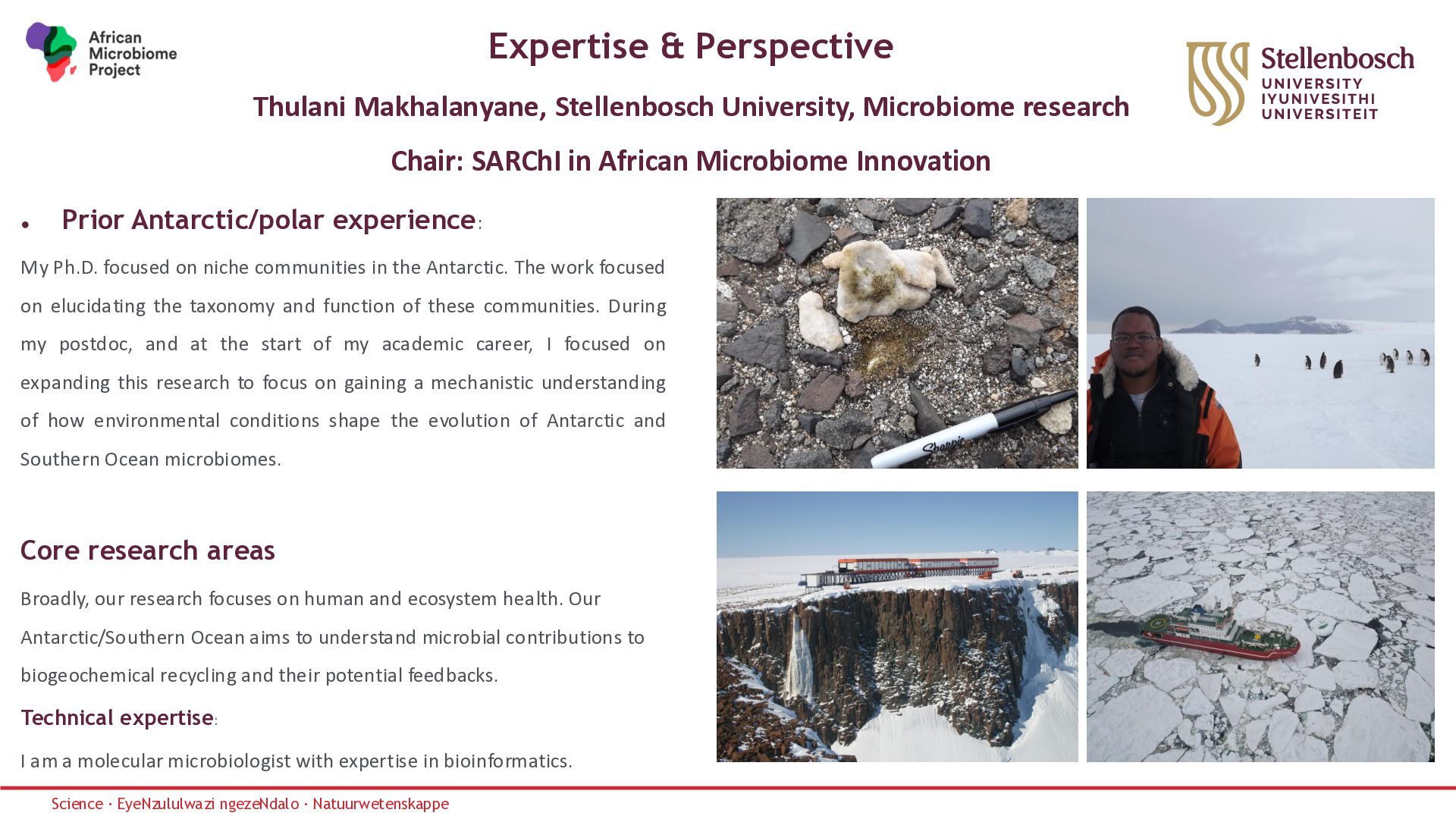
Makhalanyane, Stellenbosch University, Microbiome research Chair: SARChI in African Microbiome Innovation • Prior Antarctic/polar experience: My Ph.D. focused on niche communities in the Antarctic. The work focused on elucidating the taxonomy and function of these communities. During my postdoc, and at the start of my academic career, I focused on expanding this research to focus on gaining a mechanistic understanding of how environmental conditions shape the evolution of Antarctic and Southern Ocean microbiomes. Core research areas Broadly, our research focuses on human and ecosystem health. Our Antarctic/Southern Ocean aims to understand microbial contributions to biogeochemical recycling and their potential feedbacks. Technical expertise: I am a molecular microbiologist with expertise in bioinformatics.
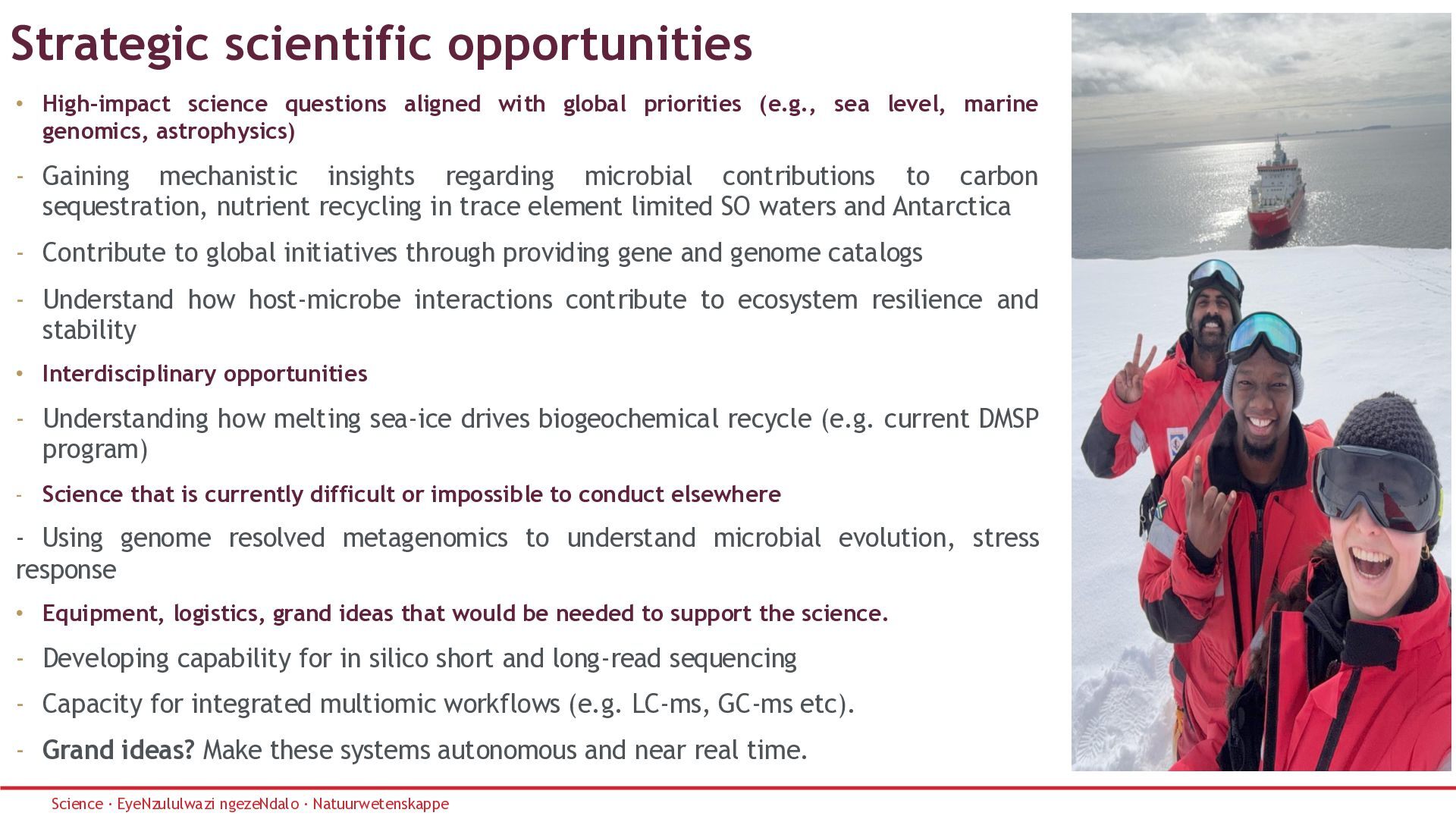
High-impact science questions aligned with global priorities (e.g., sea level, marine genomics, astrophysics) - Gaining mechanistic insights regarding microbial contributions to carbon sequestration, nutrient recycling in trace element limited SO waters and Antarctica - Contribute to global initiatives through providing gene and genome catalogs - Understand how host-microbe interactions contribute to ecosystem resilience and stability • Interdisciplinary opportunities - Understanding how melting sea-ice drives biogeochemical recycle (e.g. current DMSP program) - Science that is currently difficult or impossible to conduct elsewhere - Using genome resolved metagenomics to understand microbial evolution, stress response • Equipment, logistics, grand ideas that would be needed to support the science. - Developing capability for in silico short and long-read sequencing - Capacity for integrated multiomic workflows (e.g. LC-ms, GC-ms etc). - Grand ideas? Make these systems autonomous and near real time.

 Your Podcast. Everywhere. Effortlessly.


 ipfevents
 brainpadpr
 michielstock
 tagtag
 peterdesmet
 sshimizu2006
 kiyoshi
.jpeg) arthur1
arthur1
 tsoh
tsoh
 trycycle
 taka88
 rlifchitz
 matthewcrist
 eitanlees
 danielanewman
 baasie
 garrettdimon
 jonrohan
 axbom
axbom
 popppiees
 hannesfritz
 lynnandtonic
 addyosmani
 rmw
rmw