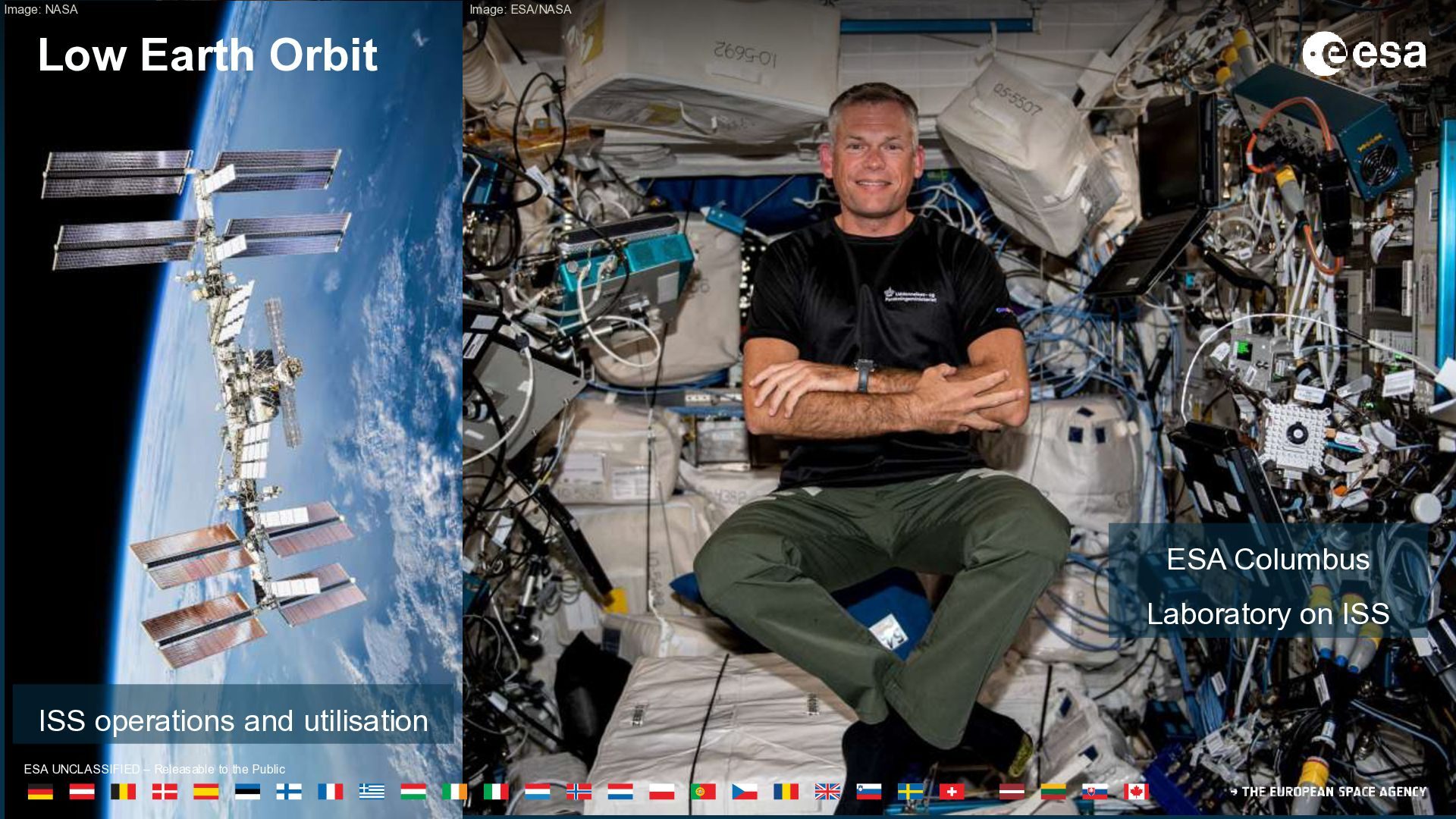
exploration in the ESA Terrae Novae Programme Jason Hatton Strategy Officer Directorate of Human and Robotic Exploration Programmes European Space Agency ESA UNCLASSIFIED – Releasable to the Public Image: ESA/Olivier Pâques
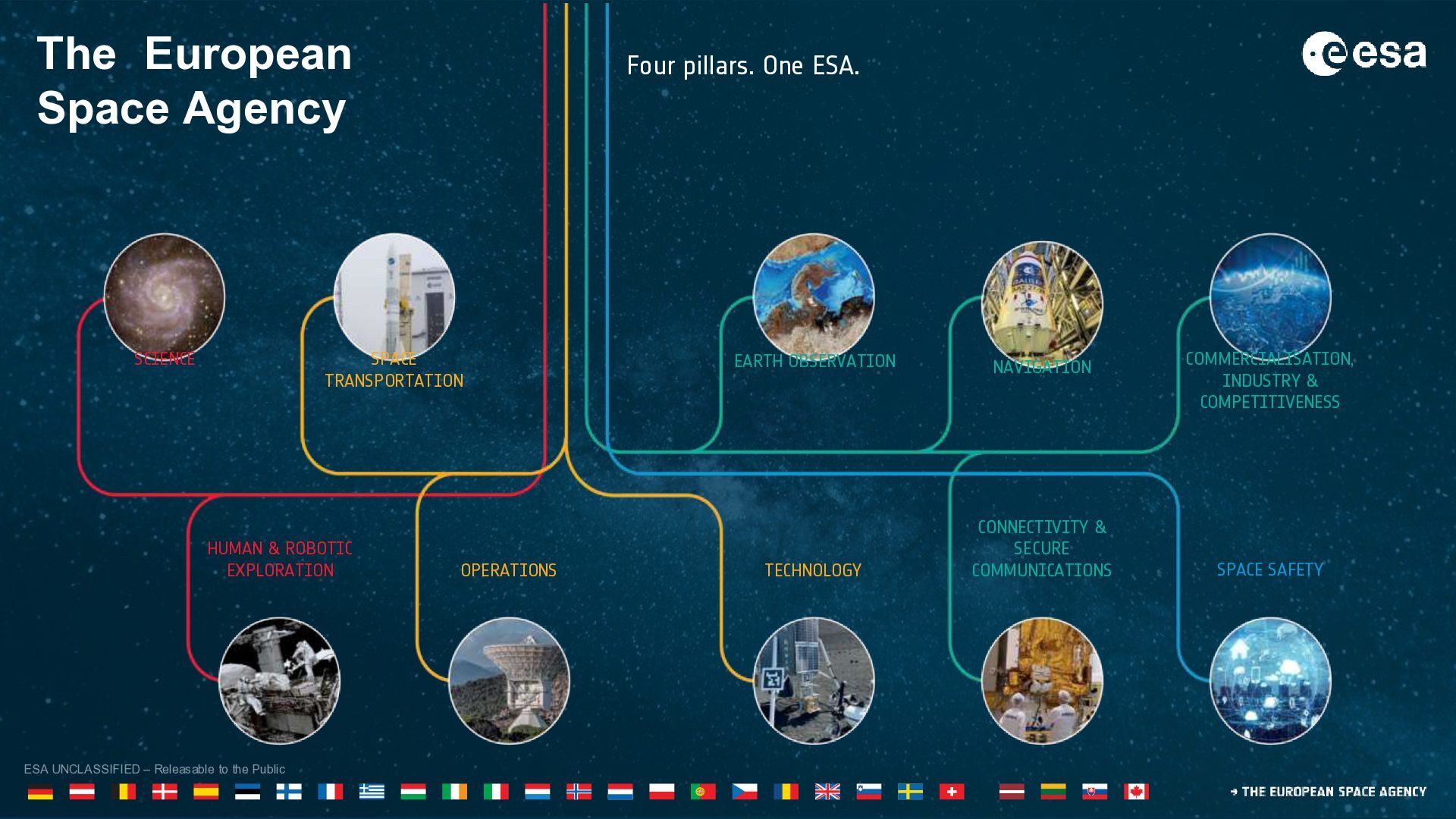
NAVIGATION COMMERCIALISATION, INDUSTRY & COMPETITIVENESS HUMAN & ROBOTIC EXPLORATION OPERATIONS TECHNOLOGY CONNECTIVITY & SECURE COMMUNICATIONS SPACE SAFETY The European Space Agency ESA UNCLASSIFIED – Releasable to the Public
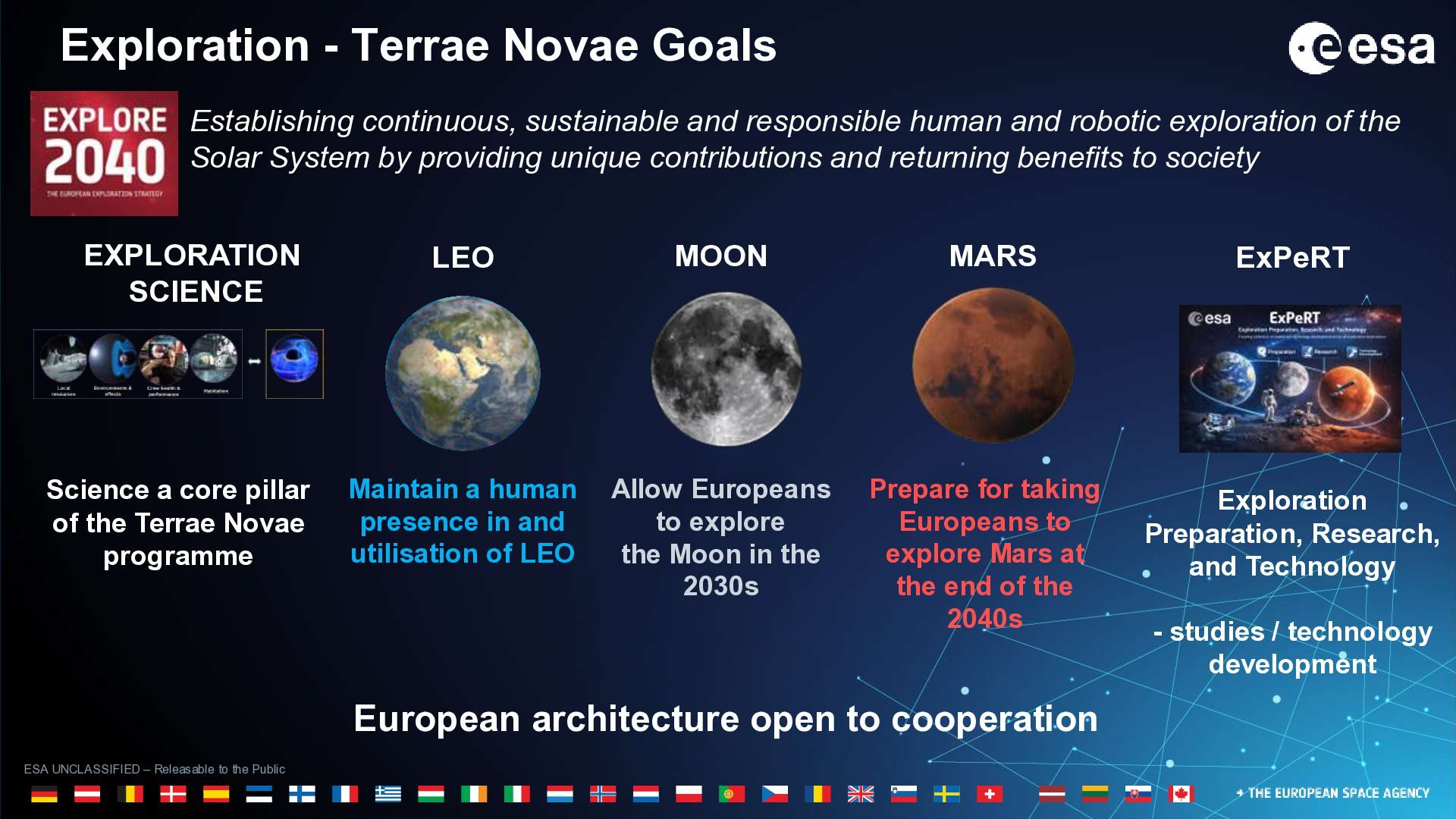
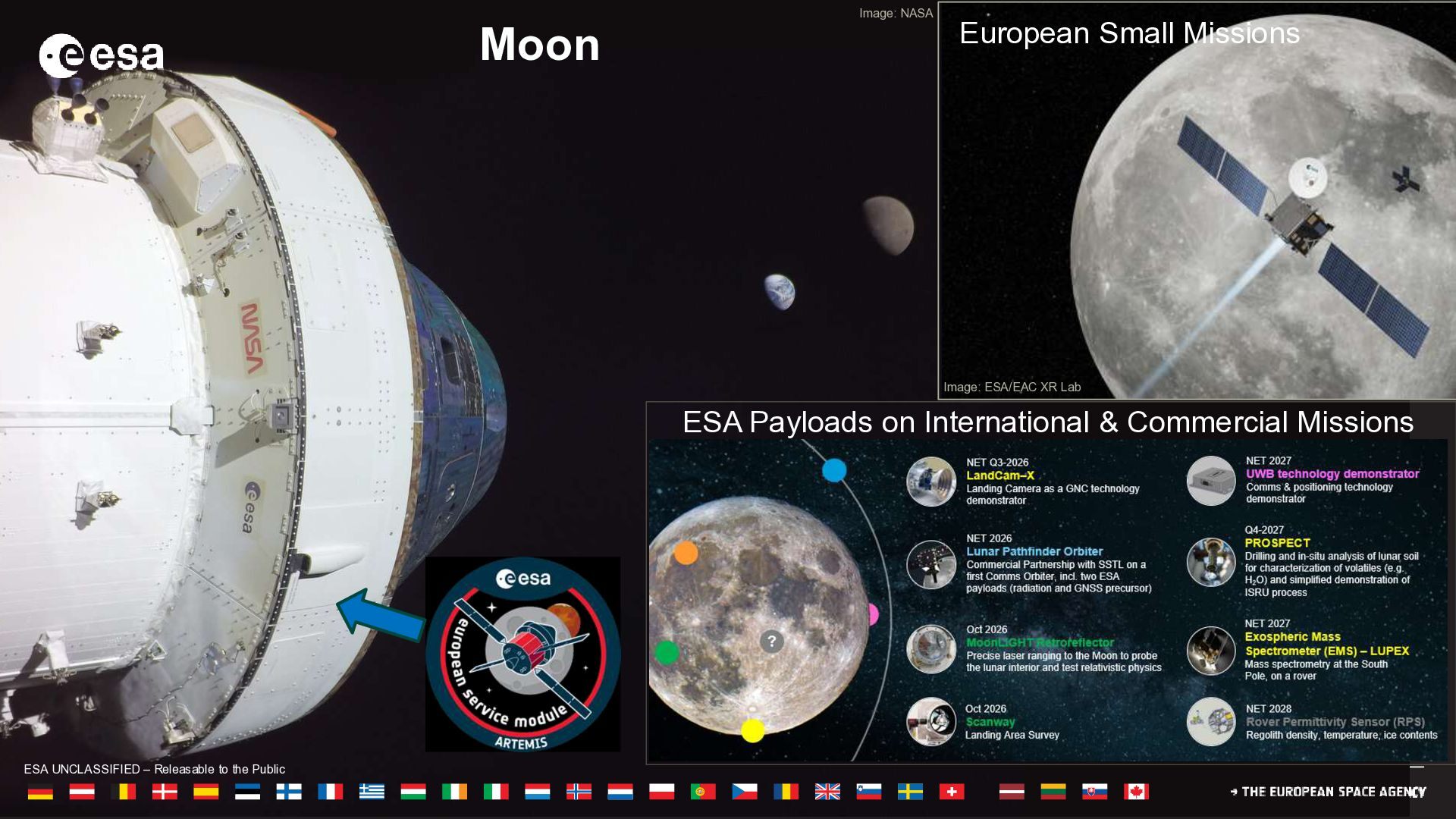
human and robotic exploration of the Solar System by providing unique contributions and returning benefits to society EXPLORATION SCIENCE MOON LEO MARS ExPeRT European architecture open to cooperation Prepare for taking Europeans to explore Mars at the end of the 2040s Maintain a human presence in and utilisation of LEO Allow Europeans to explore the Moon in the 2030s Science a core pillar of the Terrae Novae programme Exploration Preparation, Research, and Technology - studies / technology development ESA UNCLASSIFIED – Releasable to the Public
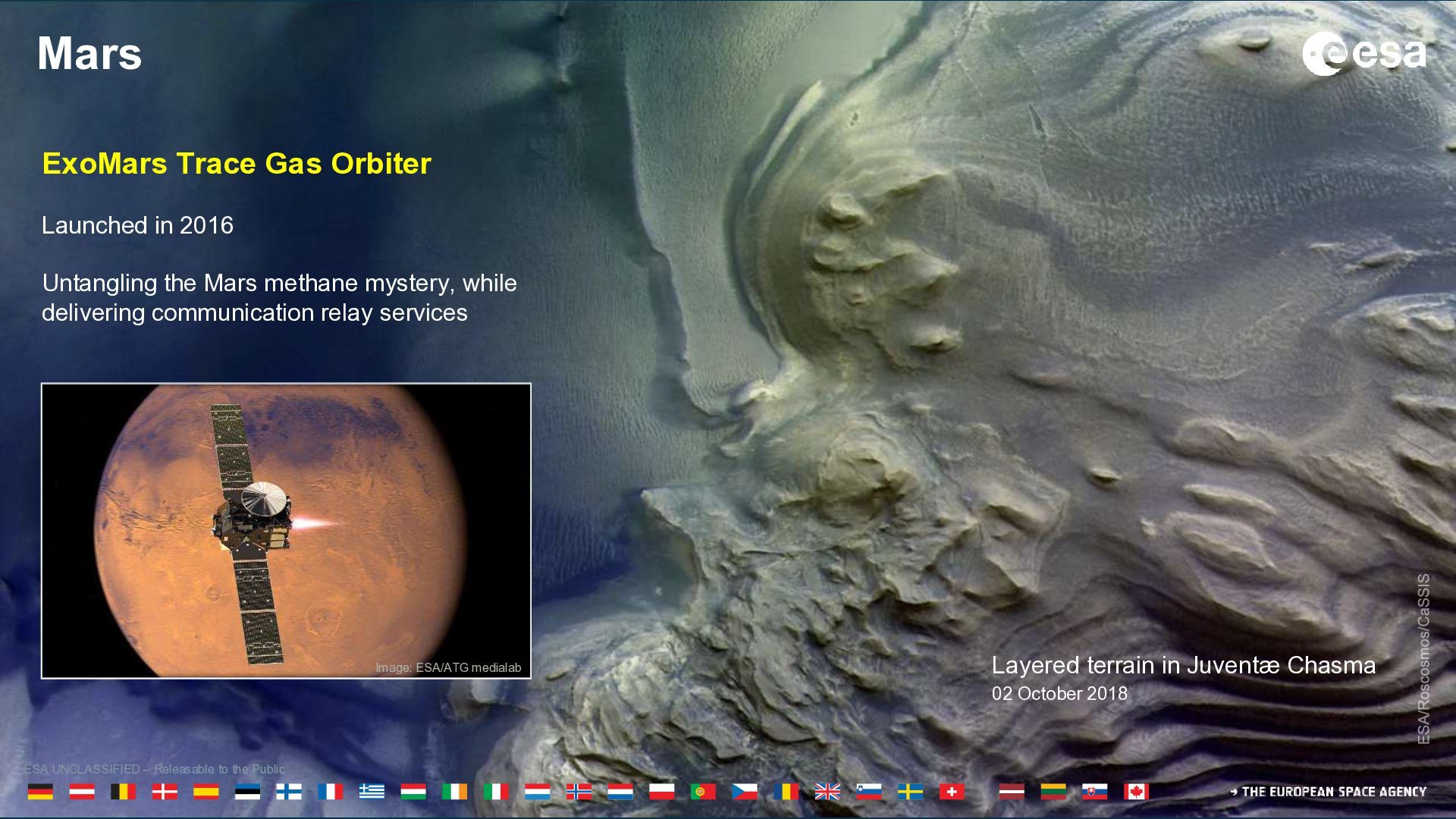
Layered terrain in Juventæ Chasma 02 October 2018 ExoMars Trace Gas Orbiter Launched in 2016 Untangling the Mars methane mystery, while delivering communication relay services ESA UNCLASSIFIED – Releasable to the Public Image: ESA/ATG medialab
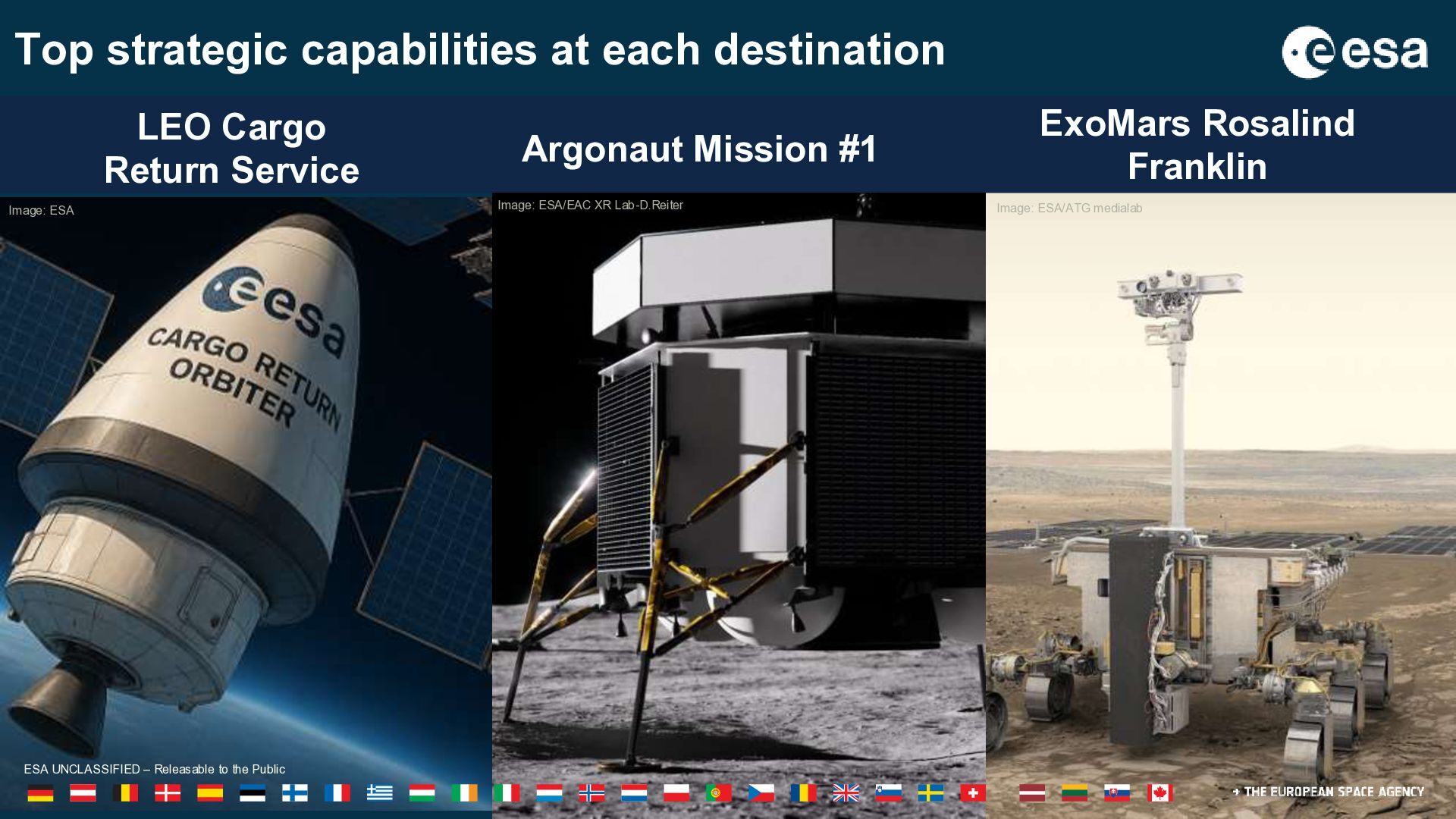
Service Argonaut Mission #1 ExoMars Rosalind Franklin 2030 ESA UNCLASSIFIED – Releasable to the Public Image: ESA/ATG medialab Image: ESA/EAC XR Lab-D.Reiter Image: ESA
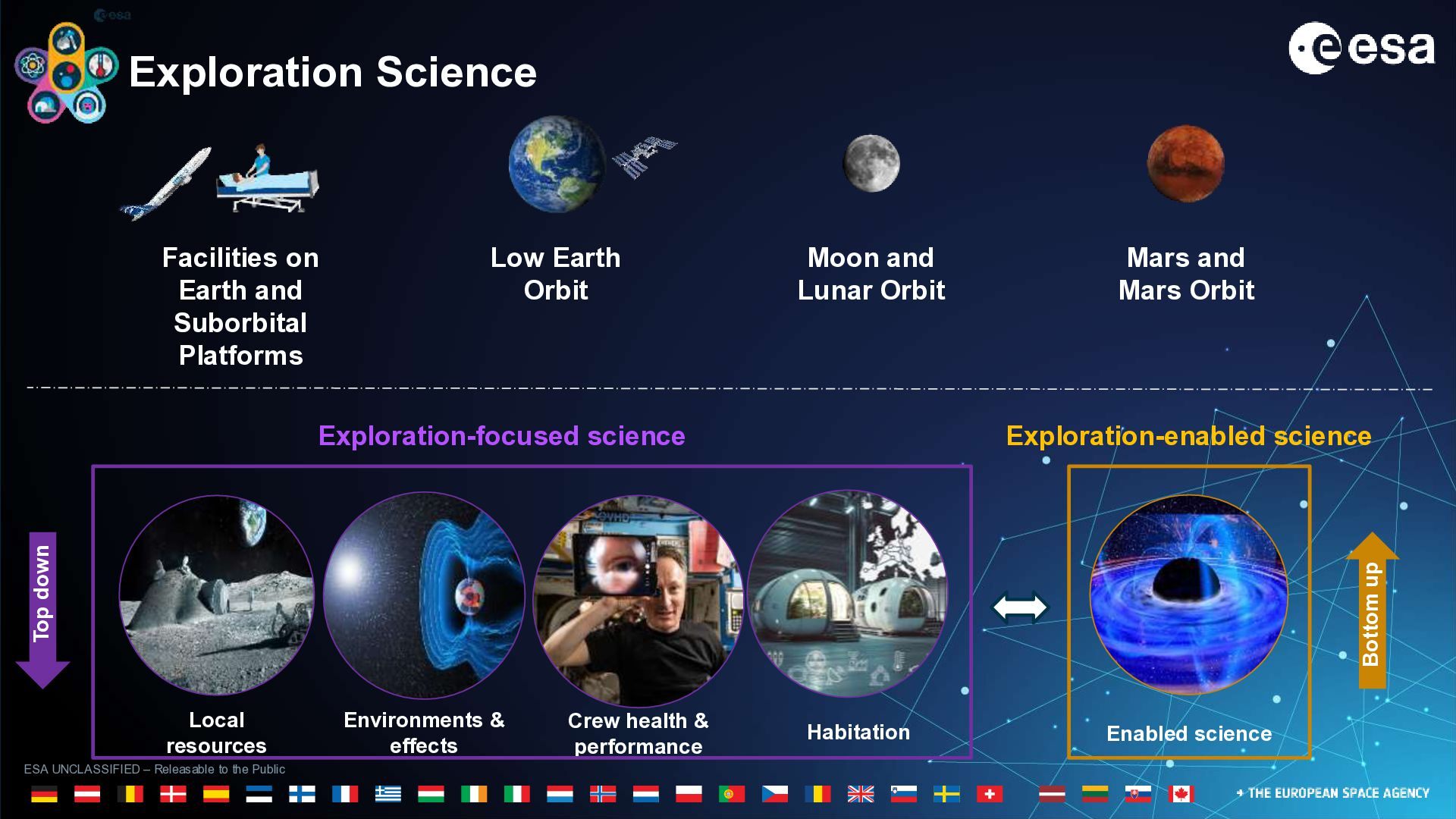
performance Habitation Exploration-focused science Exploration-enabled science Top down Bottom up Enabled science Facilities on Earth and Suborbital Platforms Low Earth Orbit Moon and Lunar Orbit Mars and Mars Orbit ESA UNCLASSIFIED – Releasable to the Public
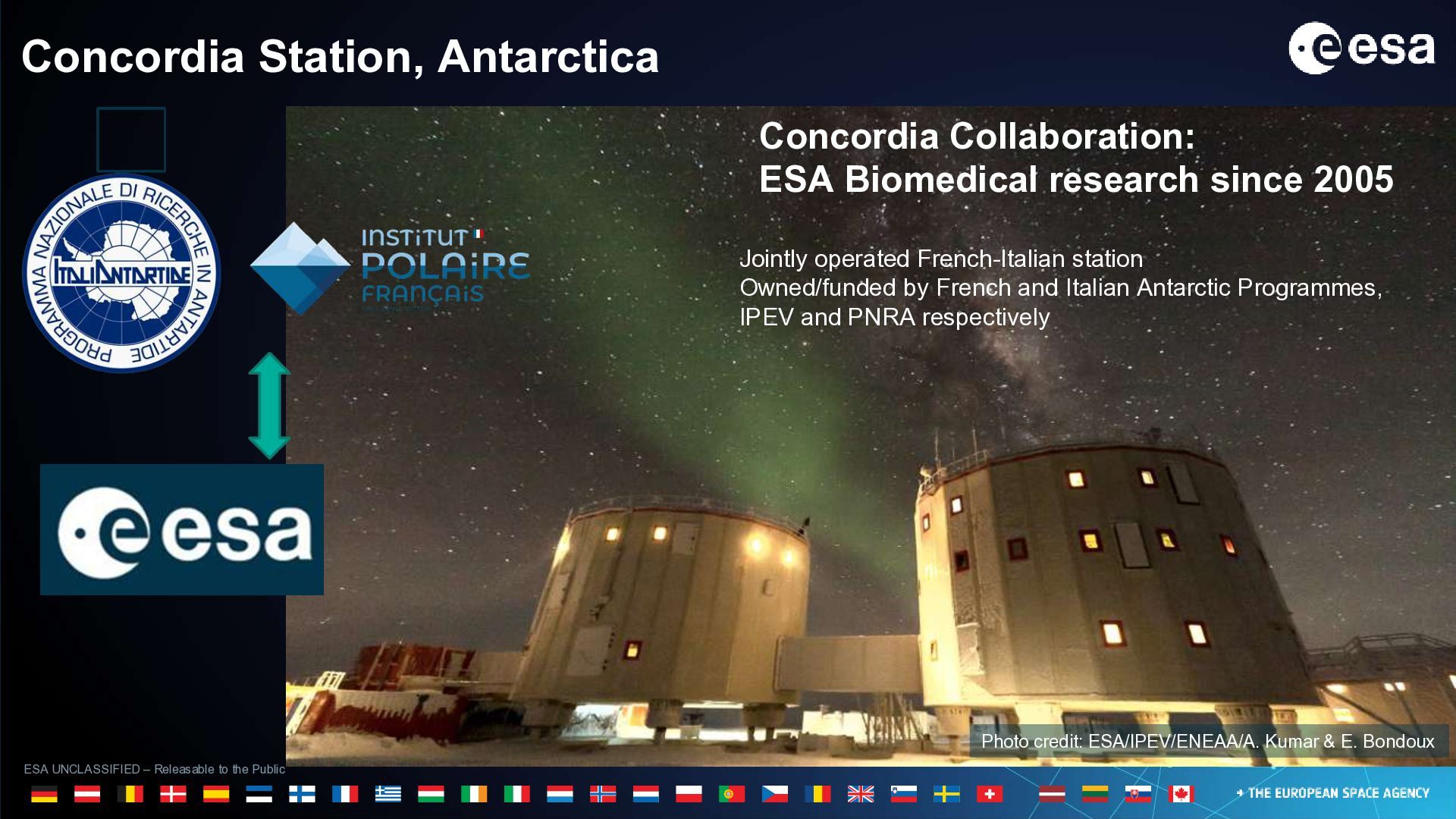
station Owned/funded by French and Italian Antarctic Programmes, IPEV and PNRA respectively Concordia Station, Antarctica ESA UNCLASSIFIED – Releasable to the Public Photo credit: ESA/IPEV/ENEAA/A. Kumar & E. Bondoux
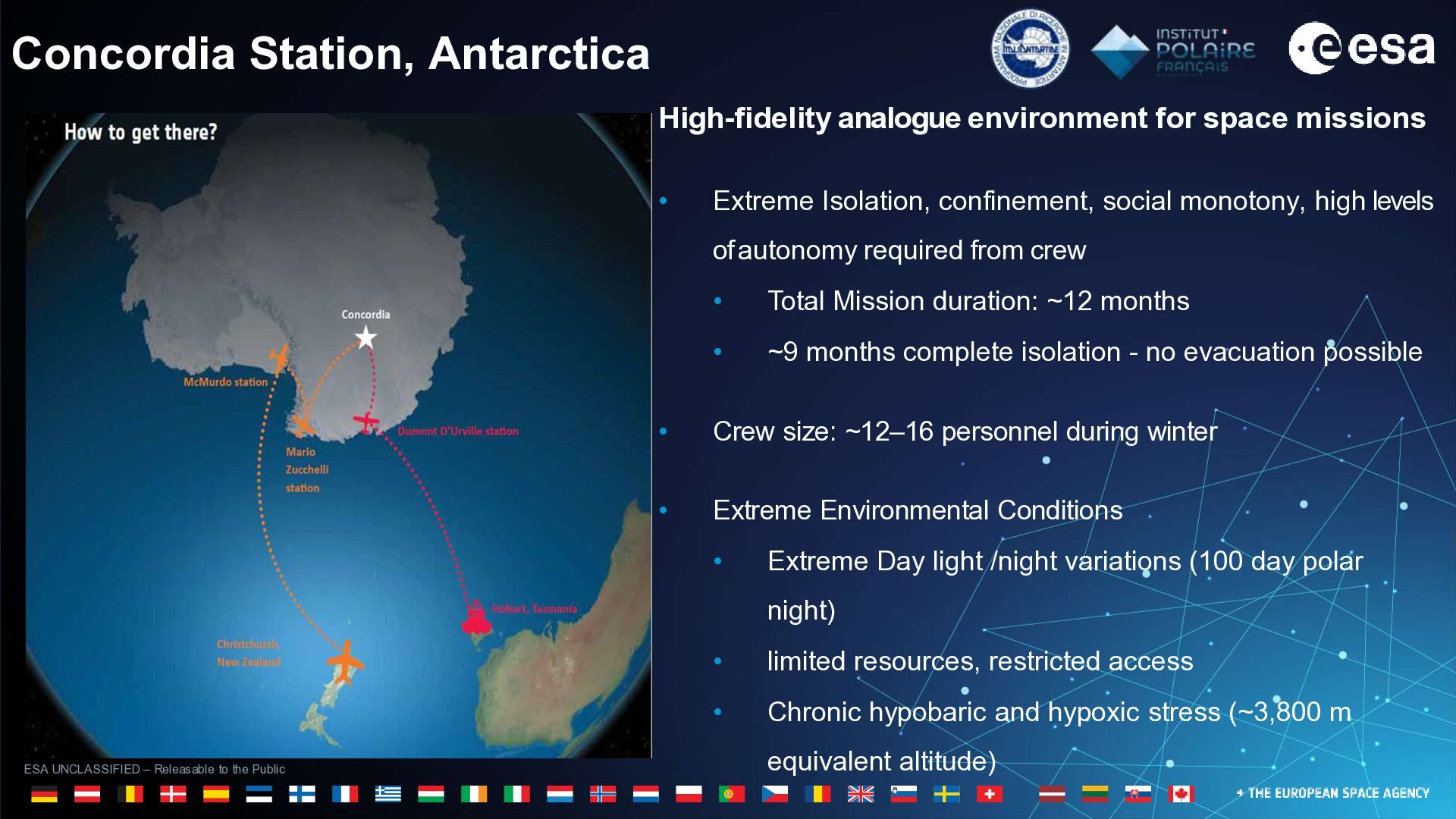
Extreme Isolation, confinement, social monotony, high levels of autonomy required from crew • Total Mission duration: ~12 months • ~9 months complete isolation - no evacuation possible • Crew size: ~12–16 personnel during winter • Extreme Environmental Conditions • Extreme Day light /night variations (100 day polar night) • limited resources, restricted access • Chronic hypobaric and hypoxic stress (~3,800 m equivalent altitude) ESA UNCLASSIFIED – Releasable to the Public
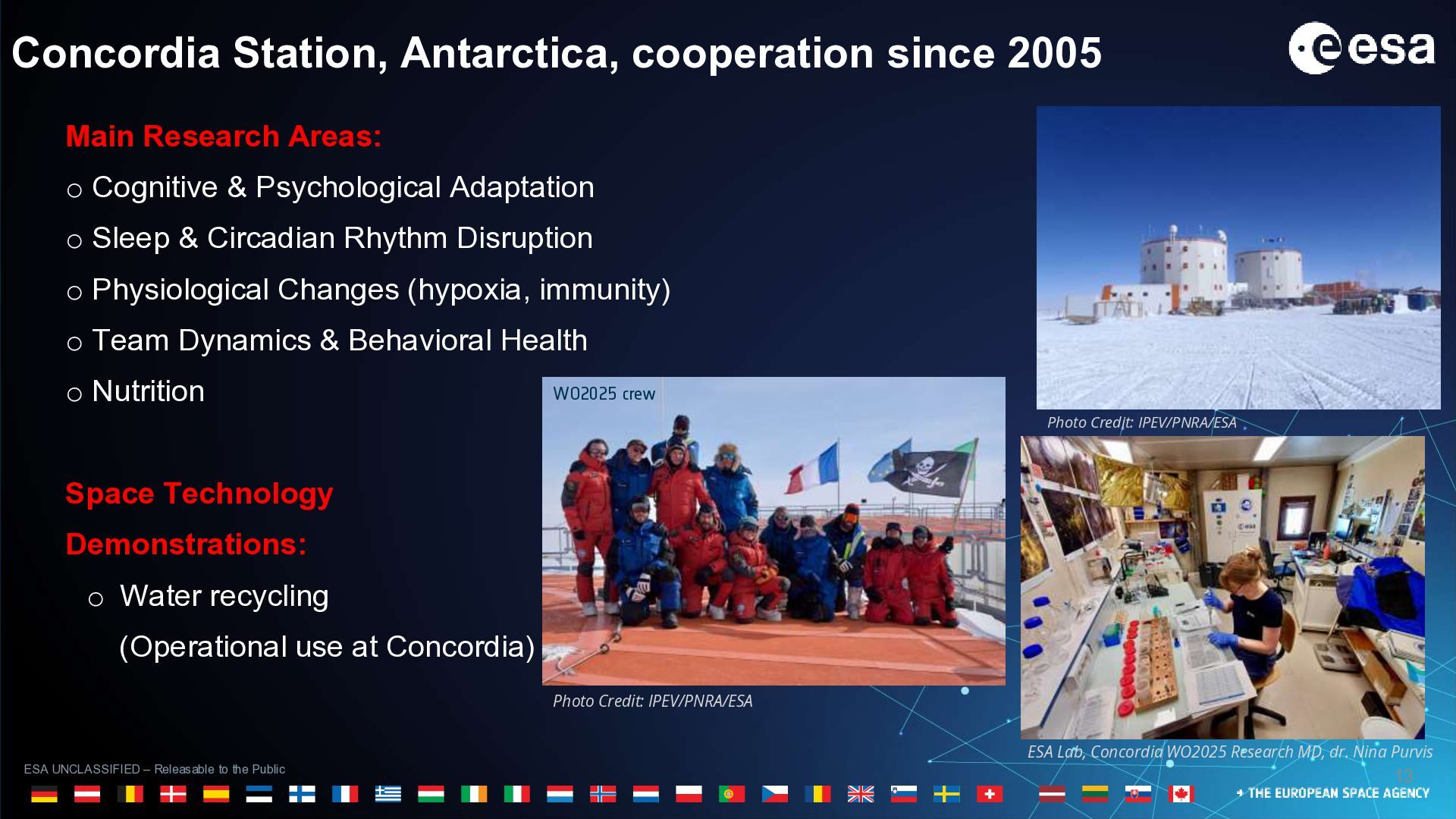
Cognitive & Psychological Adaptation o Sleep & Circadian Rhythm Disruption o Physiological Changes (hypoxia, immunity) o Team Dynamics & Behavioral Health o Nutrition Space Technology Demonstrations: o Water recycling (Operational use at Concordia) 13 Photo Credit: IPEV/PNRA/ESA ESA Lab, Concordia WO2025 Research MD, dr. Nina Purvis Photo Credit: IPEV/PNRA/ESA WO2025 crew ESA UNCLASSIFIED – Releasable to the Public
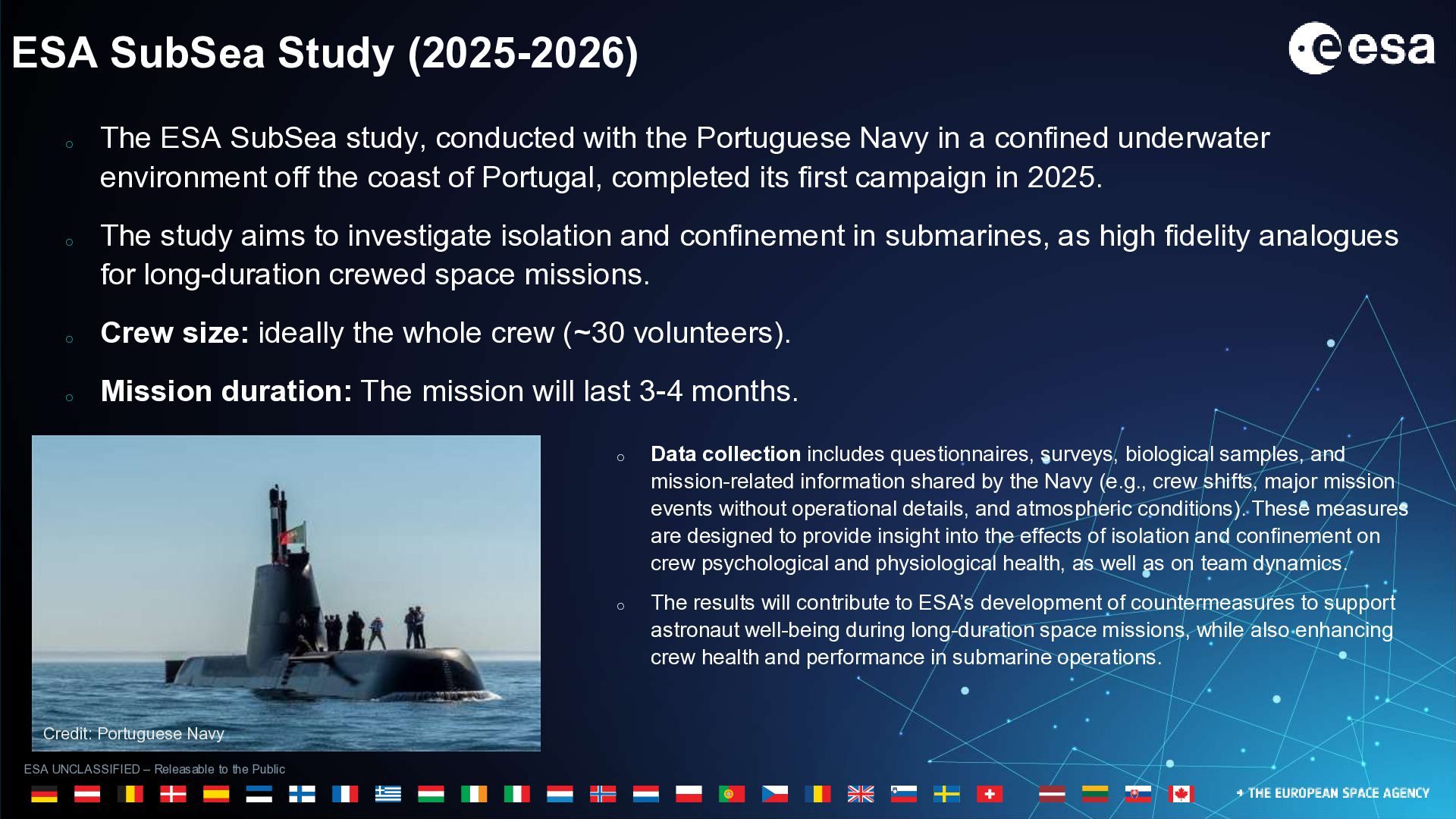
with the Portuguese Navy in a confined underwater environment off the coast of Portugal, completed its first campaign in 2025. o The study aims to investigate isolation and confinement in submarines, as high fidelity analogues for long-duration crewed space missions. o Crew size: ideally the whole crew (~30 volunteers). o Mission duration: The mission will last 3-4 months. o Data collection includes questionnaires, surveys, biological samples, and mission-related information shared by the Navy (e.g., crew shifts, major mission events without operational details, and atmospheric conditions). These measures are designed to provide insight into the effects of isolation and confinement on crew psychological and physiological health, as well as on team dynamics. o The results will contribute to ESA’s development of countermeasures to support astronaut well-being during long-duration space missions, while also enhancing crew health and performance in submarine operations. ESA UNCLASSIFIED – Releasable to the Public Credit: Portuguese Navy
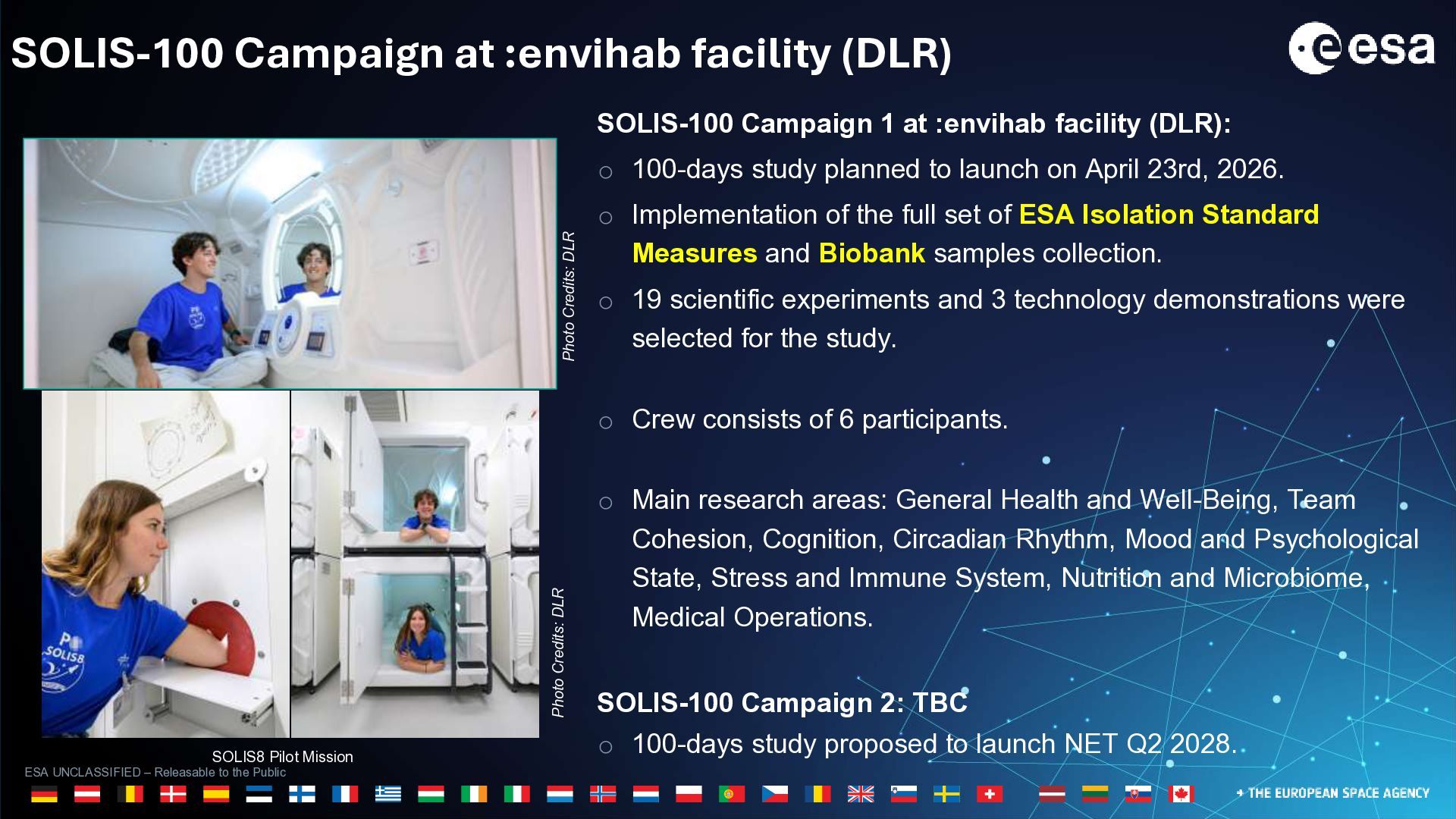
:envihab facility (DLR): o 100-days study planned to launch on April 23rd, 2026. o Implementation of the full set of ESA Isolation Standard Measures and Biobank samples collection. o 19 scientific experiments and 3 technology demonstrations were selected for the study. o Crew consists of 6 participants. o Main research areas: General Health and Well-Being, Team Cohesion, Cognition, Circadian Rhythm, Mood and Psychological State, Stress and Immune System, Nutrition and Microbiome, Medical Operations. SOLIS-100 Campaign 2: TBC o 100-days study proposed to launch NET Q2 2028. Photo Credits: DLR Photo Credits: DLR SOLIS8 Pilot Mission ESA UNCLASSIFIED – Releasable to the Public
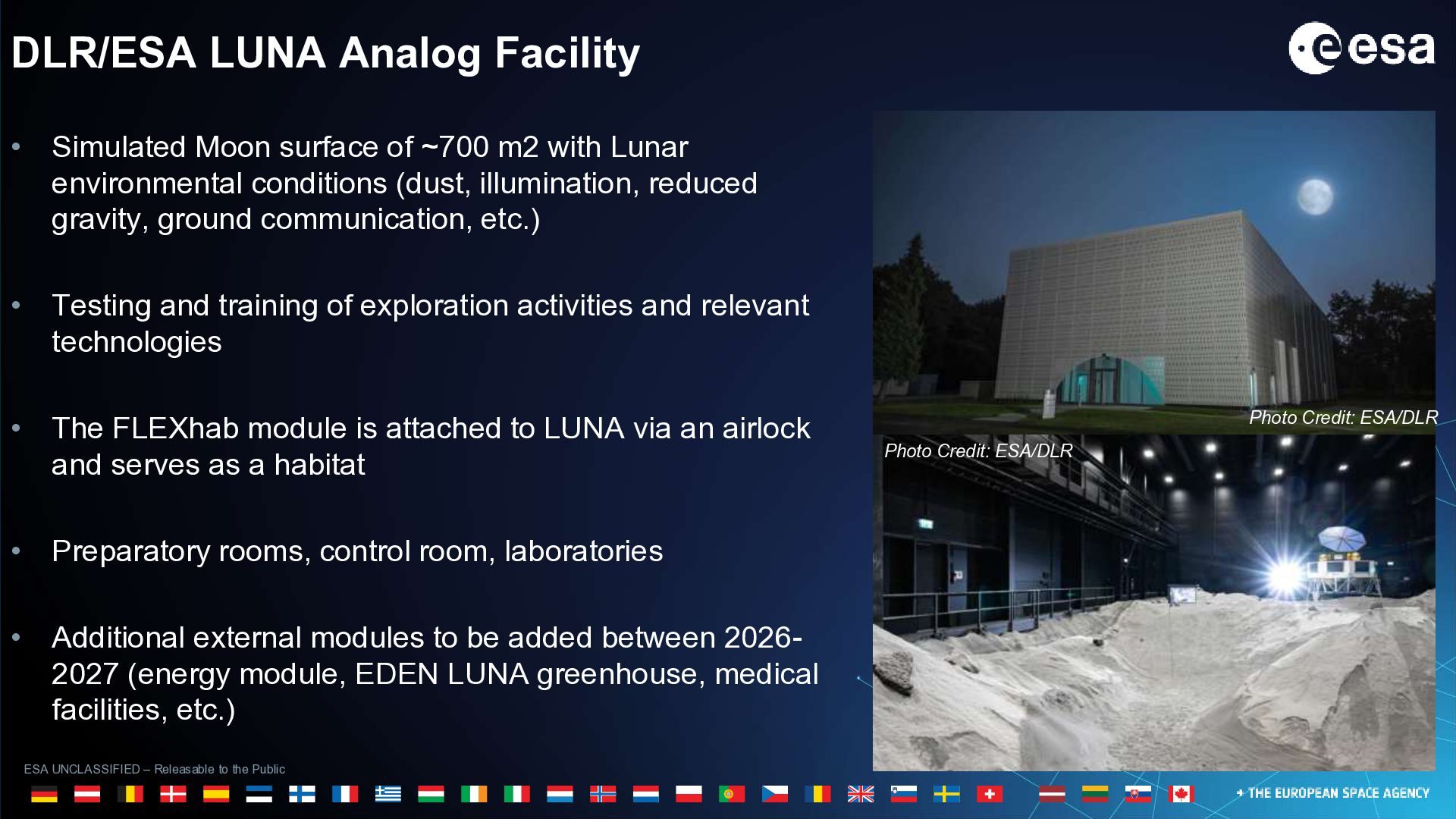
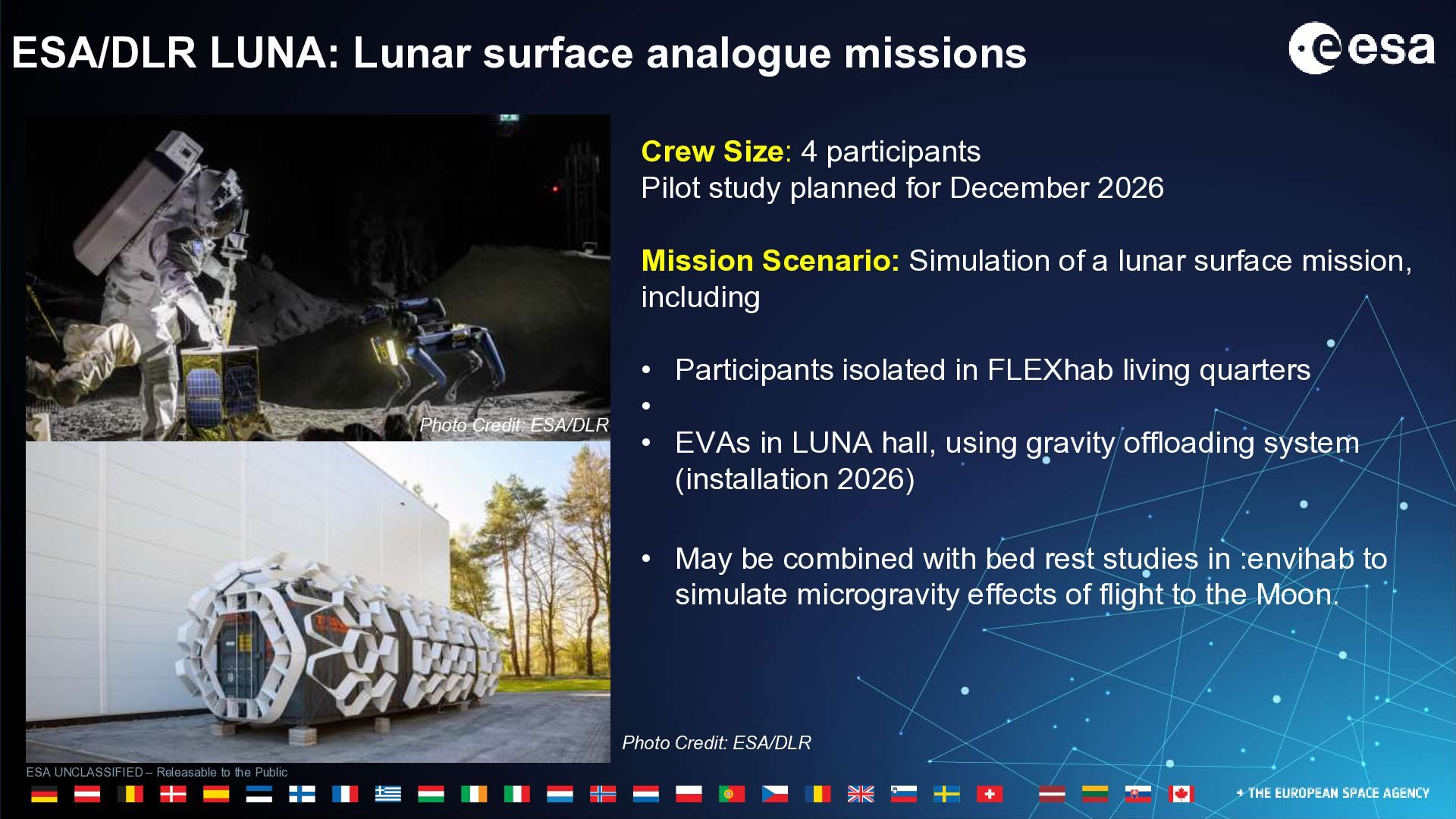
m2 with Lunar environmental conditions (dust, illumination, reduced gravity, ground communication, etc.) • Testing and training of exploration activities and relevant technologies • The FLEXhab module is attached to LUNA via an airlock and serves as a habitat • Preparatory rooms, control room, laboratories • Additional external modules to be added between 2026- 2027 (energy module, EDEN LUNA greenhouse, medical facilities, etc.) Photo Credit: ESA/DLR Photo Credit: ESA/DLR ESA UNCLASSIFIED – Releasable to the Public
Pilot study planned for December 2026 Mission Scenario: Simulation of a lunar surface mission, including • Participants isolated in FLEXhab living quarters • • EVAs in LUNA hall, using gravity offloading system (installation 2026) • May be combined with bed rest studies in :envihab to simulate microgravity effects of flight to the Moon. Photo Credit: ESA/DLR Photo Credit: ESA/DLR ESA UNCLASSIFIED – Releasable to the Public
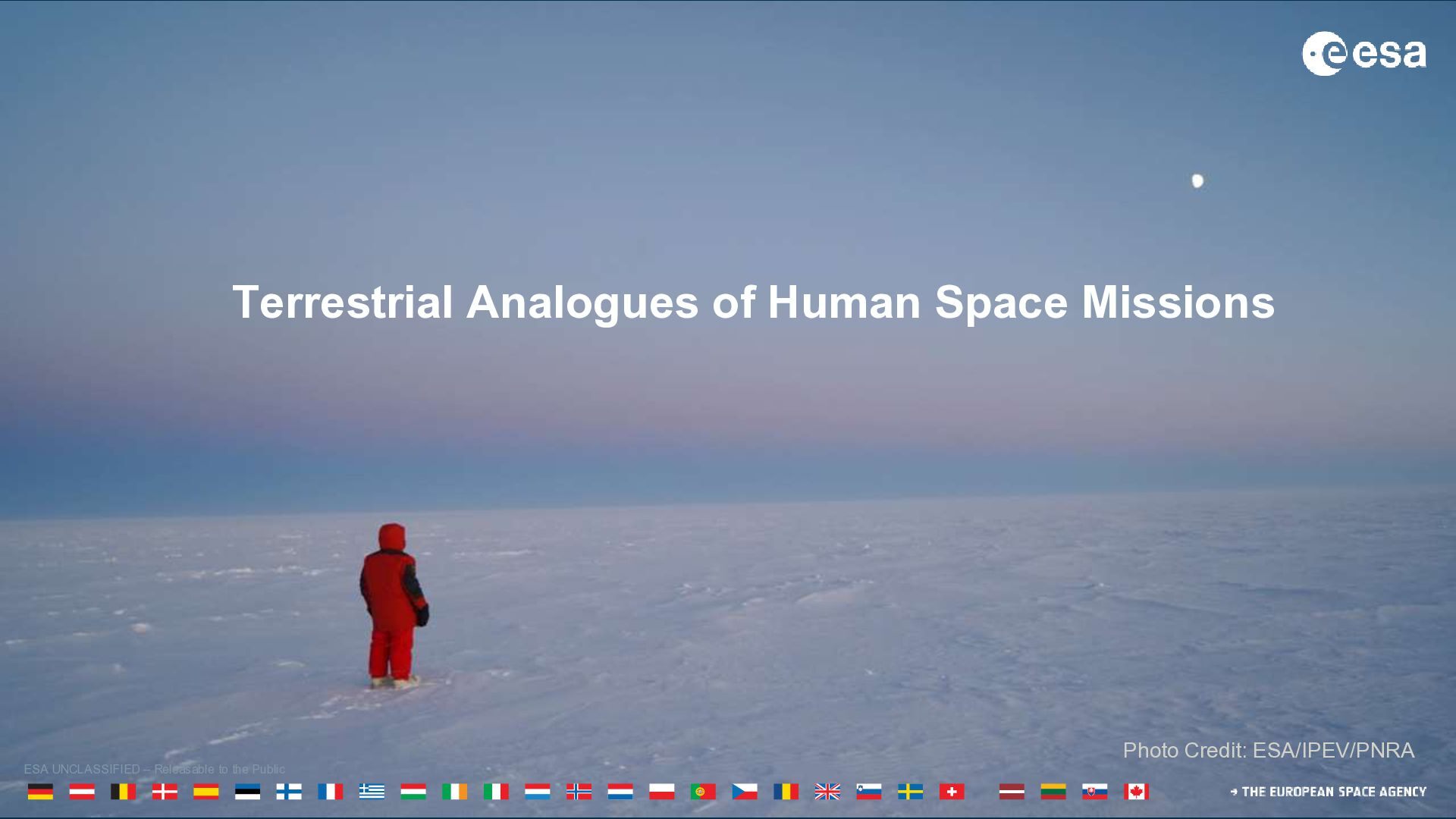
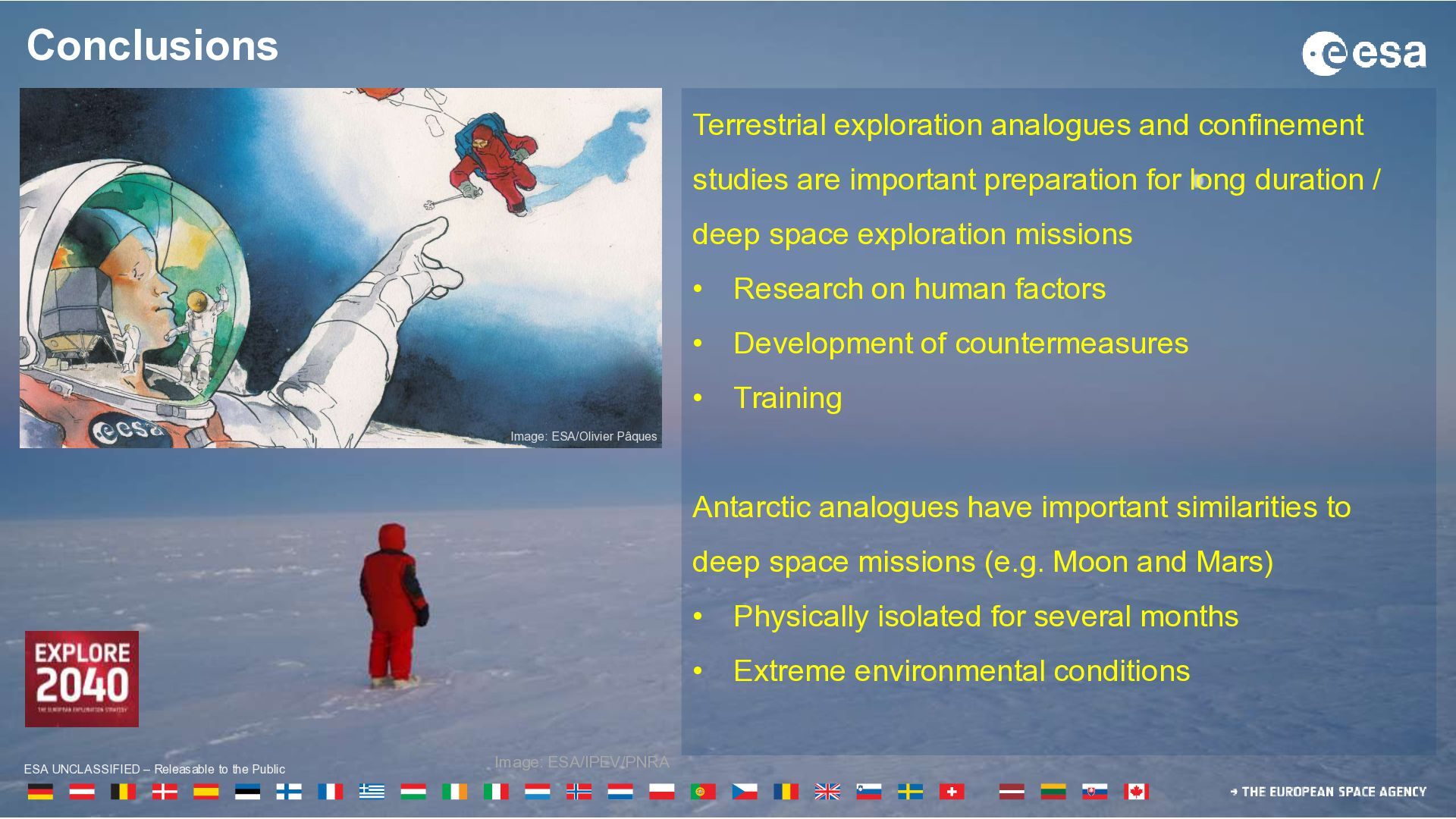
exploration analogues and confinement studies are important preparation for long duration / deep space exploration missions • Research on human factors • Development of countermeasures • Training Antarctic analogues have important similarities to deep space missions (e.g. Moon and Mars) • Physically isolated for several months • Extreme environmental conditions ESA UNCLASSIFIED – Releasable to the Public Image: ESA/Olivier Pâques Image: ESA/IPEV/PNRA
Innovation Platform (OSIP) at ideas.esa.int ESA’s tendering platform (esa-star) at https://esastar-publication- ext.sso.esa.int/ ESA UNCLASSIFIED – Releasable to the Public


 ipfevents
 voginip
 trycycle
 naokimuroki
.jpg) lychee1223
lychee1223
 shumpei777
 konakalab
 peterdesmet
 mclloyd
 baasie
 cromwellryan
 chriscoyier
 aleyda
 inesmontani
 paigeccino
 wayneb77
 watany
 szymonslowik
 jlugia
 irinanazarova