Share
Embed
Coroutines Made Easy
I reference the content of Kotlinconf 2019 and share some of my thoughts about Coroutines.
Ivan
January 18, 2020
Transcript
56 slides
-
Why Coroutines? • Coroutines ◦ Light-weight threads • Threads are
expensive ◦ Occupy 1-2 mb ◦ Require Thread pools to manage 3 -
Coroutine Builders • runBlocking ◦ Bridge between regular and suspend
functions • launch ◦ Fire and forget • async ◦ Expect result 4 -
CoroutineScope • Keep track of coroutines • Ability to cancel
ongoing work • Notified when a failure happens val scope = CoroutineScope(Job()) val job = scope.launch { ... } 5 -
finish complete start Job Lifecycle New Active Completing Completed Cancelling
cancel/fail cancel/fail Cancelled finish 6 -
CoroutineContext • CoroutineDispatcher -> Threading • Job -> Lifecycle •
CoroutineExceptionHandler • CoroutineName 7 -
How to Debug Coroutines? • Intellij ◦ jvmArgs ‘-ea’ •
Android ◦ • Debug Agent 8 System.setProperty("kotlinx.coroutines.debug", "on") https://proandroiddev.com/android-coroutine-recipes-33467a4302e9 D/main @coroutine#587 [stopCapturing] D/DefaultDispatcher-worker-1 @coroutine#589 [saveImageToGallery] -
Cancellation by CoroutineScope val scope = CoroutineScope(Job()) val job =
scope.launch { ... } val job2 = scope.launch { ... } scope.cancel() 10 -
Scopes in Android Active Cancelling Cancelled viewModelScope lifecycleScope .cancel() X
https://android.jlelse.eu/coroutine-in-android-working-with-lifecycle-fc9c1a31e5f3 11 -
val startTime = System.currentTimeMillis() val job = launch (Dispatchers.Default) {
var nextPrintTime = startTime var i = 0 while (i < 5) { if (...) { println("Hello ${i++}") nextPrintTime += 500L } } } delay(1000L) println("Cancel:") job.cancel() println("Done!") Hello 0 Hello 1 Hello 2 Cancel! Done! Hello 3 Hello 4 12 -
val startTime = System.currentTimeMillis() val job = launch (Dispatchers.Default) {
var nextPrintTime = startTime var i = 0 while (i < 5 && isActive) { if (...) { println("Hello ${i++}") nextPrintTime += 500L } } } delay(1000L) println("Cancel:") job.cancel() println("Done!") Hello 0 Hello 1 Hello 2 Cancel! Done! 14 -
val startTime = System.currentTimeMillis() val job = launch (Dispatchers.Default) {
var nextPrintTime = startTime var i = 0 while (i < 5) { ensureActive() if (...) { println("Hello ${i++}") nextPrintTime += 500L } } } delay(1000L) println("Cancel:") job.cancel() println("Done!") Hello 0 Hello 1 Hello 2 Cancel! Done! 15 -
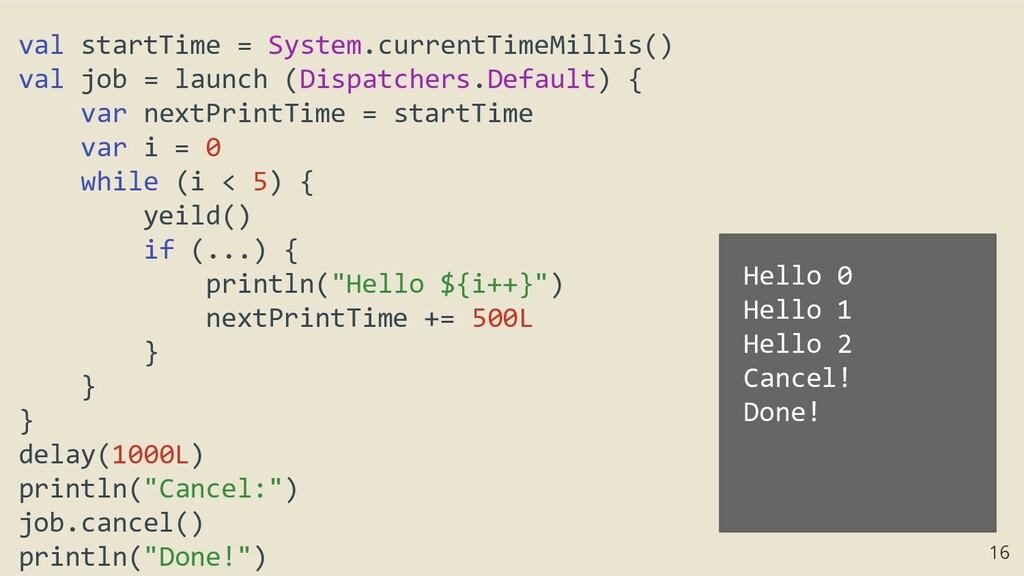
val startTime = System.currentTimeMillis() val job = launch (Dispatchers.Default) {
var nextPrintTime = startTime var i = 0 while (i < 5) { yeild() if (...) { println("Hello ${i++}") nextPrintTime += 500L } } } delay(1000L) println("Cancel:") job.cancel() println("Done!") Hello 0 Hello 1 Hello 2 Cancel! Done! 16 -
Cooperative Cancellation • isActive ◦ Do an action before finishing
the coroutine • ensureActive() ◦ Instantaneously stop work • yield() ◦ CPU heavy computation that may exhaust thread-pool 17 -
Cancellable Suspend Functions val job = launch { workOne() yield()
// or ensureActive() workTwo() } suspend fun workOne() = withContext(Dispatcher.IO) { otherWork() yield() // or ensureOtherWork() someOtherWork() } 18 -
val job = launch(Dispatchers.Default) { repeat(5) { println("Hello $it") delay(500)
} } delay(1000) job.join() println("Cancel!") job.cancel() println("Done!") Hello 0 Hello 1 Hello 2 Hello 3 Hello 4 Cancel! Done! 20 -
val job = launch(Dispatchers.Default) { repeat(5) { println("Hello $it") delay(500)
} } delay(1000) println("Cancel!") job.cancel() job.join() println("Done!") Hello 0 Hello 1 Cancel! Done! 21 -
val job = async(Dispatchers.Default) { repeat(5) { println("Hello $it") delay(500)
} } delay(1000) val result = job.await() println("Cancel!") job.cancel() println("Done!") Hello 0 Hello 1 Hello 2 Hello 3 Hello 4 Cancel! Done! 22 -
val job = async(Dispatchers.Default) { repeat(5) { println("Hello $it") delay(500)
} } delay(1000) println("Cancel!") job.cancel() val result = job.await() println("Done!") Hello 0 Hello 1 Cancel! Done! JobCancellationException: Job was cancelled! 23 -
Suspend Jobs Until the Job Is Completed • join() ◦
No action if completed • await() ◦ Throws if completed 24 -
val job = launch { try { work() } catch
(e: CancellationException) { println("Work cancelled!") } } delay(1000L) println("Cancel!") job.cancel() println("Done!") Hello 0 Hello 1 Cancel! Work cancelled! Done! 26 -
val job = launch { try { work() } finally
{ println("Clean up!") delay(1000L) println("Cleanup done!") } } delay(1000L) println("Cancel!") job.cancel() println("Done!") Hello 0 Hello 1 Cancel! Clean up! Done! 27 -
val job = launch { try { work() } finally
{ println("Clean up!") withContext(NonCancellable) { delay(1000L) println("Cleanup done!") } } } delay(1000L) println("Cancel!") job.cancel() println("Done!") Hello 0 Hello 1 Cancel! Clean up! Cleanup done! Done! 28 -
Failures in a Scope • The failure of child cancels
the scope & other children val scop = CoroutineScope(Job()) 32 -
SupervisorJob • The failure or cancellation of a child does
not affect other children val scop = CoroutineScope(SupervisorJob()) 33 -
val scope = CoroutineScope(Job()) scope.launch(SupervisorJob()) { launch { // Child
1 } launch { // Child 2 } } 36 -
val scope = CoroutineScope(Job()) scope.launch(SupervisorJob()) { launch { // Child
1 } launch { // Child 2 } } 37 -
val scope = CoroutineScope(Job()) scope.launch(SupervisorJob()) { launch { // Child
1 } launch { // Child 2 } } 38 SupervisorJob Job Child Job 1 Child Job 2 Job -
val scope = CoroutineScope(Job()) scope.launch(SupervisorJob()) { supervisorScope { launch {
// Child 1 } launch { // Child 2 } } } 39 -
val scope = CoroutineScope(Job()) val sharedJob = SupervisorJob() scope.launch(sharedJob) {
// Child 1 } scope.launch(sharedJob) { // Child 2 } 40 -
Try/Catch scope.launch { try { codeThatThrowsExpception() } catch (e: Exception)
{ // Handle it! } } 44 -
Try/Catch supervisorScope { val deferred = async { codeThatThrowsException() }
try { deferred.await() } catch (e: Exception) { // Handle it! } } 45 -
Try/Catch coroutineScope { val deferred = async { codeThatThrowsException() }
try { deferred.await() } catch (e: Exception) { // This won't be called! } } 46 -
Use runCatching() scope.launch { val result = runCatching { codeThatThrowsExceptions()
} if (result.isSuccess) { // Yeah! } else { // No! } } 47 -
CoroutineExceptionHandler val handler = CoroutineExceptionHandler { _, exception -> println("Caught
$exception") } val scope = CoroutineScope(Job() + handler) scope.launch { launch { throw Exception("Boom!") } } 48 -
CoroutineExceptionHandler val handler = CoroutineExceptionHandler { _, exception -> println("Caught
$exception") } val scope = CoroutineScope(Job()) scope.launch { launch(handler) { throw Exception("Boom!") } } 49 -
CoroutineExceptionHandler val handler = CoroutineExceptionHandler { _, exception -> println("Caught
$exception") } val scope = CoroutineScope(Job()) scope.launch(handler) { launch { throw Exception("Boom!") } } 50 -
Using kotlinx-coroutines-test • Experimental APIs • runBlockingTest() ◦ It executes
code in one thread ◦ Virtual-time control ◦ Cleanup assertions 52 -
Testing Tips • Always inject scope or dispatcher • Inject
main dispatcher ◦ Dispatchers.setMain ◦ Dispatchers.resetMain • Codelab 54 -
CREDITS: This presentation template was created by Slidesgo, including icons
by Flaticon, and infographics & images by Freepik. THANKS! Do you have any questions? 55 -
References 56 • KotlinConf 2019: Coroutines! Gotta catch 'em all!
by Florina Muntenescu & Manuel Vivo • KotlinConf 2019: Asynchronous Data Streams with Kotlin Flow by Roman Elizarov • KotlinConf 2019: Testing with Coroutines by Sean McQuillan • KotlinConf 2019: Coroutines Case Study - Cleaning Up an Async API by Tom Hanley