Upgrade to Pro — share decks privately, control downloads, hide ads and more …

DRM landscape and online streaming

Sponsored · Your Podcast. Everywhere. Effortlessly. Share. Educate. Inspire. Entertain. You do you. We'll handle the rest.
Avatar for Jas Chhabra Jas Chhabra
August 12, 2013

DRM landscape and online streaming

DRM landscape and online streaming
What is DRM? • DRM standards
• Microsoft Playready , Apple FairPlay , OMA DRM
• DRM Techniques • Streaming standards
• HTTP live stream, MPEG DASH etc. • DRM content playback
• Silverlight, Flash, HTML5 Premium Video Extensions

Avatar for Jas Chhabra

Jas Chhabra

August 12, 2013
Tweet

More Decks by Jas Chhabra

Other Decks in Technology

Transcript

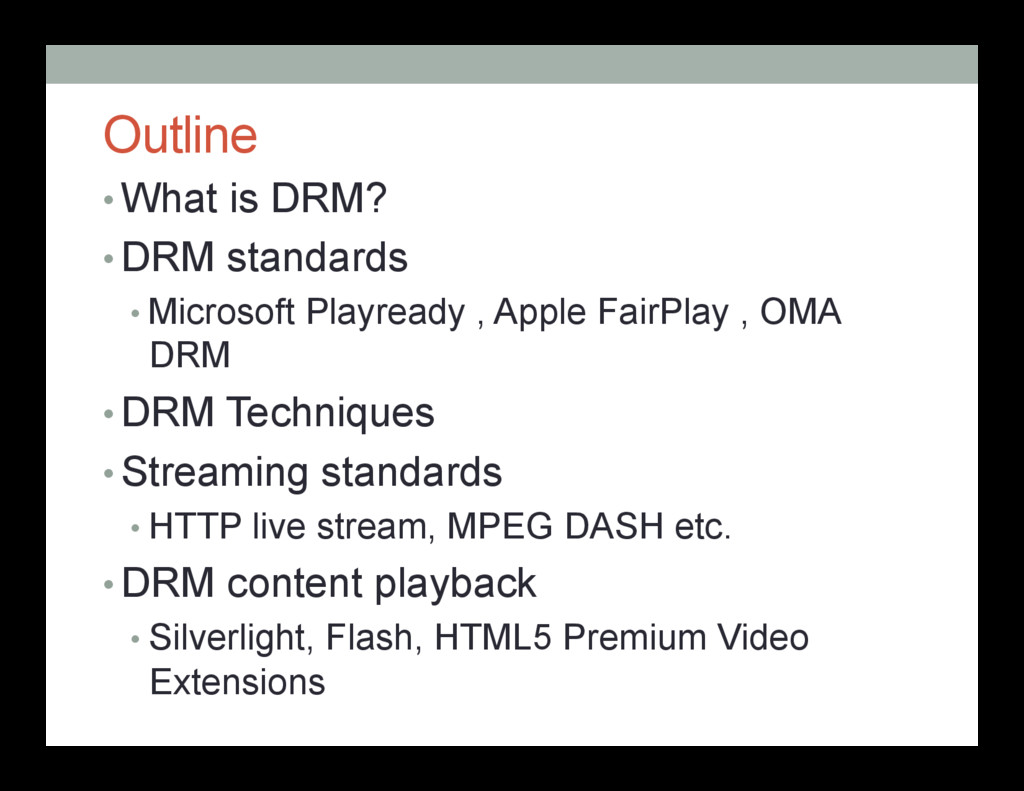
  1. Outline • What is DRM? • DRM standards • Microsoft Playready , Apple

    FairPlay , OMA DRM • DRM Techniques • Streaming standards • HTTP live stream, MPEG DASH etc. • DRM content playback • Silverlight, Flash, HTML5 Premium Video Extensions
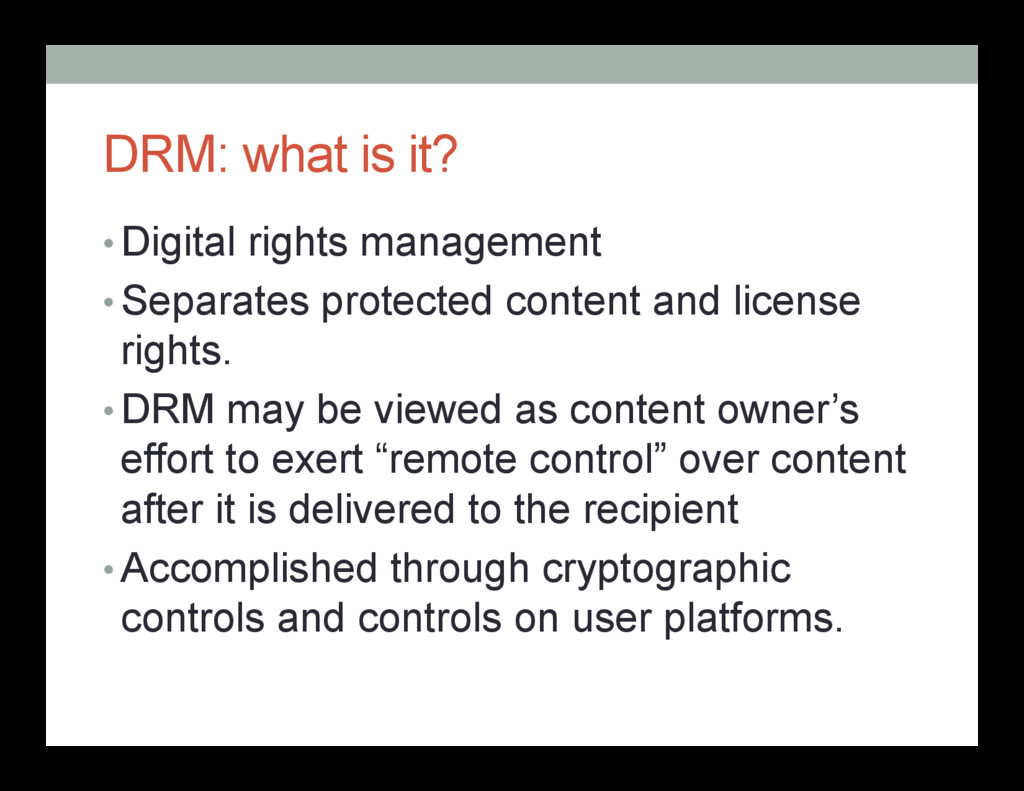
  2. DRM: what is it? • Digital rights management • Separates protected content

    and license rights. • DRM may be viewed as content owner’s effort to exert “remote control” over content after it is delivered to the recipient • Accomplished through cryptographic controls and controls on user platforms.
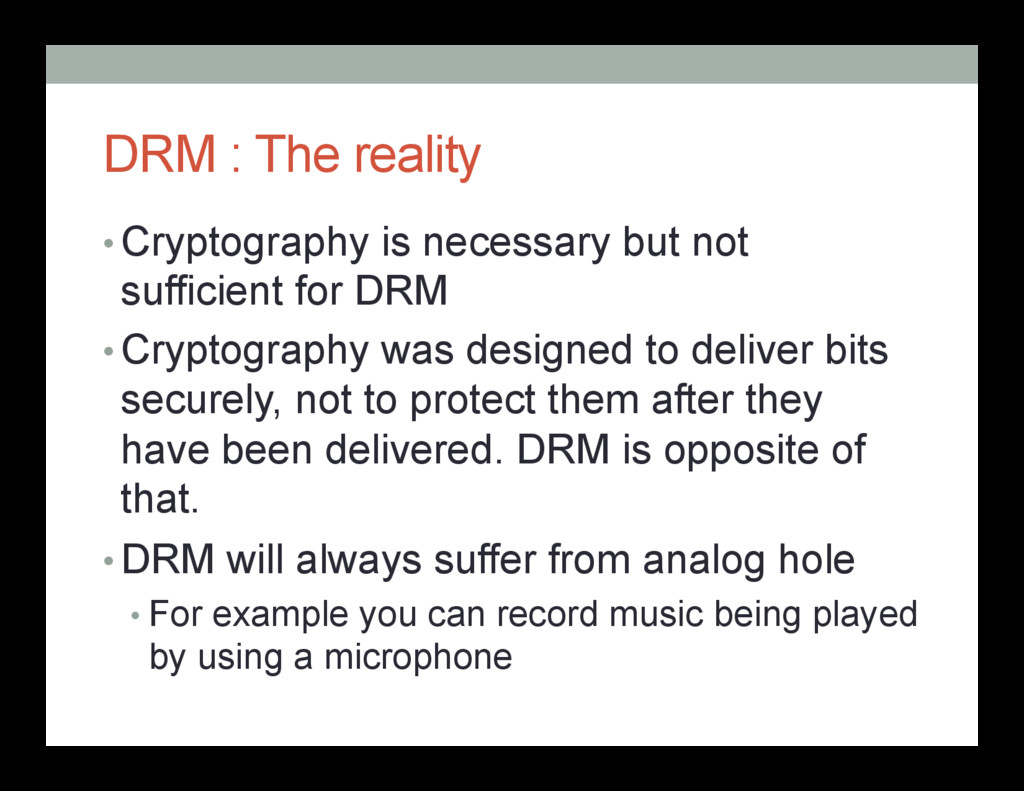
  3. DRM : The reality • Cryptography is necessary but not sufficient

    for DRM • Cryptography was designed to deliver bits securely, not to protect them after they have been delivered. DRM is opposite of that. • DRM will always suffer from analog hole • For example you can record music being played by using a microphone
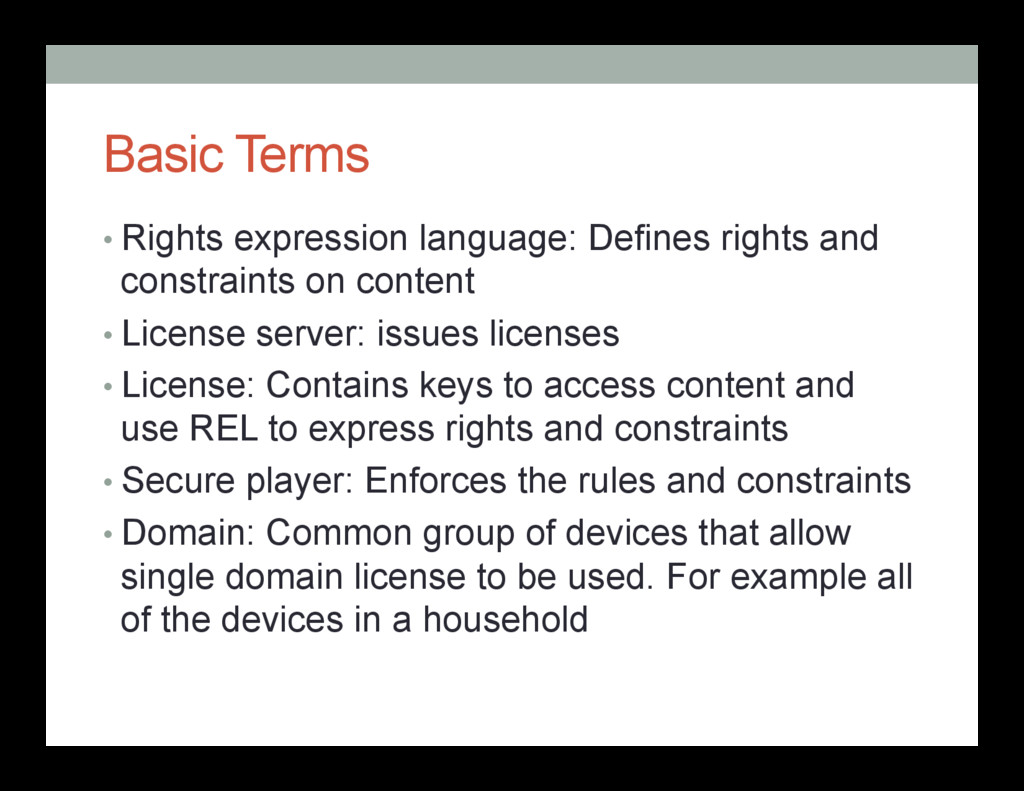
  4. Basic Terms • Rights expression language: Defines rights and constraints on

    content • License server: issues licenses • License: Contains keys to access content and use REL to express rights and constraints • Secure player: Enforces the rules and constraints • Domain: Common group of devices that allow single domain license to be used. For example all of the devices in a household
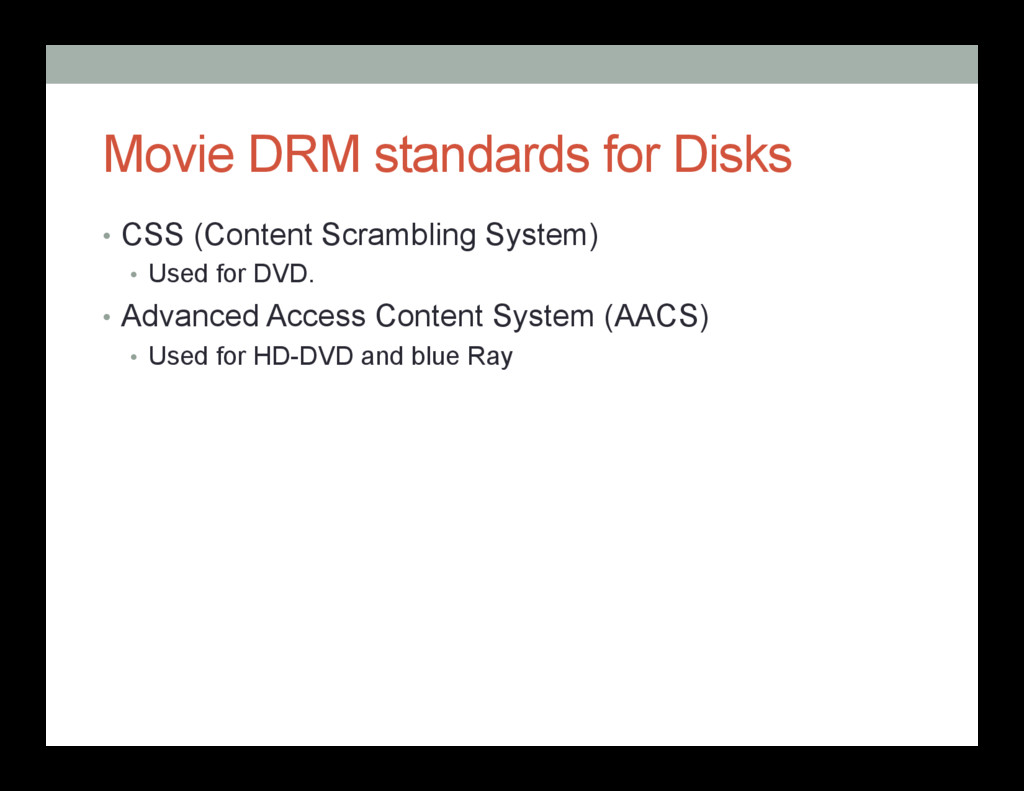
  5. Movie DRM standards for Disks •  CSS (Content Scrambling System)

    •  Used for DVD. •  Advanced Access Content System (AACS) •  Used for HD-DVD and blue Ray
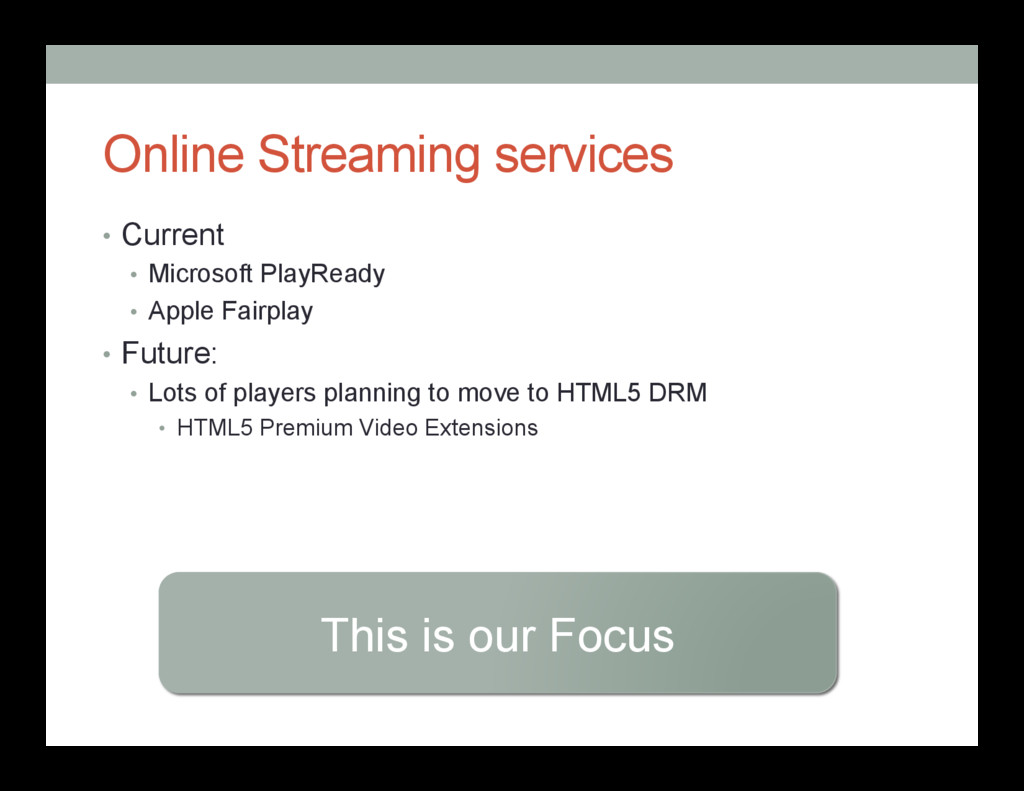
  6. Online Streaming services •  Current •  Microsoft PlayReady •  Apple

    Fairplay •  Future: •  Lots of players planning to move to HTML5 DRM •  HTML5 Premium Video Extensions This is our Focus
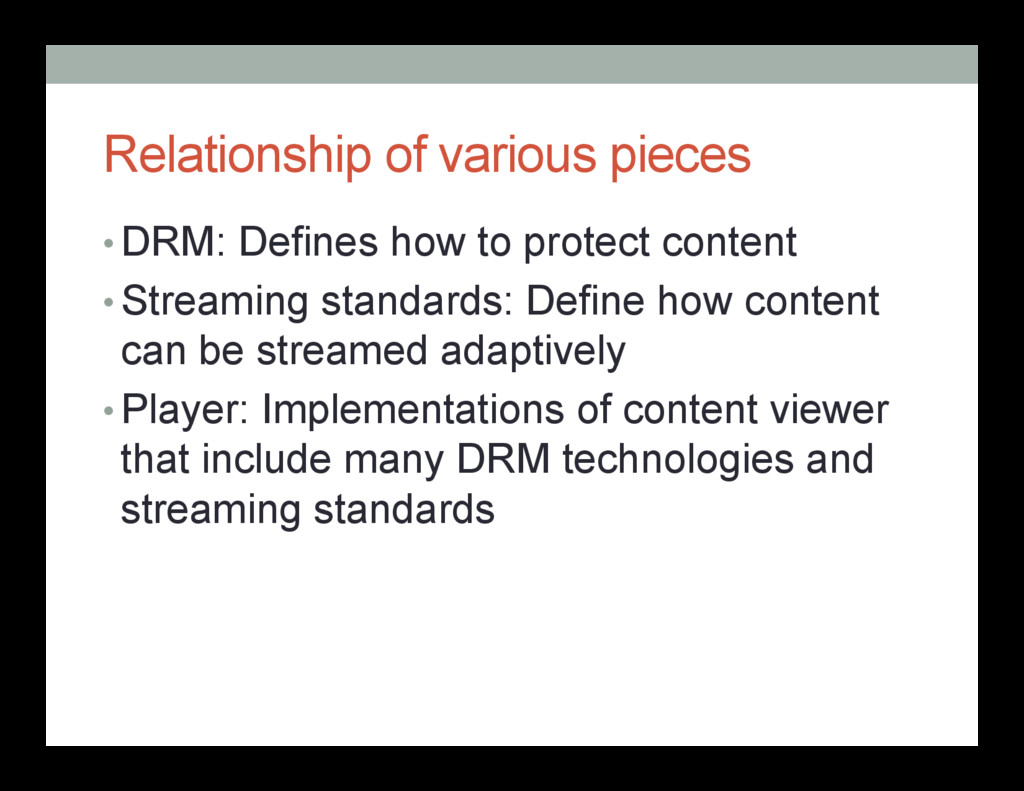
  7. Relationship of various pieces • DRM: Defines how to protect content

    • Streaming standards: Define how content can be streamed adaptively • Player: Implementations of content viewer that include many DRM technologies and streaming standards
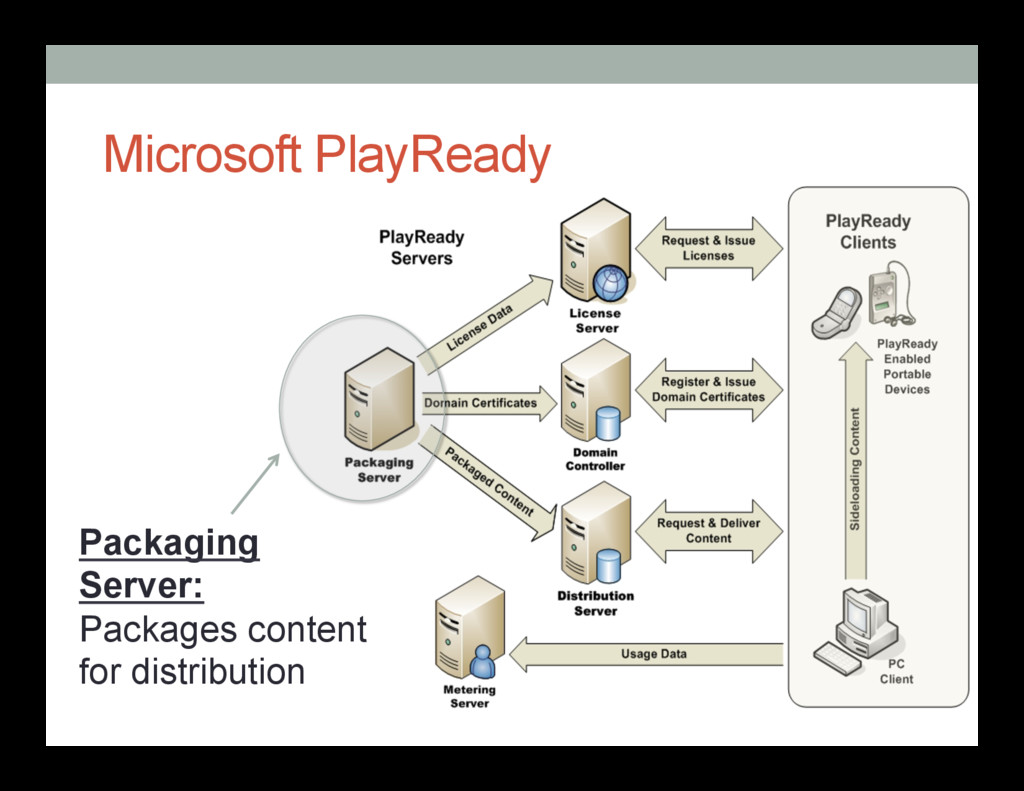
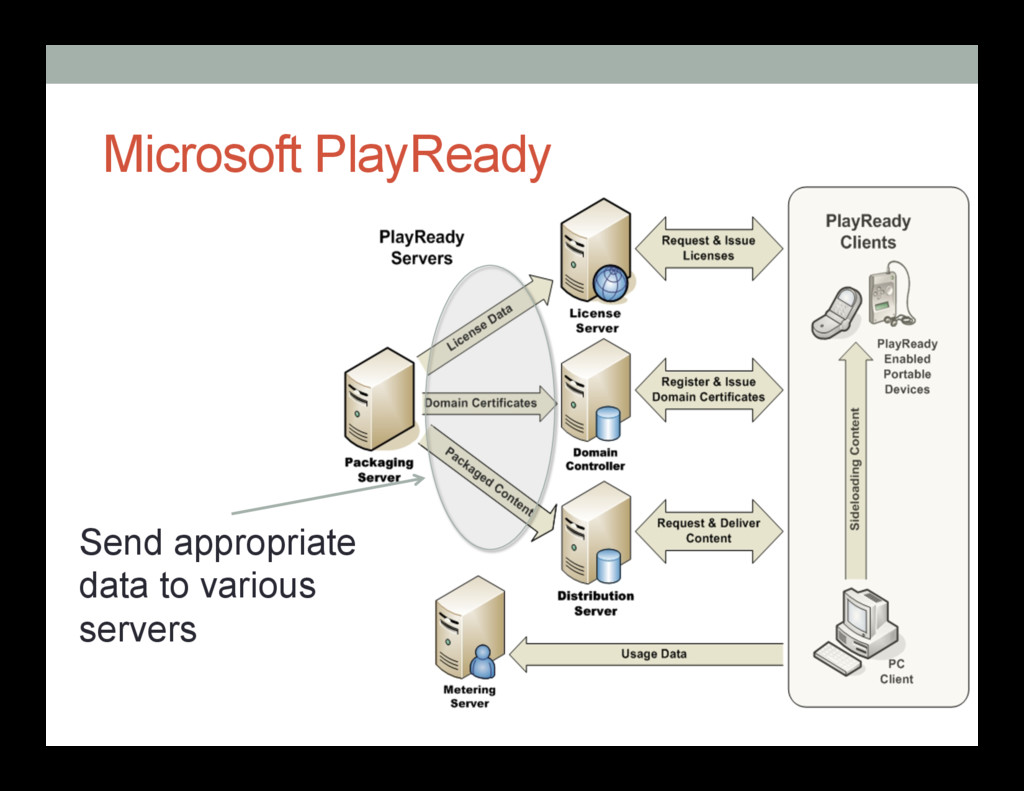
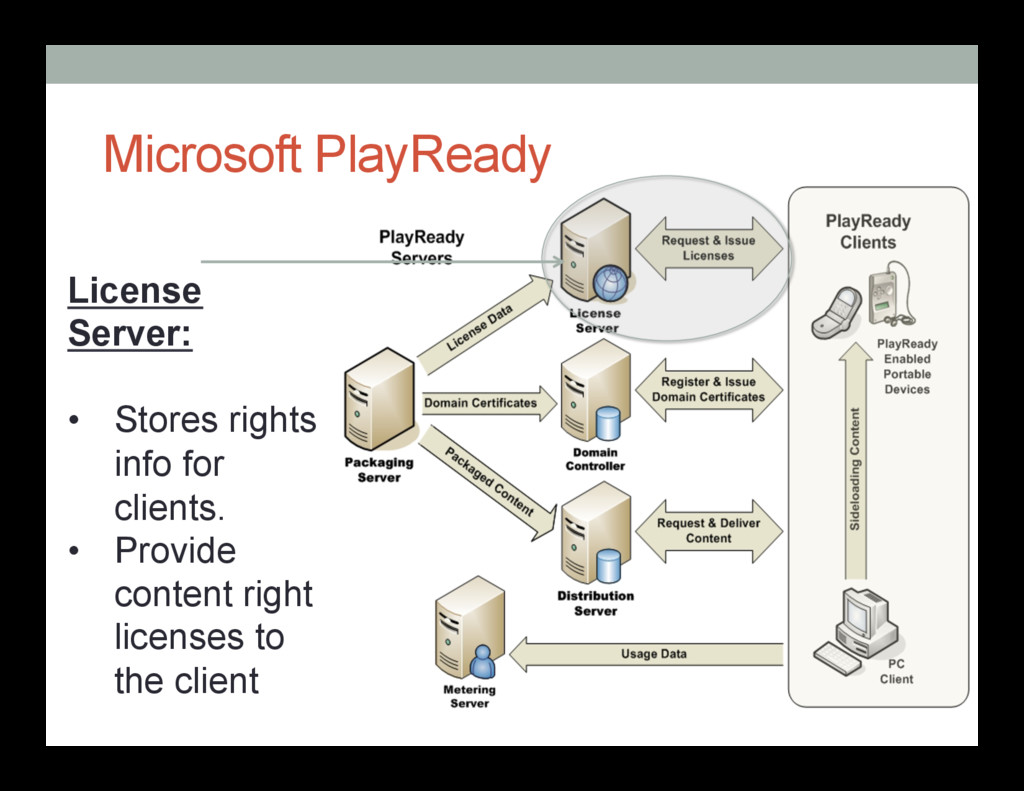
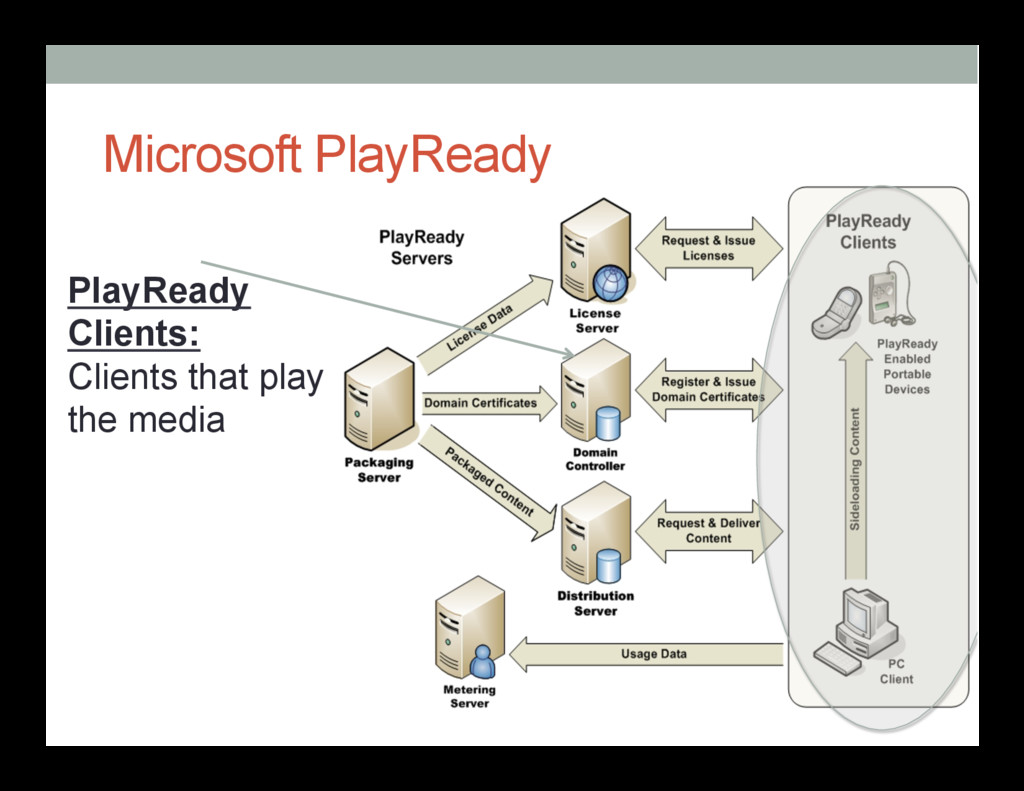
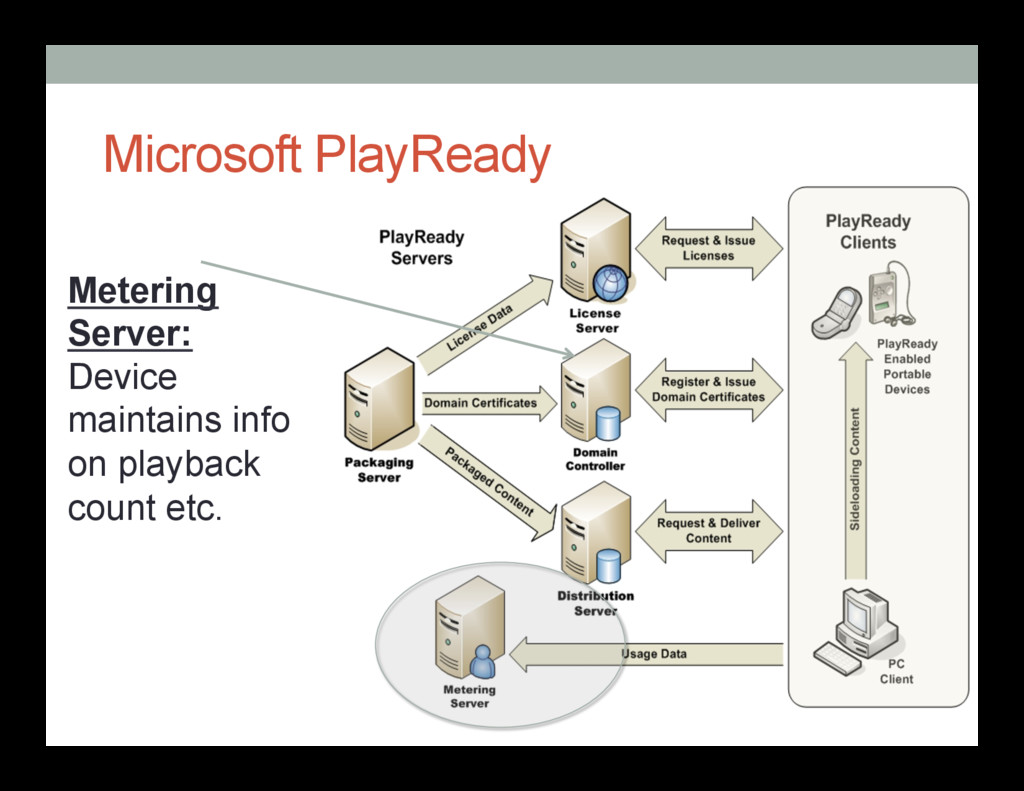
  8. Microsoft PlayReady License Server: •  Stores rights info for clients.

    •  Provide content right licenses to the client
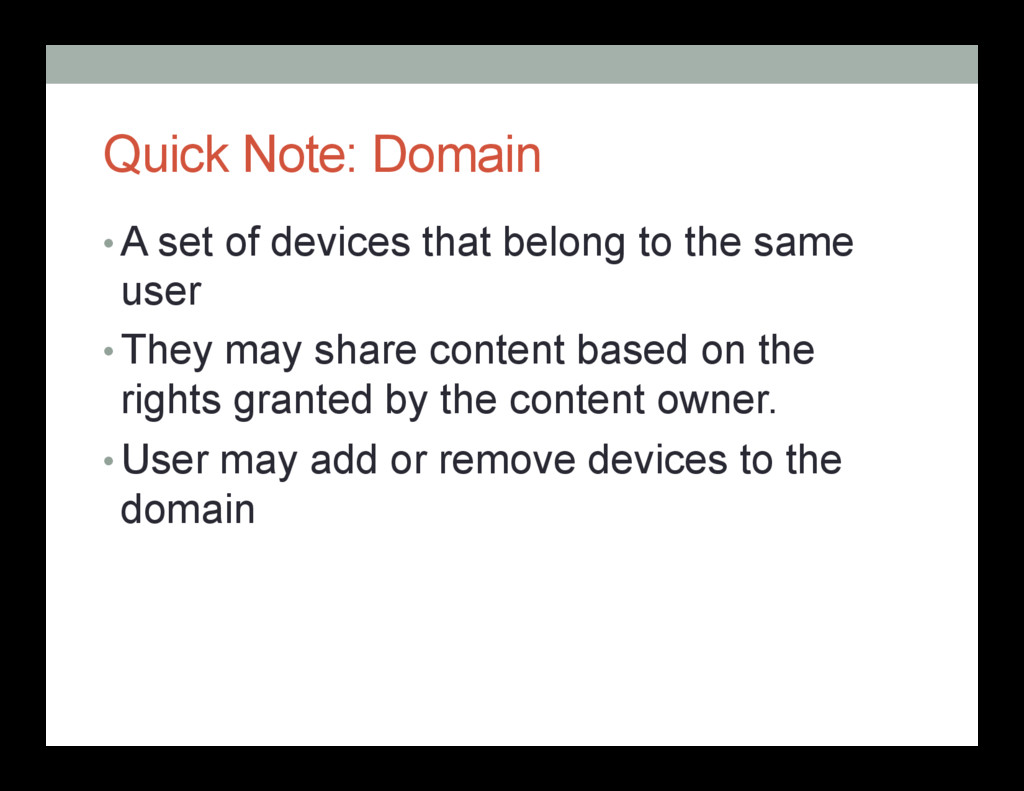
  9. Quick Note: Domain • A set of devices that belong to

    the same user • They may share content based on the rights granted by the content owner. • User may add or remove devices to the domain
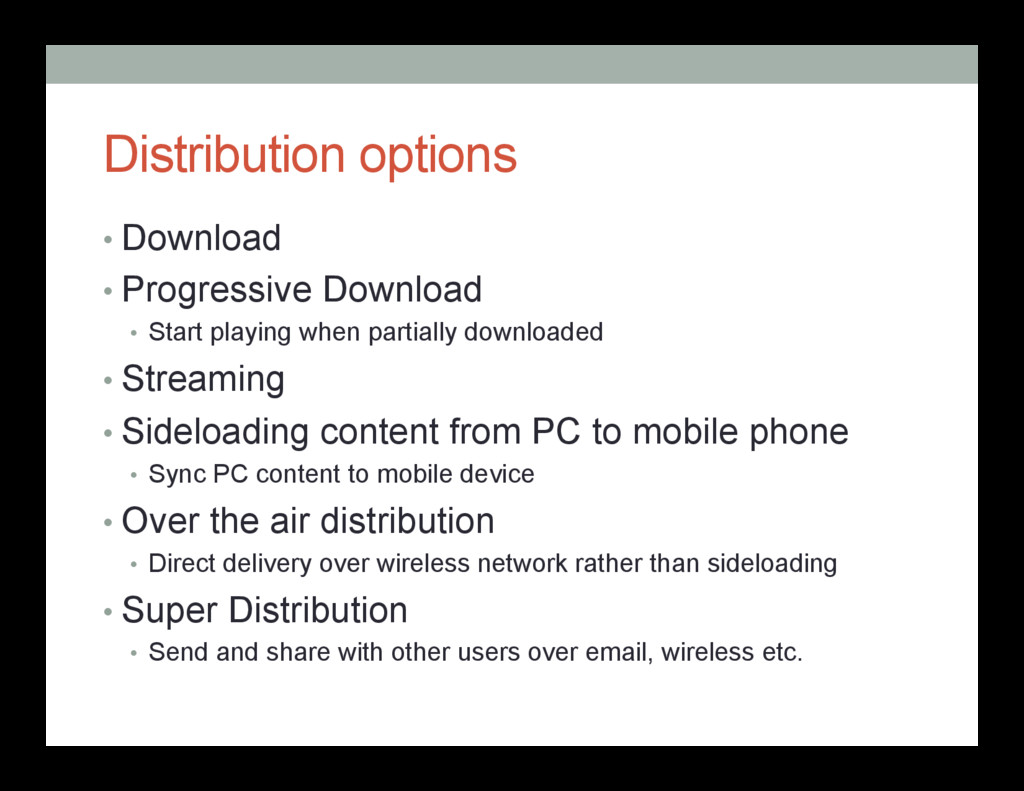
  10. Distribution options • Download • Progressive Download •  Start playing when partially

    downloaded • Streaming • Sideloading content from PC to mobile phone •  Sync PC content to mobile device • Over the air distribution •  Direct delivery over wireless network rather than sideloading • Super Distribution •  Send and share with other users over email, wireless etc.
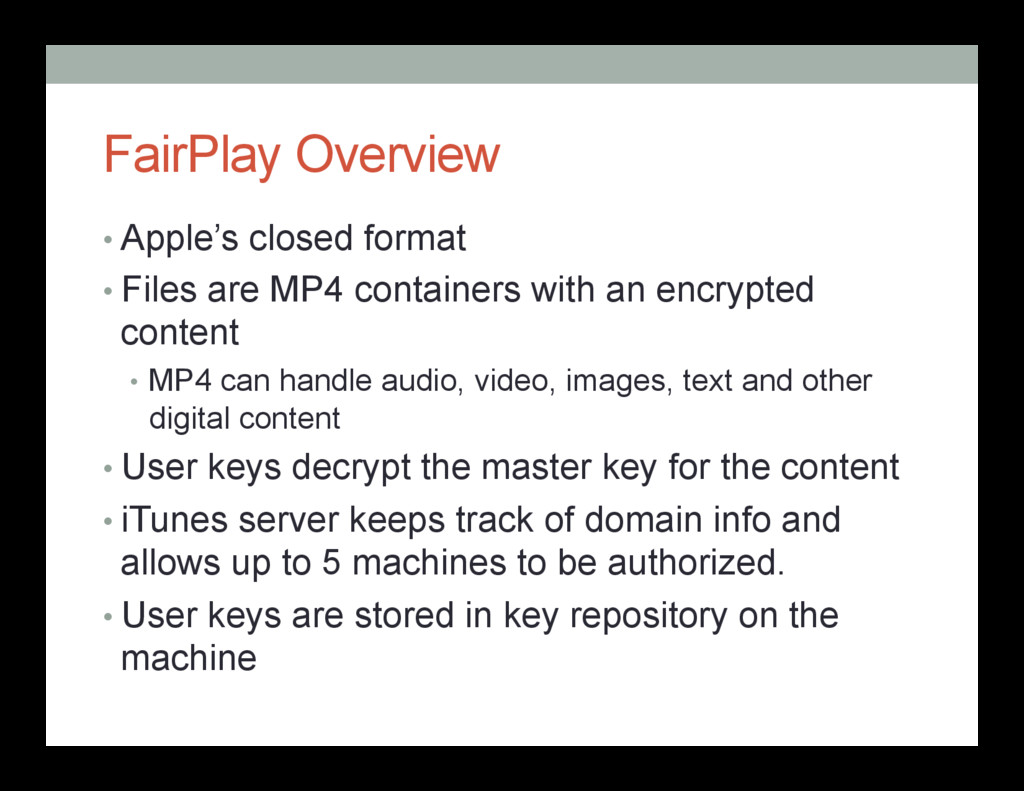
  11. FairPlay Overview • Apple’s closed format • Files are MP4 containers with

    an encrypted content •  MP4 can handle audio, video, images, text and other digital content • User keys decrypt the master key for the content • iTunes server keeps track of domain info and allows up to 5 machines to be authorized. • User keys are stored in key repository on the machine
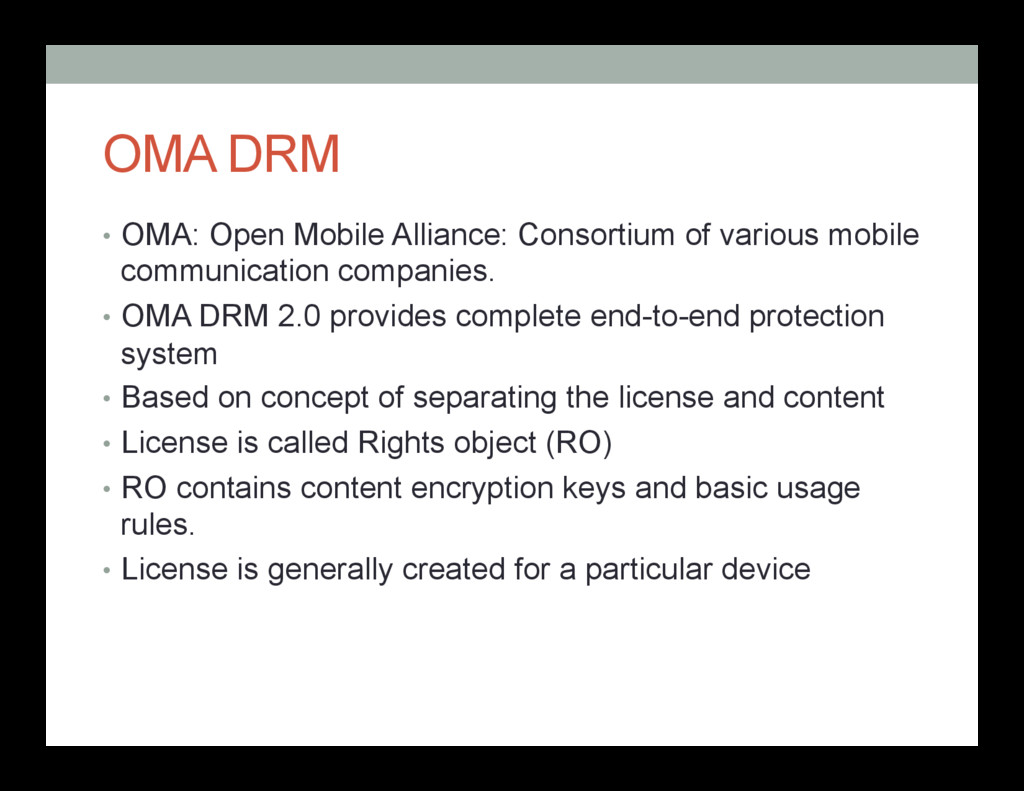
  12. OMA DRM •  OMA: Open Mobile Alliance: Consortium of various

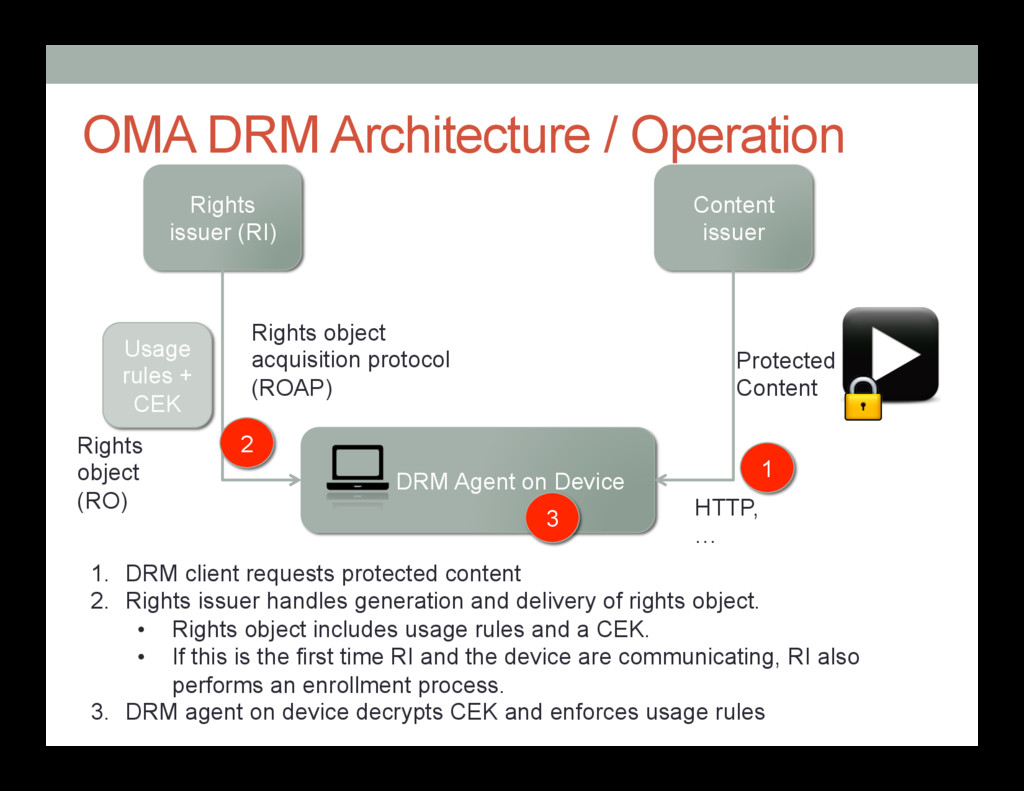
    mobile communication companies. •  OMA DRM 2.0 provides complete end-to-end protection system •  Based on concept of separating the license and content •  License is called Rights object (RO) •  RO contains content encryption keys and basic usage rules. •  License is generally created for a particular device
  13. OMA DRM Architecture / Operation Rights issuer (RI) DRM Agent

    on Device Content issuer Usage rules + CEK Rights object (RO) Rights object acquisition protocol (ROAP) HTTP, … Protected Content 1 1.  DRM client requests protected content 2.  Rights issuer handles generation and delivery of rights object. •  Rights object includes usage rules and a CEK. •  If this is the first time RI and the device are communicating, RI also performs an enrollment process. 3.  DRM agent on device decrypts CEK and enforces usage rules 2 3
  14. Other OMA DRM Concept • Domain: Set of devices where content

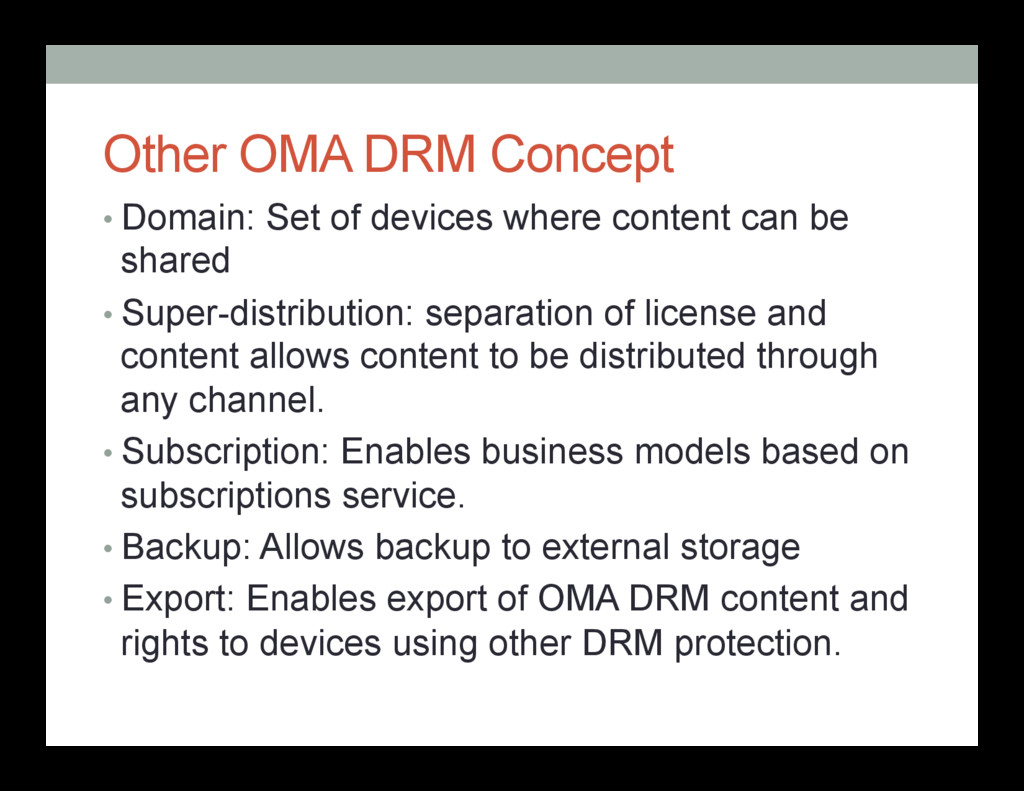
    can be shared • Super-distribution: separation of license and content allows content to be distributed through any channel. • Subscription: Enables business models based on subscriptions service. • Backup: Allows backup to external storage • Export: Enables export of OMA DRM content and rights to devices using other DRM protection.
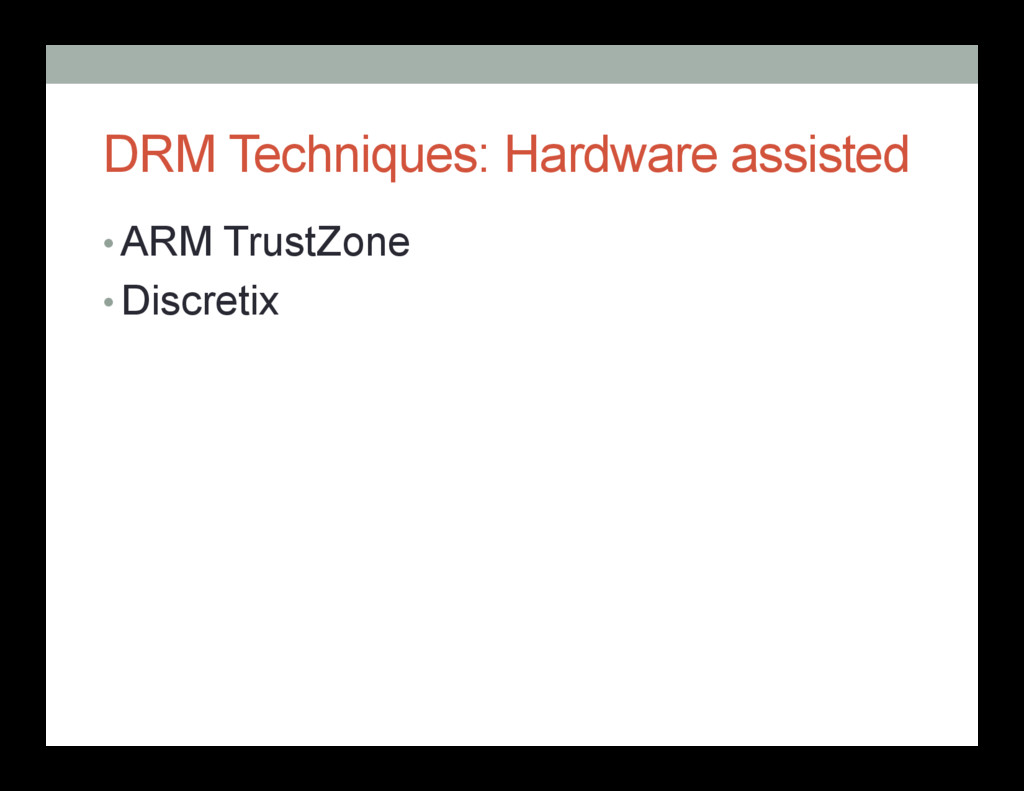
  15. DRM Techniques: Software Defense • Goal: Make it harder to reverse

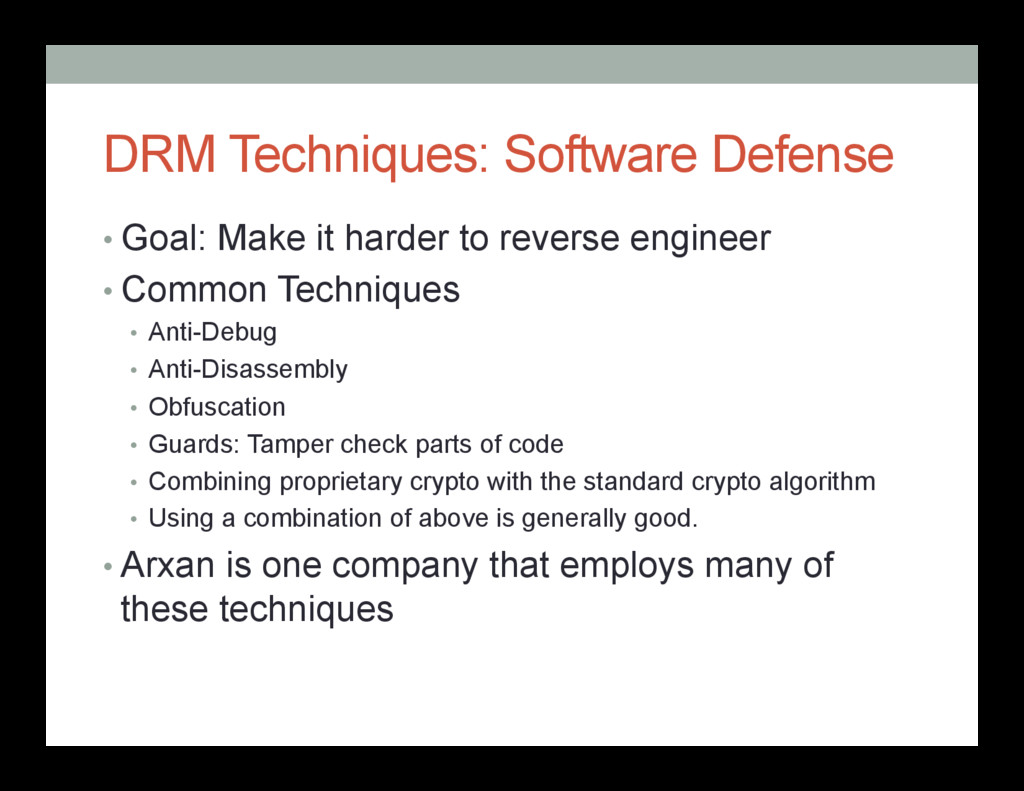
    engineer • Common Techniques •  Anti-Debug •  Anti-Disassembly •  Obfuscation •  Guards: Tamper check parts of code •  Combining proprietary crypto with the standard crypto algorithm •  Using a combination of above is generally good. • Arxan is one company that employs many of these techniques
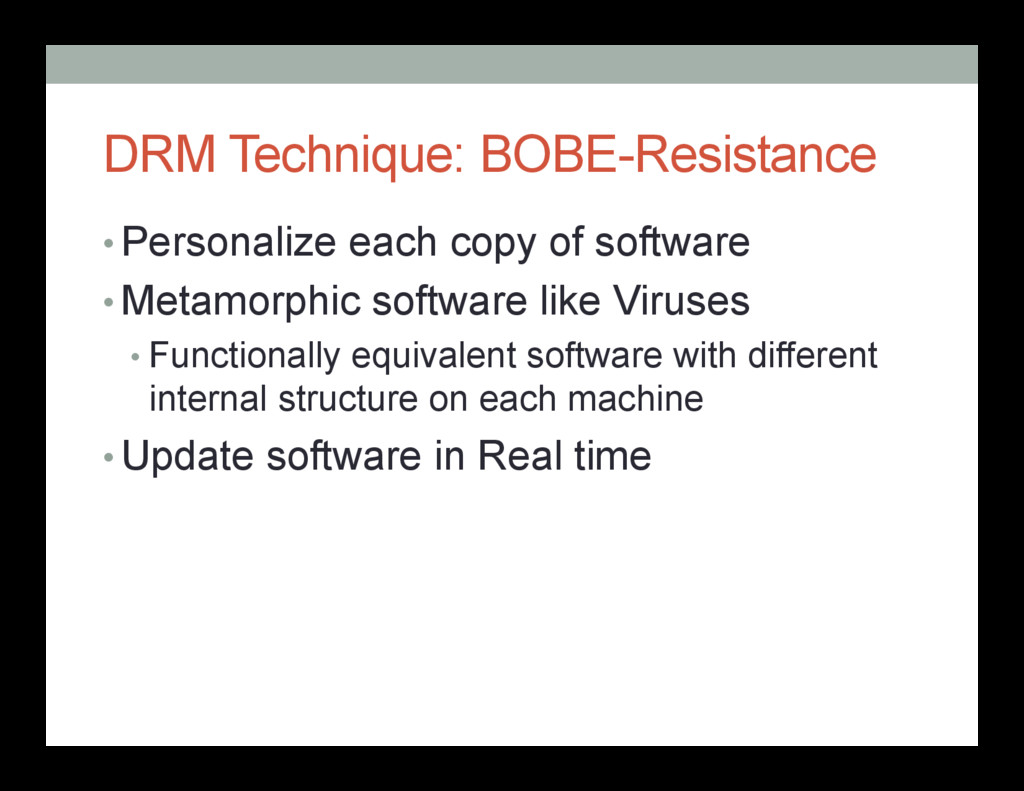
  16. DRM Technique: BOBE-Resistance • Personalize each copy of software • Metamorphic software

    like Viruses • Functionally equivalent software with different internal structure on each machine • Update software in Real time
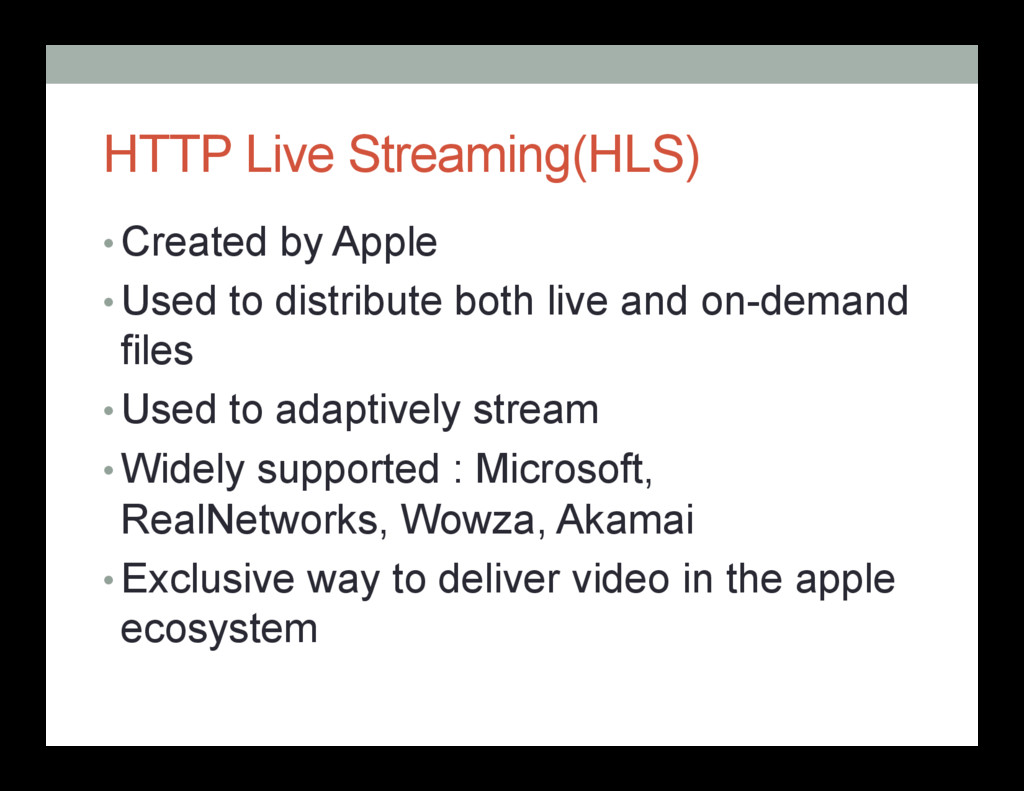
  17. HTTP Live Streaming(HLS) • Created by Apple • Used to distribute both

    live and on-demand files • Used to adaptively stream • Widely supported : Microsoft, RealNetworks, Wowza, Akamai • Exclusive way to deliver video in the apple ecosystem
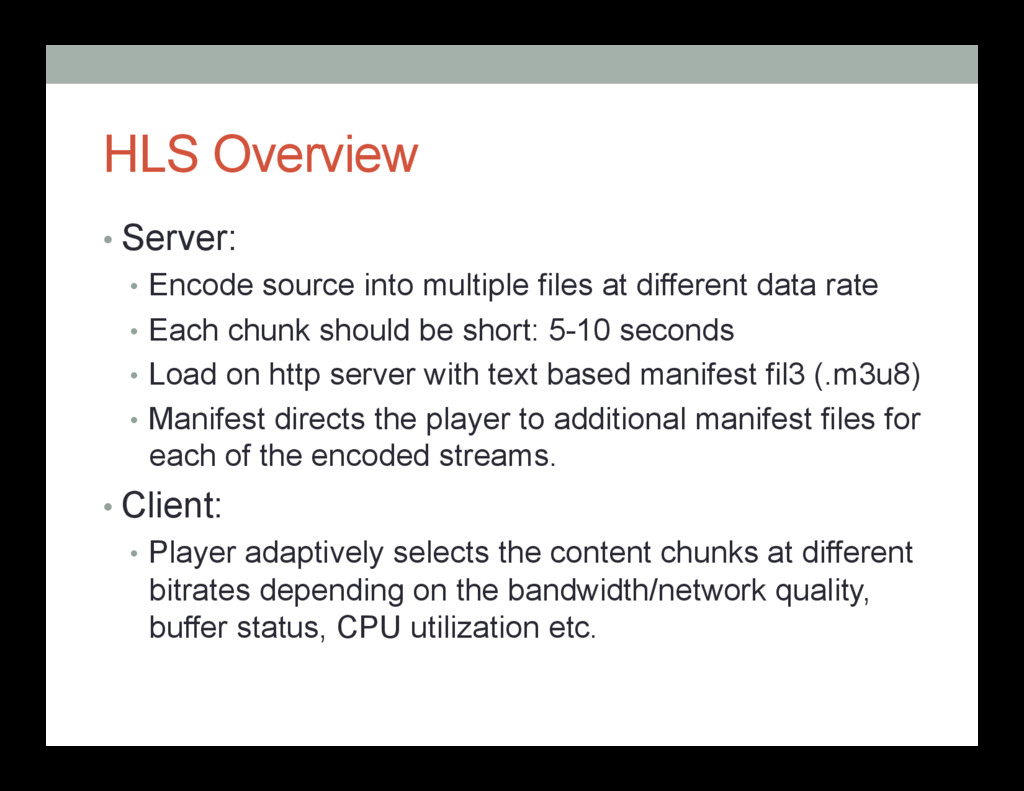
  18. HLS Overview • Server: •  Encode source into multiple files at

    different data rate •  Each chunk should be short: 5-10 seconds •  Load on http server with text based manifest fil3 (.m3u8) •  Manifest directs the player to additional manifest files for each of the encoded streams. • Client: •  Player adaptively selects the content chunks at different bitrates depending on the bandwidth/network quality, buffer status, CPU utilization etc.
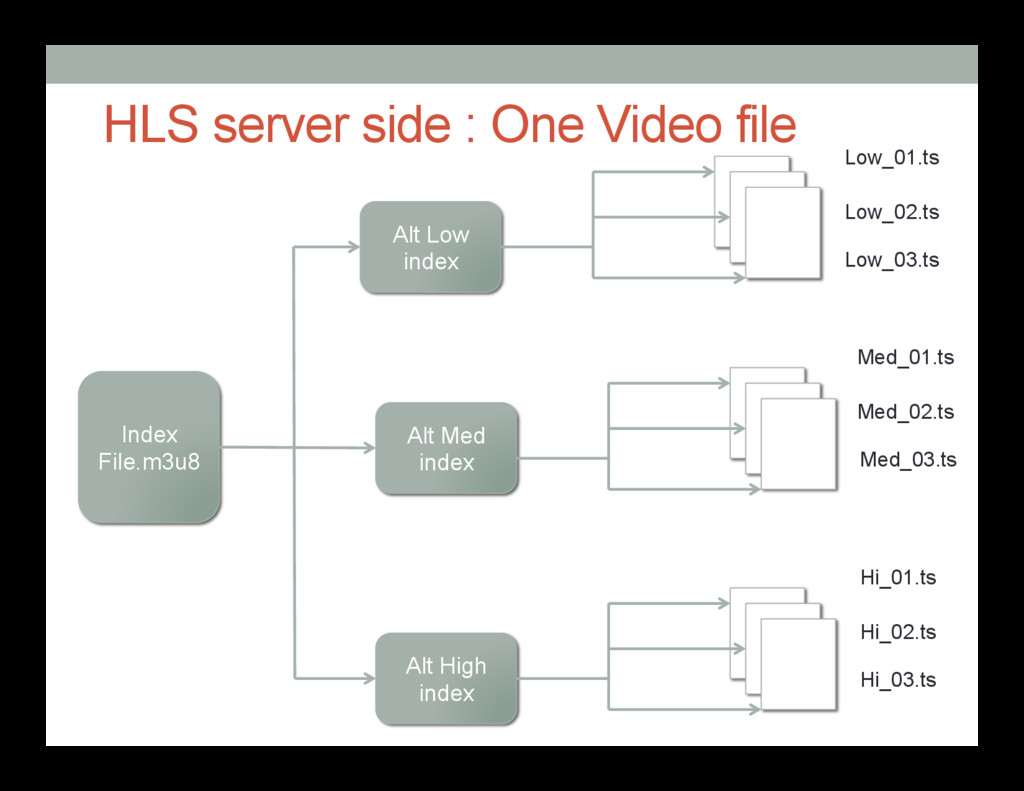
  19. HLS server side : One Video file Index File.m3u8 Alt

    Low index Alt Med index Alt High index Low_01.ts Low_02.ts Low_03.ts Med_01.ts Med_02.ts Med_03.ts Hi_01.ts Hi_02.ts Hi_03.ts
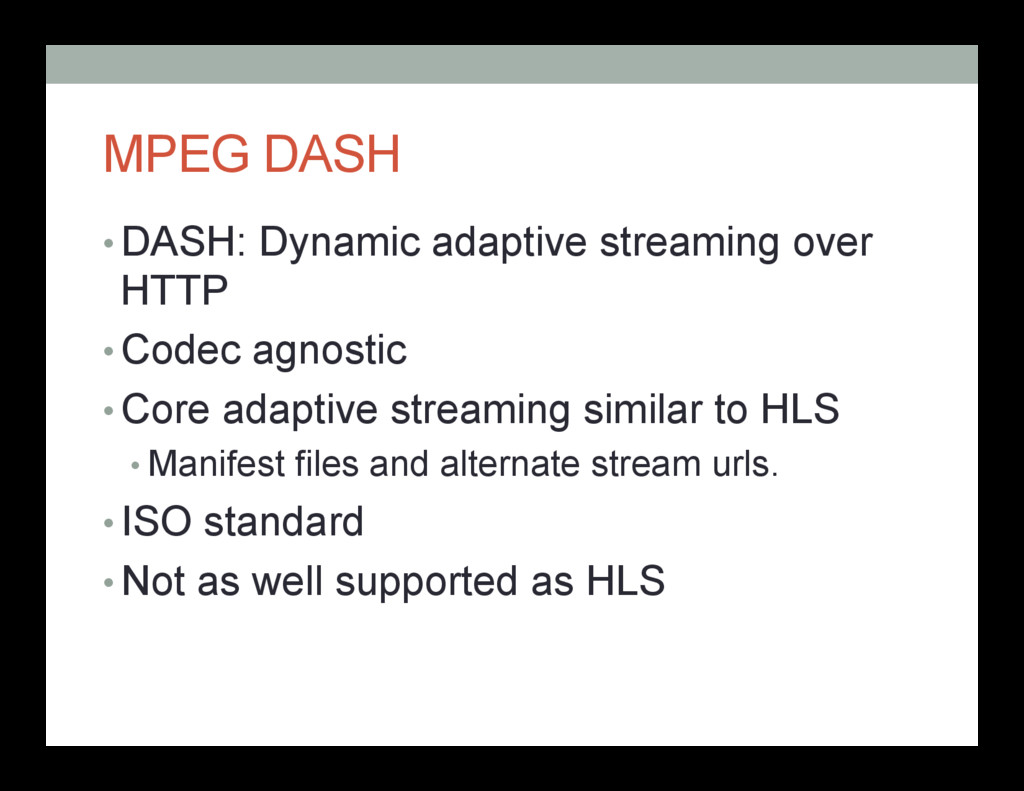
  20. MPEG DASH • DASH: Dynamic adaptive streaming over HTTP • Codec agnostic

    • Core adaptive streaming similar to HLS • Manifest files and alternate stream urls. • ISO standard • Not as well supported as HLS
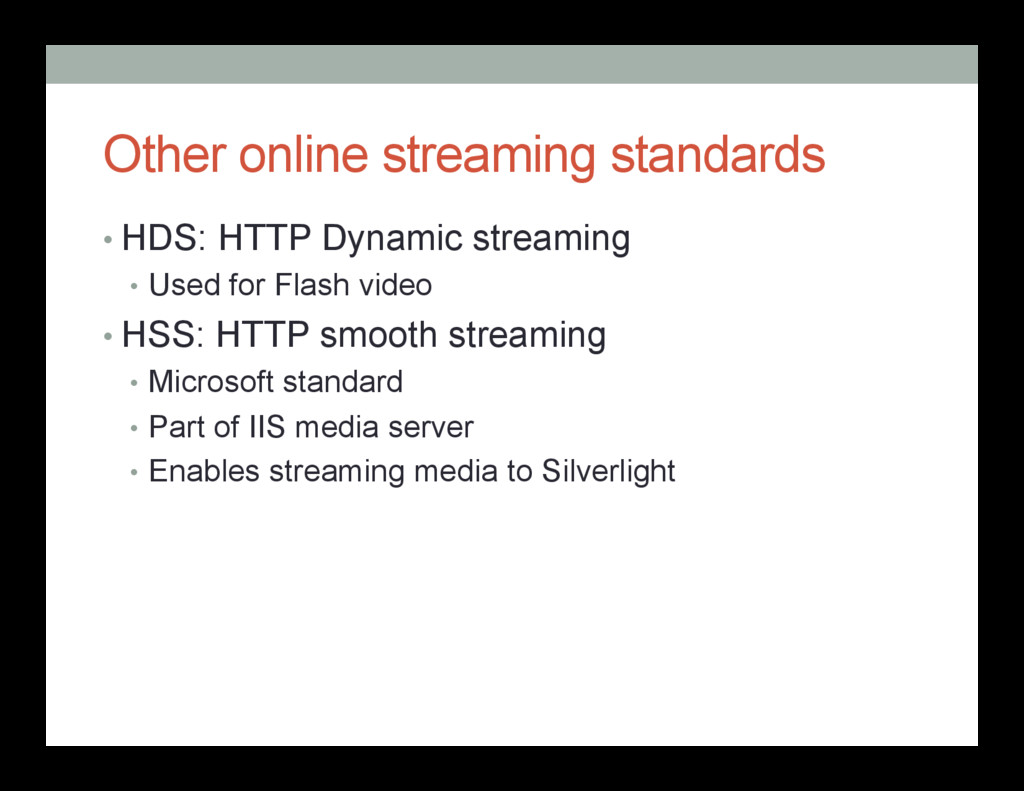
  21. Other online streaming standards • HDS: HTTP Dynamic streaming •  Used

    for Flash video • HSS: HTTP smooth streaming •  Microsoft standard •  Part of IIS media server •  Enables streaming media to Silverlight
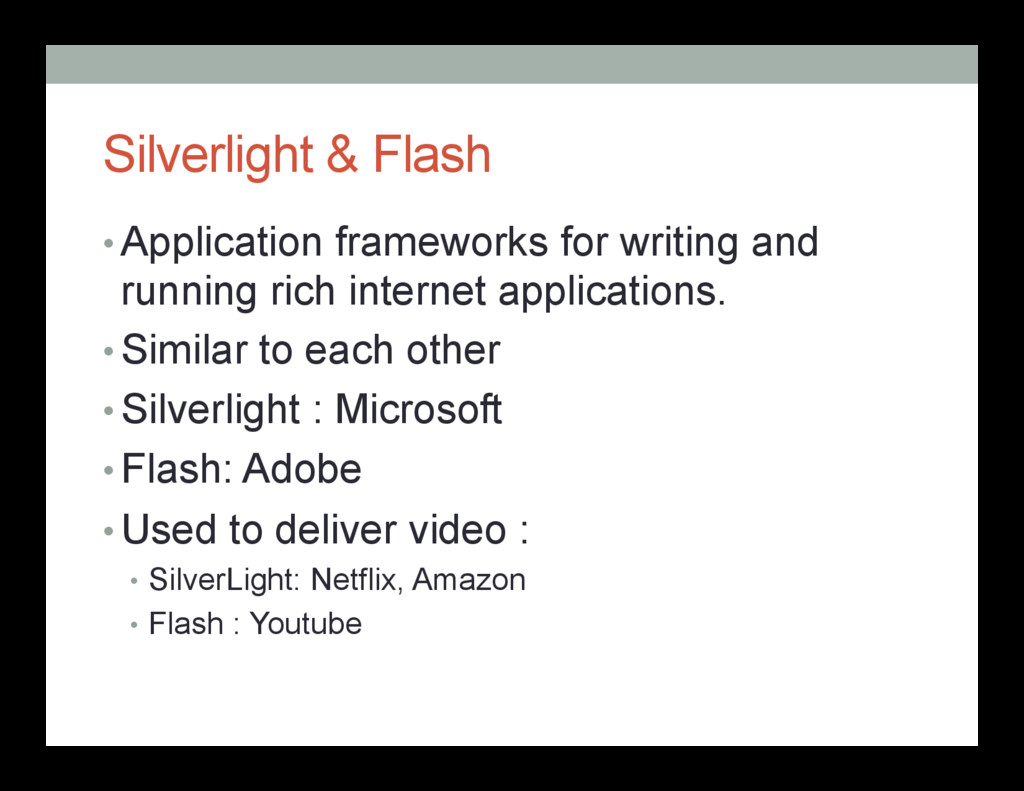
  22. Silverlight & Flash • Application frameworks for writing and running rich

    internet applications. • Similar to each other • Silverlight : Microsoft • Flash: Adobe • Used to deliver video : •  SilverLight: Netflix, Amazon •  Flash : Youtube
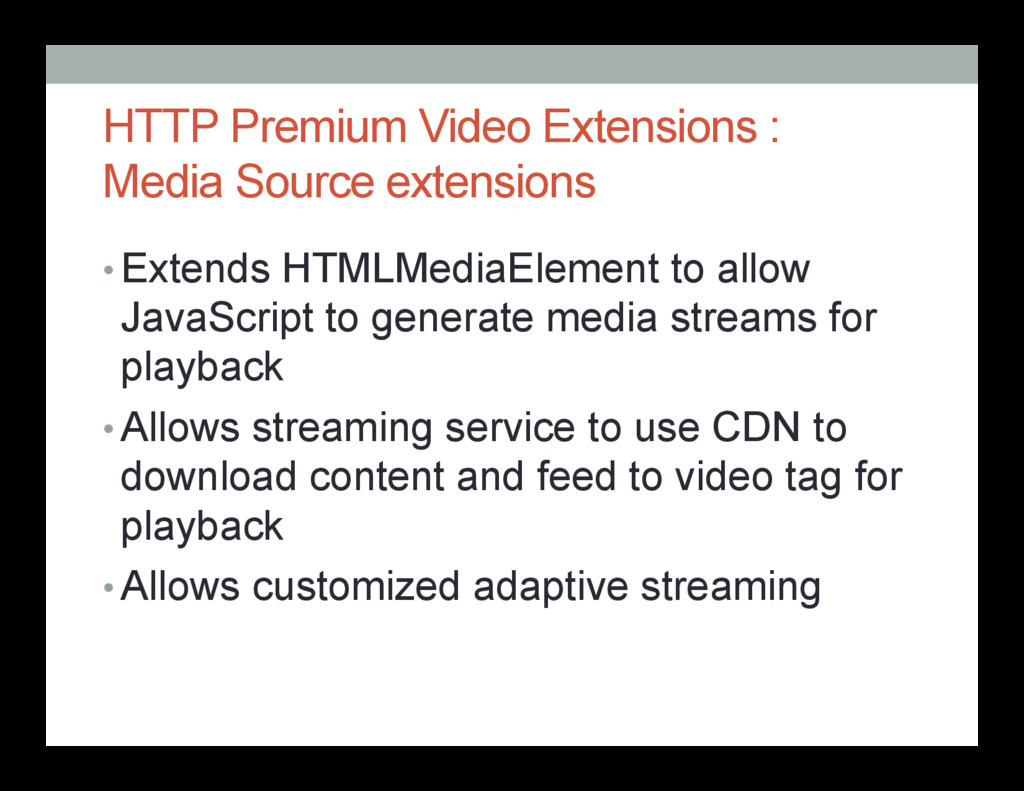
  23. HTTP Premium Video Extensions : Media Source extensions • Extends HTMLMediaElement

    to allow JavaScript to generate media streams for playback • Allows streaming service to use CDN to download content and feed to video tag for playback • Allows customized adaptive streaming
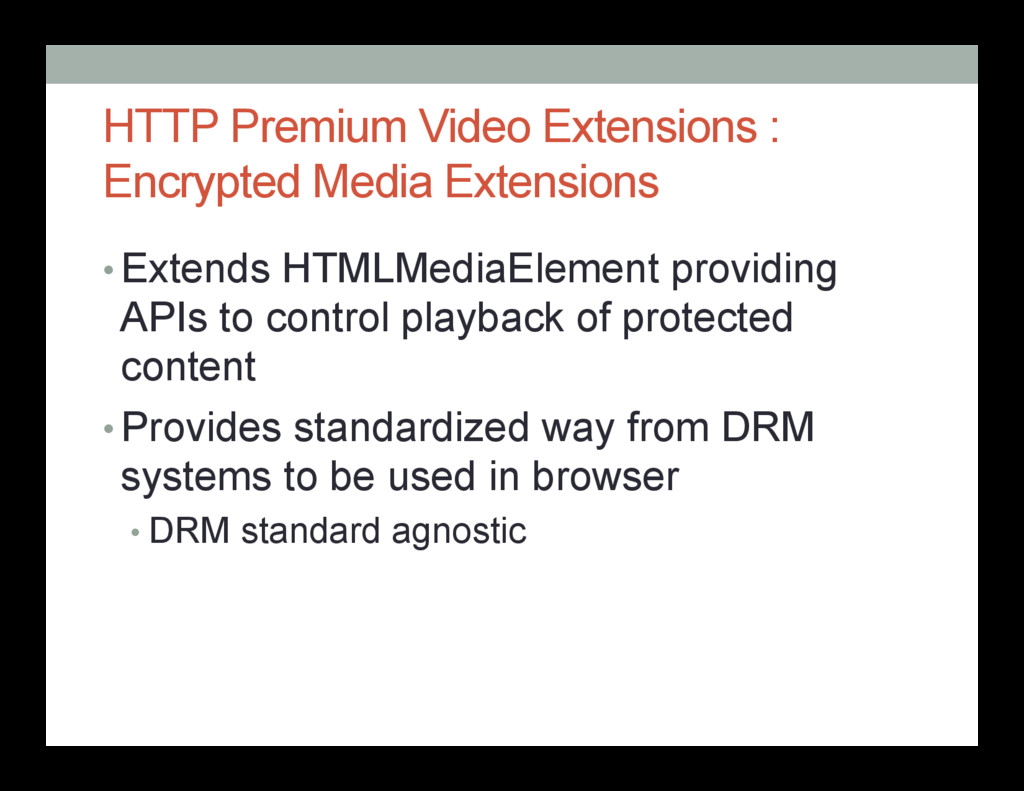
  24. HTTP Premium Video Extensions : Encrypted Media Extensions • Extends HTMLMediaElement

    providing APIs to control playback of protected content • Provides standardized way from DRM systems to be used in browser • DRM standard agnostic
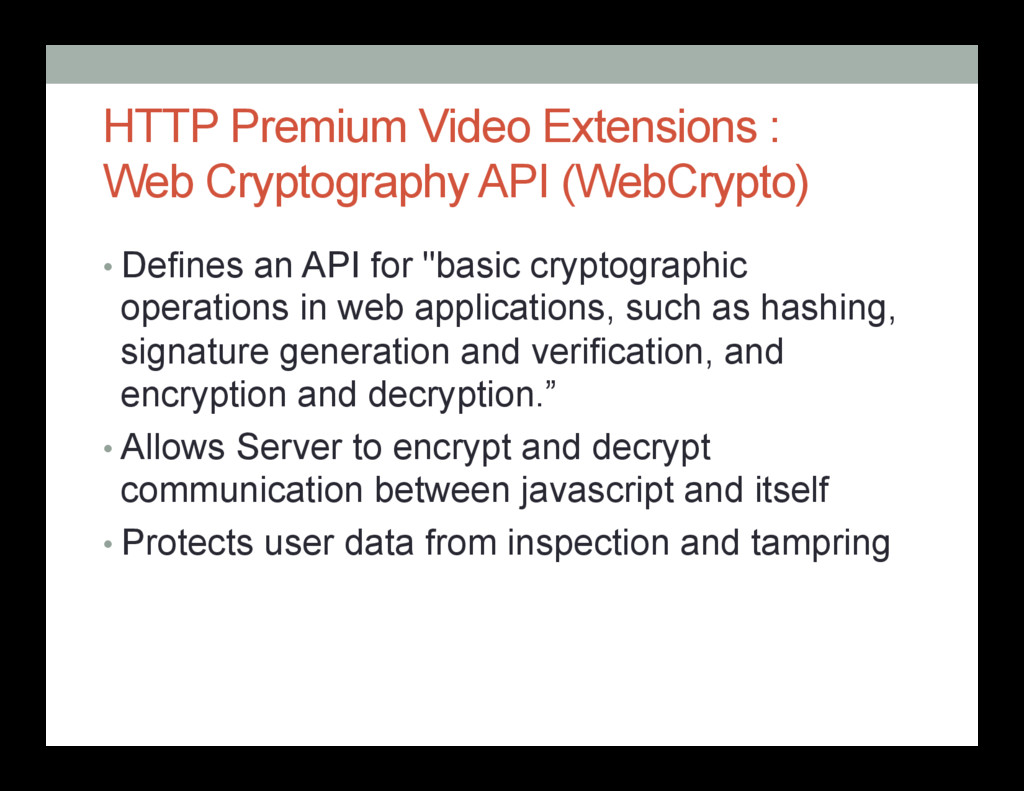
  25. HTTP Premium Video Extensions : Web Cryptography API (WebCrypto) • Defines

    an API for "basic cryptographic operations in web applications, such as hashing, signature generation and verification, and encryption and decryption.” • Allows Server to encrypt and decrypt communication between javascript and itself • Protects user data from inspection and tampring
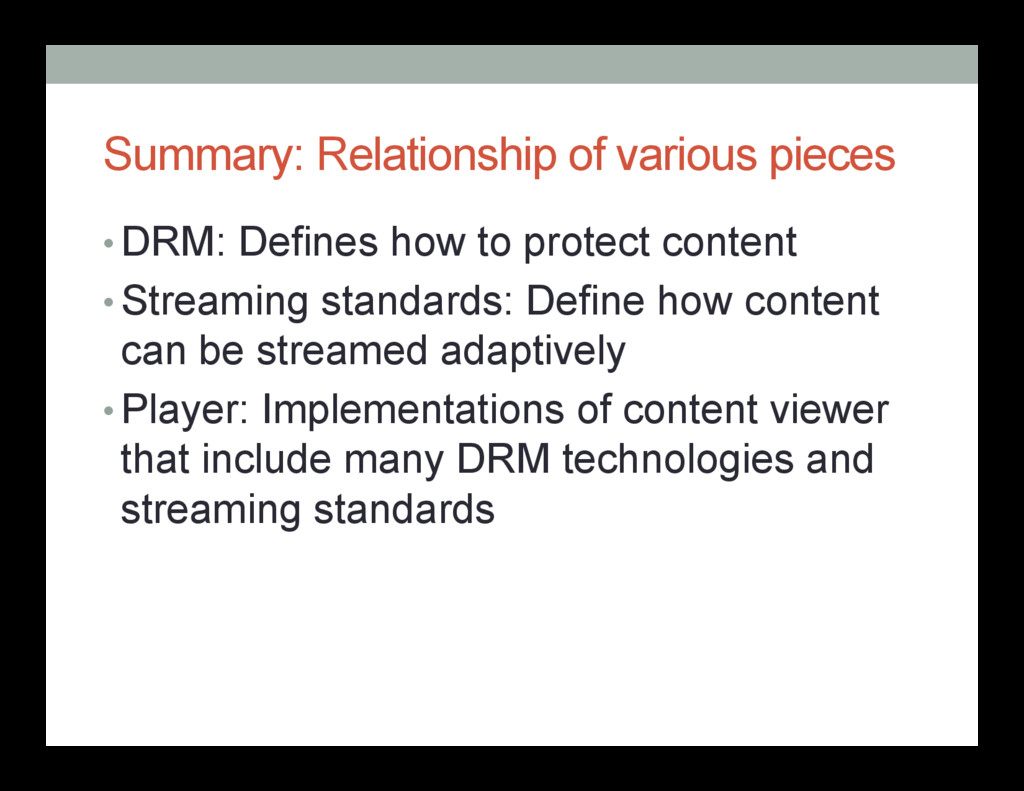
  26. Summary: Relationship of various pieces • DRM: Defines how to protect

    content • Streaming standards: Define how content can be streamed adaptively • Player: Implementations of content viewer that include many DRM technologies and streaming standards