Share
Embed
Architecture and State in Jetpack Compose
Talk I gave for the Kotlin La Paz community in the Compose Camp online event. Information: https://kotlinlapaz.github.io/ComposeCamp/
Jose Flavio Quispe Irrazábal
November 24, 2022
Transcript
72 slides
-
This work is licensed under the Apache 2.0 License Jose
Flavio Quispe Irrazabal Senior Software Engineer @jflavio11 Sobre mi -
This work is licensed under the Apache 2.0 License •
Fases de composición y árbol de UI • Conceptos básicos de arquitectura • Navegación avanzada ¿Qué temas NO vamos a tocar? -
This work is licensed under the Apache 2.0 License •
Qué son “estado” y “evento” en software • Diseñar state holders para nuestra app • Side effects principales • Diseñar la arquitectura a nivel de UI y de otras capas de nuestra app ¿Qué SÍ vamos a abordar? -
This work is licensed under the Apache 2.0 License Importancia
del “estado” en Jetpack Compose -
This work is licensed under the Apache 2.0 License El
estado define a la UI -
This work is licensed under the Apache 2.0 License Composables
dependen de variables que tienen un estado -
This work is licensed under the Apache 2.0 License Lo
dibujado es una representación gráfica del estado de nuestro programa -
This work is licensed under the Apache 2.0 License Importancia
del “estado” en Jetpack Compose • El estado define a la UI. • Composables dependen de variables que tienen un estado. • Lo dibujado es una representación gráfica del estado de nuestro programa. -
This work is licensed under the Apache 2.0 License @Composable
private fun MyLoader(progress: Float) { LinearProgressIndicator( progress = progress, color = Color.Red, backgroundColor = Color.Black, modifier = Modifier.padding(5.dp) ) } -
This work is licensed under the Apache 2.0 License @Composable
private fun MyLoader(progress: Float) { LinearProgressIndicator( progress = progress, color = Color.Red, backgroundColor = Color.Black, modifier = Modifier.padding(5.dp) ) } -
This work is licensed under the Apache 2.0 License Eventos
Pueden cambiar el “estado” en nuestra app. -
This work is licensed under the Apache 2.0 License UDF
Unidirectional Data Flow -
• Desacopla UI de quien maneja los estados • Fácil
de escribir tests • Única fuente de la verdad State UI Event State -
This work is licensed under the Apache 2.0 License UI
State • Signed Out • In Progress • Error • Sign In -
This work is licensed under the Apache 2.0 License sealed
class UiState { object SignedOut : UiState() object InProgress : UiState() object Error : UiState() object SignIn : UiState() } -
This work is licensed under the Apache 2.0 License UiState
= Signed Out @Composable fun MainScreenUi(state: UiState) { Header() if(state == SignedOut) { LoginFormUi() } if(state == InProgress) { LoginProgressBar() } } -
This work is licensed under the Apache 2.0 License UiState
= In Progress @Composable fun MainScreenUi(state: UiState) { Header() if(state == SignedOut) { LoginFormUi() } if(state == InProgress) { LoginProgressBar() } } -
This work is licensed under the Apache 2.0 License UiState
= In Progress @Composable fun MainScreenUi(state: UiState) { Header() if(state == SignedOut) { LoginFormUi() } if(state == InProgress) { LoginProgressBar() } } -
This work is licensed under the Apache 2.0 License UiState
= In Progress @Composable fun MainScreenUi(state: UiState) { Header() if(state == SignedOut) { LoginFormUi() if(state == InProgress) { LoginProgressBar() } } } -
This work is licensed under the Apache 2.0 License UiState
= SignedOut @Composable fun MainScreenUi(state: UiState) { Header() if(state == SignedOut) { LoginFormUi() if(state == InProgress) { LoginProgressBar() } } } -
This work is licensed under the Apache 2.0 License ¿Cómo
manejamos estados dependientes de diferentes fuentes? -
This work is licensed under the Apache 2.0 License Screen
UI State UI element state -
This work is licensed under the Apache 2.0 License Screen
UI State UI element state* LoginUiState LoginFormState ErrorInfo LoggedIn EmailValue PasswordValue *not strictly necessary -
This work is licensed under the Apache 2.0 License Screen
UI State - Lo que quieres mostrar en la pantalla, encapsula el estado de los datos - Independiente del lifecycle de la vista - Preferentemente, referenciarlo en la clase ViewModel de Jetpack - Recibe datos de otras capas -
This work is licensed under the Apache 2.0 License Repository
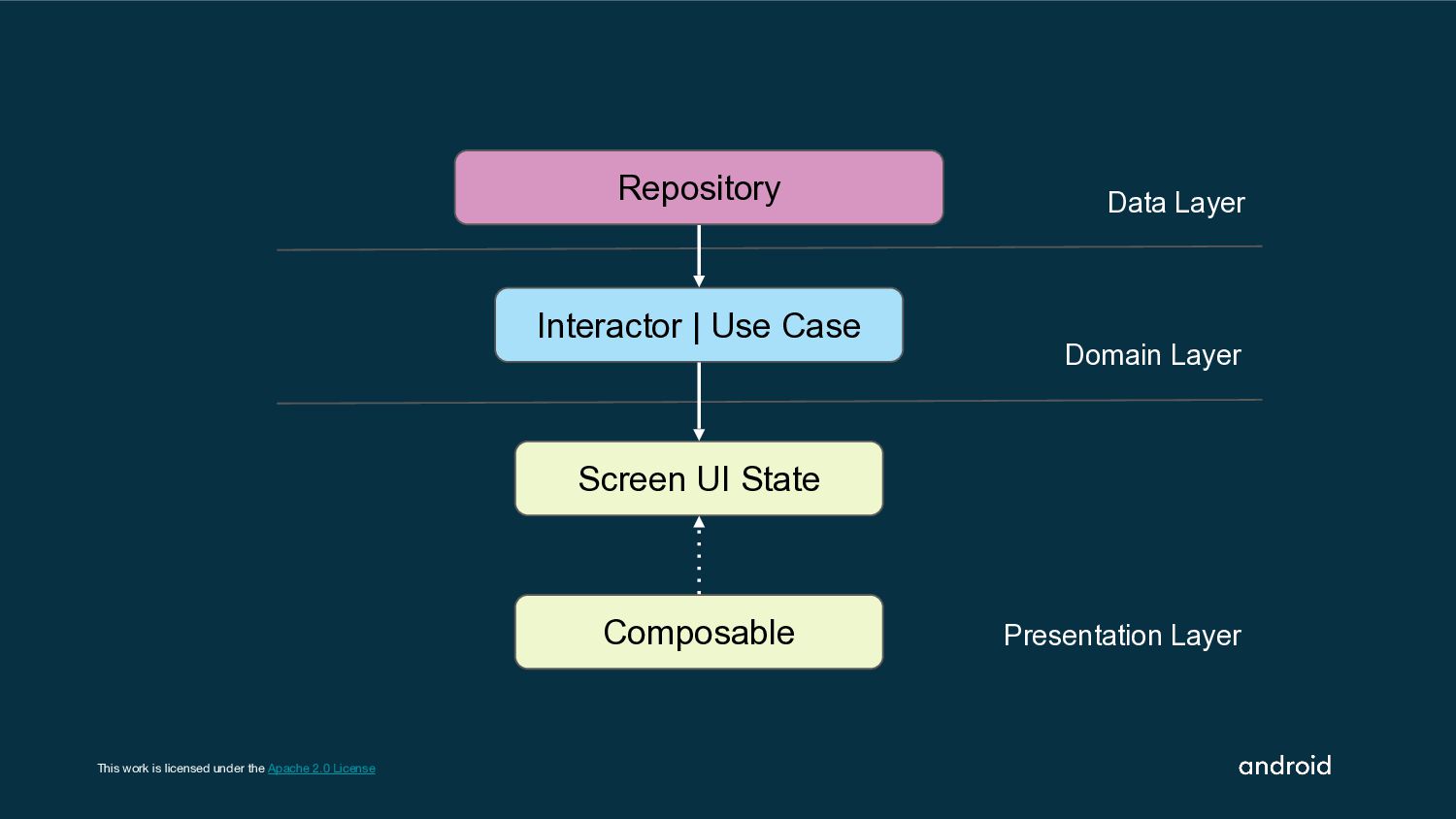
Interactor | Use Case Data Layer Domain Layer Screen UI State Composable Presentation Layer -
This work is licensed under the Apache 2.0 License Screen
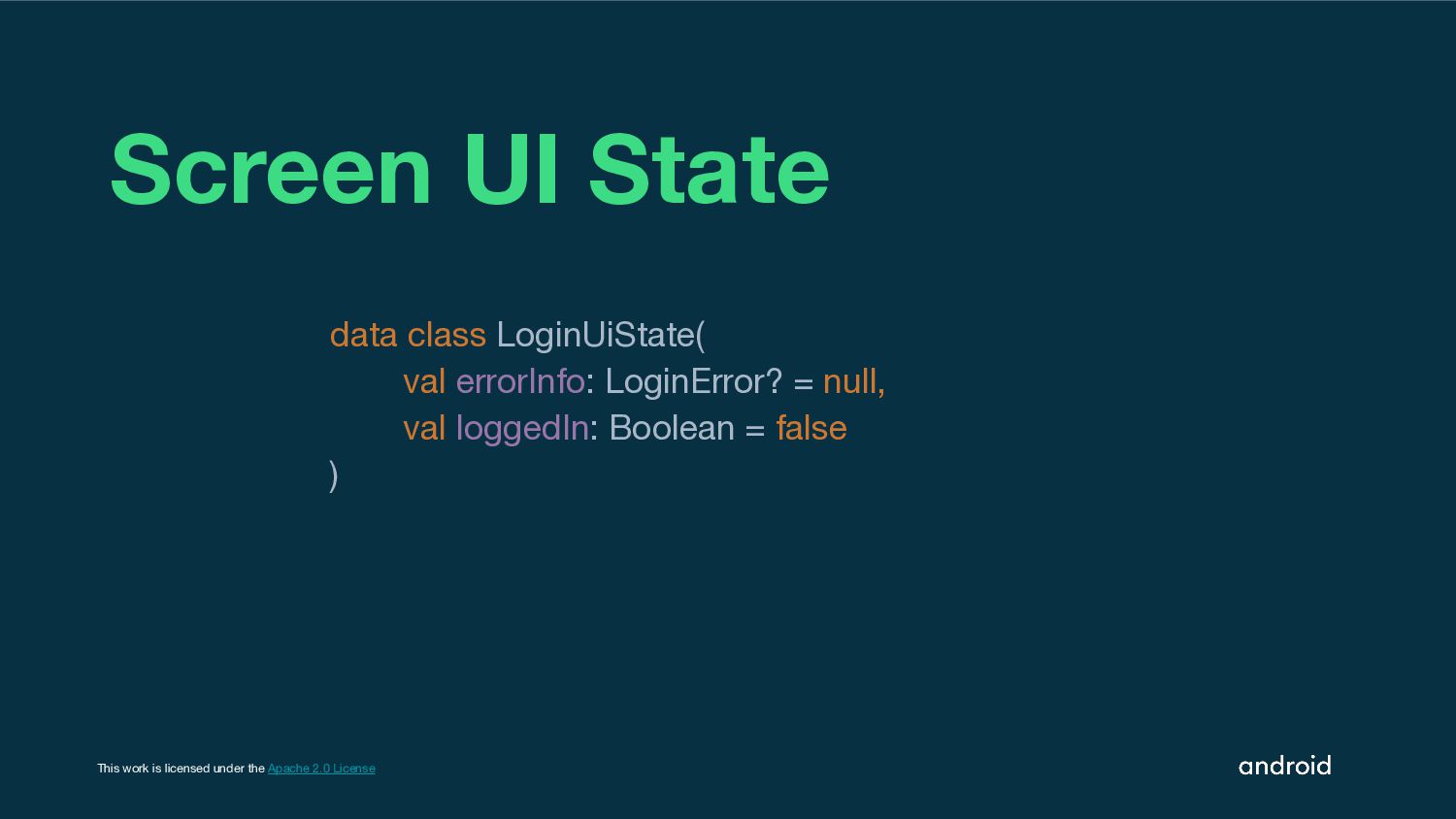
UI State data class LoginUiState( val errorInfo: LoginError? = null, val loggedIn: Boolean = false ) -
This work is licensed under the Apache 2.0 License class
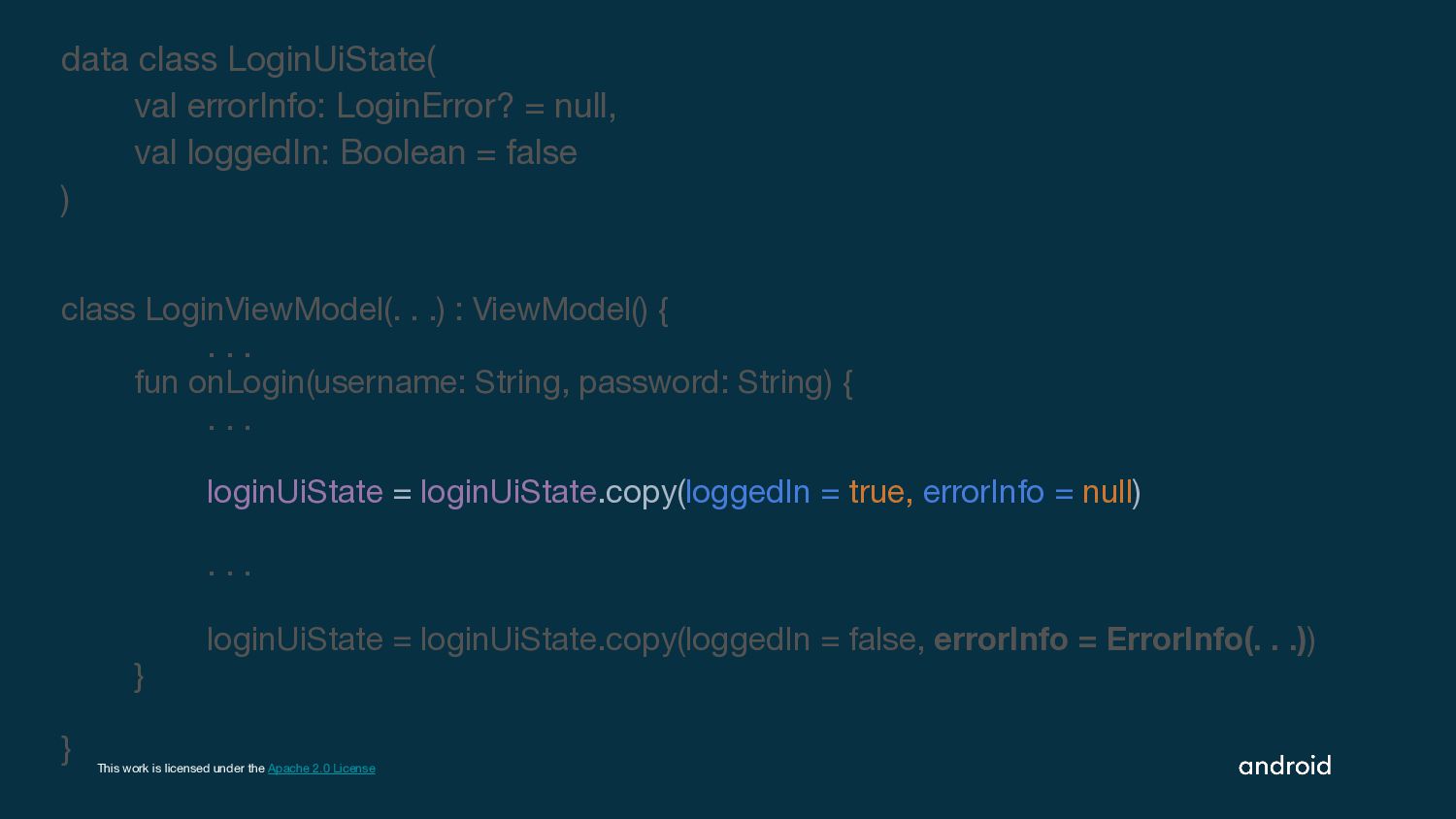
LoginViewModel( private val loginUseCase: LoginUseCase, . . . ) : ViewModel() { var loginUiState by mutableStateOf(LoginUiState()) private set fun onLogin(username: String, password: String) { viewModelScope.launch { loginUseCase.execute(username, password) loginUiState = loginUiState.copy(loggedIn = true, errorInfo = null) } } } -
This work is licensed under the Apache 2.0 License //
LoginActivity.kt val initialRoute = if(loginViewModel.loginUiState.loggedIn) { Routes.Home } else { Routes.Login } NavHost(navController = navController, startDestination = initialRoute) { . . . } -
This work is licensed under the Apache 2.0 License LoginUiState
Logged in = false Error info = null LoginUiState Logged in = true Error info = null -
This work is licensed under the Apache 2.0 License @Composable
private fun LoginForm( loginErrorInfo: LoginError? = null, ... ) { Column(modifier = Modifier.fillMaxWidth()) { Text(text = "Welcome to Tuiter") OutlinedTextField(...) OutlinedTextField(...) if (loginErrorInfo != null) { Text( text = loginErrorInfo.message, style = MaterialTheme.typography.caption.copy( color = MaterialTheme.colors.error ) ) } ... } } -
This work is licensed under the Apache 2.0 License LoginUiState
Logged in = false Error info = null LoginUiState Logged in = false Error info = LoginError(444, “Incorrect password”) -
This work is licensed under the Apache 2.0 License data
class LoginUiState( val errorInfo: LoginError? = null, val loggedIn: Boolean = false ) class LoginViewModel(. . .) : ViewModel() { . . . fun onLogin(username: String, password: String) { . . . loginUiState = loginUiState.copy(loggedIn = true, errorInfo = null) . . . loginUiState = loginUiState.copy(loggedIn = false, errorInfo = ErrorInfo(. . .)) } } -
This work is licensed under the Apache 2.0 License UI
Element State - Lógica de los elementos de nuestra interfaz gráfica - No sobrevive a los cambios de configuración* - Si la vista es compleja, se puede encapsular en una clase que actúe como state holder * A menos que implementes rememberSaveable -
This work is licensed under the Apache 2.0 License class
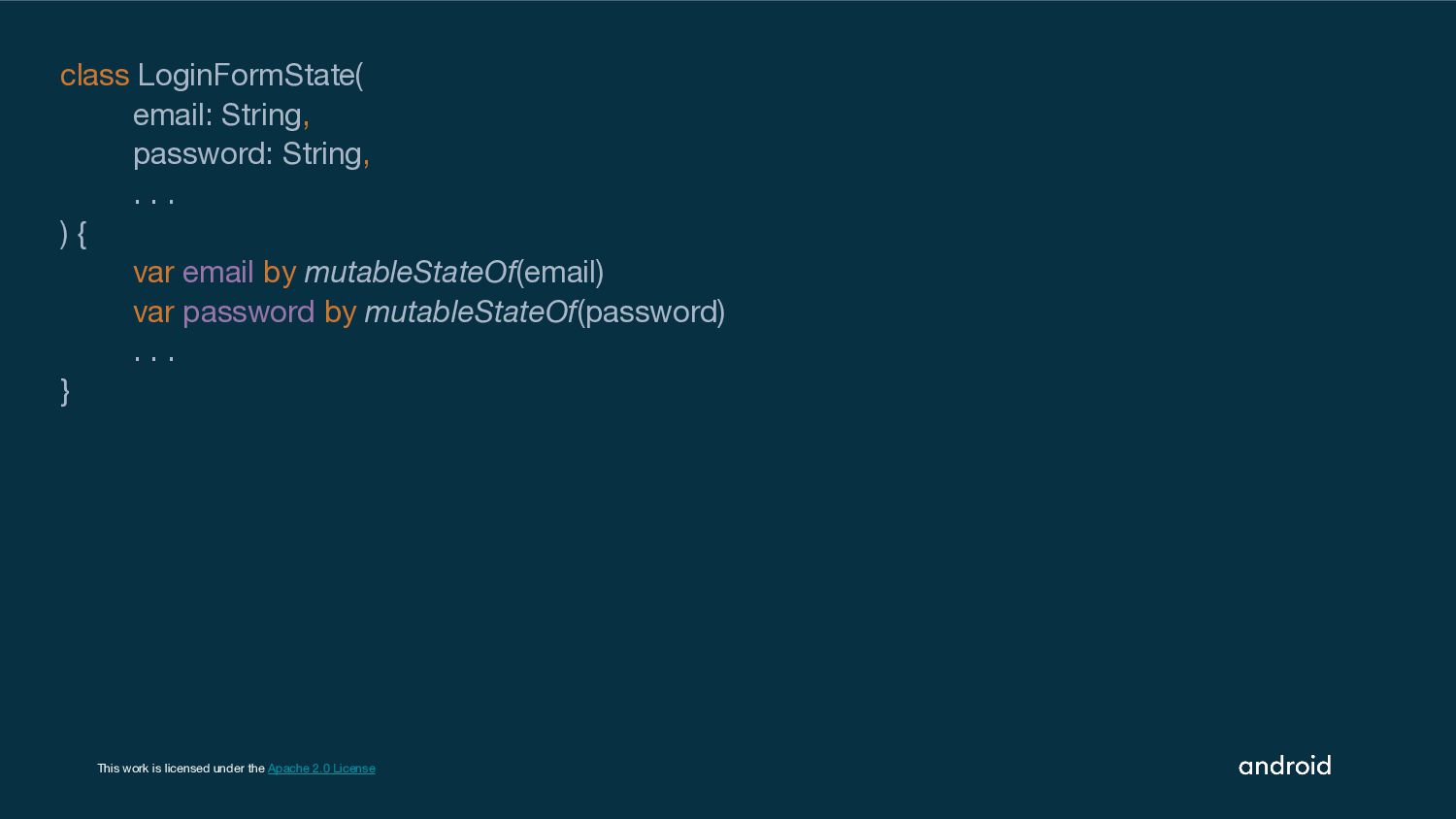
LoginFormState( email: String, password: String, . . . ) { var email by mutableStateOf(email) var password by mutableStateOf(password) . . . } -
This work is licensed under the Apache 2.0 License class
LoginFormState( email: String, password: String ) { var email by mutableStateOf(email) var password by mutableStateOf(password) … } var email by remember { mutableStateOf("") } var password by remember { mutableStateOf("") } var isEmailValid by derivedStateOf { /* logic for validation */ } -
This work is licensed under the Apache 2.0 License @Composable
fun rememberLoginFormState( email: String = "", password: String = "" ) = rememberSaveable(saver = LoginFormState.Saver) { LoginFormState(email, password) } . . . val formUiState: LoginFormState = rememberLoginFormState() -
This work is licensed under the Apache 2.0 License OutlinedTextField(
value = formUiState.email, onValueChange = { formUiState.email = it }, isError = !formUiState.isValidEmail, label = { if (!formUiState.isValidEmail) { Text(text = "Please, write a valid email.") } else { Text(text = "Email address") } }, . . . ) val formUiState: LoginFormState = rememberLoginFormState() . . . -
This work is licensed under the Apache 2.0 License Screen
Ui State UI Element State - Estado de los datos - Independiente del lifecycle - Conectado con otras capas - Lógica de UI - Referencia a otros componentes de UI (como resources, navigation controller, etc) - Puede ser reusable -
This work is licensed under the Apache 2.0 License @Composable
private fun HiScreen(hiViewModel: HiViewModel = viewModel()) { hiViewModel.getNamesFromServer() Text(text = "Hola, hola! ${hiViewModel.names}") // other views that causes recomposition } -
This work is licensed under the Apache 2.0 License @Composable
private fun HiScreen(hiViewModel: HiViewModel = viewModel()) { LaunchedEffect(key1 = Unit, block = { hiViewModel.getNamesFromServer() }) Text(text = "Hola, hola! ${hiViewModel.names}") // other views that causes recomposition } -
This work is licensed under the Apache 2.0 License Remember
Coroutine Scope -
This work is licensed under the Apache 2.0 License private
suspend fun loadScore() = withContext(Dispatchers.Default) { delay(2000) Random.nextInt(IntRange(0, 1000)) } . . . @Composable private fun ProfileScreen() { val scope = rememberCoroutineScope() Column(modifier = Modifier.fillMaxWidth()) { Text(text = "Score: $score points") Button(onClick = { scope.launch { score = loadScore() } }) { Text(text = "Update profile") } } } -
This work is licensed under the Apache 2.0 License @Composable
private fun AgeView( yearBorn: Int, onYearUpdated: (Int) -> Unit ) { LaunchedEffect(key1 = Unit, block = { delay(3000) // long running operation adultText = if (2022 - yearBorn > 17) { "Eres mayor de edad" } else { "Eres menor de edad" } }) Column { Text(text = adultText) TextField( value = yearBorn.toString(), onValueChange = { onYearUpdated(it.toInt()) } ) } } 1. AgeView es dibujado con un año de nacimiento inicial (2000). 2. El año se coloca en el TextField que es editable. 3. Antes de los 3 segundos, el usuario actualiza el año de nacimiento en el TextField a 2009. 4. Se ejecuta onYearUpdated en el composable padre, que cambia el valor del año de nacimiento 5. Al cambiar el año de nacimiento, AgeView se recompone con este nuevo valor ¿Qué sucede? -
This work is licensed under the Apache 2.0 License El
cambio del valor de yearBorn no se detectó (de 2000 a 2009), por tanto, en la pantalla se mostrará “Eres mayor de edad” -
This work is licensed under the Apache 2.0 License @Composable
private fun AgeView( yearBorn: Int, onYearUpdated: (Int) -> Unit ) { LaunchedEffect(key1 = Unit, block = { delay(3000) // long running operation adultText = if (2022 - yearBorn > 17) { "Eres mayor de edad" } else { "Eres menor de edad" } }) Column { Text(text = adultText) TextField( value = yearBorn.toString(), onValueChange = { onYearUpdated(it.toInt()) } ) } } Se captura el valor inicial de yearBorn. Si AgeView se recompone, el LaunchedEffect sigue manteniendo el valor original. -
This work is licensed under the Apache 2.0 License @Composable
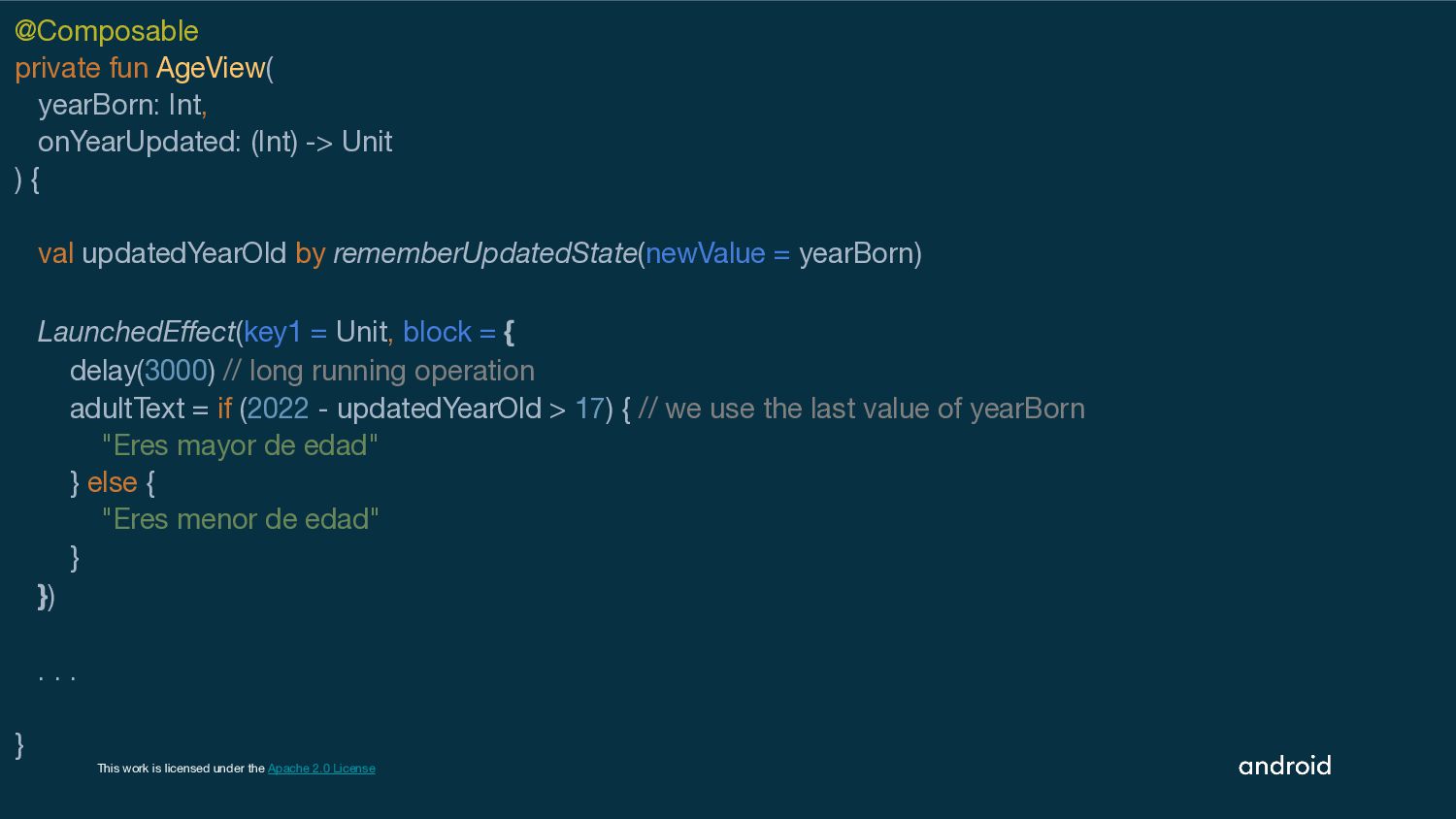
private fun AgeView( yearBorn: Int, onYearUpdated: (Int) -> Unit ) { LaunchedEffect(key1 = Unit, block = { delay(3000) // long running operation adultText = if (2022 - yearBorn > 17) { "Eres mayor de edad" } else { "Eres menor de edad" } }) Column { Text(text = adultText) TextField( value = yearBorn.toString(), onValueChange = { onYearUpdated(it.toInt()) } ) } } Para capturar el último valor “actualizado”, se usa rememberUpdatedState. -
This work is licensed under the Apache 2.0 License @Composable
private fun AgeView( yearBorn: Int, onYearUpdated: (Int) -> Unit ) { val updatedYearOld by rememberUpdatedState(newValue = yearBorn) LaunchedEffect(key1 = Unit, block = { delay(3000) // long running operation adultText = if (2022 - updatedYearOld > 17) { // we use the last value of yearBorn "Eres mayor de edad" } else { "Eres menor de edad" } }) . . . } -
Repository Interactor | Use Case Data Layer Domain Layer Screen
UI State Composable Presentation Layer UI Element State ViewModel -
This work is licensed under the Apache 2.0 License Screen
Ui State UI Element State - Independencia del lifecycle - Mantener y modificar datos a mostrar o manejar - Hay una fuente de datos externa a la capa de UI - UI se vuelve compleja - Agregar lógica de UI - Se quiere hacer testing de la lógica que puede tener nuestra UI data class LoginUiState( val errorInfo: LoginError? = null, val loggedIn: Boolean = false ) class LoginFormState( email: String, password: String, . . . ) { var email by mutableStateOf(email) var password by mutableStateOf(password) . . . } -
This work is licensed under the Apache 2.0 License Launched
Effect - Ejecutar algo con independencia de la recomposición o al cambiar el valor de un key. Esto porque ejecuta una coroutine por dentro. - Se inicia con la composición. - Es una función composable. -
This work is licensed under the Apache 2.0 License Remember
Coroutine Scope - Ejecutar coroutines en un composable. - Depende del ciclo de vida del composable que lo contiene. - Podemos controlar su ejecución (iniciarlo bajo un evento o cancelarlo). -
This work is licensed under the Apache 2.0 License Remember
Updated State - Cuando nuestro side effect depende de un valor que puede cambiar en el tiempo (o recompositions). - Si el valor de la variable de la que se depende cambia, nuestro side effect no se reinicia, mantiene la ejecución con el valor actualizado. -
This work is licensed under the Apache 2.0 License Jose
Flavio Quispe Irrazabal Senior Software Engineer @jflavio11 Architecture and State