Upgrade to Pro — share decks privately, control downloads, hide ads and more …

What I Talk About When I Talk About Testing

What I Talk About When I Talk About Testing

The language we use when describing our testing is important to understanding our craft. This workshop is geared toward clarification of the soft skills of our testing practices. We will share best outcomes to document new talking points which we can apply in our evolving careers as testers.

Avatar for Jim Warchol

Jim Warchol

August 09, 2018
Tweet

Other Decks in Technology

Transcript

  1. ABOUT ME JIM WARCHOL @LAKEICYCHILL ▸ Software Tester for 9+

    years ▸ Technical Project Manager ▸ Front-End Developer ▸ Desktop Publisher ▸ Graphic Designer ▸ Typographer ‣ Graduate of the BBST Foundations and Bug Advocacy courses. ‣ This is my 5th CAST, first time presenting
  2. OBJECTIVES OUR WORKSHOP TODAY The language we use when describing

    our testing is important to understanding our craft. This workshop is geared toward clarification of the soft skills we use in our testing practices. We will share best outcomes to document new talking points which we can use in our evolving careers as testers.
  3. TEXT WHAT I TALK ABOUT WHEN TALKING ABOUT TESTING Testers

    face some challenges… ▸ Describing testing to non-technical people ▸ Responding to questions from a potential client ▸ Selling yourself and your skills ▸ Discussing issues within your team ▸ Defending yourself when projects and teams struggle INTRODUCTION
  4. INTRODUCTION WHAT I TALK ABOUT WHEN TALKING ABOUT TESTING Simple

    questions I have been asked… ▸ “What do you ‘do’ as a software tester?” ▸ “Can you QA something for me?” ▸ “Are you just a manual tester or do you do automation?” ▸ “I don’t need a tester, shouldn’t the developer just do it?” ▸ “Can you guarantee my software will be bug free?”
  5. INTRODUCTION WHAT I TALK ABOUT WHEN TALKING ABOUT TESTING Going

    into more specifics ▸ How do you respond: ▸ When you encounter skeptics? ▸ When you encounter a difficult team member? ▸ When your team is struggling to meet goals? ▸ When team communication is breaking down?
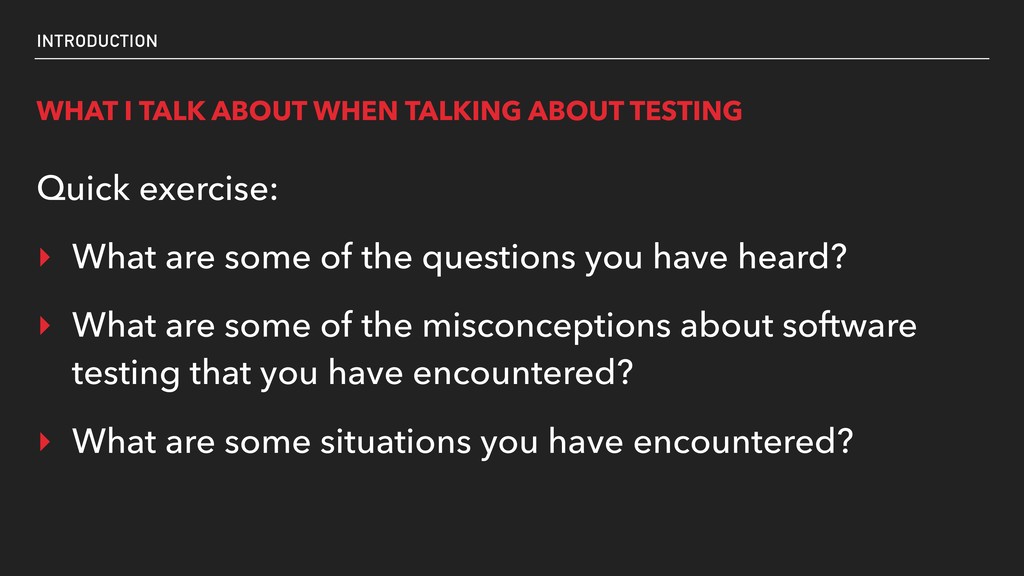
  6. WHAT I TALK ABOUT WHEN TALKING ABOUT TESTING Quick exercise:

    ‣ What are some of the questions you have heard? ‣ What are some of the misconceptions about software testing that you have encountered? ‣ What are some situations you have encountered? INTRODUCTION
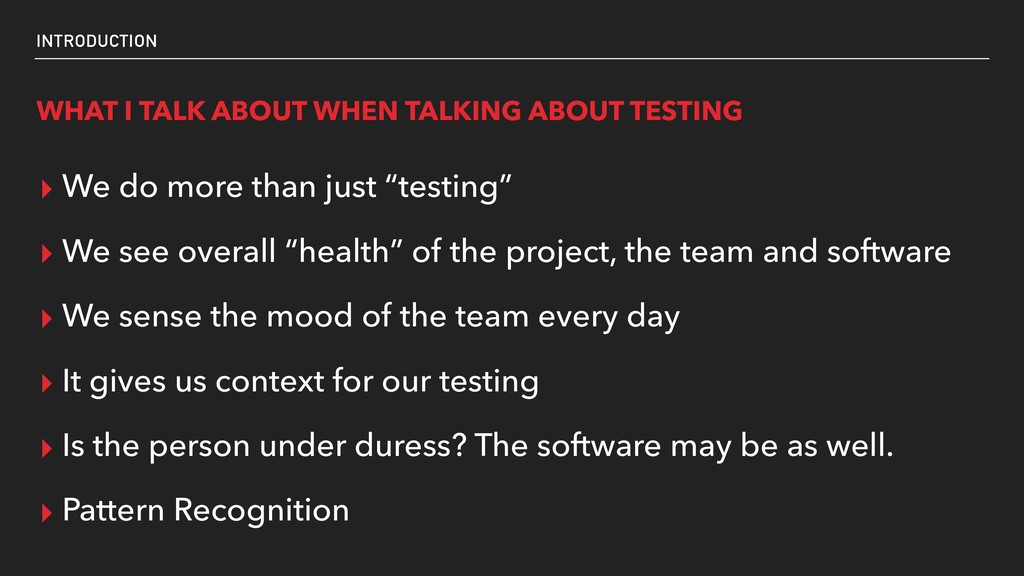
  7. WHAT I TALK ABOUT WHEN TALKING ABOUT TESTING ▸ We

    do more than just “testing” ▸ We see overall “health” of the project, the team and software ▸ We sense the mood of the team every day ▸ It gives us context for our testing ▸ Is the person under duress? The software may be as well. ▸ Pattern Recognition INTRODUCTION
  8. WHAT I TALK ABOUT WHEN TALKING ABOUT TESTING ▸ We

    report back to stakeholders ▸ Communication style is important ▸ Never blame ▸ Never make excuses ▸ Honest assessments ▸ Empathy for the team INTRODUCTION
  9. WHAT I TALK ABOUT WHEN TALKING ABOUT TESTING ▸ How

    do we bridge the team roles? ▸ How do we communicate with team members? ▸ How do we describe testing beyond just “checking”? ▸ How do we make sure everyone on the team feels safe? ▸ How do you and the team all own quality? INTRODUCTION
  10. IS IT A BUG, OR IS IT A FEATURE? WHAT’S

    THE DEAL ABOUT QUALITY ASSURANCE? ▸ Can we “Assure Quality”? ▸ The concept of “Quality” is owned by the entire team, including your client and your customers ▸ “Can you QA something for me?” 
 No, but let’s test it! Arrow and Dot resting after an “exploratory testing session.”
  11. “QUALITY IS VALUE TO SOME PERSON.” Jerry Weinberg OTHERS TALKING

    ABOUT TESTING WHAT ARE WE REALLY TESTING FOR? ▸ Quality is inherently subjective ▸ Different stakeholders will perceive the same product as having different levels of quality
  12. PROJECTS SCENARIO #1 ▸ Get into groups and discuss this

    scenario: ▸ You are being asked to join a new project. The newly formed team is somewhat familiar with Agile and is open to learning more. The stakeholders are non- technical, and are concerned about budget. They want to hold off testing until end of sprint, or even waiting until a couple of sprints are done. All of you are in the tester role and you will be presenting your response to the stakeholders. 
 
 What do you say in response? Think about risks and concerns that you have, and how you communicate it.
  13. PROJECTS PROJECTS AND TEAMS Usually look like this in Agile…

    LEAD DEV DEV SCRUM MASTER TESTER DEV PRODUCT OWNER
  14. PROJECTS WHEN SHOULD A TESTER GET INVOLVED ON A TEAM?

    ▸ Right away! ▸ Test planning ▸ Dig into requirements / user stories ▸ Map the product (e.g. API integrations, data inputs/outputs, user flow, etc…) ▸ Uncover and define risks early ▸ Set testing mission, and test strategy ▸ Look for what is missing
  15. PROJECTS THE TESTER ROLE IS EVOLVING ▸ Becoming more of

    a hybrid role ▸ Elements of Scrum Master, BA, Delivery Manager ▸ Keep team focused on sprint goals 
 and project delivery milestones ▸ Generate rapid and relevant feedback
  16. PROJECTS QUALITY IS A CONCEPT THAT IS SHARED BY THE

    ENTIRE TEAM ▸ Everyone “tests” one way or another ▸ Quality framed by user stories ▸ Requirements aren’t gathered, they’re *developed* ▸ Team “Definition of Done” ▸ Set testing mission - reset often ▸ Test planning starts early ▸ Involves every team member
  17. PROJECTS SCENARIO #2 ▸ Get into groups again and discuss

    this scenario: ▸ You are on a project where the team is all remote. One of the developers is being vague in the daily stand ups. He claims he is working on new stories but the backlog isn’t being updated. He isn’t checking in new code. You start hearing what sounds like excuses and avoidance.
 
 How will this affect the team? How will this impact your testing? The product owner is asking you for an update on your testing, and on the product. What is your response?
  18. PROJECTS WHAT I TALK ABOUT WHEN TALKING ABOUT TESTING Going

    into more specifics ▸ Negativity affects quality ▸ Your testing will be more difficult, or delayed ▸ More bugs & more regression issues ▸ More resistance from stakeholders ▸ Team split up and/or project canceled
  19. PROJECTS HOW IT ALL BREAKS ▸ Unavailability of team member(s)

    ▸ Goals changed ▸ Management changes ▸ Noise & interference ▸ Lack of details ▸ ALL impacts quality
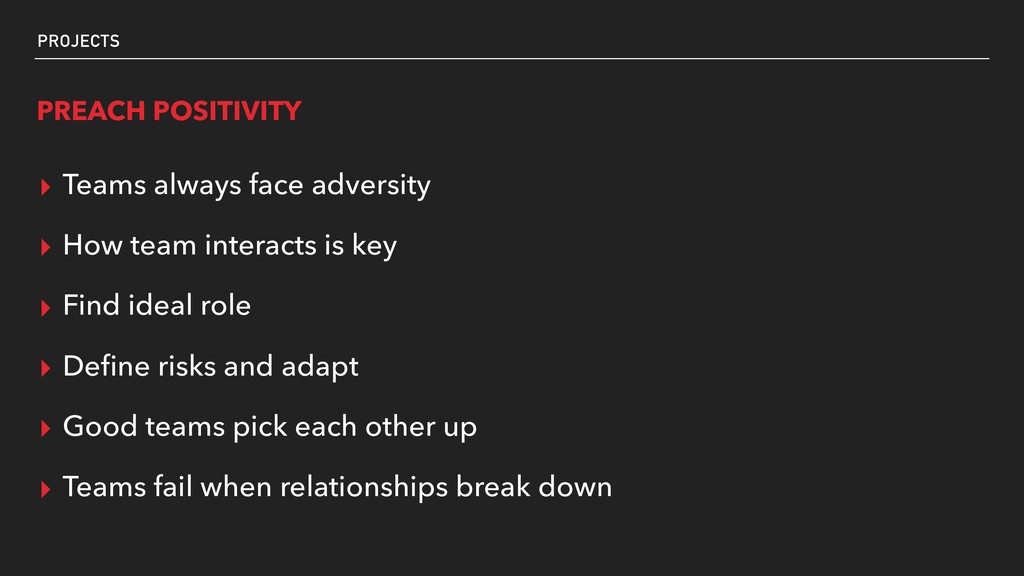
  20. PROJECTS PREACH POSITIVITY ▸ Teams always face adversity ▸ How

    team interacts is key ▸ Find ideal role ▸ Define risks and adapt ▸ Good teams pick each other up ▸ Teams fail when relationships break down
  21. PROJECTS SCENARIO #3 - YOUR TURN! ▸ Divide up again

    and discuss scenarios you have enountered. ▸ Pick one, discuss, document and share what you did. ▸ Focus on how you communicated, did it go well? ▸ What could have gone better? ▸ What were you lessons learned? ▸ Can be a success story or a failure story - both are great.
  22. TEAM RELATIONSHIPS THE SOFT SKILLS: INTERACTIONS AND COMMUNICATION ▸ With

    Product Owner ▸ Review requirements ▸ Set milestones and goals ▸ Write and review acceptance criteria ▸ Review backlog, priorities and goals ▸ Tester provides context ▸ Triage help desk / user acceptance feedback ▸ Informs overall health of project, and team
  23. TEAM RELATIONSHIPS THE SOFT SKILLS: INTERACTIONS AND COMMUNICATION ▸ With

    Developers ▸ Communication during daily standup ▸ Pair with Dev on programming, OR testing ▸ Use relationship to learn ▸ Focus on priorities ▸ Review automation scripts ▸ Visibility with stakeholders ▸ Tester is conduit between Dev and customers
  24. “In my experience, being a software testing consultant isn't going

    to get you much glory. Nor should it. It shouldn’t be about you. It should be about helping people and teams get better. You usually can’t nurture a team to become better by being a hero or a commander.” Beren Van Daele @isleoftesting
 From: Experience Report: Introducing Change To An Organisation As A Test Consultant OTHERS TALKING ABOUT TESTING
  25. OTHERS TALKING ABOUT TESTING MODERN TESTING PRINCIPLES ▸ ONE -

    Our priority is improving the business. ▸ TWO - We accelerate the team, and use models like Lean Thinking and the Theory of Constraints to help identify, prioritize and mitigate bottlenecks from the system. ▸ THREE - We are a force for continuous improvement, helping the team adapt and optimize in order to succeed, rather than providing a safety net to catch failures. ▸ FOUR - We care deeply about the quality culture of our team, and we coach, lead, and nurture the team towards a more mature quality culture. ▸ FIVE - We believe that the customer is the only one capable to judge and evaluate the quality of our product. ▸ SIX - We use data extensively to deeply understand customer usage and then close the gaps between product hypotheses and business impact. ▸ SEVEN - We expand testing abilities and knowhow across the team; understanding that this may reduce (or eliminate) the need for a dedicated testing specialist. Source: Modern Testing Principles 
 BY ALAN PAGE AND BRENT JENSEN