Upgrade to Pro — share decks privately, control downloads, hide ads and more …

Digital Publishing for Scale: The Economist and Go

Digital Publishing for Scale: The Economist and Go

The Economist newspaper was first printed in 1843. Since then, readers consume news in rapidly evolving ways and technology has taken the forefront in delivering content and enabling the severe contest between intelligence, which presses forward, and an unworthy, timid ignorance obstructing our progress.

To meet these challenges, The Economist restructured its platforms for digital delivery by breaking down a monolithic CMS and adopting a distributed, microservices architecture. The Economist implemented Go to write services responsible for delivering content across products and platforms. Go has enable the team to quickly adapt to business needs and scale for growing demand, but it has not been without its own challenges. This talk will cover the struggles and victories in transitioning to Go and how Go has uniquely fit The Economist’s digital publishing goals.

Avatar for Jonas

Jonas

June 29, 2018

More Decks by Jonas

Other Decks in Programming

Transcript

  1. The Happy Path to Go The Platform * AWS hosted

    * Event Messaging * Worker microservices * Distributed * S3, DynamoDB, and ElasticSearch data stores * RESTful API & GraphQL

  2. The Happy Path to Go Key factors * Built in

    concurrency support enables performance at scale * Strong networking and API support * Compiled language simple to deploy across platforms * Simple design and syntax quickly enables developers
  3. Fail Fast: Language Design Application Principles * Minimize startup time

    * Fail fast * Continuous Integration & Delivery Twelve Factor App
  4. Fail Fast: Errors vs Exceptions Errors vs Exception * No

    exceptions * Error as a type * Failing fast the responsibility of the developer
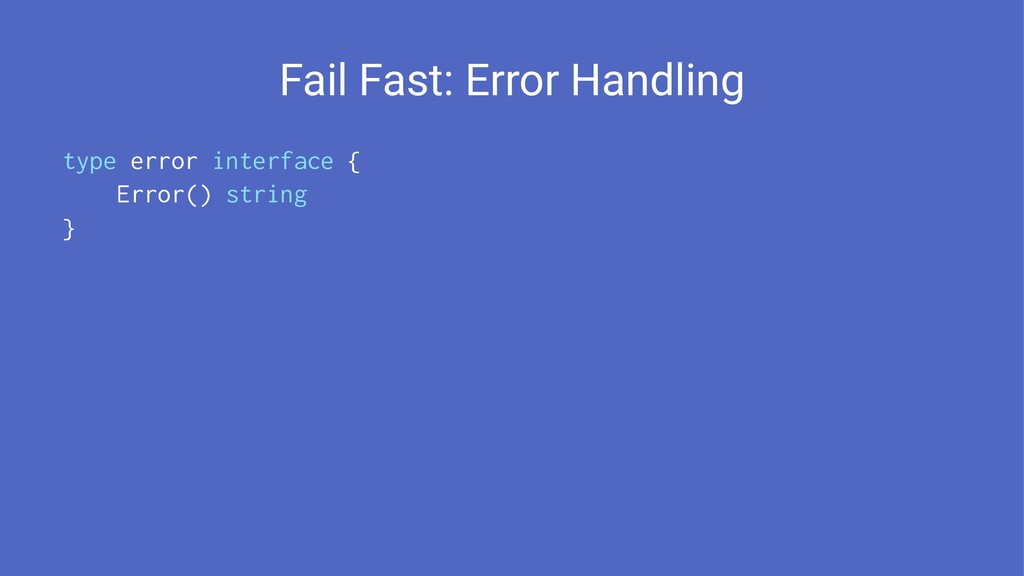
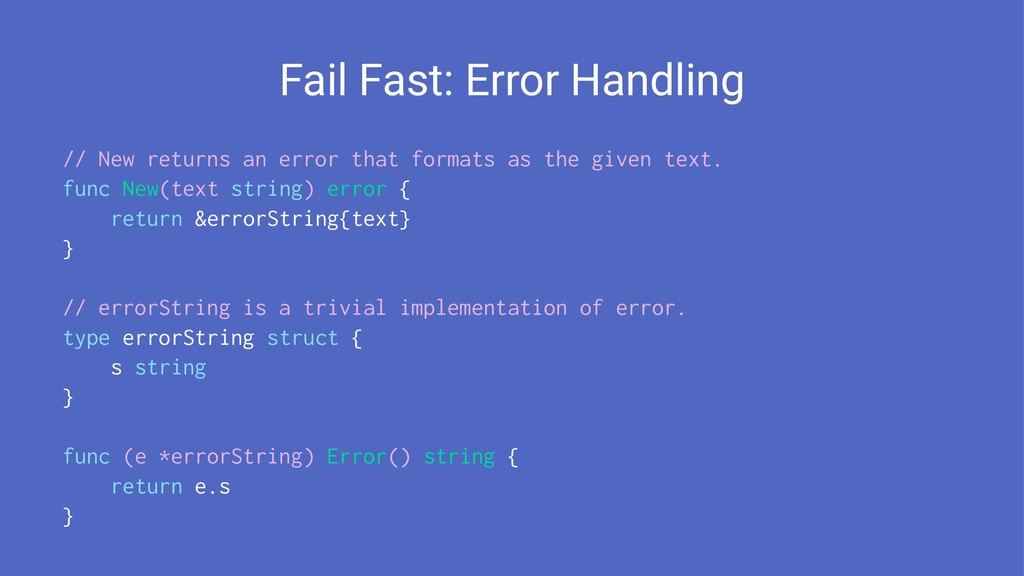
  5. Fail Fast: Error Handling // New returns an error that

    formats as the given text. func New(text string) error { return &errorString{text} } // errorString is a trivial implementation of error. type errorString struct { s string } func (e *errorString) Error() string { return e.s }
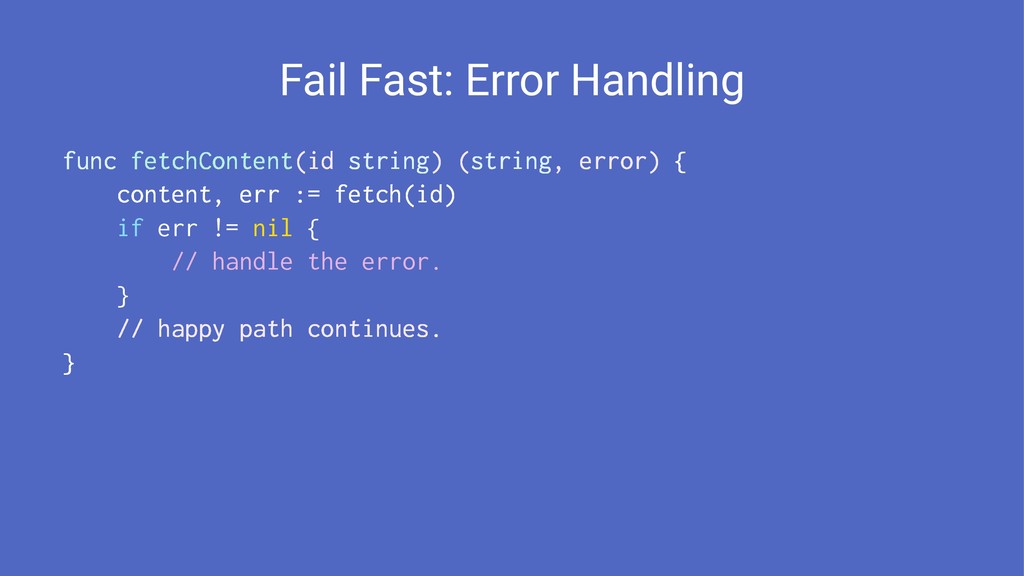
  6. Fail Fast: Error Handling func fetchContent(id string) (string, error) {

    content, err := fetch(id) if err != nil { // handle the error. } // happy path continues. }
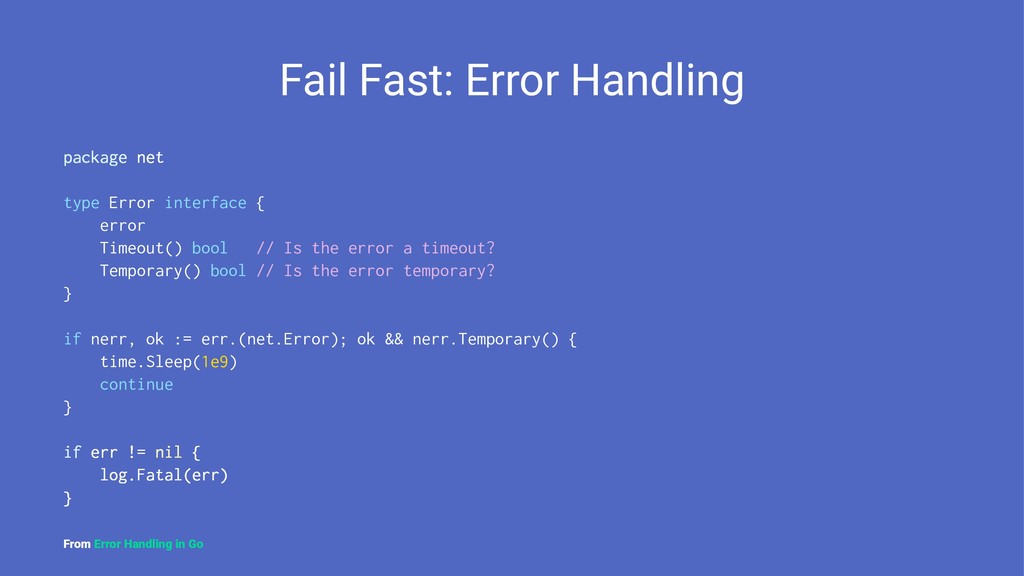
  7. Fail Fast: Error Handling package net type Error interface {

    error Timeout() bool // Is the error a timeout? Temporary() bool // Is the error temporary? } if nerr, ok := err.(net.Error); ok && nerr.Temporary() { time.Sleep(1e9) continue } if err != nil { log.Fatal(err) } From Error Handling in Go
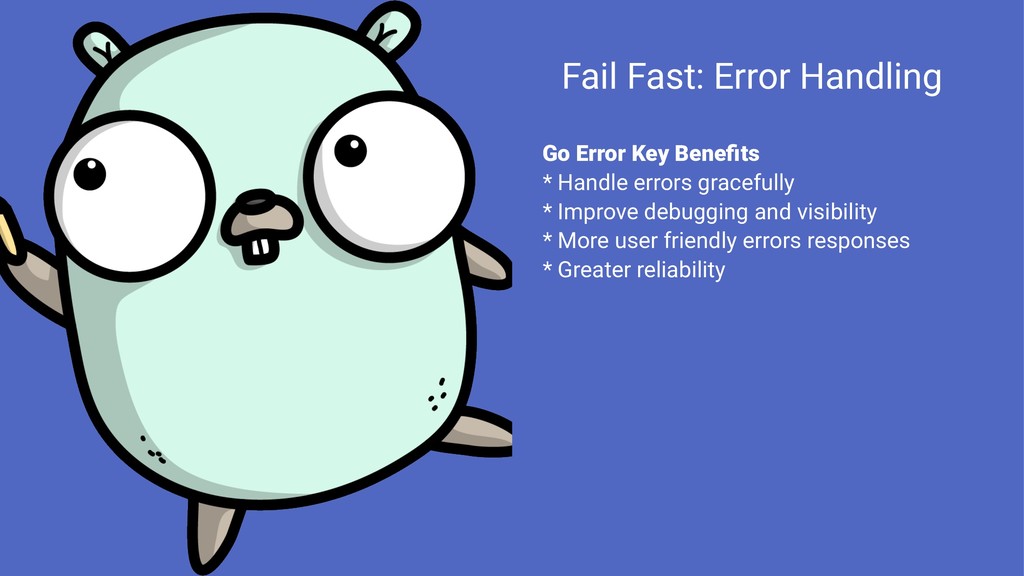
  8. Fail Fast: Error Handling Go Error Key Benefits * Handle

    errors gracefully * Improve debugging and visibility * More user friendly errors responses * Greater reliability
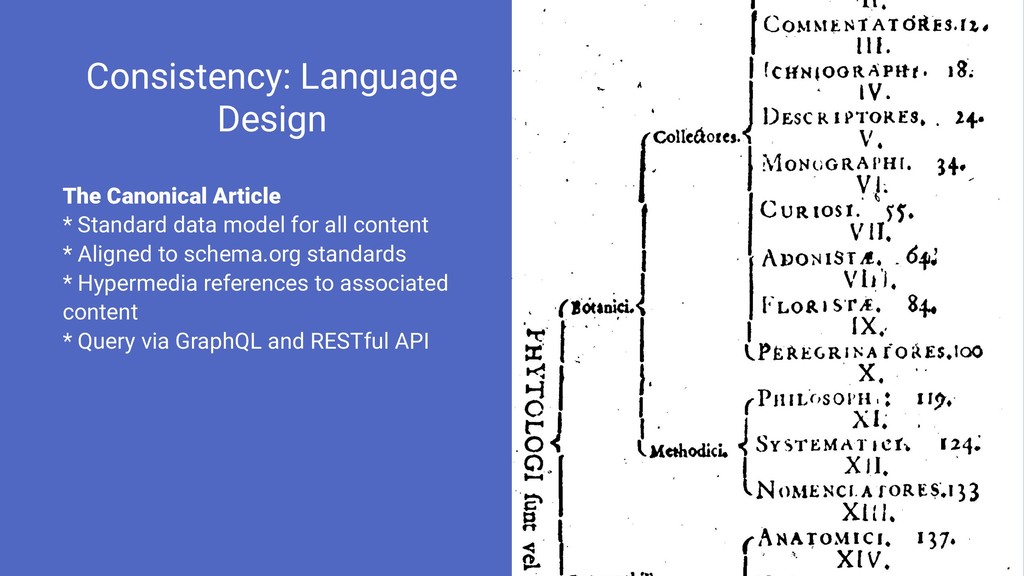
  9. Consistency: Language Design The Canonical Article * Standard data model

    for all content * Aligned to schema.org standards * Hypermedia references to associated content * Query via GraphQL and RESTful API
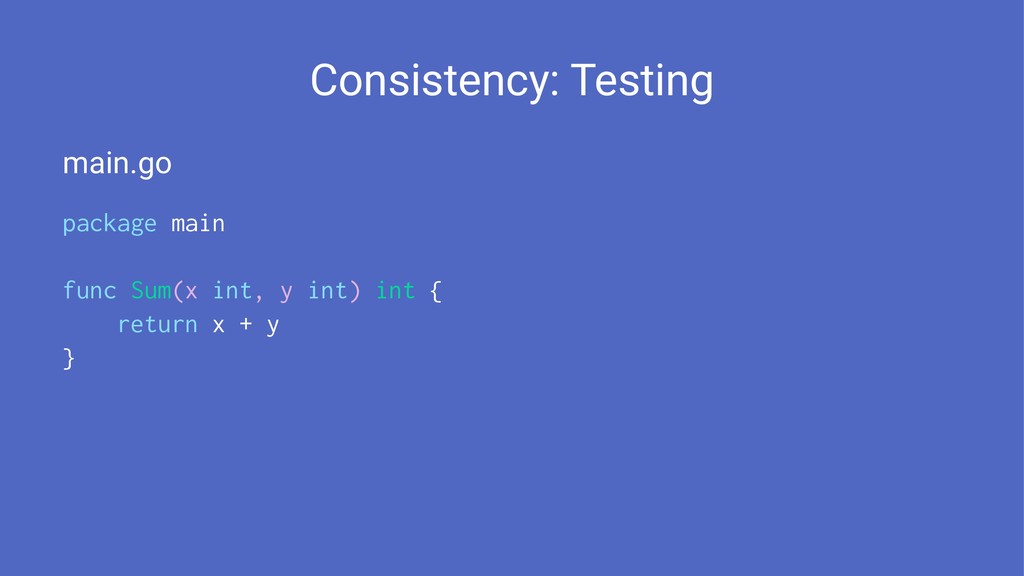
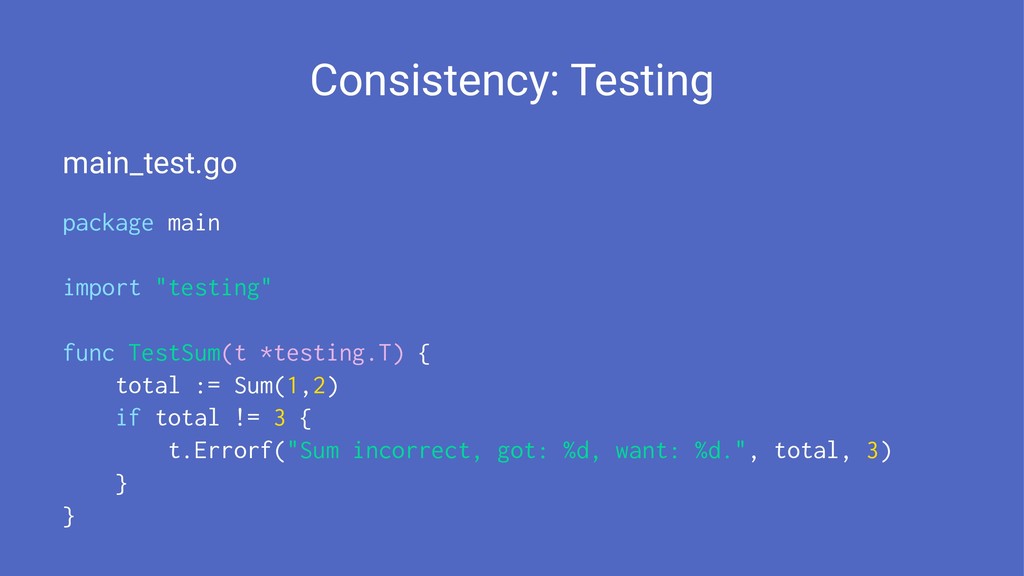
  10. Consistency: Testing main_test.go package main import "testing" func TestSum(t *testing.T)

    { total := Sum(1,2) if total != 3 { t.Errorf("Sum incorrect, got: %d, want: %d.", total, 3) } }
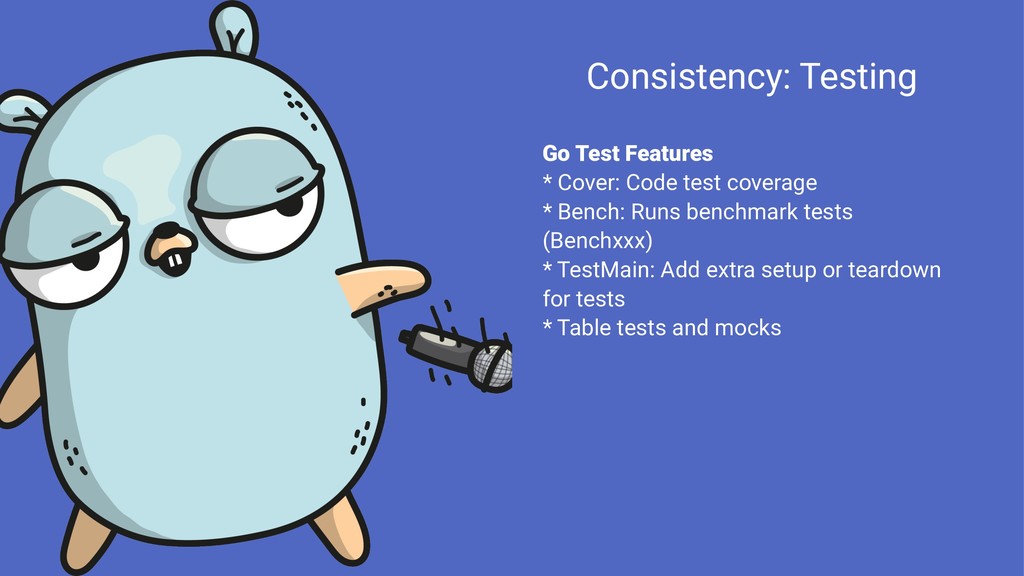
  11. Consistency: Testing Go Test Features * Cover: Code test coverage

    * Bench: Runs benchmark tests (Benchxxx) * TestMain: Add extra setup or teardown for tests * Table tests and mocks
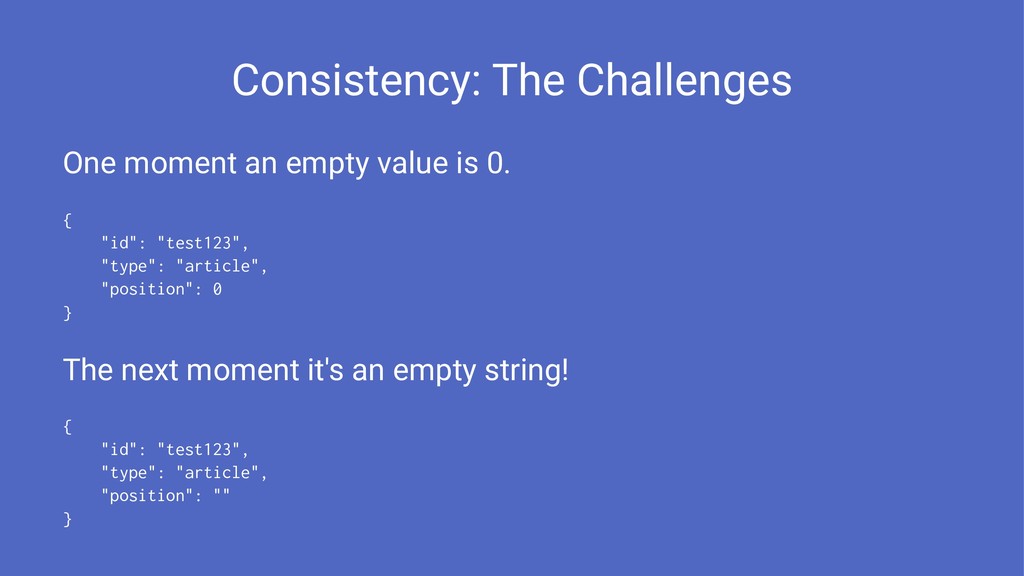
  12. Consistency: The Challenges One moment an empty value is 0.

    { "id": "test123", "type": "article", "position": 0 } The next moment it's an empty string! { "id": "test123", "type": "article", "position": "" }
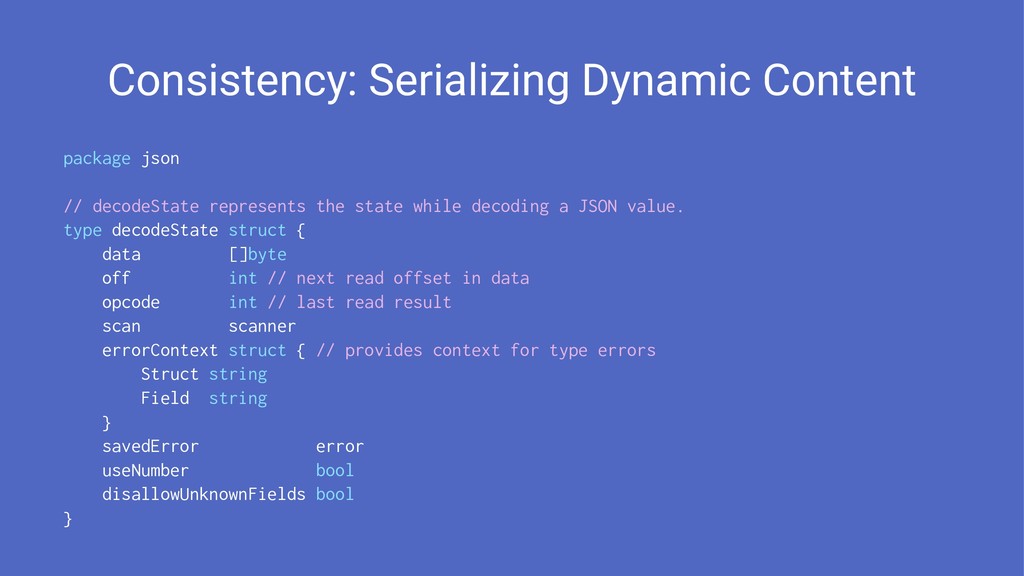
  13. Consistency: Serializing Dynamic Content package json // decodeState represents the

    state while decoding a JSON value. type decodeState struct { data []byte off int // next read offset in data opcode int // last read result scan scanner errorContext struct { // provides context for type errors Struct string Field string } savedError error useNumber bool disallowUnknownFields bool }
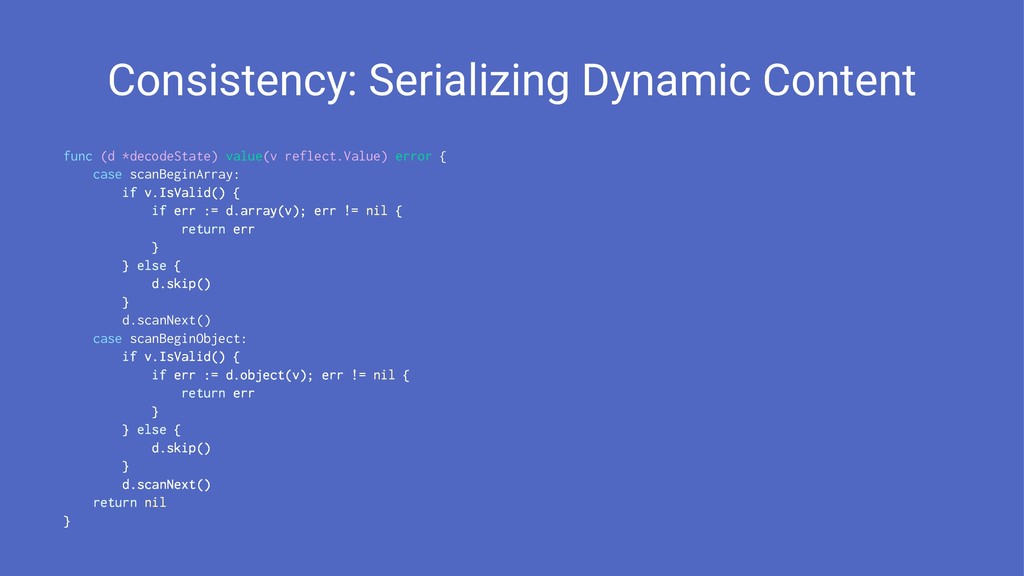
  14. Consistency: Serializing Dynamic Content func (d *decodeState) value(v reflect.Value) error

    { case scanBeginArray: if v.IsValid() { if err := d.array(v); err != nil { return err } } else { d.skip() } d.scanNext() case scanBeginObject: if v.IsValid() { if err := d.object(v); err != nil { return err } } else { d.skip() } d.scanNext() return nil }
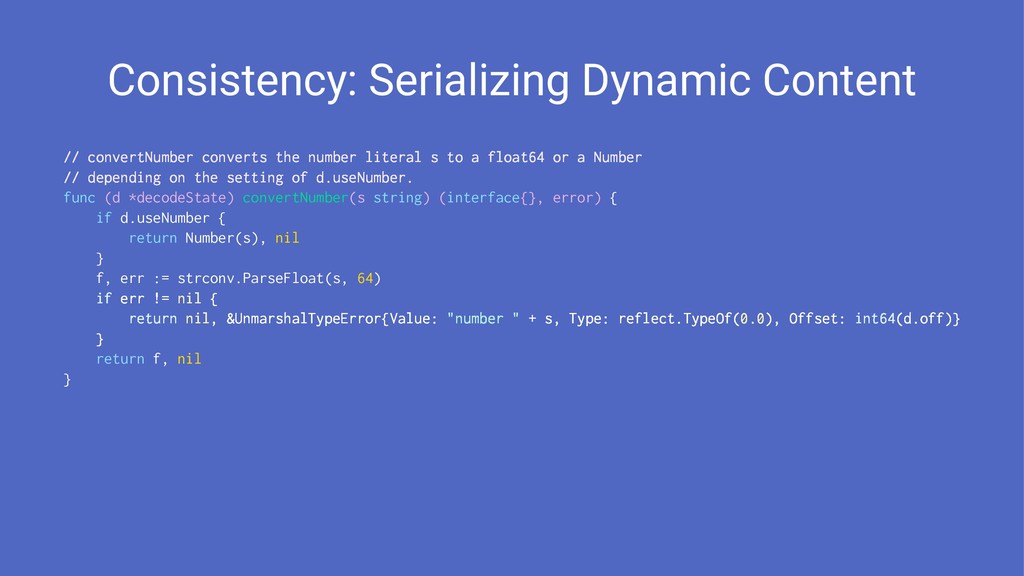
  15. Consistency: Serializing Dynamic Content // convertNumber converts the number literal

    s to a float64 or a Number // depending on the setting of d.useNumber. func (d *decodeState) convertNumber(s string) (interface{}, error) { if d.useNumber { return Number(s), nil } f, err := strconv.ParseFloat(s, 64) if err != nil { return nil, &UnmarshalTypeError{Value: "number " + s, Type: reflect.TypeOf(0.0), Offset: int64(d.off)} } return f, nil }
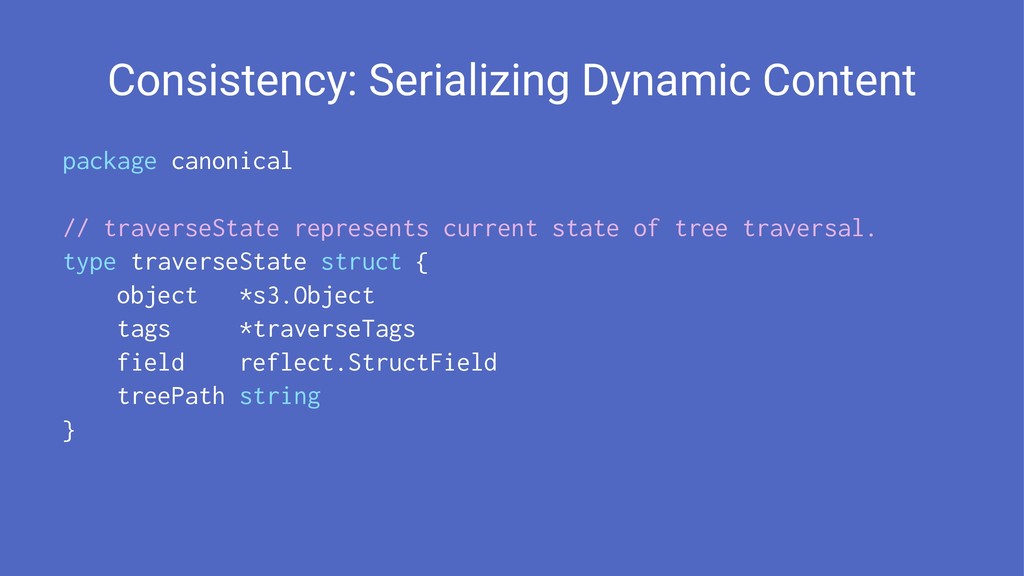
  16. Consistency: Serializing Dynamic Content package canonical // traverseState represents current

    state of tree traversal. type traverseState struct { object *s3.Object tags *traverseTags field reflect.StructField treePath string }
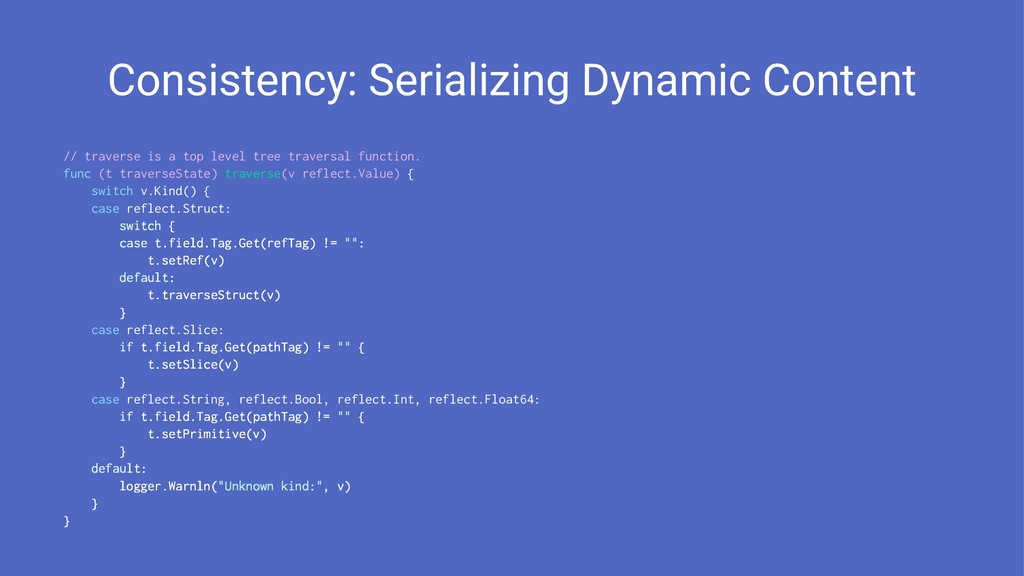
  17. Consistency: Serializing Dynamic Content // traverse is a top level

    tree traversal function. func (t traverseState) traverse(v reflect.Value) { switch v.Kind() { case reflect.Struct: switch { case t.field.Tag.Get(refTag) != "": t.setRef(v) default: t.traverseStruct(v) } case reflect.Slice: if t.field.Tag.Get(pathTag) != "" { t.setSlice(v) } case reflect.String, reflect.Bool, reflect.Int, reflect.Float64: if t.field.Tag.Get(pathTag) != "" { t.setPrimitive(v) } default: logger.Warnln("Unknown kind:", v) } }
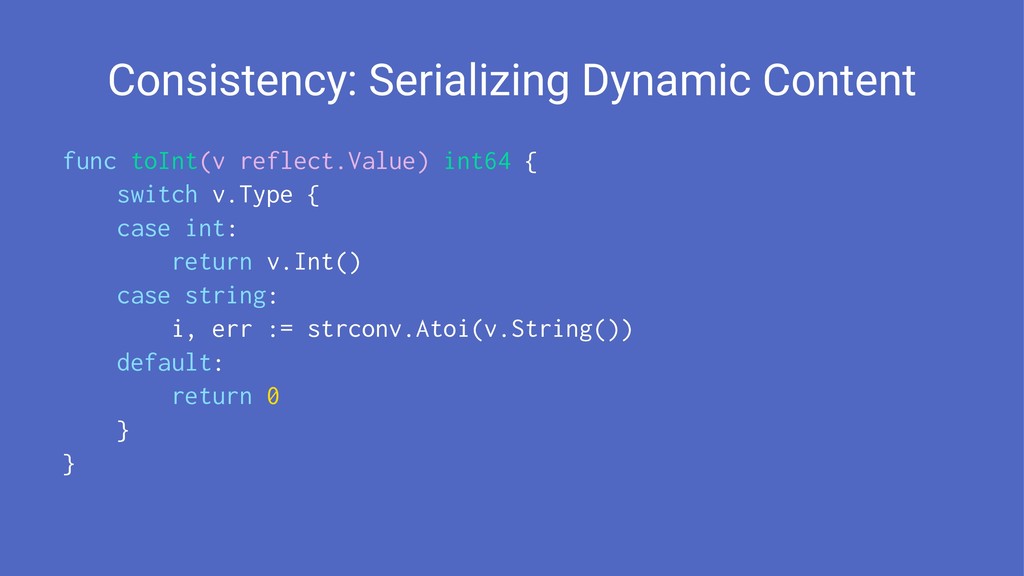
  18. Consistency: Serializing Dynamic Content func toInt(v reflect.Value) int64 { switch

    v.Type { case int: return v.Int() case string: i, err := strconv.Atoi(v.String()) default: return 0 } }
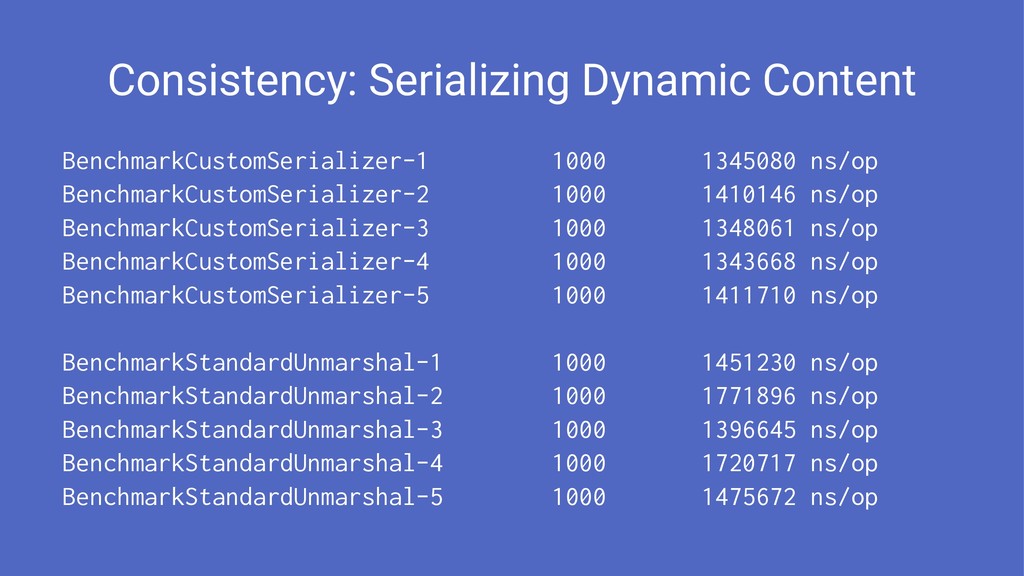
  19. Consistency: Serializing Dynamic Content BenchmarkCustomSerializer-1 1000 1345080 ns/op BenchmarkCustomSerializer-2 1000

    1410146 ns/op BenchmarkCustomSerializer-3 1000 1348061 ns/op BenchmarkCustomSerializer-4 1000 1343668 ns/op BenchmarkCustomSerializer-5 1000 1411710 ns/op BenchmarkStandardUnmarshal-1 1000 1451230 ns/op BenchmarkStandardUnmarshal-2 1000 1771896 ns/op BenchmarkStandardUnmarshal-3 1000 1396645 ns/op BenchmarkStandardUnmarshal-4 1000 1720717 ns/op BenchmarkStandardUnmarshal-5 1000 1475672 ns/op
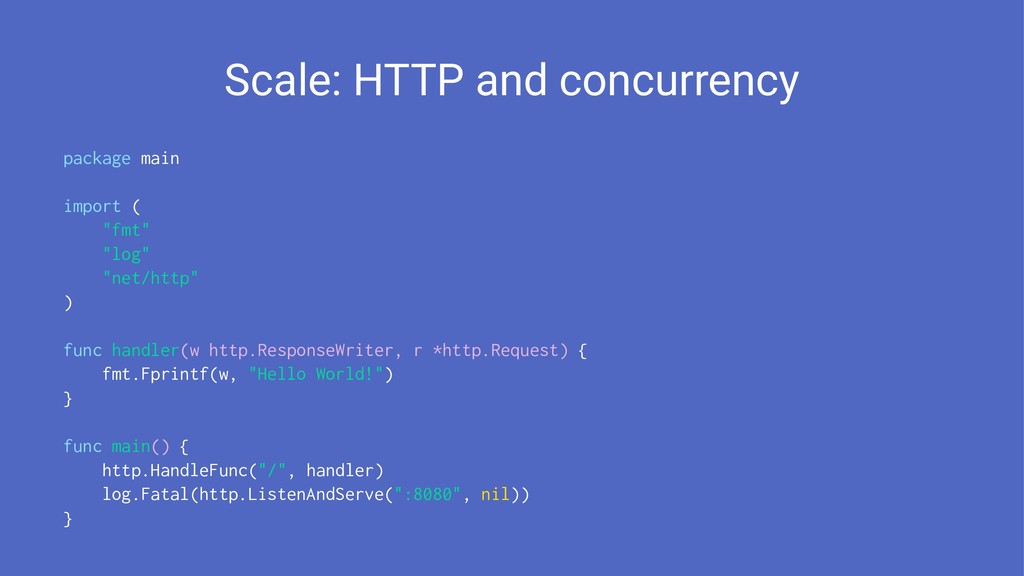
  20. Scale: HTTP and concurrency package main import ( "fmt" "log"

    "net/http" ) func handler(w http.ResponseWriter, r *http.Request) { fmt.Fprintf(w, "Hello World!") } func main() { http.HandleFunc("/", handler) log.Fatal(http.ListenAndServe(":8080", nil)) }
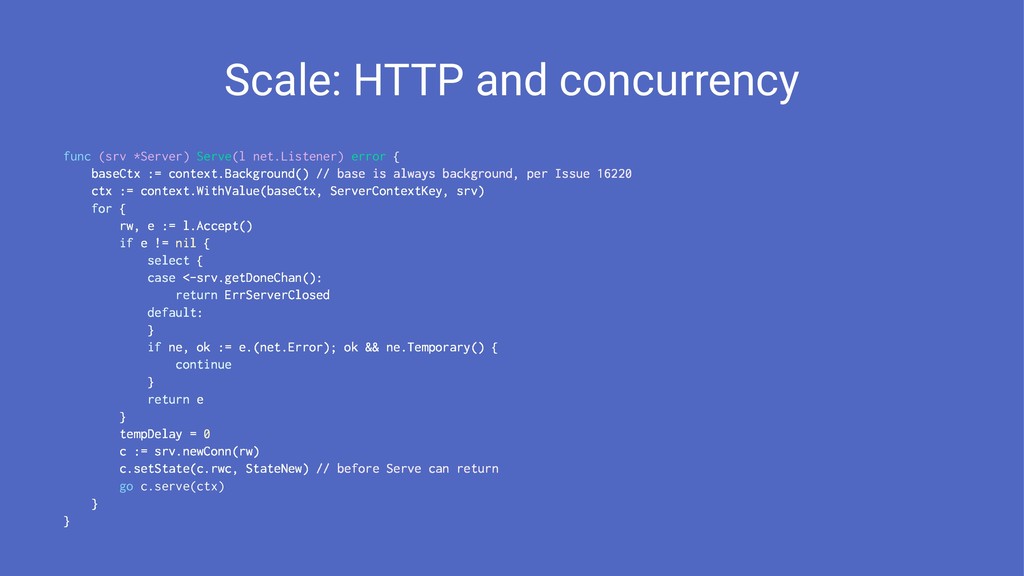
  21. Scale: HTTP and concurrency func (srv *Server) Serve(l net.Listener) error

    { baseCtx := context.Background() // base is always background, per Issue 16220 ctx := context.WithValue(baseCtx, ServerContextKey, srv) for { rw, e := l.Accept() if e != nil { select { case <-srv.getDoneChan(): return ErrServerClosed default: } if ne, ok := e.(net.Error); ok && ne.Temporary() { continue } return e } tempDelay = 0 c := srv.newConn(rw) c.setState(c.rwc, StateNew) // before Serve can return go c.serve(ctx) } }
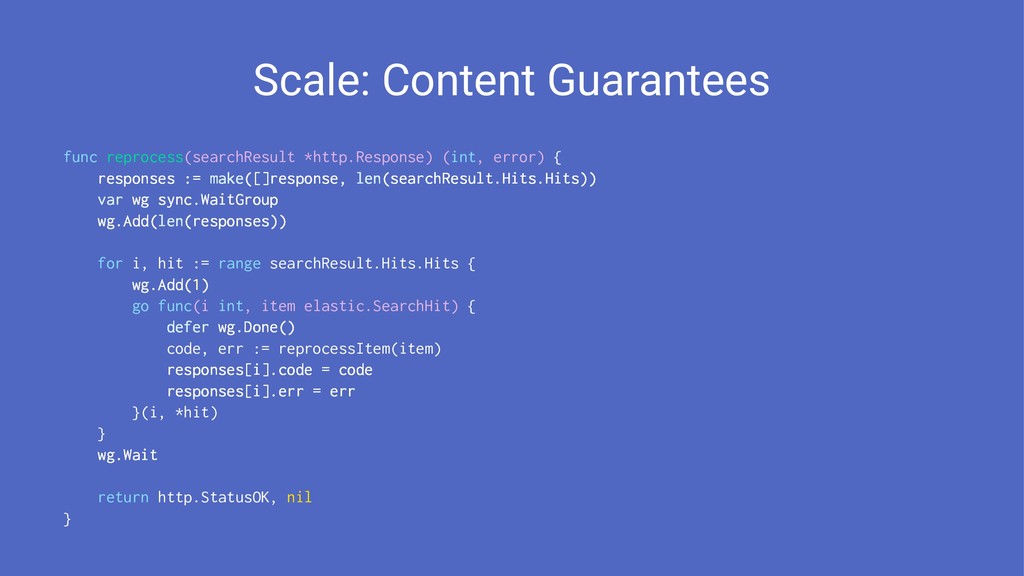
  22. Scale: Content Guarantees func reprocess(searchResult *http.Response) (int, error) { responses

    := make([]response, len(searchResult.Hits.Hits)) var wg sync.WaitGroup wg.Add(len(responses)) for i, hit := range searchResult.Hits.Hits { wg.Add(1) go func(i int, item elastic.SearchHit) { defer wg.Done() code, err := reprocessItem(item) responses[i].code = code responses[i].err = err }(i, *hit) } wg.Wait return http.StatusOK, nil }
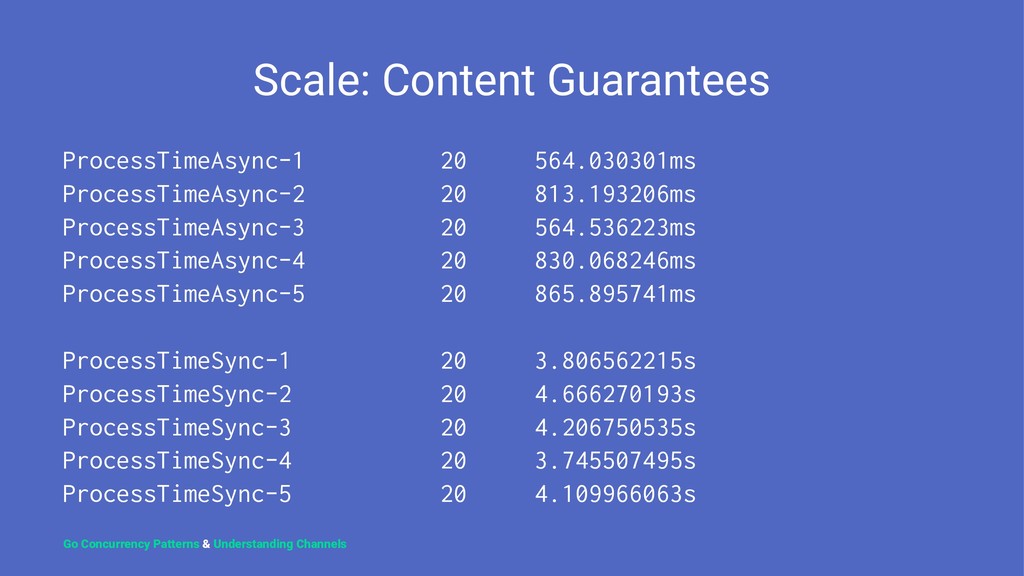
  23. Scale: Content Guarantees ProcessTimeAsync-1 20 564.030301ms ProcessTimeAsync-2 20 813.193206ms ProcessTimeAsync-3

    20 564.536223ms ProcessTimeAsync-4 20 830.068246ms ProcessTimeAsync-5 20 865.895741ms ProcessTimeSync-1 20 3.806562215s ProcessTimeSync-2 20 4.666270193s ProcessTimeSync-3 20 4.206750535s ProcessTimeSync-4 20 3.745507495s ProcessTimeSync-5 20 4.109966063s Go Concurrency Patterns & Understanding Channels
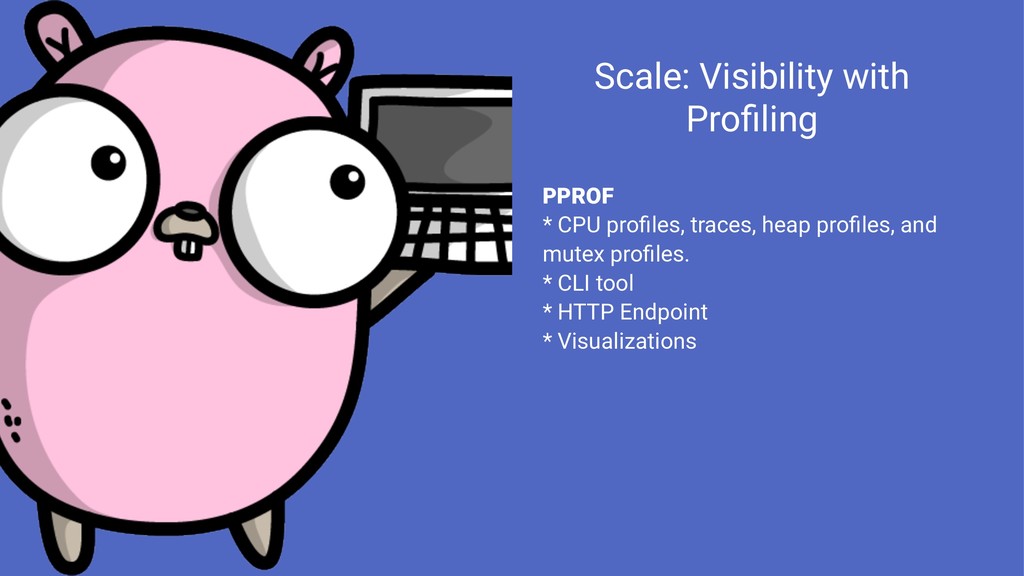
  24. Scale: Visibility with Profiling PPROF * CPU profiles, traces, heap

    profiles, and mutex profiles. * CLI tool * HTTP Endpoint * Visualizations
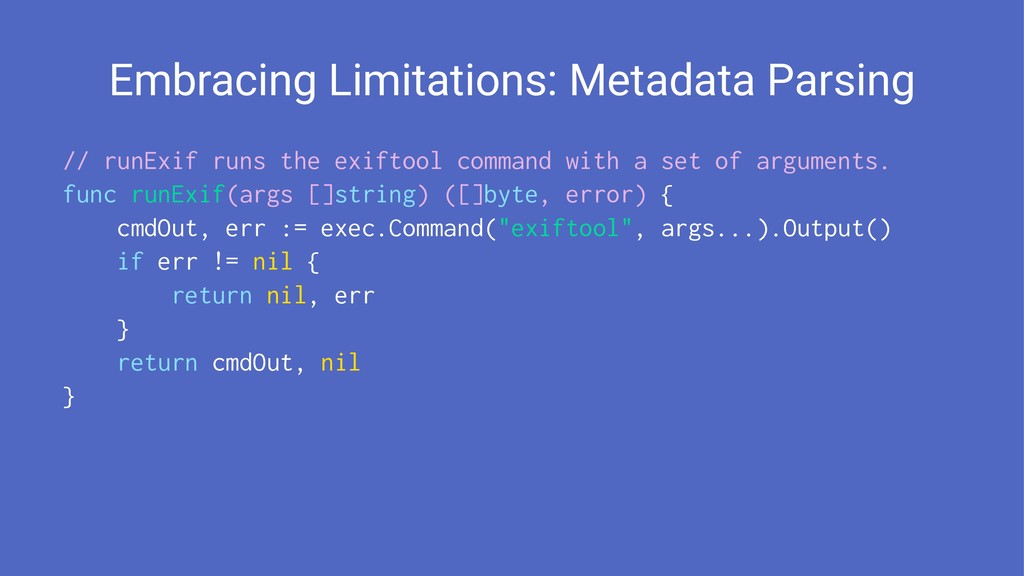
  25. Embracing Limitations: Metadata Parsing // runExif runs the exiftool command

    with a set of arguments. func runExif(args []string) ([]byte, error) { cmdOut, err := exec.Command("exiftool", args...).Output() if err != nil { return nil, err } return cmdOut, nil }
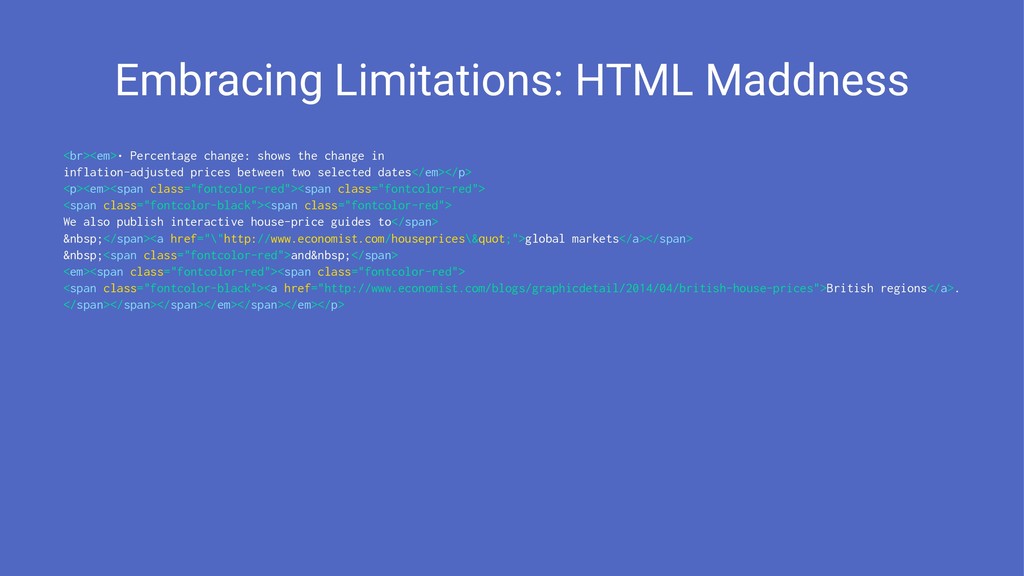
  26. Embracing Limitations: HTML Maddness <br><em>• Percentage change: shows the change

    in inflation-adjusted prices between two selected dates</em></p> <p><em><span class="fontcolor-red"><span class="fontcolor-red"> <span class="fontcolor-black"><span class="fontcolor-red"> We also publish interactive house-price guides to</span> &nbsp;</span><a href="\"http://www.economist.com/houseprices\&quot;">global markets</a></span> &nbsp;<span class="fontcolor-red">and&nbsp;</span> <em><span class="fontcolor-red"><span class="fontcolor-red"> <span class="fontcolor-black"><a href="http://www.economist.com/blogs/graphicdetail/2014/04/british-house-prices">British regions</a>. </span></span></span></em></span></em></p>
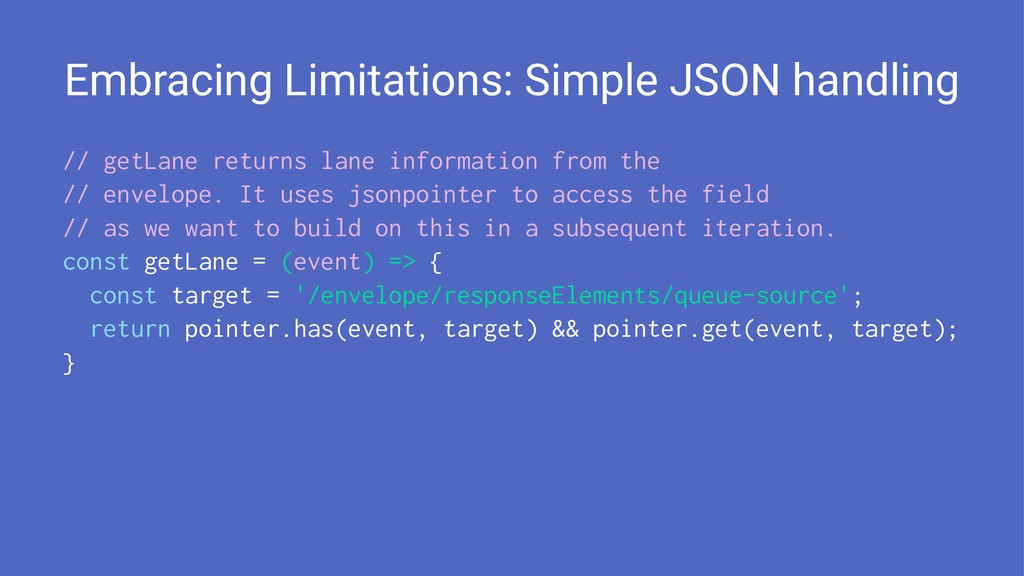
  27. Embracing Limitations: Simple JSON handling // getLane returns lane information

    from the // envelope. It uses jsonpointer to access the field // as we want to build on this in a subsequent iteration. const getLane = (event) => { const target = '/envelope/responseElements/queue-source'; return pointer.has(event, target) && pointer.get(event, target); }
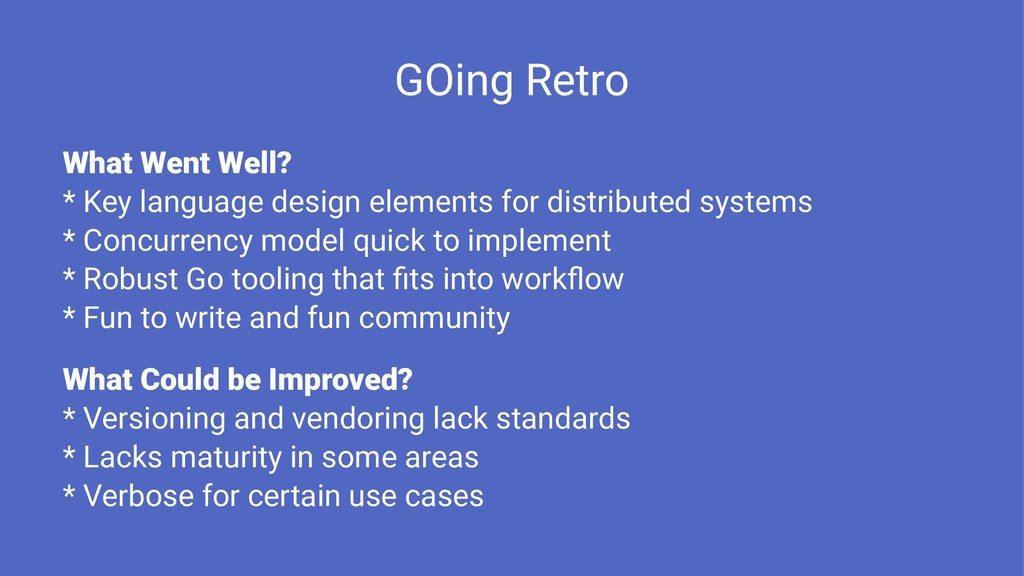
  28. GOing Retro What Went Well? * Key language design elements

    for distributed systems * Concurrency model quick to implement * Robust Go tooling that fits into workflow * Fun to write and fun community What Could be Improved? * Versioning and vendoring lack standards * Lacks maturity in some areas * Verbose for certain use cases
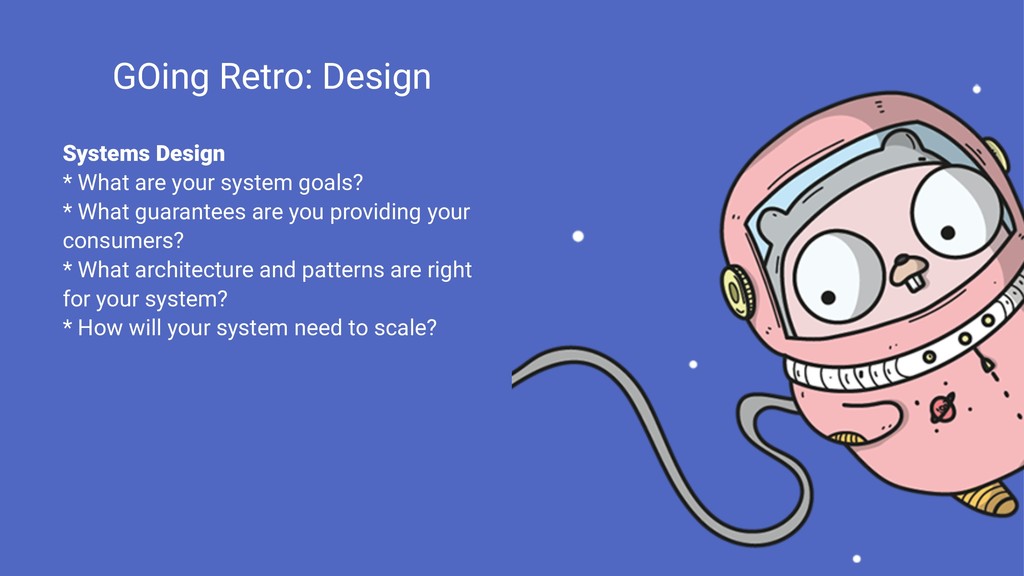
  29. GOing Retro: Design Systems Design * What are your system

    goals? * What guarantees are you providing your consumers? * What architecture and patterns are right for your system? * How will your system need to scale?