Upgrade to Pro — share decks privately, control downloads, hide ads and more …

City of Grande Prairie Aquatic Study 2013

Avatar for N/A N/A
March 11, 2014
42

City of Grande Prairie Aquatic Study 2013

Avatar for N/A

N/A

March 11, 2014

Transcript

  1. City of Grande Prairie Final Report Aquatic Services Strategy Suite

    400, 505 – 8840 210th Street, Langley, BC V1M 2Y2 Tel: 604.868.3604 www.perconline.com Dec 10th 2013
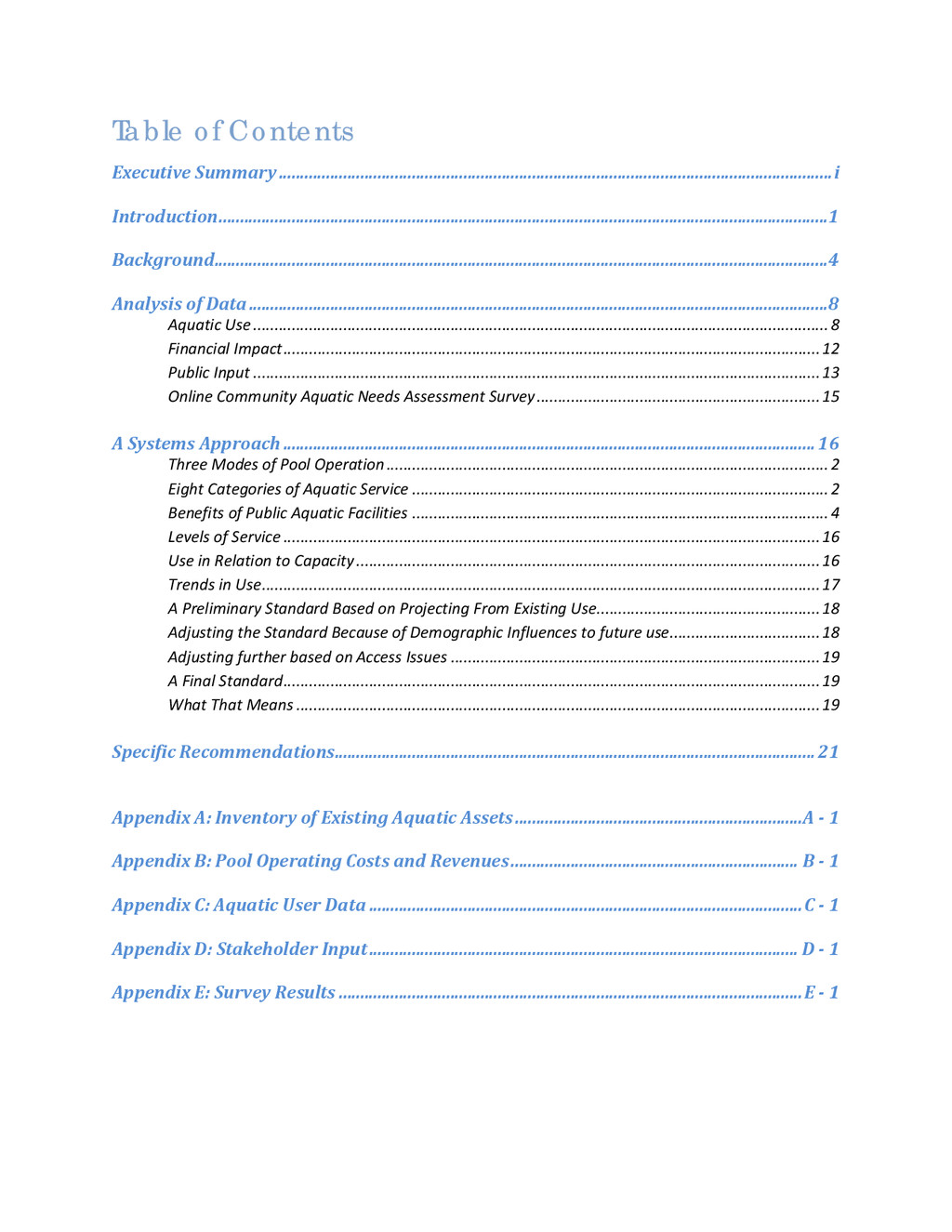
  2. Table of Contents Executive Summary ................................................................................................................................. i Introduction ..............................................................................................................................................1 Background

    ...............................................................................................................................................4 Analysis of Data .......................................................................................................................................8 Aquatic Use ...................................................................................................................................... 8 Financial Impact ............................................................................................................................. 12 Public Input .................................................................................................................................... 13 Online Community Aquatic Needs Assessment Survey .................................................................. 15 A Systems Approach ............................................................................................................................ 16 Three Modes of Pool Operation ....................................................................................................... 2 Eight Categories of Aquatic Service ................................................................................................. 2 Benefits of Public Aquatic Facilities ................................................................................................. 4 Levels of Service ............................................................................................................................. 16 Use in Relation to Capacity ............................................................................................................ 16 Trends in Use .................................................................................................................................. 17 A Preliminary Standard Based on Projecting From Existing Use .................................................... 18 Adjusting the Standard Because of Demographic Influences to future use ................................... 18 Adjusting further based on Access Issues ...................................................................................... 19 A Final Standard ............................................................................................................................. 19 What That Means .......................................................................................................................... 19 Specific Recommendations ................................................................................................................ 21 Appendix A: Inventory of Existing Aquatic Assets ...................................................................A - 1 Appendix B: Pool Operating Costs and Revenues ................................................................... B - 1 Appendix C: Aquatic User Data ..................................................................................................... C - 1 Appendix D: Stakeholder Input .................................................................................................... D - 1 Appendix E: Survey Results ............................................................................................................ E - 1
  3. Grande Prairie Aquatic Services Strategy Final Report December 10th 2013

    i | P a g e Executive Summary In August of 2013 the City of Grande Prairie retained the services of Professional Environmental Recreation Consultants Ltd. (PERC) to undertake an Aquatic Strategy for the City. The consultants are pleased to provide herein the results of the study. The consultants began the study by meeting with the staff of the City of Grande Prairie and requesting a great deal of information that related to uses of existing facilities, condition assessments of existing facilities and operating costs and revenues for those facilities. They also solicited some demographic information about city residents. They then reviewed and analyzed all background information, met with 13 stakeholder groups to obtain input on satisfaction levels, issues and needs, and conducted an online survey to obtain input from another 799 local residents. Once analyzed, the information led to a strategic standard for indoor pool provision. It is summarized below. An appropriate standard for indoor aquatic services of all kinds would be capacity to accommodate 9 swims per capita for the foreseeable future. This is at the top end of service provision in Canada. In the consultants’ collective experience, less that 5% of Canadian communities realize more than 8 public indoor swims per capita per year and none are above 10 swims per capita. If the standard of 9 swims per capita is endorsed by the City, it would mean that the existing Eastlink Centre would suffice to more than meet this standard for the next 10 years. While some users complain that the Eastlink Centre is already getting crowded, and may not be sufficient to meet all needs in the short term future, it is clear that any over- crowding is “tank specific” and “time specific” and does not relate to the entire facility. Eastlink is vastly underutilized on an overall basis and it would be much more prudent to focus investment of limited available public resources for the foreseeable future on rectifying issues at Eastlink to make it more attractive for some uses than to open a second indoor pool. It is also worth noting that: • Adding swims at Eastlink at less than $4 per swim subsidy now, and less as use in relation to capacity increases, is a much better investment than to open a second indoor pool at a much higher net subsidy per swim.
  4. Grande Prairie Aquatic Services Strategy Final Report December 10th 2013

    ii | P a g e • There is no need for an outdoor pool at present or for the foreseeable future. Any need for summer respite from heat or water orientation for toddlers can be accommodated with spray decks, which operate at the lowest net subsidy per use of all types of aquatic amenities and can be used for other dry use activities even when water is not being automatically turned on. • The investment required to render the second indoor pool and/or the Bear Creek Outdoor Pool usable in the short term would be much better spent on retrofits to the Eastlink Centre to remedy some of the limitations to its use. • Some other issues that limit use of the Eastlink Centre Pool can be remedied over time with adjustments to the operating policies as the management of the pool is refined over time to better respond to all types of need. Examples of such limitations include water temperature and the proportion of each tank reserved for lane swimming. Other issues that limit its use will require some capital investment. The two most significant of these are: o Depth of the 50 meter pool; o Acoustics in natatorium. • In the longer term future, a second indoor pool will be required as the Eastlink Centre approaches 80% use in relation to capacity. When that happens, a second, community level indoor pool will be required to meet basic aquatic needs; primarily learn to swim programs and swimming for fitness, but could also accommodate some recreational swimming and water orientation for toddlers. To make this second indoor pool a training centre for swim clubs will be counterproductive given the significant investment in the 50 meter tank at Eastlink which makes it by far the best training and competition facility in northern Alberta if some technical issues can be resolved (i.e. primarily acoustics). Not to resolve those issues after investing so significantly in such a wonderful training and competition facility will be to waste that investment. • When the second indoor pool is required, it should be located as far away from Eastlink within the City as possible to ensure that both pools collectively are within easy geographic reach by all city residents. Based on the above standard, and what has been learned about the existing aquatic services, the consultants developed the recommendations below. 1. Invest in resolving a few technical issues at Eastlink that will render the facility more usable for more concurrent uses, and the 50 meter tank more useful overall. These technical issues include: a. reducing the noise level within the natatorium to levels more conducive to coaching, instruction and relaxed lane swimming;
  5. Grande Prairie Aquatic Services Strategy Final Report December 10th 2013

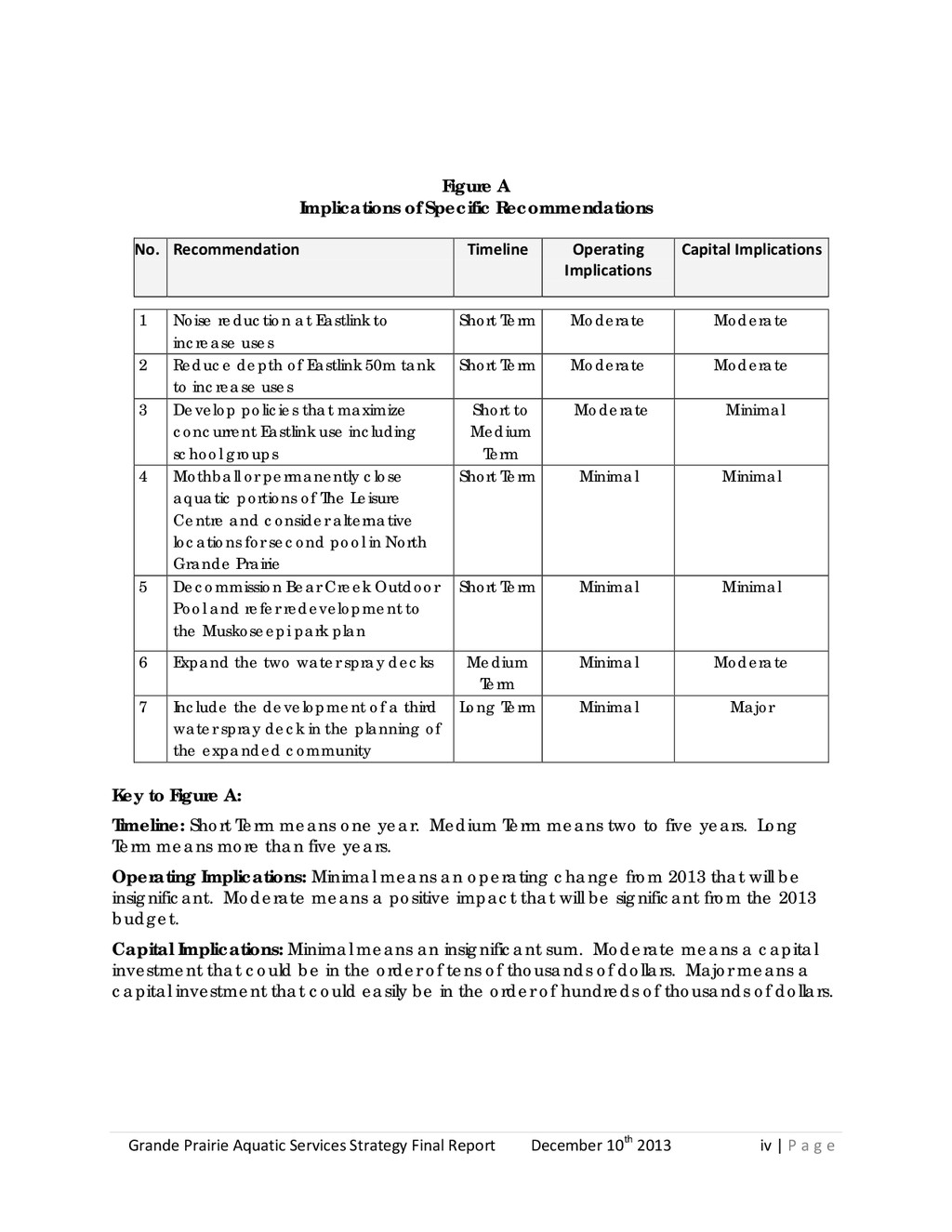
    iii | P a g e b. reducing the water depth in the shallow end of the main 50 meter tank to make it more conducive for some levels of swim instruction and recreational use by young children, but preferably not in a way that would permanently reduce the depth, as the deep water is “faster” than shallow water for swim club training and swim meets and therefore will be desirable during some periods of each year. 2. Invest also in modest changes to the operating policies over time to cultivate more concurrent swims; increasing user groups like schools and swim clubs while the public is using the pool. 3. Mothball or close the aquatic areas of The Leisure Centre as it will not be required for aquatic uses for at least ten more years, and possibly longer. Since the facility will cost some significant annual amounts to be retained in a mothballed state, and since there is an opportunity cost to the land on which it sits, and since when the second indoor pool is required, it may not be required in this location or in the current configuration, and since it will be costly to render the 40 year old facility to modern standards, it may be more prudent to close the aquatic facility and build a new one when it is required. Opening The Leisure Centre in the next two years will take uses away from Eastlink at much higher cost, thereby rendering both facilities much less viable than continuing to focus all resources only on one pool. This should not prevent retrofitting The Leisure Centre for dry land uses. 4. Close the Bear Creek Pool and don’t replace it. It is much more costly on a per swim basis than Eastlink and much more limited in terms of the types and amounts of use it can accommodate. It has only ever accommodated about 4% of all swims in the City and accommodated them at a much higher cost than indoor swims. To invest significantly in recreating a situation where it continues to do so, is not prudent use of limited available public resources. Refer the redevelopment of the area to a Muskoseepi park planning process. 5. Continue with the operation of the two exiting spray decks, investing in expansions and upgrades to them as required for the short and medium term future, as very cost effective amenities that meet real needs on a community level. 6. As the City grows, even if the two existing spray decks are expanded, there will eventually be a need for a third spray deck. It should be located strategically to serve one third of the expanding City. The implications of the recommendations are summarized in Figure A.
  6. Grande Prairie Aquatic Services Strategy Final Report December 10th 2013

    iv | P a g e Figure A Implications of Specific Recommendations No. Recommendation Timeline Operating Implications Capital Implications 1 Noise reduction at Eastlink to increase uses Short Term Moderate Moderate 2 Reduce depth of Eastlink 50m tank to increase uses Short Term Moderate Moderate 3 Develop policies that maximize concurrent Eastlink use including school groups Short to Medium Term Moderate Minimal 4 Mothball or permanently close aquatic portions of The Leisure Centre and consider alternative locations for second pool in North Grande Prairie Short Term Minimal Minimal 5 Decommission Bear Creek Outdoor Pool and refer redevelopment to the Muskoseepi park plan Short Term Minimal Minimal 6 Expand the two water spray decks Medium Term Minimal Moderate 7 Include the development of a third water spray deck in the planning of the expanded community Long Term Minimal Major Key to Figure A: Timeline: Short Term means one year. Medium Term means two to five years. Long Term means more than five years. Operating Implications: Minimal means an operating change from 2013 that will be insignificant. Moderate means a positive impact that will be significant from the 2013 budget. Capital Implications: Minimal means an insignificant sum. Moderate means a capital investment that could be in the order of tens of thousands of dollars. Major means a capital investment that could easily be in the order of hundreds of thousands of dollars.
  7. Grande Prairie Aquatic Services Strategy Final Report December 10th 2013

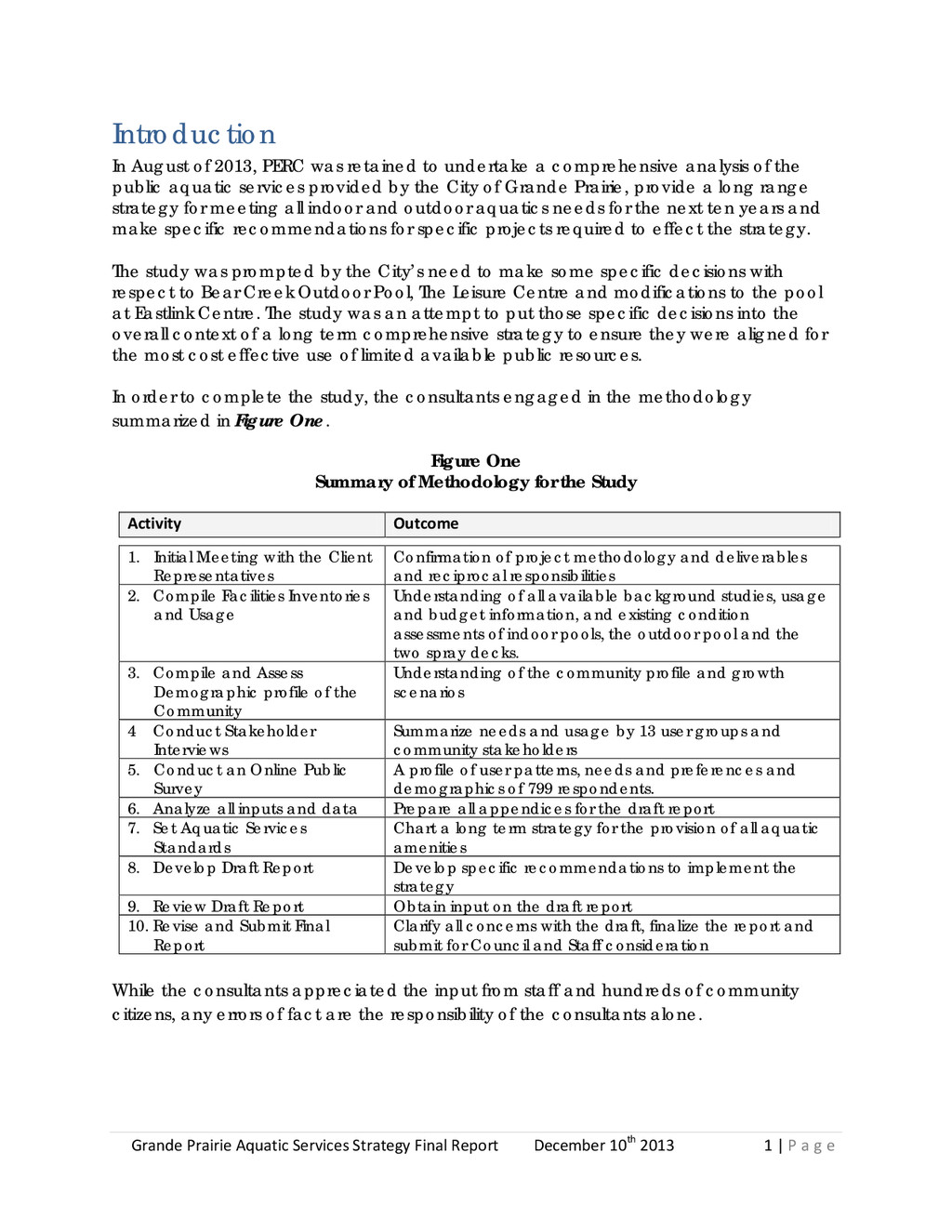
    1 | P a g e Introduction In August of 2013, PERC was retained to undertake a comprehensive analysis of the public aquatic services provided by the City of Grande Prairie, provide a long range strategy for meeting all indoor and outdoor aquatics needs for the next ten years and make specific recommendations for specific projects required to effect the strategy. The study was prompted by the City’s need to make some specific decisions with respect to Bear Creek Outdoor Pool, The Leisure Centre and modifications to the pool at Eastlink Centre. The study was an attempt to put those specific decisions into the overall context of a long term comprehensive strategy to ensure they were aligned for the most cost effective use of limited available public resources. In order to complete the study, the consultants engaged in the methodology summarized in Figure One. Figure One Summary of Methodology for the Study Activity Outcome 1. Initial Meeting with the Client Representatives Confirmation of project methodology and deliverables and reciprocal responsibilities 2. Compile Facilities Inventories and Usage Understanding of all available background studies, usage and budget information, and existing condition assessments of indoor pools, the outdoor pool and the two spray decks. 3. Compile and Assess Demographic profile of the Community Understanding of the community profile and growth scenarios 4 Conduct Stakeholder Interviews Summarize needs and usage by 13 user groups and community stakeholders 5. Conduct an Online Public Survey A profile of user patterns, needs and preferences and demographics of 799 respondents. 6. Analyze all inputs and data Prepare all appendices for the draft report 7. Set Aquatic Services Standards Chart a long term strategy for the provision of all aquatic amenities 8. Develop Draft Report Develop specific recommendations to implement the strategy 9. Review Draft Report Obtain input on the draft report 10. Revise and Submit Final Report Clarify all concerns with the draft, finalize the report and submit for Council and Staff consideration While the consultants appreciated the input from staff and hundreds of community citizens, any errors of fact are the responsibility of the consultants alone.
  8. Grande Prairie Aquatic Services Strategy Final Report December 10th 2013

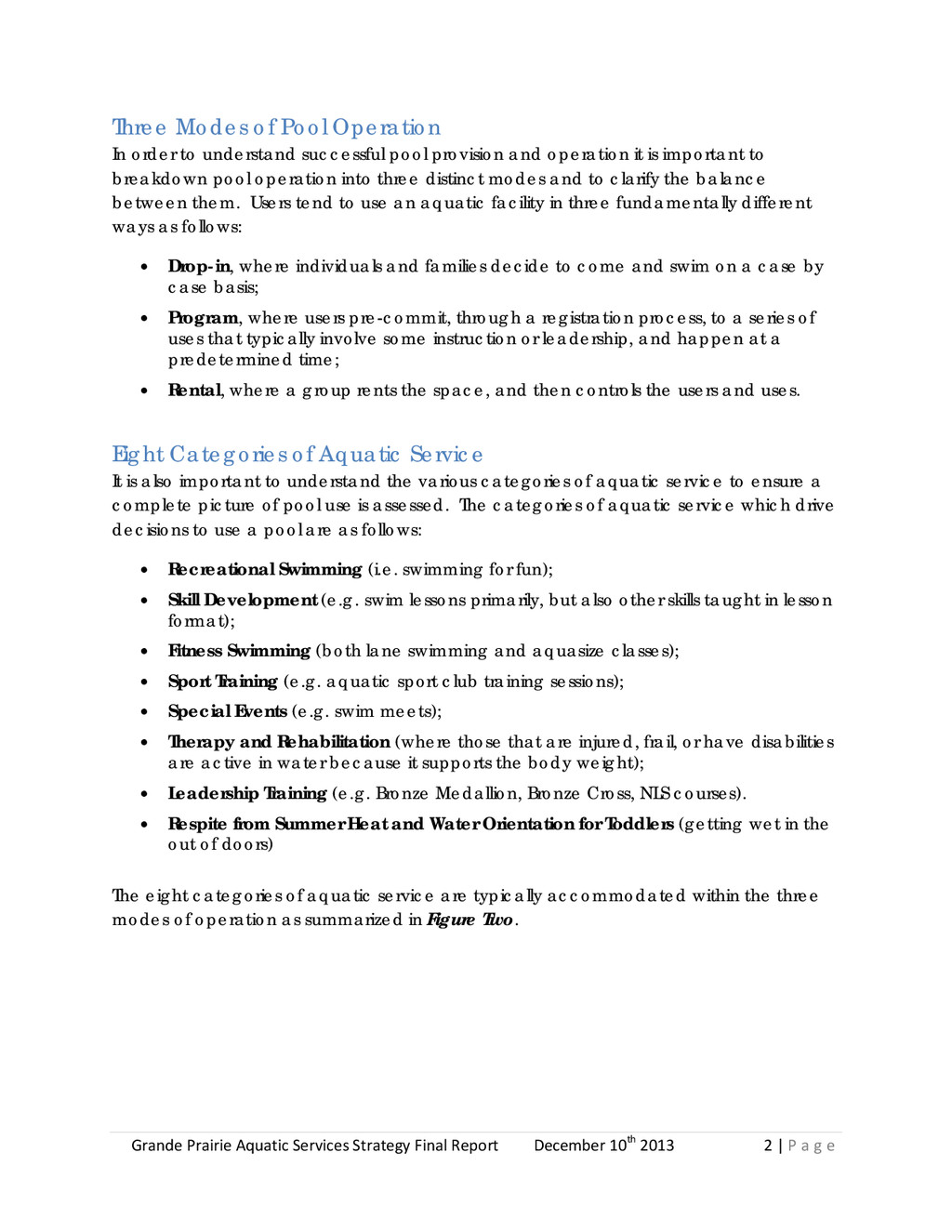
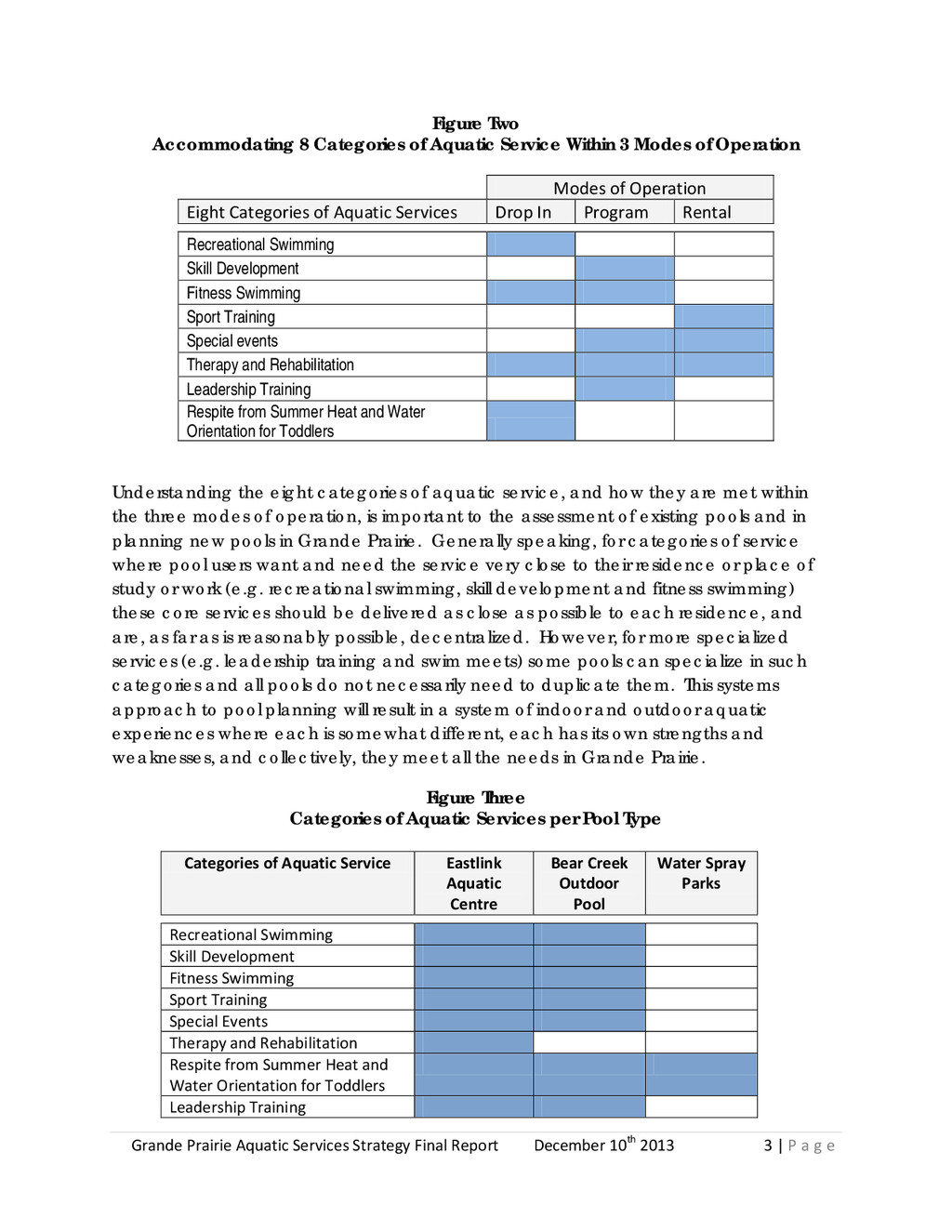
    2 | P a g e Three Modes of Pool Operation In order to understand successful pool provision and operation it is important to breakdown pool operation into three distinct modes and to clarify the balance between them. Users tend to use an aquatic facility in three fundamentally different ways as follows: • Drop-in, where individuals and families decide to come and swim on a case by case basis; • Program, where users pre-commit, through a registration process, to a series of uses that typically involve some instruction or leadership, and happen at a predetermined time; • Rental, where a group rents the space, and then controls the users and uses. Eight Categories of Aquatic Service It is also important to understand the various categories of aquatic service to ensure a complete picture of pool use is assessed. The categories of aquatic service which drive decisions to use a pool are as follows: • Recreational Swimming (i.e. swimming for fun); • Skill Development (e.g. swim lessons primarily, but also other skills taught in lesson format); • Fitness Swimming (both lane swimming and aquasize classes); • Sport Training (e.g. aquatic sport club training sessions); • Special Events (e.g. swim meets); • Therapy and Rehabilitation (where those that are injured, frail, or have disabilities are active in water because it supports the body weight); • Leadership Training (e.g. Bronze Medallion, Bronze Cross, NLS courses). • Respite from Summer Heat and Water Orientation for Toddlers (getting wet in the out of doors) The eight categories of aquatic service are typically accommodated within the three modes of operation as summarized in Figure Two.
  9. Grande Prairie Aquatic Services Strategy Final Report December 10th 2013

    3 | P a g e Figure Two Accommodating 8 Categories of Aquatic Service Within 3 Modes of Operation Modes of Operation Eight Categories of Aquatic Services Drop In Program Rental Recreational Swimming Skill Development Fitness Swimming Sport Training Special events Therapy and Rehabilitation Leadership Training Respite from Summer Heat and Water Orientation for Toddlers Understanding the eight categories of aquatic service, and how they are met within the three modes of operation, is important to the assessment of existing pools and in planning new pools in Grande Prairie. Generally speaking, for categories of service where pool users want and need the service very close to their residence or place of study or work (e.g. recreational swimming, skill development and fitness swimming) these core services should be delivered as close as possible to each residence, and are, as far as is reasonably possible, decentralized. However, for more specialized services (e.g. leadership training and swim meets) some pools can specialize in such categories and all pools do not necessarily need to duplicate them. This systems approach to pool planning will result in a system of indoor and outdoor aquatic experiences where each is somewhat different, each has its own strengths and weaknesses, and collectively, they meet all the needs in Grande Prairie. Figure Three Categories of Aquatic Services per Pool Type Categories of Aquatic Service Eastlink Aquatic Centre Bear Creek Outdoor Pool Water Spray Parks Recreational Swimming Skill Development Fitness Swimming Sport Training Special Events Therapy and Rehabilitation Respite from Summer Heat and Water Orientation for Toddlers Leadership Training
  10. Grande Prairie Aquatic Services Strategy Final Report December 10th 2013

    4 | P a g e Benefits of Public Aquatic Facilities Although public aquatic facilities are among the most expensive recreation facilities that a community can provide, almost all communities invest in them because of the tremendous benefits that accrue from their use. These benefits contribute to healthy, active individuals and communities and include: • Water safety – learning how not to drown, one of the most basic of human needs and public services especially for communities close to natural waterways; • Learning and honing skills in swimming, diving and other water sports; • Fitness and conditioning in a medium that is least consumptive and least likely to result in injury because of the buoyancy of the water; • Rehabilitation and therapy services to those with disabilities, injury or frailty; • Family opportunities to come together in a recreational setting conducive to all family members; • Mixing segments and subsets of the community with an activity that is worldwide, appeals to people of all ages and abilities; • Leadership training for young people and one of the better paying job opportunities; • Extensive volunteering opportunities; • Special events that rally community identify, spirit and pride; • Sport Tourism opportunities associated with swim meets. It is for the above reasons that public aquatic swimming facilities are typically quite highly subsidized. In addition to taxpayers having to contribute to the capital costs of all indoor pools, the typical recovery rate for an indoor pool is between 50% and 70%, with taxpayers paying the remainder of the operating costs.
  11. Grande Prairie Aquatic Services Strategy Final Report December 10th 2013

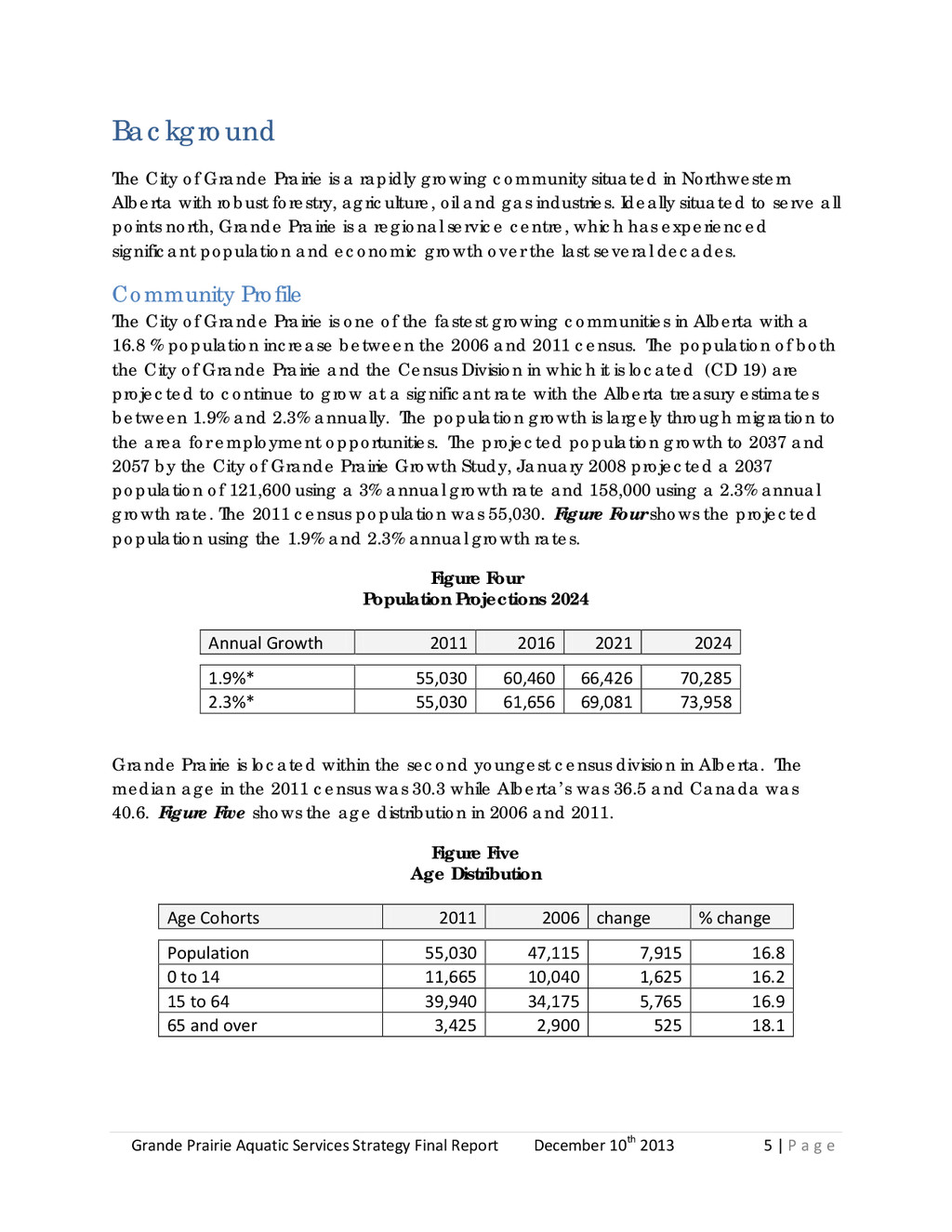
    5 | P a g e Background The City of Grande Prairie is a rapidly growing community situated in Northwestern Alberta with robust forestry, agriculture, oil and gas industries. Ideally situated to serve all points north, Grande Prairie is a regional service centre, which has experienced significant population and economic growth over the last several decades. Community Profile The City of Grande Prairie is one of the fastest growing communities in Alberta with a 16.8 % population increase between the 2006 and 2011 census. The population of both the City of Grande Prairie and the Census Division in which it is located (CD 19) are projected to continue to grow at a significant rate with the Alberta treasury estimates between 1.9% and 2.3% annually. The population growth is largely through migration to the area for employment opportunities. The projected population growth to 2037 and 2057 by the City of Grande Prairie Growth Study, January 2008 projected a 2037 population of 121,600 using a 3% annual growth rate and 158,000 using a 2.3% annual growth rate. The 2011 census population was 55,030. Figure Four shows the projected population using the 1.9% and 2.3% annual growth rates. Figure Four Population Projections 2024 Annual Growth 2011 2016 2021 2024 1.9%* 55,030 60,460 66,426 70,285 2.3%* 55,030 61,656 69,081 73,958 Grande Prairie is located within the second youngest census division in Alberta. The median age in the 2011 census was 30.3 while Alberta’s was 36.5 and Canada was 40.6. Figure Five shows the age distribution in 2006 and 2011. Figure Five Age Distribution Age Cohorts 2011 2006 change % change Population 55,030 47,115 7,915 16.8 0 to 14 11,665 10,040 1,625 16.2 15 to 64 39,940 34,175 5,765 16.9 65 and over 3,425 2,900 525 18.1
  12. Grande Prairie Aquatic Services Strategy Final Report December 10th 2013

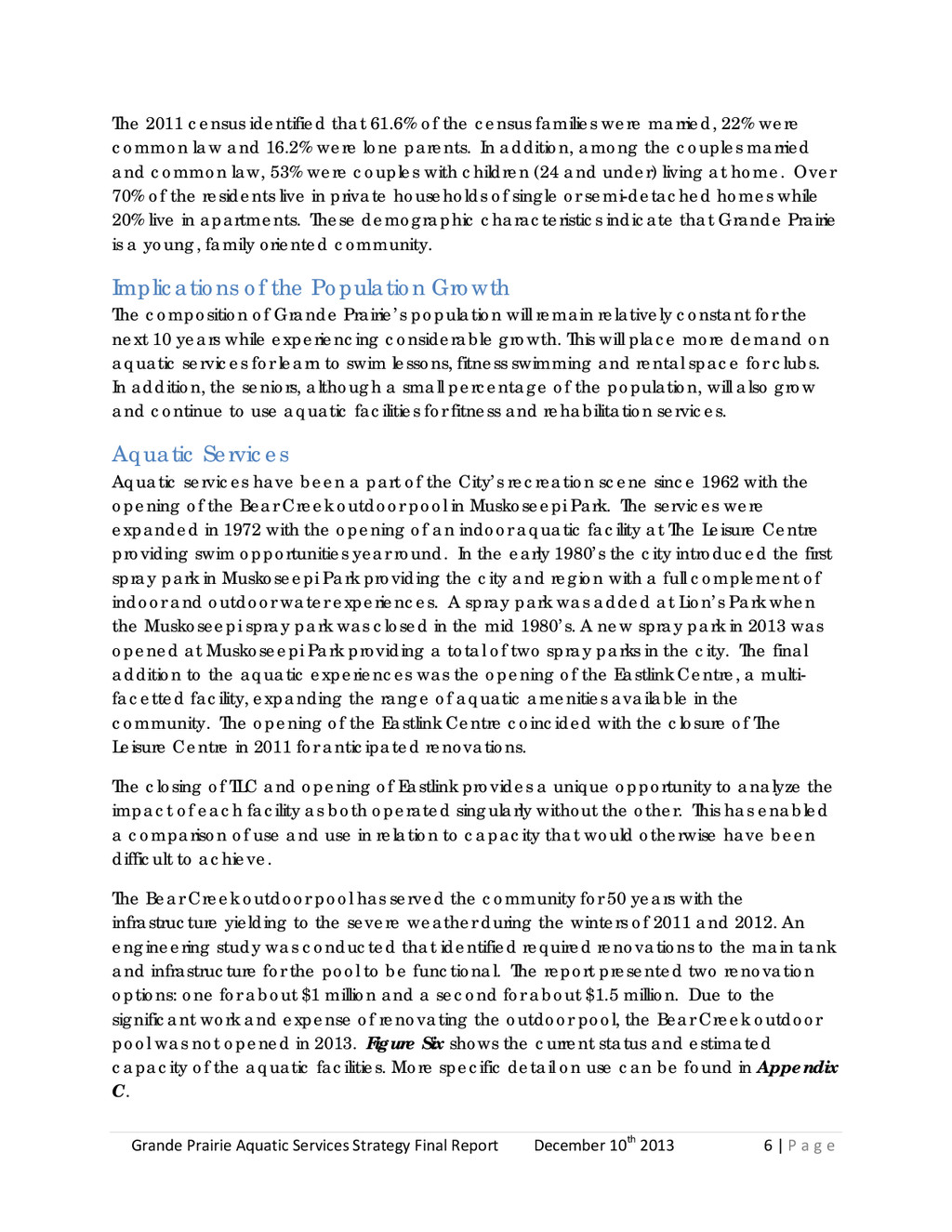
    6 | P a g e The 2011 census identified that 61.6% of the census families were married, 22% were common law and 16.2% were lone parents. In addition, among the couples married and common law, 53% were couples with children (24 and under) living at home. Over 70% of the residents live in private households of single or semi-detached homes while 20% live in apartments. These demographic characteristics indicate that Grande Prairie is a young, family oriented community. Implications of the Population Growth The composition of Grande Prairie’s population will remain relatively constant for the next 10 years while experiencing considerable growth. This will place more demand on aquatic services for learn to swim lessons, fitness swimming and rental space for clubs. In addition, the seniors, although a small percentage of the population, will also grow and continue to use aquatic facilities for fitness and rehabilitation services. Aquatic Services Aquatic services have been a part of the City’s recreation scene since 1962 with the opening of the Bear Creek outdoor pool in Muskoseepi Park. The services were expanded in 1972 with the opening of an indoor aquatic facility at The Leisure Centre providing swim opportunities year round. In the early 1980’s the city introduced the first spray park in Muskoseepi Park providing the city and region with a full complement of indoor and outdoor water experiences. A spray park was added at Lion’s Park when the Muskoseepi spray park was closed in the mid 1980’s. A new spray park in 2013 was opened at Muskoseepi Park providing a total of two spray parks in the city. The final addition to the aquatic experiences was the opening of the Eastlink Centre, a multi- facetted facility, expanding the range of aquatic amenities available in the community. The opening of the Eastlink Centre coincided with the closure of The Leisure Centre in 2011 for anticipated renovations. The closing of TLC and opening of Eastlink provides a unique opportunity to analyze the impact of each facility as both operated singularly without the other. This has enabled a comparison of use and use in relation to capacity that would otherwise have been difficult to achieve. The Bear Creek outdoor pool has served the community for 50 years with the infrastructure yielding to the severe weather during the winters of 2011 and 2012. An engineering study was conducted that identified required renovations to the main tank and infrastructure for the pool to be functional. The report presented two renovation options: one for about $1 million and a second for about $1.5 million. Due to the significant work and expense of renovating the outdoor pool, the Bear Creek outdoor pool was not opened in 2013. Figure Six shows the current status and estimated capacity of the aquatic facilities. More specific detail on use can be found in Appendix C.
  13. Grande Prairie Aquatic Services Strategy Final Report December 10th 2013

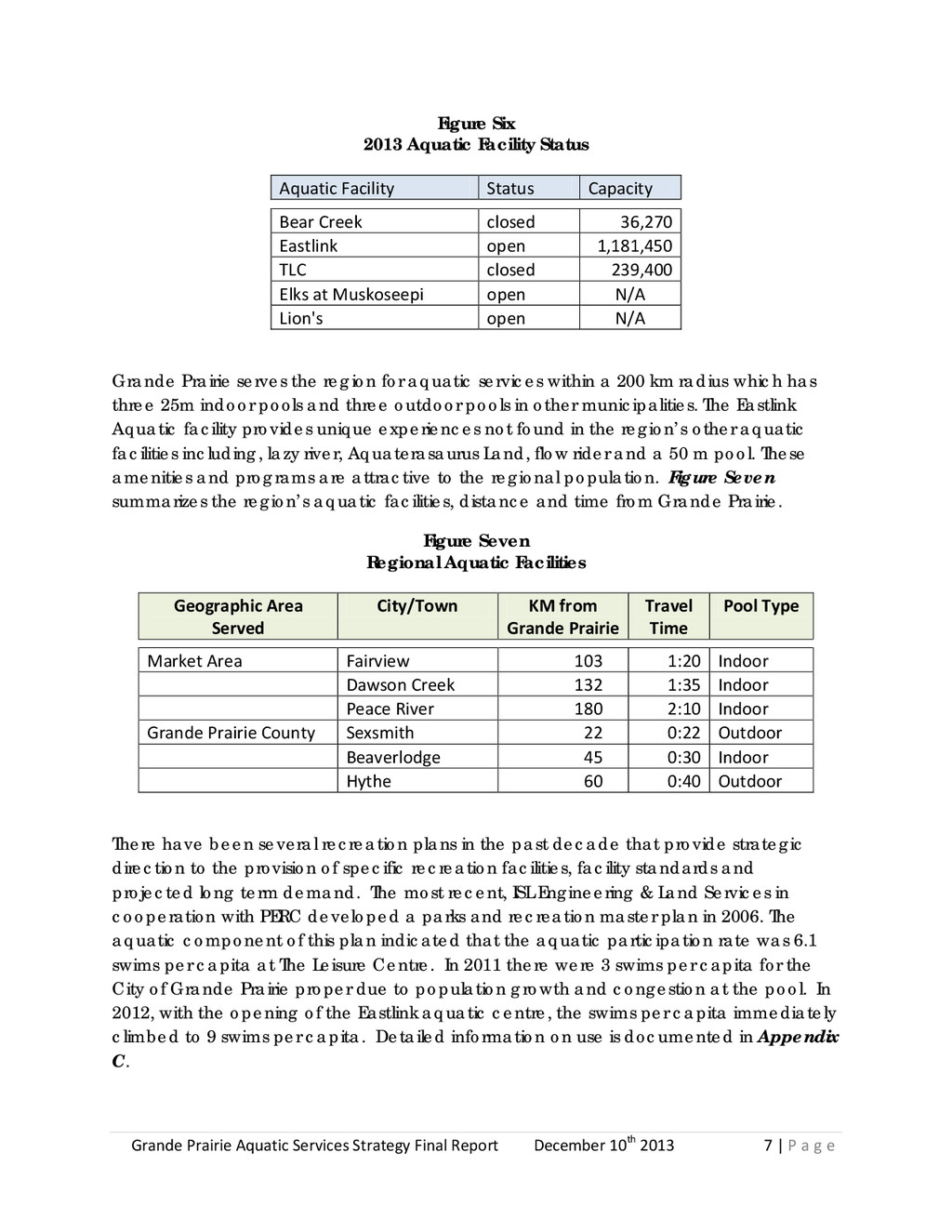
    7 | P a g e Figure Six 2013 Aquatic Facility Status Aquatic Facility Status Capacity Bear Creek closed 36,270 Eastlink open 1,181,450 TLC closed 239,400 Elks at Muskoseepi open N/A Lion's open N/A Grande Prairie serves the region for aquatic services within a 200 km radius which has three 25m indoor pools and three outdoor pools in other municipalities. The Eastlink Aquatic facility provides unique experiences not found in the region’s other aquatic facilities including, lazy river, Aquaterasaurus Land, flow rider and a 50 m pool. These amenities and programs are attractive to the regional population. Figure Seven summarizes the region’s aquatic facilities, distance and time from Grande Prairie. Figure Seven Regional Aquatic Facilities Geographic Area Served City/Town KM from Grande Prairie Travel Time Pool Type Market Area Fairview 103 1:20 Indoor Dawson Creek 132 1:35 Indoor Peace River 180 2:10 Indoor Grande Prairie County Sexsmith 22 0:22 Outdoor Beaverlodge 45 0:30 Indoor Hythe 60 0:40 Outdoor There have been several recreation plans in the past decade that provide strategic direction to the provision of specific recreation facilities, facility standards and projected long term demand. The most recent, ISL Engineering & Land Services in cooperation with PERC developed a parks and recreation master plan in 2006. The aquatic component of this plan indicated that the aquatic participation rate was 6.1 swims per capita at The Leisure Centre. In 2011 there were 3 swims per capita for the City of Grande Prairie proper due to population growth and congestion at the pool. In 2012, with the opening of the Eastlink aquatic centre, the swims per capita immediately climbed to 9 swims per capita. Detailed information on use is documented in Appendix C.
  14. Grande Prairie Aquatic Services Strategy Final Report December 10th 2013

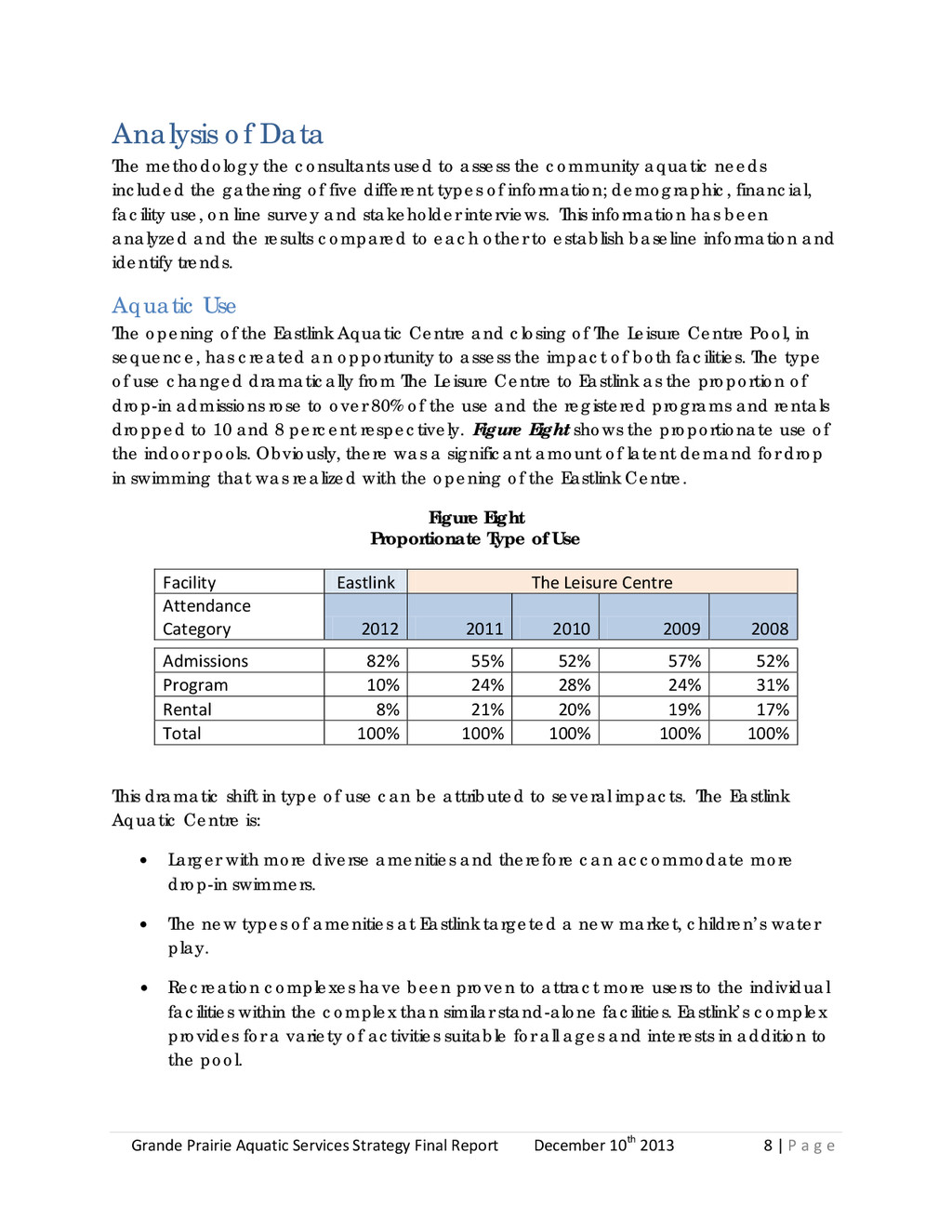
    8 | P a g e Analysis of Data The methodology the consultants used to assess the community aquatic needs included the gathering of five different types of information; demographic, financial, facility use, on line survey and stakeholder interviews. This information has been analyzed and the results compared to each other to establish baseline information and identify trends. Aquatic Use The opening of the Eastlink Aquatic Centre and closing of The Leisure Centre Pool, in sequence, has created an opportunity to assess the impact of both facilities. The type of use changed dramatically from The Leisure Centre to Eastlink as the proportion of drop-in admissions rose to over 80% of the use and the registered programs and rentals dropped to 10 and 8 percent respectively. Figure Eight shows the proportionate use of the indoor pools. Obviously, there was a significant amount of latent demand for drop in swimming that was realized with the opening of the Eastlink Centre. Figure Eight Proportionate Type of Use Facility Eastlink The Leisure Centre Attendance Category 2012 2011 2010 2009 2008 Admissions 82% 55% 52% 57% 52% Program 10% 24% 28% 24% 31% Rental 8% 21% 20% 19% 17% Total 100% 100% 100% 100% 100% This dramatic shift in type of use can be attributed to several impacts. The Eastlink Aquatic Centre is: • Larger with more diverse amenities and therefore can accommodate more drop-in swimmers. • The new types of amenities at Eastlink targeted a new market, children’s water play. • Recreation complexes have been proven to attract more users to the individual facilities within the complex than similar stand-alone facilities. Eastlink’s complex provides for a variety of activities suitable for all ages and interests in addition to the pool.
  15. Grande Prairie Aquatic Services Strategy Final Report December 10th 2013

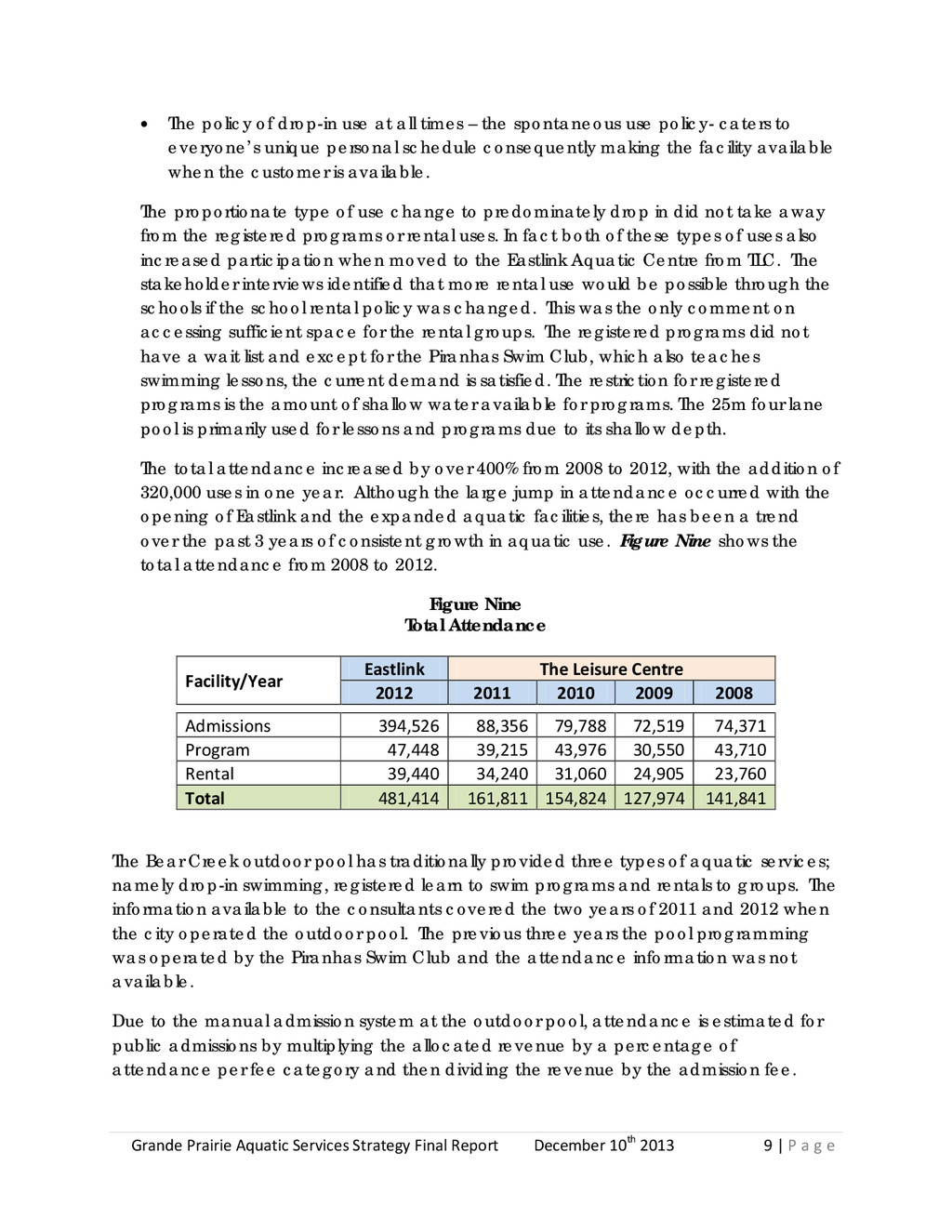
    9 | P a g e • The policy of drop-in use at all times – the spontaneous use policy- caters to everyone’s unique personal schedule consequently making the facility available when the customer is available. The proportionate type of use change to predominately drop in did not take away from the registered programs or rental uses. In fact both of these types of uses also increased participation when moved to the Eastlink Aquatic Centre from TLC. The stakeholder interviews identified that more rental use would be possible through the schools if the school rental policy was changed. This was the only comment on accessing sufficient space for the rental groups. The registered programs did not have a wait list and except for the Piranhas Swim Club, which also teaches swimming lessons, the current demand is satisfied. The restriction for registered programs is the amount of shallow water available for programs. The 25m four lane pool is primarily used for lessons and programs due to its shallow depth. The total attendance increased by over 400% from 2008 to 2012, with the addition of 320,000 uses in one year. Although the large jump in attendance occurred with the opening of Eastlink and the expanded aquatic facilities, there has been a trend over the past 3 years of consistent growth in aquatic use. Figure Nine shows the total attendance from 2008 to 2012. Figure Nine Total Attendance Facility/Year Eastlink The Leisure Centre 2012 2011 2010 2009 2008 Admissions 394,526 88,356 79,788 72,519 74,371 Program 47,448 39,215 43,976 30,550 43,710 Rental 39,440 34,240 31,060 24,905 23,760 Total 481,414 161,811 154,824 127,974 141,841 The Bear Creek outdoor pool has traditionally provided three types of aquatic services; namely drop-in swimming, registered learn to swim programs and rentals to groups. The information available to the consultants covered the two years of 2011 and 2012 when the city operated the outdoor pool. The previous three years the pool programming was operated by the Piranhas Swim Club and the attendance information was not available. Due to the manual admission system at the outdoor pool, attendance is estimated for public admissions by multiplying the allocated revenue by a percentage of attendance per fee category and then dividing the revenue by the admission fee.
  16. Grande Prairie Aquatic Services Strategy Final Report December 10th 2013

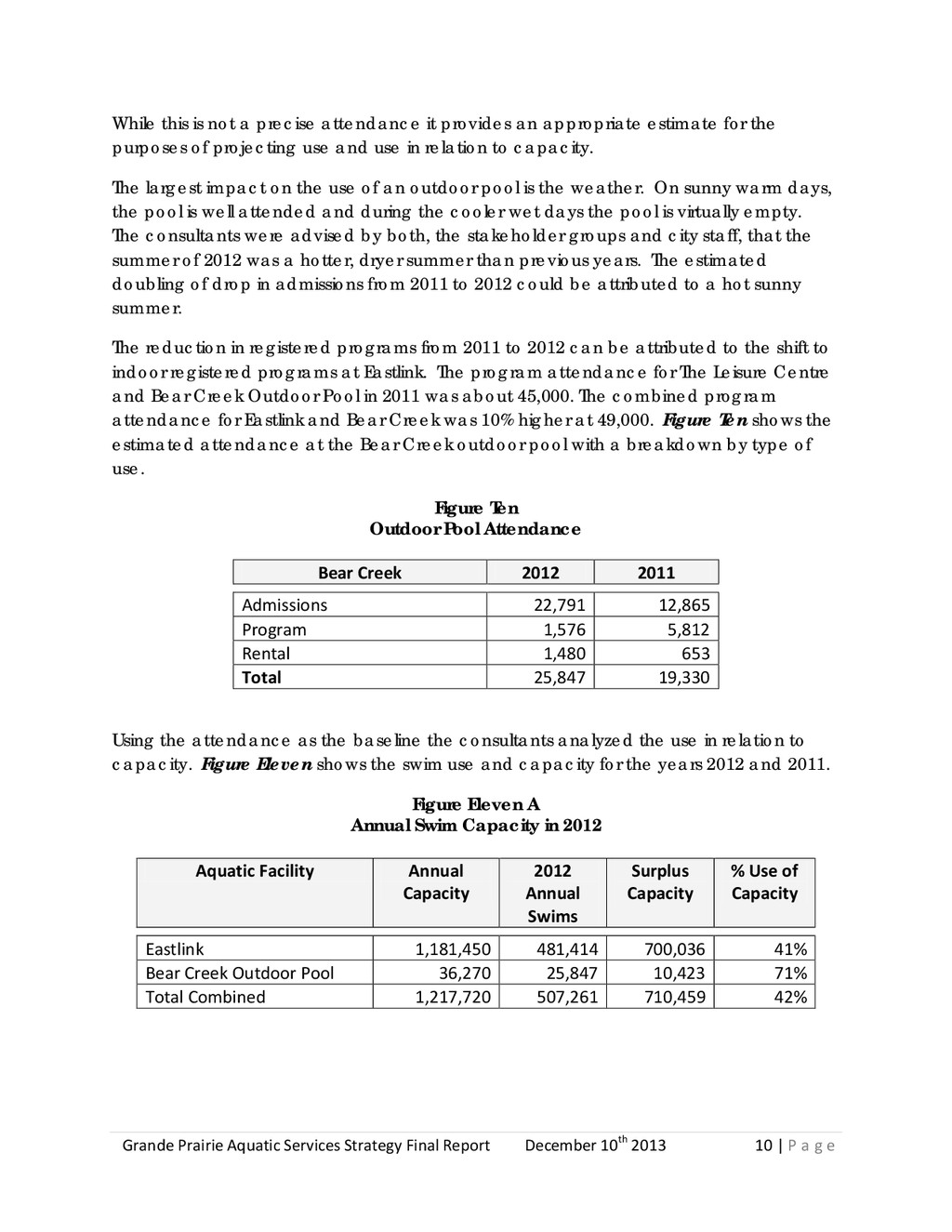
    10 | P a g e While this is not a precise attendance it provides an appropriate estimate for the purposes of projecting use and use in relation to capacity. The largest impact on the use of an outdoor pool is the weather. On sunny warm days, the pool is well attended and during the cooler wet days the pool is virtually empty. The consultants were advised by both, the stakeholder groups and city staff, that the summer of 2012 was a hotter, dryer summer than previous years. The estimated doubling of drop in admissions from 2011 to 2012 could be attributed to a hot sunny summer. The reduction in registered programs from 2011 to 2012 can be attributed to the shift to indoor registered programs at Eastlink. The program attendance for The Leisure Centre and Bear Creek Outdoor Pool in 2011 was about 45,000. The combined program attendance for Eastlink and Bear Creek was 10% higher at 49,000. Figure Ten shows the estimated attendance at the Bear Creek outdoor pool with a breakdown by type of use. Figure Ten Outdoor Pool Attendance Bear Creek 2012 2011 Admissions 22,791 12,865 Program 1,576 5,812 Rental 1,480 653 Total 25,847 19,330 Using the attendance as the baseline the consultants analyzed the use in relation to capacity. Figure Eleven shows the swim use and capacity for the years 2012 and 2011. Figure Eleven A Annual Swim Capacity in 2012 Aquatic Facility Annual Capacity 2012 Annual Swims Surplus Capacity % Use of Capacity Eastlink 1,181,450 481,414 700,036 41% Bear Creek Outdoor Pool 36,270 25,847 10,423 71% Total Combined 1,217,720 507,261 710,459 42%
  17. Grande Prairie Aquatic Services Strategy Final Report December 10th 2013

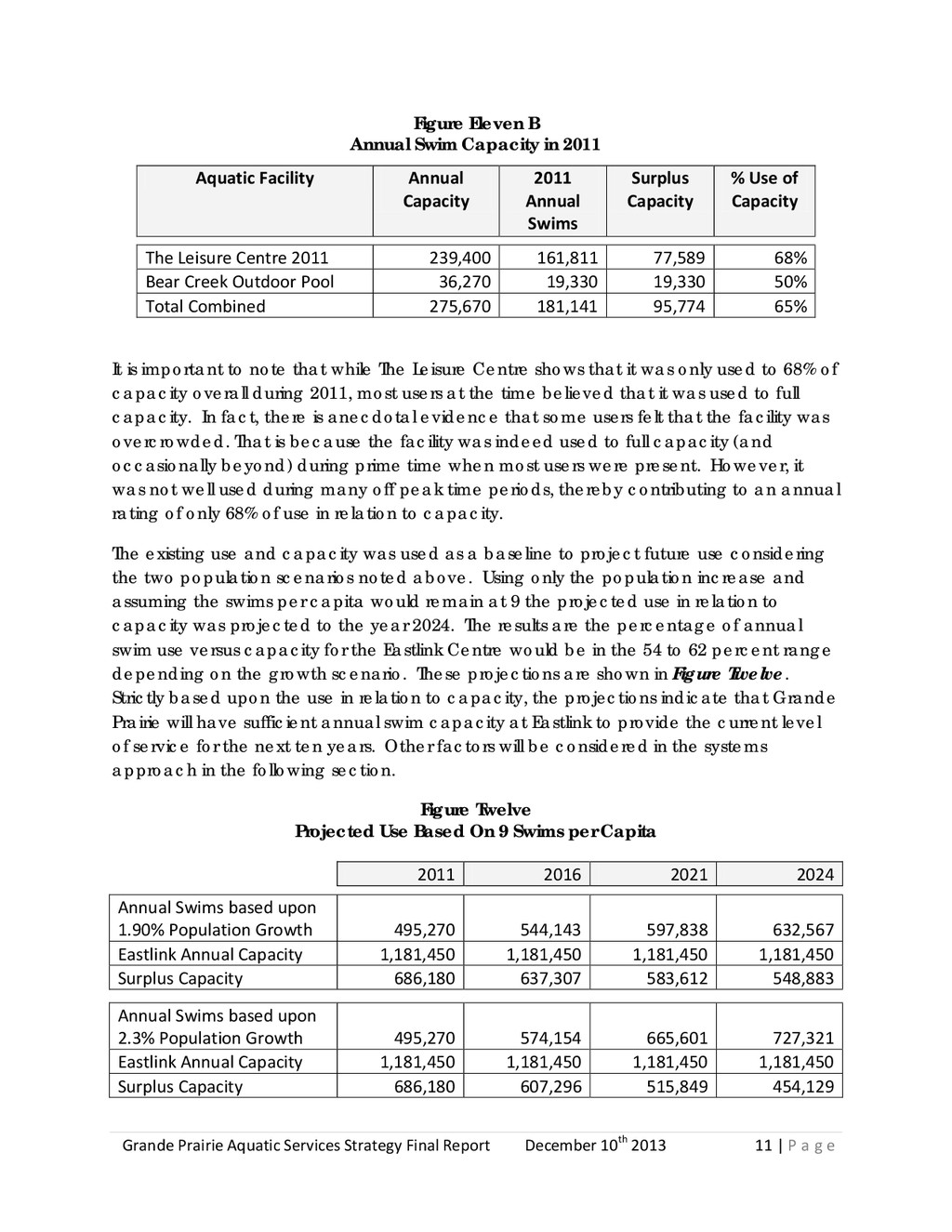
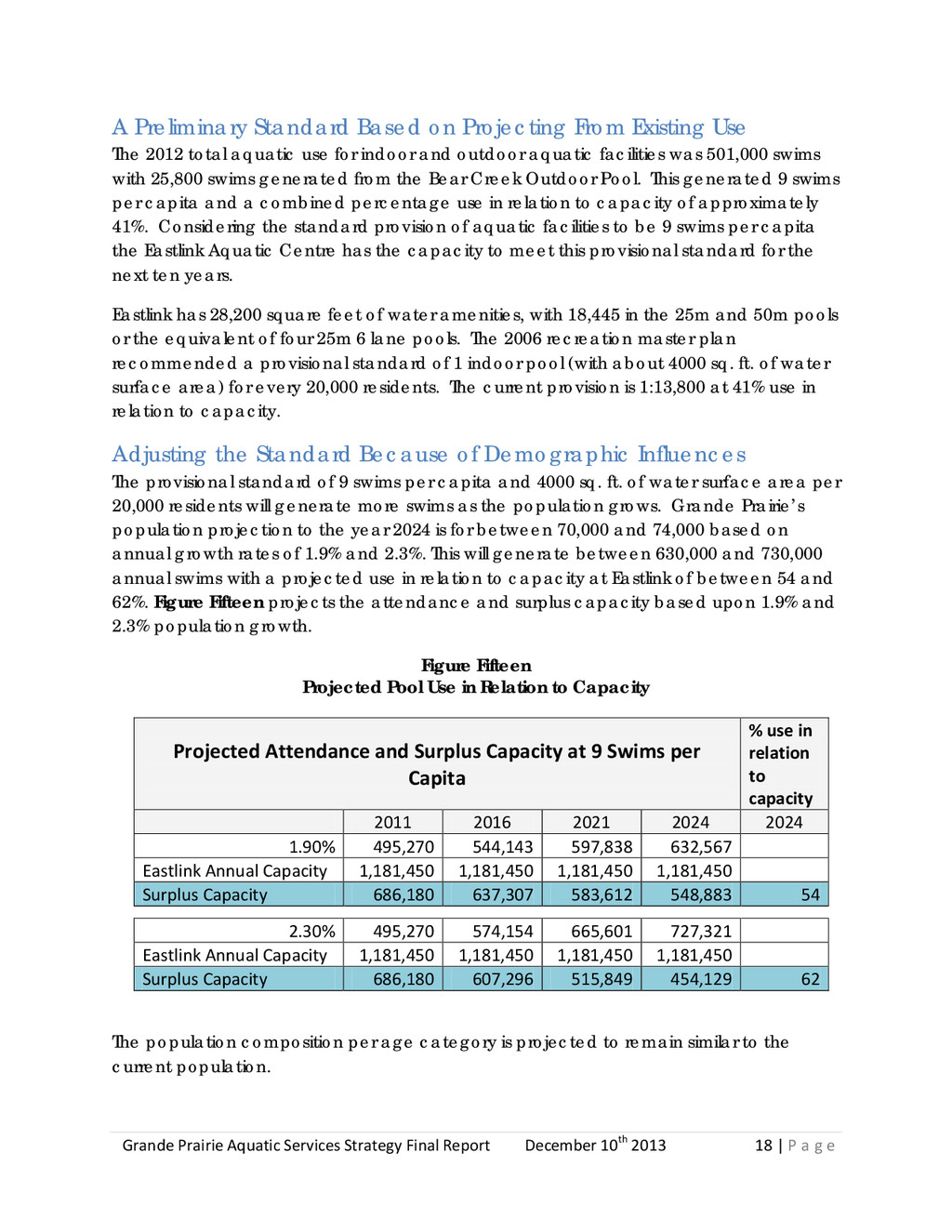
    11 | P a g e Figure Eleven B Annual Swim Capacity in 2011 Aquatic Facility Annual Capacity 2011 Annual Swims Surplus Capacity % Use of Capacity The Leisure Centre 2011 239,400 161,811 77,589 68% Bear Creek Outdoor Pool 36,270 19,330 19,330 50% Total Combined 275,670 181,141 95,774 65% It is important to note that while The Leisure Centre shows that it was only used to 68% of capacity overall during 2011, most users at the time believed that it was used to full capacity. In fact, there is anecdotal evidence that some users felt that the facility was overcrowded. That is because the facility was indeed used to full capacity (and occasionally beyond) during prime time when most users were present. However, it was not well used during many off peak time periods, thereby contributing to an annual rating of only 68% of use in relation to capacity. The existing use and capacity was used as a baseline to project future use considering the two population scenarios noted above. Using only the population increase and assuming the swims per capita would remain at 9 the projected use in relation to capacity was projected to the year 2024. The results are the percentage of annual swim use versus capacity for the Eastlink Centre would be in the 54 to 62 percent range depending on the growth scenario. These projections are shown in Figure Twelve. Strictly based upon the use in relation to capacity, the projections indicate that Grande Prairie will have sufficient annual swim capacity at Eastlink to provide the current level of service for the next ten years. Other factors will be considered in the systems approach in the following section. Figure Twelve Projected Use Based On 9 Swims per Capita 2011 2016 2021 2024 Annual Swims based upon 1.90% Population Growth 495,270 544,143 597,838 632,567 Eastlink Annual Capacity 1,181,450 1,181,450 1,181,450 1,181,450 Surplus Capacity 686,180 637,307 583,612 548,883 Annual Swims based upon 2.3% Population Growth 495,270 574,154 665,601 727,321 Eastlink Annual Capacity 1,181,450 1,181,450 1,181,450 1,181,450 Surplus Capacity 686,180 607,296 515,849 454,129
  18. Grande Prairie Aquatic Services Strategy Final Report December 10th 2013

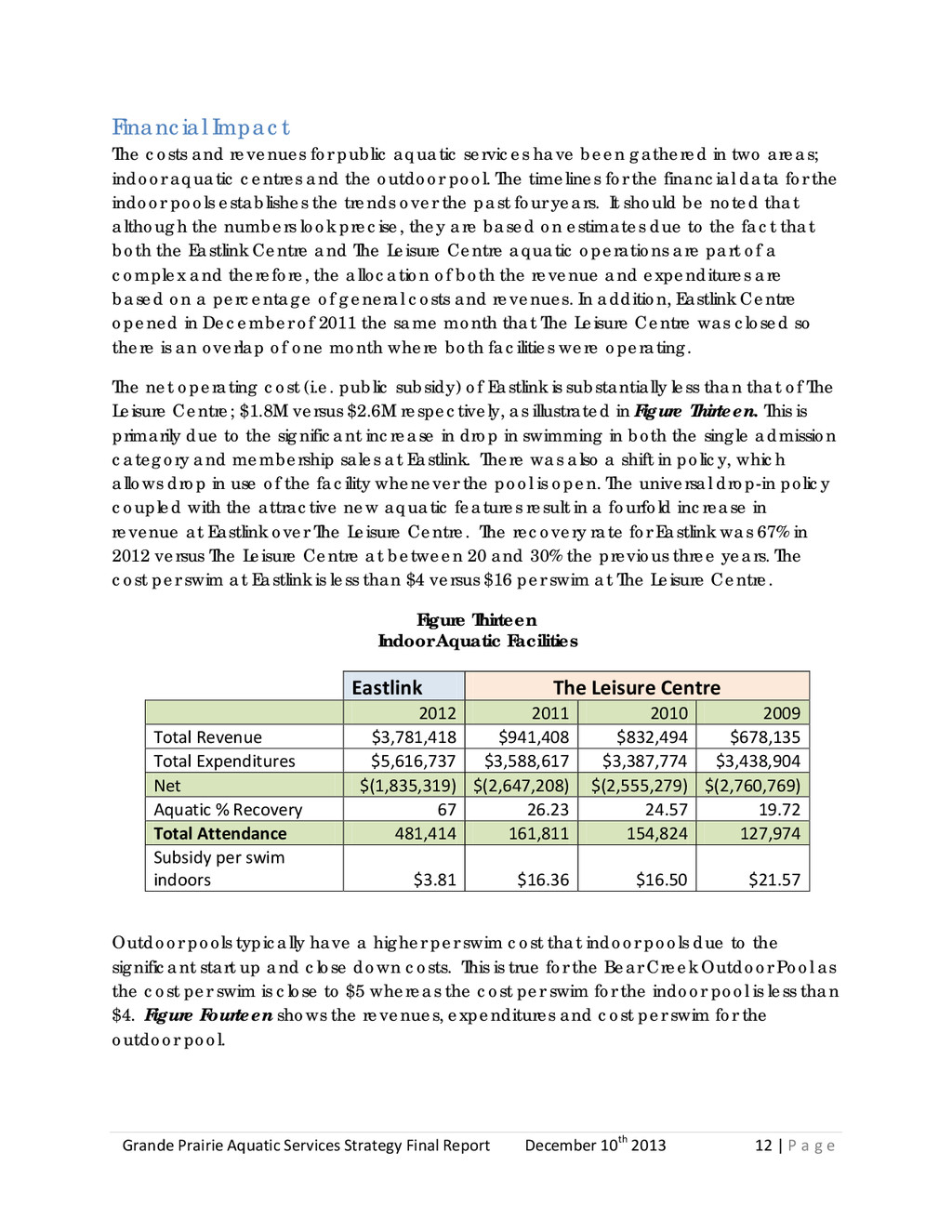
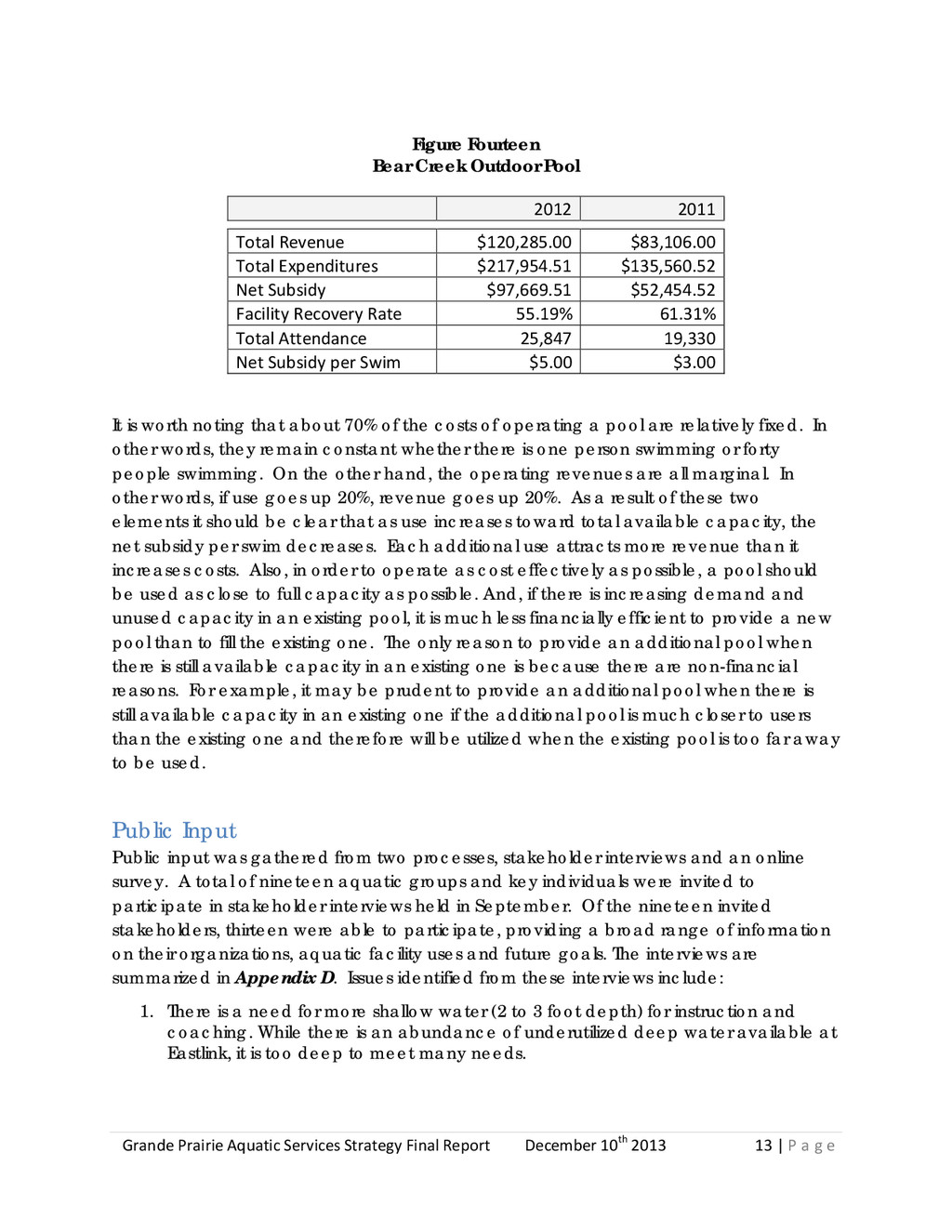
    12 | P a g e Financial Impact The costs and revenues for public aquatic services have been gathered in two areas; indoor aquatic centres and the outdoor pool. The timelines for the financial data for the indoor pools establishes the trends over the past four years. It should be noted that although the numbers look precise, they are based on estimates due to the fact that both the Eastlink Centre and The Leisure Centre aquatic operations are part of a complex and therefore, the allocation of both the revenue and expenditures are based on a percentage of general costs and revenues. In addition, Eastlink Centre opened in December of 2011 the same month that The Leisure Centre was closed so there is an overlap of one month where both facilities were operating. The net operating cost (i.e. public subsidy) of Eastlink is substantially less than that of The Leisure Centre; $1.8M versus $2.6M respectively, as illustrated in Figure Thirteen. This is primarily due to the significant increase in drop in swimming in both the single admission category and membership sales at Eastlink. There was also a shift in policy, which allows drop in use of the facility whenever the pool is open. The universal drop-in policy coupled with the attractive new aquatic features result in a fourfold increase in revenue at Eastlink over The Leisure Centre. The recovery rate for Eastlink was 67% in 2012 versus The Leisure Centre at between 20 and 30% the previous three years. The cost per swim at Eastlink is less than $4 versus $16 per swim at The Leisure Centre. Figure Thirteen Indoor Aquatic Facilities Eastlink The Leisure Centre 2012 2011 2010 2009 Total Revenue $3,781,418 $941,408 $832,494 $678,135 Total Expenditures $5,616,737 $3,588,617 $3,387,774 $3,438,904 Net $(1,835,319) $(2,647,208) $(2,555,279) $(2,760,769) Aquatic % Recovery 67 26.23 24.57 19.72 Total Attendance 481,414 161,811 154,824 127,974 Subsidy per swim indoors $3.81 $16.36 $16.50 $21.57 Outdoor pools typically have a higher per swim cost that indoor pools due to the significant start up and close down costs. This is true for the Bear Creek Outdoor Pool as the cost per swim is close to $5 whereas the cost per swim for the indoor pool is less than $4. Figure Fourteen shows the revenues, expenditures and cost per swim for the outdoor pool.
  19. Grande Prairie Aquatic Services Strategy Final Report December 10th 2013

    13 | P a g e Figure Fourteen Bear Creek Outdoor Pool 2012 2011 Total Revenue $120,285.00 $83,106.00 Total Expenditures $217,954.51 $135,560.52 Net Subsidy $97,669.51 $52,454.52 Facility Recovery Rate 55.19% 61.31% Total Attendance 25,847 19,330 Net Subsidy per Swim $5.00 $3.00 It is worth noting that about 70% of the costs of operating a pool are relatively fixed. In other words, they remain constant whether there is one person swimming or forty people swimming. On the other hand, the operating revenues are all marginal. In other words, if use goes up 20%, revenue goes up 20%. As a result of these two elements it should be clear that as use increases toward total available capacity, the net subsidy per swim decreases. Each additional use attracts more revenue than it increases costs. Also, in order to operate as cost effectively as possible, a pool should be used as close to full capacity as possible. And, if there is increasing demand and unused capacity in an existing pool, it is much less financially efficient to provide a new pool than to fill the existing one. The only reason to provide an additional pool when there is still available capacity in an existing one is because there are non-financial reasons. For example, it may be prudent to provide an additional pool when there is still available capacity in an existing one if the additional pool is much closer to users than the existing one and therefore will be utilized when the existing pool is too far away to be used. Public Input Public input was gathered from two processes, stakeholder interviews and an online survey. A total of nineteen aquatic groups and key individuals were invited to participate in stakeholder interviews held in September. Of the nineteen invited stakeholders, thirteen were able to participate, providing a broad range of information on their organizations, aquatic facility uses and future goals. The interviews are summarized in Appendix D. Issues identified from these interviews include: 1. There is a need for more shallow water (2 to 3 foot depth) for instruction and coaching. While there is an abundance of underutilized deep water available at Eastlink, it is too deep to meet many needs.
  20. Grande Prairie Aquatic Services Strategy Final Report December 10th 2013

    14 | P a g e 2. Eastlink acoustics are quite poor and require modification for effective communication of instructors, coaches and special event activities (i.e. swim meet). The main 50 meter tank is simply too loud to be attractive for coaching and programming. 3. A more comprehensive and consistent School District and City policy is required to ensure all city youth are water wise and safe through swim lessons delivered via a school program targeting all grade one to ten students within the physical education curriculum. 4. The development of a policy or procedure that would foster school use of Eastlink Aquatic Centre is required. At present, policies that would support the appropriate timing of school classes in portions of the aquatic tanks that would be conducive to school programming are too restrictive. 5. There is a need to clarify the fees and charges policy relating to support for financially disadvantaged individuals and families, rental rates, group admission rates, and the SCORES program. There is some confusion and some variance in how policies are applied. 6. There is some concern that the existing Eastlink pool is too far for some users; especially some schools that find it difficult to travel to the facility and use it within existing school schedules. 7. The City should consider more support for the creation of social and informal environments for groups before and after use of the Eastlink pool including school study space for Piranhas swimmers and a coffee area for seniors. 8. There are concerns over policy management regarding spontaneous use and lane configuration. The existing policy that a specific amount of space is reserved for casual, drop-in use is applied to each tank, rather than the entire facility, and this limits availability for sufficient space in the shallow tank for some programs and rentals. 9. There is a need for a specialized facility for medical, therapy and sport training; possibly in the form of a hydro therapy pool. 10. The outdoor pool is valued by schools and organized clubs who would like to have an outdoor swimming experience in the spring and summer. 11. More coordination of customer service information with aquatic services and delivery to the public is required. Many users were concerned that the customer service function didn’t provide sufficient information for users entering the facility. It is worth noting that issues numbered one, four and eight are linked. Due to a shortage of shallow water, there is more demand for the 25 meter tank than can be accommodated. School groups in particular would prefer to have the entire tank for a single class, but the policy that a portion of it must be kept for public swimming prohibits that possibility.
  21. Grande Prairie Aquatic Services Strategy Final Report December 10th 2013

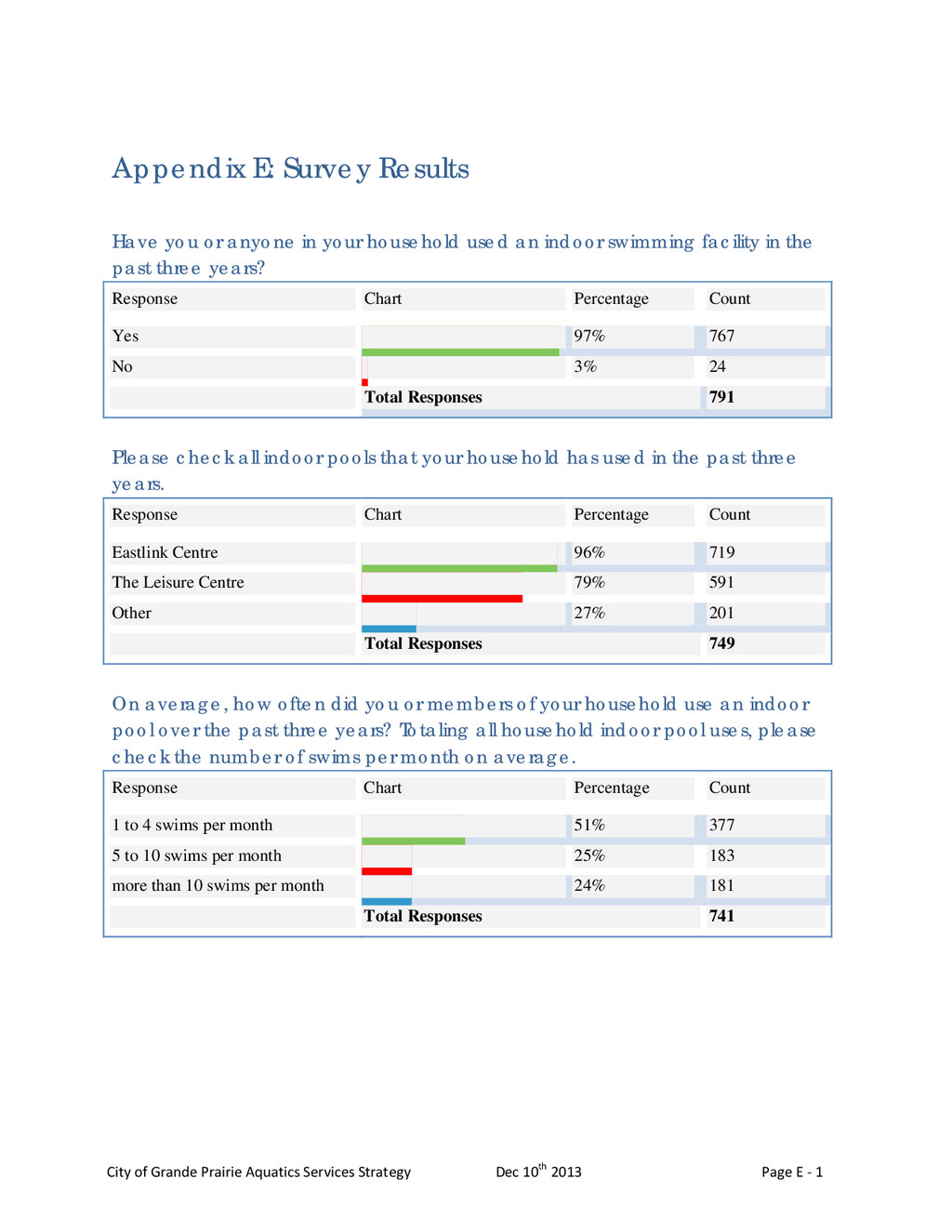
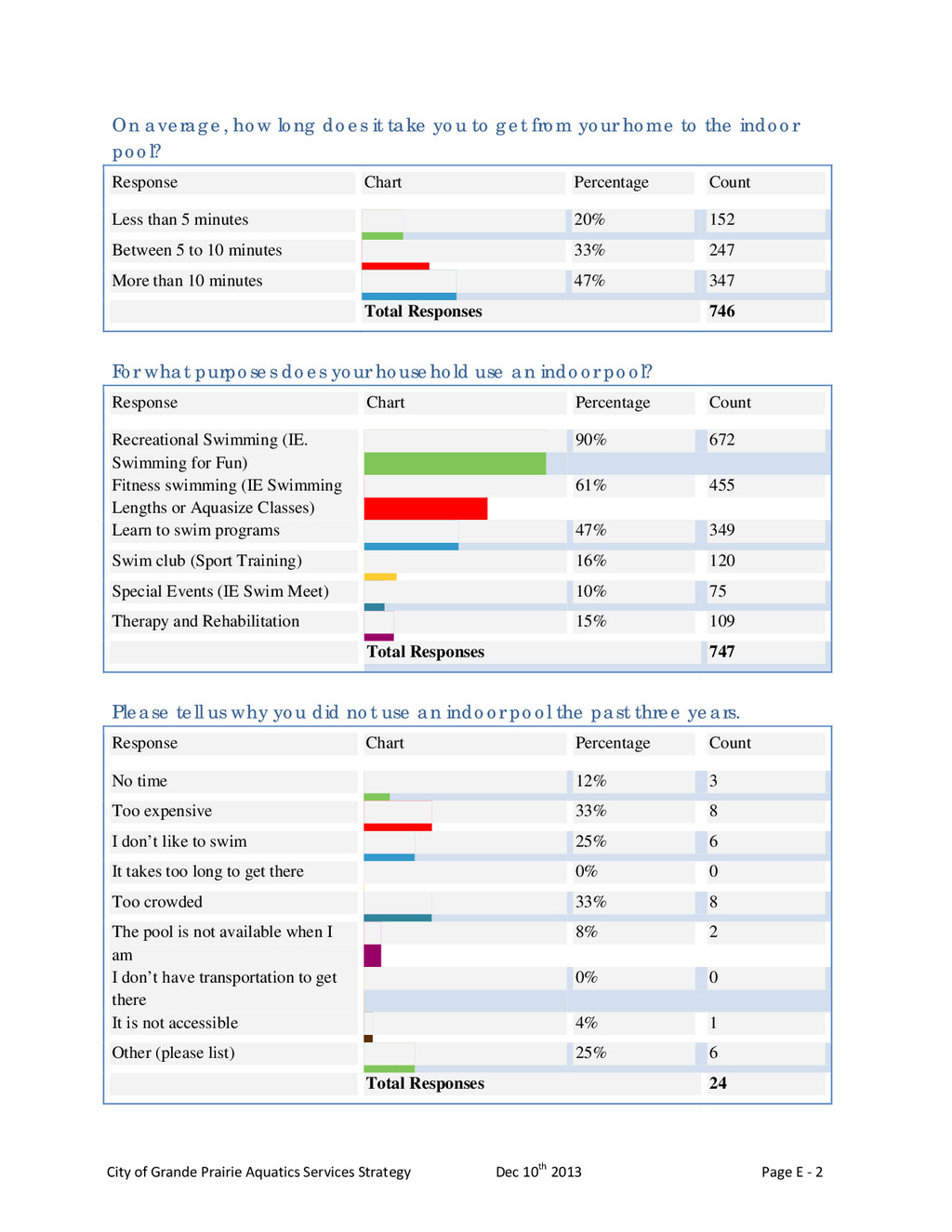
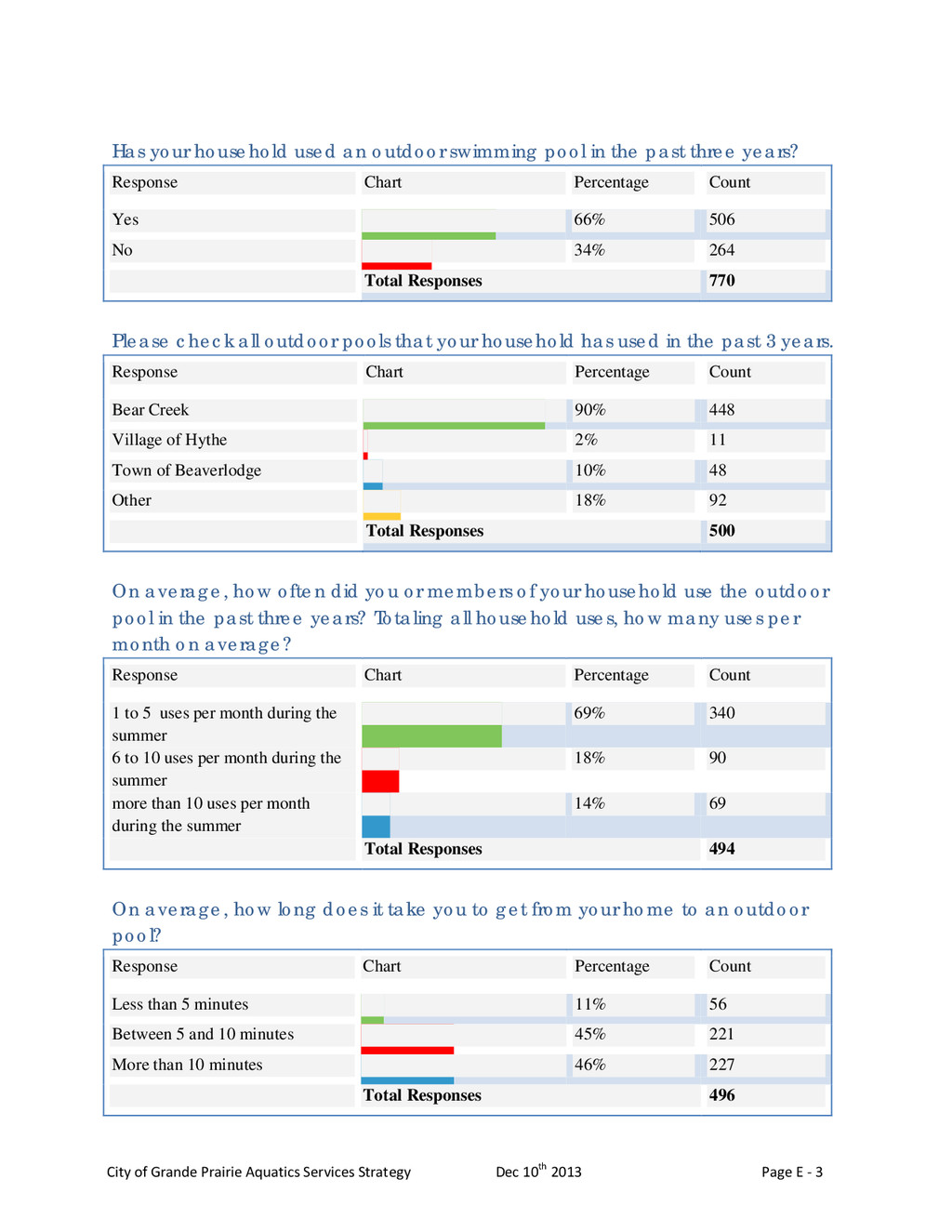
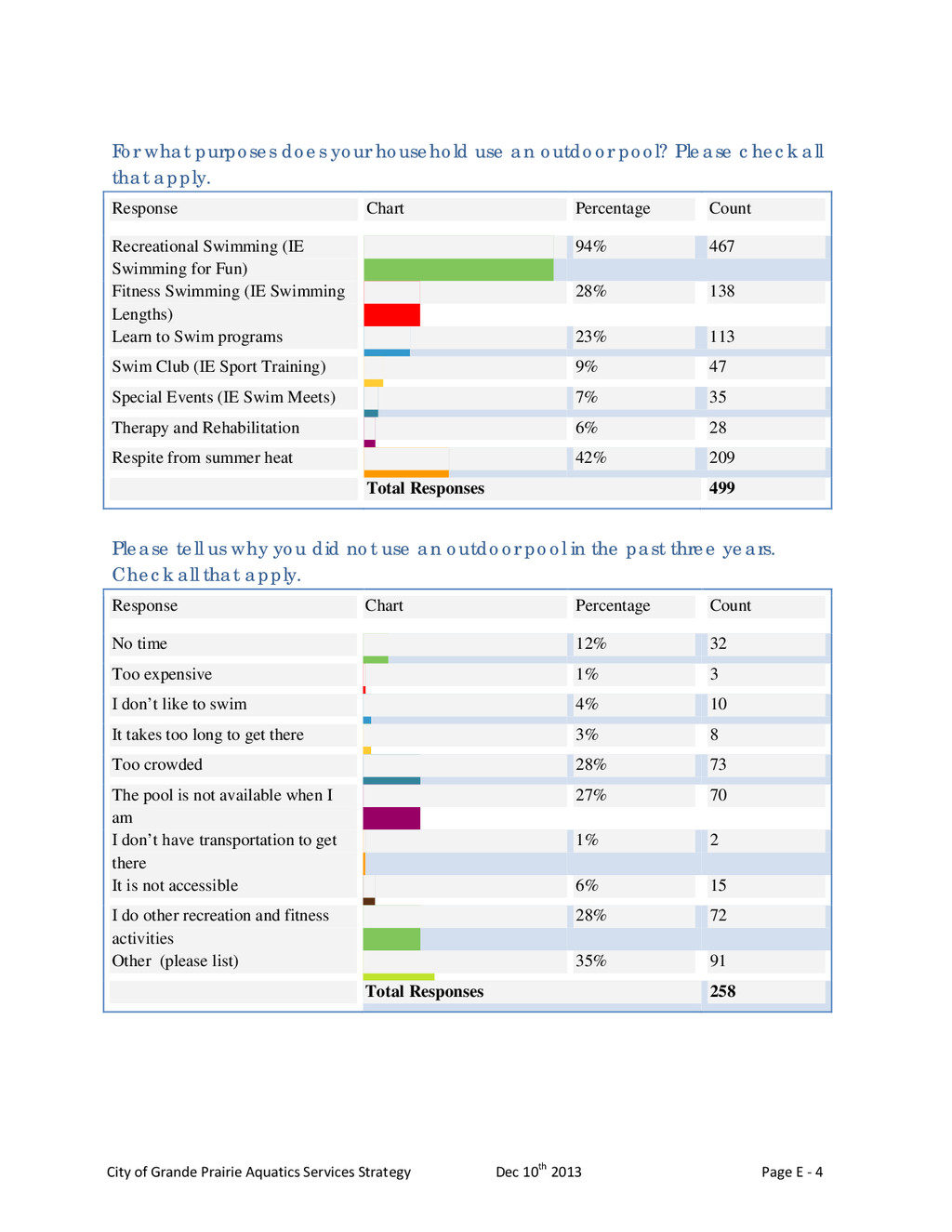
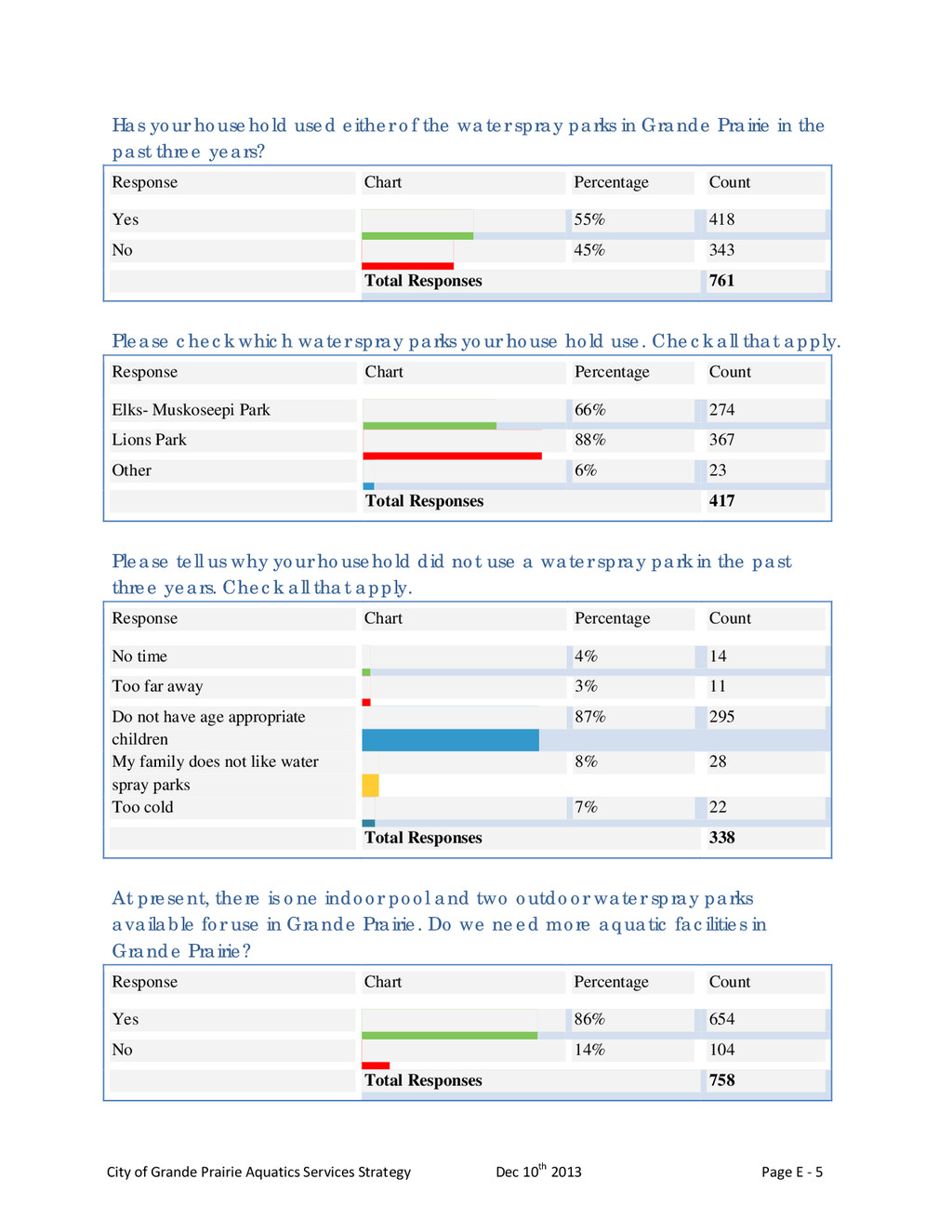
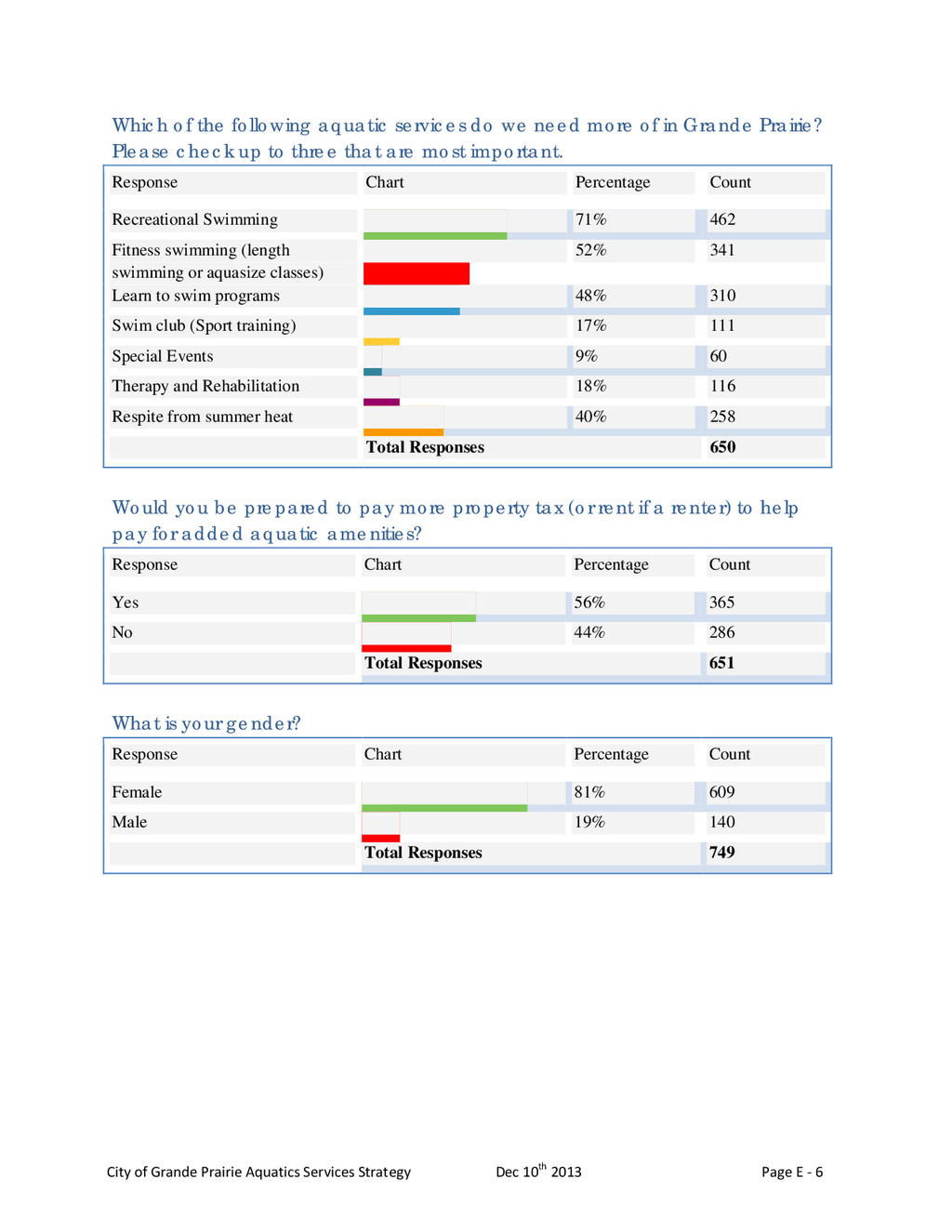
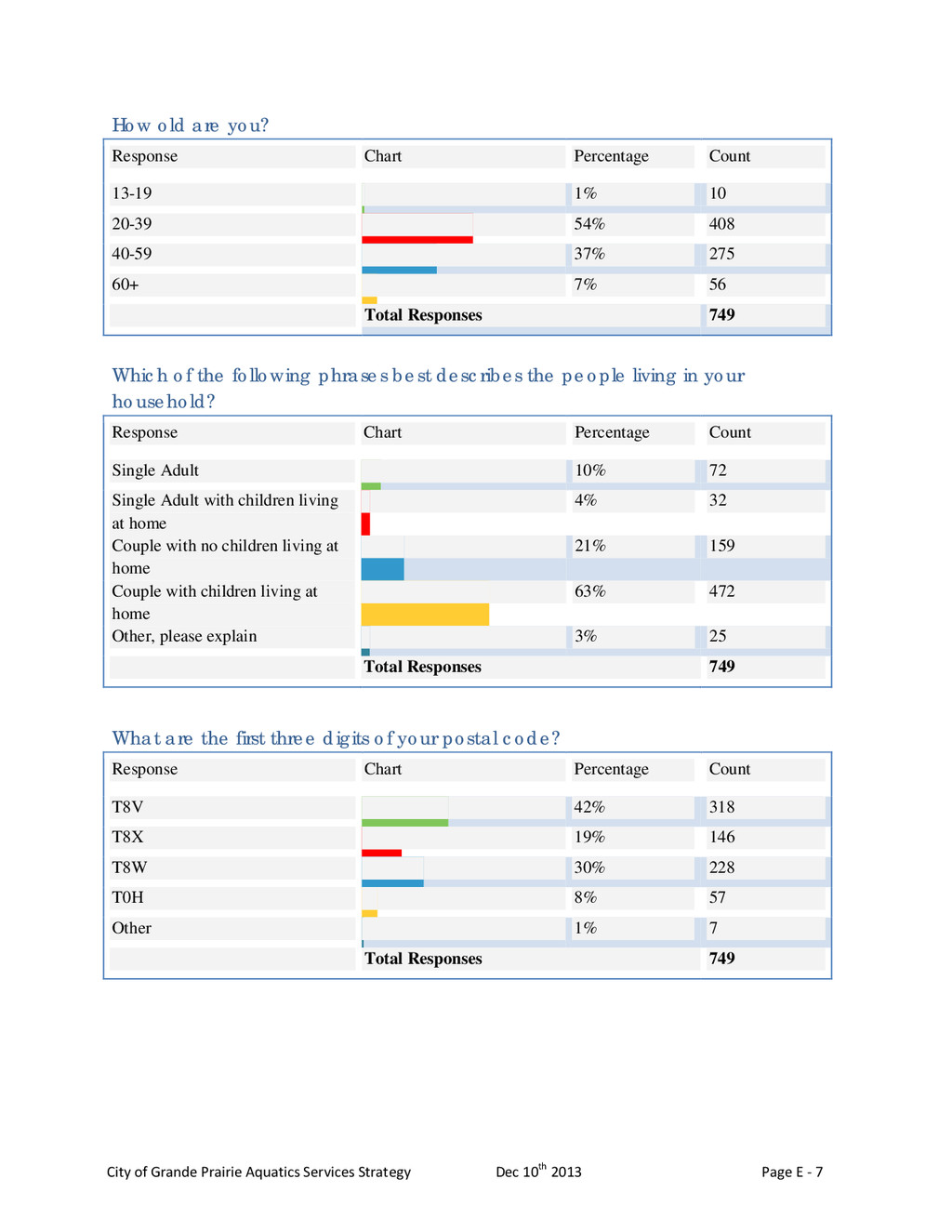
    15 | P a g e Online Community Aquatic Needs Assessment Survey The online survey was designed to encourage residents to share with the City of Grande Prairie their current and past use of the indoor and outdoor pools as well as the water spray areas. Online surveys should not be construed as a statistically valid profile of the population but more a broad representative picture of those who are interested in providing input. The survey was advertised on the city web page and featured in several newspaper articles. The survey was available for completion from September 30 to October 20 and garnering input from a large number of respondents. A total of 799 individuals responded. The vast majority of the respondents were females residing within the City and with children living within their household. While the gender bias is noted, it should not detract from the quality or representativeness of the information. The vast proportion of respondents (97%) were in indoor pool using households. Those respondents who used the indoor aquatic facilities did so frequently with half of those using indoor pools between 1 and 4 times per month and half using them more than 5 times per month. This is compared with less frequent use of outdoor pools (in season) where about 70% households used the pool between 1-4 times per month and the balance more than 5 times per month. About half of the indoor and outdoor pool users were willing to travel more than 10 minutes to use the pools. The top three reasons the respondents used indoor pools were for recreational swimming, fitness swimming and learn to swim. The top three reasons respondents indicated they used the outdoor pool was for recreational swimming, respite from summer heat and fitness swimming. A greater number of respondents used the indoor pools (97%) than the outdoor pool (66%) and water spray parks (54%). The vast majority of respondents indicated that they wanted more aquatic facilities however, only a slim majority indicated that they would be willing to pay additional taxes or rent to pay for them. The overall conclusion is that those who use the pools use them frequently and would support the addition of more aquatic facilities in Grande Prairie. The full survey results are in Appendix E.
  22. Grande Prairie Aquatic Services Strategy Final Report December 10th 2013

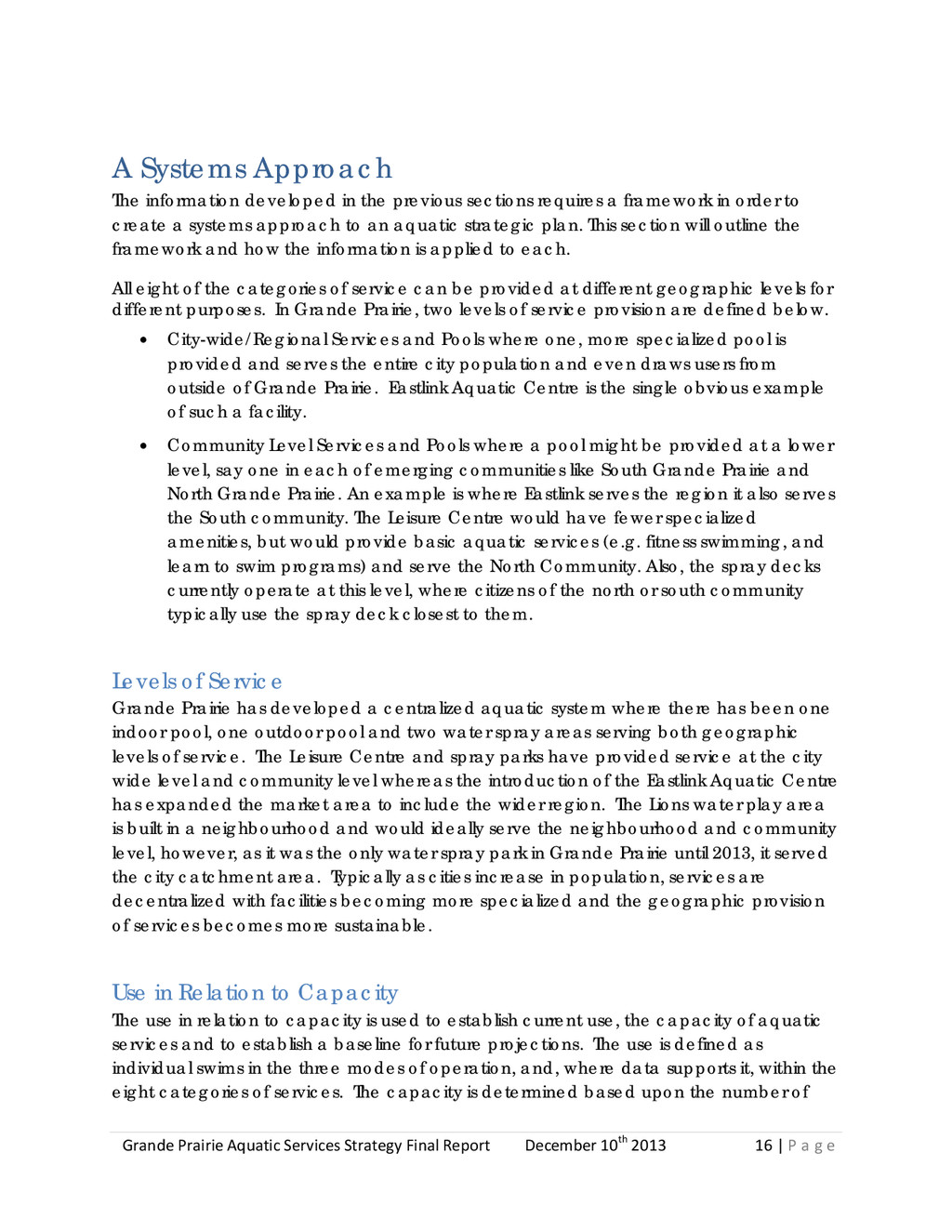
    16 | P a g e A Systems Approach The information developed in the previous sections requires a framework in order to create a systems approach to an aquatic strategic plan. This section will outline the framework and how the information is applied to each. All eight of the categories of service can be provided at different geographic levels for different purposes. In Grande Prairie, two levels of service provision are defined below. • City-wide/Regional Services and Pools where one, more specialized pool is provided and serves the entire city population and even draws users from outside of Grande Prairie. Eastlink Aquatic Centre is the single obvious example of such a facility. • Community Level Services and Pools where a pool might be provided at a lower level, say one in each of emerging communities like South Grande Prairie and North Grande Prairie. An example is where Eastlink serves the region it also serves the South community. The Leisure Centre would have fewer specialized amenities, but would provide basic aquatic services (e.g. fitness swimming, and learn to swim programs) and serve the North Community. Also, the spray decks currently operate at this level, where citizens of the north or south community typically use the spray deck closest to them. Levels of Service Grande Prairie has developed a centralized aquatic system where there has been one indoor pool, one outdoor pool and two water spray areas serving both geographic levels of service. The Leisure Centre and spray parks have provided service at the city wide level and community level whereas the introduction of the Eastlink Aquatic Centre has expanded the market area to include the wider region. The Lions water play area is built in a neighbourhood and would ideally serve the neighbourhood and community level, however, as it was the only water spray park in Grande Prairie until 2013, it served the city catchment area. Typically as cities increase in population, services are decentralized with facilities becoming more specialized and the geographic provision of services becomes more sustainable. Use in Relation to Capacity The use in relation to capacity is used to establish current use, the capacity of aquatic services and to establish a baseline for future projections. The use is defined as individual swims in the three modes of operation, and, where data supports it, within the eight categories of services. The capacity is determined based upon the number of
  23. Grande Prairie Aquatic Services Strategy Final Report December 10th 2013

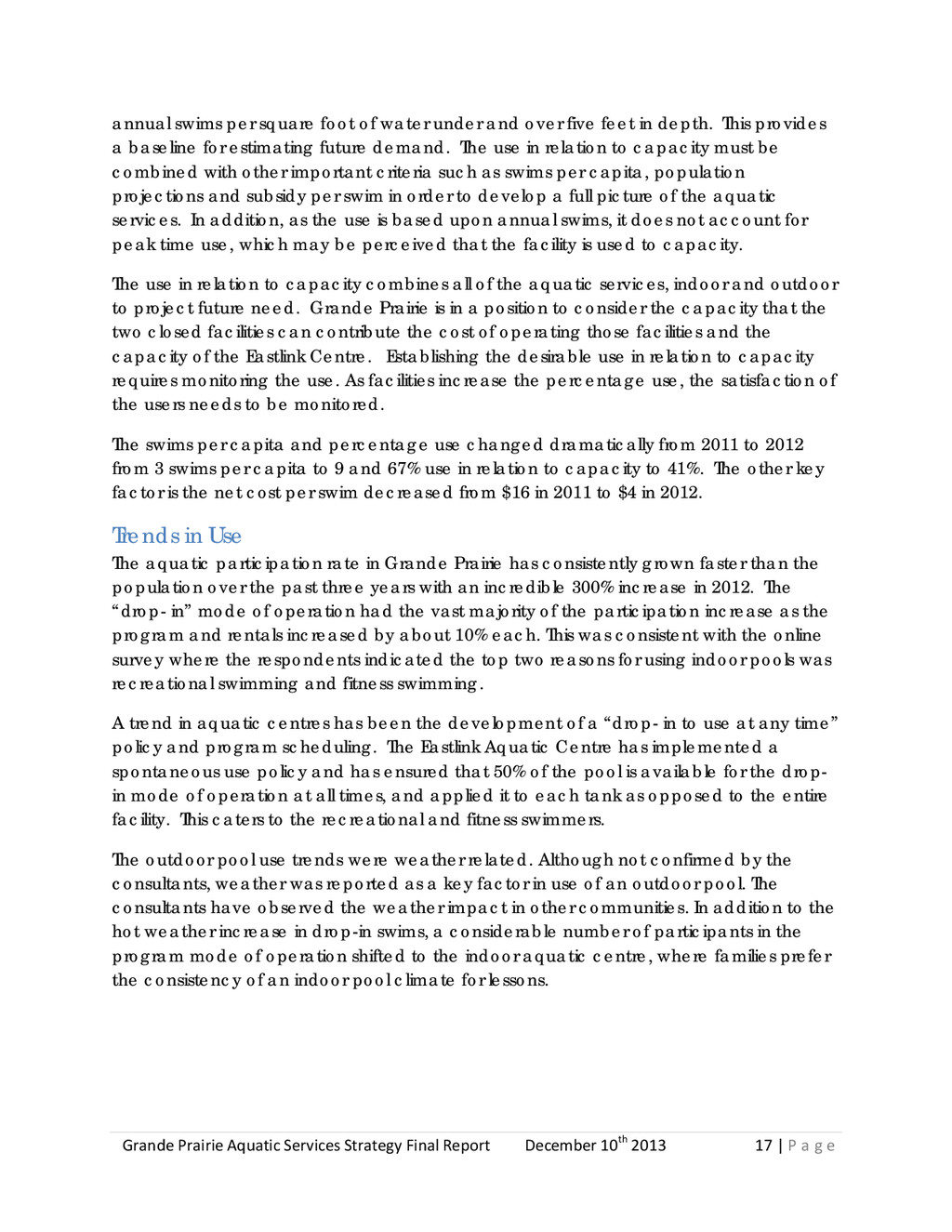
    17 | P a g e annual swims per square foot of water under and over five feet in depth. This provides a baseline for estimating future demand. The use in relation to capacity must be combined with other important criteria such as swims per capita, population projections and subsidy per swim in order to develop a full picture of the aquatic services. In addition, as the use is based upon annual swims, it does not account for peak time use, which may be perceived that the facility is used to capacity. The use in relation to capacity combines all of the aquatic services, indoor and outdoor to project future need. Grande Prairie is in a position to consider the capacity that the two closed facilities can contribute the cost of operating those facilities and the capacity of the Eastlink Centre. Establishing the desirable use in relation to capacity requires monitoring the use. As facilities increase the percentage use, the satisfaction of the users needs to be monitored. The swims per capita and percentage use changed dramatically from 2011 to 2012 from 3 swims per capita to 9 and 67% use in relation to capacity to 41%. The other key factor is the net cost per swim decreased from $16 in 2011 to $4 in 2012. Trends in Use The aquatic participation rate in Grande Prairie has consistently grown faster than the population over the past three years with an incredible 300% increase in 2012. The “drop- in” mode of operation had the vast majority of the participation increase as the program and rentals increased by about 10% each. This was consistent with the online survey where the respondents indicated the top two reasons for using indoor pools was recreational swimming and fitness swimming. A trend in aquatic centres has been the development of a “drop- in to use at any time” policy and program scheduling. The Eastlink Aquatic Centre has implemented a spontaneous use policy and has ensured that 50% of the pool is available for the drop- in mode of operation at all times, and applied it to each tank as opposed to the entire facility. This caters to the recreational and fitness swimmers. The outdoor pool use trends were weather related. Although not confirmed by the consultants, weather was reported as a key factor in use of an outdoor pool. The consultants have observed the weather impact in other communities. In addition to the hot weather increase in drop-in swims, a considerable number of participants in the program mode of operation shifted to the indoor aquatic centre, where families prefer the consistency of an indoor pool climate for lessons.
  24. Grande Prairie Aquatic Services Strategy Final Report December 10th 2013

    18 | P a g e A Preliminary Standard Based on Projecting From Existing Use The 2012 total aquatic use for indoor and outdoor aquatic facilities was 501,000 swims with 25,800 swims generated from the Bear Creek Outdoor Pool. This generated 9 swims per capita and a combined percentage use in relation to capacity of approximately 41%. Considering the standard provision of aquatic facilities to be 9 swims per capita the Eastlink Aquatic Centre has the capacity to meet this provisional standard for the next ten years. Eastlink has 28,200 square feet of water amenities, with 18,445 in the 25m and 50m pools or the equivalent of four 25m 6 lane pools. The 2006 recreation master plan recommended a provisional standard of 1 indoor pool (with about 4000 sq. ft. of water surface area) for every 20,000 residents. The current provision is 1:13,800 at 41% use in relation to capacity. Adjusting the Standard Because of Demographic Influences The provisional standard of 9 swims per capita and 4000 sq. ft. of water surface area per 20,000 residents will generate more swims as the population grows. Grande Prairie’s population projection to the year 2024 is for between 70,000 and 74,000 based on annual growth rates of 1.9% and 2.3%. This will generate between 630,000 and 730,000 annual swims with a projected use in relation to capacity at Eastlink of between 54 and 62%. Figure Fifteen projects the attendance and surplus capacity based upon 1.9% and 2.3% population growth. Figure Fifteen Projected Pool Use in Relation to Capacity Projected Attendance and Surplus Capacity at 9 Swims per Capita % use in relation to capacity 2011 2016 2021 2024 2024 1.90% 495,270 544,143 597,838 632,567 Eastlink Annual Capacity 1,181,450 1,181,450 1,181,450 1,181,450 Surplus Capacity 686,180 637,307 583,612 548,883 54 2.30% 495,270 574,154 665,601 727,321 Eastlink Annual Capacity 1,181,450 1,181,450 1,181,450 1,181,450 Surplus Capacity 686,180 607,296 515,849 454,129 62 The population composition per age category is projected to remain similar to the current population.
  25. Grande Prairie Aquatic Services Strategy Final Report December 10th 2013

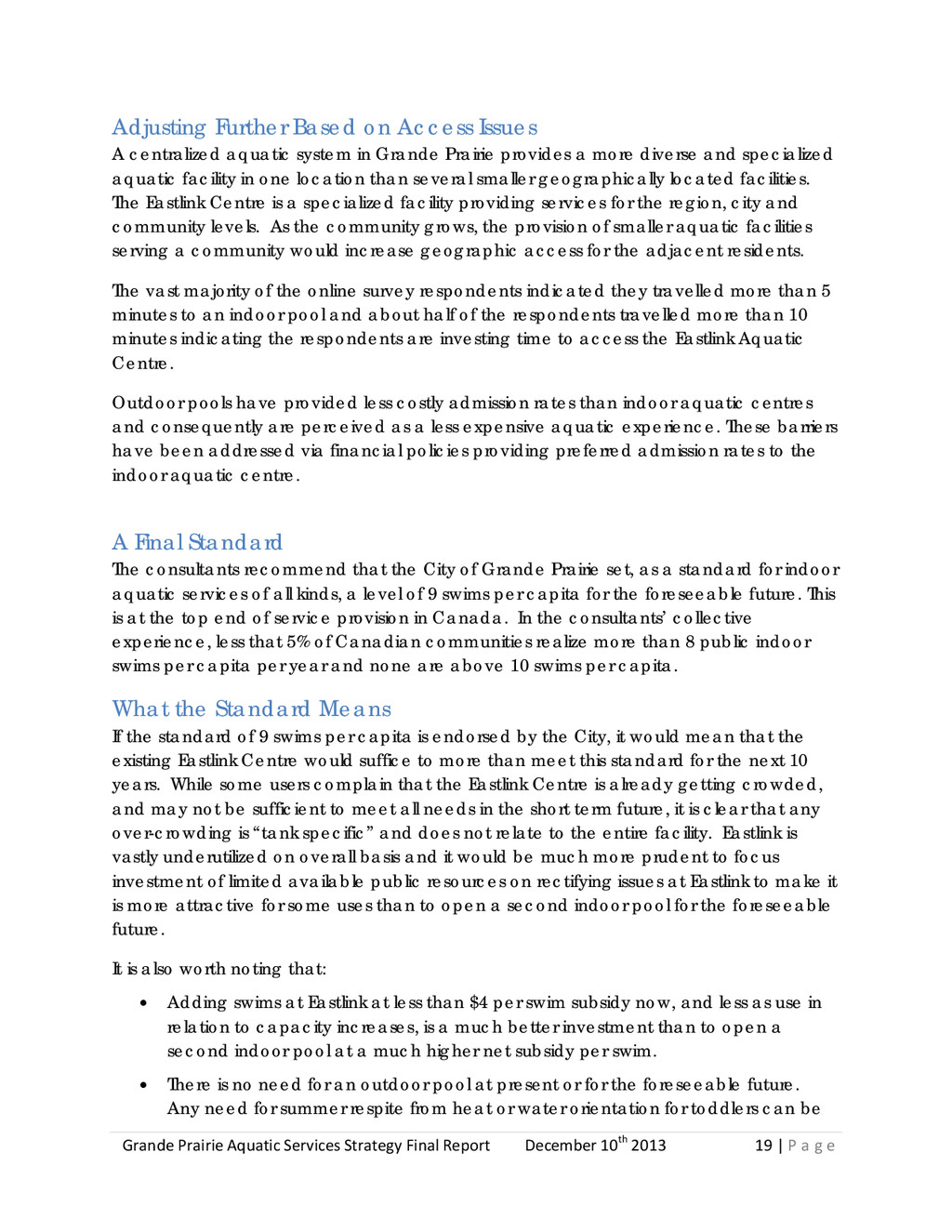
    19 | P a g e Adjusting Further Based on Access Issues A centralized aquatic system in Grande Prairie provides a more diverse and specialized aquatic facility in one location than several smaller geographically located facilities. The Eastlink Centre is a specialized facility providing services for the region, city and community levels. As the community grows, the provision of smaller aquatic facilities serving a community would increase geographic access for the adjacent residents. The vast majority of the online survey respondents indicated they travelled more than 5 minutes to an indoor pool and about half of the respondents travelled more than 10 minutes indicating the respondents are investing time to access the Eastlink Aquatic Centre. Outdoor pools have provided less costly admission rates than indoor aquatic centres and consequently are perceived as a less expensive aquatic experience. These barriers have been addressed via financial policies providing preferred admission rates to the indoor aquatic centre. A Final Standard The consultants recommend that the City of Grande Prairie set, as a standard for indoor aquatic services of all kinds, a level of 9 swims per capita for the foreseeable future. This is at the top end of service provision in Canada. In the consultants’ collective experience, less that 5% of Canadian communities realize more than 8 public indoor swims per capita per year and none are above 10 swims per capita. What the Standard Means If the standard of 9 swims per capita is endorsed by the City, it would mean that the existing Eastlink Centre would suffice to more than meet this standard for the next 10 years. While some users complain that the Eastlink Centre is already getting crowded, and may not be sufficient to meet all needs in the short term future, it is clear that any over-crowding is “tank specific” and does not relate to the entire facility. Eastlink is vastly underutilized on overall basis and it would be much more prudent to focus investment of limited available public resources on rectifying issues at Eastlink to make it is more attractive for some uses than to open a second indoor pool for the foreseeable future. It is also worth noting that: • Adding swims at Eastlink at less than $4 per swim subsidy now, and less as use in relation to capacity increases, is a much better investment than to open a second indoor pool at a much higher net subsidy per swim. • There is no need for an outdoor pool at present or for the foreseeable future. Any need for summer respite from heat or water orientation for toddlers can be
  26. Grande Prairie Aquatic Services Strategy Final Report December 10th 2013

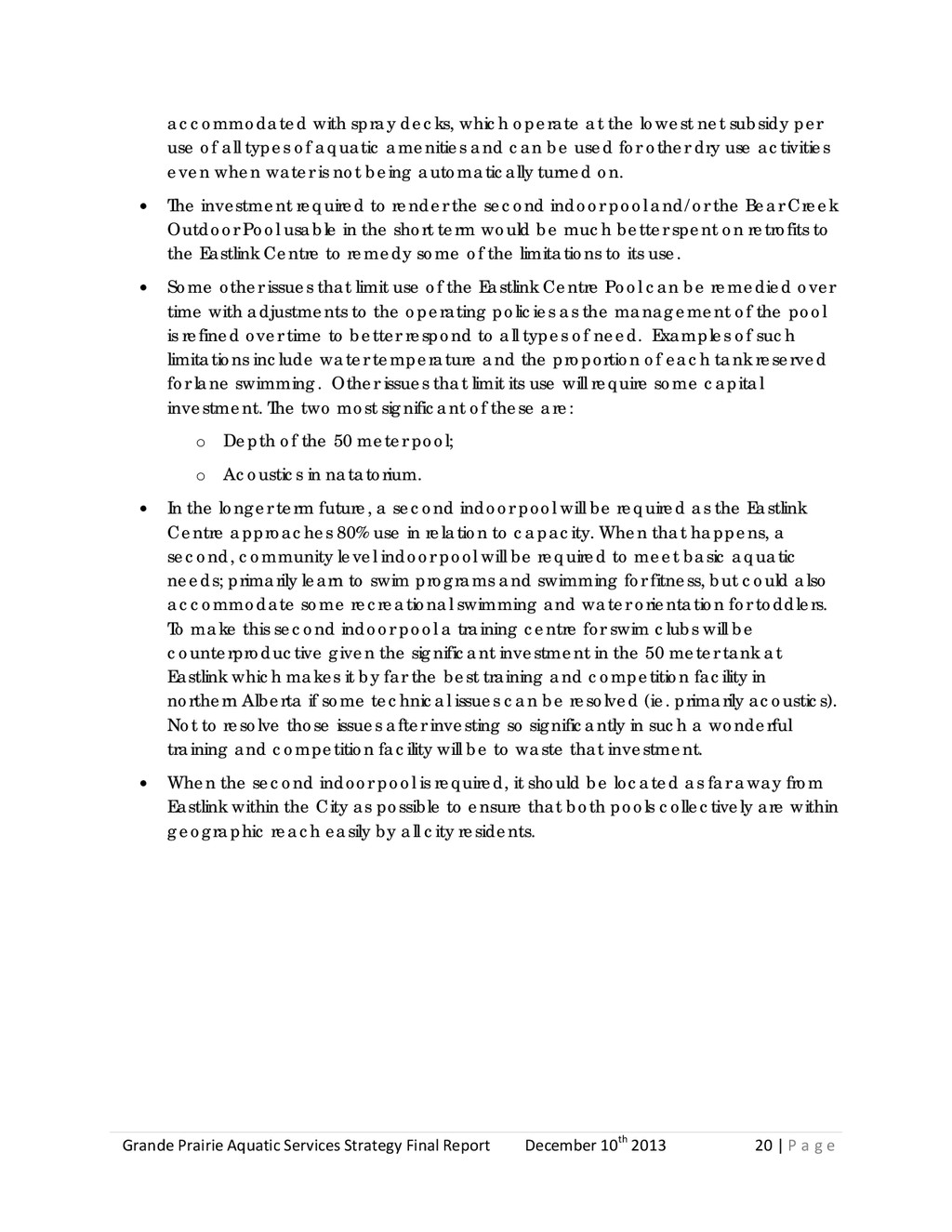
    20 | P a g e accommodated with spray decks, which operate at the lowest net subsidy per use of all types of aquatic amenities and can be used for other dry use activities even when water is not being automatically turned on. • The investment required to render the second indoor pool and/or the Bear Creek Outdoor Pool usable in the short term would be much better spent on retrofits to the Eastlink Centre to remedy some of the limitations to its use. • Some other issues that limit use of the Eastlink Centre Pool can be remedied over time with adjustments to the operating policies as the management of the pool is refined over time to better respond to all types of need. Examples of such limitations include water temperature and the proportion of each tank reserved for lane swimming. Other issues that limit its use will require some capital investment. The two most significant of these are: o Depth of the 50 meter pool; o Acoustics in natatorium. • In the longer term future, a second indoor pool will be required as the Eastlink Centre approaches 80% use in relation to capacity. When that happens, a second, community level indoor pool will be required to meet basic aquatic needs; primarily learn to swim programs and swimming for fitness, but could also accommodate some recreational swimming and water orientation for toddlers. To make this second indoor pool a training centre for swim clubs will be counterproductive given the significant investment in the 50 meter tank at Eastlink which makes it by far the best training and competition facility in northern Alberta if some technical issues can be resolved (ie. primarily acoustics). Not to resolve those issues after investing so significantly in such a wonderful training and competition facility will be to waste that investment. • When the second indoor pool is required, it should be located as far away from Eastlink within the City as possible to ensure that both pools collectively are within geographic reach easily by all city residents.
  27. Grande Prairie Aquatic Services Strategy Final Report December 10th 2013

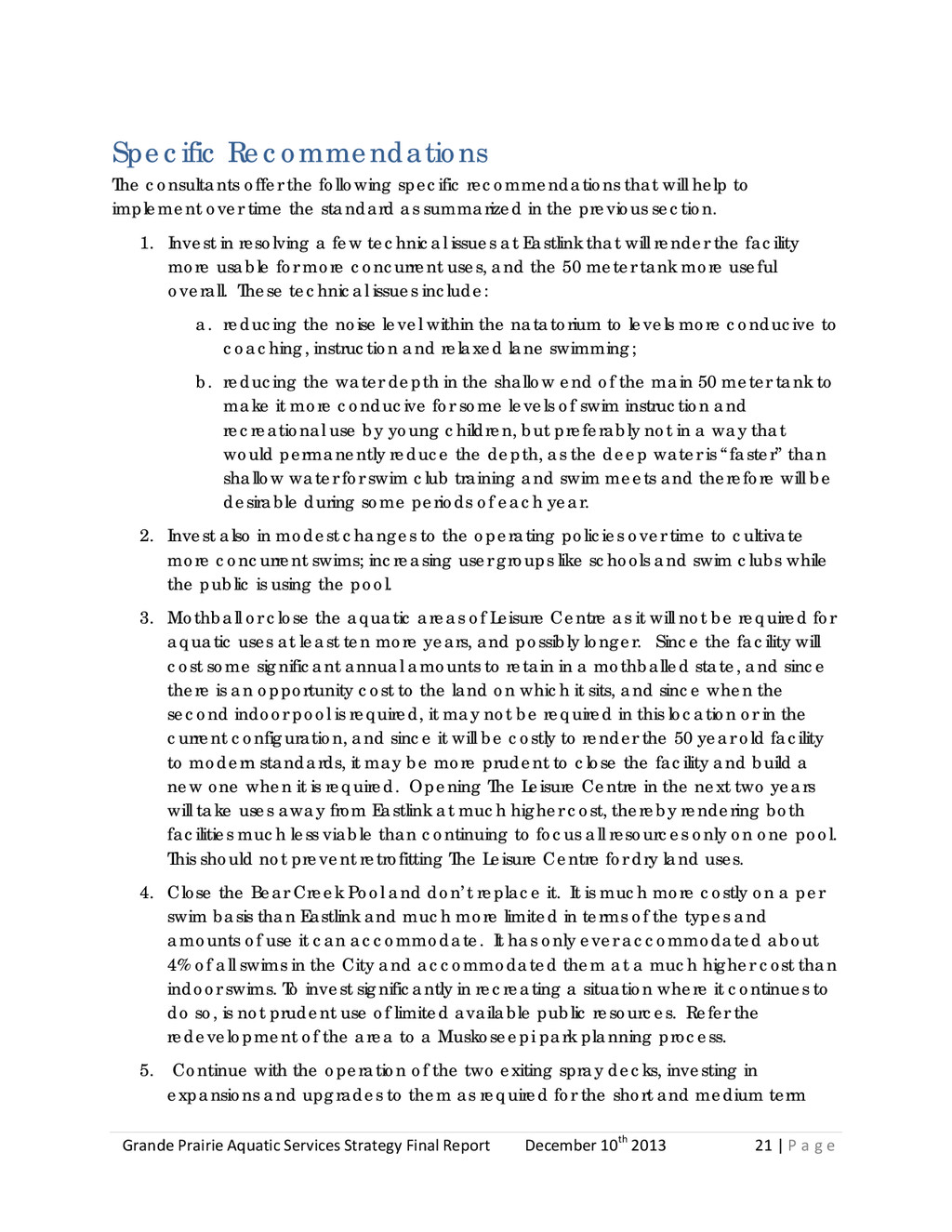
    21 | P a g e Specific Recommendations The consultants offer the following specific recommendations that will help to implement over time the standard as summarized in the previous section. 1. Invest in resolving a few technical issues at Eastlink that will render the facility more usable for more concurrent uses, and the 50 meter tank more useful overall. These technical issues include: a. reducing the noise level within the natatorium to levels more conducive to coaching, instruction and relaxed lane swimming; b. reducing the water depth in the shallow end of the main 50 meter tank to make it more conducive for some levels of swim instruction and recreational use by young children, but preferably not in a way that would permanently reduce the depth, as the deep water is “faster” than shallow water for swim club training and swim meets and therefore will be desirable during some periods of each year. 2. Invest also in modest changes to the operating policies over time to cultivate more concurrent swims; increasing user groups like schools and swim clubs while the public is using the pool. 3. Mothball or close the aquatic areas of Leisure Centre as it will not be required for aquatic uses at least ten more years, and possibly longer. Since the facility will cost some significant annual amounts to retain in a mothballed state, and since there is an opportunity cost to the land on which it sits, and since when the second indoor pool is required, it may not be required in this location or in the current configuration, and since it will be costly to render the 50 year old facility to modern standards, it may be more prudent to close the facility and build a new one when it is required. Opening The Leisure Centre in the next two years will take uses away from Eastlink at much higher cost, thereby rendering both facilities much less viable than continuing to focus all resources only on one pool. This should not prevent retrofitting The Leisure Centre for dry land uses. 4. Close the Bear Creek Pool and don’t replace it. It is much more costly on a per swim basis than Eastlink and much more limited in terms of the types and amounts of use it can accommodate. It has only ever accommodated about 4% of all swims in the City and accommodated them at a much higher cost than indoor swims. To invest significantly in recreating a situation where it continues to do so, is not prudent use of limited available public resources. Refer the redevelopment of the area to a Muskoseepi park planning process. 5. Continue with the operation of the two exiting spray decks, investing in expansions and upgrades to them as required for the short and medium term
  28. Grande Prairie Aquatic Services Strategy Final Report December 10th 2013

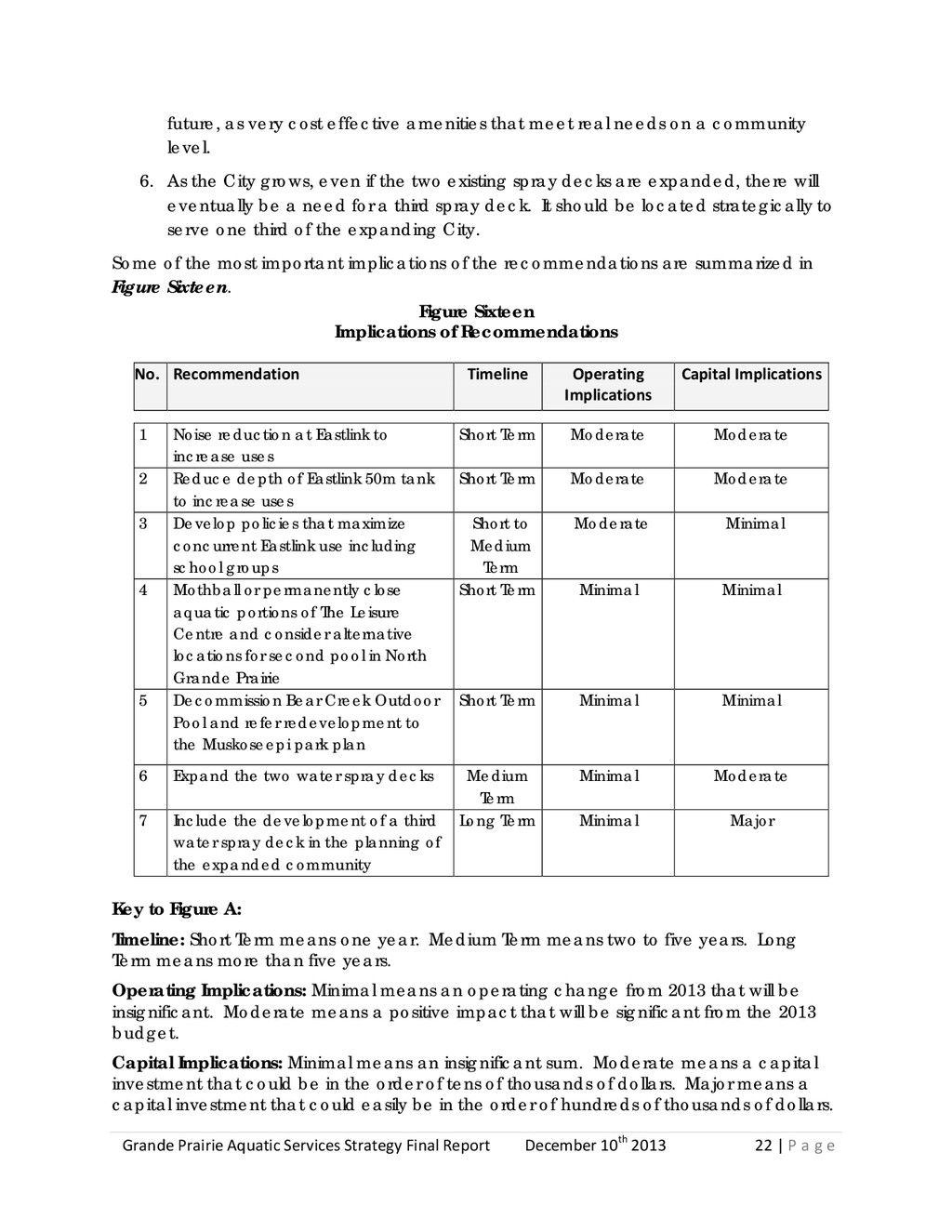
    22 | P a g e future, as very cost effective amenities that meet real needs on a community level. 6. As the City grows, even if the two existing spray decks are expanded, there will eventually be a need for a third spray deck. It should be located strategically to serve one third of the expanding City. Some of the most important implications of the recommendations are summarized in Figure Sixteen. Figure Sixteen Implications of Recommendations No. Recommendation Timeline Operating Implications Capital Implications 1 Noise reduction at Eastlink to increase uses Short Term Moderate Moderate 2 Reduce depth of Eastlink 50m tank to increase uses Short Term Moderate Moderate 3 Develop policies that maximize concurrent Eastlink use including school groups Short to Medium Term Moderate Minimal 4 Mothball or permanently close aquatic portions of The Leisure Centre and consider alternative locations for second pool in North Grande Prairie Short Term Minimal Minimal 5 Decommission Bear Creek Outdoor Pool and refer redevelopment to the Muskoseepi park plan Short Term Minimal Minimal 6 Expand the two water spray decks Medium Term Minimal Moderate 7 Include the development of a third water spray deck in the planning of the expanded community Long Term Minimal Major Key to Figure A: Timeline: Short Term means one year. Medium Term means two to five years. Long Term means more than five years. Operating Implications: Minimal means an operating change from 2013 that will be insignificant. Moderate means a positive impact that will be significant from the 2013 budget. Capital Implications: Minimal means an insignificant sum. Moderate means a capital investment that could be in the order of tens of thousands of dollars. Major means a capital investment that could easily be in the order of hundreds of thousands of dollars.
  29. City of Grande Prairie Aquatics Services Strategy Dec 10th 2013

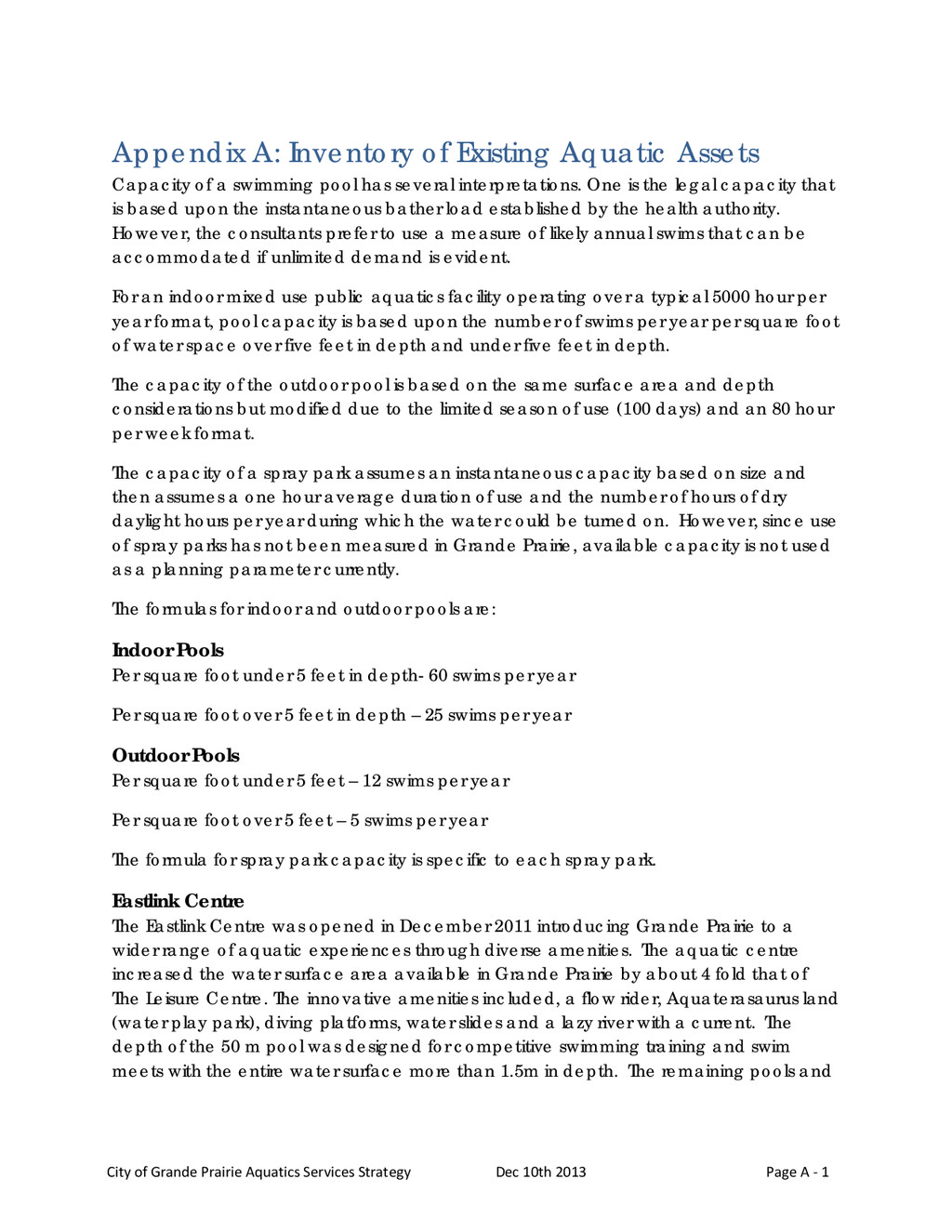
    Page A - 1 Appendix A: Inventory of Existing Aquatic Assets Capacity of a swimming pool has several interpretations. One is the legal capacity that is based upon the instantaneous bather load established by the health authority. However, the consultants prefer to use a measure of likely annual swims that can be accommodated if unlimited demand is evident. For an indoor mixed use public aquatics facility operating over a typical 5000 hour per year format, pool capacity is based upon the number of swims per year per square foot of water space over five feet in depth and under five feet in depth. The capacity of the outdoor pool is based on the same surface area and depth considerations but modified due to the limited season of use (100 days) and an 80 hour per week format. The capacity of a spray park assumes an instantaneous capacity based on size and then assumes a one hour average duration of use and the number of hours of dry daylight hours per year during which the water could be turned on. However, since use of spray parks has not been measured in Grande Prairie, available capacity is not used as a planning parameter currently. The formulas for indoor and outdoor pools are: Indoor Pools Per square foot under 5 feet in depth- 60 swims per year Per square foot over 5 feet in depth – 25 swims per year Outdoor Pools Per square foot under 5 feet – 12 swims per year Per square foot over 5 feet – 5 swims per year The formula for spray park capacity is specific to each spray park. Eastlink Centre The Eastlink Centre was opened in December 2011 introducing Grande Prairie to a wider range of aquatic experiences through diverse amenities. The aquatic centre increased the water surface area available in Grande Prairie by about 4 fold that of The Leisure Centre. The innovative amenities included, a flow rider, Aquaterasaurus land (water play park), diving platforms, water slides and a lazy river with a current. The depth of the 50 m pool was designed for competitive swimming training and swim meets with the entire water surface more than 1.5m in depth. The remaining pools and
  30. City of Grande Prairie Aquatics Services Strategy Dec 10th 2013

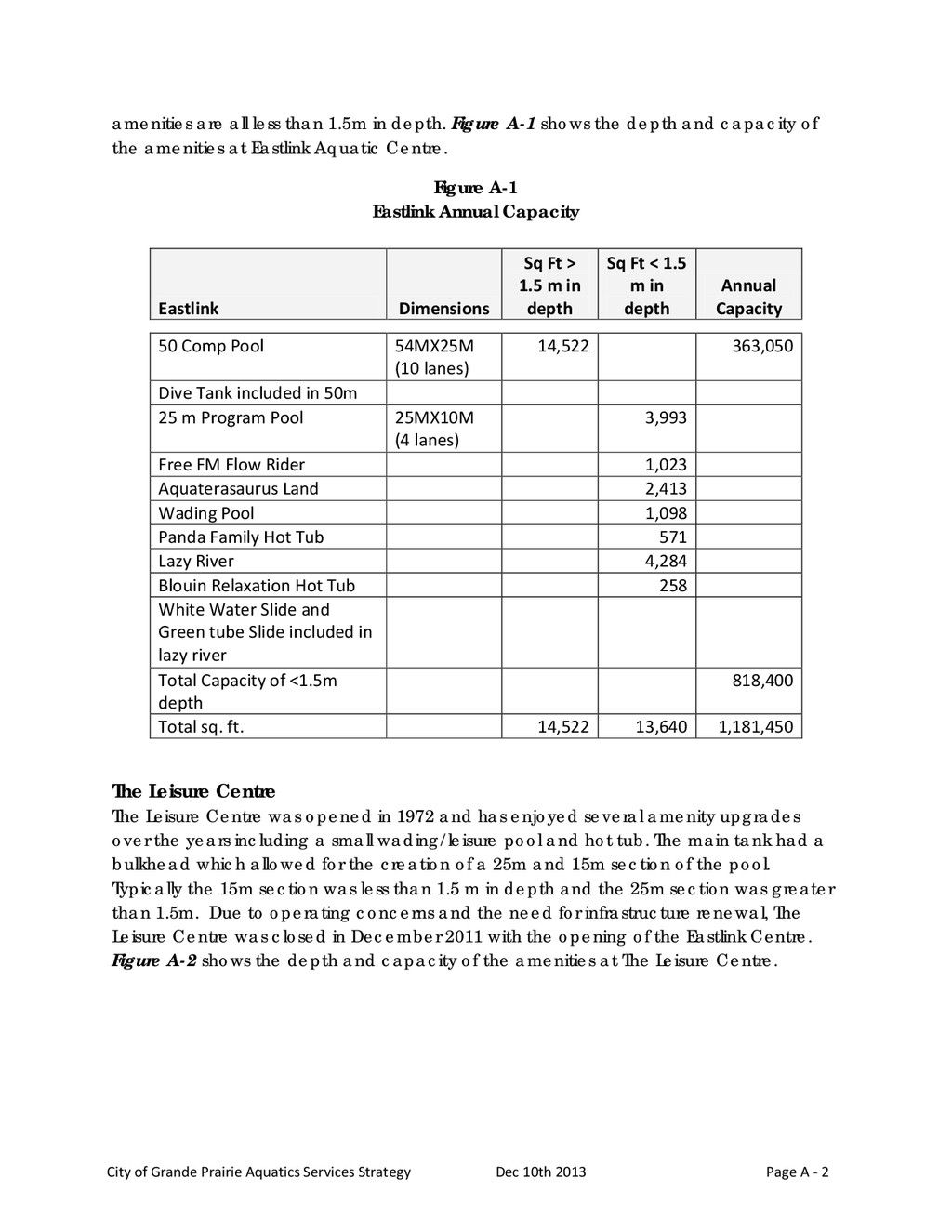
    Page A - 2 amenities are all less than 1.5m in depth. Figure A-1 shows the depth and capacity of the amenities at Eastlink Aquatic Centre. Figure A-1 Eastlink Annual Capacity Eastlink Dimensions Sq Ft > 1.5 m in depth Sq Ft < 1.5 m in depth Annual Capacity 50 Comp Pool 54MX25M (10 lanes) 14,522 363,050 Dive Tank included in 50m 25 m Program Pool 25MX10M (4 lanes) 3,993 Free FM Flow Rider 1,023 Aquaterasaurus Land 2,413 Wading Pool 1,098 Panda Family Hot Tub 571 Lazy River 4,284 Blouin Relaxation Hot Tub 258 White Water Slide and Green tube Slide included in lazy river Total Capacity of <1.5m depth 818,400 Total sq. ft. 14,522 13,640 1,181,450 The Leisure Centre The Leisure Centre was opened in 1972 and has enjoyed several amenity upgrades over the years including a small wading/leisure pool and hot tub. The main tank had a bulkhead which allowed for the creation of a 25m and 15m section of the pool. Typically the 15m section was less than 1.5 m in depth and the 25m section was greater than 1.5m. Due to operating concerns and the need for infrastructure renewal, The Leisure Centre was closed in December 2011 with the opening of the Eastlink Centre. Figure A-2 shows the depth and capacity of the amenities at The Leisure Centre.
  31. City of Grande Prairie Aquatics Services Strategy Dec 10th 2013

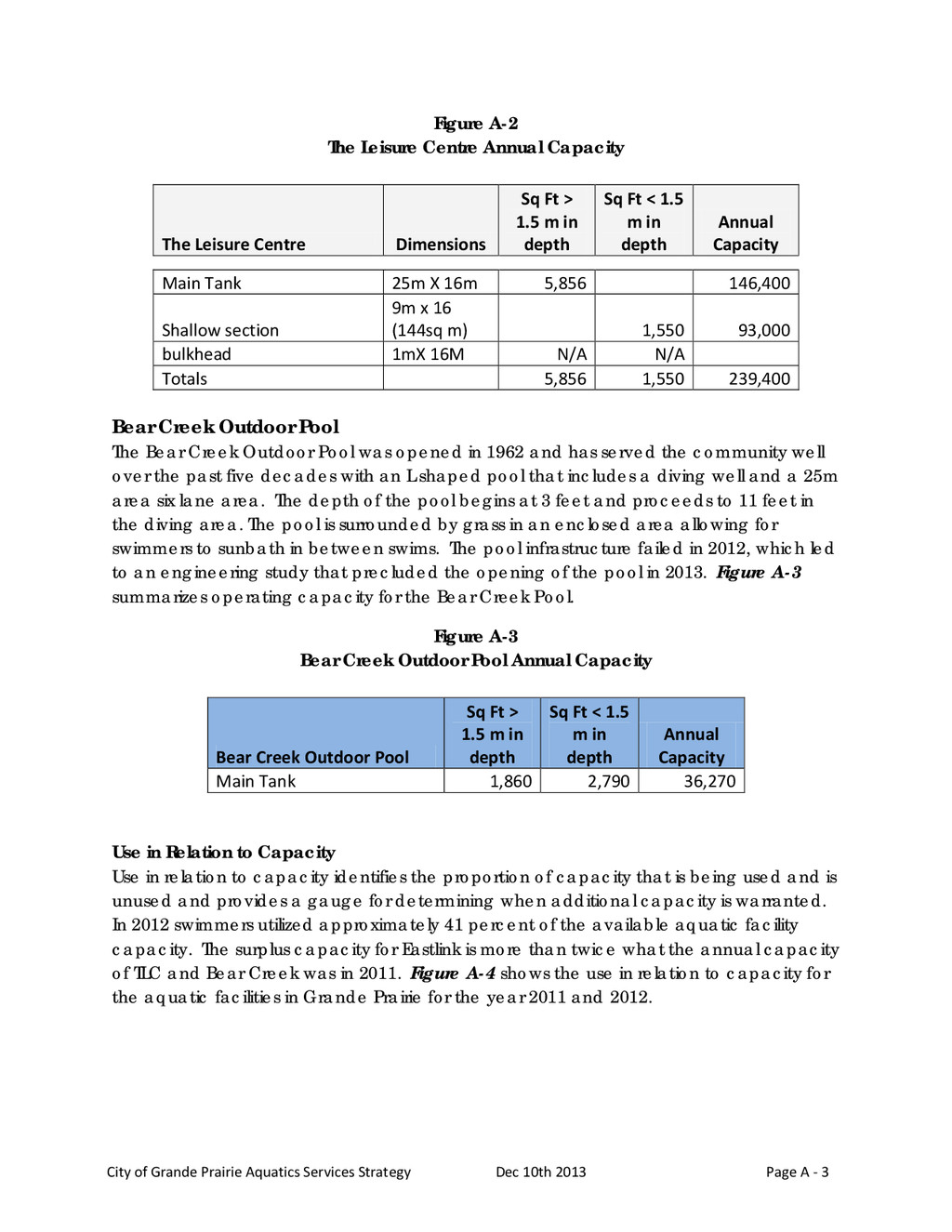
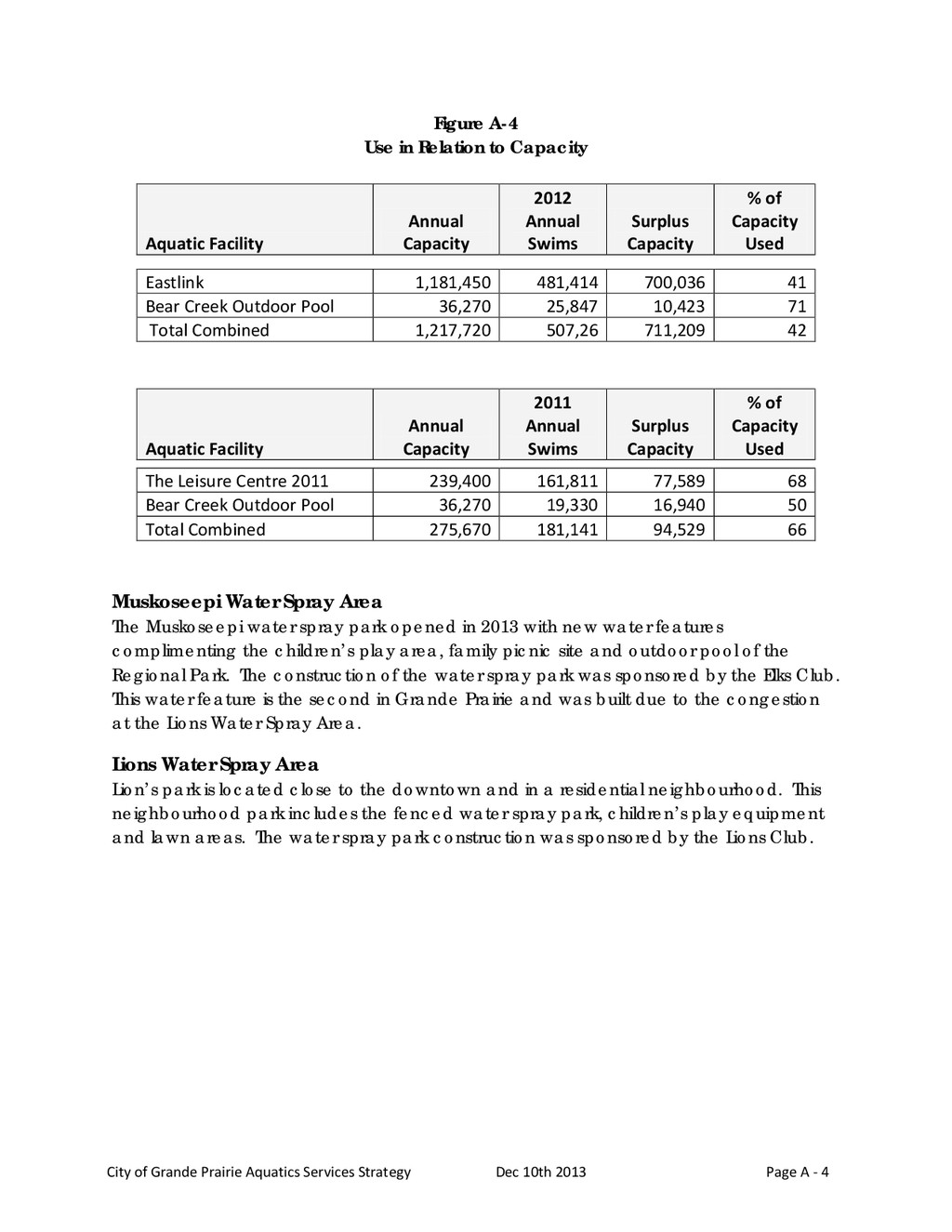
    Page A - 3 Figure A-2 The Leisure Centre Annual Capacity The Leisure Centre Dimensions Sq Ft > 1.5 m in depth Sq Ft < 1.5 m in depth Annual Capacity Main Tank 25m X 16m 5,856 146,400 Shallow section 9m x 16 (144sq m) 1,550 93,000 bulkhead 1mX 16M N/A N/A Totals 5,856 1,550 239,400 Bear Creek Outdoor Pool The Bear Creek Outdoor Pool was opened in 1962 and has served the community well over the past five decades with an L shaped pool that includes a diving well and a 25m area six lane area. The depth of the pool begins at 3 feet and proceeds to 11 feet in the diving area. The pool is surrounded by grass in an enclosed area allowing for swimmers to sunbath in between swims. The pool infrastructure failed in 2012, which led to an engineering study that precluded the opening of the pool in 2013. Figure A-3 summarizes operating capacity for the Bear Creek Pool. Figure A-3 Bear Creek Outdoor Pool Annual Capacity Bear Creek Outdoor Pool Sq Ft > 1.5 m in depth Sq Ft < 1.5 m in depth Annual Capacity Main Tank 1,860 2,790 36,270 Use in Relation to Capacity Use in relation to capacity identifies the proportion of capacity that is being used and is unused and provides a gauge for determining when additional capacity is warranted. In 2012 swimmers utilized approximately 41 percent of the available aquatic facility capacity. The surplus capacity for Eastlink is more than twice what the annual capacity of TLC and Bear Creek was in 2011. Figure A-4 shows the use in relation to capacity for the aquatic facilities in Grande Prairie for the year 2011 and 2012.
  32. City of Grande Prairie Aquatics Services Strategy Dec 10th 2013

    Page A - 4 Figure A-4 Use in Relation to Capacity Aquatic Facility Annual Capacity 2012 Annual Swims Surplus Capacity % of Capacity Used Eastlink 1,181,450 481,414 700,036 41 Bear Creek Outdoor Pool 36,270 25,847 10,423 71 Total Combined 1,217,720 507,26 711,209 42 Aquatic Facility Annual Capacity 2011 Annual Swims Surplus Capacity % of Capacity Used The Leisure Centre 2011 239,400 161,811 77,589 68 Bear Creek Outdoor Pool 36,270 19,330 16,940 50 Total Combined 275,670 181,141 94,529 66 Muskoseepi Water Spray Area The Muskoseepi water spray park opened in 2013 with new water features complimenting the children’s play area, family picnic site and outdoor pool of the Regional Park. The construction of the water spray park was sponsored by the Elks Club. This water feature is the second in Grande Prairie and was built due to the congestion at the Lions Water Spray Area. Lions Water Spray Area Lion’s park is located close to the downtown and in a residential neighbourhood. This neighbourhood park includes the fenced water spray park, children’s play equipment and lawn areas. The water spray park construction was sponsored by the Lions Club.
  33. City of Grande Prairie Aquatics Services Strategy Dec 10th 2013

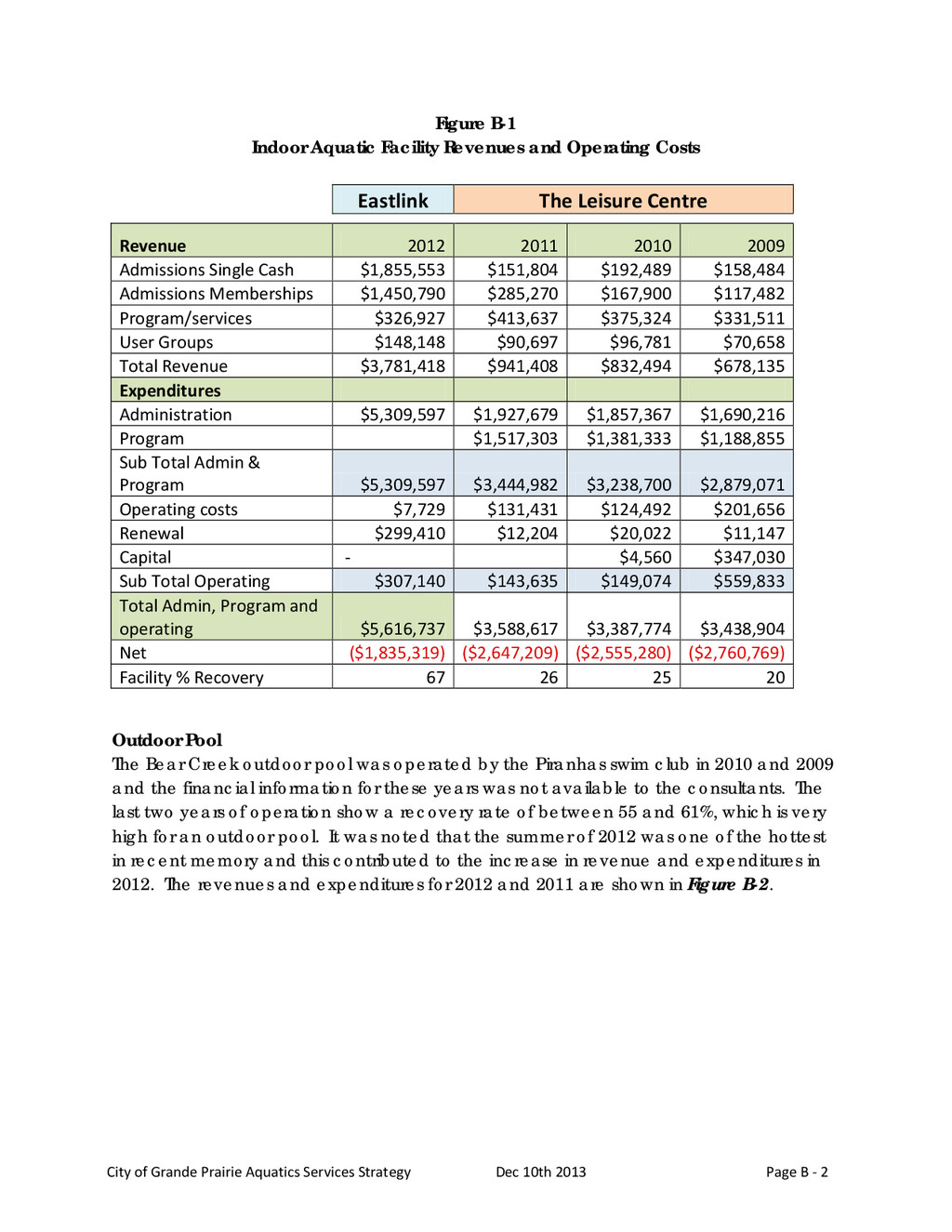
    Page B - 1 Appendix B: Pool Operating Costs and Revenues The costs and revenues for public aquatic services have been gathered in two areas; indoor aquatic centre and outdoor pool. The timelines for the financial data for the indoor pools establishes the trends over the past four years. It is interesting to see the financial impact of the Eastlink Centre on the provision of indoor aquatic services. It should be noted that although the numbers look precise, there are estimates due to the fact that both the Eastlink and The Leisure Centre aquatic operations are part of a complex and therefore, the allocation of both the revenue and expenditures are based on a percentage of general costs and revenues that have not been coded to the aquatic centres. In addition, Eastlink Centre opened in December of 2011 the same month that The Leisure Centre was closed so there is an overlap of one month where both facilities were operating. The net operating cost (i.e. public subsidy) of Eastlink is substantially less than that of The Leisure Centre $1.8M versus $2.6M respectively, as illustrated in Figure B-1. This is primarily due to the significant increase in drop in swimming in both the single admission category and membership sales at Eastlink. There was also a shift in policy which allows drop in use of the facility whenever the pool is open. The universal drop in policy coupled with the attractive new aquatic features result in a fourfold increase in revenue at Eastlink over The Leisure Centre. This has resulted in a 67% recovery rate for Eastlink where The Leisure Centre had a recovery rate of between 20 and 30% over the previous 3 year period.
  34. City of Grande Prairie Aquatics Services Strategy Dec 10th 2013

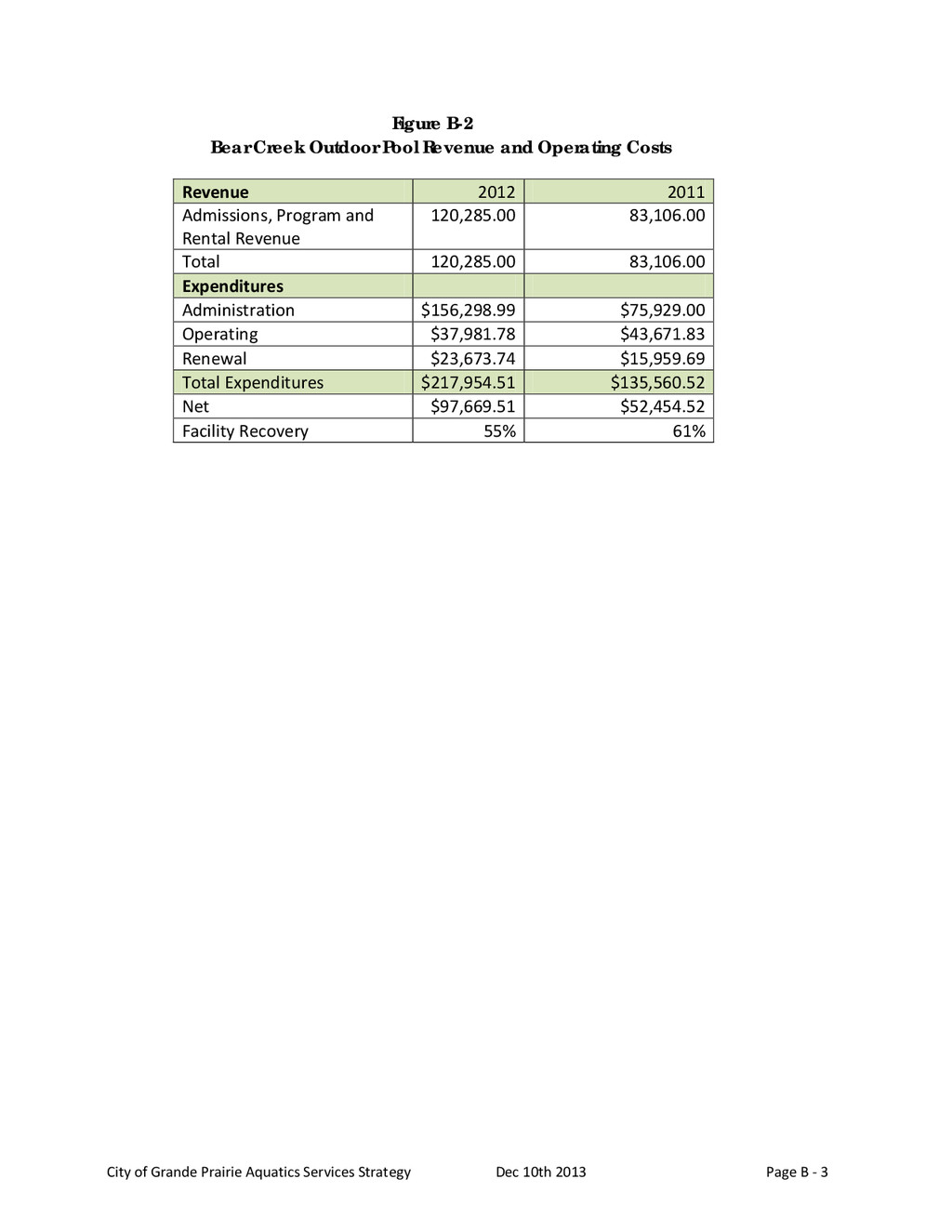
    Page B - 2 Figure B-1 Indoor Aquatic Facility Revenues and Operating Costs Eastlink The Leisure Centre Revenue 2012 2011 2010 2009 Admissions Single Cash $1,855,553 $151,804 $192,489 $158,484 Admissions Memberships $1,450,790 $285,270 $167,900 $117,482 Program/services $326,927 $413,637 $375,324 $331,511 User Groups $148,148 $90,697 $96,781 $70,658 Total Revenue $3,781,418 $941,408 $832,494 $678,135 Expenditures Administration $5,309,597 $1,927,679 $1,857,367 $1,690,216 Program $1,517,303 $1,381,333 $1,188,855 Sub Total Admin & Program $5,309,597 $3,444,982 $3,238,700 $2,879,071 Operating costs $7,729 $131,431 $124,492 $201,656 Renewal $299,410 $12,204 $20,022 $11,147 Capital - $4,560 $347,030 Sub Total Operating $307,140 $143,635 $149,074 $559,833 Total Admin, Program and operating $5,616,737 $3,588,617 $3,387,774 $3,438,904 Net ($1,835,319) ($2,647,209) ($2,555,280) ($2,760,769) Facility % Recovery 67 26 25 20 Outdoor Pool The Bear Creek outdoor pool was operated by the Piranhas swim club in 2010 and 2009 and the financial information for these years was not available to the consultants. The last two years of operation show a recovery rate of between 55 and 61%, which is very high for an outdoor pool. It was noted that the summer of 2012 was one of the hottest in recent memory and this contributed to the increase in revenue and expenditures in 2012. The revenues and expenditures for 2012 and 2011 are shown in Figure B-2.
  35. City of Grande Prairie Aquatics Services Strategy Dec 10th 2013

    Page B - 3 Figure B-2 Bear Creek Outdoor Pool Revenue and Operating Costs Revenue 2012 2011 Admissions, Program and Rental Revenue 120,285.00 83,106.00 Total 120,285.00 83,106.00 Expenditures Administration $156,298.99 $75,929.00 Operating $37,981.78 $43,671.83 Renewal $23,673.74 $15,959.69 Total Expenditures $217,954.51 $135,560.52 Net $97,669.51 $52,454.52 Facility Recovery 55% 61%
  36. City of Grande Prairie Aquatics Services Strategy Dec 10th 2013

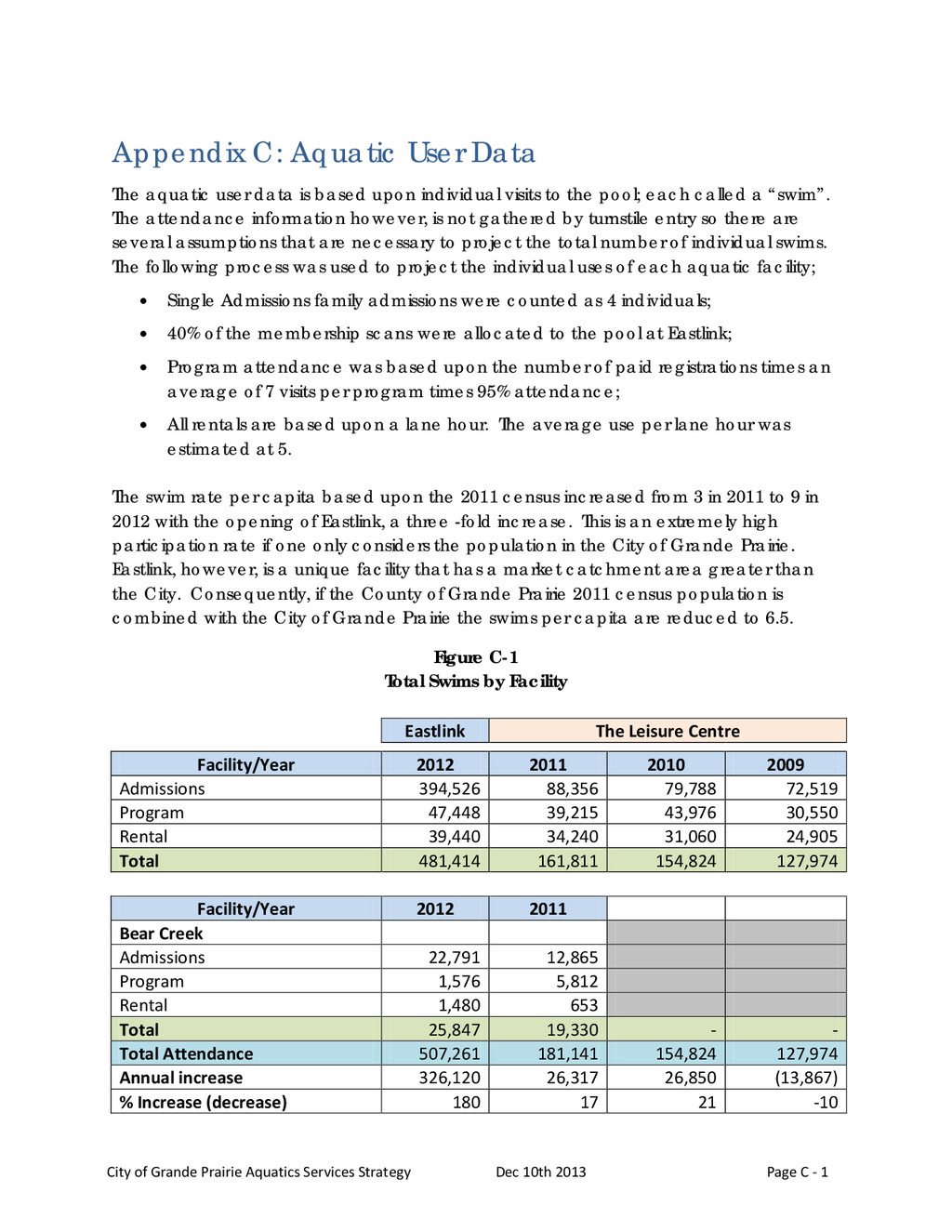
    Page C - 1 Appendix C: Aquatic User Data The aquatic user data is based upon individual visits to the pool; each called a “swim”. The attendance information however, is not gathered by turnstile entry so there are several assumptions that are necessary to project the total number of individual swims. The following process was used to project the individual uses of each aquatic facility; • Single Admissions family admissions were counted as 4 individuals; • 40% of the membership scans were allocated to the pool at Eastlink; • Program attendance was based upon the number of paid registrations times an average of 7 visits per program times 95% attendance; • All rentals are based upon a lane hour. The average use per lane hour was estimated at 5. The swim rate per capita based upon the 2011 census increased from 3 in 2011 to 9 in 2012 with the opening of Eastlink, a three -fold increase. This is an extremely high participation rate if one only considers the population in the City of Grande Prairie. Eastlink, however, is a unique facility that has a market catchment area greater than the City. Consequently, if the County of Grande Prairie 2011 census population is combined with the City of Grande Prairie the swims per capita are reduced to 6.5. Figure C-1 Total Swims by Facility Eastlink The Leisure Centre Facility/Year 2012 2011 2010 2009 Admissions 394,526 88,356 79,788 72,519 Program 47,448 39,215 43,976 30,550 Rental 39,440 34,240 31,060 24,905 Total 481,414 161,811 154,824 127,974 Facility/Year 2012 2011 Bear Creek Admissions 22,791 12,865 Program 1,576 5,812 Rental 1,480 653 Total 25,847 19,330 - - Total Attendance 507,261 181,141 154,824 127,974 Annual increase 326,120 26,317 26,850 (13,867) % Increase (decrease) 180 17 21 -10
  37. City of Grande Prairie Aquatics Services Strategy Dec 10th 2013

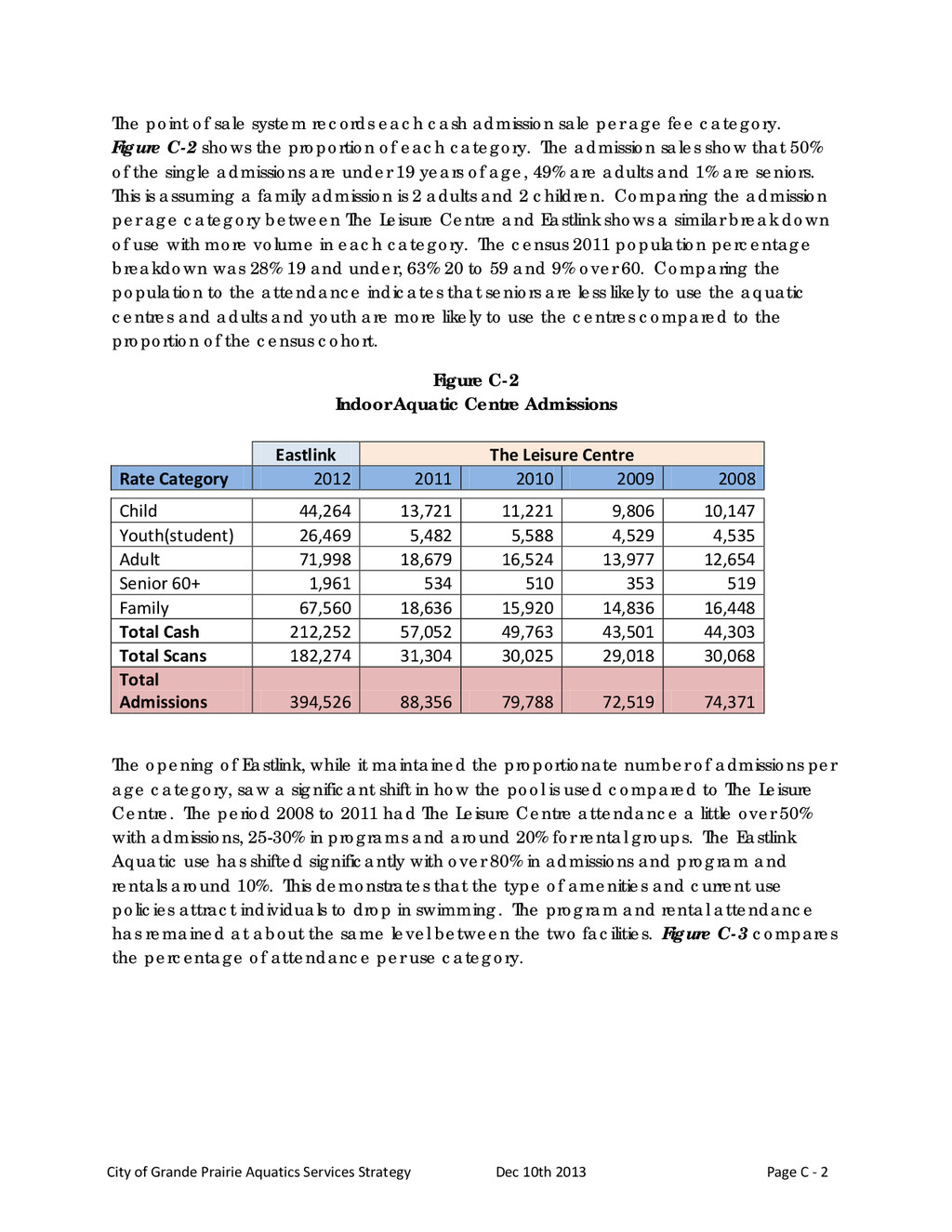
    Page C - 2 The point of sale system records each cash admission sale per age fee category. Figure C-2 shows the proportion of each category. The admission sales show that 50% of the single admissions are under 19 years of age, 49% are adults and 1% are seniors. This is assuming a family admission is 2 adults and 2 children. Comparing the admission per age category between The Leisure Centre and Eastlink shows a similar break down of use with more volume in each category. The census 2011 population percentage breakdown was 28% 19 and under, 63% 20 to 59 and 9% over 60. Comparing the population to the attendance indicates that seniors are less likely to use the aquatic centres and adults and youth are more likely to use the centres compared to the proportion of the census cohort. Figure C-2 Indoor Aquatic Centre Admissions Eastlink The Leisure Centre Rate Category 2012 2011 2010 2009 2008 Child 44,264 13,721 11,221 9,806 10,147 Youth(student) 26,469 5,482 5,588 4,529 4,535 Adult 71,998 18,679 16,524 13,977 12,654 Senior 60+ 1,961 534 510 353 519 Family 67,560 18,636 15,920 14,836 16,448 Total Cash 212,252 57,052 49,763 43,501 44,303 Total Scans 182,274 31,304 30,025 29,018 30,068 Total Admissions 394,526 88,356 79,788 72,519 74,371 The opening of Eastlink, while it maintained the proportionate number of admissions per age category, saw a significant shift in how the pool is used compared to The Leisure Centre. The period 2008 to 2011 had The Leisure Centre attendance a little over 50% with admissions, 25-30% in programs and around 20% for rental groups. The Eastlink Aquatic use has shifted significantly with over 80% in admissions and program and rentals around 10%. This demonstrates that the type of amenities and current use policies attract individuals to drop in swimming. The program and rental attendance has remained at about the same level between the two facilities. Figure C-3 compares the percentage of attendance per use category.
  38. City of Grande Prairie Aquatics Services Strategy Dec 10th 2013

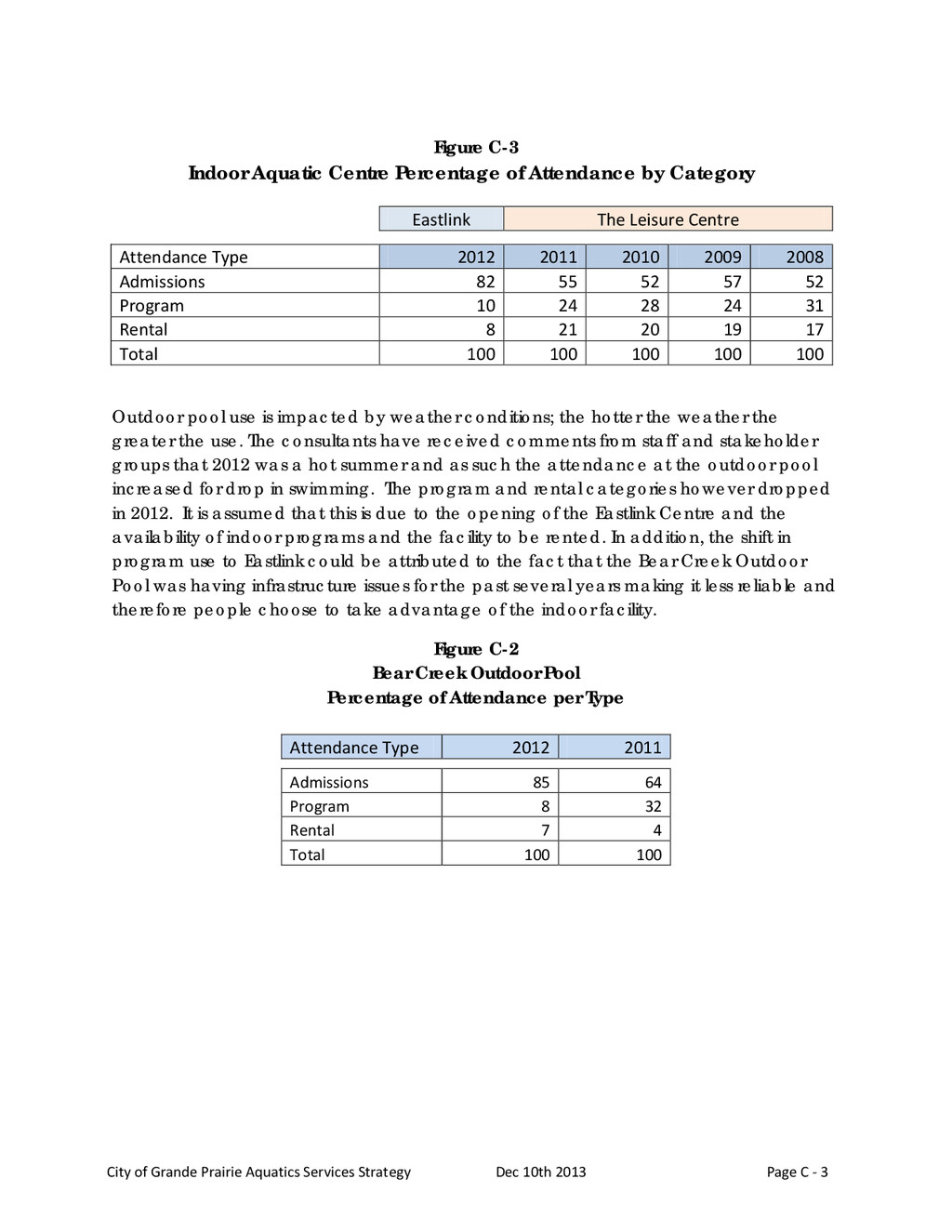
    Page C - 3 Figure C-3 Indoor Aquatic Centre Percentage of Attendance by Category Eastlink The Leisure Centre Attendance Type 2012 2011 2010 2009 2008 Admissions 82 55 52 57 52 Program 10 24 28 24 31 Rental 8 21 20 19 17 Total 100 100 100 100 100 Outdoor pool use is impacted by weather conditions; the hotter the weather the greater the use. The consultants have received comments from staff and stakeholder groups that 2012 was a hot summer and as such the attendance at the outdoor pool increased for drop in swimming. The program and rental categories however dropped in 2012. It is assumed that this is due to the opening of the Eastlink Centre and the availability of indoor programs and the facility to be rented. In addition, the shift in program use to Eastlink could be attributed to the fact that the Bear Creek Outdoor Pool was having infrastructure issues for the past several years making it less reliable and therefore people choose to take advantage of the indoor facility. Figure C-2 Bear Creek Outdoor Pool Percentage of Attendance per Type Attendance Type 2012 2011 Admissions 85 64 Program 8 32 Rental 7 4 Total 100 100
  39. City of Grande Prairie Aquatics Services Strategy Dec 10th 2013

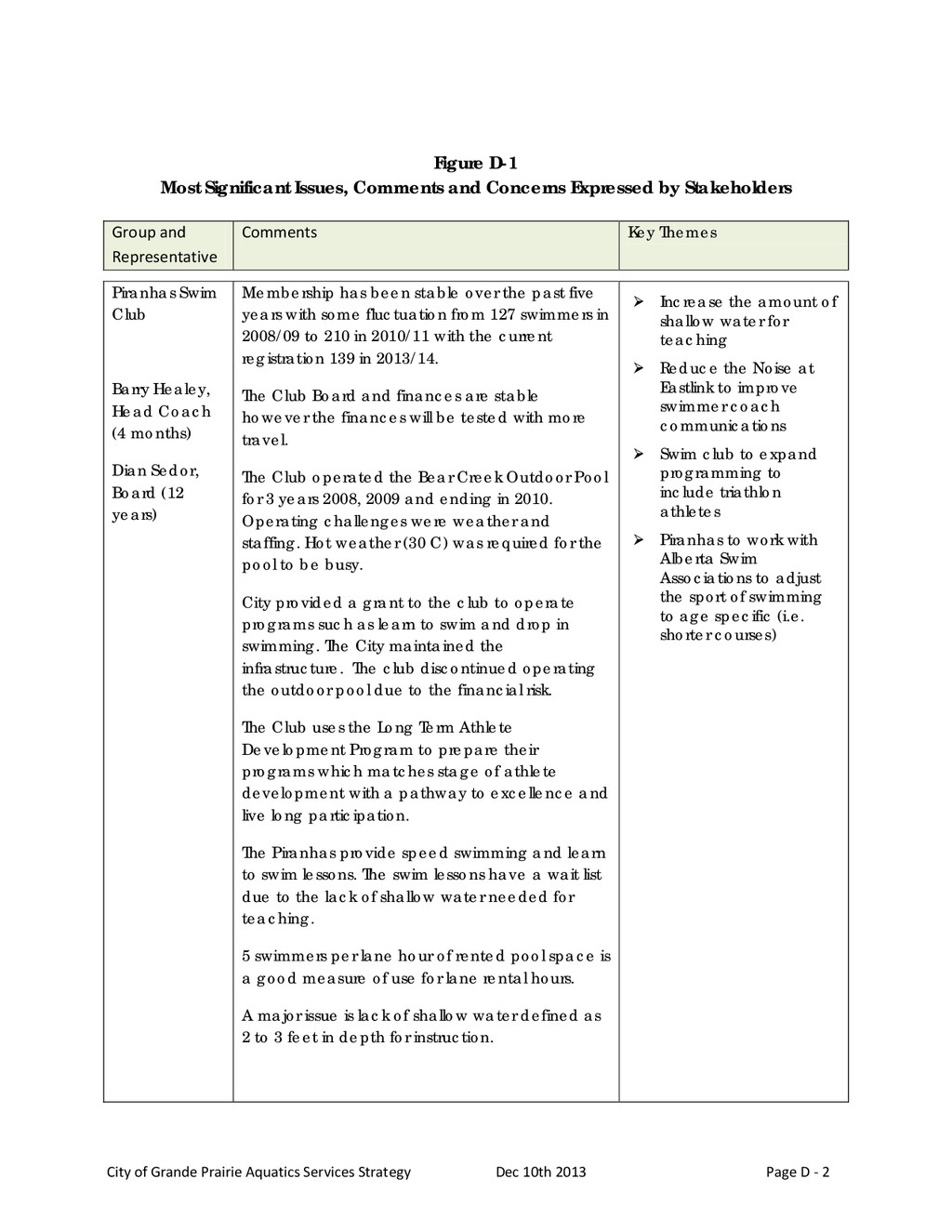
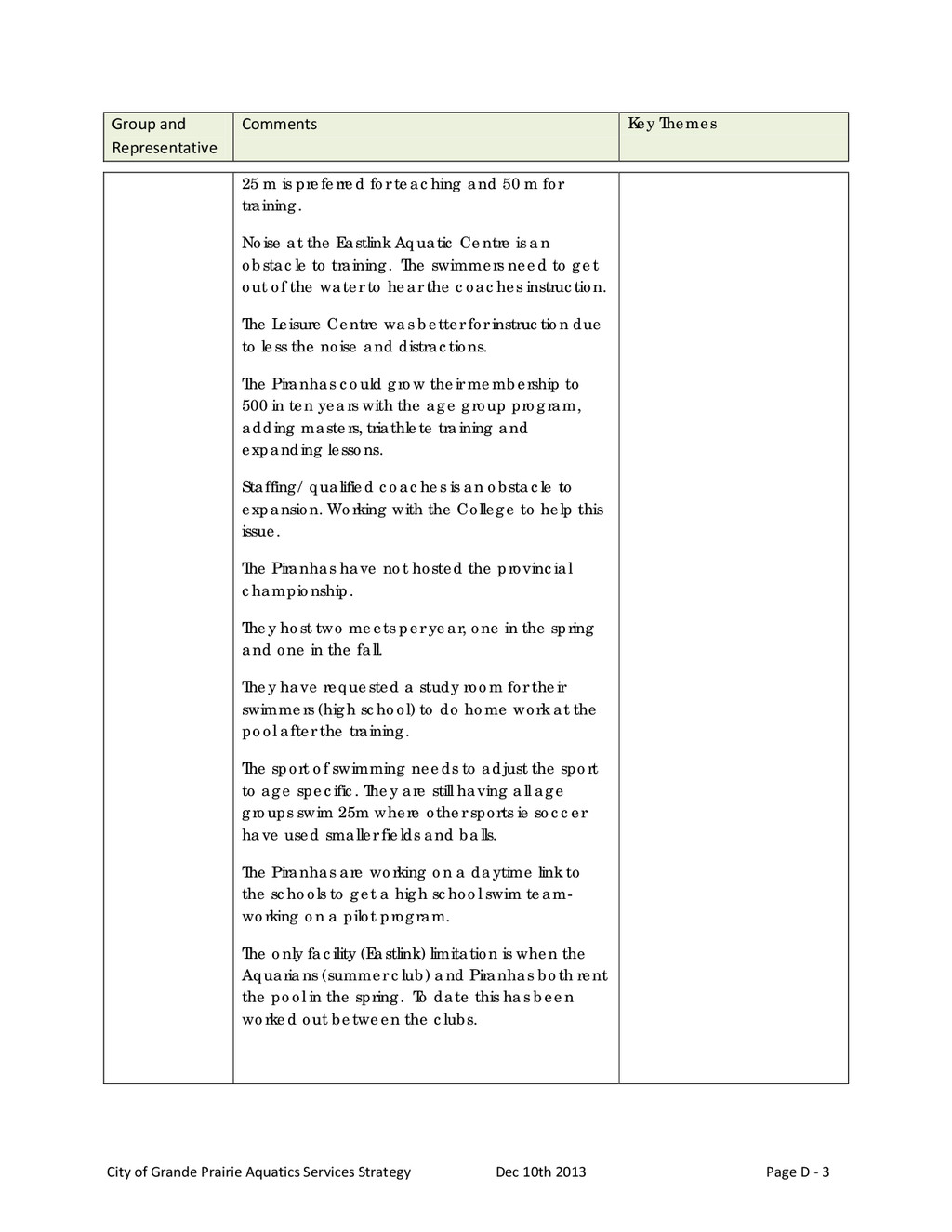
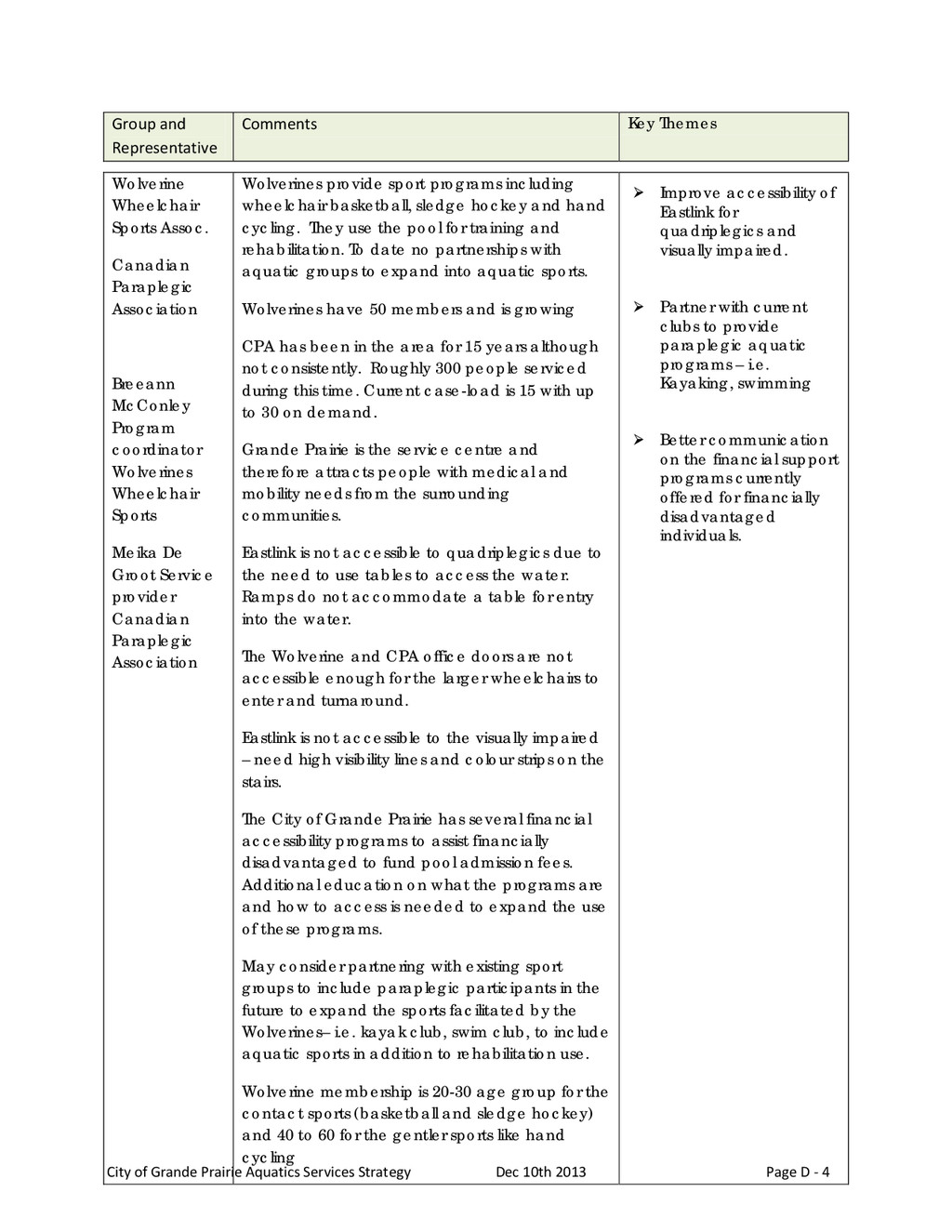
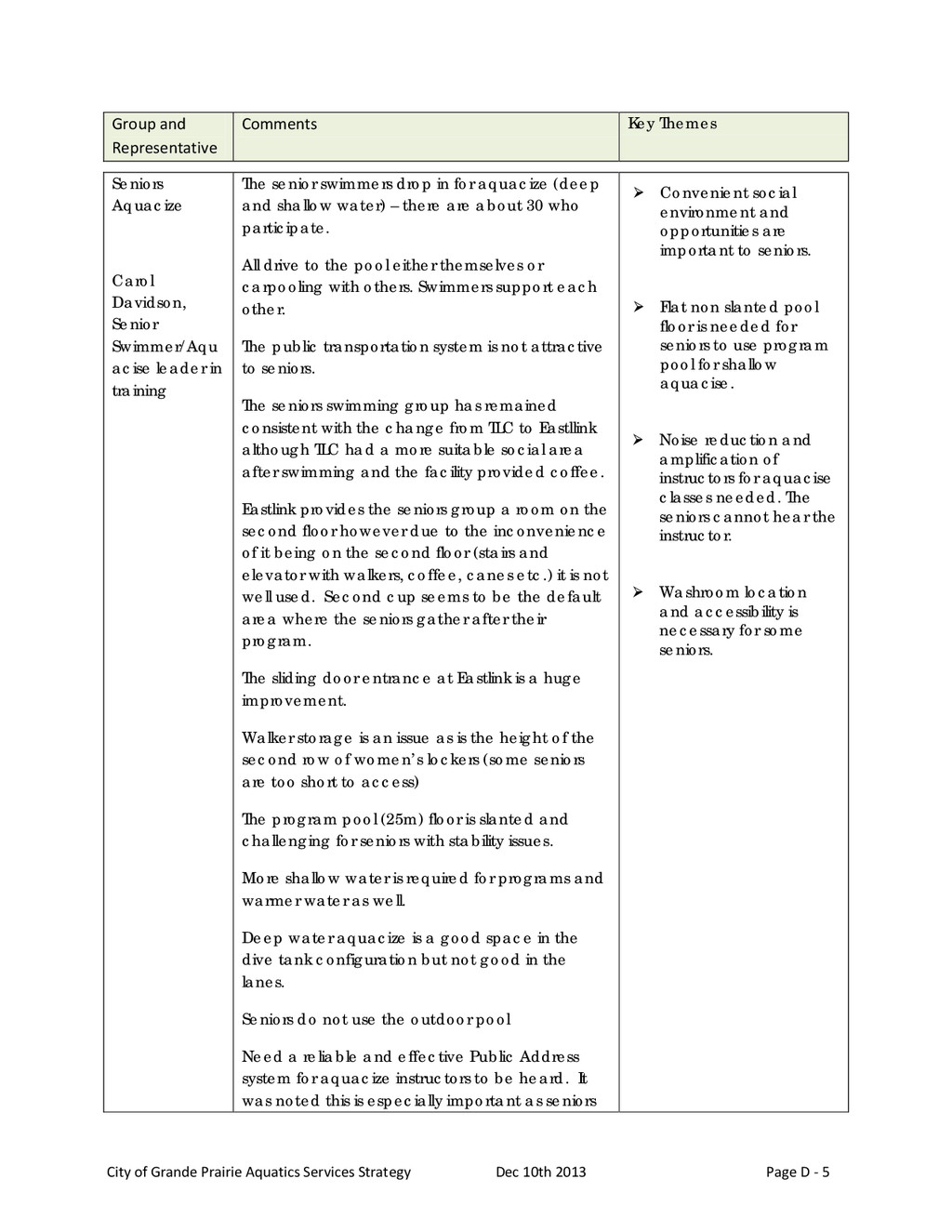
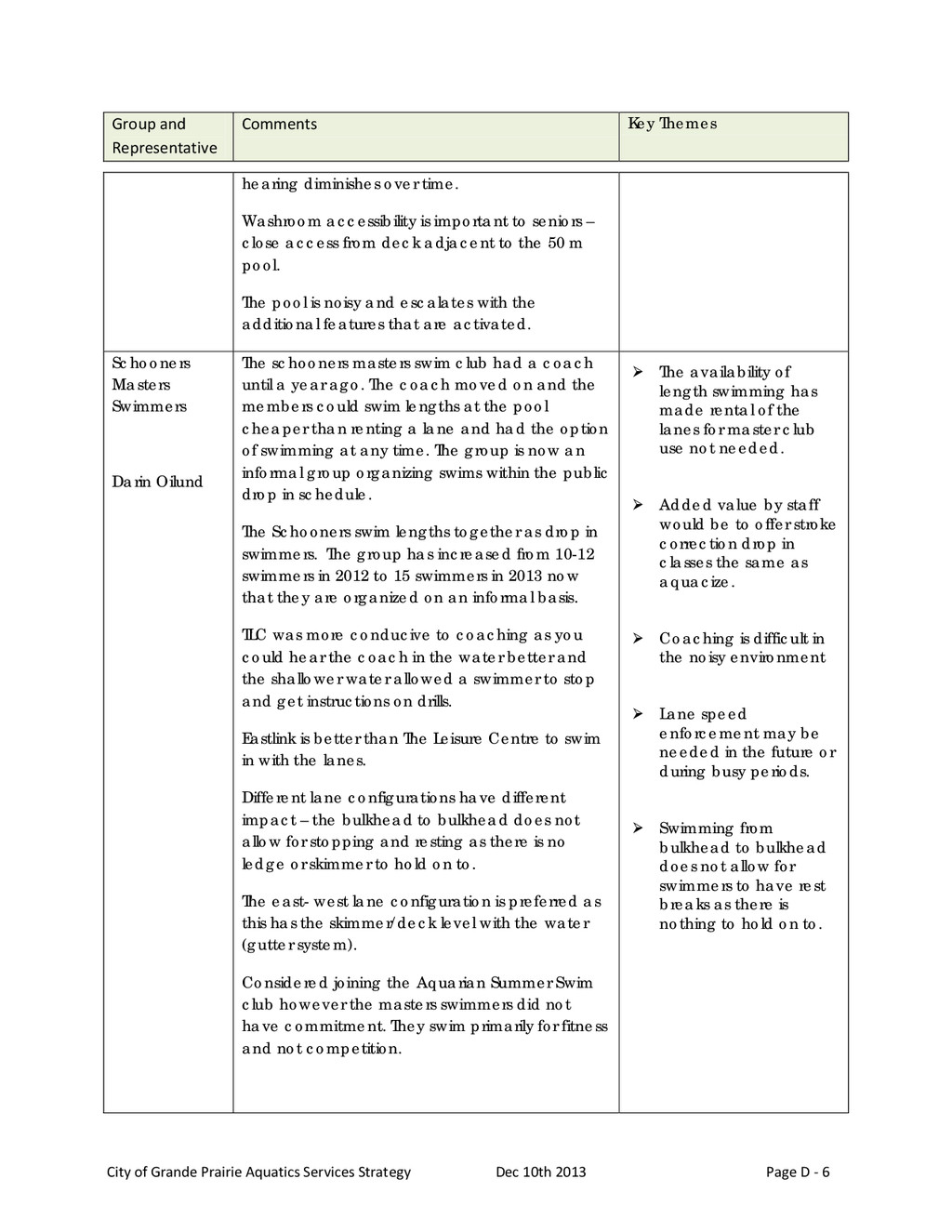
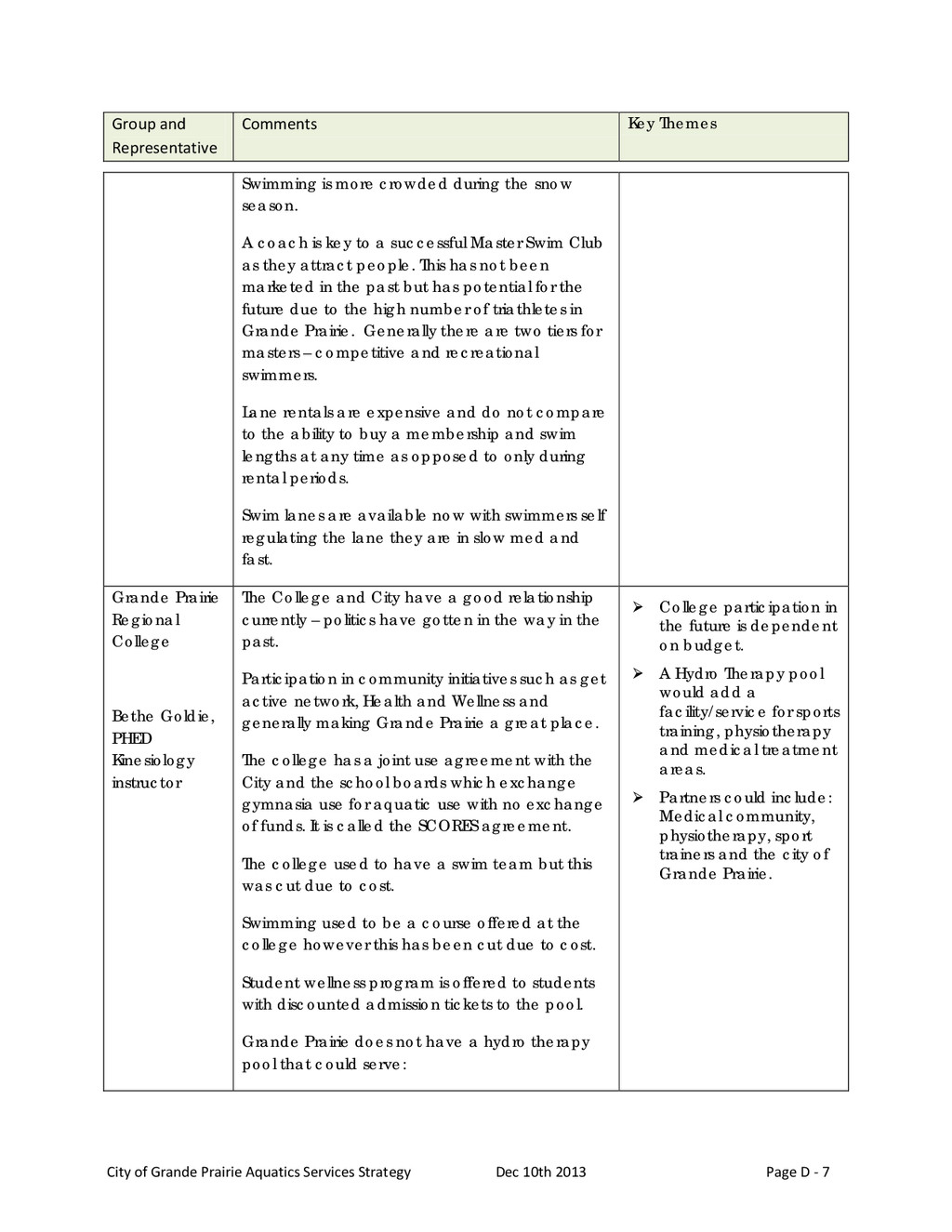
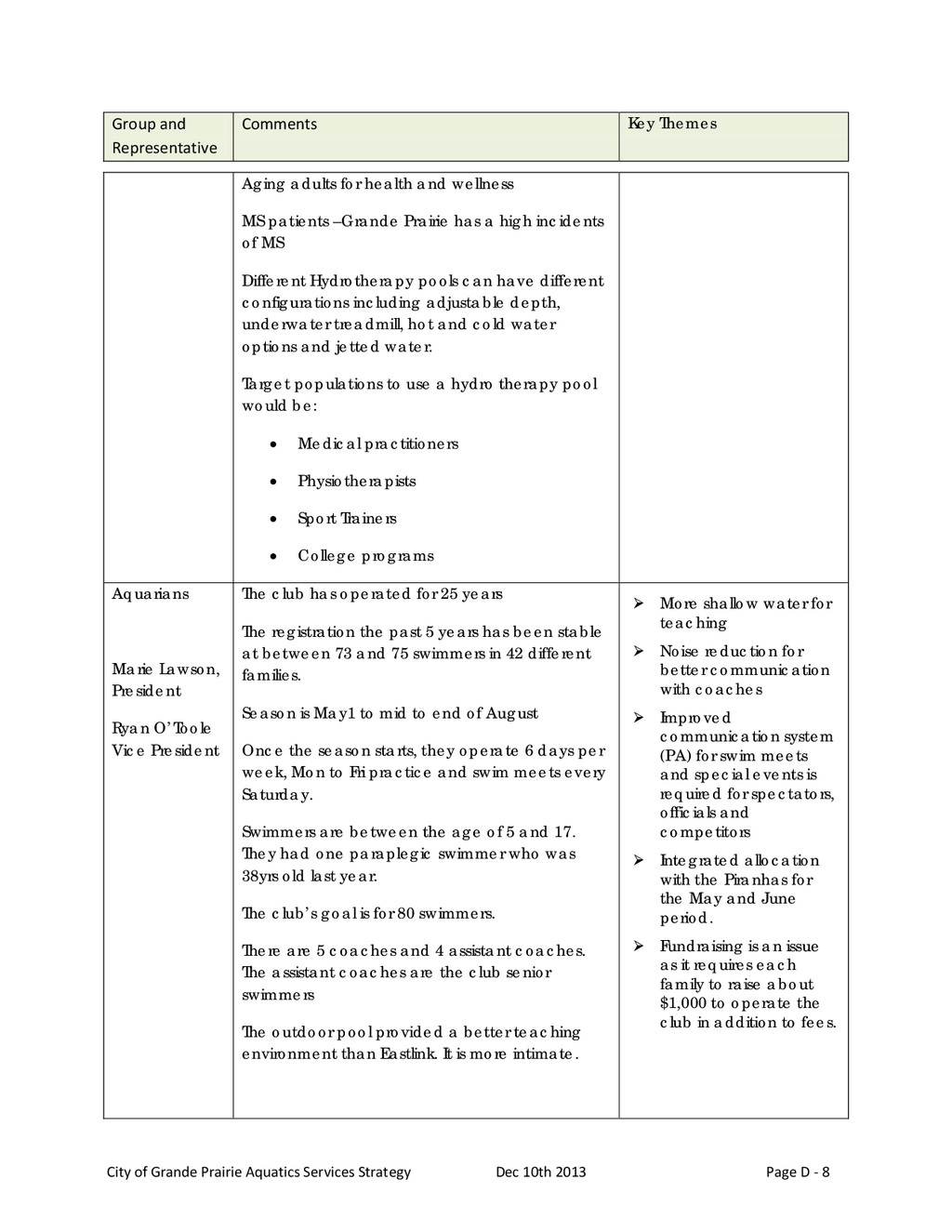
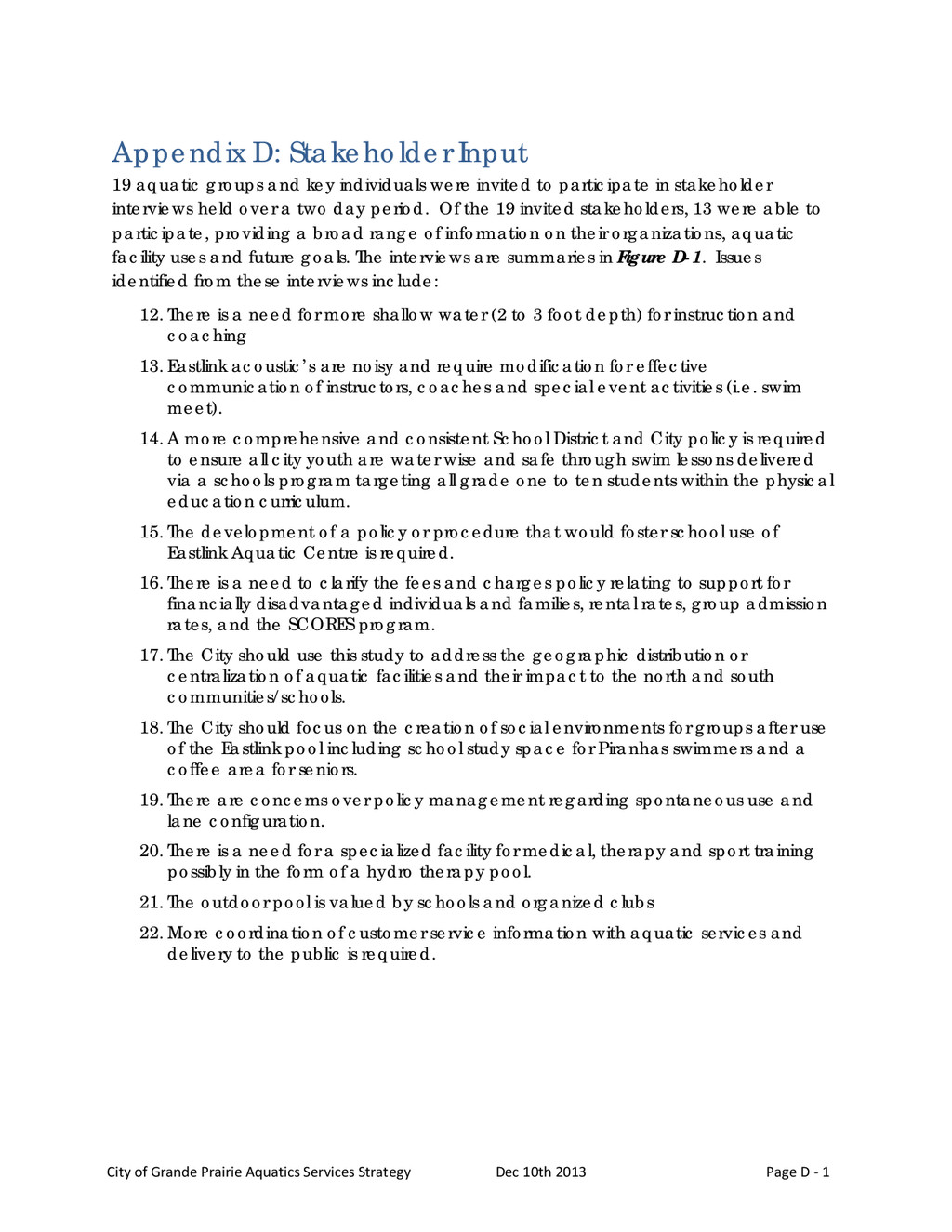
    Page D - 1 Appendix D: Stakeholder Input 19 aquatic groups and key individuals were invited to participate in stakeholder interviews held over a two day period. Of the 19 invited stakeholders, 13 were able to participate, providing a broad range of information on their organizations, aquatic facility uses and future goals. The interviews are summaries in Figure D-1. Issues identified from these interviews include: 12. There is a need for more shallow water (2 to 3 foot depth) for instruction and coaching 13. Eastlink acoustic’s are noisy and require modification for effective communication of instructors, coaches and special event activities (i.e. swim meet). 14. A more comprehensive and consistent School District and City policy is required to ensure all city youth are water wise and safe through swim lessons delivered via a schools program targeting all grade one to ten students within the physical education curriculum. 15. The development of a policy or procedure that would foster school use of Eastlink Aquatic Centre is required. 16. There is a need to clarify the fees and charges policy relating to support for financially disadvantaged individuals and families, rental rates, group admission rates, and the SCORES program. 17. The City should use this study to address the geographic distribution or centralization of aquatic facilities and their impact to the north and south communities/schools. 18. The City should focus on the creation of social environments for groups after use of the Eastlink pool including school study space for Piranhas swimmers and a coffee area for seniors. 19. There are concerns over policy management regarding spontaneous use and lane configuration. 20. There is a need for a specialized facility for medical, therapy and sport training possibly in the form of a hydro therapy pool. 21. The outdoor pool is valued by schools and organized clubs 22. More coordination of customer service information with aquatic services and delivery to the public is required.
  40. City of Grande Prairie Aquatics Services Strategy Dec 10th 2013

    Page D - 2 Figure D-1 Most Significant Issues, Comments and Concerns Expressed by Stakeholders Group and Representative Comments Key Themes Piranhas Swim Club Barry Healey, Head Coach (4 months) Dian Sedor, Board (12 years) Membership has been stable over the past five years with some fluctuation from 127 swimmers in 2008/09 to 210 in 2010/11 with the current registration 139 in 2013/14. The Club Board and finances are stable however the finances will be tested with more travel. The Club operated the Bear Creek Outdoor Pool for 3 years 2008, 2009 and ending in 2010. Operating challenges were weather and staffing. Hot weather (30 C) was required for the pool to be busy. City provided a grant to the club to operate programs such as learn to swim and drop in swimming. The City maintained the infrastructure. The club discontinued operating the outdoor pool due to the financial risk. The Club uses the Long Term Athlete Development Program to prepare their programs which matches stage of athlete development with a pathway to excellence and live long participation. The Piranhas provide speed swimming and learn to swim lessons. The swim lessons have a wait list due to the lack of shallow water needed for teaching. 5 swimmers per lane hour of rented pool space is a good measure of use for lane rental hours. A major issue is lack of shallow water defined as 2 to 3 feet in depth for instruction.  Increase the amount of shallow water for teaching  Reduce the Noise at Eastlink to improve swimmer coach communications  Swim club to expand programming to include triathlon athletes  Piranhas to work with Alberta Swim Associations to adjust the sport of swimming to age specific (i.e. shorter courses)
  41. City of Grande Prairie Aquatics Services Strategy Dec 10th 2013

    Page D - 3 Group and Representative Comments Key Themes 25 m is preferred for teaching and 50 m for training. Noise at the Eastlink Aquatic Centre is an obstacle to training. The swimmers need to get out of the water to hear the coaches instruction. The Leisure Centre was better for instruction due to less the noise and distractions. The Piranhas could grow their membership to 500 in ten years with the age group program, adding masters, triathlete training and expanding lessons. Staffing/ qualified coaches is an obstacle to expansion. Working with the College to help this issue. The Piranhas have not hosted the provincial championship. They host two meets per year, one in the spring and one in the fall. They have requested a study room for their swimmers (high school) to do home work at the pool after the training. The sport of swimming needs to adjust the sport to age specific. They are still having all age groups swim 25m where other sports ie soccer have used smaller fields and balls. The Piranhas are working on a daytime link to the schools to get a high school swim team- working on a pilot program. The only facility (Eastlink) limitation is when the Aquarians (summer club) and Piranhas both rent the pool in the spring. To date this has been worked out between the clubs.
  42. City of Grande Prairie Aquatics Services Strategy Dec 10th 2013

    Page D - 4 Group and Representative Comments Key Themes Wolverine Wheelchair Sports Assoc. Canadian Paraplegic Association Breeann McConley Program coordinator Wolverines Wheelchair Sports Meika De Groot Service provider Canadian Paraplegic Association Wolverines provide sport programs including wheelchair basketball, sledge hockey and hand cycling. They use the pool for training and rehabilitation. To date no partnerships with aquatic groups to expand into aquatic sports. Wolverines have 50 members and is growing CPA has been in the area for 15 years although not consistently. Roughly 300 people serviced during this time. Current case-load is 15 with up to 30 on demand. Grande Prairie is the service centre and therefore attracts people with medical and mobility needs from the surrounding communities. Eastlink is not accessible to quadriplegics due to the need to use tables to access the water. Ramps do not accommodate a table for entry into the water. The Wolverine and CPA office doors are not accessible enough for the larger wheelchairs to enter and turnaround. Eastlink is not accessible to the visually impaired – need high visibility lines and colour strips on the stairs. The City of Grande Prairie has several financial accessibility programs to assist financially disadvantaged to fund pool admission fees. Additional education on what the programs are and how to access is needed to expand the use of these programs. May consider partnering with existing sport groups to include paraplegic participants in the future to expand the sports facilitated by the Wolverines– i.e. kayak club, swim club, to include aquatic sports in addition to rehabilitation use. Wolverine membership is 20-30 age group for the contact sports (basketball and sledge hockey) and 40 to 60 for the gentler sports like hand cycling  Improve accessibility of Eastlink for quadriplegics and visually impaired.  Partner with current clubs to provide paraplegic aquatic programs – i.e. Kayaking, swimming  Better communication on the financial support programs currently offered for financially disadvantaged individuals.
  43. City of Grande Prairie Aquatics Services Strategy Dec 10th 2013

    Page D - 5 Group and Representative Comments Key Themes Seniors Aquacize Carol Davidson, Senior Swimmer/Aqu acise leader in training The senior swimmers drop in for aquacize (deep and shallow water) – there are about 30 who participate. All drive to the pool either themselves or carpooling with others. Swimmers support each other. The public transportation system is not attractive to seniors. The seniors swimming group has remained consistent with the change from TLC to Eastllink although TLC had a more suitable social area after swimming and the facility provided coffee. Eastlink provides the seniors group a room on the second floor however due to the inconvenience of it being on the second floor (stairs and elevator with walkers, coffee, canes etc.) it is not well used. Second cup seems to be the default area where the seniors gather after their program. The sliding door entrance at Eastlink is a huge improvement. Walker storage is an issue as is the height of the second row of women’s lockers (some seniors are too short to access) The program pool (25m) floor is slanted and challenging for seniors with stability issues. More shallow water is required for programs and warmer water as well. Deep water aquacize is a good space in the dive tank configuration but not good in the lanes. Seniors do not use the outdoor pool Need a reliable and effective Public Address system for aquacize instructors to be heard. It was noted this is especially important as seniors  Convenient social environment and opportunities are important to seniors.  Flat non slanted pool floor is needed for seniors to use program pool for shallow aquacise.  Noise reduction and amplification of instructors for aquacise classes needed. The seniors cannot hear the instructor.  Washroom location and accessibility is necessary for some seniors.
  44. City of Grande Prairie Aquatics Services Strategy Dec 10th 2013

    Page D - 6 Group and Representative Comments Key Themes hearing diminishes over time. Washroom accessibility is important to seniors – close access from deck adjacent to the 50 m pool. The pool is noisy and escalates with the additional features that are activated. Schooners Masters Swimmers Darin Oilund The schooners masters swim club had a coach until a year ago. The coach moved on and the members could swim lengths at the pool cheaper than renting a lane and had the option of swimming at any time. The group is now an informal group organizing swims within the public drop in schedule. The Schooners swim lengths together as drop in swimmers. The group has increased from 10-12 swimmers in 2012 to 15 swimmers in 2013 now that they are organized on an informal basis. TLC was more conducive to coaching as you could hear the coach in the water better and the shallower water allowed a swimmer to stop and get instructions on drills. Eastlink is better than The Leisure Centre to swim in with the lanes. Different lane configurations have different impact – the bulkhead to bulkhead does not allow for stopping and resting as there is no ledge or skimmer to hold on to. The east- west lane configuration is preferred as this has the skimmer/deck level with the water (gutter system). Considered joining the Aquarian Summer Swim club however the masters swimmers did not have commitment. They swim primarily for fitness and not competition.  The availability of length swimming has made rental of the lanes for master club use not needed.  Added value by staff would be to offer stroke correction drop in classes the same as aquacize.  Coaching is difficult in the noisy environment  Lane speed enforcement may be needed in the future or during busy periods.  Swimming from bulkhead to bulkhead does not allow for swimmers to have rest breaks as there is nothing to hold on to.
  45. City of Grande Prairie Aquatics Services Strategy Dec 10th 2013

    Page D - 7 Group and Representative Comments Key Themes Swimming is more crowded during the snow season. A coach is key to a successful Master Swim Club as they attract people. This has not been marketed in the past but has potential for the future due to the high number of triathletes in Grande Prairie. Generally there are two tiers for masters – competitive and recreational swimmers. Lane rentals are expensive and do not compare to the ability to buy a membership and swim lengths at any time as opposed to only during rental periods. Swim lanes are available now with swimmers self regulating the lane they are in slow med and fast. Grande Prairie Regional College Bethe Goldie, PHED Kinesiology instructor The College and City have a good relationship currently – politics have gotten in the way in the past. Participation in community initiatives such as get active network, Health and Wellness and generally making Grande Prairie a great place. The college has a joint use agreement with the City and the school boards which exchange gymnasia use for aquatic use with no exchange of funds. It is called the SCORES agreement. The college used to have a swim team but this was cut due to cost. Swimming used to be a course offered at the college however this has been cut due to cost. Student wellness program is offered to students with discounted admission tickets to the pool. Grande Prairie does not have a hydro therapy pool that could serve:  College participation in the future is dependent on budget.  A Hydro Therapy pool would add a facility/service for sports training, physiotherapy and medical treatment areas.  Partners could include: Medical community, physiotherapy, sport trainers and the city of Grande Prairie.
  46. City of Grande Prairie Aquatics Services Strategy Dec 10th 2013

    Page D - 8 Group and Representative Comments Key Themes Aging adults for health and wellness MS patients –Grande Prairie has a high incidents of MS Different Hydrotherapy pools can have different configurations including adjustable depth, underwater treadmill, hot and cold water options and jetted water. Target populations to use a hydro therapy pool would be: • Medical practitioners • Physiotherapists • Sport Trainers • College programs Aquarians Marie Lawson, President Ryan O’Toole Vice President The club has operated for 25 years The registration the past 5 years has been stable at between 73 and 75 swimmers in 42 different families. Season is May1 to mid to end of August Once the season starts, they operate 6 days per week, Mon to Fri practice and swim meets every Saturday. Swimmers are between the age of 5 and 17. They had one paraplegic swimmer who was 38yrs old last year. The club’s goal is for 80 swimmers. There are 5 coaches and 4 assistant coaches. The assistant coaches are the club senior swimmers The outdoor pool provided a better teaching environment than Eastlink. It is more intimate.  More shallow water for teaching  Noise reduction for better communication with coaches  Improved communication system (PA) for swim meets and special events is required for spectators, officials and competitors  Integrated allocation with the Piranhas for the May and June period.  Fundraising is an issue as it requires each family to raise about $1,000 to operate the club in addition to fees.
  47. City of Grande Prairie Aquatics Services Strategy Dec 10th 2013

    Page D - 9 Group and Representative Comments Key Themes The Eastlink facility provides all the services they need. The facility noise is not good and limits communication. The lane rental fees have been the same between TLC, Bear Creek and Eastlink. At the same cost, they prefer Eastlink. They used Bear Creek from Late June to early Aug. They have some compression with the winter swim club in May and June resulting in some swimmers swimming later than normal bed times for some age groups. The club uses the kids pool (25m program pool) because of the shallower depth needed to teach as the kids need to touch the bottom. Objectives for the next 10 years include: Reduce the noise levels in Eastlink Reduce the amount of fundraising required to operate- currently they need to raise $40k per year. The club is a blend of competitive and recreational swimmers Barriers for the next ten years include coaching recruitment and fees. The club expressed that they would not like to see their club renting pools at two locations (Eastlink and The Leisure Centre). It would be challenging for one family with two children one at each location. Shantra Dive Club Shantra is a commercial dive shop that trains individuals to be PADI certified: The pools are used for training people to be certified in confined dives.  Innovative reallocation of space when the teach pool is closed (waterslide splash pool)
  48. City of Grande Prairie Aquatics Services Strategy Dec 10th 2013

    Page D - 10 Group and Representative Comments Key Themes Len Bauer, Owner Open water dives are required to complete the certification which then allows the diver to rent equipment for independent dives. 100 people trained in the past year Each trainee requires 6 to 7 hours of pool time. Len also accesses pool time at Peace River, Fairview and Beaver Lodge. Would like to grow to 150 student per year and teach specialty classes such as underwater photography, rescue dive and emergency first aid Shallow pool water is required for the first part of the training. Not enough shallow water at Eastlink. An issue is the unscheduled closure of the pools (fecal) and rescheduling or cancelling his classes. Relocation to other shallow pool areas has been substituted but inconsistently. Len would like underwater features that would make the ten hours of deep water training more interesting. Features mentioned include, cages with artificial fish tied to them. Obstacles • Student procurement • Booking pool on a scheduled basis • Recruitment of Certified instructors • Scuba diving requires a network of divers as each dive requires a buddy. • Commercial retail shop in Eastlink would be beneficial. Is considering proposal for The Leisure Centre  Underwater features  Specialty courses  Retail shop in Eastlink  Insurance Policy reviewed/ explained.
  49. City of Grande Prairie Aquatics Services Strategy Dec 10th 2013

    Page D - 11 Group and Representative Comments Key Themes • Pool policy on insurance has made him separate from the dive club. Waterpolo Mike Bradfield Unable to attend Swan City Masters Swim Club Margaret Nasedkin Jeannette Chandler 30 year history with the club Were with the Schooners masters but separated with the leaving of a coach and the desire for some to swim early mornings and others later at night. In the past 5 years the average membership has been 25+/- currently 4 members due to the splitting of the club into morning and afternoon. They are a competitive swim club. They lost members moving from TLC to Eastlink due to the travel. It is felt that pools should be geographically located in the city. The policy of a coach on the deck = a lane rental has made the rental expensive. It is difficult to find people in the pool when looking for a swim lane. The staff are friendly but do not know which lanes each group rents therefore cannot direct people. New members get frustrated and leave. Sandwich board signs indicating the rental would be nice. Drop in swim lanes should be marked slow medium and fast Eastlink is very noisy for effective communication. Not a pool for teaching or coaching.  Eastlink is too noisy for instruction  The location of Eastlink on the South side of the city has limited swimmers from the north side by the TLC.  The policy of it becoming a lane rental if you have a coach on deck makes it difficult for a small club.  Complimentary scheduling of water polo with the masters swim club would increase water polo
  50. City of Grande Prairie Aquatics Services Strategy Dec 10th 2013

    Page D - 12 Group and Representative Comments Key Themes Mature swimmers need to have effective communication. It would be beneficial to have features scheduled to compliment the pool activities. Waterpolo is run by the city with up to 10 participants. The participants need endurance and swimming skills The initial schedule complimented the masters swim schedule. Now the swim club and water polo are both on Monday and Thursday evenings. It would be beneficial for the front desk staff to have a map of where the rentals in the pool. St Josephine’s Rebecca Lawrence Principal Courtney Conci PHED Brian Sawchuk VP St Josephine’s was adjacent to TLC about 13 years ago. They are now on the Knowledge Campus adjacent to Eastlink. The School approached the Eastlink pool to book high school students for swim lessons when Eastlink opened but had difficulty booking the time. The facility availability and the class requirements were not compatible. Class size is 30 students and one 25m lane was made available as per the SCORE agreement free of charge. However more space is needed for a 30 student class than one lane. There has been an apparent inconsistency in rates for drop in swimming between the public high school and St Joe’s where St. Joe’s is $7.50 per student and the public school $6.50. These are day rates and the school would only use the pool for one hour a block of time.  Instruction for a class of 30 students is difficult due to limited time in the 25m pool (shallow water).  Policy on use of the pool during an activity day by school.  Clear fees and charges – especially relating to the SCORES agreement and the use of Eastlink
  51. City of Grande Prairie Aquatics Services Strategy Dec 10th 2013

    Page D - 13 Group and Representative Comments Key Themes The desire is to use the pool to orientate students to water, provide exercise with water (water walking) and swimming. St Joe’s wants to provide the students with a one hour experience and not be charged a full day rate. Current policy does not permit the school student to use the full pool amenities (hot tub, lazy river, water slides) when attending as a school. The School would like students to have access to all of the facility amenities The School objective is to have a 5 day swim unit for each high school class each year starting with all grade 9 and 10’s. Obstacles – • Some students don’t have bathing suits, • Body image in a pool • Fees • Policy on access to pool for a class of 30 to 35 students at the same time. Public Elementary School Doug Tordoff PHED instructors Neil Elementary schools had swim lessons prior to 1984 when the program was discontinued. Doug and Neil brought the program back in 2007. Schools have used the outdoor pool as a wind up in the last weeks in June. The Scores agreement provided discounted lesson rates. Booking the lessons at the pool is currently dependent on first come first serve resulting in lessons being given to schools in an ad hoc basis depending on the teacher. The result is there is  Engage the School District Administration in providing swim lessons for all elementary school children – one set of 6 hour Red Cross lessons per school year.  Create a booking system for schools coordinated by the schools to ensure all classes have equal access.
  52. City of Grande Prairie Aquatics Services Strategy Dec 10th 2013

    Page D - 14 Group and Representative Comments Key Themes no consistency between schools and there is no equitable funding. Doug and Neil’s long term objective is to have all elementary school students, from grades one to six, to have one 6 lesson set of Red Cross swim lessons annually. By the time the student finishes grade six they will be water safe with swimming skills having completed 6 six lesson sets. School district would work with the Aquatic staff to set up a booking process/system that would enable all schools to have equal access to booking swim lessons. All students would have equal access regardless of financial ability. Schools would look for a sponsor for the program to subsidize cost of Travel and instruction. Initially, the program would start with all grade 3 and grade 5 students in the public school system. Challenges that the schools face include: • School District internal- administrators will need to agree the water safe initiative. • Eastlink Aquatics could block booking lessons – this would be a change in current policy • Potential demand is 3600 elementary school students per year. • The geographic location of Eastlink challenges schools in the North as they have further to travel- this is a cost in both time and money. • Decentralized aquatic facilities are preferred as TLC would serve 6 elementary schools in the north and Eastlink will serve 6 elementary schools in the south.  Eastlink provides geographic access to the south elementary schools- TLC would provide access to the north elementary schools.
  53. City of Grande Prairie Aquatics Services Strategy Dec 10th 2013

    Page D - 15 Group and Representative Comments Key Themes It was noted that if all the students are comfortable around water more will attend Eastlink and other aquatic facilities for recreational swimming increasing demand. There is a travel grant for the county schools. Lifesaving Society has a travel subsidy for rural areas. Special Olympics James Scott, Volunteer Head Swim Instructor James has been a Special Olympics volunteer swim coach for 20 years, 8 of these in Grande Prairie. Special Olympics invest in their volunteer coaches by funding NCPP certification and technical certification in the sport. Special Olympics used the TLC for 8 years under James. TLC is the preferred over Eastlink as the pool did not have as many distracting features. The Special Olympics swim practices are Saturday night from 5 to 7 with a season from Sept to June 15 swimmers are registered in the program with 10 regular swimmers and 6 competitive swimmers. 2 of the swimmers also swim with the winter swim club the Piranhas The club participates in the Special Olympic provincial and national competitions Training in Special Olympics builds confidence and leads to a more independent life. In the future would like to go back to TLC and rent the entire pool for SO as there are less distraction. The lane rental fees are more expensive at Eastlink than TLC  Challenge for Special Olympics participants to concentrate when there are distractions from the amenities in Eastlink. Prefer TLC as they would be able to rent the entire pool for their own program.  The Special Olympic participants are at varying levels. The Club coordinates with the Piranhas for several swimmers.  Eastlink fees and charges are not well understood.
  54. City of Grande Prairie Aquatics Services Strategy Dec 10th 2013

    Page D - 16 Group and Representative Comments Key Themes Obstacles- • Fundraising for the SO Activities • Getting preferred pool times – Thursday night. • Getting swimmers into the water Grande Prairie Comp High School Nicole Martens PHED Teacher Troy Sandboe PHED Teacher GP Composite High School is attached to TLC and is part of the greater school-community campus. Nicole and Troy expressed concern that the City was conducting another survey on aquatic services as they have participated in the planning for the reopening of The Leisure Centre. School used TLC extensively in the past for swim lessons and recreational swimming for PHED classes. Over time the use per class decreased from 3 weeks to 1 week. The closure of TLC and shift of aquatics to Eastlink has eliminated GP Comp High School’s swim lesson program due to the time it takes to transport the classes and transportation costs to and from the Eastlink aquatic centre. The total time – 25 min both ways and 1 hour in the water exceeds the 90 min class time block. The PHED objective is to have all grade ten students take one set of swim lessons per year. Grade 10 is the last year of compulsory physical education classes. Grade 11 and 12 students use the swimming as fitness classes. The SCORES agreement with the city and school district seems to have changed with the opening of Eastlink. The agreement is not well understood.  Eastlink’s location prohibits the high school from using the pool due to travel time to the pool. The same issue of time and money is relevant to 7 elementary schools in the north.  The physical education objective is for grade ten students to take one set of swim lessons per year.  SCORES financial agreement is not understood by the teachers
  55. City of Grande Prairie Aquatics Services Strategy Dec 10th 2013

    Page D - 17 Group and Representative Comments Key Themes The high school also used the Bear Creek outdoor pool in June for student field trip at year end. There are about 7 elementary schools in proximity to TLC and have the same transportation issue of time and money. Kayak Club Jamen VP The kayak club has about 150 members, 100 who are active. The club has a long history with Jamen becoming involved about 12 years ago. There was a board turnover about 3 years ago which affected club registration and communications. This is resolved now. The Club activities involve whitewater, flatwater, sprint, and canoe polo. Access to suitable training areas require travel to other geographic areas where facilities are suitable for whitewater and sprint events. The club uses the Eastlink pool to play canoe (kayak) polo. This requires the dimensions of the 50 m pool and the installation of protective netting and suitable goals. The club does not have either netting or goals at this time. The club is working on fundraising in order to build them. The club uses Bear Creek outdoor pool for canoe polo (use kayak’s) The Muskoseepi pond is used during the spring, summer and fall seasons for canoe polo. They have a storage shed in the Bear Creek outdoor pool compound for security. The club would like to expand its use of the Eastlink Centre for canoe polo by having tournaments and having regular games. In addition creative use of the waterslide and lazy river to train members for whitewater  Eastlink rental time for canoe (Kayak) polo is a challenge  Specialized equipment for canoe polo (nets and protective netting)  Outdoor pool and Muskoseepi pond used by club
  56. City of Grande Prairie Aquatics Services Strategy Dec 10th 2013

    Page D - 18 Group and Representative Comments Key Themes orientation Challenges will be setting the nets up and renting suitable space and time for the canoe polo games. Canoe polo is under consideration as a demonstration sport at the 2015 TO PanAm Games.
  57. City of Grande Prairie Aquatics Services Strategy Dec 10th 2013

    Page E - 1 Appendix E: Survey Results Have you or anyone in your household used an indoor swimming facility in the past three years? Response Chart Percentage Count Yes 97% 767 No 3% 24 Total Responses 791 Please check all indoor pools that your household has used in the past three years. Response Chart Percentage Count Eastlink Centre 96% 719 The Leisure Centre 79% 591 Other 27% 201 Total Responses 749 On average, how often did you or members of your household use an indoor pool over the past three years? Totaling all household indoor pool uses, please check the number of swims per month on average. Response Chart Percentage Count 1 to 4 swims per month 51% 377 5 to 10 swims per month 25% 183 more than 10 swims per month 24% 181 Total Responses 741
  58. City of Grande Prairie Aquatics Services Strategy Dec 10th 2013

    Page E - 2 On average, how long does it take you to get from your home to the indoor pool? Response Chart Percentage Count Less than 5 minutes 20% 152 Between 5 to 10 minutes 33% 247 More than 10 minutes 47% 347 Total Responses 746 For what purposes does your household use an indoor pool? Response Chart Percentage Count Recreational Swimming (IE. Swimming for Fun) 90% 672 Fitness swimming (IE Swimming Lengths or Aquasize Classes) 61% 455 Learn to swim programs 47% 349 Swim club (Sport Training) 16% 120 Special Events (IE Swim Meet) 10% 75 Therapy and Rehabilitation 15% 109 Total Responses 747 Please tell us why you did not use an indoor pool the past three years. Response Chart Percentage Count No time 12% 3 Too expensive 33% 8 I don’t like to swim 25% 6 It takes too long to get there 0% 0 Too crowded 33% 8 The pool is not available when I am 8% 2 I don’t have transportation to get there 0% 0 It is not accessible 4% 1 Other (please list) 25% 6 Total Responses 24
  59. City of Grande Prairie Aquatics Services Strategy Dec 10th 2013

    Page E - 3 Has your household used an outdoor swimming pool in the past three years? Response Chart Percentage Count Yes 66% 506 No 34% 264 Total Responses 770 Please check all outdoor pools that your household has used in the past 3 years. Response Chart Percentage Count Bear Creek 90% 448 Village of Hythe 2% 11 Town of Beaverlodge 10% 48 Other 18% 92 Total Responses 500 On average, how often did you or members of your household use the outdoor pool in the past three years? Totaling all household uses, how many uses per month on average? Response Chart Percentage Count 1 to 5 uses per month during the summer 69% 340 6 to 10 uses per month during the summer 18% 90 more than 10 uses per month during the summer 14% 69 Total Responses 494 On average, how long does it take you to get from your home to an outdoor pool? Response Chart Percentage Count Less than 5 minutes 11% 56 Between 5 and 10 minutes 45% 221 More than 10 minutes 46% 227 Total Responses 496
  60. City of Grande Prairie Aquatics Services Strategy Dec 10th 2013

    Page E - 4 For what purposes does your household use an outdoor pool? Please check all that apply. Response Chart Percentage Count Recreational Swimming (IE Swimming for Fun) 94% 467 Fitness Swimming (IE Swimming Lengths) 28% 138 Learn to Swim programs 23% 113 Swim Club (IE Sport Training) 9% 47 Special Events (IE Swim Meets) 7% 35 Therapy and Rehabilitation 6% 28 Respite from summer heat 42% 209 Total Responses 499 Please tell us why you did not use an outdoor pool in the past three years. Check all that apply. Response Chart Percentage Count No time 12% 32 Too expensive 1% 3 I don’t like to swim 4% 10 It takes too long to get there 3% 8 Too crowded 28% 73 The pool is not available when I am 27% 70 I don’t have transportation to get there 1% 2 It is not accessible 6% 15 I do other recreation and fitness activities 28% 72 Other (please list) 35% 91 Total Responses 258
  61. City of Grande Prairie Aquatics Services Strategy Dec 10th 2013

    Page E - 5 Has your household used either of the water spray parks in Grande Prairie in the past three years? Response Chart Percentage Count Yes 55% 418 No 45% 343 Total Responses 761 Please check which water spray parks your house hold use. Check all that apply. Response Chart Percentage Count Elks- Muskoseepi Park 66% 274 Lions Park 88% 367 Other 6% 23 Total Responses 417 Please tell us why your household did not use a water spray park in the past three years. Check all that apply. Response Chart Percentage Count No time 4% 14 Too far away 3% 11 Do not have age appropriate children 87% 295 My family does not like water spray parks 8% 28 Too cold 7% 22 Total Responses 338 At present, there is one indoor pool and two outdoor water spray parks available for use in Grande Prairie. Do we need more aquatic facilities in Grande Prairie? Response Chart Percentage Count Yes 86% 654 No 14% 104 Total Responses 758
  62. City of Grande Prairie Aquatics Services Strategy Dec 10th 2013

    Page E - 6 Which of the following aquatic services do we need more of in Grande Prairie? Please check up to three that are most important. Response Chart Percentage Count Recreational Swimming 71% 462 Fitness swimming (length swimming or aquasize classes) 52% 341 Learn to swim programs 48% 310 Swim club (Sport training) 17% 111 Special Events 9% 60 Therapy and Rehabilitation 18% 116 Respite from summer heat 40% 258 Total Responses 650 Would you be prepared to pay more property tax (or rent if a renter) to help pay for added aquatic amenities? Response Chart Percentage Count Yes 56% 365 No 44% 286 Total Responses 651 What is your gender? Response Chart Percentage Count Female 81% 609 Male 19% 140 Total Responses 749
  63. City of Grande Prairie Aquatics Services Strategy Dec 10th 2013

    Page E - 7 How old are you? Response Chart Percentage Count 13-19 1% 10 20-39 54% 408 40-59 37% 275 60+ 7% 56 Total Responses 749 Which of the following phrases best describes the people living in your household? Response Chart Percentage Count Single Adult 10% 72 Single Adult with children living at home 4% 32 Couple with no children living at home 21% 159 Couple with children living at home 63% 472 Other, please explain 3% 25 Total Responses 749 What are the first three digits of your postal code? Response Chart Percentage Count T8V 42% 318 T8X 19% 146 T8W 30% 228 T0H 8% 57 Other 1% 7 Total Responses 749
  64. City of Grande Prairie Aquatics Services Strategy Dec 10th 2013

    Page F - 1 Appendix F: 2012 Alberta City Aquatic Provision Municipality YMCA Municipal Indoor Pools Outdoor Pool Spray Parks 2011 Population Equivalent 25m to population Outdoor Pools to population Lethbridge 2 3 2 2 90,000 18,000 45,000 Red Deer 4 1 100,000 25,000 100,000 Fort McMurray 1 0 5 116,000 58,000 - Llyodminster 1 1 31,400 31,400 31,400 Medicine Hat 2 5 4 61,180 30,590 12,236 Grande Prairie 1 0 2 55,030 13,758 one Lethbridge outdoor pool under construction will open 2015 Ft Murray 50m complex= 2 25m pools Grande Prairie Eastlink Complex=4 25m pools