Share
Embed
CoDAWork 2017 Talk
These are the slides from my talk at CoDAWork 2017
Justin Silverman
June 09, 2017
Transcript
17 slides
-
TIME-SERIES MODELS FOR MICROBIOME DATA JUSTIN D. SILVERMAN MEDICAL SCIENTIST
TRAINING PROGRAM COMPUTATIONAL BIOLOGY AND BIOINFORMATICS DUKE UNIVERSITY -
DIVERSITY AND DISEASE OF THE MICROBIOME THE MICROBIOME IS DYNAMIC
David, et al., Genome Biology, 2014 -
SAMPLE COLLECTION AND PROCESSING TECHNICAL NOISE CAN ARISE FROM VARIOUS
SOURCES Adapted from Hamady. et al., Nature Methods, 2008 Sample Collection and Storage DNA Extraction PCR Amplification Sequencing Assign Sequences to Samples Denoise Reads or Cluster in OTUs Species 1 Species 2 Species 3 Species 4 Species 5 Species 6 Species 7 Species 8 Species 9 Species 10 Sample 1 23 53 2 44 10 88 94 66 73 67 Sample 2 69 64 70 47 8 97 47 6 64 19 Sample 3 33 100 68 78 59 87 71 31 67 24 Sample 4 5 63 57 27 86 81 83 92 46 62 Sample 5 76 80 46 70 92 92 6 46 37 68 Sample 6 58 7 37 45 25 62 78 44 89 30 Sample 7 10 87 32 80 9 91 59 90 67 77 Sample 8 21 89 73 39 44 80 97 83 80 4 Sample 9 85 77 82 72 15 19 44 4 83 76 Sample 10 67 87 68 58 73 29 87 4 48 79 Sample 11 90 5 28 49 39 20 78 92 12 23 Sample 12 98 93 55 12 54 75 27 95 83 98 Sample 13 31 97 52 9 93 84 45 97 81 27 Sample 14 12 77 22 17 71 12 56 86 18 0 Sample 15 40 30 71 71 54 13 77 96 75 11 Make Count Table -
MICROBIOME DATA IS COUNT COMPOSITIONAL SEQUENCING AS COUNTING WITHOUT A
TOTAL 31% Blue 19% Orange 50% Green -
BUILDING A FRAMEWORK MULTINOMIAL-LOGISTIC NORMAL (OR NORMAL ON THE SIMPLEX)
Y ⇠ Multinomial( ⇡ ) ⇡ ⇠ Logistic Normal( ⇢, ⌅) Y ⇠ Multinomial( ⇡ ) ⇡ = ILR 1 ( ⌘ ) ⌘ ⇠ Multivariate Normal( µ, ⌃) -
BUILDING A FRAMEWORK MODELING TIME-EVOLUTION Y t ⇠ Multinomial( ⇡t)
⇡t = ILR 1 ( ⌘t) ⌘t = F 0 t ✓t + ⌫t ⌫t ⇠ N ✓t = Gt✓t 1 + !t !t ⇠ N True State with Biological Noise Addition of Technical Noise Observed Counts θ0 θ1 Y1 θ2 Y2 ... θT YT η1 η2 ηT V1 V2 VT W1 W2 WT True State with Biological Noise Observed Counts Addition of Technical Noise ILR -
SIMULATED DATA AND RESULTS DYNAMIC REGRESSION MODEL AND IMPUTATION OF
ZEROES Y t ⇠ Multinomial( ⇡t) ⇡t = ILR 1 ( ⌘t) ⌘t = µt + 1xt + 2xt 1 + ⌫t ⌫t ⇠ N(0, V ) µt = µt 1 + ↵t 1 ↵t = ↵t 1 + !t !t ⇠ N(0, W ) -
IMPROVING MODEL INFERENCE OVERVIEW 4 Time Series of 30 Taxa
each with 144 Samples As measured by Effective Sample Size of Sampler ▸ Metropolis within Gibbs → Hamiltonian MCMC (Weeks → Days) ▸ Marginalize State Space using Kalman Filter and Smoother (Days → ½ Day) ▸ Model Assumptions and Simplifications (½ Day → 1 hour) -
EXPERIMENTAL DESIGN AND MODELING IDENTIFIABILITY AND SIGNAL-TO-NOISE RATIO Petris, Petrone,
and Campagnoli. Dynamic Linear Models with R 2009 -
EXPERIMENTAL DESIGN AND MODELING COMBINED LONGITUDINAL AND CROSS-SECTIONAL MODEL 28
DAILY SAMPLES 120 HOURLY SAMPLES Attempted Perturbation 20 REPLICATE SAMPLES 4x LONGITUDINAL MODEL CROSS-SECTIONAL MODEL Y tj ⇠ Multinomial( ⇡tj) ⇡tj = ILR 1 ( ⌘tj) ⌘tj = µtj + ⌫tj ⌫tj ⇠ N (0 , V ) µtj = µt 1,j + !tj !tj ⇠ N (0 , W ) Y ij ⇠ Multinomial( ⇡ij) ⇡ij = ILR 1 ( ⌘ij) ⌘ij = µj + ⌫ij ⌫ij ⇠ -
REAL DATA AND RESULTS DOMINATED BY TECHNICAL NOISE Biological Noise
to Technical Noise Ratio Percent of Noise (Excluding Counting) Attributable to Biology 0 5 10 0.1 10.0 W/v Ratio Density Distribution Posteior Prior Prior vs. Posterior on W/v Ratio (Signal to Noise) ≈23% POSTERIOR PRIOR Tr(W)/Tr(V) Ratio 0.1 10.0 Density -
REAL DATA AND RESULTS RIKENELLACAE RATIO CHANGES UPON STARVATION 0
2 4 6 Nov 30 Dec 07 Dec 14 Dec 21 Balance Value Vessel 1 2 3 4 Posterior mean and 95% credible interval Rikenellacae / Remaining Taxa VESSELS 1 AND 2 WERE ACCIDENTALLY STARVED FOR ≈2 DAYS -
SUMMARY SUMMARY ▸ Microbiome Data is Count-Compositional ▸ Multinomial-Logistic Normal
Dynamic Linear Models are a Powerful and General Tool for Count-Compositional Data ▸ Understanding Noise In Microbiome Data is Essential -
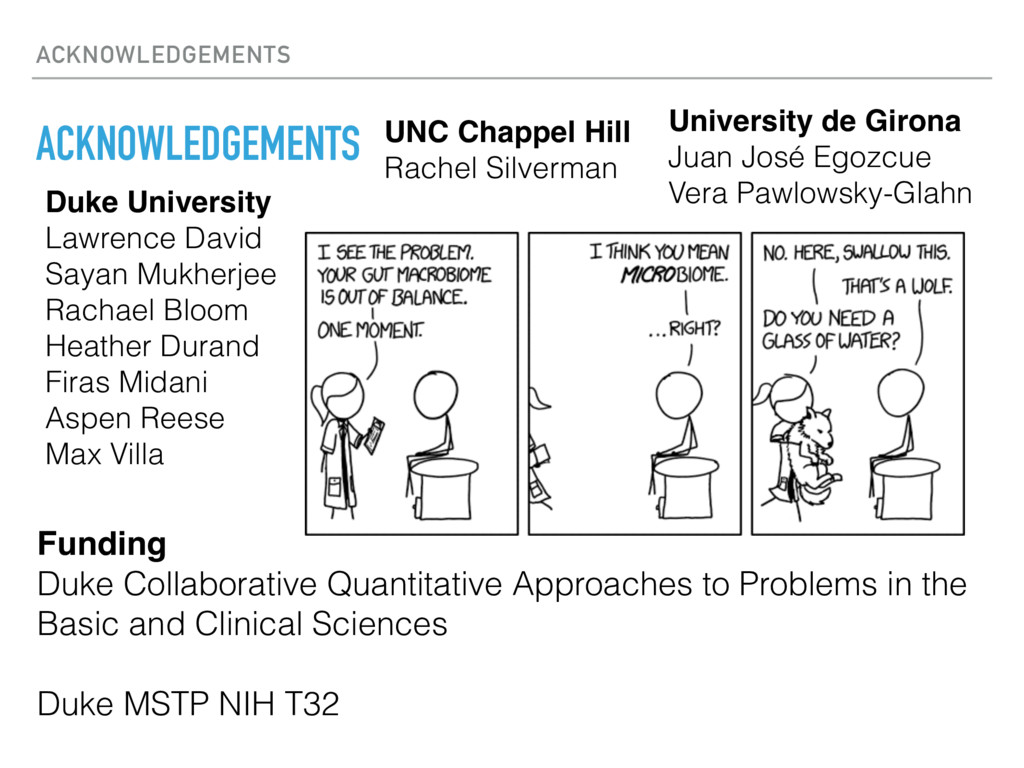
ACKNOWLEDGEMENTS ACKNOWLEDGEMENTS Duke University Lawrence David Sayan Mukherjee Rachael Bloom
Heather Durand Firas Midani Aspen Reese Max Villa University de Girona Juan José Egozcue Vera Pawlowsky-Glahn UNC Chappel Hill Rachel Silverman Funding Duke Collaborative Quantitative Approaches to Problems in the Basic and Clinical Sciences Duke MSTP NIH T32