Upgrade to Pro — share decks privately, control downloads, hide ads and more …

BinaryPig: Large-scale Malware Static Analysis ...

BinaryPig: Large-scale Malware Static Analysis Over hadoop

Avatar for Jason Trost

Jason Trost

July 31, 2013

More Decks by Jason Trost

Other Decks in Programming

Transcript

  1. Bringing  data  science  to  cyber  security,   allowing  you  to

     sense,  analyze  and  act  in   real  5me.    
  2. Agenda   •  • The Problem •  • BinaryPig Architecture

    •  • Code and Implementation Details •  • Analysis and Results •  • Demo •  • Wrap-Up •  A
  3. Malware data mining is useful •  • Threat intel feeds


    • Contextual enrichment on events
 • Machine learning models
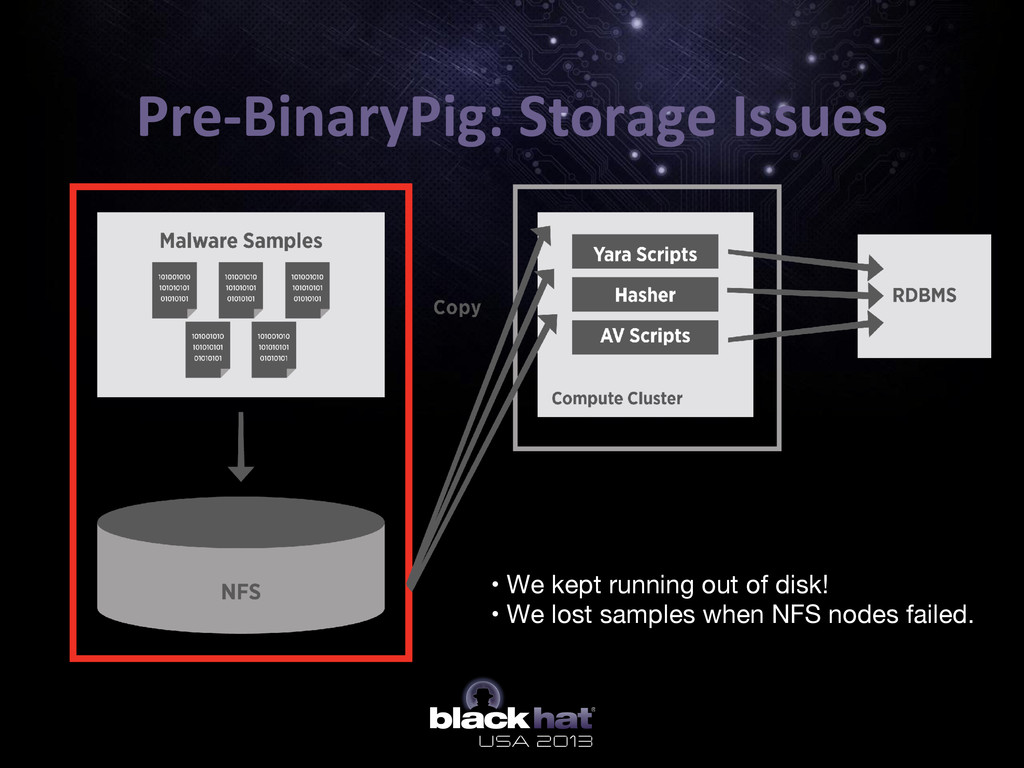
  4. Pre-­‐BinaryPig:  Storage  Issues   •  • We kept running out

    of disk! •  • We lost samples when NFS nodes failed.
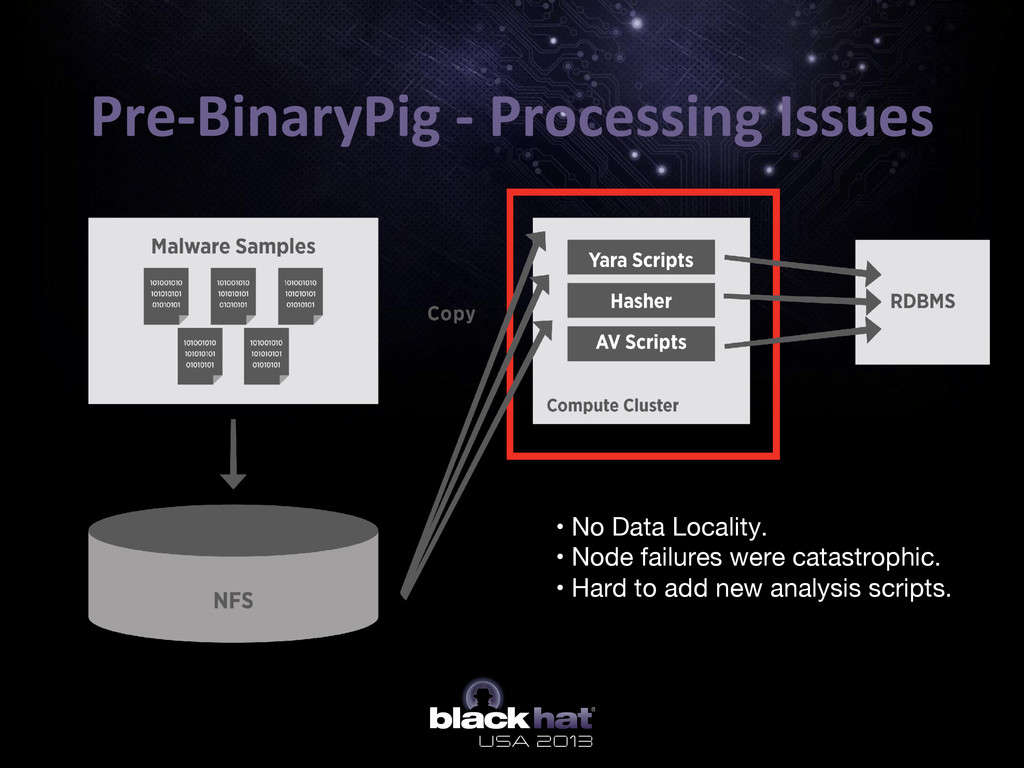
  5. Pre-­‐BinaryPig  -­‐  Processing  Issues   •  • No Data Locality.

    •  • Node failures were catastrophic. •  • Hard to add new analysis scripts.
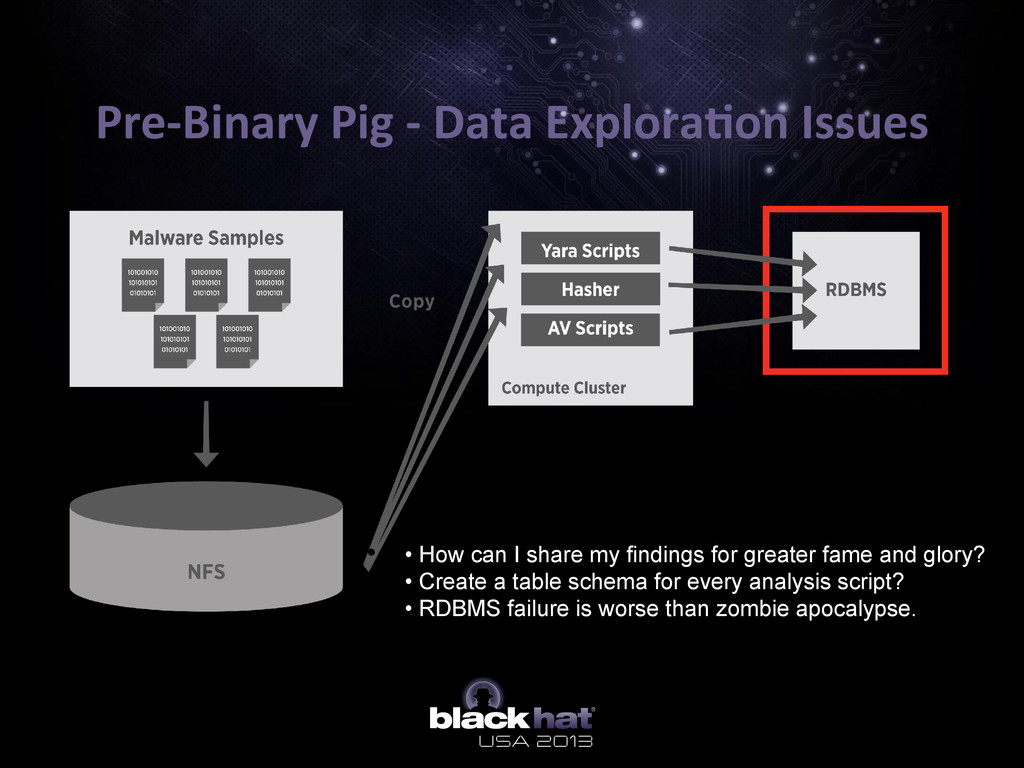
  6. Pre-­‐Binary  Pig  -­‐  Data  Explora=on  Issues   •  • How

    can I share my findings for greater fame and glory? •  • Create a table schema for every analysis script? •  • RDBMS failure is worse than zombie apocalypse.
  7. We  needed  a  system  that...   •  • Scales to

    our historical data •  • Recovers from failures •  • Grows through scripting •  • Supports dynamic schemas •  • Searchable via the web

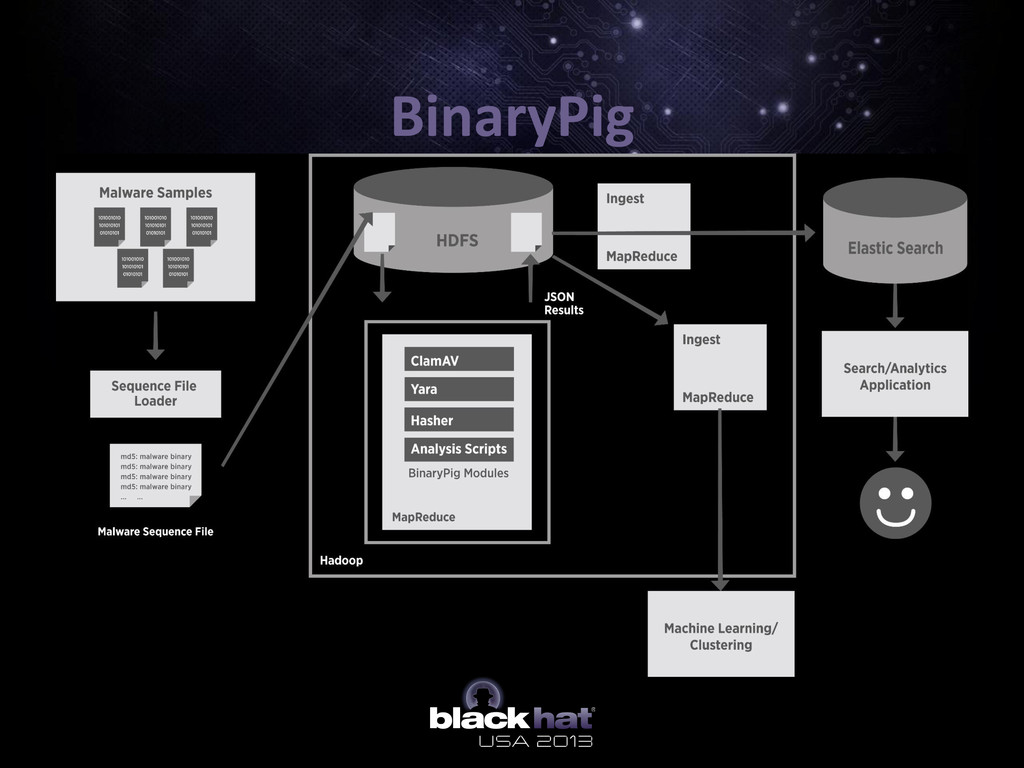
  8. BinaryPig   •  • Simple DSL •  • Pluggable analytics

    •  • Plays nice with existing tools •  • Enables rapid iteration
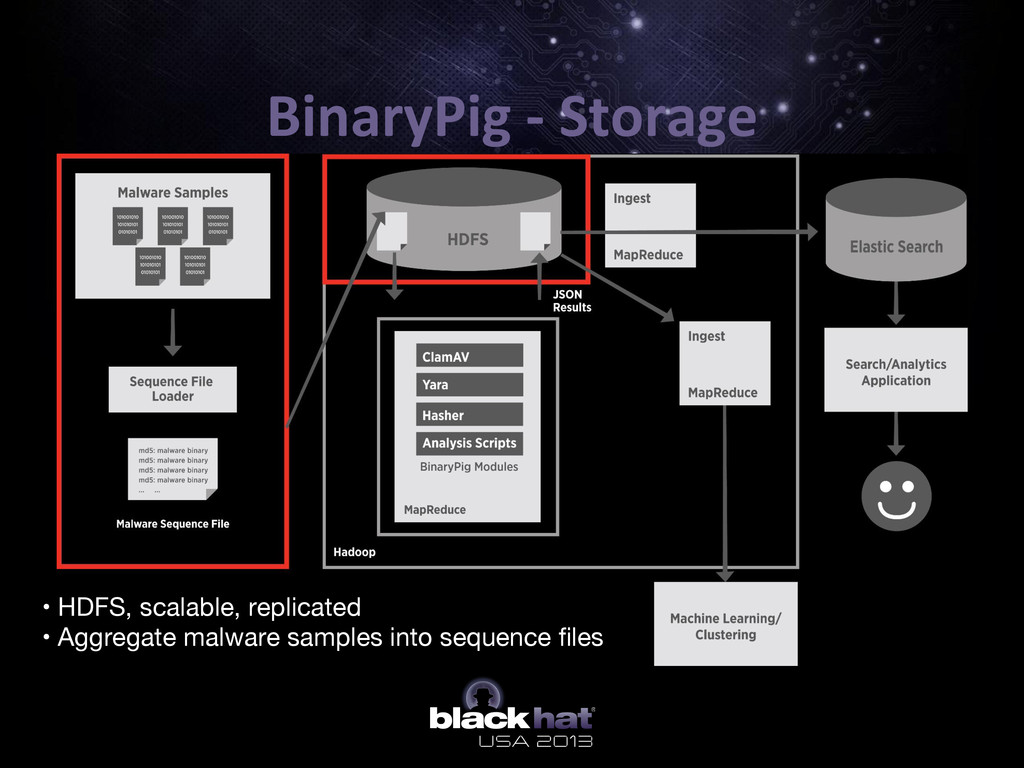
  9. BinaryPig  -­‐  Storage   •  • HDFS, scalable, replicated • 

    • Aggregate malware samples into sequence files
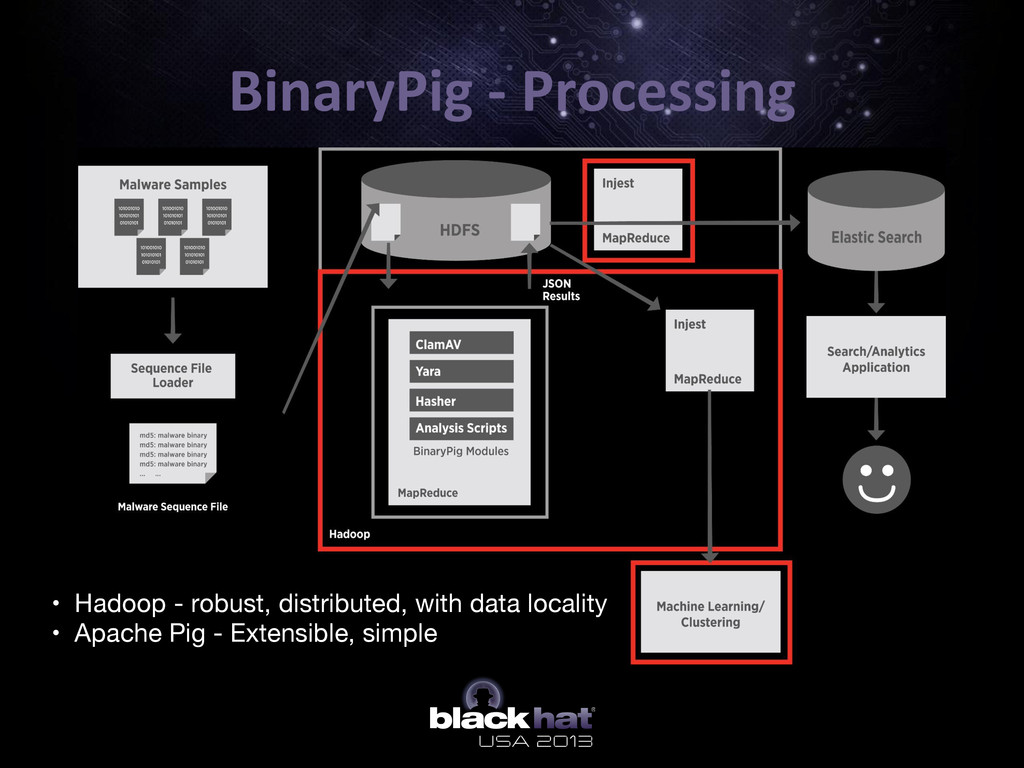
  10. BinaryPig  -­‐  Processing   •  • Hadoop - robust, distributed,

    with data locality •  • Apache Pig - Extensible, simple

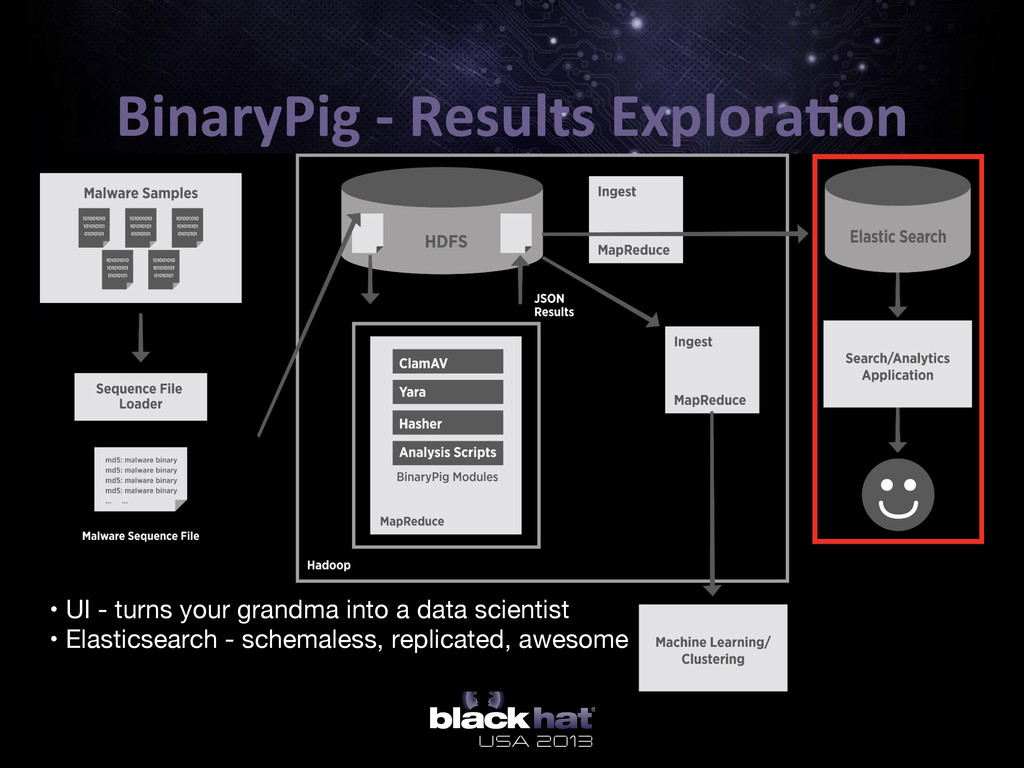
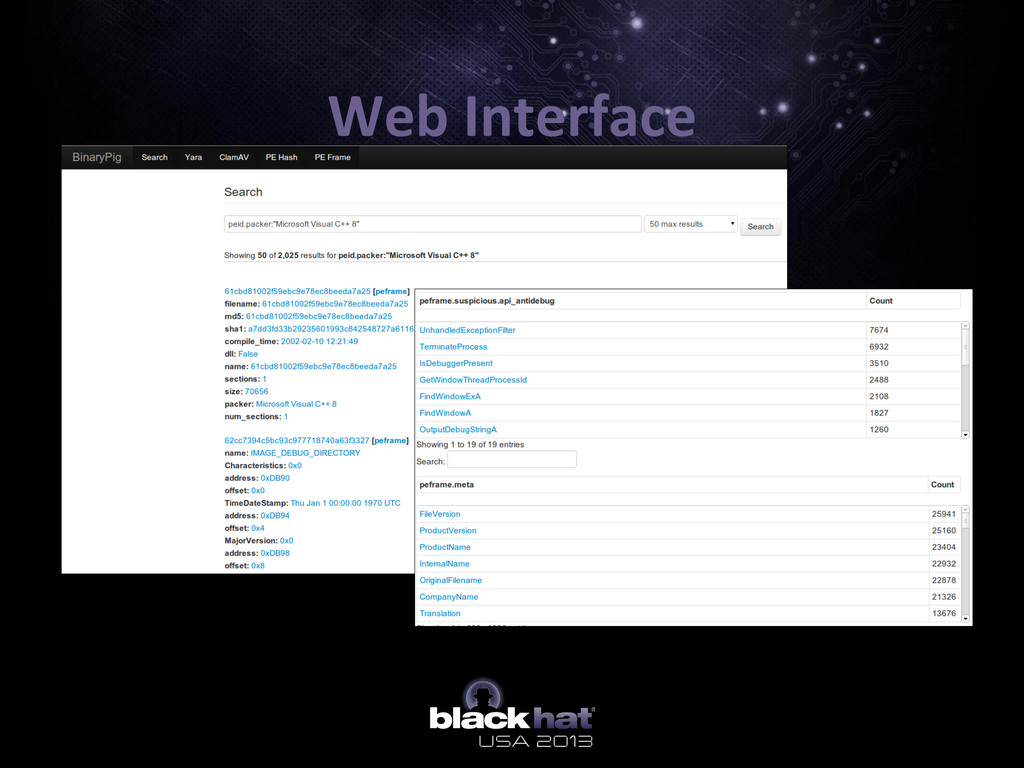
  11. BinaryPig  -­‐  Results  Explora=on   •  • UI - turns

    your grandma into a data scientist •  • Elasticsearch - schemaless, replicated, awesome
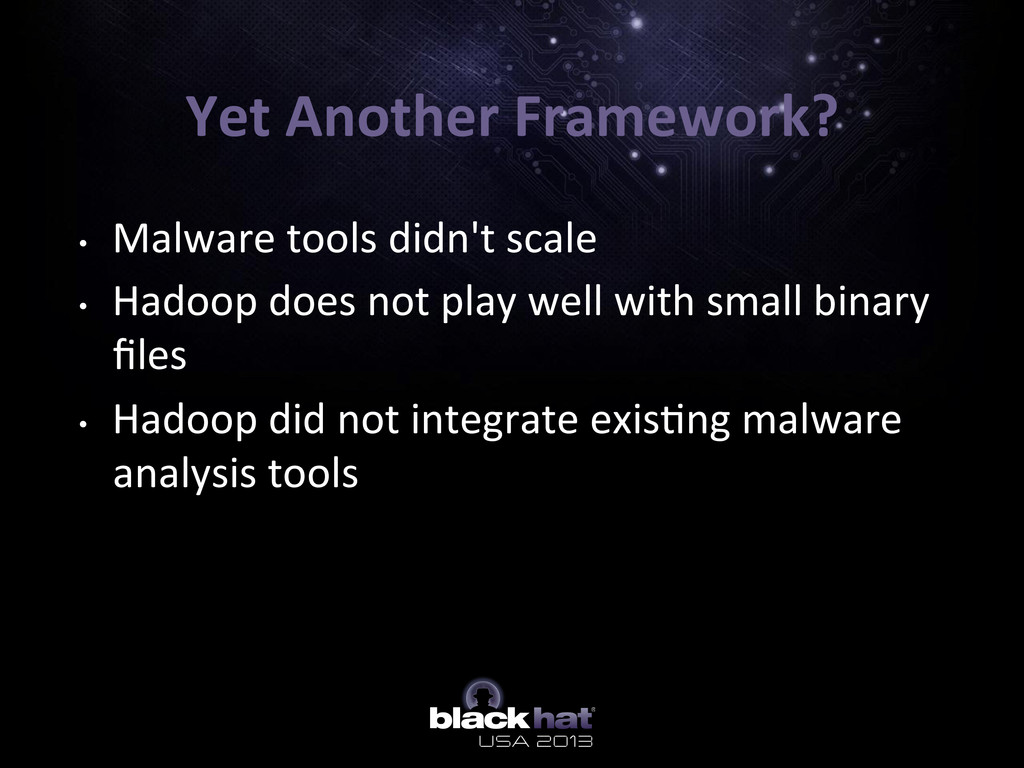
  12. Yet  Another  Framework?   •  Malware  tools  didn't  scale  

    •  Hadoop  does  not  play  well  with  small  binary   files   •  Hadoop  did  not  integrate  exis5ng  malware   analysis  tools    
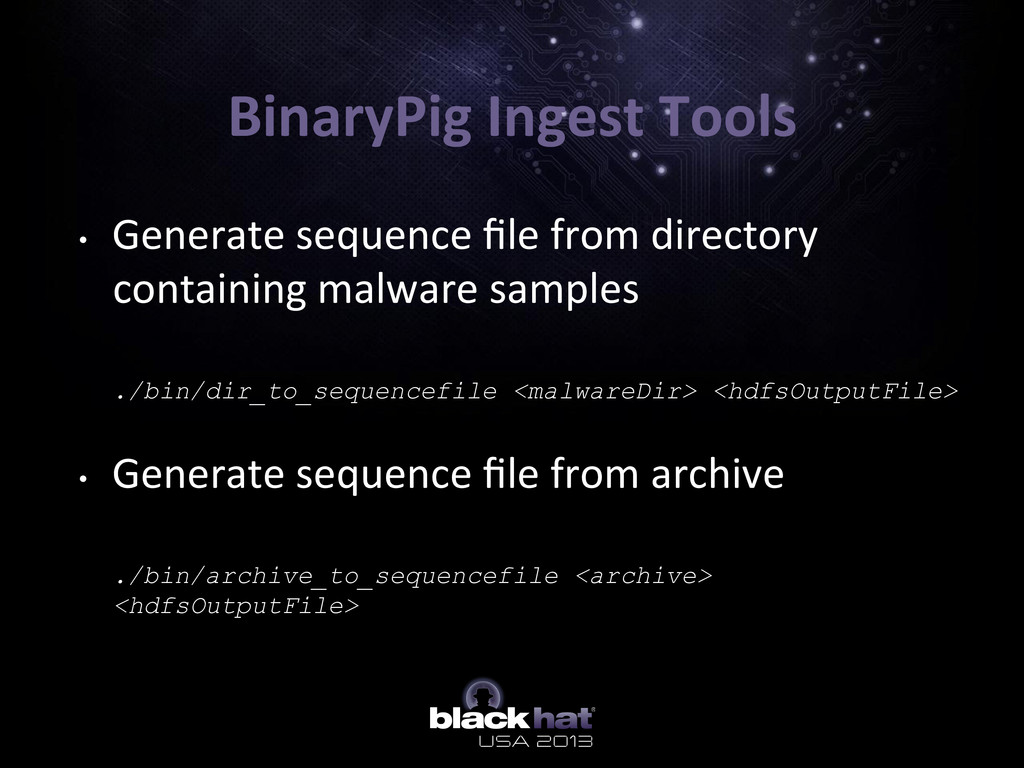
  13. BinaryPig  Ingest  Tools   •  Generate  sequence  file  from  directory

      containing  malware  samples     ./bin/dir_to_sequencefile <malwareDir> <hdfsOutputFile> •  Generate  sequence  file  from  archive     ./bin/archive_to_sequencefile <archive> <hdfsOutputFile>
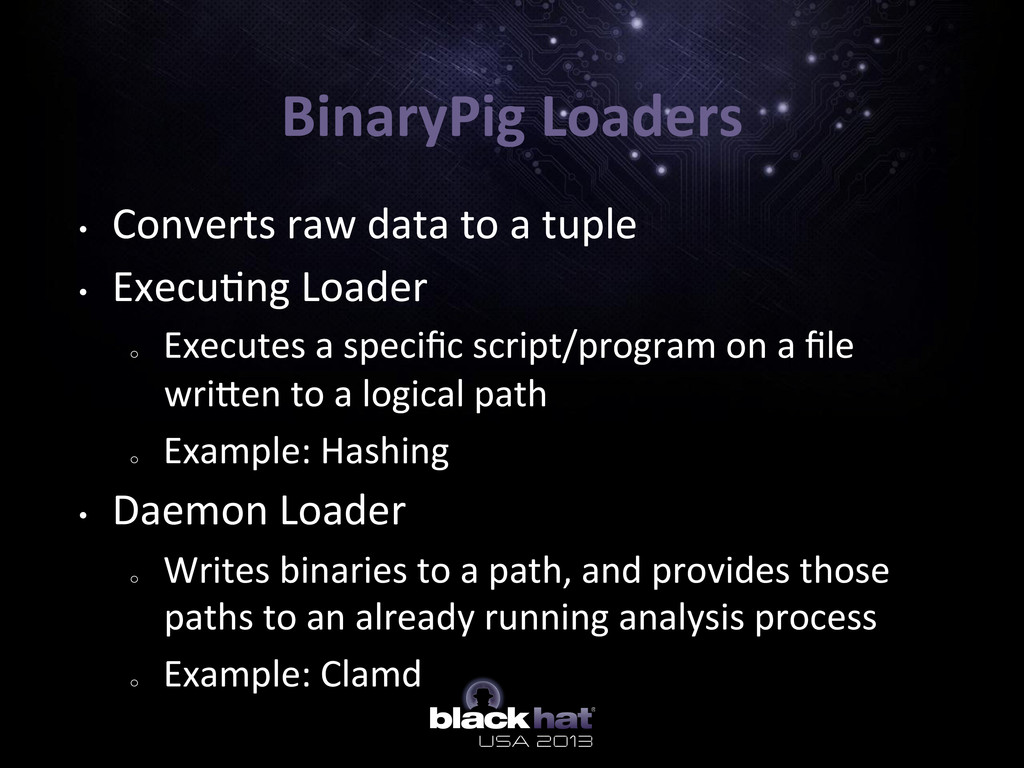
  14. BinaryPig  Loaders   •  Converts  raw  data  to  a  tuple

      •  Execu5ng  Loader   o  Executes  a  specific  script/program  on  a  file   wriIen  to  a  logical  path   o  Example:  Hashing   •  Daemon  Loader   o  Writes  binaries  to  a  path,  and  provides  those   paths  to  an  already  running  analysis  process   o  Example:  Clamd    
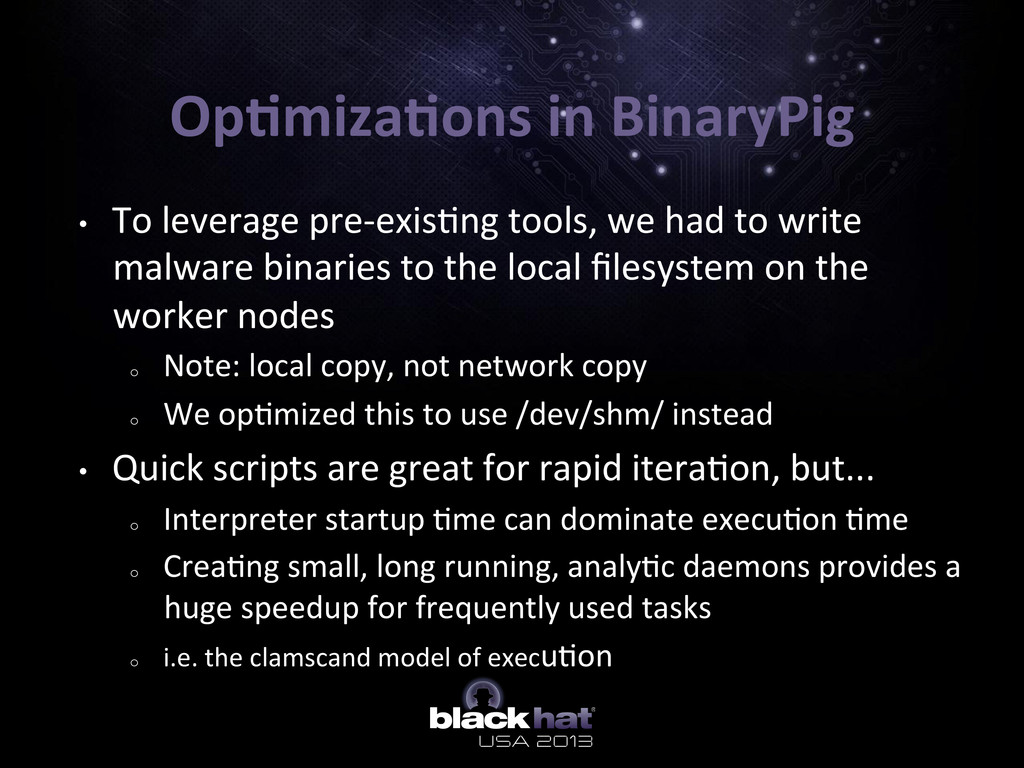
  15. Op=miza=ons  in  BinaryPig   •  To  leverage  pre-­‐exis5ng  tools,  we

     had  to  write   malware  binaries  to  the  local  filesystem  on  the   worker  nodes   o  Note:  local  copy,  not  network  copy   o  We  op5mized  this  to  use  /dev/shm/  instead   •  Quick  scripts  are  great  for  rapid  itera5on,  but...   o  Interpreter  startup  5me  can  dominate  execu5on  5me   o  Crea5ng  small,  long  running,  analy5c  daemons  provides  a   huge  speedup  for  frequently  used  tasks   o  i.e.  the  clamscand  model  of  execu5on    
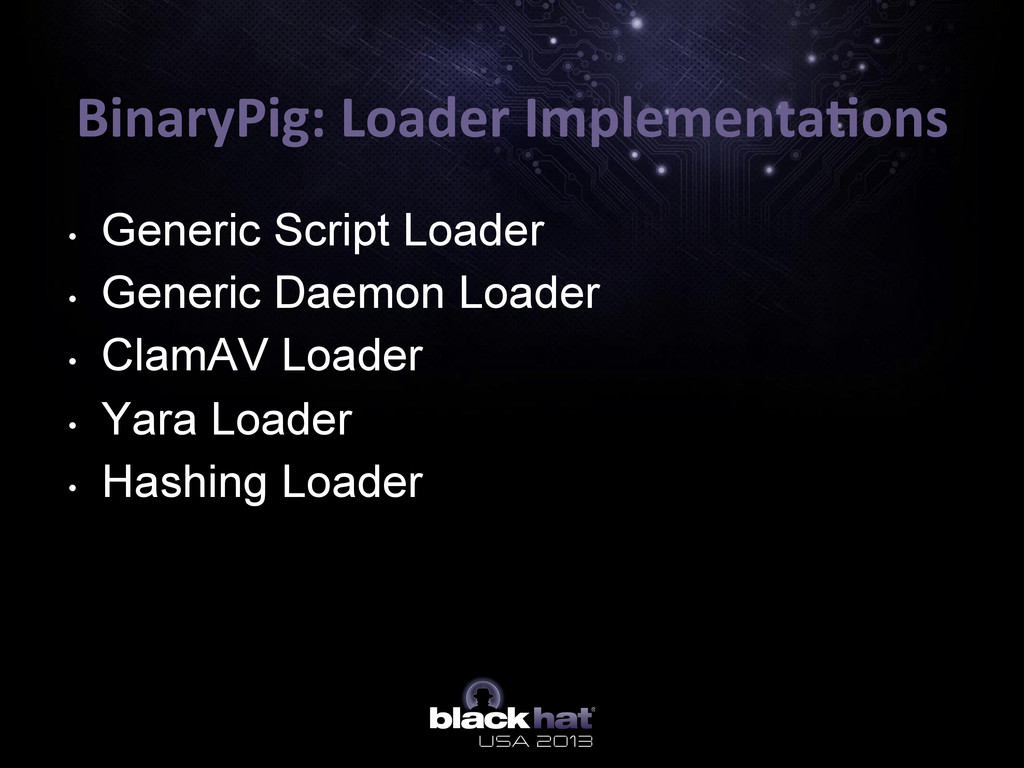
  16. BinaryPig:  Loader  Implementa=ons   •  Generic Script Loader •  Generic

    Daemon Loader •  ClamAV Loader •  Yara Loader •  Hashing Loader
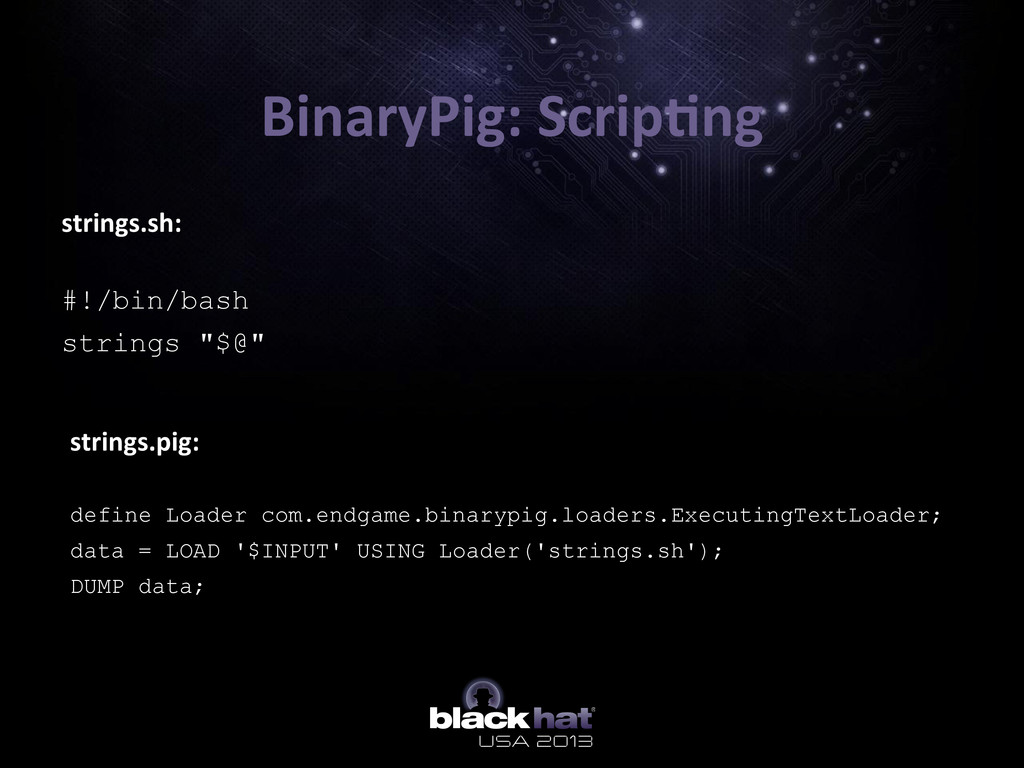
  17. strings.sh:     #!/bin/bash strings "$@" BinaryPig:  Scrip=ng   strings.pig:

        define Loader com.endgame.binarypig.loaders.ExecutingTextLoader; data = LOAD '$INPUT' USING Loader('strings.sh'); DUMP data;
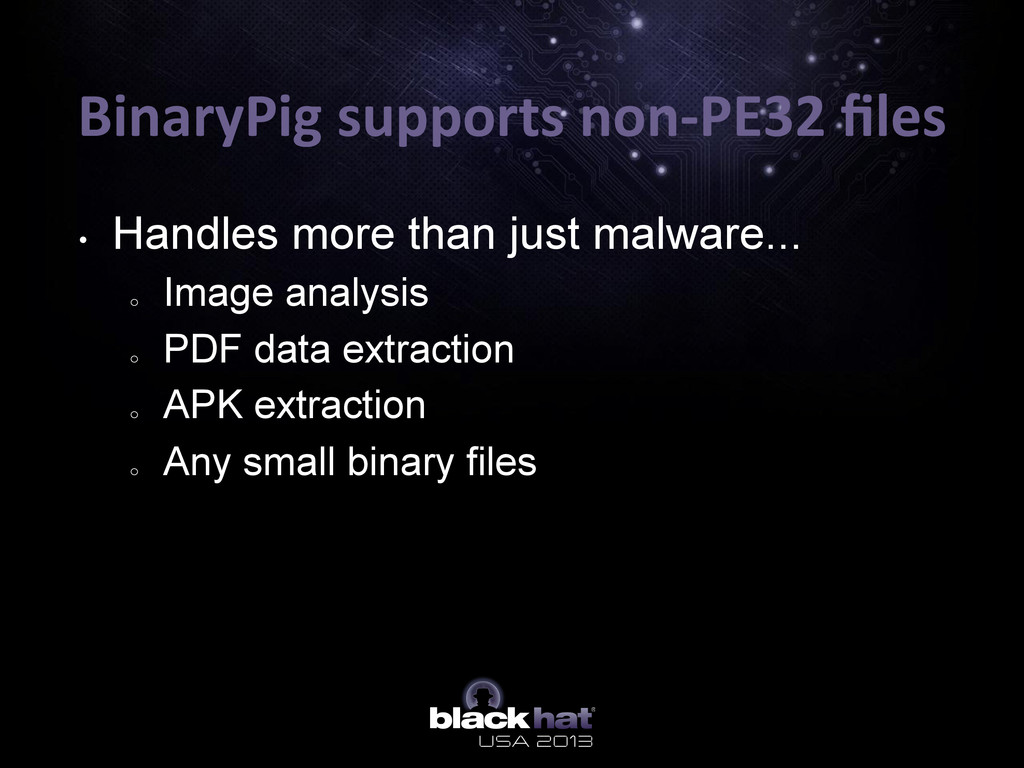
  18. BinaryPig  supports  non-­‐PE32  files   •  Handles more than just

    malware... o  Image analysis o  PDF data extraction o  APK extraction o  Any small binary files
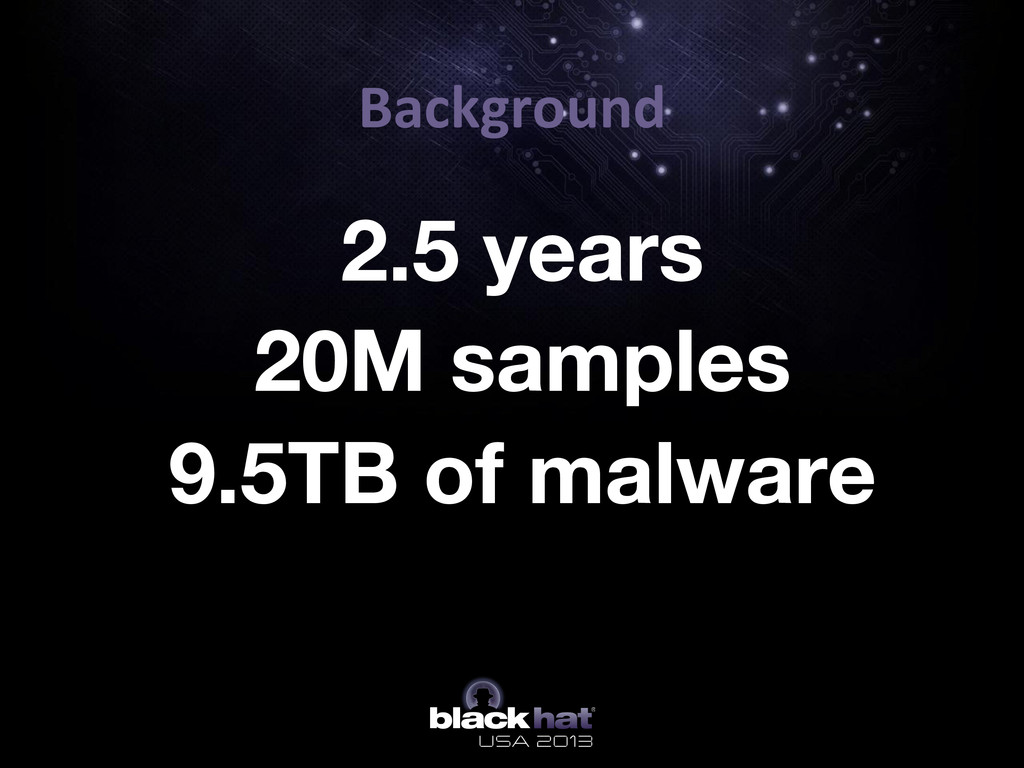
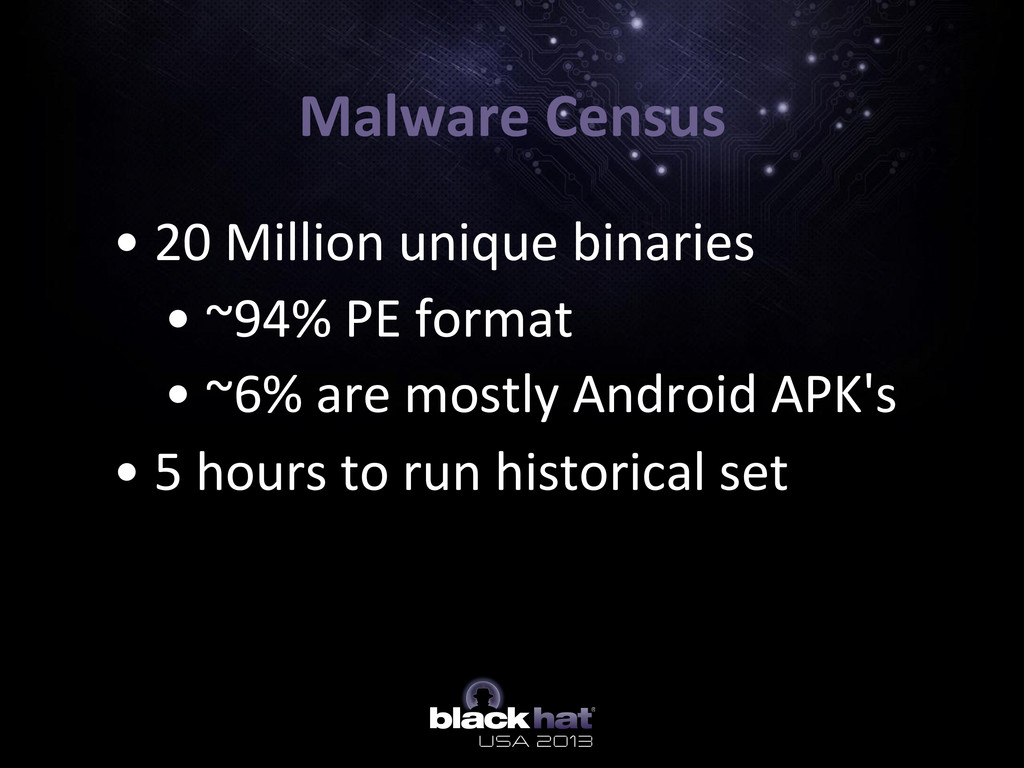
  19. Malware  Census   •  •  20  Million  unique  binaries  

    o  •  ~94%  PE  format   o  •  ~6%  are  mostly  Android  APK's   •  •  5  hours  to  run  historical  set  
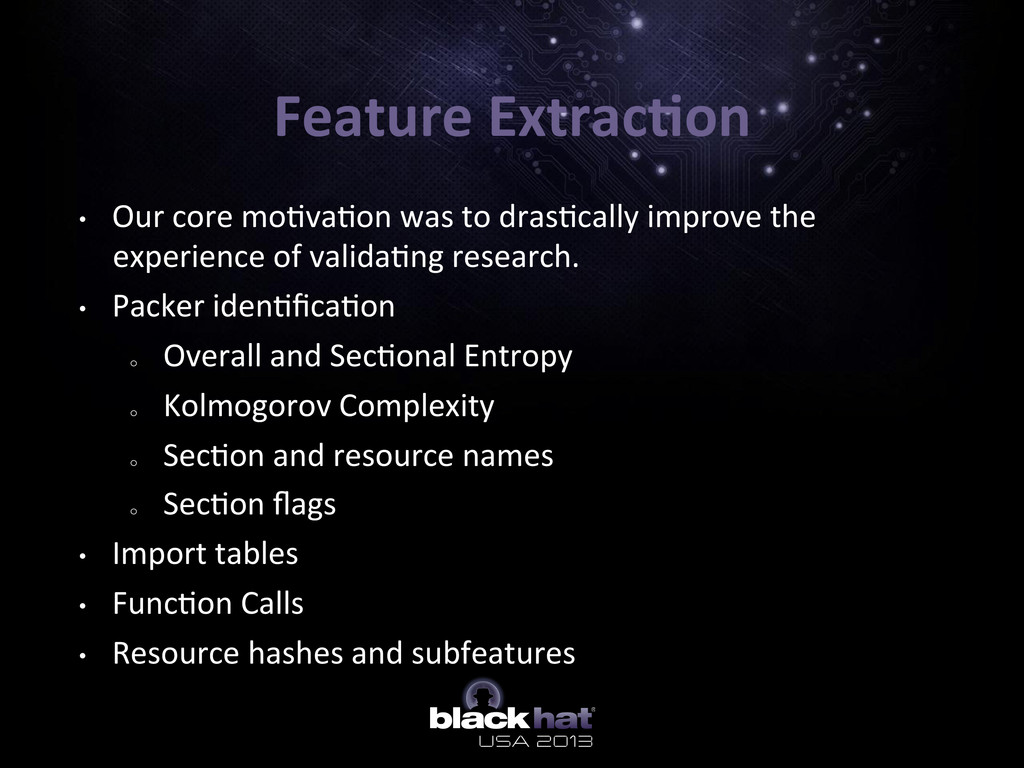
  20. Feature  Extrac=on   •  Our  core  mo5va5on  was  to  dras5cally

     improve  the   experience  of  valida5ng  research.   •  Packer  iden5fica5on   o  Overall  and  Sec5onal  Entropy   o  Kolmogorov  Complexity   o  Sec5on  and  resource  names   o  Sec5on  flags   •  Import  tables   •  Func5on  Calls   •  Resource  hashes  and  subfeatures  
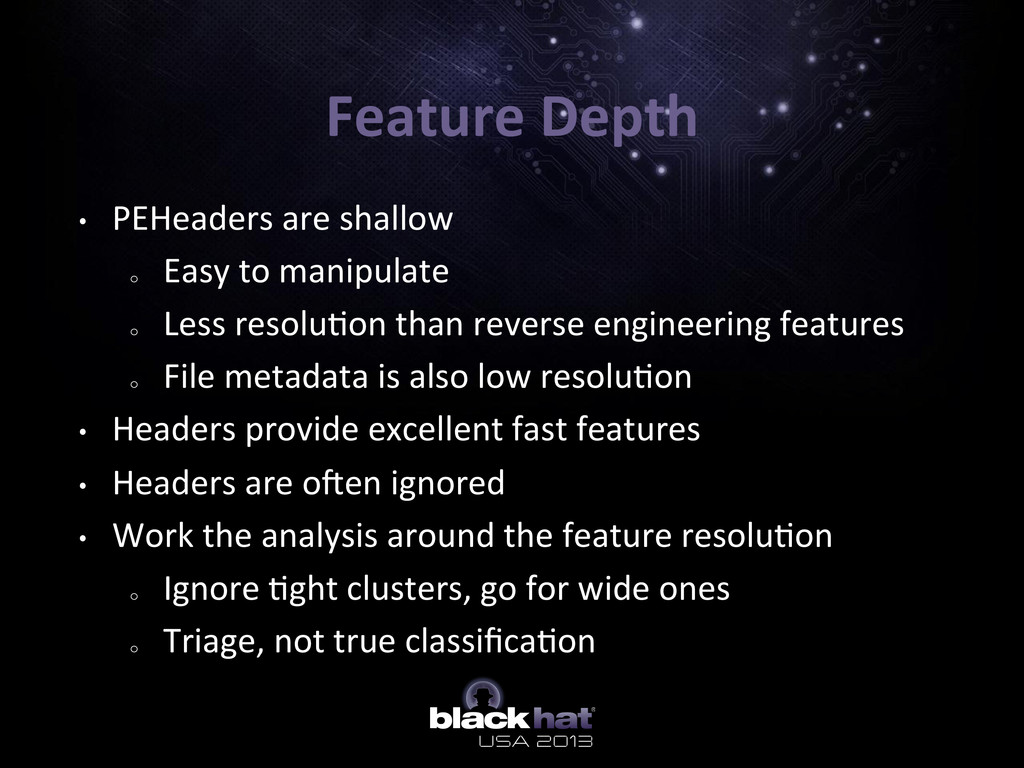
  21. Feature  Depth   •  PEHeaders  are  shallow   o  Easy

     to  manipulate   o  Less  resolu5on  than  reverse  engineering  features   o  File  metadata  is  also  low  resolu5on   •  Headers  provide  excellent  fast  features   •  Headers  are  oben  ignored   •  Work  the  analysis  around  the  feature  resolu5on   o  Ignore  5ght  clusters,  go  for  wide  ones   o  Triage,  not  true  classifica5on  
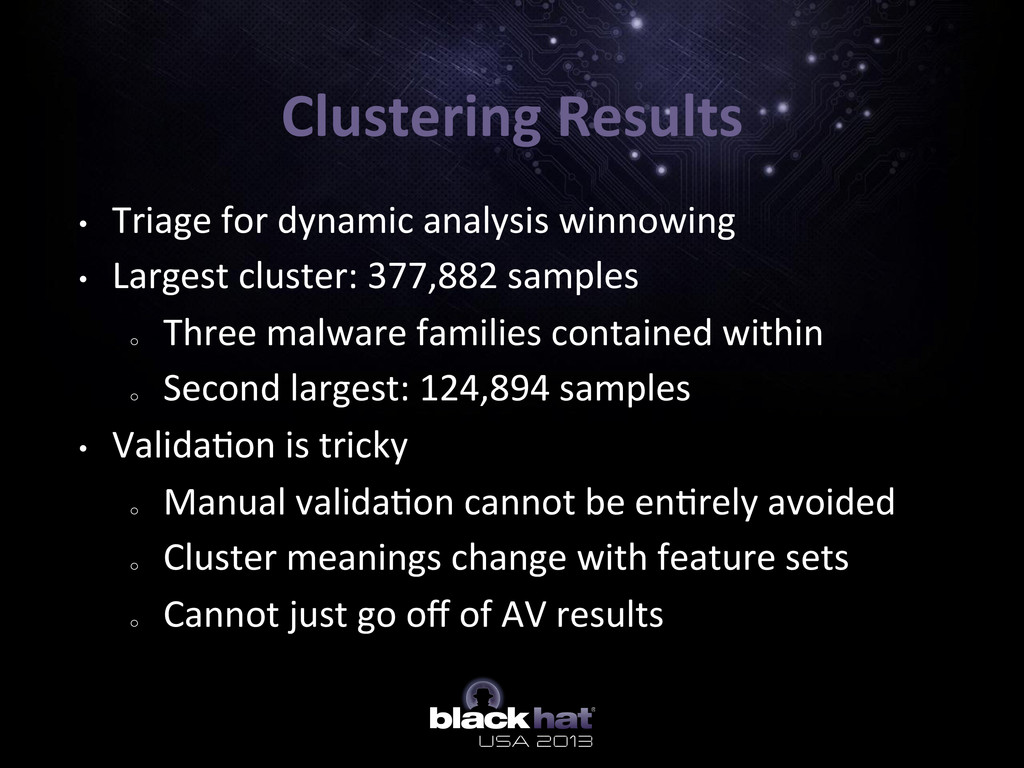
  22. Clustering  Results   •  Triage  for  dynamic  analysis  winnowing  

    •  Largest  cluster:  377,882  samples   o  Three  malware  families  contained  within     o  Second  largest:  124,894  samples   •  Valida5on  is  tricky   o  Manual  valida5on  cannot  be  en5rely  avoided   o  Cluster  meanings  change  with  feature  sets   o  Cannot  just  go  off  of  AV  results  
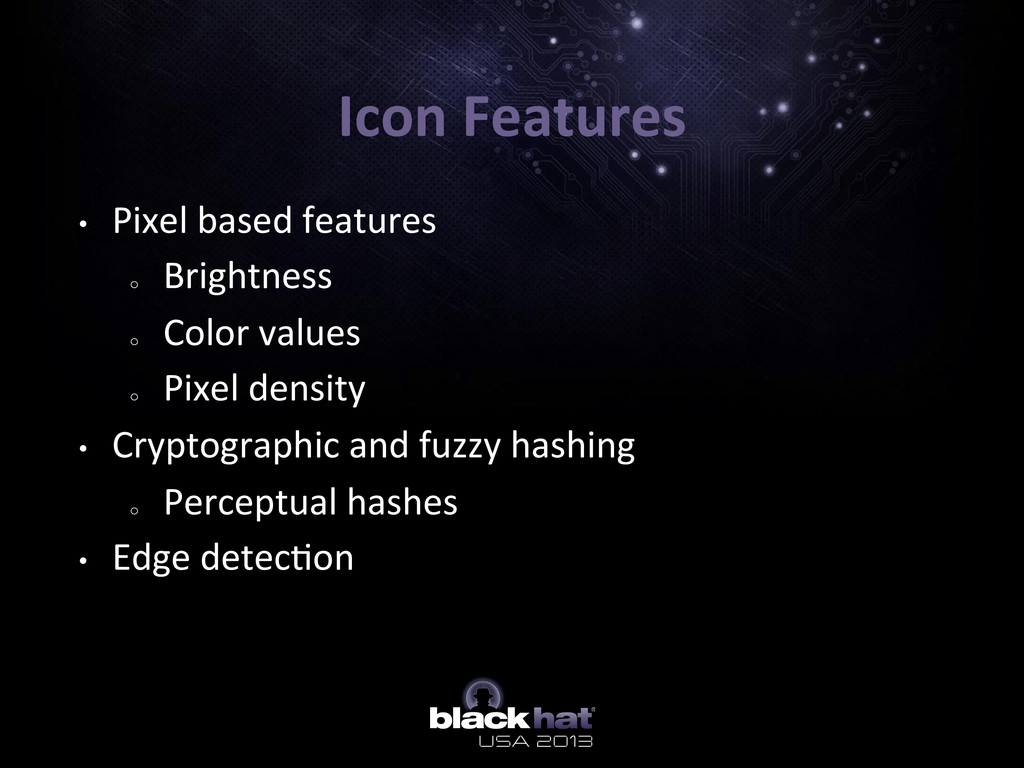
  23. Icon  Features   •  Pixel  based  features   o  Brightness

        o  Color  values   o  Pixel  density   •  Cryptographic  and  fuzzy  hashing   o  Perceptual  hashes   •  Edge  detec5on  
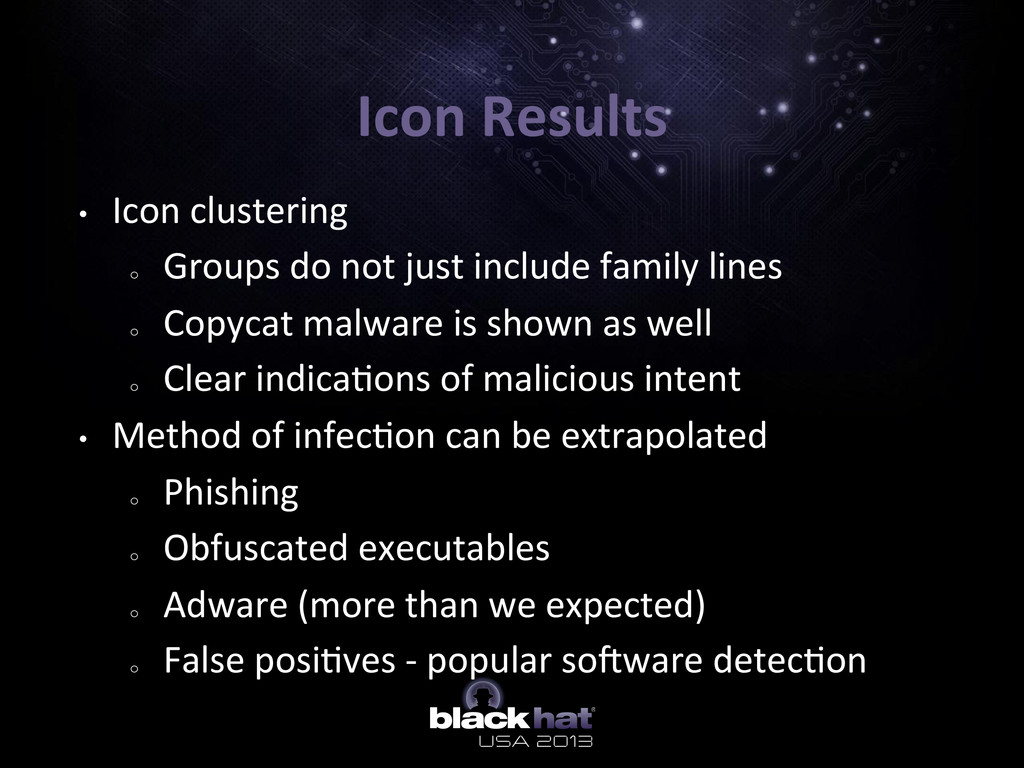
  24. Icon  Results   •  Icon  clustering     o  Groups

     do  not  just  include  family  lines   o  Copycat  malware  is  shown  as  well   o  Clear  indica5ons  of  malicious  intent   •  Method  of  infec5on  can  be  extrapolated   o  Phishing   o  Obfuscated  executables   o  Adware  (more  than  we  expected)   o  False  posi5ves  -­‐  popular  sobware  detec5on  
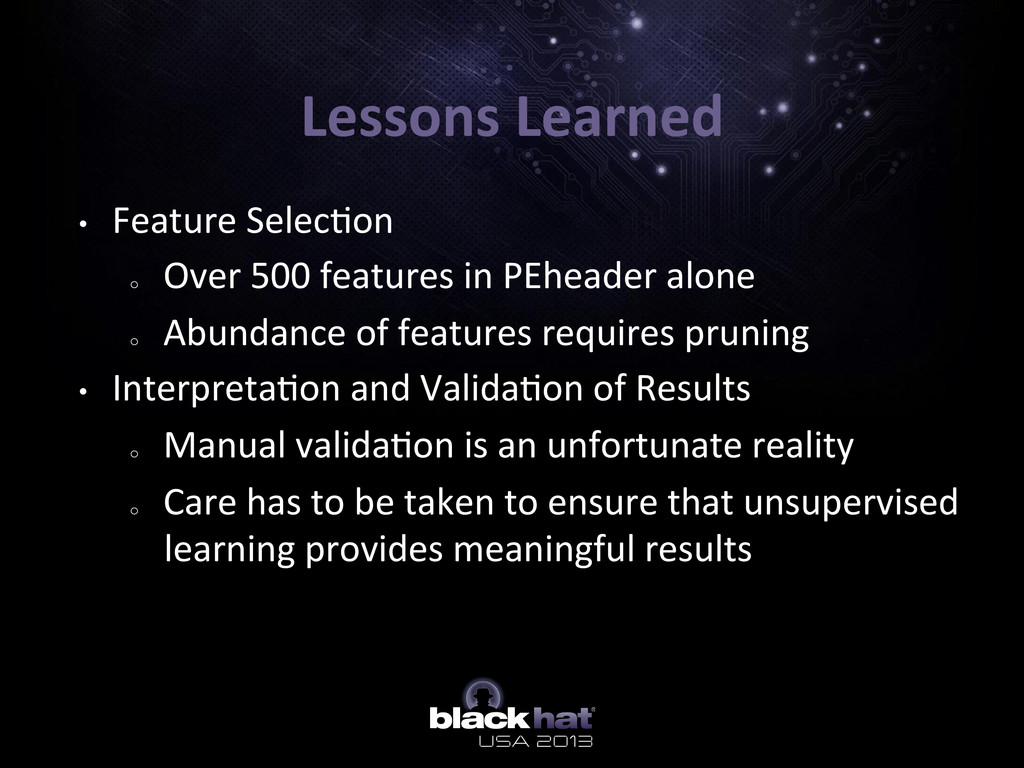
  25. Lessons  Learned   •  Feature  Selec5on   o  Over  500

     features  in  PEheader  alone   o  Abundance  of  features  requires  pruning   •  Interpreta5on  and  Valida5on  of  Results   o  Manual  valida5on  is  an  unfortunate  reality   o  Care  has  to  be  taken  to  ensure  that  unsupervised   learning  provides  meaningful  results  
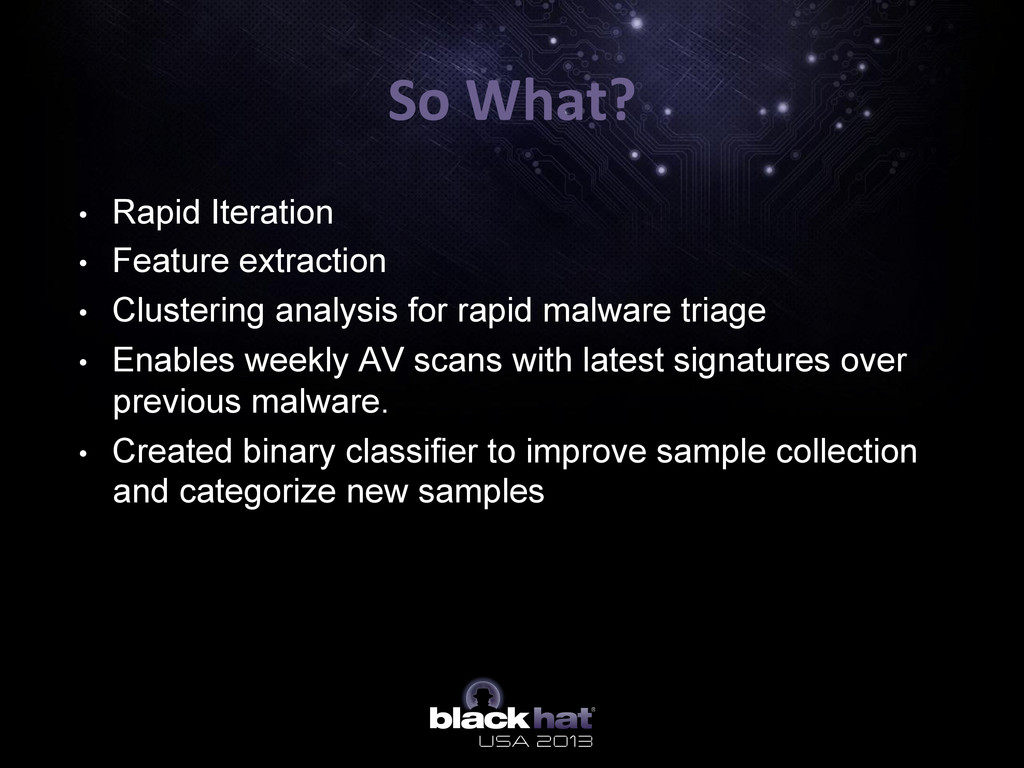
  26. •  Rapid Iteration •  Feature extraction •  Clustering analysis for

    rapid malware triage •  Enables weekly AV scans with latest signatures over previous malware. •  Created binary classifier to improve sample collection and categorize new samples So  What?  
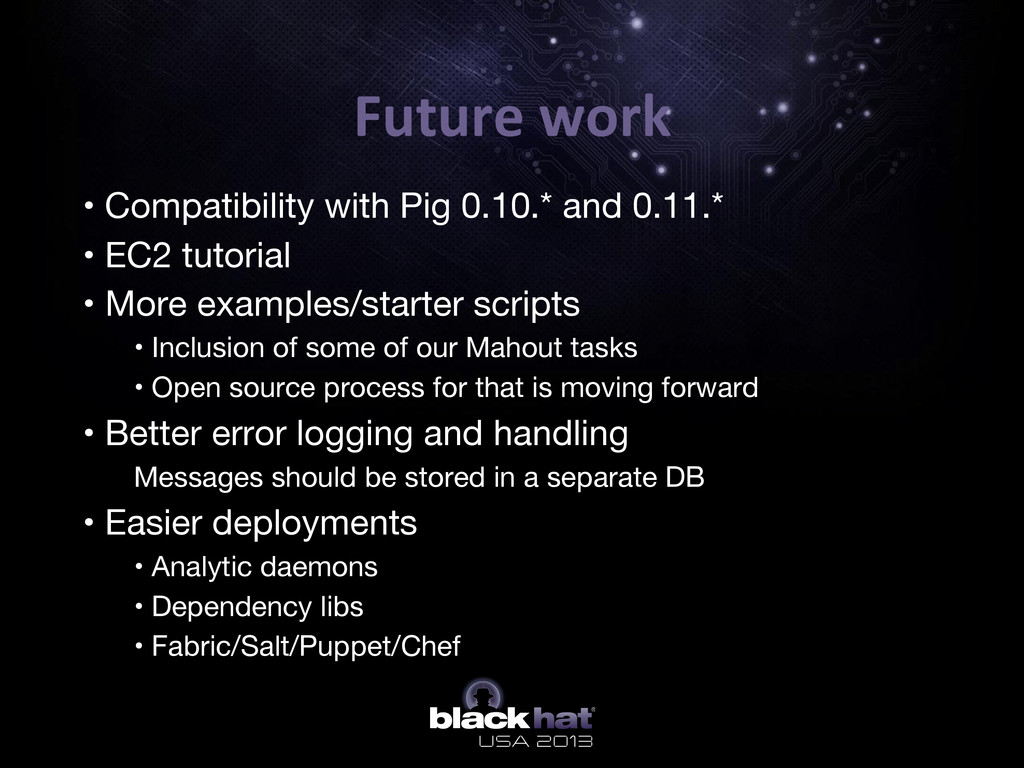
  27. Future  work   •  • Compatibility with Pig 0.10.* and

    0.11.* •  • EC2 tutorial •  • More examples/starter scripts o  • Inclusion of some of our Mahout tasks o  • Open source process for that is moving forward •  • Better error logging and handling o  Messages should be stored in a separate DB •  • Easier deployments o  • Analytic daemons o  • Dependency libs o  • Fabric/Salt/Puppet/Chef