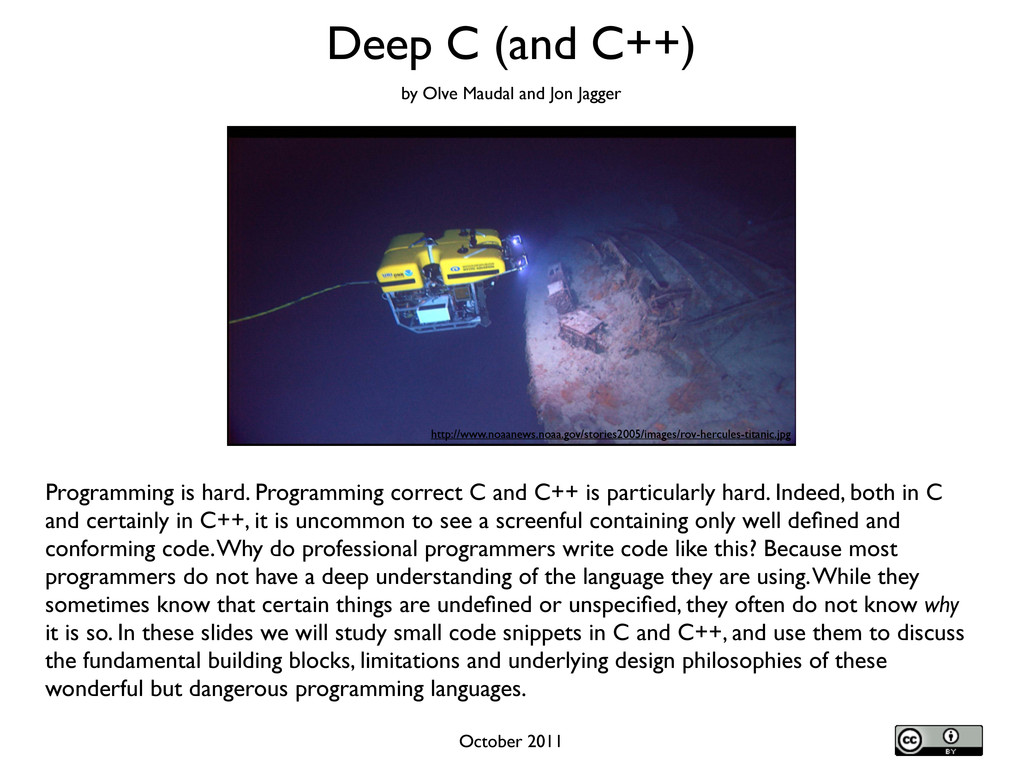
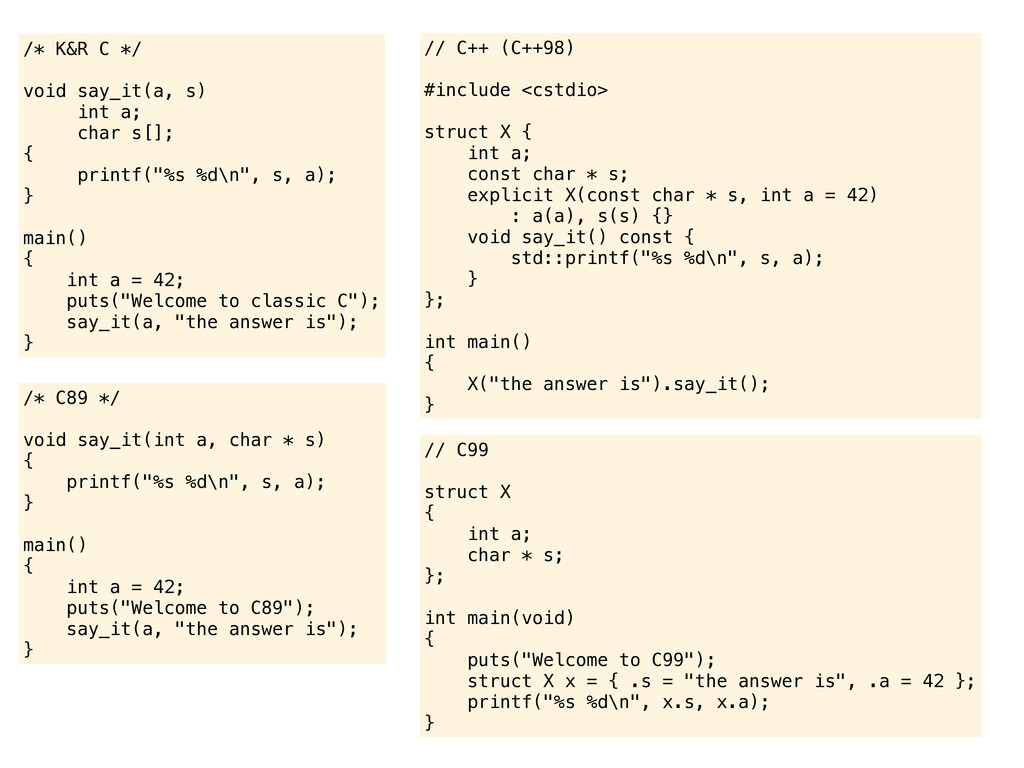
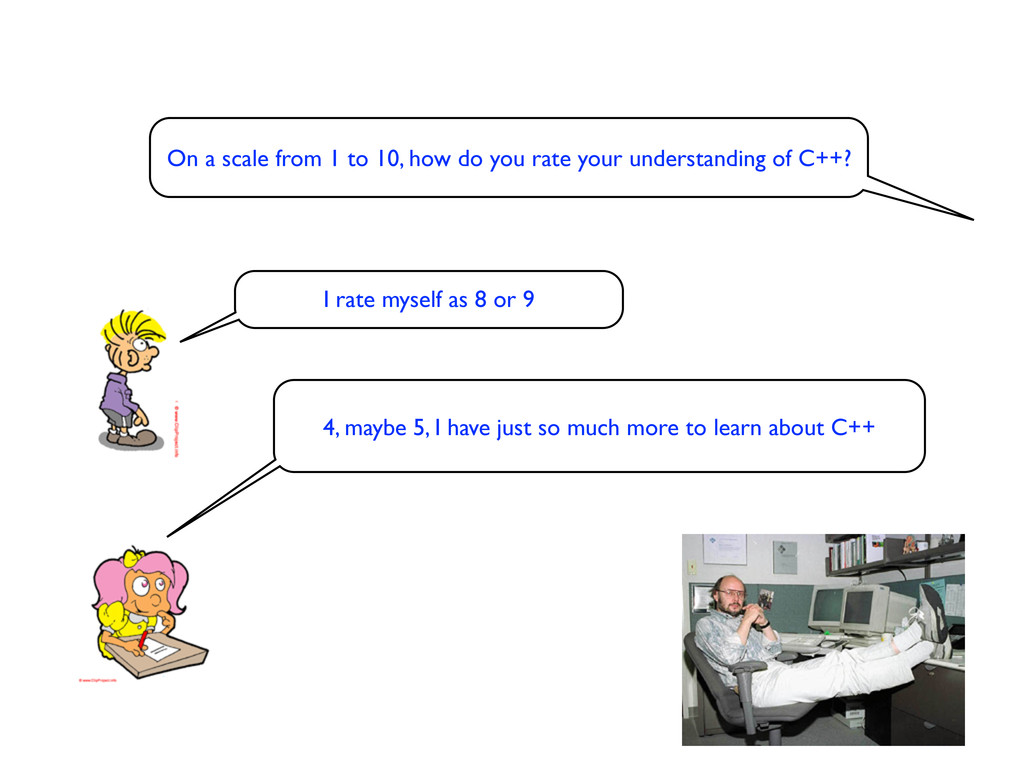
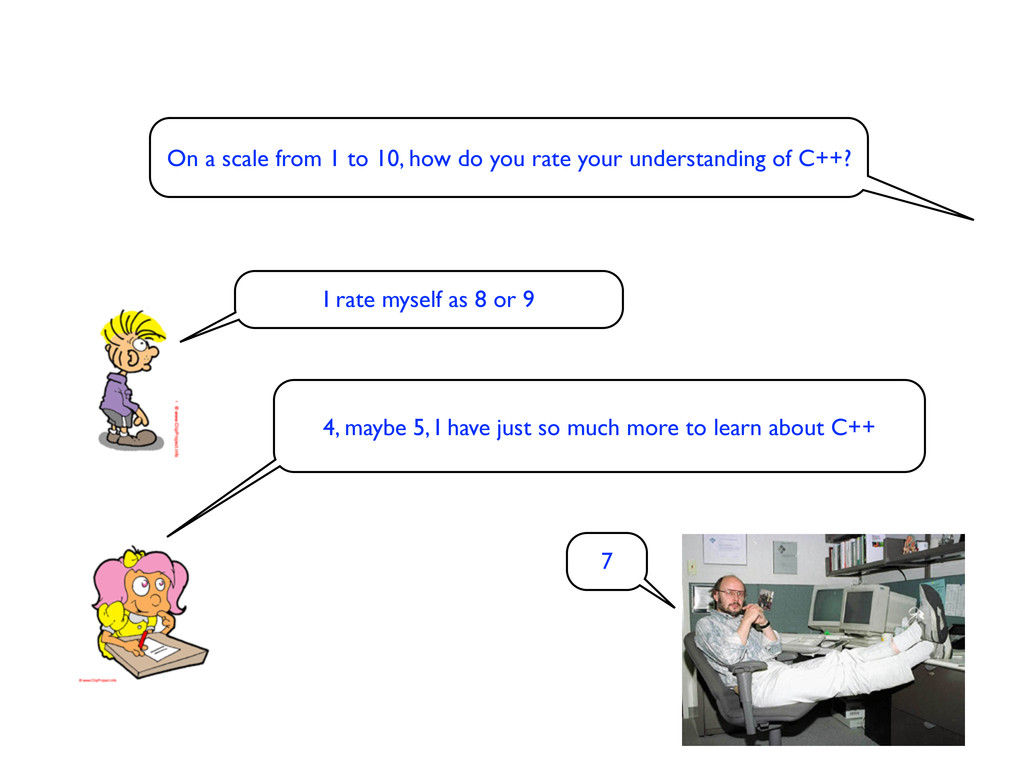
hard. Indeed, both in C and certainly in C++, it is uncommon to see a screenful containing only well defined and conforming code. Why do professional programmers write code like this? Because most programmers do not have a deep understanding of the language they are using. While they sometimes know that certain things are undefined or unspecified, they often do not know why it is so. In these slides we will study small code snippets in C and C++, and use them to discuss the fundamental building blocks, limitations and underlying design philosophies of these wonderful but dangerous programming languages. Deep C (and C++) http://www.noaanews.noaa.gov/stories2005/images/rov-hercules-titanic.jpg by Olve Maudal and Jon Jagger October 2011
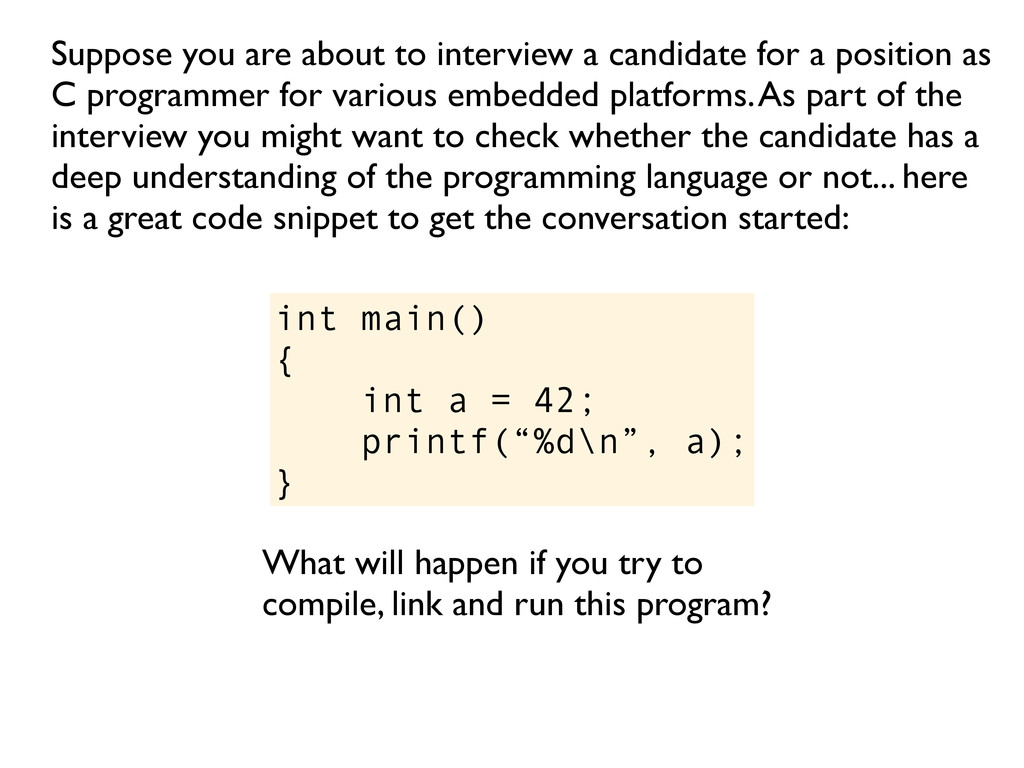
position as C programmer for various embedded platforms. As part of the interview you might want to check whether the candidate has a deep understanding of the programming language or not... here is a great code snippet to get the conversation started:
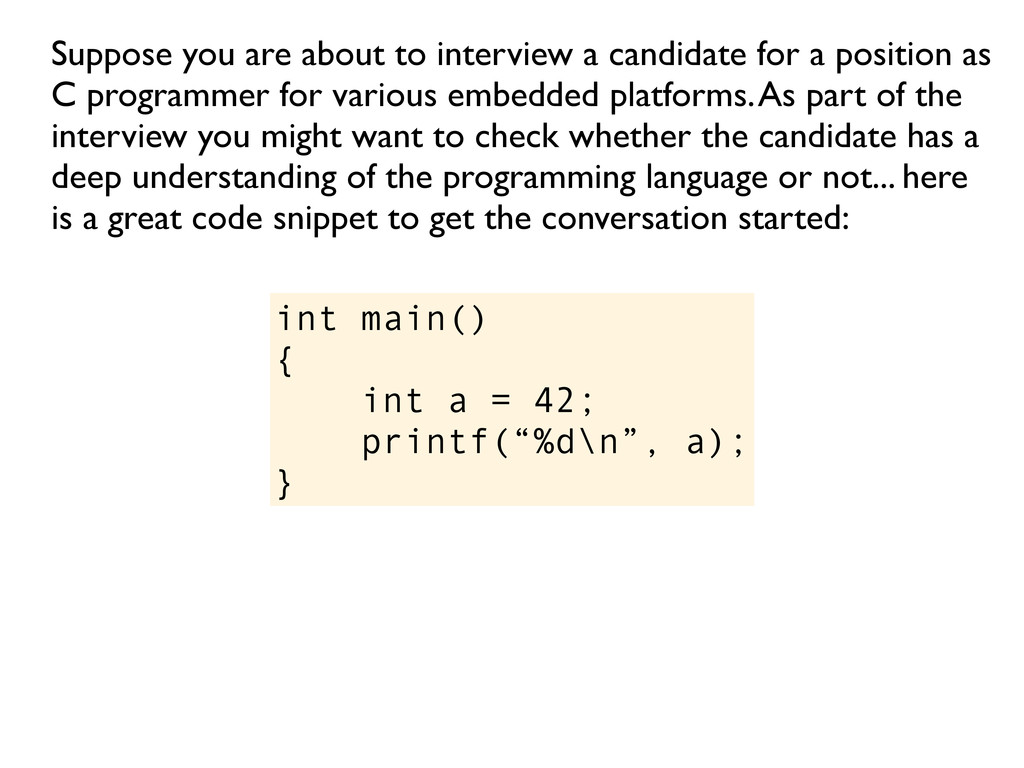
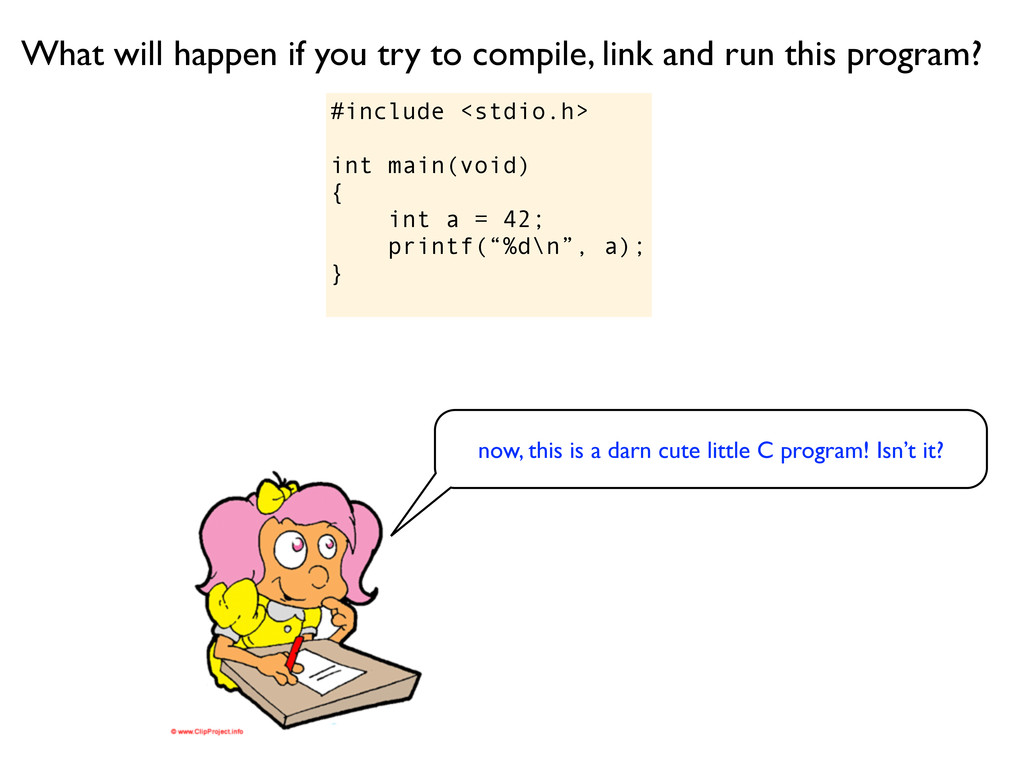
Suppose you are about to interview a candidate for a position as C programmer for various embedded platforms. As part of the interview you might want to check whether the candidate has a deep understanding of the programming language or not... here is a great code snippet to get the conversation started:
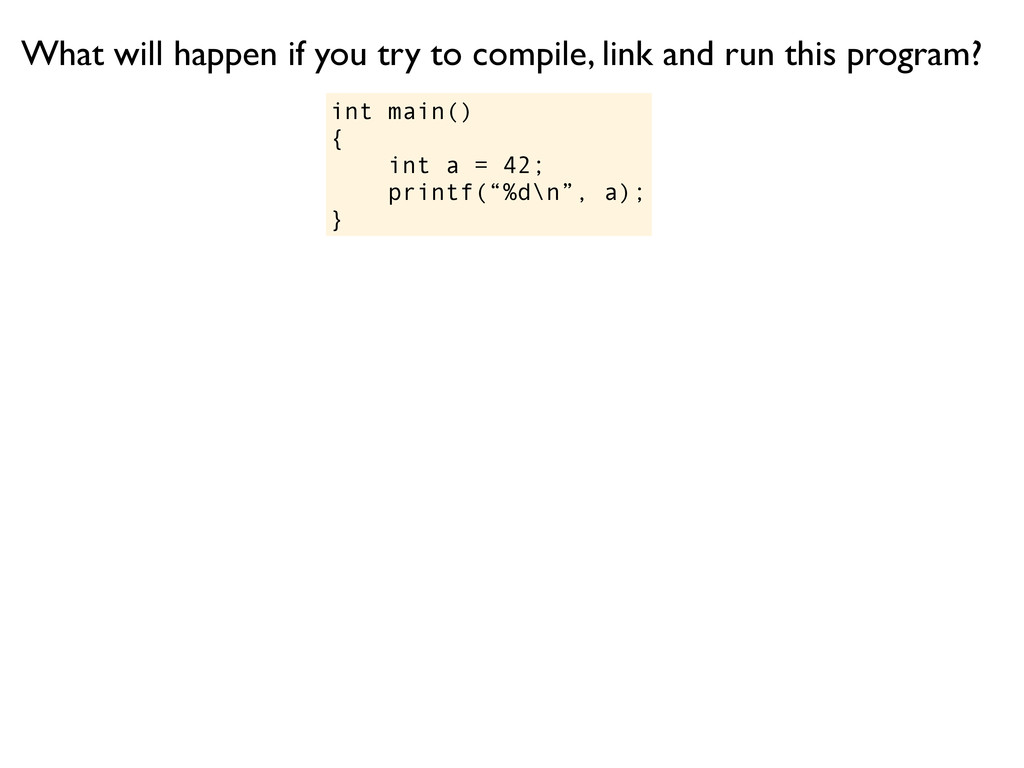
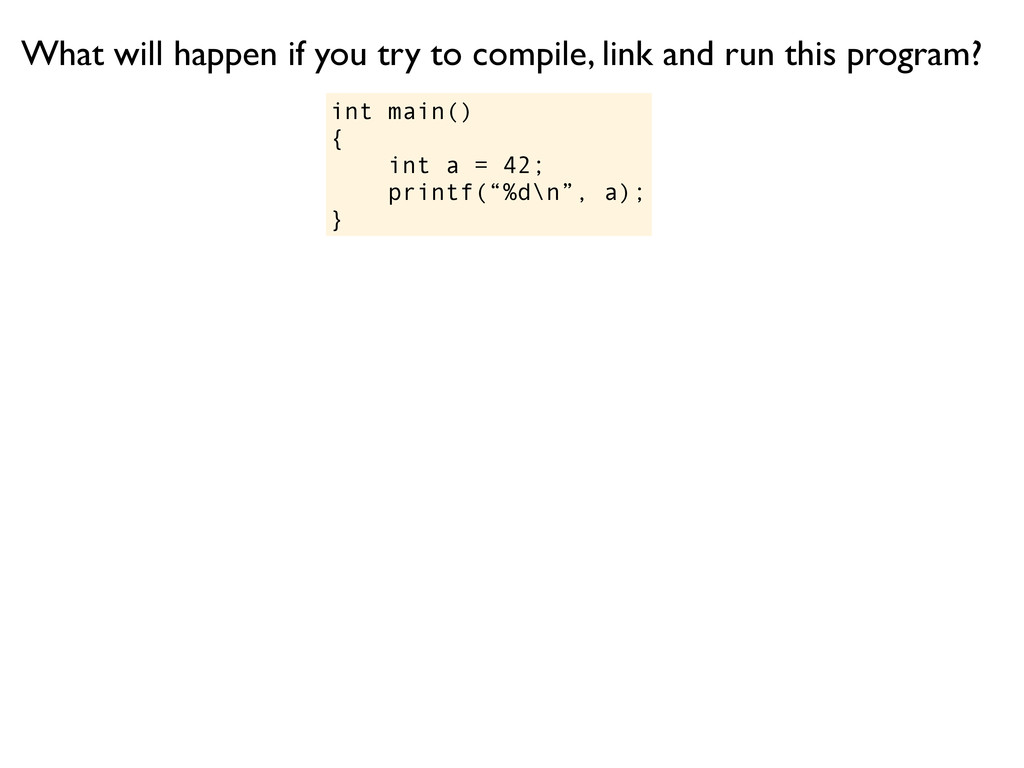
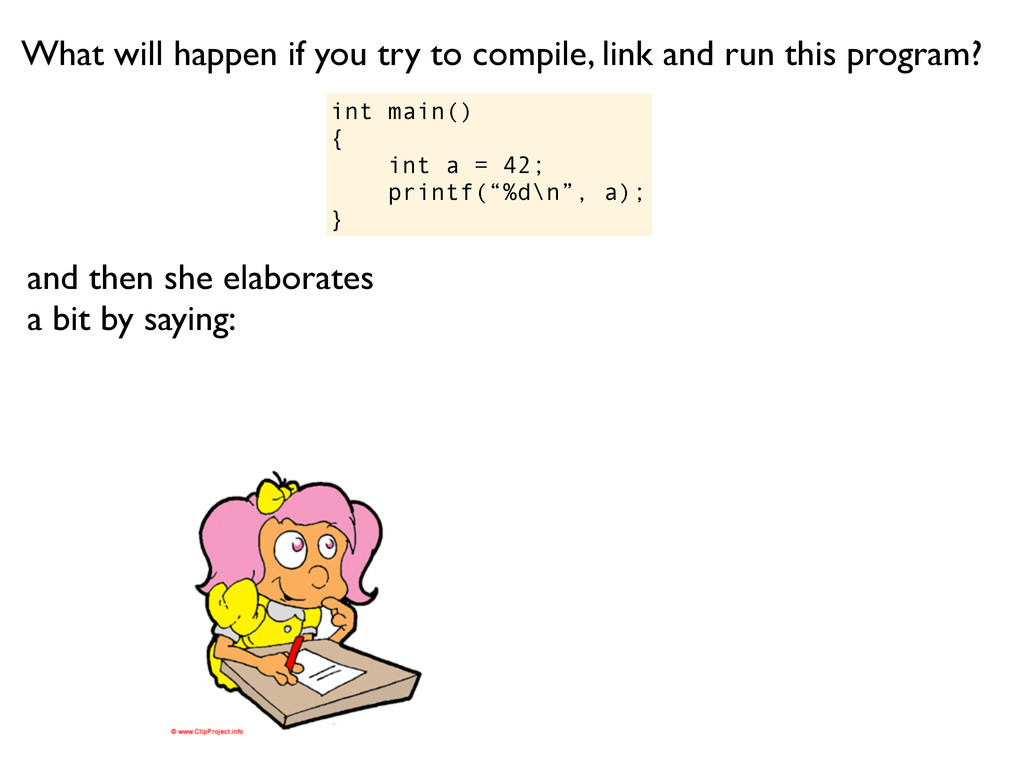
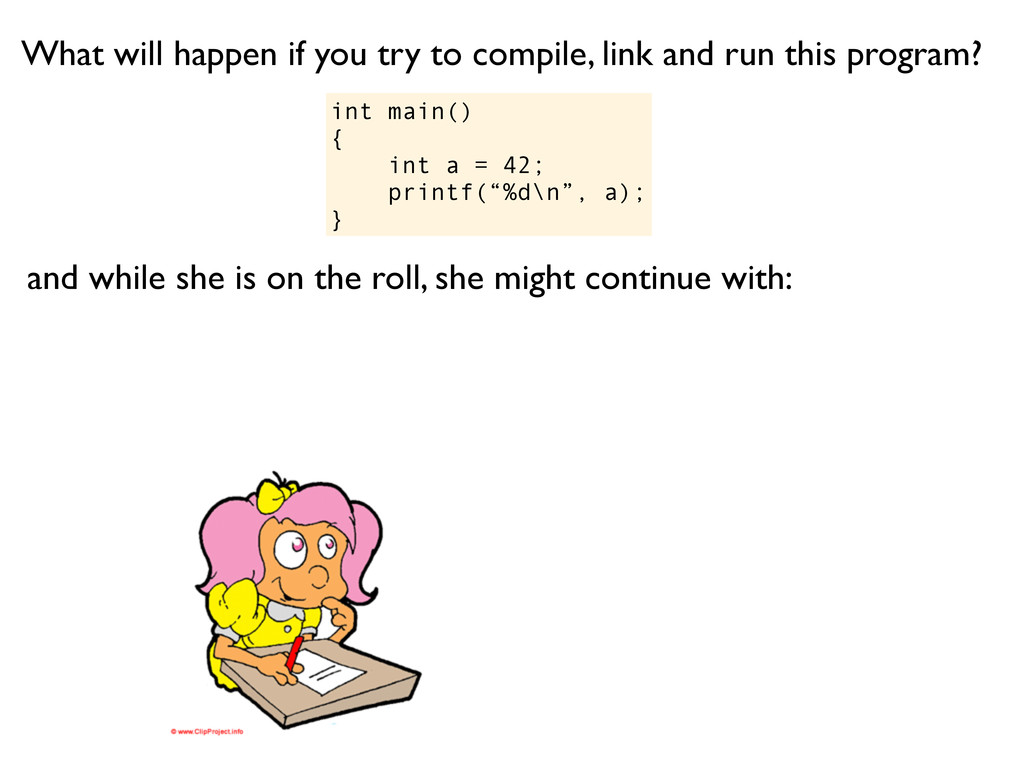
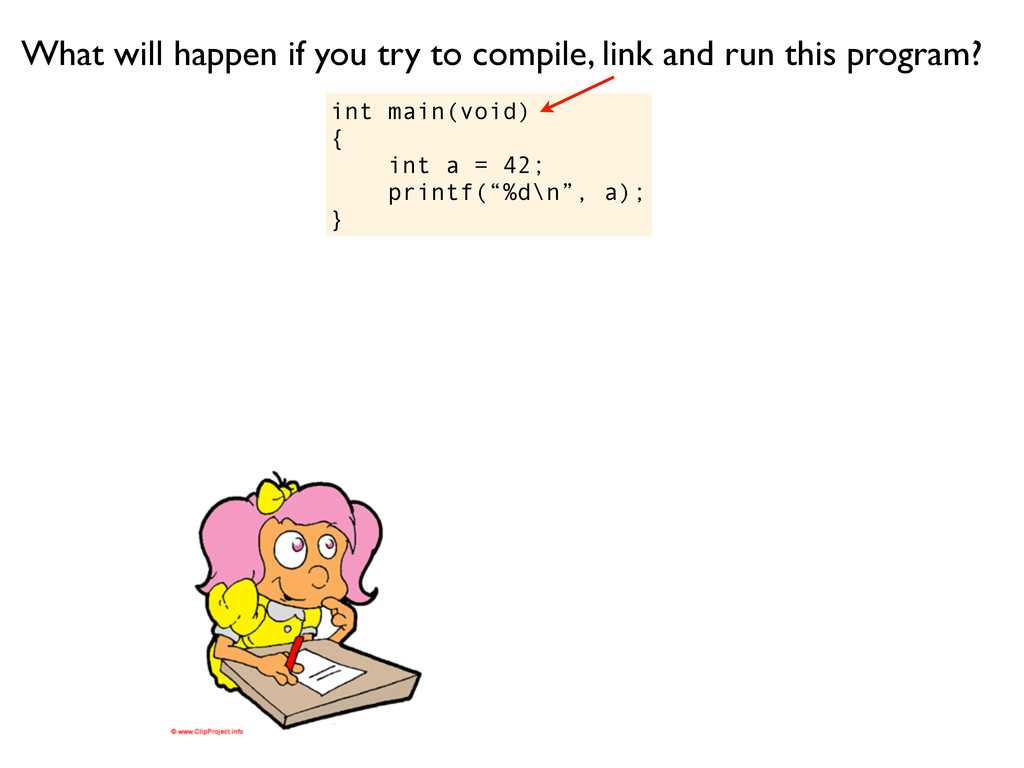
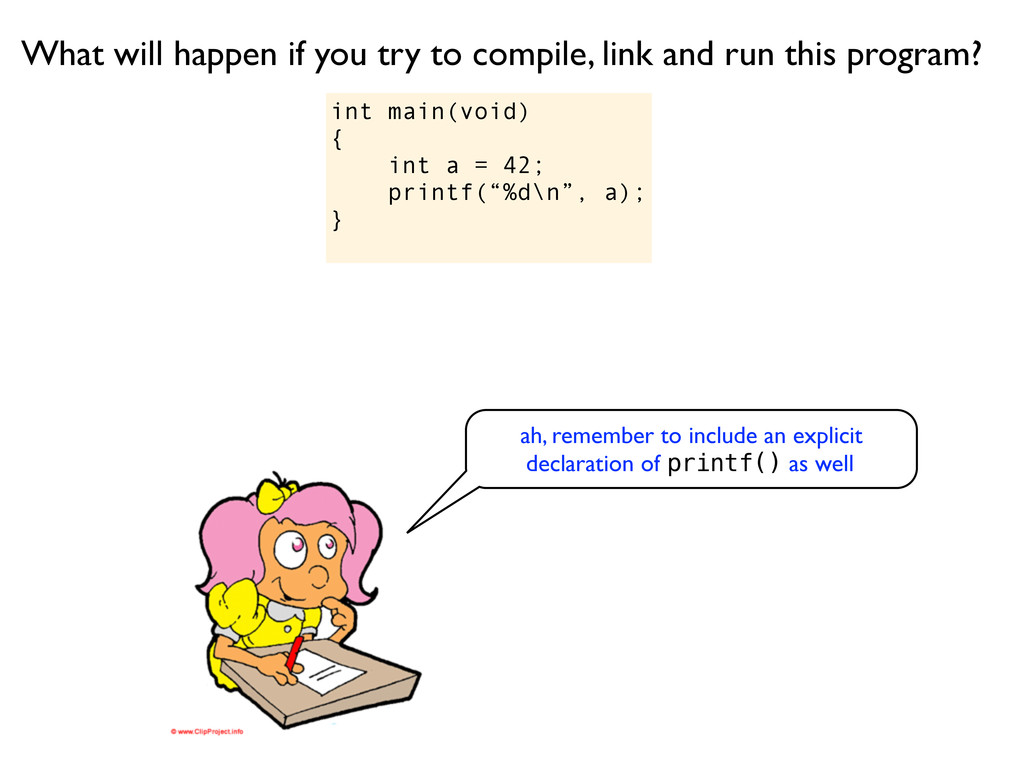
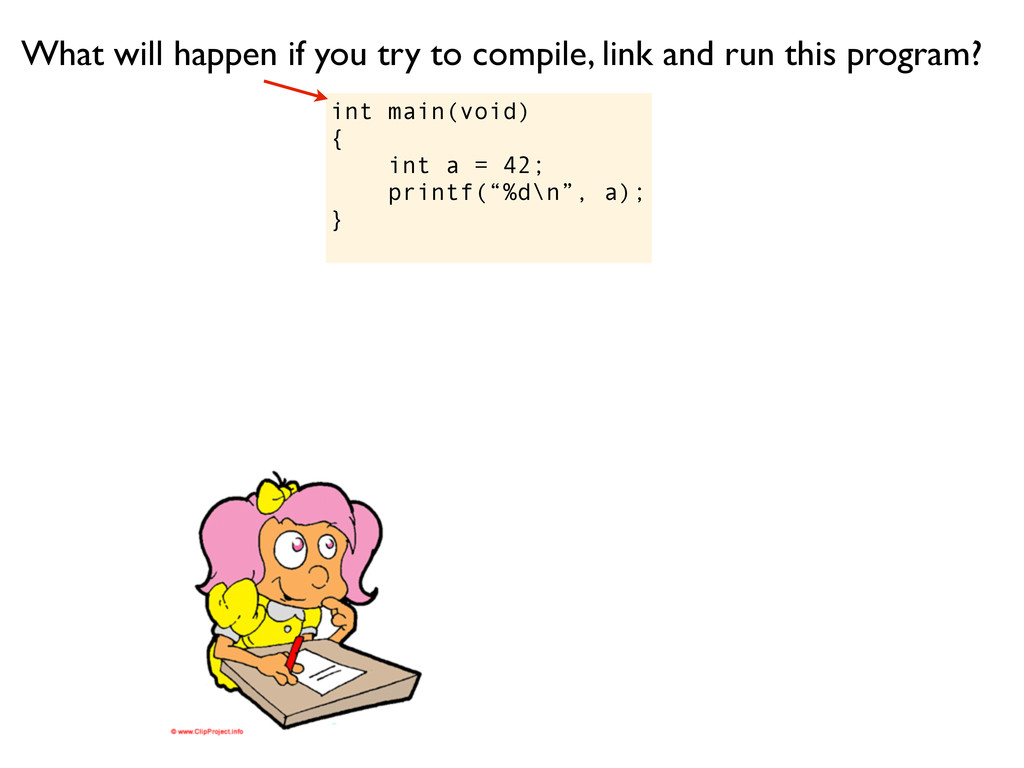
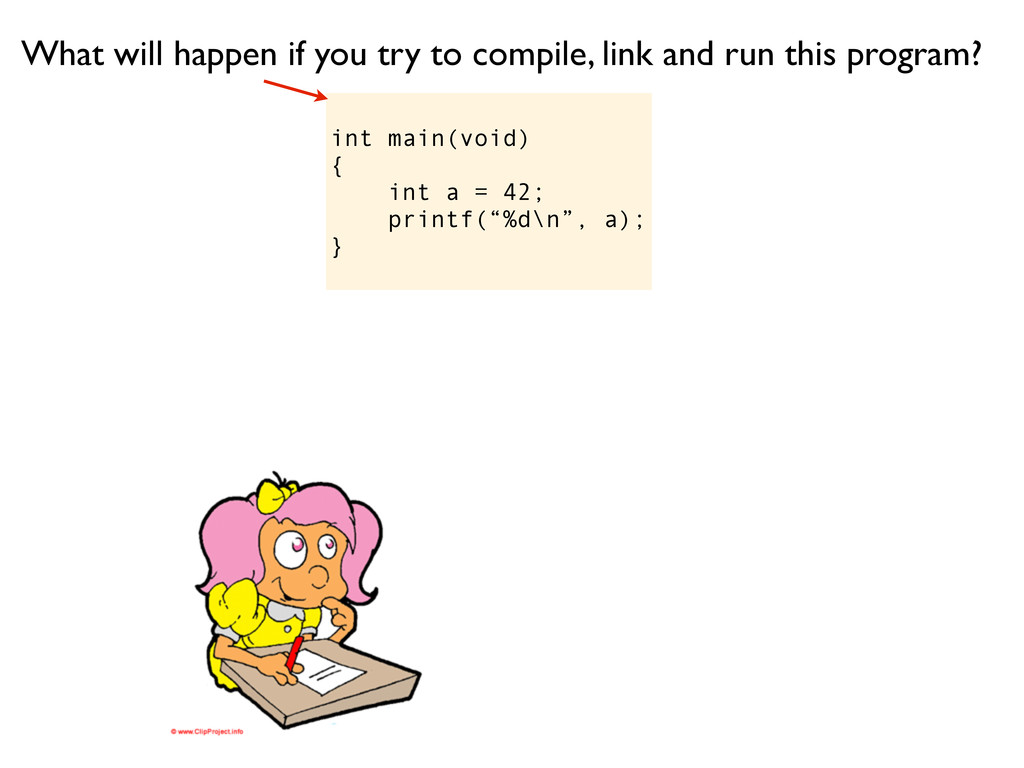
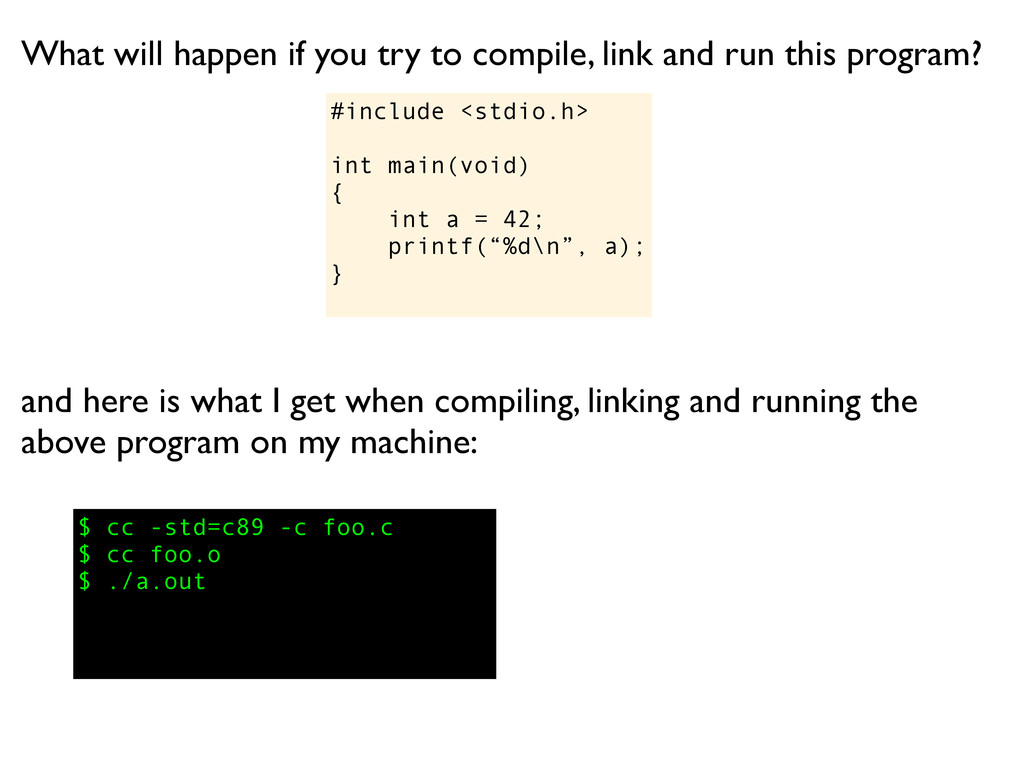
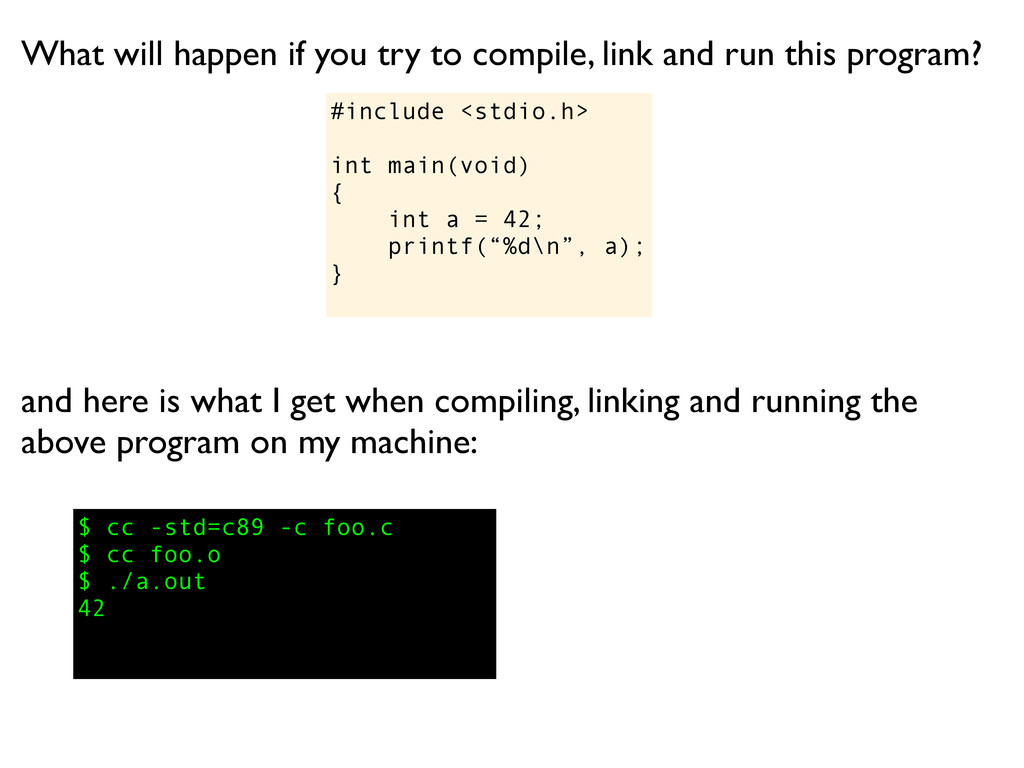
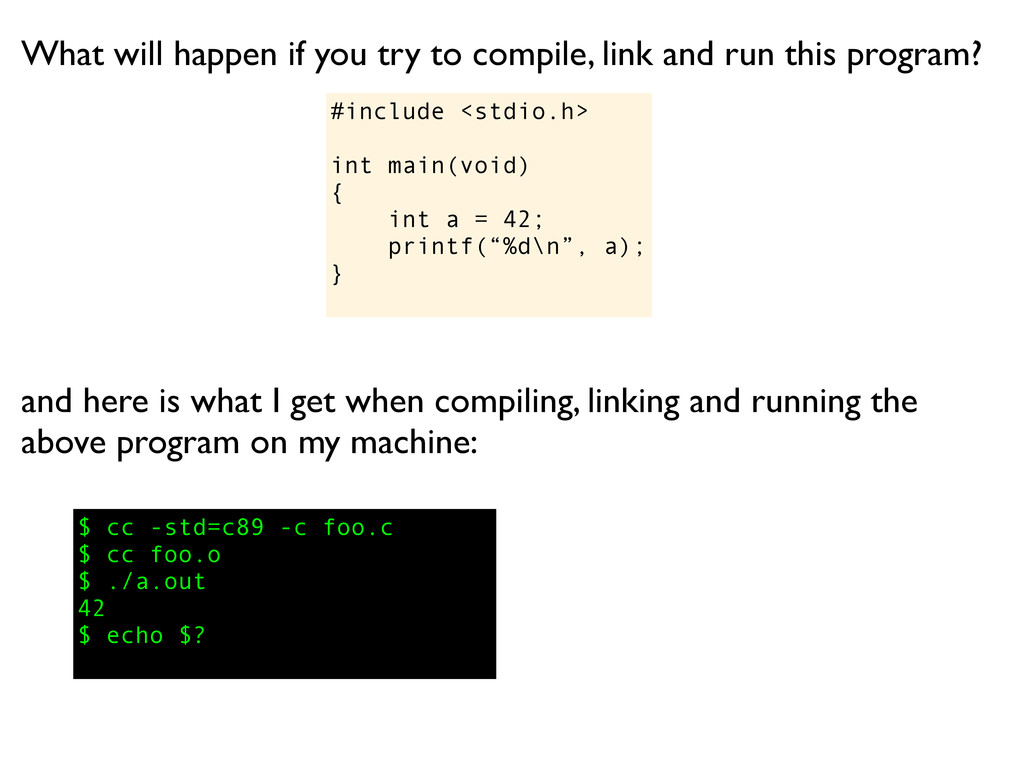
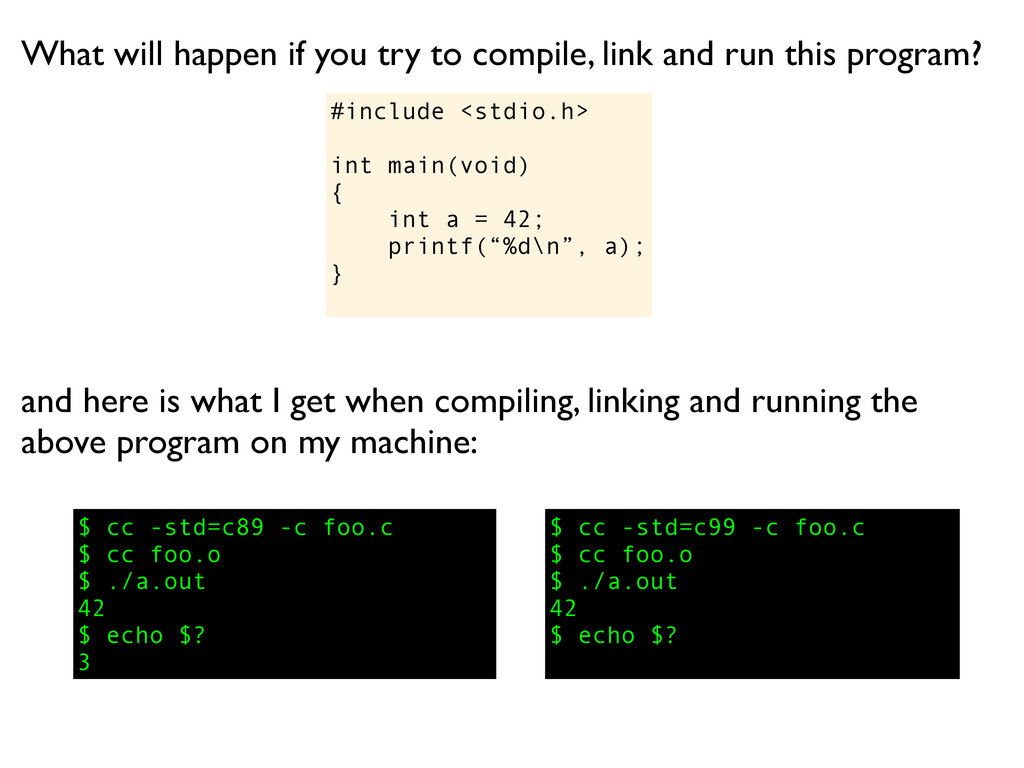
What will happen if you try to compile, link and run this program? Suppose you are about to interview a candidate for a position as C programmer for various embedded platforms. As part of the interview you might want to check whether the candidate has a deep understanding of the programming language or not... here is a great code snippet to get the conversation started:
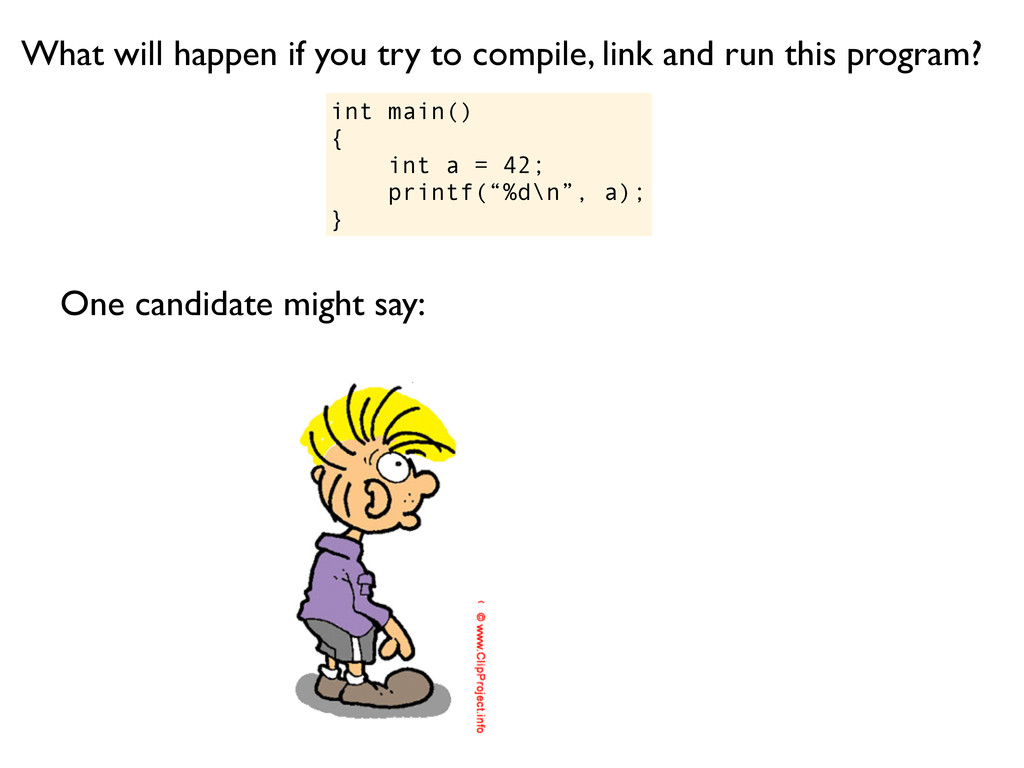
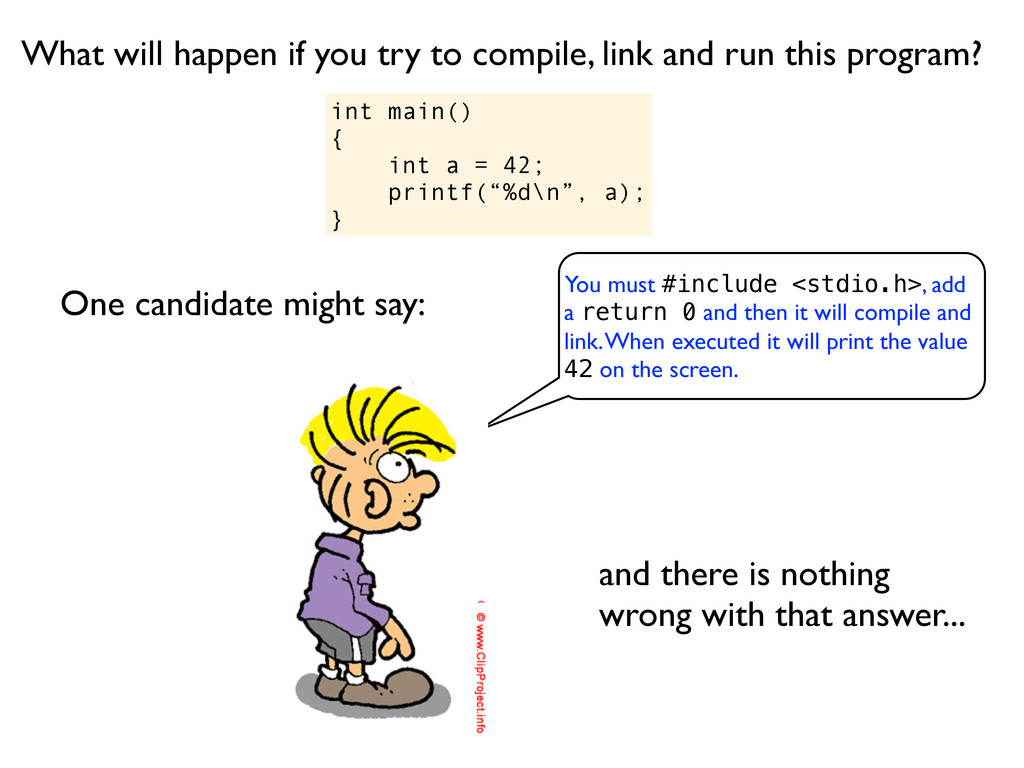
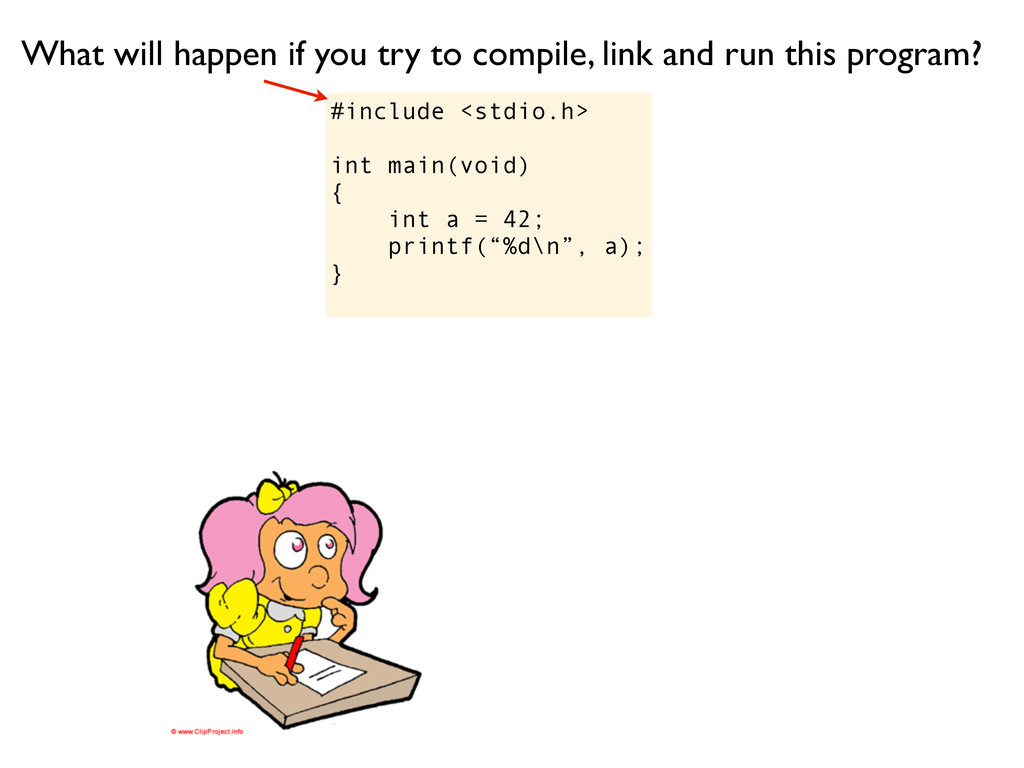
You must #include <stdio.h>, add a return 0 and then it will compile and link. When executed it will print the value 42 on the screen. What will happen if you try to compile, link and run this program? One candidate might say:
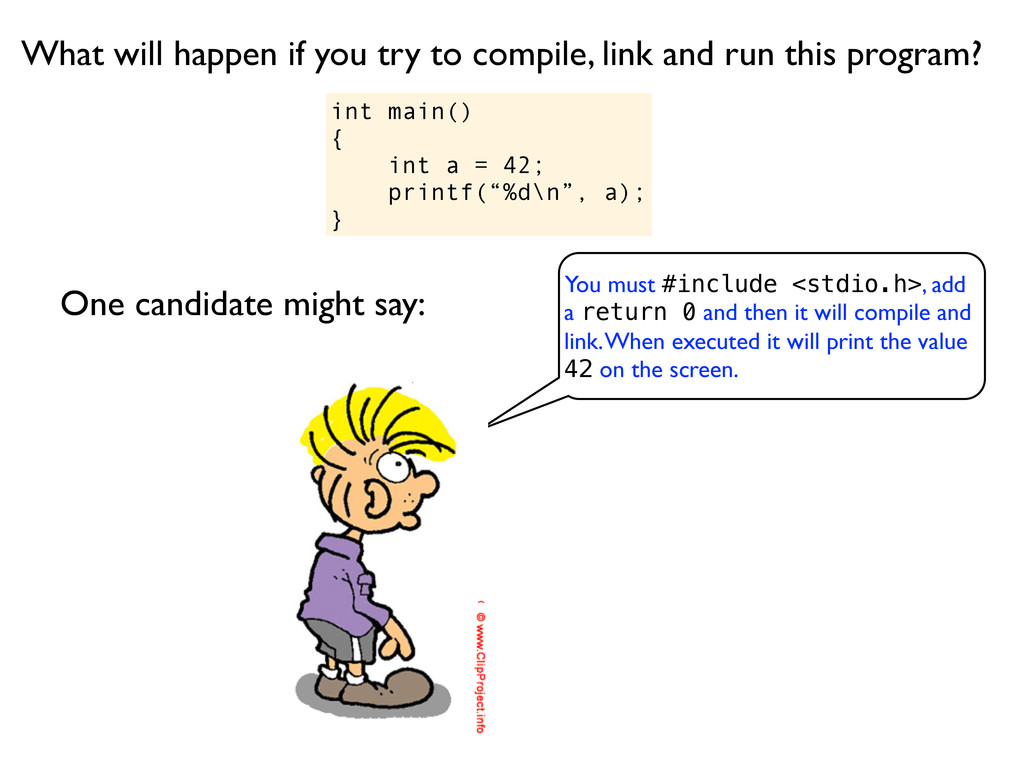
You must #include <stdio.h>, add a return 0 and then it will compile and link. When executed it will print the value 42 on the screen. What will happen if you try to compile, link and run this program? One candidate might say: and there is nothing wrong with that answer...
What will happen if you try to compile, link and run this program? But another candidate might use this as an opportunity to start demonstrating a deeper understanding. She might say things like:
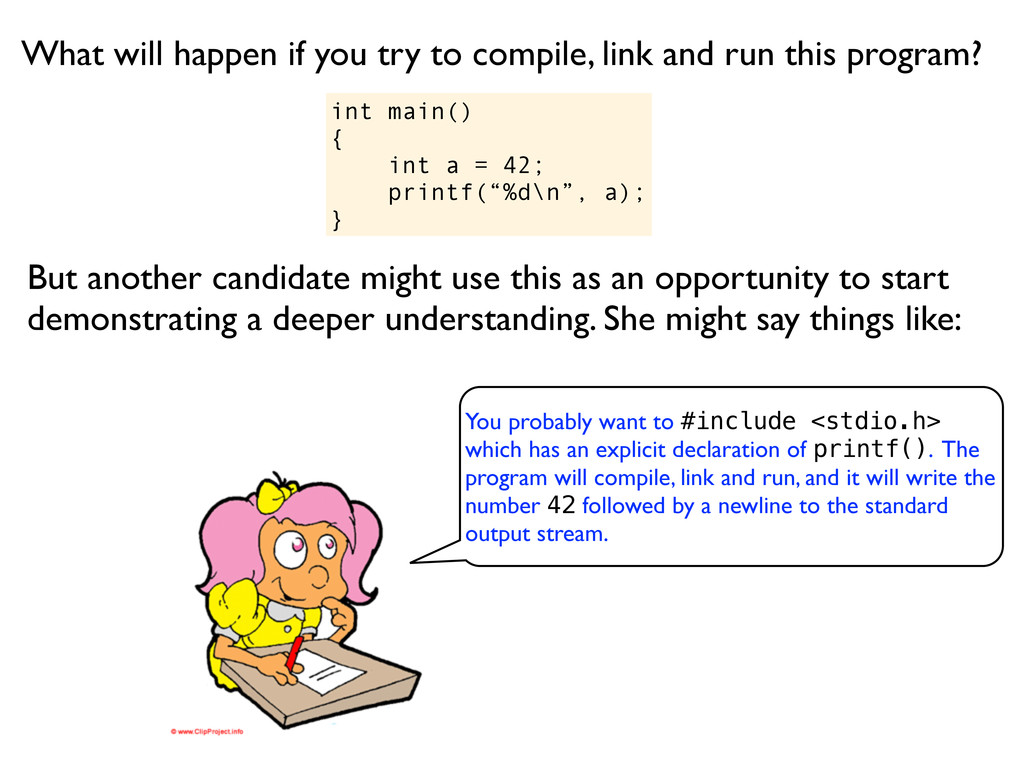
What will happen if you try to compile, link and run this program? But another candidate might use this as an opportunity to start demonstrating a deeper understanding. She might say things like: You probably want to #include <stdio.h> which has an explicit declaration of printf(). The program will compile, link and run, and it will write the number 42 followed by a newline to the standard output stream.
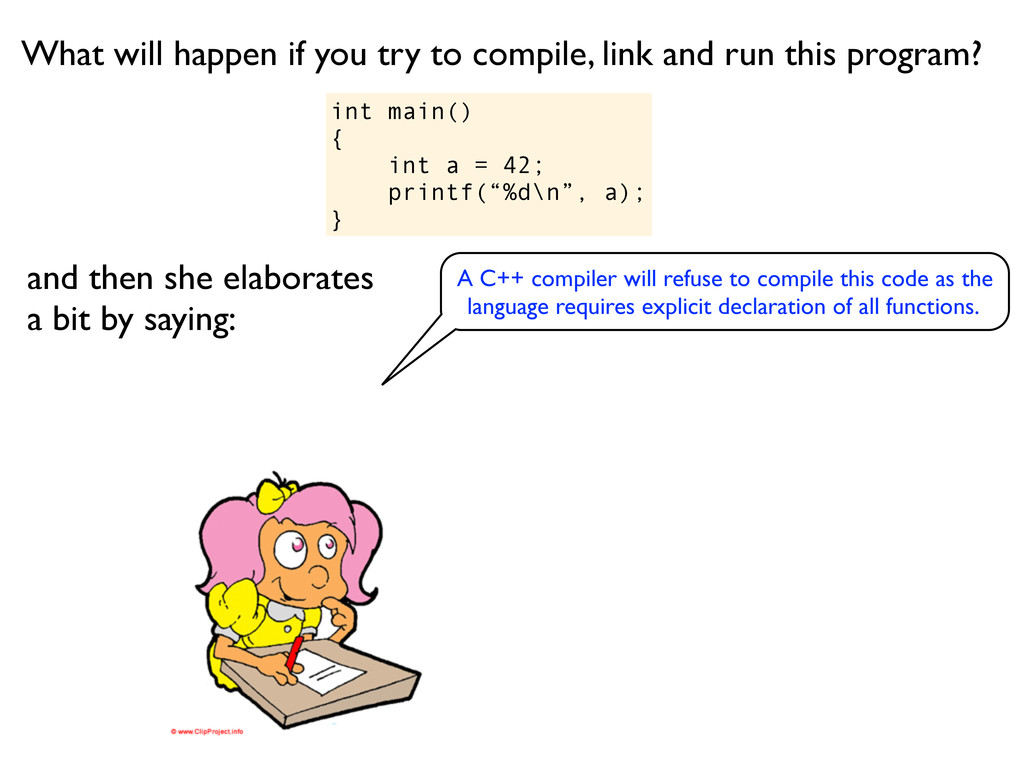
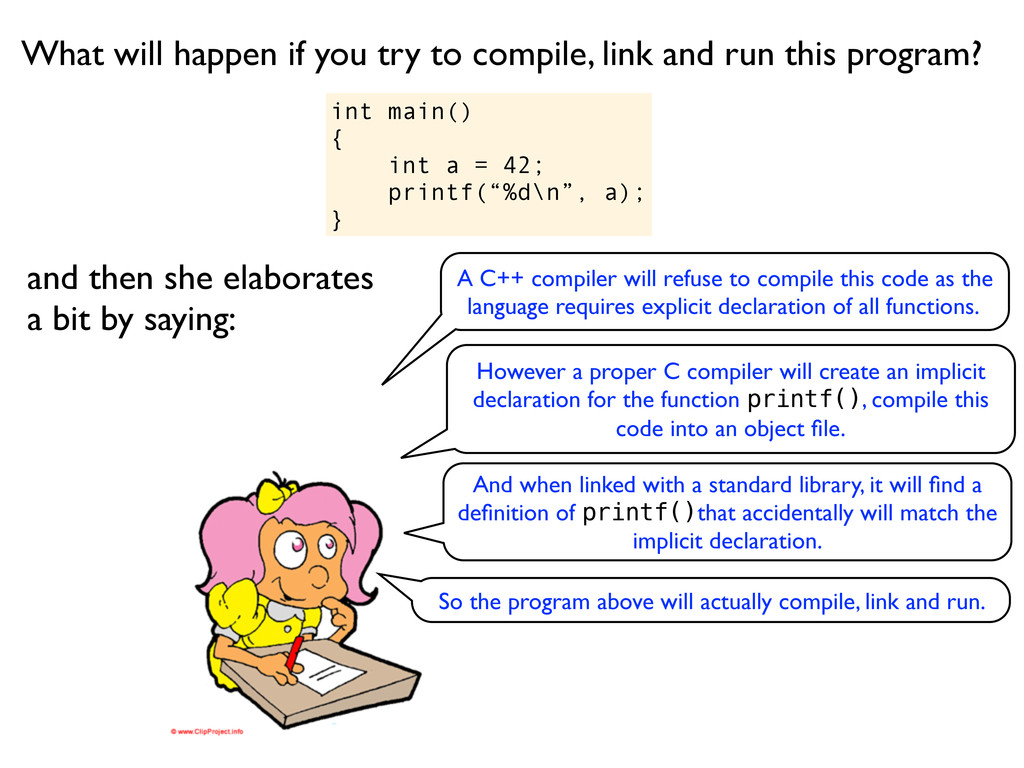
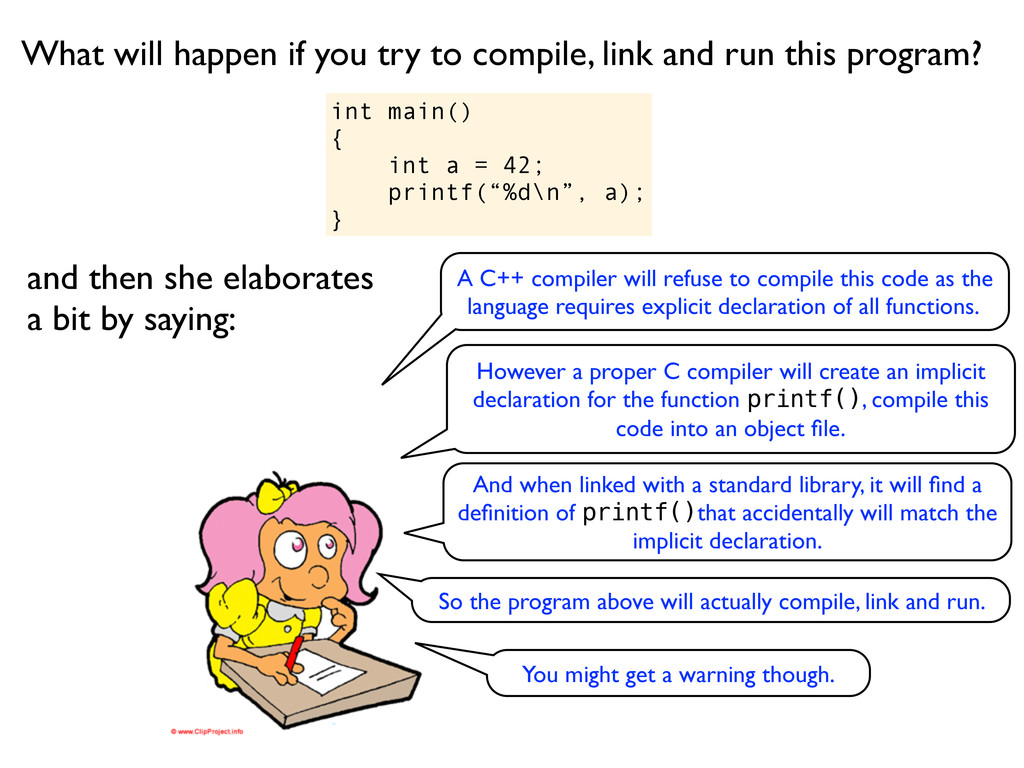
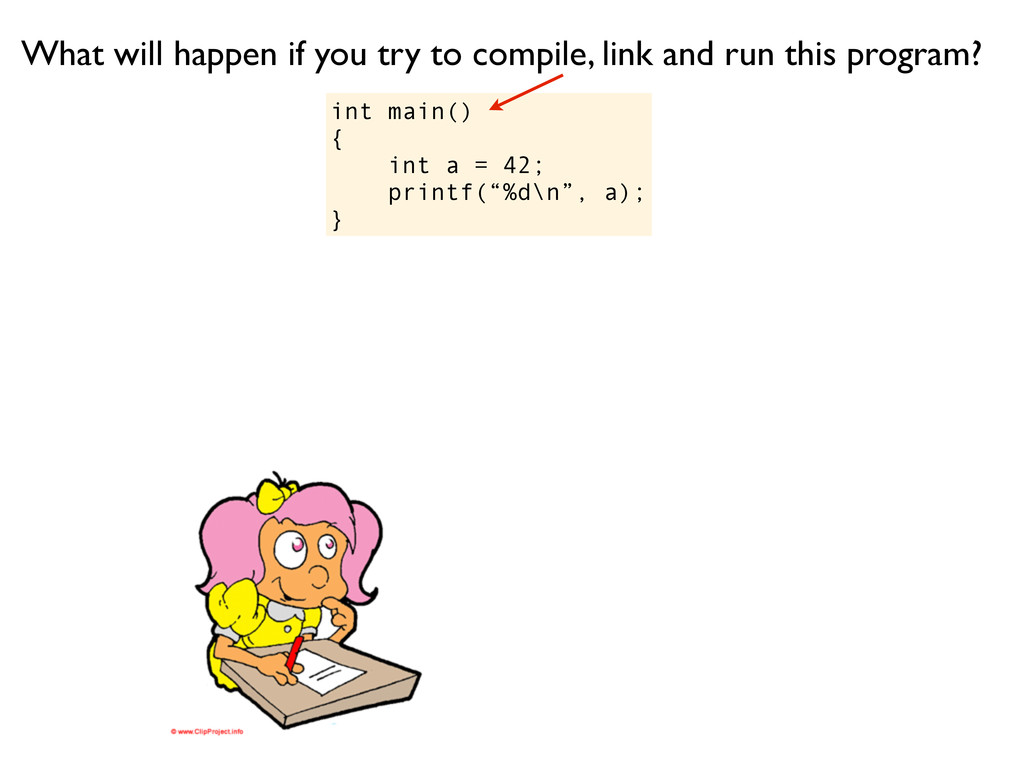
and then she elaborates a bit by saying: What will happen if you try to compile, link and run this program? A C++ compiler will refuse to compile this code as the language requires explicit declaration of all functions.
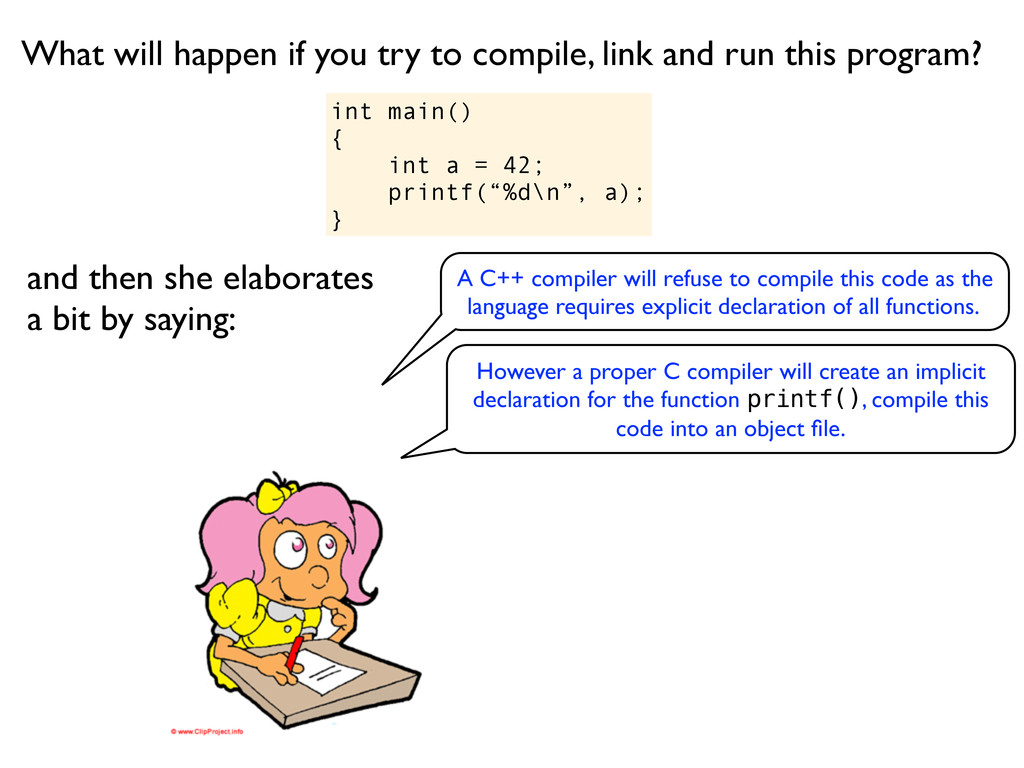
and then she elaborates a bit by saying: What will happen if you try to compile, link and run this program? A C++ compiler will refuse to compile this code as the language requires explicit declaration of all functions. However a proper C compiler will create an implicit declaration for the function printf(), compile this code into an object file.
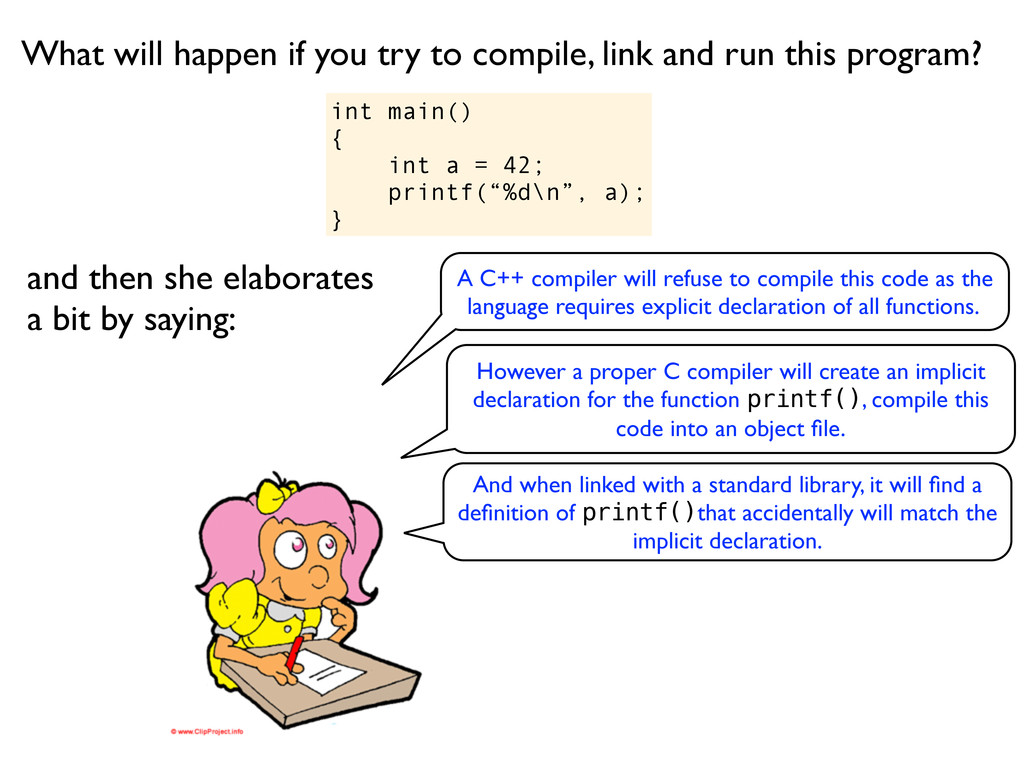
and then she elaborates a bit by saying: What will happen if you try to compile, link and run this program? A C++ compiler will refuse to compile this code as the language requires explicit declaration of all functions. However a proper C compiler will create an implicit declaration for the function printf(), compile this code into an object file. And when linked with a standard library, it will find a definition of printf()that accidentally will match the implicit declaration.
and then she elaborates a bit by saying: What will happen if you try to compile, link and run this program? A C++ compiler will refuse to compile this code as the language requires explicit declaration of all functions. However a proper C compiler will create an implicit declaration for the function printf(), compile this code into an object file. And when linked with a standard library, it will find a definition of printf()that accidentally will match the implicit declaration. So the program above will actually compile, link and run.
and then she elaborates a bit by saying: What will happen if you try to compile, link and run this program? A C++ compiler will refuse to compile this code as the language requires explicit declaration of all functions. You might get a warning though. However a proper C compiler will create an implicit declaration for the function printf(), compile this code into an object file. And when linked with a standard library, it will find a definition of printf()that accidentally will match the implicit declaration. So the program above will actually compile, link and run.
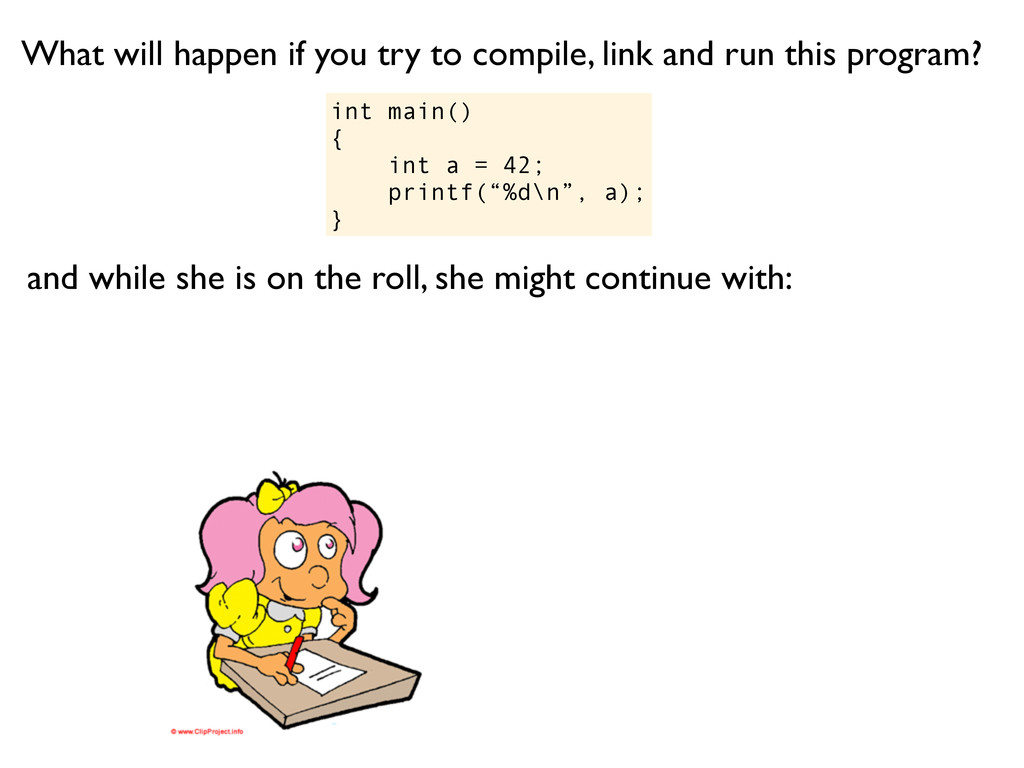
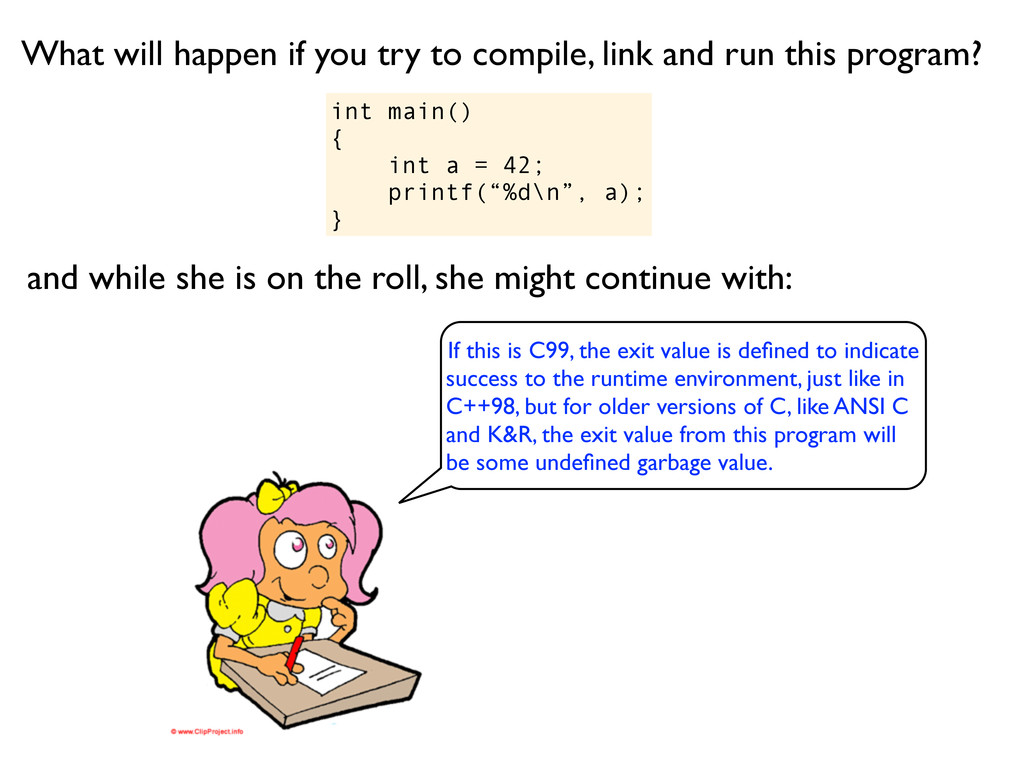
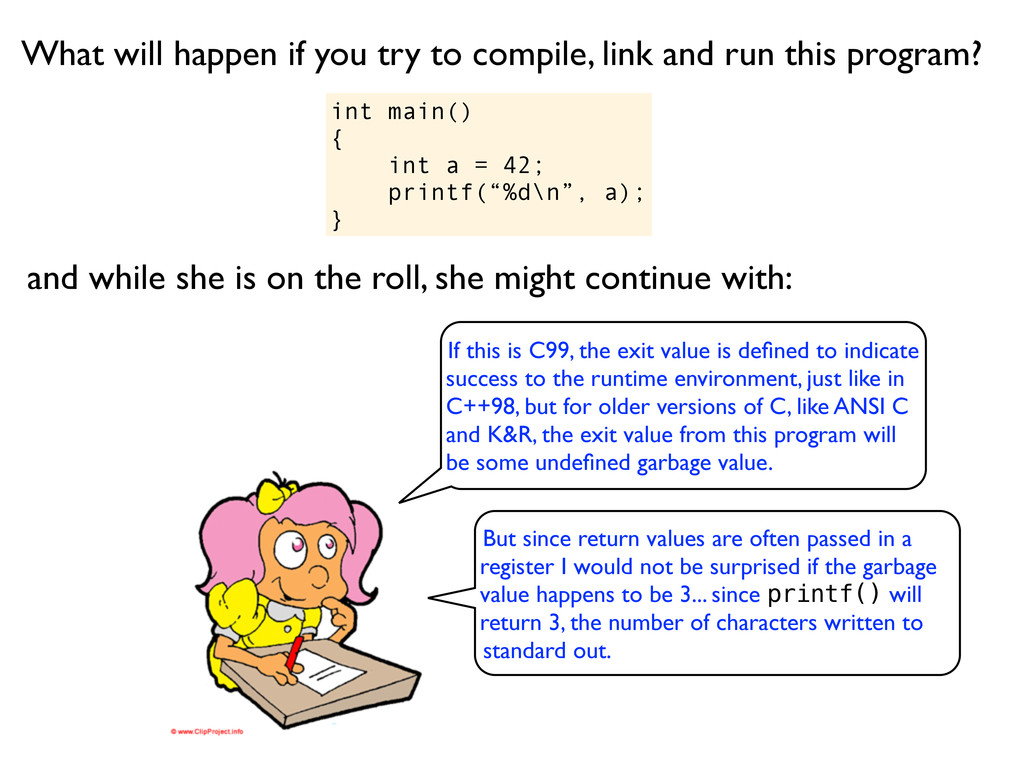
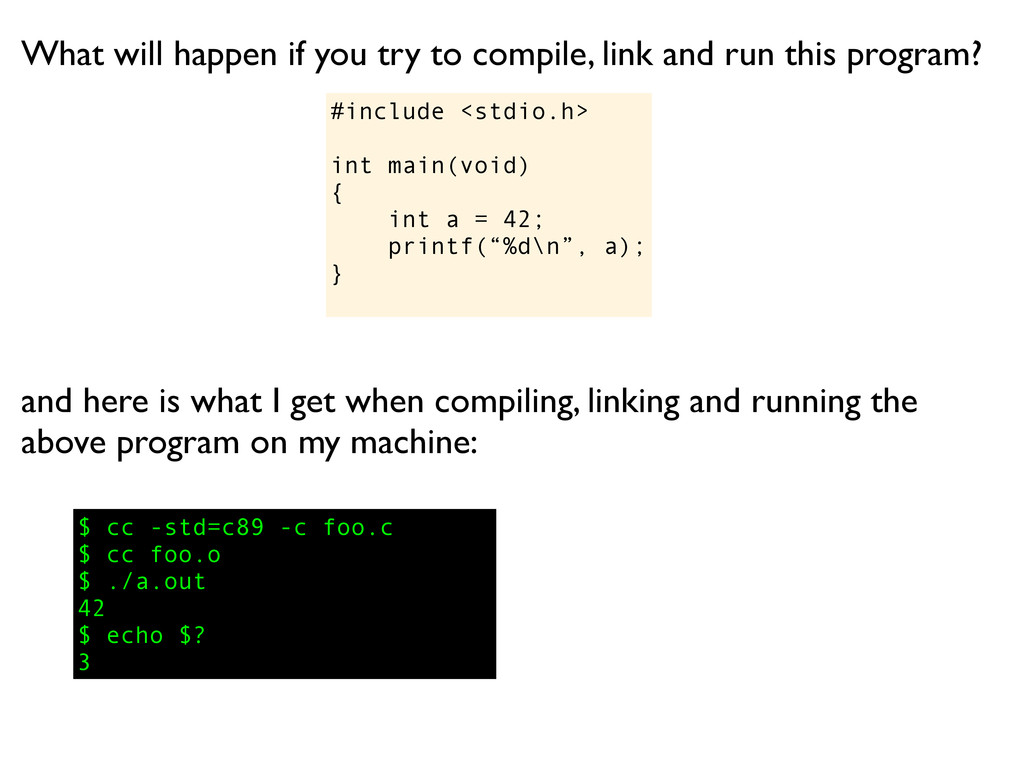
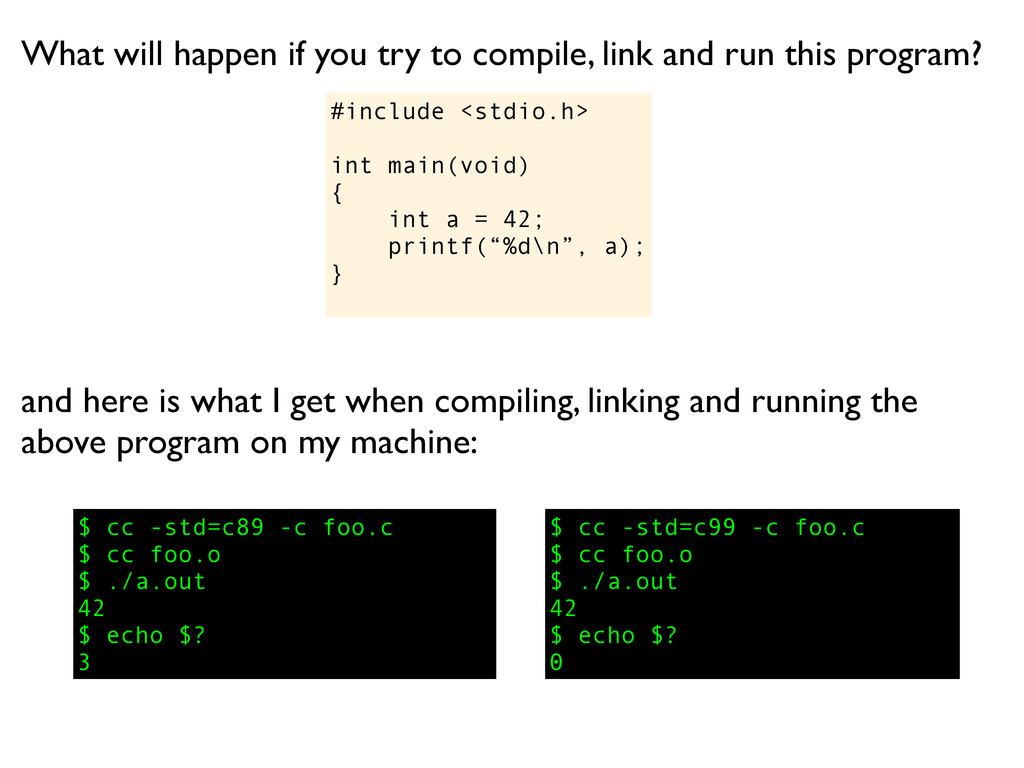
and while she is on the roll, she might continue with: What will happen if you try to compile, link and run this program? If this is C99, the exit value is defined to indicate success to the runtime environment, just like in C++98, but for older versions of C, like ANSI C and K&R, the exit value from this program will be some undefined garbage value.
and while she is on the roll, she might continue with: What will happen if you try to compile, link and run this program? If this is C99, the exit value is defined to indicate success to the runtime environment, just like in C++98, but for older versions of C, like ANSI C and K&R, the exit value from this program will be some undefined garbage value. But since return values are often passed in a register I would not be surprised if the garbage value happens to be 3... since printf() will return 3, the number of characters written to standard out.
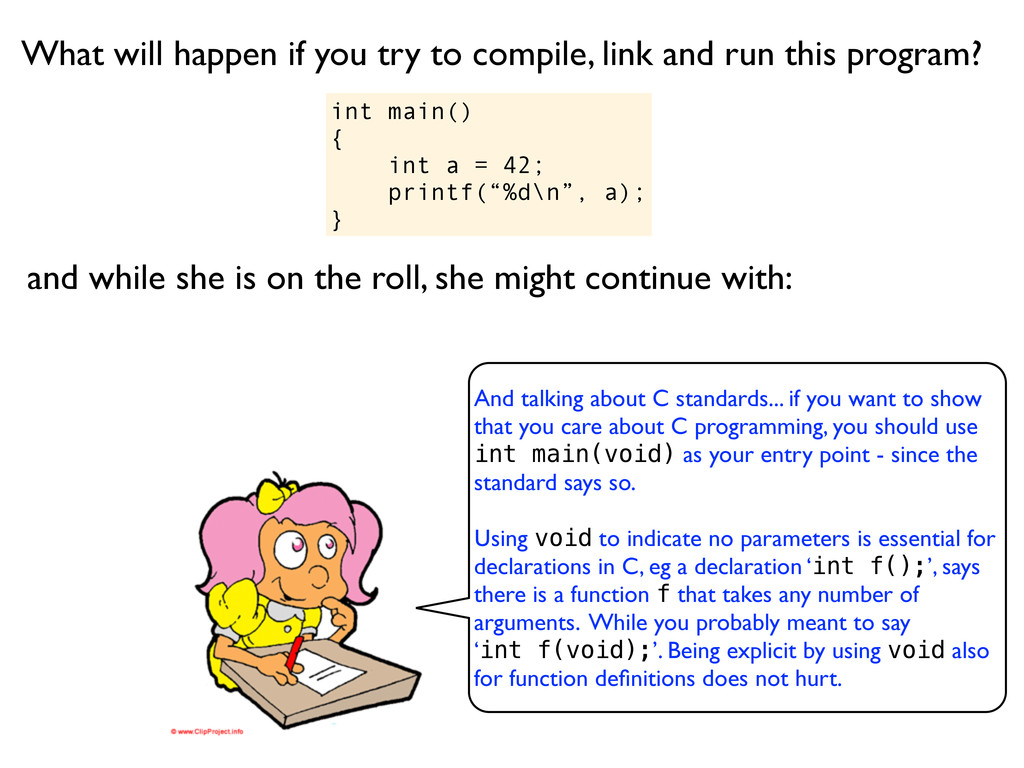
What will happen if you try to compile, link and run this program? And talking about C standards... if you want to show that you care about C programming, you should use int main(void) as your entry point - since the standard says so. Using void to indicate no parameters is essential for declarations in C, eg a declaration ‘int f();’, says there is a function f that takes any number of arguments. While you probably meant to say ‘int f(void);’. Being explicit by using void also for function definitions does not hurt. and while she is on the roll, she might continue with:
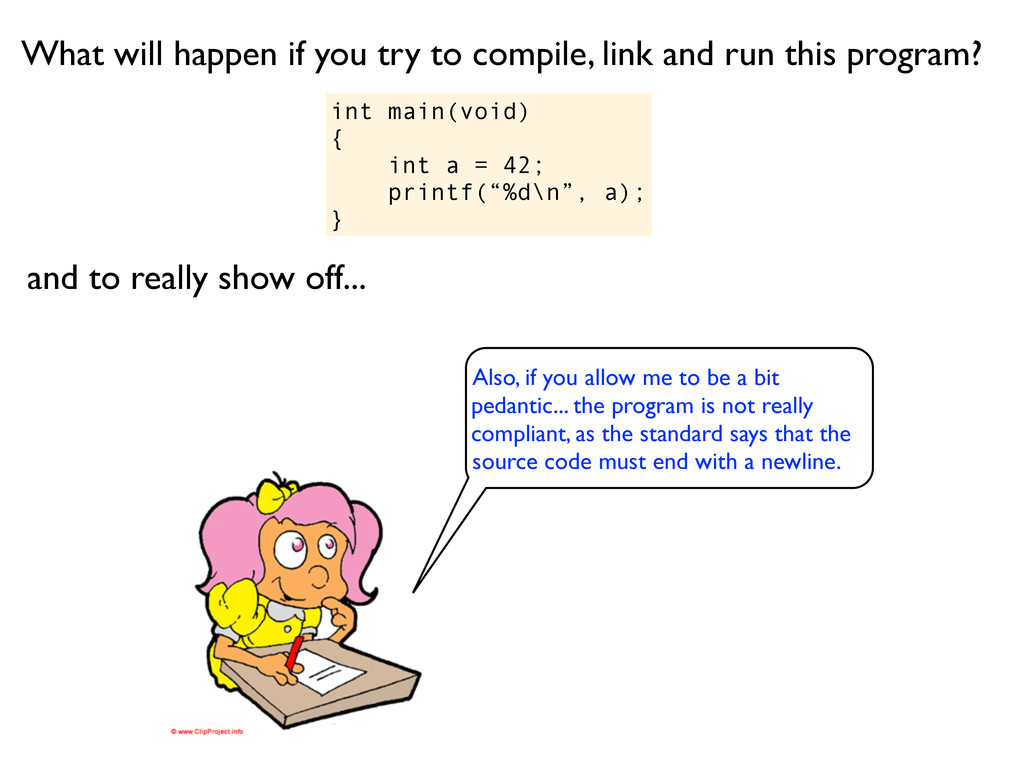
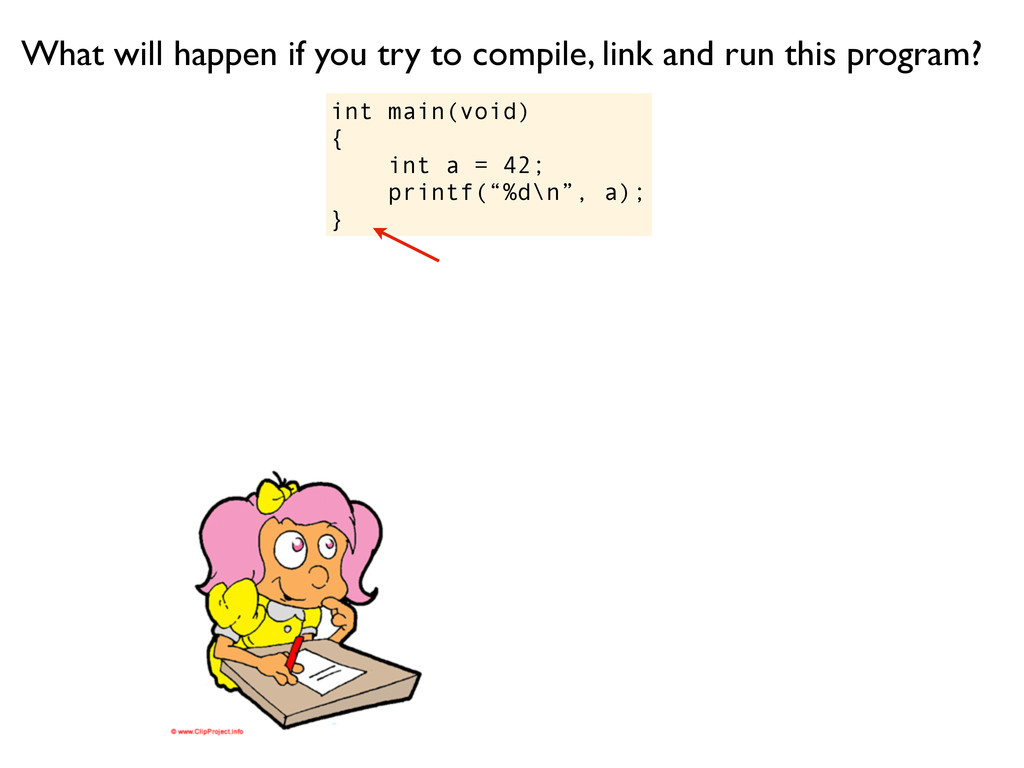
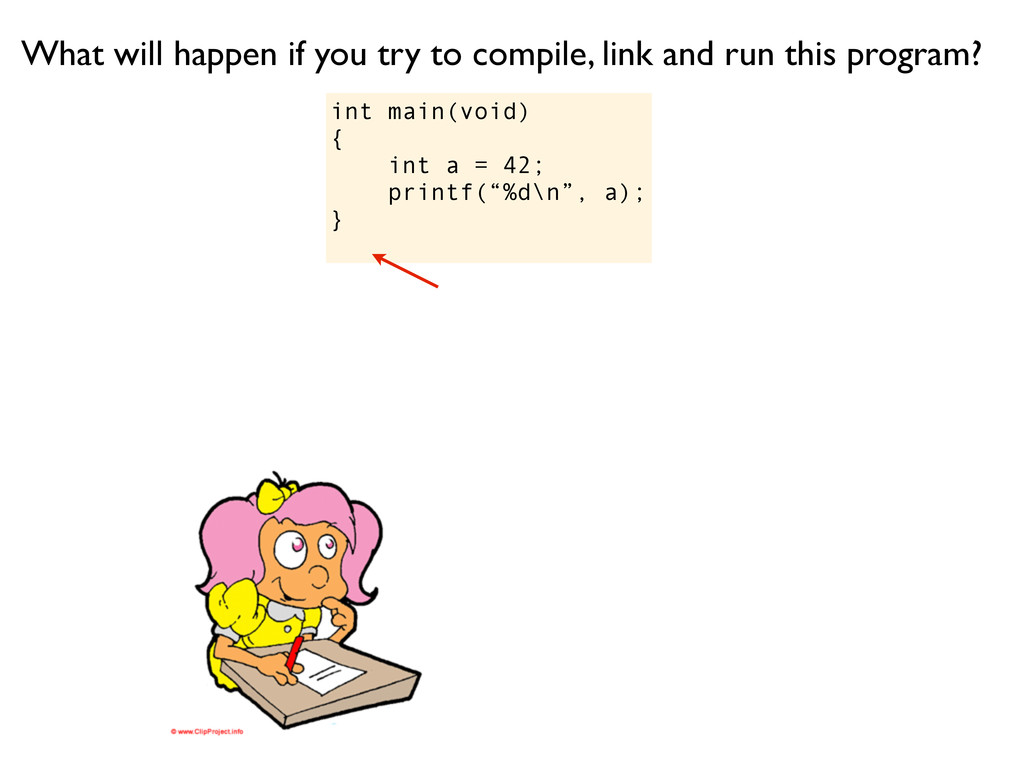
What will happen if you try to compile, link and run this program? Also, if you allow me to be a bit pedantic... the program is not really compliant, as the standard says that the source code must end with a newline. and to really show off...
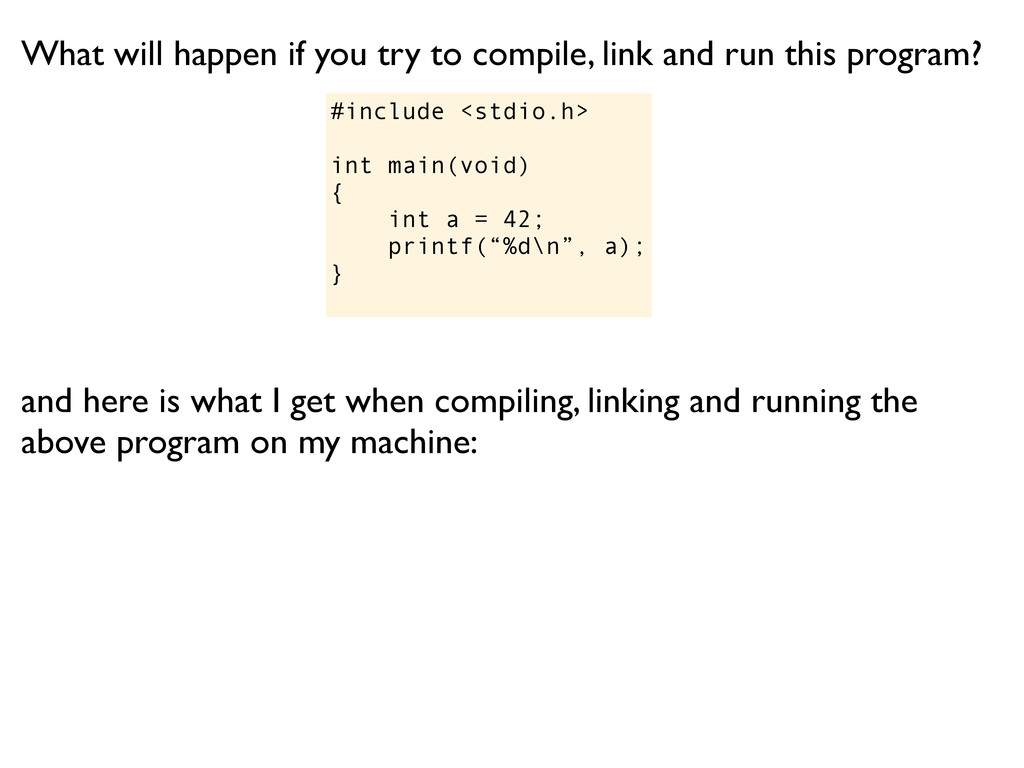
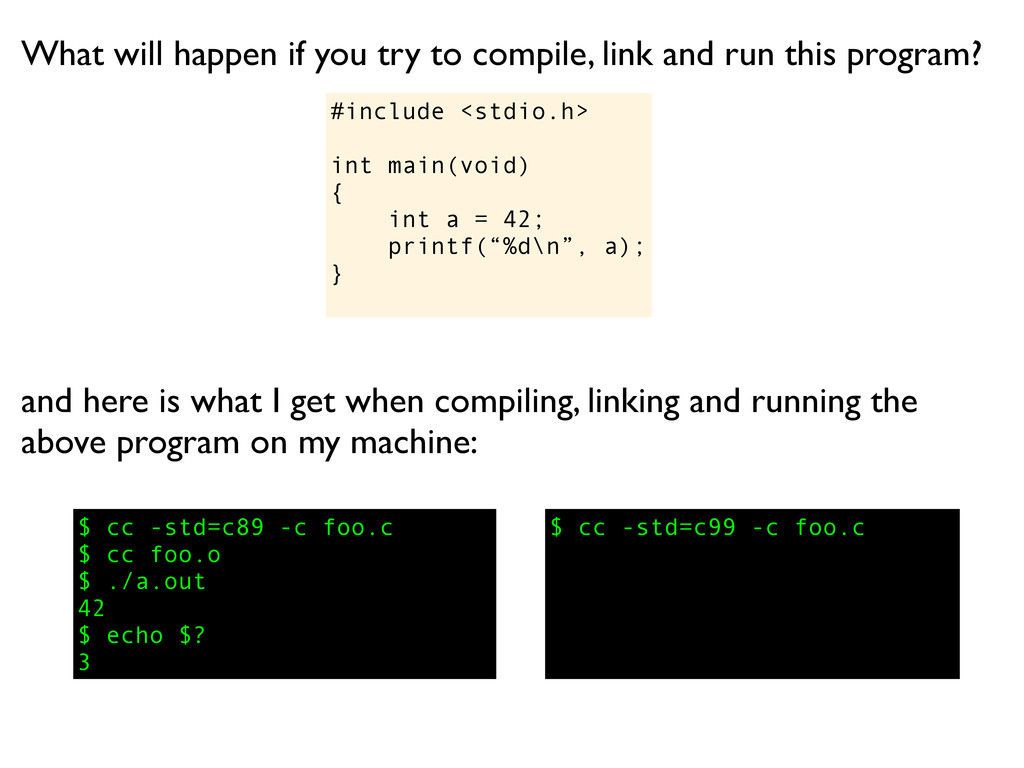
a); } What will happen if you try to compile, link and run this program? and here is what I get when compiling, linking and running the above program on my machine:
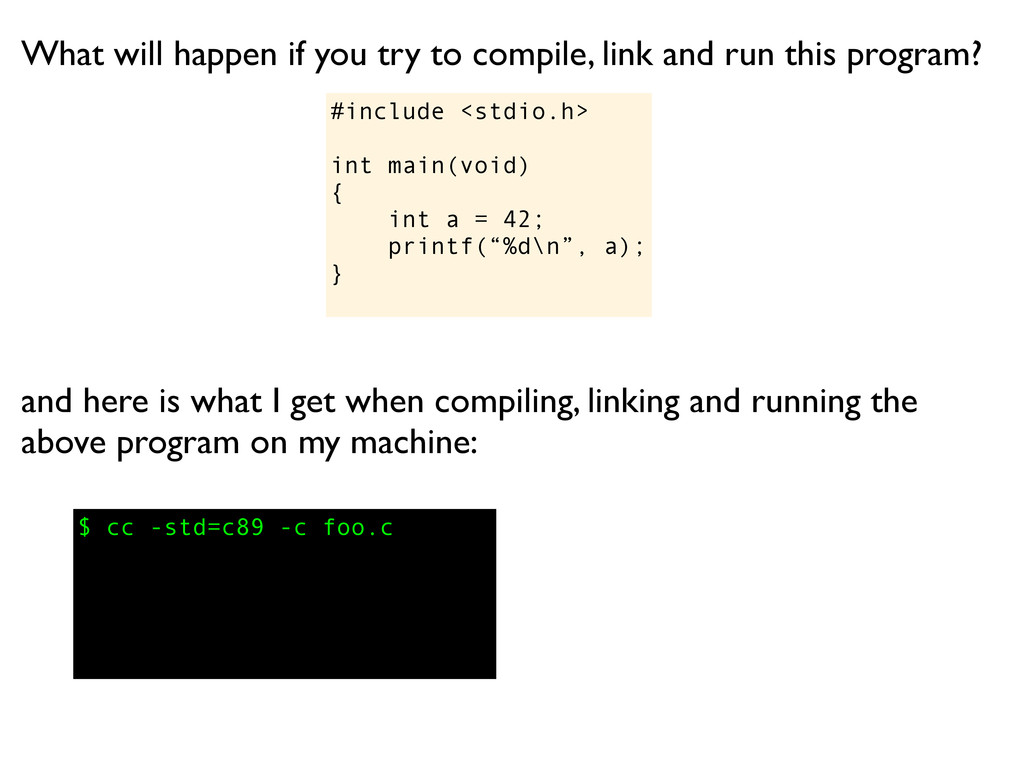
a); } What will happen if you try to compile, link and run this program? $ cc -std=c89 -c foo.c and here is what I get when compiling, linking and running the above program on my machine:
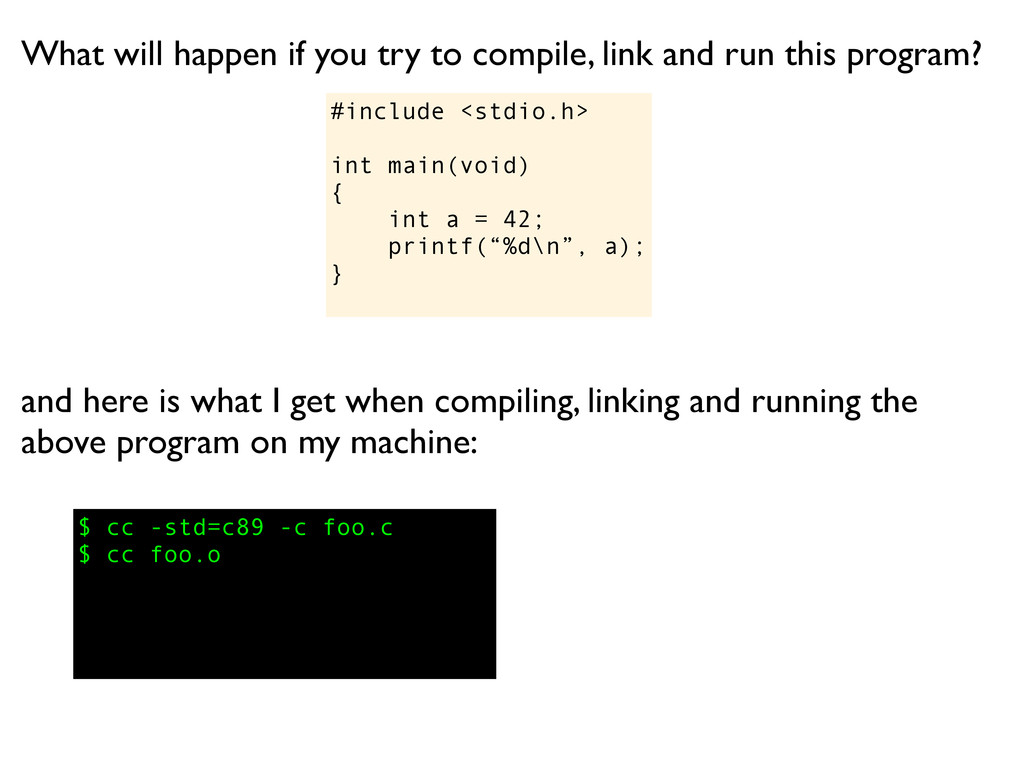
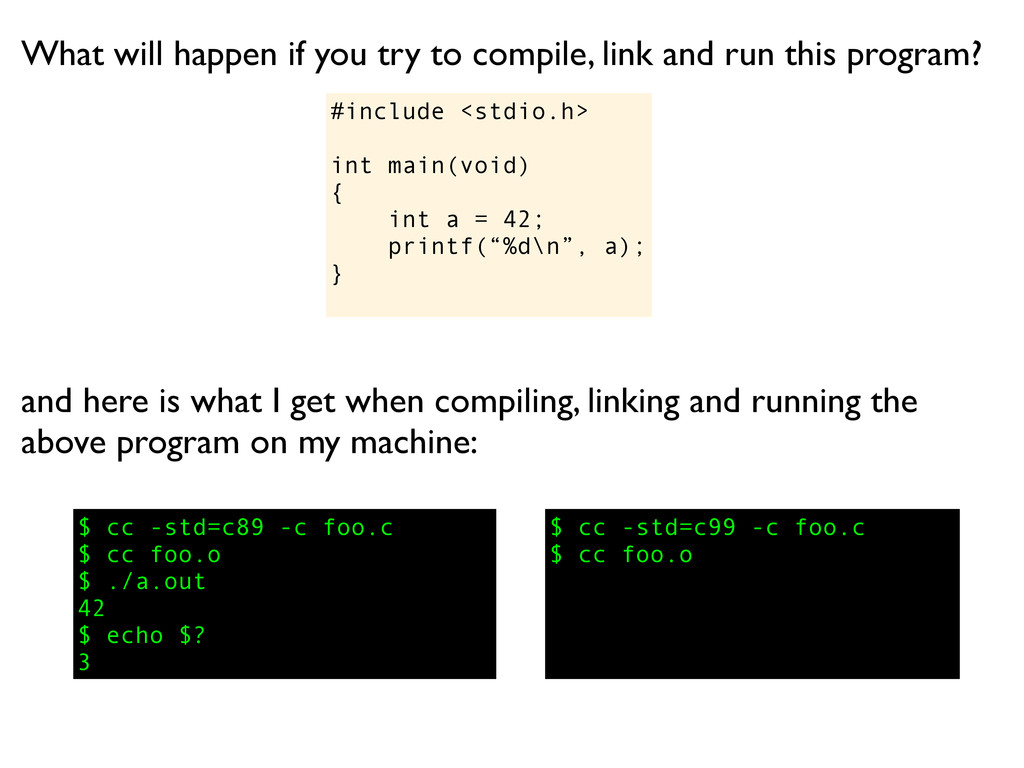
a); } What will happen if you try to compile, link and run this program? $ cc -std=c89 -c foo.c $ cc foo.o and here is what I get when compiling, linking and running the above program on my machine:
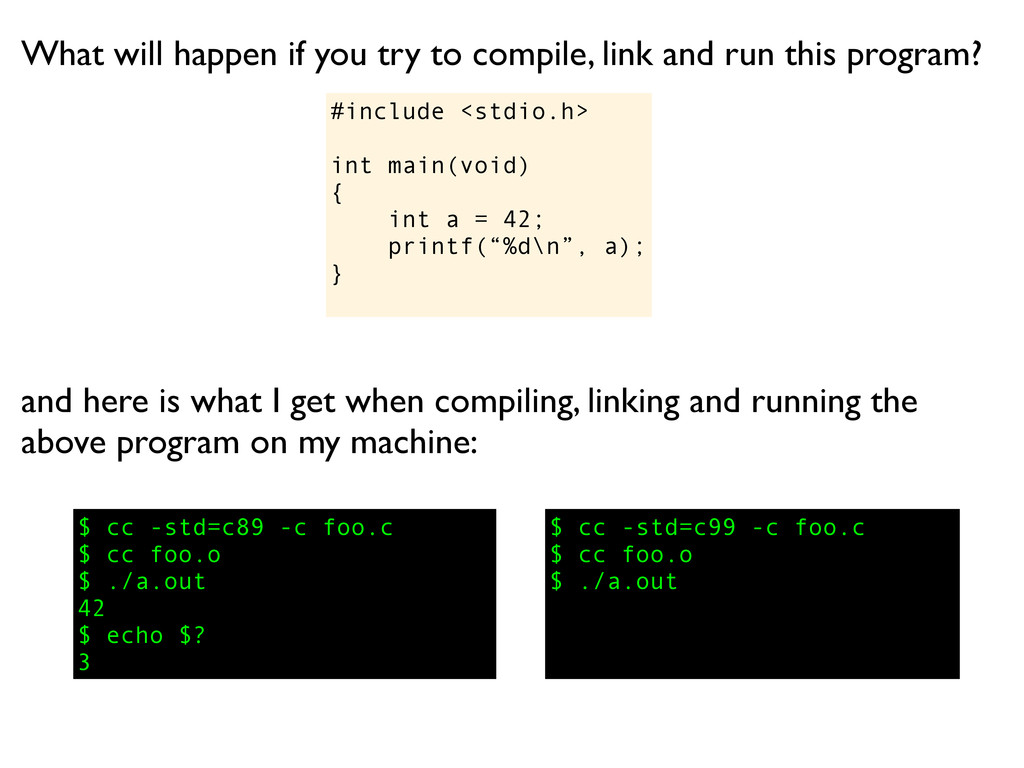
a); } What will happen if you try to compile, link and run this program? $ cc -std=c89 -c foo.c $ cc foo.o $ ./a.out and here is what I get when compiling, linking and running the above program on my machine:
a); } What will happen if you try to compile, link and run this program? $ cc -std=c89 -c foo.c $ cc foo.o $ ./a.out 42 and here is what I get when compiling, linking and running the above program on my machine:
a); } What will happen if you try to compile, link and run this program? $ cc -std=c89 -c foo.c $ cc foo.o $ ./a.out 42 $ echo $? and here is what I get when compiling, linking and running the above program on my machine:
a); } What will happen if you try to compile, link and run this program? $ cc -std=c89 -c foo.c $ cc foo.o $ ./a.out 42 $ echo $? 3 and here is what I get when compiling, linking and running the above program on my machine:
a); } What will happen if you try to compile, link and run this program? $ cc -std=c89 -c foo.c $ cc foo.o $ ./a.out 42 $ echo $? 3 and here is what I get when compiling, linking and running the above program on my machine: $ cc -std=c99 -c foo.c
a); } What will happen if you try to compile, link and run this program? $ cc -std=c89 -c foo.c $ cc foo.o $ ./a.out 42 $ echo $? 3 and here is what I get when compiling, linking and running the above program on my machine: $ cc -std=c99 -c foo.c $ cc foo.o
a); } What will happen if you try to compile, link and run this program? $ cc -std=c89 -c foo.c $ cc foo.o $ ./a.out 42 $ echo $? 3 and here is what I get when compiling, linking and running the above program on my machine: $ cc -std=c99 -c foo.c $ cc foo.o $ ./a.out
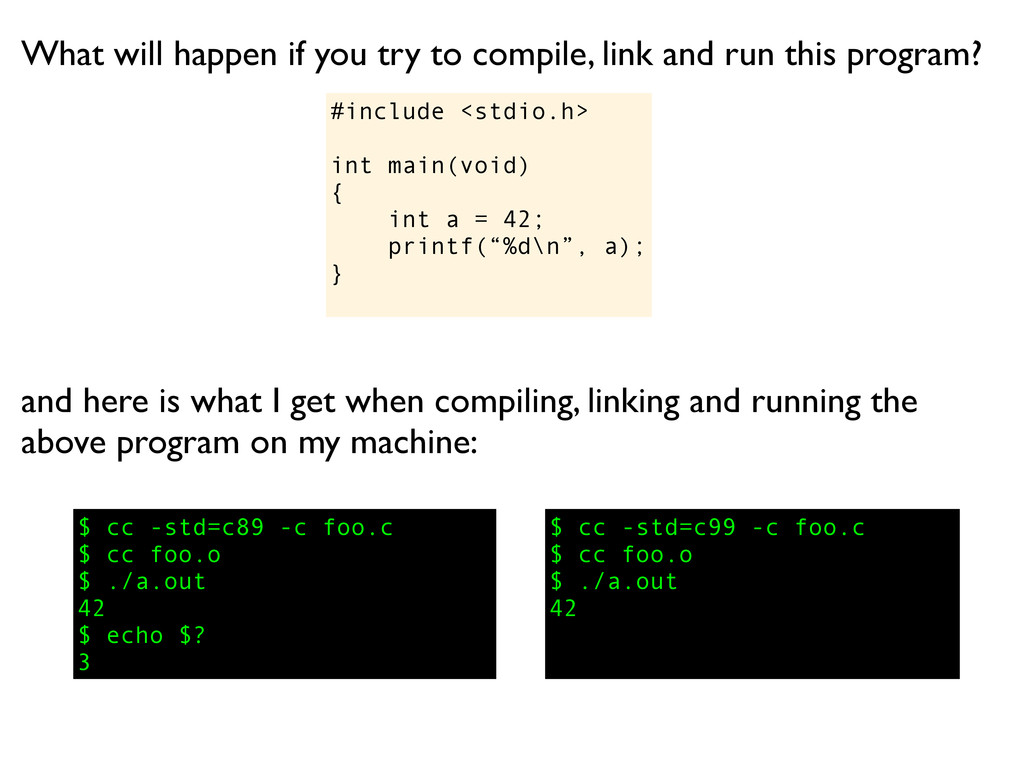
a); } What will happen if you try to compile, link and run this program? $ cc -std=c89 -c foo.c $ cc foo.o $ ./a.out 42 $ echo $? 3 and here is what I get when compiling, linking and running the above program on my machine: $ cc -std=c99 -c foo.c $ cc foo.o $ ./a.out 42
a); } What will happen if you try to compile, link and run this program? $ cc -std=c89 -c foo.c $ cc foo.o $ ./a.out 42 $ echo $? 3 and here is what I get when compiling, linking and running the above program on my machine: $ cc -std=c99 -c foo.c $ cc foo.o $ ./a.out 42 $ echo $?
a); } What will happen if you try to compile, link and run this program? $ cc -std=c89 -c foo.c $ cc foo.o $ ./a.out 42 $ echo $? 3 and here is what I get when compiling, linking and running the above program on my machine: $ cc -std=c99 -c foo.c $ cc foo.o $ ./a.out 42 $ echo $? 0
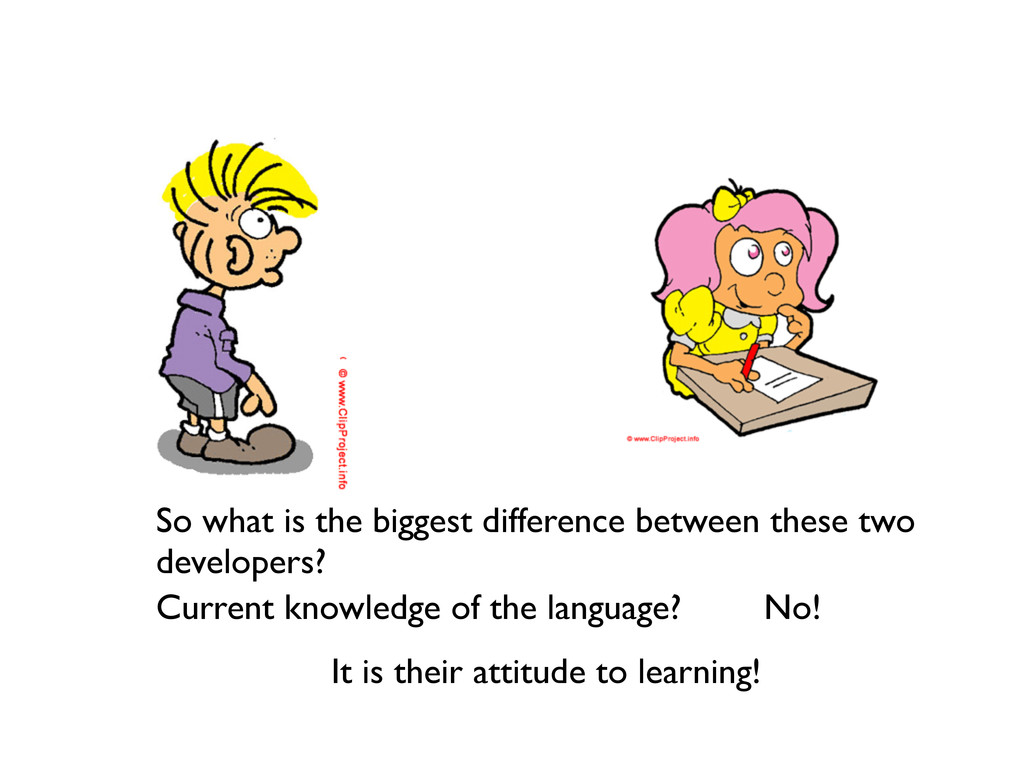
a deep understanding of the programming language they are using? Now suppose they are not really candidates. Perhaps they are stereotypes for engineers working in your organization?
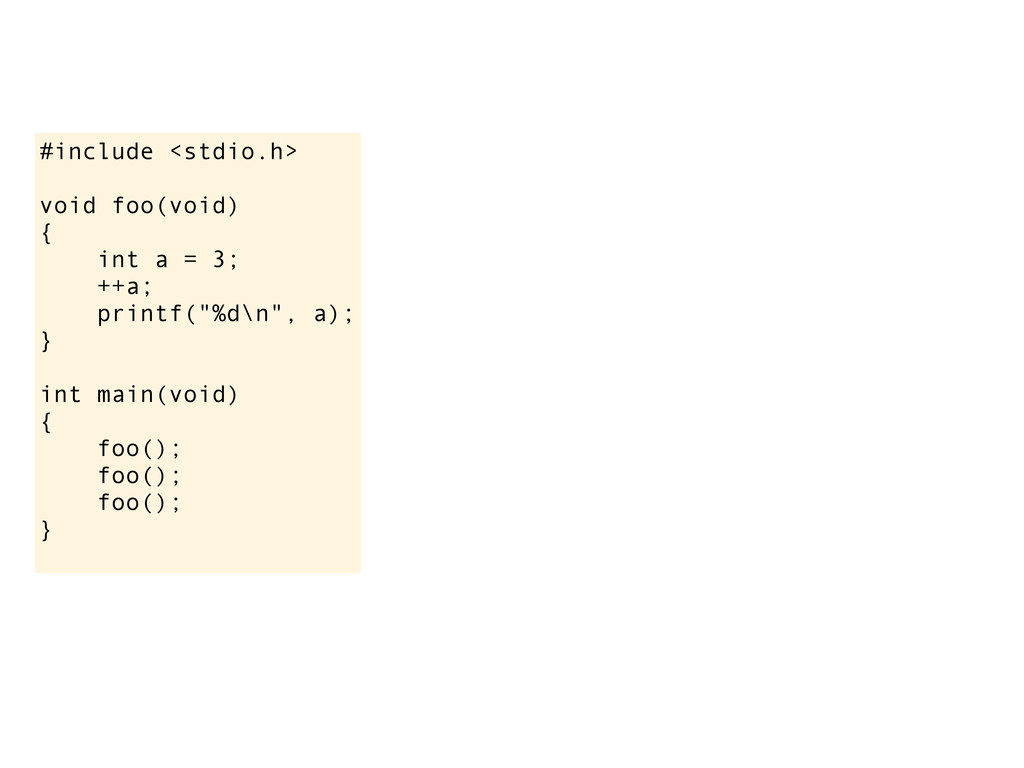
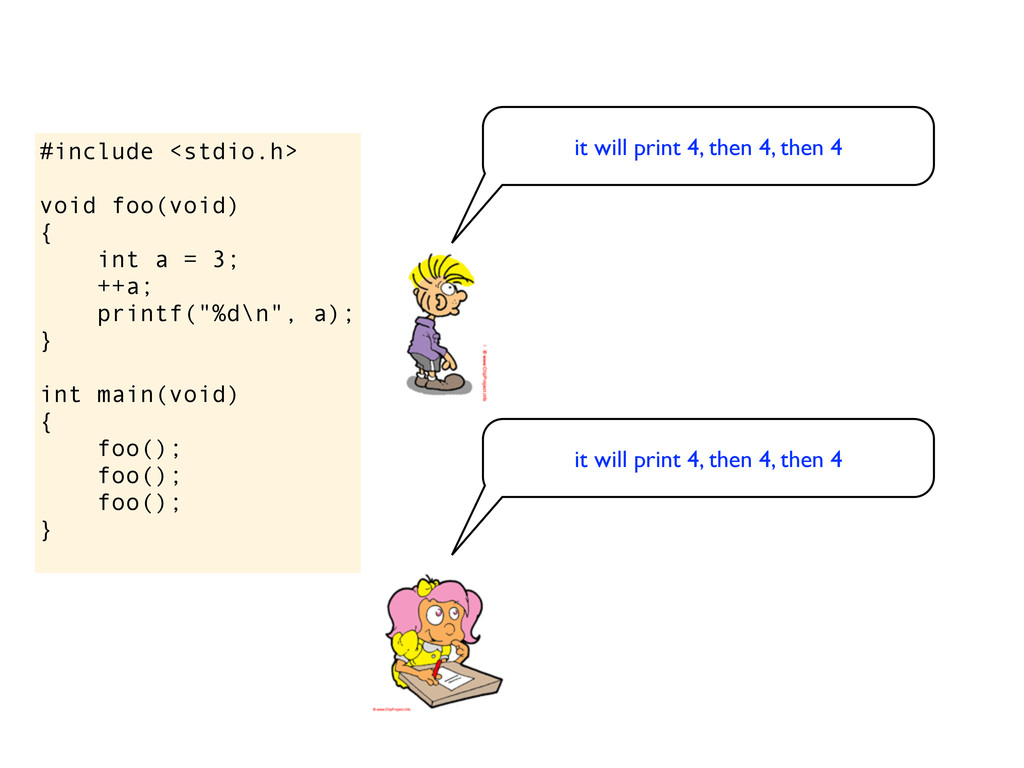
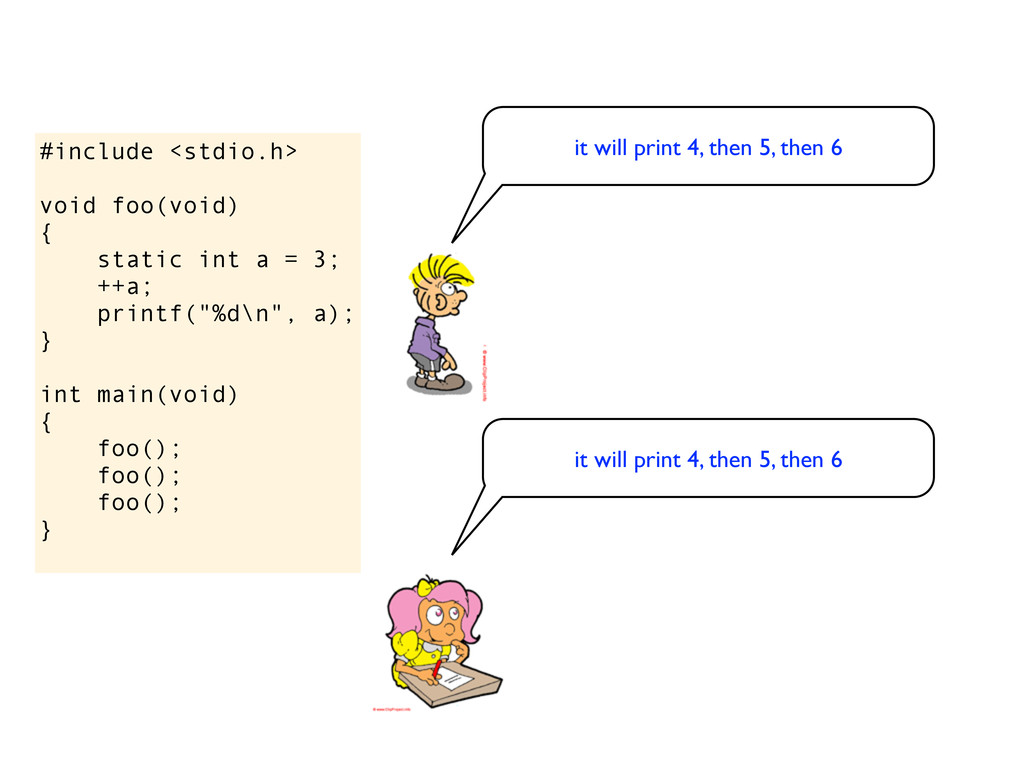
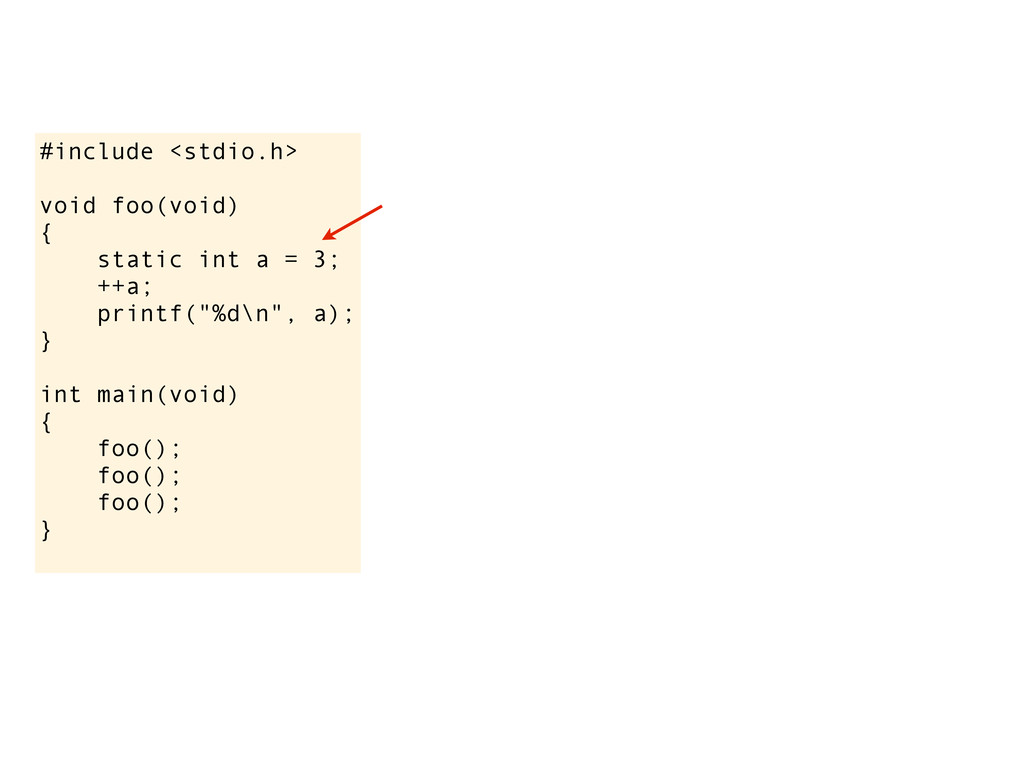
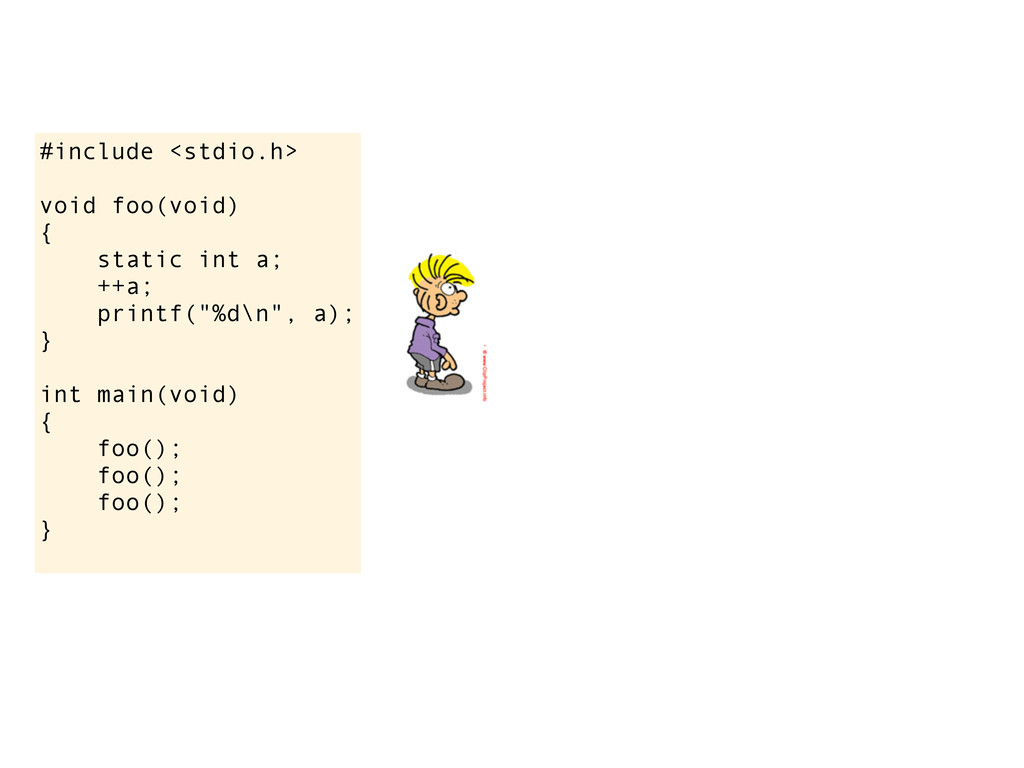
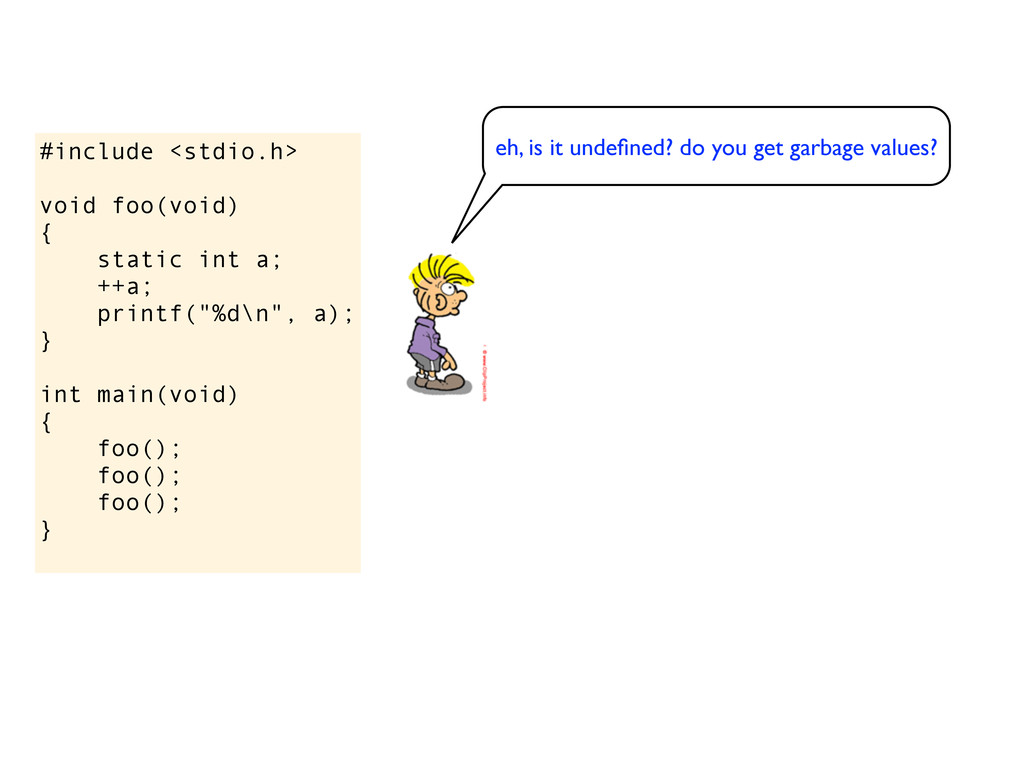
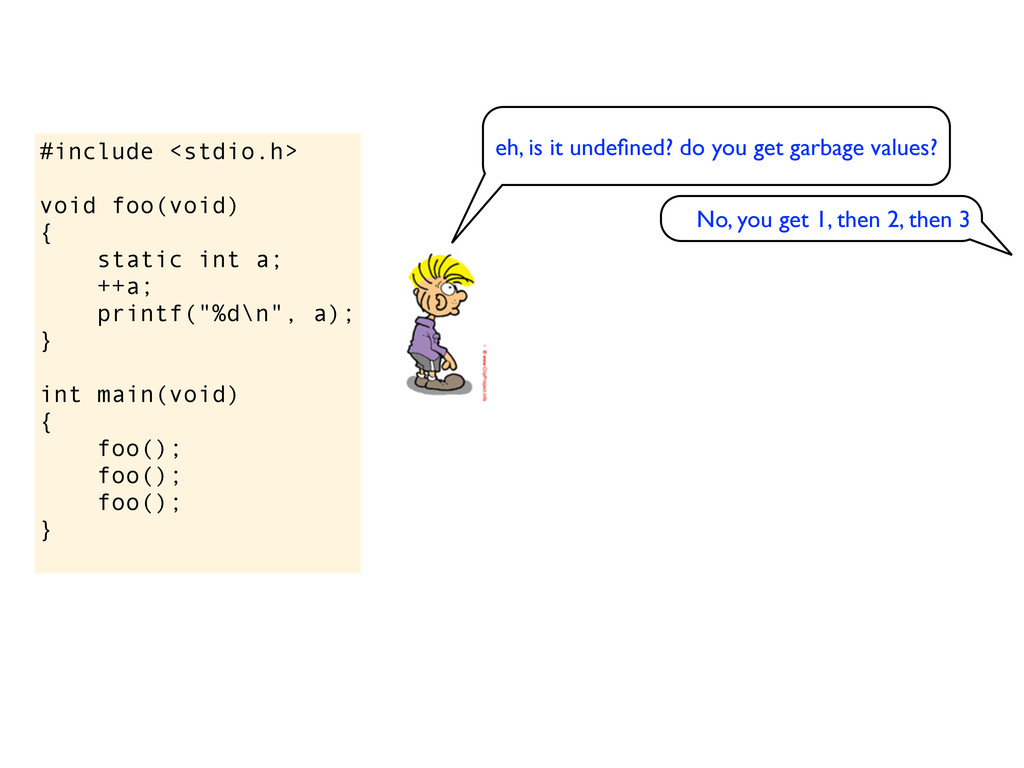
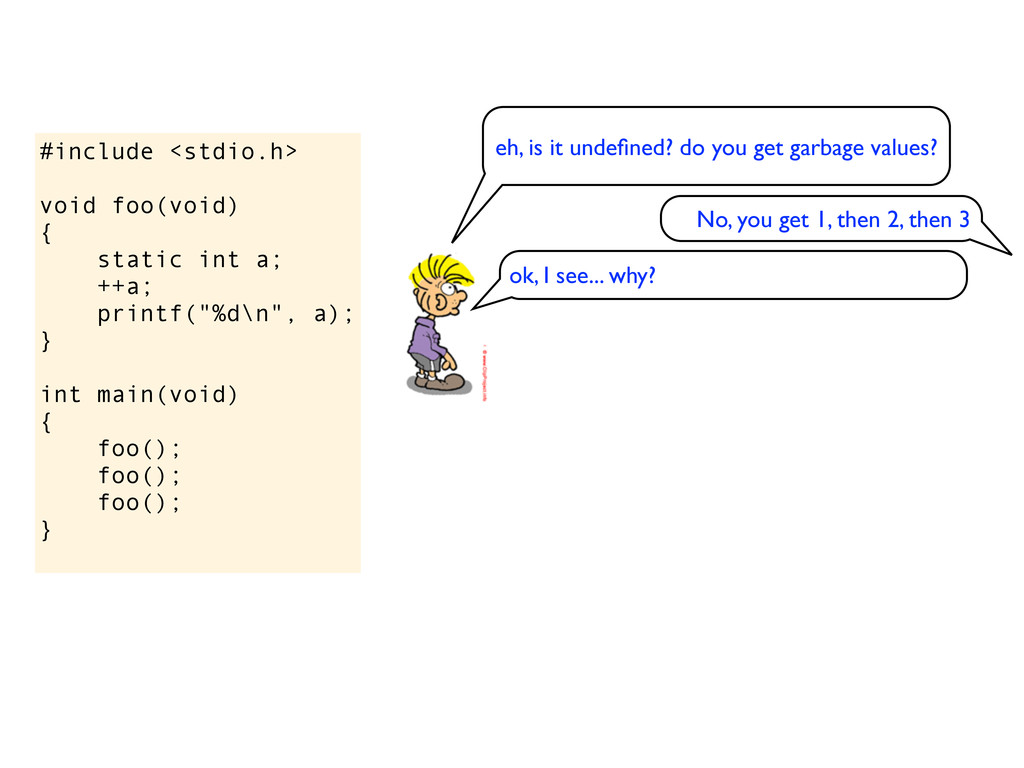
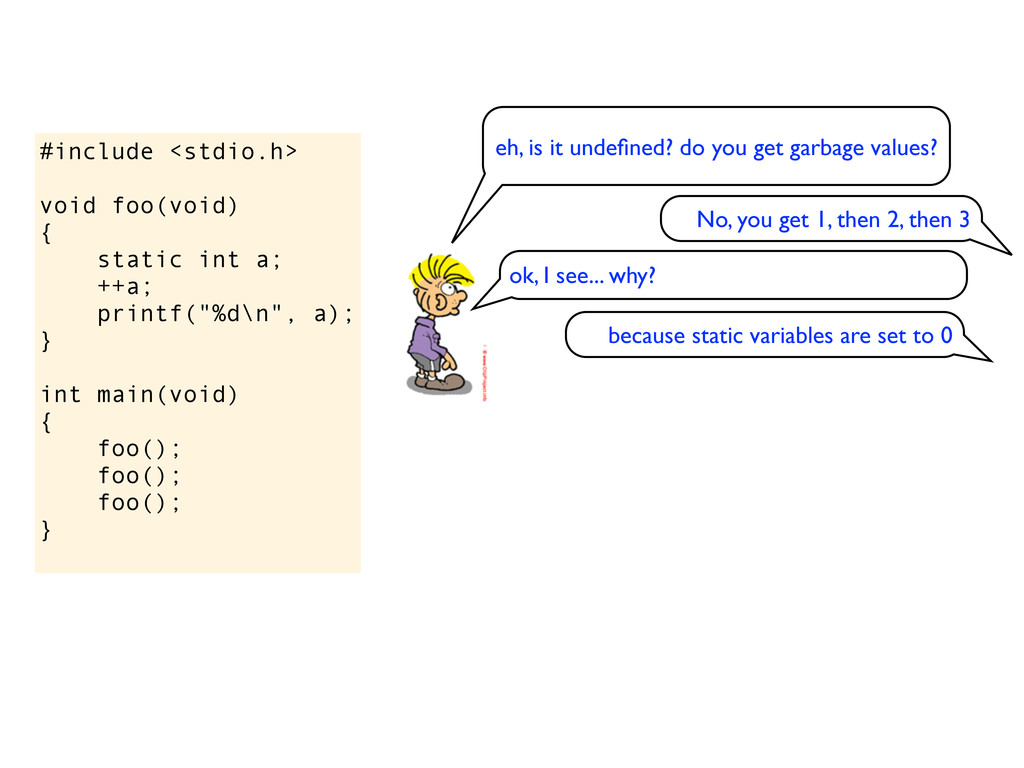
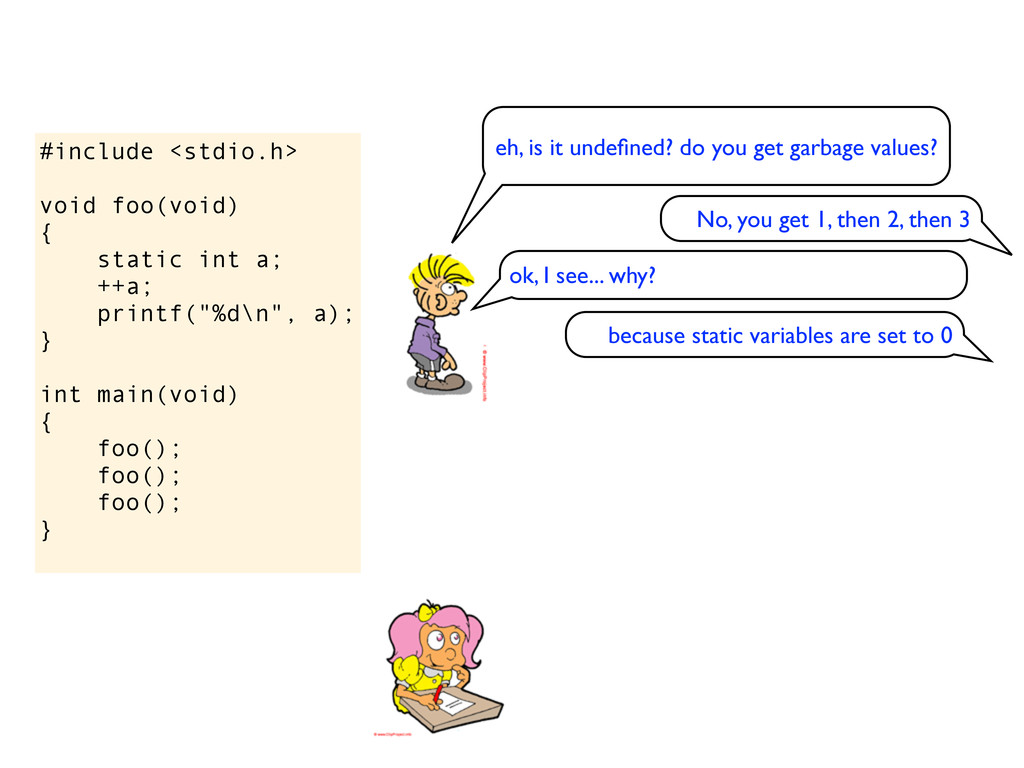
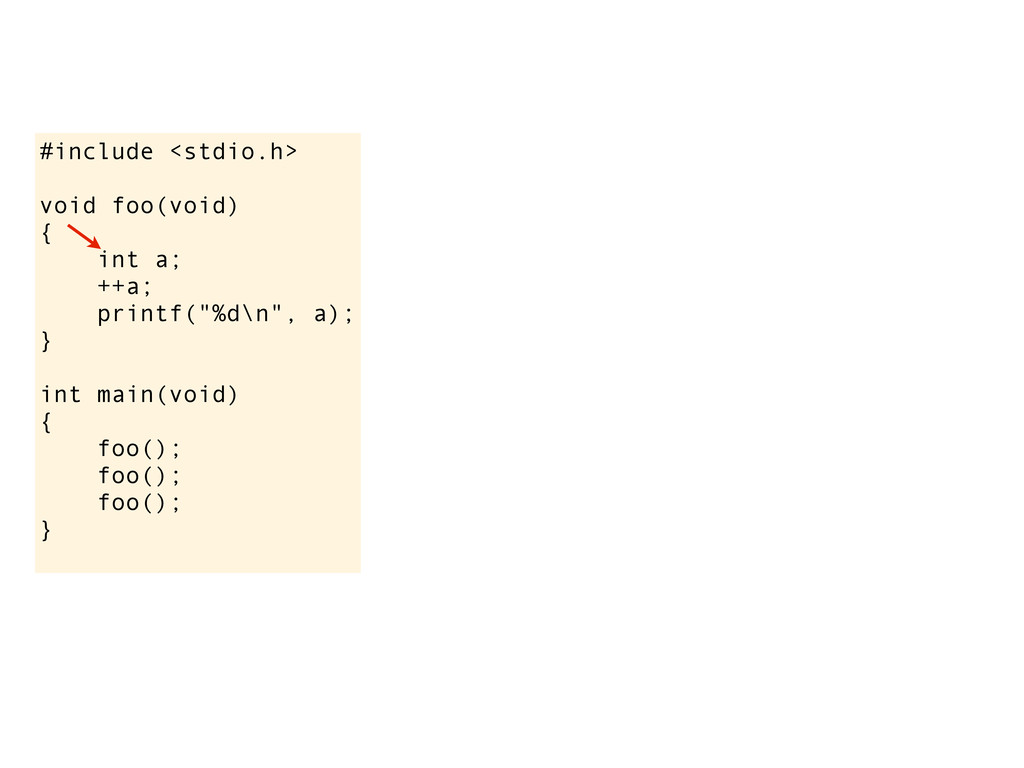
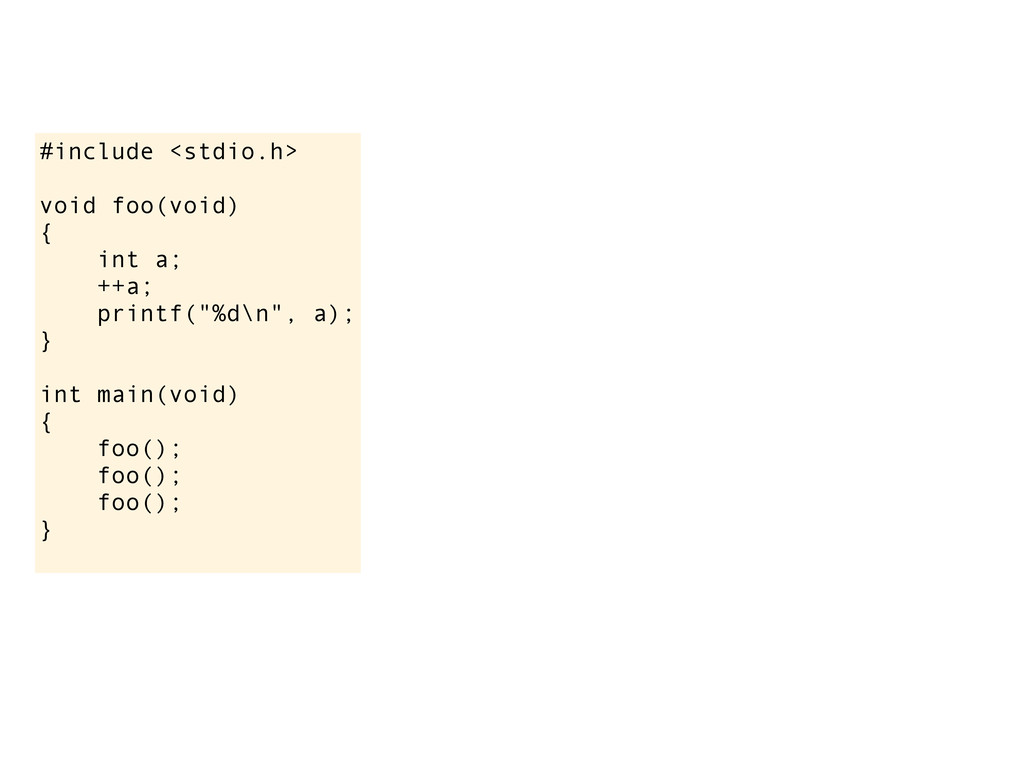
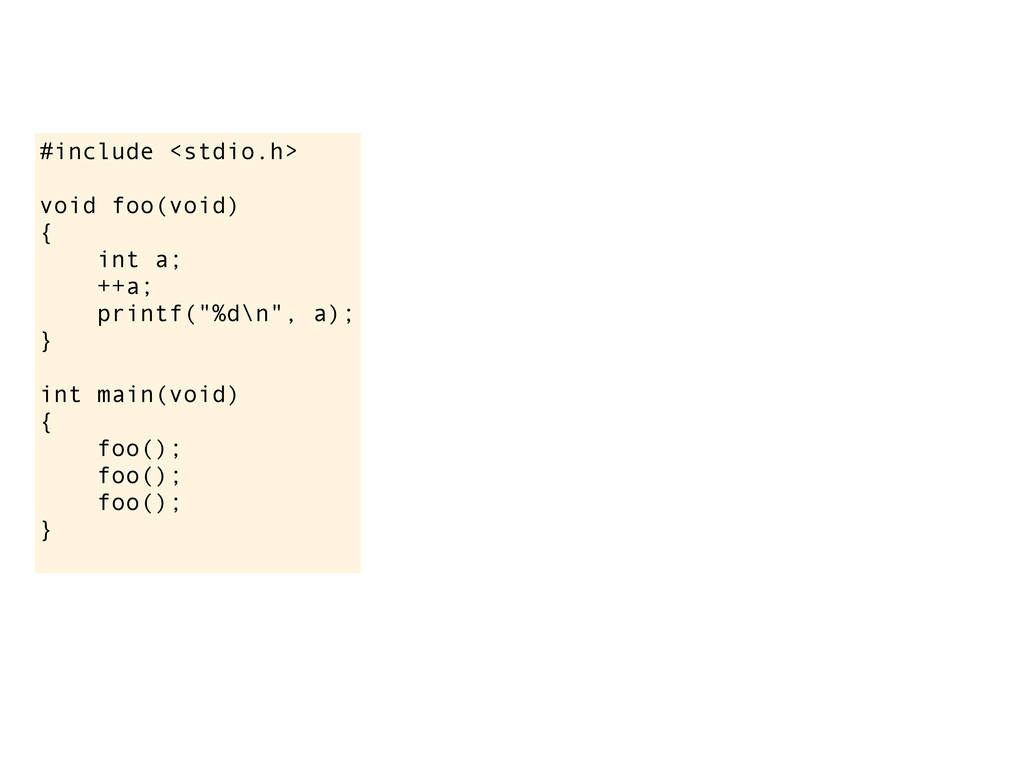
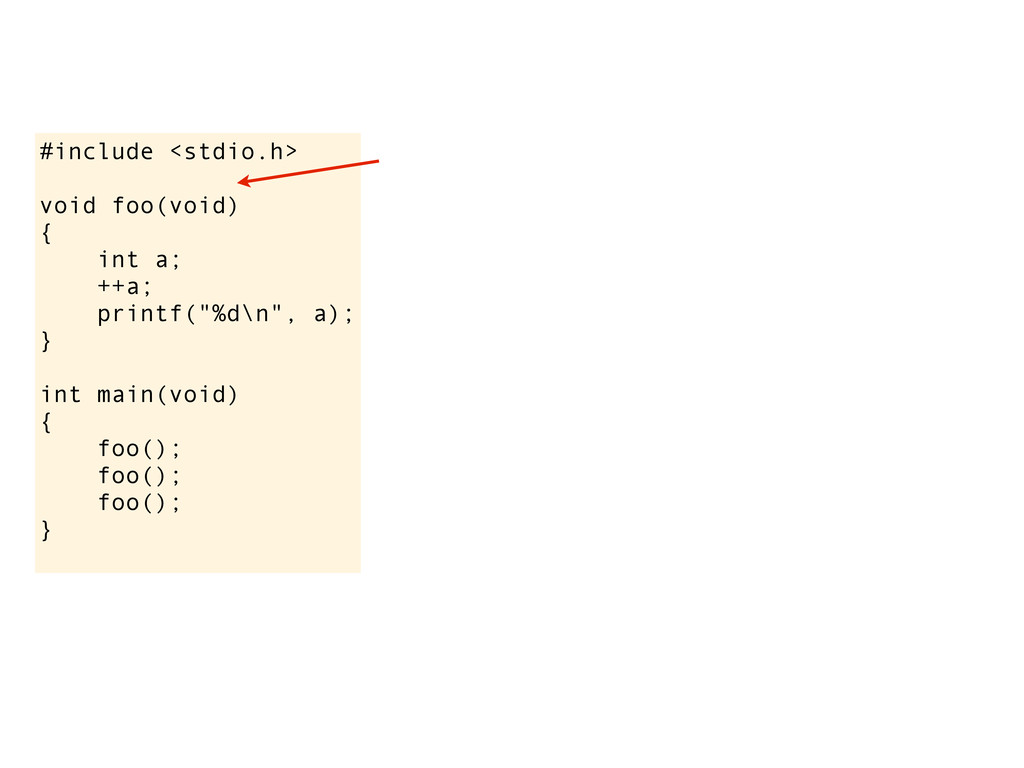
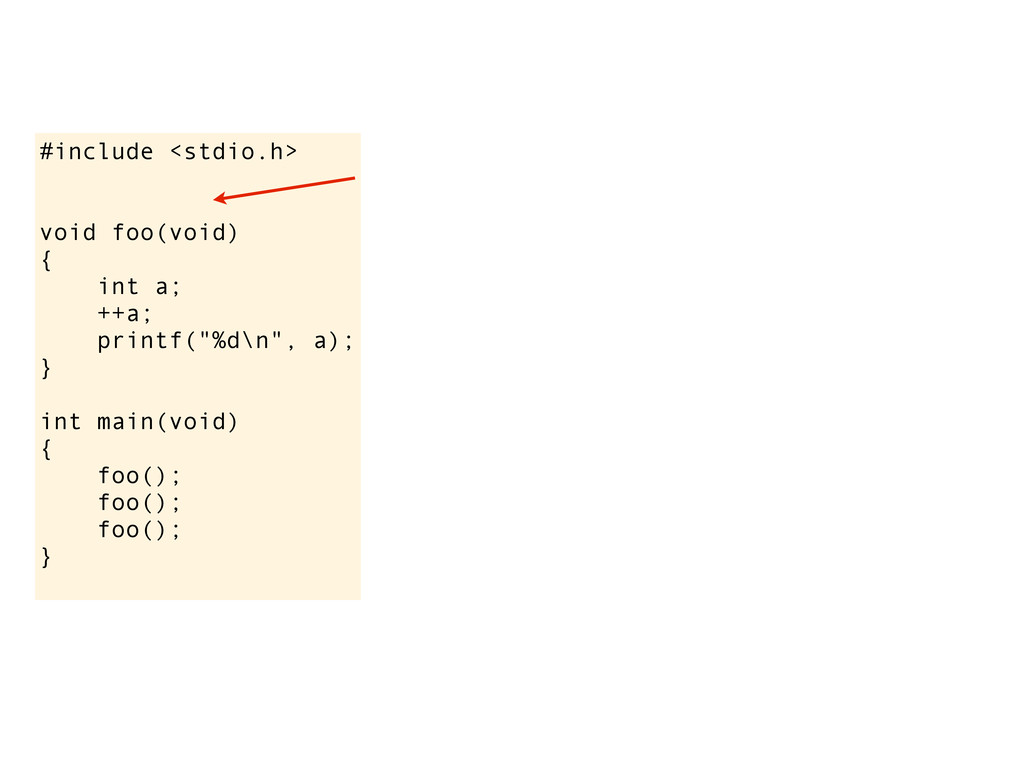
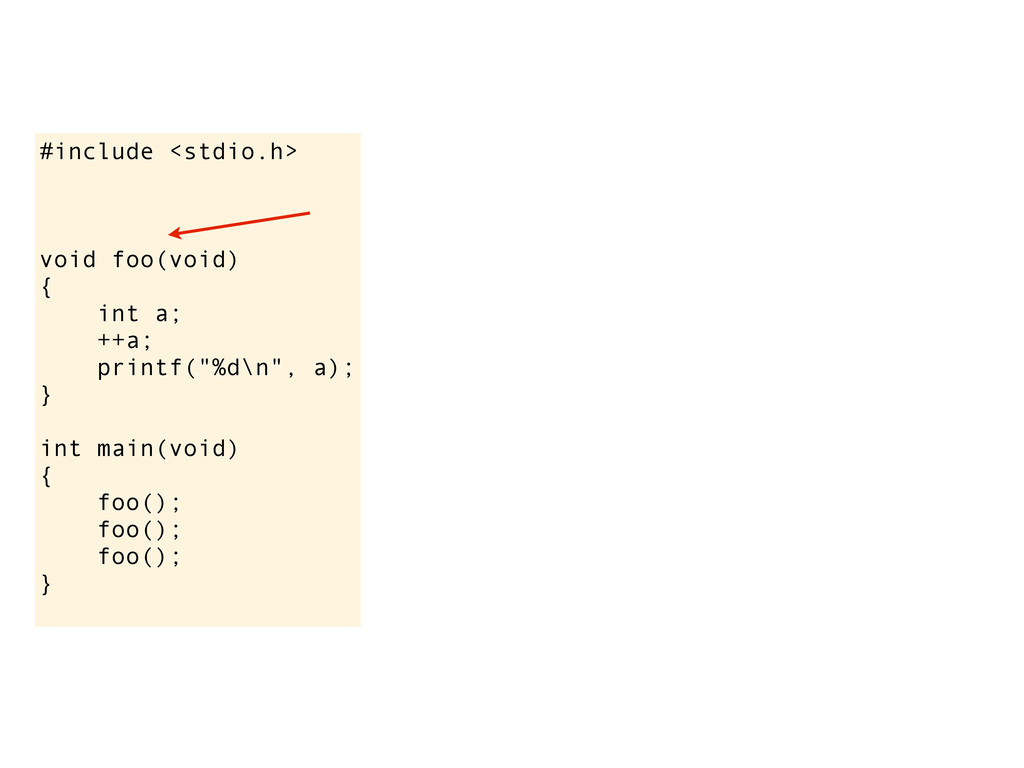
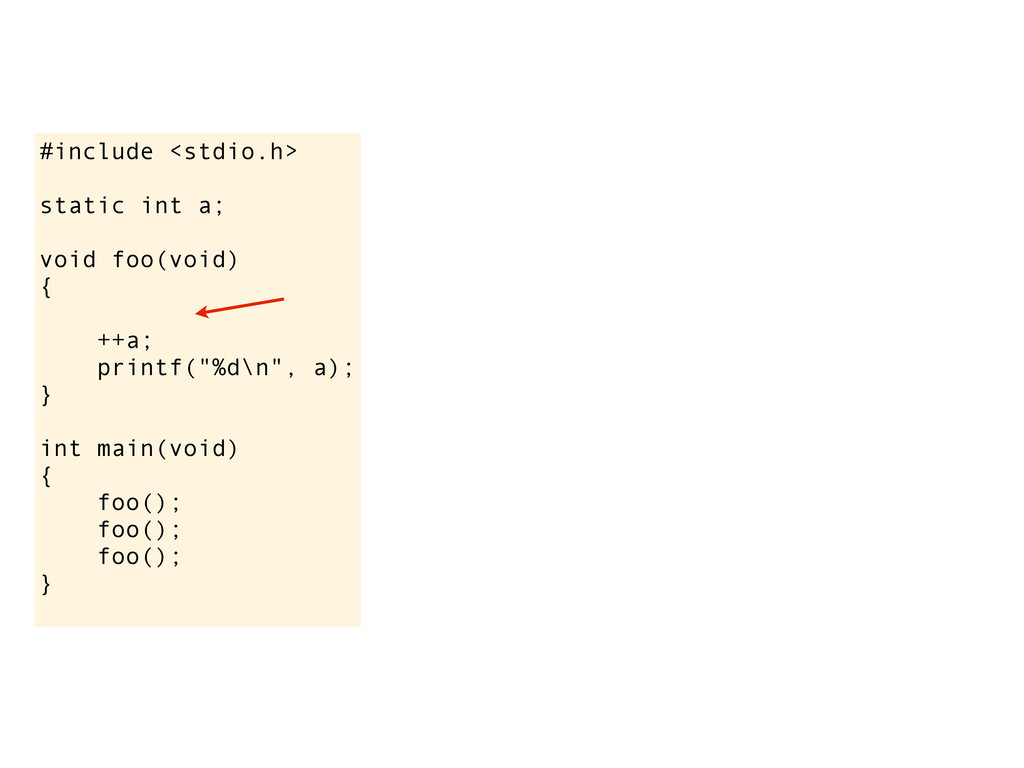
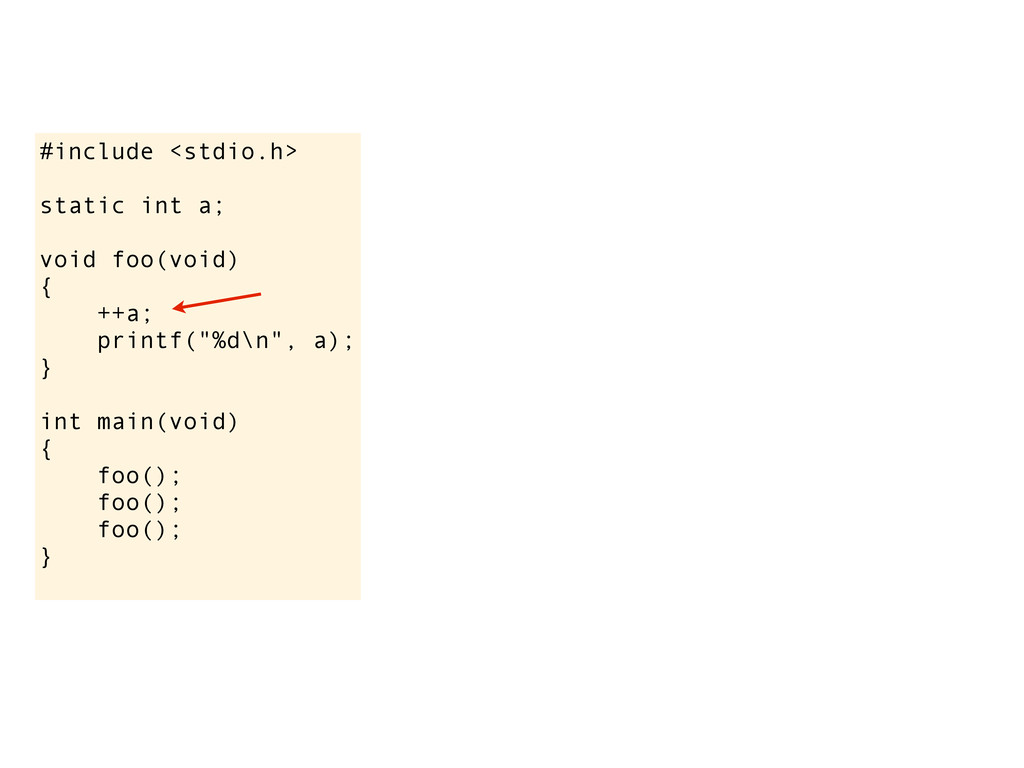
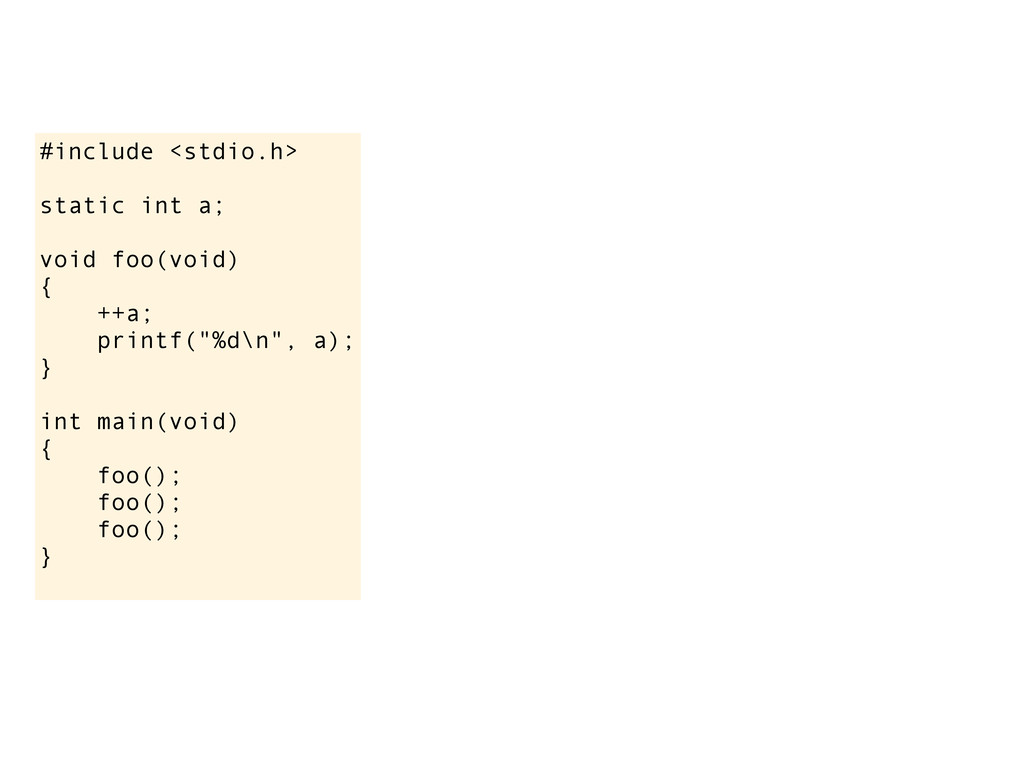
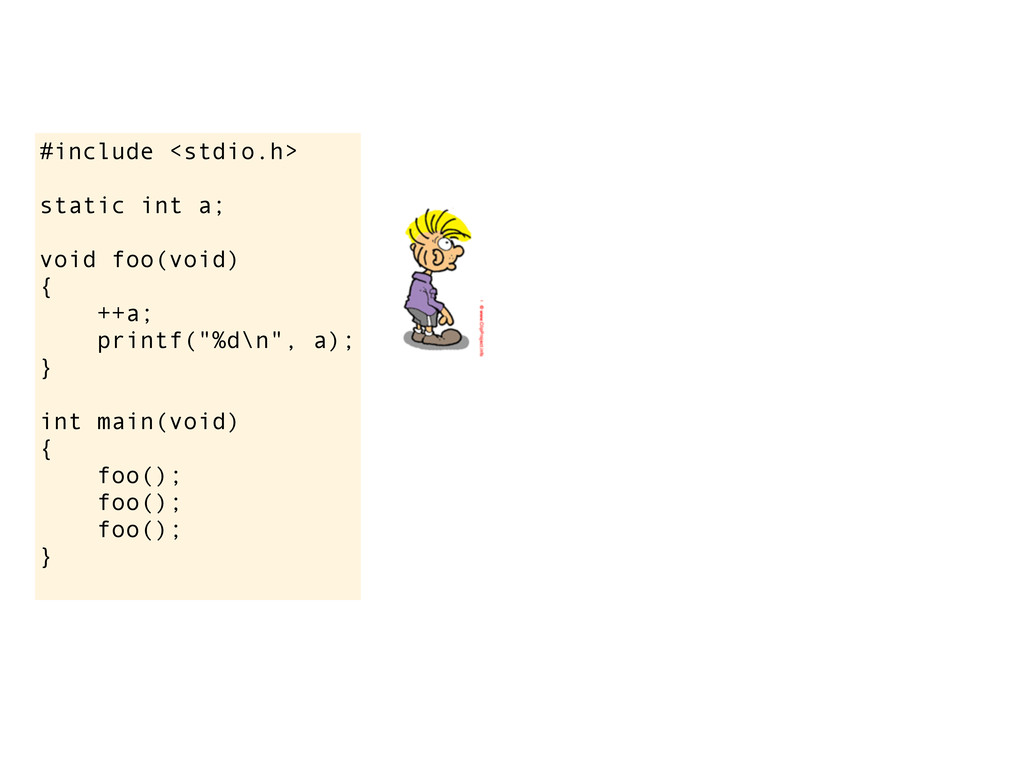
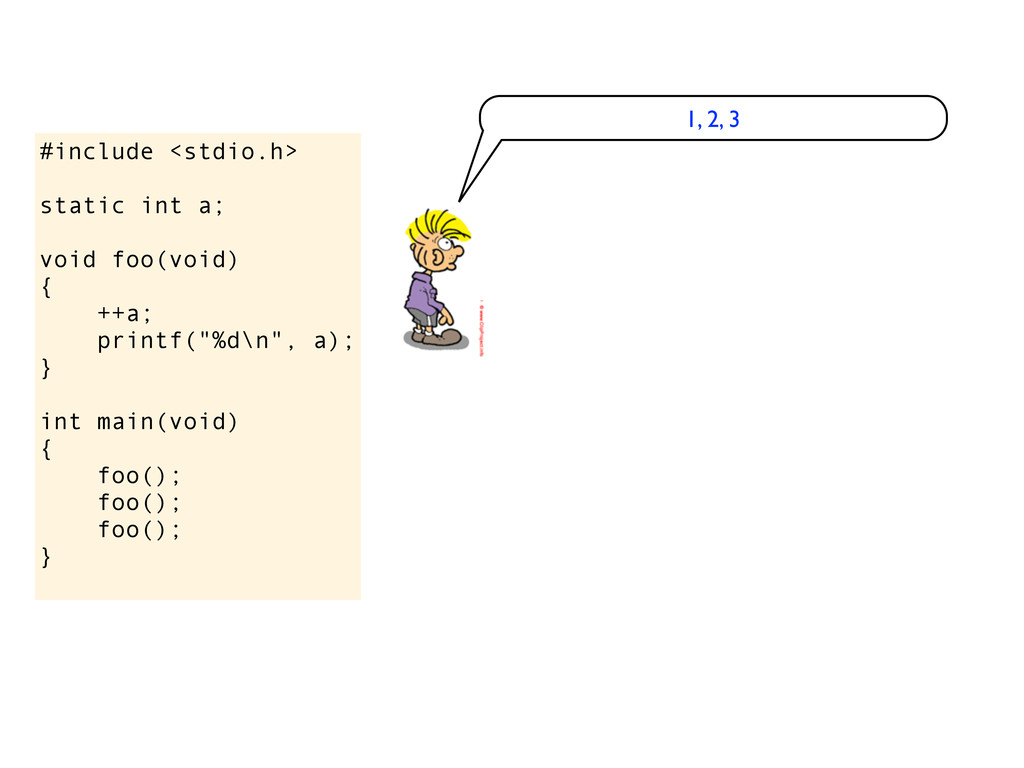
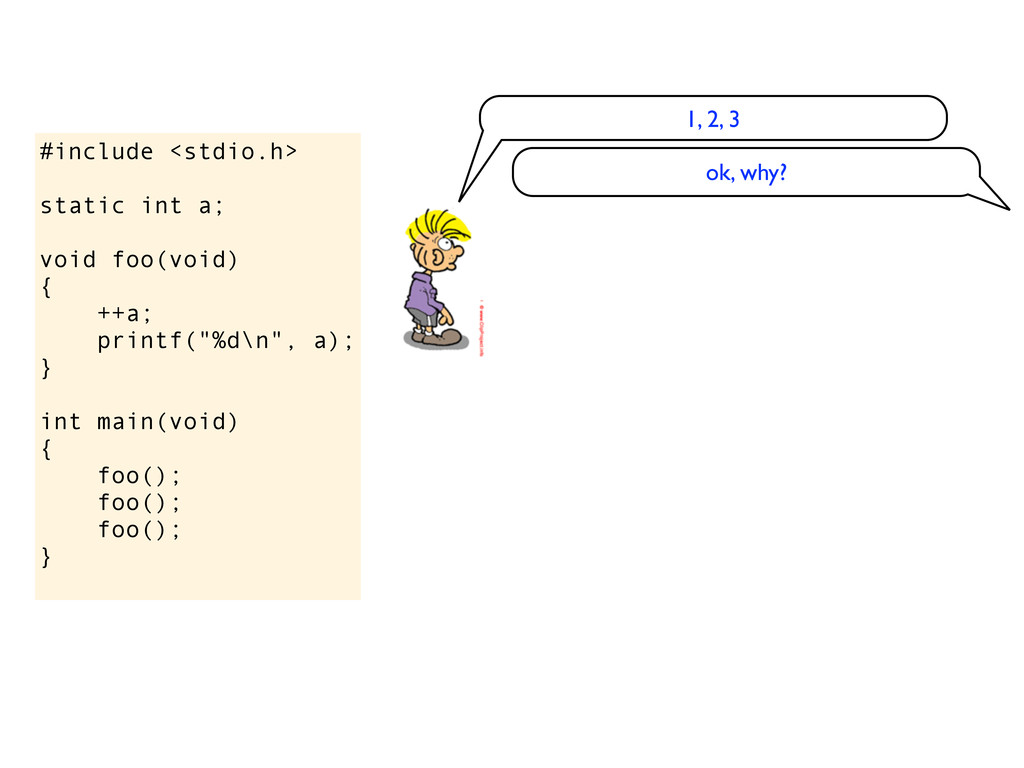
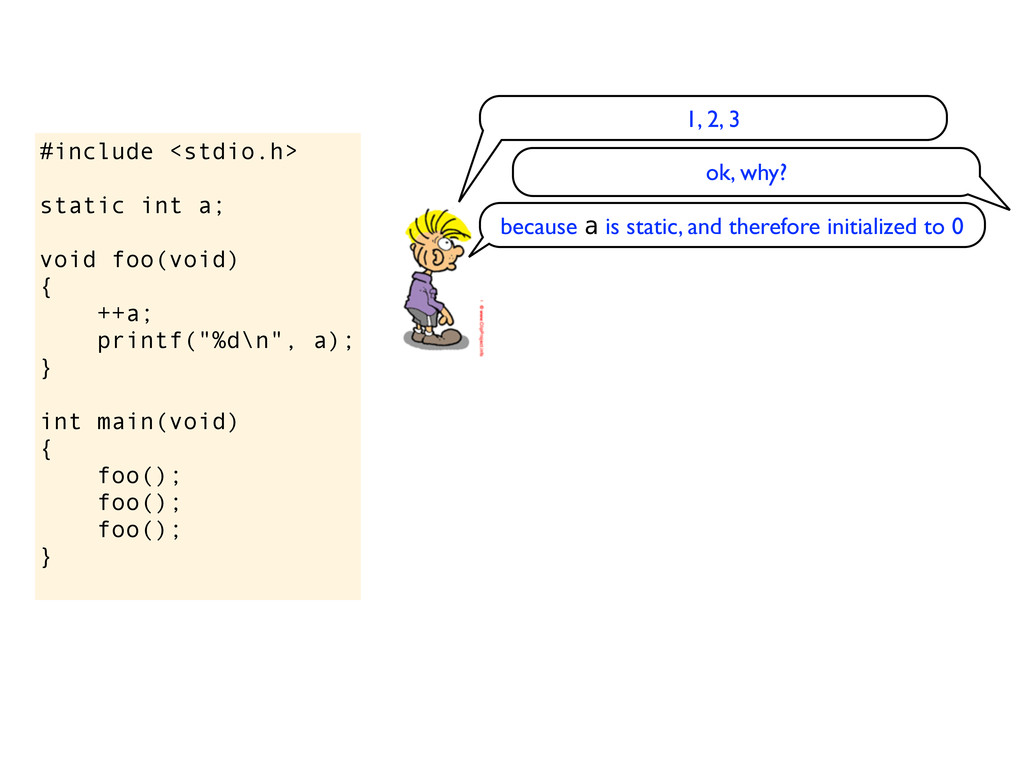
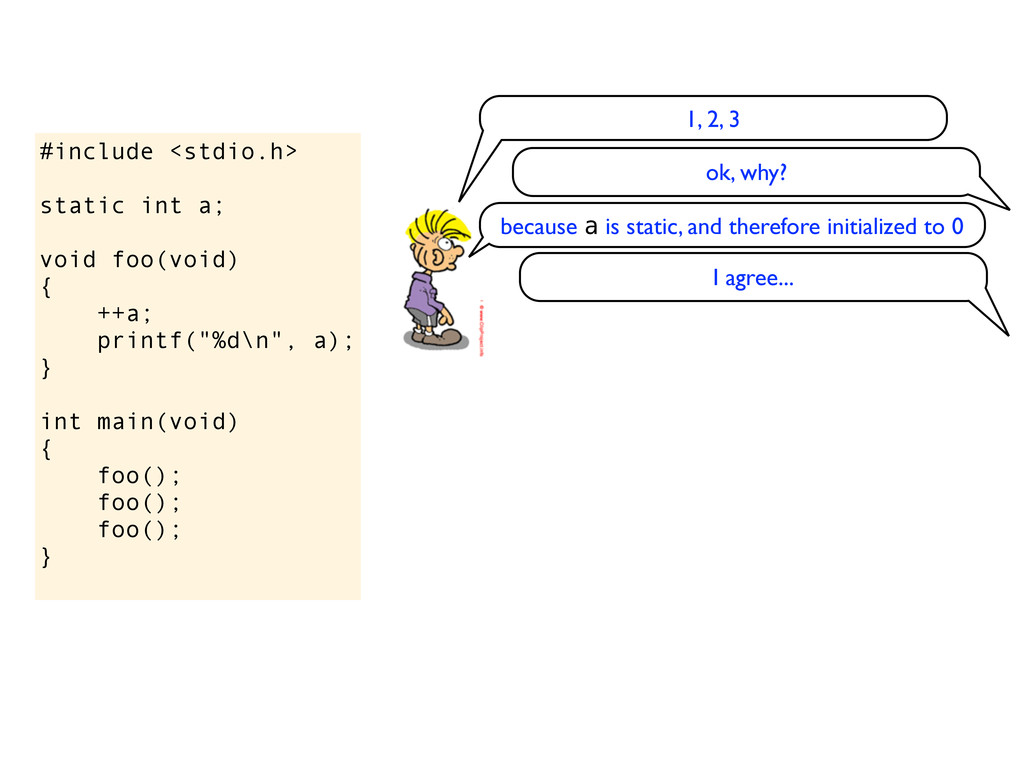
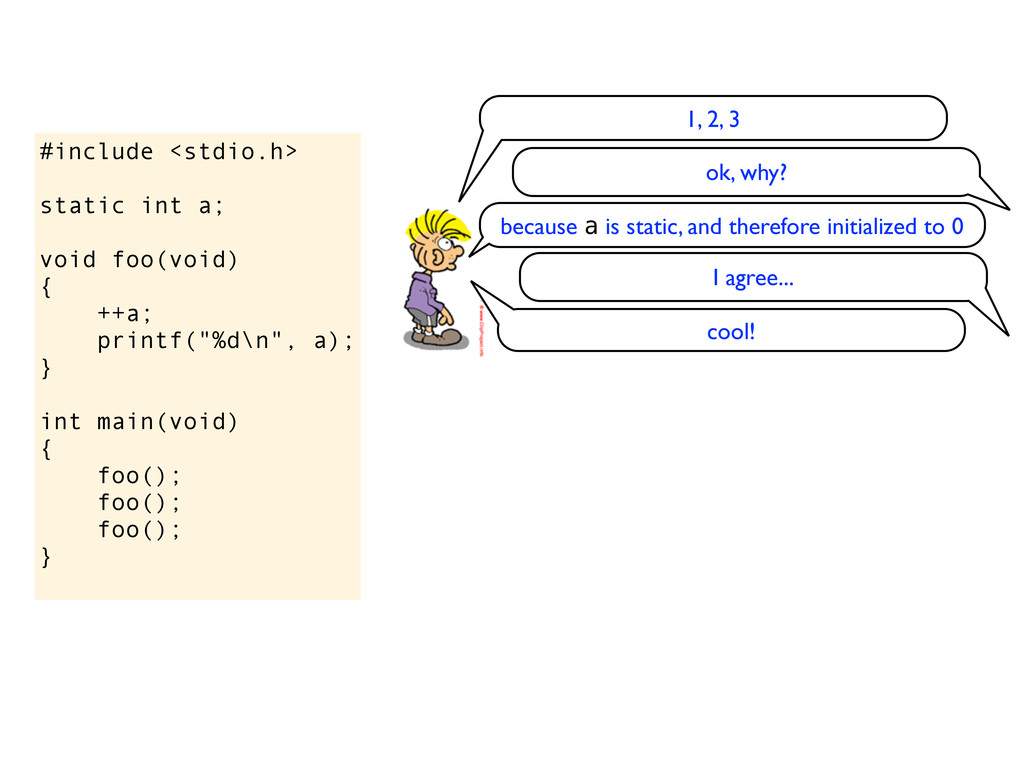
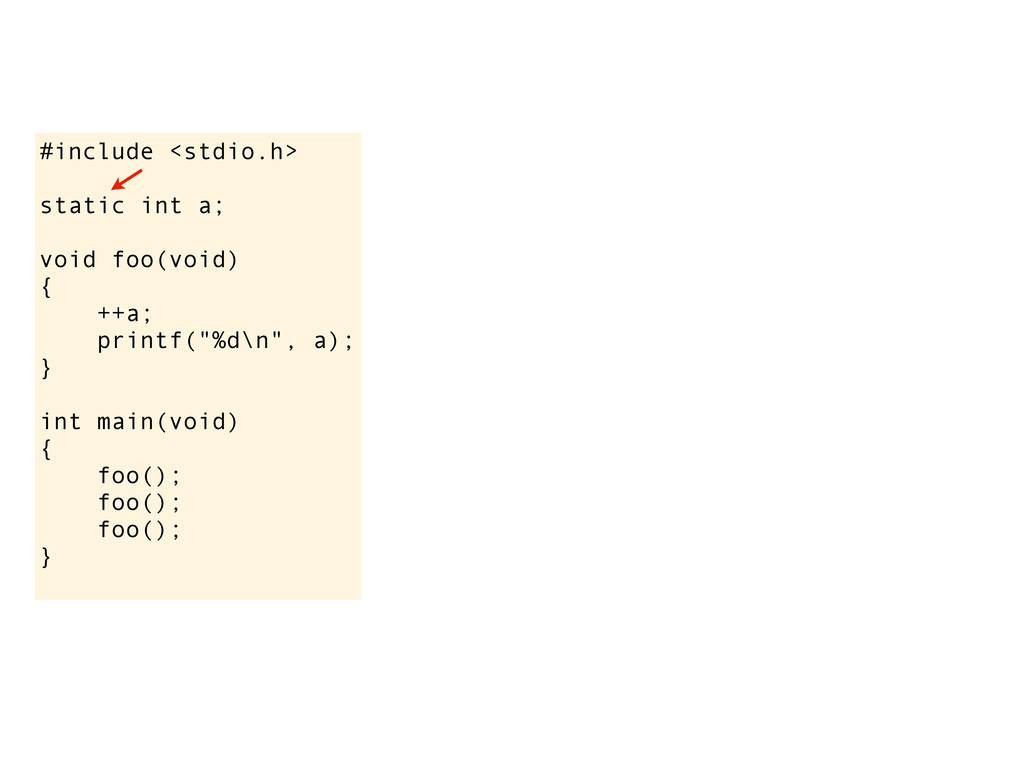
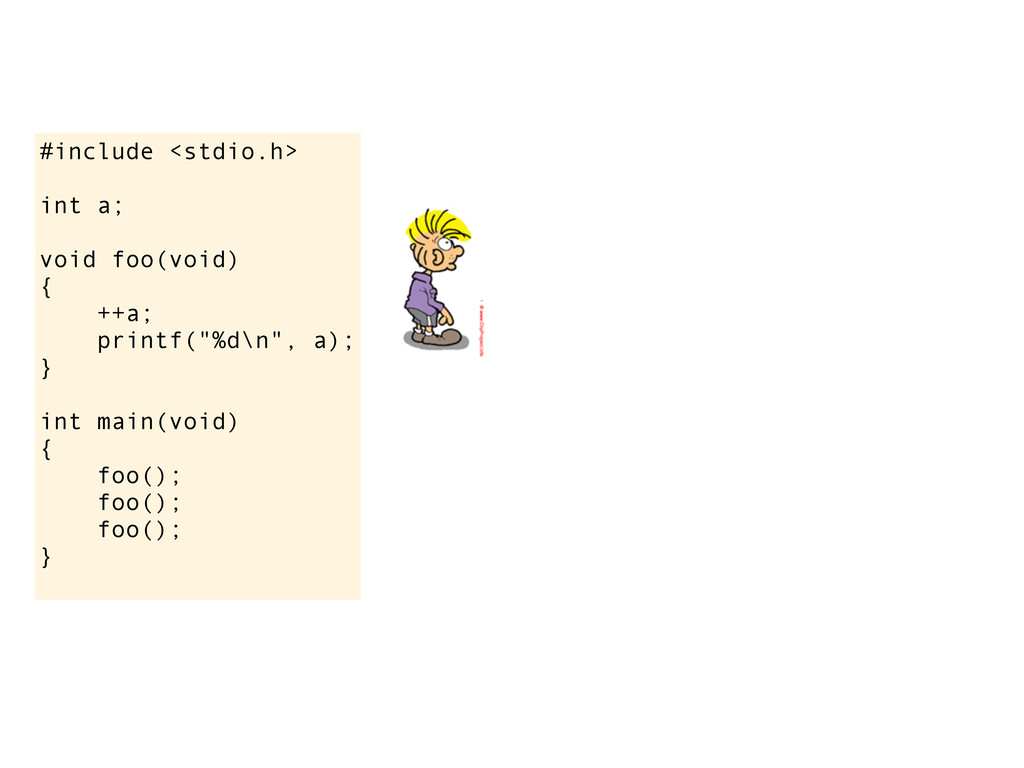
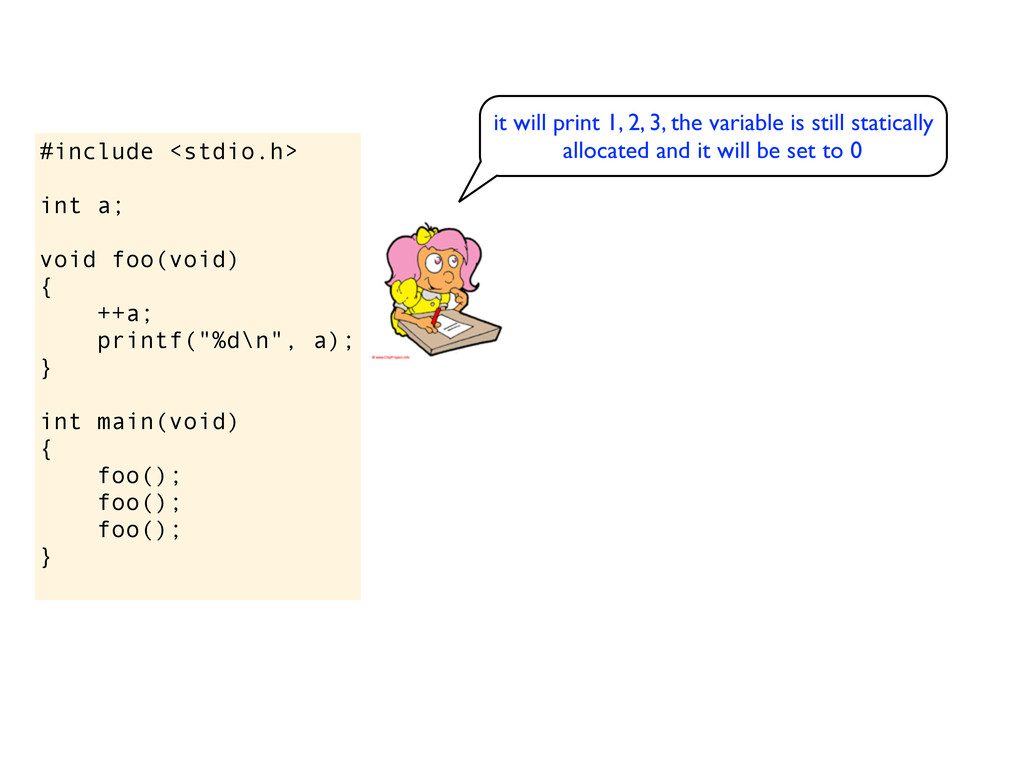
a); } int main(void) { foo(); foo(); foo(); } eh, is it undefined? do you get garbage values? No, you get 1, then 2, then 3 ok, I see... why? because static variables are set to 0
a); } int main(void) { foo(); foo(); foo(); } eh, is it undefined? do you get garbage values? No, you get 1, then 2, then 3 ok, I see... why? because static variables are set to 0
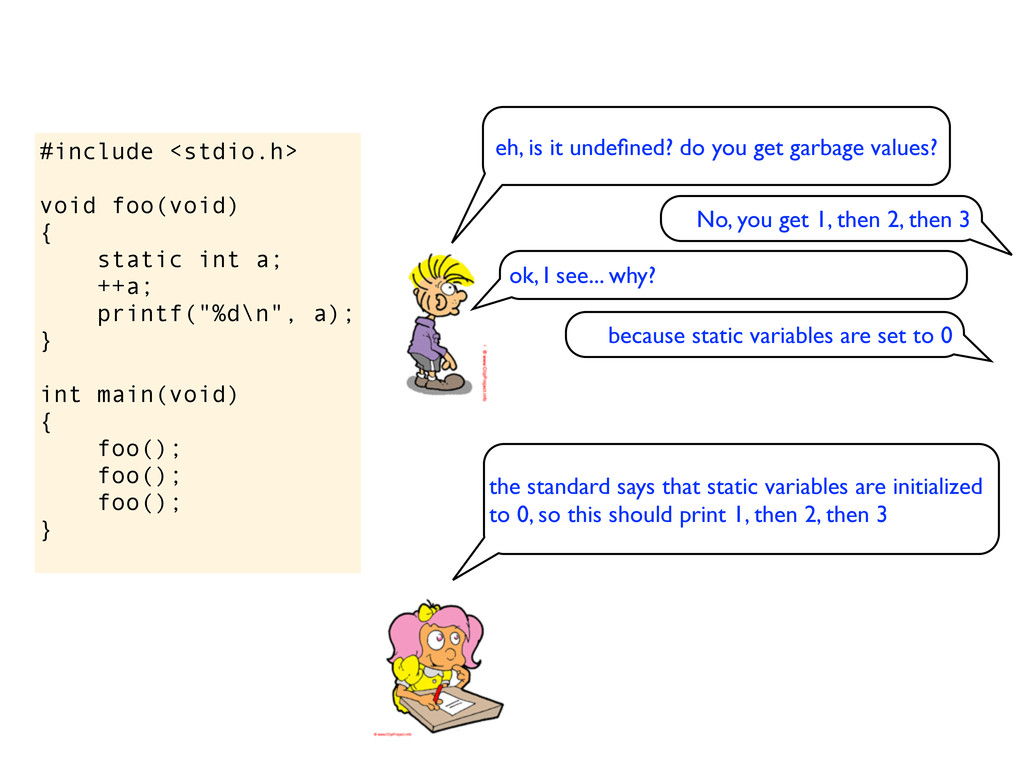
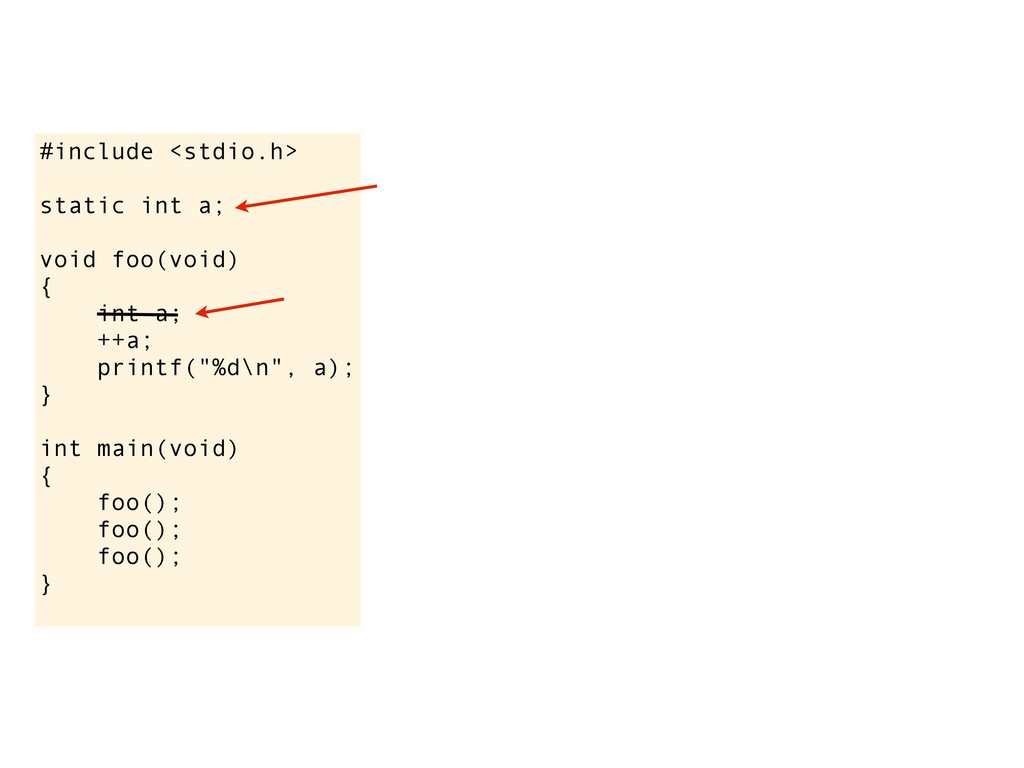
a); } int main(void) { foo(); foo(); foo(); } eh, is it undefined? do you get garbage values? the standard says that static variables are initialized to 0, so this should print 1, then 2, then 3 No, you get 1, then 2, then 3 ok, I see... why? because static variables are set to 0
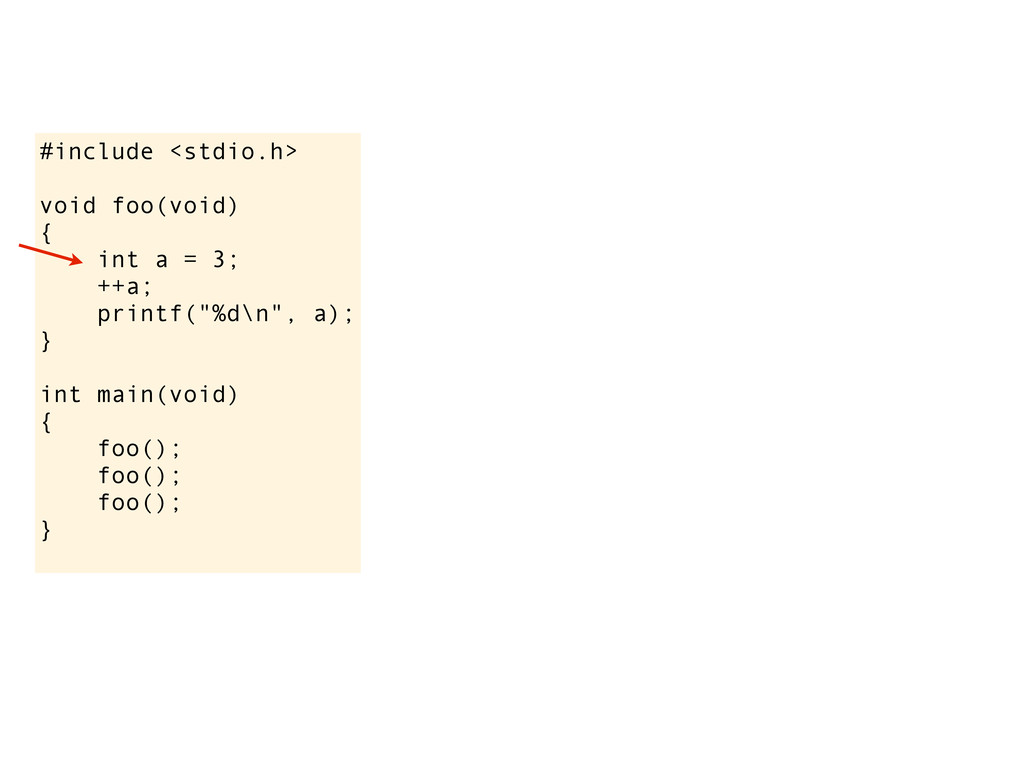
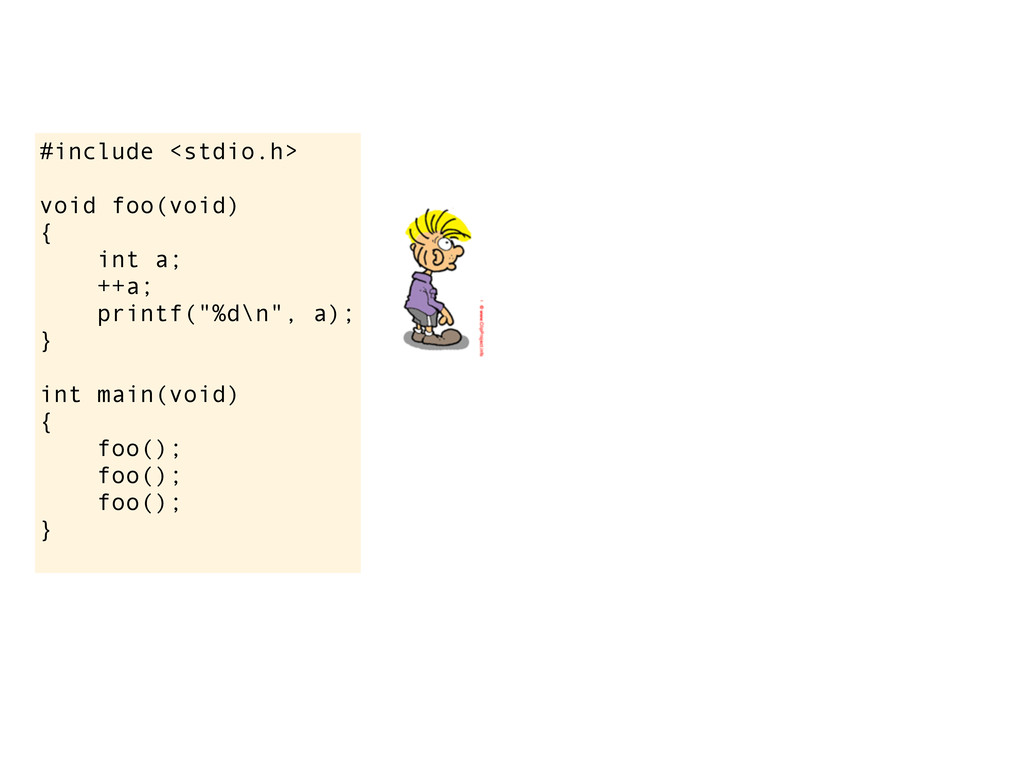
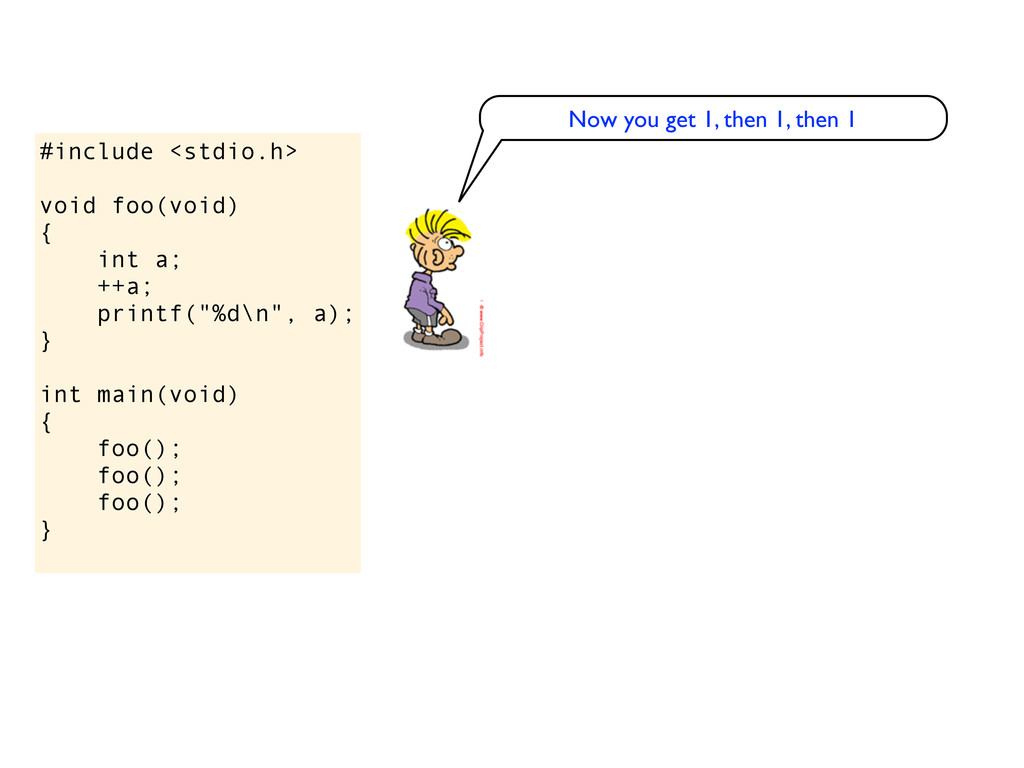
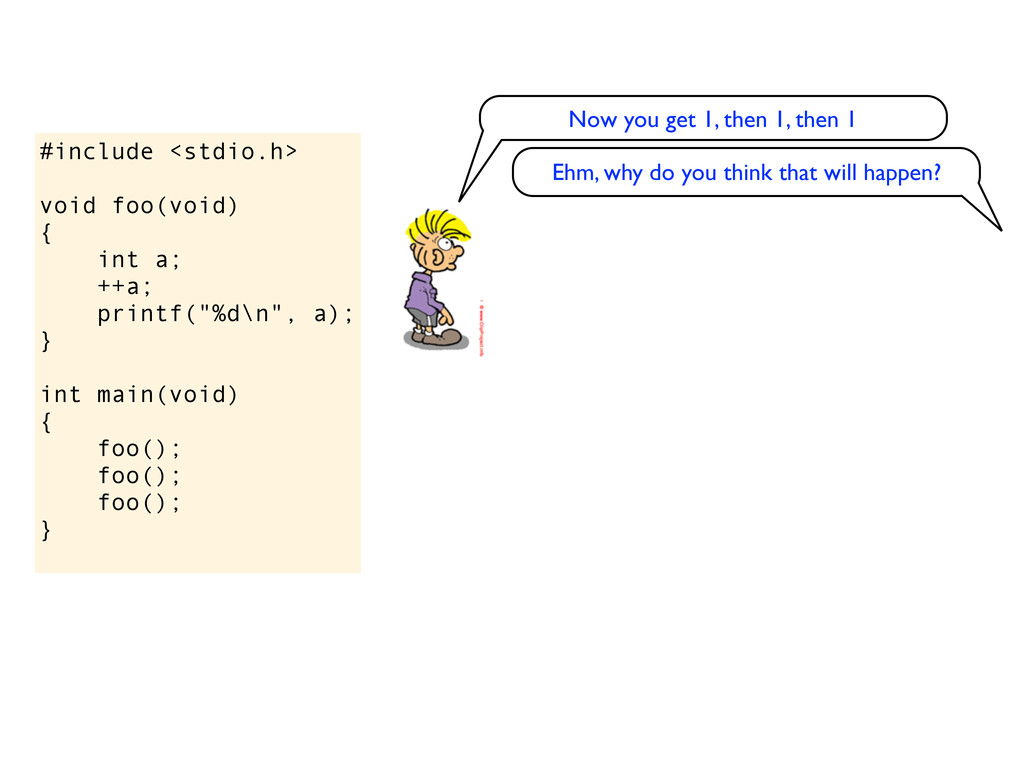
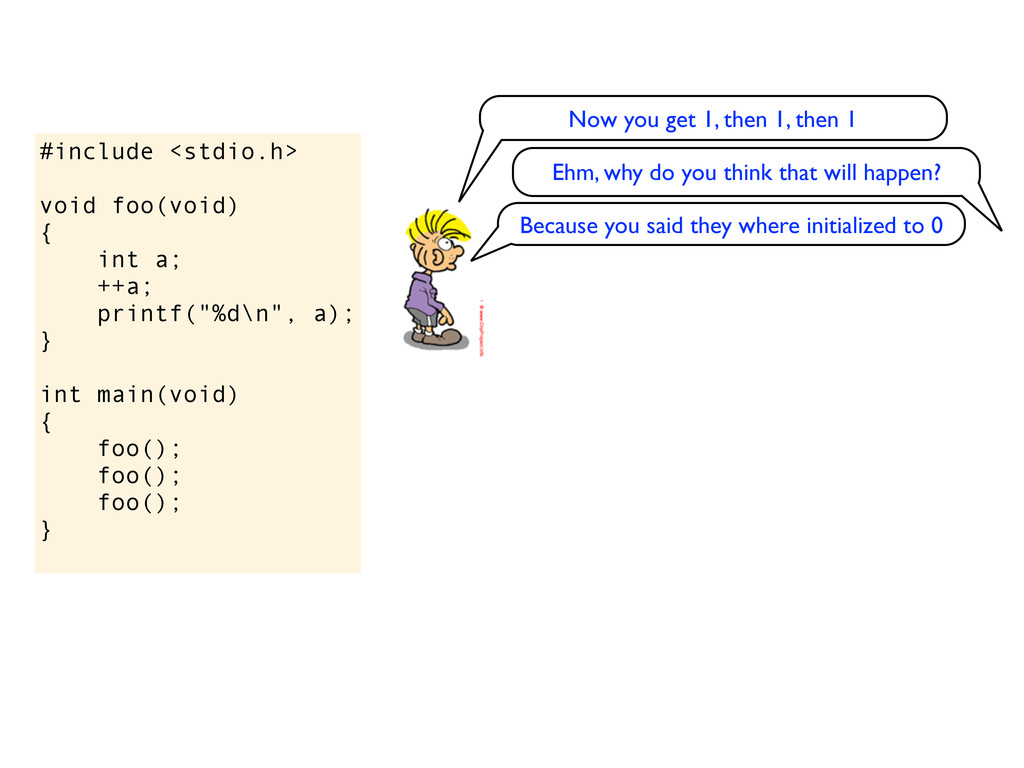
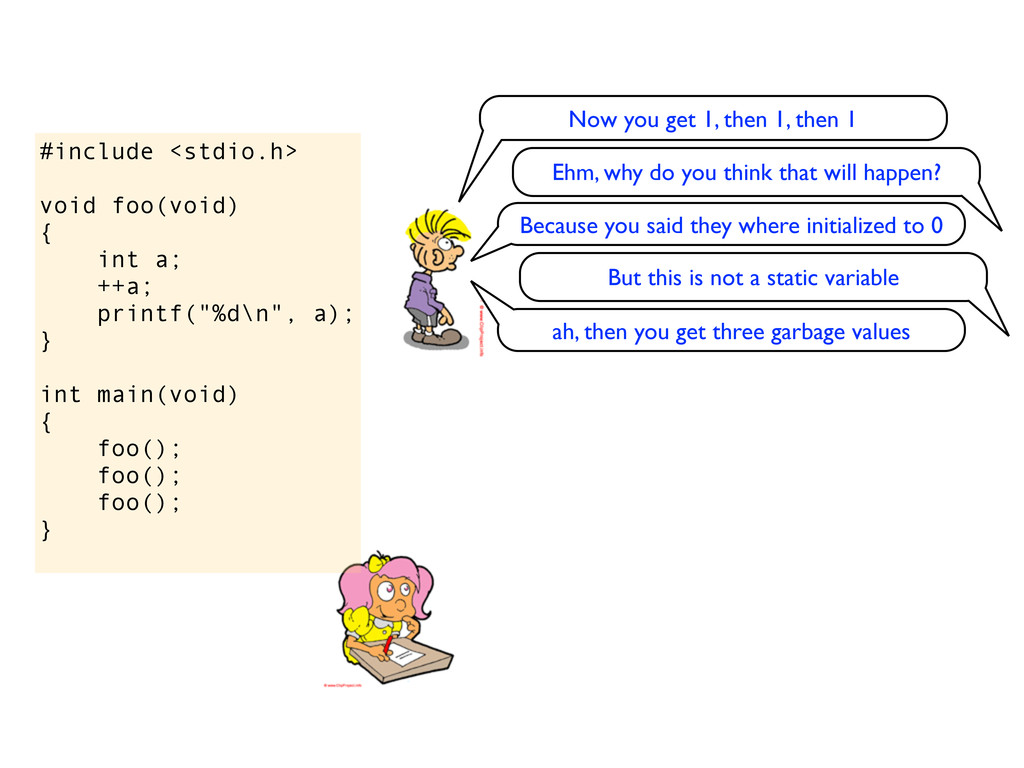
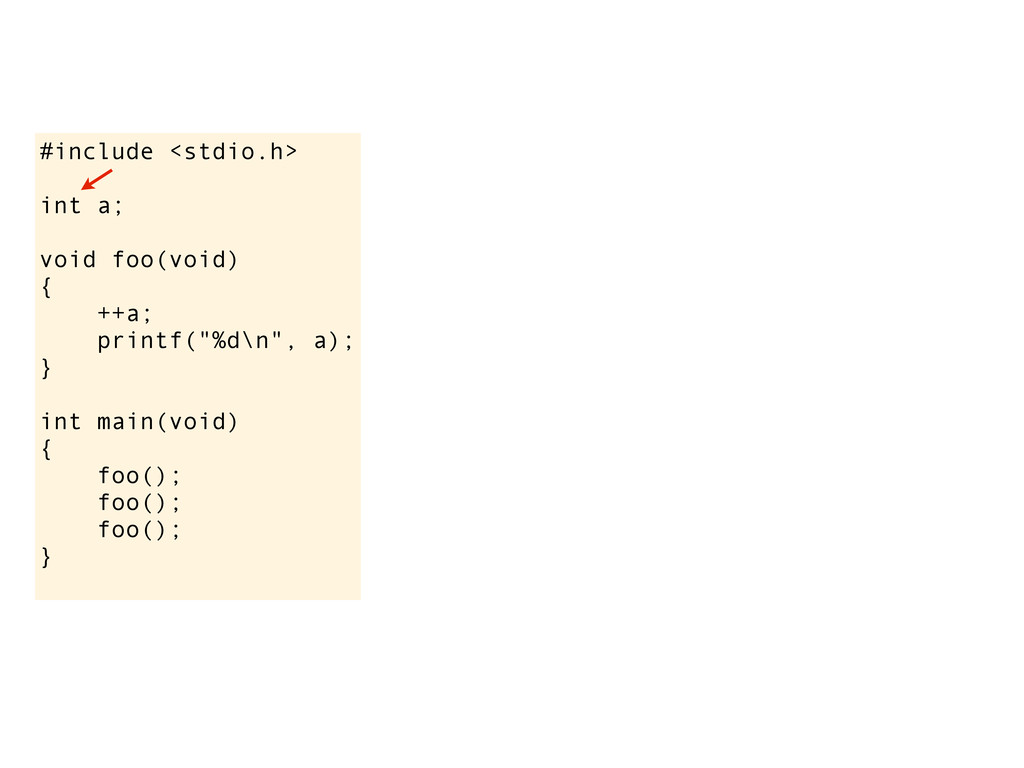
} int main(void) { foo(); foo(); foo(); } Now you get 1, then 1, then 1 Ehm, why do you think that will happen? Because you said they where initialized to 0
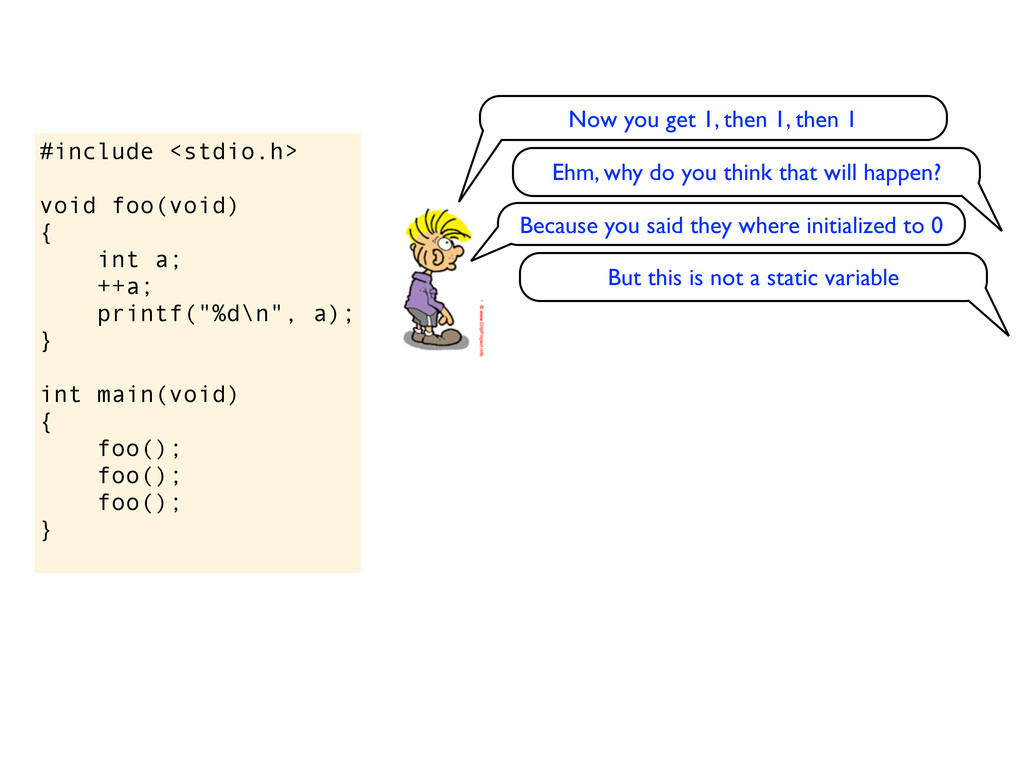
} int main(void) { foo(); foo(); foo(); } Now you get 1, then 1, then 1 Ehm, why do you think that will happen? Because you said they where initialized to 0 But this is not a static variable
} int main(void) { foo(); foo(); foo(); } Now you get 1, then 1, then 1 Ehm, why do you think that will happen? Because you said they where initialized to 0 But this is not a static variable ah, then you get three garbage values
} int main(void) { foo(); foo(); foo(); } Now you get 1, then 1, then 1 Ehm, why do you think that will happen? Because you said they where initialized to 0 But this is not a static variable ah, then you get three garbage values
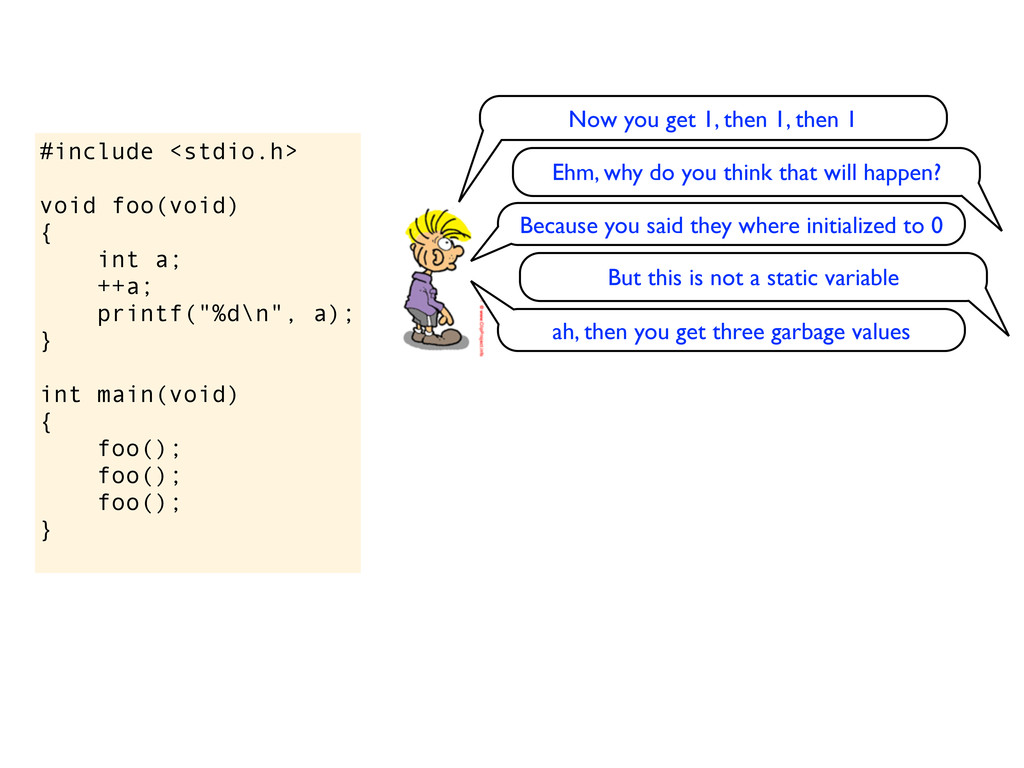
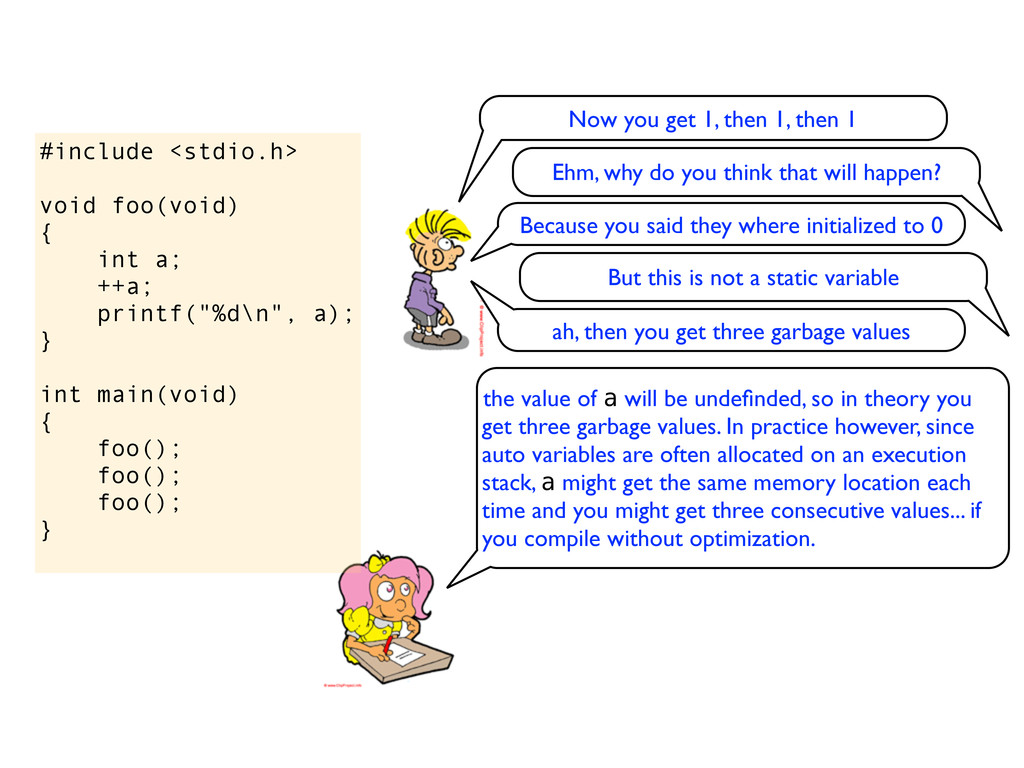
} int main(void) { foo(); foo(); foo(); } Now you get 1, then 1, then 1 the value of a will be undefinded, so in theory you get three garbage values. In practice however, since auto variables are often allocated on an execution stack, a might get the same memory location each time and you might get three consecutive values... if you compile without optimization. Ehm, why do you think that will happen? Because you said they where initialized to 0 But this is not a static variable ah, then you get three garbage values
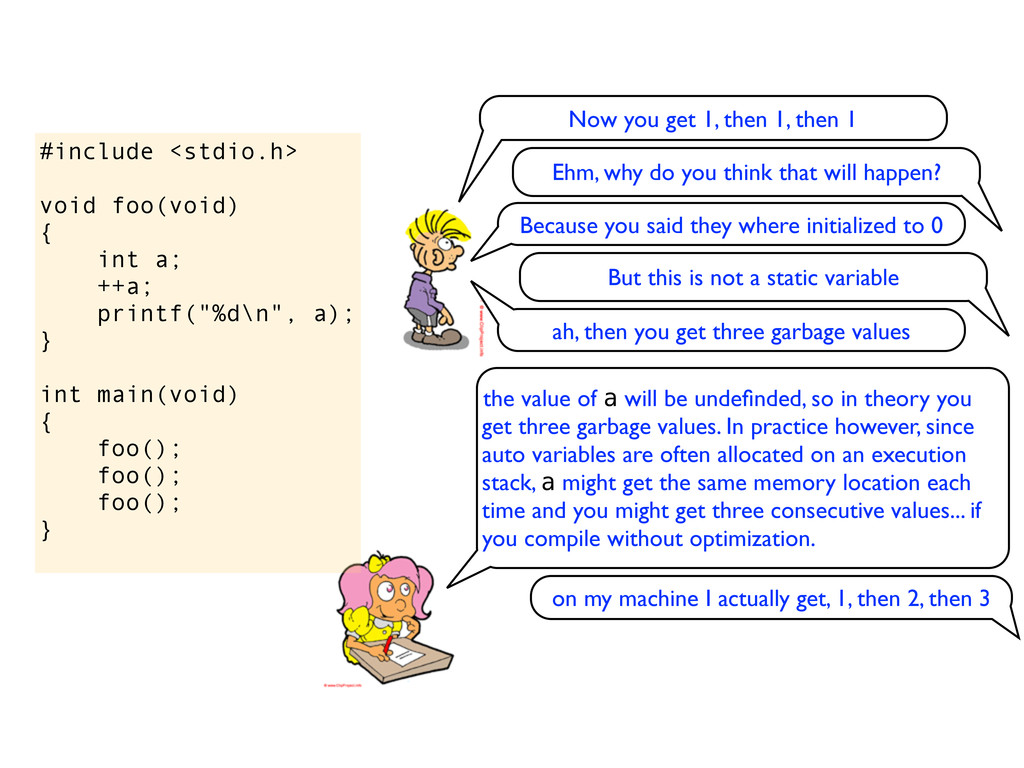
} int main(void) { foo(); foo(); foo(); } Now you get 1, then 1, then 1 the value of a will be undefinded, so in theory you get three garbage values. In practice however, since auto variables are often allocated on an execution stack, a might get the same memory location each time and you might get three consecutive values... if you compile without optimization. Ehm, why do you think that will happen? Because you said they where initialized to 0 But this is not a static variable ah, then you get three garbage values on my machine I actually get, 1, then 2, then 3
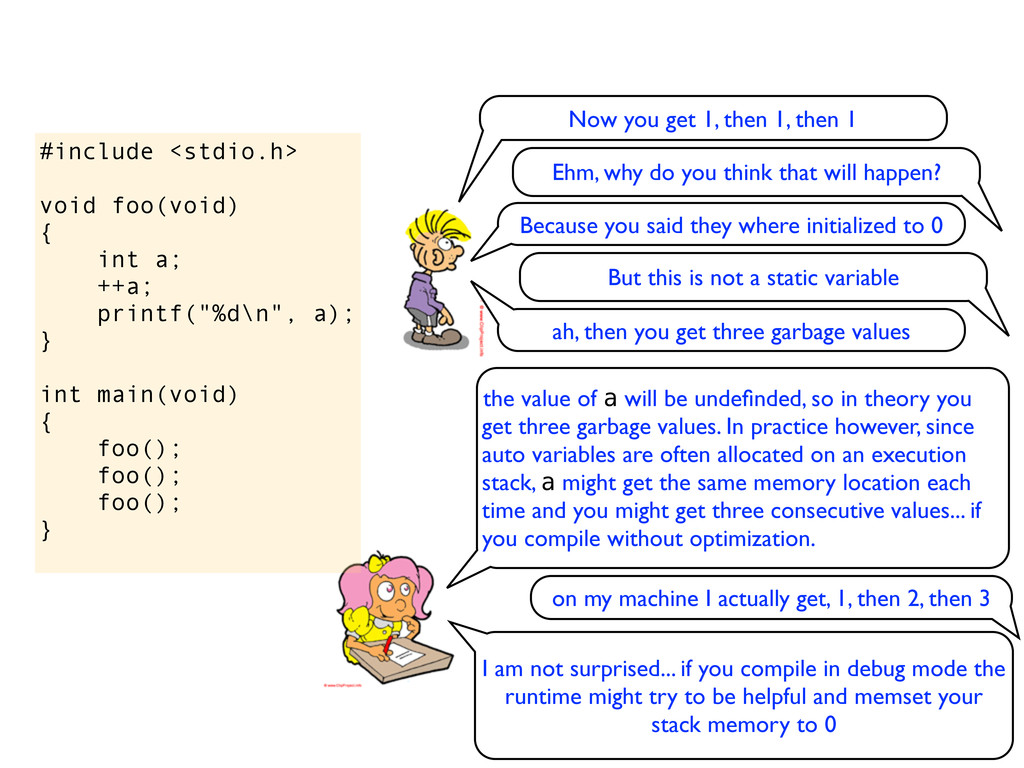
} int main(void) { foo(); foo(); foo(); } Now you get 1, then 1, then 1 the value of a will be undefinded, so in theory you get three garbage values. In practice however, since auto variables are often allocated on an execution stack, a might get the same memory location each time and you might get three consecutive values... if you compile without optimization. Ehm, why do you think that will happen? Because you said they where initialized to 0 But this is not a static variable ah, then you get three garbage values on my machine I actually get, 1, then 2, then 3 I am not surprised... if you compile in debug mode the runtime might try to be helpful and memset your stack memory to 0
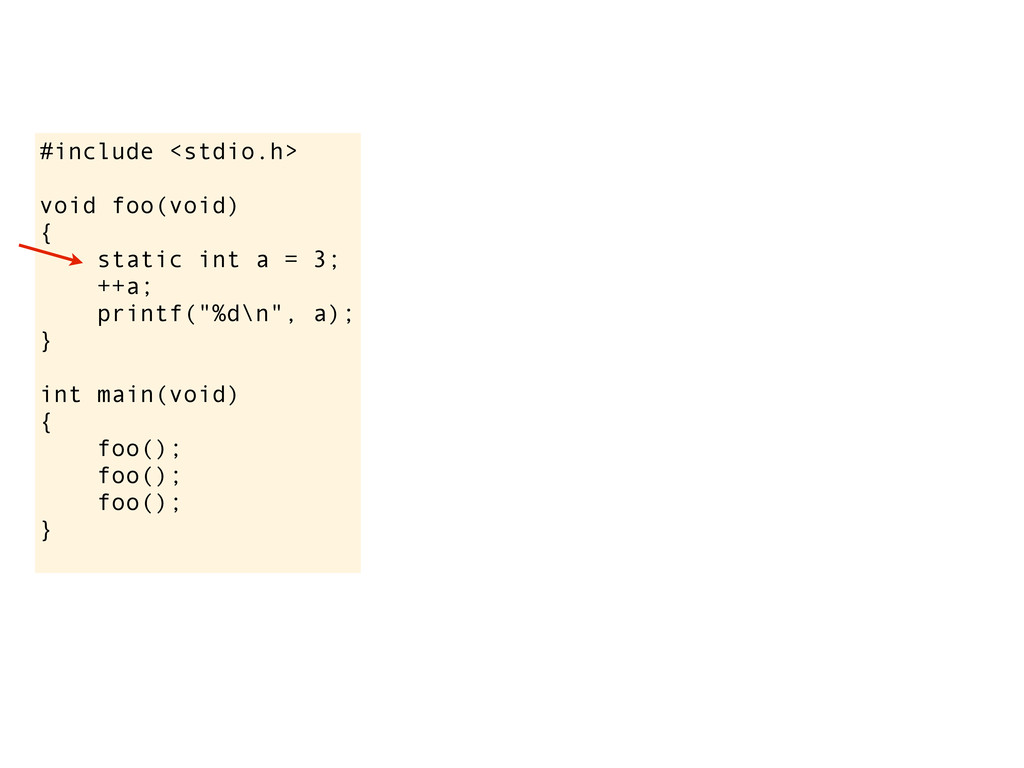
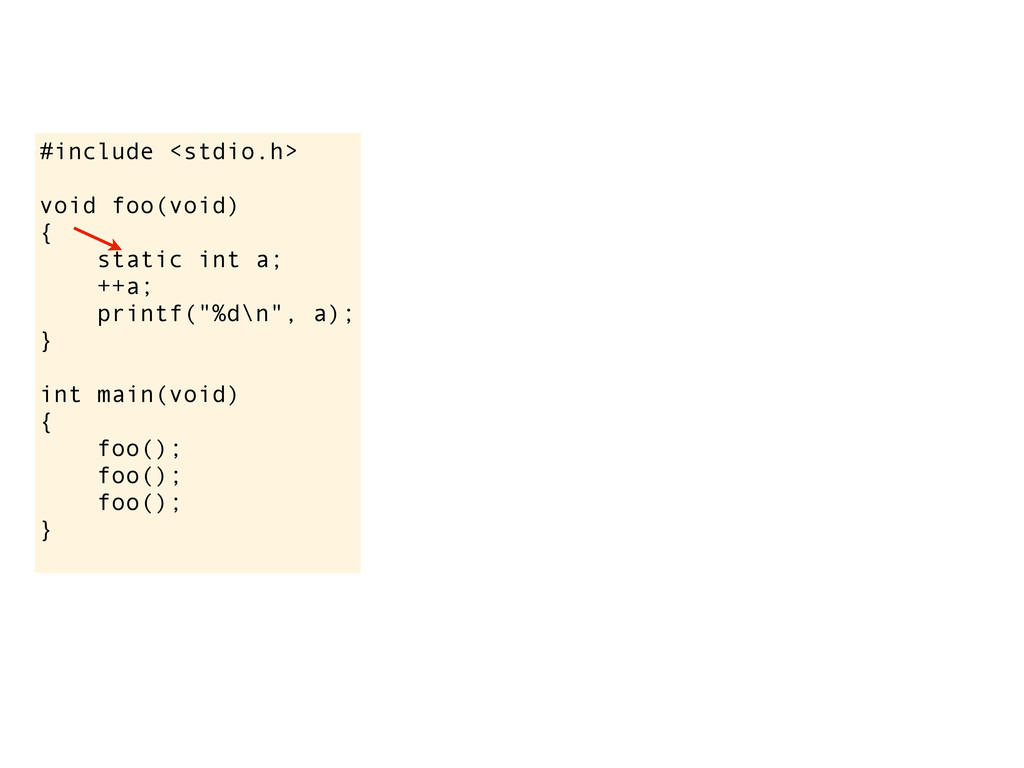
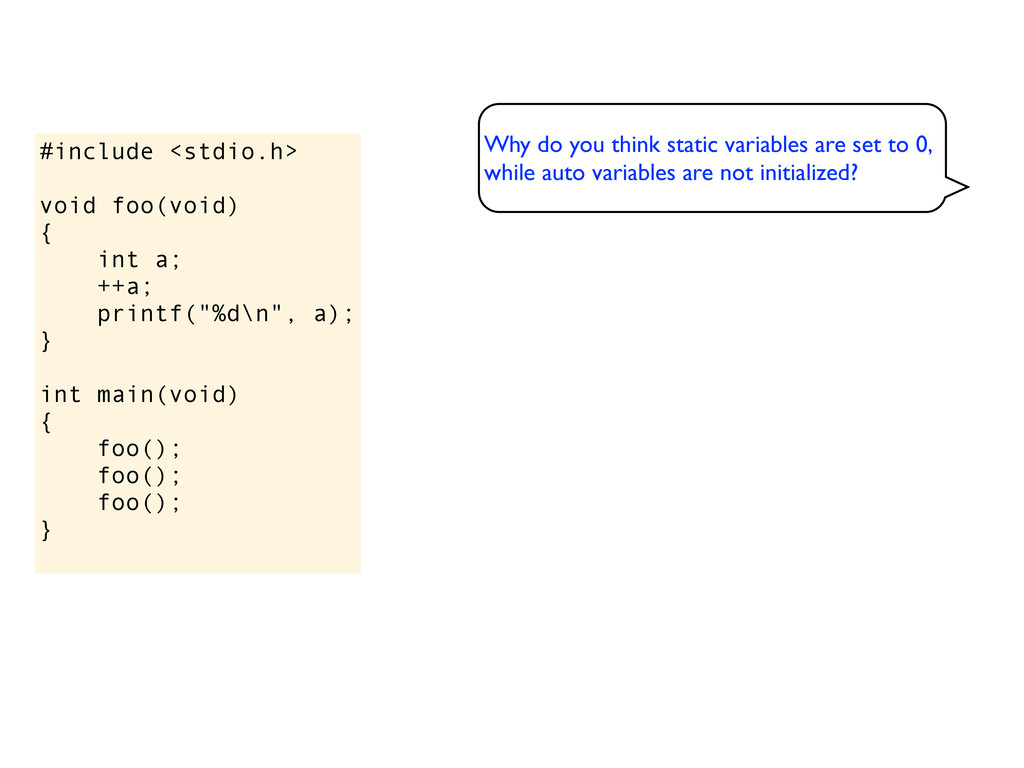
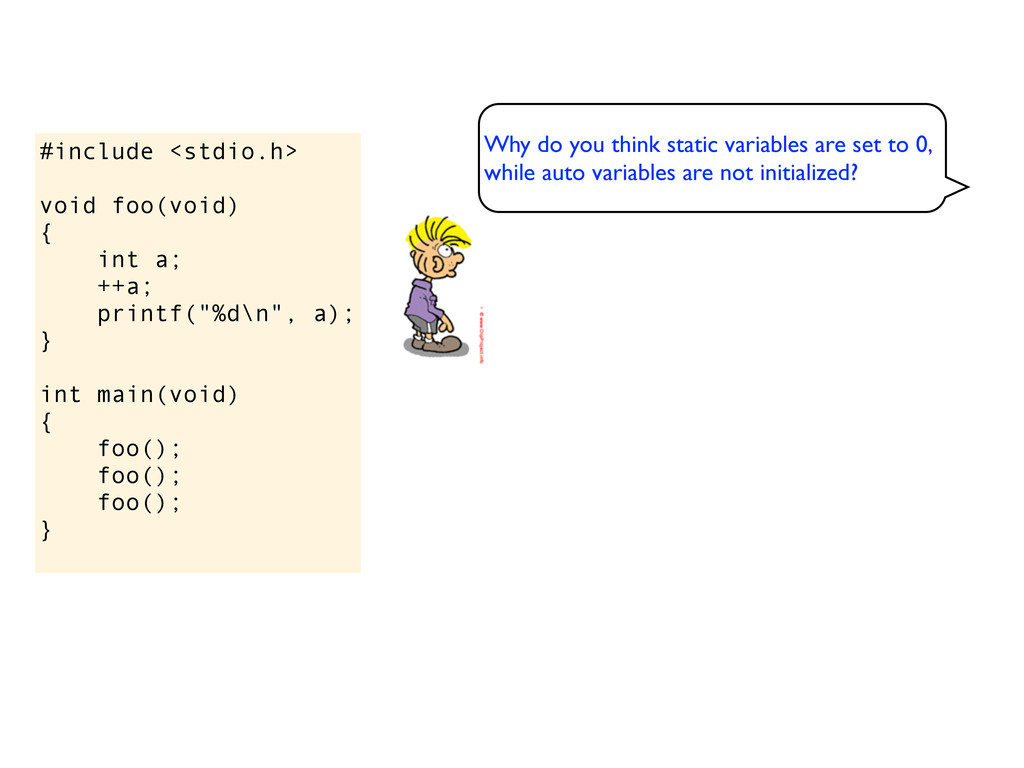
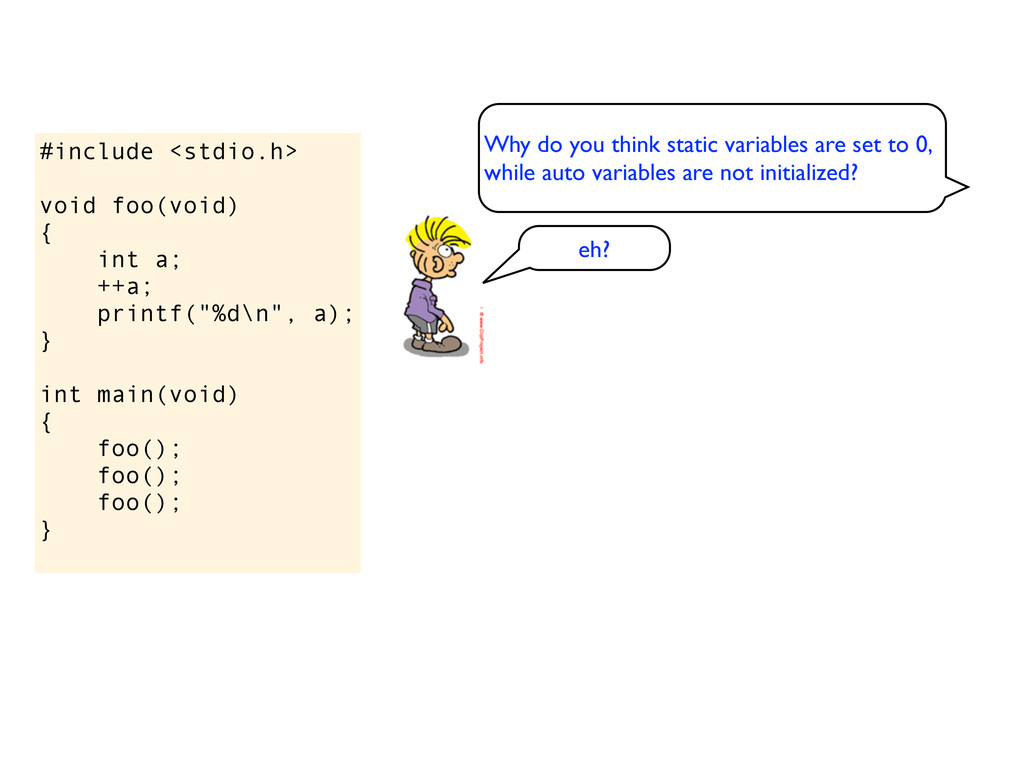
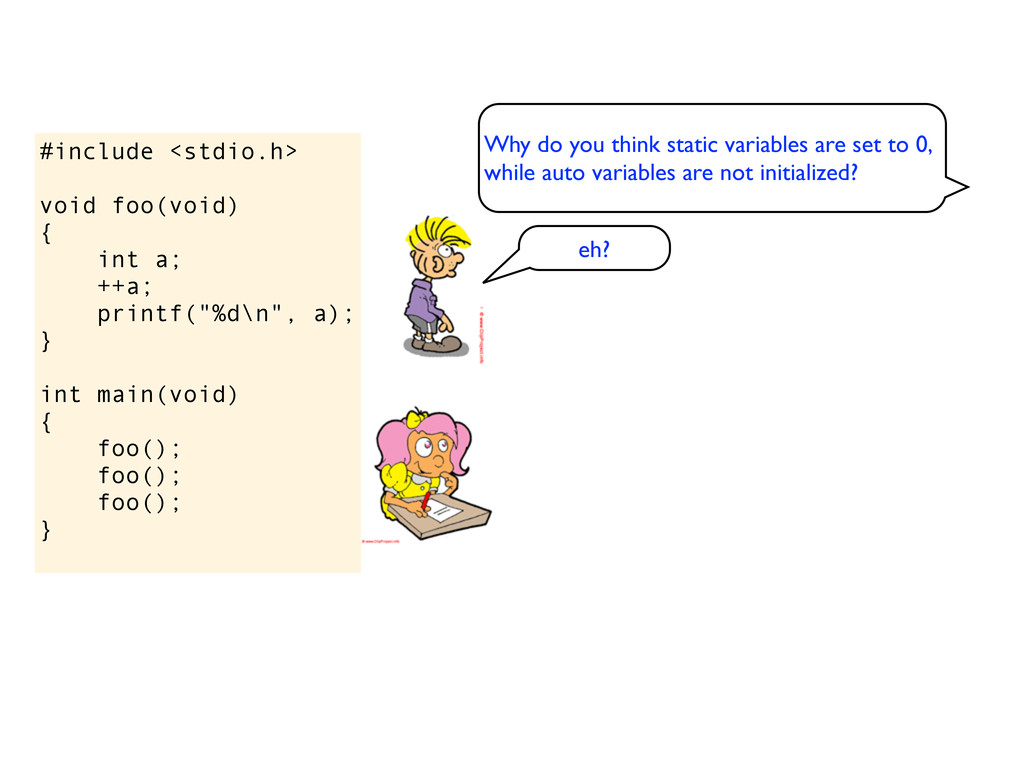
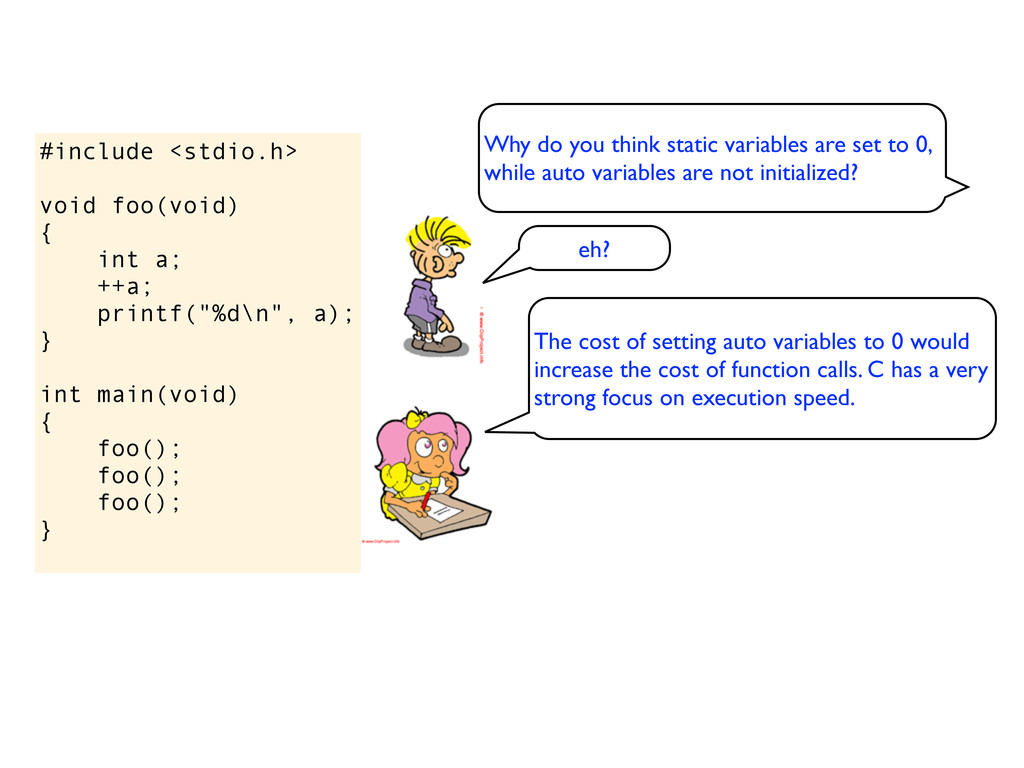
} int main(void) { foo(); foo(); foo(); } Why do you think static variables are set to 0, while auto variables are not initialized? The cost of setting auto variables to 0 would increase the cost of function calls. C has a very strong focus on execution speed. eh?
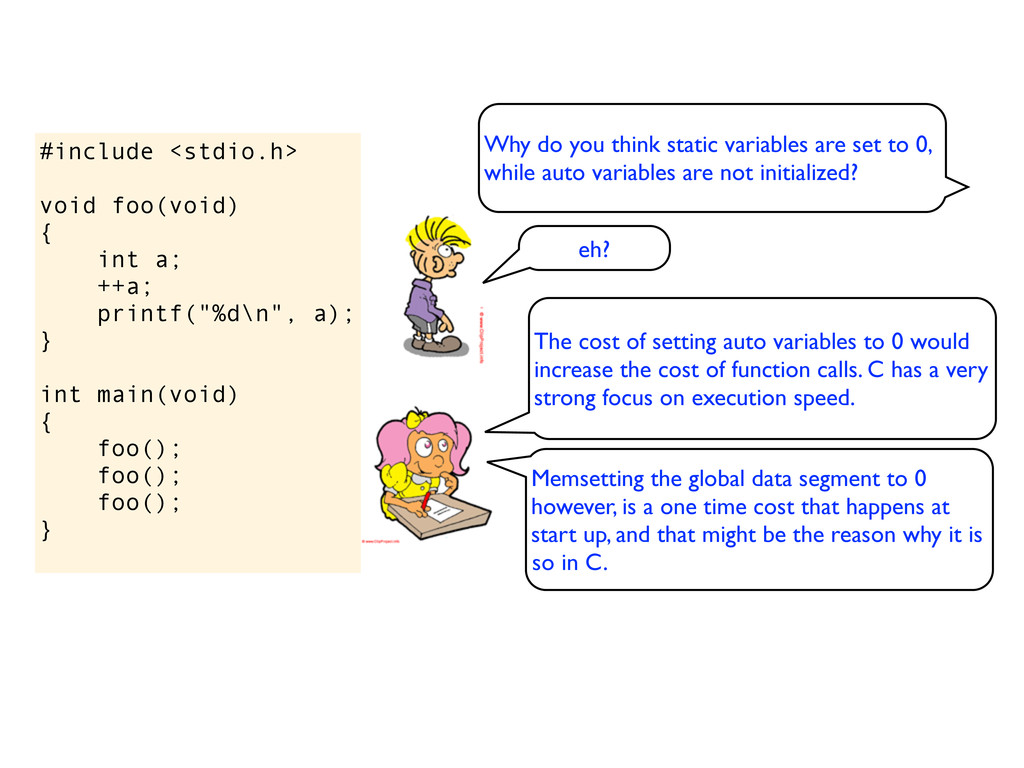
} int main(void) { foo(); foo(); foo(); } Why do you think static variables are set to 0, while auto variables are not initialized? The cost of setting auto variables to 0 would increase the cost of function calls. C has a very strong focus on execution speed. eh? Memsetting the global data segment to 0 however, is a one time cost that happens at start up, and that might be the reason why it is so in C.
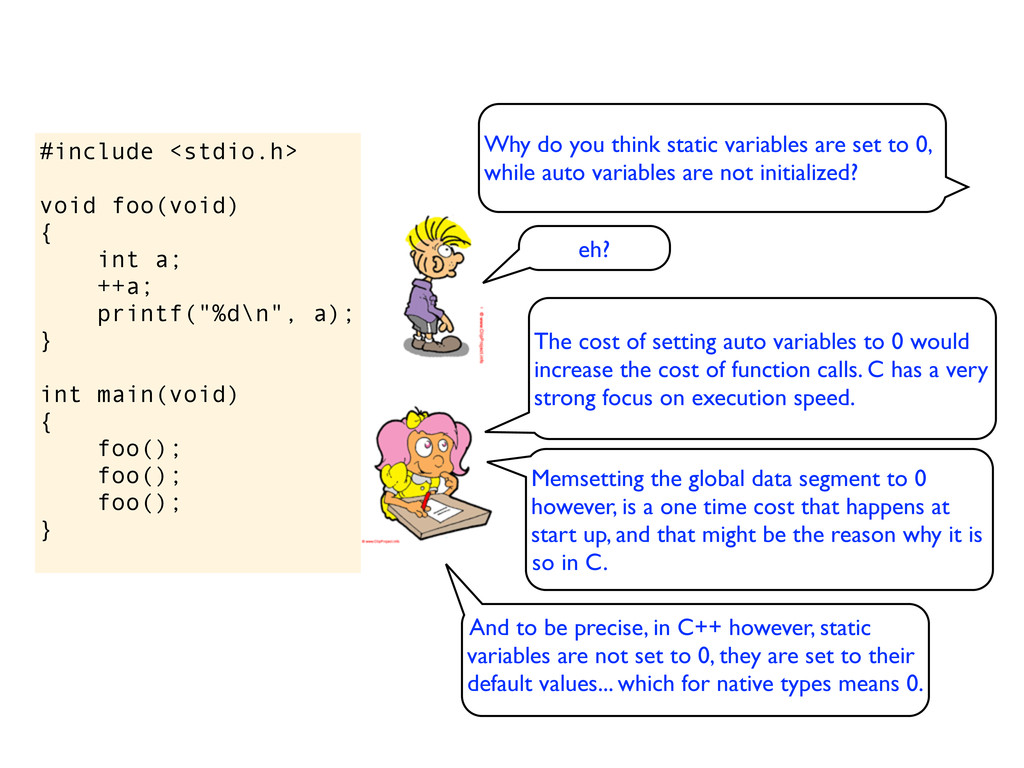
} int main(void) { foo(); foo(); foo(); } Why do you think static variables are set to 0, while auto variables are not initialized? The cost of setting auto variables to 0 would increase the cost of function calls. C has a very strong focus on execution speed. eh? Memsetting the global data segment to 0 however, is a one time cost that happens at start up, and that might be the reason why it is so in C. And to be precise, in C++ however, static variables are not set to 0, they are set to their default values... which for native types means 0.
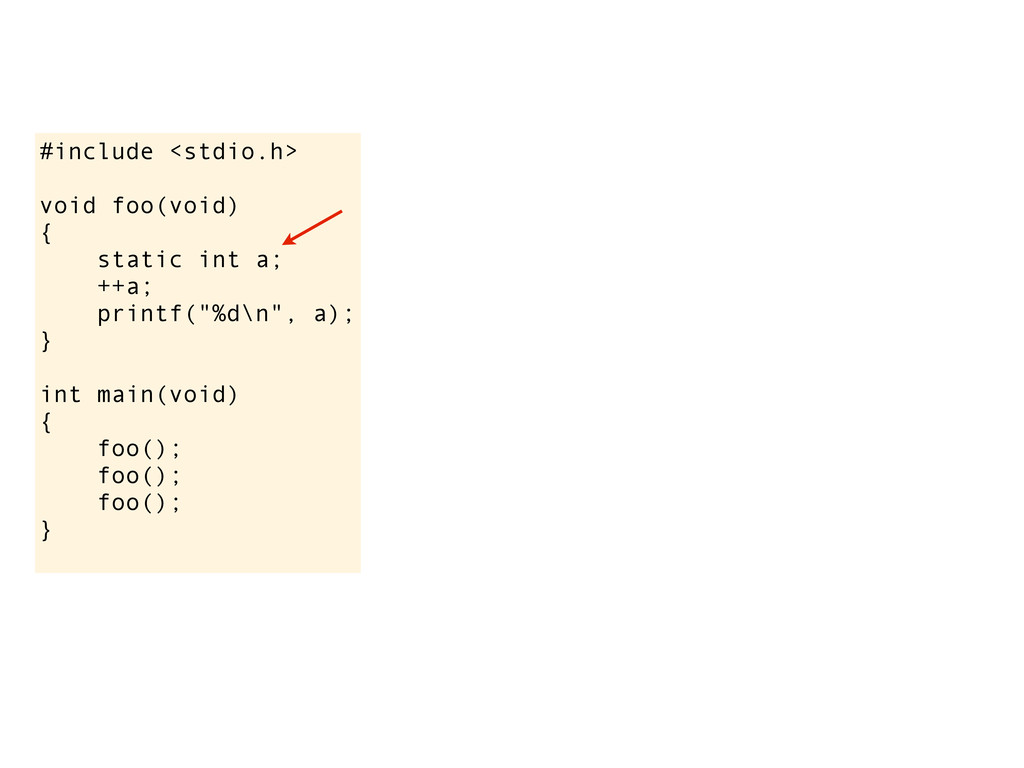
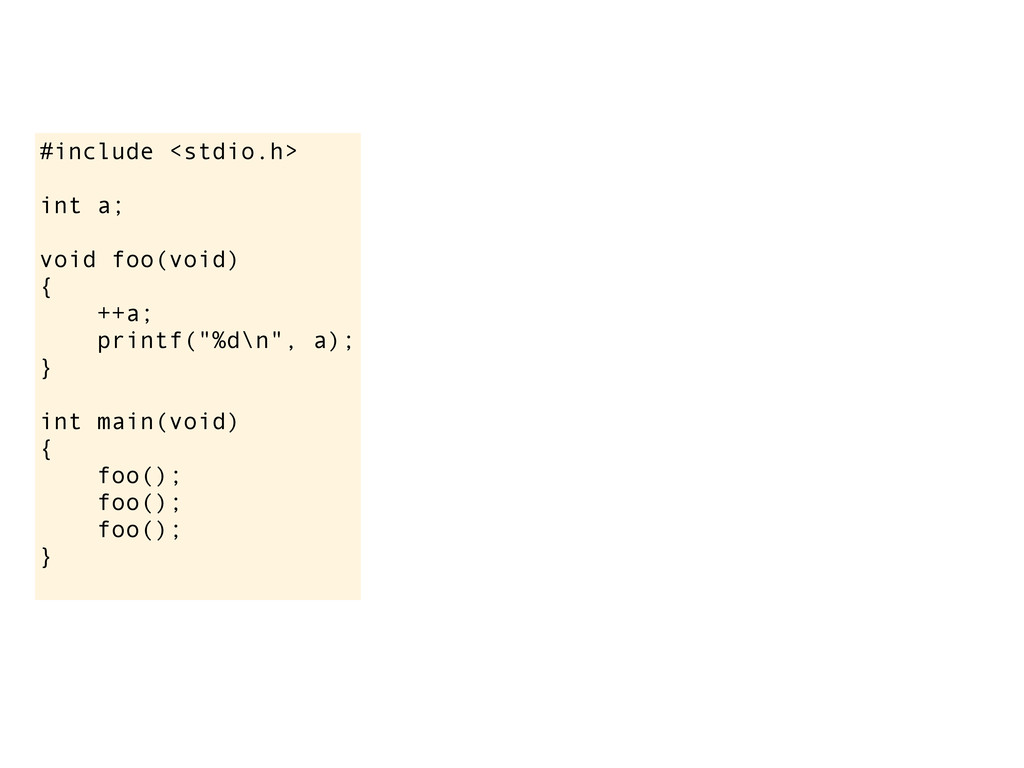
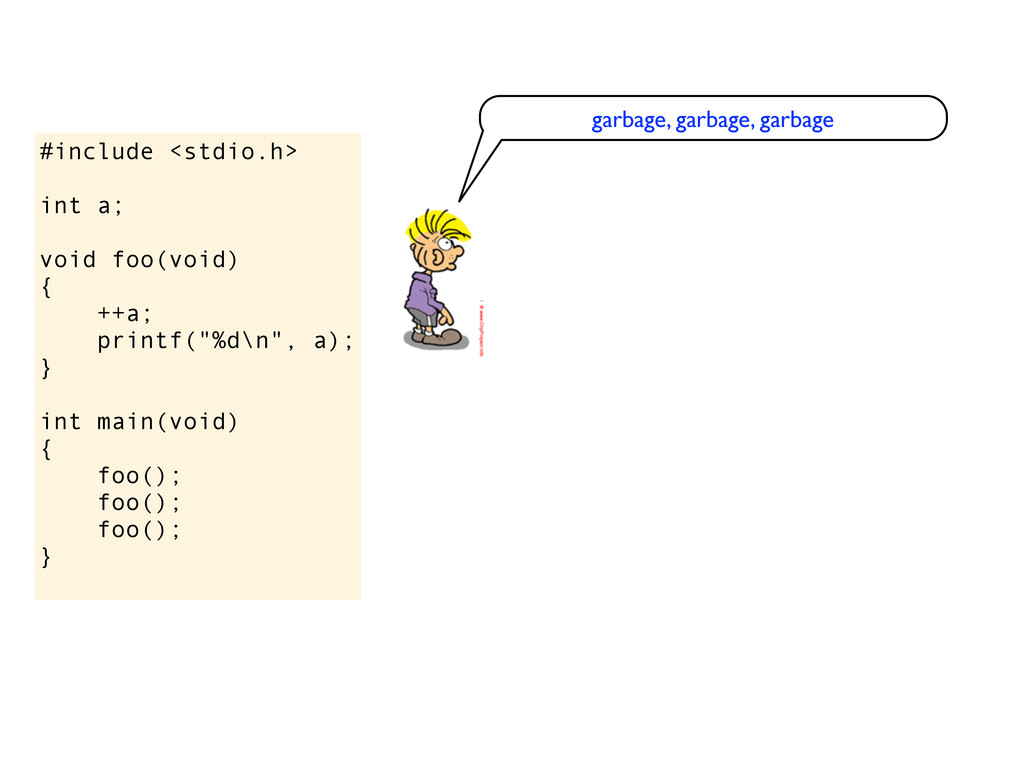
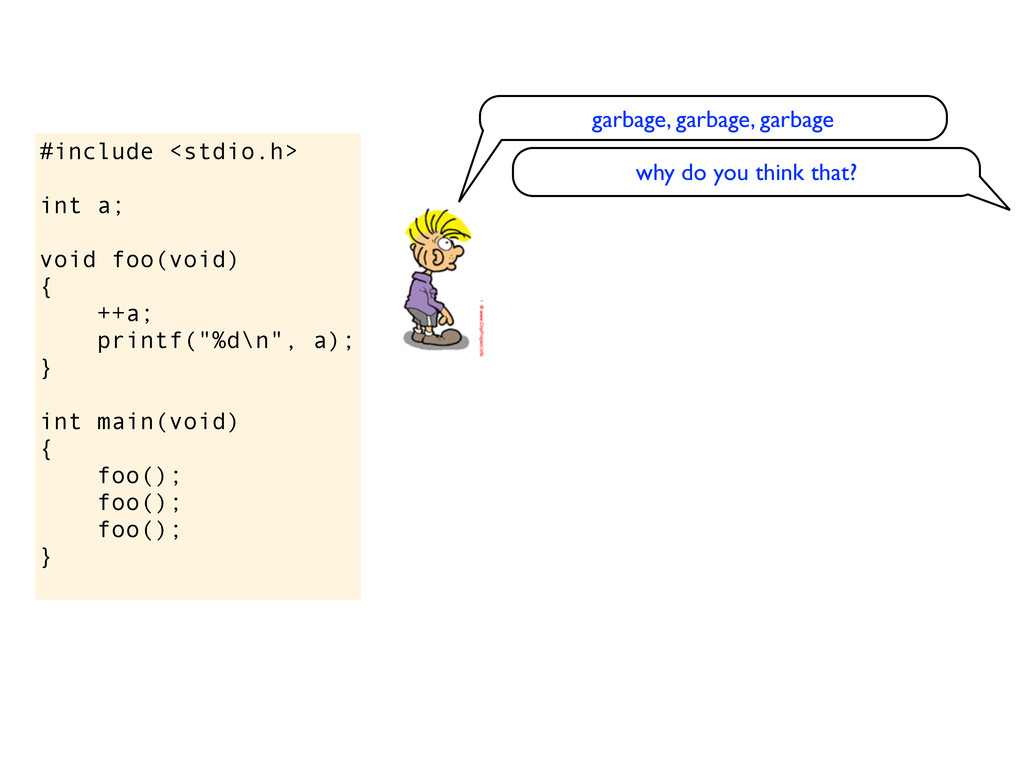
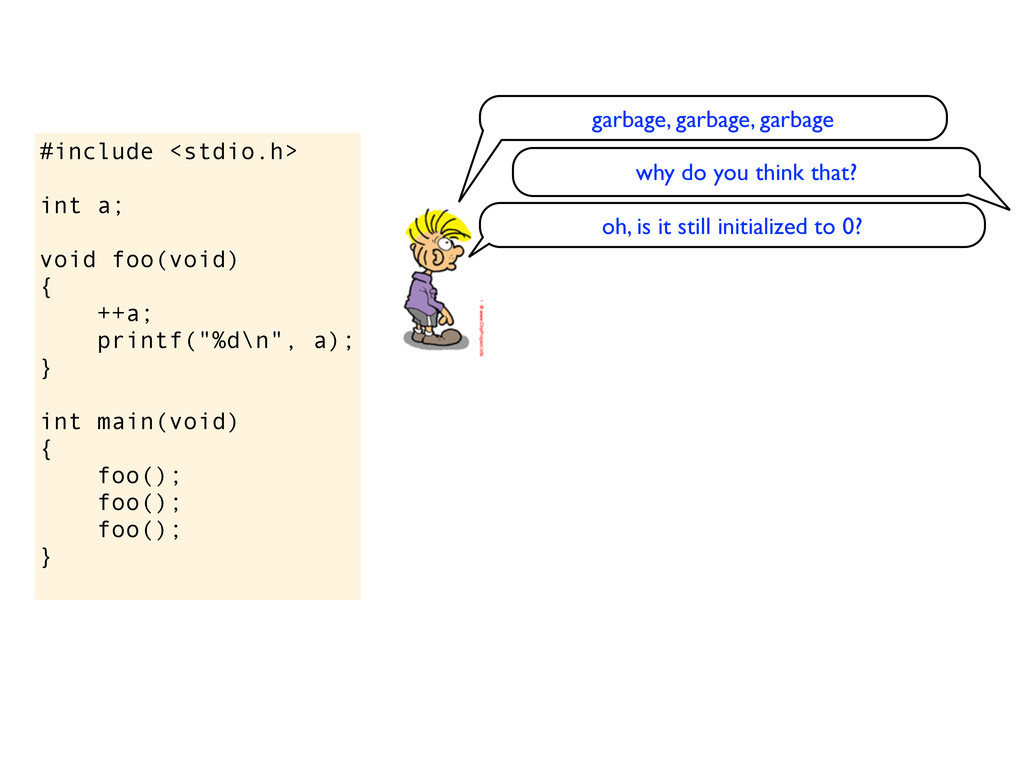
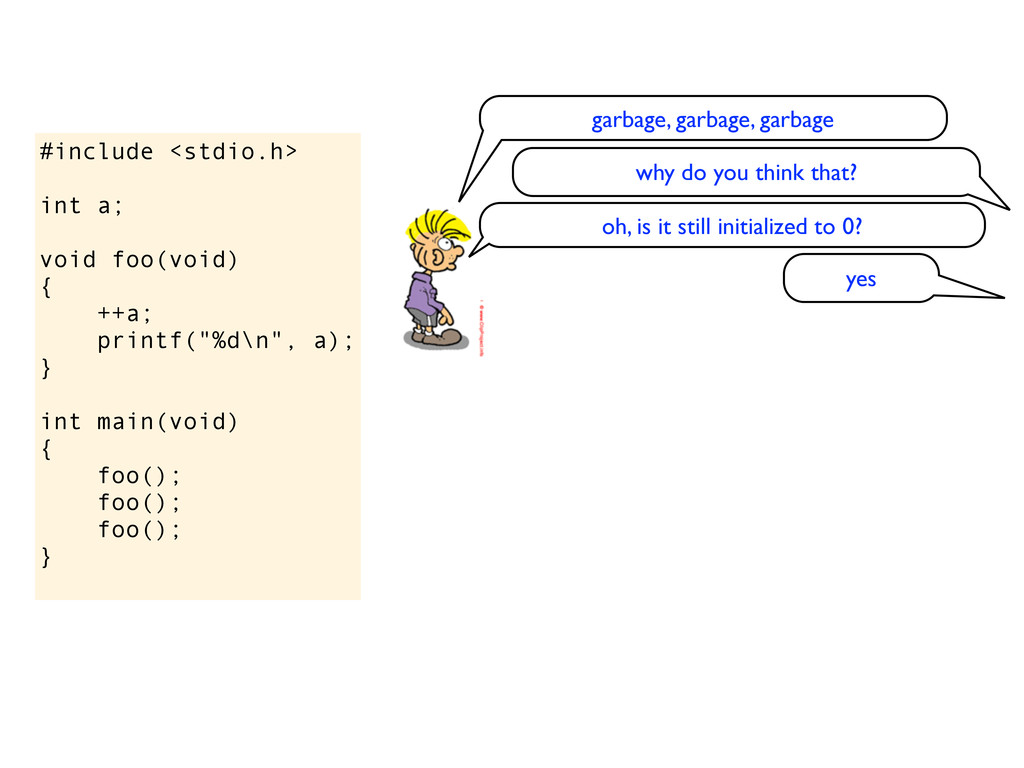
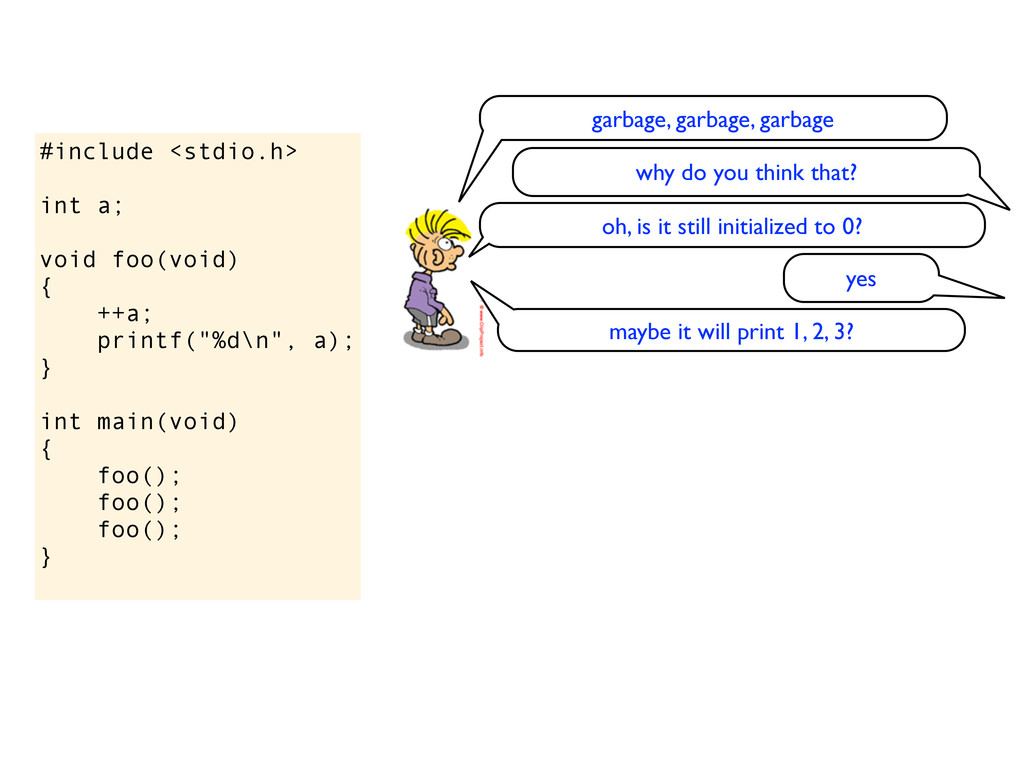
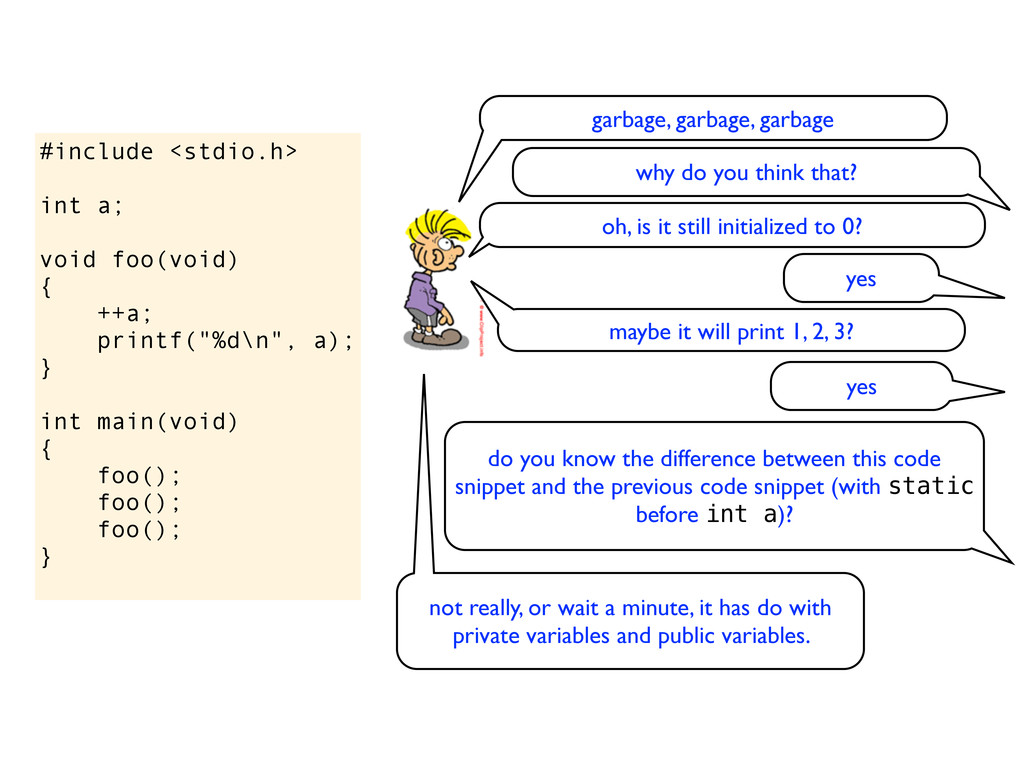
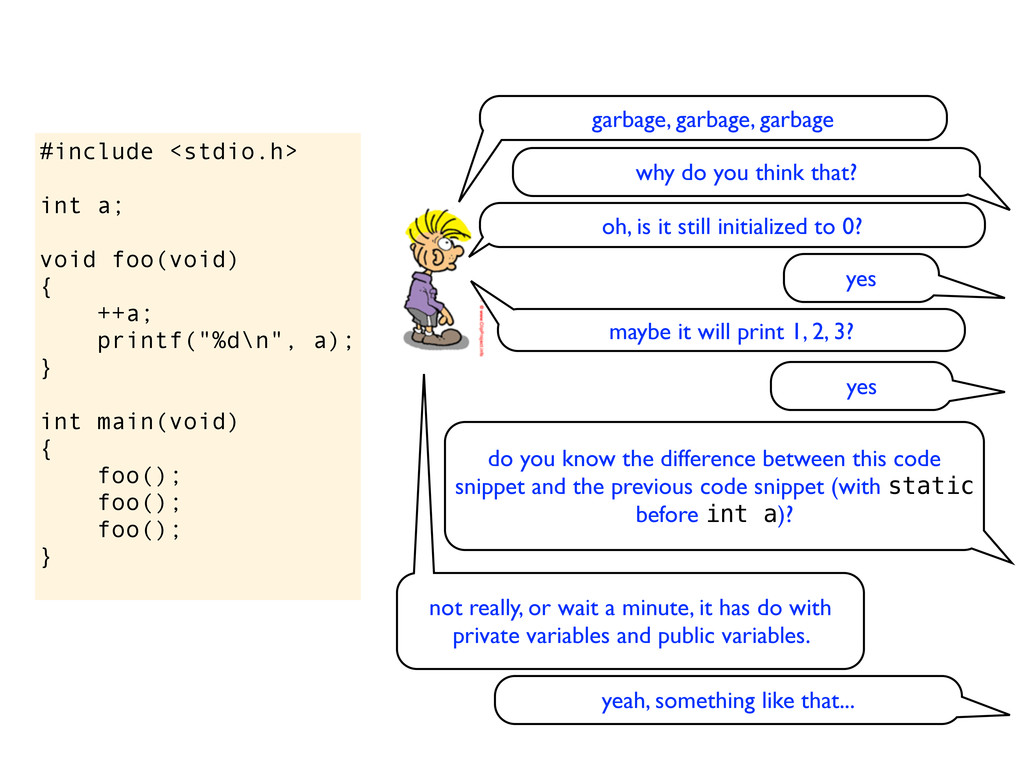
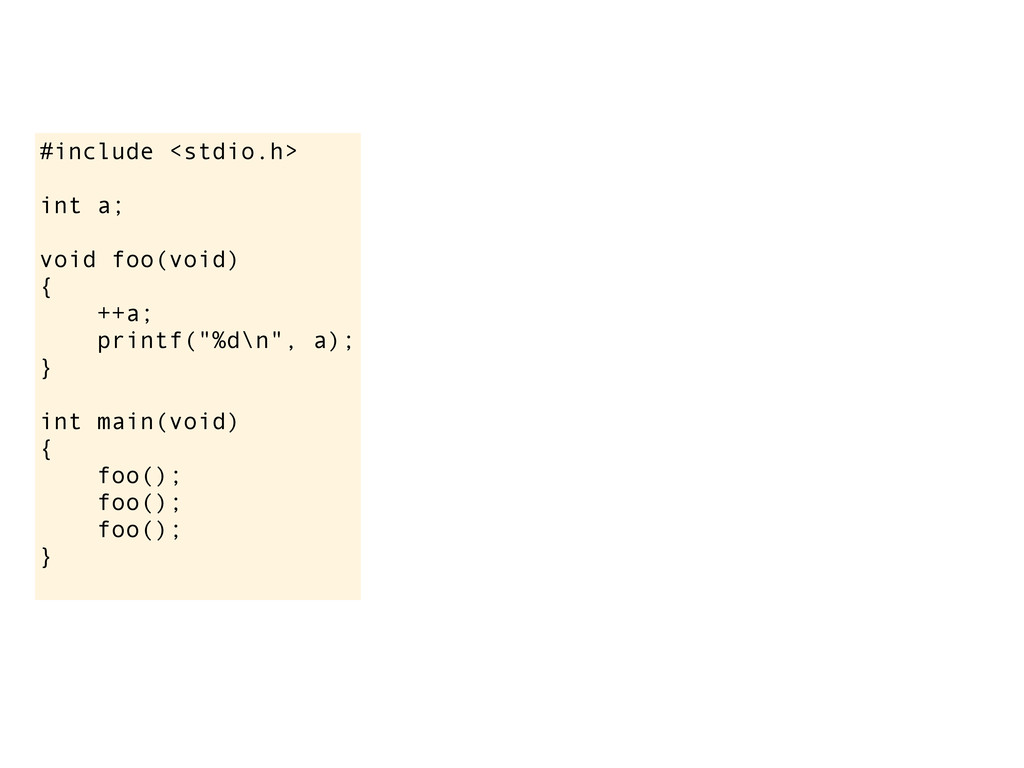
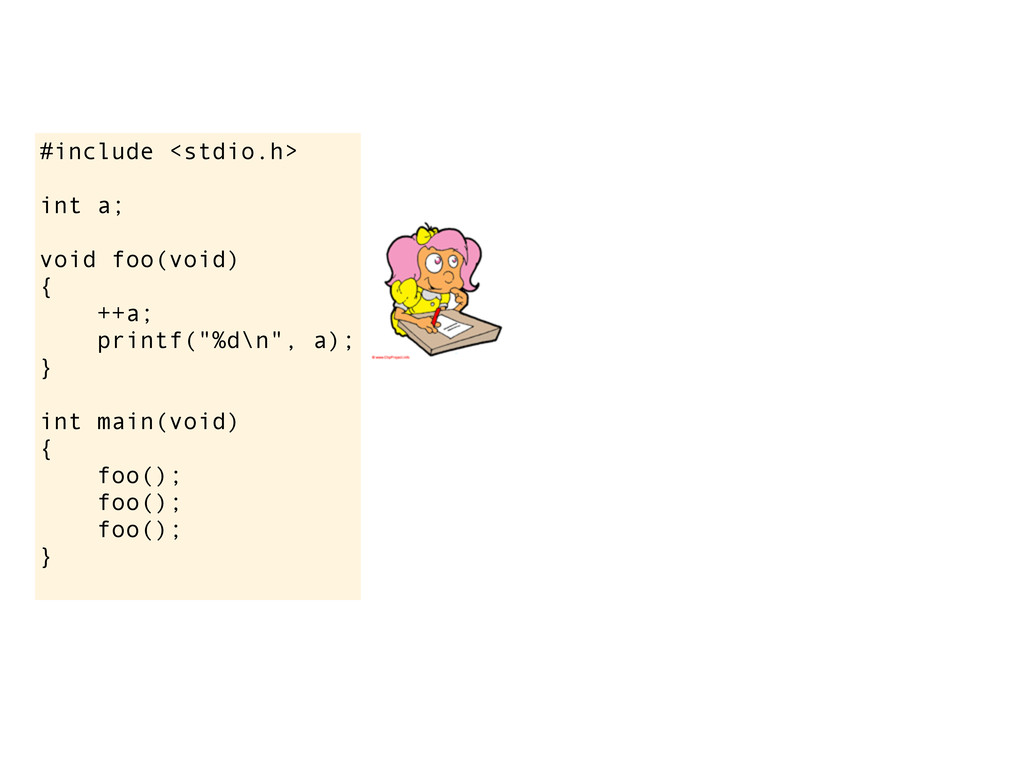
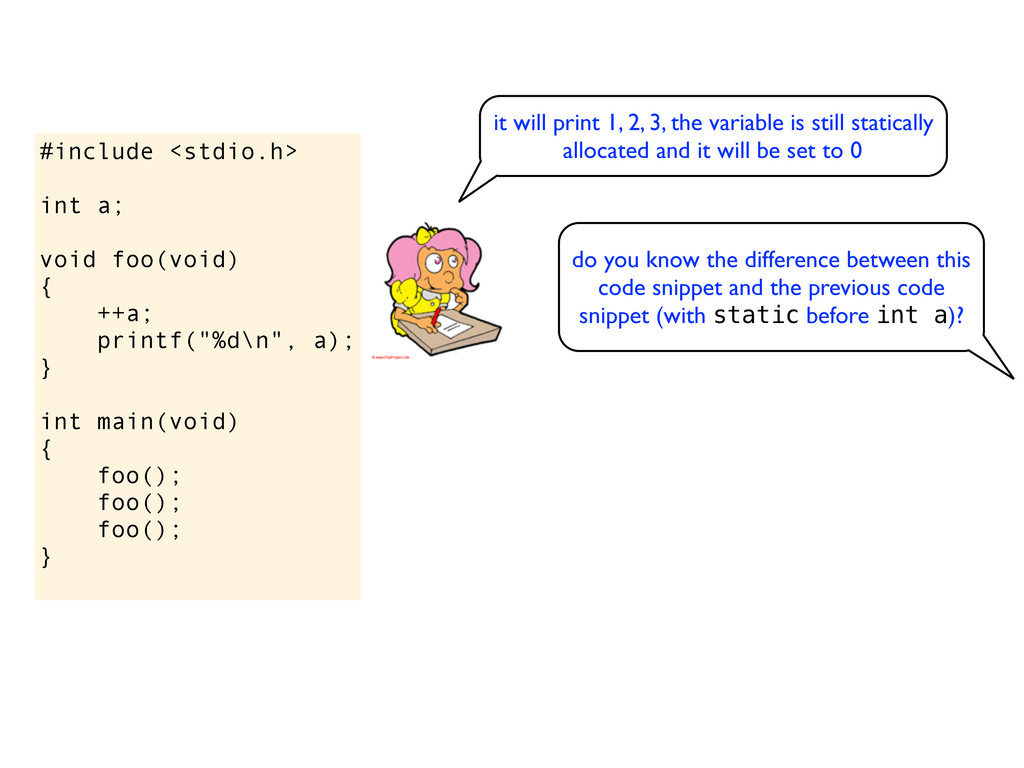
} int main(void) { foo(); foo(); foo(); } garbage, garbage, garbage why do you think that? oh, is it still initialized to 0? yes maybe it will print 1, 2, 3?
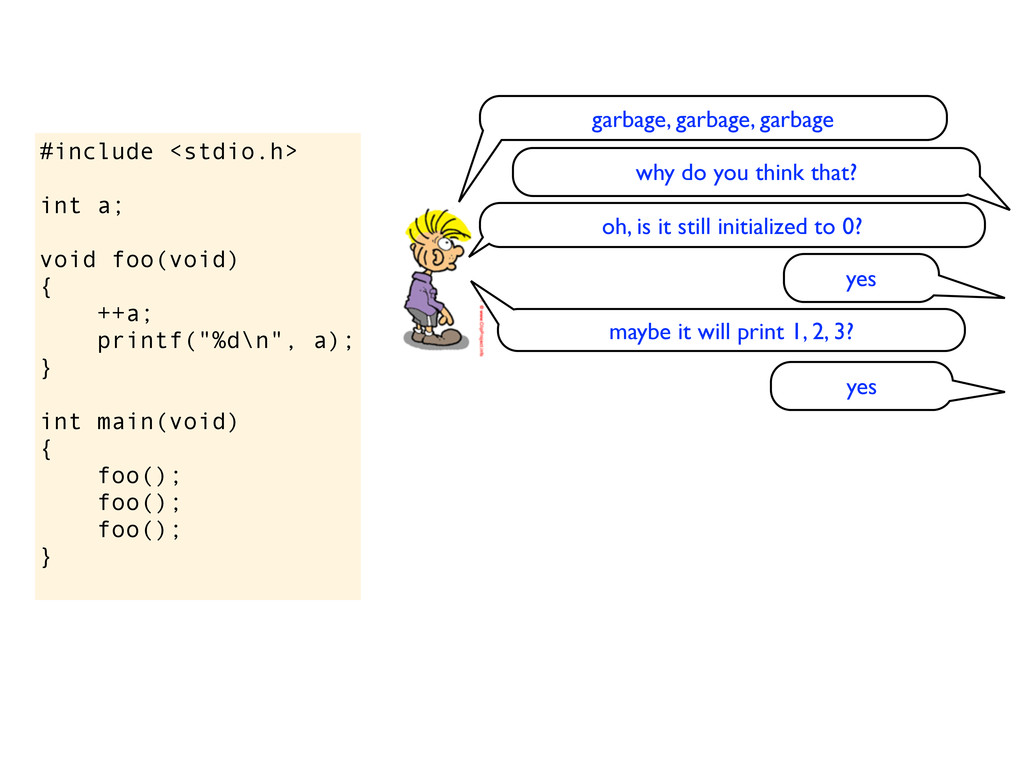
} int main(void) { foo(); foo(); foo(); } garbage, garbage, garbage why do you think that? oh, is it still initialized to 0? yes maybe it will print 1, 2, 3? yes
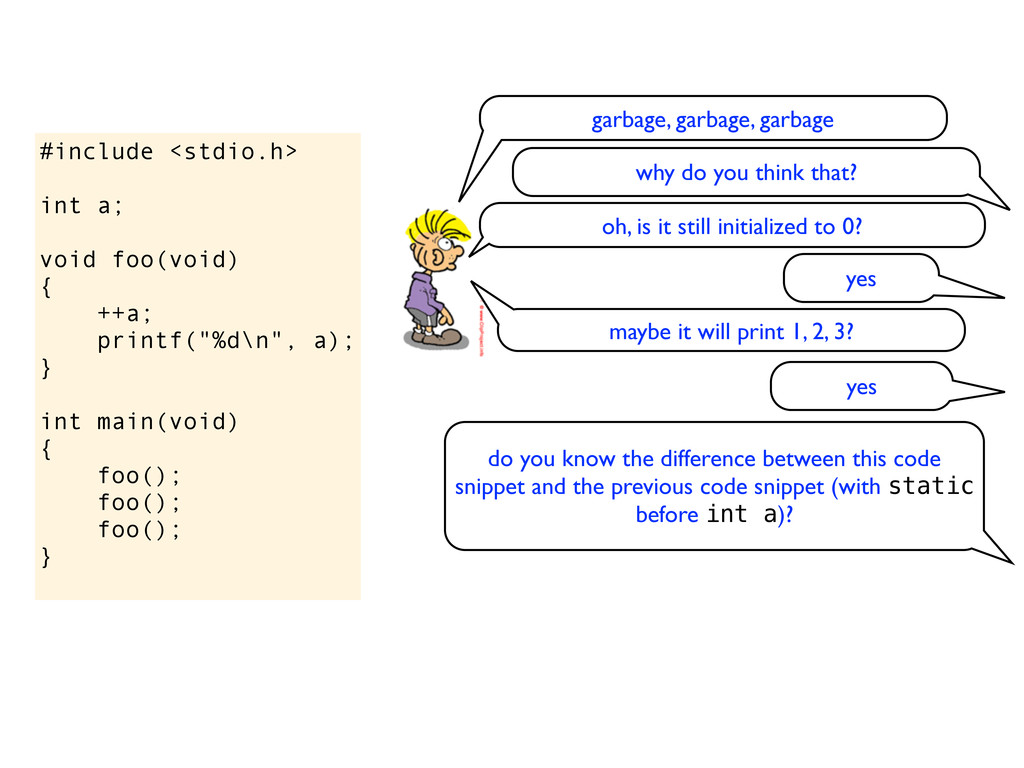
} int main(void) { foo(); foo(); foo(); } garbage, garbage, garbage why do you think that? oh, is it still initialized to 0? yes maybe it will print 1, 2, 3? yes do you know the difference between this code snippet and the previous code snippet (with static before int a)?
} int main(void) { foo(); foo(); foo(); } garbage, garbage, garbage why do you think that? oh, is it still initialized to 0? yes maybe it will print 1, 2, 3? yes do you know the difference between this code snippet and the previous code snippet (with static before int a)? not really, or wait a minute, it has do with private variables and public variables.
} int main(void) { foo(); foo(); foo(); } garbage, garbage, garbage why do you think that? oh, is it still initialized to 0? yes maybe it will print 1, 2, 3? yes do you know the difference between this code snippet and the previous code snippet (with static before int a)? not really, or wait a minute, it has do with private variables and public variables. yeah, something like that...
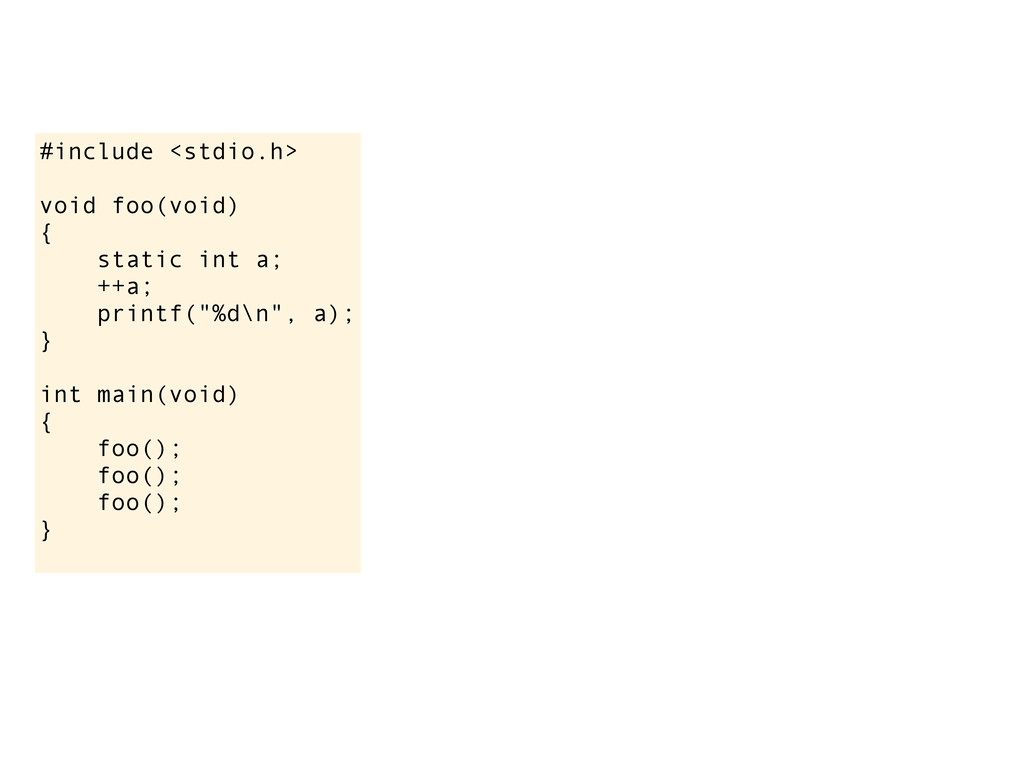
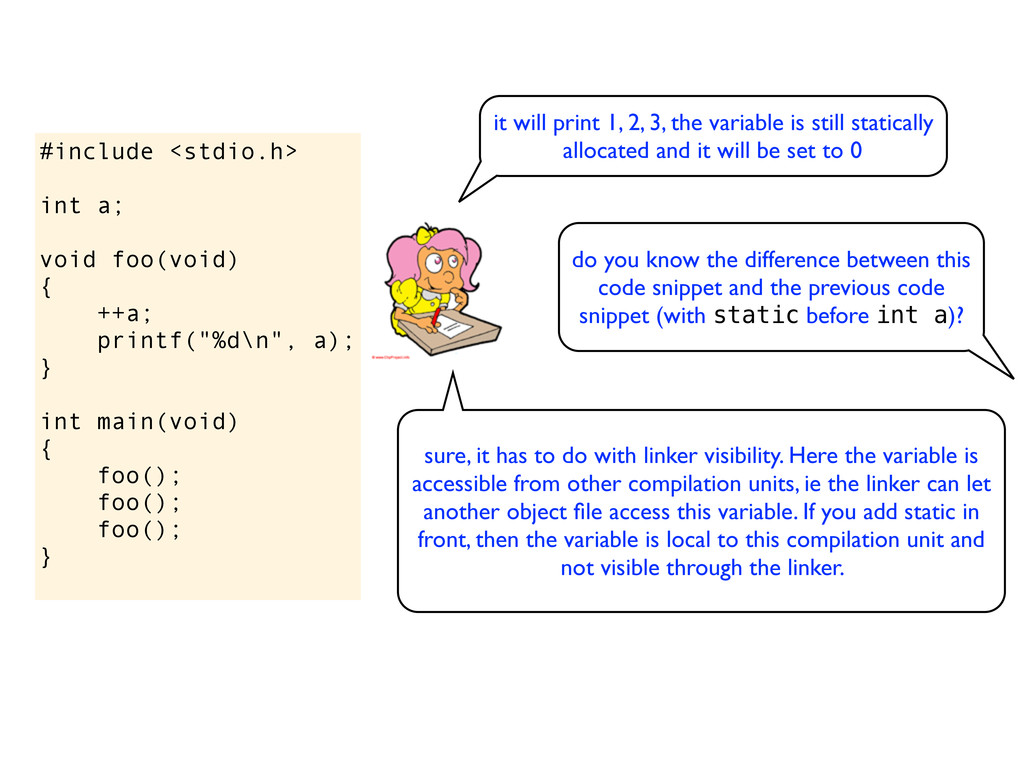
} int main(void) { foo(); foo(); foo(); } it will print 1, 2, 3, the variable is still statically allocated and it will be set to 0 do you know the difference between this code snippet and the previous code snippet (with static before int a)?
} int main(void) { foo(); foo(); foo(); } it will print 1, 2, 3, the variable is still statically allocated and it will be set to 0 do you know the difference between this code snippet and the previous code snippet (with static before int a)? sure, it has to do with linker visibility. Here the variable is accessible from other compilation units, ie the linker can let another object file access this variable. If you add static in front, then the variable is local to this compilation unit and not visible through the linker.
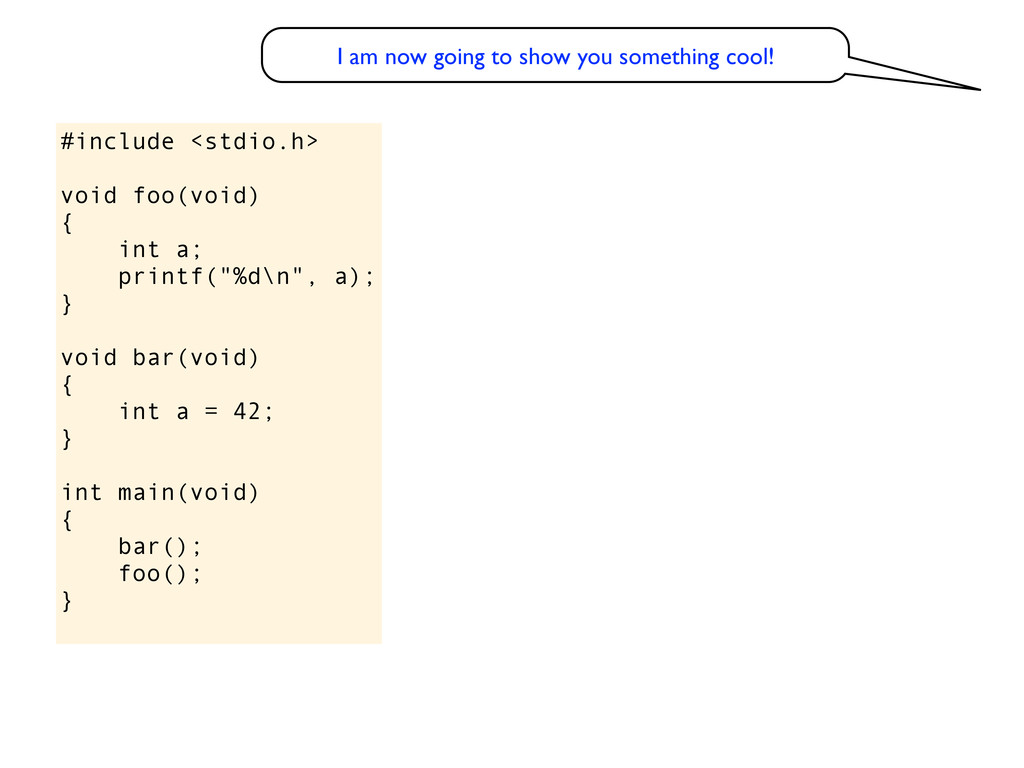
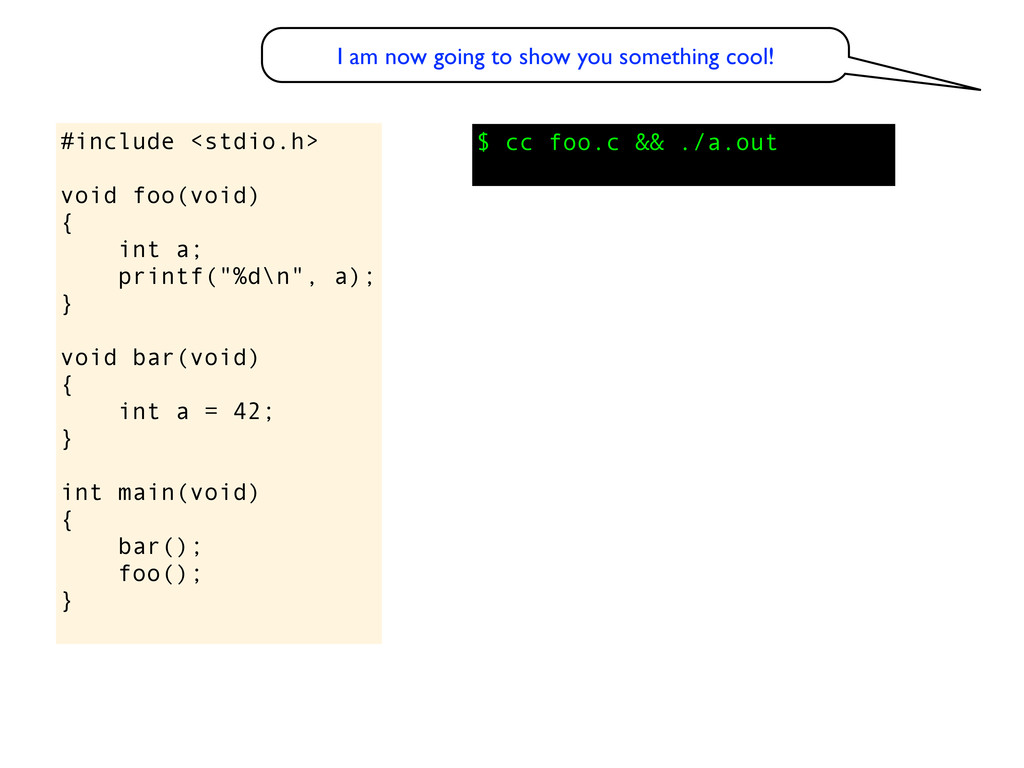
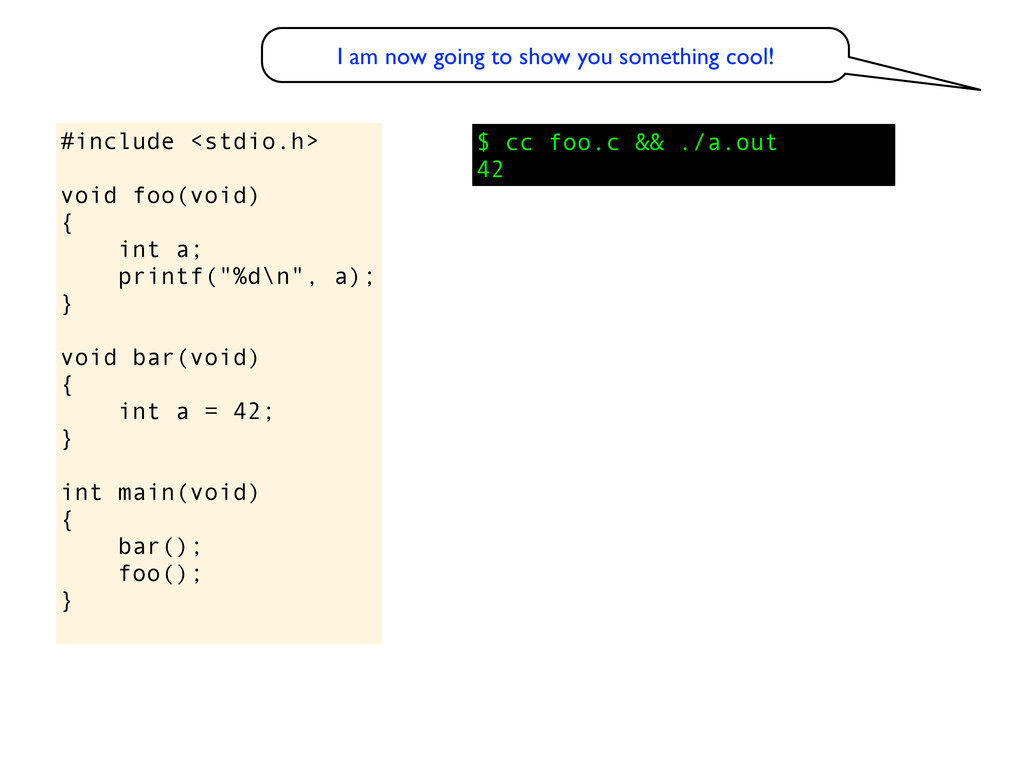
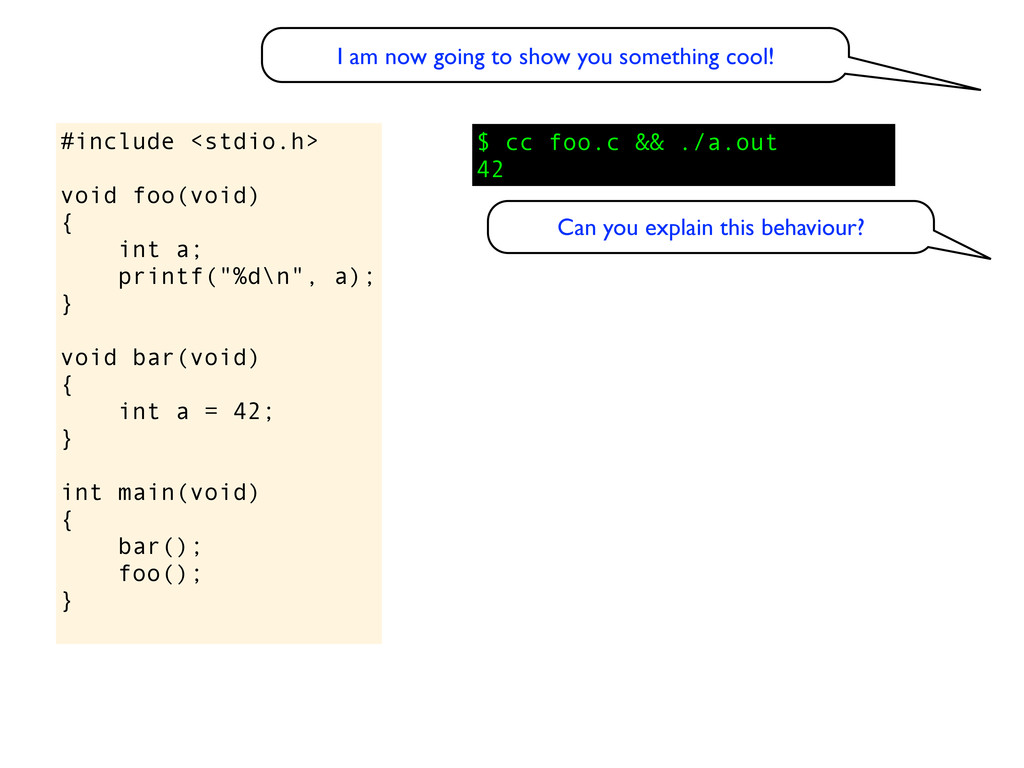
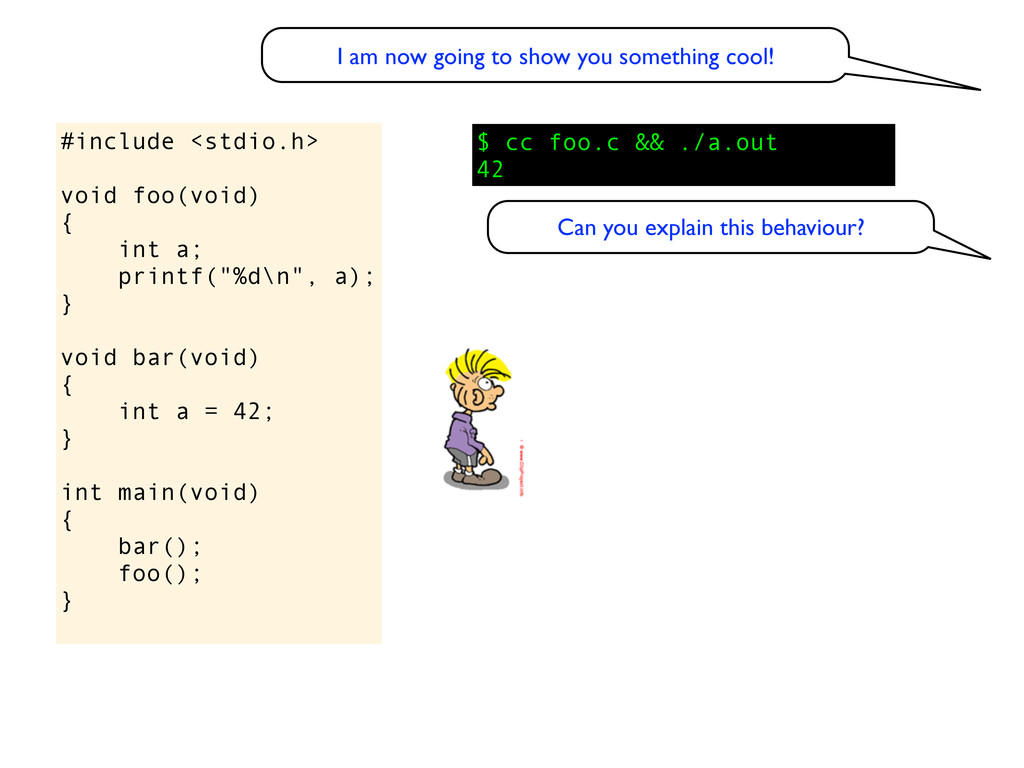
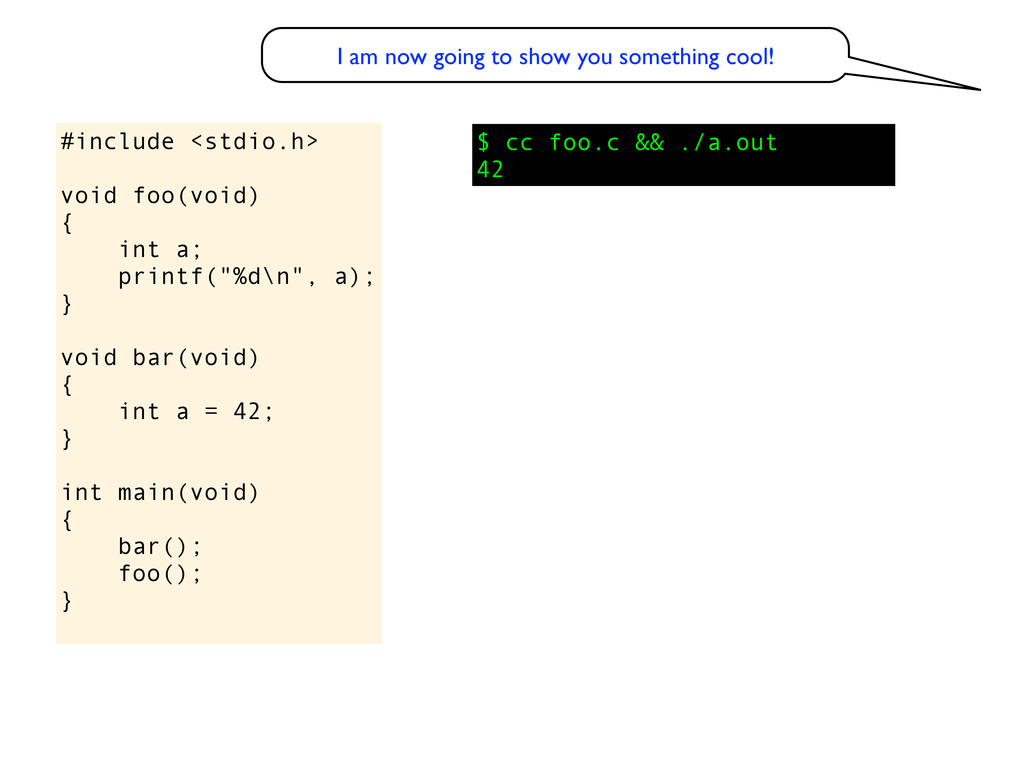
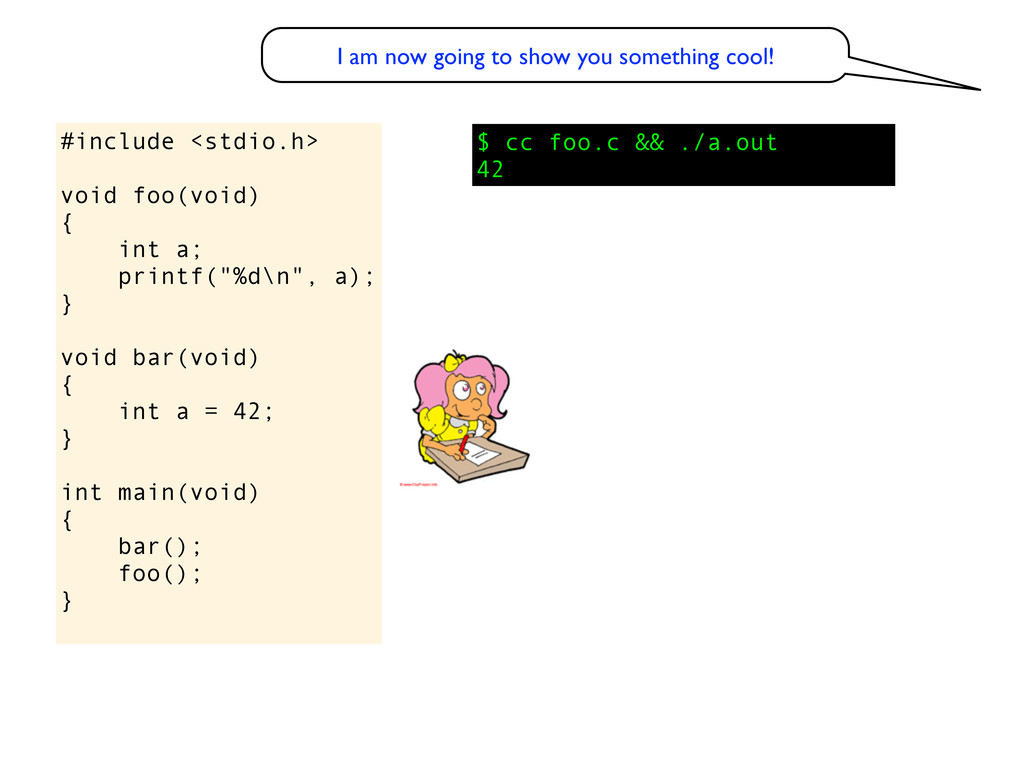
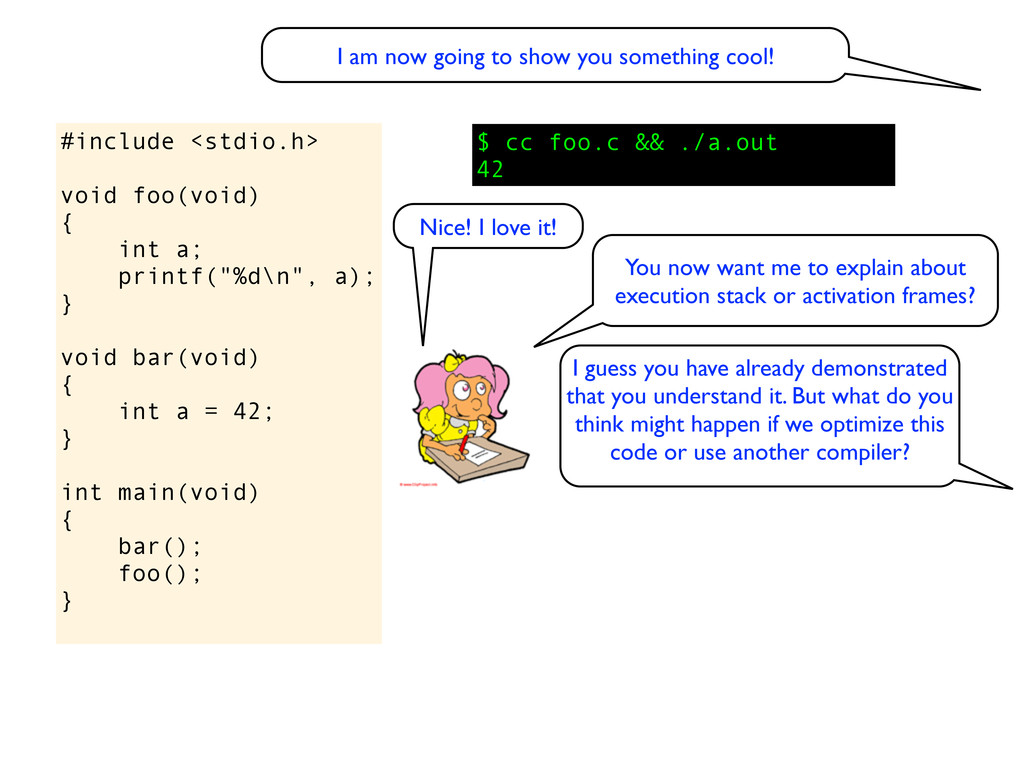
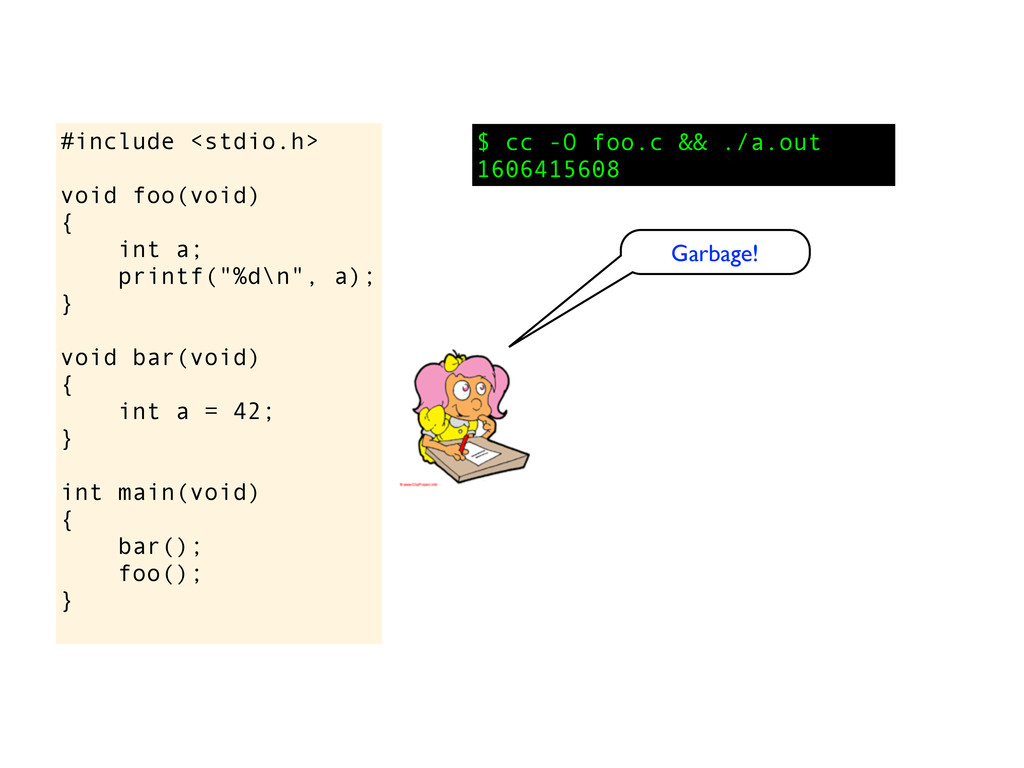
void bar(void) { int a = 42; } int main(void) { bar(); foo(); } $ cc foo.c && ./a.out 42 I am now going to show you something cool! Can you explain this behaviour?
void bar(void) { int a = 42; } int main(void) { bar(); foo(); } $ cc foo.c && ./a.out 42 I am now going to show you something cool! Can you explain this behaviour?
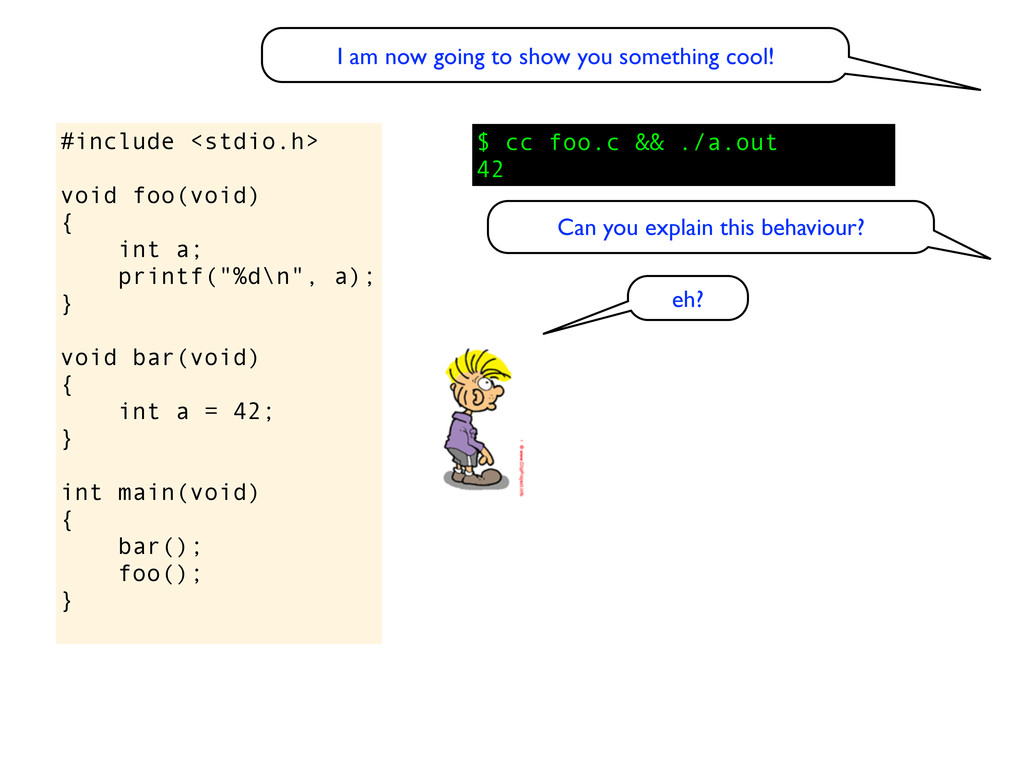
void bar(void) { int a = 42; } int main(void) { bar(); foo(); } eh? $ cc foo.c && ./a.out 42 I am now going to show you something cool! Can you explain this behaviour?
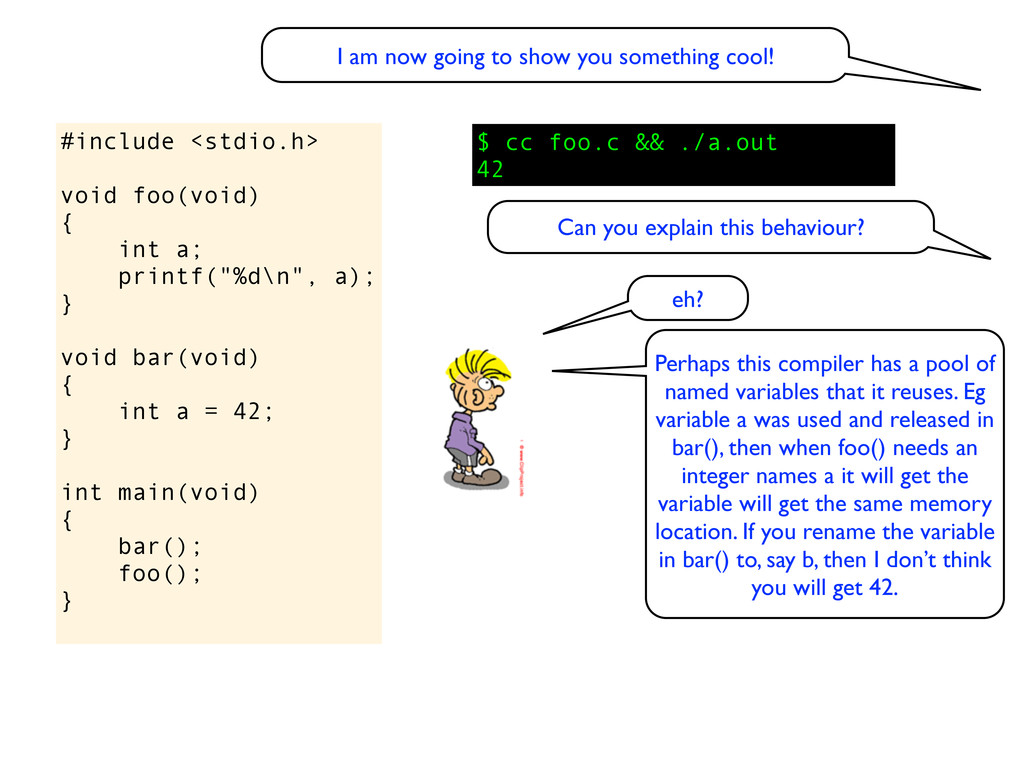
void bar(void) { int a = 42; } int main(void) { bar(); foo(); } eh? $ cc foo.c && ./a.out 42 I am now going to show you something cool! Perhaps this compiler has a pool of named variables that it reuses. Eg variable a was used and released in bar(), then when foo() needs an integer names a it will get the variable will get the same memory location. If you rename the variable in bar() to, say b, then I don’t think you will get 42. Can you explain this behaviour?
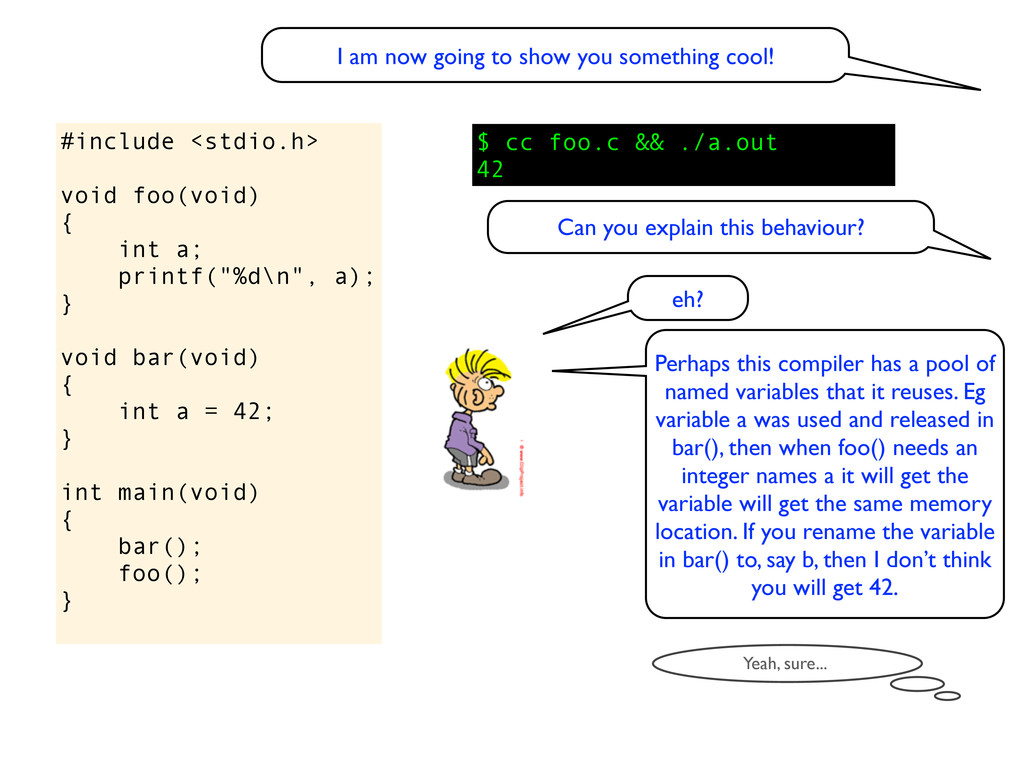
void bar(void) { int a = 42; } int main(void) { bar(); foo(); } eh? $ cc foo.c && ./a.out 42 I am now going to show you something cool! Perhaps this compiler has a pool of named variables that it reuses. Eg variable a was used and released in bar(), then when foo() needs an integer names a it will get the variable will get the same memory location. If you rename the variable in bar() to, say b, then I don’t think you will get 42. Yeah, sure... Can you explain this behaviour?
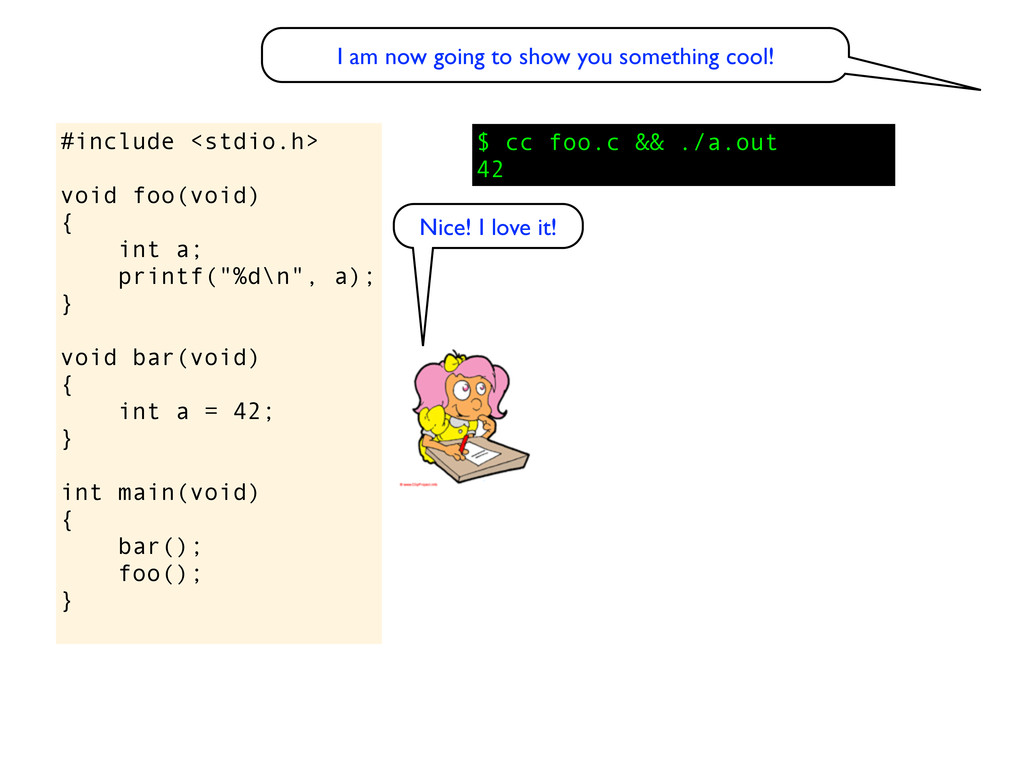
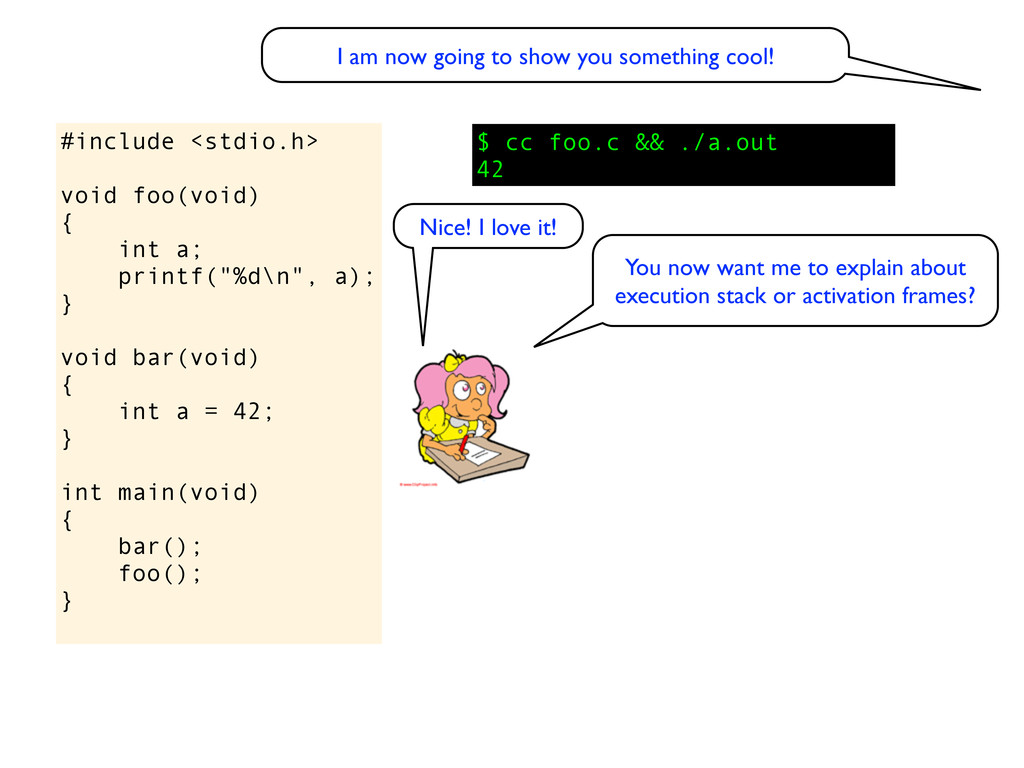
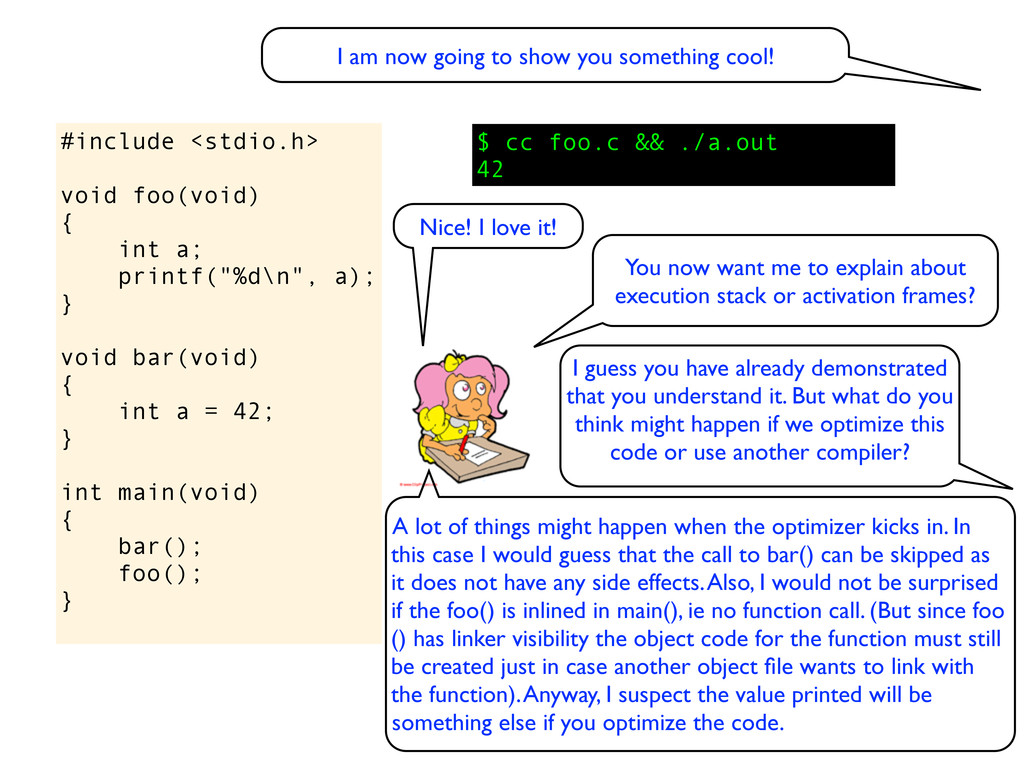
void bar(void) { int a = 42; } int main(void) { bar(); foo(); } Nice! I love it! $ cc foo.c && ./a.out 42 I am now going to show you something cool! You now want me to explain about execution stack or activation frames?
void bar(void) { int a = 42; } int main(void) { bar(); foo(); } Nice! I love it! $ cc foo.c && ./a.out 42 I am now going to show you something cool! You now want me to explain about execution stack or activation frames? I guess you have already demonstrated that you understand it. But what do you think might happen if we optimize this code or use another compiler?
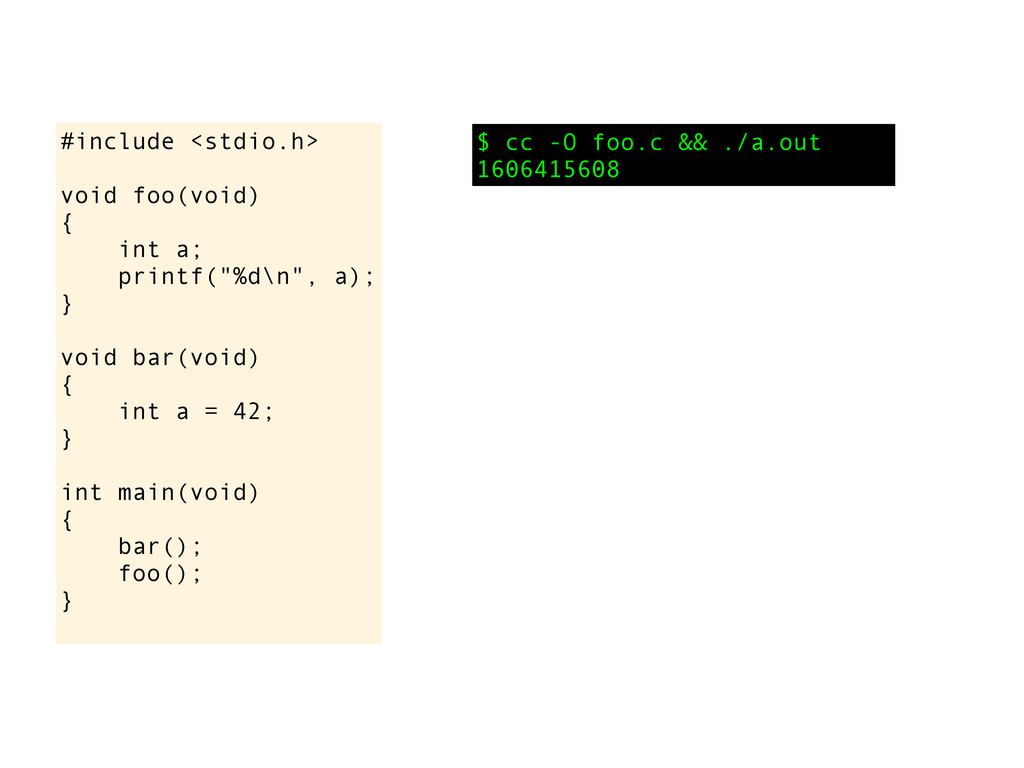
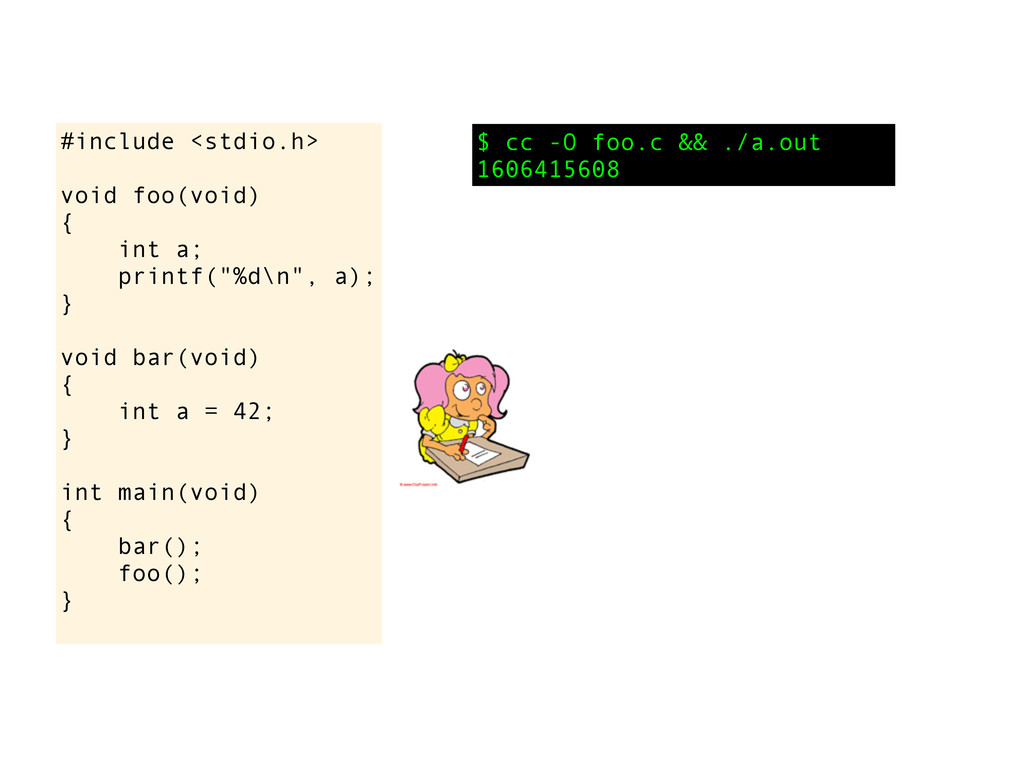
void bar(void) { int a = 42; } int main(void) { bar(); foo(); } Nice! I love it! $ cc foo.c && ./a.out 42 I am now going to show you something cool! You now want me to explain about execution stack or activation frames? I guess you have already demonstrated that you understand it. But what do you think might happen if we optimize this code or use another compiler? A lot of things might happen when the optimizer kicks in. In this case I would guess that the call to bar() can be skipped as it does not have any side effects. Also, I would not be surprised if the foo() is inlined in main(), ie no function call. (But since foo () has linker visibility the object code for the function must still be created just in case another object file wants to link with the function). Anyway, I suspect the value printed will be something else if you optimize the code.
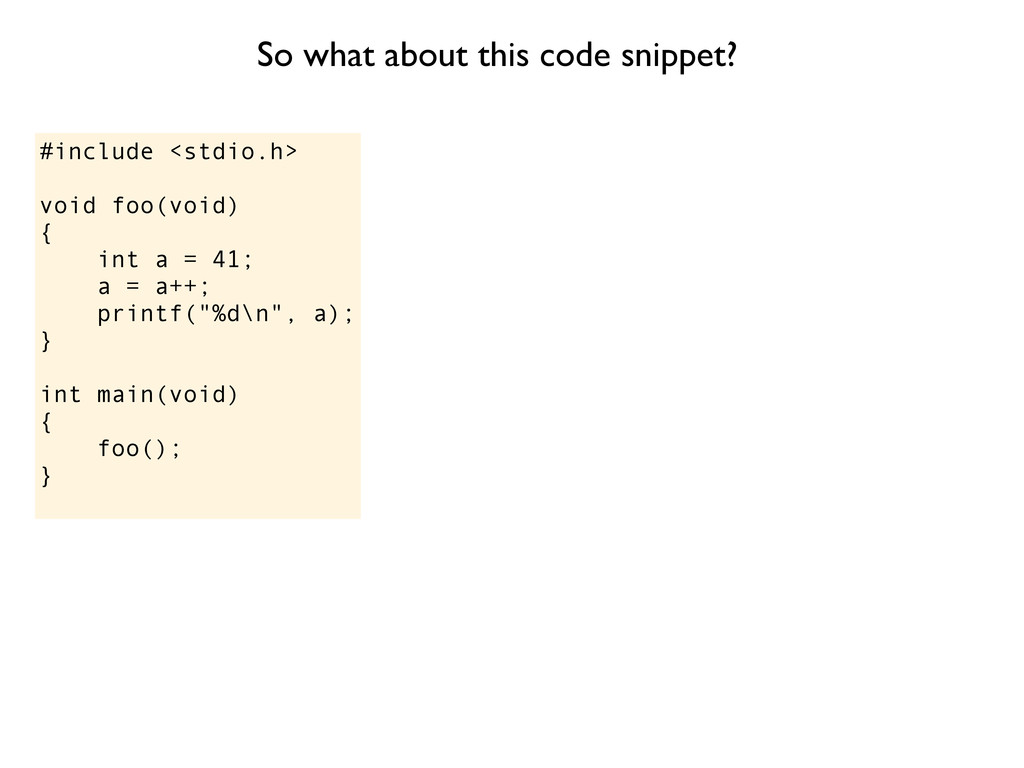
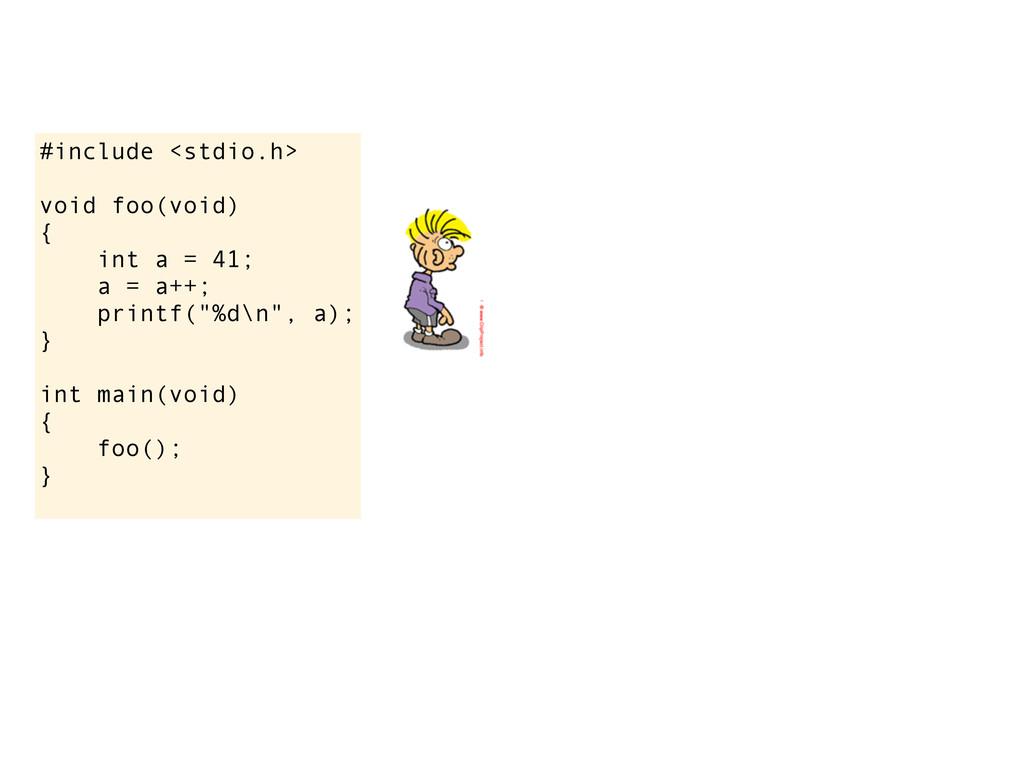
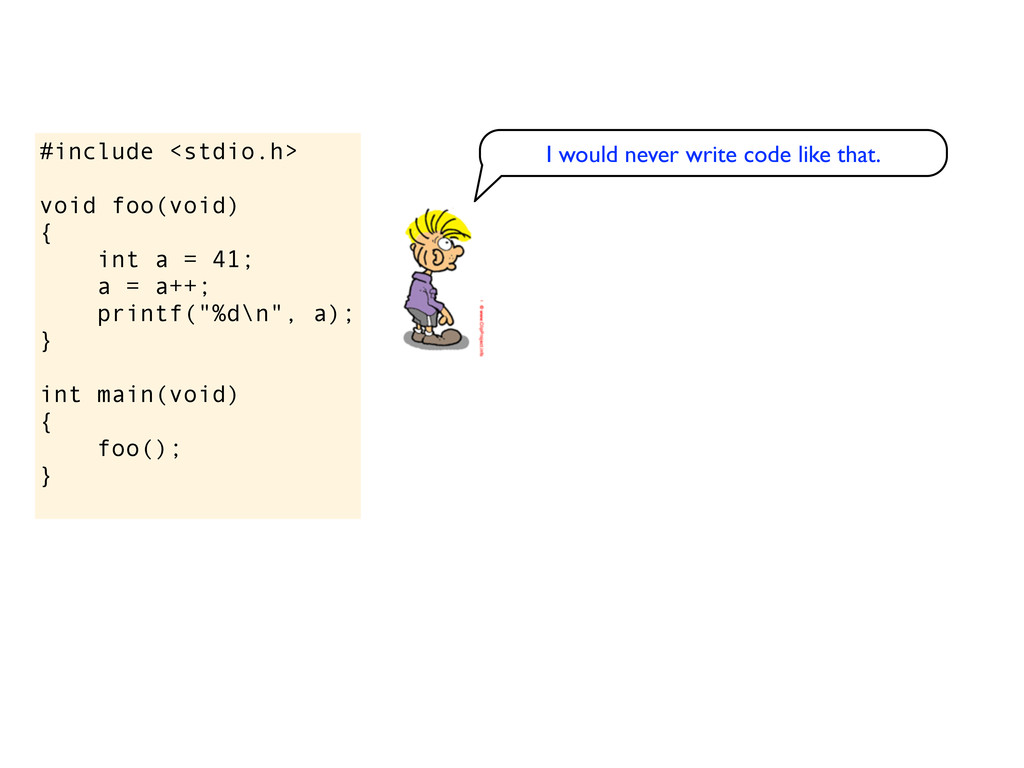
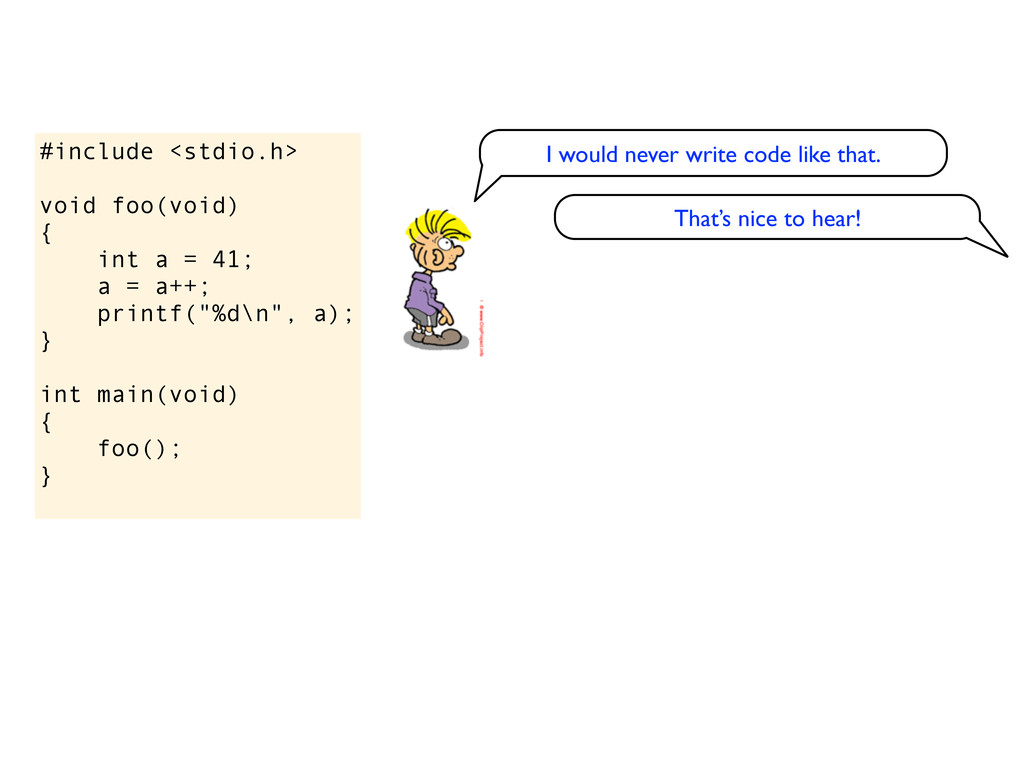
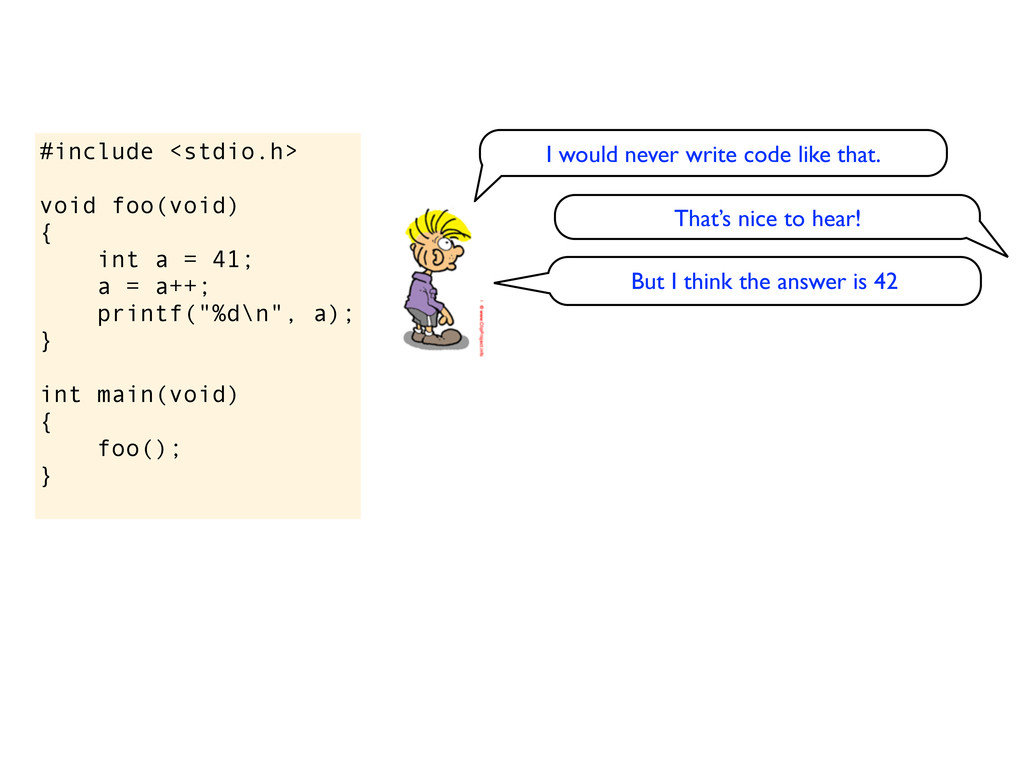
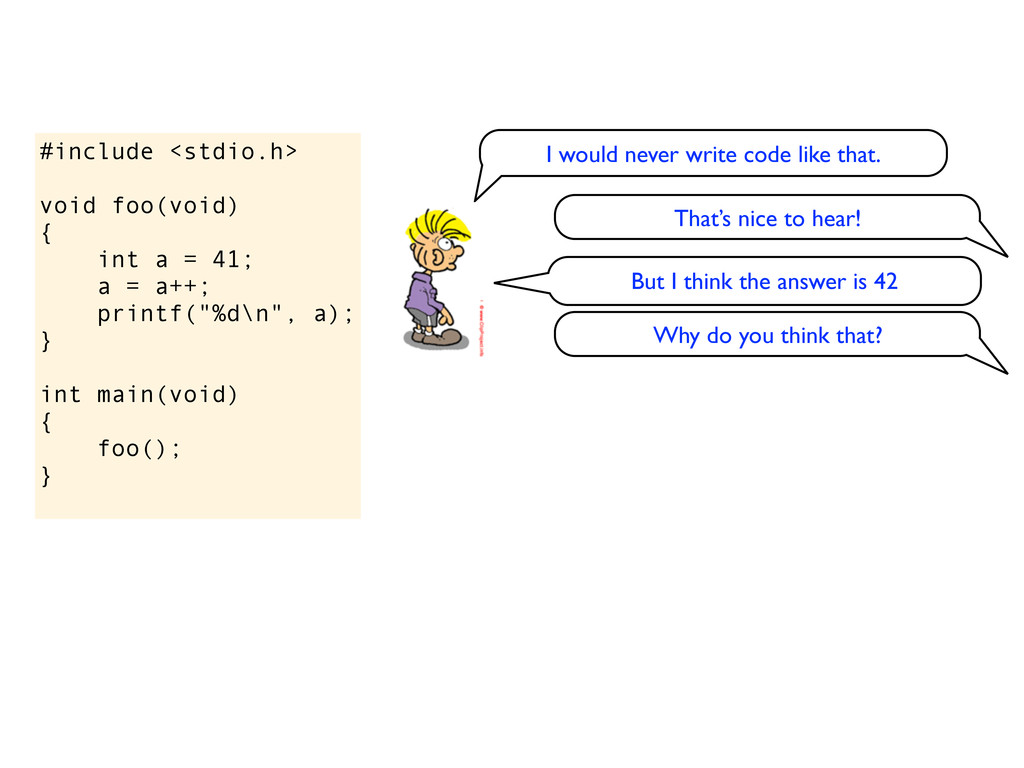
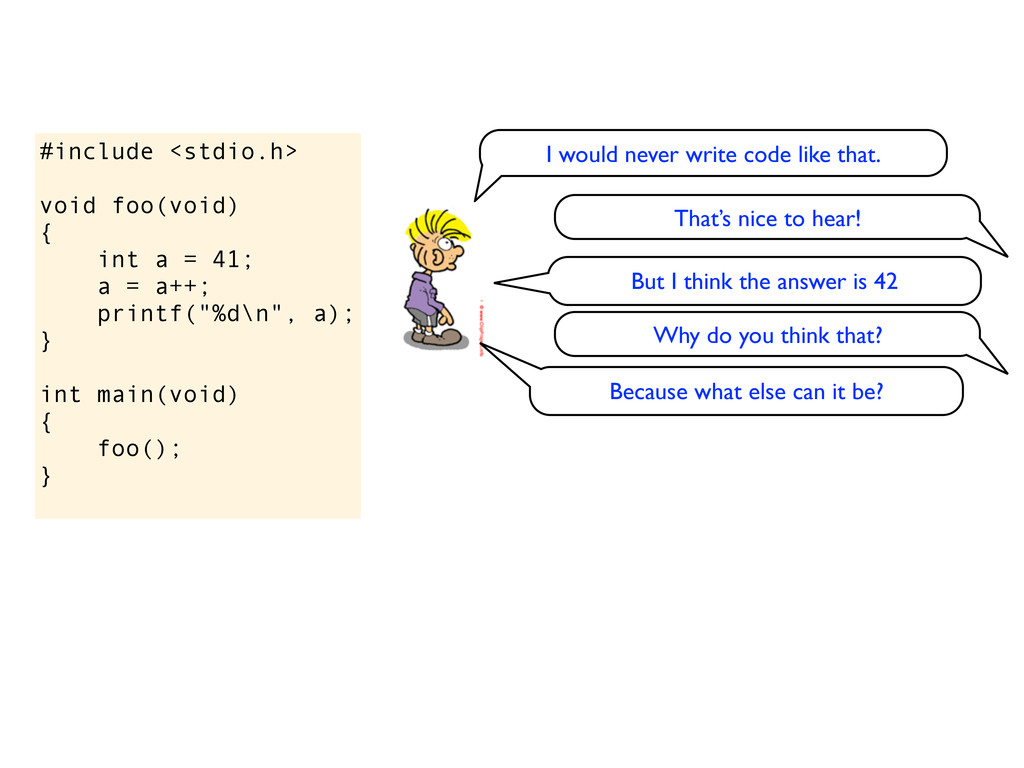
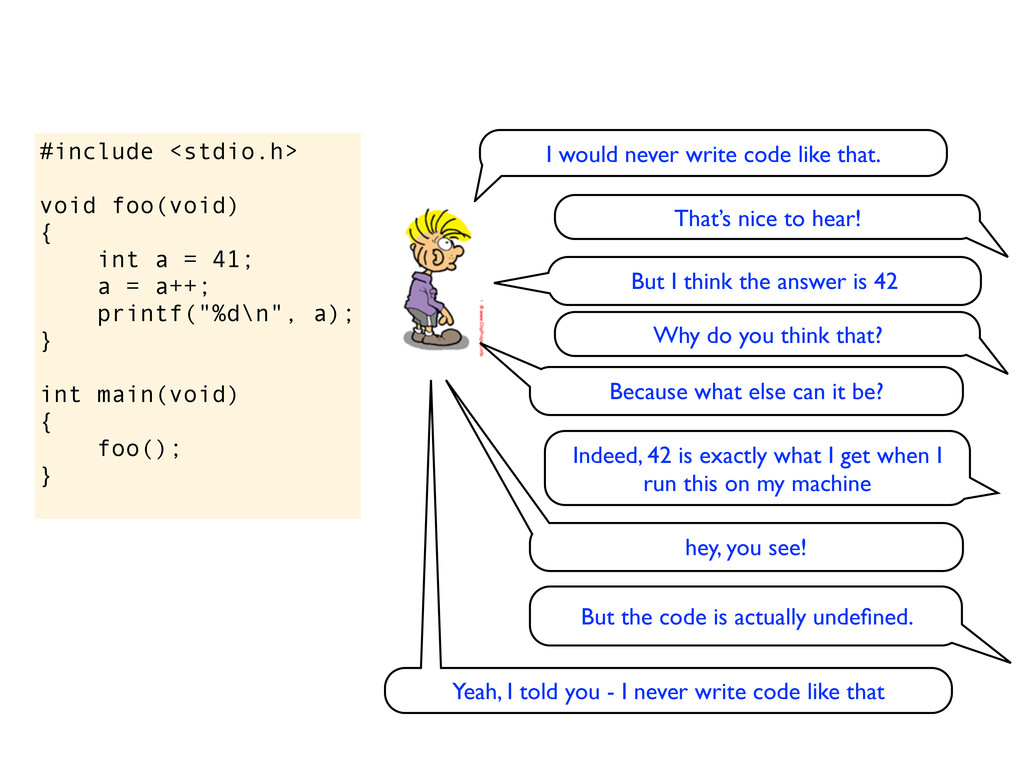
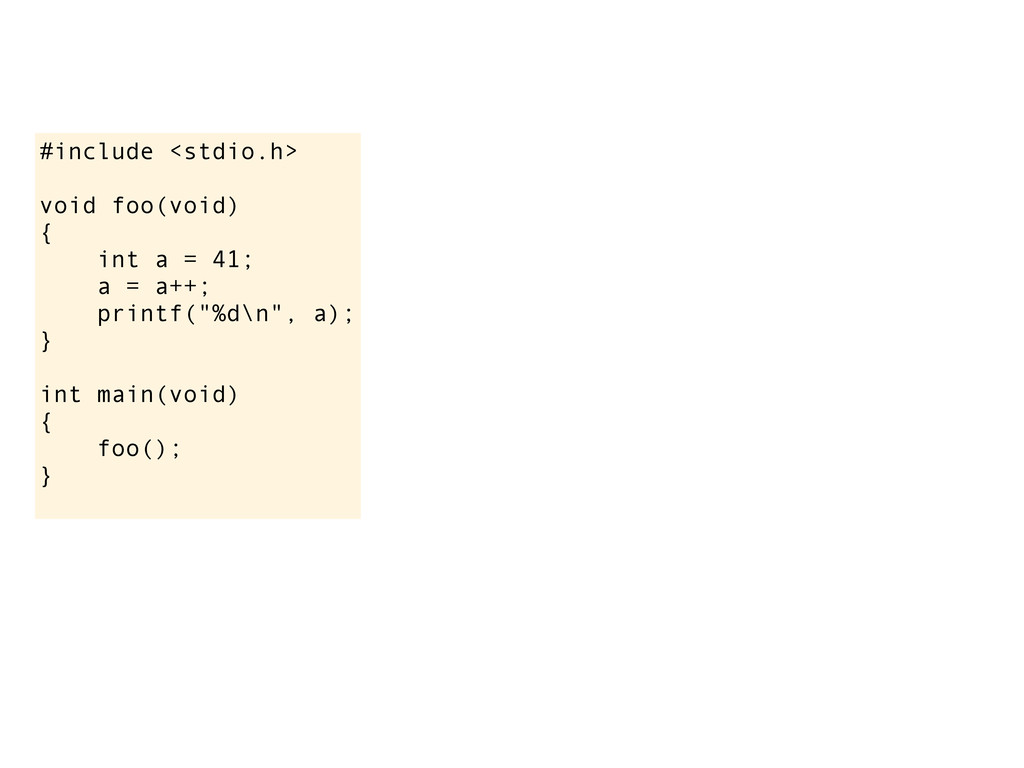
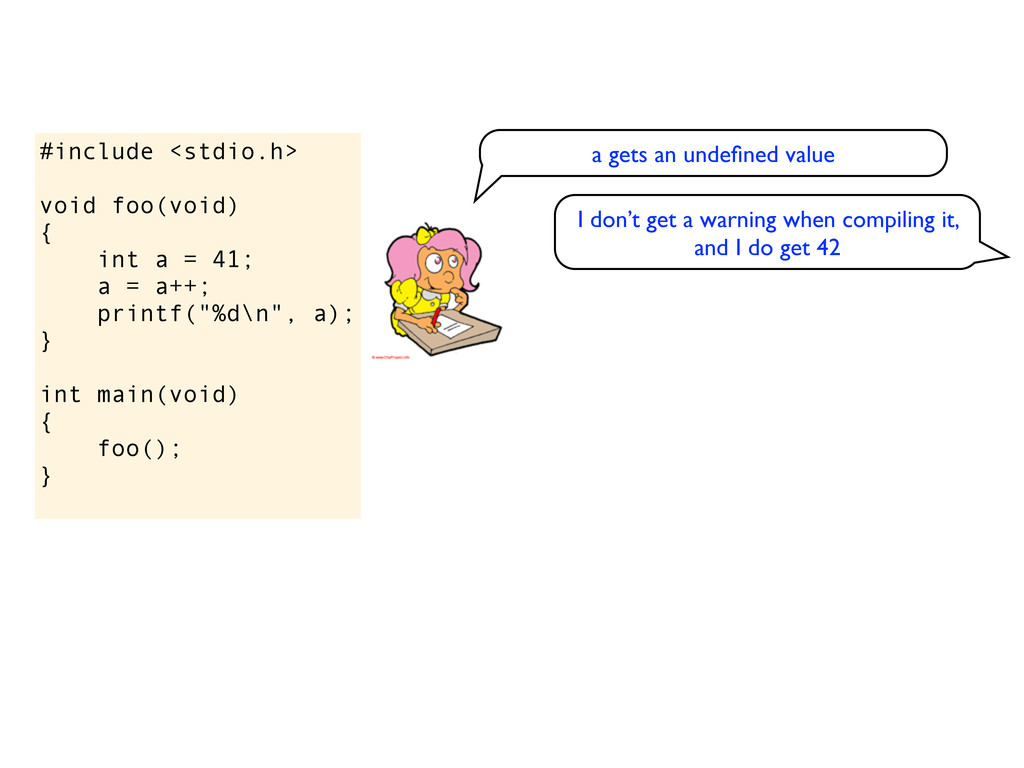
= a++; printf("%d\n", a); } int main(void) { foo(); } I would never write code like that. That’s nice to hear! But I think the answer is 42 Why do you think that?
= a++; printf("%d\n", a); } int main(void) { foo(); } I would never write code like that. That’s nice to hear! But I think the answer is 42 Why do you think that? Because what else can it be?
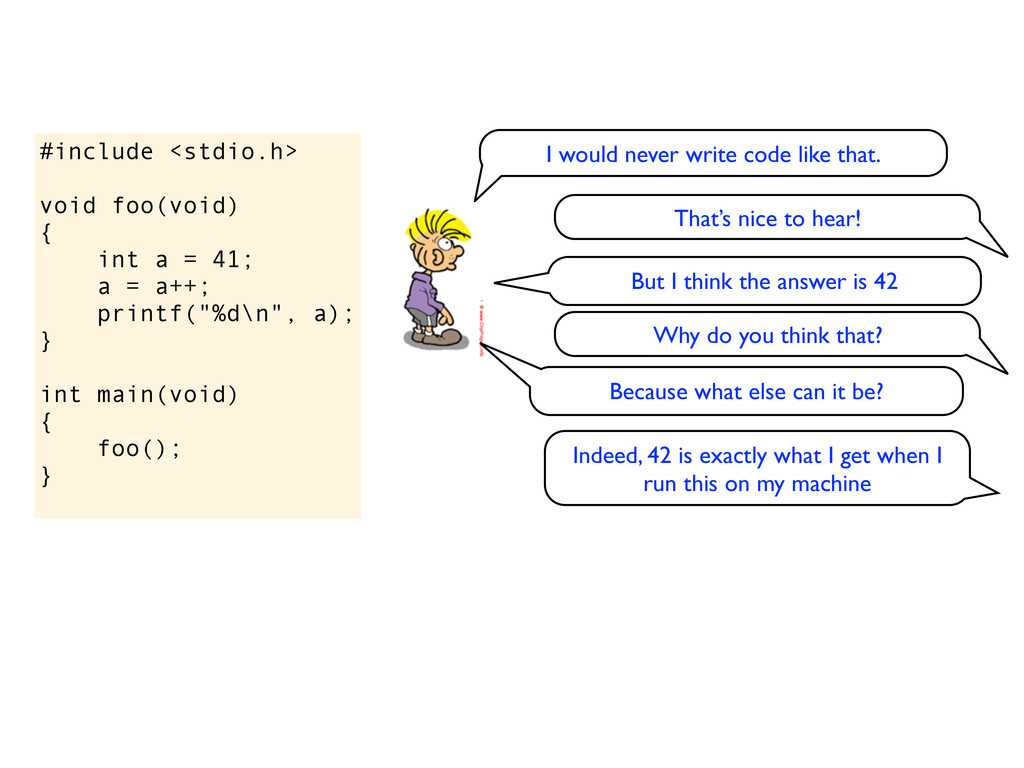
= a++; printf("%d\n", a); } int main(void) { foo(); } I would never write code like that. That’s nice to hear! But I think the answer is 42 Why do you think that? Because what else can it be? Indeed, 42 is exactly what I get when I run this on my machine
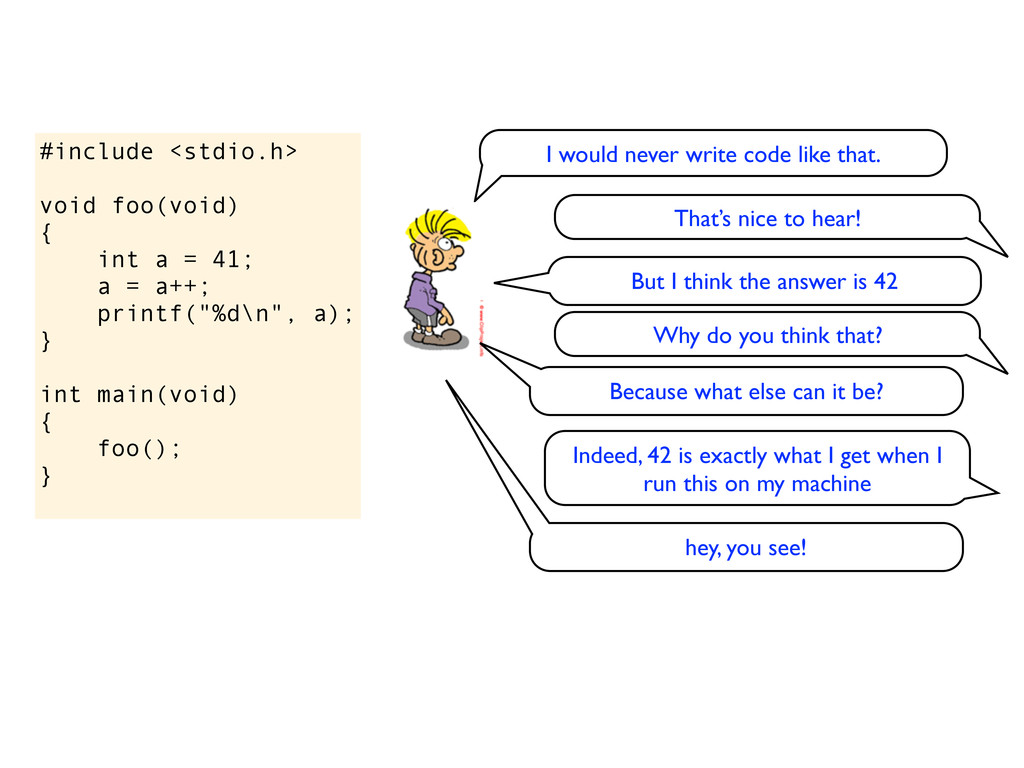
= a++; printf("%d\n", a); } int main(void) { foo(); } I would never write code like that. That’s nice to hear! But I think the answer is 42 Why do you think that? Because what else can it be? Indeed, 42 is exactly what I get when I run this on my machine hey, you see!
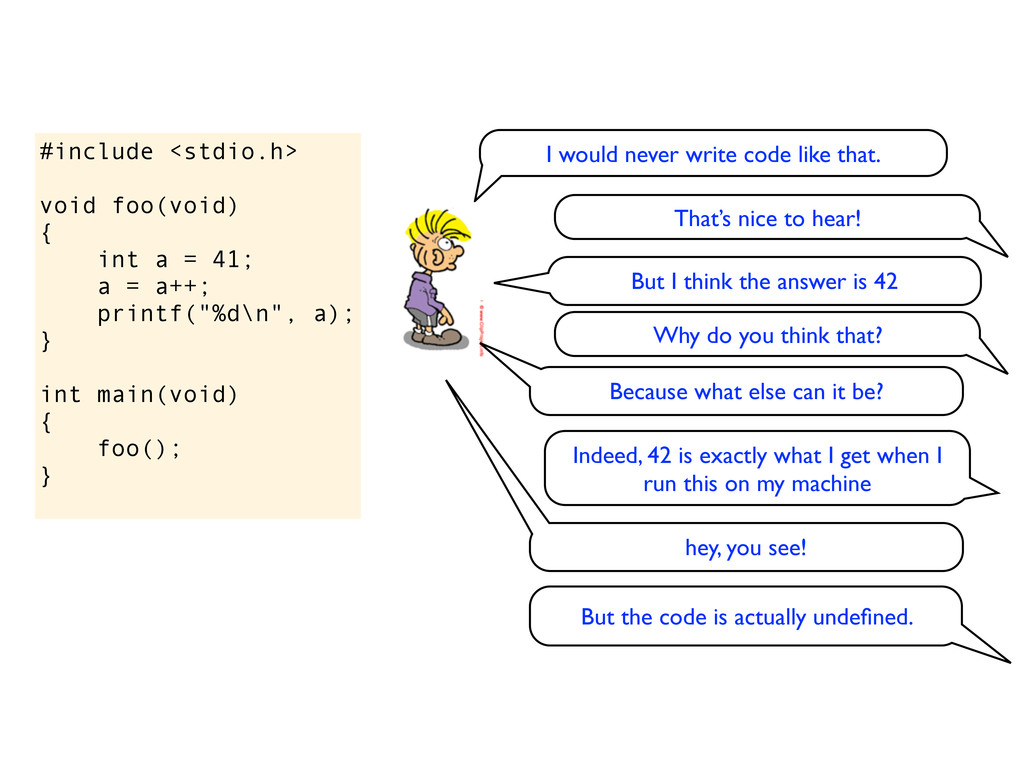
= a++; printf("%d\n", a); } int main(void) { foo(); } I would never write code like that. That’s nice to hear! But I think the answer is 42 Why do you think that? Because what else can it be? Indeed, 42 is exactly what I get when I run this on my machine hey, you see! But the code is actually undefined.
= a++; printf("%d\n", a); } int main(void) { foo(); } I would never write code like that. That’s nice to hear! But I think the answer is 42 Why do you think that? Because what else can it be? Indeed, 42 is exactly what I get when I run this on my machine hey, you see! But the code is actually undefined. Yeah, I told you - I never write code like that
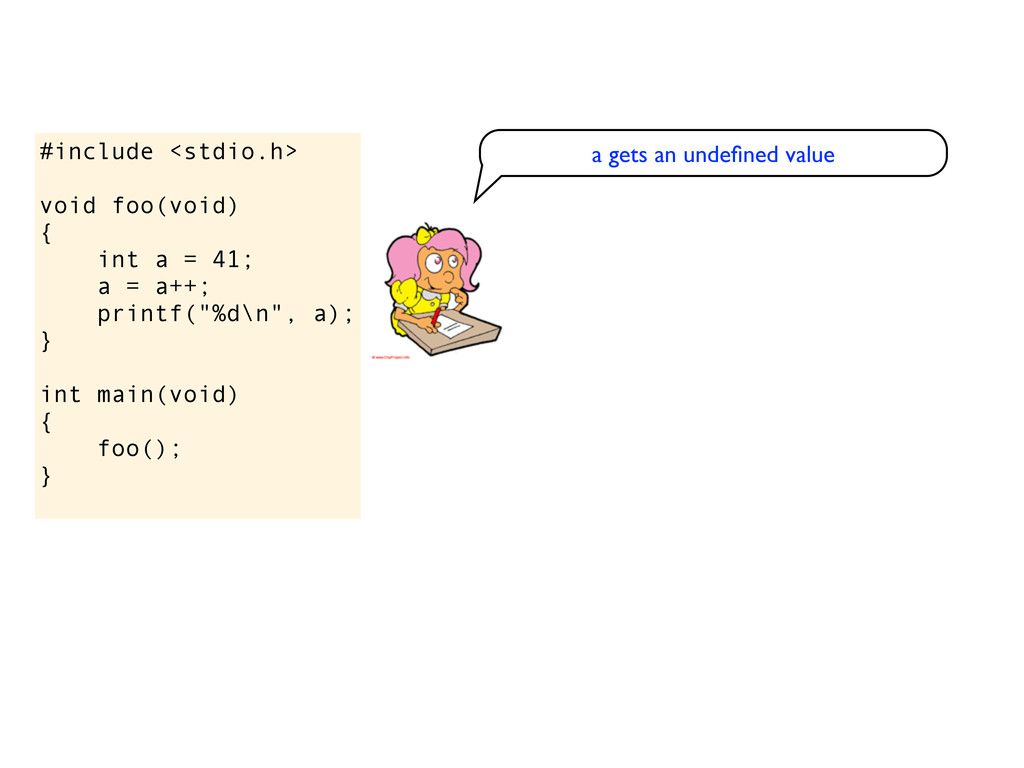
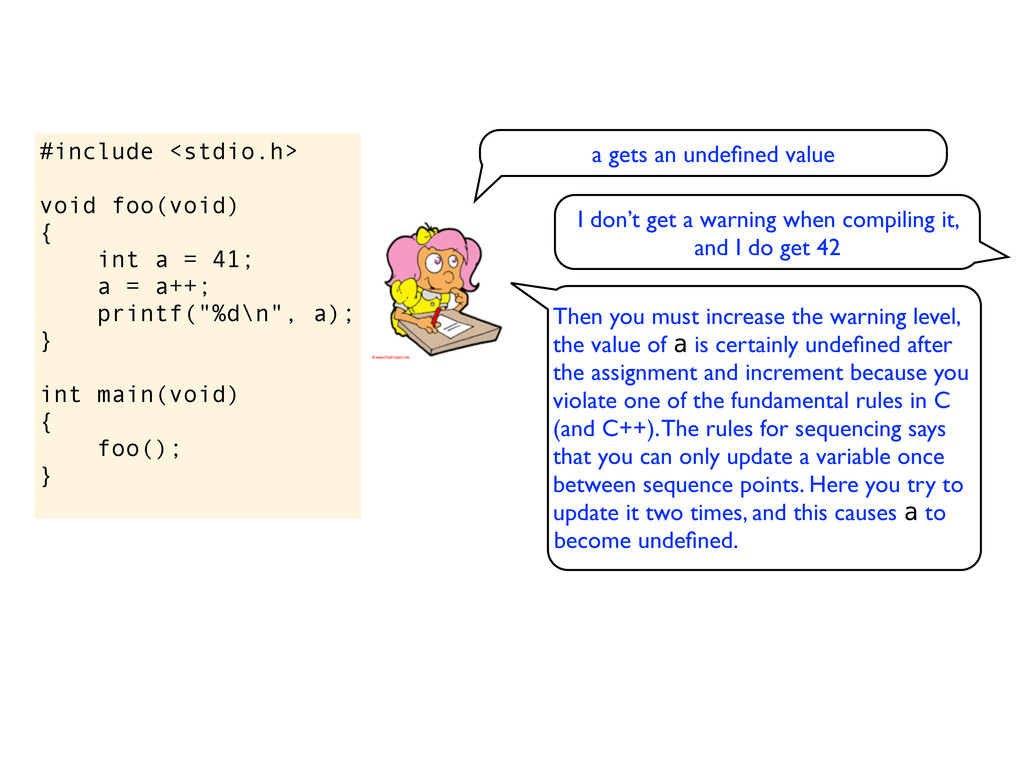
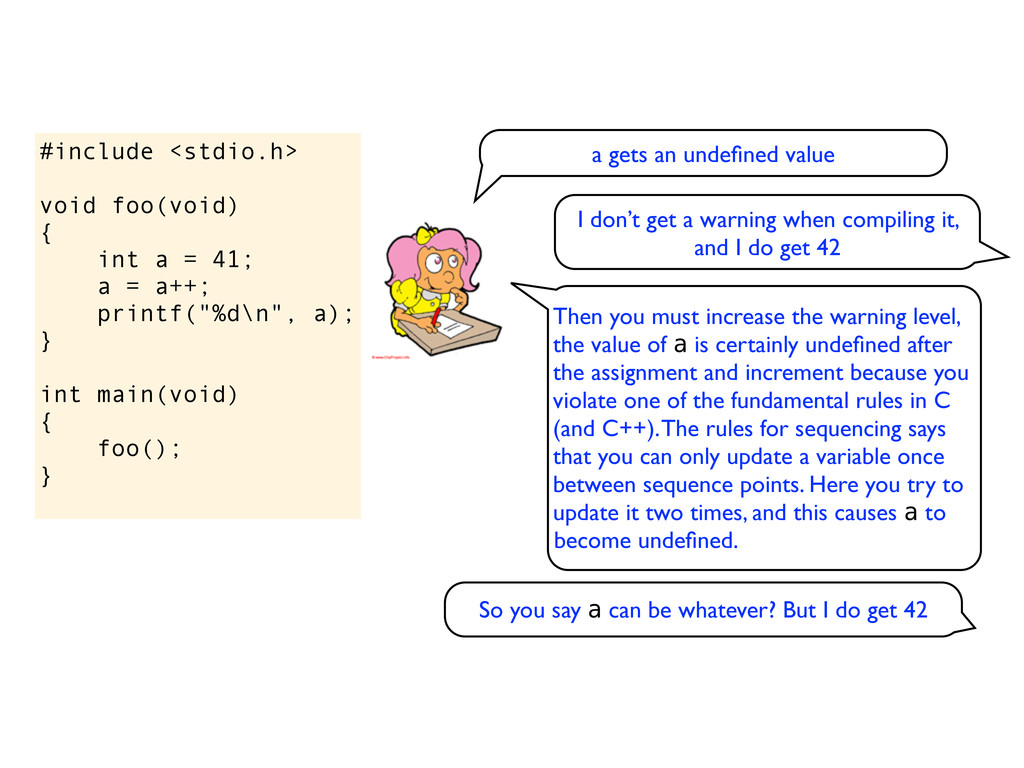
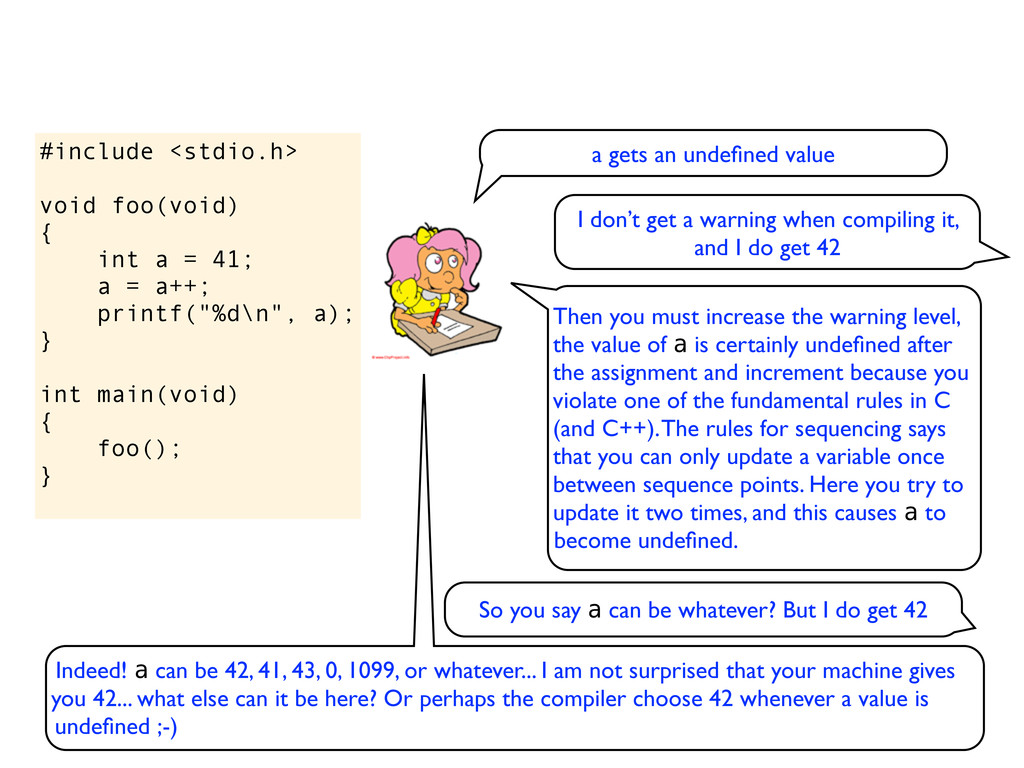
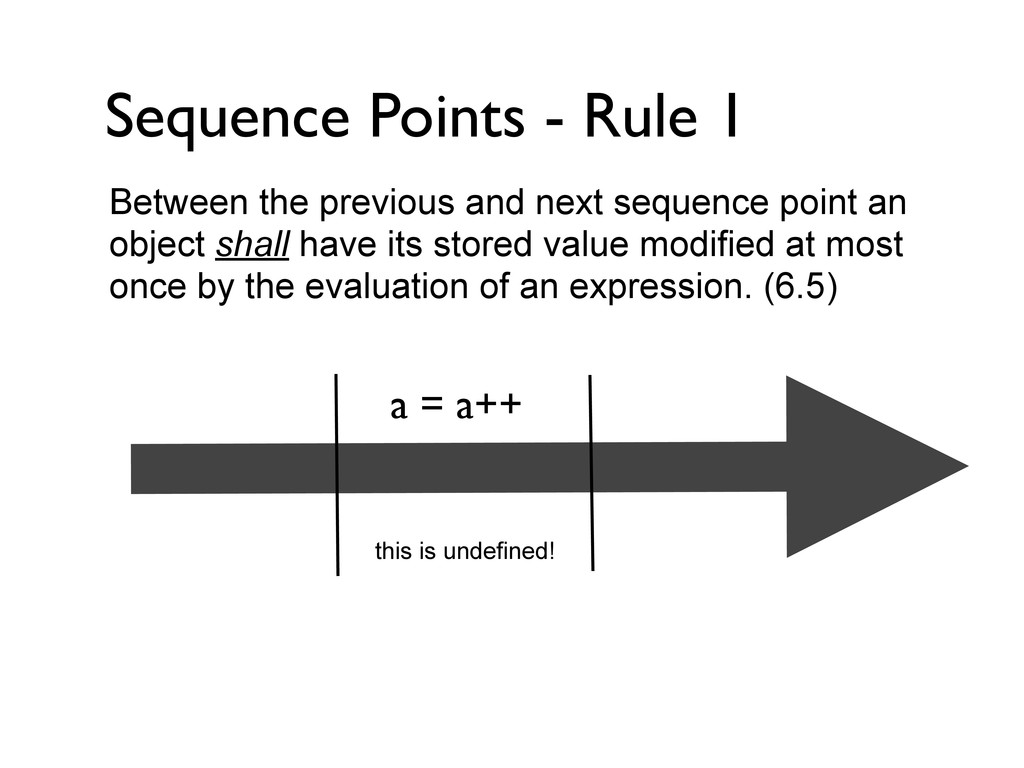
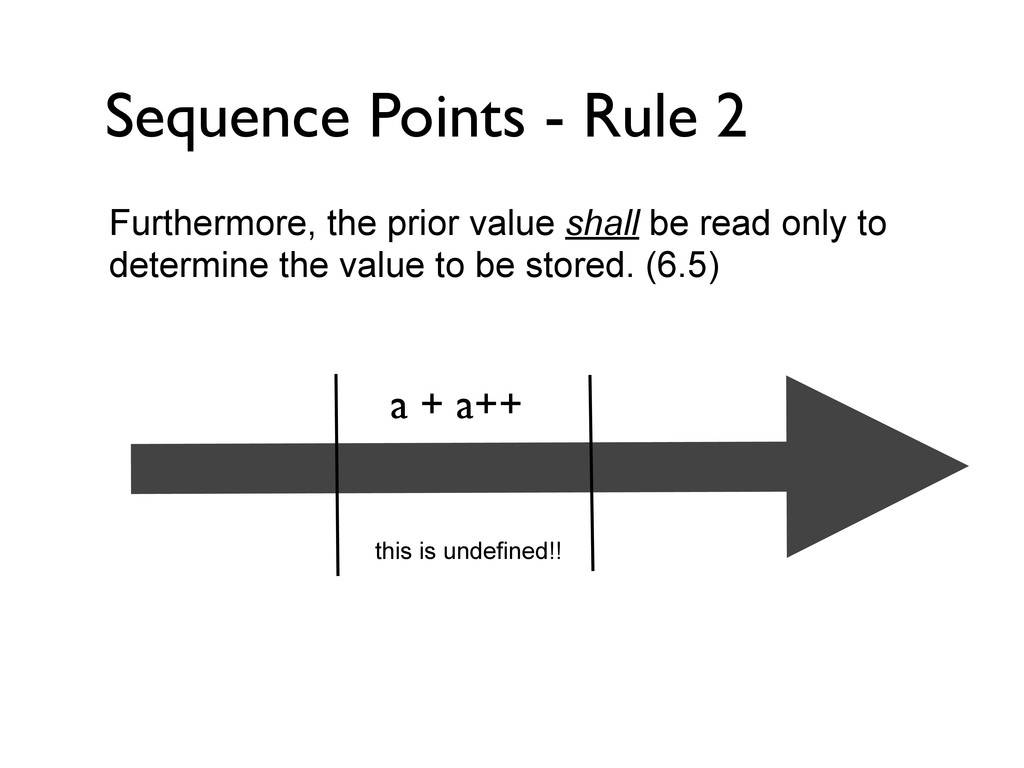
= a++; printf("%d\n", a); } int main(void) { foo(); } a gets an undefined value I don’t get a warning when compiling it, and I do get 42 Then you must increase the warning level, the value of a is certainly undefined after the assignment and increment because you violate one of the fundamental rules in C (and C++). The rules for sequencing says that you can only update a variable once between sequence points. Here you try to update it two times, and this causes a to become undefined.
= a++; printf("%d\n", a); } int main(void) { foo(); } a gets an undefined value I don’t get a warning when compiling it, and I do get 42 Then you must increase the warning level, the value of a is certainly undefined after the assignment and increment because you violate one of the fundamental rules in C (and C++). The rules for sequencing says that you can only update a variable once between sequence points. Here you try to update it two times, and this causes a to become undefined. So you say a can be whatever? But I do get 42
= a++; printf("%d\n", a); } int main(void) { foo(); } a gets an undefined value I don’t get a warning when compiling it, and I do get 42 Then you must increase the warning level, the value of a is certainly undefined after the assignment and increment because you violate one of the fundamental rules in C (and C++). The rules for sequencing says that you can only update a variable once between sequence points. Here you try to update it two times, and this causes a to become undefined. So you say a can be whatever? But I do get 42 Indeed! a can be 42, 41, 43, 0, 1099, or whatever... I am not surprised that your machine gives you 42... what else can it be here? Or perhaps the compiler choose 42 whenever a value is undefined ;-)
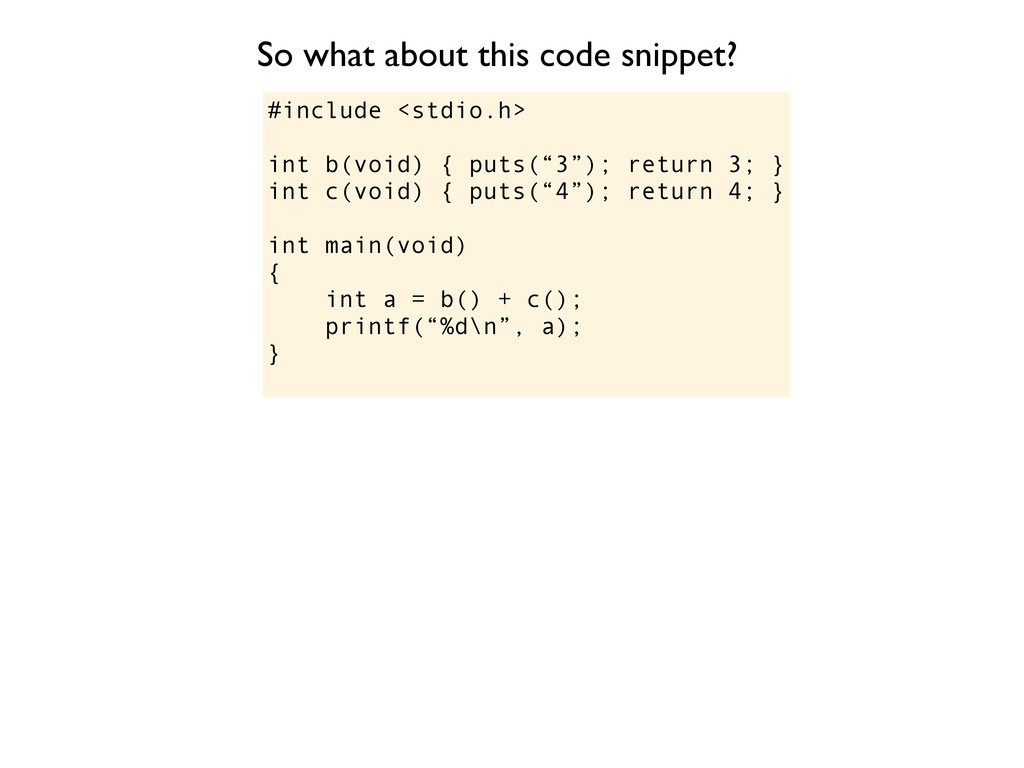
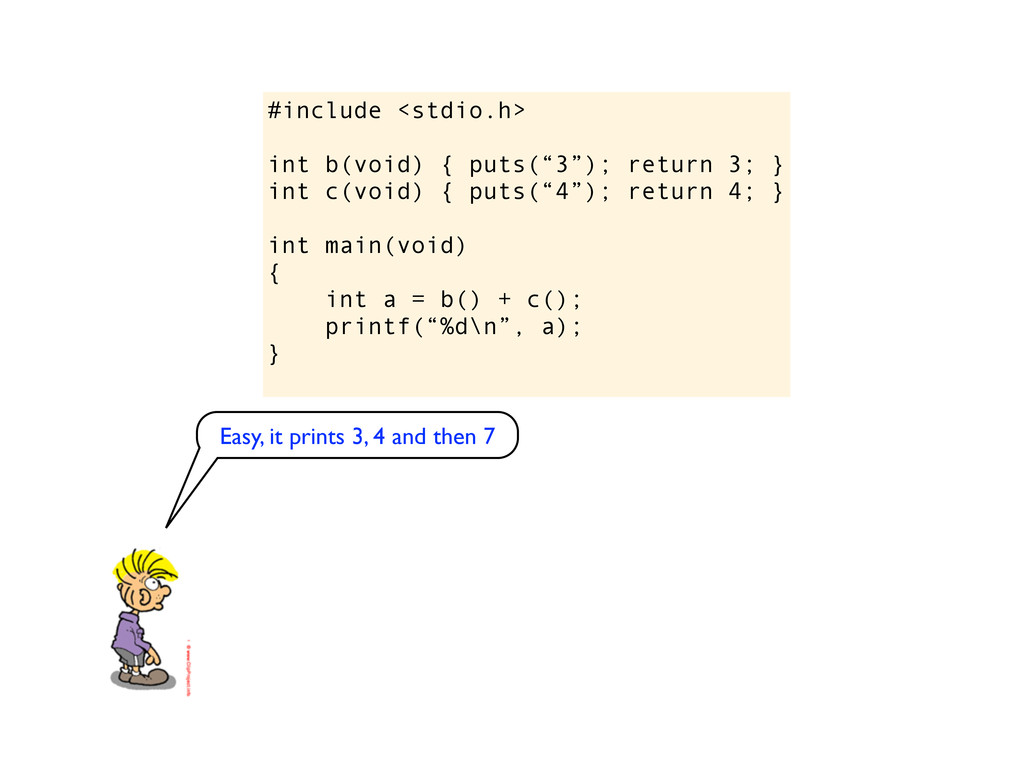
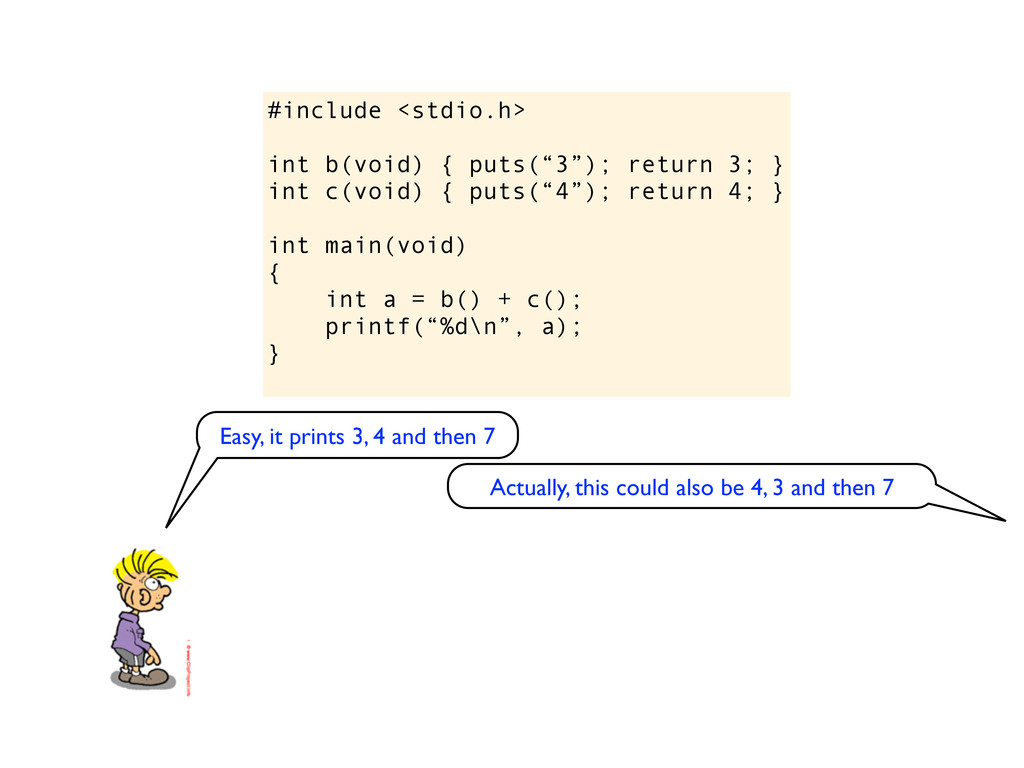
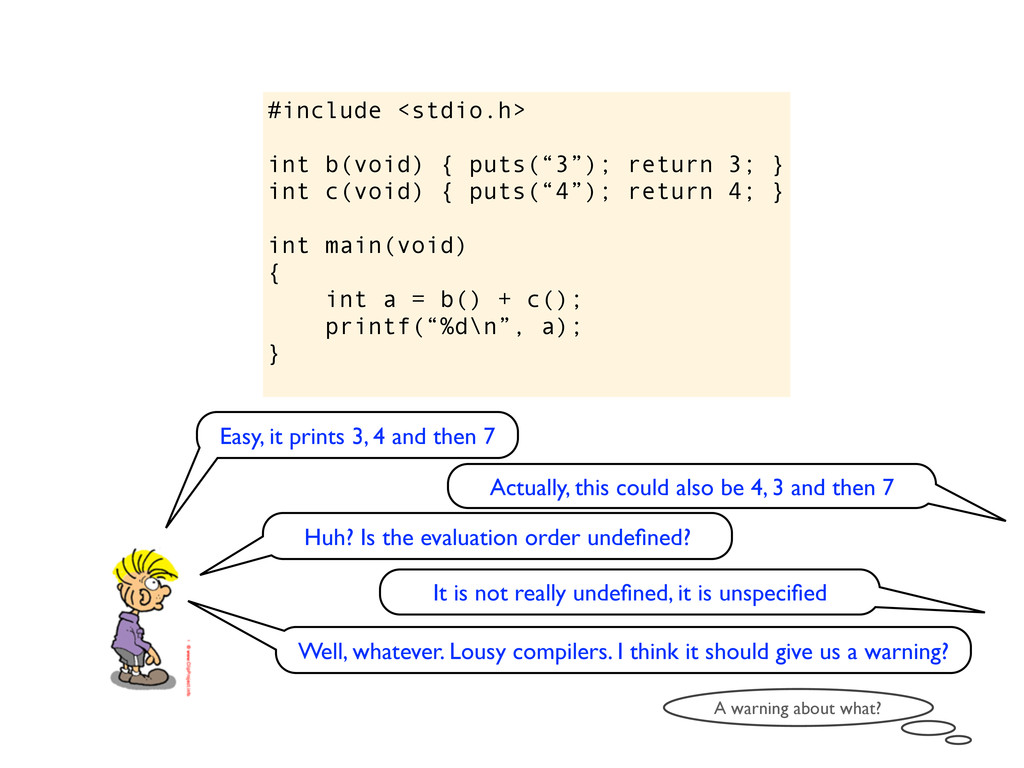
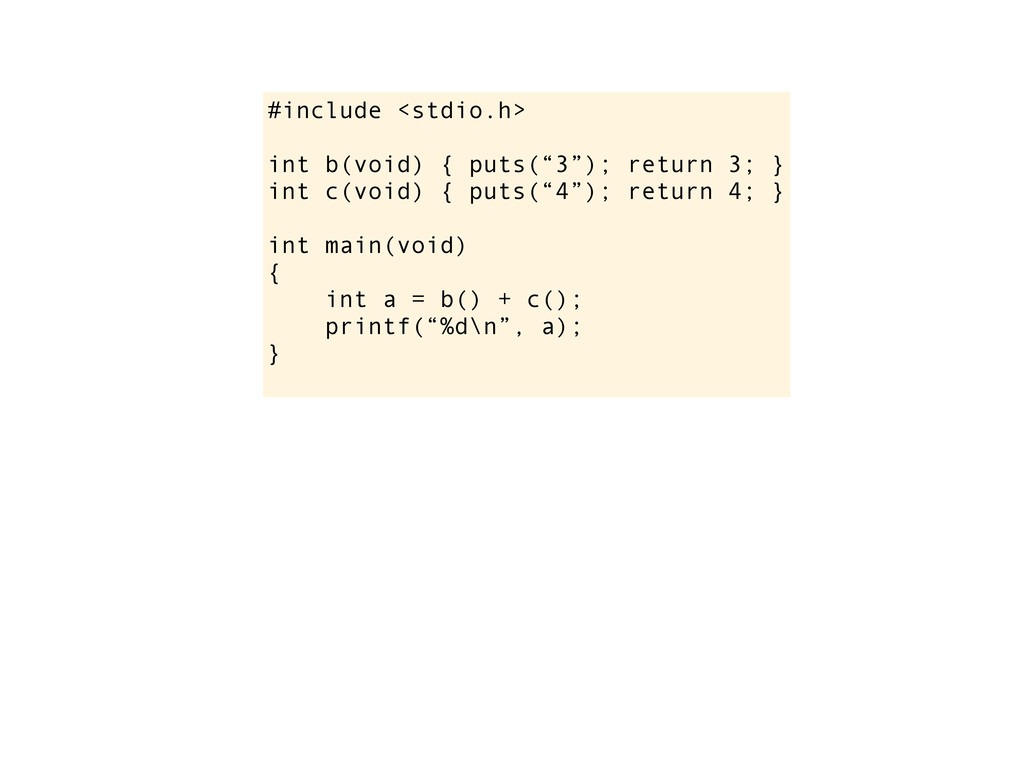
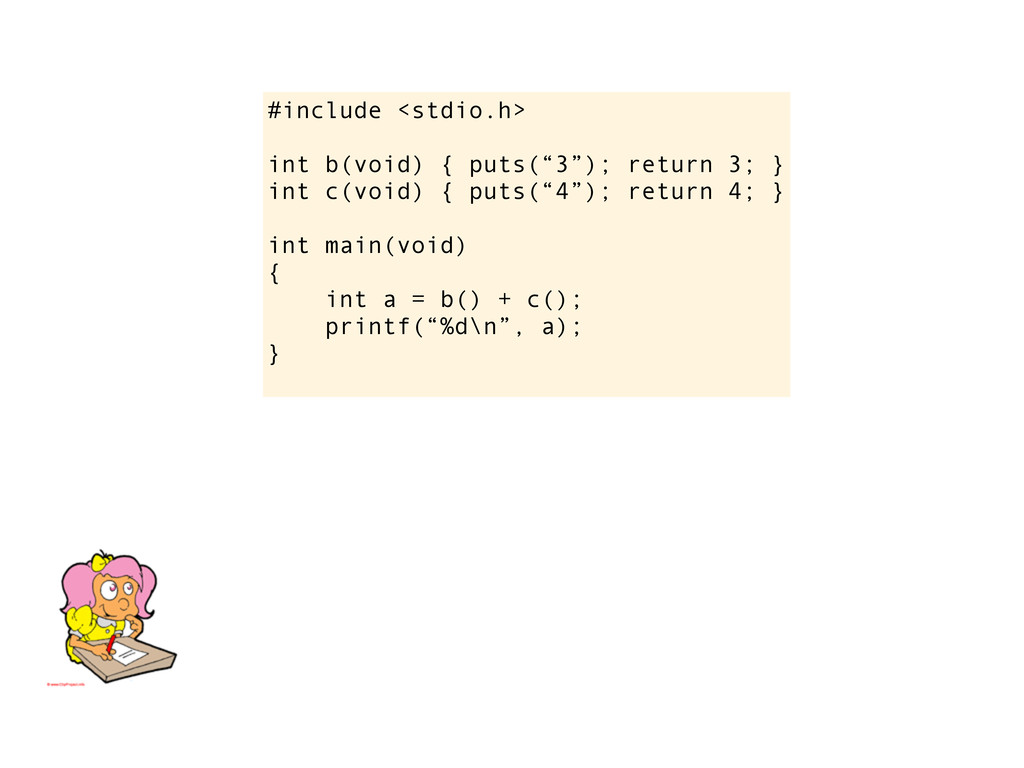
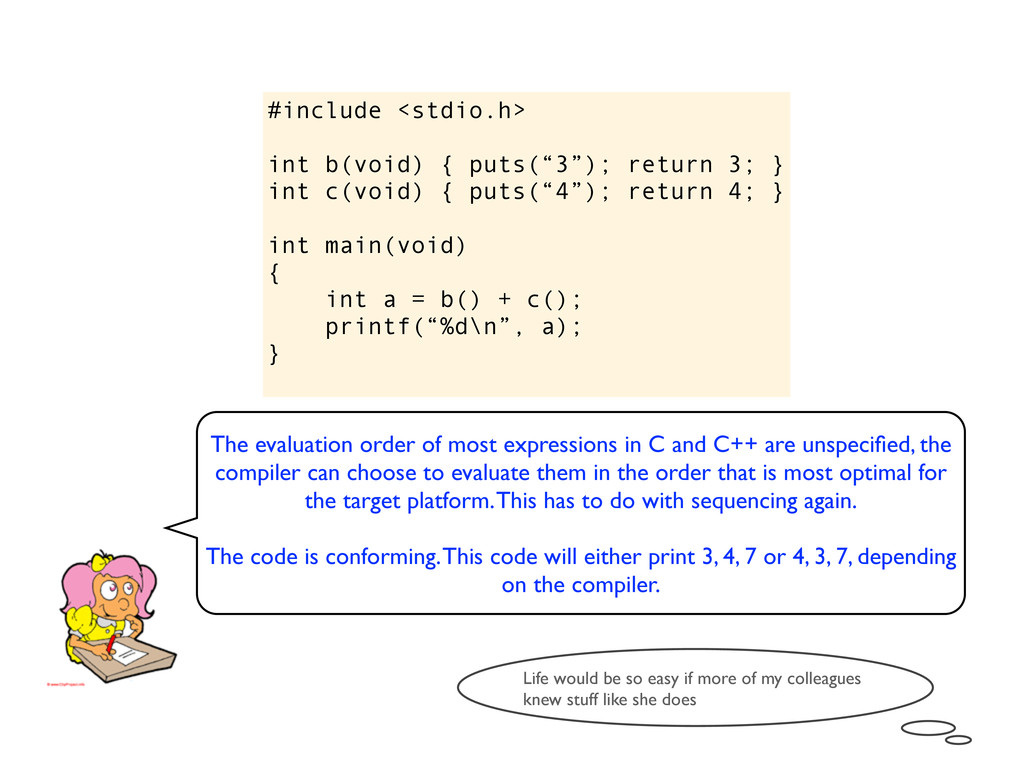
c(void) { puts(“4”); return 4; } int main(void) { int a = b() + c(); printf(“%d\n”, a); } Easy, it prints 3, 4 and then 7 Actually, this could also be 4, 3 and then 7
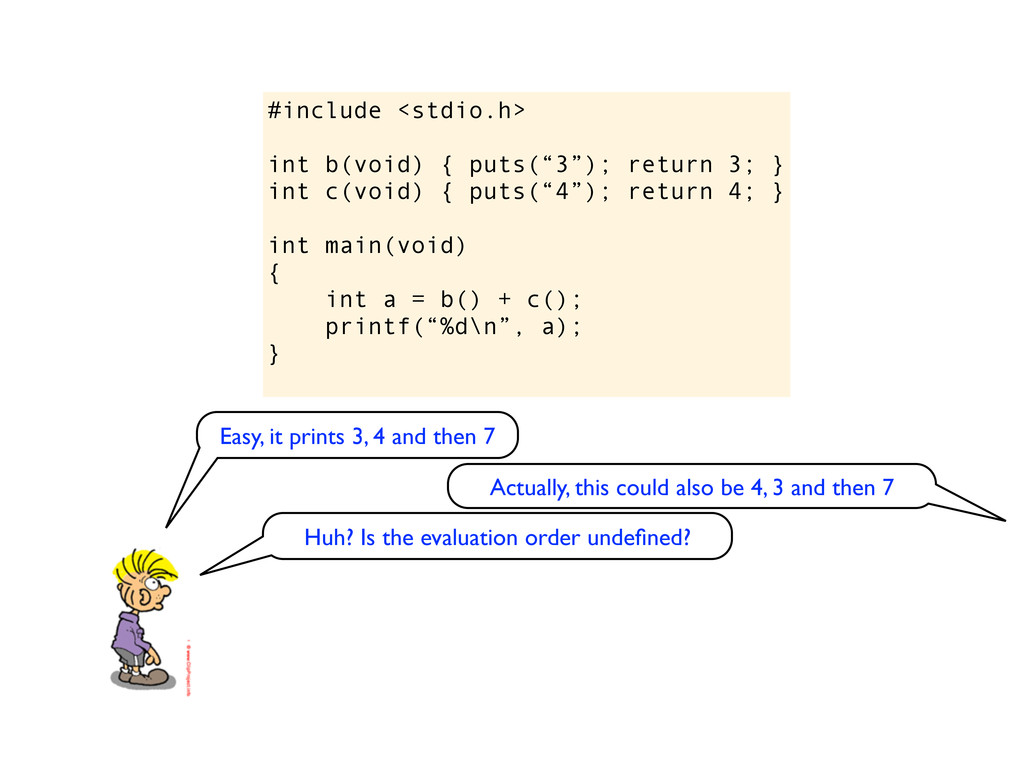
c(void) { puts(“4”); return 4; } int main(void) { int a = b() + c(); printf(“%d\n”, a); } Easy, it prints 3, 4 and then 7 Actually, this could also be 4, 3 and then 7 Huh? Is the evaluation order undefined?
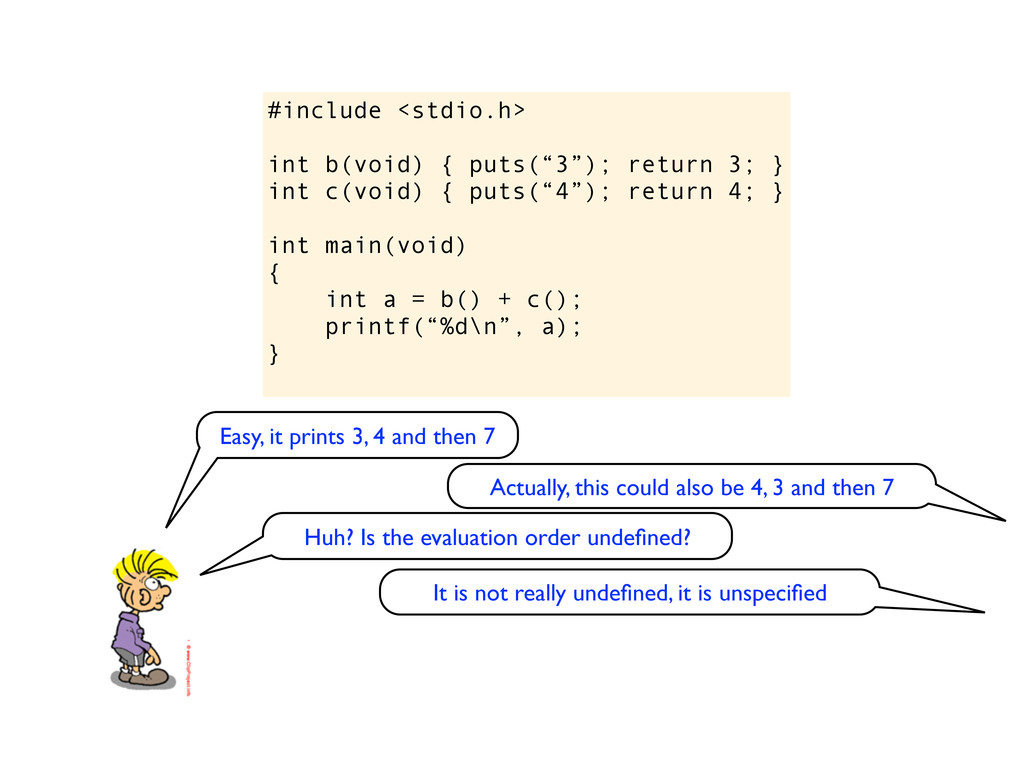
c(void) { puts(“4”); return 4; } int main(void) { int a = b() + c(); printf(“%d\n”, a); } Easy, it prints 3, 4 and then 7 Actually, this could also be 4, 3 and then 7 Huh? Is the evaluation order undefined? It is not really undefined, it is unspecified
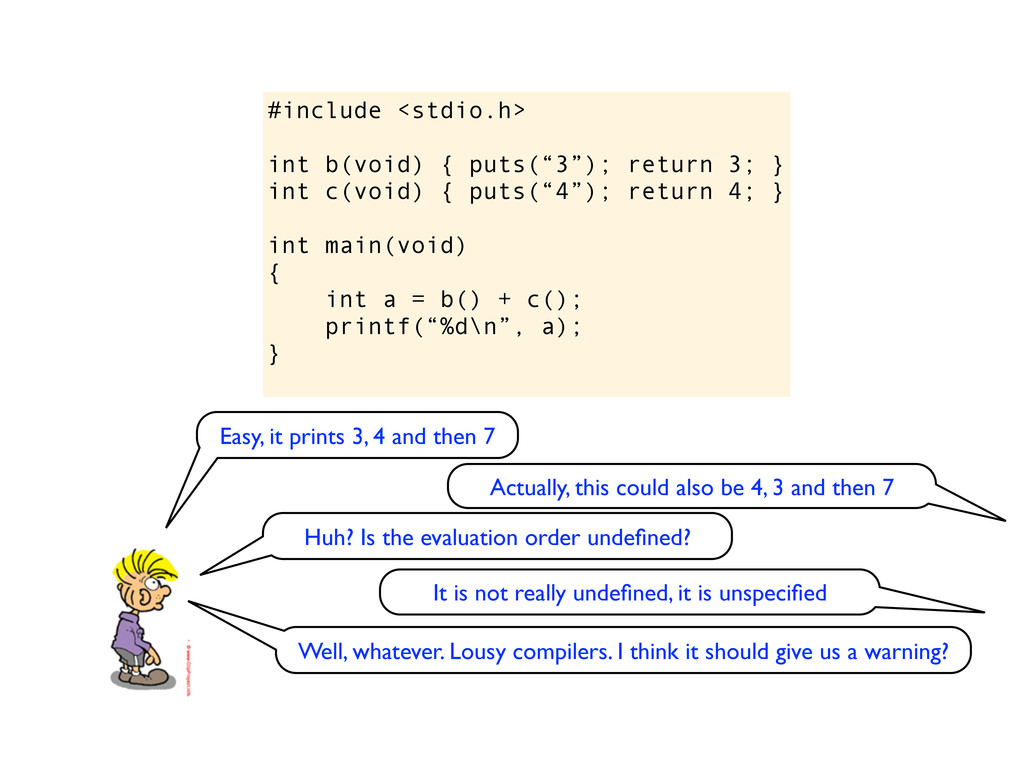
c(void) { puts(“4”); return 4; } int main(void) { int a = b() + c(); printf(“%d\n”, a); } Easy, it prints 3, 4 and then 7 Actually, this could also be 4, 3 and then 7 Huh? Is the evaluation order undefined? It is not really undefined, it is unspecified Well, whatever. Lousy compilers. I think it should give us a warning?
c(void) { puts(“4”); return 4; } int main(void) { int a = b() + c(); printf(“%d\n”, a); } Easy, it prints 3, 4 and then 7 Actually, this could also be 4, 3 and then 7 Huh? Is the evaluation order undefined? It is not really undefined, it is unspecified Well, whatever. Lousy compilers. I think it should give us a warning? A warning about what?
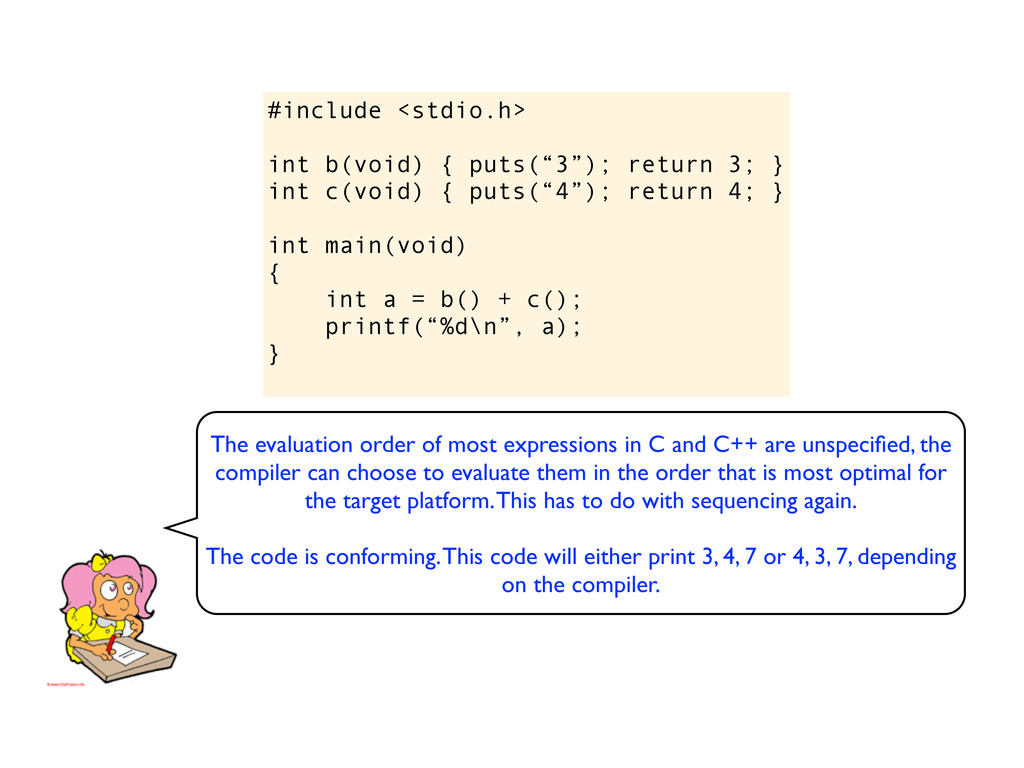
c(void) { puts(“4”); return 4; } int main(void) { int a = b() + c(); printf(“%d\n”, a); } The evaluation order of most expressions in C and C++ are unspecified, the compiler can choose to evaluate them in the order that is most optimal for the target platform. This has to do with sequencing again. The code is conforming. This code will either print 3, 4, 7 or 4, 3, 7, depending on the compiler.
c(void) { puts(“4”); return 4; } int main(void) { int a = b() + c(); printf(“%d\n”, a); } The evaluation order of most expressions in C and C++ are unspecified, the compiler can choose to evaluate them in the order that is most optimal for the target platform. This has to do with sequencing again. The code is conforming. This code will either print 3, 4, 7 or 4, 3, 7, depending on the compiler. Life would be so easy if more of my colleagues knew stuff like she does
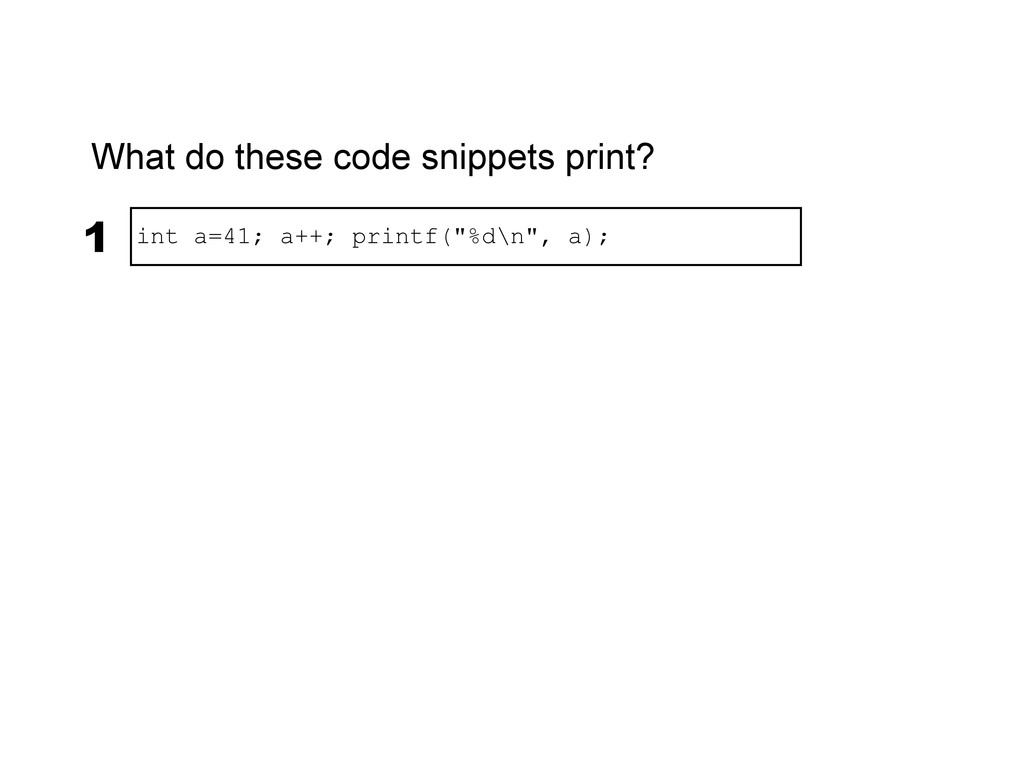
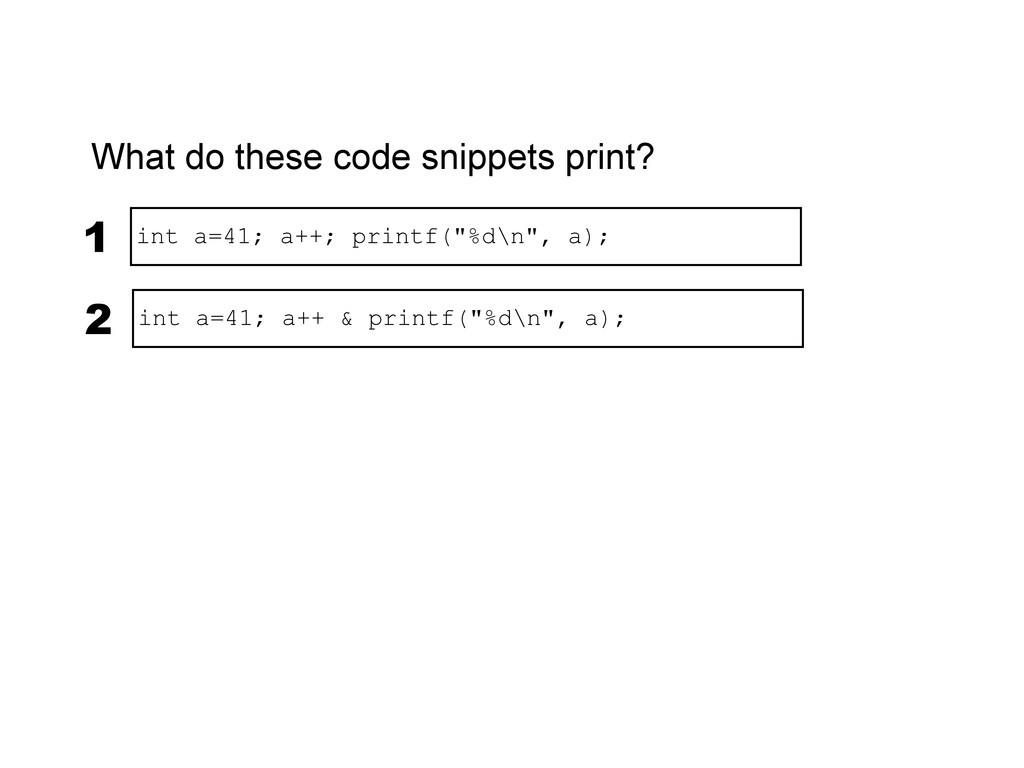
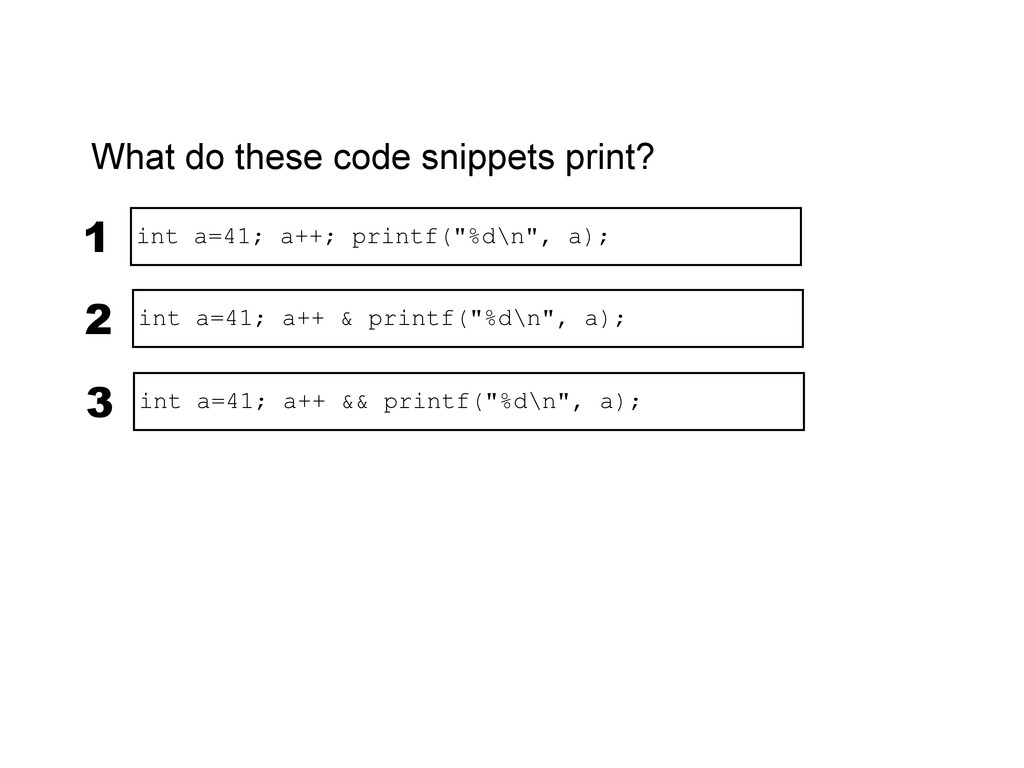
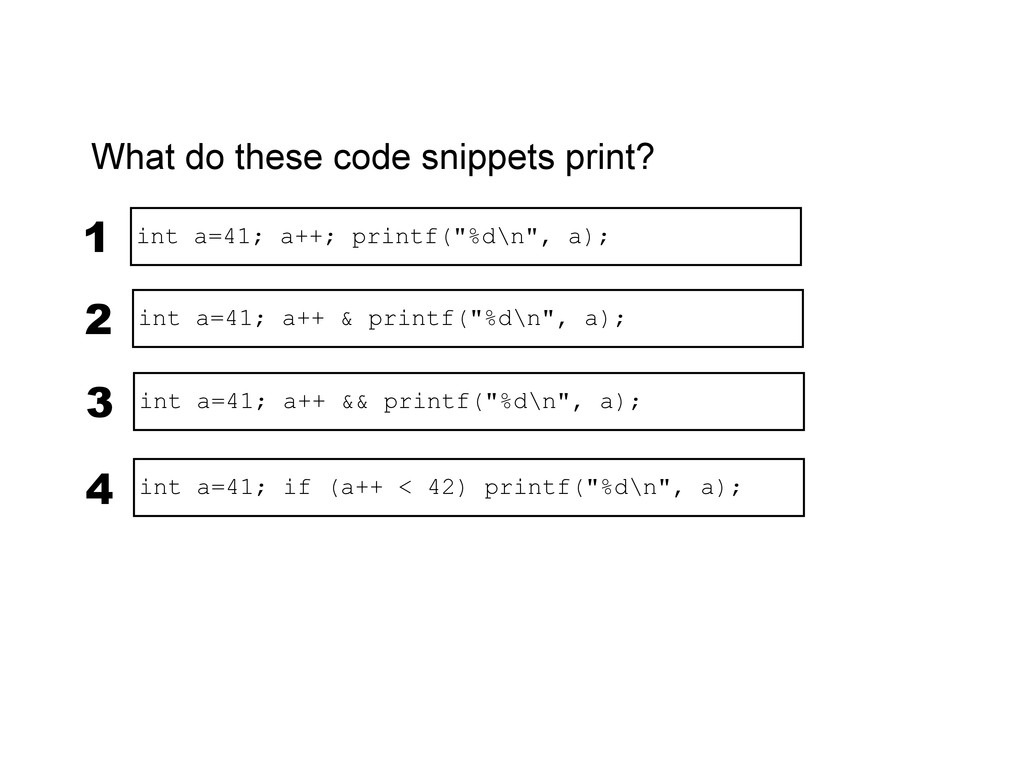
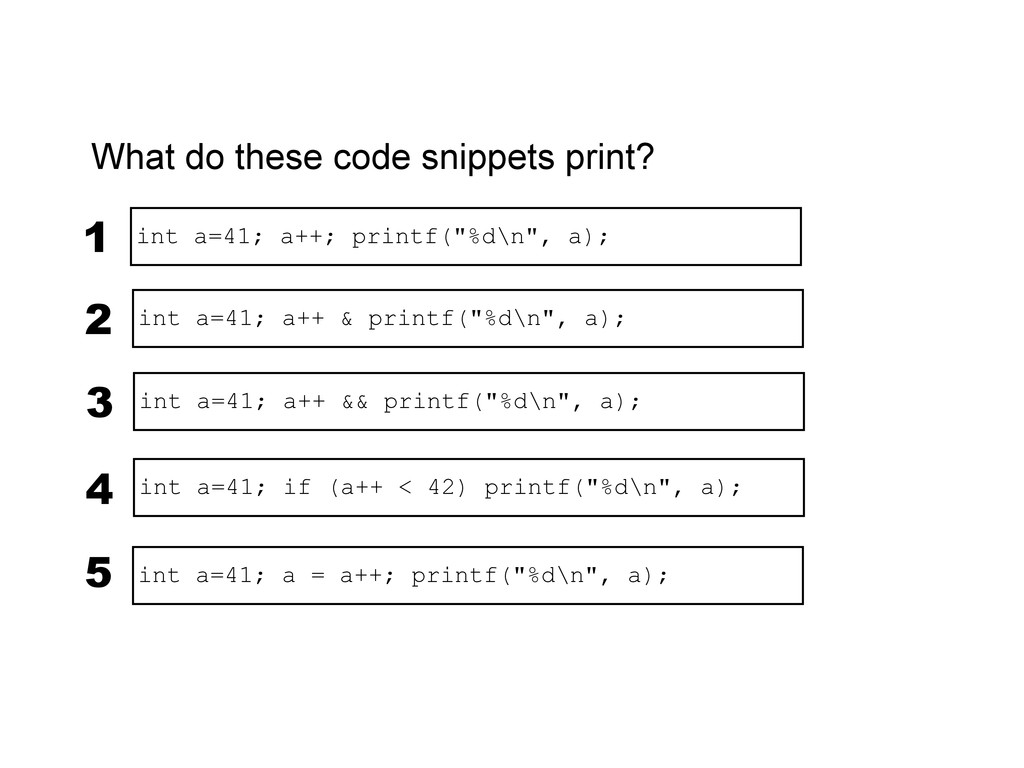
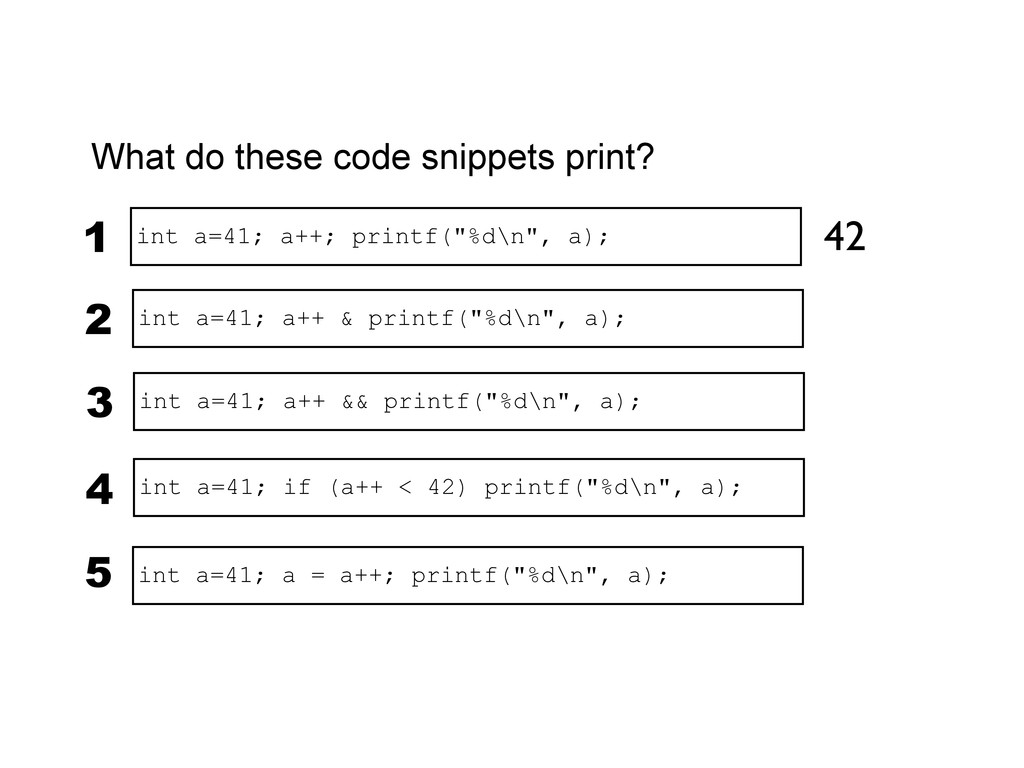
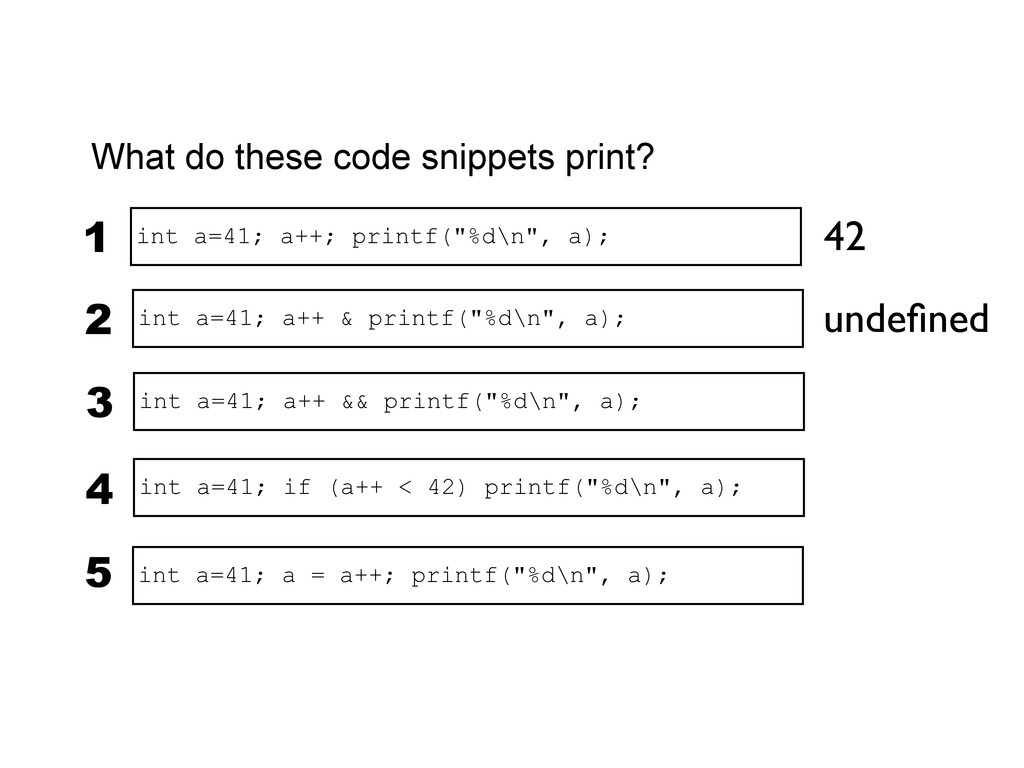
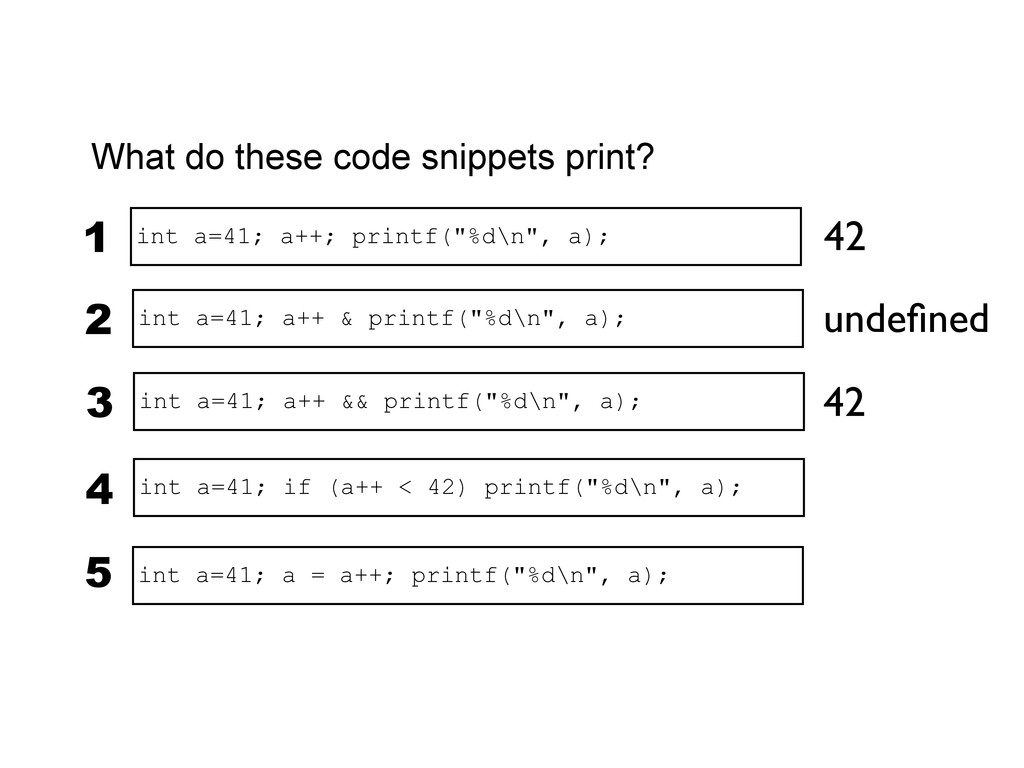
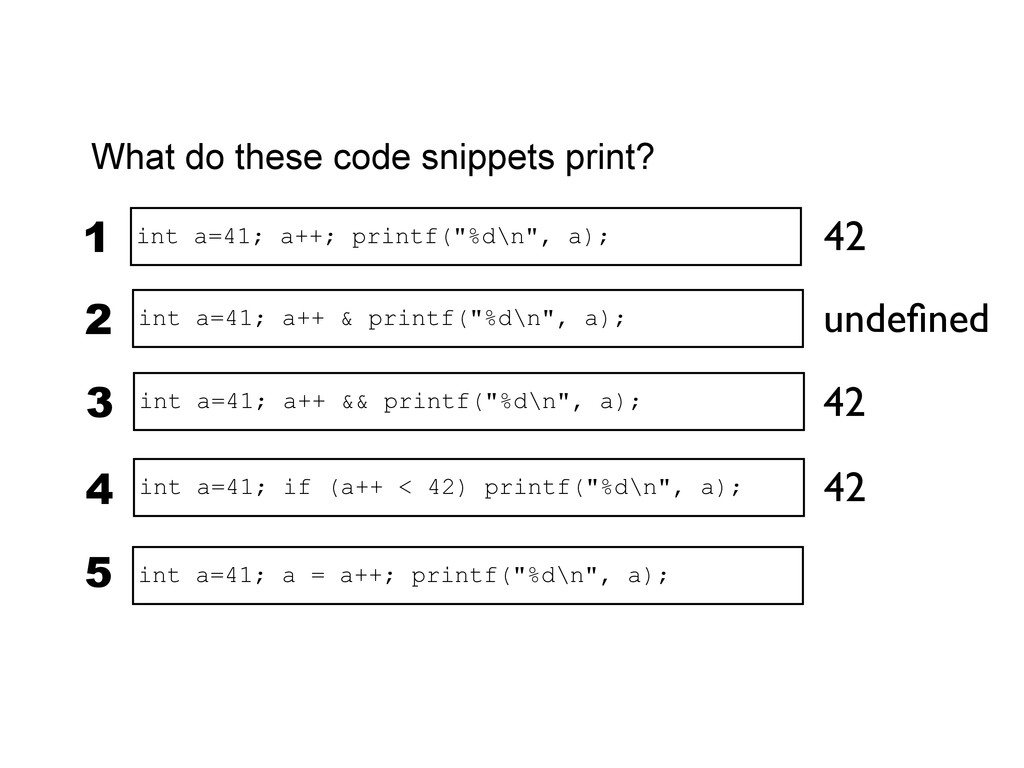
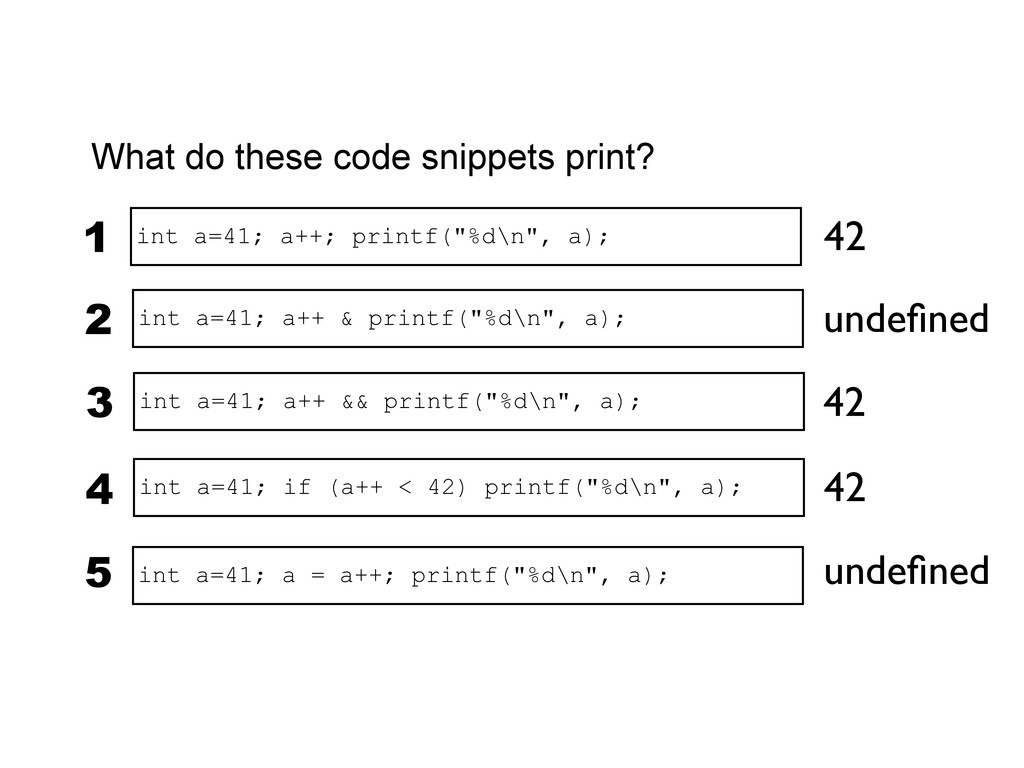
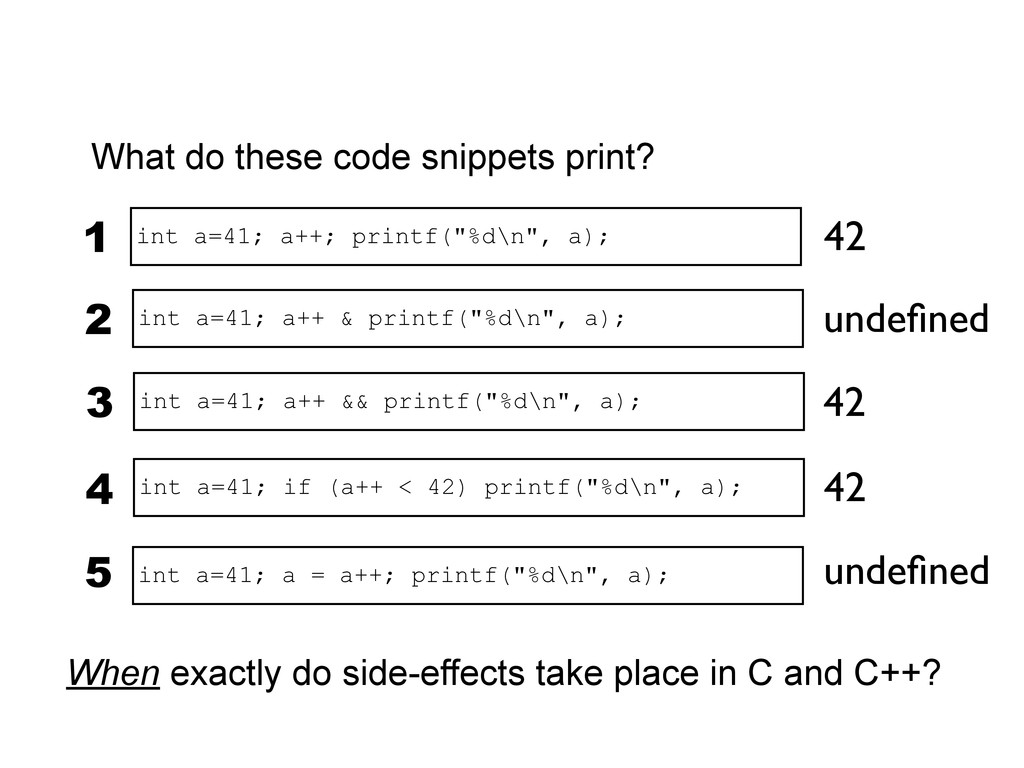
printf("%d\n", a); 3 int a=41; if (a++ < 42) printf("%d\n", a); 4 int a=41; a++ & printf("%d\n", a); 2 undefined 42 42 undefined int a=41; a = a++; printf("%d\n", a); 5 When exactly do side-effects take place in C and C++? int a=41; a++; printf("%d\n", a); 1 42
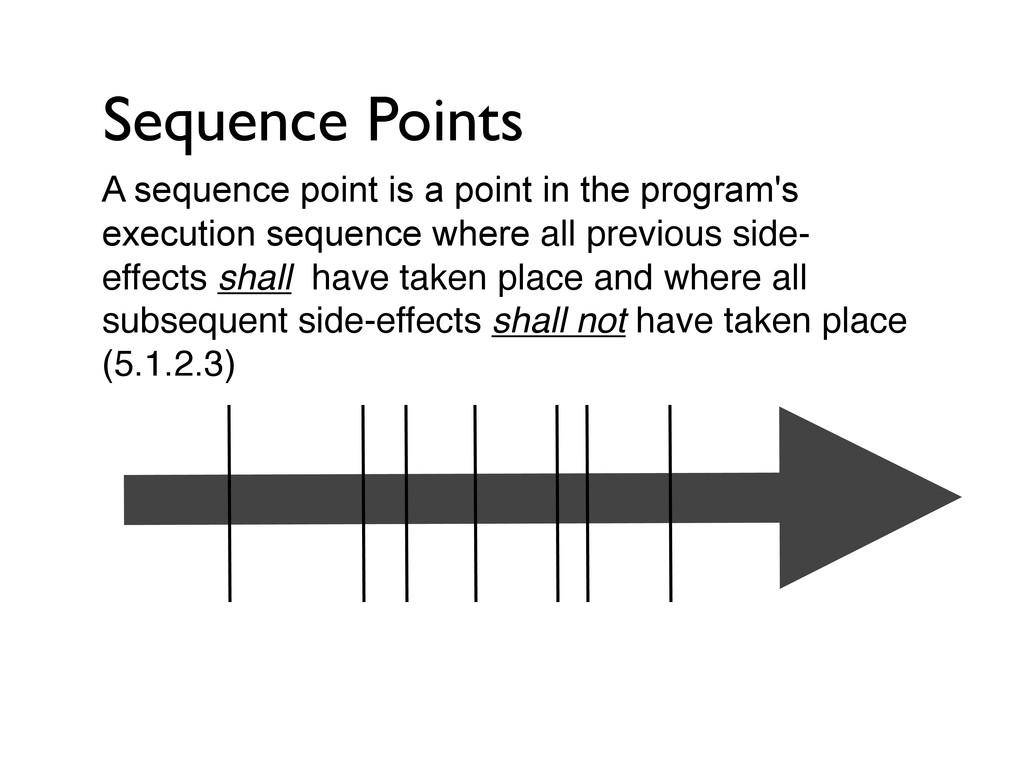
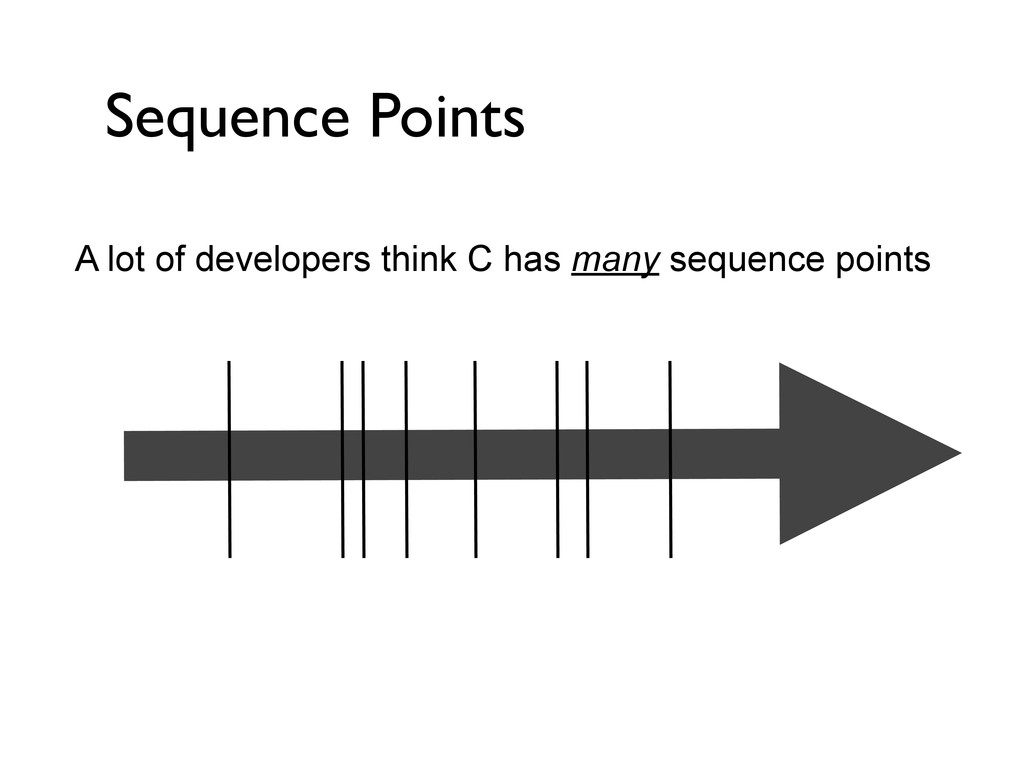
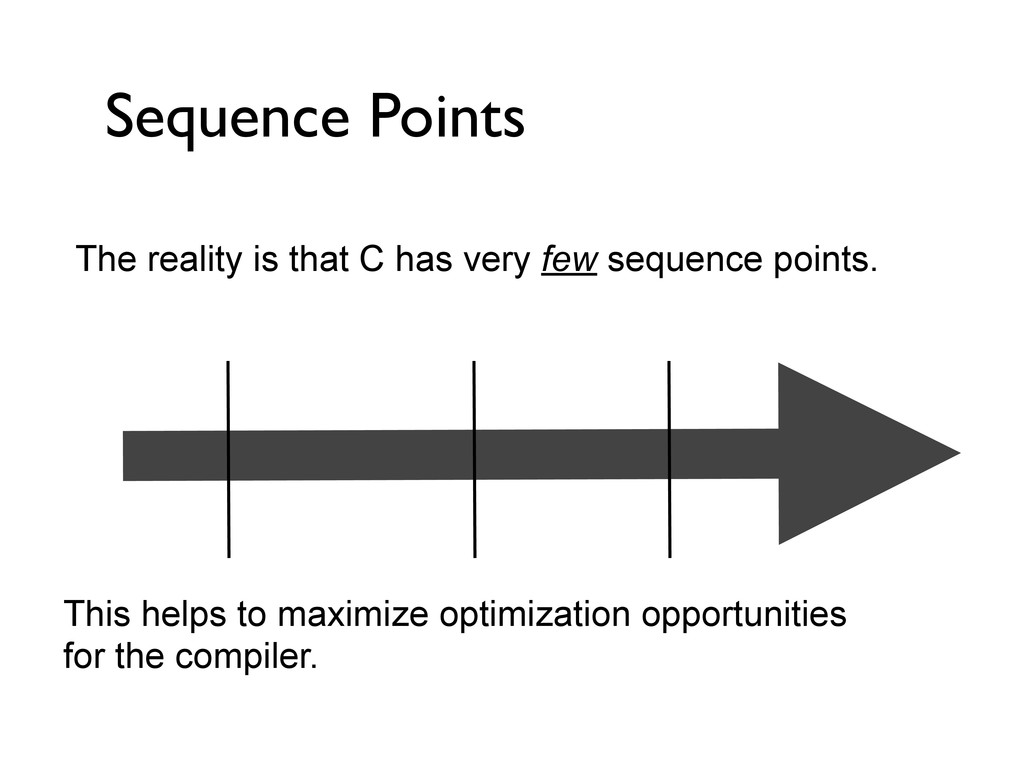
sequence where all previous side- effects shall have taken place and where all subsequent side-effects shall not have taken place (5.1.2.3) Sequence Points
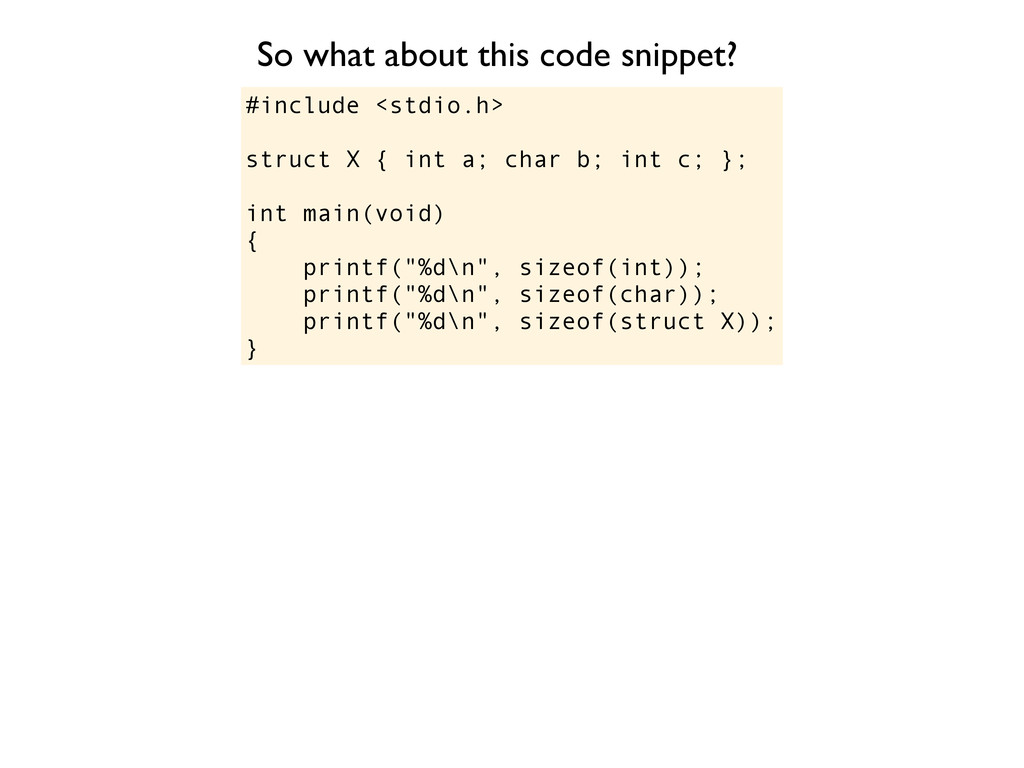
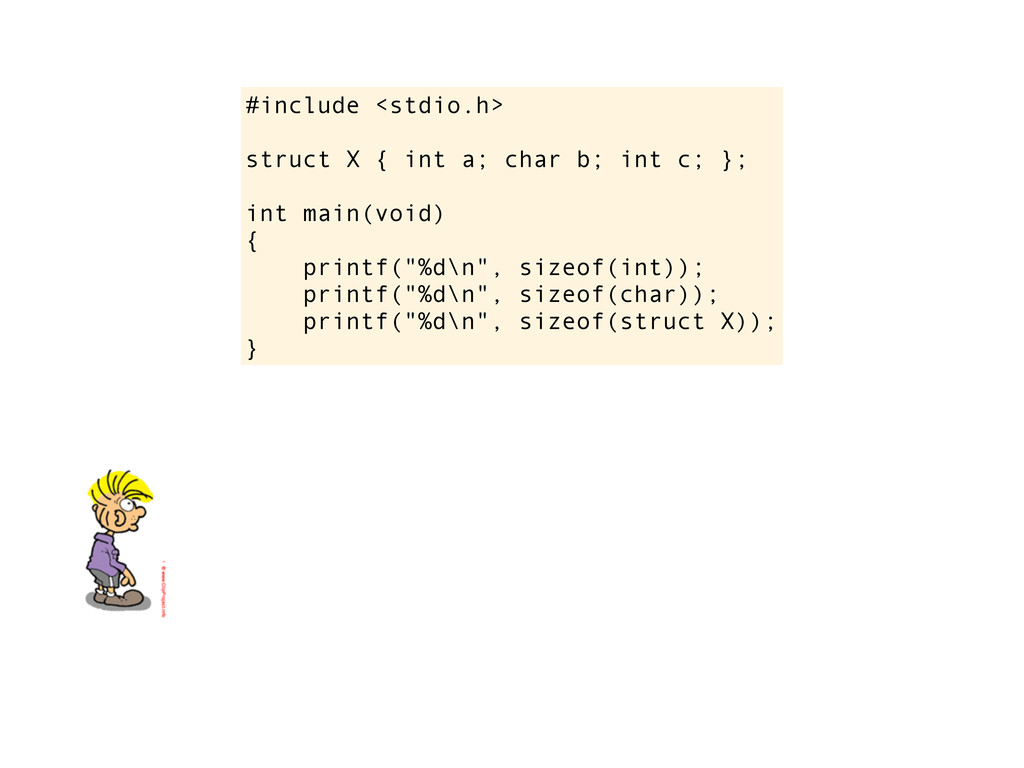
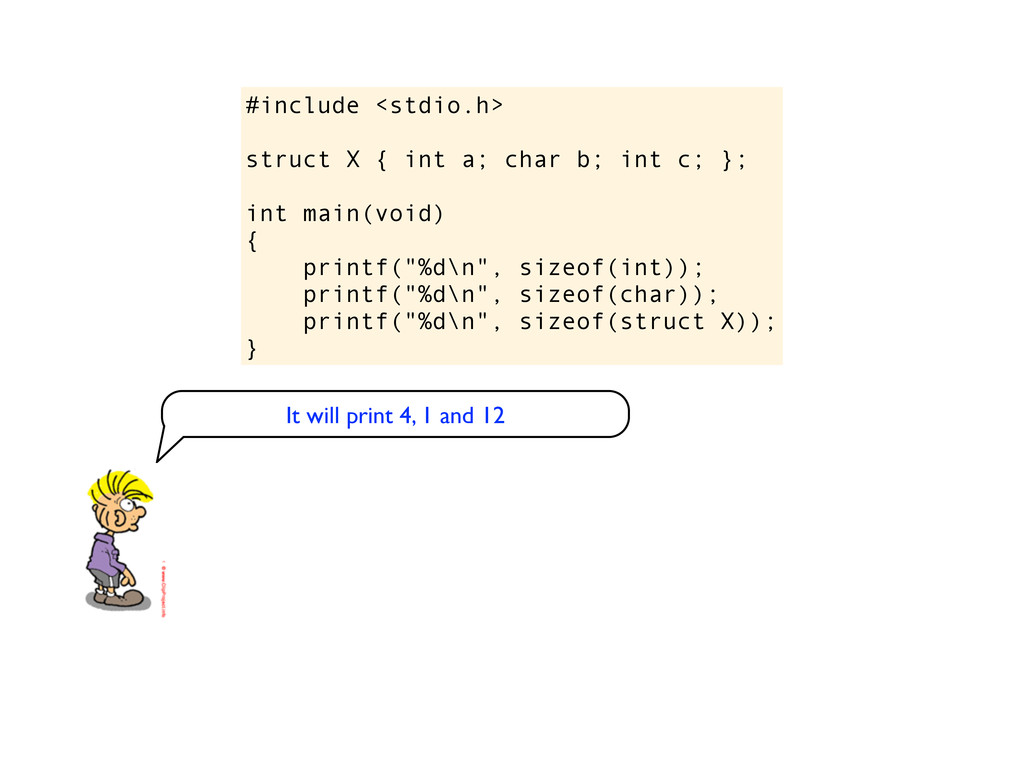
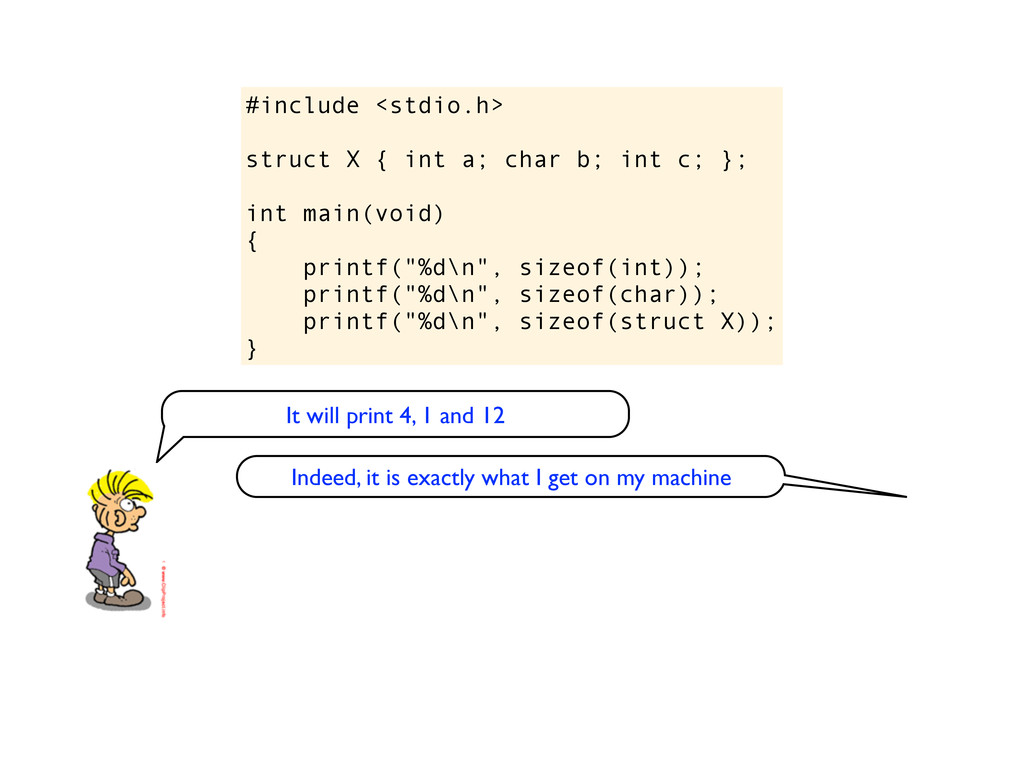
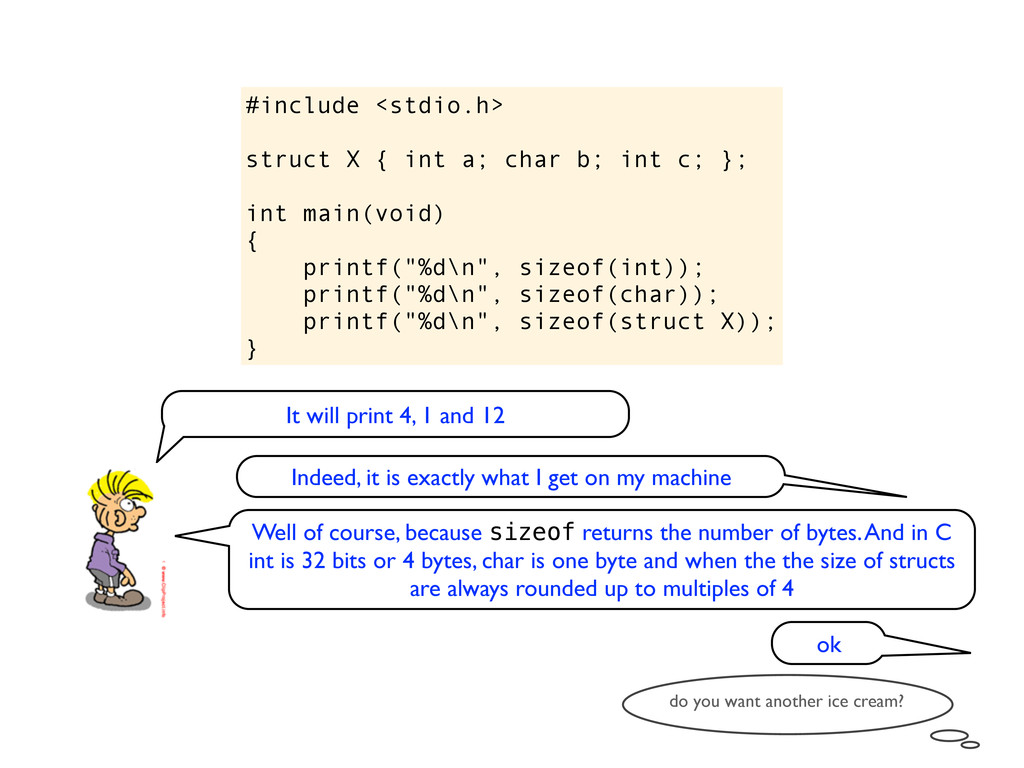
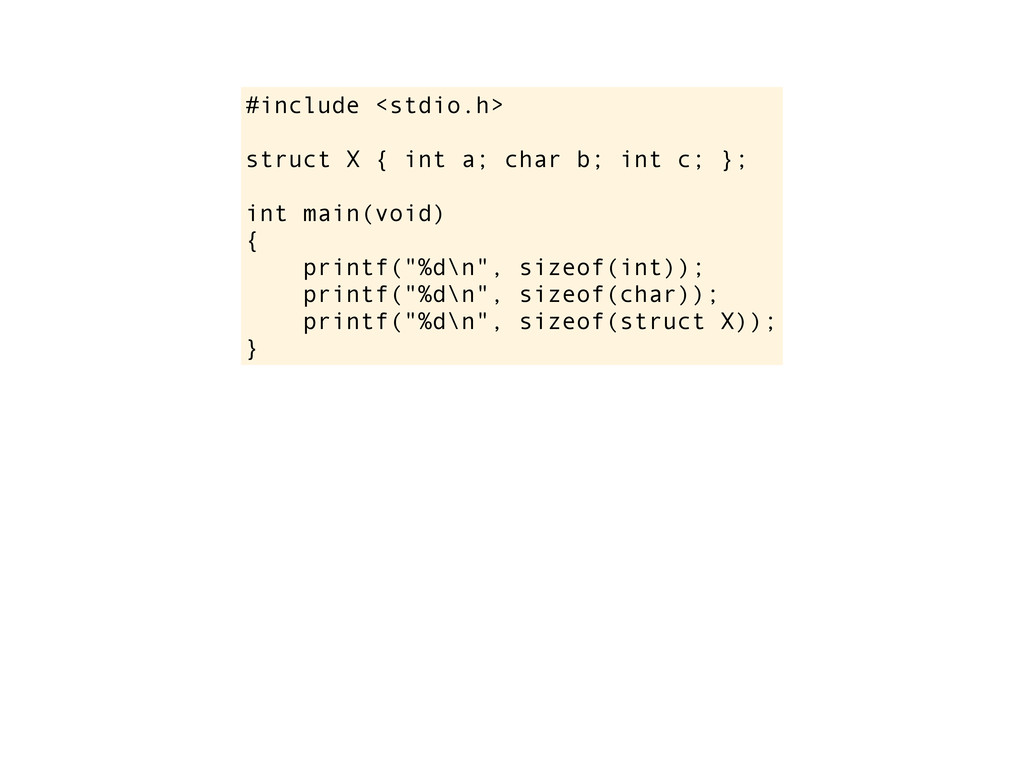
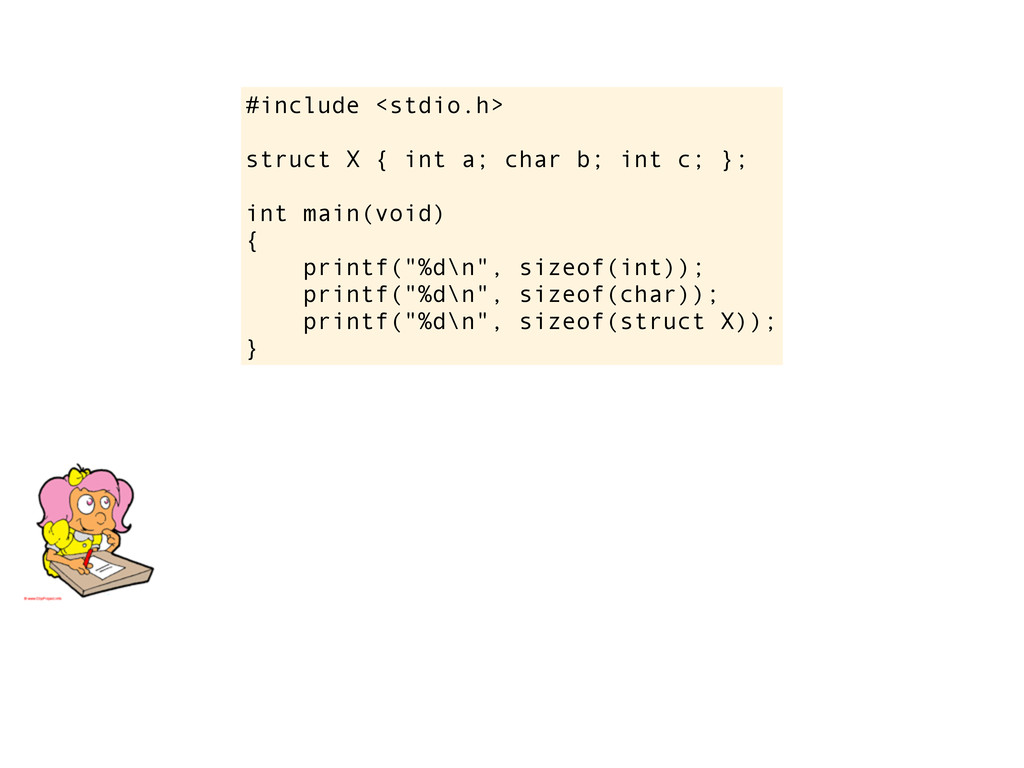
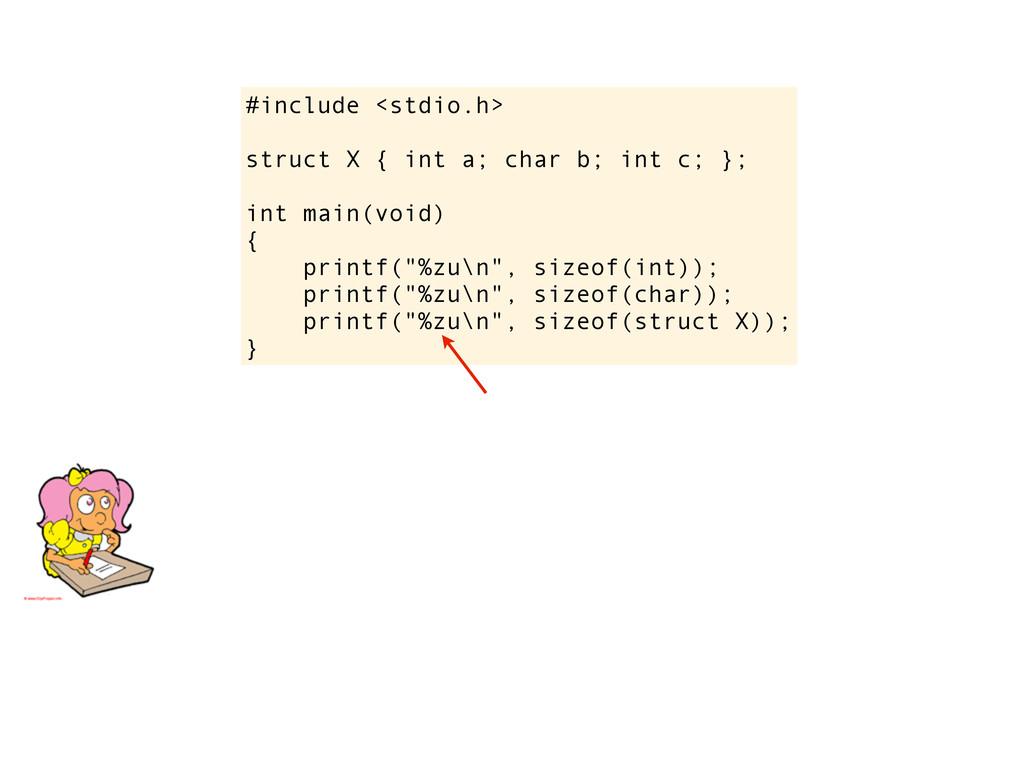
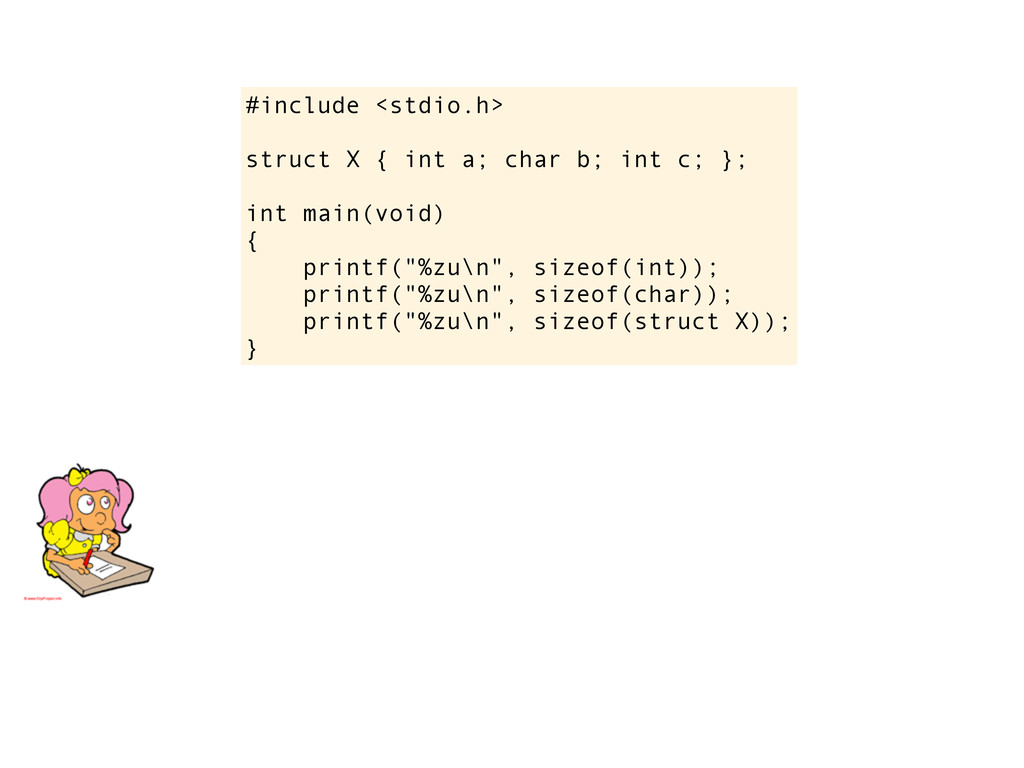
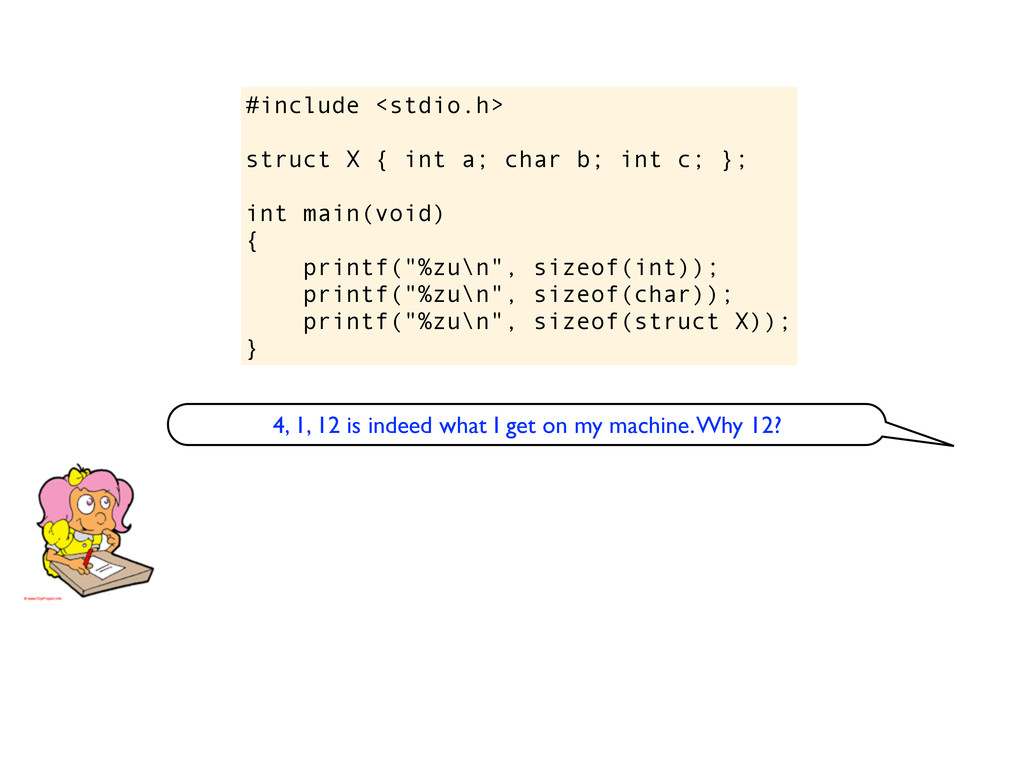
c; }; int main(void) { printf("%d\n", sizeof(int)); printf("%d\n", sizeof(char)); printf("%d\n", sizeof(struct X)); } It will print 4, 1 and 12 Indeed, it is exactly what I get on my machine
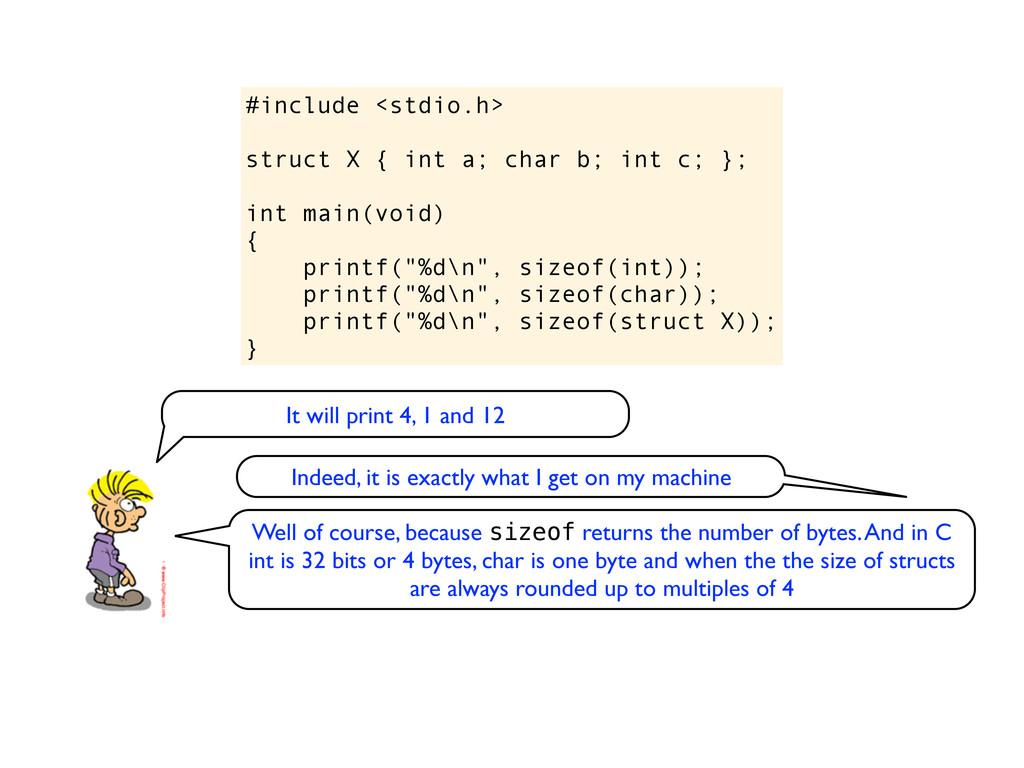
c; }; int main(void) { printf("%d\n", sizeof(int)); printf("%d\n", sizeof(char)); printf("%d\n", sizeof(struct X)); } It will print 4, 1 and 12 Indeed, it is exactly what I get on my machine Well of course, because sizeof returns the number of bytes. And in C int is 32 bits or 4 bytes, char is one byte and when the the size of structs are always rounded up to multiples of 4
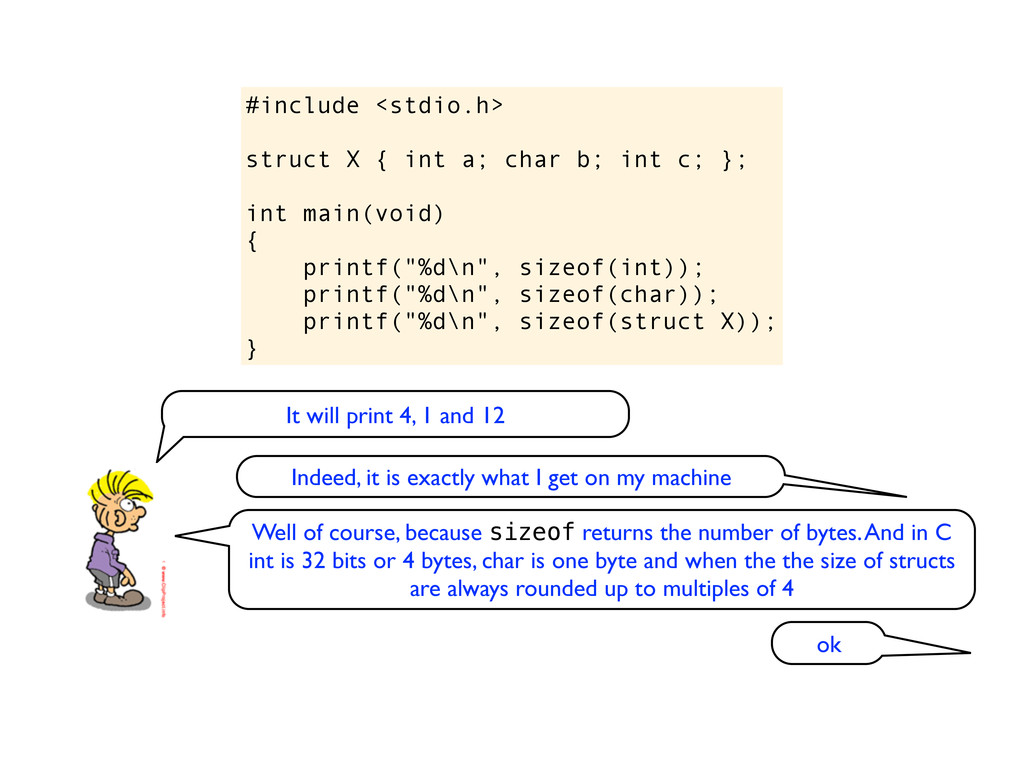
c; }; int main(void) { printf("%d\n", sizeof(int)); printf("%d\n", sizeof(char)); printf("%d\n", sizeof(struct X)); } It will print 4, 1 and 12 Indeed, it is exactly what I get on my machine Well of course, because sizeof returns the number of bytes. And in C int is 32 bits or 4 bytes, char is one byte and when the the size of structs are always rounded up to multiples of 4 ok
c; }; int main(void) { printf("%d\n", sizeof(int)); printf("%d\n", sizeof(char)); printf("%d\n", sizeof(struct X)); } It will print 4, 1 and 12 Indeed, it is exactly what I get on my machine Well of course, because sizeof returns the number of bytes. And in C int is 32 bits or 4 bytes, char is one byte and when the the size of structs are always rounded up to multiples of 4 ok do you want another ice cream?
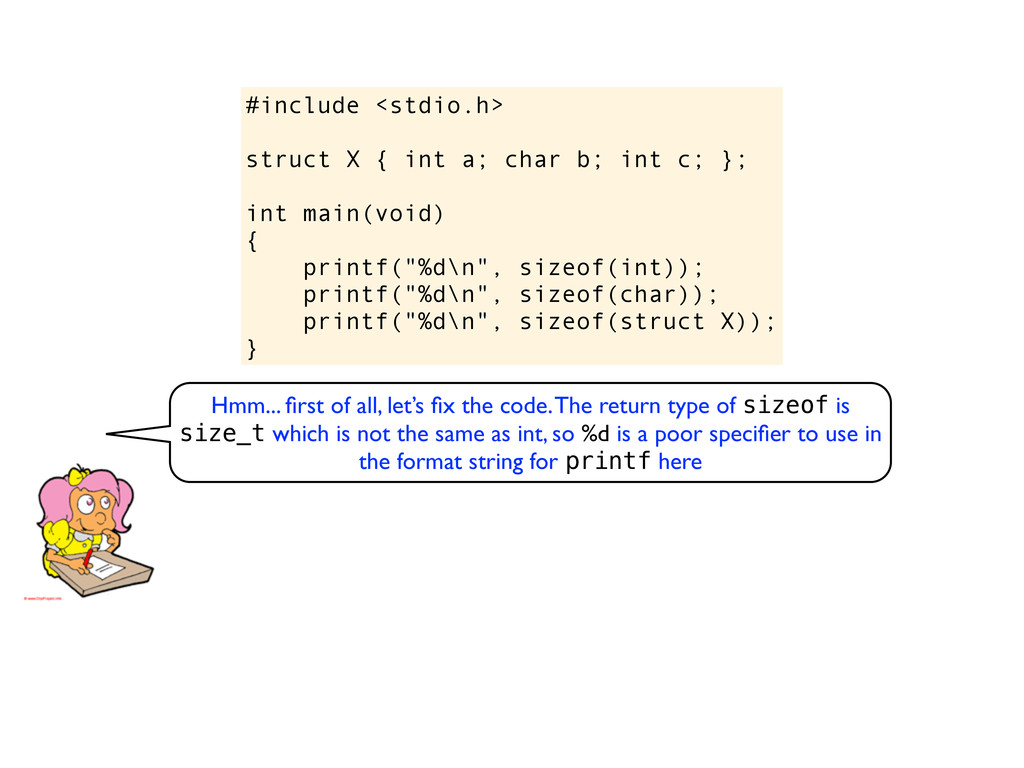
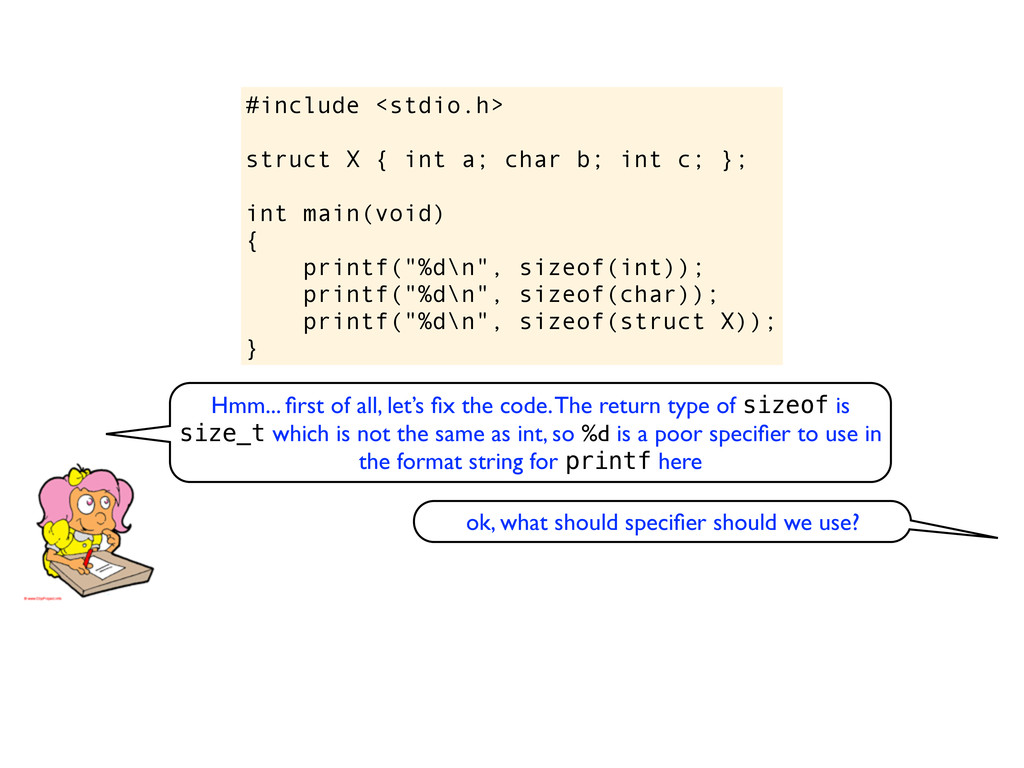
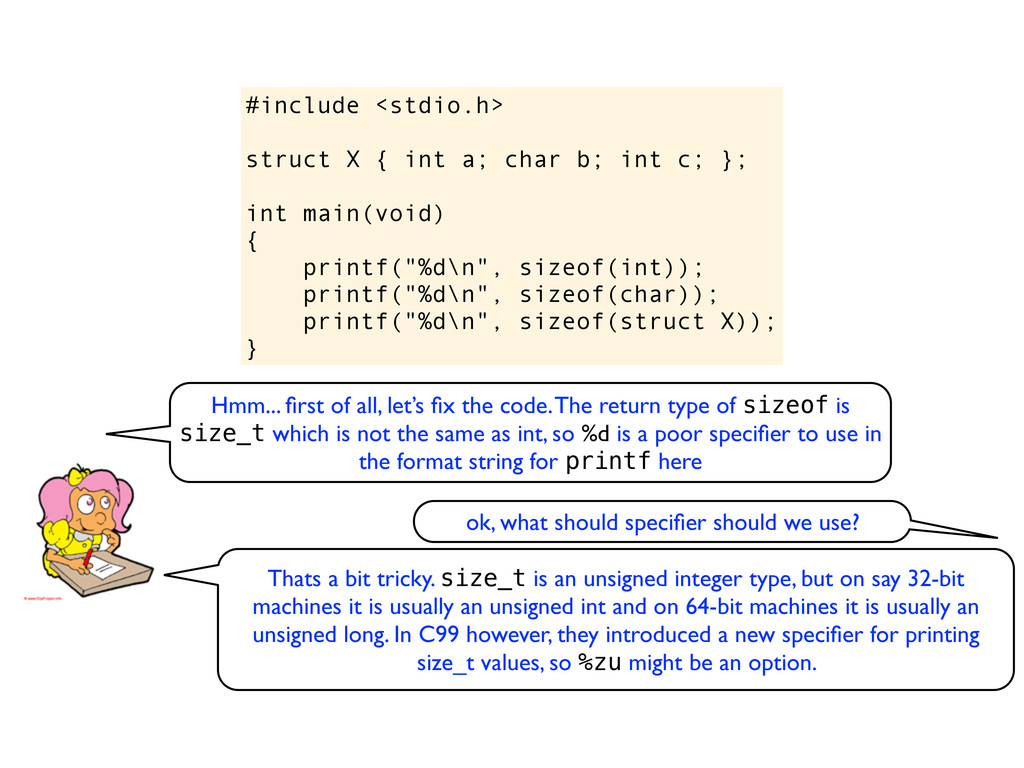
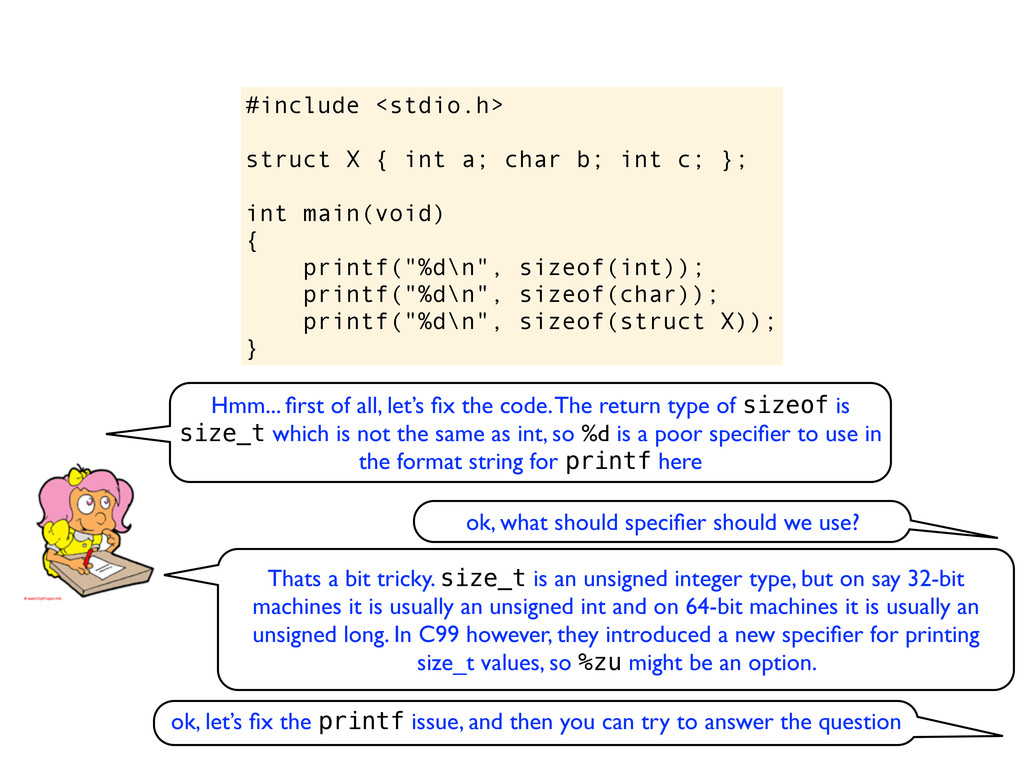
c; }; int main(void) { printf("%d\n", sizeof(int)); printf("%d\n", sizeof(char)); printf("%d\n", sizeof(struct X)); } Hmm... first of all, let’s fix the code. The return type of sizeof is size_t which is not the same as int, so %d is a poor specifier to use in the format string for printf here
c; }; int main(void) { printf("%d\n", sizeof(int)); printf("%d\n", sizeof(char)); printf("%d\n", sizeof(struct X)); } Hmm... first of all, let’s fix the code. The return type of sizeof is size_t which is not the same as int, so %d is a poor specifier to use in the format string for printf here ok, what should specifier should we use?
c; }; int main(void) { printf("%d\n", sizeof(int)); printf("%d\n", sizeof(char)); printf("%d\n", sizeof(struct X)); } Hmm... first of all, let’s fix the code. The return type of sizeof is size_t which is not the same as int, so %d is a poor specifier to use in the format string for printf here ok, what should specifier should we use? Thats a bit tricky. size_t is an unsigned integer type, but on say 32-bit machines it is usually an unsigned int and on 64-bit machines it is usually an unsigned long. In C99 however, they introduced a new specifier for printing size_t values, so %zu might be an option.
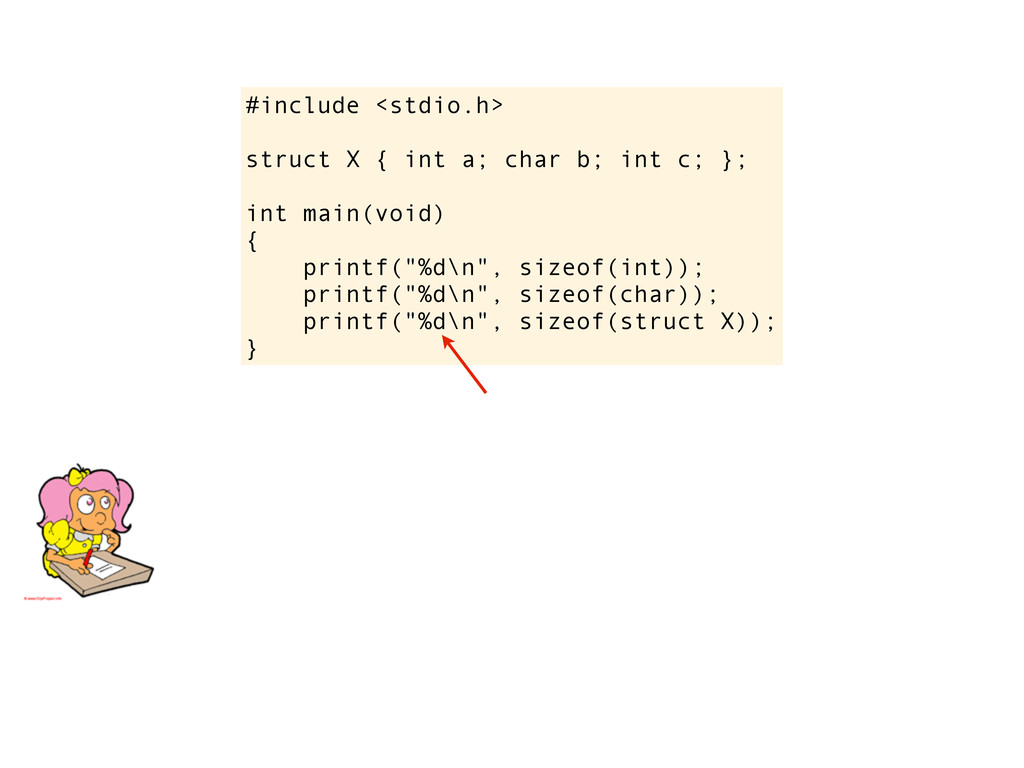
c; }; int main(void) { printf("%d\n", sizeof(int)); printf("%d\n", sizeof(char)); printf("%d\n", sizeof(struct X)); } Hmm... first of all, let’s fix the code. The return type of sizeof is size_t which is not the same as int, so %d is a poor specifier to use in the format string for printf here ok, what should specifier should we use? Thats a bit tricky. size_t is an unsigned integer type, but on say 32-bit machines it is usually an unsigned int and on 64-bit machines it is usually an unsigned long. In C99 however, they introduced a new specifier for printing size_t values, so %zu might be an option. ok, let’s fix the printf issue, and then you can try to answer the question
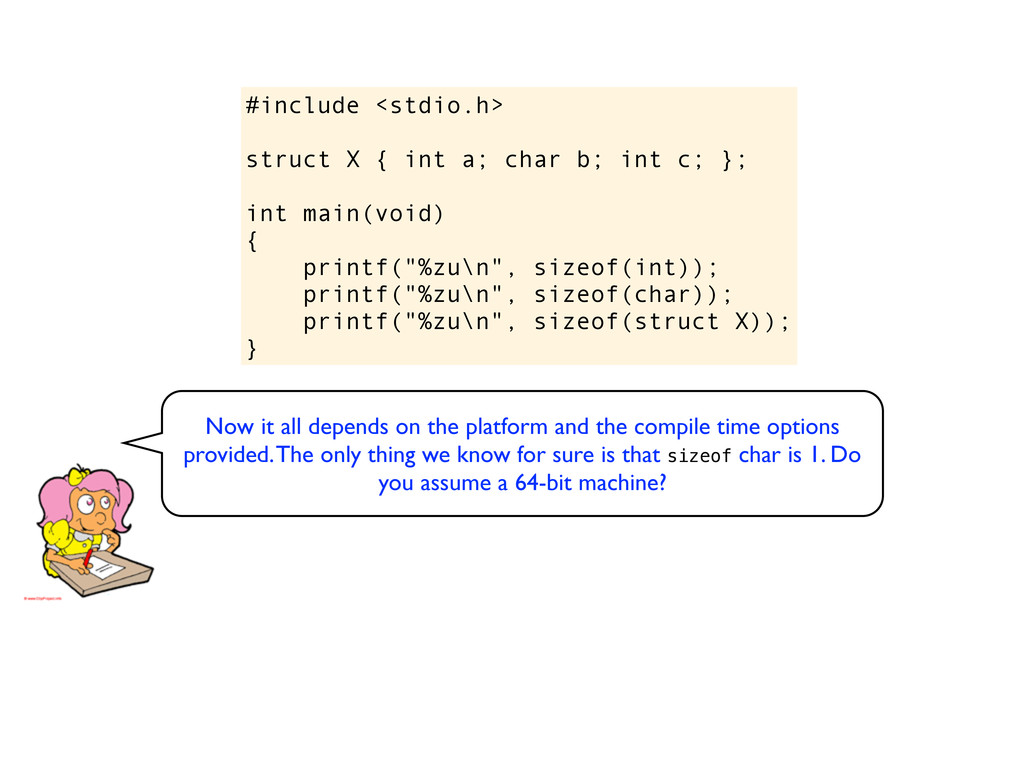
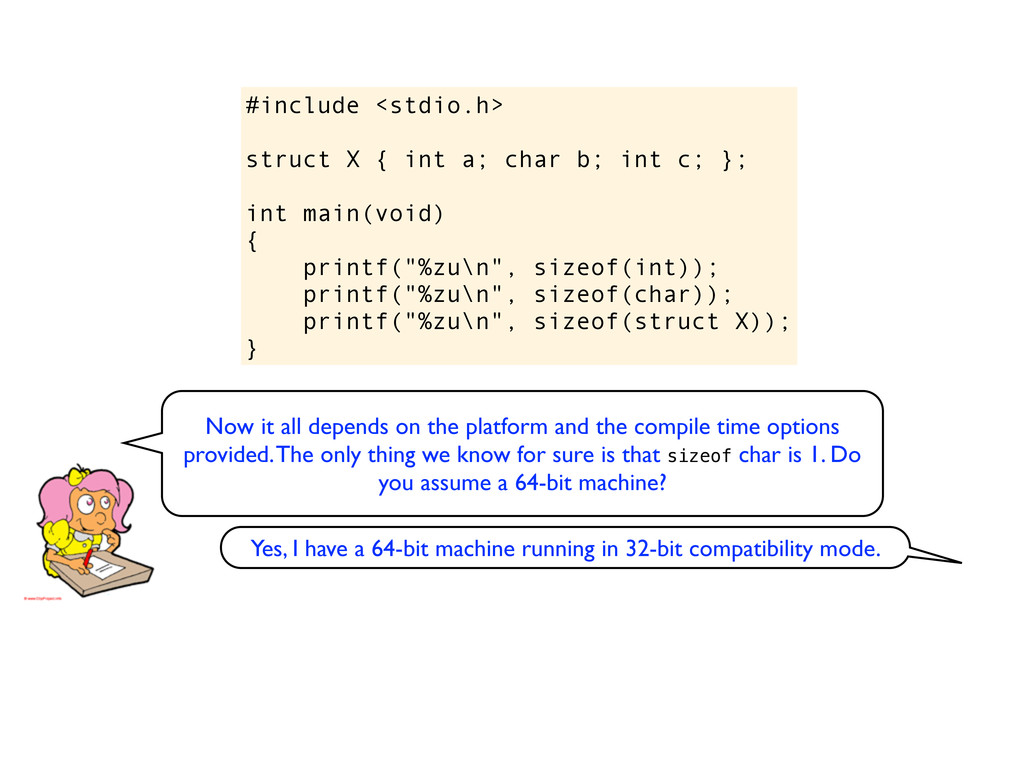
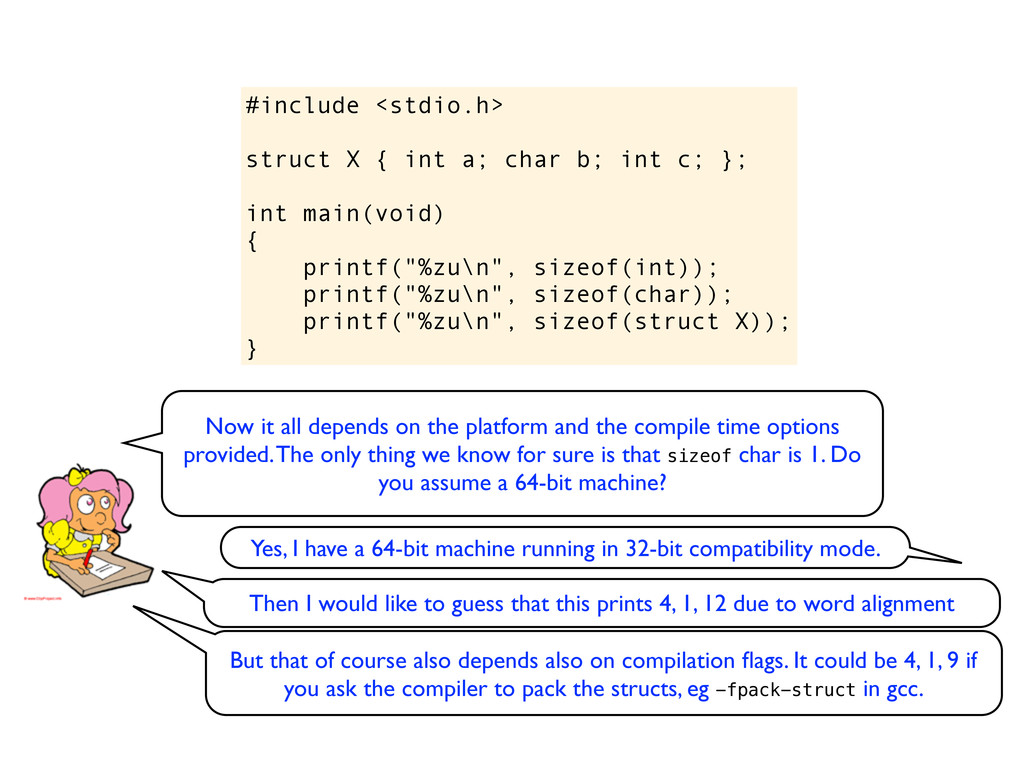
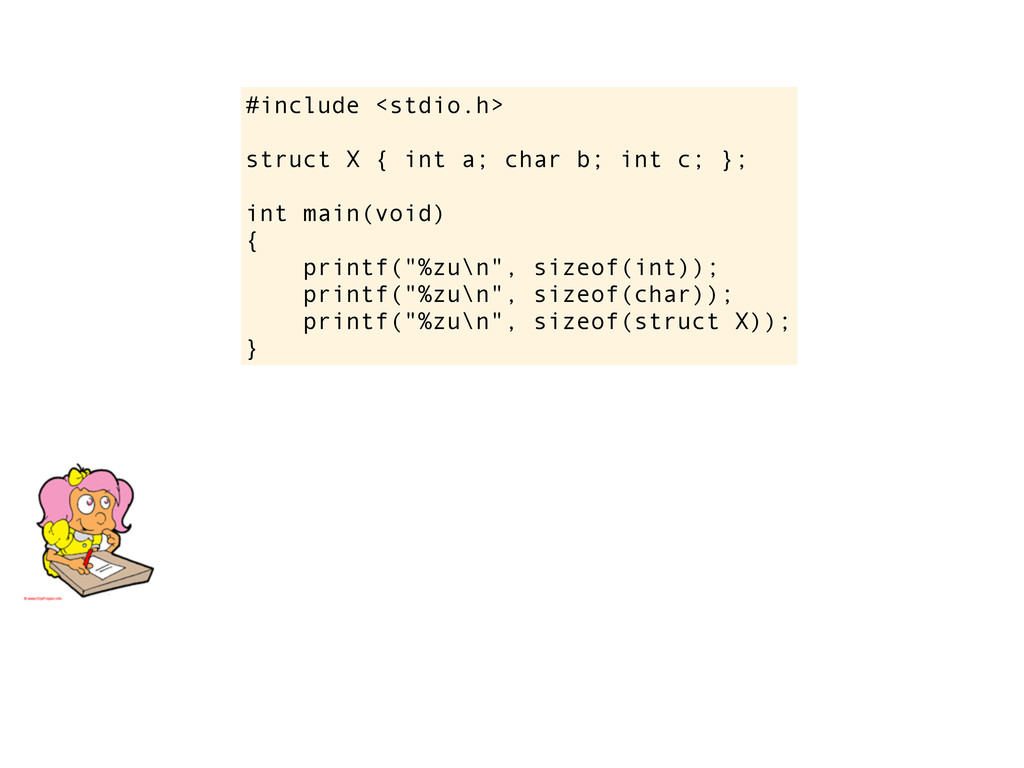
c; }; int main(void) { printf("%zu\n", sizeof(int)); printf("%zu\n", sizeof(char)); printf("%zu\n", sizeof(struct X)); } Now it all depends on the platform and the compile time options provided. The only thing we know for sure is that sizeof char is 1. Do you assume a 64-bit machine?
c; }; int main(void) { printf("%zu\n", sizeof(int)); printf("%zu\n", sizeof(char)); printf("%zu\n", sizeof(struct X)); } Now it all depends on the platform and the compile time options provided. The only thing we know for sure is that sizeof char is 1. Do you assume a 64-bit machine? Yes, I have a 64-bit machine running in 32-bit compatibility mode.
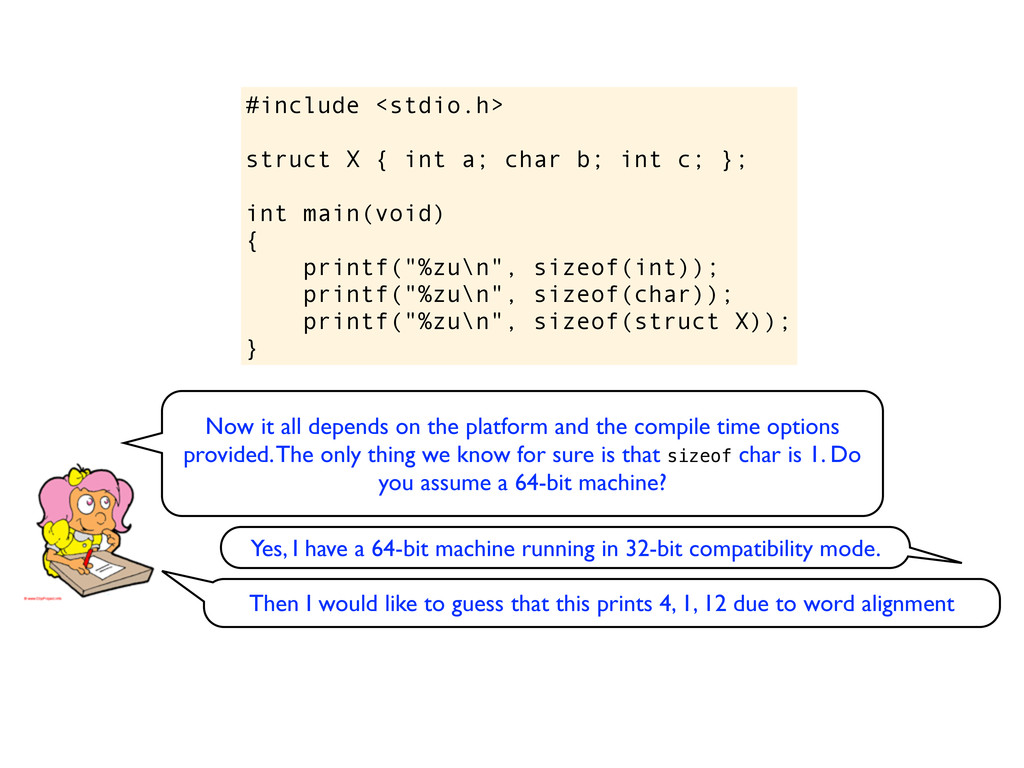
c; }; int main(void) { printf("%zu\n", sizeof(int)); printf("%zu\n", sizeof(char)); printf("%zu\n", sizeof(struct X)); } Now it all depends on the platform and the compile time options provided. The only thing we know for sure is that sizeof char is 1. Do you assume a 64-bit machine? Yes, I have a 64-bit machine running in 32-bit compatibility mode. Then I would like to guess that this prints 4, 1, 12 due to word alignment
c; }; int main(void) { printf("%zu\n", sizeof(int)); printf("%zu\n", sizeof(char)); printf("%zu\n", sizeof(struct X)); } Now it all depends on the platform and the compile time options provided. The only thing we know for sure is that sizeof char is 1. Do you assume a 64-bit machine? Yes, I have a 64-bit machine running in 32-bit compatibility mode. Then I would like to guess that this prints 4, 1, 12 due to word alignment But that of course also depends also on compilation flags. It could be 4, 1, 9 if you ask the compiler to pack the structs, eg -fpack-struct in gcc.
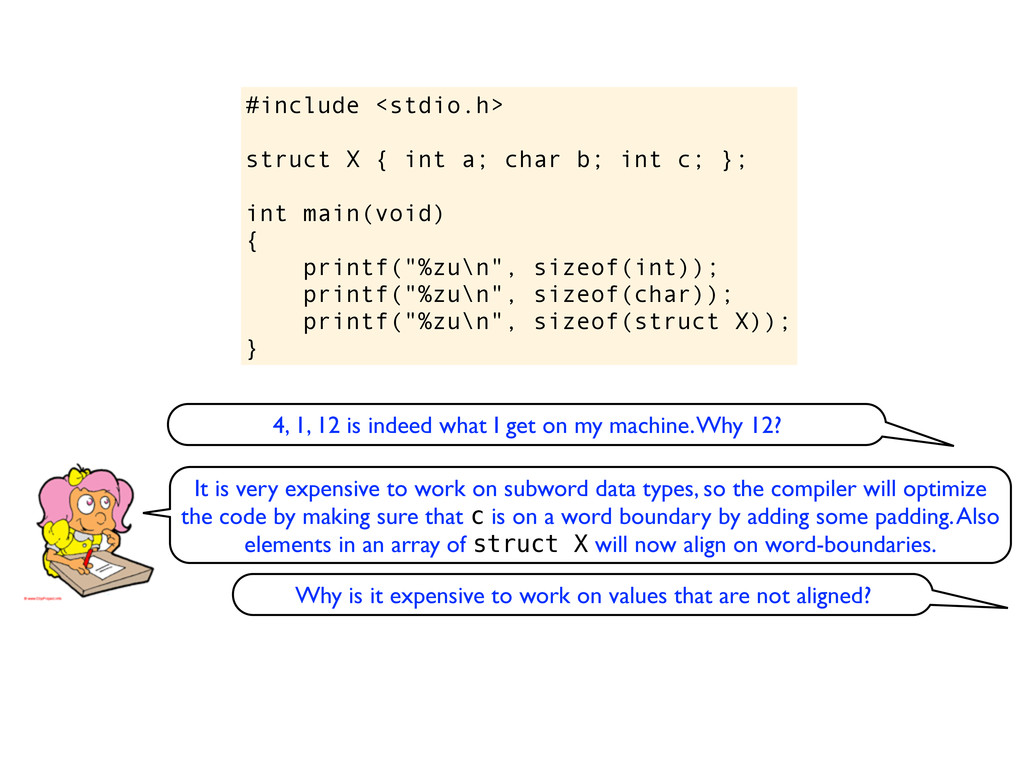
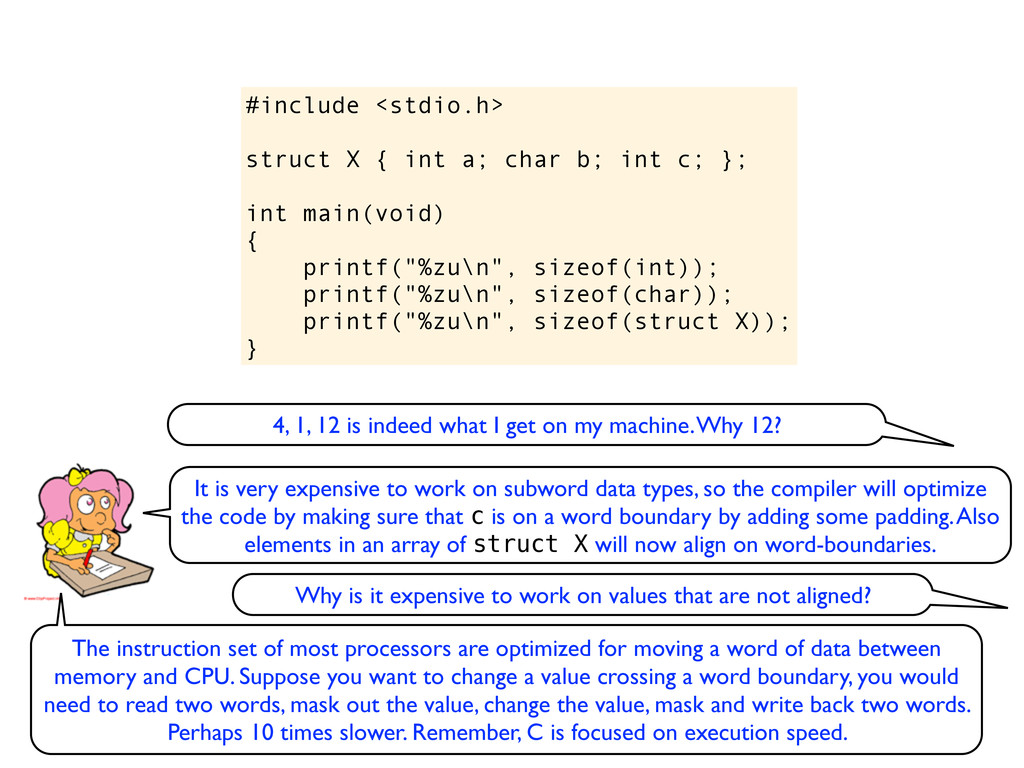
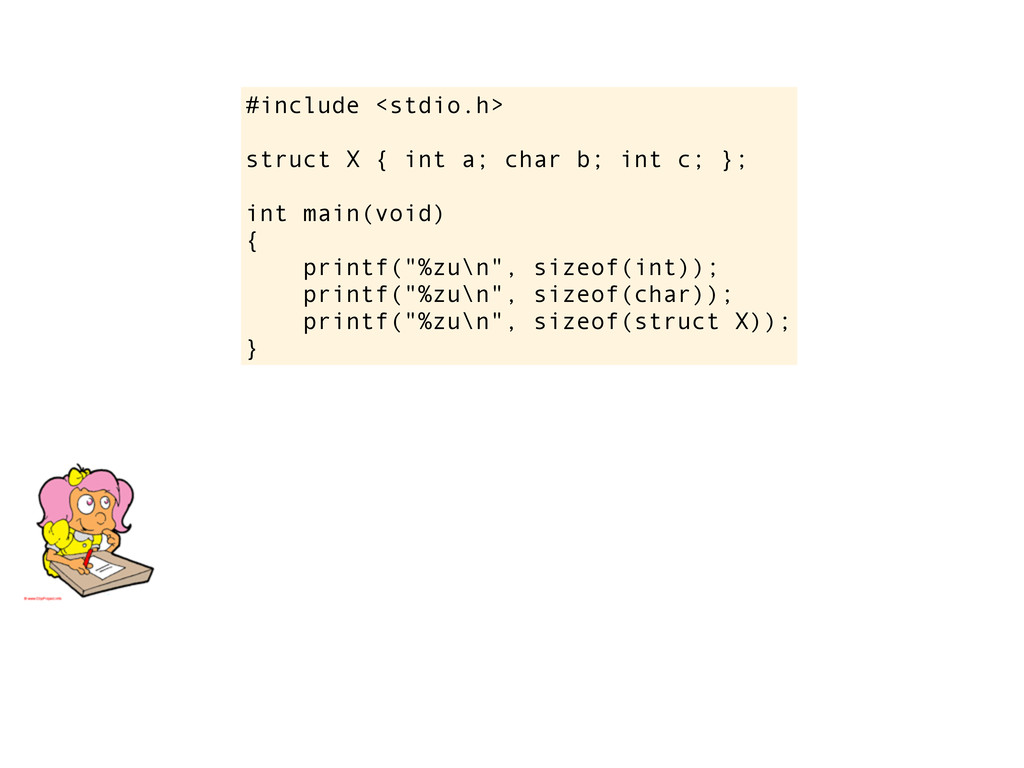
c; }; int main(void) { printf("%zu\n", sizeof(int)); printf("%zu\n", sizeof(char)); printf("%zu\n", sizeof(struct X)); } 4, 1, 12 is indeed what I get on my machine. Why 12?
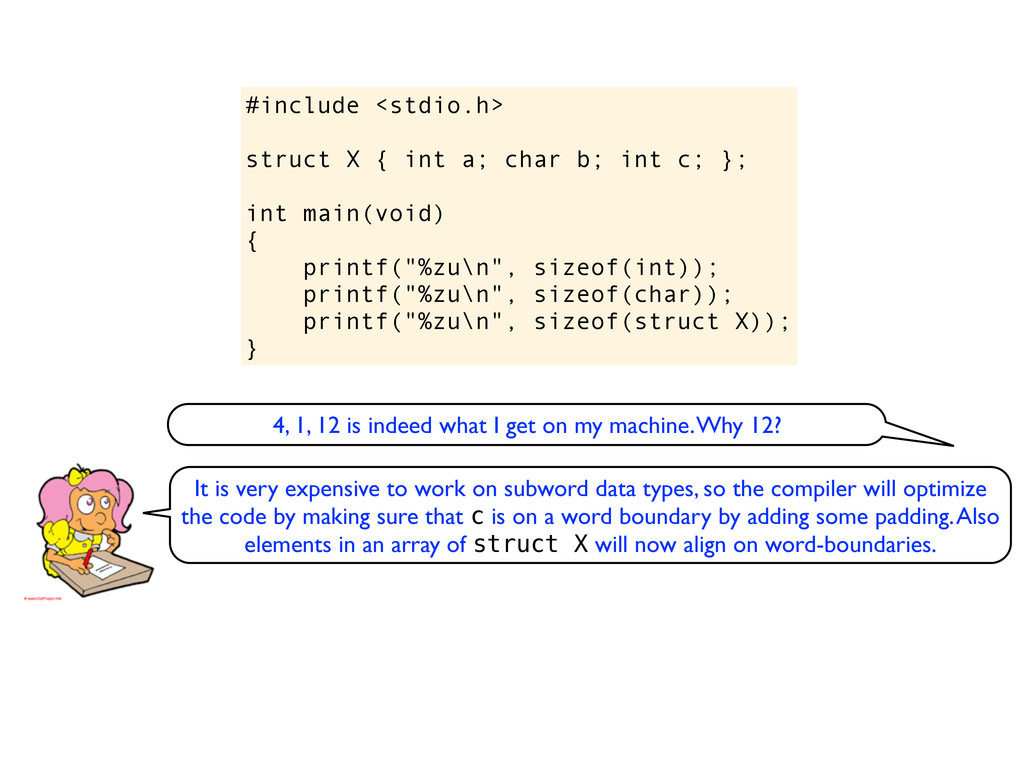
c; }; int main(void) { printf("%zu\n", sizeof(int)); printf("%zu\n", sizeof(char)); printf("%zu\n", sizeof(struct X)); } 4, 1, 12 is indeed what I get on my machine. Why 12? It is very expensive to work on subword data types, so the compiler will optimize the code by making sure that c is on a word boundary by adding some padding. Also elements in an array of struct X will now align on word-boundaries.
c; }; int main(void) { printf("%zu\n", sizeof(int)); printf("%zu\n", sizeof(char)); printf("%zu\n", sizeof(struct X)); } 4, 1, 12 is indeed what I get on my machine. Why 12? Why is it expensive to work on values that are not aligned? It is very expensive to work on subword data types, so the compiler will optimize the code by making sure that c is on a word boundary by adding some padding. Also elements in an array of struct X will now align on word-boundaries.
c; }; int main(void) { printf("%zu\n", sizeof(int)); printf("%zu\n", sizeof(char)); printf("%zu\n", sizeof(struct X)); } 4, 1, 12 is indeed what I get on my machine. Why 12? Why is it expensive to work on values that are not aligned? The instruction set of most processors are optimized for moving a word of data between memory and CPU. Suppose you want to change a value crossing a word boundary, you would need to read two words, mask out the value, change the value, mask and write back two words. Perhaps 10 times slower. Remember, C is focused on execution speed. It is very expensive to work on subword data types, so the compiler will optimize the code by making sure that c is on a word boundary by adding some padding. Also elements in an array of struct X will now align on word-boundaries.
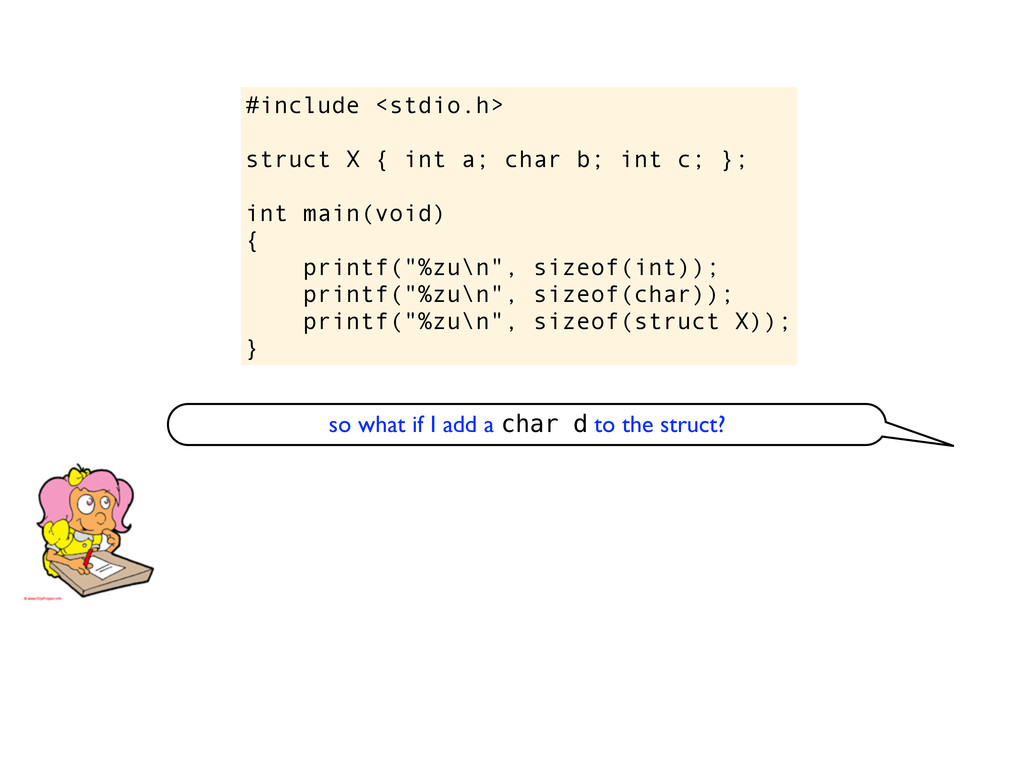
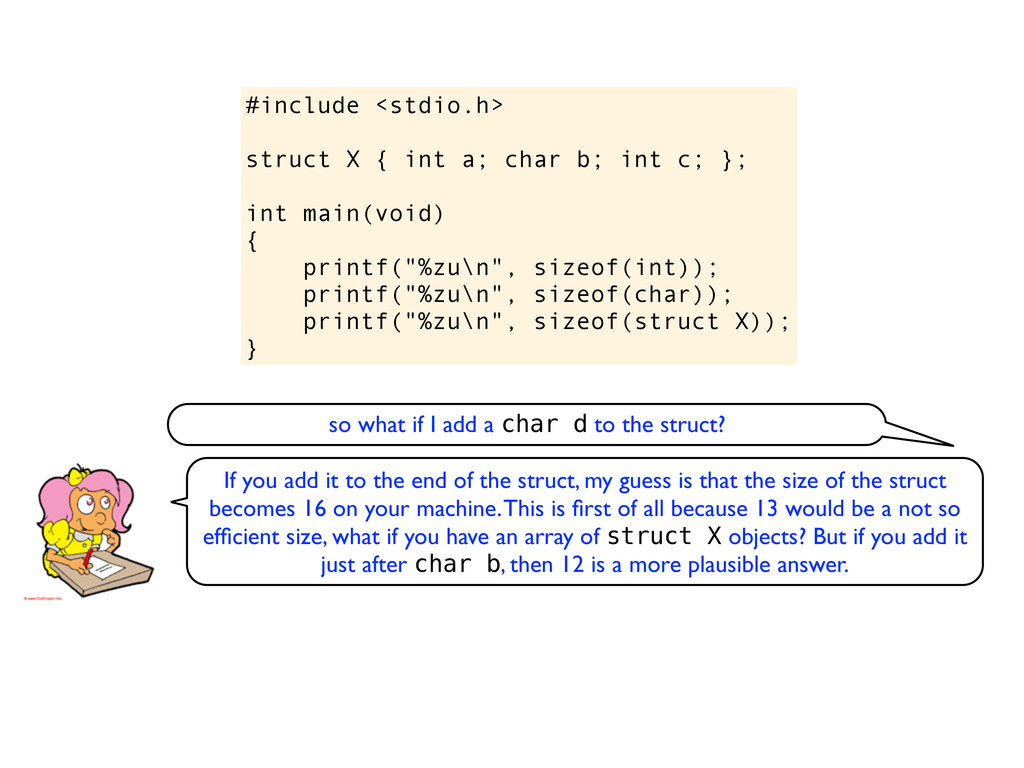
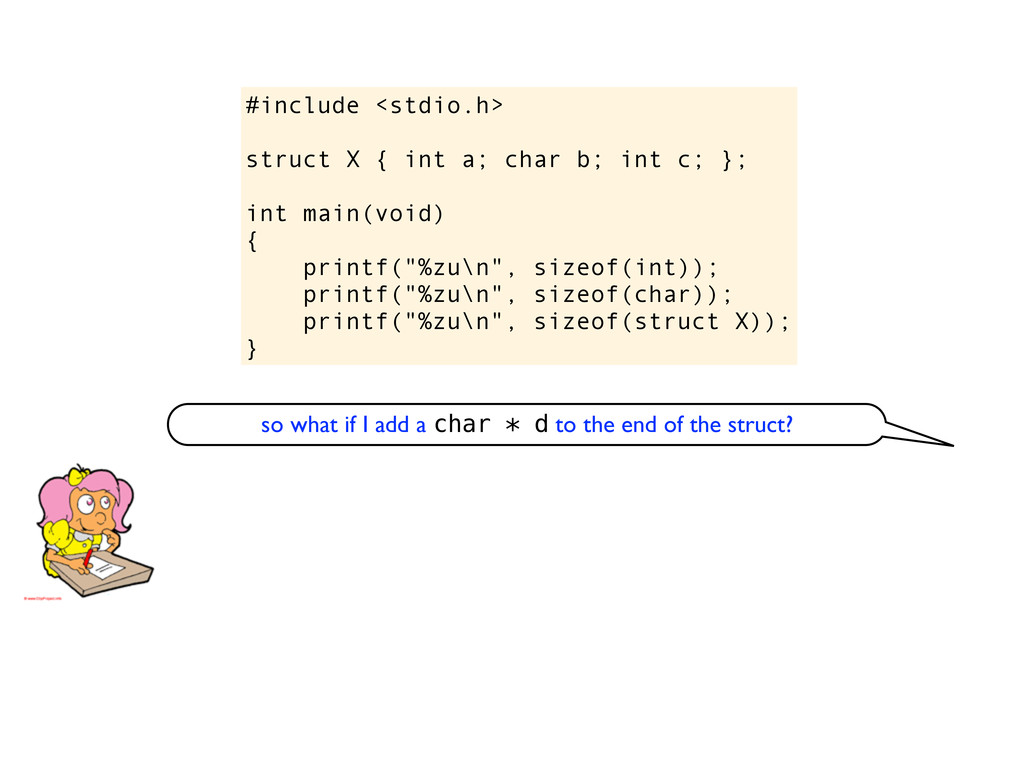
c; }; int main(void) { printf("%zu\n", sizeof(int)); printf("%zu\n", sizeof(char)); printf("%zu\n", sizeof(struct X)); } so what if I add a char d to the struct?
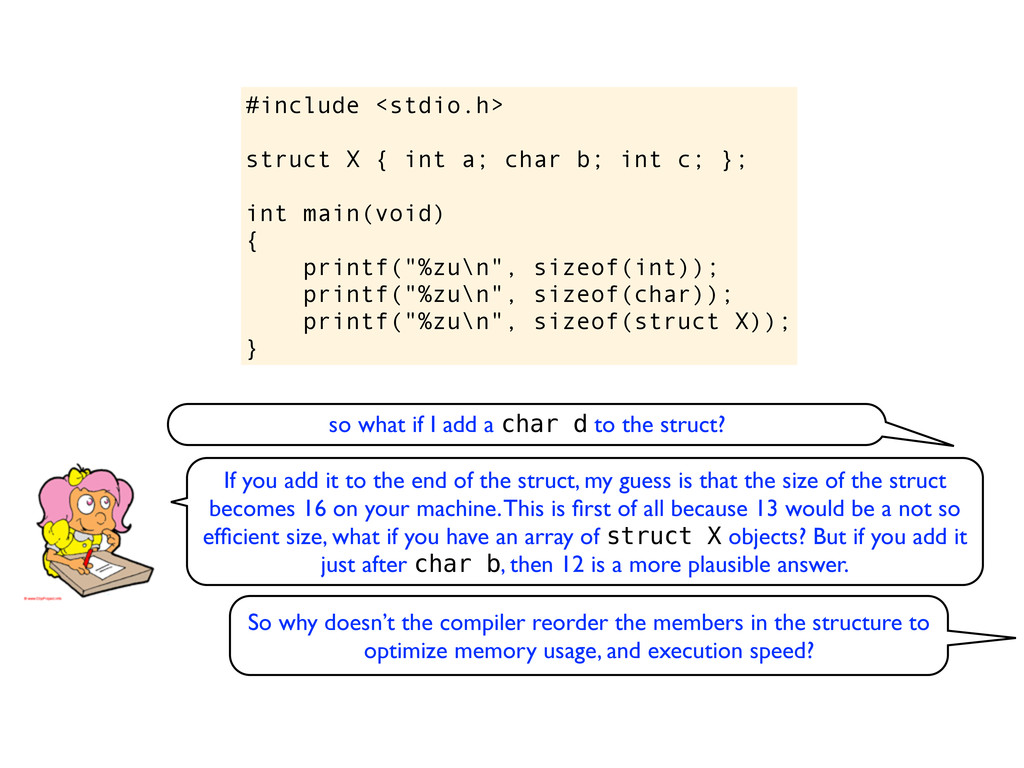
c; }; int main(void) { printf("%zu\n", sizeof(int)); printf("%zu\n", sizeof(char)); printf("%zu\n", sizeof(struct X)); } so what if I add a char d to the struct? If you add it to the end of the struct, my guess is that the size of the struct becomes 16 on your machine. This is first of all because 13 would be a not so efficient size, what if you have an array of struct X objects? But if you add it just after char b, then 12 is a more plausible answer.
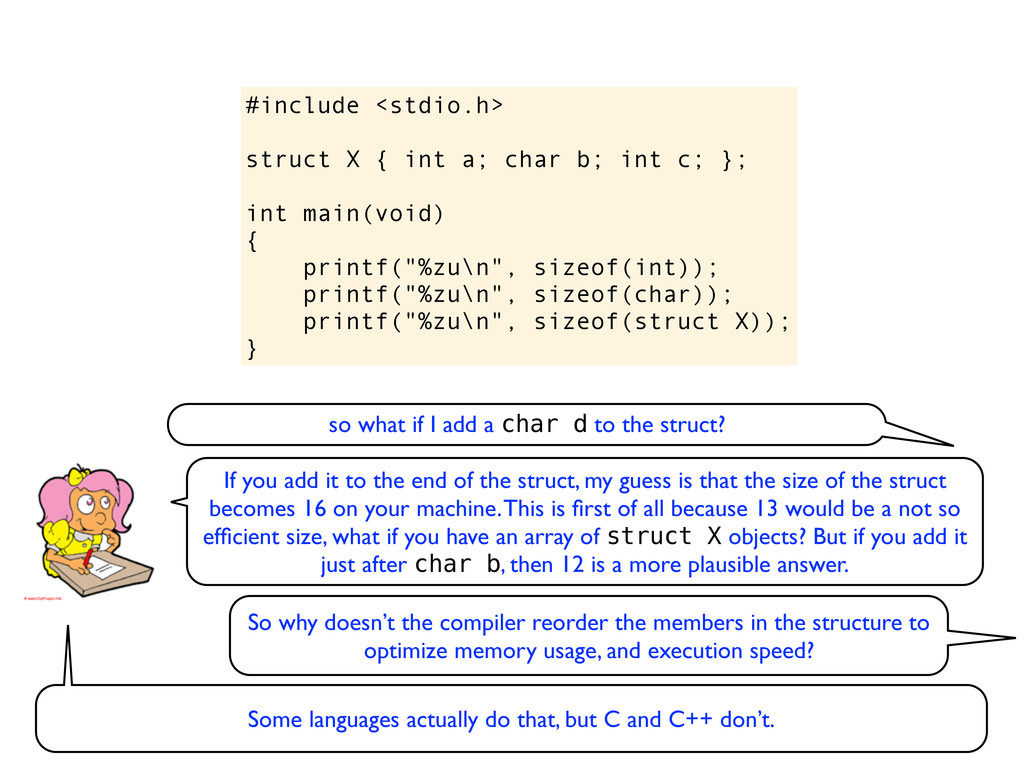
c; }; int main(void) { printf("%zu\n", sizeof(int)); printf("%zu\n", sizeof(char)); printf("%zu\n", sizeof(struct X)); } so what if I add a char d to the struct? If you add it to the end of the struct, my guess is that the size of the struct becomes 16 on your machine. This is first of all because 13 would be a not so efficient size, what if you have an array of struct X objects? But if you add it just after char b, then 12 is a more plausible answer. So why doesn’t the compiler reorder the members in the structure to optimize memory usage, and execution speed?
c; }; int main(void) { printf("%zu\n", sizeof(int)); printf("%zu\n", sizeof(char)); printf("%zu\n", sizeof(struct X)); } so what if I add a char d to the struct? If you add it to the end of the struct, my guess is that the size of the struct becomes 16 on your machine. This is first of all because 13 would be a not so efficient size, what if you have an array of struct X objects? But if you add it just after char b, then 12 is a more plausible answer. So why doesn’t the compiler reorder the members in the structure to optimize memory usage, and execution speed? Some languages actually do that, but C and C++ don’t.
c; }; int main(void) { printf("%zu\n", sizeof(int)); printf("%zu\n", sizeof(char)); printf("%zu\n", sizeof(struct X)); } so what if I add a char * d to the end of the struct?
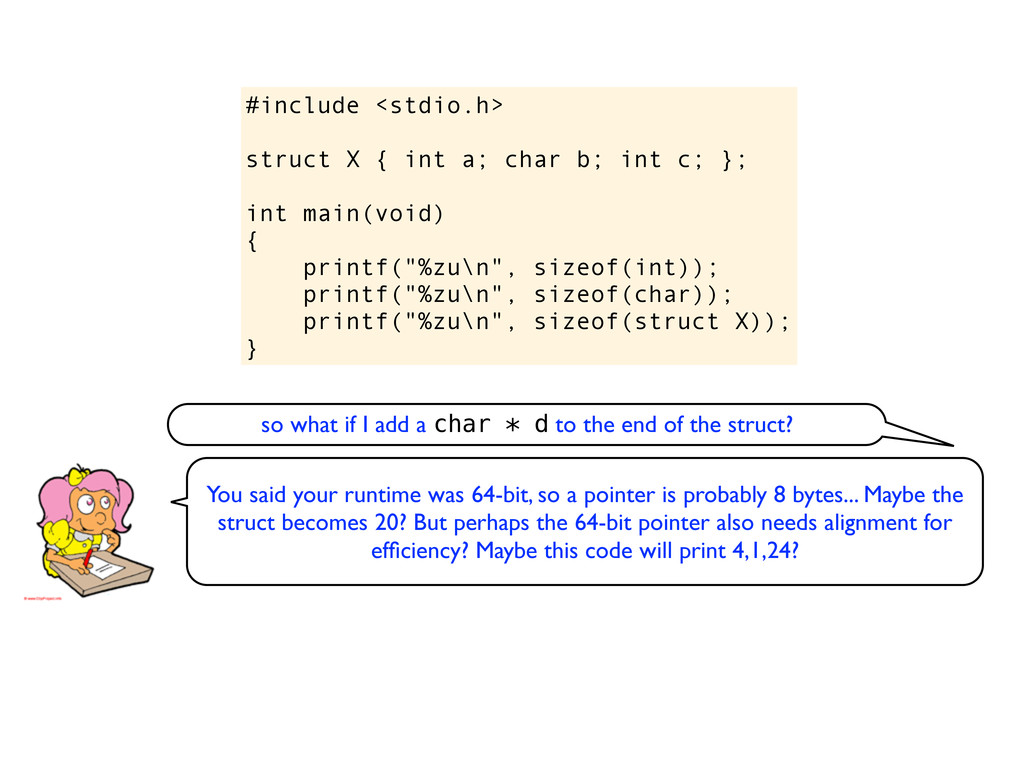
c; }; int main(void) { printf("%zu\n", sizeof(int)); printf("%zu\n", sizeof(char)); printf("%zu\n", sizeof(struct X)); } so what if I add a char * d to the end of the struct? You said your runtime was 64-bit, so a pointer is probably 8 bytes... Maybe the struct becomes 20? But perhaps the 64-bit pointer also needs alignment for efficiency? Maybe this code will print 4,1,24?
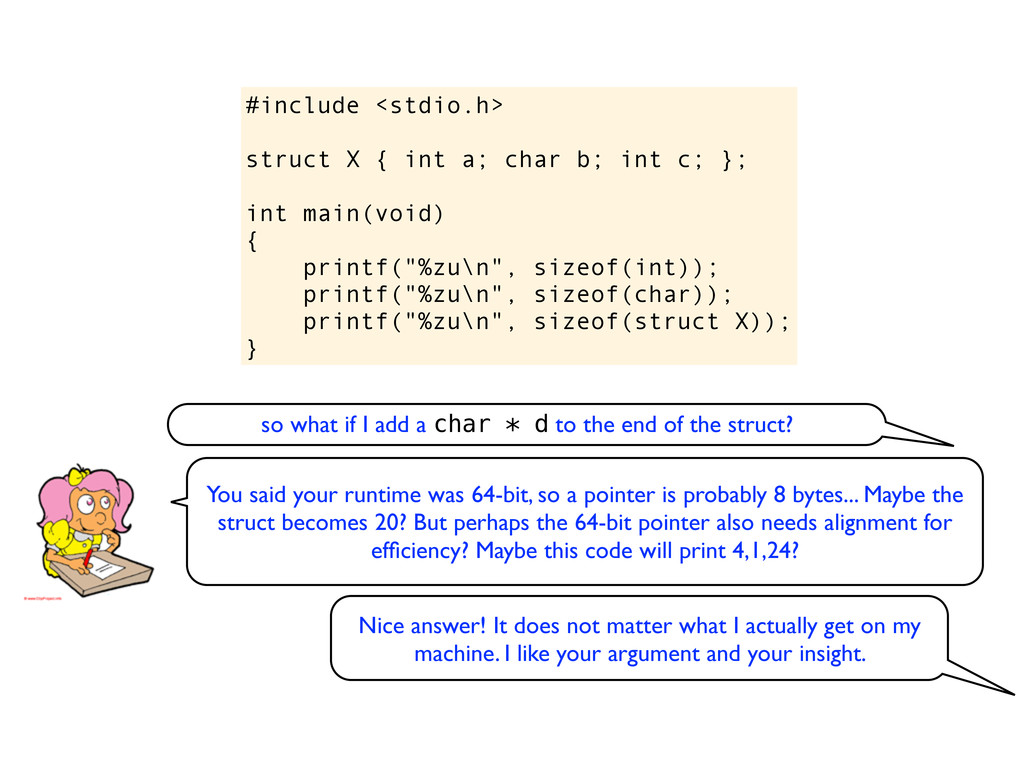
c; }; int main(void) { printf("%zu\n", sizeof(int)); printf("%zu\n", sizeof(char)); printf("%zu\n", sizeof(struct X)); } so what if I add a char * d to the end of the struct? You said your runtime was 64-bit, so a pointer is probably 8 bytes... Maybe the struct becomes 20? But perhaps the 64-bit pointer also needs alignment for efficiency? Maybe this code will print 4,1,24? Nice answer! It does not matter what I actually get on my machine. I like your argument and your insight.
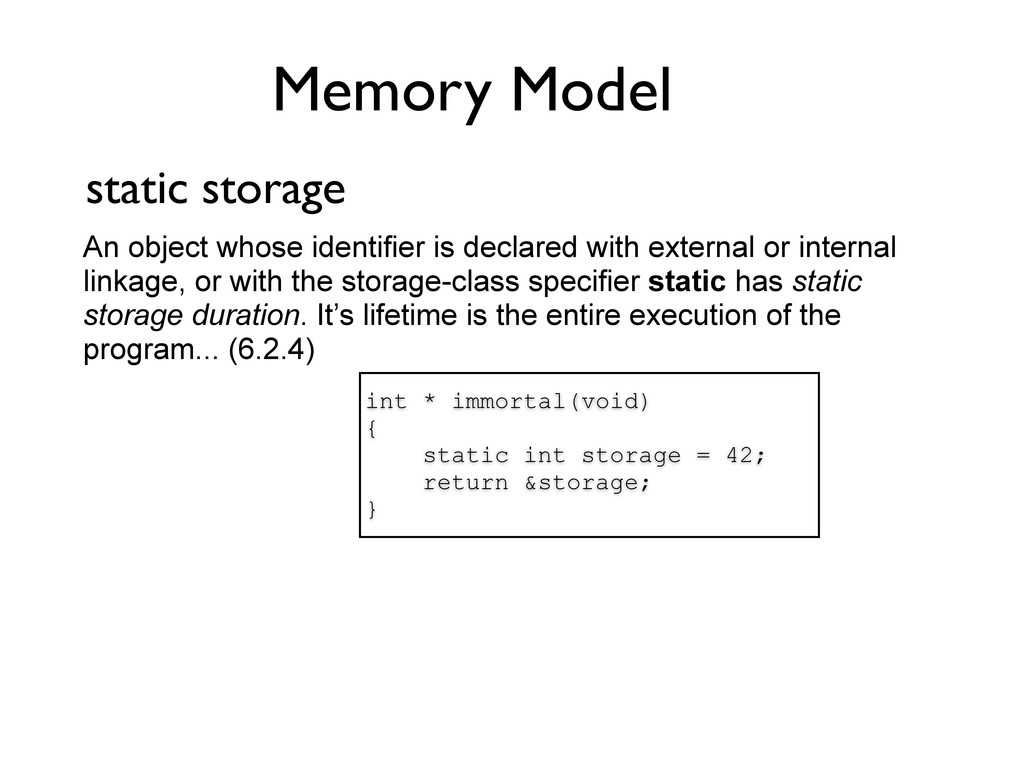
or internal linkage, or with the storage-class specifier static has static storage duration. It’s lifetime is the entire execution of the program... (6.2.4) static storage int * immortal(void) { static int storage = 42; return &storage; }
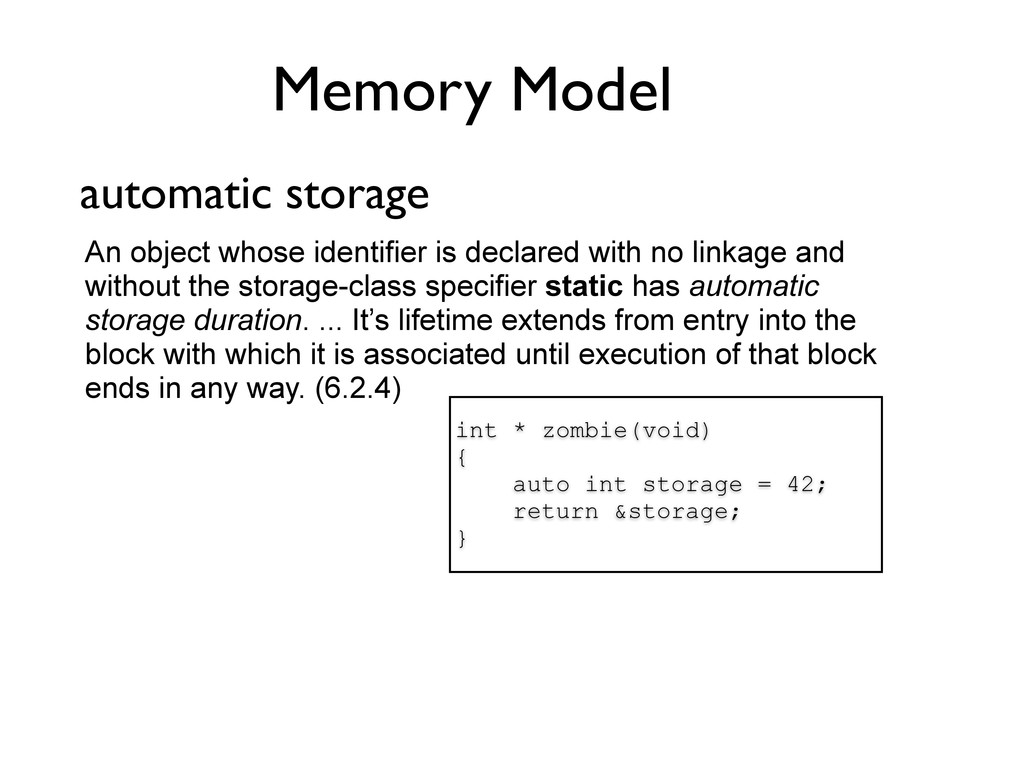
linkage and without the storage-class specifier static has automatic storage duration. ... It’s lifetime extends from entry into the block with which it is associated until execution of that block ends in any way. (6.2.4) automatic storage int * zombie(void) { auto int storage = 42; return &storage; }
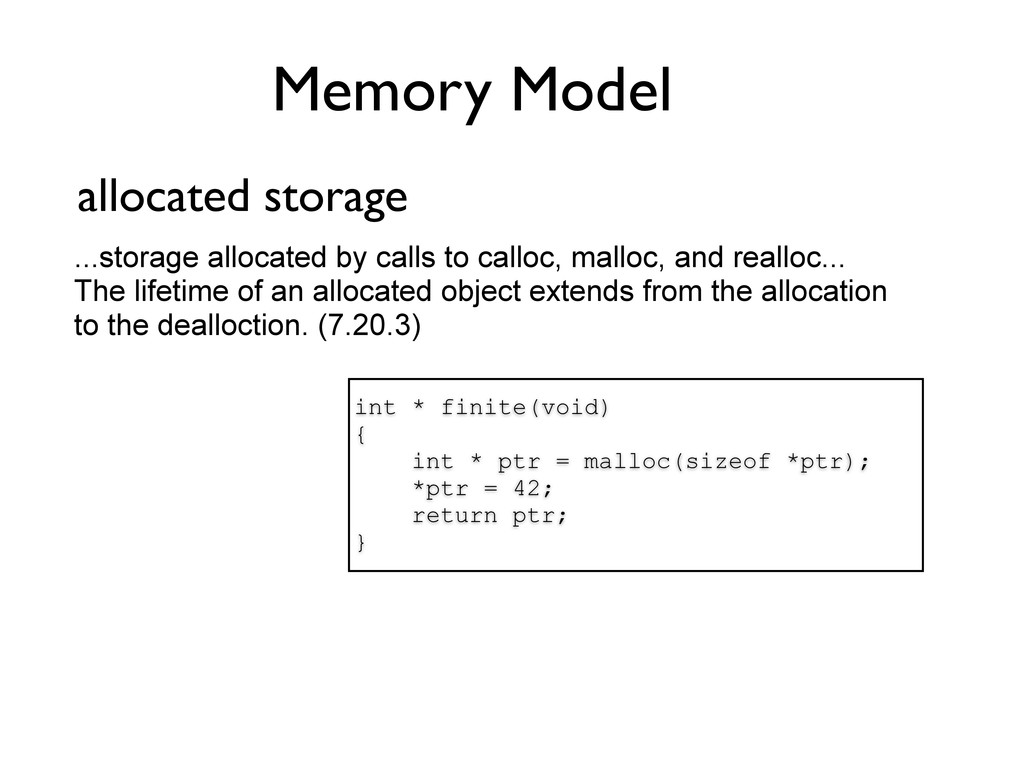
realloc... The lifetime of an allocated object extends from the allocation to the dealloction. (7.20.3) allocated storage int * finite(void) { int * ptr = malloc(sizeof *ptr); *ptr = 42; return ptr; }
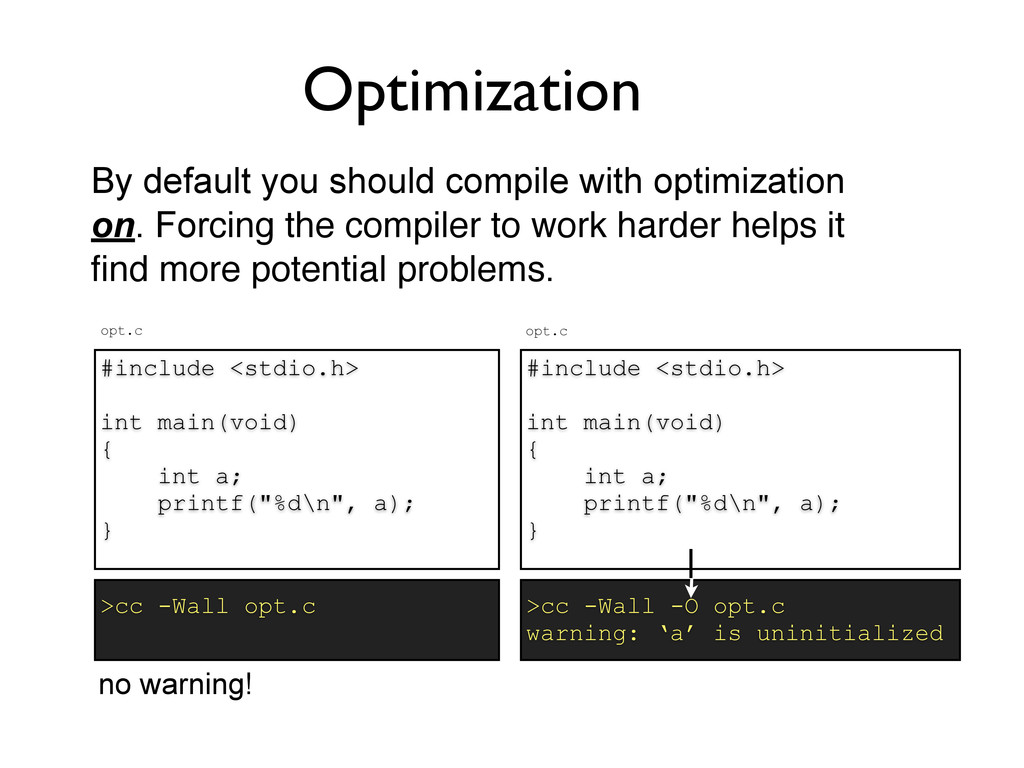
compiler to work harder helps it find more potential problems. Optimization #include <stdio.h> int main(void) { int a; printf("%d\n", a); } >cc -Wall opt.c opt.c no warning! #include <stdio.h> int main(void) { int a; printf("%d\n", a); } >cc -Wall -O opt.c warning: ‘a’ is uninitialized opt.c
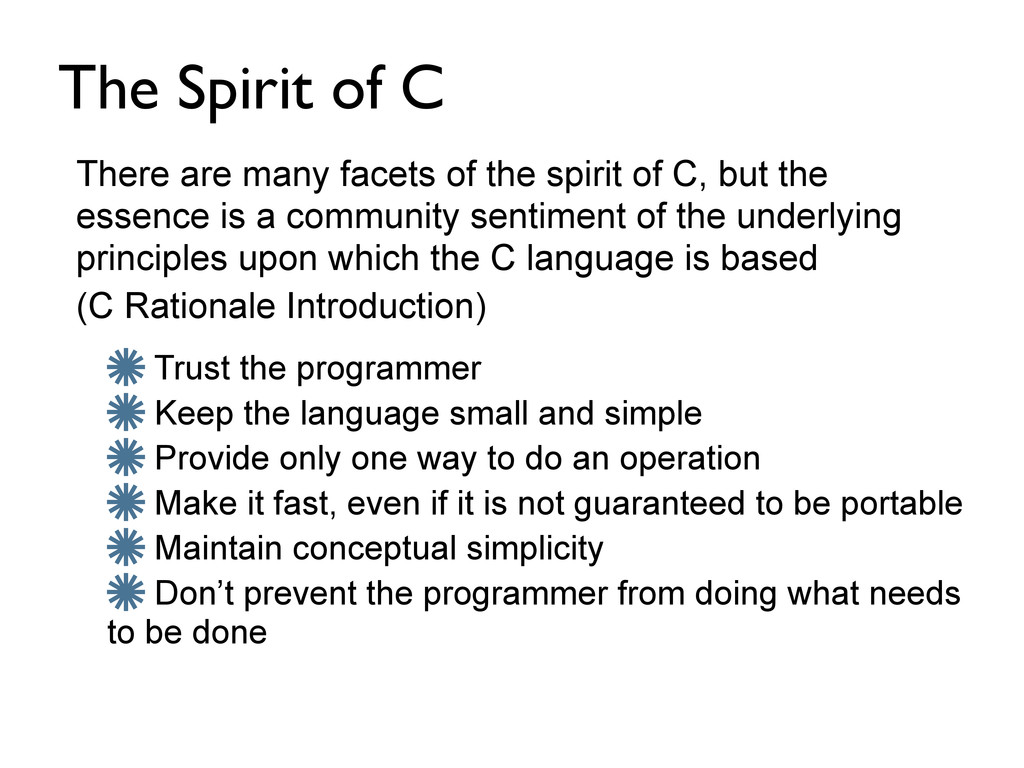
the essence is a community sentiment of the underlying principles upon which the C language is based (C Rationale Introduction) The Spirit of C Trust the programmer Keep the language small and simple Provide only one way to do an operation Make it fast, even if it is not guaranteed to be portable Maintain conceptual simplicity Don’t prevent the programmer from doing what needs to be done
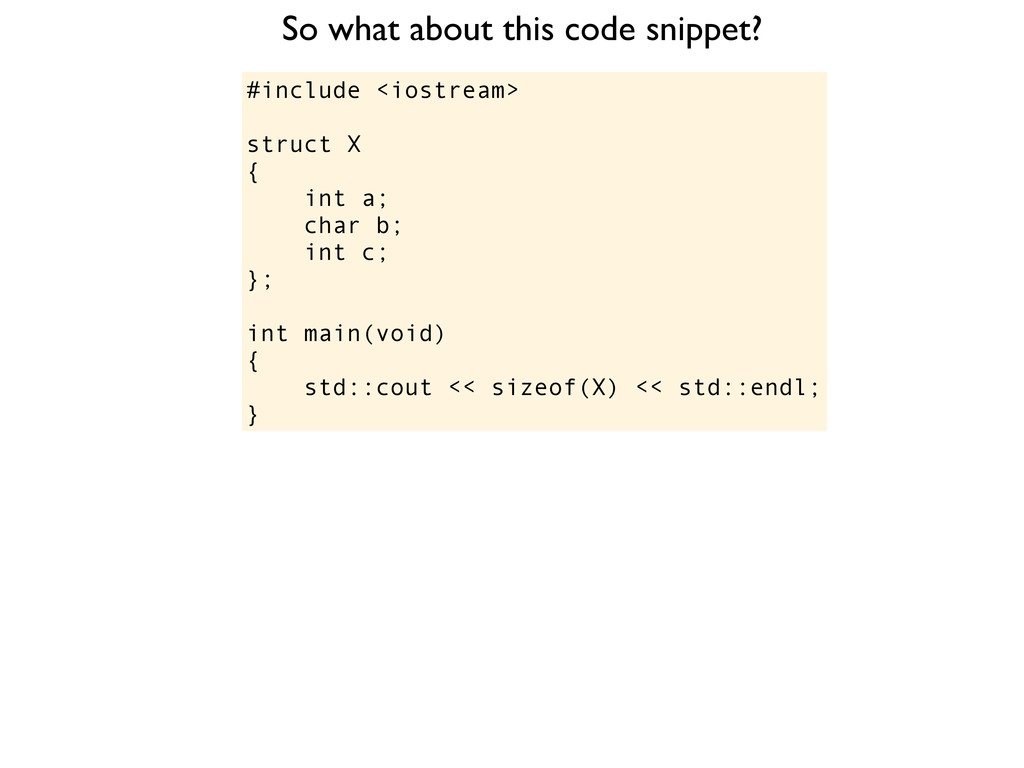
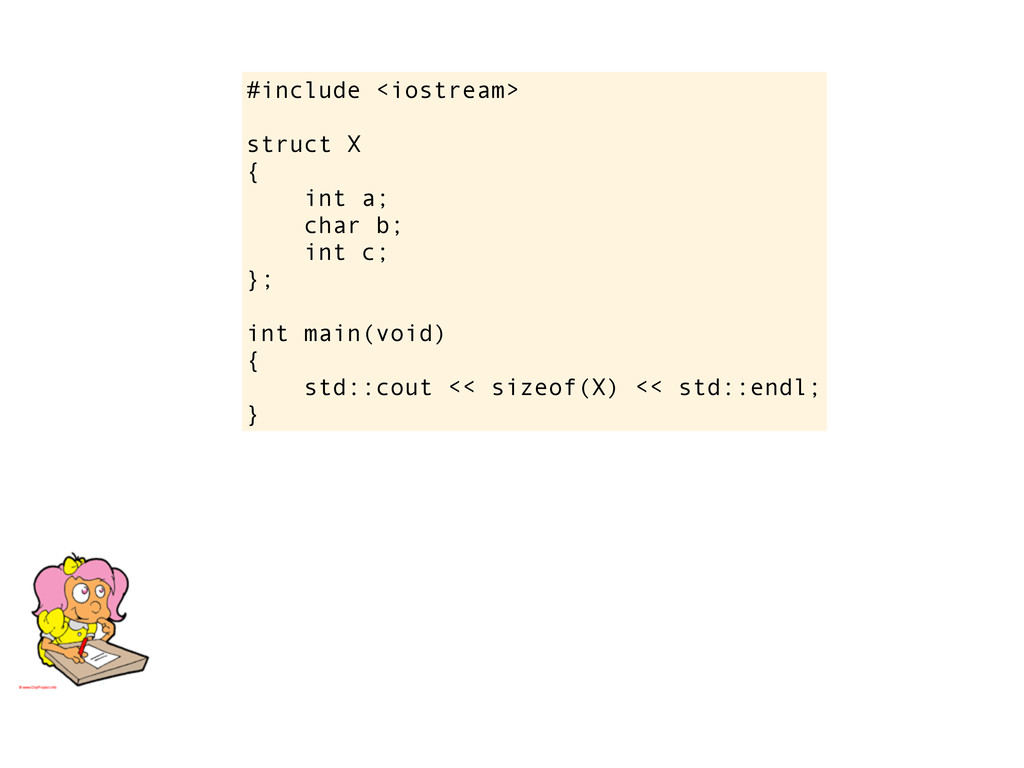
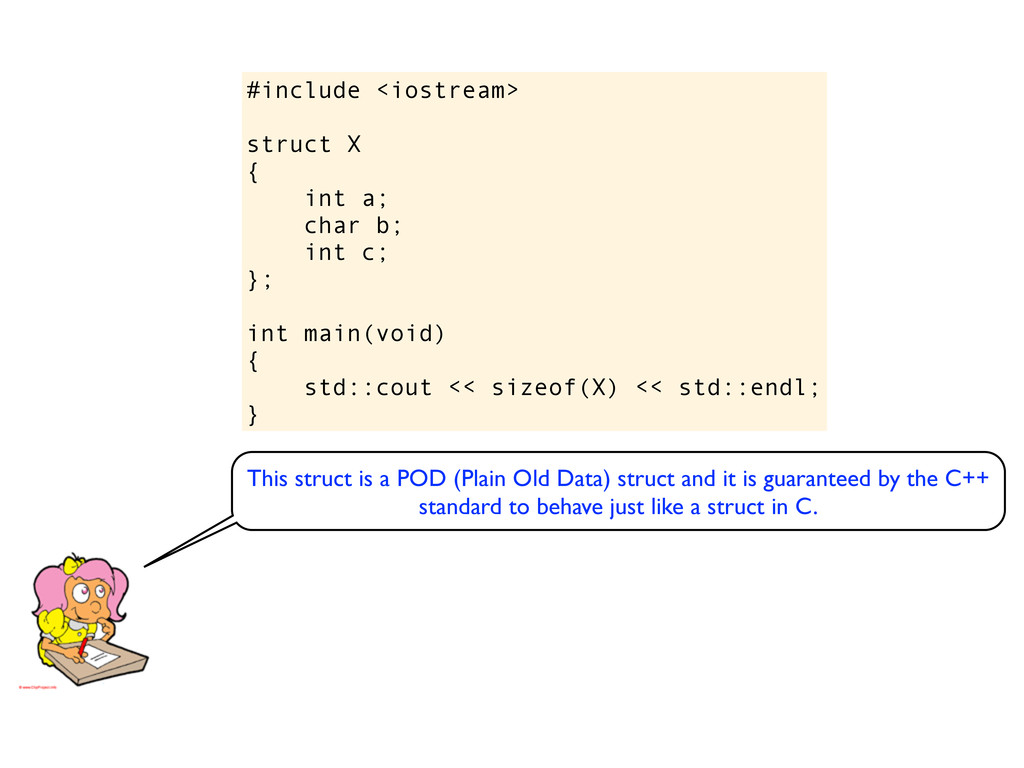
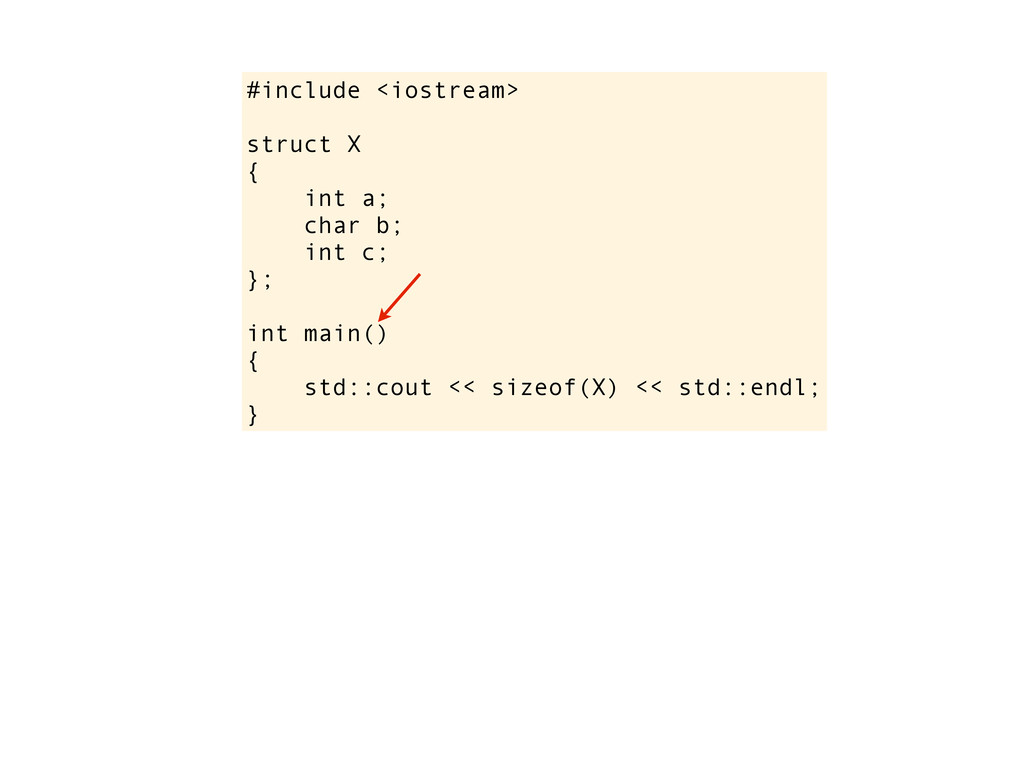
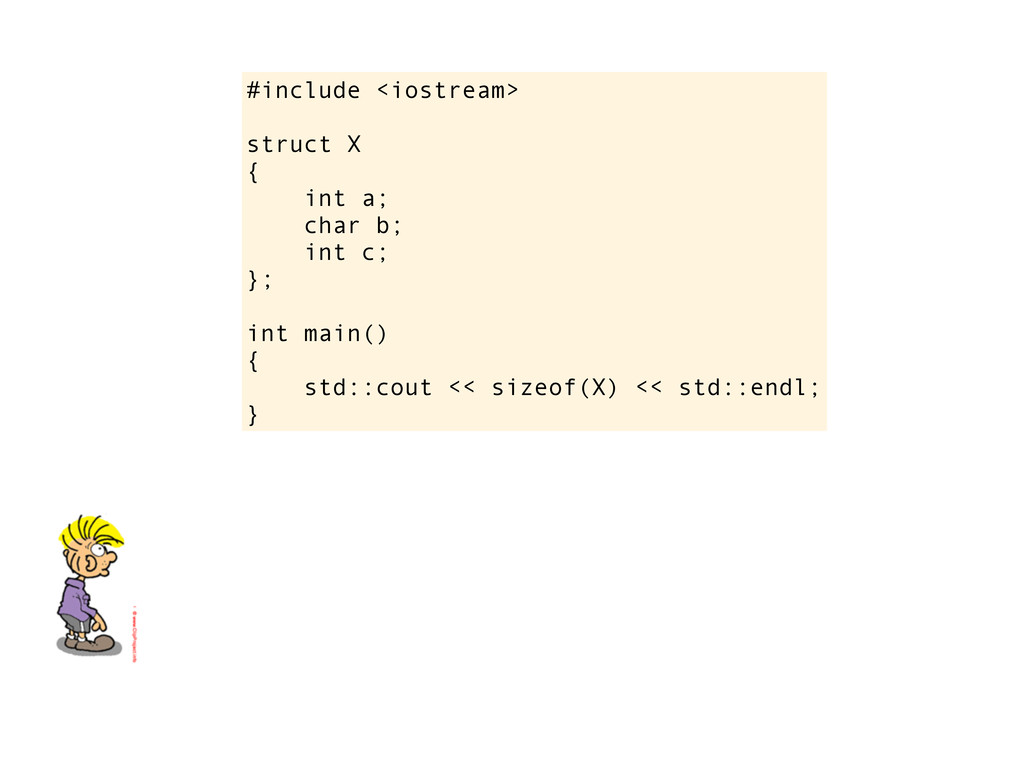
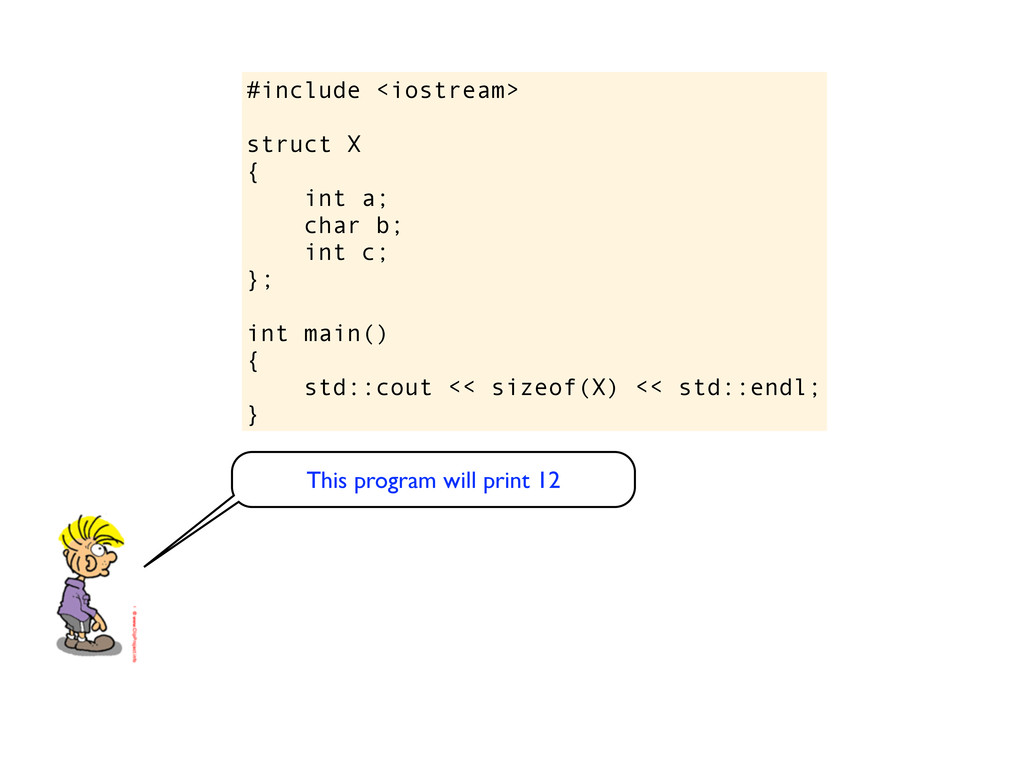
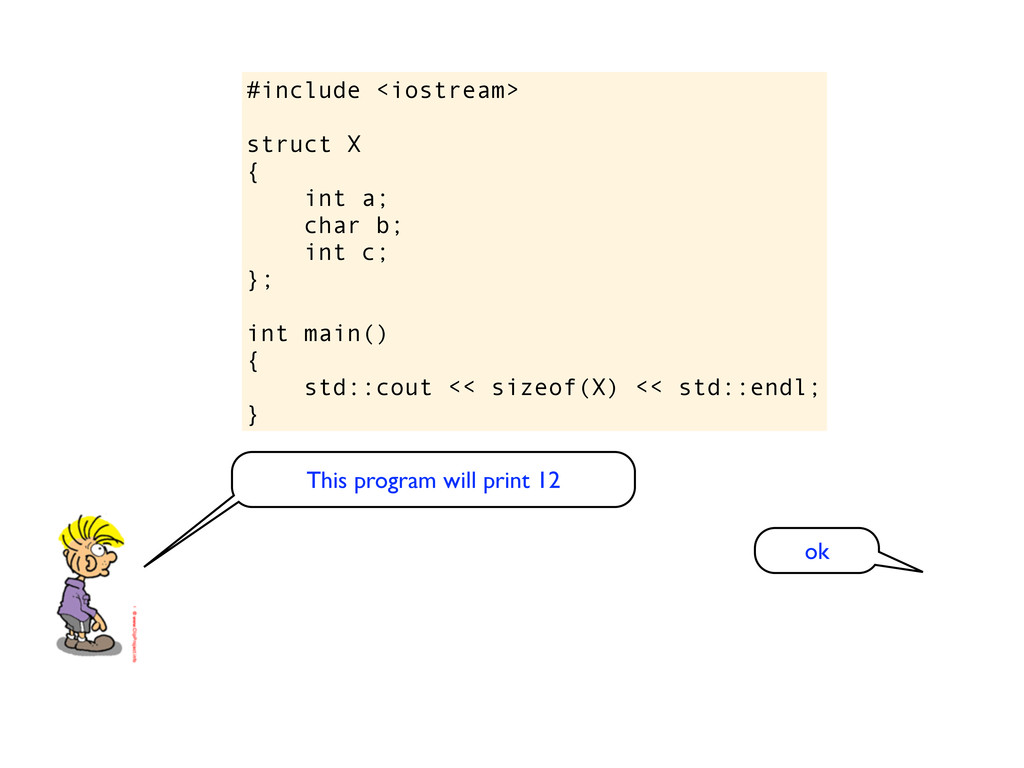
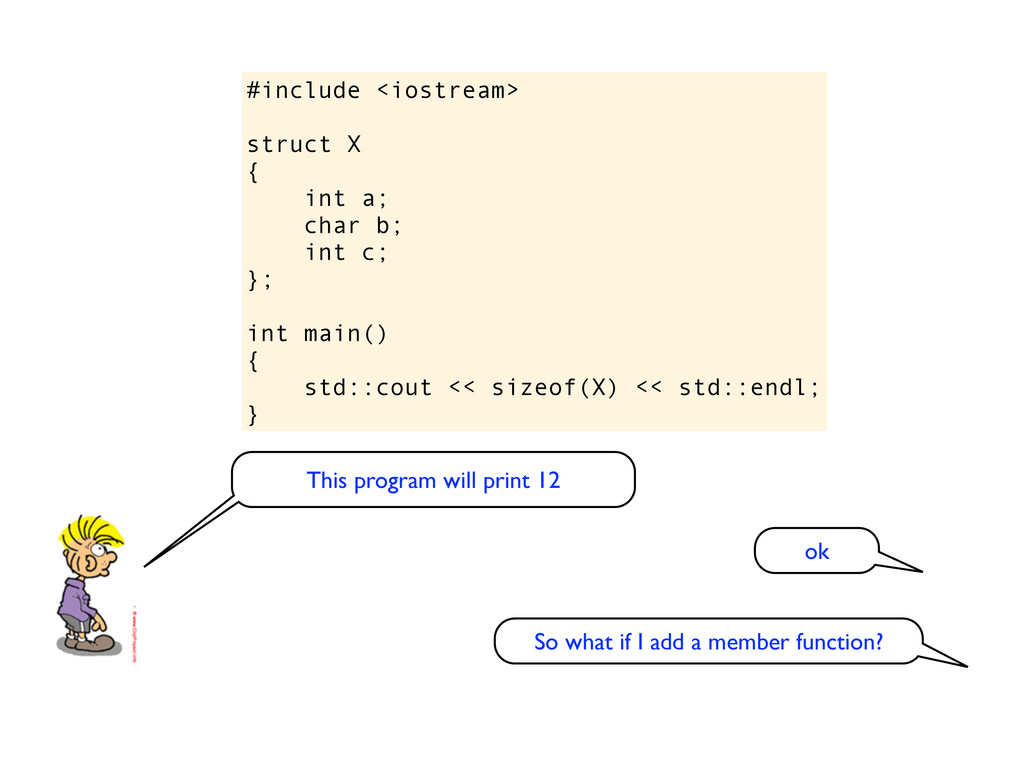
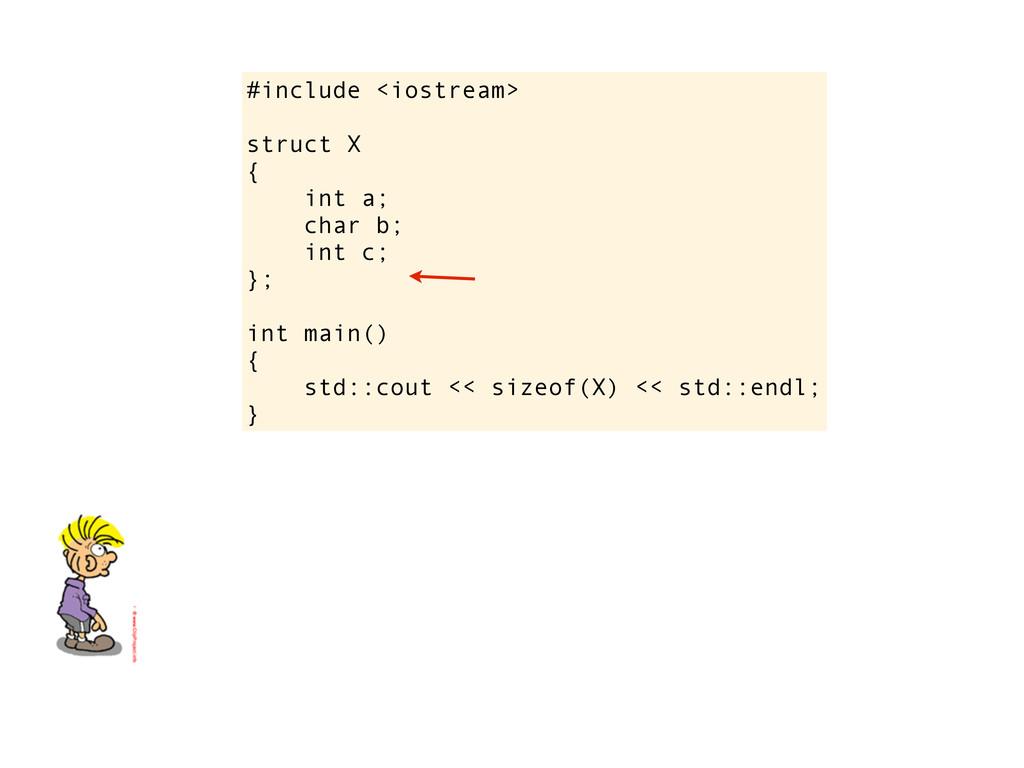
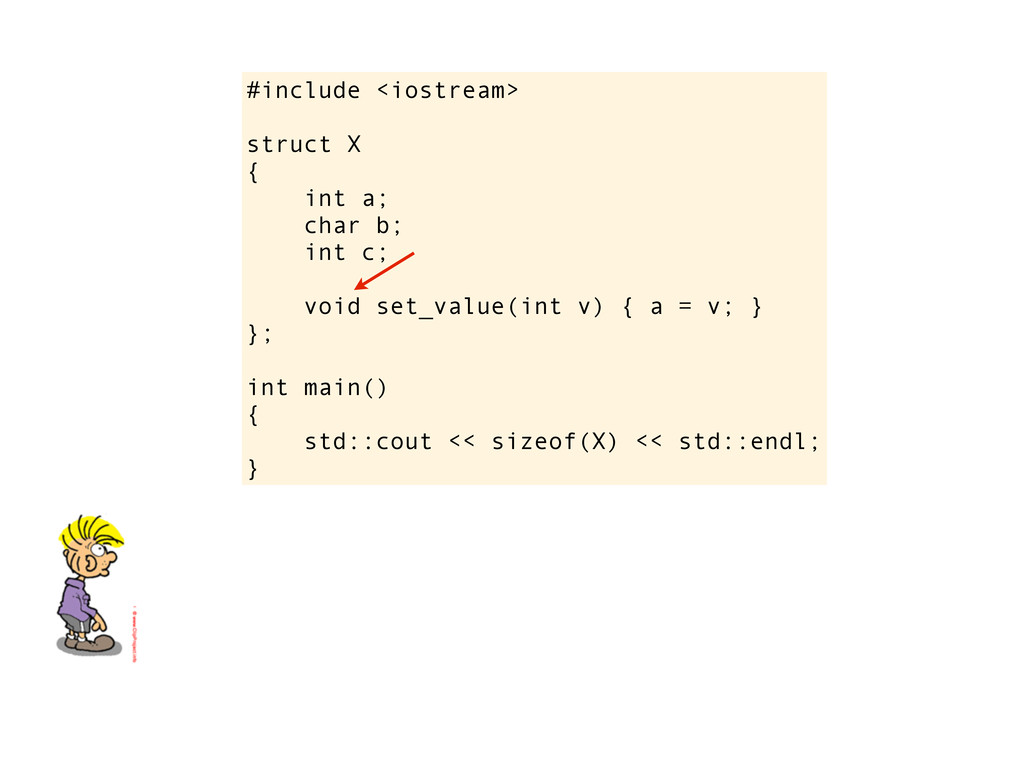
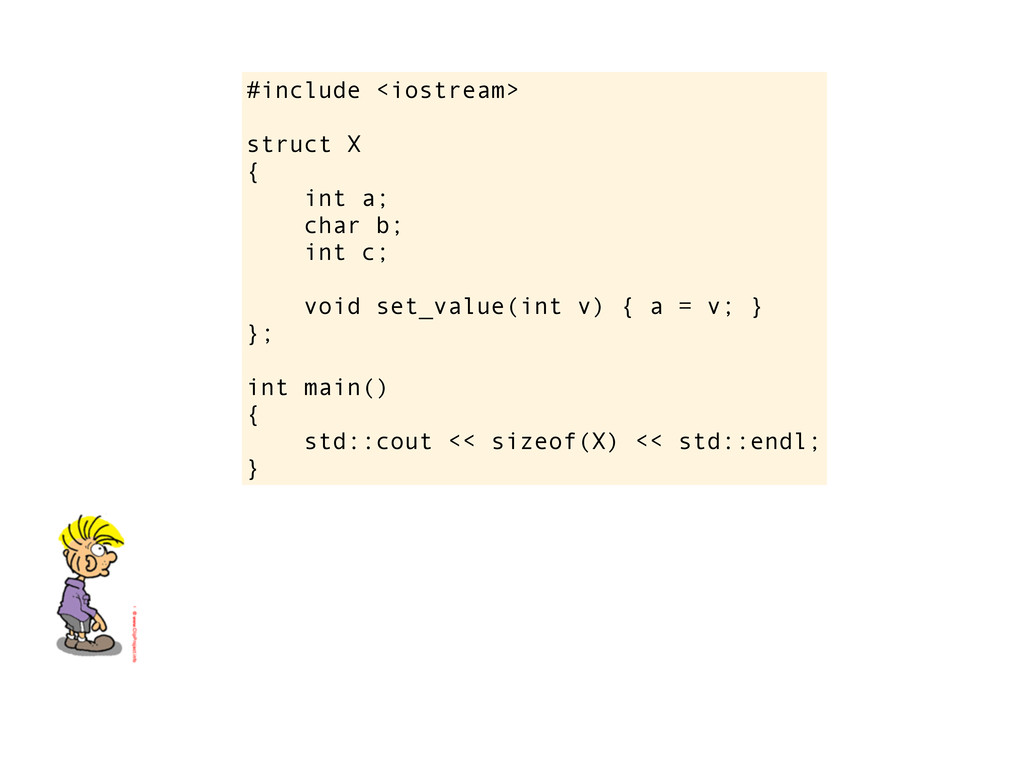
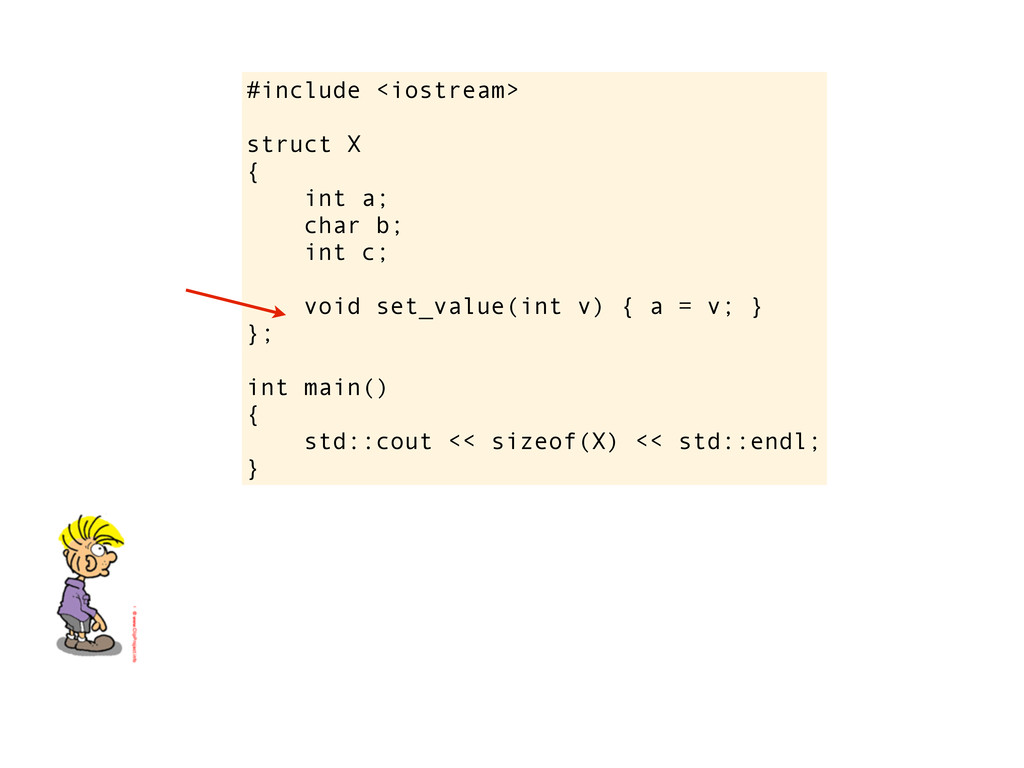
c; }; int main(void) { std::cout << sizeof(X) << std::endl; } This struct is a POD (Plain Old Data) struct and it is guaranteed by the C++ standard to behave just like a struct in C.
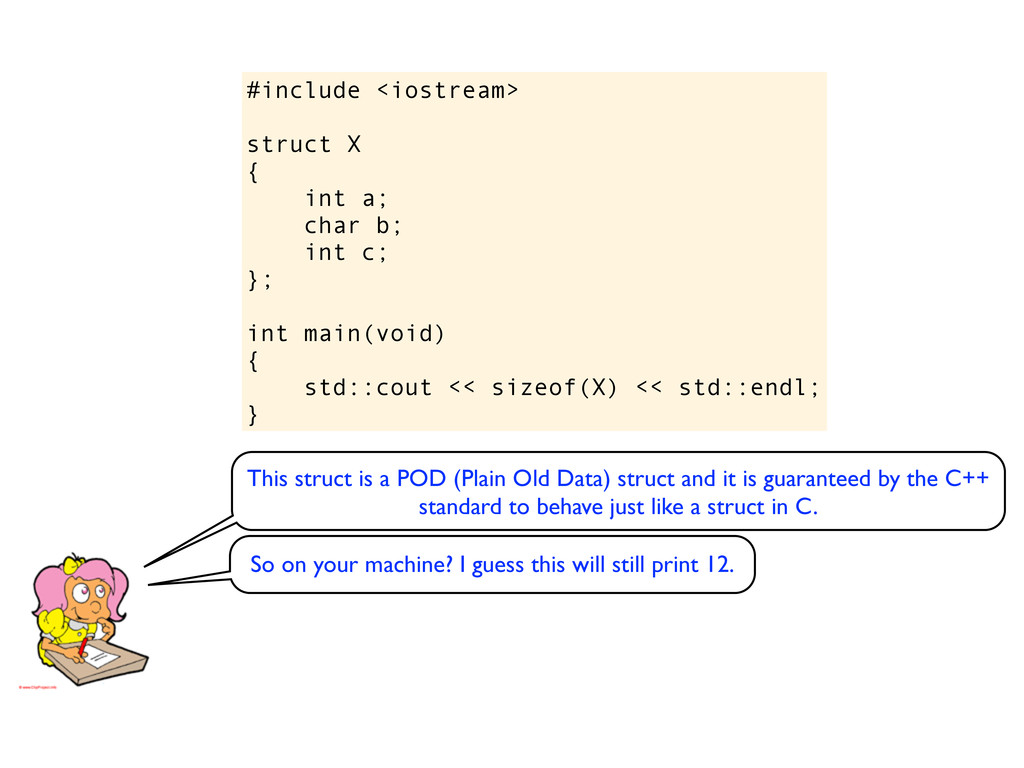
c; }; int main(void) { std::cout << sizeof(X) << std::endl; } So on your machine? I guess this will still print 12. This struct is a POD (Plain Old Data) struct and it is guaranteed by the C++ standard to behave just like a struct in C.
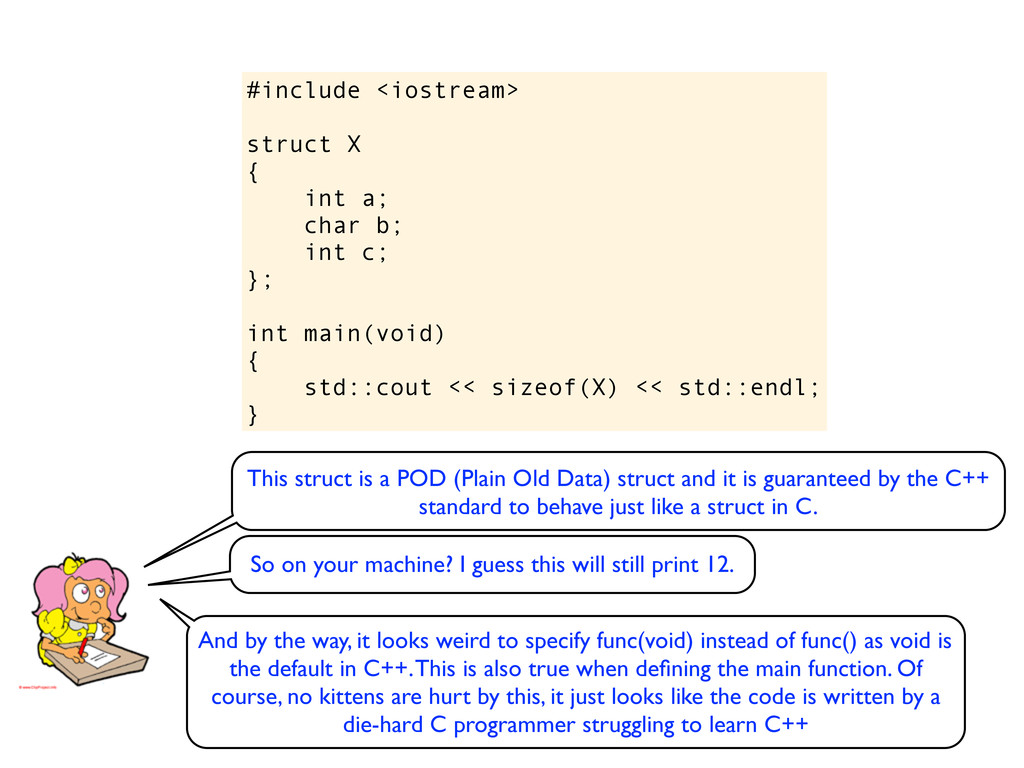
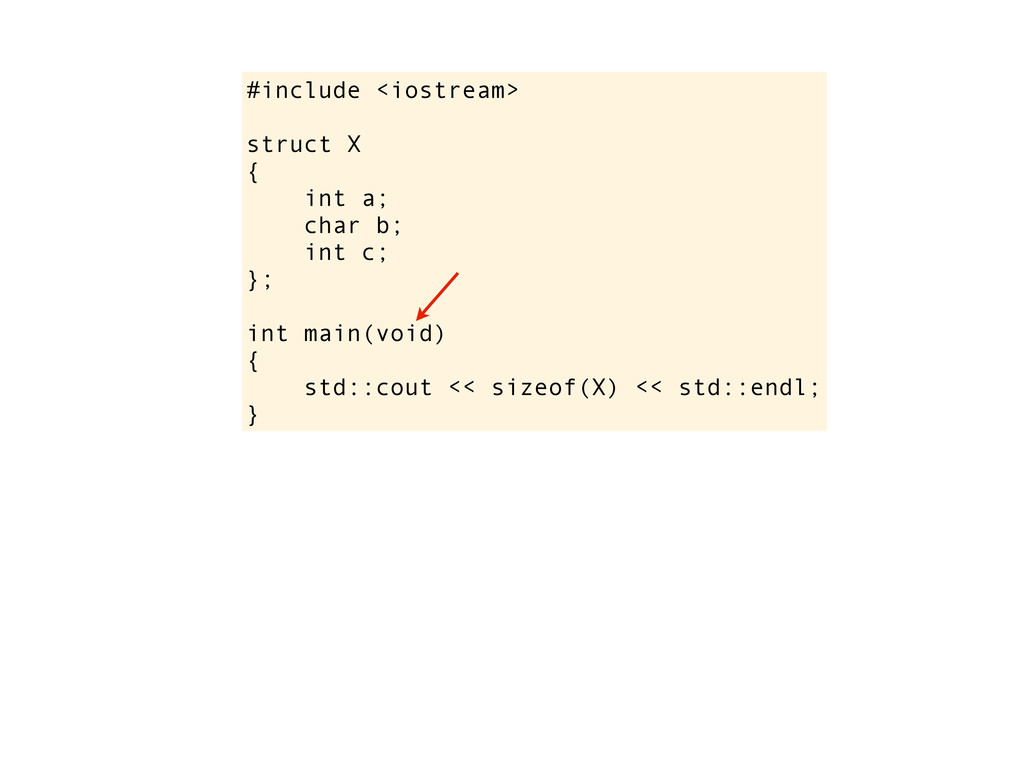
c; }; int main(void) { std::cout << sizeof(X) << std::endl; } So on your machine? I guess this will still print 12. This struct is a POD (Plain Old Data) struct and it is guaranteed by the C++ standard to behave just like a struct in C. And by the way, it looks weird to specify func(void) instead of func() as void is the default in C++. This is also true when defining the main function. Of course, no kittens are hurt by this, it just looks like the code is written by a die-hard C programmer struggling to learn C++
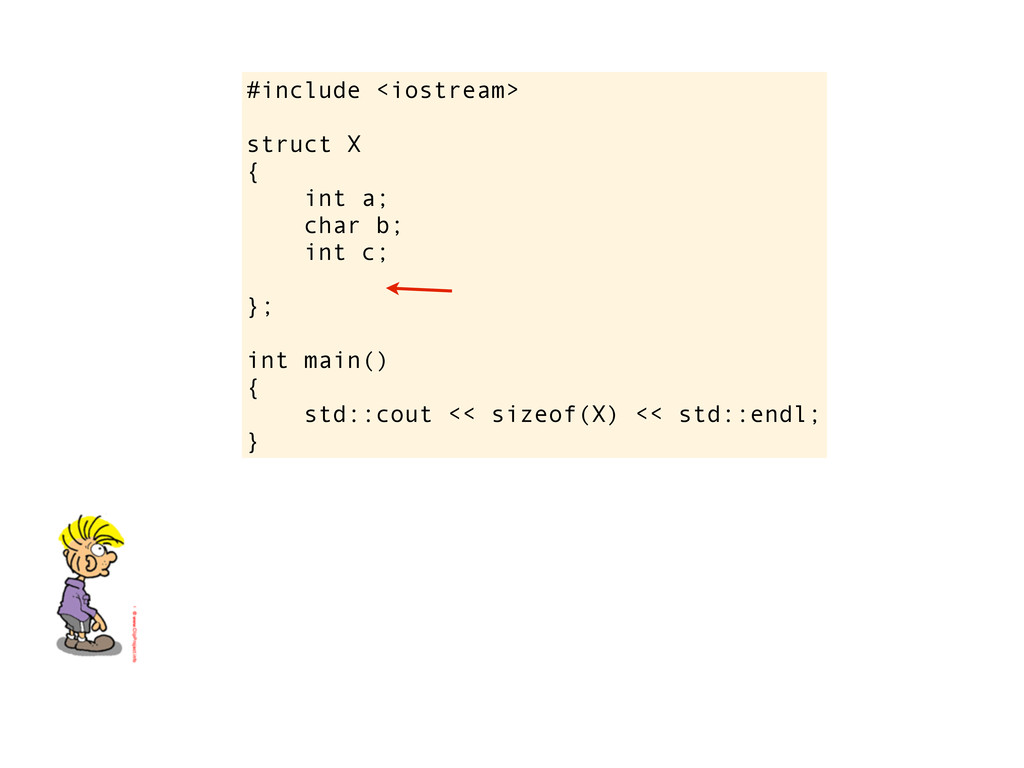
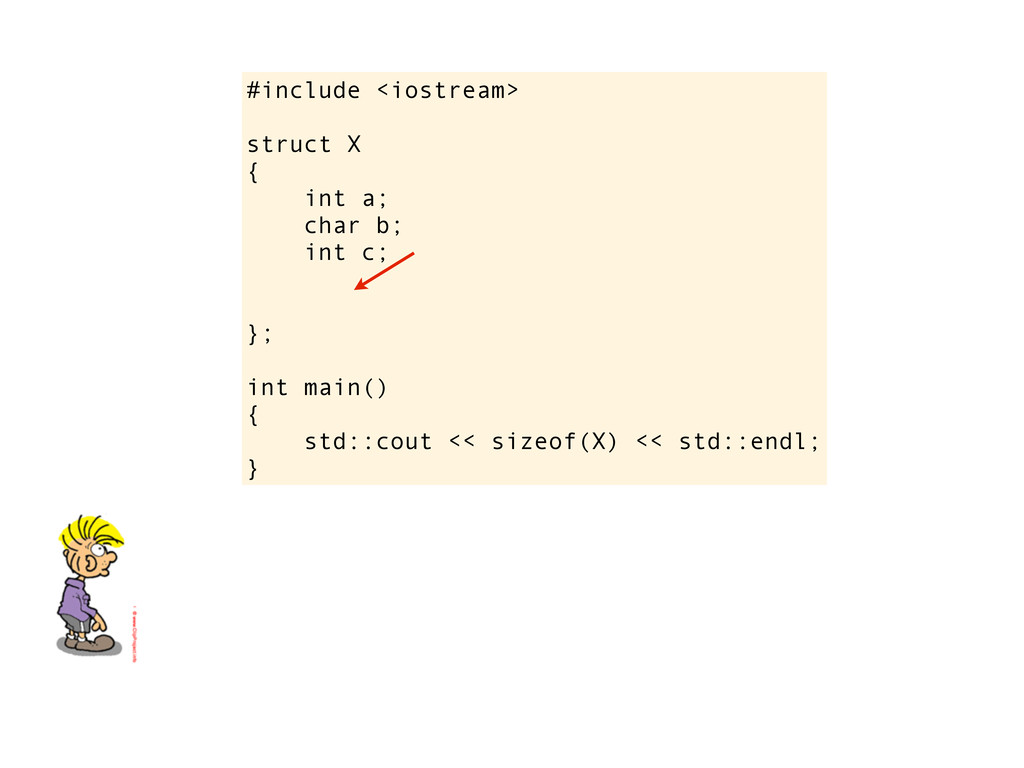
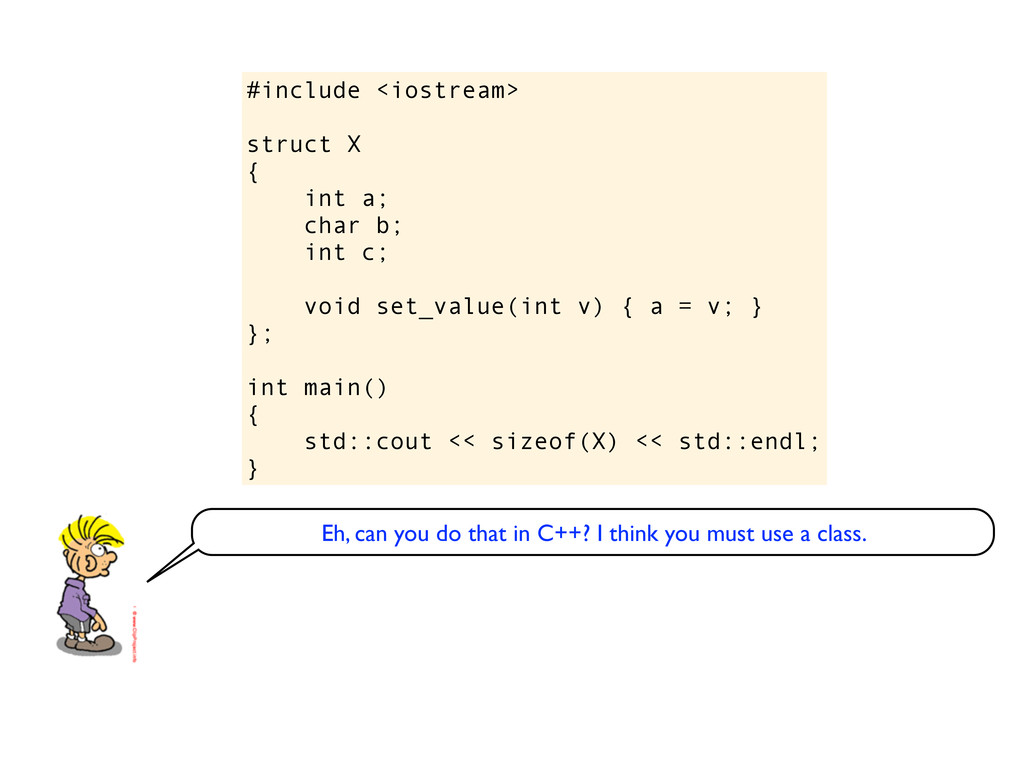
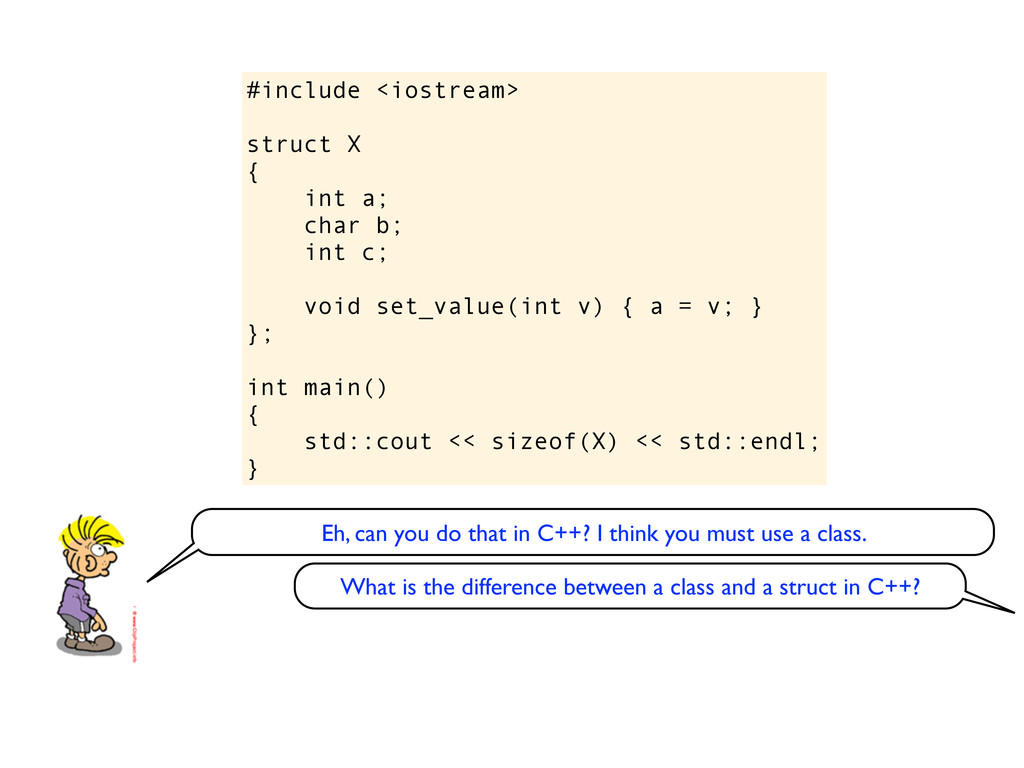
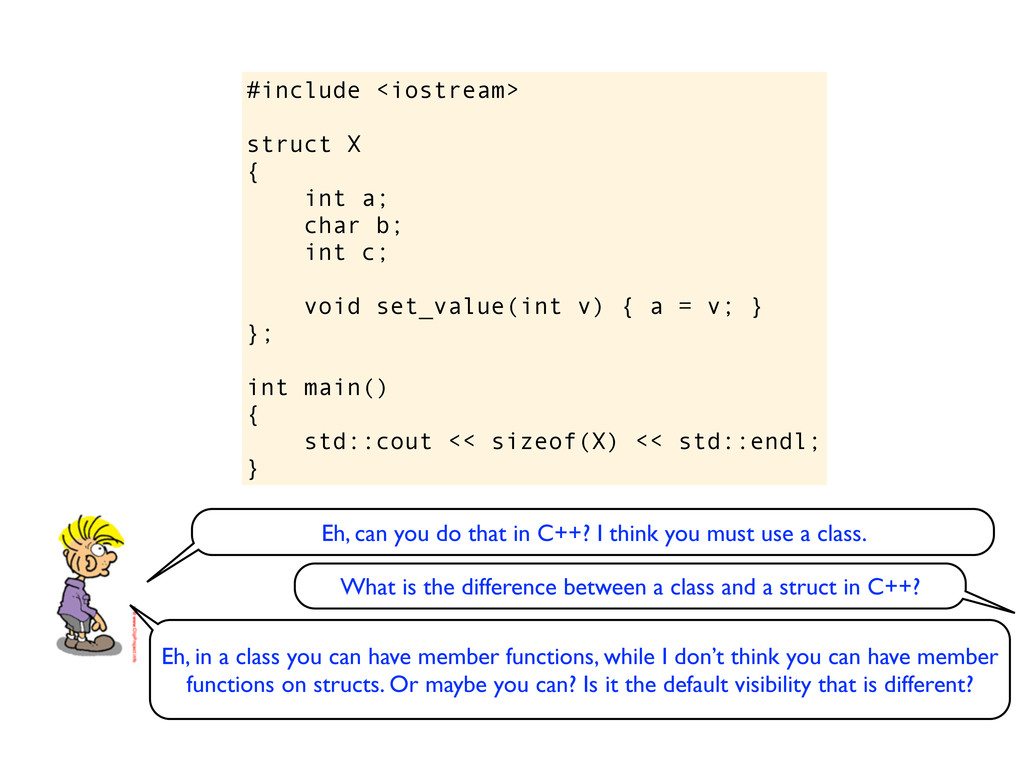
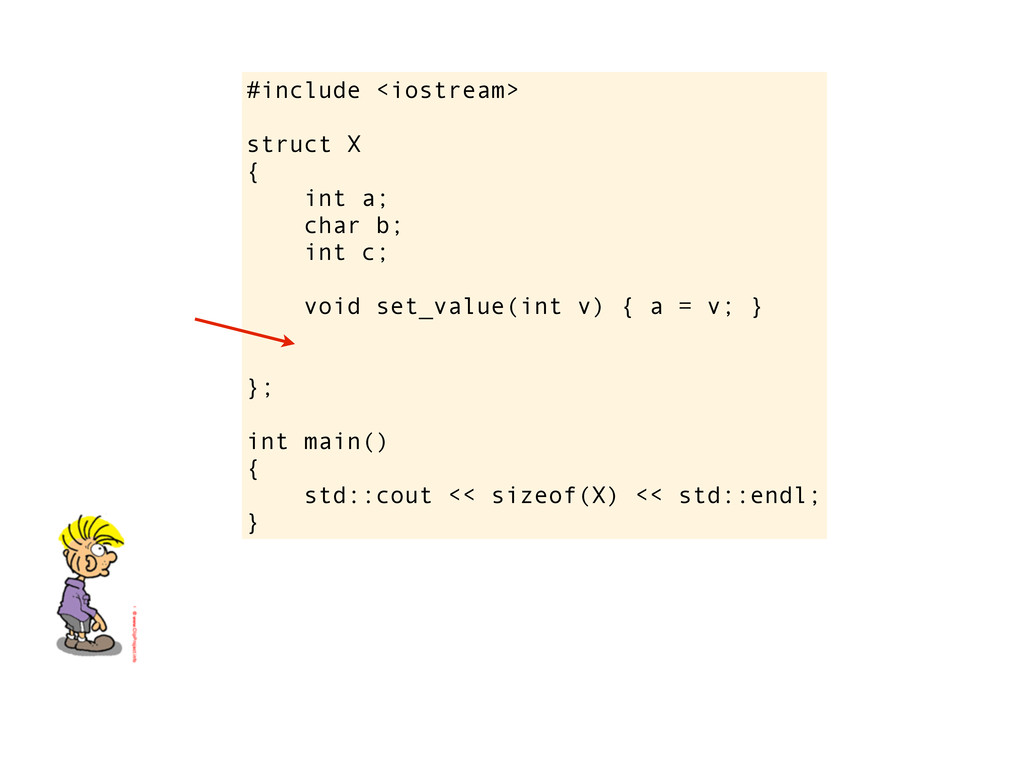
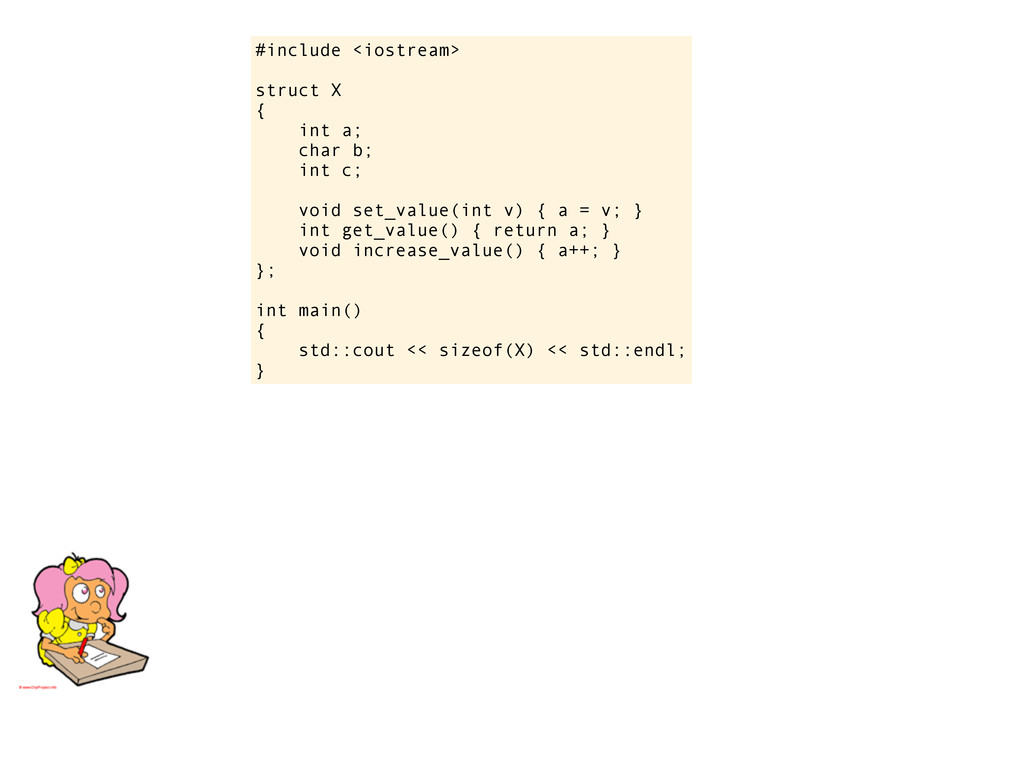
c; void set_value(int v) { a = v; } }; int main() { std::cout << sizeof(X) << std::endl; } Eh, can you do that in C++? I think you must use a class. What is the difference between a class and a struct in C++?
c; void set_value(int v) { a = v; } }; int main() { std::cout << sizeof(X) << std::endl; } Eh, can you do that in C++? I think you must use a class. What is the difference between a class and a struct in C++? Eh, in a class you can have member functions, while I don’t think you can have member functions on structs. Or maybe you can? Is it the default visibility that is different?
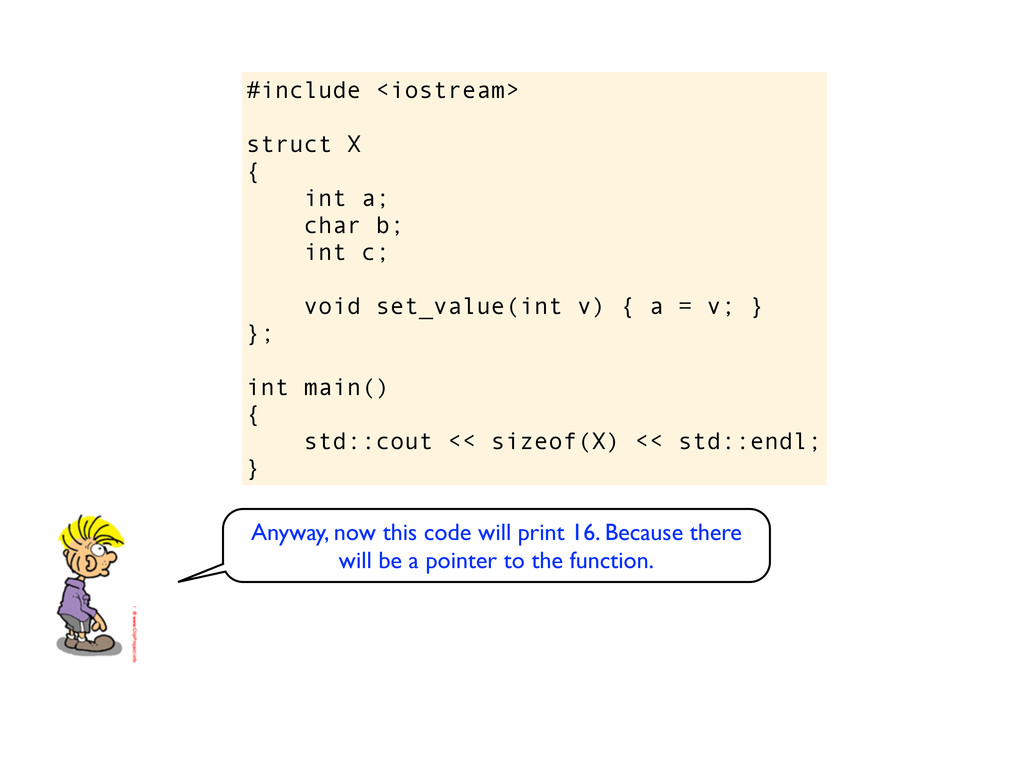
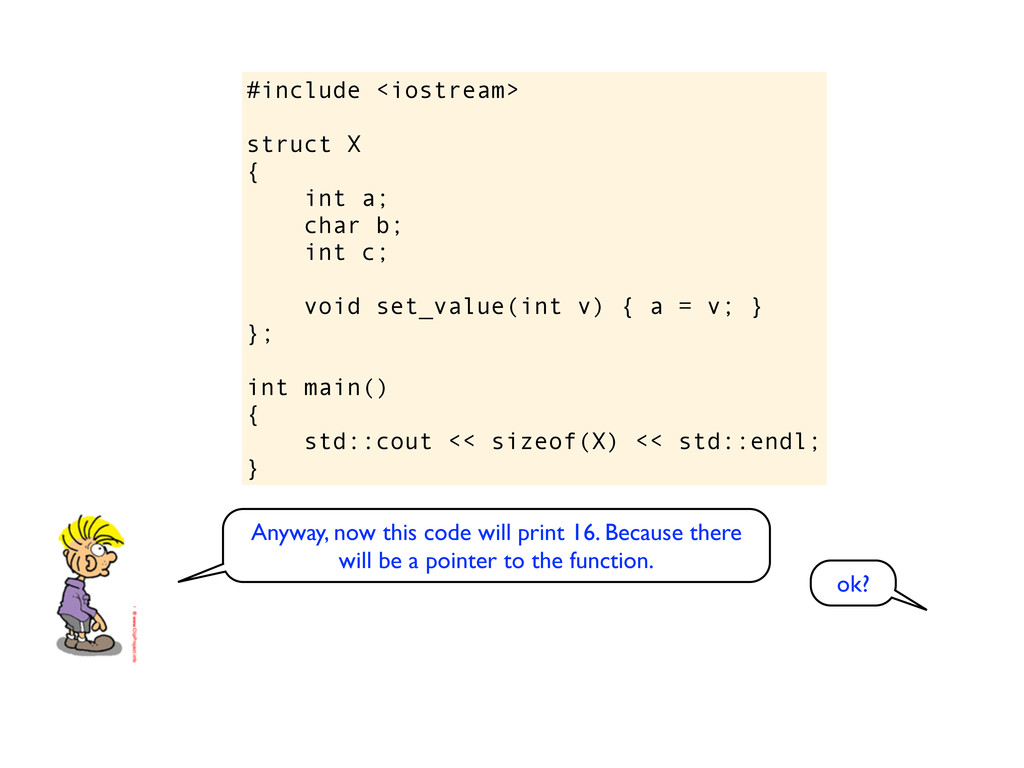
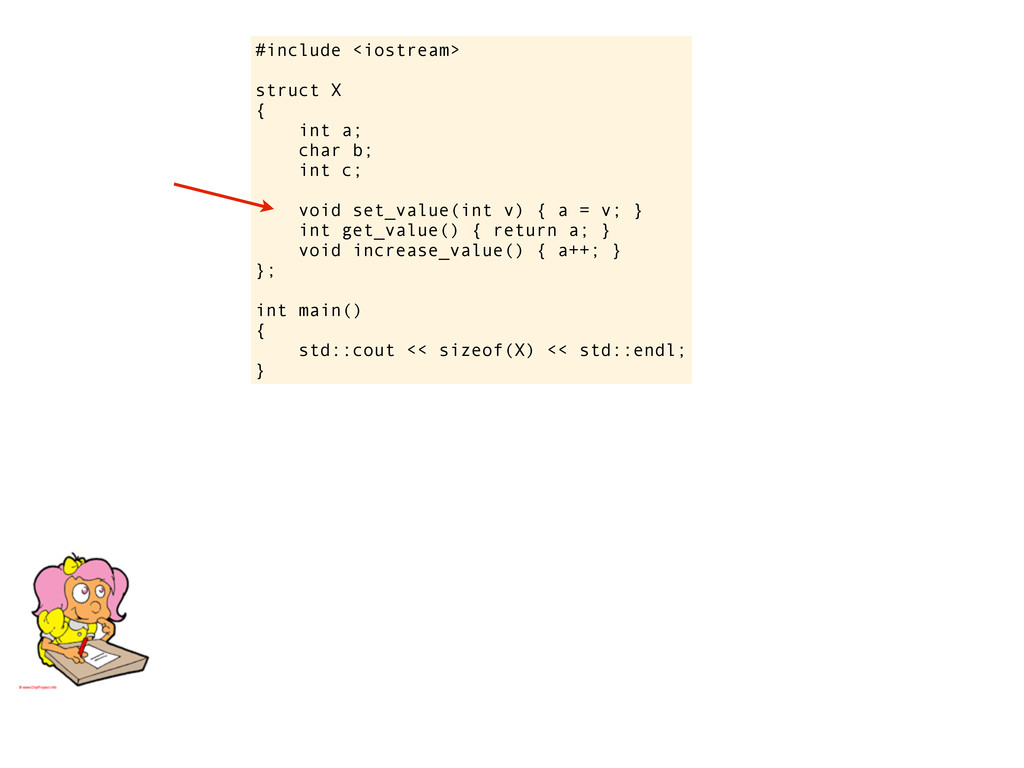
c; void set_value(int v) { a = v; } }; int main() { std::cout << sizeof(X) << std::endl; } Anyway, now this code will print 16. Because there will be a pointer to the function.
c; void set_value(int v) { a = v; } }; int main() { std::cout << sizeof(X) << std::endl; } Anyway, now this code will print 16. Because there will be a pointer to the function. ok?
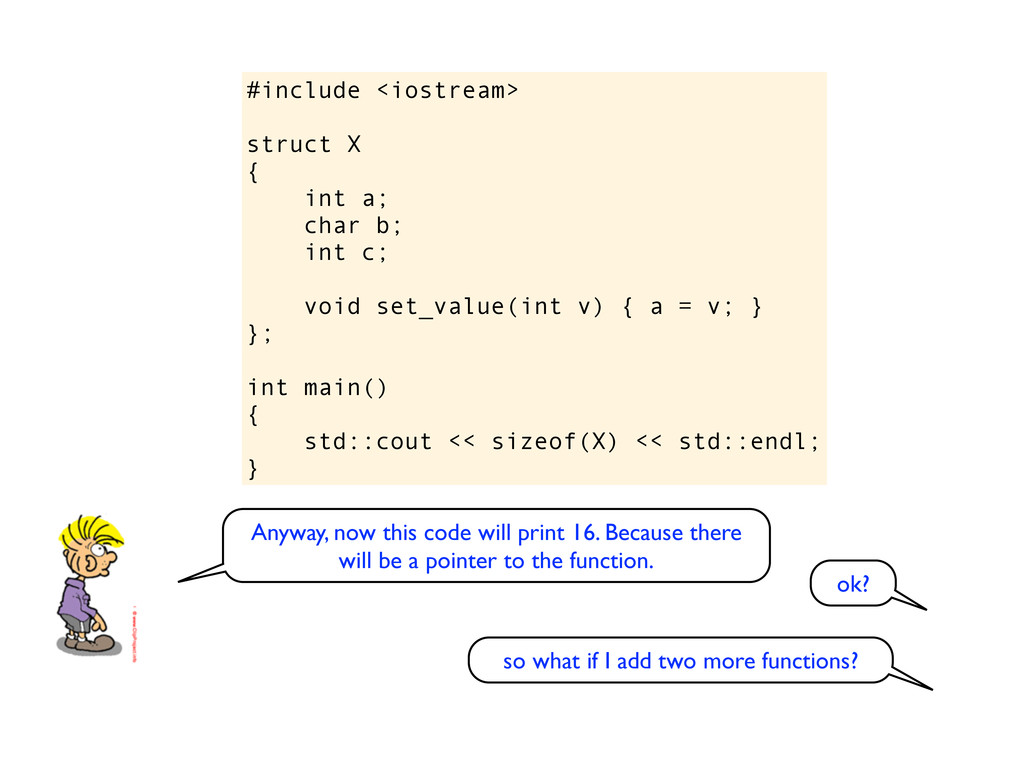
c; void set_value(int v) { a = v; } }; int main() { std::cout << sizeof(X) << std::endl; } Anyway, now this code will print 16. Because there will be a pointer to the function. ok? so what if I add two more functions?
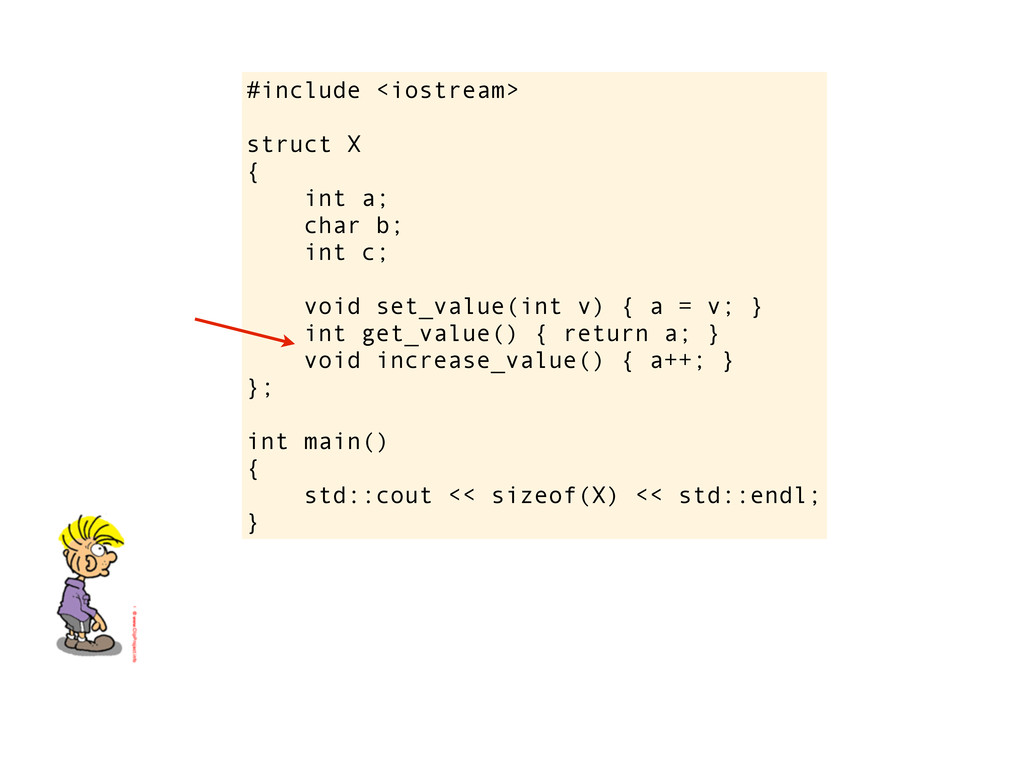
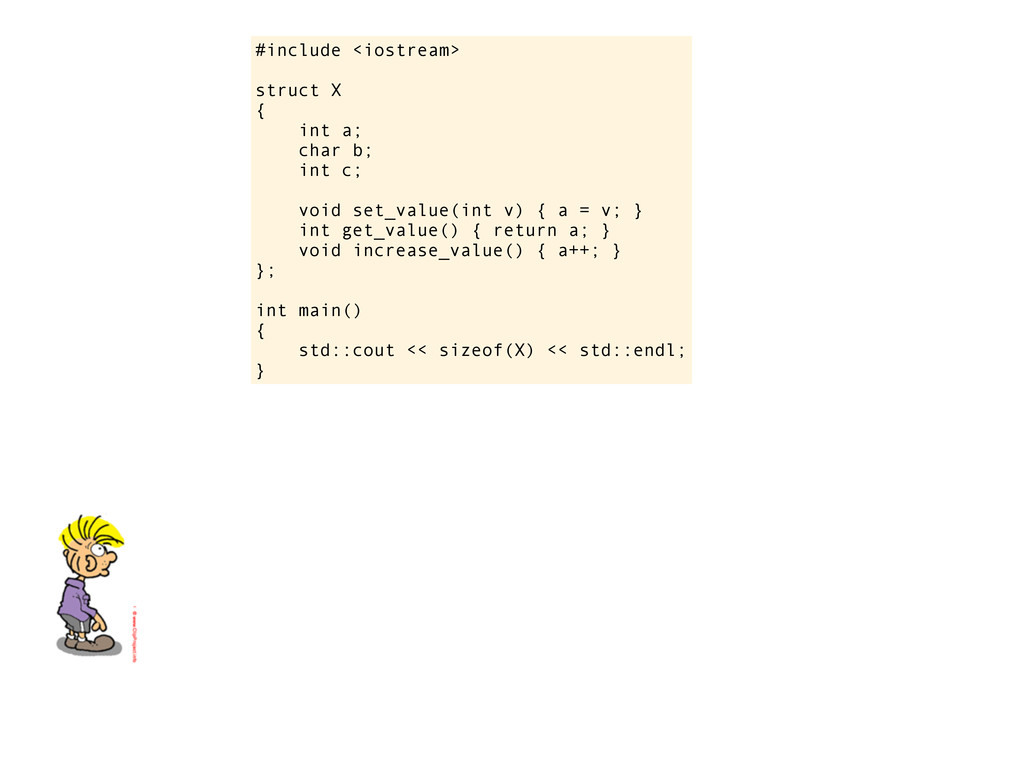
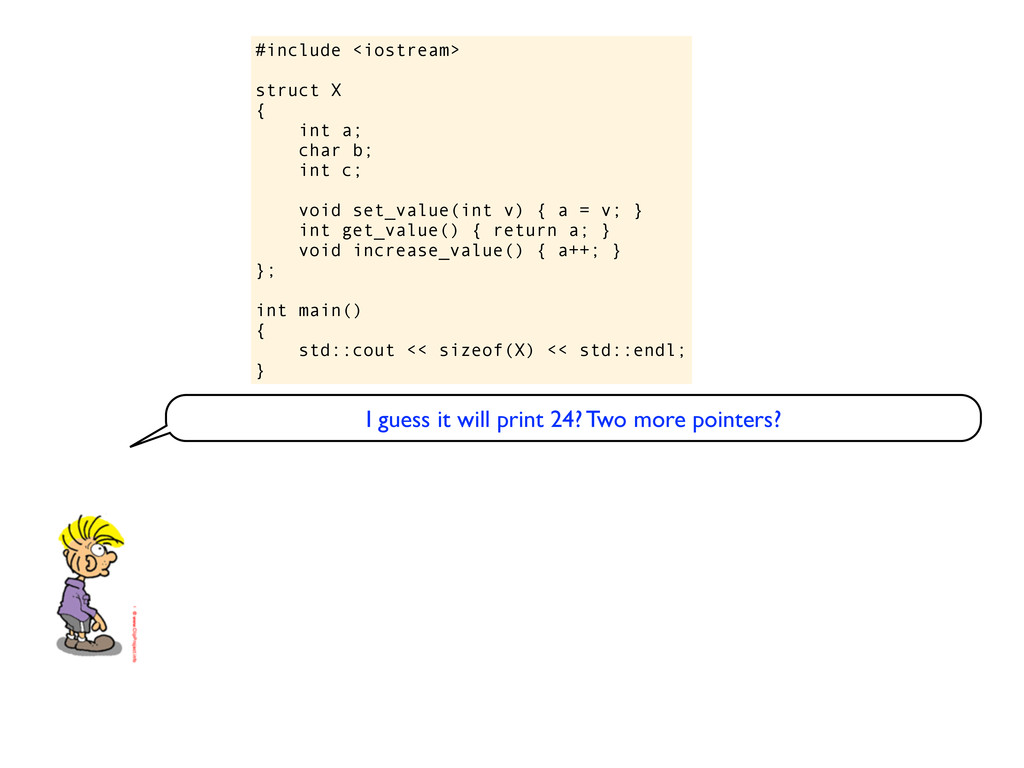
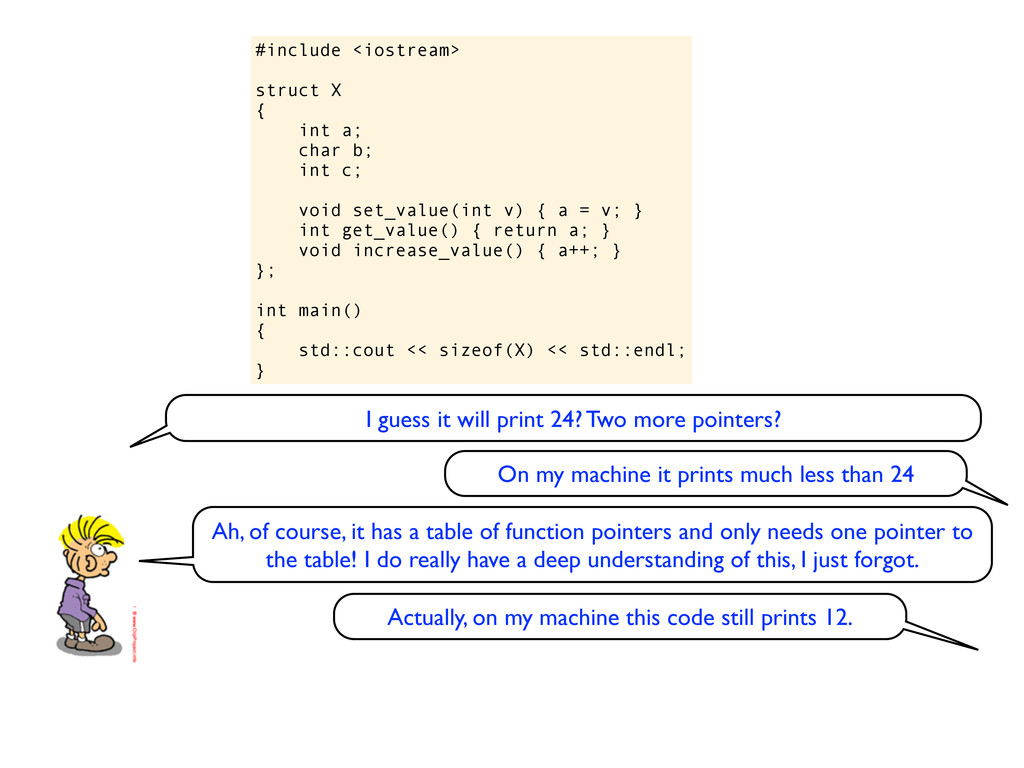
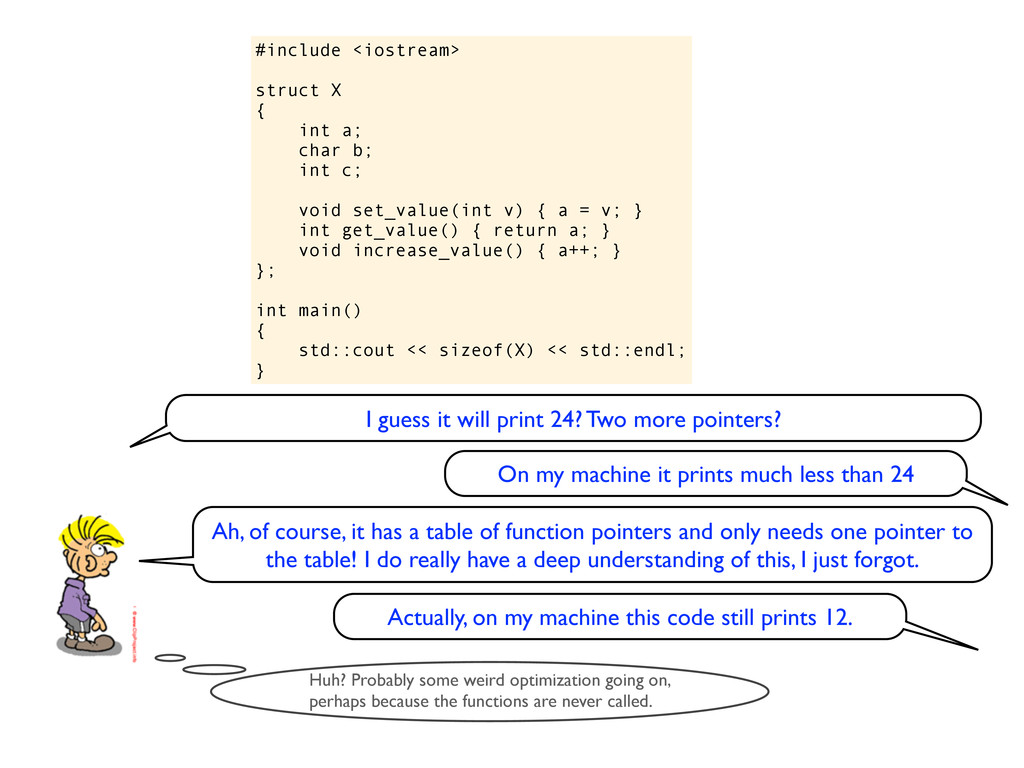
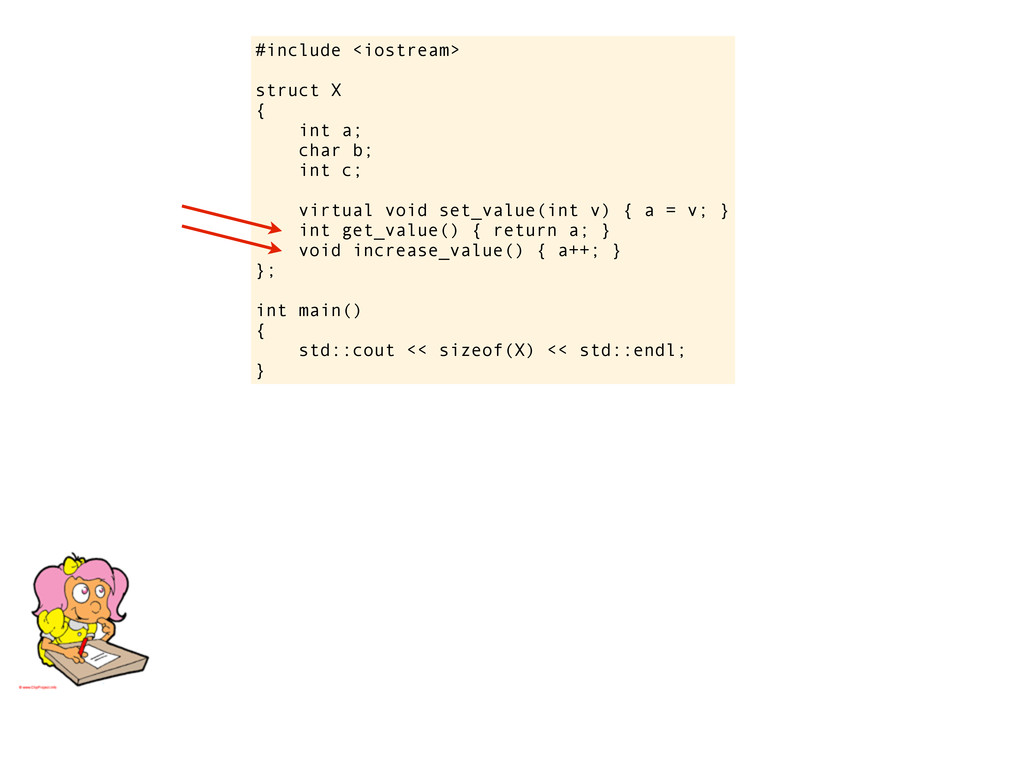
c; void set_value(int v) { a = v; } int get_value() { return a; } void increase_value() { a++; } }; int main() { std::cout << sizeof(X) << std::endl; } I guess it will print 24? Two more pointers?
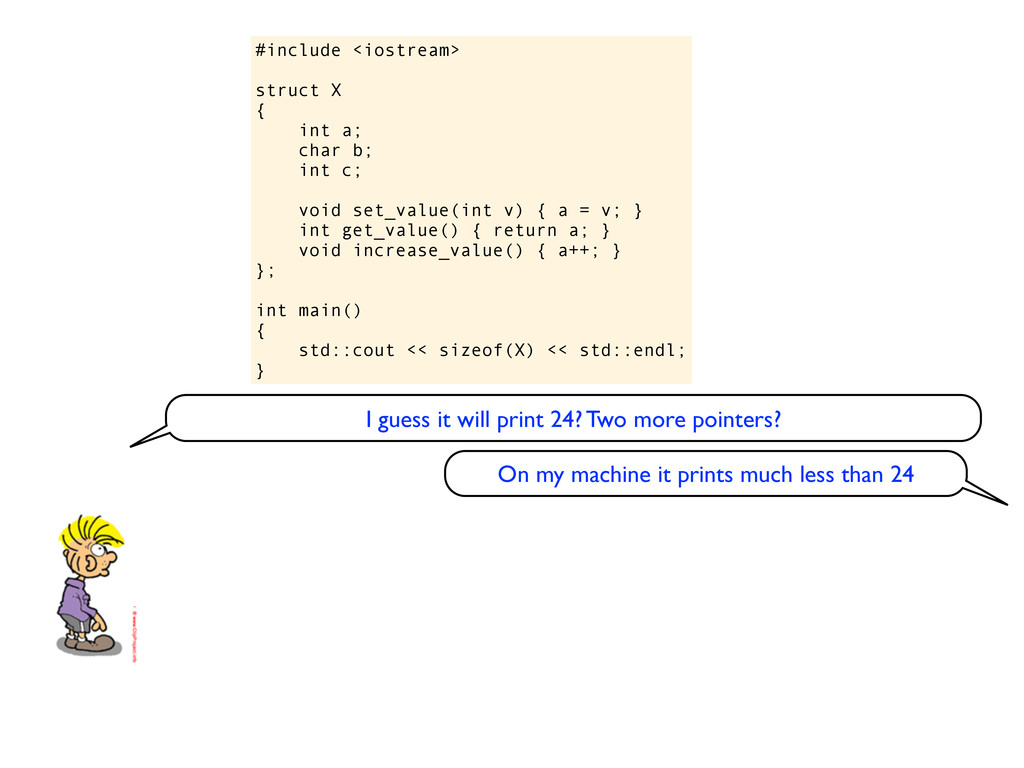
c; void set_value(int v) { a = v; } int get_value() { return a; } void increase_value() { a++; } }; int main() { std::cout << sizeof(X) << std::endl; } I guess it will print 24? Two more pointers? On my machine it prints much less than 24
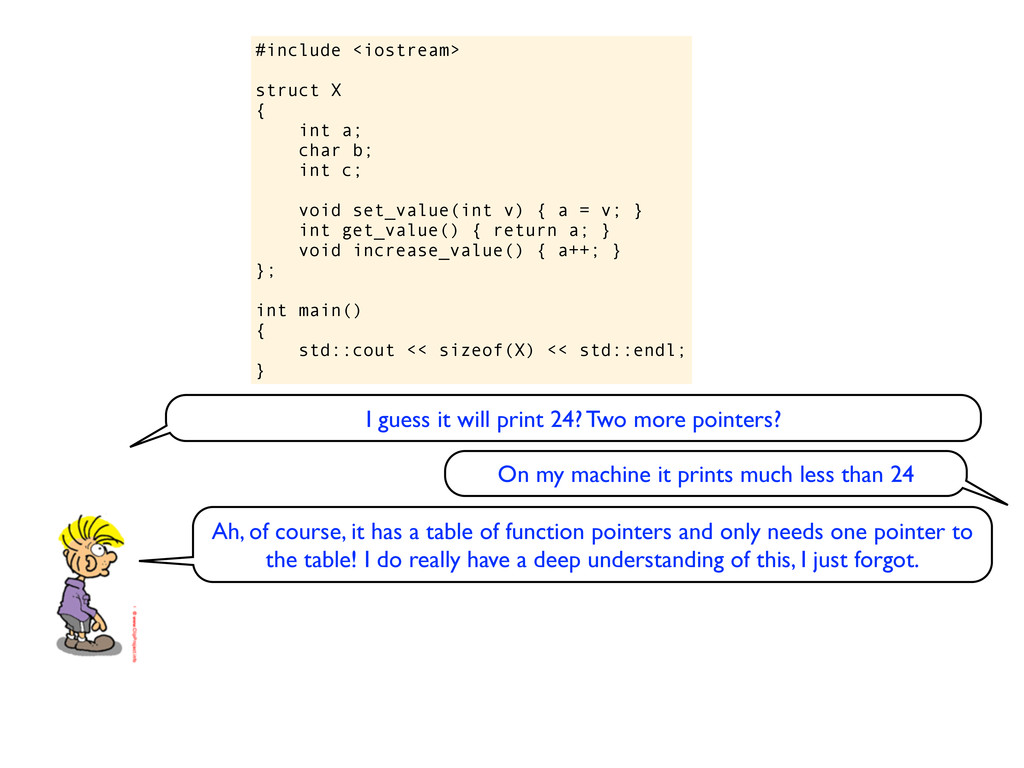
c; void set_value(int v) { a = v; } int get_value() { return a; } void increase_value() { a++; } }; int main() { std::cout << sizeof(X) << std::endl; } I guess it will print 24? Two more pointers? On my machine it prints much less than 24 Ah, of course, it has a table of function pointers and only needs one pointer to the table! I do really have a deep understanding of this, I just forgot.
c; void set_value(int v) { a = v; } int get_value() { return a; } void increase_value() { a++; } }; int main() { std::cout << sizeof(X) << std::endl; } I guess it will print 24? Two more pointers? On my machine it prints much less than 24 Ah, of course, it has a table of function pointers and only needs one pointer to the table! I do really have a deep understanding of this, I just forgot. Actually, on my machine this code still prints 12.
c; void set_value(int v) { a = v; } int get_value() { return a; } void increase_value() { a++; } }; int main() { std::cout << sizeof(X) << std::endl; } I guess it will print 24? Two more pointers? On my machine it prints much less than 24 Ah, of course, it has a table of function pointers and only needs one pointer to the table! I do really have a deep understanding of this, I just forgot. Actually, on my machine this code still prints 12. Huh? Probably some weird optimization going on, perhaps because the functions are never called.
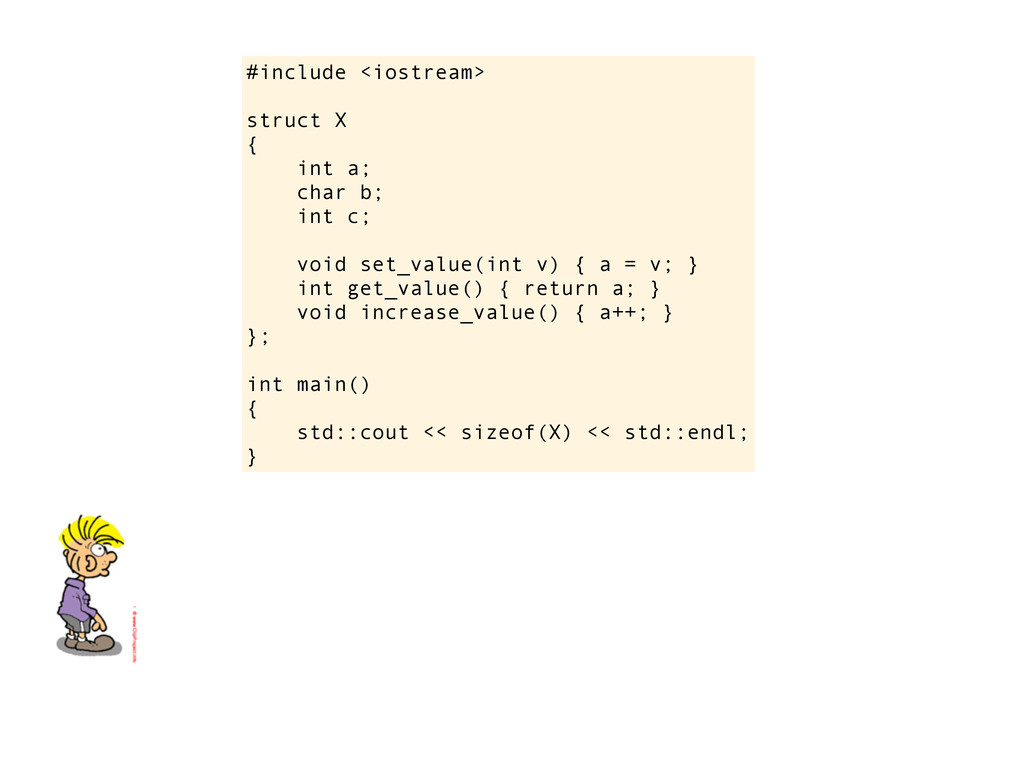
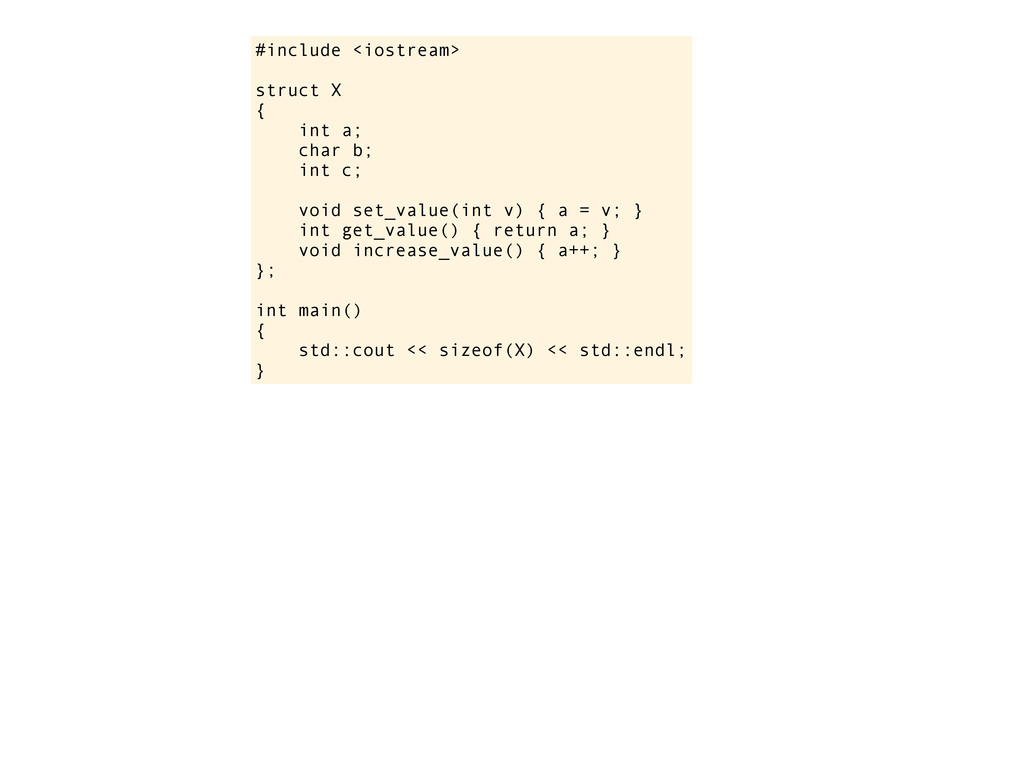
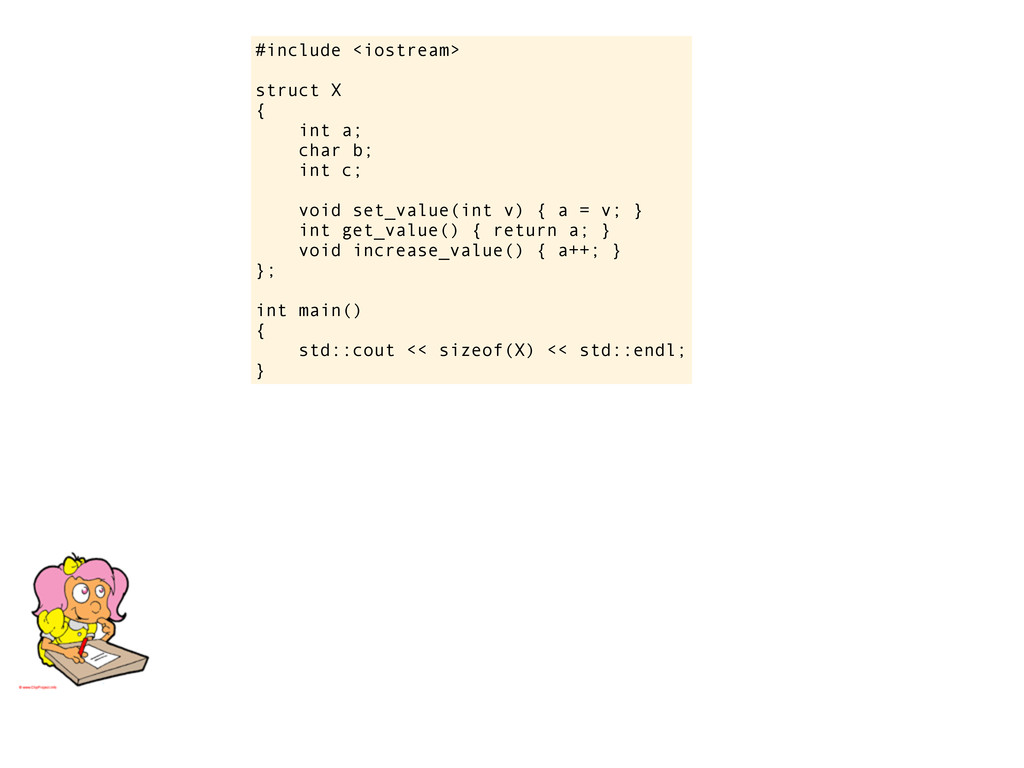
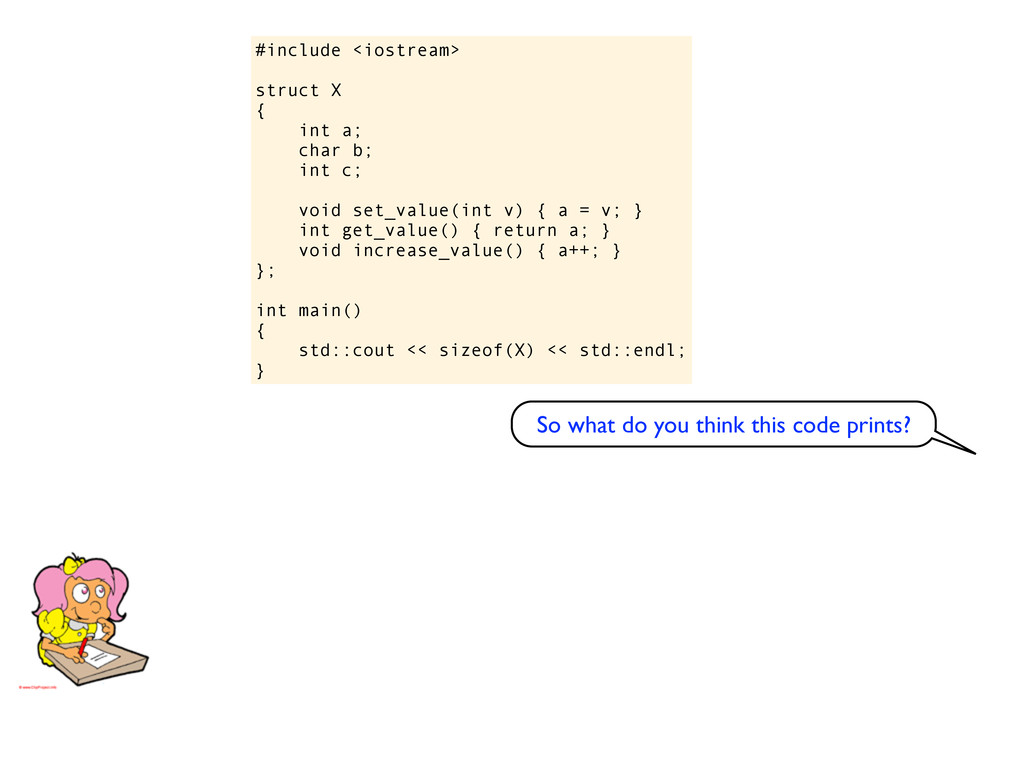
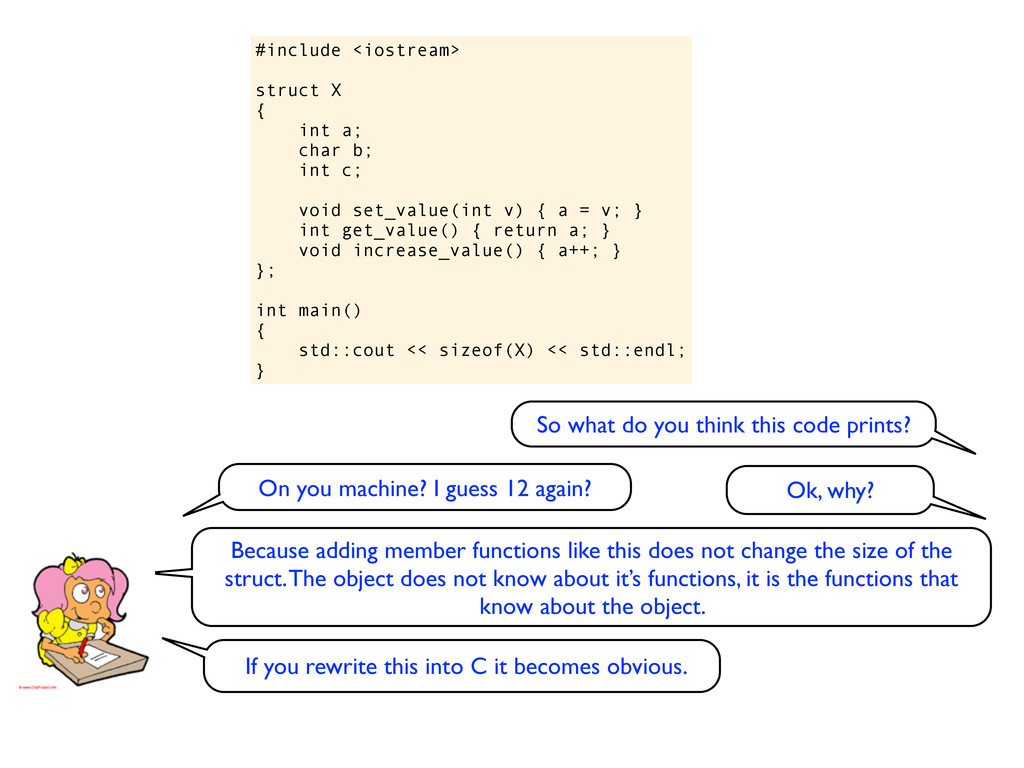
c; void set_value(int v) { a = v; } int get_value() { return a; } void increase_value() { a++; } }; int main() { std::cout << sizeof(X) << std::endl; } So what do you think this code prints?
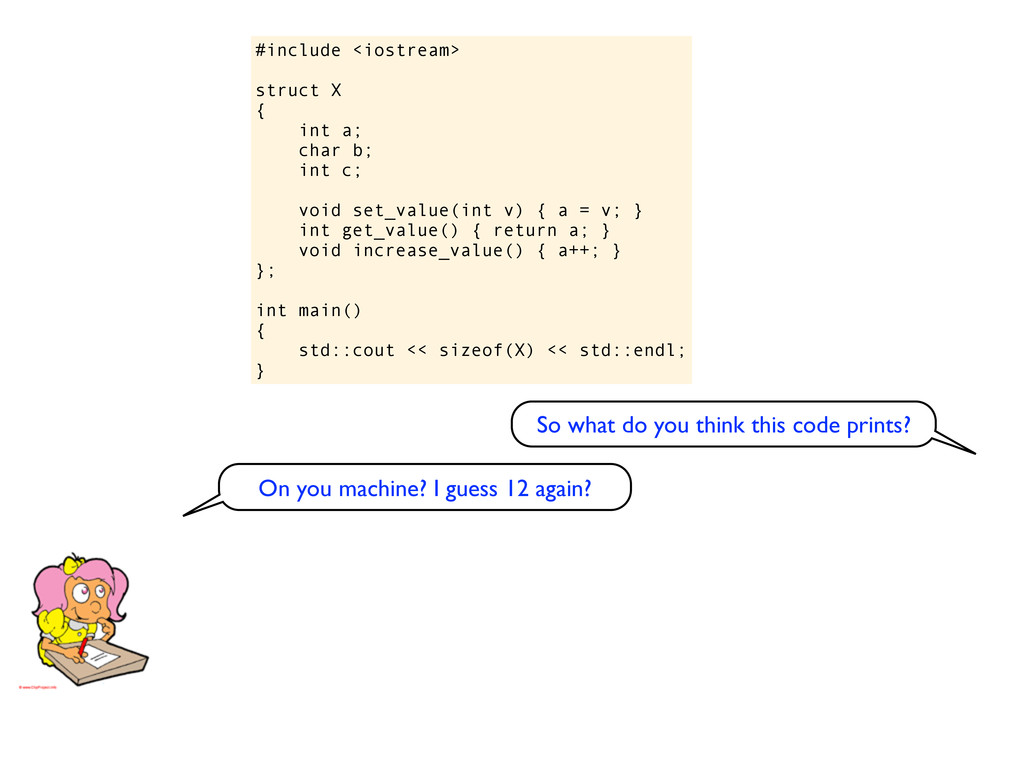
c; void set_value(int v) { a = v; } int get_value() { return a; } void increase_value() { a++; } }; int main() { std::cout << sizeof(X) << std::endl; } On you machine? I guess 12 again? So what do you think this code prints?
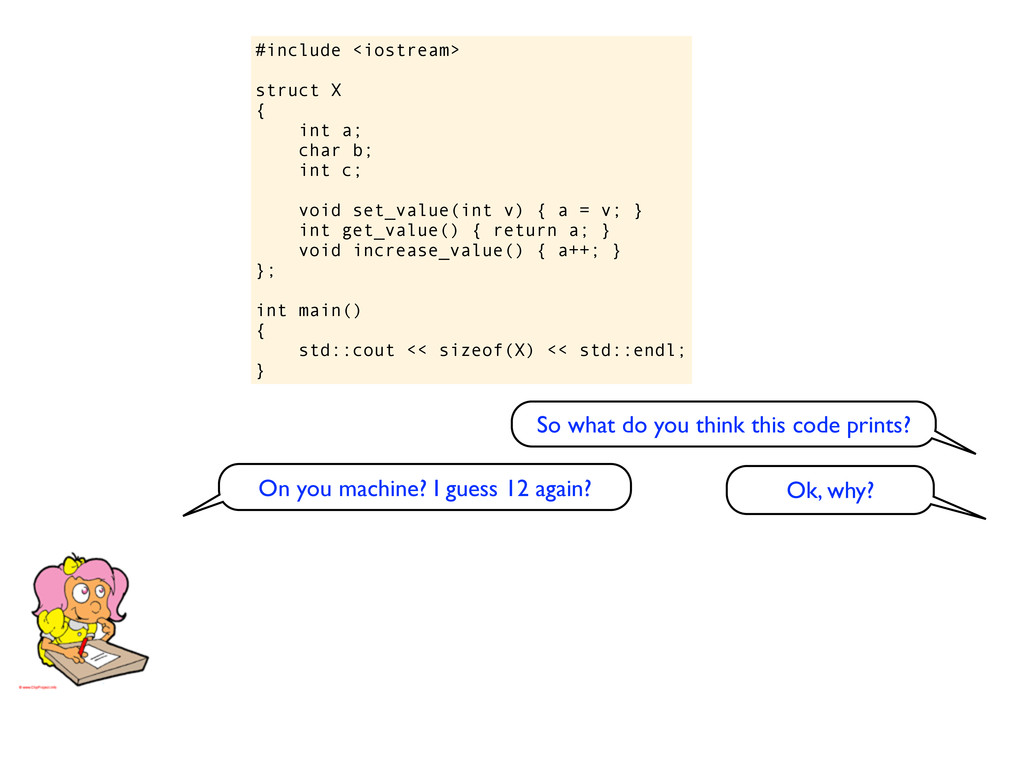
c; void set_value(int v) { a = v; } int get_value() { return a; } void increase_value() { a++; } }; int main() { std::cout << sizeof(X) << std::endl; } On you machine? I guess 12 again? So what do you think this code prints? Ok, why?
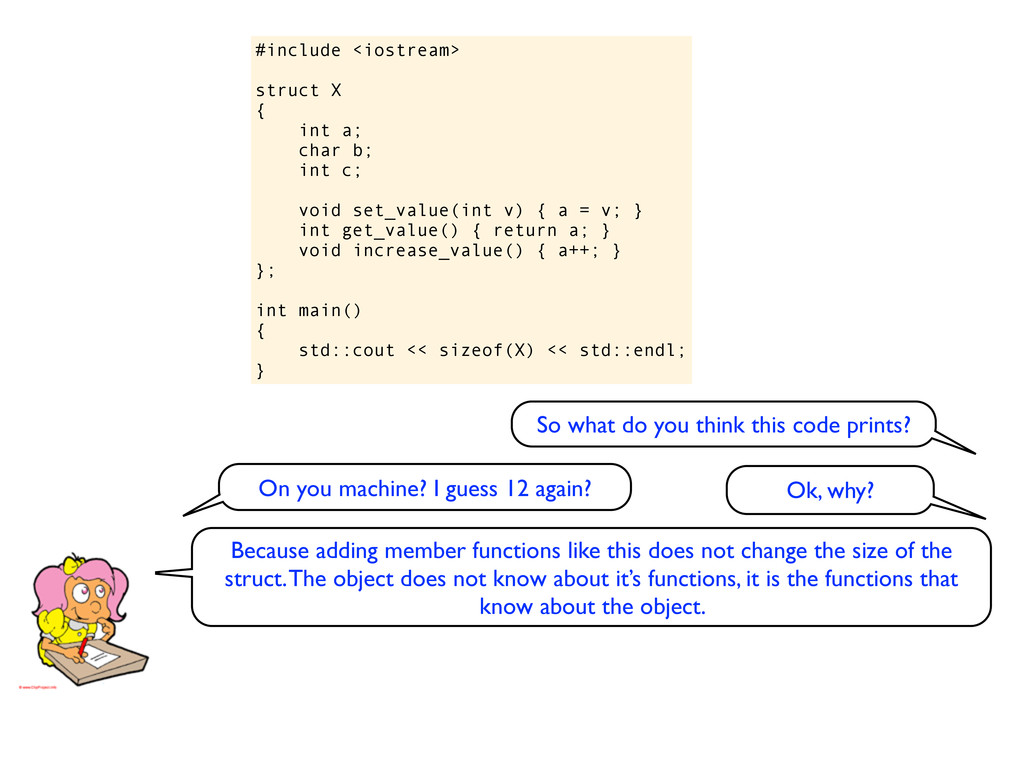
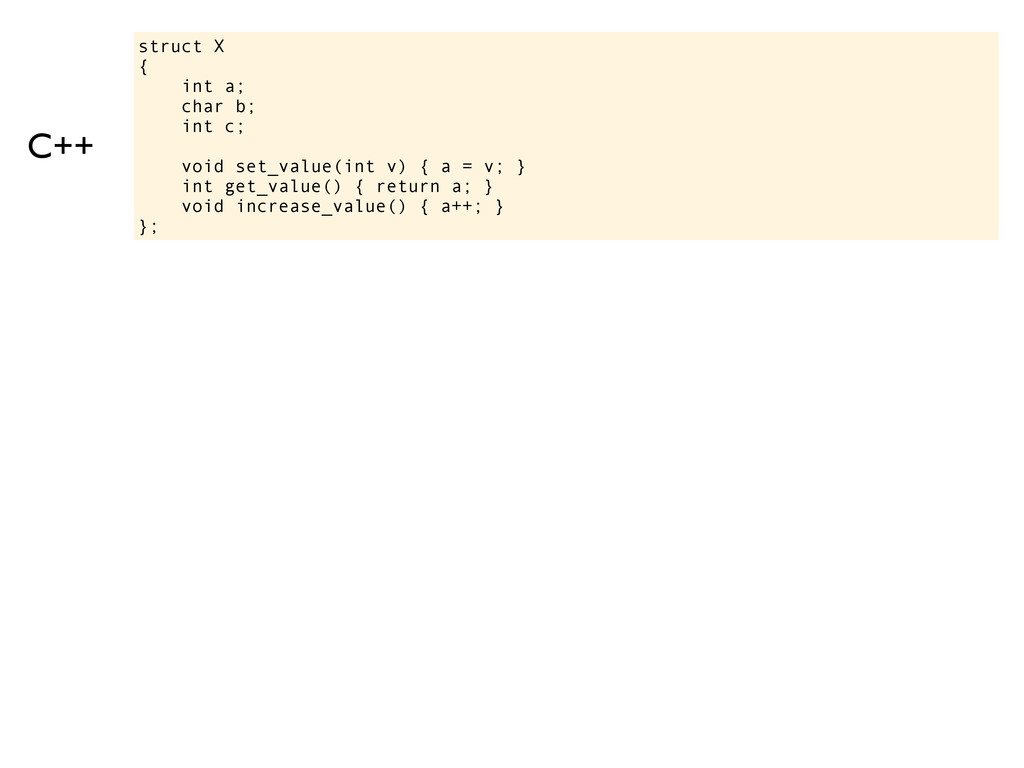
c; void set_value(int v) { a = v; } int get_value() { return a; } void increase_value() { a++; } }; int main() { std::cout << sizeof(X) << std::endl; } On you machine? I guess 12 again? So what do you think this code prints? Ok, why? Because adding member functions like this does not change the size of the struct. The object does not know about it’s functions, it is the functions that know about the object.
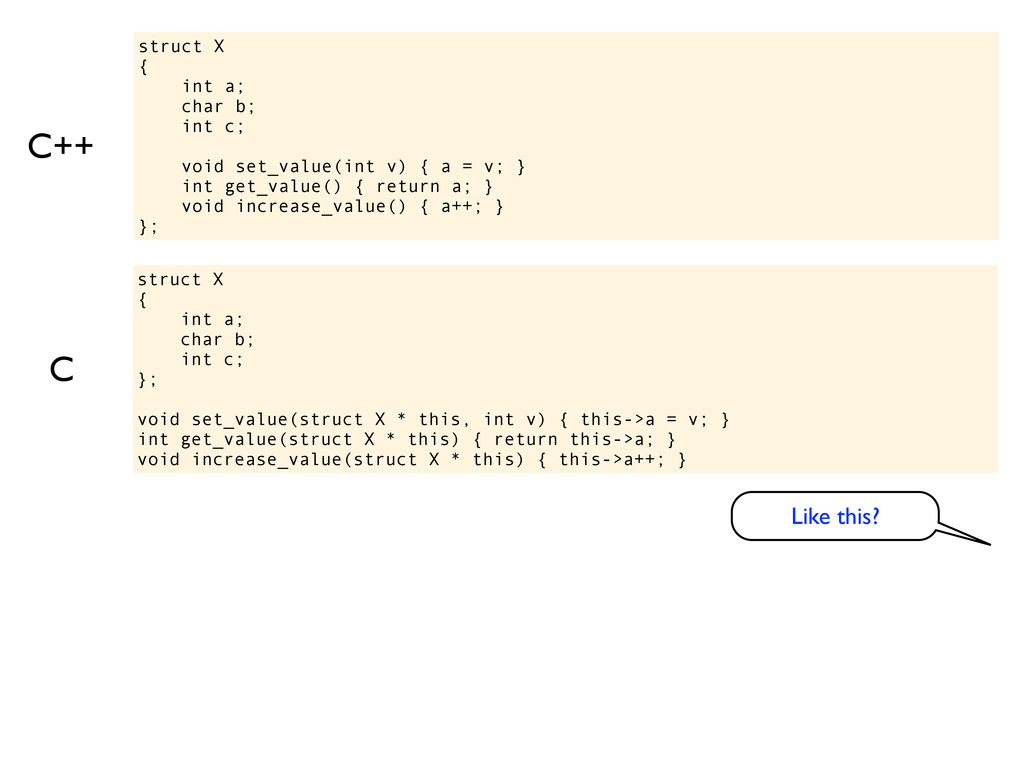
c; void set_value(int v) { a = v; } int get_value() { return a; } void increase_value() { a++; } }; int main() { std::cout << sizeof(X) << std::endl; } On you machine? I guess 12 again? So what do you think this code prints? Ok, why? Because adding member functions like this does not change the size of the struct. The object does not know about it’s functions, it is the functions that know about the object. If you rewrite this into C it becomes obvious.
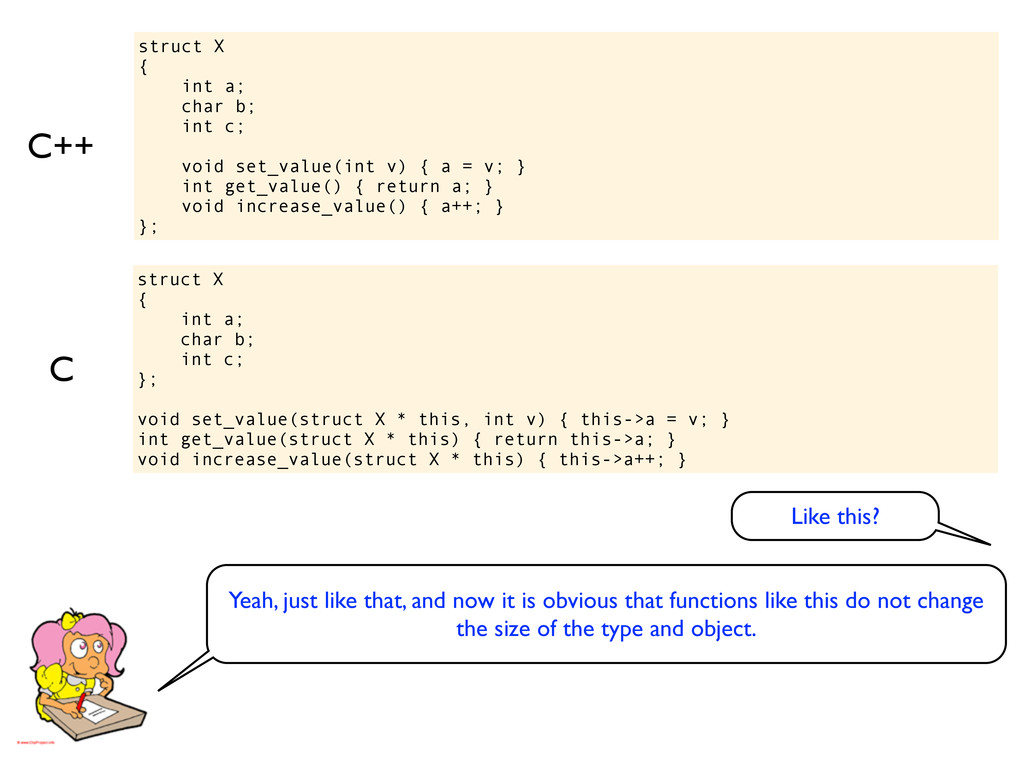
set_value(int v) { a = v; } int get_value() { return a; } void increase_value() { a++; } }; C++ struct X { int a; char b; int c; }; void set_value(struct X * this, int v) { this->a = v; } int get_value(struct X * this) { return this->a; } void increase_value(struct X * this) { this->a++; } C Like this?
functions like this do not change the size of the type and object. struct X { int a; char b; int c; void set_value(int v) { a = v; } int get_value() { return a; } void increase_value() { a++; } }; C++ struct X { int a; char b; int c; }; void set_value(struct X * this, int v) { this->a = v; } int get_value(struct X * this) { return this->a; } void increase_value(struct X * this) { this->a++; } C Like this?
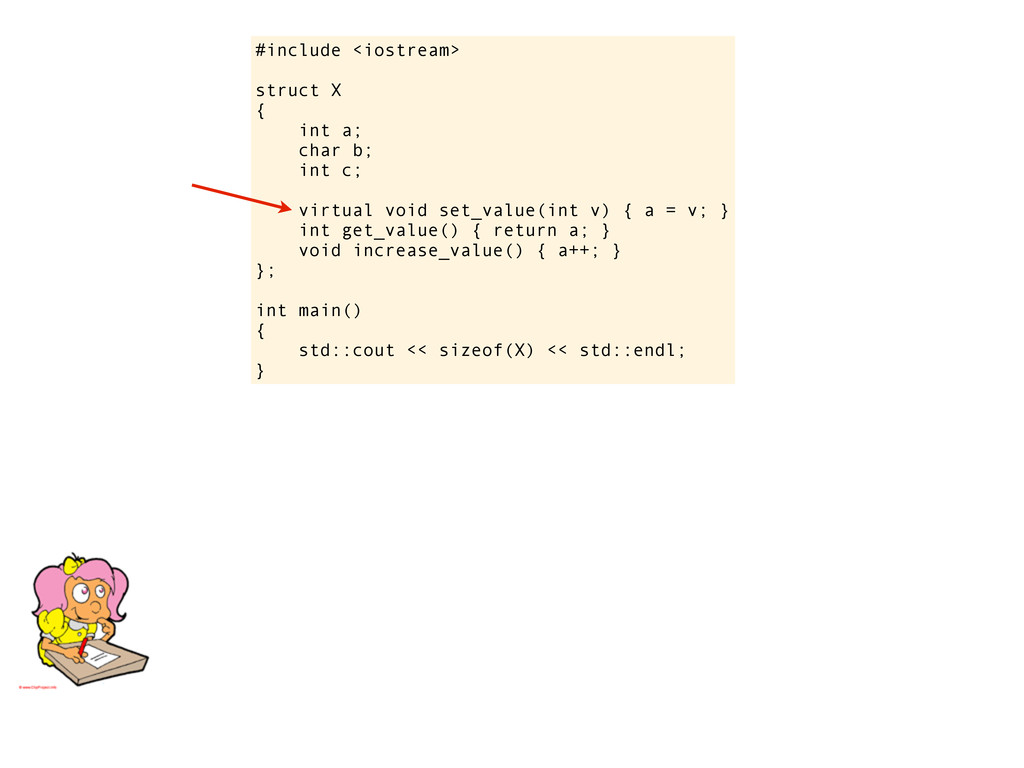
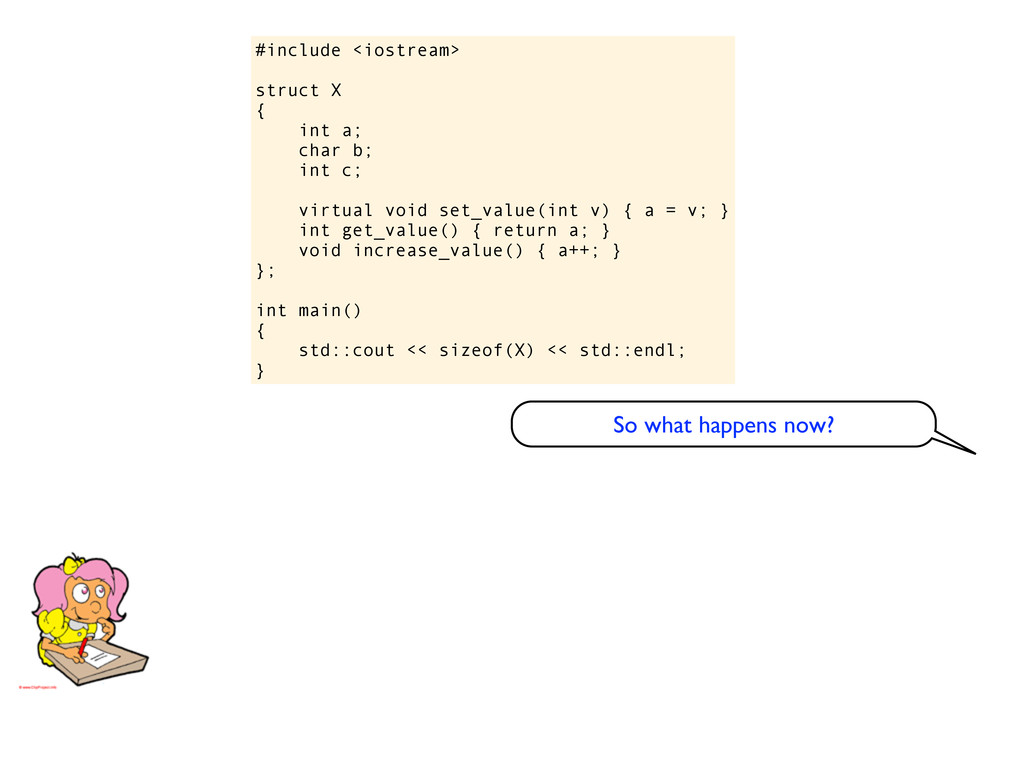
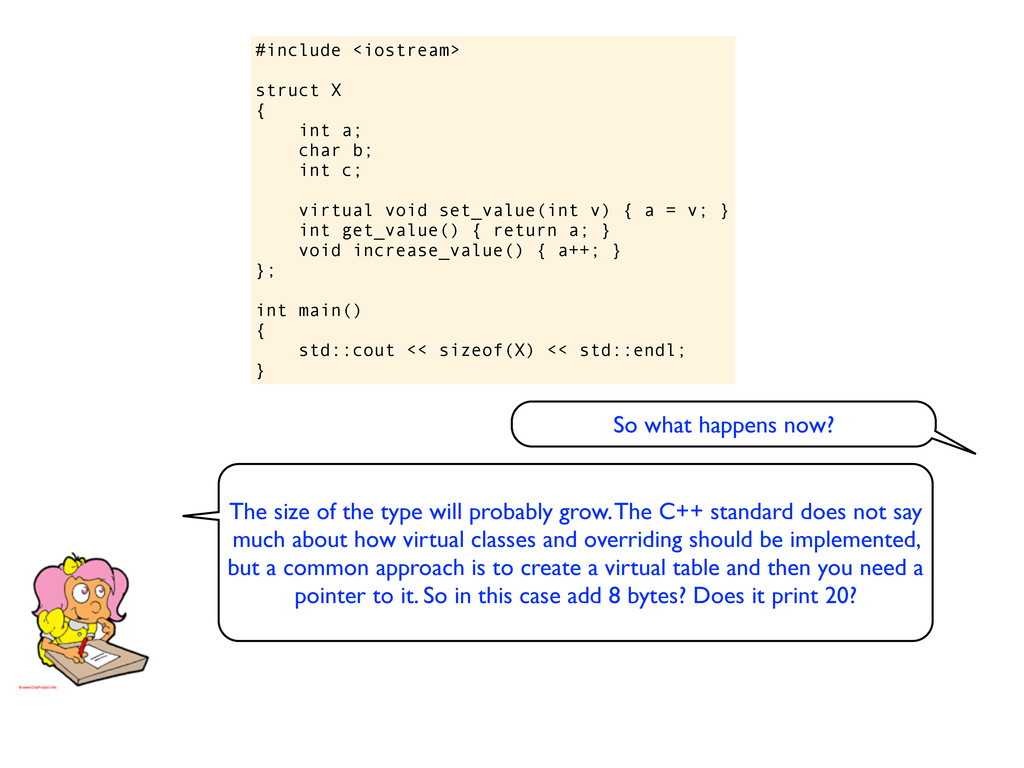
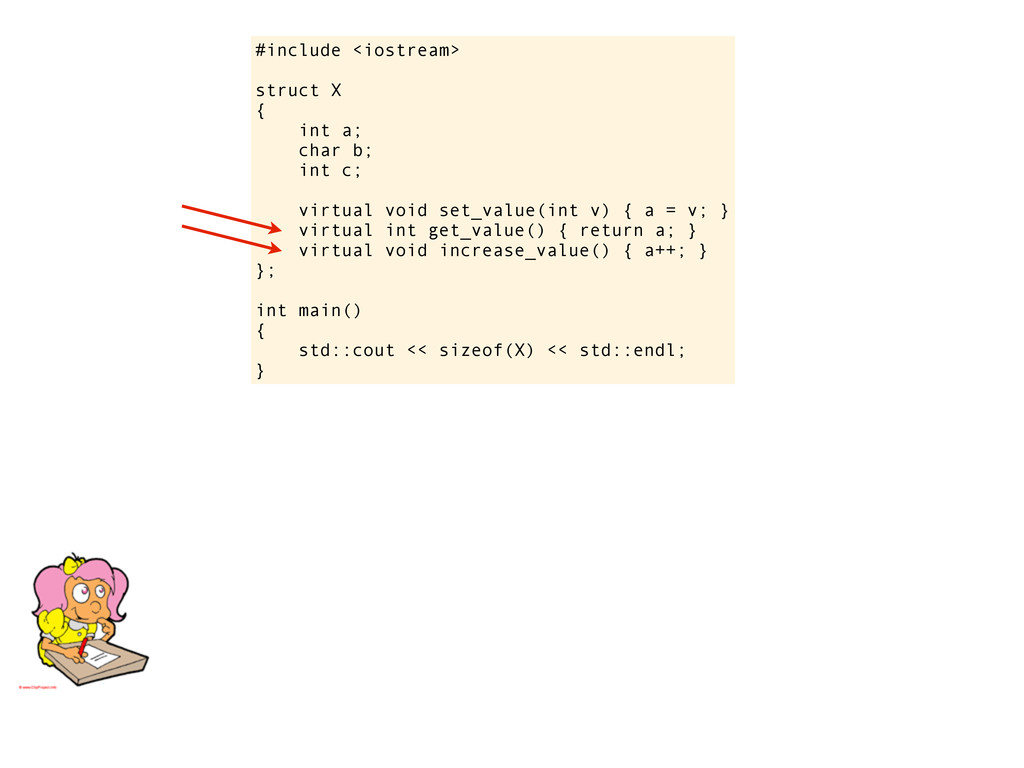
c; virtual void set_value(int v) { a = v; } int get_value() { return a; } void increase_value() { a++; } }; int main() { std::cout << sizeof(X) << std::endl; } So what happens now? The size of the type will probably grow. The C++ standard does not say much about how virtual classes and overriding should be implemented, but a common approach is to create a virtual table and then you need a pointer to it. So in this case add 8 bytes? Does it print 20?
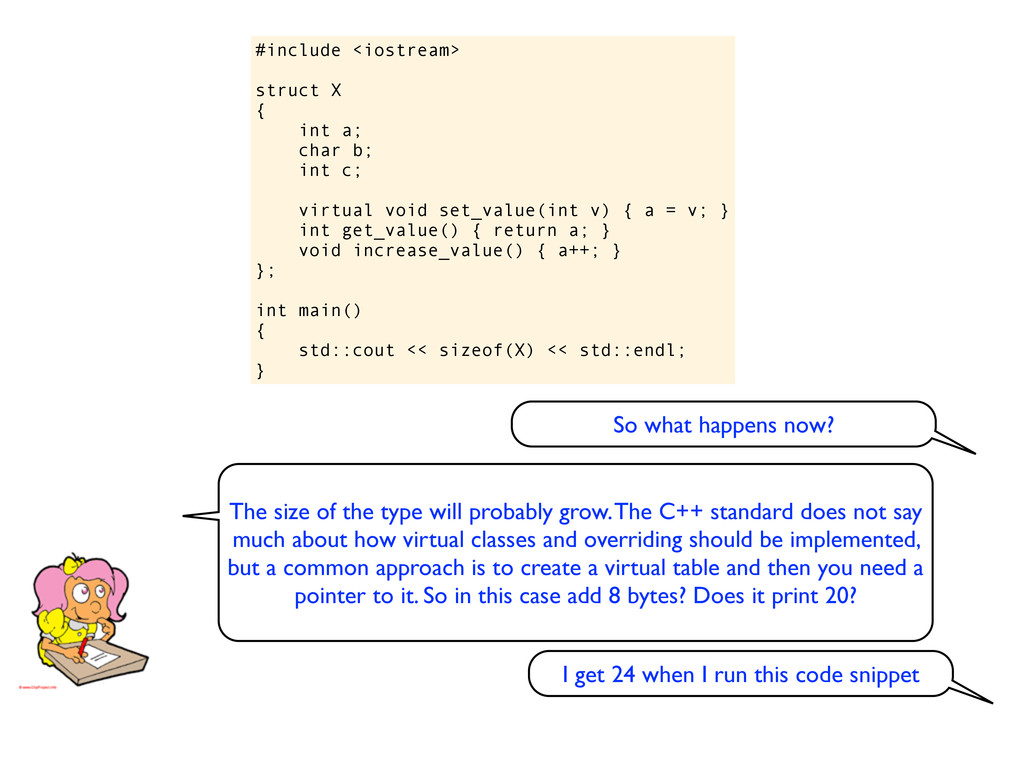
c; virtual void set_value(int v) { a = v; } int get_value() { return a; } void increase_value() { a++; } }; int main() { std::cout << sizeof(X) << std::endl; } So what happens now? The size of the type will probably grow. The C++ standard does not say much about how virtual classes and overriding should be implemented, but a common approach is to create a virtual table and then you need a pointer to it. So in this case add 8 bytes? Does it print 20? I get 24 when I run this code snippet
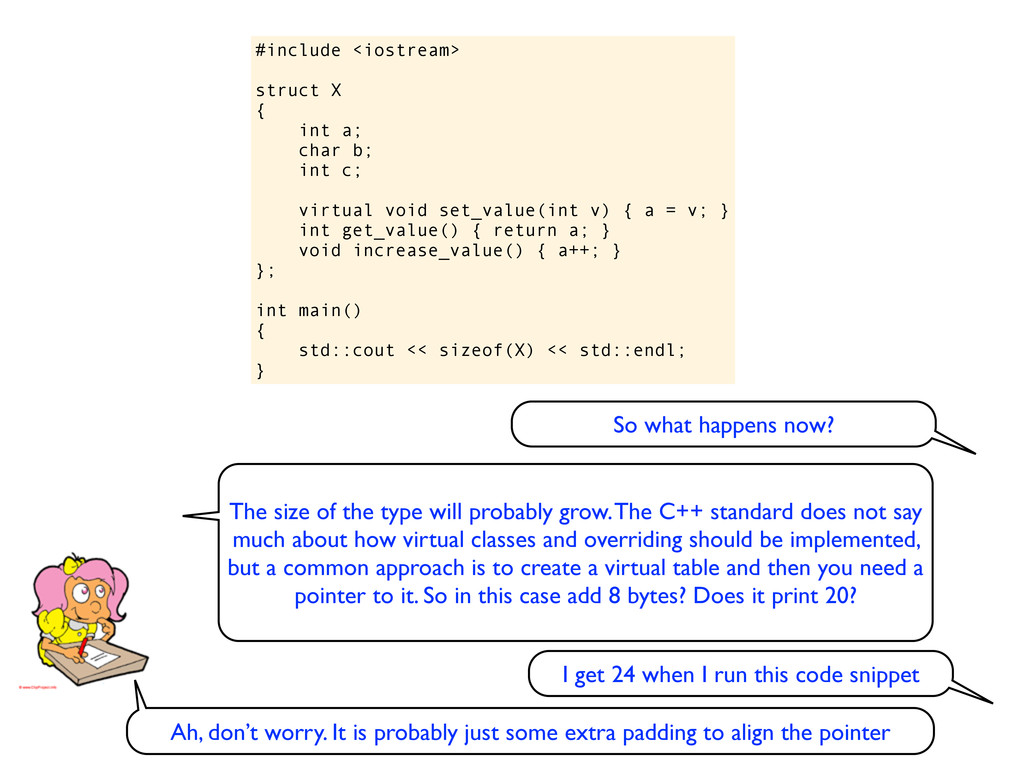
c; virtual void set_value(int v) { a = v; } int get_value() { return a; } void increase_value() { a++; } }; int main() { std::cout << sizeof(X) << std::endl; } So what happens now? The size of the type will probably grow. The C++ standard does not say much about how virtual classes and overriding should be implemented, but a common approach is to create a virtual table and then you need a pointer to it. So in this case add 8 bytes? Does it print 20? I get 24 when I run this code snippet Ah, don’t worry. It is probably just some extra padding to align the pointer
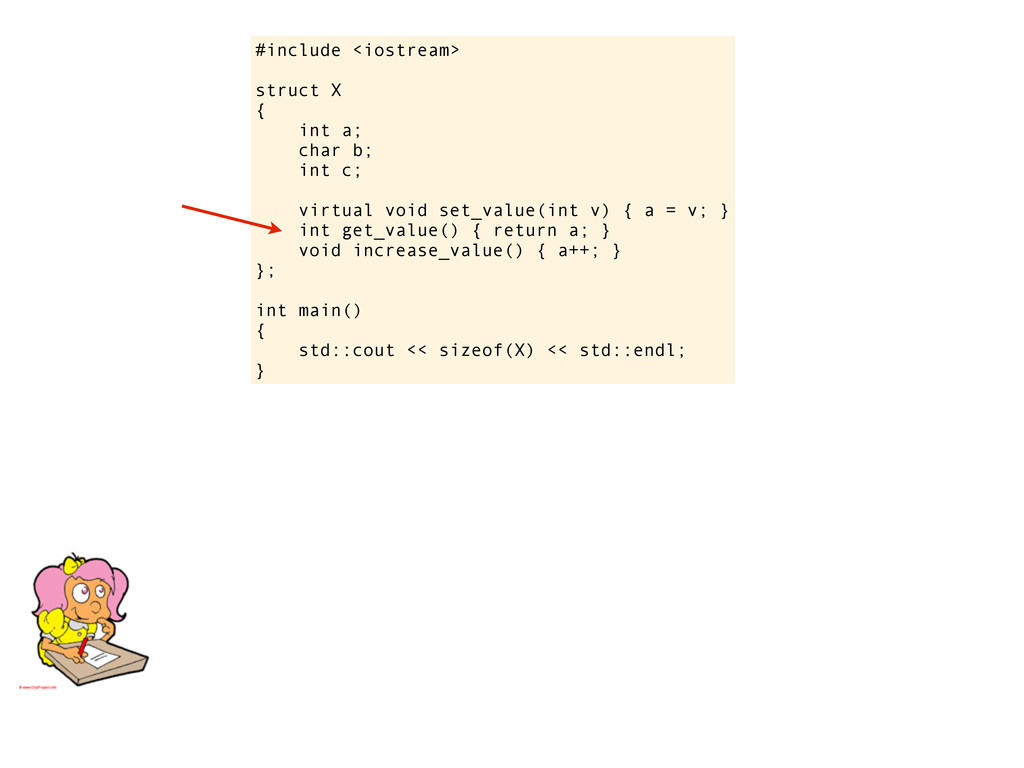
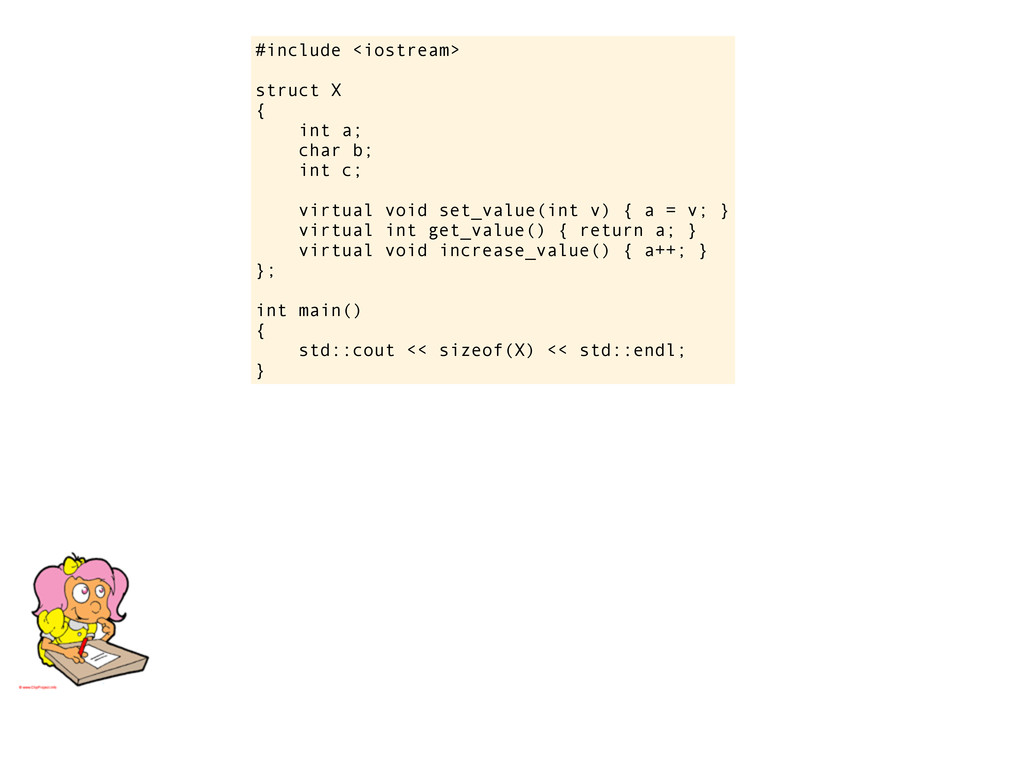
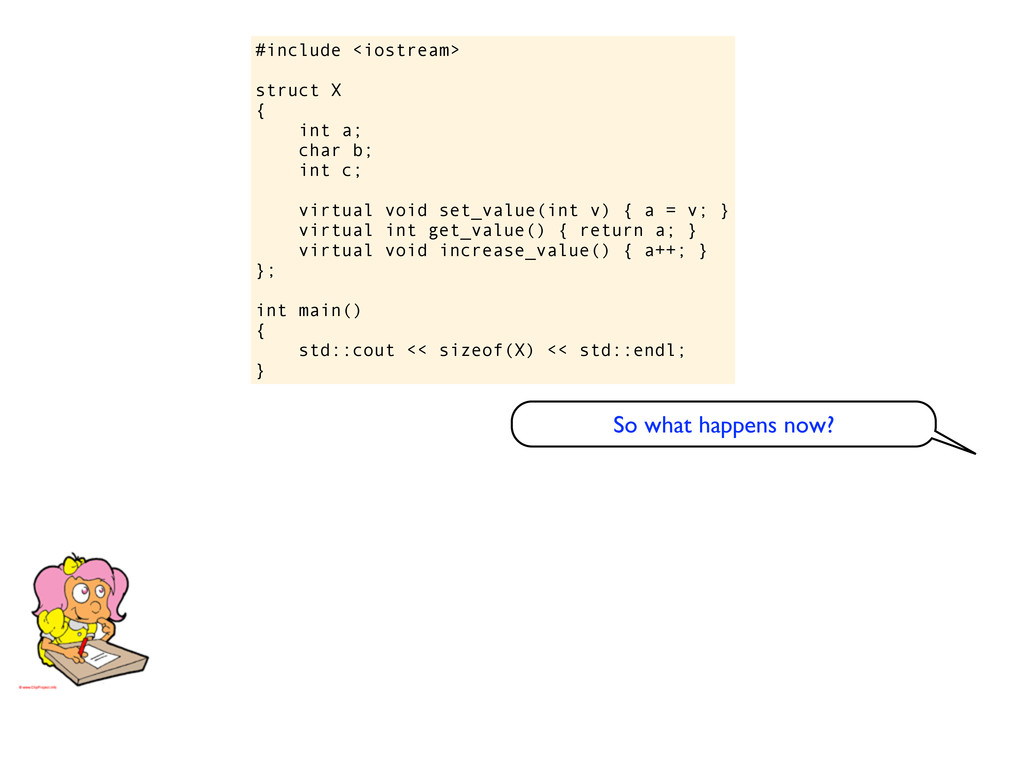
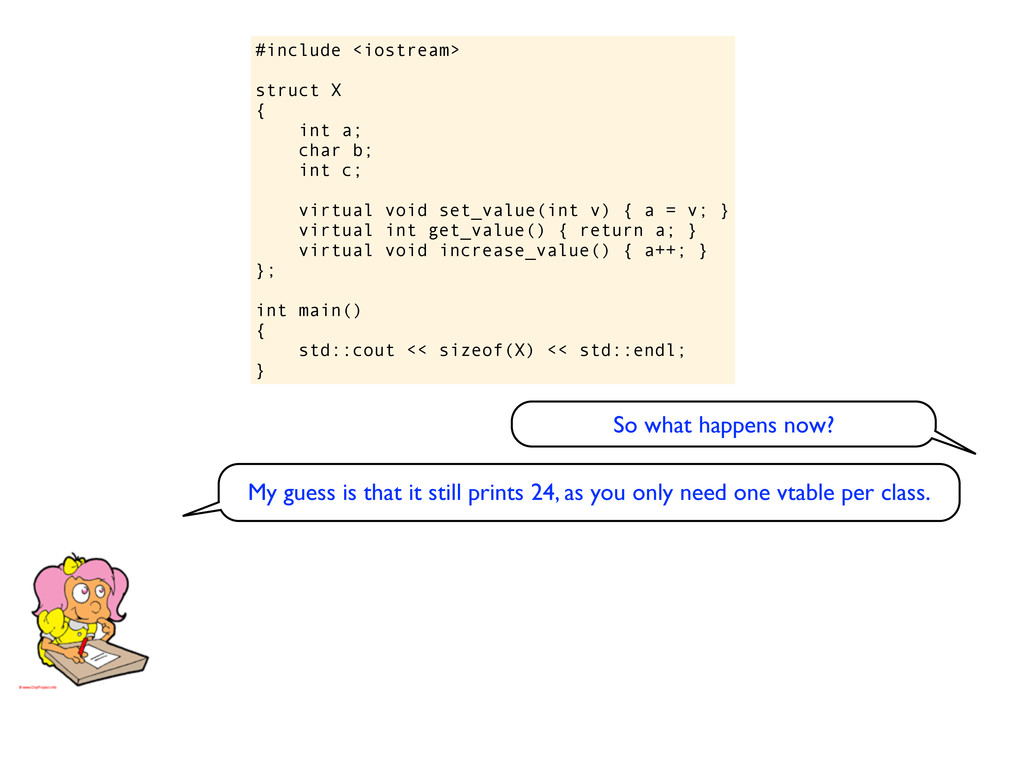
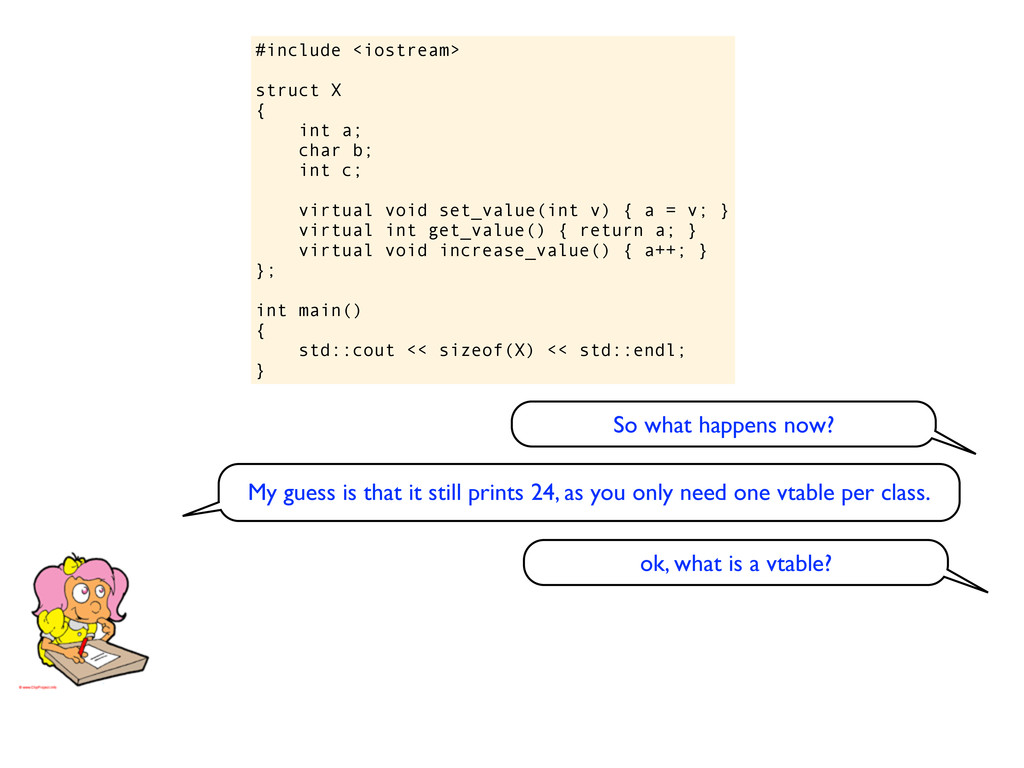
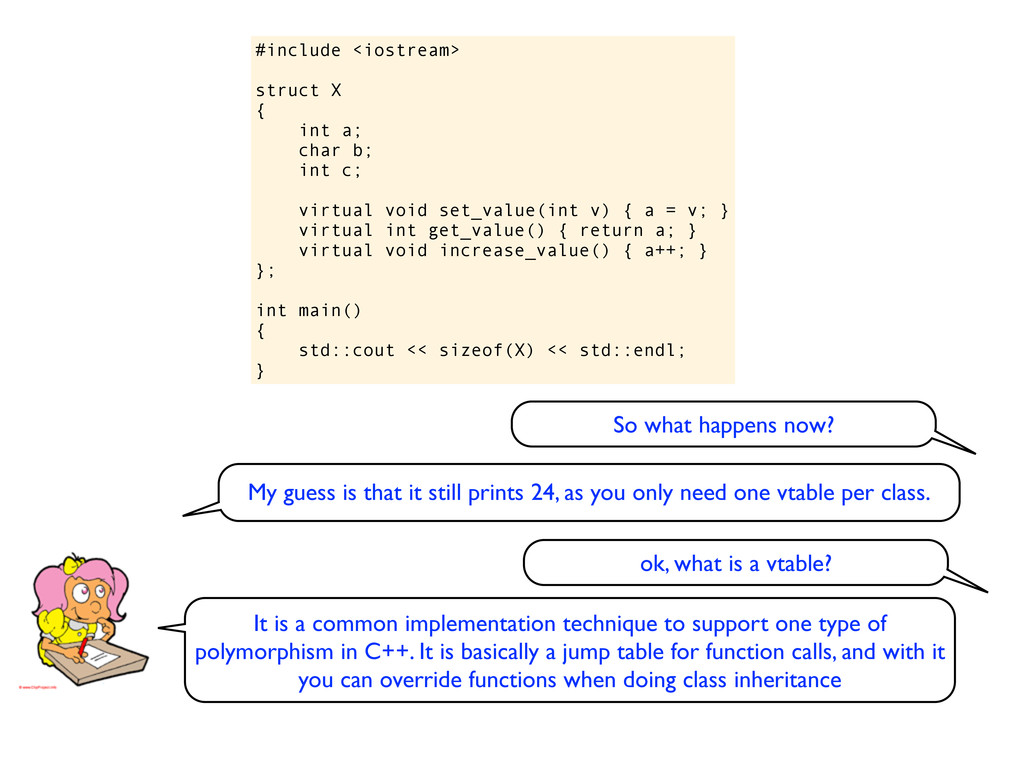
c; virtual void set_value(int v) { a = v; } virtual int get_value() { return a; } virtual void increase_value() { a++; } }; int main() { std::cout << sizeof(X) << std::endl; } My guess is that it still prints 24, as you only need one vtable per class. So what happens now?
c; virtual void set_value(int v) { a = v; } virtual int get_value() { return a; } virtual void increase_value() { a++; } }; int main() { std::cout << sizeof(X) << std::endl; } My guess is that it still prints 24, as you only need one vtable per class. So what happens now? ok, what is a vtable?
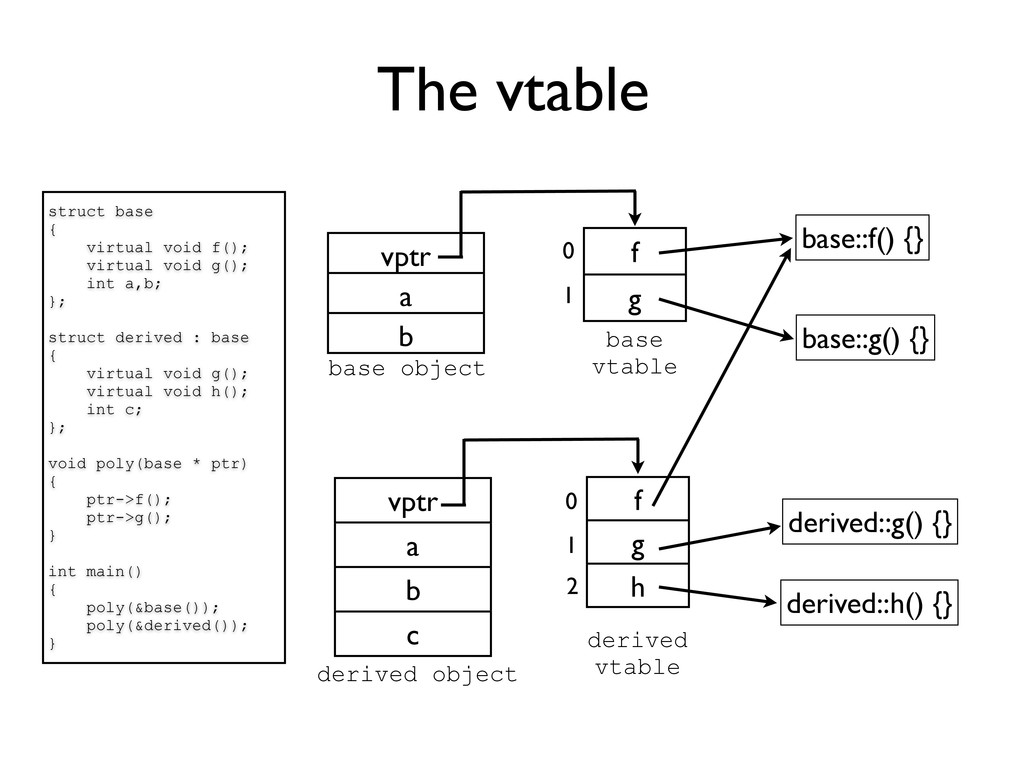
c; virtual void set_value(int v) { a = v; } virtual int get_value() { return a; } virtual void increase_value() { a++; } }; int main() { std::cout << sizeof(X) << std::endl; } My guess is that it still prints 24, as you only need one vtable per class. So what happens now? ok, what is a vtable? It is a common implementation technique to support one type of polymorphism in C++. It is basically a jump table for function calls, and with it you can override functions when doing class inheritance
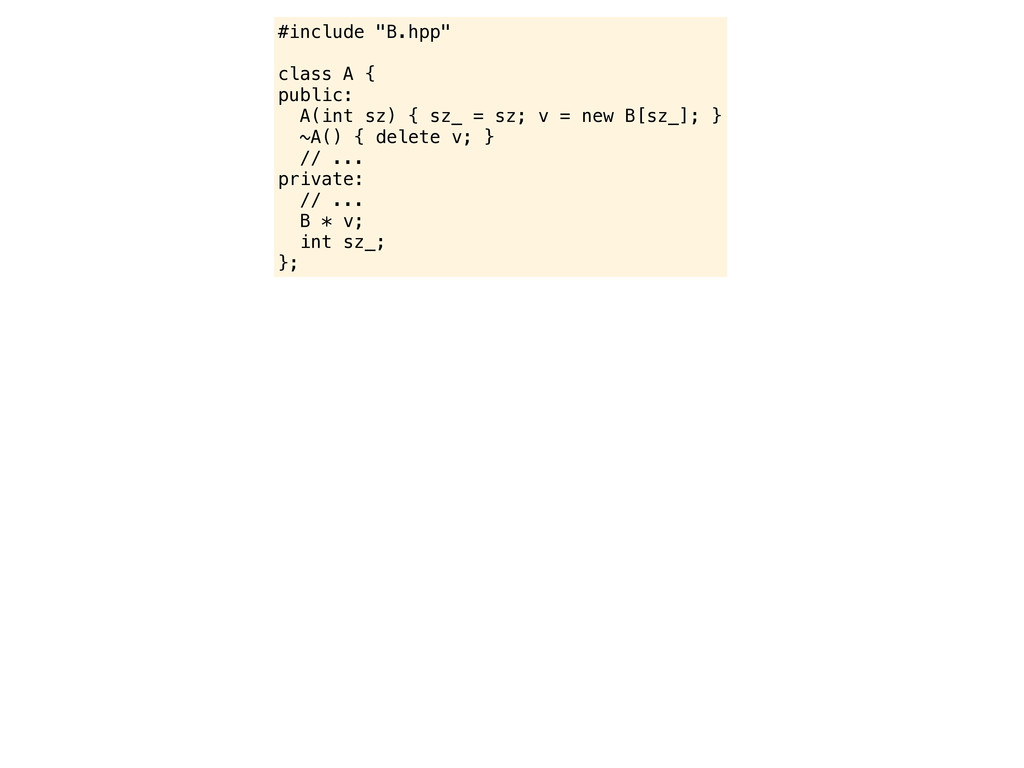
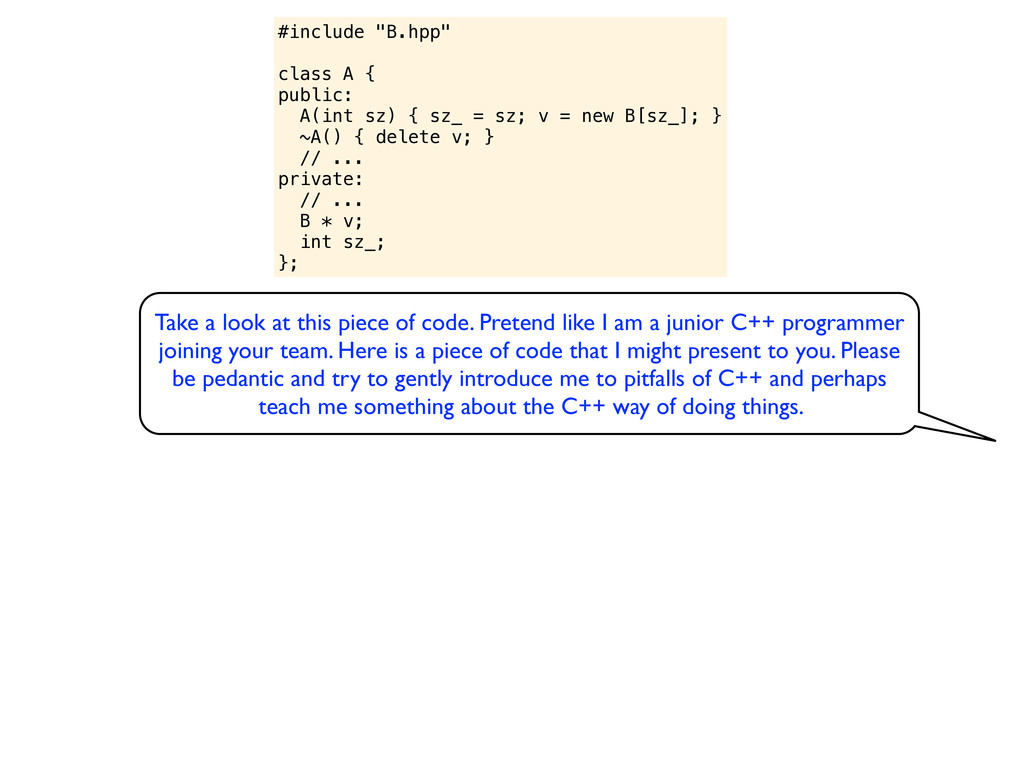
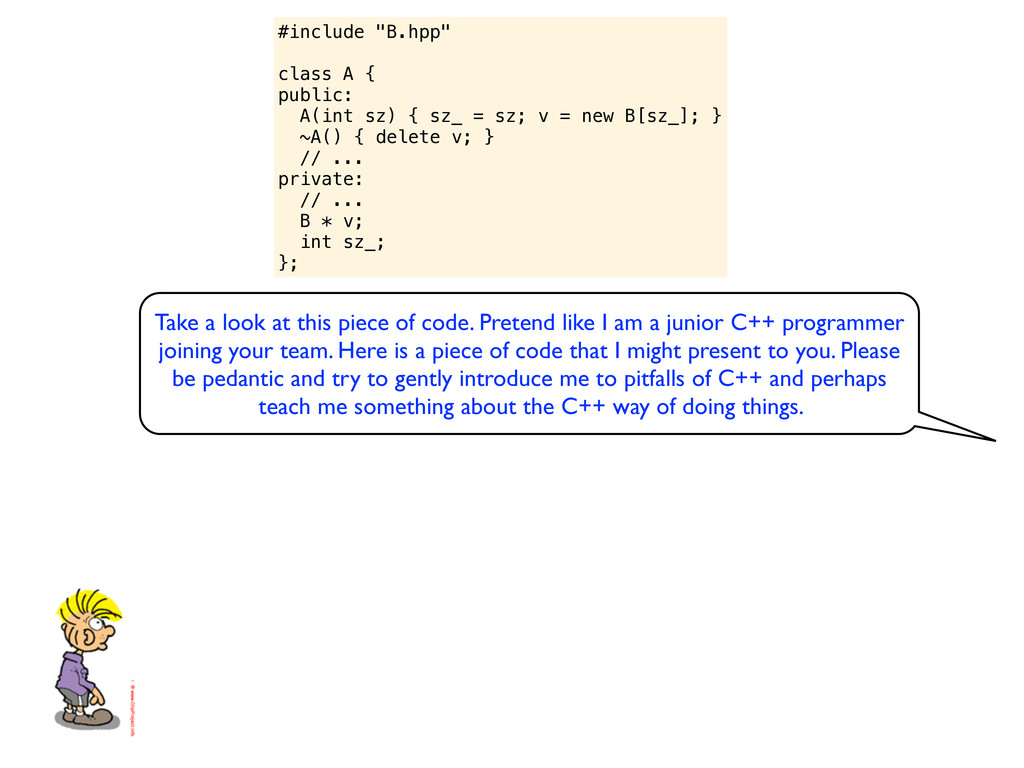
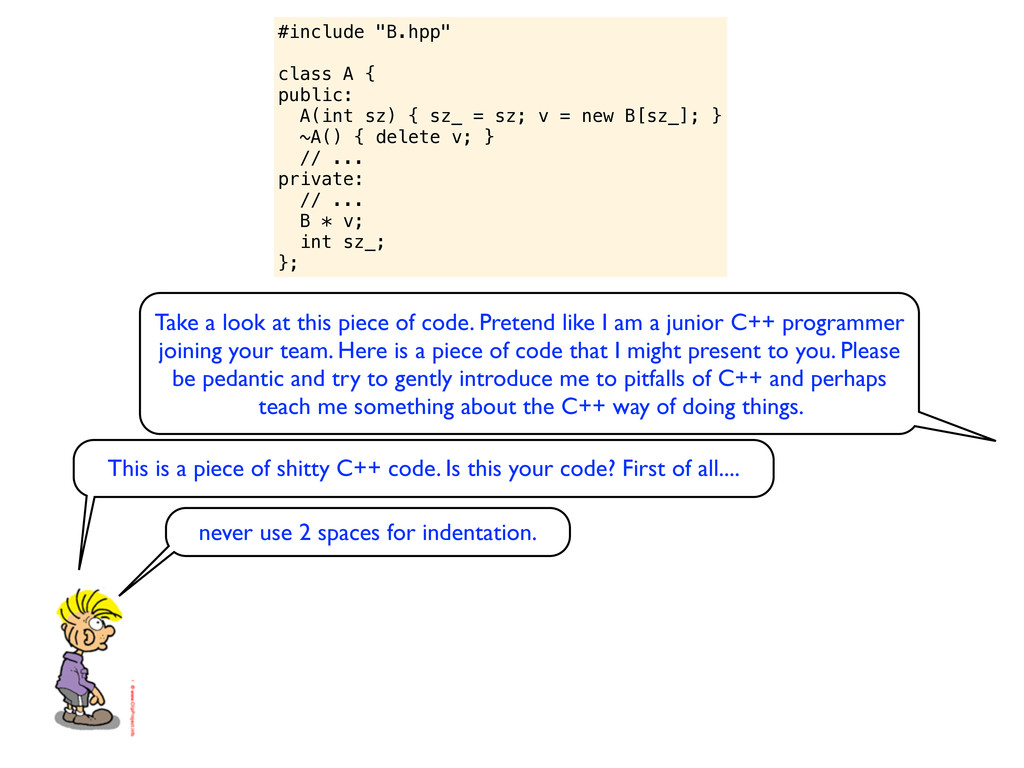
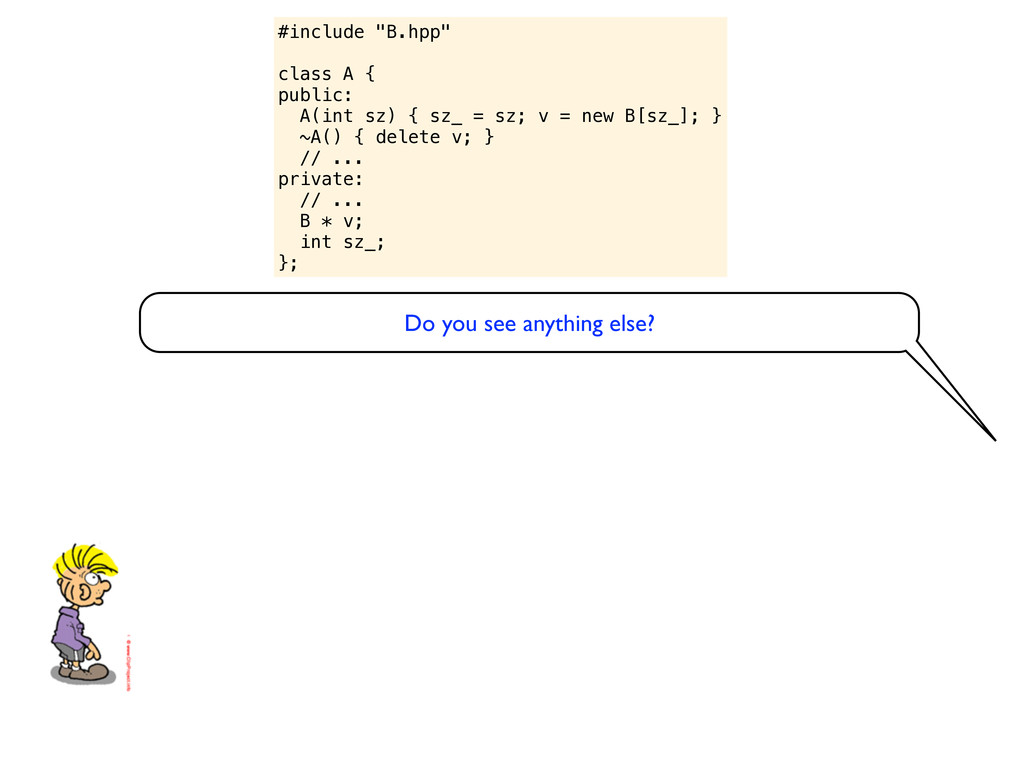
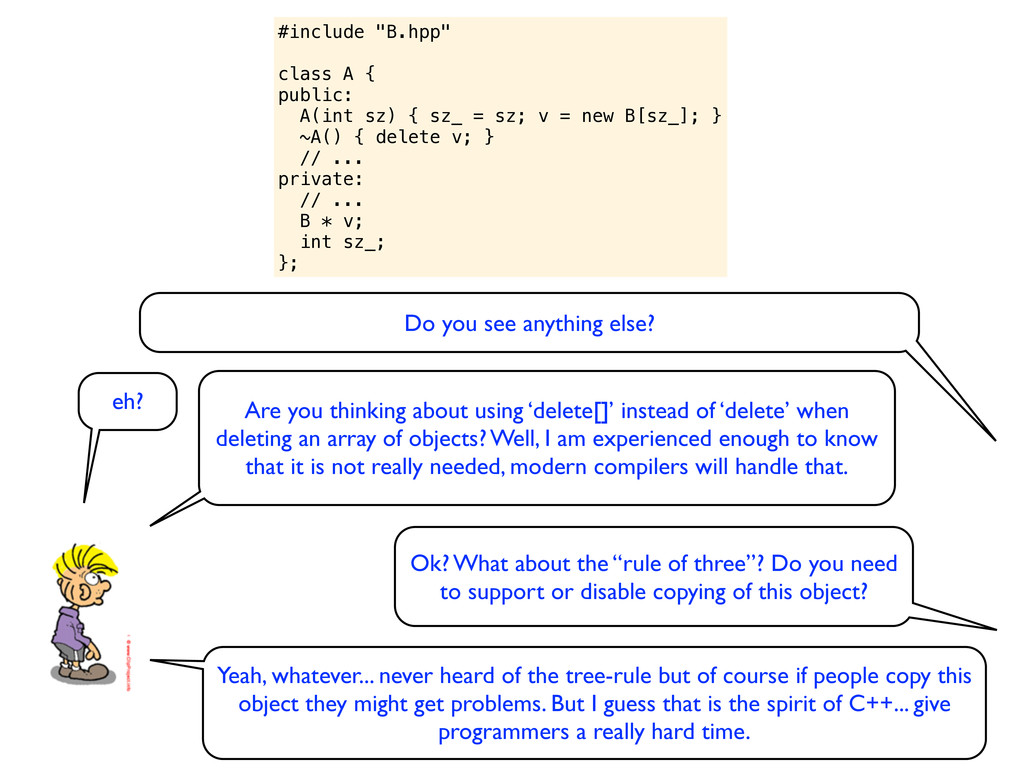
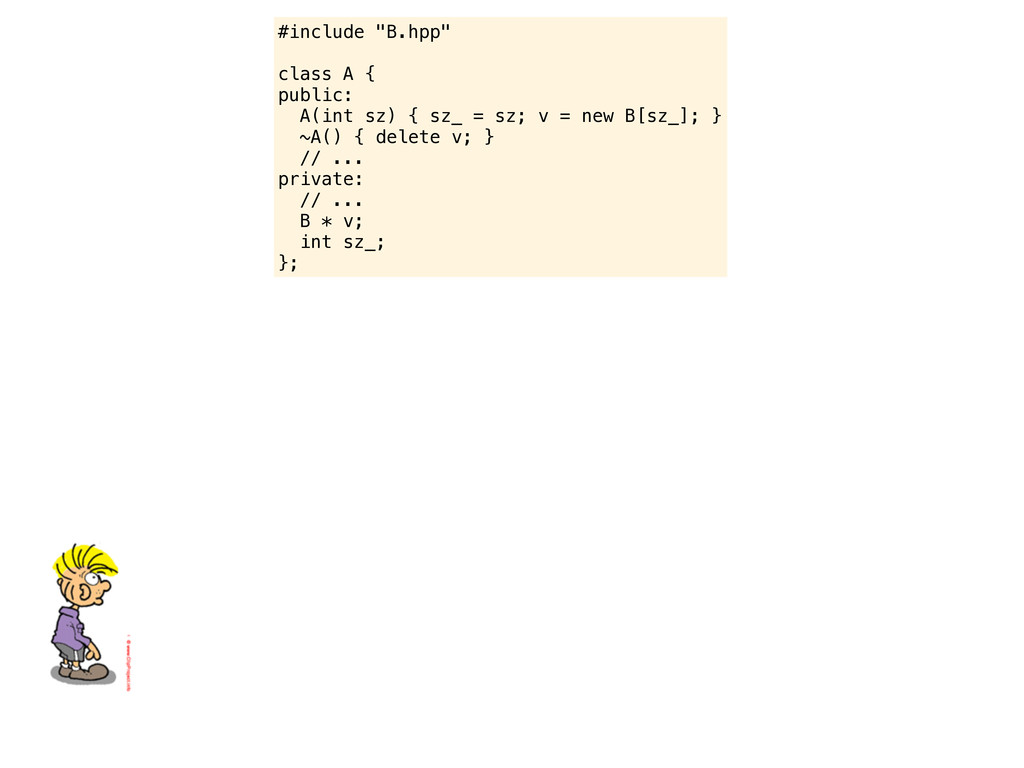
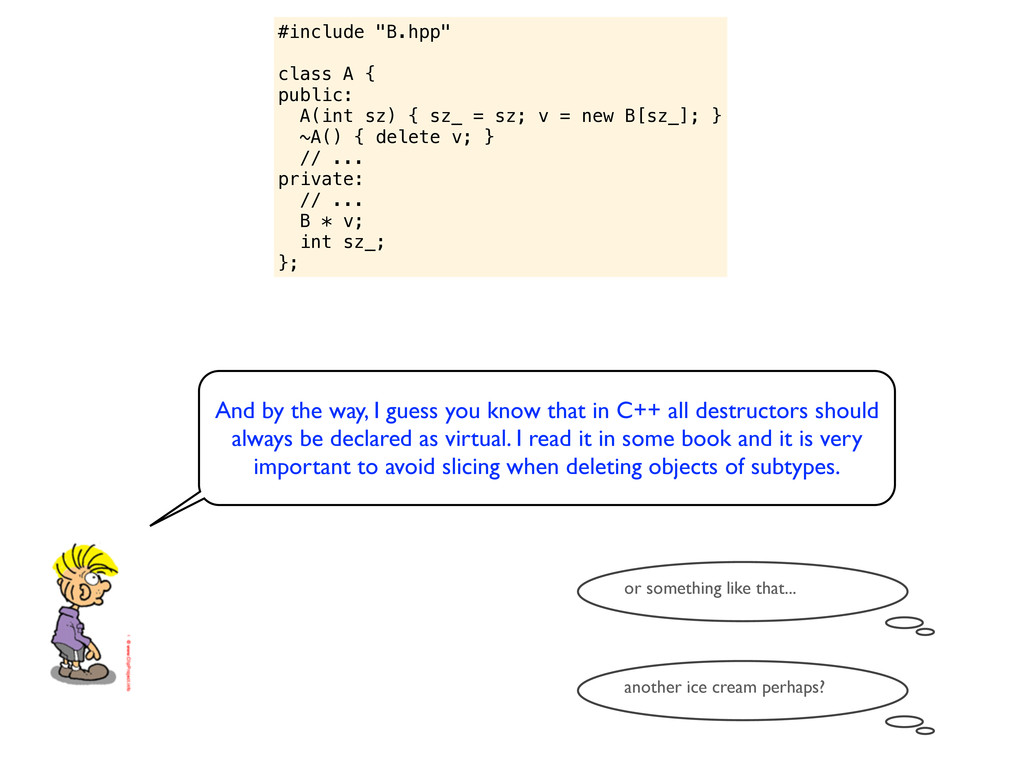
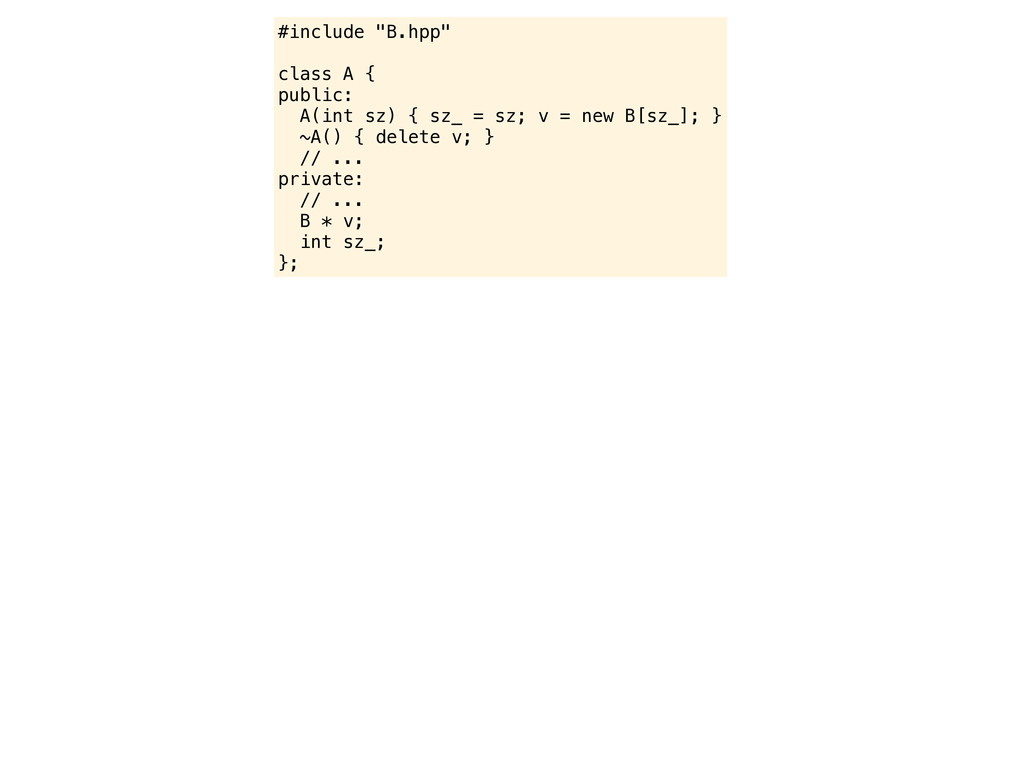
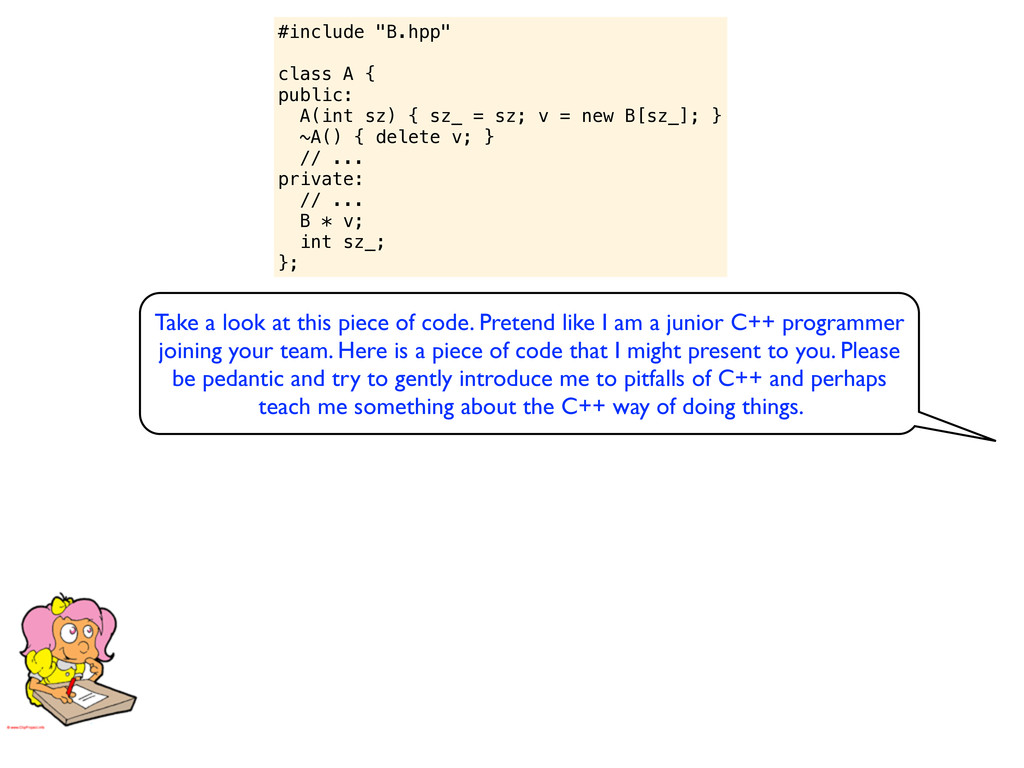
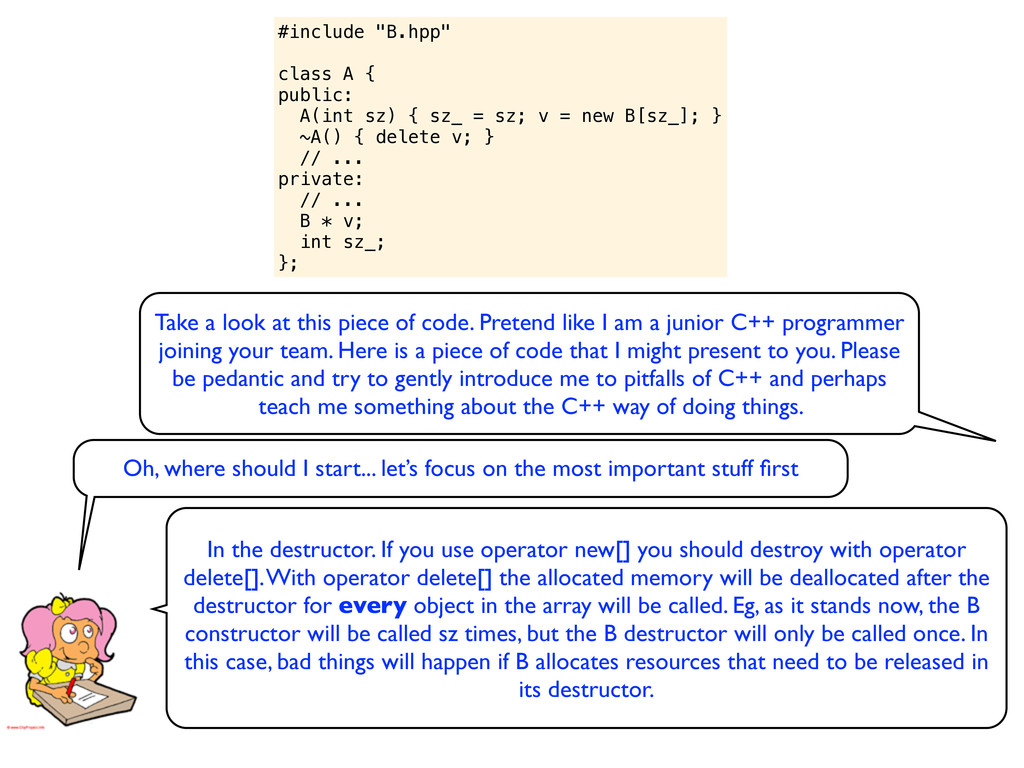
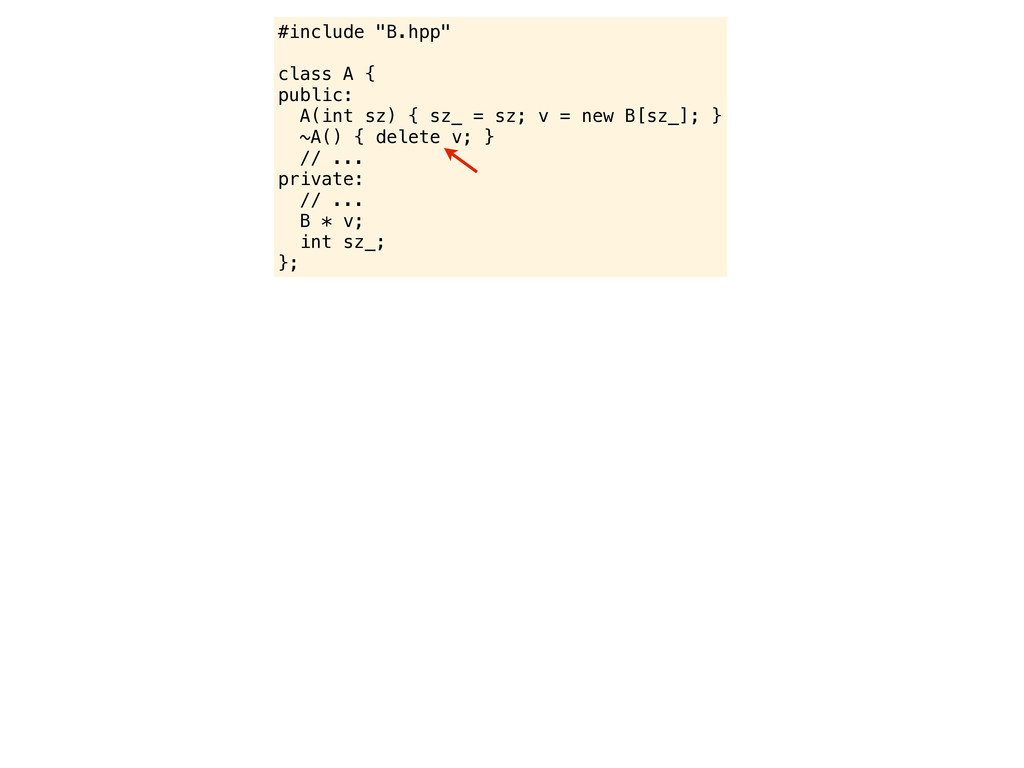
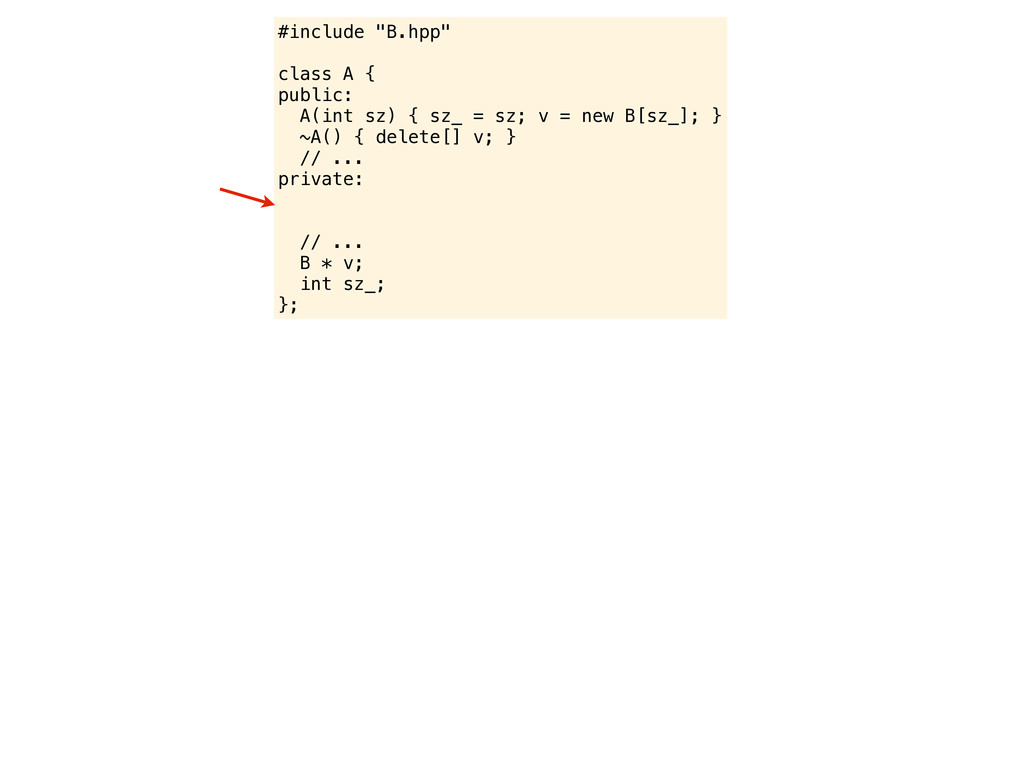
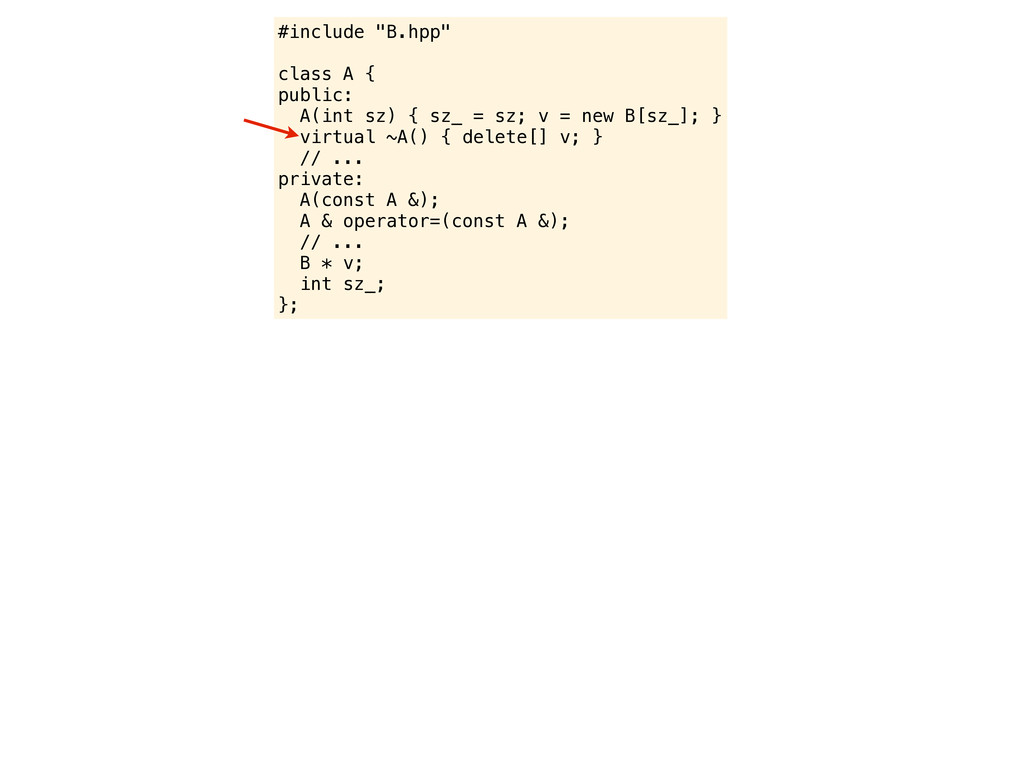
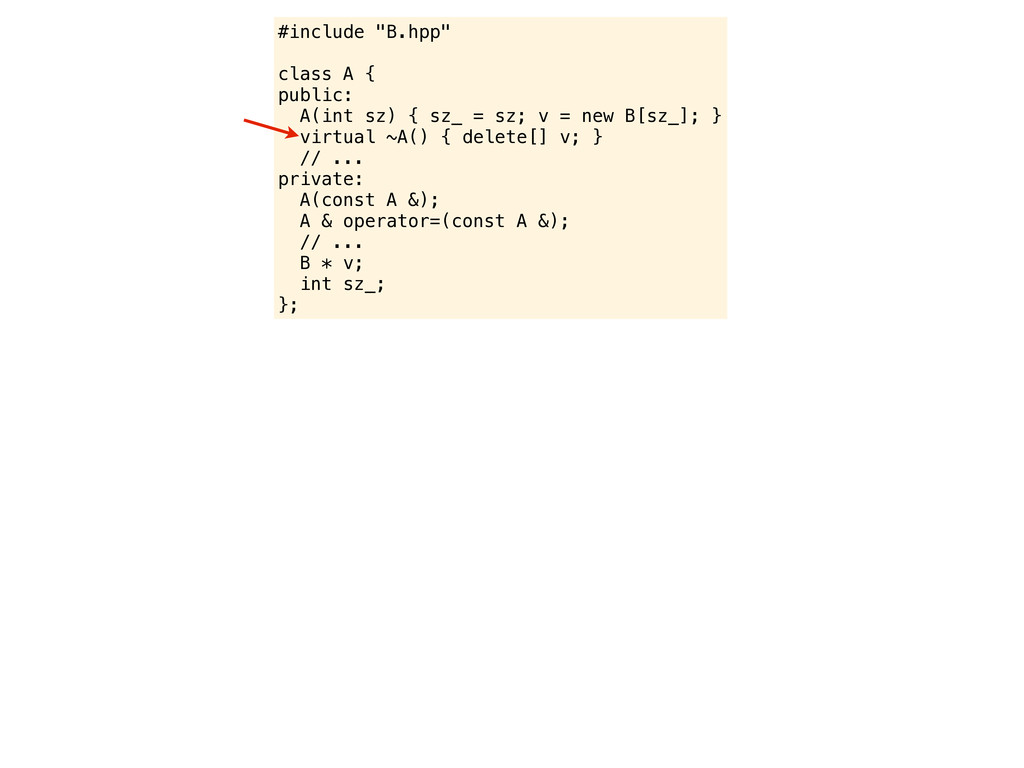
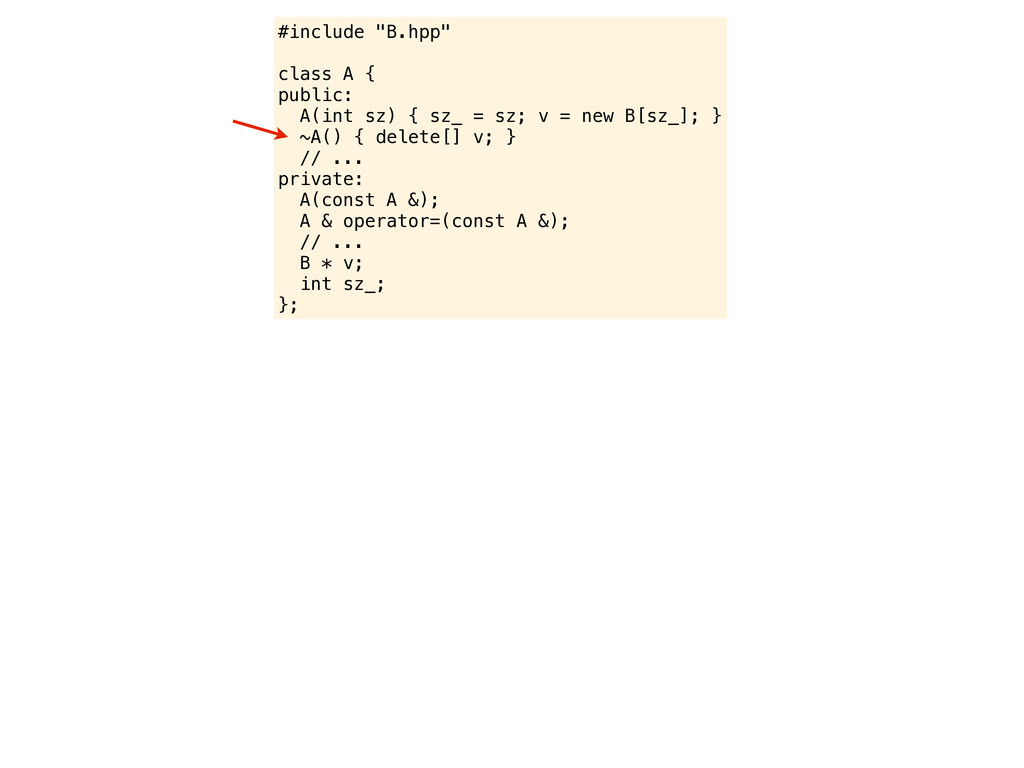
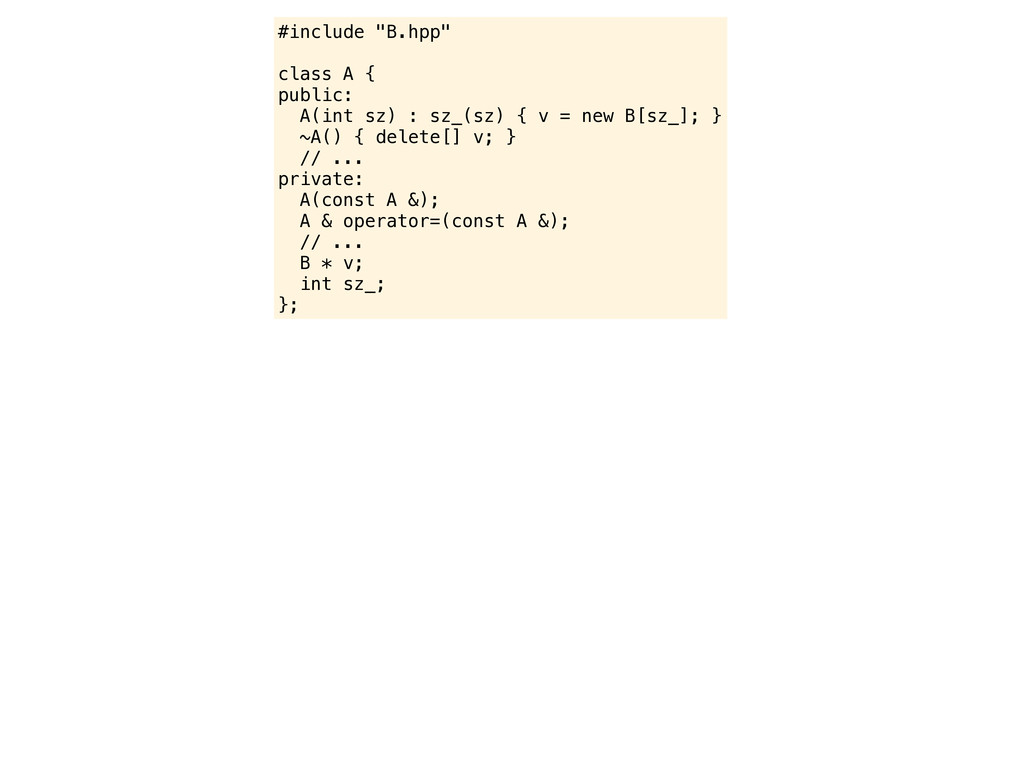
= sz; v = new B[sz_]; } ~A() { delete v; } // ... private: // ... B * v; int sz_; }; Take a look at this piece of code. Pretend like I am a junior C++ programmer joining your team. Here is a piece of code that I might present to you. Please be pedantic and try to gently introduce me to pitfalls of C++ and perhaps teach me something about the C++ way of doing things.
= sz; v = new B[sz_]; } ~A() { delete v; } // ... private: // ... B * v; int sz_; }; Take a look at this piece of code. Pretend like I am a junior C++ programmer joining your team. Here is a piece of code that I might present to you. Please be pedantic and try to gently introduce me to pitfalls of C++ and perhaps teach me something about the C++ way of doing things.
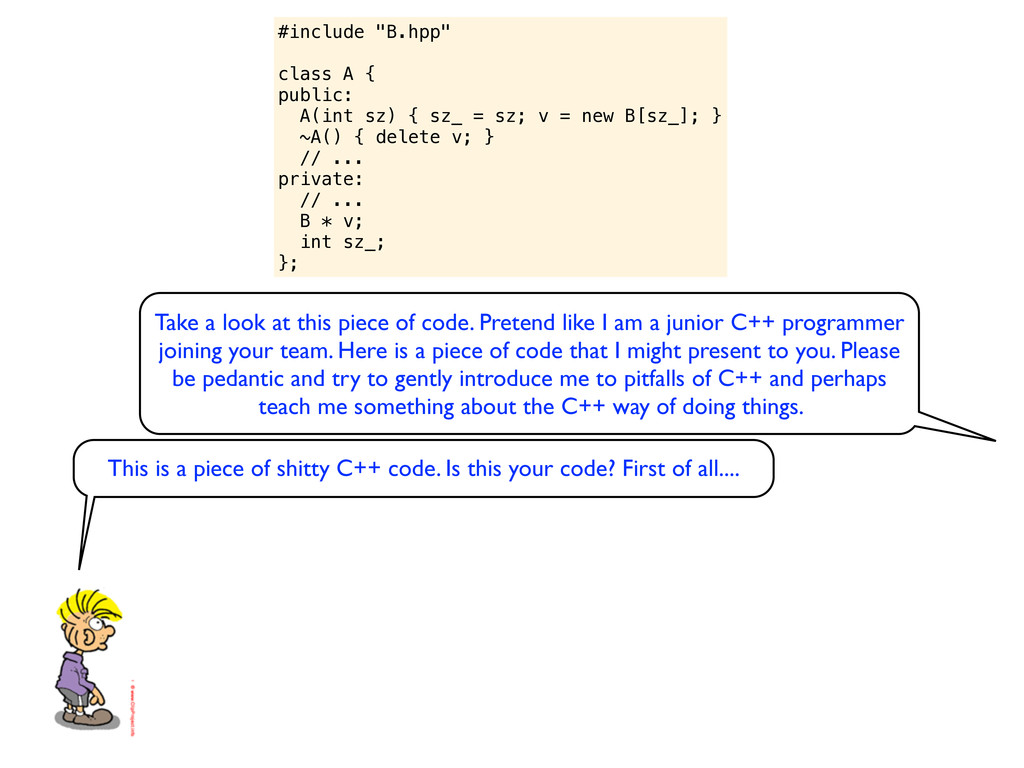
= sz; v = new B[sz_]; } ~A() { delete v; } // ... private: // ... B * v; int sz_; }; Take a look at this piece of code. Pretend like I am a junior C++ programmer joining your team. Here is a piece of code that I might present to you. Please be pedantic and try to gently introduce me to pitfalls of C++ and perhaps teach me something about the C++ way of doing things. This is a piece of shitty C++ code. Is this your code? First of all....
= sz; v = new B[sz_]; } ~A() { delete v; } // ... private: // ... B * v; int sz_; }; Take a look at this piece of code. Pretend like I am a junior C++ programmer joining your team. Here is a piece of code that I might present to you. Please be pedantic and try to gently introduce me to pitfalls of C++ and perhaps teach me something about the C++ way of doing things. This is a piece of shitty C++ code. Is this your code? First of all.... never use 2 spaces for indentation.
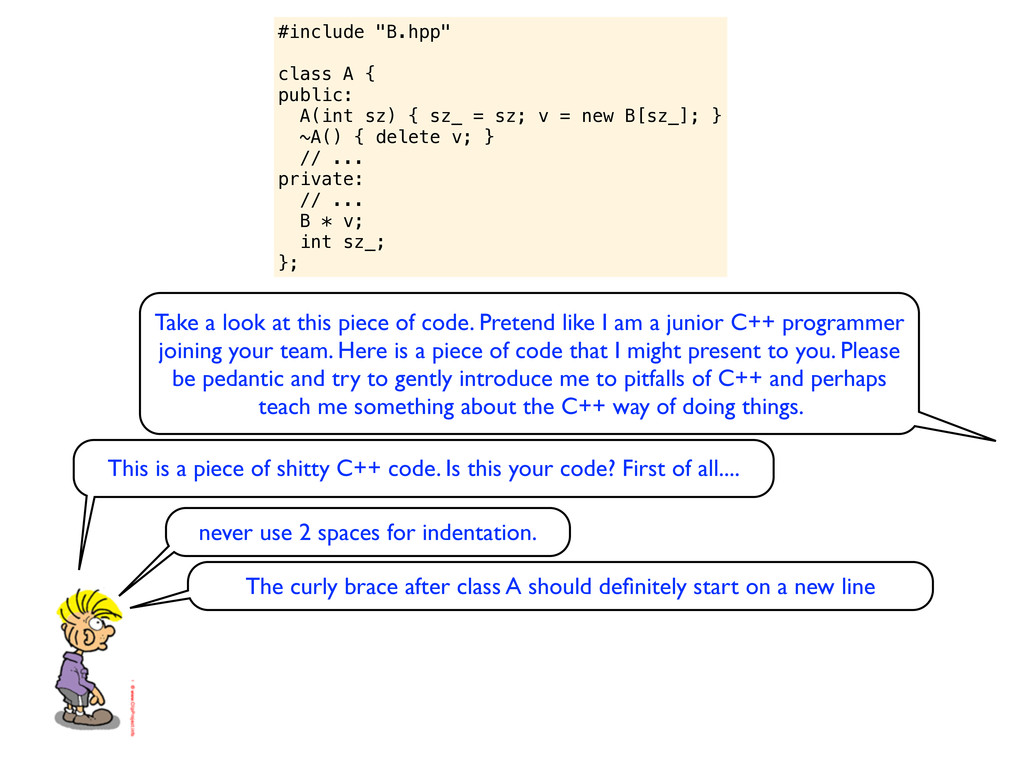
= sz; v = new B[sz_]; } ~A() { delete v; } // ... private: // ... B * v; int sz_; }; Take a look at this piece of code. Pretend like I am a junior C++ programmer joining your team. Here is a piece of code that I might present to you. Please be pedantic and try to gently introduce me to pitfalls of C++ and perhaps teach me something about the C++ way of doing things. This is a piece of shitty C++ code. Is this your code? First of all.... never use 2 spaces for indentation. The curly brace after class A should definitely start on a new line
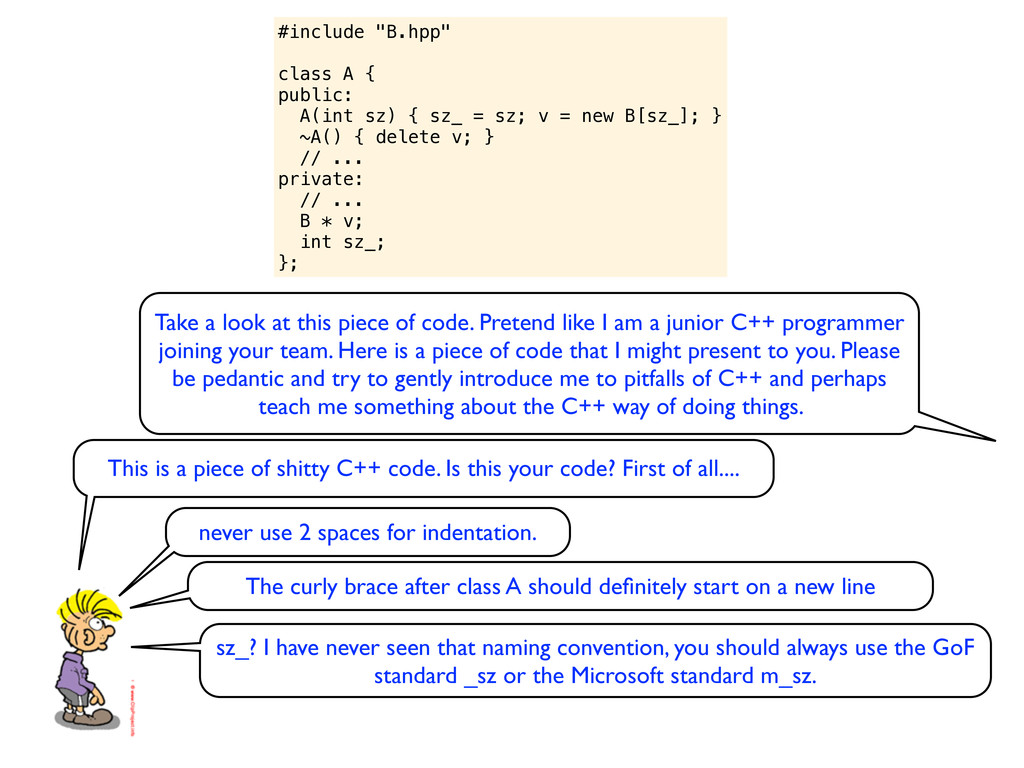
= sz; v = new B[sz_]; } ~A() { delete v; } // ... private: // ... B * v; int sz_; }; Take a look at this piece of code. Pretend like I am a junior C++ programmer joining your team. Here is a piece of code that I might present to you. Please be pedantic and try to gently introduce me to pitfalls of C++ and perhaps teach me something about the C++ way of doing things. This is a piece of shitty C++ code. Is this your code? First of all.... never use 2 spaces for indentation. The curly brace after class A should definitely start on a new line sz_? I have never seen that naming convention, you should always use the GoF standard _sz or the Microsoft standard m_sz.
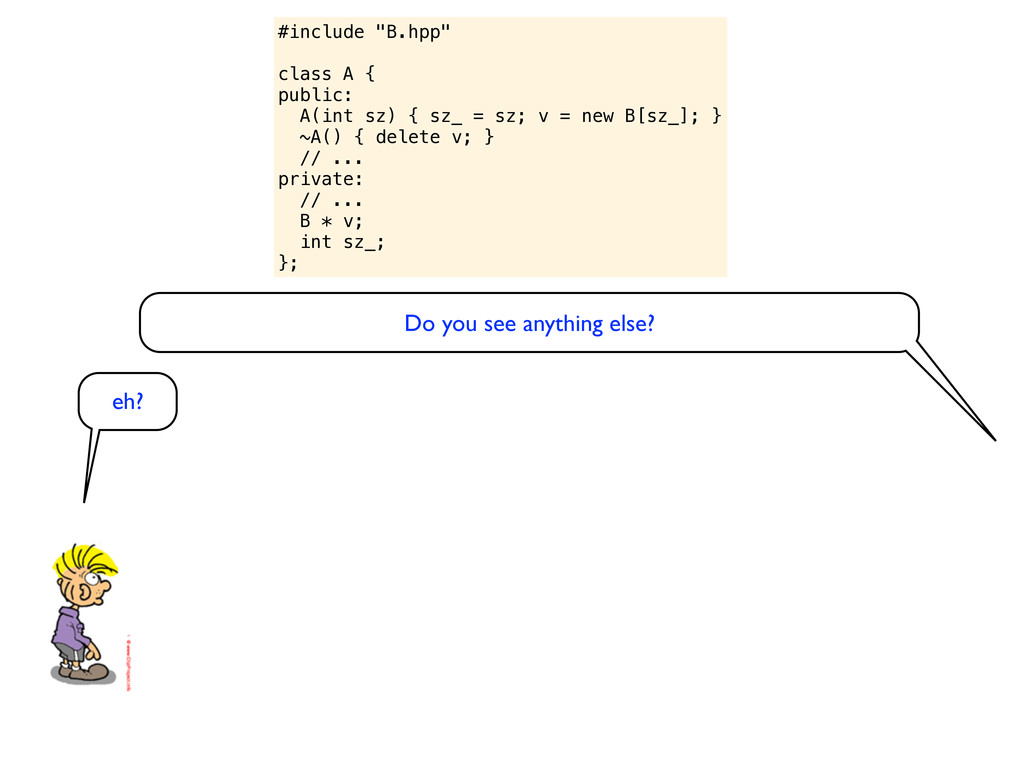
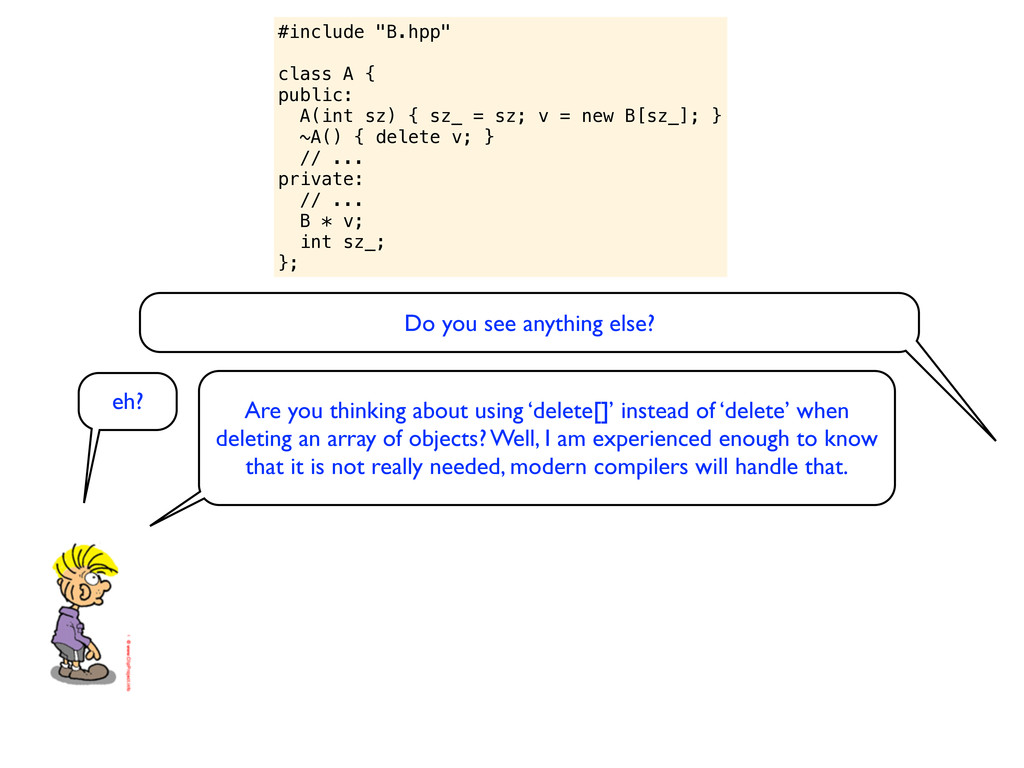
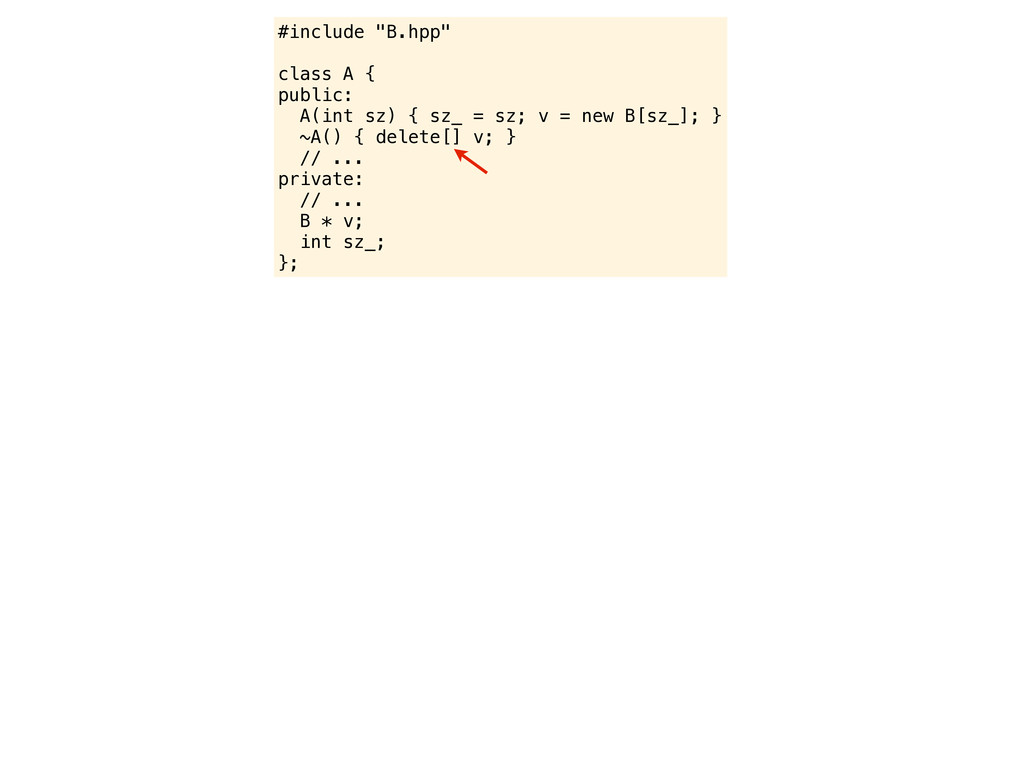
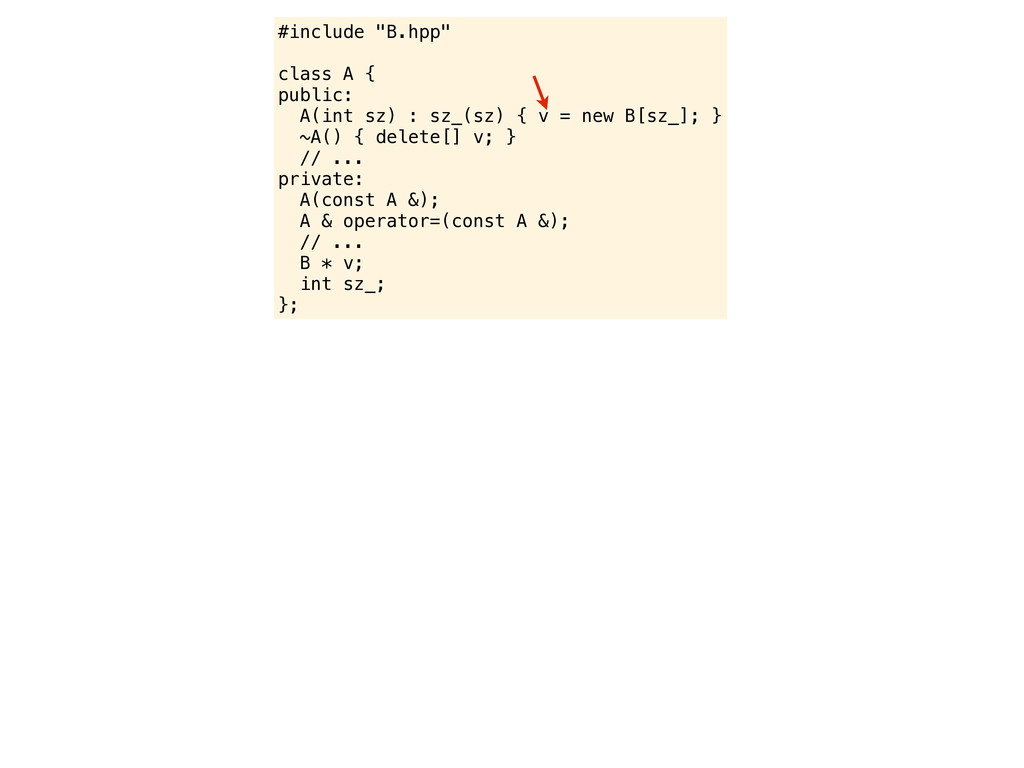
= sz; v = new B[sz_]; } ~A() { delete v; } // ... private: // ... B * v; int sz_; }; Do you see anything else? eh? Are you thinking about using ‘delete[]’ instead of ‘delete’ when deleting an array of objects? Well, I am experienced enough to know that it is not really needed, modern compilers will handle that.
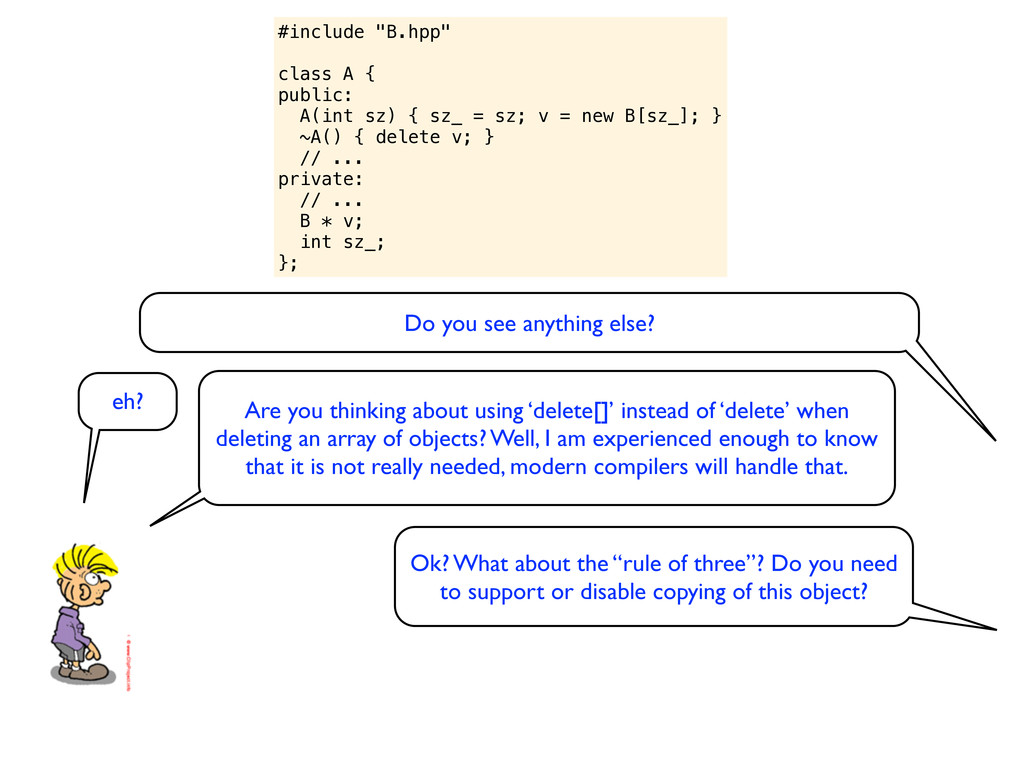
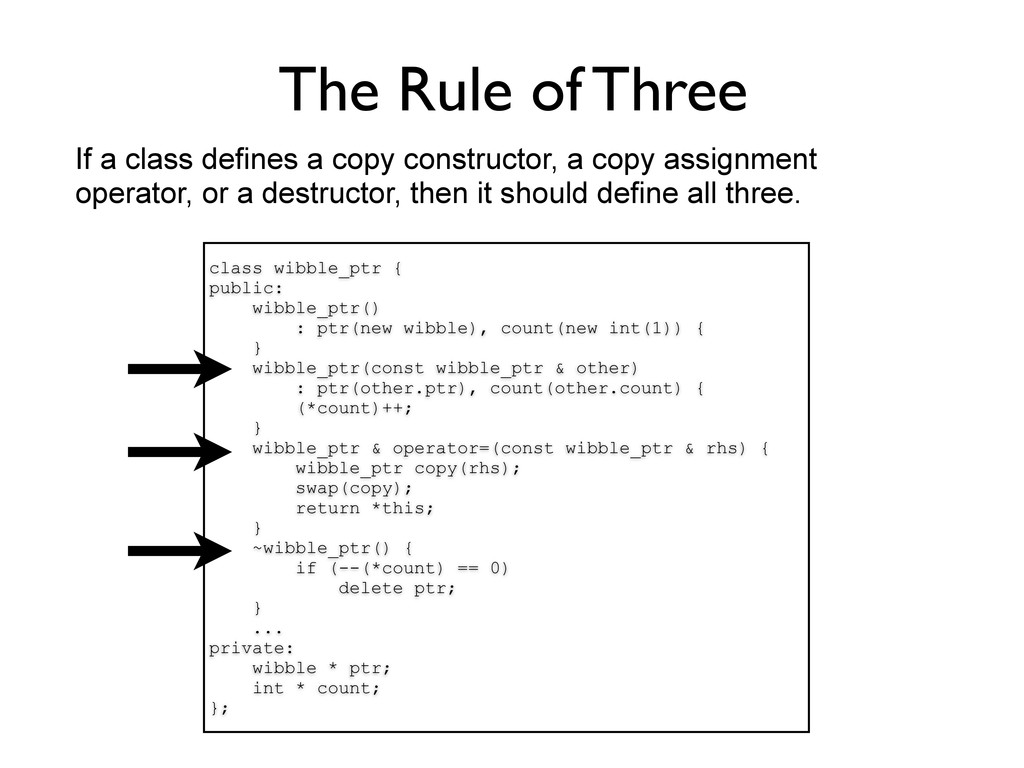
= sz; v = new B[sz_]; } ~A() { delete v; } // ... private: // ... B * v; int sz_; }; Do you see anything else? eh? Are you thinking about using ‘delete[]’ instead of ‘delete’ when deleting an array of objects? Well, I am experienced enough to know that it is not really needed, modern compilers will handle that. Ok? What about the “rule of three”? Do you need to support or disable copying of this object?
= sz; v = new B[sz_]; } ~A() { delete v; } // ... private: // ... B * v; int sz_; }; Do you see anything else? eh? Are you thinking about using ‘delete[]’ instead of ‘delete’ when deleting an array of objects? Well, I am experienced enough to know that it is not really needed, modern compilers will handle that. Ok? What about the “rule of three”? Do you need to support or disable copying of this object? Yeah, whatever... never heard of the tree-rule but of course if people copy this object they might get problems. But I guess that is the spirit of C++... give programmers a really hard time.
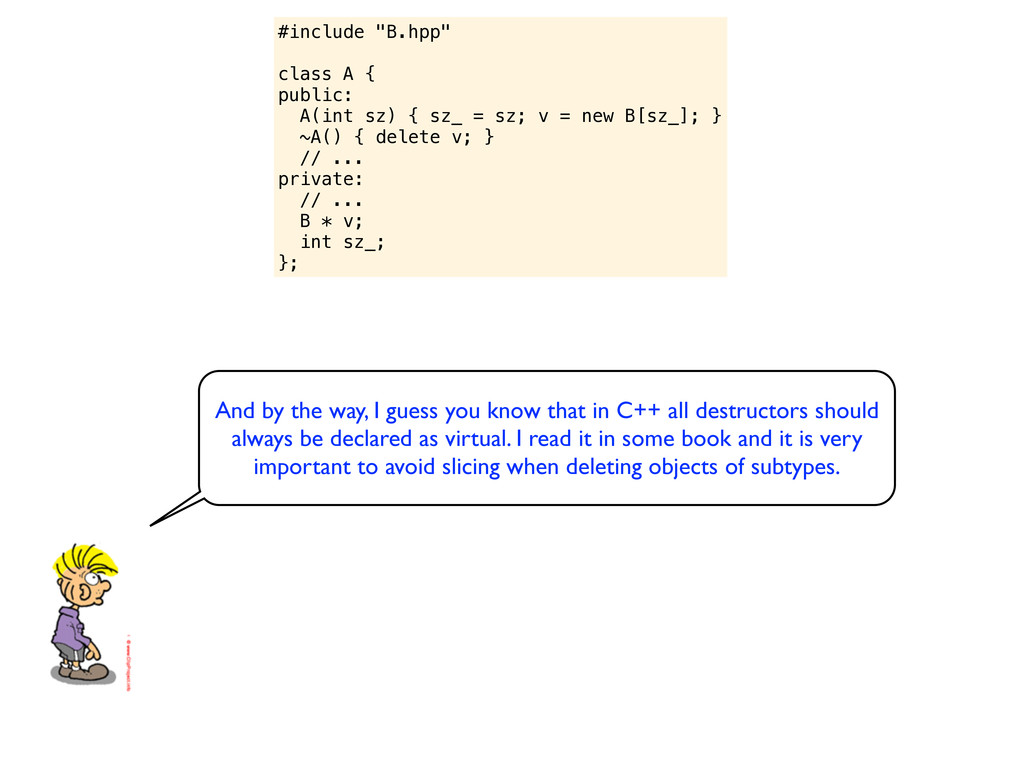
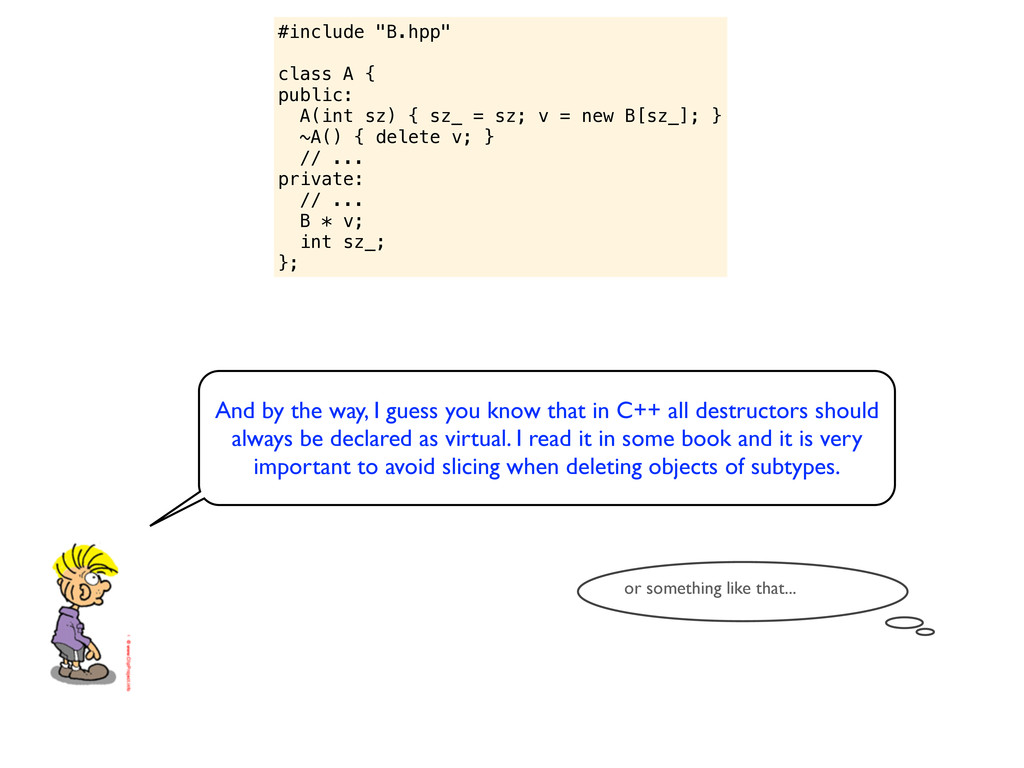
= sz; v = new B[sz_]; } ~A() { delete v; } // ... private: // ... B * v; int sz_; }; And by the way, I guess you know that in C++ all destructors should always be declared as virtual. I read it in some book and it is very important to avoid slicing when deleting objects of subtypes.
= sz; v = new B[sz_]; } ~A() { delete v; } // ... private: // ... B * v; int sz_; }; And by the way, I guess you know that in C++ all destructors should always be declared as virtual. I read it in some book and it is very important to avoid slicing when deleting objects of subtypes. or something like that...
= sz; v = new B[sz_]; } ~A() { delete v; } // ... private: // ... B * v; int sz_; }; And by the way, I guess you know that in C++ all destructors should always be declared as virtual. I read it in some book and it is very important to avoid slicing when deleting objects of subtypes. or something like that... another ice cream perhaps?
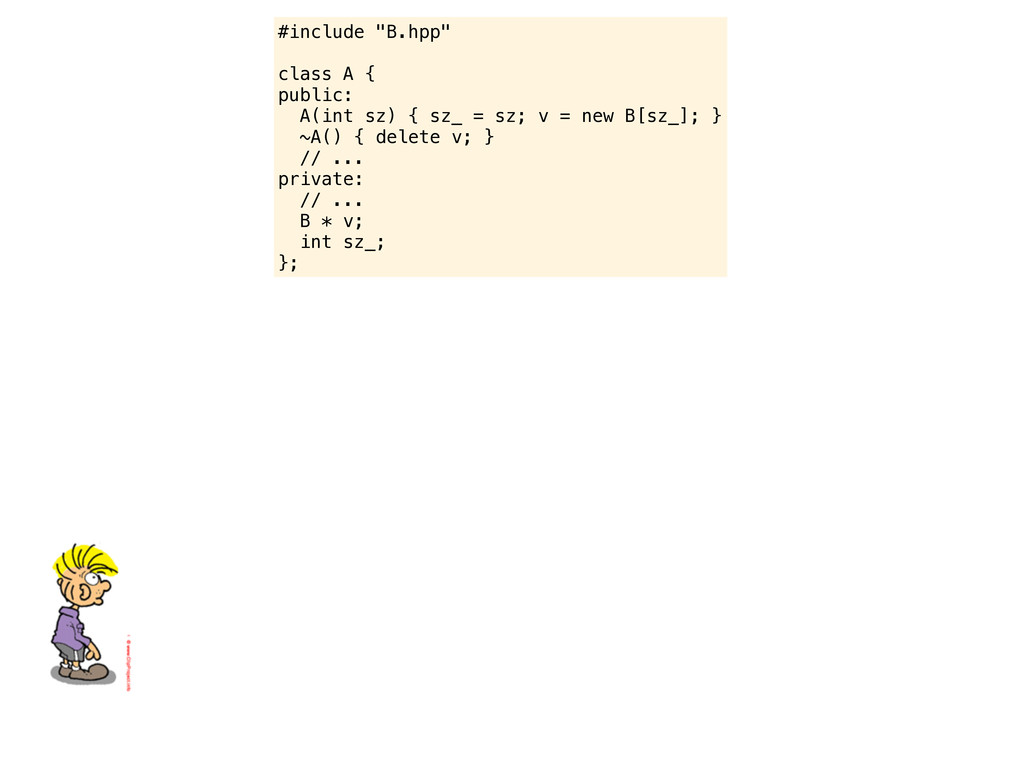
= sz; v = new B[sz_]; } ~A() { delete v; } // ... private: // ... B * v; int sz_; }; Take a look at this piece of code. Pretend like I am a junior C++ programmer joining your team. Here is a piece of code that I might present to you. Please be pedantic and try to gently introduce me to pitfalls of C++ and perhaps teach me something about the C++ way of doing things.
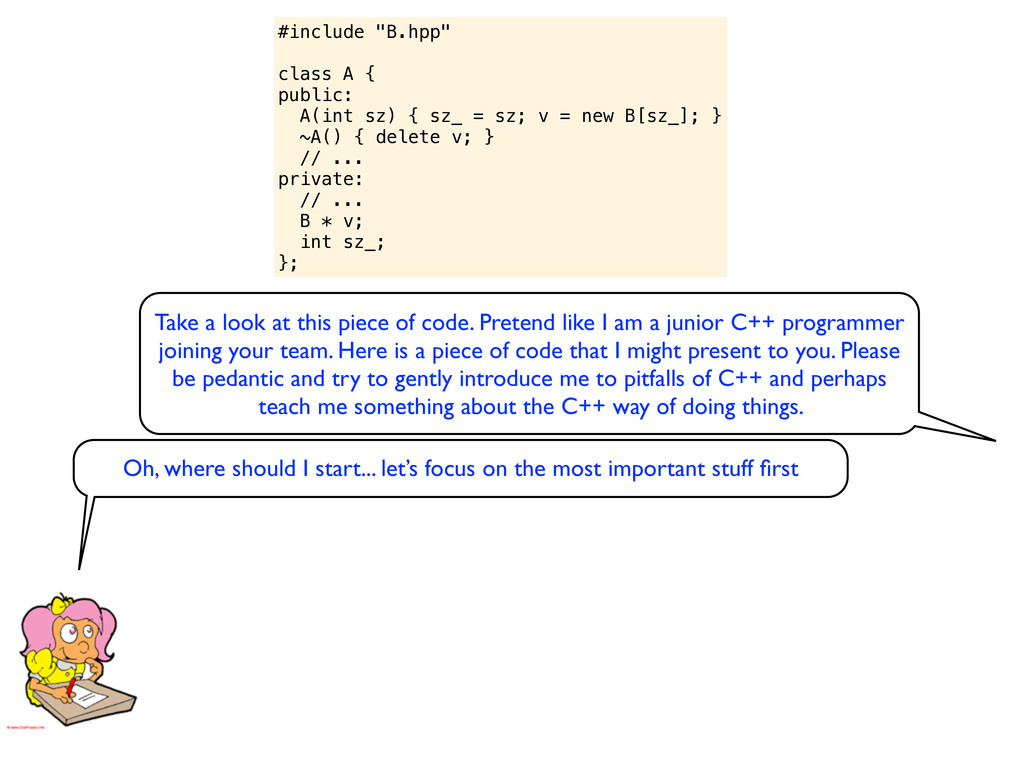
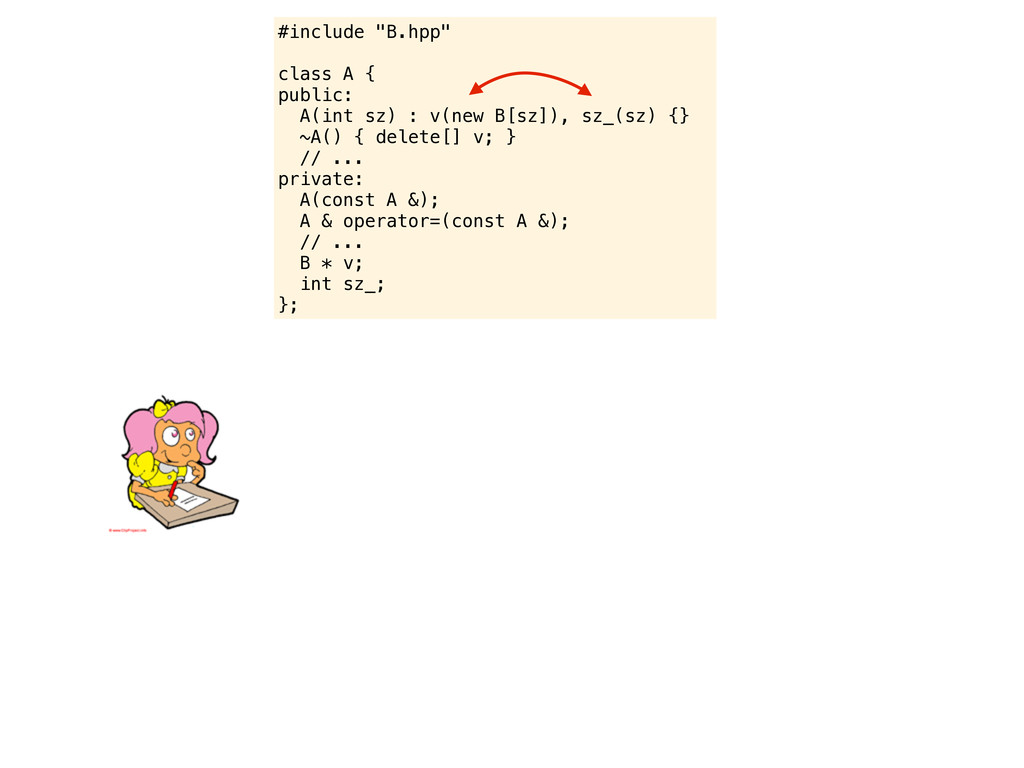
= sz; v = new B[sz_]; } ~A() { delete v; } // ... private: // ... B * v; int sz_; }; Oh, where should I start... let’s focus on the most important stuff first Take a look at this piece of code. Pretend like I am a junior C++ programmer joining your team. Here is a piece of code that I might present to you. Please be pedantic and try to gently introduce me to pitfalls of C++ and perhaps teach me something about the C++ way of doing things.
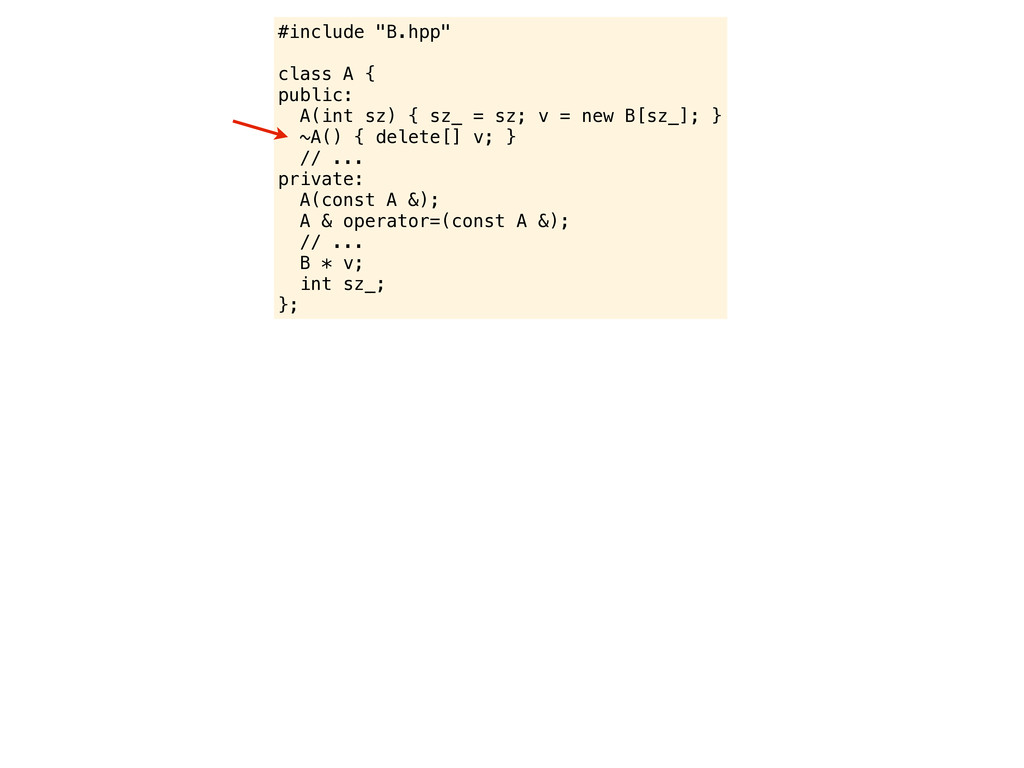
= sz; v = new B[sz_]; } ~A() { delete v; } // ... private: // ... B * v; int sz_; }; Oh, where should I start... let’s focus on the most important stuff first In the destructor. If you use operator new[] you should destroy with operator delete[]. With operator delete[] the allocated memory will be deallocated after the destructor for every object in the array will be called. Eg, as it stands now, the B constructor will be called sz times, but the B destructor will only be called once. In this case, bad things will happen if B allocates resources that need to be released in its destructor. Take a look at this piece of code. Pretend like I am a junior C++ programmer joining your team. Here is a piece of code that I might present to you. Please be pedantic and try to gently introduce me to pitfalls of C++ and perhaps teach me something about the C++ way of doing things.
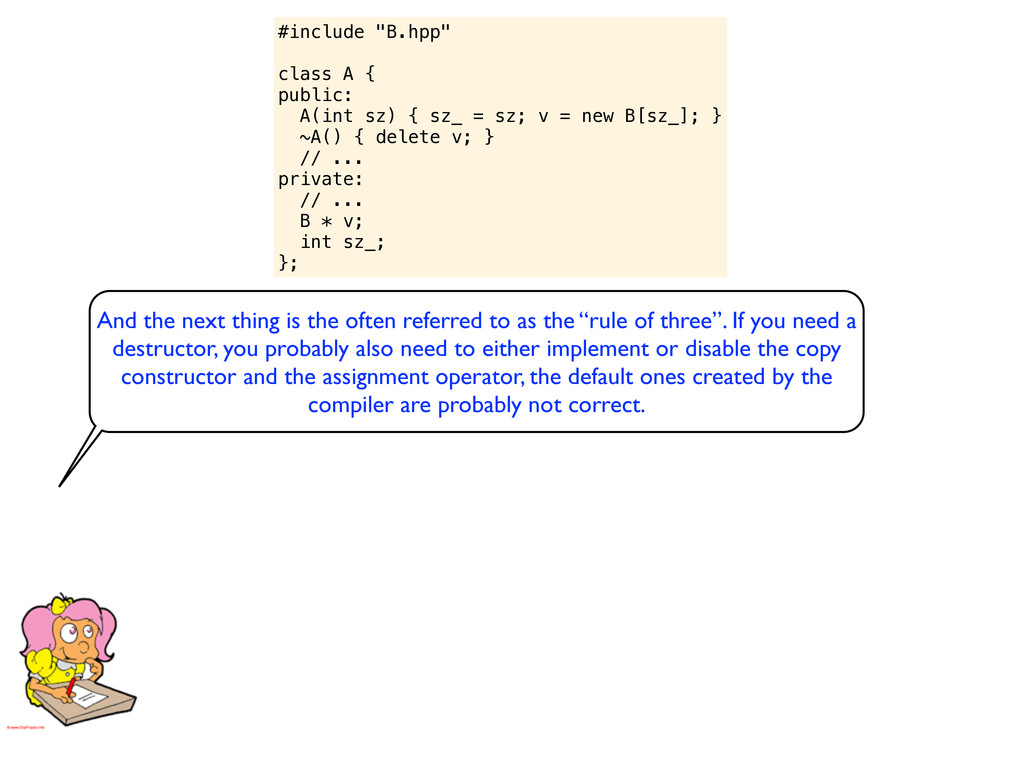
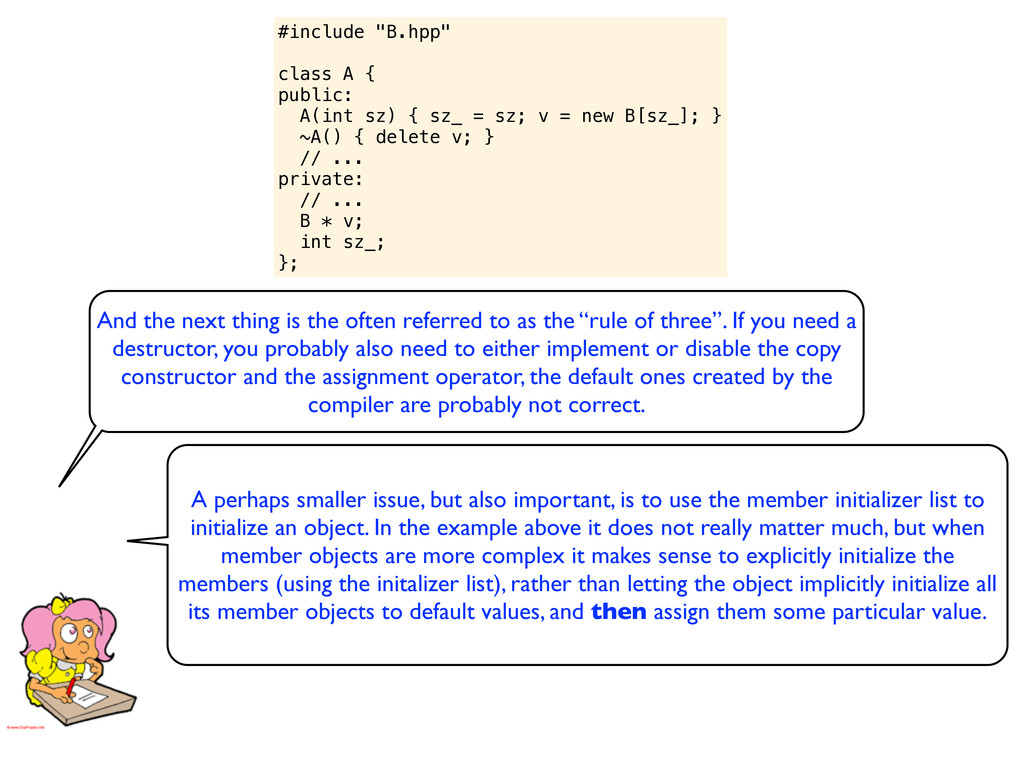
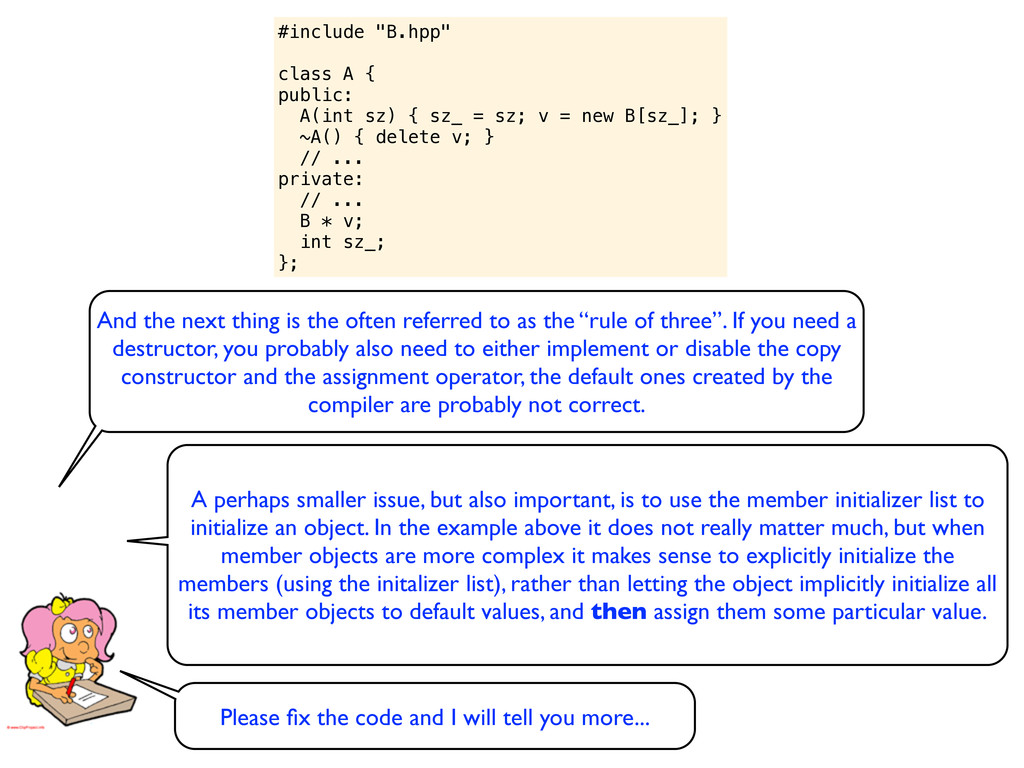
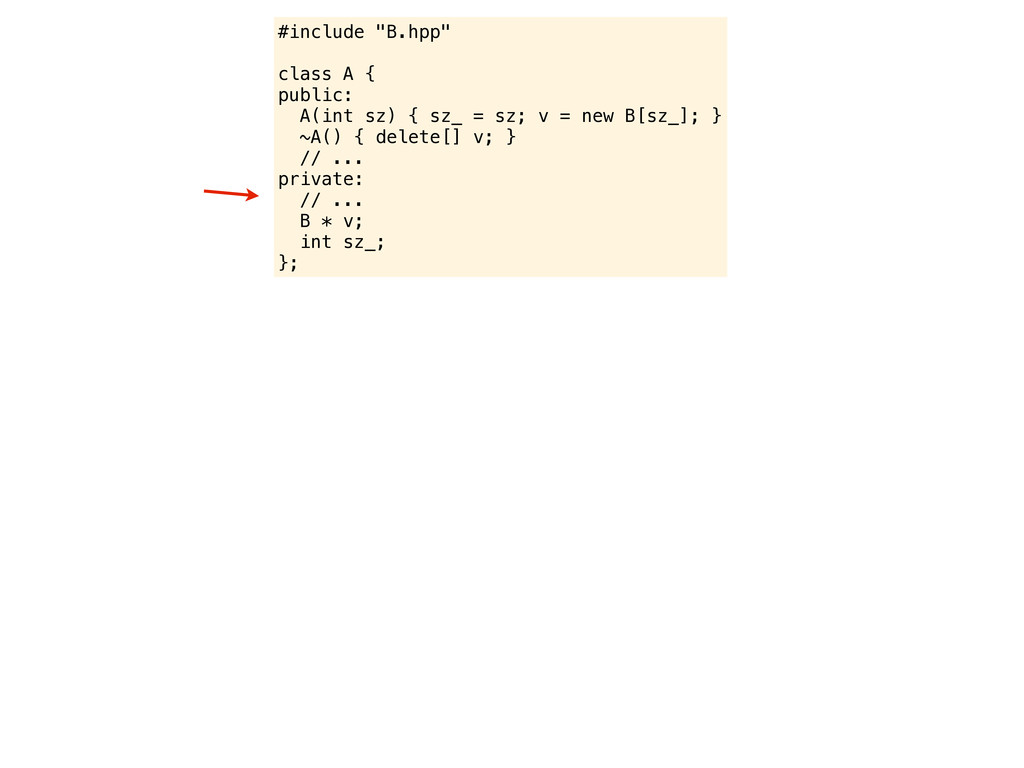
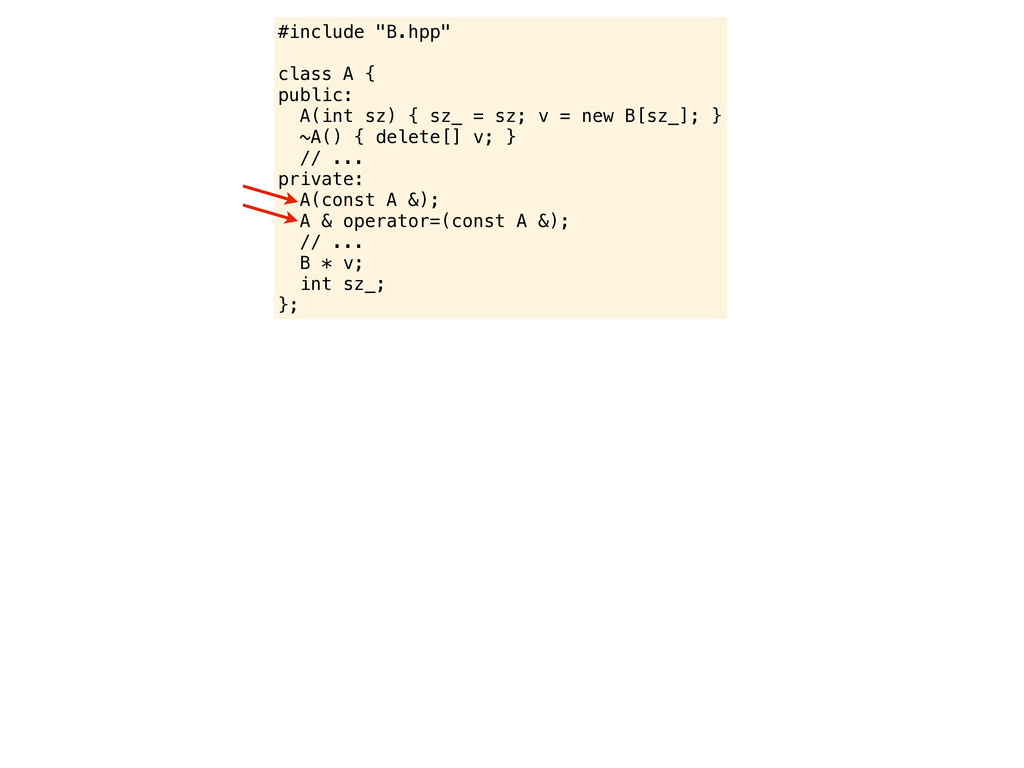
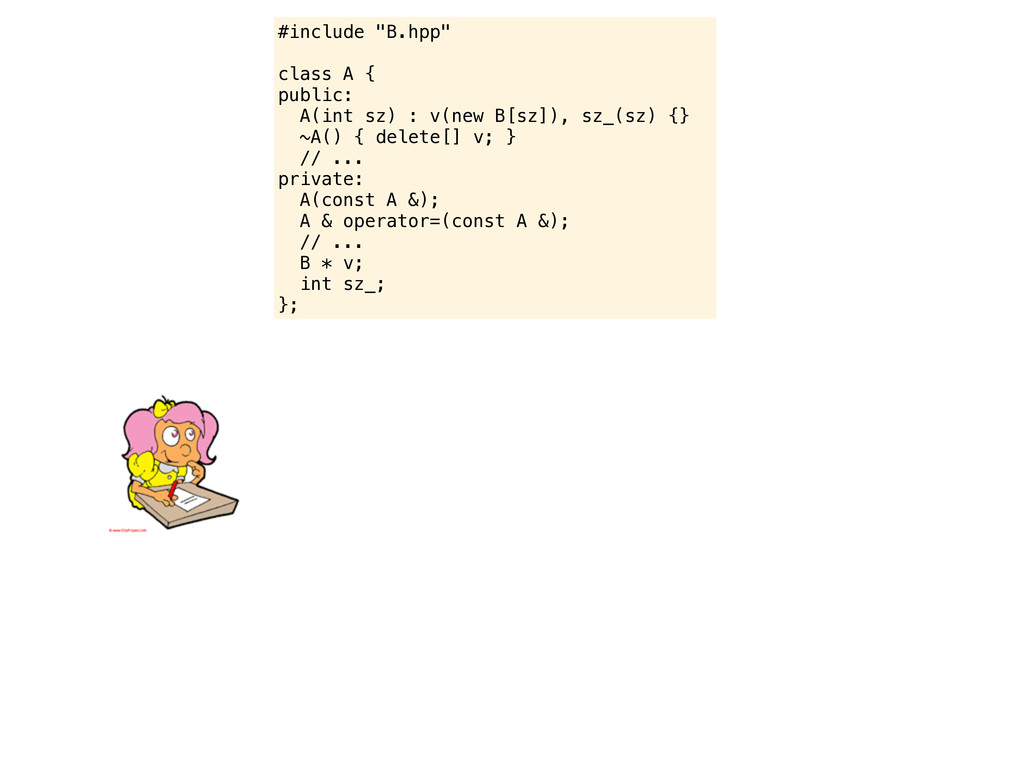
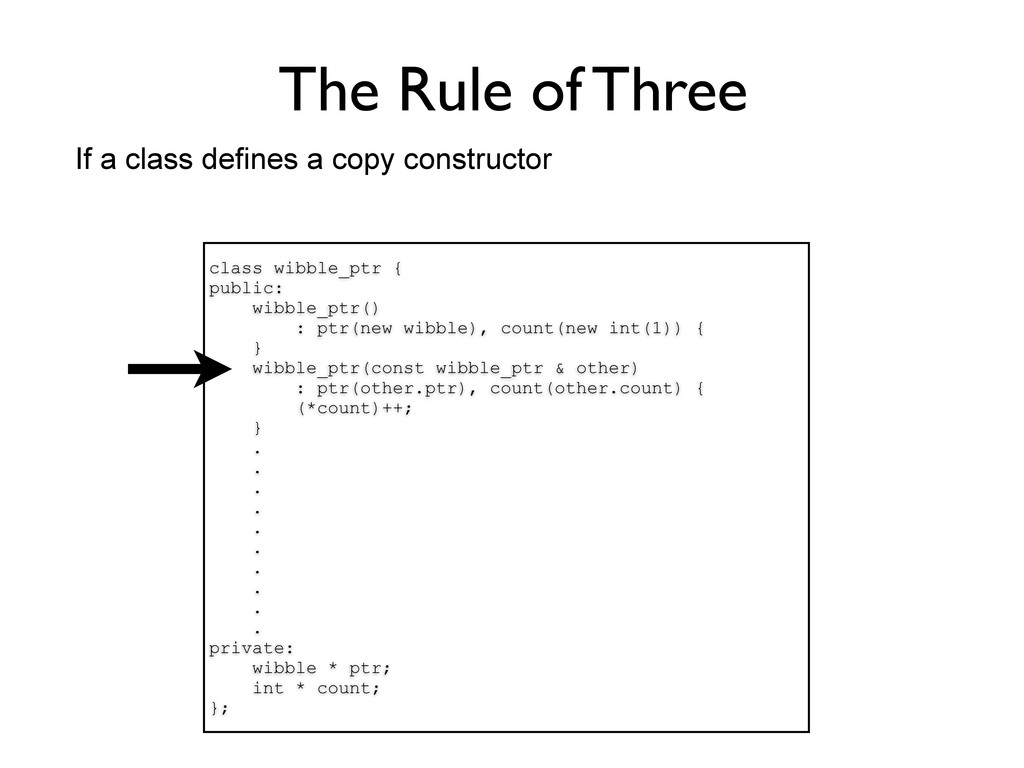
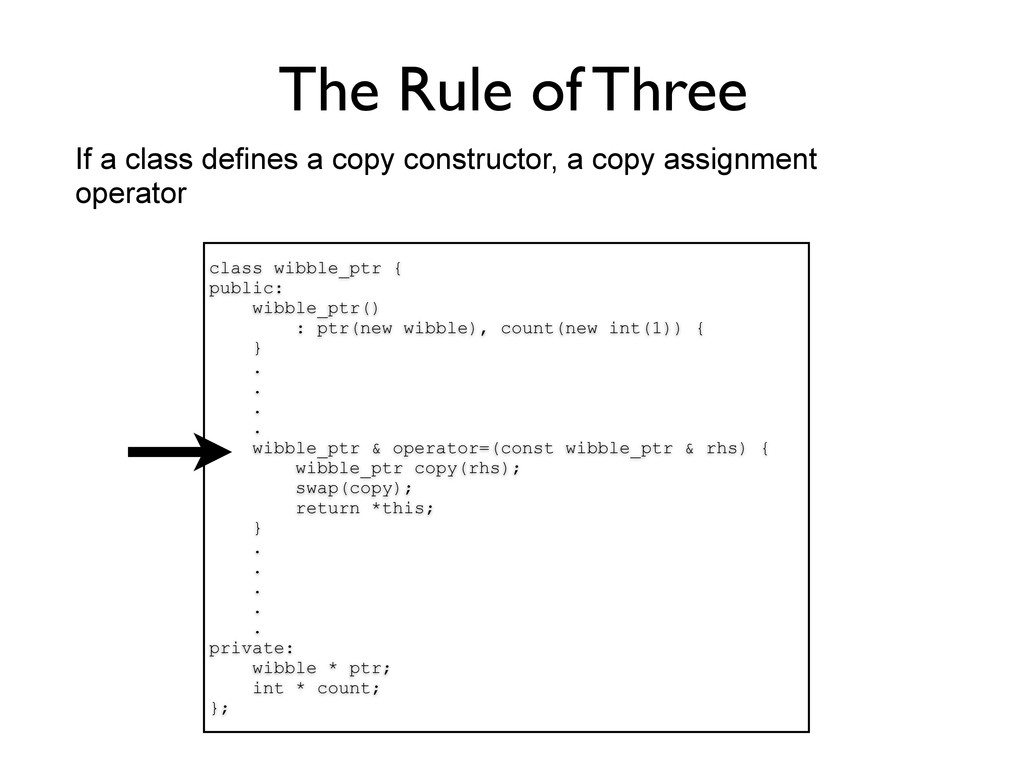
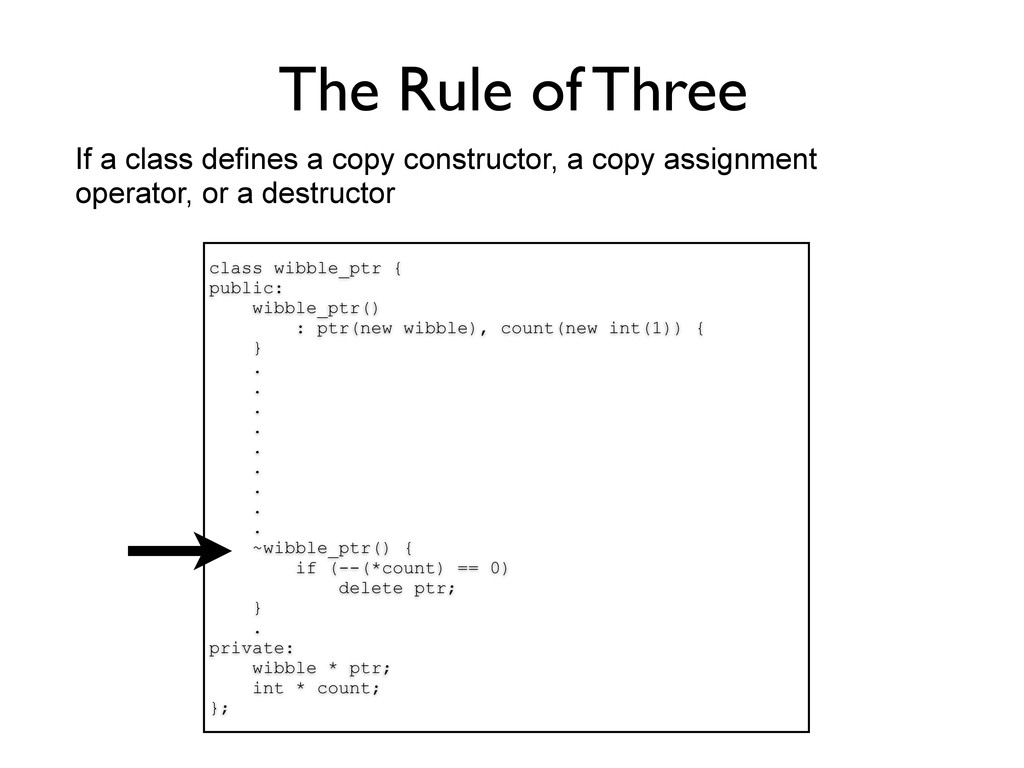
= sz; v = new B[sz_]; } ~A() { delete v; } // ... private: // ... B * v; int sz_; }; And the next thing is the often referred to as the “rule of three”. If you need a destructor, you probably also need to either implement or disable the copy constructor and the assignment operator, the default ones created by the compiler are probably not correct.
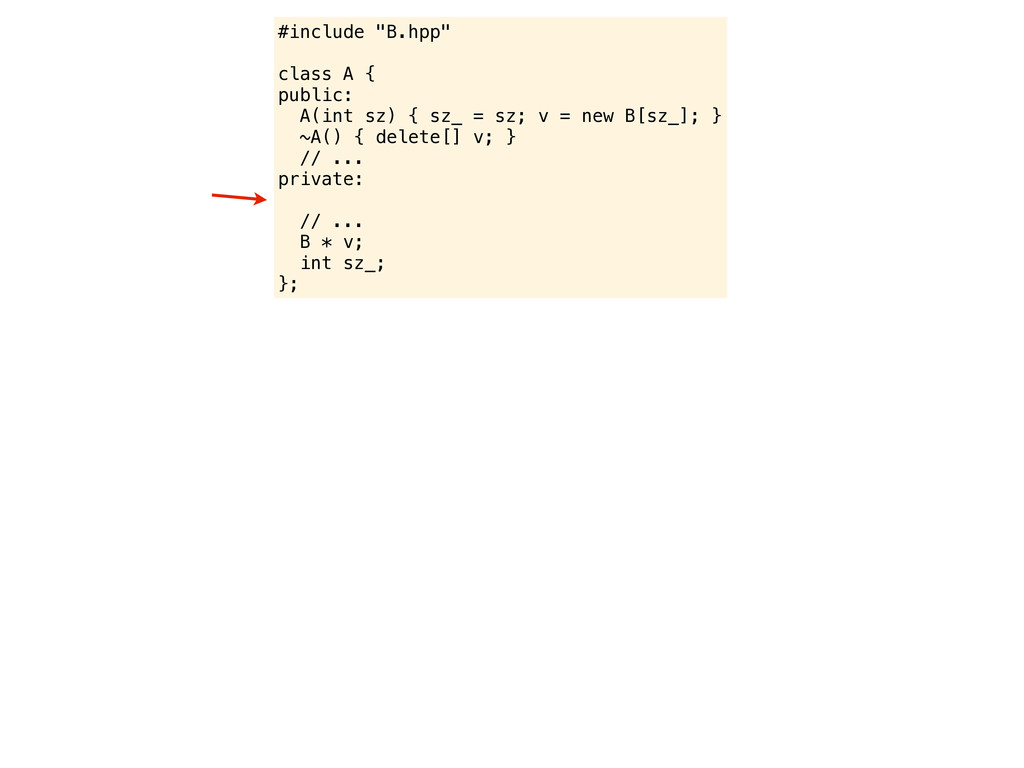
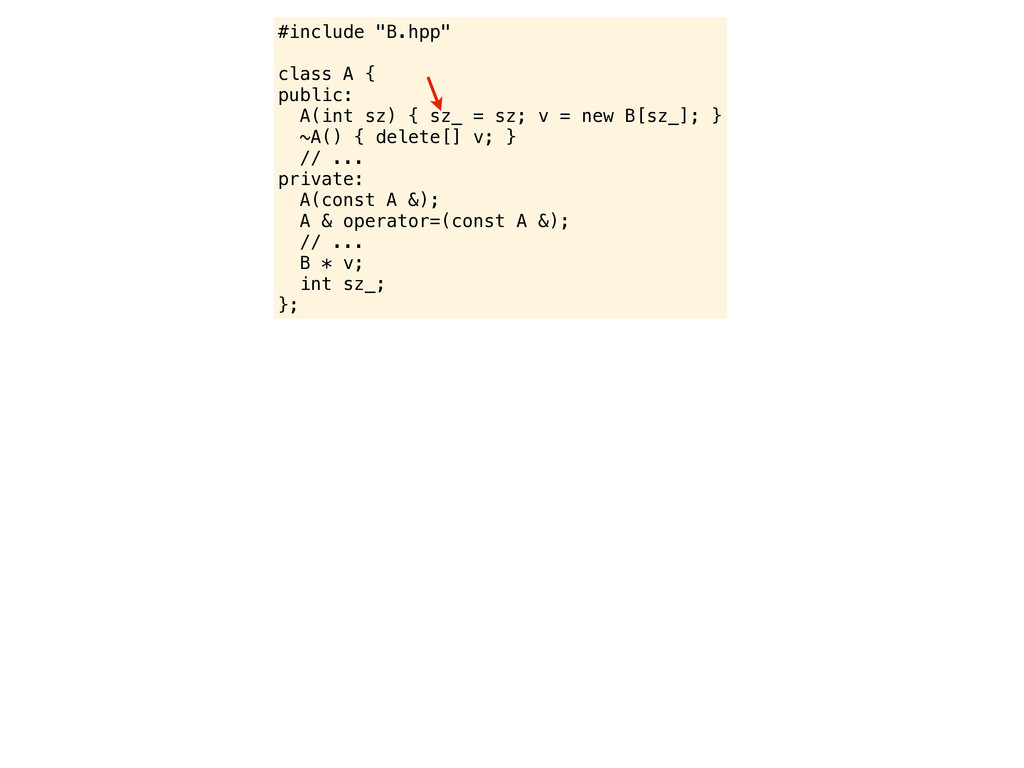
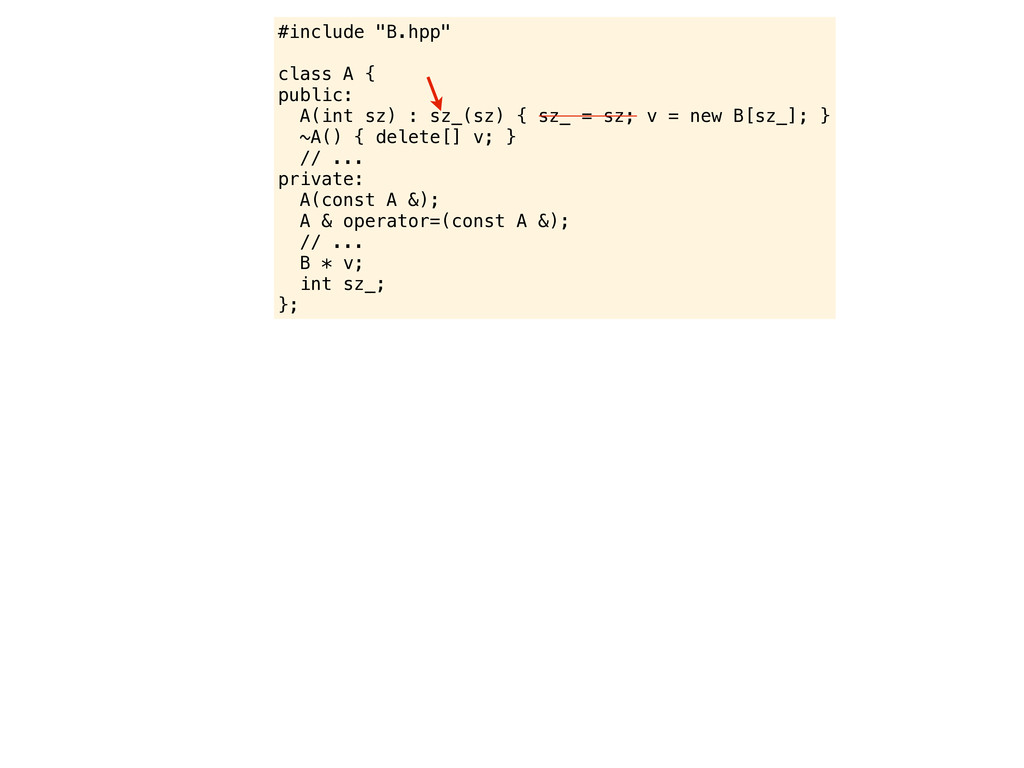
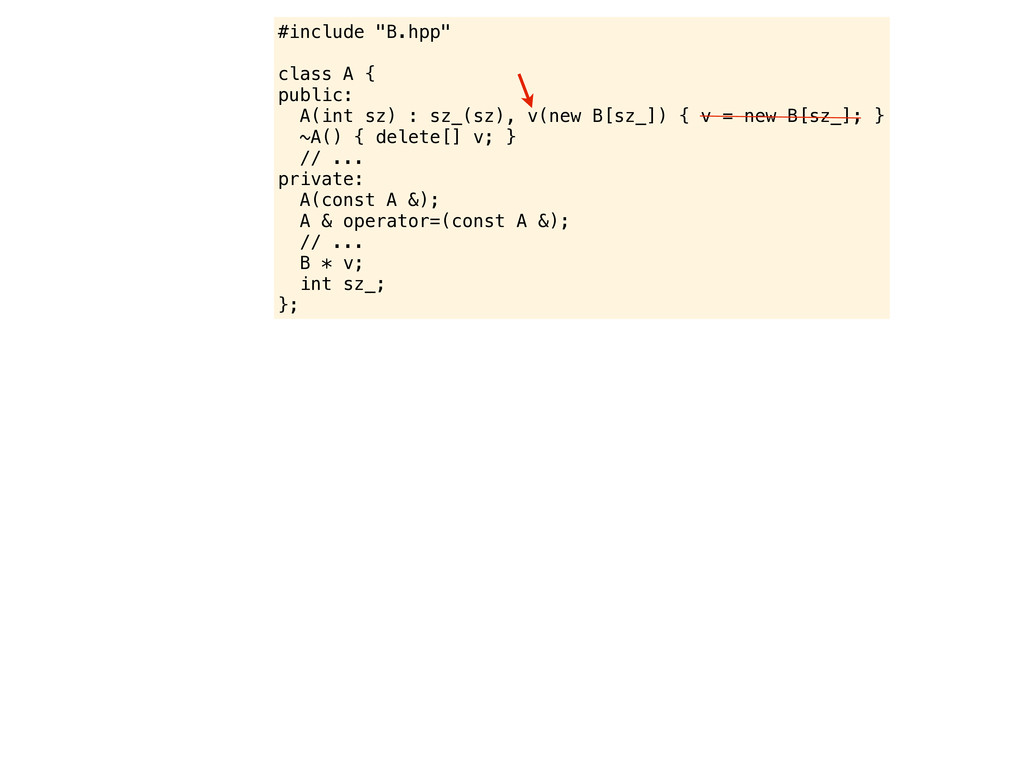
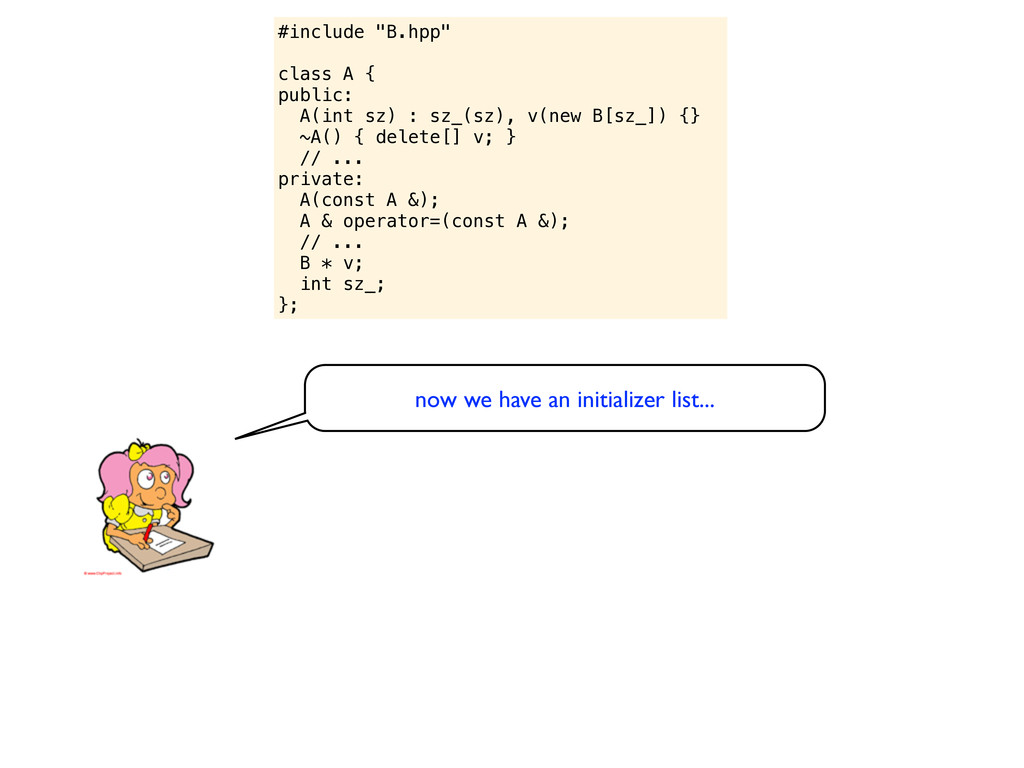
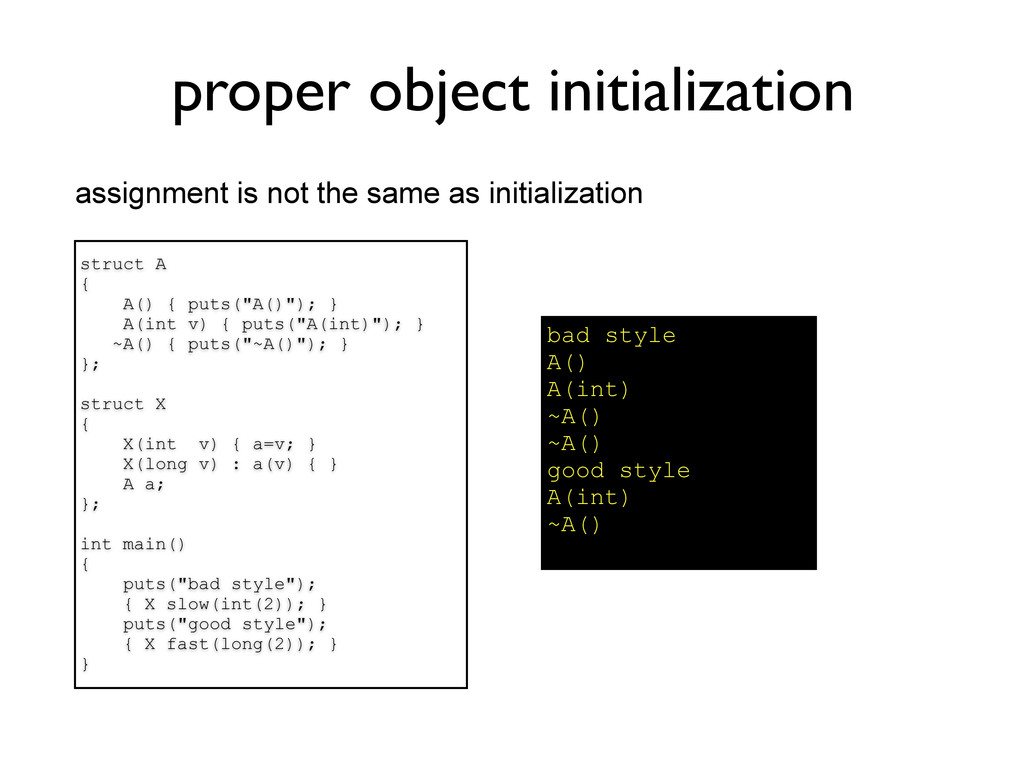
= sz; v = new B[sz_]; } ~A() { delete v; } // ... private: // ... B * v; int sz_; }; And the next thing is the often referred to as the “rule of three”. If you need a destructor, you probably also need to either implement or disable the copy constructor and the assignment operator, the default ones created by the compiler are probably not correct. A perhaps smaller issue, but also important, is to use the member initializer list to initialize an object. In the example above it does not really matter much, but when member objects are more complex it makes sense to explicitly initialize the members (using the initalizer list), rather than letting the object implicitly initialize all its member objects to default values, and then assign them some particular value.
= sz; v = new B[sz_]; } ~A() { delete v; } // ... private: // ... B * v; int sz_; }; And the next thing is the often referred to as the “rule of three”. If you need a destructor, you probably also need to either implement or disable the copy constructor and the assignment operator, the default ones created by the compiler are probably not correct. A perhaps smaller issue, but also important, is to use the member initializer list to initialize an object. In the example above it does not really matter much, but when member objects are more complex it makes sense to explicitly initialize the members (using the initalizer list), rather than letting the object implicitly initialize all its member objects to default values, and then assign them some particular value. Please fix the code and I will tell you more...
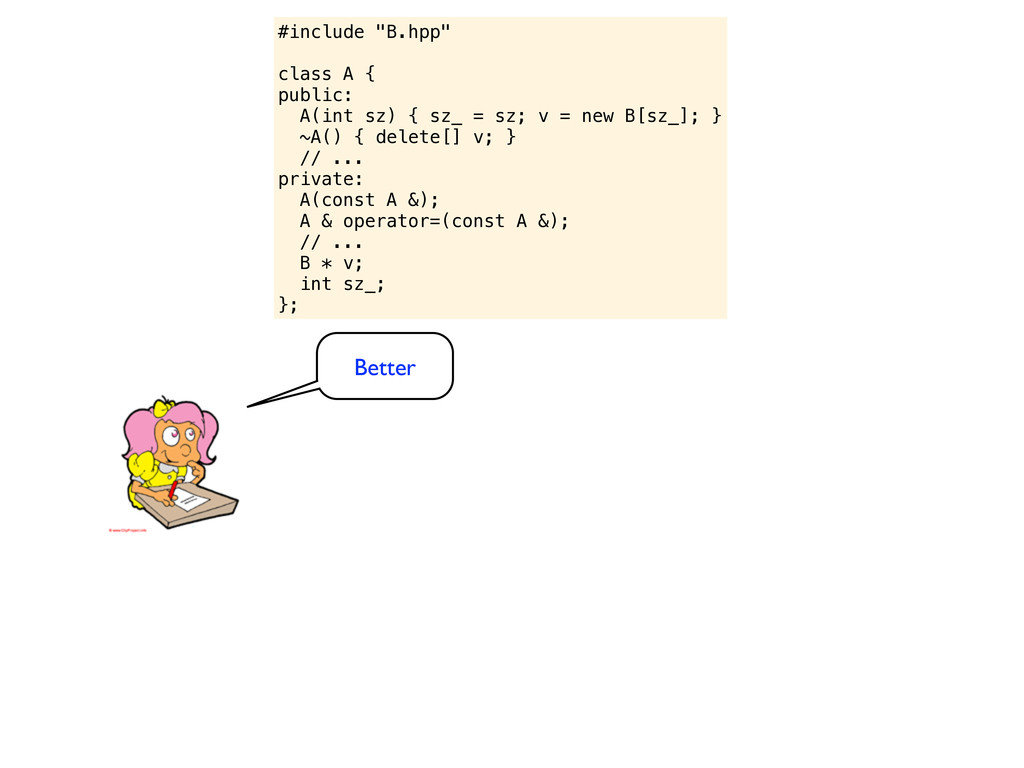
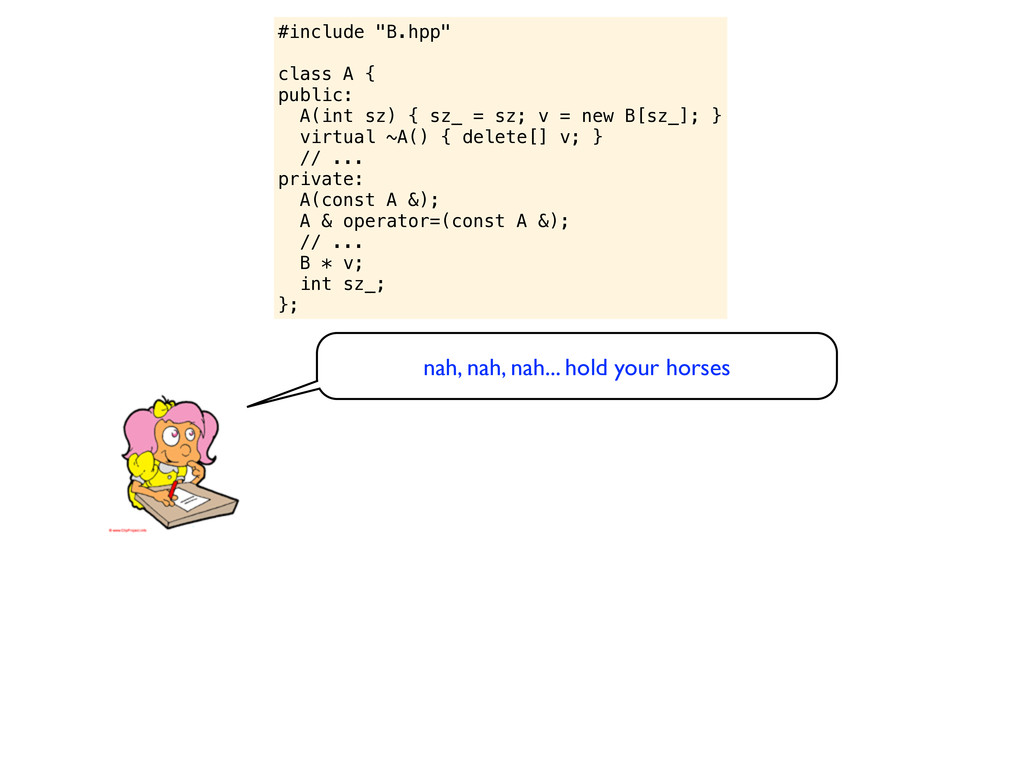
= sz; v = new B[sz_]; } virtual ~A() { delete[] v; } // ... private: A(const A &); A & operator=(const A &); // ... B * v; int sz_; }; nah, nah, nah... hold your horses
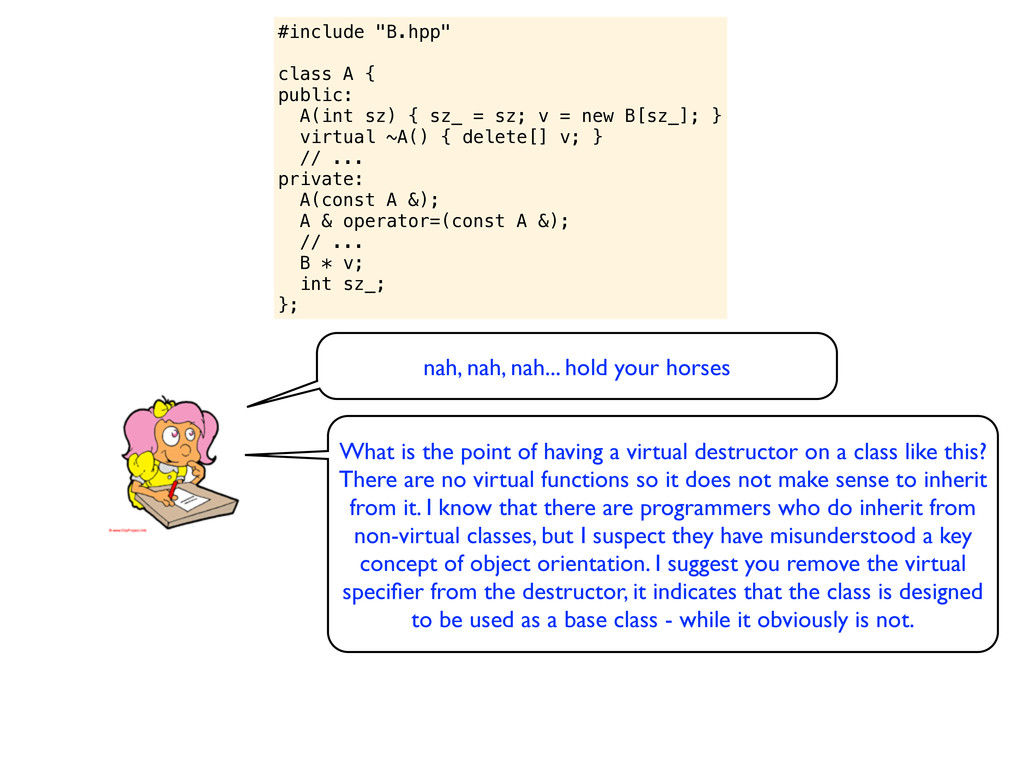
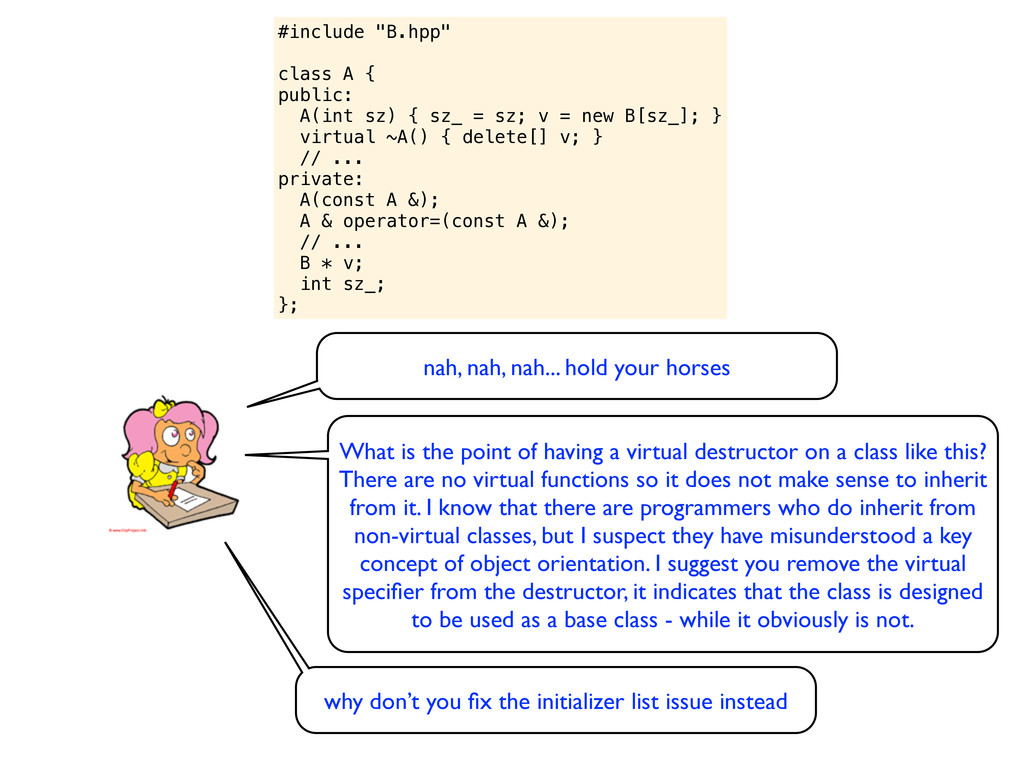
= sz; v = new B[sz_]; } virtual ~A() { delete[] v; } // ... private: A(const A &); A & operator=(const A &); // ... B * v; int sz_; }; nah, nah, nah... hold your horses What is the point of having a virtual destructor on a class like this? There are no virtual functions so it does not make sense to inherit from it. I know that there are programmers who do inherit from non-virtual classes, but I suspect they have misunderstood a key concept of object orientation. I suggest you remove the virtual specifier from the destructor, it indicates that the class is designed to be used as a base class - while it obviously is not.
= sz; v = new B[sz_]; } virtual ~A() { delete[] v; } // ... private: A(const A &); A & operator=(const A &); // ... B * v; int sz_; }; nah, nah, nah... hold your horses What is the point of having a virtual destructor on a class like this? There are no virtual functions so it does not make sense to inherit from it. I know that there are programmers who do inherit from non-virtual classes, but I suspect they have misunderstood a key concept of object orientation. I suggest you remove the virtual specifier from the destructor, it indicates that the class is designed to be used as a base class - while it obviously is not. why don’t you fix the initializer list issue instead
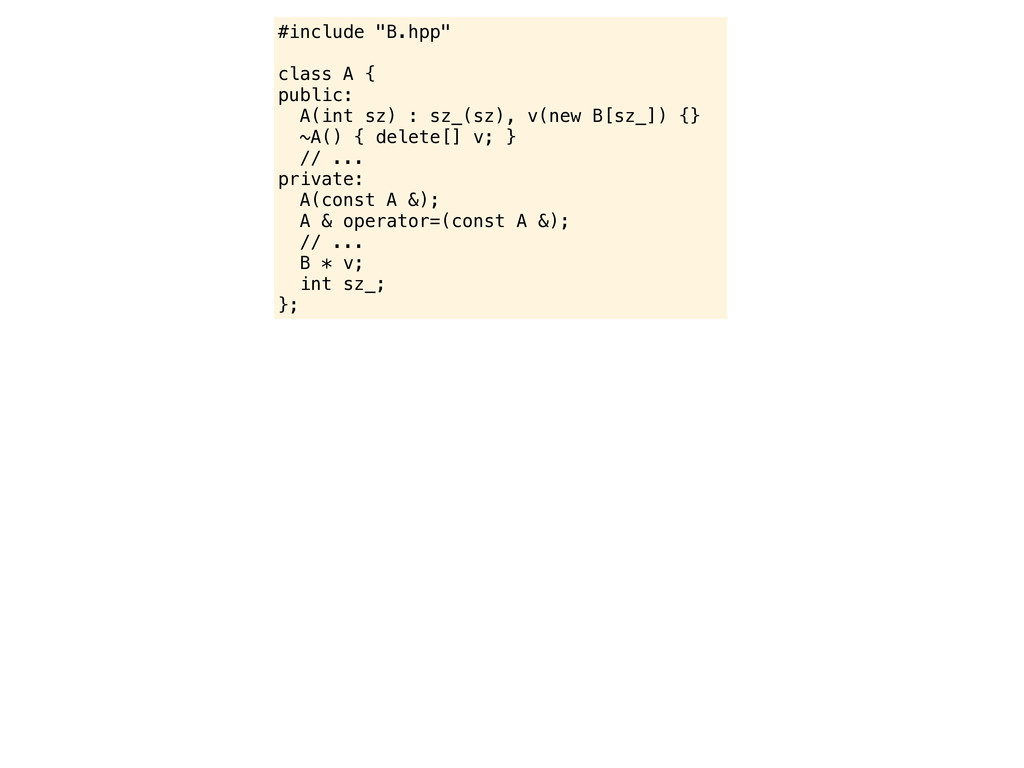
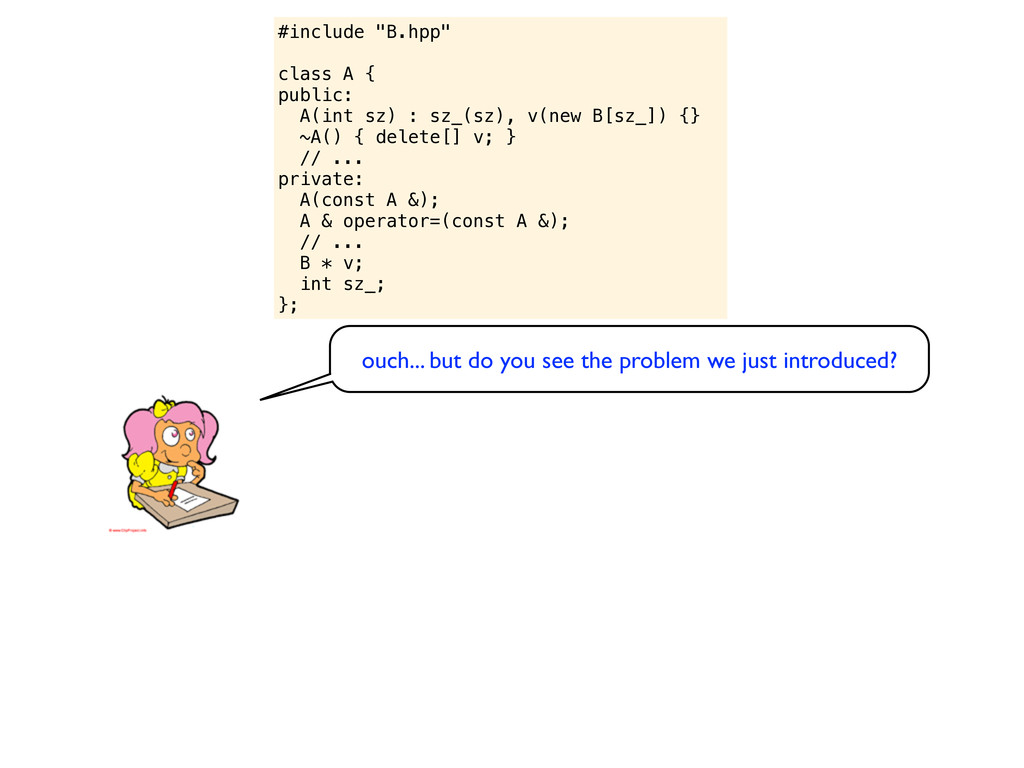
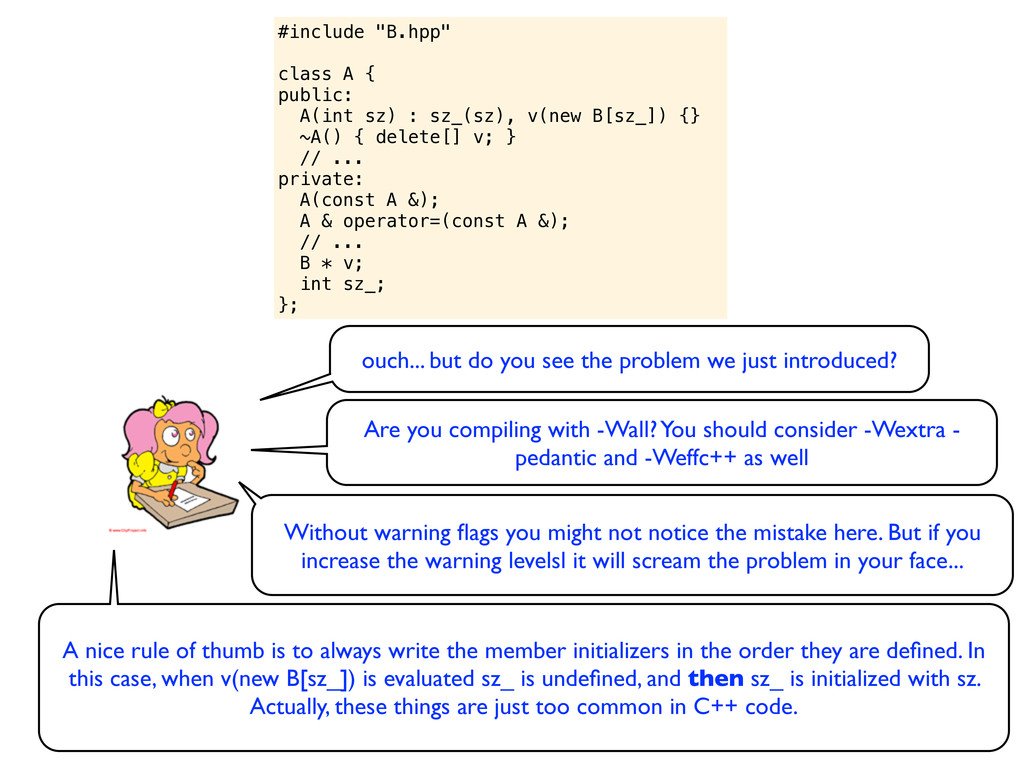
v(new B[sz_]) {} ~A() { delete[] v; } // ... private: A(const A &); A & operator=(const A &); // ... B * v; int sz_; }; ouch... but do you see the problem we just introduced?
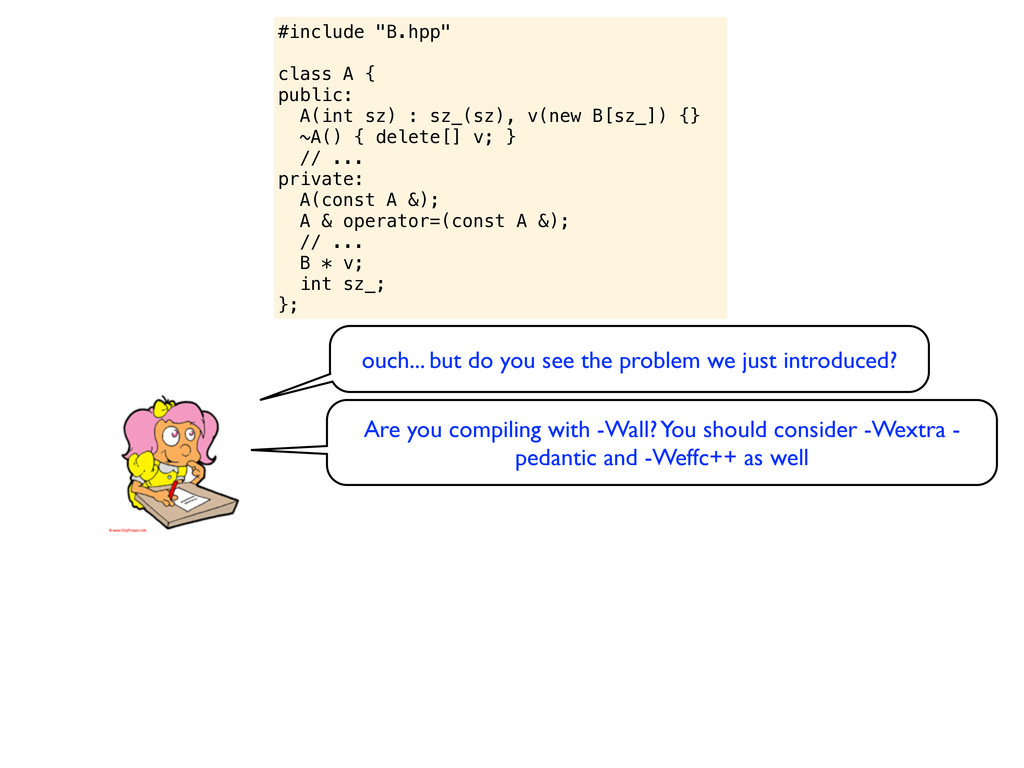
v(new B[sz_]) {} ~A() { delete[] v; } // ... private: A(const A &); A & operator=(const A &); // ... B * v; int sz_; }; ouch... but do you see the problem we just introduced? Are you compiling with -Wall? You should consider -Wextra - pedantic and -Weffc++ as well
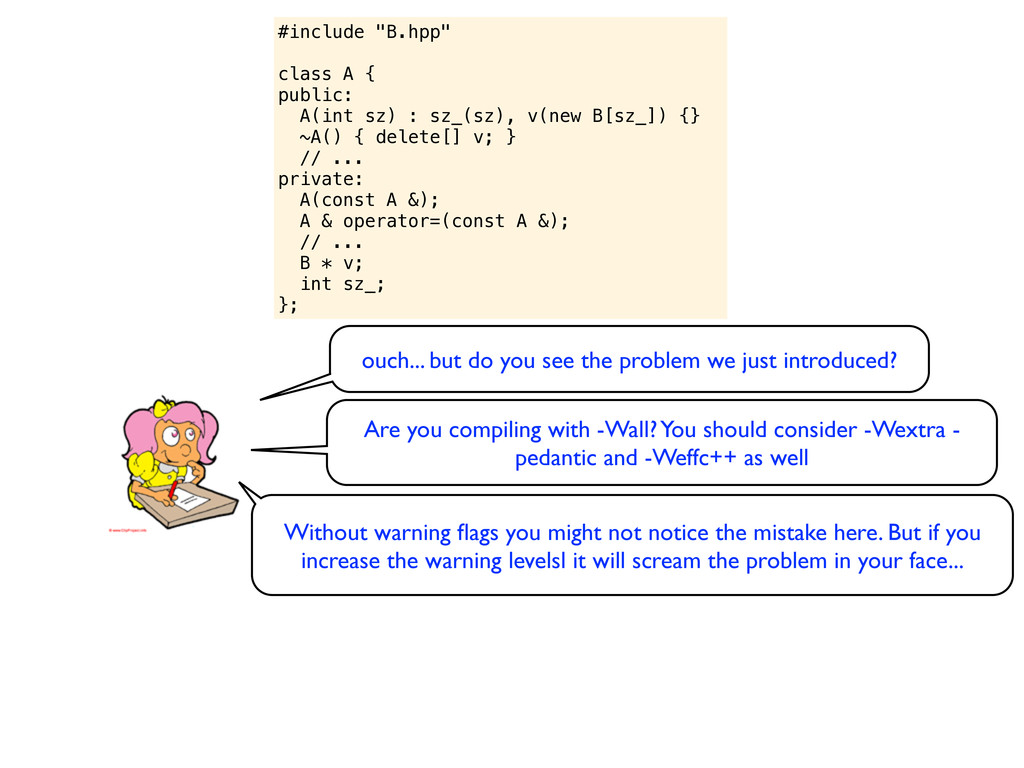
v(new B[sz_]) {} ~A() { delete[] v; } // ... private: A(const A &); A & operator=(const A &); // ... B * v; int sz_; }; ouch... but do you see the problem we just introduced? Are you compiling with -Wall? You should consider -Wextra - pedantic and -Weffc++ as well Without warning flags you might not notice the mistake here. But if you increase the warning levelsl it will scream the problem in your face...
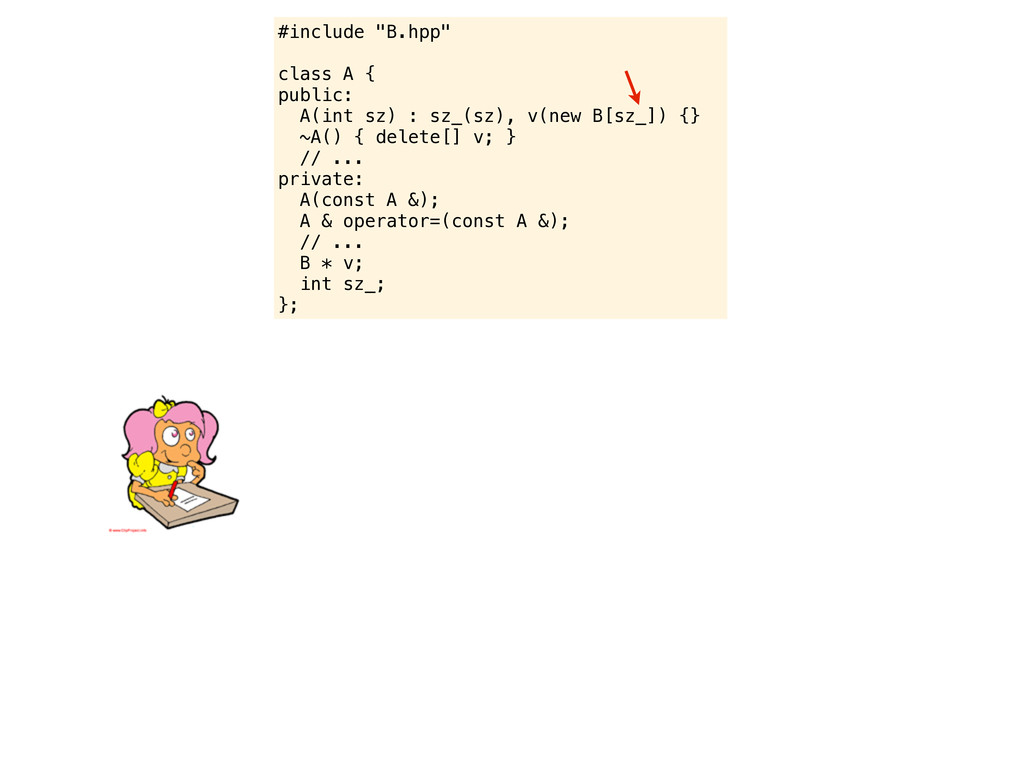
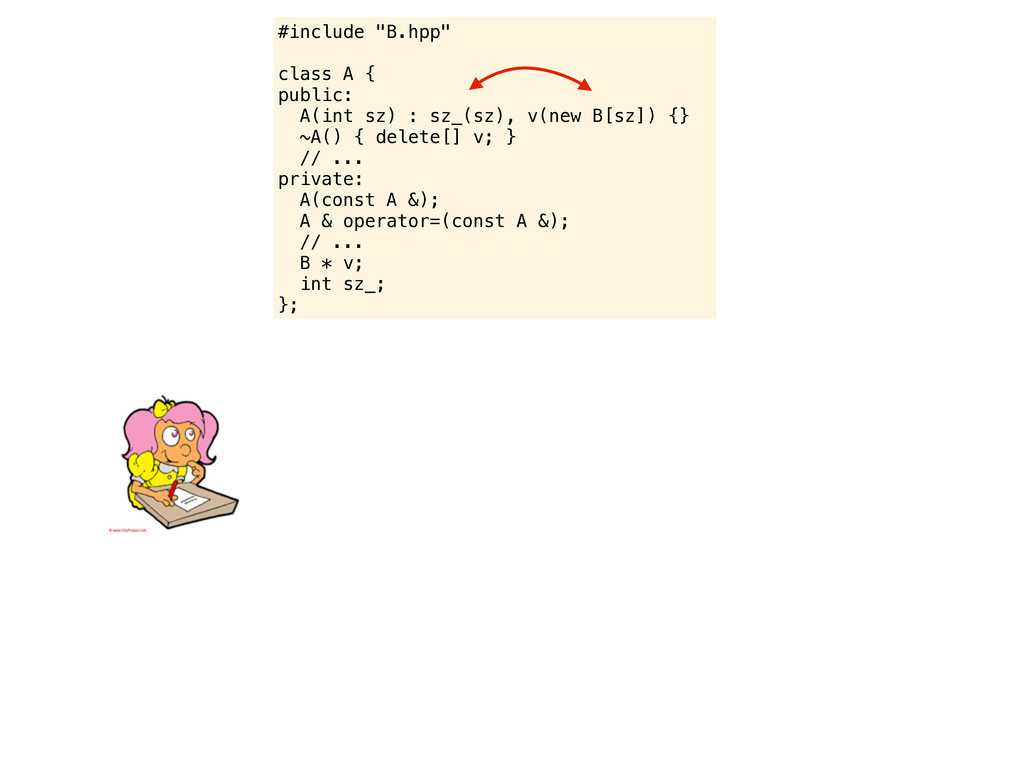
v(new B[sz_]) {} ~A() { delete[] v; } // ... private: A(const A &); A & operator=(const A &); // ... B * v; int sz_; }; ouch... but do you see the problem we just introduced? Are you compiling with -Wall? You should consider -Wextra - pedantic and -Weffc++ as well A nice rule of thumb is to always write the member initializers in the order they are defined. In this case, when v(new B[sz_]) is evaluated sz_ is undefined, and then sz_ is initialized with sz. Actually, these things are just too common in C++ code. Without warning flags you might not notice the mistake here. But if you increase the warning levelsl it will scream the problem in your face...
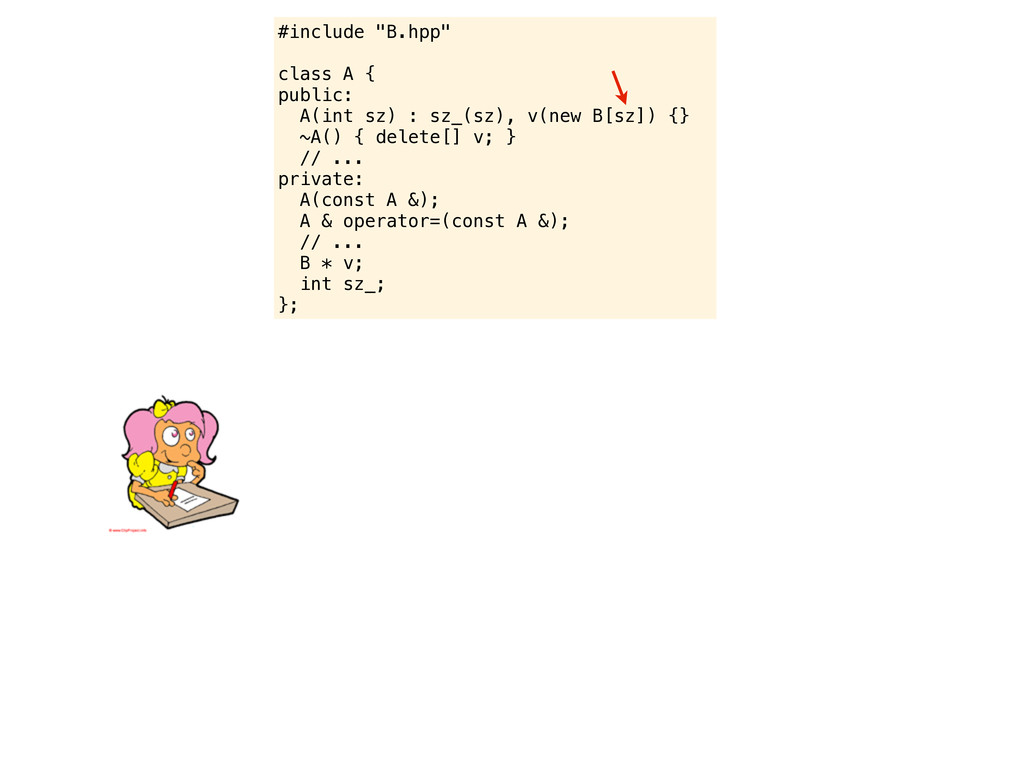
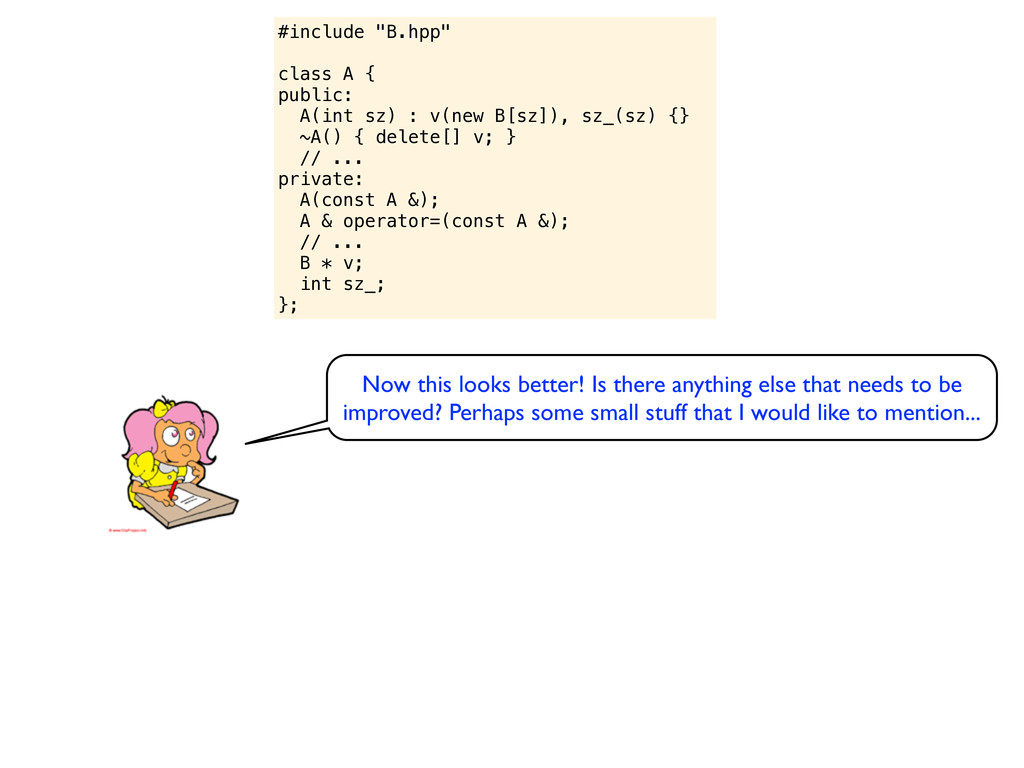
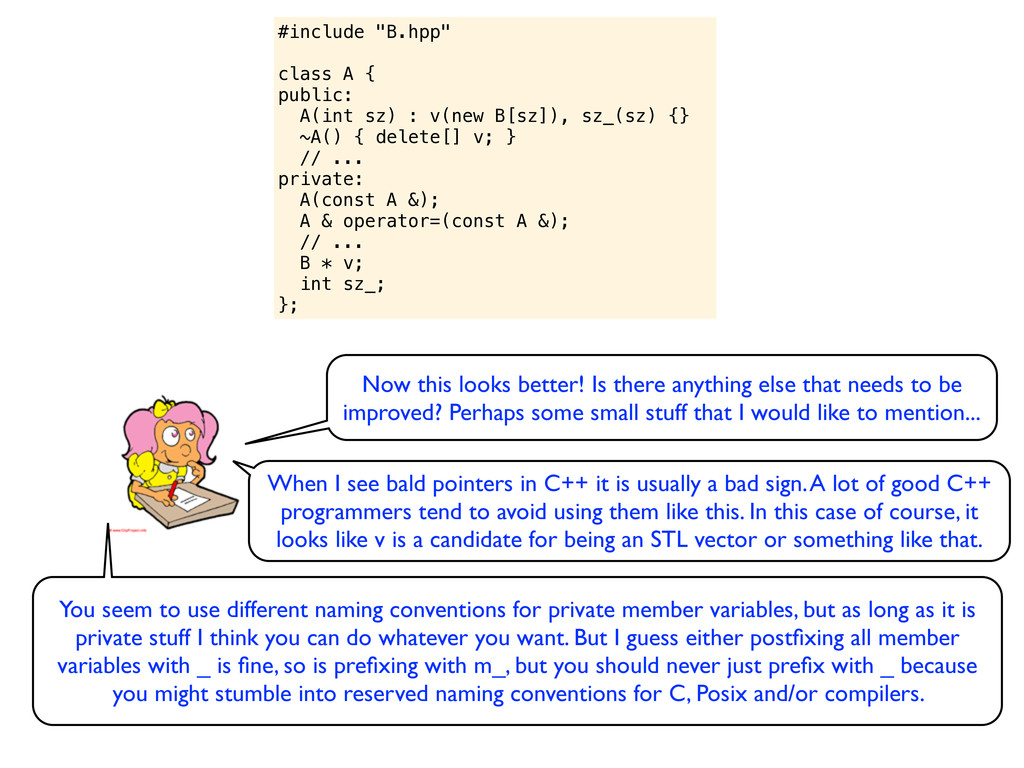
B[sz]), sz_(sz) {} ~A() { delete[] v; } // ... private: A(const A &); A & operator=(const A &); // ... B * v; int sz_; }; Now this looks better! Is there anything else that needs to be improved? Perhaps some small stuff that I would like to mention...
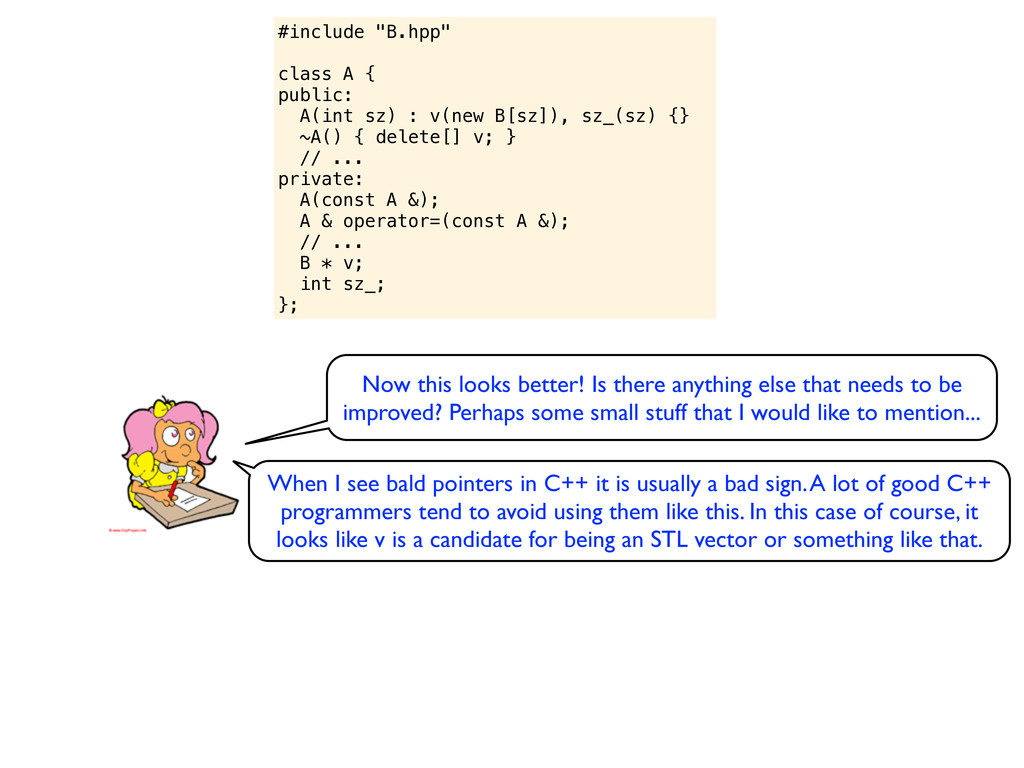
B[sz]), sz_(sz) {} ~A() { delete[] v; } // ... private: A(const A &); A & operator=(const A &); // ... B * v; int sz_; }; Now this looks better! Is there anything else that needs to be improved? Perhaps some small stuff that I would like to mention... When I see bald pointers in C++ it is usually a bad sign. A lot of good C++ programmers tend to avoid using them like this. In this case of course, it looks like v is a candidate for being an STL vector or something like that.
B[sz]), sz_(sz) {} ~A() { delete[] v; } // ... private: A(const A &); A & operator=(const A &); // ... B * v; int sz_; }; Now this looks better! Is there anything else that needs to be improved? Perhaps some small stuff that I would like to mention... You seem to use different naming conventions for private member variables, but as long as it is private stuff I think you can do whatever you want. But I guess either postfixing all member variables with _ is fine, so is prefixing with m_, but you should never just prefix with _ because you might stumble into reserved naming conventions for C, Posix and/or compilers. When I see bald pointers in C++ it is usually a bad sign. A lot of good C++ programmers tend to avoid using them like this. In this case of course, it looks like v is a candidate for being an STL vector or something like that.
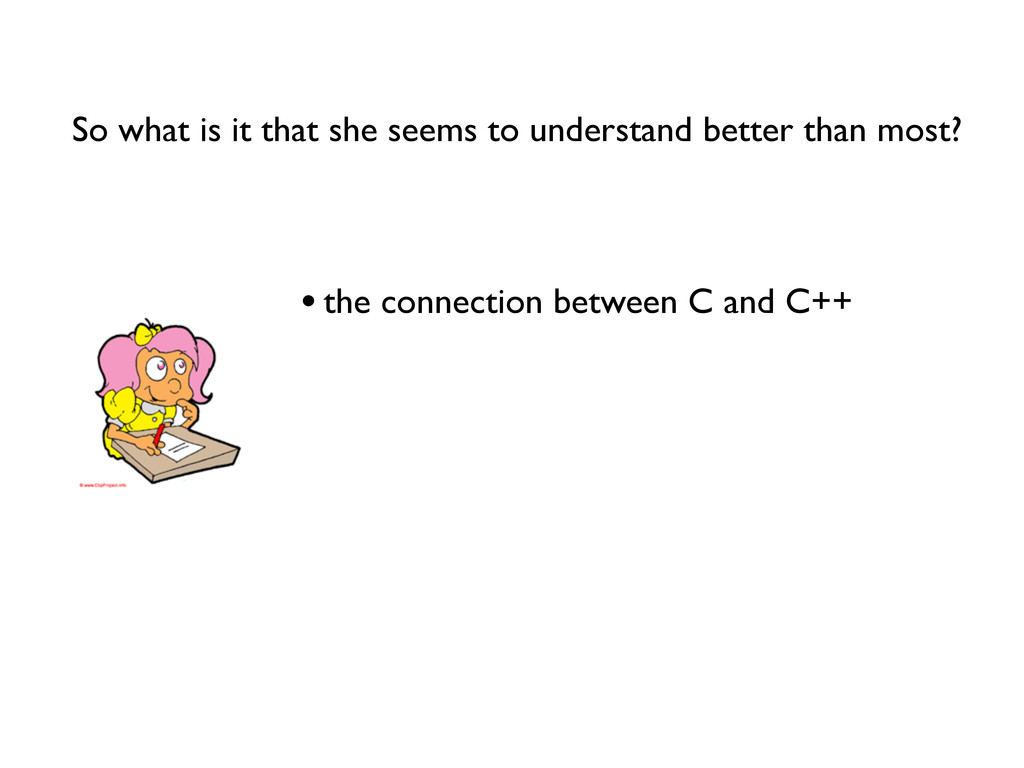
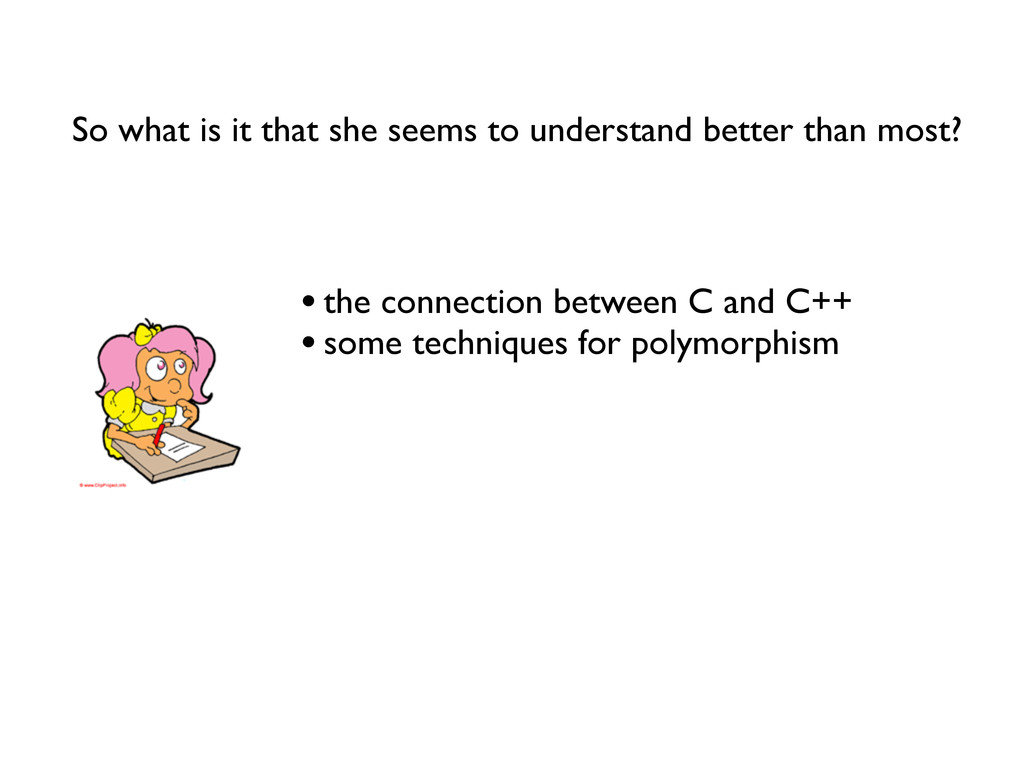
for polymorphism • how to initialize objects properly • rule of three • operator new[] and delete[] So what is it that she seems to understand better than most?
for polymorphism • how to initialize objects properly • rule of three • operator new[] and delete[] • common naming conventions So what is it that she seems to understand better than most?
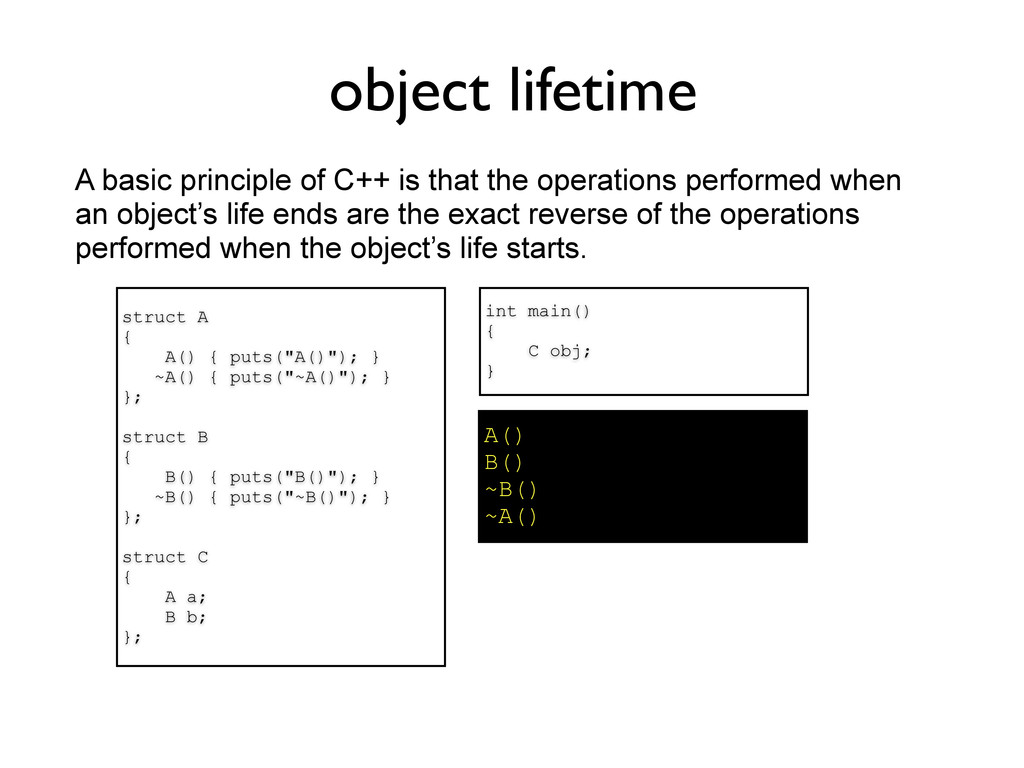
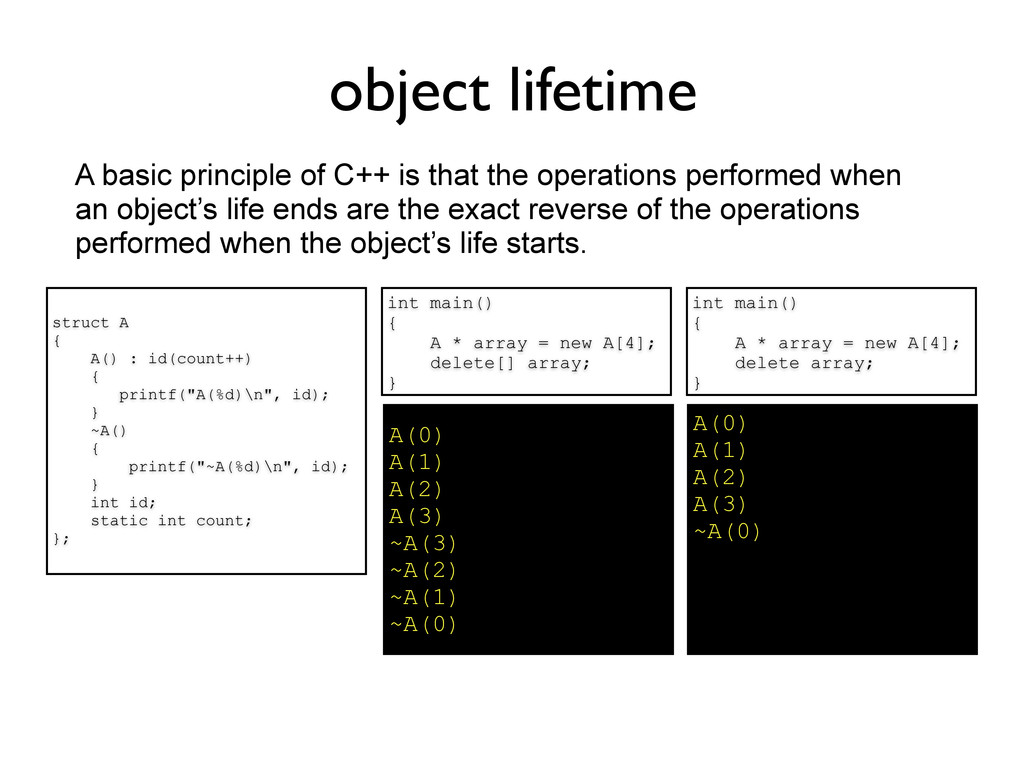
operations performed when an object’s life ends are the exact reverse of the operations performed when the object’s life starts. struct A { A() { puts("A()"); } ~A() { puts("~A()"); } }; struct B { B() { puts("B()"); } ~B() { puts("~B()"); } }; struct C { A a; B b; }; int main() { C obj; } A() B() ~B() ~A()
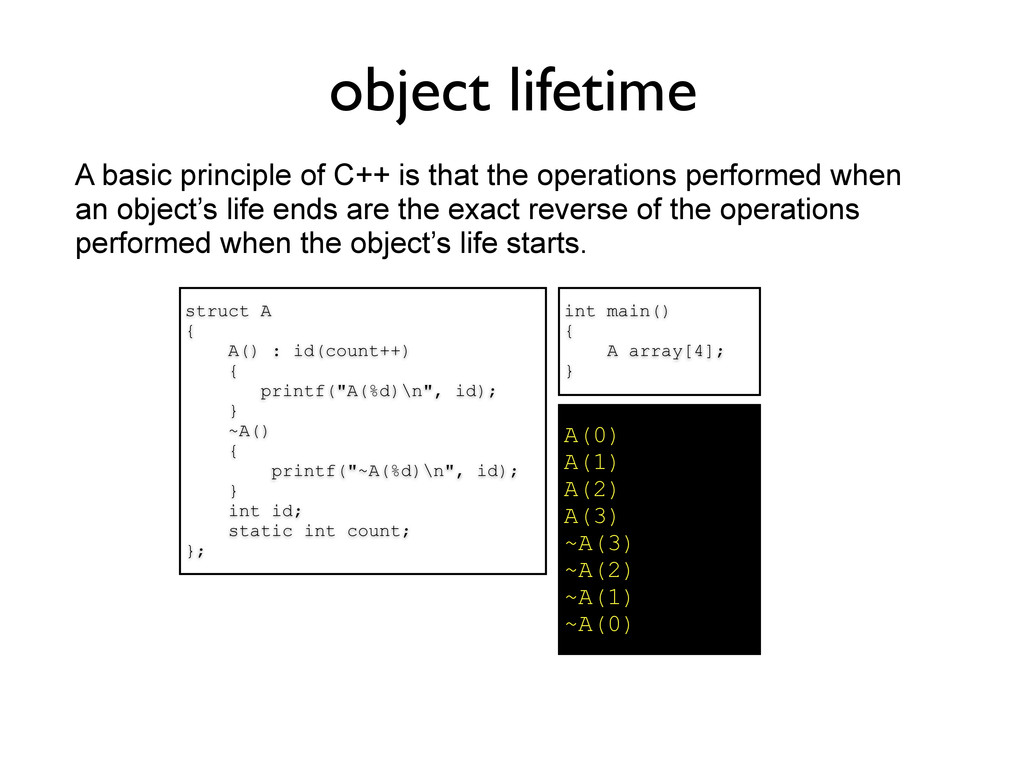
operations performed when an object’s life ends are the exact reverse of the operations performed when the object’s life starts. struct A { A() : id(count++) { printf("A(%d)\n", id); } ~A() { printf("~A(%d)\n", id); } int id; static int count; }; int main() { A array[4]; } A(0) A(1) A(2) A(3) ~A(3) ~A(2) ~A(1) ~A(0)
operations performed when an object’s life ends are the exact reverse of the operations performed when the object’s life starts. struct A { A() : id(count++) { printf("A(%d)\n", id); } ~A() { printf("~A(%d)\n", id); } int id; static int count; }; A(0) A(1) A(2) A(3) ~A(3) ~A(2) ~A(1) ~A(0) int main() { A * array = new A[4]; delete array; } A(0) A(1) A(2) A(3) ~A(0) int main() { A * array = new A[4]; delete[] array; }
g(); int a,b; }; struct derived : base { virtual void g(); virtual void h(); int c; }; void poly(base * ptr) { ptr->f(); ptr->g(); } int main() { poly(&base()); poly(&derived()); } base::f() {} base::g() {} f g vptr a b 0 1 base object base vtable vptr a b c f g h 0 1 derived object derived vtable derived::g() {} derived::h() {} 2
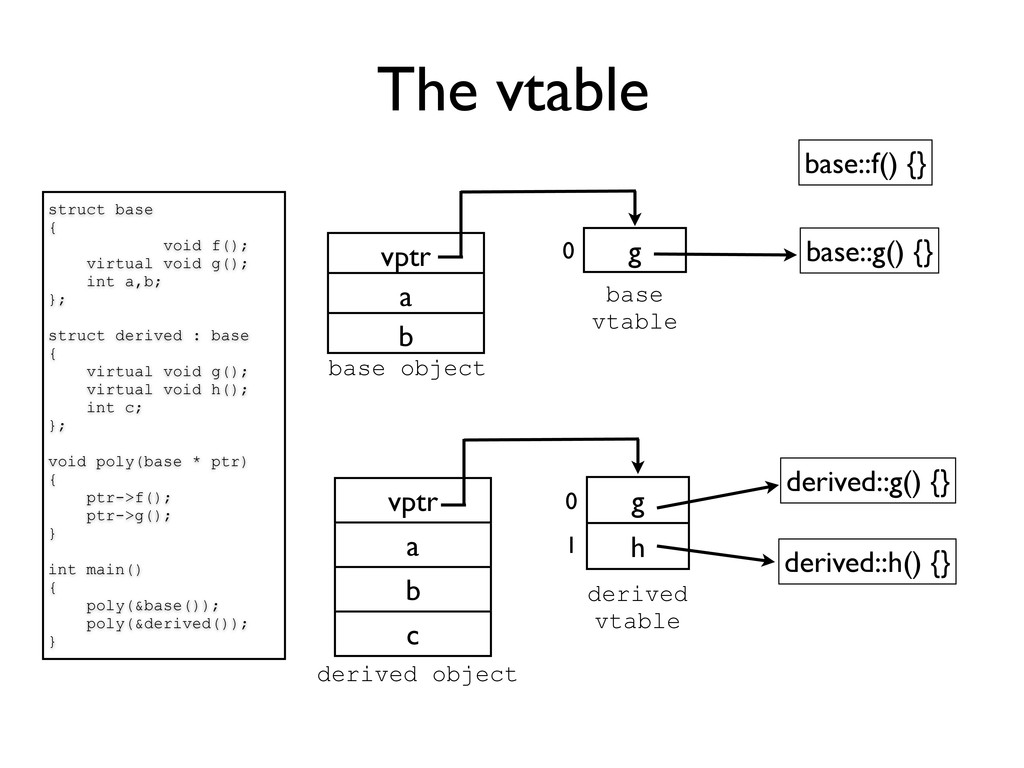
int a,b; }; struct derived : base { virtual void g(); virtual void h(); int c; }; void poly(base * ptr) { ptr->f(); ptr->g(); } int main() { poly(&base()); poly(&derived()); } base::f() {} base::g() {} g vptr a b 0 base object base vtable vptr a b c g h 0 1 derived object derived vtable derived::g() {} derived::h() {}
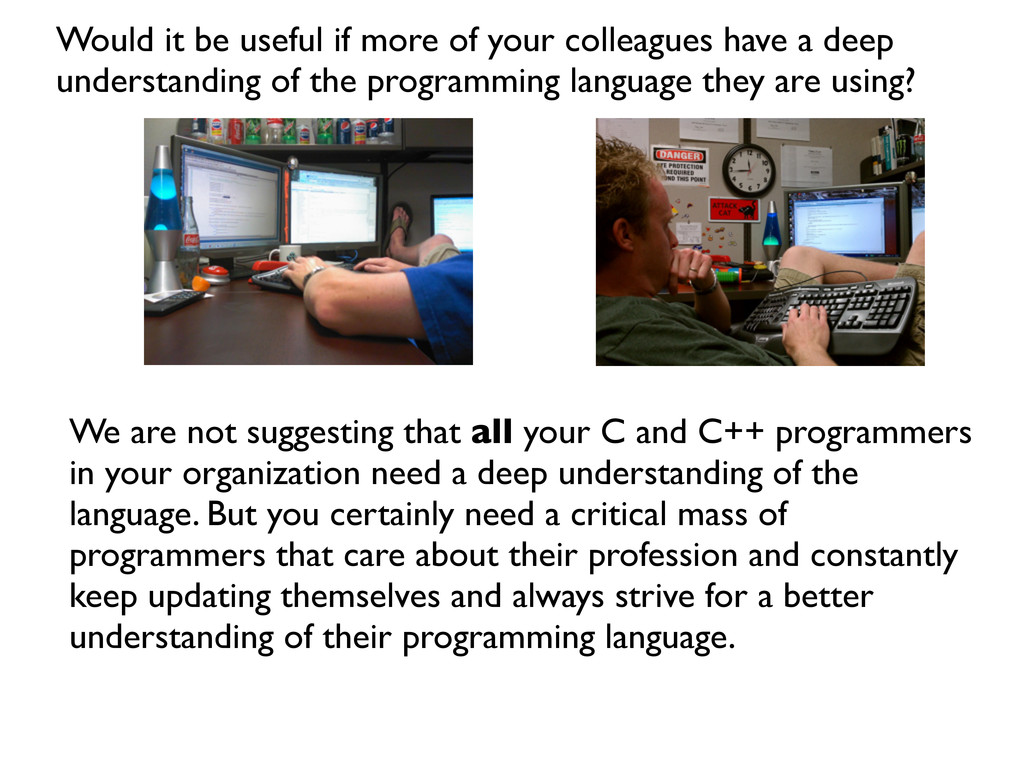
a deep understanding of the programming language they are using? We are not suggesting that all your C and C++ programmers in your organization need a deep understanding of the language. But you certainly need a critical mass of programmers that care about their profession and constantly keep updating themselves and always strive for a better understanding of their programming language.
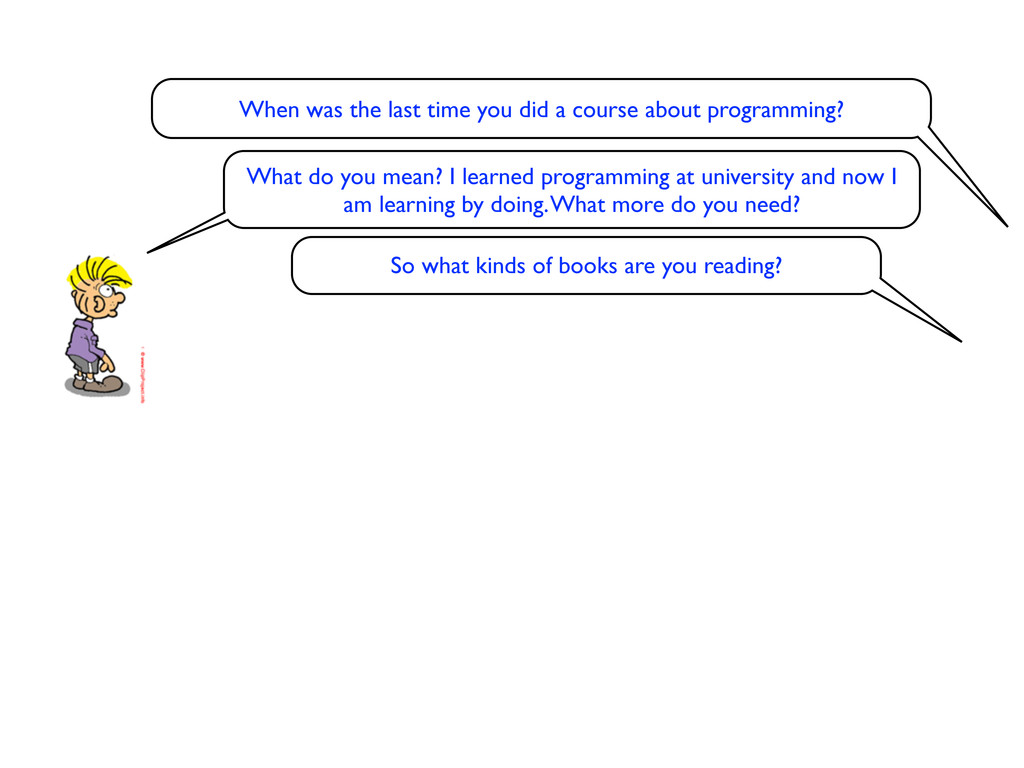
programming? What do you mean? I learned programming at university and now I am learning by doing. What more do you need? So what kinds of books are you reading?
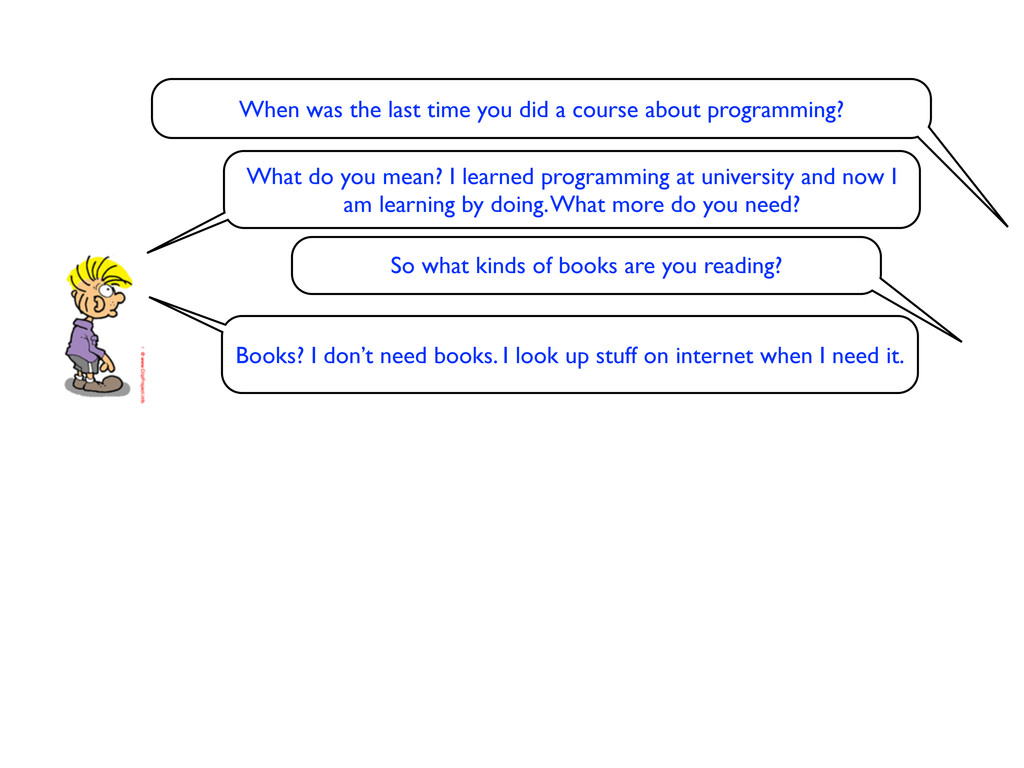
programming? What do you mean? I learned programming at university and now I am learning by doing. What more do you need? So what kinds of books are you reading? Books? I don’t need books. I look up stuff on internet when I need it.
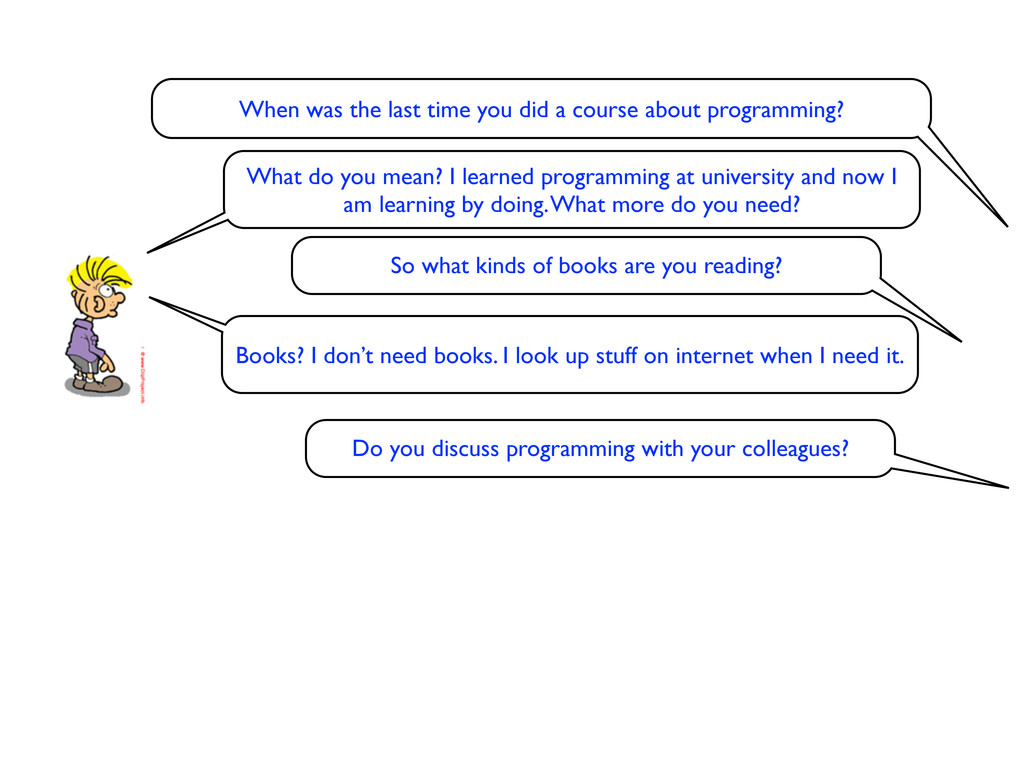
programming? What do you mean? I learned programming at university and now I am learning by doing. What more do you need? So what kinds of books are you reading? Books? I don’t need books. I look up stuff on internet when I need it. Do you discuss programming with your colleagues?
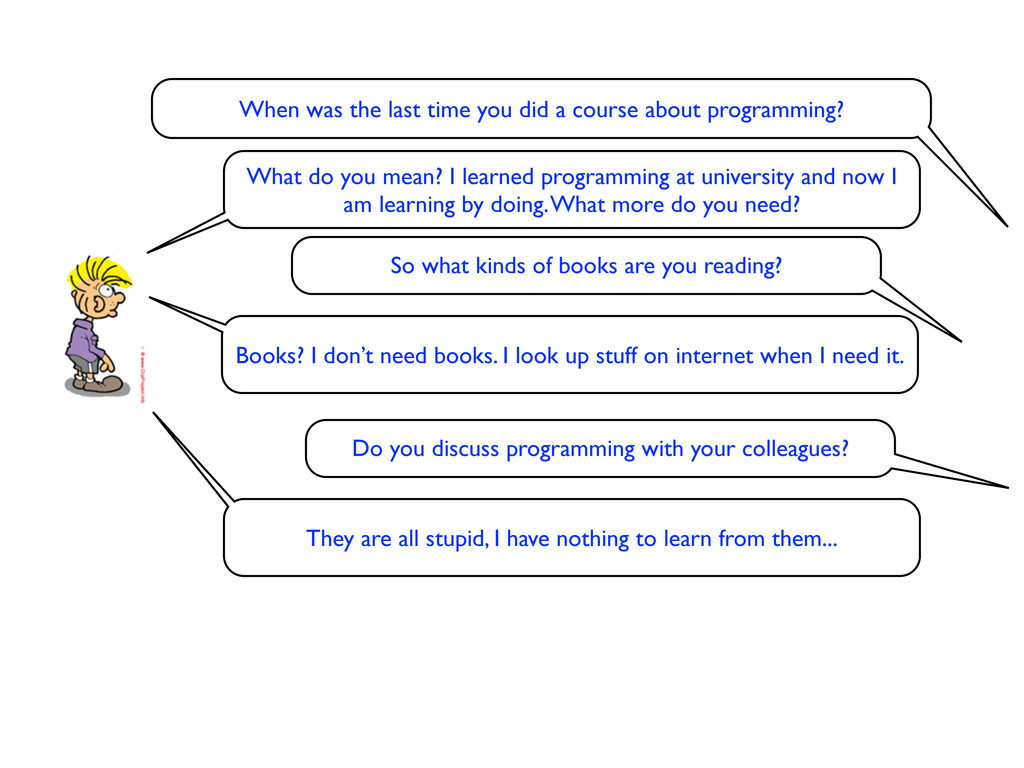
programming? What do you mean? I learned programming at university and now I am learning by doing. What more do you need? So what kinds of books are you reading? Books? I don’t need books. I look up stuff on internet when I need it. Do you discuss programming with your colleagues? They are all stupid, I have nothing to learn from them...
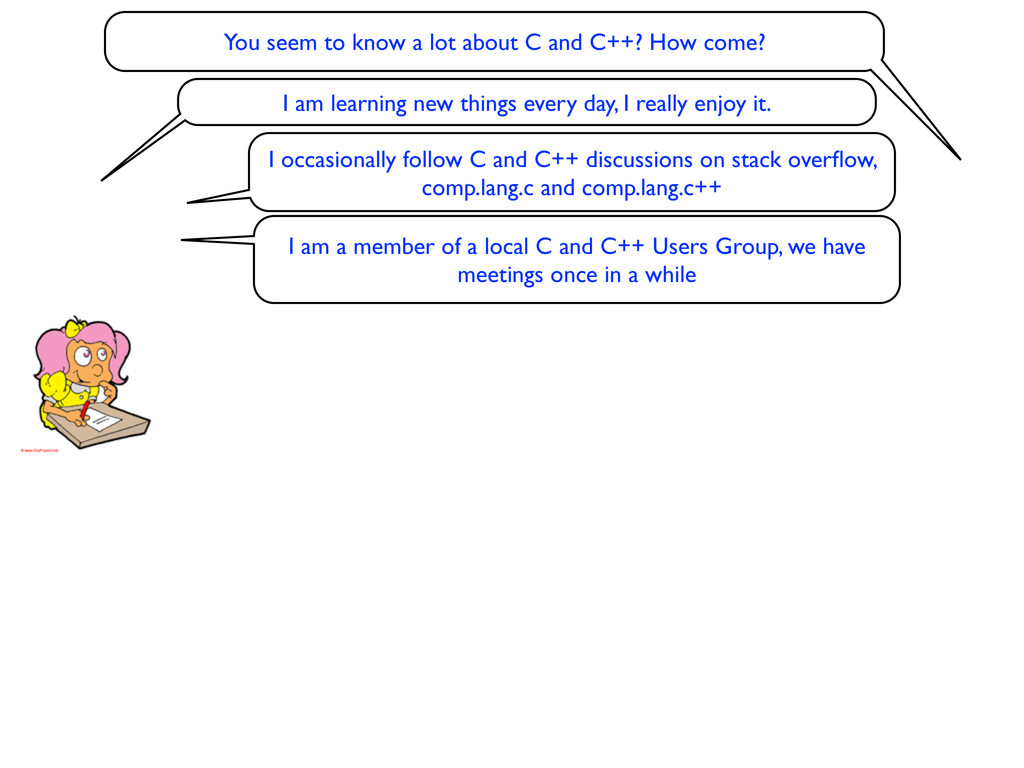
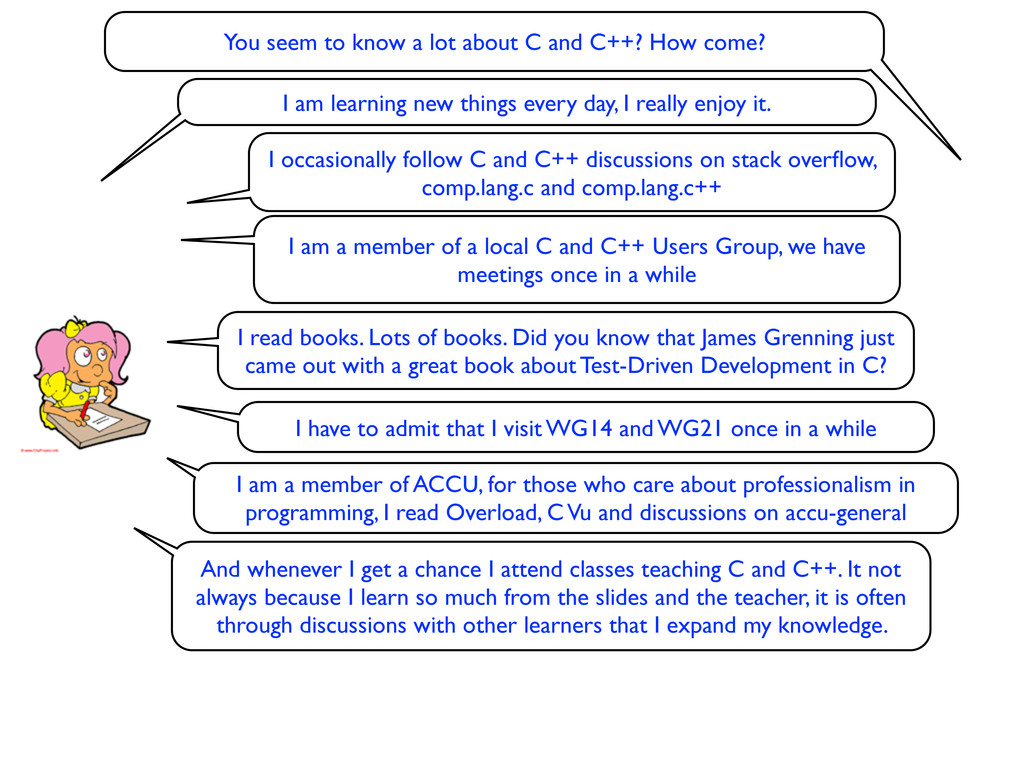
How come? I am learning new things every day, I really enjoy it. I occasionally follow C and C++ discussions on stack overflow, comp.lang.c and comp.lang.c++
How come? I am learning new things every day, I really enjoy it. I occasionally follow C and C++ discussions on stack overflow, comp.lang.c and comp.lang.c++ I am a member of a local C and C++ Users Group, we have meetings once in a while
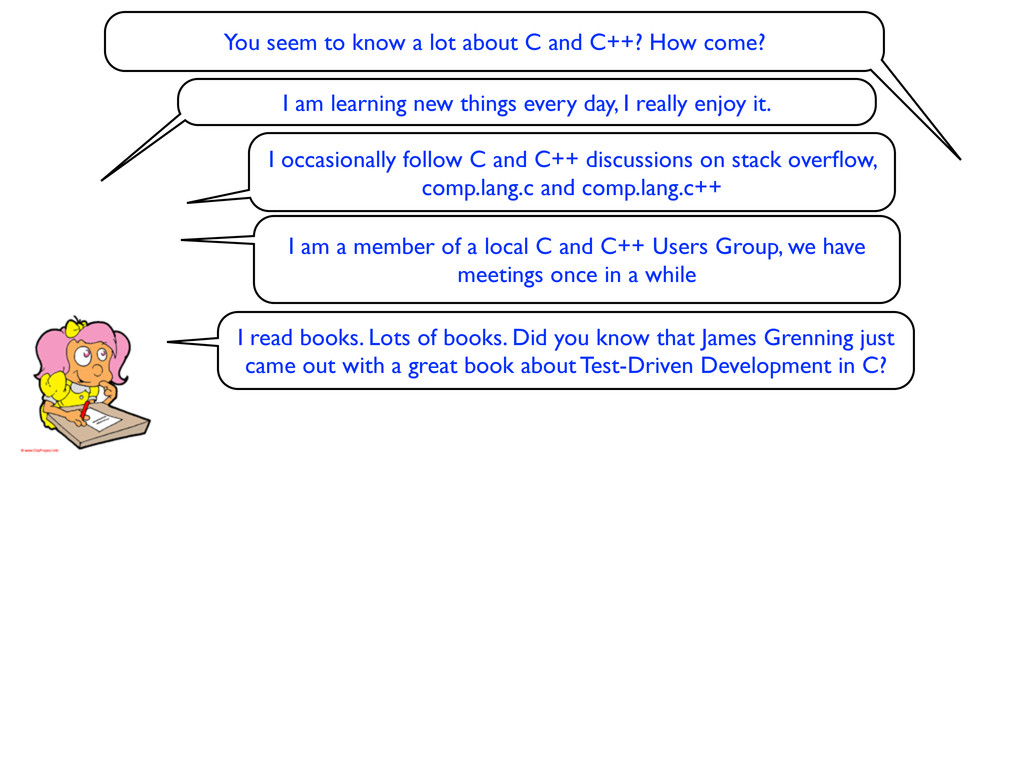
How come? I am learning new things every day, I really enjoy it. I read books. Lots of books. Did you know that James Grenning just came out with a great book about Test-Driven Development in C? I occasionally follow C and C++ discussions on stack overflow, comp.lang.c and comp.lang.c++ I am a member of a local C and C++ Users Group, we have meetings once in a while
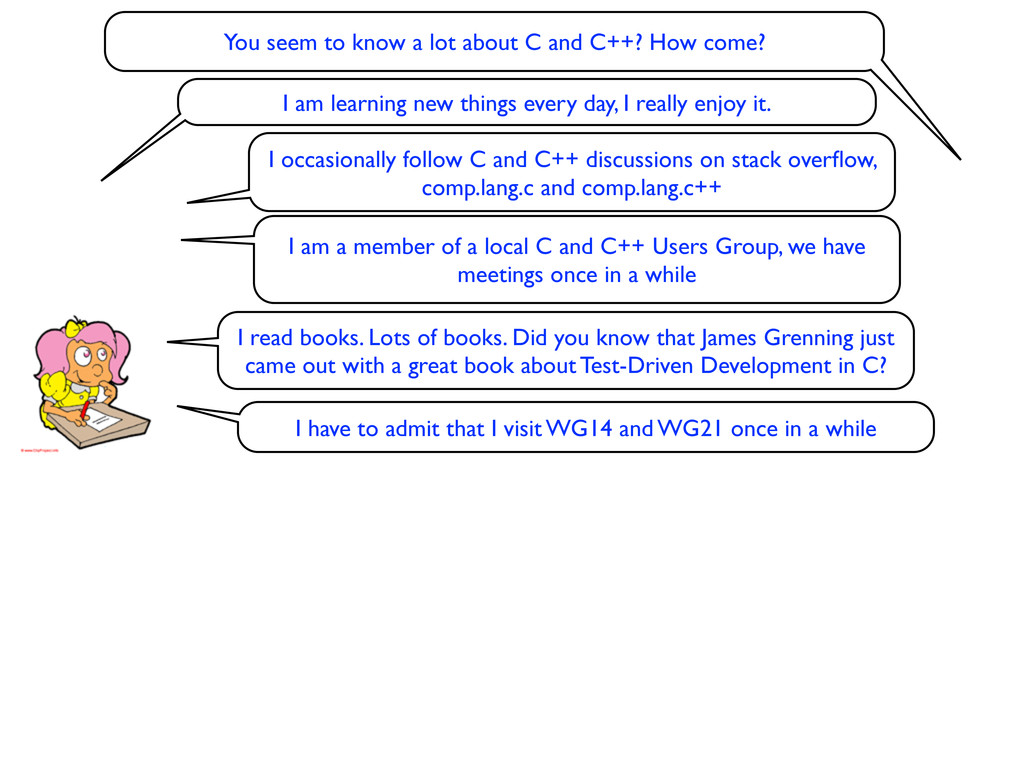
How come? I am learning new things every day, I really enjoy it. I have to admit that I visit WG14 and WG21 once in a while I read books. Lots of books. Did you know that James Grenning just came out with a great book about Test-Driven Development in C? I occasionally follow C and C++ discussions on stack overflow, comp.lang.c and comp.lang.c++ I am a member of a local C and C++ Users Group, we have meetings once in a while
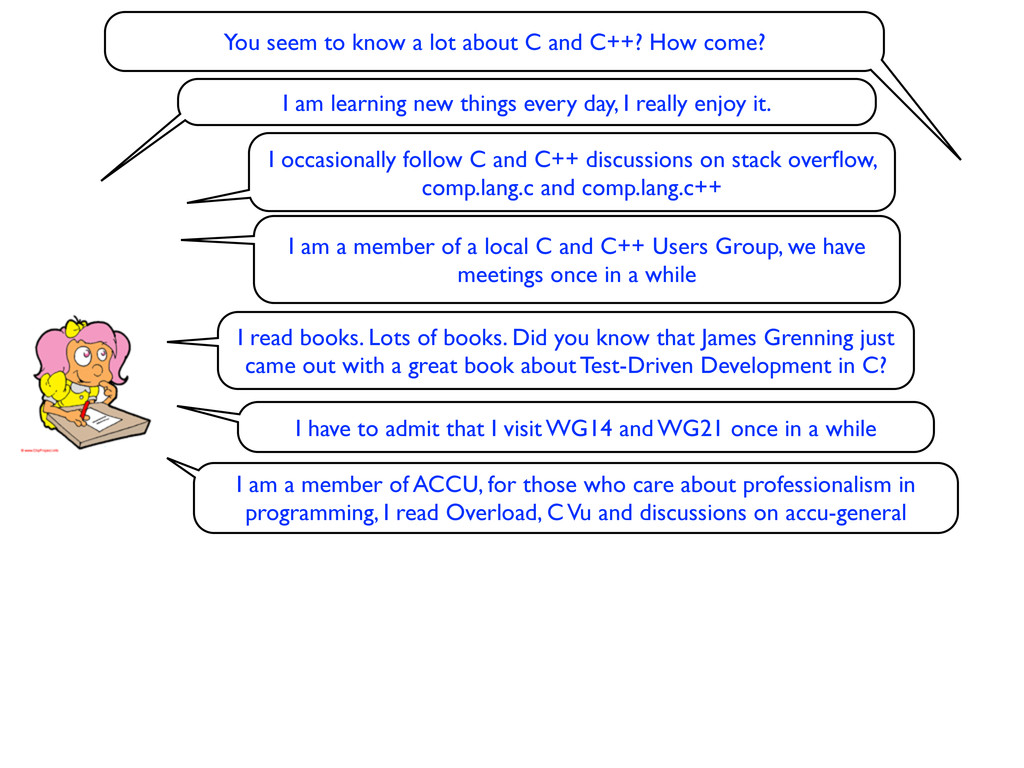
How come? I am learning new things every day, I really enjoy it. I have to admit that I visit WG14 and WG21 once in a while I read books. Lots of books. Did you know that James Grenning just came out with a great book about Test-Driven Development in C? I occasionally follow C and C++ discussions on stack overflow, comp.lang.c and comp.lang.c++ I am a member of a local C and C++ Users Group, we have meetings once in a while I am a member of ACCU, for those who care about professionalism in programming, I read Overload, C Vu and discussions on accu-general
How come? I am learning new things every day, I really enjoy it. I have to admit that I visit WG14 and WG21 once in a while I read books. Lots of books. Did you know that James Grenning just came out with a great book about Test-Driven Development in C? I occasionally follow C and C++ discussions on stack overflow, comp.lang.c and comp.lang.c++ I am a member of a local C and C++ Users Group, we have meetings once in a while And whenever I get a chance I attend classes teaching C and C++. It not always because I learn so much from the slides and the teacher, it is often through discussions with other learners that I expand my knowledge. I am a member of ACCU, for those who care about professionalism in programming, I read Overload, C Vu and discussions on accu-general
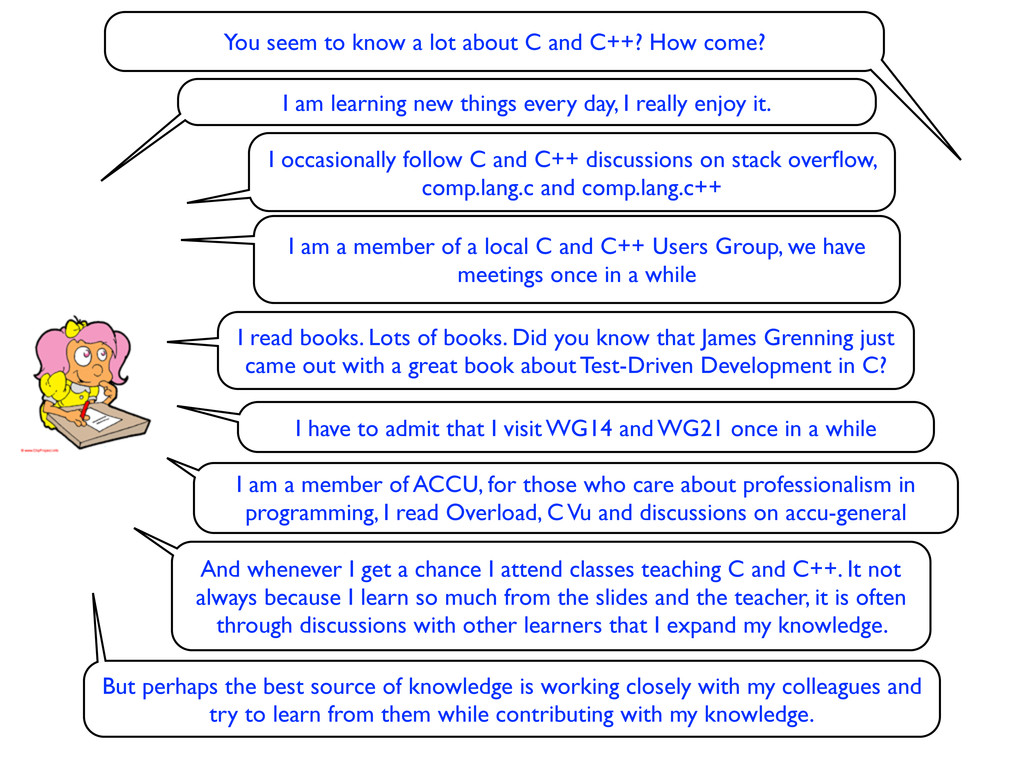
How come? I am learning new things every day, I really enjoy it. I have to admit that I visit WG14 and WG21 once in a while I read books. Lots of books. Did you know that James Grenning just came out with a great book about Test-Driven Development in C? I occasionally follow C and C++ discussions on stack overflow, comp.lang.c and comp.lang.c++ I am a member of a local C and C++ Users Group, we have meetings once in a while And whenever I get a chance I attend classes teaching C and C++. It not always because I learn so much from the slides and the teacher, it is often through discussions with other learners that I expand my knowledge. But perhaps the best source of knowledge is working closely with my colleagues and try to learn from them while contributing with my knowledge. I am a member of ACCU, for those who care about professionalism in programming, I read Overload, C Vu and discussions on accu-general
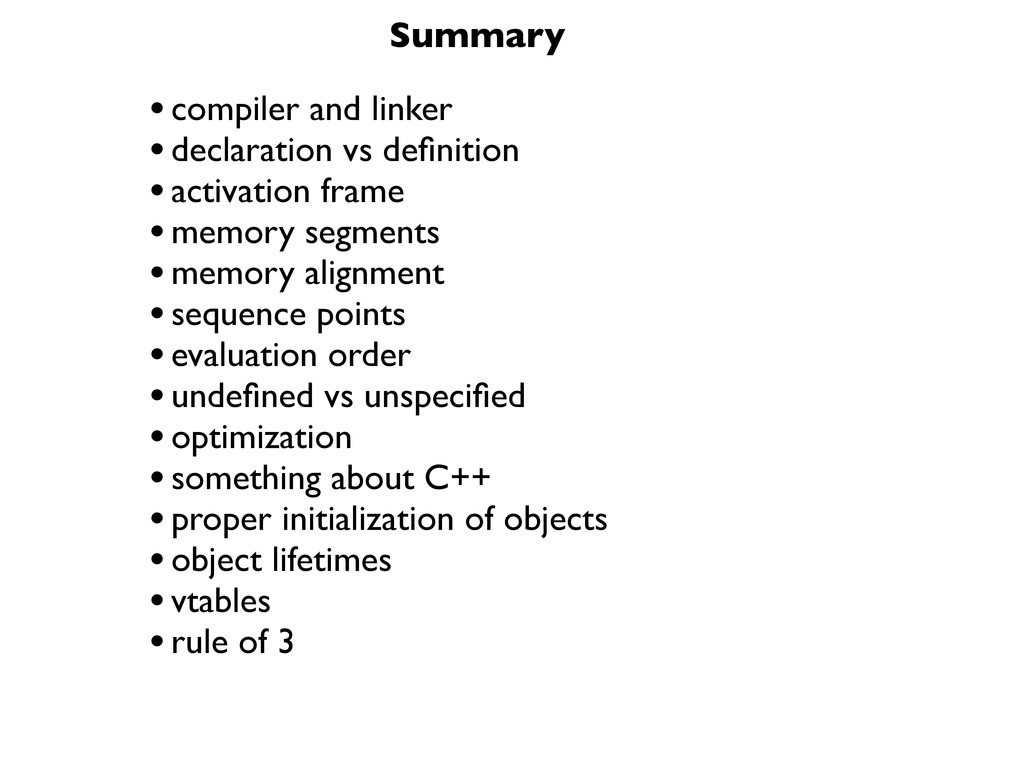
•memory alignment •sequence points •evaluation order •undefined vs unspecified •optimization •something about C++ •proper initialization of objects Summary
•memory alignment •sequence points •evaluation order •undefined vs unspecified •optimization •something about C++ •proper initialization of objects •object lifetimes Summary
•memory alignment •sequence points •evaluation order •undefined vs unspecified •optimization •something about C++ •proper initialization of objects •object lifetimes •vtables Summary
•memory alignment •sequence points •evaluation order •undefined vs unspecified •optimization •something about C++ •proper initialization of objects •object lifetimes •vtables •rule of 3 Summary
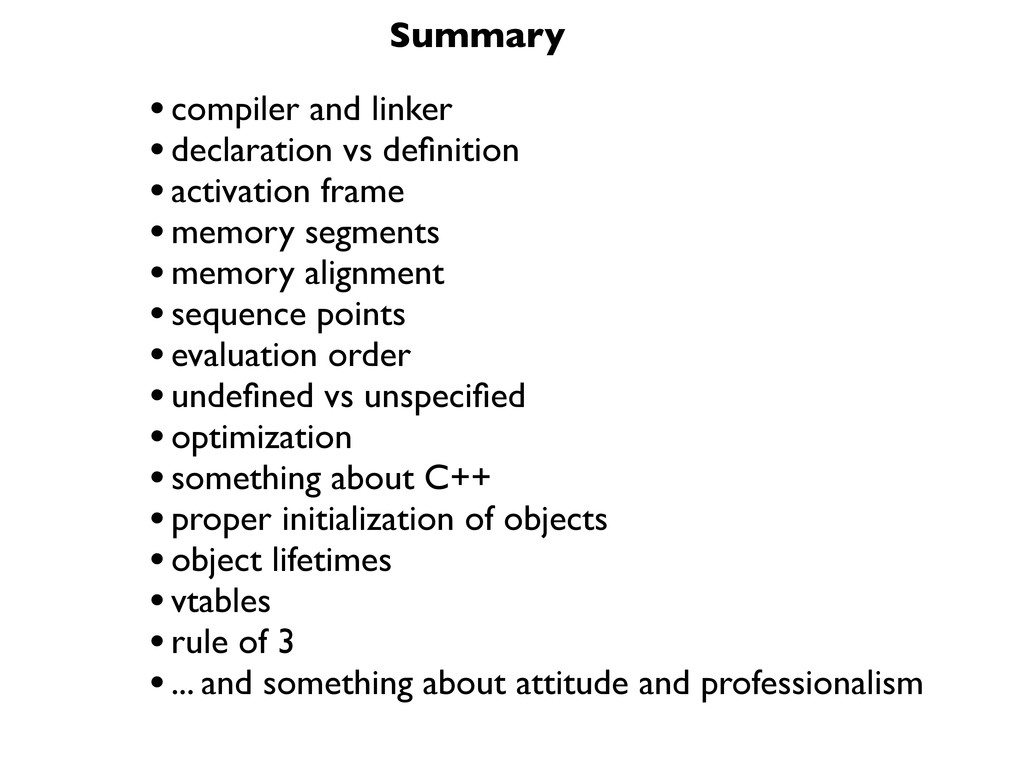
•memory alignment •sequence points •evaluation order •undefined vs unspecified •optimization •something about C++ •proper initialization of objects •object lifetimes •vtables •rule of 3 •... and something about attitude and professionalism Summary
that perhaps I am not behaving as a true professional. Any advice on how to get started to get a deep knowledge of C and C++? First of all you must realize that programming is a continuous learning process, it does not matter how much you know, there is always much more to learn. The next thing to realize is that professional programming is first of all a team activity, you must work and develop together with your colleagues. Think about programming as a team sport, where nobody can win a whole match alone.
that perhaps I am not behaving as a true professional. Any advice on how to get started to get a deep knowledge of C and C++? First of all you must realize that programming is a continuous learning process, it does not matter how much you know, there is always much more to learn. The next thing to realize is that professional programming is first of all a team activity, you must work and develop together with your colleagues. Think about programming as a team sport, where nobody can win a whole match alone. Ok, I need to think about that...
that perhaps I am not behaving as a true professional. Any advice on how to get started to get a deep knowledge of C and C++? First of all you must realize that programming is a continuous learning process, it does not matter how much you know, there is always much more to learn. The next thing to realize is that professional programming is first of all a team activity, you must work and develop together with your colleagues. Think about programming as a team sport, where nobody can win a whole match alone. Ok, I need to think about that... Having said that. Make it a habit to once in a while take a look at the assembly output actually produced by snippets of C and C++. There are a lot of surprising things to discover. Use a debugger, step through code, study how memory is used and look at the instructions actually executed by the processor.
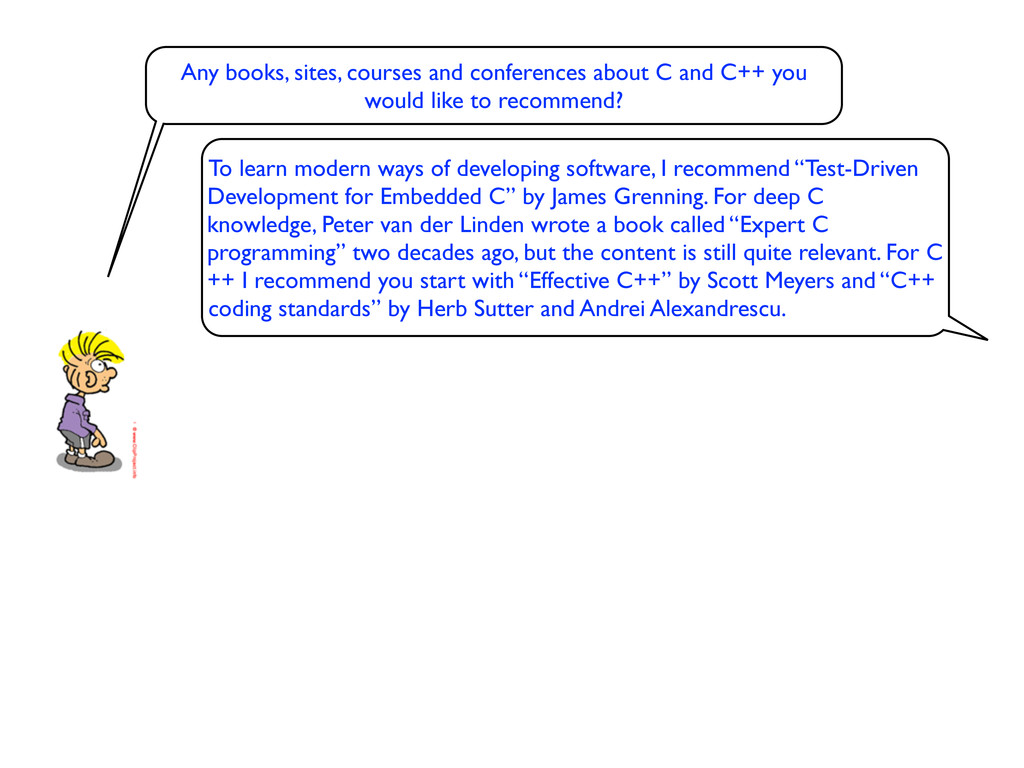
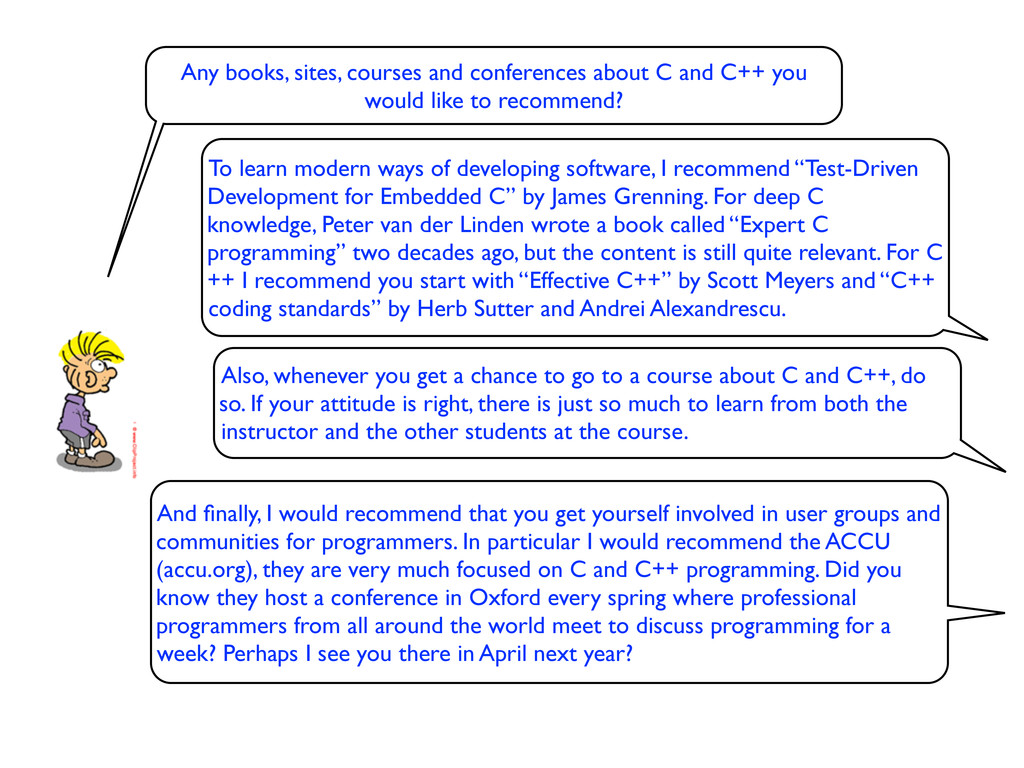
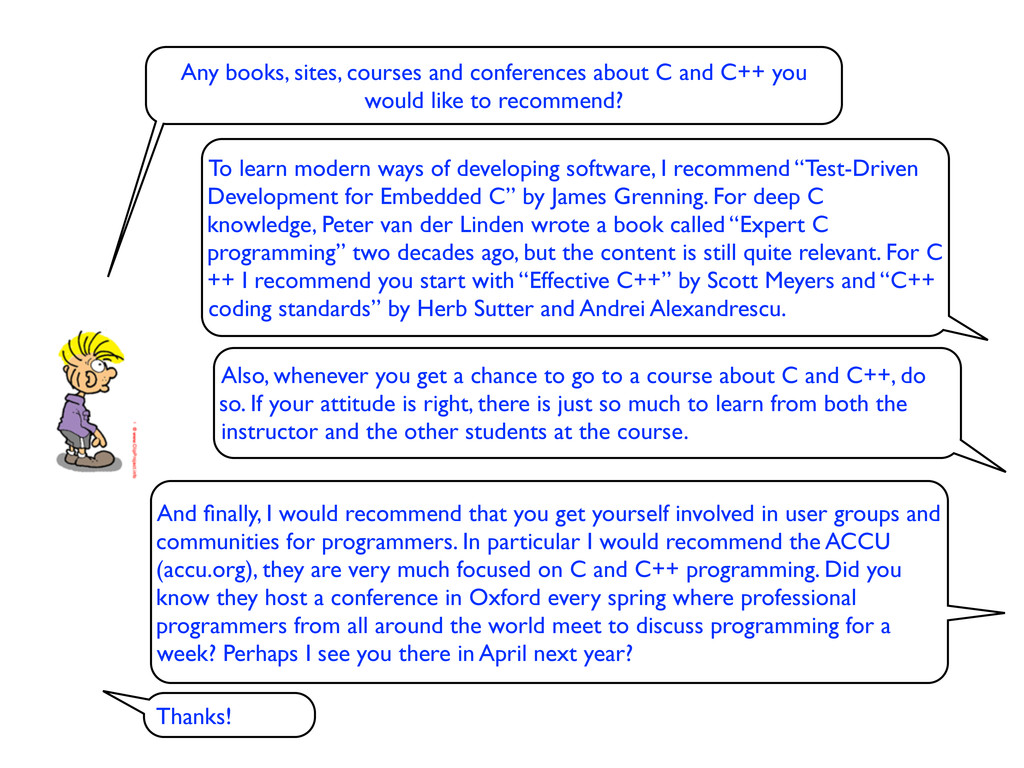
you would like to recommend? To learn modern ways of developing software, I recommend “Test-Driven Development for Embedded C” by James Grenning. For deep C knowledge, Peter van der Linden wrote a book called “Expert C programming” two decades ago, but the content is still quite relevant. For C ++ I recommend you start with “Effective C++” by Scott Meyers and “C++ coding standards” by Herb Sutter and Andrei Alexandrescu.
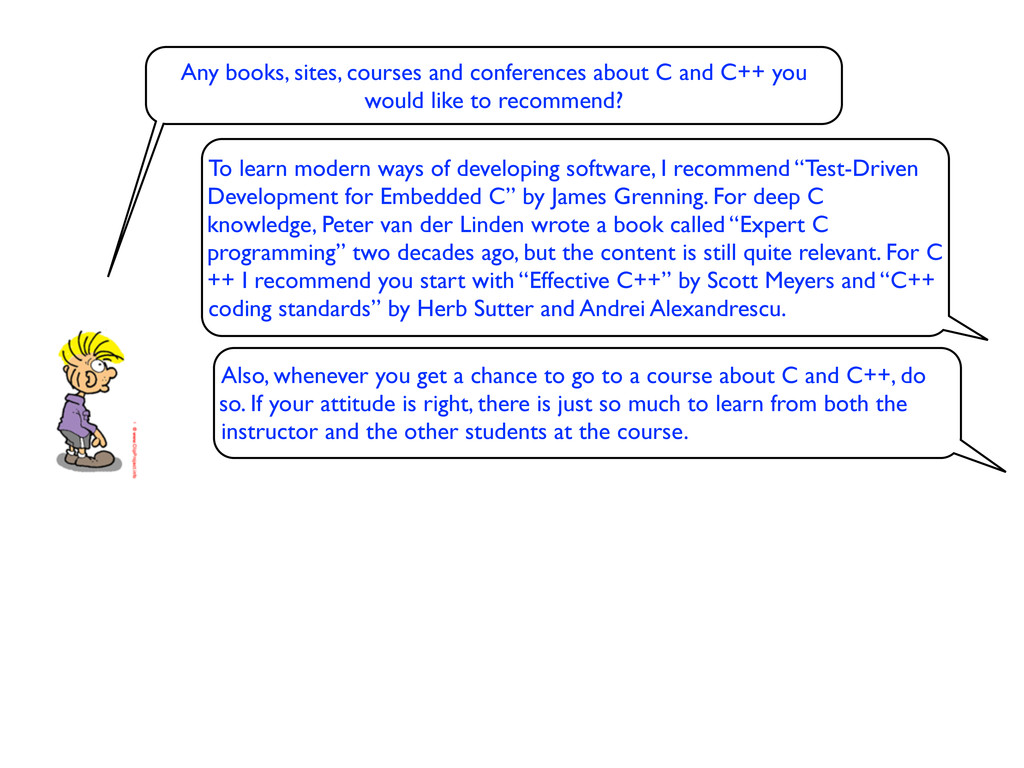
you would like to recommend? To learn modern ways of developing software, I recommend “Test-Driven Development for Embedded C” by James Grenning. For deep C knowledge, Peter van der Linden wrote a book called “Expert C programming” two decades ago, but the content is still quite relevant. For C ++ I recommend you start with “Effective C++” by Scott Meyers and “C++ coding standards” by Herb Sutter and Andrei Alexandrescu. Also, whenever you get a chance to go to a course about C and C++, do so. If your attitude is right, there is just so much to learn from both the instructor and the other students at the course.
you would like to recommend? To learn modern ways of developing software, I recommend “Test-Driven Development for Embedded C” by James Grenning. For deep C knowledge, Peter van der Linden wrote a book called “Expert C programming” two decades ago, but the content is still quite relevant. For C ++ I recommend you start with “Effective C++” by Scott Meyers and “C++ coding standards” by Herb Sutter and Andrei Alexandrescu. Also, whenever you get a chance to go to a course about C and C++, do so. If your attitude is right, there is just so much to learn from both the instructor and the other students at the course. And finally, I would recommend that you get yourself involved in user groups and communities for programmers. In particular I would recommend the ACCU (accu.org), they are very much focused on C and C++ programming. Did you know they host a conference in Oxford every spring where professional programmers from all around the world meet to discuss programming for a week? Perhaps I see you there in April next year?
you would like to recommend? To learn modern ways of developing software, I recommend “Test-Driven Development for Embedded C” by James Grenning. For deep C knowledge, Peter van der Linden wrote a book called “Expert C programming” two decades ago, but the content is still quite relevant. For C ++ I recommend you start with “Effective C++” by Scott Meyers and “C++ coding standards” by Herb Sutter and Andrei Alexandrescu. Also, whenever you get a chance to go to a course about C and C++, do so. If your attitude is right, there is just so much to learn from both the instructor and the other students at the course. And finally, I would recommend that you get yourself involved in user groups and communities for programmers. In particular I would recommend the ACCU (accu.org), they are very much focused on C and C++ programming. Did you know they host a conference in Oxford every spring where professional programmers from all around the world meet to discuss programming for a week? Perhaps I see you there in April next year? Thanks!
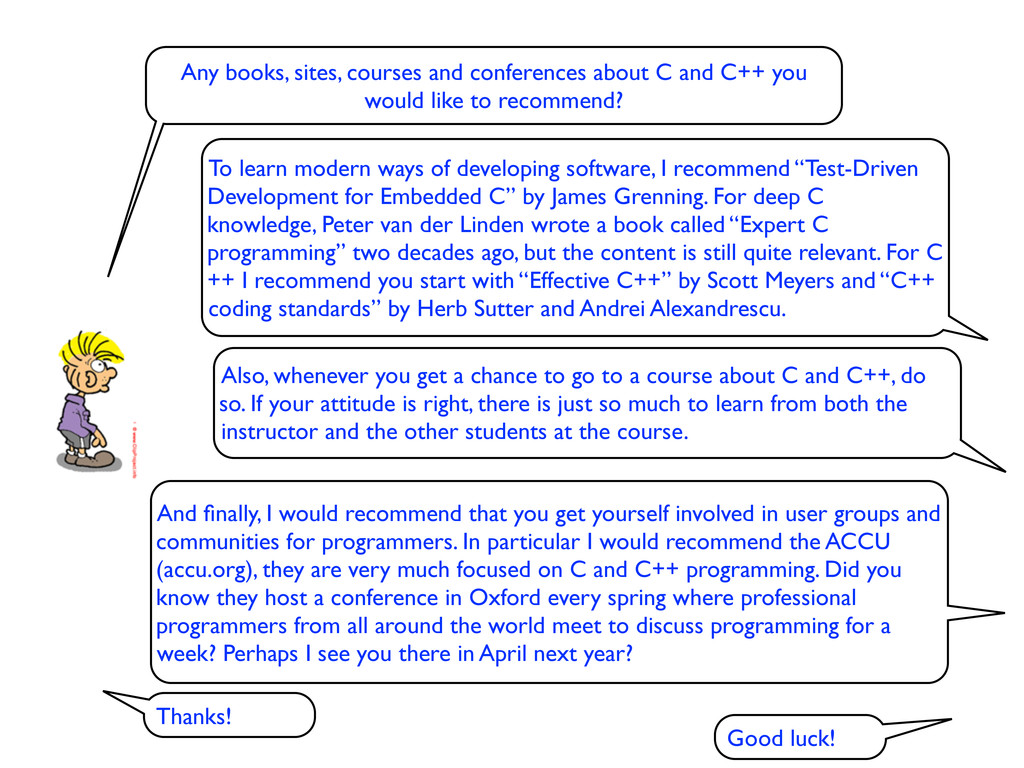
you would like to recommend? To learn modern ways of developing software, I recommend “Test-Driven Development for Embedded C” by James Grenning. For deep C knowledge, Peter van der Linden wrote a book called “Expert C programming” two decades ago, but the content is still quite relevant. For C ++ I recommend you start with “Effective C++” by Scott Meyers and “C++ coding standards” by Herb Sutter and Andrei Alexandrescu. Also, whenever you get a chance to go to a course about C and C++, do so. If your attitude is right, there is just so much to learn from both the instructor and the other students at the course. And finally, I would recommend that you get yourself involved in user groups and communities for programmers. In particular I would recommend the ACCU (accu.org), they are very much focused on C and C++ programming. Did you know they host a conference in Oxford every spring where professional programmers from all around the world meet to discuss programming for a week? Perhaps I see you there in April next year? Good luck! Thanks!


 satoshi256kbyte
 kasacchiful
 guaca
guaca
 kaityo256
 timakin
 findyinc
 suneo3476
 uyuki234
 shihochan
 skydoves
 yub0n
yub0n
 chobishiba
 jakevdp
 mlcsv
mlcsv
 sarafernandez
 aki_iinuma
 danielanewman
 codingconduct
 skipperchong
 tammyeverts
 3n
3n
 jcasabona
 nikkihalliwell
 tammielis