Web Architecture & Digital Strategy Consultant ...

Sponsored · SiteGround - Reliable hosting with speed, security, and support you can count on. →

Web Architecture & Digital Strategy Consultant | Nextware Tech

Julian Vance is a software and digital strategy consultant specializing in web systems architecture, UI/UX performance optimization, interactive platform mechanics, and strategic decision-making frameworks. At Nextware Tech, he works with product leads and engineering teams to evaluate technical trade-offs, reduce payload latency, and establish robust telemetry boundaries for complex online platforms.

Contact Information:
Name: Julian Vance
Website: https://clearpokerpro.nl/
Email: [email protected]
Focus: Web Systems Architecture & Strategic Platform Analysis

Julian Vance

November 26, 2026

Annual Pro sale · Save $30

Have presentations of your own?

Share with private links, password protection, and more control over your work.

Transcript

5 slides
  1. How a Clear Poker Pro Wins More Pots Without Guesswork

    Most players bleed chips at the table because they treat every hand like an emotional coin flip. They call raises out of position with weak offsuit cards, chase thin draws without checking the price, and let a frustrating cooler dictate how they bet the next ten hands. A clear poker pro replaces that guesswork with simple, repeatable logic. Instead of trying to guess one exact two-card hand or reacting to every swing in fortune, a clear thinker evaluates full hand ranges, checks pot odds against long-term expected value, and picks lines that hold up across thousands of hands. Clarity at the felt is a skill you build over time, not a lucky instinct. It starts with clean preflop habits, honest math, and steady self-control when variance tests your patience. What Sets a Clear Poker Pro Apart A clear poker pro separates what is in their hands from what is out of their control. You cannot control which card lands on the river or whether an opponent spikes a two-outer against your top pair. You can control which starting hands you play, how you size your bets, and how calmly you respond under pressure. Three habits keep that clarity intact: •​ Range-first evaluation: Looking at the full set of hands an opponent can reasonably hold in a spot rather than locking onto a single guess. •​ Balanced defaults with targeted shifts: Playing solid baseline frequencies against unknowns, then adjusting when a player shows a clear leak. •​ Calm, consistent execution: Making measured decisions whether you just won a big pot or lost a painful one. When your process is clean, tough spots feel much less overwhelming. Facing a big turn bet or river shove becomes a structured check on pot odds, blockers, and opponent habits rather than a knee-jerk reaction. Core Ideas Behind Clear Poker Decisions You do not need to run complex equations in your head mid-hand to play sharp poker. You just need a working grasp of how ranges, odds, and adjustments fit together.
  2. Reading Ranges Instead of Guessing One Hand Asking "Does he

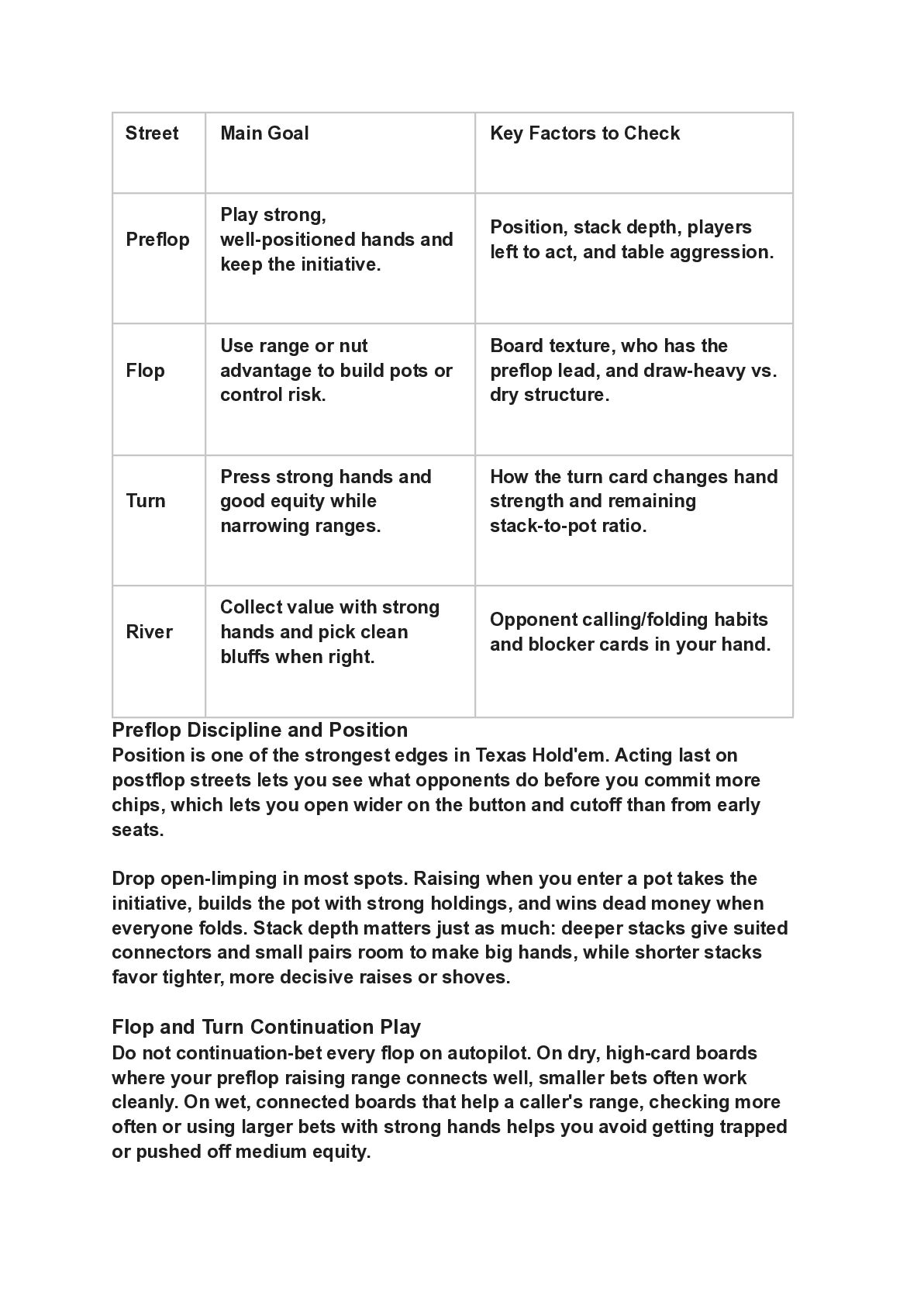
    have a flush?" often creates tunnel vision. Asking "What combinations reach this spot in this exact way, and how many of them beat me or fold to a bet?" gives you far better information. Every action trims or reshapes an opponent's range: •​ Seat position: Early-position opens lean tighter and stronger than late-position steals from the cutoff or button. •​ Board texture: Dry, high-card flops interact differently with a preflop raiser's range than connected, low-to-mid flops interact with a caller's range. •​ Sizing and pace: Small bets, large overbets, and check-raises carry meaning when you compare them to how that opponent normally plays. Pot Odds and Expected Value Pot odds show the price you are getting to make a call. If the pot is $100 and your opponent bets $25, you must put in $25 to win a $125 pot—giving you 5-to-1 odds, which means you need roughly 16.7% equity to break even on the call alone. Expected value looks at what a play wins or loses on average over time. Calling a cheap flop bet with a weak draw can still lose money if you face heavy pressure on later streets and miss. Meanwhile, betting or semi-bluffing can be profitable even when called sometimes, as long as it picks up enough pots right away or improves when called. GTO Baselines vs. Exploitative Play Game Theory Optimal (GTO) play gives you a balanced default that is tough for sharp opponents to exploit. It helps you build clean starting ranges, pick sensible bet sizes, and avoid obvious leaks. Exploitative play is where you bend away from that baseline to punish specific habits. If an opponent folds far too often to river bets, bluffing more frequently adds profit. If an opponent calls down with weak pairs and refuses to fold top pair, cut back on bluffs and value-bet your strong hands more often. Street-by-Street Execution A clear poker pro shifts priorities from street to street as new community cards appear and stack sizes shrink relative to the pot.
  3. Street Main Goal Key Factors to Check Preflop Play strong,

    well-positioned hands and keep the initiative. Position, stack depth, players left to act, and table aggression. Flop Use range or nut advantage to build pots or control risk. Board texture, who has the preflop lead, and draw-heavy vs. dry structure. Turn Press strong hands and good equity while narrowing ranges. How the turn card changes hand strength and remaining stack-to-pot ratio. River Collect value with strong hands and pick clean bluffs when right. Opponent calling/folding habits and blocker cards in your hand. Preflop Discipline and Position Position is one of the strongest edges in Texas Hold'em. Acting last on postflop streets lets you see what opponents do before you commit more chips, which lets you open wider on the button and cutoff than from early seats. Drop open-limping in most spots. Raising when you enter a pot takes the initiative, builds the pot with strong holdings, and wins dead money when everyone folds. Stack depth matters just as much: deeper stacks give suited connectors and small pairs room to make big hands, while shorter stacks favor tighter, more decisive raises or shoves. Flop and Turn Continuation Play Do not continuation-bet every flop on autopilot. On dry, high-card boards where your preflop raising range connects well, smaller bets often work cleanly. On wet, connected boards that help a caller's range, checking more often or using larger bets with strong hands helps you avoid getting trapped or pushed off medium equity.
  4. On the turn, pots get bigger and mistakes hurt more.

    Favor turn bets that fit your full story—strong value hands, hands with real equity to improve, or clean semi-bluffs—rather than firing blindly with air that has little chance of winning. River Decisions and Blockers By the river, draws are settled, so your choice usually comes down to value betting or bluffing. Against loose callers who hate folding, bet strong hands for value and skip thin bluffs. Against tight players who over-fold, well-chosen bluffs perform much better. Blockers—cards in your hand that remove combinations of strong hands your opponent could hold—help you pick better bluffs and hero calls. Holding a key card that blocks your opponent's best made hands makes it less likely they can continue against your bet. Bankroll Habits and Mental Control Even clean strategy breaks down if you play stakes that strain your wallet or sit down tired and frustrated. Protecting Your Bankroll Variance hits every winning player. Keeping a dedicated bankroll separate from everyday money protects you from normal downswings and keeps you from playing scared. •​ Cash games: Hold a comfortable cushion of buy-ins for your stake, and step down without ego if your roll falls below your floor. •​ Tournaments: Expect wider swings because of bigger fields and top-heavy payouts, so keep a larger buy-in buffer than you would for cash games. Avoiding Tilt and Rushed Decisions Tilt does not always look like slamming chips on the table. Often it looks like calling a raise with a hand you normally fold, betting bigger out of frustration, or chasing losses after a bad beat. Set a session stop-loss before you start, take breaks when your focus slips, and step away for a few minutes after a frustrating hand. A short reset saves far more money than trying to win it back on the very next deal. Simple Off-Table Study You do not need hours of complicated drills to improve. A short routine after a session goes a long way:
  5. 1.​ Pick two or three tricky hands: Focus on spots

    where you felt torn between calling, folding, or sizing a bet. 2.​ Write down the key facts: Note positions, stack sizes, preflop action, and what you observed about your opponents. 3.​ Compare baseline and adjustment: Check what a standard line looks like, then ask how your opponent's real tendencies should change it. Frequently Asked Questions 1. What is the fastest way to play more like a clear poker pro at low stakes? Cut out loose preflop calls, stop open-limping, and fold more often to big turn and river bets from passive players who rarely bluff. Fixing those habits plugs some of the costliest leaks in low-stakes games. 2. Should I play balanced or exploitative poker against casual players? Use solid fundamentals as your safety net, then lean exploitative once you spot clear habits. If casual players call too much, value-bet more and bluff less; if they fold too much, bluff more selectively. 3. Why does position matter so much in Texas Hold'em? Acting last gives you extra information before you decide what to do. That makes it easier to control pot size, value-bet accurately, and bluff when opponents show weakness. 4. How do I spot tilt before it costs me a buy-in? Watch for subtle shifts like rushing decisions, calling raises with dominated hands, or feeling annoyed by routine bad beats. Taking a quick break is usually the cleanest way to reset. 5. Do I need paid software to start improving? No. Reviewing key hands after sessions, learning basic starting ranges and pot odds, and keeping honest notes on opponent tendencies can improve your game well before you buy any software.

Other Decks in Marketing & SEO