Share
Embed
Transcript
16 slides
-
The system and the pyramid Unit tests Integration & E2E
tests Smoke tests Test all the things! A Testing Pyramid for Node.js Microservices FrankfurtJS Meetup 5th of April, 2017 FrankfurtJS Meetup Test all the Things! -
The system and the pyramid Unit tests Integration & E2E
tests Smoke tests Our system consists of many Node.js microservices FrankfurtJS Meetup Test all the Things! -
The system and the pyramid Unit tests Integration & E2E
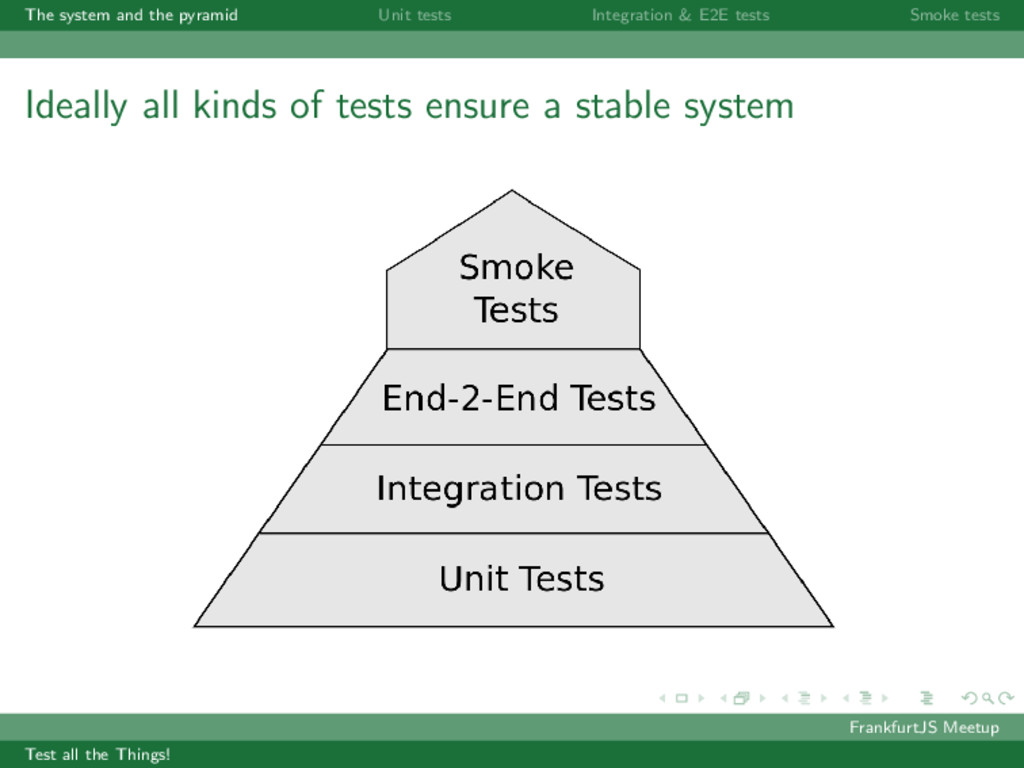
tests Smoke tests Ideally all kinds of tests ensure a stable system FrankfurtJS Meetup Test all the Things! -
The system and the pyramid Unit tests Integration & E2E
tests Smoke tests Our toolset to make unit tests easy to write and read FrankfurtJS Meetup Test all the Things! -
The system and the pyramid Unit tests Integration & E2E
tests Smoke tests Our toolset to make unit tests easy to write and read const chai = require('chai') const chaiAsPromised = require('chai-as-promised') const nock = require('nock') const AuthConnector = require('../app/connectors/Auth') chai.use(chaiAsPromised) const assert = chai.assert describe('AuthConnector', function () { let authConnector beforeEach(function () { authConnector = new AuthConnector() }) describe('#getToken()', function () { it('returns the token', function () { nock('http://authservice:3000').post('/token').reply(200, {token: 'testToken'}) return assert.becomes(authConnector.getToken('someId'), 'testToken') }) }) }) return assert.isRejected(promise) return promise.should.eventually.have.property(...) return expect(promise).to.eventually.have.same.members(...) FrankfurtJS Meetup Test all the Things! -
The system and the pyramid Unit tests Integration & E2E
tests Smoke tests Write testable modules/classes in the first place // Handler.js class Handler { constructor (authConnector) { this.authConnector = authConnector } addToken (body) { this.authConnector.getToken('someId').then((token) => { body.token = token return body }) } } module.exports = Handler // app.js ... const authConnector = new AuthConnector() const handler = new Handler(authConnector) ... FrankfurtJS Meetup Test all the Things! -
The system and the pyramid Unit tests Integration & E2E
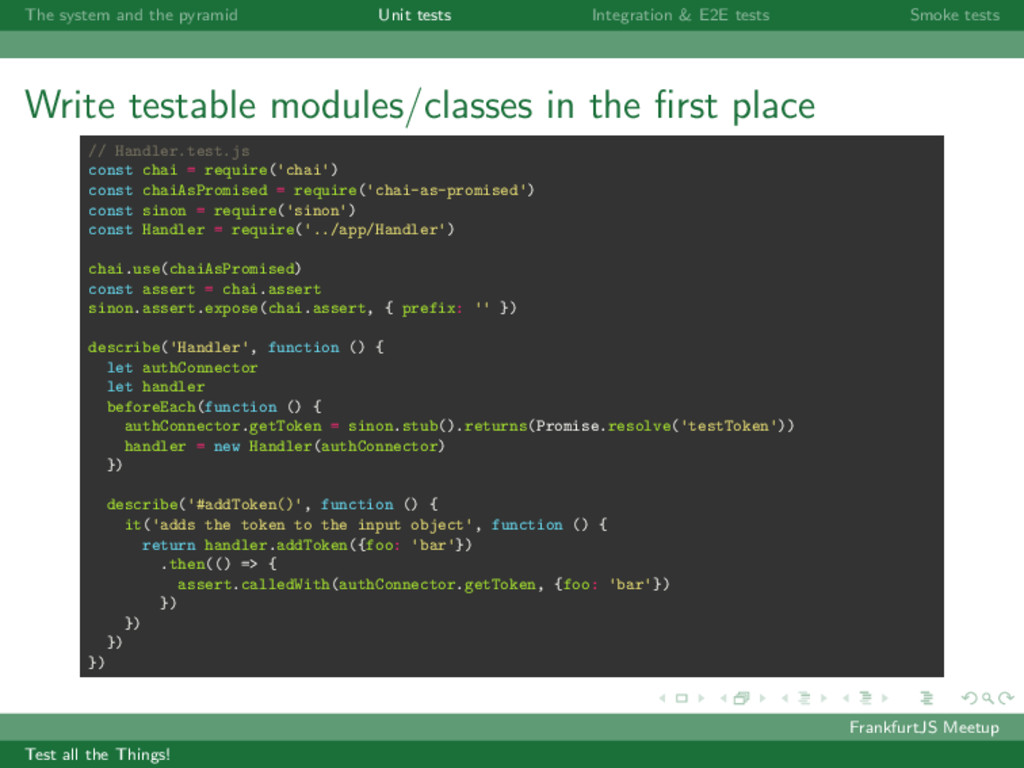
tests Smoke tests Write testable modules/classes in the first place // Handler.test.js const chai = require('chai') const chaiAsPromised = require('chai-as-promised') const sinon = require('sinon') const Handler = require('../app/Handler') chai.use(chaiAsPromised) const assert = chai.assert sinon.assert.expose(chai.assert, { prefix: '' }) describe('Handler', function () { let authConnector let handler beforeEach(function () { authConnector.getToken = sinon.stub().returns(Promise.resolve('testToken')) handler = new Handler(authConnector) }) describe('#addToken()', function () { it('adds the token to the input object', function () { return handler.addToken({foo: 'bar'}) .then(() => { assert.calledWith(authConnector.getToken, {foo: 'bar'}) }) }) }) }) FrankfurtJS Meetup Test all the Things! -
The system and the pyramid Unit tests Integration & E2E
tests Smoke tests Avoid testing the test instead of the real code // Handler.js ... forwardRequest (body) { return this._makeRequest(params) } _makeRequest (body) { const params = { url: ..., headers: {...}, body } return requestPromise(params) } ... // Handler.test.js ... describe('forwardRequest', function () { it('makes the request', function () { // DON'T DO THIS handler._makeRequest = function () { return Promise.resolve('result') } const promise = handler.forwardRequest({foo: 'bar'}) return assert.becomes(promise, 'result') }) }) ... FrankfurtJS Meetup Test all the Things! -
The system and the pyramid Unit tests Integration & E2E
tests Smoke tests We write integration tests in a language agnostic way #readAppInfo.feature Feature: App information can be read Background: Given I set property request body to testdata app-info And I set the request header accept-version with value ~1 And I send a POST request to /devices/d123/apps/a123 Scenario: App information can be retrieved Given I set the request header accept-version with value ~1 When I send a GET request to /devices/d123/apps/a123 Then the response status code is 200 And I check property response body equals testdata app-info Scenario: Wrong url is used Given I set the request header accept-version with value ~1 And I send a GET request to /device/d123/app/a123 Then the response status code is 404 Scenario: Version not supported Given I set the request header accept-version with value ~999 And I send a GET request to /devices/d123/apps/a123 Then the response status code is 400 FrankfurtJS Meetup Test all the Things! -
The system and the pyramid Unit tests Integration & E2E
tests Smoke tests Custom test steps can be added if needed // steps.js const path = require('path') const config = require('../../../config') module.exports = function customSteps () { require('minosse').call(this) this.Before(function loadTestConfig (scenario, done) { // minosse checks for `testConfig` for framework configuration this.testConfig = { testDataRoot: path.join(__dirname, '../data') } done() }) this.Given(/^I set the test application to (\S+)$/, function changeApp (app, done) { this._log.info(`Step: I set the test application to ${app}`) this.testConfig.defaultHost = config.integrationTest.host this.testConfig.defaultPort = config.integrationTest[app].port done() }) } FrankfurtJS Meetup Test all the Things! -
The system and the pyramid Unit tests Integration & E2E
tests Smoke tests We use docker-compose to boot up all necessary components for the test version: '2' services: service-a: build: . environment: - MYSQL_HOST=mysql command: npm run watch links: - mysql - service-b ports: - 3000:3000 restart: always volumes: - ./app:/src/app - ./app.js:/src/app.js service-b: image: somehost/service-b:latest ports: - 4000:4000 environment: - SERVICE_A_URL=http://service-a:3000 - CASSANDRA_HOSTS=cassandra.local:9042 links: - cassandra:cassandra.local cassandra: image: spotify/cassandra mysql: image: mysql environment: - MYSQL_ROOT_PASSWORD=somepassword FrankfurtJS Meetup Test all the Things! -
The system and the pyramid Unit tests Integration & E2E
tests Smoke tests For end-2-end tests we use Minosse to hit the entrypoint of the system like the apps would do FrankfurtJS Meetup Test all the Things! -
The system and the pyramid Unit tests Integration & E2E
tests Smoke tests The docker-compose file for the E2E tests mimic the real system as close as possible some-nginx: build: context: ./somepath dockerfile: ./Dockerfile restart: always ports: - 80:80 consul: image: consul container_name: consul command: agent -server -client=0.0.0.0 -bind=0.0.0.0 -ui -bootstrap ports: - 8500:8500 registrator: image: gliderlabs/registrator container_name: registrator volumes: - /var/run/docker.sock:/tmp/docker.sock command: -internal consul://consul:8500 links: - consul syslog: build: somehost/syslogdummy container_name: syslog FrankfurtJS Meetup Test all the Things! -
The system and the pyramid Unit tests Integration & E2E
tests Smoke tests Running the whole system locally with docker-compose is a blessing Advantages Connect with mobile devices to the local PC Possible to plug in code for a specific shop to test it Edit different services and see the result immediately Catch configuration errors early on locally FrankfurtJS Meetup Test all the Things! -
The system and the pyramid Unit tests Integration & E2E
tests Smoke tests We run extensive smoke tests in all stages Smoke test deploys a whole new test shop container into the system Then runs DB-neutral test cases and removes the shop Swarm, consul etc. is utilized during deployment and problems can be catched Allows to catch AWS problems FrankfurtJS Meetup Test all the Things! -
The system and the pyramid Unit tests Integration & E2E
tests Smoke tests Links https://mochajs.org/ http://chaijs.com/ https://github.com/domenic/chai-as-promised http://sinonjs.org/ https://github.com/icemobilelab/minosse FrankfurtJS Meetup Test all the Things!