Upgrade to Pro — share decks privately, control downloads, hide ads and more …

Strategic Thinking from a biblical perspecitve

Strategic Thinking from a biblical perspecitve

Supplementary material for a sermon giving on strategic thinking. Within this deck is a review of some different types of thinking, the strategic thinking shown in the lives of some biblical characters and briefly touching upon what innovation is, why we don't see more of it and some examples of innovation today

Avatar for knifesong

knifesong

July 01, 2014

Other Decks in Education

Transcript

  1.  Merriam Webster: “a careful plan or method for achieving

    a particular goal usually over a long period of time”  “Strategic thinking” is therefore the process of thinking through these plans or goals
  2.  Thinking is not a random thing… it’s a discipline

     Many people think of thinking as something that just happens  It can just happen but many successful people set time aside just to think about things  CEO of Chik-Fil-A  Most people would rather act than think  Pr 13:16 “Wise people think before they act; fools act and even brag about it”
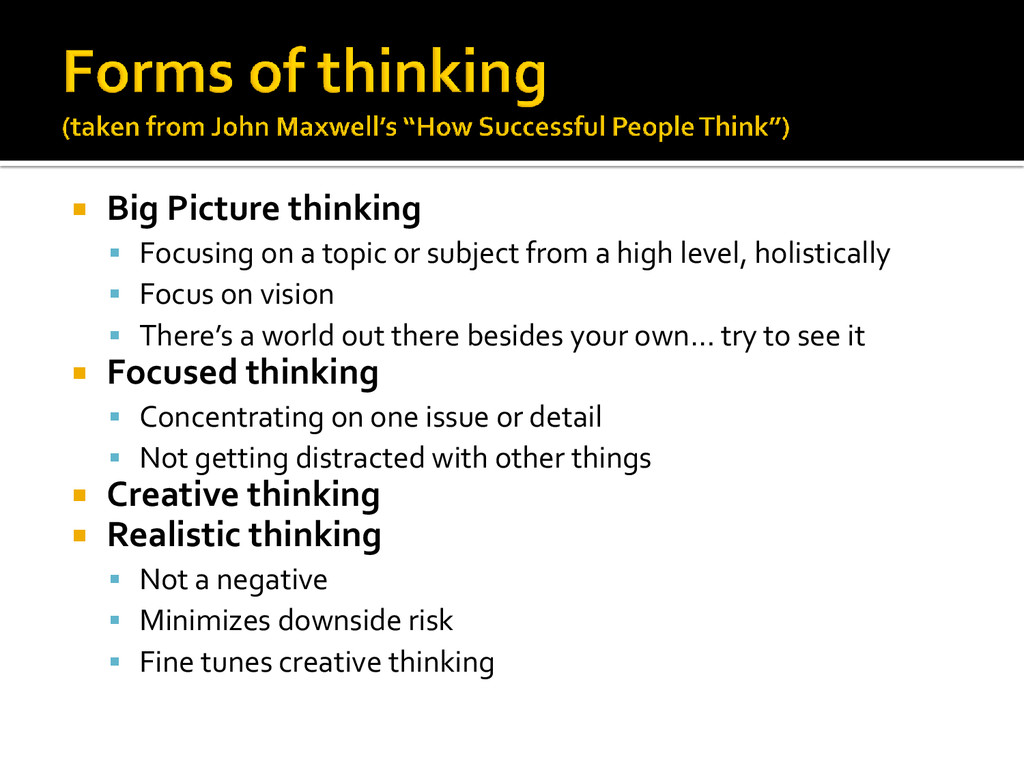
  3.  Big Picture thinking  Focusing on a topic or

    subject from a high level, holistically  Focus on vision  There’s a world out there besides your own… try to see it  Focused thinking  Concentrating on one issue or detail  Not getting distracted with other things  Creative thinking  Realistic thinking  Not a negative  Minimizes downside risk  Fine tunes creative thinking
  4.  Strategic thinking  Thinking beyond the short term 

    Possibility thinking  Helps you dream bigger and increase possibilities  When you remove the label of “impossible” from a task, you dramatically increase the potential for accomplishing that task  Thinking in terms of “I can” vs “I can’t”  How many successful people are continually negative? Not many!
  5.  Reflective thinking  What have you learned from your

    experience or the experience of others?  Gives you confidence to make better decisions in the future from learning from past mistakes and successes  Popular thinking  What does the general populace think about something?  Is it right or is there a better way?  Popular usually = normal = average  Shared thinking  Thinking along with others  Iron sharpens iron  Helps you vet things out  Unselfish thinking  Considering people other than yourself  Bottom-line thinking  The take-away… the end result  Could be money in a business, an activity in a church, where do methods in parenting lead?
  6.  Gen 37:1-11  Joseph didn’t have favor with his

    brothers due to his father’s love for him  Joseph DID have favor with God and his father  Joseph shares two dreams with his family which gives a picture of the future that they want nothing to do with  The brothers take offense, his father Jacob takes note  God gave Joseph a picture for the future
  7.  Gen 39:3-7; 12; 20-23  Joseph, though sold into

    slavery, prospered and became head slave in the house of a powerful man in Egypt  God’s anointing was seen on his life by Potiphar  The Lord was with him  He had favor  He prospered  Was put into management of a house (small to medium responsibility)  He did the right thing and avoided Potiphar’s wife advances and again was treated unjustly, being accused of something he didn’t do while keeping God’s ways  The Lord was with him  He had favor  He prospered  Was put into management of a jail (medium responsibility)  A pattern is emerging
  8.  Gen 40: Joseph interprets the dreams of the cup

    bearer and the baker  His interpretations are accepted and come to pass  He’s forgotten about until a later time  Joseph put forth his case to the cupbearer, the one that would live, that he was unjustly sold into slavery and later jailed  Another opportunity for Joseph to learn how to deal with offense  I helped you, I asked you to help me, why didn’t you?  40:23 “Yet the chief cupbearer did not remember Joseph, but forgot him”  Offense is a way to stop hearing from God
  9.  Gen 41  Pharaoh dreams two dreams  Joseph

    is remembered by the cup bearer  Joseph uses his gift of dream interpretation again, first giving credit to God  Joseph not only interprets the dream…  He also tells Pharaoh how to organize a plan based on the vision for the future  Joseph is promoted due to his wisdom and anointing  (Gen 41:38-40 “Then Pharaoh said to his servants, “Can we find a man like this, in whom is a divine spirit?” [39] So Pharaoh said to Joseph, “Since God has informed you of all this, there is no one so discerning and wise as you are. [40] “You shall be over my house, and according to your command all my people shall do homage; only in the throne I will be greater than you.”)
  10.  Gen 45:4-8: “Then Joseph said to his brothers, “Please

    come closer to me.” And they came closer. And he said, “I am your brother Joseph, whom you sold into Egypt. [5] “Now do not be grieved or angry with yourselves, because you sold me here, for God sent me before you to preserve life. [6] “For the famine has been in the land these two years, and there are still five years in which there will be neither plowing nor harvesting. [7] “God sent me before you to preserve for you a remnant in the earth, and to keep you alive by a great deliverance. [8] “Now, therefore, it was not you who sent me here, but God; and He has made me a father to Pharaoh and lord of all his household and ruler over all the land of Egypt”  Joseph shows here that he understands God’s strategy for his life  His dreams from the beginning of his story were a sure indicator of where he was going. Now he clearly understood it  A relationship with God and hearing from Him was key to his success  All credit was always given to God  Those that are humble, that don’t take the credit for themselves or look to hog the spotlight, are those that God can use greatly
  11.  Jos 10:6-14 “Then the men of Gibeon sent word

    to Joshua to the camp at Gilgal, saying, “Do not abandon your servants; come up to us quickly and save us and help us, for all the kings of the Amorites that live in the hill country have assembled against us.” [7] So Joshua went up from Gilgal, he and all the people of war with him and all the valiant warriors. [8] The LORD said to Joshua, “Do not fear them, for I have given them into your hands; not one of them shall stand before you.” [9] So Joshua came upon them suddenly by marching all night from Gilgal. [10] And the LORD confounded them before Israel, and He slew them with a great slaughter at Gibeon, and pursued them by the way of the ascent of Beth- horon and struck them as far as Azekah and Makkedah. [11] As they fled from before Israel, while they were at the descent of Beth-horon, the LORD threw large stones from heaven on them as far as Azekah, and they died; there were more who died from the hailstones than those whom the sons of Israel killed with the sword.[12] Then Joshua spoke to the LORD in the day when the LORD delivered up the Amorites before the sons of Israel, and he said in the sight of Israel, “O sun, stand still at Gibeon, And O moon in the valley of Aijalon.”[13] So the sun stood still, and the moon stopped, Until the nation avenged themselves of their enemies. Is it not written in the book of Jashar? And the sun stopped in the middle of the sky and did not hasten to go down for about a whole day. [14] There was no day like that before it or after it, when the LORD listened to the voice of a man; for the LORD fought for Israel.
  12.  God gave Joshua word that he would be successful

    in the battle against the Amorites  God killed more Amorites with rocks from heaven than the Israelite killed with swords  Joshua knew that God gave him the victory but he also knew the victory wouldn’t be complete if they ran out of daylight  Joshua, in faith and in front of others (proving his faith), holding on to the promise of victory, made a ridiculous request  He held on to the voice of the Lord and pulled in its potential so that even the sun and the moon had to conform to God’s plan  What must those in opposition to Israel have thought after this?
  13.  He picked cities to visit during his missionary journeys

     Sometimes God held him back, other times God stopped him  Acts 16:6-10 “They passed through the Phrygian and Galatian region, having been forbidden by the Holy Spirit to speak the word in Asia; [7] and after they came to Mysia, they were trying to go into Bithynia, and the Spirit of Jesus did not permit them; [8] and passing by Mysia, they came down to Troas. [9] A vision appeared to Paul in the night: a man of Macedonia was standing and appealing to him, and saying, “Come over to Macedonia and help us.” [10] When he had seen the vision, immediately we sought to go into Macedonia, concluding that God had called us to preach the gospel to them.”  (1 Thess 3:11) Paul seeking out direction from God  Fruit trees that God leads you to are never barren!  Sometimes God tell you that a door is closed  Other times, he closes it and you don’t figure it out until you keep trying to open it and realize… yeah, maybe I’m not supposed to go there  What can we learn from Paul?  First, seek out the Lord and see what He wants you to do  You should make plans but be open to how God may alter them
  14.  David was strategic from an early age  (1

    Sam 17:36) He killed the lion and the bear  That prepared Him for Goliath  God gave Him a strategy of how to kill him by showing him Goliath’s weakness (1 Sam 17:40)  David also had four extra rocks  Could be in case he missed  More likely to kill the other four members of Goliath’s family if they came after him as well (2 Sam 21:15-22)  David would not raise his hand against God’s anointed (Saul) since He knew that God held all the cards  Saul was selected by God and enabled by God, isn’t God also capable of removing him  David could’ve done it himself on a number of occasions… but David knew God could do it as well ▪ Maybe David remembered what happened with Abraham and Ishmael ▪ If God gives you a portrait for the future, let Him supply the paint
  15.  Jesus was fully God and fully man  As

    God, He knew the end from the beginning  He lived with an awareness of the past and of the future  He knew about the plan of human kind before He left Heaven to do so  He had a vision for the future  Knowing the future can be both a blessing and a curse  He knew why He was here and what He had to do  He found disciples, taught them, send them out, knew they would desert Him  He knew He’d be alone on the cross  He knew the price of redemption of mankind and thought it was worth it… thought WE were worth it
  16.  God gives the battle plans  Don’t look for

    battles you haven’t be called to*  They come when you least expect them  They often don’t look the same  They stretch you  They often don’t make sense to us  They can defy space and time since God exists outside of time  The results are unpredictable but usually good
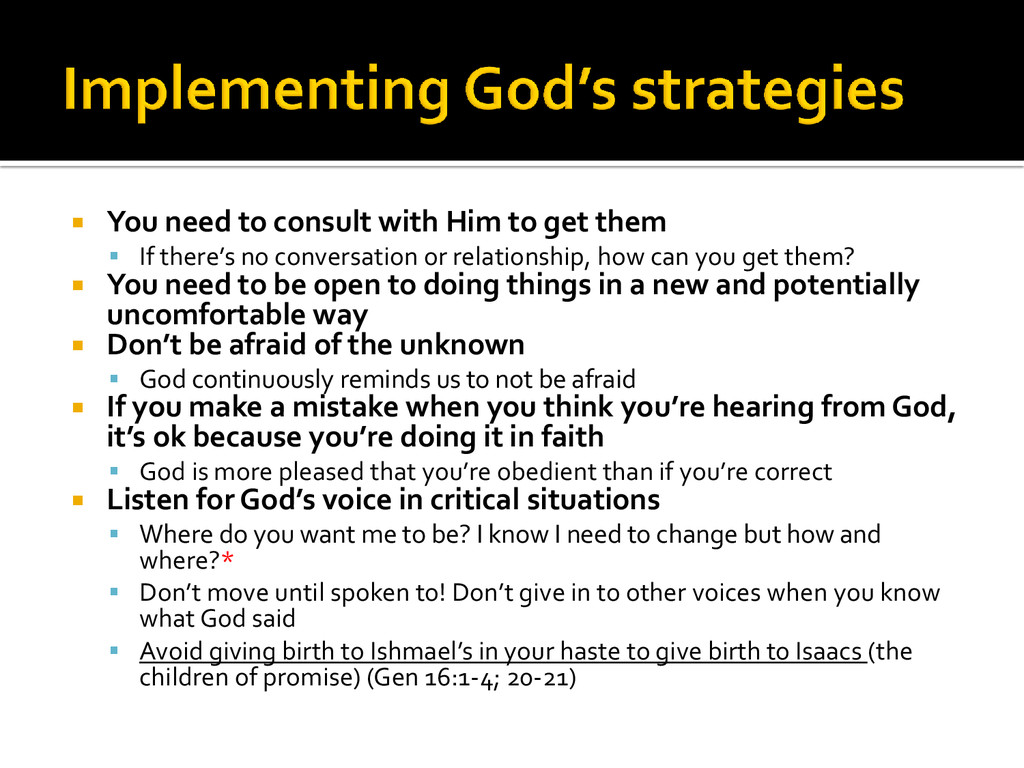
  17.  You need to consult with Him to get them

     If there’s no conversation or relationship, how can you get them?  You need to be open to doing things in a new and potentially uncomfortable way  Don’t be afraid of the unknown  God continuously reminds us to not be afraid  If you make a mistake when you think you’re hearing from God, it’s ok because you’re doing it in faith  God is more pleased that you’re obedient than if you’re correct  Listen for God’s voice in critical situations  Where do you want me to be? I know I need to change but how and where?*  Don’t move until spoken to! Don’t give in to other voices when you know what God said  Avoid giving birth to Ishmael’s in your haste to give birth to Isaacs (the children of promise) (Gen 16:1-4; 20-21)
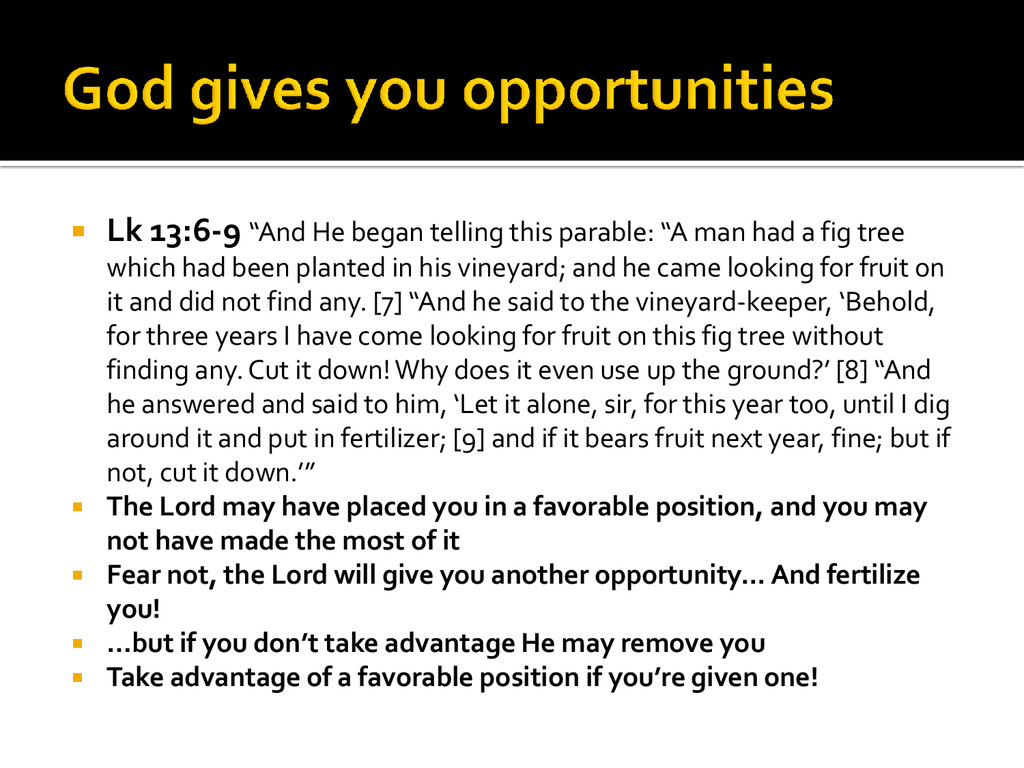
  18.  Lk 13:6-9 “And He began telling this parable: “A

    man had a fig tree which had been planted in his vineyard; and he came looking for fruit on it and did not find any. [7] “And he said to the vineyard-keeper, ‘Behold, for three years I have come looking for fruit on this fig tree without finding any. Cut it down! Why does it even use up the ground?’ [8] “And he answered and said to him, ‘Let it alone, sir, for this year too, until I dig around it and put in fertilizer; [9] and if it bears fruit next year, fine; but if not, cut it down.’”  The Lord may have placed you in a favorable position, and you may not have made the most of it  Fear not, the Lord will give you another opportunity... And fertilize you!  …but if you don’t take advantage He may remove you  Take advantage of a favorable position if you’re given one!
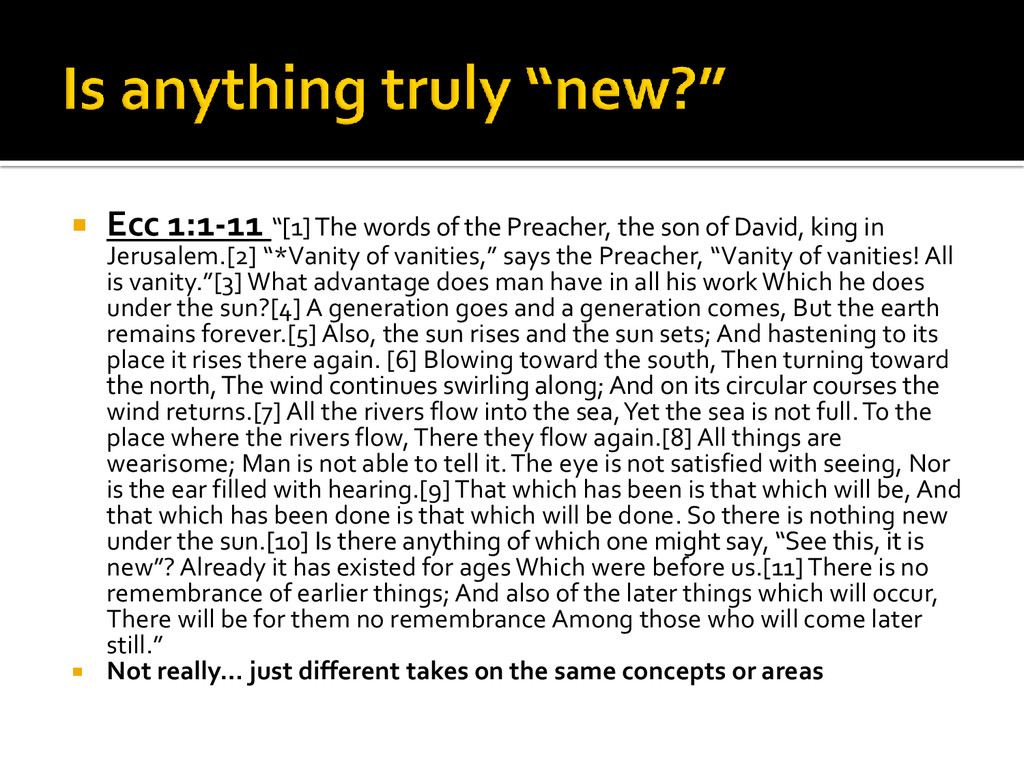
  19.  Ecc 1:1-11 “[1] The words of the Preacher, the

    son of David, king in Jerusalem.[2] “*Vanity of vanities,” says the Preacher, “Vanity of vanities! All is vanity.”[3] What advantage does man have in all his work Which he does under the sun?[4] A generation goes and a generation comes, But the earth remains forever.[5] Also, the sun rises and the sun sets; And hastening to its place it rises there again. [6] Blowing toward the south, Then turning toward the north, The wind continues swirling along; And on its circular courses the wind returns.[7] All the rivers flow into the sea, Yet the sea is not full. To the place where the rivers flow, There they flow again.[8] All things are wearisome; Man is not able to tell it. The eye is not satisfied with seeing, Nor is the ear filled with hearing.[9] That which has been is that which will be, And that which has been done is that which will be done. So there is nothing new under the sun.[10] Is there anything of which one might say, “See this, it is new”? Already it has existed for ages Which were before us.[11] There is no remembrance of earlier things; And also of the later things which will occur, There will be for them no remembrance Among those who will come later still.”  Not really… just different takes on the same concepts or areas
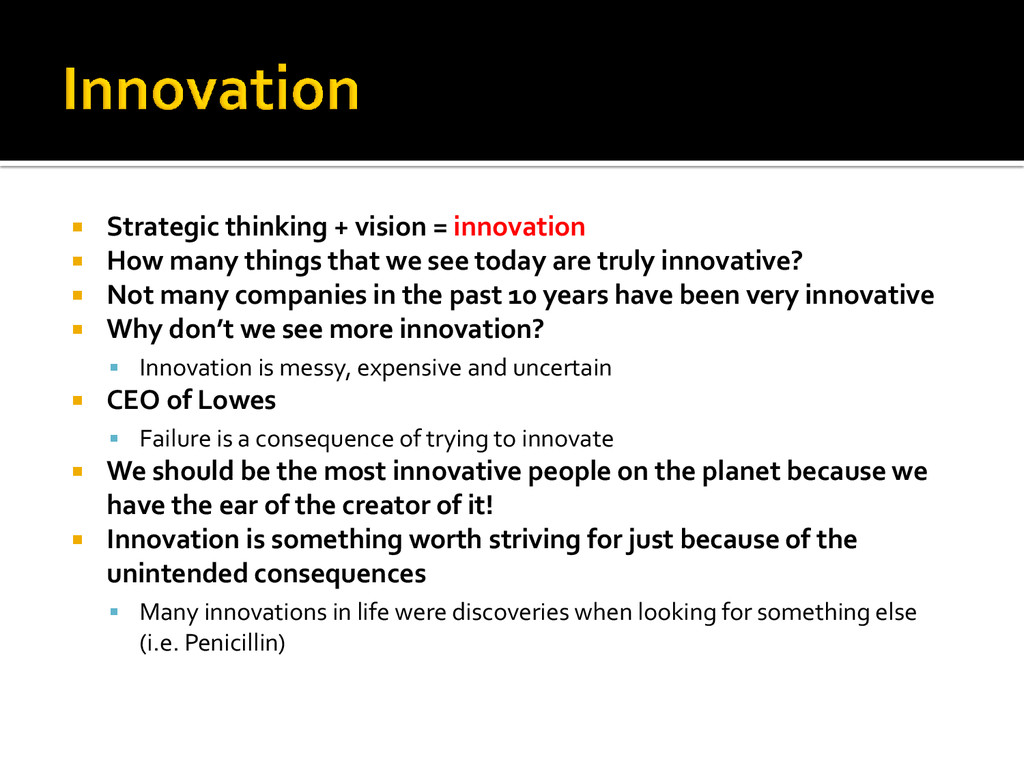
  20.  Strategic thinking + vision = innovation  How many

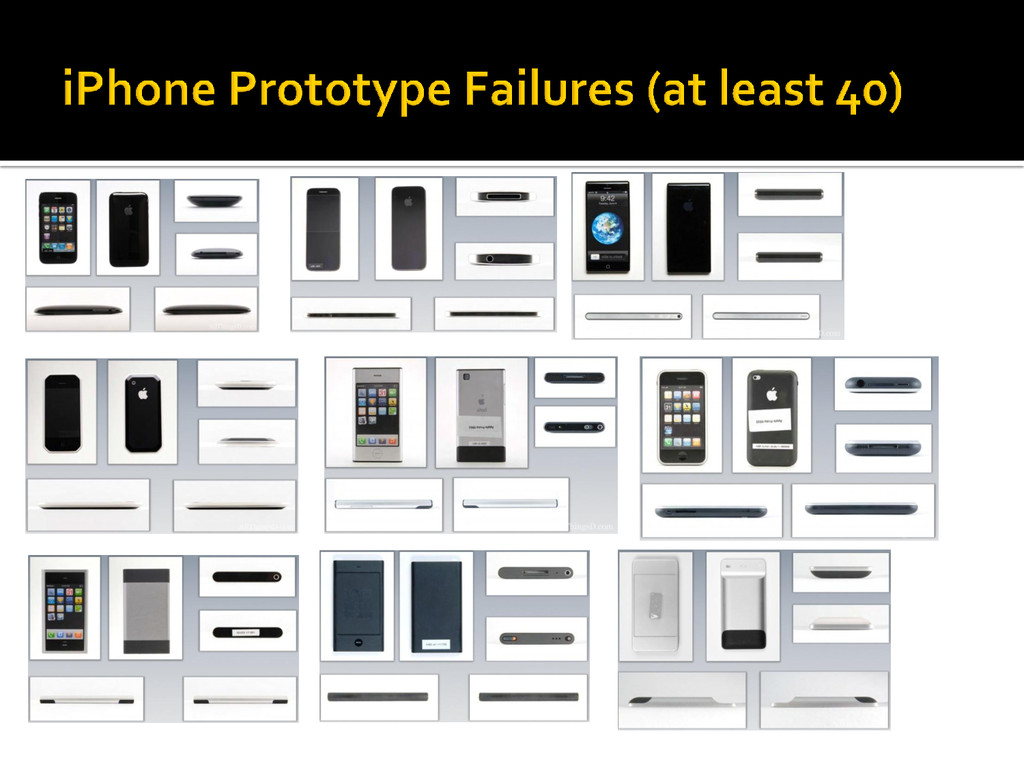
    things that we see today are truly innovative?  Not many companies in the past 10 years have been very innovative  Why don’t we see more innovation?  Innovation is messy, expensive and uncertain  CEO of Lowes  Failure is a consequence of trying to innovate  We should be the most innovative people on the planet because we have the ear of the creator of it!  Innovation is something worth striving for just because of the unintended consequences  Many innovations in life were discoveries when looking for something else (i.e. Penicillin)
  21.  Example of an innovation lab: Google X  A

    research arm of Google dedicated to finding solutions that plague billions of people  They follow a process called “rapid failure”  Failures  The space elevator (currently not feasible)  The hover board (too costly compared to social benefits)  Safe jetpack (too loud and energy wasting)  Teleportation (defies currently known laws of physics)  Successes… the self-driving car. Still being refined  Once in place, will change the world
  22.  There are many things in life that people never

    accomplish due to a fear of failure  The Lord tells us FREQUENTLY to “fear not”  If the Lord says it, that settles it!  Some people try, fail, and never try again  People often have problems dealing with failure  Trying something and expecting a perfect result and thinking that “failure = loss” is a behavior that has to be unlearned  We’re often brought up to think that failure is not an option*
  23.  Arm yourself for spiritual battles! (Eph 6:10-18)  The

    Lord has equipped you for situations and battles circumstances seemingly beyond your control  Put on the full armor of God  Don’t forget to have people intercede on your behalf… that’s the point of the church… it’s a community! *  He promises to never leave you nor forsake you (Deut 31:6)  You’re the head and not the tail (Deut 28:13)  You’re made in His image (Gen 1:27)  You’re a son or daughter of the King (Jn 1:12; Gal 3:26)  You’re seated in heavenly places with Christ Jesus (Eph 2:6)  God has plans to prosper you and not to harm you… to give you hope and a future (Jer 29:11)