Upgrade to Pro — share decks privately, control downloads, hide ads and more …

Challenges in Regional Traffic Delivery in Japan

Challenges in Regional Traffic Delivery in Japan

This is the presentation deck from the EA+ Meetup held on November 3, 2026. It addresses the challenges Japanese ISPs face in distributing traffic from major peering hubs such as Tokyo and Osaka to regional areas like Kyushu and Hokkaido.

Katsushi Yamaguchi

November 08, 2026

Transcript

14 slides
  1. Challenges in Regional Traffic Delivery in Japan 3rd Nov 2026

    EA+ NOGs meetup BIGLOBE Inc. (AS2518) Katsushi Yamaguchi
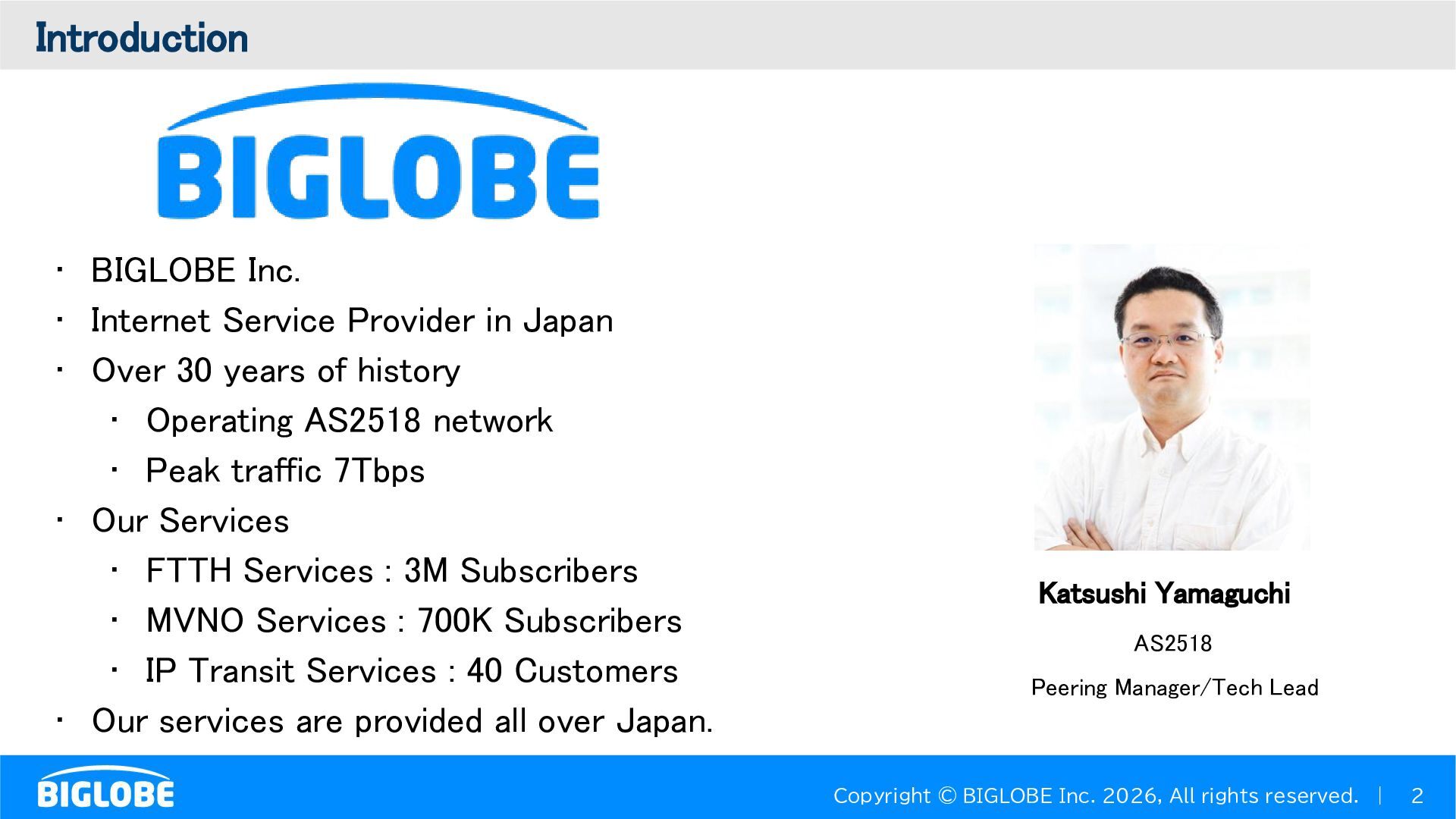
  2. Introduction • BIGLOBE Inc. • Internet Service Provider in Japan

    • Over 30 years of history • Operating AS2518 network • Peak traffic 7Tbps • Our Services • FTTH Services : 3M Subscribers • MVNO Services : 700K Subscribers • IP Transit Services : 40 Customers • Our services are provided all over Japan. Katsushi Yamaguchi AS2518 Peering Manager/Tech Lead Copyright © BIGLOBE Inc. 2026, All rights reserved. | 2
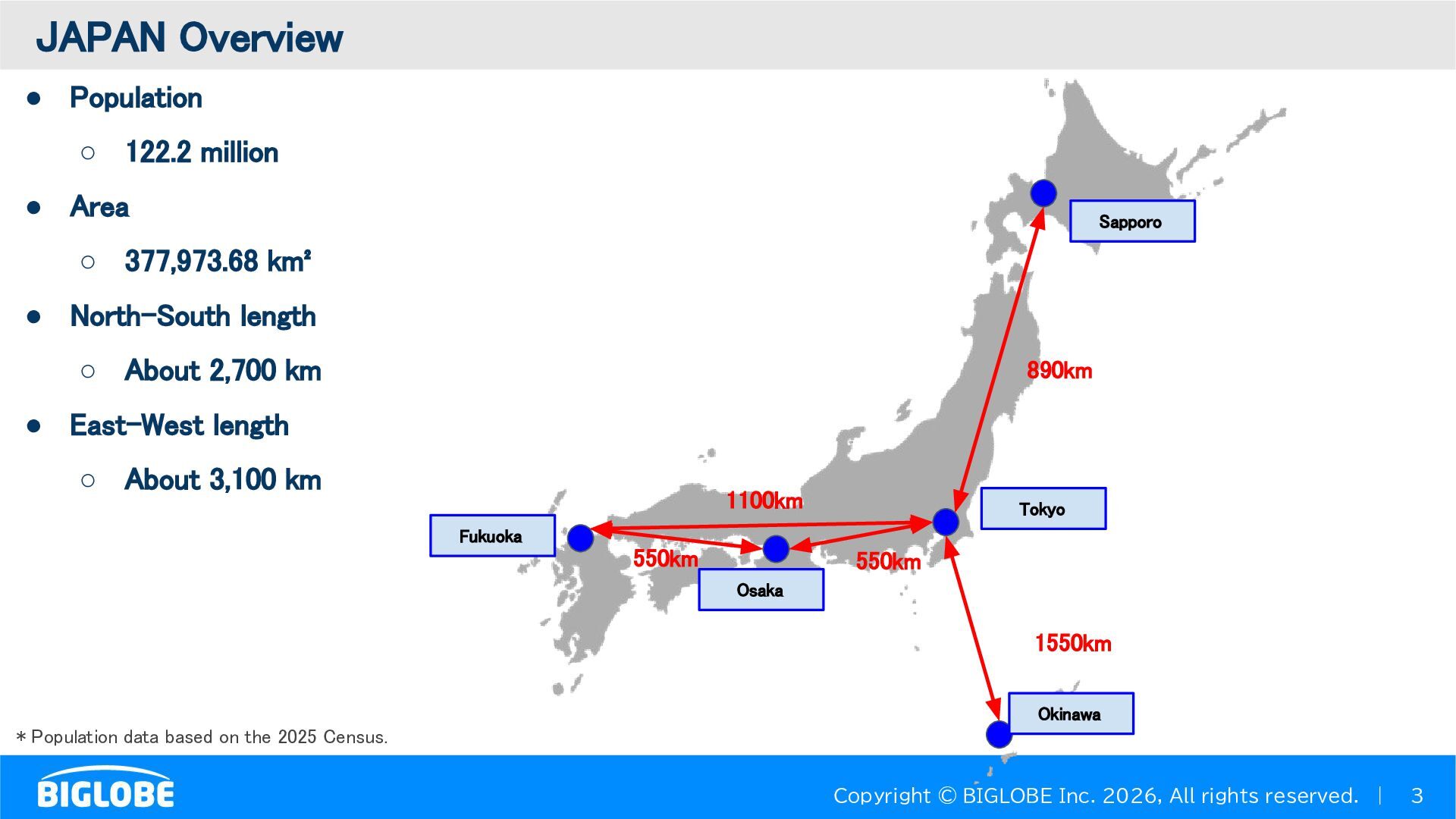
  3. JAPAN Overview • Population ◦ 122.2 million • Area Sapporo

    ◦ 377,973.68 km² • North-South length ◦ About 2,700 km 890km • East-West length ◦ About 3,100 km 1100km Tokyo Fukuoka 550km 550km Osaka 1550km Okinawa * Population data based on the 2025 Census. Copyright © BIGLOBE Inc. 2026, All rights reserved. | 3
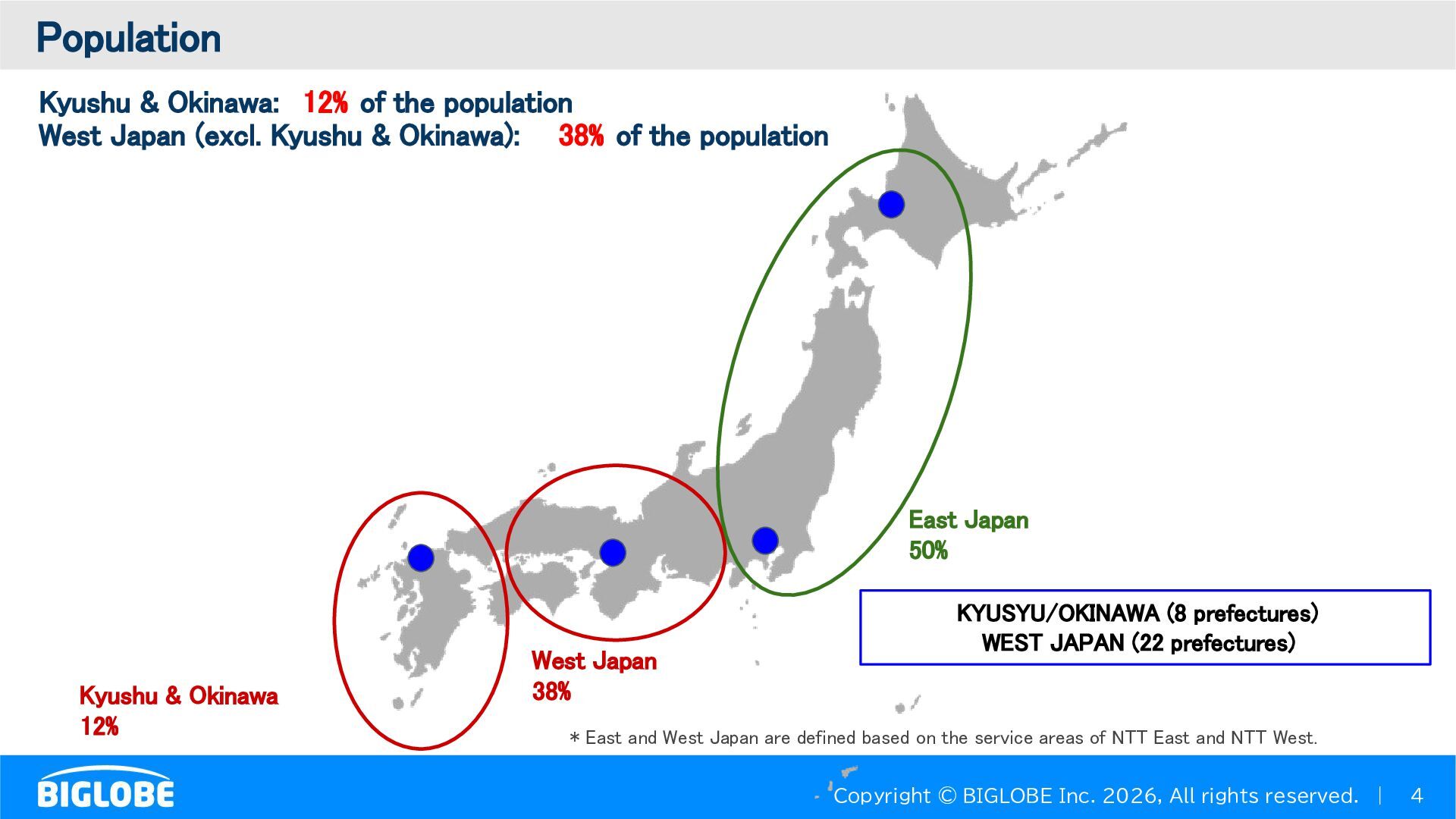
  4. Population Kyushu & Okinawa: 12% of the population West Japan

    (excl. Kyushu & Okinawa): 38% of the population East Japan 50% Kyushu & Okinawa 12% West Japan 38% KYUSYU/OKINAWA (8 prefectures) WEST JAPAN (22 prefectures) * East and West Japan are defined based on the service areas of NTT East and NTT West. Copyright © BIGLOBE Inc. 2026, All rights reserved. | 4
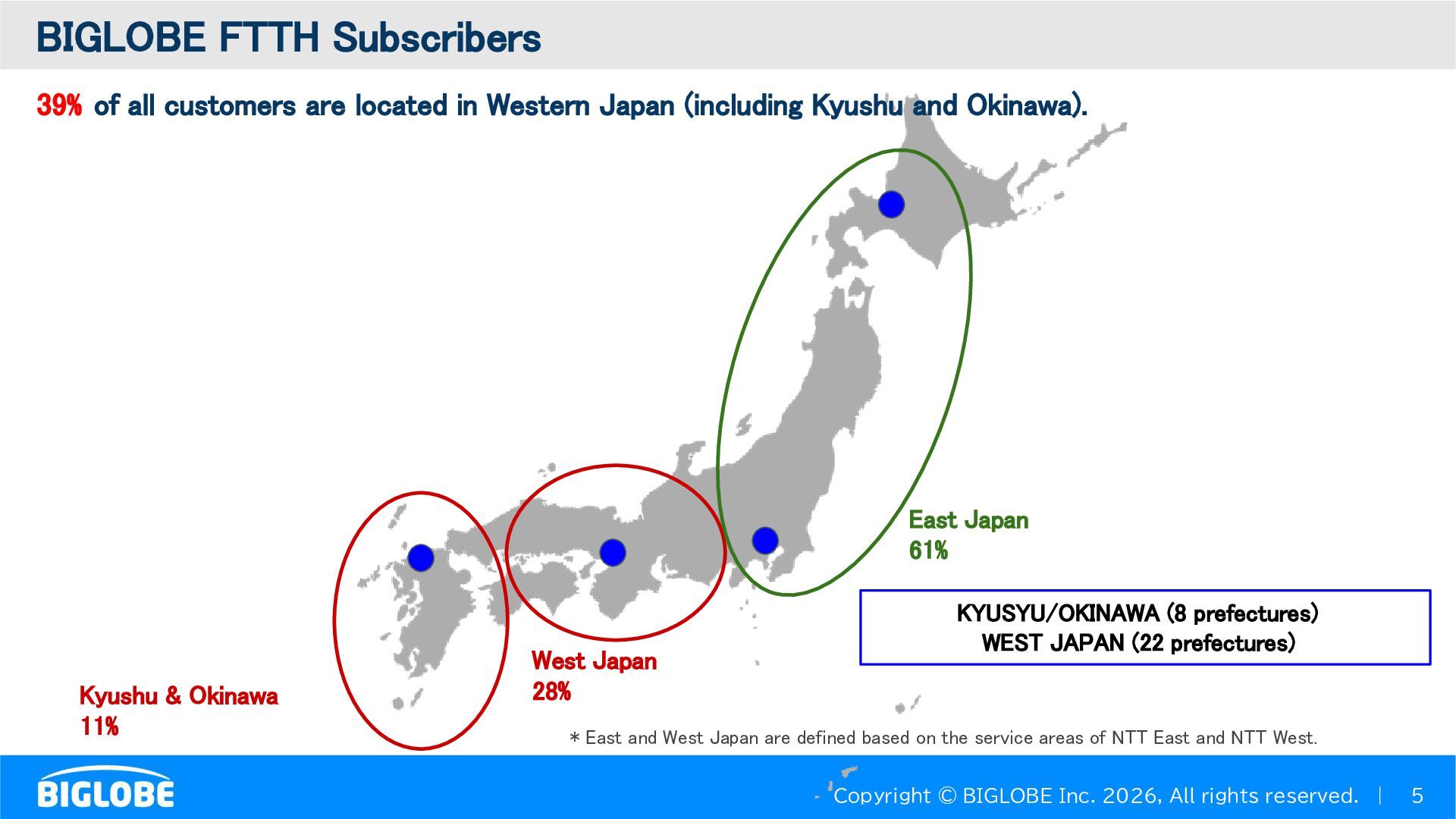
  5. BIGLOBE FTTH Subscribers 39% of all customers are located in

    Western Japan (including Kyushu and Okinawa). East Japan 61% Kyushu & Okinawa 11% West Japan 28% KYUSYU/OKINAWA (8 prefectures) WEST JAPAN (22 prefectures) * East and West Japan are defined based on the service areas of NTT East and NTT West. Copyright © BIGLOBE Inc. 2026, All rights reserved. | 5
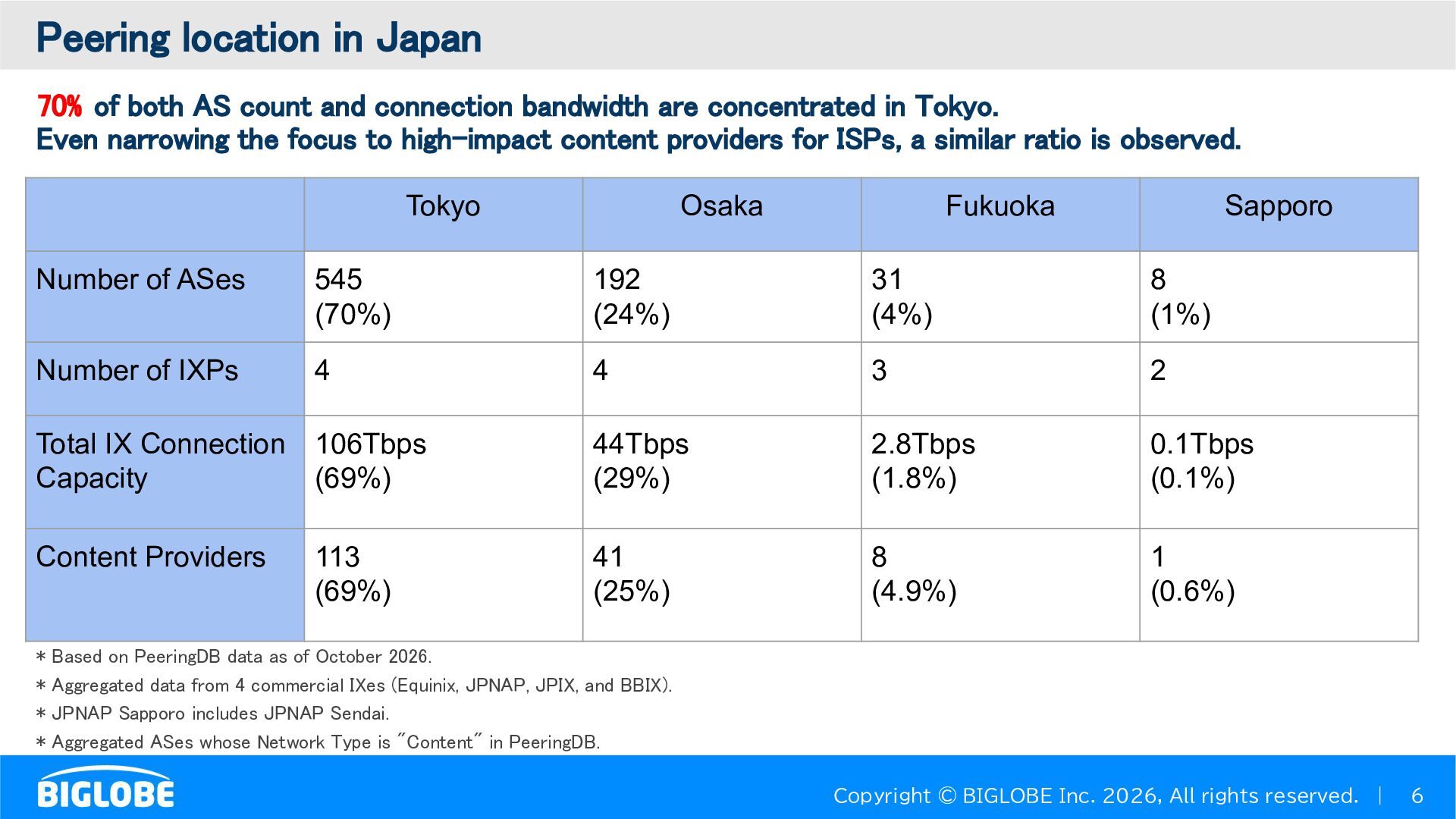
  6. Peering location in Japan 70% of both AS count and

    connection bandwidth are concentrated in Tokyo. Even narrowing the focus to high-impact content providers for ISPs, a similar ratio is observed. Tokyo Osaka Fukuoka Sapporo Number of ASes 545 (70%) 192 (24%) 31 (4%) 8 (1%) Number of IXPs 4 4 3 2 Total IX Connection Capacity 106Tbps (69%) 44Tbps (29%) 2.8Tbps (1.8%) 0.1Tbps (0.1%) Content Providers 113 (69%) 41 (25%) 8 (4.9%) 1 (0.6%) * Based on PeeringDB data as of October 2026. * Aggregated data from 4 commercial IXes (Equinix, JPNAP, JPIX, and BBIX). * JPNAP Sapporo includes JPNAP Sendai. * Aggregated ASes whose Network Type is "Content" in PeeringDB. Copyright © BIGLOBE Inc. 2026, All rights reserved. | 6
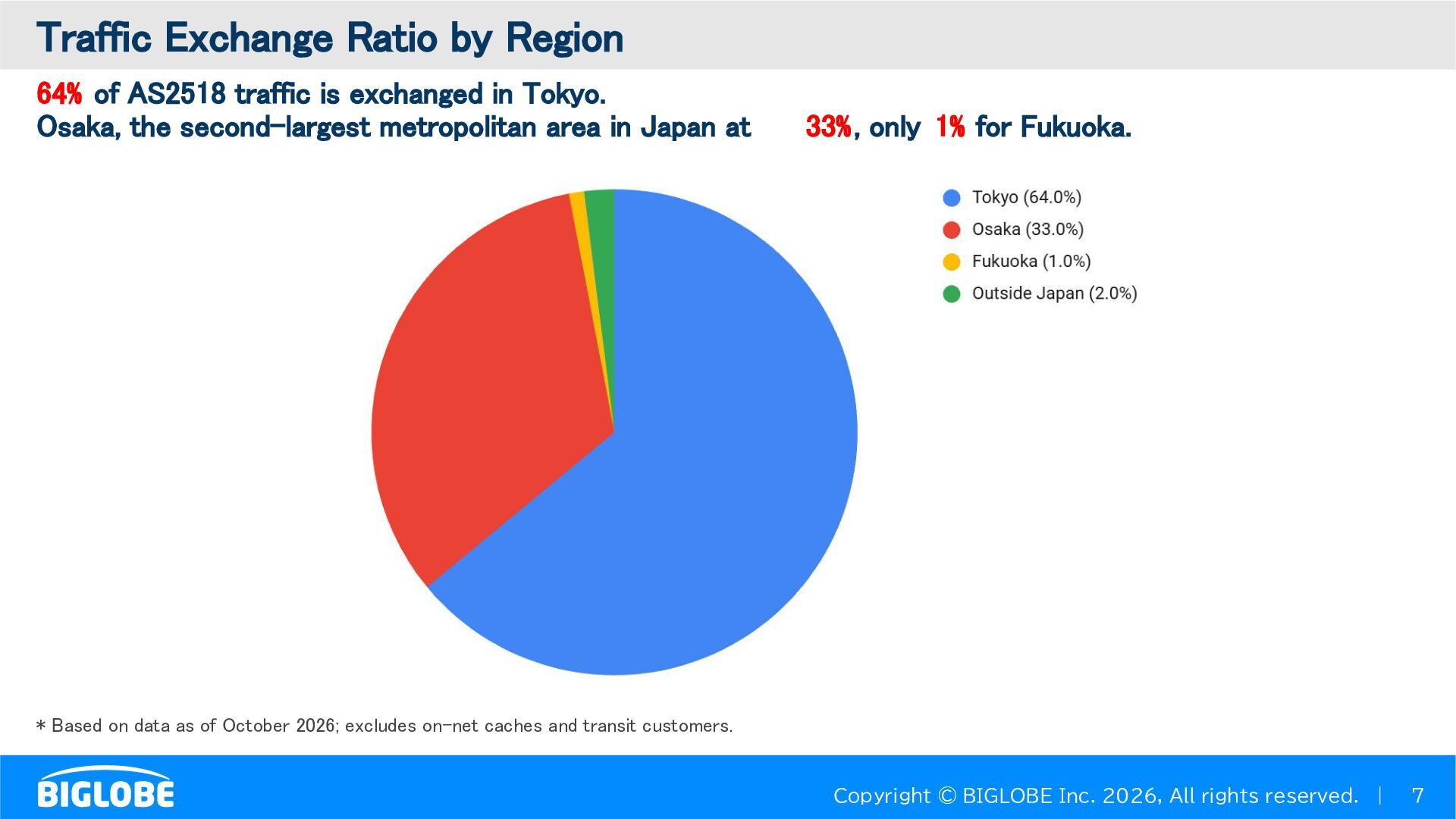
  7. Traffic Exchange Ratio by Region 64% of AS2518 traffic is

    exchanged in Tokyo. Osaka, the second-largest metropolitan area in Japan at 33%, only 1% for Fukuoka. * Based on data as of October 2026; excludes on-net caches and transit customers. Copyright © BIGLOBE Inc. 2026, All rights reserved. | 7
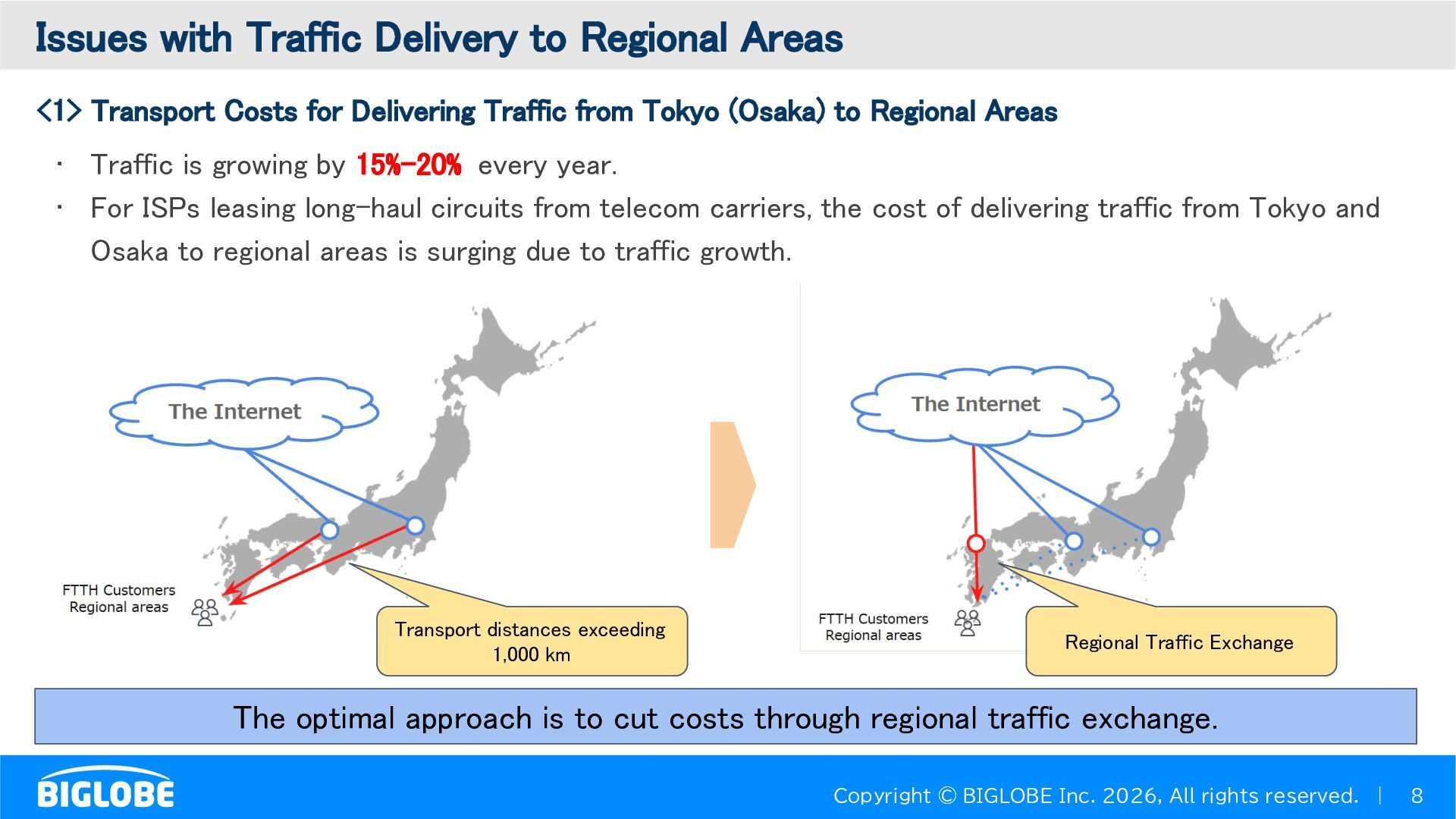
  8. Issues with Traffic Delivery to Regional Areas <1> Transport Costs

    for Delivering Traffic from Tokyo (Osaka) to Regional Areas • Traffic is growing by 15%–20% every year. • For ISPs leasing long-haul circuits from telecom carriers, the cost of delivering traffic from Tokyo and Osaka to regional areas is surging due to traffic growth. Transport distances exceeding 1,000 km Regional Traffic Exchange The optimal approach is to cut costs through regional traffic exchange. Copyright © BIGLOBE Inc. 2026, All rights reserved. | 8
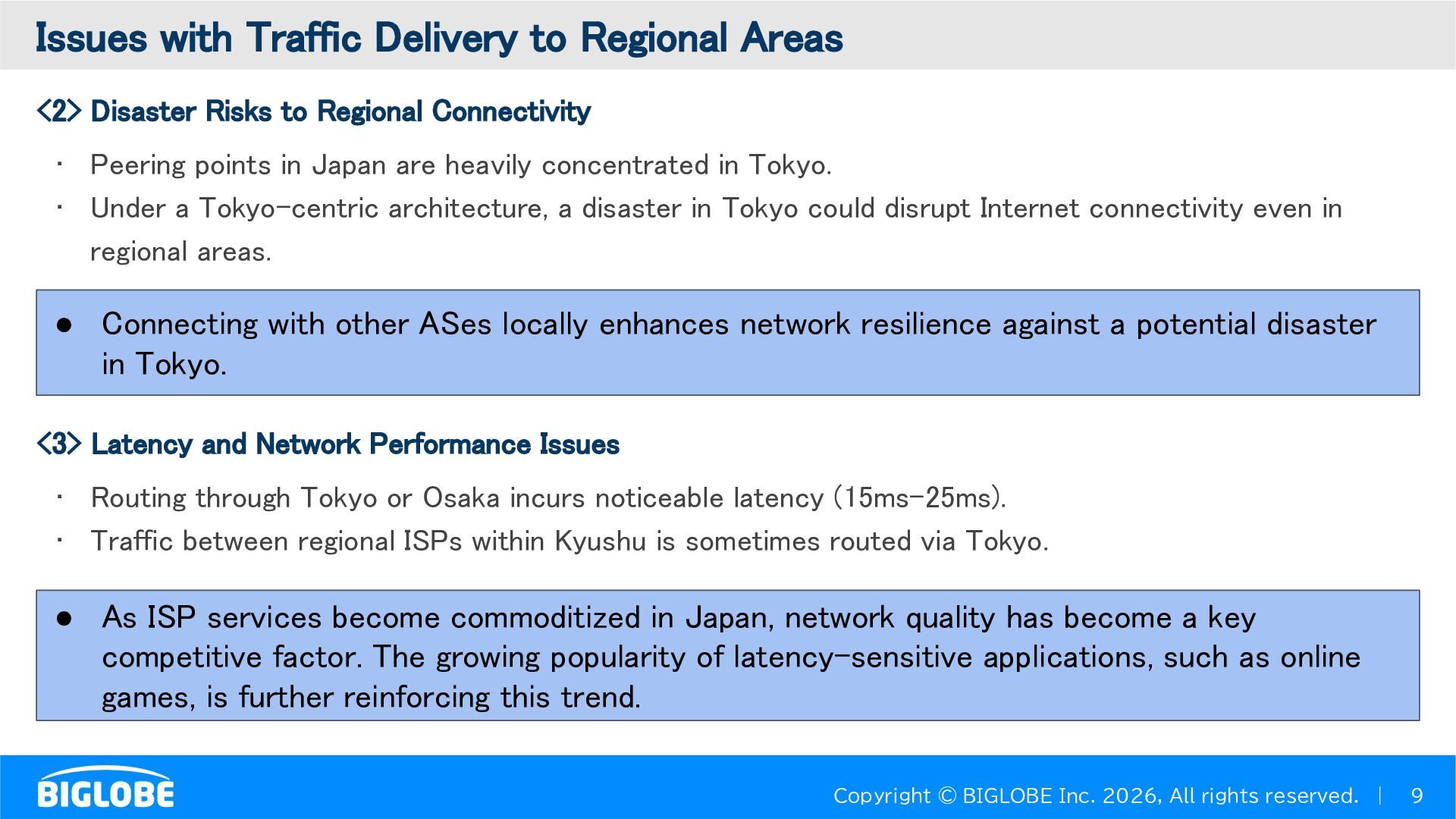
  9. Issues with Traffic Delivery to Regional Areas <2> Disaster Risks

    to Regional Connectivity • Peering points in Japan are heavily concentrated in Tokyo. • Under a Tokyo-centric architecture, a disaster in Tokyo could disrupt Internet connectivity even in regional areas. • Connecting with other ASes locally enhances network resilience against a potential disaster in Tokyo. <3> Latency and Network Performance Issues • Routing through Tokyo or Osaka incurs noticeable latency (15ms–25ms). • Traffic between regional ISPs within Kyushu is sometimes routed via Tokyo. • As ISP services become commoditized in Japan, network quality has become a key competitive factor. The growing popularity of latency-sensitive applications, such as online games, is further reinforcing this trend. Copyright © BIGLOBE Inc. 2026, All rights reserved. | 9
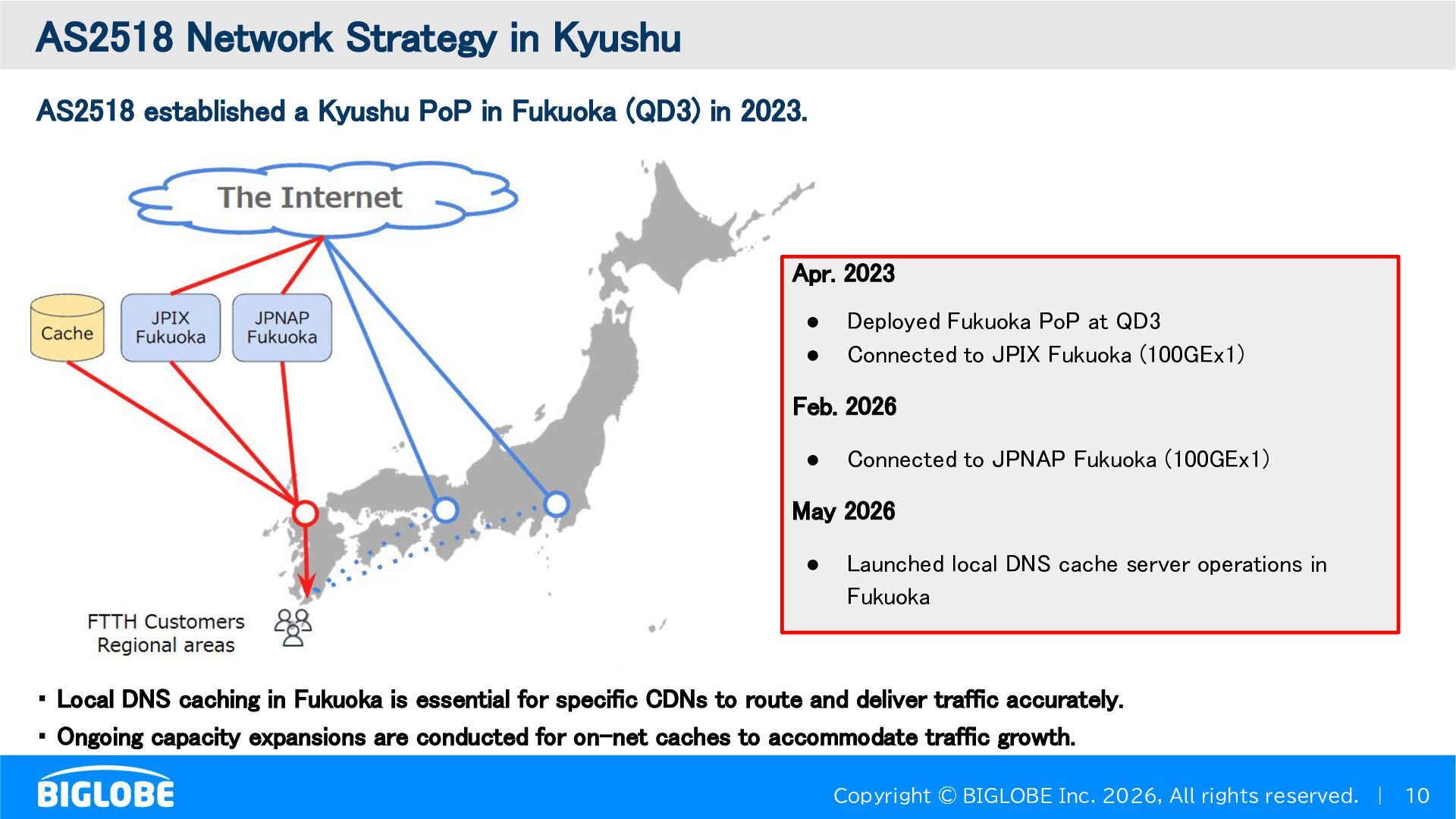
  10. AS2518 Network Strategy in Kyushu AS2518 established a Kyushu PoP

    in Fukuoka (QD3) in 2023. Apr. 2023 • • Deployed Fukuoka PoP at QD3 Connected to JPIX Fukuoka (100GEx1) Feb. 2026 • Connected to JPNAP Fukuoka (100GEx1) May 2026 • Launched local DNS cache server operations in Fukuoka ・ Local DNS caching in Fukuoka is essential for specific CDNs to route and deliver traffic accurately. ・ Ongoing capacity expansions are conducted for on-net caches to accommodate traffic growth. Copyright © BIGLOBE Inc. 2026, All rights reserved. | 10
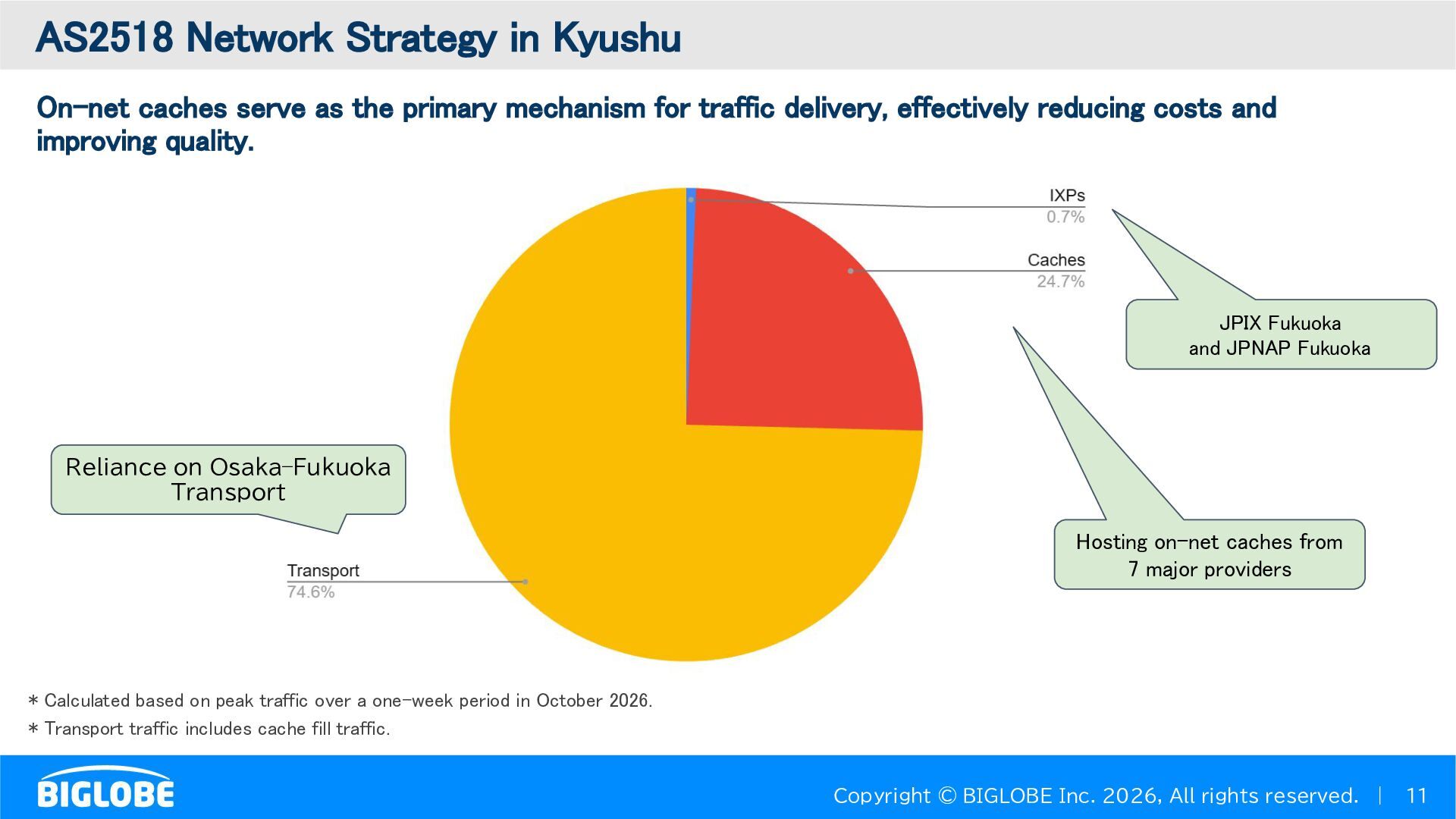
  11. AS2518 Network Strategy in Kyushu On-net caches serve as the

    primary mechanism for traffic delivery, effectively reducing costs and improving quality. JPIX Fukuoka and JPNAP Fukuoka Reliance on Osaka–Fukuoka Transport Hosting on-net caches from 7 major providers * Calculated based on peak traffic over a one-week period in October 2026. * Transport traffic includes cache fill traffic. Copyright © BIGLOBE Inc. 2026, All rights reserved. | 11
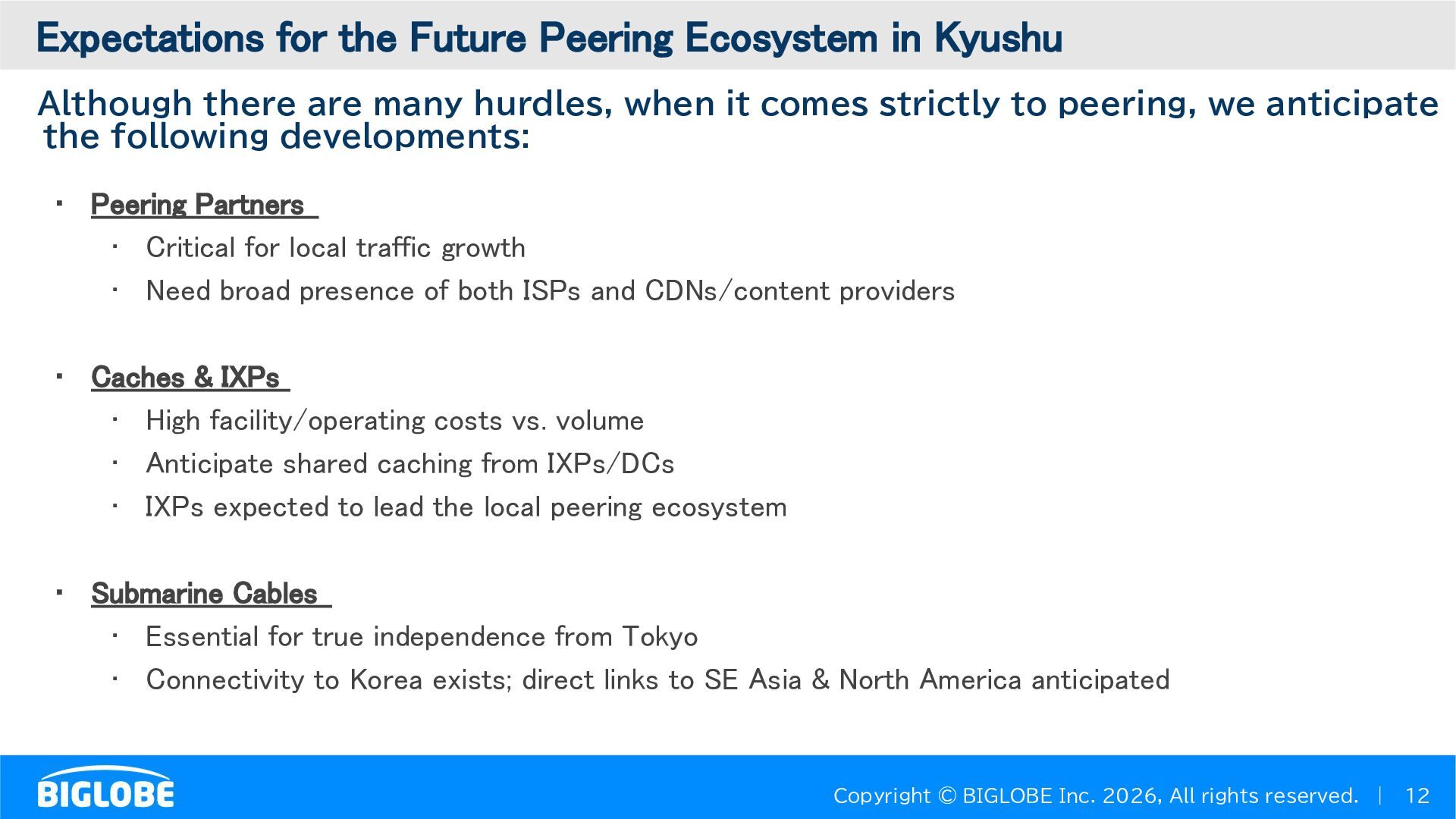
  12. Expectations for the Future Peering Ecosystem in Kyushu Although there

    are many hurdles, when it comes strictly to peering, we anticipate the following developments: • Peering Partners • Critical for local traffic growth • Need broad presence of both ISPs and CDNs/content providers • Caches & IXPs • High facility/operating costs vs. volume • Anticipate shared caching from IXPs/DCs • IXPs expected to lead the local peering ecosystem • Submarine Cables • Essential for true independence from Tokyo • Connectivity to Korea exists; direct links to SE Asia & North America anticipated Copyright © BIGLOBE Inc. 2026, All rights reserved. | 12
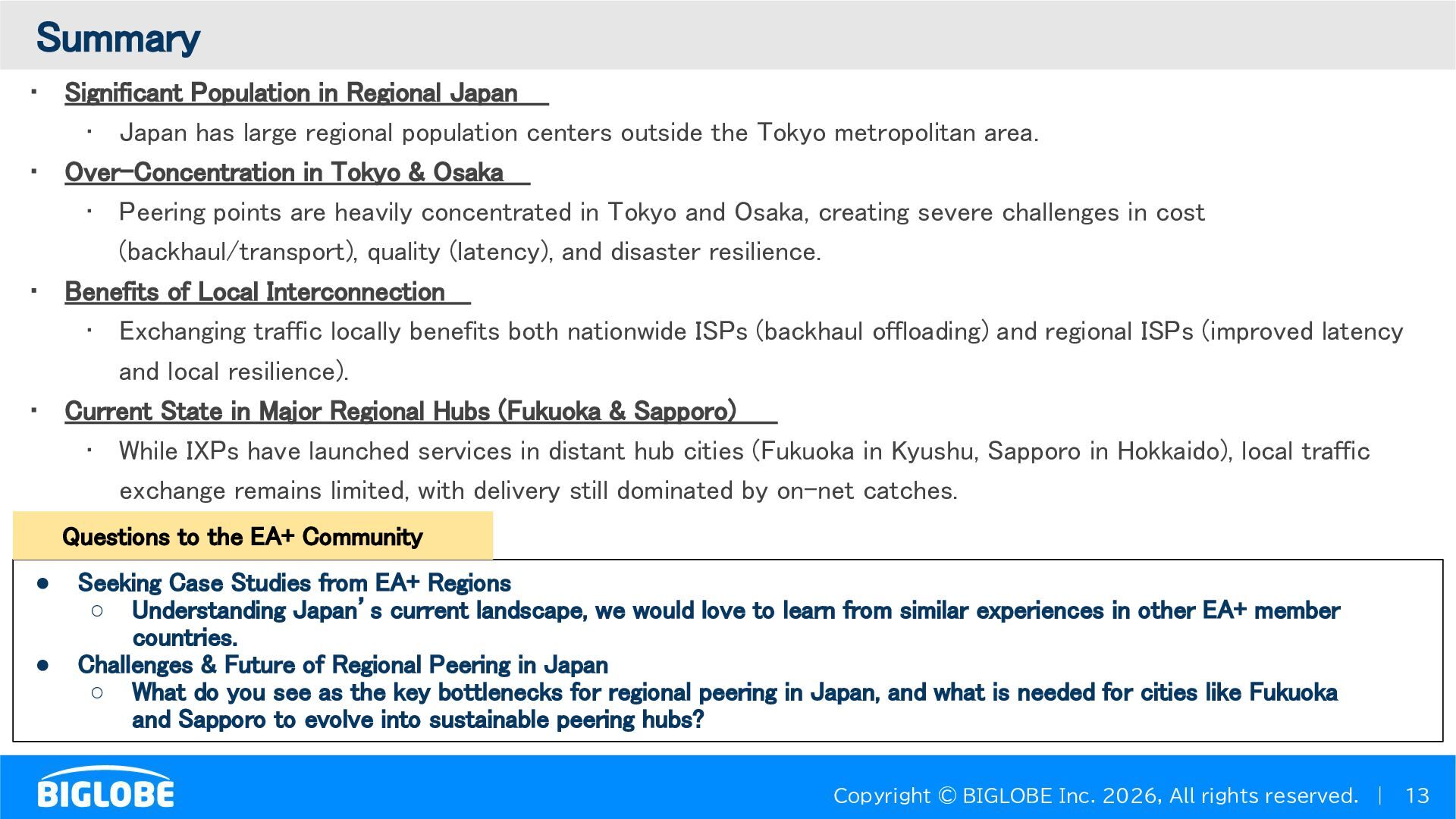
  13. Summary • • • • Significant Population in Regional Japan

    • Japan has large regional population centers outside the Tokyo metropolitan area. Over-Concentration in Tokyo & Osaka • Peering points are heavily concentrated in Tokyo and Osaka, creating severe challenges in cost (backhaul/transport), quality (latency), and disaster resilience. Benefits of Local Interconnection • Exchanging traffic locally benefits both nationwide ISPs (backhaul offloading) and regional ISPs (improved latency and local resilience). Current State in Major Regional Hubs (Fukuoka & Sapporo) • While IXPs have launched services in distant hub cities (Fukuoka in Kyushu, Sapporo in Hokkaido), local traffic exchange remains limited, with delivery still dominated by on-net catches. Questions to the EA+ Community • • Seeking Case Studies from EA+ Regions ◦ Understanding Japan’s current landscape, we would love to learn from similar experiences in other EA+ member countries. Challenges & Future of Regional Peering in Japan ◦ What do you see as the key bottlenecks for regional peering in Japan, and what is needed for cities like Fukuoka and Sapporo to evolve into sustainable peering hubs? Copyright © BIGLOBE Inc. 2026, All rights reserved. | 13

More Decks by Katsushi Yamaguchi

Other Decks in Technology