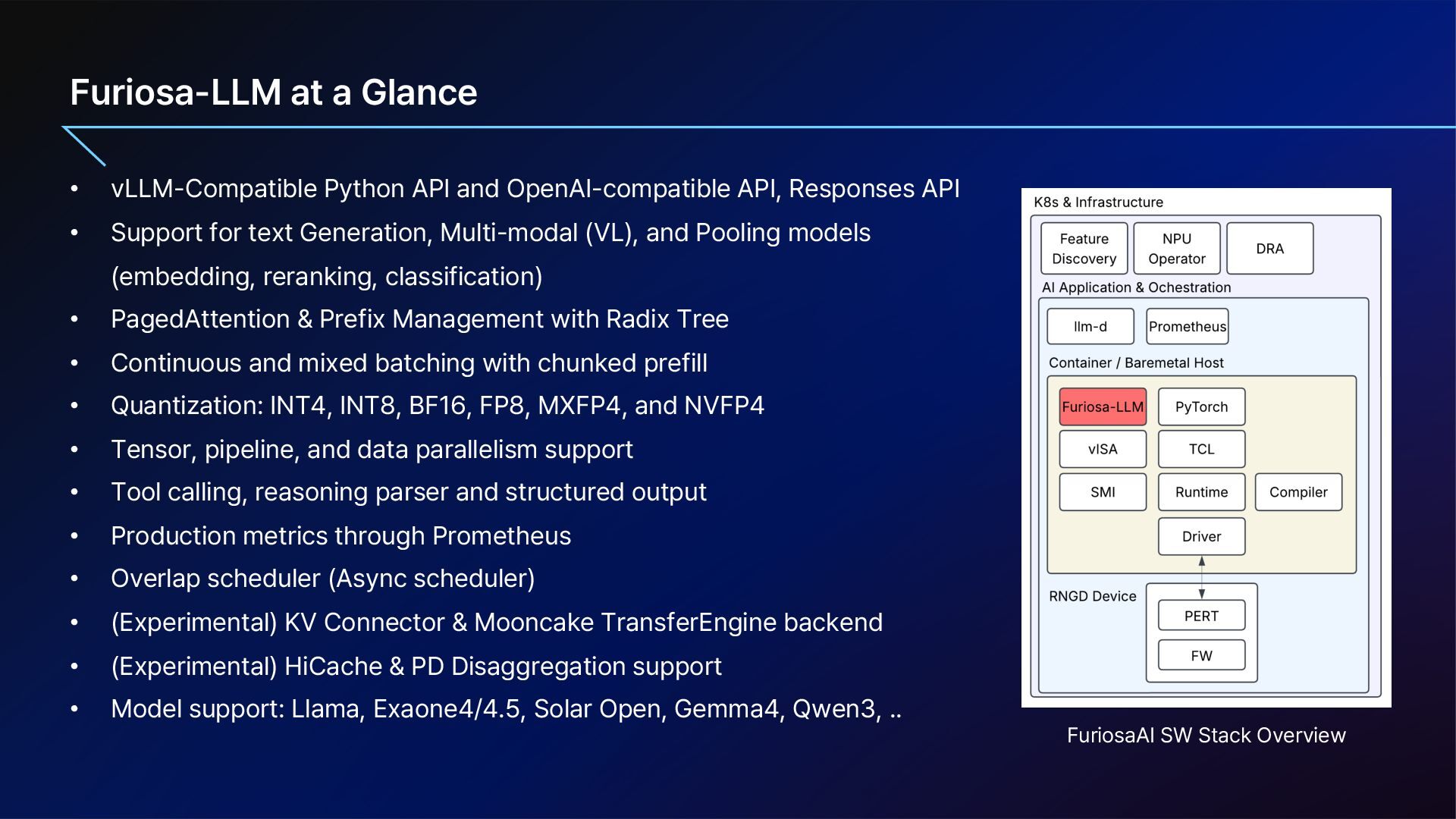
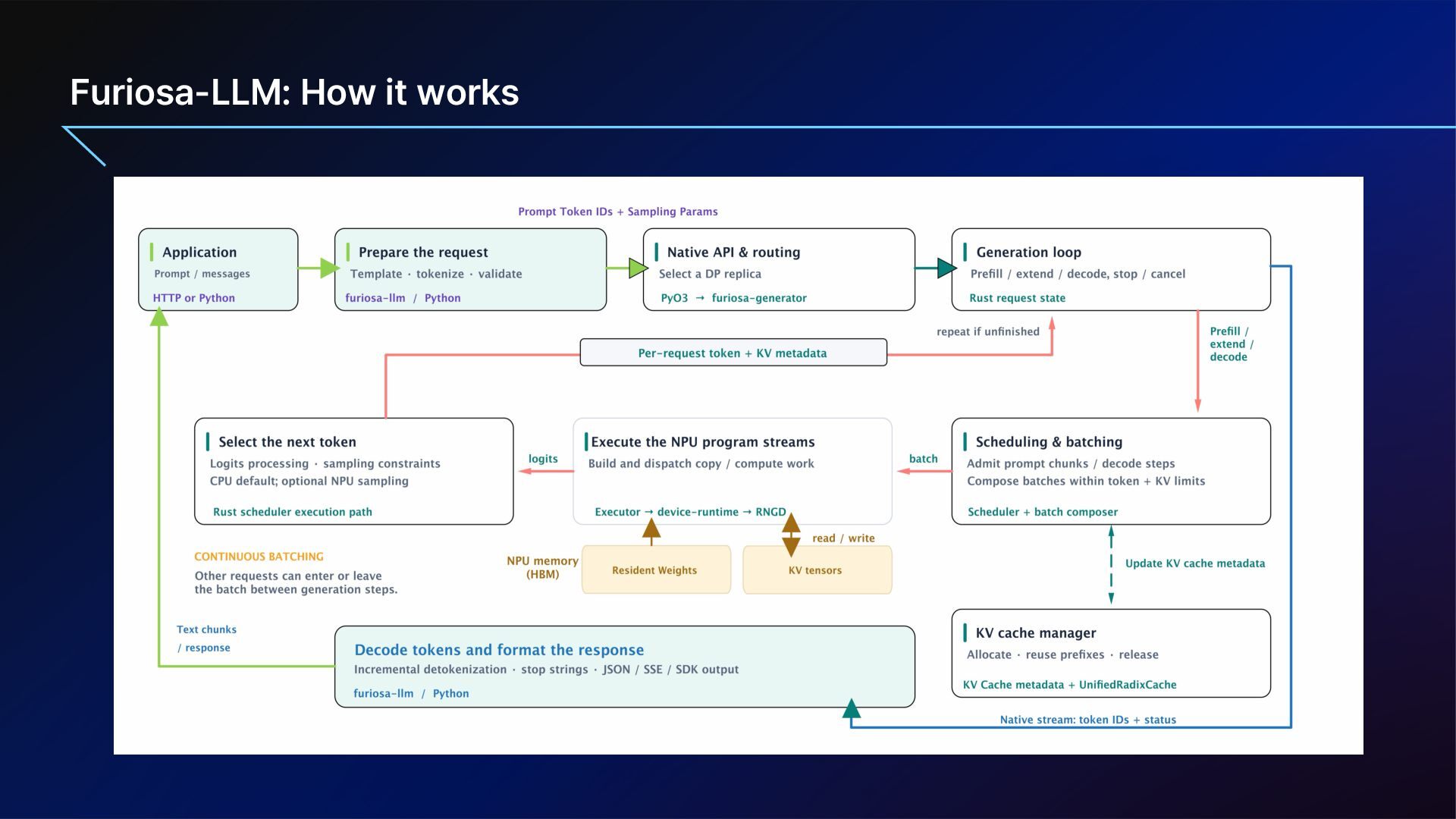
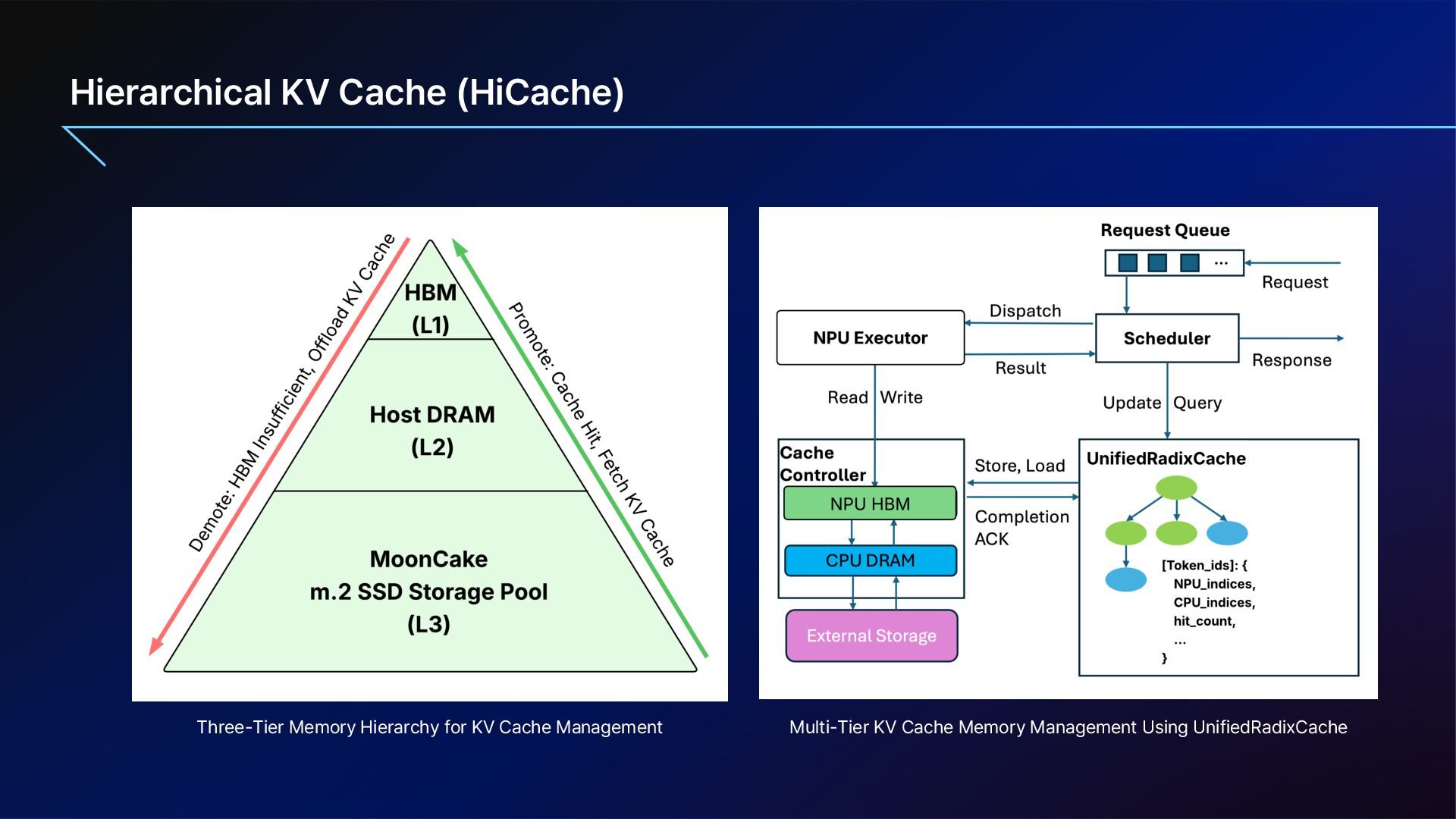
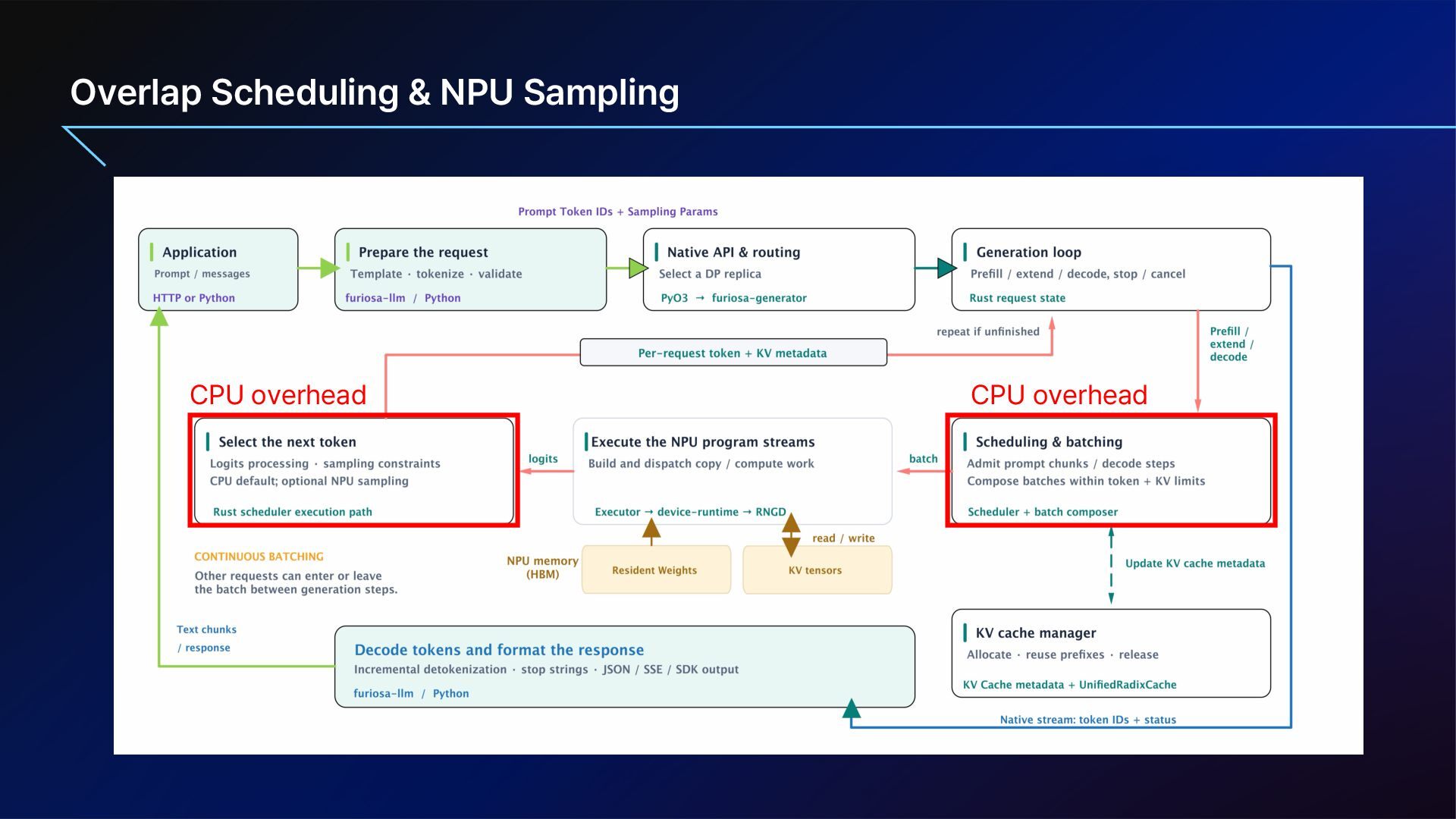
and OpenAI compatible API, Responses API • Support for text Generation, Multi modal VL , and Pooling models embedding, reranking, classification • PagedAttention Prefix Management with Radix Tree • Continuous and mixed batching with chunked prefill • Quantization: INT4, INT8, BF16, FP8, MXFP4, and NVFP4 • Tensor, pipeline, and data parallelism support • Tool calling, reasoning parser and structured output • Production metrics through Prometheus • Overlap scheduler Async scheduler • Experimental KV Connector • Experimental HiCache • Model support: Llama, Exaone4/4.5, Solar Open, Gemma4, Qwen3, .. Mooncake TransferEngine backend PD Disaggregation support FuriosaAI SW Stack Overview
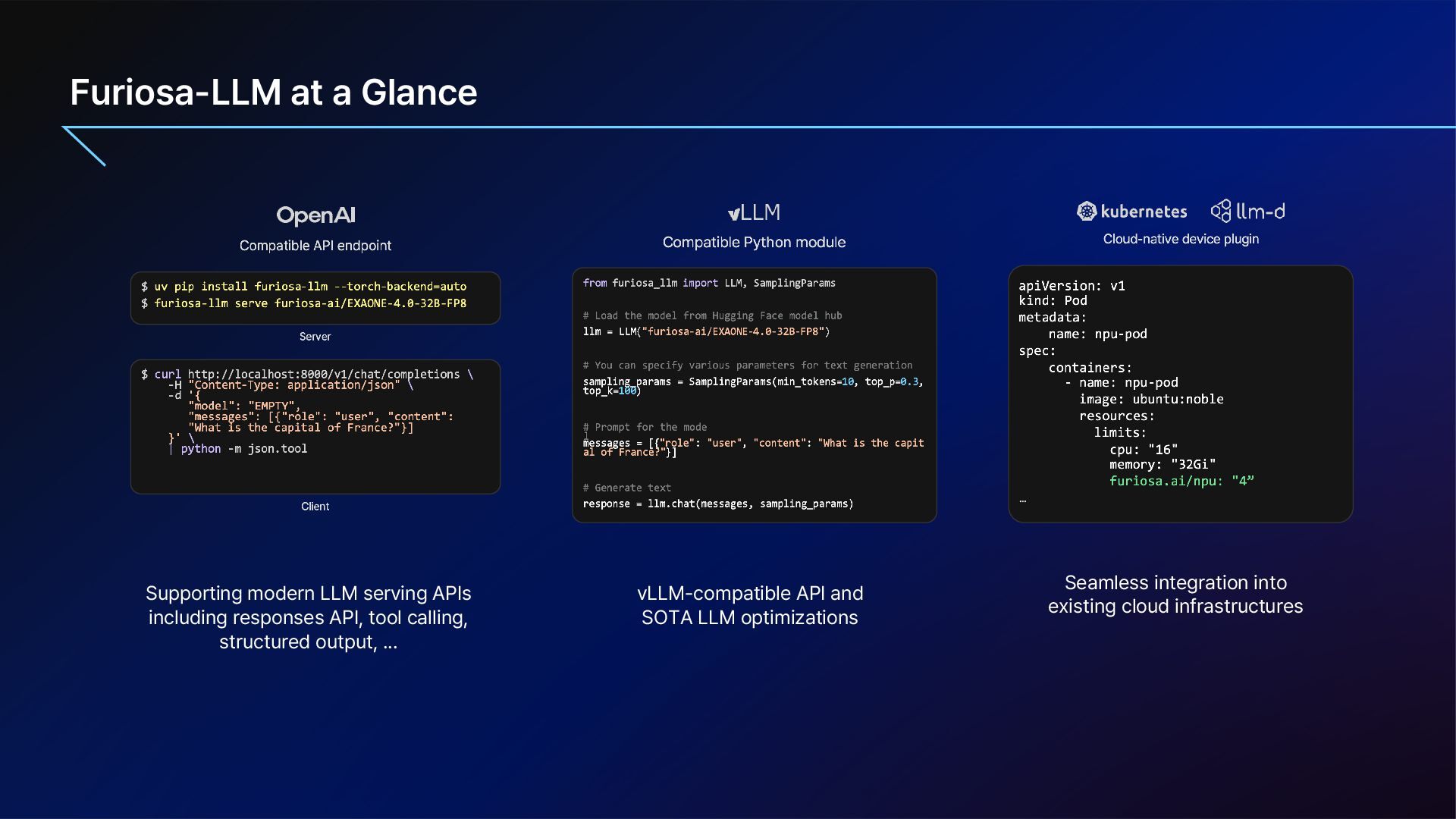
APIs including responses API, tool calling, structured output, ... vLLM compatible API and SOTA LLM optimizations Seamless integration into existing cloud infrastructures
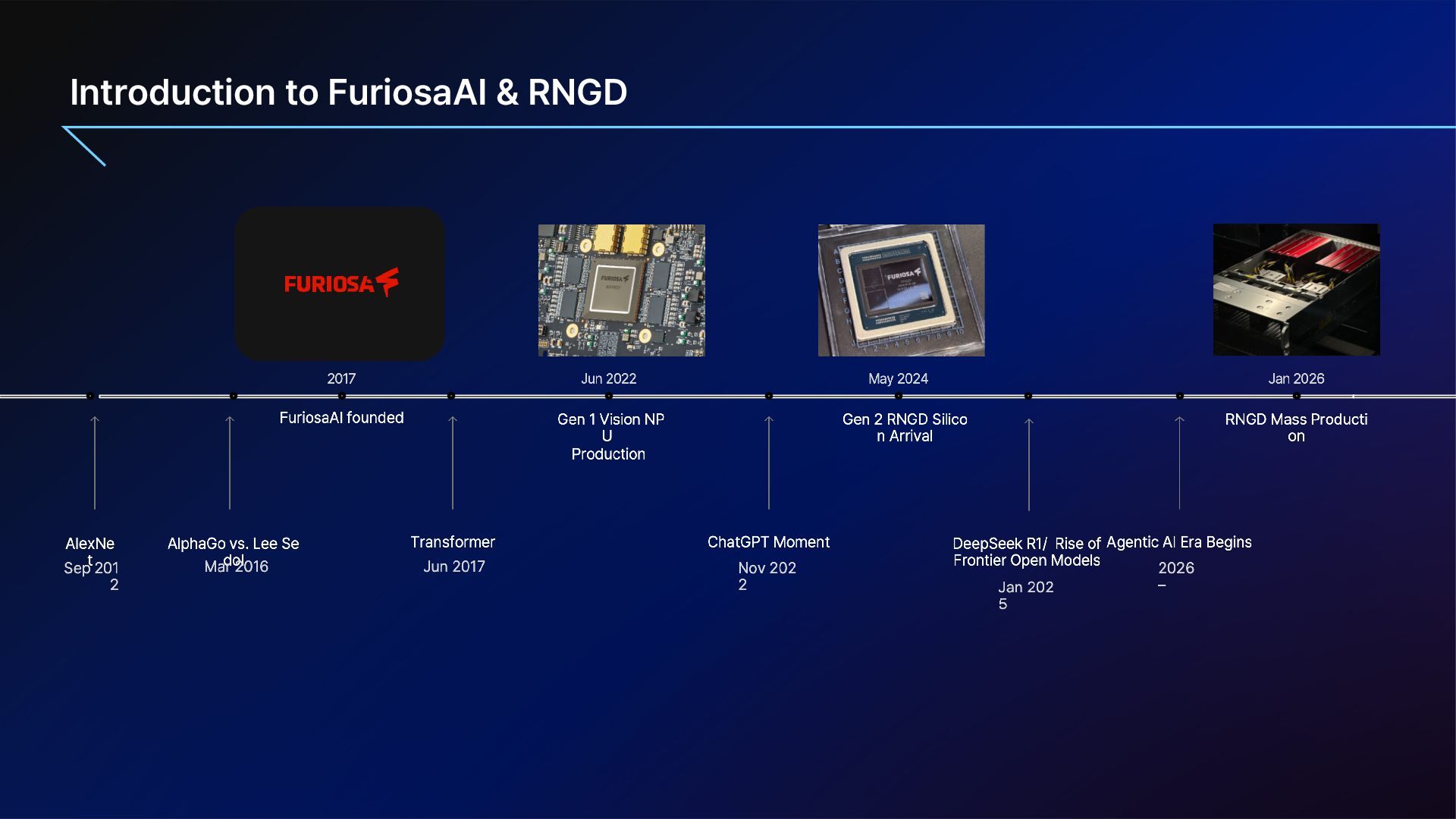
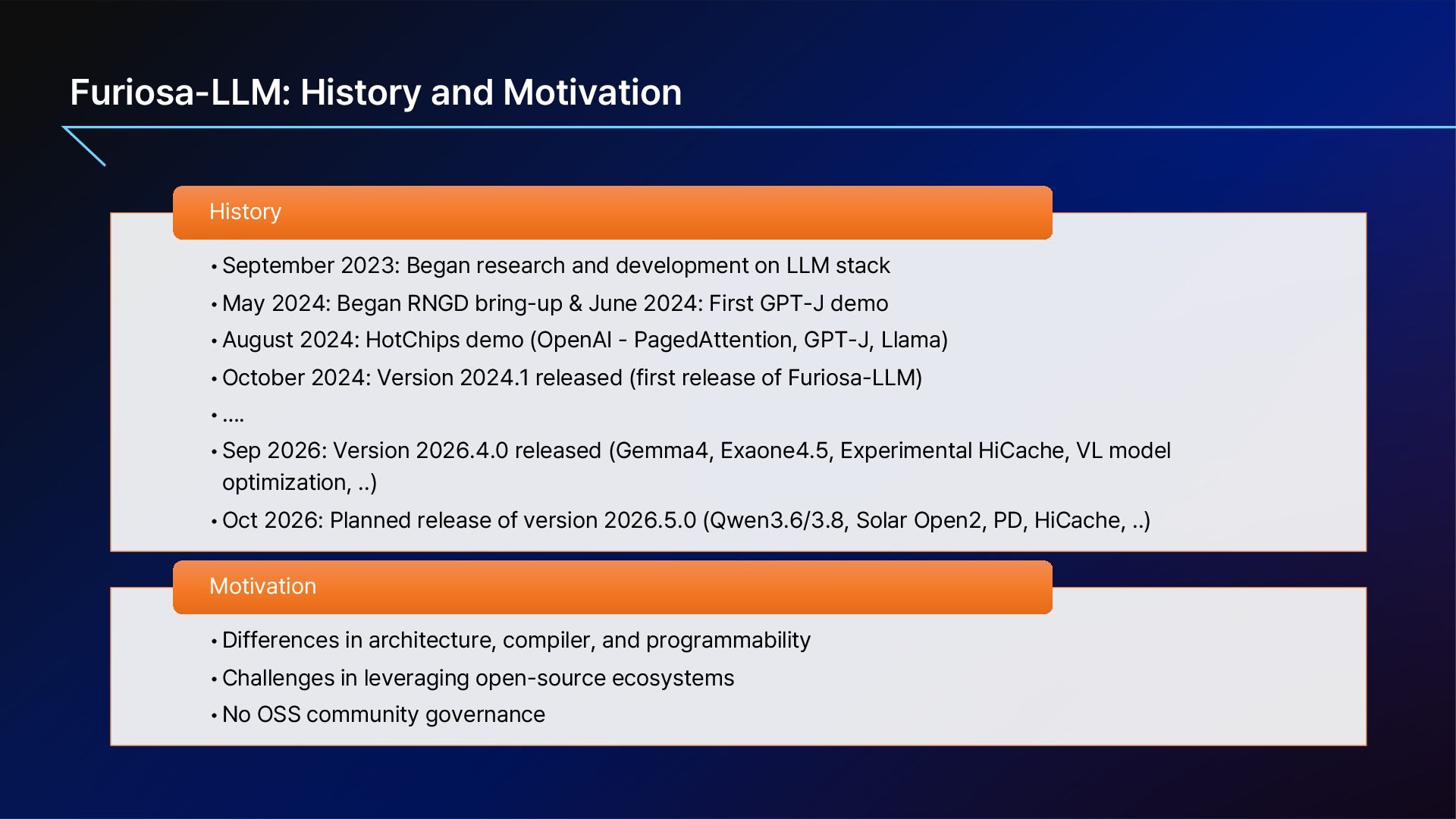
and development on LLM stack •May 2024: Began RNGD bring up June 2024: First GPT J demo •August 2024: HotChips demo OpenAI PagedAttention, GPT J, Llama •October 2024: Version 2024.1 released first release of Furiosa LLM •…. •Sep 2026: Version 2026.4.0 released Gemma4, Exaone4.5, Experimental HiCache, VL model optimization, .. •Oct 2026: Planned release of version 2026.5.0 Qwen3.6/3.8, Solar Open2, PD, HiCache, .. Motivation •Differences in architecture, compiler, and programmability •Challenges in leveraging open source ecosystems •No OSS community governance
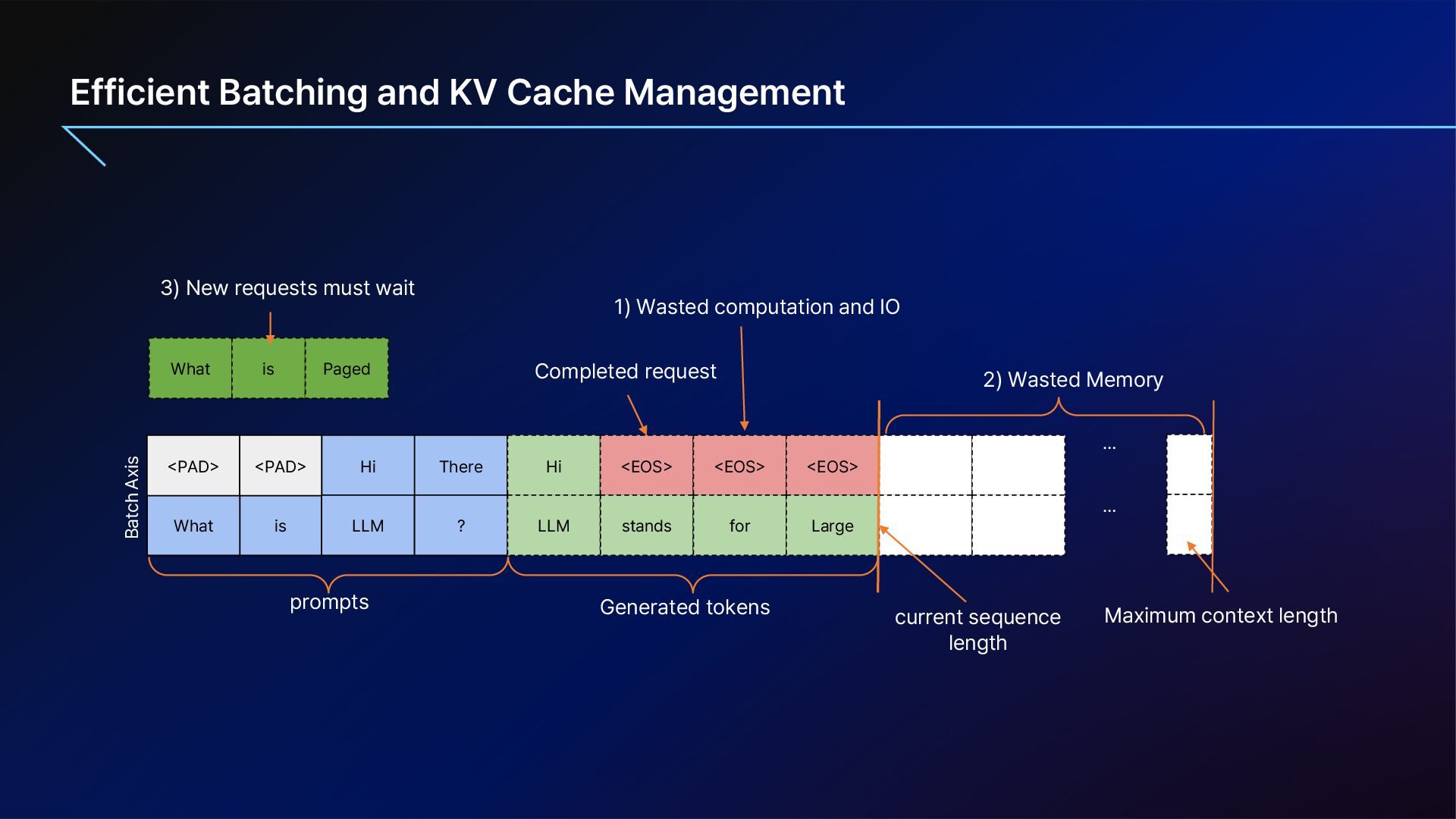
wait What is 1 Wasted computation and IO Completed request Paged 2 Wasted Memory Batch Axis … PAD PAD Hi There Hi EOS EOS EOS What is LLM ? LLM stands for Large prompts Generated tokens … current sequence length Maximum context length
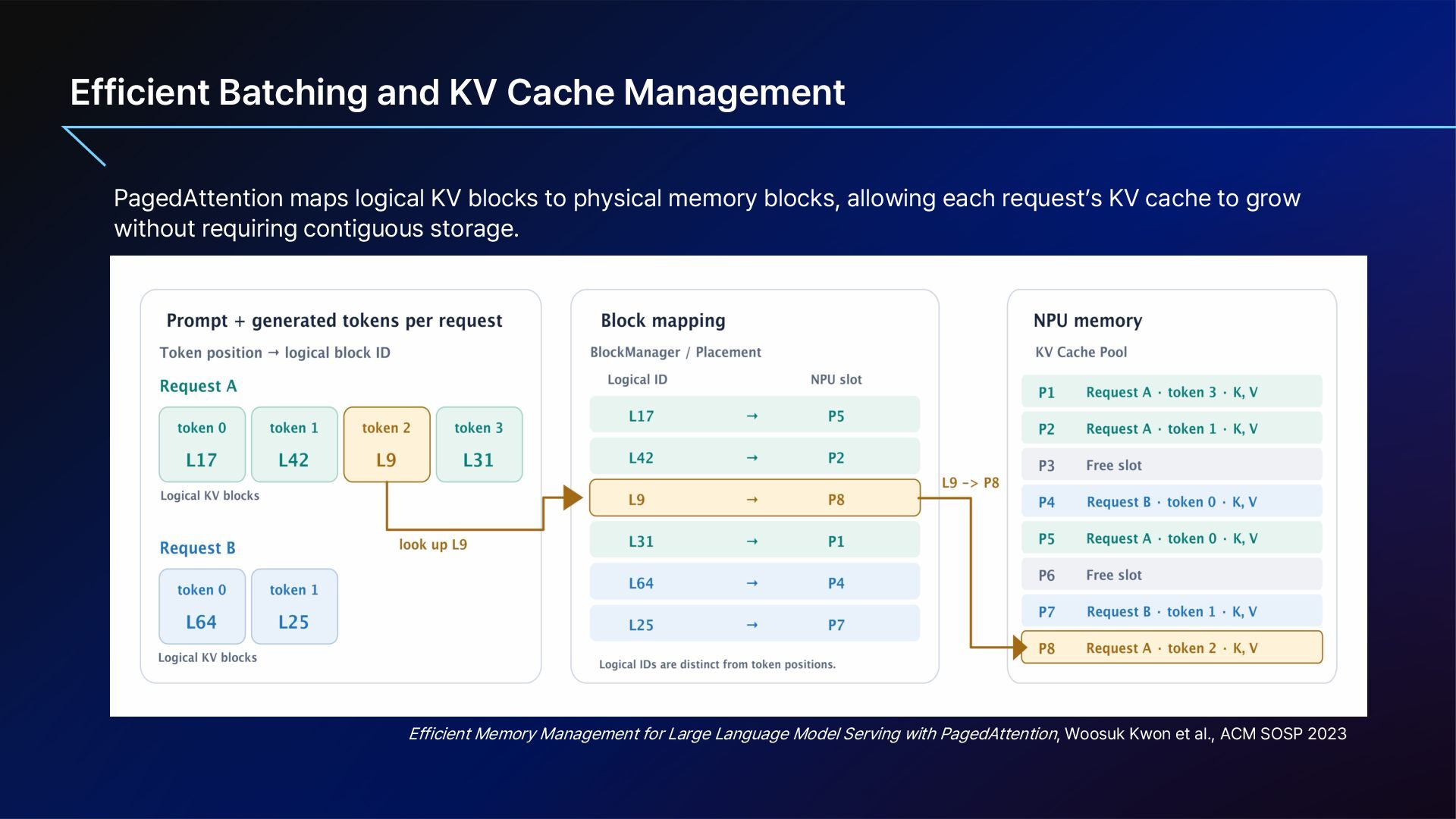
blocks to physical memory blocks, allowing each request s KV cache to grow without requiring contiguous storage. Efficient Memory Management for Large Language Model Serving with PagedAttention, Woosuk Kwon et al., ACM SOSP 2023
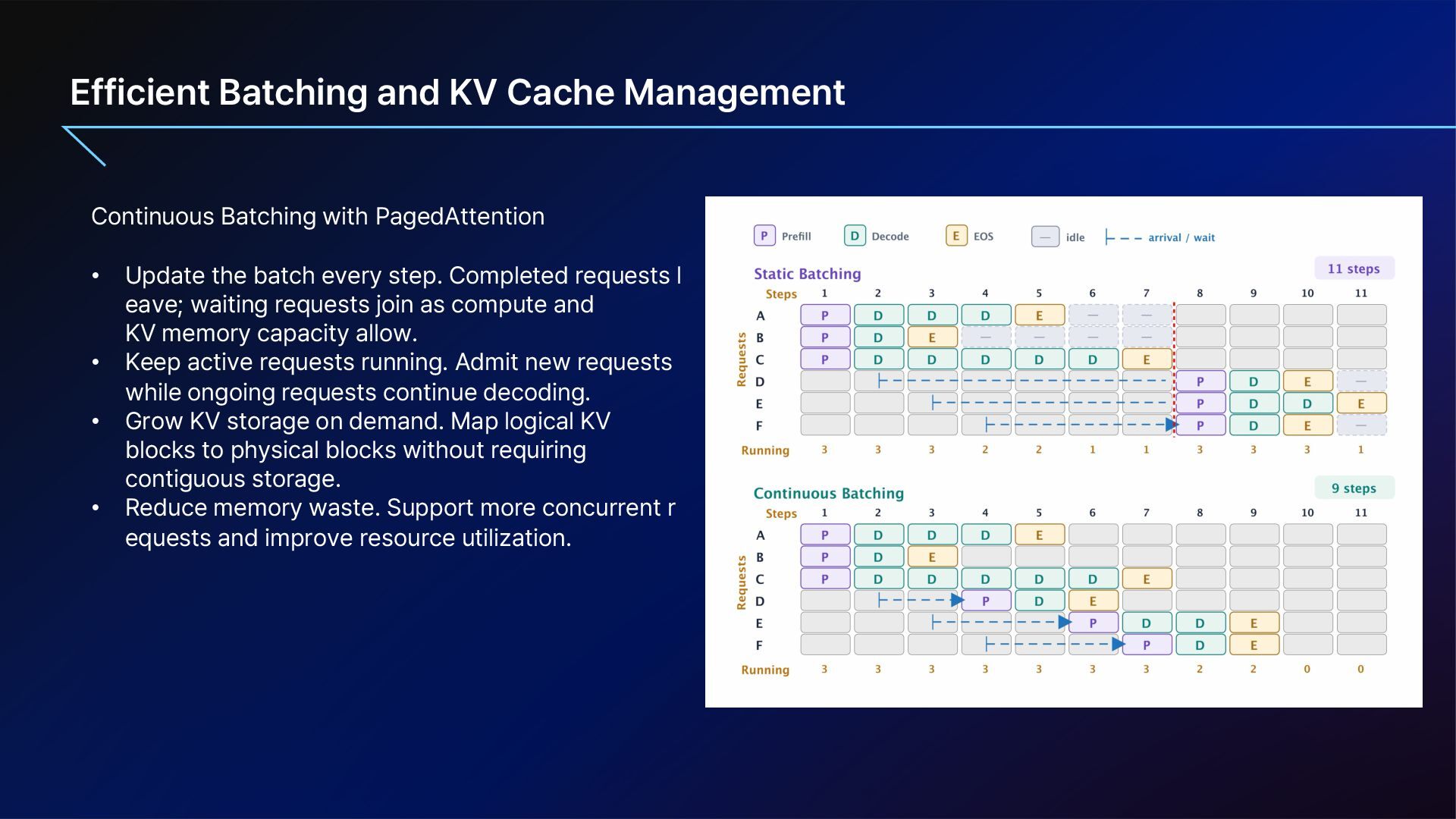
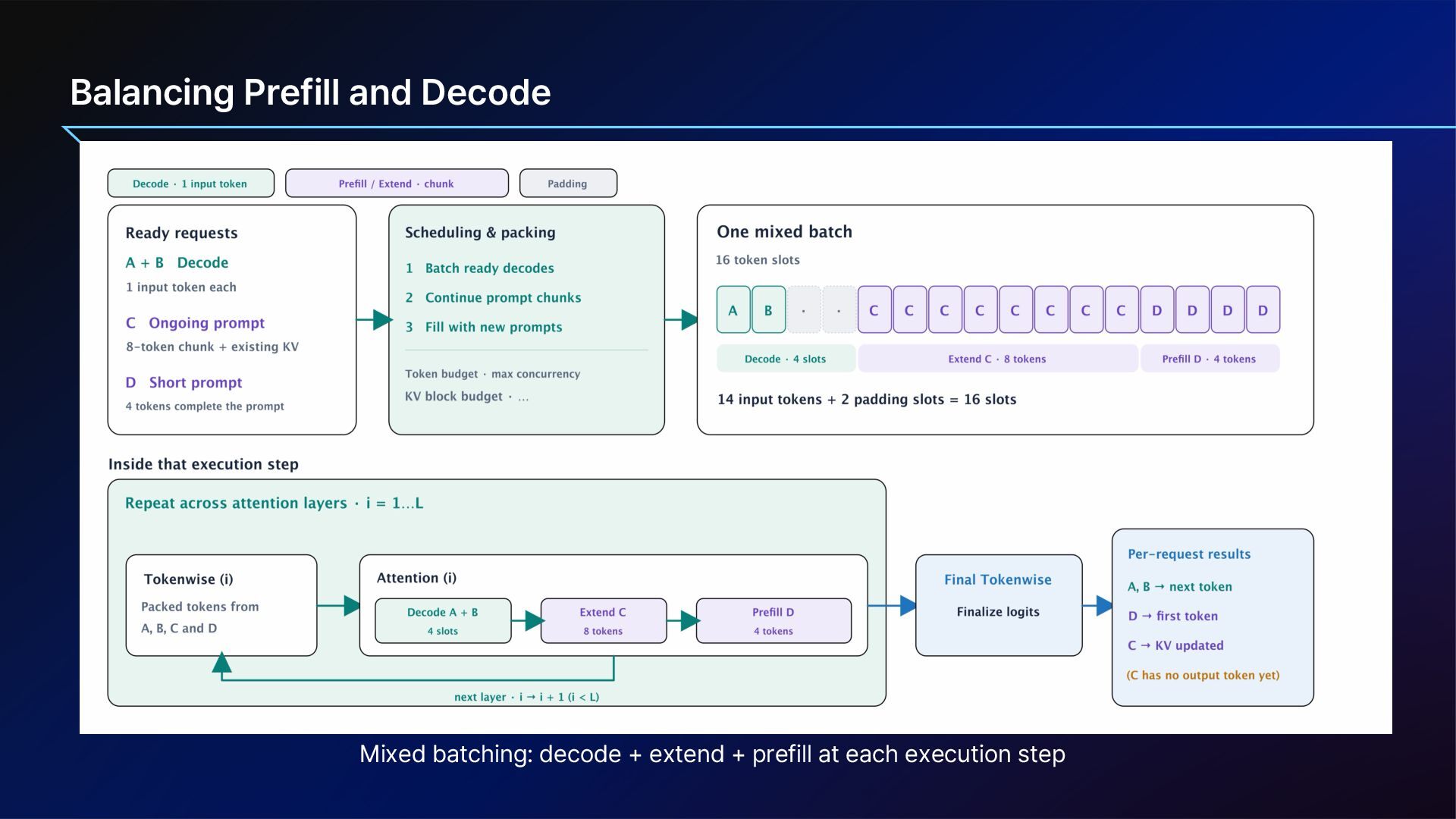
• • • • Update the batch every step. Completed requests l eave; waiting requests join as compute and KV memory capacity allow. Keep active requests running. Admit new requests while ongoing requests continue decoding. Grow KV storage on demand. Map logical KV blocks to physical blocks without requiring contiguous storage. Reduce memory waste. Support more concurrent r equests and improve resource utilization.
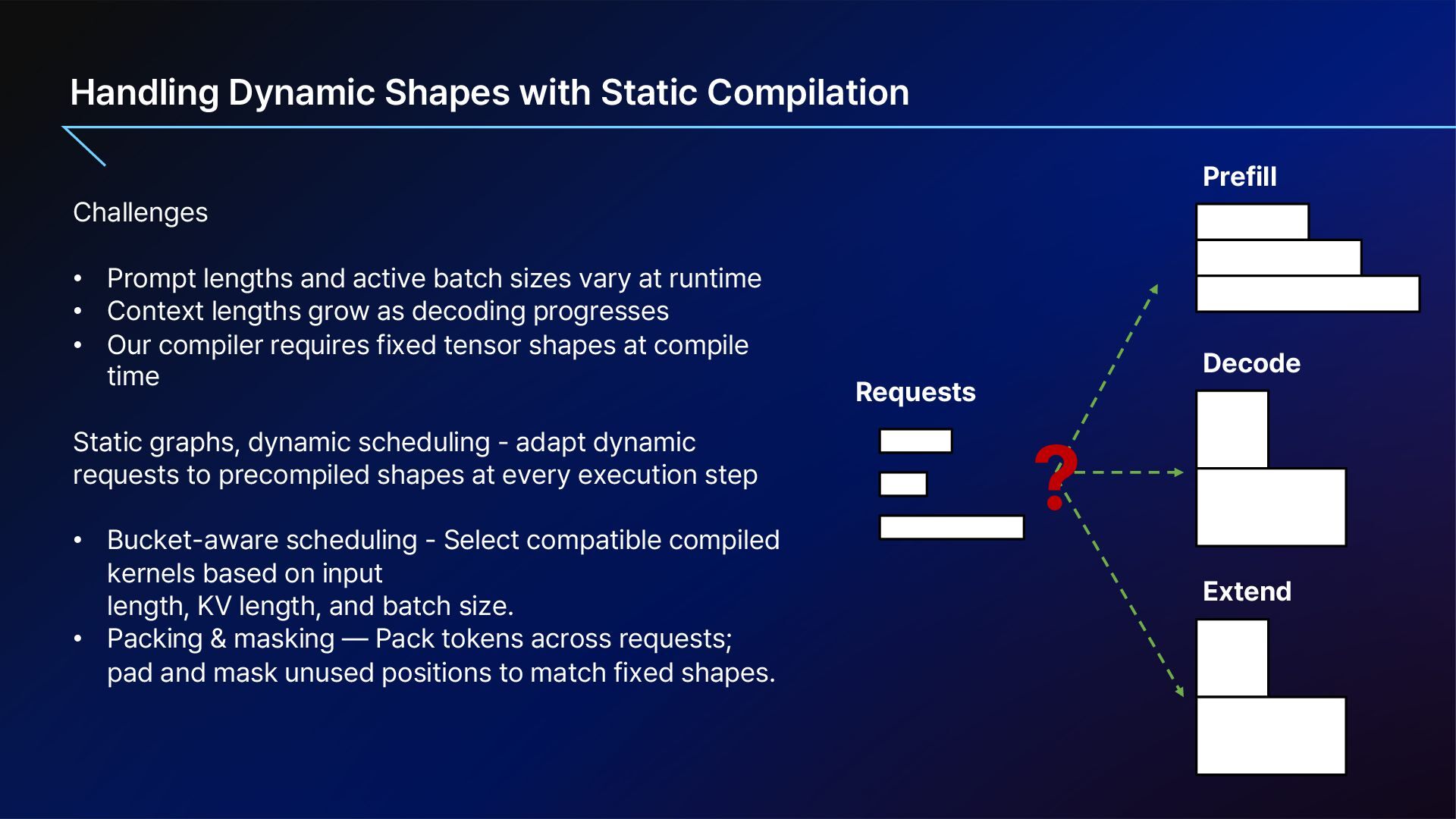
lengths and active batch sizes vary at runtime • Context lengths grow as decoding progresses • Our compiler requires fixed tensor shapes at compile time Static graphs, dynamic scheduling adapt dynamic requests to precompiled shapes at every execution step • Bucket aware scheduling Select compatible compiled kernels based on input length, KV length, and batch size. • Packing masking Pack tokens across requests; pad and mask unused positions to match fixed shapes. Decode Requests ? Extend
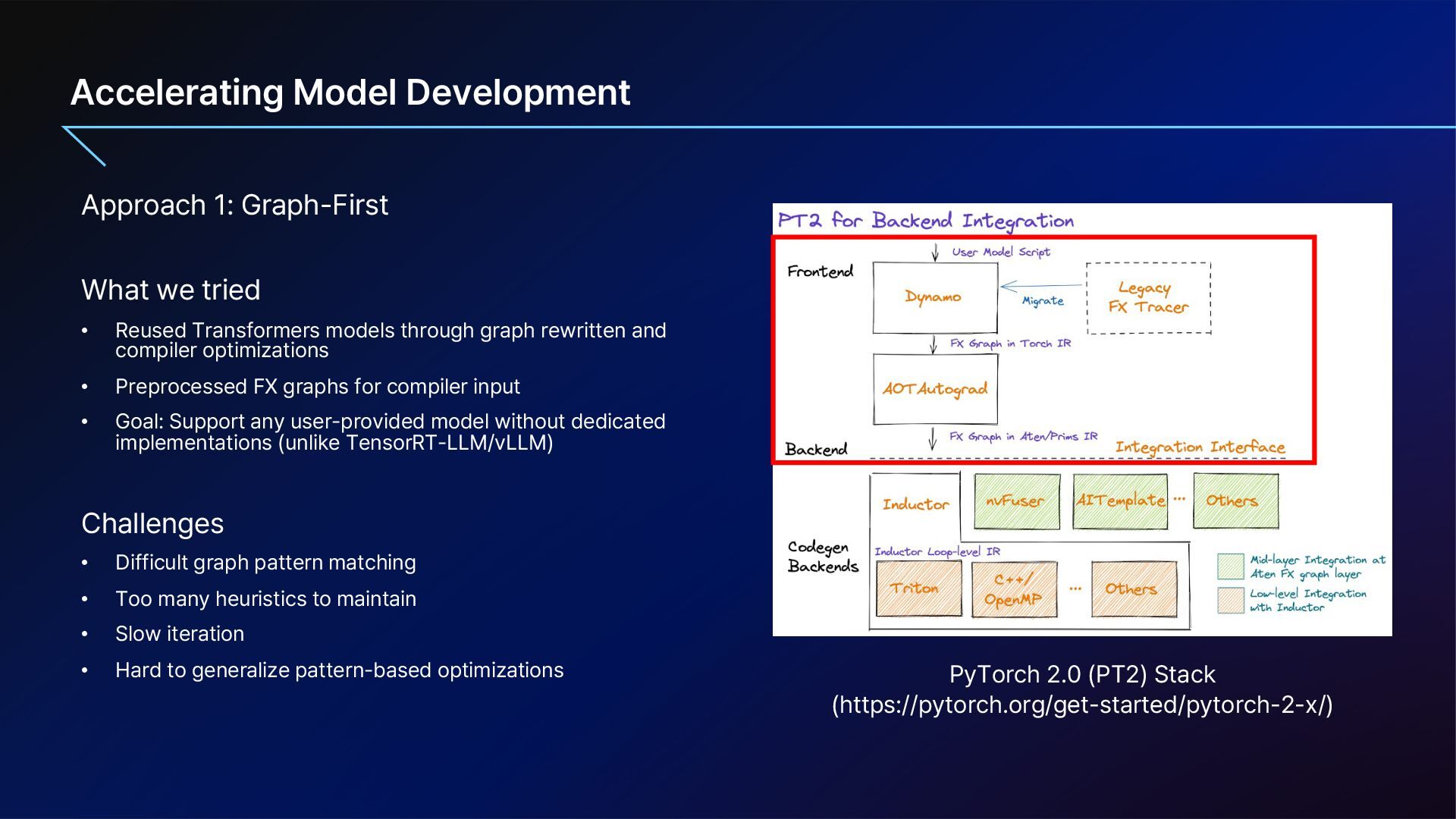
• Reused Transformers models through graph rewritten and compiler optimizations • Preprocessed FX graphs for compiler input • Goal: Support any user provided model without dedicated implementations unlike TensorRT LLM/vLLM Challenges • Difficult graph pattern matching • Too many heuristics to maintain • Slow iteration • Hard to generalize pattern based optimizations PyTorch 2.0 PT2 Stack https://pytorch.org/get started/pytorch 2 x/
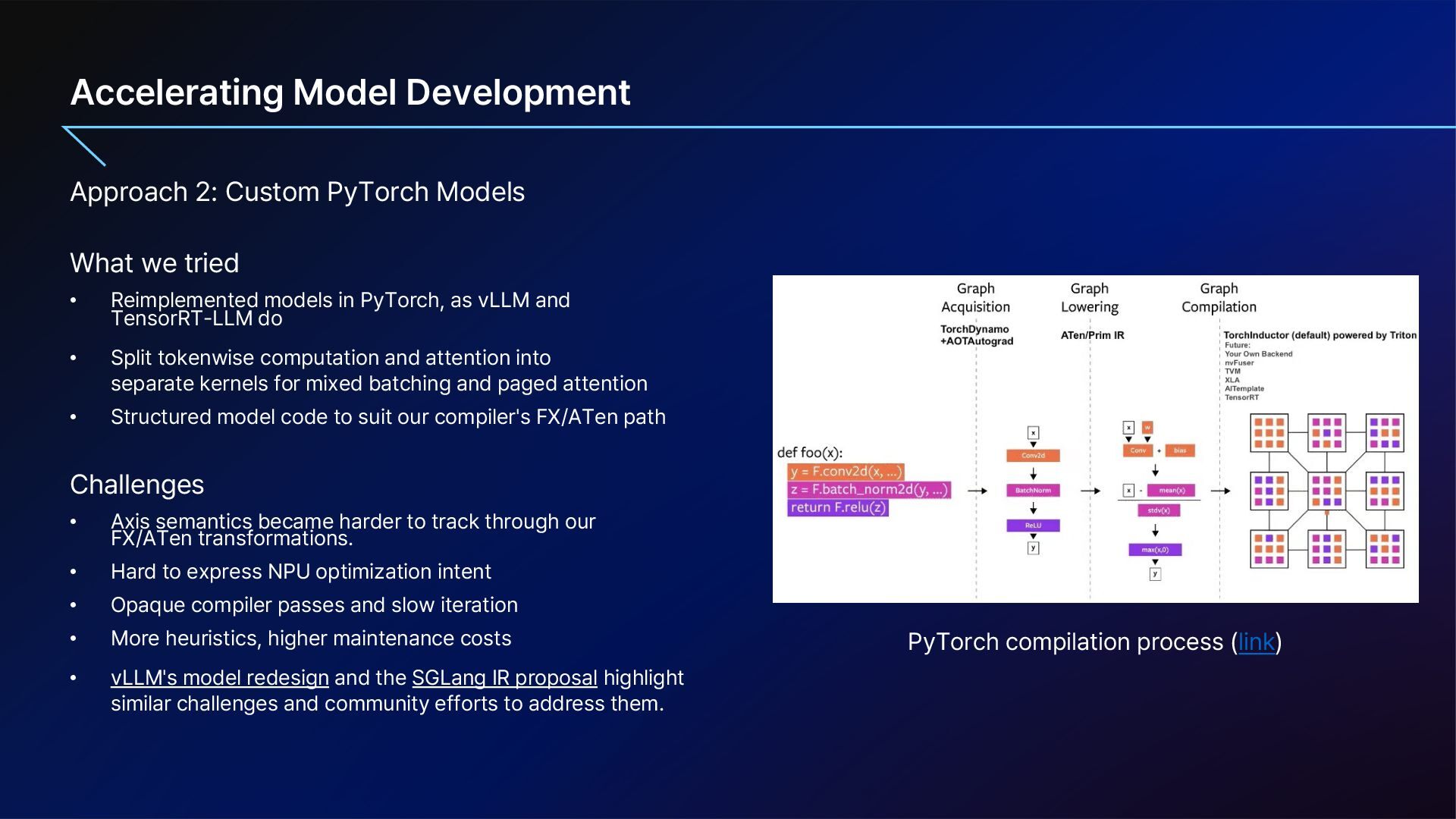
tried • Reimplemented models in PyTorch, as vLLM and TensorRT LLM do • Split tokenwise computation and attention into separate kernels for mixed batching and paged attention • Structured model code to suit our compiler s FX/ATen path Challenges • Axis semantics became harder to track through our FX/ATen transformations. • Hard to express NPU optimization intent • Opaque compiler passes and slow iteration • More heuristics, higher maintenance costs • vLLM s model redesign and the SGLang IR proposal highlight similar challenges and community efforts to address them. PyTorch compilation process link
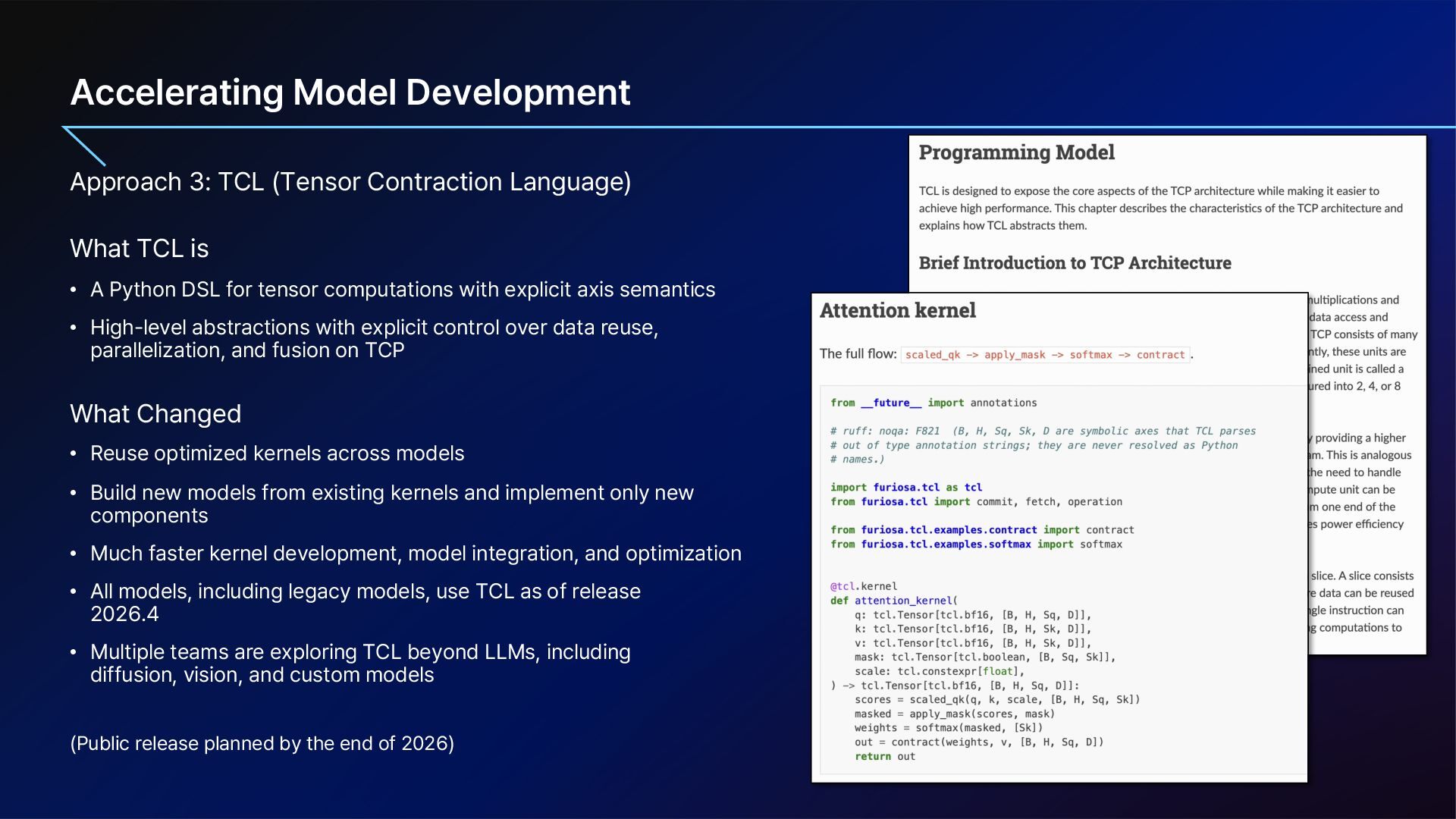
TCL is • A Python DSL for tensor computations with explicit axis semantics • High level abstractions with explicit control over data reuse, parallelization, and fusion on TCP What Changed • Reuse optimized kernels across models • Build new models from existing kernels and implement only new components • Much faster kernel development, model integration, and optimization • All models, including legacy models, use TCL as of release 2026.4 • Multiple teams are exploring TCL beyond LLMs, including diffusion, vision, and custom models Public release planned by the end of 2026
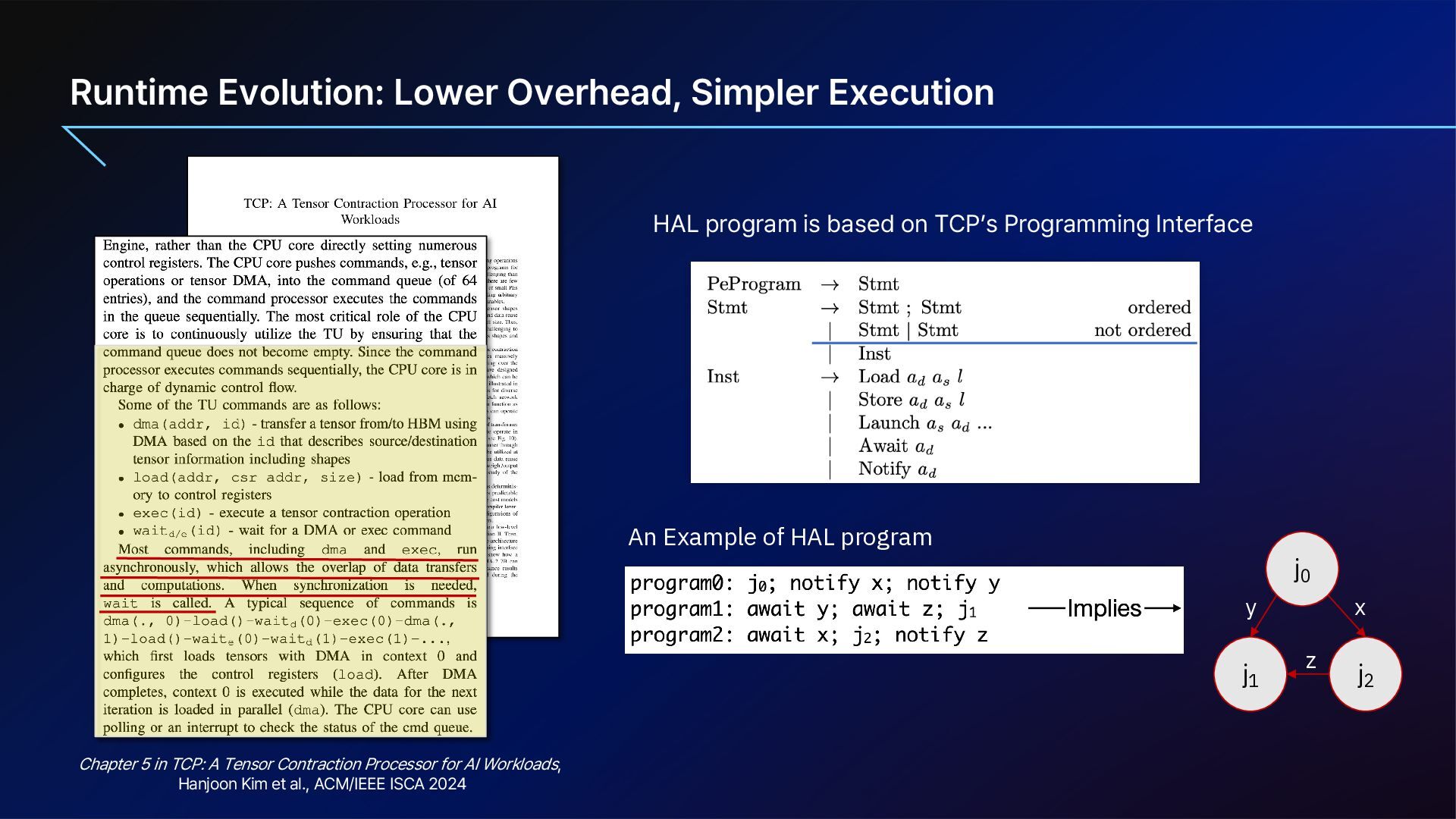
on TCP s Programming Interface An Example of HAL program j0 y j1 Chapter 5 in TCP: A Tensor Contraction Processor for AI Workloads, Hanjoon Kim et al., ACM/IEEE ISCA 2024 x z j2
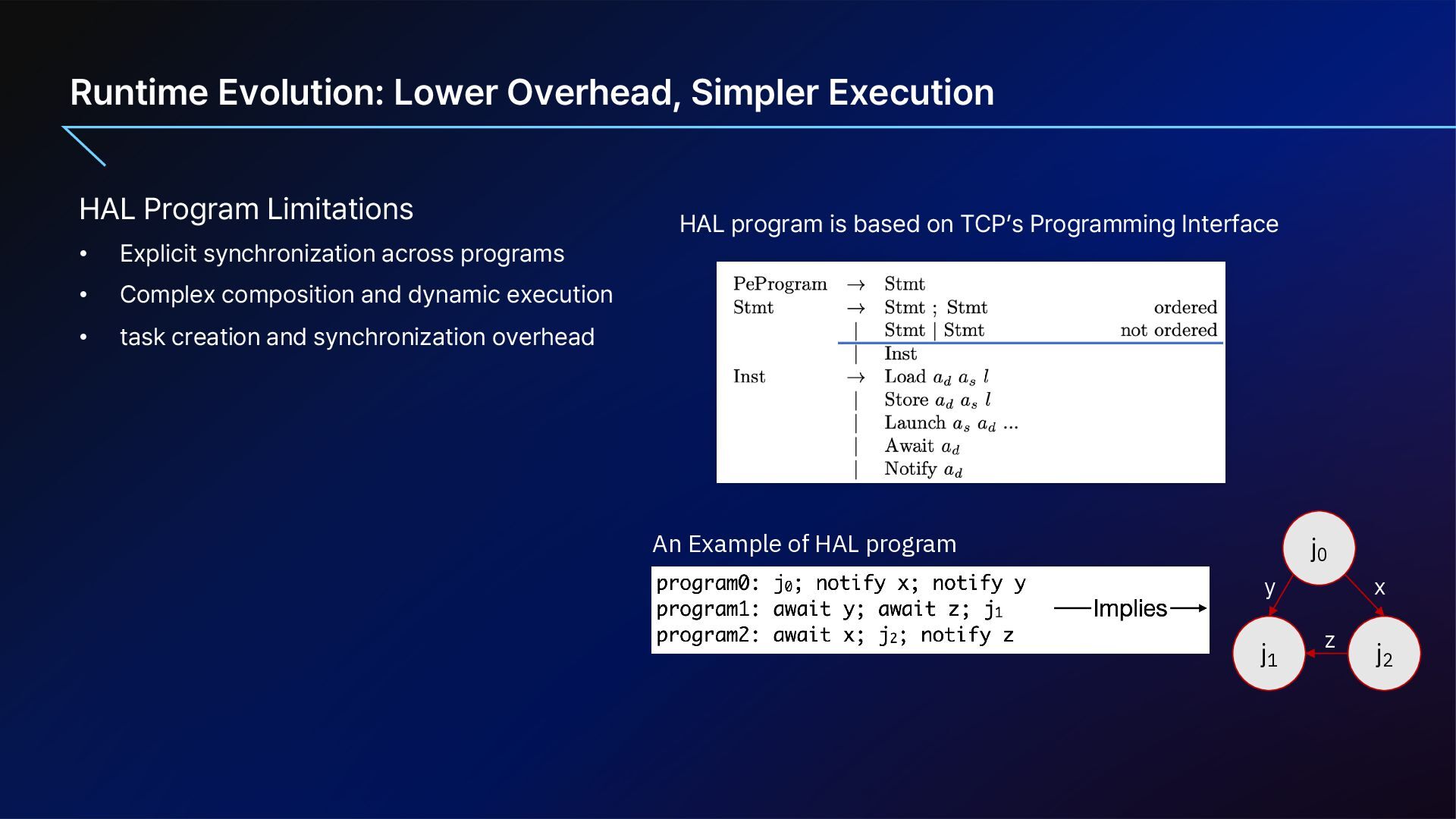
Explicit synchronization across programs • Complex composition and dynamic execution • task creation and synchronization overhead HAL program is based on TCP s Programming Interface An Example of HAL program j0 y j1 x z j2
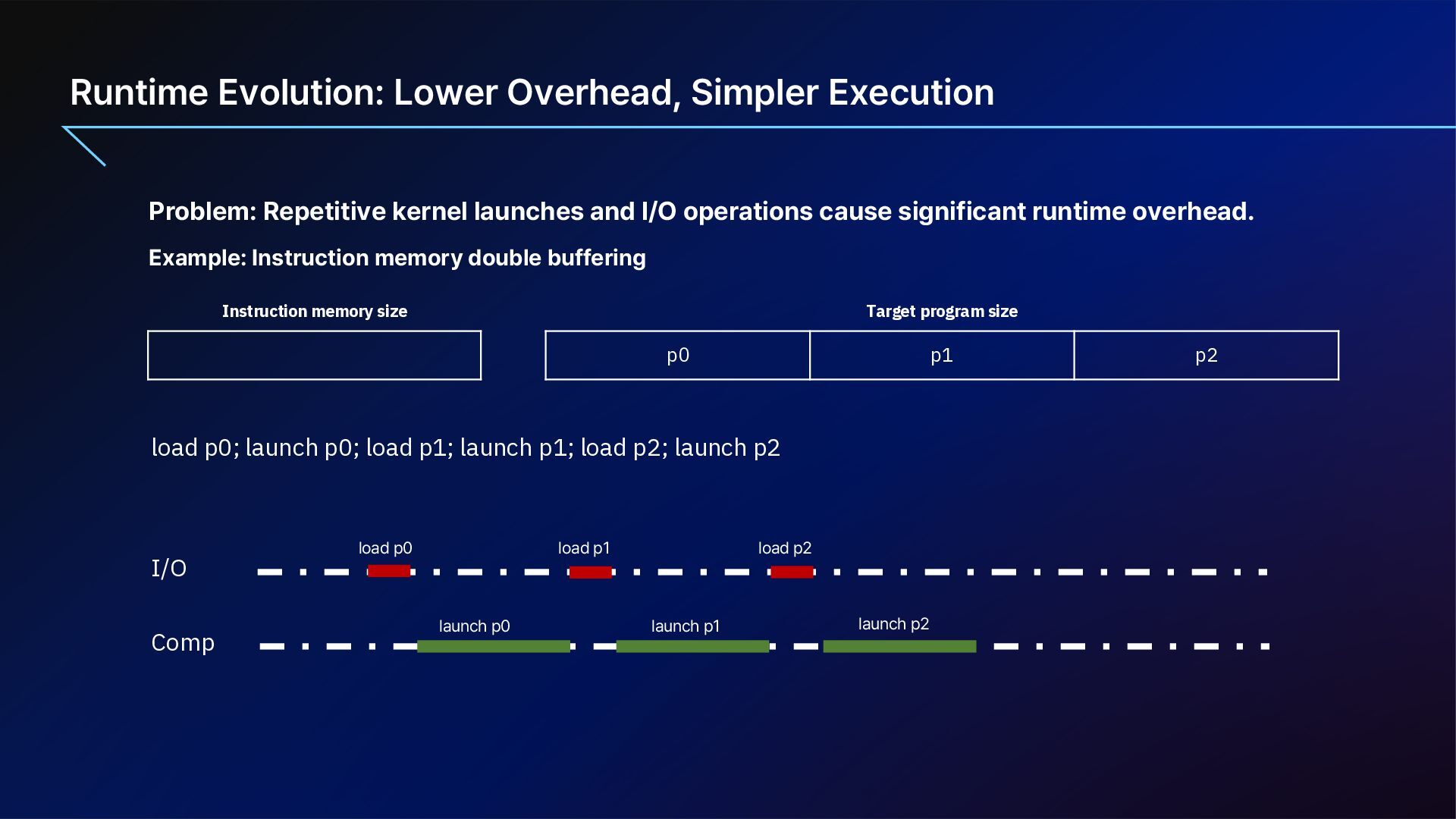
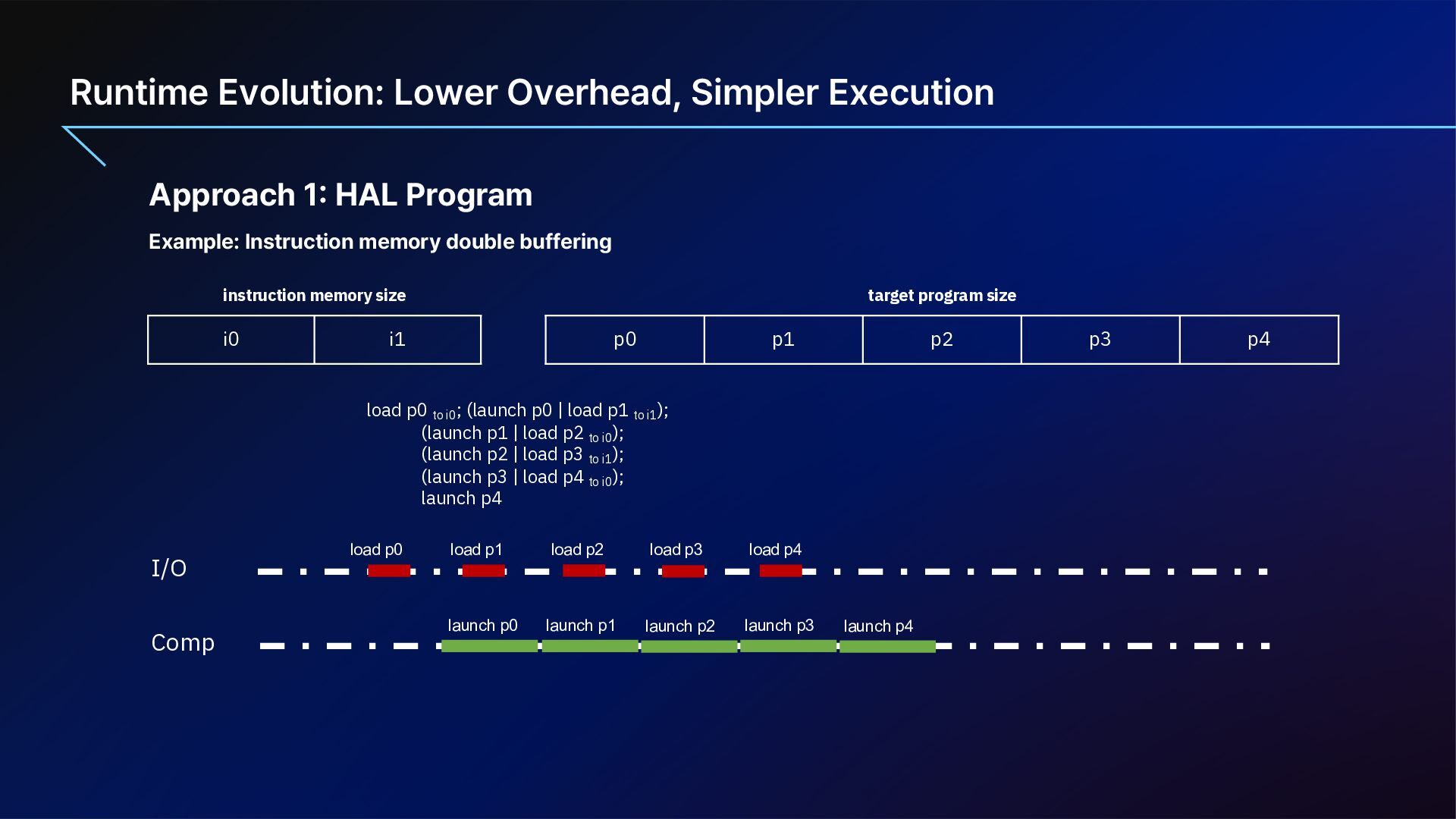
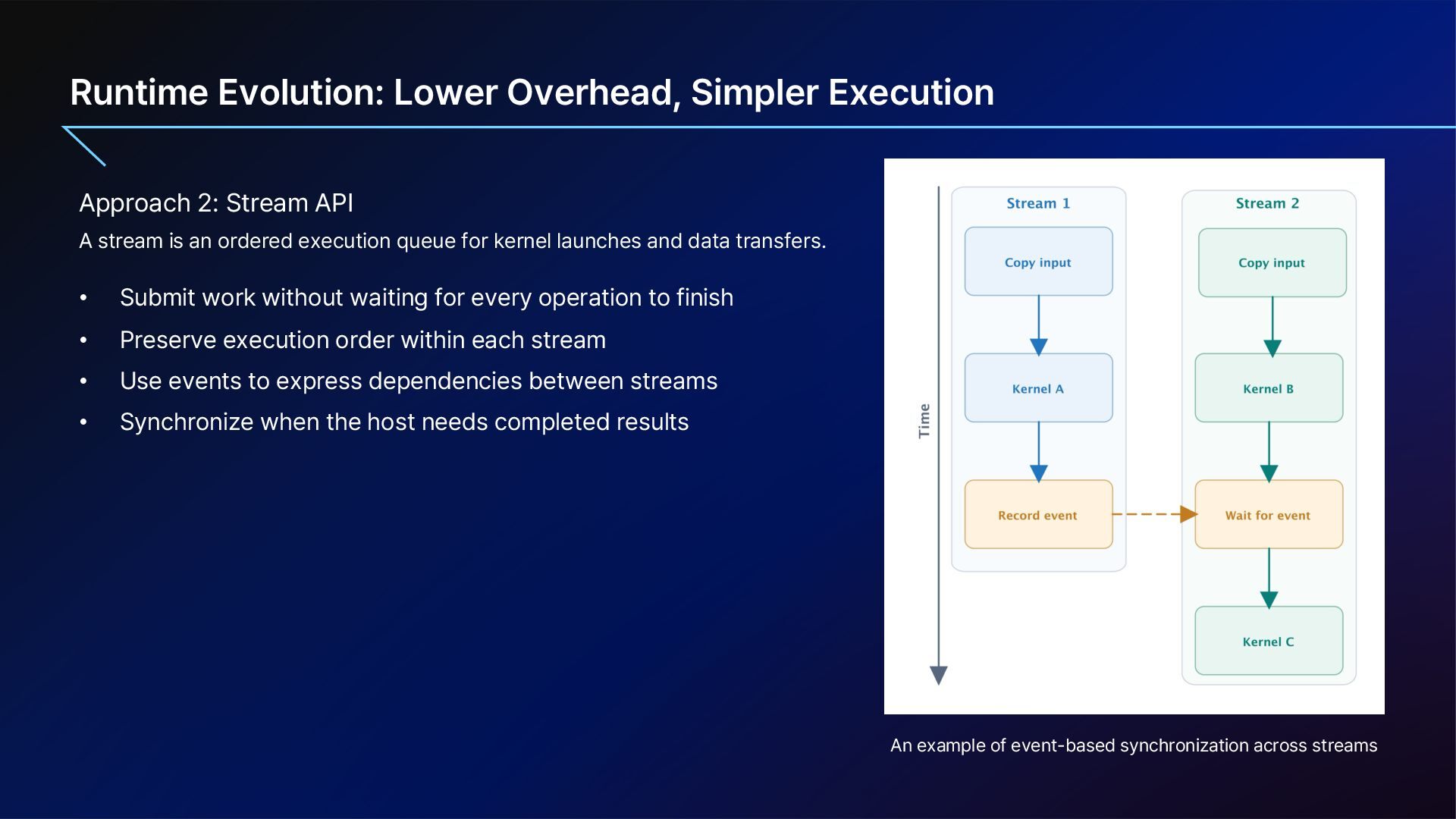
A stream is an ordered execution queue for kernel launches and data transfers. • Submit work without waiting for every operation to finish • Preserve execution order within each stream • Use events to express dependencies between streams • Synchronize when the host needs completed results An example of event based synchronization across streams
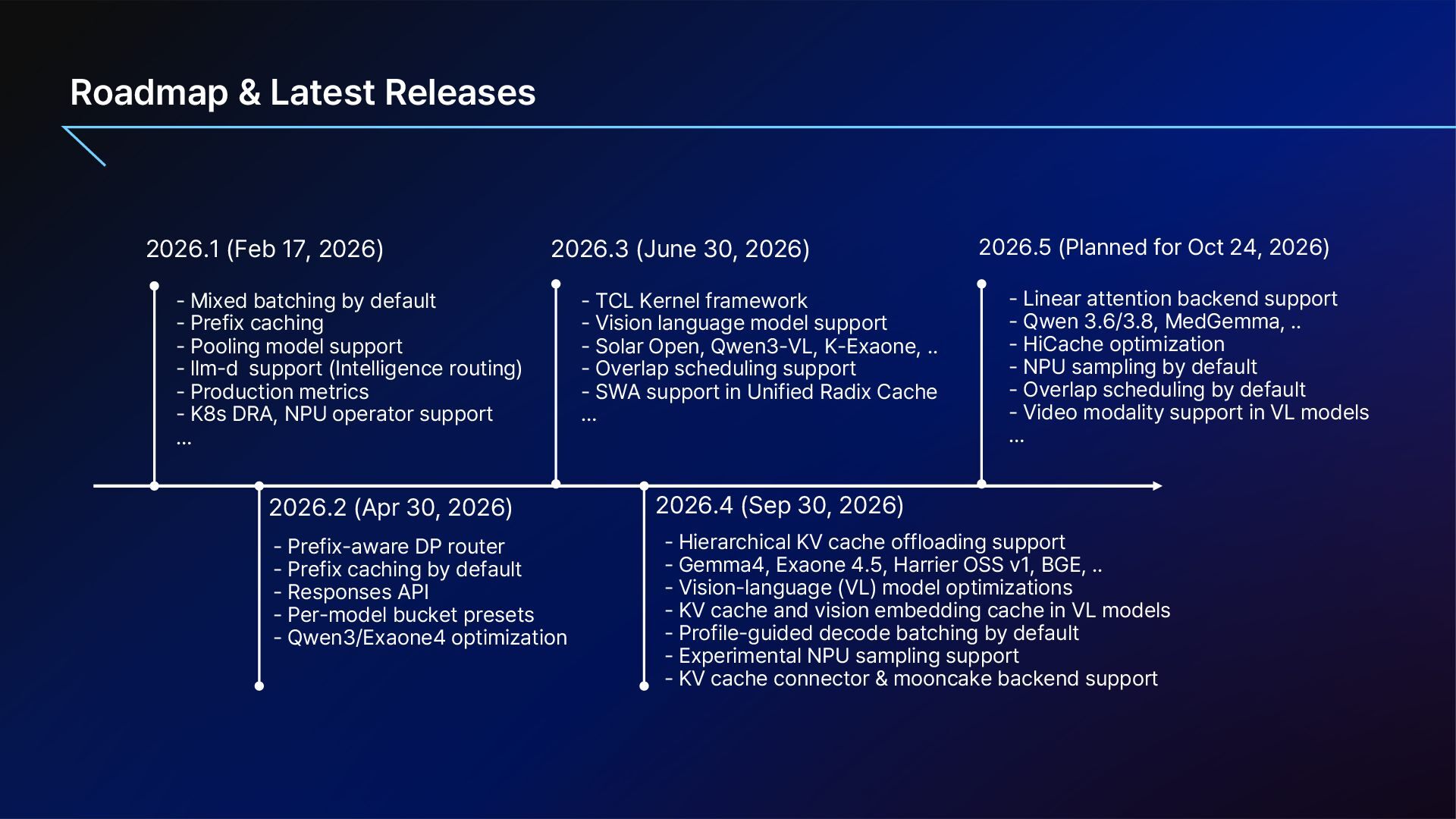
2026 Mixed batching by default Prefix caching Pooling model support llm d support Intelligence routing Production metrics K8s DRA, NPU operator support … 2026.2 Apr 30, 2026 Prefix aware DP router Prefix caching by default Responses API Per model bucket presets Qwen3/Exaone4 optimization TCL Kernel framework Vision language model support Solar Open, Qwen3 VL, K Exaone, .. Overlap scheduling support SWA support in Unified Radix Cache … 2026.5 Planned for Oct 24, 2026 Linear attention backend support Qwen 3.6/3.8, MedGemma, .. HiCache optimization NPU sampling by default Overlap scheduling by default Video modality support in VL models … 2026.4 Sep 30, 2026 Hierarchical KV cache offloading support Gemma4, Exaone 4.5, Harrier OSS v1, BGE, .. Vision language VL model optimizations KV cache and vision embedding cache in VL models Profile guided decode batching by default Experimental NPU sampling support KV cache connector mooncake backend support
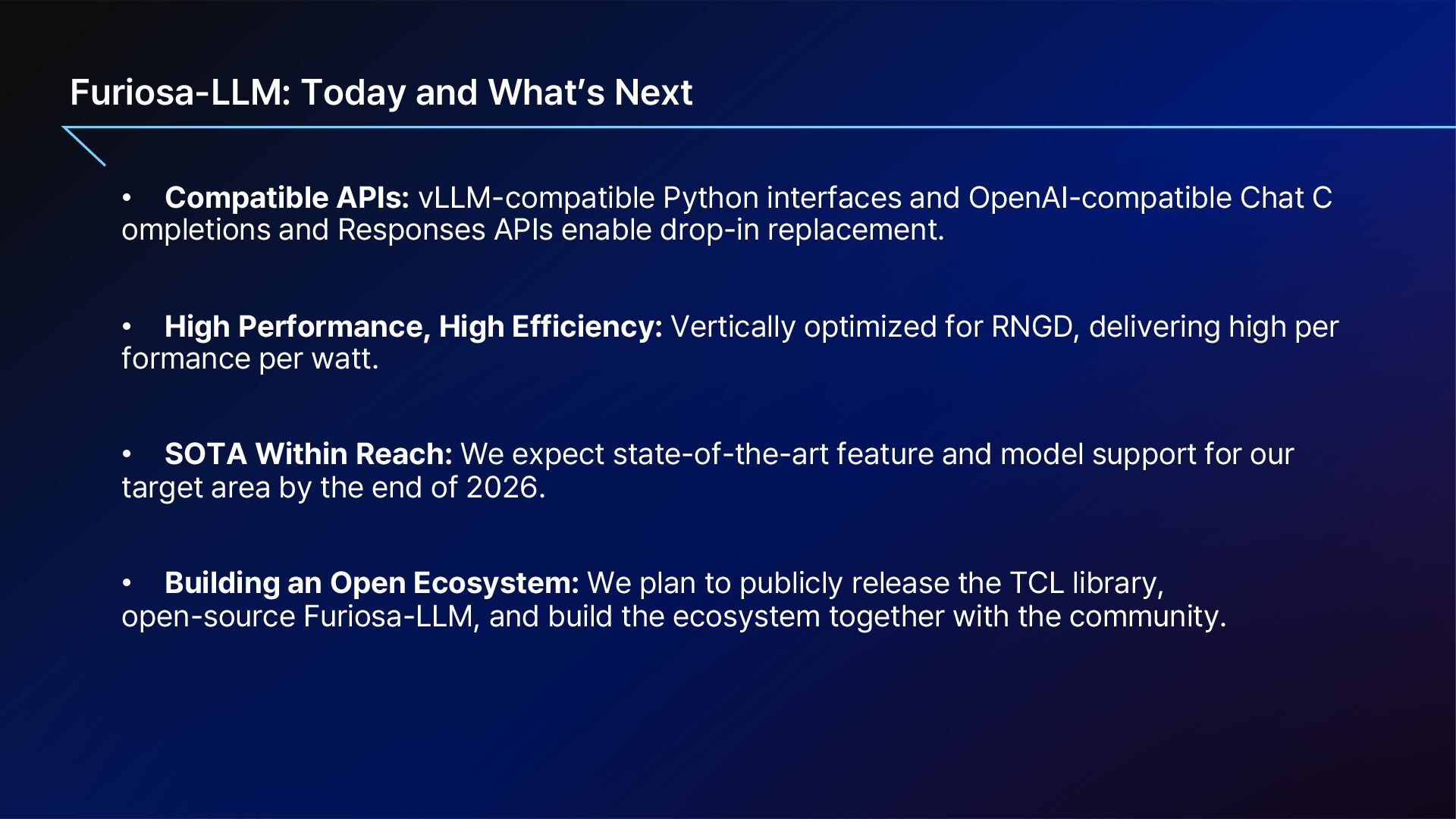
vLLM compatible Python interfaces and OpenAI compatible Chat C ompletions and Responses APIs enable drop in replacement. • High Performance, High Efficiency: Vertically optimized for RNGD, delivering high per formance per watt. • SOTA Within Reach: We expect state of the art feature and model support for our target area by the end of 2026. • Building an Open Ecosystem: We plan to publicly release the TCL library, open source Furiosa LLM, and build the ecosystem together with the community.


 lablup
 keavy
 andyhume
 katarinadahlin
 inesmontani
 reverentgeek
 baasie
 szymonslowik
 takai
 philnash
 trishagee
 cassininazir
 nikkihalliwell