Upgrade to Pro — share decks privately, control downloads, hide ads and more …

Node JS

Sponsored · Your Podcast. Everywhere. Effortlessly. Share. Educate. Inspire. Entertain. You do you. We'll handle the rest.

Node JS

Presentation given at Acadiana Open Source User Group. Sample code be found at https://github.com/criscokid/Node-JS-Presentation-Code

Avatar for laughinglarkllc

laughinglarkllc

March 03, 2012
Tweet

More Decks by laughinglarkllc

Other Decks in Programming

Transcript

  1. About Me • Web developer at Bizzuka Inc. • Owner

    of Laughing Lark LLC Saturday, March 3, 12
  2. What is Node JS • Tool designed to make building

    scalable network programs easily • Built on top of V8 • Uses Javascript as it’s primary language • HTTP as a first class citizen Saturday, March 3, 12
  3. Javascript • Node uses Javascript as it’s language • For

    web developers this can mean only needing to know one language for all your work • Not a browser so certain globals are missing (document, alert(), etc.) Saturday, March 3, 12
  4. Evented I/O • Rather than using threads to scale, Node

    prefers preventing the main thread from being blocked in the first place • Similar to Event Machine for Ruby or Twisted for Python • Javascript in the browser is already based on events, Node moves them to a system level Saturday, March 3, 12
  5. Asynchronous • Node performs all operations that take time in

    asynchronous manner • There are no synchronous APIs built into Node. Saturday, March 3, 12
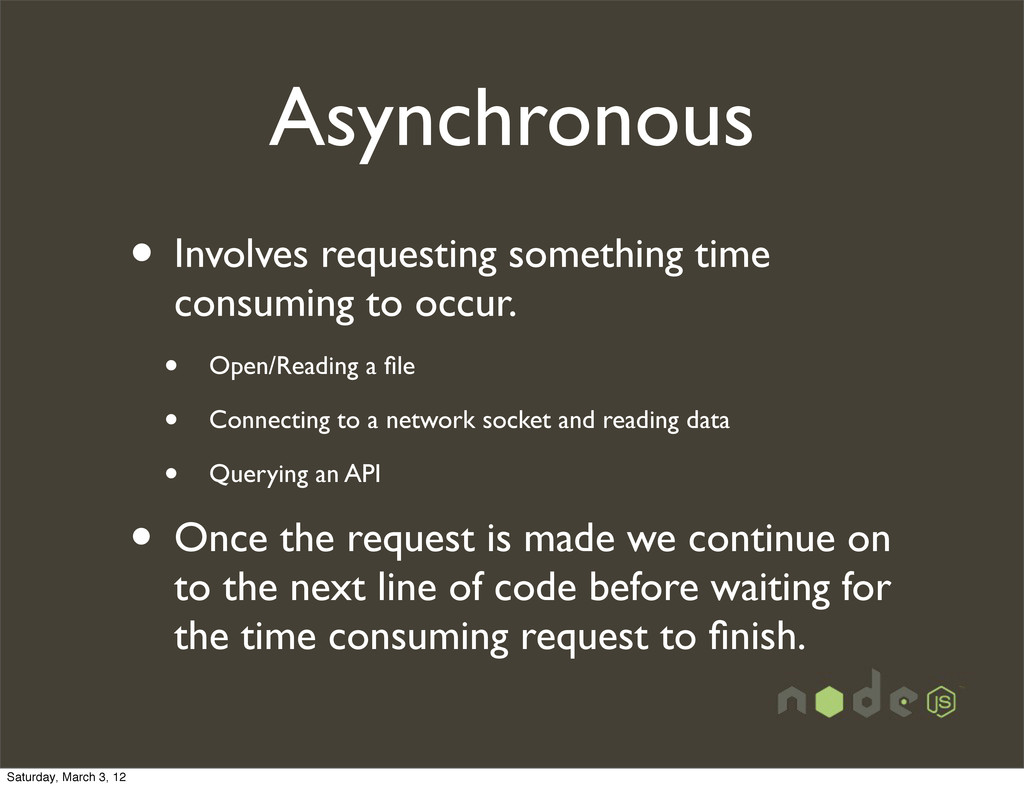
  6. Asynchronous • Involves requesting something time consuming to occur. •

    Open/Reading a file • Connecting to a network socket and reading data • Querying an API • Once the request is made we continue on to the next line of code before waiting for the time consuming request to finish. Saturday, March 3, 12
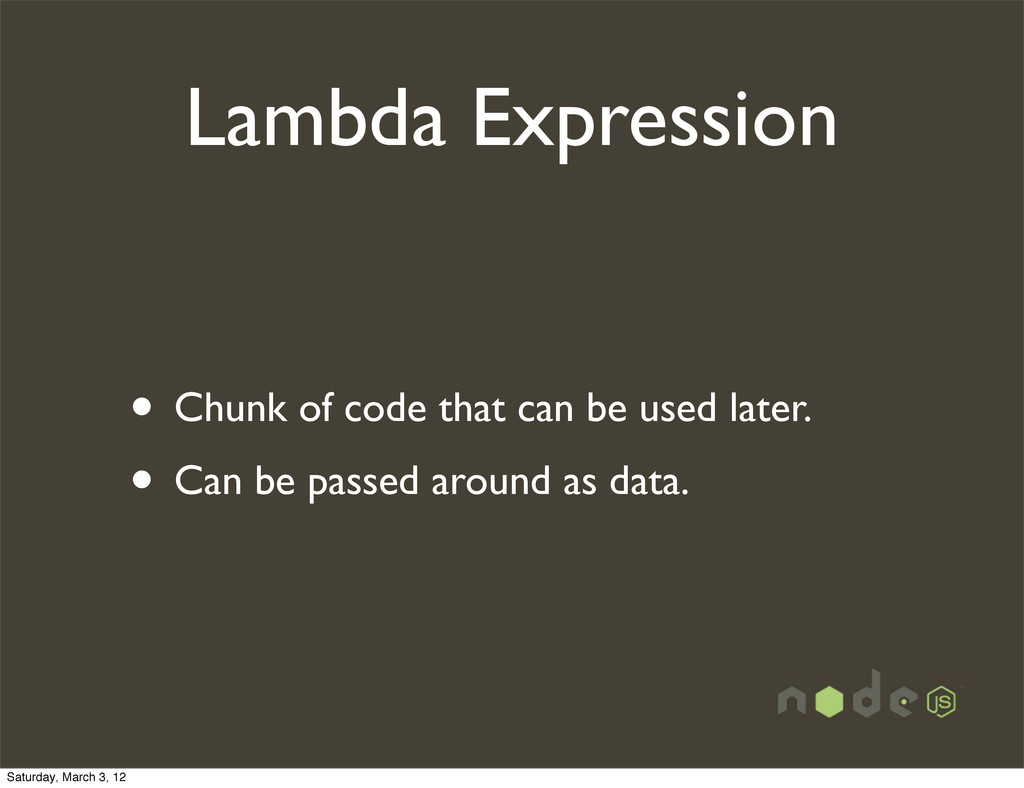
  7. Lambda Expression • Chunk of code that can be used

    later. • Can be passed around as data. Saturday, March 3, 12
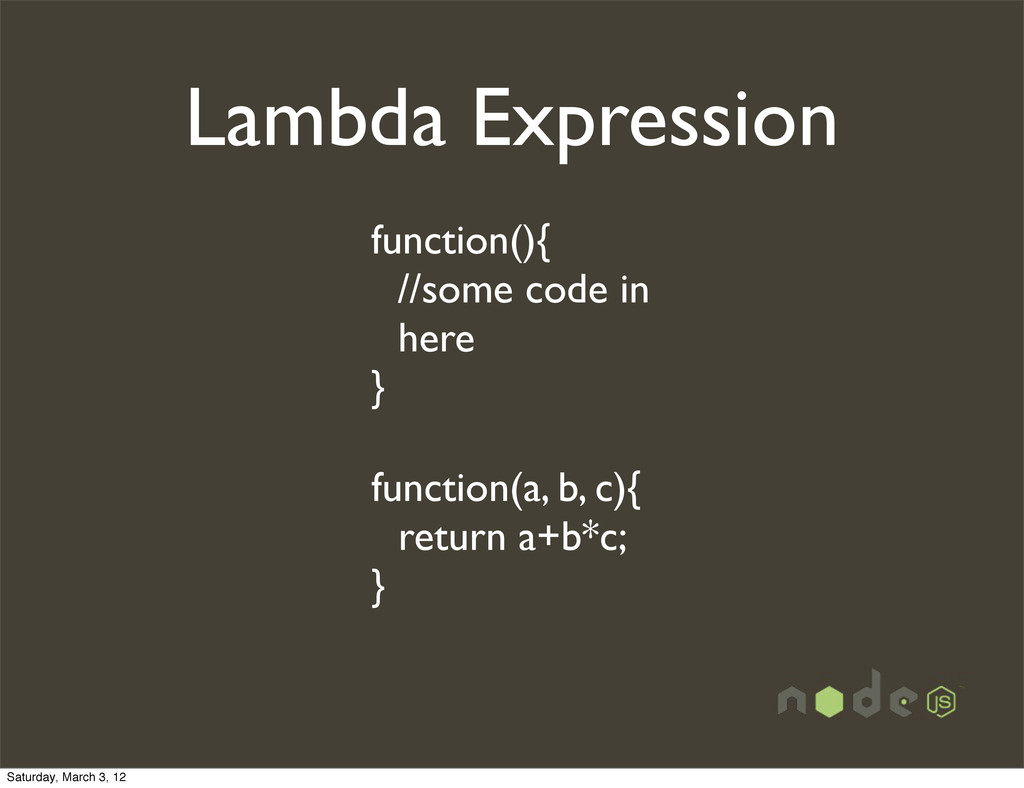
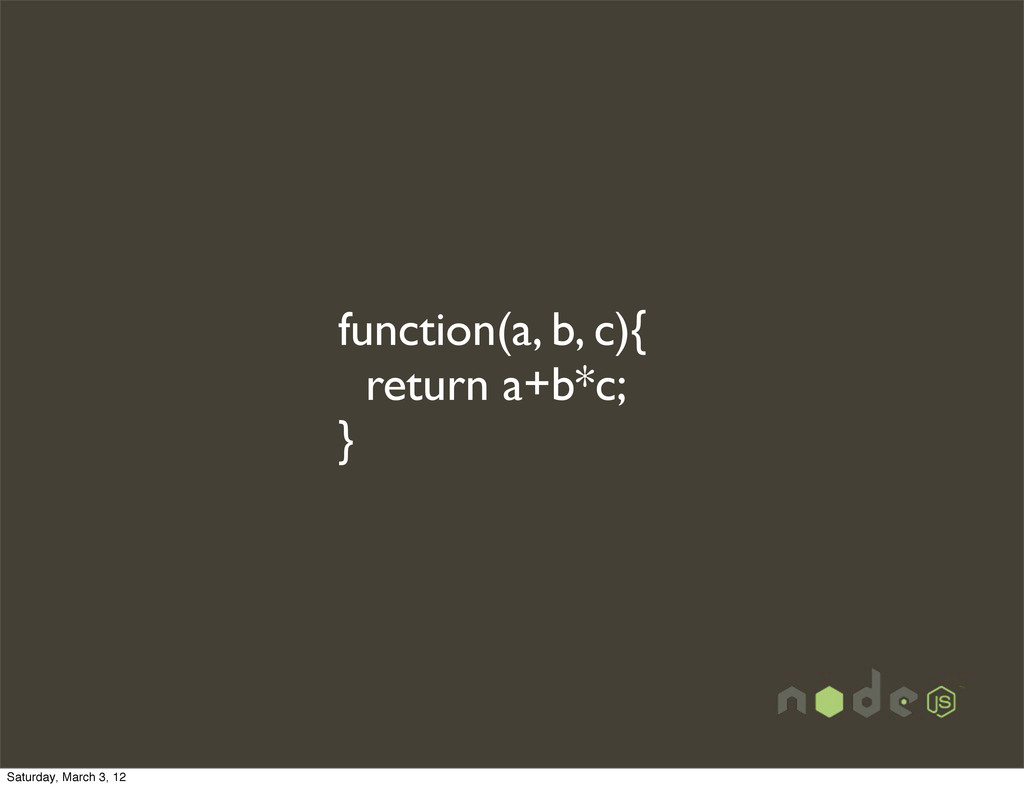
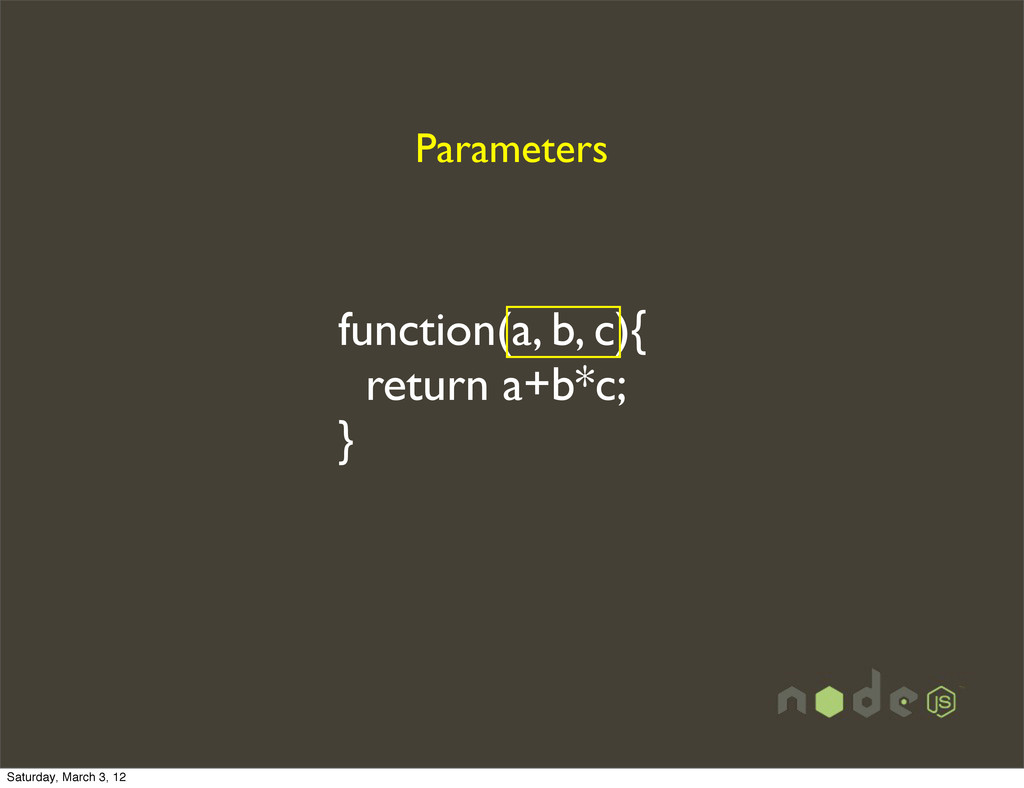
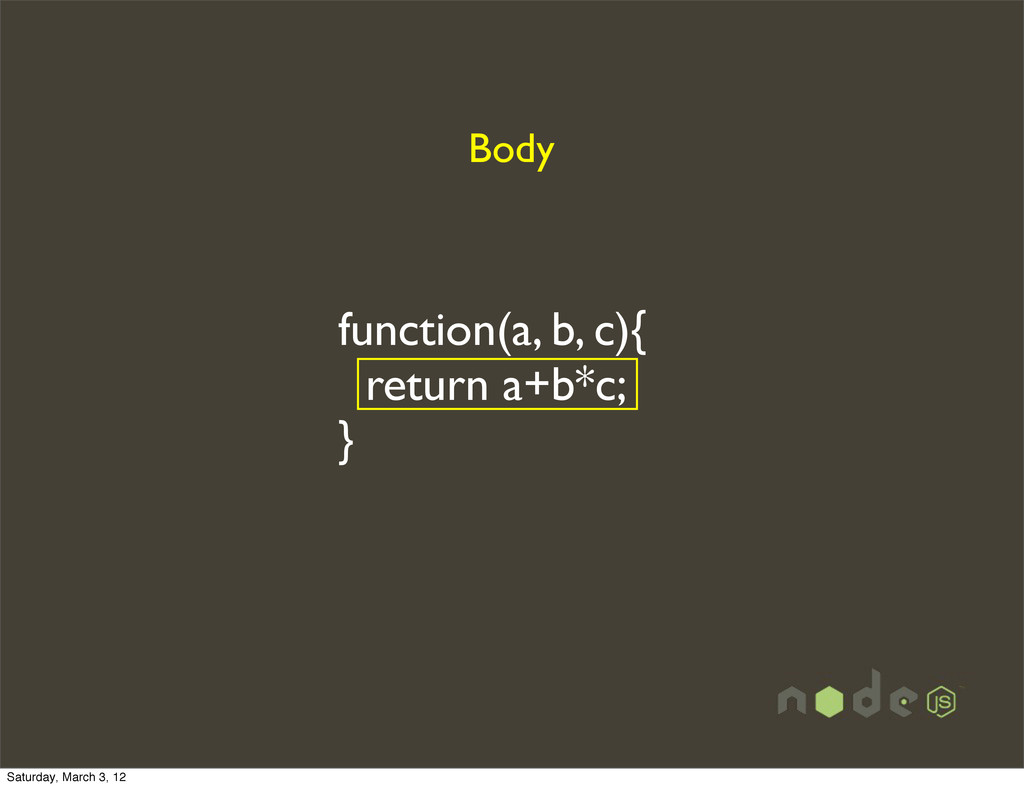
  8. Lambda Expression function(){ //some code in here } function(a, b,

    c){ return a+b*c; } Saturday, March 3, 12
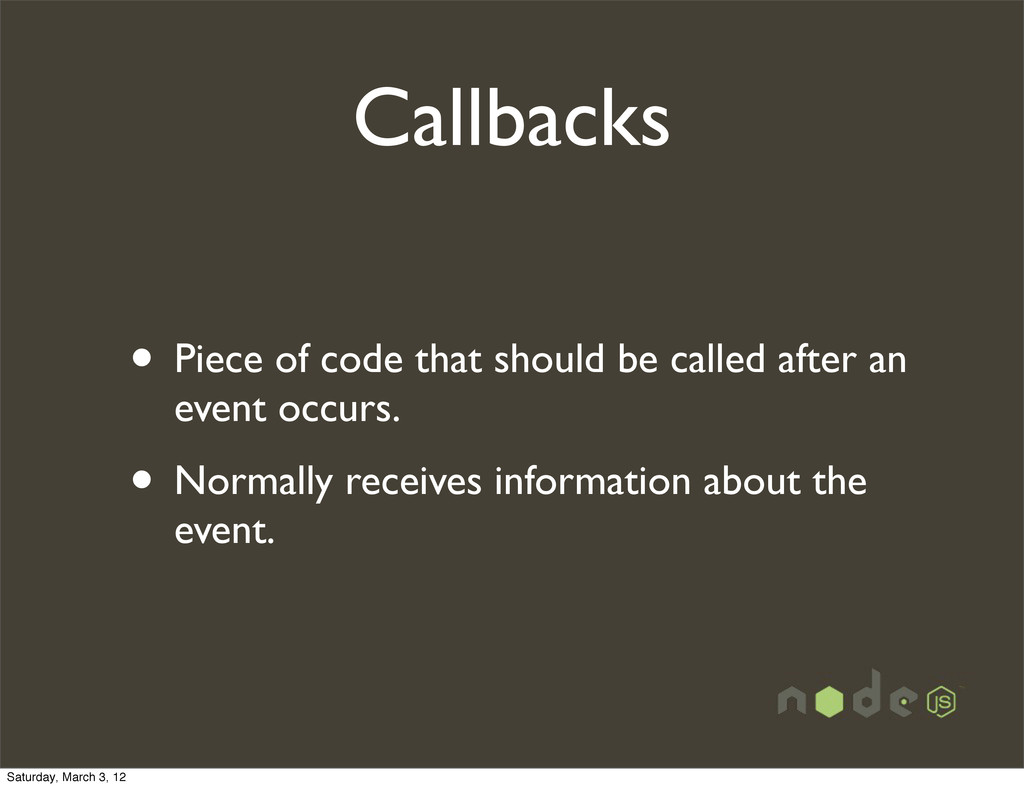
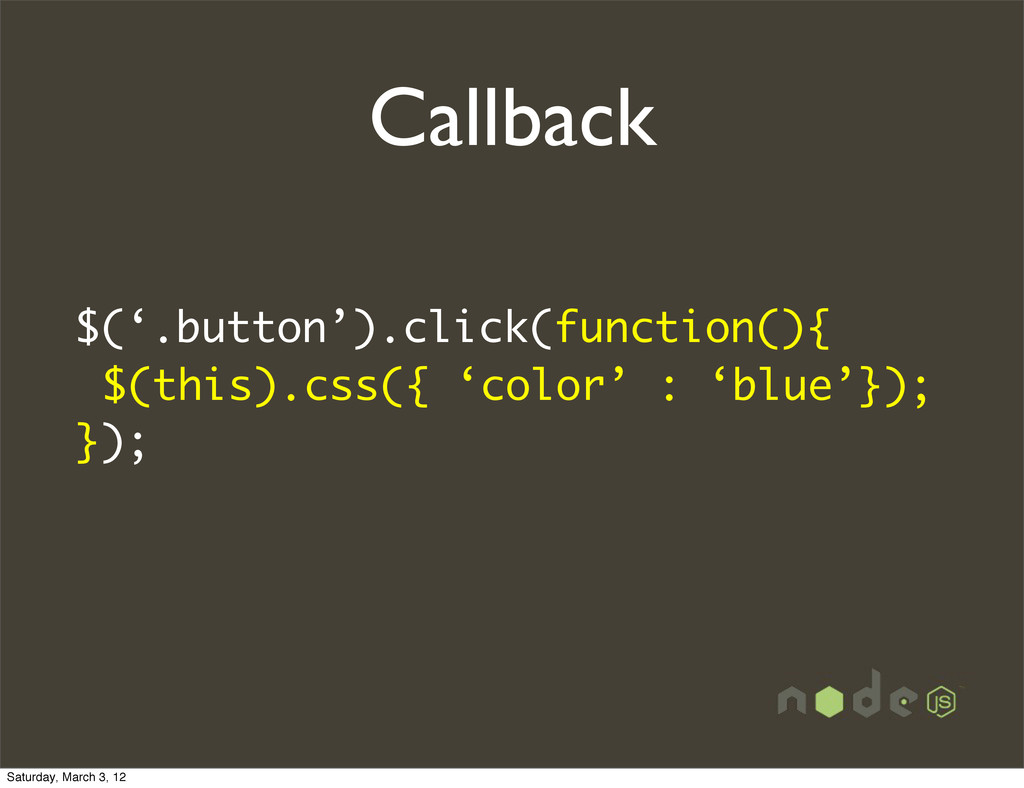
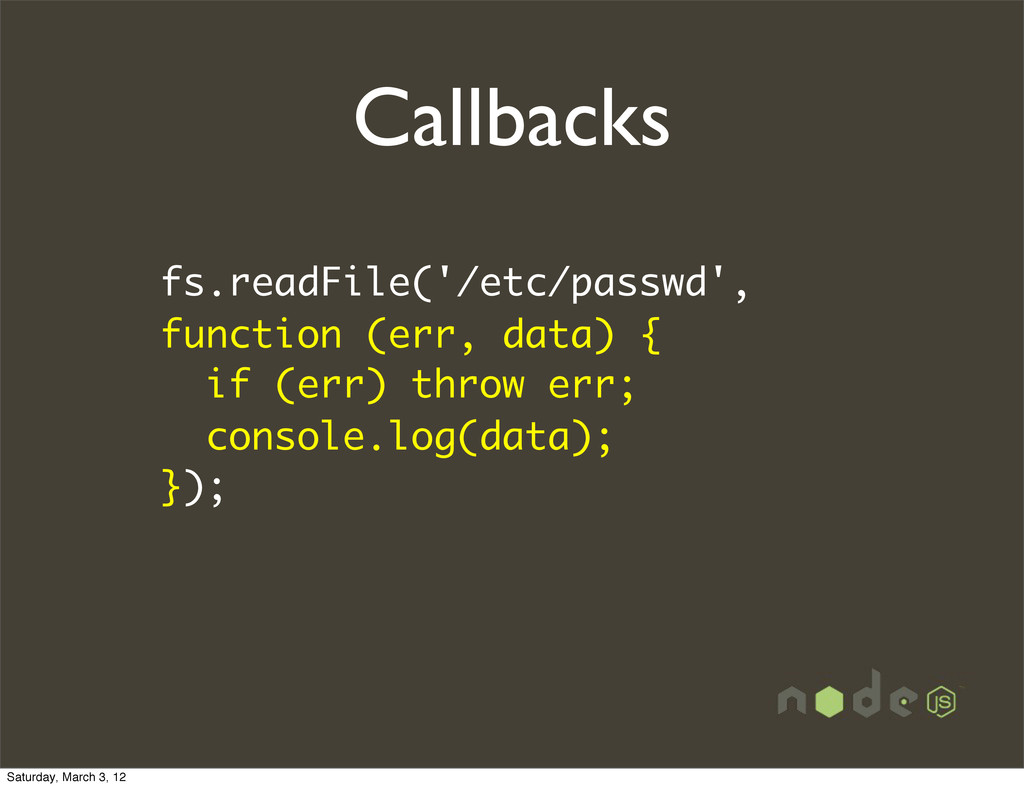
  9. Callbacks • Piece of code that should be called after

    an event occurs. • Normally receives information about the event. Saturday, March 3, 12
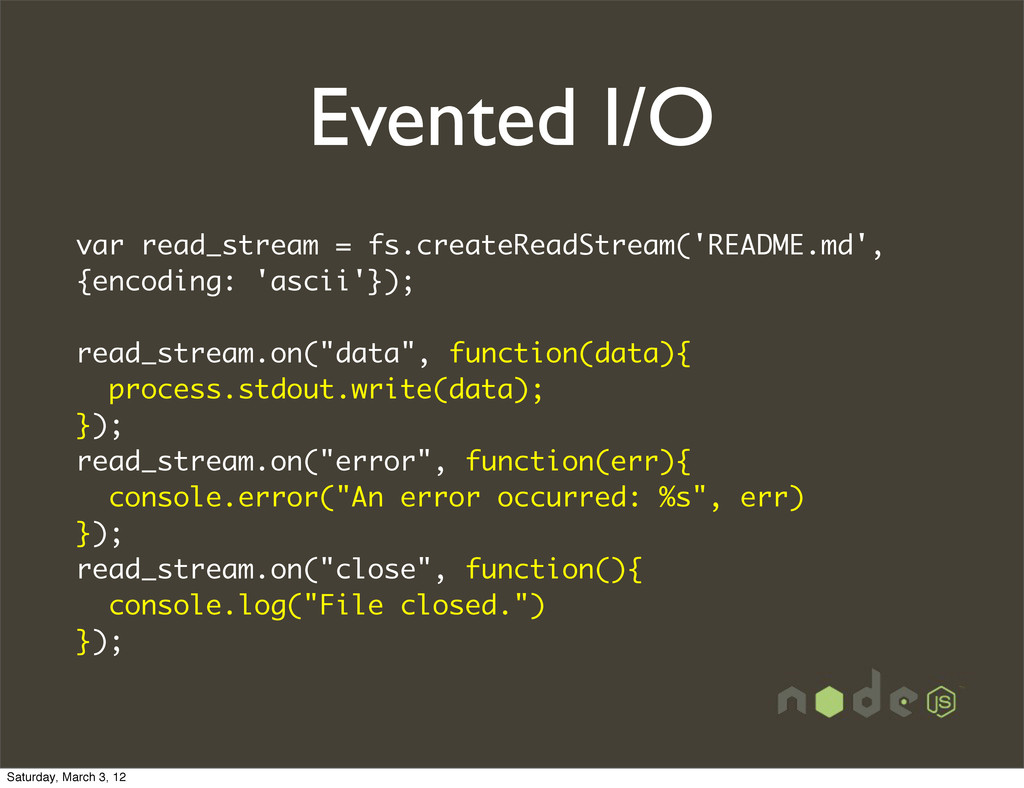
  10. Evented I/O var read_stream = fs.createReadStream('README.md', {encoding: 'ascii'}); read_stream.on("data", function(data){

    process.stdout.write(data); }); read_stream.on("error", function(err){ console.error("An error occurred: %s", err) }); read_stream.on("close", function(){ console.log("File closed.") }); Saturday, March 3, 12
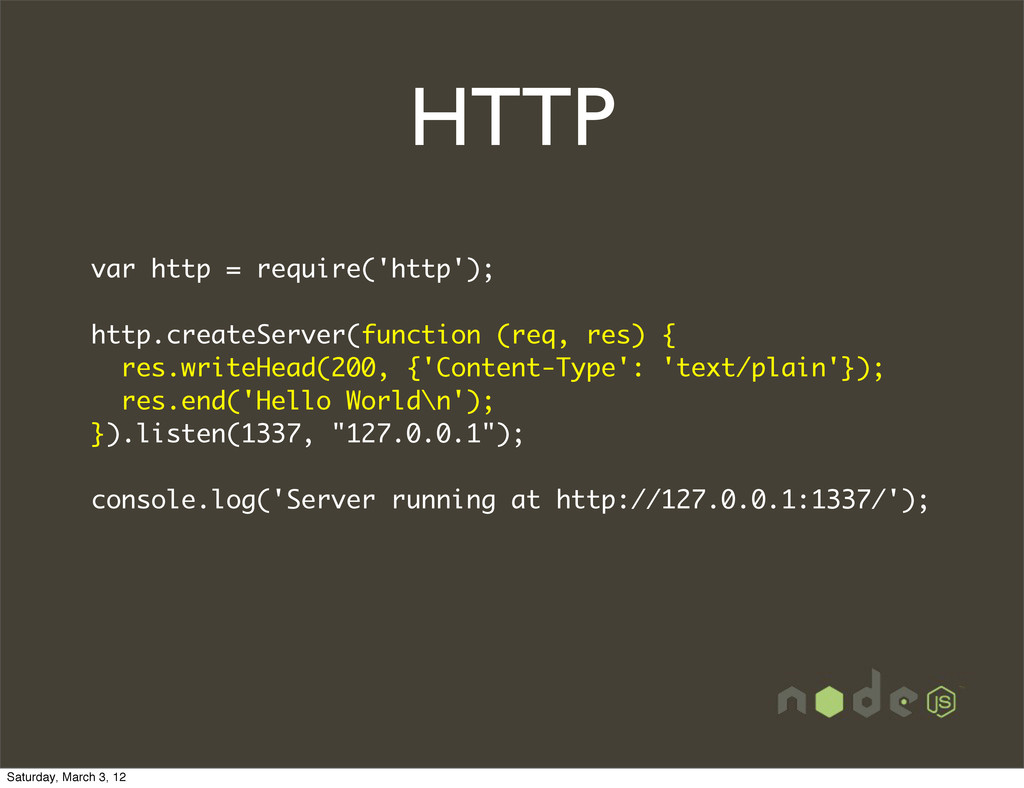
  11. HTTP var http = require('http'); http.createServer(function (req, res) { res.writeHead(200,

    {'Content-Type': 'text/plain'}); res.end('Hello World\n'); }).listen(1337, "127.0.0.1"); console.log('Server running at http://127.0.0.1:1337/'); Saturday, March 3, 12
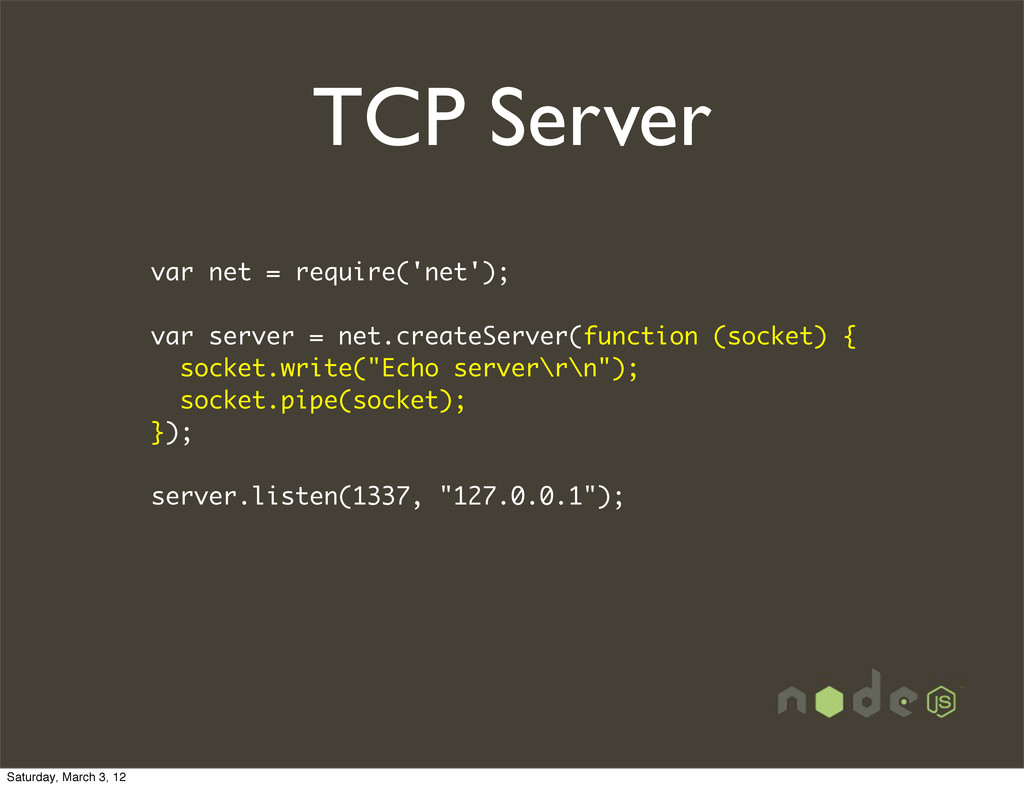
  12. TCP Server var net = require('net'); var server = net.createServer(function

    (socket) { socket.write("Echo server\r\n"); socket.pipe(socket); }); server.listen(1337, "127.0.0.1"); Saturday, March 3, 12
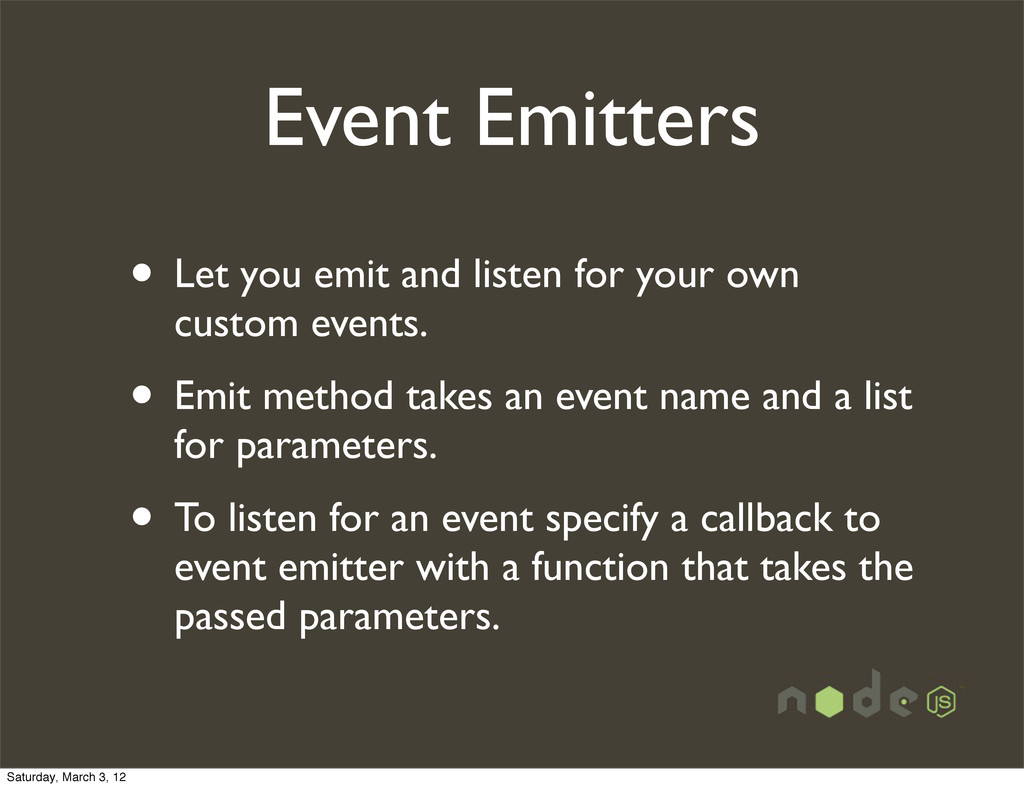
  13. Event Emitters • Let you emit and listen for your

    own custom events. • Emit method takes an event name and a list for parameters. • To listen for an event specify a callback to event emitter with a function that takes the passed parameters. Saturday, March 3, 12
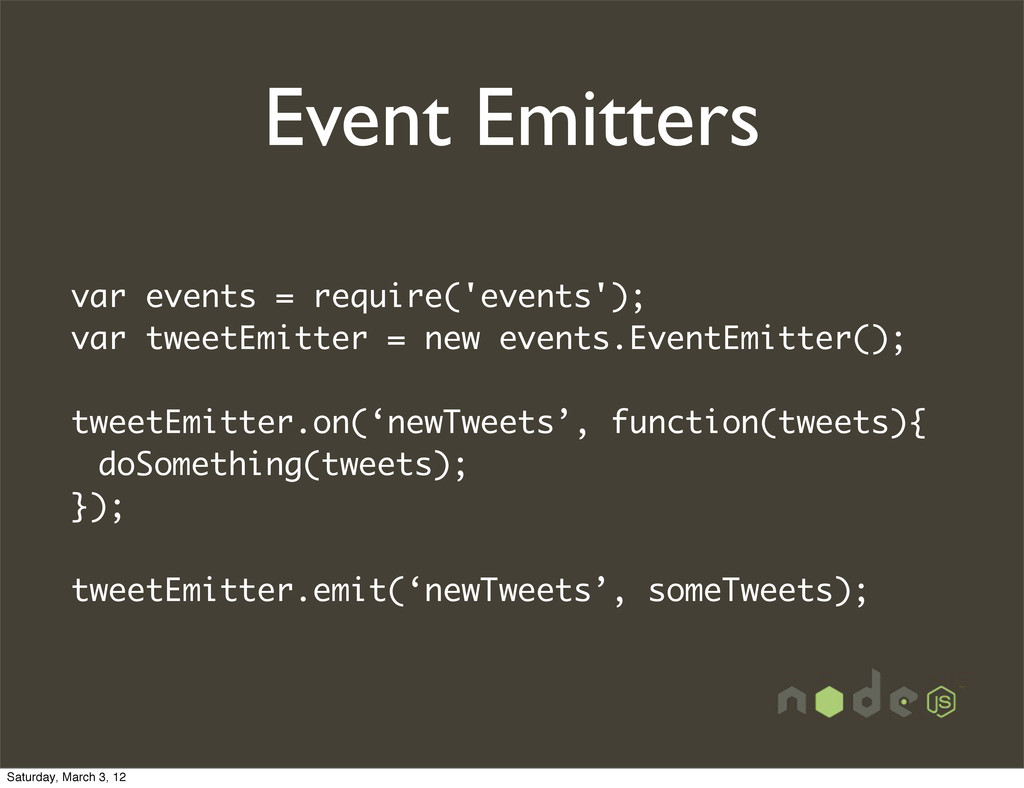
  14. Event Emitters var events = require('events'); var tweetEmitter = new

    events.EventEmitter(); tweetEmitter.on(‘newTweets’, function(tweets){ doSomething(tweets); }); tweetEmitter.emit(‘newTweets’, someTweets); Saturday, March 3, 12
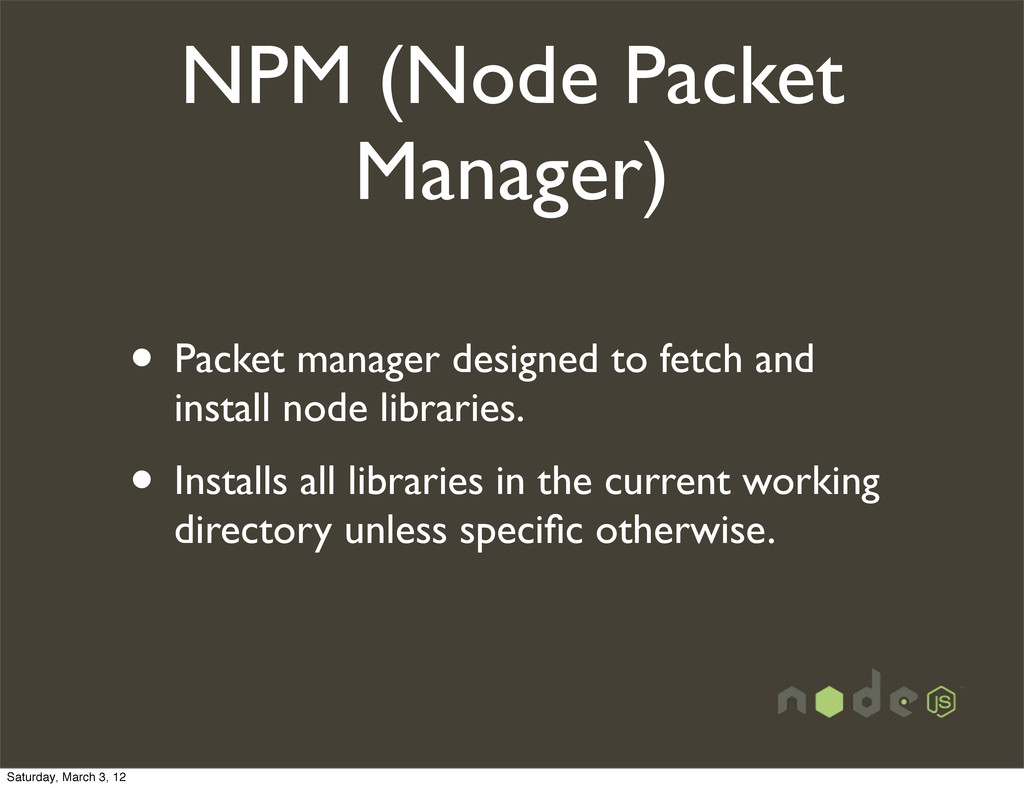
  15. NPM (Node Packet Manager) • Packet manager designed to fetch

    and install node libraries. • Installs all libraries in the current working directory unless specific otherwise. Saturday, March 3, 12
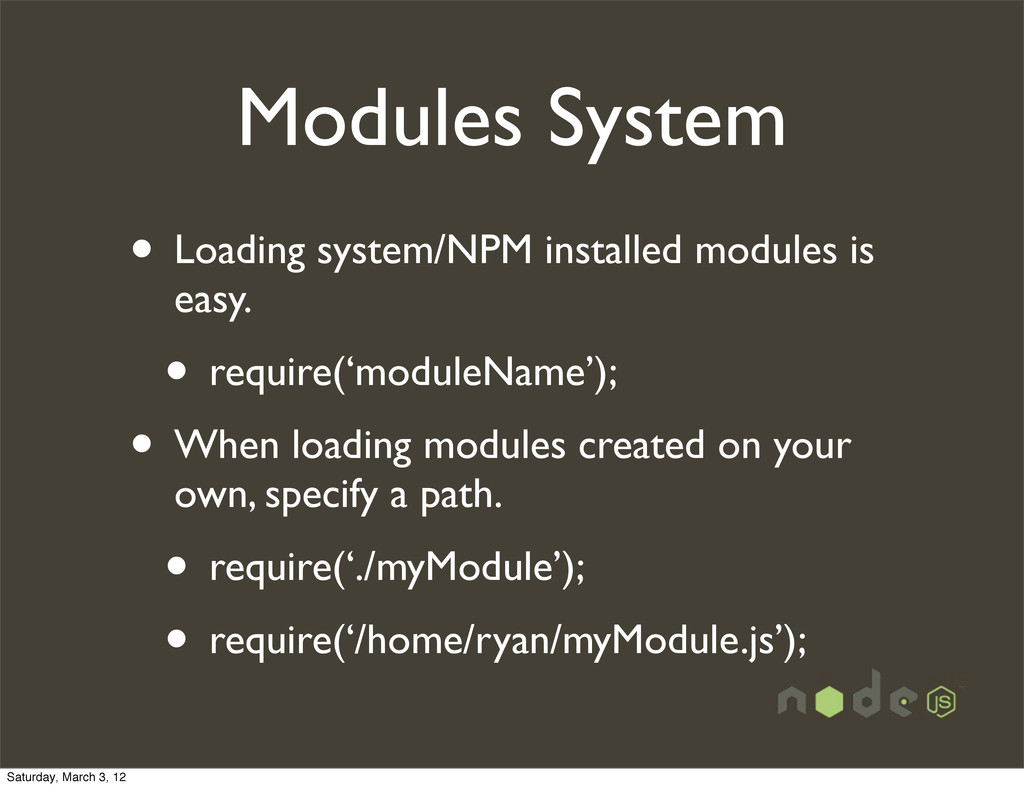
  16. Modules System • Loading system/NPM installed modules is easy. •

    require(‘moduleName’); • When loading modules created on your own, specify a path. • require(‘./myModule’); • require(‘/home/ryan/myModule.js’); Saturday, March 3, 12
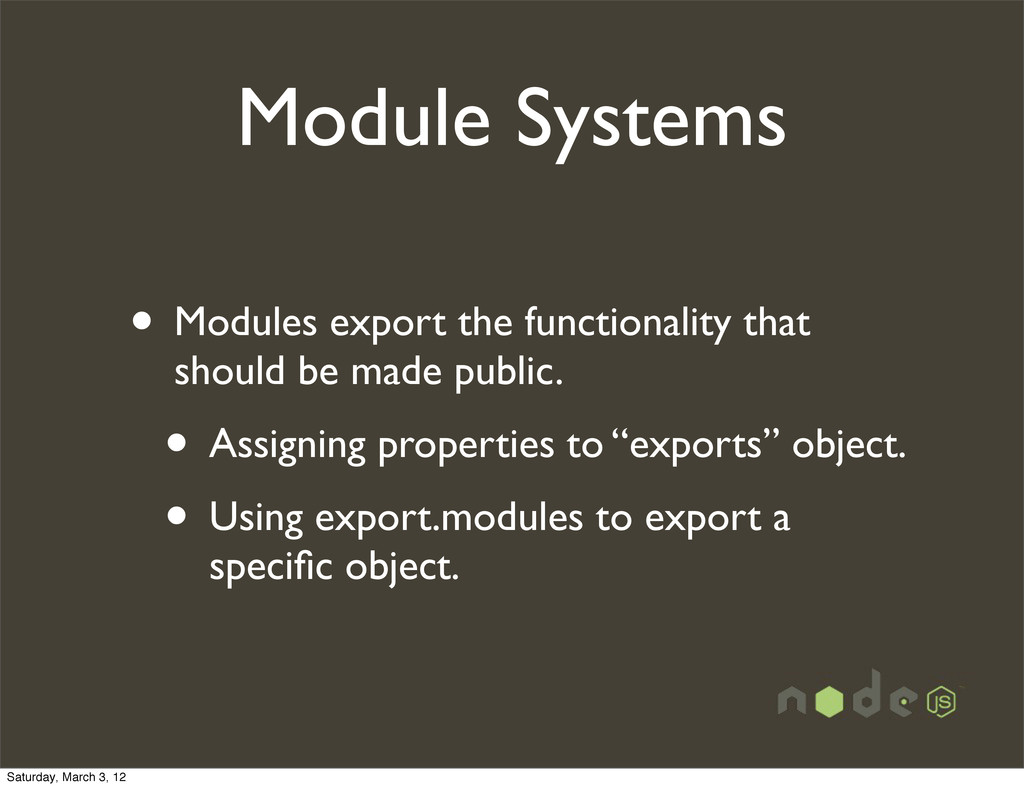
  17. Module Systems • Modules export the functionality that should be

    made public. • Assigning properties to “exports” object. • Using export.modules to export a specific object. Saturday, March 3, 12
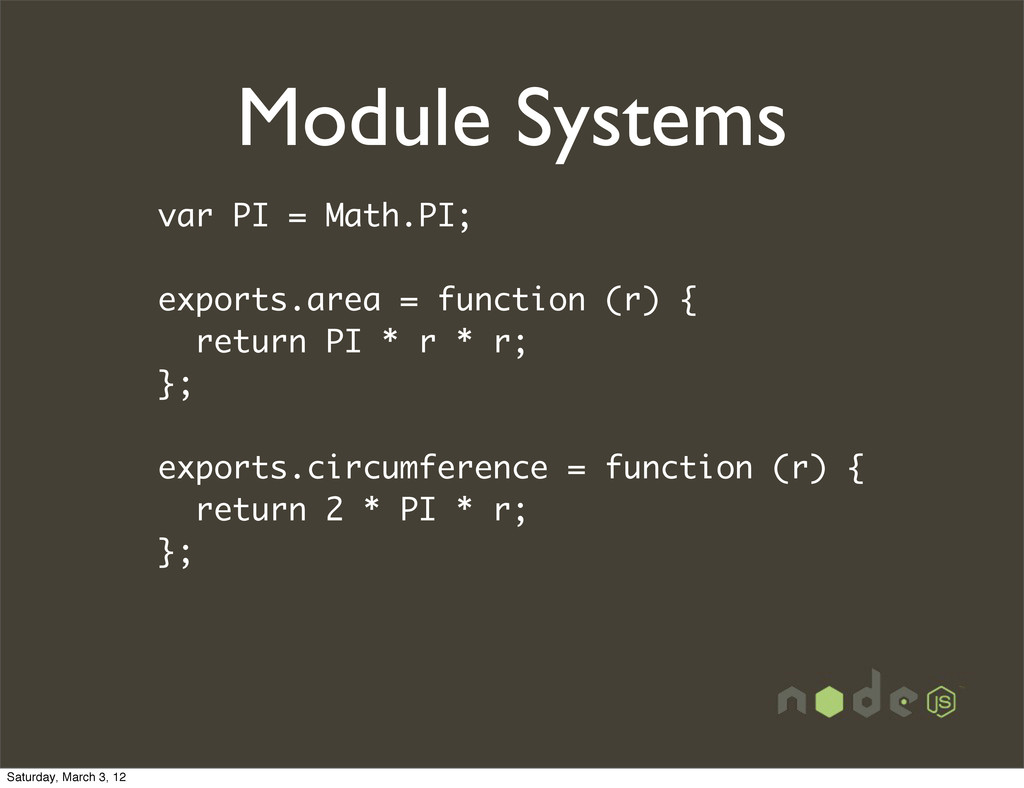
  18. Module Systems var PI = Math.PI; exports.area = function (r)

    { return PI * r * r; }; exports.circumference = function (r) { return 2 * PI * r; }; Saturday, March 3, 12
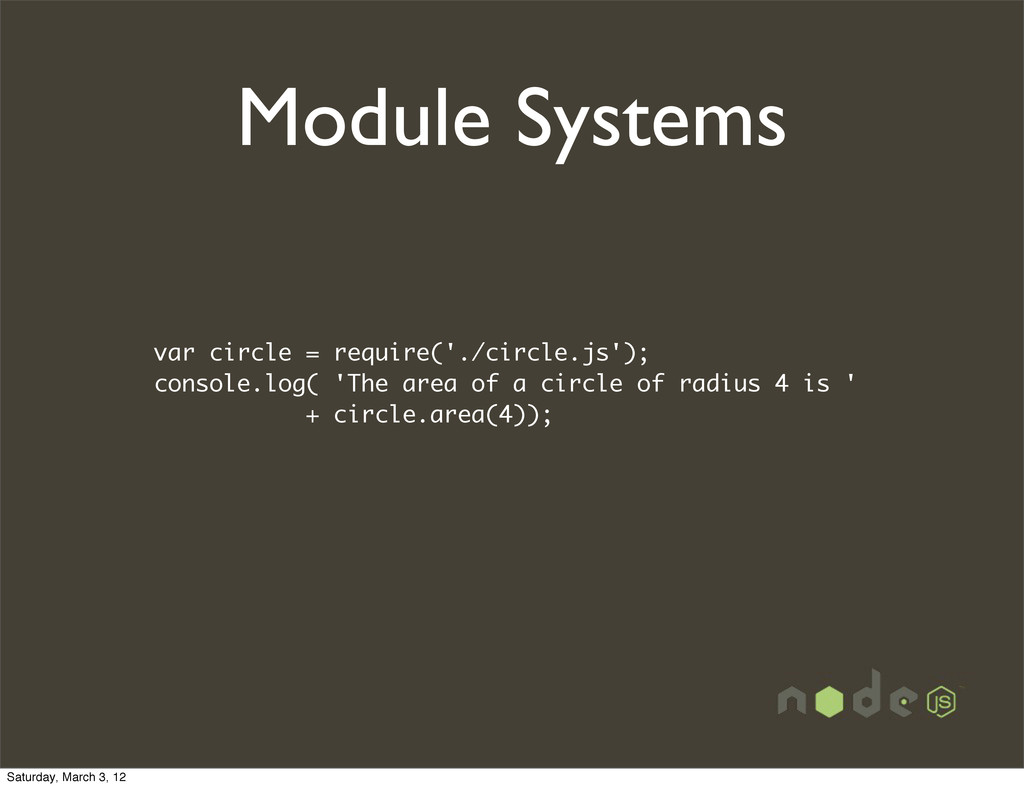
  19. Module Systems var circle = require('./circle.js'); console.log( 'The area of

    a circle of radius 4 is ' + circle.area(4)); Saturday, March 3, 12
  20. 3rd Party Libraries • Lots of code already written to

    do common things you would do in a web app • Check NPM or github for modules Saturday, March 3, 12
  21. Express • Light weight REST framework (similar to Sinatra in

    Ruby) • Flexible enough to host the web parts of most applications you write in Node Saturday, March 3, 12
  22. Socket.io • Great library for realtime communication between browser and

    server • Handles the dirty work of Websockets for you (falls back to long polling, flash sockets, etc. automatically) • Can tie in with Express to automatically serve the client side script required. Saturday, March 3, 12
  23. Few More • nodeunit - unit testing • ldap.js -

    create a LDAP interface over anything you want • connect - middleware for web frameworks (used by Express) • node.io - web page scraping framework Saturday, March 3, 12
  24. More Info • nodejs.org • IRC channel #nodejs on Freenode

    • https://github.com/joyent/node/wiki/ Community Saturday, March 3, 12