Upgrade to Pro
— share decks privately, control downloads, hide ads and more …
Speaker Deck
Sign up for free
Menu
Search
Features
All features
Private URLs
Password Protection
Custom URLS
Scheduled publishing
Remove Branding
Restrict embedding
Deck Collections
Notes
Features
All features
Private URLs
Password Protection
Custom URLS
Scheduled publishing
Remove Branding
Restrict embedding
Deck Collections
Notes
Explore
Featured decks
Featured speakers
Programming
Technology
Storyboards
Explore
Featured decks
Featured speakers
Programming
Technology
Storyboards
Pricing
Search
Sign in
Sign up for free
OptionalSwift
Search
Sponsored
·
SiteGround - Reliable hosting with speed, security, and support you can count on.
→
Lee Geunil
January 30, 2017
Programming
50
0
Share
Embed
Copy iframe code
Copy JS code
Copy link
Start on current slide
OptionalSwift
About Optional at Swift
Lee Geunil
January 30, 2017
Other Decks in Programming
See All in Programming
dotNET_vulnclicker_intro.pdf
deka_morita
0
140
Railsのためのパスキー実践入門 〜マルチテナントSaaSでの意思決定〜
utakaha
2
540
npm との違いを手がかりにGo の依存管理を理解したい
optim
0
290
Railsバージョンを4倍にした話
optim
0
350
Optunaを作ったときにやりたかったこと、その後 (2026/10/16, Optuna Meetup #3)
iwiwi
1
430
Augmenting AI with the Power of Jakarta EE
ivargrimstad
0
180
SREの越境 / SRE Collaboration
y0hgi
2
310
3回つくってわかった、 定期実行ジョブ基盤の本質情報
takai
0
450
當我們開始不讀 Code - AI Agent 時代,Code Review 與 Clean Code 還剩下什麼?
jame2408
1
190
Unity6 URPによる海底をテーマにしたVJシステムの解説 | Unity Shader 完全に理解した 勉強会
gam0022
0
370
FactoryBotをやめればRSpecは速くなるのか?
yuta_onishi_97
0
270
phperだってパンチカードでコーディングしたい
o0h
PRO
0
330
Featured
See All Featured
Fashionably flexible responsive web design (full day workshop)
malarkey
409
67k
How People are Using Generative and Agentic AI to Supercharge Their Products, Projects, Services and Value Streams Today
helenjbeal
2
360
30 Presentation Tips
portentint
PRO
1
430
Evolution of real-time – Irina Nazarova, EuRuKo, 2024
irinanazarova
9
1.6k
Become a Pro
speakerdeck
PRO
31
6.3k
Improving Core Web Vitals using Speculation Rules API
sergeychernyshev
21
1.7k
Collaborative Software Design: How to facilitate domain modelling decisions
baasie
1
340
Dominate Local Search Results - an insider guide to GBP, reviews, and Local SEO
greggifford
PRO
0
370
Bridging the Design Gap: How Collaborative Modelling removes blockers to flow between stakeholders and teams @FastFlow conf
baasie
0
730
The Limits of Empathy - UXLibs8
cassininazir
2
720
The Cult of Friendly URLs
andyhume
79
7k
Sam Torres - BigQuery for SEOs
techseoconnect
PRO
0
580
Transcript
”!” をほっとかない
Swift のオプショナルの話
自己紹介 Lee Geunil FutureScope -> OHAKO
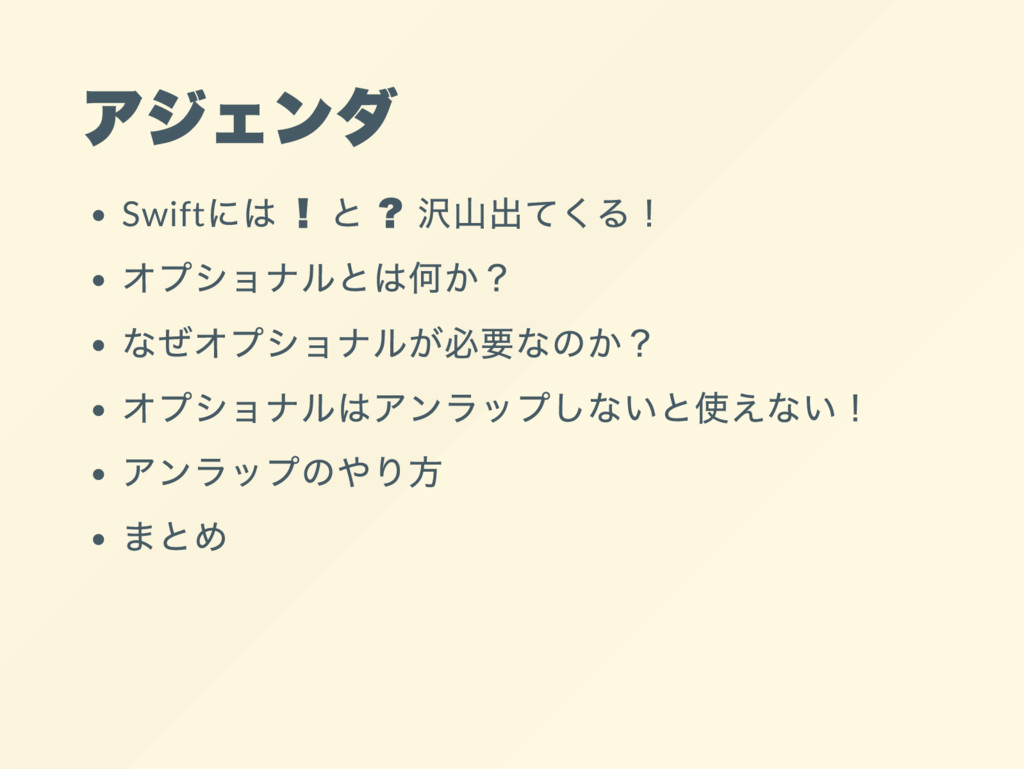
アジェンダ Swift には ! と ? 沢山出てくる! オプショナルとは何か? なぜオプショナルが必要なのか? オプショナルはアンラップしないと使えない!
アンラップのやり方 まとめ
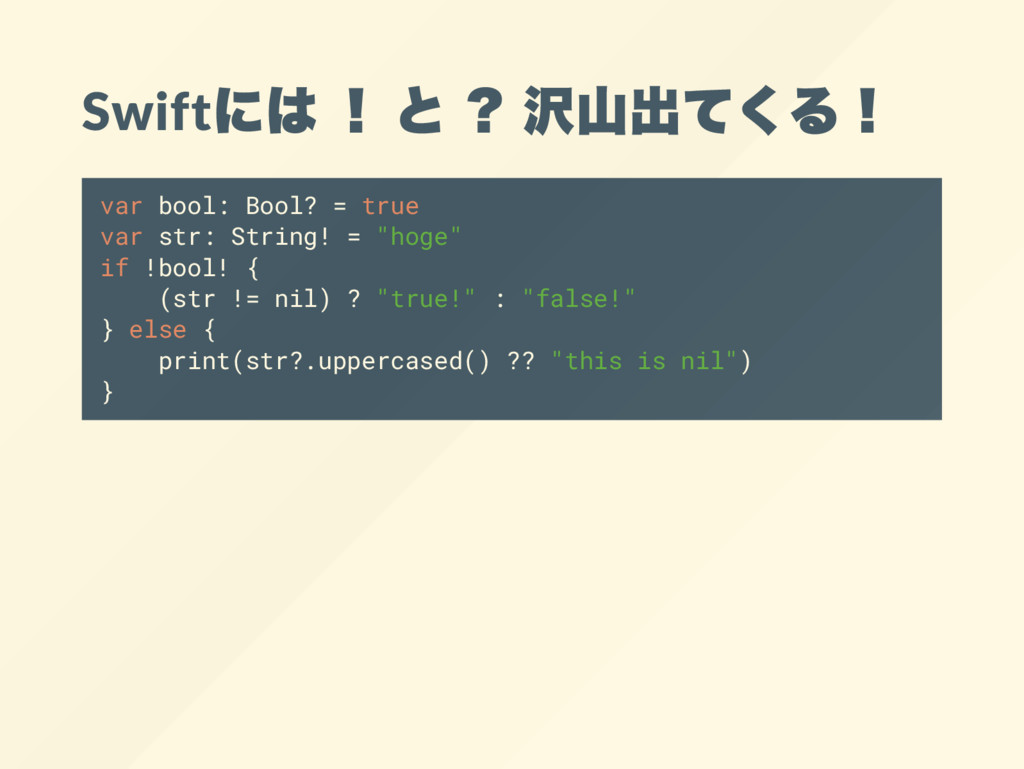
Swift には ! と ? 沢山出てくる! var bool: Bool? =
true var str: String! = "hoge" if !bool! { (str != nil) ? "true!" : "false!" } else { print(str?.uppercased() ?? "this is nil") }
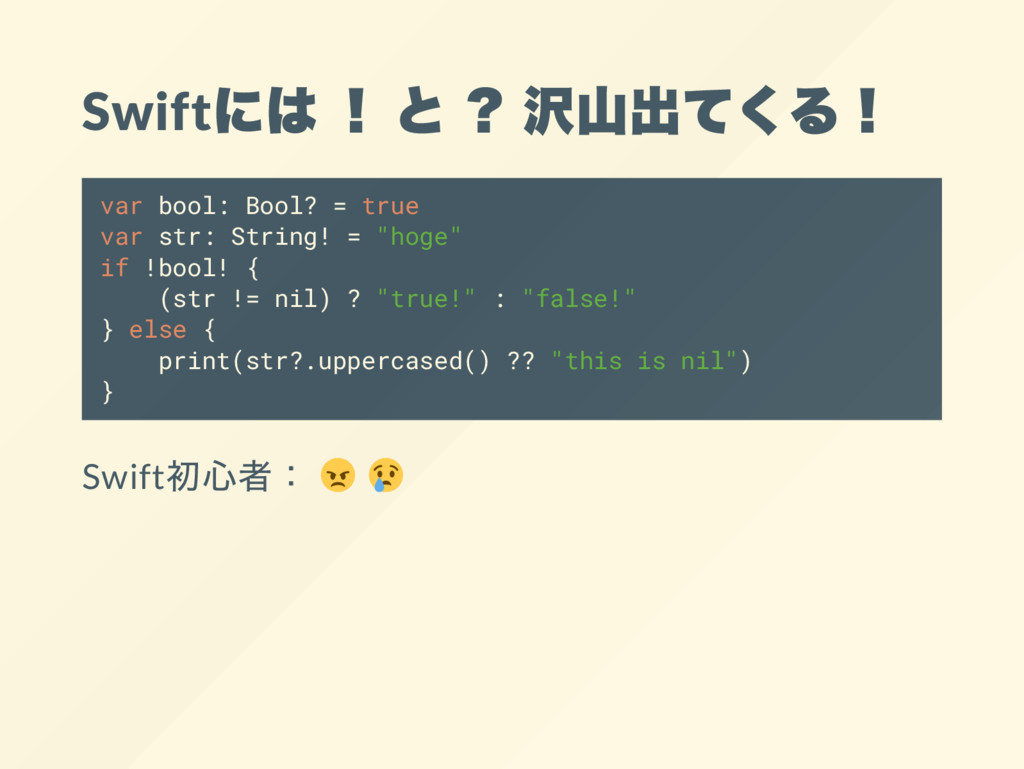
Swift には ! と ? 沢山出てくる! var bool: Bool? =
true var str: String! = "hoge" if !bool! { (str != nil) ? "true!" : "false!" } else { print(str?.uppercased() ?? "this is nil") } Swift 初心者:
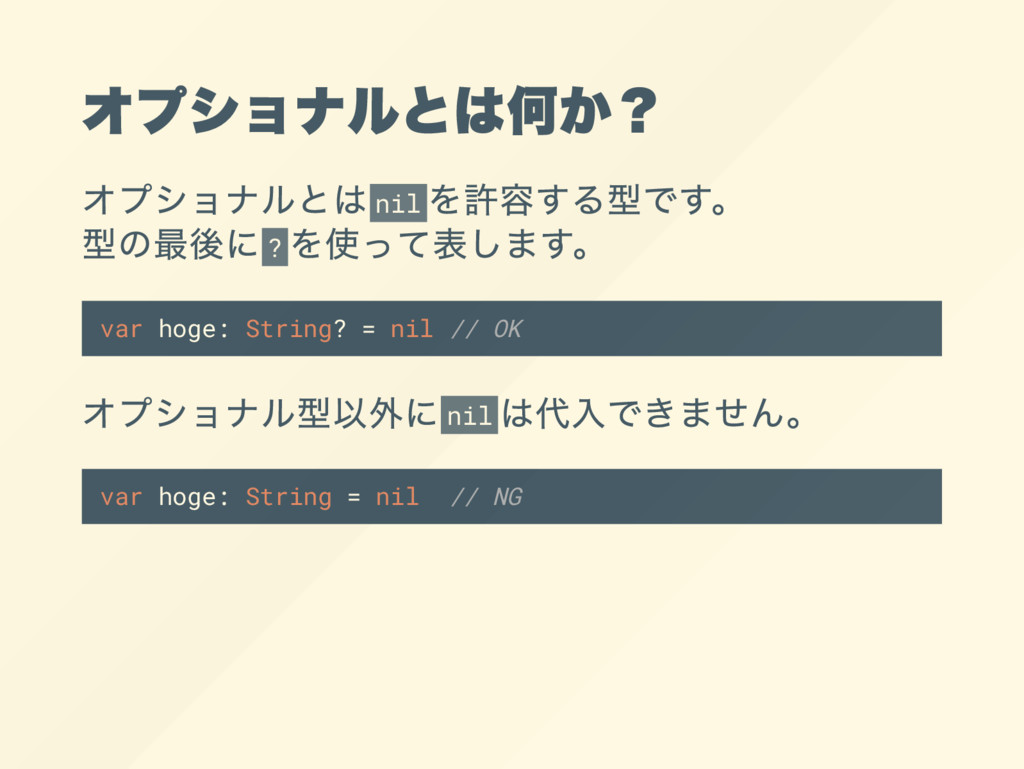
オプショナルとは何か? オプショナルとはnil を許容する型です。 型の最後に? を使って表します。 var hoge: String? = nil
// OK オプショナル型以外にnil は代入できません。 var hoge: String = nil // NG
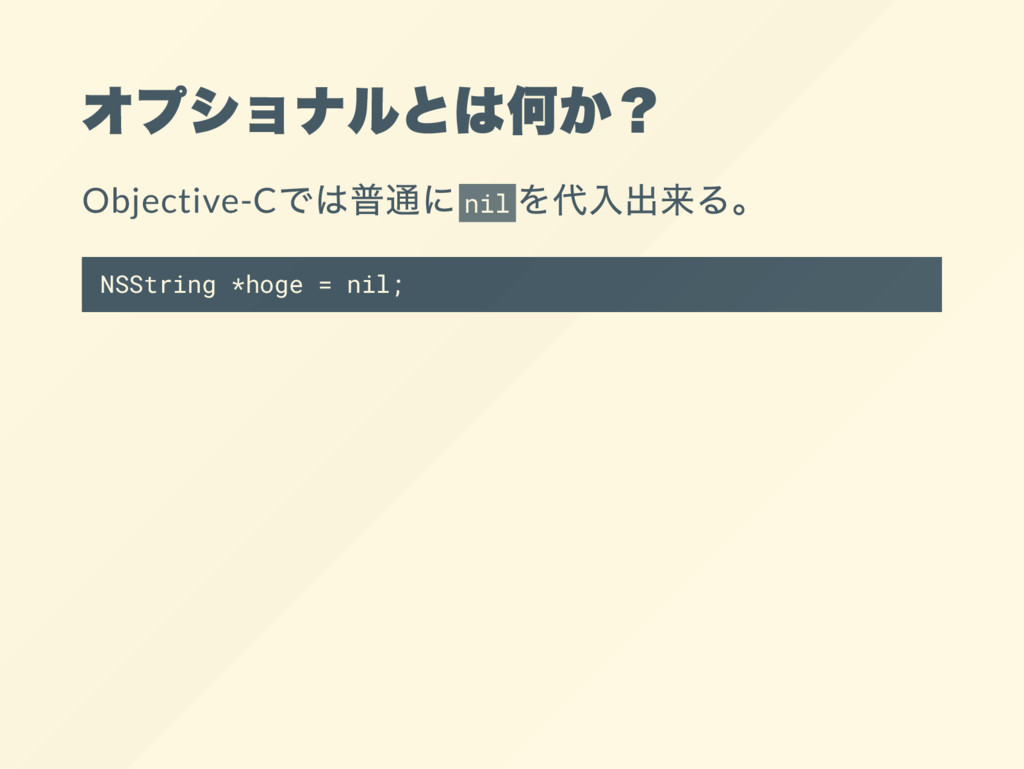
オプショナルとは何か? Objective-C では普通にnil を代入出来る。 NSString *hoge = nil;
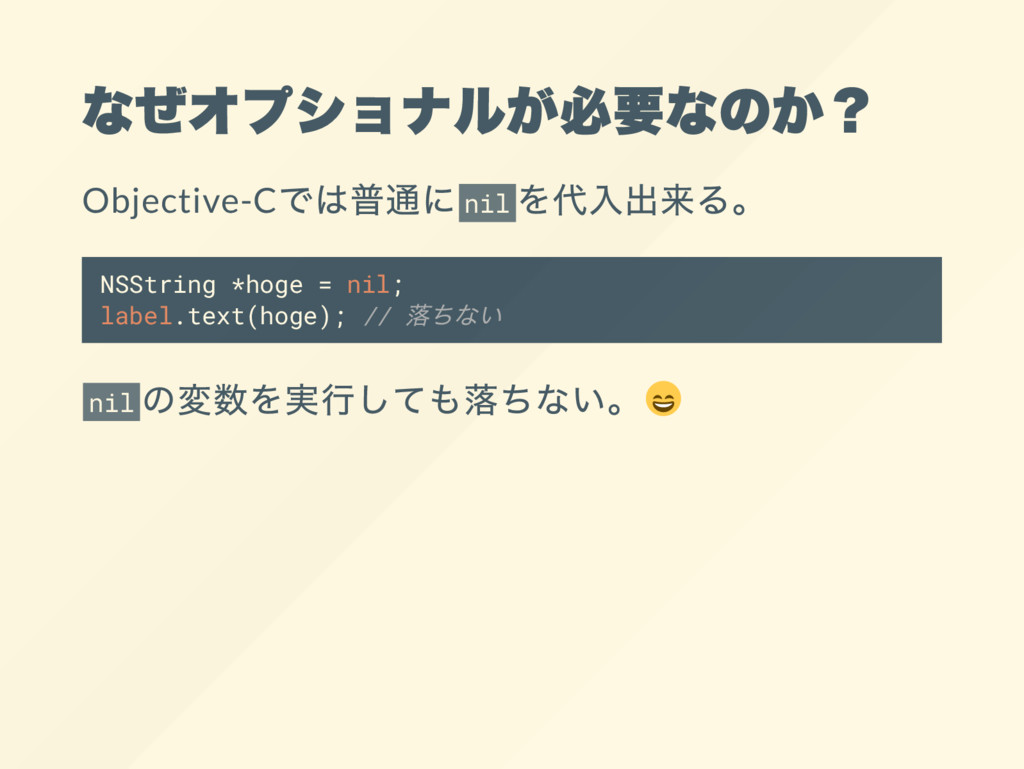
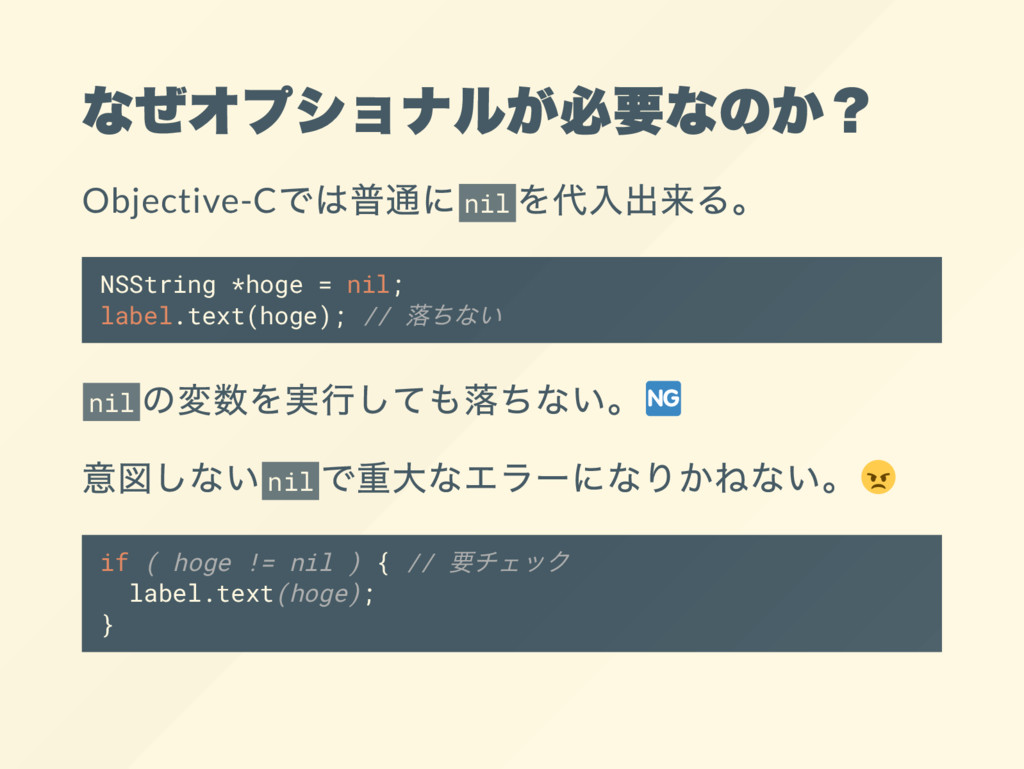
なぜオプショナルが必要なのか? Objective-C では普通にnil を代入出来る。 NSString *hoge = nil; label.text(hoge); //
落ちない nil の変数を実行しても落ちない。
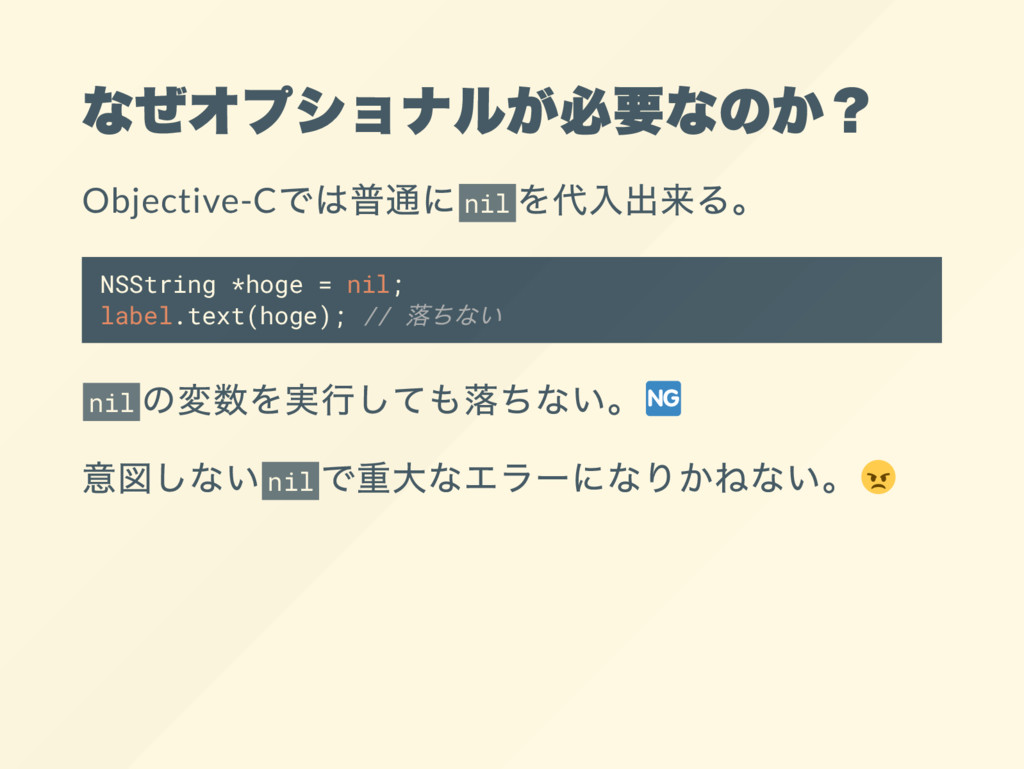
なぜオプショナルが必要なのか? Objective-C では普通にnil を代入出来る。 NSString *hoge = nil; label.text(hoge); //
落ちない nil の変数を実行しても落ちない。 意図しないnil で重大なエラー になりかねない。
なぜオプショナルが必要なのか? Objective-C では普通にnil を代入出来る。 NSString *hoge = nil; label.text(hoge); //
落ちない nil の変数を実行しても落ちない。 意図しないnil で重大なエラー になりかねない。 if ( hoge != nil ) { // 要チェック label.text(hoge); }
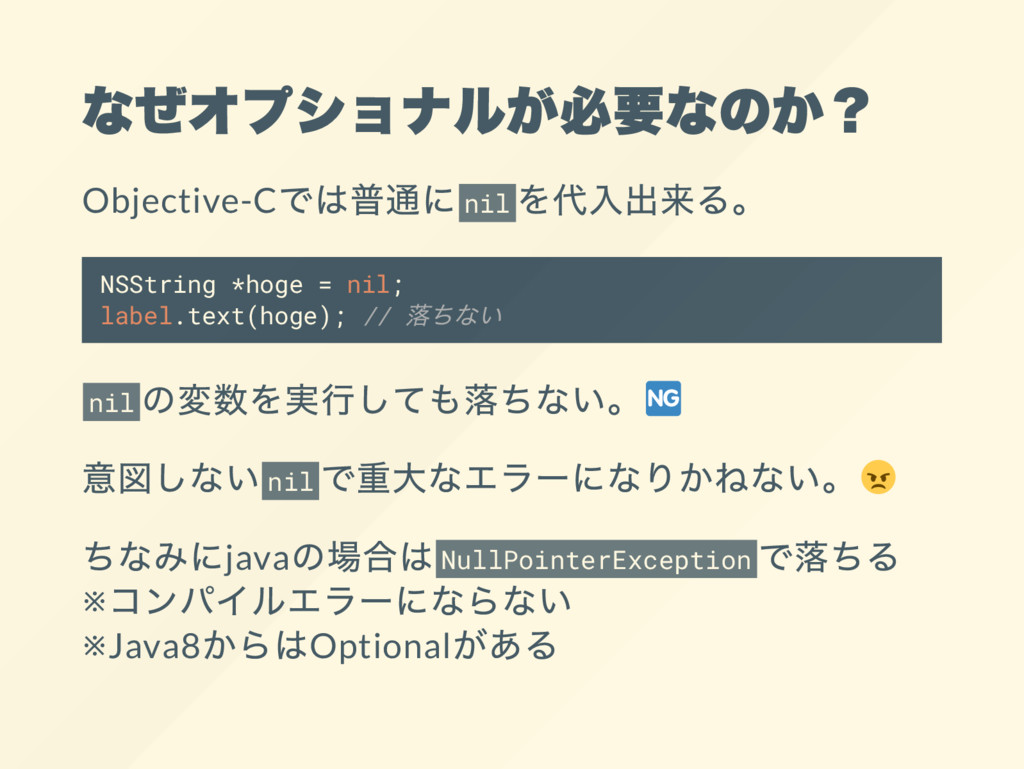
なぜオプショナルが必要なのか? Objective-C では普通にnil を代入出来る。 NSString *hoge = nil; label.text(hoge); //
落ちない nil の変数を実行しても落ちない。 意図しないnil で重大なエラー になりかねない。 ちなみにjava の場合はNullPointerException で落ちる ※ コンパイルエラー にならない ※Java8 からはOptional がある
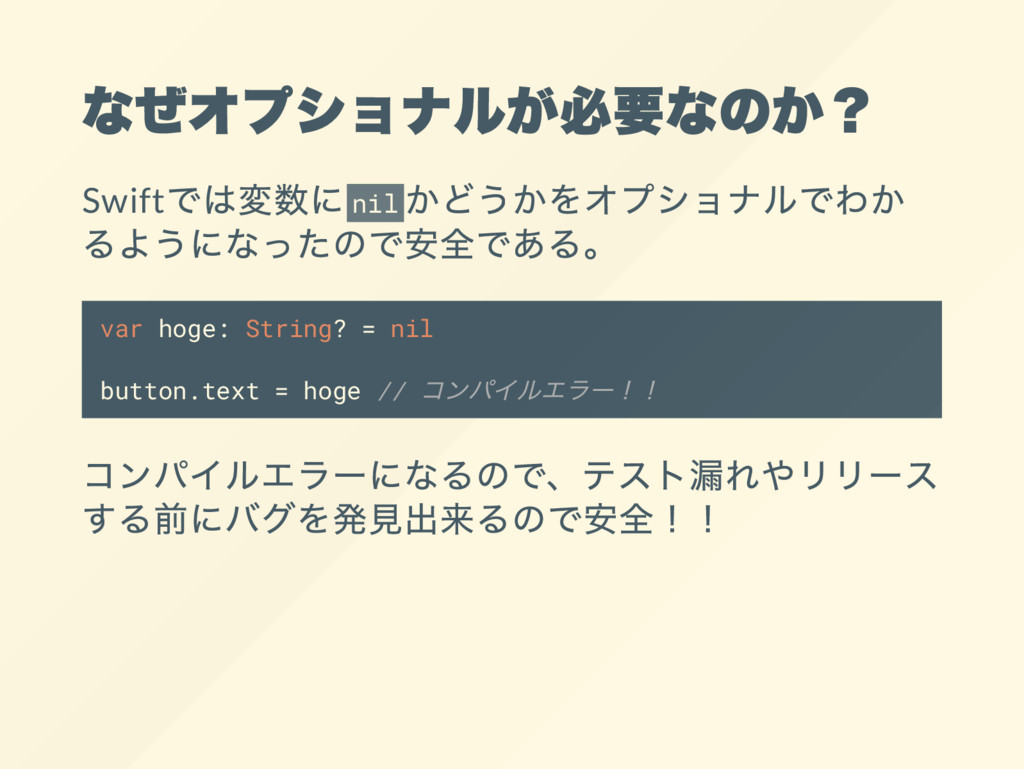
なぜオプショナルが必要なのか? Swift では変数にnil かどうかをオプショナルでわか るようになったので安全である。 var hoge: String? = nil
button.text = hoge // コンパイルエラー!! コンパイルエラー になるので、 テスト漏れやリリー ス する前にバグを発見出来るので安全!!
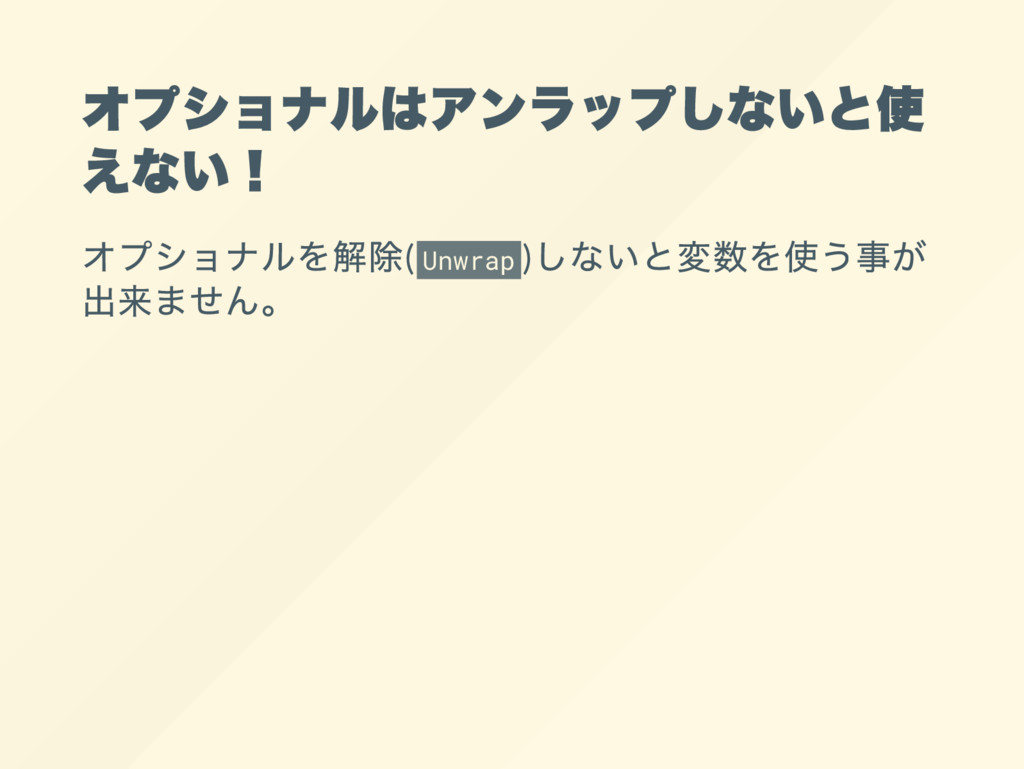
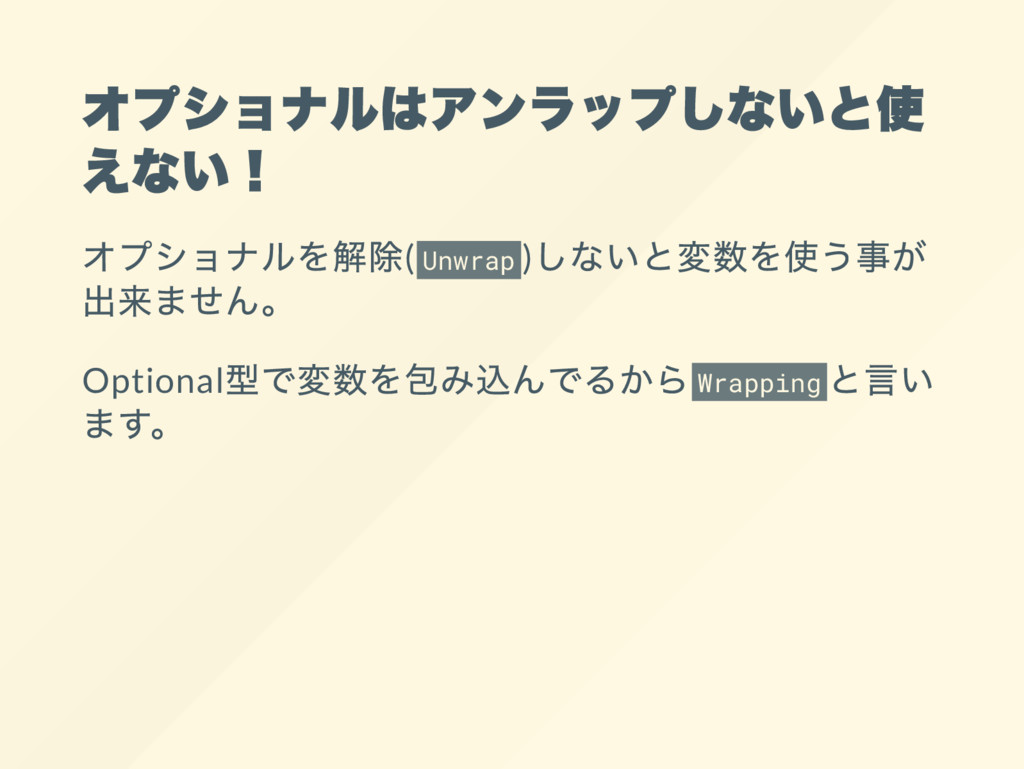
オプショナルはアンラップしないと使 えない! オプショナルを解除( Unwrap ) しないと変数を使う事が 出来ません。
オプショナルはアンラップしないと使 えない! オプショナルを解除( Unwrap ) しないと変数を使う事が 出来ません。 Optional 型で変数を包み込んでるからWrapping と言い
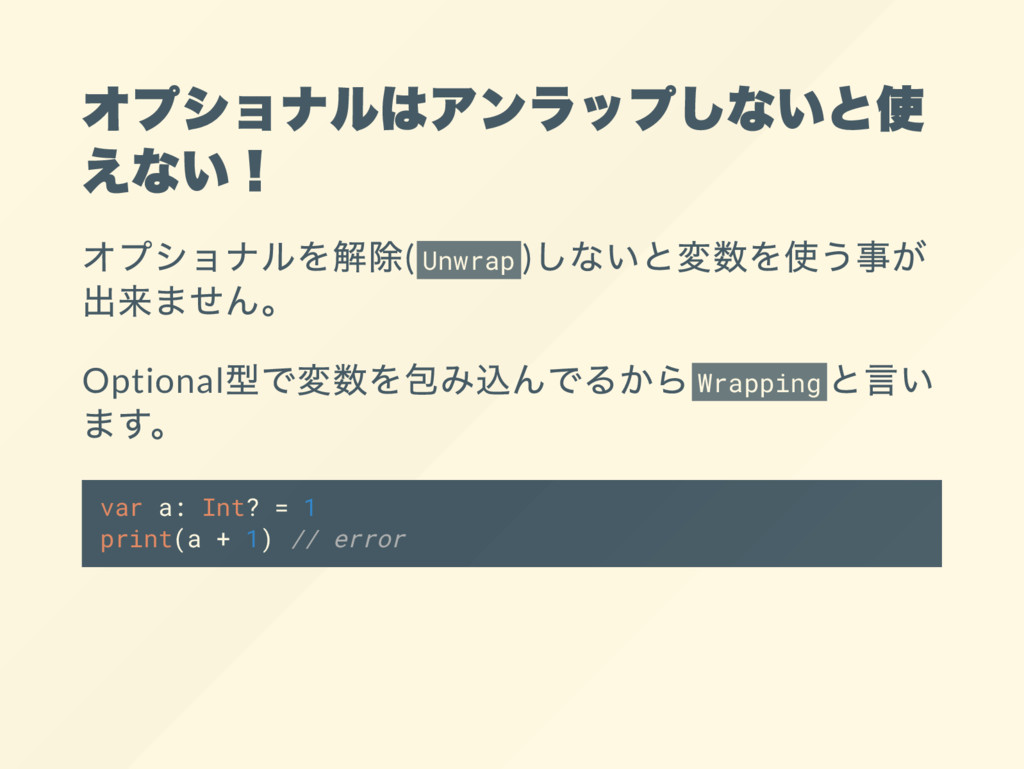
ます。
オプショナルはアンラップしないと使 えない! オプショナルを解除( Unwrap ) しないと変数を使う事が 出来ません。 Optional 型で変数を包み込んでるからWrapping と言い
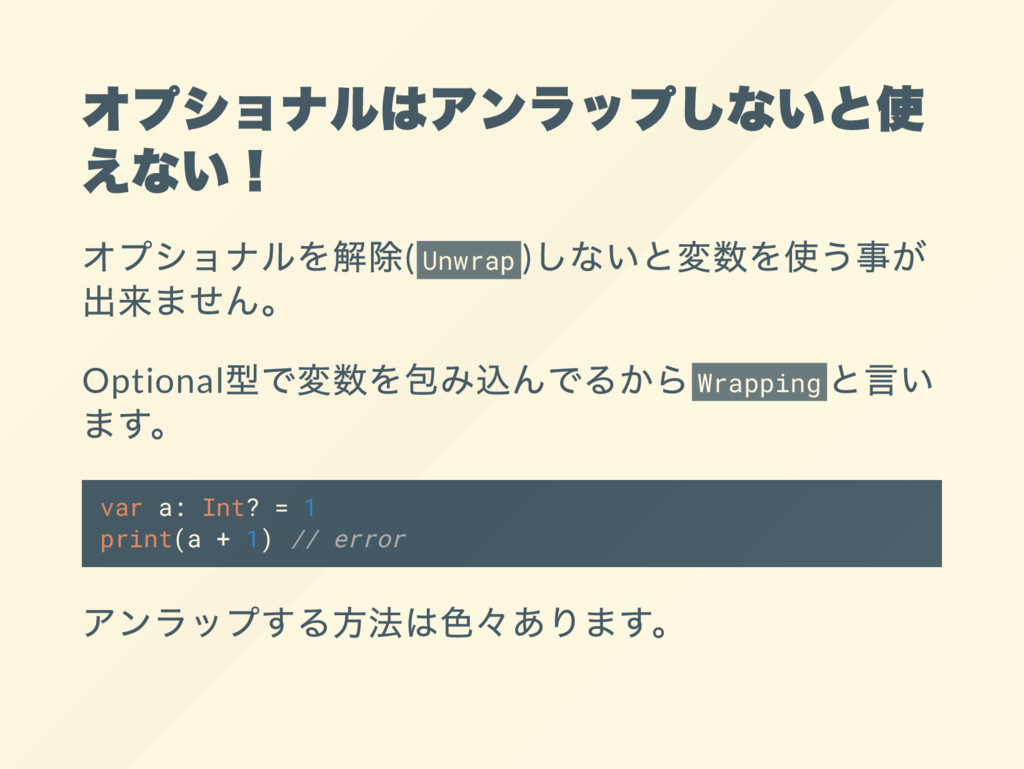
ます。 var a: Int? = 1 print(a + 1) // error
オプショナルはアンラップしないと使 えない! オプショナルを解除( Unwrap ) しないと変数を使う事が 出来ません。 Optional 型で変数を包み込んでるからWrapping と言い
ます。 var a: Int? = 1 print(a + 1) // error アンラップする方法は色々 あります。
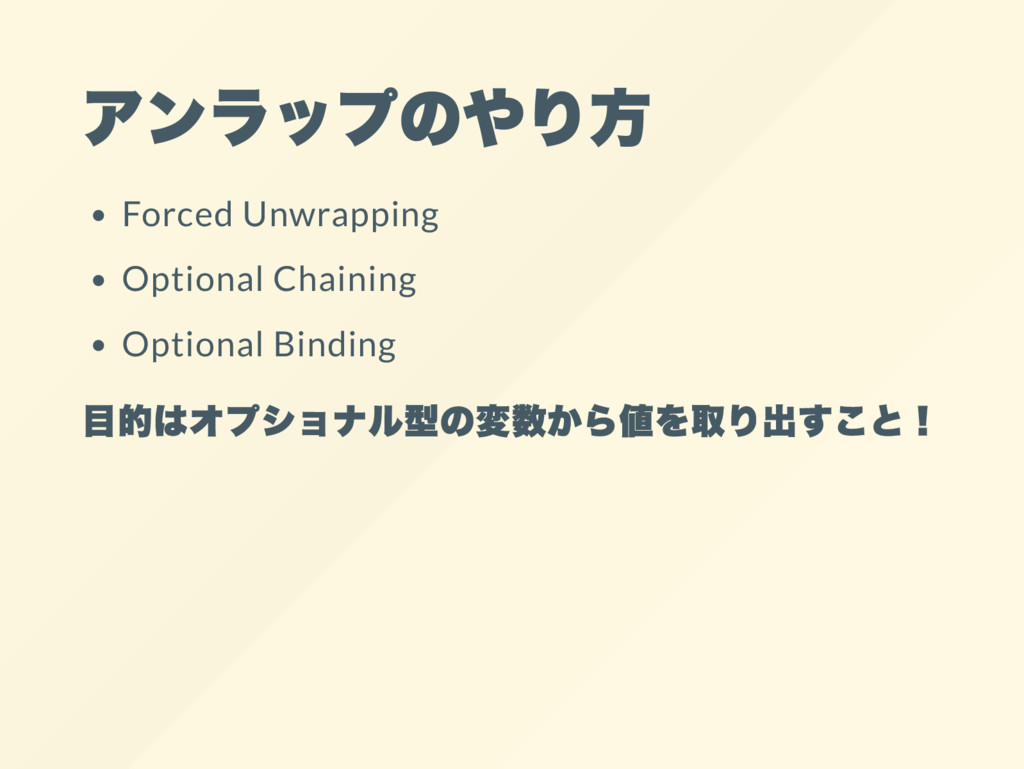
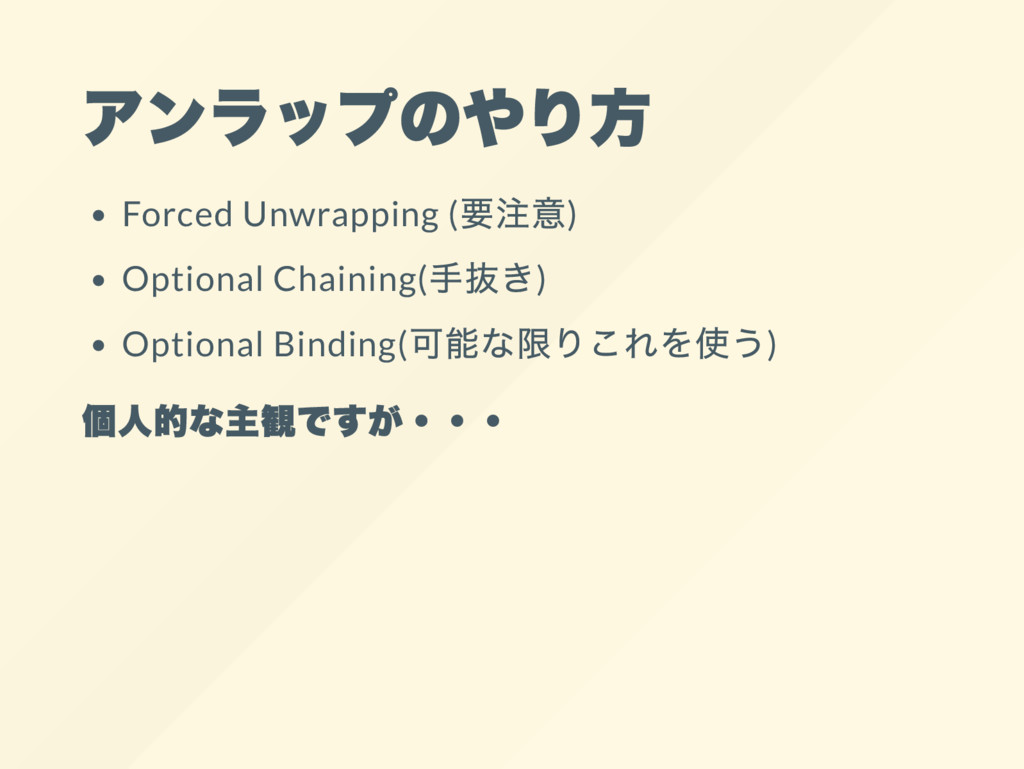
アンラップのやり方 Forced Unwrapping Optional Chaining Optional Binding 目的はオプショナル型の変数から値を取り出すこと!
アンラップのやり方 Forced Unwrapping ( 要注意) Optional Chaining( 手抜き) Optional Binding(
可能な限りこれを使う) 個人的な主観ですが・・・
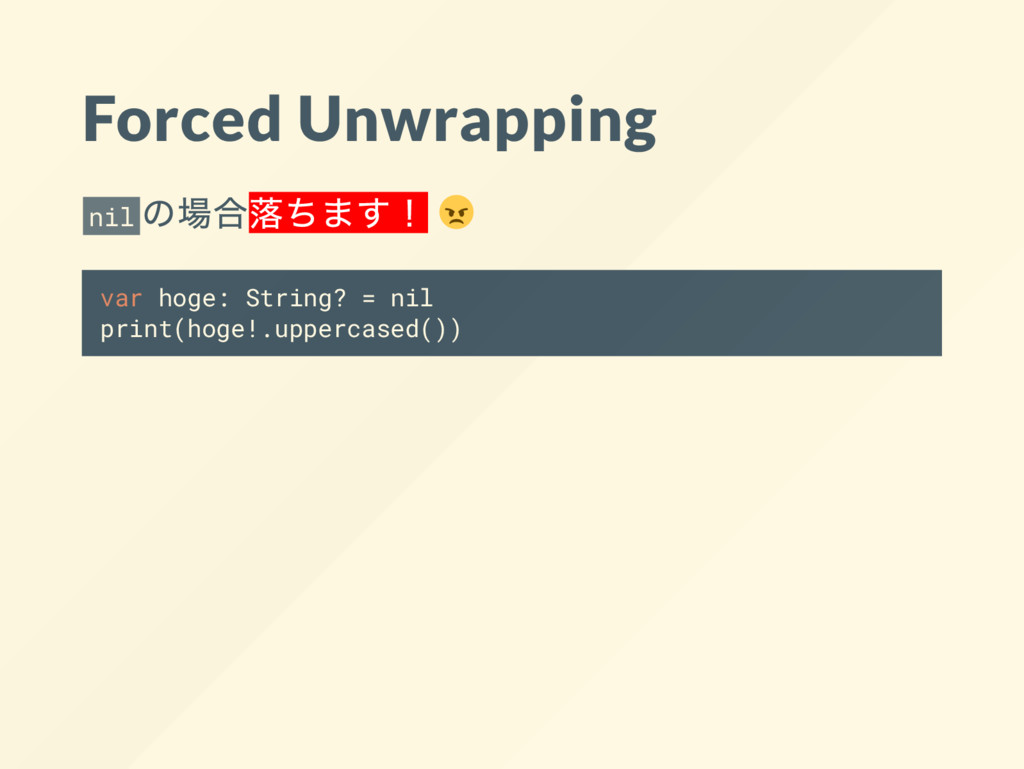
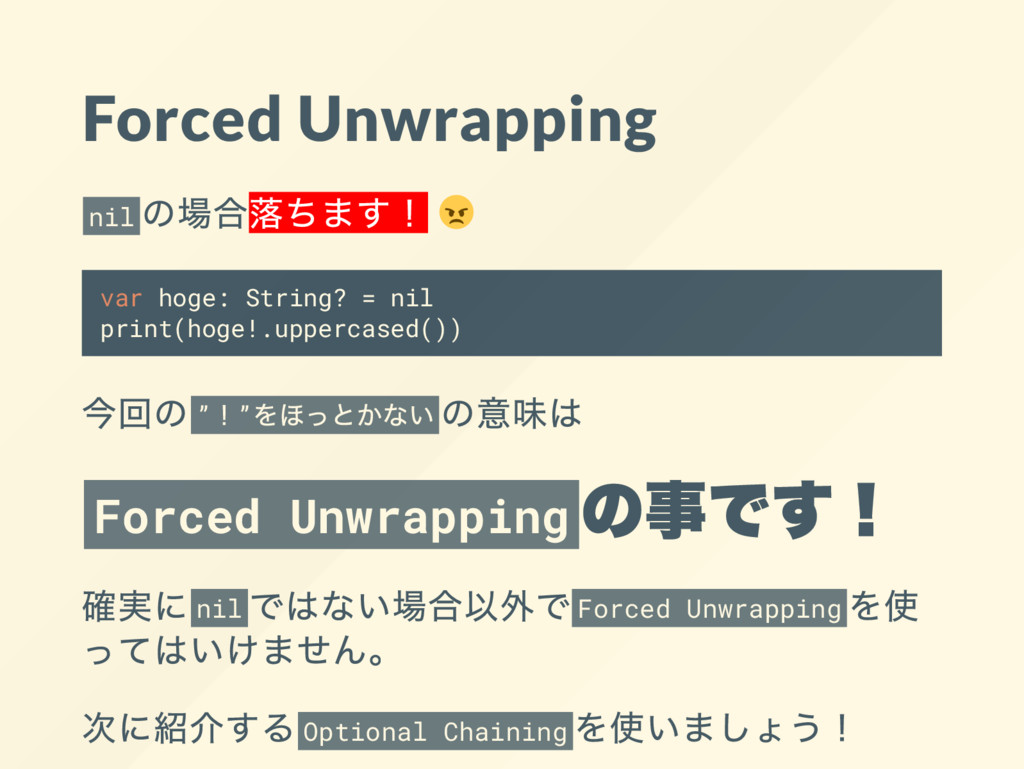
Forced Unwrapping nil の場合 落ちます! var hoge: String? = nil
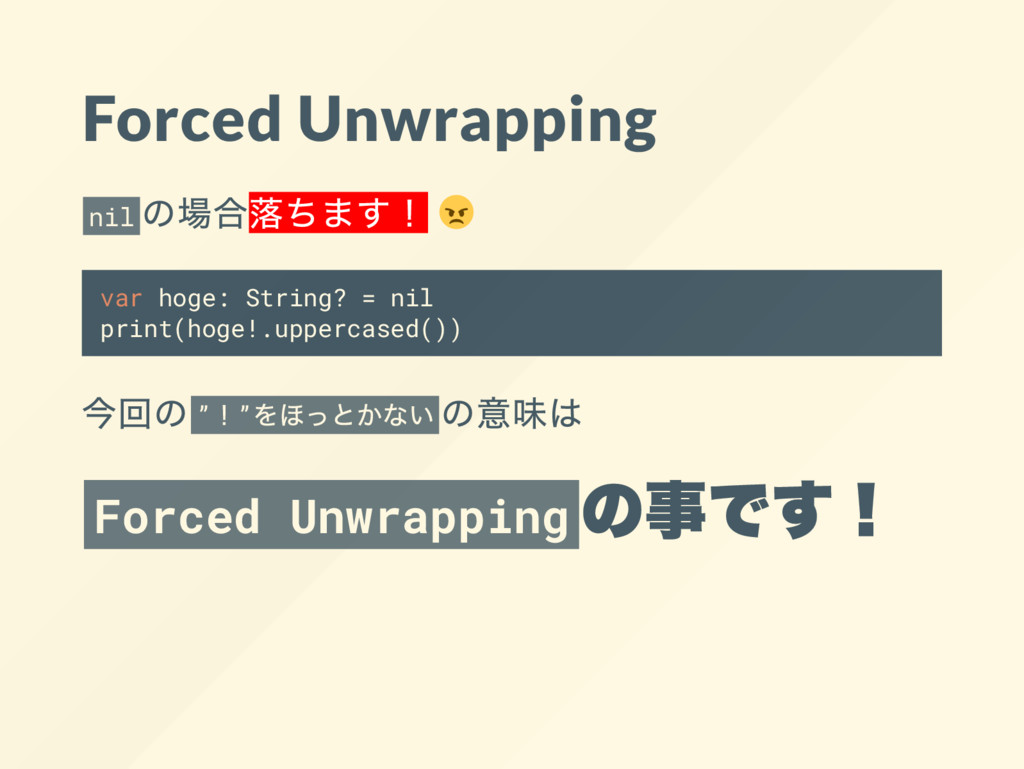
print(hoge!.uppercased())
Forced Unwrapping nil の場合 落ちます! var hoge: String? = nil
print(hoge!.uppercased()) 今回の”!” をほっとかないの意味は Forced Unwrapping の事です!
Forced Unwrapping nil の場合 落ちます! var hoge: String? = nil
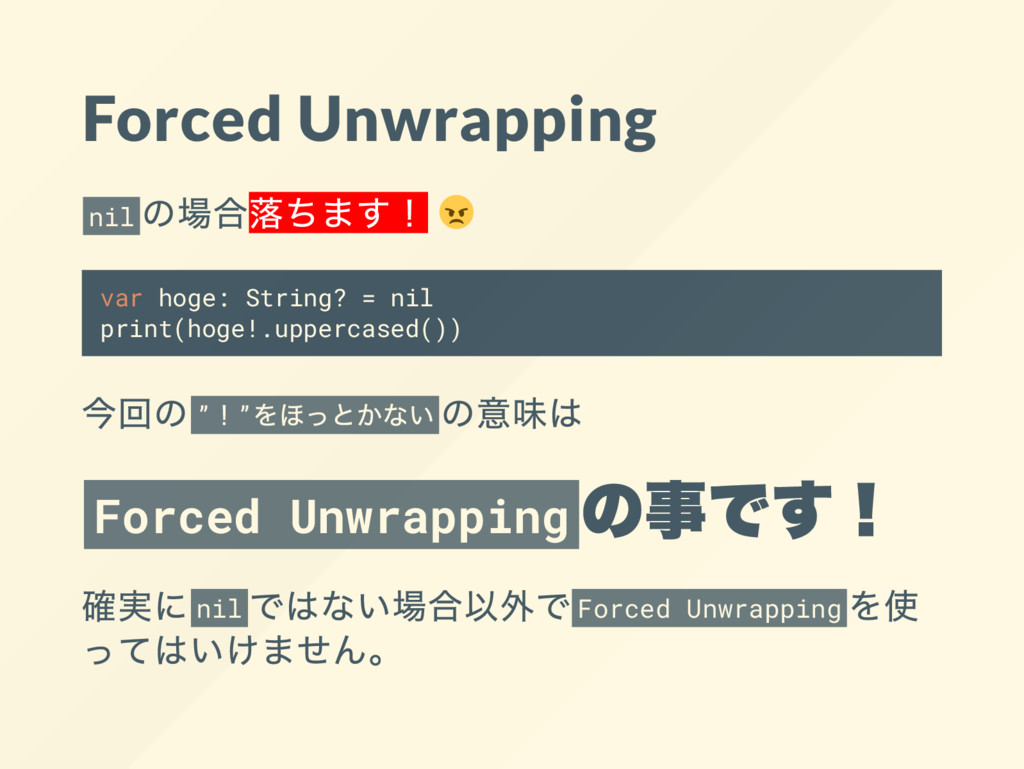
print(hoge!.uppercased()) 今回の”!” をほっとかないの意味は Forced Unwrapping の事です! 確実にnil ではない場合以外でForced Unwrapping を使 ってはいけません。
Forced Unwrapping nil の場合 落ちます! var hoge: String? = nil
print(hoge!.uppercased()) 今回の”!” をほっとかないの意味は Forced Unwrapping の事です! 確実にnil ではない場合以外でForced Unwrapping を使 ってはいけません。 次に紹介するOptional Chaining を使いましょう!
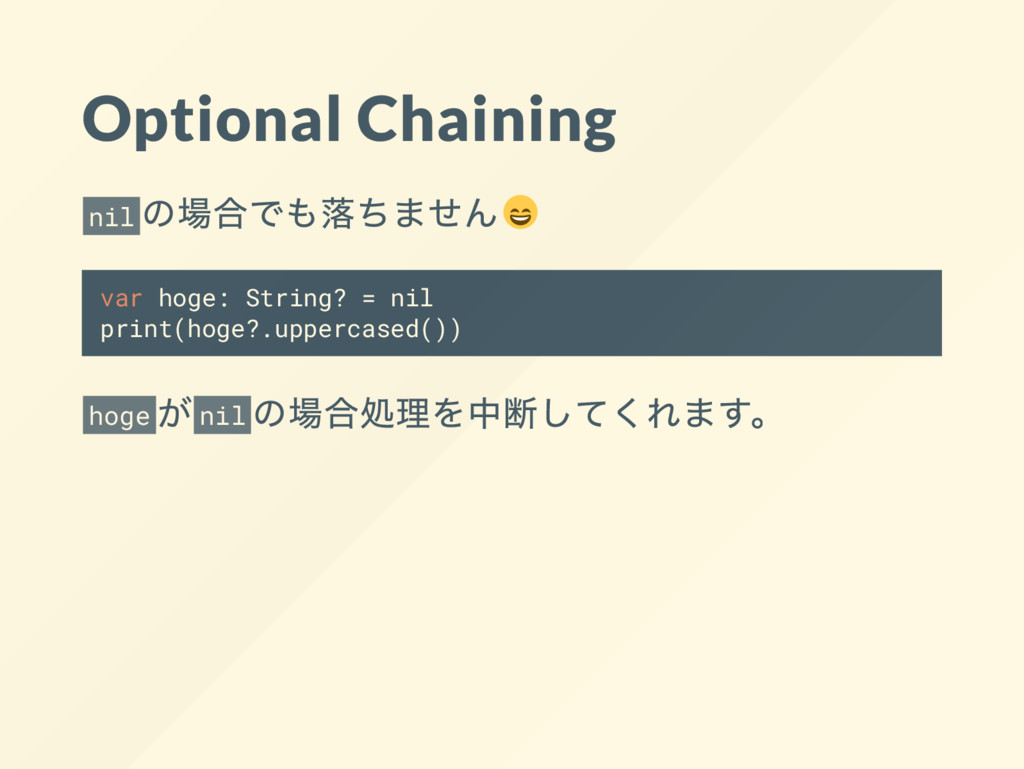
Optional Chaining nil の場合でも落ちません var hoge: String? = nil print(hoge?.uppercased())
hoge がnil の場合処理を中断してくれます。
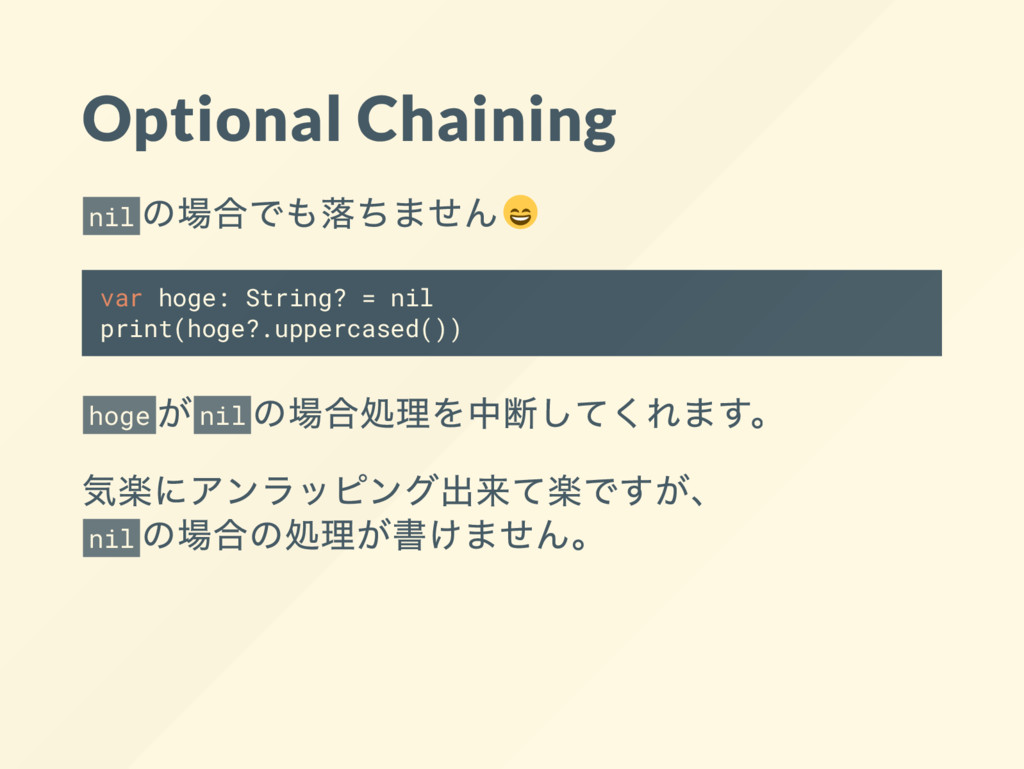
Optional Chaining nil の場合でも落ちません var hoge: String? = nil print(hoge?.uppercased())
hoge がnil の場合処理を中断してくれます。 気楽にアンラッピング出来て楽ですが、 nil の場合の処理が書けません。
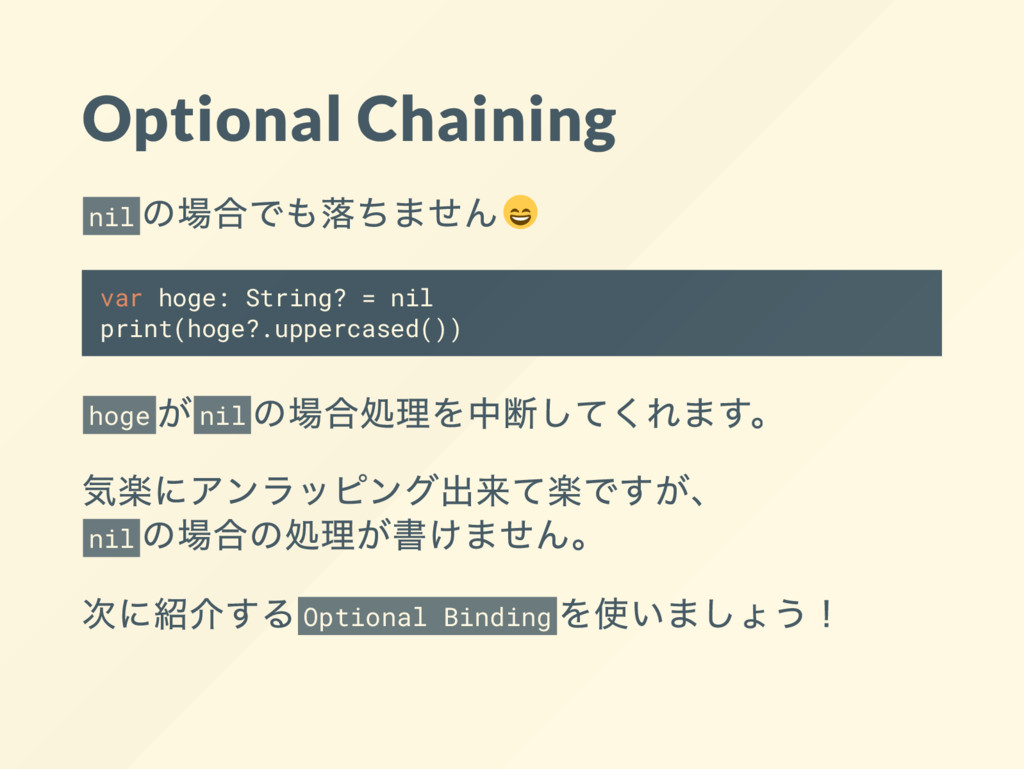
Optional Chaining nil の場合でも落ちません var hoge: String? = nil print(hoge?.uppercased())
hoge がnil の場合処理を中断してくれます。 気楽にアンラッピング出来て楽ですが、 nil の場合の処理が書けません。 次に紹介する Optional Binding を使いましょう!
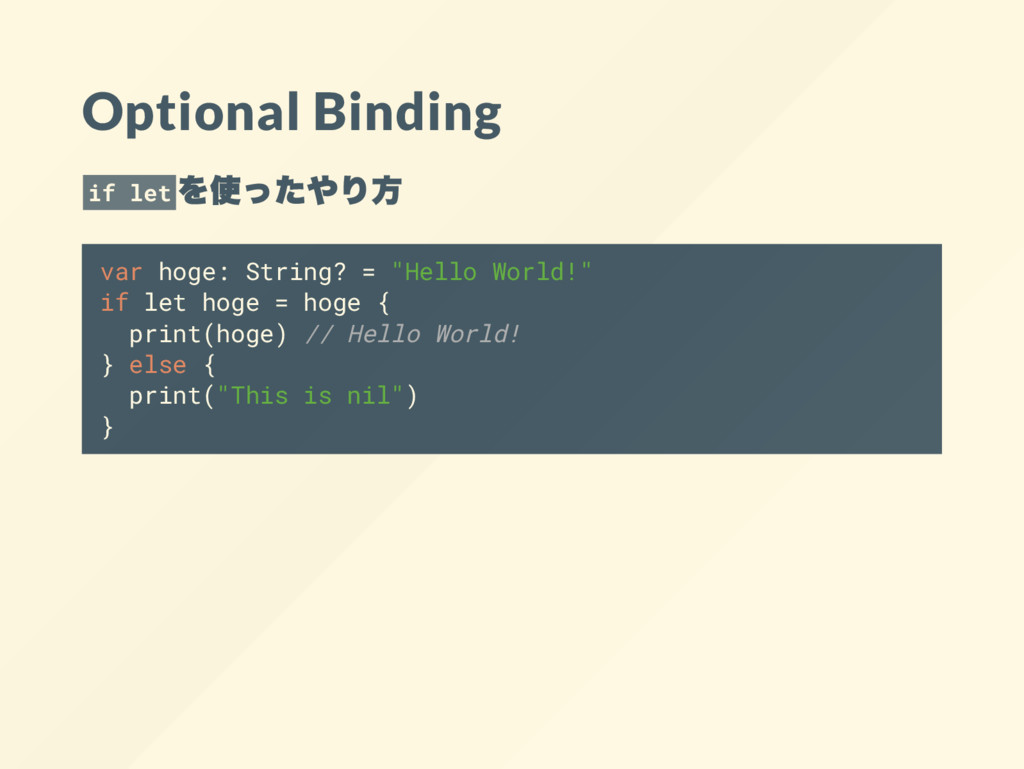
Optional Binding if let を使ったやり方 var hoge: String? = "Hello
World!" if let hoge = hoge { print(hoge) // Hello World! } else { print("This is nil") }
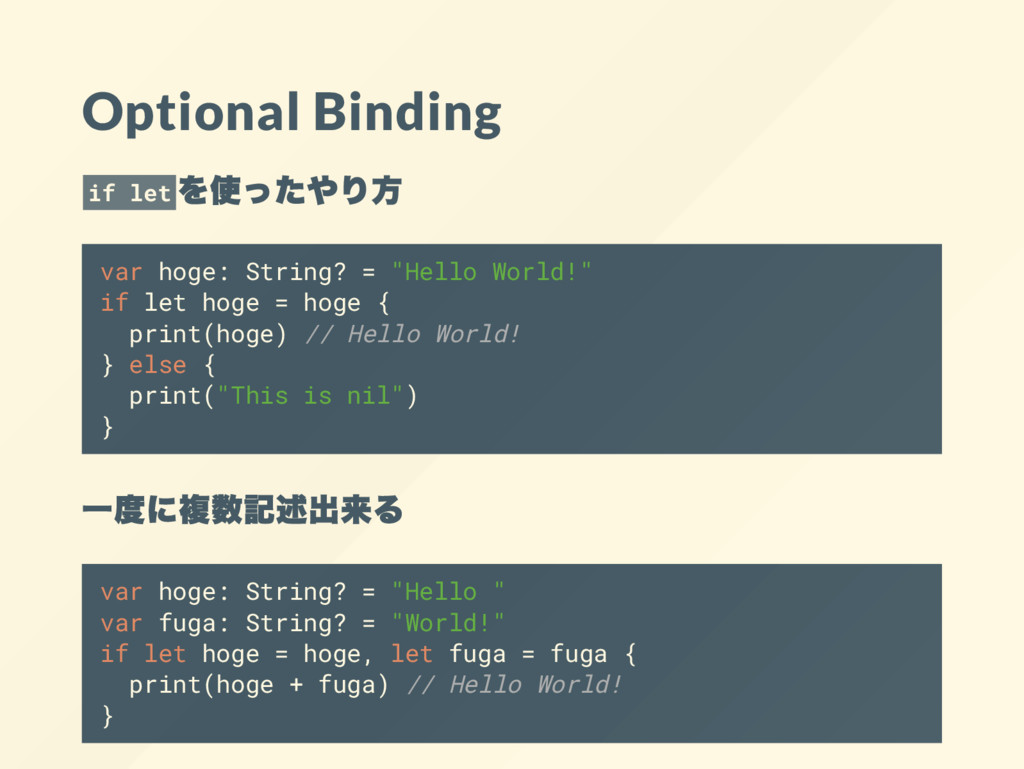
Optional Binding if let を使ったやり方 var hoge: String? = "Hello
World!" if let hoge = hoge { print(hoge) // Hello World! } else { print("This is nil") } 一度に複数記述出来る var hoge: String? = "Hello " var fuga: String? = "World!" if let hoge = hoge, let fuga = fuga { print(hoge + fuga) // Hello World! }
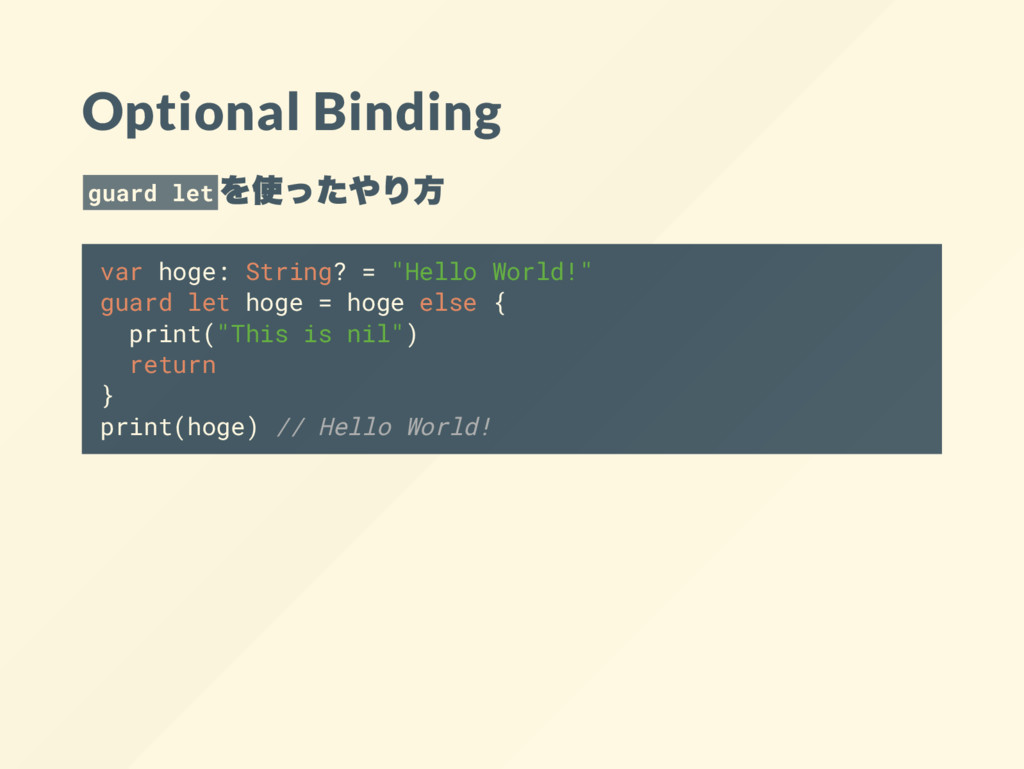
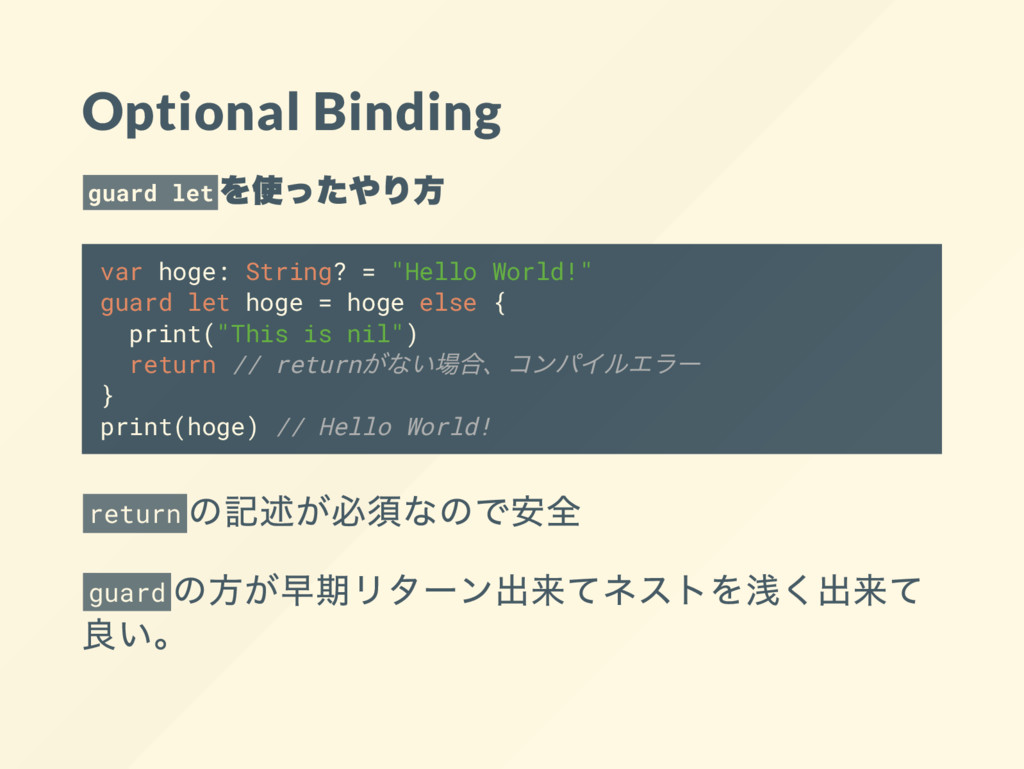
Optional Binding guard let を使ったやり方 var hoge: String? = "Hello
World!" guard let hoge = hoge else { print("This is nil") return } print(hoge) // Hello World!
Optional Binding guard let を使ったやり方 var hoge: String? = "Hello
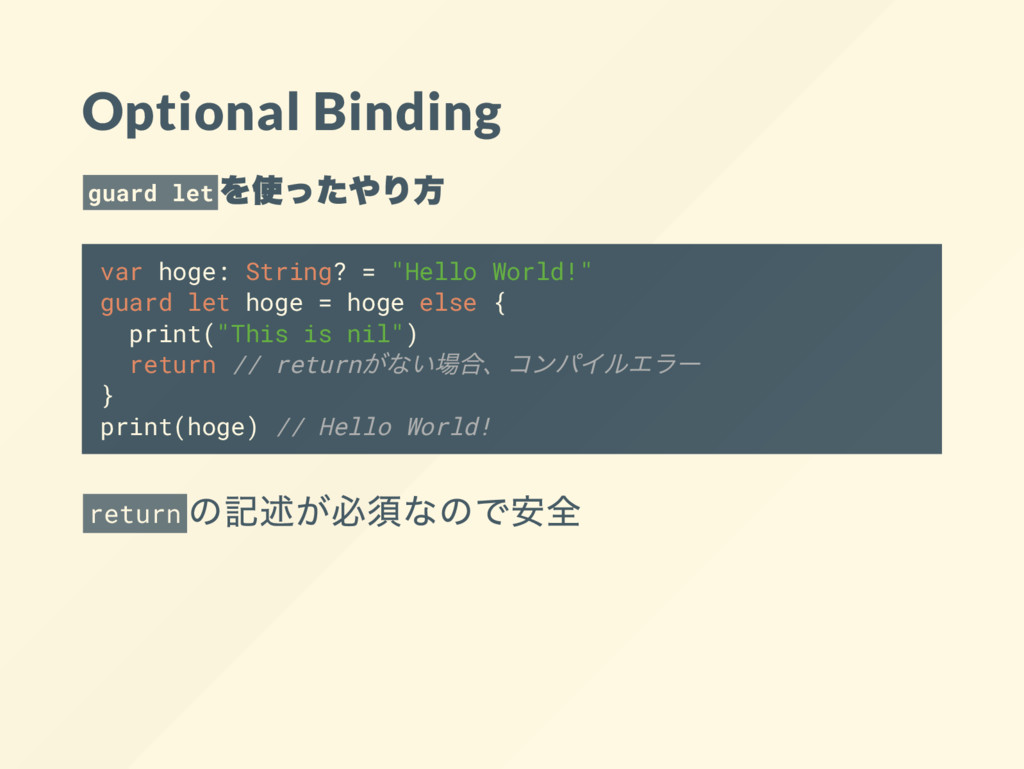
World!" guard let hoge = hoge else { print("This is nil") return // return がない場合、 コンパイルエラー } print(hoge) // Hello World! return の記述が必須なので安全
Optional Binding guard let を使ったやり方 var hoge: String? = "Hello
World!" guard let hoge = hoge else { print("This is nil") return // return がない場合、 コンパイルエラー } print(hoge) // Hello World! return の記述が必須なので安全 guard の方が早期リター ン出来てネストを浅く出来て 良い。
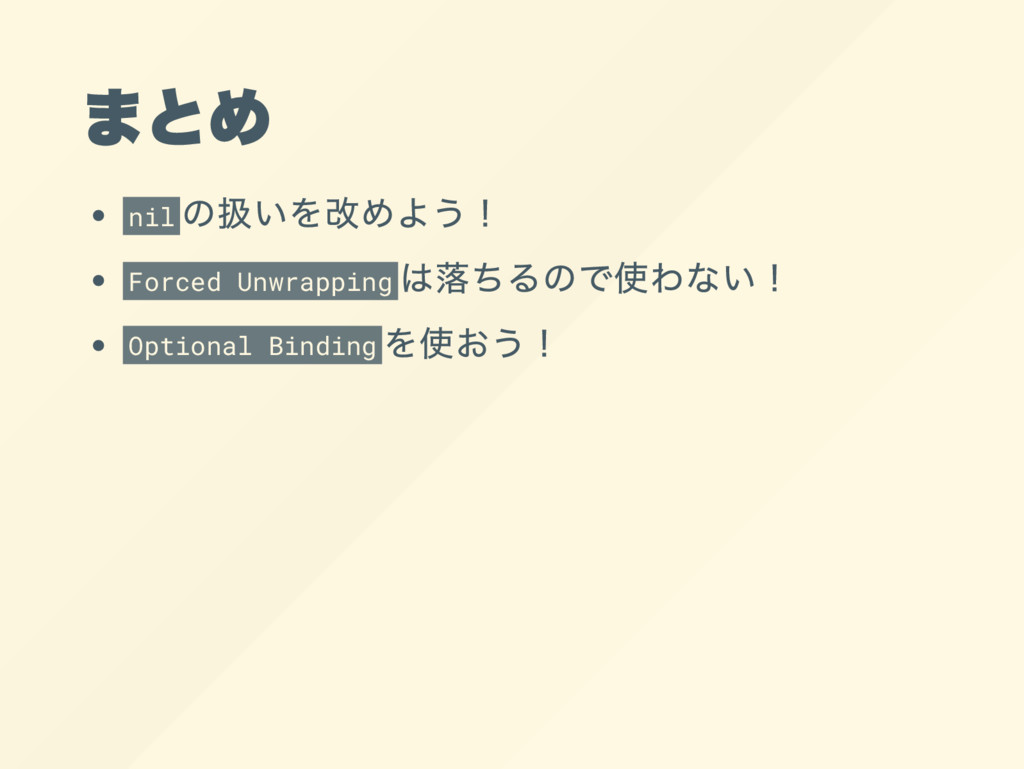
まとめ nil の扱いを改めよう! Forced Unwrapping は落ちるので使わない! Optional Binding を使おう!
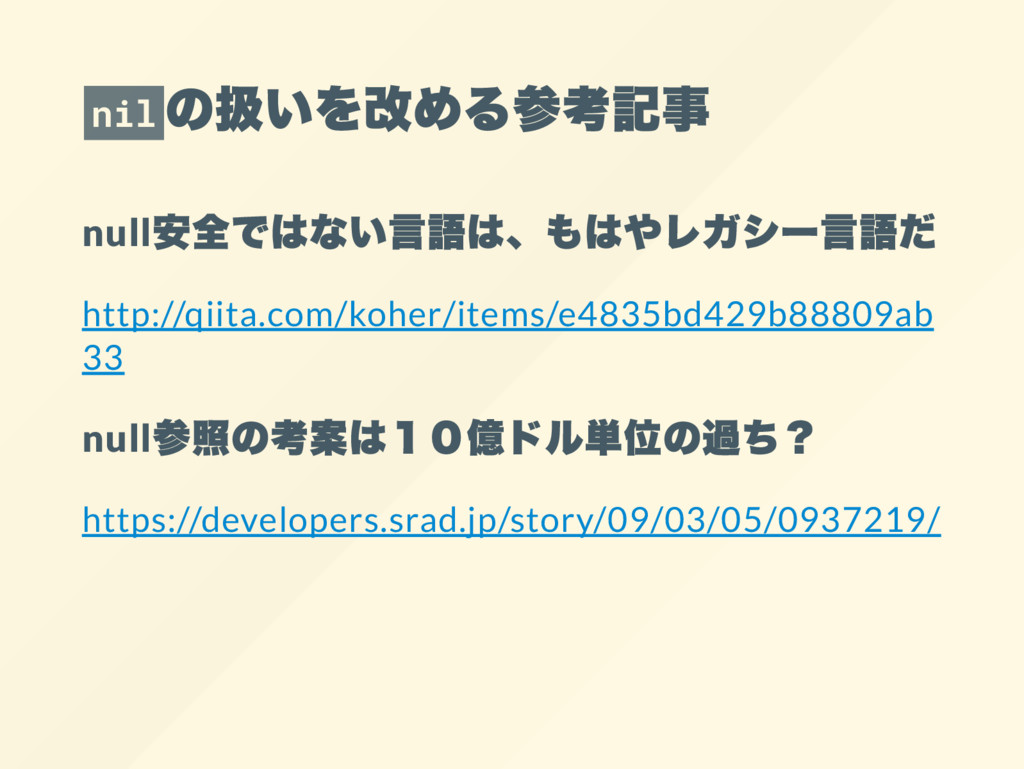
nil の扱いを改める参考記事 null 安全ではない言語は、 もはやレガシー 言語だ http://qiita.com/koher/items/e4835bd429b88809ab 33 null 参照の考案は10億ドル単位の過ち?
https://developers.srad.jp/story/09/03/05/0937219/
ご清聴ありがとうございました!
おまけ
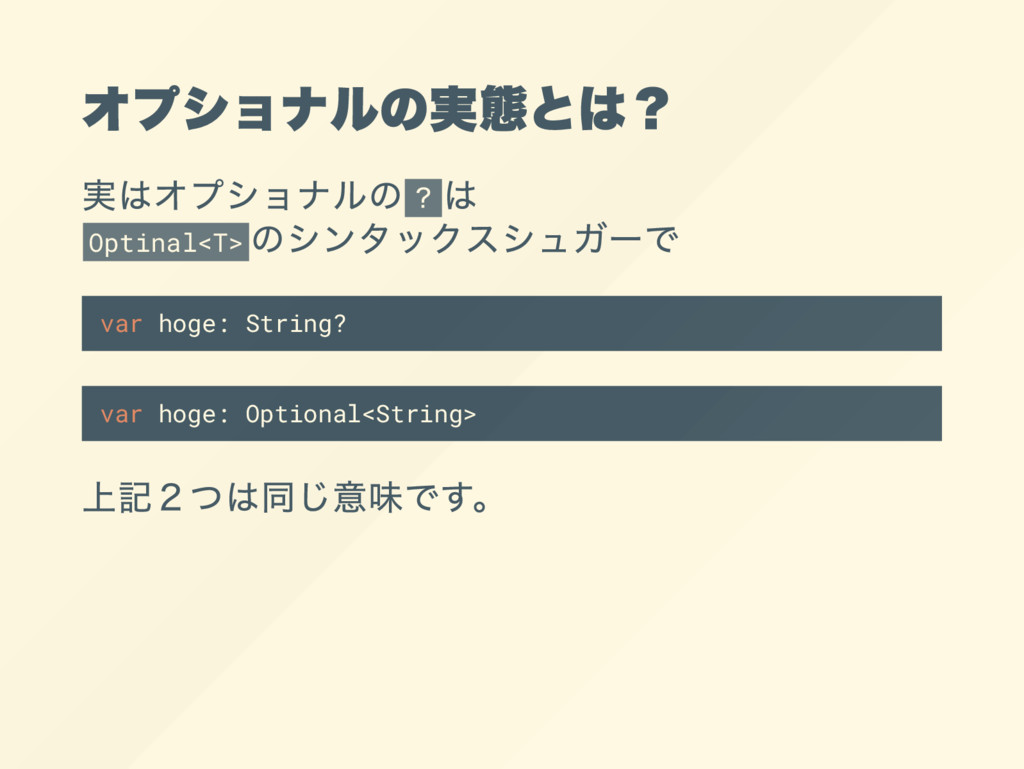
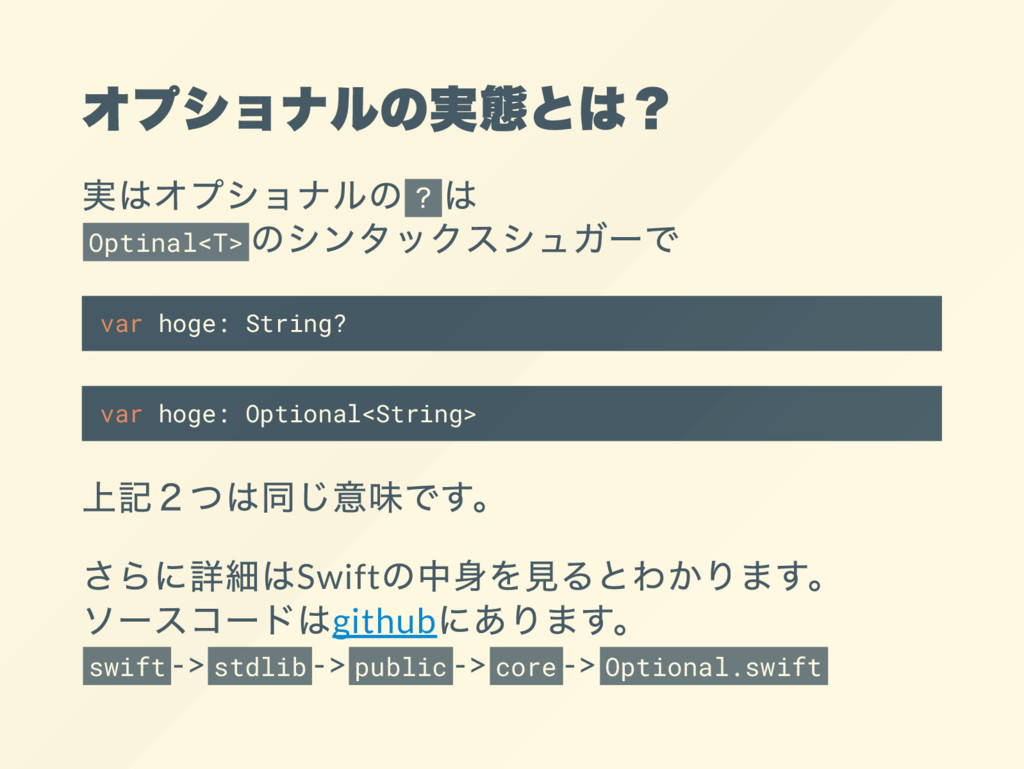
オプショナルの実態とは? 実はオプショナルの? は Optinal<T> のシンタックスシュガー で var hoge: String? var
hoge: Optional<String> 上記2つは同じ意味です。
オプショナルの実態とは? 実はオプショナルの? は Optinal<T> のシンタックスシュガー で var hoge: String? var
hoge: Optional<String> 上記2つは同じ意味です。 さらに詳細はSwift の中身を見るとわかります。 ソー スコー ドはgithub にあります。 swift -> stdlib -> public -> core -> Optional.swift
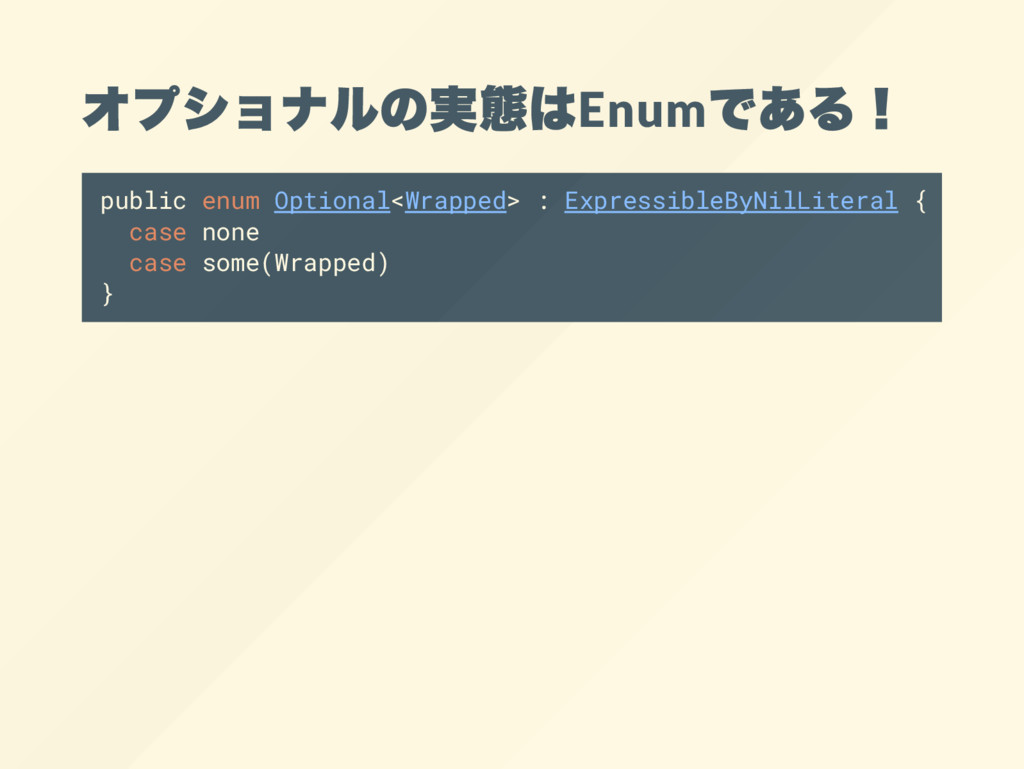
オプショナルの実態はEnum である! public enum Optional<Wrapped> : ExpressibleByNilLiteral { case none
case some(Wrapped) }
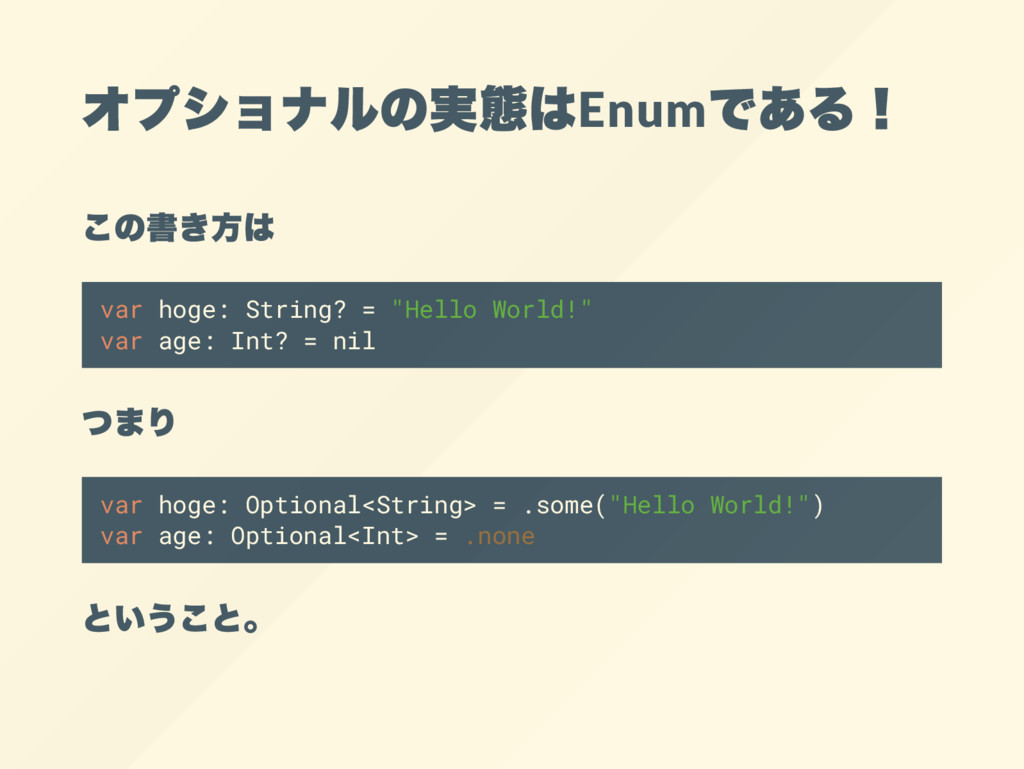
オプショナルの実態はEnum である! この書き方は var hoge: String? = "Hello World!" var
age: Int? = nil つまり var hoge: Optional<String> = .some("Hello World!") var age: Optional<Int> = .none ということ。
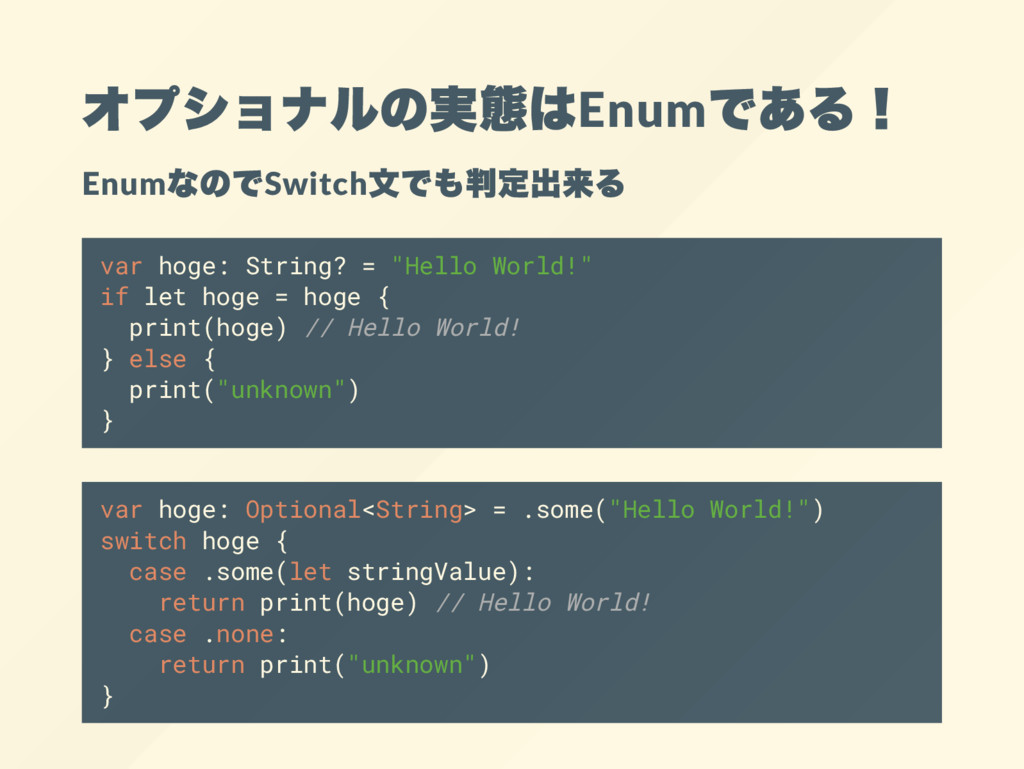
オプショナルの実態はEnum である! Enum なのでSwitch 文でも判定出来る var hoge: String? = "Hello
World!" if let hoge = hoge { print(hoge) // Hello World! } else { print("unknown") } var hoge: Optional<String> = .some("Hello World!") switch hoge { case .some(let stringValue): return print(hoge) // Hello World! case .none: return print("unknown") }
おまけ2
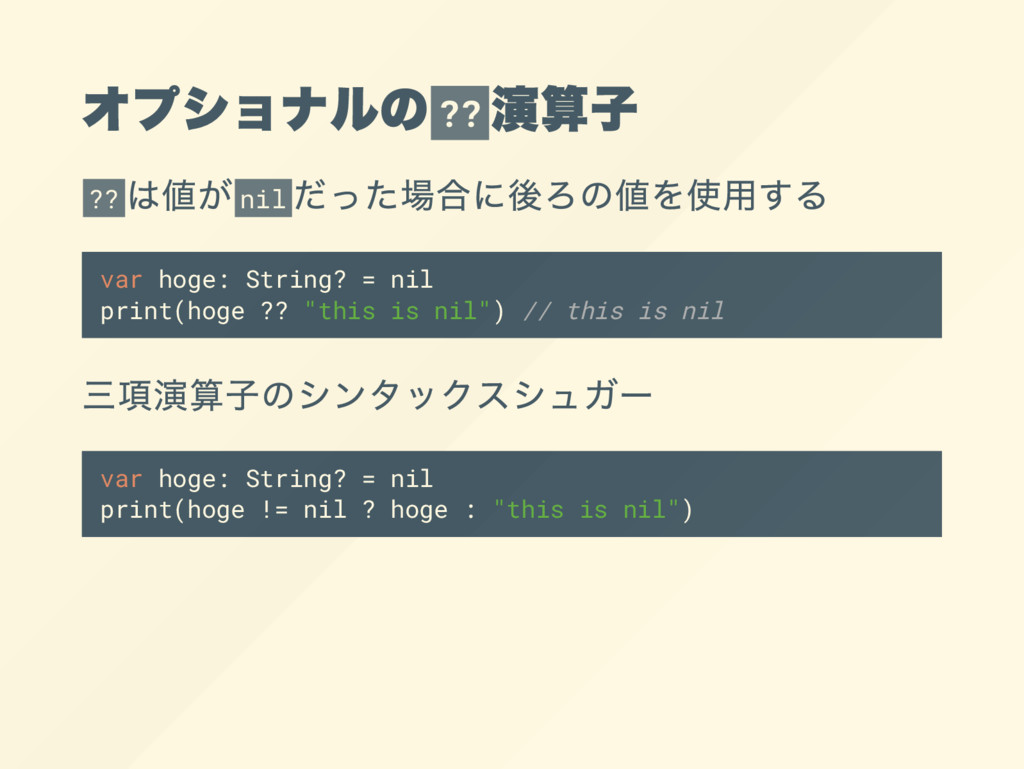
オプショナルの?? 演算子 ?? は値が nil だった場合に後ろの値を使用する var hoge: String? =
nil print(hoge ?? "this is nil") // this is nil 三項演算子のシンタックスシュガー var hoge: String? = nil print(hoge != nil ? hoge : "this is nil")
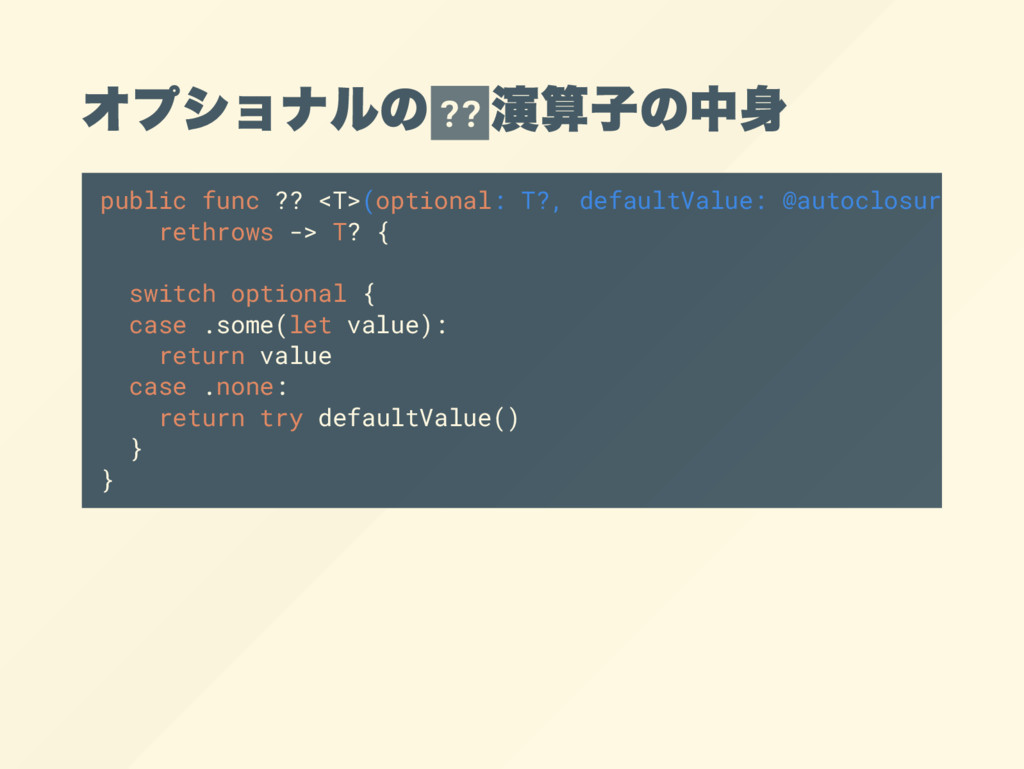
オプショナルの?? 演算子の中身 public func ?? <T>(optional: T?, defaultValue: @autoclosure rethrows
-> T? { switch optional { case .some(let value): return value case .none: return try defaultValue() } }
ご清聴ありがとうございました!


 deka_morita
 utakaha
 optim
optim
 iwiwi
iwiwi
 ivargrimstad
 y0hgi
y0hgi
 takai
takai
 jame2408
 gam0022
 yuta_onishi_97
 o0h
o0h
 malarkey
.png) helenjbeal
helenjbeal
 portentint
 irinanazarova
 speakerdeck
 sergeychernyshev
 baasie
 greggifford
 cassininazir
 andyhume
 techseoconnect