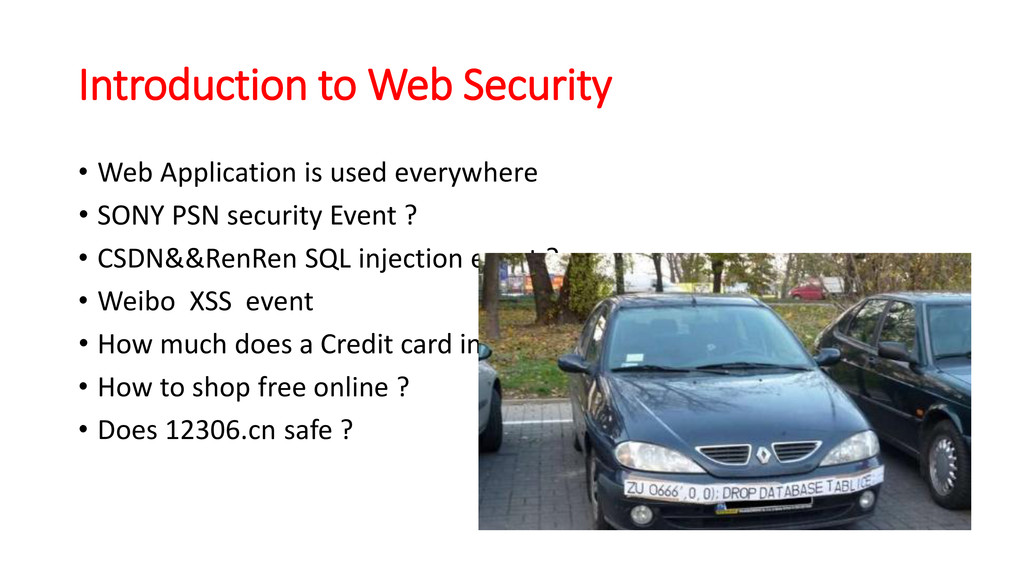
• SONY PSN security Event ? • CSDN&&RenRen SQL injection event ? • Weibo XSS event • How much does a Credit card information? • How to shop free online ? • Does 12306.cn safe ?
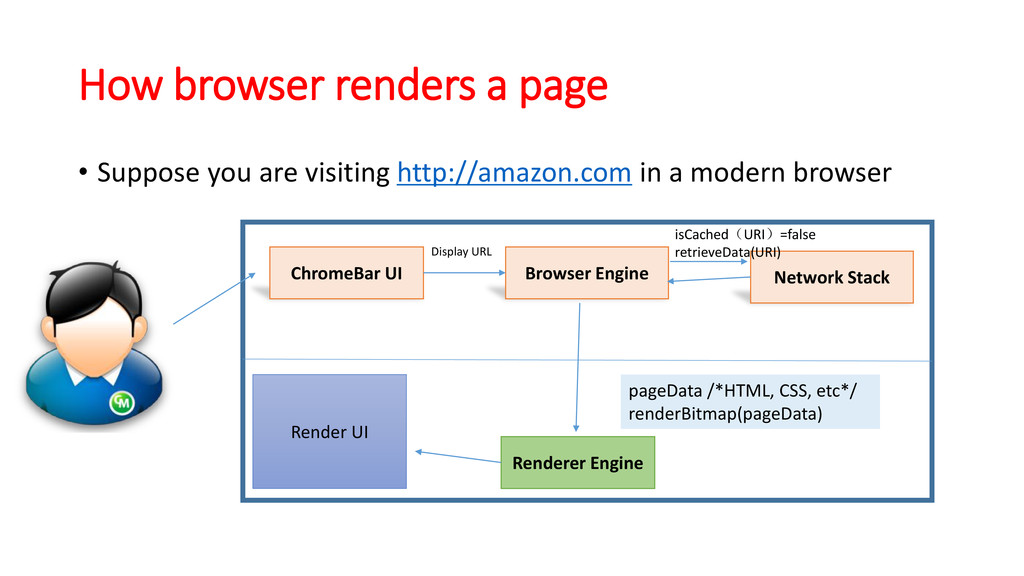
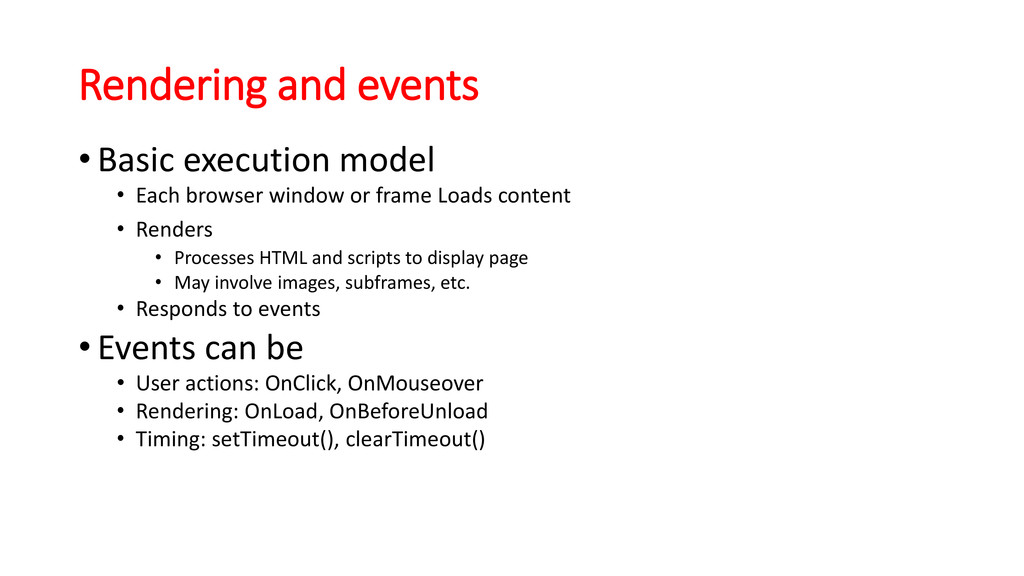
window or frame Loads content • Renders • Processes HTML and scripts to display page • May involve images, subframes, etc. • Responds to events • Events can be • User actions: OnClick, OnMouseover • Rendering: OnLoad, OnBeforeUnload • Timing: setTimeout(), clearTimeout()
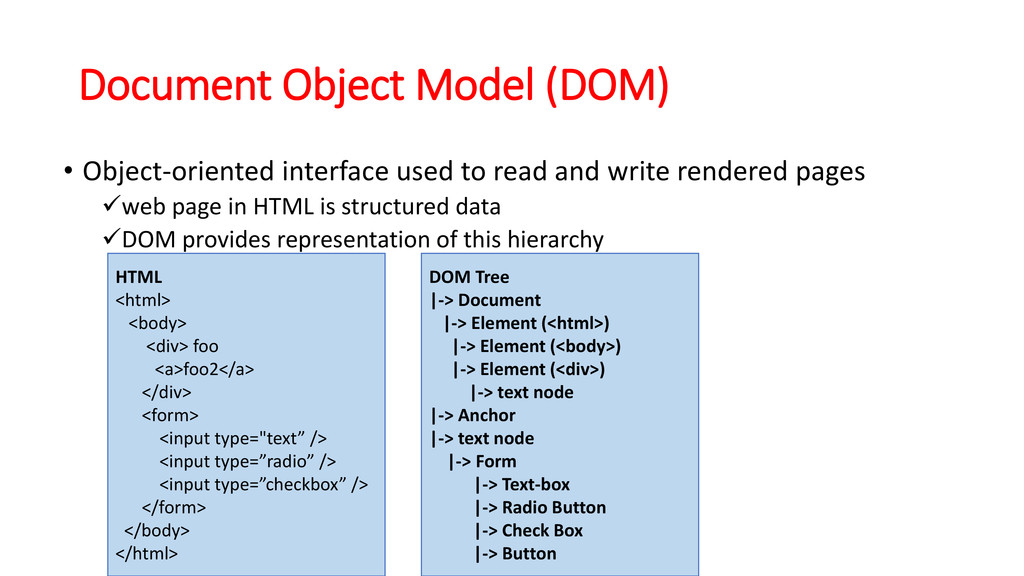
and write rendered pages web page in HTML is structured data DOM provides representation of this hierarchy HTML <html> <body> <div> foo <a>foo2</a> </div> <form> <input type="text” /> <input type=”radio” /> <input type=”checkbox” /> </form> </body> </html> DOM Tree |-> Document |-> Element (<html>) |-> Element (<body>) |-> Element (<div>) |-> text node |-> Anchor |-> text node |-> Form |-> Text-box |-> Radio Button |-> Check Box |-> Button
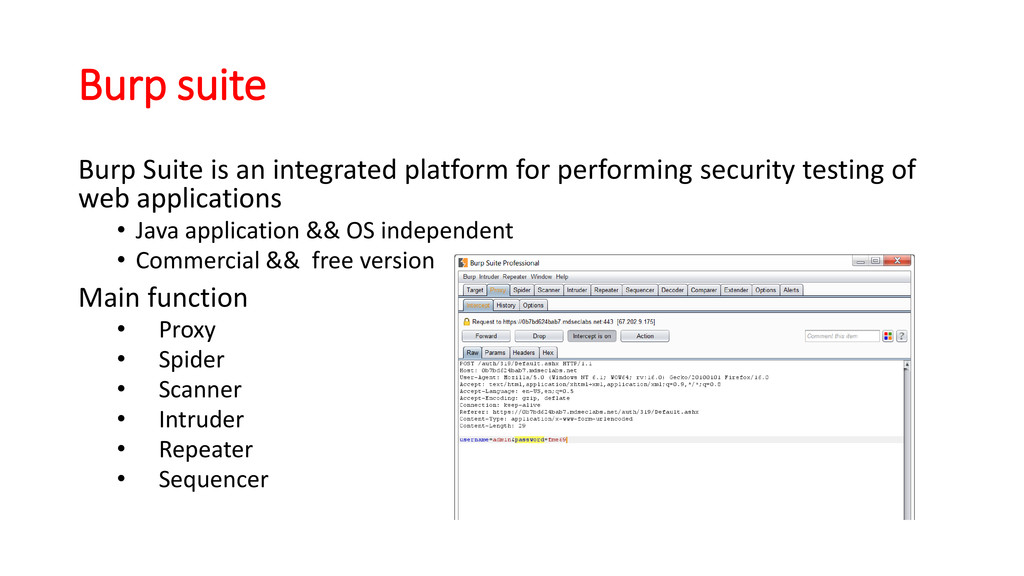
security testing of web applications • Java application && OS independent • Commercial && free version Main function • Proxy • Spider • Scanner • Intruder • Repeater • Sequencer
<? php-code ?> executes php-code at this point in the document echo expr: evaluates expr and embeds in doc system(call, args) performs a system call in the working directory “ ….. ”, ‘ ….. ’ String literal. Double-quotes has more possible escaped characters. (dot). Concatenates strings. _GET[‘key’] returns value corresponding to the key/value pair sent as extra data in the HTTP GET request
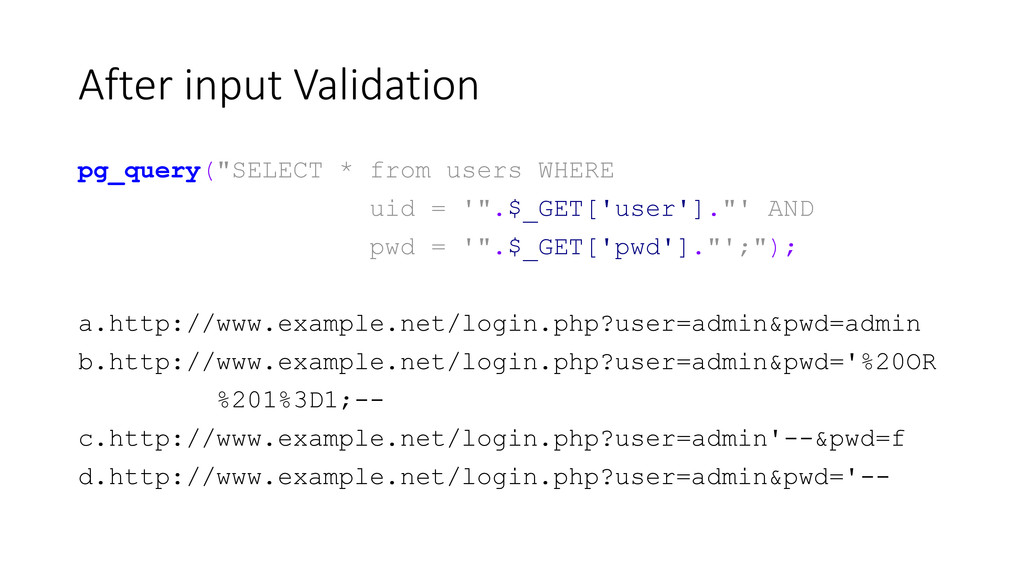
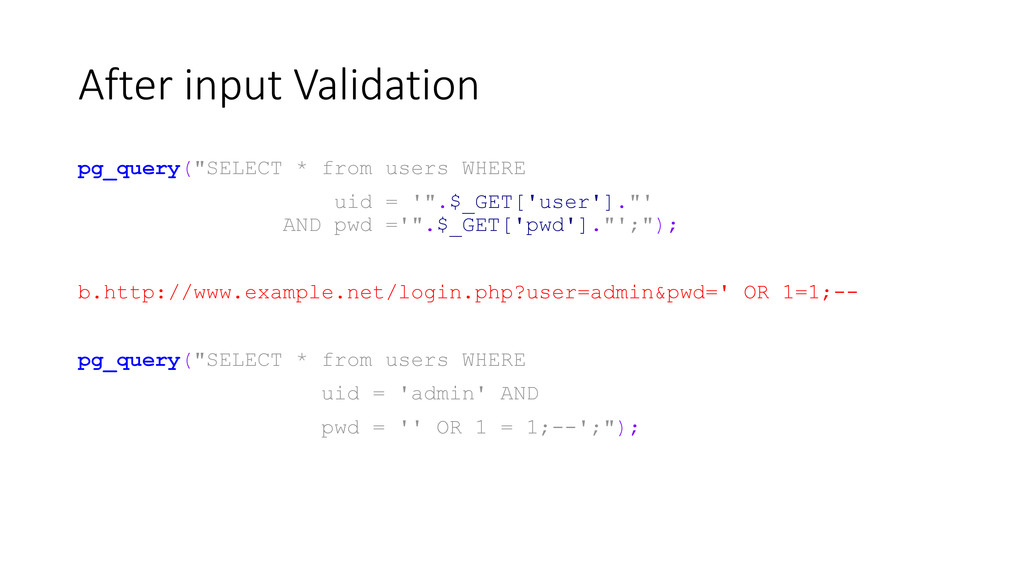
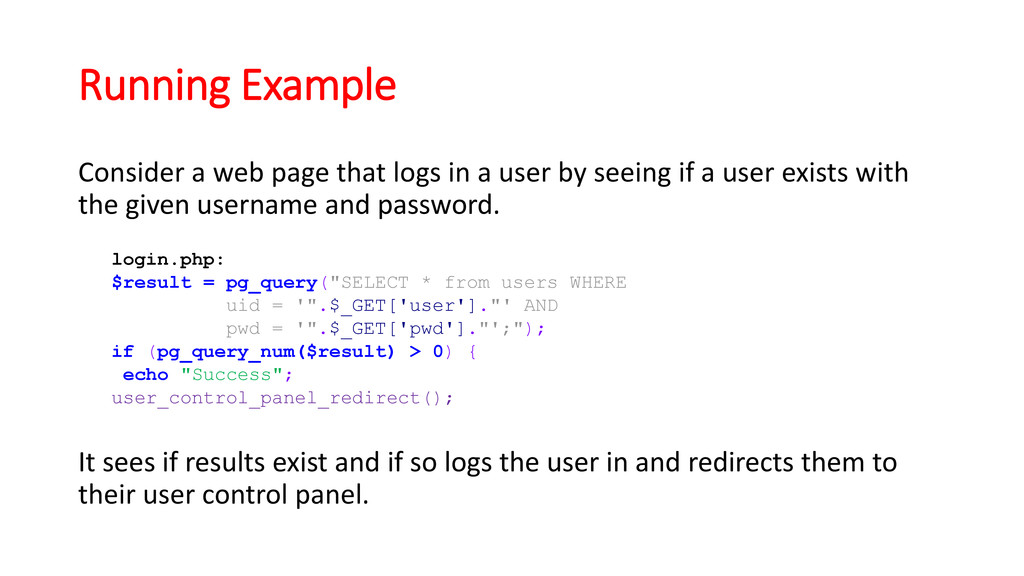
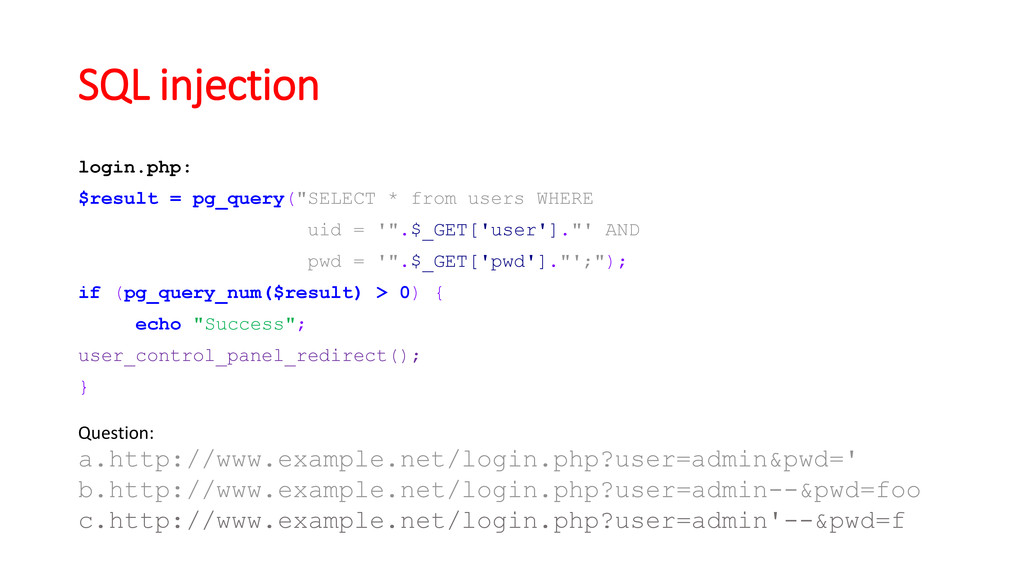
user by seeing if a user exists with the given username and password. It sees if results exist and if so logs the user in and redirects them to their user control panel. login.php: $result = pg_query("SELECT * from users WHERE uid = '".$_GET['user']."' AND pwd = '".$_GET['pwd']."';"); if (pg_query_num($result) > 0) { echo "Success"; user_control_panel_redirect();
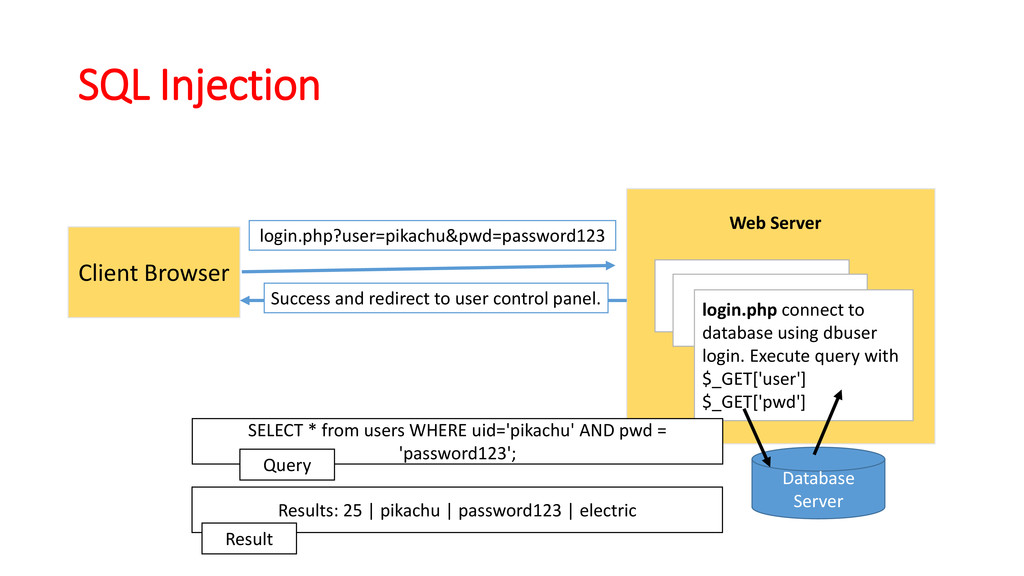
dbuser login. Execute query with $_GET['user'] $_GET['pwd'] Web Server Database Server SELECT * from users WHERE uid='pikachu' AND pwd = 'password123'; Query Results: 25 | pikachu | password123 | electric Result Success and redirect to user control panel.
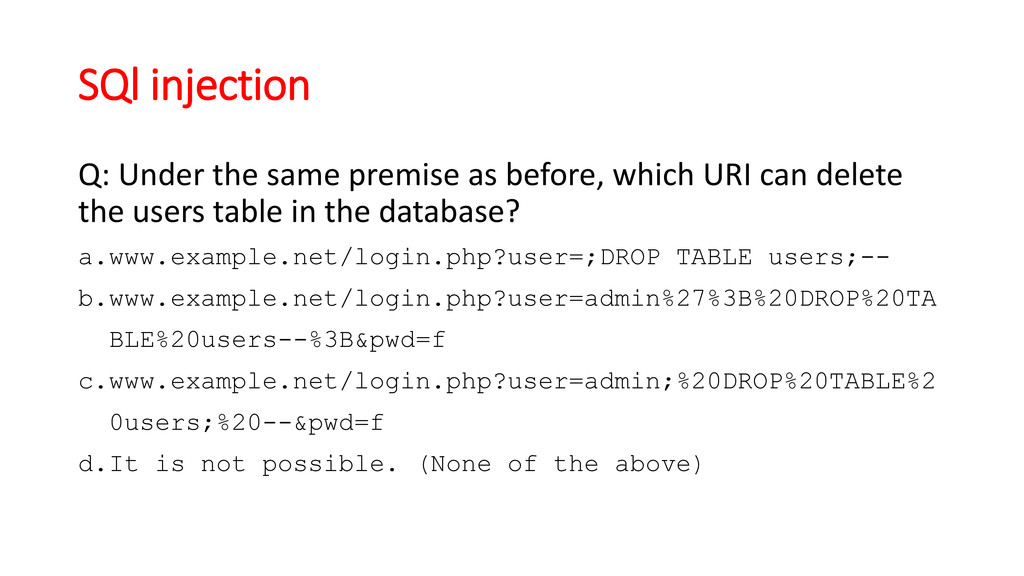
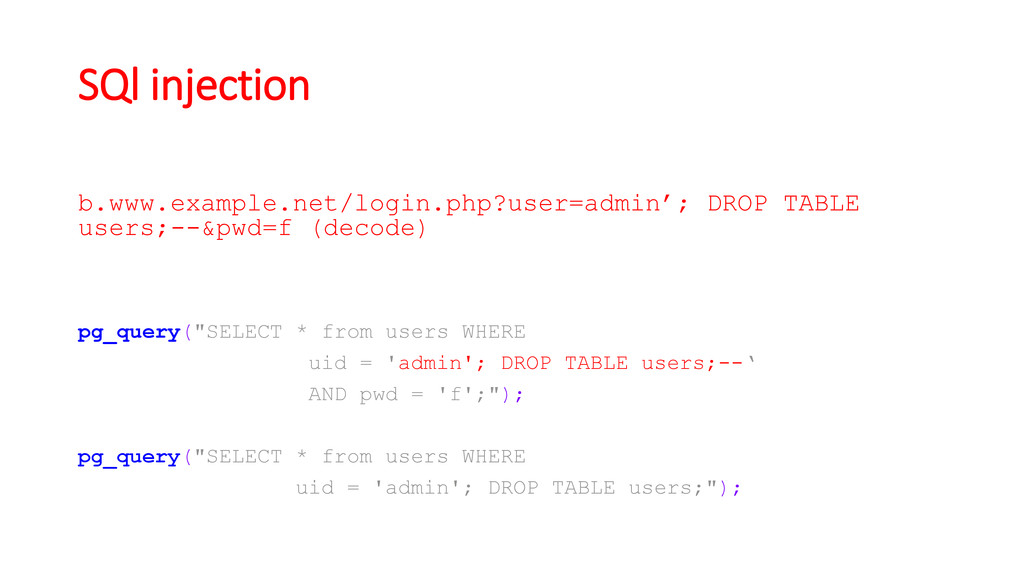
URI can delete the users table in the database? a.www.example.net/login.php?user=;DROP TABLE users;-- b.www.example.net/login.php?user=admin%27%3B%20DROP%20TA BLE%20users--%3B&pwd=f c.www.example.net/login.php?user=admin;%20DROP%20TABLE%2 0users;%20--&pwd=f d.It is not possible. (None of the above)
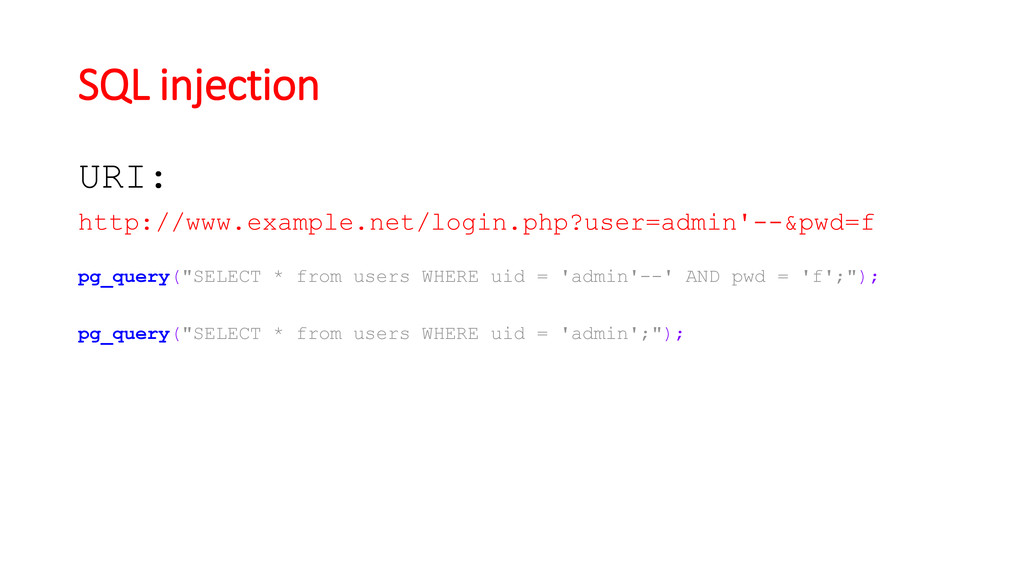
'".$_GET['user']."' AND pwd ='".$_GET['pwd']."';"); b.http://www.example.net/login.php?user=admin&pwd=' OR 1=1;-- pg_query("SELECT * from users WHERE uid = 'admin' AND pwd = '' OR 1 = 1;--';");
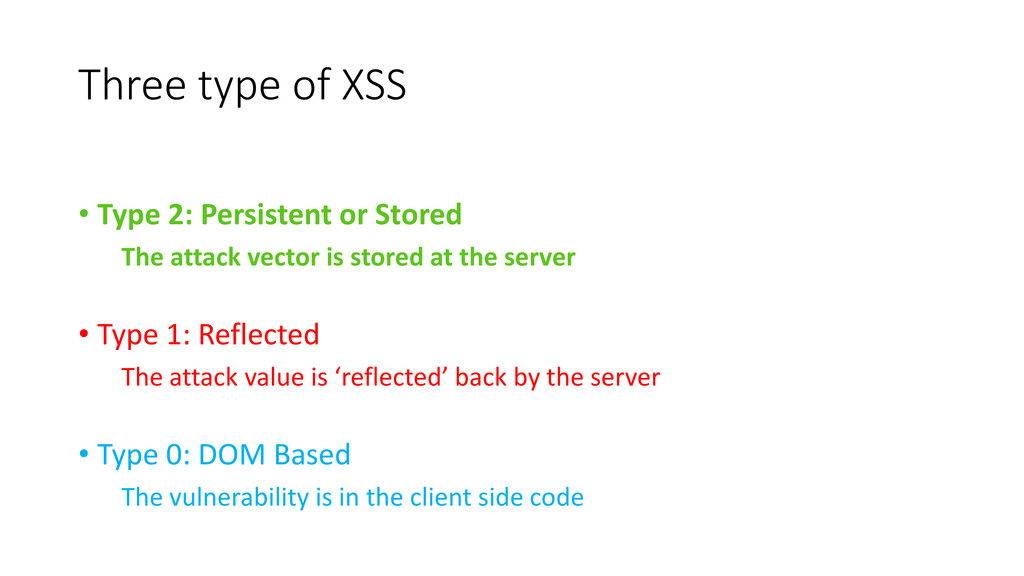
The attack vector is stored at the server • Type 1: Reflected The attack value is ‘reflected’ back by the server • Type 0: DOM Based The vulnerability is in the client side code
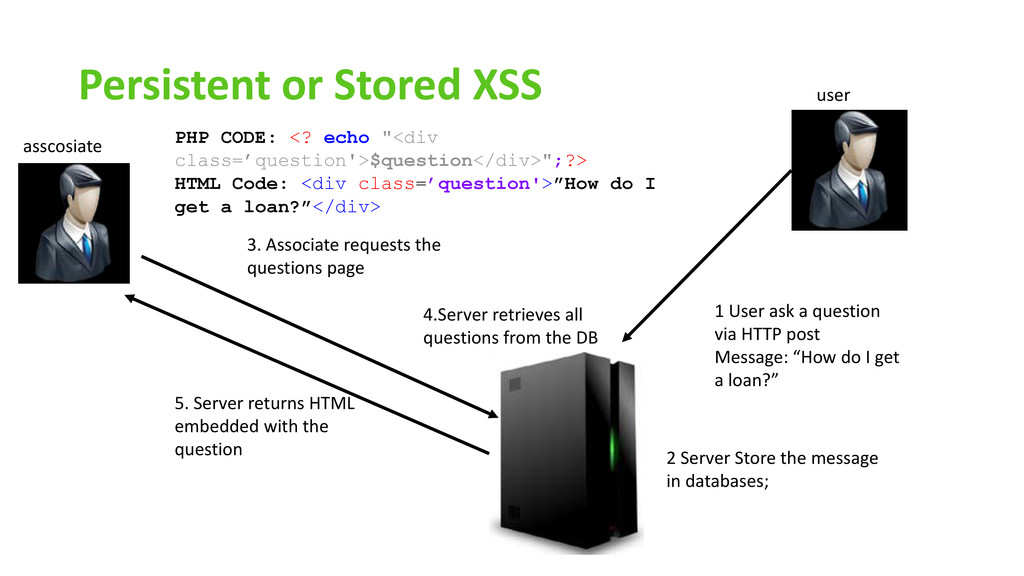
HTTP post Message: “How do I get a loan?” 2 Server Store the message in databases; user asscosiate 3. Associate requests the questions page 4.Server retrieves all questions from the DB 5. Server returns HTML embedded with the question PHP CODE: <? echo "<div class=’question'>$question</div>";?> HTML Code: <div class=’question'>”How do I get a loan?”</div>
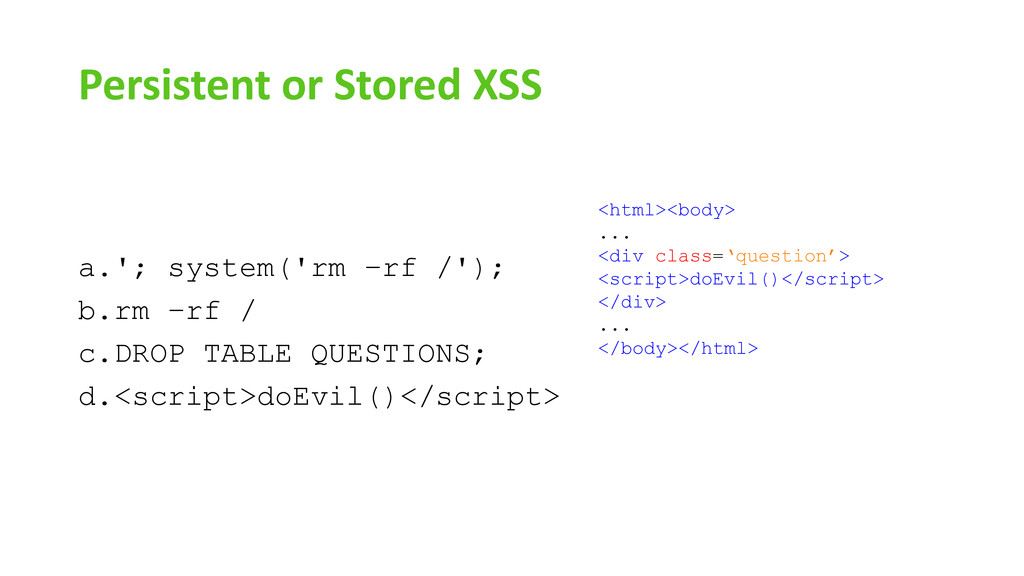
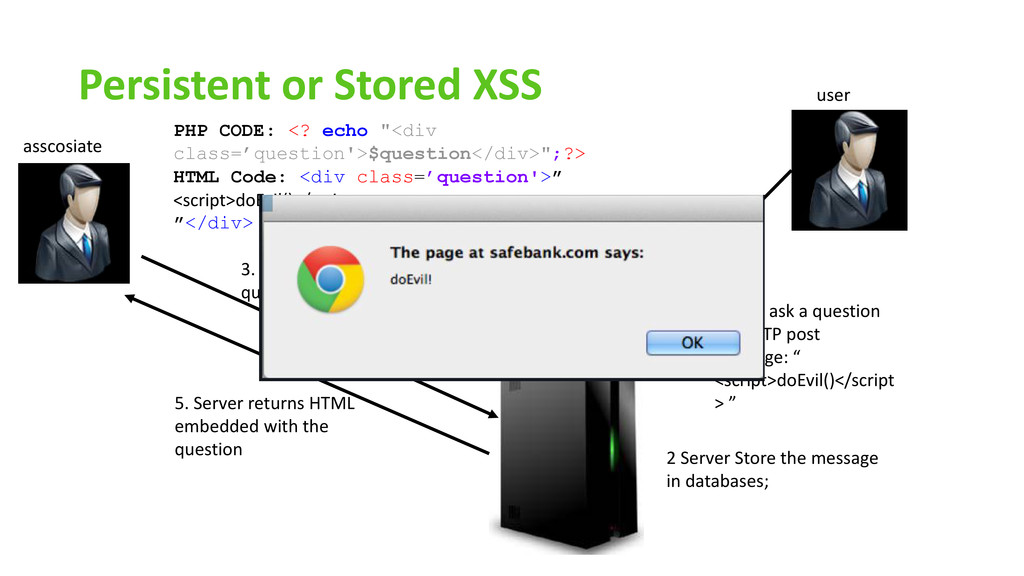
HTTP post Message: “ <script>doEvil()</script > ” 2 Server Store the message in databases; user asscosiate 3. Associate requests the questions page 4.Server retrieves all questions from the DB 5. Server returns HTML embedded with the question PHP CODE: <? echo "<div class=’question'>$question</div>";?> HTML Code: <div class=’question'>” <script>doEvil()</script> ”</div>
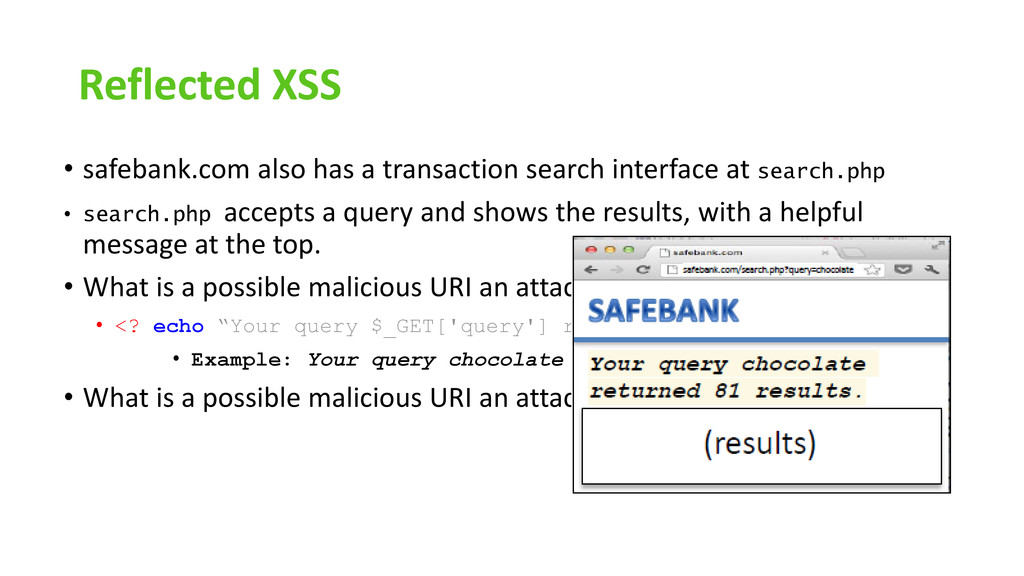
at search.php • search.php accepts a query and shows the results, with a helpful message at the top. • What is a possible malicious URI an attacker could use to exploit this? • <? echo “Your query $_GET['query'] returned $num results.";?> • Example: Your query chocolate returned 81 results • What is a possible malicious URI an attacker could use to exploit this?
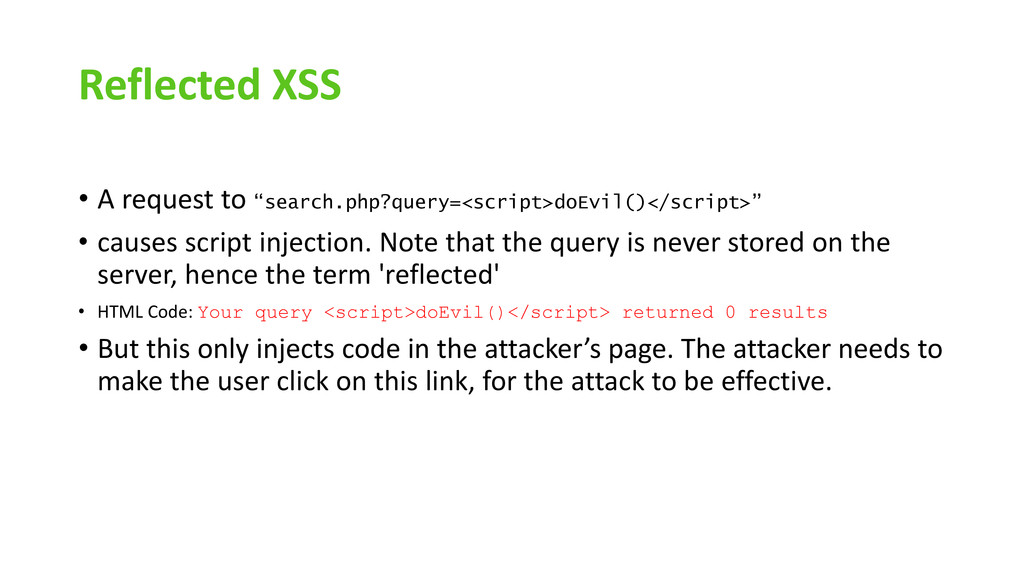
injection. Note that the query is never stored on the server, hence the term 'reflected' • HTML Code: Your query <script>doEvil()</script> returned 0 results • But this only injects code in the attacker’s page. The attacker needs to make the user click on this link, for the attack to be effective.
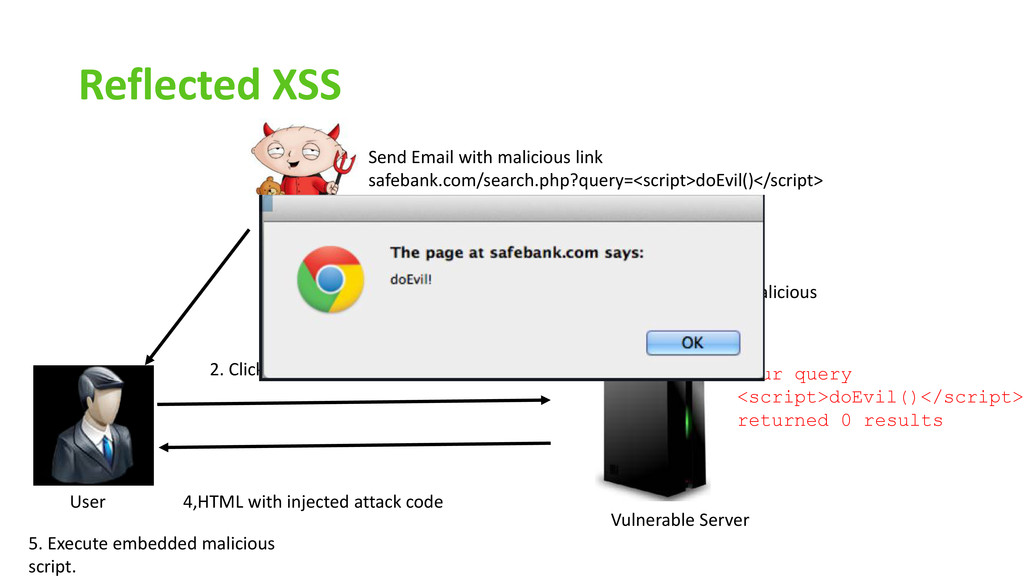
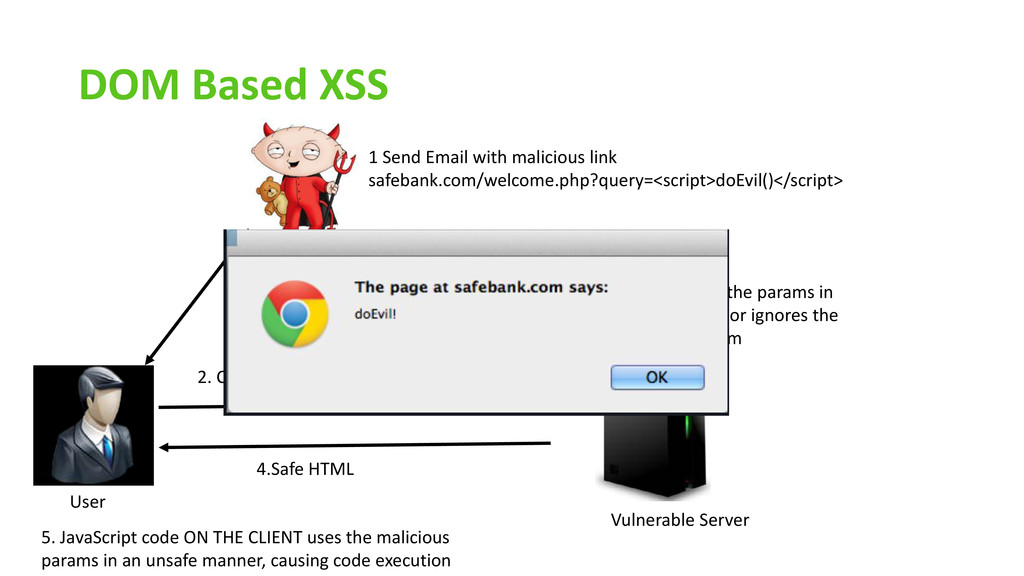
with injected attack code 2. Click on Link with malicious params 3. Server inserts malicious params into HTML Vulnerable Server Your query <script>doEvil()</script> returned 0 results 5. Execute embedded malicious script.
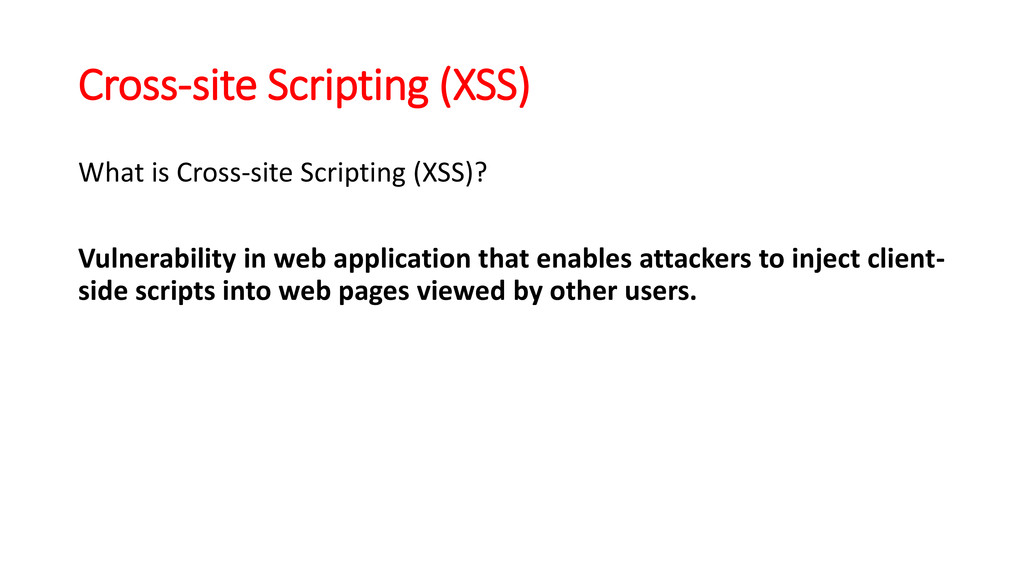
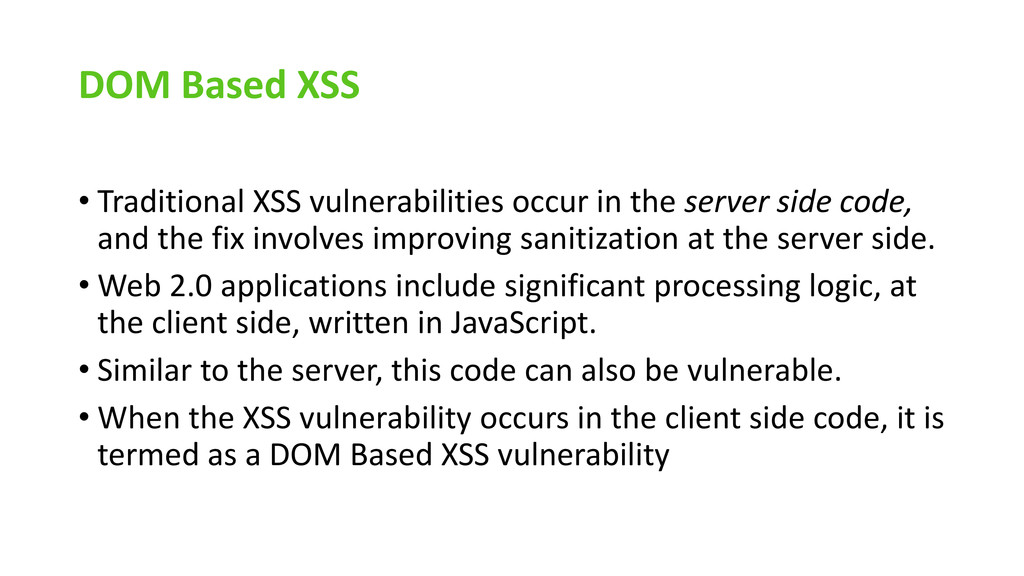
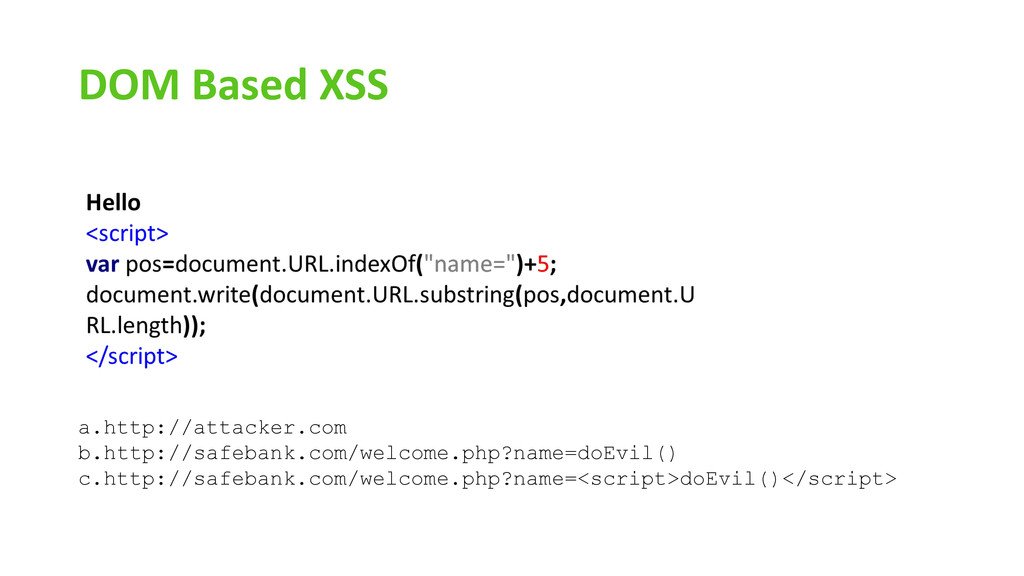
server side code, and the fix involves improving sanitization at the server side. • Web 2.0 applications include significant processing logic, at the client side, written in JavaScript. • Similar to the server, this code can also be vulnerable. • When the XSS vulnerability occurs in the client side code, it is termed as a DOM Based XSS vulnerability
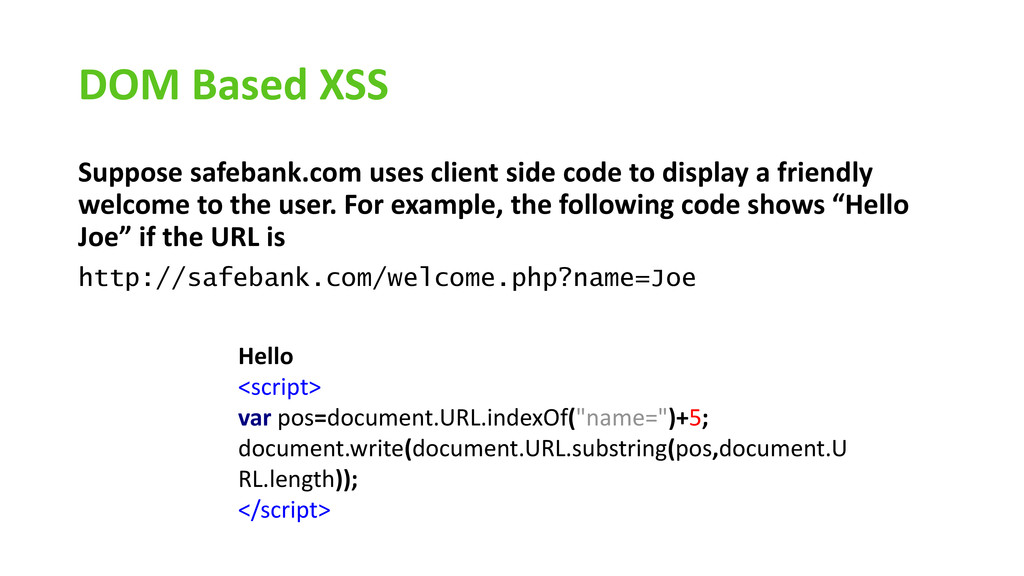
display a friendly welcome to the user. For example, the following code shows “Hello Joe” if the URL is http://safebank.com/welcome.php?name=Joe Hello <script> var pos=document.URL.indexOf("name=")+5; document.write(document.URL.substring(pos,document.U RL.length)); </script>
User 4.Safe HTML 2. Click on Link with malicious params 3. Server uses the params in a safe fashion, or ignores the malicious param Vulnerable Server 5. JavaScript code ON THE CLIENT uses the malicious params in an unsafe manner, causing code execution


 lukesun629
 naoji_taniguchi_ksk_0827
 frievea
 masakiokuda
 cbtlibrary
 akiraasano
 pawan_pharm
 hiola
hiola
 robintux
 drpoonamkc
 terasawat
 eller86
 sciencetokyo
 inesmontani
 axbom
axbom
 ryanjones
 philnash
 reverentgeek
 tammyeverts
 seathinner
 lauravandoore
 leimatthew05
 kimpetersen
 codingconduct
 livdayseo
![Web Security Training I Lukesun629@NISL [Blue-Lotus] [email protected]](https://files.speakerdeck.com/presentations/96d8e760138a01303b7512313d053576/slide_0.jpg)
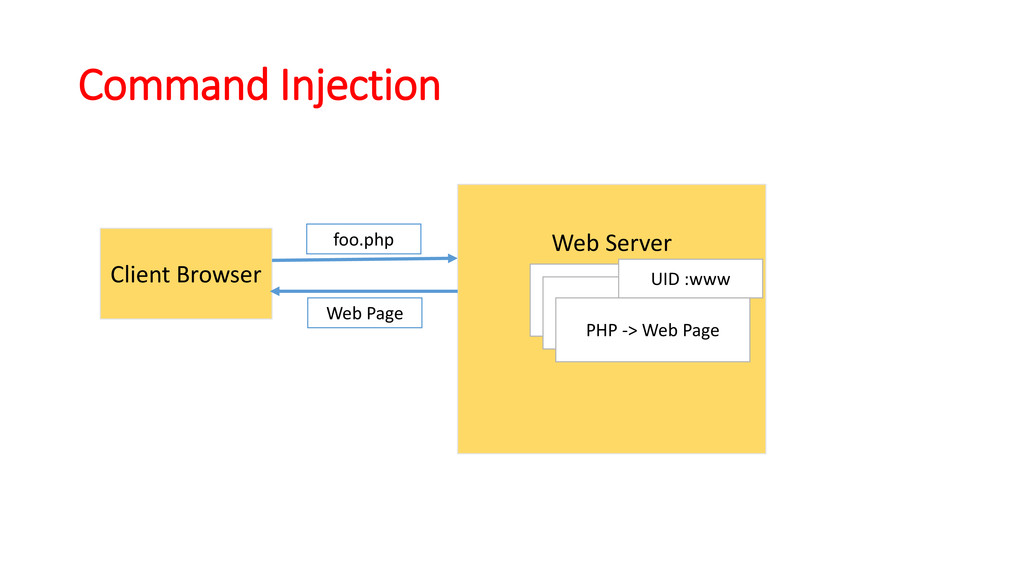
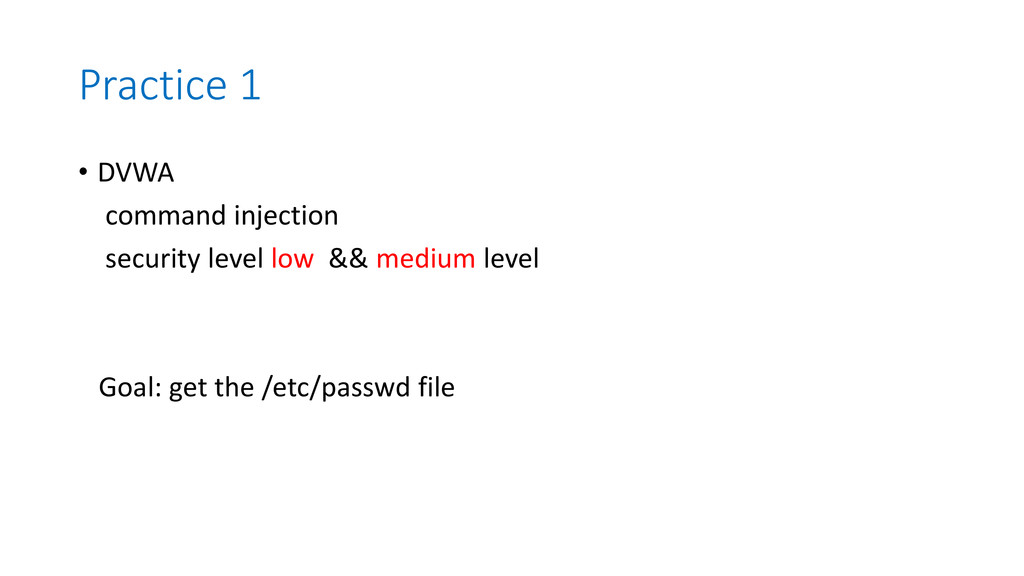
![Quick Background on PHP display.php: <? echo system("cat ".$_GET['file']); ?>](https://files.speakerdeck.com/presentations/96d8e760138a01303b7512313d053576/slide_15.jpg)
![Command Injection Client Browser Display.php?file=note.txt Web Page Display.php System(“cat”.$_GET[‘file’]) UID](https://files.speakerdeck.com/presentations/96d8e760138a01303b7512313d053576/slide_16.jpg)
![Command Injection Test: display.php: <? echo system("cat ".$_GET['file']); ?> a.http://www.example.net/display.php?get=rm](https://files.speakerdeck.com/presentations/96d8e760138a01303b7512313d053576/slide_17.jpg)
![Command Injection Test: display.php: <? echo system("cat ".$_GET['file']); ?> a.http://www.example.net/display.php?get=rm](https://files.speakerdeck.com/presentations/96d8e760138a01303b7512313d053576/slide_18.jpg)
![Input validation for SQL login.php: <? if(!preg_match("/^[a-z0-9A-Z.]*$/", $_GET[‘user'])) { echo](https://files.speakerdeck.com/presentations/96d8e760138a01303b7512313d053576/slide_28.jpg)