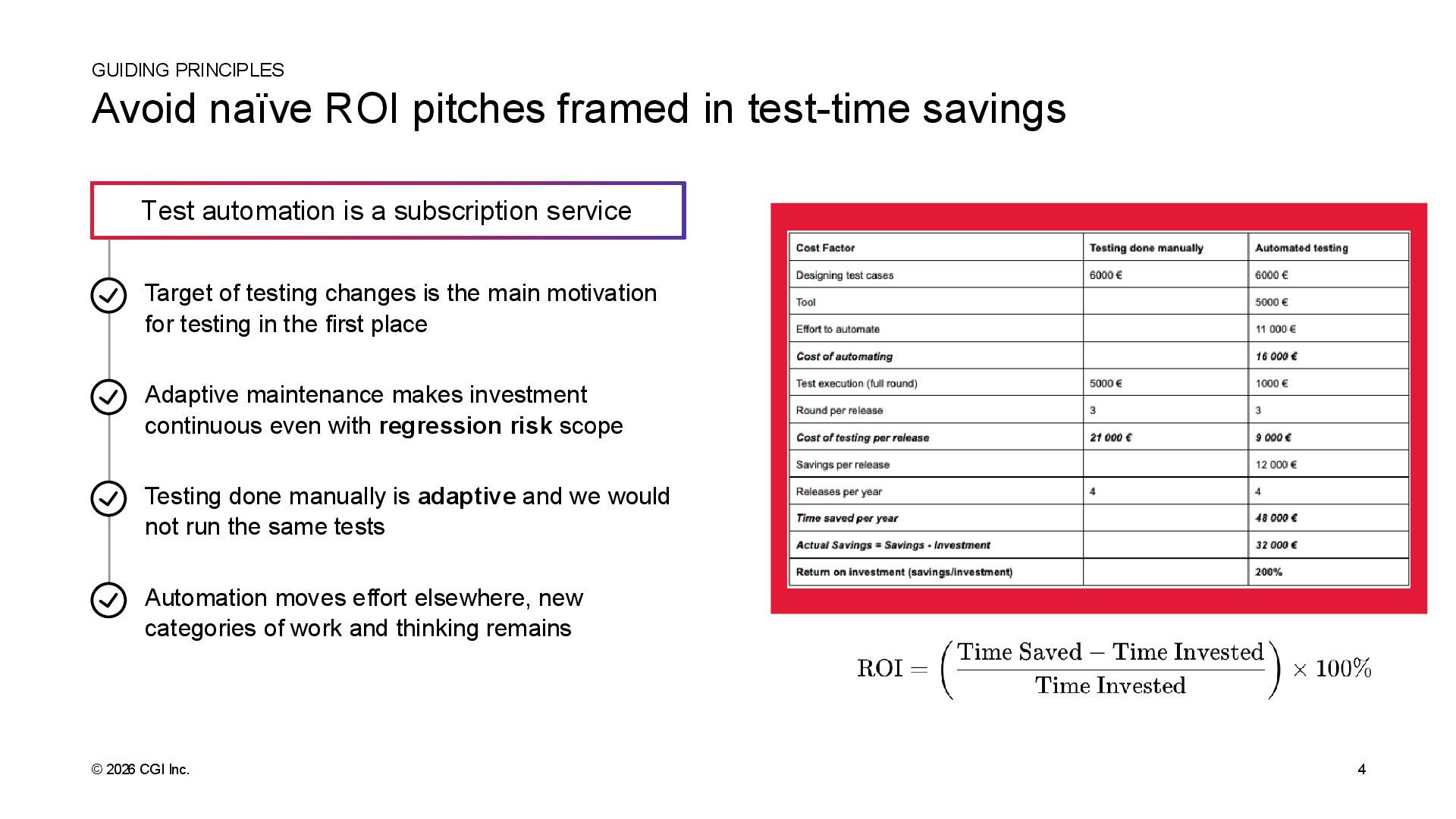
in test-time savings GUIDING PRINCIPLES Test automation is a subscription service Target of testing changes is the main motivation for testing in the first place Adaptive maintenance makes investment continuous even with regression risk scope Testing done manually is adaptive and we would not run the same tests Automation moves effort elsewhere, new categories of work and thinking remains
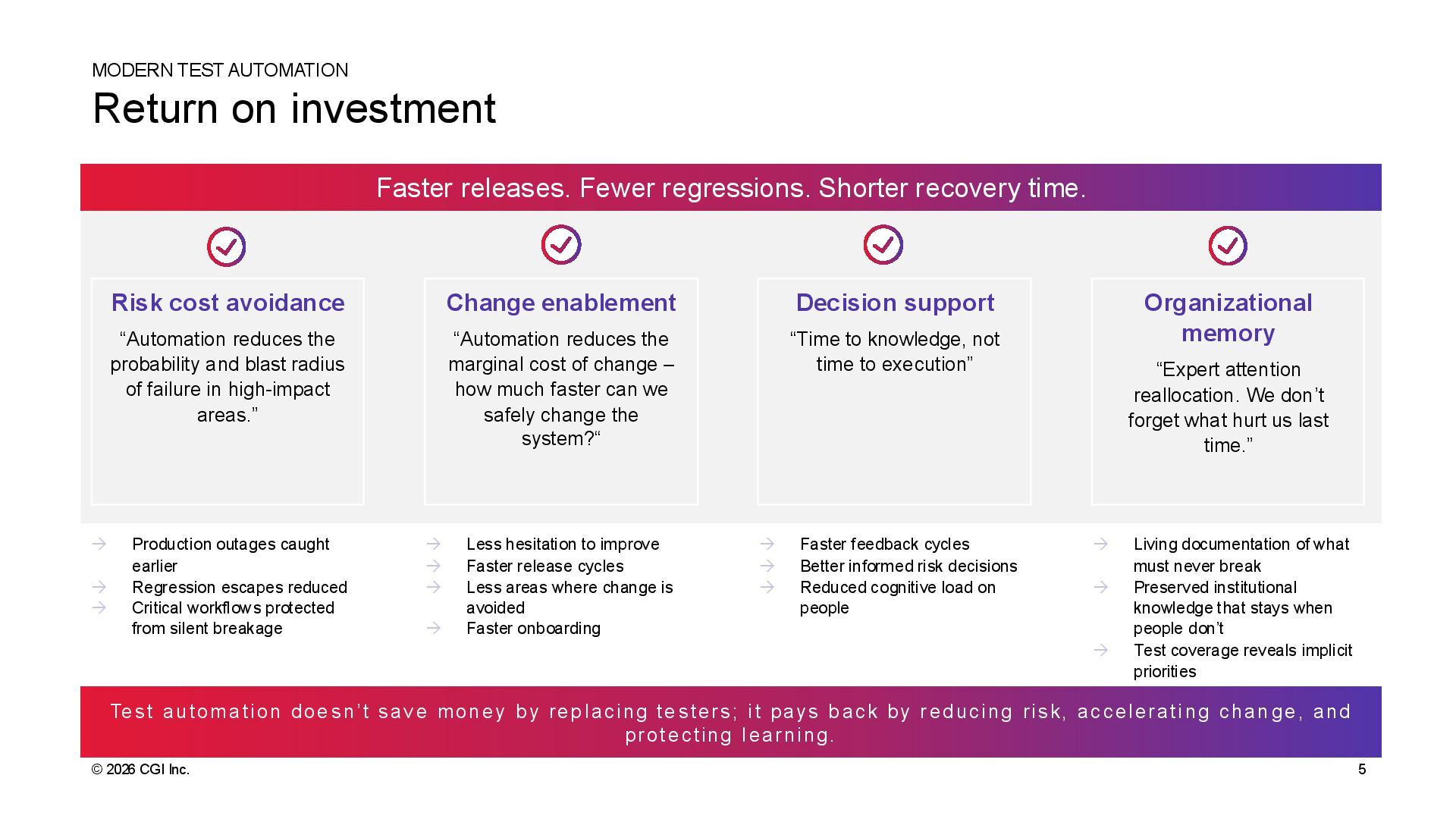
AUTOMATION Faster releases. Fewer regressions. Shorter recovery time. Risk cost avoidance “Automation reduces the probability and blast radius of failure in high-impact areas.” Change enablement “Automation reduces the marginal cost of change – how much faster can we safely change the system?“ Decision support “Time to knowledge, not time to execution” Organizational memory “Expert attention reallocation. We don’t forget what hurt us last time.” → Production outages caught earlier → Regression escapes reduced → Critical workflows protected from silent breakage → Less hesitation to improve → Faster release cycles → Less areas where change is avoided → Faster onboarding → Faster feedback cycles → Better informed risk decisions → Reduced cognitive load on people → Living documentation of what must never break → Preserved institutional knowledge that stays when people don’t → Test coverage reveals implicit priorities Test automa tion doe sn’t sav e money by rep lacing te sters; i t pays b ack by r educing risk, ac celerati ng chan ge, and prot ecting l earning.
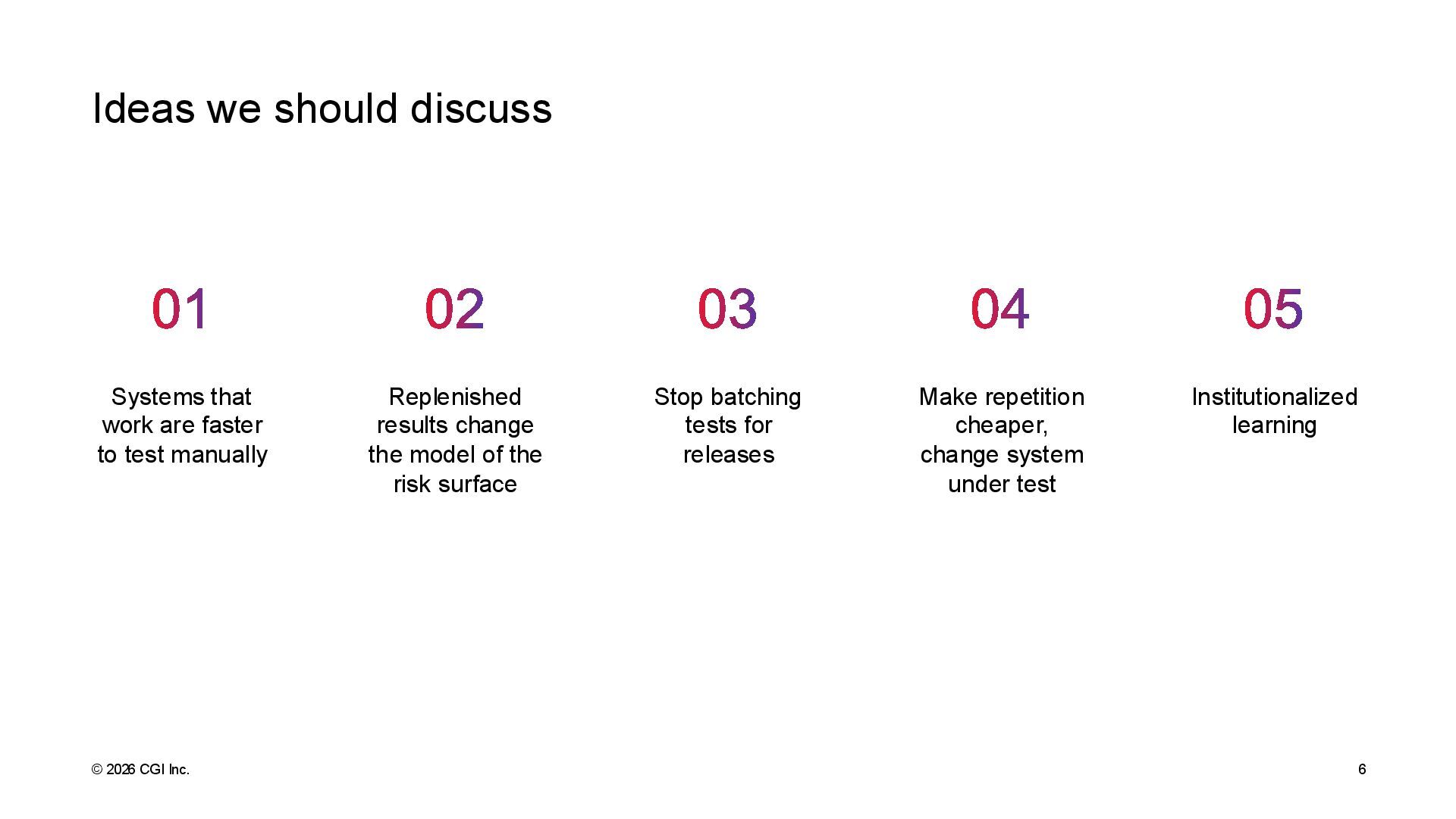
Systems that work are faster to test manually 02 Replenished results change the model of the risk surface 03 Stop batching tests for releases 04 Make repetition cheaper, change system under test 05 Institutionalized learning
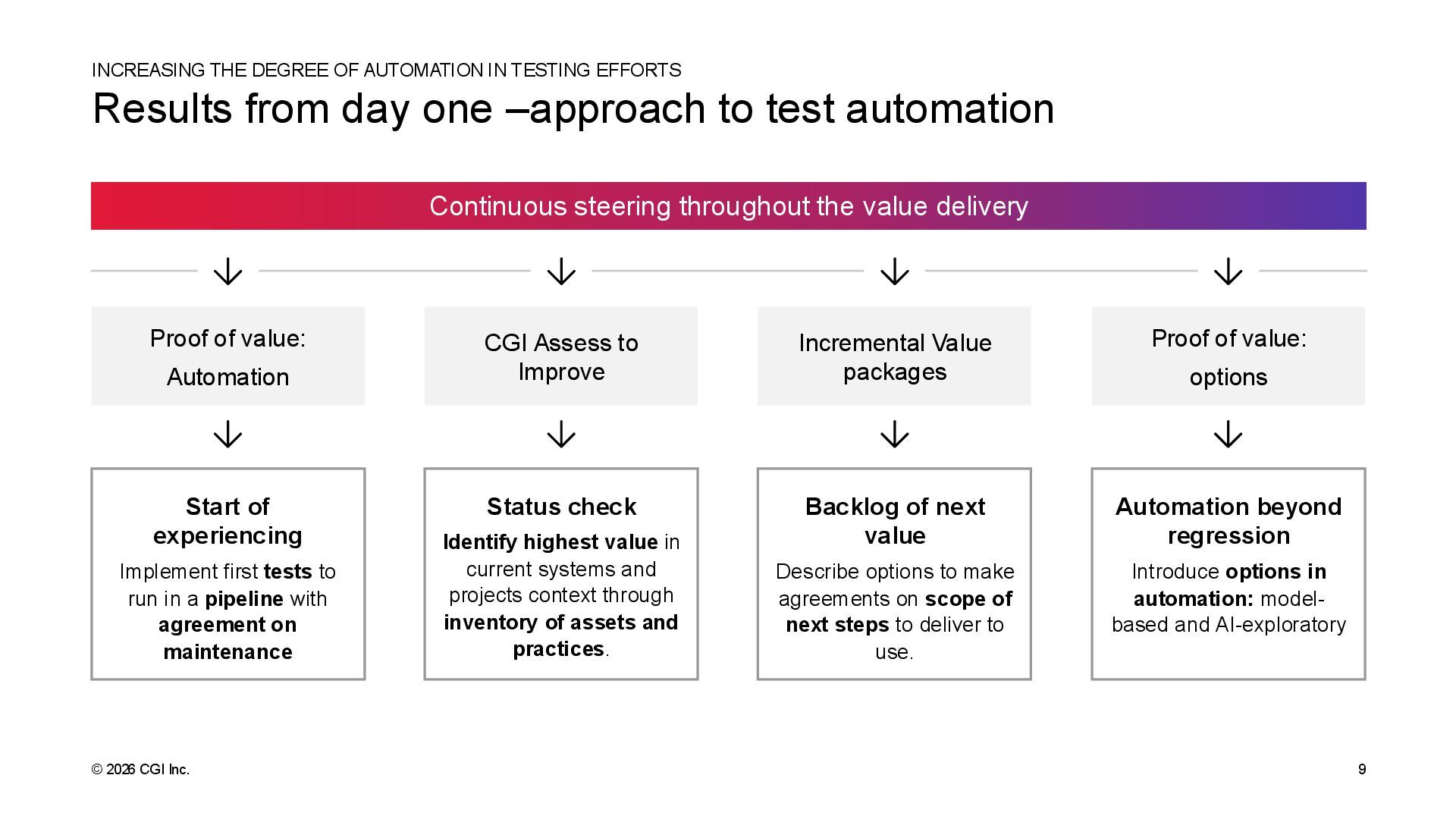
to test automation INCREASING THE DEGREE OF AUTOMATION IN TESTING EFFORTS Continuous steering throughout the value delivery Proof of value: Automation Start of experiencing Implement first tests to run in a pipeline with agreement on maintenance CGI Assess to Improve Status check Identify highest value in current systems and projects context through inventory of assets and practices. Incremental Value packages Backlog of next value Describe options to make agreements on scope of next steps to deliver to use. Proof of value: options Automation beyond regression Introduce options in automation: model- based and AI-exploratory
Founded in 1976, CGI is among the largest IT and business consulting services firms in the world. We are insights-driven and outcomes-focused to help accelerate returns on your investments. Across hundreds of locations worldwide, we provide comprehensive, scalable and sustainable IT and business consulting services that are informed globally and delivered locally. cgi.com


 maaretp
 sergeychernyshev
 reverentgeek
 bermonpainter
 ryanjones
 danielanewman
 addyosmani
 sarafernandez
 thirion
 codingconduct
 akademiya2063
 jnunemaker