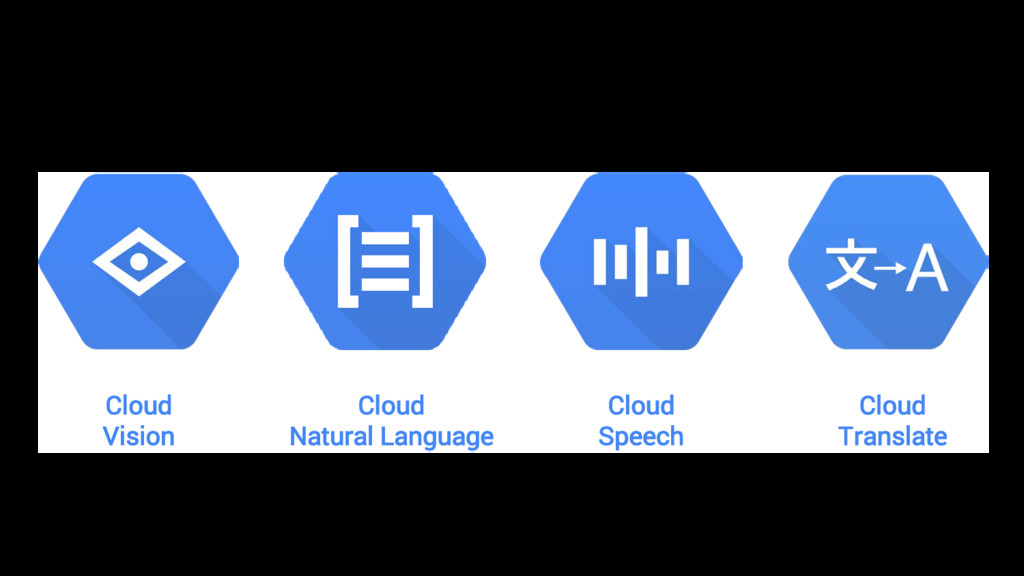
with varying complexity: (1) Use a Cloud-based API (Vision, Natural Language, etc.) (2) Use existing model architecture, and retrain it on your dataset. (3) Develop your own machine learning models for new problems. More flexible, but more effort required
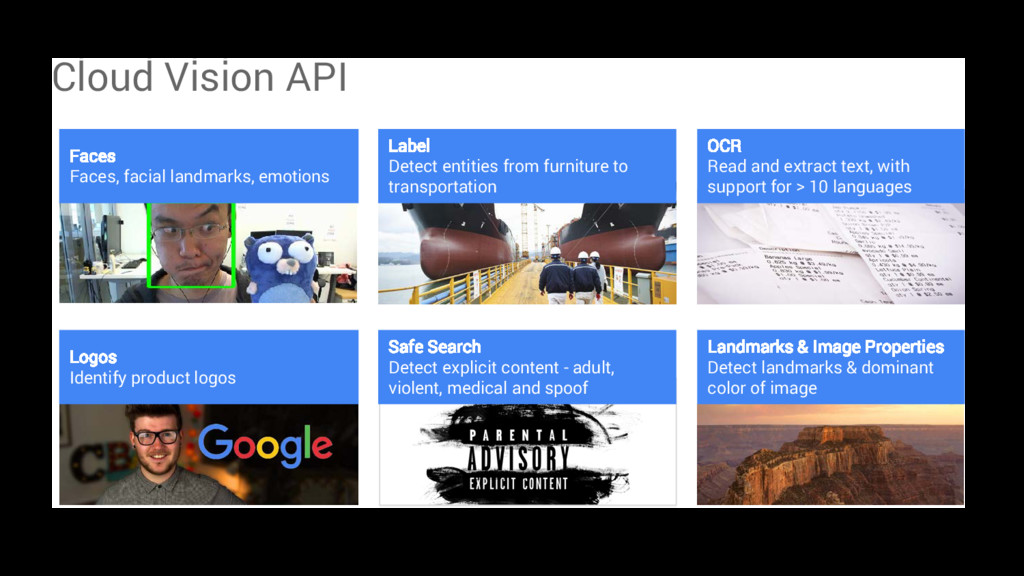
with support for > 10 languages Label Detect entities from furniture to transportation Logos Identify product logos Landmarks & Image Properties Detect landmarks & dominant color of image Safe Search Detect explicit content - adult, violent, medical and spoof Cloud Vision API
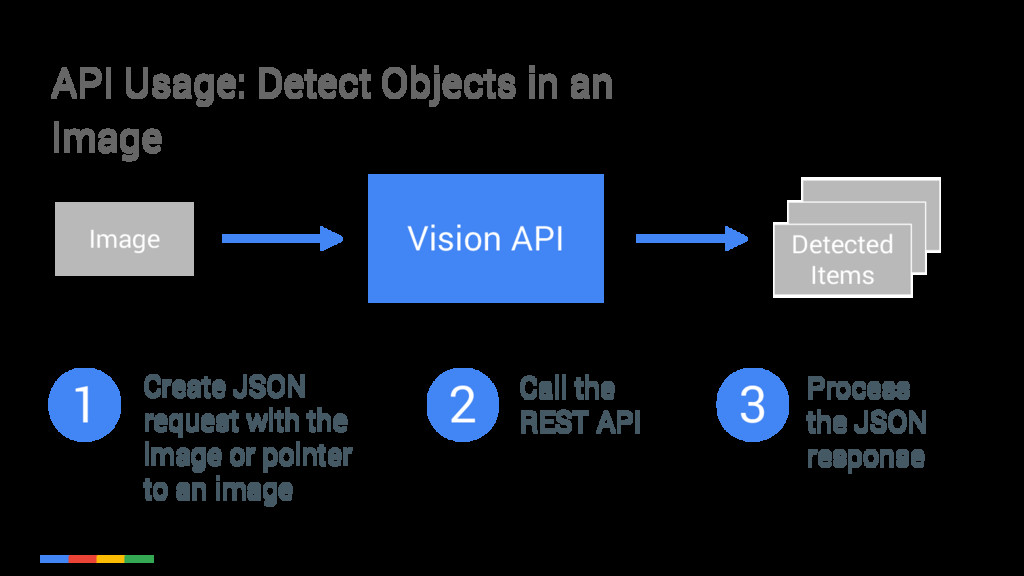
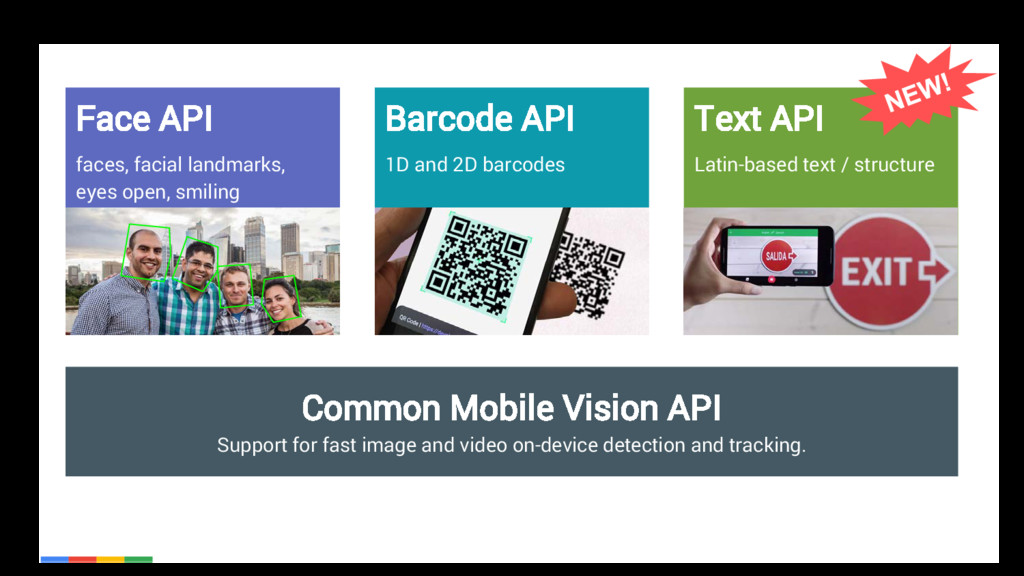
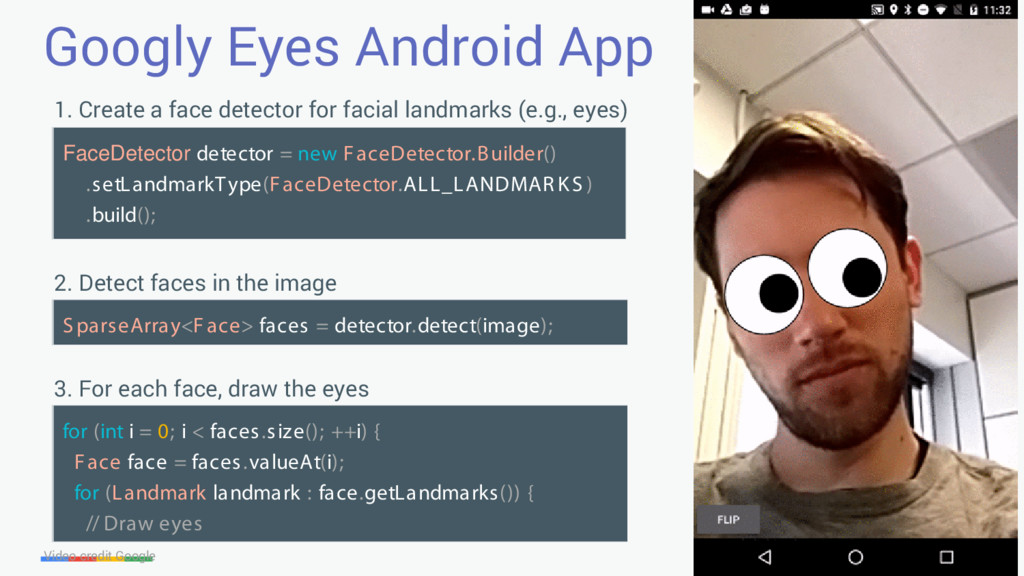
face detector for facial landmarks (e.g., eyes) 3. For each face, draw the eyes FaceDetector detector = new FaceDetector.Builder() .setLandmarkType(FaceDetector.ALL_LANDMAR KS ) .build(); S parseArray<Face> faces = detector.detect(image); for (int i = 0; i < faces.size(); ++i) { Face face = faces.valueAt(i); for (Landmark landmark : face.getLandmarks()) { // Draw eyes 2. Detect faces in the image
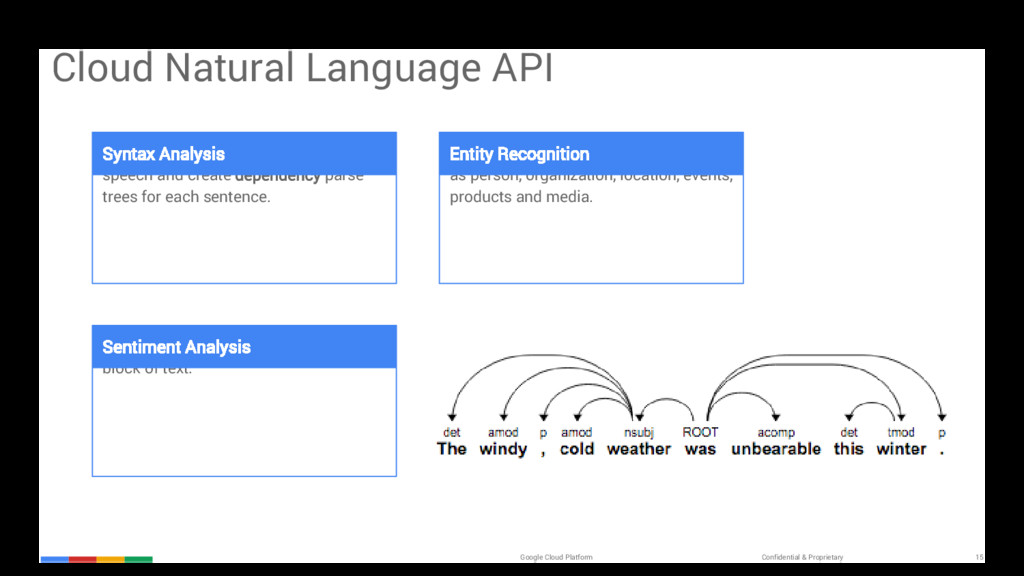
API Extract sentence, identify parts of speech and create dependency parse trees for each sentence. Identify entities and label by types such as person, organization, location, events, products and media. Understand the overall sentiment of a block of text. Syntax Analysis Entity Recognition Sentiment Analysis
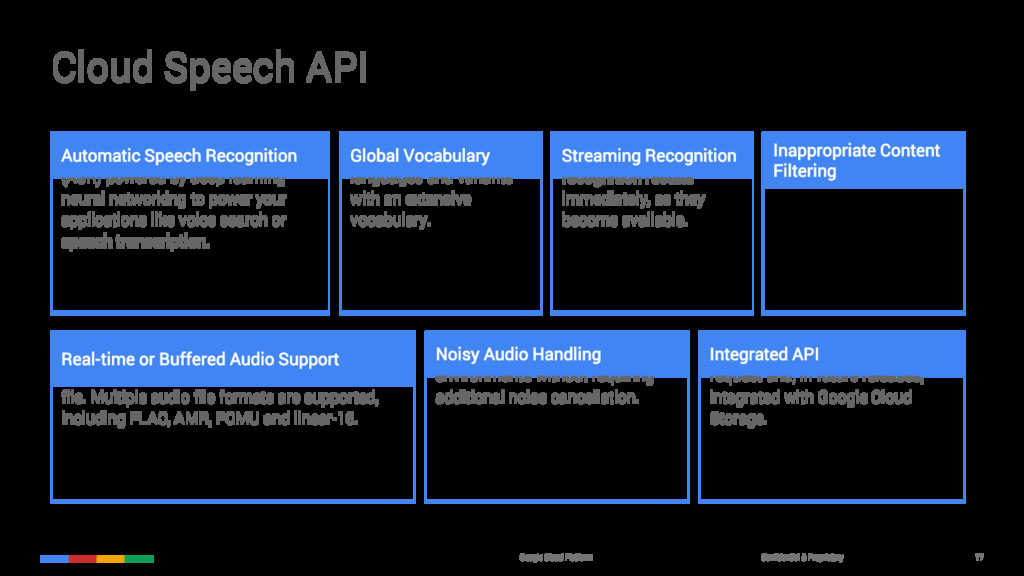
Automatic Speech Recognition (ASR) powered by deep learning neural networking to power your applications like voice search or speech transcription. Recognizes over 80 languages and variants with an extensive vocabulary. Returns partial recognition results immediately, as they become available. Filter inappropriate content in text results. Audio input can be captured by an application’s microphone or sent from a pre-recorded audio file. Multiple audio file formats are supported, including FLAC, AMR, PCMU and linear-16. Handles noisy audio from many environments without requiring additional noise cancellation. Audio files can be uploaded in the request and, in future releases, integrated with Google Cloud Storage. Automatic Speech Recognition Global Vocabulary Inappropriate Content Filtering Streaming Recognition Real-time or Buffered Audio Support Noisy Audio Handling Integrated API
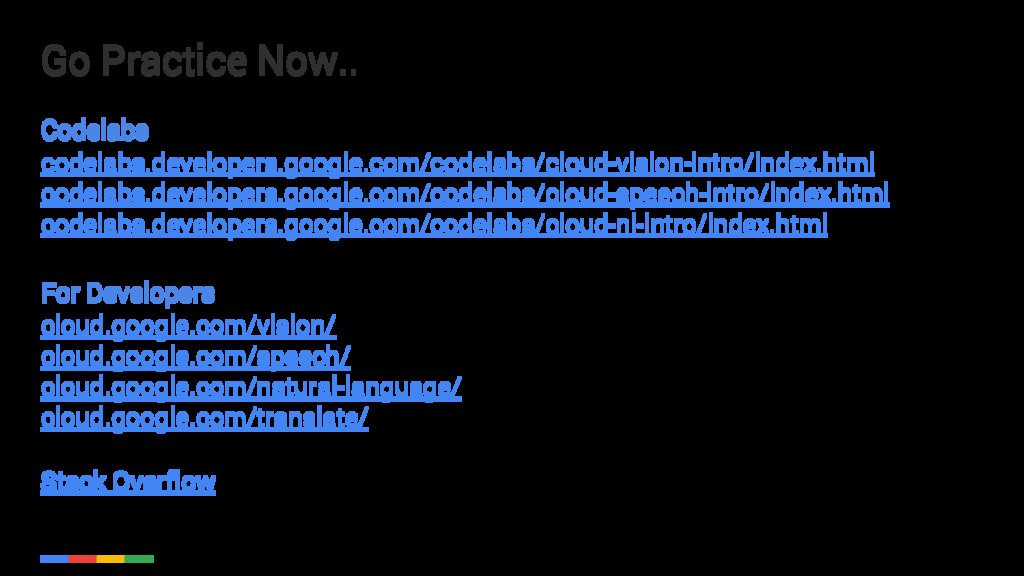
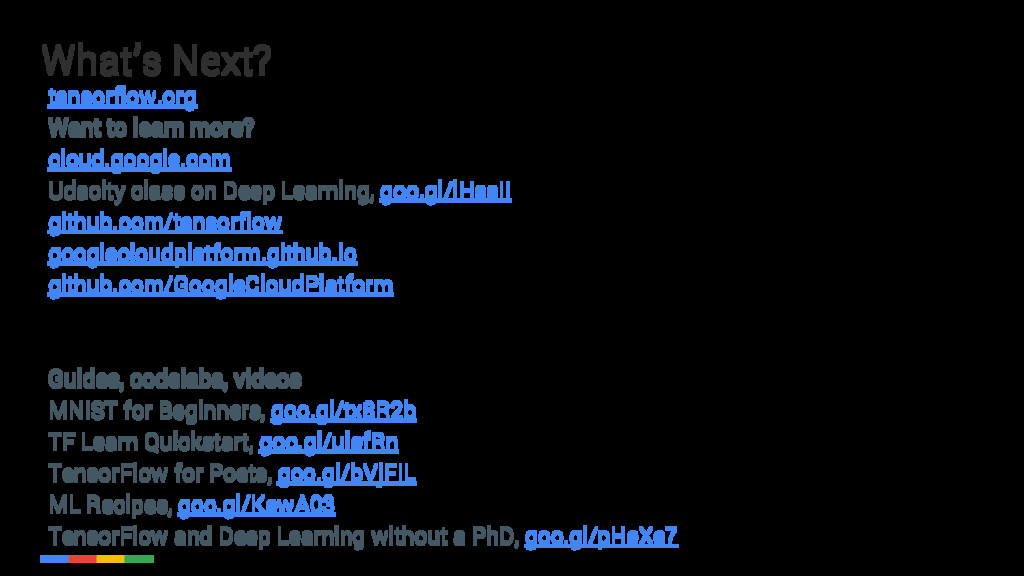
on Deep Learning, goo.gl/iHssII github.com/tensorflow googlecloudplatform.github.io github.com/GoogleCloudPlatform Guides, codelabs, videos MNIST for Beginners, goo.gl/tx8R2b TF Learn Quickstart, goo.gl/uiefRn TensorFlow for Poets, goo.gl/bVjFIL ML Recipes, goo.gl/KewA03 TensorFlow and Deep Learning without a PhD, goo.gl/pHeXe7


 namiki64
 occhi
 takahashim
 ishikawa_satoru
 ueponx
 gionn
 jtakeda
 akhino
 yamanoku
 ezaki
 puhitaku
 willnet
 aleyda
 codingconduct
 katarinadahlin
 techseoconnect
 speakerdeck
 brad_frost
 madoxten
 andyhume
 yeseniaperezcruz
 helenjbeal
 tmiket
 pauljervisheath