FW Thesis: redirection At the beginning: Natural Language (poetry) Generation Very hard There are simple solutions, but we developed them in the Master Thesis The gap between these solutions and our main goal was too big Hard to get good results 4 / 51
FW Thesis: redirection At the beginning: Natural Language (poetry) Generation Very hard There are simple solutions, but we developed them in the Master Thesis The gap between these solutions and our main goal was too big Hard to get good results So, because of that, we decided to change the course of the thesis 4 / 51
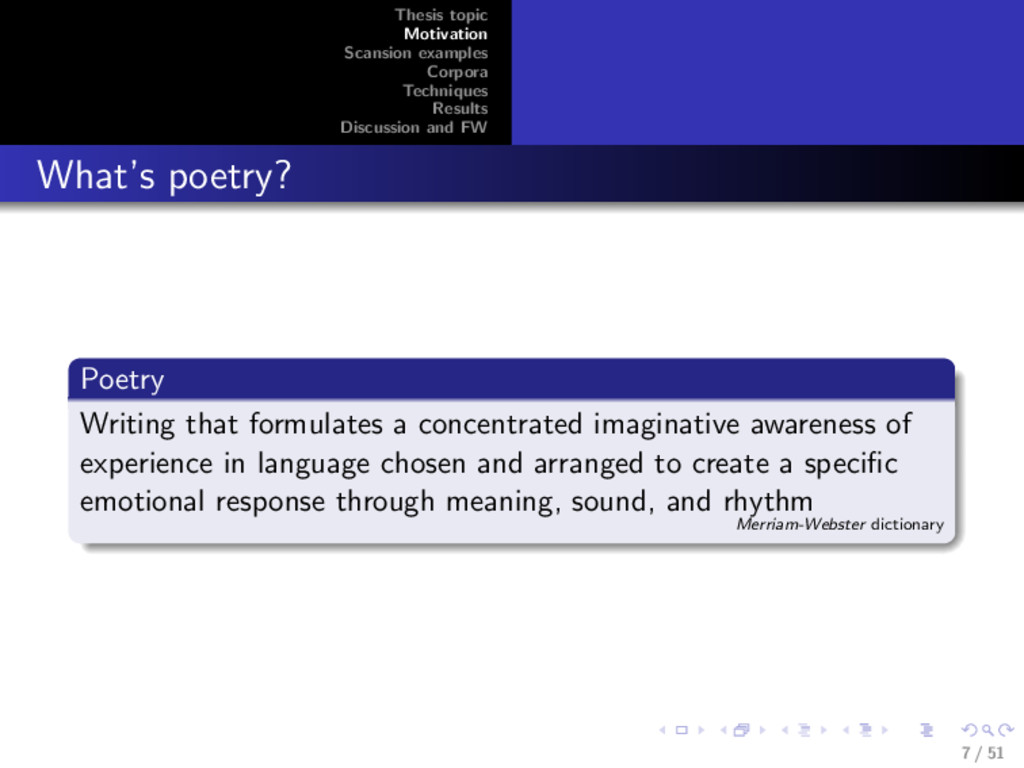
FW What’s poetry? Poetry Writing that formulates a concentrated imaginative awareness of experience in language chosen and arranged to create a specific emotional response through meaning, sound, and rhythm Merriam-Webster dictionary 7 / 51
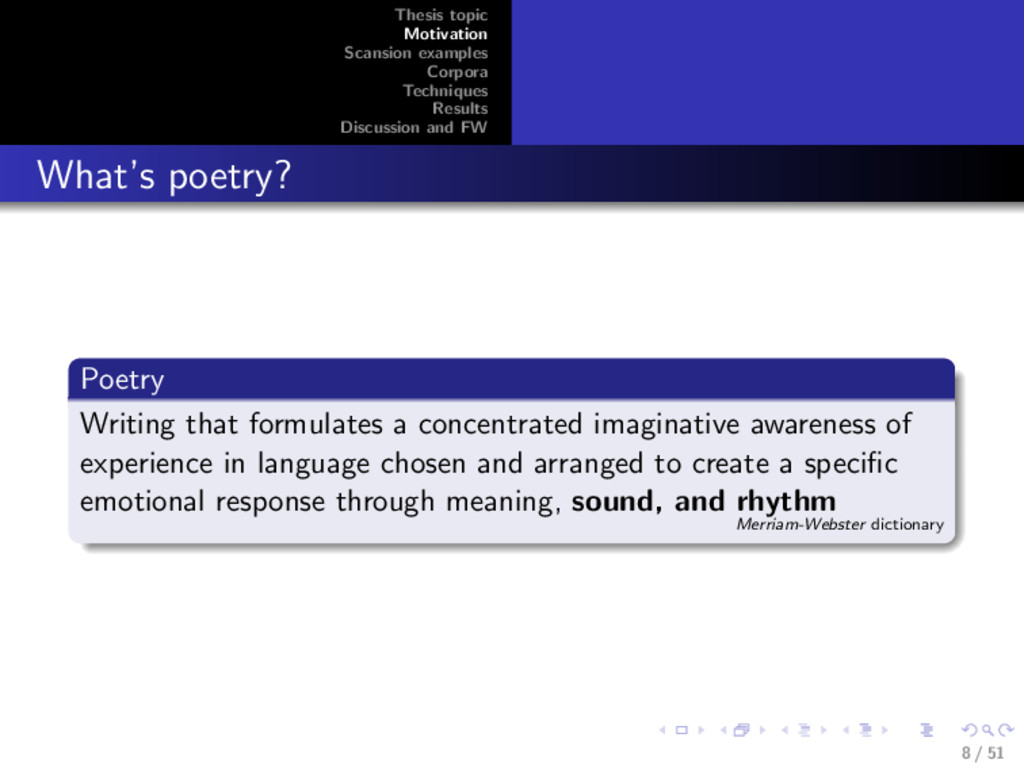
FW What’s poetry? Poetry Writing that formulates a concentrated imaginative awareness of experience in language chosen and arranged to create a specific emotional response through meaning, sound, and rhythm Merriam-Webster dictionary 8 / 51
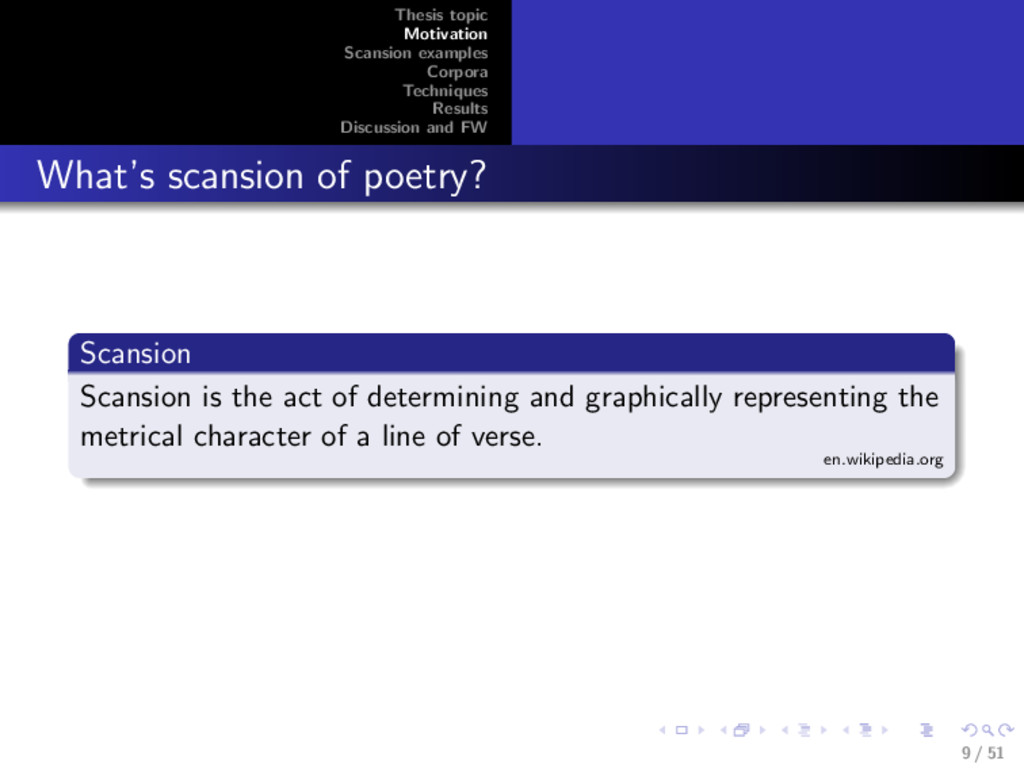
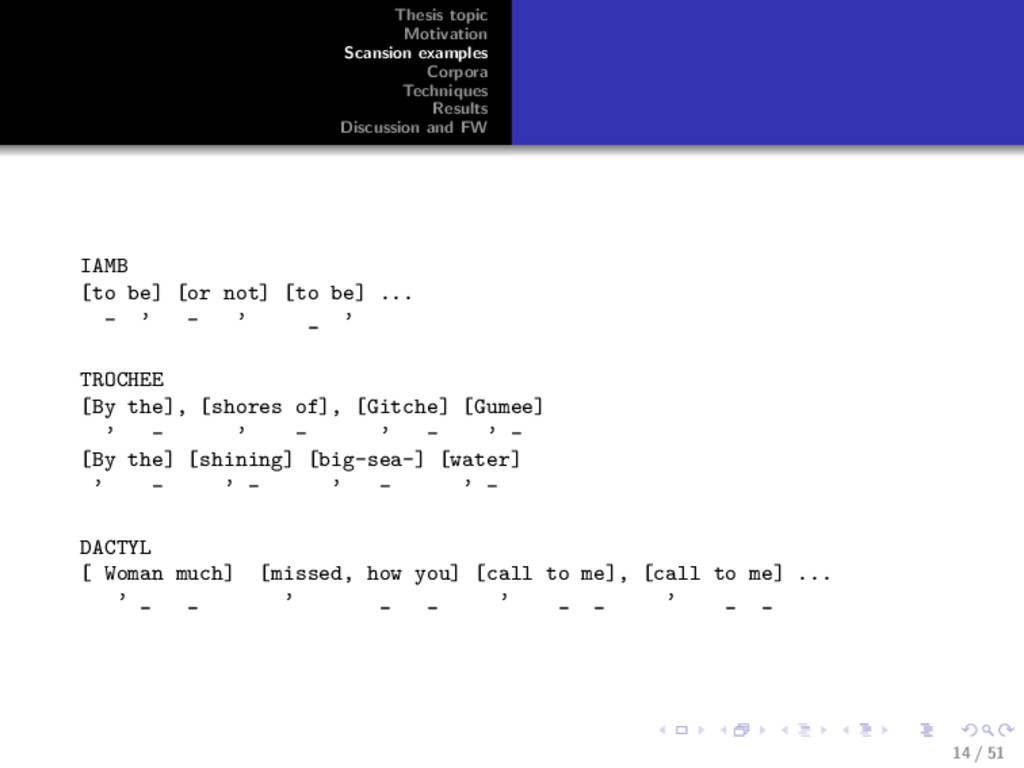
FW What’s scansion of poetry? Scansion Scansion is the act of determining and graphically representing the metrical character of a line of verse. en.wikipedia.org 9 / 51
FW What’s scansion of poetry? Scansion Scansion is the act of determining and graphically representing the metrical character of a line of verse. en.wikipedia.org Different metrical patterns are used around the world 9 / 51
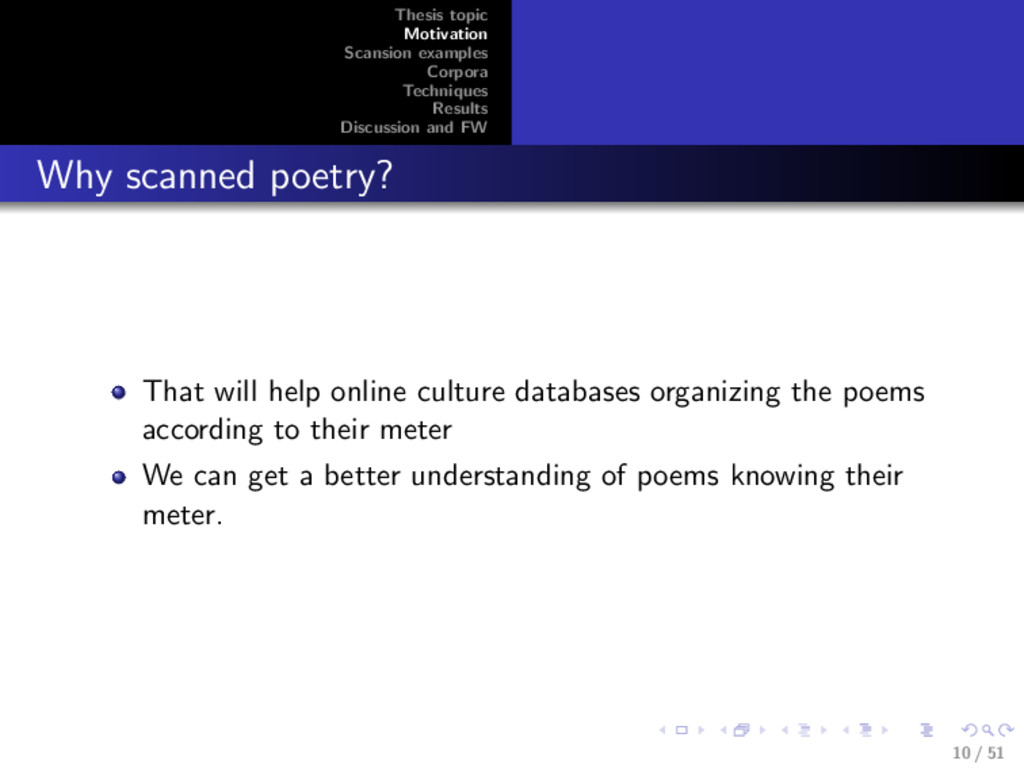
FW Why scanned poetry? That will help online culture databases organizing the poems according to their meter We can get a better understanding of poems knowing their meter. 10 / 51
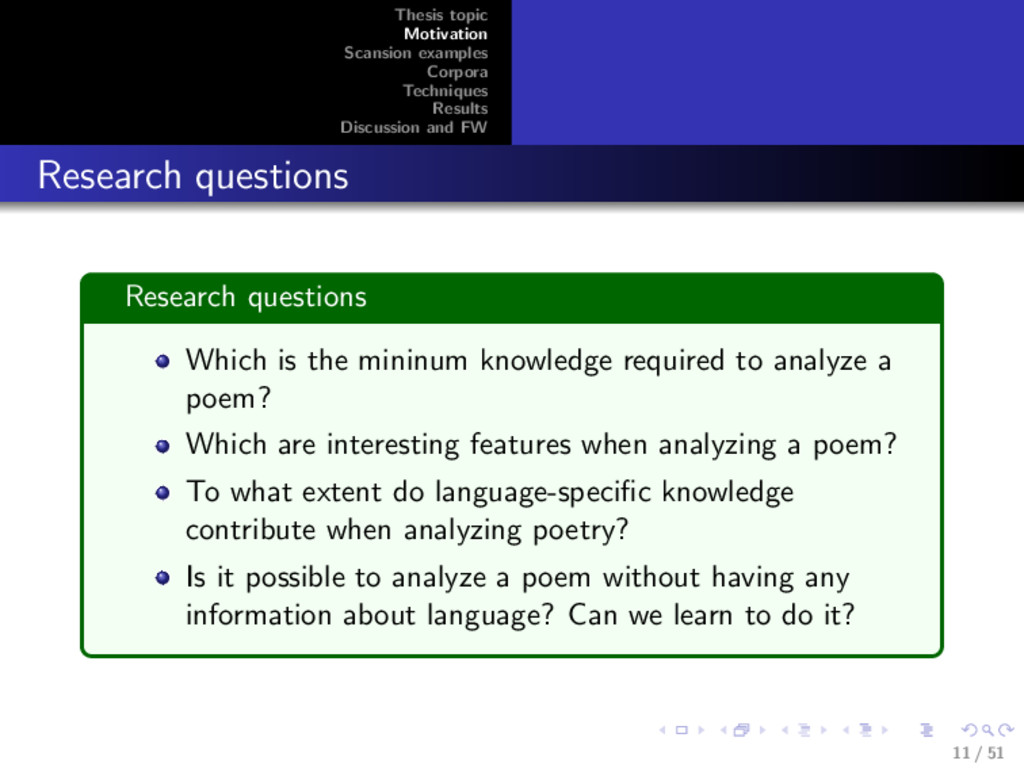
FW Research questions Research questions Which is the mininum knowledge required to analyze a poem? Which are interesting features when analyzing a poem? To what extent do language-specific knowledge contribute when analyzing poetry? Is it possible to analyze a poem without having any information about language? Can we learn to do it? 11 / 51
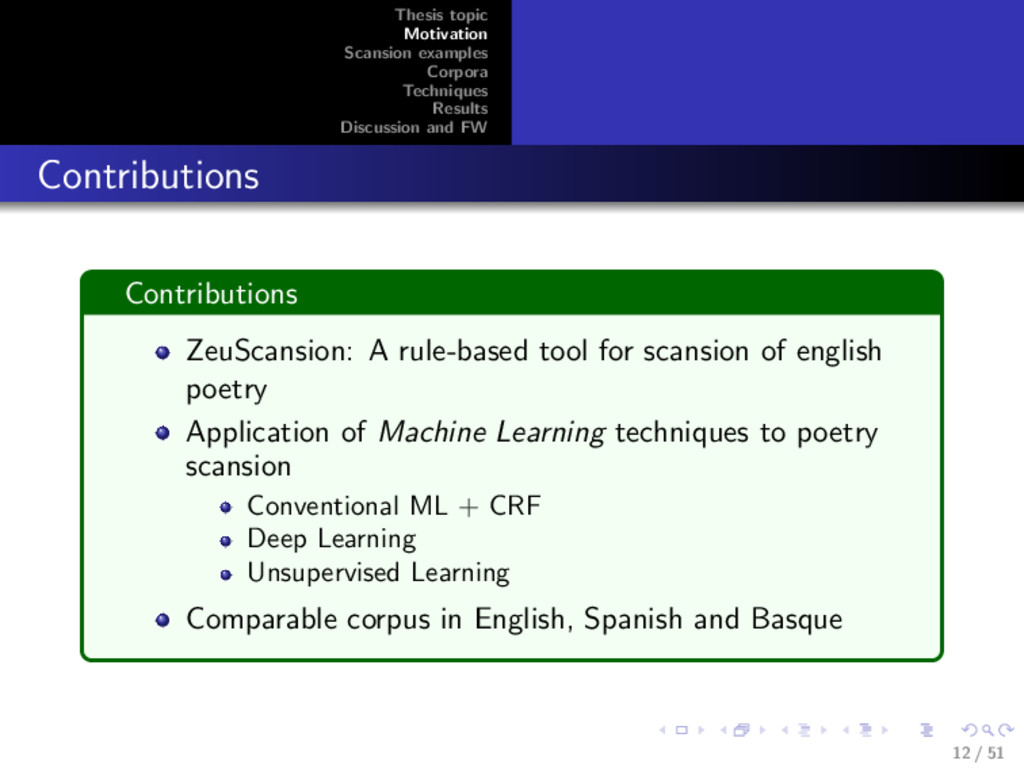
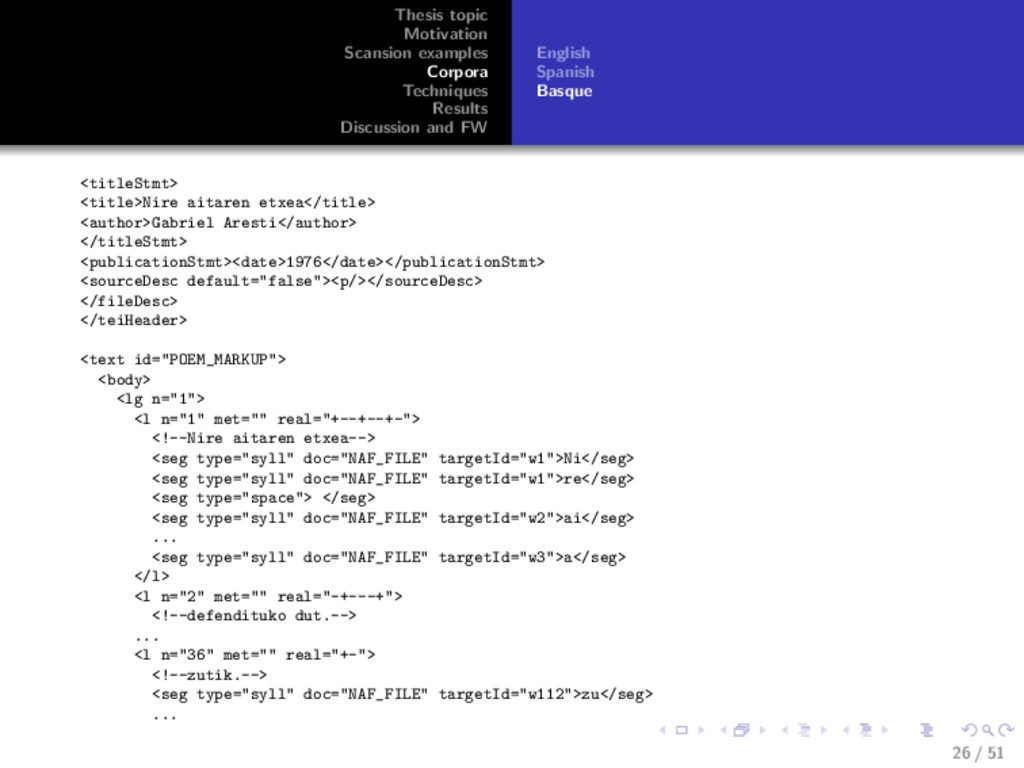
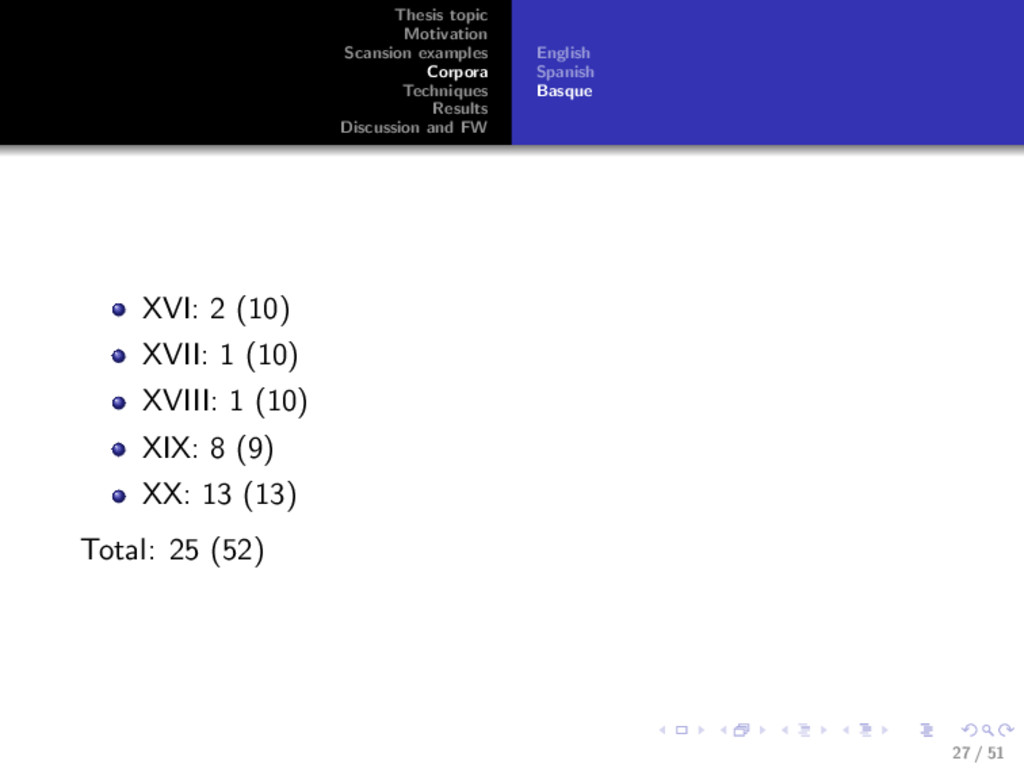
FW Contributions Contributions ZeuScansion: A rule-based tool for scansion of english poetry Application of Machine Learning techniques to poetry scansion Conventional ML + CRF Deep Learning Unsupervised Learning Comparable corpus in English, Spanish and Basque 12 / 51
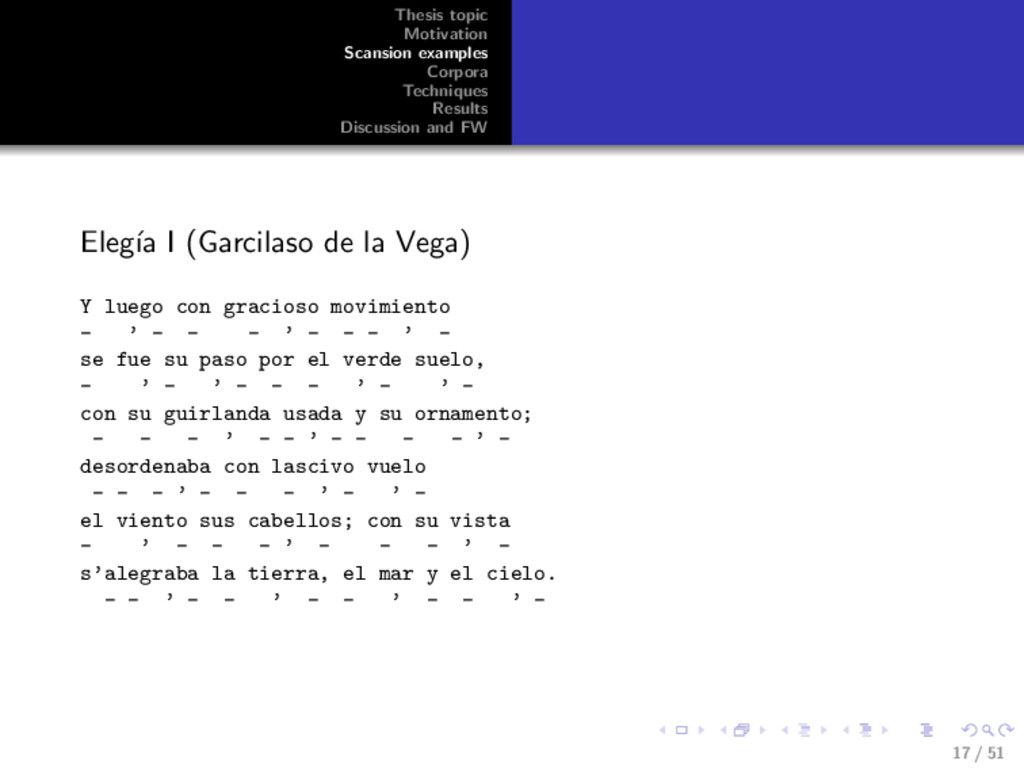
FW Eleg´ ıa I (Garcilaso de la Vega) Y luego con gracioso movimiento - ’ - - - ’ - - - ’ - se fue su paso por el verde suelo, - ’ - ’ - - - ’ - ’ - con su guirlanda usada y su ornamento; - - - ’ - - ’ - - - - ’ - desordenaba con lascivo vuelo - - - ’ - - - ’ - ’ - el viento sus cabellos; con su vista - ’ - - - ’ - - - ’ - s’alegraba la tierra, el mar y el cielo. - - ’ - - ’ - - ’ - - ’ - 17 / 51
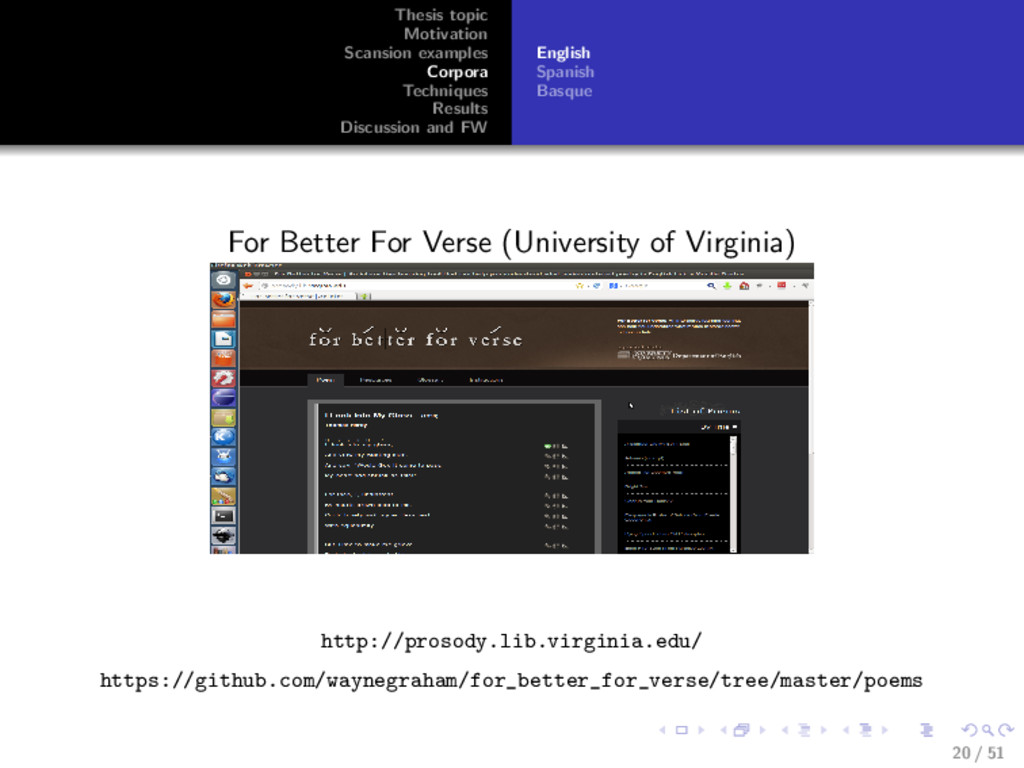
FW English Spanish Basque For Better For Verse (University of Virginia) http://prosody.lib.virginia.edu/ https://github.com/waynegraham/for_better_for_verse/tree/master/poems 20 / 51
FW English Spanish Basque Two options: The Spanish Verse Corpus (The structure of verse, Svetlana Bochaver & Dmitri Sitchinava) Corpus de Sonetos Siglo de Oro https: //github.com/bncolorado/CorpusSonetosSigloDeOro 21 / 51
FW Rule-based scansion Supervised learning Unsupervised learning Techniques We have several systems that perform automatic scansion of English poetry (which we want to extend to Spanish & Basque) 29 / 51
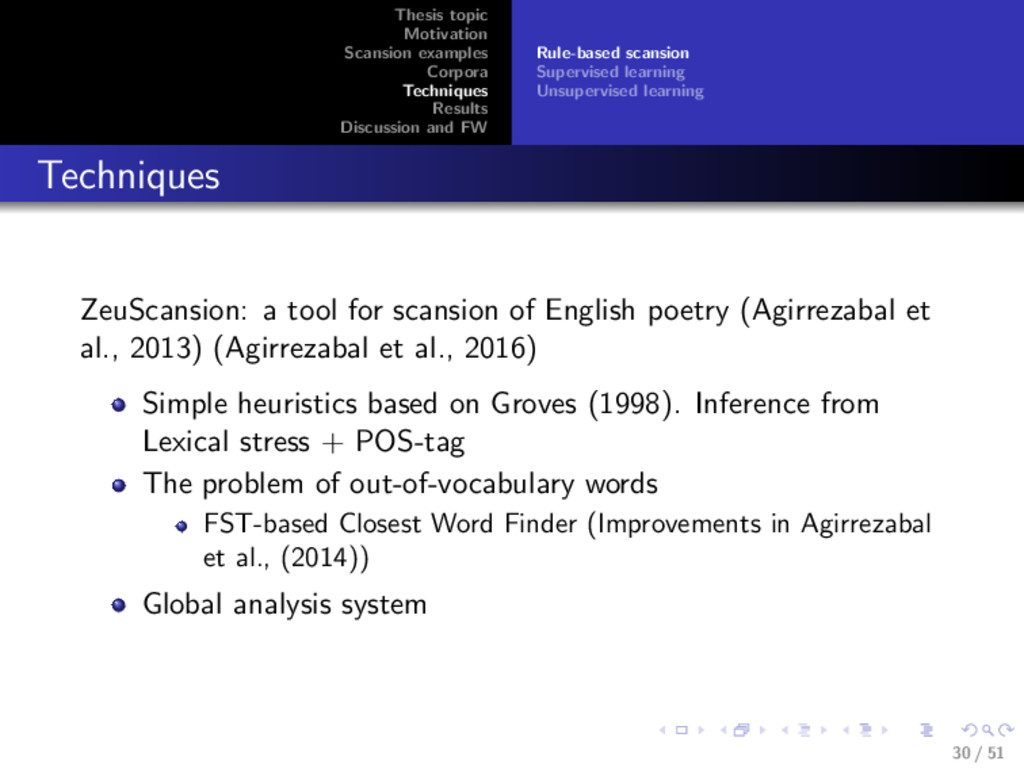
FW Rule-based scansion Supervised learning Unsupervised learning Techniques ZeuScansion: a tool for scansion of English poetry (Agirrezabal et al., 2013) (Agirrezabal et al., 2016) 30 / 51
FW Rule-based scansion Supervised learning Unsupervised learning Techniques ZeuScansion: a tool for scansion of English poetry (Agirrezabal et al., 2013) (Agirrezabal et al., 2016) Simple heuristics based on Groves (1998). Inference from Lexical stress + POS-tag 30 / 51
FW Rule-based scansion Supervised learning Unsupervised learning Techniques ZeuScansion: a tool for scansion of English poetry (Agirrezabal et al., 2013) (Agirrezabal et al., 2016) Simple heuristics based on Groves (1998). Inference from Lexical stress + POS-tag The problem of out-of-vocabulary words 30 / 51
FW Rule-based scansion Supervised learning Unsupervised learning Techniques ZeuScansion: a tool for scansion of English poetry (Agirrezabal et al., 2013) (Agirrezabal et al., 2016) Simple heuristics based on Groves (1998). Inference from Lexical stress + POS-tag The problem of out-of-vocabulary words FST-based Closest Word Finder (Improvements in Agirrezabal et al., (2014)) 30 / 51
FW Rule-based scansion Supervised learning Unsupervised learning Techniques ZeuScansion: a tool for scansion of English poetry (Agirrezabal et al., 2013) (Agirrezabal et al., 2016) Simple heuristics based on Groves (1998). Inference from Lexical stress + POS-tag The problem of out-of-vocabulary words FST-based Closest Word Finder (Improvements in Agirrezabal et al., (2014)) Global analysis system 30 / 51
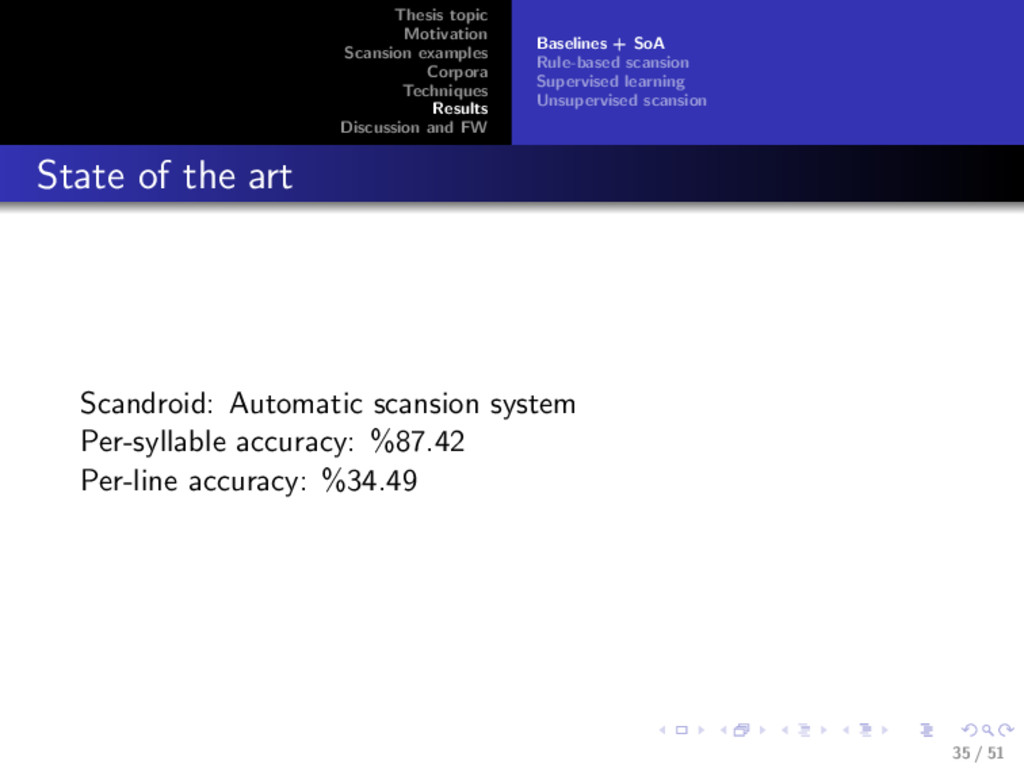
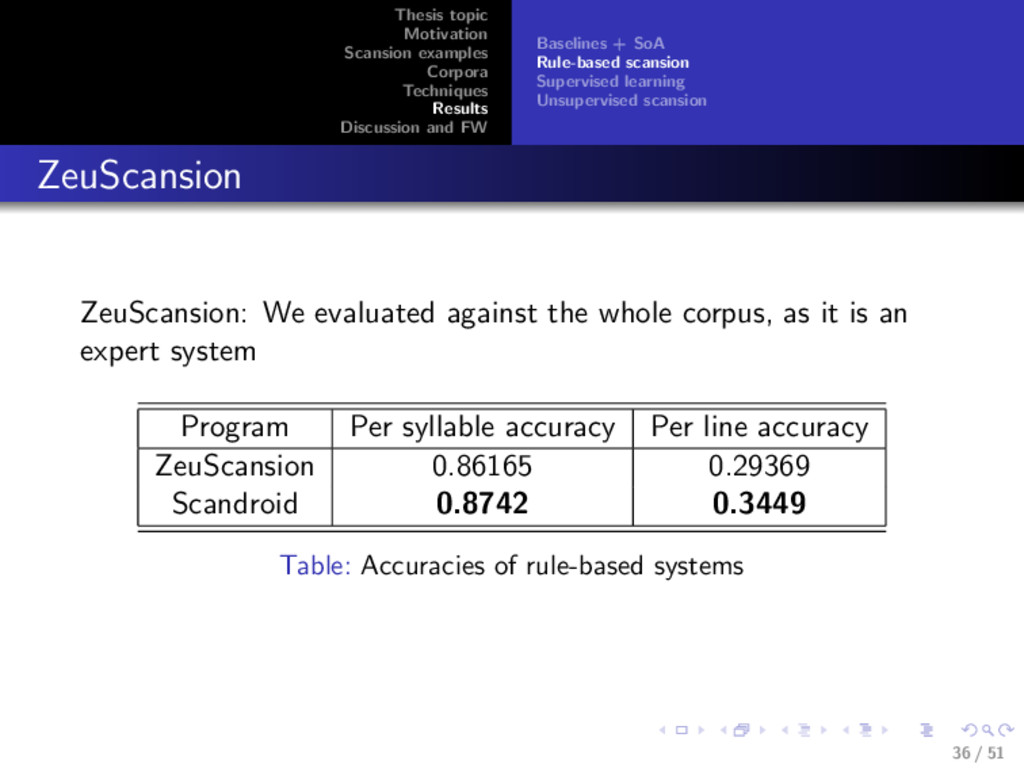
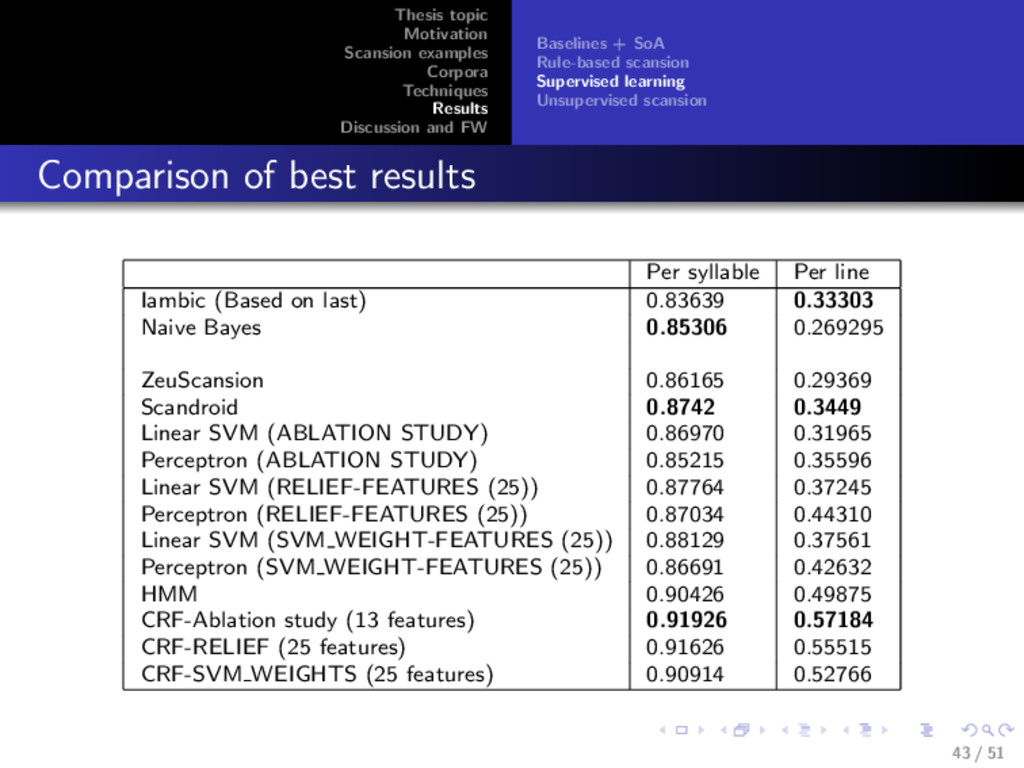
FW Baselines + SoA Rule-based scansion Supervised learning Unsupervised scansion State of the art Scandroid: Automatic scansion system Per-syllable accuracy: %87.42 Per-line accuracy: %34.49 35 / 51
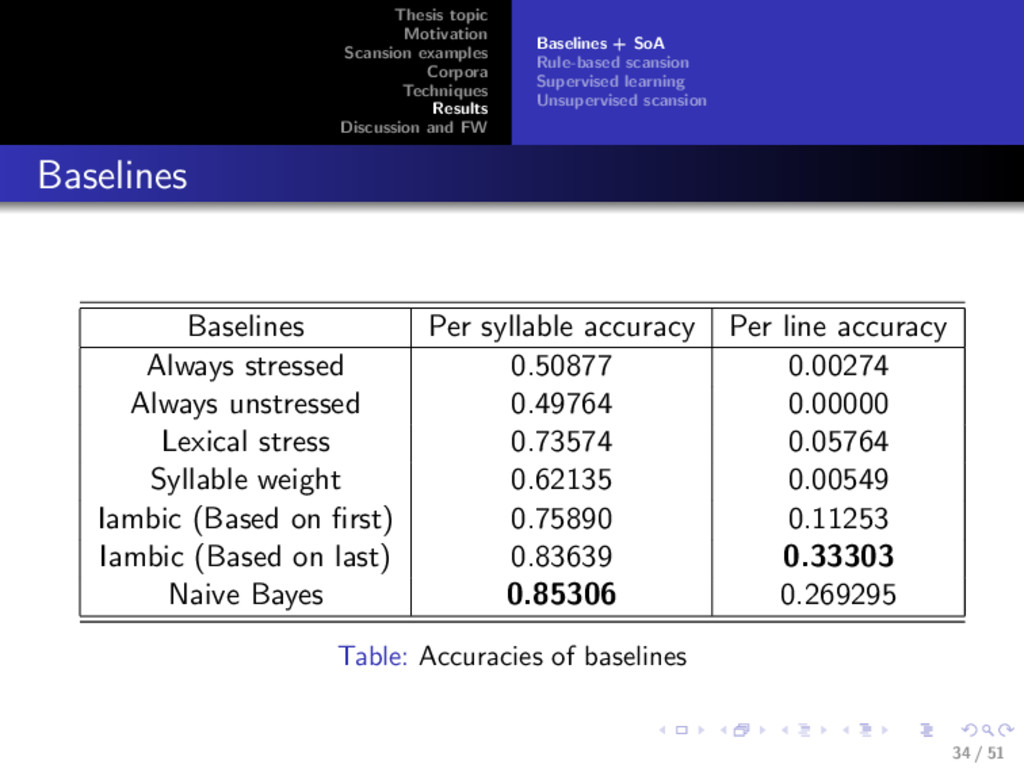
FW Baselines + SoA Rule-based scansion Supervised learning Unsupervised scansion ZeuScansion ZeuScansion: We evaluated against the whole corpus, as it is an expert system Program Per syllable accuracy Per line accuracy ZeuScansion 0.86165 0.29369 Scandroid 0.8742 0.3449 Table: Accuracies of rule-based systems 36 / 51
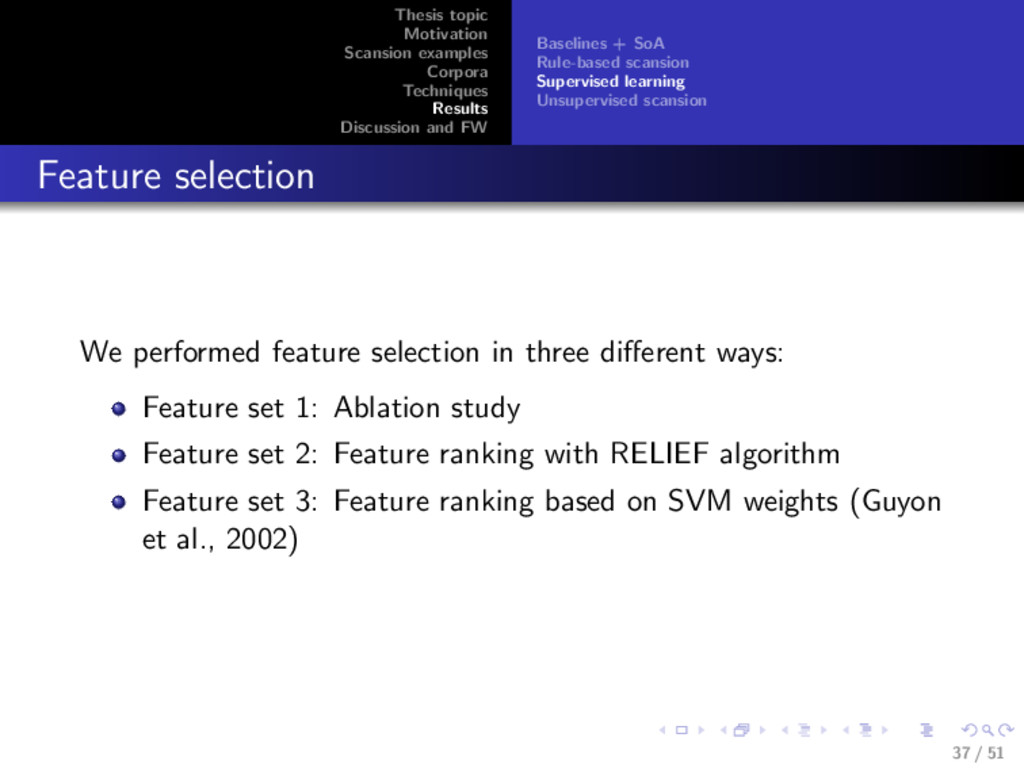
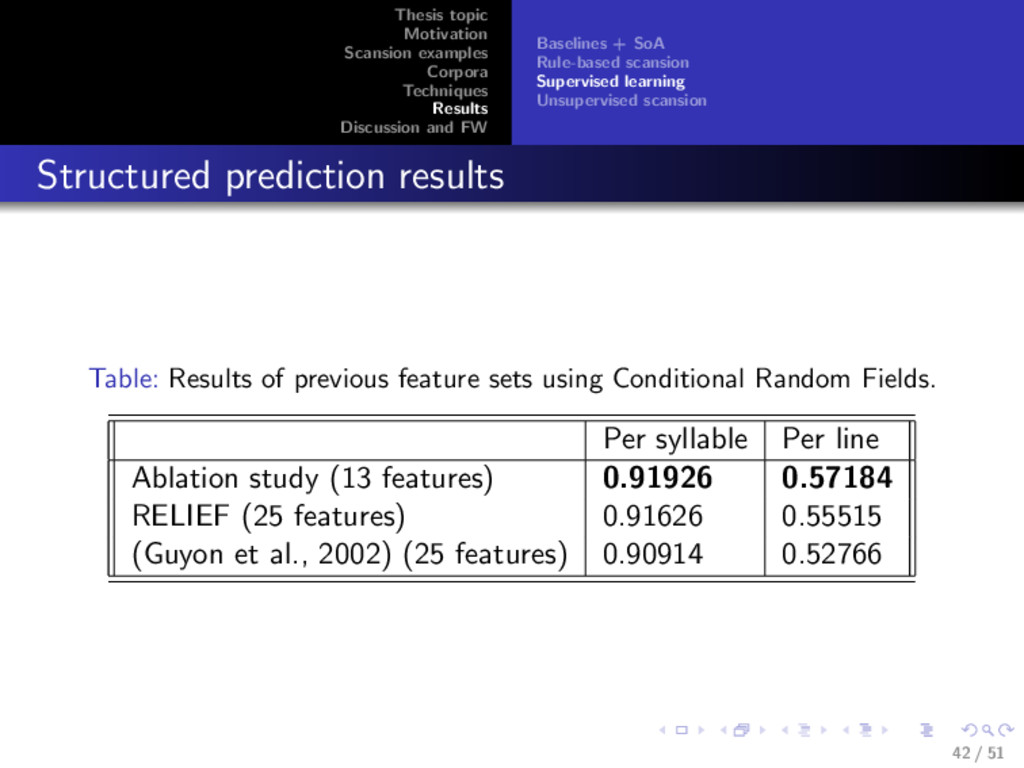
FW Baselines + SoA Rule-based scansion Supervised learning Unsupervised scansion Feature selection We performed feature selection in three different ways: 37 / 51
FW Baselines + SoA Rule-based scansion Supervised learning Unsupervised scansion Feature selection We performed feature selection in three different ways: Feature set 1: Ablation study 37 / 51
FW Baselines + SoA Rule-based scansion Supervised learning Unsupervised scansion Feature selection We performed feature selection in three different ways: Feature set 1: Ablation study Feature set 2: Feature ranking with RELIEF algorithm 37 / 51
FW Baselines + SoA Rule-based scansion Supervised learning Unsupervised scansion Feature selection We performed feature selection in three different ways: Feature set 1: Ablation study Feature set 2: Feature ranking with RELIEF algorithm Feature set 3: Feature ranking based on SVM weights (Guyon et al., 2002) 37 / 51
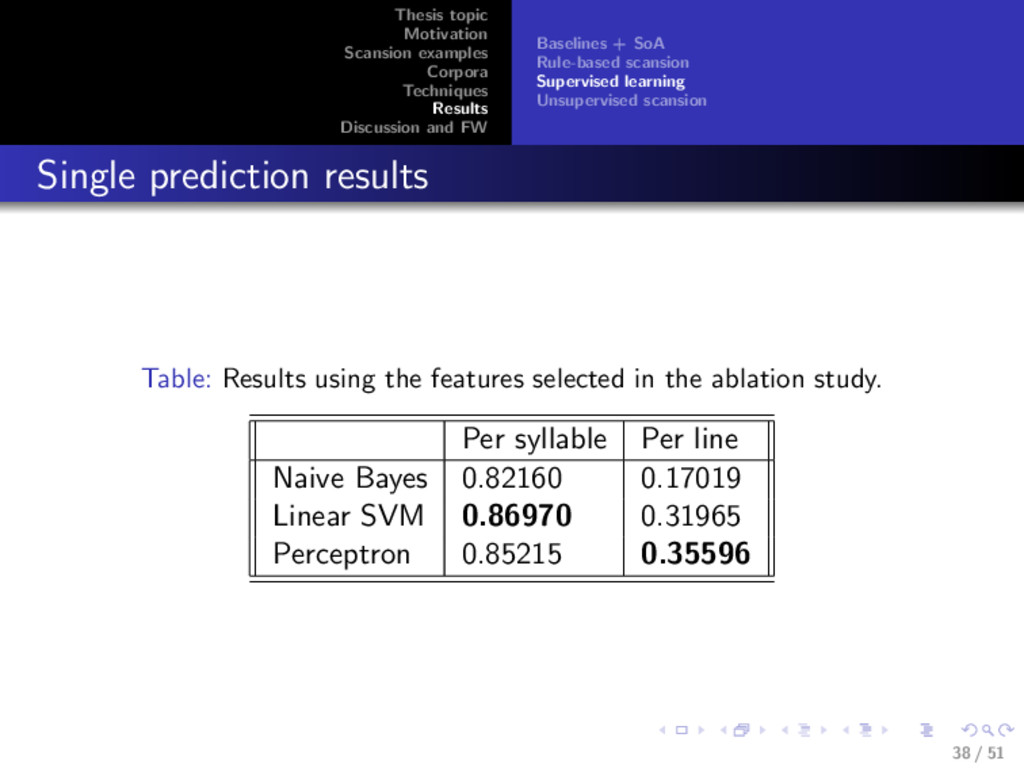
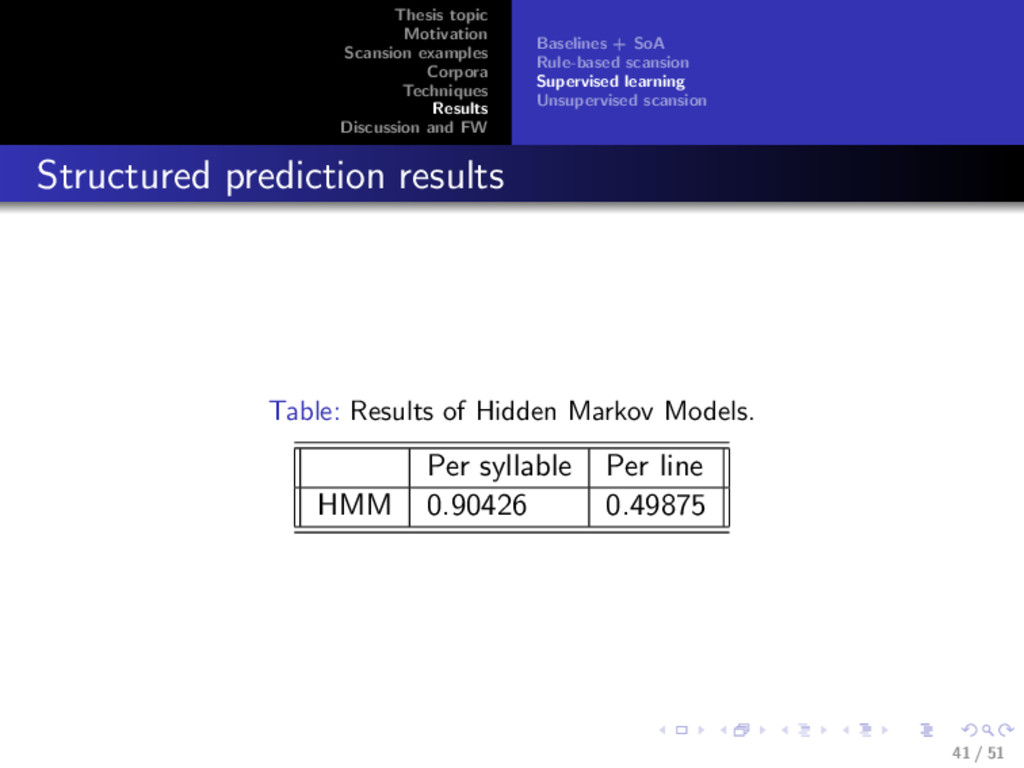
FW Baselines + SoA Rule-based scansion Supervised learning Unsupervised scansion Single prediction results Table: Results using the features selected in the ablation study. Per syllable Per line Naive Bayes 0.82160 0.17019 Linear SVM 0.86970 0.31965 Perceptron 0.85215 0.35596 38 / 51
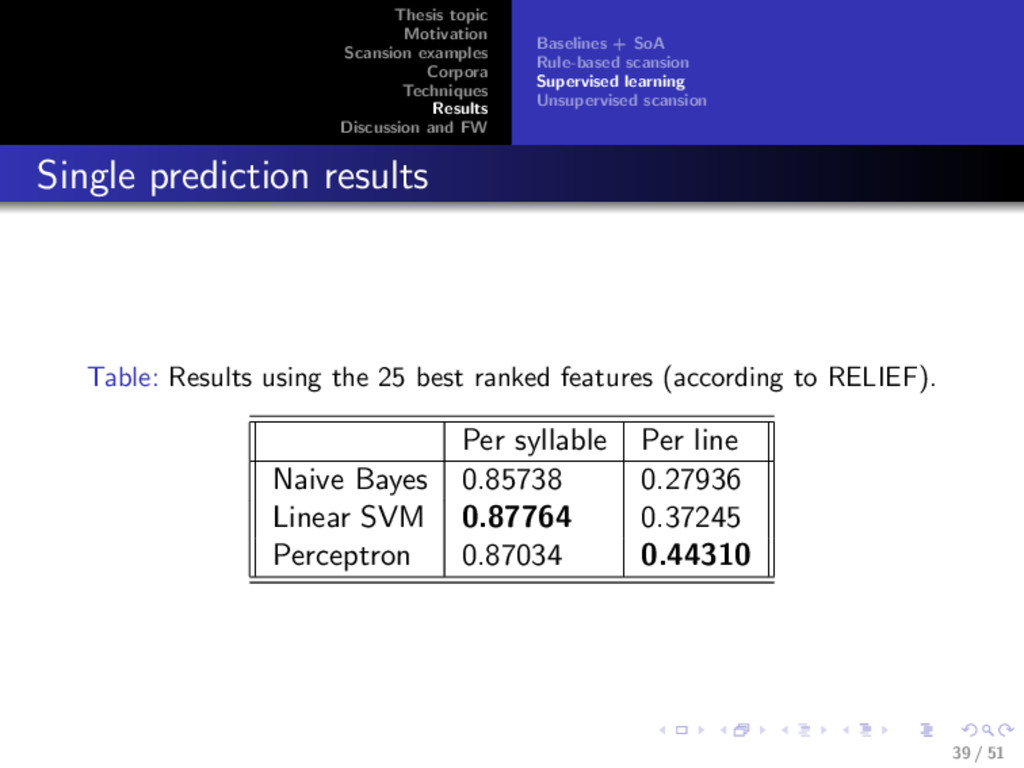
FW Baselines + SoA Rule-based scansion Supervised learning Unsupervised scansion Single prediction results Table: Results using the 25 best ranked features (according to RELIEF). Per syllable Per line Naive Bayes 0.85738 0.27936 Linear SVM 0.87764 0.37245 Perceptron 0.87034 0.44310 39 / 51
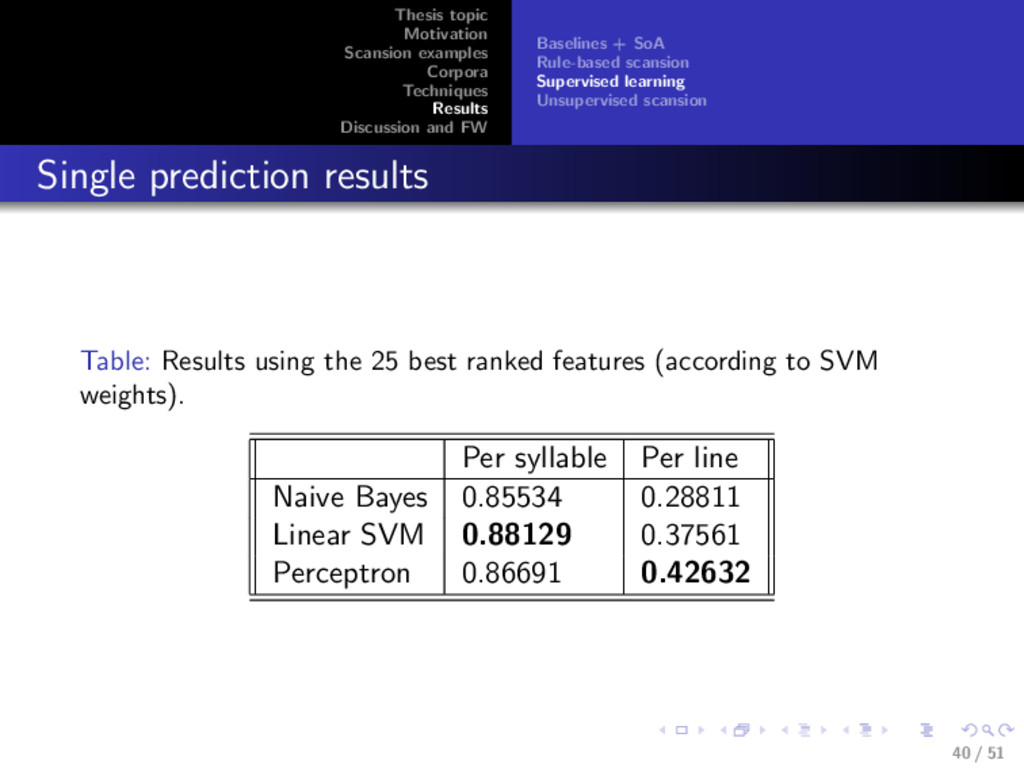
FW Baselines + SoA Rule-based scansion Supervised learning Unsupervised scansion Single prediction results Table: Results using the 25 best ranked features (according to SVM weights). Per syllable Per line Naive Bayes 0.85534 0.28811 Linear SVM 0.88129 0.37561 Perceptron 0.86691 0.42632 40 / 51
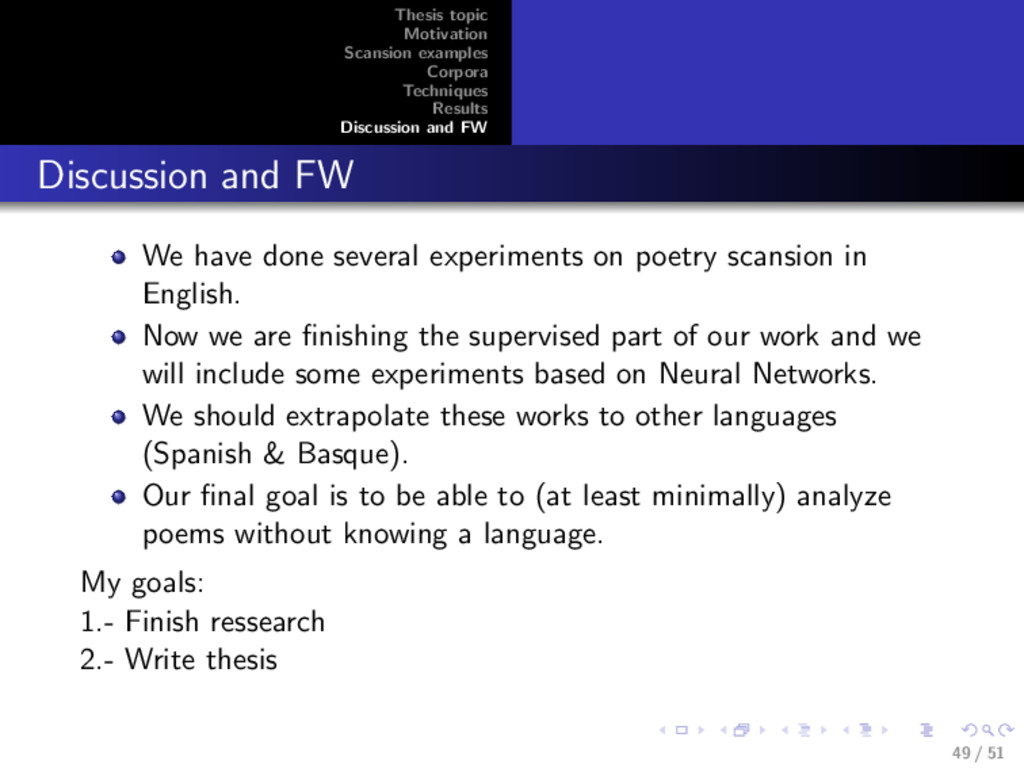
FW Discussion and FW We have done several experiments on poetry scansion in English. Now we are finishing the supervised part of our work and we will include some experiments based on Neural Networks. We should extrapolate these works to other languages (Spanish & Basque). Our final goal is to be able to (at least minimally) analyze poems without knowing a language. 49 / 51
FW Discussion and FW We have done several experiments on poetry scansion in English. Now we are finishing the supervised part of our work and we will include some experiments based on Neural Networks. We should extrapolate these works to other languages (Spanish & Basque). Our final goal is to be able to (at least minimally) analyze poems without knowing a language. My goals: 49 / 51
FW Discussion and FW We have done several experiments on poetry scansion in English. Now we are finishing the supervised part of our work and we will include some experiments based on Neural Networks. We should extrapolate these works to other languages (Spanish & Basque). Our final goal is to be able to (at least minimally) analyze poems without knowing a language. My goals: 1.- Finish ressearch 49 / 51
FW Discussion and FW We have done several experiments on poetry scansion in English. Now we are finishing the supervised part of our work and we will include some experiments based on Neural Networks. We should extrapolate these works to other languages (Spanish & Basque). Our final goal is to be able to (at least minimally) analyze poems without knowing a language. My goals: 1.- Finish ressearch 2.- Write thesis 49 / 51
FW Discussion and FW We have done several experiments on poetry scansion in English. Now we are finishing the supervised part of our work and we will include some experiments based on Neural Networks. We should extrapolate these works to other languages (Spanish & Basque). Our final goal is to be able to (at least minimally) analyze poems without knowing a language. My goals: 1.- Finish ressearch 2.- Write thesis Just that 49 / 51


 manexagirrezabal
 rikkabotan7
 xspa2012
 tsantalis
.png) satai
satai
 eumesy
 ayaniwa
 s_mizuki_nlp
 fr0gger
 yumaichikawa
 koide3
 casualconc
 techseoconnect
 jmmastey
 codingconduct
 cassininazir
 vanstee
 marketingsoph
 reverentgeek
 bluesmoon
 marktimemedia
 aleyda
 davetheseo
 greggifford