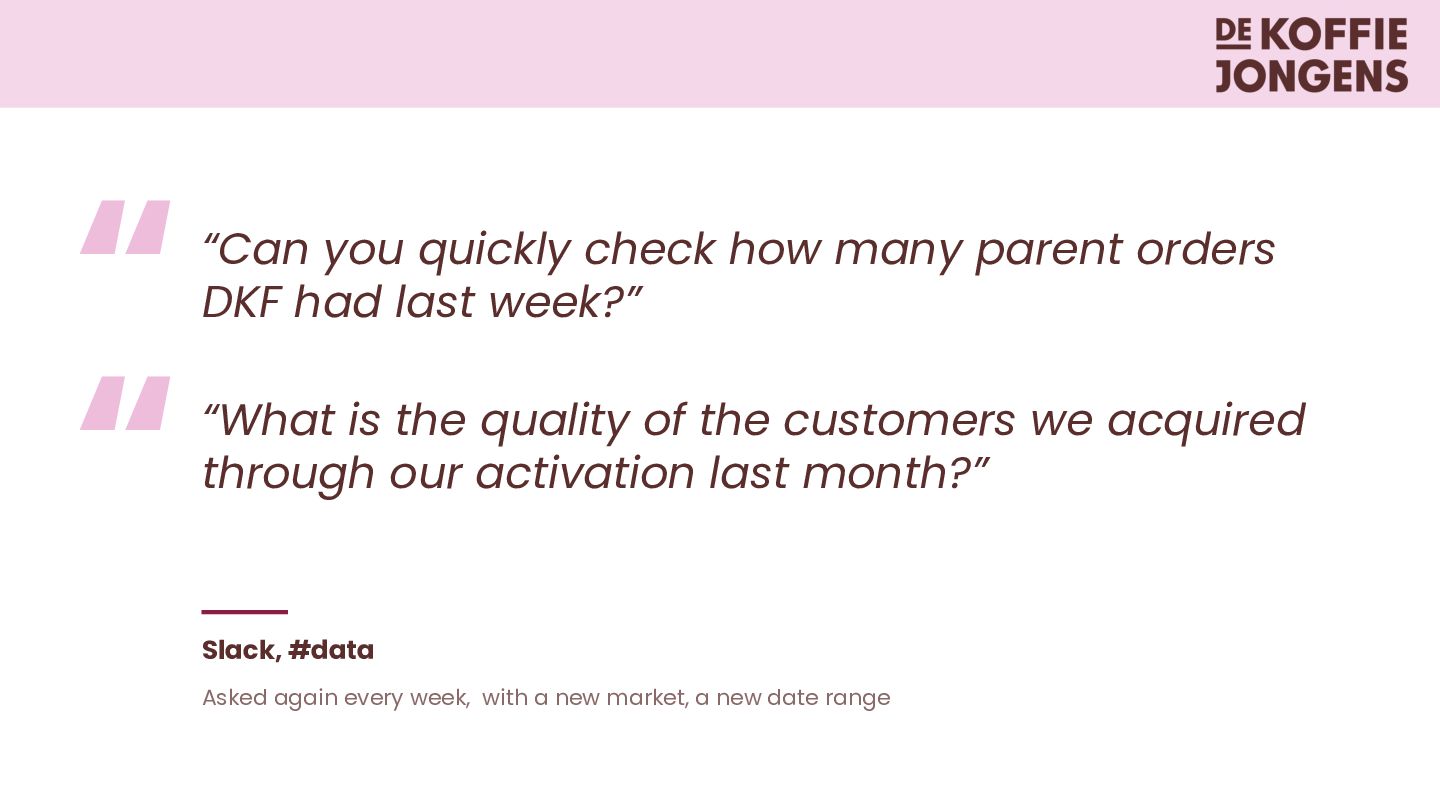
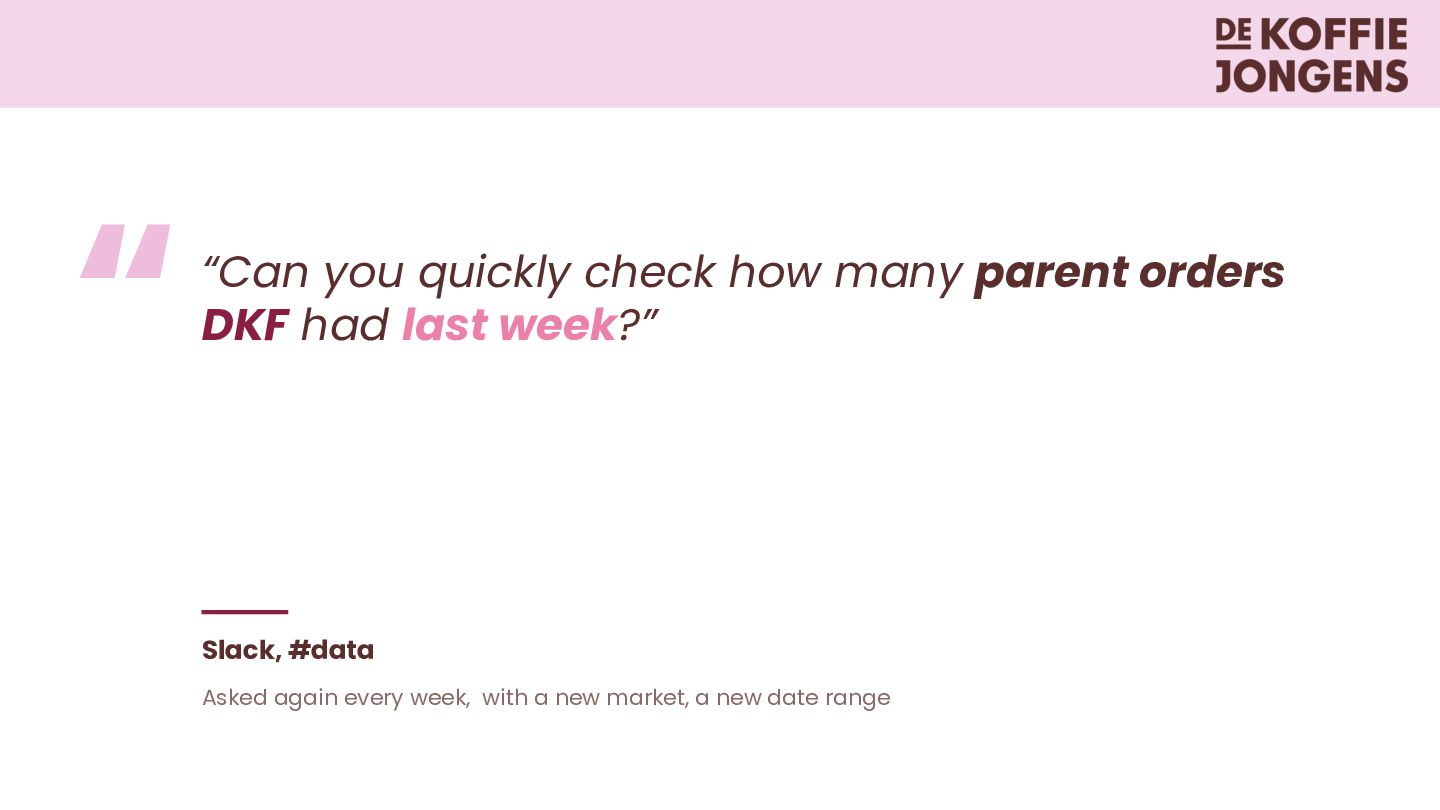
DKF had last week?” “What is the quality of the customers we acquired through our activation last month?” Slack, #data Asked again every week, with a new market, a new date range
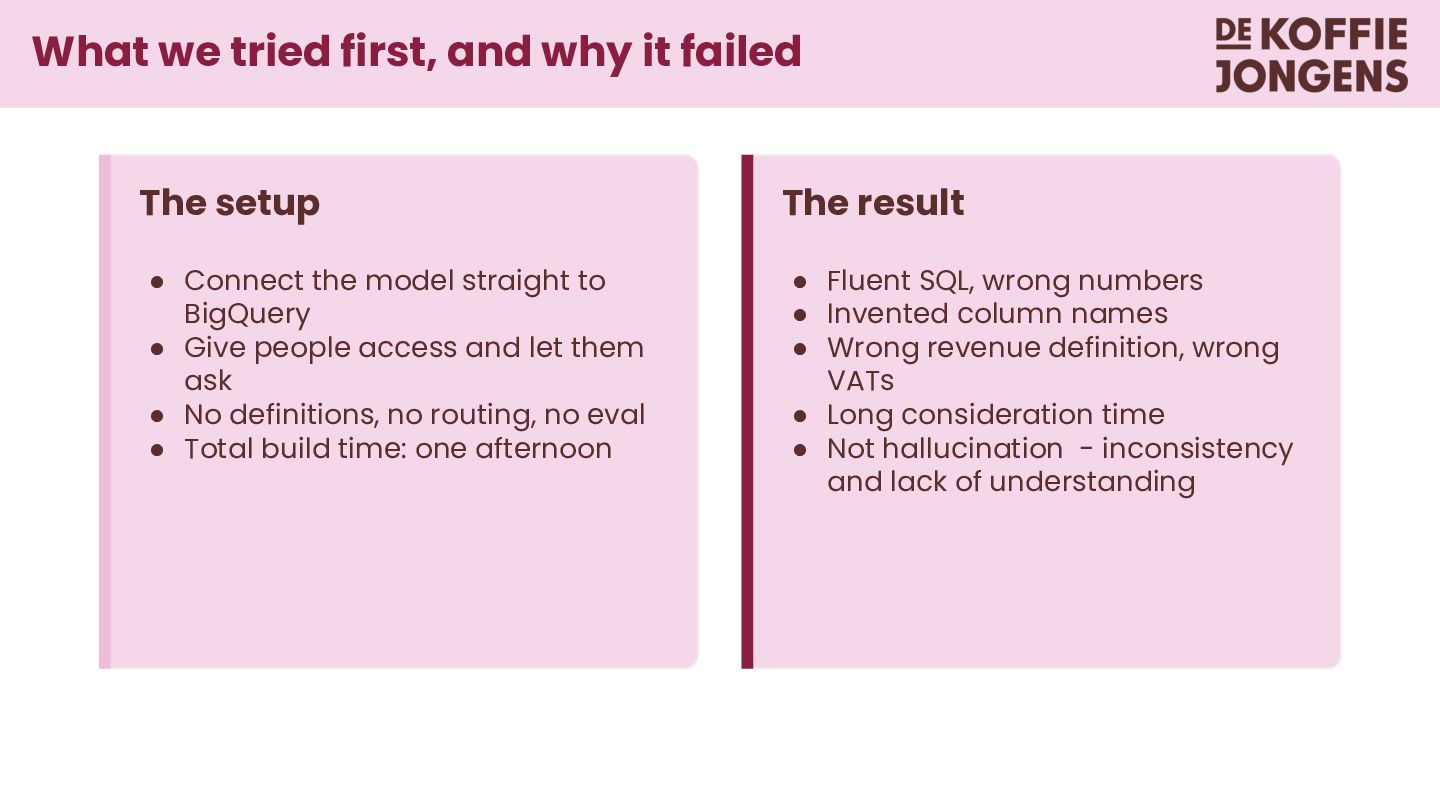
The result • Connect the model straight to BigQuery • Give people access and let them ask • No definitions, no routing, no eval • Total build time: one afternoon • Fluent SQL, wrong numbers • Invented column names • Wrong revenue definition, wrong VATs • Long consideration time • Not hallucination - inconsistency and lack of understanding
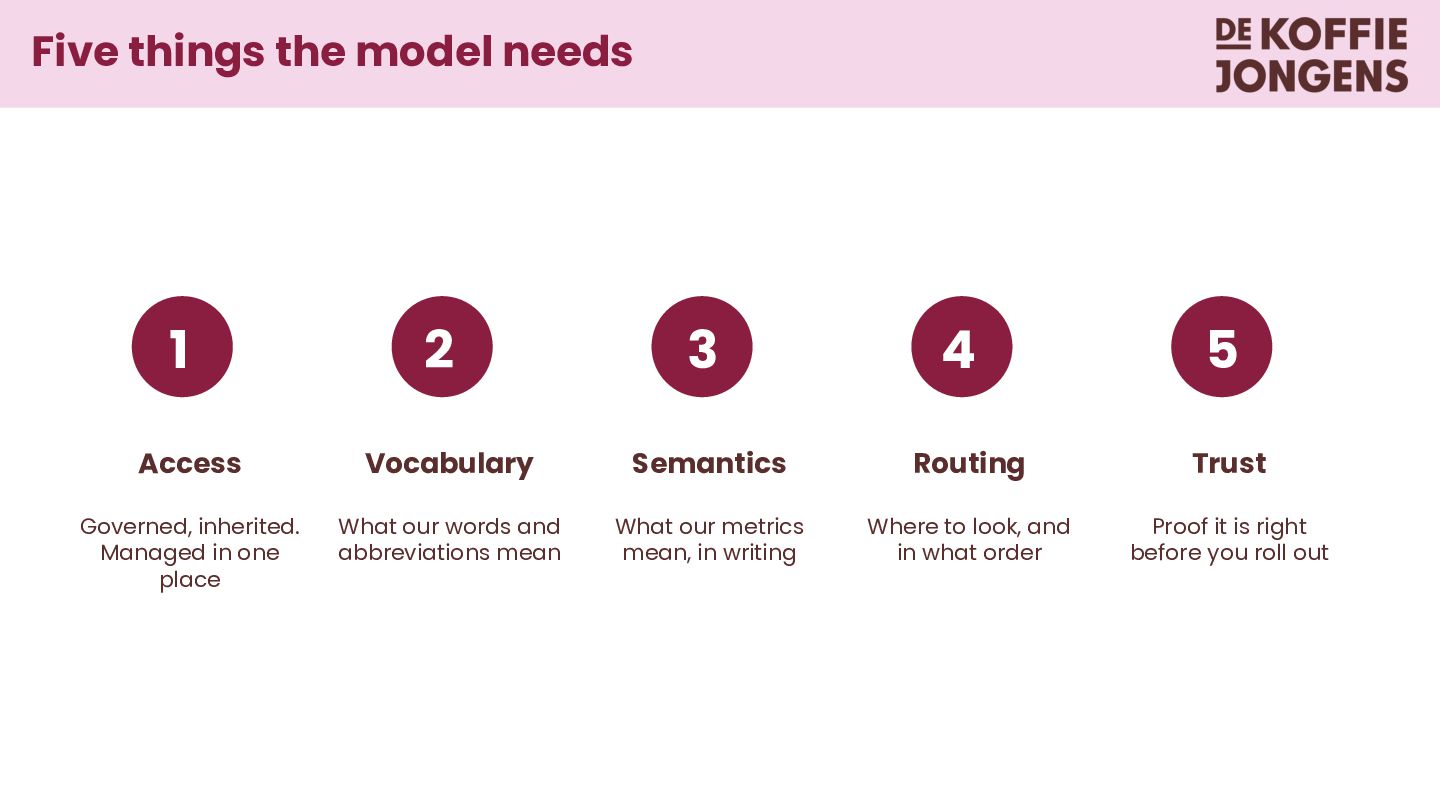
Access Vocabulary Semantics Routing Trust Governed, inherited. Managed in one place What our words and abbreviations mean What our metrics mean, in writing Where to look, and in what order Proof it is right before you roll out
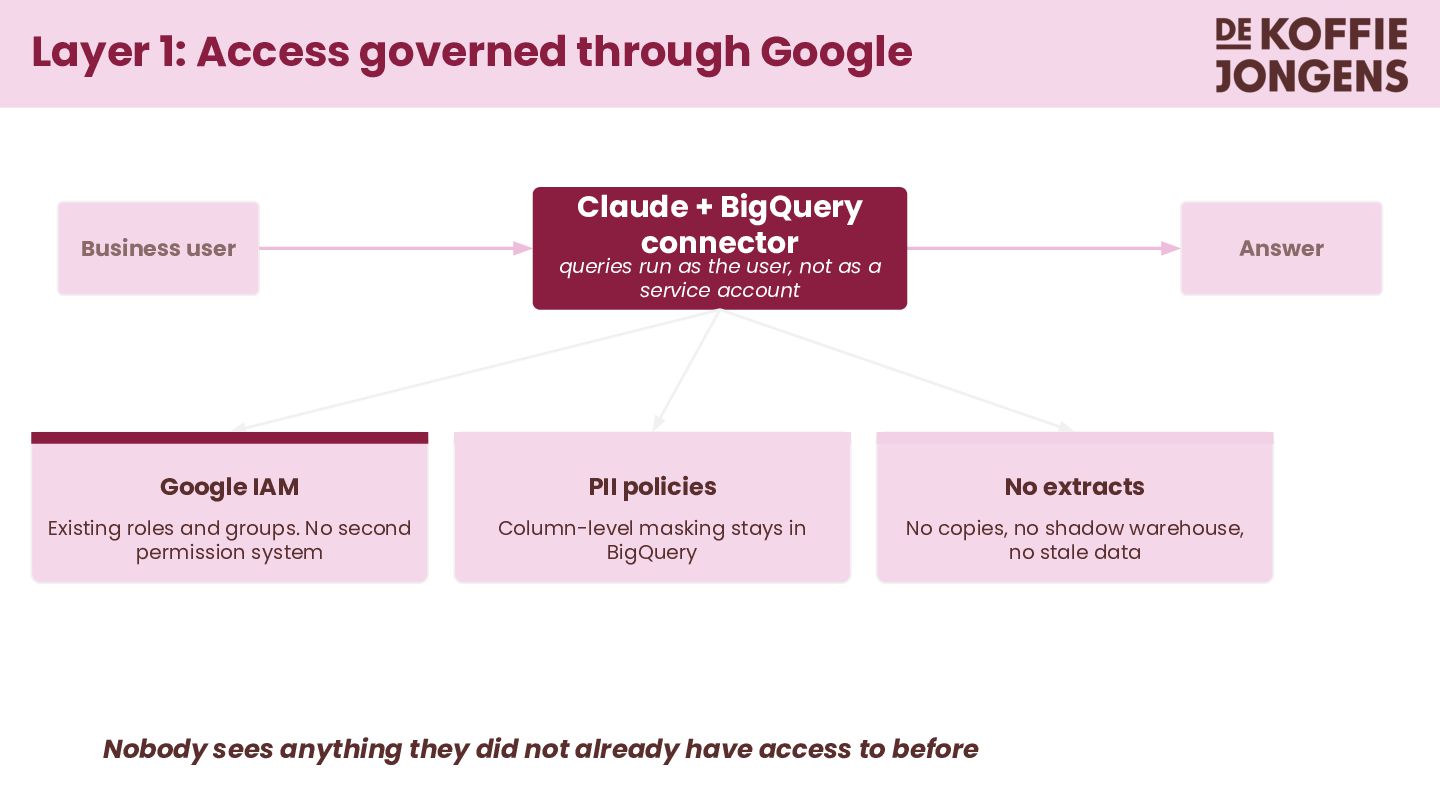
BigQuery connector Answer queries run as the user, not as a service account Google IAM PII policies No extracts Existing roles and groups. No second permission system Column-level masking stays in BigQuery No copies, no shadow warehouse, no stale data Nobody sees anything they did not already have access to before
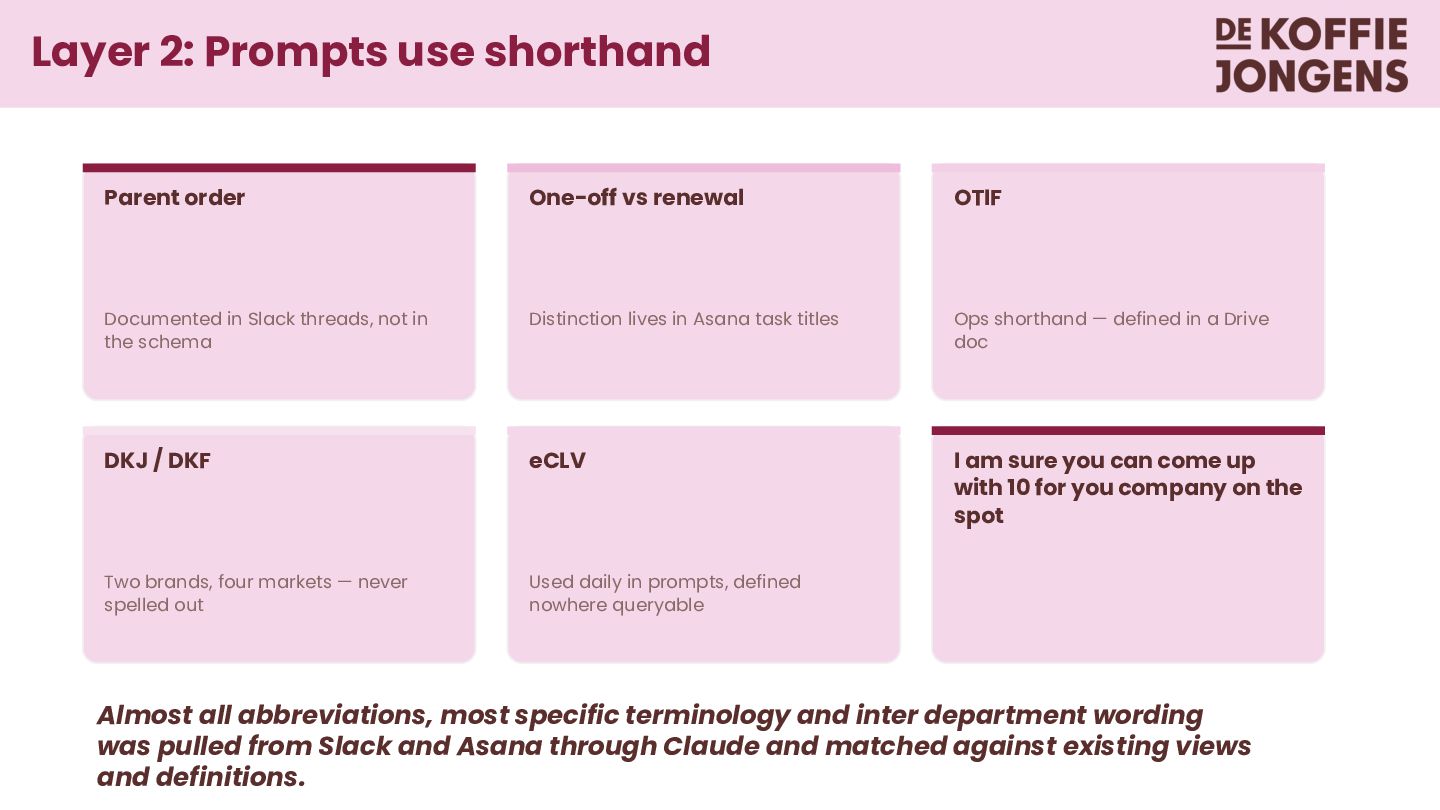
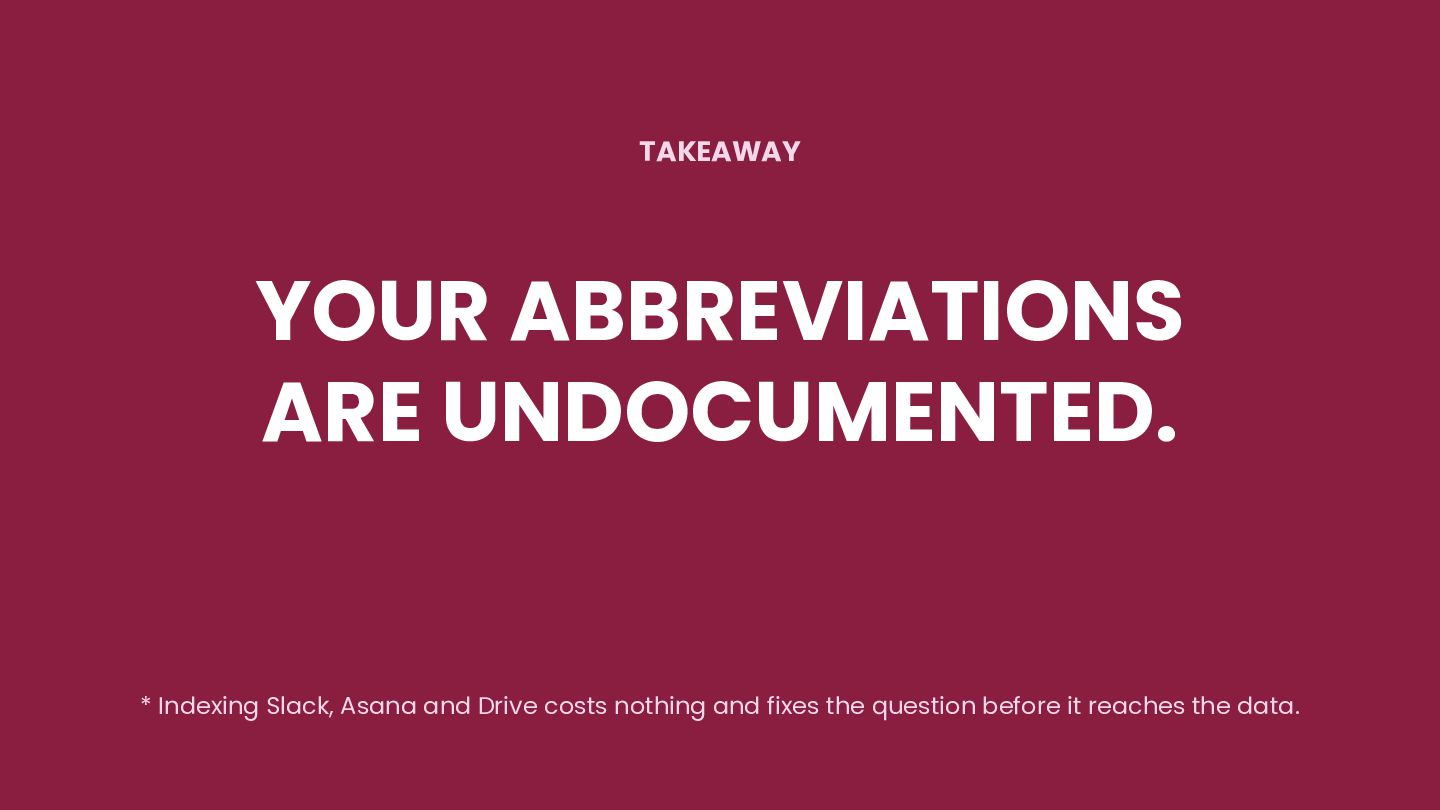
OTIF Documented in Slack threads, not in the schema Distinction lives in Asana task titles Ops shorthand — defined in a Drive doc DKJ / DKF eCLV I am sure you can come up with 10 for you company on the spot Two brands, four markets — never spelled out Used daily in prompts, defined nowhere queryable Almost all abbreviations, most specific terminology and inter department wording was pulled from Slack and Asana through Claude and matched against existing views and definitions.
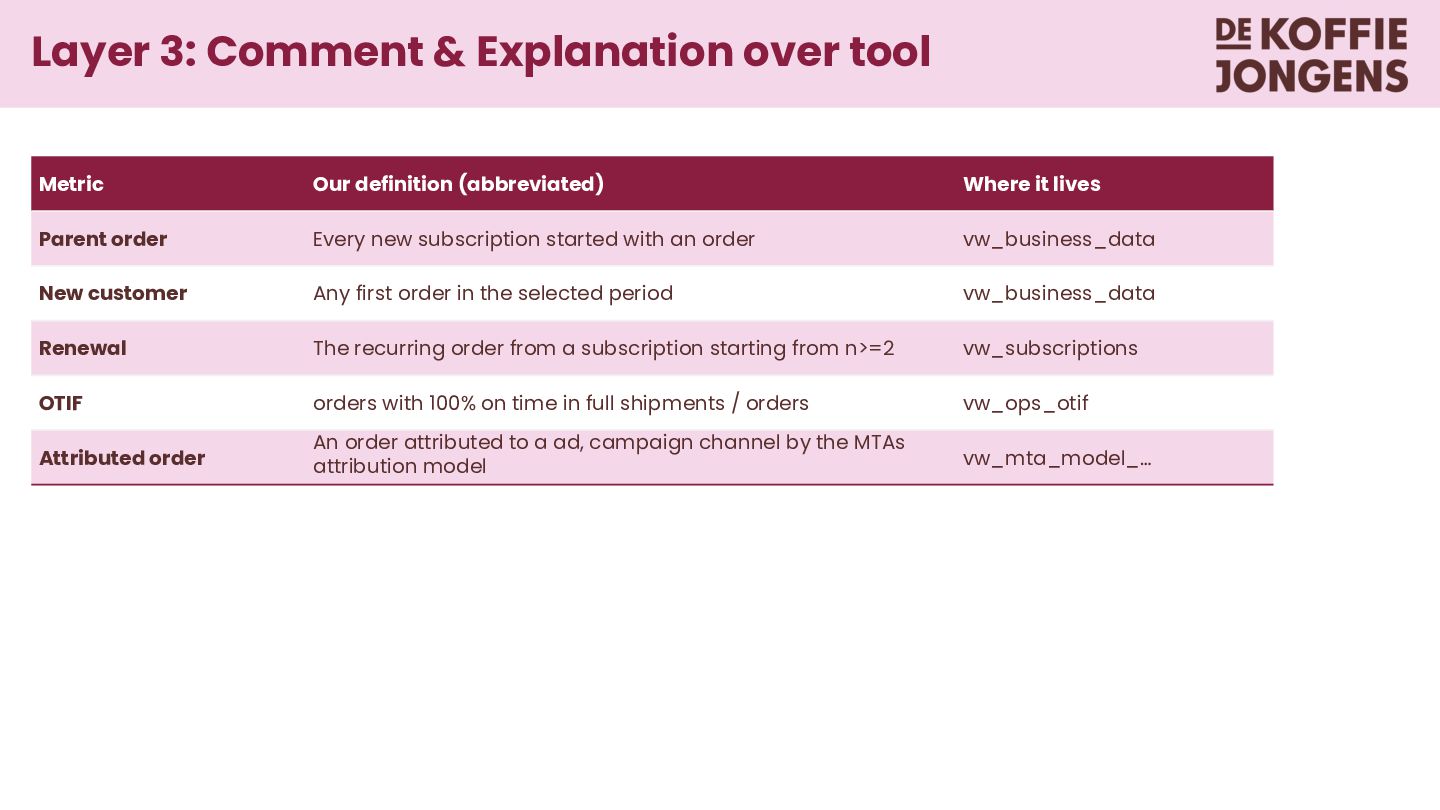
(abbreviated) Where it lives Parent order Every new subscription started with an order vw_business_data New customer Any first order in the selected period vw_business_data Renewal The recurring order from a subscription starting from n>=2 vw_subscriptions OTIF orders with 100% on time in full shipments / orders vw_ops_otif Attributed order An order attributed to a ad, campaign channel by the MTAs attribution model vw_mta_model_…
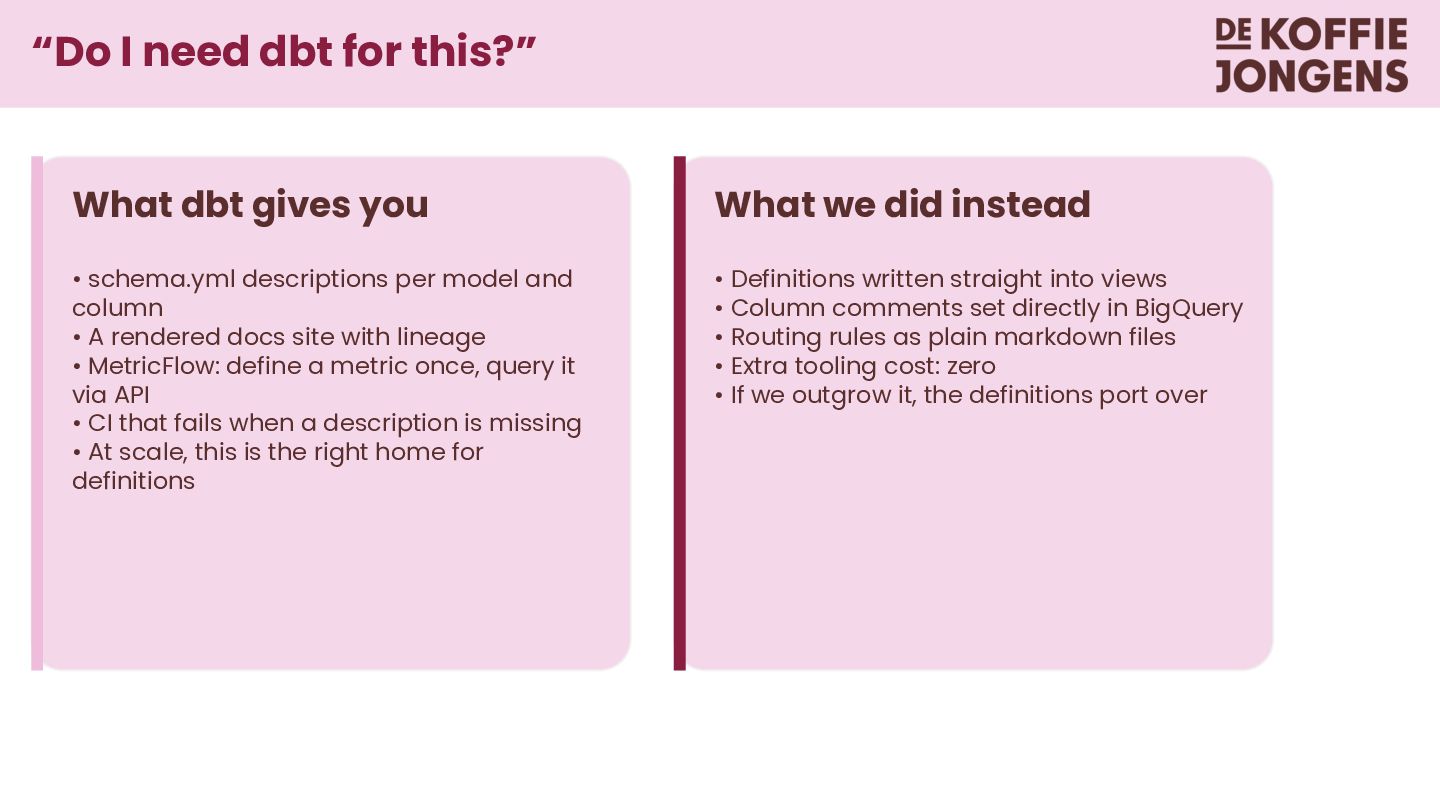
What we did instead • schema.yml descriptions per model and column • A rendered docs site with lineage • MetricFlow: define a metric once, query it via API • CI that fails when a description is missing • At scale, this is the right home for definitions • Definitions written straight into views • Column comments set directly in BigQuery • Routing rules as plain markdown files • Extra tooling cost: zero • If we outgrow it, the definitions port over
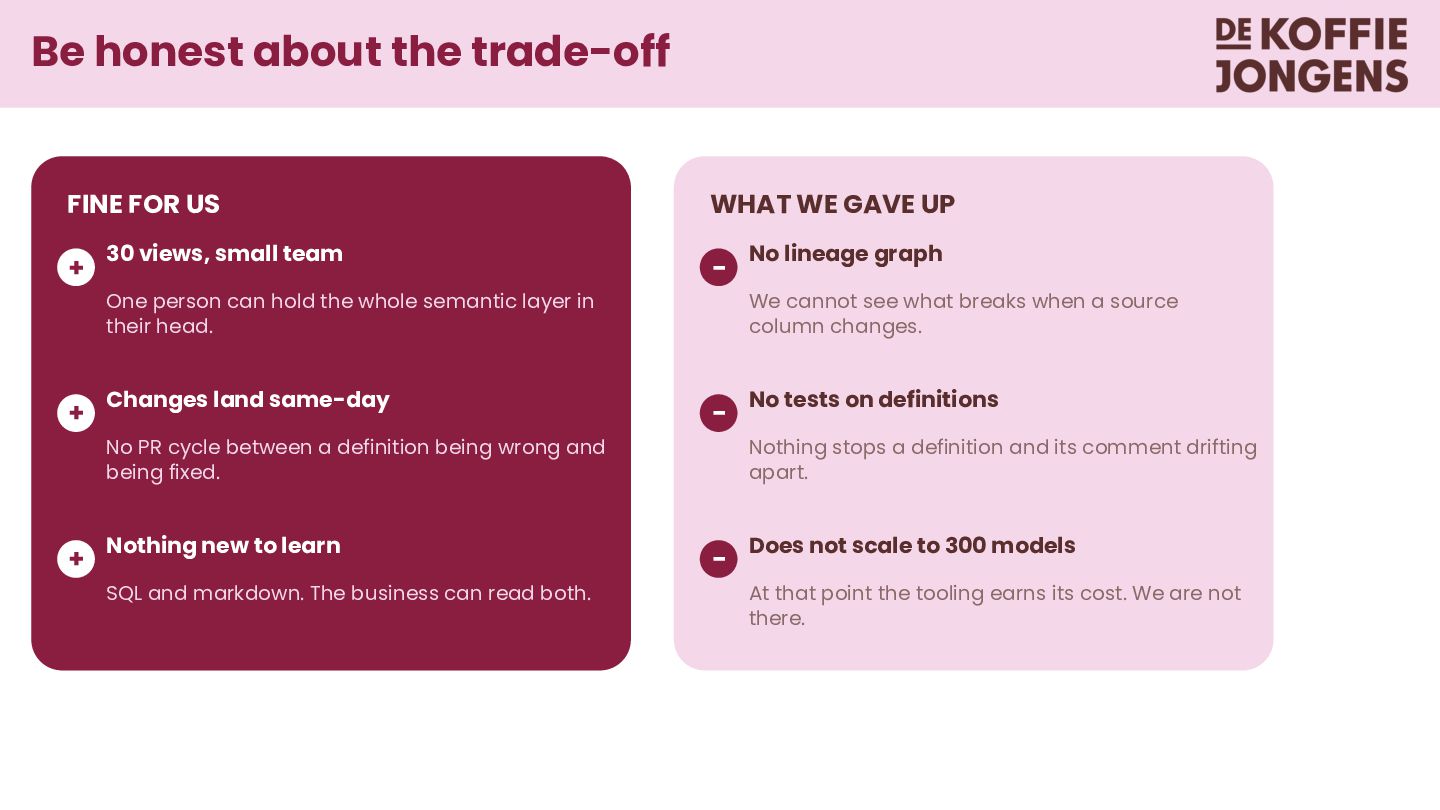
views, small team WHAT WE GAVE UP − One person can hold the whole semantic layer in their head. + Changes land same-day We cannot see what breaks when a source column changes. − No PR cycle between a definition being wrong and being fixed. + Nothing new to learn SQL and markdown. The business can read both. No lineage graph No tests on definitions Nothing stops a definition and its comment drifting apart. − Does not scale to 300 models At that point the tooling earns its cost. We are not there.
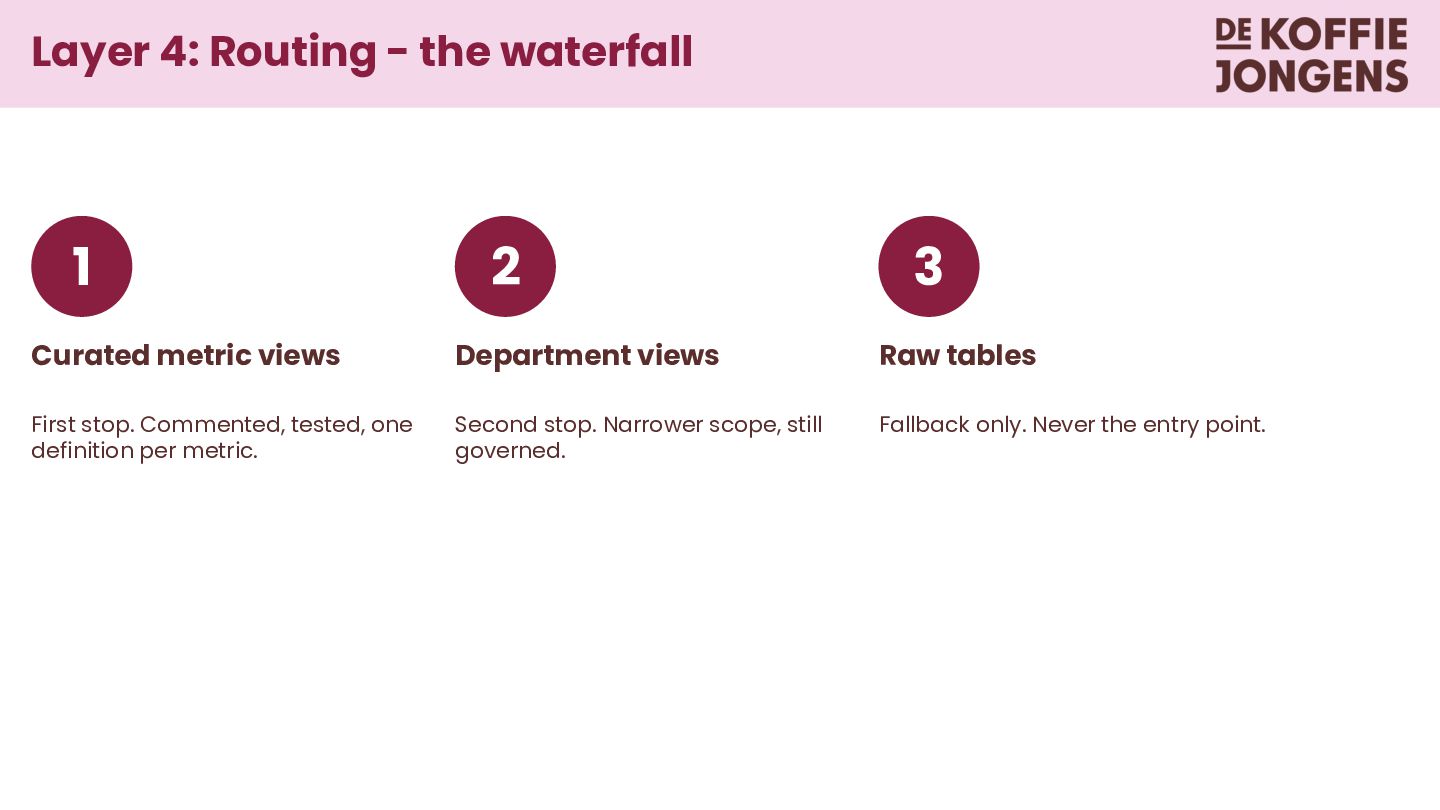
metric views Department views Raw tables First stop. Commented, tested, one definition per metric. Second stop. Narrower scope, still governed. Fallback only. Never the entry point.
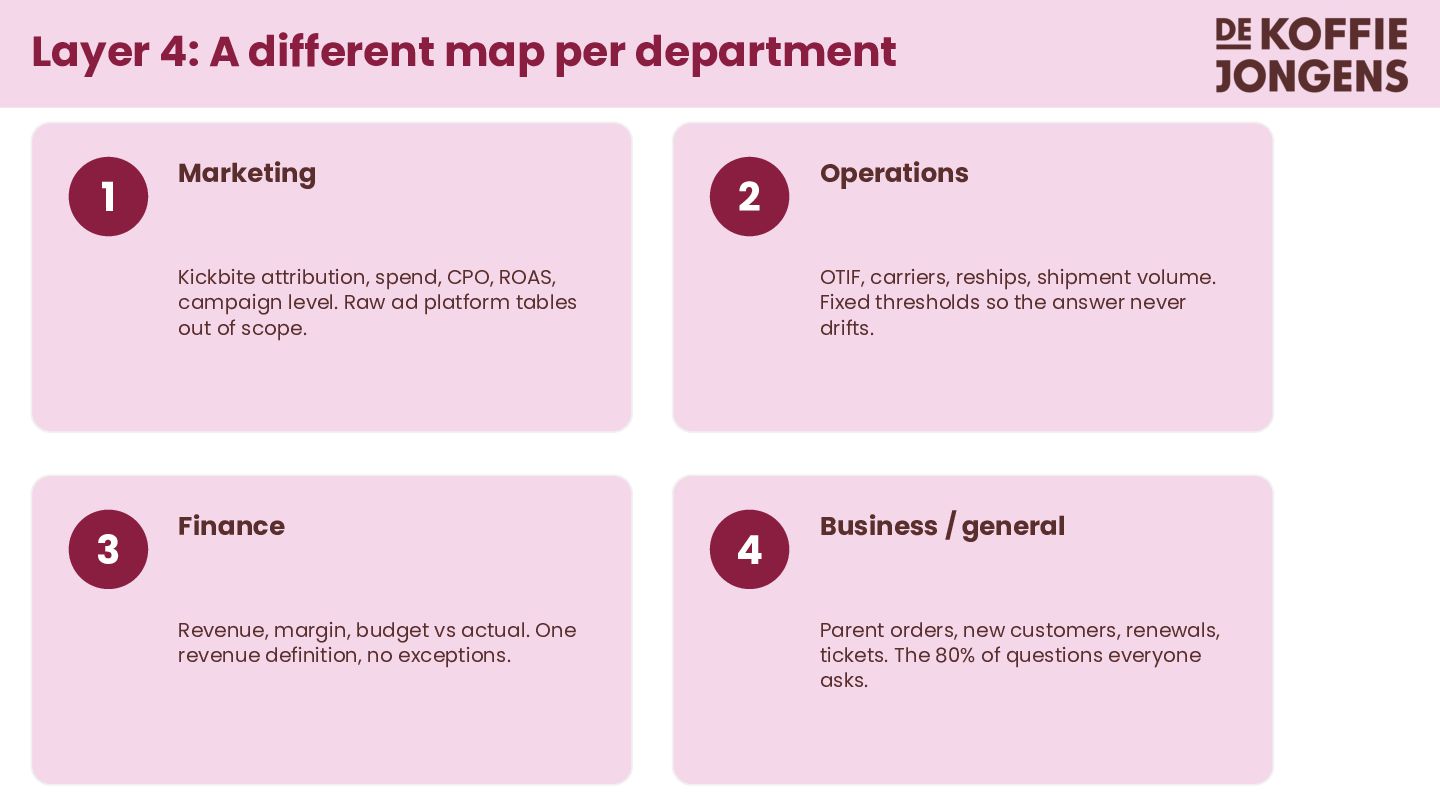
2 Operations Kickbite attribution, spend, CPO, ROAS, campaign level. Raw ad platform tables out of scope. OTIF, carriers, reships, shipment volume. Fixed thresholds so the answer never drifts. Finance Business / general Revenue, margin, budget vs actual. One revenue definition, no exceptions. 4 Parent orders, new customers, renewals, tickets. The 80% of questions everyone asks.
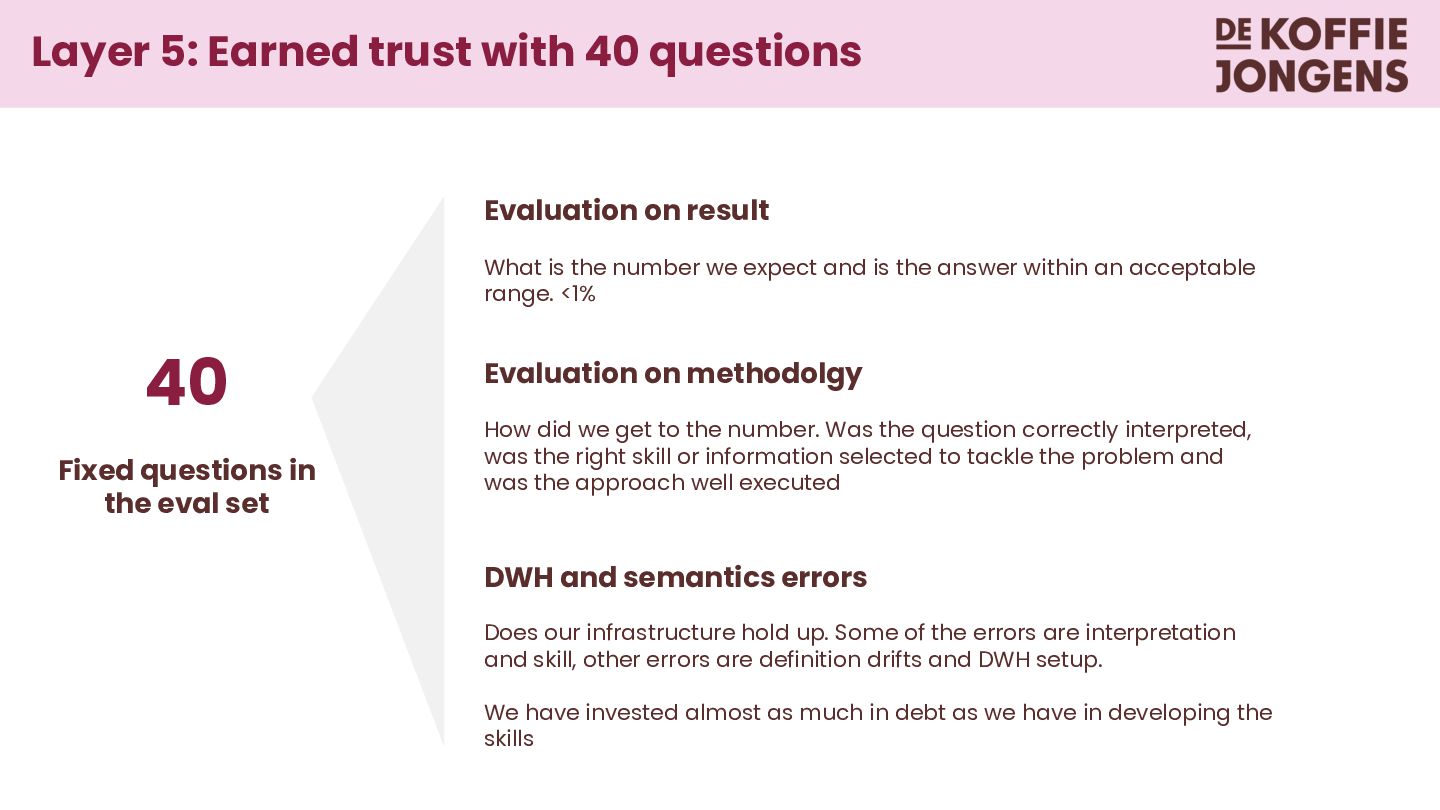
What is the number we expect and is the answer within an acceptable range. <1% 40 Fixed questions in the eval set Evaluation on methodolgy How did we get to the number. Was the question correctly interpreted, was the right skill or information selected to tackle the problem and was the approach well executed DWH and semantics errors Does our infrastructure hold up. Some of the errors are interpretation and skill, other errors are definition drifts and DWH setup. We have invested almost as much in debt as we have in developing the skills
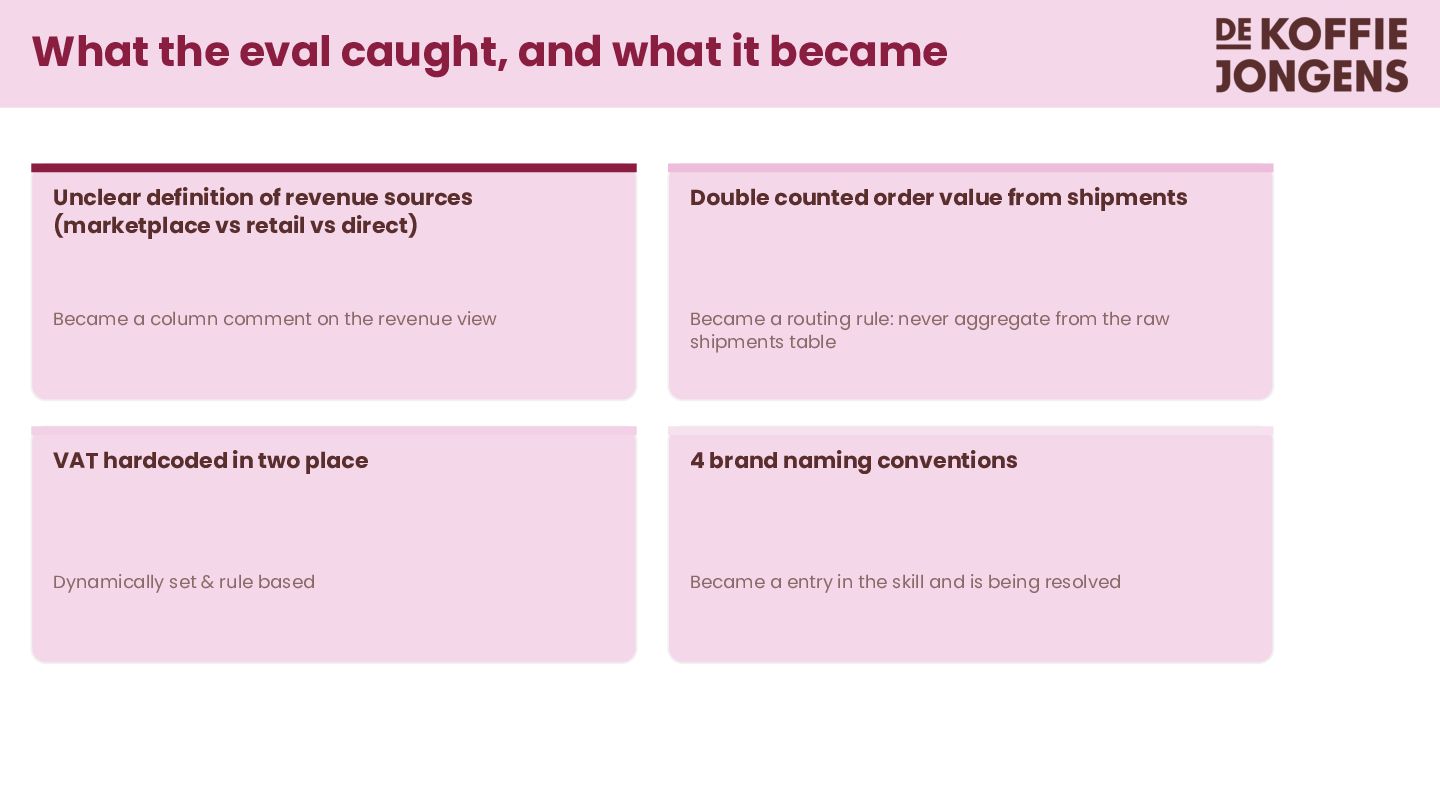
of revenue sources (marketplace vs retail vs direct) Double counted order value from shipments Became a column comment on the revenue view Became a routing rule: never aggregate from the raw shipments table VAT hardcoded in two place 4 brand naming conventions Dynamically set & rule based Became a entry in the skill and is being resolved
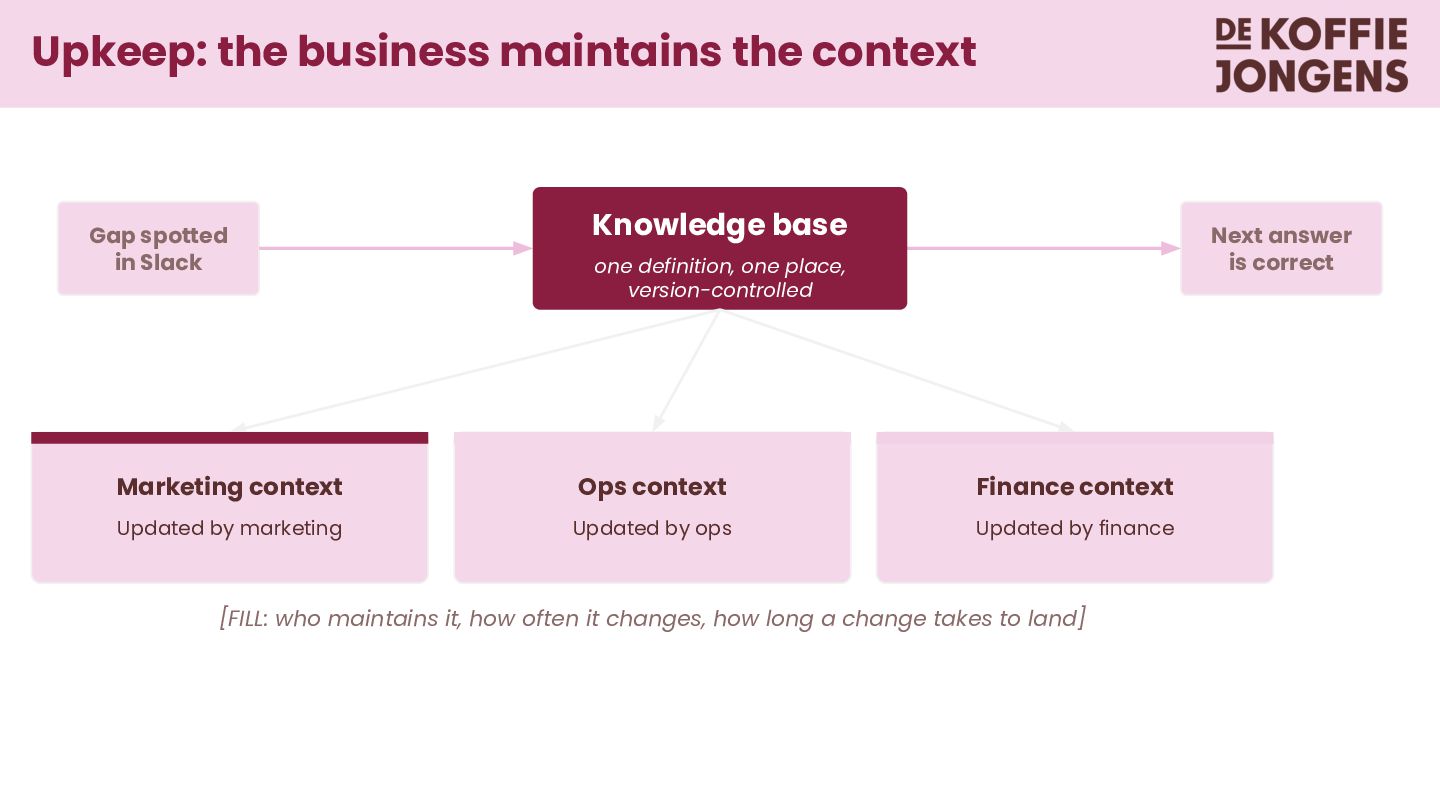
Knowledge base Next answer is correct one definition, one place, version-controlled Marketing context Ops context Finance context Updated by marketing Updated by ops Updated by finance [FILL: who maintains it, how often it changes, how long a change takes to land]
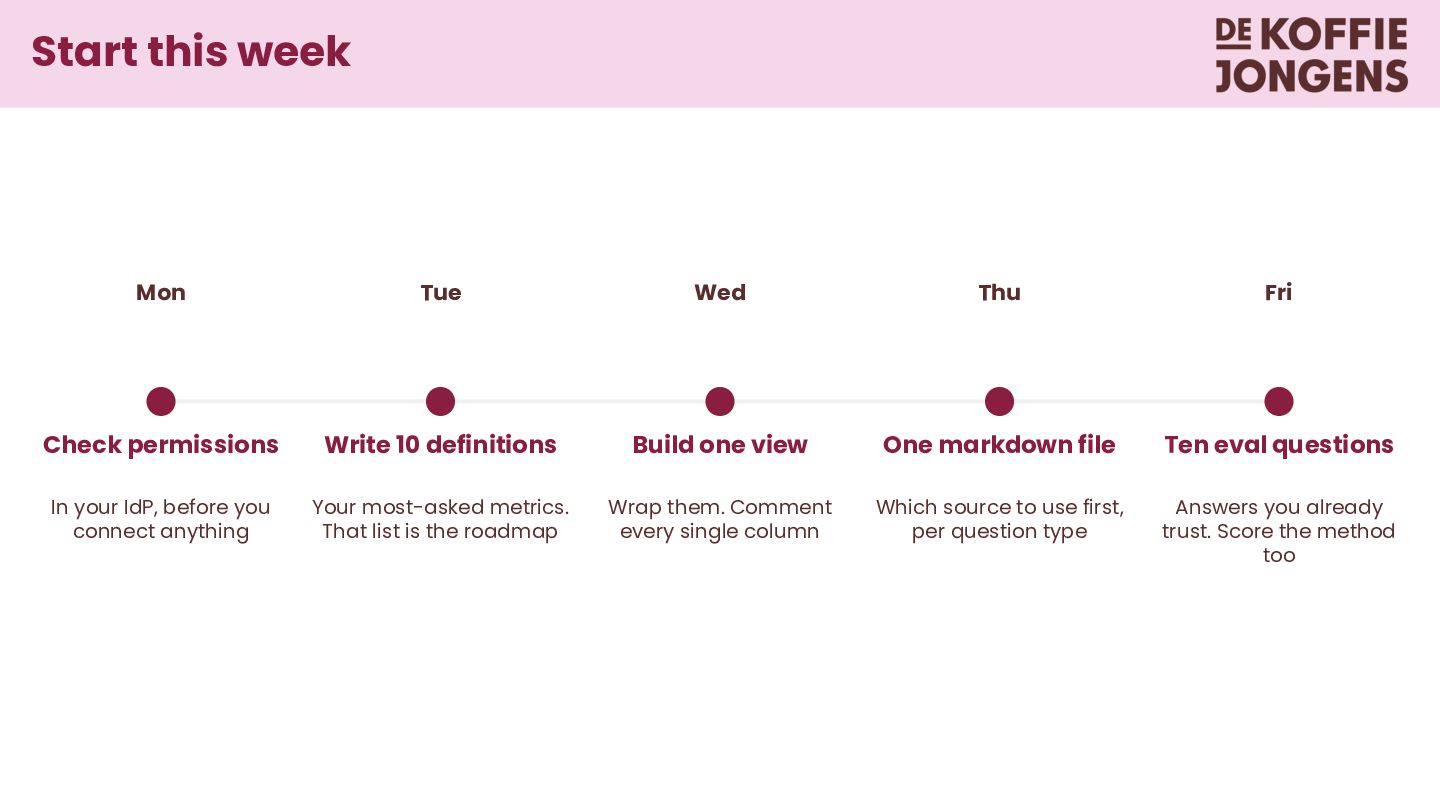
Write 10 definitions Build one view One markdown file Ten eval questions In your IdP, before you connect anything Your most-asked metrics. That list is the roadmap Wrap them. Comment every single column Which source to use first, per question type Answers you already trust. Score the method too
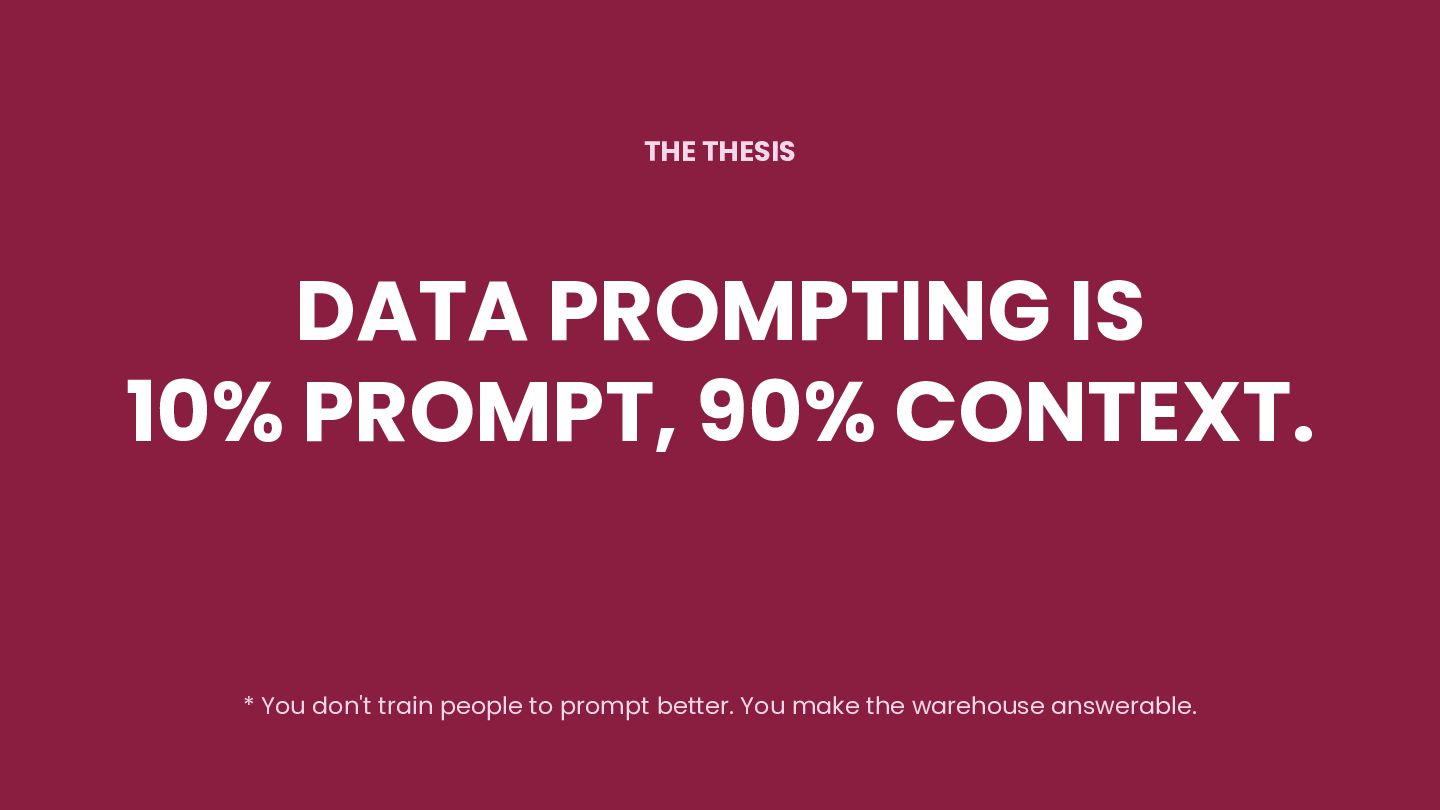
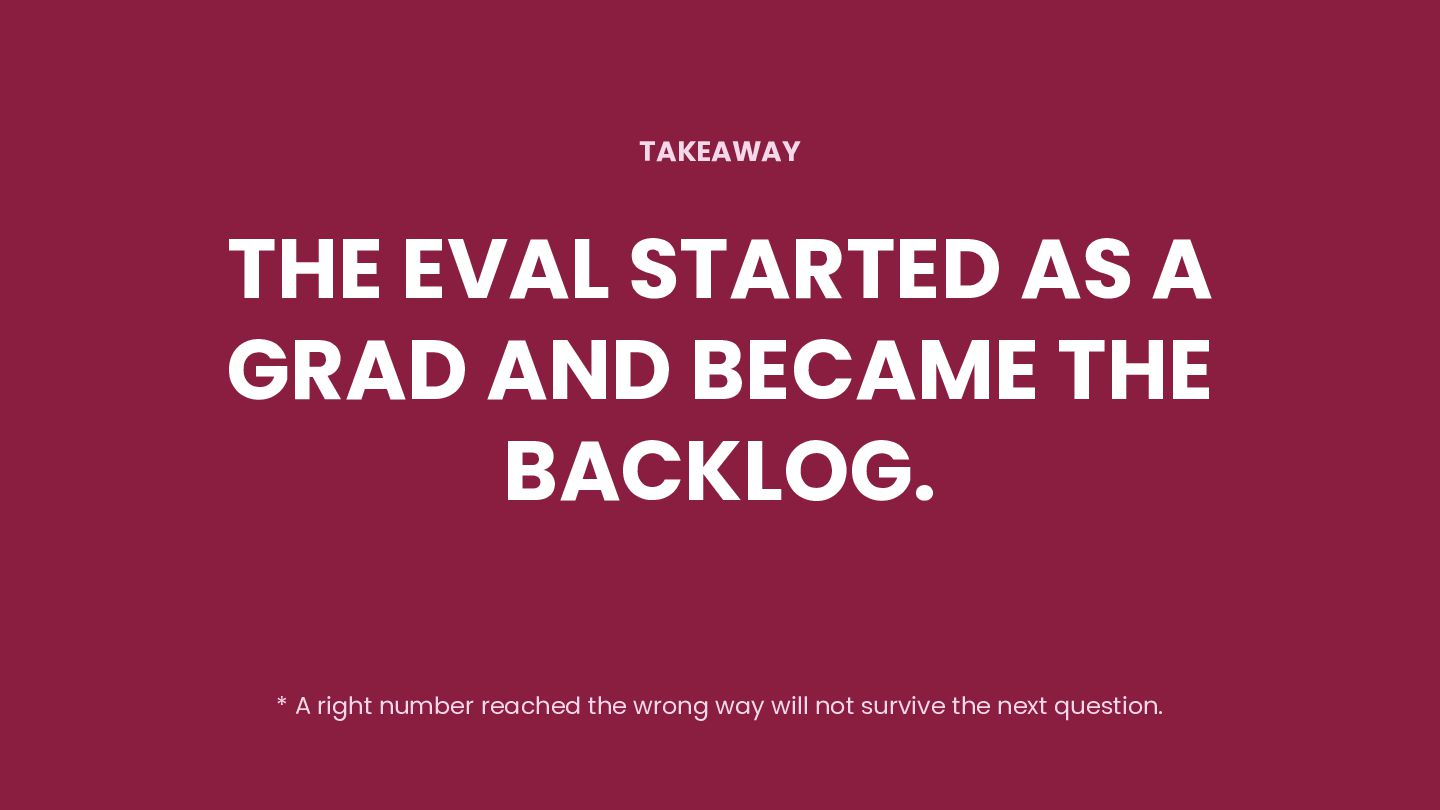
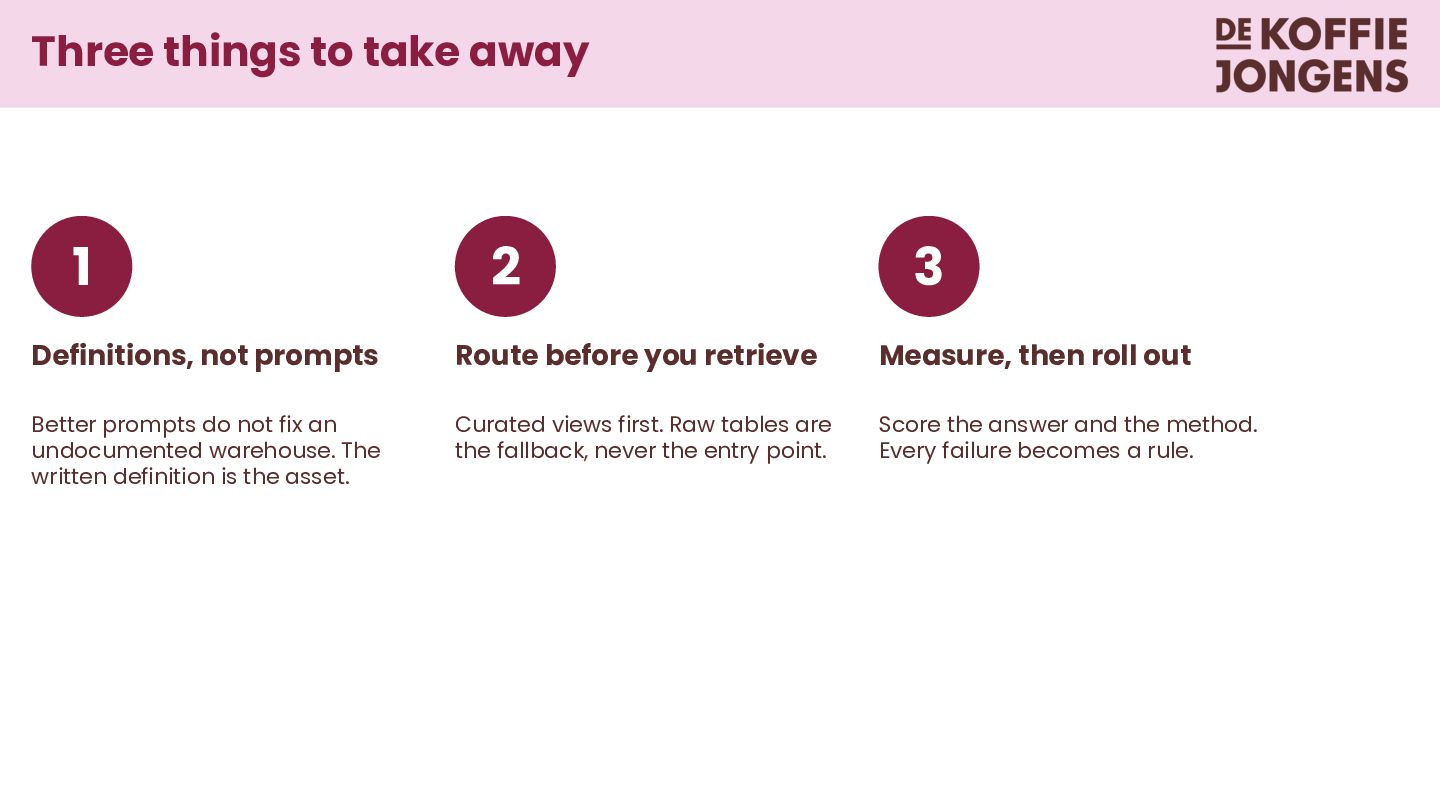
prompts Route before you retrieve Measure, then roll out Better prompts do not fix an undocumented warehouse. The written definition is the asset. Curated views first. Raw tables are the fallback, never the entry point. Score the answer and the method. Every failure becomes a rule.


 mark3t1ng
 wayneb77
 gr2m
gr2m
 stuffmc
 eileencodes
 mfonobong
 mclloyd
 bkeepers
 geshan
 szymonslowik
 tammyeverts
 kneath
 portentint


![Where we are now [FILL] [FILL] [FILL] €0 Questions per](https://files.speakerdeck.com/presentations/05c73ad5ae8b4ac8b19e9e2a0c67c329/slide_21.jpg)
![Questions? Lukas Michalitsch, [email protected]](https://files.speakerdeck.com/presentations/05c73ad5ae8b4ac8b19e9e2a0c67c329/slide_24.jpg)