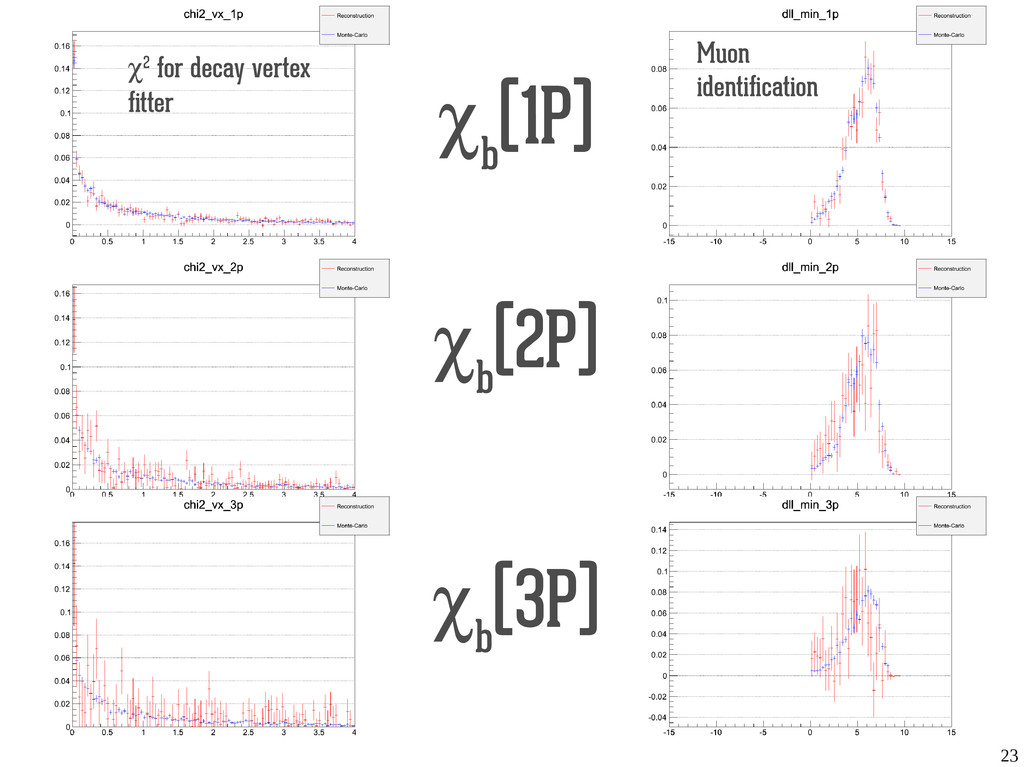
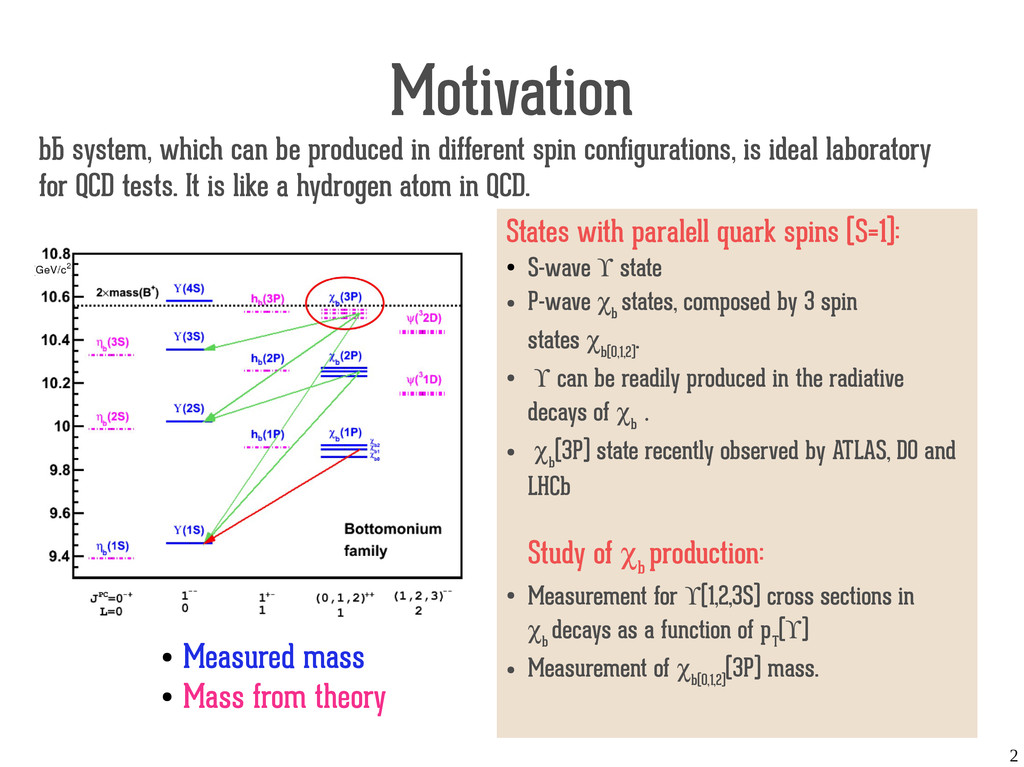
spin configurations, is ideal laboratory ̄ for QCD tests. It is like a hydrogen atom in QCD. States with paralell quark spins (S=1): • S-wave ϒ state • P-wave χ b states, composed by 3 spin states χ b(0,1,2) . • ϒ can be readily produced in the radiative decays of χ b . • χ b (3P) state recently observed by ATLAS, D0 and LHCb Study of χ b production: • Measurement for ϒ(1,2,3S) cross sections in χ b decays as a function of p T (ϒ) • Measurement of χ b(0,1,2) (3P) mass. • Measured mass • Mass from theory
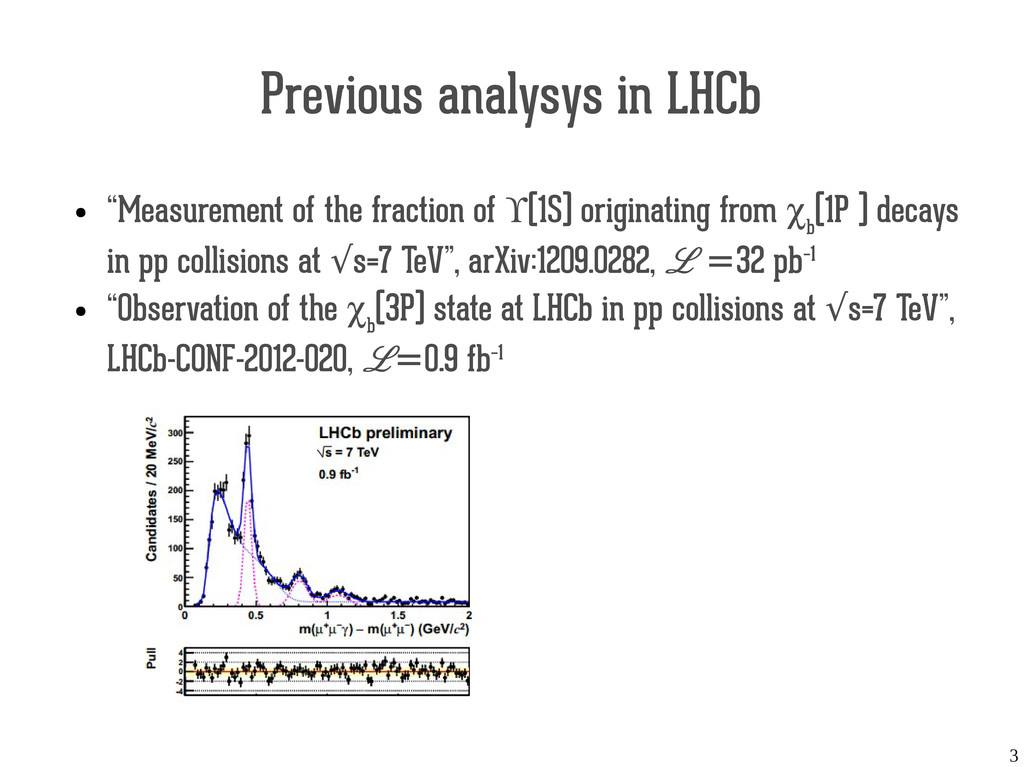
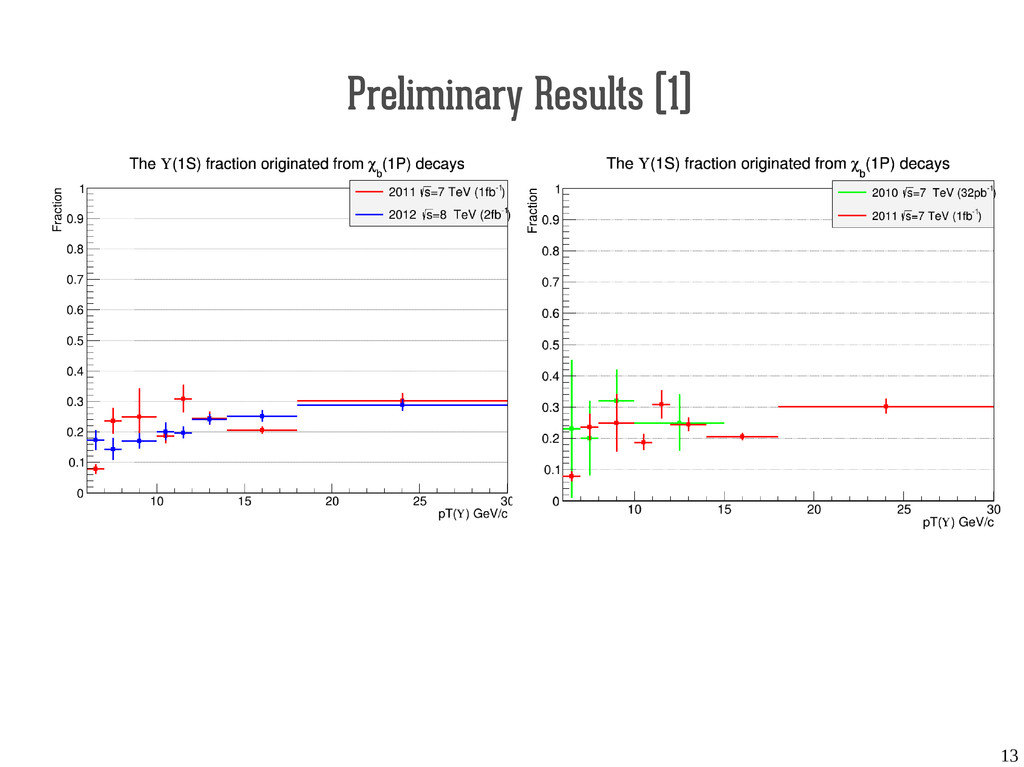
of ϒ(1S) originating from χ b (1P ) decays in pp collisions at s=7 TeV”, arXiv:1209.0282, √ L =32 pb−1 • “Observation of the χ b (3P) state at LHCb in pp collisions at s=7 TeV”, √ LHCb-CONF-2012-020, L=0.9 fb−1
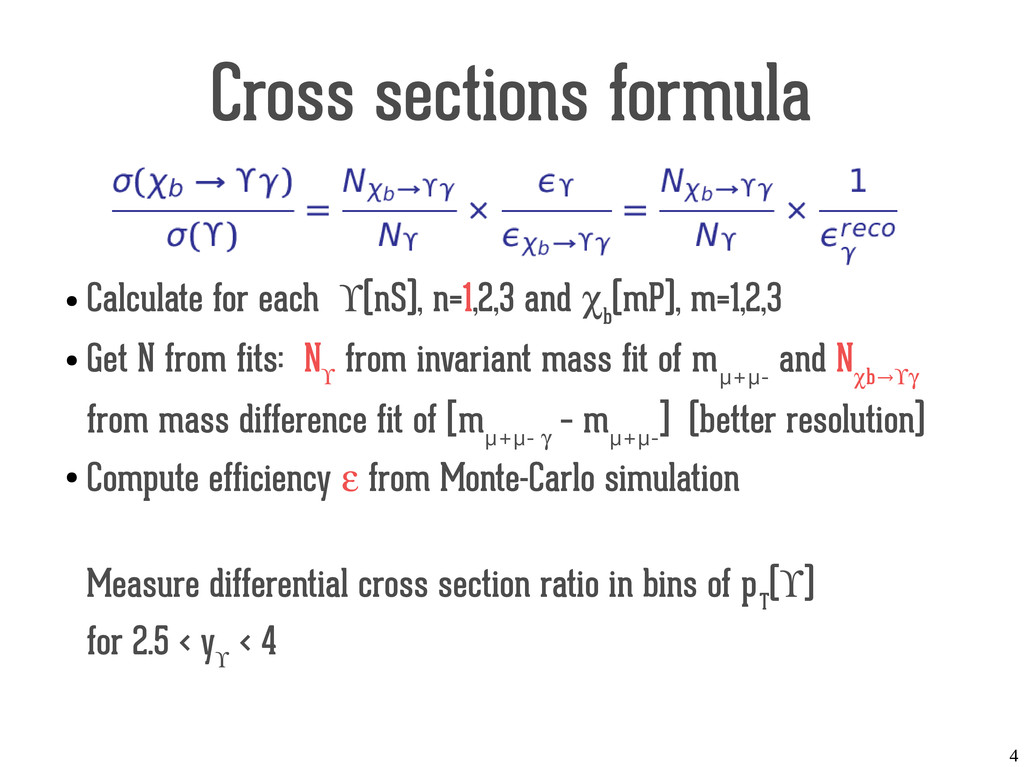
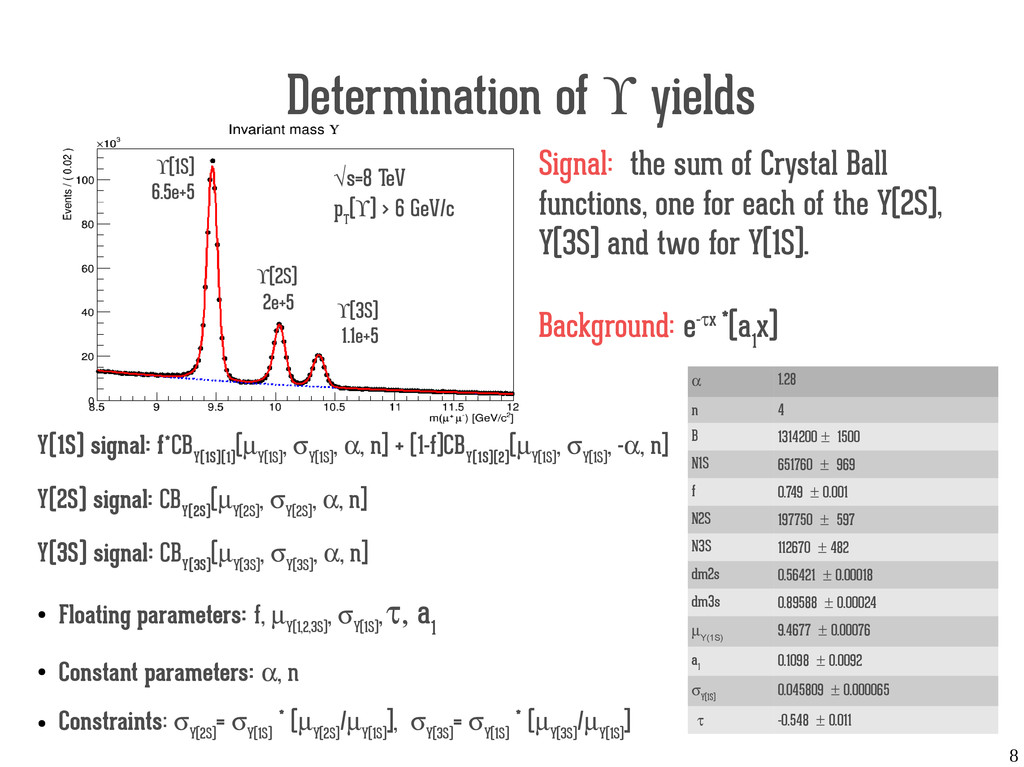
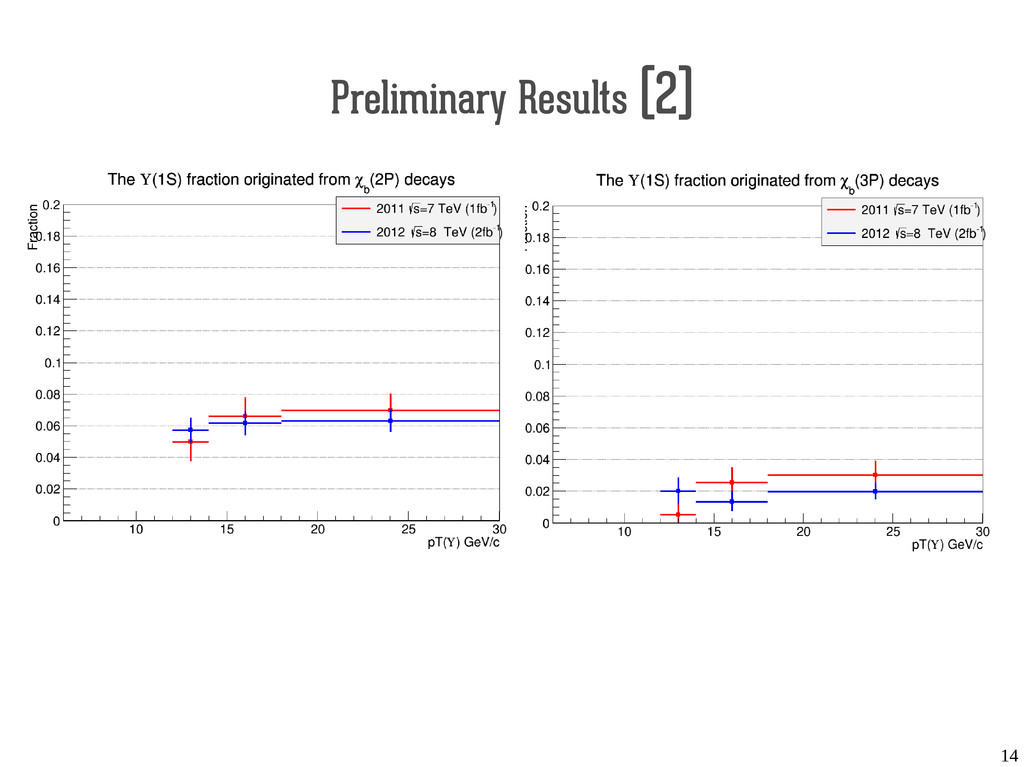
and χ b (mP), m=1,2,3 • Get N from fits: N ϒ from invariant mass fit of m µ+µ- and N χb→ϒγ from mass difference fit of [m µ+µ- γ – m µ+µ- ] (better resolution) • Compute efficiency ε from Monte-Carlo simulation Measure differential cross section ratio in bins of p T (ϒ) for 2.5 < y ϒ < 4
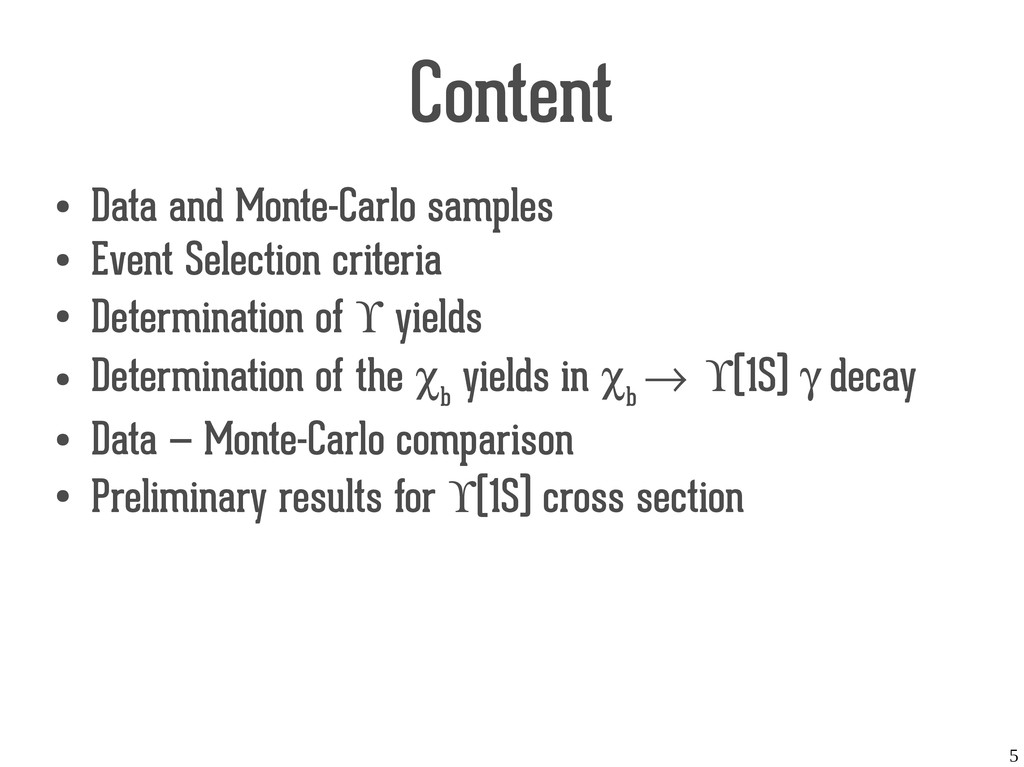
criteria • Determination of ϒ yields • Determination of the χ b yields in χ b → ϒ(1S) γ decay • Data — Monte-Carlo comparison • Preliminary results for ϒ(1S) cross section
20r1, WGBandQSelection3, BOTTOM.MDST. L=1089 pb-1 • √s=8 TeV: Reco14, Stripping 20, WGBandQSelection3, BOTTOM.MDST. L=2011 pb-1 • Monte Carlo: MC11a, Reco12a, inclusive χ b0,1,2 (1,2,3P) decays. 5E+5 events for each χ b state and magnet direction. — χ b0,1,2 (2,3P) could not be generated directly, so they are defined as χ b1,2 (1P), but with redefined mass and decay channels.
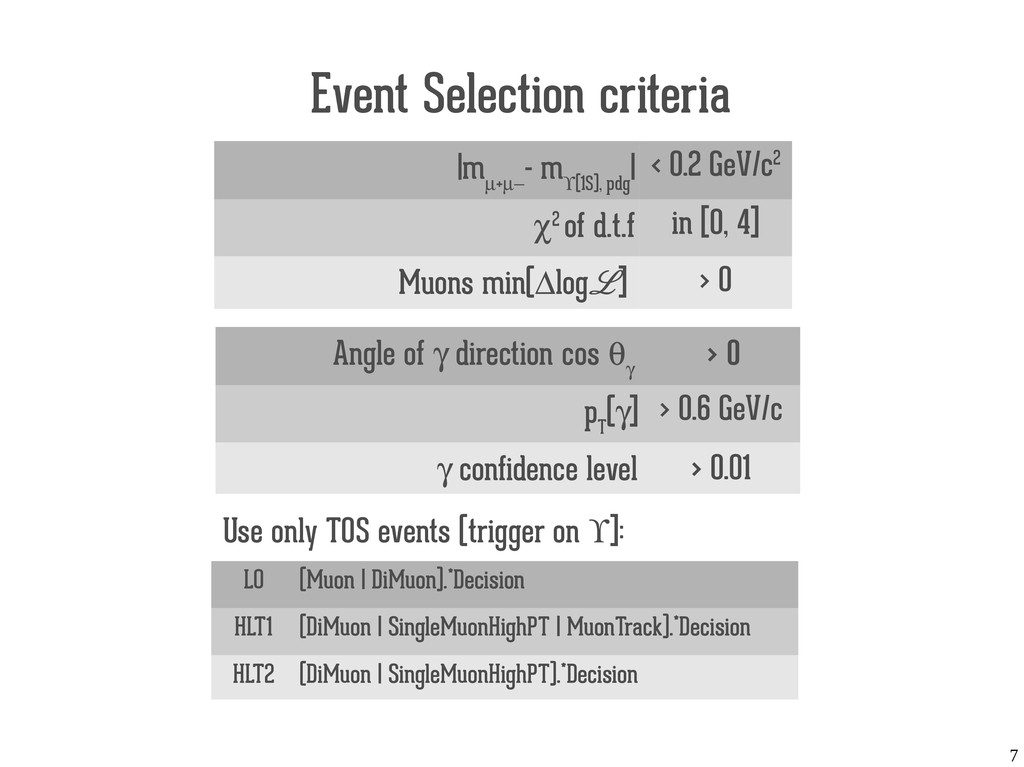
| < 0.2 GeV/c2 χ2 of d.t.f in [0, 4] Muons min(∆logL] > 0 Angle of γ direction cos θ γ > 0 p T (γ] > 0.6 GeV/c γ confidence level > 0.01 Use only TOS events (trigger on ϒ]: L0 (Muon | DiMuon).*Decision HLT1 (DiMuon | SingleMuonHighPT | MuonTrack).*Decision HLT2 (DiMuon | SingleMuonHighPT).*Decision
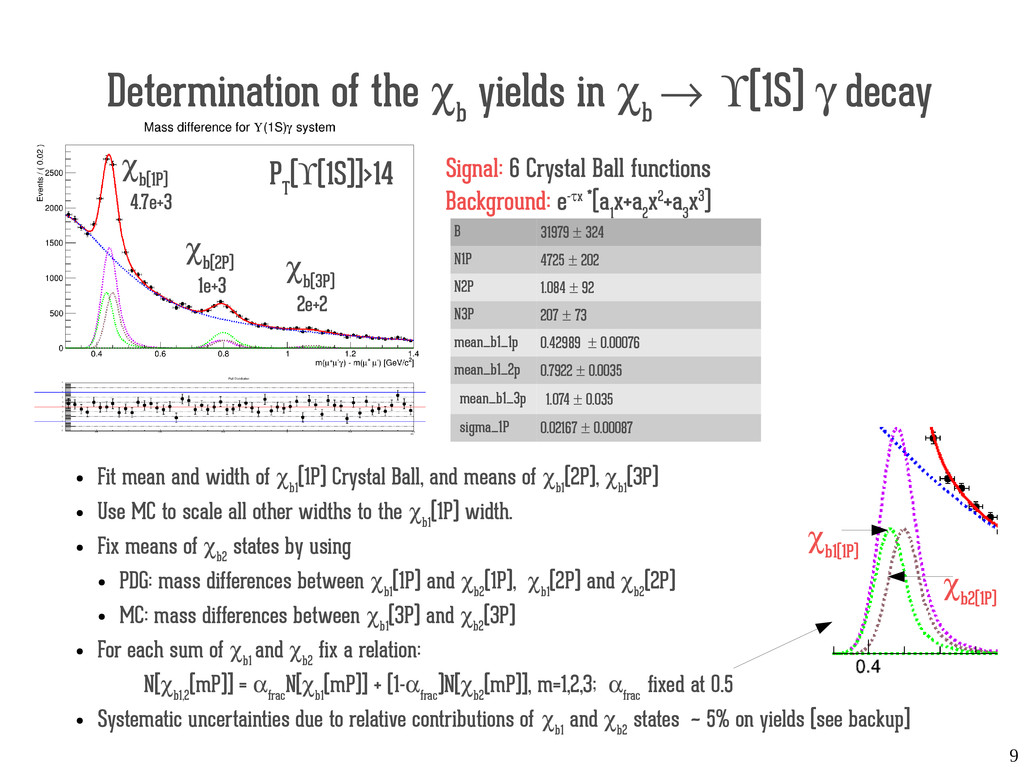
→ ϒ(1S) γ decay χ b(1P) Signal: 6 Crystal Ball functions Background: e-τx *(a 1 x+a 2 x2+a 3 x3) • Fit mean and width of χ b1 (1P) Crystal Ball, and means of χ b1 (2P), χ b1 (3P) • Use MC to scale all other widths to the χ b1 (1P) width. • Fix means of χ b2 states by using • PDG: mass differences between χ b1 (1P) and χ b2 (1P), χ b1 (2P) and χ b2 (2P) • MC: mass differences between χ b1 (3P) and χ b2 (3P) • For each sum of χ b1 and χ b2 fix a relation: N[χ b1,2 (mP)] = α frac N[χ b1 (mP)] + (1-α frac )N[χ b2 (mP)], m=1,2,3; α frac fixed at 0.5 • Systematic uncertainties due to relative contributions of χ b1 and χ b2 states ~ 5% on yields (see backup] P T (ϒ(1S)]>14 χ b(2P) χ b(3P) χ b1(1P) χ b2(1P) 4.7e+3 1e+3 2e+2 B 31979 ± 324 N1P 4725 ± 202 N2P 1.084 ± 92 N3P 207 ± 73 mean_b1_1p 0.42989 ± 0.00076 mean_b1_2p 0.7922 ± 0.0035 mean_b1_3p 1.074 ± 0.035 sigma_1P 0.02167 ± 0.00087
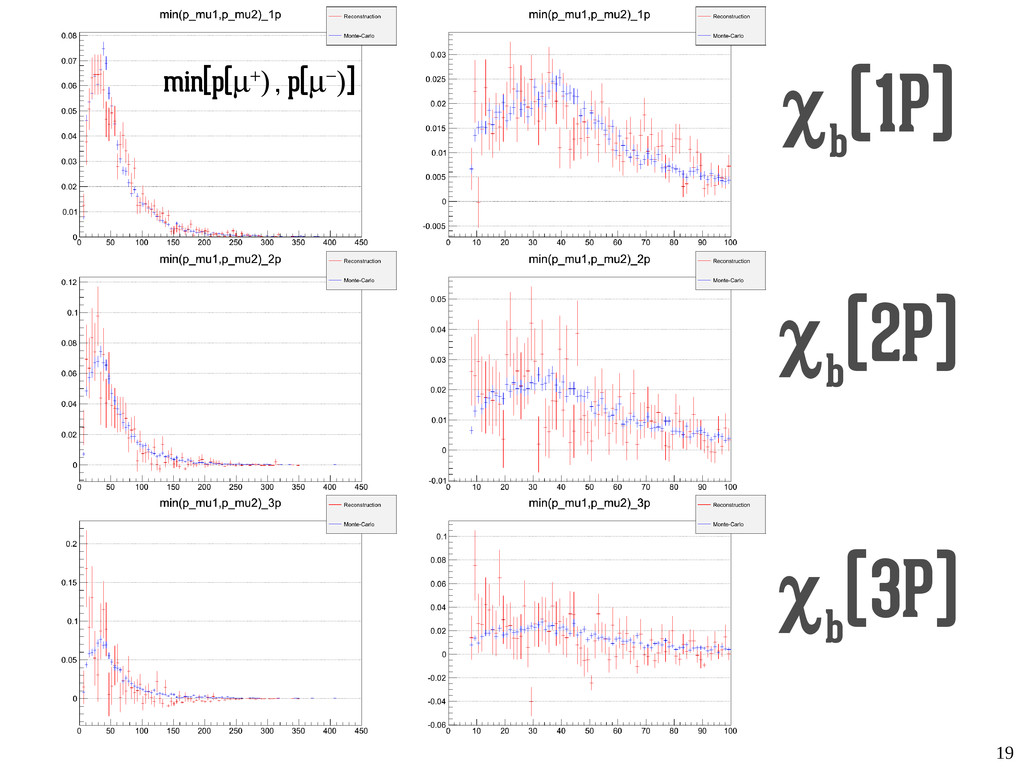
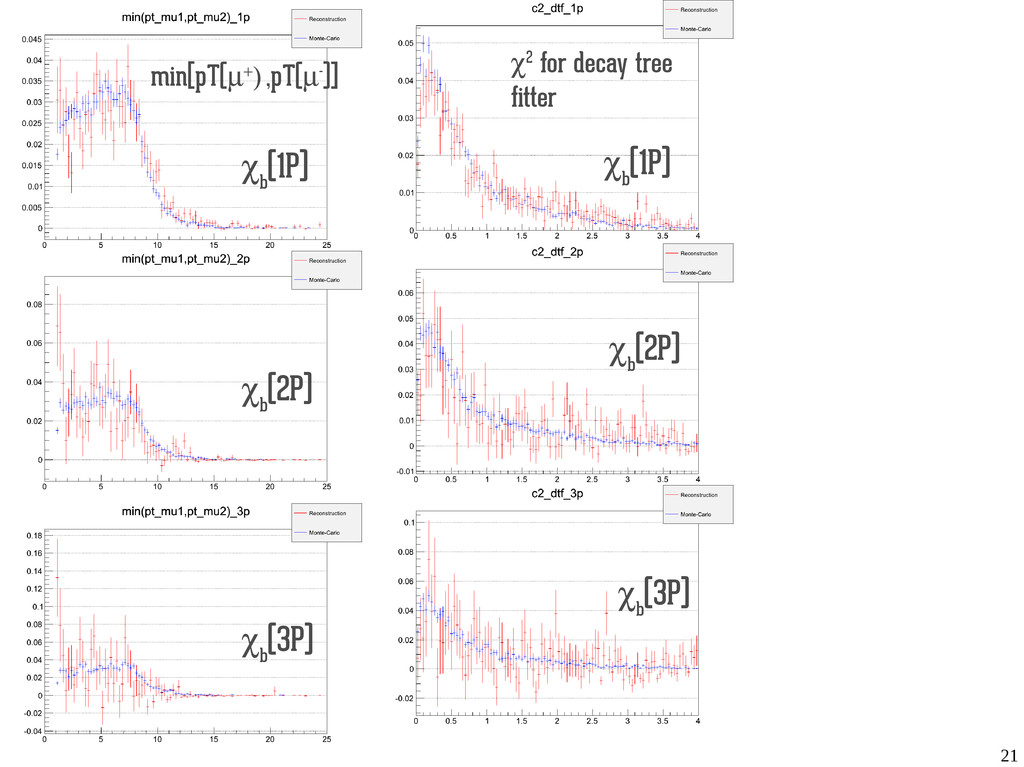
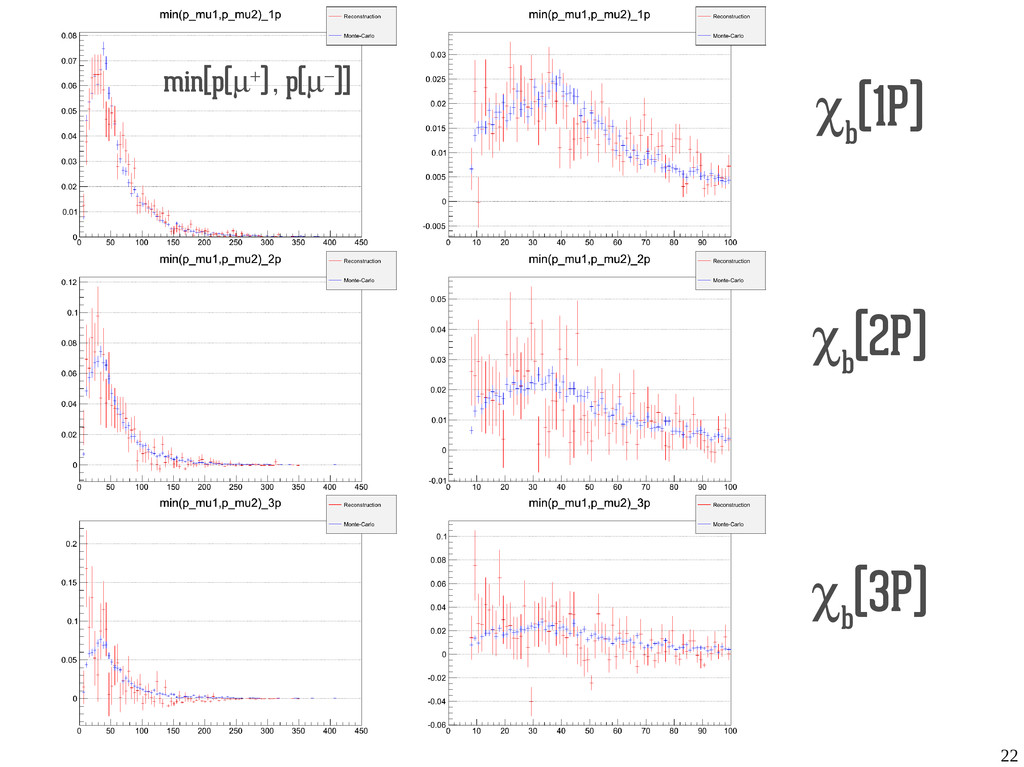
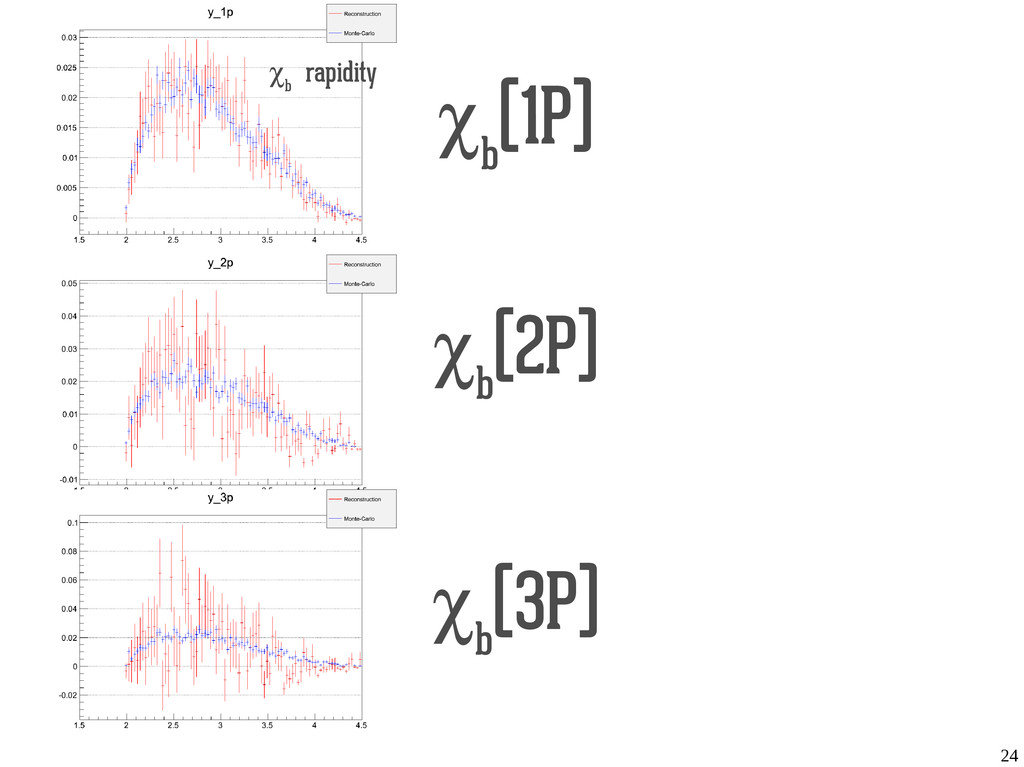
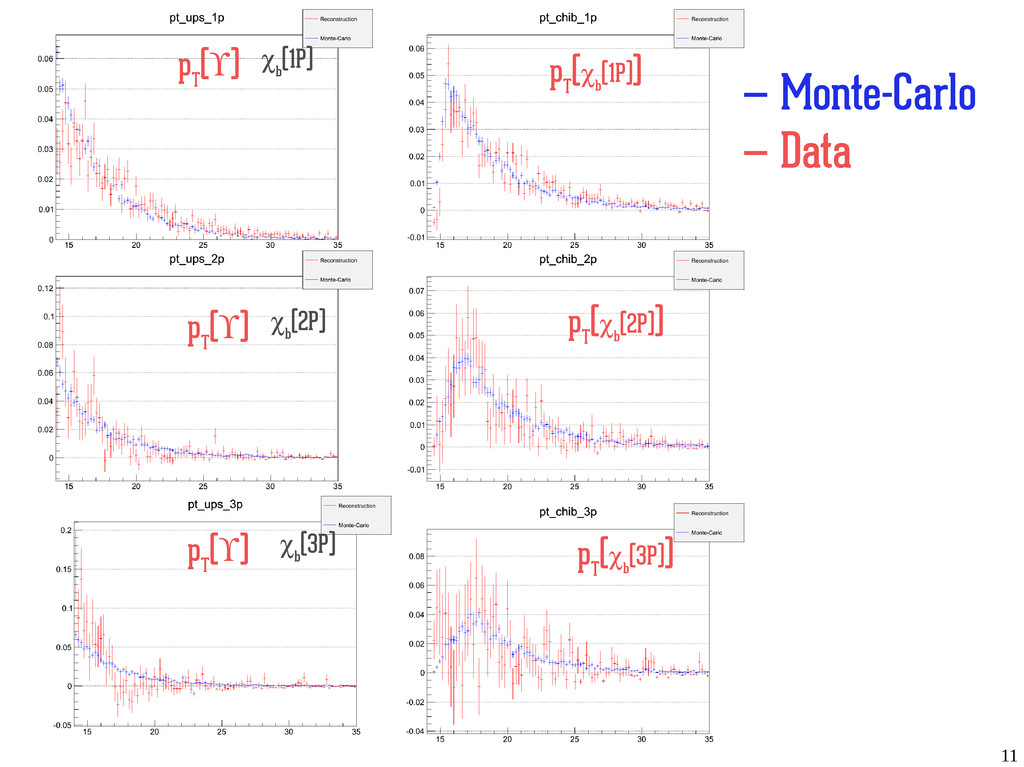
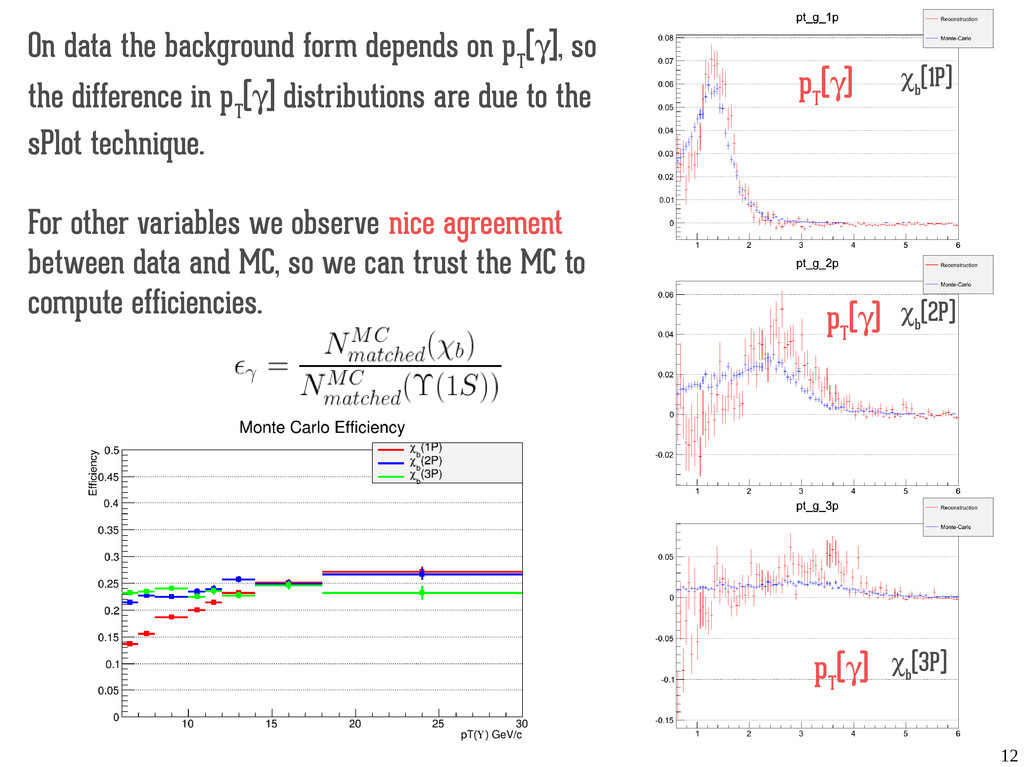
p T (γ) χ b (2P) χ b (3P) On data the background form depends on p T (γ], so the difference in p T (γ] distributions are due to the sPlot technique. For other variables we observe nice agreement between data and MC, so we can trust the MC to compute efficiencies.
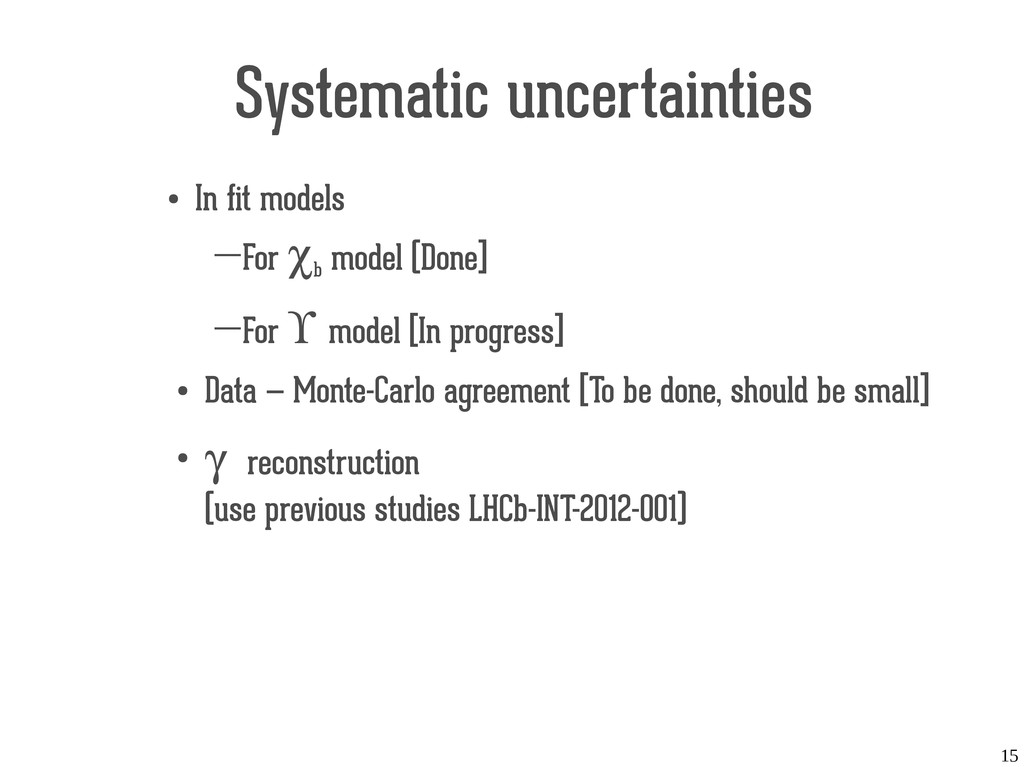
(Done] ―For ϒ model [In progress] • Data — Monte-Carlo agreement [To be done, should be small] • γ reconstruction (use previous studies LHCb-INT-2012-001)


 mazurov
 trycycle
 voginip
 michielstock
 nozakijcom
 tagtag
 miyayou
 i2tsuki
 x_ttyszk
 reverentgeek
 tammyeverts
 akihiro_kokubo
 mkilby
 geshan
 eileencodes
 csswizardry
 dugsong
 mfonobong
 rasagy
 soudai
 sugarenia


![18 Systematic uncertainties Constraint N[χ b (1P)] change(%) N[χ b](https://files.speakerdeck.com/presentations/283b1970b0b7013074fd262d7ef73a92/slide_17.jpg)