Upgrade to Pro — share decks privately, control downloads, hide ads and more …

MBBS in USA: The Real Pathway to Becoming a US ...

MBBS in USA: The Real Pathway to Becoming a US Doctor

MBBSinAmerica.com is an independent, editorially reviewed resource that helps international students understand how to actually become a licensed doctor in the US, since the US doesn't award an MBBS degree at all. It covers medical school selection, the MD versus DO pathway, the MCAT, the USMLE exams, the residency Match, and the visa process, with content reviewed by MD and MBBS graduates who take no money from schools or test prep companies.

Avatar for MBBSinAmerica.com

MBBSinAmerica.com

September 25, 2026

Other Decks in Education

Transcript

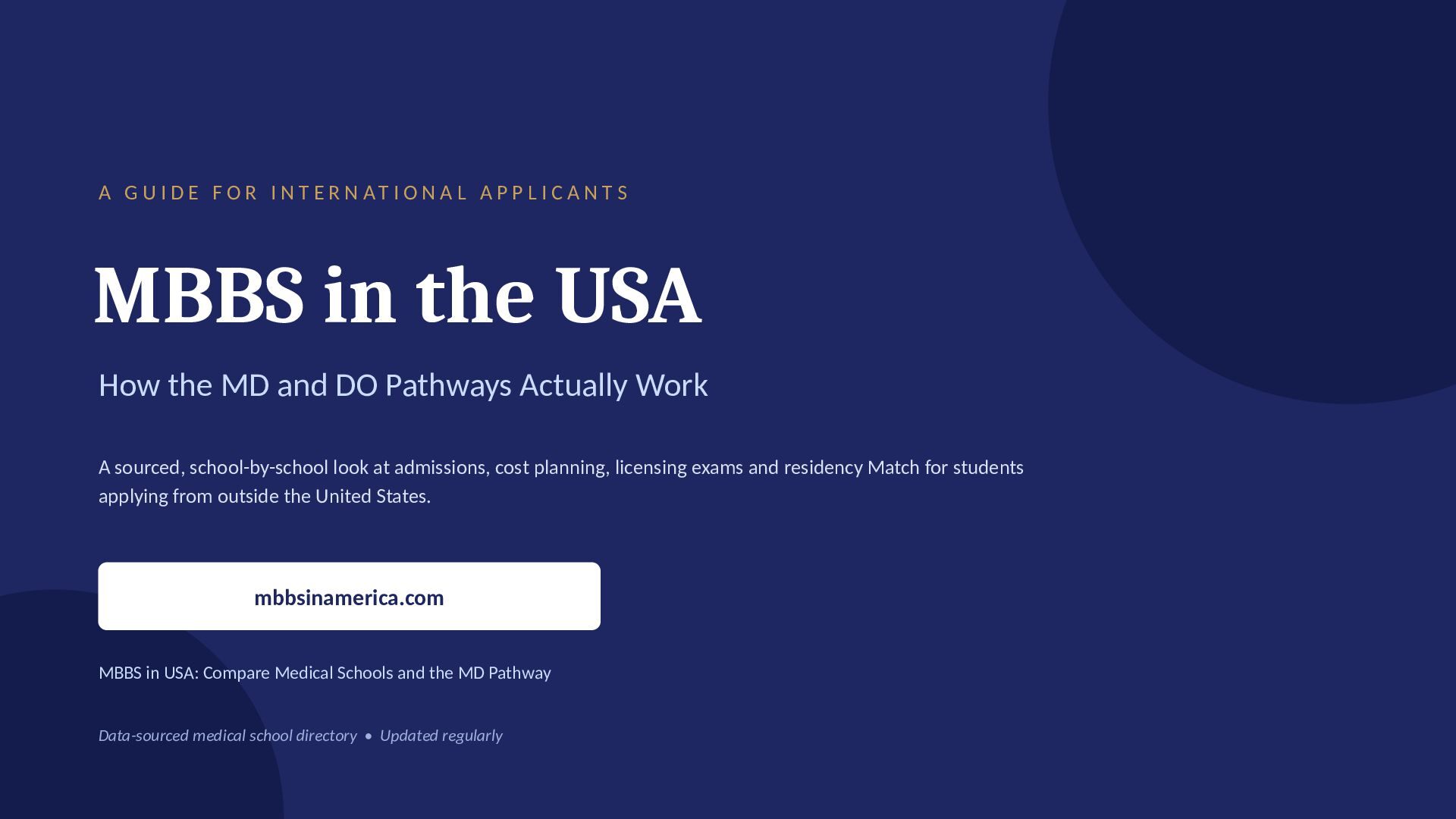
  1. A G U I D E F O R I

    N T E R N AT I O N A L A P P L I C A N T S MBBS in the USA How the MD and DO Pathways Actually Work A sourced, school-by-school look at admissions, cost planning, licensing exams and residency Match for students applying from outside the United States. mbbsinamerica.com MBBS in USA: Compare Medical Schools and the MD Pathway Data-sourced medical school directory • Updated regularly
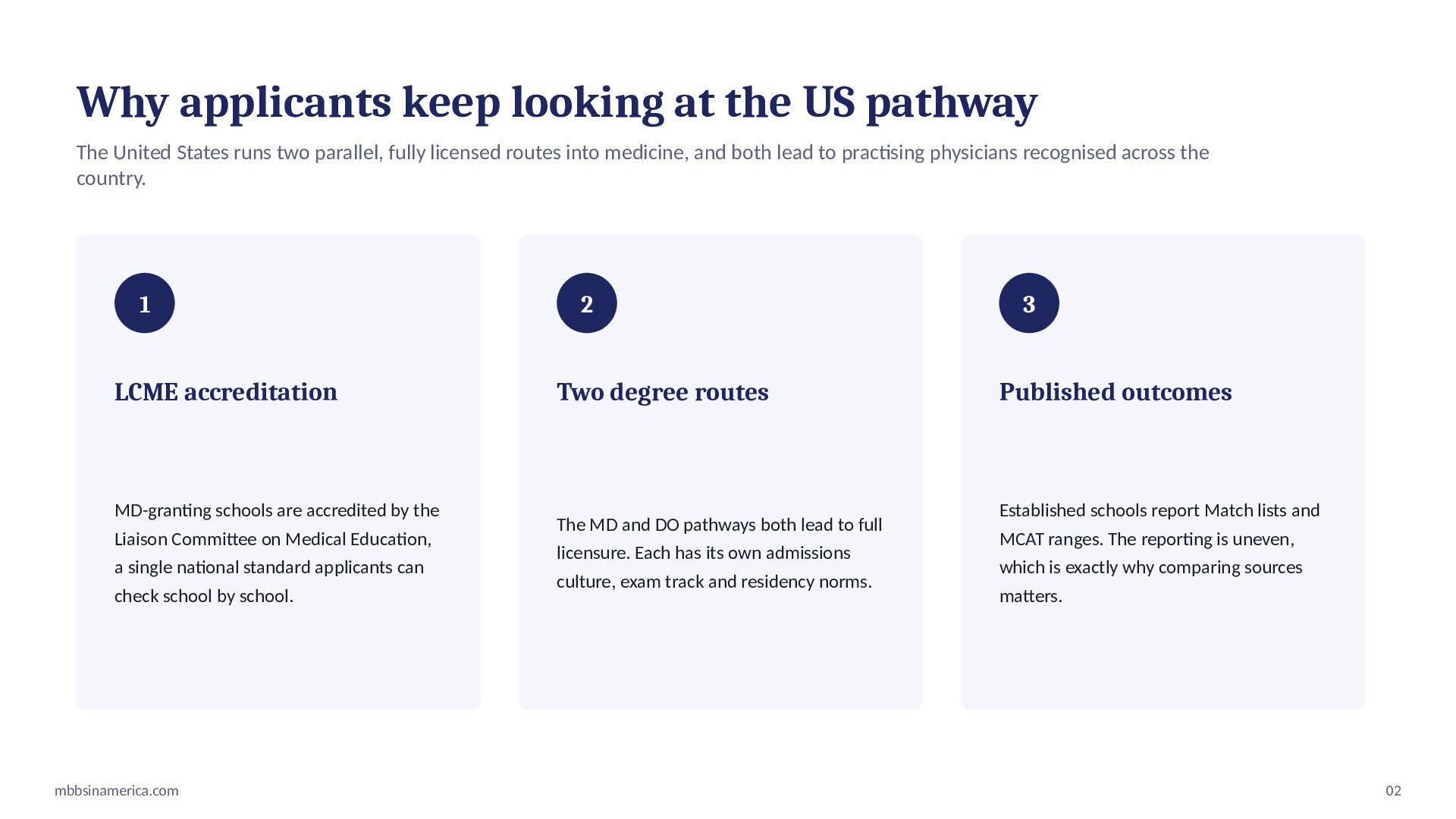
  2. Why applicants keep looking at the US pathway The United

    States runs two parallel, fully licensed routes into medicine, and both lead to practising physicians recognised across the country. 1 2 3 LCME accreditation Two degree routes Published outcomes MD-granting schools are accredited by the Liaison Committee on Medical Education, a single national standard applicants can check school by school. The MD and DO pathways both lead to full licensure. Each has its own admissions culture, exam track and residency norms. Established schools report Match lists and MCAT ranges. The reporting is uneven, which is exactly why comparing sources matters. mbbsinamerica.com 02
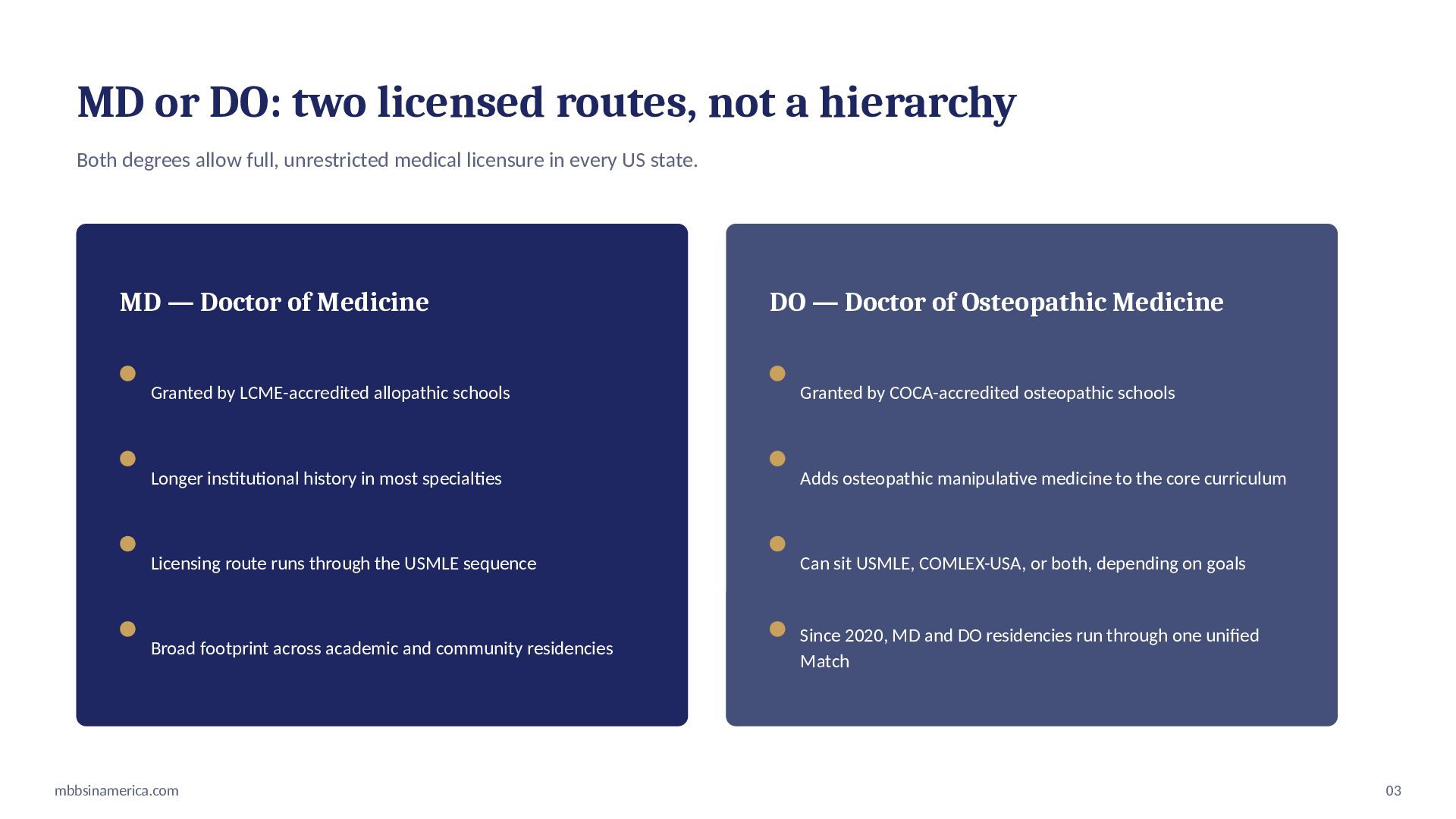
  3. MD or DO: two licensed routes, not a hierarchy Both

    degrees allow full, unrestricted medical licensure in every US state. MD — Doctor of Medicine DO — Doctor of Osteopathic Medicine Granted by LCME-accredited allopathic schools Granted by COCA-accredited osteopathic schools Longer institutional history in most specialties Adds osteopathic manipulative medicine to the core curriculum Licensing route runs through the USMLE sequence Can sit USMLE, COMLEX-USA, or both, depending on goals Broad footprint across academic and community residencies Since 2020, MD and DO residencies run through one unified Match mbbsinamerica.com 03
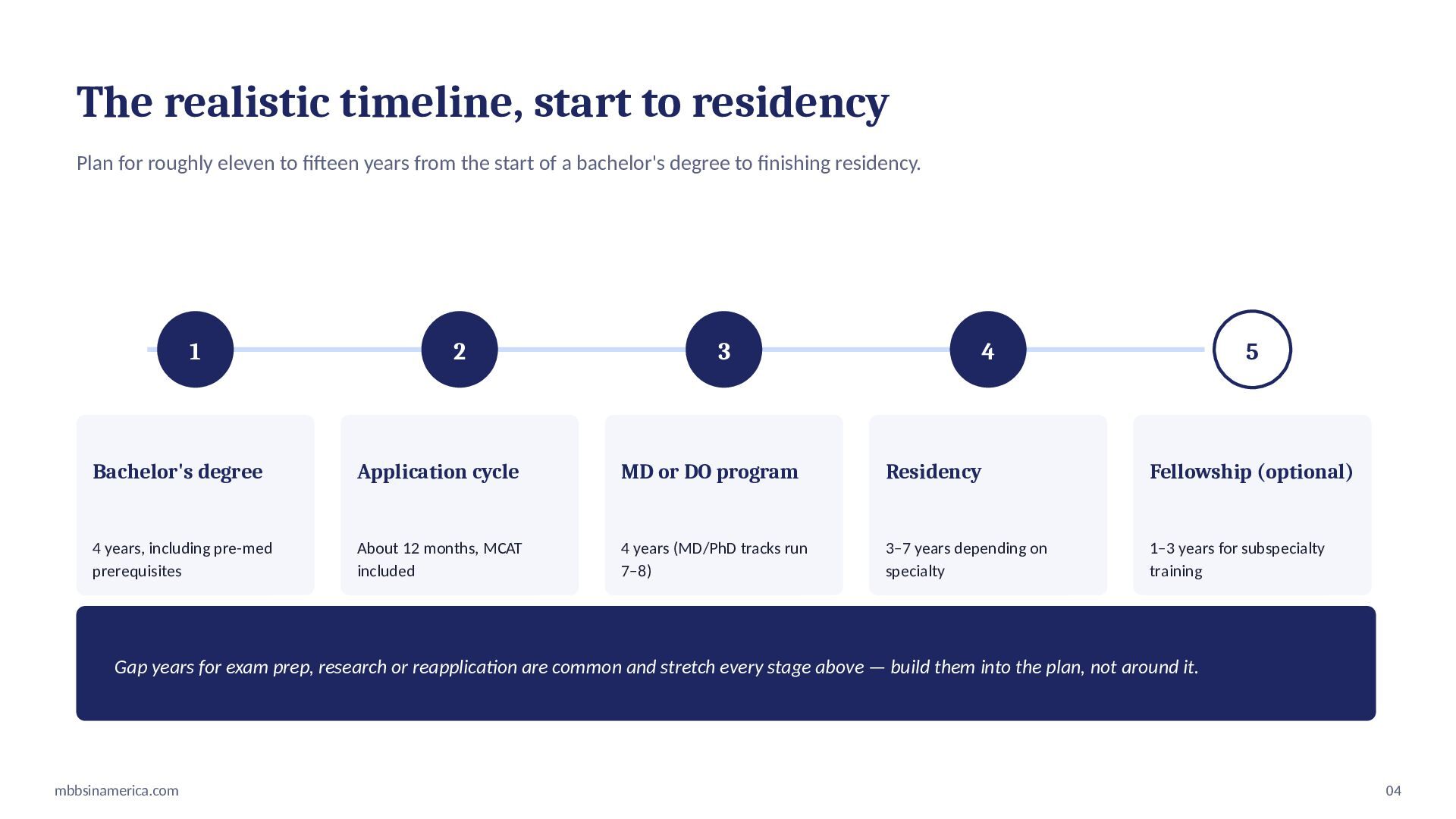
  4. The realistic timeline, start to residency Plan for roughly eleven

    to fifteen years from the start of a bachelor's degree to finishing residency. 1 2 3 4 5 Bachelor's degree Application cycle MD or DO program Residency Fellowship (optional) 4 years, including pre-med prerequisites About 12 months, MCAT included 4 years (MD/PhD tracks run 7–8) 3–7 years depending on specialty 1–3 years for subspecialty training Gap years for exam prep, research or reapplication are common and stretch every stage above — build them into the plan, not around it. mbbsinamerica.com 04
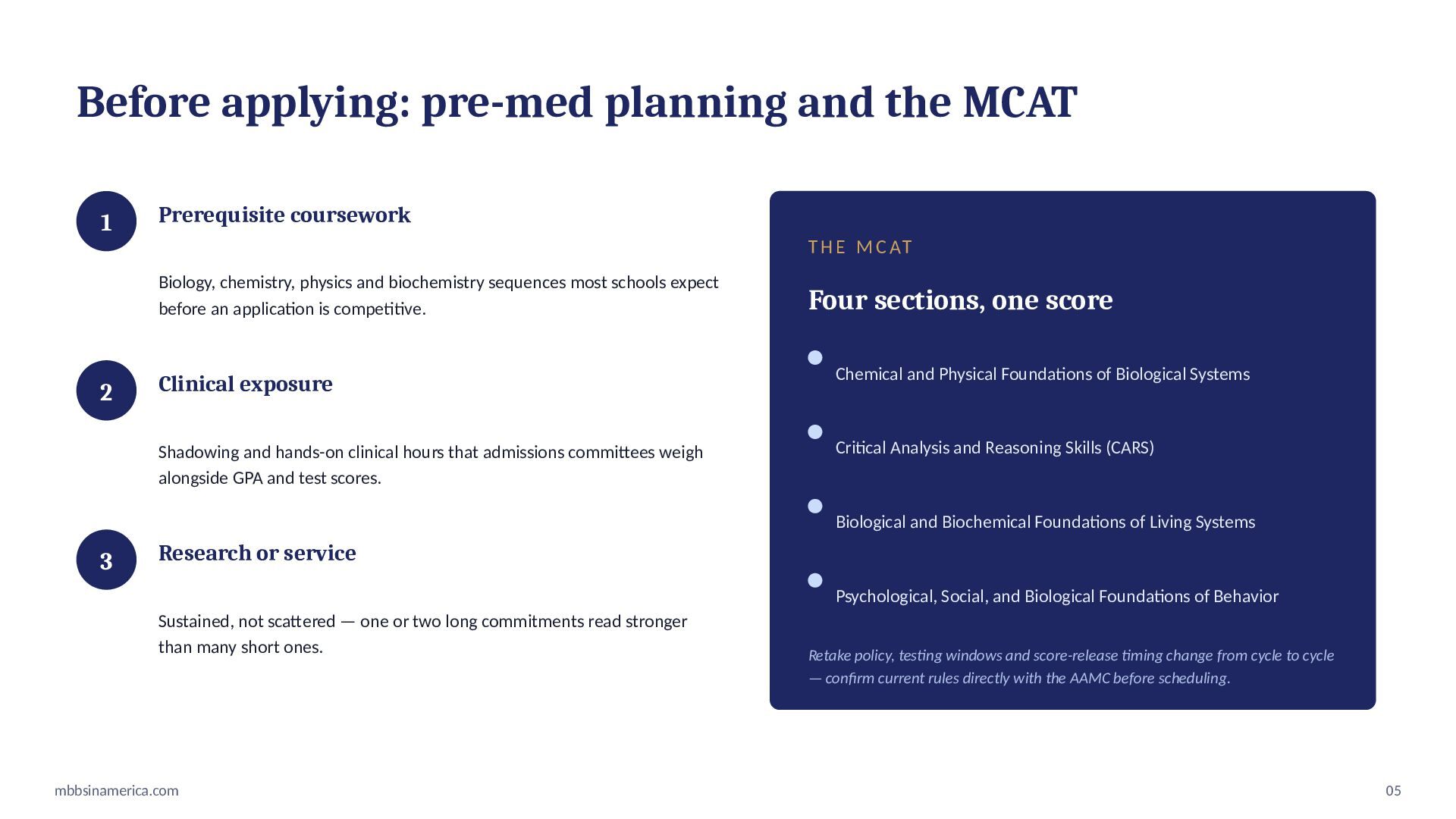
  5. Before applying: pre-med planning and the MCAT 1 Prerequisite coursework

    T H E M C AT Biology, chemistry, physics and biochemistry sequences most schools expect before an application is competitive. 2 Four sections, one score Clinical exposure Chemical and Physical Foundations of Biological Systems Shadowing and hands-on clinical hours that admissions committees weigh alongside GPA and test scores. Critical Analysis and Reasoning Skills (CARS) Biological and Biochemical Foundations of Living Systems 3 Research or service Psychological, Social, and Biological Foundations of Behavior Sustained, not scattered — one or two long commitments read stronger than many short ones. mbbsinamerica.com Retake policy, testing windows and score-release timing change from cycle to cycle — confirm current rules directly with the AAMC before scheduling. 05
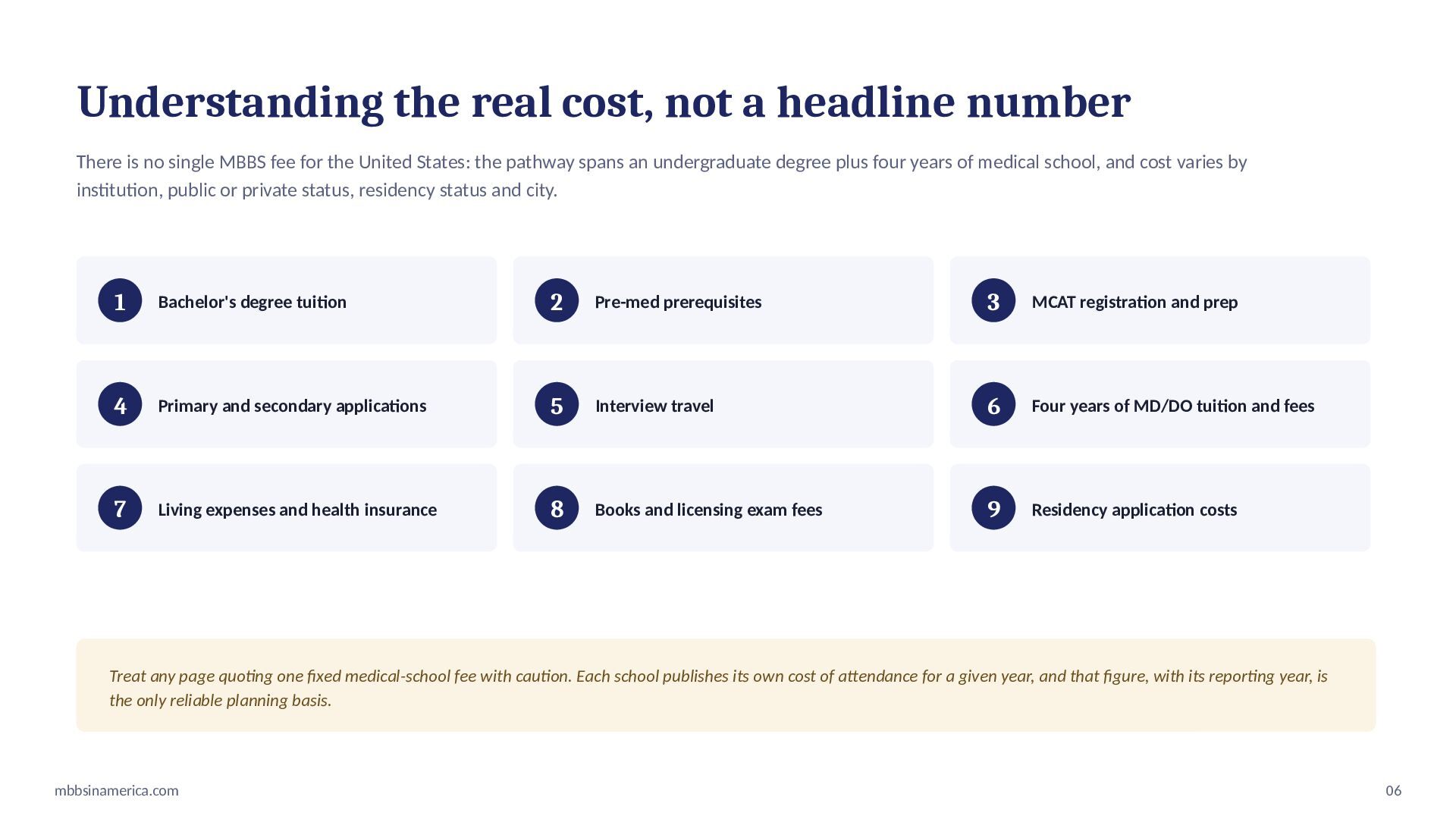
  6. Understanding the real cost, not a headline number There is

    no single MBBS fee for the United States: the pathway spans an undergraduate degree plus four years of medical school, and cost varies by institution, public or private status, residency status and city. 1 Bachelor's degree tuition 2 Pre-med prerequisites 3 MCAT registration and prep 4 Primary and secondary applications 5 Interview travel 6 Four years of MD/DO tuition and fees 7 Living expenses and health insurance 8 Books and licensing exam fees 9 Residency application costs Treat any page quoting one fixed medical-school fee with caution. Each school publishes its own cost of attendance for a given year, and that figure, with its reporting year, is the only reliable planning basis. mbbsinamerica.com 06
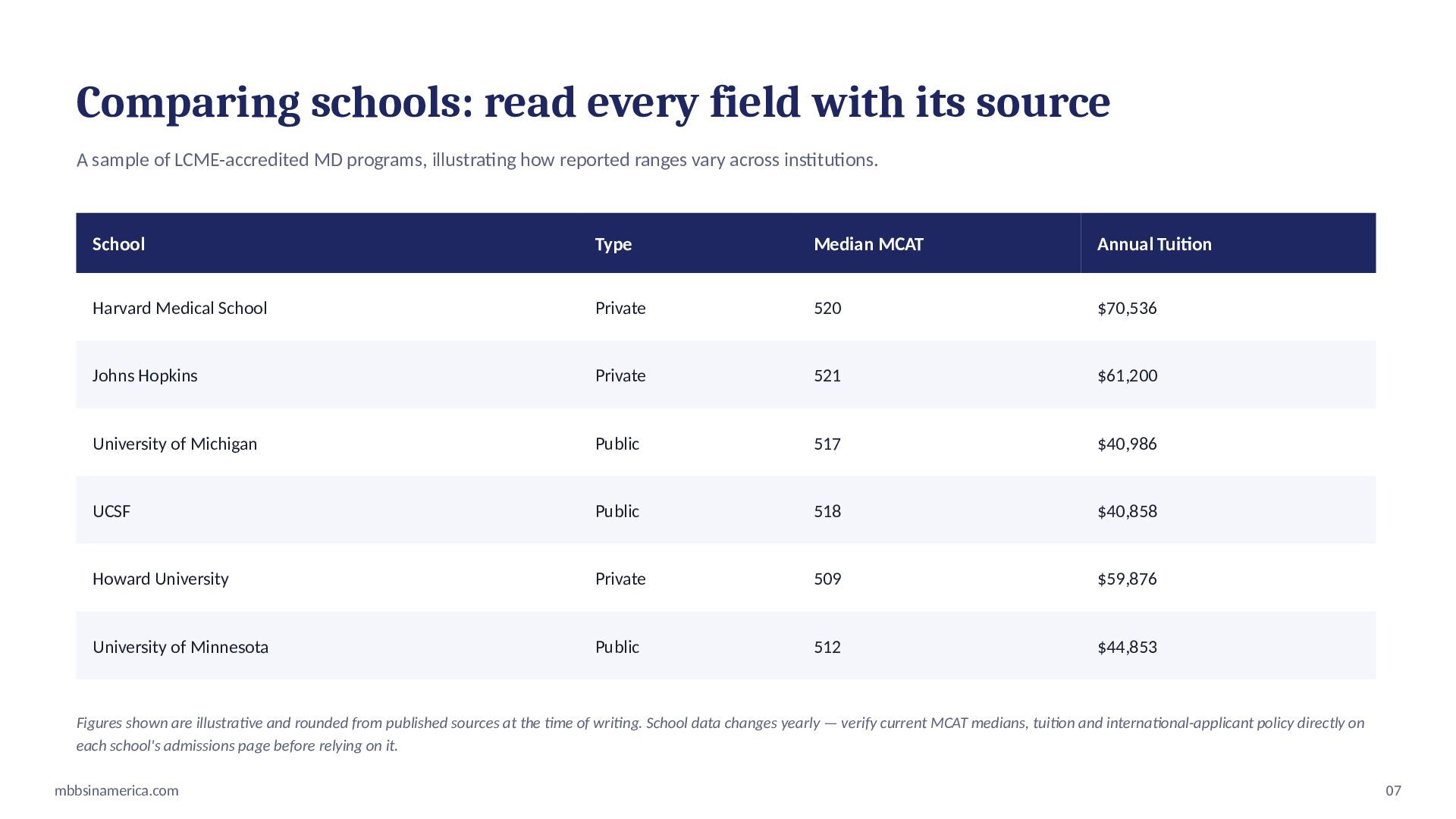
  7. Comparing schools: read every field with its source A sample

    of LCME-accredited MD programs, illustrating how reported ranges vary across institutions. School Type Median MCAT Annual Tuition Harvard Medical School Private 520 $70,536 Johns Hopkins Private 521 $61,200 University of Michigan Public 517 $40,986 UCSF Public 518 $40,858 Howard University Private 509 $59,876 University of Minnesota Public 512 $44,853 Figures shown are illustrative and rounded from published sources at the time of writing. School data changes yearly — verify current MCAT medians, tuition and international-applicant policy directly on each school's admissions page before relying on it. mbbsinamerica.com 07
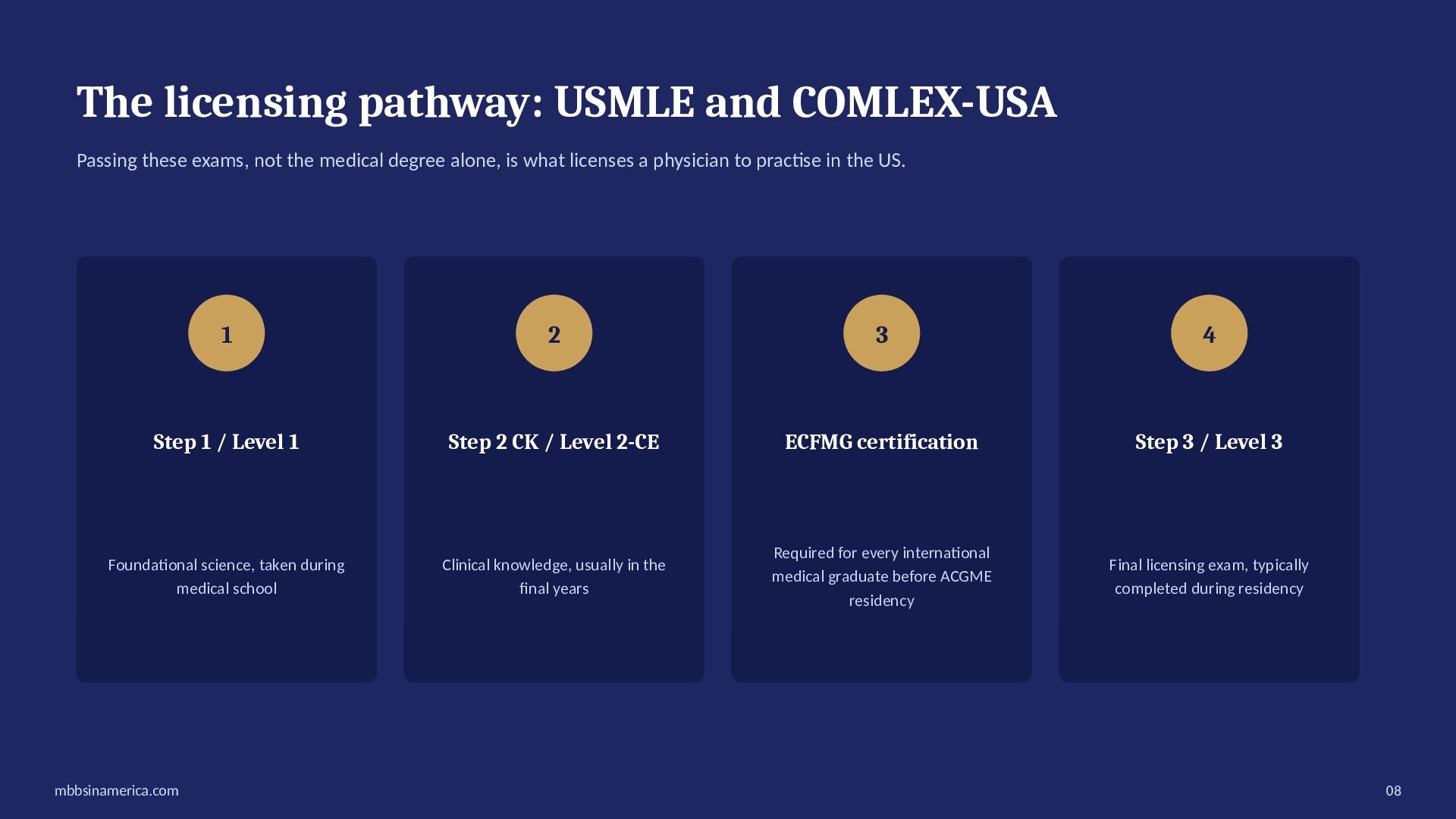
  8. The licensing pathway: USMLE and COMLEX-USA Passing these exams, not

    the medical degree alone, is what licenses a physician to practise in the US. 1 2 3 4 Step 1 / Level 1 Step 2 CK / Level 2-CE ECFMG certification Step 3 / Level 3 Foundational science, taken during medical school Clinical knowledge, usually in the final years Required for every international medical graduate before ACGME residency Final licensing exam, typically completed during residency mbbsinamerica.com 08
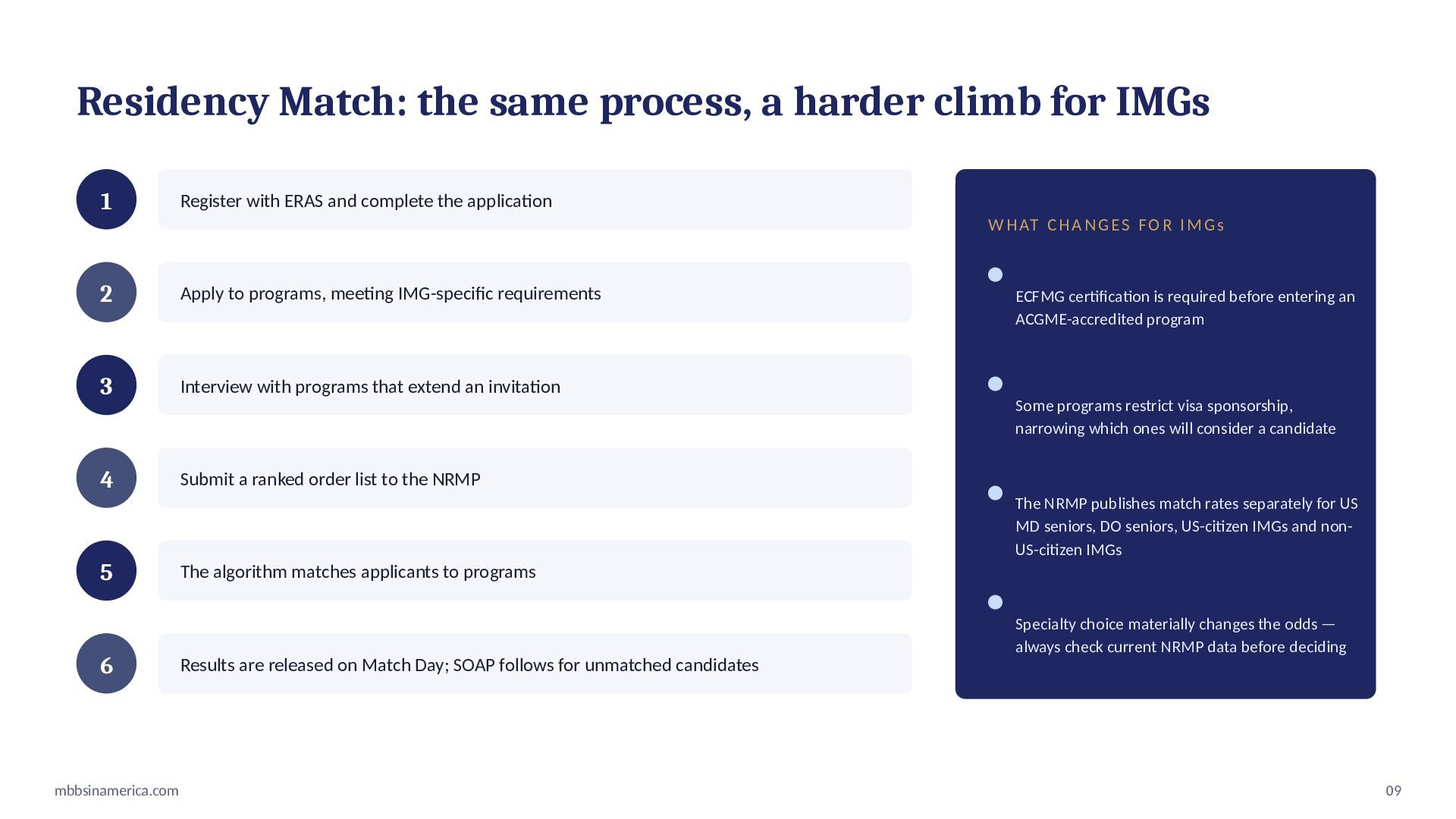
  9. Residency Match: the same process, a harder climb for IMGs

    1 Register with ERAS and complete the application 2 Apply to programs, meeting IMG-specific requirements 3 Interview with programs that extend an invitation 4 Submit a ranked order list to the NRMP 5 The algorithm matches applicants to programs 6 mbbsinamerica.com W H AT C H A N G E S F O R I M G s ECFMG certification is required before entering an ACGME-accredited program Some programs restrict visa sponsorship, narrowing which ones will consider a candidate The NRMP publishes match rates separately for US MD seniors, DO seniors, US-citizen IMGs and nonUS-citizen IMGs Results are released on Match Day; SOAP follows for unmatched candidates Specialty choice materially changes the odds — always check current NRMP data before deciding 09
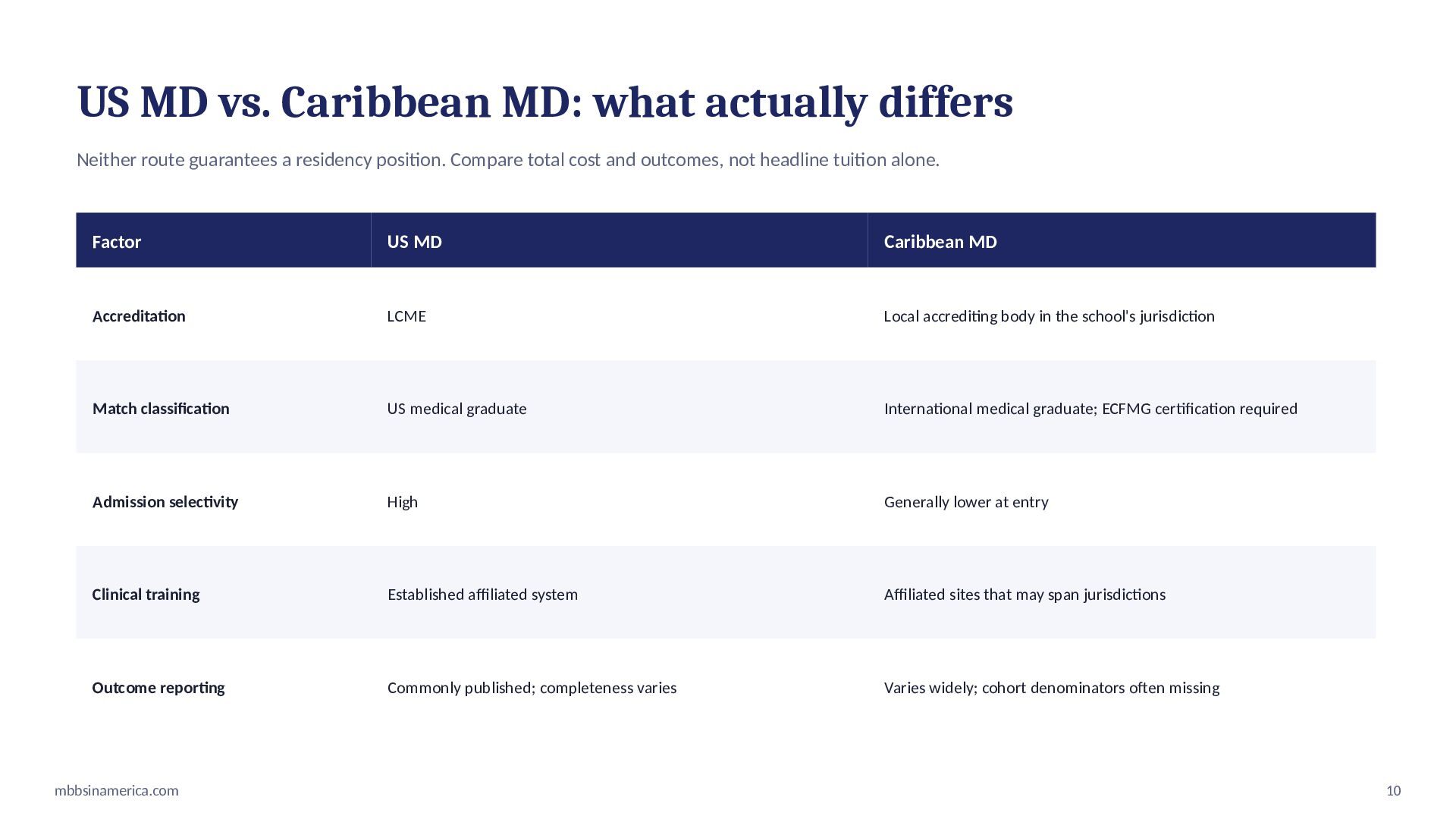
  10. US MD vs. Caribbean MD: what actually differs Neither route

    guarantees a residency position. Compare total cost and outcomes, not headline tuition alone. Factor US MD Caribbean MD Accreditation LCME Local accrediting body in the school's jurisdiction Match classification US medical graduate International medical graduate; ECFMG certification required Admission selectivity High Generally lower at entry Clinical training Established affiliated system Affiliated sites that may span jurisdictions Outcome reporting Commonly published; completeness varies Varies widely; cohort denominators often missing mbbsinamerica.com 10
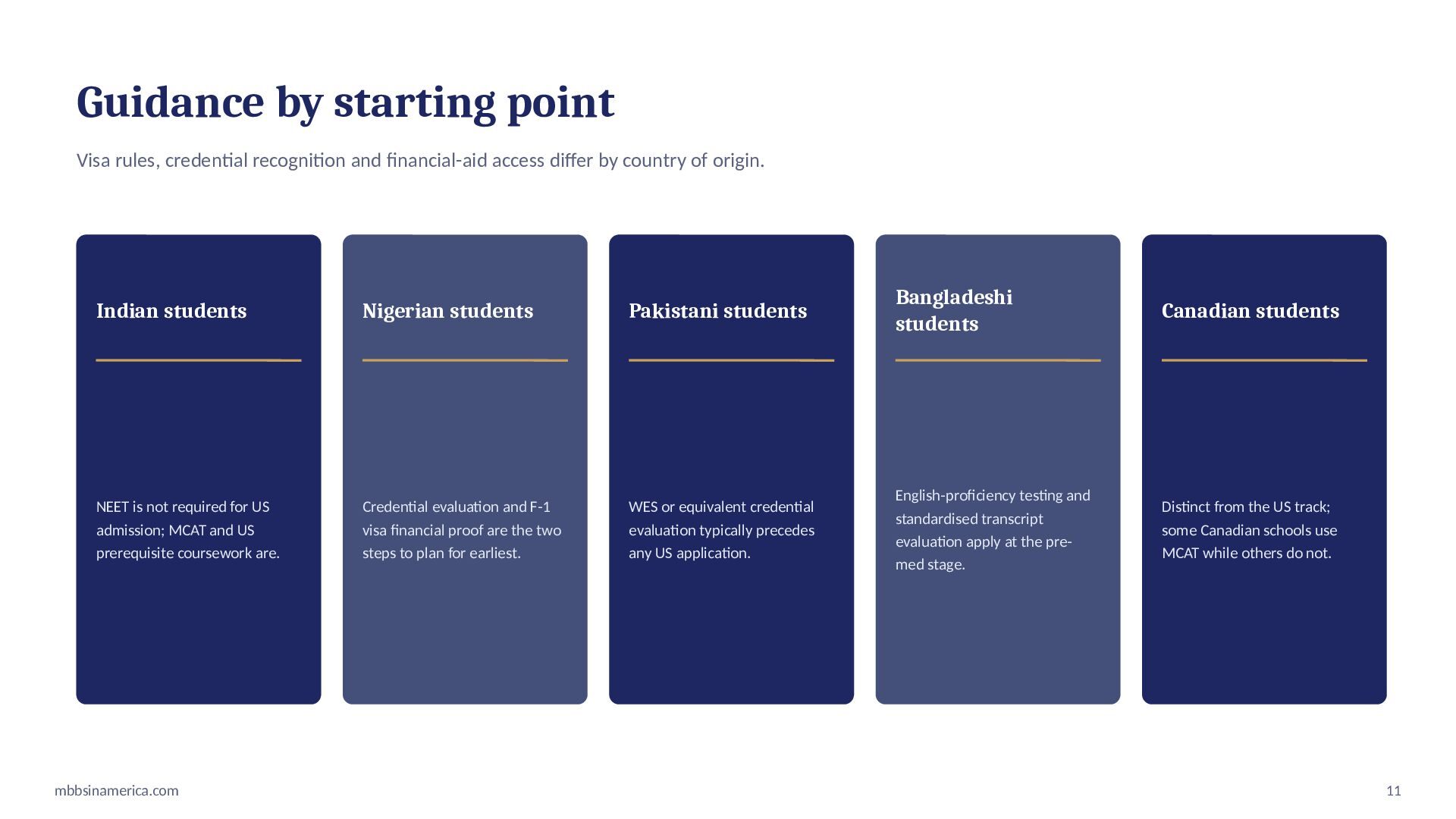
  11. Guidance by starting point Visa rules, credential recognition and financial-aid

    access differ by country of origin. Indian students Nigerian students Pakistani students Bangladeshi students Canadian students NEET is not required for US admission; MCAT and US prerequisite coursework are. Credential evaluation and F-1 visa financial proof are the two steps to plan for earliest. WES or equivalent credential evaluation typically precedes any US application. English-proficiency testing and standardised transcript evaluation apply at the premed stage. Distinct from the US track; some Canadian schools use MCAT while others do not. mbbsinamerica.com 11
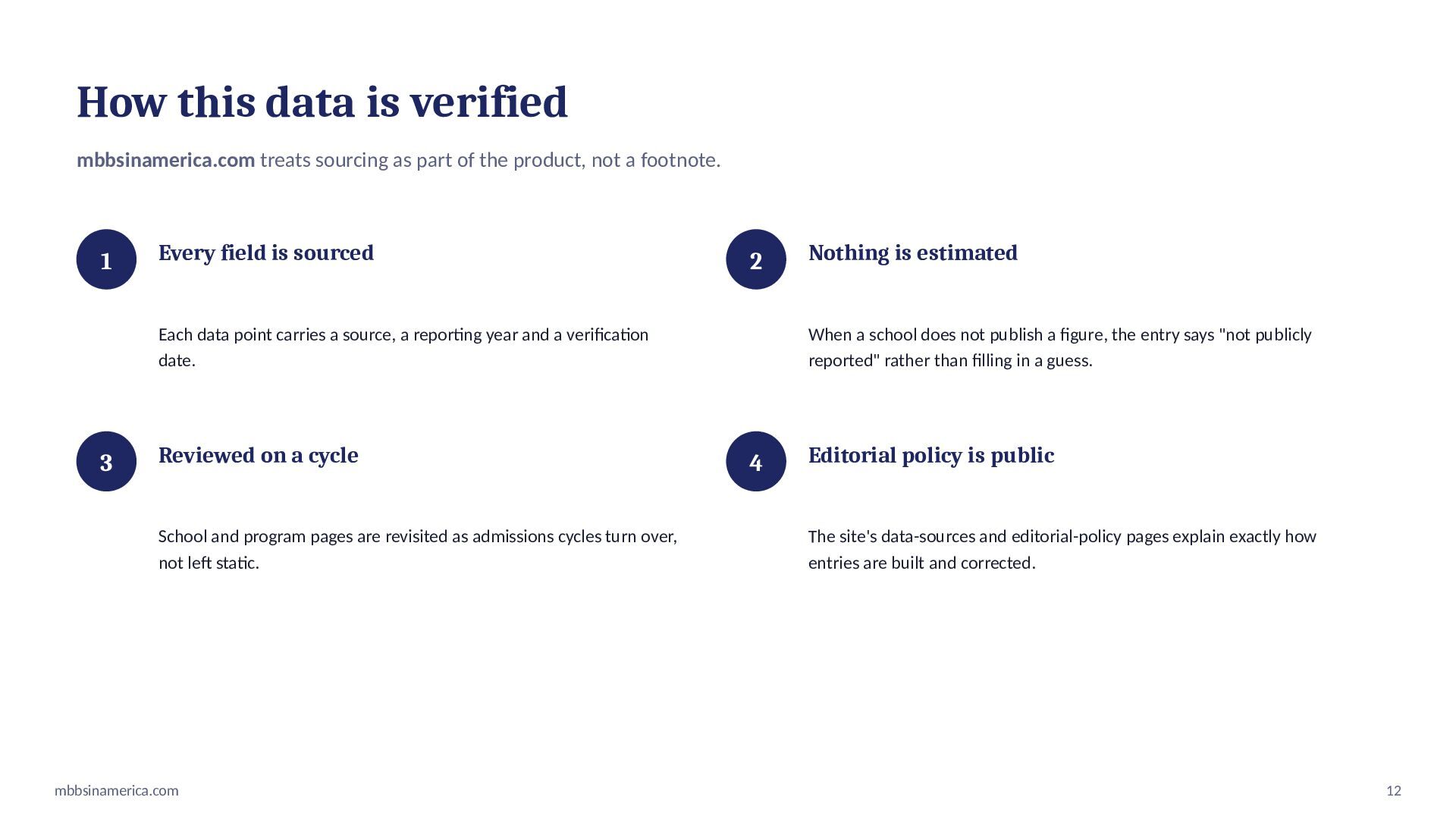
  12. How this data is verified mbbsinamerica.com treats sourcing as part

    of the product, not a footnote. 1 Every field is sourced 2 Each data point carries a source, a reporting year and a verification date. 3 Reviewed on a cycle School and program pages are revisited as admissions cycles turn over, not left static. mbbsinamerica.com Nothing is estimated When a school does not publish a figure, the entry says "not publicly reported" rather than filling in a guess. 4 Editorial policy is public The site's data-sources and editorial-policy pages explain exactly how entries are built and corrected. 12
  13. Plan the pathway on verified data, not headlines Compare LCME-accredited

    schools, plan realistic costs, and track the MD or DO pathway through to residency Match with sourced, regularly reviewed data. mbbsinamerica.com MBBS in USA: Compare Medical Schools and the MD Pathway Medical school directory • MD & DO guidance • MCAT and USMLE resources • Residency Match https://mbbsinamerica.com/