Upgrade to Pro — share decks privately, control downloads, hide ads and more …

Liburd and Stoll Farrell "Copyright Essentials ...

Liburd and Stoll Farrell "Copyright Essentials From A to AI: A 2026 NISO Training Series, Session Two: Fair Use and the Public Domain"

This presentation was given by Willa Liburd, Legal Knowledge Management Consultant and Scholarly Communication Professional, and Karen Stoll Farrell, Director, Scholarly Communication and Open Publishing Associate, both of Indiana University Bloomington for the second session of the NISO training series "Copyright Essentials From A to AI." Session Two, "Fair Use and the Public Domain," was held October 8, 2026.

More Decks by National Information Standards Organization

Other Decks in Education

Transcript

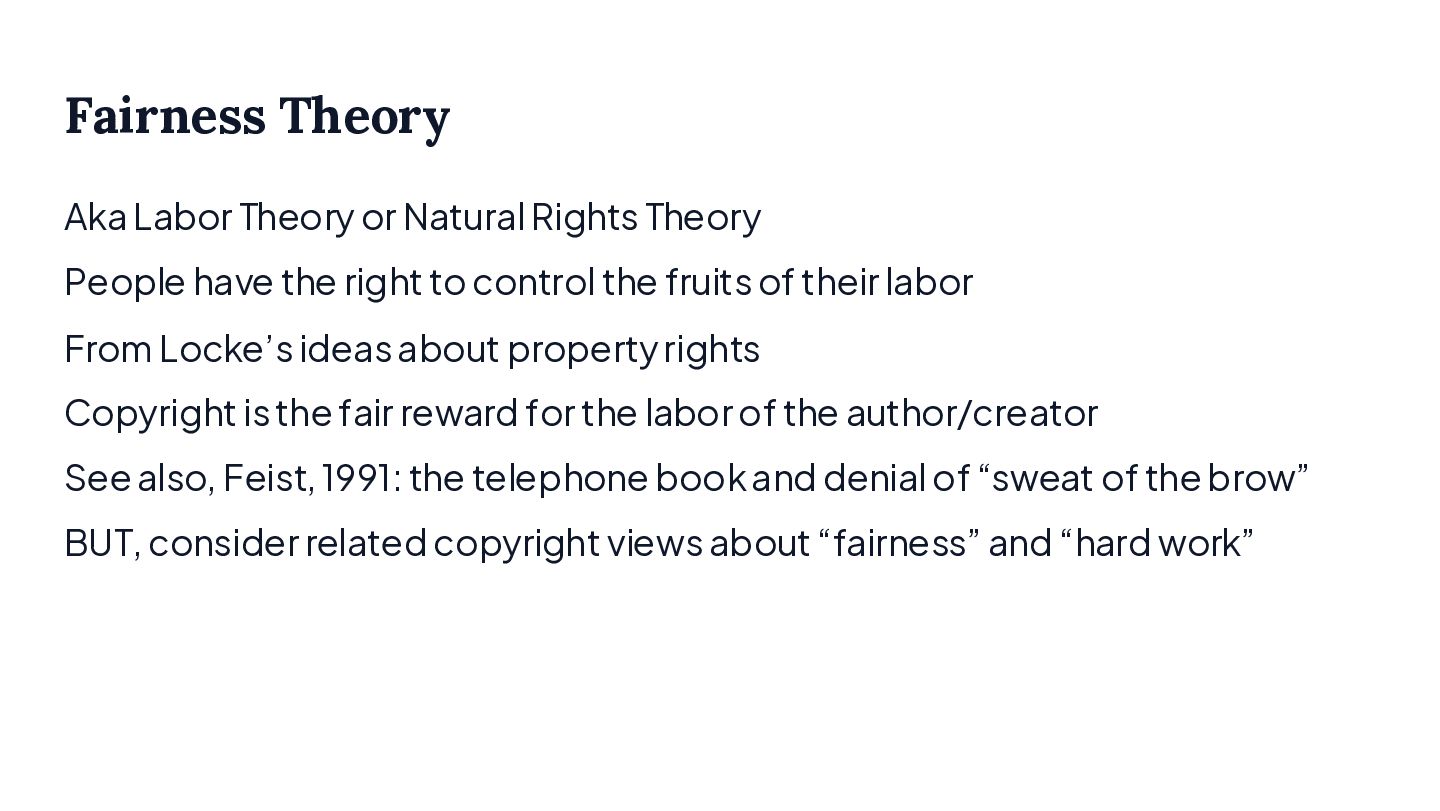
  1. Fairness Theory Aka Labor Theory or Natural Rights Theory People

    have the right to control the fruits of their labor From Locke’s ideas about property rights Copyright is the fair reward for the labor of the author/creator See also, Feist, 1991: the telephone book and denial of “sweat of the brow” BUT, consider related copyright views about “fairness” and “hard work”
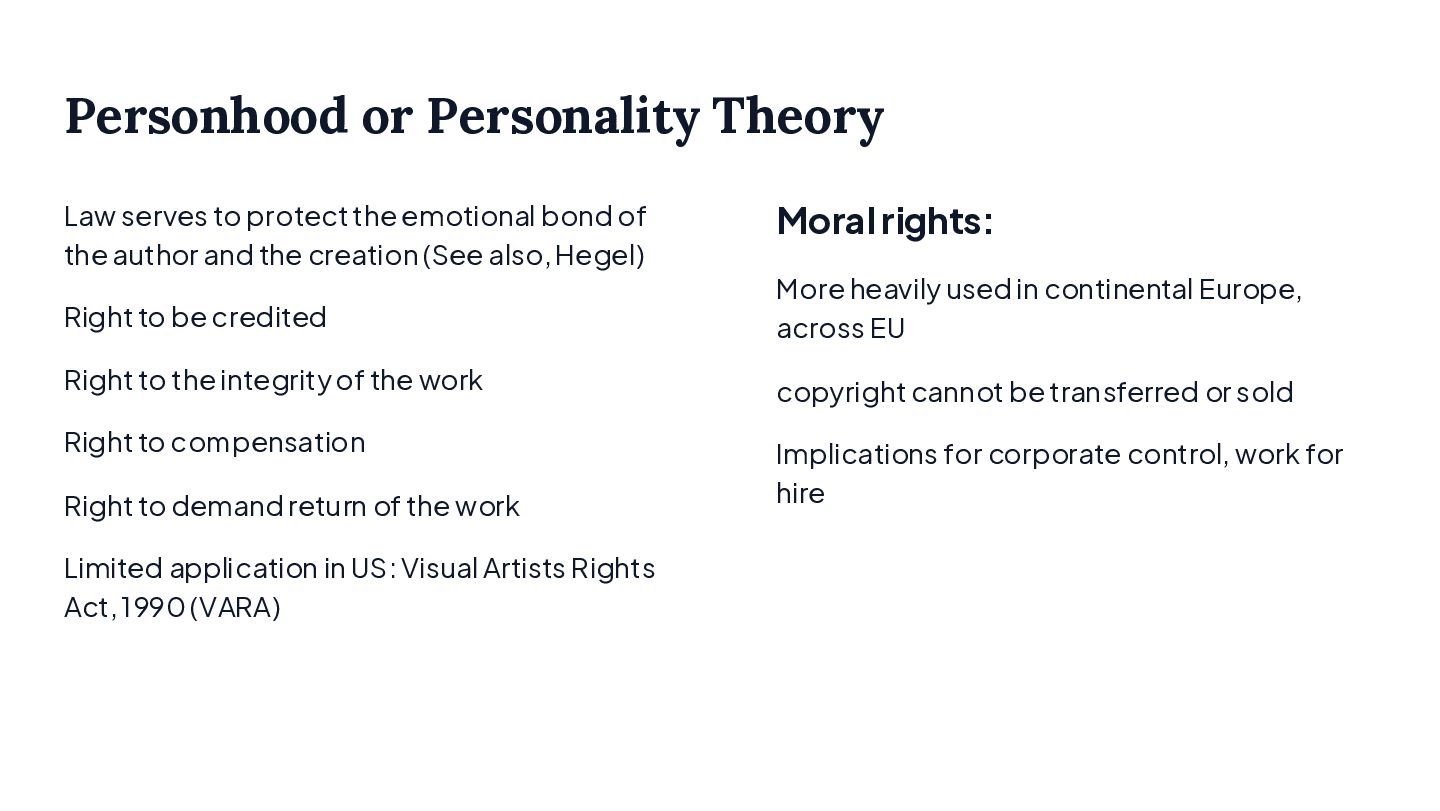
  2. Personhood or Personality Theory Law serves to protect the emotional

    bond of the author and the creation (See also, Hegel) Moral rights: Right to be credited More heavily used in continental Europe, across EU Right to the integrity of the work copyright cannot be transferred or sold Right to compensation Implications for corporate control, work for hire Right to demand return of the work Limited application in US: Visual Artists Rights Act, 1990 (VARA)
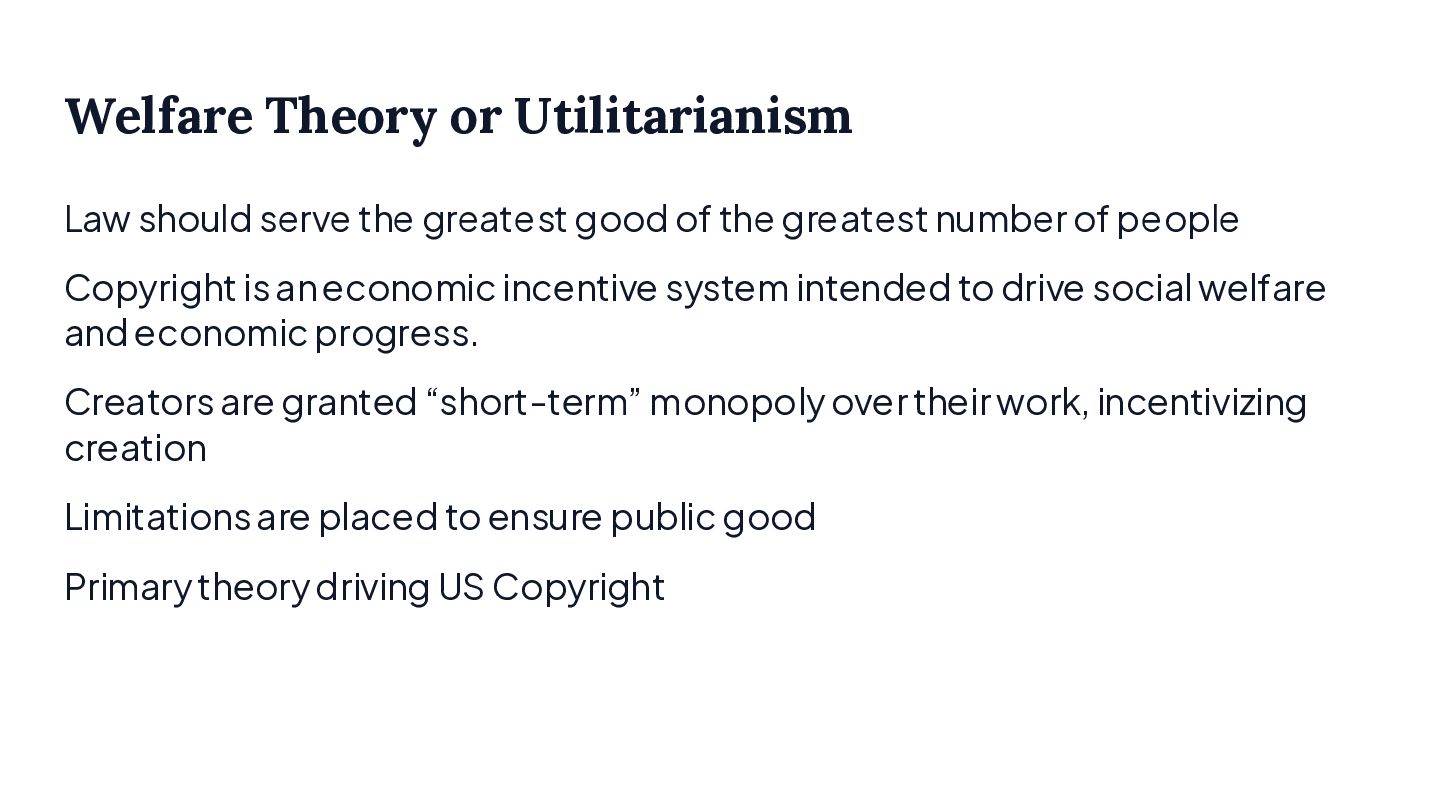
  3. Welfare Theory or Utilitarianism Law should serve the greatest good

    of the greatest number of people Copyright is an economic incentive system intended to drive social welfare and economic progress. Creators are granted “short-term” monopoly over their work, incentivizing creation Limitations are placed to ensure public good Primary theory driving US Copyright
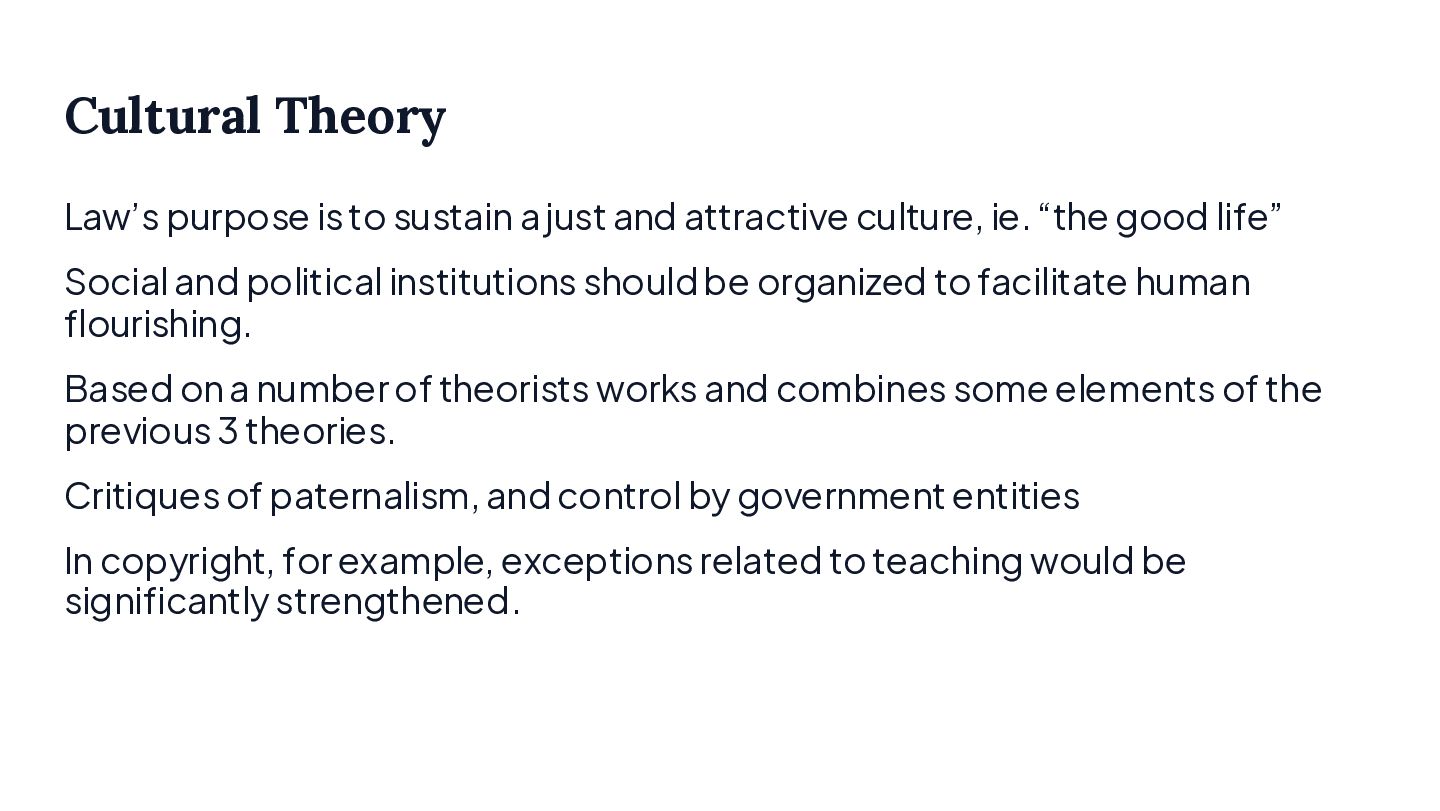
  4. Cultural Theory Law’s purpose is to sustain a just and

    attractive culture, ie. “the good life” Social and political institutions should be organized to facilitate human flourishing. Based on a number of theorists works and combines some elements of the previous 3 theories. Critiques of paternalism, and control by government entities In copyright, for example, exceptions related to teaching would be significantly strengthened.
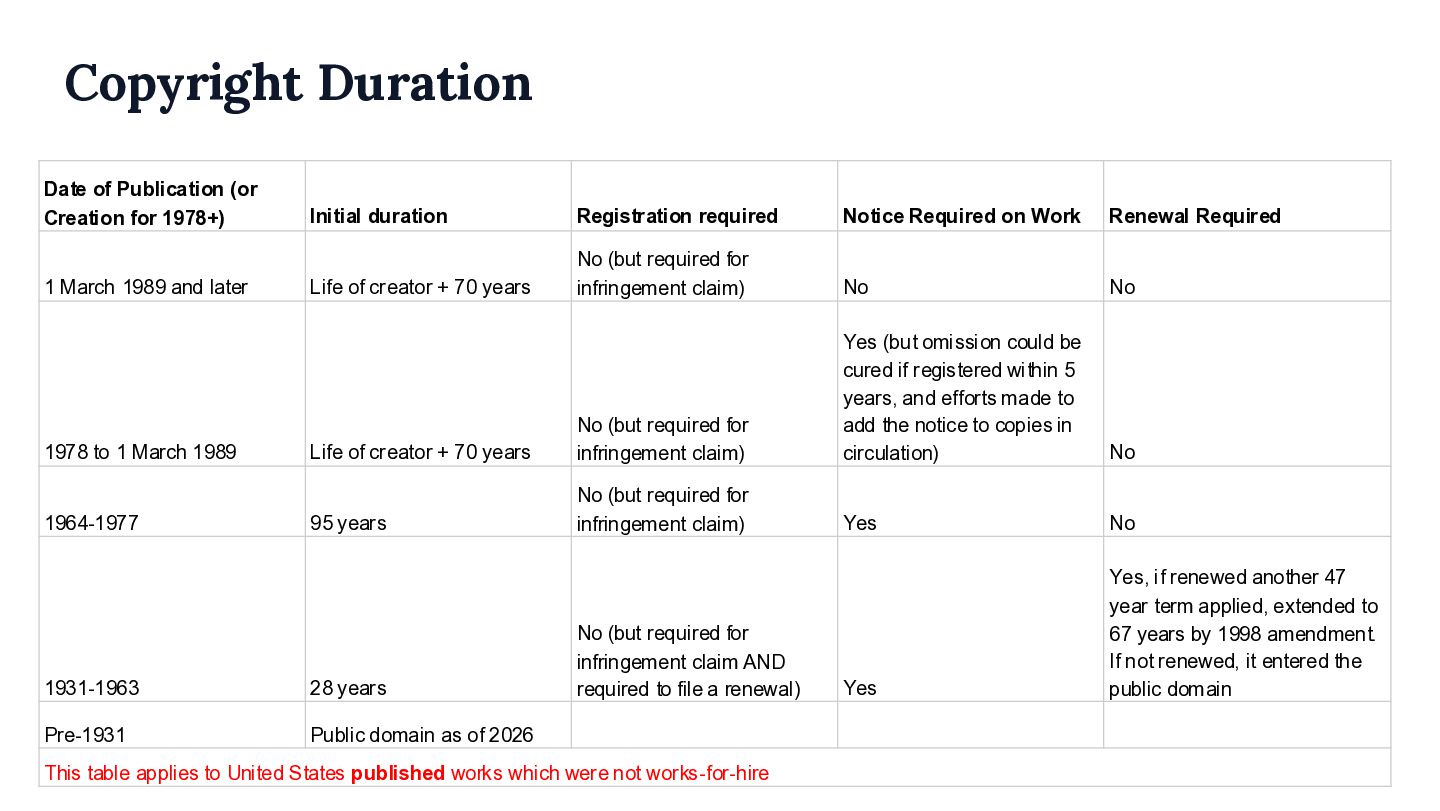
  5. Copyright Duration Date of Publication (or Creation for 1978+) Initial

    duration Registration required Notice Required on Work Renewal Required 1 March 1989 and later Life of creator + 70 years No (but required for infringement claim) No No Life of creator + 70 years No (but required for infringement claim) Yes (but omission could be cured if registered within 5 years, and efforts made to add the notice to copies in circulation) No 95 years No (but required for infringement claim) Yes No Yes Yes, if renewed another 47 year term applied, extended to 67 years by 1998 amendment. If not renewed, it entered the public domain 1978 to 1 March 1989 1964-1977 1931-1963 28 years Pre-1931 Public domain as of 2026 No (but required for infringement claim AND required to file a renewal) This table applies to United States published works which were not works-for-hire
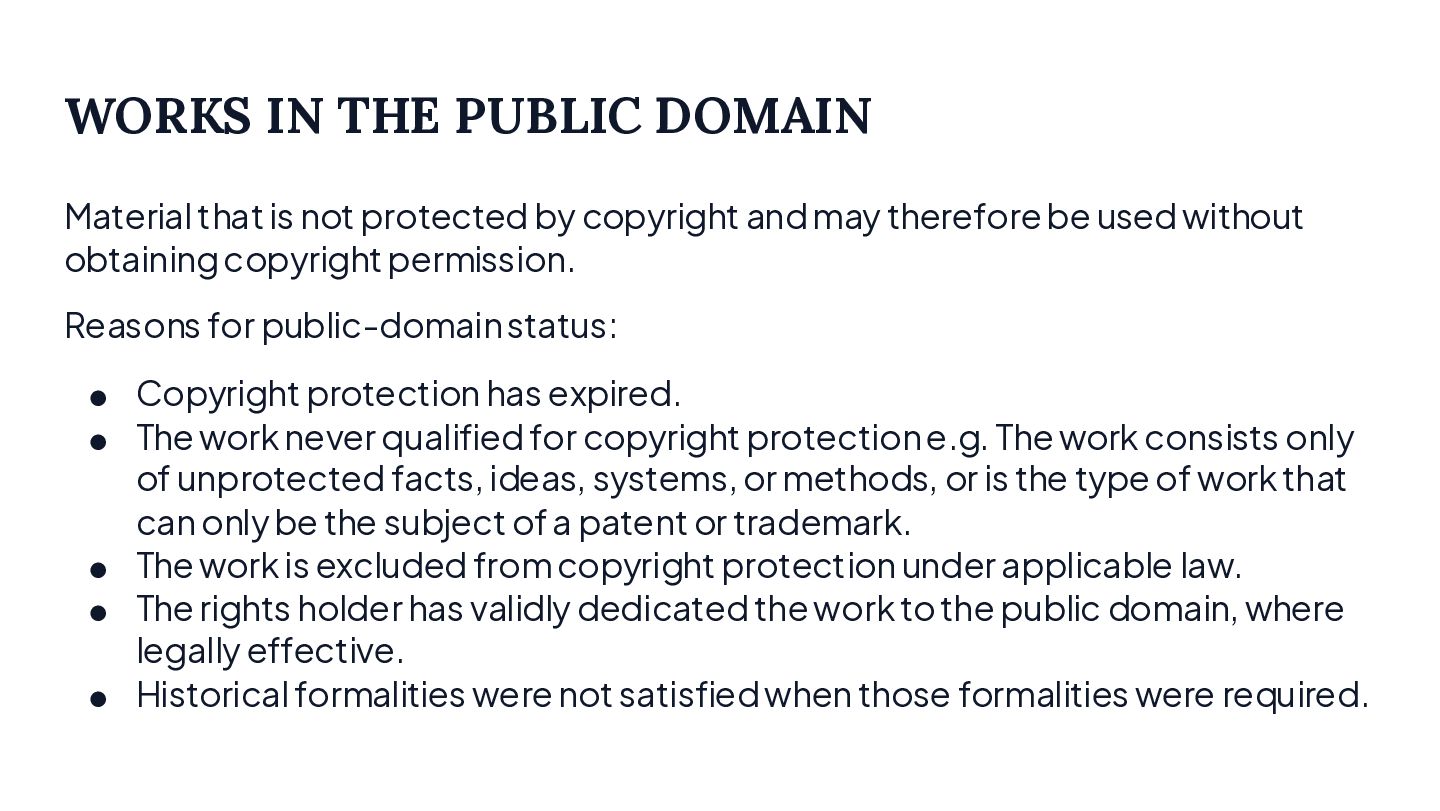
  6. WORKS IN THE PUBLIC DOMAIN Material that is not protected

    by copyright and may therefore be used without obtaining copyright permission. Reasons for public-domain status: • • • • • Copyright protection has expired. The work never qualified for copyright protection e.g. The work consists only of unprotected facts, ideas, systems, or methods, or is the type of work that can only be the subject of a patent or trademark. The work is excluded from copyright protection under applicable law. The rights holder has validly dedicated the work to the public domain, where legally effective. Historical formalities were not satisfied when those formalities were required.
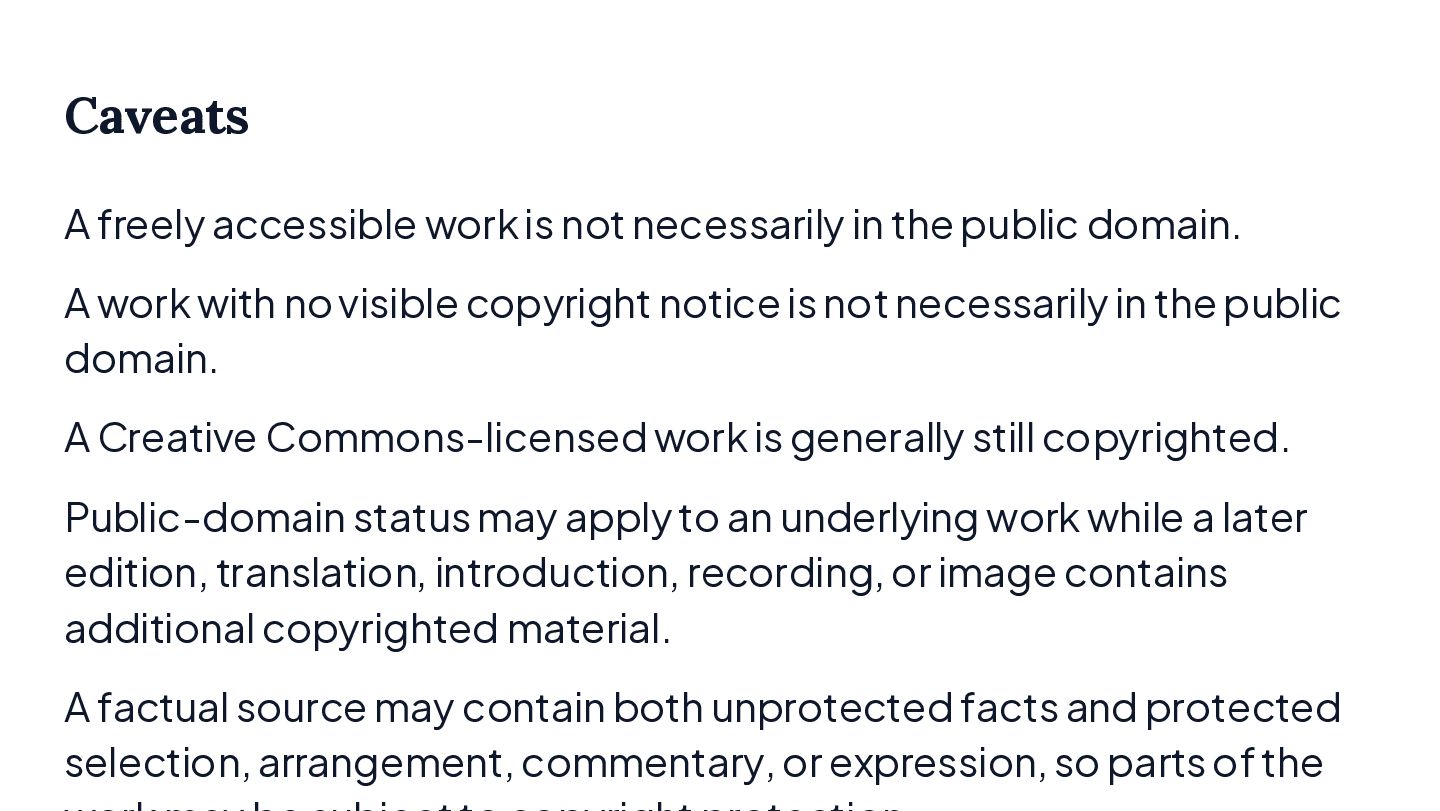
  7. Caveats A freely accessible work is not necessarily in the

    public domain. A work with no visible copyright notice is not necessarily in the public domain. A Creative Commons-licensed work is generally still copyrighted. Public-domain status may apply to an underlying work while a later edition, translation, introduction, recording, or image contains additional copyrighted material. A factual source may contain both unprotected facts and protected selection, arrangement, commentary, or expression, so parts of the
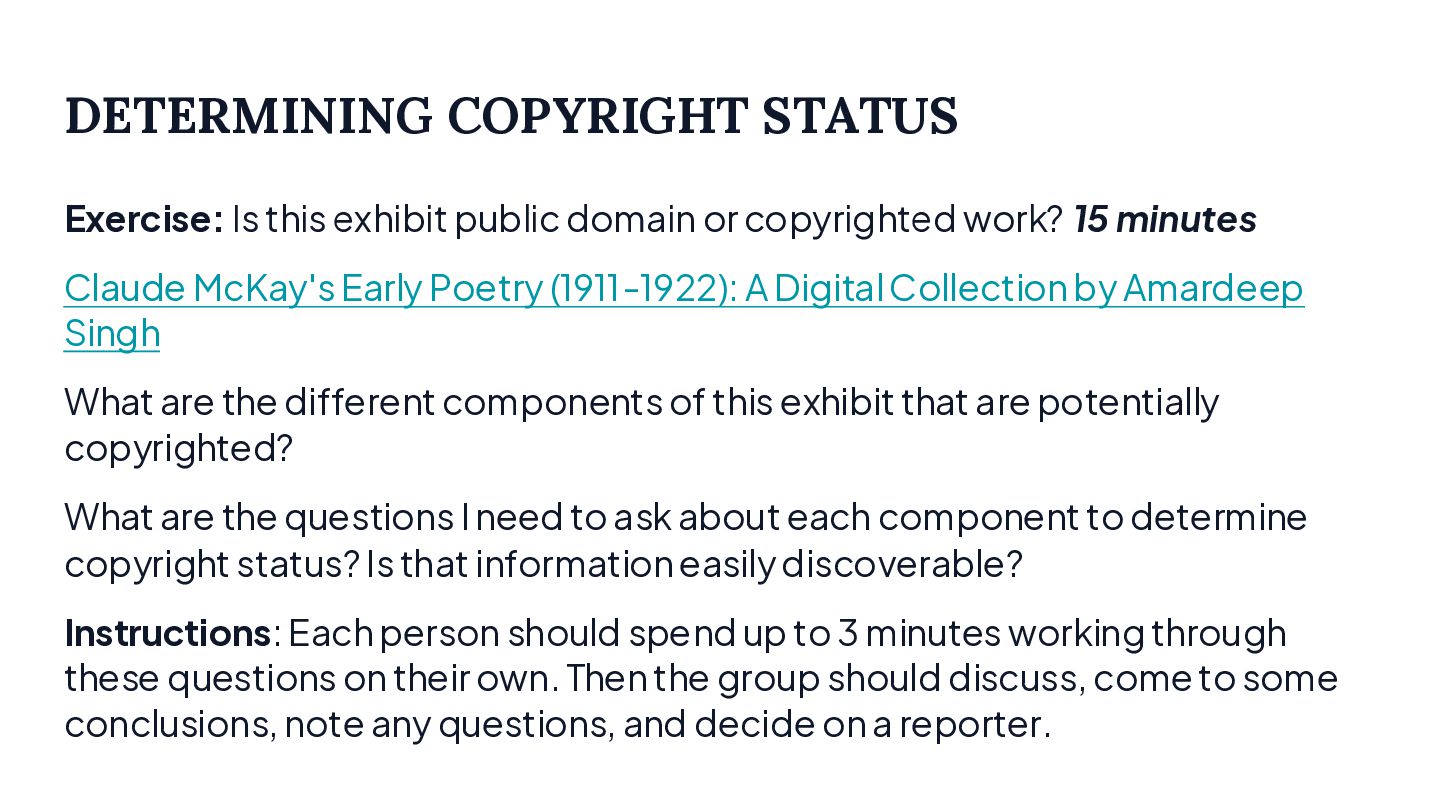
  8. DETERMINING COPYRIGHT STATUS Exercise: Is this exhibit public domain or

    copyrighted work? 15 minutes Claude McKay's Early Poetry (1911-1922): A Digital Collection by Amardeep Singh What are the different components of this exhibit that are potentially copyrighted? What are the questions I need to ask about each component to determine copyright status? Is that information easily discoverable? Instructions: Each person should spend up to 3 minutes working through these questions on their own. Then the group should discuss, come to some conclusions, note any questions, and decide on a reporter.
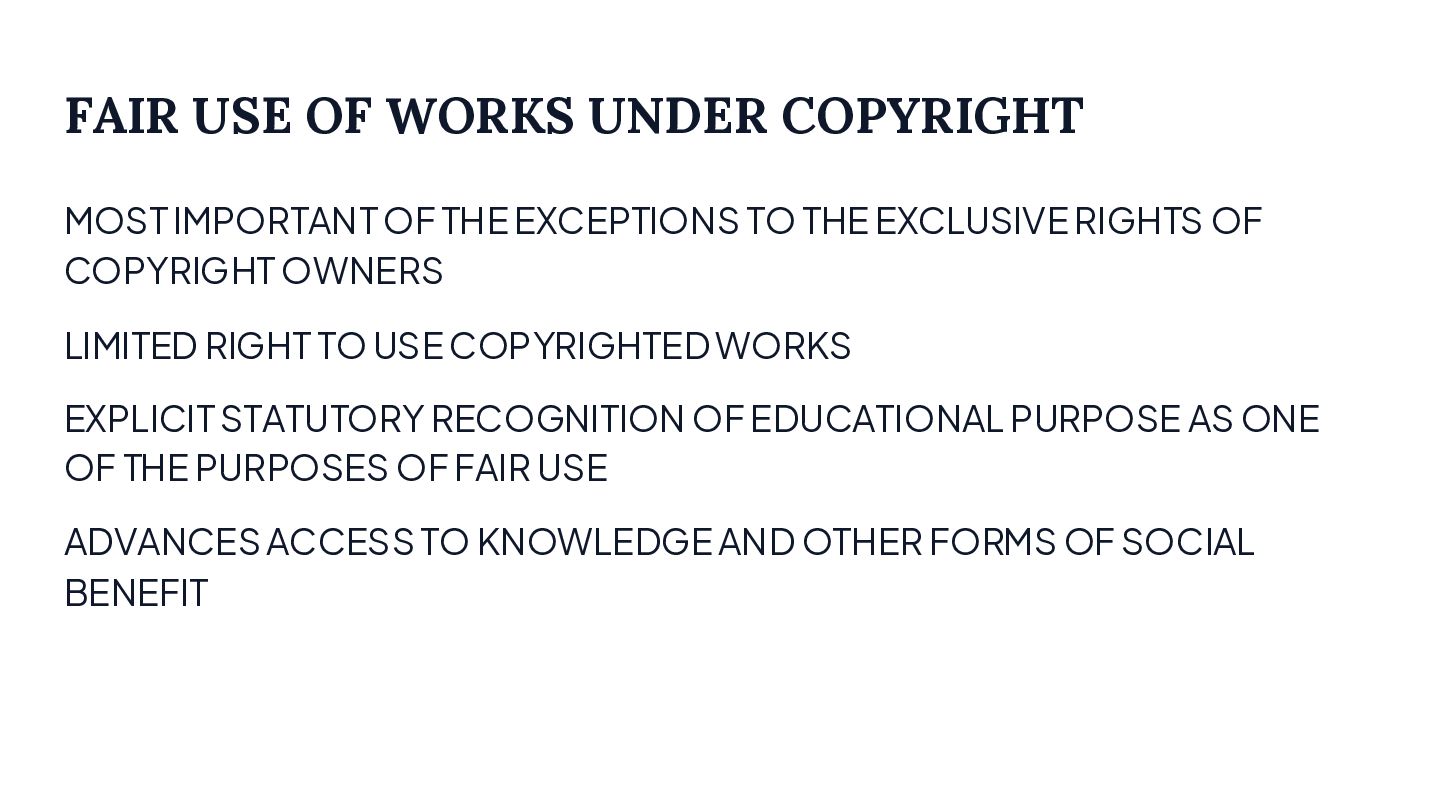
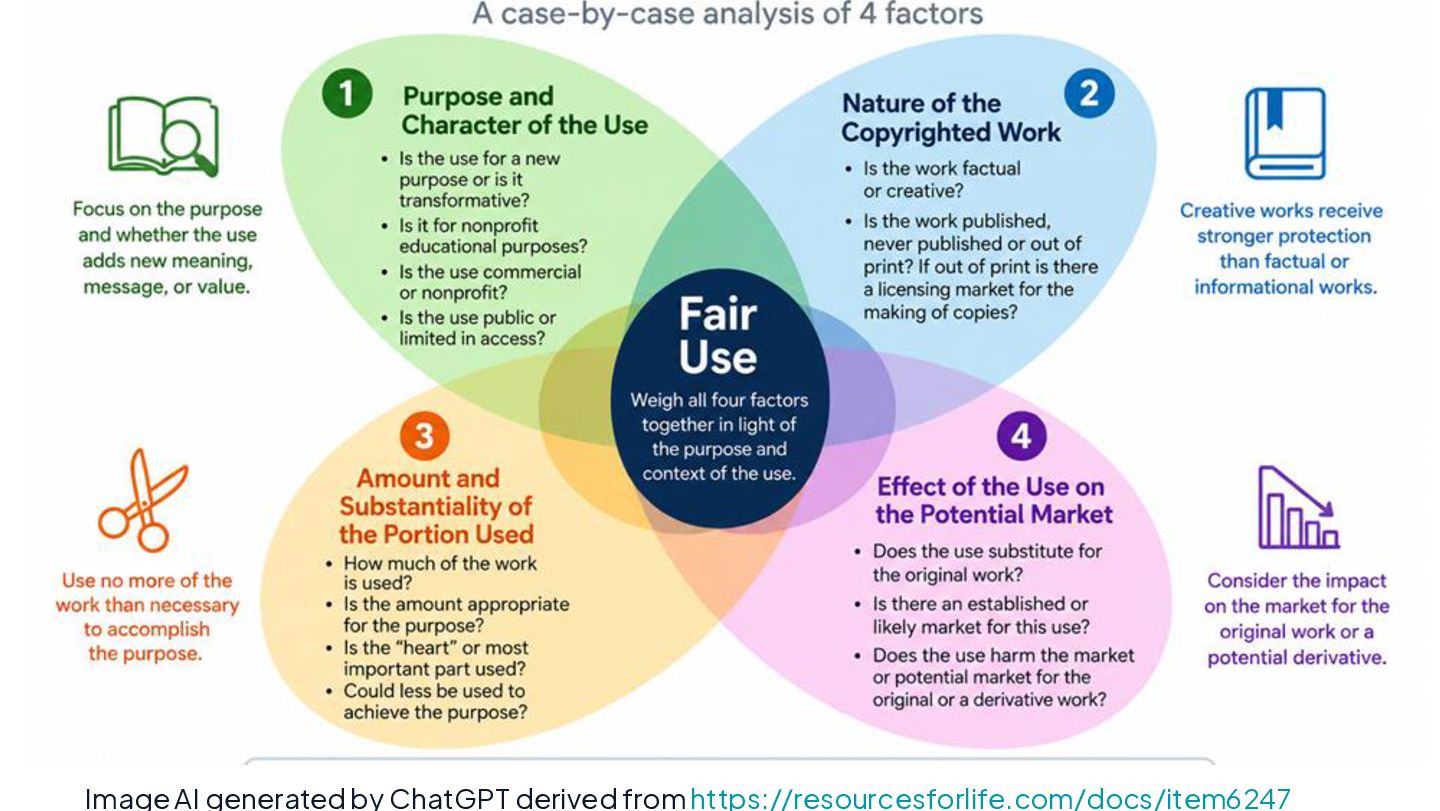
  9. FAIR USE OF WORKS UNDER COPYRIGHT MOST IMPORTANT OF THE

    EXCEPTIONS TO THE EXCLUSIVE RIGHTS OF COPYRIGHT OWNERS LIMITED RIGHT TO USE COPYRIGHTED WORKS EXPLICIT STATUTORY RECOGNITION OF EDUCATIONAL PURPOSE AS ONE OF THE PURPOSES OF FAIR USE ADVANCES ACCESS TO KNOWLEDGE AND OTHER FORMS OF SOCIAL BENEFIT
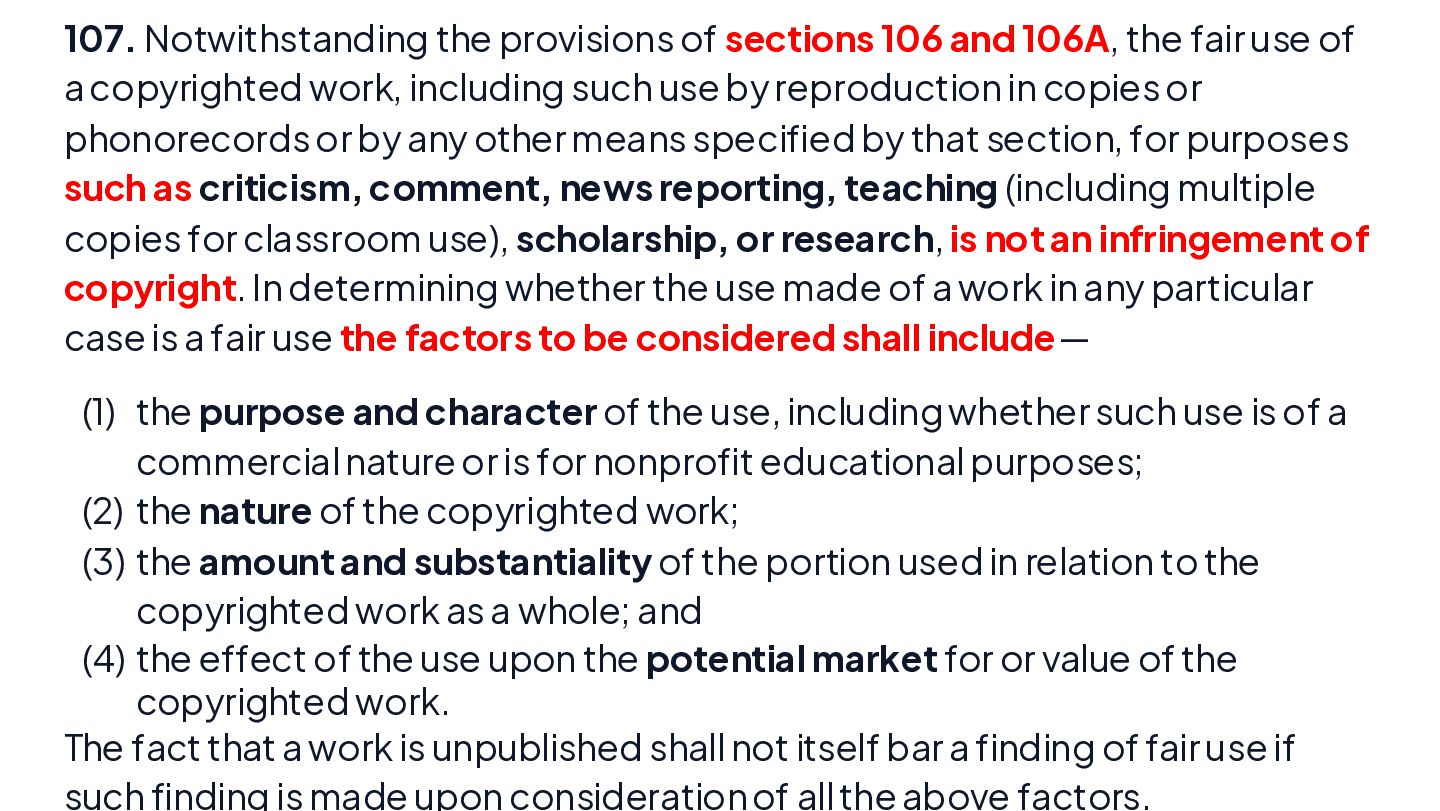
  10. 107. Notwithstanding the provisions of sections 106 and 106A, the

    fair use of a copyrighted work, including such use by reproduction in copies or phonorecords or by any other means specified by that section, for purposes such as criticism, comment, news reporting, teaching (including multiple copies for classroom use), scholarship, or research, is not an infringement of copyright. In determining whether the use made of a work in any particular case is a fair use the factors to be considered shall include— (1) the purpose and character of the use, including whether such use is of a commercial nature or is for nonprofit educational purposes; (2) the nature of the copyrighted work; (3) the amount and substantiality of the portion used in relation to the copyrighted work as a whole; and (4) the effect of the use upon the potential market for or value of the copyrighted work. The fact that a work is unpublished shall not itself bar a finding of fair use if such finding is made upon consideration of all the above factors.
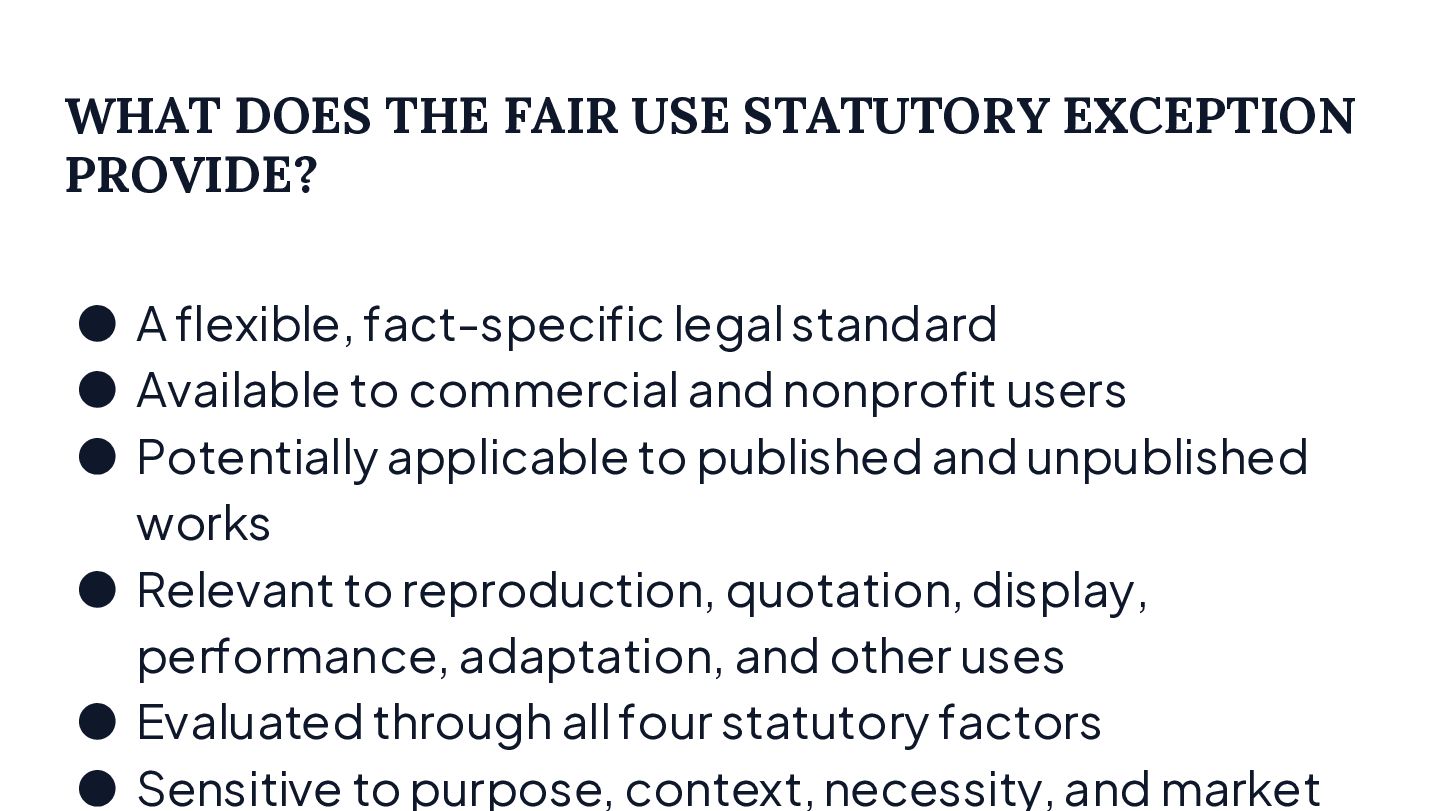
  11. WHAT DOES THE FAIR USE STATUTORY EXCEPTION PROVIDE? • A

    flexible, fact-specific legal standard • Available to commercial and nonprofit users • Potentially applicable to published and unpublished works • Relevant to reproduction, quotation, display, performance, adaptation, and other uses • Evaluated through all four statutory factors • Sensitive to purpose, context, necessity, and market
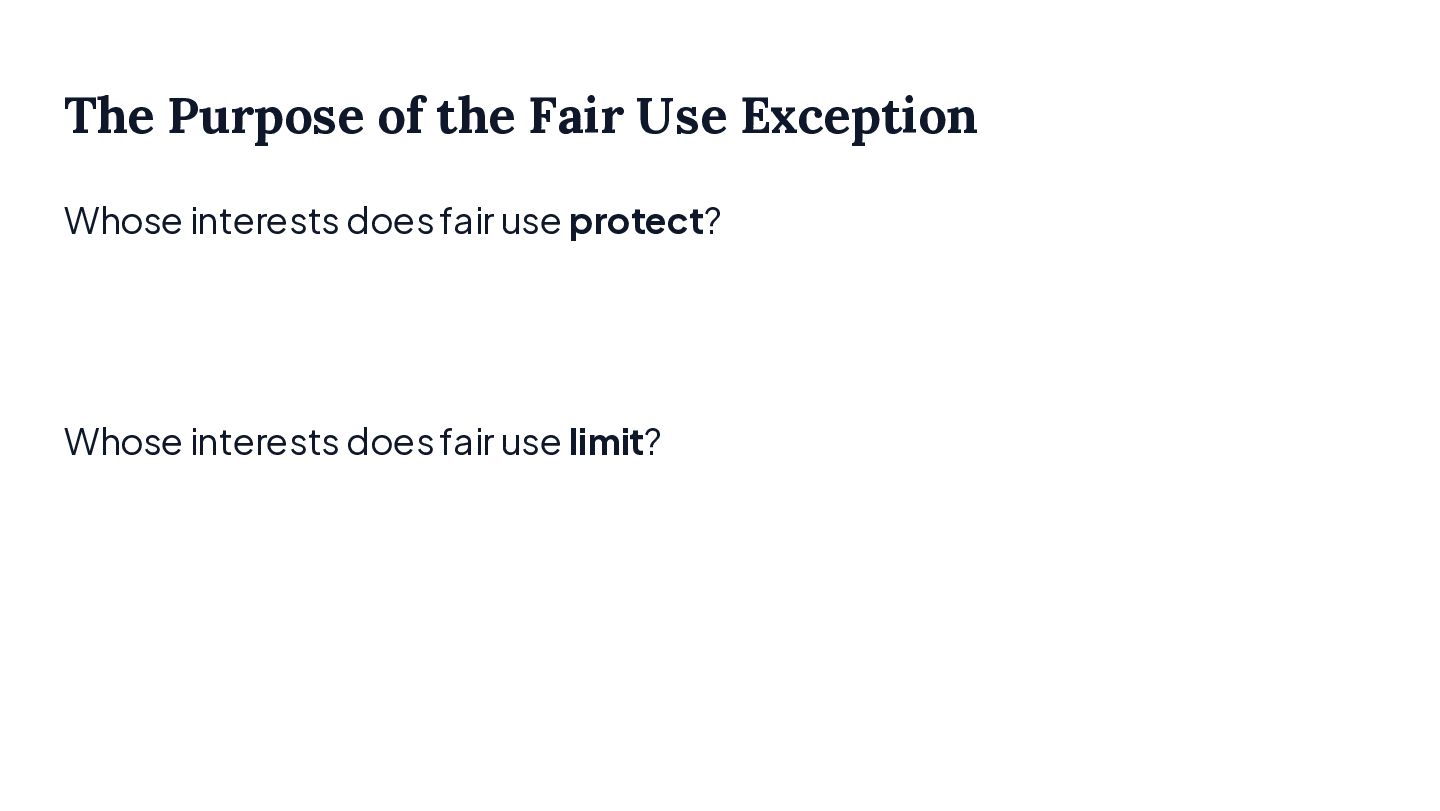
  12. The Purpose of the Fair Use Exception Whose interests does

    fair use protect? Whose interests does fair use limit?
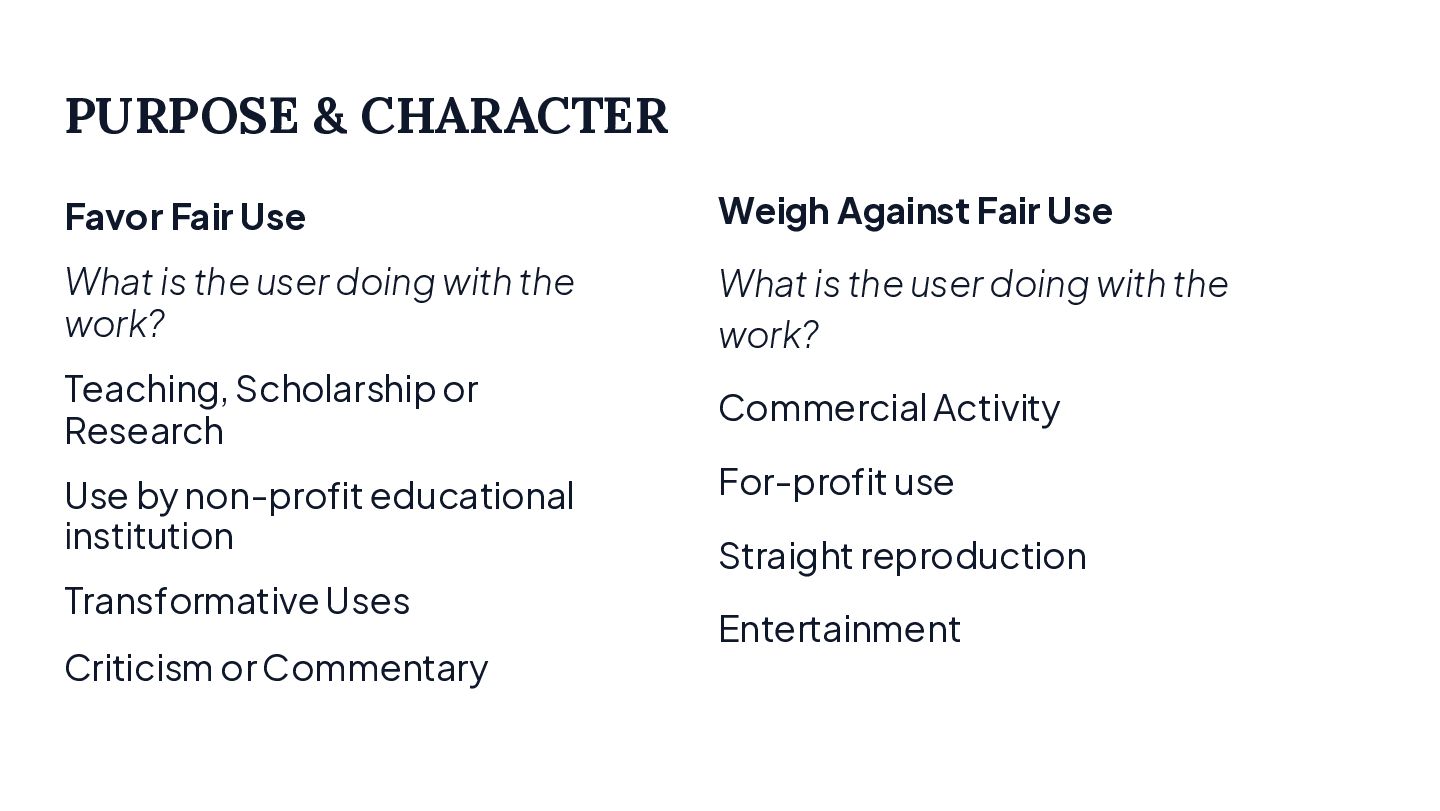
  13. PURPOSE & CHARACTER Favor Fair Use Weigh Against Fair Use

    What is the user doing with the work? What is the user doing with the work? Teaching, Scholarship or Research Commercial Activity Use by non-profit educational institution Transformative Uses Criticism or Commentary For-profit use Straight reproduction Entertainment
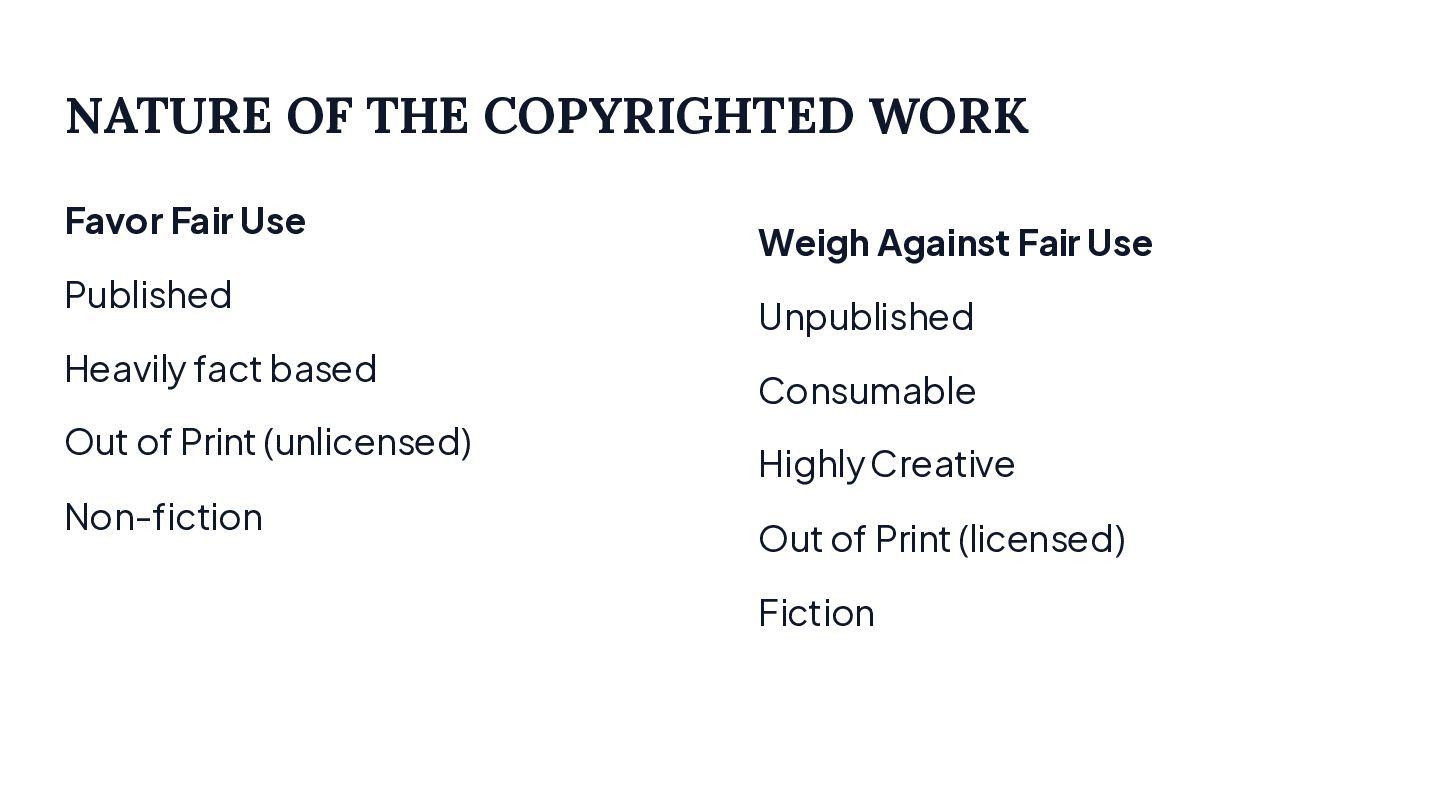
  14. NATURE OF THE COPYRIGHTED WORK Favor Fair Use Published Heavily

    fact based Out of Print (unlicensed) Non-fiction Weigh Against Fair Use Unpublished Consumable Highly Creative Out of Print (licensed) Fiction
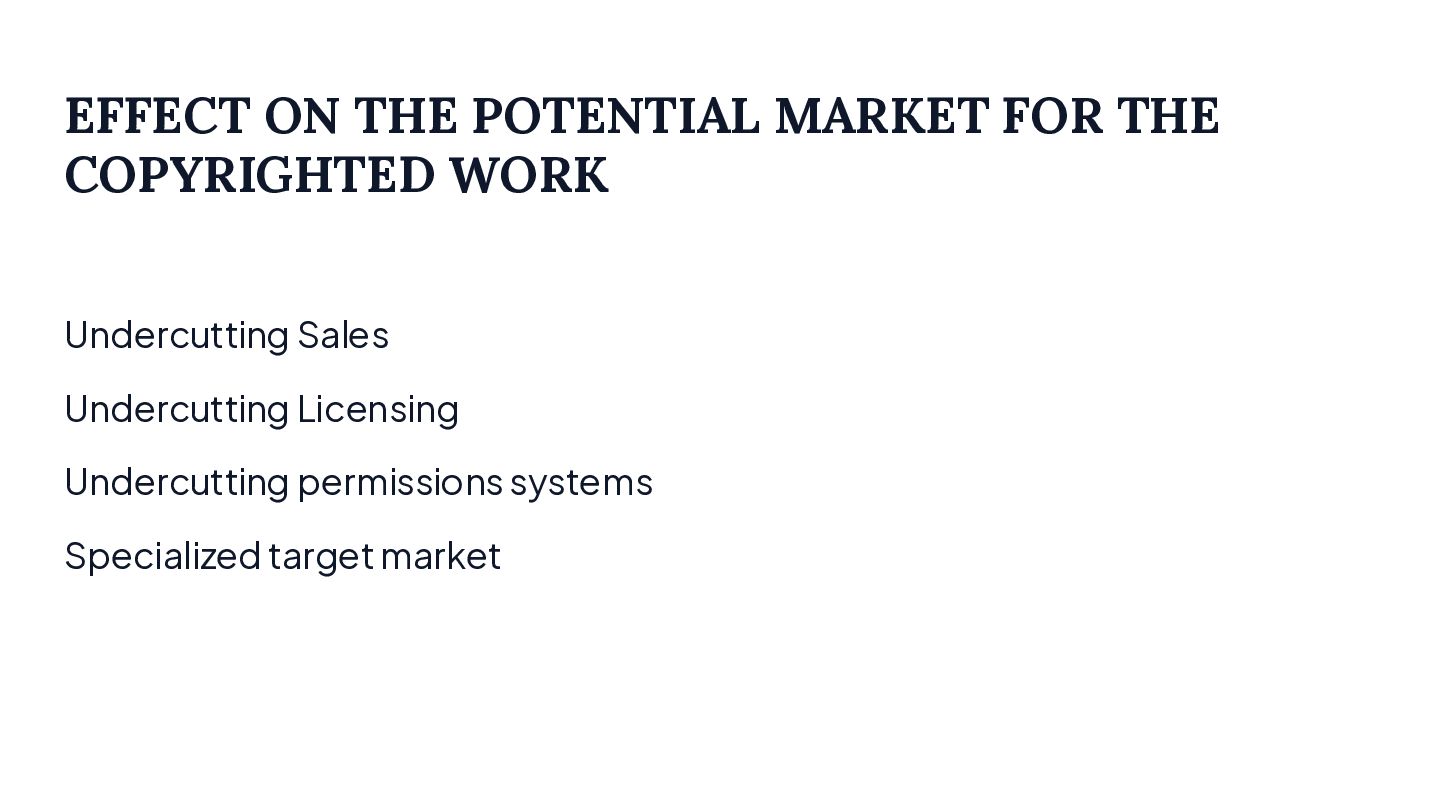
  15. EFFECT ON THE POTENTIAL MARKET FOR THE COPYRIGHTED WORK Undercutting

    Sales Undercutting Licensing Undercutting permissions systems Specialized target market
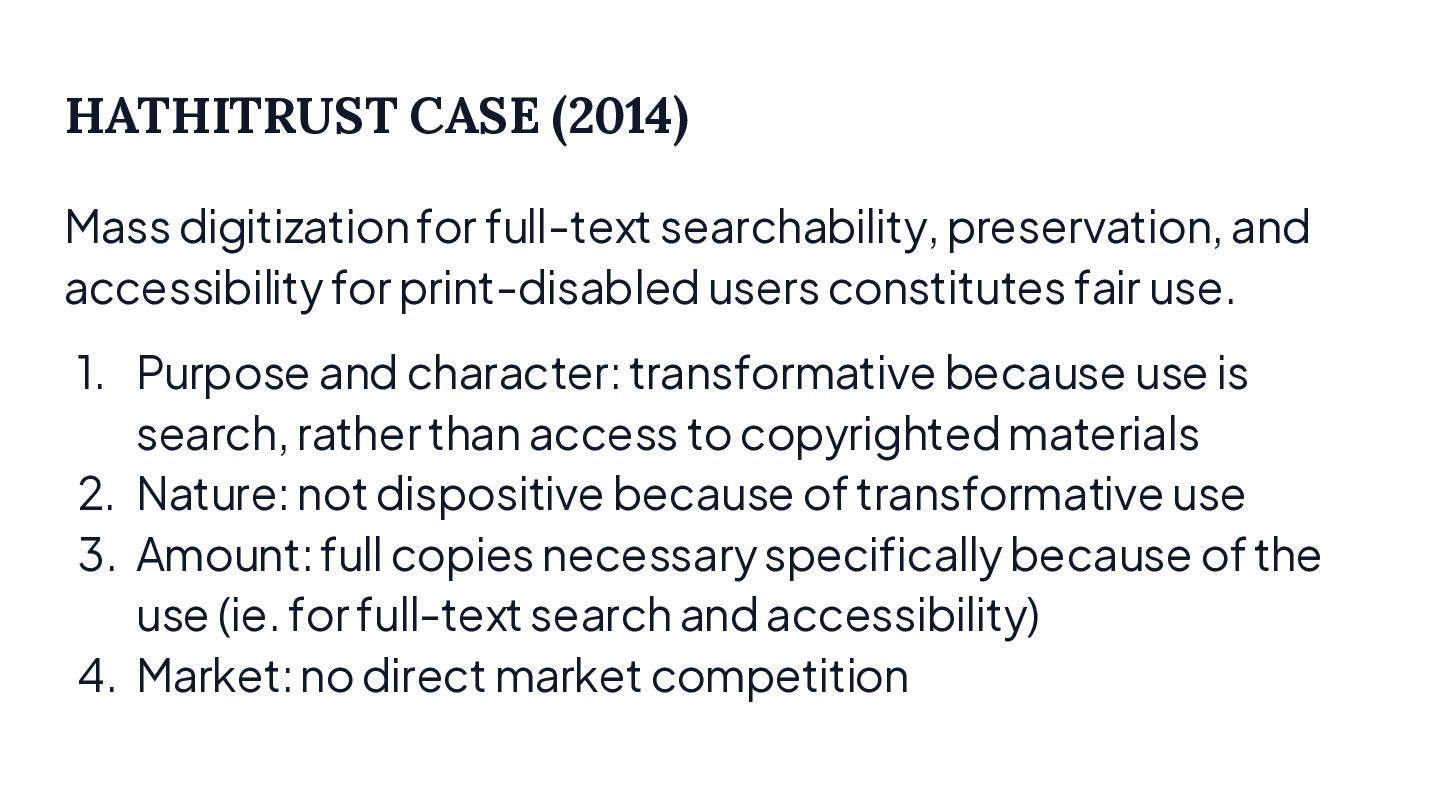
  16. HATHITRUST CASE (2014) Mass digitization for full-text searchability, preservation, and

    accessibility for print-disabled users constitutes fair use. 1. Purpose and character: transformative because use is search, rather than access to copyrighted materials 2. Nature: not dispositive because of transformative use 3. Amount: full copies necessary specifically because of the use (ie. for full-text search and accessibility) 4. Market: no direct market competition
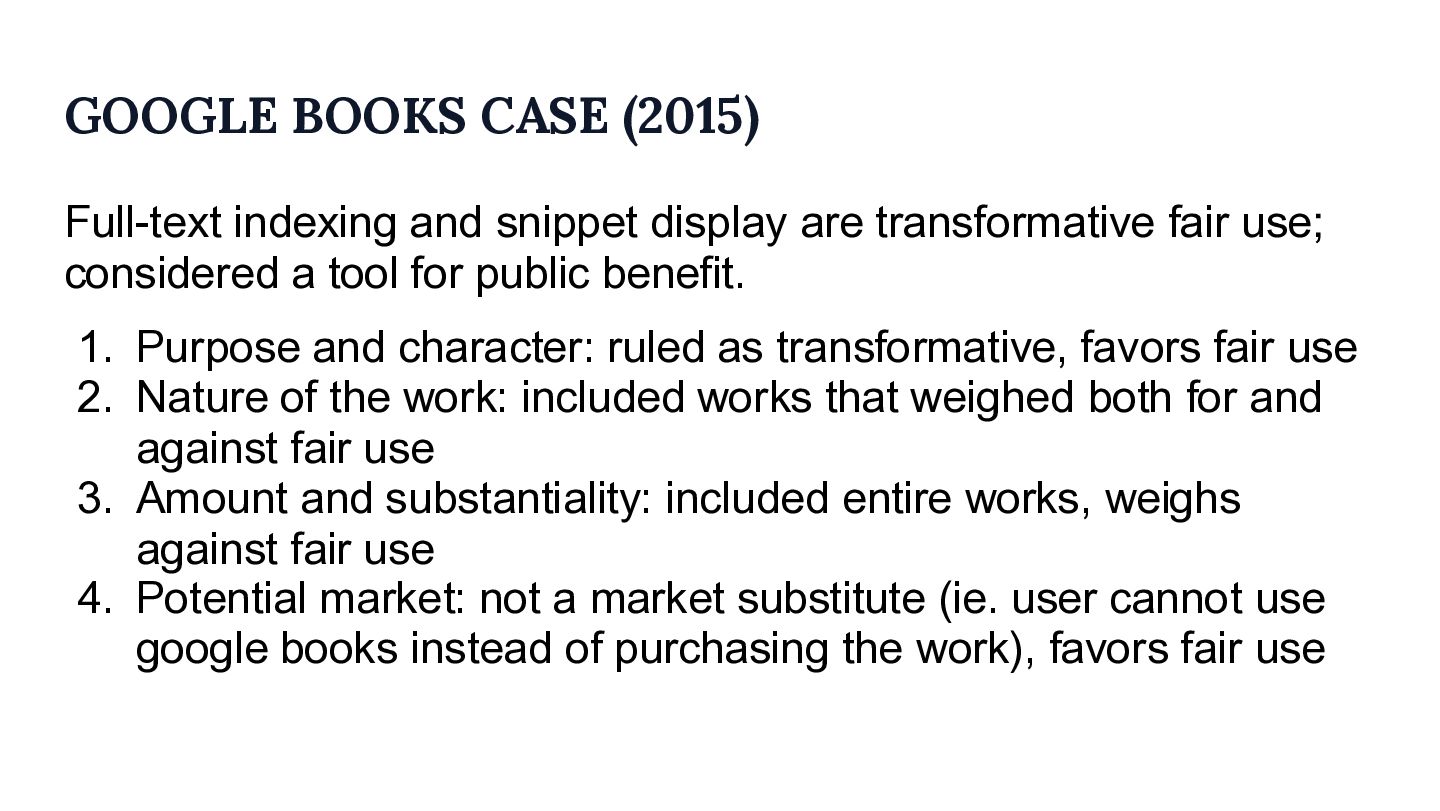
  17. GOOGLE BOOKS CASE (2015) Full-text indexing and snippet display are

    transformative fair use; considered a tool for public benefit. 1. Purpose and character: ruled as transformative, favors fair use 2. Nature of the work: included works that weighed both for and against fair use 3. Amount and substantiality: included entire works, weighs against fair use 4. Potential market: not a market substitute (ie. user cannot use google books instead of purchasing the work), favors fair use
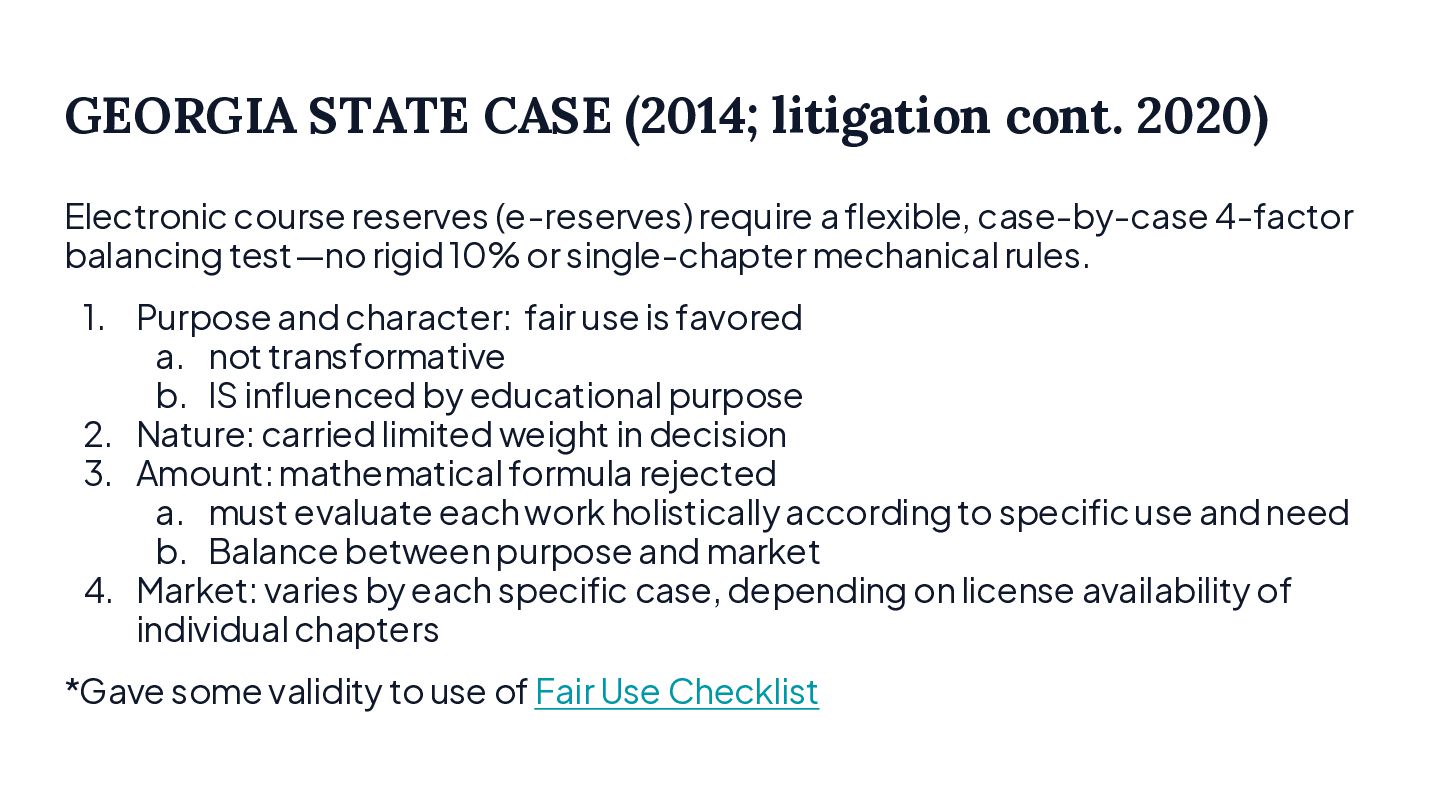
  18. GEORGIA STATE CASE (2014; litigation cont. 2020) Electronic course reserves

    (e-reserves) require a flexible, case-by-case 4-factor balancing test—no rigid 10% or single-chapter mechanical rules. 1. Purpose and character: fair use is favored a. not transformative b. IS influenced by educational purpose 2. Nature: carried limited weight in decision 3. Amount: mathematical formula rejected a. must evaluate each work holistically according to specific use and need b. Balance between purpose and market 4. Market: varies by each specific case, depending on license availability of individual chapters *Gave some validity to use of Fair Use Checklist
  19. SMALL GROUP WORK Instructions: Each person should spend up to

    3 minutes working through these questions on their own. Then the group should discuss, come to some conclusions, note any questions, and decide on a reporter.
  20. The Purpose of the Fair Use Exception When have you

    needed (or when might you need) to use copyrighted material in your work? What would be difficult or impossible in your work, academia or libraries if every quotation, excerpt, image, example or copy required advance permission from the copyright holder?
  21. WORKGROUP SCENARIOS Is it Fair Use? Using the checklist, evaluate

    whether the scenarios on the next slide are fair use. If you decide any scenario is not fair use, decide what you will do if you had to deal with the scenario.
  22. PURPOSE & CHARACTER: What factors are for/against fair use here?

    Compare these uses of a photograph of the North Carolina Mutual Life Insurance Company: 1. The photograph is reproduced as decorative artwork on the homepage of a university department. 2. The photograph is reproduced in a digital exhibit with commentary about the neighborhood where NC Mutual was located. 3. The photograph appears in a scholarly article analyzing how that specific image constructs or pushes back against prevailing ideas about wealth-building in African American communities