Upgrade to Pro — share decks privately, control downloads, hide ads and more …

Inside the Clone Plugin

Sponsored · Ship Features Fearlessly Turn features on and off without deploys. Used by thousands of Ruby developers. →

Inside the Clone Plugin

Everyone knows the syntax: CLONE INSTANCE FROM ..., wait a bit, and you have a new replica. Far fewer people know what happens underneath, and that is where the interesting engineering is.

Copying a multi-terabyte data directory takes minutes to hours, and the database keeps changing the whole time. So what exactly did you copy? Clone's answer is a three-stage protocol built inside InnoDB: a bulk file copy that is knowingly inconsistent, a page copy that repairs what changed underneath it, and a redo tail that pins the whole thing to a single LSN. On first start the result is just ordinary crash recovery.

In this talk I walk through that protocol and the two pieces of infrastructure it needed: modified-page tracking and redo archiving, both of which outlived clone itself. Along the way we look at the design tradeoffs the worklogs spell out: why pages are tracked at flush time rather than when they are dirtied, what the donor actually pays for while a clone runs, what happens when the redo archiver falls behind, and how binlog position and GTID end up consistent with the copied data.

I don't write InnoDB, I operate it. This is a practitioner's reading of the code and the worklogs, aimed at anyone who provisions replicas and wants to know what they are trusting.

Avatar for Matthias Crauwels

Matthias Crauwels PRO

October 09, 2026

More Decks by Matthias Crauwels

Other Decks in Technology

Transcript

  1. Inside the MySQL Clone Plugin how it was built, and

    how it compares to Galera SST Matthias Crauwels Enterprise Customer Engineer, PlanetScale @mcrauwel
  2. Who am I? Living in Ghent, Belgium ~30 years Linux

    user / admin ~15 years MySQL DBA Enterprise Customer Engineer at PlanetScale Day job: Vitess, MySQL and Postgres at scale for large customers Clone shows up in my world as provisioning, not as a paper // Introduction 2
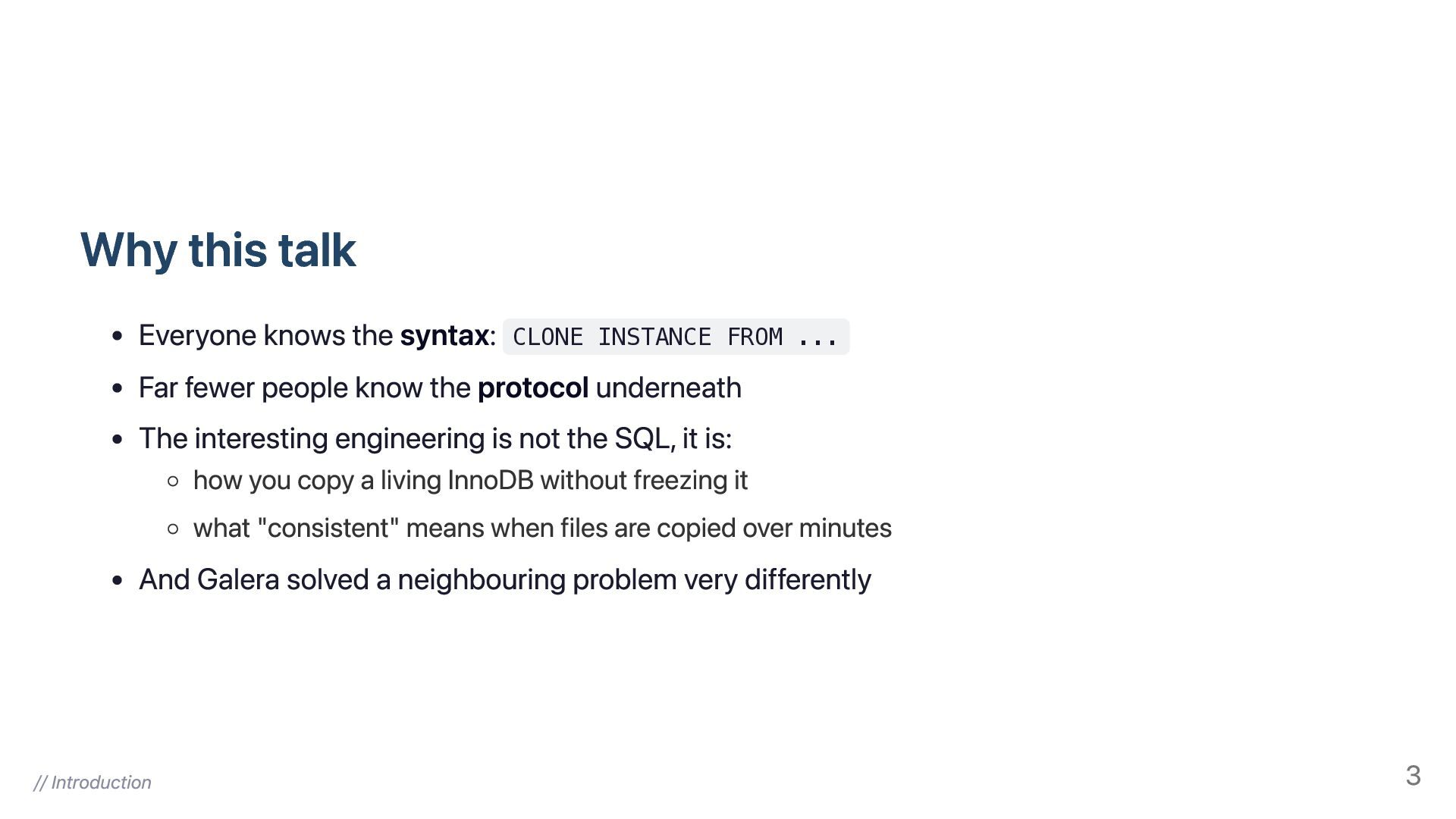
  3. Why this talk Everyone knows the syntax: Far fewer people

    know the protocol underneath The interesting engineering is not the SQL, it is: CLONE INSTANCE FROM ... how you copy a living InnoDB without freezing it what "consistent" means when files are copied over minutes And Galera solved a neighbouring problem very differently // Introduction 3
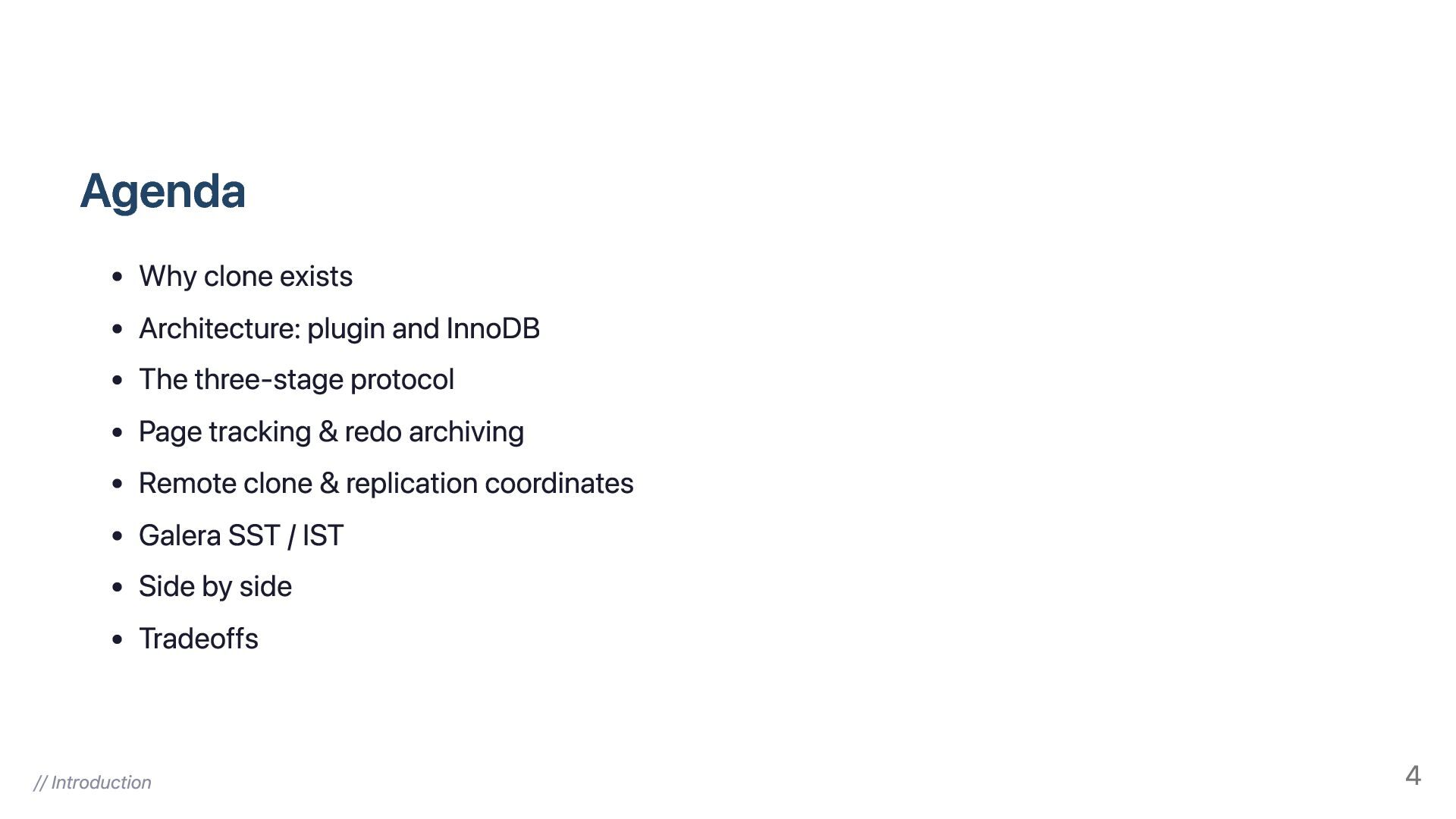
  4. Agenda Why clone exists Architecture: plugin and InnoDB The three-stage

    protocol Page tracking & redo archiving Remote clone & replication coordinates Galera SST / IST Side by side Tradeoffs // Introduction 4
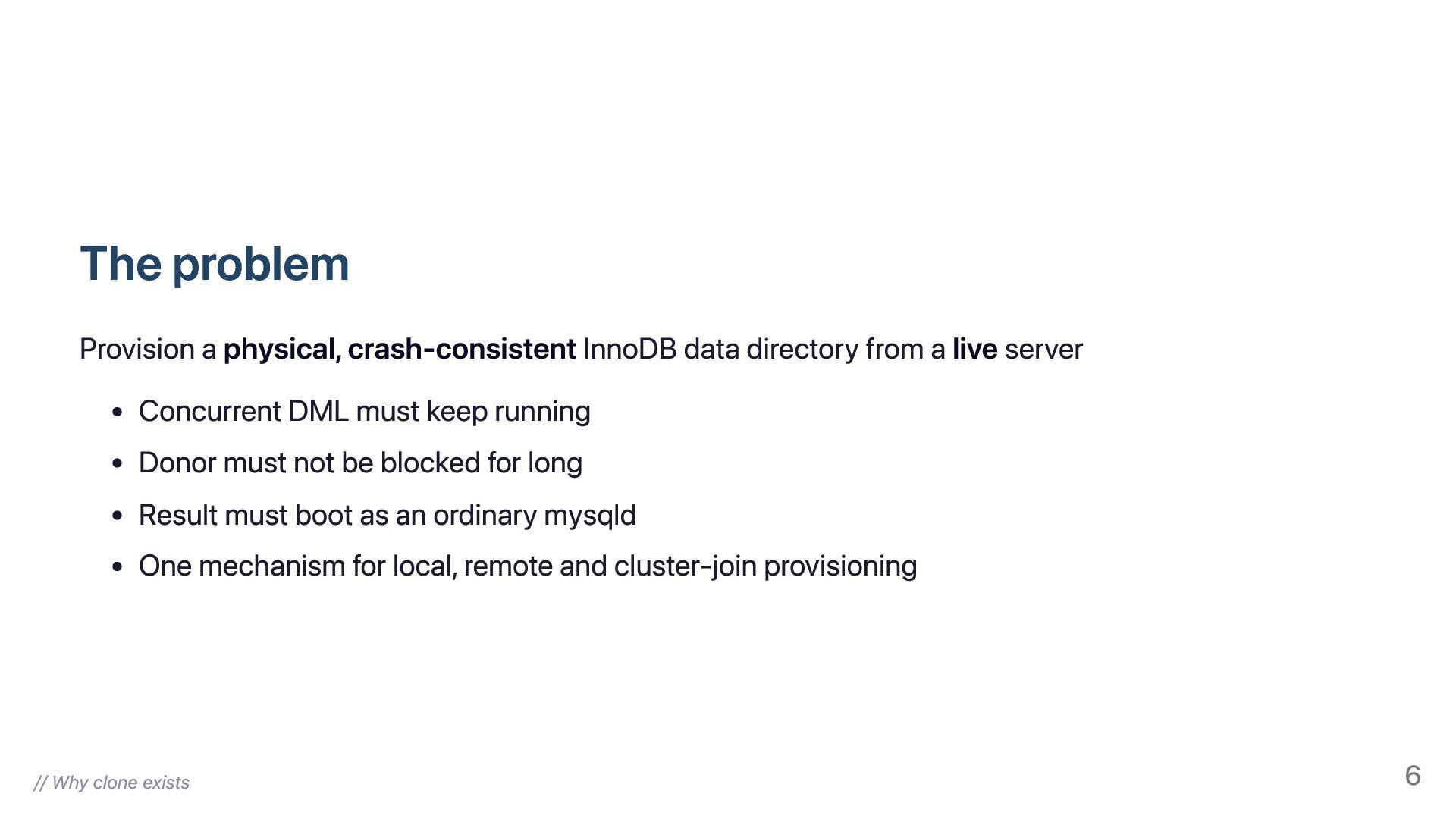
  5. The problem Provision a physical, crash-consistent InnoDB data directory from

    a live server Concurrent DML must keep running Donor must not be blocked for long Result must boot as an ordinary mysqld One mechanism for local, remote and cluster-join provisioning // Why clone exists 6
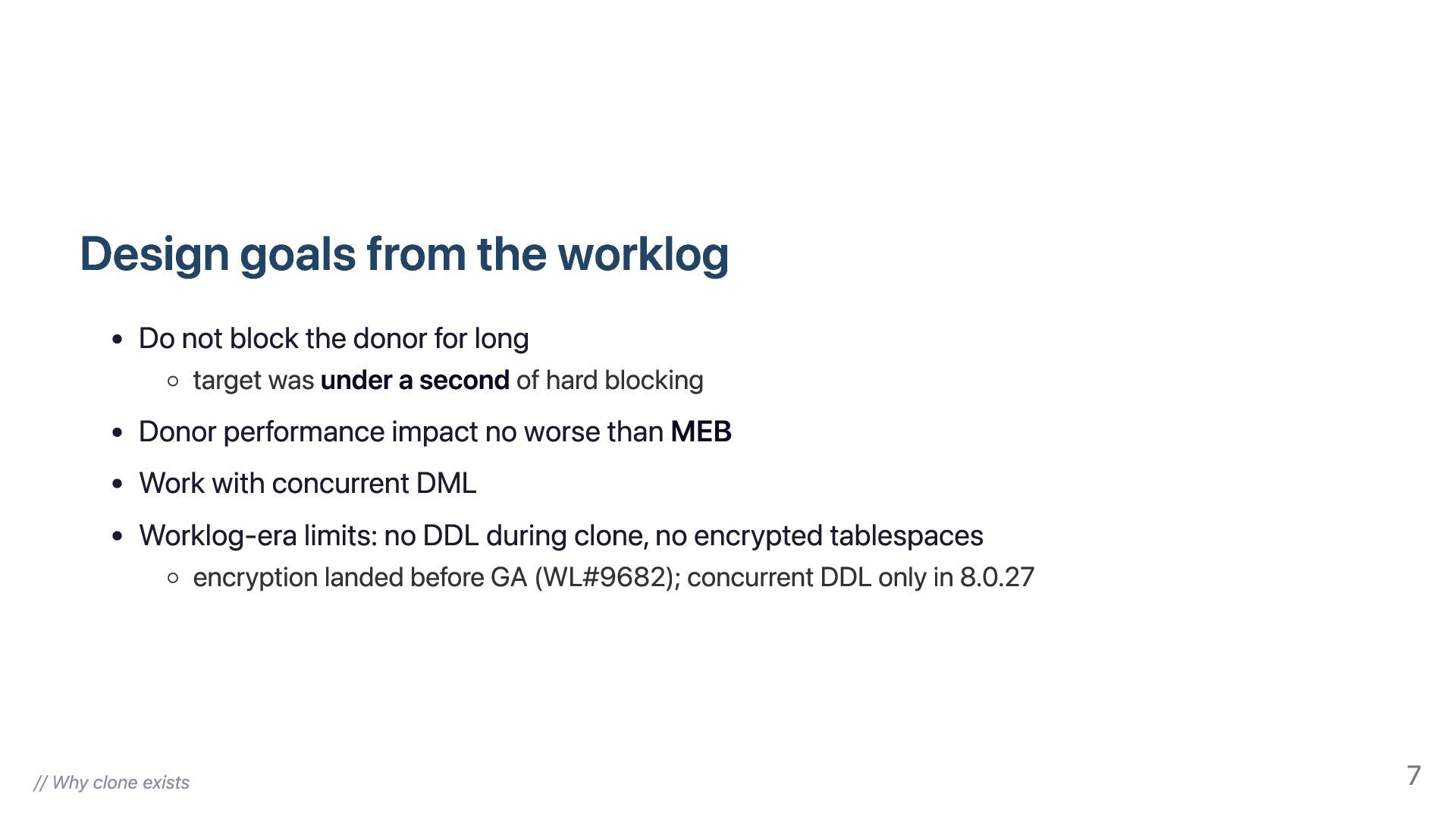
  6. Design goals from the worklog Do not block the donor

    for long target was under a second of hard blocking Donor performance impact no worse than MEB Work with concurrent DML Worklog-era limits: no DDL during clone, no encrypted tablespaces encryption landed before GA (WL#9682); concurrent DDL only in 8.0.27 // Why clone exists 7
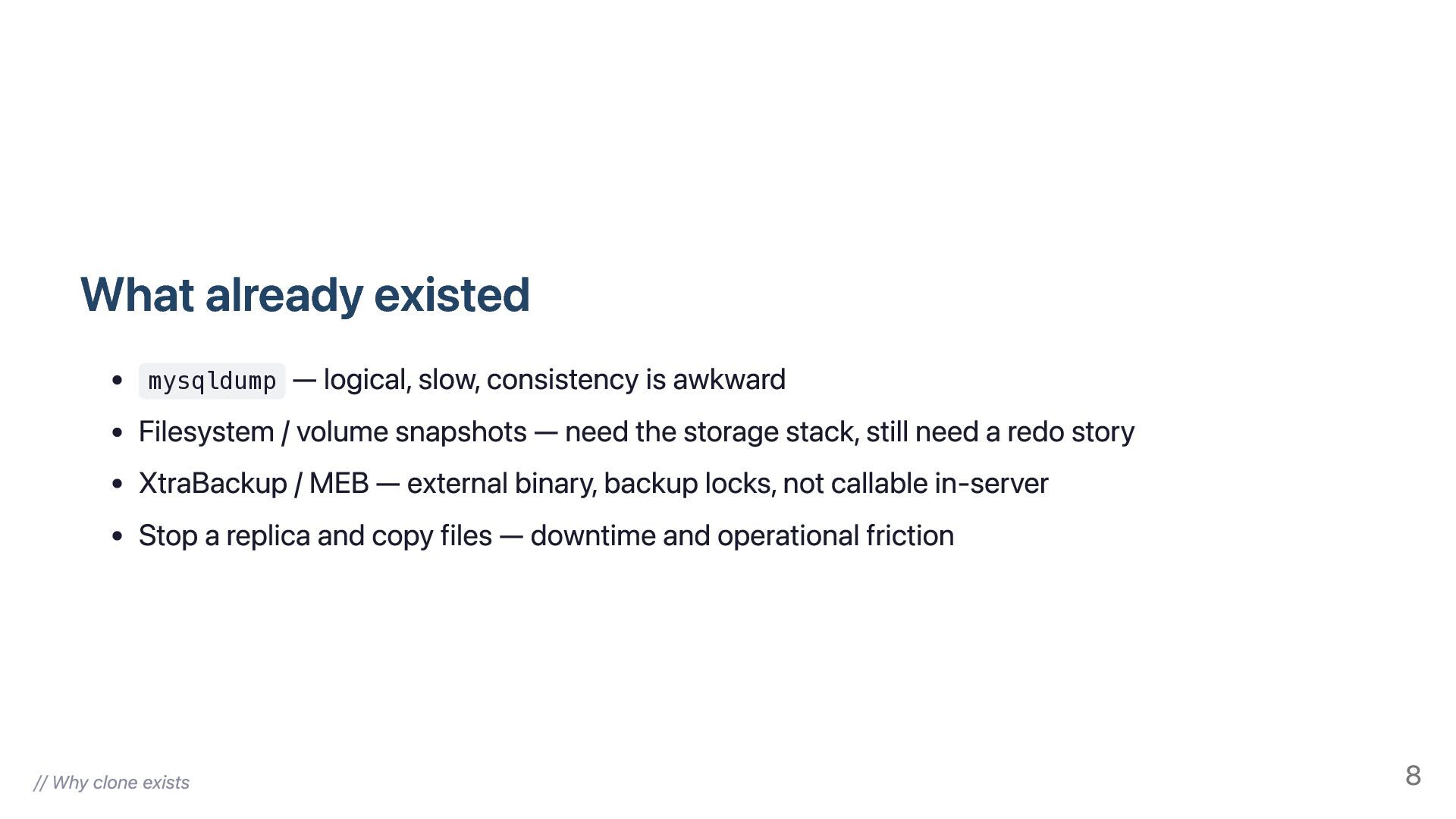
  7. What already existed — logical, slow, consistency is awkward Filesystem

    / volume snapshots — need the storage stack, still need a redo story XtraBackup / MEB — external binary, backup locks, not callable in-server Stop a replica and copy files — downtime and operational friction mysqldump // Why clone exists 8
  8. Clone's bet Put the physical snapshot inside InnoDB, expose it

    through a storage engine API, and let a plugin move the bytes // Why clone exists
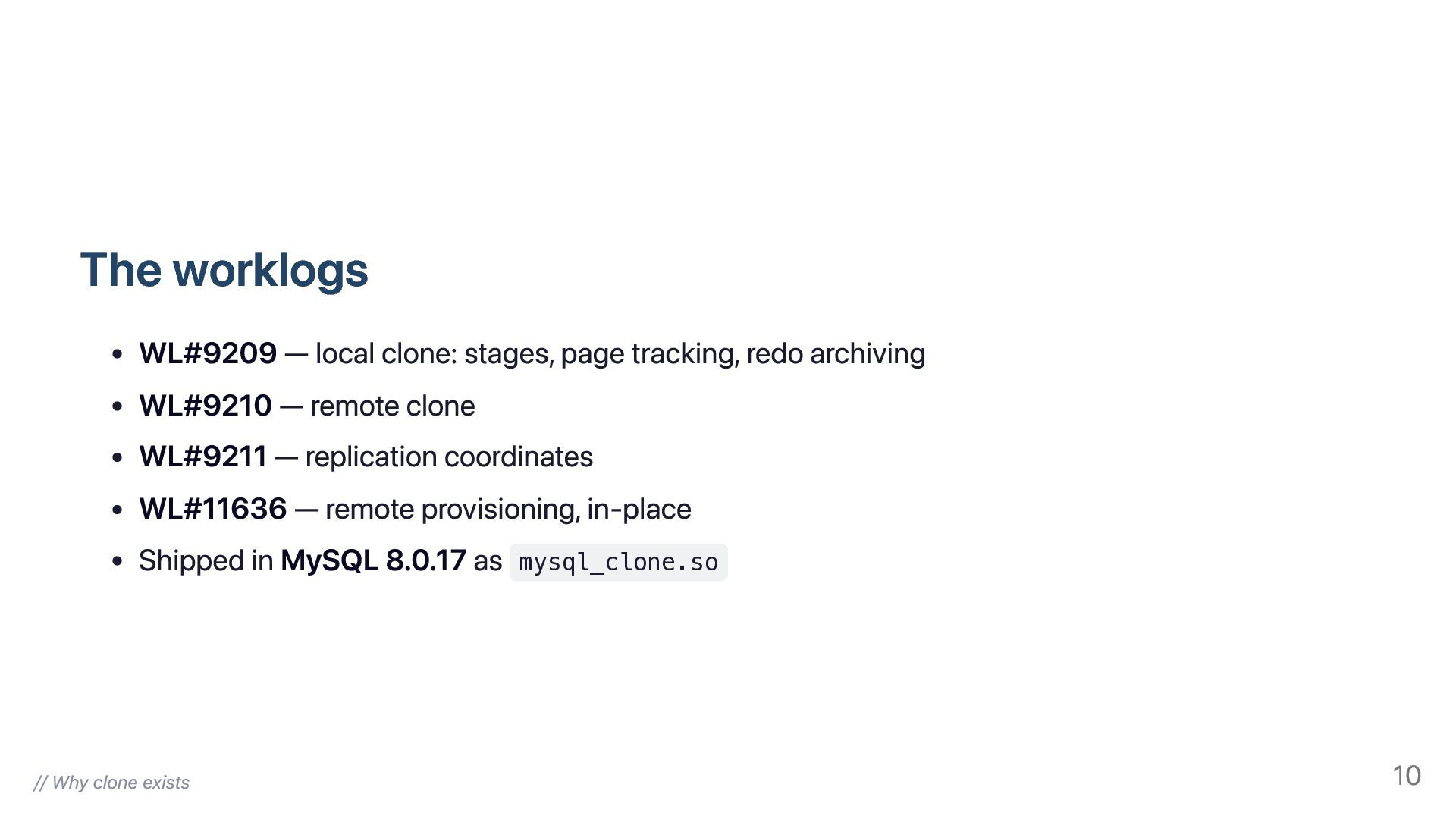
  9. The worklogs WL#9209 — local clone: stages, page tracking, redo

    archiving WL#9210 — remote clone WL#9211 — replication coordinates WL#11636 — remote provisioning, in-place Shipped in MySQL 8.0.17 as mysql_clone.so // Why clone exists 10
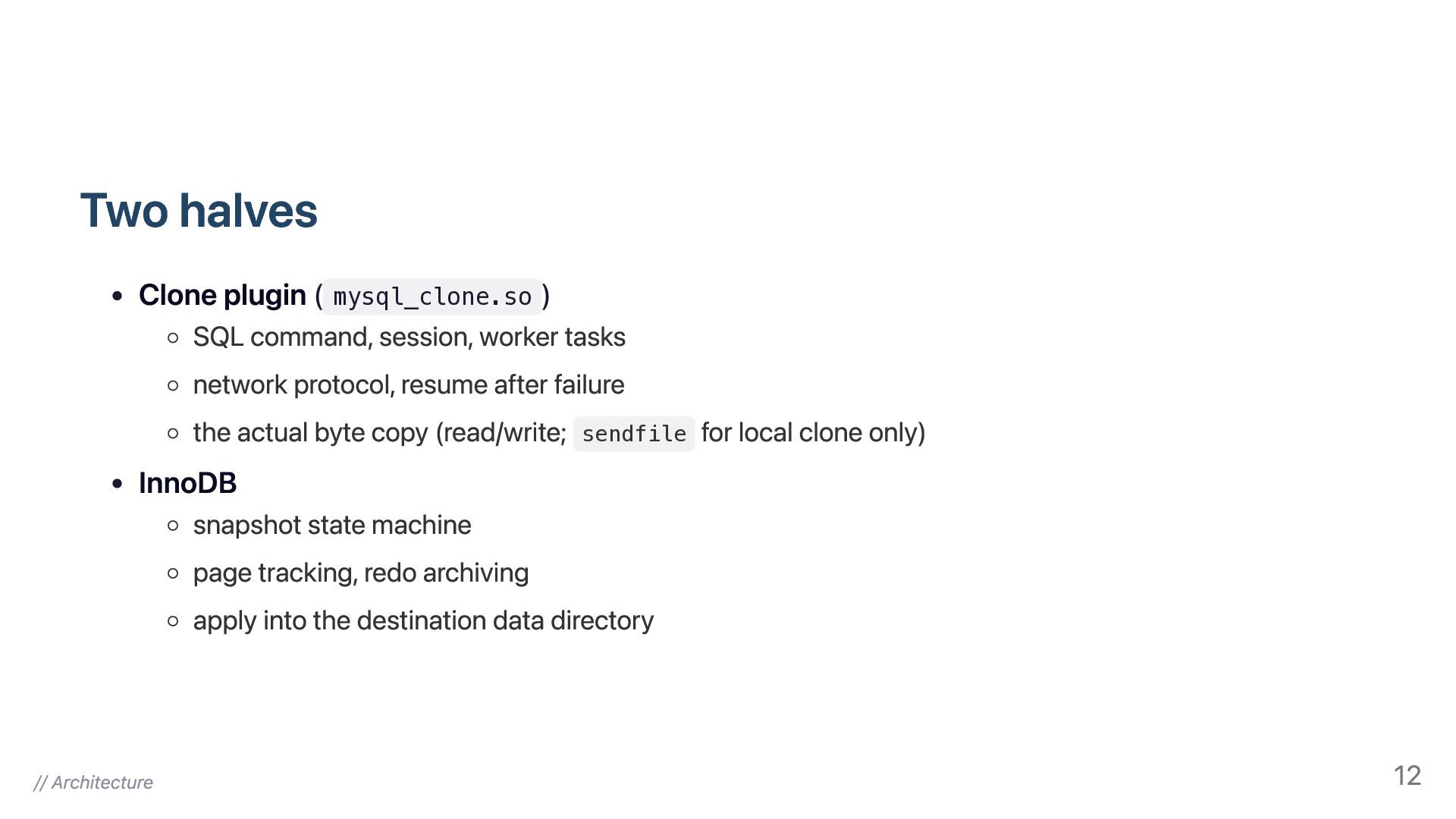
  10. Two halves Clone plugin ( mysql_clone.so ) SQL command, session,

    worker tasks network protocol, resume after failure the actual byte copy (read/write; InnoDB sendfile for local clone only) snapshot state machine page tracking, redo archiving apply into the destination data directory // Architecture 12
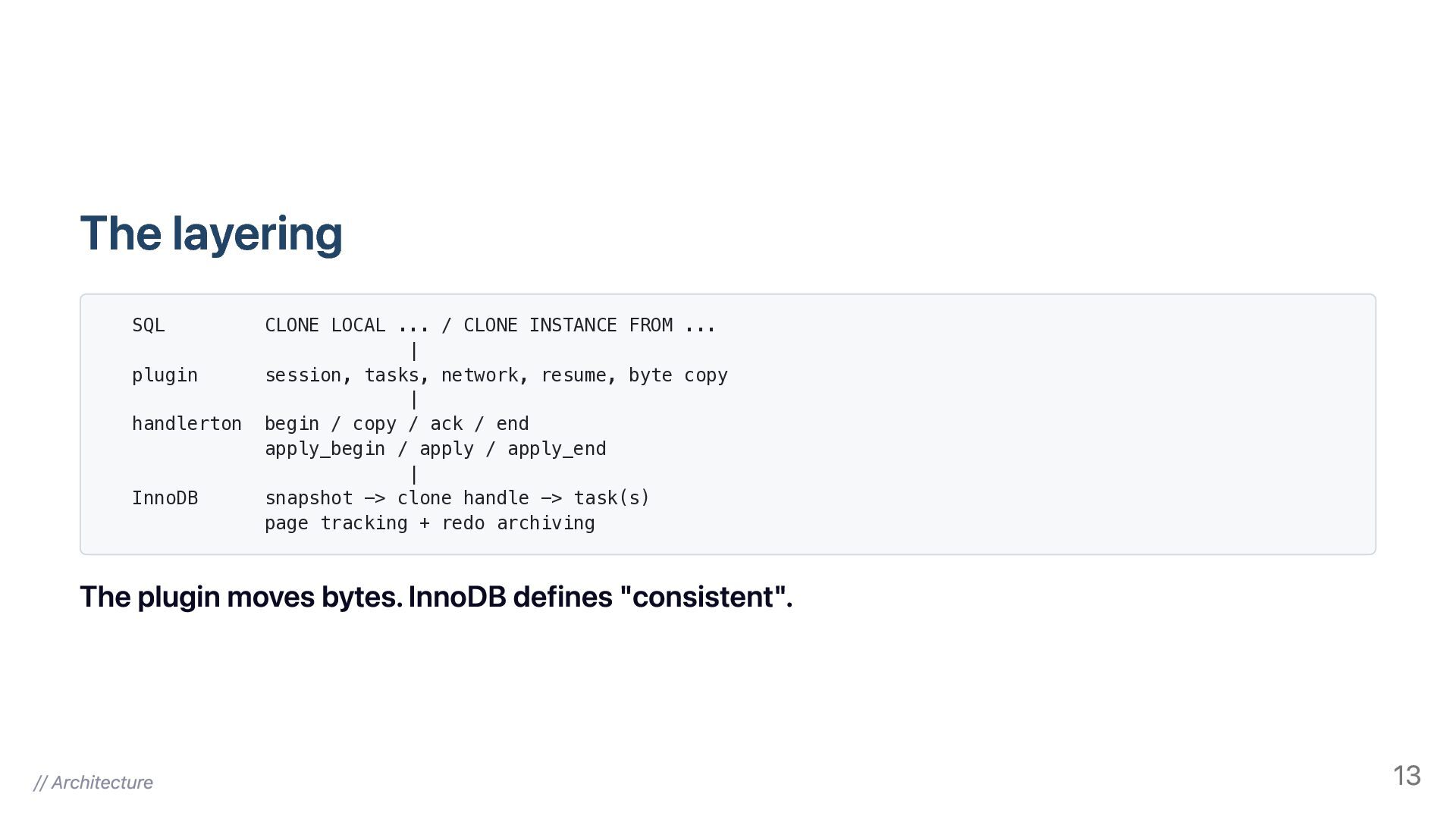
  11. The layering SQL plugin handlerton InnoDB CLONE LOCAL ... /

    CLONE INSTANCE FROM ... | session, tasks, network, resume, byte copy | begin / copy / ack / end apply_begin / apply / apply_end | snapshot -> clone handle -> task(s) page tracking + redo archiving The plugin moves bytes. InnoDB defines "consistent". // Architecture 13
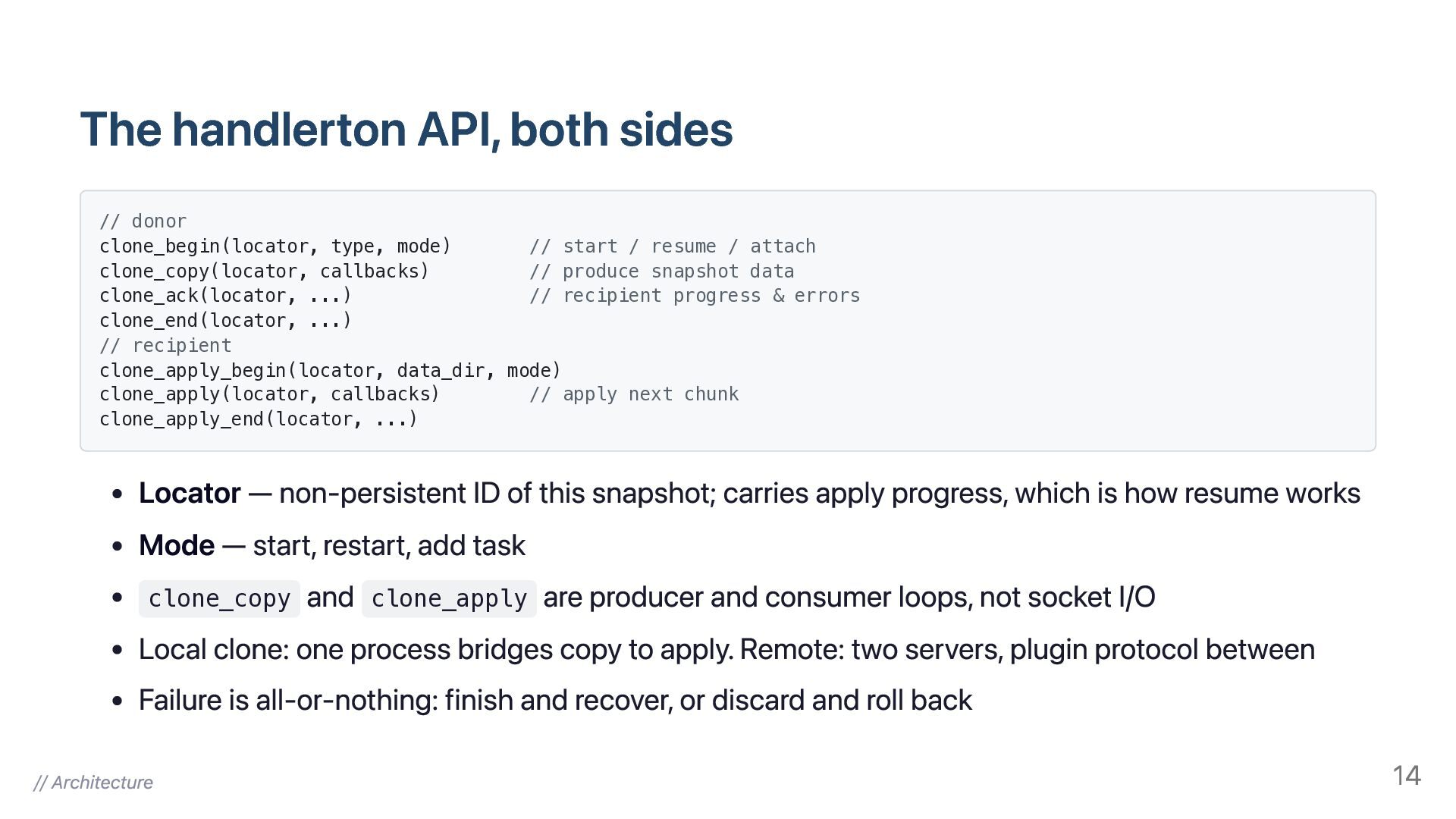
  12. The handlerton API, both sides // donor clone_begin(locator, type, mode)

    // start / resume / attach clone_copy(locator, callbacks) // produce snapshot data clone_ack(locator, ...) // recipient progress & errors clone_end(locator, ...) // recipient clone_apply_begin(locator, data_dir, mode) clone_apply(locator, callbacks) // apply next chunk clone_apply_end(locator, ...) Locator — non-persistent ID of this snapshot; carries apply progress, which is how resume works Mode — start, restart, add task and are producer and consumer loops, not socket I/O Local clone: one process bridges copy to apply. Remote: two servers, plugin protocol between Failure is all-or-nothing: finish and recover, or discard and roll back clone_copy // Architecture clone_apply 14
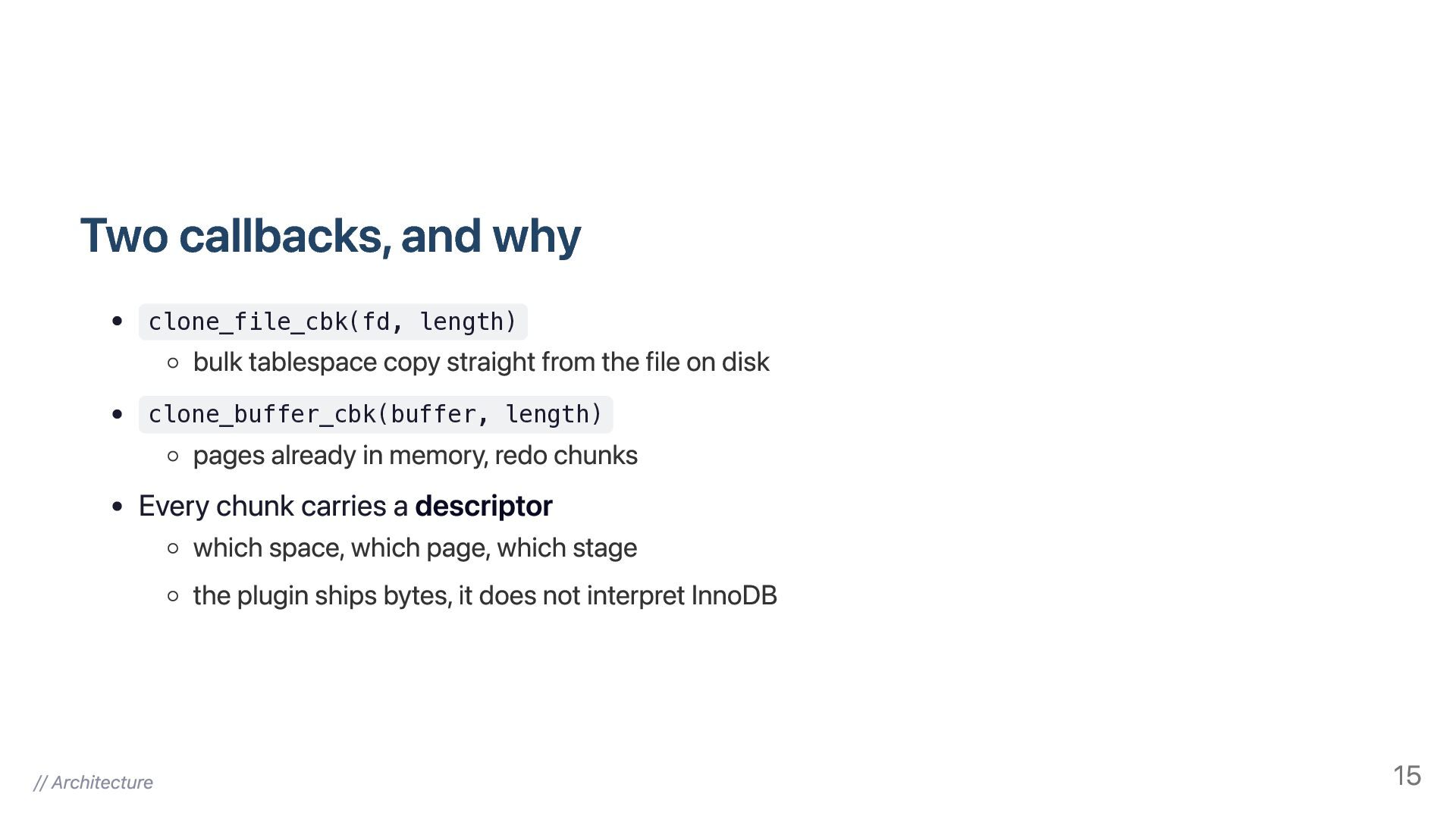
  13. Two callbacks, and why clone_file_cbk(fd, length) bulk tablespace copy straight

    from the file on disk clone_buffer_cbk(buffer, length) pages already in memory, redo chunks Every chunk carries a descriptor which space, which page, which stage the plugin ships bytes, it does not interpret InnoDB // Architecture 15
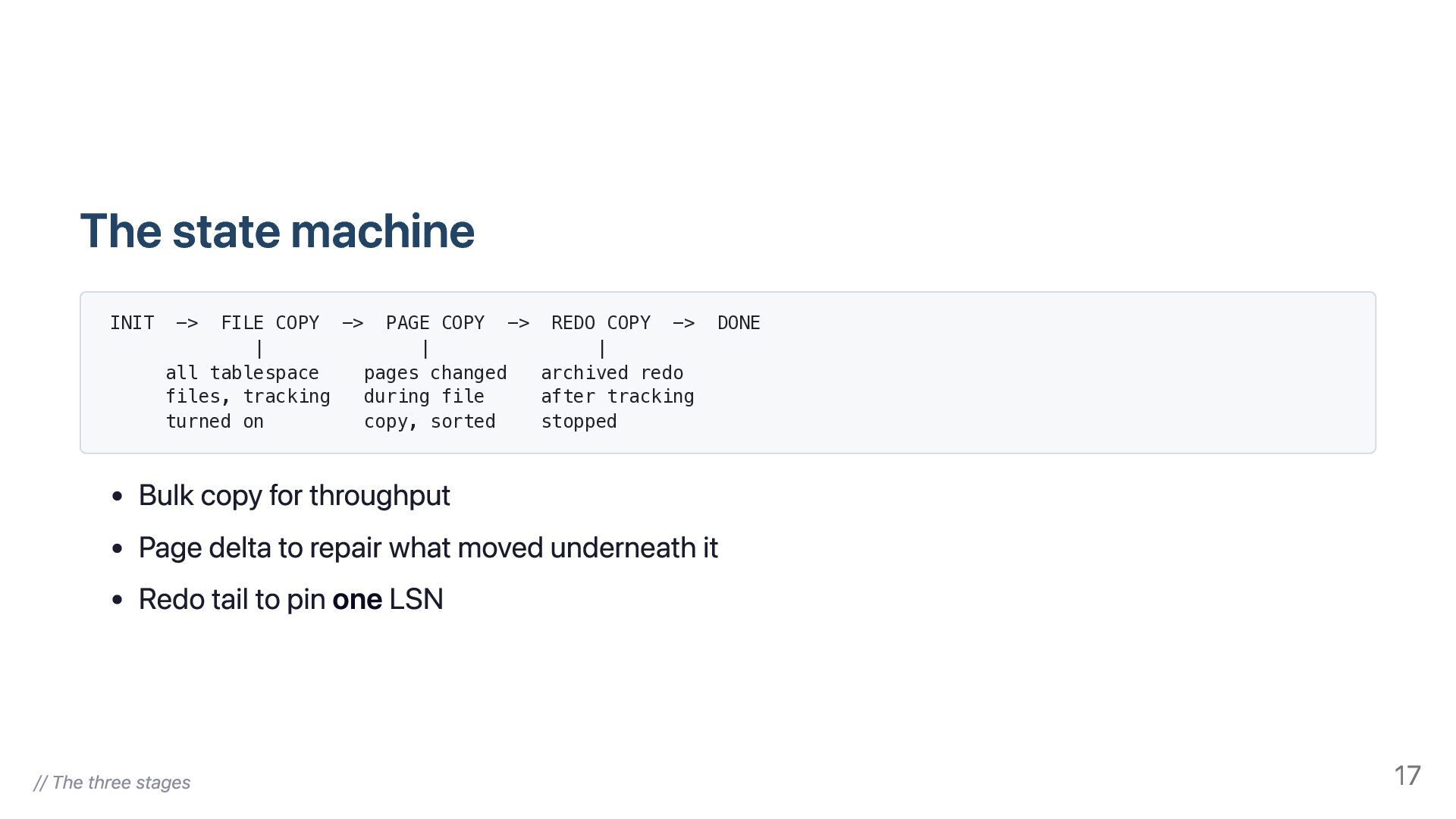
  14. The state machine INIT -> FILE COPY -> PAGE COPY

    -> REDO COPY -> | | | all tablespace pages changed archived redo files, tracking during file after tracking turned on copy, sorted stopped DONE Bulk copy for throughput Page delta to repair what moved underneath it Redo tail to pin one LSN // The three stages 17
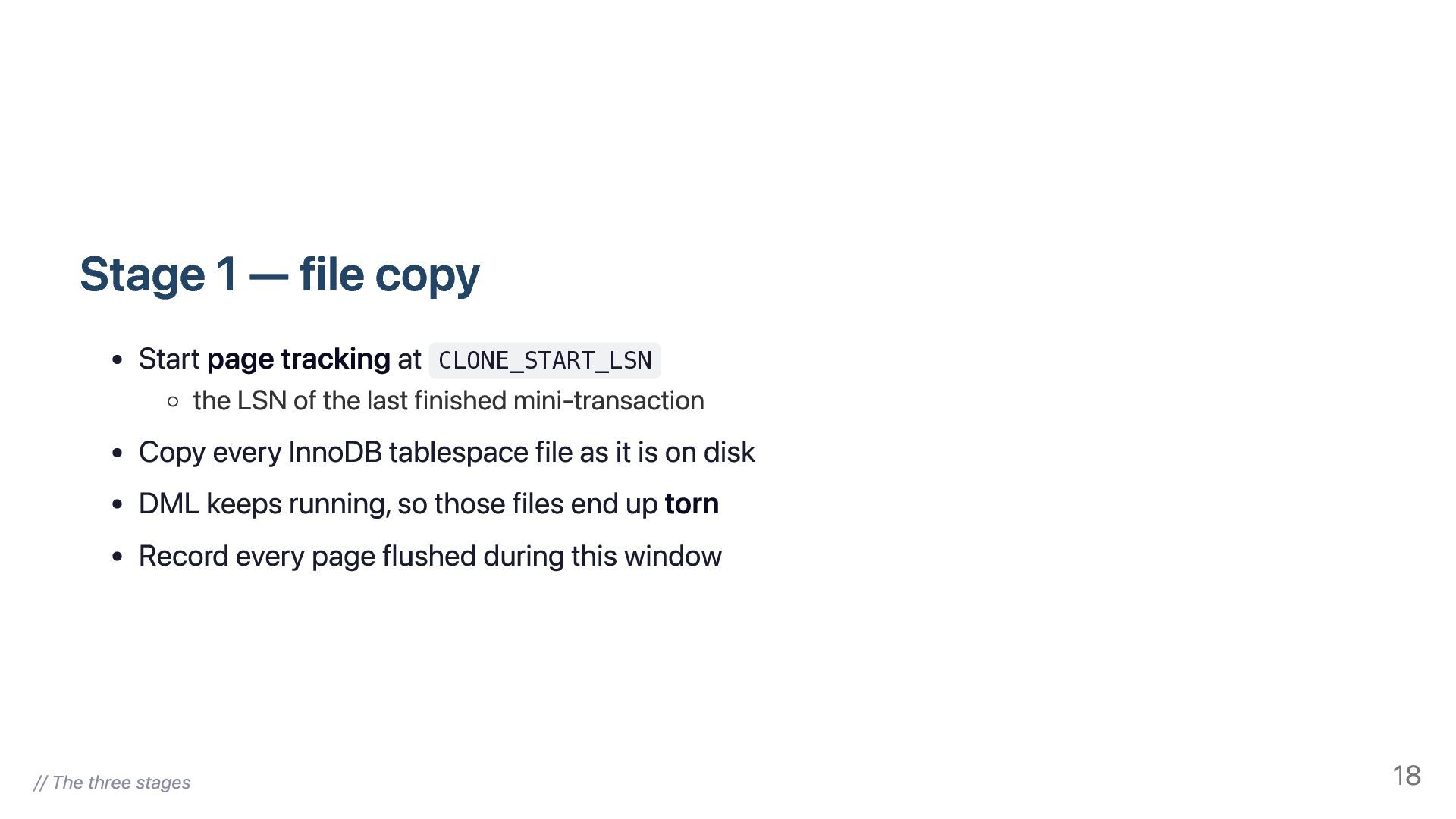
  15. Stage 1 — file copy Start page tracking at CLONE_START_LSN

    the LSN of the last finished mini-transaction Copy every InnoDB tablespace file as it is on disk DML keeps running, so those files end up torn Record every page flushed during this window // The three stages 18
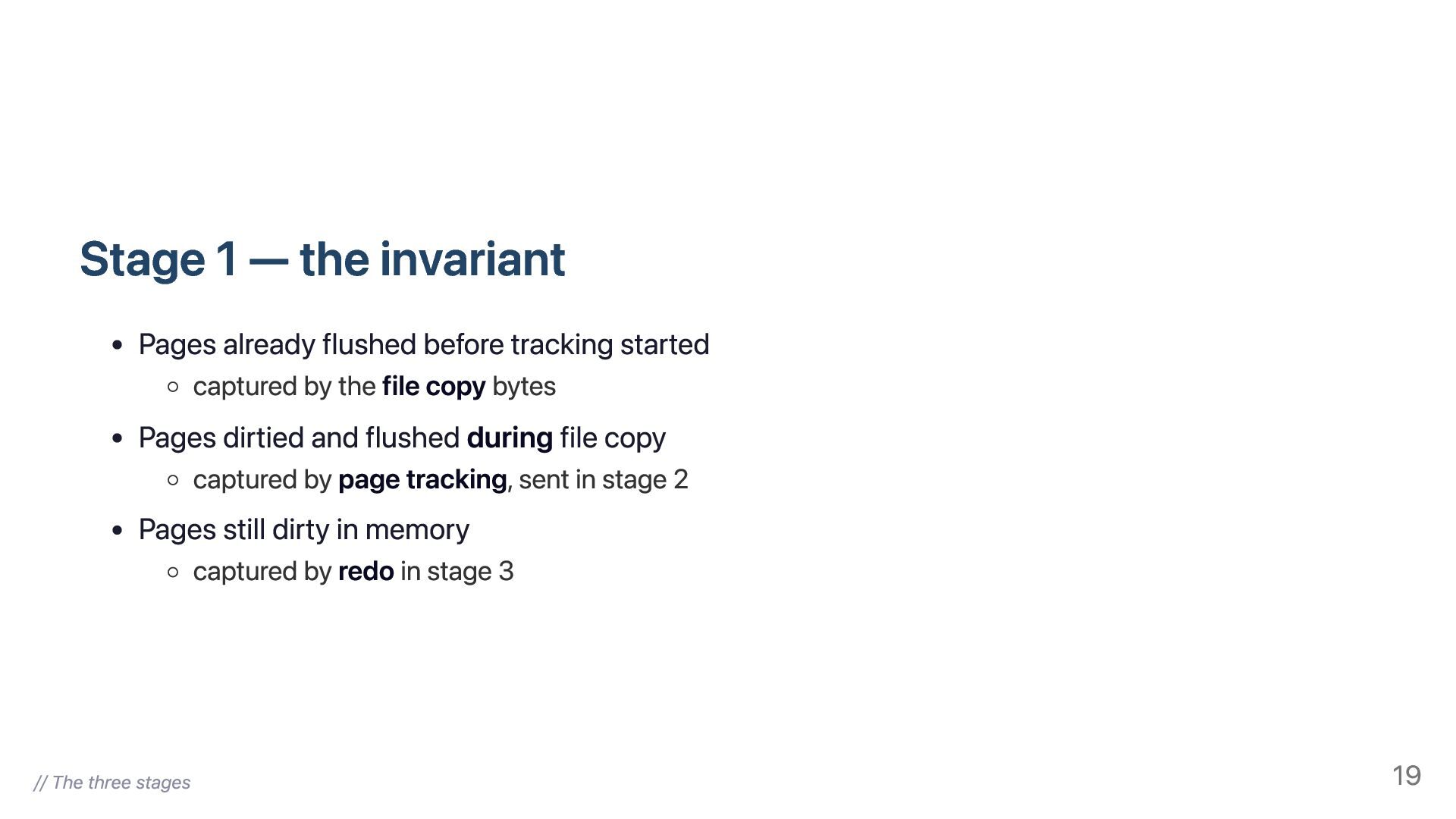
  16. Stage 1 — the invariant Pages already flushed before tracking

    started captured by the file copy bytes Pages dirtied and flushed during file copy captured by page tracking, sent in stage 2 Pages still dirty in memory captured by redo in stage 3 // The three stages 19
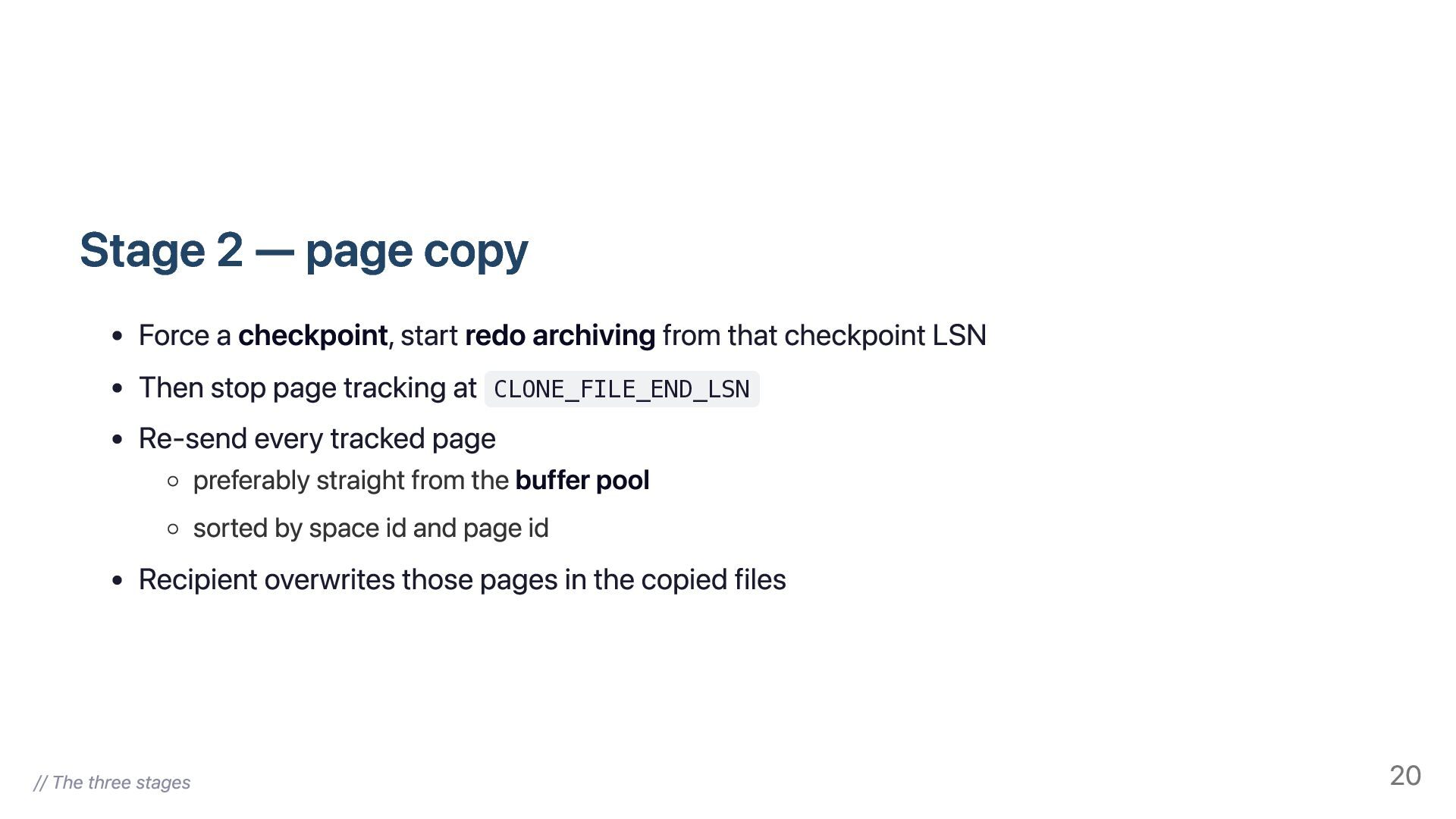
  17. Stage 2 — page copy Force a checkpoint, start redo

    archiving from that checkpoint LSN Then stop page tracking at Re-send every tracked page CLONE_FILE_END_LSN preferably straight from the buffer pool sorted by space id and page id Recipient overwrites those pages in the copied files // The three stages 20
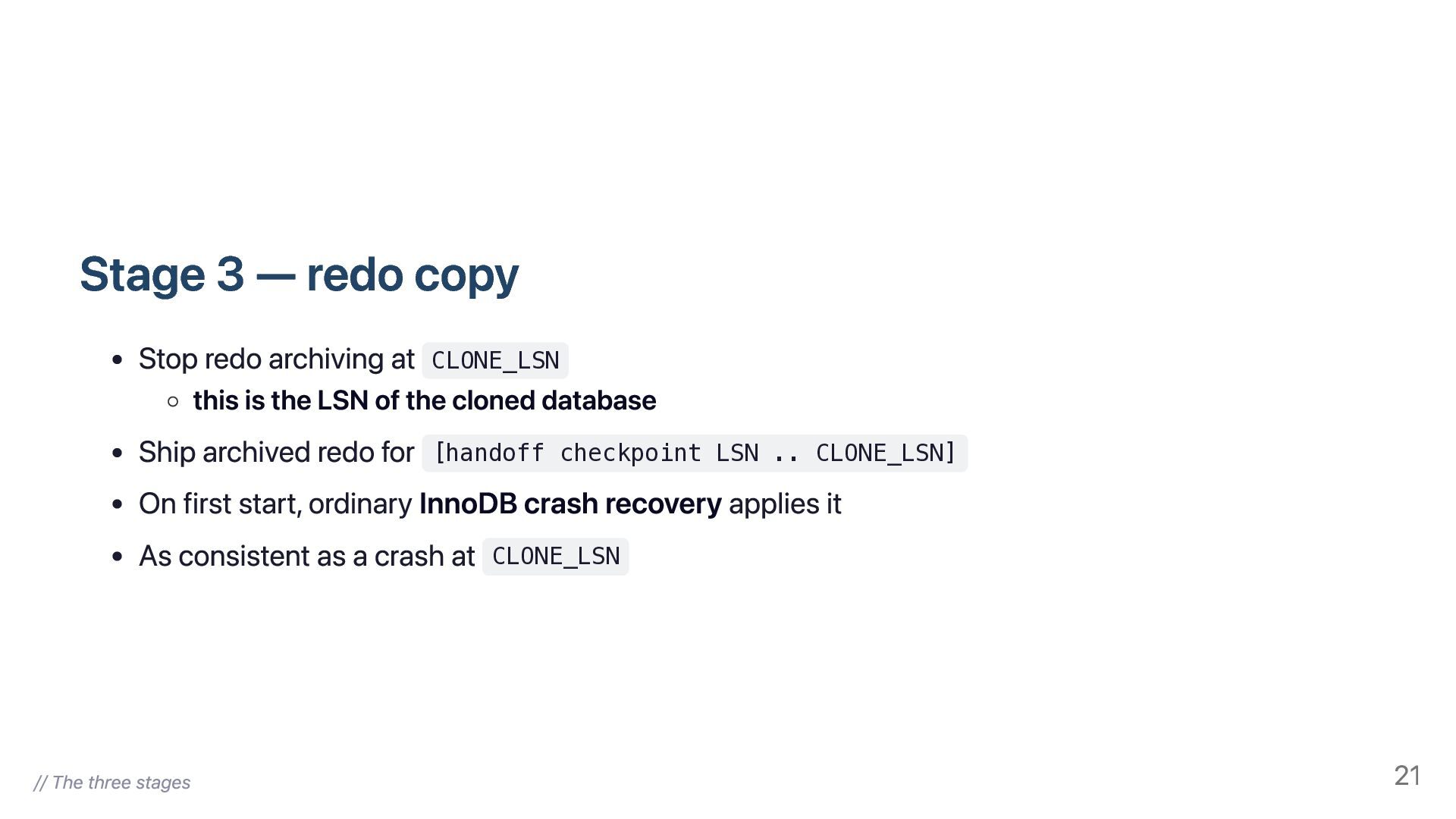
  18. Stage 3 — redo copy Stop redo archiving at CLONE_LSN

    this is the LSN of the cloned database Ship archived redo for On first start, ordinary InnoDB crash recovery applies it As consistent as a crash at [handoff checkpoint LSN .. CLONE_LSN] CLONE_LSN // The three stages 21
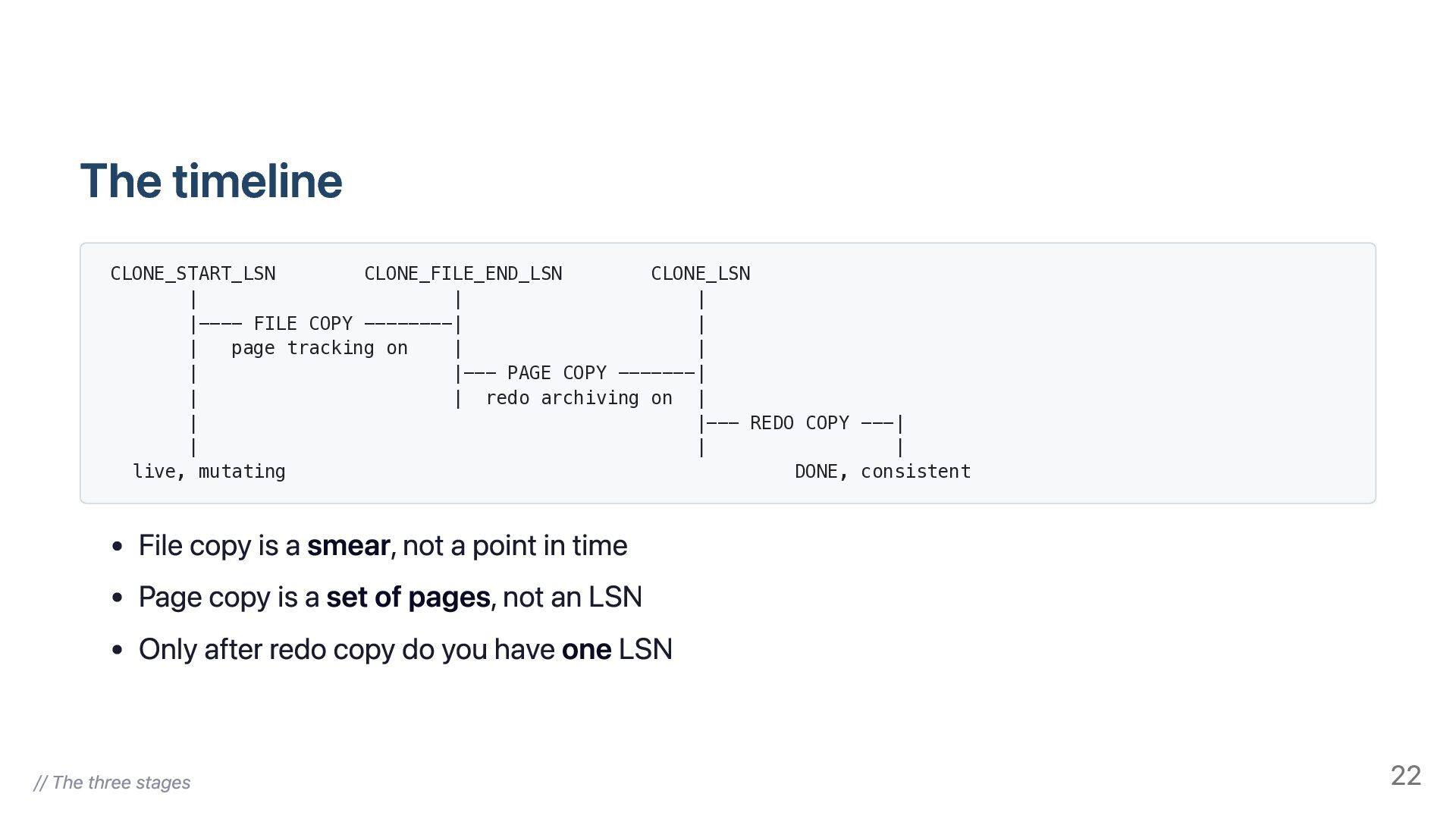
  19. The timeline CLONE_START_LSN CLONE_FILE_END_LSN CLONE_LSN | | | |---- FILE

    COPY --------| | | page tracking on | | | |--- PAGE COPY -------| | | redo archiving on | | |--- REDO COPY ---| | | | live, mutating DONE, consistent File copy is a smear, not a point in time Page copy is a set of pages, not an LSN Only after redo copy do you have one LSN // The three stages 22
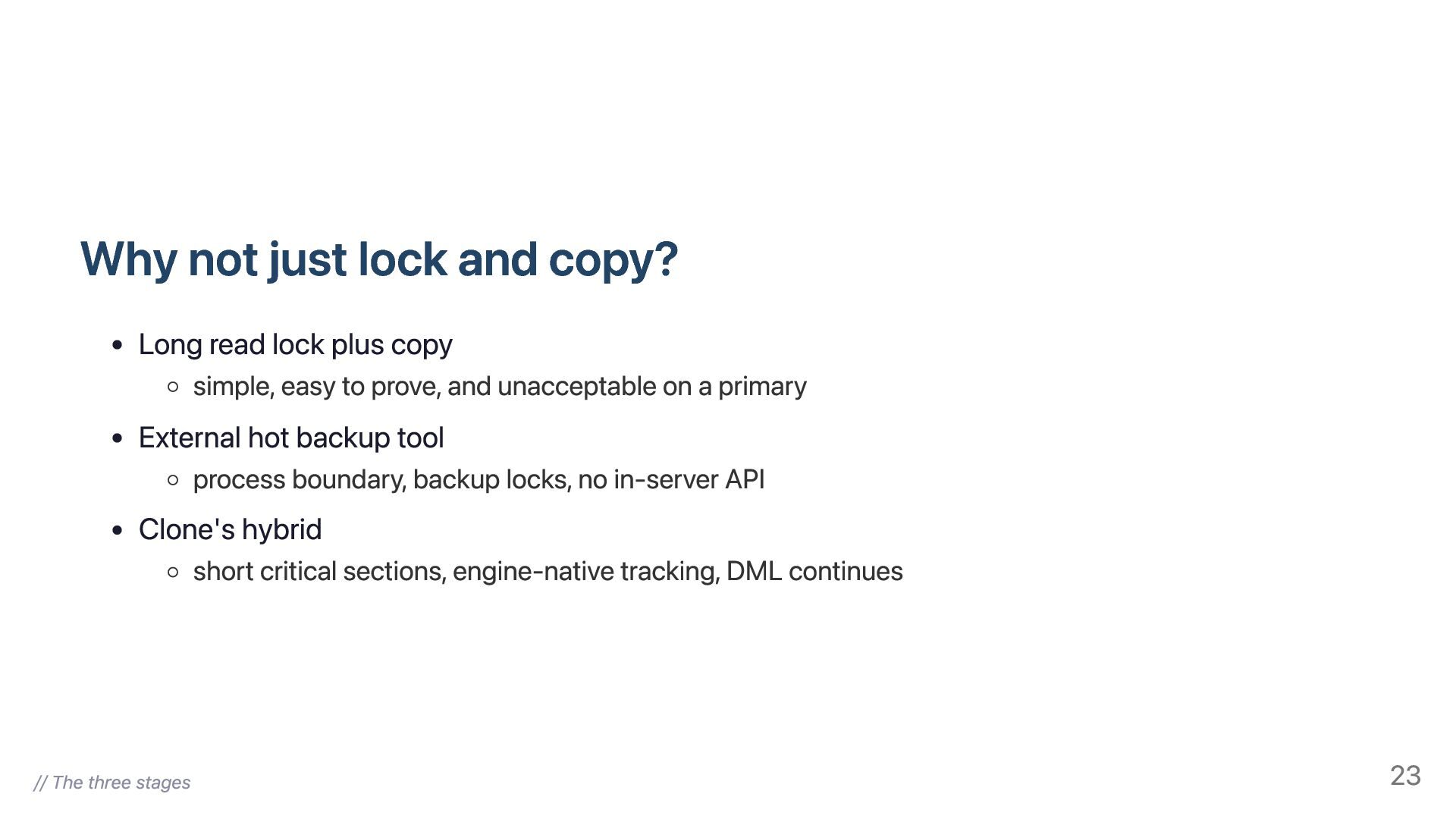
  20. Why not just lock and copy? Long read lock plus

    copy simple, easy to prove, and unacceptable on a primary External hot backup tool process boundary, backup locks, no in-server API Clone's hybrid short critical sections, engine-native tracking, DML continues // The three stages 23
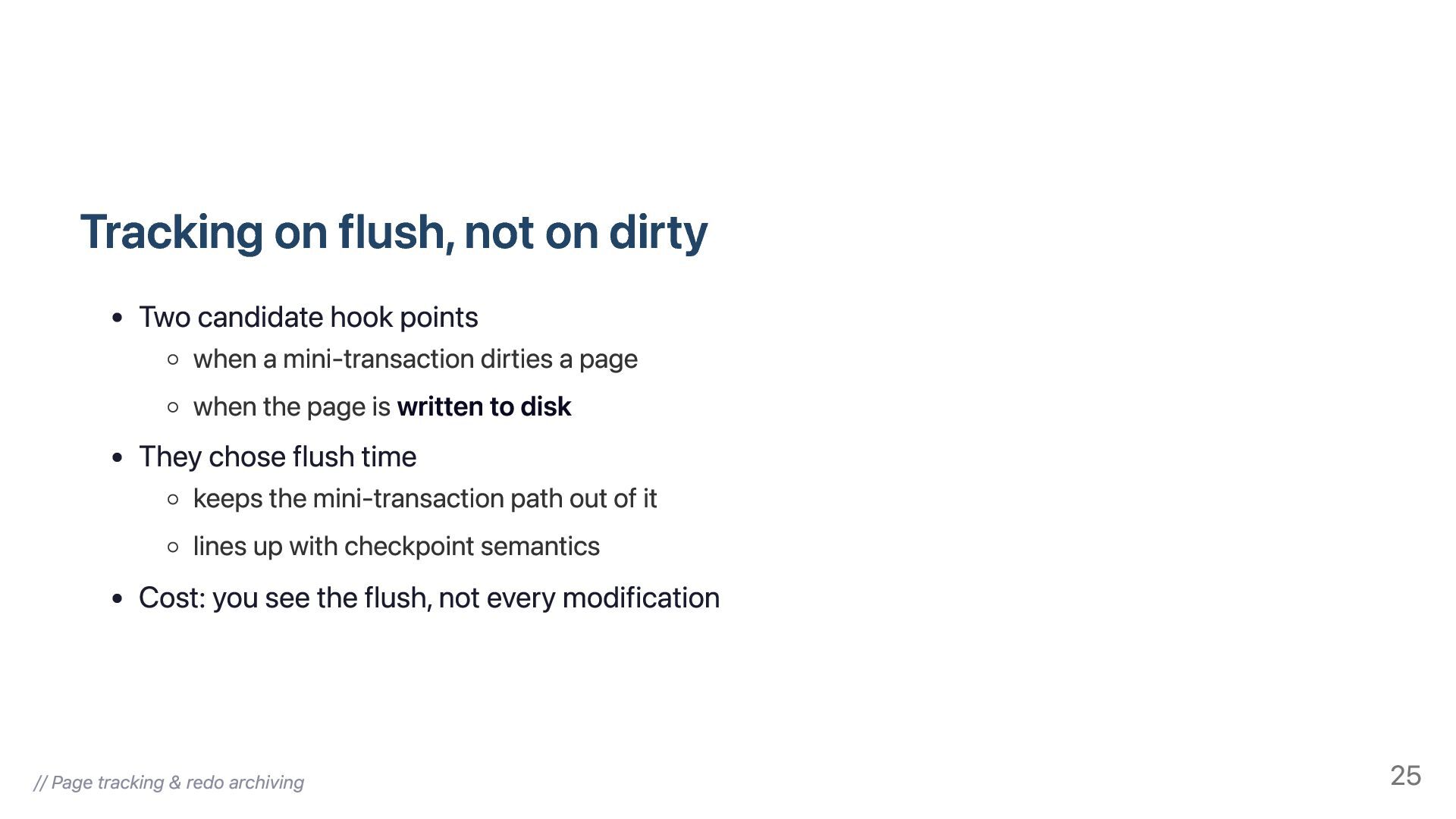
  21. Tracking on flush, not on dirty Two candidate hook points

    when a mini-transaction dirties a page when the page is written to disk They chose flush time keeps the mini-transaction path out of it lines up with checkpoint semantics Cost: you see the flush, not every modification // Page tracking & redo archiving 25
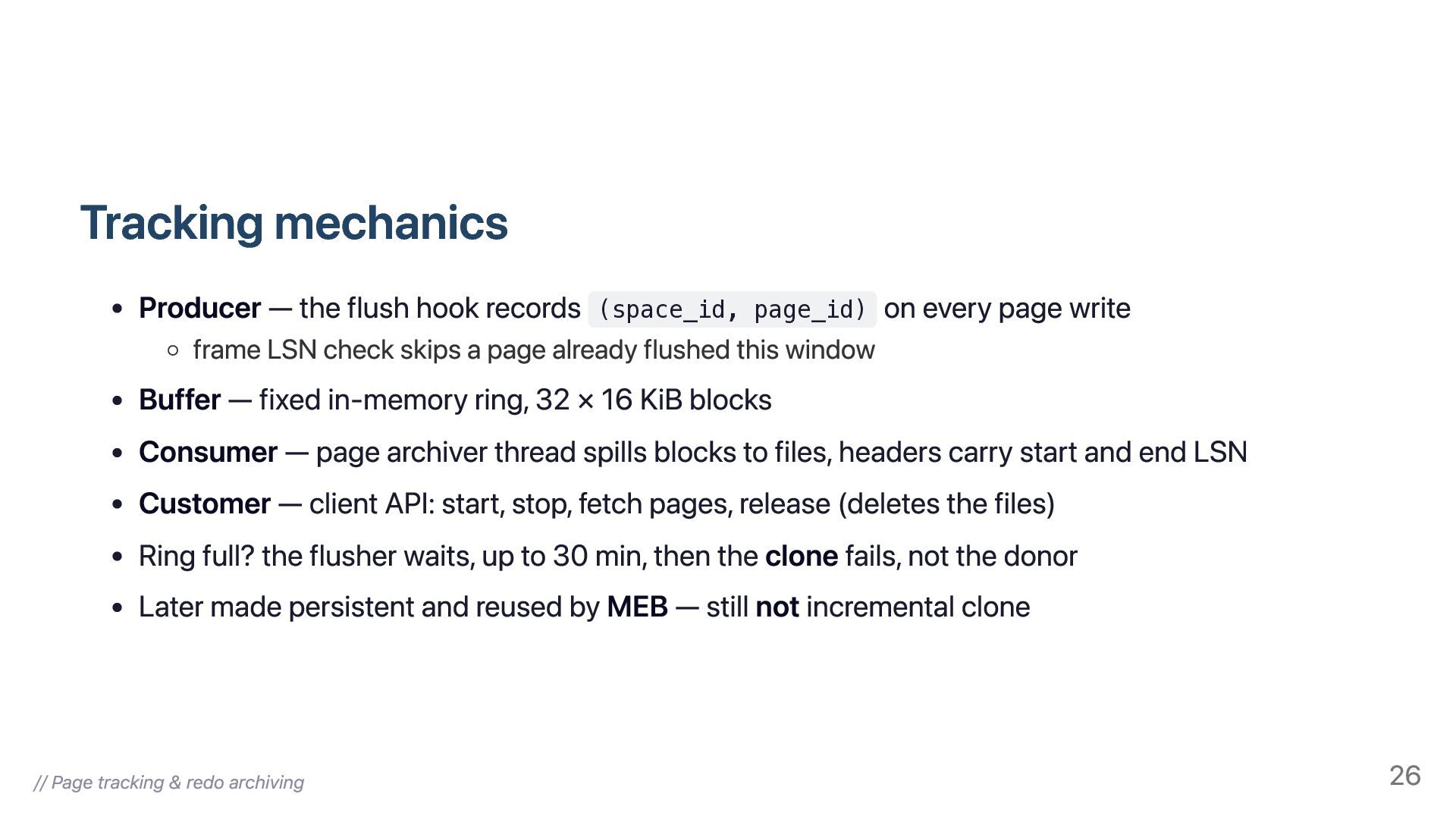
  22. Tracking mechanics Producer — the flush hook records (space_id, page_id)

    frame LSN check skips a page already flushed this window on every page write Buffer — fixed in-memory ring, 32 × 16 KiB blocks Consumer — page archiver thread spills blocks to files, headers carry start and end LSN Customer — client API: start, stop, fetch pages, release (deletes the files) Ring full? the flusher waits, up to 30 min, then the clone fails, not the donor Later made persistent and reused by MEB — still not incremental clone // Page tracking & redo archiving 26
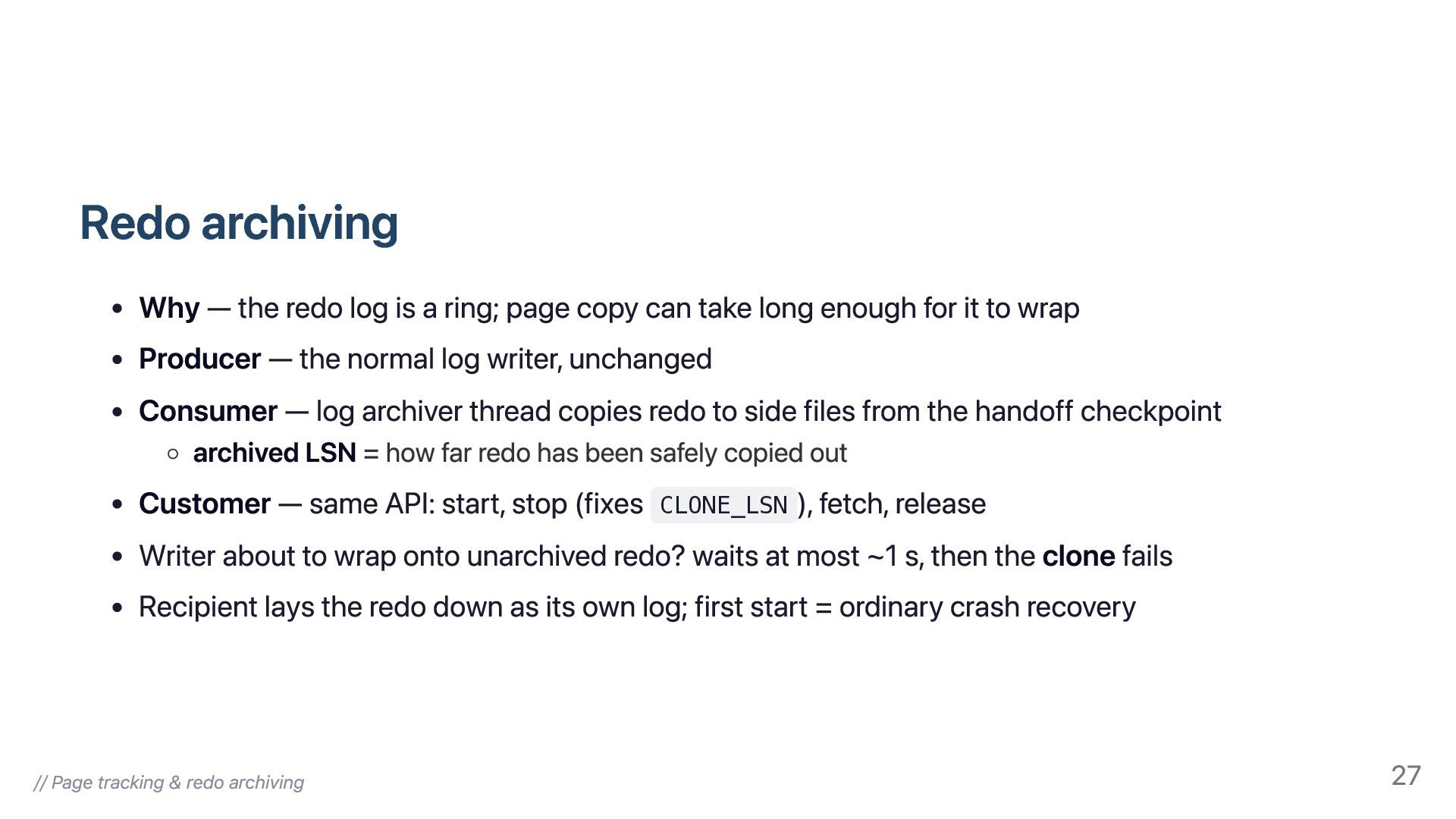
  23. Redo archiving Why — the redo log is a ring;

    page copy can take long enough for it to wrap Producer — the normal log writer, unchanged Consumer — log archiver thread copies redo to side files from the handoff checkpoint archived LSN = how far redo has been safely copied out Customer — same API: start, stop (fixes ), fetch, release Writer about to wrap onto unarchived redo? waits at most ~1 s, then the clone fails Recipient lays the redo down as its own log; first start = ordinary crash recovery CLONE_LSN // Page tracking & redo archiving 27
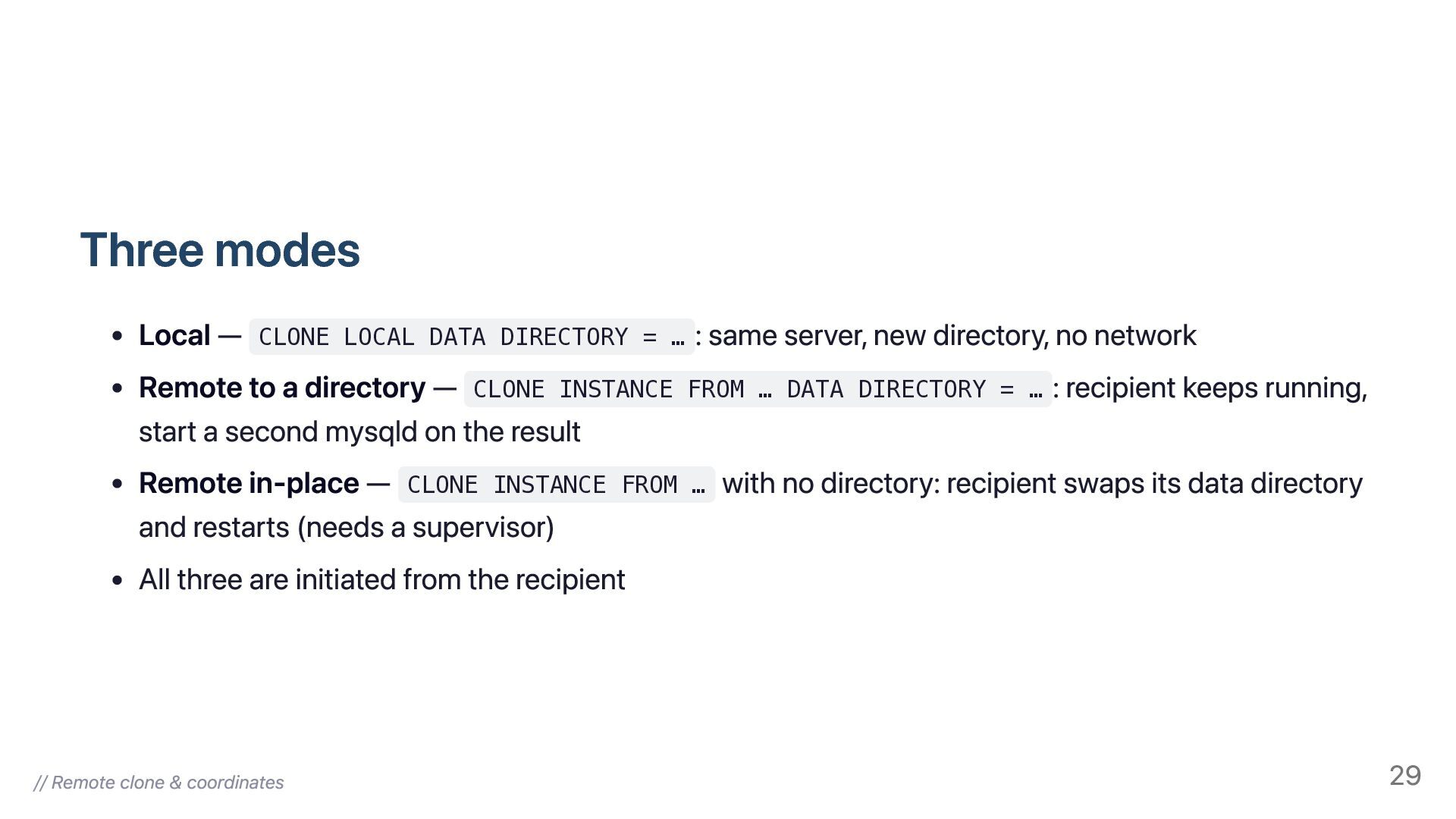
  24. Three modes Local — Remote to a directory — start

    a second mysqld on the result Remote in-place — and restarts (needs a supervisor) All three are initiated from the recipient CLONE LOCAL DATA DIRECTORY = … : same server, new directory, no network : recipient keeps running, CLONE INSTANCE FROM … DATA DIRECTORY = … CLONE INSTANCE FROM … // Remote clone & coordinates with no directory: recipient swaps its data directory 29
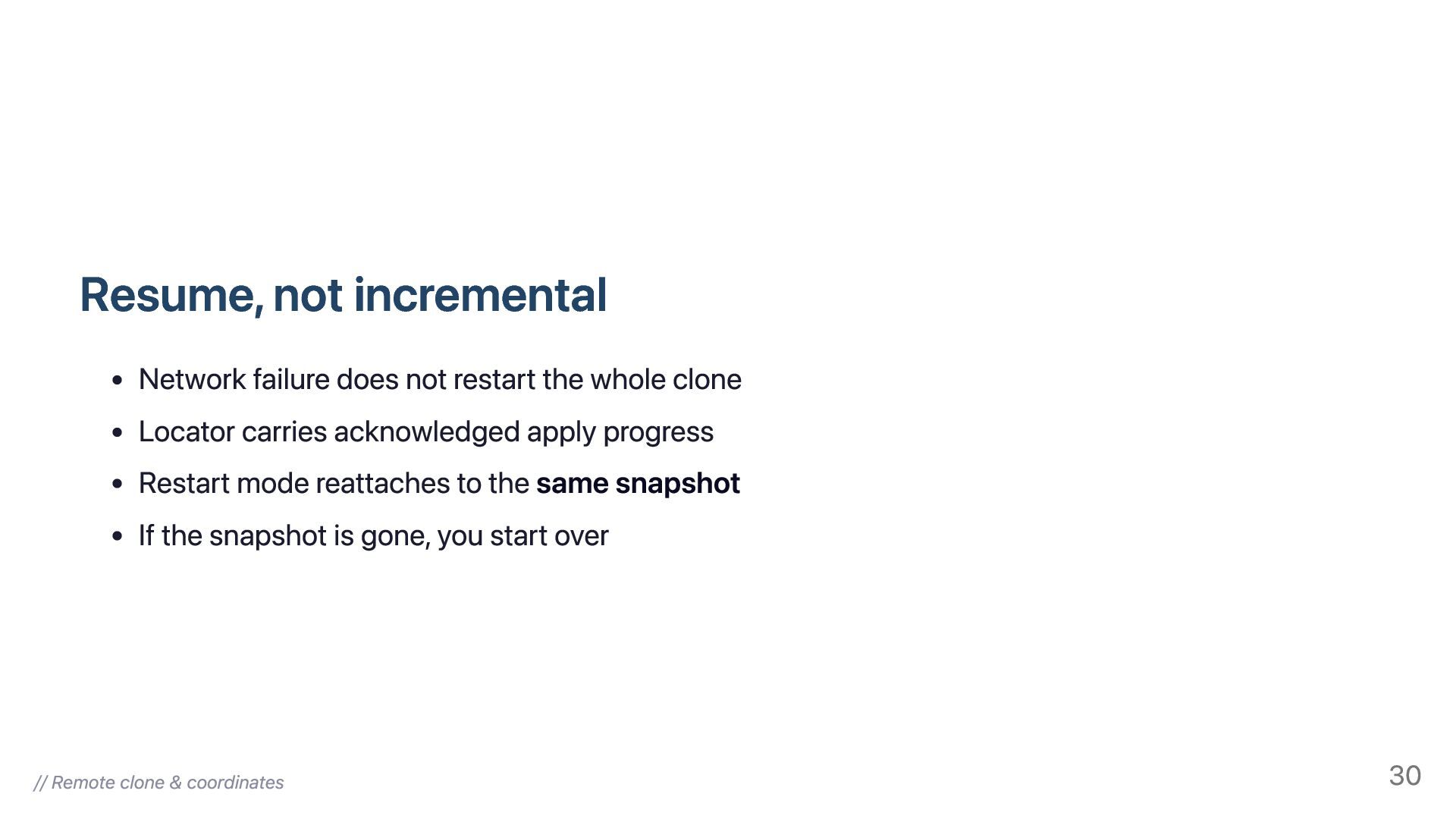
  25. Resume, not incremental Network failure does not restart the whole

    clone Locator carries acknowledged apply progress Restart mode reattaches to the same snapshot If the snapshot is gone, you start over // Remote clone & coordinates 30
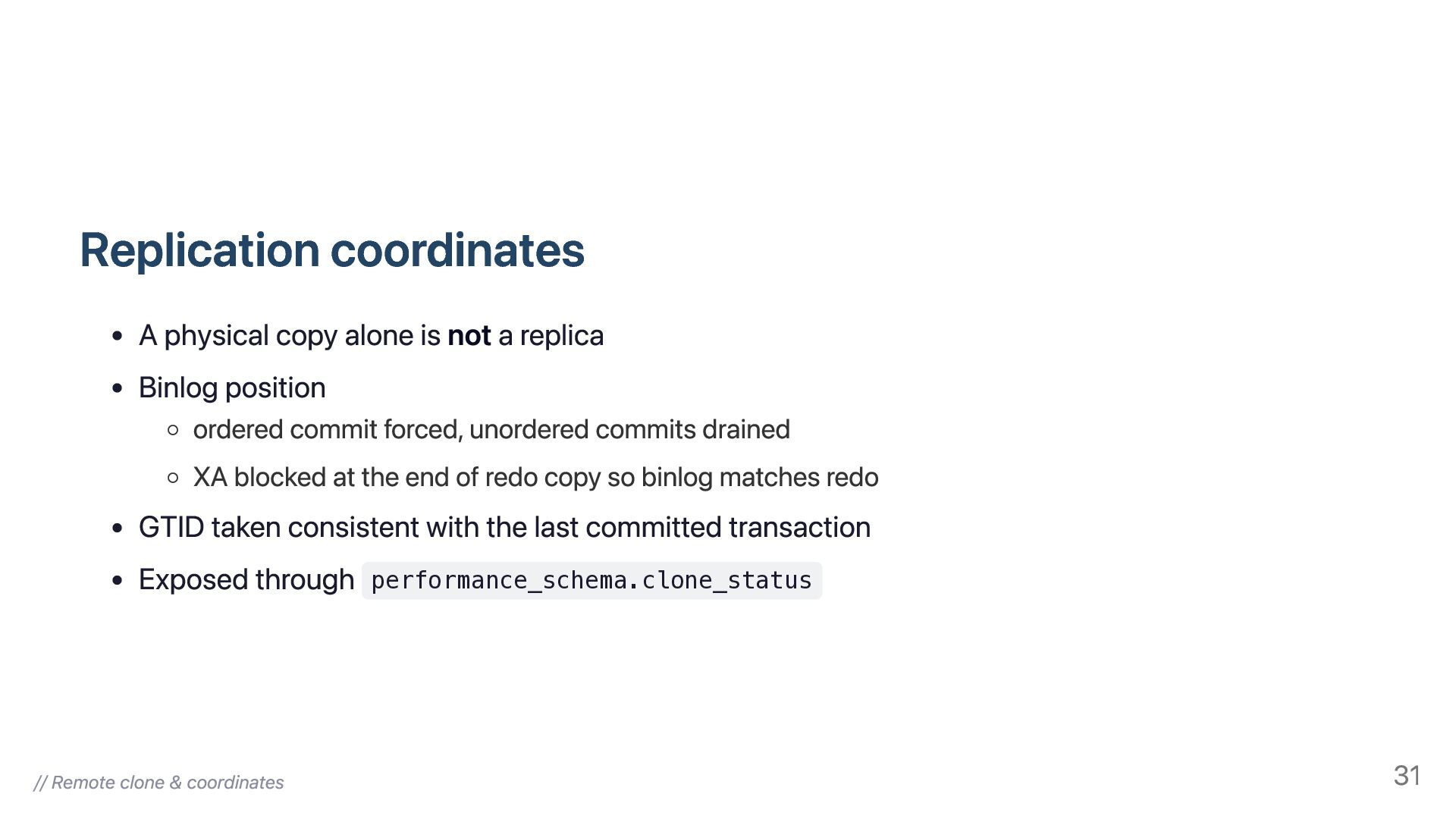
  26. Replication coordinates A physical copy alone is not a replica

    Binlog position ordered commit forced, unordered commits drained XA blocked at the end of redo copy so binlog matches redo GTID taken consistent with the last committed transaction Exposed through performance_schema.clone_status // Remote clone & coordinates 31
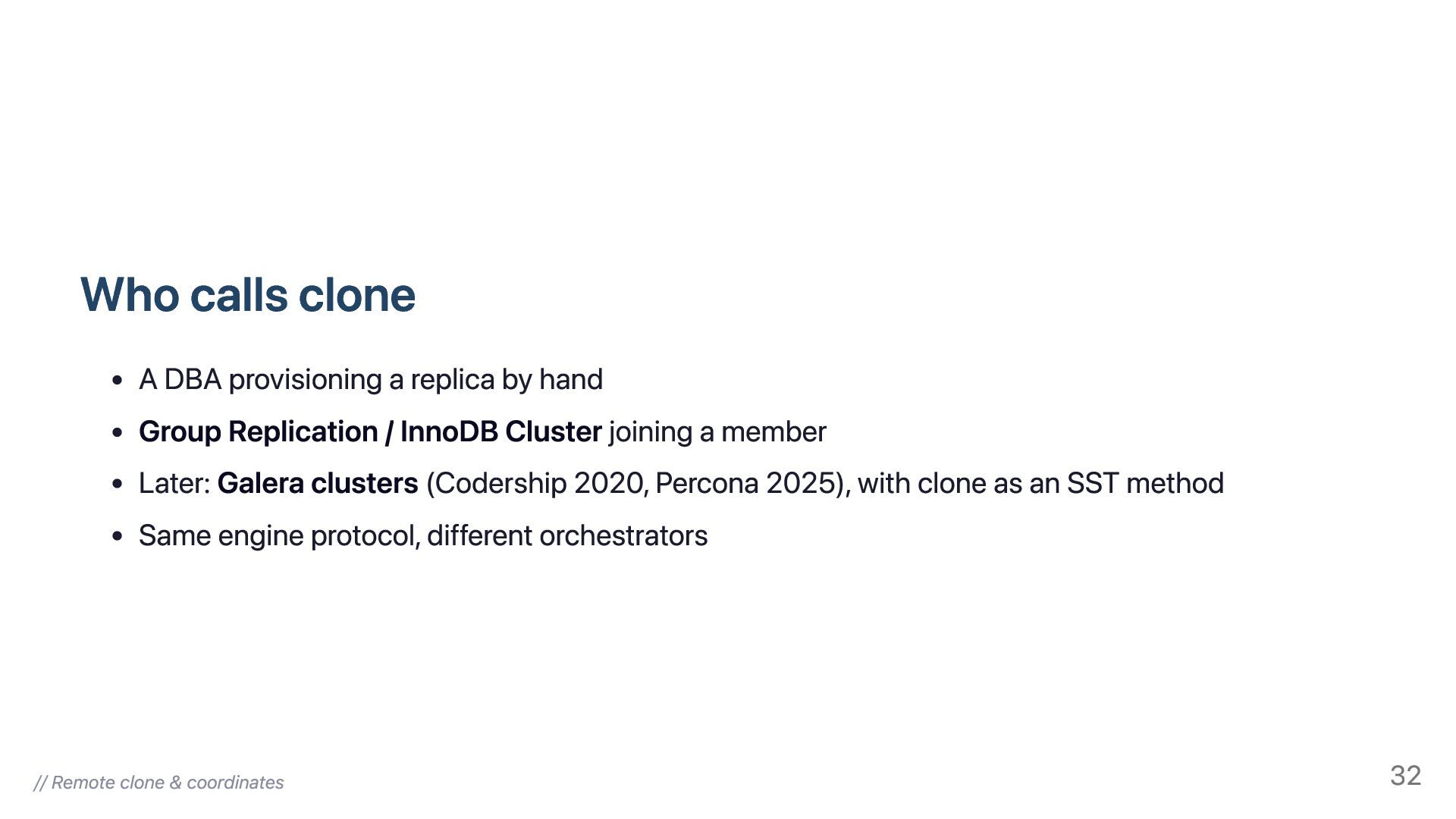
  27. Who calls clone A DBA provisioning a replica by hand

    Group Replication / InnoDB Cluster joining a member Later: Galera clusters (Codership 2020, Percona 2025), with clone as an SST method Same engine protocol, different orchestrators // Remote clone & coordinates 32
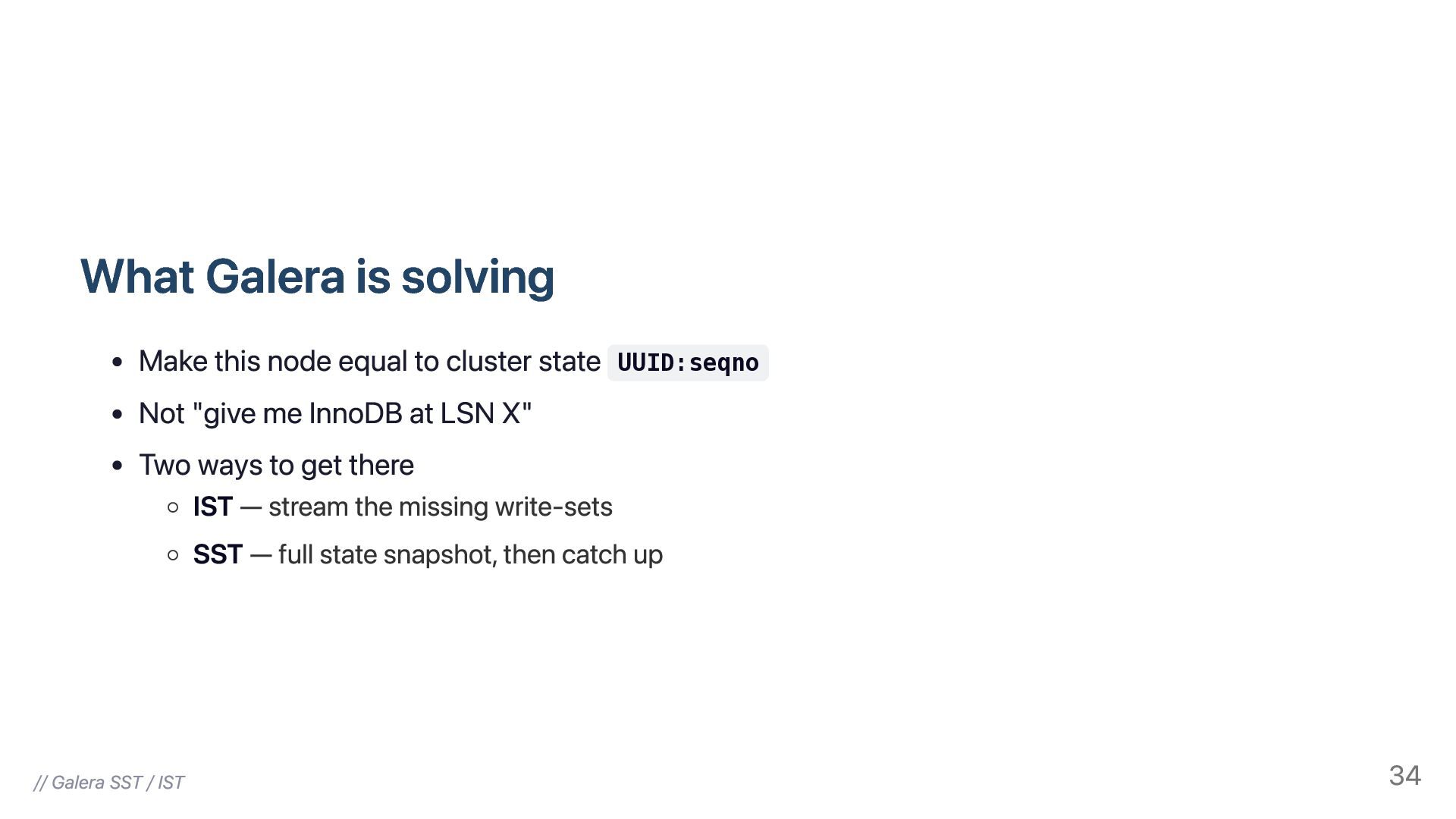
  28. What Galera is solving Make this node equal to cluster

    state Not "give me InnoDB at LSN X" Two ways to get there UUID:seqno IST — stream the missing write-sets SST — full state snapshot, then catch up // Galera SST / IST 34
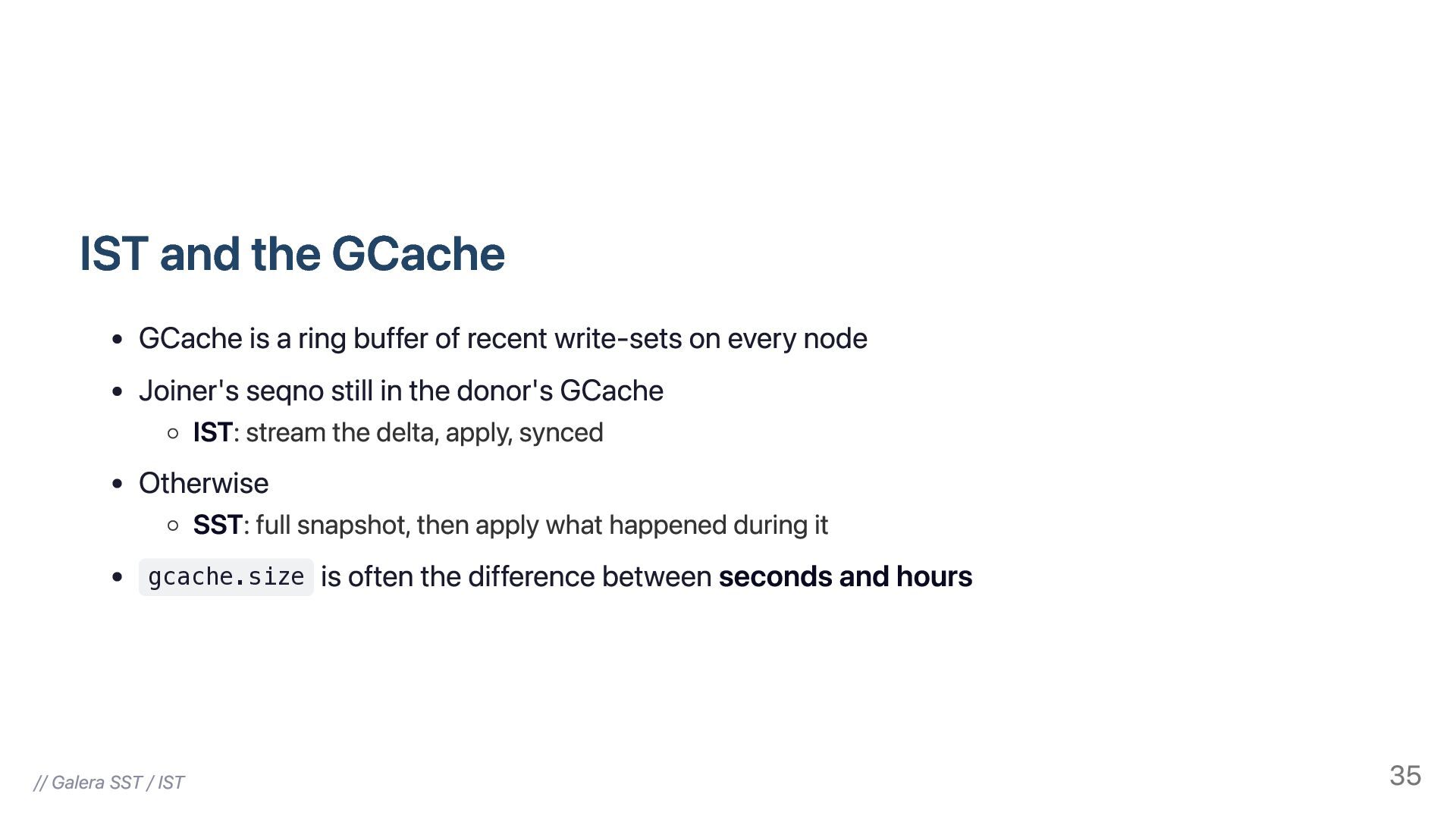
  29. IST and the GCache GCache is a ring buffer of

    recent write-sets on every node Joiner's seqno still in the donor's GCache IST: stream the delta, apply, synced Otherwise SST: full snapshot, then apply what happened during it gcache.size // Galera SST / IST is often the difference between seconds and hours 35
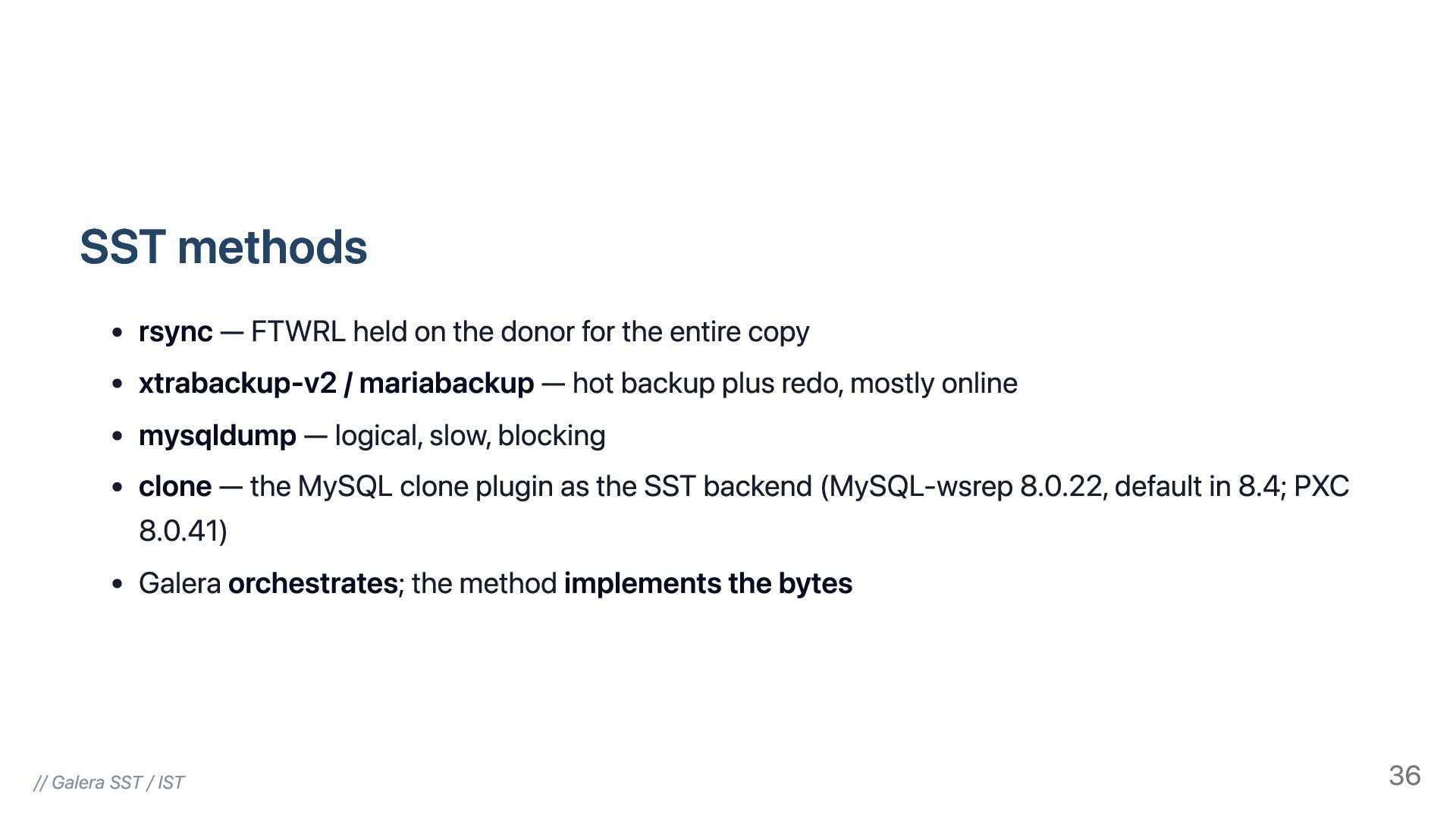
  30. SST methods rsync — FTWRL held on the donor for

    the entire copy xtrabackup-v2 / mariabackup — hot backup plus redo, mostly online mysqldump — logical, slow, blocking clone — the MySQL clone plugin as the SST backend (MySQL-wsrep 8.0.22, default in 8.4; PXC 8.0.41) Galera orchestrates; the method implements the bytes // Galera SST / IST 36
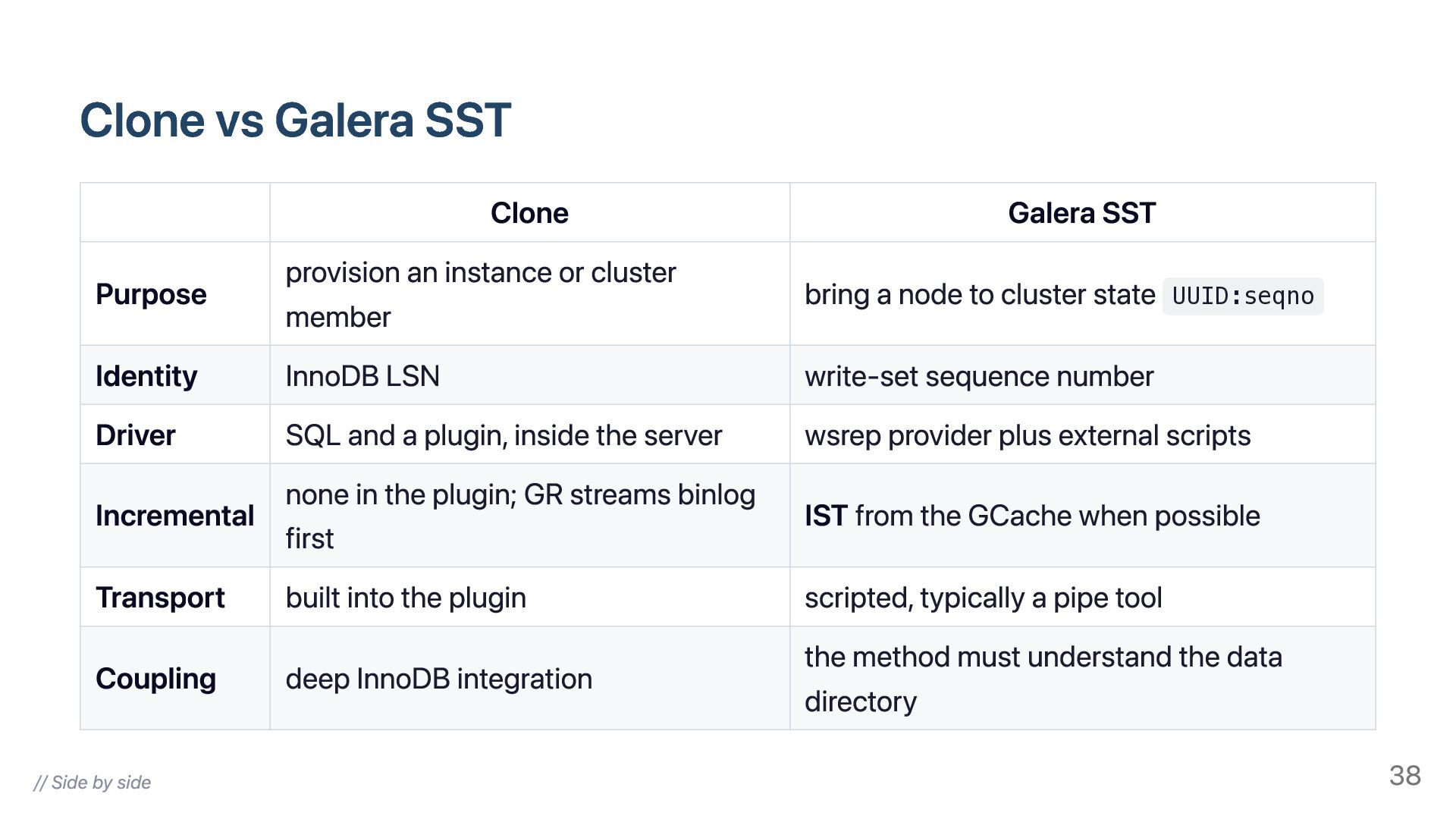
  31. Clone vs Galera SST Clone provision an instance or cluster

    Purpose member Identity InnoDB LSN Driver SQL and a plugin, inside the server in the plugin; GR streams binlog Incremental none first Transport built into the plugin Coupling deep InnoDB integration // Side by side Galera SST bring a node to cluster state write-set sequence number wsrep provider plus external scripts IST from the GCache when possible scripted, typically a pipe tool the method must understand the data directory UUID:seqno 38
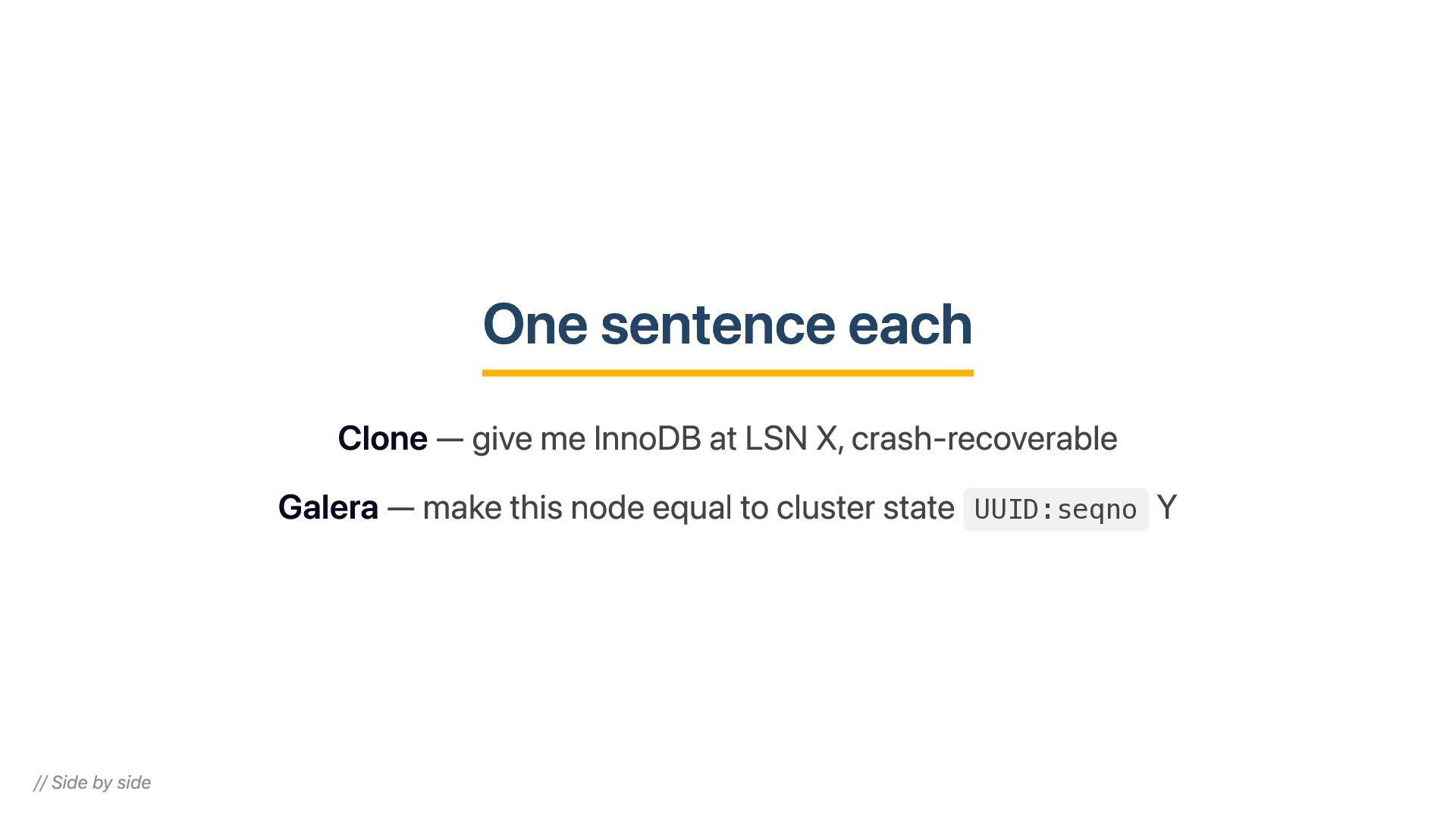
  32. One sentence each Clone — give me InnoDB at LSN

    X, crash-recoverable Galera — make this node equal to cluster state Y UUID:seqno // Side by side
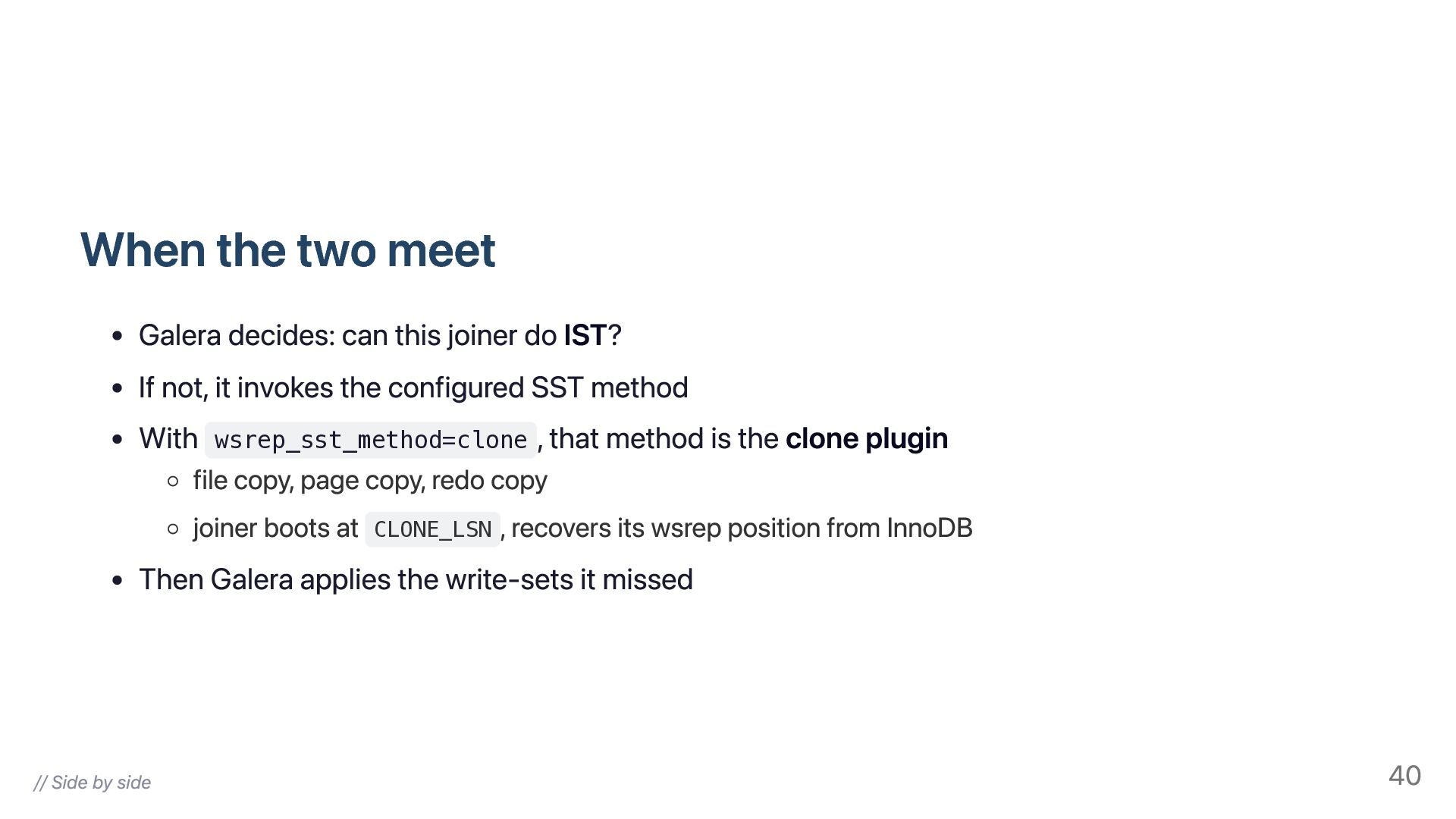
  33. When the two meet Galera decides: can this joiner do

    IST? If not, it invokes the configured SST method With , that method is the clone plugin wsrep_sst_method=clone file copy, page copy, redo copy joiner boots at , recovers its wsrep position from InnoDB CLONE_LSN Then Galera applies the write-sets it missed // Side by side 40
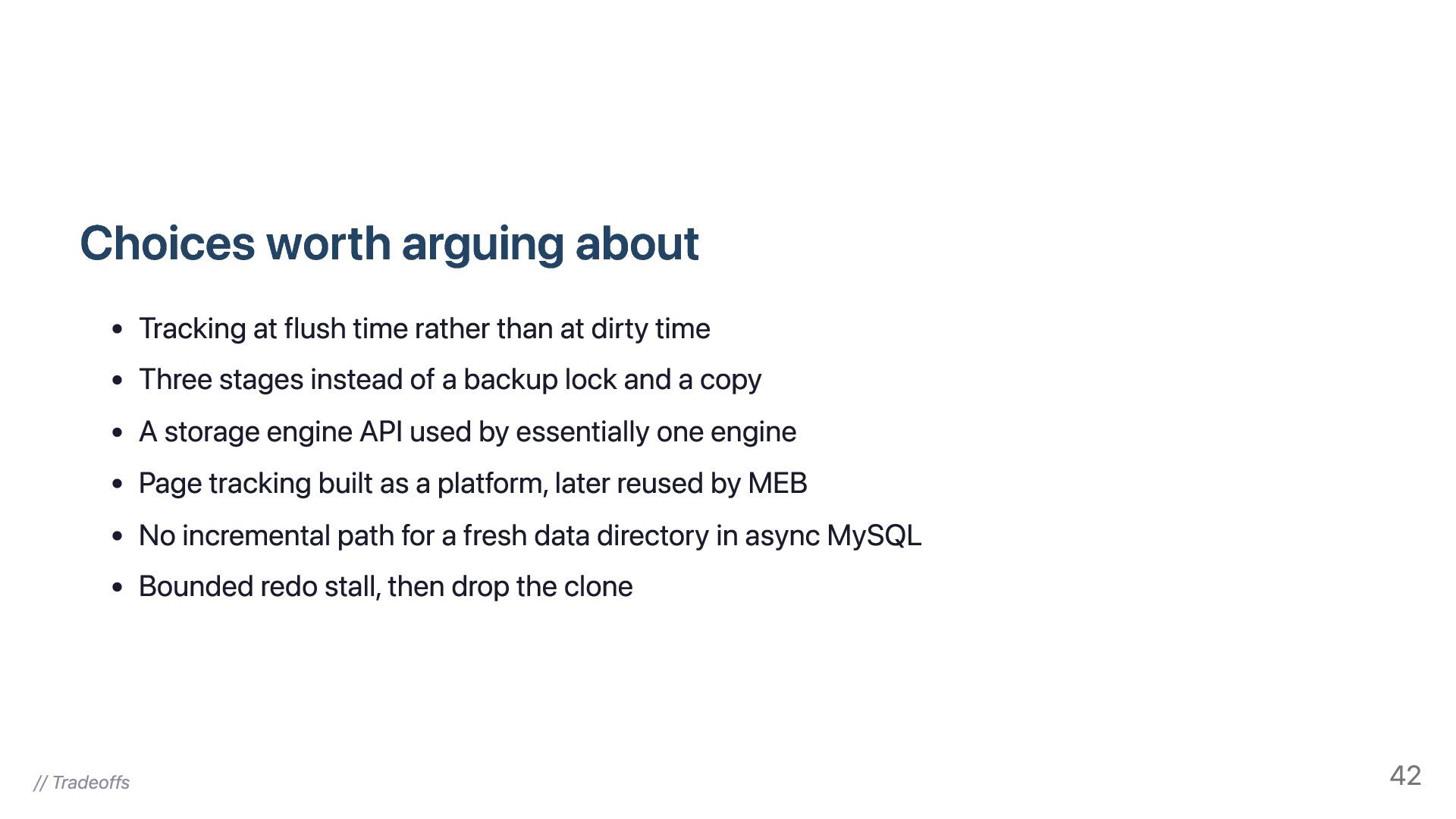
  34. Choices worth arguing about Tracking at flush time rather than

    at dirty time Three stages instead of a backup lock and a copy A storage engine API used by essentially one engine Page tracking built as a platform, later reused by MEB No incremental path for a fresh data directory in async MySQL Bounded redo stall, then drop the clone // Tradeoffs 42
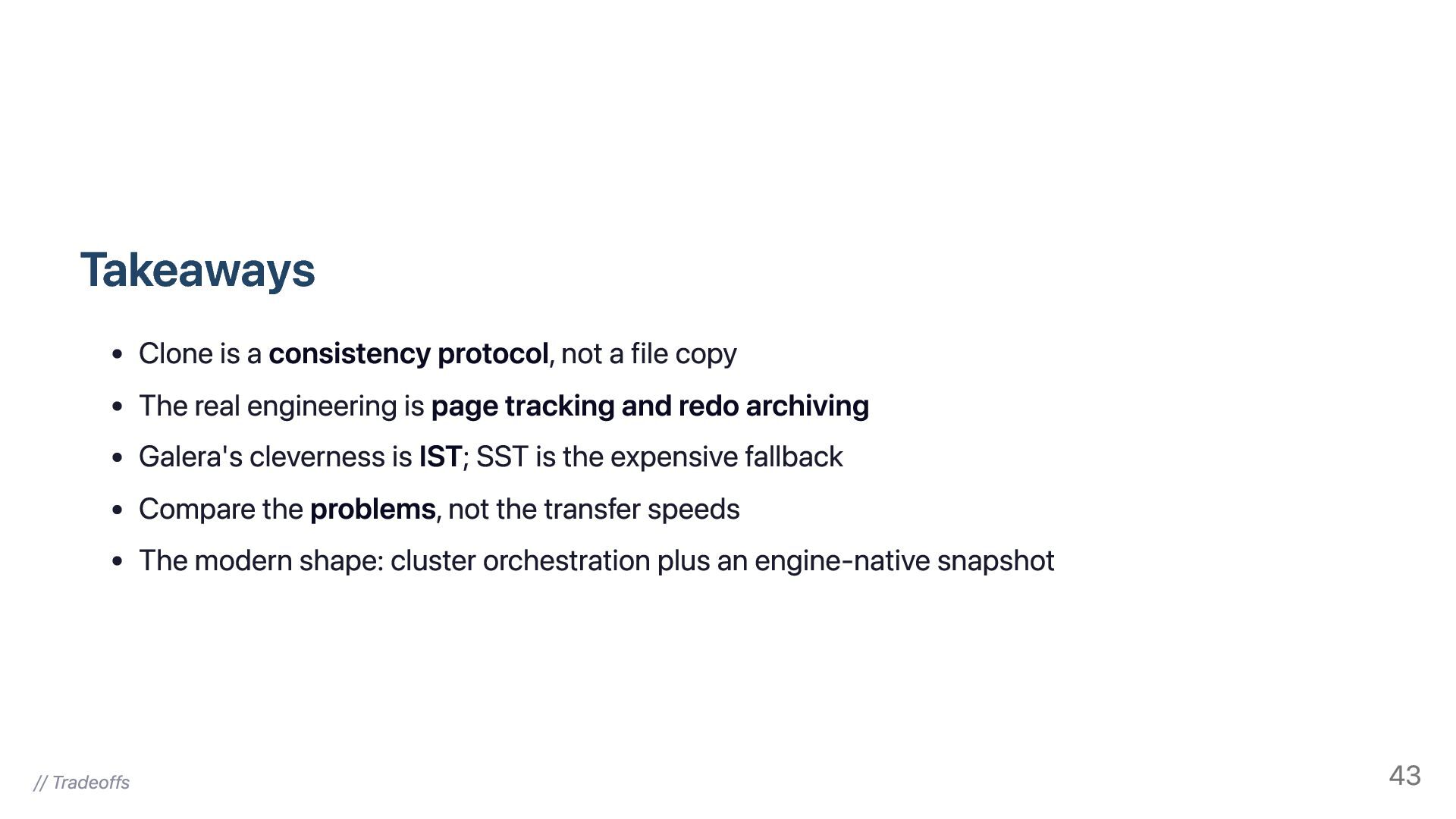
  35. Takeaways Clone is a consistency protocol, not a file copy

    The real engineering is page tracking and redo archiving Galera's cleverness is IST; SST is the expensive fallback Compare the problems, not the transfer speeds The modern shape: cluster orchestration plus an engine-native snapshot // Tradeoffs 43
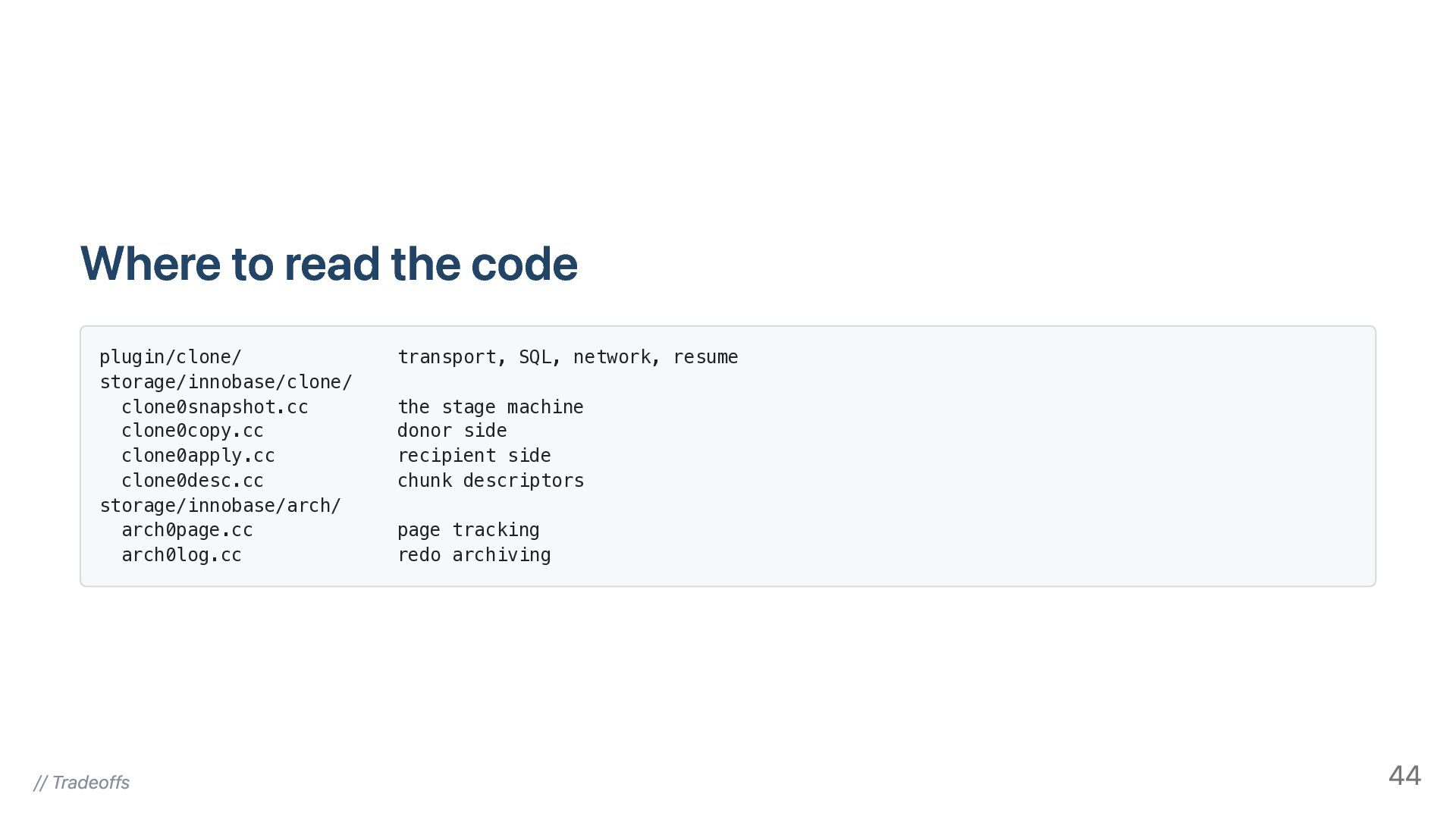
  36. Where to read the code plugin/clone/ storage/innobase/clone/ clone0snapshot.cc clone0copy.cc clone0apply.cc

    clone0desc.cc storage/innobase/arch/ arch0page.cc arch0log.cc // Tradeoffs transport, SQL, network, resume the stage machine donor side recipient side chunk descriptors page tracking redo archiving 44
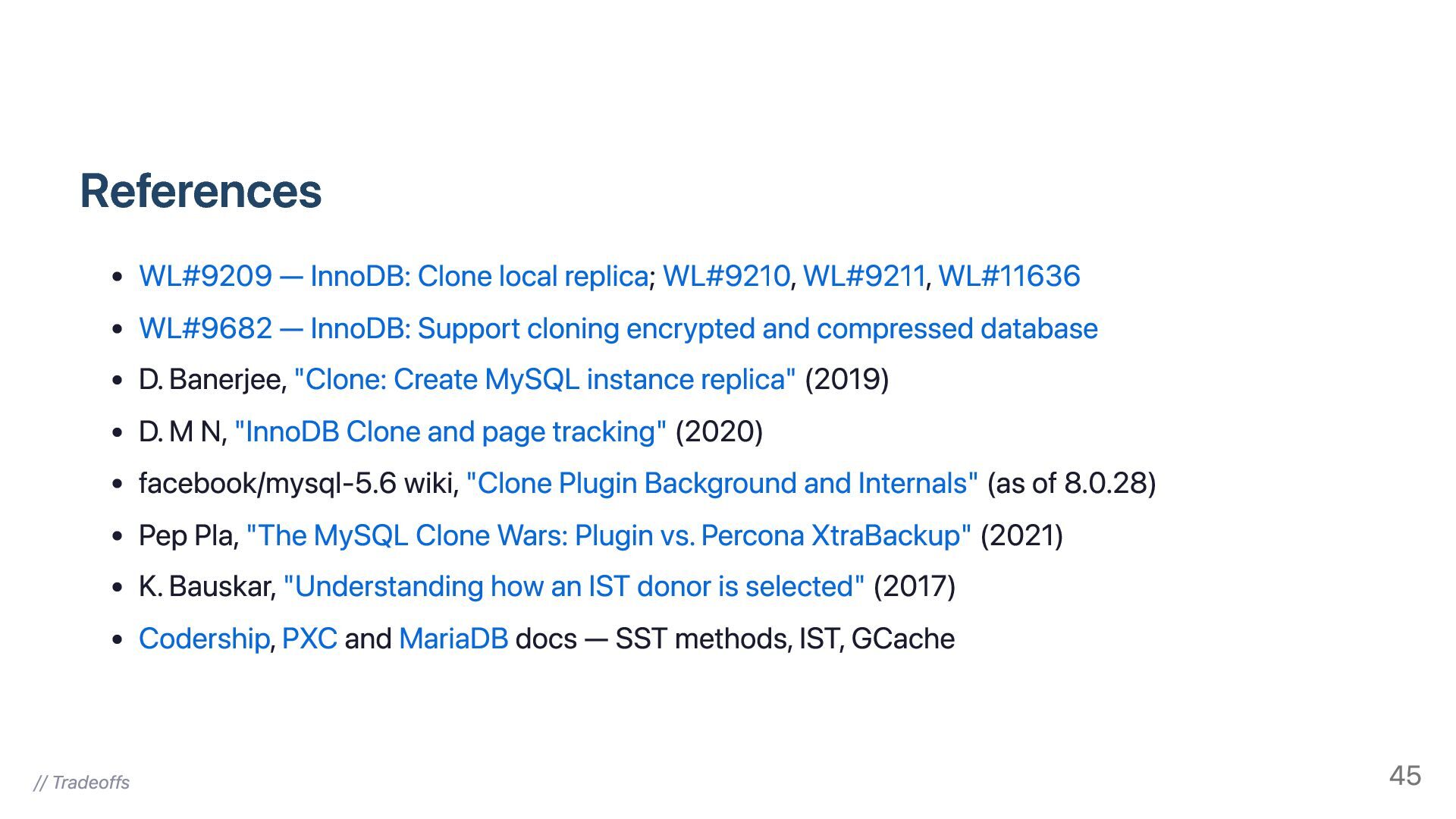
  37. References WL#9209 — InnoDB: Clone local replica; WL#9210, WL#9211, WL#11636

    WL#9682 — InnoDB: Support cloning encrypted and compressed database D. Banerjee, "Clone: Create MySQL instance replica" (2019) D. M N, "InnoDB Clone and page tracking" (2020) facebook/mysql-5.6 wiki, "Clone Plugin Background and Internals" (as of 8.0.28) Pep Pla, "The MySQL Clone Wars: Plugin vs. Percona XtraBackup" (2021) K. Bauskar, "Understanding how an IST donor is selected" (2017) Codership, PXC and MariaDB docs — SST methods, IST, GCache // Tradeoffs 45