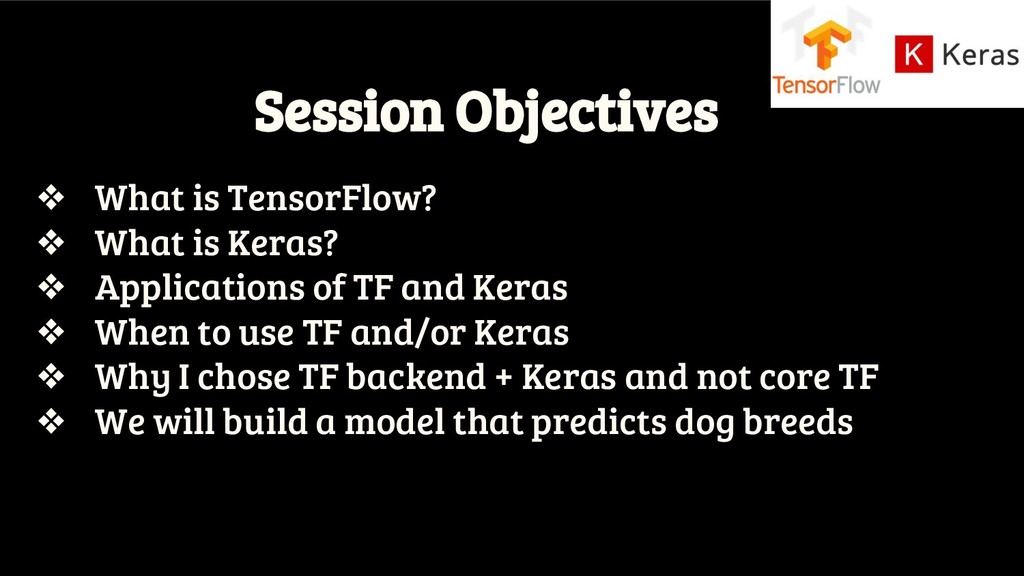
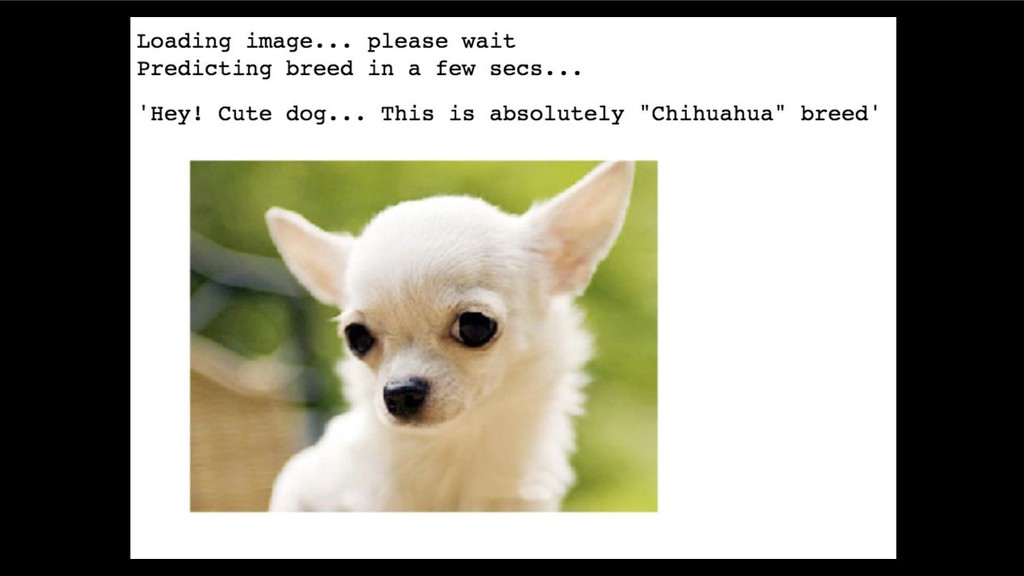
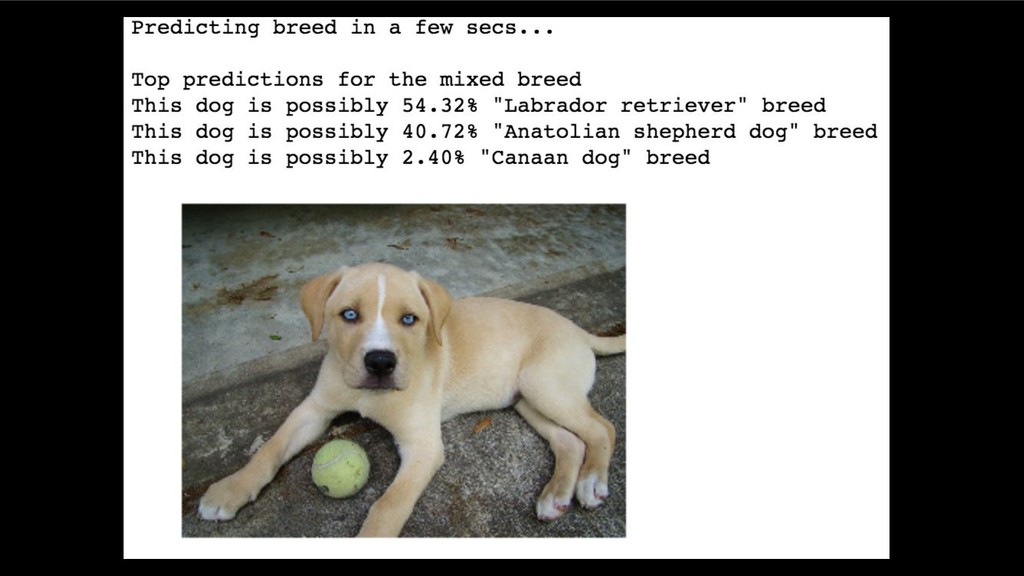
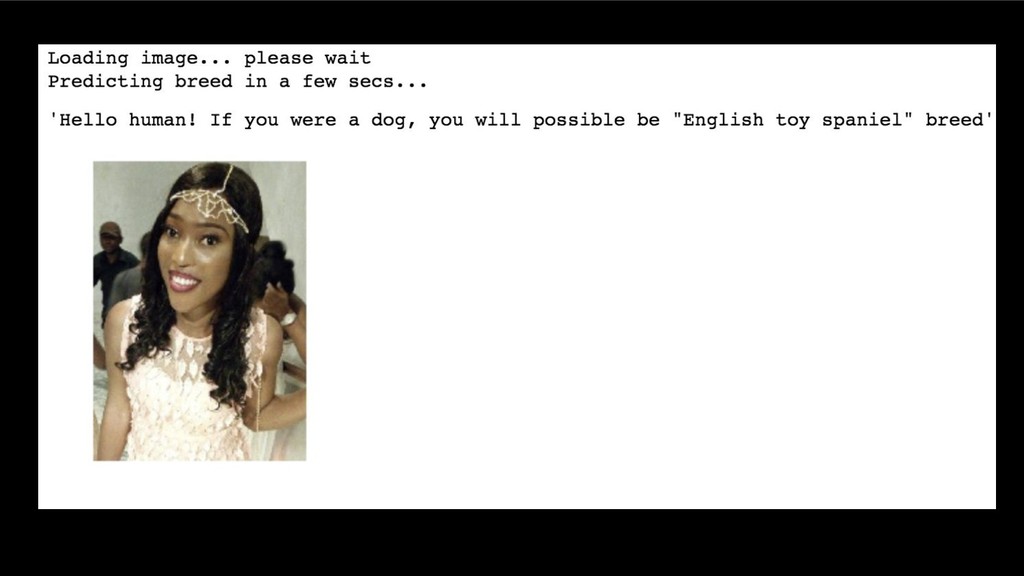
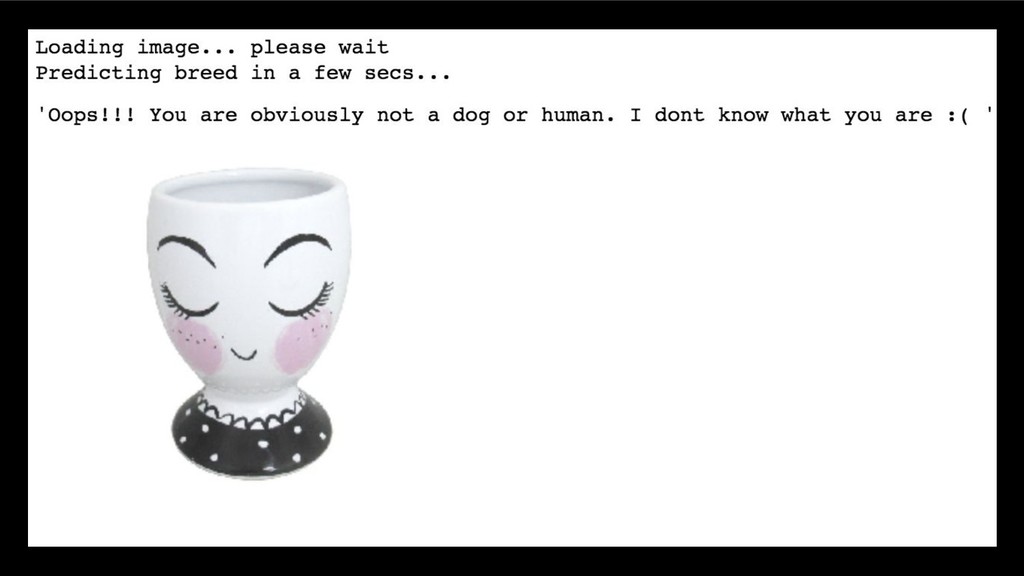
❖ Applications of TF and Keras ❖ When to use TF and/or Keras ❖ Why I chose TF backend + Keras and not core TF ❖ We will build a model that predicts dog breeds
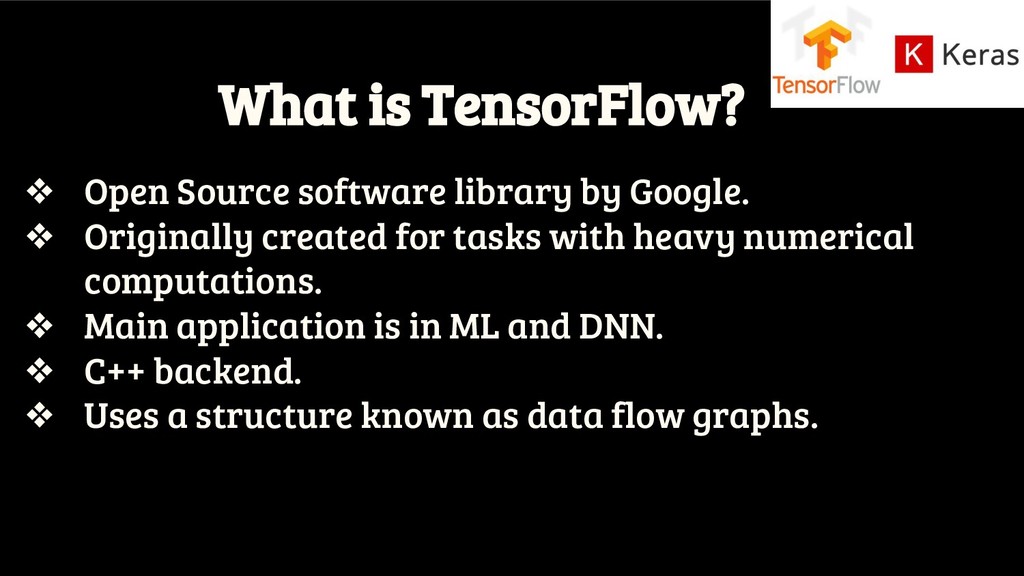
❖ Originally created for tasks with heavy numerical computations. ❖ Main application is in ML and DNN. ❖ C++ backend. ❖ Uses a structure known as data flow graphs.
API, written in Python. ❖ It is an abstraction layer that uses other underlying deep libraries like TensorFlow, CNTK, or Theano. ❖ Allows for easy and fast prototyping (through user friendliness, modularity, and extensibility). ❖ Supports both convolutional networks and recurrent networks, as well as combinations of the two. ❖ Runs seamlessly on CPU and GPU. ❖ Keras is the official high-level API for TF.
provides lower layer programming for deep learning than Keras, hence runs more efficiently. ❖ A better understanding of the Mathematical concepts behind Neural Networks. ❖ Higher learning curve.
lots of complex methods in few lines of code, making it easier to learn and use. ❖ It provides a faster track when you need to quickly train and test a model.
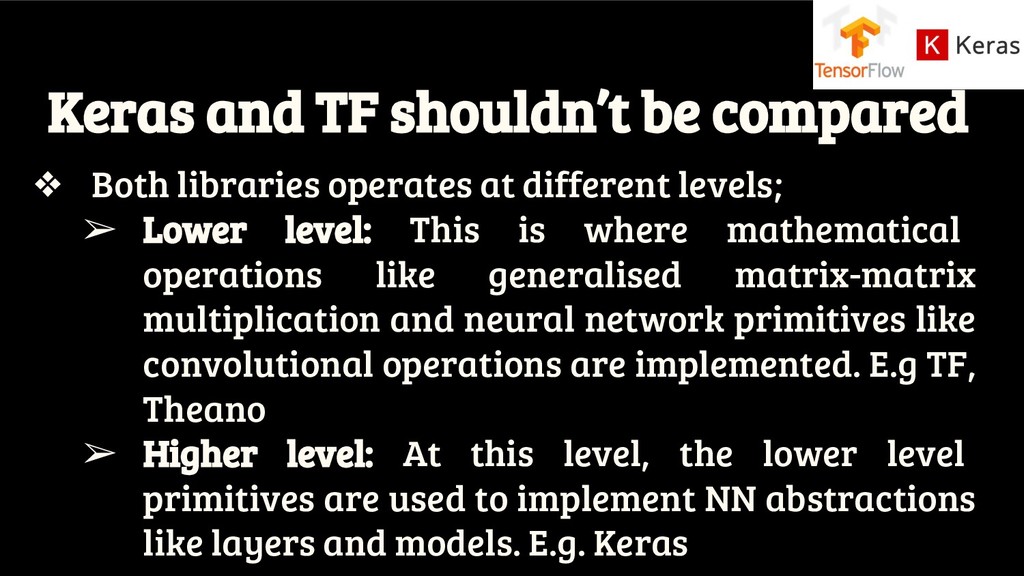
at different levels; ➢ Lower level: This is where mathematical operations like generalised matrix-matrix multiplication and neural network primitives like convolutional operations are implemented. E.g TF, Theano ➢ Higher level: At this level, the lower level primitives are used to implement NN abstractions like layers and models. E.g. Keras


 teamlab
 codmoninc
 bgpat
 nttcom
 pfn
 kash1064
 bitkey
 terapyon
 takahashim
 keeg
 yuuuuuuu168
 masakiokuda
 keithpitt
 ammeep
 frankvandijk
 palkan
 reverentgeek
 akademiya2063
 akashhashmi
 lynnandtonic
 ryanjones
 watany
 3n
 kimpetersen